Cambridge IGCSE Physical Science 0652 — 2018 Oct/Nov Paper 4 · Variant 2
0652/42/O/N/18 · 12 questions · 80 marks · ≈90 min
The question paper and its mark scheme, free to read here and free to download. This is Cambridge’s own paper, exactly as it was sat.
Question paper20 pages
Mark scheme9 pages
Answers below. Sit the paper first if you are practising.
Questions as text
Q1 · A spring suspended from a clamp
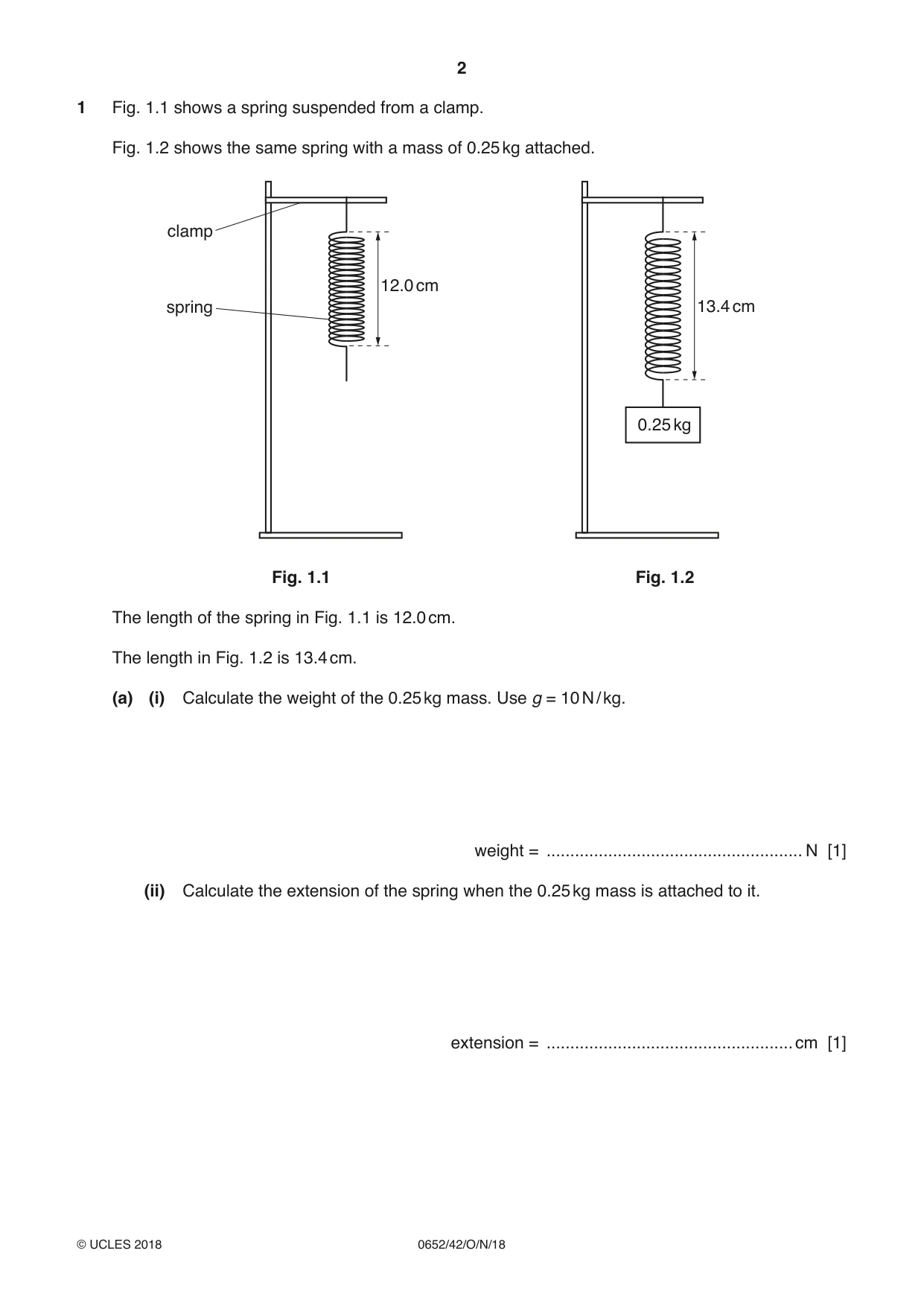
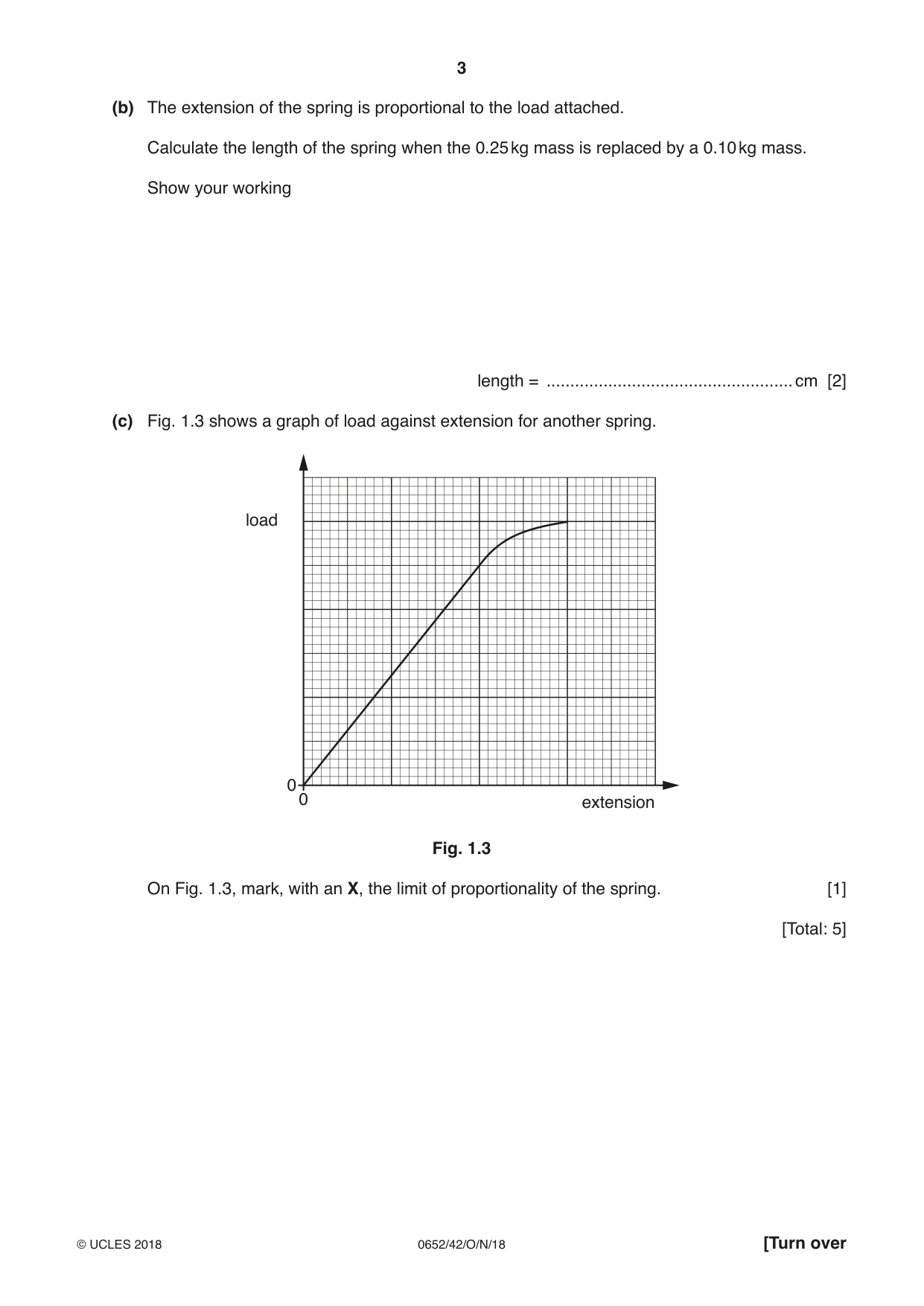
1 Fig. 1.1 shows a spring suspended from a clamp. Fig. 1.2 shows the same spring with a mass of 0.25 kg attached. clamp 12.0 cm spring 13.4 cm 0.25 kg Fig. 1.1 Fig. 1.2 The length of the spring in Fig. 1.1 is 12.0 cm. The length in Fig. 1.2 is 13.4 cm. (a) (i) Calculate the weight of the 0.25 kg mass. Use g = 10 N / kg. weight = ...................................................... N [1] (ii) Calculate the extension of the spring when the 0.25 kg mass is attached to it. extension = .................................................... cm [1] (b) The extension of the spring is proportional to the load attached. Calculate the length of the spring when the 0.25 kg mass is replaced by a 0.10 kg mass. Show your working length = .................................................... cm [2] (c) Fig. 1.3 shows a graph of load against extension for another spring. load 0 0 extension Fig. 1.3 On Fig. 1.3, mark, with an X, the limit of proportionality of the spring. [1] [Total: 5]
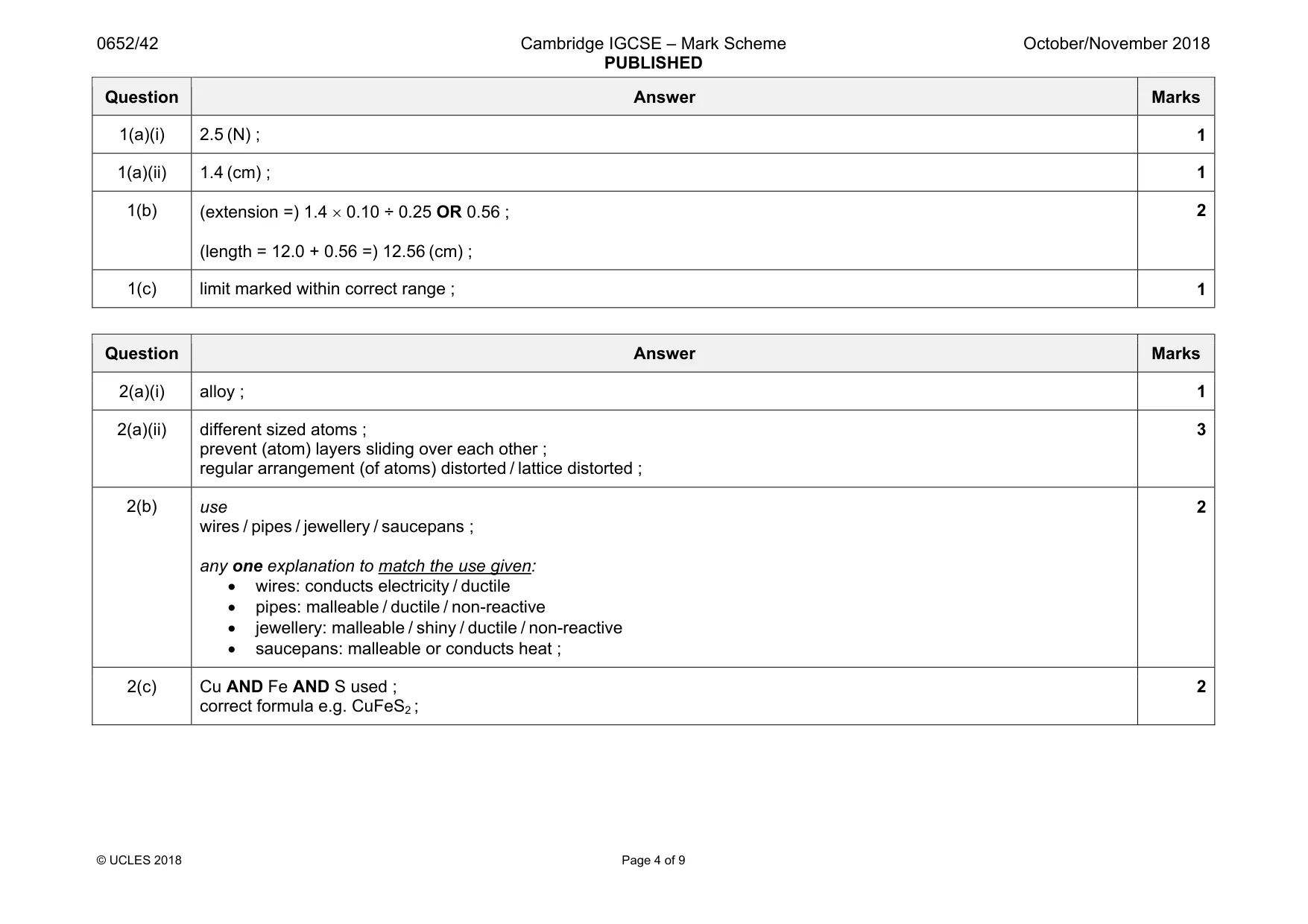
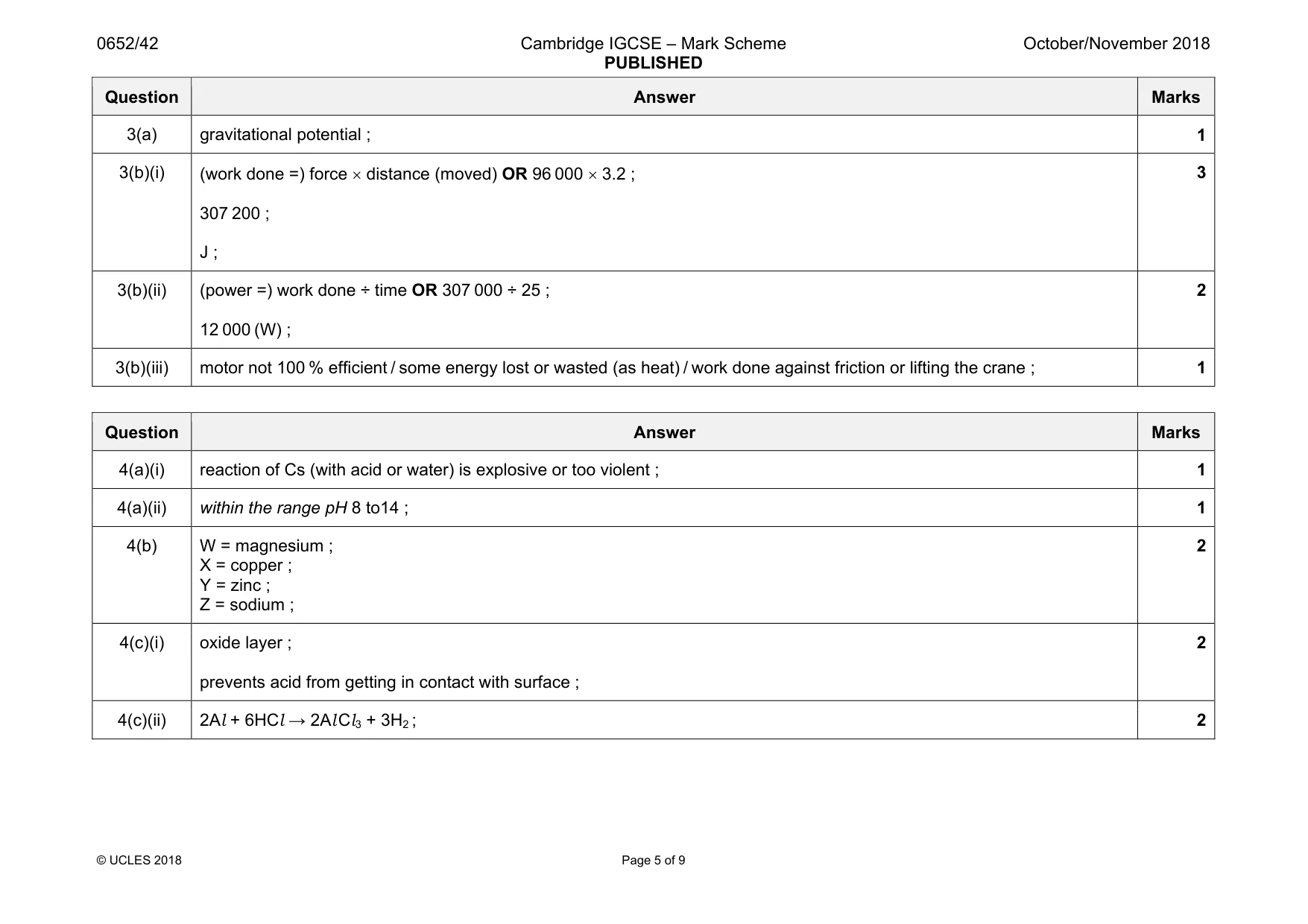
Mark scheme: 1(a)(i) 2.5 (N) ; 1 1(a)(ii) 1.4 (cm) ; 1 1(b) (extension =) 1.4 × 0.10 ÷ 0.25 OR 0.56 ; (length = 12.0 + 0.56 =) 12.56 (cm) ; 2 1(c) limit marked within correct range ; 1
Q2 · A mixture of two different metal atoms in a solid
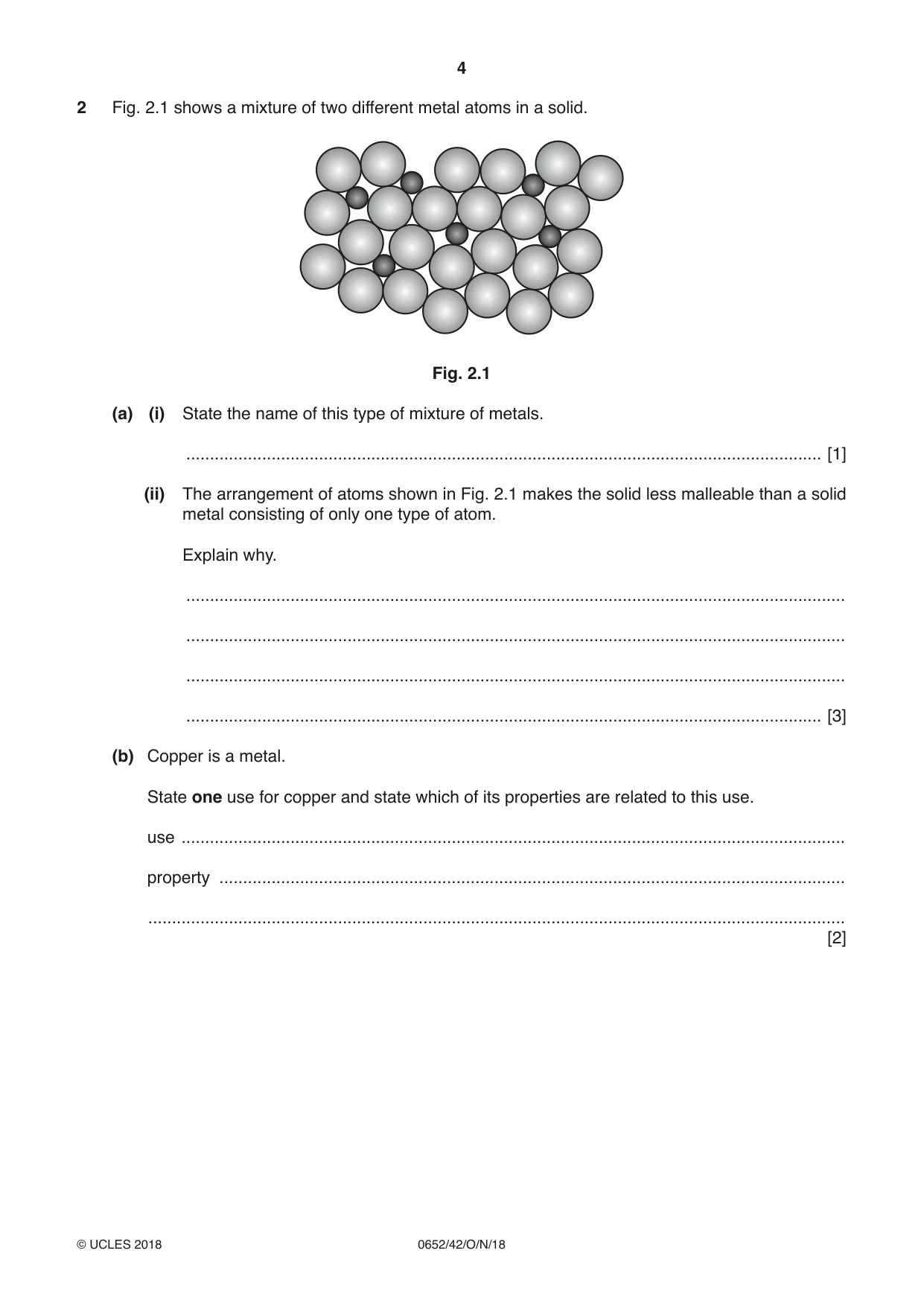
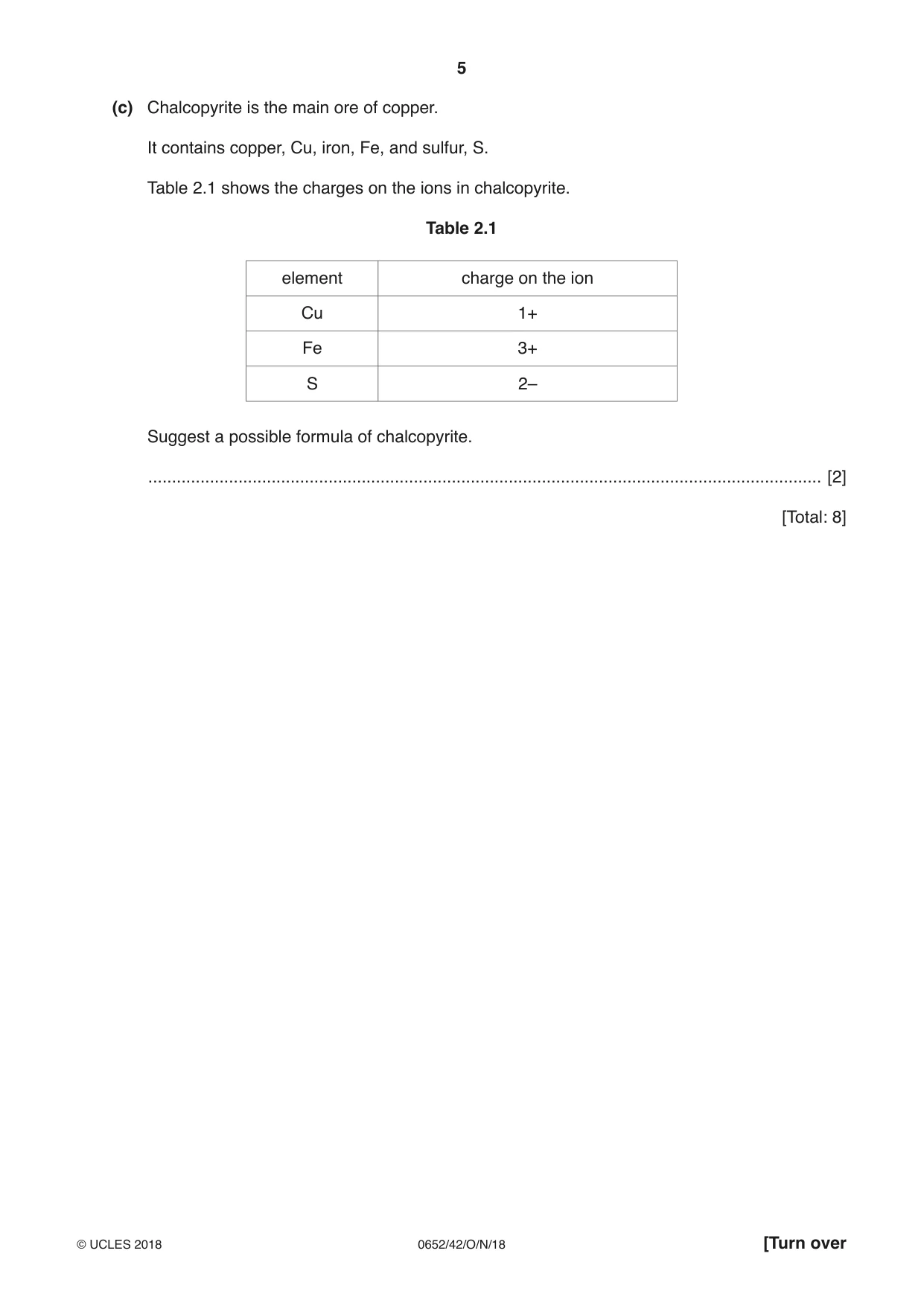
2 Fig. 2.1 shows a mixture of two different metal atoms in a solid. Fig. 2.1 (a) (i) State the name of this type of mixture of metals. ...................................................................................................................................... [1] (ii) The arrangement of atoms shown in Fig. 2.1 makes the solid less malleable than a solid metal consisting of only one type of atom. Explain why. ........................................................................................................................................... ........................................................................................................................................... ........................................................................................................................................... ...................................................................................................................................... [3] (b) Copper is a metal. State one use for copper and state which of its properties are related to this use. use ............................................................................................................................................ property .................................................................................................................................... ................................................................................................................................................... [2] (c) Chalcopyrite is the main ore of copper. It contains copper, Cu, iron, Fe, and sulfur, S. Table 2.1 shows the charges on the ions in chalcopyrite. Table 2.1 element charge on the ion Cu 1+ Fe 3+ S 2– Suggest a possible formula of chalcopyrite. .............................................................................................................................................. [2] [Total: 8]
Mark scheme: 2(a)(i) alloy ; 1 2(a)(ii) different sized atoms ; prevent (atom) layers sliding over each other ; regular arrangement (of atoms) distorted / lattice distorted ; 3 2(b) use wires / pipes / jewellery / saucepans ; any one explanation to match the use given: • wires: conducts electricity / ductile • pipes: malleable / ductile / non-reactive • jewellery: malleable / shiny / ductile / non-reactive • saucepans: malleable or conducts heat ; 2 2(c) Cu AND Fe AND S used ; correct formula e.g. CuFeS2 ; 2
Q3 · A crane lifting a tree trunk onto a lorry
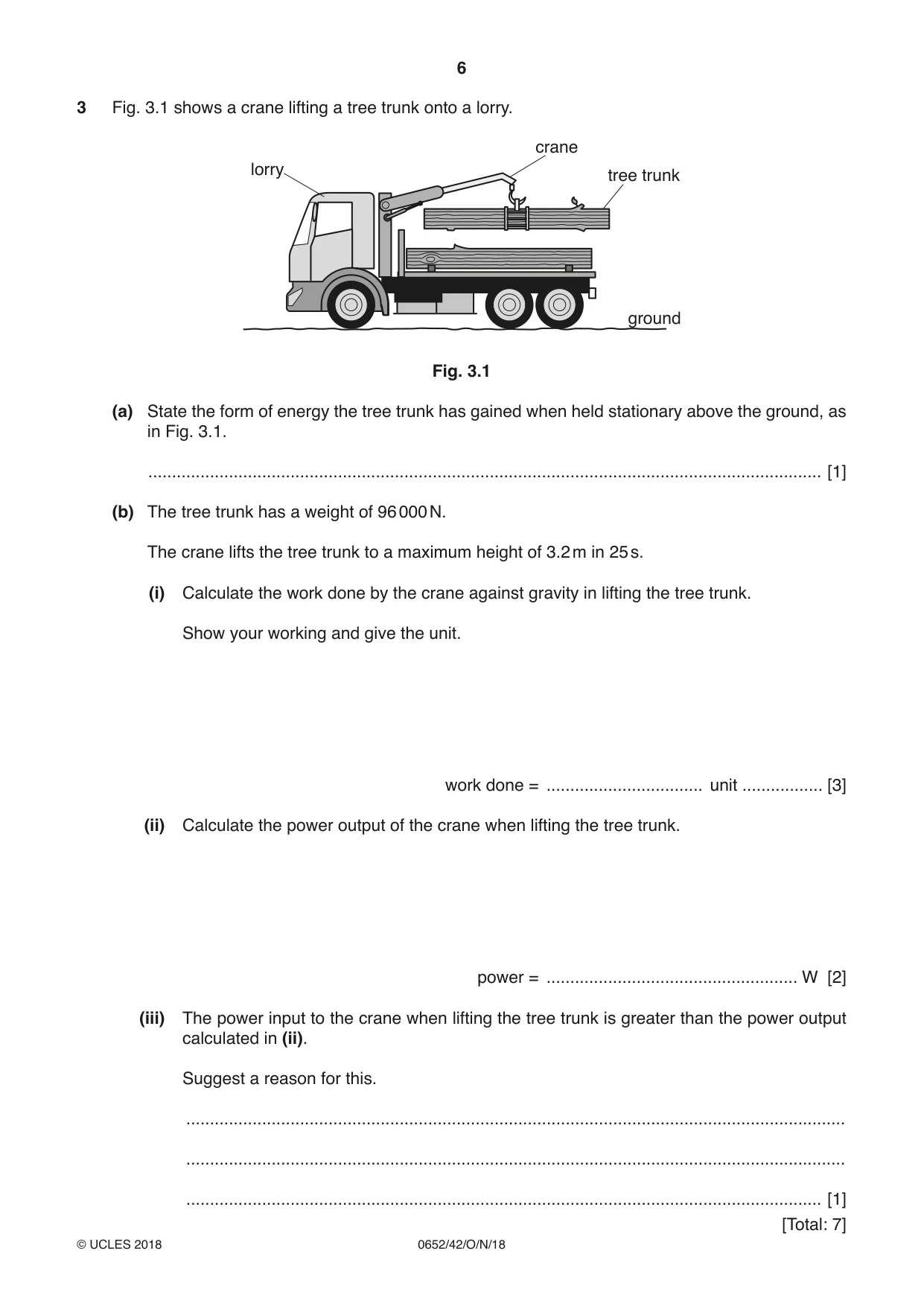
3 Fig. 3.1 shows a crane lifting a tree trunk onto a lorry. crane lorry tree trunk ground Fig. 3.1 (a) State the form of energy the tree trunk has gained when held stationary above the ground, as in Fig. 3.1. .............................................................................................................................................. [1] (b) The tree trunk has a weight of 96 000 N. The crane lifts the tree trunk to a maximum height of 3.2 m in 25 s. (i) Calculate the work done by the crane against gravity in lifting the tree trunk. Show your working and give the unit. work done = ................................. unit ................. [3] (ii) Calculate the power output of the crane when lifting the tree trunk. power = ..................................................... W [2] (iii) The power input to the crane when lifting the tree trunk is greater than the power output calculated in (ii). Suggest a reason for this. ........................................................................................................................................... ........................................................................................................................................... ...................................................................................................................................... [1]
Mark scheme: 3(a) gravitational potential ; 1 3(b)(i) (work done =) force × distance (moved) OR 96 000 × 3.2 ; 307 200 ; J ; 3 3(b)(ii) (power =) work done ÷ time OR 307 000 ÷ 25 ; 12 000 (W) ; 2 3(b)(iii) motor not 100 % efficient / some energy lost or wasted (as heat) / work done against friction or lifting the crane ; 1
Q4 · A student tests four unidentified metals, labelled W, X, Y and Z, using water and dilute…
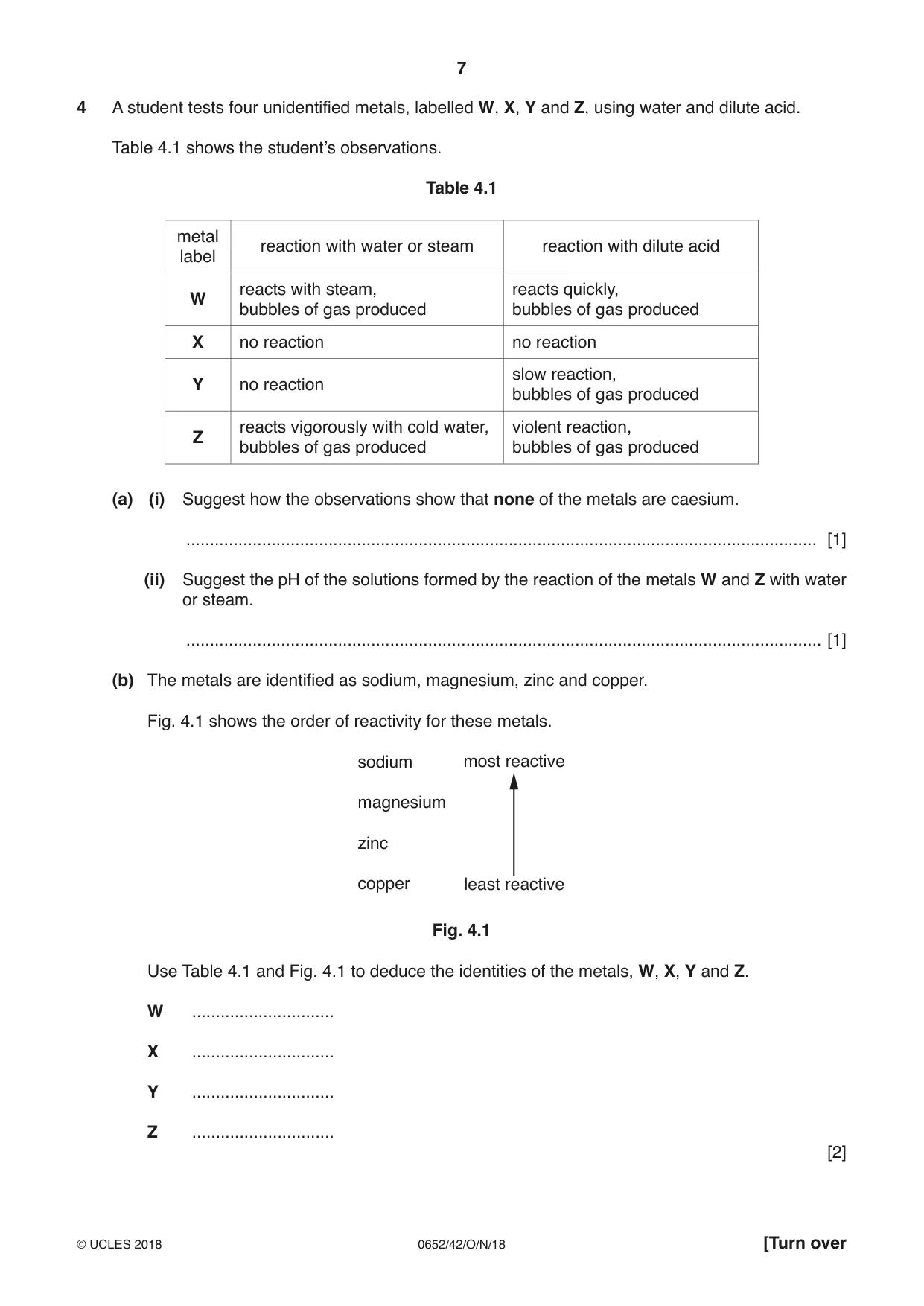
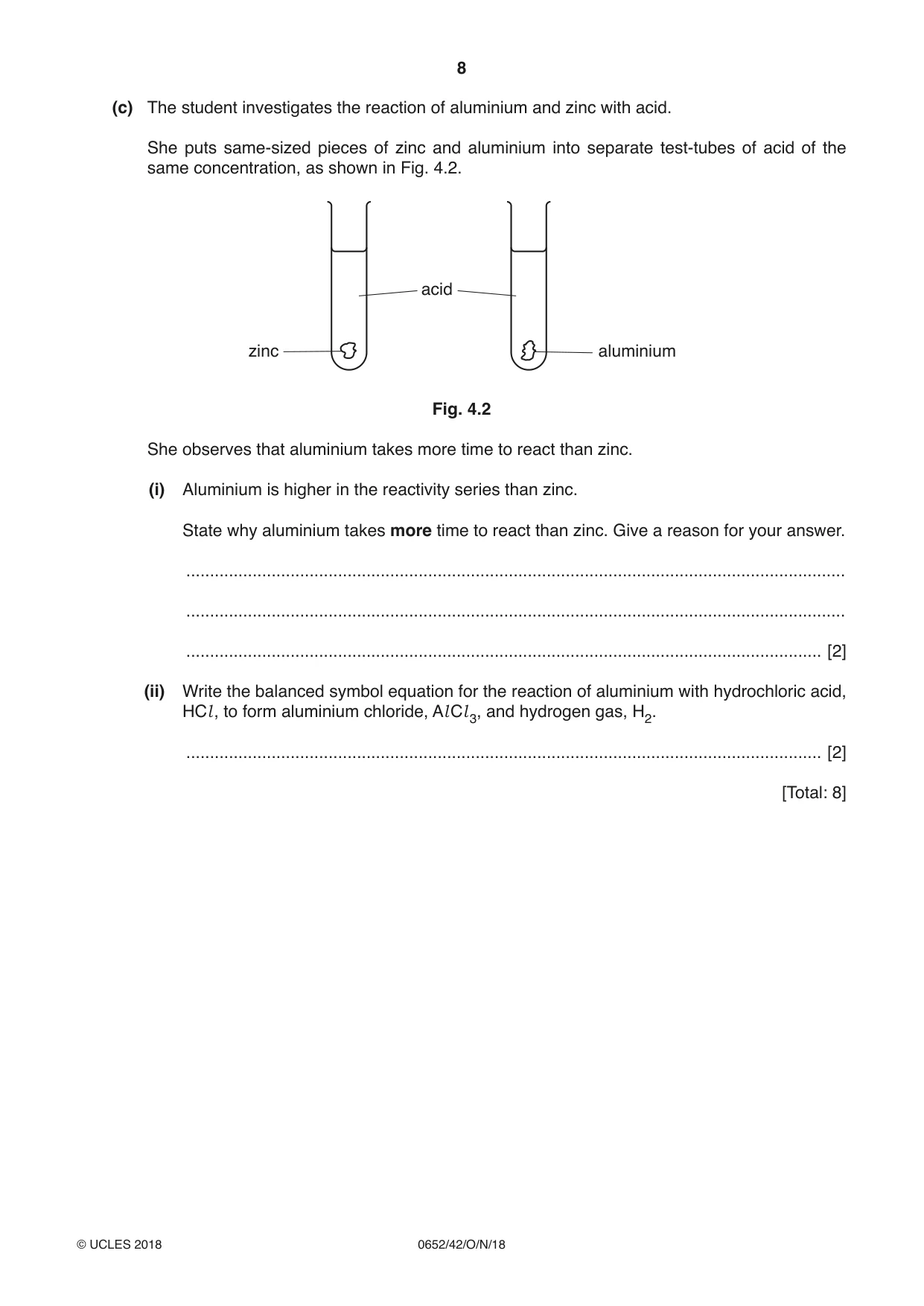
4 A student tests four unidentified metals, labelled W, X, Y and Z, using water and dilute acid. Table 4.1 shows the student’s observations. Table 4.1 metal reaction with water or steam reaction with dilute acid label reacts with steam, reacts quickly, W bubbles of gas produced bubbles of gas produced X no reaction no reaction slow reaction, Y no reaction bubbles of gas produced reacts vigorously with cold water, violent reaction, Z bubbles of gas produced bubbles of gas produced (a) (i) Suggest how the observations show that none of the metals are caesium. ..................................................................................................................................... [1] (ii) Suggest the pH of the solutions formed by the reaction of the metals W and Z with water or steam. ...................................................................................................................................... [1] (b) The metals are identified as sodium, magnesium, zinc and copper. Fig. 4.1 shows the order of reactivity for these metals. sodium most reactive magnesium zinc copper least reactive Fig. 4.1 Use Table 4.1 and Fig. 4.1 to deduce the identities of the metals, W, X, Y and Z. W .............................. X .............................. Y .............................. Z .............................. [2] (c) The student investigates the reaction of aluminium and zinc with acid. She puts same-sized pieces of zinc and aluminium into separate test-tubes of acid of the same concentration, as shown in Fig. 4.2. acid zinc aluminium Fig. 4.2 She observes that aluminium takes more time to react than zinc. (i) Aluminium is higher in the reactivity series than zinc. State why aluminium takes more time to react than zinc. Give a reason for your answer. ........................................................................................................................................... ........................................................................................................................................... ...................................................................................................................................... [2] (ii) Write the balanced symbol equation for the reaction of aluminium with hydrochloric acid, HCl , to form aluminium chloride, Al Cl 3, and hydrogen gas, H2. ...................................................................................................................................... [2] [Total: 8]
Mark scheme: 4(a)(i) reaction of Cs (with acid or water) is explosive or too violent ; 1 4(a)(ii) within the range pH 8 to14 ; 1 4(b) W = magnesium ; X = copper ; Y = zinc ; Z = sodium ; 2 4(c)(i) oxide layer ; prevents acid from getting in contact with surface ; 2 4(c)(ii) 2Al + 6HCl → 2Al Cl3 + 3H2 ; 2
Q5 · The construction of a simple solar panel used to produce hot water
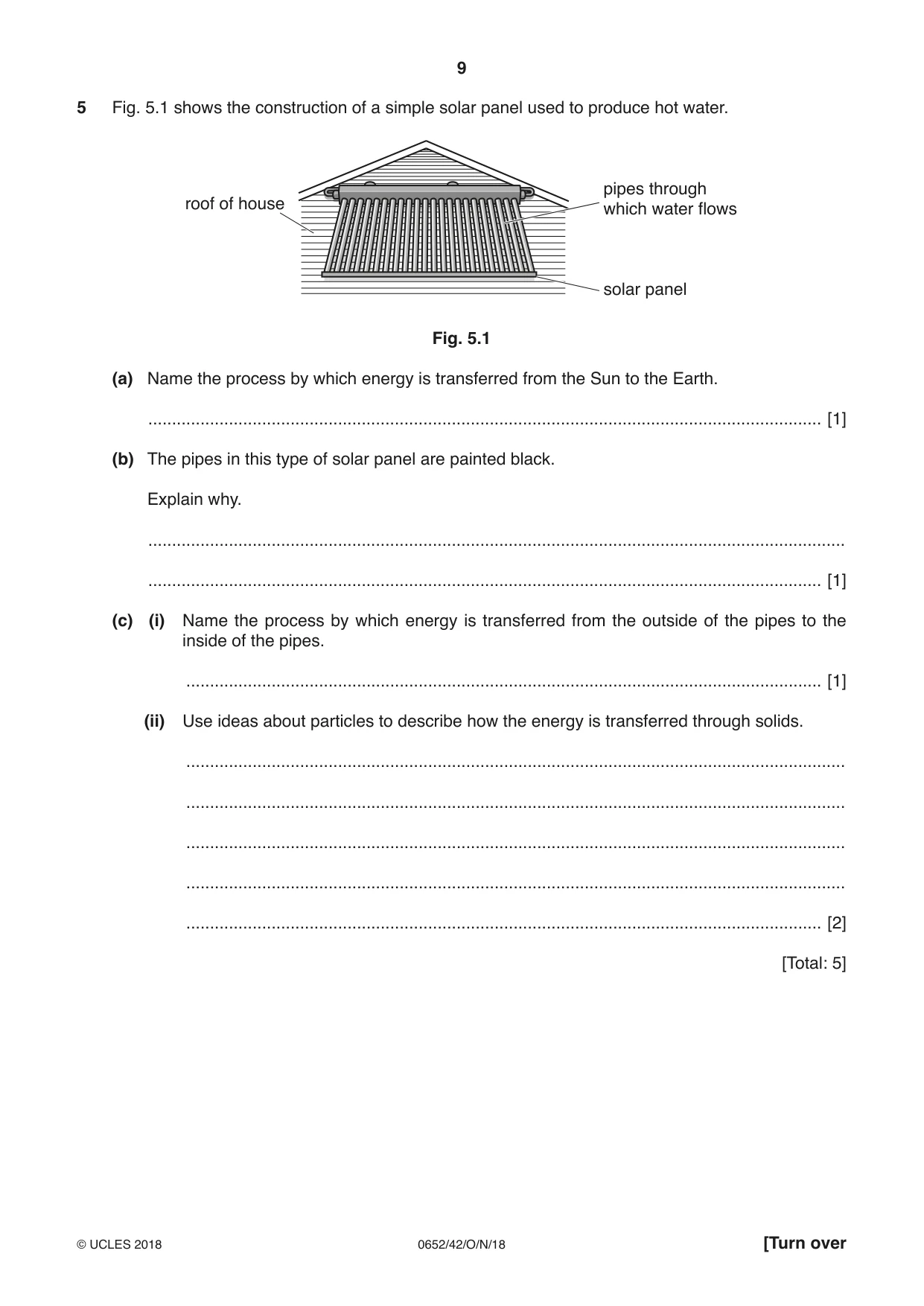
5 Fig. 5.1 shows the construction of a simple solar panel used to produce hot water. pipes through roof of house which water flows solar panel Fig. 5.1 (a) Name the process by which energy is transferred from the Sun to the Earth. .............................................................................................................................................. [1] (b) The pipes in this type of solar panel are painted black. Explain why. ................................................................................................................................................... .............................................................................................................................................. [1] (c) (i) Name the process by which energy is transferred from the outside of the pipes to the inside of the pipes. ...................................................................................................................................... [1] (ii) Use ideas about particles to describe how the energy is transferred through solids. ........................................................................................................................................... ........................................................................................................................................... ........................................................................................................................................... ........................................................................................................................................... ...................................................................................................................................... [2] [Total: 5]
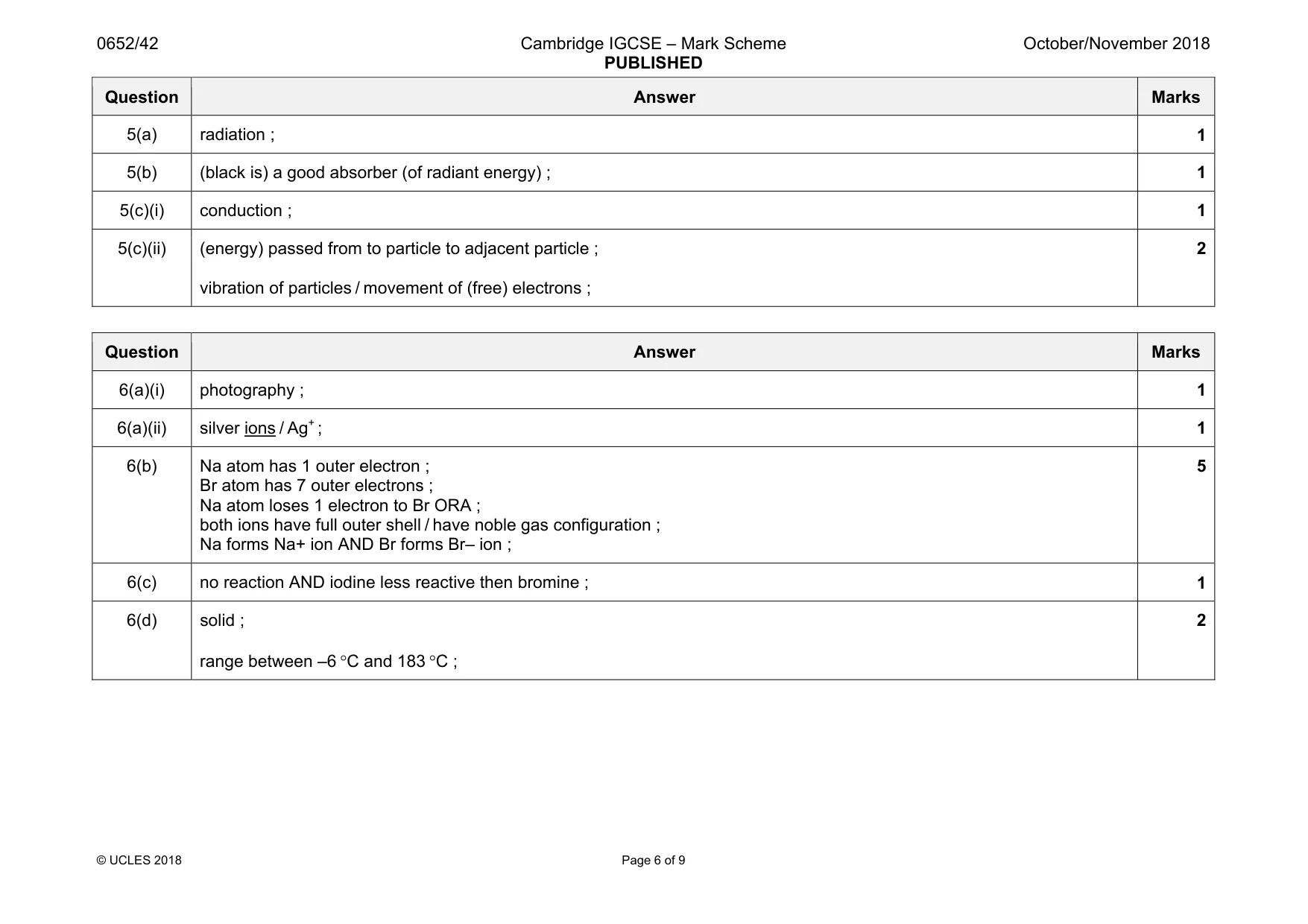
Mark scheme: 5(a) radiation ; 1 5(b) (black is) a good absorber (of radiant energy) ; 1 5(c)(i) conduction ; 1 5(c)(ii) (energy) passed from to particle to adjacent particle ; vibration of particles / movement of (free) electrons ; 2
Q6 · Silver bromide decomposes in the presence of light to form silver and bromine, as shown…
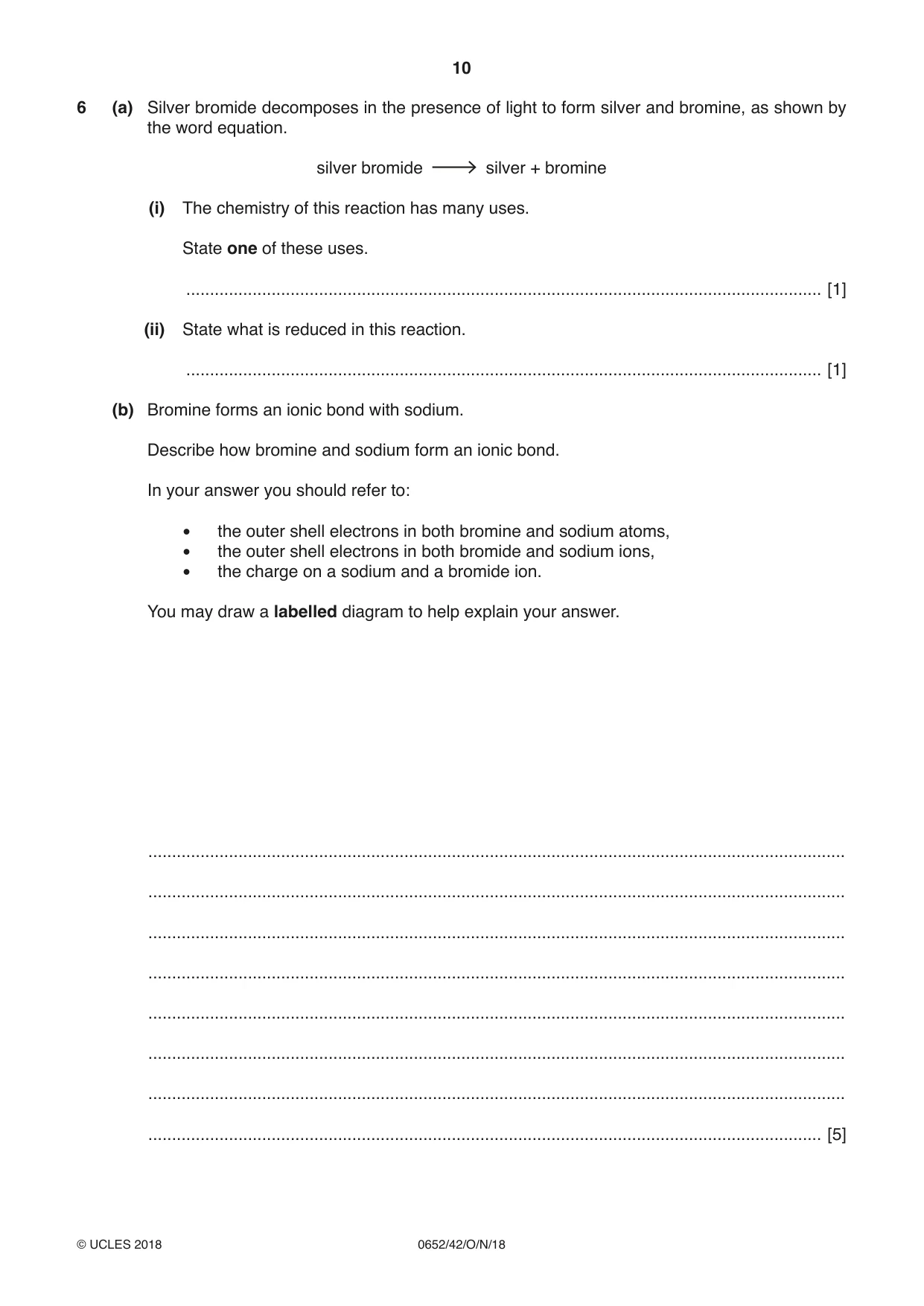
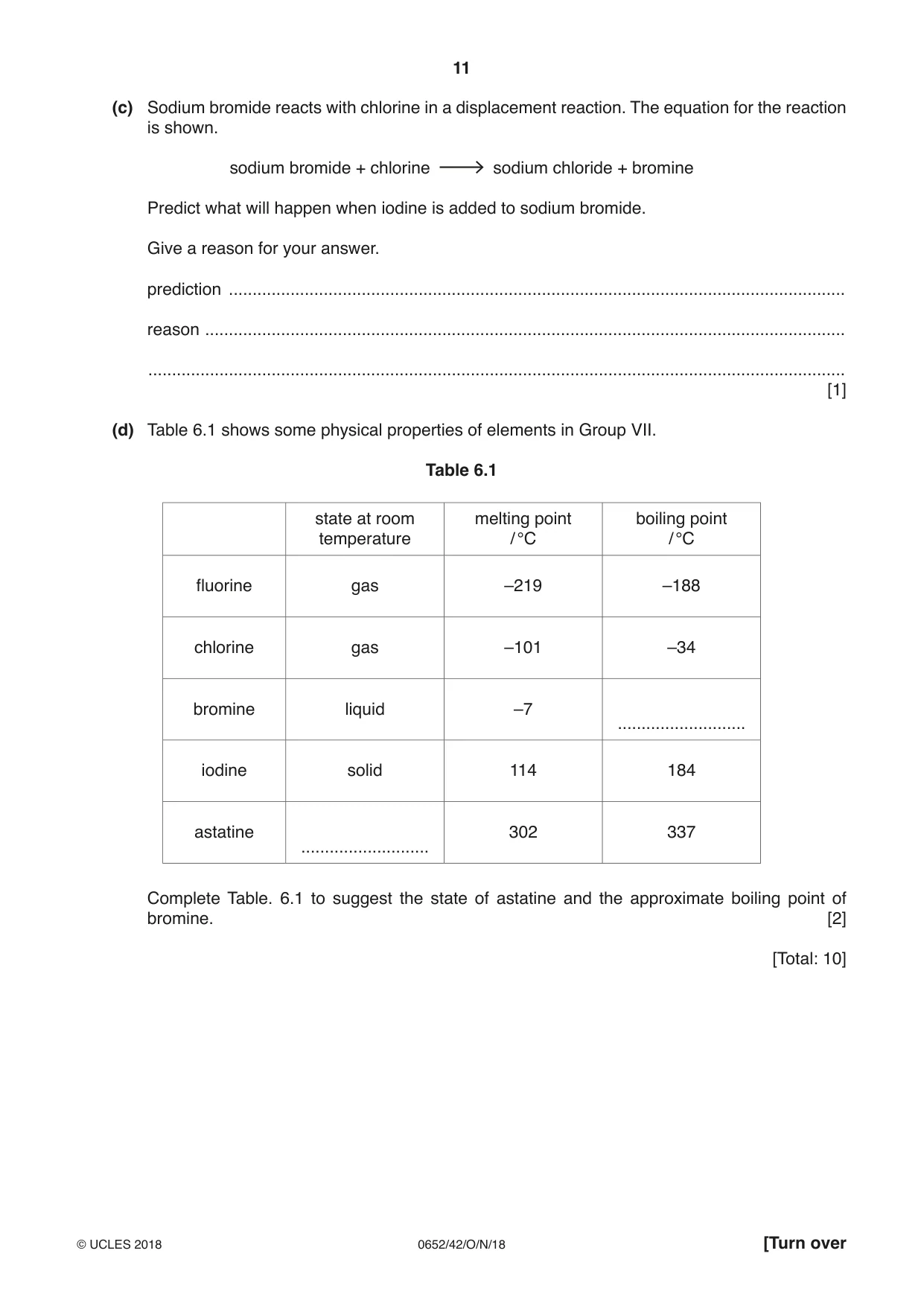
6 (a) Silver bromide decomposes in the presence of light to form silver and bromine, as shown by the word equation. silver bromide silver + bromine (i) The chemistry of this reaction has many uses. State one of these uses. ...................................................................................................................................... [1] (ii) State what is reduced in this reaction. ...................................................................................................................................... [1] (b) Bromine forms an ionic bond with sodium. Describe how bromine and sodium form an ionic bond. In your answer you should refer to: • the outer shell electrons in both bromine and sodium atoms, • the outer shell electrons in both bromide and sodium ions, • the charge on a sodium and a bromide ion. You may draw a labelled diagram to help explain your answer. ................................................................................................................................................... ................................................................................................................................................... ................................................................................................................................................... ................................................................................................................................................... ................................................................................................................................................... ................................................................................................................................................... ................................................................................................................................................... .............................................................................................................................................. [5] (c) Sodium bromide reacts with chlorine in a displacement reaction. The equation for the reaction is shown. sodium bromide + chlorine sodium chloride + bromine Predict what will happen when iodine is added to sodium bromide. Give a reason for your answer. prediction .................................................................................................................................. reason ....................................................................................................................................... ................................................................................................................................................... [1] (d) Table 6.1 shows some physical properties of elements in Group VII. Table 6.1 state at room melting point boiling point temperature / °C / °C fluorine gas –219 –188 chlorine gas –101 –34 bromine liquid –7 ........................... iodine solid 114 184 astatine 302 337 ........................... Complete Table. 6.1 to suggest the state of astatine and the approximate boiling point of bromine. [2] [Total: 10]
Mark scheme: 6(a)(i) photography ; 1 6(a)(ii) silver ions / Ag+ ; 1 6(b) Na atom has 1 outer electron ; Br atom has 7 outer electrons ; Na atom loses 1 electron to Br ORA ; both ions have full outer shell / have noble gas configuration ; Na forms Na+ ion AND Br forms Br– ion ; 5 6(c) no reaction AND iodine less reactive then bromine ; 1 6(d) solid ; range between –6 °C and 183 °C ; 2
Q7 · A shallow tank of water
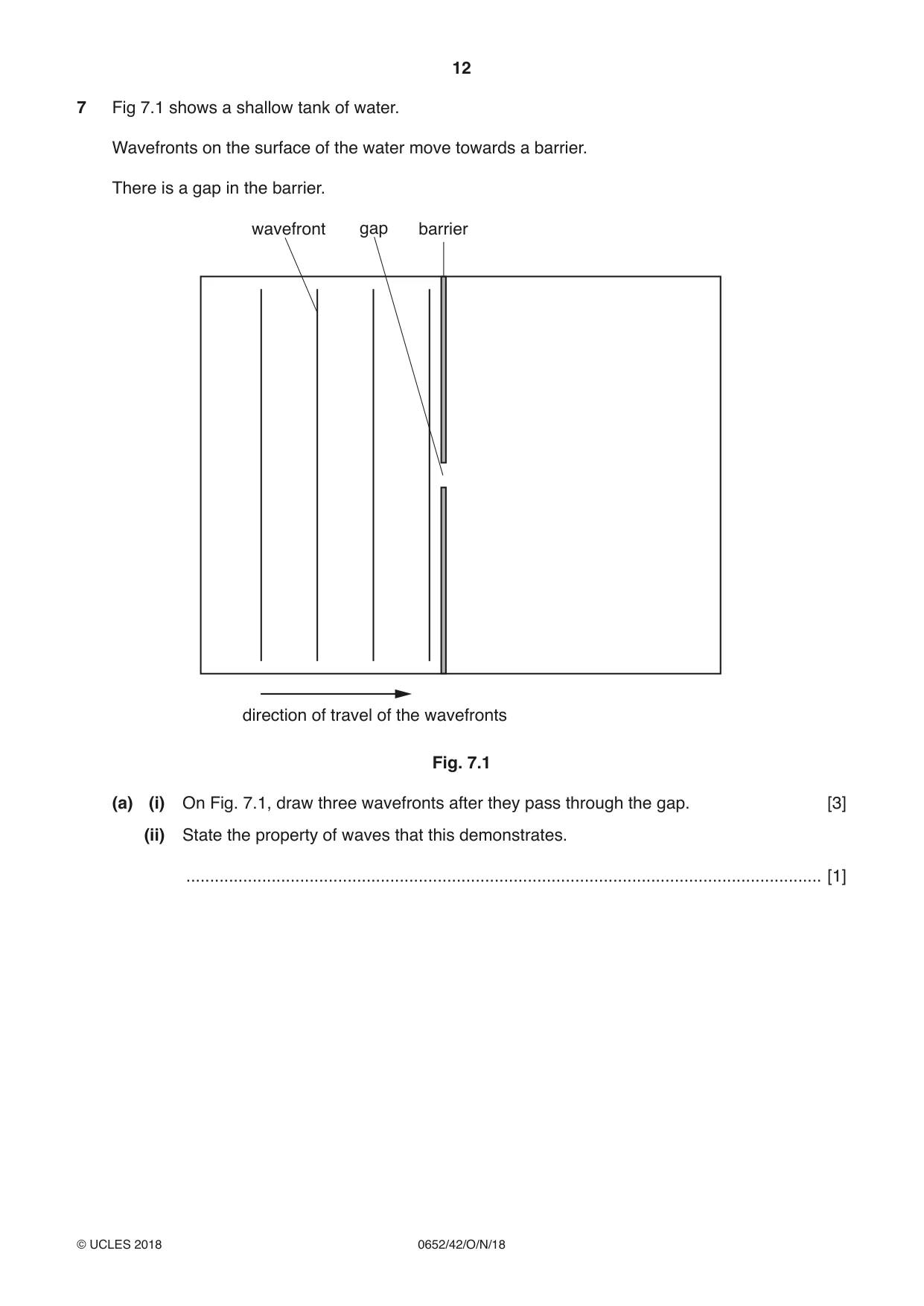
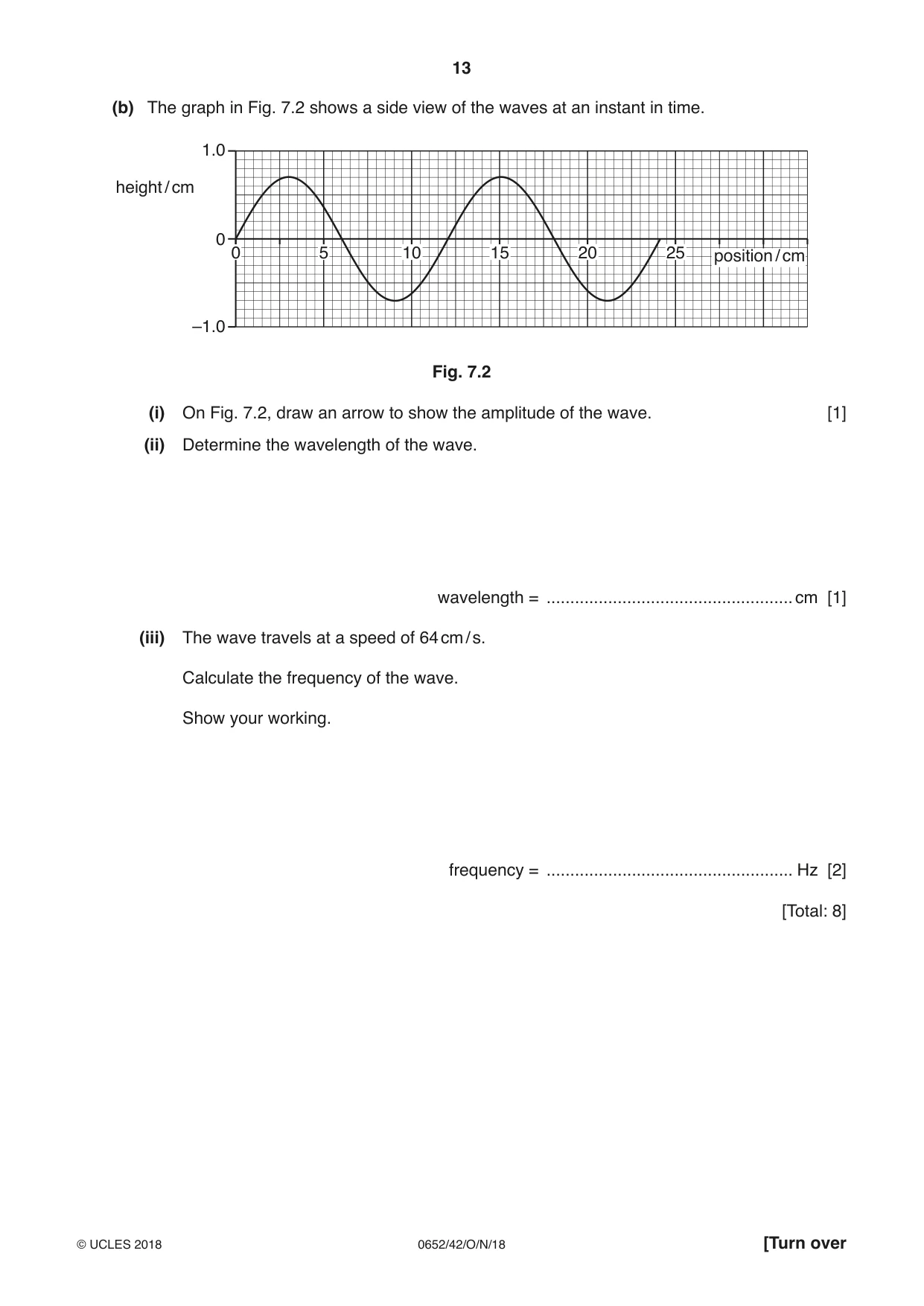
7 Fig 7.1 shows a shallow tank of water. Wavefronts on the surface of the water move towards a barrier. There is a gap in the barrier. wavefront gap barrier direction of travel of the wavefronts Fig. 7.1 (a) (i) On Fig. 7.1, draw three wavefronts after they pass through the gap. [3] (ii) State the property of waves that this demonstrates. ...................................................................................................................................... [1] (b) The graph in Fig. 7.2 shows a side view of the waves at an instant in time. 1.0 height / cm 0 0 5 10 15 20 25 position / cm –1.0 Fig. 7.2 (i) On Fig. 7.2, draw an arrow to show the amplitude of the wave. [1] (ii) Determine the wavelength of the wave. wavelength = .................................................... cm [1] (iii) The wave travels at a speed of 64 cm / s. Calculate the frequency of the wave. Show your working. frequency = .................................................... Hz [2] [Total: 8]
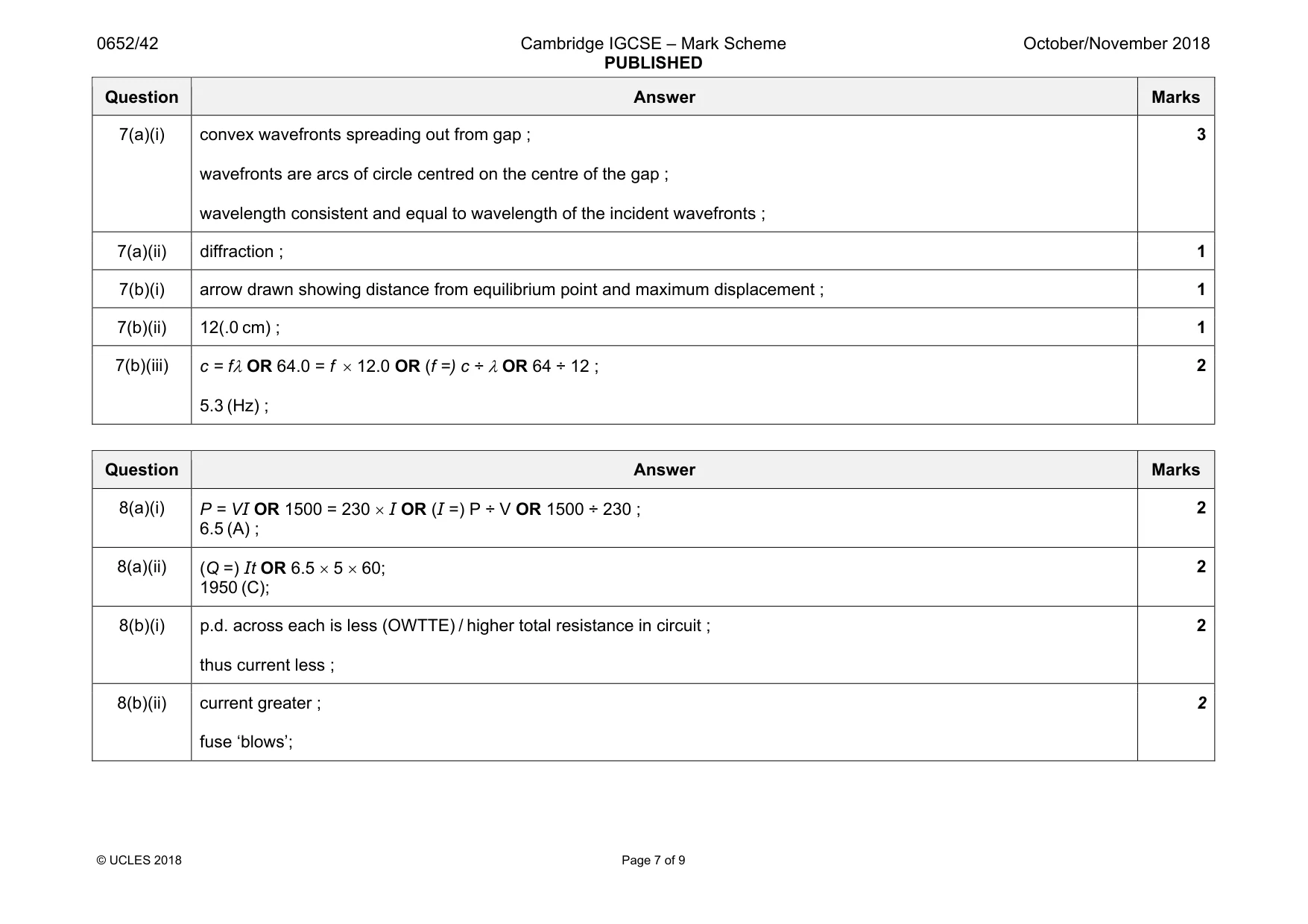
Mark scheme: 7(a)(i) convex wavefronts spreading out from gap ; wavefronts are arcs of circle centred on the centre of the gap ; wavelength consistent and equal to wavelength of the incident wavefronts ; 3 7(a)(ii) diffraction ; 1 7(b)(i) arrow drawn showing distance from equilibrium point and maximum displacement ; 1 7(b)(ii) 12(.0 cm) ; 1 7(b)(iii) c = fλ OR 64.0 = f × 12.0 OR (f =) c ÷ λ OR 64 ÷ 12 ; 5.3 (Hz) ; 2
Q8 · A circuit which contains a heater
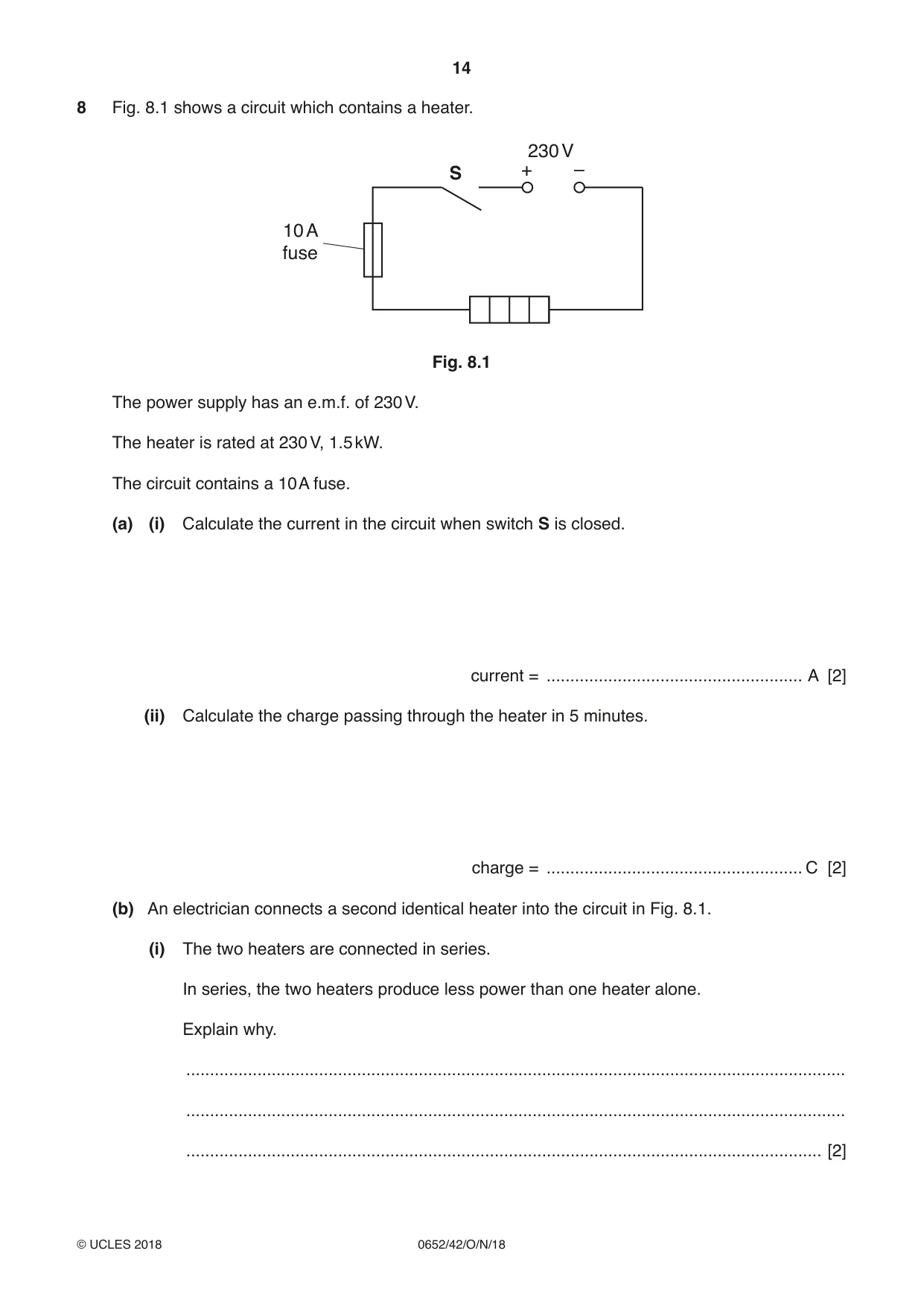
8 Fig. 8.1 shows a circuit which contains a heater. 230 V S + – 10 A fuse Fig. 8.1 The power supply has an e.m.f. of 230 V. The heater is rated at 230 V, 1.5 kW. The circuit contains a 10 A fuse. (a) (i) Calculate the current in the circuit when switch S is closed. current = ...................................................... A [2] (ii) Calculate the charge passing through the heater in 5 minutes. charge = ...................................................... C [2] (b) An electrician connects a second identical heater into the circuit in Fig. 8.1. (i) The two heaters are connected in series. In series, the two heaters produce less power than one heater alone. Explain why. ........................................................................................................................................... ........................................................................................................................................... ...................................................................................................................................... [2] (ii) The electrician then connects the two heaters in parallel. He closes switch S and finds that the heaters do not work. Explain why the heaters stop working. ........................................................................................................................................... ........................................................................................................................................... ...................................................................................................................................... [2] [Total: 8]
Mark scheme: 8(a)(i) 6.5 (A) ; 2 8(a)(ii) (Q =) It OR 6.5 × 5 × 60; 1950 (C); 2 8(b)(i) p.d. across each is less (OWTTE) / higher total resistance in circuit ; thus current less ; 2 8(b)(ii) current greater ; fuse ‘blows’; 2
Q9 · Use words from the box to complete the sentences about making an insoluble salt
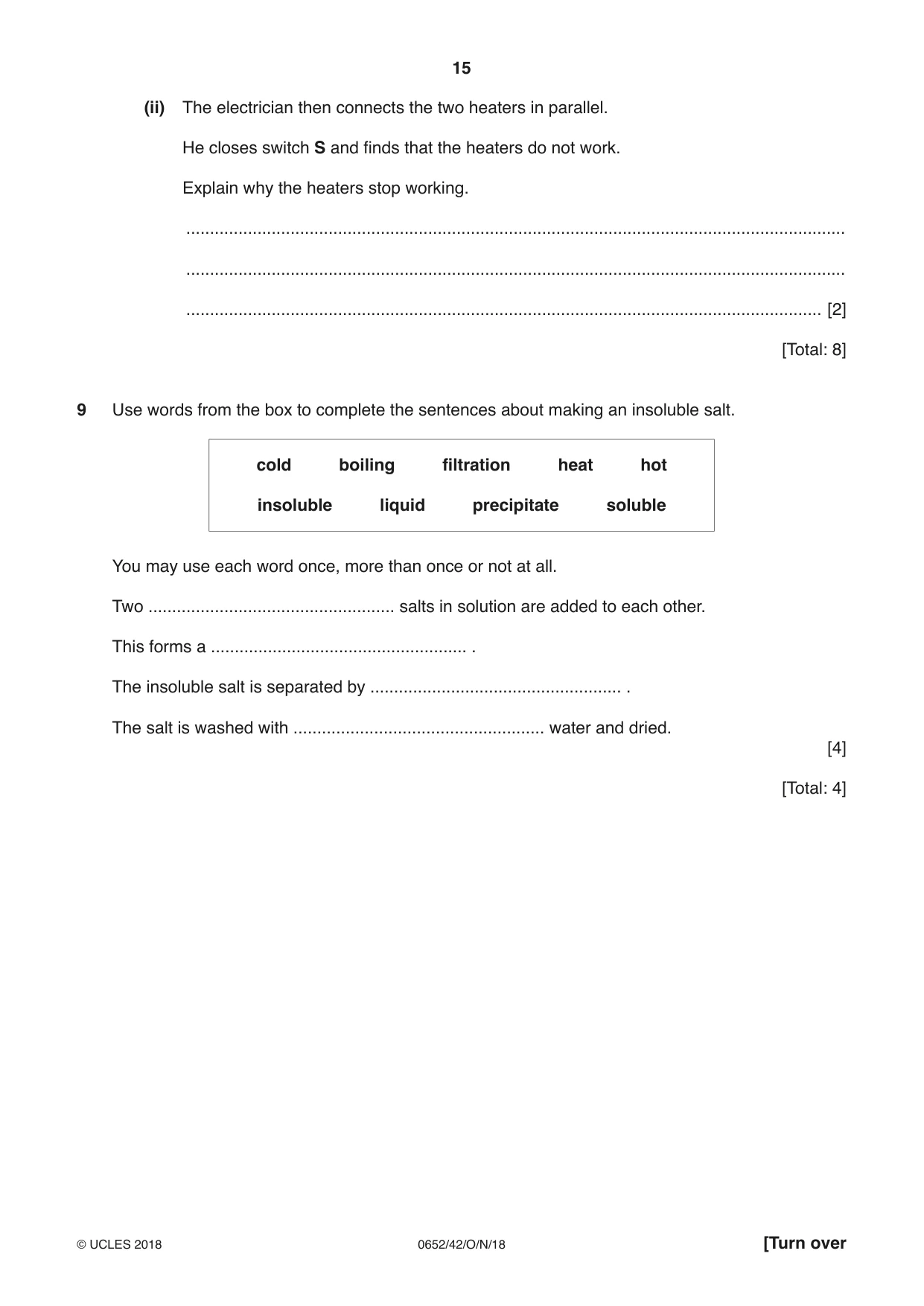
9 Use words from the box to complete the sentences about making an insoluble salt. cold boiling filtration heat hot insoluble liquid precipitate soluble You may use each word once, more than once or not at all. Two .................................................... salts in solution are added to each other. This forms a ...................................................... . The insoluble salt is separated by ..................................................... . The salt is washed with ..................................................... water and dried. [4] [Total: 4]
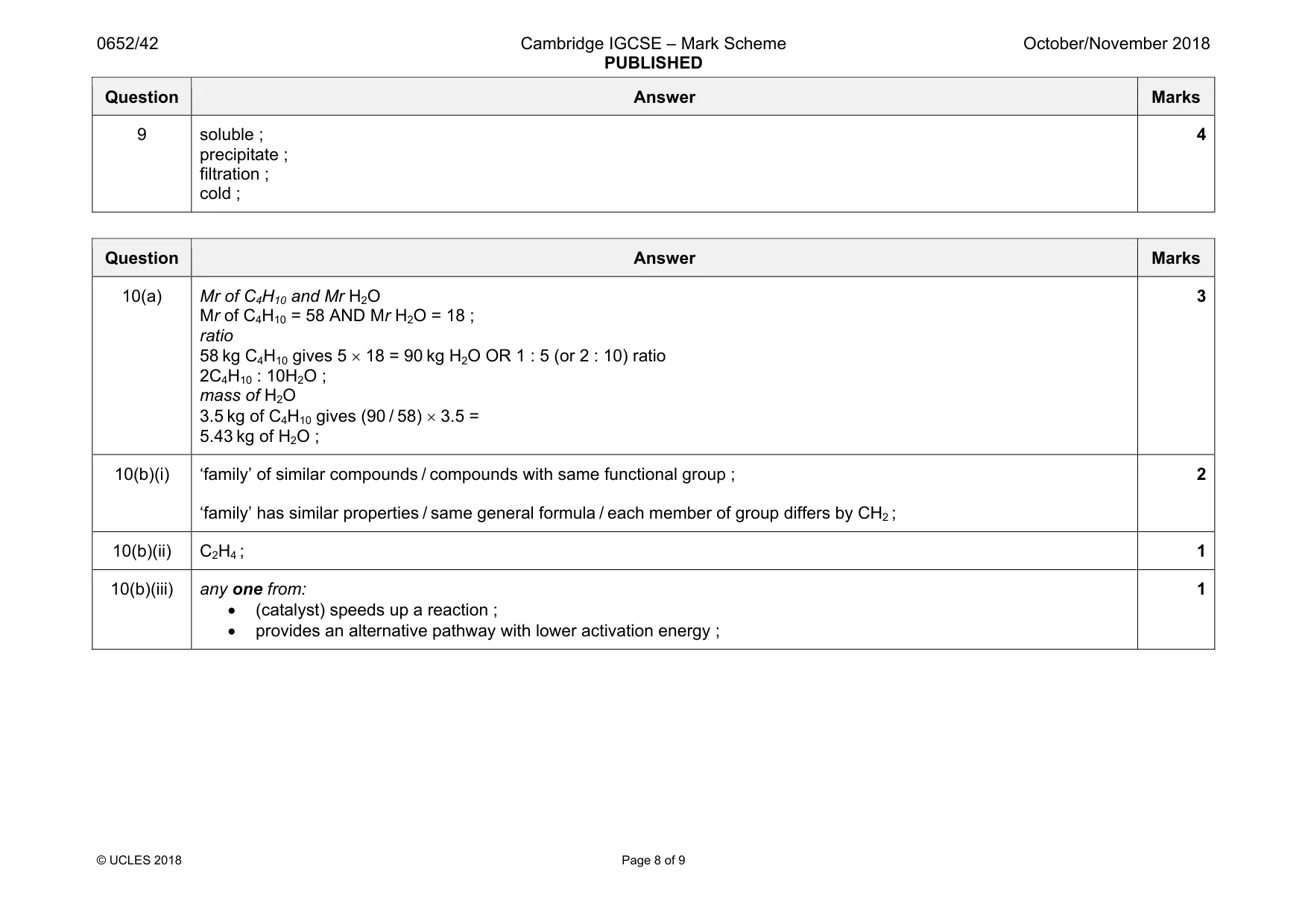
Mark scheme: 9 soluble ; precipitate ; filtration ; cold ; 4
Q10 · Butane combusts in oxygen, as shown by the equation
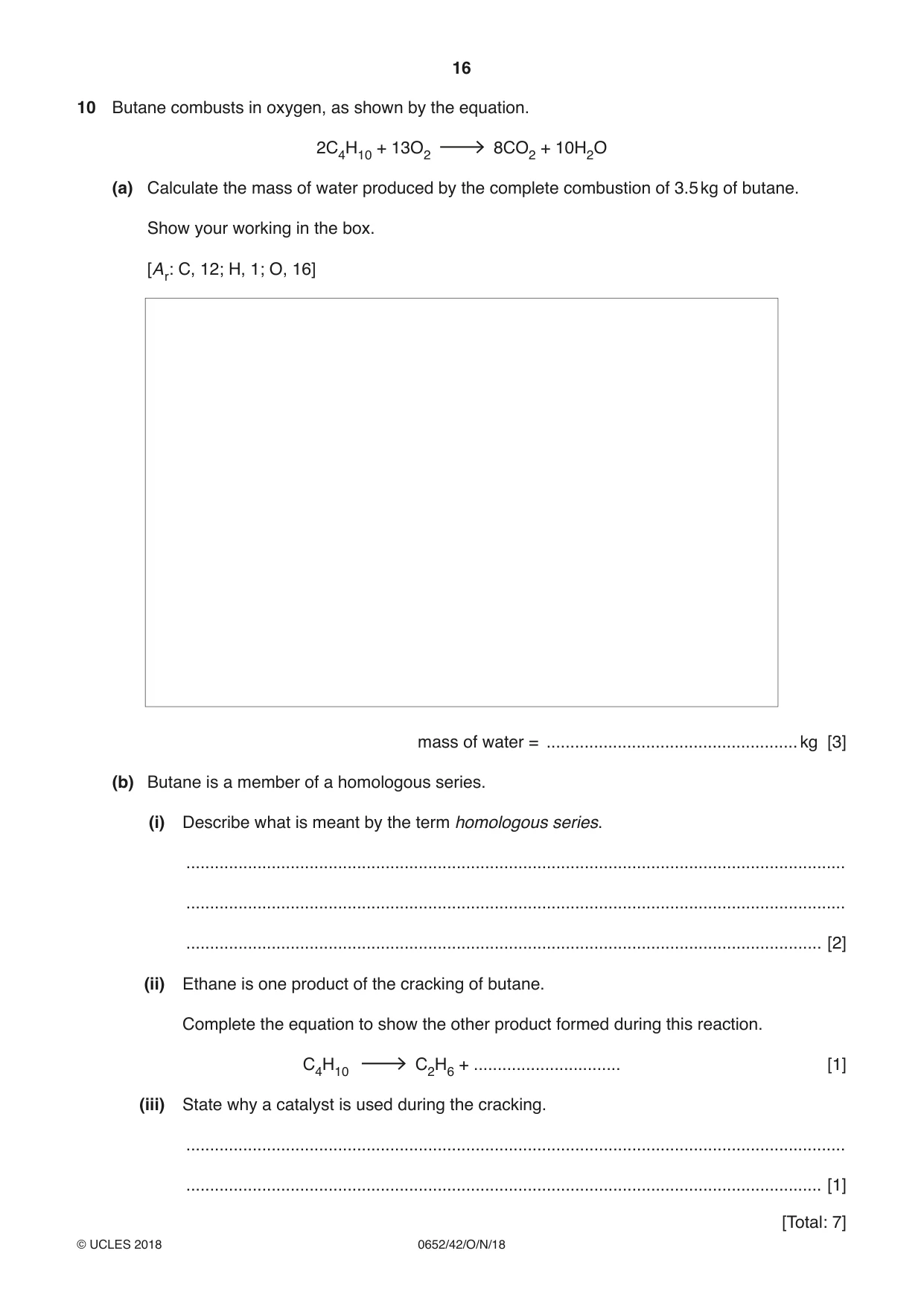
10 Butane combusts in oxygen, as shown by the equation. 2C4H10 + 13O2 8CO2 + 10H2O (a) Calculate the mass of water produced by the complete combustion of 3.5 kg of butane. Show your working in the box. [Ar: C, 12; H, 1; O, 16] mass of water = ..................................................... kg [3] (b) Butane is a member of a homologous series. (i) Describe what is meant by the term homologous series. ........................................................................................................................................... ........................................................................................................................................... ...................................................................................................................................... [2] (ii) Ethane is one product of the cracking of butane. Complete the equation to show the other product formed during this reaction. C4H10 C2H6 + ............................... [1] (iii) State why a catalyst is used during the cracking. ........................................................................................................................................... ...................................................................................................................................... [1] [Total: 7]
Mark scheme: 10(a) Mr of C4H10 and Mr H2O Mr of C4H10 = 58 AND Mr H2O = 18 ; ratio 58 kg C4H10 gives 5 × 18 = 90 kg H2O OR 1 : 5 (or 2 : 10) ratio 2C4H10 : 10H2O ; mass of H2O 3.5 kg of C4H10 gives (90 / 58) × 3.5 = 5.43 kg of H2O ; 3 10(b)(i) ‘family’ of similar compounds / compounds with same functional group ; ‘family’ has similar properties / same general formula / each member of group differs by CH2 ; 2 10(b)(ii) C2H4 ; 1 10(b)(iii) any one from: • (catalyst) speeds up a reaction ; • provides an alternative pathway with lower activation energy ; 1
Q11 · A student has a long thin wire, a horseshoe magnet and a sensitive, zero-centred…
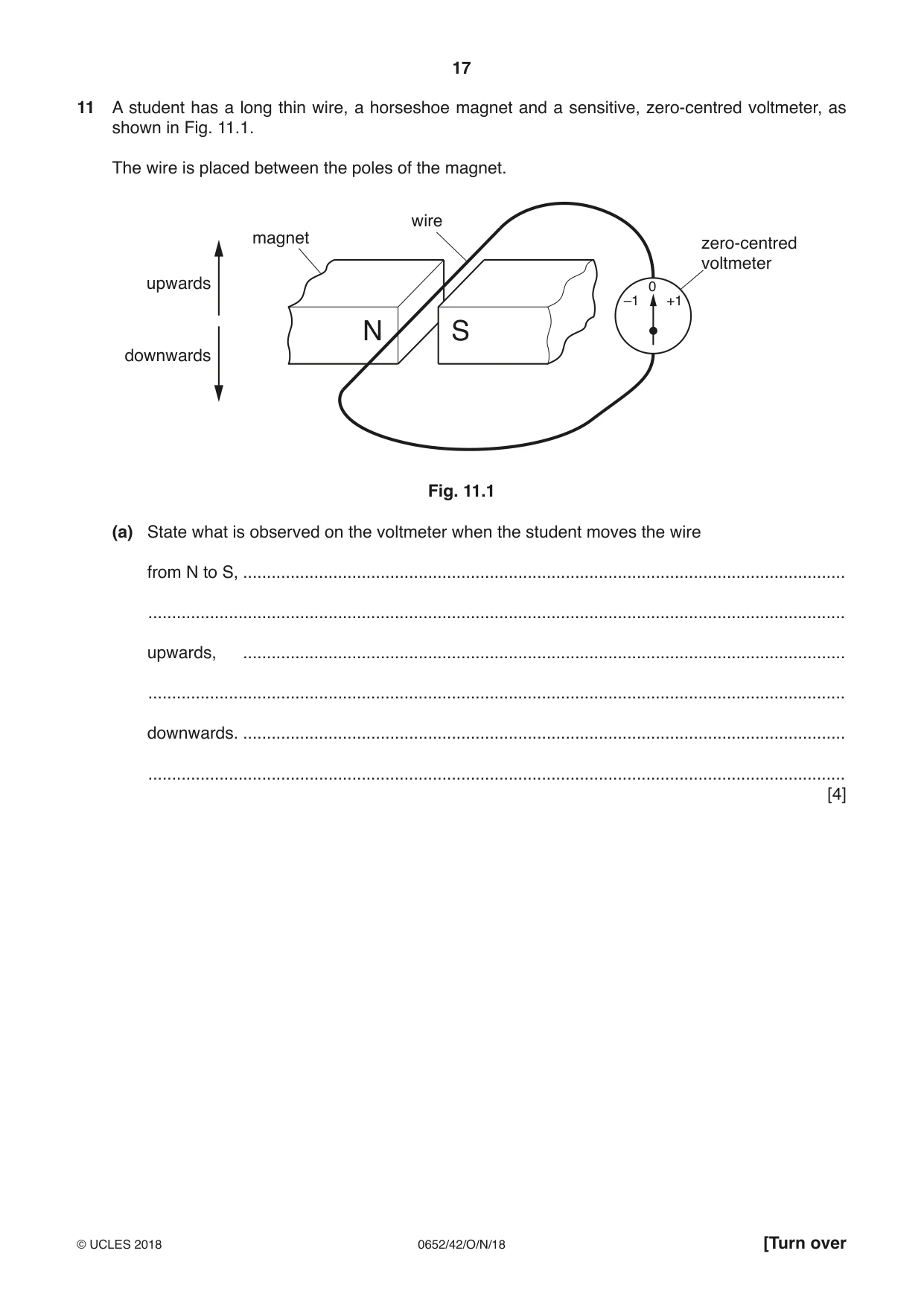
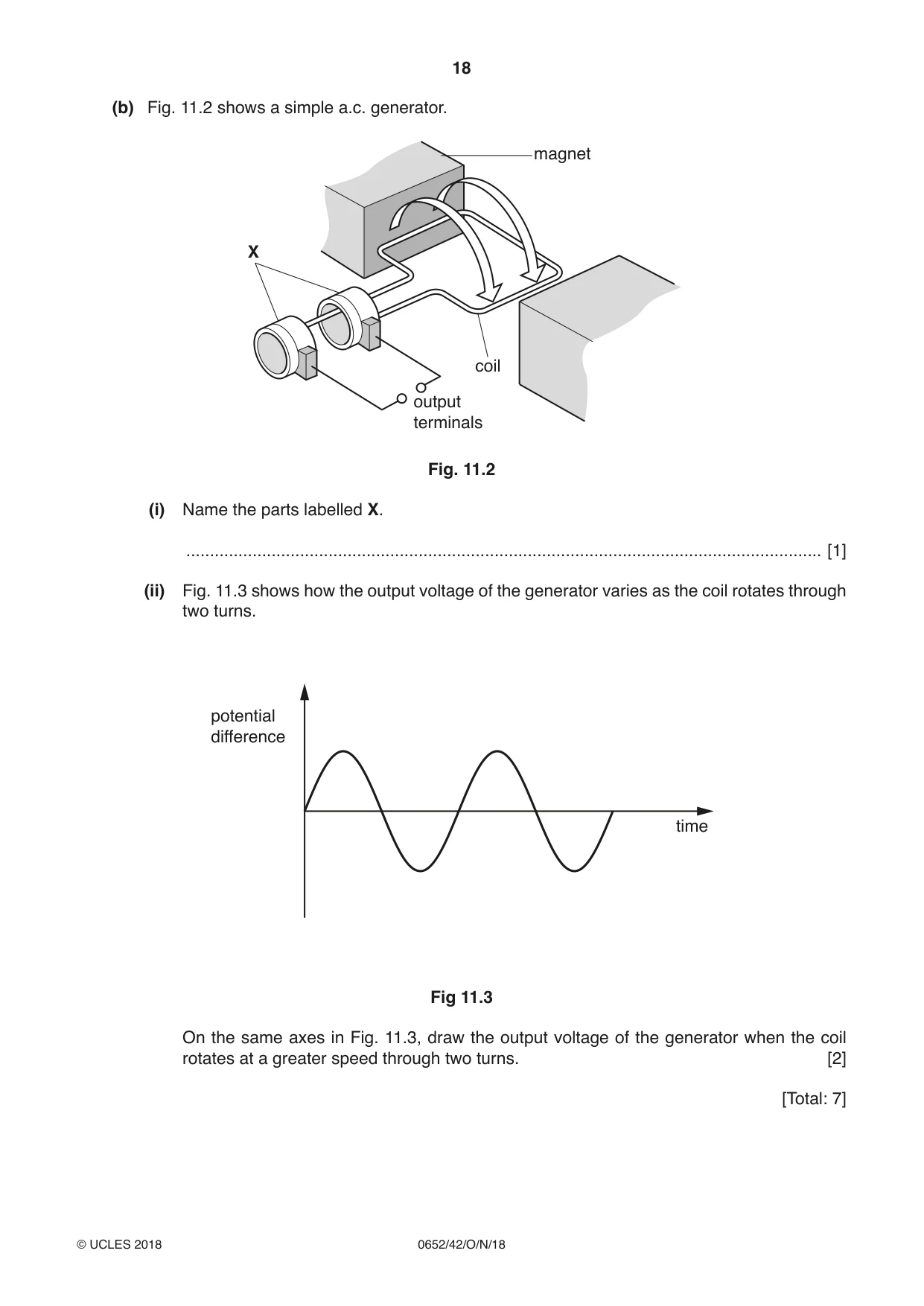
11 A student has a long thin wire, a horseshoe magnet and a sensitive, zero-centred voltmeter, as shown in Fig. 11.1. The wire is placed between the poles of the magnet. wire magnet zero-centred voltmeter upwards 0 –1 +1 N S downwards Fig. 11.1 (a) State what is observed on the voltmeter when the student moves the wire from N to S, ............................................................................................................................... ................................................................................................................................................... upwards, ............................................................................................................................... ................................................................................................................................................... downwards. ............................................................................................................................... ................................................................................................................................................... [4] (b) Fig. 11.2 shows a simple a.c. generator. magnet X coil output terminals Fig. 11.2 (i) Name the parts labelled X. ...................................................................................................................................... [1] (ii) Fig. 11.3 shows how the output voltage of the generator varies as the coil rotates through two turns. potential difference time Fig 11.3 On the same axes in Fig. 11.3, draw the output voltage of the generator when the coil rotates at a greater speed through two turns. [2] [Total: 7]
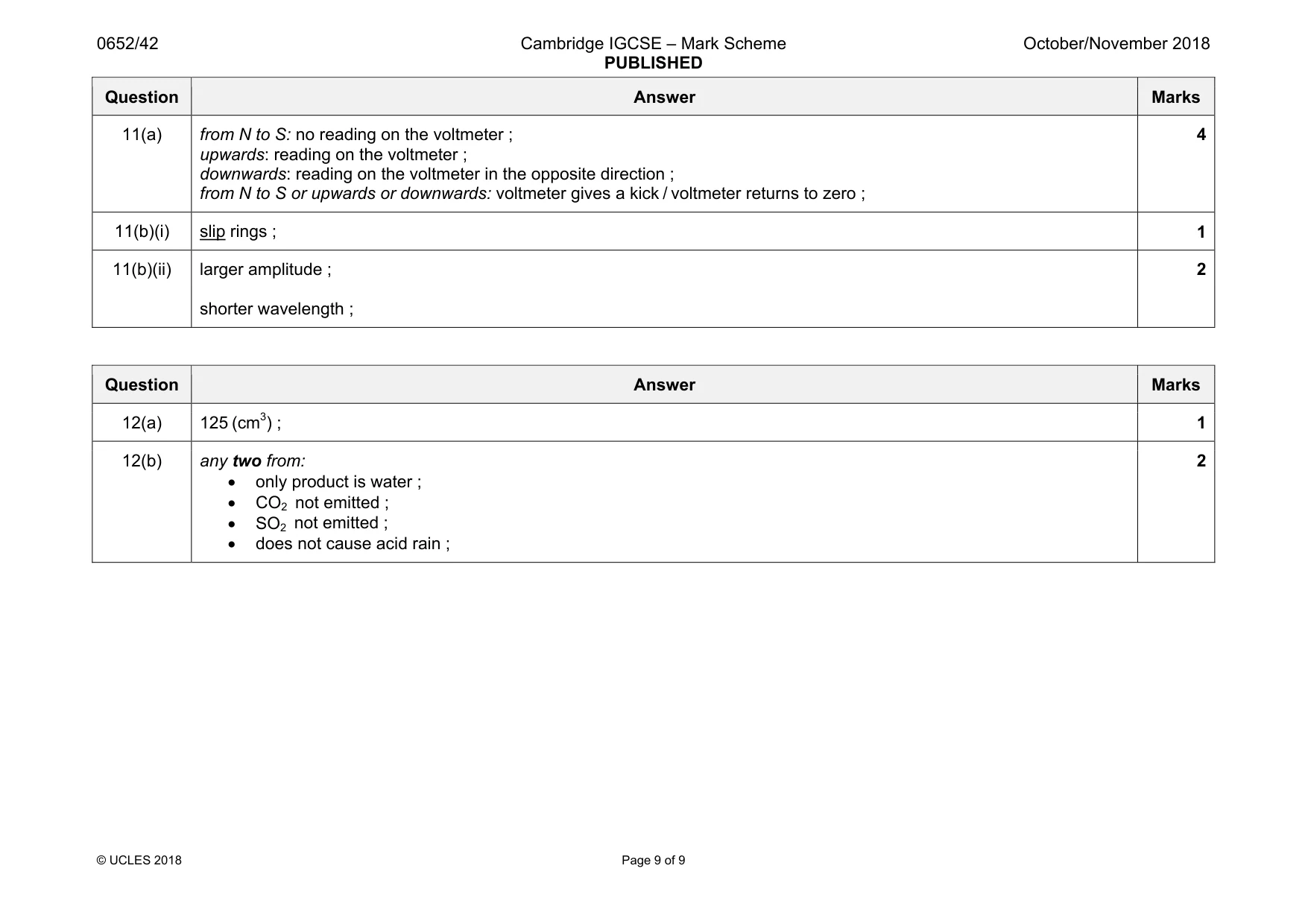
Mark scheme: 11(a) from N to S: no reading on the voltmeter ; upwards: reading on the voltmeter ; downwards: reading on the voltmeter in the opposite direction ; from N to S or upwards or downwards: voltmeter gives a kick / voltmeter returns to zero ; 4 11(b)(i) slip rings ; 1 11(b)(ii) larger amplitude ; shorter wavelength ; 2
Q12 · Hydrogen gas is used as fuel
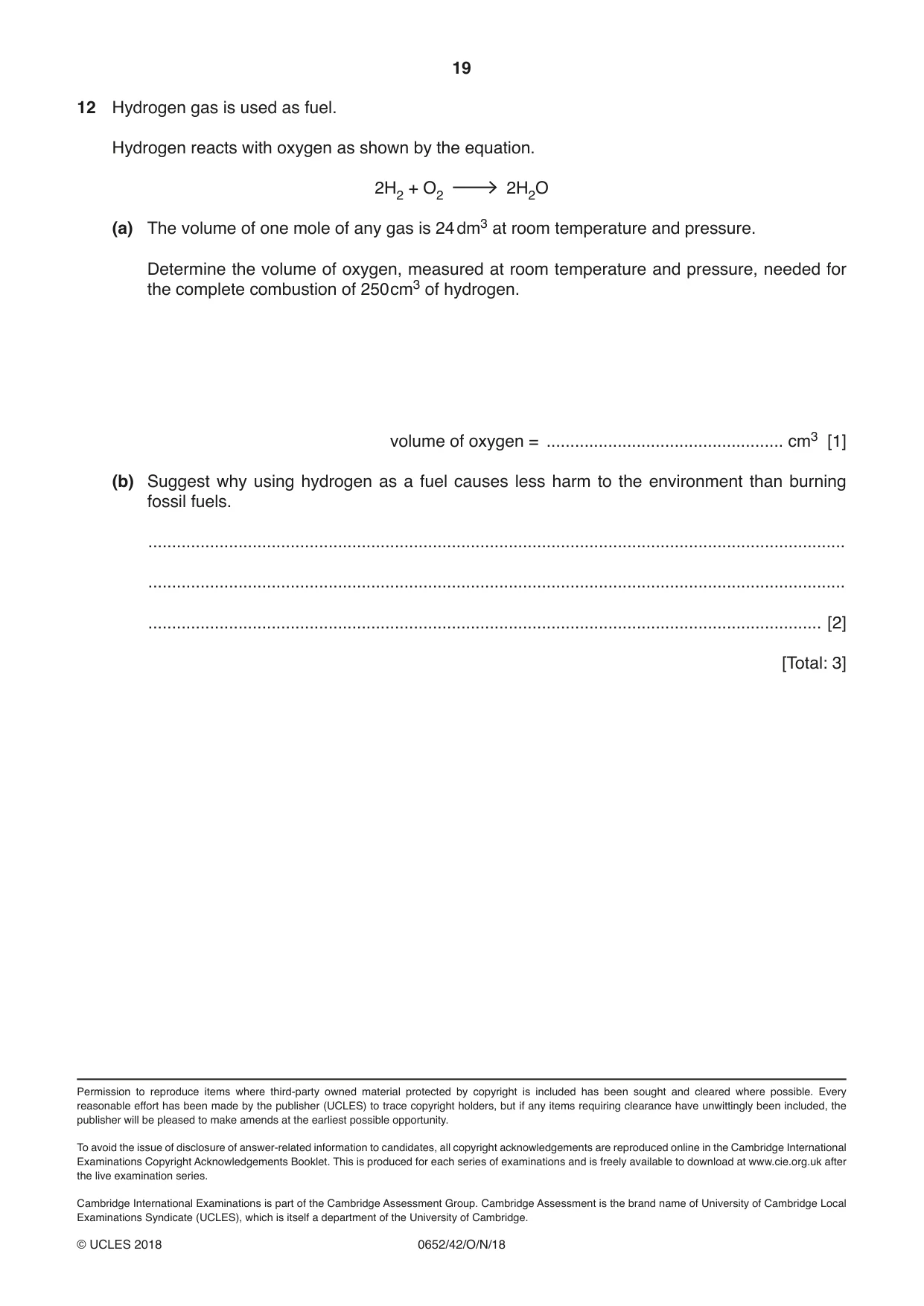
12 Hydrogen gas is used as fuel. Hydrogen reacts with oxygen as shown by the equation. 2H2 + O2 2H2O (a) The volume of one mole of any gas is 24 dm3 at room temperature and pressure. Determine the volume of oxygen, measured at room temperature and pressure, needed for the complete combustion of 250 cm3 of hydrogen. volume of oxygen = .................................................. cm3 [1] (b) Suggest why using hydrogen as a fuel causes less harm to the environment than burning fossil fuels. ................................................................................................................................................... ................................................................................................................................................... .............................................................................................................................................. [2] [Total: 3]
Mark scheme: 12(a) 1 12(b) any two from: • only product is water ; • CO2 not emitted ; • SO2 not emitted ; • does not cause acid rain ; 2
What was in this paper
The subtopics covered by these 12 questions, and how many questions each got. Open one in a new tab to see every Cambridge question on it.
What you needed in this session
Cambridge’s own grade thresholds for 2018 Oct/Nov, Paper 4 · Variant 2. A higher threshold means an easier paper — the bar moves with how the cohort did.