Cambridge IGCSE Physical Education 0413 — 2024 May/June Paper 1 · Variant 1
0413/11/M/J/24 · 100 marks · ≈113 min
The question paper and its mark scheme, free to read here and free to download. This is Cambridge’s own paper, exactly as it was sat.
Question paper16 pages
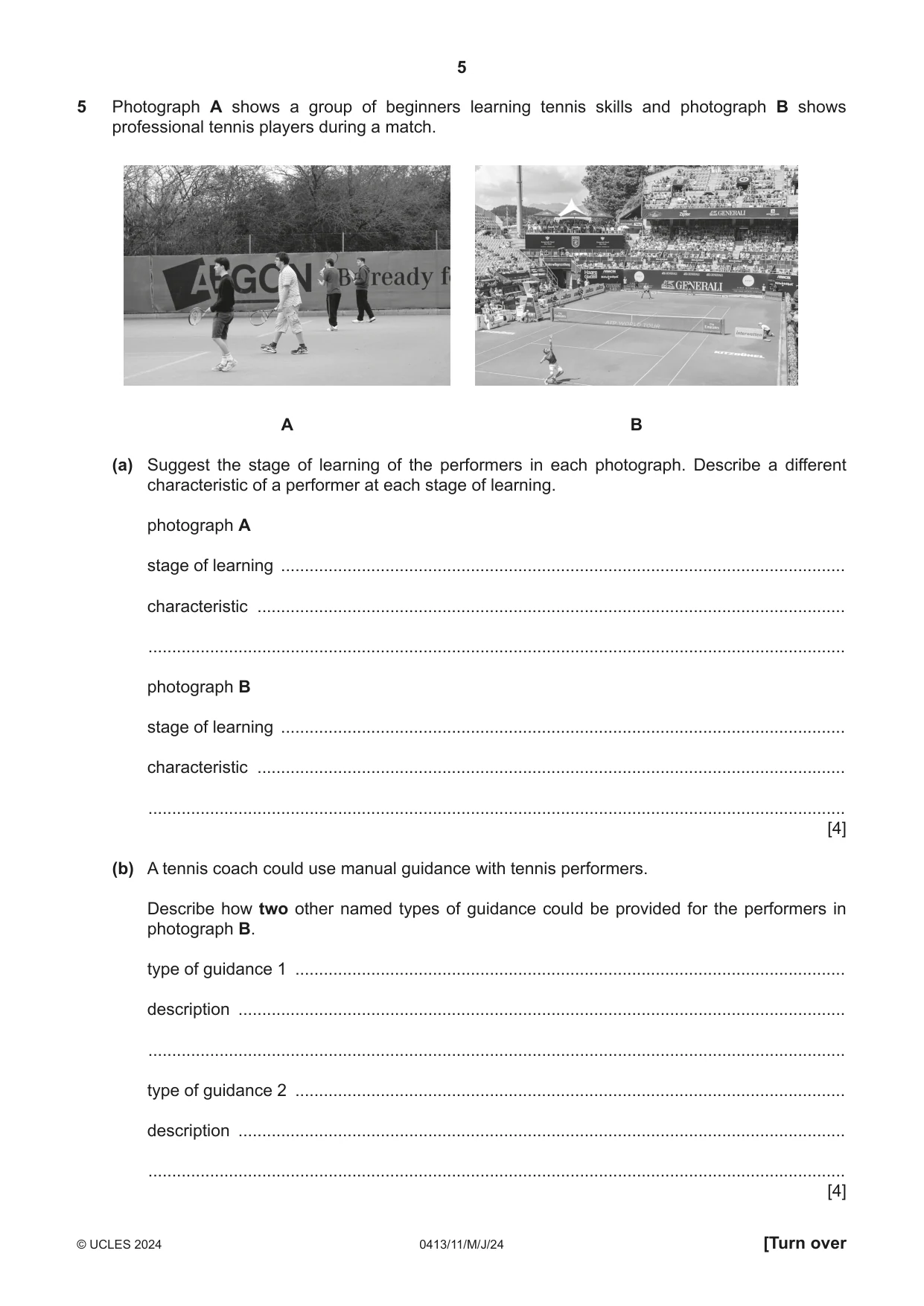
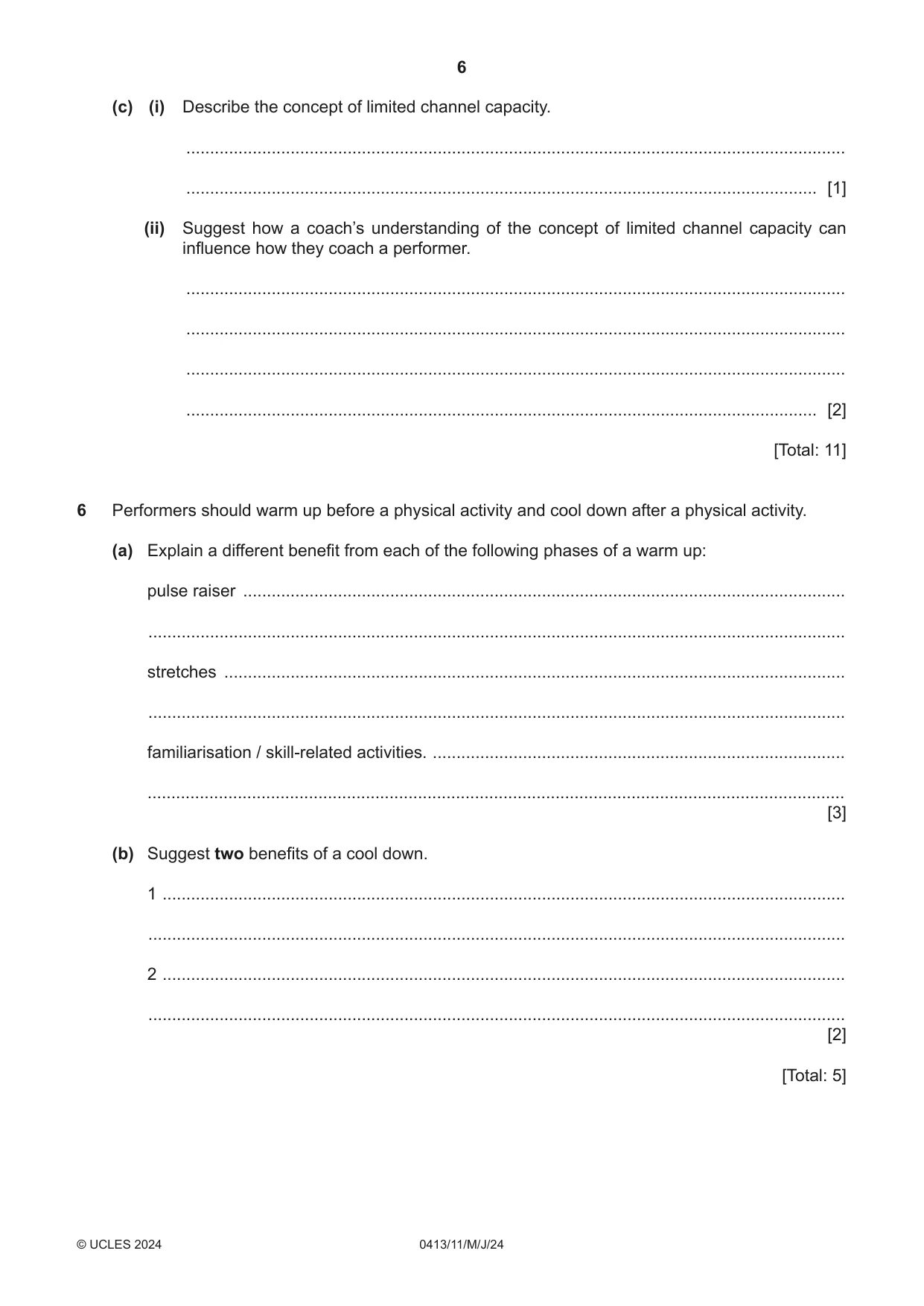
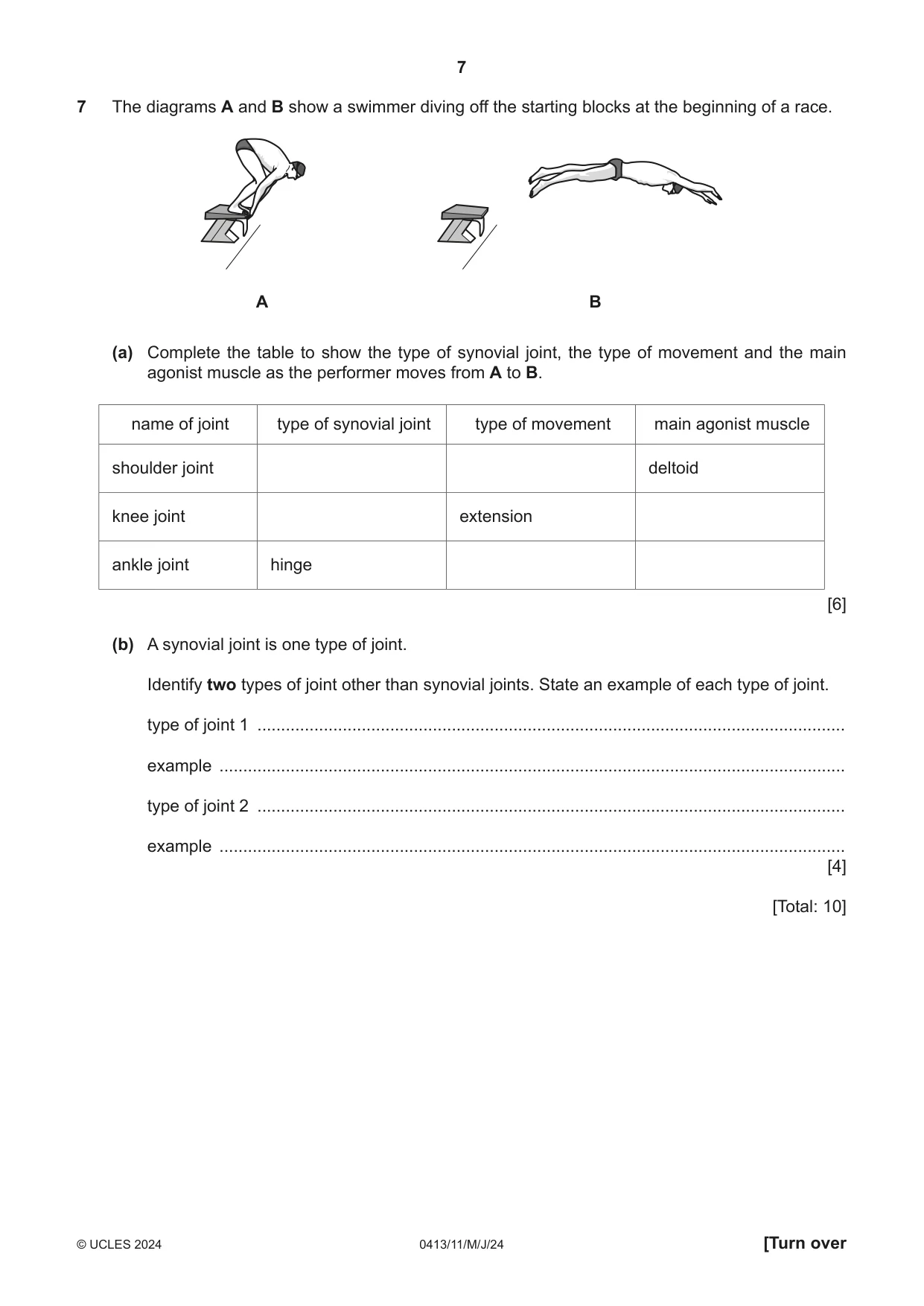
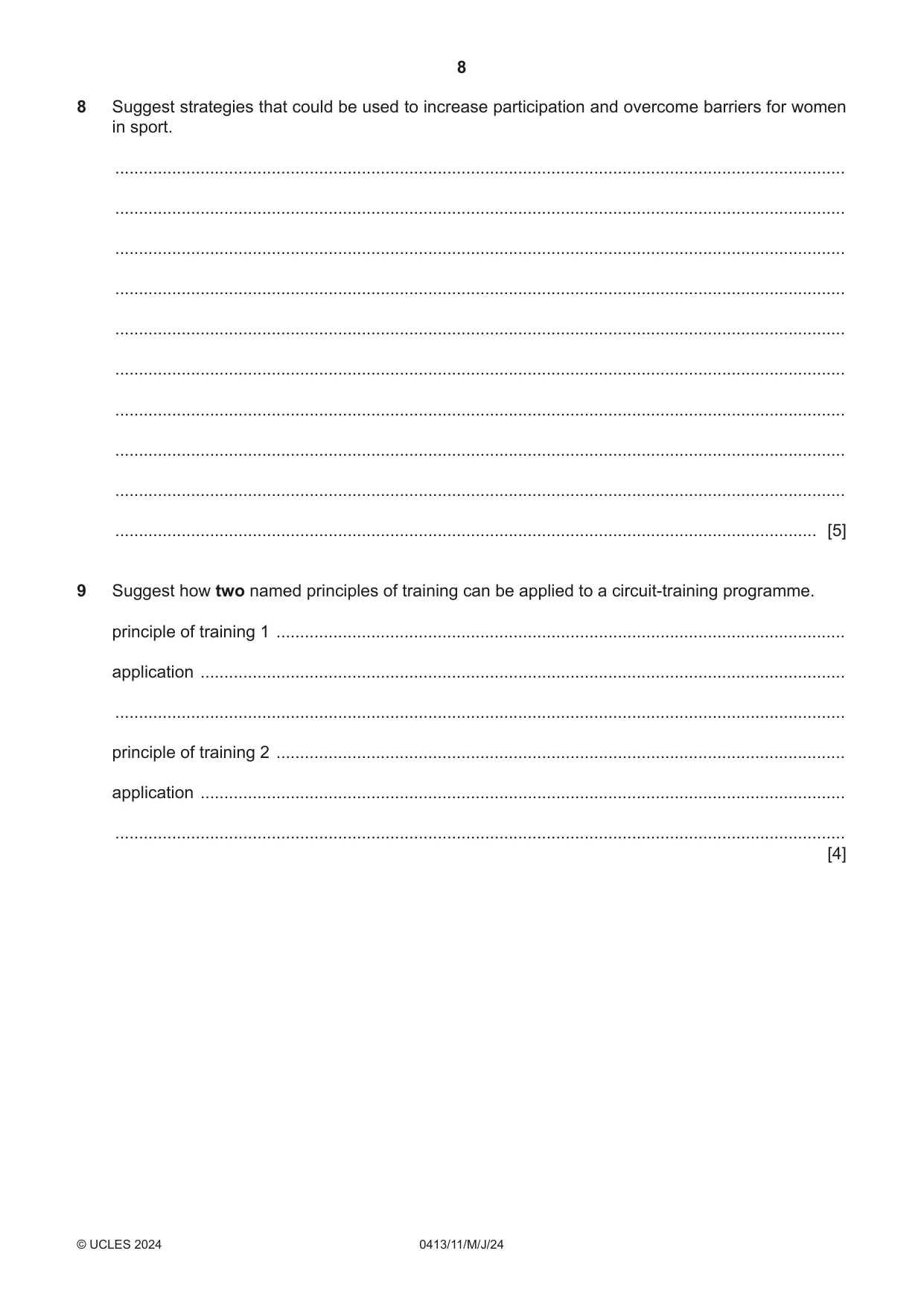

Mark scheme21 pages
Answers below. Sit the paper first if you are practising.
Paper as text
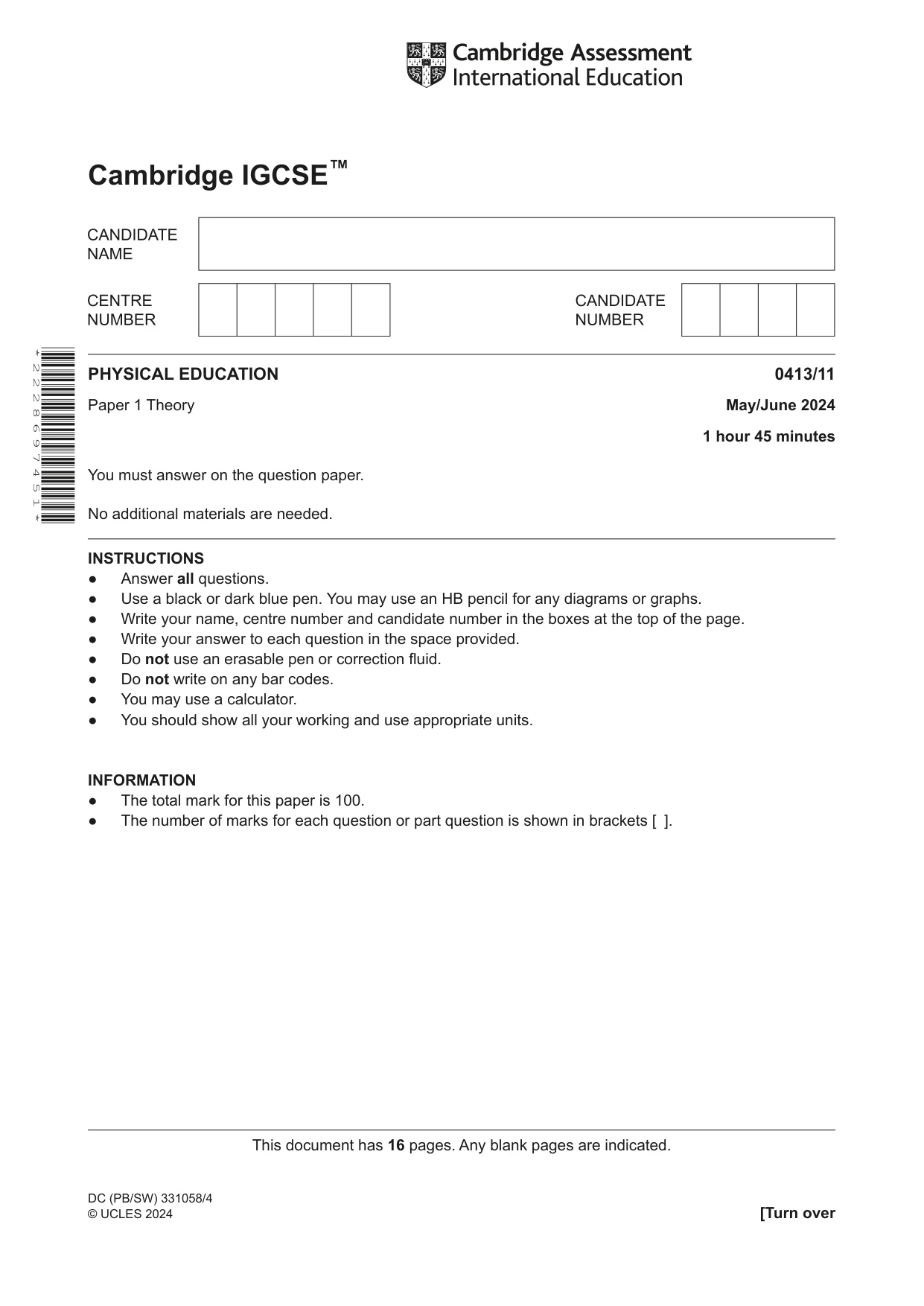
Question paper, page 1
This document has 16 pages. Any blank pages are indicated. [Turn over Cambridge IGCSE™ * 2 2 2 8 6 9 7 4 5 1 * PHYSICAL EDUCATION 0413/11 Paper 1 Theory May/June 2024 1 hour 45 minutes You must answer on the question paper. No additional materials are needed. INSTRUCTIONS ● Answer all questions. ● Use a black or dark blue pen. You may use an HB pencil for any diagrams or graphs. ● Write your name, centre number and candidate number in the boxes at the top of the page. ● Write your answer to each question in the space provided. ● Do not use an erasable pen or correction fluid. ● Do not write on any bar codes. ● You may use a calculator. ● You should show all your working and use appropriate units. INFORMATION ● The total mark for this paper is 100. ● The number of marks for each question or part question is shown in brackets [ ]. DC (PB/SW) 331058/4 © UCLES 2024
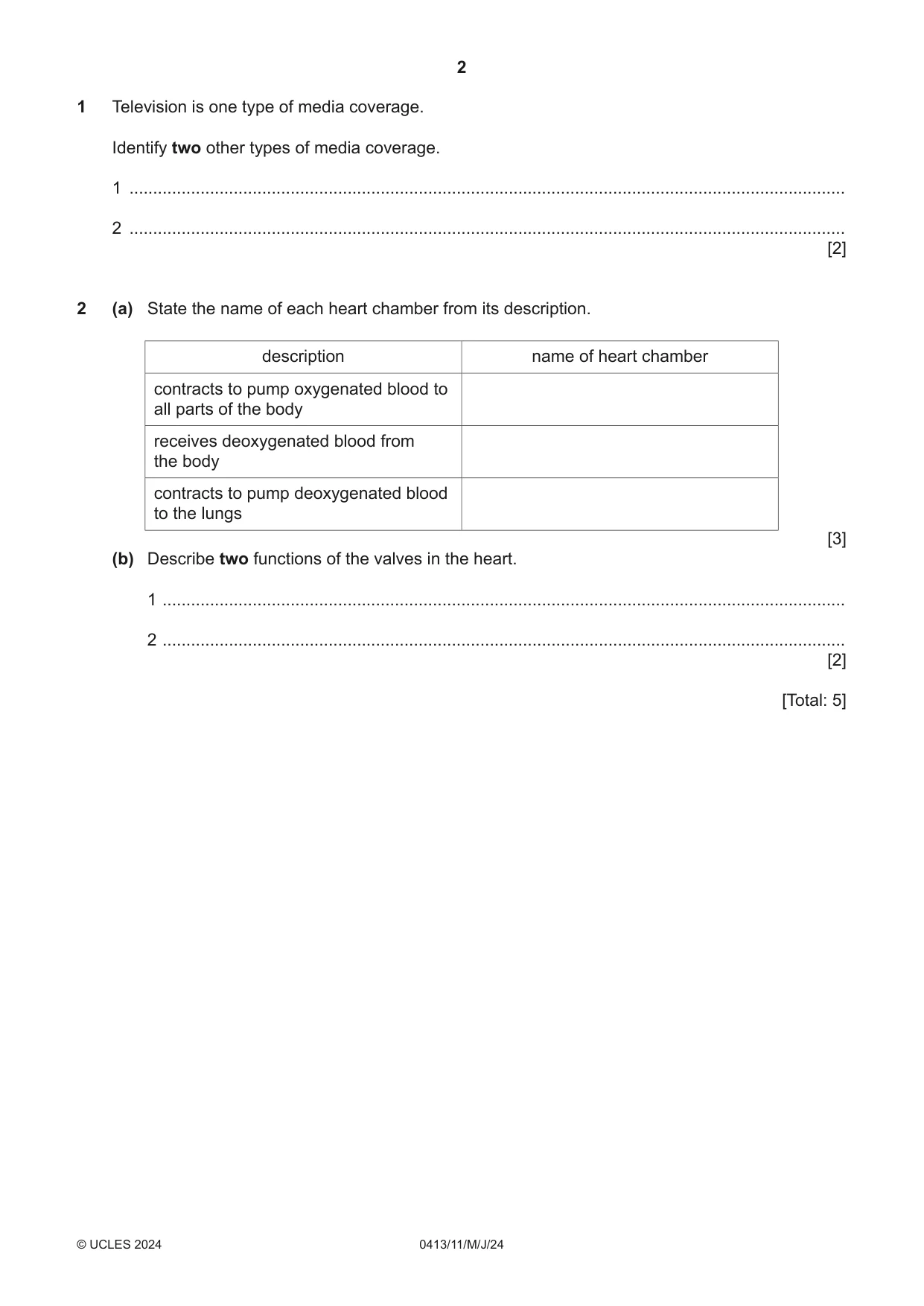
Question paper, page 2
2 0413/11/M/J/24 © UCLES 2024 1 Television is one type of media coverage. Identify two other types of media coverage. 1 … 2 … [2] 2 (a) State the name of each heart chamber from its description. description name of heart chamber contracts to pump oxygenated blood to all parts of the body receives deoxygenated blood from the body contracts to pump deoxygenated blood to the lungs [3] (b) Describe two functions of the valves in the heart. 1 … 2 … [2] [Total: 5]
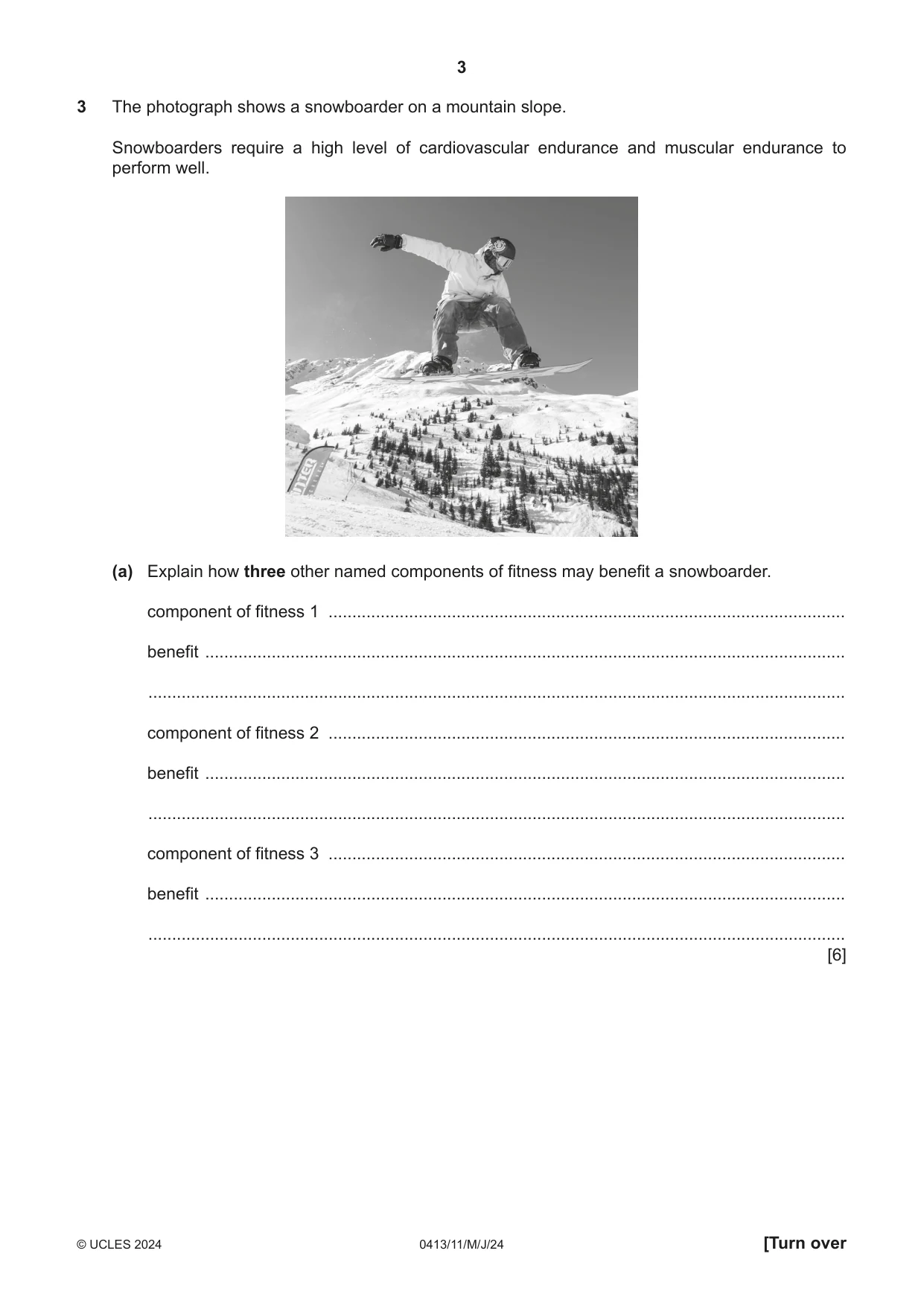
Question paper, page 3
3 0413/11/M/J/24 © UCLES 2024 [Turn over 3 The photograph shows a snowboarder on a mountain slope. Snowboarders require a high level of cardiovascular endurance and muscular endurance to perform well. (a) Explain how three other named components of fitness may benefit a snowboarder. component of fitness 1 … benefit … … component of fitness 2 … benefit … … component of fitness 3 … benefit … … [6]
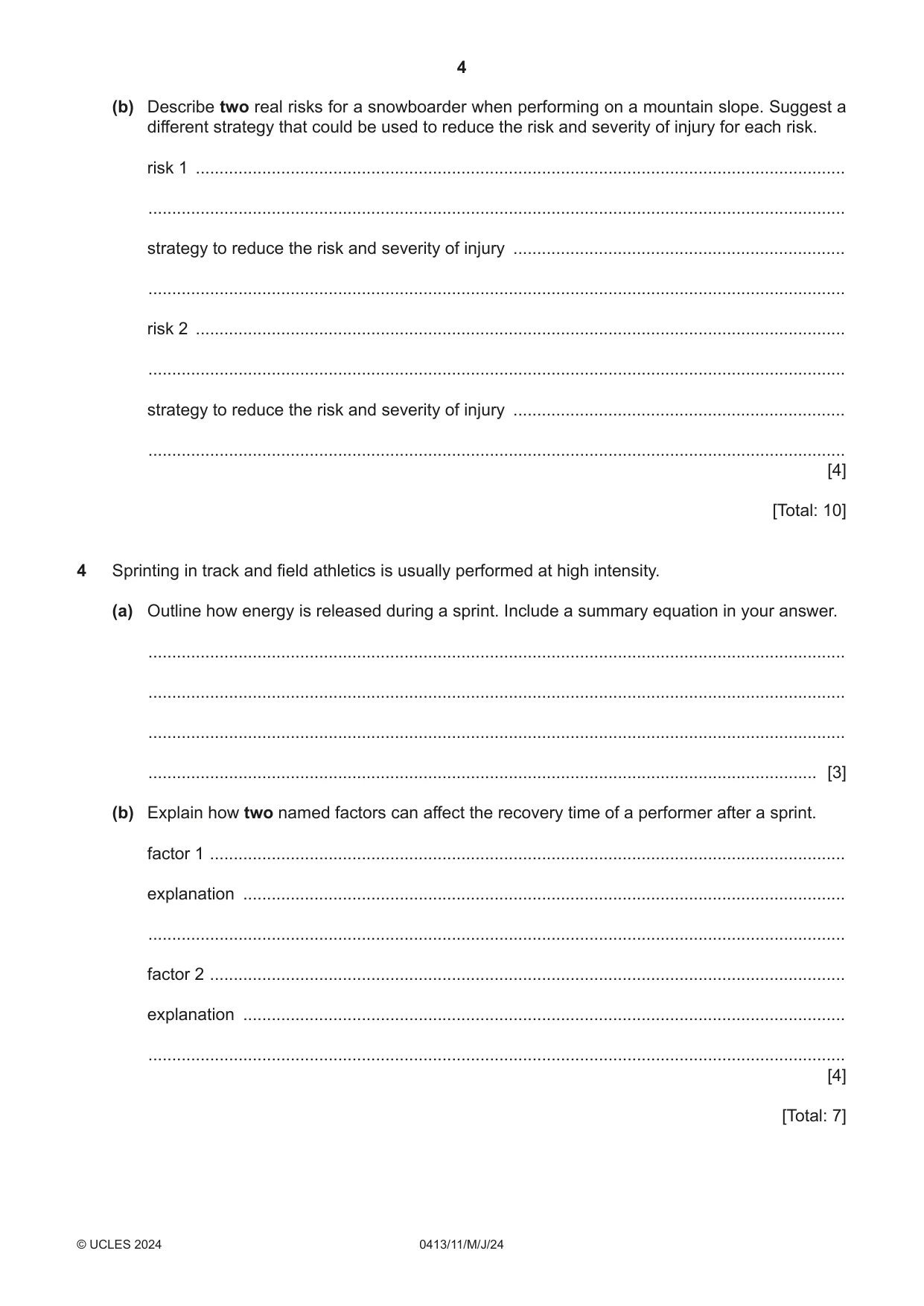
Question paper, page 4
4 0413/11/M/J/24 © UCLES 2024 (b) Describe two real risks for a snowboarder when performing on a mountain slope. Suggest a different strategy that could be used to reduce the risk and severity of injury for each risk. risk 1 … … strategy to reduce the risk and severity of injury … … risk 2 … … strategy to reduce the risk and severity of injury … … [4] [Total: 10] 4 Sprinting in track and field athletics is usually performed at high intensity. (a) Outline how energy is released during a sprint. Include a summary equation in your answer. … … … … [3] (b) Explain how two named factors can affect the recovery time of a performer after a sprint. factor 1 … explanation … … factor 2 … explanation … … [4] [Total: 7]
Question paper, page 5
5 0413/11/M/J/24 © UCLES 2024 [Turn over 5 Photograph A shows a group of beginners learning tennis skills and photograph B shows professional tennis players during a match. A B (a) Suggest the stage of learning of the performers in each photograph. Describe a different characteristic of a performer at each stage of learning. photograph A stage of learning … characteristic … … photograph B stage of learning … characteristic … … [4] (b) A tennis coach could use manual guidance with tennis performers. Describe how two other named types of guidance could be provided for the performers in photograph B. type of guidance 1 … description … … type of guidance 2 … description … … [4]
Question paper, page 6
6 0413/11/M/J/24 © UCLES 2024 (c) (i) Describe the concept of limited channel capacity. … … [1] (ii) Suggest how a coach’s understanding of the concept of limited channel capacity can influence how they coach a performer. … … … … [2] [Total: 11] 6 Performers should warm up before a physical activity and cool down after a physical activity. (a) Explain a different benefit from each of the following phases of a warm up: pulse raiser … … stretches … … familiarisation / skill-related activities. … … [3] (b) Suggest two benefits of a cool down. 1 … … 2 … … [2] [Total: 5]
Question paper, page 7
7 0413/11/M/J/24 © UCLES 2024 [Turn over 7 The diagrams A and B show a swimmer diving off the starting blocks at the beginning of a race. A B (a) Complete the table to show the type of synovial joint, the type of movement and the main agonist muscle as the performer moves from A to B. name of joint type of synovial joint type of movement main agonist muscle shoulder joint deltoid knee joint extension ankle joint hinge [6] (b) A synovial joint is one type of joint. Identify two types of joint other than synovial joints. State an example of each type of joint. type of joint 1 … example … type of joint 2 … example … [4] [Total: 10]
Question paper, page 8
8 0413/11/M/J/24 © UCLES 2024 8 Suggest strategies that could be used to increase participation and overcome barriers for women in sport. … … … … … … … … … … [5] 9 Suggest how two named principles of training can be applied to a circuit-training programme. principle of training 1 … application … … principle of training 2 … application … … [4]
Question paper, page 9
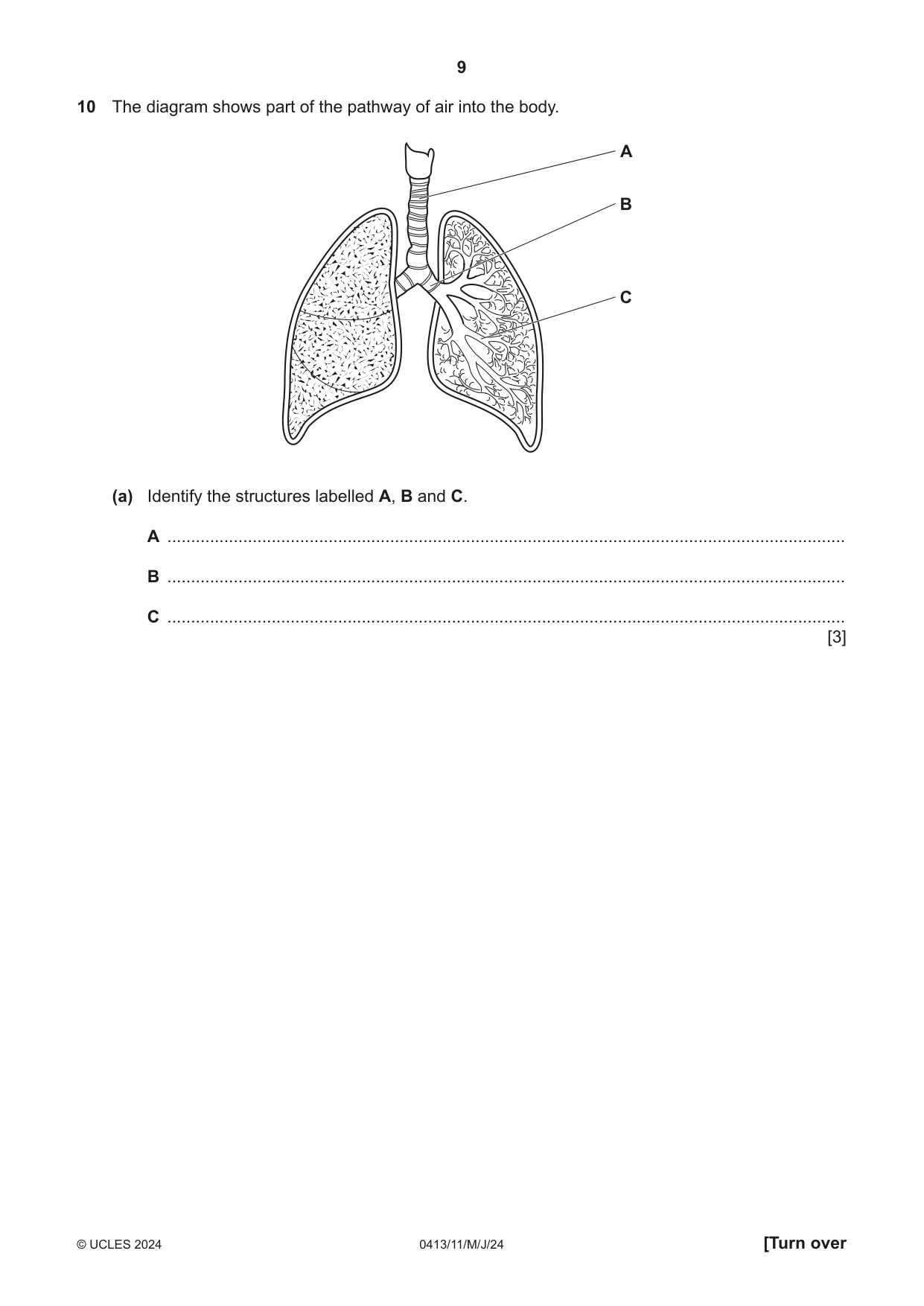
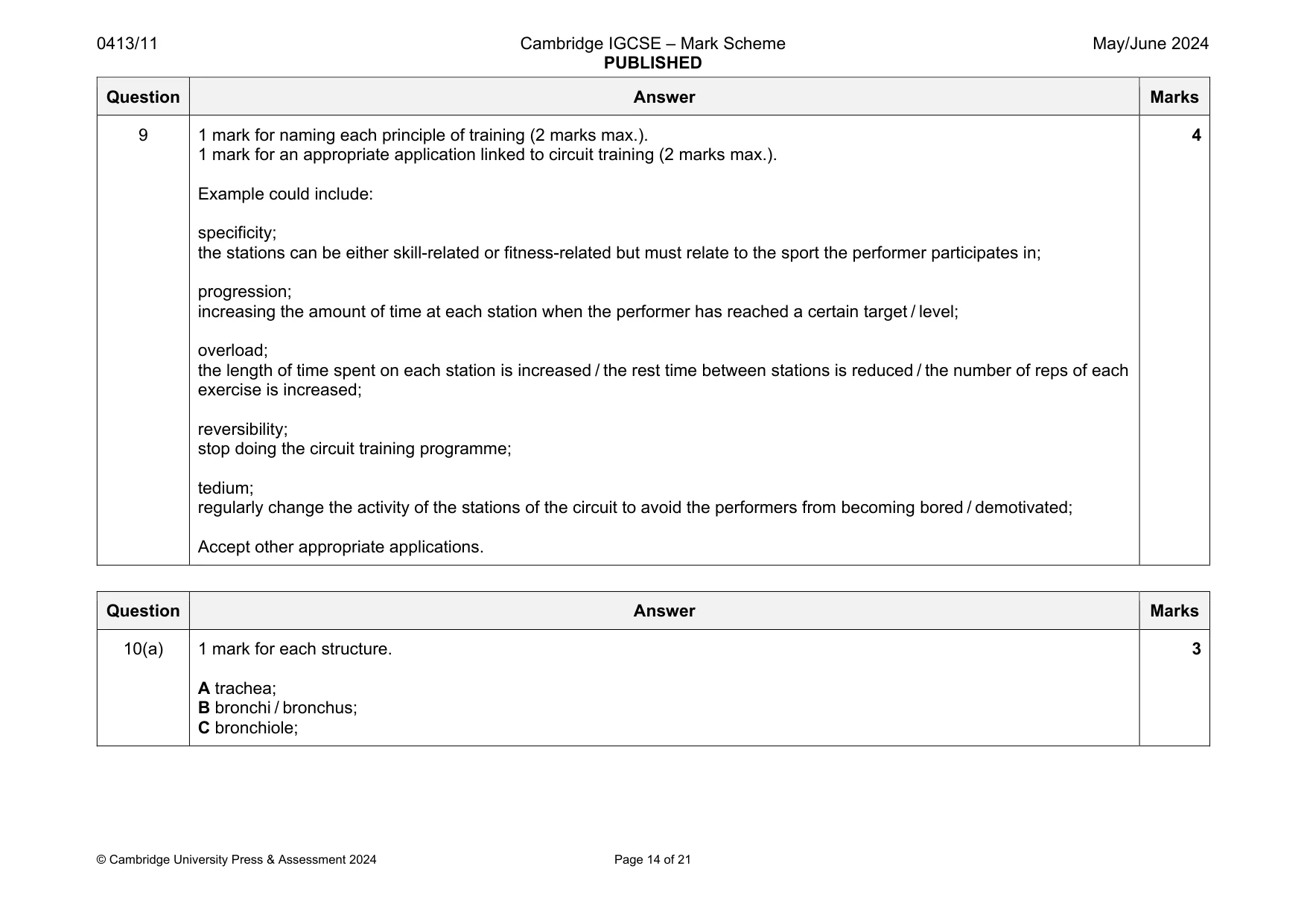
9 0413/11/M/J/24 © UCLES 2024 [Turn over 10 The diagram shows part of the pathway of air into the body. A B C (a) Identify the structures labelled A, B and C. A … B … C … [3]
Question paper, page 10
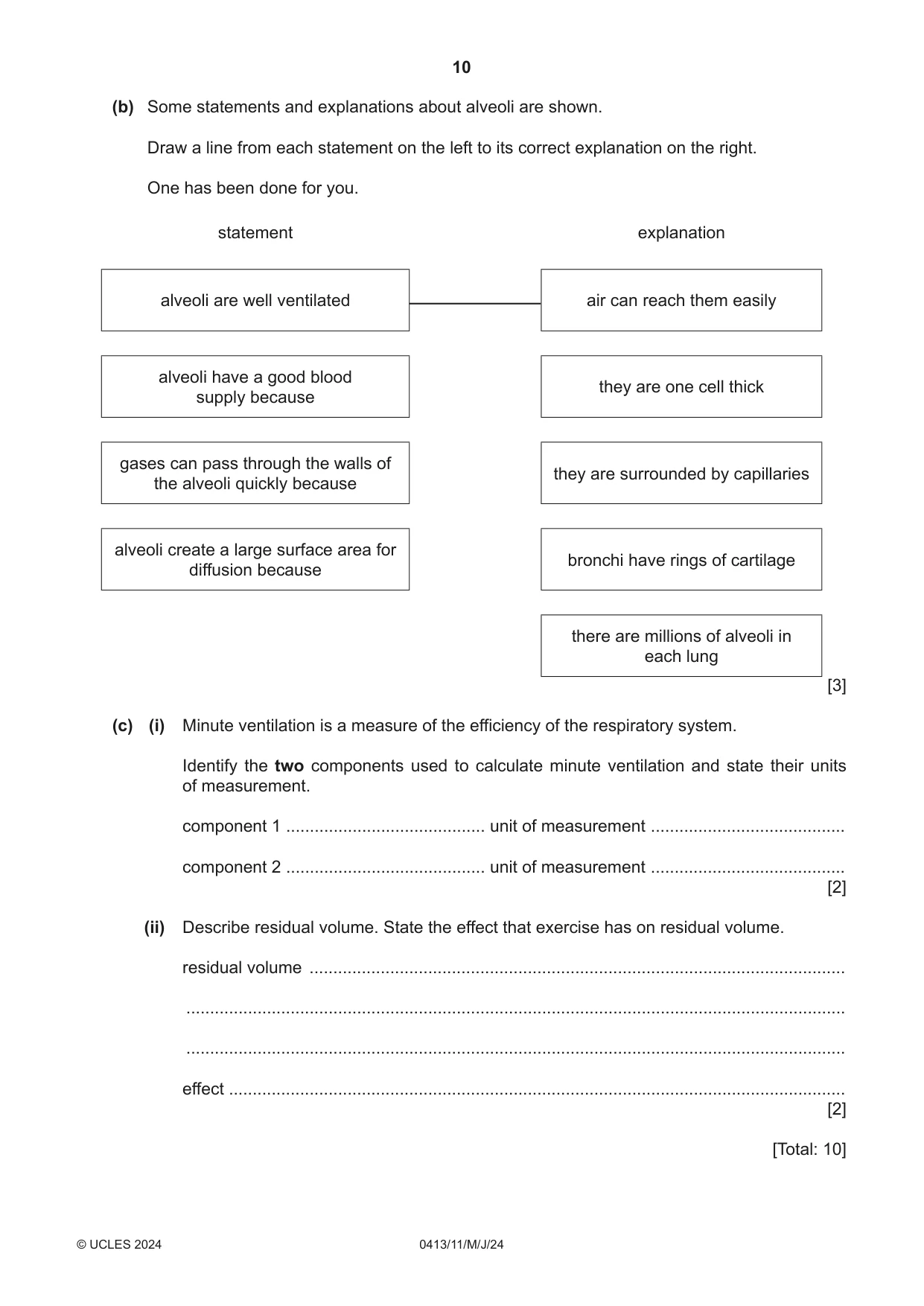
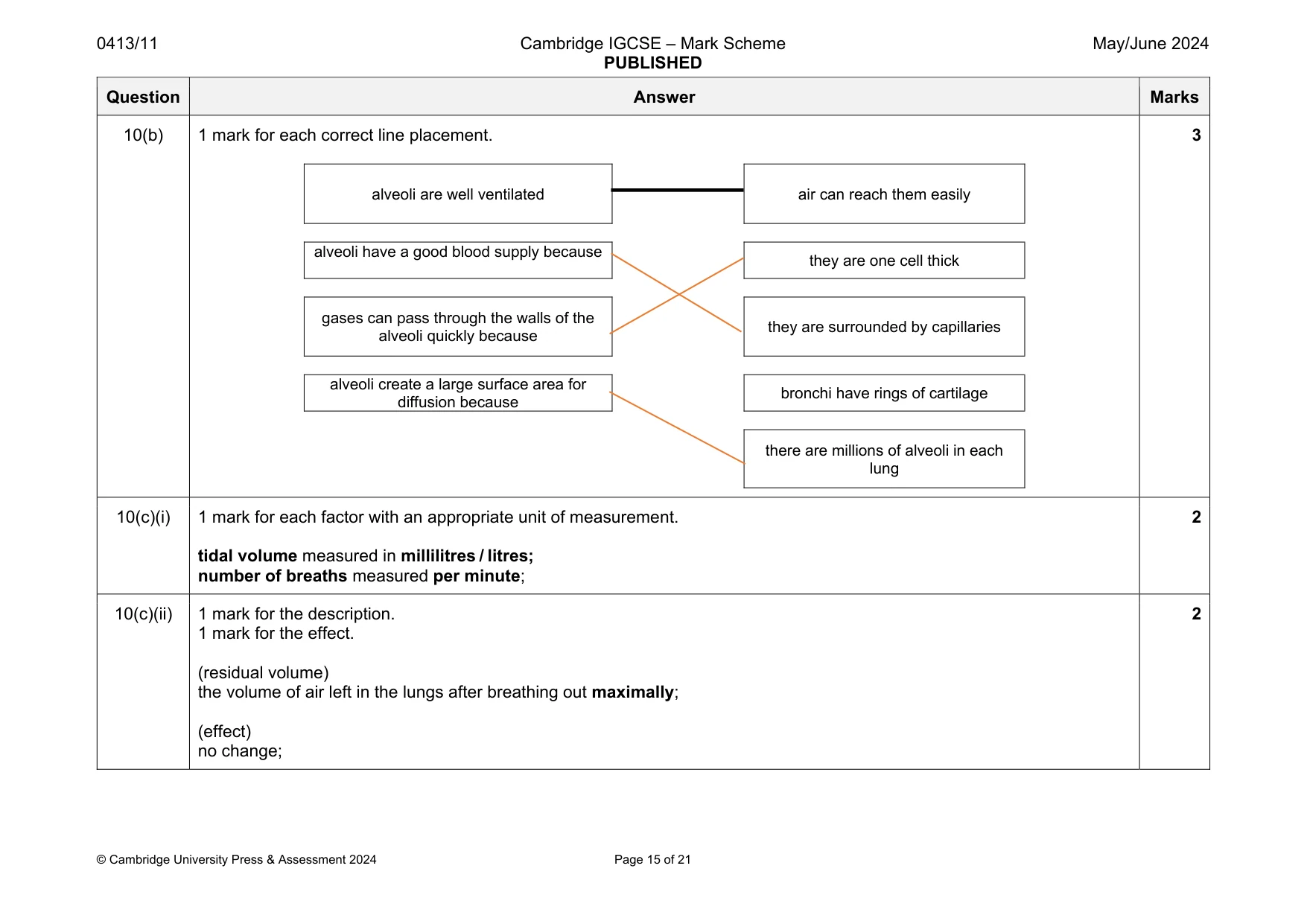
10 0413/11/M/J/24 © UCLES 2024 (b) Some statements and explanations about alveoli are shown. Draw a line from each statement on the left to its correct explanation on the right. One has been done for you. statement explanation alveoli are well ventilated air can reach them easily alveoli have a good blood supply because they are one cell thick gases can pass through the walls of the alveoli quickly because they are surrounded by capillaries alveoli create a large surface area for diffusion because bronchi have rings of cartilage there are millions of alveoli in each lung [3] (c) (i) Minute ventilation is a measure of the efficiency of the respiratory system. Identify the two components used to calculate minute ventilation and state their units of measurement. component 1 … unit of measurement … component 2 … unit of measurement … [2] (ii) Describe residual volume. State the effect that exercise has on residual volume. residual volume … … … effect … [2] [Total: 10]
Question paper, page 11
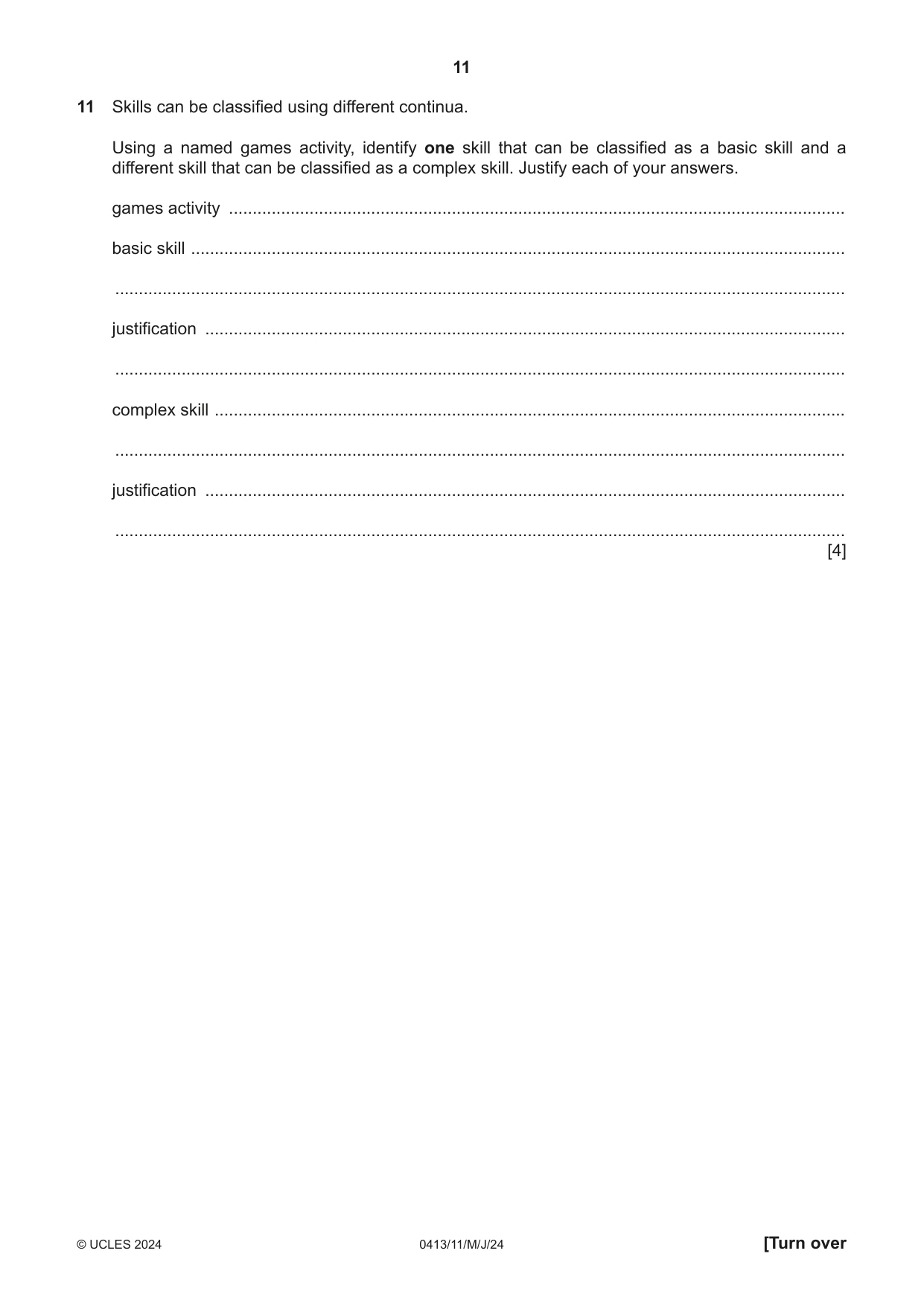
11 0413/11/M/J/24 © UCLES 2024 [Turn over 11 Skills can be classified using different continua. Using a named games activity, identify one skill that can be classified as a basic skill and a different skill that can be classified as a complex skill. Justify each of your answers. games activity … basic skill … … justification … … complex skill … … justification … … [4]
Question paper, page 12
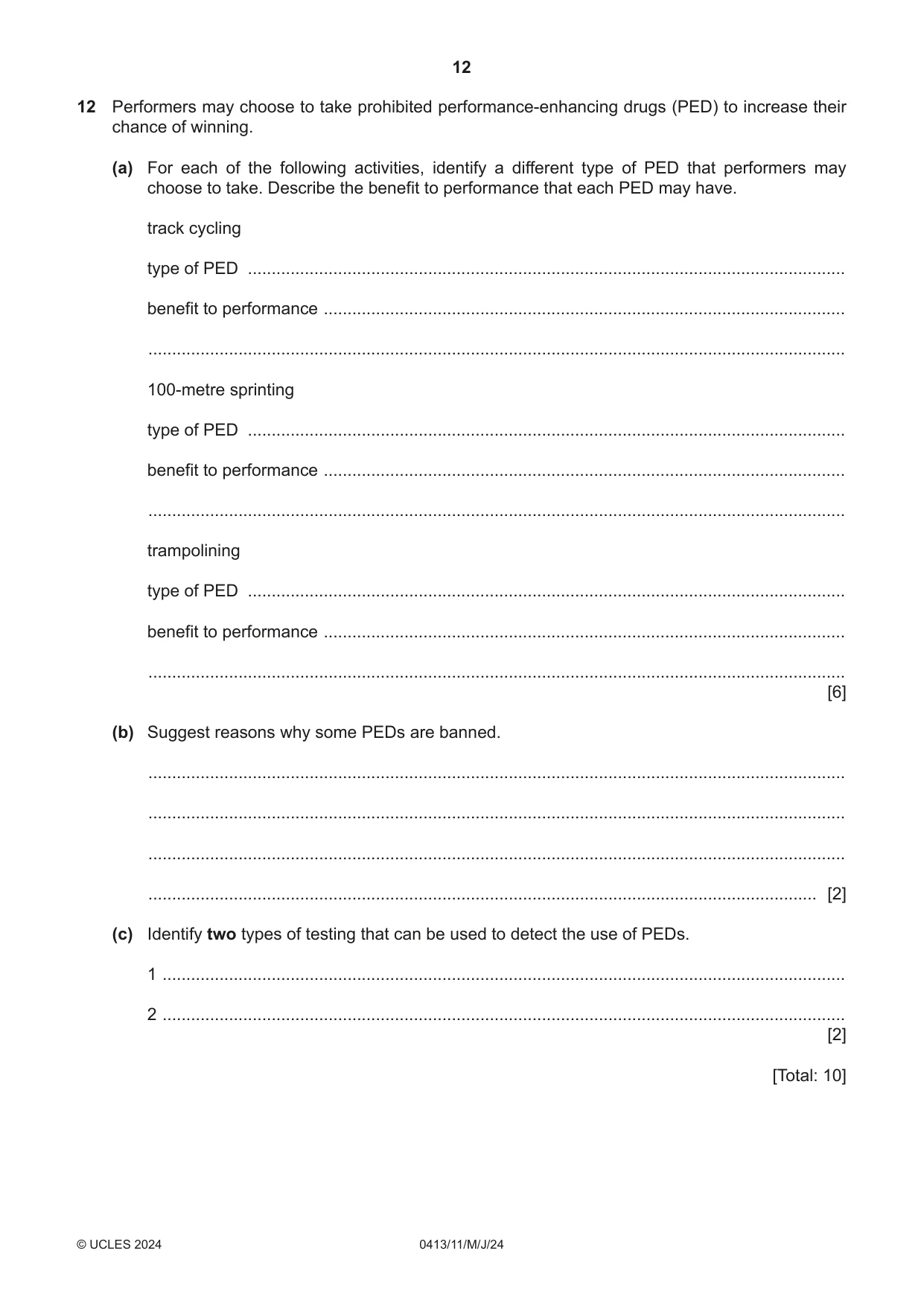
12 0413/11/M/J/24 © UCLES 2024 12 Performers may choose to take prohibited performance-enhancing drugs (PED) to increase their chance of winning. (a) For each of the following activities, identify a different type of PED that performers may choose to take. Describe the benefit to performance that each PED may have. track cycling type of PED … benefit to performance … … 100-metre sprinting type of PED … benefit to performance … … trampolining type of PED … benefit to performance … … [6] (b) Suggest reasons why some PEDs are banned. … … … … [2] (c) Identify two types of testing that can be used to detect the use of PEDs. 1 … 2 … [2] [Total: 10]
Question paper, page 13
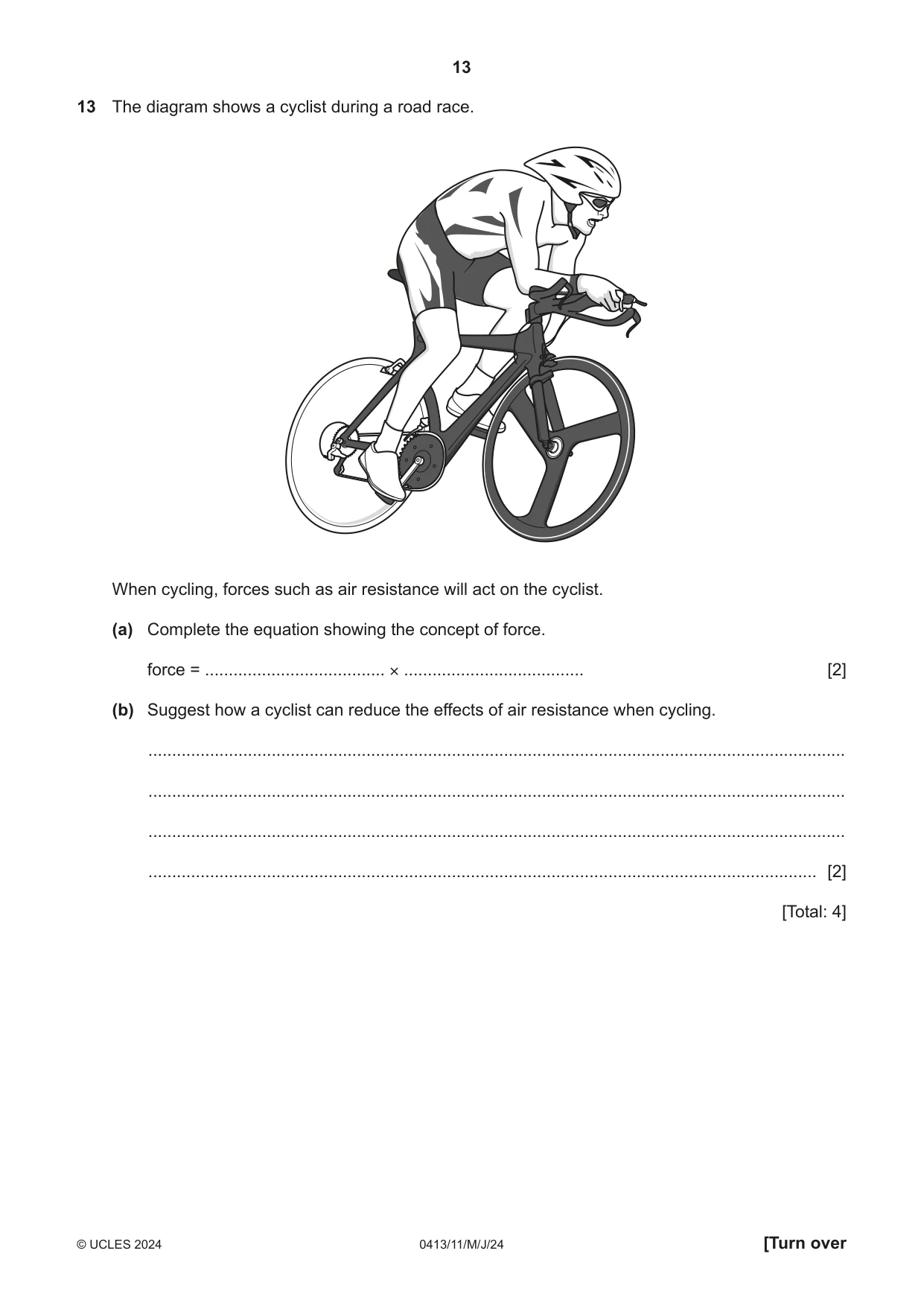
13 0413/11/M/J/24 © UCLES 2024 [Turn over 13 The diagram shows a cyclist during a road race. When cycling, forces such as air resistance will act on the cyclist. (a) Complete the equation showing the concept of force. force = … × … [2] (b) Suggest how a cyclist can reduce the effects of air resistance when cycling. … … … … [2] [Total: 4]
Question paper, page 14
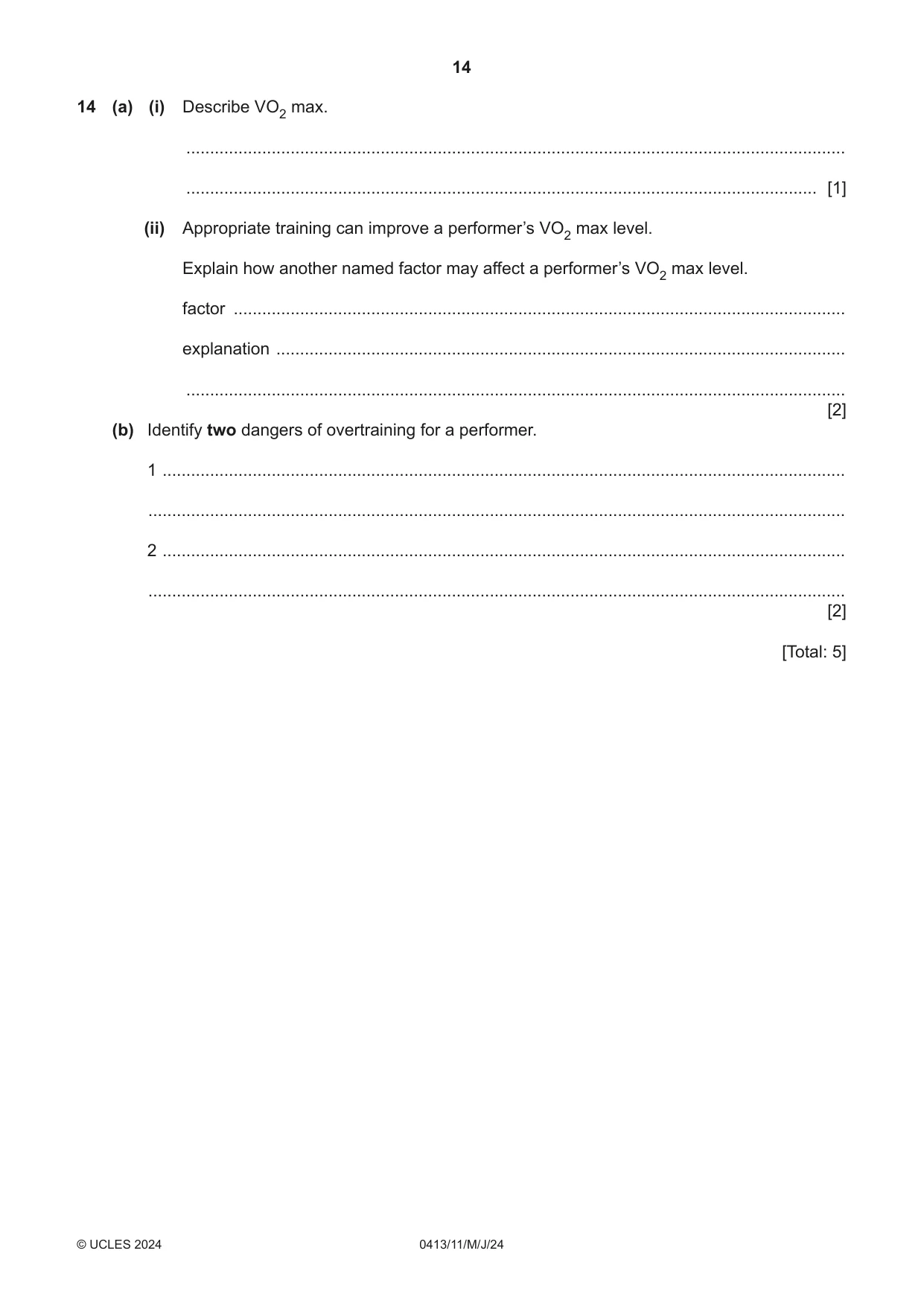
14 0413/11/M/J/24 © UCLES 2024 14 (a) (i) Describe VO2 max. … … [1] (ii) Appropriate training can improve a performer’s VO2 max level. Explain how another named factor may affect a performer’s VO2 max level. factor … explanation … … [2] (b) Identify two dangers of overtraining for a performer. 1 … … 2 … … [2] [Total: 5]
Question paper, page 15
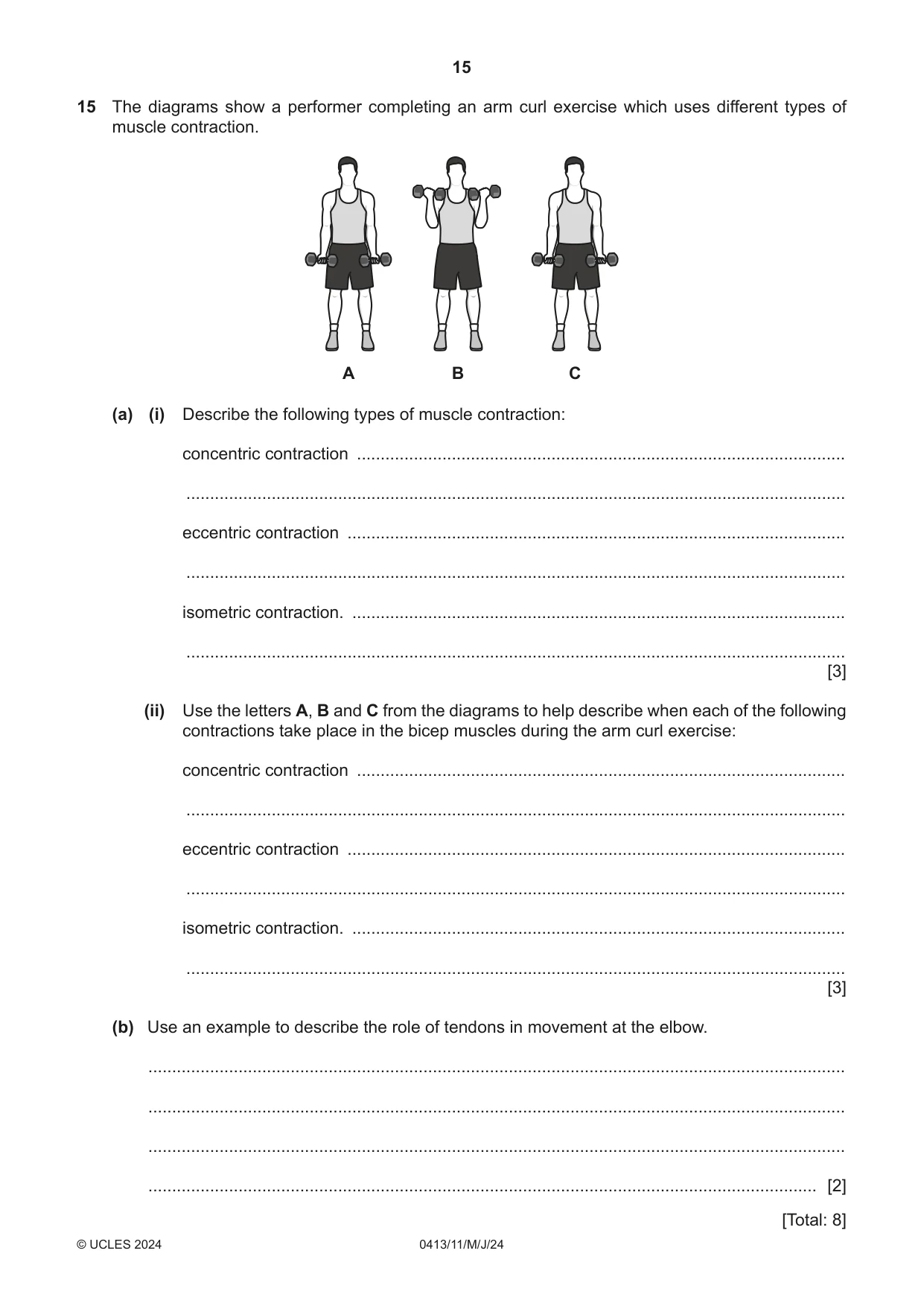
15 0413/11/M/J/24 © UCLES 2024 15 The diagrams show a performer completing an arm curl exercise which uses different types of muscle contraction. A C B (a) (i) Describe the following types of muscle contraction: concentric contraction … … eccentric contraction … … isometric contraction. … … [3] (ii) Use the letters A, B and C from the diagrams to help describe when each of the following contractions take place in the bicep muscles during the arm curl exercise: concentric contraction … … eccentric contraction … … isometric contraction. … … [3] (b) Use an example to describe the role of tendons in movement at the elbow. … … … … [2] [Total: 8]
Question paper, page 16
16 0413/11/M/J/24 © UCLES 2024 Permission to reproduce items where third-party owned material protected by copyright is included has been sought and cleared where possible. Every reasonable effort has been made by the publisher (UCLES) to trace copyright holders, but if any items requiring clearance have unwittingly been included, the publisher will be pleased to make amends at the earliest possible opportunity. To avoid the issue of disclosure of answer-related information to candidates, all copyright acknowledgements are reproduced online in the Cambridge Assessment International Education Copyright Acknowledgements Booklet. This is produced for each series of examinations and is freely available to download at www.cambridgeinternational.org after the live examination series. Cambridge Assessment International Education is part of Cambridge Assessment. Cambridge Assessment is the brand name of the University of Cambridge Local Examinations Syndicate (UCLES), which is a department of the University of Cambridge. BLANK PAGE
Mark scheme, page 1
This document consists of 21 printed pages. © Cambridge University Press & Assessment 2024 [Turn over Cambridge IGCSE™ PHYSICAL EDUCATION 0413/11 Paper 1 Theory May/June 2024 MARK SCHEME Maximum Mark: 100 Published This mark scheme is published as an aid to teachers and candidates, to indicate the requirements of the examination. It shows the basis on which Examiners were instructed to award marks. It does not indicate the details of the discussions that took place at an Examiners’ meeting before marking began, which would have considered the acceptability of alternative answers. Mark schemes should be read in conjunction with the question paper and the Principal Examiner Report for Teachers. Cambridge International will not enter into discussions about these mark schemes. Cambridge International is publishing the mark schemes for the May/June 2024 series for most Cambridge IGCSE, Cambridge International A and AS Level and Cambridge Pre-U components, and some Cambridge O Level components.
Mark scheme, page 2
0413/11 Cambridge IGCSE – Mark Scheme PUBLISHED May/June 2024 © Cambridge University Press & Assessment 2024 Page 2 of 21 Generic Marking Principles These general marking principles must be applied by all examiners when marking candidate answers. They should be applied alongside the specific content of the mark scheme or generic level descriptions for a question. Each question paper and mark scheme will also comply with these marking principles. GENERIC MARKING PRINCIPLE 1: Marks must be awarded in line with: the specific content of the mark scheme or the generic level descriptors for the question the specific skills defined in the mark scheme or in the generic level descriptors for the question the standard of response required by a candidate as exemplified by the standardisation scripts. GENERIC MARKING PRINCIPLE 2: Marks awarded are always whole marks (not half marks, or other fractions). GENERIC MARKING PRINCIPLE 3: Marks must be awarded positively: marks are awarded for correct/valid answers, as defined in the mark scheme. However, credit is given for valid answers which go beyond the scope of the syllabus and mark scheme, referring to your Team Leader as appropriate marks are awarded when candidates clearly demonstrate what they know and can do marks are not deducted for errors marks are not deducted for omissions answers should only be judged on the quality of spelling, punctuation and grammar when these features are specifically assessed by the question as indicated by the mark scheme. The meaning, however, should be unambiguous. GENERIC MARKING PRINCIPLE 4: Rules must be applied consistently, e.g. in situations where candidates have not followed instructions or in the application of generic level descriptors.
Mark scheme, page 3
0413/11 Cambridge IGCSE – Mark Scheme PUBLISHED May/June 2024 © Cambridge University Press & Assessment 2024 Page 3 of 21 GENERIC MARKING PRINCIPLE 5: Marks should be awarded using the full range of marks defined in the mark scheme for the question (however; the use of the full mark range may be limited according to the quality of the candidate responses seen). GENERIC MARKING PRINCIPLE 6: Marks awarded are based solely on the requirements as defined in the mark scheme. Marks should not be awarded with grade thresholds or grade descriptors in mind. Science-Specific Marking Principles 1 Examiners should consider the context and scientific use of any keywords when awarding marks. Although keywords may be present, marks should not be awarded if the keywords are used incorrectly. 2 The examiner should not choose between contradictory statements given in the same question part, and credit should not be awarded for any correct statement that is contradicted within the same question part. Wrong science that is irrelevant to the question should be ignored. 3 Although spellings do not have to be correct, spellings of syllabus terms must allow for clear and unambiguous separation from other syllabus terms with which they may be confused (e.g. ethane / ethene, glucagon / glycogen, refraction / reflection). 4 The error carried forward (ecf) principle should be applied, where appropriate. If an incorrect answer is subsequently used in a scientifically correct way, the candidate should be awarded these subsequent marking points. Further guidance will be included in the mark scheme where necessary and any exceptions to this general principle will be noted. 5 ‘List rule’ guidance For questions that require n responses (e.g. State two reasons …): The response should be read as continuous prose, even when numbered answer spaces are provided. Any response marked ignore in the mark scheme should not count towards n. Incorrect responses should not be awarded credit but will still count towards n. Read the entire response to check for any responses that contradict those that would otherwise be credited. Credit should not be awarded for any responses that are contradicted within the rest of the response. Where two responses contradict one another, this should be treated as a single incorrect response. Non-contradictory responses after the first n responses may be ignored even if they include incorrect science.
Mark scheme, page 4
0413/11 Cambridge IGCSE – Mark Scheme PUBLISHED May/June 2024 © Cambridge University Press & Assessment 2024 Page 4 of 21 6 Calculation specific guidance Correct answers to calculations should be given full credit even if there is no working or incorrect working, unless the question states ‘show your working’. For questions in which the number of significant figures required is not stated, credit should be awarded for correct answers when rounded by the examiner to the number of significant figures given in the mark scheme. This may not apply to measured values. For answers given in standard form (e.g. a 10n) in which the convention of restricting the value of the coefficient (a) to a value between 1 and 10 is not followed, credit may still be awarded if the answer can be converted to the answer given in the mark scheme. Unless a separate mark is given for a unit, a missing or incorrect unit will normally mean that the final calculation mark is not awarded. Exceptions to this general principle will be noted in the mark scheme. 7 Guidance for chemical equations Multiples / fractions of coefficients used in chemical equations are acceptable unless stated otherwise in the mark scheme. State symbols given in an equation should be ignored unless asked for in the question or stated otherwise in the mark scheme.
Mark scheme, page 5
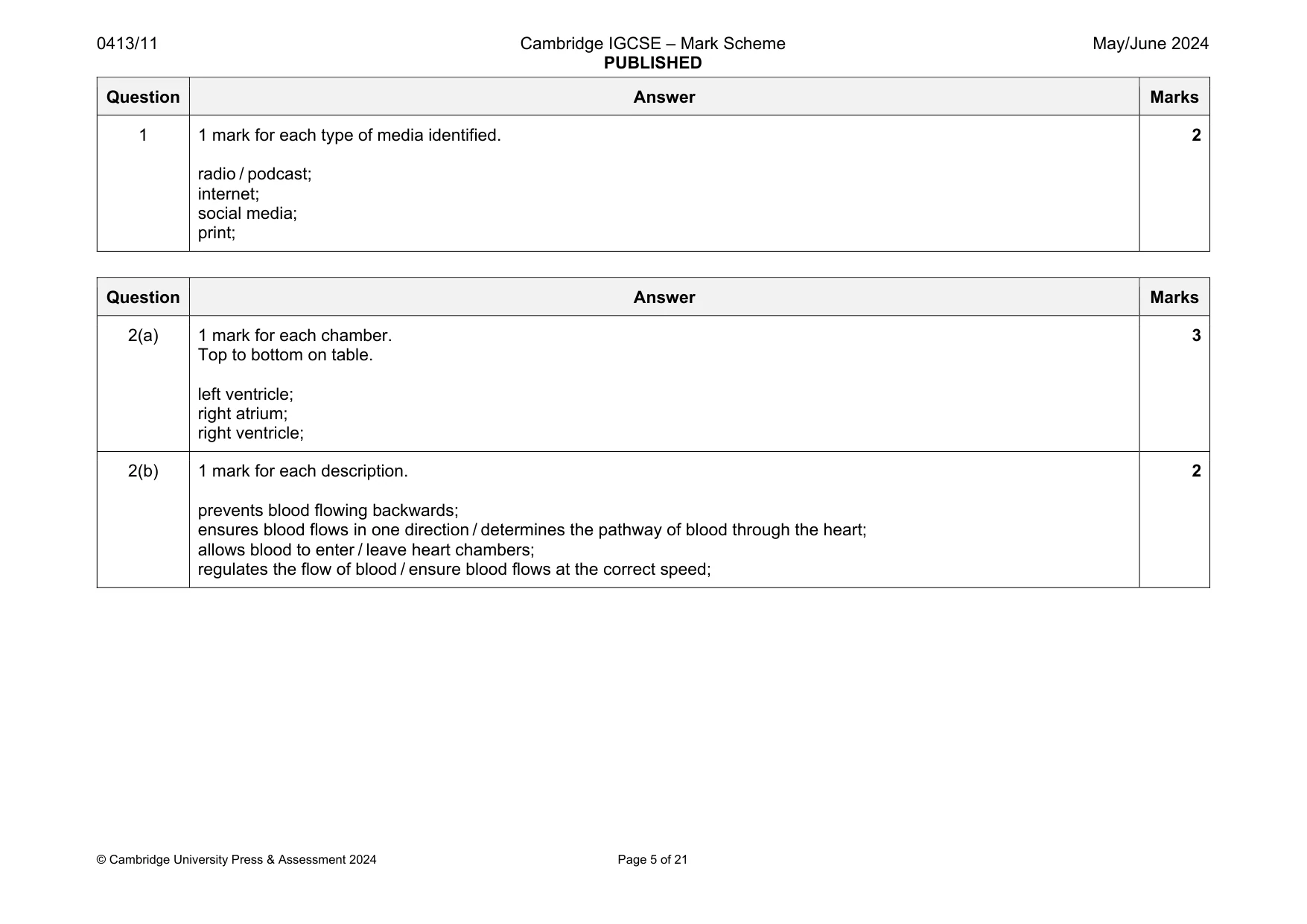
0413/11 Cambridge IGCSE – Mark Scheme PUBLISHED May/June 2024 © Cambridge University Press & Assessment 2024 Page 5 of 21 Question Answer Marks 1 1 mark for each type of media identified. radio / podcast; internet; social media; print; 2 Question Answer Marks 2(a) 1 mark for each chamber. Top to bottom on table. left ventricle; right atrium; right ventricle; 3 2(b) 1 mark for each description. prevents blood flowing backwards; ensures blood flows in one direction / determines the pathway of blood through the heart; allows blood to enter / leave heart chambers; regulates the flow of blood / ensure blood flows at the correct speed; 2
Mark scheme, page 6
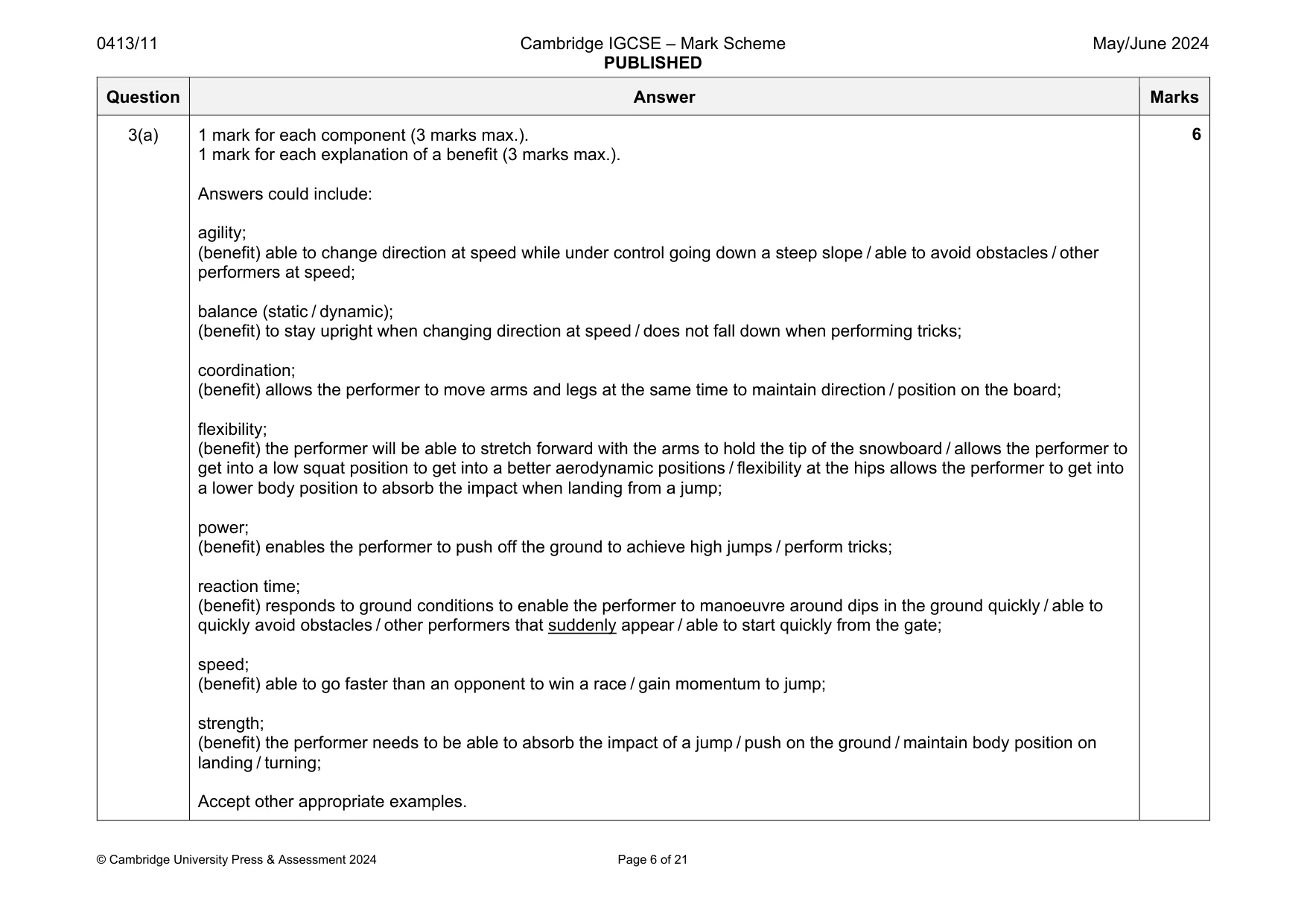
0413/11 Cambridge IGCSE – Mark Scheme PUBLISHED May/June 2024 © Cambridge University Press & Assessment 2024 Page 6 of 21 Question Answer Marks 3(a) 1 mark for each component (3 marks max.). 1 mark for each explanation of a benefit (3 marks max.). Answers could include: agility; (benefit) able to change direction at speed while under control going down a steep slope / able to avoid obstacles / other performers at speed; balance (static / dynamic); (benefit) to stay upright when changing direction at speed / does not fall down when performing tricks; coordination; (benefit) allows the performer to move arms and legs at the same time to maintain direction / position on the board; flexibility; (benefit) the performer will be able to stretch forward with the arms to hold the tip of the snowboard / allows the performer to get into a low squat position to get into a better aerodynamic positions / flexibility at the hips allows the performer to get into a lower body position to absorb the impact when landing from a jump; power; (benefit) enables the performer to push off the ground to achieve high jumps / perform tricks; reaction time; (benefit) responds to ground conditions to enable the performer to manoeuvre around dips in the ground quickly / able to quickly avoid obstacles / other performers that suddenly appear / able to start quickly from the gate; speed; (benefit) able to go faster than an opponent to win a race / gain momentum to jump; strength; (benefit) the performer needs to be able to absorb the impact of a jump / push on the ground / maintain body position on landing / turning; Accept other appropriate examples. 6
Mark scheme, page 7
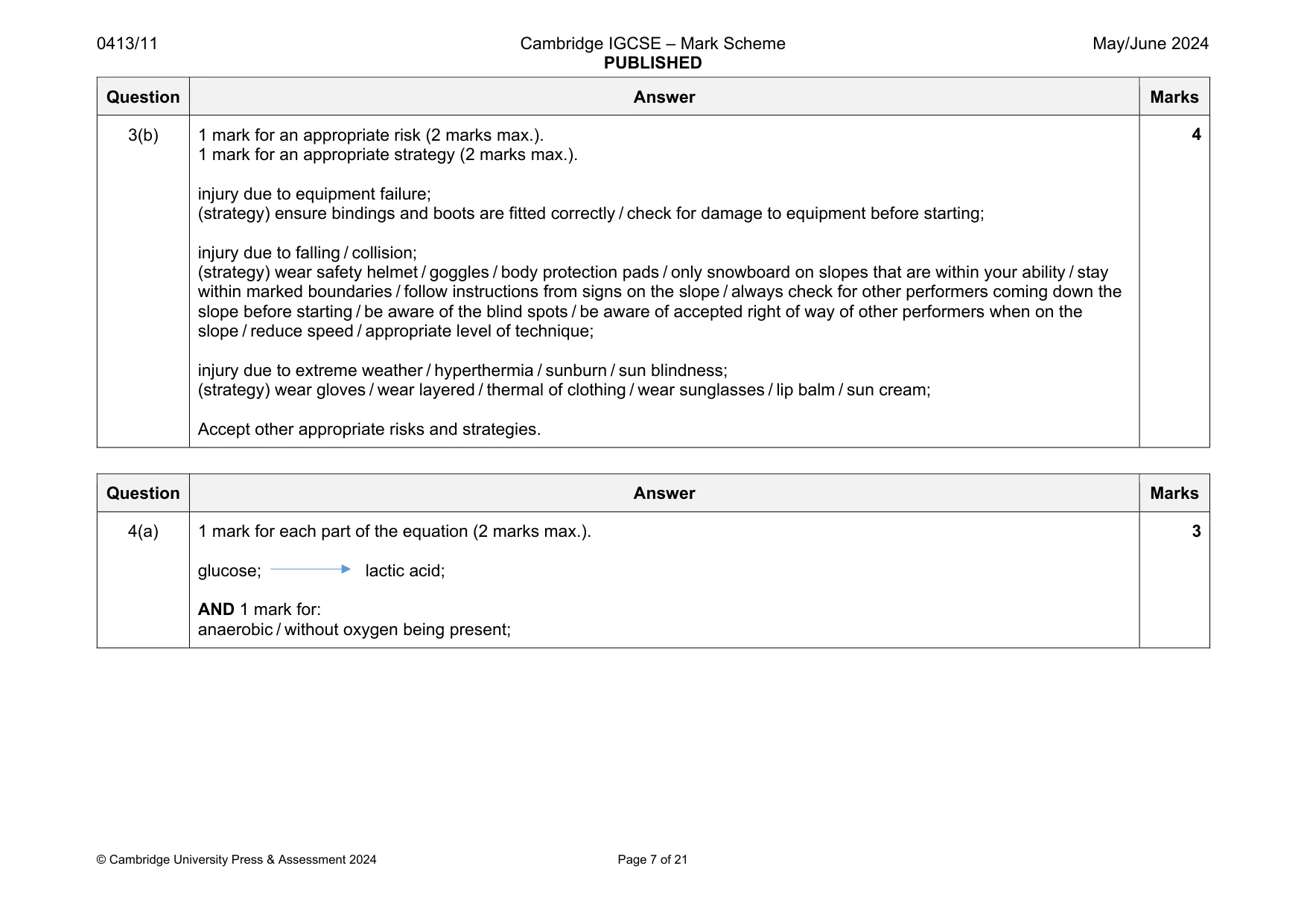
0413/11 Cambridge IGCSE – Mark Scheme PUBLISHED May/June 2024 © Cambridge University Press & Assessment 2024 Page 7 of 21 Question Answer Marks 3(b) 1 mark for an appropriate risk (2 marks max.). 1 mark for an appropriate strategy (2 marks max.). injury due to equipment failure; (strategy) ensure bindings and boots are fitted correctly / check for damage to equipment before starting; injury due to falling / collision; (strategy) wear safety helmet / goggles / body protection pads / only snowboard on slopes that are within your ability / stay within marked boundaries / follow instructions from signs on the slope / always check for other performers coming down the slope before starting / be aware of the blind spots / be aware of accepted right of way of other performers when on the slope / reduce speed / appropriate level of technique; injury due to extreme weather / hyperthermia / sunburn / sun blindness; (strategy) wear gloves / wear layered / thermal of clothing / wear sunglasses / lip balm / sun cream; Accept other appropriate risks and strategies. 4 Question Answer Marks 4(a) 1 mark for each part of the equation (2 marks max.). glucose; lactic acid; AND 1 mark for: anaerobic / without oxygen being present; 3
Mark scheme, page 8
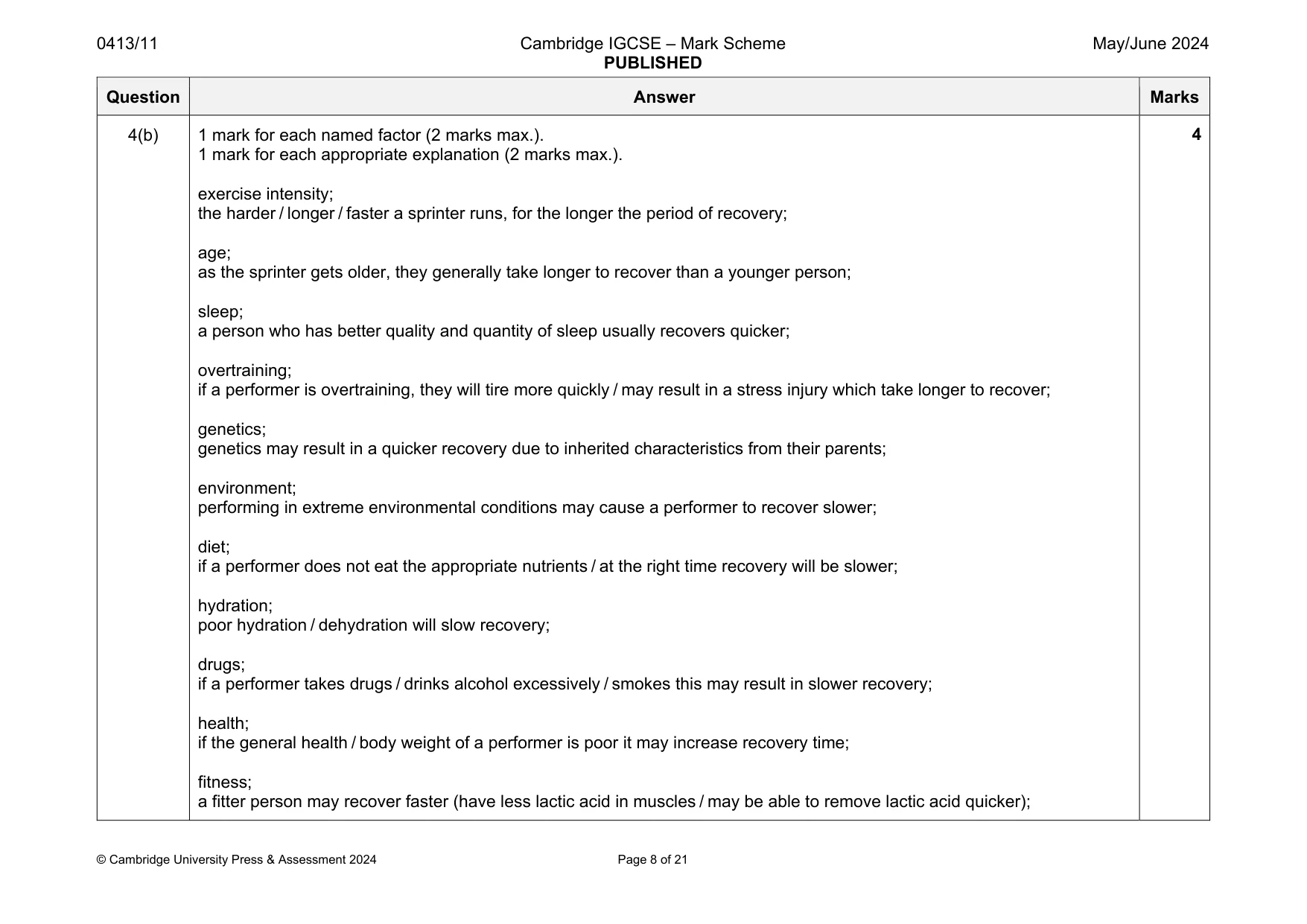
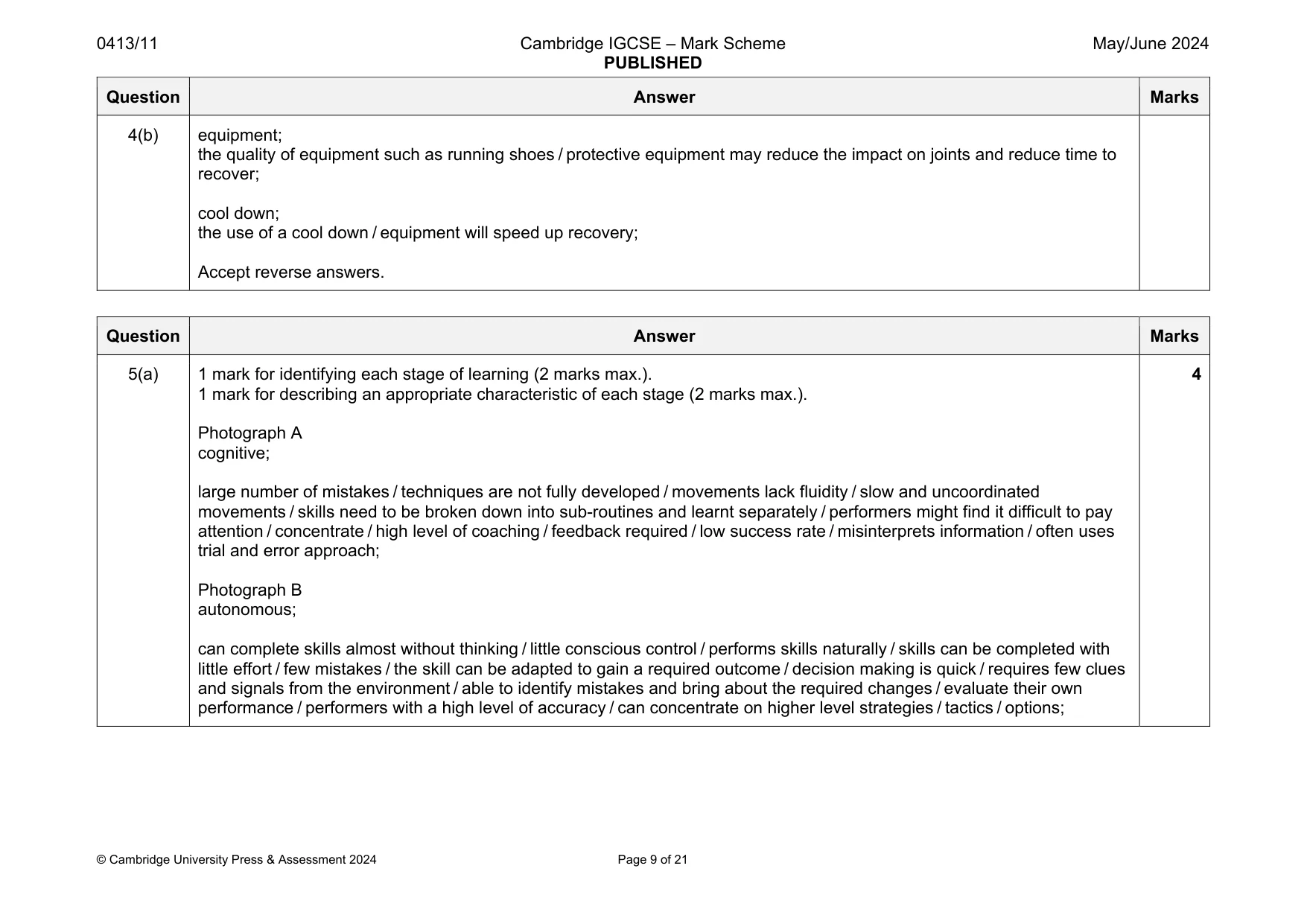
0413/11 Cambridge IGCSE – Mark Scheme PUBLISHED May/June 2024 © Cambridge University Press & Assessment 2024 Page 8 of 21 Question Answer Marks 4(b) 1 mark for each named factor (2 marks max.). 1 mark for each appropriate explanation (2 marks max.). exercise intensity; the harder / longer / faster a sprinter runs, for the longer the period of recovery; age; as the sprinter gets older, they generally take longer to recover than a younger person; sleep; a person who has better quality and quantity of sleep usually recovers quicker; overtraining; if a performer is overtraining, they will tire more quickly / may result in a stress injury which take longer to recover; genetics; genetics may result in a quicker recovery due to inherited characteristics from their parents; environment; performing in extreme environmental conditions may cause a performer to recover slower; diet; if a performer does not eat the appropriate nutrients / at the right time recovery will be slower; hydration; poor hydration / dehydration will slow recovery; drugs; if a performer takes drugs / drinks alcohol excessively / smokes this may result in slower recovery; health; if the general health / body weight of a performer is poor it may increase recovery time; fitness; a fitter person may recover faster (have less lactic acid in muscles / may be able to remove lactic acid quicker); 4
Mark scheme, page 9
0413/11 Cambridge IGCSE – Mark Scheme PUBLISHED May/June 2024 © Cambridge University Press & Assessment 2024 Page 9 of 21 Question Answer Marks 4(b) equipment; the quality of equipment such as running shoes / protective equipment may reduce the impact on joints and reduce time to recover; cool down; the use of a cool down / equipment will speed up recovery; Accept reverse answers. Question Answer Marks 5(a) 1 mark for identifying each stage of learning (2 marks max.). 1 mark for describing an appropriate characteristic of each stage (2 marks max.). Photograph A cognitive; large number of mistakes / techniques are not fully developed / movements lack fluidity / slow and uncoordinated movements / skills need to be broken down into sub-routines and learnt separately / performers might find it difficult to pay attention / concentrate / high level of coaching / feedback required / low success rate / misinterprets information / often uses trial and error approach; Photograph B autonomous; can complete skills almost without thinking / little conscious control / performs skills naturally / skills can be completed with little effort / few mistakes / the skill can be adapted to gain a required outcome / decision making is quick / requires few clues and signals from the environment / able to identify mistakes and bring about the required changes / evaluate their own performance / performers with a high level of accuracy / can concentrate on higher level strategies / tactics / options; 4
Mark scheme, page 10
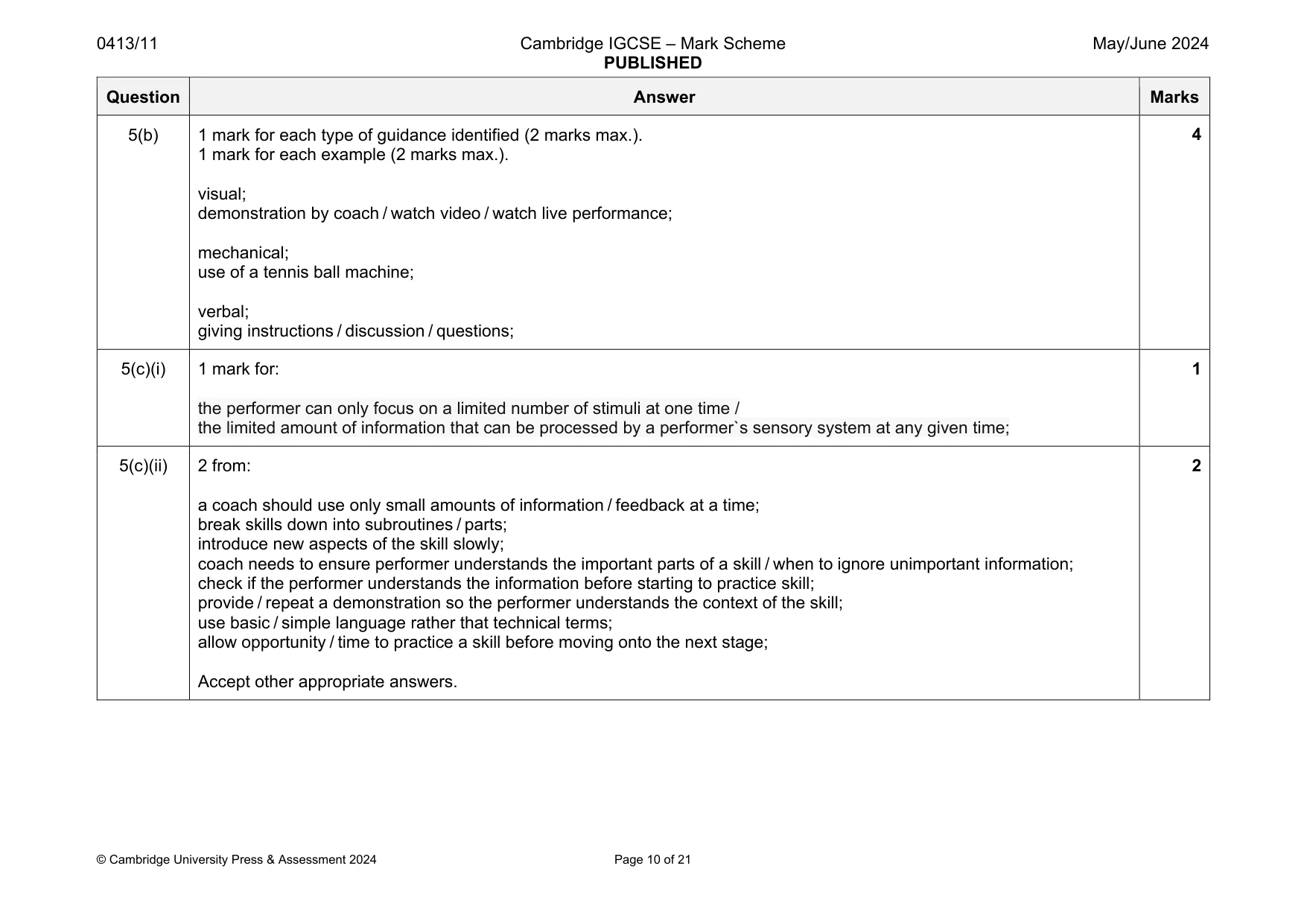
0413/11 Cambridge IGCSE – Mark Scheme PUBLISHED May/June 2024 © Cambridge University Press & Assessment 2024 Page 10 of 21 Question Answer Marks 5(b) 1 mark for each type of guidance identified (2 marks max.). 1 mark for each example (2 marks max.). visual; demonstration by coach / watch video / watch live performance; mechanical; use of a tennis ball machine; verbal; giving instructions / discussion / questions; 4 5(c)(i) 1 mark for: the performer can only focus on a limited number of stimuli at one time / the limited amount of information that can be processed by a performer`s sensory system at any given time; 1 5(c)(ii) 2 from: a coach should use only small amounts of information / feedback at a time; break skills down into subroutines / parts; introduce new aspects of the skill slowly; coach needs to ensure performer understands the important parts of a skill / when to ignore unimportant information; check if the performer understands the information before starting to practice skill; provide / repeat a demonstration so the performer understands the context of the skill; use basic / simple language rather that technical terms; allow opportunity / time to practice a skill before moving onto the next stage; Accept other appropriate answers. 2
Mark scheme, page 11
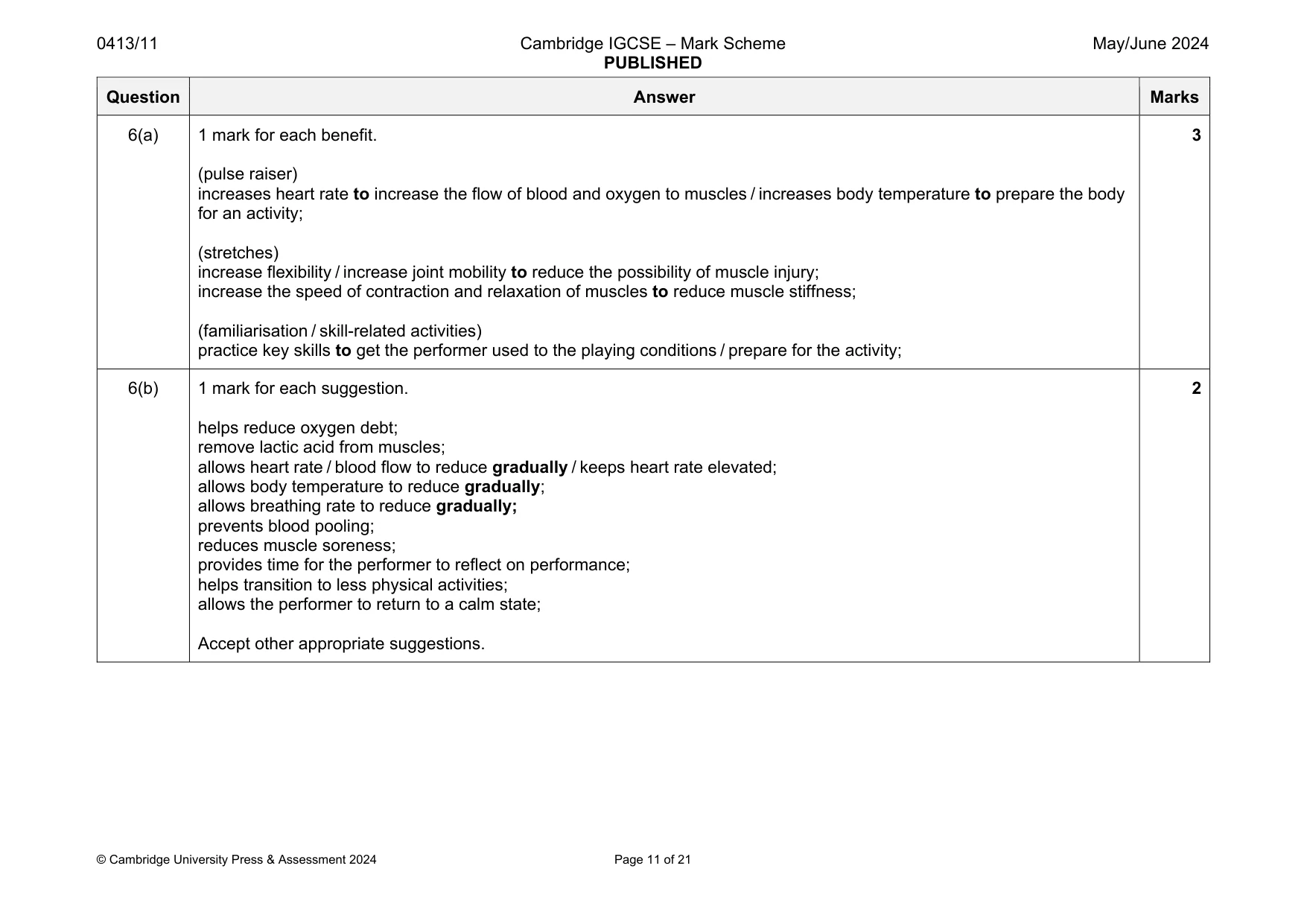
0413/11 Cambridge IGCSE – Mark Scheme PUBLISHED May/June 2024 © Cambridge University Press & Assessment 2024 Page 11 of 21 Question Answer Marks 6(a) 1 mark for each benefit. (pulse raiser) increases heart rate to increase the flow of blood and oxygen to muscles / increases body temperature to prepare the body for an activity; (stretches) increase flexibility / increase joint mobility to reduce the possibility of muscle injury; increase the speed of contraction and relaxation of muscles to reduce muscle stiffness; (familiarisation / skill-related activities) practice key skills to get the performer used to the playing conditions / prepare for the activity; 3 6(b) 1 mark for each suggestion. helps reduce oxygen debt; remove lactic acid from muscles; allows heart rate / blood flow to reduce gradually / keeps heart rate elevated; allows body temperature to reduce gradually; allows breathing rate to reduce gradually; prevents blood pooling; reduces muscle soreness; provides time for the performer to reflect on performance; helps transition to less physical activities; allows the performer to return to a calm state; Accept other appropriate suggestions. 2
Mark scheme, page 12
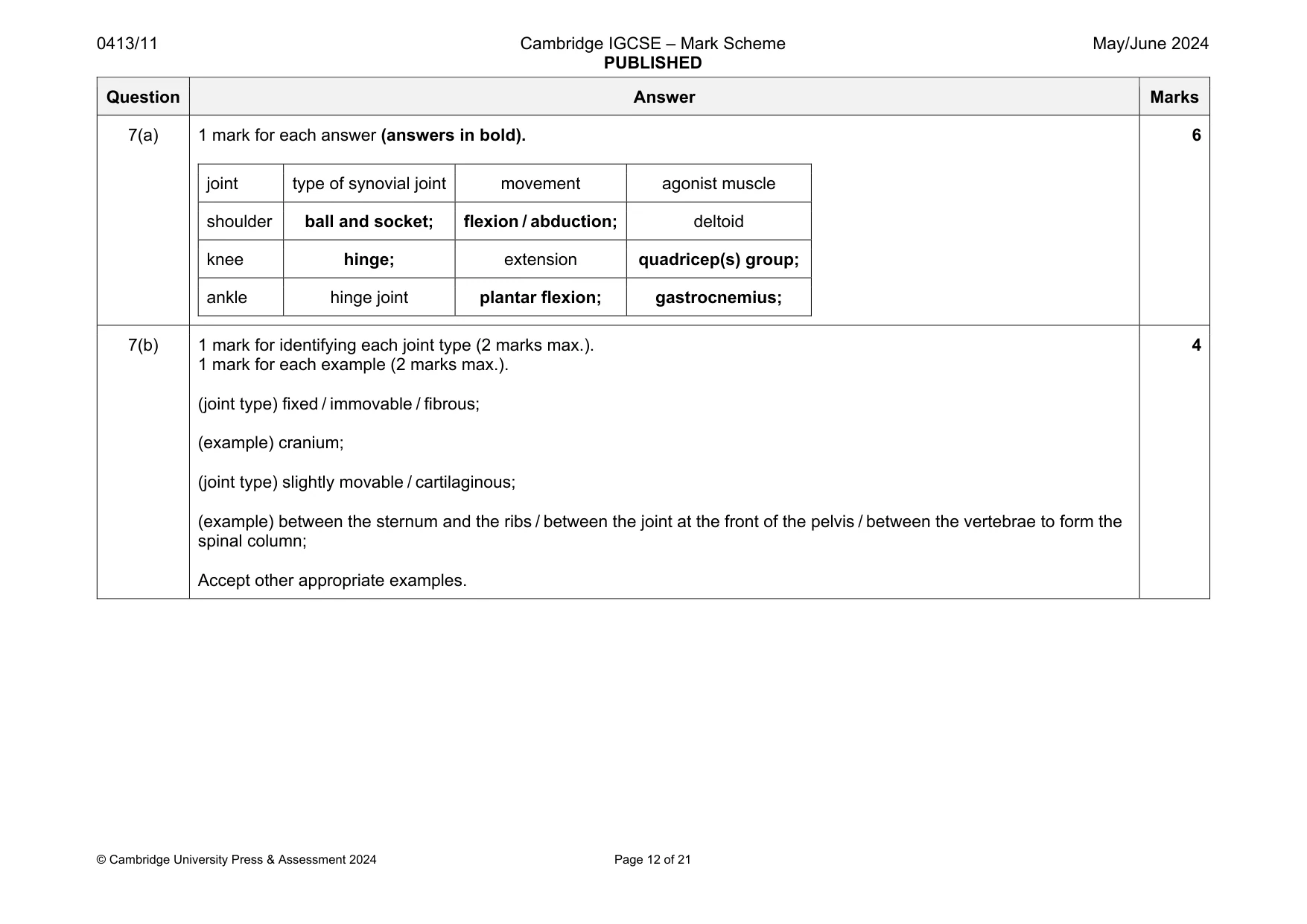
0413/11 Cambridge IGCSE – Mark Scheme PUBLISHED May/June 2024 © Cambridge University Press & Assessment 2024 Page 12 of 21 Question Answer Marks 7(a) 1 mark for each answer (answers in bold). joint type of synovial joint movement agonist muscle shoulder ball and socket; flexion / abduction; deltoid knee hinge; extension quadricep(s) group; ankle hinge joint plantar flexion; gastrocnemius; 6 7(b) 1 mark for identifying each joint type (2 marks max.). 1 mark for each example (2 marks max.). (joint type) fixed / immovable / fibrous; (example) cranium; (joint type) slightly movable / cartilaginous; (example) between the sternum and the ribs / between the joint at the front of the pelvis / between the vertebrae to form the spinal column; Accept other appropriate examples. 4
Mark scheme, page 13
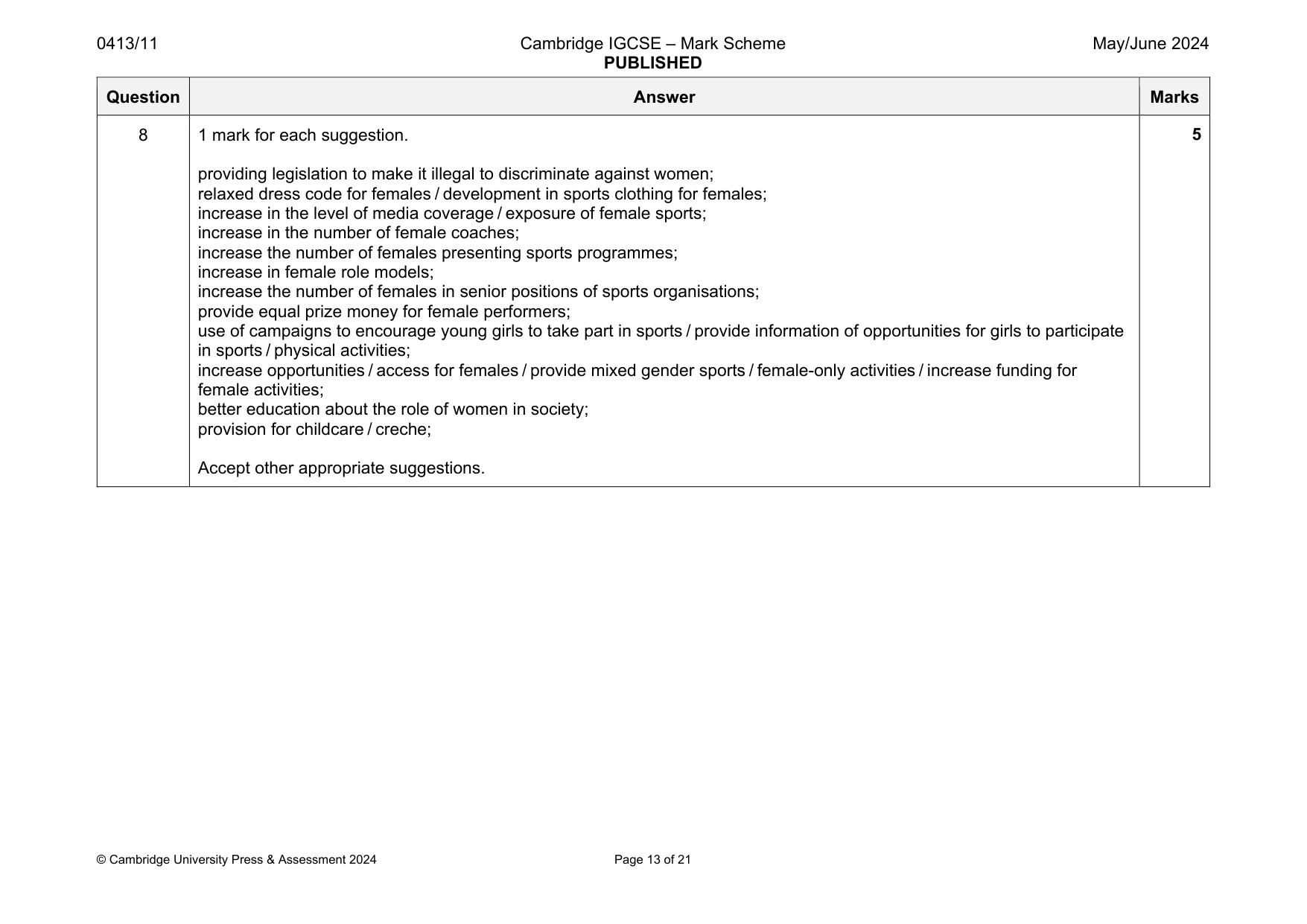
0413/11 Cambridge IGCSE – Mark Scheme PUBLISHED May/June 2024 © Cambridge University Press & Assessment 2024 Page 13 of 21 Question Answer Marks 8 1 mark for each suggestion. providing legislation to make it illegal to discriminate against women; relaxed dress code for females / development in sports clothing for females; increase in the level of media coverage / exposure of female sports; increase in the number of female coaches; increase the number of females presenting sports programmes; increase in female role models; increase the number of females in senior positions of sports organisations; provide equal prize money for female performers; use of campaigns to encourage young girls to take part in sports / provide information of opportunities for girls to participate in sports / physical activities; increase opportunities / access for females / provide mixed gender sports / female-only activities / increase funding for female activities; better education about the role of women in society; provision for childcare / creche; Accept other appropriate suggestions. 5
Mark scheme, page 14
0413/11 Cambridge IGCSE – Mark Scheme PUBLISHED May/June 2024 © Cambridge University Press & Assessment 2024 Page 14 of 21 Question Answer Marks 9 1 mark for naming each principle of training (2 marks max.). 1 mark for an appropriate application linked to circuit training (2 marks max.). Example could include: specificity; the stations can be either skill-related or fitness-related but must relate to the sport the performer participates in; progression; increasing the amount of time at each station when the performer has reached a certain target / level; overload; the length of time spent on each station is increased / the rest time between stations is reduced / the number of reps of each exercise is increased; reversibility; stop doing the circuit training programme; tedium; regularly change the activity of the stations of the circuit to avoid the performers from becoming bored / demotivated; Accept other appropriate applications. 4 Question Answer Marks 10(a) 1 mark for each structure. A trachea; B bronchi / bronchus; C bronchiole; 3
Mark scheme, page 15
0413/11 Cambridge IGCSE – Mark Scheme PUBLISHED May/June 2024 © Cambridge University Press & Assessment 2024 Page 15 of 21 Question Answer Marks 10(b) 1 mark for each correct line placement. alveoli are well ventilated air can reach them easily alveoli have a good blood supply because they are one cell thick gases can pass through the walls of the alveoli quickly because they are surrounded by capillaries alveoli create a large surface area for diffusion because bronchi have rings of cartilage there are millions of alveoli in each lung 3 10(c)(i) 1 mark for each factor with an appropriate unit of measurement. tidal volume measured in millilitres / litres; number of breaths measured per minute; 2 10(c)(ii) 1 mark for the description. 1 mark for the effect. (residual volume) the volume of air left in the lungs after breathing out maximally; (effect) no change; 2
Mark scheme, page 16
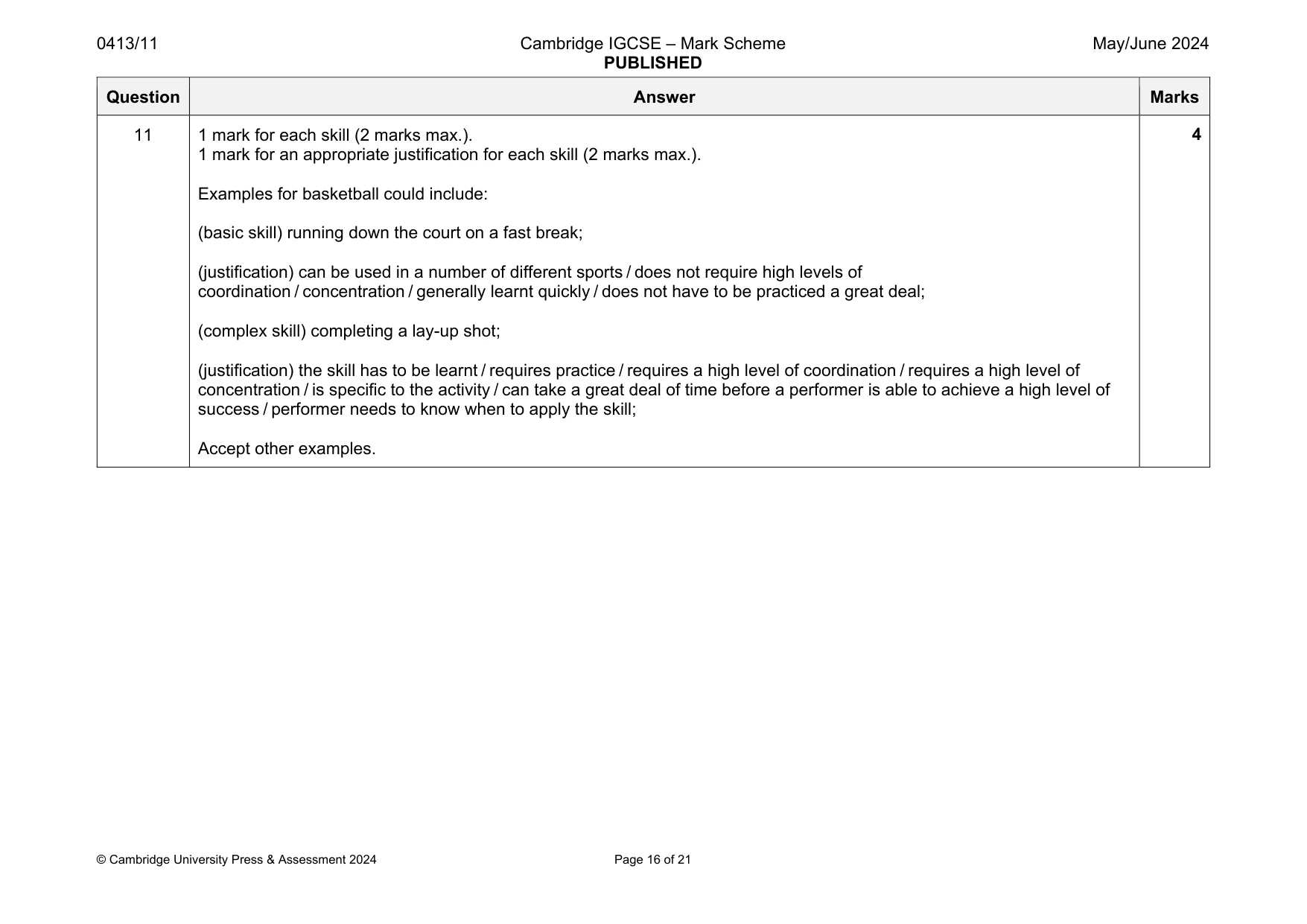
0413/11 Cambridge IGCSE – Mark Scheme PUBLISHED May/June 2024 © Cambridge University Press & Assessment 2024 Page 16 of 21 Question Answer Marks 11 1 mark for each skill (2 marks max.). 1 mark for an appropriate justification for each skill (2 marks max.). Examples for basketball could include: (basic skill) running down the court on a fast break; (justification) can be used in a number of different sports / does not require high levels of coordination / concentration / generally learnt quickly / does not have to be practiced a great deal; (complex skill) completing a lay-up shot; (justification) the skill has to be learnt / requires practice / requires a high level of coordination / requires a high level of concentration / is specific to the activity / can take a great deal of time before a performer is able to achieve a high level of success / performer needs to know when to apply the skill; Accept other examples. 4
Mark scheme, page 17
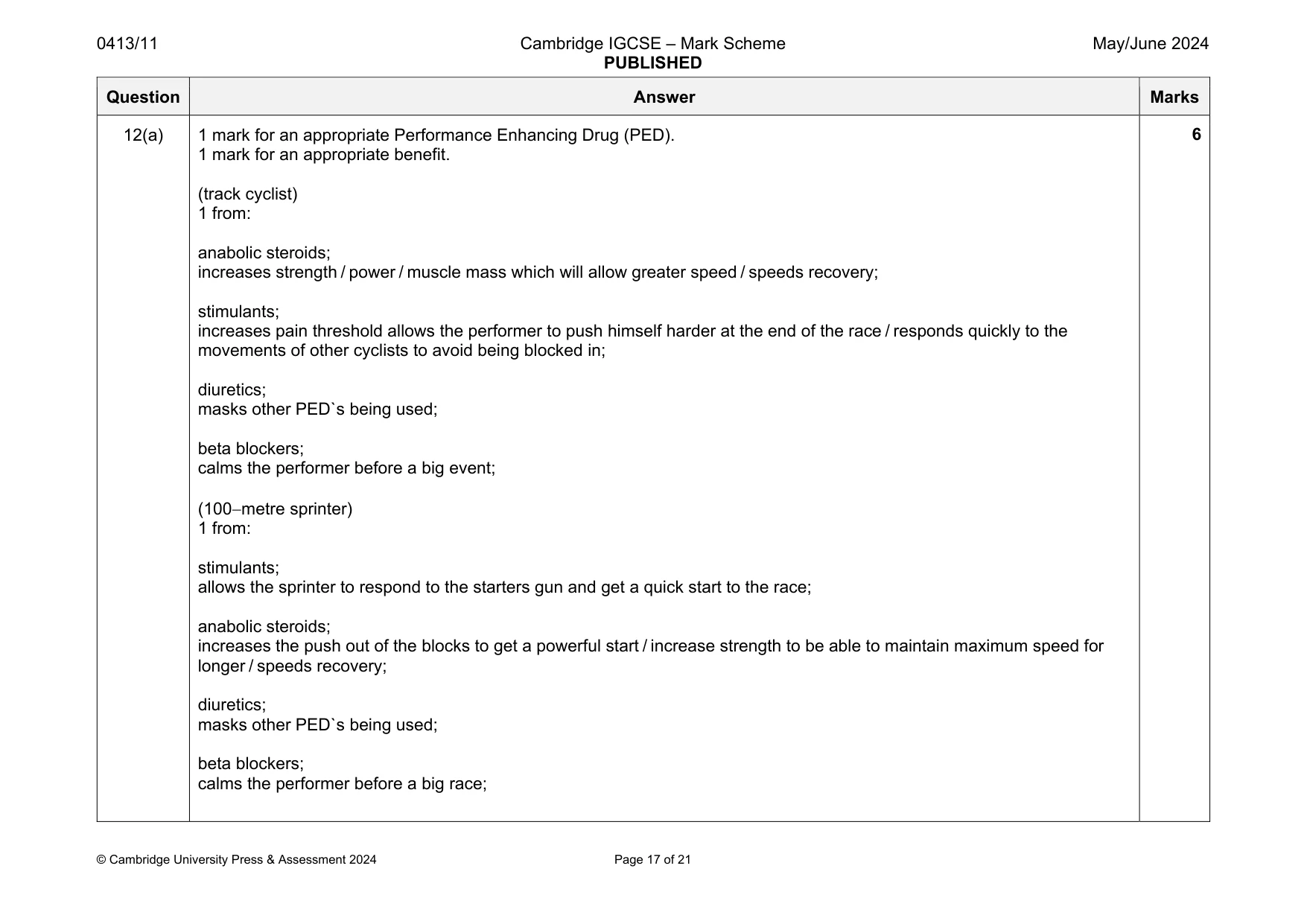
0413/11 Cambridge IGCSE – Mark Scheme PUBLISHED May/June 2024 © Cambridge University Press & Assessment 2024 Page 17 of 21 Question Answer Marks 12(a) 1 mark for an appropriate Performance Enhancing Drug (PED). 1 mark for an appropriate benefit. (track cyclist) 1 from: anabolic steroids; increases strength / power / muscle mass which will allow greater speed / speeds recovery; stimulants; increases pain threshold allows the performer to push himself harder at the end of the race / responds quickly to the movements of other cyclists to avoid being blocked in; diuretics; masks other PED`s being used; beta blockers; calms the performer before a big event; (100metre sprinter) 1 from: stimulants; allows the sprinter to respond to the starters gun and get a quick start to the race; anabolic steroids; increases the push out of the blocks to get a powerful start / increase strength to be able to maintain maximum speed for longer / speeds recovery; diuretics; masks other PED`s being used; beta blockers; calms the performer before a big race; 6
Mark scheme, page 18
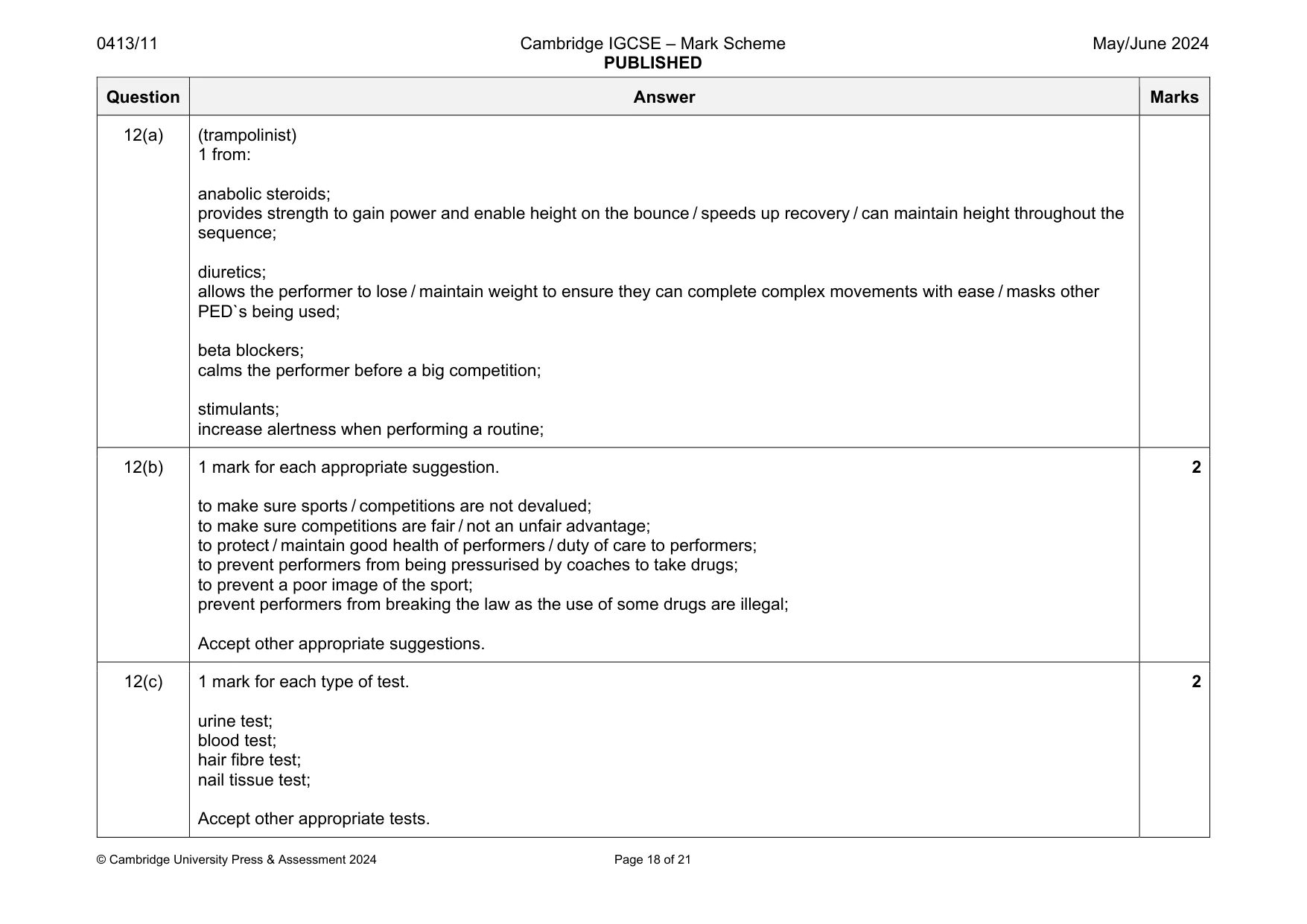
0413/11 Cambridge IGCSE – Mark Scheme PUBLISHED May/June 2024 © Cambridge University Press & Assessment 2024 Page 18 of 21 Question Answer Marks 12(a) (trampolinist) 1 from: anabolic steroids; provides strength to gain power and enable height on the bounce / speeds up recovery / can maintain height throughout the sequence; diuretics; allows the performer to lose / maintain weight to ensure they can complete complex movements with ease / masks other PED`s being used; beta blockers; calms the performer before a big competition; stimulants; increase alertness when performing a routine; 12(b) 1 mark for each appropriate suggestion. to make sure sports / competitions are not devalued; to make sure competitions are fair / not an unfair advantage; to protect / maintain good health of performers / duty of care to performers; to prevent performers from being pressurised by coaches to take drugs; to prevent a poor image of the sport; prevent performers from breaking the law as the use of some drugs are illegal; Accept other appropriate suggestions. 2 12(c) 1 mark for each type of test. urine test; blood test; hair fibre test; nail tissue test; Accept other appropriate tests. 2
Mark scheme, page 19
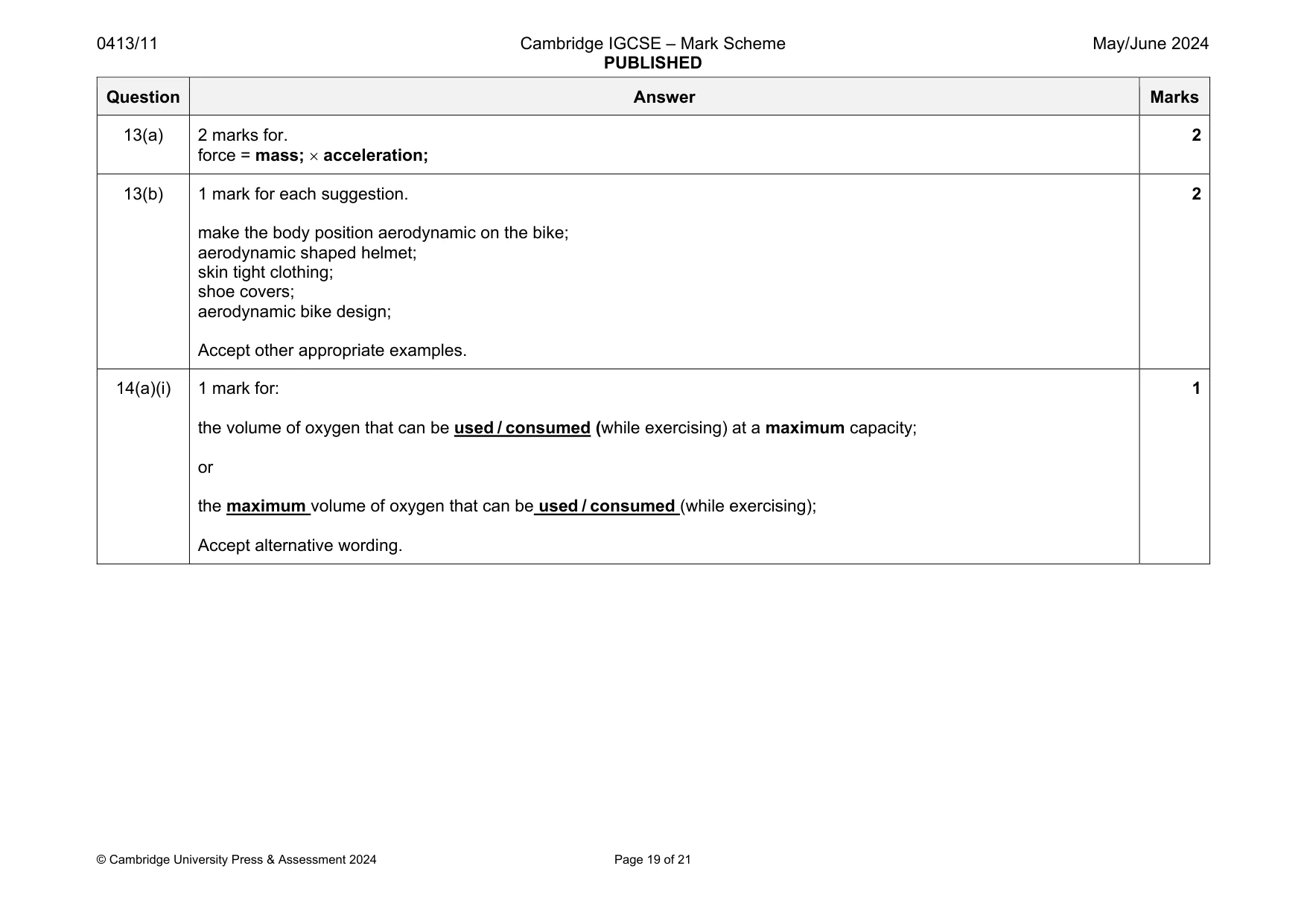
0413/11 Cambridge IGCSE – Mark Scheme PUBLISHED May/June 2024 © Cambridge University Press & Assessment 2024 Page 19 of 21 Question Answer Marks 13(a) 2 marks for. force = mass; acceleration; 2 13(b) 1 mark for each suggestion. make the body position aerodynamic on the bike; aerodynamic shaped helmet; skin tight clothing; shoe covers; aerodynamic bike design; Accept other appropriate examples. 2 14(a)(i) 1 mark for: the volume of oxygen that can be used / consumed (while exercising) at a maximum capacity; or the maximum volume of oxygen that can be used / consumed (while exercising); Accept alternative wording. 1
Mark scheme, page 20
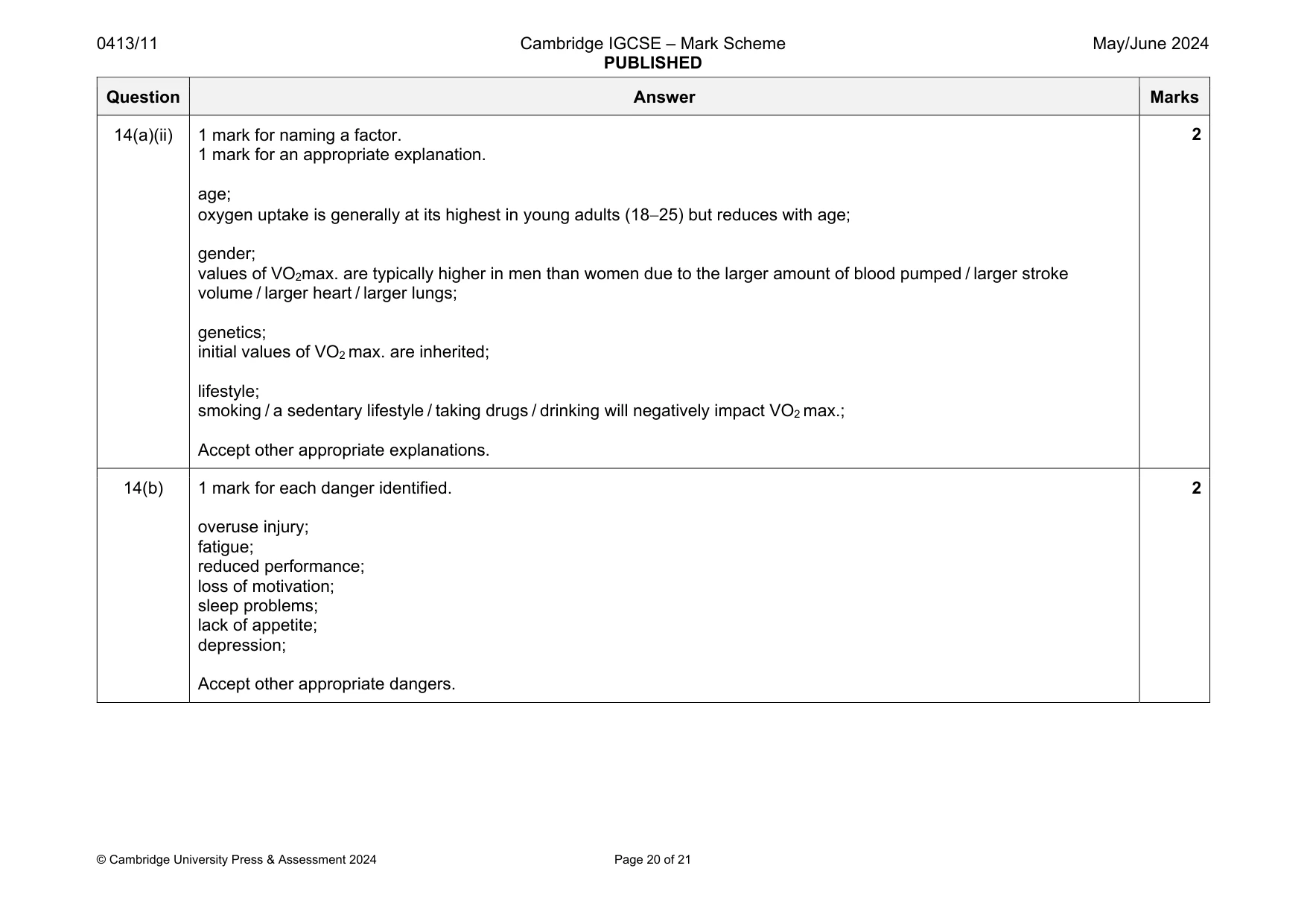
0413/11 Cambridge IGCSE – Mark Scheme PUBLISHED May/June 2024 © Cambridge University Press & Assessment 2024 Page 20 of 21 Question Answer Marks 14(a)(ii) 1 mark for naming a factor. 1 mark for an appropriate explanation. age; oxygen uptake is generally at its highest in young adults (1825) but reduces with age; gender; values of VO2max. are typically higher in men than women due to the larger amount of blood pumped / larger stroke volume / larger heart / larger lungs; genetics; initial values of VO2 max. are inherited; lifestyle; smoking / a sedentary lifestyle / taking drugs / drinking will negatively impact VO2 max.; Accept other appropriate explanations. 2 14(b) 1 mark for each danger identified. overuse injury; fatigue; reduced performance; loss of motivation; sleep problems; lack of appetite; depression; Accept other appropriate dangers. 2
Mark scheme, page 21
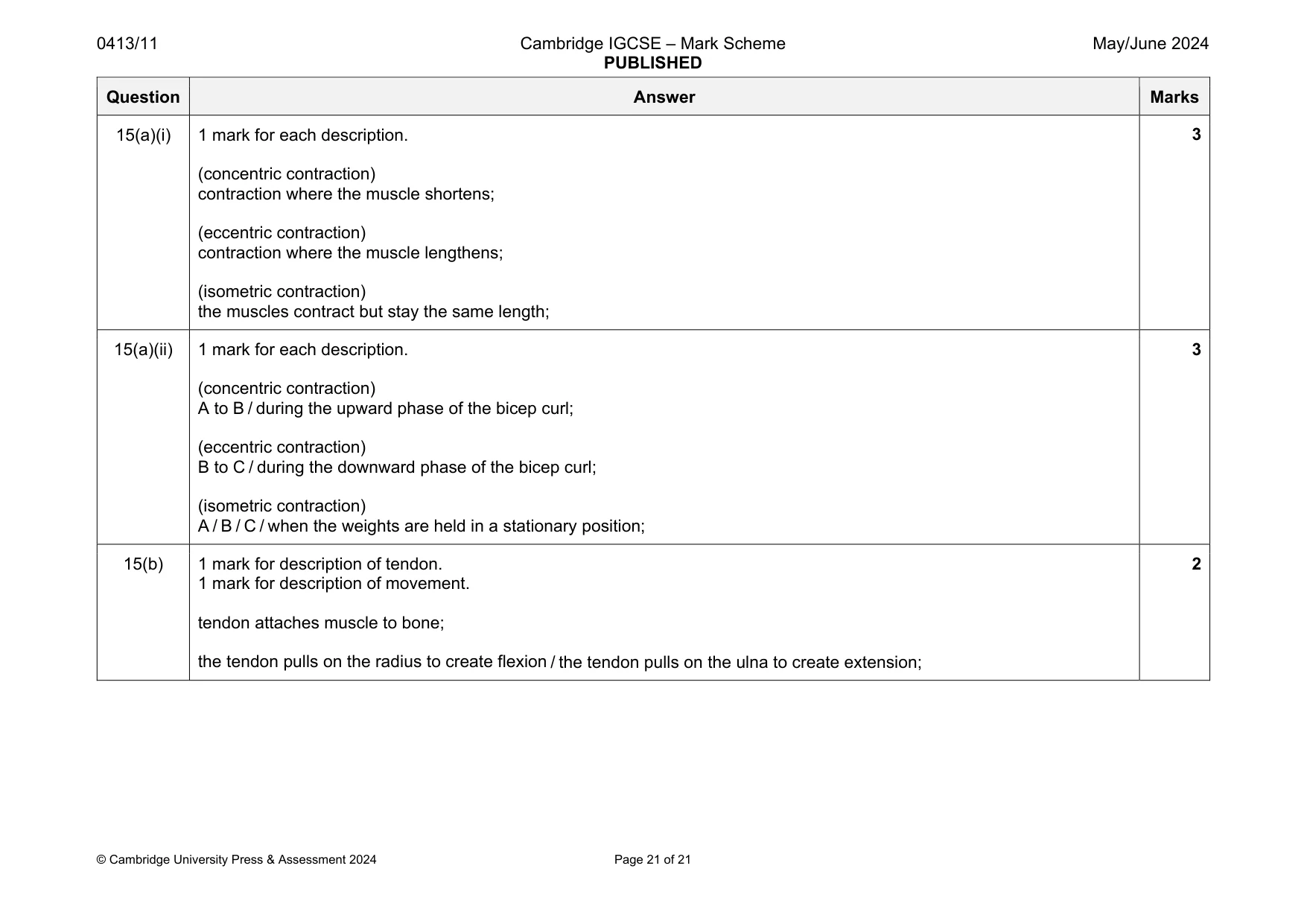
0413/11 Cambridge IGCSE – Mark Scheme PUBLISHED May/June 2024 © Cambridge University Press & Assessment 2024 Page 21 of 21 Question Answer Marks 15(a)(i) 1 mark for each description. (concentric contraction) contraction where the muscle shortens; (eccentric contraction) contraction where the muscle lengthens; (isometric contraction) the muscles contract but stay the same length; 3 15(a)(ii) 1 mark for each description. (concentric contraction) A to B / during the upward phase of the bicep curl; (eccentric contraction) B to C / during the downward phase of the bicep curl; (isometric contraction) A / B / C / when the weights are held in a stationary position; 3 15(b) 1 mark for description of tendon. 1 mark for description of movement. tendon attaches muscle to bone; the tendon pulls on the radius to create flexion / the tendon pulls on the ulna to create extension; 2
What you needed in this session
Cambridge’s own grade thresholds for 2024 May/June, Paper 1 · Variant 1. A higher threshold means an easier paper — the bar moves with how the cohort did.