Cambridge IGCSE Physical Education 0413 — 2024 May/June Paper 1 · Variant 2
0413/12/M/J/24 · 100 marks · ≈113 min
The question paper and its mark scheme, free to read here and free to download. This is Cambridge’s own paper, exactly as it was sat.
Question paper16 pages


Mark scheme21 pages
Answers below. Sit the paper first if you are practising.
Paper as text
Question paper, page 1
This document has 16 pages. Any blank pages are indicated. [Turn over Cambridge IGCSE™ * 8 3 9 1 3 4 7 0 4 2 * PHYSICAL EDUCATION 0413/12 Paper 1 Theory May/June 2024 1 hour 45 minutes You must answer on the question paper. No additional materials are needed. INSTRUCTIONS ● Answer all questions. ● Use a black or dark blue pen. You may use an HB pencil for any diagrams or graphs. ● Write your name, centre number and candidate number in the boxes at the top of the page. ● Write your answer to each question in the space provided. ● Do not use an erasable pen or correction fluid. ● Do not write on any bar codes. ● You may use a calculator. ● You should show all your working and use appropriate units. INFORMATION ● The total mark for this paper is 100. ● The number of marks for each question or part question is shown in brackets [ ]. DC (PB/CT) 331059/3 © UCLES 2024
Question paper, page 2
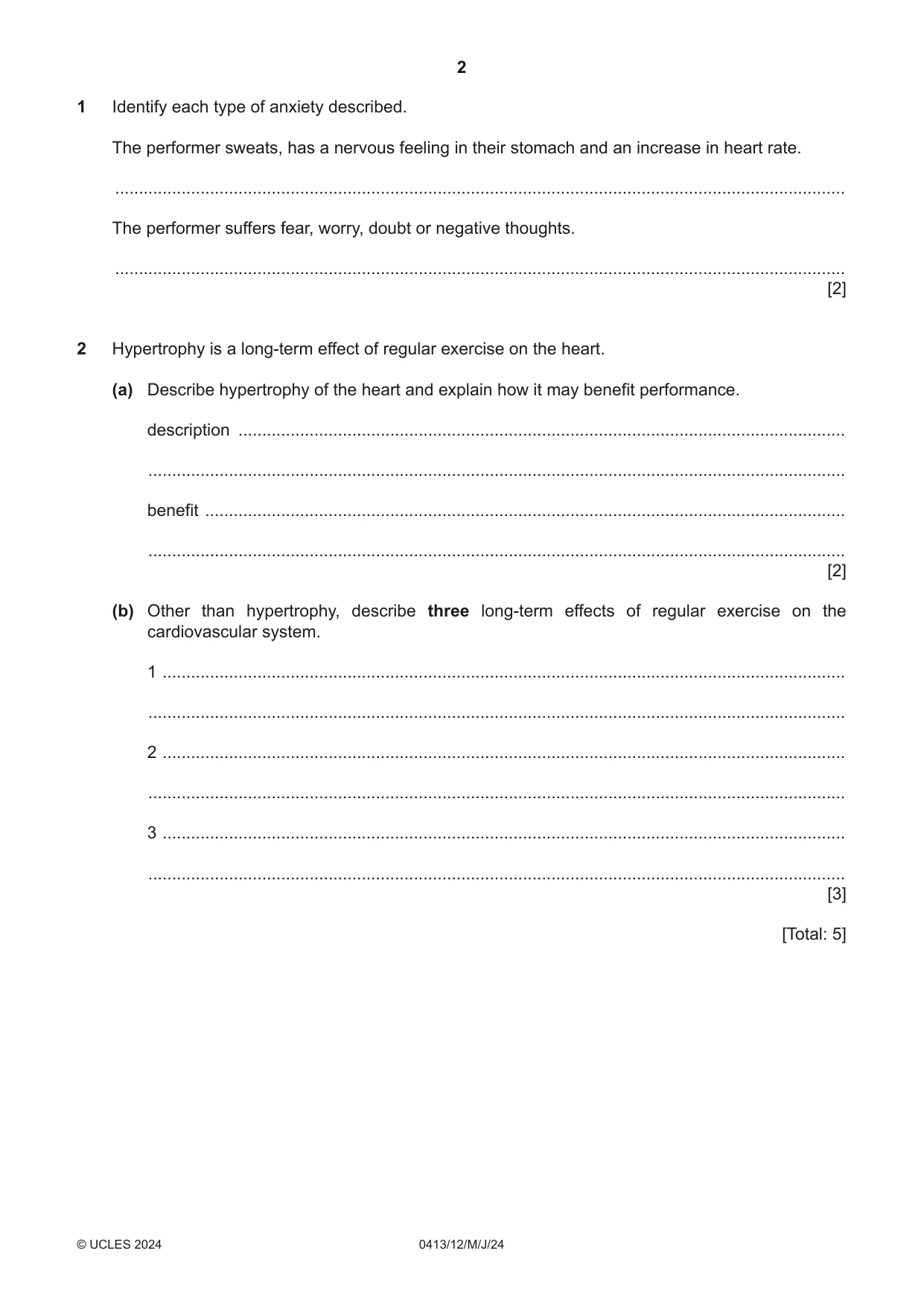
2 0413/12/M/J/24 © UCLES 2024 1 Identify each type of anxiety described. The performer sweats, has a nervous feeling in their stomach and an increase in heart rate. … The performer suffers fear, worry, doubt or negative thoughts. … [2] 2 Hypertrophy is a long-term effect of regular exercise on the heart. (a) Describe hypertrophy of the heart and explain how it may benefit performance. description … … benefit … … [2] (b) Other than hypertrophy, describe three long-term effects of regular exercise on the cardiovascular system. 1 … … 2 … … 3 … … [3] [Total: 5]
Question paper, page 3
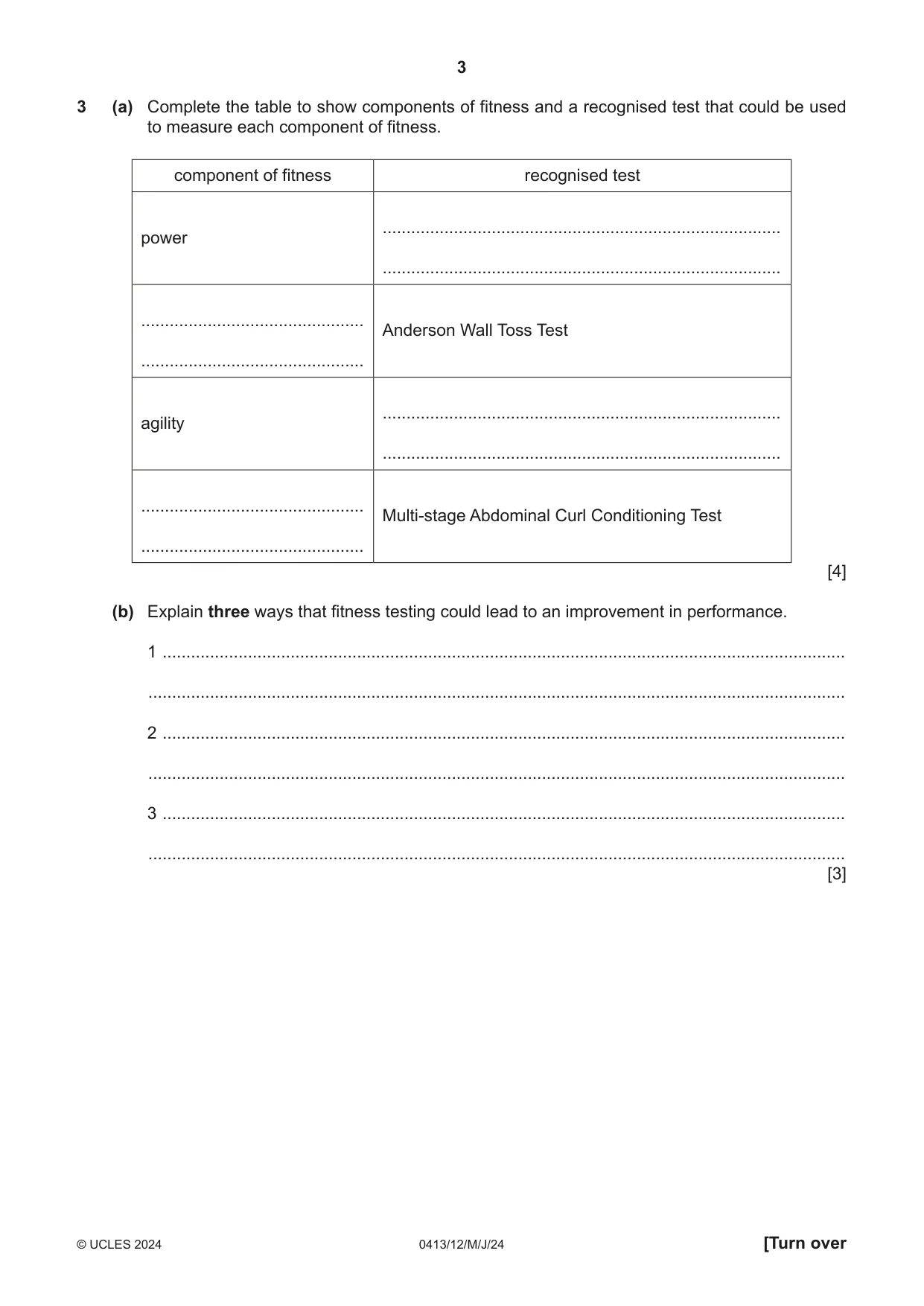
3 0413/12/M/J/24 © UCLES 2024 [Turn over 3 (a) Complete the table to show components of fitness and a recognised test that could be used to measure each component of fitness. component of fitness recognised test power … … … … Anderson Wall Toss Test agility … … … … Multi-stage Abdominal Curl Conditioning Test [4] (b) Explain three ways that fitness testing could lead to an improvement in performance. 1 … … 2 … … 3 … … [3]
Question paper, page 4
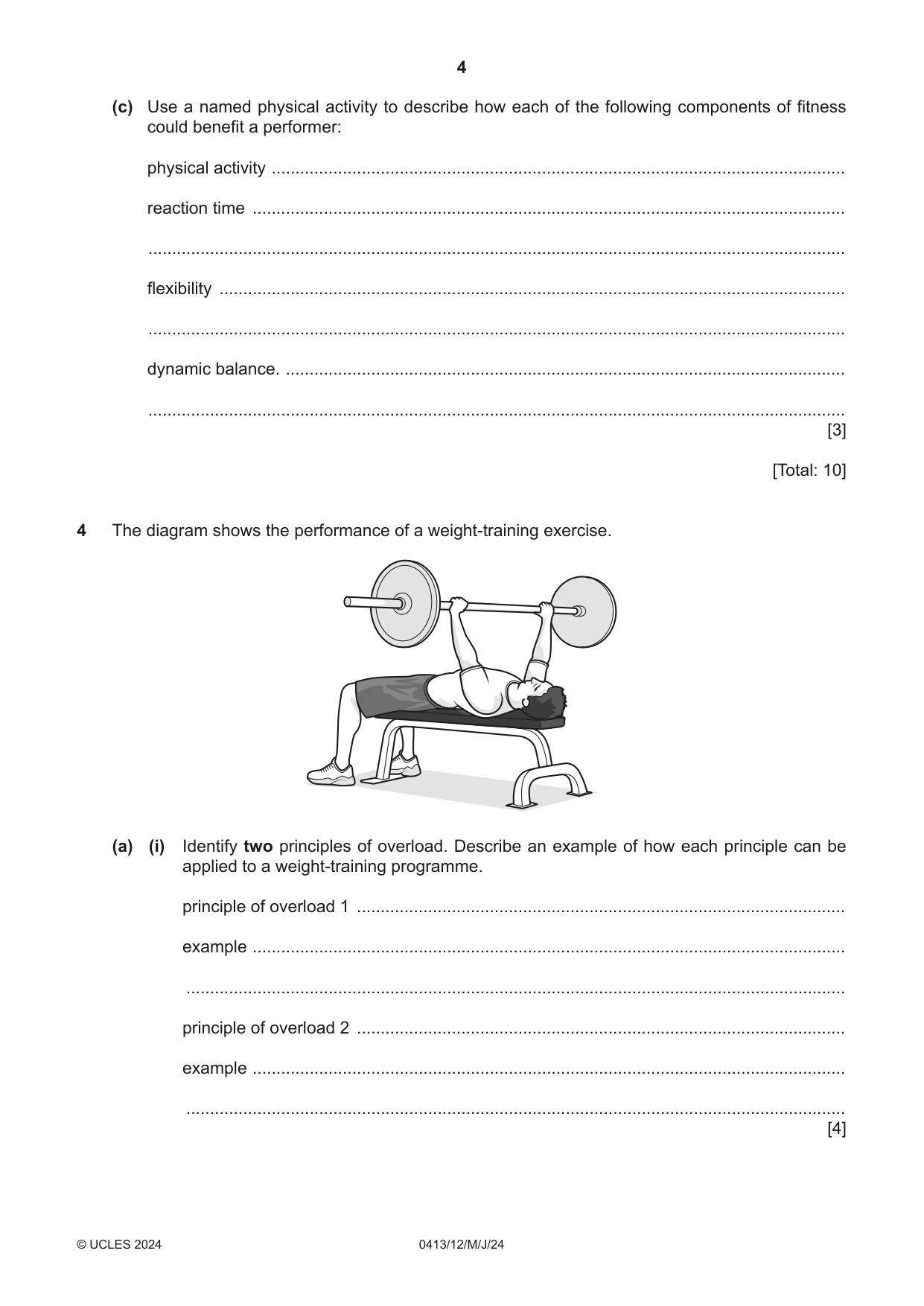
4 0413/12/M/J/24 © UCLES 2024 (c) Use a named physical activity to describe how each of the following components of fitness could benefit a performer: physical activity … reaction time … … flexibility … … dynamic balance. … … [3] [Total: 10] 4 The diagram shows the performance of a weight-training exercise. (a) (i) Identify two principles of overload. Describe an example of how each principle can be applied to a weight-training programme. principle of overload 1 … example … … principle of overload 2 … example … … [4]
Question paper, page 5
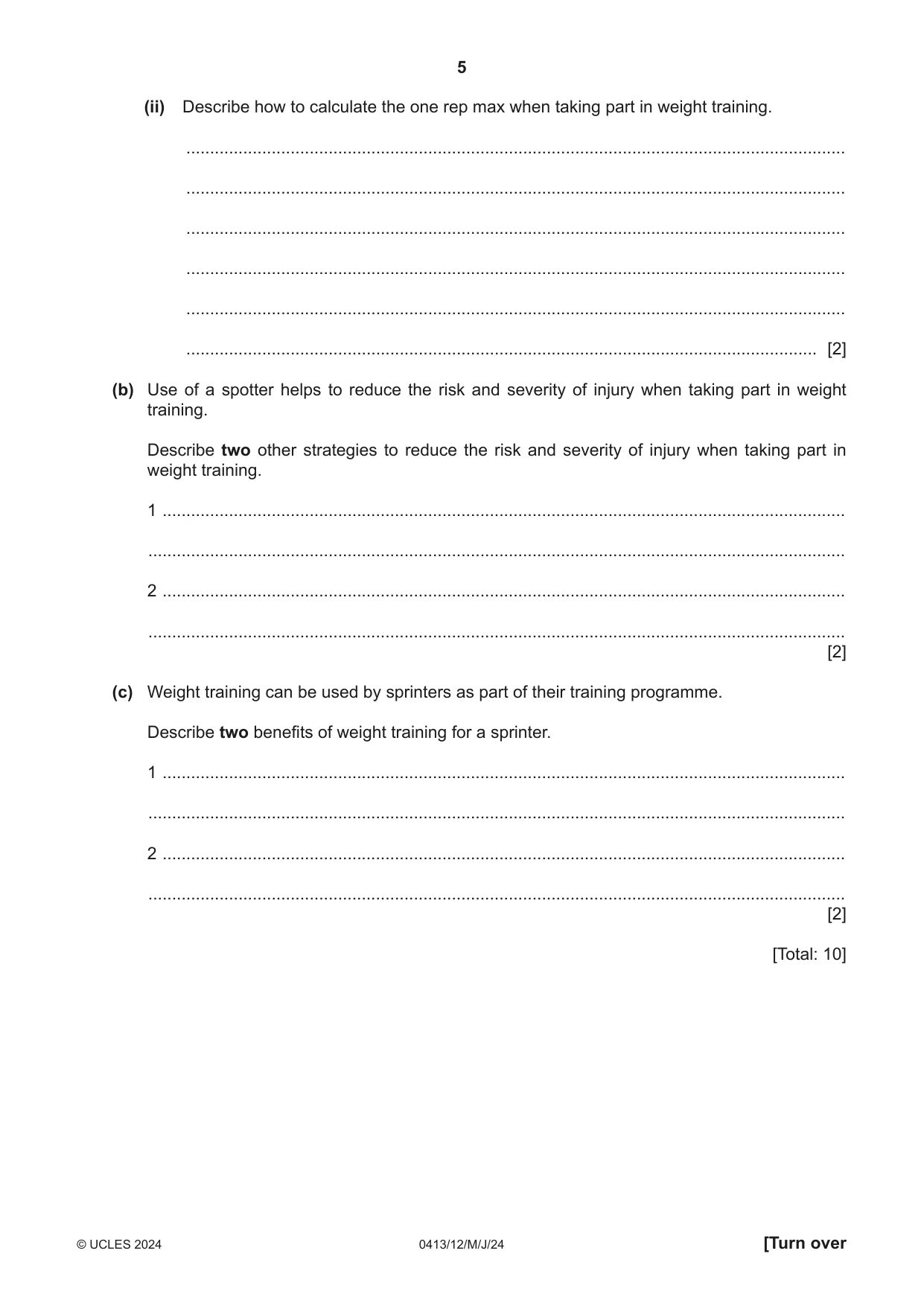
5 0413/12/M/J/24 © UCLES 2024 [Turn over (ii) Describe how to calculate the one rep max when taking part in weight training. … … … … … … [2] (b) Use of a spotter helps to reduce the risk and severity of injury when taking part in weight training. Describe two other strategies to reduce the risk and severity of injury when taking part in weight training. 1 … … 2 … … [2] (c) Weight training can be used by sprinters as part of their training programme. Describe two benefits of weight training for a sprinter. 1 … … 2 … … [2] [Total: 10]
Question paper, page 6
6 0413/12/M/J/24 © UCLES 2024 5 Companies may be chosen to sponsor a global event such as the Olympic Games. Suggest advantages and disadvantages of being a sponsor of a global event such as the Olympic Games. advantages … … … … … … disadvantages … … … … … … [5]
Question paper, page 7
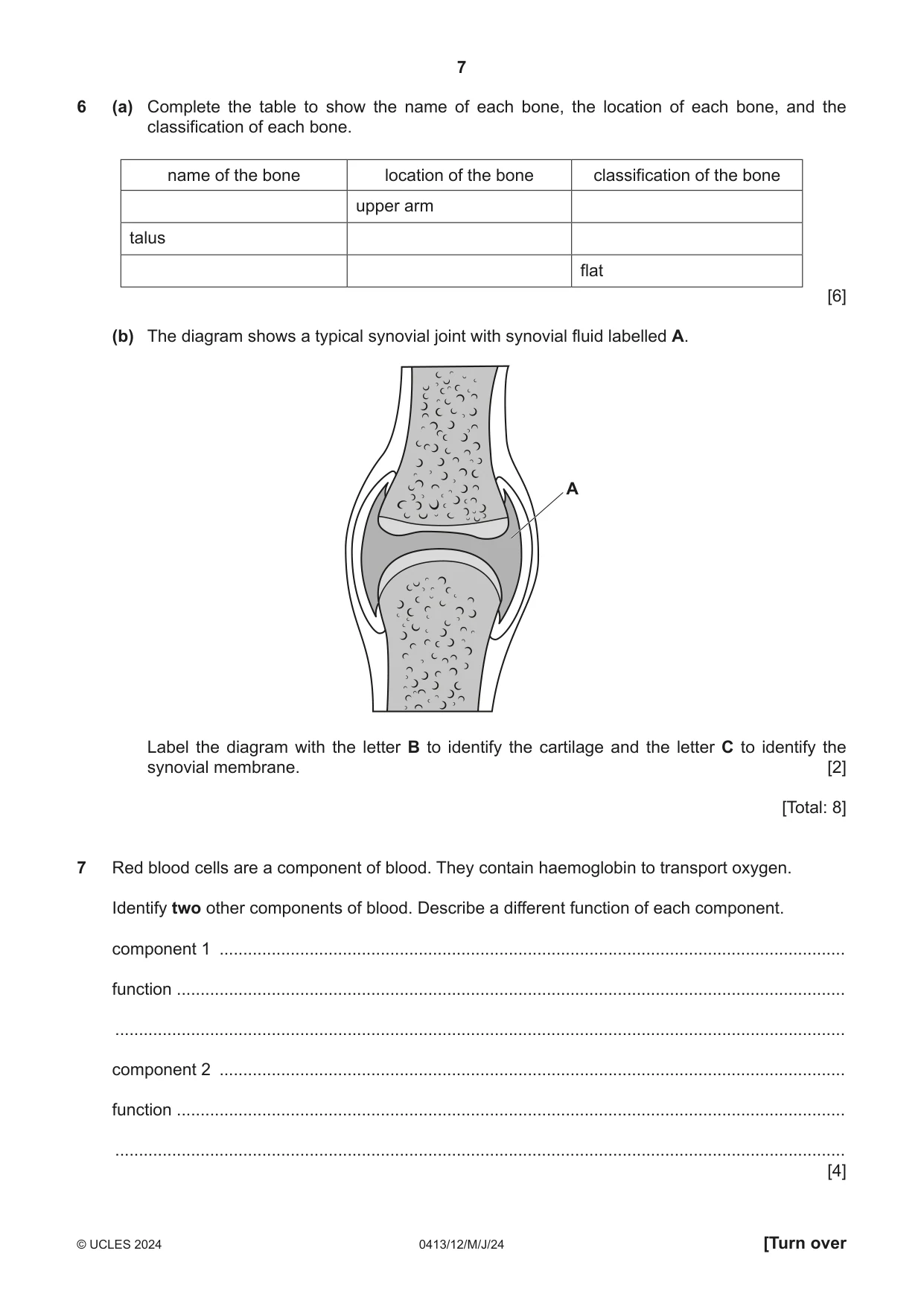
7 0413/12/M/J/24 © UCLES 2024 [Turn over 6 (a) Complete the table to show the name of each bone, the location of each bone, and the classification of each bone. name of the bone location of the bone classification of the bone upper arm talus flat [6] (b) The diagram shows a typical synovial joint with synovial fluid labelled A. A Label the diagram with the letter B to identify the cartilage and the letter C to identify the synovial membrane. [2] [Total: 8] 7 Red blood cells are a component of blood. They contain haemoglobin to transport oxygen. Identify two other components of blood. Describe a different function of each component. component 1 … function … … component 2 … function … … [4]
Question paper, page 8
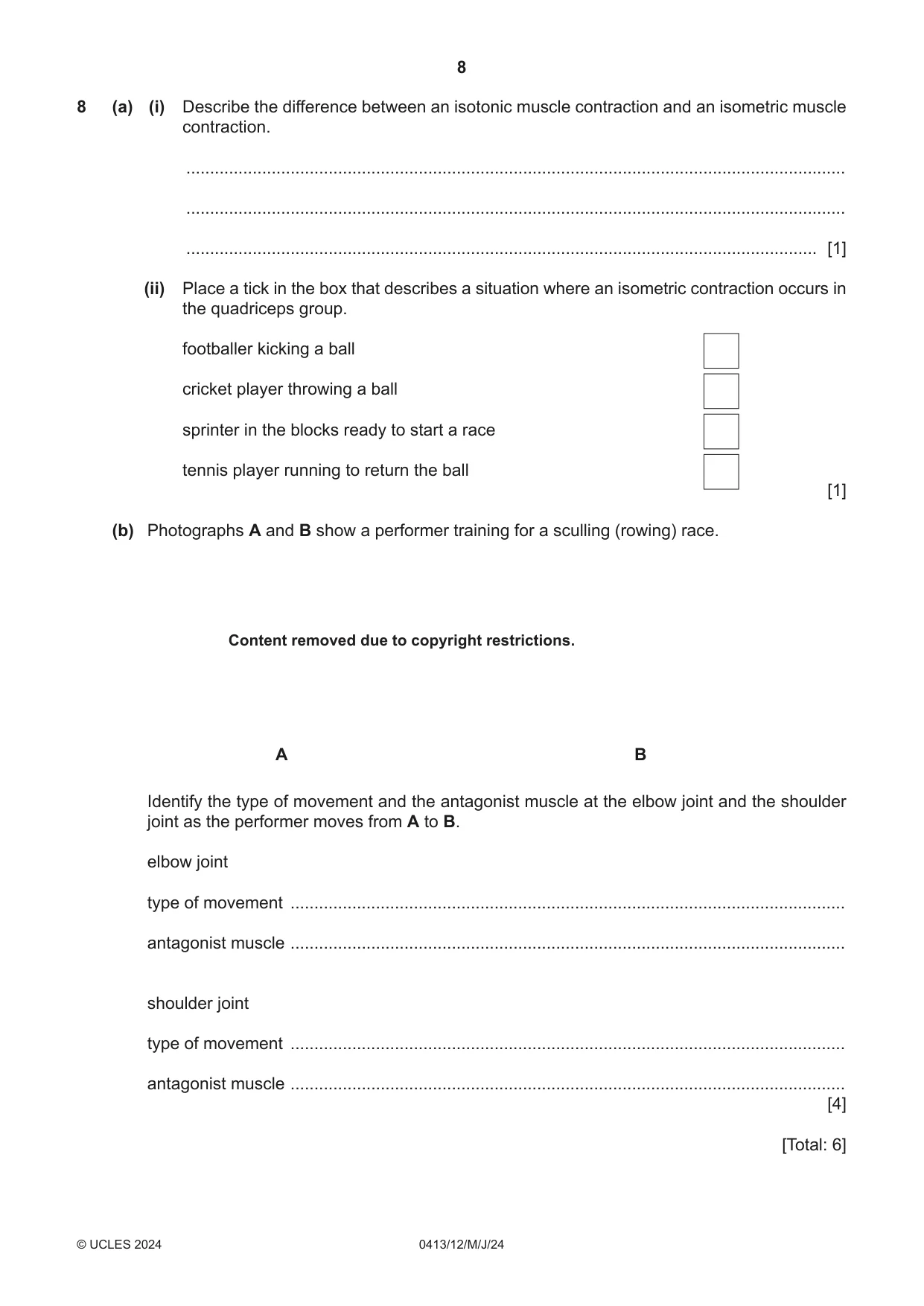
8 0413/12/M/J/24 © UCLES 2024 8 (a) (i) Describe the difference between an isotonic muscle contraction and an isometric muscle contraction. … … … [1] (ii) Place a tick in the box that describes a situation where an isometric contraction occurs in the quadriceps group. footballer kicking a ball cricket player throwing a ball sprinter in the blocks ready to start a race tennis player running to return the ball [1] (b) Photographs A and B show a performer training for a sculling (rowing) race. A B Identify the type of movement and the antagonist muscle at the elbow joint and the shoulder joint as the performer moves from A to B. elbow joint type of movement … antagonist muscle … shoulder joint type of movement … antagonist muscle … [4] [Total: 6] Content removed due to copyright restrictions.
Question paper, page 9
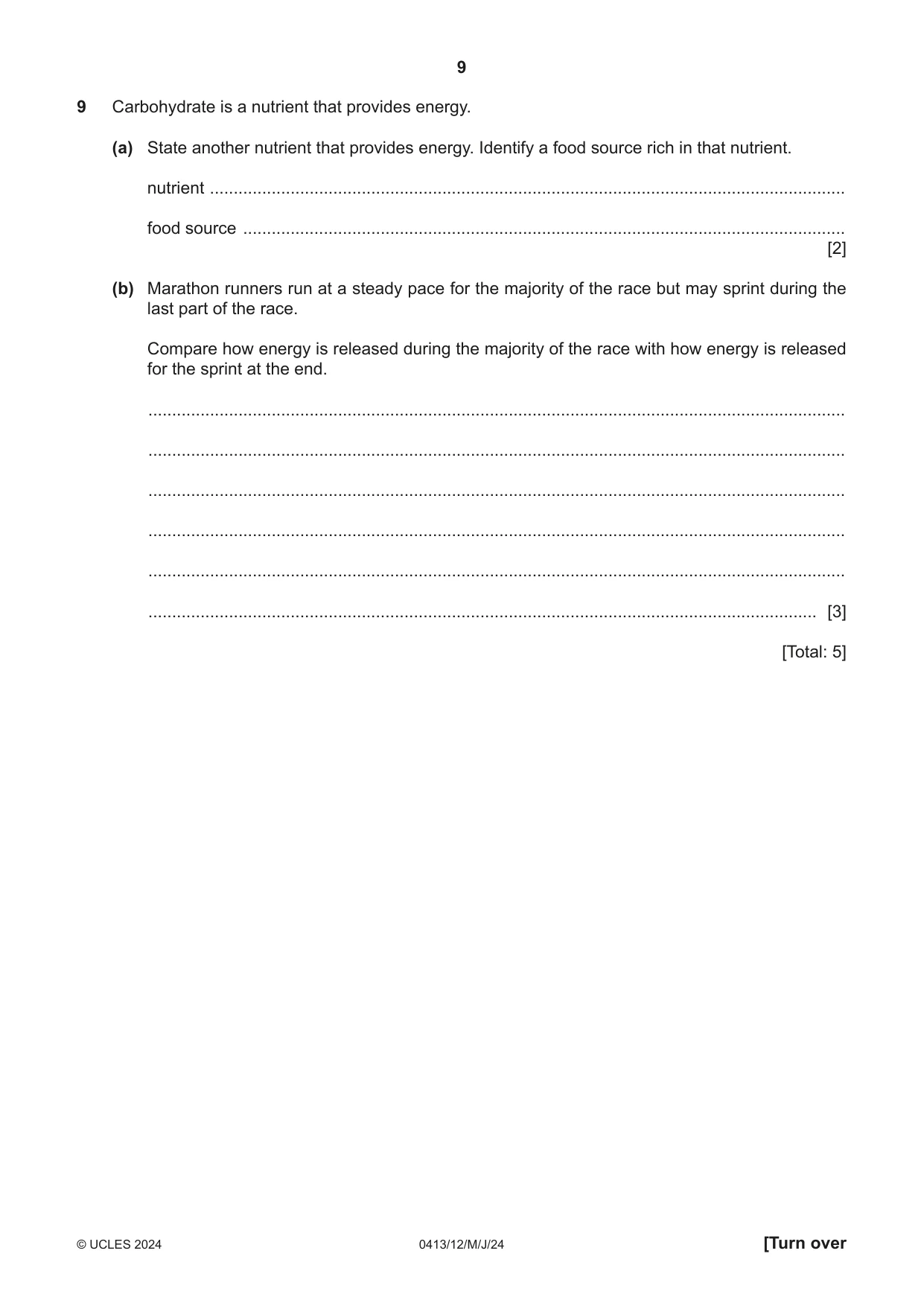
9 0413/12/M/J/24 © UCLES 2024 [Turn over 9 Carbohydrate is a nutrient that provides energy. (a) State another nutrient that provides energy. Identify a food source rich in that nutrient. nutrient … food source … [2] (b) Marathon runners run at a steady pace for the majority of the race but may sprint during the last part of the race. Compare how energy is released during the majority of the race with how energy is released for the sprint at the end. … … … … … … [3] [Total: 5]
Question paper, page 10
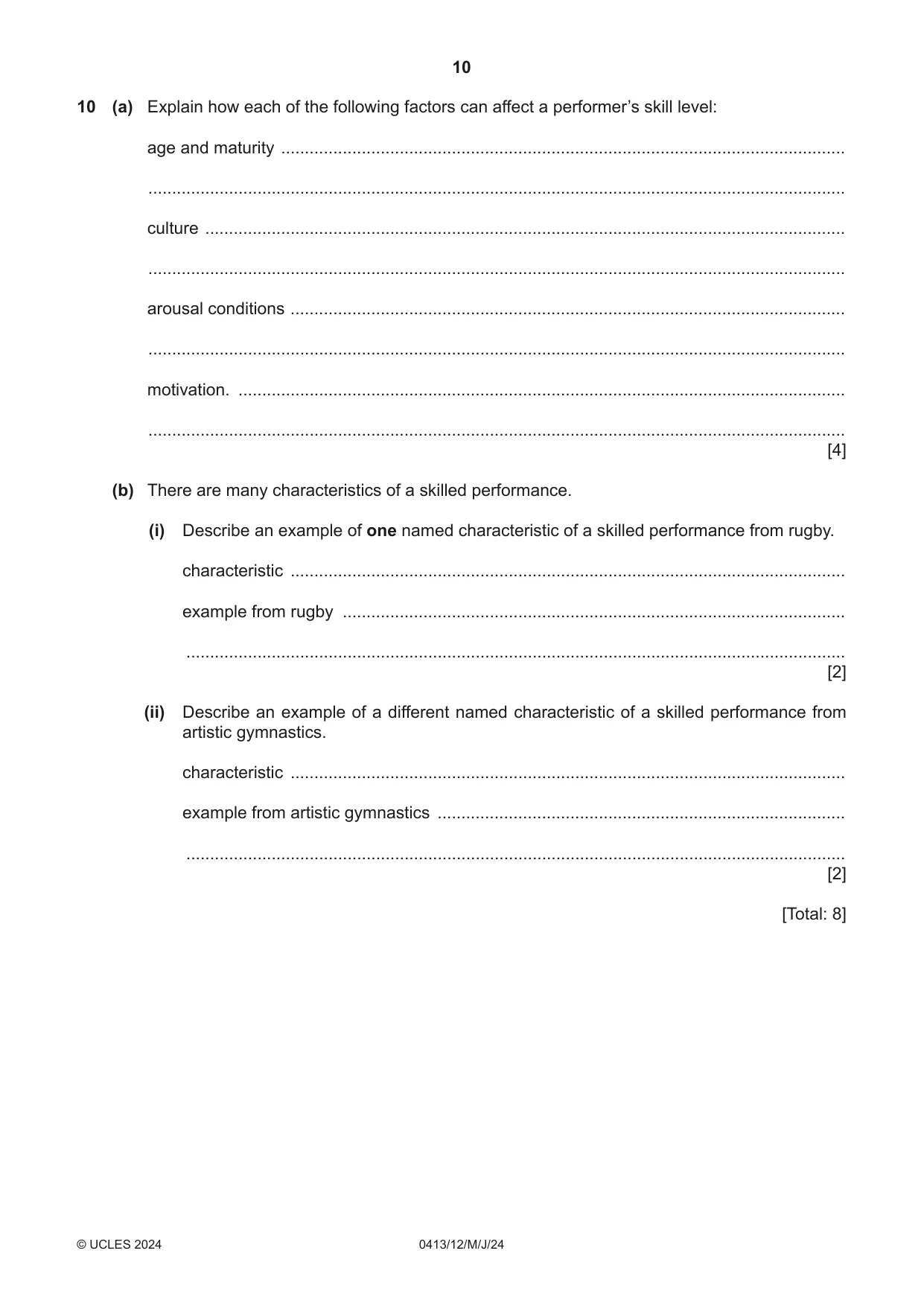
10 0413/12/M/J/24 © UCLES 2024 10 (a) Explain how each of the following factors can affect a performer’s skill level: age and maturity … … culture … … arousal conditions … … motivation. … … [4] (b) There are many characteristics of a skilled performance. (i) Describe an example of one named characteristic of a skilled performance from rugby. characteristic … example from rugby … … [2] (ii) Describe an example of a different named characteristic of a skilled performance from artistic gymnastics. characteristic … example from artistic gymnastics … … [2] [Total: 8]
Question paper, page 11
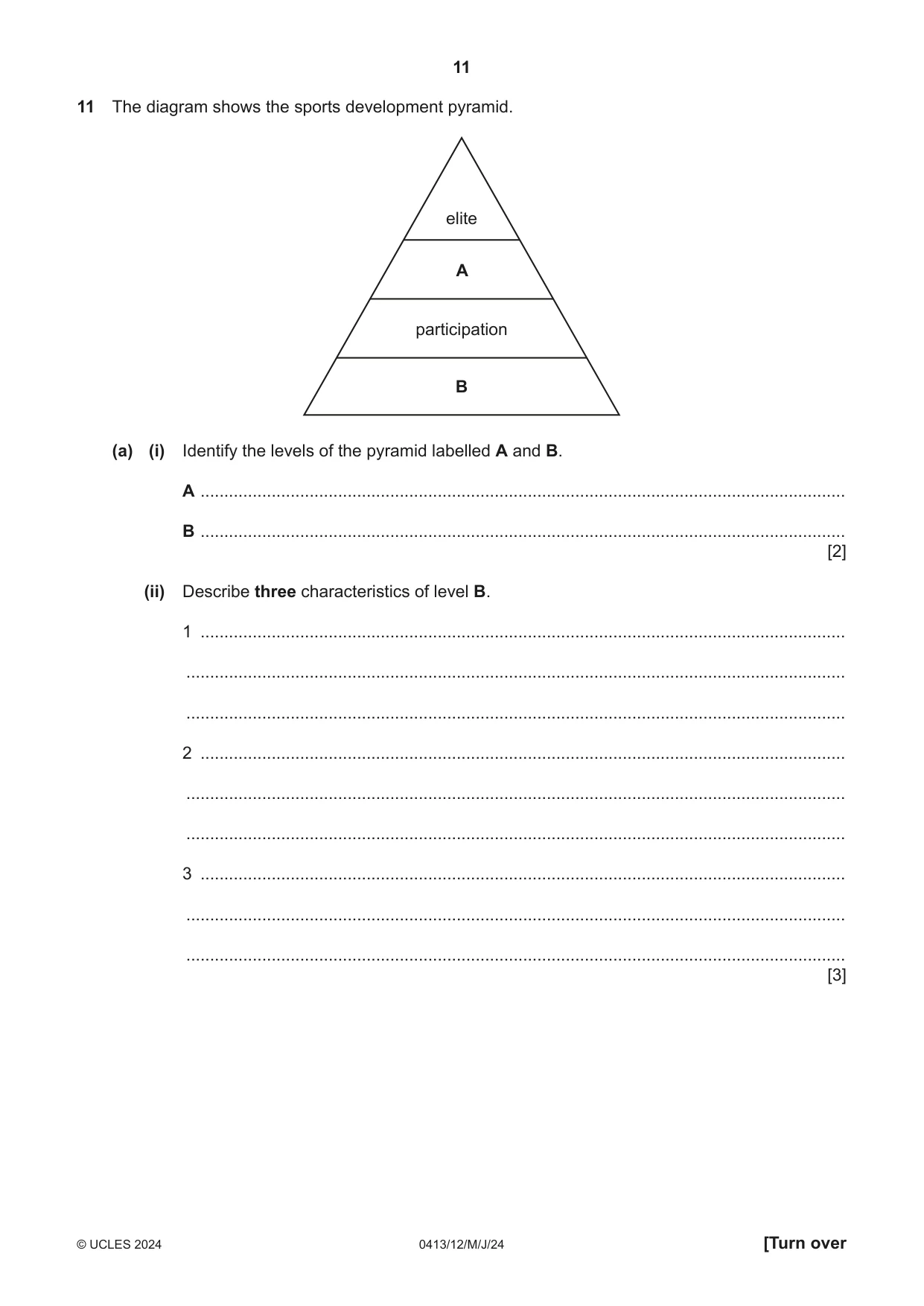
11 0413/12/M/J/24 © UCLES 2024 [Turn over 11 The diagram shows the sports development pyramid. elite A participation B (a) (i) Identify the levels of the pyramid labelled A and B. A … B … [2] (ii) Describe three characteristics of level B. 1 … … … 2 … … … 3 … … … [3]
Question paper, page 12
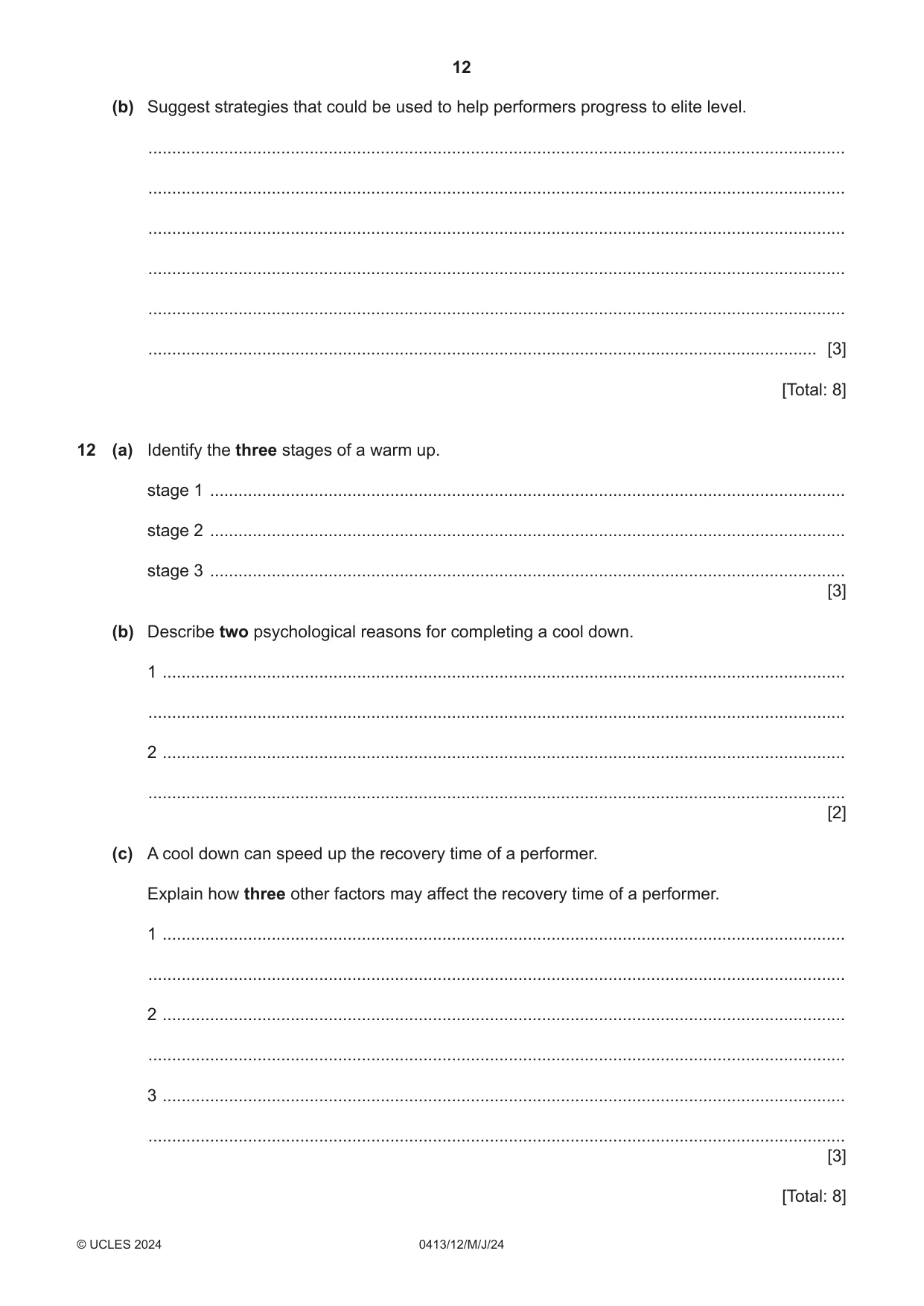
12 0413/12/M/J/24 © UCLES 2024 (b) Suggest strategies that could be used to help performers progress to elite level. … … … … … … [3] [Total: 8] 12 (a) Identify the three stages of a warm up. stage 1 … stage 2 … stage 3 … [3] (b) Describe two psychological reasons for completing a cool down. 1 … … 2 … … [2] (c) A cool down can speed up the recovery time of a performer. Explain how three other factors may affect the recovery time of a performer. 1 … … 2 … … 3 … … [3] [Total: 8]
Question paper, page 13
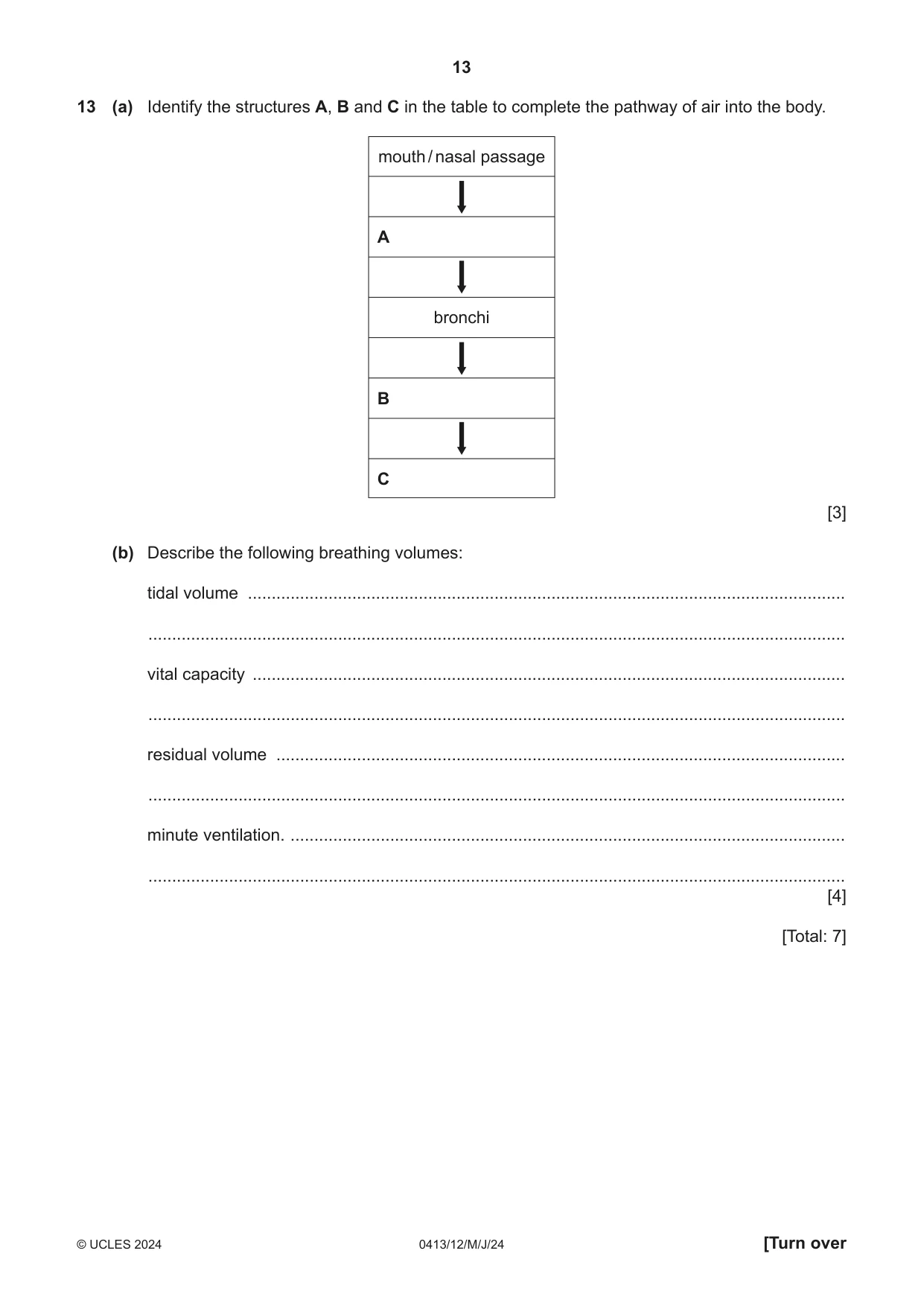
13 0413/12/M/J/24 © UCLES 2024 [Turn over 13 (a) Identify the structures A, B and C in the table to complete the pathway of air into the body. mouth / nasal passage bronchi A B C [3] (b) Describe the following breathing volumes: tidal volume … … vital capacity … … residual volume … … minute ventilation. … … [4] [Total: 7]
Question paper, page 14
14 0413/12/M/J/24 © UCLES 2024 14 One short-term effect of exercise on a performer is an increase in heart rate. Describe three other short-term effects of exercise. 1 … … 2 … … 3 … … [3] 15 The diagram shows a performer pushing off from the take-off board when long jumping. (a) (i) Identify which class of lever is being used as the foot pushes off the take-off board. … [1] (ii) State the three components of a lever system. 1 … 2 … 3 … [3]
Question paper, page 15
15 0413/12/M/J/24 © UCLES 2024 (b) Explain how two named forces will act on the performer when long jumping. force 1 … explanation … … force 2 … explanation … … [4] (c) Identify three different types of feedback the long jumper may receive. 1 … 2 … 3 … [3] [Total: 11]
Question paper, page 16
16 0413/12/M/J/24 © UCLES 2024 Permission to reproduce items where third-party owned material protected by copyright is included has been sought and cleared where possible. Every reasonable effort has been made by the publisher (UCLES) to trace copyright holders, but if any items requiring clearance have unwittingly been included, the publisher will be pleased to make amends at the earliest possible opportunity. To avoid the issue of disclosure of answer-related information to candidates, all copyright acknowledgements are reproduced online in the Cambridge Assessment International Education Copyright Acknowledgements Booklet. This is produced for each series of examinations and is freely available to download at www.cambridgeinternational.org after the live examination series. Cambridge Assessment International Education is part of Cambridge Assessment. Cambridge Assessment is the brand name of the University of Cambridge Local Examinations Syndicate (UCLES), which is a department of the University of Cambridge. BLANK PAGE
Mark scheme, page 1
This document consists of 21 printed pages. © Cambridge University Press & Assessment 2024 [Turn over Cambridge IGCSE™ PHYSICAL EDUCATION 0413/12 Paper 1 Theory May/June 2024 MARK SCHEME Maximum Mark: 100 Published This mark scheme is published as an aid to teachers and candidates, to indicate the requirements of the examination. It shows the basis on which Examiners were instructed to award marks. It does not indicate the details of the discussions that took place at an Examiners’ meeting before marking began, which would have considered the acceptability of alternative answers. Mark schemes should be read in conjunction with the question paper and the Principal Examiner Report for Teachers. Cambridge International will not enter into discussions about these mark schemes. Cambridge International is publishing the mark schemes for the May/June 2024 series for most Cambridge IGCSE, Cambridge International A and AS Level and Cambridge Pre-U components, and some Cambridge O Level components.
Mark scheme, page 2
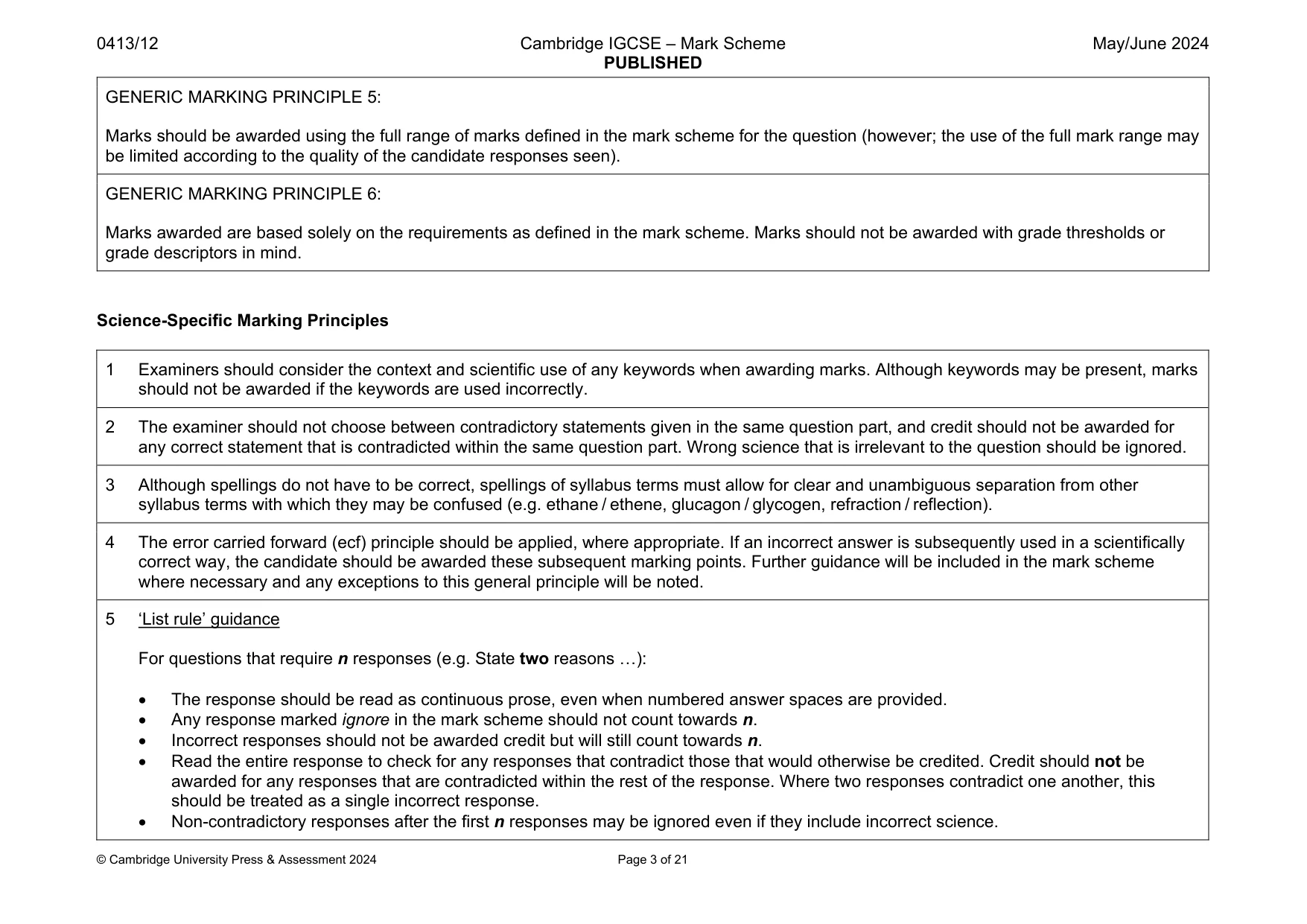
0413/12 Cambridge IGCSE – Mark Scheme PUBLISHED May/June 2024 © Cambridge University Press & Assessment 2024 Page 2 of 21 Generic Marking Principles These general marking principles must be applied by all examiners when marking candidate answers. They should be applied alongside the specific content of the mark scheme or generic level descriptions for a question. Each question paper and mark scheme will also comply with these marking principles. GENERIC MARKING PRINCIPLE 1: Marks must be awarded in line with: the specific content of the mark scheme or the generic level descriptors for the question the specific skills defined in the mark scheme or in the generic level descriptors for the question the standard of response required by a candidate as exemplified by the standardisation scripts. GENERIC MARKING PRINCIPLE 2: Marks awarded are always whole marks (not half marks, or other fractions). GENERIC MARKING PRINCIPLE 3: Marks must be awarded positively: marks are awarded for correct/valid answers, as defined in the mark scheme. However, credit is given for valid answers which go beyond the scope of the syllabus and mark scheme, referring to your Team Leader as appropriate marks are awarded when candidates clearly demonstrate what they know and can do marks are not deducted for errors marks are not deducted for omissions answers should only be judged on the quality of spelling, punctuation and grammar when these features are specifically assessed by the question as indicated by the mark scheme. The meaning, however, should be unambiguous. GENERIC MARKING PRINCIPLE 4: Rules must be applied consistently, e.g. in situations where candidates have not followed instructions or in the application of generic level descriptors.
Mark scheme, page 3
0413/12 Cambridge IGCSE – Mark Scheme PUBLISHED May/June 2024 © Cambridge University Press & Assessment 2024 Page 3 of 21 GENERIC MARKING PRINCIPLE 5: Marks should be awarded using the full range of marks defined in the mark scheme for the question (however; the use of the full mark range may be limited according to the quality of the candidate responses seen). GENERIC MARKING PRINCIPLE 6: Marks awarded are based solely on the requirements as defined in the mark scheme. Marks should not be awarded with grade thresholds or grade descriptors in mind. Science-Specific Marking Principles 1 Examiners should consider the context and scientific use of any keywords when awarding marks. Although keywords may be present, marks should not be awarded if the keywords are used incorrectly. 2 The examiner should not choose between contradictory statements given in the same question part, and credit should not be awarded for any correct statement that is contradicted within the same question part. Wrong science that is irrelevant to the question should be ignored. 3 Although spellings do not have to be correct, spellings of syllabus terms must allow for clear and unambiguous separation from other syllabus terms with which they may be confused (e.g. ethane / ethene, glucagon / glycogen, refraction / reflection). 4 The error carried forward (ecf) principle should be applied, where appropriate. If an incorrect answer is subsequently used in a scientifically correct way, the candidate should be awarded these subsequent marking points. Further guidance will be included in the mark scheme where necessary and any exceptions to this general principle will be noted. 5 ‘List rule’ guidance For questions that require n responses (e.g. State two reasons …): The response should be read as continuous prose, even when numbered answer spaces are provided. Any response marked ignore in the mark scheme should not count towards n. Incorrect responses should not be awarded credit but will still count towards n. Read the entire response to check for any responses that contradict those that would otherwise be credited. Credit should not be awarded for any responses that are contradicted within the rest of the response. Where two responses contradict one another, this should be treated as a single incorrect response. Non-contradictory responses after the first n responses may be ignored even if they include incorrect science.
Mark scheme, page 4
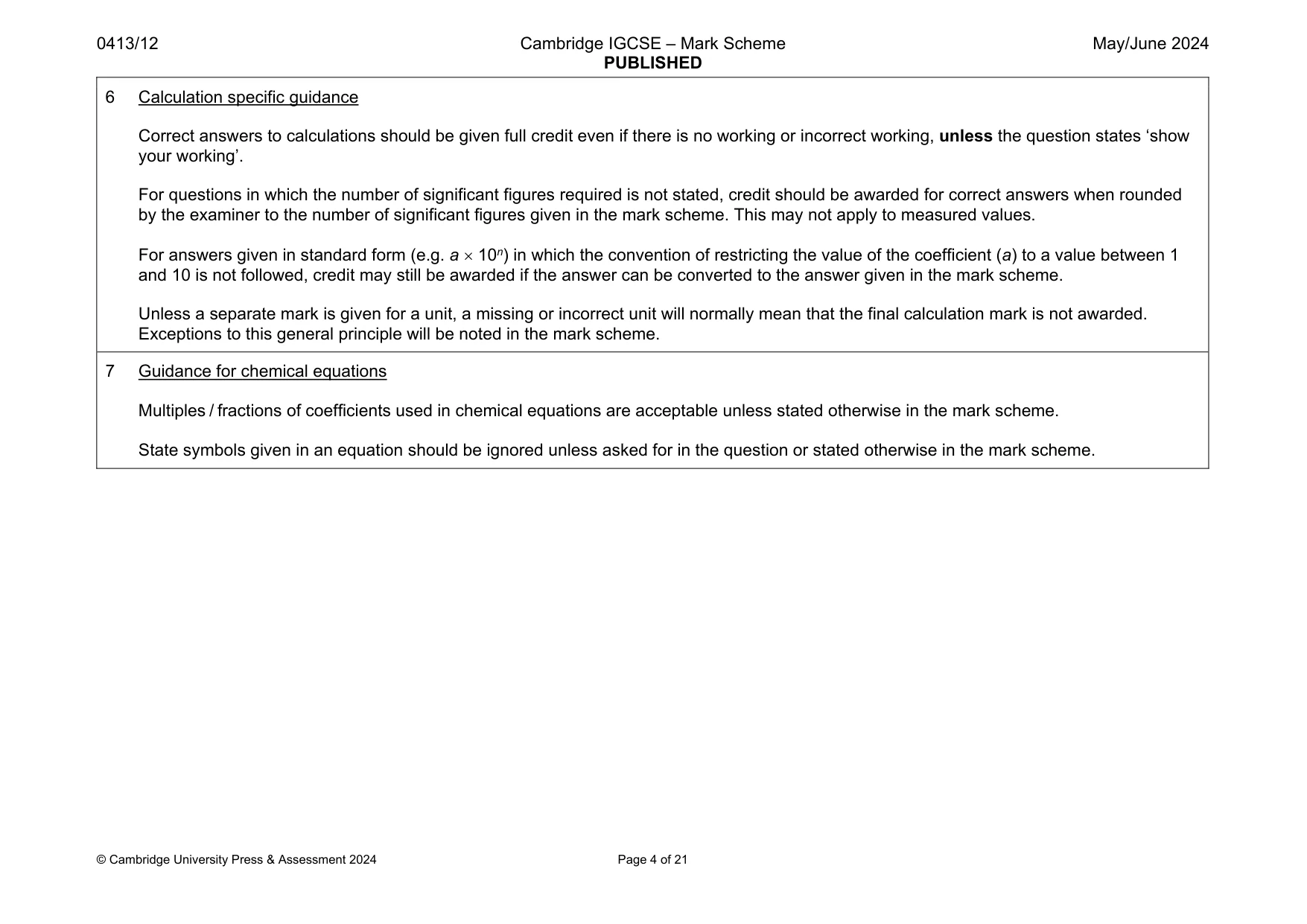
0413/12 Cambridge IGCSE – Mark Scheme PUBLISHED May/June 2024 © Cambridge University Press & Assessment 2024 Page 4 of 21 6 Calculation specific guidance Correct answers to calculations should be given full credit even if there is no working or incorrect working, unless the question states ‘show your working’. For questions in which the number of significant figures required is not stated, credit should be awarded for correct answers when rounded by the examiner to the number of significant figures given in the mark scheme. This may not apply to measured values. For answers given in standard form (e.g. a 10n) in which the convention of restricting the value of the coefficient (a) to a value between 1 and 10 is not followed, credit may still be awarded if the answer can be converted to the answer given in the mark scheme. Unless a separate mark is given for a unit, a missing or incorrect unit will normally mean that the final calculation mark is not awarded. Exceptions to this general principle will be noted in the mark scheme. 7 Guidance for chemical equations Multiples / fractions of coefficients used in chemical equations are acceptable unless stated otherwise in the mark scheme. State symbols given in an equation should be ignored unless asked for in the question or stated otherwise in the mark scheme.
Mark scheme, page 5
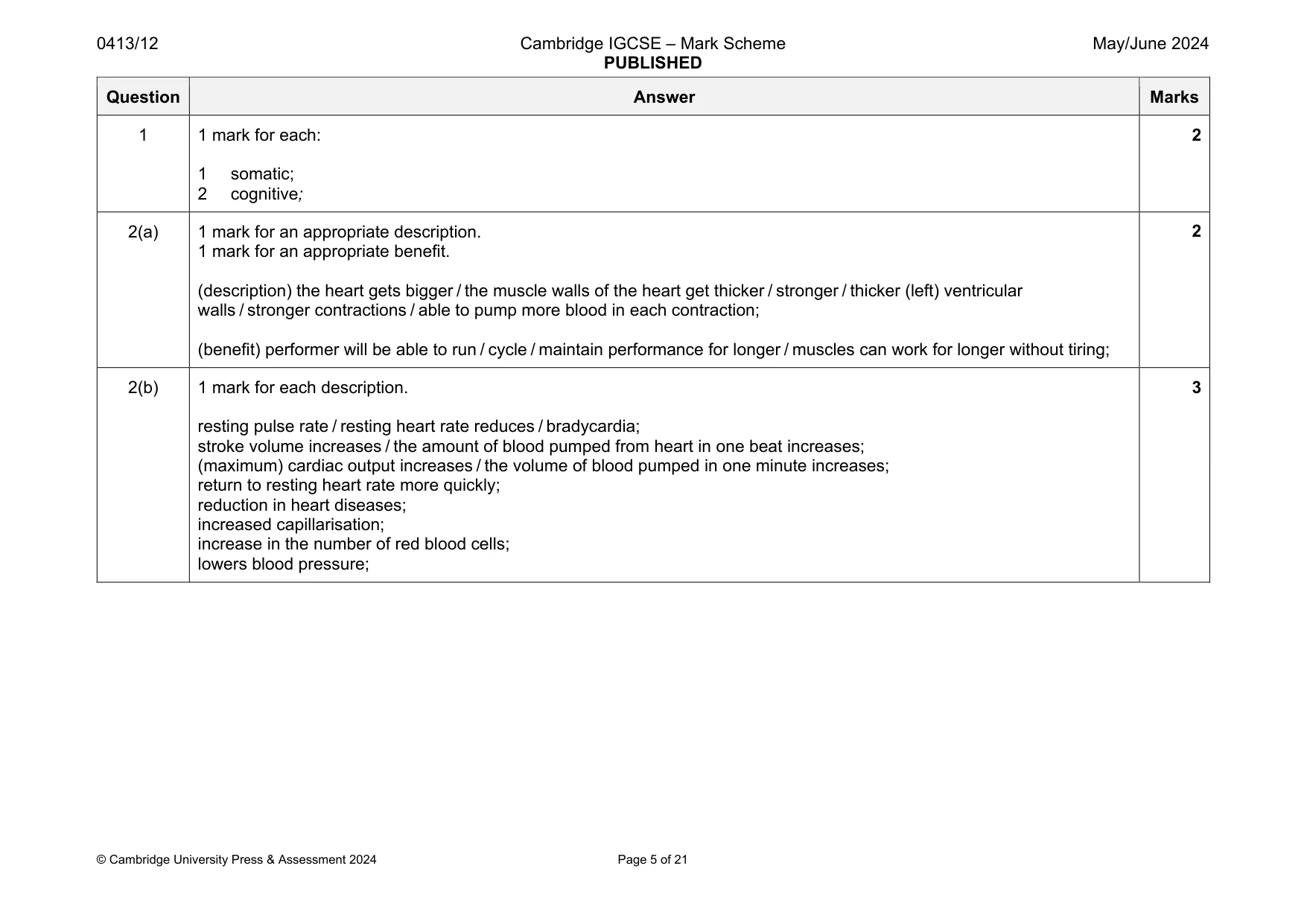
0413/12 Cambridge IGCSE – Mark Scheme PUBLISHED May/June 2024 © Cambridge University Press & Assessment 2024 Page 5 of 21 Question Answer Marks 1 1 mark for each: 1 somatic; 2 cognitive; 2 2(a) 1 mark for an appropriate description. 1 mark for an appropriate benefit. (description) the heart gets bigger / the muscle walls of the heart get thicker / stronger / thicker (left) ventricular walls / stronger contractions / able to pump more blood in each contraction; (benefit) performer will be able to run / cycle / maintain performance for longer / muscles can work for longer without tiring; 2 2(b) 1 mark for each description. resting pulse rate / resting heart rate reduces / bradycardia; stroke volume increases / the amount of blood pumped from heart in one beat increases; (maximum) cardiac output increases / the volume of blood pumped in one minute increases; return to resting heart rate more quickly; reduction in heart diseases; increased capillarisation; increase in the number of red blood cells; lowers blood pressure; 3
Mark scheme, page 6
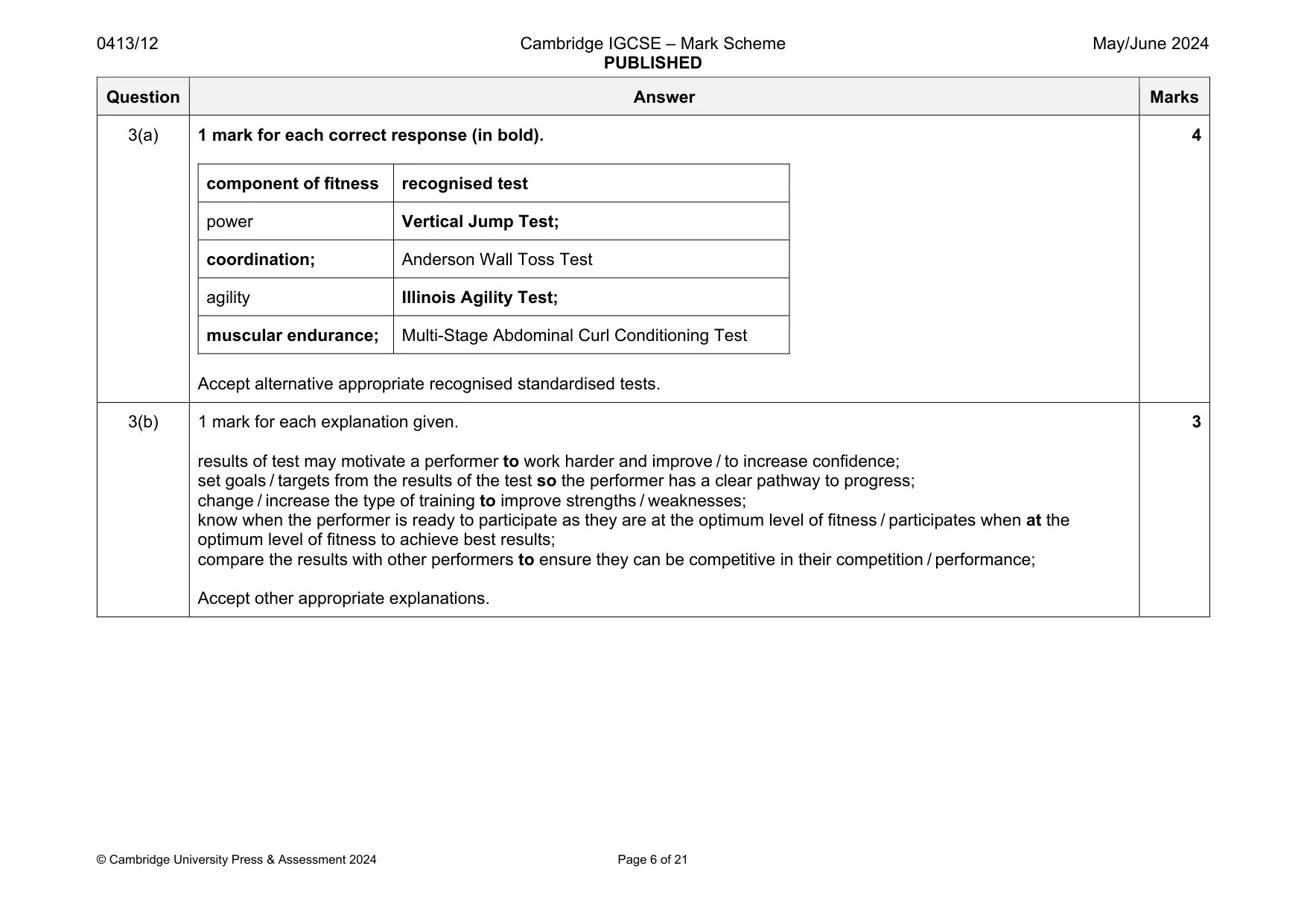
0413/12 Cambridge IGCSE – Mark Scheme PUBLISHED May/June 2024 © Cambridge University Press & Assessment 2024 Page 6 of 21 Question Answer Marks 3(a) 1 mark for each correct response (in bold). component of fitness recognised test power Vertical Jump Test; coordination; Anderson Wall Toss Test agility Illinois Agility Test; muscular endurance; Multi-Stage Abdominal Curl Conditioning Test Accept alternative appropriate recognised standardised tests. 4 3(b) 1 mark for each explanation given. results of test may motivate a performer to work harder and improve / to increase confidence; set goals / targets from the results of the test so the performer has a clear pathway to progress; change / increase the type of training to improve strengths / weaknesses; know when the performer is ready to participate as they are at the optimum level of fitness / participates when at the optimum level of fitness to achieve best results; compare the results with other performers to ensure they can be competitive in their competition / performance; Accept other appropriate explanations. 3
Mark scheme, page 7
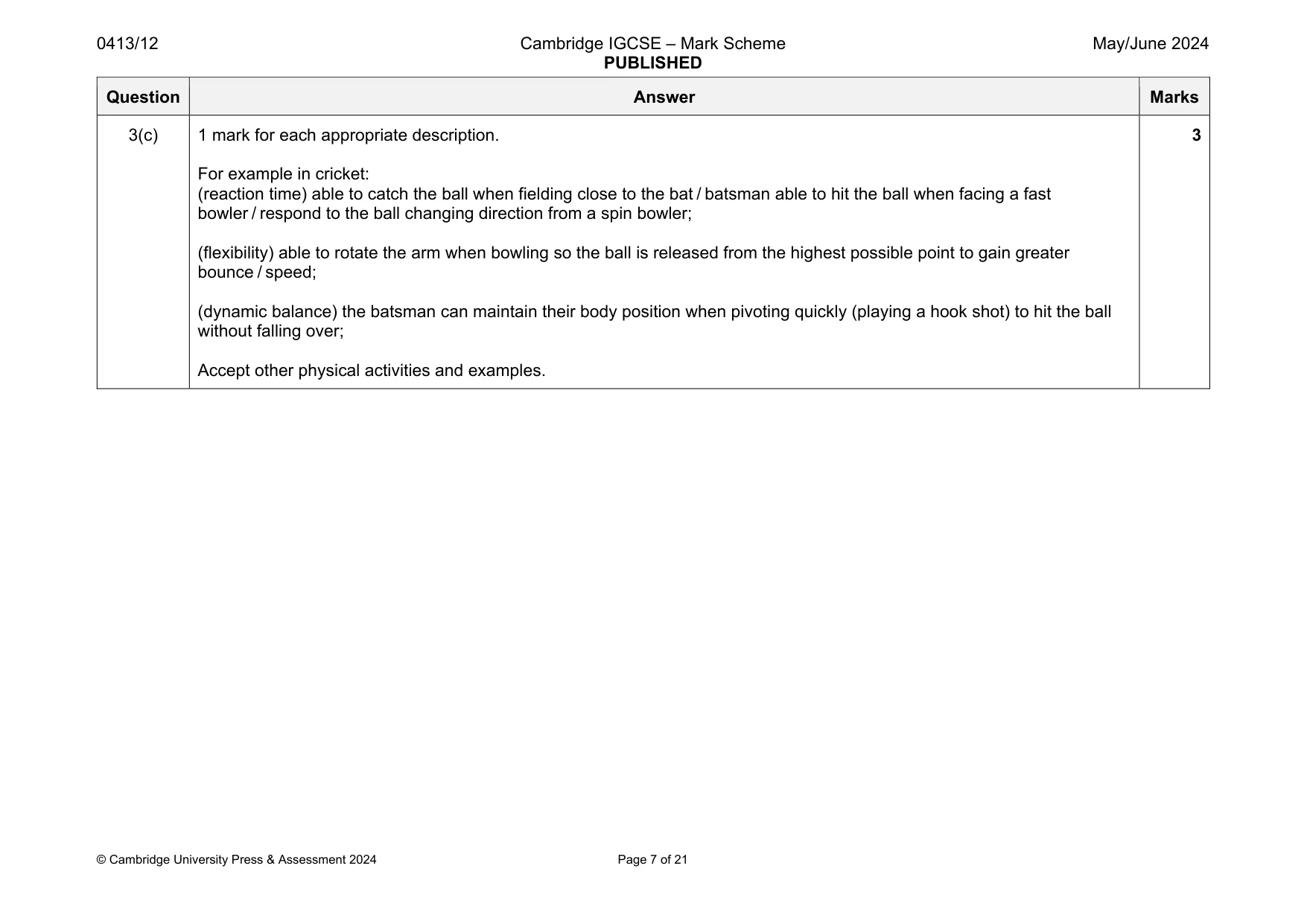
0413/12 Cambridge IGCSE – Mark Scheme PUBLISHED May/June 2024 © Cambridge University Press & Assessment 2024 Page 7 of 21 Question Answer Marks 3(c) 1 mark for each appropriate description. For example in cricket: (reaction time) able to catch the ball when fielding close to the bat / batsman able to hit the ball when facing a fast bowler / respond to the ball changing direction from a spin bowler; (flexibility) able to rotate the arm when bowling so the ball is released from the highest possible point to gain greater bounce / speed; (dynamic balance) the batsman can maintain their body position when pivoting quickly (playing a hook shot) to hit the ball without falling over; Accept other physical activities and examples. 3
Mark scheme, page 8
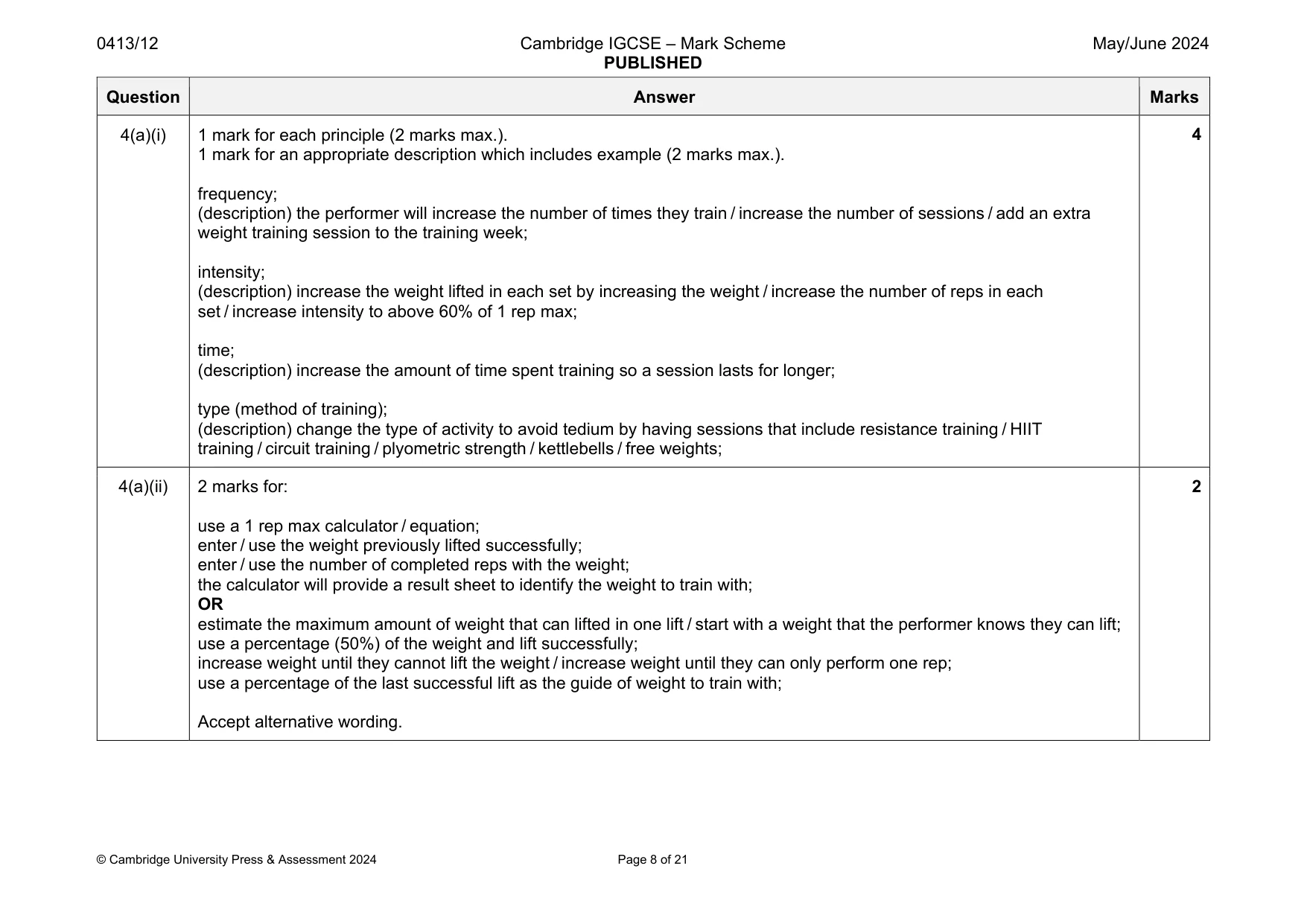
0413/12 Cambridge IGCSE – Mark Scheme PUBLISHED May/June 2024 © Cambridge University Press & Assessment 2024 Page 8 of 21 Question Answer Marks 4(a)(i) 1 mark for each principle (2 marks max.). 1 mark for an appropriate description which includes example (2 marks max.). frequency; (description) the performer will increase the number of times they train / increase the number of sessions / add an extra weight training session to the training week; intensity; (description) increase the weight lifted in each set by increasing the weight / increase the number of reps in each set / increase intensity to above 60% of 1 rep max; time; (description) increase the amount of time spent training so a session lasts for longer; type (method of training); (description) change the type of activity to avoid tedium by having sessions that include resistance training / HIIT training / circuit training / plyometric strength / kettlebells / free weights; 4 4(a)(ii) 2 marks for: use a 1 rep max calculator / equation; enter / use the weight previously lifted successfully; enter / use the number of completed reps with the weight; the calculator will provide a result sheet to identify the weight to train with; OR estimate the maximum amount of weight that can lifted in one lift / start with a weight that the performer knows they can lift; use a percentage (50%) of the weight and lift successfully; increase weight until they cannot lift the weight / increase weight until they can only perform one rep; use a percentage of the last successful lift as the guide of weight to train with; Accept alternative wording. 2
Mark scheme, page 9
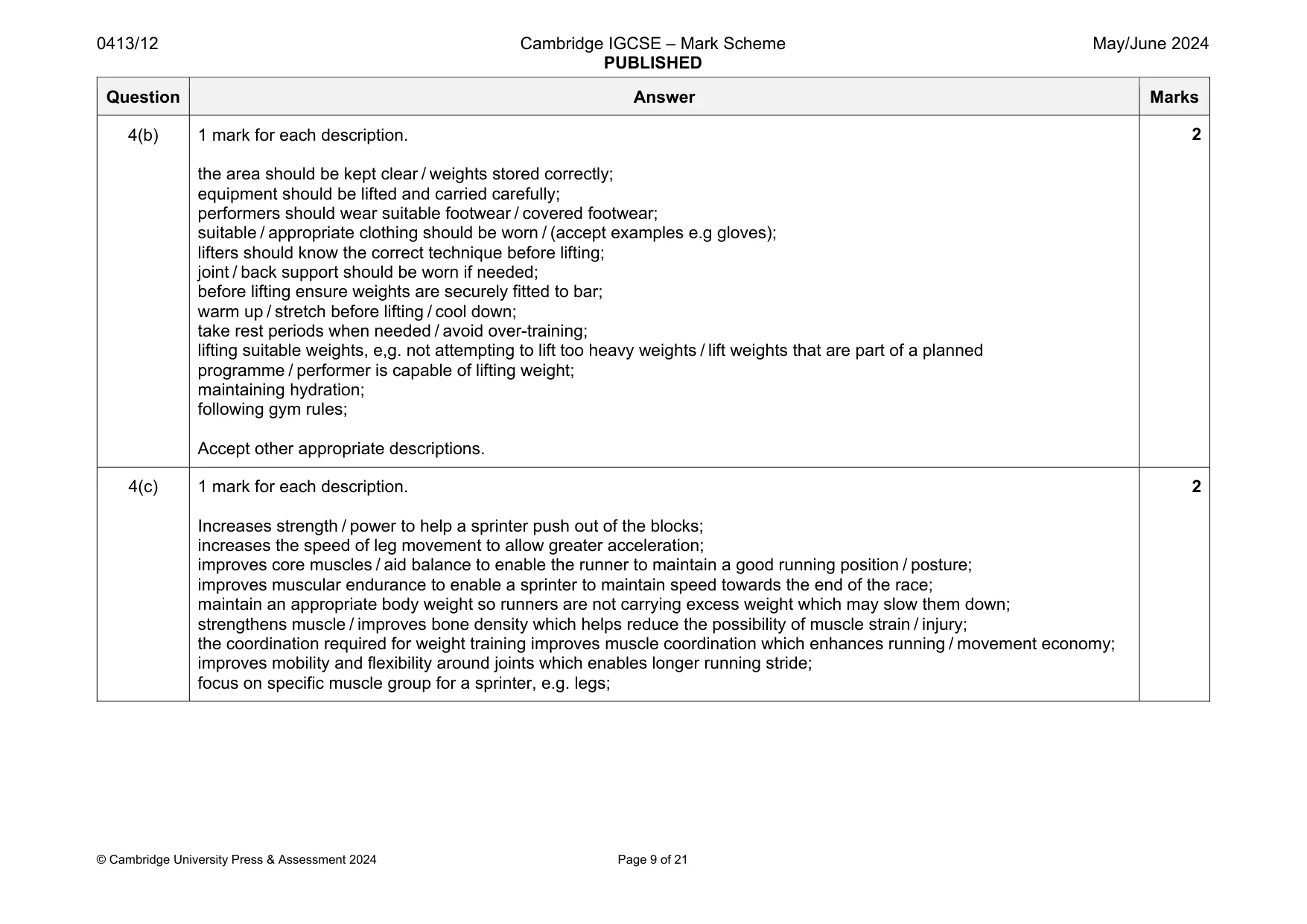
0413/12 Cambridge IGCSE – Mark Scheme PUBLISHED May/June 2024 © Cambridge University Press & Assessment 2024 Page 9 of 21 Question Answer Marks 4(b) 1 mark for each description. the area should be kept clear / weights stored correctly; equipment should be lifted and carried carefully; performers should wear suitable footwear / covered footwear; suitable / appropriate clothing should be worn / (accept examples e.g gloves); lifters should know the correct technique before lifting; joint / back support should be worn if needed; before lifting ensure weights are securely fitted to bar; warm up / stretch before lifting / cool down; take rest periods when needed / avoid over-training; lifting suitable weights, e,g. not attempting to lift too heavy weights / lift weights that are part of a planned programme / performer is capable of lifting weight; maintaining hydration; following gym rules; Accept other appropriate descriptions. 2 4(c) 1 mark for each description. Increases strength / power to help a sprinter push out of the blocks; increases the speed of leg movement to allow greater acceleration; improves core muscles / aid balance to enable the runner to maintain a good running position / posture; improves muscular endurance to enable a sprinter to maintain speed towards the end of the race; maintain an appropriate body weight so runners are not carrying excess weight which may slow them down; strengthens muscle / improves bone density which helps reduce the possibility of muscle strain / injury; the coordination required for weight training improves muscle coordination which enhances running / movement economy; improves mobility and flexibility around joints which enables longer running stride; focus on specific muscle group for a sprinter, e.g. legs; 2
Mark scheme, page 10
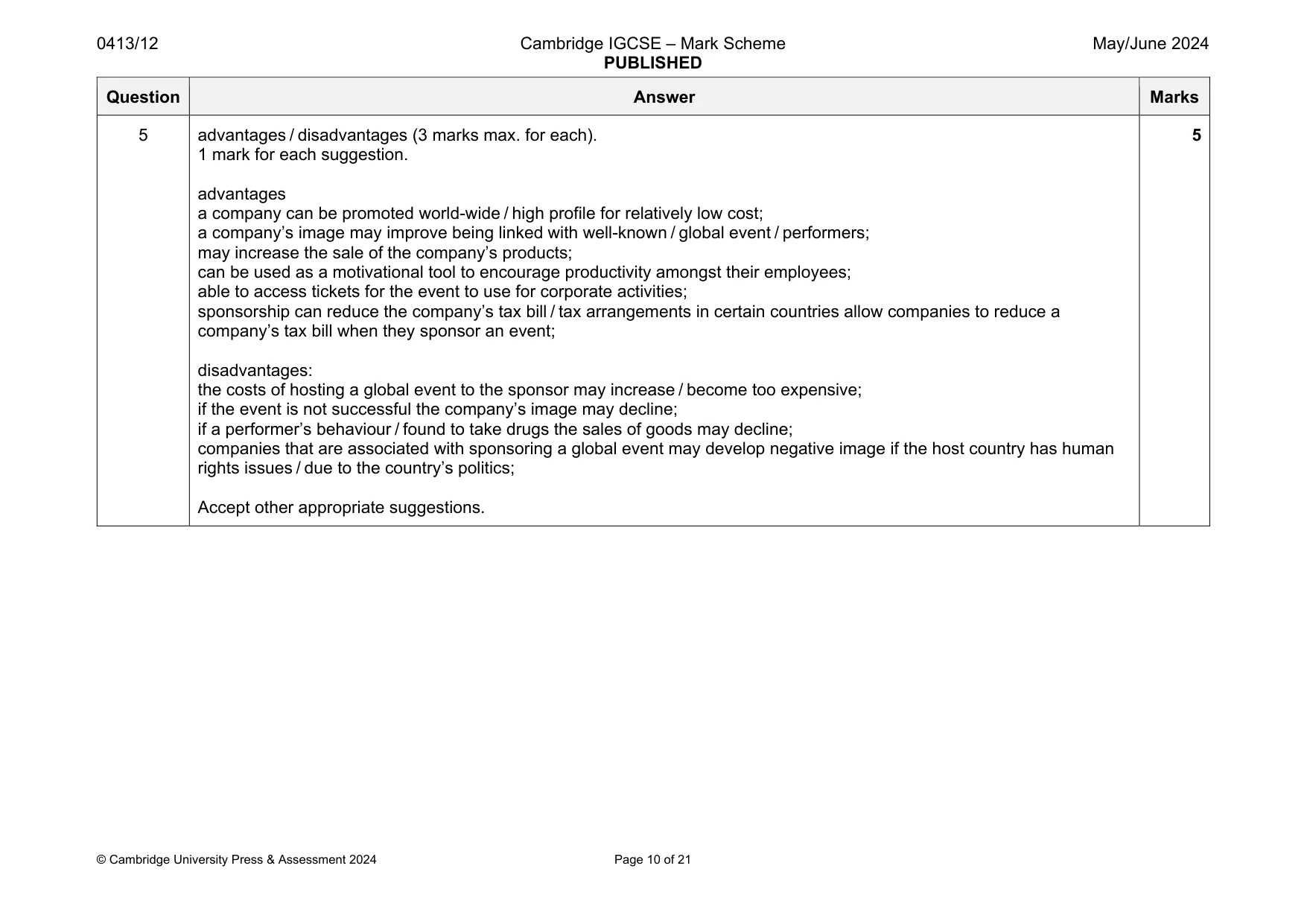
0413/12 Cambridge IGCSE – Mark Scheme PUBLISHED May/June 2024 © Cambridge University Press & Assessment 2024 Page 10 of 21 Question Answer Marks 5 advantages / disadvantages (3 marks max. for each). 1 mark for each suggestion. advantages a company can be promoted world-wide / high profile for relatively low cost; a company’s image may improve being linked with well-known / global event / performers; may increase the sale of the company’s products; can be used as a motivational tool to encourage productivity amongst their employees; able to access tickets for the event to use for corporate activities; sponsorship can reduce the company’s tax bill / tax arrangements in certain countries allow companies to reduce a company’s tax bill when they sponsor an event; disadvantages: the costs of hosting a global event to the sponsor may increase / become too expensive; if the event is not successful the company’s image may decline; if a performer’s behaviour / found to take drugs the sales of goods may decline; companies that are associated with sponsoring a global event may develop negative image if the host country has human rights issues / due to the country’s politics; Accept other appropriate suggestions. 5
Mark scheme, page 11
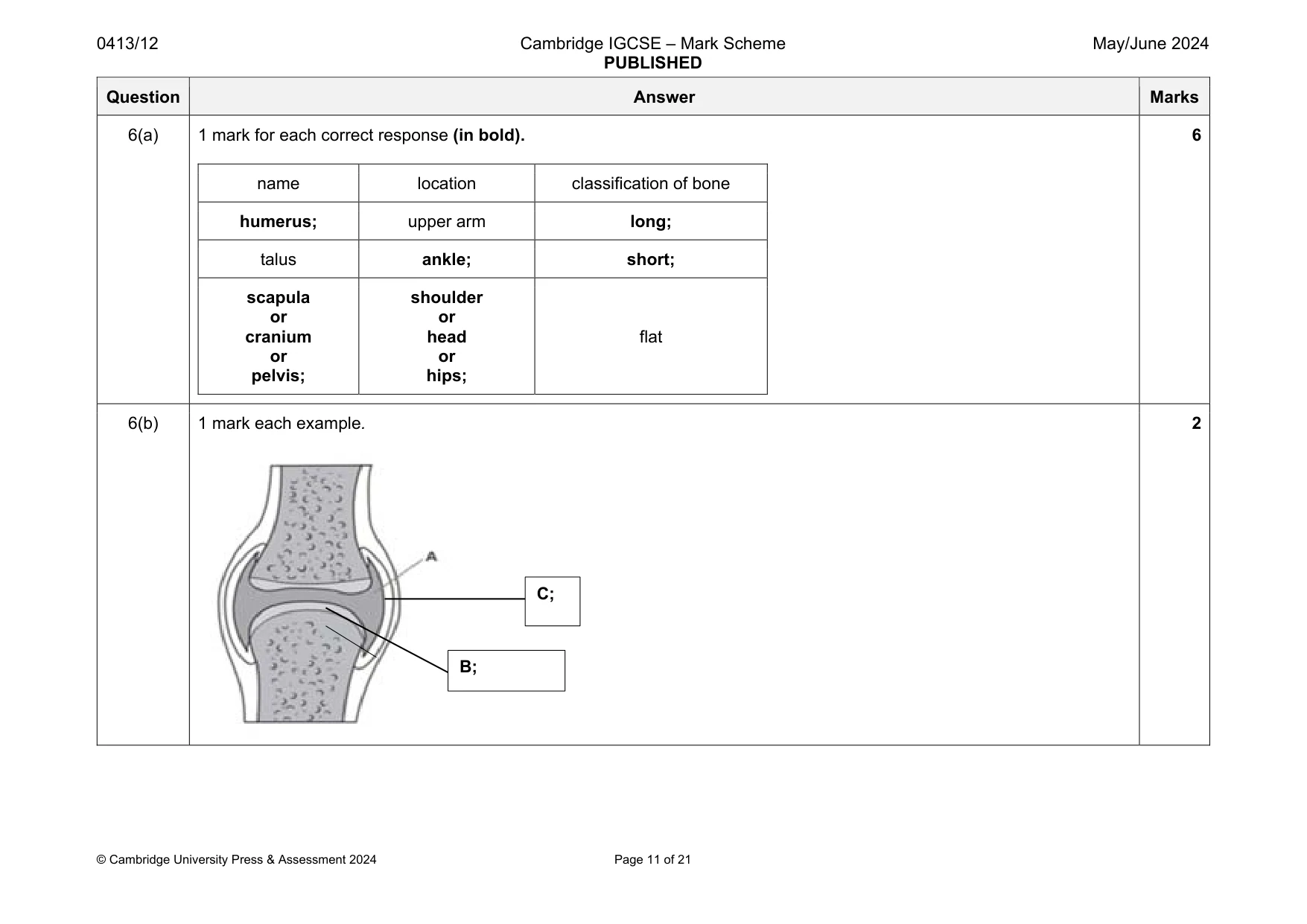
0413/12 Cambridge IGCSE – Mark Scheme PUBLISHED May/June 2024 © Cambridge University Press & Assessment 2024 Page 11 of 21 Question Answer Marks 6(a) 1 mark for each correct response (in bold). name location classification of bone humerus; upper arm long; talus ankle; short; scapula or cranium or pelvis; shoulder or head or hips; flat 6 6(b) 1 mark each example. 2 C; B;
Mark scheme, page 12
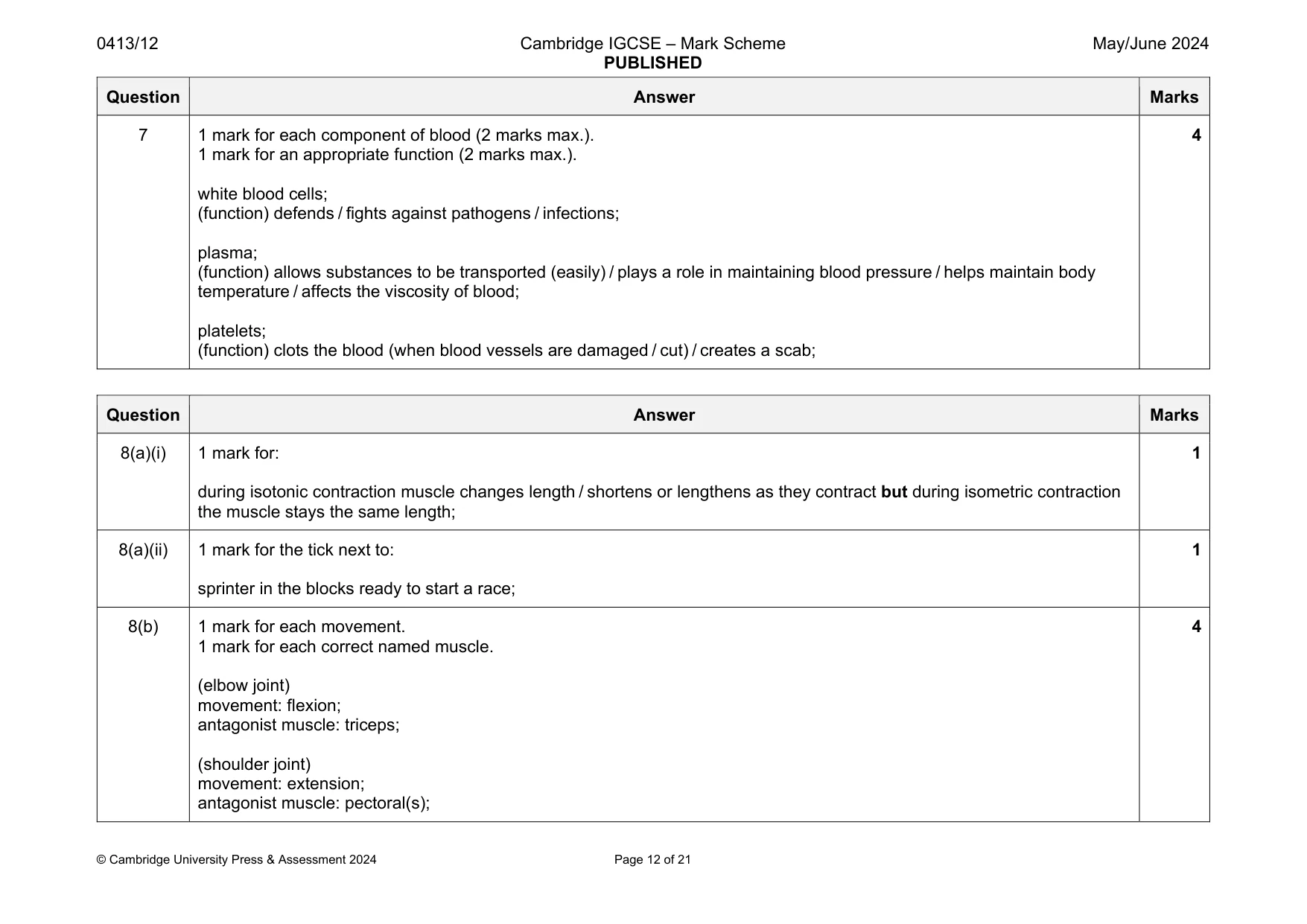
0413/12 Cambridge IGCSE – Mark Scheme PUBLISHED May/June 2024 © Cambridge University Press & Assessment 2024 Page 12 of 21 Question Answer Marks 7 1 mark for each component of blood (2 marks max.). 1 mark for an appropriate function (2 marks max.). white blood cells; (function) defends / fights against pathogens / infections; plasma; (function) allows substances to be transported (easily) / plays a role in maintaining blood pressure / helps maintain body temperature / affects the viscosity of blood; platelets; (function) clots the blood (when blood vessels are damaged / cut) / creates a scab; 4 Question Answer Marks 8(a)(i) 1 mark for: during isotonic contraction muscle changes length / shortens or lengthens as they contract but during isometric contraction the muscle stays the same length; 1 8(a)(ii) 1 mark for the tick next to: sprinter in the blocks ready to start a race; 1 8(b) 1 mark for each movement. 1 mark for each correct named muscle. (elbow joint) movement: flexion; antagonist muscle: triceps; (shoulder joint) movement: extension; antagonist muscle: pectoral(s); 4
Mark scheme, page 13
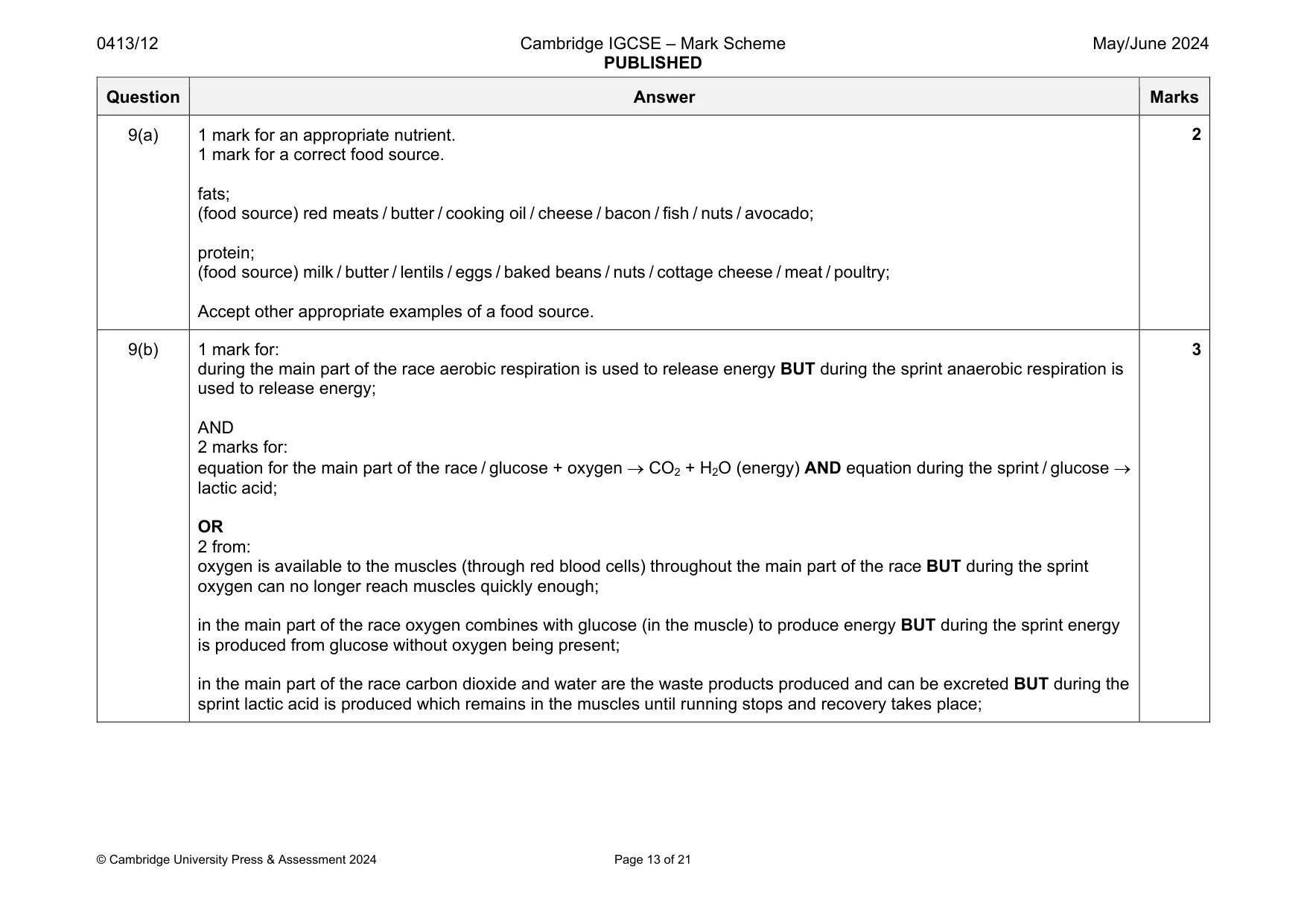
0413/12 Cambridge IGCSE – Mark Scheme PUBLISHED May/June 2024 © Cambridge University Press & Assessment 2024 Page 13 of 21 Question Answer Marks 9(a) 1 mark for an appropriate nutrient. 1 mark for a correct food source. fats; (food source) red meats / butter / cooking oil / cheese / bacon / fish / nuts / avocado; protein; (food source) milk / butter / lentils / eggs / baked beans / nuts / cottage cheese / meat / poultry; Accept other appropriate examples of a food source. 2 9(b) 1 mark for: during the main part of the race aerobic respiration is used to release energy BUT during the sprint anaerobic respiration is used to release energy; AND 2 marks for: equation for the main part of the race / glucose + oxygen CO2 + H2O (energy) AND equation during the sprint / glucose lactic acid; OR 2 from: oxygen is available to the muscles (through red blood cells) throughout the main part of the race BUT during the sprint oxygen can no longer reach muscles quickly enough; in the main part of the race oxygen combines with glucose (in the muscle) to produce energy BUT during the sprint energy is produced from glucose without oxygen being present; in the main part of the race carbon dioxide and water are the waste products produced and can be excreted BUT during the sprint lactic acid is produced which remains in the muscles until running stops and recovery takes place; 3
Mark scheme, page 14
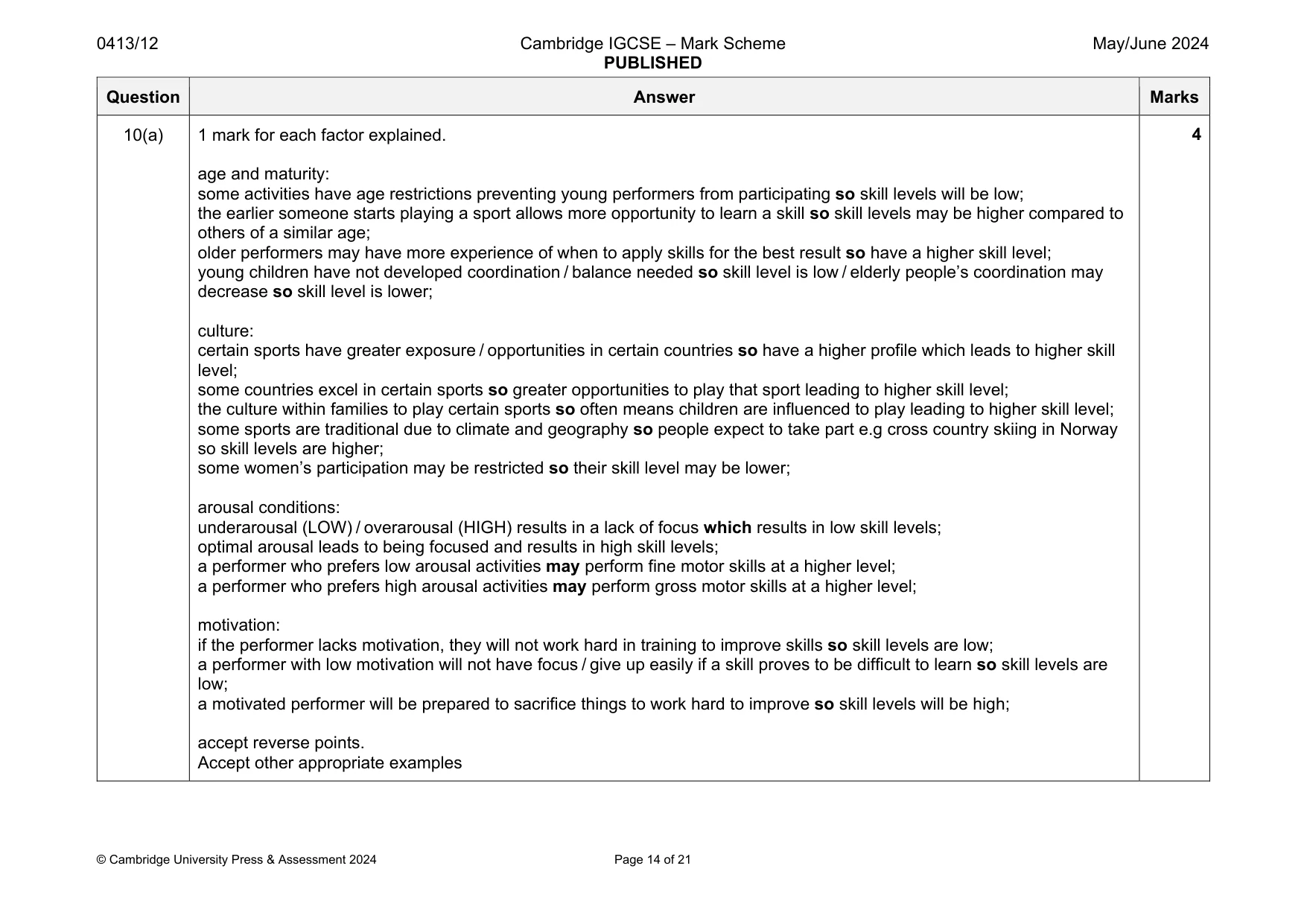
0413/12 Cambridge IGCSE – Mark Scheme PUBLISHED May/June 2024 © Cambridge University Press & Assessment 2024 Page 14 of 21 Question Answer Marks 10(a) 1 mark for each factor explained. age and maturity: some activities have age restrictions preventing young performers from participating so skill levels will be low; the earlier someone starts playing a sport allows more opportunity to learn a skill so skill levels may be higher compared to others of a similar age; older performers may have more experience of when to apply skills for the best result so have a higher skill level; young children have not developed coordination / balance needed so skill level is low / elderly people’s coordination may decrease so skill level is lower; culture: certain sports have greater exposure / opportunities in certain countries so have a higher profile which leads to higher skill level; some countries excel in certain sports so greater opportunities to play that sport leading to higher skill level; the culture within families to play certain sports so often means children are influenced to play leading to higher skill level; some sports are traditional due to climate and geography so people expect to take part e.g cross country skiing in Norway so skill levels are higher; some women’s participation may be restricted so their skill level may be lower; arousal conditions: underarousal (LOW) / overarousal (HIGH) results in a lack of focus which results in low skill levels; optimal arousal leads to being focused and results in high skill levels; a performer who prefers low arousal activities may perform fine motor skills at a higher level; a performer who prefers high arousal activities may perform gross motor skills at a higher level; motivation: if the performer lacks motivation, they will not work hard in training to improve skills so skill levels are low; a performer with low motivation will not have focus / give up easily if a skill proves to be difficult to learn so skill levels are low; a motivated performer will be prepared to sacrifice things to work hard to improve so skill levels will be high; accept reverse points. Accept other appropriate examples 4
Mark scheme, page 15
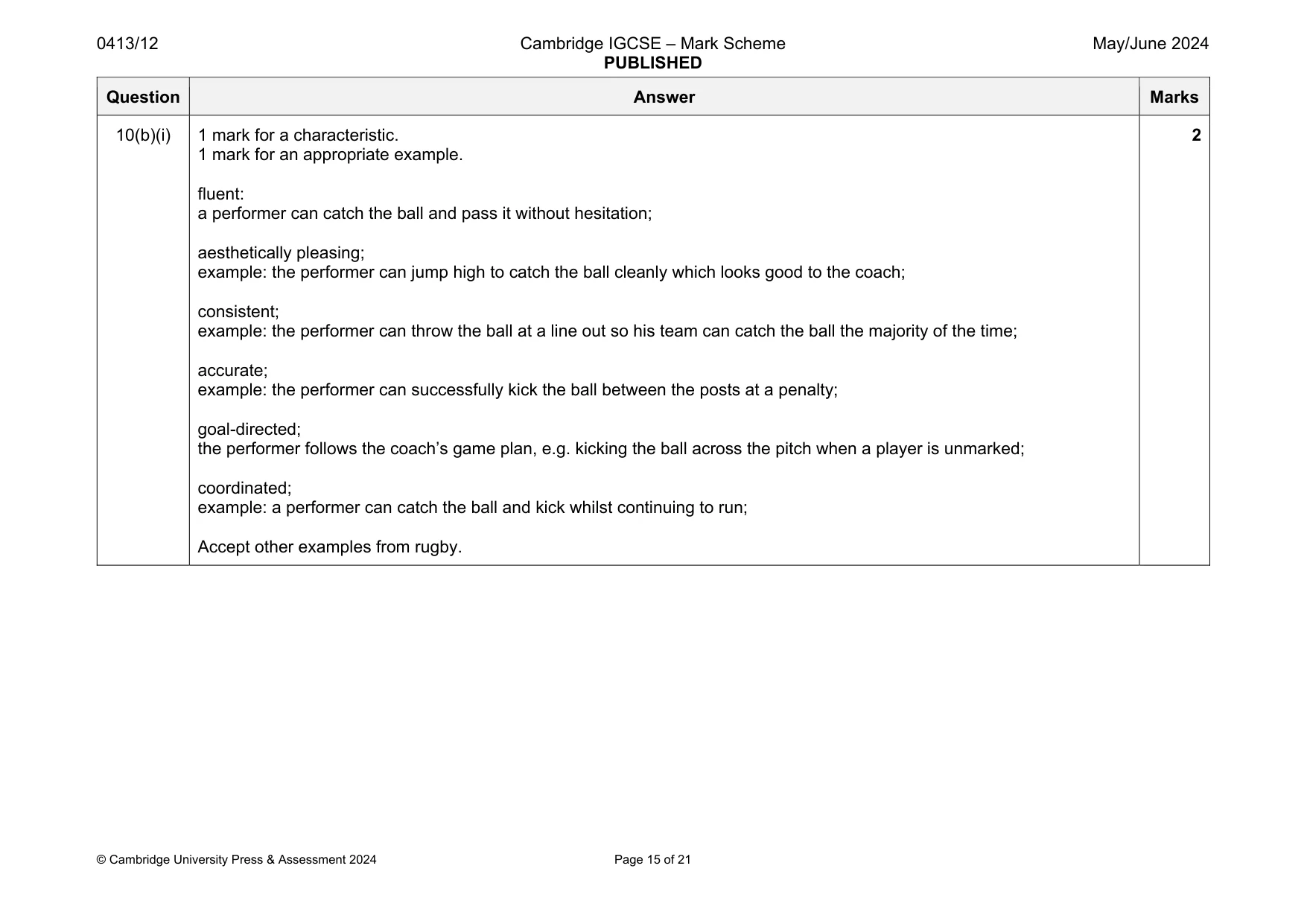
0413/12 Cambridge IGCSE – Mark Scheme PUBLISHED May/June 2024 © Cambridge University Press & Assessment 2024 Page 15 of 21 Question Answer Marks 10(b)(i) 1 mark for a characteristic. 1 mark for an appropriate example. fluent: a performer can catch the ball and pass it without hesitation; aesthetically pleasing; example: the performer can jump high to catch the ball cleanly which looks good to the coach; consistent; example: the performer can throw the ball at a line out so his team can catch the ball the majority of the time; accurate; example: the performer can successfully kick the ball between the posts at a penalty; goal-directed; the performer follows the coach’s game plan, e.g. kicking the ball across the pitch when a player is unmarked; coordinated; example: a performer can catch the ball and kick whilst continuing to run; Accept other examples from rugby. 2
Mark scheme, page 16
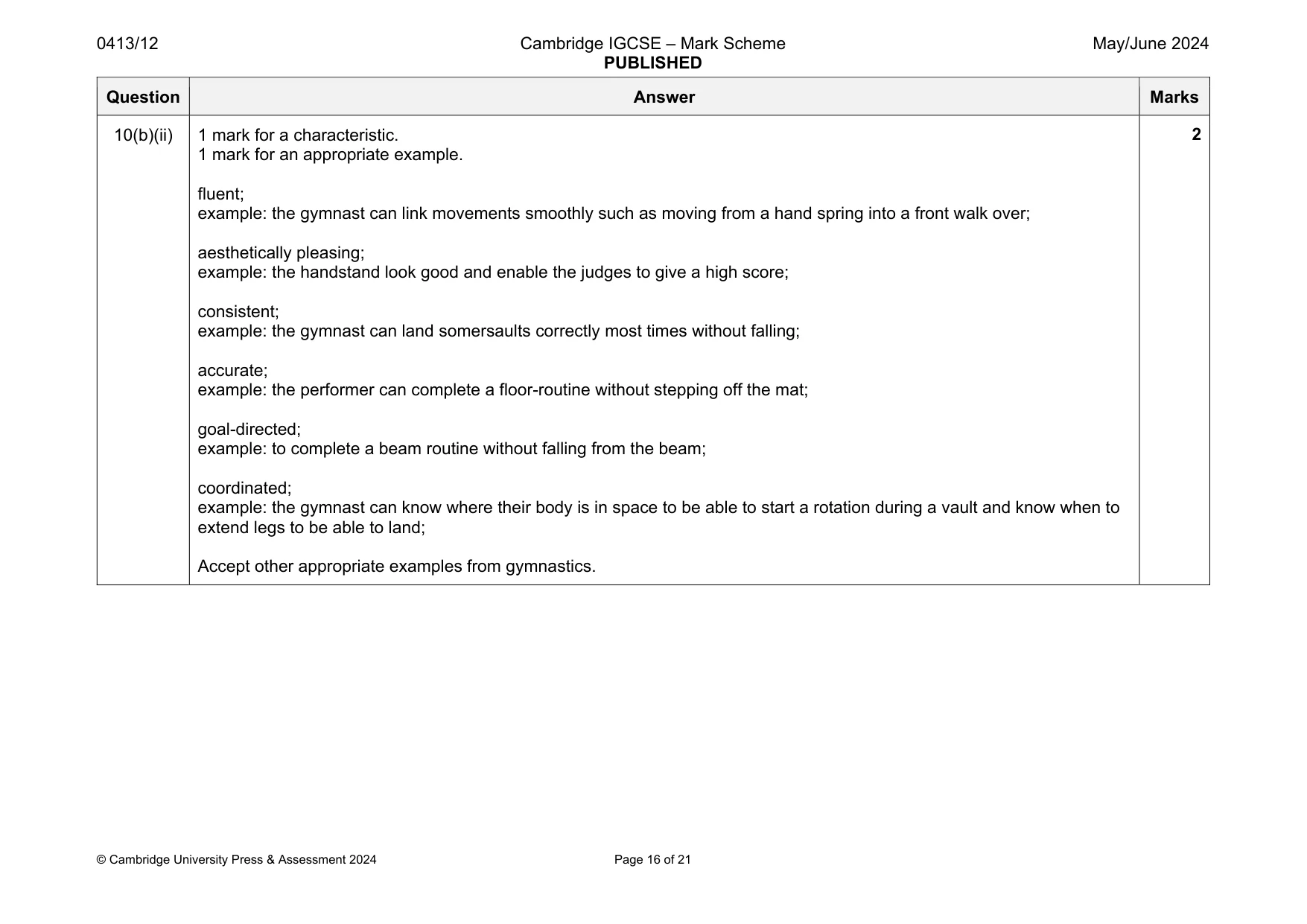
0413/12 Cambridge IGCSE – Mark Scheme PUBLISHED May/June 2024 © Cambridge University Press & Assessment 2024 Page 16 of 21 Question Answer Marks 10(b)(ii) 1 mark for a characteristic. 1 mark for an appropriate example. fluent; example: the gymnast can link movements smoothly such as moving from a hand spring into a front walk over; aesthetically pleasing; example: the handstand look good and enable the judges to give a high score; consistent; example: the gymnast can land somersaults correctly most times without falling; accurate; example: the performer can complete a floor-routine without stepping off the mat; goal-directed; example: to complete a beam routine without falling from the beam; coordinated; example: the gymnast can know where their body is in space to be able to start a rotation during a vault and know when to extend legs to be able to land; Accept other appropriate examples from gymnastics. 2
Mark scheme, page 17
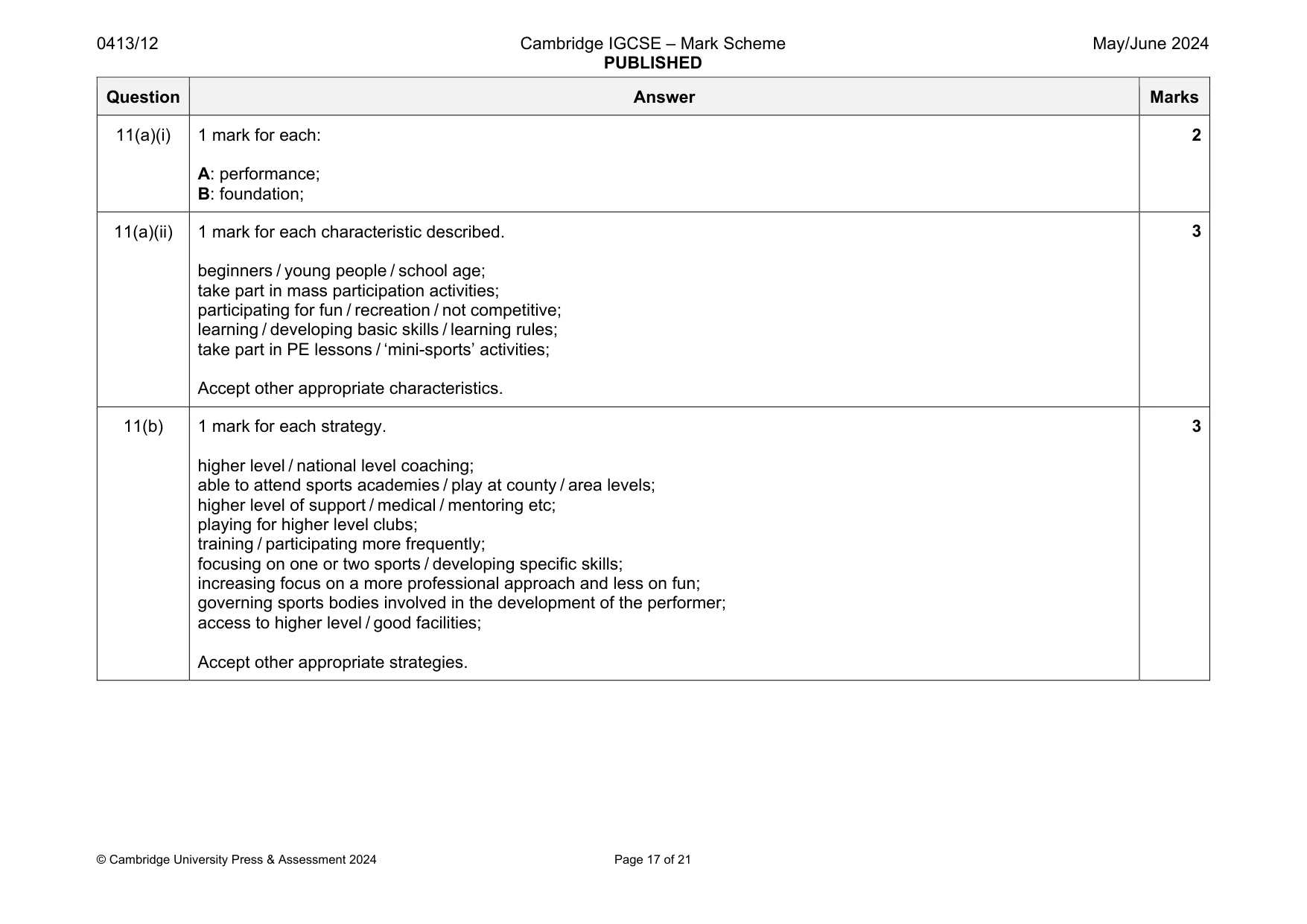
0413/12 Cambridge IGCSE – Mark Scheme PUBLISHED May/June 2024 © Cambridge University Press & Assessment 2024 Page 17 of 21 Question Answer Marks 11(a)(i) 1 mark for each: A: performance; B: foundation; 2 11(a)(ii) 1 mark for each characteristic described. beginners / young people / school age; take part in mass participation activities; participating for fun / recreation / not competitive; learning / developing basic skills / learning rules; take part in PE lessons / ‘mini-sports’ activities; Accept other appropriate characteristics. 3 11(b) 1 mark for each strategy. higher level / national level coaching; able to attend sports academies / play at county / area levels; higher level of support / medical / mentoring etc; playing for higher level clubs; training / participating more frequently; focusing on one or two sports / developing specific skills; increasing focus on a more professional approach and less on fun; governing sports bodies involved in the development of the performer; access to higher level / good facilities; Accept other appropriate strategies. 3
Mark scheme, page 18
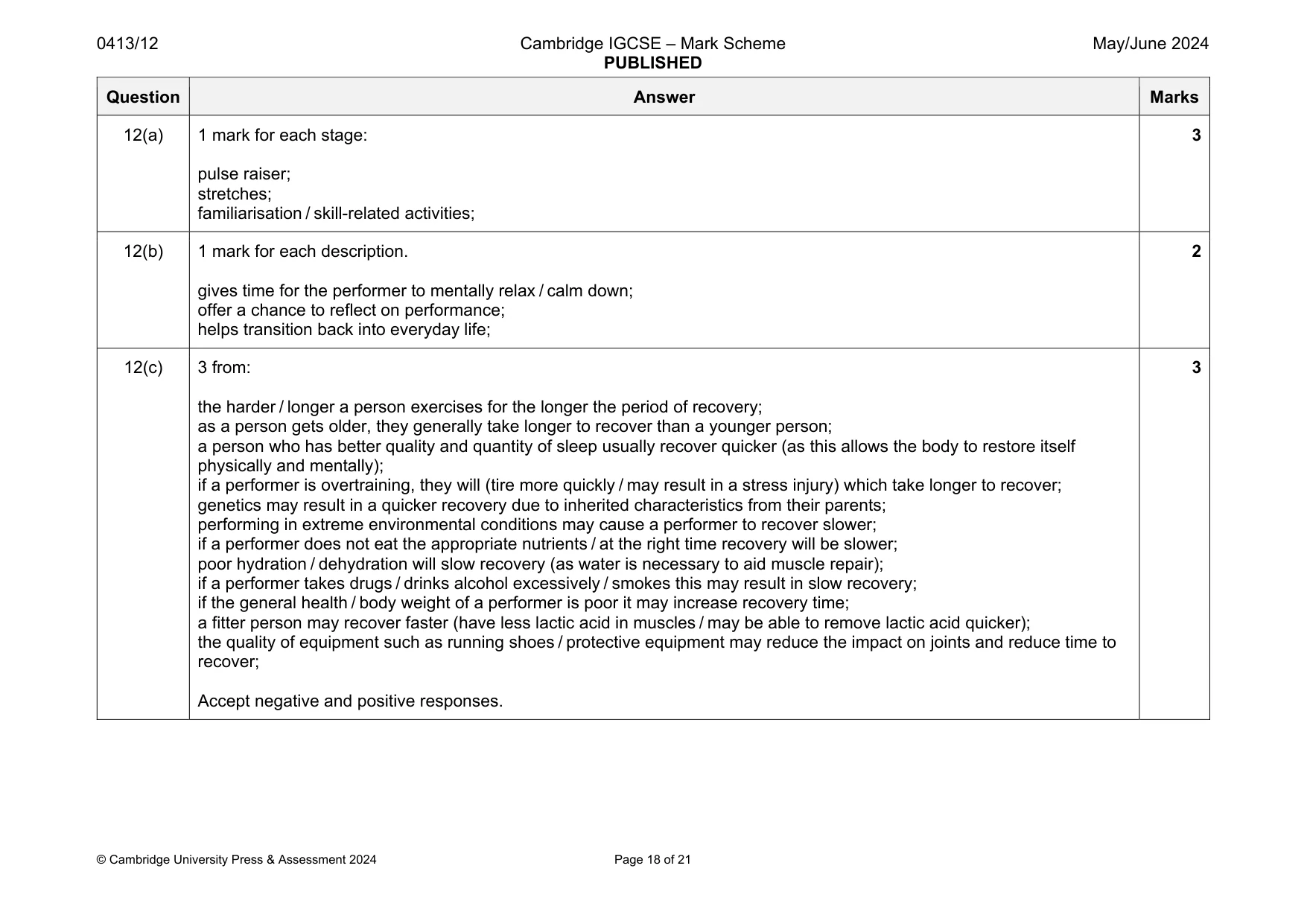
0413/12 Cambridge IGCSE – Mark Scheme PUBLISHED May/June 2024 © Cambridge University Press & Assessment 2024 Page 18 of 21 Question Answer Marks 12(a) 1 mark for each stage: pulse raiser; stretches; familiarisation / skill-related activities; 3 12(b) 1 mark for each description. gives time for the performer to mentally relax / calm down; offer a chance to reflect on performance; helps transition back into everyday life; 2 12(c) 3 from: the harder / longer a person exercises for the longer the period of recovery; as a person gets older, they generally take longer to recover than a younger person; a person who has better quality and quantity of sleep usually recover quicker (as this allows the body to restore itself physically and mentally); if a performer is overtraining, they will (tire more quickly / may result in a stress injury) which take longer to recover; genetics may result in a quicker recovery due to inherited characteristics from their parents; performing in extreme environmental conditions may cause a performer to recover slower; if a performer does not eat the appropriate nutrients / at the right time recovery will be slower; poor hydration / dehydration will slow recovery (as water is necessary to aid muscle repair); if a performer takes drugs / drinks alcohol excessively / smokes this may result in slow recovery; if the general health / body weight of a performer is poor it may increase recovery time; a fitter person may recover faster (have less lactic acid in muscles / may be able to remove lactic acid quicker); the quality of equipment such as running shoes / protective equipment may reduce the impact on joints and reduce time to recover; Accept negative and positive responses. 3
Mark scheme, page 19
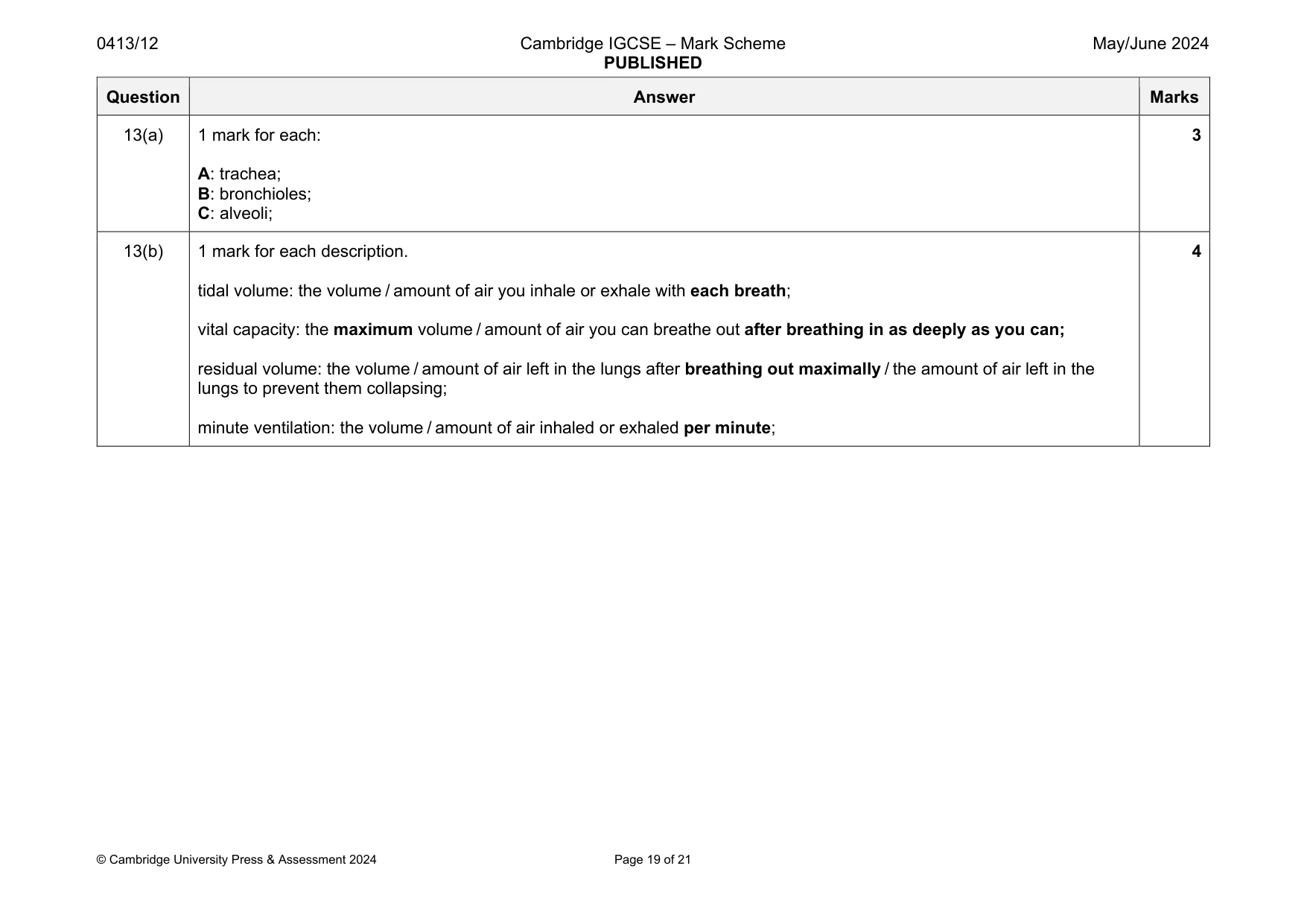
0413/12 Cambridge IGCSE – Mark Scheme PUBLISHED May/June 2024 © Cambridge University Press & Assessment 2024 Page 19 of 21 Question Answer Marks 13(a) 1 mark for each: A: trachea; B: bronchioles; C: alveoli; 3 13(b) 1 mark for each description. tidal volume: the volume / amount of air you inhale or exhale with each breath; vital capacity: the maximum volume / amount of air you can breathe out after breathing in as deeply as you can; residual volume: the volume / amount of air left in the lungs after breathing out maximally / the amount of air left in the lungs to prevent them collapsing; minute ventilation: the volume / amount of air inhaled or exhaled per minute; 4
Mark scheme, page 20
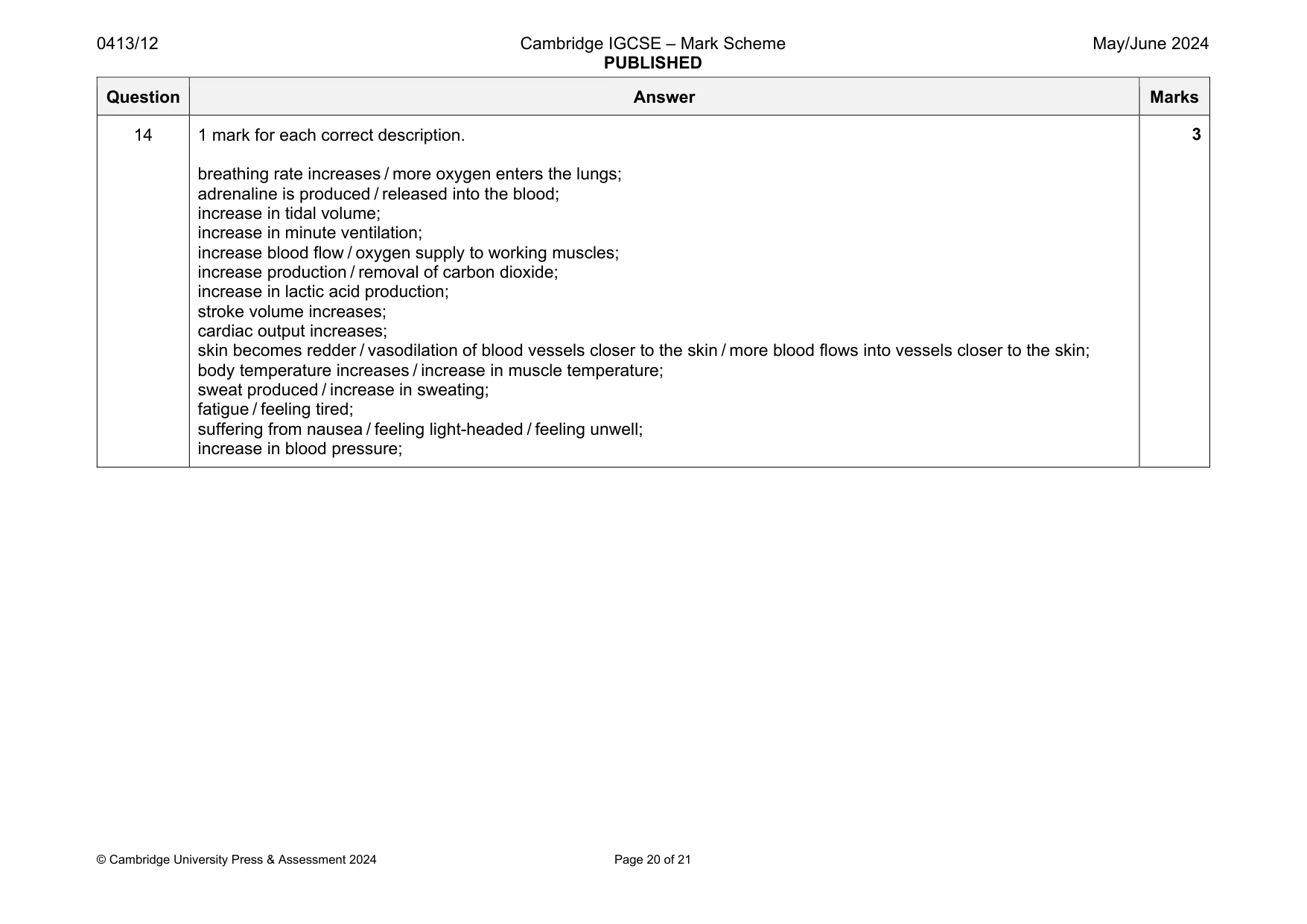
0413/12 Cambridge IGCSE – Mark Scheme PUBLISHED May/June 2024 © Cambridge University Press & Assessment 2024 Page 20 of 21 Question Answer Marks 14 1 mark for each correct description. breathing rate increases / more oxygen enters the lungs; adrenaline is produced / released into the blood; increase in tidal volume; increase in minute ventilation; increase blood flow / oxygen supply to working muscles; increase production / removal of carbon dioxide; increase in lactic acid production; stroke volume increases; cardiac output increases; skin becomes redder / vasodilation of blood vessels closer to the skin / more blood flows into vessels closer to the skin; body temperature increases / increase in muscle temperature; sweat produced / increase in sweating; fatigue / feeling tired; suffering from nausea / feeling light-headed / feeling unwell; increase in blood pressure; 3
Mark scheme, page 21
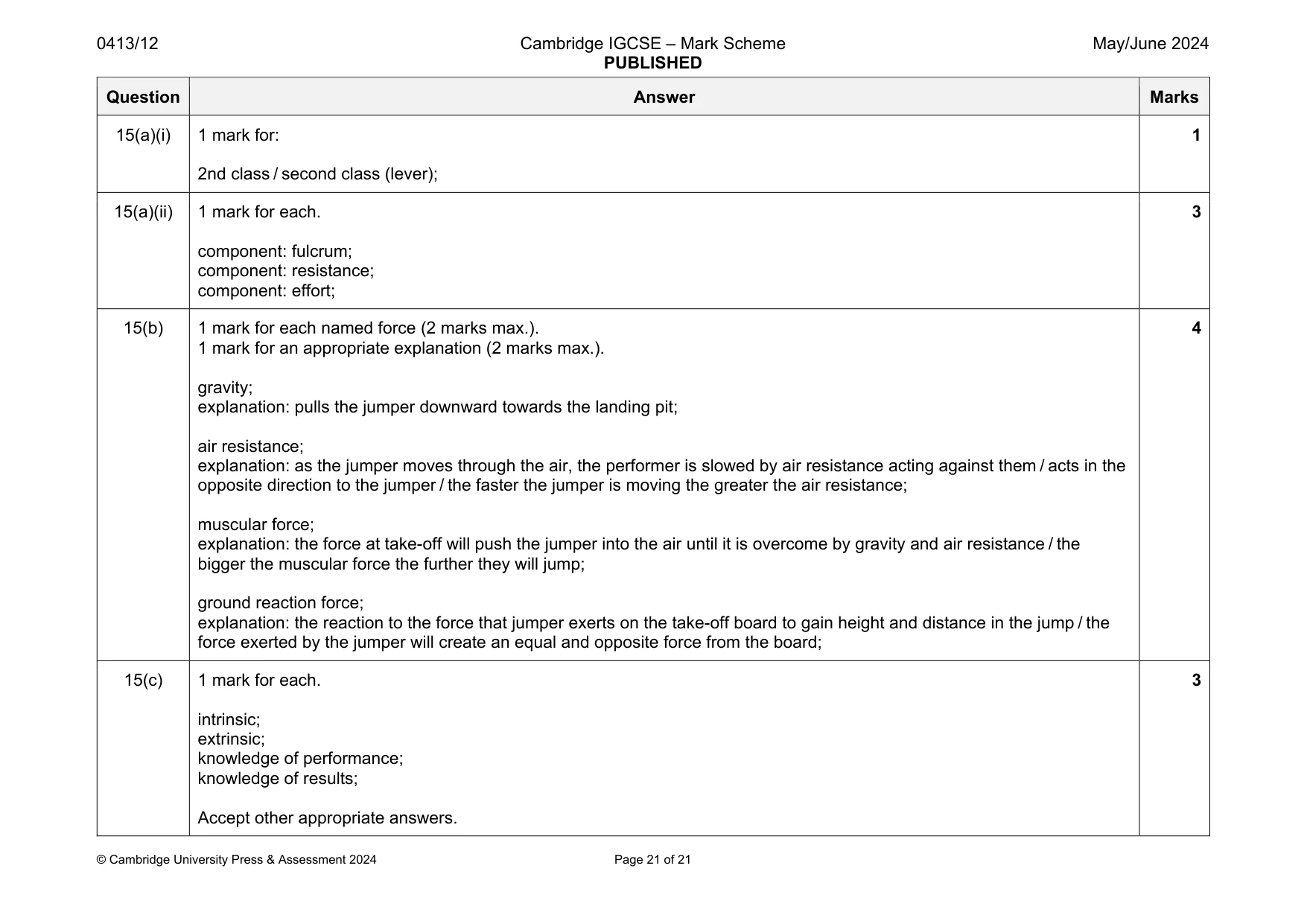
0413/12 Cambridge IGCSE – Mark Scheme PUBLISHED May/June 2024 © Cambridge University Press & Assessment 2024 Page 21 of 21 Question Answer Marks 15(a)(i) 1 mark for: 2nd class / second class (lever); 1 15(a)(ii) 1 mark for each. component: fulcrum; component: resistance; component: effort; 3 15(b) 1 mark for each named force (2 marks max.). 1 mark for an appropriate explanation (2 marks max.). gravity; explanation: pulls the jumper downward towards the landing pit; air resistance; explanation: as the jumper moves through the air, the performer is slowed by air resistance acting against them / acts in the opposite direction to the jumper / the faster the jumper is moving the greater the air resistance; muscular force; explanation: the force at take-off will push the jumper into the air until it is overcome by gravity and air resistance / the bigger the muscular force the further they will jump; ground reaction force; explanation: the reaction to the force that jumper exerts on the take-off board to gain height and distance in the jump / the force exerted by the jumper will create an equal and opposite force from the board; 4 15(c) 1 mark for each. intrinsic; extrinsic; knowledge of performance; knowledge of results; Accept other appropriate answers. 3
What you needed in this session
Cambridge’s own grade thresholds for 2024 May/June, Paper 1 · Variant 2. A higher threshold means an easier paper — the bar moves with how the cohort did.