Cambridge IGCSE Physical Education 0413 — 2022 May/June Paper 1 · Variant 1
0413/11/M/J/22 · 100 marks · ≈113 min
The question paper and its mark scheme, free to read here and free to download. This is Cambridge’s own paper, exactly as it was sat.
Question paper16 pages
Mark scheme21 pages
Answers below. Sit the paper first if you are practising.
Paper as text
Question paper, page 1
This document has 16 pages. [Turn over Cambridge IGCSE™ DC (PQ/JG) 303519/3 © UCLES 2022 * 7 8 6 8 6 6 8 4 1 4 * PHYSICAL EDUCATION 0413/11 Paper 1 Theory May/June 2022 1 hour 45 minutes You must answer on the question paper. No additional materials are needed. INSTRUCTIONS ● Answer all questions. ● Use a black or dark blue pen. You may use an HB pencil for any diagrams or graphs. ● Write your name, centre number and candidate number in the boxes at the top of the page. ● Write your answer to each question in the space provided. ● Do not use an erasable pen or correction fluid. ● Do not write on any bar codes. ● You may use a calculator. ● You should show all your working and use appropriate units. INFORMATION ● The total mark for this paper is 100. ● The number of marks for each question or part question is shown in brackets [ ].
Question paper, page 2
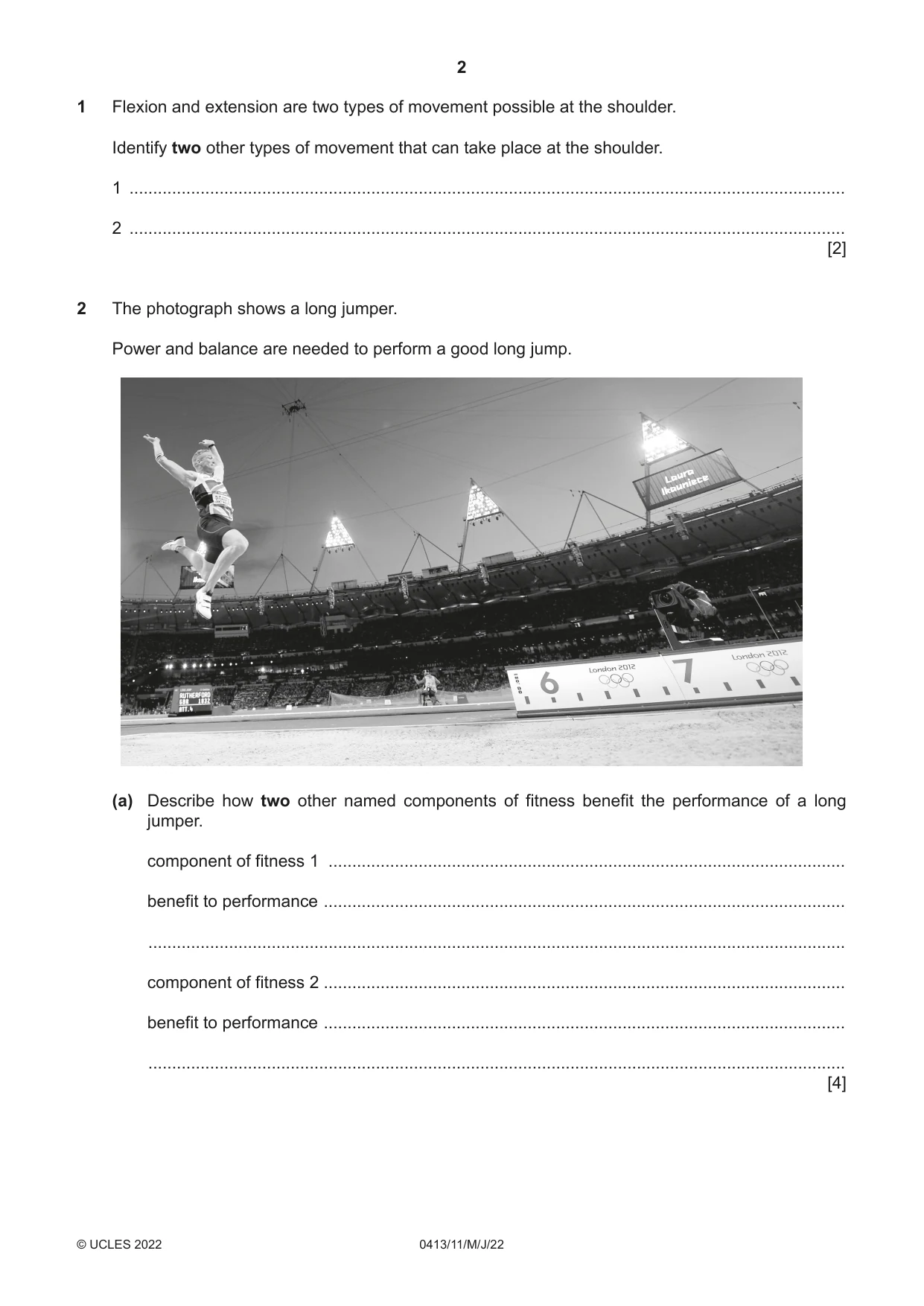
2 0413/11/M/J/22 © UCLES 2022 1 Flexion and extension are two types of movement possible at the shoulder. Identify two other types of movement that can take place at the shoulder. 1 … 2 … [2] 2 The photograph shows a long jumper. Power and balance are needed to perform a good long jump. (a) Describe how two other named components of fitness benefit the performance of a long jumper. component of fitness 1 … benefit to performance … … component of fitness 2 … benefit to performance … … [4]
Question paper, page 3
3 0413/11/M/J/22 © UCLES 2022 [Turn over (b) Describe how to carry out a named fitness test to measure power. name of fitness test … description … … … … … … [4] (c) A coach may carry out a range of fitness tests to assess the strengths and weaknesses of a performer. Describe two other reasons why a coach may carry out a range of fitness tests with a performer. 1 … … 2 … … [2] [Total: 10]
Question paper, page 4
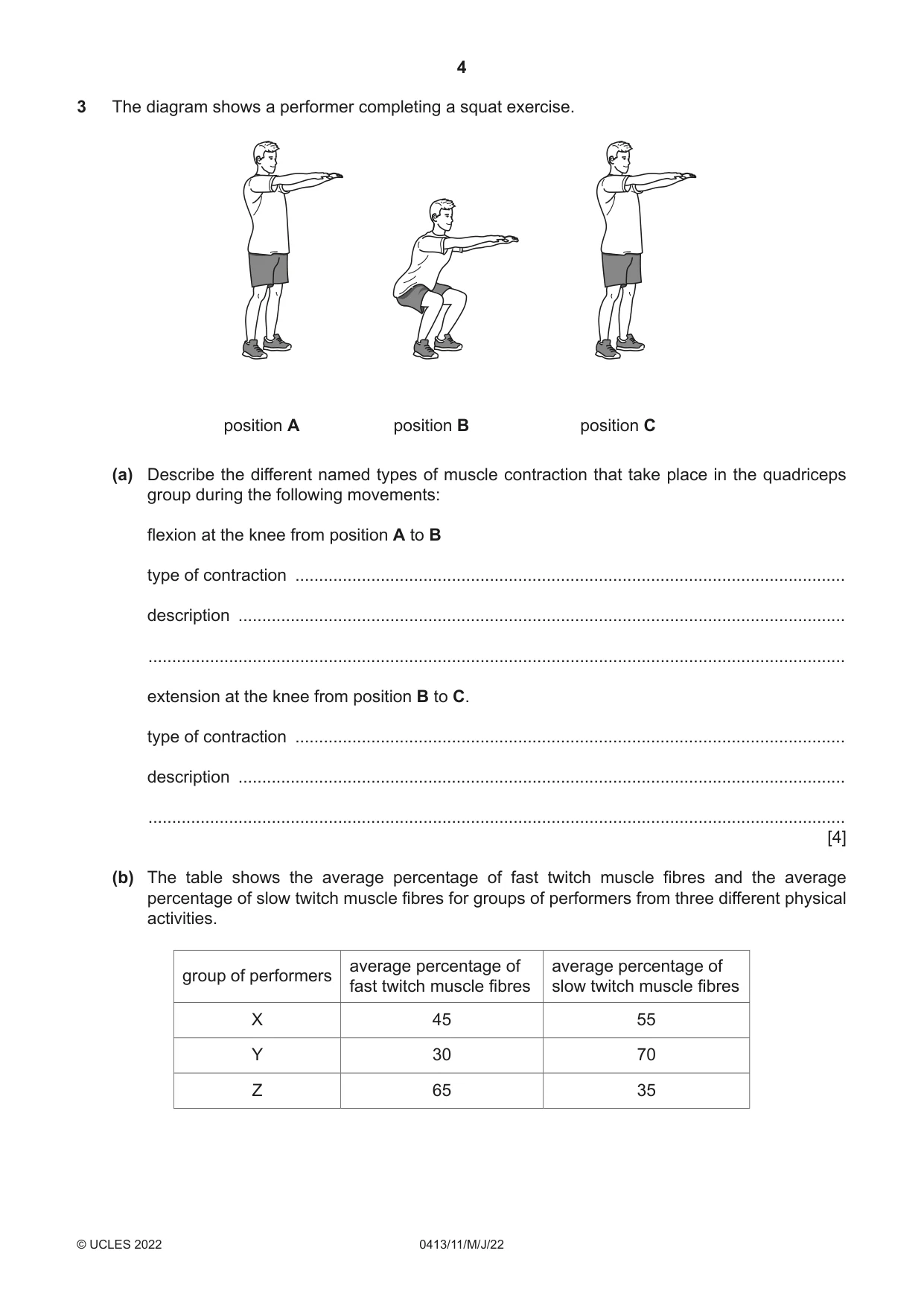
4 0413/11/M/J/22 © UCLES 2022 3 The diagram shows a performer completing a squat exercise. position A position B position C (a) Describe the different named types of muscle contraction that take place in the quadriceps group during the following movements: flexion at the knee from position A to B type of contraction … description … … extension at the knee from position B to C. type of contraction … description … … [4] (b) The table shows the average percentage of fast twitch muscle fibres and the average percentage of slow twitch muscle fibres for groups of performers from three different physical activities. group of performers average percentage of fast twitch muscle fibres average percentage of slow twitch muscle fibres X 45 55 Y 30 70 Z 65 35
Question paper, page 5
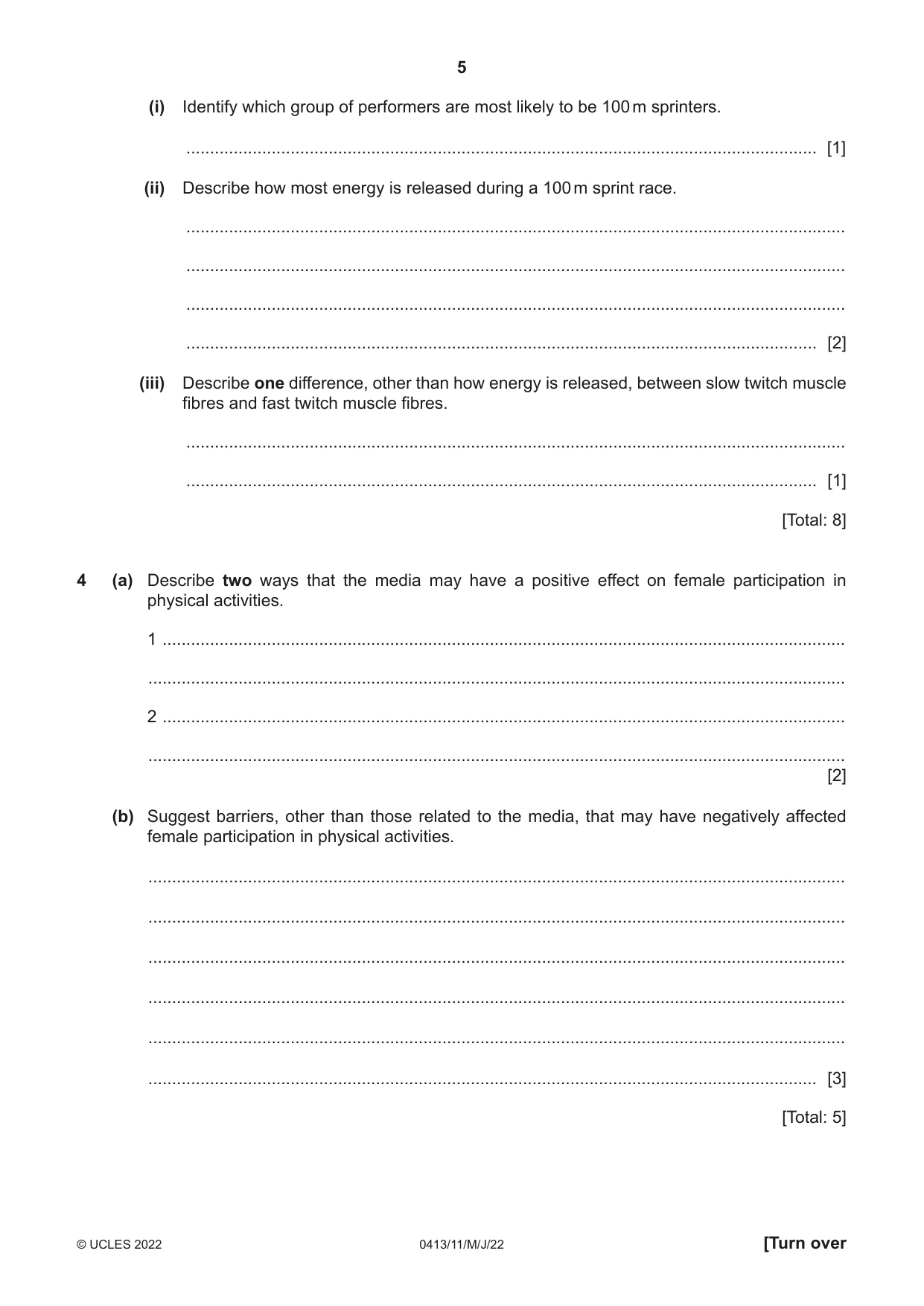
5 0413/11/M/J/22 © UCLES 2022 [Turn over (i) Identify which group of performers are most likely to be 100 m sprinters. … [1] (ii) Describe how most energy is released during a 100 m sprint race. … … … … [2] (iii) Describe one difference, other than how energy is released, between slow twitch muscle fibres and fast twitch muscle fibres. … … [1] [Total: 8] 4 (a) Describe two ways that the media may have a positive effect on female participation in physical activities. 1 … … 2 … … [2] (b) Suggest barriers, other than those related to the media, that may have negatively affected female participation in physical activities. … … … … … … [3] [Total: 5]
Question paper, page 6
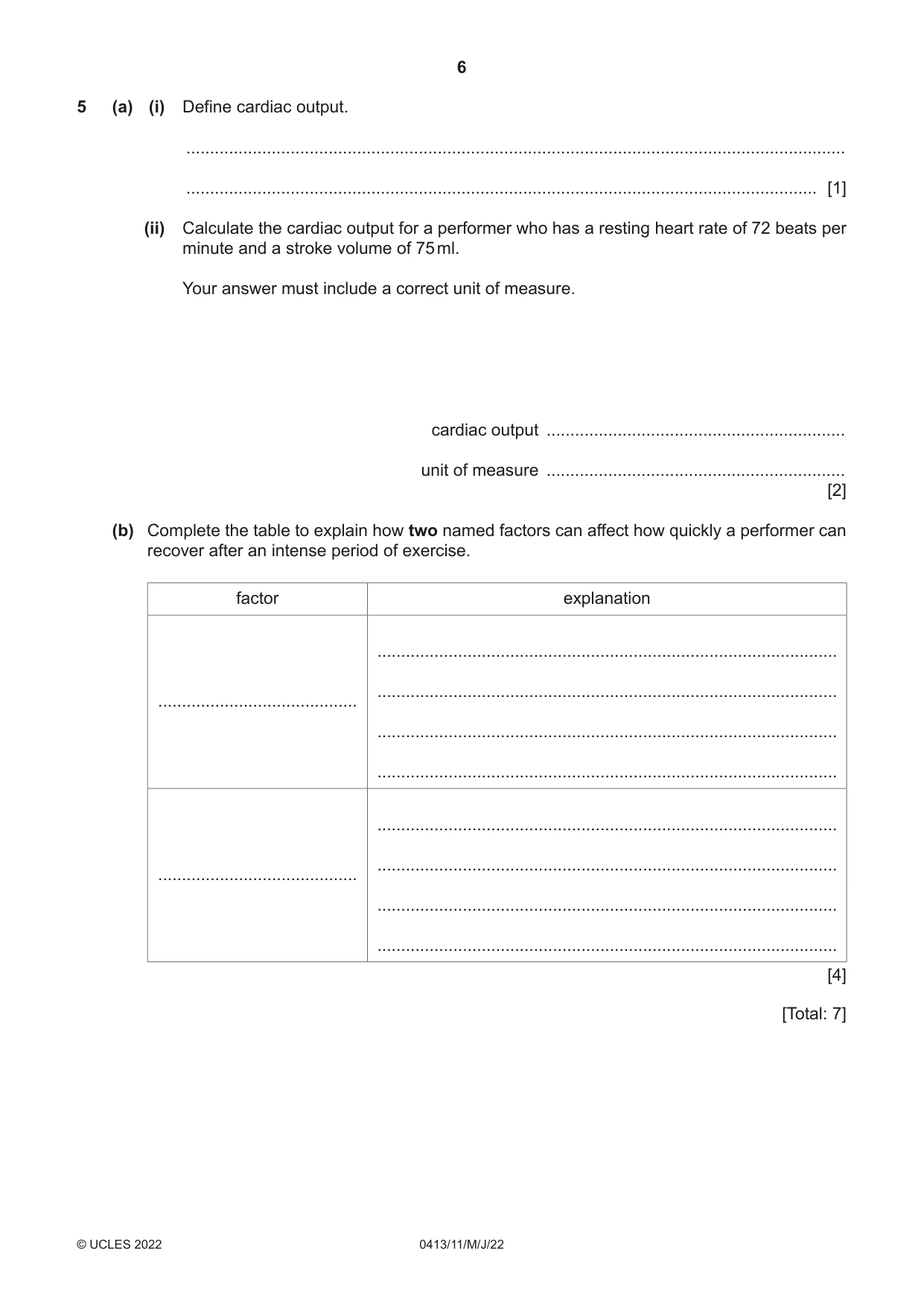
6 0413/11/M/J/22 © UCLES 2022 5 (a) (i) Define cardiac output. … … [1] (ii) Calculate the cardiac output for a performer who has a resting heart rate of 72 beats per minute and a stroke volume of 75 ml. Your answer must include a correct unit of measure. cardiac output … unit of measure … [2] (b) Complete the table to explain how two named factors can affect how quickly a performer can recover after an intense period of exercise. factor explanation … … … … … … … … … … [4] [Total: 7]
Question paper, page 7
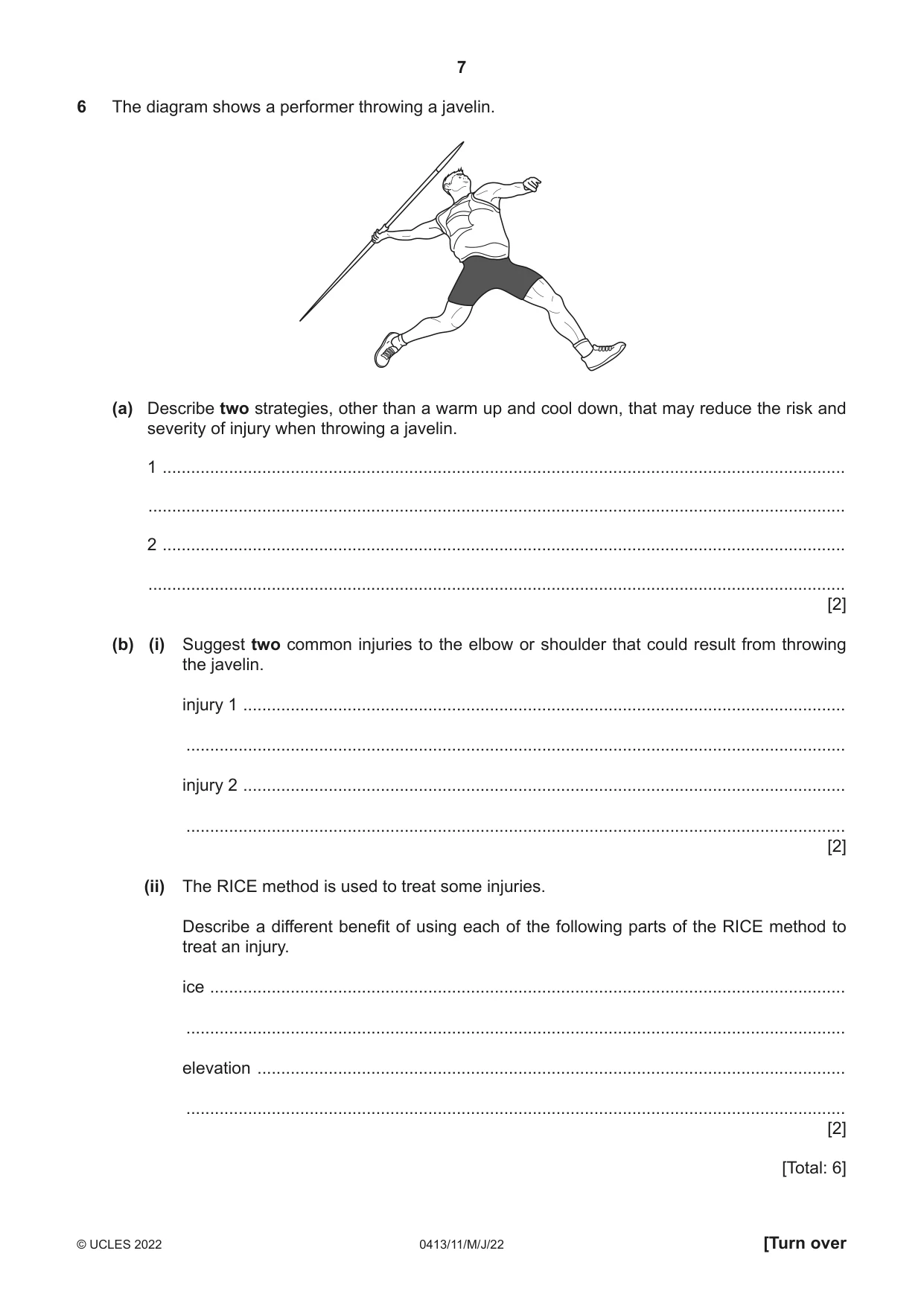
7 0413/11/M/J/22 © UCLES 2022 [Turn over 6 The diagram shows a performer throwing a javelin. (a) Describe two strategies, other than a warm up and cool down, that may reduce the risk and severity of injury when throwing a javelin. 1 … … 2 … … [2] (b) (i) Suggest two common injuries to the elbow or shoulder that could result from throwing the javelin. injury 1 … … injury 2 … … [2] (ii) The RICE method is used to treat some injuries. Describe a different benefit of using each of the following parts of the RICE method to treat an injury. ice … … elevation … … [2] [Total: 6]
Question paper, page 8
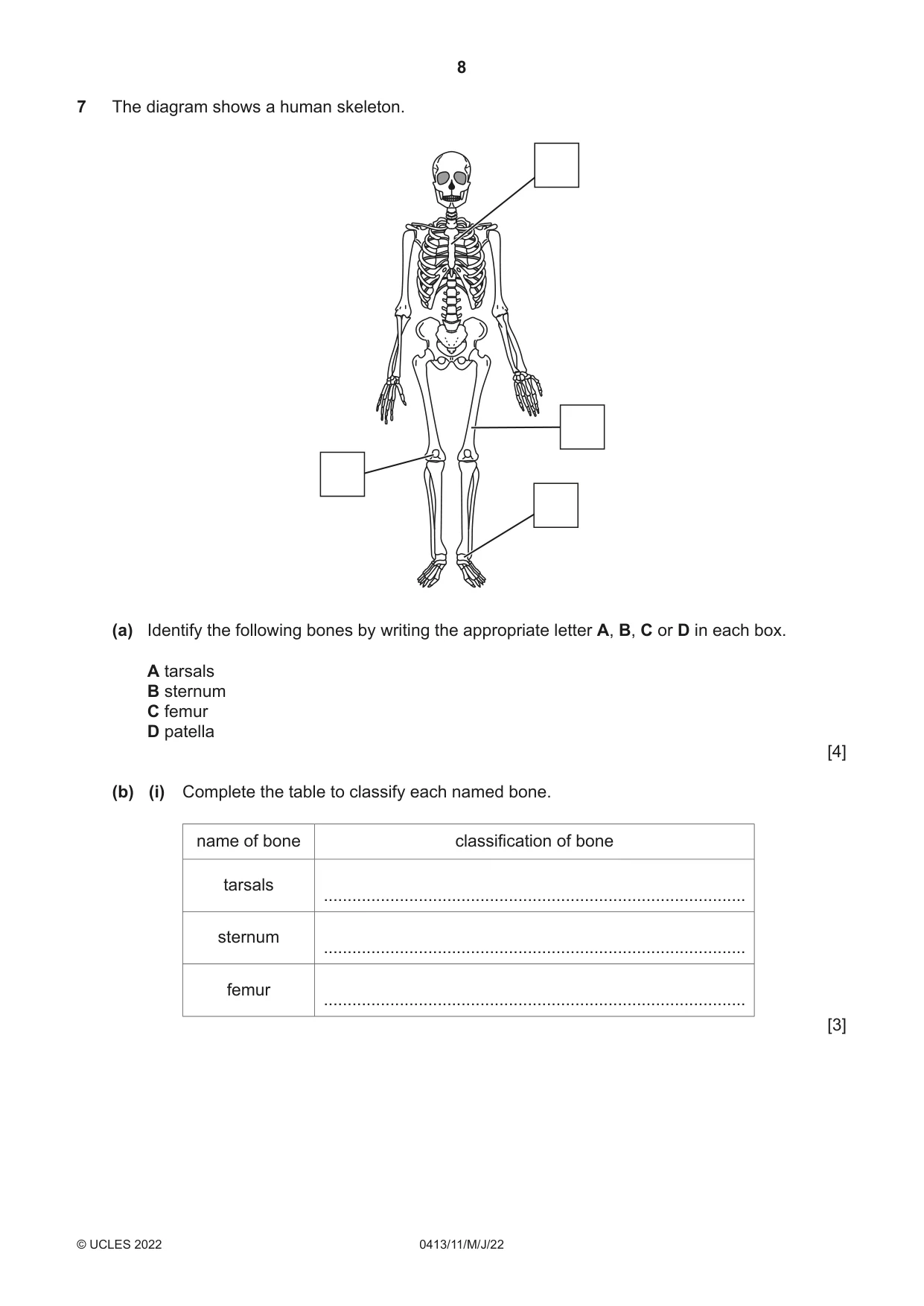
8 0413/11/M/J/22 © UCLES 2022 7 The diagram shows a human skeleton. (a) Identify the following bones by writing the appropriate letter A, B, C or D in each box. A tarsals B sternum C femur D patella [4] (b) (i) Complete the table to classify each named bone. name of bone classification of bone tarsals … sternum … femur … [3]
Question paper, page 9
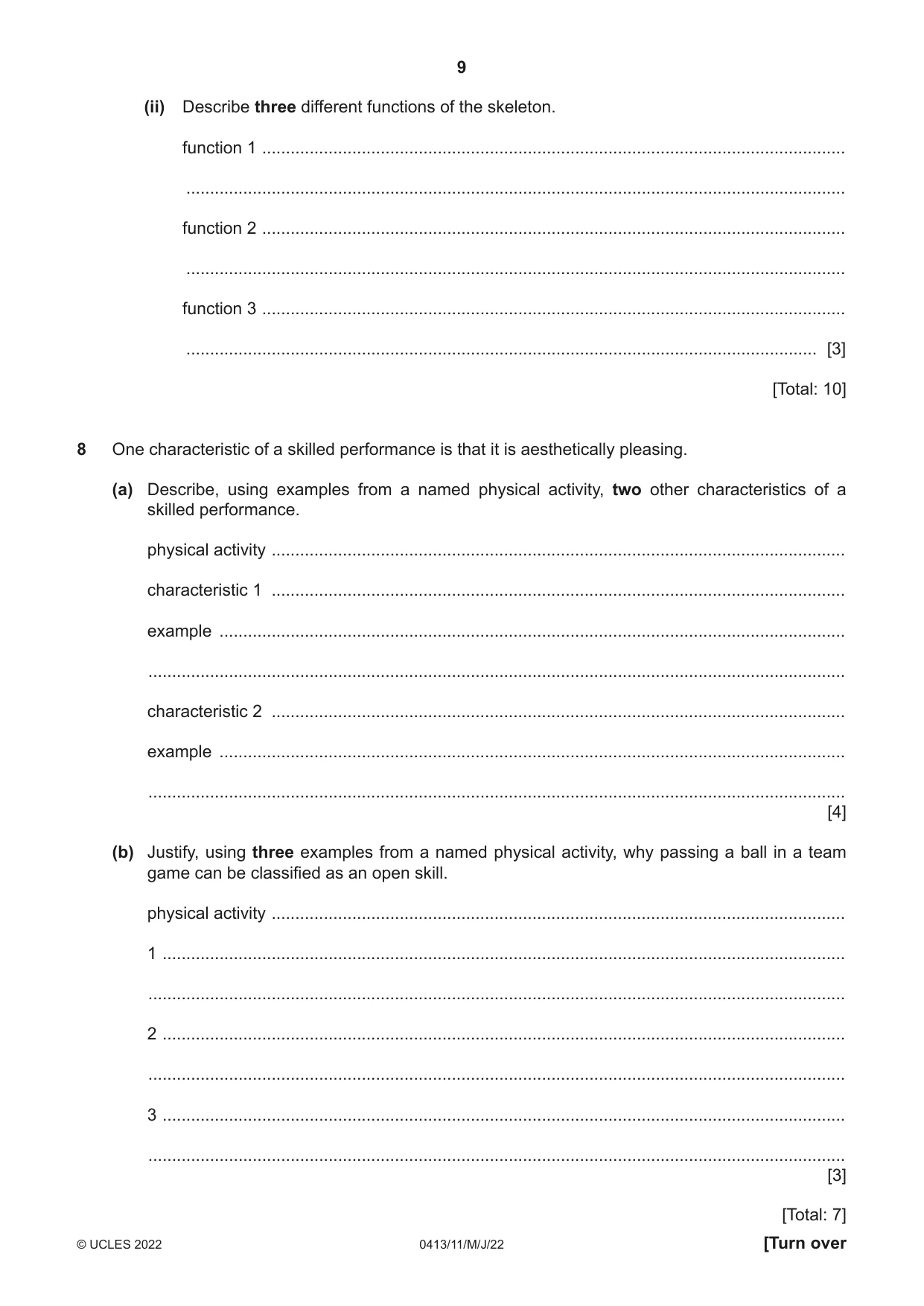
9 0413/11/M/J/22 © UCLES 2022 [Turn over (ii) Describe three different functions of the skeleton. function 1 … … function 2 … … function 3 … … [3] [Total: 10] 8 One characteristic of a skilled performance is that it is aesthetically pleasing. (a) Describe, using examples from a named physical activity, two other characteristics of a skilled performance. physical activity … characteristic 1 … example … … characteristic 2 … example … … [4] (b) Justify, using three examples from a named physical activity, why passing a ball in a team game can be classified as an open skill. physical activity … 1 … … 2 … … 3 … … [3] [Total: 7]
Question paper, page 10
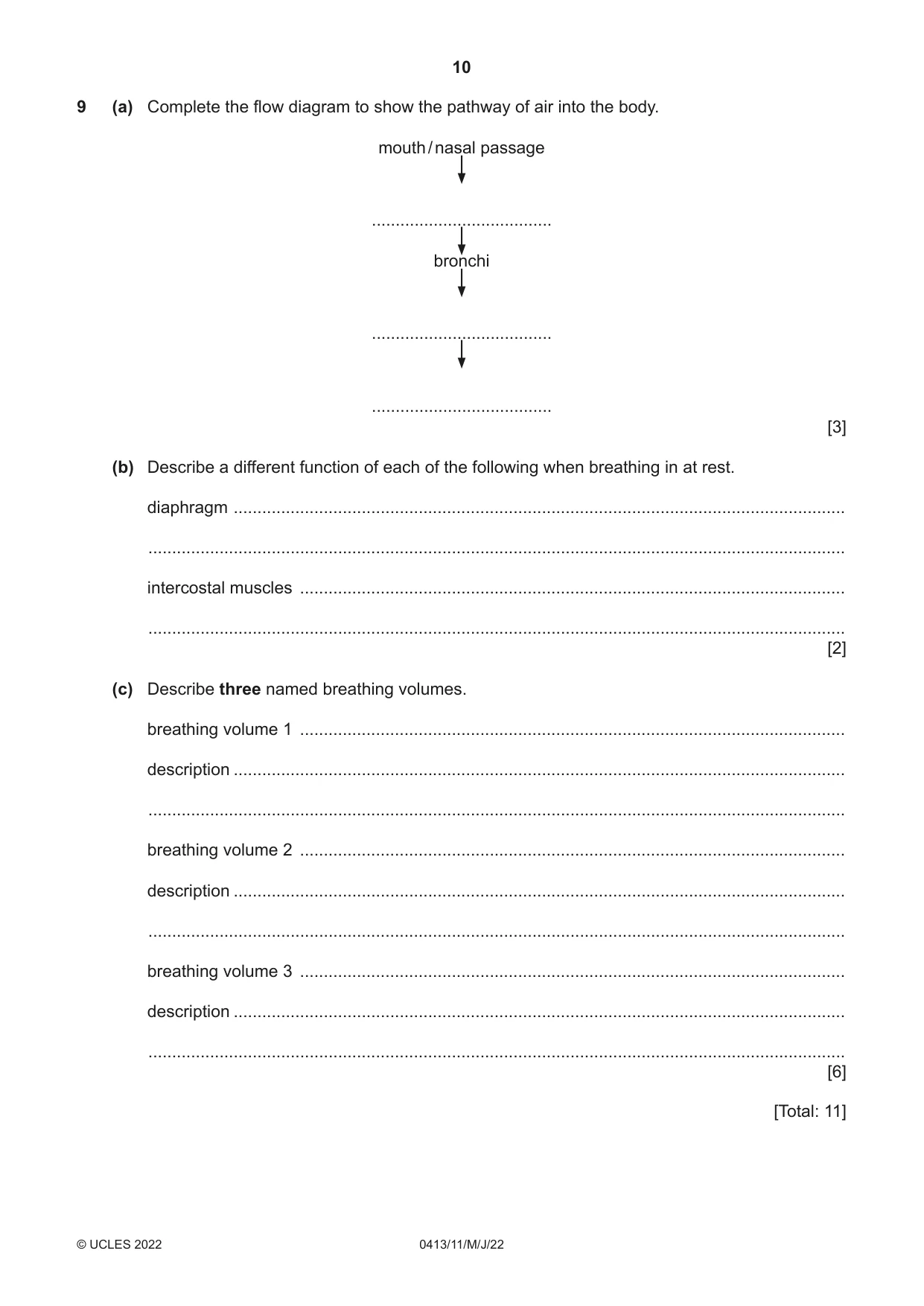
10 0413/11/M/J/22 © UCLES 2022 9 (a) Complete the flow diagram to show the pathway of air into the body. mouth / nasal passage … bronchi … … [3] (b) Describe a different function of each of the following when breathing in at rest. diaphragm … … intercostal muscles … … [2] (c) Describe three named breathing volumes. breathing volume 1 … description … … breathing volume 2 … description … … breathing volume 3 … description … … [6] [Total: 11]
Question paper, page 11
11 0413/11/M/J/22 © UCLES 2022 [Turn over 10 (a) Identify a different type of guidance that would be most appropriate for a performer at the following stages of learning. Justify each choice. cognitive stage of learning type of guidance … justification … … autonomous stage of learning type of guidance … justification … … [4] (b) Explain three reasons why feedback is important for a performer. 1 … … 2 … … 3 … … [3] [Total: 7]
Question paper, page 12
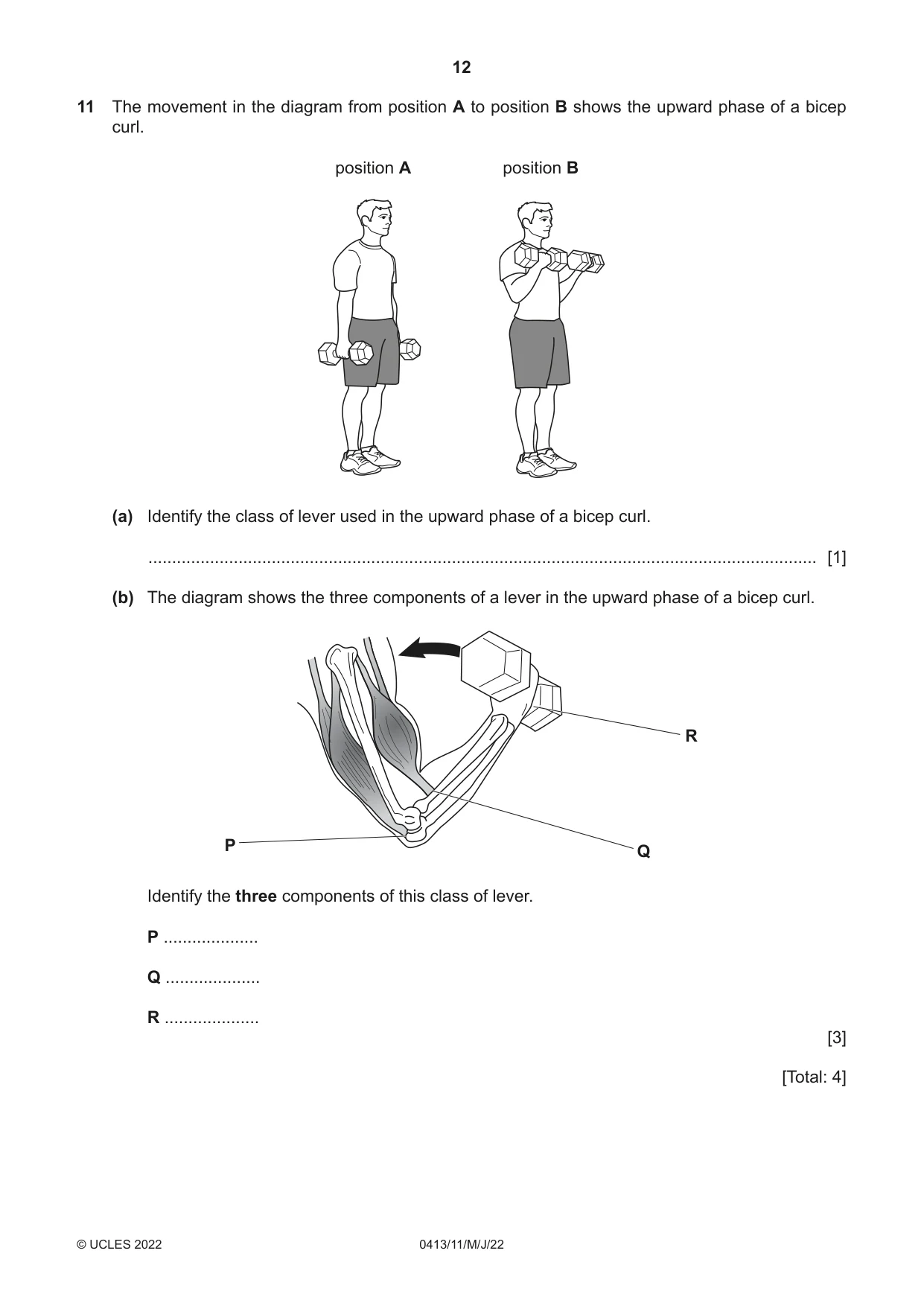
12 0413/11/M/J/22 © UCLES 2022 11 The movement in the diagram from position A to position B shows the upward phase of a bicep curl. position A position B (a) Identify the class of lever used in the upward phase of a bicep curl. … [1] (b) The diagram shows the three components of a lever in the upward phase of a bicep curl. R P Q Identify the three components of this class of lever. P … Q … R … [3] [Total: 4]
Question paper, page 13
13 0413/11/M/J/22 © UCLES 2022 [Turn over 12 (a) Describe the function of the following nutrients. fat … … protein … … water … … [3] (b) Explain why energy balance must be suitable for a performer. … … … … [2] [Total: 5] 13 Suggest a physical activity usually associated with a performer with an introvert personality type. Justify your choice. physical activity … justification … … [2]
Question paper, page 14
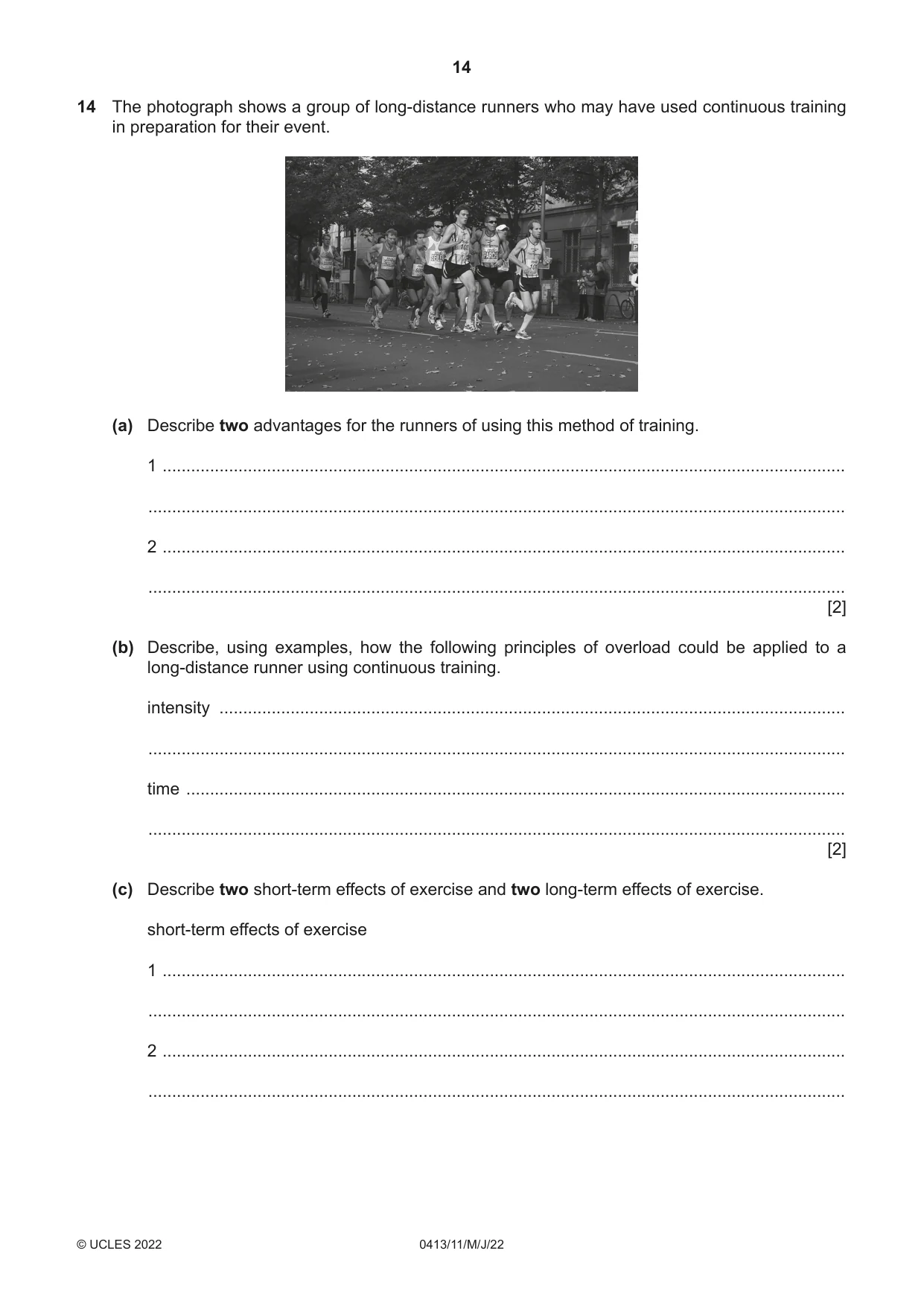
14 0413/11/M/J/22 © UCLES 2022 14 The photograph shows a group of long-distance runners who may have used continuous training in preparation for their event. (a) Describe two advantages for the runners of using this method of training. 1 … … 2 … … [2] (b) Describe, using examples, how the following principles of overload could be applied to a long-distance runner using continuous training. intensity … … time … … [2] (c) Describe two short-term effects of exercise and two long-term effects of exercise. short-term effects of exercise 1 … … 2 … …
Question paper, page 15
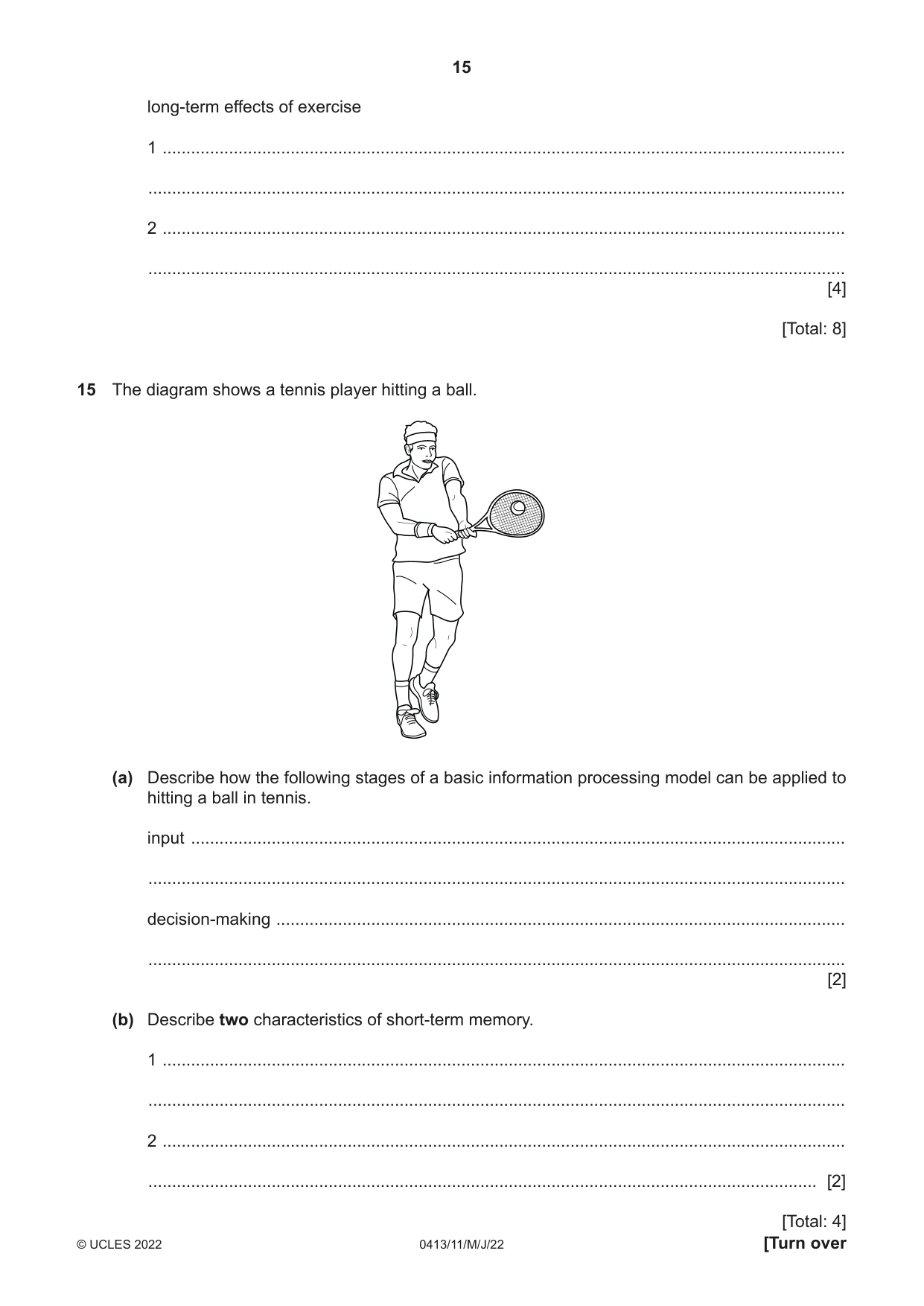
15 0413/11/M/J/22 © UCLES 2022 [Turn over long-term effects of exercise 1 … … 2 … … [4] [Total: 8] 15 The diagram shows a tennis player hitting a ball. (a) Describe how the following stages of a basic information processing model can be applied to hitting a ball in tennis. input … … decision-making … … [2] (b) Describe two characteristics of short-term memory. 1 … … 2 … … [2] [Total: 4]
Question paper, page 16
16 0413/11/M/J/22 © UCLES 2022 Permission to reproduce items where third-party owned material protected by copyright is included has been sought and cleared where possible. Every reasonable effort has been made by the publisher (UCLES) to trace copyright holders, but if any items requiring clearance have unwittingly been included, the publisher will be pleased to make amends at the earliest possible opportunity. To avoid the issue of disclosure of answer-related information to candidates, all copyright acknowledgements are reproduced online in the Cambridge Assessment International Education Copyright Acknowledgements Booklet. This is produced for each series of examinations and is freely available to download at www.cambridgeinternational.org after the live examination series. Cambridge Assessment International Education is part of Cambridge Assessment. Cambridge Assessment is the brand name of the University of Cambridge Local Examinations Syndicate (UCLES), which is a department of the University of Cambridge. 16 Red blood cells are a component of blood. Identify two other components of blood and describe the function of each component. component 1 … function … … component 2 … function … … [4]
Mark scheme, page 1
This document consists of 21 printed pages. © UCLES 2022 [Turn over Cambridge IGCSE™ PHYSICAL EDUCATION 0413/11 Paper 1 Theory May/June 2022 MARK SCHEME Maximum Mark: 100 Published This mark scheme is published as an aid to teachers and candidates, to indicate the requirements of the examination. It shows the basis on which Examiners were instructed to award marks. It does not indicate the details of the discussions that took place at an Examiners’ meeting before marking began, which would have considered the acceptability of alternative answers. Mark schemes should be read in conjunction with the question paper and the Principal Examiner Report for teachers. Cambridge International will not enter into discussions about these mark schemes. Cambridge International is publishing the mark schemes for the May/June 2022 series for most Cambridge IGCSE, Cambridge International A and AS Level and Cambridge Pre-U components, and some Cambridge O Level components.
Mark scheme, page 2
0413/11 Cambridge IGCSE – Mark Scheme PUBLISHED May/June 2022 © UCLES 2022 Page 2 of 21 Generic Marking Principles These general marking principles must be applied by all examiners when marking candidate answers. They should be applied alongside the specific content of the mark scheme or generic level descriptors for a question. Each question paper and mark scheme will also comply with these marking principles. GENERIC MARKING PRINCIPLE 1: Marks must be awarded in line with: the specific content of the mark scheme or the generic level descriptors for the question the specific skills defined in the mark scheme or in the generic level descriptors for the question the standard of response required by a candidate as exemplified by the standardisation scripts. GENERIC MARKING PRINCIPLE 2: Marks awarded are always whole marks (not half marks, or other fractions). GENERIC MARKING PRINCIPLE 3: Marks must be awarded positively: marks are awarded for correct/valid answers, as defined in the mark scheme. However, credit is given for valid answers which go beyond the scope of the syllabus and mark scheme, referring to your Team Leader as appropriate marks are awarded when candidates clearly demonstrate what they know and can do marks are not deducted for errors marks are not deducted for omissions answers should only be judged on the quality of spelling, punctuation and grammar when these features are specifically assessed by the question as indicated by the mark scheme. The meaning, however, should be unambiguous. GENERIC MARKING PRINCIPLE 4: Rules must be applied consistently, e.g. in situations where candidates have not followed instructions or in the application of generic level descriptors.
Mark scheme, page 3
0413/11 Cambridge IGCSE – Mark Scheme PUBLISHED May/June 2022 © UCLES 2022 Page 3 of 21 GENERIC MARKING PRINCIPLE 5: Marks should be awarded using the full range of marks defined in the mark scheme for the question (however; the use of the full mark range may be limited according to the quality of the candidate responses seen). GENERIC MARKING PRINCIPLE 6: Marks awarded are based solely on the requirements as defined in the mark scheme. Marks should not be awarded with grade thresholds or grade descriptors in mind. Science-Specific Marking Principles 1 Examiners should consider the context and scientific use of any keywords when awarding marks. Although keywords may be present, marks should not be awarded if the keywords are used incorrectly. 2 The examiner should not choose between contradictory statements given in the same question part, and credit should not be awarded for any correct statement that is contradicted within the same question part. Wrong science that is irrelevant to the question should be ignored. 3 Although spellings do not have to be correct, spellings of syllabus terms must allow for clear and unambiguous separation from other syllabus terms with which they may be confused (e.g. ethane / ethene, glucagon / glycogen, refraction / reflection). 4 The error carried forward (ecf) principle should be applied, where appropriate. If an incorrect answer is subsequently used in a scientifically correct way, the candidate should be awarded these subsequent marking points. Further guidance will be included in the mark scheme where necessary and any exceptions to this general principle will be noted. 5 ‘List rule’ guidance For questions that require n responses (e.g. State two reasons …): The response should be read as continuous prose, even when numbered answer spaces are provided. Any response marked ignore in the mark scheme should not count towards n. Incorrect responses should not be awarded credit but will still count towards n. Read the entire response to check for any responses that contradict those that would otherwise be credited. Credit should not be awarded for any responses that are contradicted within the rest of the response. Where two responses contradict one another, this should be treated as a single incorrect response. Non-contradictory responses after the first n responses may be ignored even if they include incorrect science.
Mark scheme, page 4
0413/11 Cambridge IGCSE – Mark Scheme PUBLISHED May/June 2022 © UCLES 2022 Page 4 of 21 6 Calculation specific guidance Correct answers to calculations should be given full credit even if there is no working or incorrect working, unless the question states ‘show your working’. For questions in which the number of significant figures required is not stated, credit should be awarded for correct answers when rounded by the examiner to the number of significant figures given in the mark scheme. This may not apply to measured values. For answers given in standard form (e.g. a 10n) in which the convention of restricting the value of the coefficient (a) to a value between 1 and 10 is not followed, credit may still be awarded if the answer can be converted to the answer given in the mark scheme. Unless a separate mark is given for a unit, a missing or incorrect unit will normally mean that the final calculation mark is not awarded. Exceptions to this general principle will be noted in the mark scheme. 7 Guidance for chemical equations Multiples / fractions of coefficients used in chemical equations are acceptable unless stated otherwise in the mark scheme. State symbols given in an equation should be ignored unless asked for in the question or stated otherwise in the mark scheme.
Mark scheme, page 5
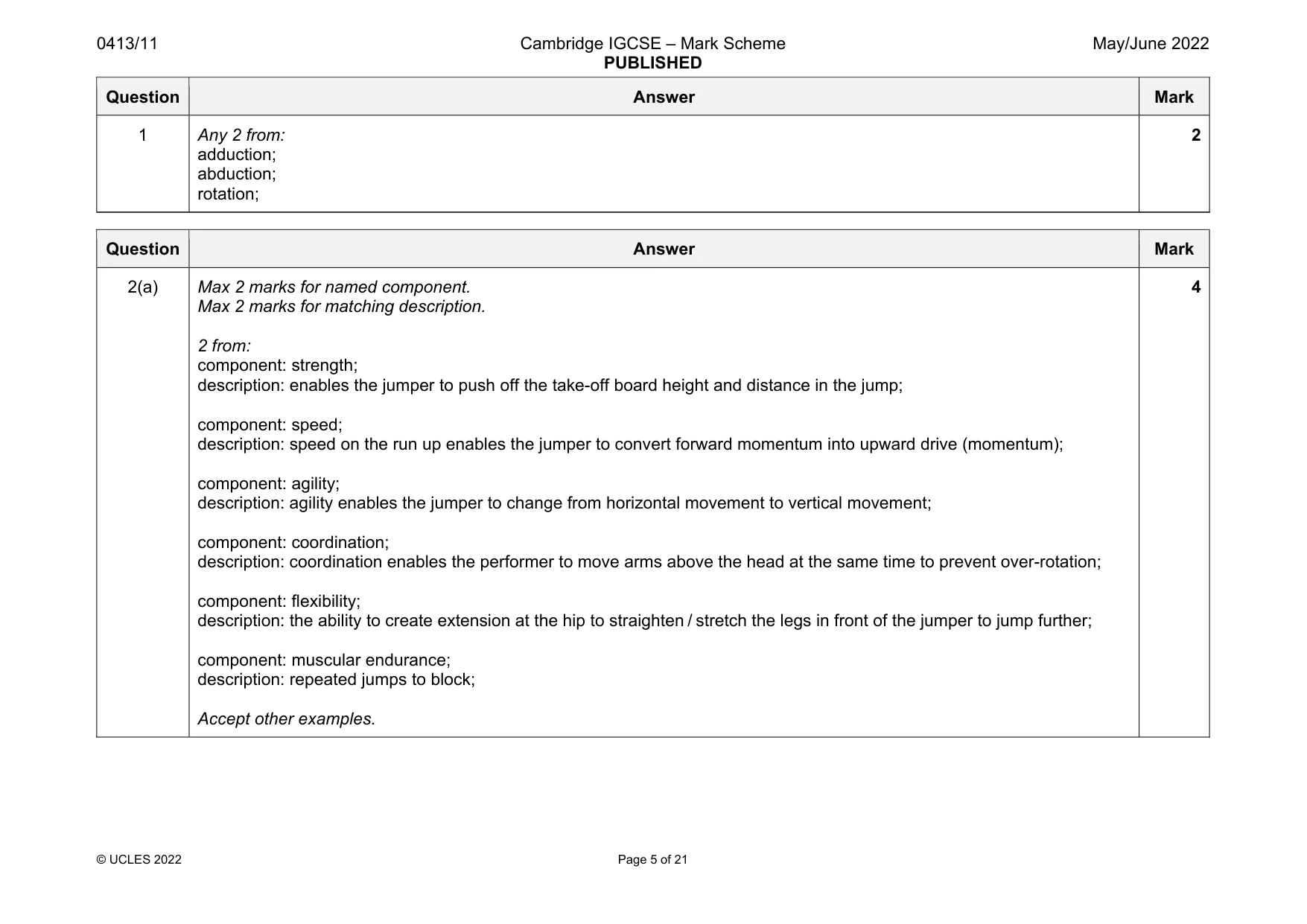
0413/11 Cambridge IGCSE – Mark Scheme PUBLISHED May/June 2022 © UCLES 2022 Page 5 of 21 Question Answer Mark 1 Any 2 from: adduction; abduction; rotation; 2 Question Answer Mark 2(a) Max 2 marks for named component. Max 2 marks for matching description. 2 from: component: strength; description: enables the jumper to push off the take-off board height and distance in the jump; component: speed; description: speed on the run up enables the jumper to convert forward momentum into upward drive (momentum); component: agility; description: agility enables the jumper to change from horizontal movement to vertical movement; component: coordination; description: coordination enables the performer to move arms above the head at the same time to prevent over-rotation; component: flexibility; description: the ability to create extension at the hip to straighten / stretch the legs in front of the jumper to jump further; component: muscular endurance; description: repeated jumps to block; Accept other examples. 4
Mark scheme, page 6
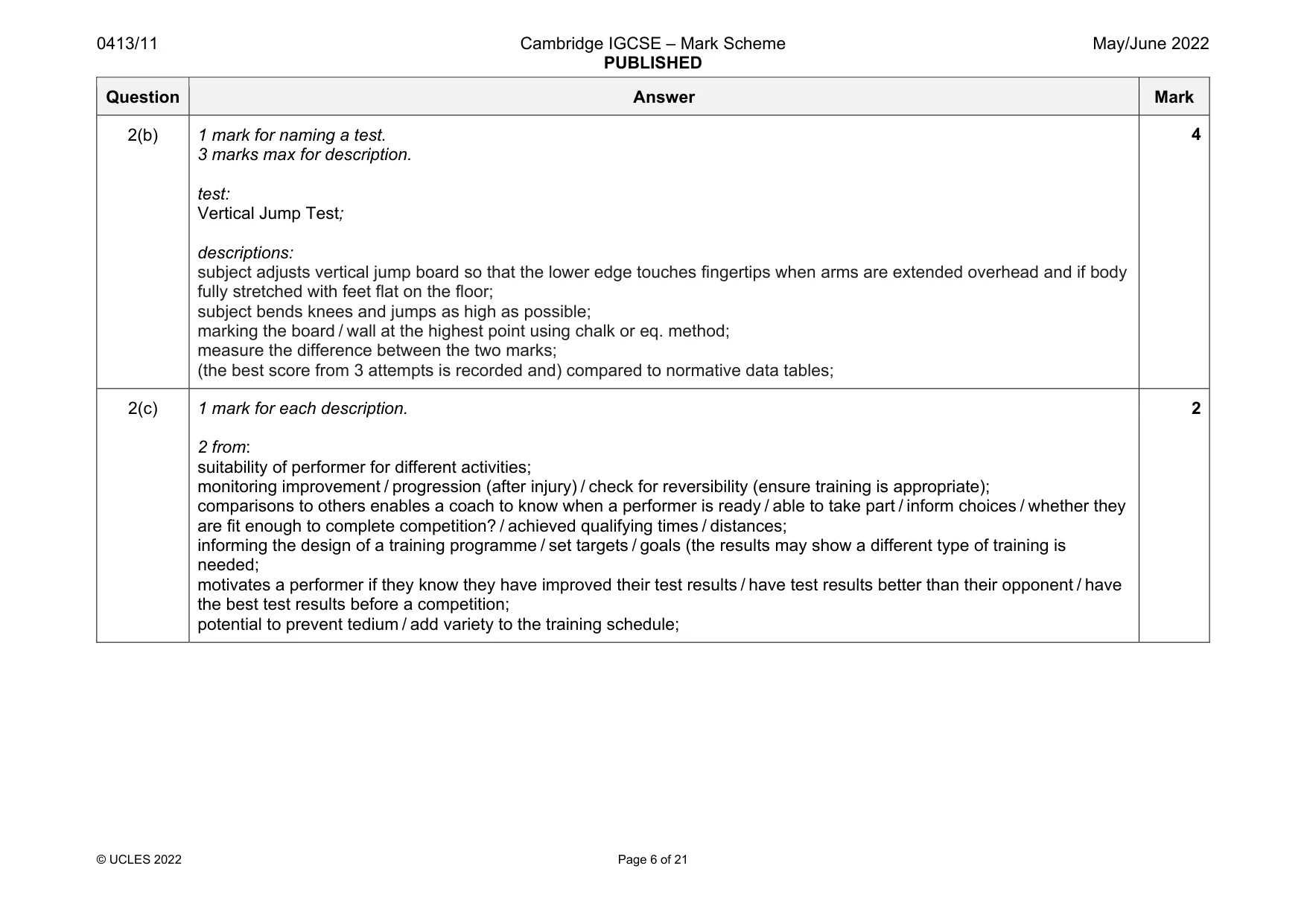
0413/11 Cambridge IGCSE – Mark Scheme PUBLISHED May/June 2022 © UCLES 2022 Page 6 of 21 Question Answer Mark 2(b) 1 mark for naming a test. 3 marks max for description. test: Vertical Jump Test; descriptions: subject adjusts vertical jump board so that the lower edge touches fingertips when arms are extended overhead and if body fully stretched with feet flat on the floor; subject bends knees and jumps as high as possible; marking the board / wall at the highest point using chalk or eq. method; measure the difference between the two marks; (the best score from 3 attempts is recorded and) compared to normative data tables; 4 2(c) 1 mark for each description. 2 from: suitability of performer for different activities; monitoring improvement / progression (after injury) / check for reversibility (ensure training is appropriate); comparisons to others enables a coach to know when a performer is ready / able to take part / inform choices / whether they are fit enough to complete competition? / achieved qualifying times / distances; informing the design of a training programme / set targets / goals (the results may show a different type of training is needed; motivates a performer if they know they have improved their test results / have test results better than their opponent / have the best test results before a competition; potential to prevent tedium / add variety to the training schedule; 2
Mark scheme, page 7
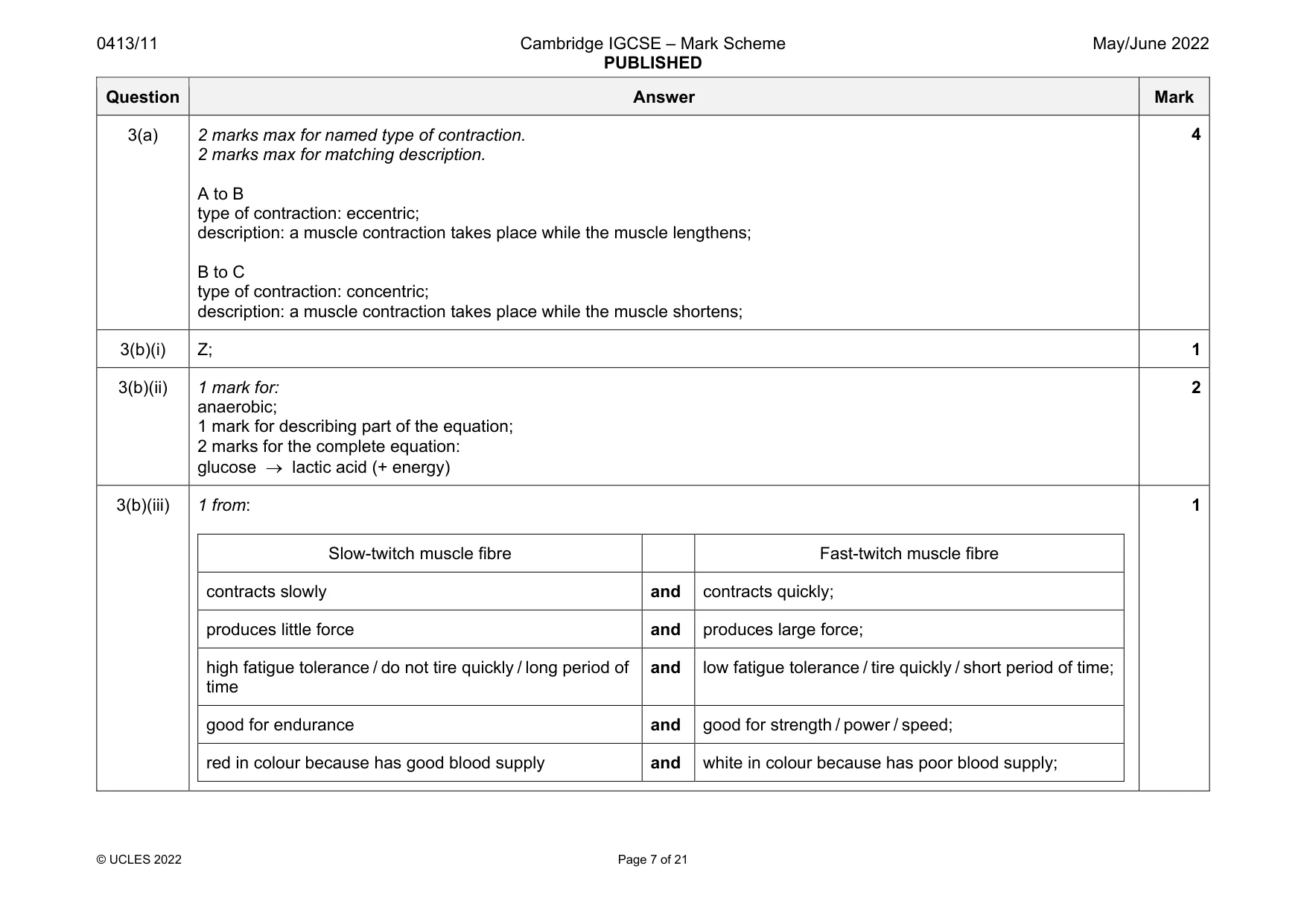
0413/11 Cambridge IGCSE – Mark Scheme PUBLISHED May/June 2022 © UCLES 2022 Page 7 of 21 Question Answer Mark 3(a) 2 marks max for named type of contraction. 2 marks max for matching description. A to B type of contraction: eccentric; description: a muscle contraction takes place while the muscle lengthens; B to C type of contraction: concentric; description: a muscle contraction takes place while the muscle shortens; 4 3(b)(i) Z; 1 3(b)(ii) 1 mark for: anaerobic; 1 mark for describing part of the equation; 2 marks for the complete equation: glucose lactic acid (+ energy) 2 3(b)(iii) 1 from: Slow-twitch muscle fibre Fast-twitch muscle fibre contracts slowly and contracts quickly; produces little force and produces large force; high fatigue tolerance / do not tire quickly / long period of time and low fatigue tolerance / tire quickly / short period of time; good for endurance and good for strength / power / speed; red in colour because has good blood supply and white in colour because has poor blood supply; 1
Mark scheme, page 8
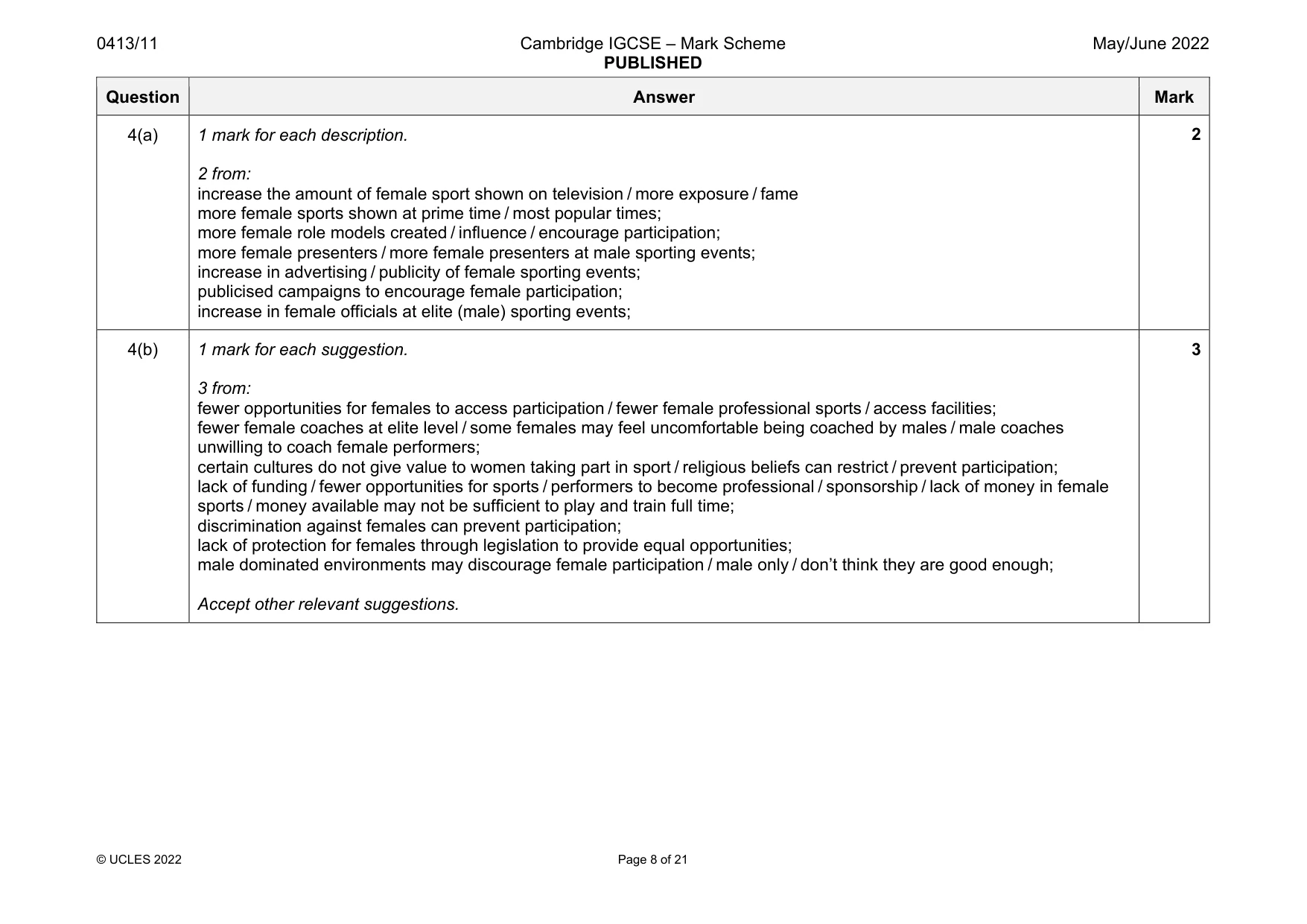
0413/11 Cambridge IGCSE – Mark Scheme PUBLISHED May/June 2022 © UCLES 2022 Page 8 of 21 Question Answer Mark 4(a) 1 mark for each description. 2 from: increase the amount of female sport shown on television / more exposure / fame more female sports shown at prime time / most popular times; more female role models created / influence / encourage participation; more female presenters / more female presenters at male sporting events; increase in advertising / publicity of female sporting events; publicised campaigns to encourage female participation; increase in female officials at elite (male) sporting events; 2 4(b) 1 mark for each suggestion. 3 from: fewer opportunities for females to access participation / fewer female professional sports / access facilities; fewer female coaches at elite level / some females may feel uncomfortable being coached by males / male coaches unwilling to coach female performers; certain cultures do not give value to women taking part in sport / religious beliefs can restrict / prevent participation; lack of funding / fewer opportunities for sports / performers to become professional / sponsorship / lack of money in female sports / money available may not be sufficient to play and train full time; discrimination against females can prevent participation; lack of protection for females through legislation to provide equal opportunities; male dominated environments may discourage female participation / male only / don’t think they are good enough; Accept other relevant suggestions. 3
Mark scheme, page 9
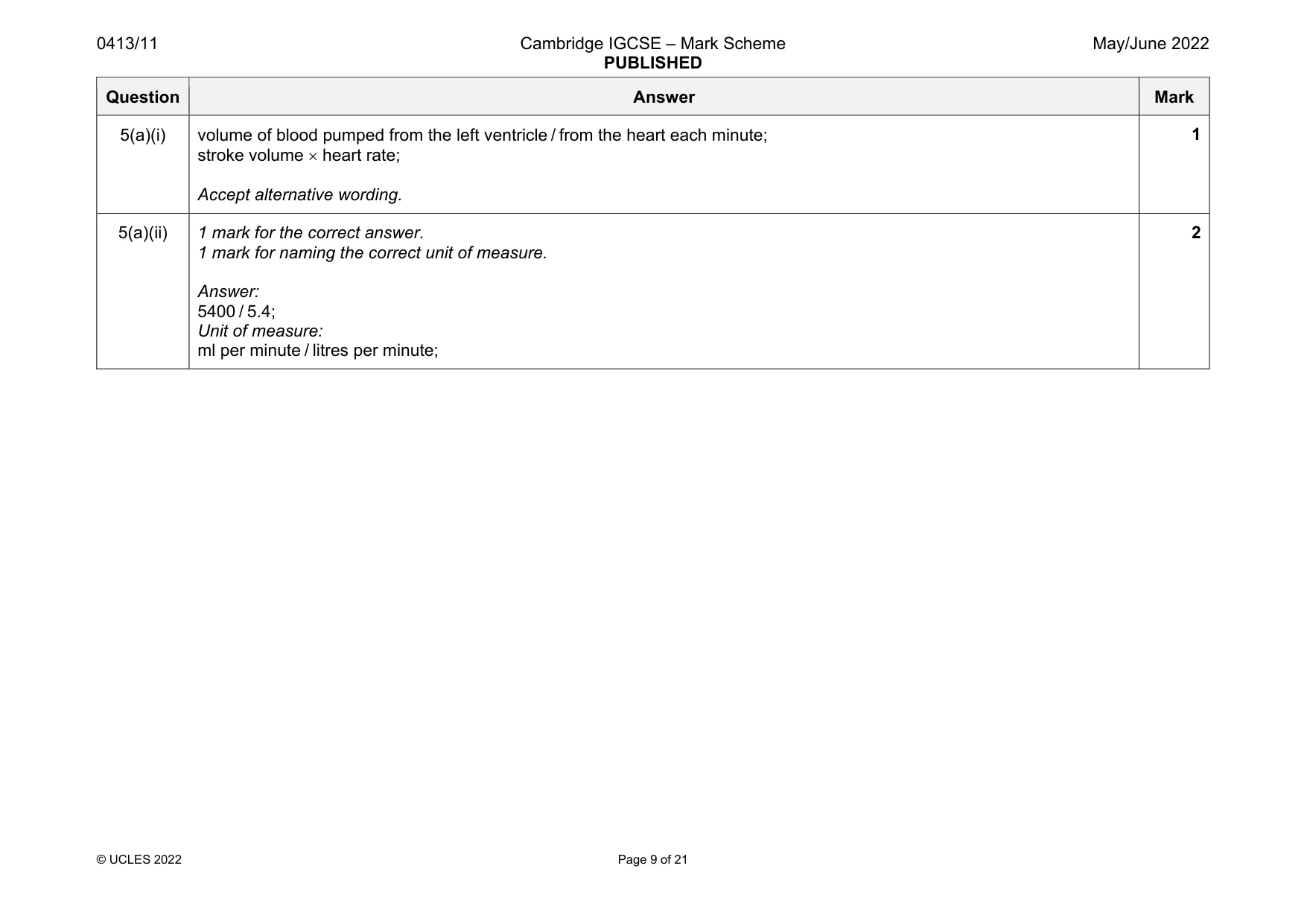
0413/11 Cambridge IGCSE – Mark Scheme PUBLISHED May/June 2022 © UCLES 2022 Page 9 of 21 Question Answer Mark 5(a)(i) volume of blood pumped from the left ventricle / from the heart each minute; stroke volume heart rate; Accept alternative wording. 1 5(a)(ii) 1 mark for the correct answer. 1 mark for naming the correct unit of measure. Answer: 5400 / 5.4; Unit of measure: ml per minute / litres per minute; 2
Mark scheme, page 10
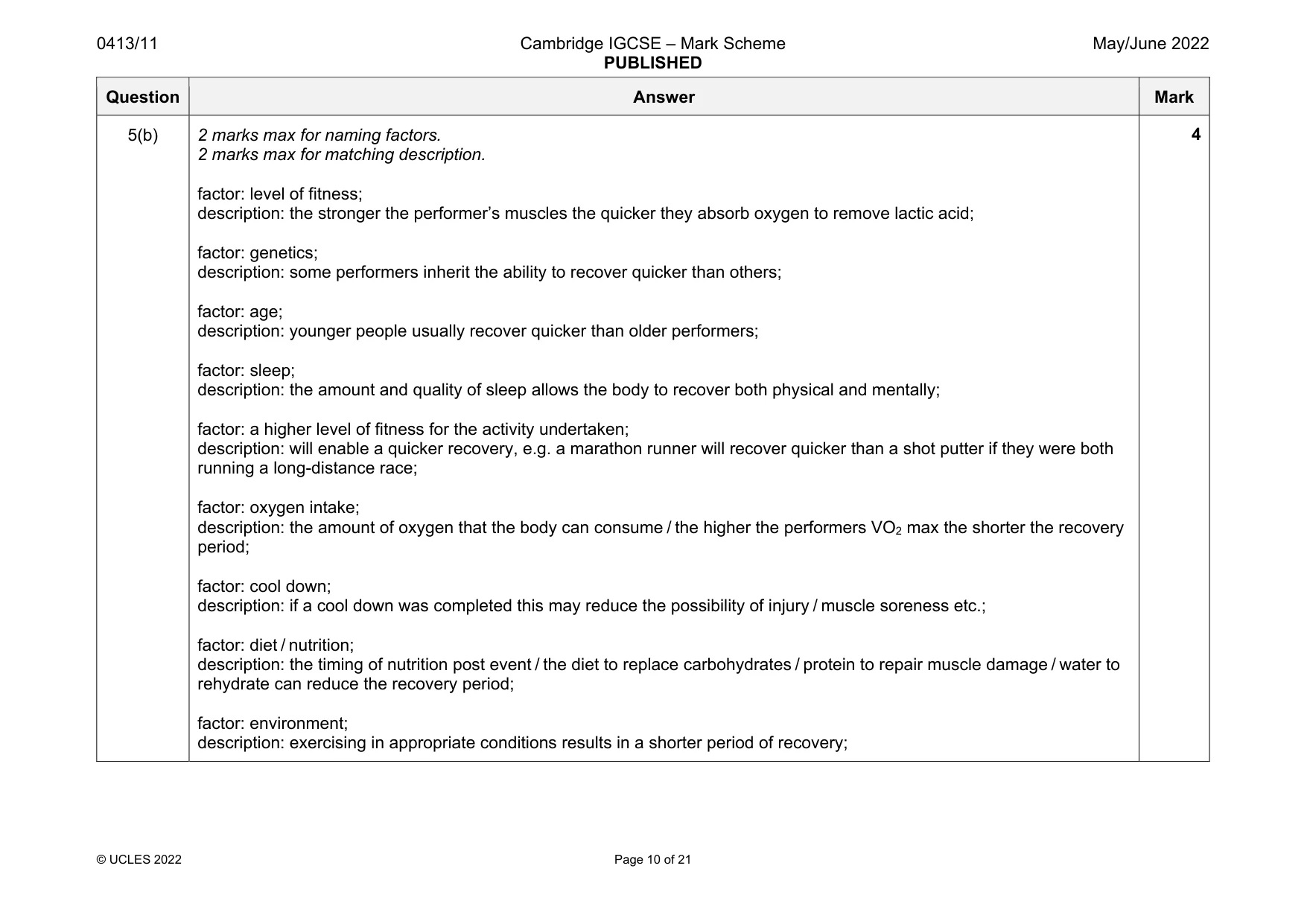
0413/11 Cambridge IGCSE – Mark Scheme PUBLISHED May/June 2022 © UCLES 2022 Page 10 of 21 Question Answer Mark 5(b) 2 marks max for naming factors. 2 marks max for matching description. factor: level of fitness; description: the stronger the performer’s muscles the quicker they absorb oxygen to remove lactic acid; factor: genetics; description: some performers inherit the ability to recover quicker than others; factor: age; description: younger people usually recover quicker than older performers; factor: sleep; description: the amount and quality of sleep allows the body to recover both physical and mentally; factor: a higher level of fitness for the activity undertaken; description: will enable a quicker recovery, e.g. a marathon runner will recover quicker than a shot putter if they were both running a long-distance race; factor: oxygen intake; description: the amount of oxygen that the body can consume / the higher the performers VO2 max the shorter the recovery period; factor: cool down; description: if a cool down was completed this may reduce the possibility of injury / muscle soreness etc.; factor: diet / nutrition; description: the timing of nutrition post event / the diet to replace carbohydrates / protein to repair muscle damage / water to rehydrate can reduce the recovery period; factor: environment; description: exercising in appropriate conditions results in a shorter period of recovery; 4
Mark scheme, page 11
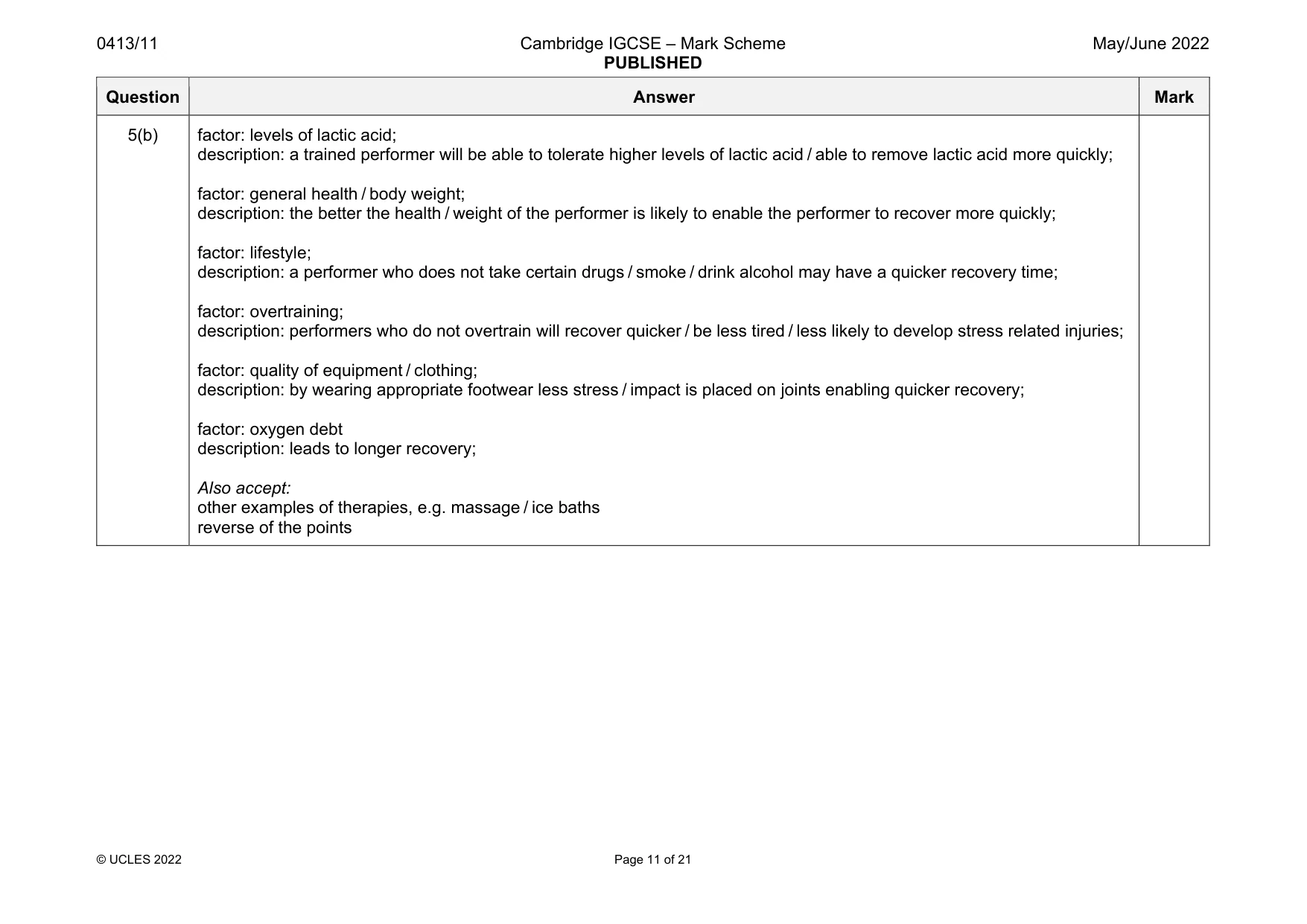
0413/11 Cambridge IGCSE – Mark Scheme PUBLISHED May/June 2022 © UCLES 2022 Page 11 of 21 Question Answer Mark 5(b) factor: levels of lactic acid; description: a trained performer will be able to tolerate higher levels of lactic acid / able to remove lactic acid more quickly; factor: general health / body weight; description: the better the health / weight of the performer is likely to enable the performer to recover more quickly; factor: lifestyle; description: a performer who does not take certain drugs / smoke / drink alcohol may have a quicker recovery time; factor: overtraining; description: performers who do not overtrain will recover quicker / be less tired / less likely to develop stress related injuries; factor: quality of equipment / clothing; description: by wearing appropriate footwear less stress / impact is placed on joints enabling quicker recovery; factor: oxygen debt description: leads to longer recovery; Also accept: other examples of therapies, e.g. massage / ice baths reverse of the points
Mark scheme, page 12
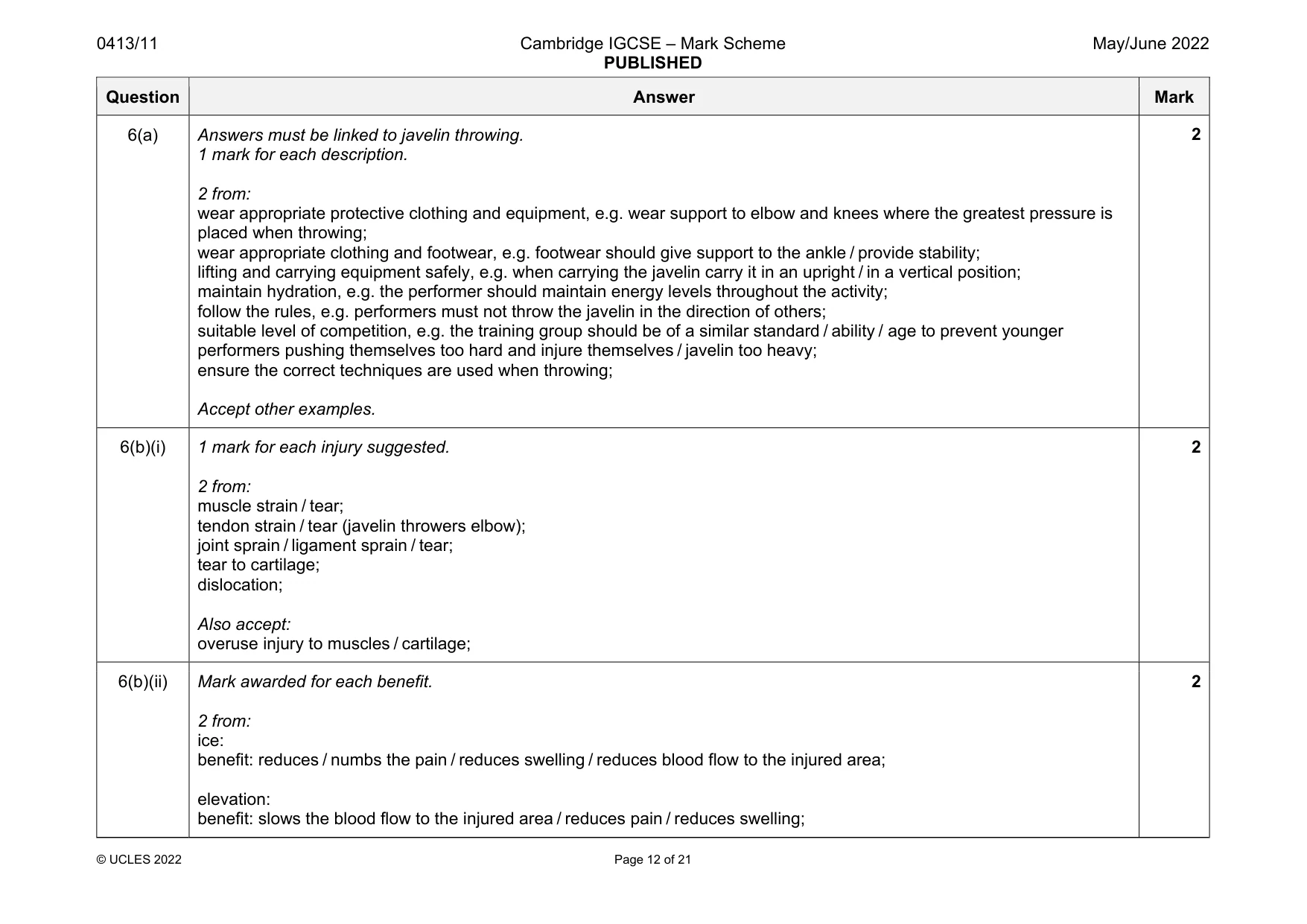
0413/11 Cambridge IGCSE – Mark Scheme PUBLISHED May/June 2022 © UCLES 2022 Page 12 of 21 Question Answer Mark 6(a) Answers must be linked to javelin throwing. 1 mark for each description. 2 from: wear appropriate protective clothing and equipment, e.g. wear support to elbow and knees where the greatest pressure is placed when throwing; wear appropriate clothing and footwear, e.g. footwear should give support to the ankle / provide stability; lifting and carrying equipment safely, e.g. when carrying the javelin carry it in an upright / in a vertical position; maintain hydration, e.g. the performer should maintain energy levels throughout the activity; follow the rules, e.g. performers must not throw the javelin in the direction of others; suitable level of competition, e.g. the training group should be of a similar standard / ability / age to prevent younger performers pushing themselves too hard and injure themselves / javelin too heavy; ensure the correct techniques are used when throwing; Accept other examples. 2 6(b)(i) 1 mark for each injury suggested. 2 from: muscle strain / tear; tendon strain / tear (javelin throwers elbow); joint sprain / ligament sprain / tear; tear to cartilage; dislocation; Also accept: overuse injury to muscles / cartilage; 2 6(b)(ii) Mark awarded for each benefit. 2 from: ice: benefit: reduces / numbs the pain / reduces swelling / reduces blood flow to the injured area; elevation: benefit: slows the blood flow to the injured area / reduces pain / reduces swelling; 2
Mark scheme, page 13
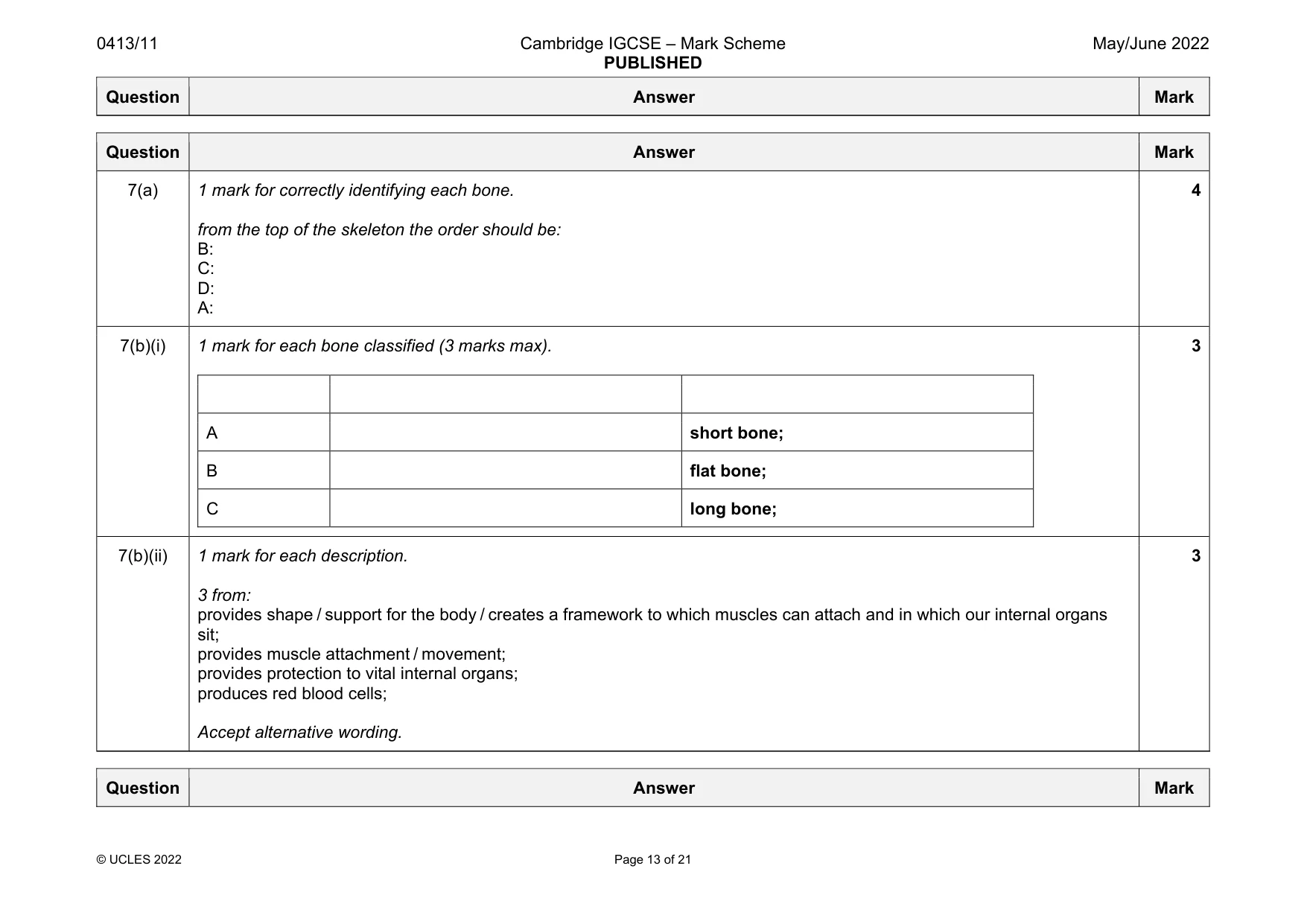
0413/11 Cambridge IGCSE – Mark Scheme PUBLISHED May/June 2022 © UCLES 2022 Page 13 of 21 Question Answer Mark Question Answer Mark 7(a) 1 mark for correctly identifying each bone. from the top of the skeleton the order should be: B: C: D: A: 4 7(b)(i) 1 mark for each bone classified (3 marks max). A short bone; B flat bone; C long bone; 3 7(b)(ii) 1 mark for each description. 3 from: provides shape / support for the body / creates a framework to which muscles can attach and in which our internal organs sit; provides muscle attachment / movement; provides protection to vital internal organs; produces red blood cells; Accept alternative wording. 3 Question Answer Mark
Mark scheme, page 14
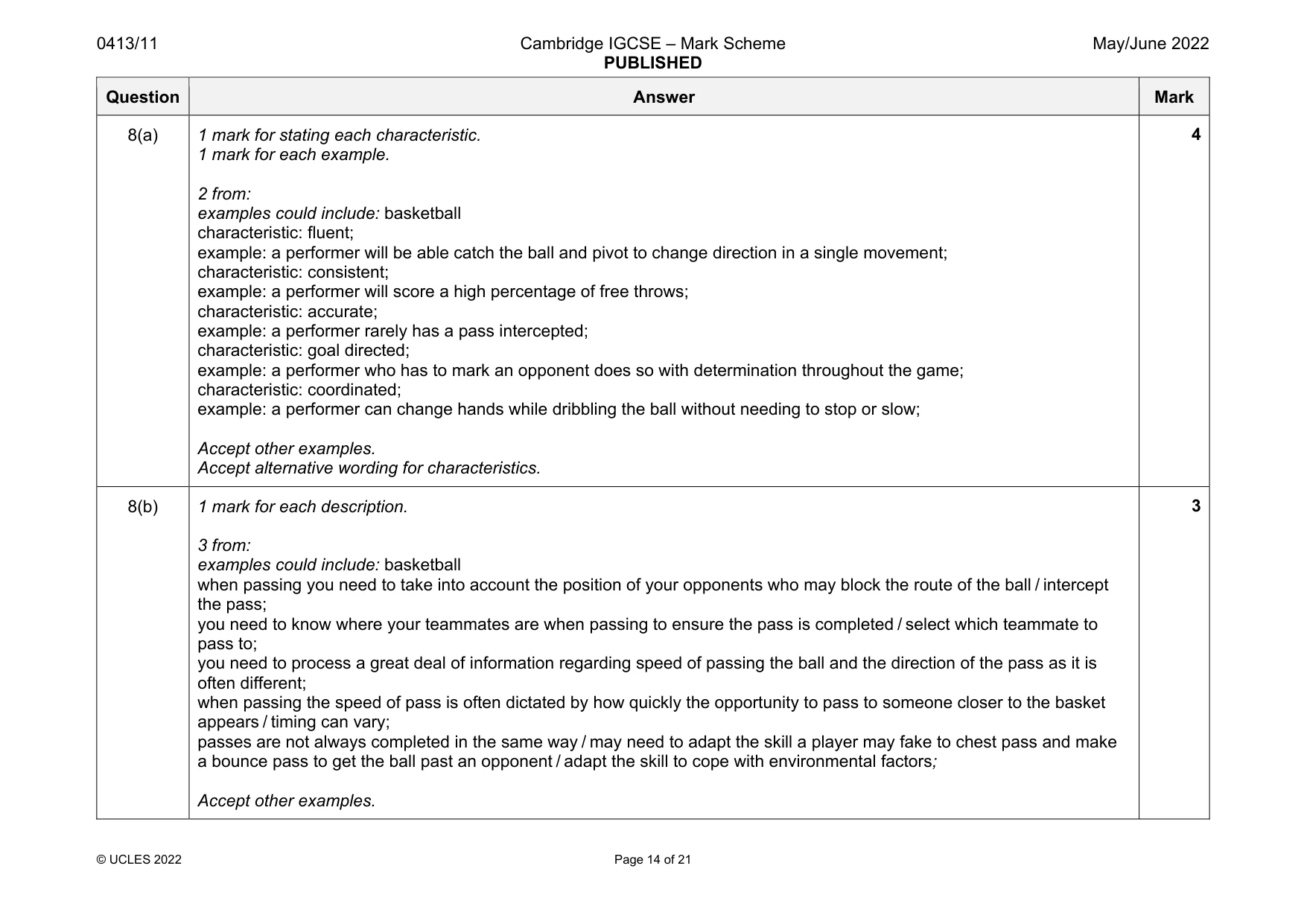
0413/11 Cambridge IGCSE – Mark Scheme PUBLISHED May/June 2022 © UCLES 2022 Page 14 of 21 Question Answer Mark 8(a) 1 mark for stating each characteristic. 1 mark for each example. 2 from: examples could include: basketball characteristic: fluent; example: a performer will be able catch the ball and pivot to change direction in a single movement; characteristic: consistent; example: a performer will score a high percentage of free throws; characteristic: accurate; example: a performer rarely has a pass intercepted; characteristic: goal directed; example: a performer who has to mark an opponent does so with determination throughout the game; characteristic: coordinated; example: a performer can change hands while dribbling the ball without needing to stop or slow; Accept other examples. Accept alternative wording for characteristics. 4 8(b) 1 mark for each description. 3 from: examples could include: basketball when passing you need to take into account the position of your opponents who may block the route of the ball / intercept the pass; you need to know where your teammates are when passing to ensure the pass is completed / select which teammate to pass to; you need to process a great deal of information regarding speed of passing the ball and the direction of the pass as it is often different; when passing the speed of pass is often dictated by how quickly the opportunity to pass to someone closer to the basket appears / timing can vary; passes are not always completed in the same way / may need to adapt the skill a player may fake to chest pass and make a bounce pass to get the ball past an opponent / adapt the skill to cope with environmental factors; Accept other examples. 3
Mark scheme, page 15
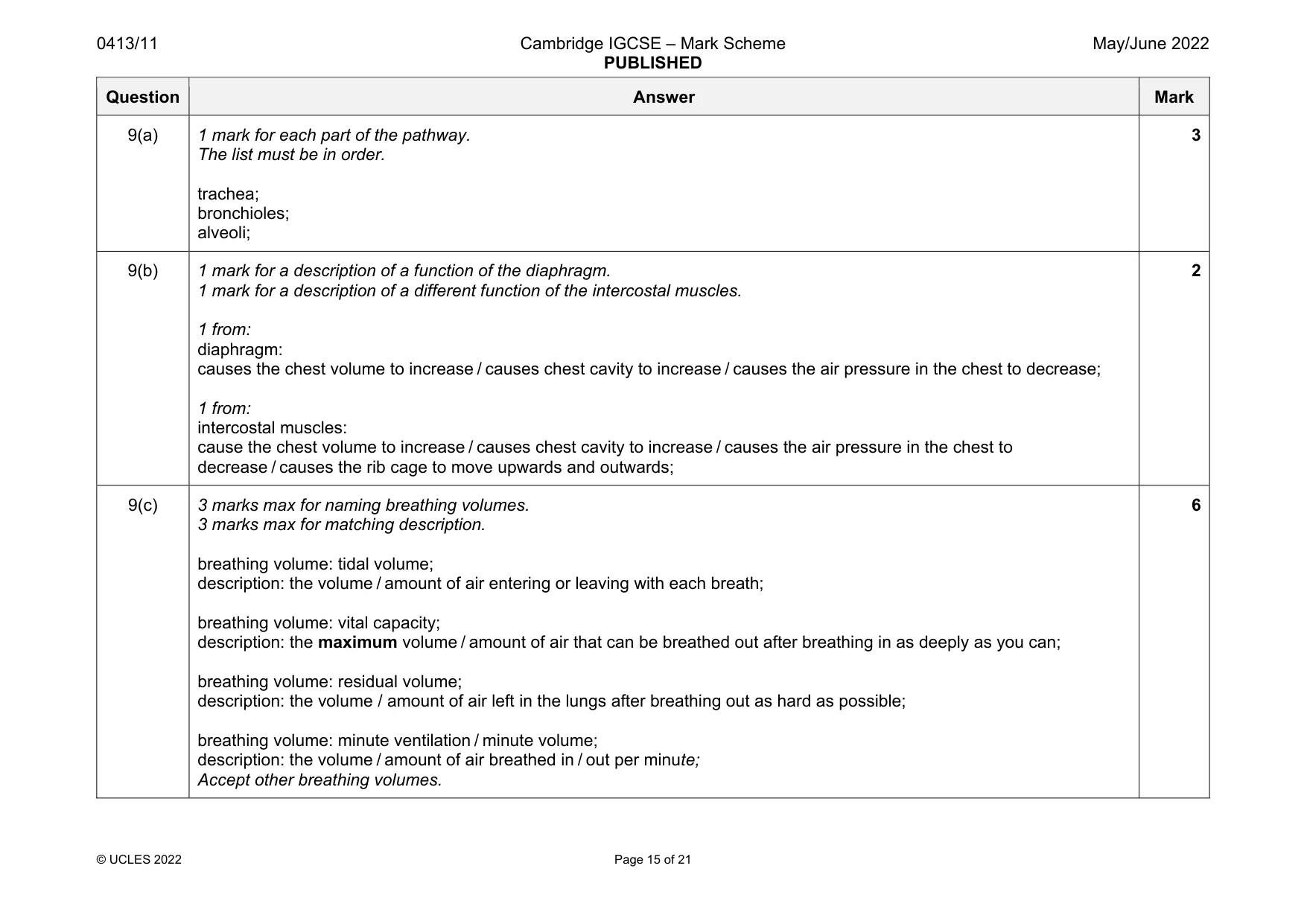
0413/11 Cambridge IGCSE – Mark Scheme PUBLISHED May/June 2022 © UCLES 2022 Page 15 of 21 Question Answer Mark 9(a) 1 mark for each part of the pathway. The list must be in order. trachea; bronchioles; alveoli; 3 9(b) 1 mark for a description of a function of the diaphragm. 1 mark for a description of a different function of the intercostal muscles. 1 from: diaphragm: causes the chest volume to increase / causes chest cavity to increase / causes the air pressure in the chest to decrease; 1 from: intercostal muscles: cause the chest volume to increase / causes chest cavity to increase / causes the air pressure in the chest to decrease / causes the rib cage to move upwards and outwards; 2 9(c) 3 marks max for naming breathing volumes. 3 marks max for matching description. breathing volume: tidal volume; description: the volume / amount of air entering or leaving with each breath; breathing volume: vital capacity; description: the maximum volume / amount of air that can be breathed out after breathing in as deeply as you can; breathing volume: residual volume; description: the volume / amount of air left in the lungs after breathing out as hard as possible; breathing volume: minute ventilation / minute volume; description: the volume / amount of air breathed in / out per minute; Accept other breathing volumes. 6
Mark scheme, page 16
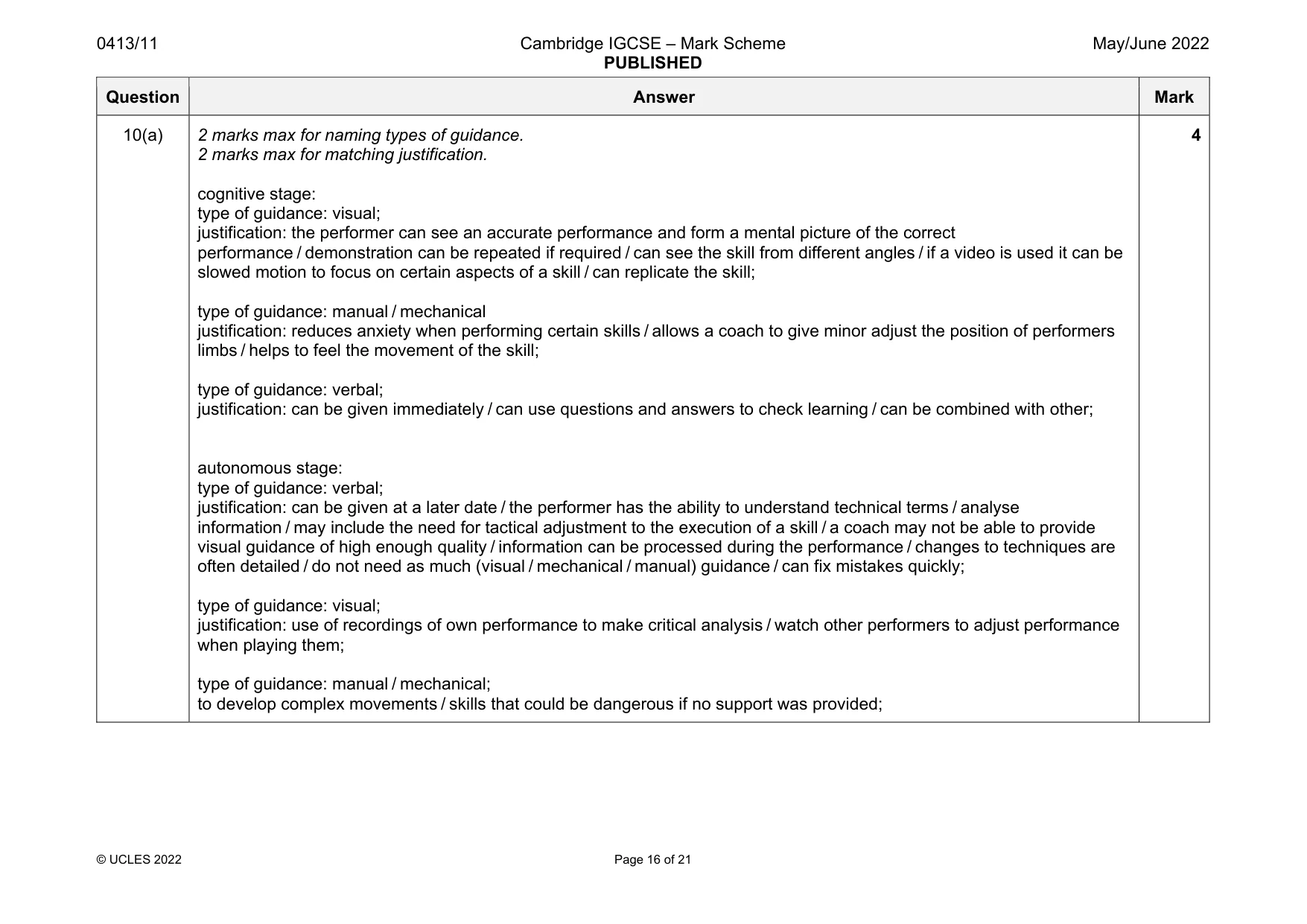
0413/11 Cambridge IGCSE – Mark Scheme PUBLISHED May/June 2022 © UCLES 2022 Page 16 of 21 Question Answer Mark 10(a) 2 marks max for naming types of guidance. 2 marks max for matching justification. cognitive stage: type of guidance: visual; justification: the performer can see an accurate performance and form a mental picture of the correct performance / demonstration can be repeated if required / can see the skill from different angles / if a video is used it can be slowed motion to focus on certain aspects of a skill / can replicate the skill; type of guidance: manual / mechanical justification: reduces anxiety when performing certain skills / allows a coach to give minor adjust the position of performers limbs / helps to feel the movement of the skill; type of guidance: verbal; justification: can be given immediately / can use questions and answers to check learning / can be combined with other; autonomous stage: type of guidance: verbal; justification: can be given at a later date / the performer has the ability to understand technical terms / analyse information / may include the need for tactical adjustment to the execution of a skill / a coach may not be able to provide visual guidance of high enough quality / information can be processed during the performance / changes to techniques are often detailed / do not need as much (visual / mechanical / manual) guidance / can fix mistakes quickly; type of guidance: visual; justification: use of recordings of own performance to make critical analysis / watch other performers to adjust performance when playing them; type of guidance: manual / mechanical; to develop complex movements / skills that could be dangerous if no support was provided; 4
Mark scheme, page 17
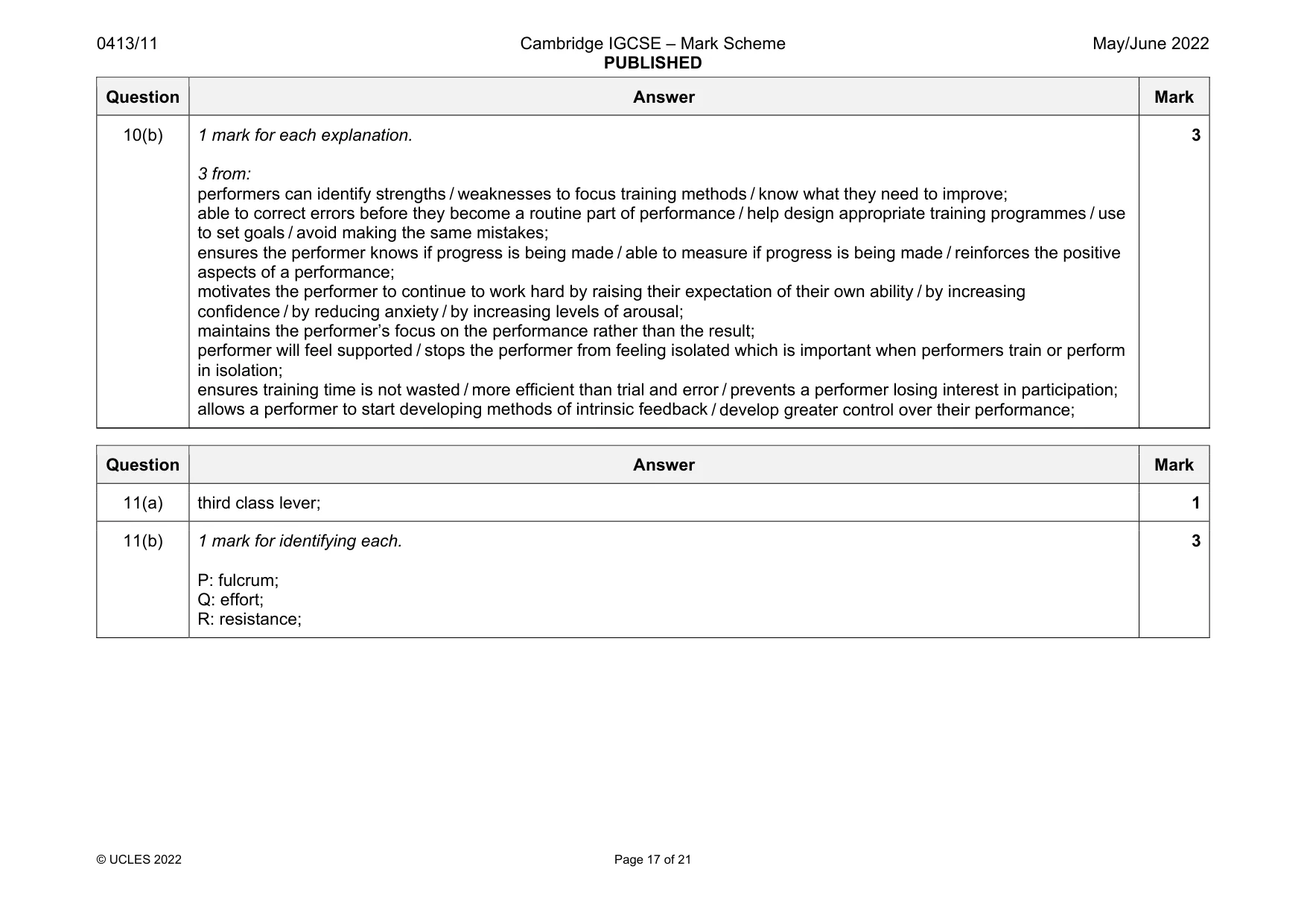
0413/11 Cambridge IGCSE – Mark Scheme PUBLISHED May/June 2022 © UCLES 2022 Page 17 of 21 Question Answer Mark 10(b) 1 mark for each explanation. 3 from: performers can identify strengths / weaknesses to focus training methods / know what they need to improve; able to correct errors before they become a routine part of performance / help design appropriate training programmes / use to set goals / avoid making the same mistakes; ensures the performer knows if progress is being made / able to measure if progress is being made / reinforces the positive aspects of a performance; motivates the performer to continue to work hard by raising their expectation of their own ability / by increasing confidence / by reducing anxiety / by increasing levels of arousal; maintains the performer’s focus on the performance rather than the result; performer will feel supported / stops the performer from feeling isolated which is important when performers train or perform in isolation; ensures training time is not wasted / more efficient than trial and error / prevents a performer losing interest in participation; allows a performer to start developing methods of intrinsic feedback / develop greater control over their performance; 3 Question Answer Mark 11(a) third class lever; 1 11(b) 1 mark for identifying each. P: fulcrum; Q: effort; R: resistance; 3
Mark scheme, page 18
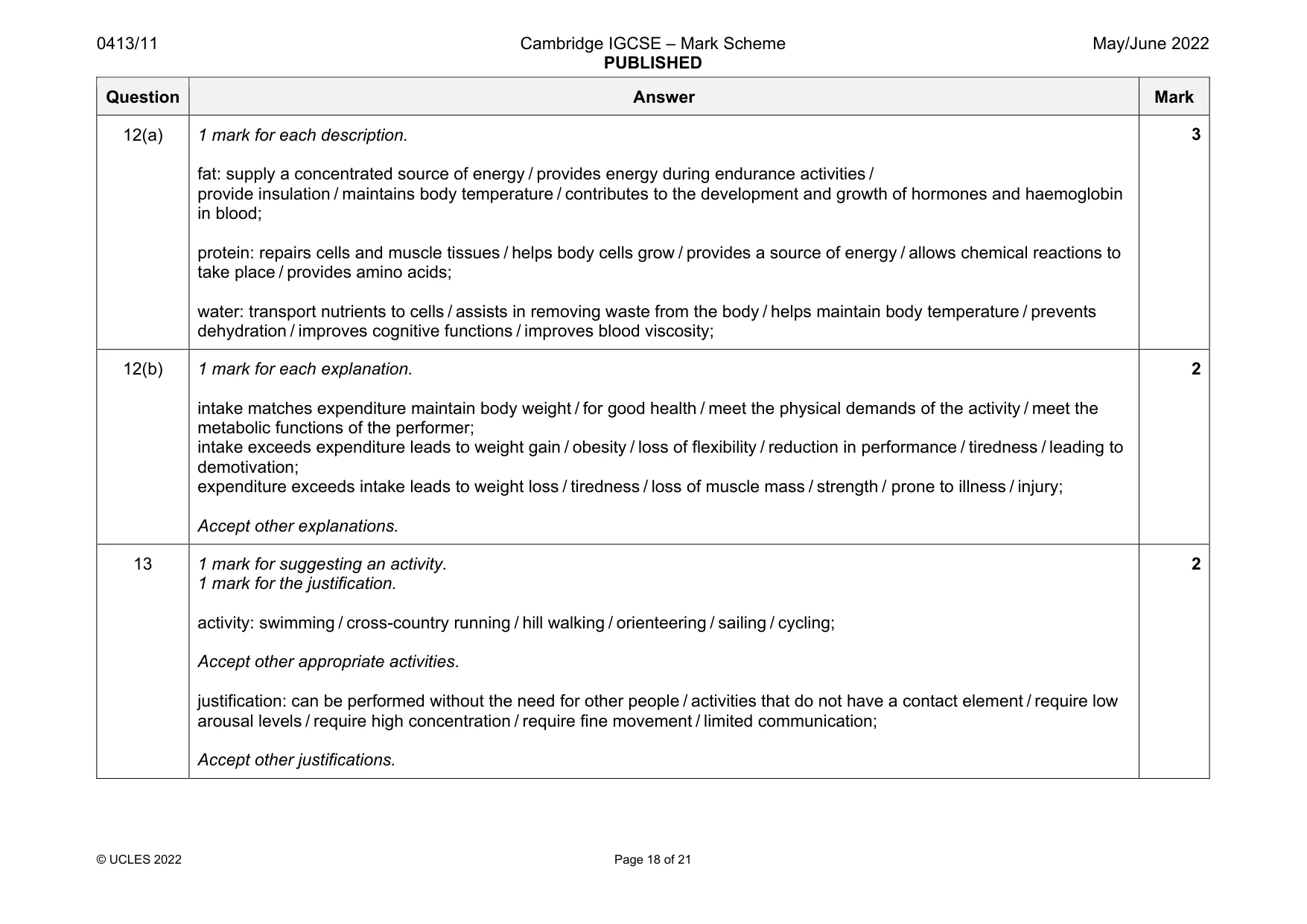
0413/11 Cambridge IGCSE – Mark Scheme PUBLISHED May/June 2022 © UCLES 2022 Page 18 of 21 Question Answer Mark 12(a) 1 mark for each description. fat: supply a concentrated source of energy / provides energy during endurance activities / provide insulation / maintains body temperature / contributes to the development and growth of hormones and haemoglobin in blood; protein: repairs cells and muscle tissues / helps body cells grow / provides a source of energy / allows chemical reactions to take place / provides amino acids; water: transport nutrients to cells / assists in removing waste from the body / helps maintain body temperature / prevents dehydration / improves cognitive functions / improves blood viscosity; 3 12(b) 1 mark for each explanation. intake matches expenditure maintain body weight / for good health / meet the physical demands of the activity / meet the metabolic functions of the performer; intake exceeds expenditure leads to weight gain / obesity / loss of flexibility / reduction in performance / tiredness / leading to demotivation; expenditure exceeds intake leads to weight loss / tiredness / loss of muscle mass / strength / prone to illness / injury; Accept other explanations. 2 13 1 mark for suggesting an activity. 1 mark for the justification. activity: swimming / cross-country running / hill walking / orienteering / sailing / cycling; Accept other appropriate activities. justification: can be performed without the need for other people / activities that do not have a contact element / require low arousal levels / require high concentration / require fine movement / limited communication; Accept other justifications. 2
Mark scheme, page 19
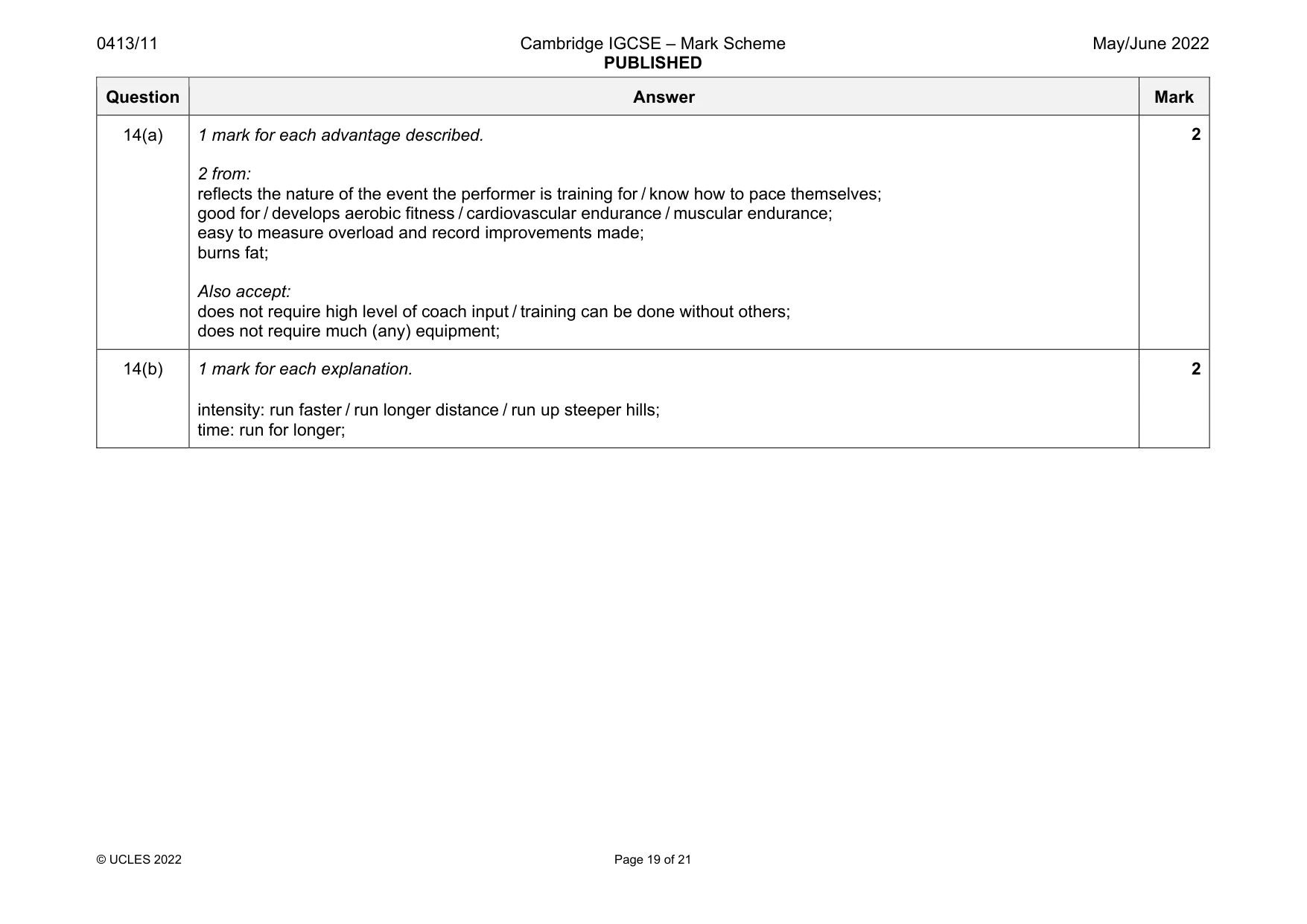
0413/11 Cambridge IGCSE – Mark Scheme PUBLISHED May/June 2022 © UCLES 2022 Page 19 of 21 Question Answer Mark 14(a) 1 mark for each advantage described. 2 from: reflects the nature of the event the performer is training for / know how to pace themselves; good for / develops aerobic fitness / cardiovascular endurance / muscular endurance; easy to measure overload and record improvements made; burns fat; Also accept: does not require high level of coach input / training can be done without others; does not require much (any) equipment; 2 14(b) 1 mark for each explanation. intensity: run faster / run longer distance / run up steeper hills; time: run for longer; 2
Mark scheme, page 20
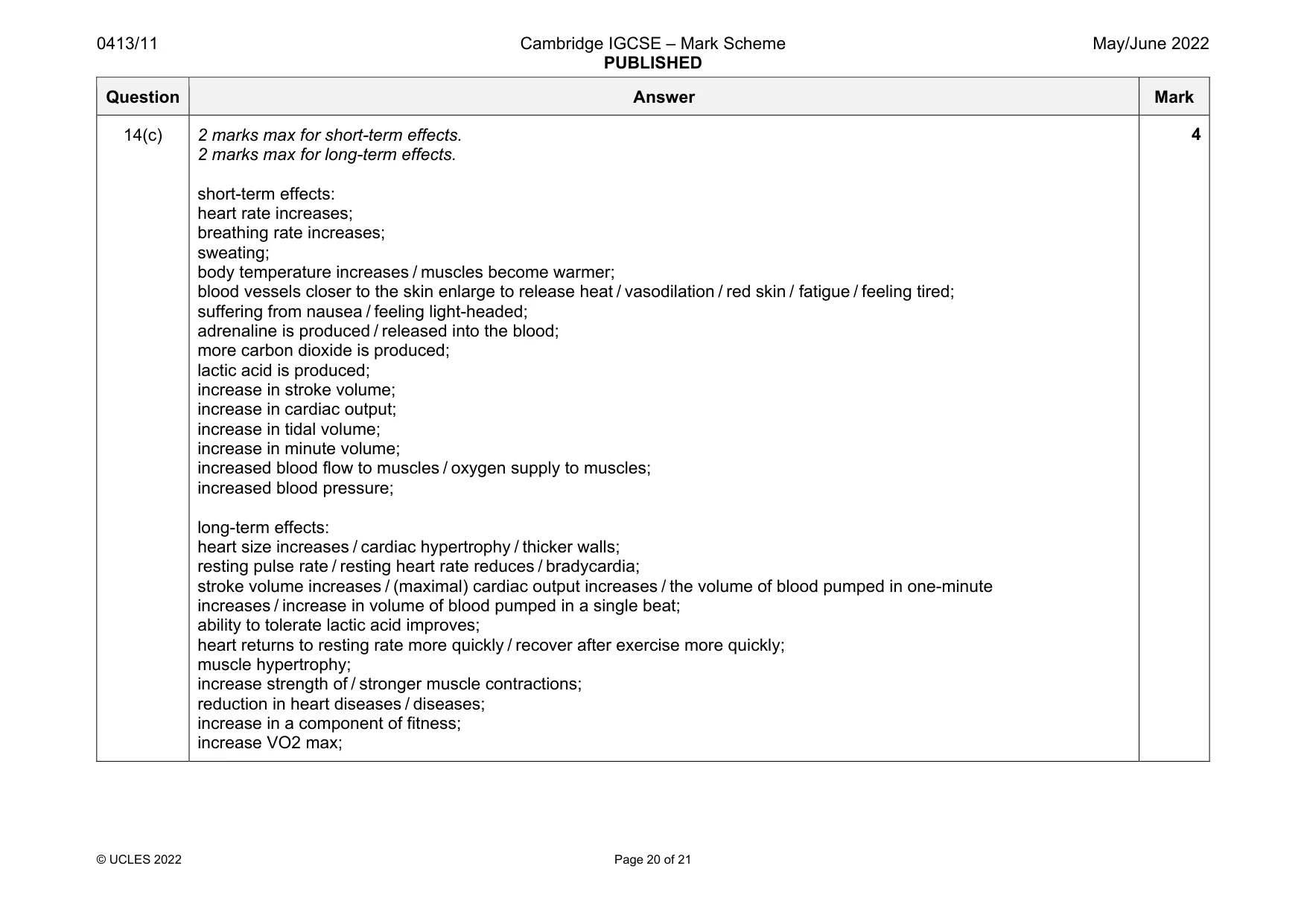
0413/11 Cambridge IGCSE – Mark Scheme PUBLISHED May/June 2022 © UCLES 2022 Page 20 of 21 Question Answer Mark 14(c) 2 marks max for short-term effects. 2 marks max for long-term effects. short-term effects: heart rate increases; breathing rate increases; sweating; body temperature increases / muscles become warmer; blood vessels closer to the skin enlarge to release heat / vasodilation / red skin / fatigue / feeling tired; suffering from nausea / feeling light-headed; adrenaline is produced / released into the blood; more carbon dioxide is produced; lactic acid is produced; increase in stroke volume; increase in cardiac output; increase in tidal volume; increase in minute volume; increased blood flow to muscles / oxygen supply to muscles; increased blood pressure; long-term effects: heart size increases / cardiac hypertrophy / thicker walls; resting pulse rate / resting heart rate reduces / bradycardia; stroke volume increases / (maximal) cardiac output increases / the volume of blood pumped in one-minute increases / increase in volume of blood pumped in a single beat; ability to tolerate lactic acid improves; heart returns to resting rate more quickly / recover after exercise more quickly; muscle hypertrophy; increase strength of / stronger muscle contractions; reduction in heart diseases / diseases; increase in a component of fitness; increase VO2 max; 4
Mark scheme, page 21
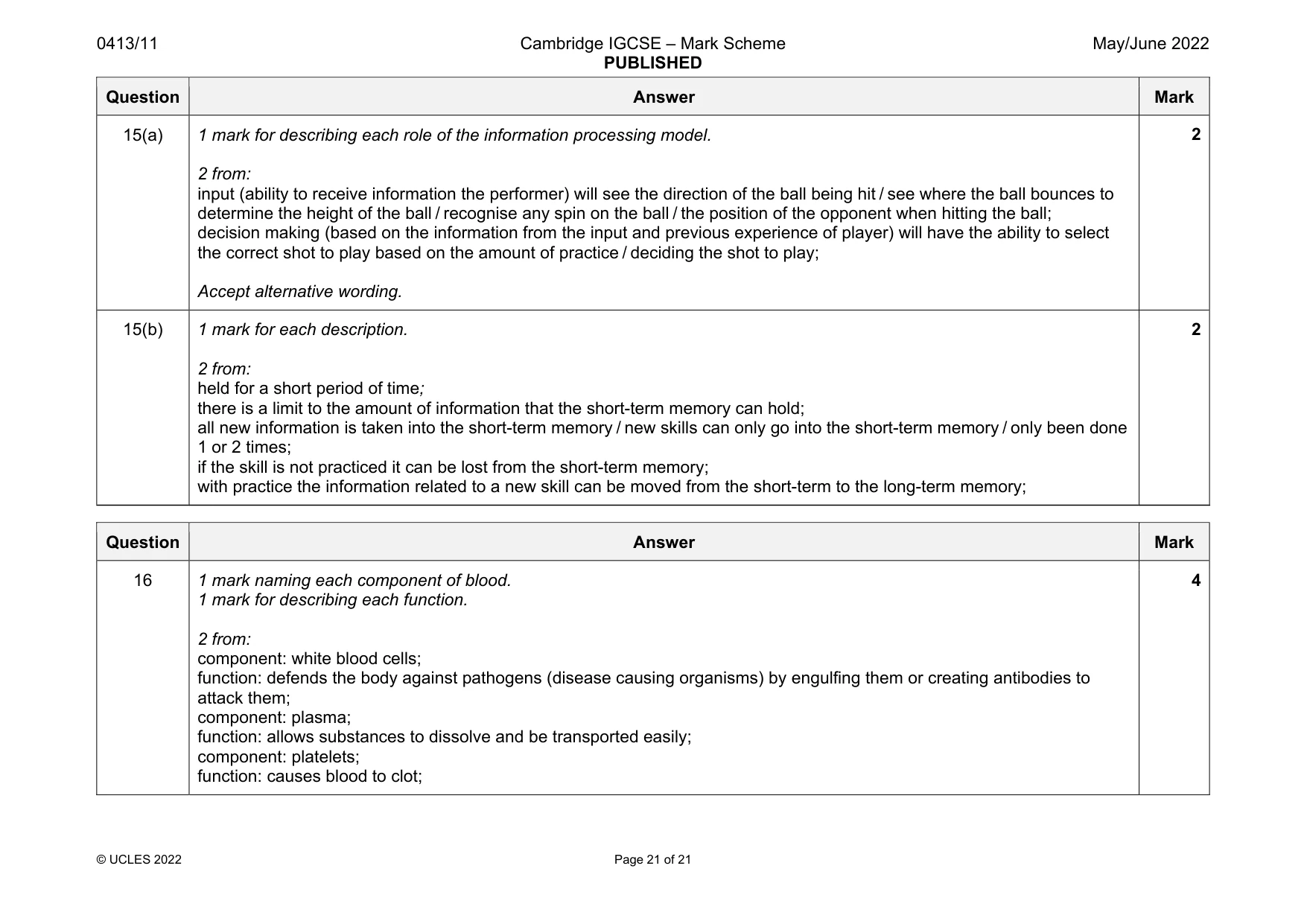
0413/11 Cambridge IGCSE – Mark Scheme PUBLISHED May/June 2022 © UCLES 2022 Page 21 of 21 Question Answer Mark 15(a) 1 mark for describing each role of the information processing model. 2 from: input (ability to receive information the performer) will see the direction of the ball being hit / see where the ball bounces to determine the height of the ball / recognise any spin on the ball / the position of the opponent when hitting the ball; decision making (based on the information from the input and previous experience of player) will have the ability to select the correct shot to play based on the amount of practice / deciding the shot to play; Accept alternative wording. 2 15(b) 1 mark for each description. 2 from: held for a short period of time; there is a limit to the amount of information that the short-term memory can hold; all new information is taken into the short-term memory / new skills can only go into the short-term memory / only been done 1 or 2 times; if the skill is not practiced it can be lost from the short-term memory; with practice the information related to a new skill can be moved from the short-term to the long-term memory; 2 Question Answer Mark 16 1 mark naming each component of blood. 1 mark for describing each function. 2 from: component: white blood cells; function: defends the body against pathogens (disease causing organisms) by engulfing them or creating antibodies to attack them; component: plasma; function: allows substances to dissolve and be transported easily; component: platelets; function: causes blood to clot; 4
What you needed in this session
Cambridge’s own grade thresholds for 2022 May/June, Paper 1 · Variant 1. A higher threshold means an easier paper — the bar moves with how the cohort did.