Cambridge IGCSE Physical Education 0413 — 2023 May/June Paper 1 · Variant 1
0413/11/M/J/23 · 100 marks · ≈113 min
The question paper and its mark scheme, free to read here and free to download. This is Cambridge’s own paper, exactly as it was sat.
Question paper16 pages
Mark scheme21 pages
Answers below. Sit the paper first if you are practising.
Paper as text
Question paper, page 1
This document has 16 pages. [Turn over Cambridge IGCSE™ DC (EF/JG) 315421/1 © UCLES 2023 * 8 7 2 4 5 3 3 5 2 5 * PHYSICAL EDUCATION 0413/11 Paper 1 Theory May/June 2023 1 hour 45 minutes You must answer on the question paper. No additional materials are needed. INSTRUCTIONS ● Answer all questions. ● Use a black or dark blue pen. You may use an HB pencil for any diagrams or graphs. ● Write your name, centre number and candidate number in the boxes at the top of the page. ● Write your answer to each question in the space provided. ● Do not use an erasable pen or correction fluid. ● Do not write on any bar codes. ● You may use a calculator. ● You should show all your working and use appropriate units. INFORMATION ● The total mark for this paper is 100. ● The number of marks for each question or part question is shown in brackets [ ].
Question paper, page 2
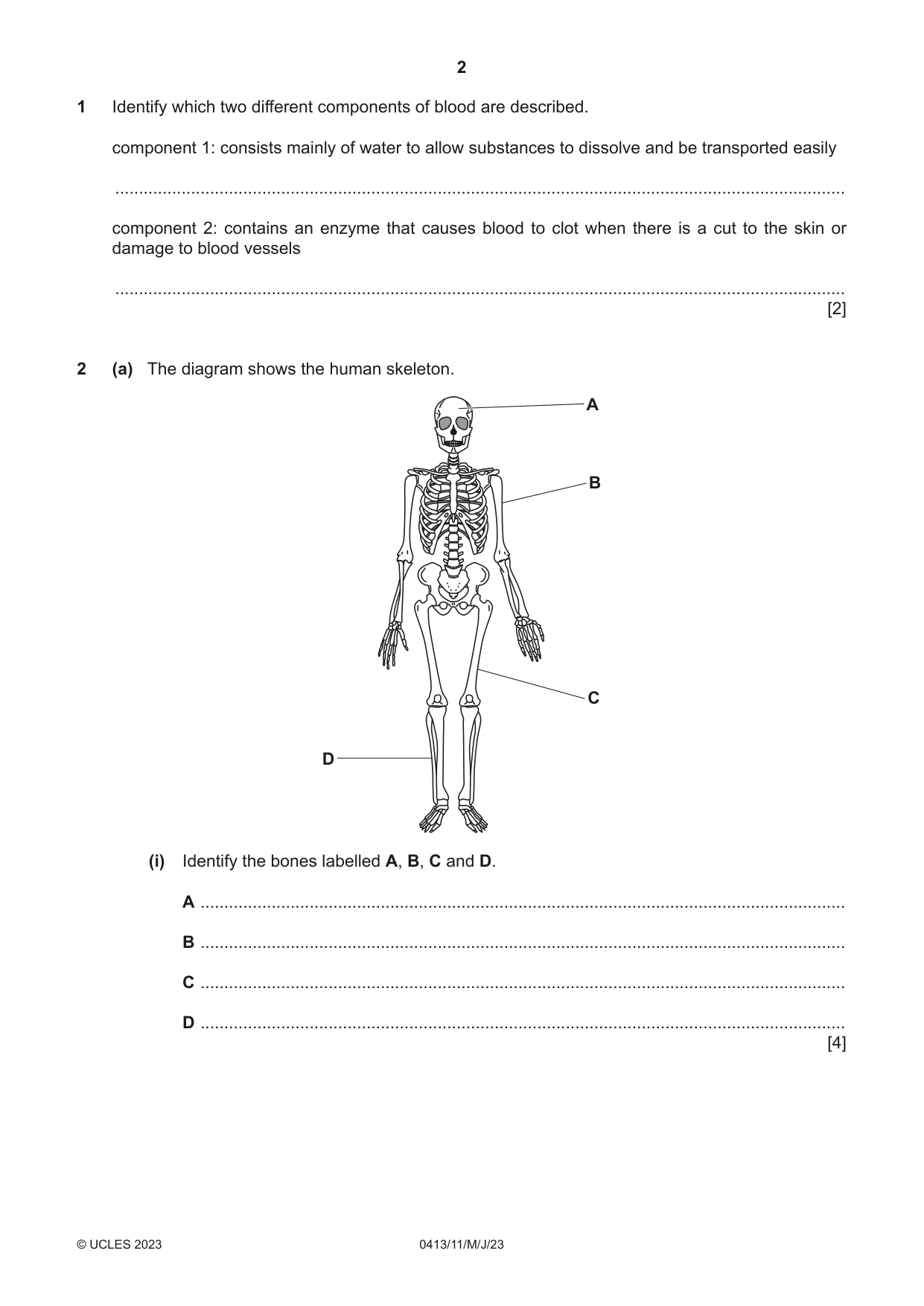
2 0413/11/M/J/23 © UCLES 2023 1 Identify which two different components of blood are described. component 1: consists mainly of water to allow substances to dissolve and be transported easily … component 2: contains an enzyme that causes blood to clot when there is a cut to the skin or damage to blood vessels … [2] 2 (a) The diagram shows the human skeleton. B D A C (i) Identify the bones labelled A, B, C and D. A … B … C … D … [4]
Question paper, page 3
3 0413/11/M/J/23 © UCLES 2023 [Turn over (ii) Explain, using examples from a named physical activity, two different functions of the skeleton provided by bone A. physical activity … function 1 … … example … … function 2 … … example … … [4] (iii) Classify the bones labelled A and B. A … B … [2] [Total: 10]
Question paper, page 4
4 0413/11/M/J/23 © UCLES 2023 3 The photograph shows a table tennis performer who requires good reaction time and coordination to play a backhand shot. (a) Describe a named fitness test to measure reaction time. name of test … description … … … … … … [4] (b) Explain how two other named components of fitness may benefit a table tennis performer. component of fitness 1 … explanation … … component of fitness 2 … explanation … … [4] Content removed due to copyright restrictions.
Question paper, page 5
5 0413/11/M/J/23 © UCLES 2023 [Turn over (c) The backhand shot in table tennis can be placed on different skill classification continua. Justify where the backhand shot would be placed on a named skill classification continuum. name of continuum … justification … … [2] (d) A characteristic of a skilled performance is that it is aesthetically pleasing. Describe, using examples from a named physical activity, two other characteristics of a skilled performance. physical activity … characteristic 1 … example … … characteristic 2 … example … … [4] [Total: 14] 4 Suggest two different examples of sportsmanship and two different examples of gamesmanship associated with a named physical activity. physical activity … sportsmanship 1 … … sportsmanship 2 … … gamesmanship 1 … … gamesmanship 2 … … [4]
Question paper, page 6
6 0413/11/M/J/23 © UCLES 2023 5 A coach may demonstrate a skill as a form of visual guidance. (a) Suggest two advantages and two disadvantages for a performer when visual guidance is used. advantage 1 … … advantage 2 … … disadvantage 1 … … disadvantage 2 … … [4] (b) (i) Identify an example of manual / mechanical guidance in a named physical activity. physical activity … example … … [1] (ii) Describe an advantage that manual / mechanical guidance provides for a performer. … … [1] (c) Describe how goal‑setting can help to control the anxiety of a performer. … … [1] [Total: 7]
Question paper, page 7
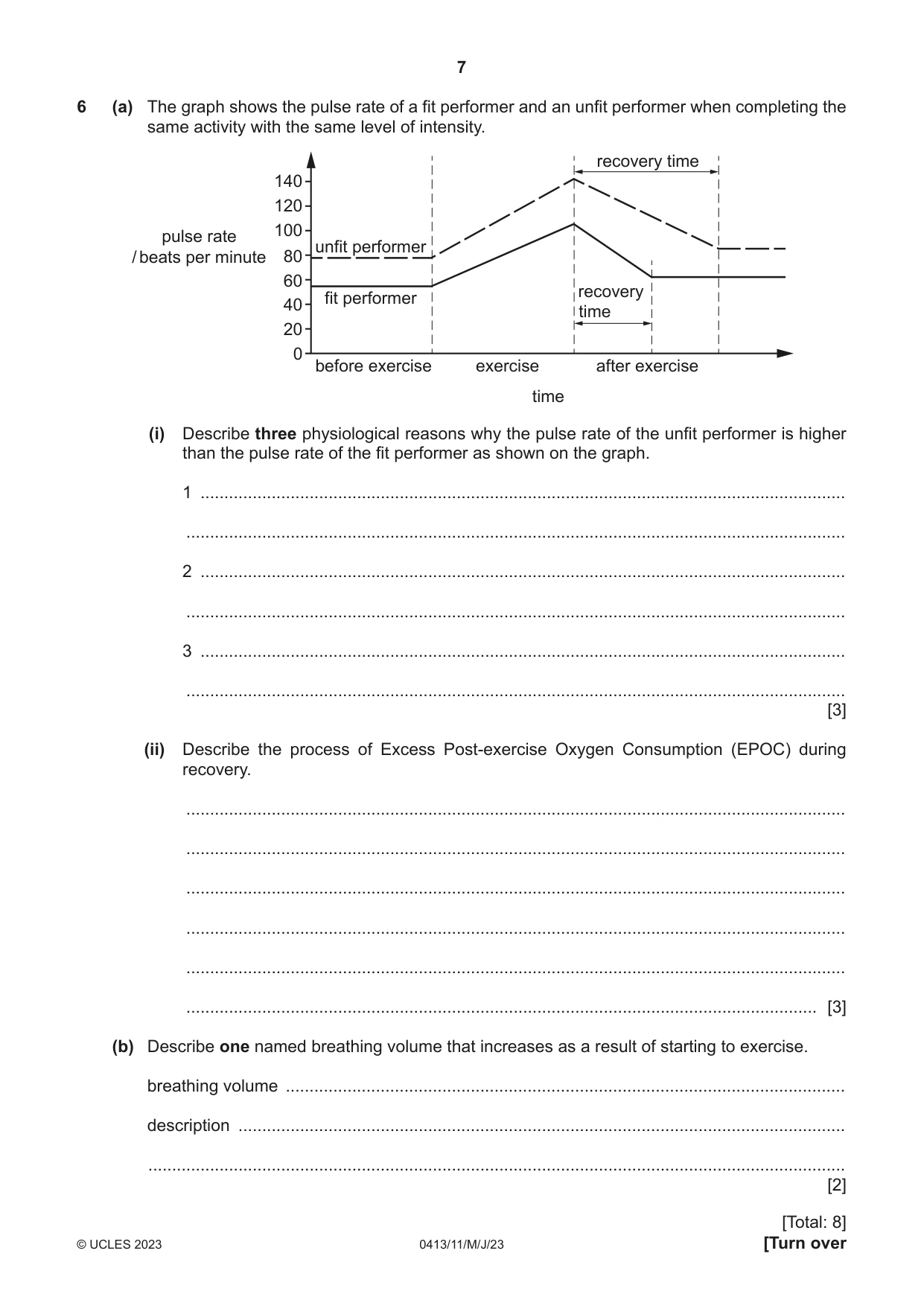
7 0413/11/M/J/23 © UCLES 2023 [Turn over 6 (a) The graph shows the pulse rate of a fit performer and an unfit performer when completing the same activity with the same level of intensity. 140 120 100 80 60 40 20 0 before exercise after exercise time exercise pulse rate / beats per minute unfit performer fit performer recovery time recovery time (i) Describe three physiological reasons why the pulse rate of the unfit performer is higher than the pulse rate of the fit performer as shown on the graph. 1 … … 2 … … 3 … … [3] (ii) Describe the process of Excess Post‑exercise Oxygen Consumption (EPOC) during recovery. … … … … … … [3] (b) Describe one named breathing volume that increases as a result of starting to exercise. breathing volume … description … … [2] [Total: 8]
Question paper, page 8
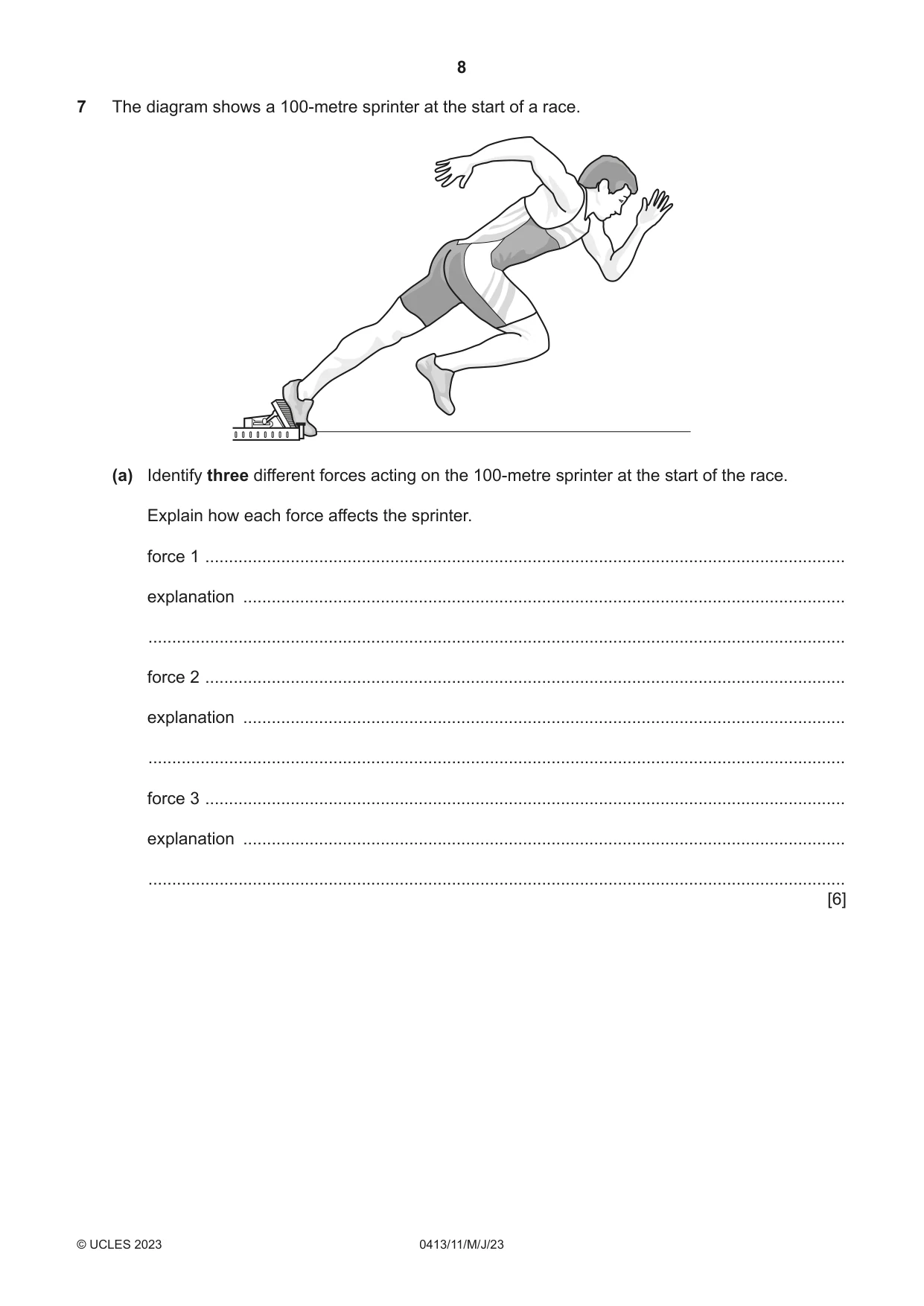
8 0413/11/M/J/23 © UCLES 2023 7 The diagram shows a 100‑metre sprinter at the start of a race. (a) Identify three different forces acting on the 100‑metre sprinter at the start of the race. Explain how each force affects the sprinter. force 1 … explanation … … force 2 … explanation … … force 3 … explanation … … [6]
Question paper, page 9
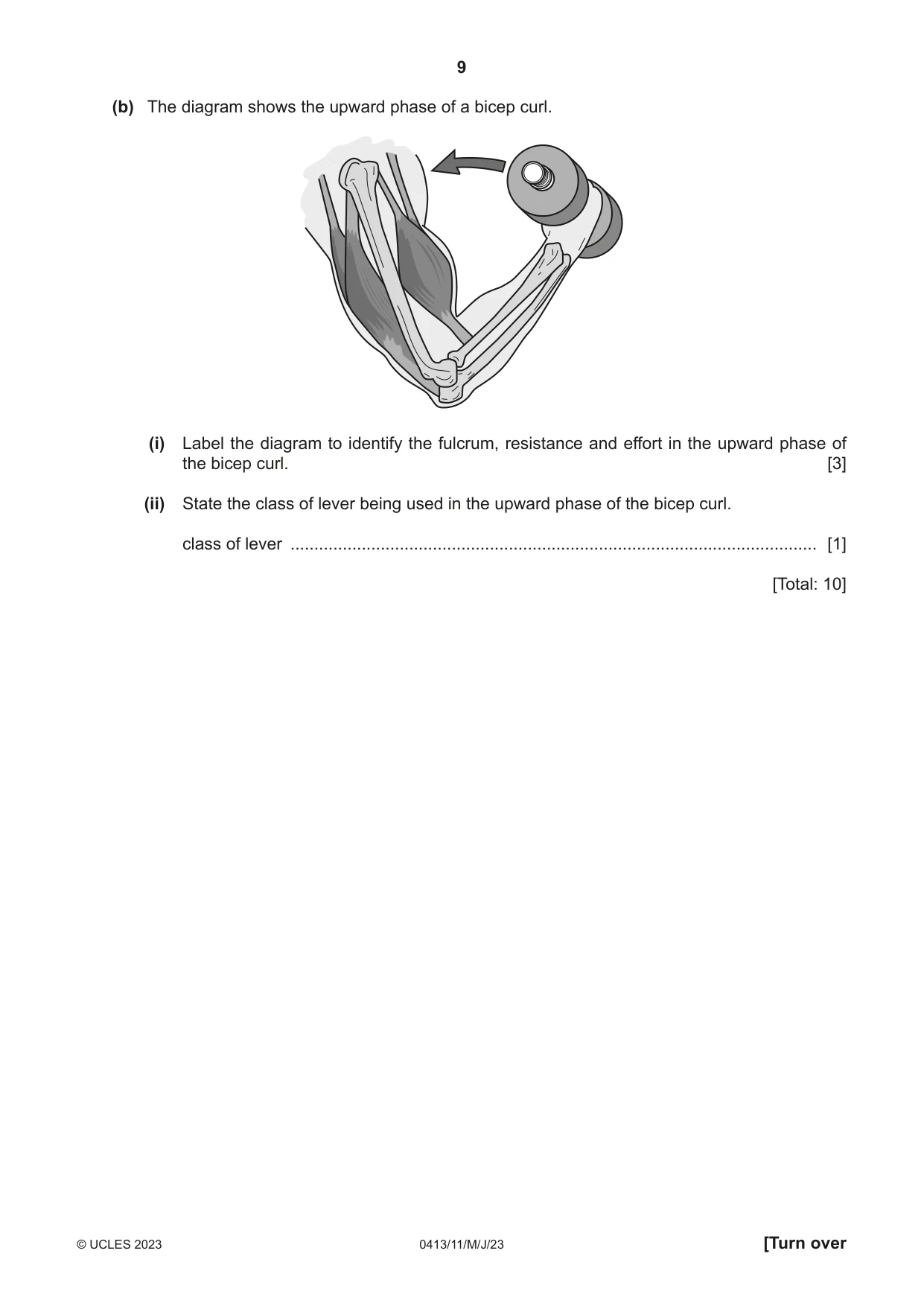
9 0413/11/M/J/23 © UCLES 2023 [Turn over (b) The diagram shows the upward phase of a bicep curl. (i) Label the diagram to identify the fulcrum, resistance and effort in the upward phase of the bicep curl. [3] (ii) State the class of lever being used in the upward phase of the bicep curl. class of lever … [1] [Total: 10]
Question paper, page 10
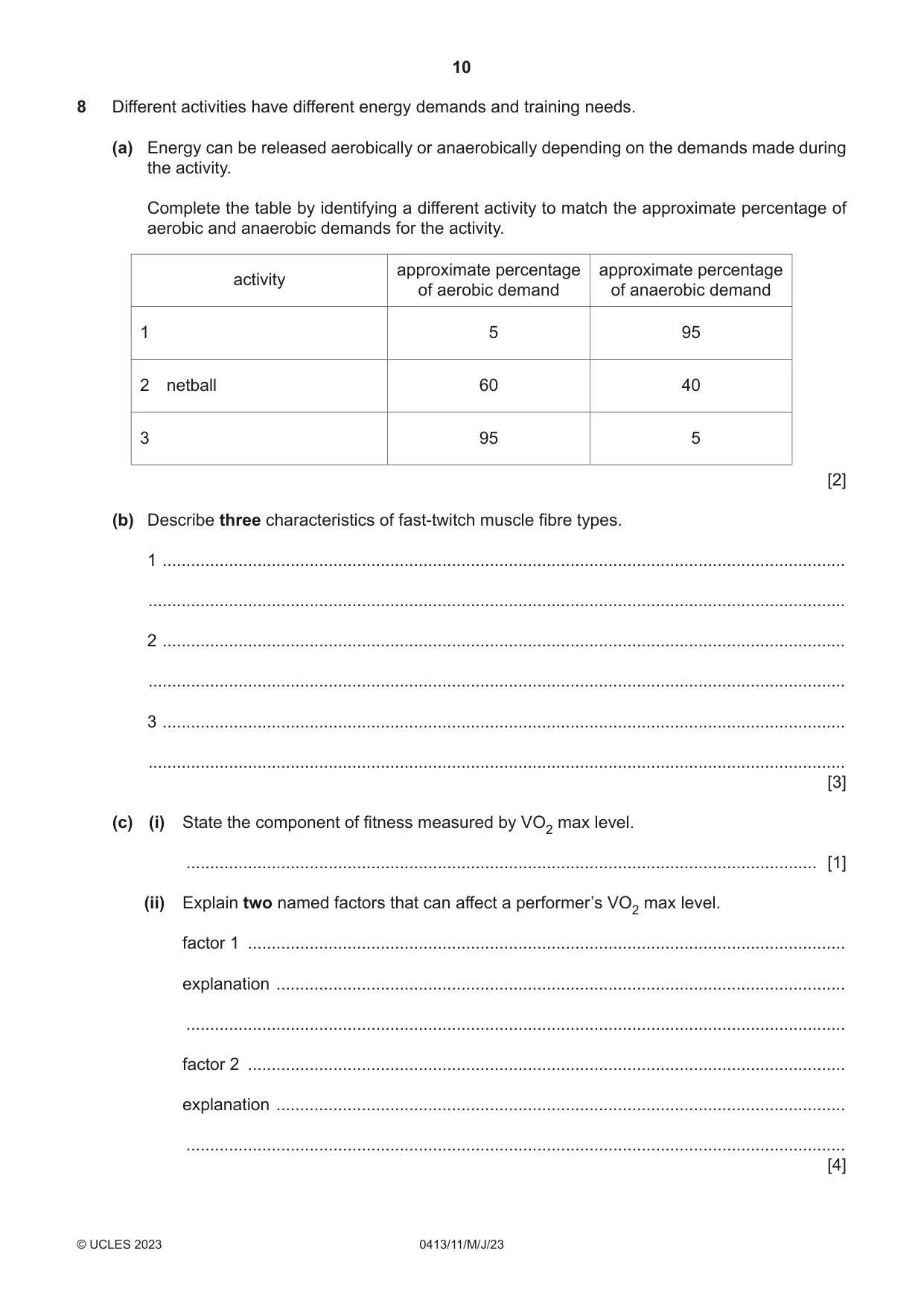
10 0413/11/M/J/23 © UCLES 2023 8 Different activities have different energy demands and training needs. (a) Energy can be released aerobically or anaerobically depending on the demands made during the activity. Complete the table by identifying a different activity to match the approximate percentage of aerobic and anaerobic demands for the activity. activity approximate percentage of aerobic demand approximate percentage of anaerobic demand 1 5 95 2 netball 60 40 3 95 5 [2] (b) Describe three characteristics of fast‑twitch muscle fibre types. 1 … … 2 … … 3 … … [3] (c) (i) State the component of fitness measured by VO2 max level. … [1] (ii) Explain two named factors that can affect a performer’s VO2 max level. factor 1 … explanation … … factor 2 … explanation … … [4]
Question paper, page 11
11 0413/11/M/J/23 © UCLES 2023 [Turn over (d) Explain two advantages and two disadvantages of high‑altitude training for performers who take part in endurance events. advantage 1 … … advantage 2 … … disadvantage 1 … … disadvantage 2 … … [4] [Total: 14]
Question paper, page 12
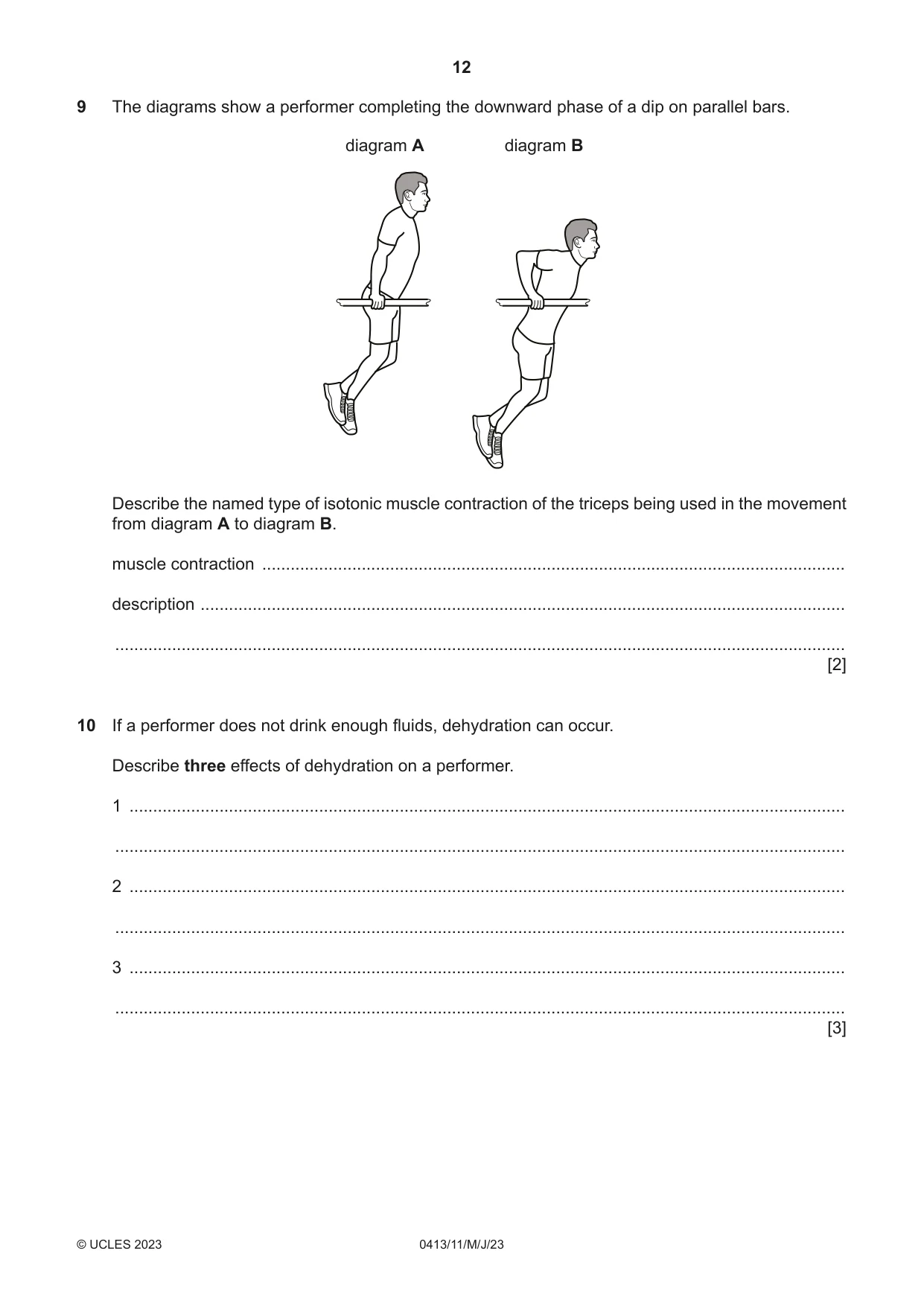
12 0413/11/M/J/23 © UCLES 2023 9 The diagrams show a performer completing the downward phase of a dip on parallel bars. diagram A diagram B Describe the named type of isotonic muscle contraction of the triceps being used in the movement from diagram A to diagram B. muscle contraction … description … … [2] 10 If a performer does not drink enough fluids, dehydration can occur. Describe three effects of dehydration on a performer. 1 … … 2 … … 3 … … [3]
Question paper, page 13
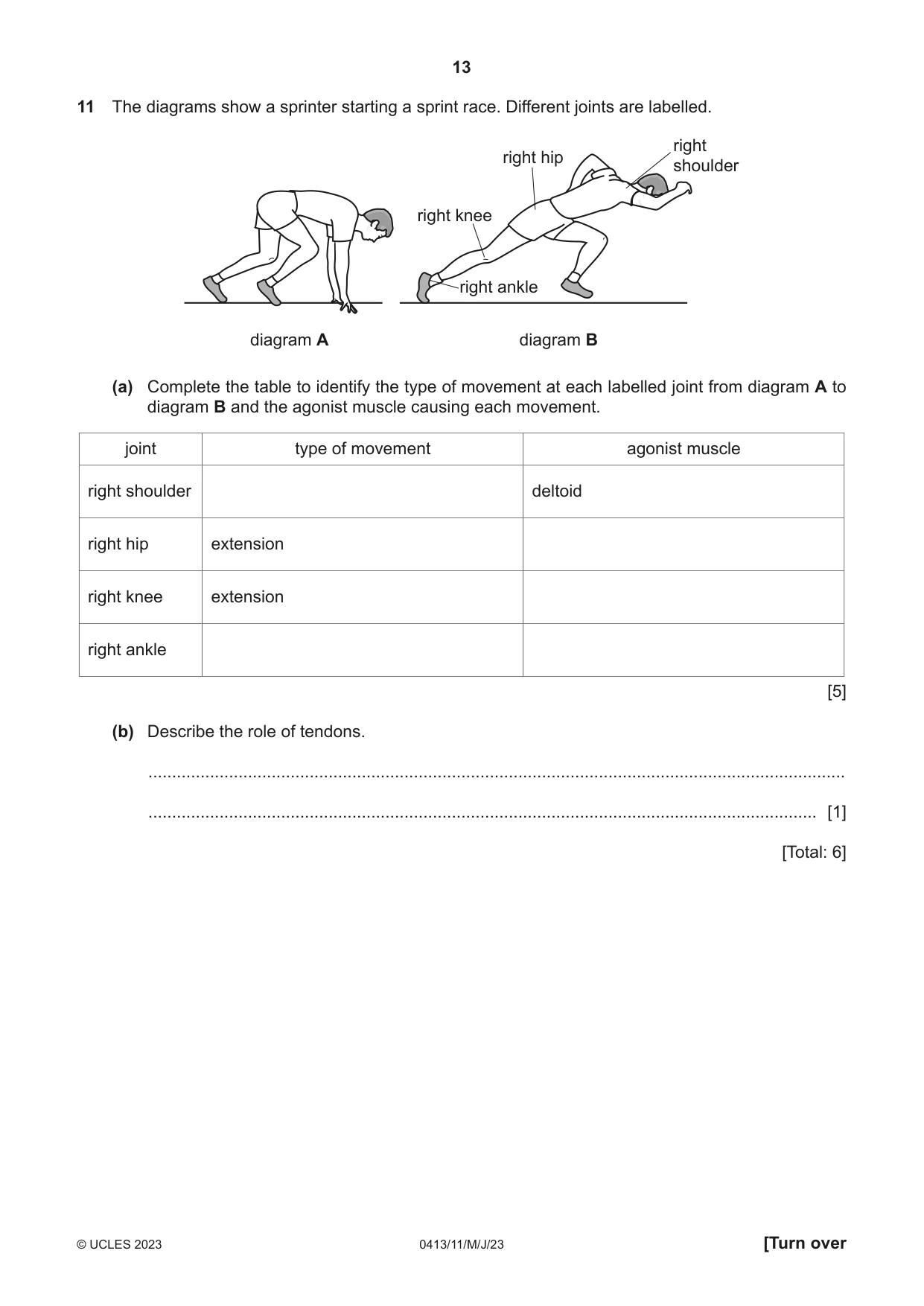
13 0413/11/M/J/23 © UCLES 2023 [Turn over 11 The diagrams show a sprinter starting a sprint race. Different joints are labelled. right knee right ankle right hip right shoulder diagram A diagram B (a) Complete the table to identify the type of movement at each labelled joint from diagram A to diagram B and the agonist muscle causing each movement. joint type of movement agonist muscle right shoulder deltoid right hip extension right knee extension right ankle [5] (b) Describe the role of tendons. … … [1] [Total: 6]
Question paper, page 14
14 0413/11/M/J/23 © UCLES 2023 12 Access to facilities can be a barrier to participation in physical activities for performers with a disability. (a) Identify two other barriers that can affect participation of performers with a disability. Suggest a strategy to overcome each barrier named. barrier 1 … strategy … … barrier 2 … strategy … … [4] (b) The Paralympics is a global event for performers with disabilities. Outline some advantages of being a host nation of a global event. … … … … … … … … [4] [Total: 8]
Question paper, page 15
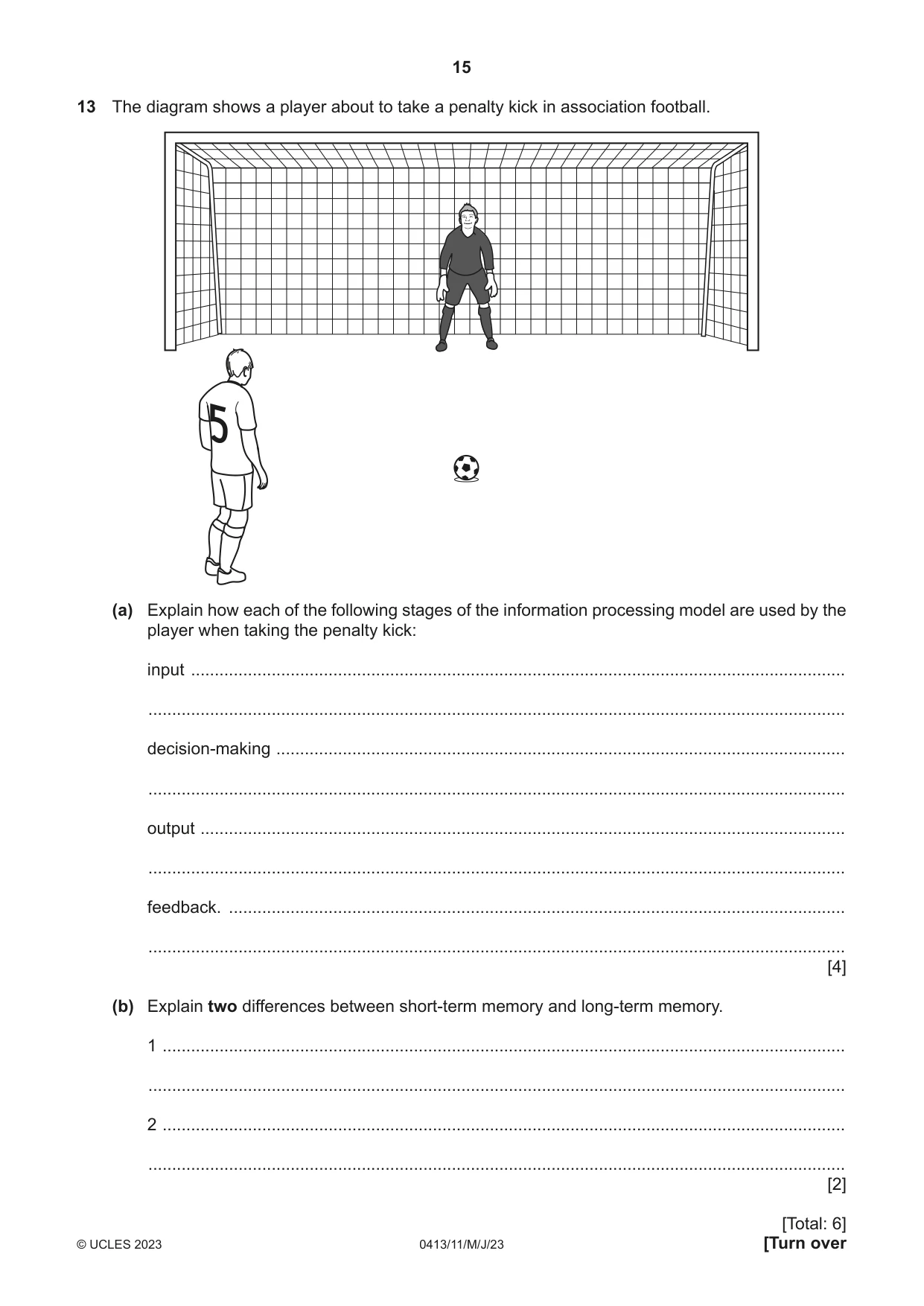
15 0413/11/M/J/23 © UCLES 2023 [Turn over 13 The diagram shows a player about to take a penalty kick in association football. (a) Explain how each of the following stages of the information processing model are used by the player when taking the penalty kick: input … … decision‑making … … output … … feedback. … … [4] (b) Explain two differences between short‑term memory and long‑term memory. 1 … … 2 … … [2] [Total: 6]
Question paper, page 16
16 0413/11/M/J/23 © UCLES 2023 Permission to reproduce items where third‑party owned material protected by copyright is included has been sought and cleared where possible. Every reasonable effort has been made by the publisher (UCLES) to trace copyright holders, but if any items requiring clearance have unwittingly been included, the publisher will be pleased to make amends at the earliest possible opportunity. To avoid the issue of disclosure of answer‑related information to candidates, all copyright acknowledgements are reproduced online in the Cambridge Assessment International Education Copyright Acknowledgements Booklet. This is produced for each series of examinations and is freely available to download at www.cambridgeinternational.org after the live examination series. Cambridge Assessment International Education is part of Cambridge Assessment. Cambridge Assessment is the brand name of the University of Cambridge Local Examinations Syndicate (UCLES), which is a department of the University of Cambridge. 14 (a) A coach may test the fitness levels of a cross‑country runner to see if the performer is suitable for the activity. Describe two other reasons for testing the fitness levels of a performer. 1 … … 2 … … [2] (b) Before every training session the cross‑country runner completes a warm up which may reduce the risk of injury. Describe two other ways the cross‑country runner could reduce the risk of injury. 1 … … 2 … … [2] (c) A cross‑country runner may use continuous training as their main method of training. Explain two advantages for a cross‑country runner of using continuous training. … … … … [2] [Total: 6]
Mark scheme, page 1
This document consists of 21 printed pages. © UCLES 2023 [Turn over Cambridge IGCSE™ PHYSICAL EDUCATION 0413/11 Paper 1 Theory May/June 2023 MARK SCHEME Maximum Mark: 100 Published This mark scheme is published as an aid to teachers and candidates, to indicate the requirements of the examination. It shows the basis on which Examiners were instructed to award marks. It does not indicate the details of the discussions that took place at an Examiners’ meeting before marking began, which would have considered the acceptability of alternative answers. Mark schemes should be read in conjunction with the question paper and the Principal Examiner Report for Teachers. Cambridge International will not enter into discussions about these mark schemes. Cambridge International is publishing the mark schemes for the May/June 2023 series for most Cambridge IGCSE, Cambridge International A and AS Level and Cambridge Pre-U components, and some Cambridge O Level components.
Mark scheme, page 2
0413/11 Cambridge IGCSE – Mark Scheme PUBLISHED May/June 2023 © UCLES 2023 Page 2 of 21 Generic Marking Principles These general marking principles must be applied by all examiners when marking candidate answers. They should be applied alongside the specific content of the mark scheme or generic level descriptors for a question. Each question paper and mark scheme will also comply with these marking principles. GENERIC MARKING PRINCIPLE 1: Marks must be awarded in line with: the specific content of the mark scheme or the generic level descriptors for the question the specific skills defined in the mark scheme or in the generic level descriptors for the question the standard of response required by a candidate as exemplified by the standardisation scripts. GENERIC MARKING PRINCIPLE 2: Marks awarded are always whole marks (not half marks, or other fractions). GENERIC MARKING PRINCIPLE 3: Marks must be awarded positively: marks are awarded for correct/valid answers, as defined in the mark scheme. However, credit is given for valid answers which go beyond the scope of the syllabus and mark scheme, referring to your Team Leader as appropriate marks are awarded when candidates clearly demonstrate what they know and can do marks are not deducted for errors marks are not deducted for omissions answers should only be judged on the quality of spelling, punctuation and grammar when these features are specifically assessed by the question as indicated by the mark scheme. The meaning, however, should be unambiguous. GENERIC MARKING PRINCIPLE 4: Rules must be applied consistently, e.g. in situations where candidates have not followed instructions or in the application of generic level descriptors.
Mark scheme, page 3
0413/11 Cambridge IGCSE – Mark Scheme PUBLISHED May/June 2023 © UCLES 2023 Page 3 of 21 GENERIC MARKING PRINCIPLE 5: Marks should be awarded using the full range of marks defined in the mark scheme for the question (however; the use of the full mark range may be limited according to the quality of the candidate responses seen). GENERIC MARKING PRINCIPLE 6: Marks awarded are based solely on the requirements as defined in the mark scheme. Marks should not be awarded with grade thresholds or grade descriptors in mind. Science-Specific Marking Principles 1 Examiners should consider the context and scientific use of any keywords when awarding marks. Although keywords may be present, marks should not be awarded if the keywords are used incorrectly. 2 The examiner should not choose between contradictory statements given in the same question part, and credit should not be awarded for any correct statement that is contradicted within the same question part. Wrong science that is irrelevant to the question should be ignored. 3 Although spellings do not have to be correct, spellings of syllabus terms must allow for clear and unambiguous separation from other syllabus terms with which they may be confused (e.g. ethane / ethene, glucagon / glycogen, refraction / reflection). 4 The error carried forward (ecf) principle should be applied, where appropriate. If an incorrect answer is subsequently used in a scientifically correct way, the candidate should be awarded these subsequent marking points. Further guidance will be included in the mark scheme where necessary and any exceptions to this general principle will be noted. 5 ‘List rule’ guidance For questions that require n responses (e.g. State two reasons …): The response should be read as continuous prose, even when numbered answer spaces are provided. Any response marked ignore in the mark scheme should not count towards n. Incorrect responses should not be awarded credit but will still count towards n. Read the entire response to check for any responses that contradict those that would otherwise be credited. Credit should not be awarded for any responses that are contradicted within the rest of the response. Where two responses contradict one another, this should be treated as a single incorrect response. Non-contradictory responses after the first n responses may be ignored even if they include incorrect science.
Mark scheme, page 4
0413/11 Cambridge IGCSE – Mark Scheme PUBLISHED May/June 2023 © UCLES 2023 Page 4 of 21 6 Calculation specific guidance Correct answers to calculations should be given full credit even if there is no working or incorrect working, unless the question states ‘show your working’. For questions in which the number of significant figures required is not stated, credit should be awarded for correct answers when rounded by the examiner to the number of significant figures given in the mark scheme. This may not apply to measured values. For answers given in standard form (e.g. a 10n) in which the convention of restricting the value of the coefficient (a) to a value between 1 and 10 is not followed, credit may still be awarded if the answer can be converted to the answer given in the mark scheme. Unless a separate mark is given for a unit, a missing or incorrect unit will normally mean that the final calculation mark is not awarded. Exceptions to this general principle will be noted in the mark scheme. 7 Guidance for chemical equations Multiples / fractions of coefficients used in chemical equations are acceptable unless stated otherwise in the mark scheme. State symbols given in an equation should be ignored unless asked for in the question or stated otherwise in the mark scheme.
Mark scheme, page 5
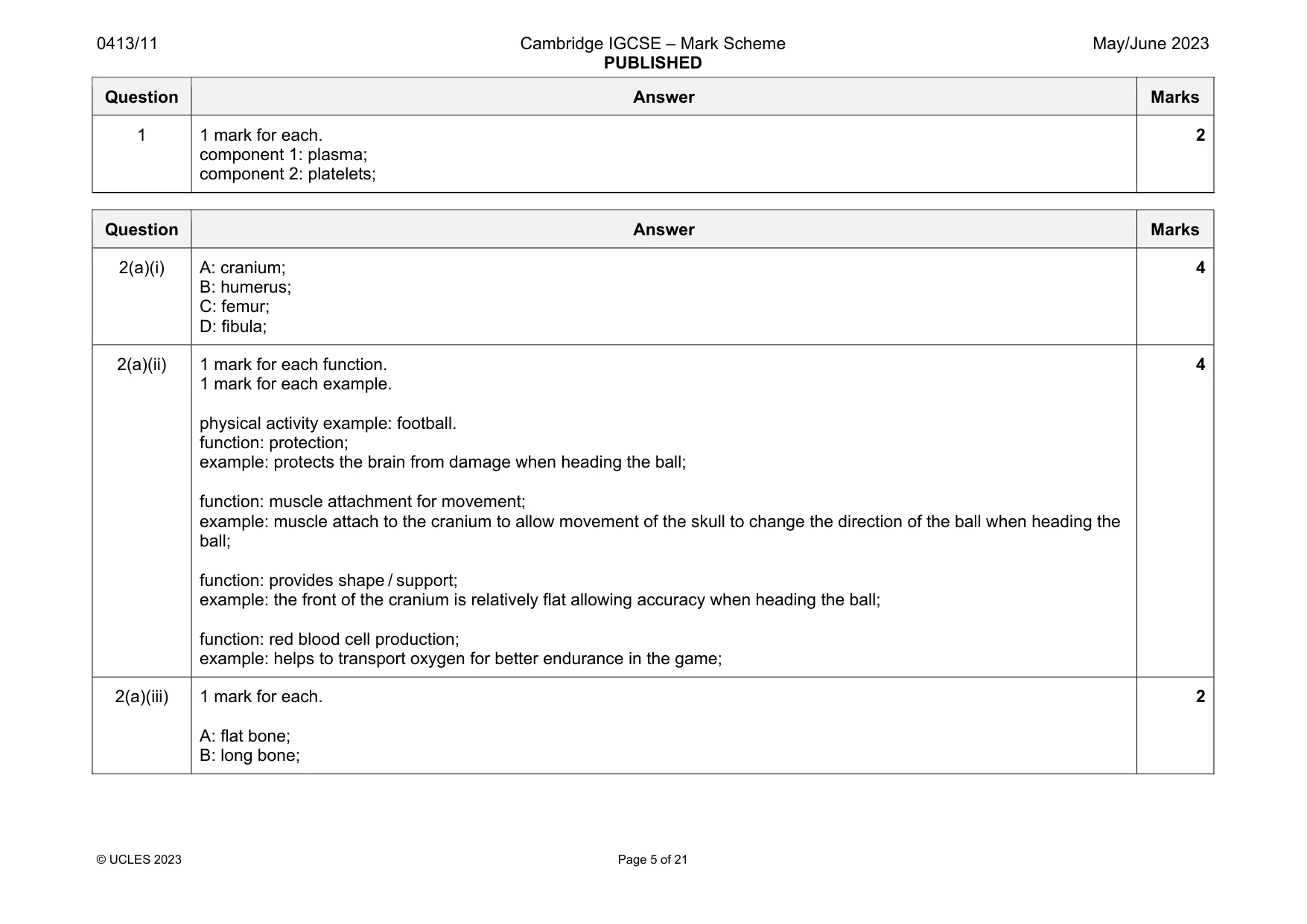
0413/11 Cambridge IGCSE – Mark Scheme PUBLISHED May/June 2023 © UCLES 2023 Page 5 of 21 Question Answer Marks 1 1 mark for each. component 1: plasma; component 2: platelets; 2 Question Answer Marks 2(a)(i) A: cranium; B: humerus; C: femur; D: fibula; 4 2(a)(ii) 1 mark for each function. 1 mark for each example. physical activity example: football. function: protection; example: protects the brain from damage when heading the ball; function: muscle attachment for movement; example: muscle attach to the cranium to allow movement of the skull to change the direction of the ball when heading the ball; function: provides shape / support; example: the front of the cranium is relatively flat allowing accuracy when heading the ball; function: red blood cell production; example: helps to transport oxygen for better endurance in the game; 4 2(a)(iii) 1 mark for each. A: flat bone; B: long bone; 2
Mark scheme, page 6
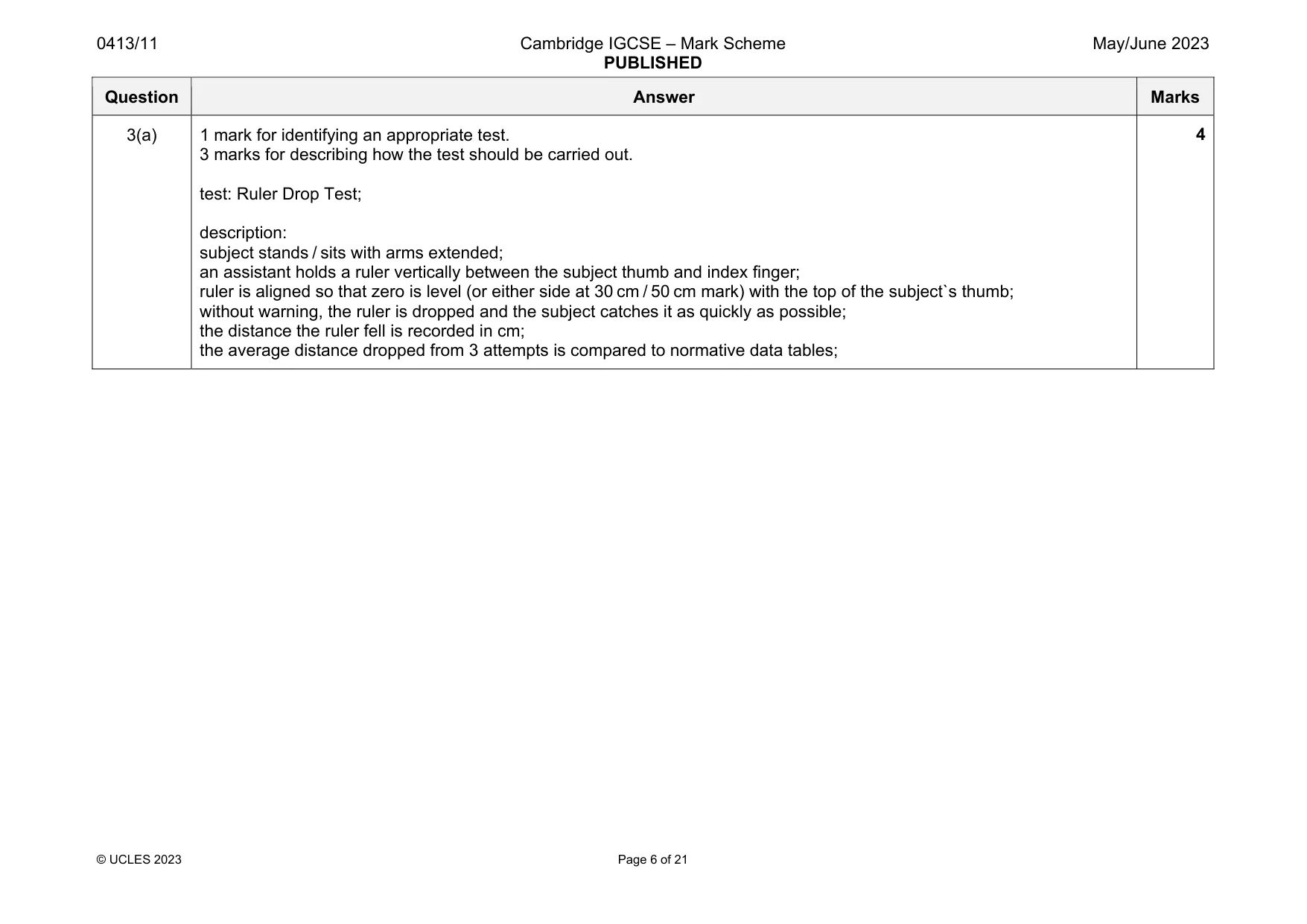
0413/11 Cambridge IGCSE – Mark Scheme PUBLISHED May/June 2023 © UCLES 2023 Page 6 of 21 Question Answer Marks 3(a) 1 mark for identifying an appropriate test. 3 marks for describing how the test should be carried out. test: Ruler Drop Test; description: subject stands / sits with arms extended; an assistant holds a ruler vertically between the subject thumb and index finger; ruler is aligned so that zero is level (or either side at 30 cm / 50 cm mark) with the top of the subject`s thumb; without warning, the ruler is dropped and the subject catches it as quickly as possible; the distance the ruler fell is recorded in cm; the average distance dropped from 3 attempts is compared to normative data tables; 4
Mark scheme, page 7
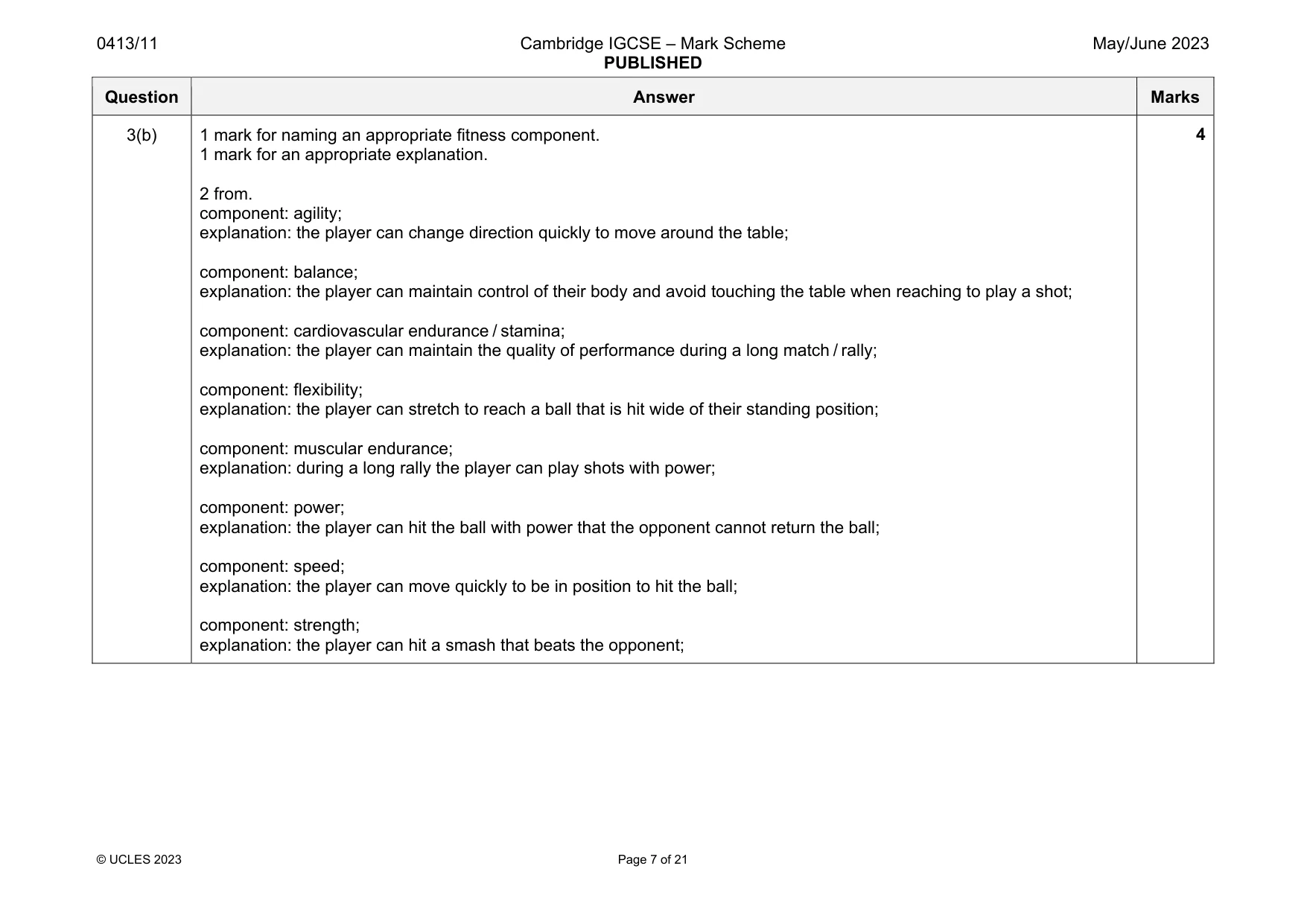
0413/11 Cambridge IGCSE – Mark Scheme PUBLISHED May/June 2023 © UCLES 2023 Page 7 of 21 Question Answer Marks 3(b) 1 mark for naming an appropriate fitness component. 1 mark for an appropriate explanation. 2 from. component: agility; explanation: the player can change direction quickly to move around the table; component: balance; explanation: the player can maintain control of their body and avoid touching the table when reaching to play a shot; component: cardiovascular endurance / stamina; explanation: the player can maintain the quality of performance during a long match / rally; component: flexibility; explanation: the player can stretch to reach a ball that is hit wide of their standing position; component: muscular endurance; explanation: during a long rally the player can play shots with power; component: power; explanation: the player can hit the ball with power that the opponent cannot return the ball; component: speed; explanation: the player can move quickly to be in position to hit the ball; component: strength; explanation: the player can hit a smash that beats the opponent; 4
Mark scheme, page 8
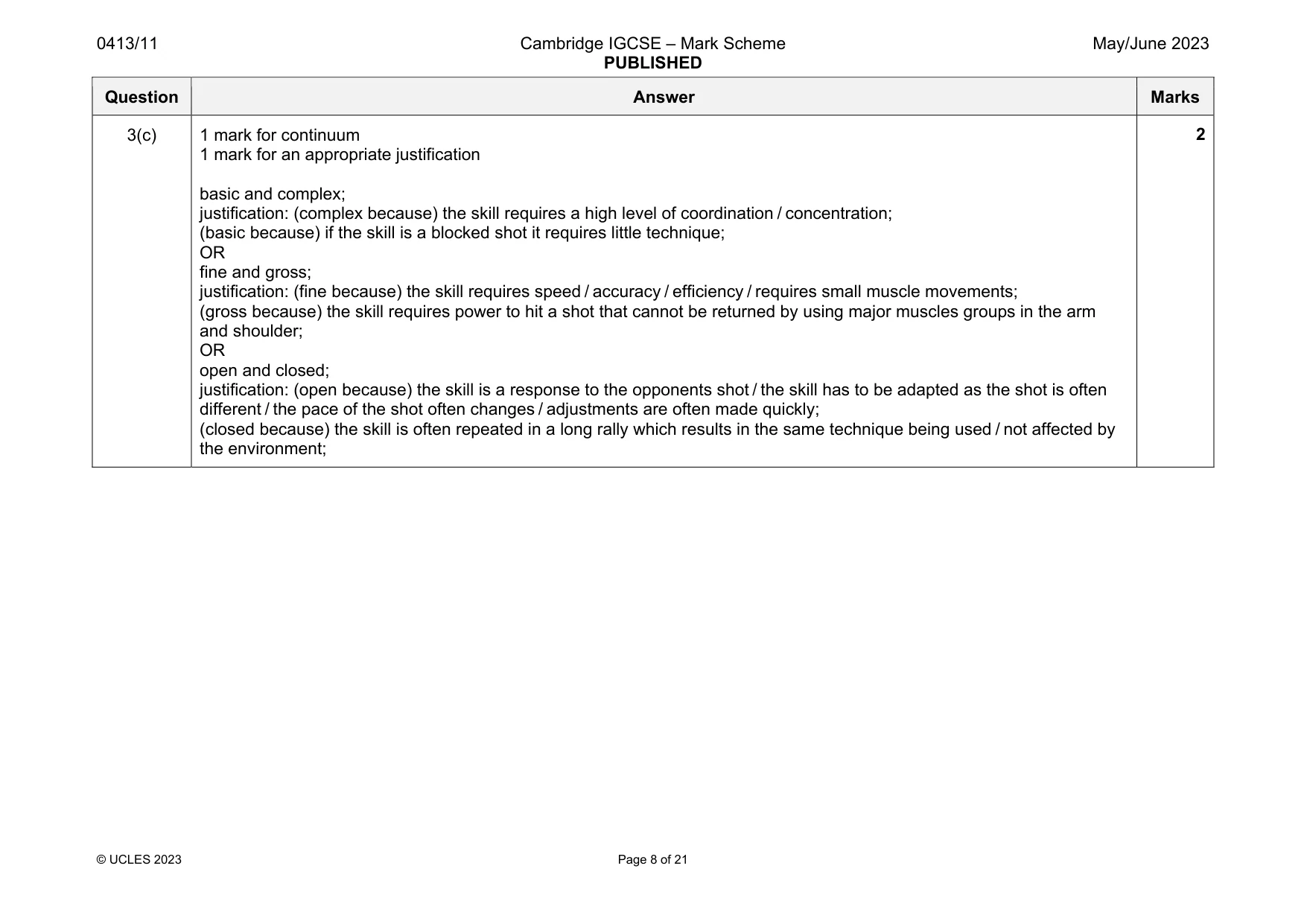
0413/11 Cambridge IGCSE – Mark Scheme PUBLISHED May/June 2023 © UCLES 2023 Page 8 of 21 Question Answer Marks 3(c) 1 mark for continuum 1 mark for an appropriate justification basic and complex; justification: (complex because) the skill requires a high level of coordination / concentration; (basic because) if the skill is a blocked shot it requires little technique; OR fine and gross; justification: (fine because) the skill requires speed / accuracy / efficiency / requires small muscle movements; (gross because) the skill requires power to hit a shot that cannot be returned by using major muscles groups in the arm and shoulder; OR open and closed; justification: (open because) the skill is a response to the opponents shot / the skill has to be adapted as the shot is often different / the pace of the shot often changes / adjustments are often made quickly; (closed because) the skill is often repeated in a long rally which results in the same technique being used / not affected by the environment; 2
Mark scheme, page 9
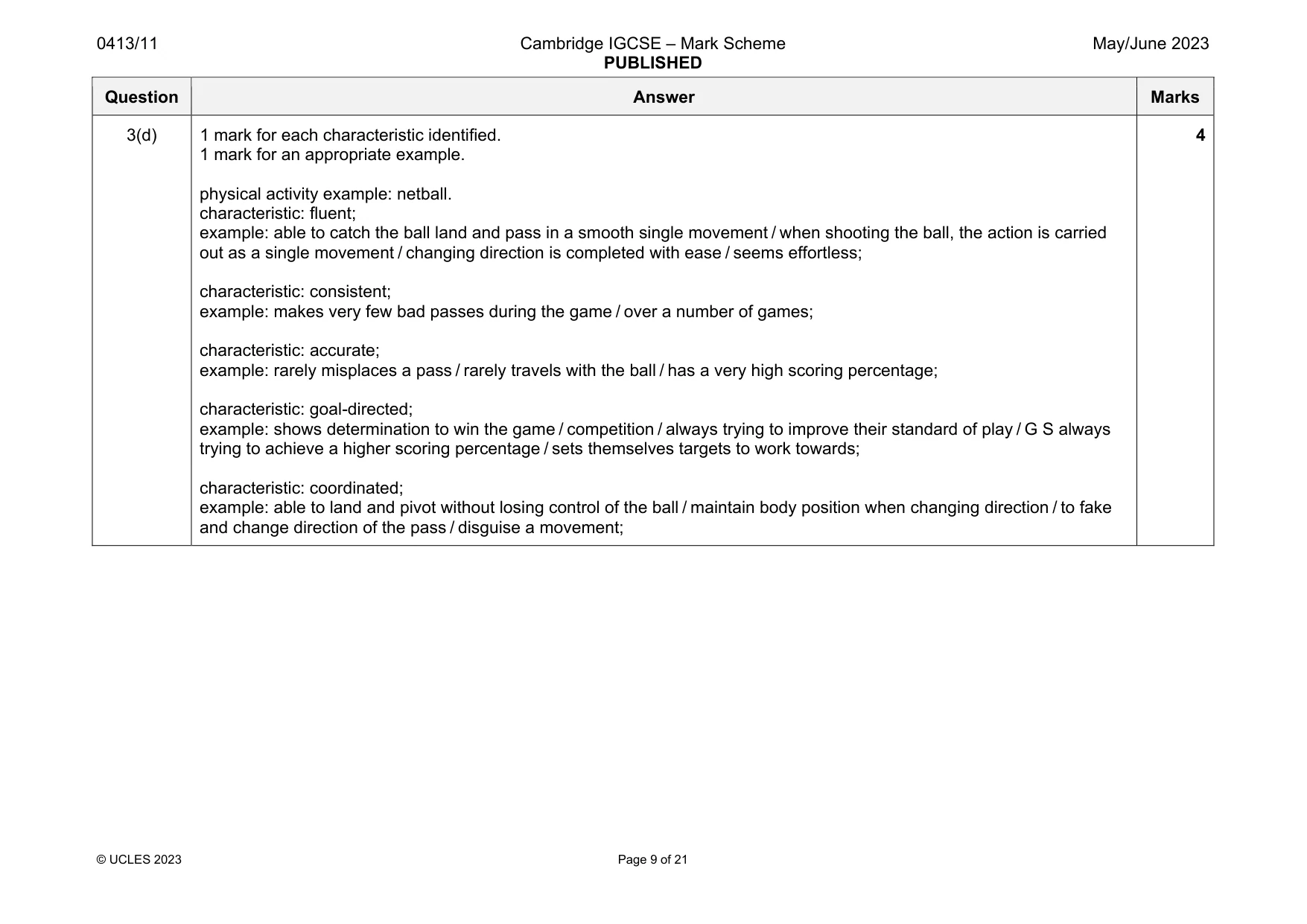
0413/11 Cambridge IGCSE – Mark Scheme PUBLISHED May/June 2023 © UCLES 2023 Page 9 of 21 Question Answer Marks 3(d) 1 mark for each characteristic identified. 1 mark for an appropriate example. physical activity example: netball. characteristic: fluent; example: able to catch the ball land and pass in a smooth single movement / when shooting the ball, the action is carried out as a single movement / changing direction is completed with ease / seems effortless; characteristic: consistent; example: makes very few bad passes during the game / over a number of games; characteristic: accurate; example: rarely misplaces a pass / rarely travels with the ball / has a very high scoring percentage; characteristic: goal-directed; example: shows determination to win the game / competition / always trying to improve their standard of play / G S always trying to achieve a higher scoring percentage / sets themselves targets to work towards; characteristic: coordinated; example: able to land and pivot without losing control of the ball / maintain body position when changing direction / to fake and change direction of the pass / disguise a movement; 4
Mark scheme, page 10
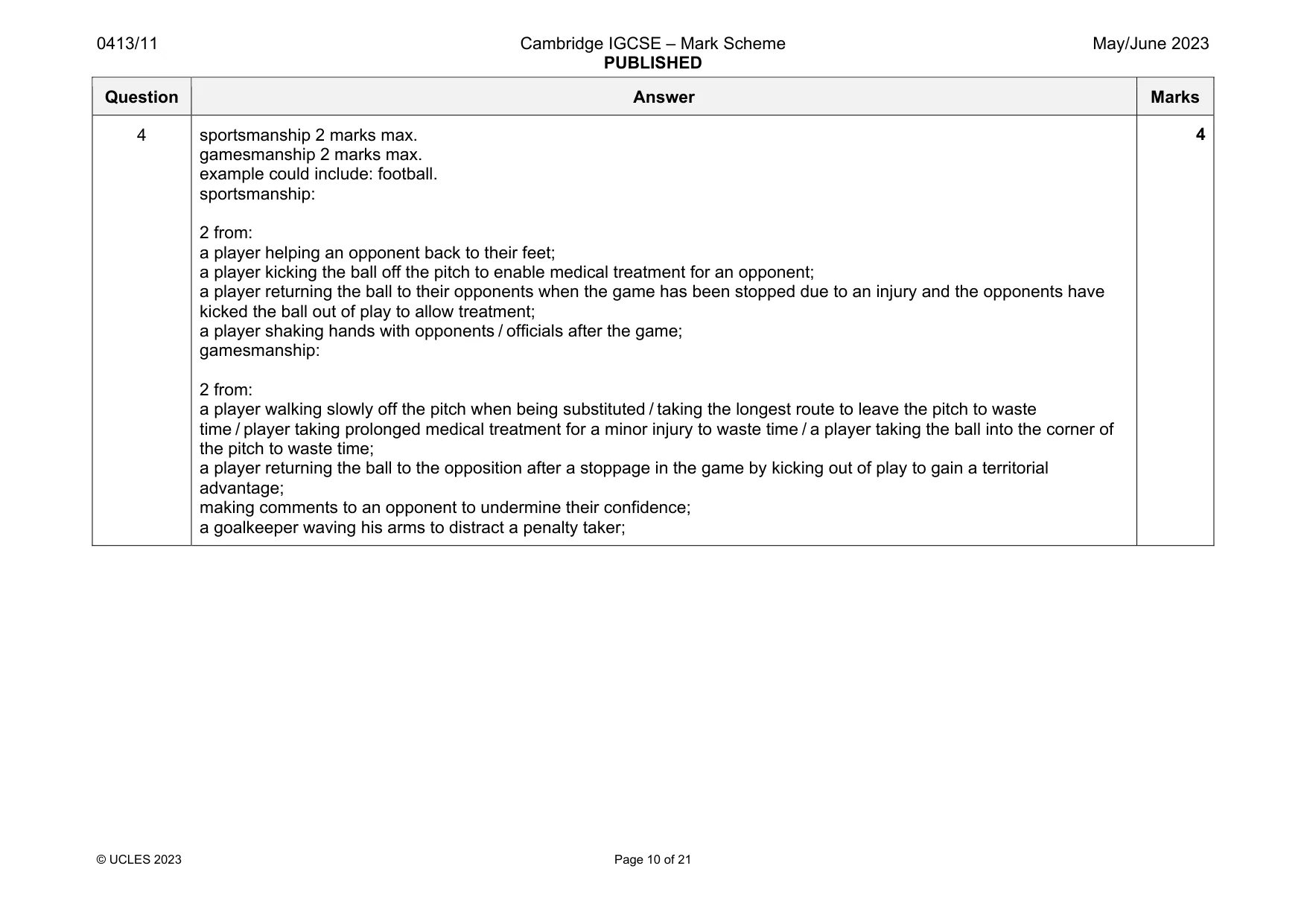
0413/11 Cambridge IGCSE – Mark Scheme PUBLISHED May/June 2023 © UCLES 2023 Page 10 of 21 Question Answer Marks 4 sportsmanship 2 marks max. gamesmanship 2 marks max. example could include: football. sportsmanship: 2 from: a player helping an opponent back to their feet; a player kicking the ball off the pitch to enable medical treatment for an opponent; a player returning the ball to their opponents when the game has been stopped due to an injury and the opponents have kicked the ball out of play to allow treatment; a player shaking hands with opponents / officials after the game; gamesmanship: 2 from: a player walking slowly off the pitch when being substituted / taking the longest route to leave the pitch to waste time / player taking prolonged medical treatment for a minor injury to waste time / a player taking the ball into the corner of the pitch to waste time; a player returning the ball to the opposition after a stoppage in the game by kicking out of play to gain a territorial advantage; making comments to an opponent to undermine their confidence; a goalkeeper waving his arms to distract a penalty taker; 4
Mark scheme, page 11
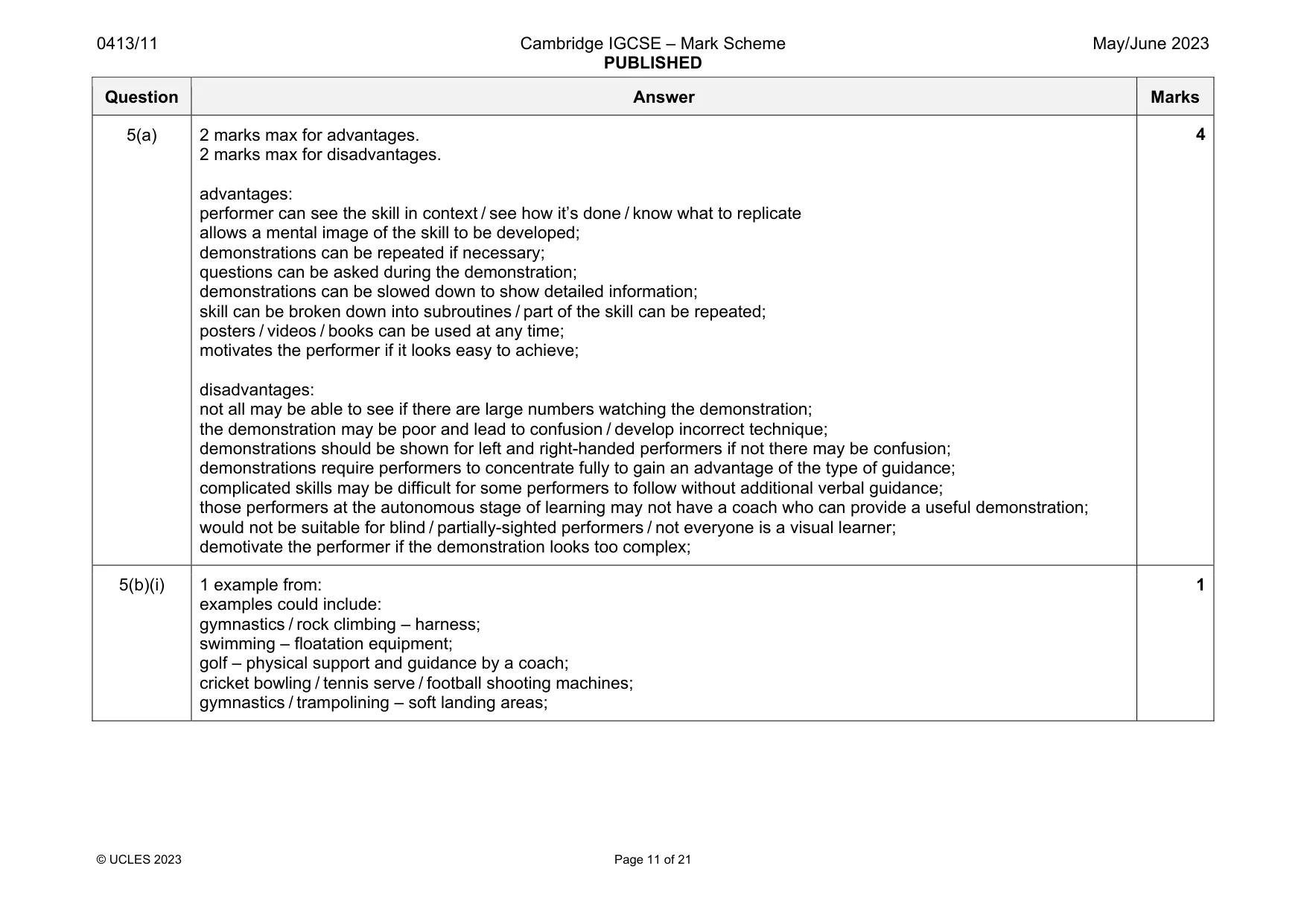
0413/11 Cambridge IGCSE – Mark Scheme PUBLISHED May/June 2023 © UCLES 2023 Page 11 of 21 Question Answer Marks 5(a) 2 marks max for advantages. 2 marks max for disadvantages. advantages: performer can see the skill in context / see how it’s done / know what to replicate allows a mental image of the skill to be developed; demonstrations can be repeated if necessary; questions can be asked during the demonstration; demonstrations can be slowed down to show detailed information; skill can be broken down into subroutines / part of the skill can be repeated; posters / videos / books can be used at any time; motivates the performer if it looks easy to achieve; disadvantages: not all may be able to see if there are large numbers watching the demonstration; the demonstration may be poor and lead to confusion / develop incorrect technique; demonstrations should be shown for left and right-handed performers if not there may be confusion; demonstrations require performers to concentrate fully to gain an advantage of the type of guidance; complicated skills may be difficult for some performers to follow without additional verbal guidance; those performers at the autonomous stage of learning may not have a coach who can provide a useful demonstration; would not be suitable for blind / partially-sighted performers / not everyone is a visual learner; demotivate the performer if the demonstration looks too complex; 4 5(b)(i) 1 example from: examples could include: gymnastics / rock climbing – harness; swimming – floatation equipment; golf – physical support and guidance by a coach; cricket bowling / tennis serve / football shooting machines; gymnastics / trampolining – soft landing areas; 1
Mark scheme, page 12
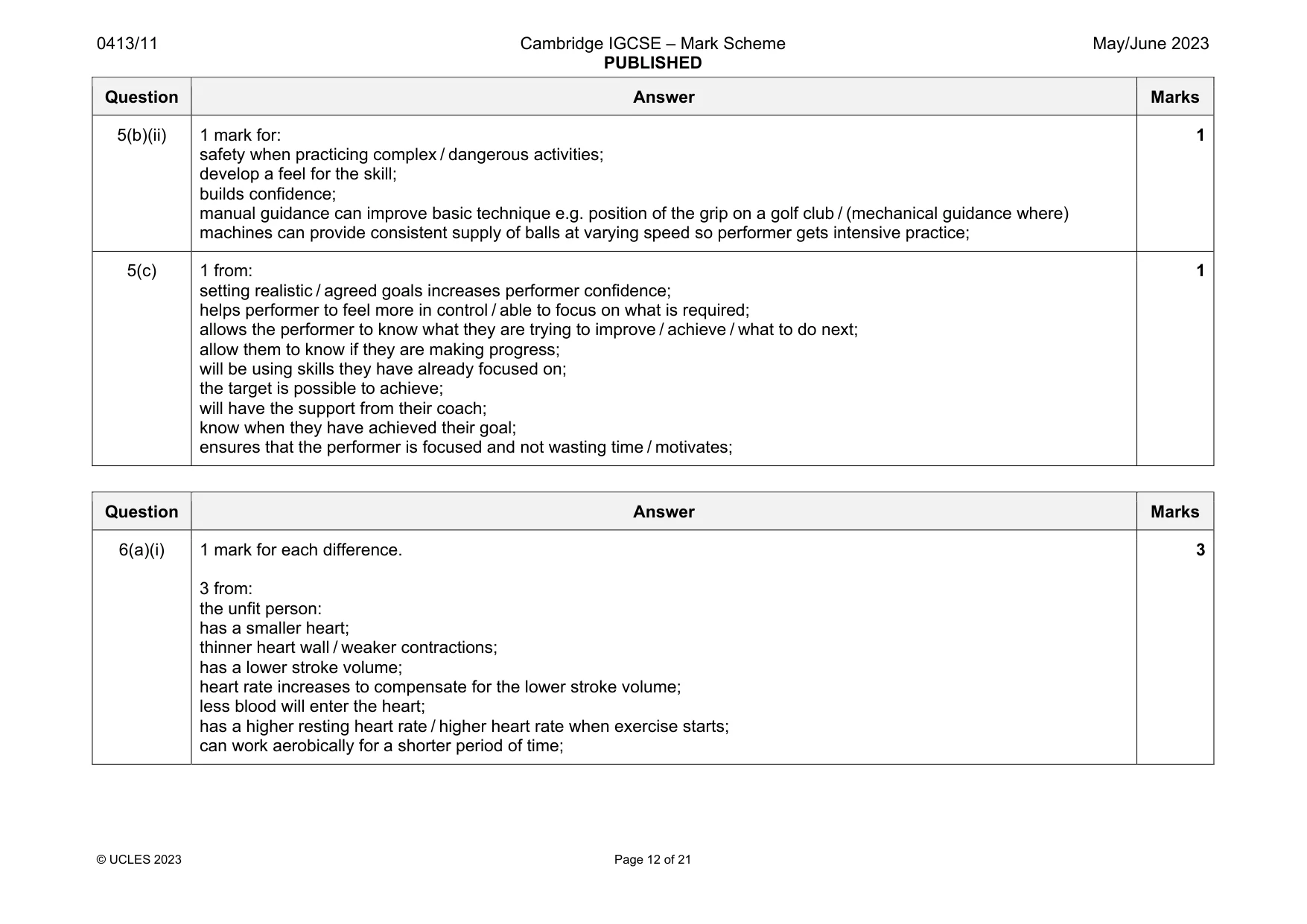
0413/11 Cambridge IGCSE – Mark Scheme PUBLISHED May/June 2023 © UCLES 2023 Page 12 of 21 Question Answer Marks 5(b)(ii) 1 mark for: safety when practicing complex / dangerous activities; develop a feel for the skill; builds confidence; manual guidance can improve basic technique e.g. position of the grip on a golf club / (mechanical guidance where) machines can provide consistent supply of balls at varying speed so performer gets intensive practice; 1 5(c) 1 from: setting realistic / agreed goals increases performer confidence; helps performer to feel more in control / able to focus on what is required; allows the performer to know what they are trying to improve / achieve / what to do next; allow them to know if they are making progress; will be using skills they have already focused on; the target is possible to achieve; will have the support from their coach; know when they have achieved their goal; ensures that the performer is focused and not wasting time / motivates; 1 Question Answer Marks 6(a)(i) 1 mark for each difference. 3 from: the unfit person: has a smaller heart; thinner heart wall / weaker contractions; has a lower stroke volume; heart rate increases to compensate for the lower stroke volume; less blood will enter the heart; has a higher resting heart rate / higher heart rate when exercise starts; can work aerobically for a shorter period of time; 3
Mark scheme, page 13
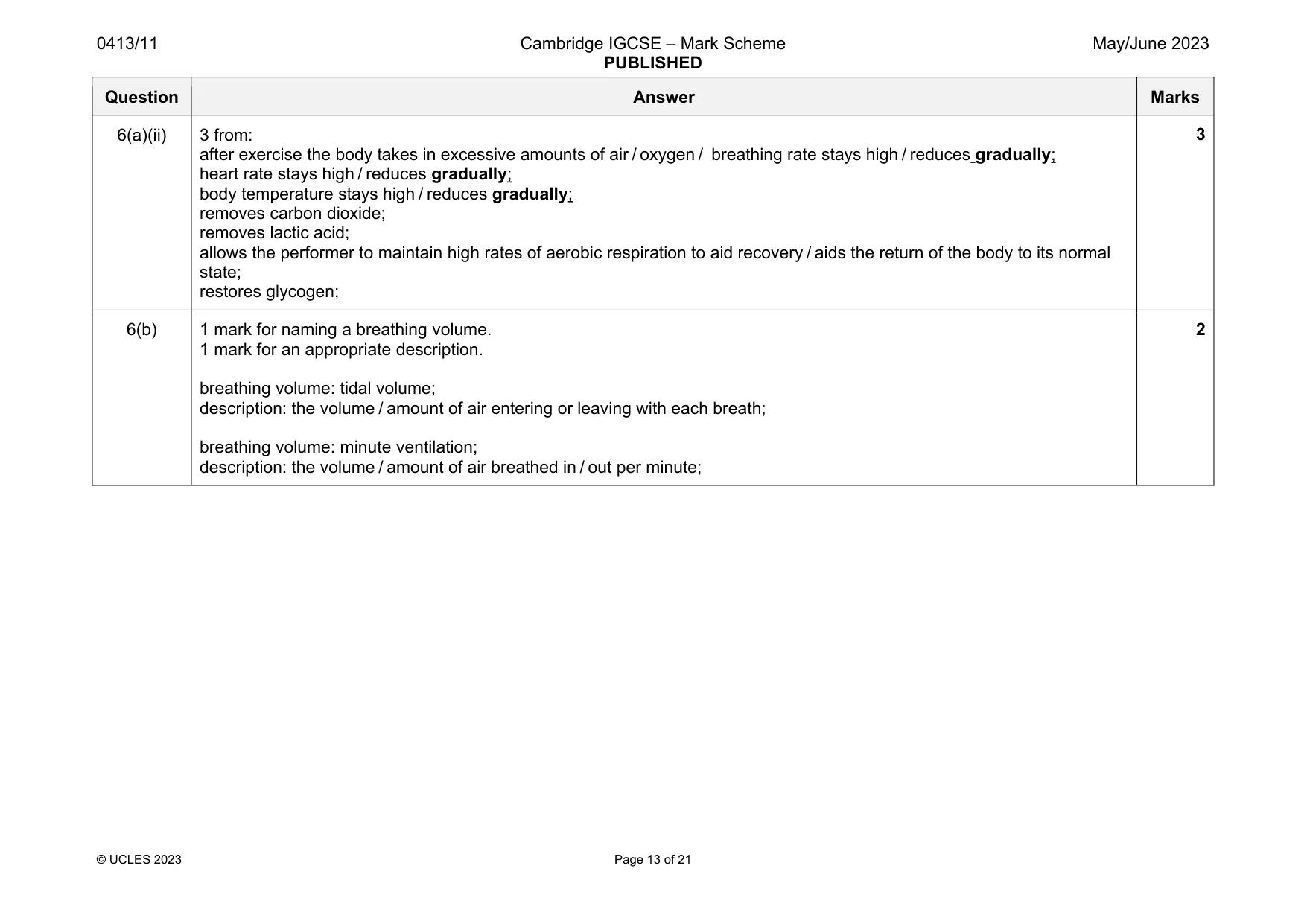
0413/11 Cambridge IGCSE – Mark Scheme PUBLISHED May/June 2023 © UCLES 2023 Page 13 of 21 Question Answer Marks 6(a)(ii) 3 from: after exercise the body takes in excessive amounts of air / oxygen / breathing rate stays high / reduces gradually; heart rate stays high / reduces gradually; body temperature stays high / reduces gradually; removes carbon dioxide; removes lactic acid; allows the performer to maintain high rates of aerobic respiration to aid recovery / aids the return of the body to its normal state; restores glycogen; 3 6(b) 1 mark for naming a breathing volume. 1 mark for an appropriate description. breathing volume: tidal volume; description: the volume / amount of air entering or leaving with each breath; breathing volume: minute ventilation; description: the volume / amount of air breathed in / out per minute; 2
Mark scheme, page 14
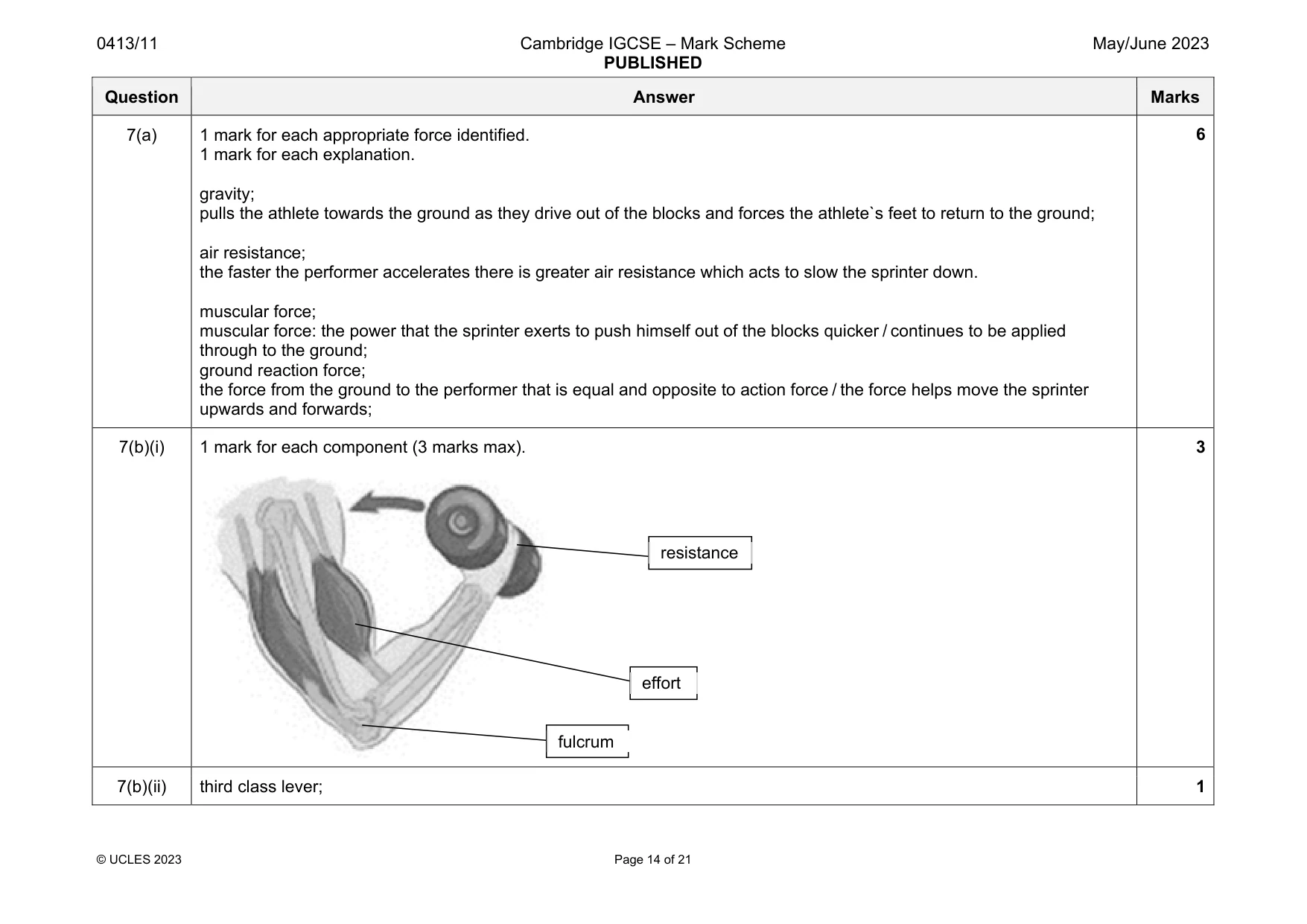
0413/11 Cambridge IGCSE – Mark Scheme PUBLISHED May/June 2023 © UCLES 2023 Page 14 of 21 Question Answer Marks 7(a) 1 mark for each appropriate force identified. 1 mark for each explanation. gravity; pulls the athlete towards the ground as they drive out of the blocks and forces the athlete`s feet to return to the ground; air resistance; the faster the performer accelerates there is greater air resistance which acts to slow the sprinter down. muscular force; muscular force: the power that the sprinter exerts to push himself out of the blocks quicker / continues to be applied through to the ground; ground reaction force; the force from the ground to the performer that is equal and opposite to action force / the force helps move the sprinter upwards and forwards; 6 7(b)(i) 1 mark for each component (3 marks max). 3 7(b)(ii) third class lever; 1 fulcrum effort resistance
Mark scheme, page 15
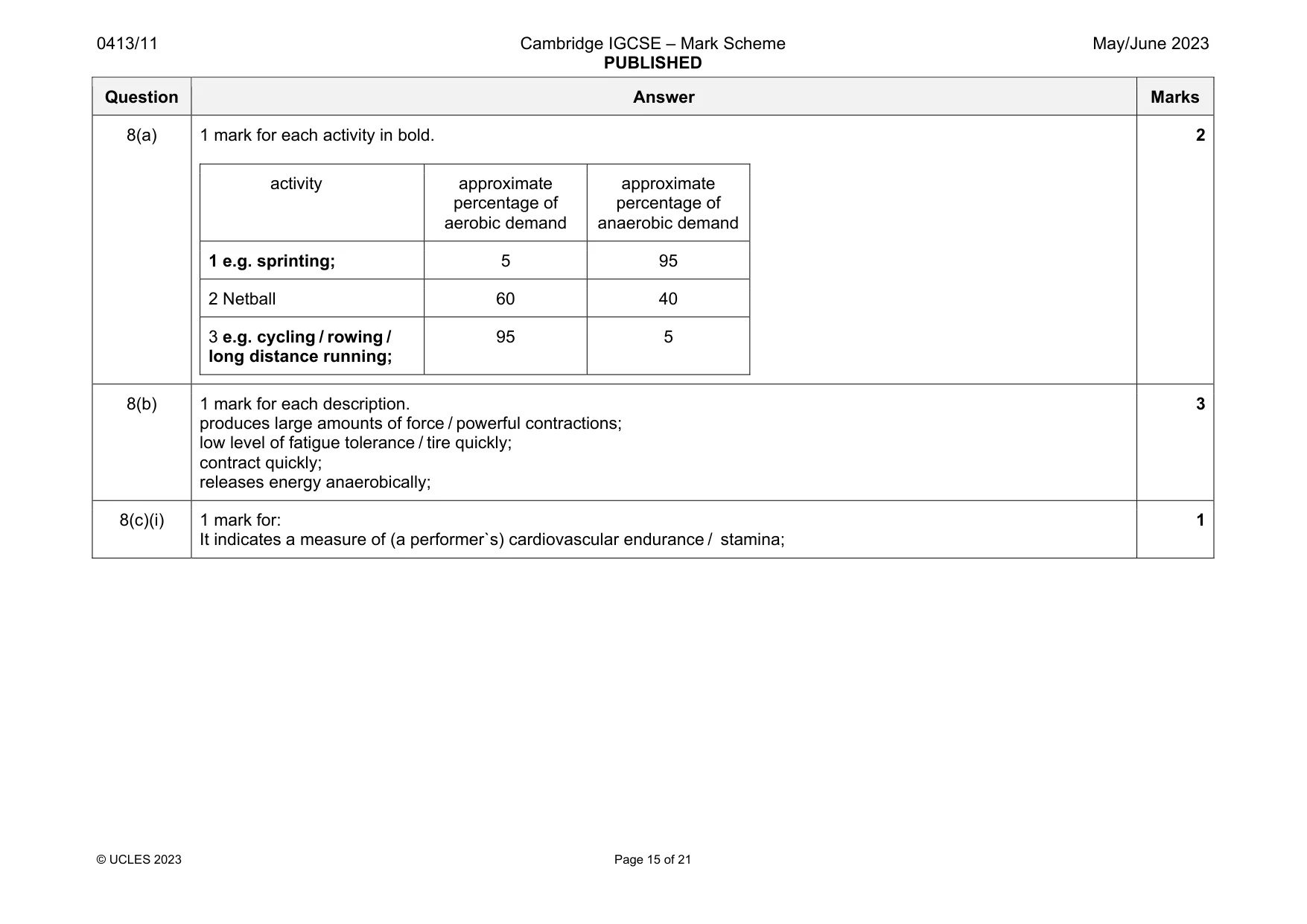
0413/11 Cambridge IGCSE – Mark Scheme PUBLISHED May/June 2023 © UCLES 2023 Page 15 of 21 Question Answer Marks 8(a) 1 mark for each activity in bold. activity approximate percentage of aerobic demand approximate percentage of anaerobic demand 1 e.g. sprinting; 5 95 2 Netball 60 40 3 e.g. cycling / rowing / long distance running; 95 5 2 8(b) 1 mark for each description. produces large amounts of force / powerful contractions; low level of fatigue tolerance / tire quickly; contract quickly; releases energy anaerobically; 3 8(c)(i) 1 mark for: It indicates a measure of (a performer`s) cardiovascular endurance / stamina; 1
Mark scheme, page 16
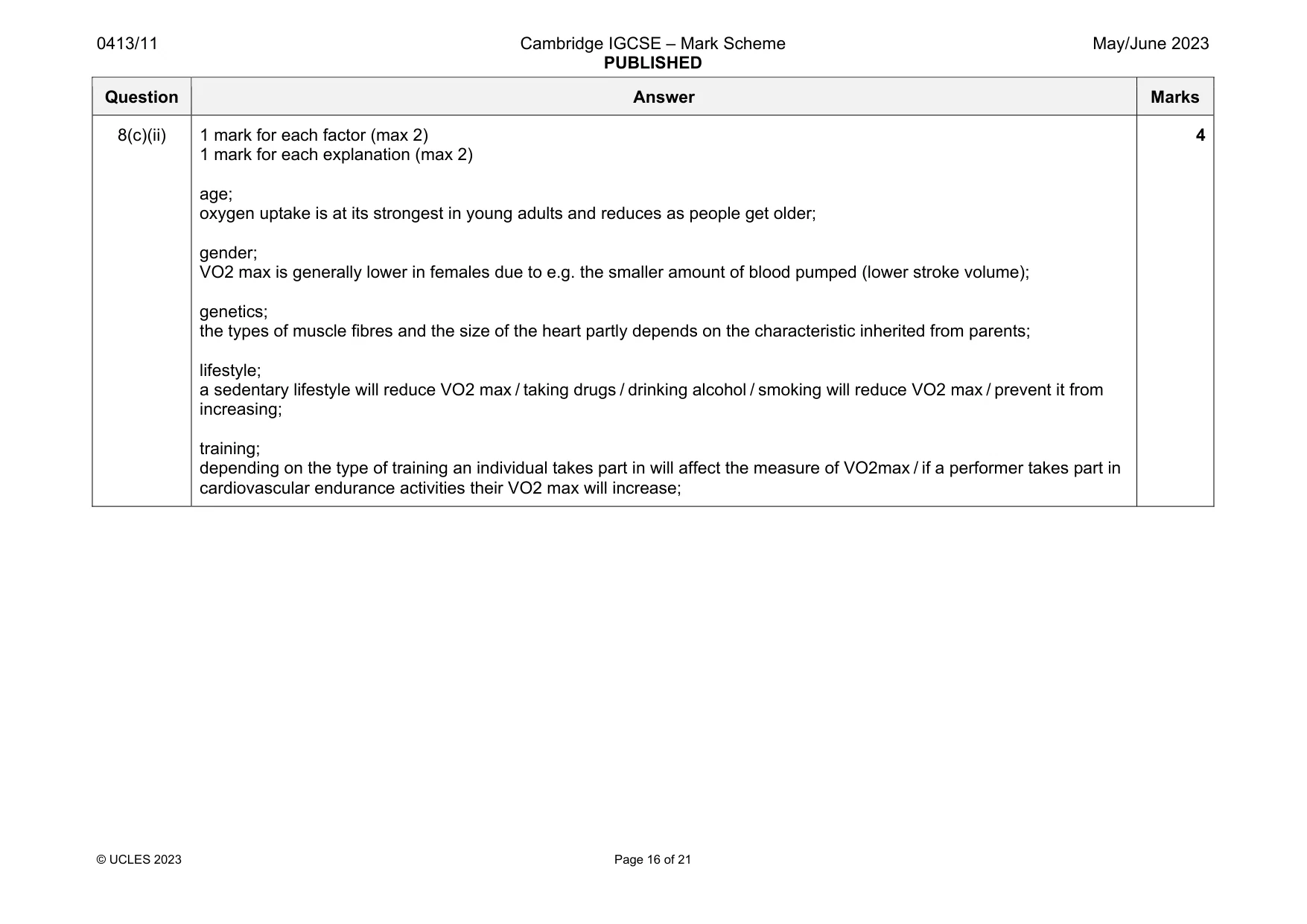
0413/11 Cambridge IGCSE – Mark Scheme PUBLISHED May/June 2023 © UCLES 2023 Page 16 of 21 Question Answer Marks 8(c)(ii) 1 mark for each factor (max 2) 1 mark for each explanation (max 2) age; oxygen uptake is at its strongest in young adults and reduces as people get older; gender; VO2 max is generally lower in females due to e.g. the smaller amount of blood pumped (lower stroke volume); genetics; the types of muscle fibres and the size of the heart partly depends on the characteristic inherited from parents; lifestyle; a sedentary lifestyle will reduce VO2 max / taking drugs / drinking alcohol / smoking will reduce VO2 max / prevent it from increasing; training; depending on the type of training an individual takes part in will affect the measure of VO2max / if a performer takes part in cardiovascular endurance activities their VO2 max will increase; 4
Mark scheme, page 17
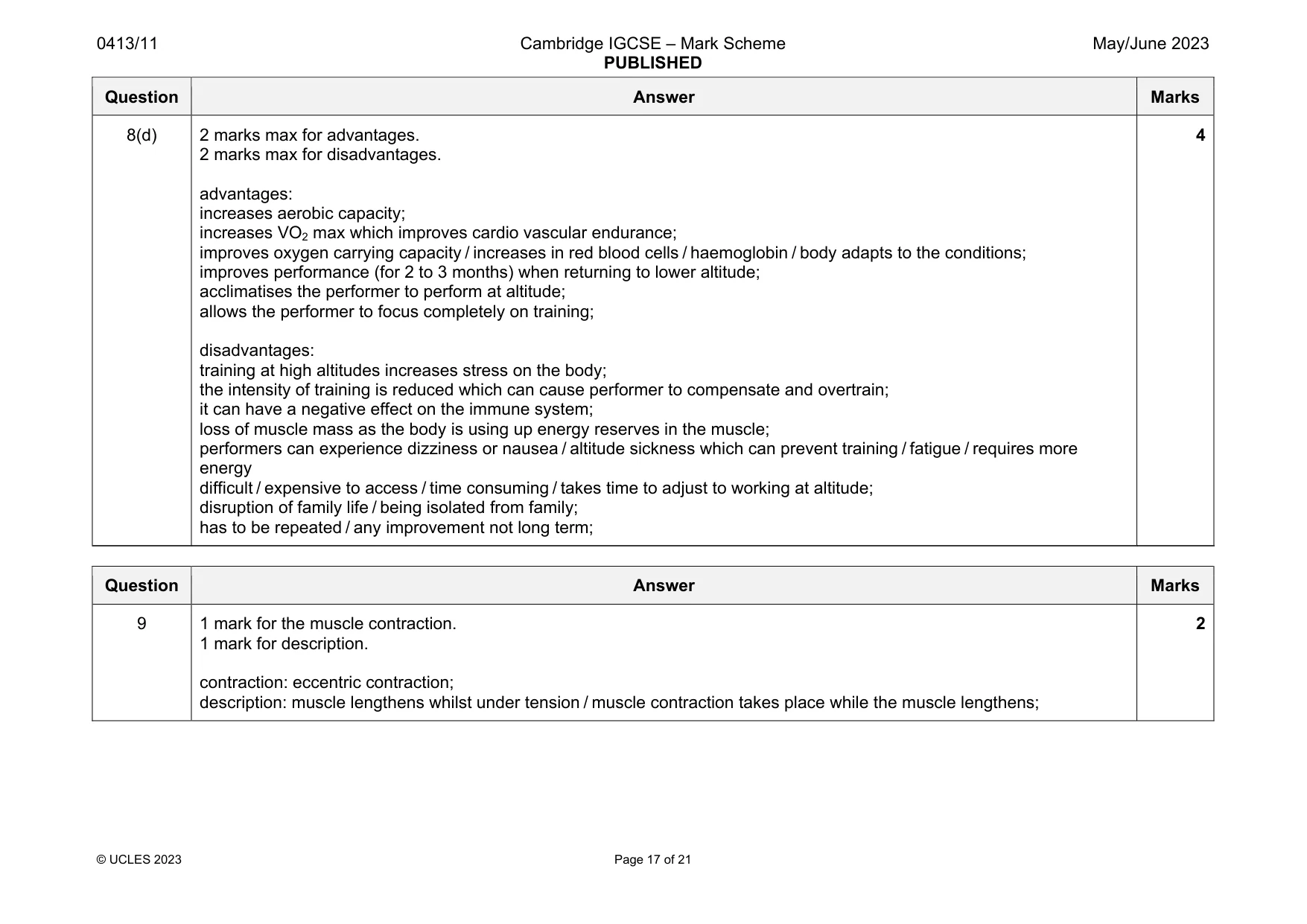
0413/11 Cambridge IGCSE – Mark Scheme PUBLISHED May/June 2023 © UCLES 2023 Page 17 of 21 Question Answer Marks 8(d) 2 marks max for advantages. 2 marks max for disadvantages. advantages: increases aerobic capacity; increases VO2 max which improves cardio vascular endurance; improves oxygen carrying capacity / increases in red blood cells / haemoglobin / body adapts to the conditions; improves performance (for 2 to 3 months) when returning to lower altitude; acclimatises the performer to perform at altitude; allows the performer to focus completely on training; disadvantages: training at high altitudes increases stress on the body; the intensity of training is reduced which can cause performer to compensate and overtrain; it can have a negative effect on the immune system; loss of muscle mass as the body is using up energy reserves in the muscle; performers can experience dizziness or nausea / altitude sickness which can prevent training / fatigue / requires more energy difficult / expensive to access / time consuming / takes time to adjust to working at altitude; disruption of family life / being isolated from family; has to be repeated / any improvement not long term; 4 Question Answer Marks 9 1 mark for the muscle contraction. 1 mark for description. contraction: eccentric contraction; description: muscle lengthens whilst under tension / muscle contraction takes place while the muscle lengthens; 2
Mark scheme, page 18
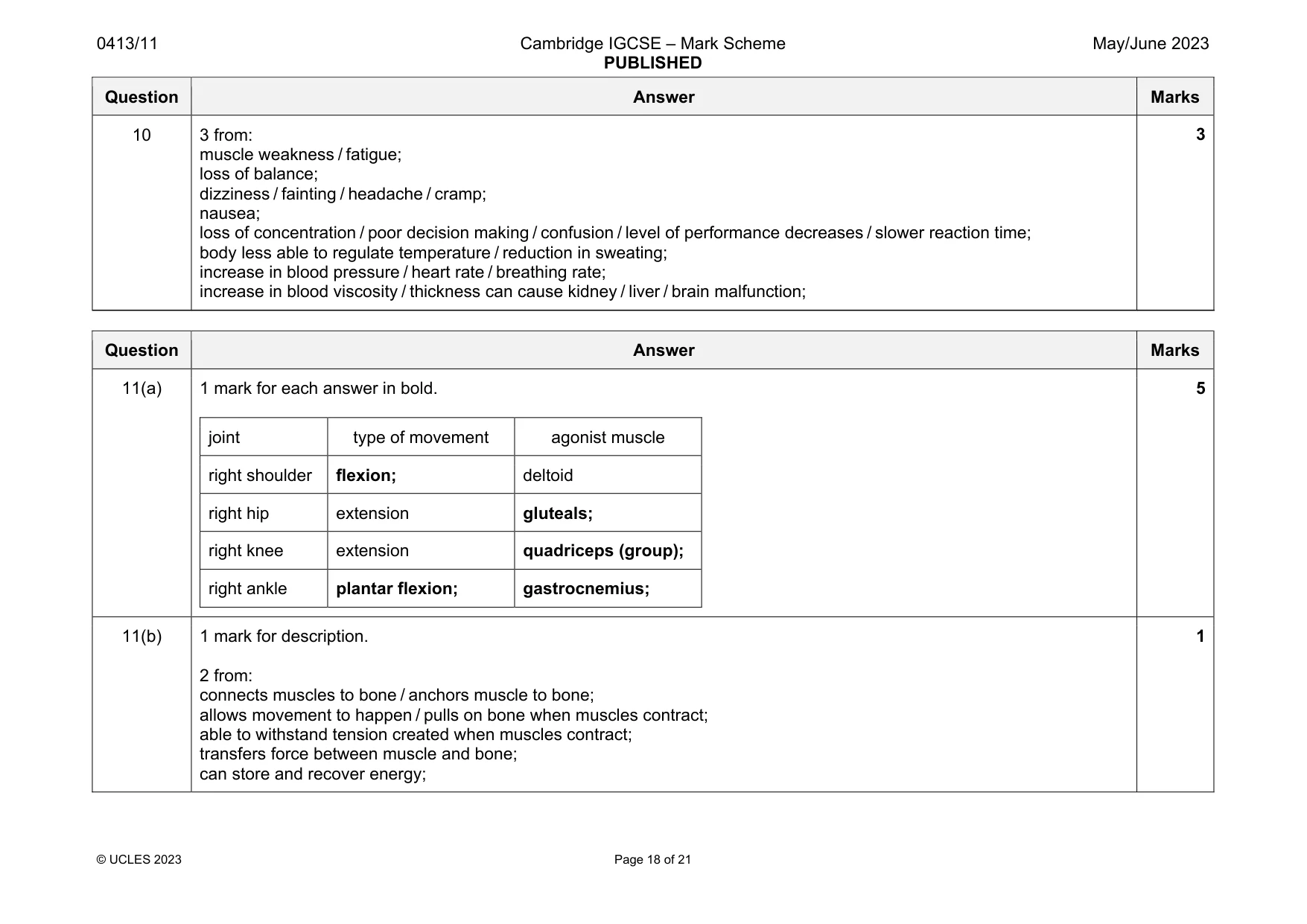
0413/11 Cambridge IGCSE – Mark Scheme PUBLISHED May/June 2023 © UCLES 2023 Page 18 of 21 Question Answer Marks 10 3 from: muscle weakness / fatigue; loss of balance; dizziness / fainting / headache / cramp; nausea; loss of concentration / poor decision making / confusion / level of performance decreases / slower reaction time; body less able to regulate temperature / reduction in sweating; increase in blood pressure / heart rate / breathing rate; increase in blood viscosity / thickness can cause kidney / liver / brain malfunction; 3 Question Answer Marks 11(a) 1 mark for each answer in bold. joint type of movement agonist muscle right shoulder flexion; deltoid right hip extension gluteals; right knee extension quadriceps (group); right ankle plantar flexion; gastrocnemius; 5 11(b) 1 mark for description. 2 from: connects muscles to bone / anchors muscle to bone; allows movement to happen / pulls on bone when muscles contract; able to withstand tension created when muscles contract; transfers force between muscle and bone; can store and recover energy; 1
Mark scheme, page 19
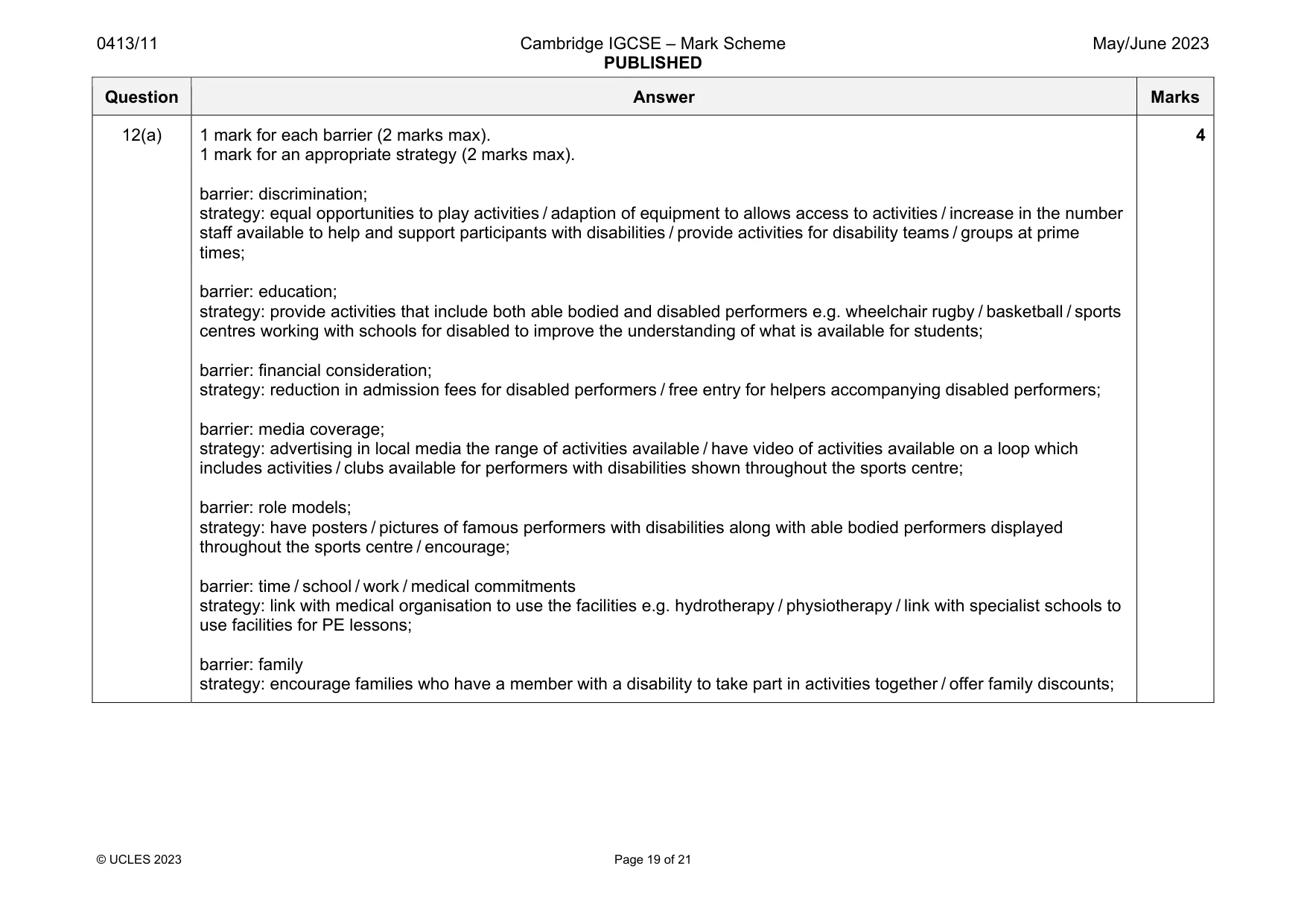
0413/11 Cambridge IGCSE – Mark Scheme PUBLISHED May/June 2023 © UCLES 2023 Page 19 of 21 Question Answer Marks 12(a) 1 mark for each barrier (2 marks max). 1 mark for an appropriate strategy (2 marks max). barrier: discrimination; strategy: equal opportunities to play activities / adaption of equipment to allows access to activities / increase in the number staff available to help and support participants with disabilities / provide activities for disability teams / groups at prime times; barrier: education; strategy: provide activities that include both able bodied and disabled performers e.g. wheelchair rugby / basketball / sports centres working with schools for disabled to improve the understanding of what is available for students; barrier: financial consideration; strategy: reduction in admission fees for disabled performers / free entry for helpers accompanying disabled performers; barrier: media coverage; strategy: advertising in local media the range of activities available / have video of activities available on a loop which includes activities / clubs available for performers with disabilities shown throughout the sports centre; barrier: role models; strategy: have posters / pictures of famous performers with disabilities along with able bodied performers displayed throughout the sports centre / encourage; barrier: time / school / work / medical commitments strategy: link with medical organisation to use the facilities e.g. hydrotherapy / physiotherapy / link with specialist schools to use facilities for PE lessons; barrier: family strategy: encourage families who have a member with a disability to take part in activities together / offer family discounts; 4
Mark scheme, page 20
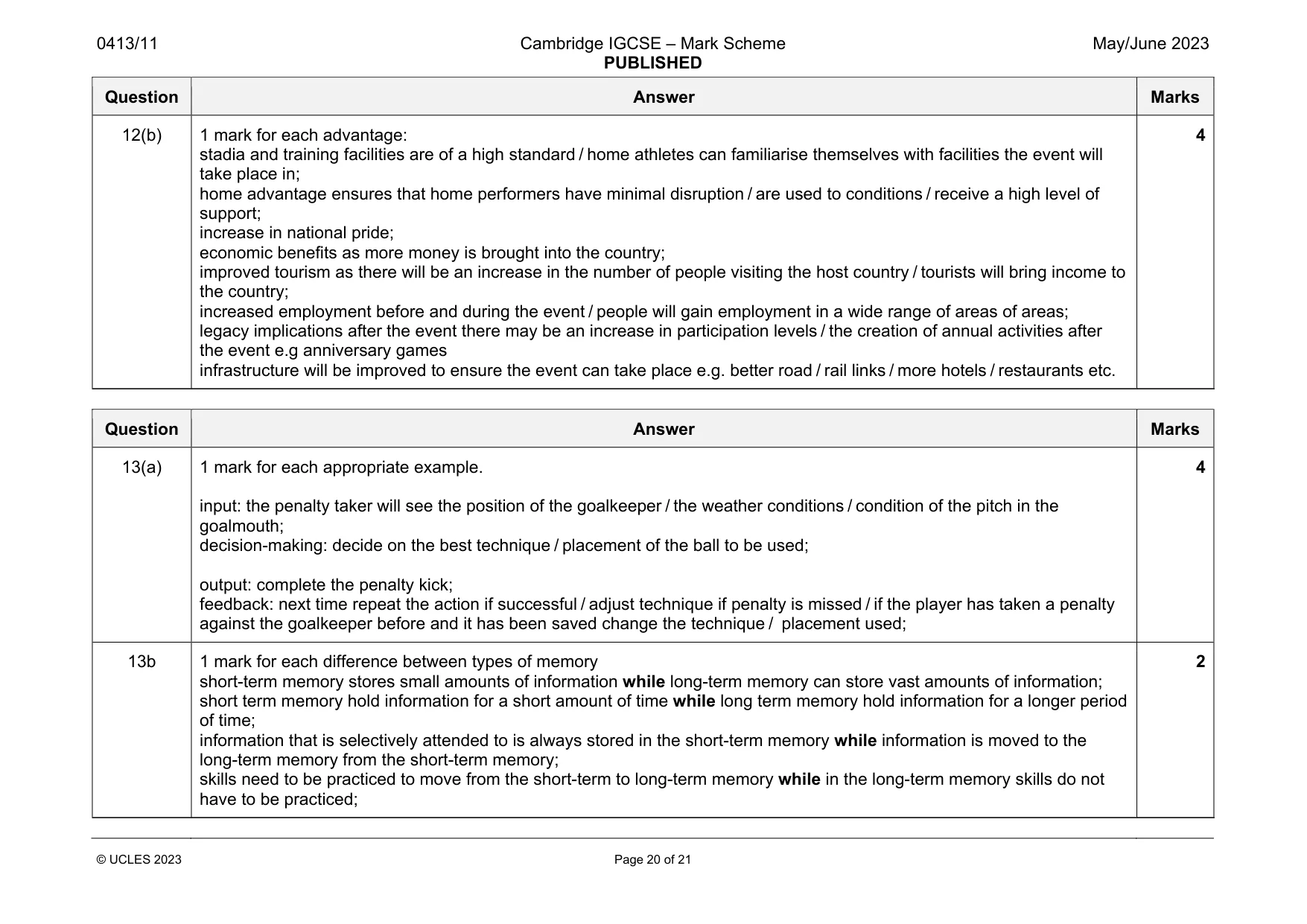
0413/11 Cambridge IGCSE – Mark Scheme PUBLISHED May/June 2023 © UCLES 2023 Page 20 of 21 Question Answer Marks 12(b) 1 mark for each advantage: stadia and training facilities are of a high standard / home athletes can familiarise themselves with facilities the event will take place in; home advantage ensures that home performers have minimal disruption / are used to conditions / receive a high level of support; increase in national pride; economic benefits as more money is brought into the country; improved tourism as there will be an increase in the number of people visiting the host country / tourists will bring income to the country; increased employment before and during the event / people will gain employment in a wide range of areas of areas; legacy implications after the event there may be an increase in participation levels / the creation of annual activities after the event e.g anniversary games infrastructure will be improved to ensure the event can take place e.g. better road / rail links / more hotels / restaurants etc. 4 Question Answer Marks 13(a) 1 mark for each appropriate example. input: the penalty taker will see the position of the goalkeeper / the weather conditions / condition of the pitch in the goalmouth; decision-making: decide on the best technique / placement of the ball to be used; output: complete the penalty kick; feedback: next time repeat the action if successful / adjust technique if penalty is missed / if the player has taken a penalty against the goalkeeper before and it has been saved change the technique / placement used; 4 13b 1 mark for each difference between types of memory short-term memory stores small amounts of information while long-term memory can store vast amounts of information; short term memory hold information for a short amount of time while long term memory hold information for a longer period of time; information that is selectively attended to is always stored in the short-term memory while information is moved to the long-term memory from the short-term memory; skills need to be practiced to move from the short-term to long-term memory while in the long-term memory skills do not have to be practiced; 2
Mark scheme, page 21
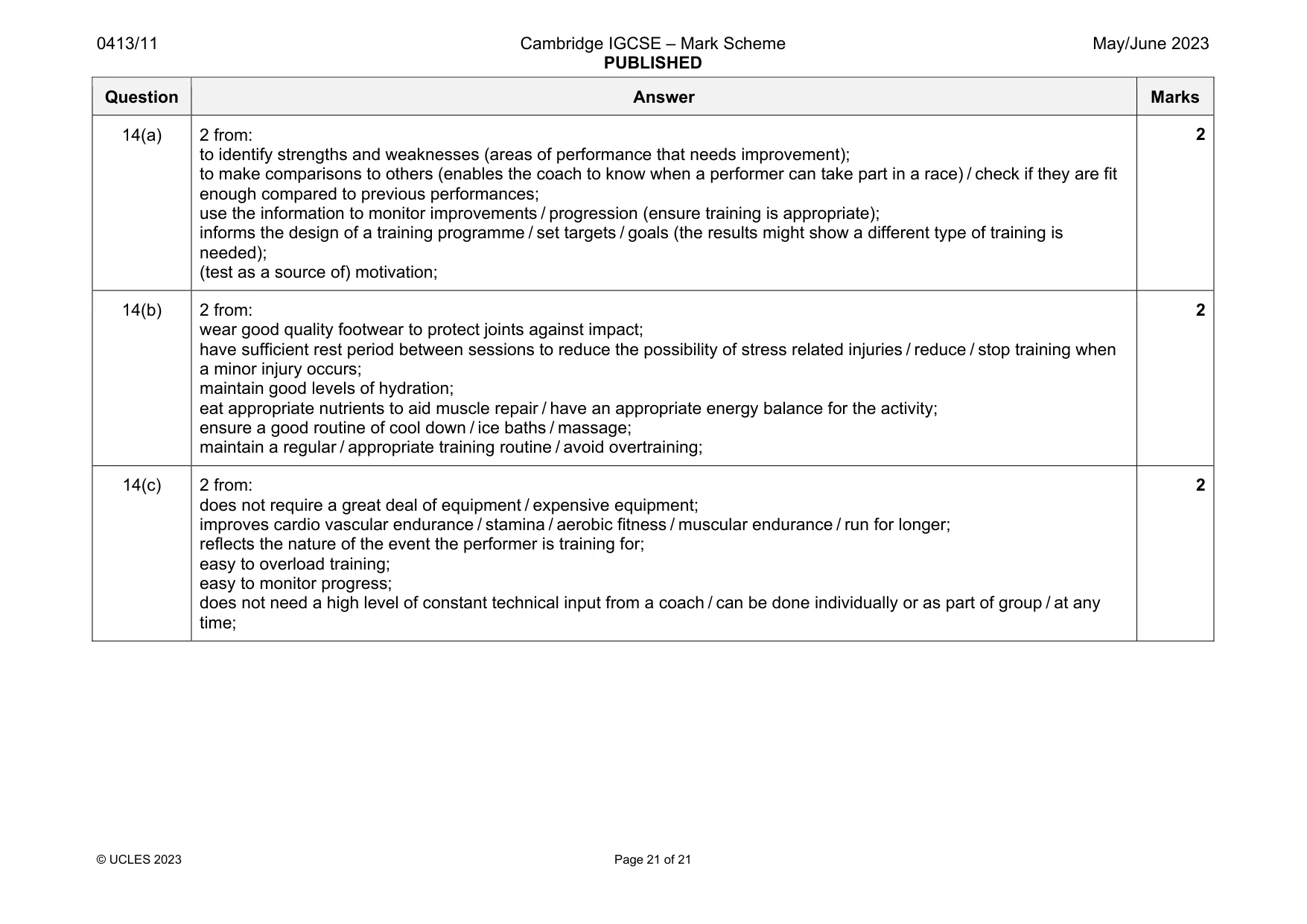
0413/11 Cambridge IGCSE – Mark Scheme PUBLISHED May/June 2023 © UCLES 2023 Page 21 of 21 Question Answer Marks 14(a) 2 from: to identify strengths and weaknesses (areas of performance that needs improvement); to make comparisons to others (enables the coach to know when a performer can take part in a race) / check if they are fit enough compared to previous performances; use the information to monitor improvements / progression (ensure training is appropriate); informs the design of a training programme / set targets / goals (the results might show a different type of training is needed); (test as a source of) motivation; 2 14(b) 2 from: wear good quality footwear to protect joints against impact; have sufficient rest period between sessions to reduce the possibility of stress related injuries / reduce / stop training when a minor injury occurs; maintain good levels of hydration; eat appropriate nutrients to aid muscle repair / have an appropriate energy balance for the activity; ensure a good routine of cool down / ice baths / massage; maintain a regular / appropriate training routine / avoid overtraining; 2 14(c) 2 from: does not require a great deal of equipment / expensive equipment; improves cardio vascular endurance / stamina / aerobic fitness / muscular endurance / run for longer; reflects the nature of the event the performer is training for; easy to overload training; easy to monitor progress; does not need a high level of constant technical input from a coach / can be done individually or as part of group / at any time; 2
What you needed in this session
Cambridge’s own grade thresholds for 2023 May/June, Paper 1 · Variant 1. A higher threshold means an easier paper — the bar moves with how the cohort did.