Cambridge IGCSE Physical Education 0413 — 2022 Oct/Nov Paper 1 · Variant 1
0413/11/O/N/22 · 100 marks · ≈113 min
The question paper and its mark scheme, free to read here and free to download. This is Cambridge’s own paper, exactly as it was sat.
Question paper16 pages

Mark scheme17 pages
Answers below. Sit the paper first if you are practising.
Paper as text
Question paper, page 1
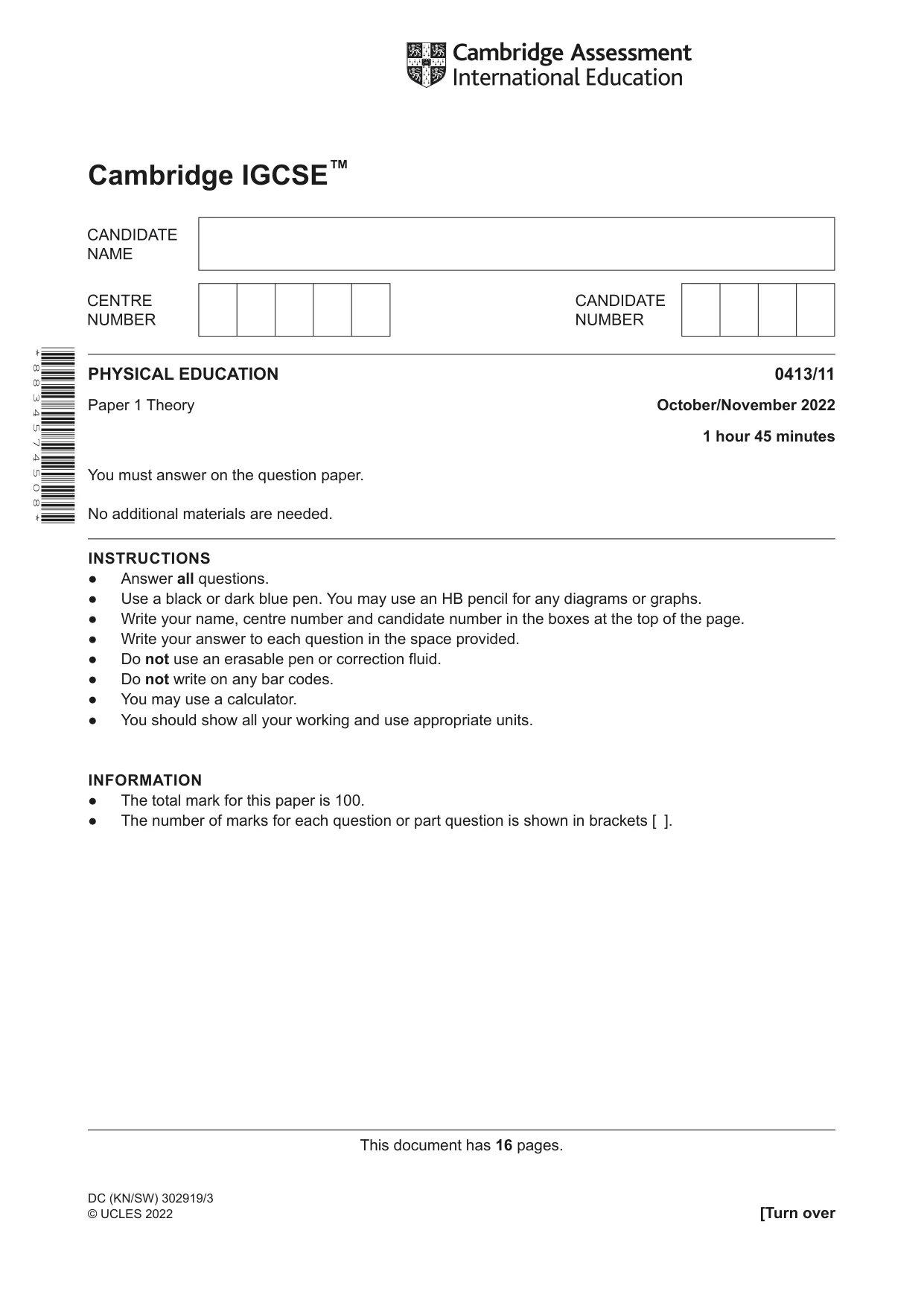
This document has 16 pages. [Turn over Cambridge IGCSE™ DC (KN/SW) 302919/3 © UCLES 2022 * 8 8 3 4 5 7 4 5 0 8 * PHYSICAL EDUCATION 0413/11 Paper 1 Theory October/November 2022 1 hour 45 minutes You must answer on the question paper. No additional materials are needed. INSTRUCTIONS ● Answer all questions. ● Use a black or dark blue pen. You may use an HB pencil for any diagrams or graphs. ● Write your name, centre number and candidate number in the boxes at the top of the page. ● Write your answer to each question in the space provided. ● Do not use an erasable pen or correction fluid. ● Do not write on any bar codes. ● You may use a calculator. ● You should show all your working and use appropriate units. INFORMATION ● The total mark for this paper is 100. ● The number of marks for each question or part question is shown in brackets [ ].
Question paper, page 2
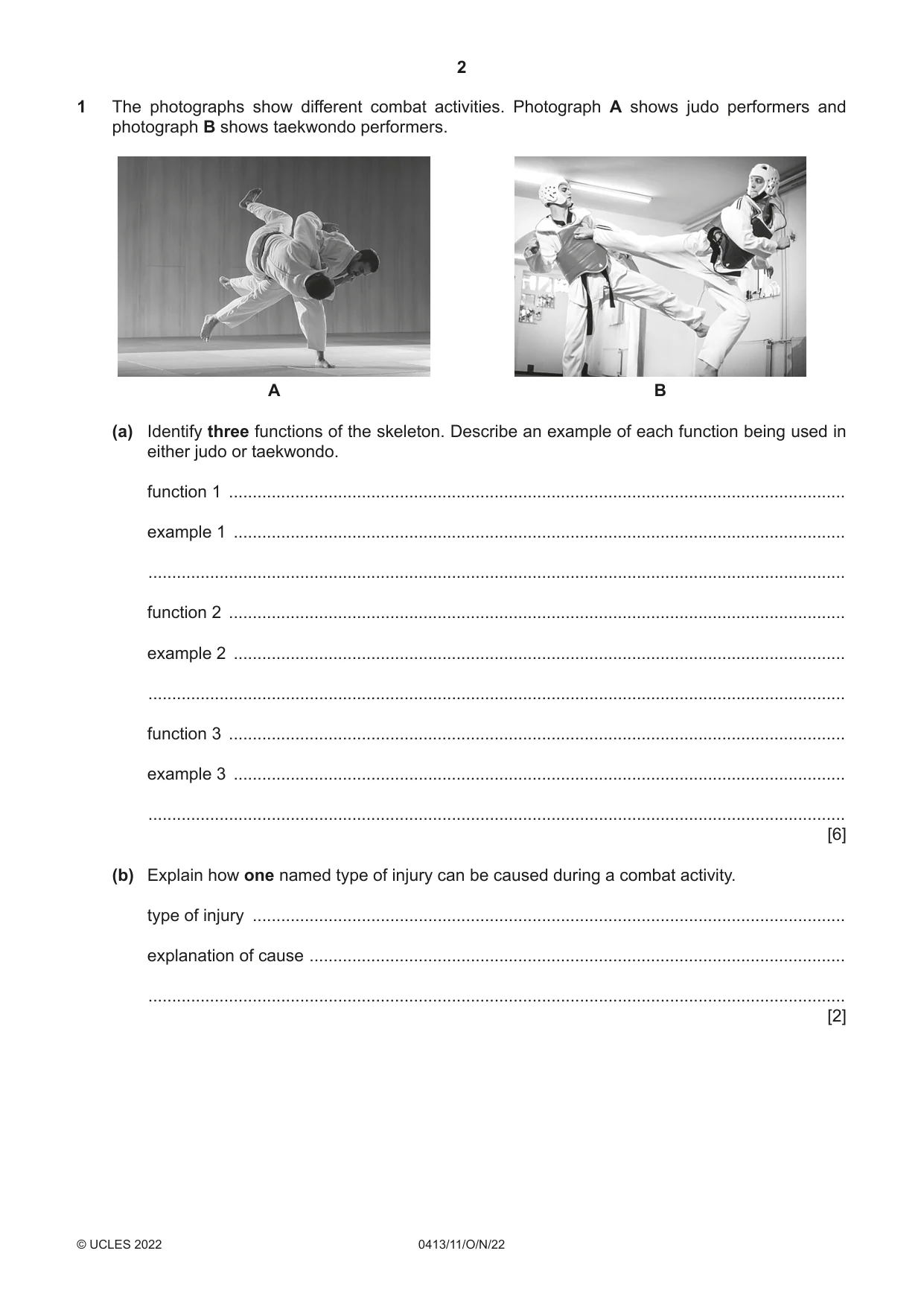
2 0413/11/O/N/22 © UCLES 2022 1 The photographs show different combat activities. Photograph A shows judo performers and photograph B shows taekwondo performers. A B (a) Identify three functions of the skeleton. Describe an example of each function being used in either judo or taekwondo. function 1 … example 1 … … function 2 … example 2 … … function 3 … example 3 … … [6] (b) Explain how one named type of injury can be caused during a combat activity. type of injury … explanation of cause … … [2]
Question paper, page 3
3 0413/11/O/N/22 © UCLES 2022 [Turn over (c) Other than the use of protective clothing and equipment, suggest three strategies that can be used to help reduce the risk and severity of injury to performers in combat activities. 1 … … 2 … … 3 … … [3] [Total: 11]
Question paper, page 4
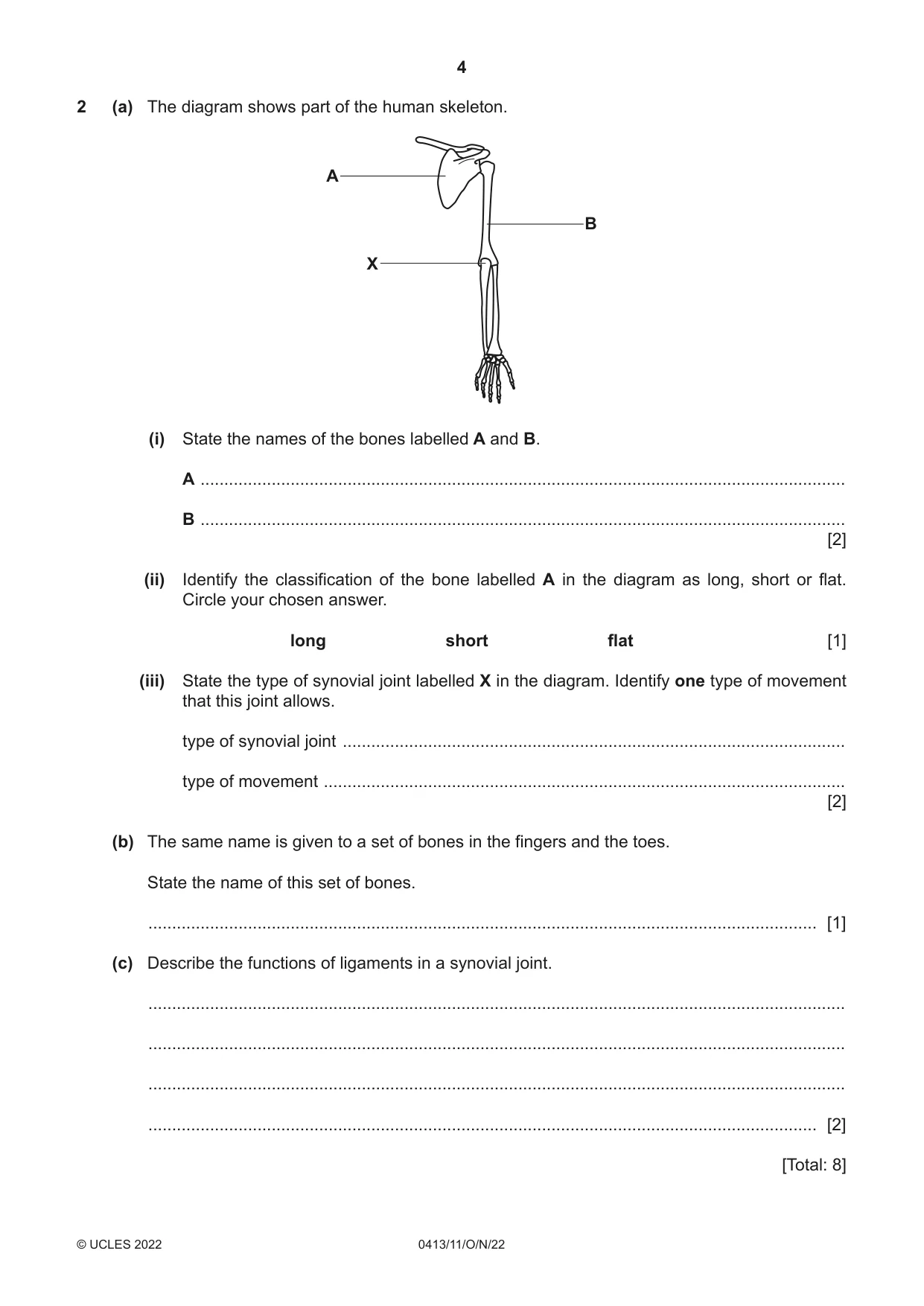
4 0413/11/O/N/22 © UCLES 2022 2 (a) The diagram shows part of the human skeleton. A X B (i) State the names of the bones labelled A and B. A … B … [2] (ii) Identify the classification of the bone labelled A in the diagram as long, short or flat. Circle your chosen answer. long short flat [1] (iii) State the type of synovial joint labelled X in the diagram. Identify one type of movement that this joint allows. type of synovial joint … type of movement … [2] (b) The same name is given to a set of bones in the fingers and the toes. State the name of this set of bones. … [1] (c) Describe the functions of ligaments in a synovial joint. … … … … [2] [Total: 8]
Question paper, page 5
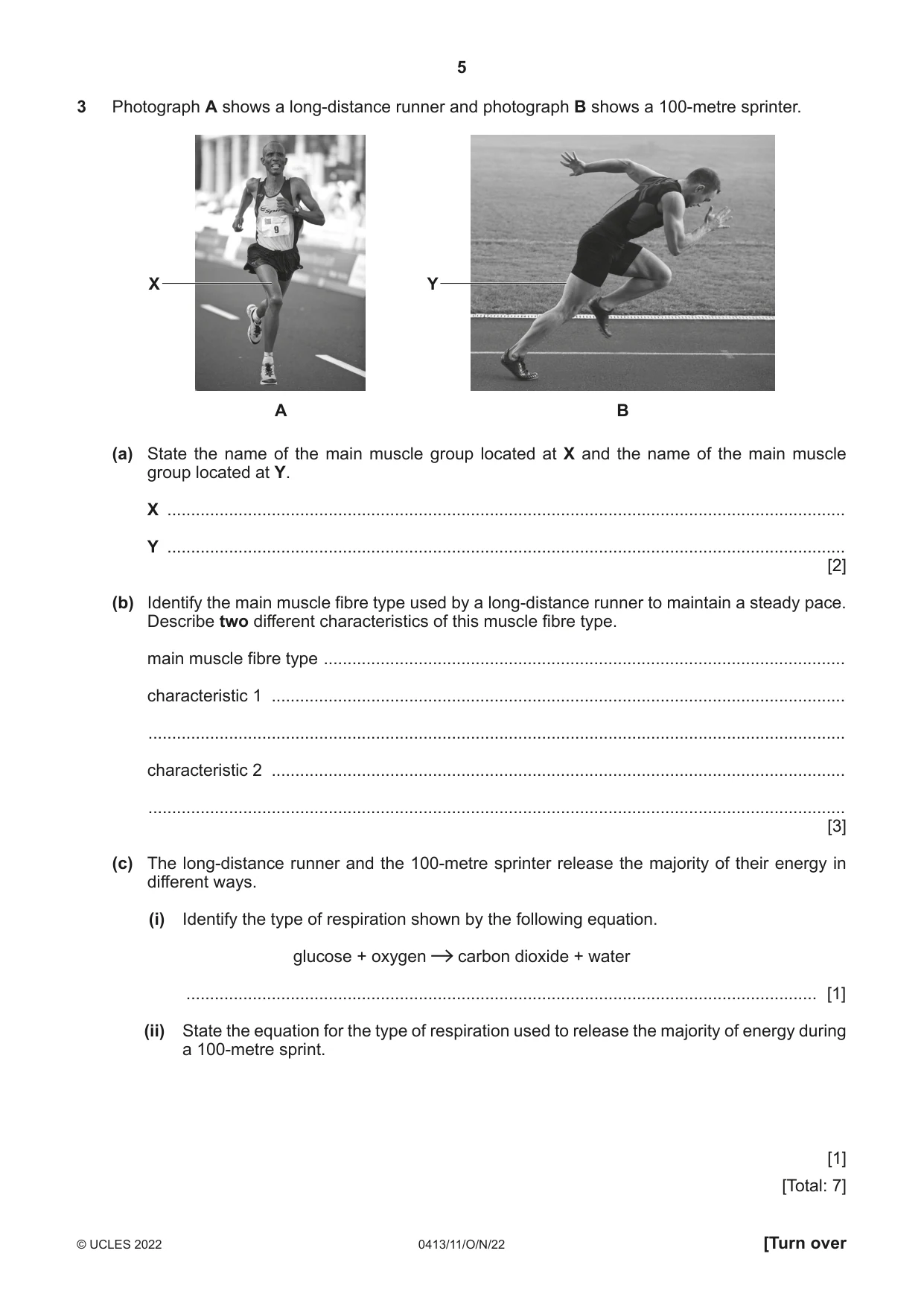
5 0413/11/O/N/22 © UCLES 2022 [Turn over 3 Photograph A shows a long-distance runner and photograph B shows a 100-metre sprinter. X A B Y (a) State the name of the main muscle group located at X and the name of the main muscle group located at Y. X … Y … [2] (b) Identify the main muscle fibre type used by a long-distance runner to maintain a steady pace. Describe two different characteristics of this muscle fibre type. main muscle fibre type … characteristic 1 … … characteristic 2 … … [3] (c) The long-distance runner and the 100-metre sprinter release the majority of their energy in different ways. (i) Identify the type of respiration shown by the following equation. glucose + oxygen carbon dioxide + water … [1] (ii) State the equation for the type of respiration used to release the majority of energy during a 100-metre sprint. [1] [Total: 7]
Question paper, page 6
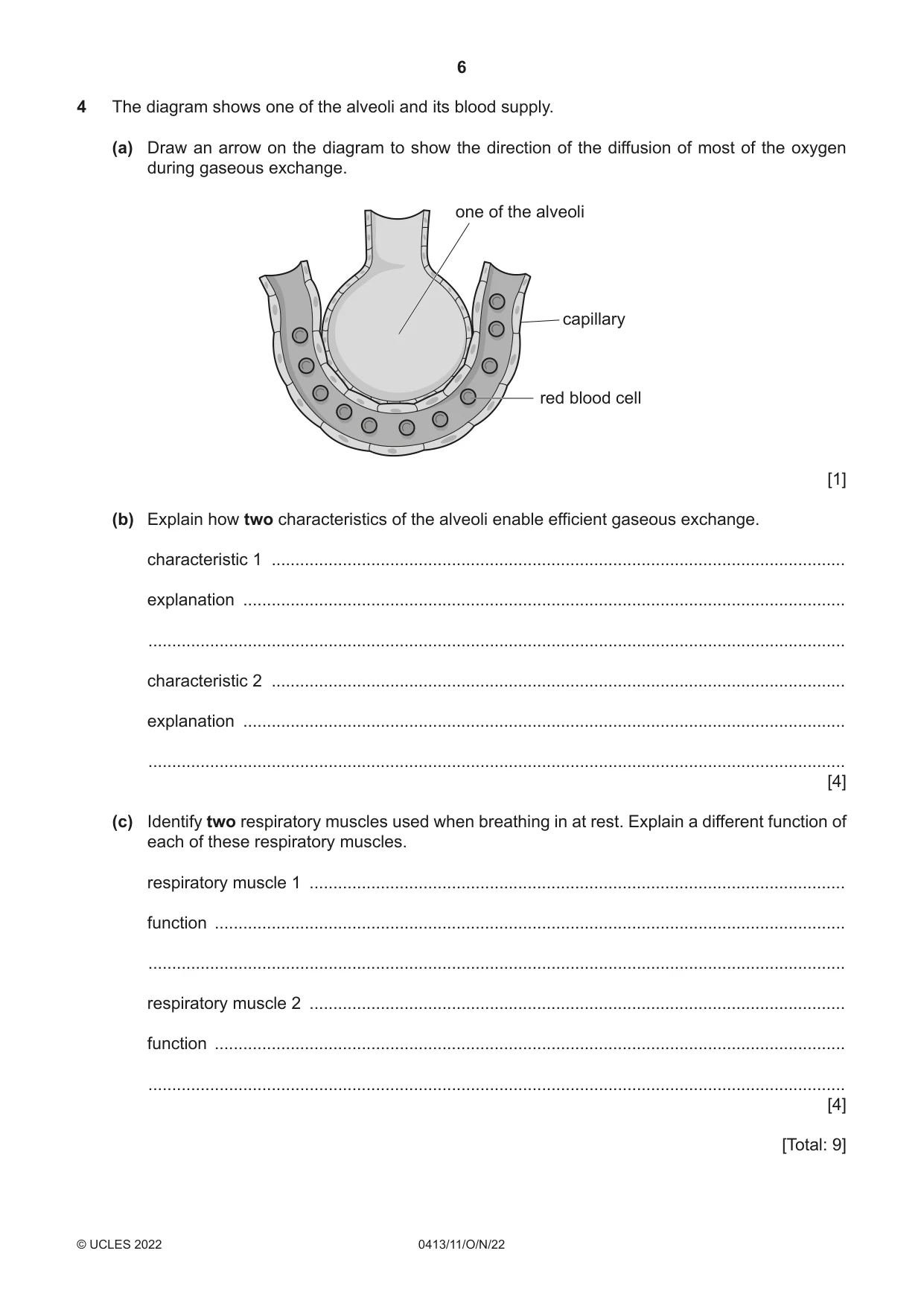
6 0413/11/O/N/22 © UCLES 2022 4 The diagram shows one of the alveoli and its blood supply. (a) Draw an arrow on the diagram to show the direction of the diffusion of most of the oxygen during gaseous exchange. one of the alveoli capillary red blood cell [1] (b) Explain how two characteristics of the alveoli enable efficient gaseous exchange. characteristic 1 … explanation … … characteristic 2 … explanation … … [4] (c) Identify two respiratory muscles used when breathing in at rest. Explain a different function of each of these respiratory muscles. respiratory muscle 1 … function … … respiratory muscle 2 … function … … [4] [Total: 9]
Question paper, page 7
7 0413/11/O/N/22 © UCLES 2022 [Turn over 5 (a) Identify the main component of blood involved when: forming a scab on a cut … fighting infection. … [2] (b) (i) Describe two differences, other than the presence of valves, between arteries and veins. 1 … … 2 … … [2] (ii) Describe the function of valves in veins. … … [1]
Question paper, page 8
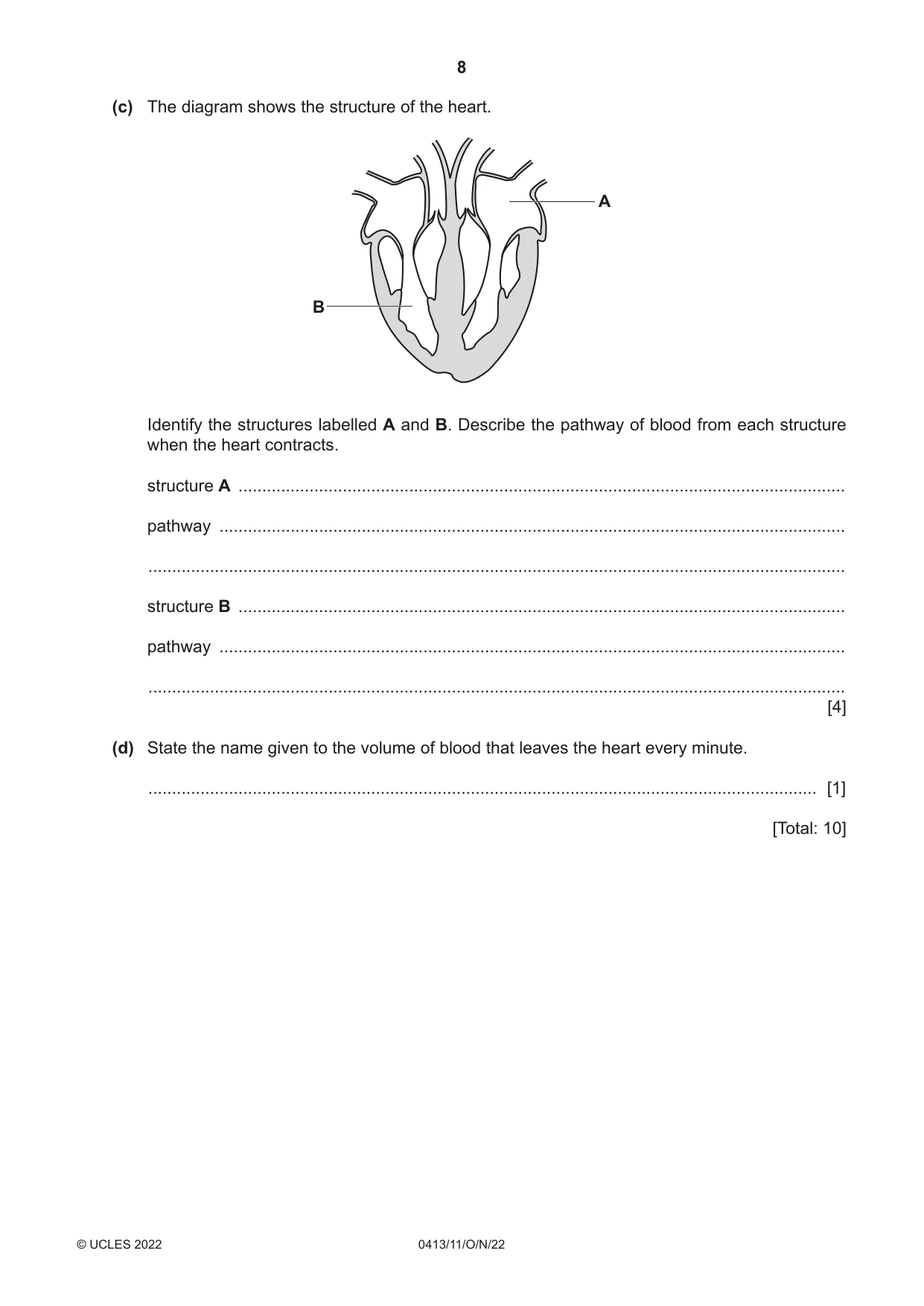
8 0413/11/O/N/22 © UCLES 2022 (c) The diagram shows the structure of the heart. B A Identify the structures labelled A and B. Describe the pathway of blood from each structure when the heart contracts. structure A … pathway … … structure B … pathway … … [4] (d) State the name given to the volume of blood that leaves the heart every minute. … [1] [Total: 10]
Question paper, page 9
9 0413/11/O/N/22 © UCLES 2022 [Turn over 6 State what Excess Post-exercise Oxygen Consumption (EPOC) is also known as. … [1] 7 (a) Identify the missing words in the following World Health Organization (WHO) definition of health: ‘a state of complete physical, … and social well-being and not merely the absence of … or infirmity’. [2] (b) Better health awareness and an increase in leisure time are factors that have influenced the growth in leisure activities. Suggest two other factors that can influence the growth in leisure activities. 1 … 2 … [2] [Total: 4]
Question paper, page 10
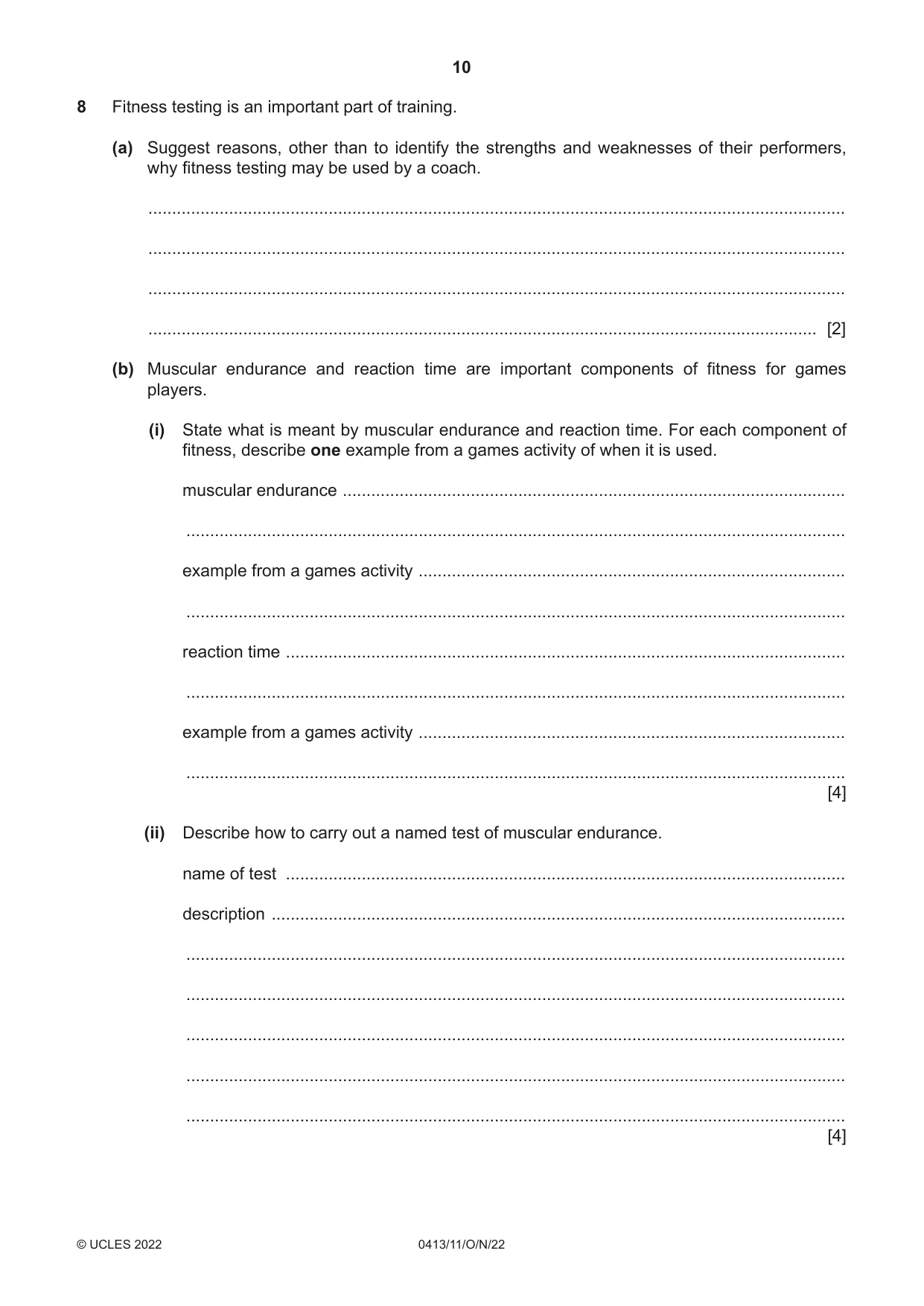
10 0413/11/O/N/22 © UCLES 2022 8 Fitness testing is an important part of training. (a) Suggest reasons, other than to identify the strengths and weaknesses of their performers, why fitness testing may be used by a coach. … … … … [2] (b) Muscular endurance and reaction time are important components of fitness for games players. (i) State what is meant by muscular endurance and reaction time. For each component of fitness, describe one example from a games activity of when it is used. muscular endurance … … example from a games activity … … reaction time … … example from a games activity … … [4] (ii) Describe how to carry out a named test of muscular endurance. name of test … description … … … … … … [4]
Question paper, page 11
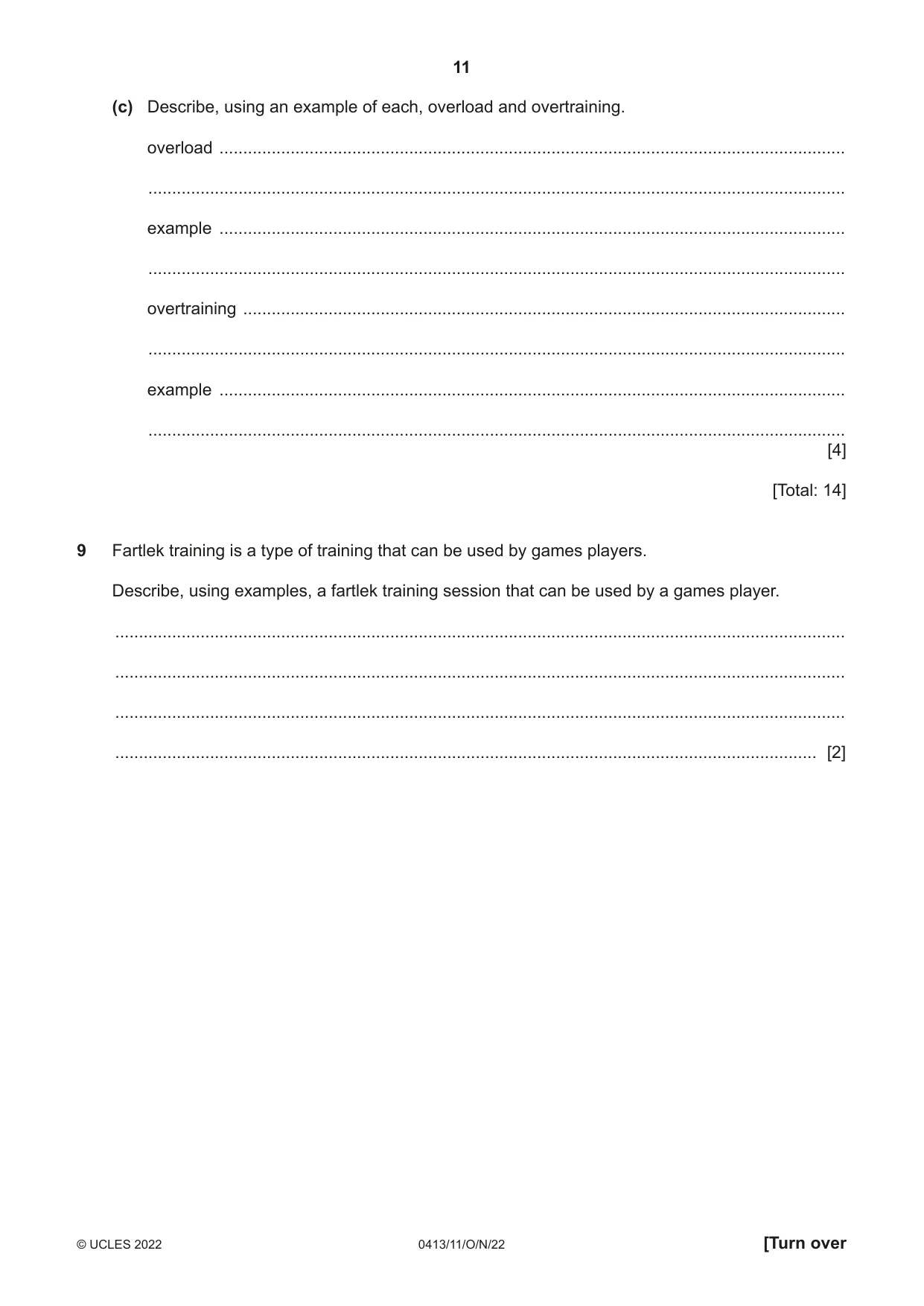
11 0413/11/O/N/22 © UCLES 2022 [Turn over (c) Describe, using an example of each, overload and overtraining. overload … … example … … overtraining … … example … … [4] [Total: 14] 9 Fartlek training is a type of training that can be used by games players. Describe, using examples, a fartlek training session that can be used by a games player. … … … … [2]
Question paper, page 12
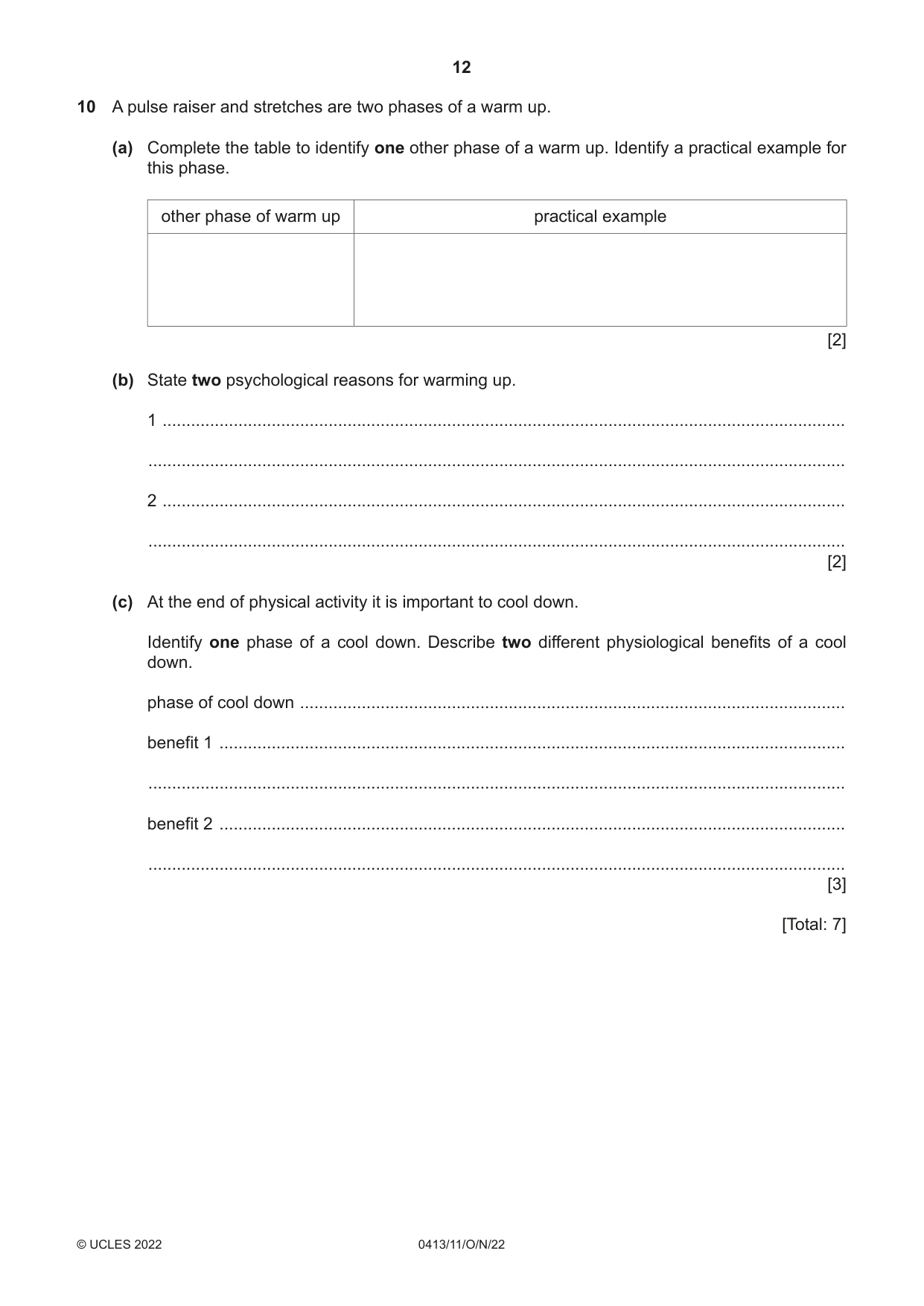
12 0413/11/O/N/22 © UCLES 2022 10 A pulse raiser and stretches are two phases of a warm up. (a) Complete the table to identify one other phase of a warm up. Identify a practical example for this phase. other phase of warm up practical example [2] (b) State two psychological reasons for warming up. 1 … … 2 … … [2] (c) At the end of physical activity it is important to cool down. Identify one phase of a cool down. Describe two different physiological benefits of a cool down. phase of cool down … benefit 1 … … benefit 2 … … [3] [Total: 7]
Question paper, page 13
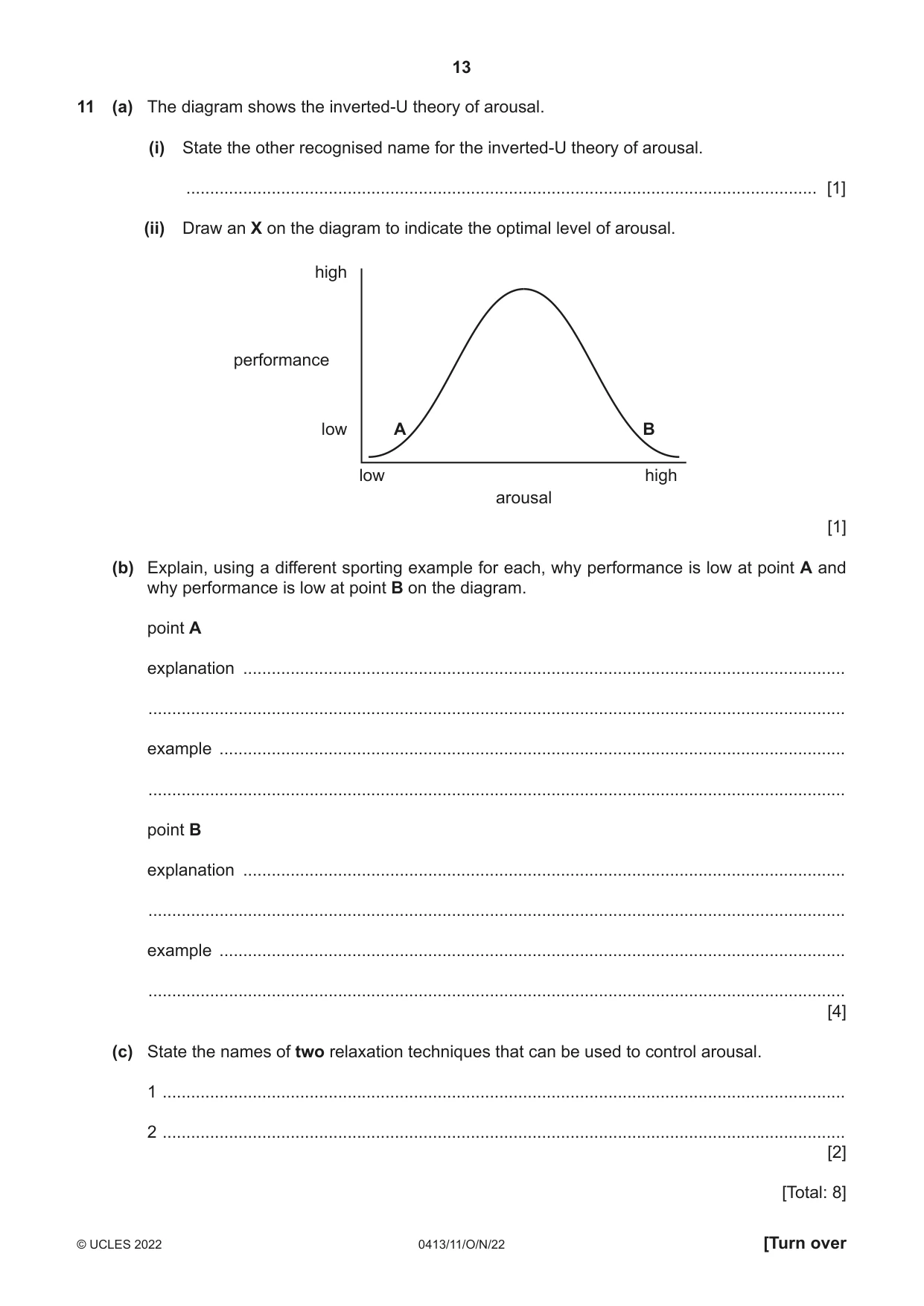
13 0413/11/O/N/22 © UCLES 2022 [Turn over 11 (a) The diagram shows the inverted-U theory of arousal. (i) State the other recognised name for the inverted-U theory of arousal. … [1] (ii) Draw an X on the diagram to indicate the optimal level of arousal. performance arousal low low A B high high [1] (b) Explain, using a different sporting example for each, why performance is low at point A and why performance is low at point B on the diagram. point A explanation … … example … … point B explanation … … example … … [4] (c) State the names of two relaxation techniques that can be used to control arousal. 1 … 2 … [2] [Total: 8]
Question paper, page 14
14 0413/11/O/N/22 © UCLES 2022 12 (a) State a major global sporting event. … [1] (b) Suggest two reasons why a nation may want to host a major global sporting event. 1 … … 2 … … [2] [Total: 3] 13 (a) Explain why a swimming coach should use each of the following principles of SMARTER goal setting when teaching a performer: measurable … … realistic … … exciting. … … [3] (b) Describe three characteristics of a performer that the swimming coach could use to decide if the performer has moved from the cognitive stage of learning to the associative stage of learning. 1 … … 2 … … 3 … … [3] (c) State two types of guidance the swimming coach may use during a swimming lesson. 1 … 2 … [2] [Total: 8]
Question paper, page 15
15 0413/11/O/N/22 © UCLES 2022 [Turn over 14 (a) The diagram shows stages of a performer hitting a golf ball. Justify each of the following classifications of hitting a golf ball: a gross skill … … a closed skill. … … [2] (b) Beta blockers are a type of prohibited performance-enhancing drug that may be used by some golfers. (i) Suggest why some performers choose to use beta blockers to enhance their performance. … … … … [2] (ii) Suggest two disadvantages of using prohibited performance-enhancing drugs. 1 … … 2 … … [2]
Question paper, page 16
16 0413/11/O/N/22 © UCLES 2022 Permission to reproduce items where third-party owned material protected by copyright is included has been sought and cleared where possible. Every reasonable effort has been made by the publisher (UCLES) to trace copyright holders, but if any items requiring clearance have unwittingly been included, the publisher will be pleased to make amends at the earliest possible opportunity. To avoid the issue of disclosure of answer-related information to candidates, all copyright acknowledgements are reproduced online in the Cambridge Assessment International Education Copyright Acknowledgements Booklet. This is produced for each series of examinations and is freely available to download at www.cambridgeinternational.org after the live examination series. Cambridge Assessment International Education is part of Cambridge Assessment. Cambridge Assessment is the brand name of the University of Cambridge Local Examinations Syndicate (UCLES), which is a department of the University of Cambridge. (c) Suggest strategies an organising body could use to reduce the use of prohibited performance- enhancing drugs in sport. … … … … [2] [Total: 8]
Mark scheme, page 1
This document consists of 17 printed pages. © UCLES 2022 [Turn over Cambridge IGCSE™ PHYSICAL EDUCATION 0413/11 Paper 1 Theory October/November 2022 MARK SCHEME Maximum Mark: 100 Published This mark scheme is published as an aid to teachers and candidates, to indicate the requirements of the examination. It shows the basis on which Examiners were instructed to award marks. It does not indicate the details of the discussions that took place at an Examiners’ meeting before marking began, which would have considered the acceptability of alternative answers. Mark schemes should be read in conjunction with the question paper and the Principal Examiner Report for Teachers. Cambridge International will not enter into discussions about these mark schemes. Cambridge International is publishing the mark schemes for the October/November 2022 series for most Cambridge IGCSE™, Cambridge International A and AS Level components and some Cambridge O Level components.
Mark scheme, page 2
0413/11 Cambridge IGCSE – Mark Scheme PUBLISHED October/November 2022 © UCLES 2022 Page 2 of 17 Generic Marking Principles These general marking principles must be applied by all examiners when marking candidate answers. They should be applied alongside the specific content of the mark scheme or generic level descriptors for a question. Each question paper and mark scheme will also comply with these marking principles. GENERIC MARKING PRINCIPLE 1: Marks must be awarded in line with: • the specific content of the mark scheme or the generic level descriptors for the question • the specific skills defined in the mark scheme or in the generic level descriptors for the question • the standard of response required by a candidate as exemplified by the standardisation scripts. GENERIC MARKING PRINCIPLE 2: Marks awarded are always whole marks (not half marks, or other fractions). GENERIC MARKING PRINCIPLE 3: Marks must be awarded positively: • marks are awarded for correct/valid answers, as defined in the mark scheme. However, credit is given for valid answers which go beyond the scope of the syllabus and mark scheme, referring to your Team Leader as appropriate • marks are awarded when candidates clearly demonstrate what they know and can do • marks are not deducted for errors • marks are not deducted for omissions • answers should only be judged on the quality of spelling, punctuation and grammar when these features are specifically assessed by the question as indicated by the mark scheme. The meaning, however, should be unambiguous. GENERIC MARKING PRINCIPLE 4: Rules must be applied consistently, e.g. in situations where candidates have not followed instructions or in the application of generic level descriptors.
Mark scheme, page 3
0413/11 Cambridge IGCSE – Mark Scheme PUBLISHED October/November 2022 © UCLES 2022 Page 3 of 17 GENERIC MARKING PRINCIPLE 5: Marks should be awarded using the full range of marks defined in the mark scheme for the question (however; the use of the full mark range may be limited according to the quality of the candidate responses seen). GENERIC MARKING PRINCIPLE 6: Marks awarded are based solely on the requirements as defined in the mark scheme. Marks should not be awarded with grade thresholds or grade descriptors in mind. Science-Specific Marking Principles 1 Examiners should consider the context and scientific use of any keywords when awarding marks. Although keywords may be present, marks should not be awarded if the keywords are used incorrectly. 2 The examiner should not choose between contradictory statements given in the same question part, and credit should not be awarded for any correct statement that is contradicted within the same question part. Wrong science that is irrelevant to the question should be ignored. 3 Although spellings do not have to be correct, spellings of syllabus terms must allow for clear and unambiguous separation from other syllabus terms with which they may be confused (e.g. ethane / ethene, glucagon / glycogen, refraction / reflection). 4 The error carried forward (ecf) principle should be applied, where appropriate. If an incorrect answer is subsequently used in a scientifically correct way, the candidate should be awarded these subsequent marking points. Further guidance will be included in the mark scheme where necessary and any exceptions to this general principle will be noted. 5 ‘List rule’ guidance For questions that require n responses (e.g. State two reasons …): • The response should be read as continuous prose, even when numbered answer spaces are provided. • Any response marked ignore in the mark scheme should not count towards n. • Incorrect responses should not be awarded credit but will still count towards n. • Read the entire response to check for any responses that contradict those that would otherwise be credited. Credit should not be awarded for any responses that are contradicted within the rest of the response. Where two responses contradict one another, this should be treated as a single incorrect response. • Non-contradictory responses after the first n responses may be ignored even if they include incorrect science.
Mark scheme, page 4
0413/11 Cambridge IGCSE – Mark Scheme PUBLISHED October/November 2022 © UCLES 2022 Page 4 of 17 6 Calculation specific guidance Correct answers to calculations should be given full credit even if there is no working or incorrect working, unless the question states ‘show your working’. For questions in which the number of significant figures required is not stated, credit should be awarded for correct answers when rounded by the examiner to the number of significant figures given in the mark scheme. This may not apply to measured values. For answers given in standard form (e.g. a 10n) in which the convention of restricting the value of the coefficient (a) to a value between 1 and 10 is not followed, credit may still be awarded if the answer can be converted to the answer given in the mark scheme. Unless a separate mark is given for a unit, a missing or incorrect unit will normally mean that the final calculation mark is not awarded. Exceptions to this general principle will be noted in the mark scheme. 7 Guidance for chemical equations Multiples / fractions of coefficients used in chemical equations are acceptable unless stated otherwise in the mark scheme. State symbols given in an equation should be ignored unless asked for in the question or stated otherwise in the mark scheme.
Mark scheme, page 5
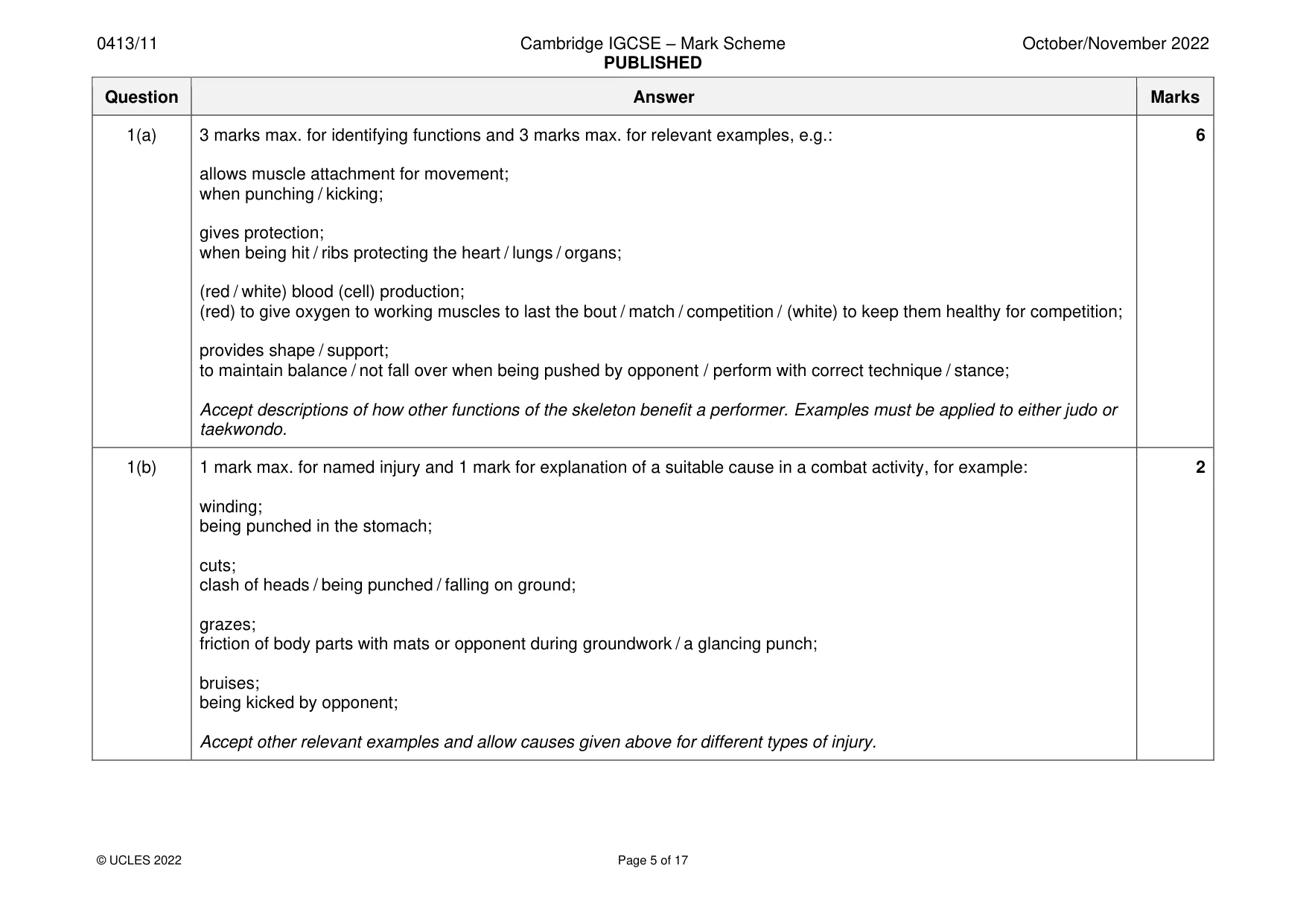
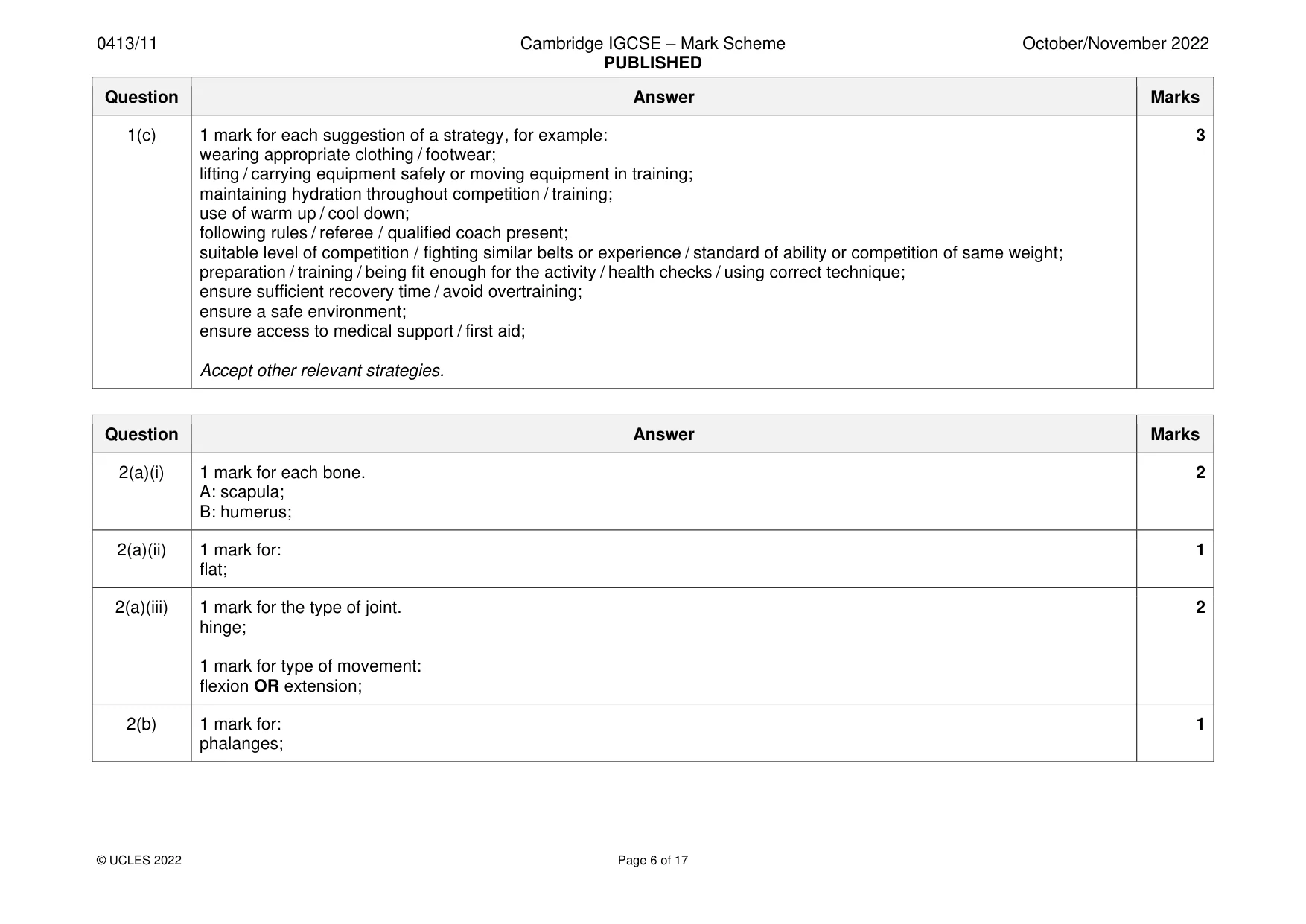
0413/11 Cambridge IGCSE – Mark Scheme PUBLISHED October/November 2022 © UCLES 2022 Page 5 of 17 Question Answer Marks 1(a) 3 marks max. for identifying functions and 3 marks max. for relevant examples, e.g.: allows muscle attachment for movement; when punching / kicking; gives protection; when being hit / ribs protecting the heart / lungs / organs; (red / white) blood (cell) production; (red) to give oxygen to working muscles to last the bout / match / competition / (white) to keep them healthy for competition; provides shape / support; to maintain balance / not fall over when being pushed by opponent / perform with correct technique / stance; Accept descriptions of how other functions of the skeleton benefit a performer. Examples must be applied to either judo or taekwondo. 6 1(b) 1 mark max. for named injury and 1 mark for explanation of a suitable cause in a combat activity, for example: winding; being punched in the stomach; cuts; clash of heads / being punched / falling on ground; grazes; friction of body parts with mats or opponent during groundwork / a glancing punch; bruises; being kicked by opponent; Accept other relevant examples and allow causes given above for different types of injury. 2
Mark scheme, page 6
0413/11 Cambridge IGCSE – Mark Scheme PUBLISHED October/November 2022 © UCLES 2022 Page 6 of 17 Question Answer Marks 1(c) 1 mark for each suggestion of a strategy, for example: wearing appropriate clothing / footwear; lifting / carrying equipment safely or moving equipment in training; maintaining hydration throughout competition / training; use of warm up / cool down; following rules / referee / qualified coach present; suitable level of competition / fighting similar belts or experience / standard of ability or competition of same weight; preparation / training / being fit enough for the activity / health checks / using correct technique; ensure sufficient recovery time / avoid overtraining; ensure a safe environment; ensure access to medical support / first aid; Accept other relevant strategies. 3 Question Answer Marks 2(a)(i) 1 mark for each bone. A: scapula; B: humerus; 2 2(a)(ii) 1 mark for: flat; 1 2(a)(iii) 1 mark for the type of joint. hinge; 1 mark for type of movement: flexion OR extension; 2 2(b) 1 mark for: phalanges; 1
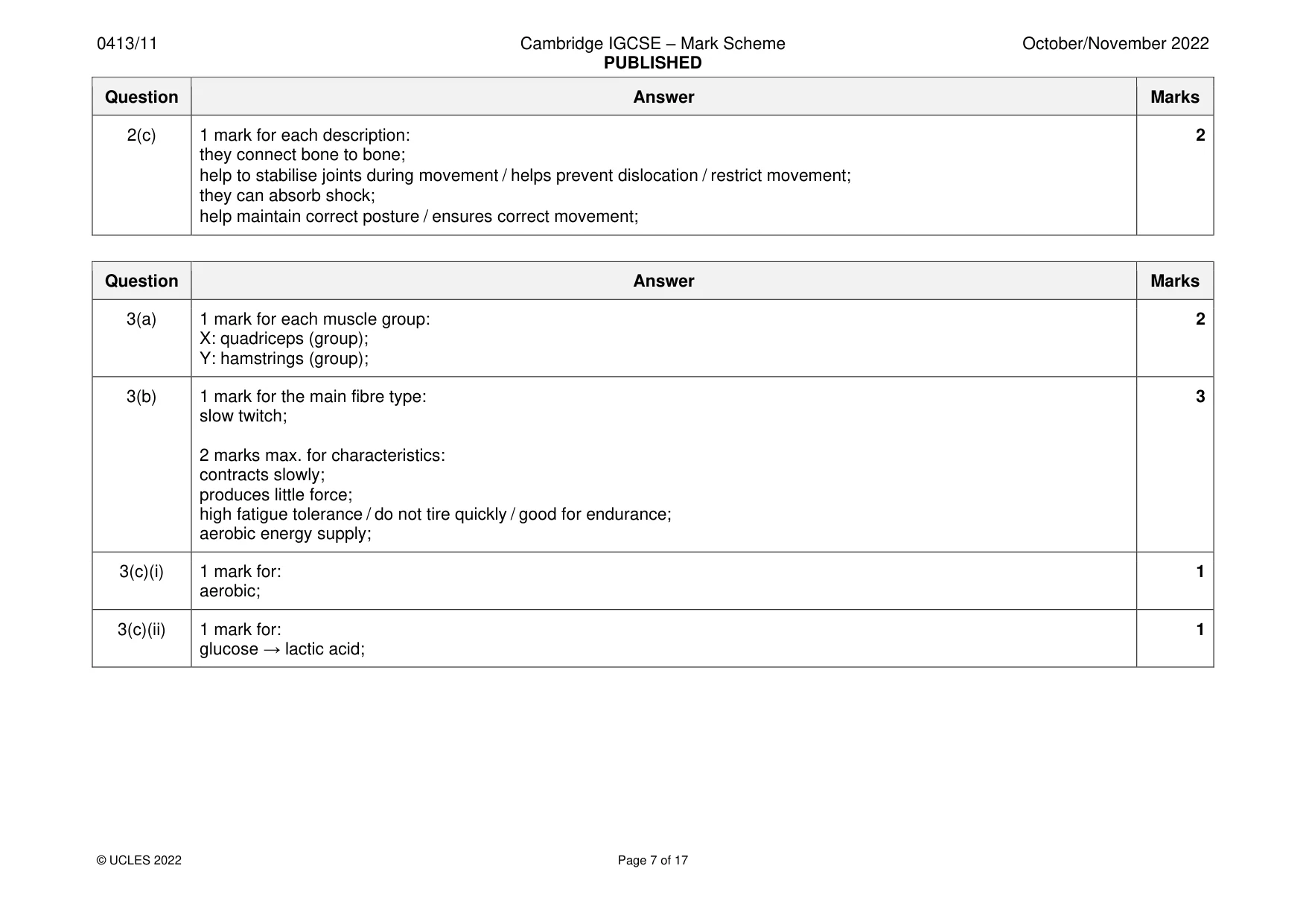
Mark scheme, page 7
0413/11 Cambridge IGCSE – Mark Scheme PUBLISHED October/November 2022 © UCLES 2022 Page 7 of 17 Question Answer Marks 2(c) 1 mark for each description: they connect bone to bone; help to stabilise joints during movement / helps prevent dislocation / restrict movement; they can absorb shock; help maintain correct posture / ensures correct movement; 2 Question Answer Marks 3(a) 1 mark for each muscle group: X: quadriceps (group); Y: hamstrings (group); 2 3(b) 1 mark for the main fibre type: slow twitch; 2 marks max. for characteristics: contracts slowly; produces little force; high fatigue tolerance / do not tire quickly / good for endurance; aerobic energy supply; 3 3(c)(i) 1 mark for: aerobic; 1 3(c)(ii) 1 mark for: glucose → lactic acid; 1
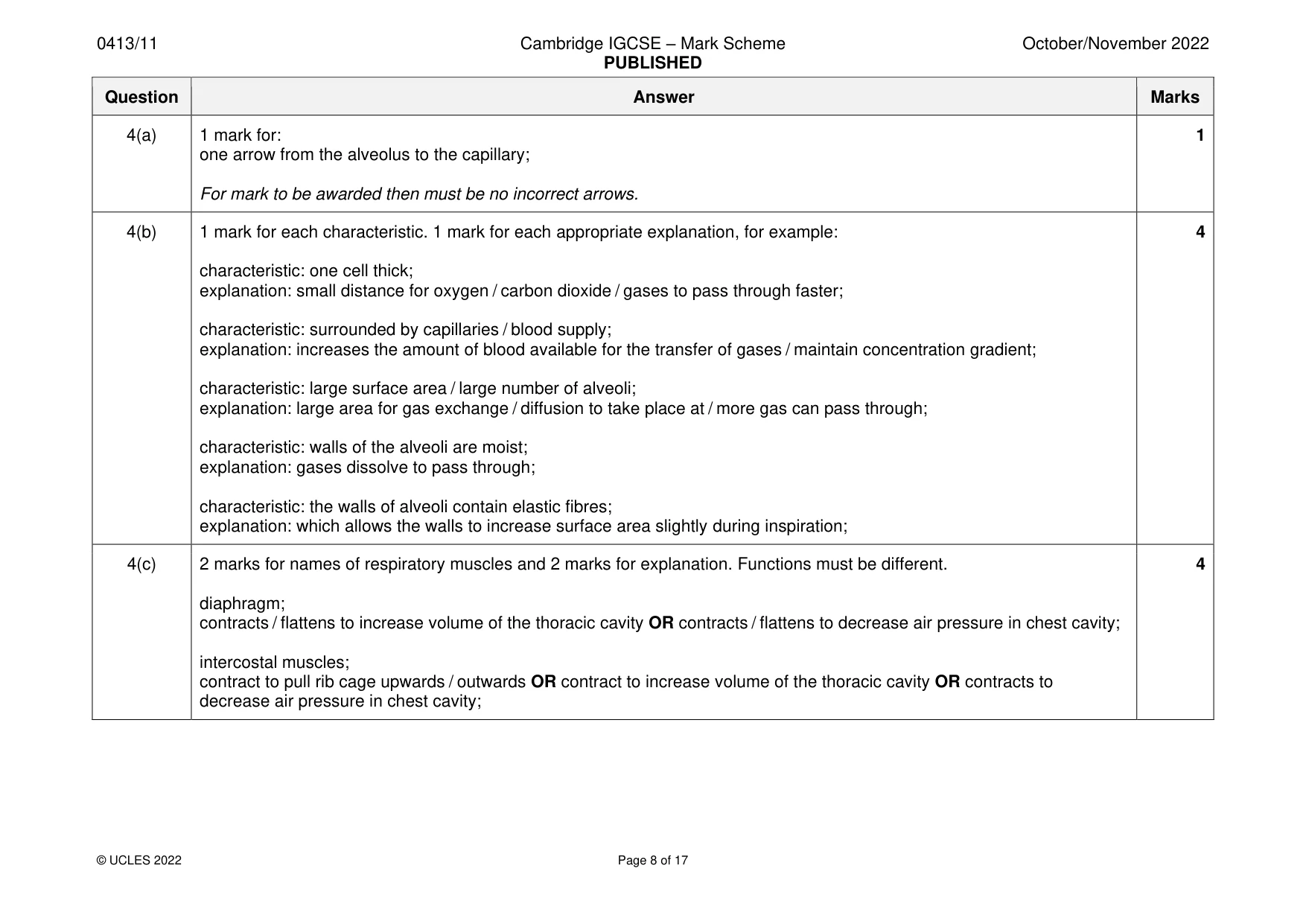
Mark scheme, page 8
0413/11 Cambridge IGCSE – Mark Scheme PUBLISHED October/November 2022 © UCLES 2022 Page 8 of 17 Question Answer Marks 4(a) 1 mark for: one arrow from the alveolus to the capillary; For mark to be awarded then must be no incorrect arrows. 1 4(b) 1 mark for each characteristic. 1 mark for each appropriate explanation, for example: characteristic: one cell thick; explanation: small distance for oxygen / carbon dioxide / gases to pass through faster; characteristic: surrounded by capillaries / blood supply; explanation: increases the amount of blood available for the transfer of gases / maintain concentration gradient; characteristic: large surface area / large number of alveoli; explanation: large area for gas exchange / diffusion to take place at / more gas can pass through; characteristic: walls of the alveoli are moist; explanation: gases dissolve to pass through; characteristic: the walls of alveoli contain elastic fibres; explanation: which allows the walls to increase surface area slightly during inspiration; 4 4(c) 2 marks for names of respiratory muscles and 2 marks for explanation. Functions must be different. diaphragm; contracts / flattens to increase volume of the thoracic cavity OR contracts / flattens to decrease air pressure in chest cavity; intercostal muscles; contract to pull rib cage upwards / outwards OR contract to increase volume of the thoracic cavity OR contracts to decrease air pressure in chest cavity; 4
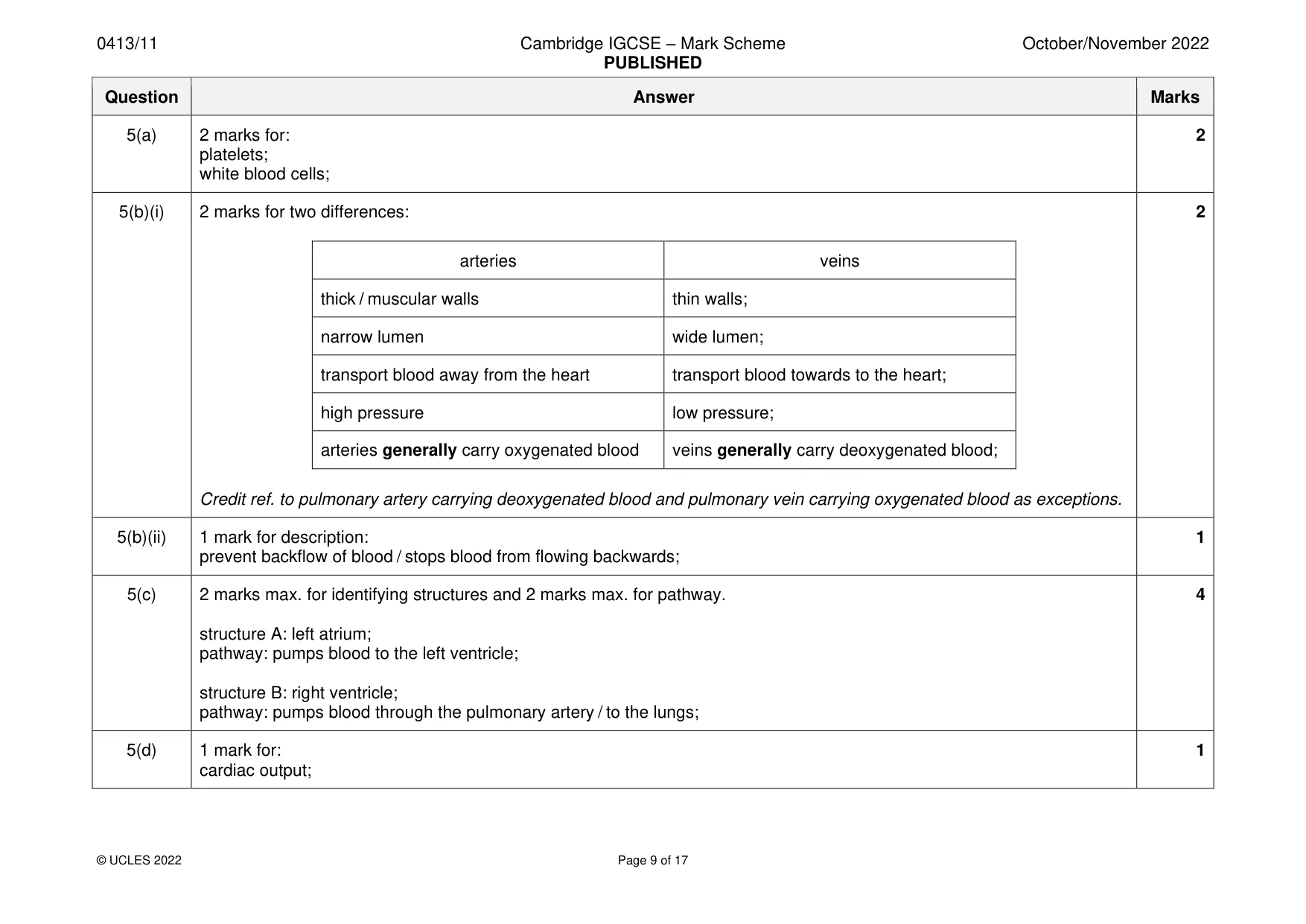
Mark scheme, page 9
0413/11 Cambridge IGCSE – Mark Scheme PUBLISHED October/November 2022 © UCLES 2022 Page 9 of 17 Question Answer Marks 5(a) 2 marks for: platelets; white blood cells; 2 5(b)(i) 2 marks for two differences: arteries veins thick / muscular walls thin walls; narrow lumen wide lumen; transport blood away from the heart transport blood towards to the heart; high pressure low pressure; arteries generally carry oxygenated blood veins generally carry deoxygenated blood; Credit ref. to pulmonary artery carrying deoxygenated blood and pulmonary vein carrying oxygenated blood as exceptions. 2 5(b)(ii) 1 mark for description: prevent backflow of blood / stops blood from flowing backwards; 1 5(c) 2 marks max. for identifying structures and 2 marks max. for pathway. structure A: left atrium; pathway: pumps blood to the left ventricle; structure B: right ventricle; pathway: pumps blood through the pulmonary artery / to the lungs; 4 5(d) 1 mark for: cardiac output; 1
Mark scheme, page 10
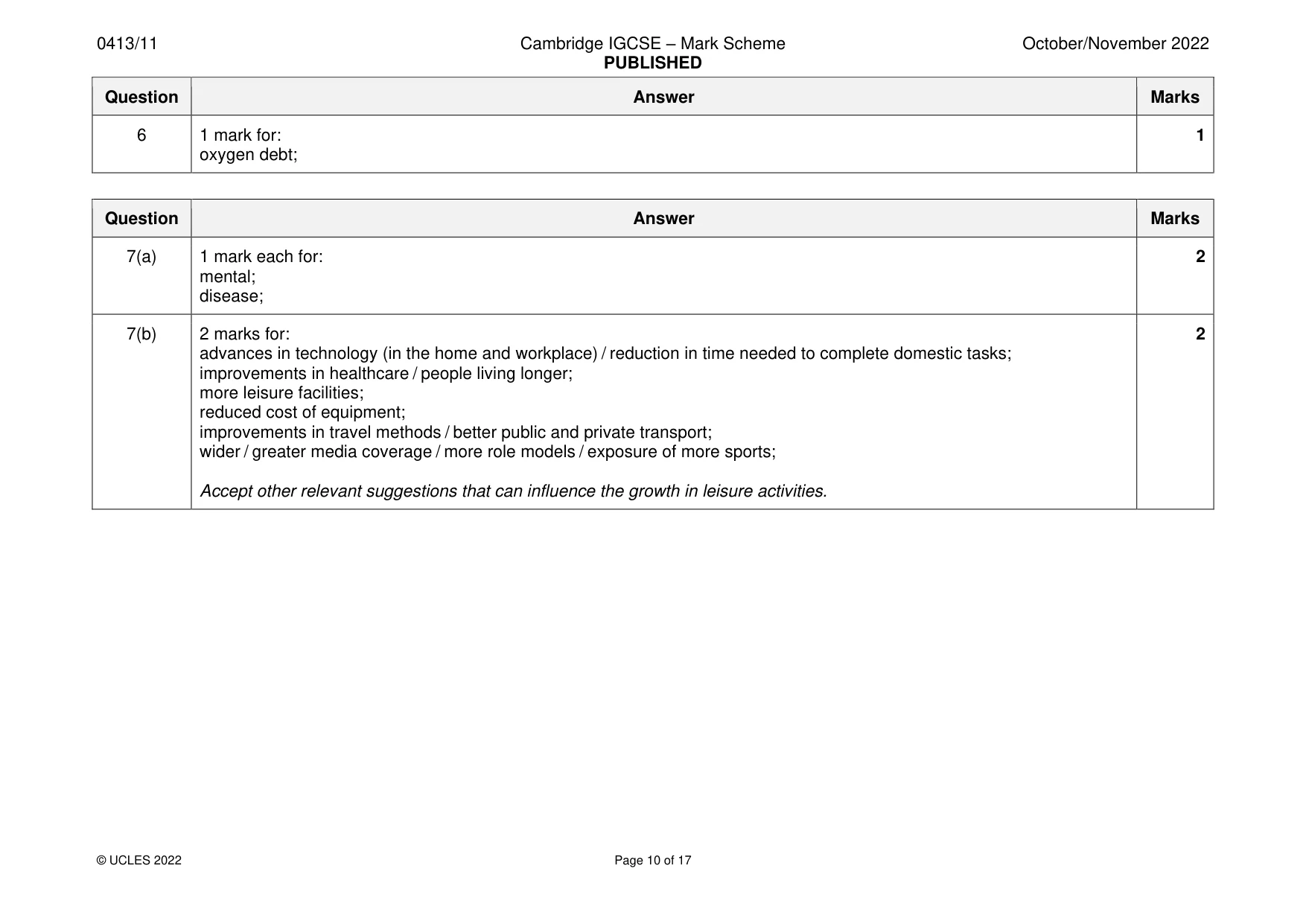
0413/11 Cambridge IGCSE – Mark Scheme PUBLISHED October/November 2022 © UCLES 2022 Page 10 of 17 Question Answer Marks 6 1 mark for: oxygen debt; 1 Question Answer Marks 7(a) 1 mark each for: mental; disease; 2 7(b) 2 marks for: advances in technology (in the home and workplace) / reduction in time needed to complete domestic tasks; improvements in healthcare / people living longer; more leisure facilities; reduced cost of equipment; improvements in travel methods / better public and private transport; wider / greater media coverage / more role models / exposure of more sports; Accept other relevant suggestions that can influence the growth in leisure activities. 2
Mark scheme, page 11
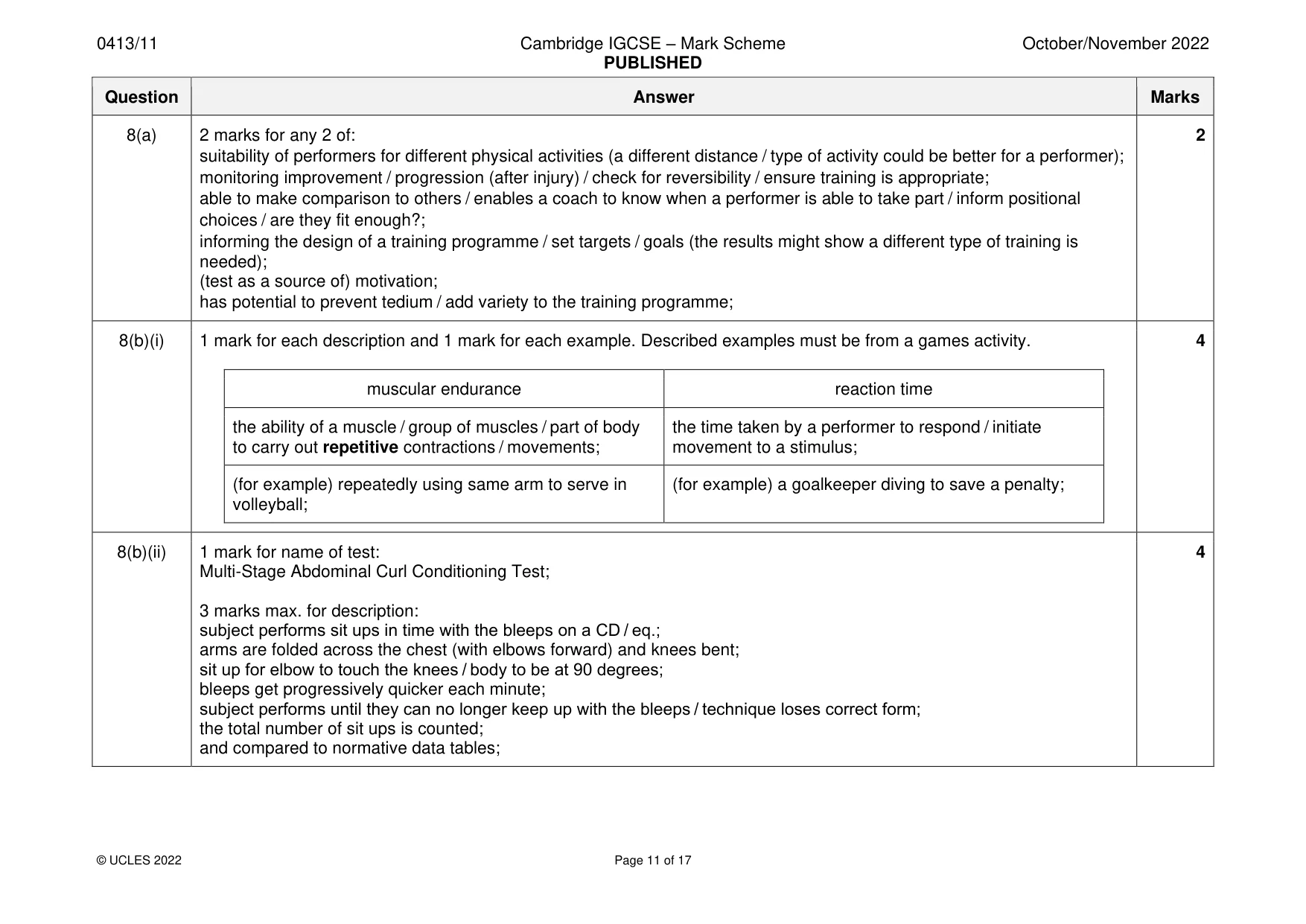
0413/11 Cambridge IGCSE – Mark Scheme PUBLISHED October/November 2022 © UCLES 2022 Page 11 of 17 Question Answer Marks 8(a) 2 marks for any 2 of: suitability of performers for different physical activities (a different distance / type of activity could be better for a performer); monitoring improvement / progression (after injury) / check for reversibility / ensure training is appropriate; able to make comparison to others / enables a coach to know when a performer is able to take part / inform positional choices / are they fit enough?; informing the design of a training programme / set targets / goals (the results might show a different type of training is needed); (test as a source of) motivation; has potential to prevent tedium / add variety to the training programme; 2 8(b)(i) 1 mark for each description and 1 mark for each example. Described examples must be from a games activity. muscular endurance reaction time the ability of a muscle / group of muscles / part of body to carry out repetitive contractions / movements; the time taken by a performer to respond / initiate movement to a stimulus; (for example) repeatedly using same arm to serve in volleyball; (for example) a goalkeeper diving to save a penalty; 4 8(b)(ii) 1 mark for name of test: Multi-Stage Abdominal Curl Conditioning Test; 3 marks max. for description: subject performs sit ups in time with the bleeps on a CD / eq.; arms are folded across the chest (with elbows forward) and knees bent; sit up for elbow to touch the knees / body to be at 90 degrees; bleeps get progressively quicker each minute; subject performs until they can no longer keep up with the bleeps / technique loses correct form; the total number of sit ups is counted; and compared to normative data tables; 4
Mark scheme, page 12
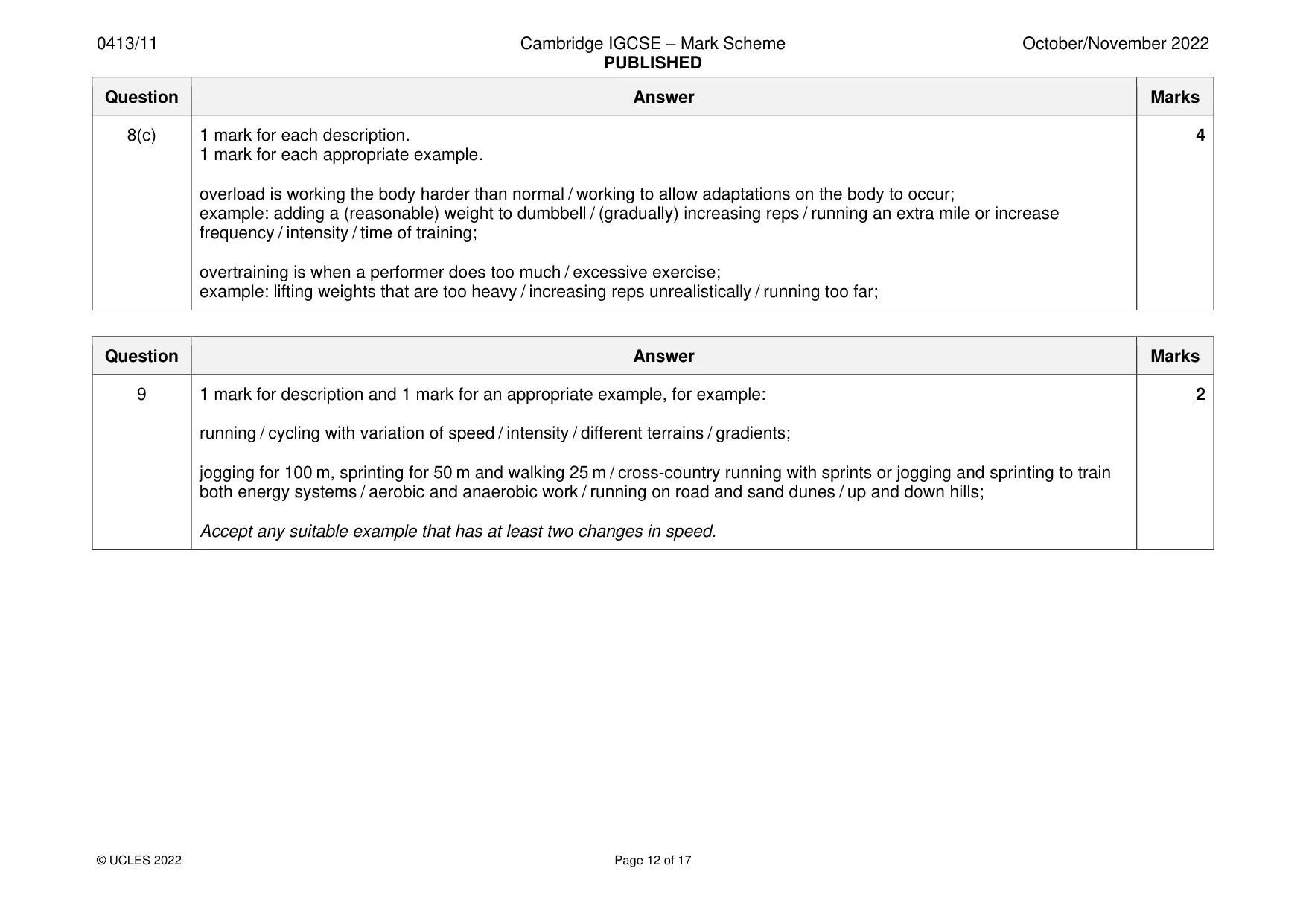
0413/11 Cambridge IGCSE – Mark Scheme PUBLISHED October/November 2022 © UCLES 2022 Page 12 of 17 Question Answer Marks 8(c) 1 mark for each description. 1 mark for each appropriate example. overload is working the body harder than normal / working to allow adaptations on the body to occur; example: adding a (reasonable) weight to dumbbell / (gradually) increasing reps / running an extra mile or increase frequency / intensity / time of training; overtraining is when a performer does too much / excessive exercise; example: lifting weights that are too heavy / increasing reps unrealistically / running too far; 4 Question Answer Marks 9 1 mark for description and 1 mark for an appropriate example, for example: running / cycling with variation of speed / intensity / different terrains / gradients; jogging for 100 m, sprinting for 50 m and walking 25 m / cross-country running with sprints or jogging and sprinting to train both energy systems / aerobic and anaerobic work / running on road and sand dunes / up and down hills; Accept any suitable example that has at least two changes in speed. 2
Mark scheme, page 13
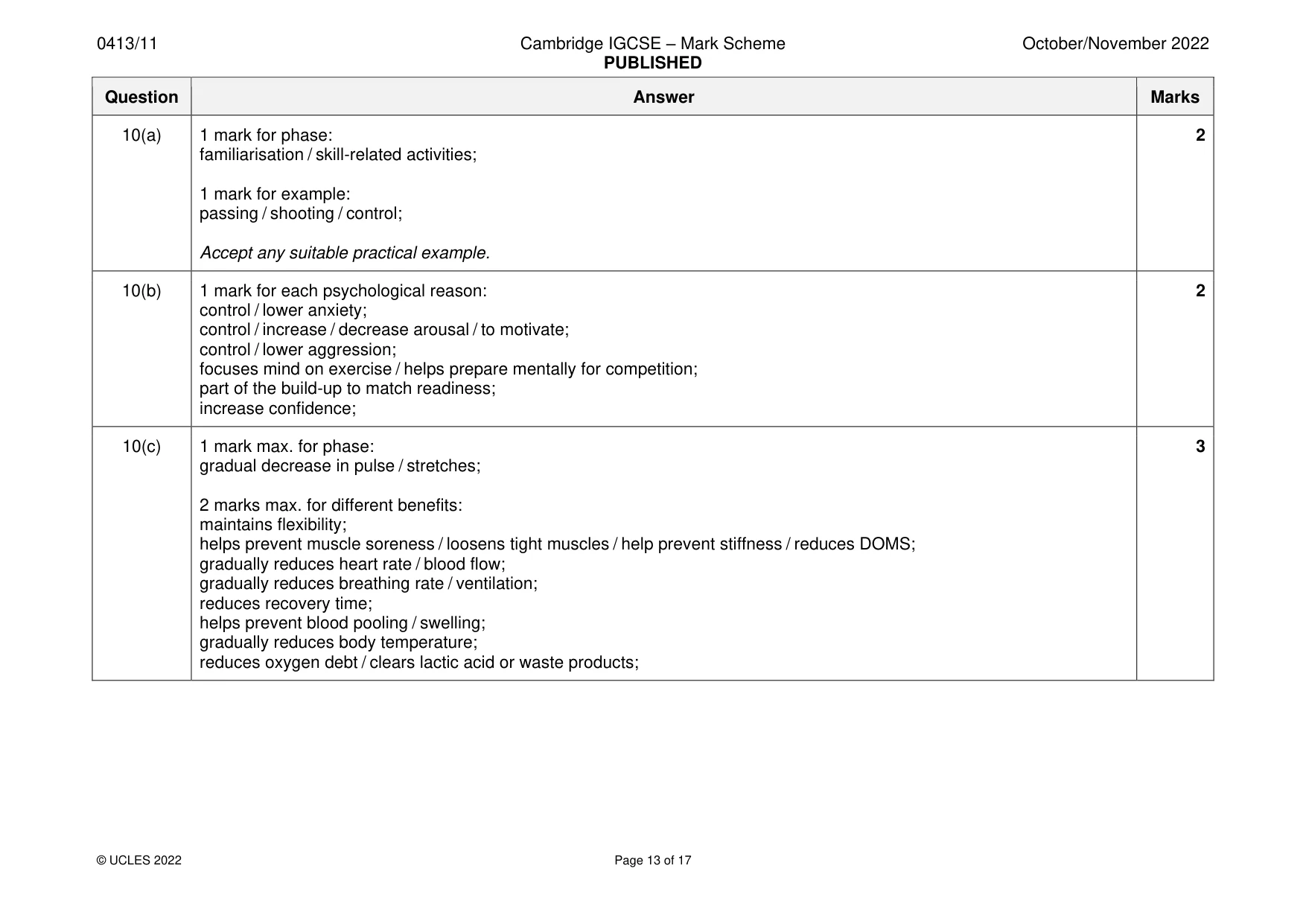
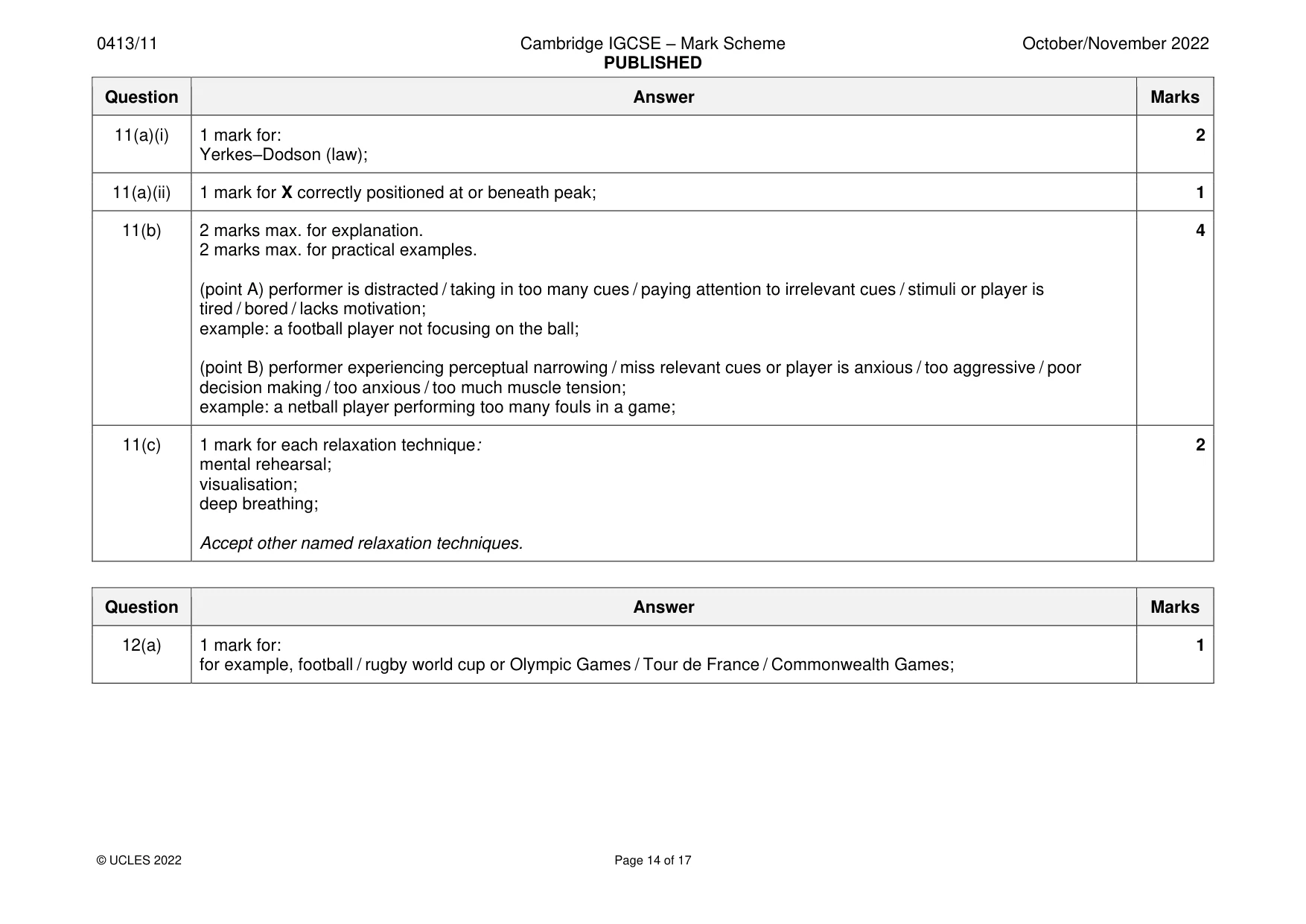
0413/11 Cambridge IGCSE – Mark Scheme PUBLISHED October/November 2022 © UCLES 2022 Page 13 of 17 Question Answer Marks 10(a) 1 mark for phase: familiarisation / skill-related activities; 1 mark for example: passing / shooting / control; Accept any suitable practical example. 2 10(b) 1 mark for each psychological reason: control / lower anxiety; control / increase / decrease arousal / to motivate; control / lower aggression; focuses mind on exercise / helps prepare mentally for competition; part of the build-up to match readiness; increase confidence; 2 10(c) 1 mark max. for phase: gradual decrease in pulse / stretches; 2 marks max. for different benefits: maintains flexibility; helps prevent muscle soreness / loosens tight muscles / help prevent stiffness / reduces DOMS; gradually reduces heart rate / blood flow; gradually reduces breathing rate / ventilation; reduces recovery time; helps prevent blood pooling / swelling; gradually reduces body temperature; reduces oxygen debt / clears lactic acid or waste products; 3
Mark scheme, page 14
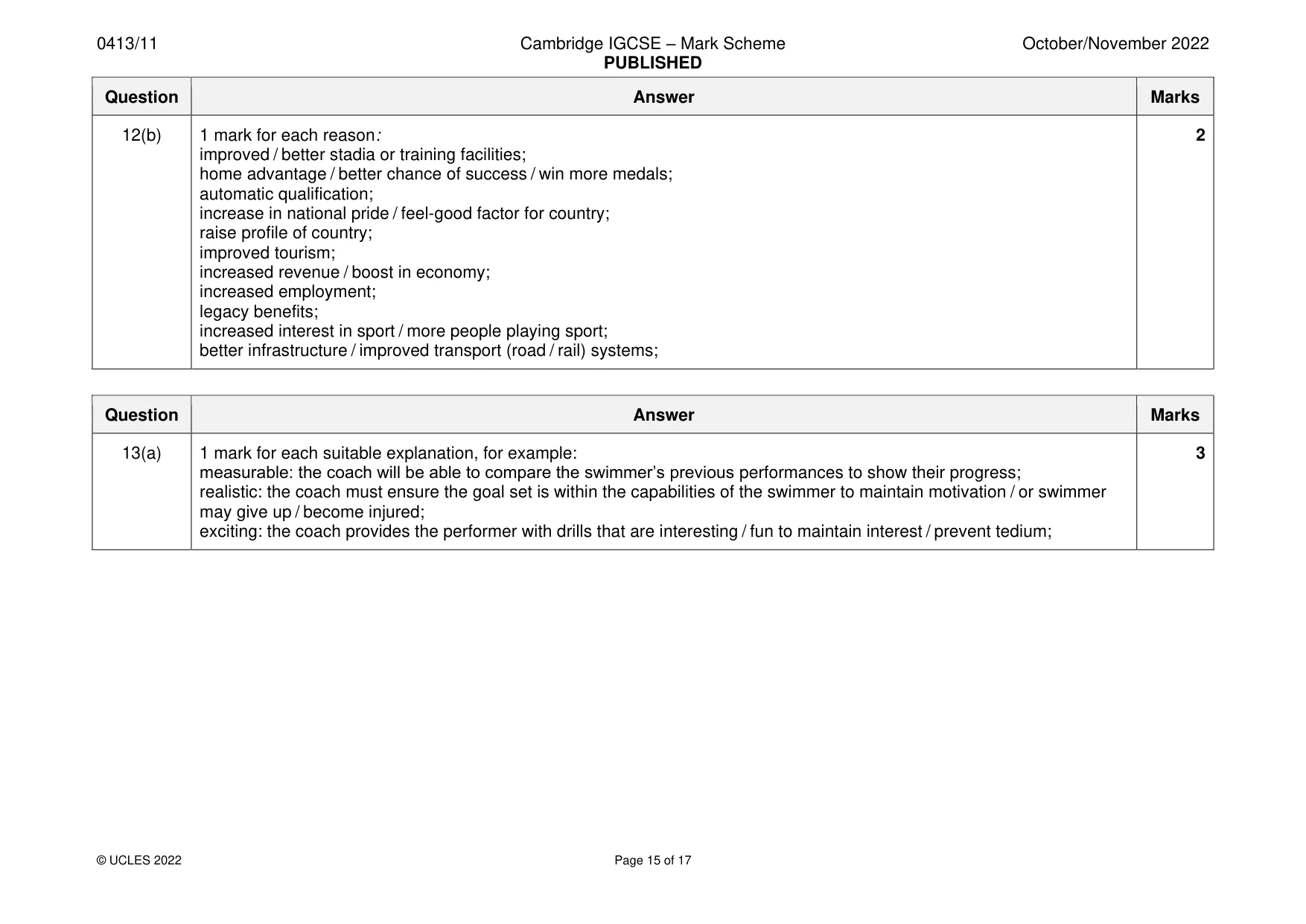
0413/11 Cambridge IGCSE – Mark Scheme PUBLISHED October/November 2022 © UCLES 2022 Page 14 of 17 Question Answer Marks 11(a)(i) 1 mark for: Yerkes–Dodson (law); 2 11(a)(ii) 1 mark for X correctly positioned at or beneath peak; 1 11(b) 2 marks max. for explanation. 2 marks max. for practical examples. (point A) performer is distracted / taking in too many cues / paying attention to irrelevant cues / stimuli or player is tired / bored / lacks motivation; example: a football player not focusing on the ball; (point B) performer experiencing perceptual narrowing / miss relevant cues or player is anxious / too aggressive / poor decision making / too anxious / too much muscle tension; example: a netball player performing too many fouls in a game; 4 11(c) 1 mark for each relaxation technique: mental rehearsal; visualisation; deep breathing; Accept other named relaxation techniques. 2 Question Answer Marks 12(a) 1 mark for: for example, football / rugby world cup or Olympic Games / Tour de France / Commonwealth Games; 1
Mark scheme, page 15
0413/11 Cambridge IGCSE – Mark Scheme PUBLISHED October/November 2022 © UCLES 2022 Page 15 of 17 Question Answer Marks 12(b) 1 mark for each reason: improved / better stadia or training facilities; home advantage / better chance of success / win more medals; automatic qualification; increase in national pride / feel-good factor for country; raise profile of country; improved tourism; increased revenue / boost in economy; increased employment; legacy benefits; increased interest in sport / more people playing sport; better infrastructure / improved transport (road / rail) systems; 2 Question Answer Marks 13(a) 1 mark for each suitable explanation, for example: measurable: the coach will be able to compare the swimmer’s previous performances to show their progress; realistic: the coach must ensure the goal set is within the capabilities of the swimmer to maintain motivation / or swimmer may give up / become injured; exciting: the coach provides the performer with drills that are interesting / fun to maintain interest / prevent tedium; 3
Mark scheme, page 16
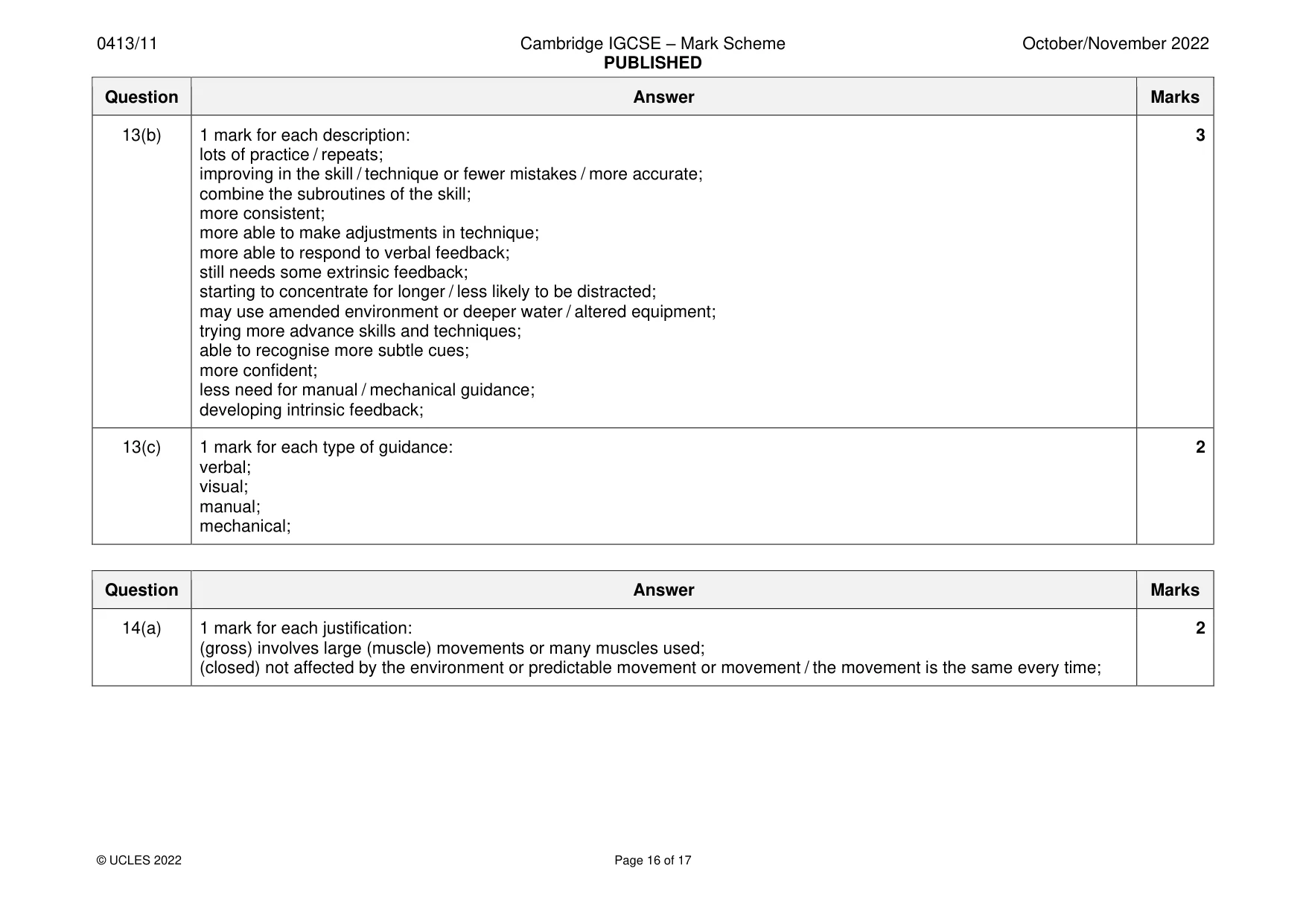
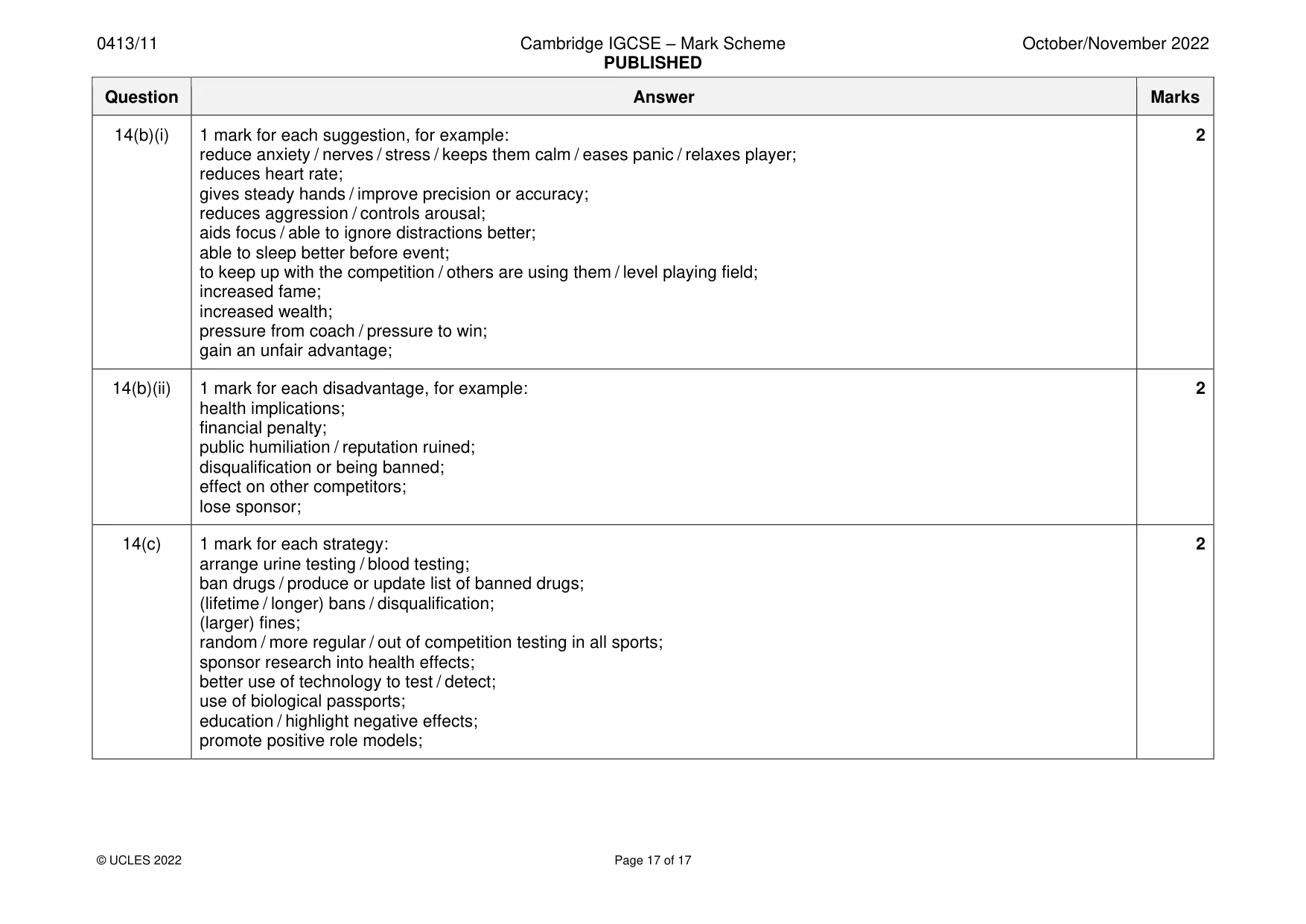
0413/11 Cambridge IGCSE – Mark Scheme PUBLISHED October/November 2022 © UCLES 2022 Page 16 of 17 Question Answer Marks 13(b) 1 mark for each description: lots of practice / repeats; improving in the skill / technique or fewer mistakes / more accurate; combine the subroutines of the skill; more consistent; more able to make adjustments in technique; more able to respond to verbal feedback; still needs some extrinsic feedback; starting to concentrate for longer / less likely to be distracted; may use amended environment or deeper water / altered equipment; trying more advance skills and techniques; able to recognise more subtle cues; more confident; less need for manual / mechanical guidance; developing intrinsic feedback; 3 13(c) 1 mark for each type of guidance: verbal; visual; manual; mechanical; 2 Question Answer Marks 14(a) 1 mark for each justification: (gross) involves large (muscle) movements or many muscles used; (closed) not affected by the environment or predictable movement or movement / the movement is the same every time; 2
Mark scheme, page 17
0413/11 Cambridge IGCSE – Mark Scheme PUBLISHED October/November 2022 © UCLES 2022 Page 17 of 17 Question Answer Marks 14(b)(i) 1 mark for each suggestion, for example: reduce anxiety / nerves / stress / keeps them calm / eases panic / relaxes player; reduces heart rate; gives steady hands / improve precision or accuracy; reduces aggression / controls arousal; aids focus / able to ignore distractions better; able to sleep better before event; to keep up with the competition / others are using them / level playing field; increased fame; increased wealth; pressure from coach / pressure to win; gain an unfair advantage; 2 14(b)(ii) 1 mark for each disadvantage, for example: health implications; financial penalty; public humiliation / reputation ruined; disqualification or being banned; effect on other competitors; lose sponsor; 2 14(c) 1 mark for each strategy: arrange urine testing / blood testing; ban drugs / produce or update list of banned drugs; (lifetime / longer) bans / disqualification; (larger) fines; random / more regular / out of competition testing in all sports; sponsor research into health effects; better use of technology to test / detect; use of biological passports; education / highlight negative effects; promote positive role models; 2
What you needed in this session
Cambridge’s own grade thresholds for 2022 Oct/Nov, Paper 1 · Variant 1. A higher threshold means an easier paper — the bar moves with how the cohort did.