Cambridge IGCSE Physical Education 0413 — 2023 May/June Paper 1 · Variant 3
0413/13/M/J/23 · 100 marks · ≈113 min
The question paper and its mark scheme, free to read here and free to download. This is Cambridge’s own paper, exactly as it was sat.
Question paper16 pages

Mark scheme19 pages
Answers below. Sit the paper first if you are practising.
Paper as text
Question paper, page 1
This document has 16 pages. Any blank pages are indicated. [Turn over Cambridge IGCSE™ PHYSICAL EDUCATION 0413/13 Paper 1 Theory May/June 2023 1 hour 45 minutes You must answer on the question paper. No additional materials are needed. INSTRUCTIONS ● Answer all questions. ● Use a black or dark blue pen. You may use an HB pencil for any diagrams or graphs. ● Write your name, centre number and candidate number in the boxes at the top of the page. ● Write your answer to each question in the space provided. ● Do not use an erasable pen or correction fluid. ● Do not write on any bar codes. ● You may use a calculator. ● You should show all your working and use appropriate units. INFORMATION ● The total mark for this paper is 100. ● The number of marks for each question or part question is shown in brackets [ ]. * 3 7 2 6 2 4 4 0 6 5 * DC (CJ/SG) 315436/2 © UCLES 2023
Question paper, page 2
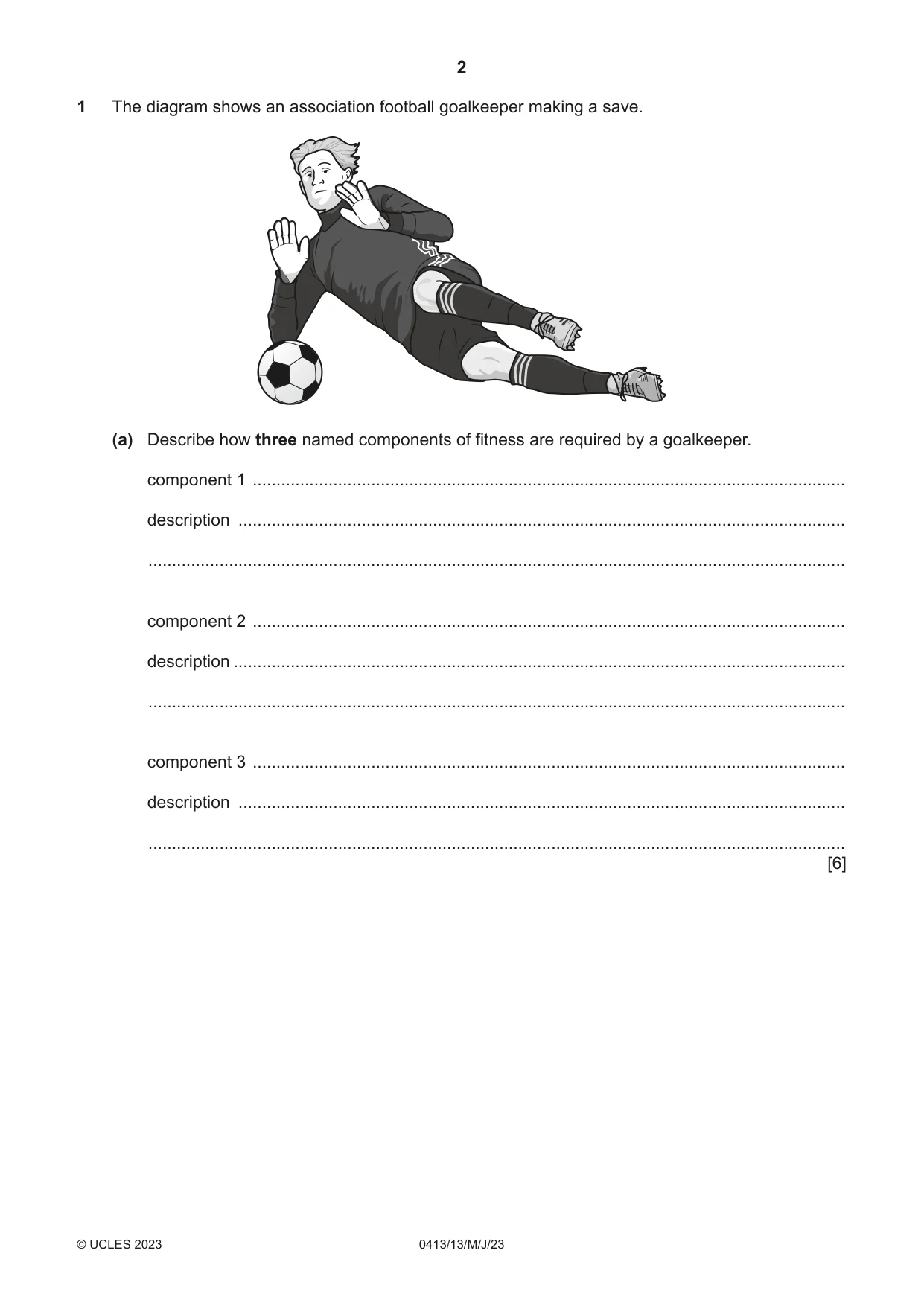
2 0413/13/M/J/23 © UCLES 2023 1 The diagram shows an association football goalkeeper making a save. (a) Describe how three named components of fitness are required by a goalkeeper. component 1 … description … … component 2 … description … … component 3 … description … … [6]
Question paper, page 3
3 0413/13/M/J/23 © UCLES 2023 [Turn over (b) State different examples of exercises that can be included in the three named phases of a warm up for a goalkeeper. Explain the benefit of each phase. name of phase 1 … … example … explanation of the benefit of phase 1 … … name of phase 2 … … example … explanation of the benefit of phase 2 … … name of phase 3 … … example … explanation of the benefit of phase 3 … … [6] (c) Define the following terms and describe one example for each from association football: sportsmanship definition … … example … … gamesmanship. definition … … example … … [4] [Total: 16]
Question paper, page 4
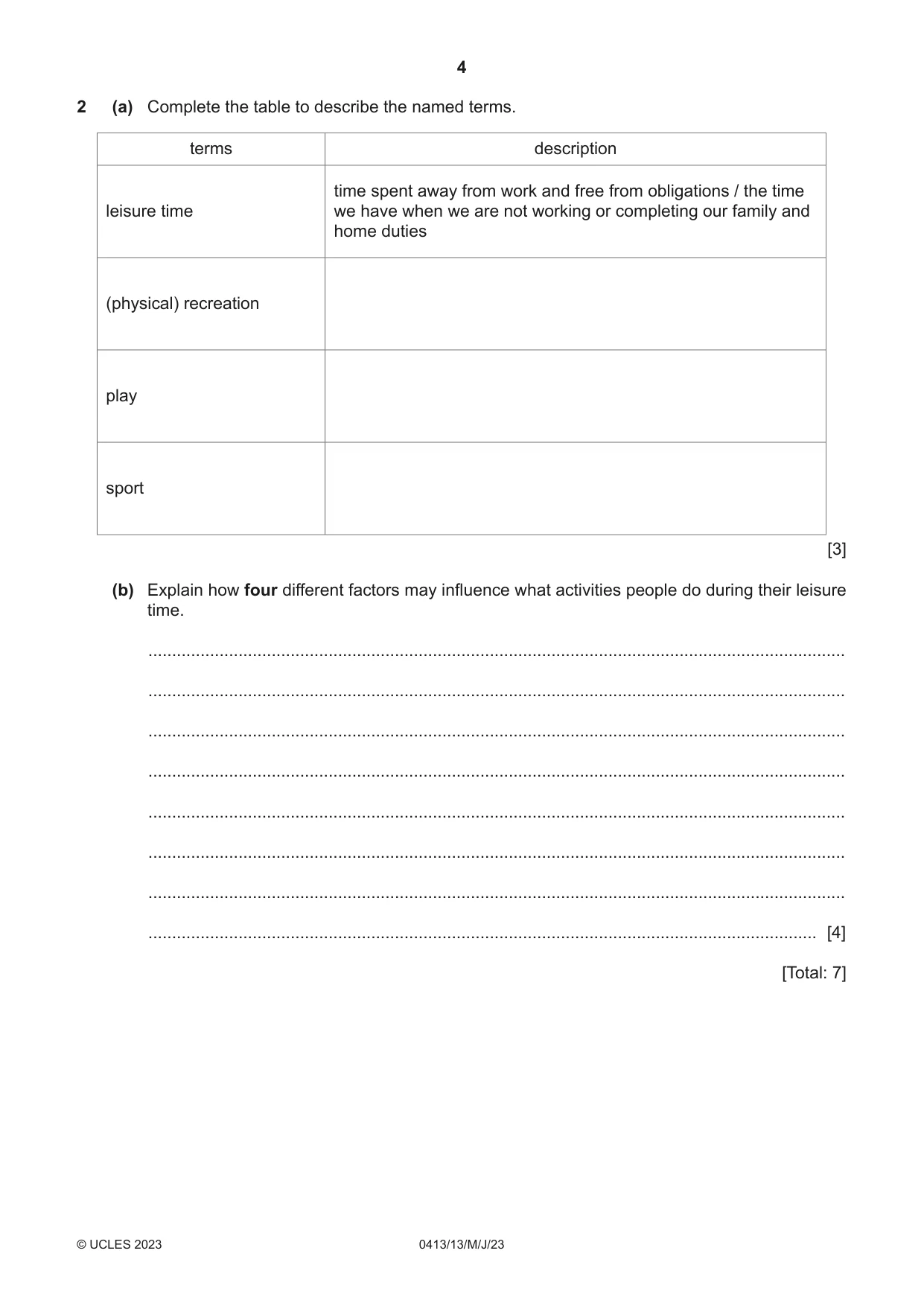
4 0413/13/M/J/23 © UCLES 2023 2 (a) Complete the table to describe the named terms. terms description leisure time time spent away from work and free from obligations / the time we have when we are not working or completing our family and home duties (physical) recreation play sport [3] (b) Explain how four different factors may influence what activities people do during their leisure time. … … … … … … … … [4] [Total: 7]
Question paper, page 5
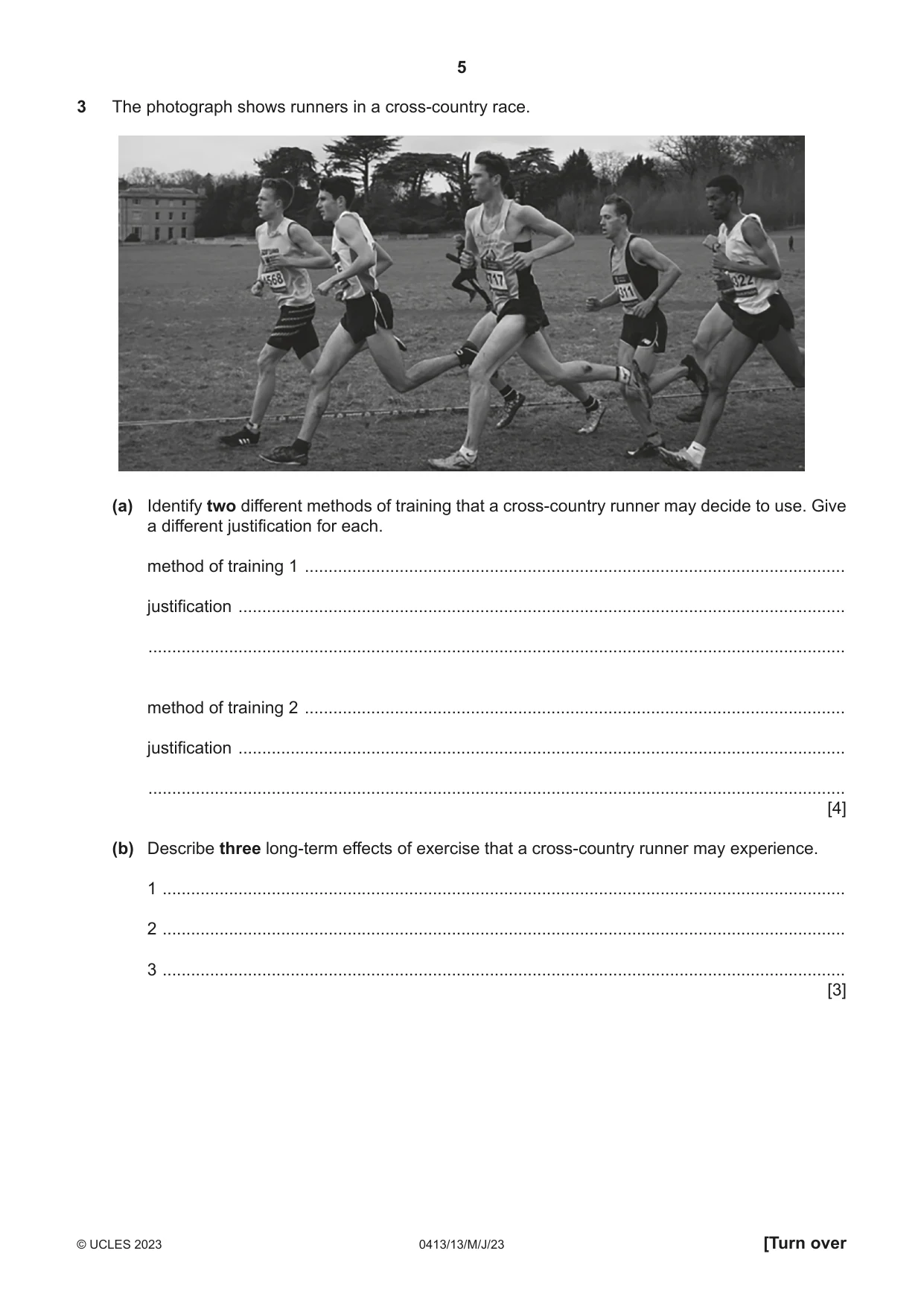
5 0413/13/M/J/23 © UCLES 2023 [Turn over 3 The photograph shows runners in a cross-country race. (a) Identify two different methods of training that a cross-country runner may decide to use. Give a different justification for each. method of training 1 … justification … … method of training 2 … justification … … [4] (b) Describe three long-term effects of exercise that a cross-country runner may experience. 1 … 2 … 3 … [3]
Question paper, page 6
6 0413/13/M/J/23 © UCLES 2023 (c) Recovery is an important aspect of a cross-country runner’s training programme. (i) Describe what is meant by EPOC. … … … … … … [3] (ii) Explain three factors that can affect recovery time. 1 … … 2 … … 3 … … [3] [Total: 13]
Question paper, page 7
7 0413/13/M/J/23 © UCLES 2023 [Turn over 4 (a) Describe, using examples from a named physical activity, how cognitive anxiety and somatic anxiety differ. physical activity … description … … … … … … … … [4] (b) Visualisation is one relaxation technique that can be used by a performer to control anxiety. Describe two other named relaxation techniques. technique 1 … description … … technique 2 … description … … [4] [Total: 8]
Question paper, page 8
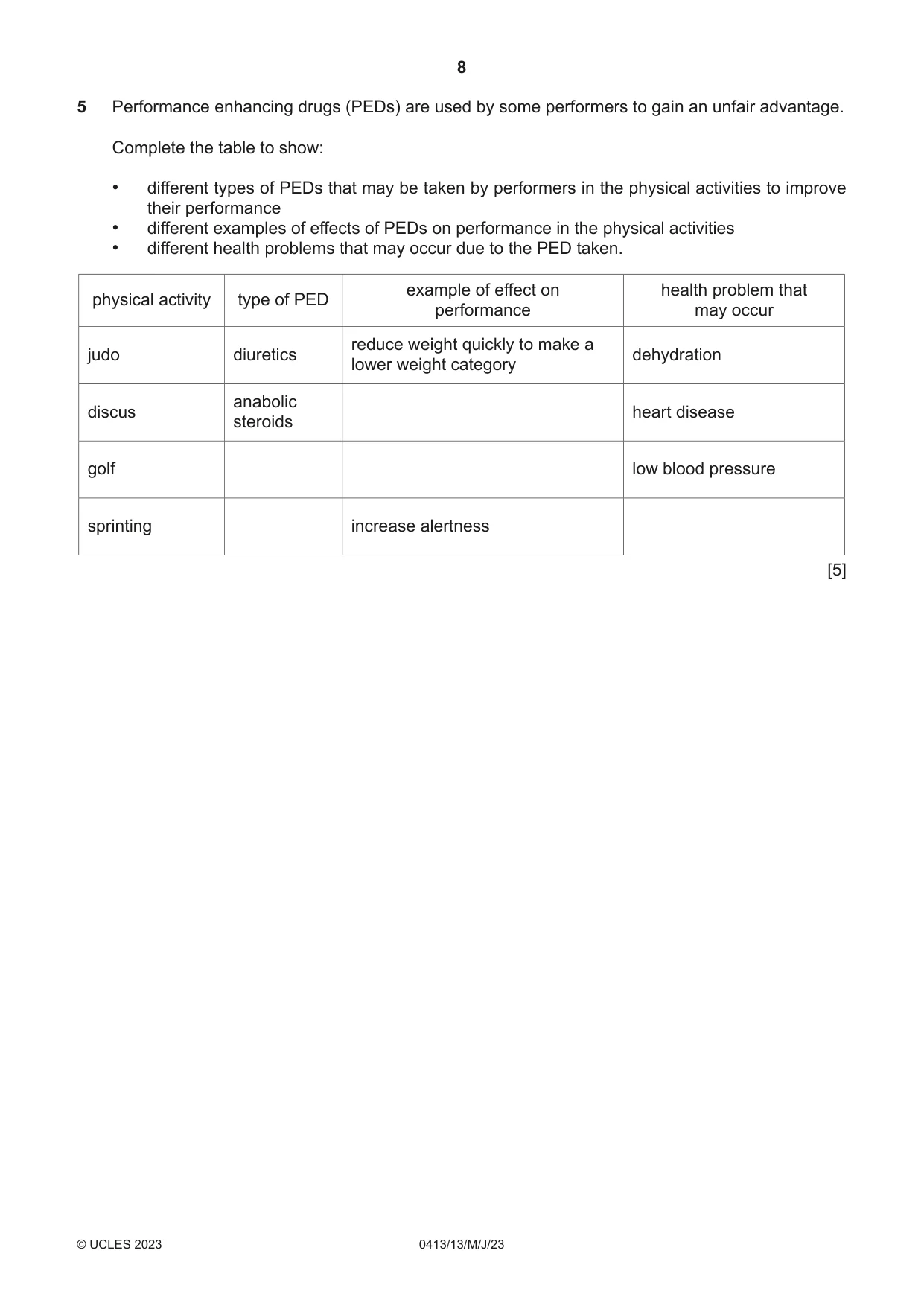
8 0413/13/M/J/23 © UCLES 2023 5 Performance enhancing drugs (PEDs) are used by some performers to gain an unfair advantage. Complete the table to show: • different types of PEDs that may be taken by performers in the physical activities to improve their performance • different examples of effects of PEDs on performance in the physical activities • different health problems that may occur due to the PED taken. physical activity type of PED example of effect on performance health problem that may occur judo diuretics reduce weight quickly to make a lower weight category dehydration discus anabolic steroids heart disease golf low blood pressure sprinting increase alertness [5]
Question paper, page 9
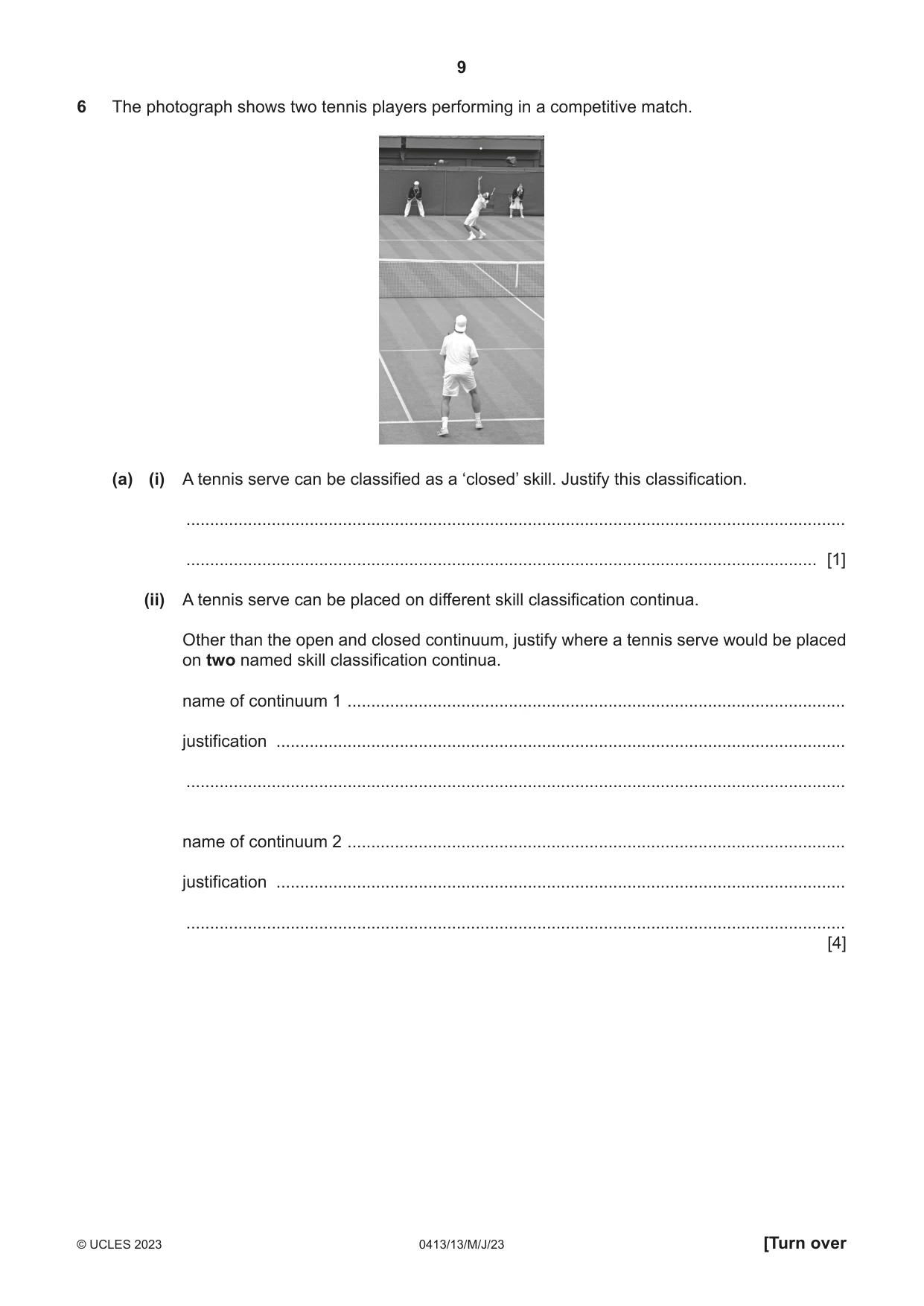
9 0413/13/M/J/23 © UCLES 2023 [Turn over 6 The photograph shows two tennis players performing in a competitive match. (a) (i) A tennis serve can be classified as a ‘closed’ skill. Justify this classification. … … [1] (ii) A tennis serve can be placed on different skill classification continua. Other than the open and closed continuum, justify where a tennis serve would be placed on two named skill classification continua. name of continuum 1 … justification … … name of continuum 2 … justification … … [4]
Question paper, page 10
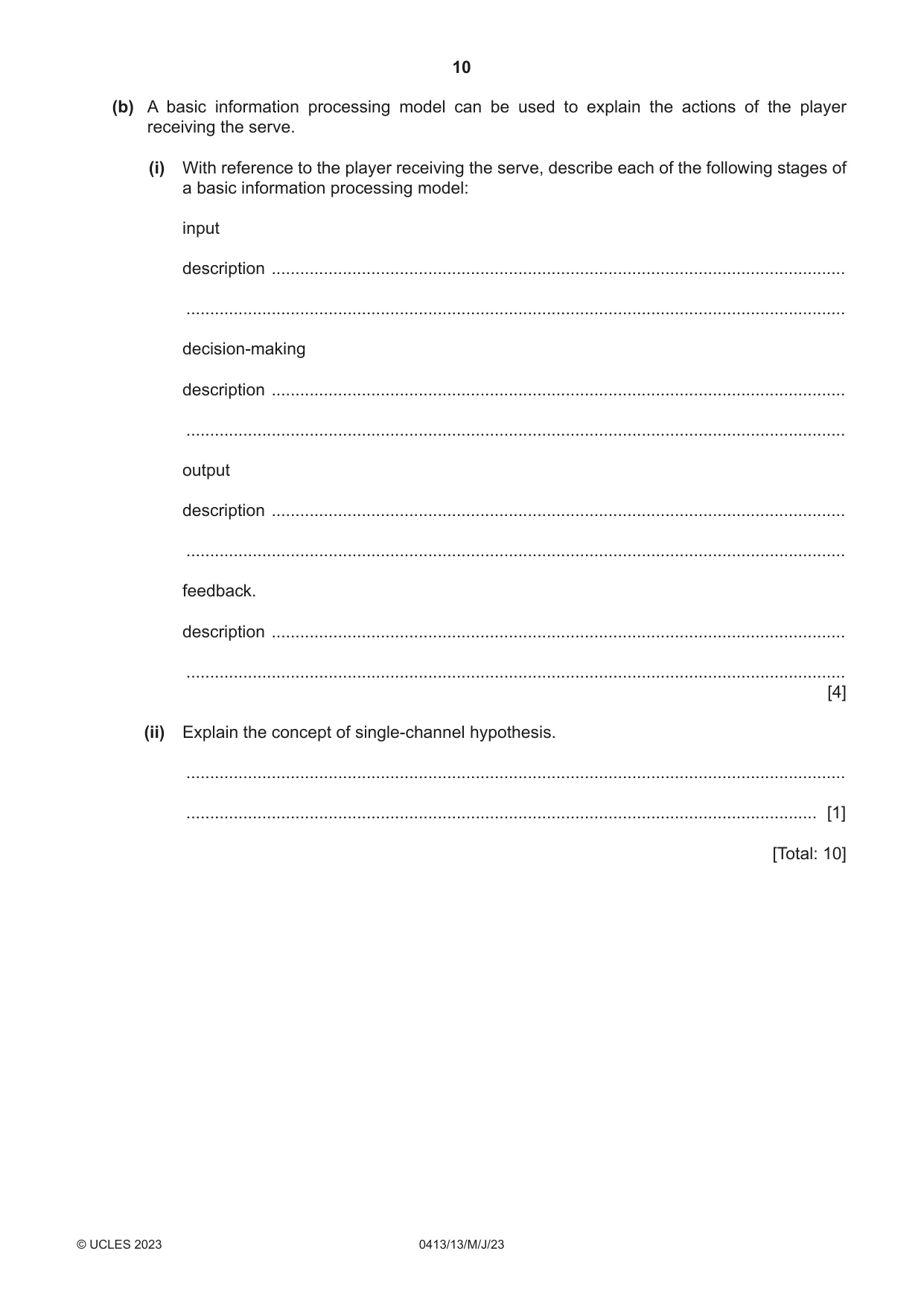
10 0413/13/M/J/23 © UCLES 2023 (b) A basic information processing model can be used to explain the actions of the player receiving the serve. (i) With reference to the player receiving the serve, describe each of the following stages of a basic information processing model: input description … … decision-making description … … output description … … feedback. description … … [4] (ii) Explain the concept of single-channel hypothesis. … … [1] [Total: 10]
Question paper, page 11
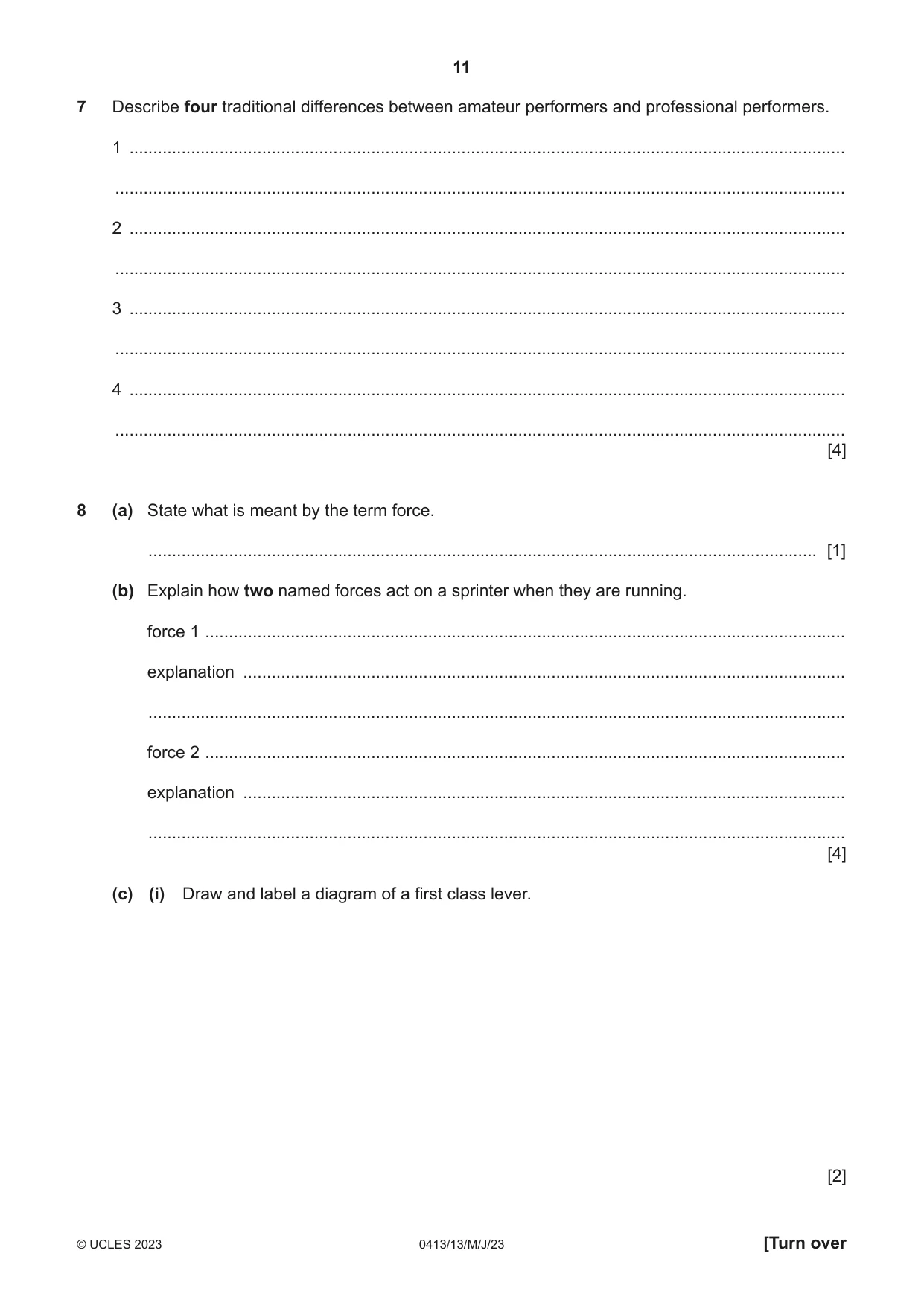
11 0413/13/M/J/23 © UCLES 2023 [Turn over 7 Describe four traditional differences between amateur performers and professional performers. 1 … … 2 … … 3 … … 4 … … [4] 8 (a) State what is meant by the term force. … [1] (b) Explain how two named forces act on a sprinter when they are running. force 1 … explanation … … force 2 … explanation … … [4] (c) (i) Draw and label a diagram of a first class lever. [2]
Question paper, page 12
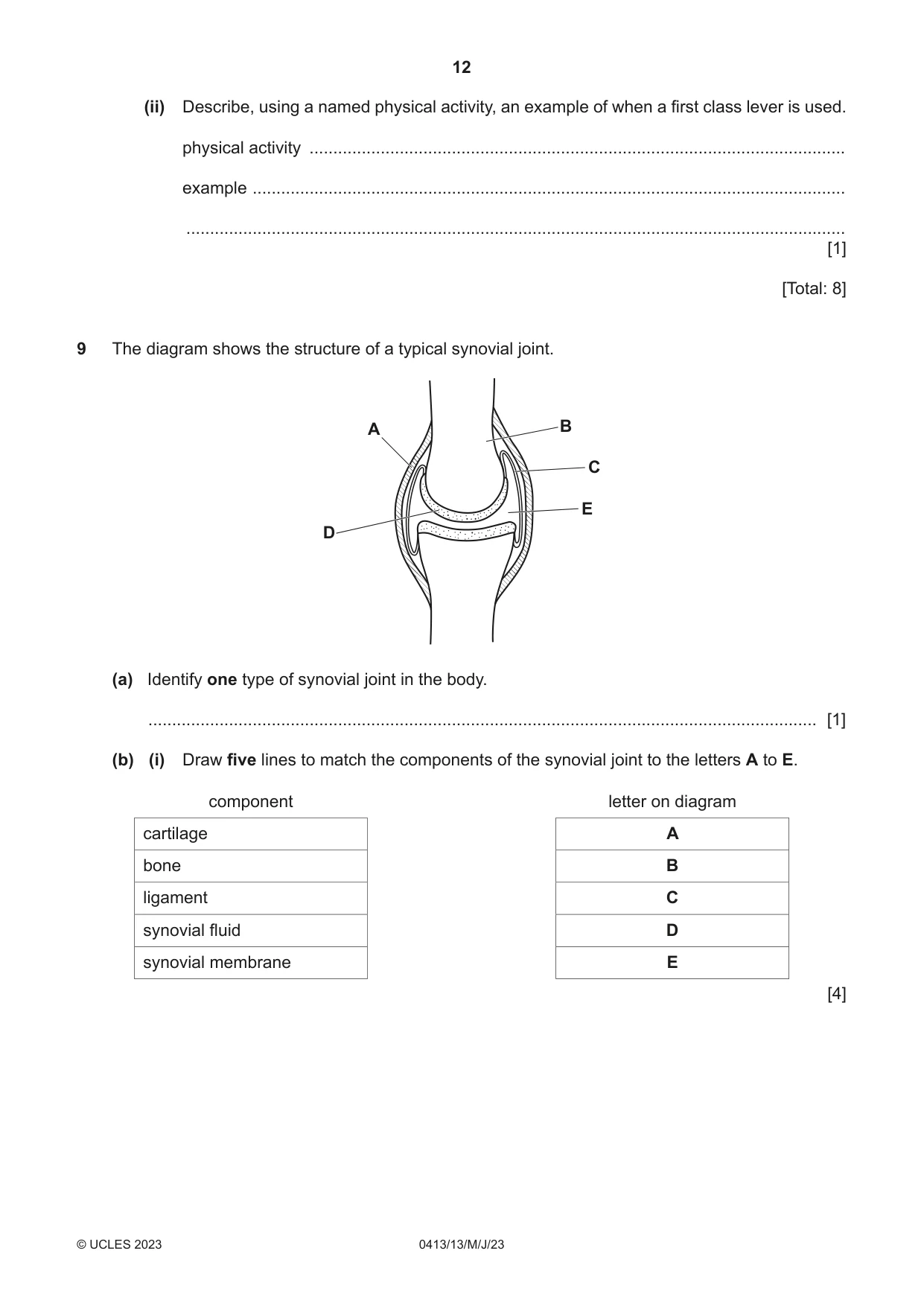
12 0413/13/M/J/23 © UCLES 2023 (ii) Describe, using a named physical activity, an example of when a first class lever is used. physical activity … example … … [1] [Total: 8] 9 The diagram shows the structure of a typical synovial joint. A D B E C (a) Identify one type of synovial joint in the body. … [1] (b) (i) Draw five lines to match the components of the synovial joint to the letters A to E. component letter on diagram cartilage A bone B ligament C synovial fluid D synovial membrane E [4]
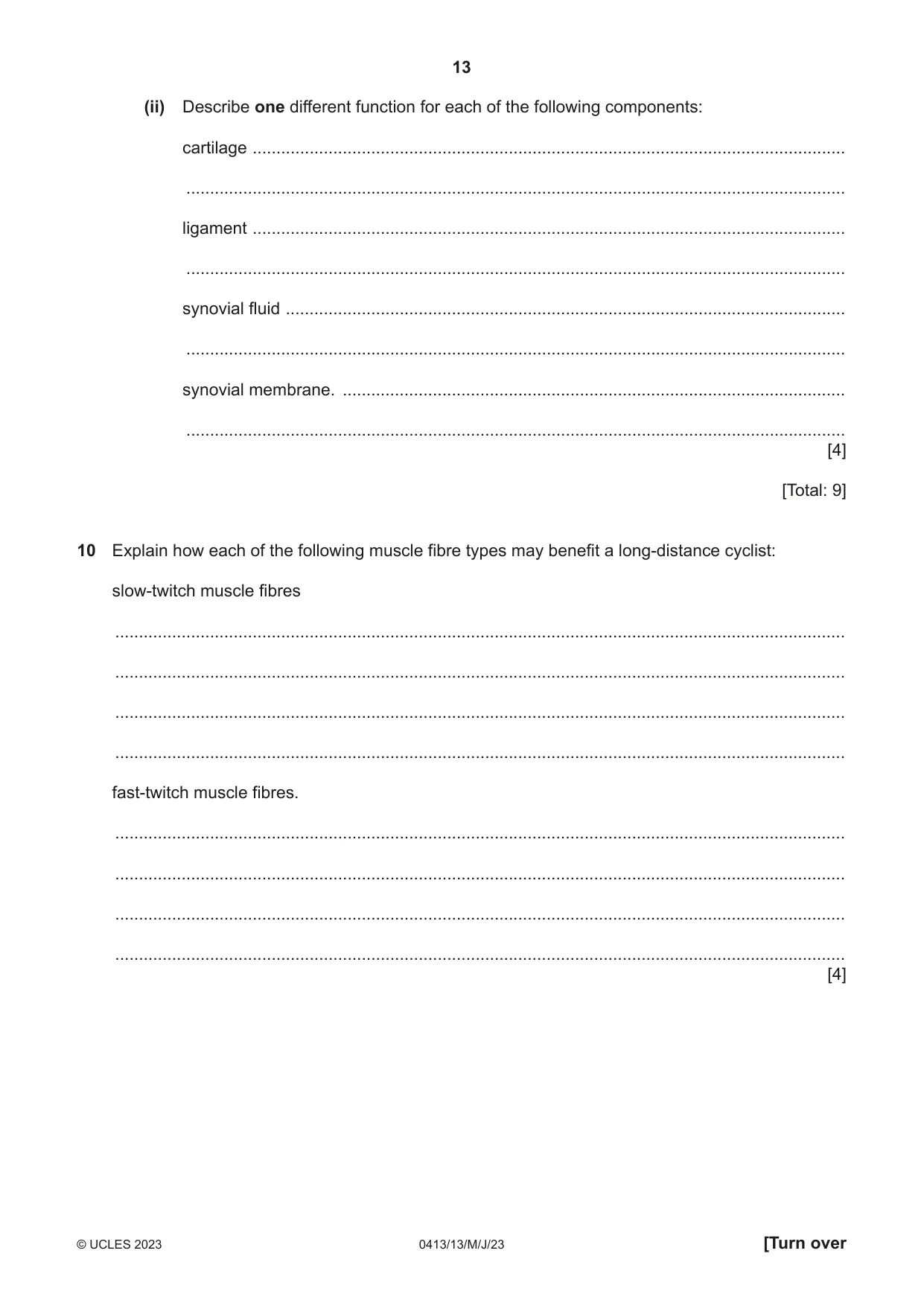
Question paper, page 13
13 0413/13/M/J/23 © UCLES 2023 [Turn over (ii) Describe one different function for each of the following components: cartilage … … ligament … … synovial fluid … … synovial membrane. … … [4] [Total: 9] 10 Explain how each of the following muscle fibre types may benefit a long-distance cyclist: slow-twitch muscle fibres … … … … fast-twitch muscle fibres. … … … … [4]
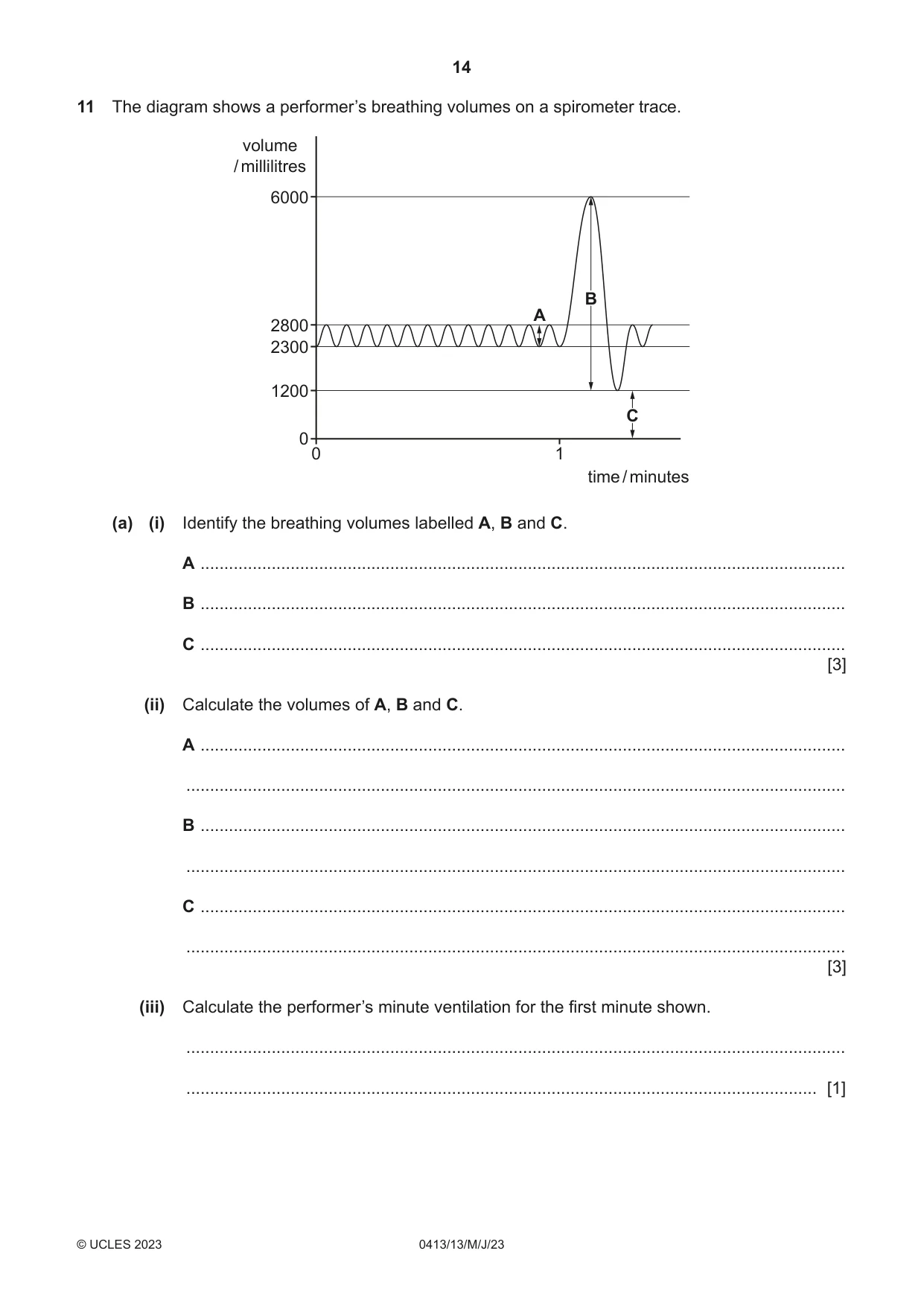
Question paper, page 14
14 0413/13/M/J/23 © UCLES 2023 11 The diagram shows a performer’s breathing volumes on a spirometer trace. volume / millilitres time / minutes 6000 2800 2300 1200 0 0 1 A B C (a) (i) Identify the breathing volumes labelled A, B and C. A … B … C … [3] (ii) Calculate the volumes of A, B and C. A … … B … … C … … [3] (iii) Calculate the performer’s minute ventilation for the first minute shown. … … [1]
Question paper, page 15
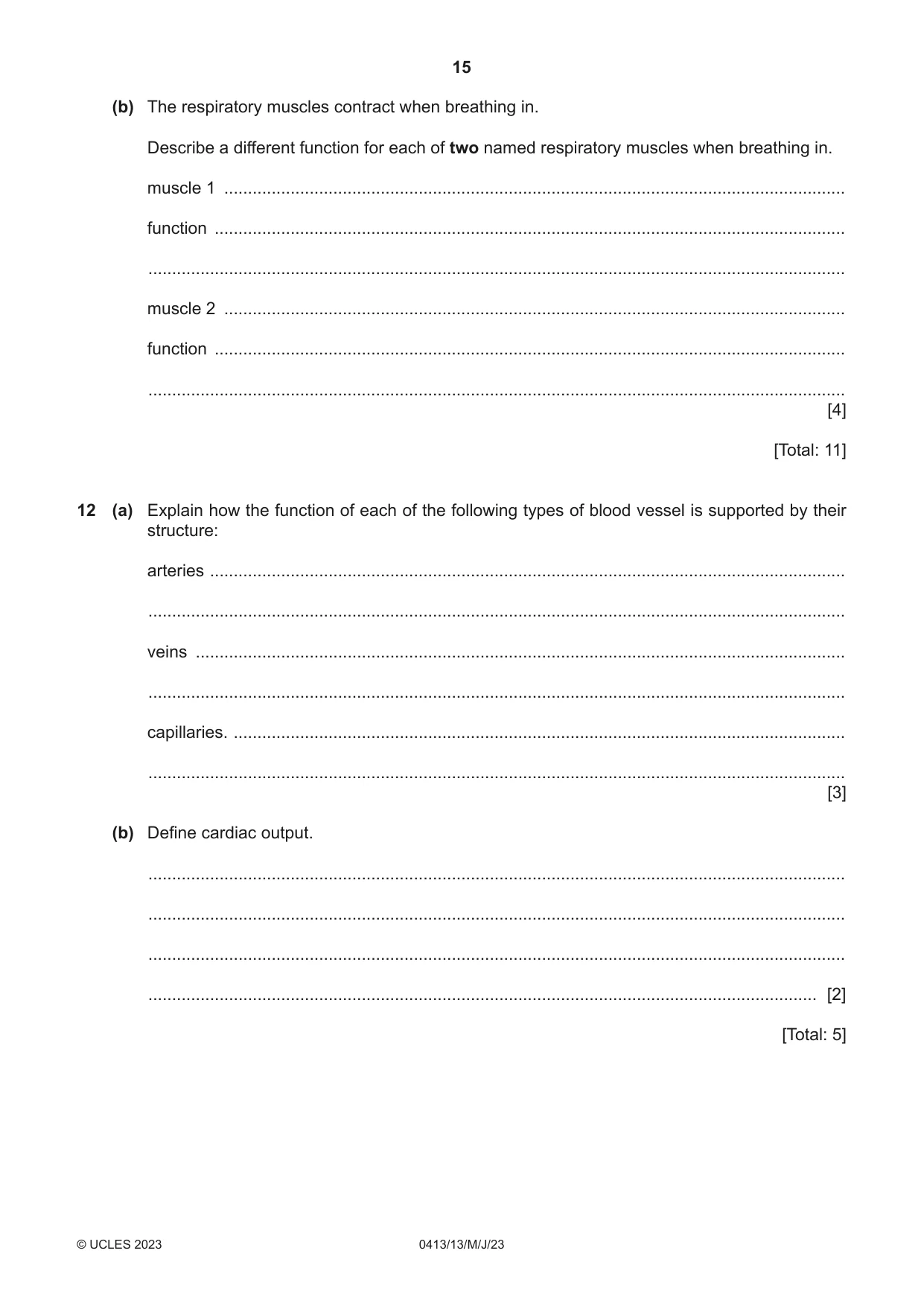
15 0413/13/M/J/23 © UCLES 2023 (b) The respiratory muscles contract when breathing in. Describe a different function for each of two named respiratory muscles when breathing in. muscle 1 … function … … muscle 2 … function … … [4] [Total: 11] 12 (a) Explain how the function of each of the following types of blood vessel is supported by their structure: arteries … … veins … … capillaries. … … [3] (b) Define cardiac output. … … … … [2] [Total: 5]
Question paper, page 16
16 0413/13/M/J/23 © UCLES 2023 Permission to reproduce items where third-party owned material protected by copyright is included has been sought and cleared where possible. Every reasonable effort has been made by the publisher (UCLES) to trace copyright holders, but if any items requiring clearance have unwittingly been included, the publisher will be pleased to make amends at the earliest possible opportunity. To avoid the issue of disclosure of answer-related information to candidates, all copyright acknowledgements are reproduced online in the Cambridge Assessment International Education Copyright Acknowledgements Booklet. This is produced for each series of examinations and is freely available to download at www.cambridgeinternational.org after the live examination series. Cambridge Assessment International Education is part of Cambridge Assessment. Cambridge Assessment is the brand name of the University of Cambridge Local Examinations Syndicate (UCLES), which is a department of the University of Cambridge. BLANK PAGE
Mark scheme, page 1
This document consists of 19 printed pages. © UCLES 2023 [Turn over Cambridge IGCSE™ PHYSICAL EDUCATION 0413/13 Paper 1 Theory May/June 2023 MARK SCHEME Maximum Mark: 100 Published This mark scheme is published as an aid to teachers and candidates, to indicate the requirements of the examination. It shows the basis on which Examiners were instructed to award marks. It does not indicate the details of the discussions that took place at an Examiners’ meeting before marking began, which would have considered the acceptability of alternative answers. Mark schemes should be read in conjunction with the question paper and the Principal Examiner Report for Teachers. Cambridge International will not enter into discussions about these mark schemes. Cambridge International is publishing the mark schemes for the May/June 2023 series for most Cambridge IGCSE, Cambridge International A and AS Level and Cambridge Pre-U components, and some Cambridge O Level components.
Mark scheme, page 2
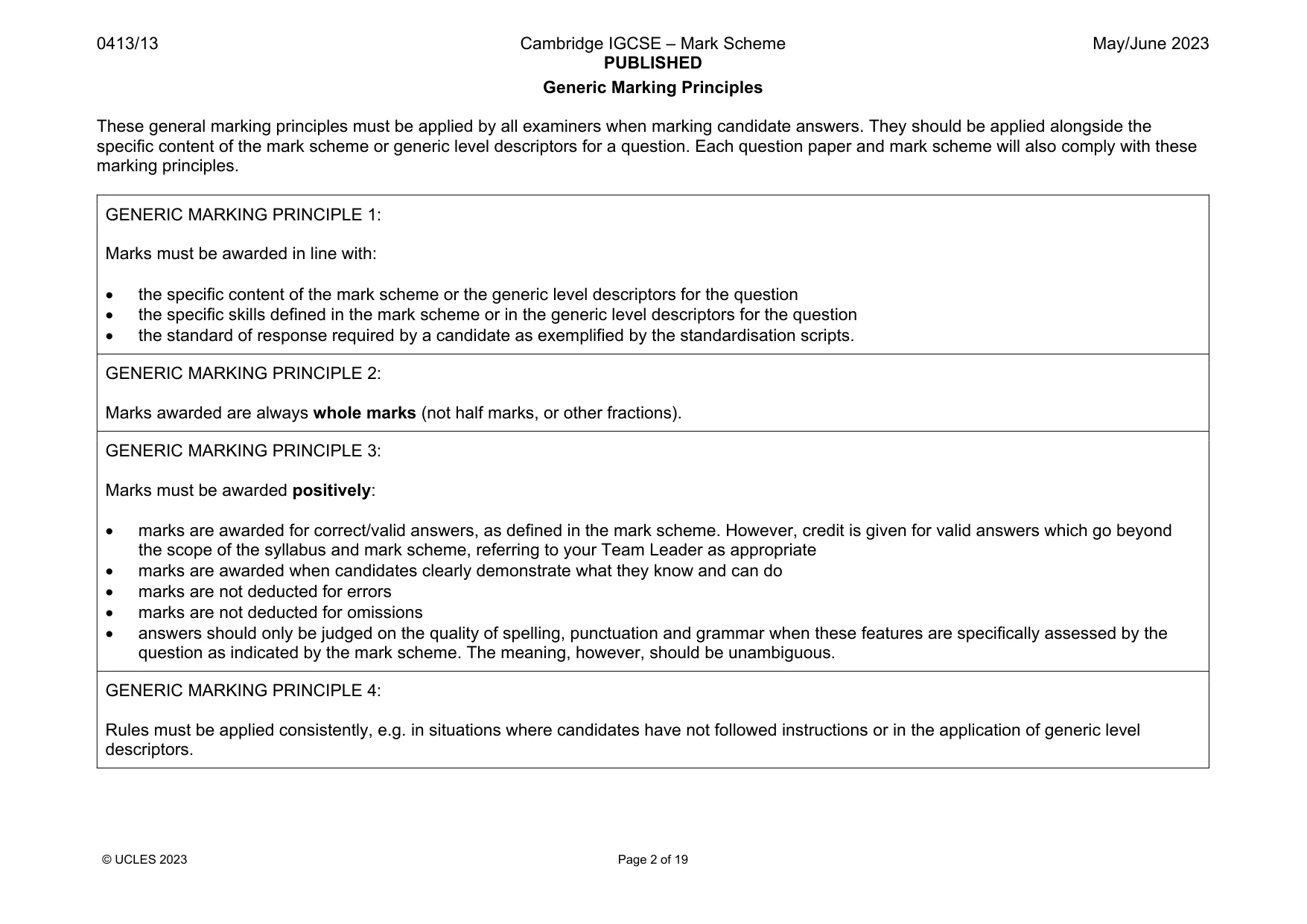
0413/13 Cambridge IGCSE – Mark Scheme PUBLISHED May/June 2023 © UCLES 2023 Page 2 of 19 Generic Marking Principles These general marking principles must be applied by all examiners when marking candidate answers. They should be applied alongside the specific content of the mark scheme or generic level descriptors for a question. Each question paper and mark scheme will also comply with these marking principles. GENERIC MARKING PRINCIPLE 1: Marks must be awarded in line with: the specific content of the mark scheme or the generic level descriptors for the question the specific skills defined in the mark scheme or in the generic level descriptors for the question the standard of response required by a candidate as exemplified by the standardisation scripts. GENERIC MARKING PRINCIPLE 2: Marks awarded are always whole marks (not half marks, or other fractions). GENERIC MARKING PRINCIPLE 3: Marks must be awarded positively: marks are awarded for correct/valid answers, as defined in the mark scheme. However, credit is given for valid answers which go beyond the scope of the syllabus and mark scheme, referring to your Team Leader as appropriate marks are awarded when candidates clearly demonstrate what they know and can do marks are not deducted for errors marks are not deducted for omissions answers should only be judged on the quality of spelling, punctuation and grammar when these features are specifically assessed by the question as indicated by the mark scheme. The meaning, however, should be unambiguous. GENERIC MARKING PRINCIPLE 4: Rules must be applied consistently, e.g. in situations where candidates have not followed instructions or in the application of generic level descriptors.
Mark scheme, page 3
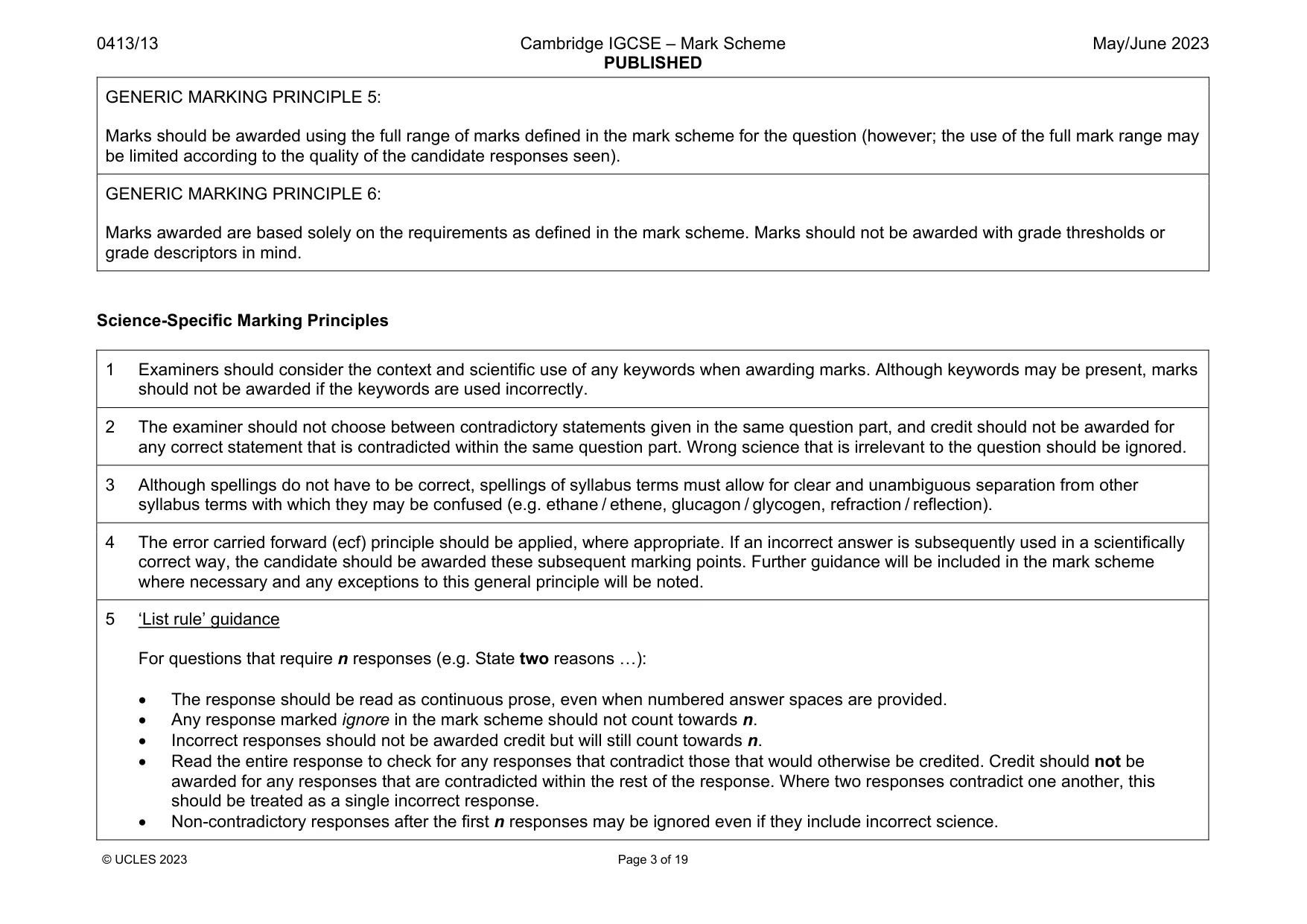
0413/13 Cambridge IGCSE – Mark Scheme PUBLISHED May/June 2023 © UCLES 2023 Page 3 of 19 GENERIC MARKING PRINCIPLE 5: Marks should be awarded using the full range of marks defined in the mark scheme for the question (however; the use of the full mark range may be limited according to the quality of the candidate responses seen). GENERIC MARKING PRINCIPLE 6: Marks awarded are based solely on the requirements as defined in the mark scheme. Marks should not be awarded with grade thresholds or grade descriptors in mind. Science-Specific Marking Principles 1 Examiners should consider the context and scientific use of any keywords when awarding marks. Although keywords may be present, marks should not be awarded if the keywords are used incorrectly. 2 The examiner should not choose between contradictory statements given in the same question part, and credit should not be awarded for any correct statement that is contradicted within the same question part. Wrong science that is irrelevant to the question should be ignored. 3 Although spellings do not have to be correct, spellings of syllabus terms must allow for clear and unambiguous separation from other syllabus terms with which they may be confused (e.g. ethane / ethene, glucagon / glycogen, refraction / reflection). 4 The error carried forward (ecf) principle should be applied, where appropriate. If an incorrect answer is subsequently used in a scientifically correct way, the candidate should be awarded these subsequent marking points. Further guidance will be included in the mark scheme where necessary and any exceptions to this general principle will be noted. 5 ‘List rule’ guidance For questions that require n responses (e.g. State two reasons …): The response should be read as continuous prose, even when numbered answer spaces are provided. Any response marked ignore in the mark scheme should not count towards n. Incorrect responses should not be awarded credit but will still count towards n. Read the entire response to check for any responses that contradict those that would otherwise be credited. Credit should not be awarded for any responses that are contradicted within the rest of the response. Where two responses contradict one another, this should be treated as a single incorrect response. Non-contradictory responses after the first n responses may be ignored even if they include incorrect science.
Mark scheme, page 4
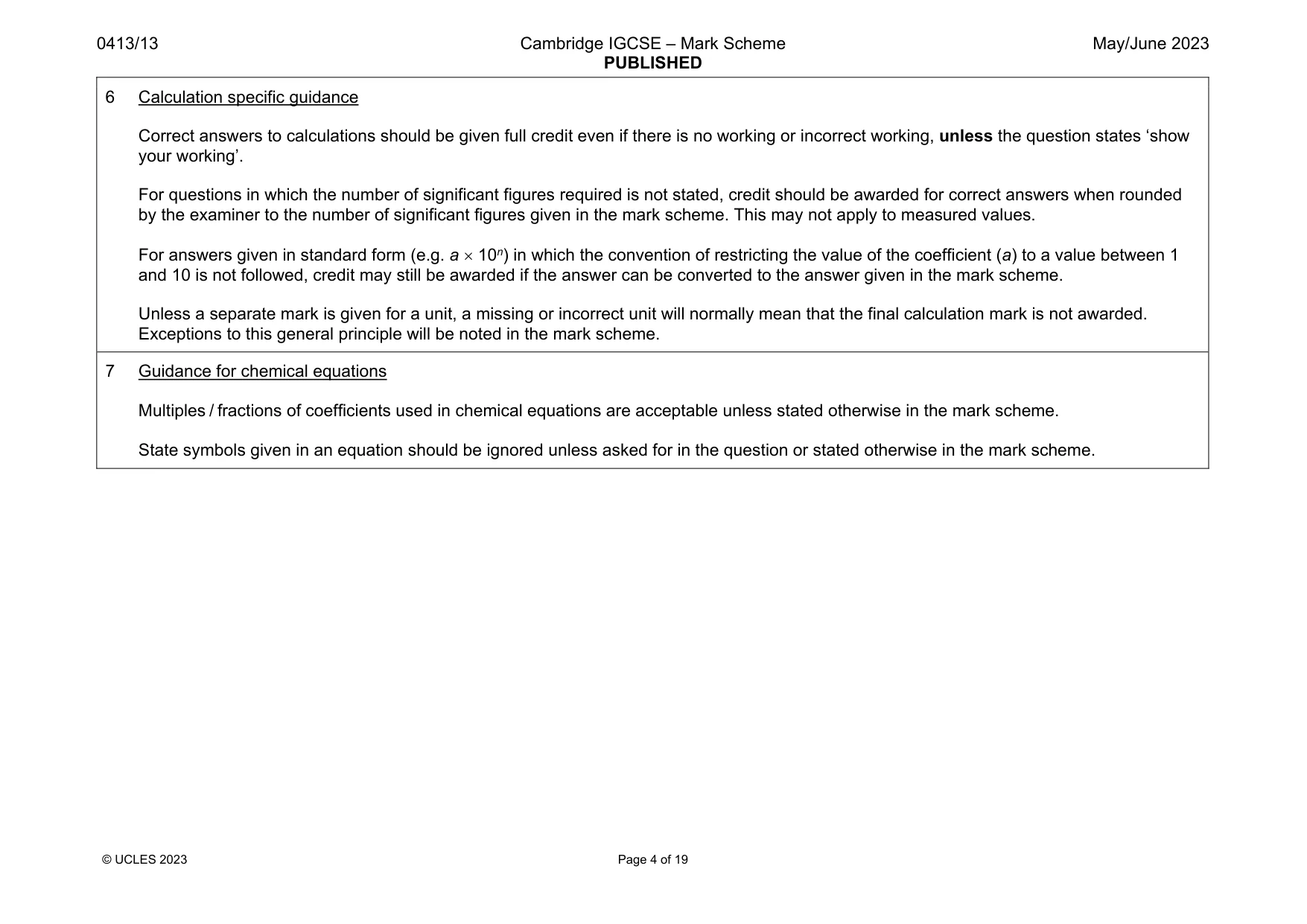
0413/13 Cambridge IGCSE – Mark Scheme PUBLISHED May/June 2023 © UCLES 2023 Page 4 of 19 6 Calculation specific guidance Correct answers to calculations should be given full credit even if there is no working or incorrect working, unless the question states ‘show your working’. For questions in which the number of significant figures required is not stated, credit should be awarded for correct answers when rounded by the examiner to the number of significant figures given in the mark scheme. This may not apply to measured values. For answers given in standard form (e.g. a 10n) in which the convention of restricting the value of the coefficient (a) to a value between 1 and 10 is not followed, credit may still be awarded if the answer can be converted to the answer given in the mark scheme. Unless a separate mark is given for a unit, a missing or incorrect unit will normally mean that the final calculation mark is not awarded. Exceptions to this general principle will be noted in the mark scheme. 7 Guidance for chemical equations Multiples / fractions of coefficients used in chemical equations are acceptable unless stated otherwise in the mark scheme. State symbols given in an equation should be ignored unless asked for in the question or stated otherwise in the mark scheme.
Mark scheme, page 5
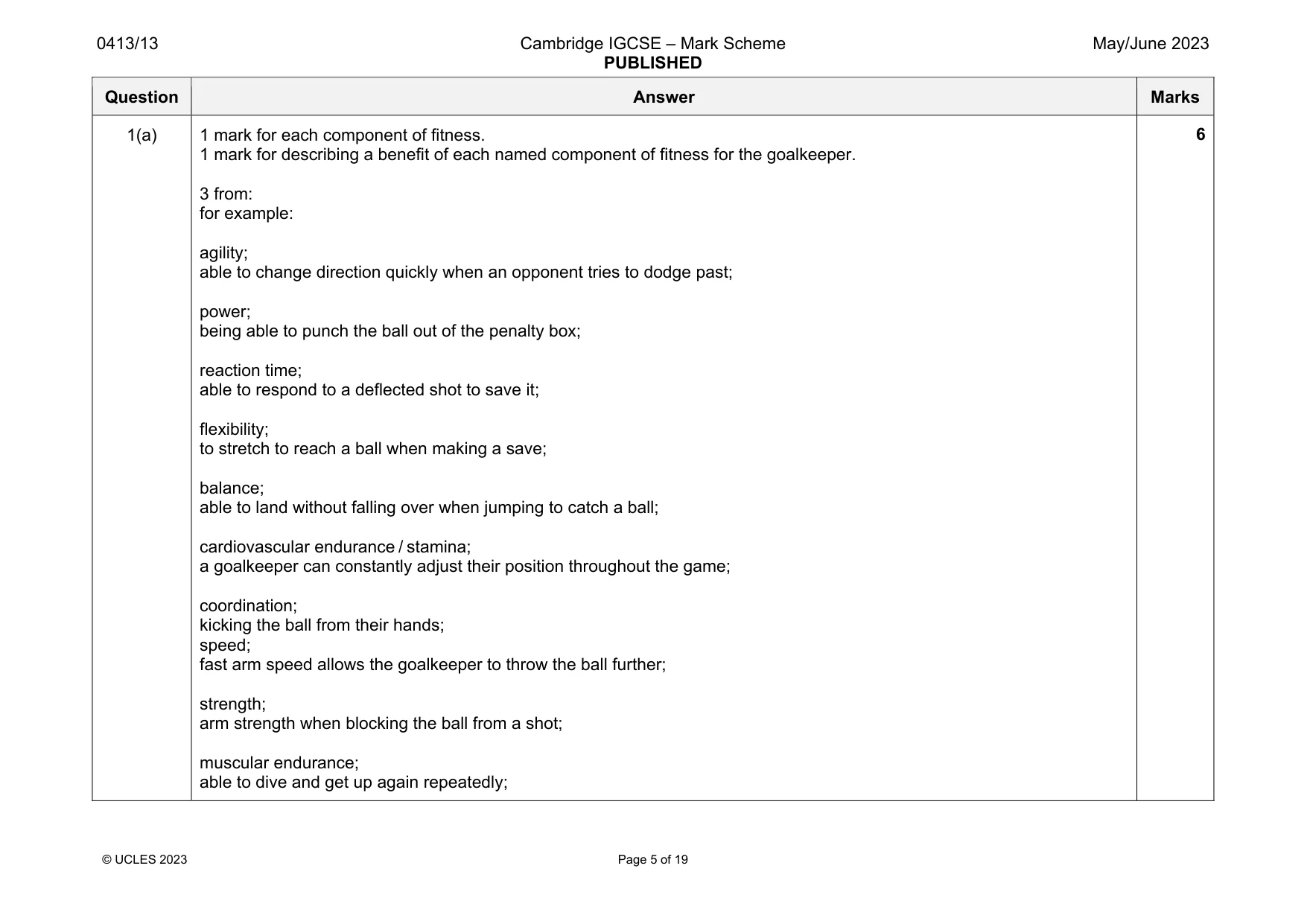
0413/13 Cambridge IGCSE – Mark Scheme PUBLISHED May/June 2023 © UCLES 2023 Page 5 of 19 Question Answer Marks 1(a) 1 mark for each component of fitness. 1 mark for describing a benefit of each named component of fitness for the goalkeeper. 3 from: for example: agility; able to change direction quickly when an opponent tries to dodge past; power; being able to punch the ball out of the penalty box; reaction time; able to respond to a deflected shot to save it; flexibility; to stretch to reach a ball when making a save; balance; able to land without falling over when jumping to catch a ball; cardiovascular endurance / stamina; a goalkeeper can constantly adjust their position throughout the game; coordination; kicking the ball from their hands; speed; fast arm speed allows the goalkeeper to throw the ball further; strength; arm strength when blocking the ball from a shot; muscular endurance; able to dive and get up again repeatedly; 6
Mark scheme, page 6
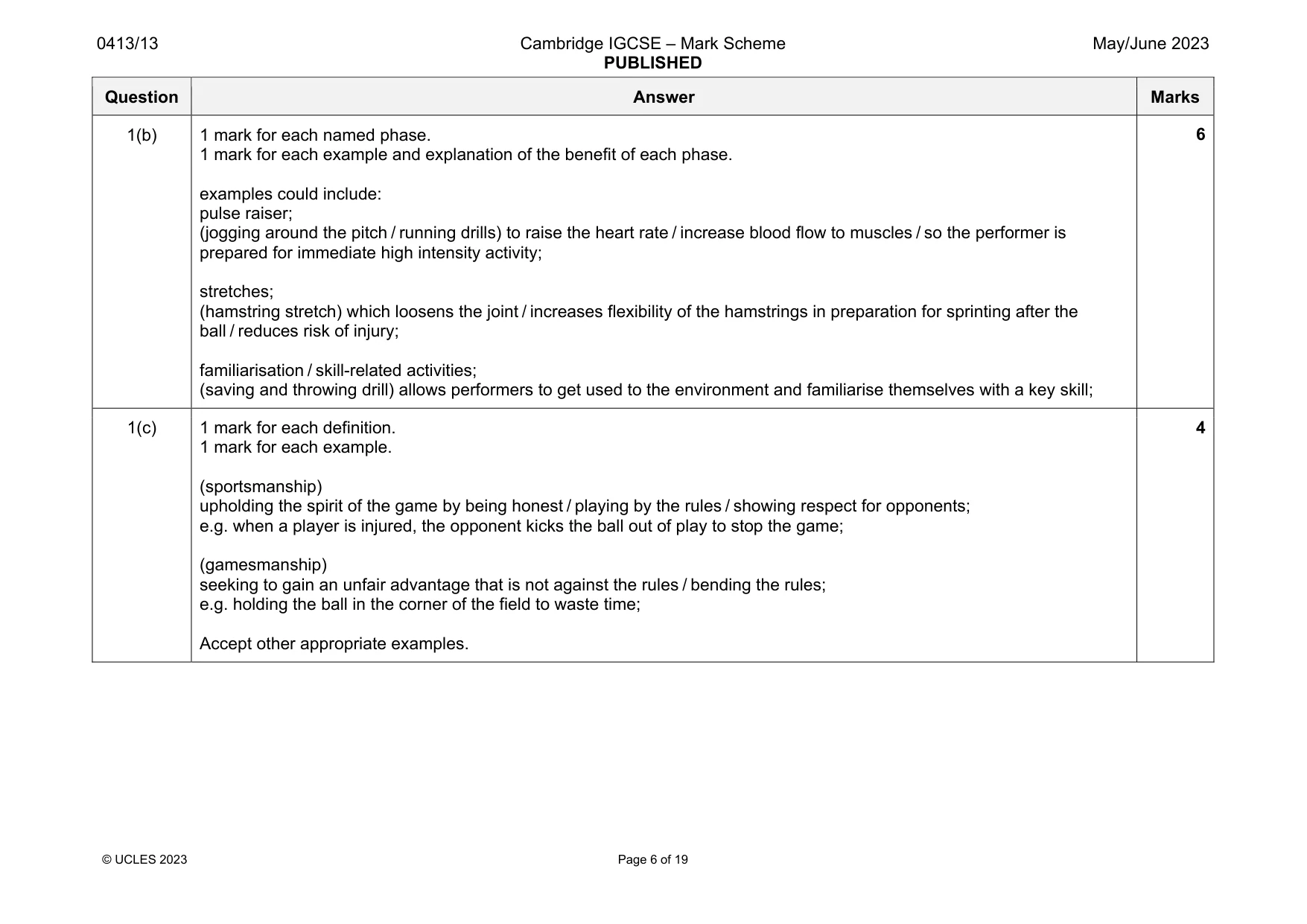
0413/13 Cambridge IGCSE – Mark Scheme PUBLISHED May/June 2023 © UCLES 2023 Page 6 of 19 Question Answer Marks 1(b) 1 mark for each named phase. 1 mark for each example and explanation of the benefit of each phase. examples could include: pulse raiser; (jogging around the pitch / running drills) to raise the heart rate / increase blood flow to muscles / so the performer is prepared for immediate high intensity activity; stretches; (hamstring stretch) which loosens the joint / increases flexibility of the hamstrings in preparation for sprinting after the ball / reduces risk of injury; familiarisation / skill-related activities; (saving and throwing drill) allows performers to get used to the environment and familiarise themselves with a key skill; 6 1(c) 1 mark for each definition. 1 mark for each example. (sportsmanship) upholding the spirit of the game by being honest / playing by the rules / showing respect for opponents; e.g. when a player is injured, the opponent kicks the ball out of play to stop the game; (gamesmanship) seeking to gain an unfair advantage that is not against the rules / bending the rules; e.g. holding the ball in the corner of the field to waste time; Accept other appropriate examples. 4
Mark scheme, page 7
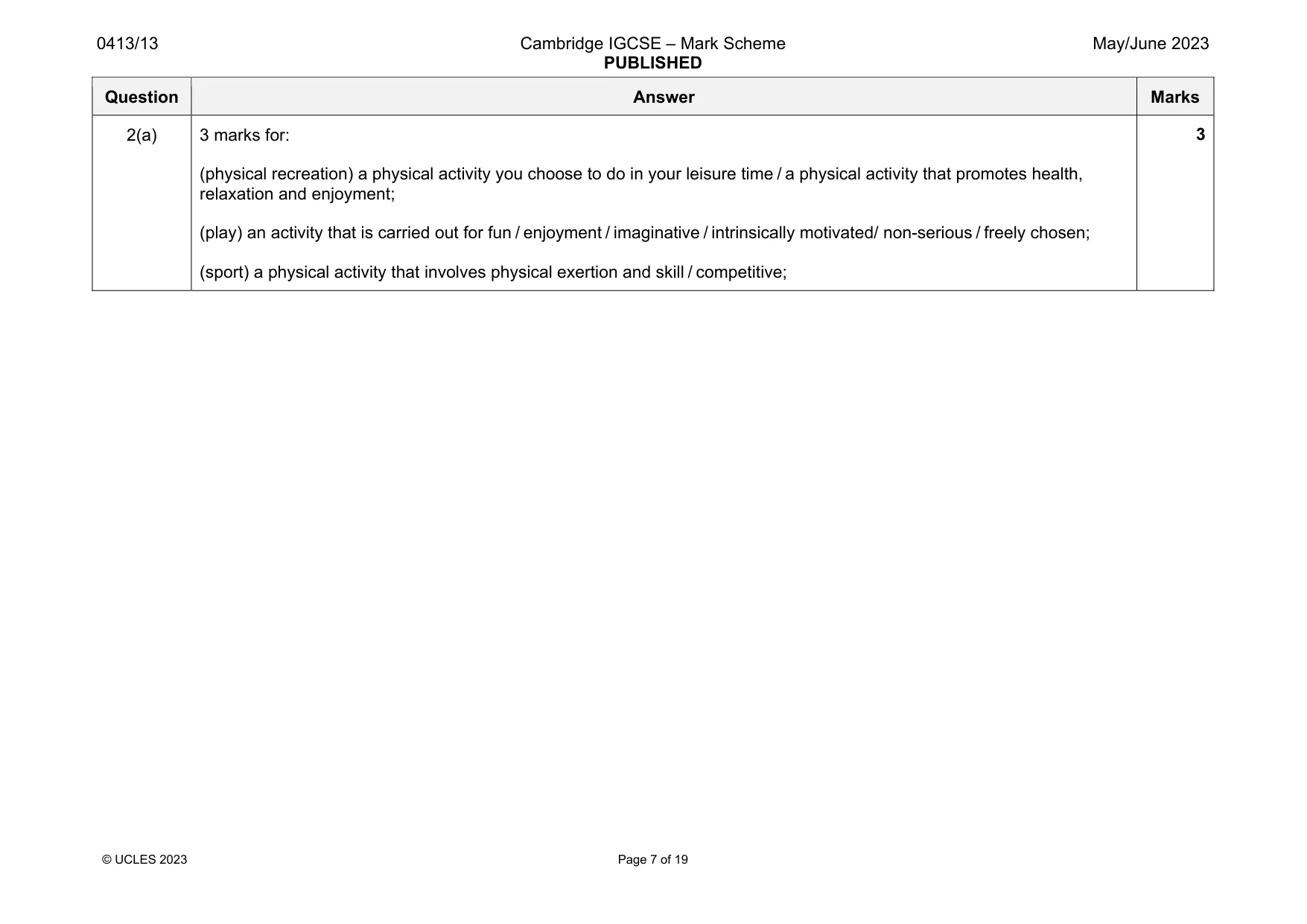
0413/13 Cambridge IGCSE – Mark Scheme PUBLISHED May/June 2023 © UCLES 2023 Page 7 of 19 Question Answer Marks 2(a) 3 marks for: (physical recreation) a physical activity you choose to do in your leisure time / a physical activity that promotes health, relaxation and enjoyment; (play) an activity that is carried out for fun / enjoyment / imaginative / intrinsically motivated/ non-serious / freely chosen; (sport) a physical activity that involves physical exertion and skill / competitive; 3
Mark scheme, page 8
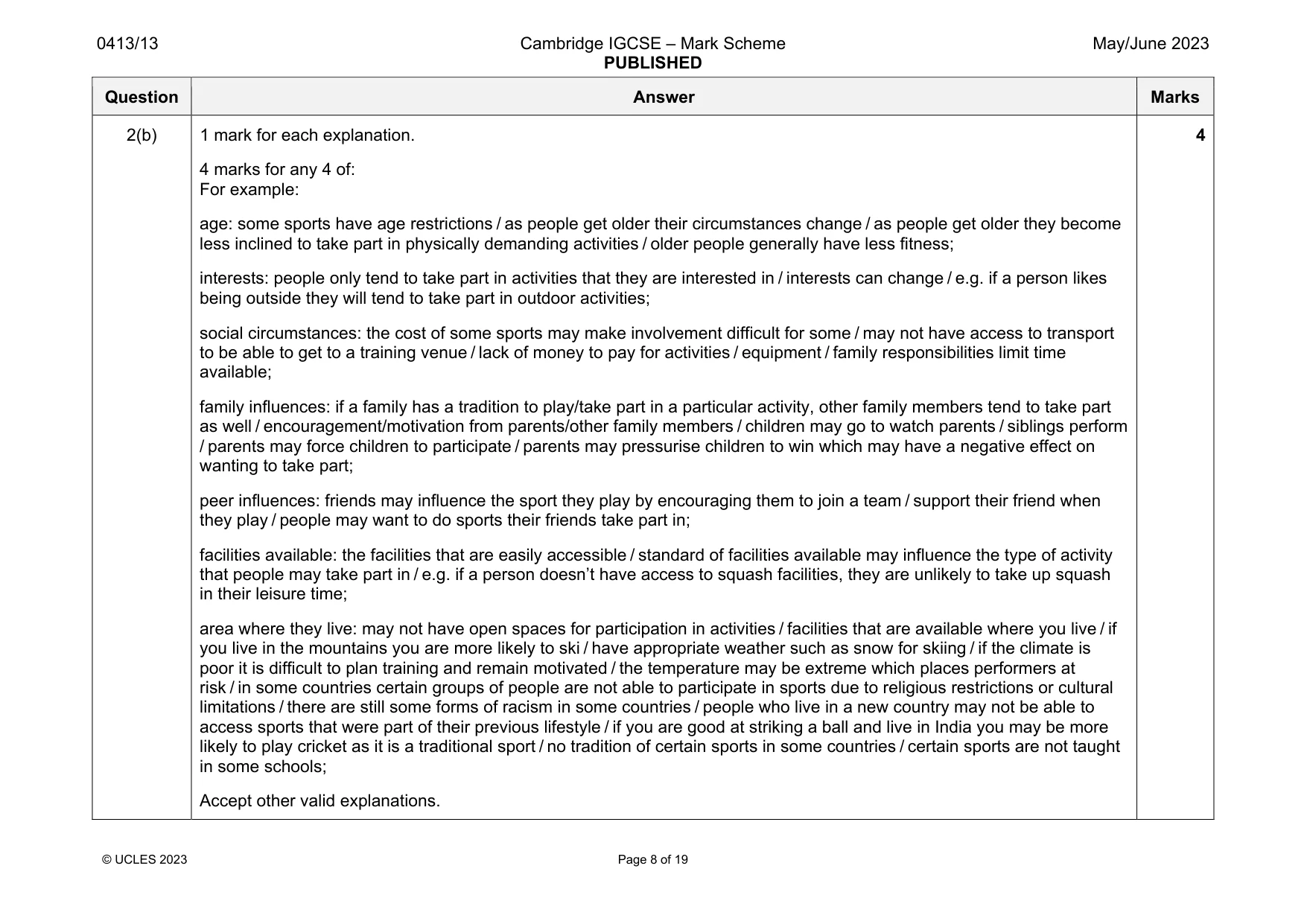
0413/13 Cambridge IGCSE – Mark Scheme PUBLISHED May/June 2023 © UCLES 2023 Page 8 of 19 Question Answer Marks 2(b) 1 mark for each explanation. 4 marks for any 4 of: For example: age: some sports have age restrictions / as people get older their circumstances change / as people get older they become less inclined to take part in physically demanding activities / older people generally have less fitness; interests: people only tend to take part in activities that they are interested in / interests can change / e.g. if a person likes being outside they will tend to take part in outdoor activities; social circumstances: the cost of some sports may make involvement difficult for some / may not have access to transport to be able to get to a training venue / lack of money to pay for activities / equipment / family responsibilities limit time available; family influences: if a family has a tradition to play/take part in a particular activity, other family members tend to take part as well / encouragement/motivation from parents/other family members / children may go to watch parents / siblings perform / parents may force children to participate / parents may pressurise children to win which may have a negative effect on wanting to take part; peer influences: friends may influence the sport they play by encouraging them to join a team / support their friend when they play / people may want to do sports their friends take part in; facilities available: the facilities that are easily accessible / standard of facilities available may influence the type of activity that people may take part in / e.g. if a person doesn’t have access to squash facilities, they are unlikely to take up squash in their leisure time; area where they live: may not have open spaces for participation in activities / facilities that are available where you live / if you live in the mountains you are more likely to ski / have appropriate weather such as snow for skiing / if the climate is poor it is difficult to plan training and remain motivated / the temperature may be extreme which places performers at risk / in some countries certain groups of people are not able to participate in sports due to religious restrictions or cultural limitations / there are still some forms of racism in some countries / people who live in a new country may not be able to access sports that were part of their previous lifestyle / if you are good at striking a ball and live in India you may be more likely to play cricket as it is a traditional sport / no tradition of certain sports in some countries / certain sports are not taught in some schools; Accept other valid explanations. 4
Mark scheme, page 9
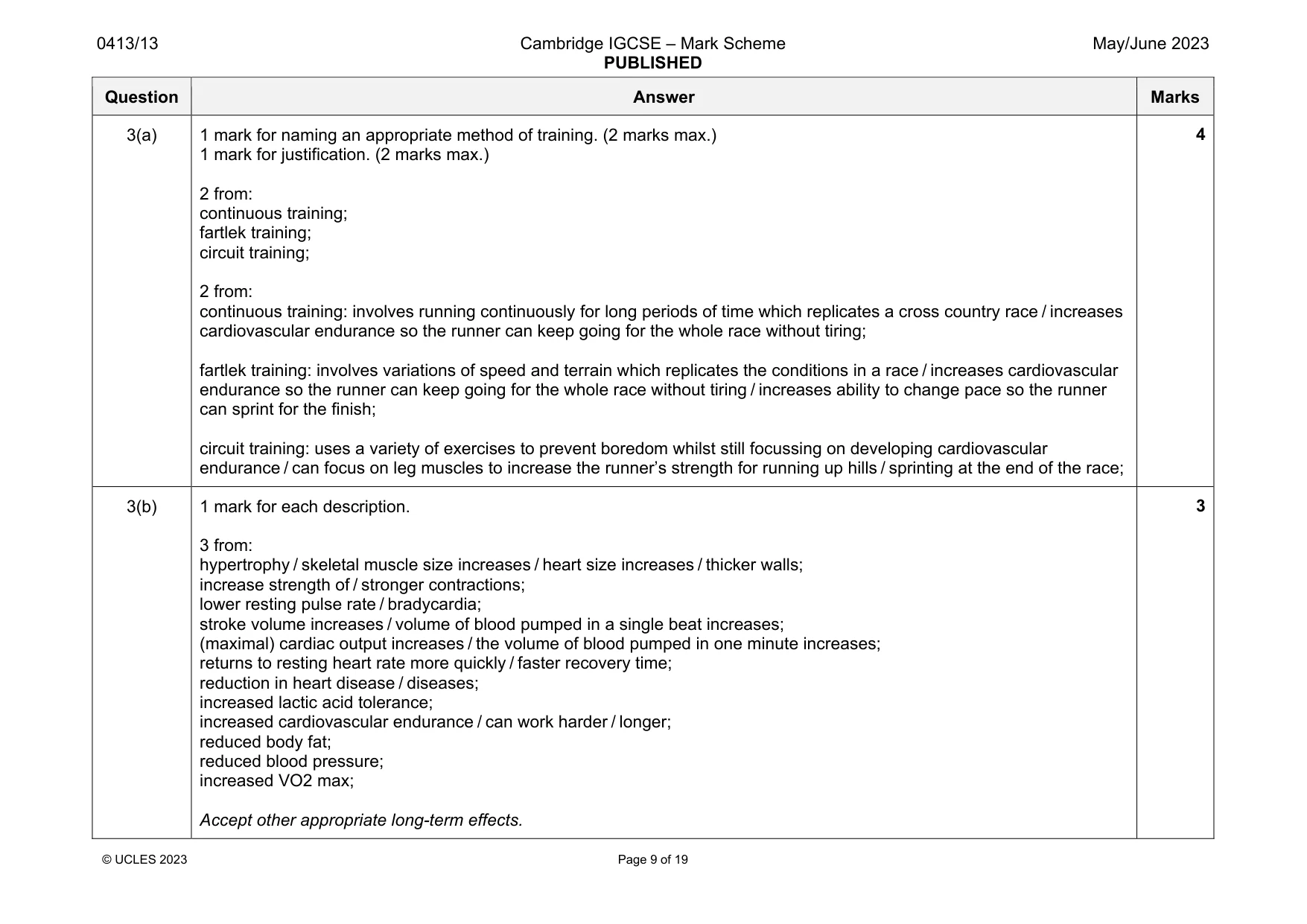
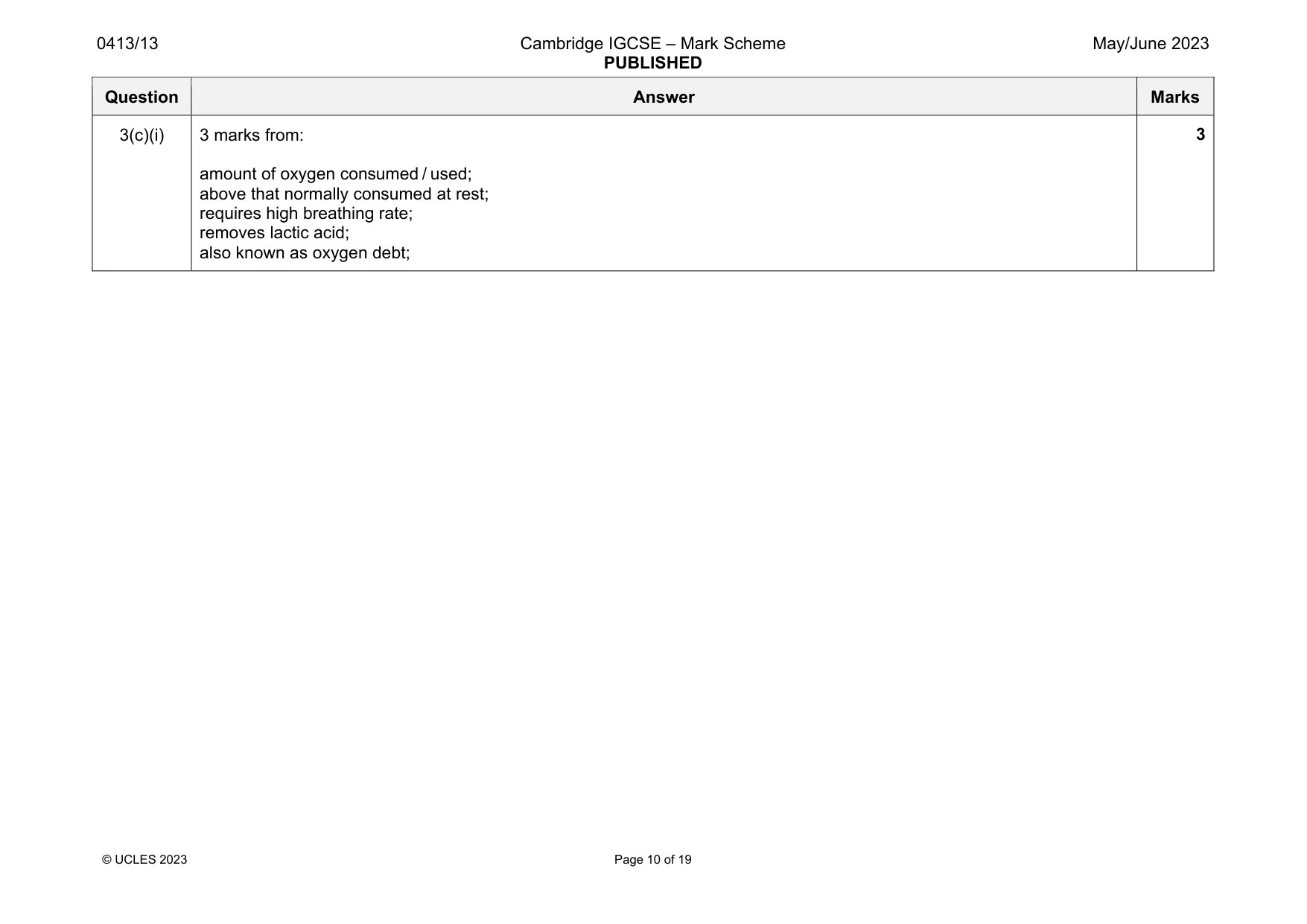
0413/13 Cambridge IGCSE – Mark Scheme PUBLISHED May/June 2023 © UCLES 2023 Page 9 of 19 Question Answer Marks 3(a) 1 mark for naming an appropriate method of training. (2 marks max.) 1 mark for justification. (2 marks max.) 2 from: continuous training; fartlek training; circuit training; 2 from: continuous training: involves running continuously for long periods of time which replicates a cross country race / increases cardiovascular endurance so the runner can keep going for the whole race without tiring; fartlek training: involves variations of speed and terrain which replicates the conditions in a race / increases cardiovascular endurance so the runner can keep going for the whole race without tiring / increases ability to change pace so the runner can sprint for the finish; circuit training: uses a variety of exercises to prevent boredom whilst still focussing on developing cardiovascular endurance / can focus on leg muscles to increase the runner’s strength for running up hills / sprinting at the end of the race; 4 3(b) 1 mark for each description. 3 from: hypertrophy / skeletal muscle size increases / heart size increases / thicker walls; increase strength of / stronger contractions; lower resting pulse rate / bradycardia; stroke volume increases / volume of blood pumped in a single beat increases; (maximal) cardiac output increases / the volume of blood pumped in one minute increases; returns to resting heart rate more quickly / faster recovery time; reduction in heart disease / diseases; increased lactic acid tolerance; increased cardiovascular endurance / can work harder / longer; reduced body fat; reduced blood pressure; increased VO2 max; Accept other appropriate long-term effects. 3
Mark scheme, page 10
0413/13 Cambridge IGCSE – Mark Scheme PUBLISHED May/June 2023 © UCLES 2023 Page 10 of 19 Question Answer Marks 3(c)(i) 3 marks from: amount of oxygen consumed / used; above that normally consumed at rest; requires high breathing rate; removes lactic acid; also known as oxygen debt; 3
Mark scheme, page 11
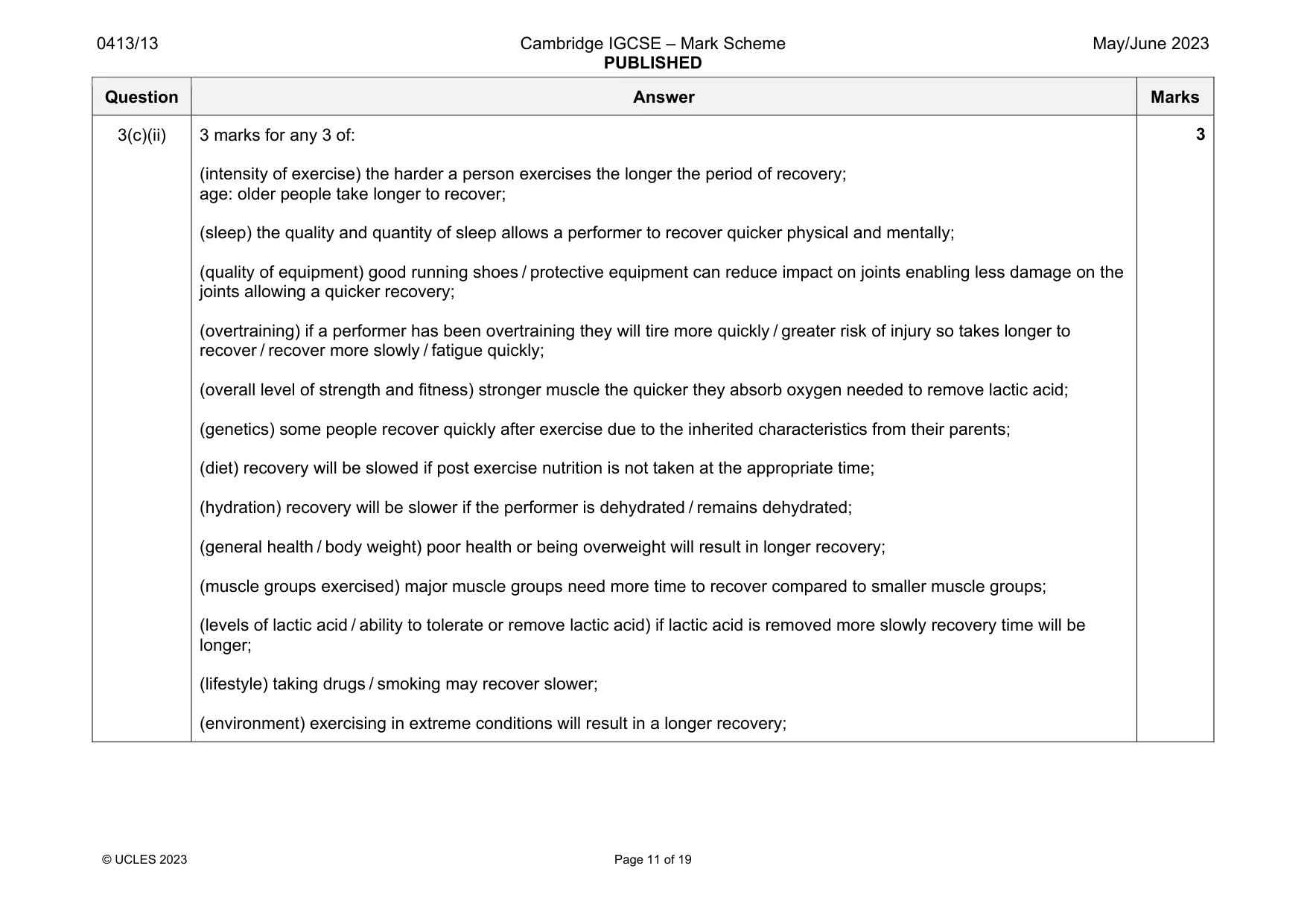
0413/13 Cambridge IGCSE – Mark Scheme PUBLISHED May/June 2023 © UCLES 2023 Page 11 of 19 Question Answer Marks 3(c)(ii) 3 marks for any 3 of: (intensity of exercise) the harder a person exercises the longer the period of recovery; age: older people take longer to recover; (sleep) the quality and quantity of sleep allows a performer to recover quicker physical and mentally; (quality of equipment) good running shoes / protective equipment can reduce impact on joints enabling less damage on the joints allowing a quicker recovery; (overtraining) if a performer has been overtraining they will tire more quickly / greater risk of injury so takes longer to recover / recover more slowly / fatigue quickly; (overall level of strength and fitness) stronger muscle the quicker they absorb oxygen needed to remove lactic acid; (genetics) some people recover quickly after exercise due to the inherited characteristics from their parents; (diet) recovery will be slowed if post exercise nutrition is not taken at the appropriate time; (hydration) recovery will be slower if the performer is dehydrated / remains dehydrated; (general health / body weight) poor health or being overweight will result in longer recovery; (muscle groups exercised) major muscle groups need more time to recover compared to smaller muscle groups; (levels of lactic acid / ability to tolerate or remove lactic acid) if lactic acid is removed more slowly recovery time will be longer; (lifestyle) taking drugs / smoking may recover slower; (environment) exercising in extreme conditions will result in a longer recovery; 3
Mark scheme, page 12
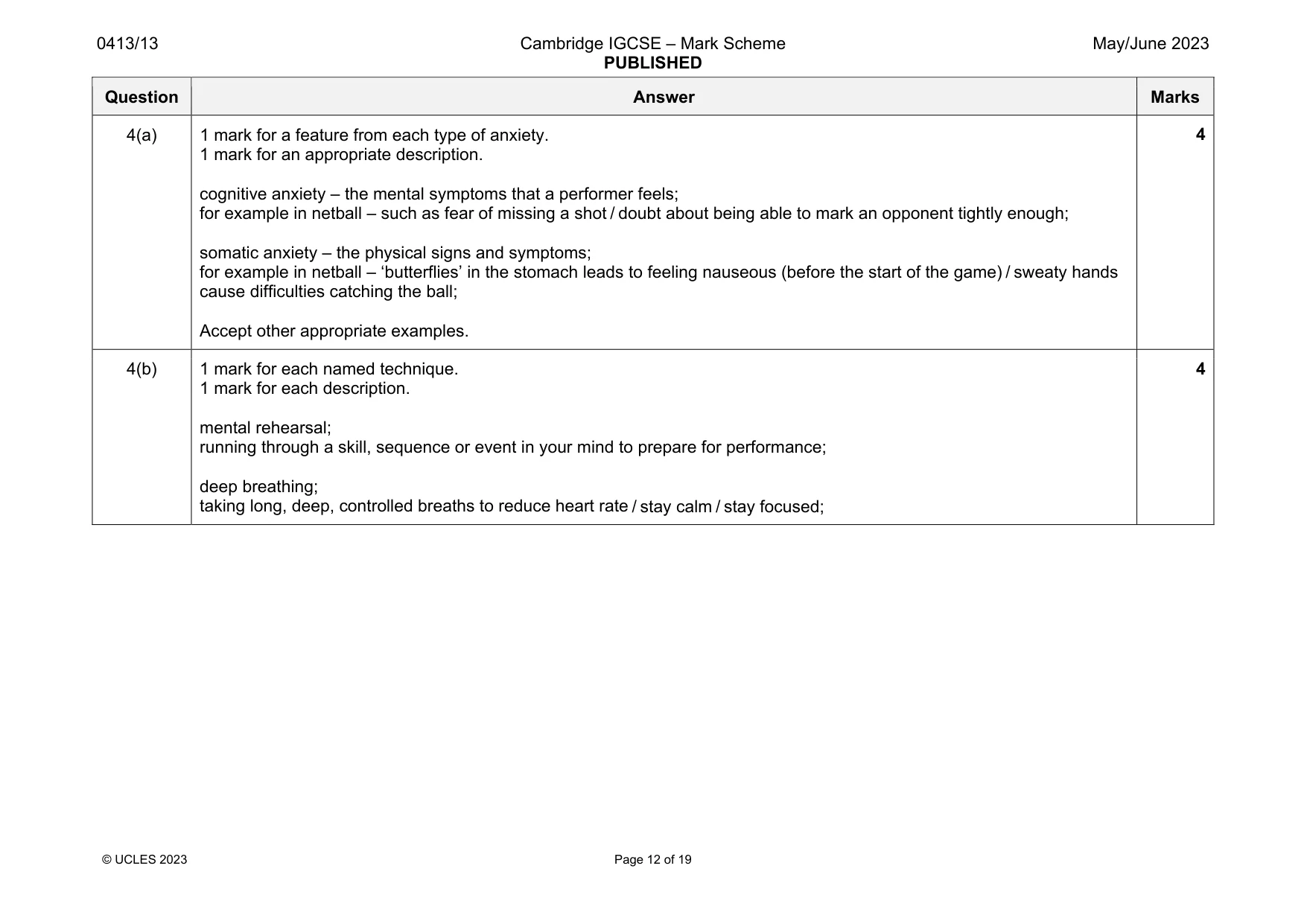
0413/13 Cambridge IGCSE – Mark Scheme PUBLISHED May/June 2023 © UCLES 2023 Page 12 of 19 Question Answer Marks 4(a) 1 mark for a feature from each type of anxiety. 1 mark for an appropriate description. cognitive anxiety – the mental symptoms that a performer feels; for example in netball – such as fear of missing a shot / doubt about being able to mark an opponent tightly enough; somatic anxiety – the physical signs and symptoms; for example in netball – ‘butterflies’ in the stomach leads to feeling nauseous (before the start of the game) / sweaty hands cause difficulties catching the ball; Accept other appropriate examples. 4 4(b) 1 mark for each named technique. 1 mark for each description. mental rehearsal; running through a skill, sequence or event in your mind to prepare for performance; deep breathing; taking long, deep, controlled breaths to reduce heart rate / stay calm / stay focused; 4
Mark scheme, page 13
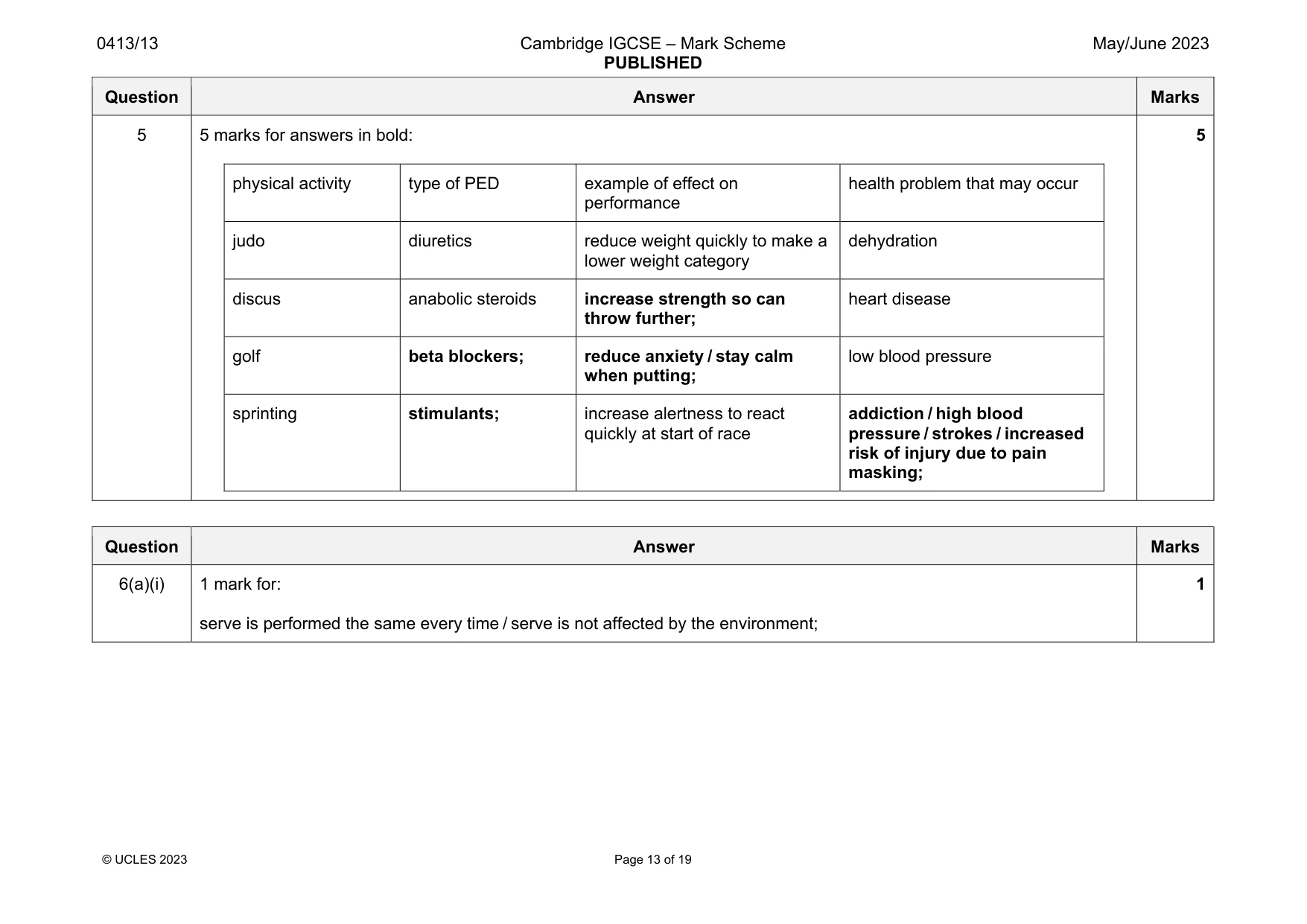
0413/13 Cambridge IGCSE – Mark Scheme PUBLISHED May/June 2023 © UCLES 2023 Page 13 of 19 Question Answer Marks 5 5 marks for answers in bold: physical activity type of PED example of effect on performance health problem that may occur judo diuretics reduce weight quickly to make a lower weight category dehydration discus anabolic steroids increase strength so can throw further; heart disease golf beta blockers; reduce anxiety / stay calm when putting; low blood pressure sprinting stimulants; increase alertness to react quickly at start of race addiction / high blood pressure / strokes / increased risk of injury due to pain masking; 5 Question Answer Marks 6(a)(i) 1 mark for: serve is performed the same every time / serve is not affected by the environment; 1
Mark scheme, page 14
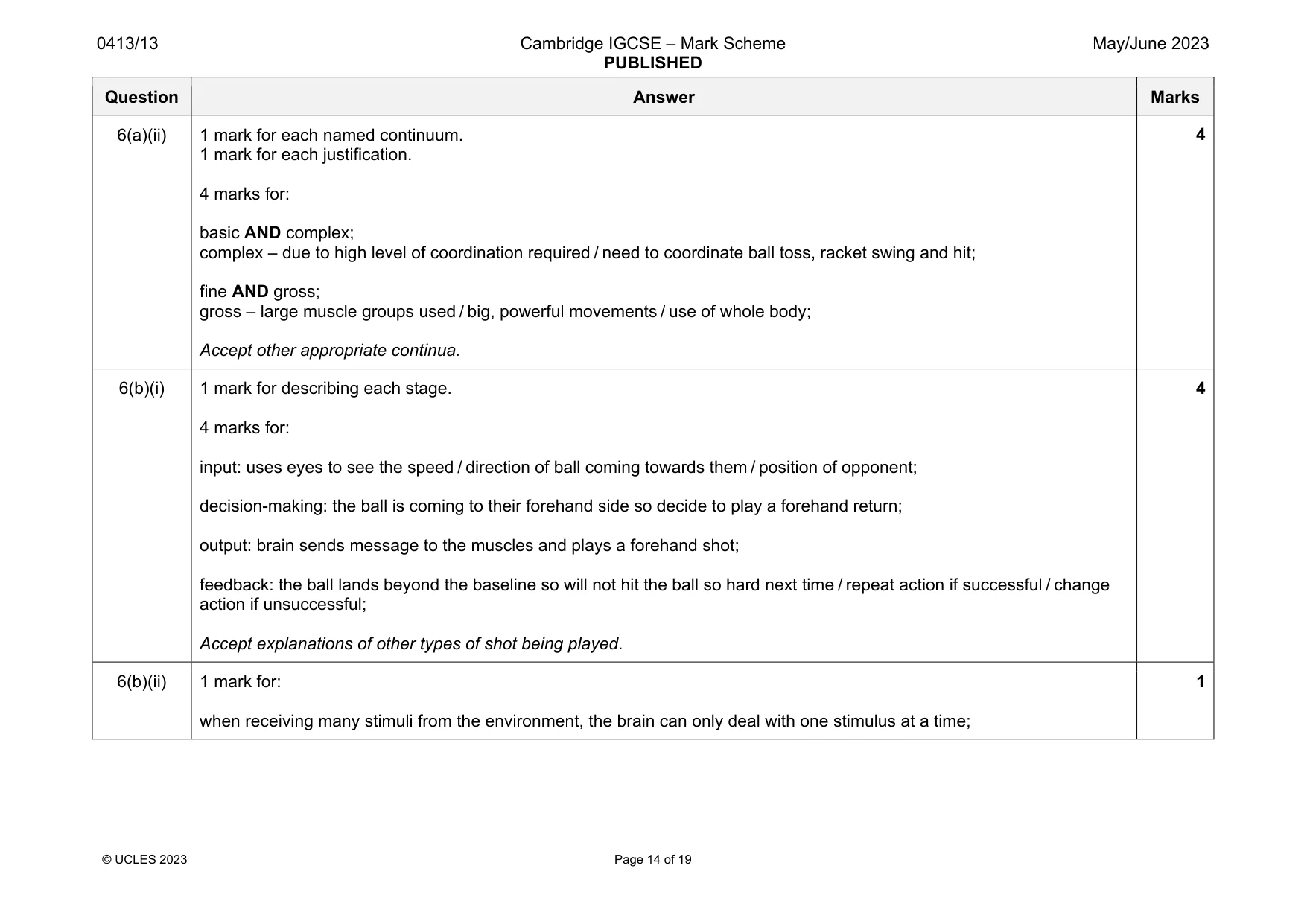
0413/13 Cambridge IGCSE – Mark Scheme PUBLISHED May/June 2023 © UCLES 2023 Page 14 of 19 Question Answer Marks 6(a)(ii) 1 mark for each named continuum. 1 mark for each justification. 4 marks for: basic AND complex; complex – due to high level of coordination required / need to coordinate ball toss, racket swing and hit; fine AND gross; gross – large muscle groups used / big, powerful movements / use of whole body; Accept other appropriate continua. 4 6(b)(i) 1 mark for describing each stage. 4 marks for: input: uses eyes to see the speed / direction of ball coming towards them / position of opponent; decision-making: the ball is coming to their forehand side so decide to play a forehand return; output: brain sends message to the muscles and plays a forehand shot; feedback: the ball lands beyond the baseline so will not hit the ball so hard next time / repeat action if successful / change action if unsuccessful; Accept explanations of other types of shot being played. 4 6(b)(ii) 1 mark for: when receiving many stimuli from the environment, the brain can only deal with one stimulus at a time; 1
Mark scheme, page 15
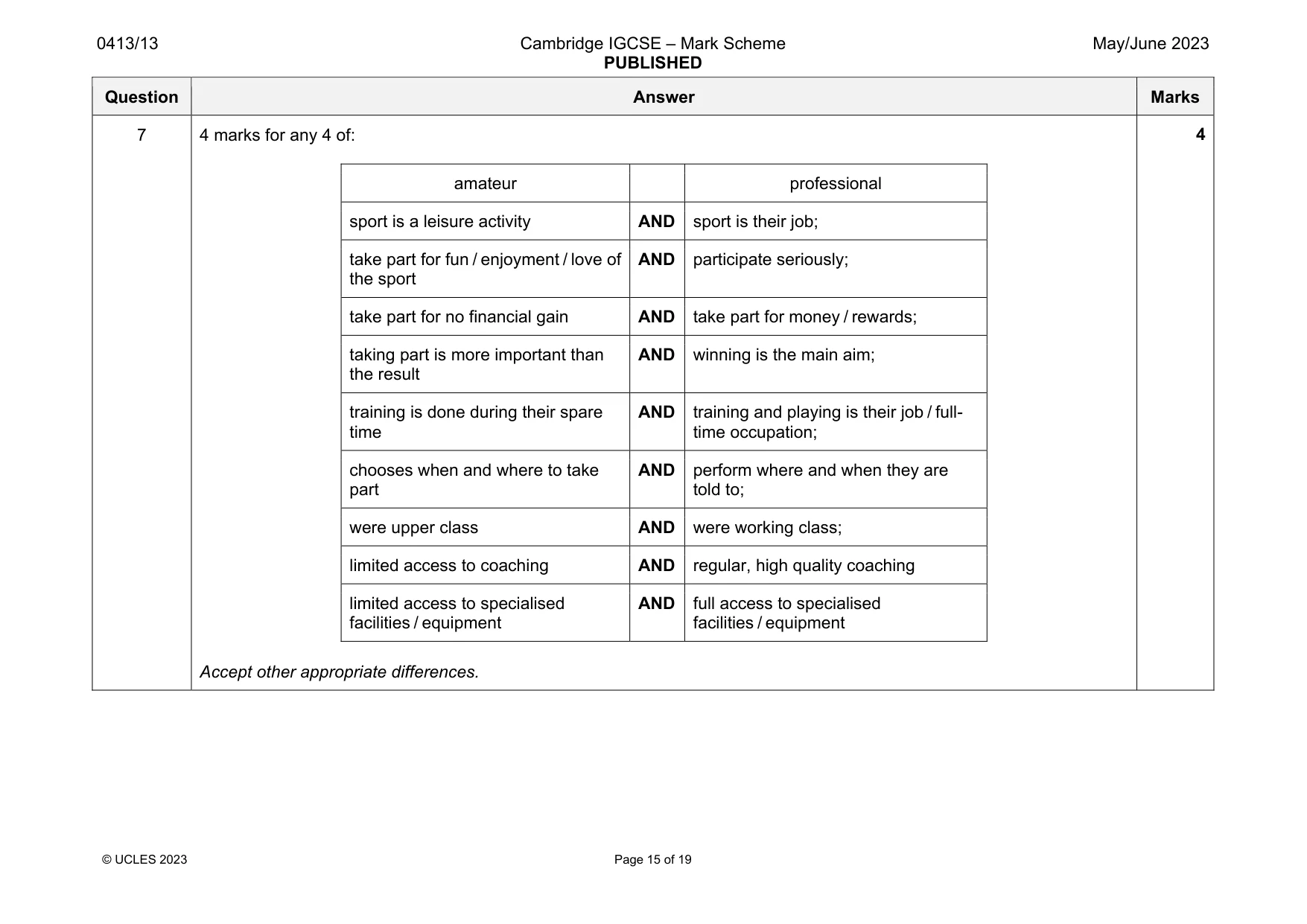
0413/13 Cambridge IGCSE – Mark Scheme PUBLISHED May/June 2023 © UCLES 2023 Page 15 of 19 Question Answer Marks 7 4 marks for any 4 of: amateur professional sport is a leisure activity AND sport is their job; take part for fun / enjoyment / love of the sport AND participate seriously; take part for no financial gain AND take part for money / rewards; taking part is more important than the result AND winning is the main aim; training is done during their spare time AND training and playing is their job / full- time occupation; chooses when and where to take part AND perform where and when they are told to; were upper class AND were working class; limited access to coaching AND regular, high quality coaching limited access to specialised facilities / equipment AND full access to specialised facilities / equipment Accept other appropriate differences. 4
Mark scheme, page 16
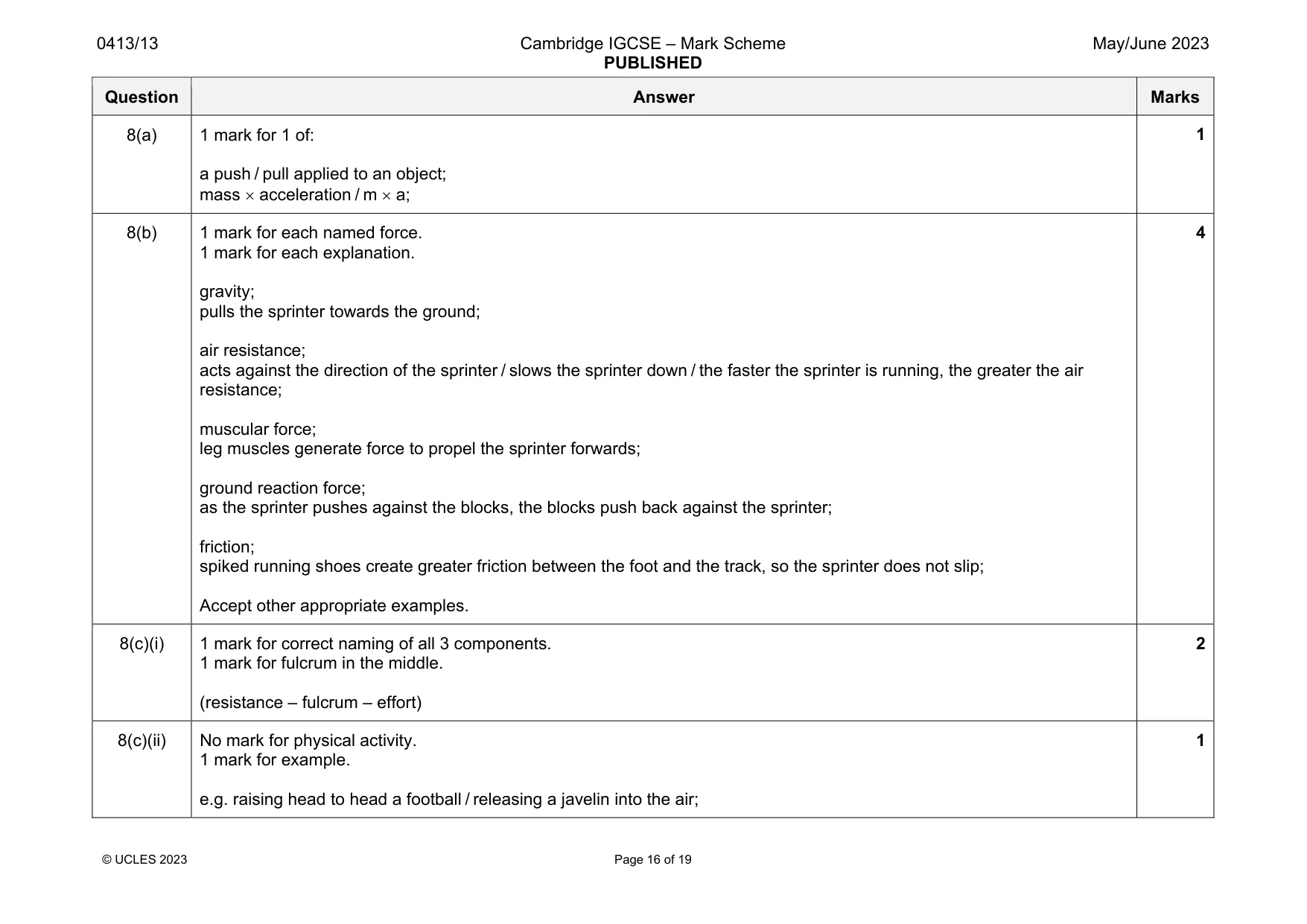
0413/13 Cambridge IGCSE – Mark Scheme PUBLISHED May/June 2023 © UCLES 2023 Page 16 of 19 Question Answer Marks 8(a) 1 mark for 1 of: a push / pull applied to an object; mass acceleration / m a; 1 8(b) 1 mark for each named force. 1 mark for each explanation. gravity; pulls the sprinter towards the ground; air resistance; acts against the direction of the sprinter / slows the sprinter down / the faster the sprinter is running, the greater the air resistance; muscular force; leg muscles generate force to propel the sprinter forwards; ground reaction force; as the sprinter pushes against the blocks, the blocks push back against the sprinter; friction; spiked running shoes create greater friction between the foot and the track, so the sprinter does not slip; Accept other appropriate examples. 4 8(c)(i) 1 mark for correct naming of all 3 components. 1 mark for fulcrum in the middle. (resistance – fulcrum – effort) 2 8(c)(ii) No mark for physical activity. 1 mark for example. e.g. raising head to head a football / releasing a javelin into the air; 1
Mark scheme, page 17
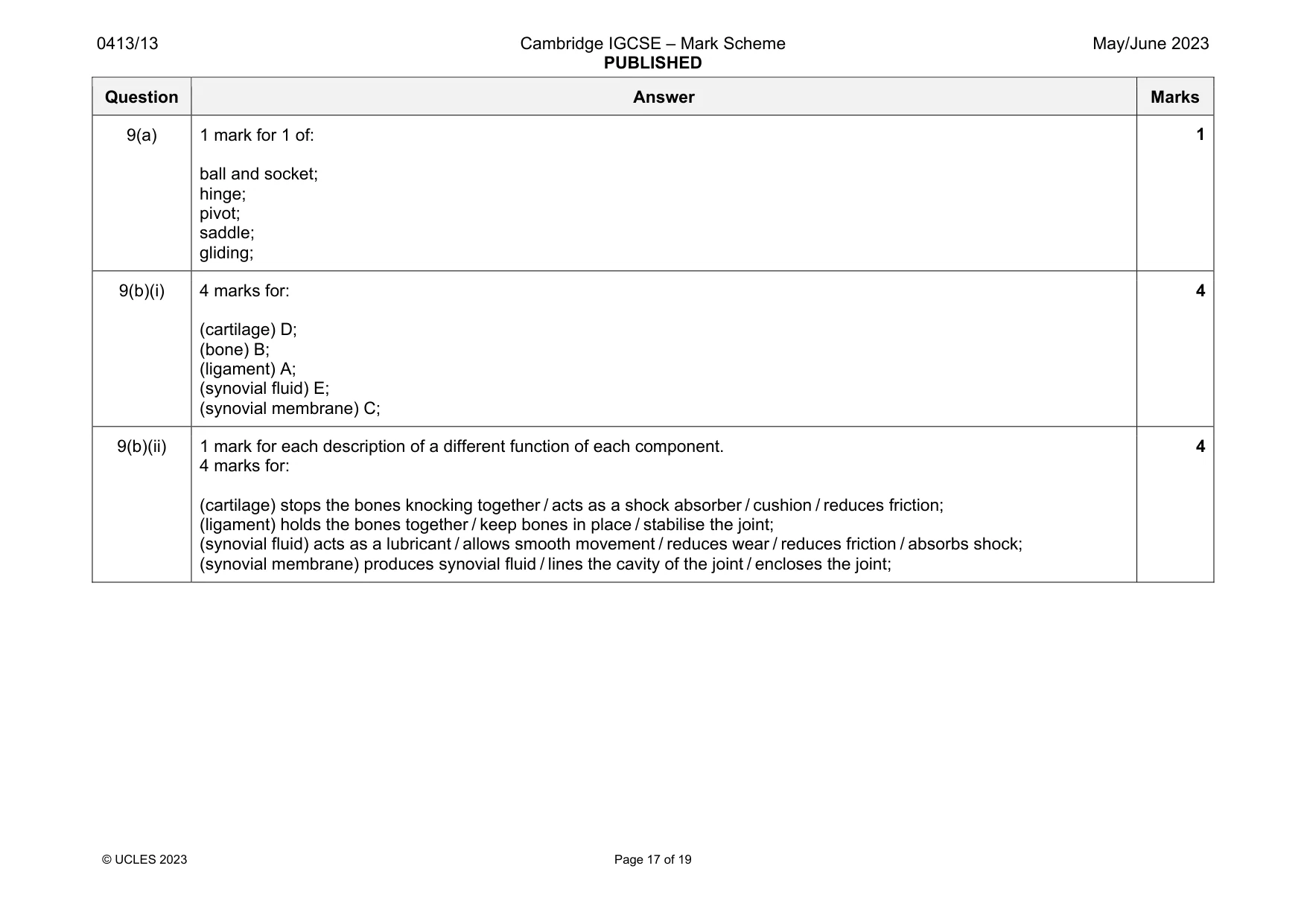
0413/13 Cambridge IGCSE – Mark Scheme PUBLISHED May/June 2023 © UCLES 2023 Page 17 of 19 Question Answer Marks 9(a) 1 mark for 1 of: ball and socket; hinge; pivot; saddle; gliding; 1 9(b)(i) 4 marks for: (cartilage) D; (bone) B; (ligament) A; (synovial fluid) E; (synovial membrane) C; 4 9(b)(ii) 1 mark for each description of a different function of each component. 4 marks for: (cartilage) stops the bones knocking together / acts as a shock absorber / cushion / reduces friction; (ligament) holds the bones together / keep bones in place / stabilise the joint; (synovial fluid) acts as a lubricant / allows smooth movement / reduces wear / reduces friction / absorbs shock; (synovial membrane) produces synovial fluid / lines the cavity of the joint / encloses the joint; 4
Mark scheme, page 18
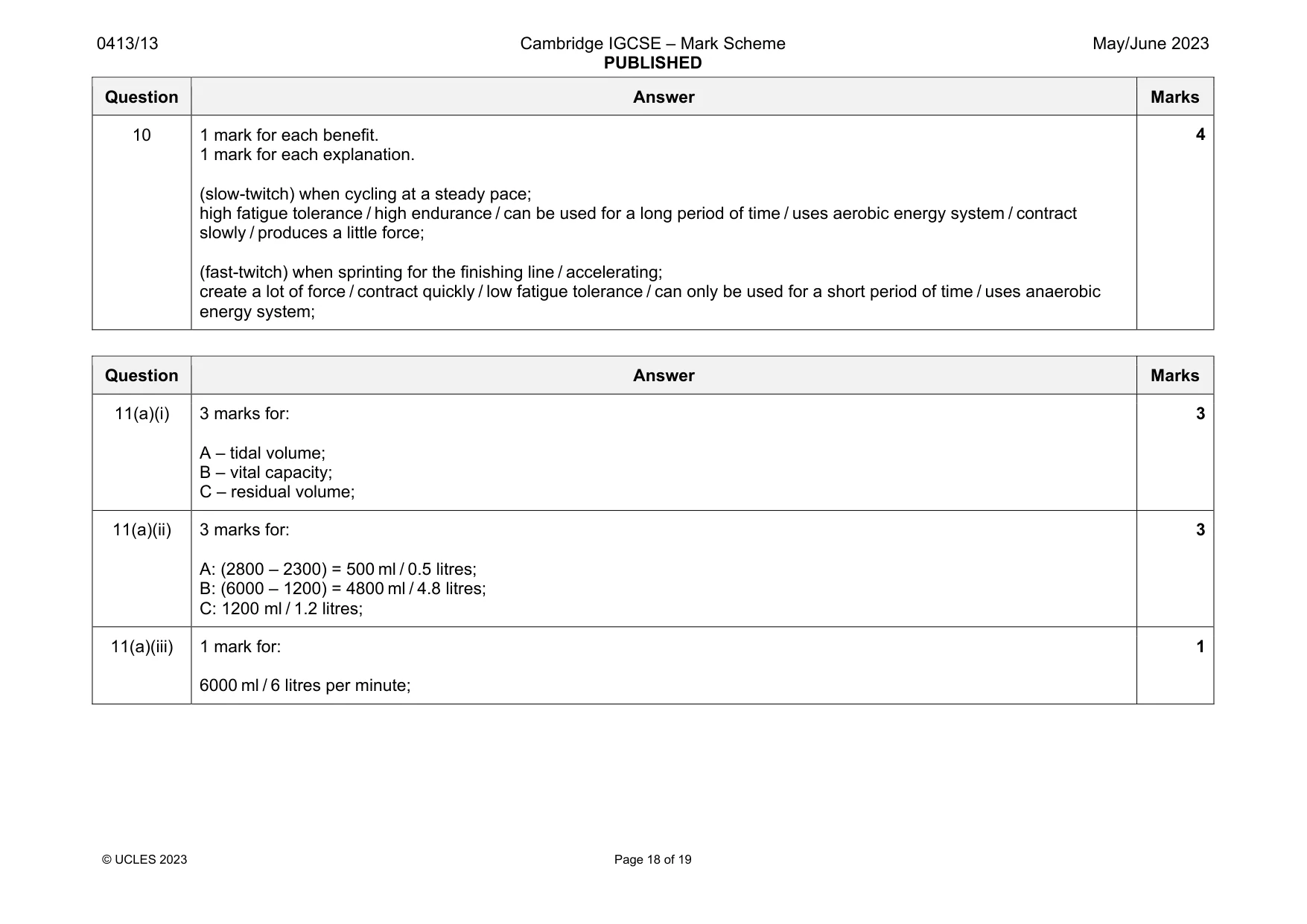
0413/13 Cambridge IGCSE – Mark Scheme PUBLISHED May/June 2023 © UCLES 2023 Page 18 of 19 Question Answer Marks 10 1 mark for each benefit. 1 mark for each explanation. (slow-twitch) when cycling at a steady pace; high fatigue tolerance / high endurance / can be used for a long period of time / uses aerobic energy system / contract slowly / produces a little force; (fast-twitch) when sprinting for the finishing line / accelerating; create a lot of force / contract quickly / low fatigue tolerance / can only be used for a short period of time / uses anaerobic energy system; 4 Question Answer Marks 11(a)(i) 3 marks for: A – tidal volume; B – vital capacity; C – residual volume; 3 11(a)(ii) 3 marks for: A: (2800 – 2300) = 500 ml / 0.5 litres; B: (6000 – 1200) = 4800 ml / 4.8 litres; C: 1200 ml / 1.2 litres; 3 11(a)(iii) 1 mark for: 6000 ml / 6 litres per minute; 1
Mark scheme, page 19
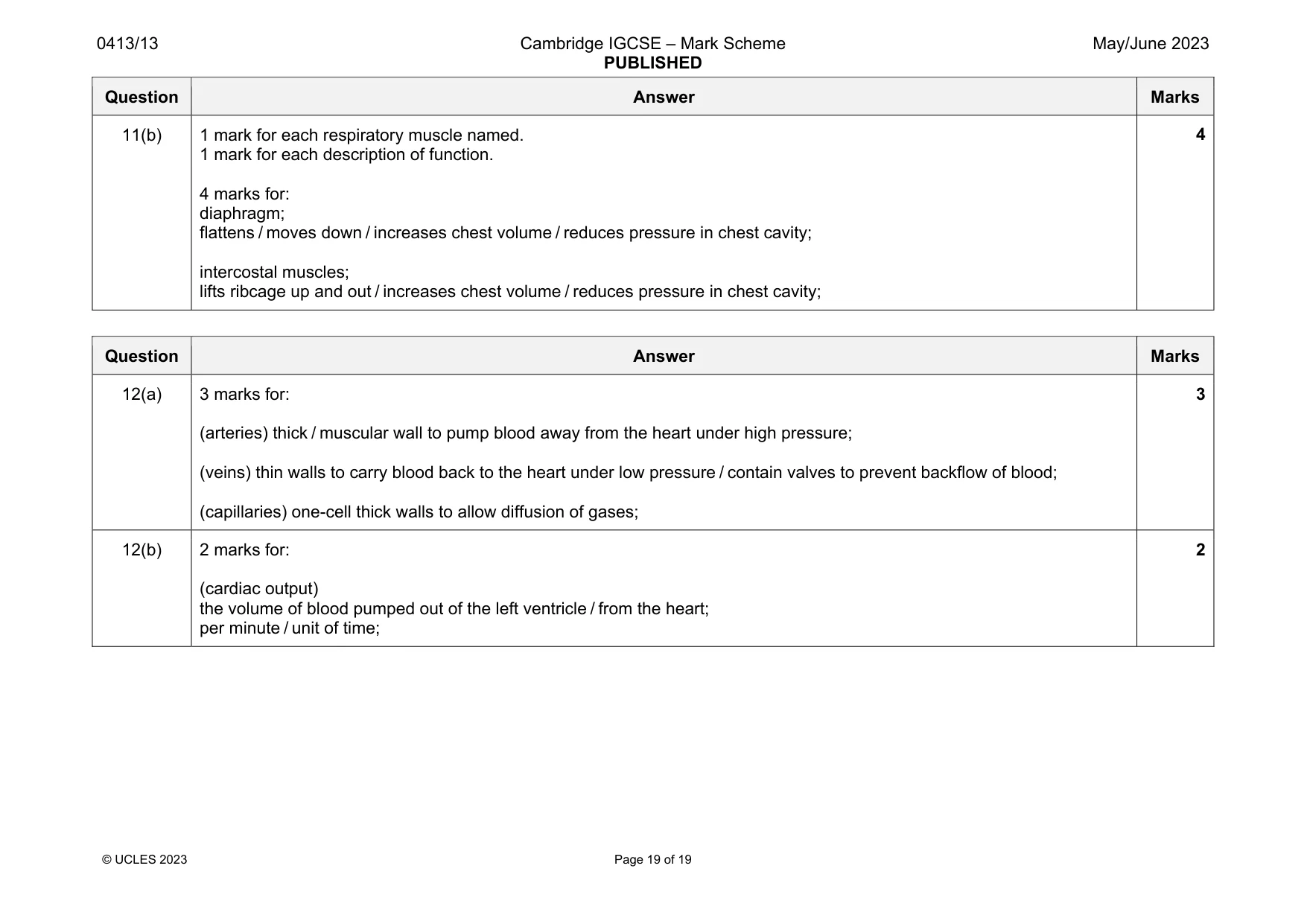
0413/13 Cambridge IGCSE – Mark Scheme PUBLISHED May/June 2023 © UCLES 2023 Page 19 of 19 Question Answer Marks 11(b) 1 mark for each respiratory muscle named. 1 mark for each description of function. 4 marks for: diaphragm; flattens / moves down / increases chest volume / reduces pressure in chest cavity; intercostal muscles; lifts ribcage up and out / increases chest volume / reduces pressure in chest cavity; 4 Question Answer Marks 12(a) 3 marks for: (arteries) thick / muscular wall to pump blood away from the heart under high pressure; (veins) thin walls to carry blood back to the heart under low pressure / contain valves to prevent backflow of blood; (capillaries) one-cell thick walls to allow diffusion of gases; 3 12(b) 2 marks for: (cardiac output) the volume of blood pumped out of the left ventricle / from the heart; per minute / unit of time; 2
What you needed in this session
Cambridge’s own grade thresholds for 2023 May/June, Paper 1 · Variant 3. A higher threshold means an easier paper — the bar moves with how the cohort did.