Cambridge IGCSE Physical Education 0413 — 2023 May/June Paper 1 · Variant 2
0413/12/M/J/23 · 100 marks · ≈113 min
The question paper and its mark scheme, free to read here and free to download. This is Cambridge’s own paper, exactly as it was sat.
Question paper20 pages



Mark scheme19 pages
Answers below. Sit the paper first if you are practising.
Paper as text
Question paper, page 1
This document has 20 pages. Any blank pages are indicated. [Turn over Cambridge IGCSE™ DC (CE/CT) 315238/3 © UCLES 2023 PHYSICAL EDUCATION 0413/12 Paper 1 Theory May/June 2023 1 hour 45 minutes You must answer on the question paper. No additional materials are needed. INSTRUCTIONS ● Answer all questions. ● Use a black or dark blue pen. You may use an HB pencil for any diagrams or graphs. ● Write your name, centre number and candidate number in the boxes at the top of the page. ● Write your answer to each question in the space provided. ● Do not use an erasable pen or correction fluid. ● Do not write on any bar codes. ● You may use a calculator. ● You should show all your working and use appropriate units. INFORMATION ● The total mark for this paper is 100. ● The number of marks for each question or part question is shown in brackets [ ]. * 5 3 7 1 0 3 6 3 7 3 *
Question paper, page 2
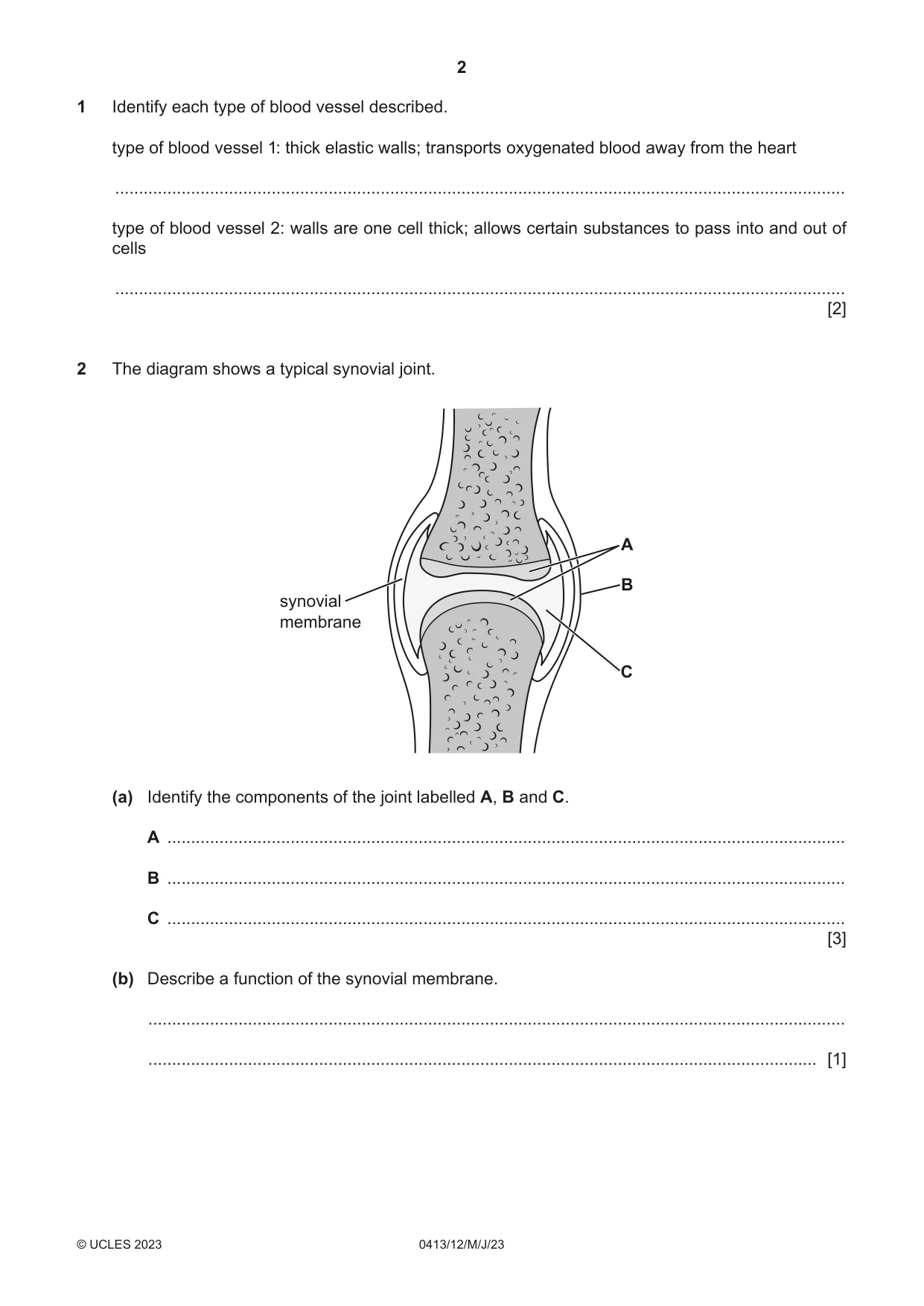
2 0413/12/M/J/23 © UCLES 2023 1 Identify each type of blood vessel described. type of blood vessel 1: thick elastic walls; transports oxygenated blood away from the heart … type of blood vessel 2: walls are one cell thick; allows certain substances to pass into and out of cells … [2] 2 The diagram shows a typical synovial joint. synovial membrane B C A (a) Identify the components of the joint labelled A, B and C. A … B … C … [3] (b) Describe a function of the synovial membrane. … … [1]
Question paper, page 3
3 0413/12/M/J/23 © UCLES 2023 [Turn over (c) (i) Identify the type of synovial joint found at the knee. … [1] (ii) Identify two bones that form the joint at the knee. 1 … 2 … [2] [Total: 7] 3 Some performers choose to use blood doping to gain an unfair advantage. (a) Describe how blood doping is carried out. … … … … … … [3] (b) Describe the potential side effects of blood doping on a performer. … … … … [2] [Total: 5]
Question paper, page 4
4 0413/12/M/J/23 © UCLES 2023 4 A sprinter has set themselves the following goal: ‘To improve my personal best time for 100 metres by 0.2 seconds by the end of the season.’ (a) Identify three named SMARTER goal-setting principles. Explain how each principle has been applied to this goal. principle 1 … application … … principle 2 … application … … principle 3 … application … … [6] (b) Identify a goal-setting principle that has not been applied in setting this goal. Suggest how not applying the named principle could cause the sprinter not to achieve their stated goal. principle … cause … … [2] [Total: 8]
Question paper, page 5
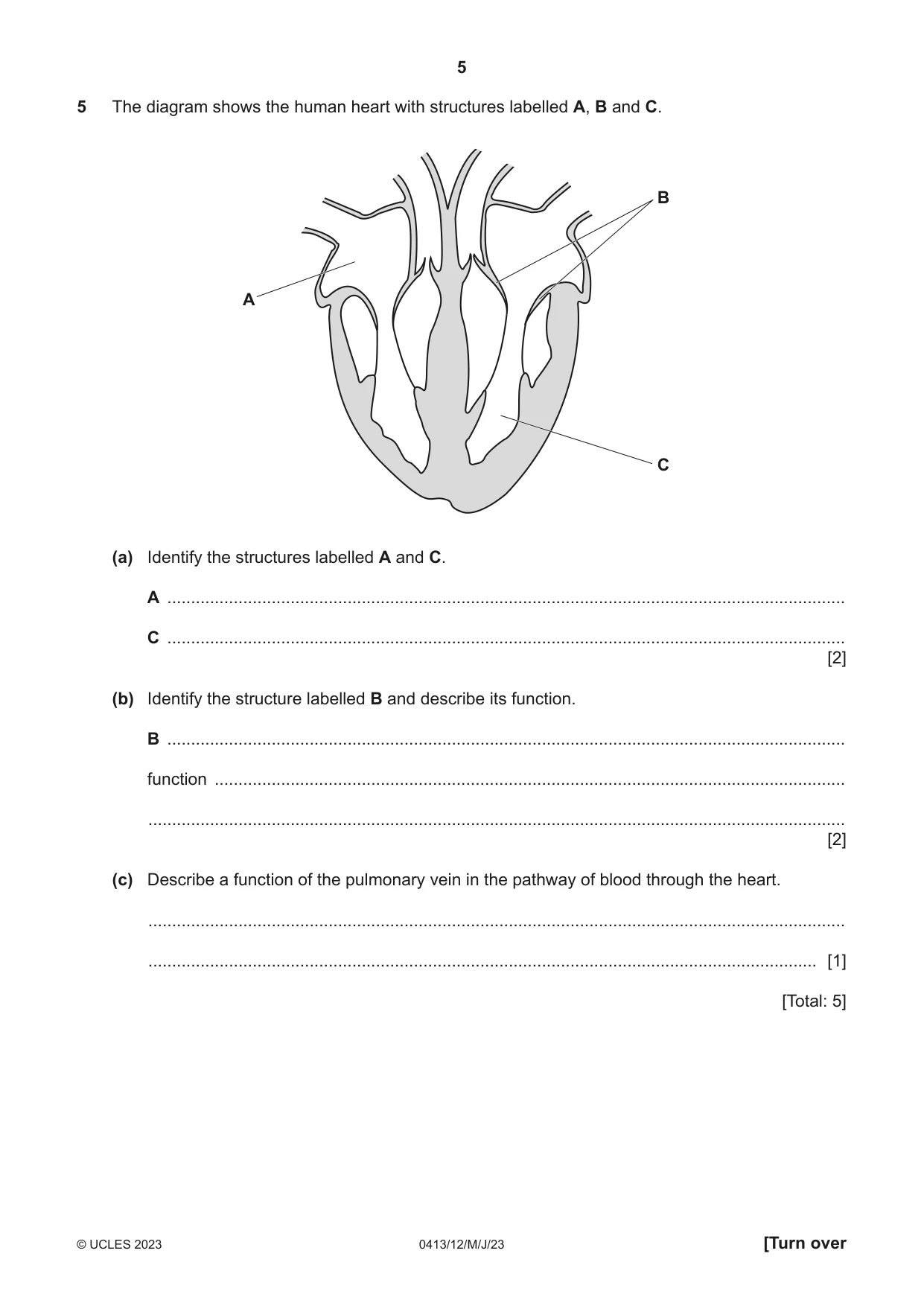
5 0413/12/M/J/23 © UCLES 2023 [Turn over 5 The diagram shows the human heart with structures labelled A, B and C. B C A (a) Identify the structures labelled A and C. A … C … [2] (b) Identify the structure labelled B and describe its function. B … function … … [2] (c) Describe a function of the pulmonary vein in the pathway of blood through the heart. … … [1] [Total: 5]
Question paper, page 6
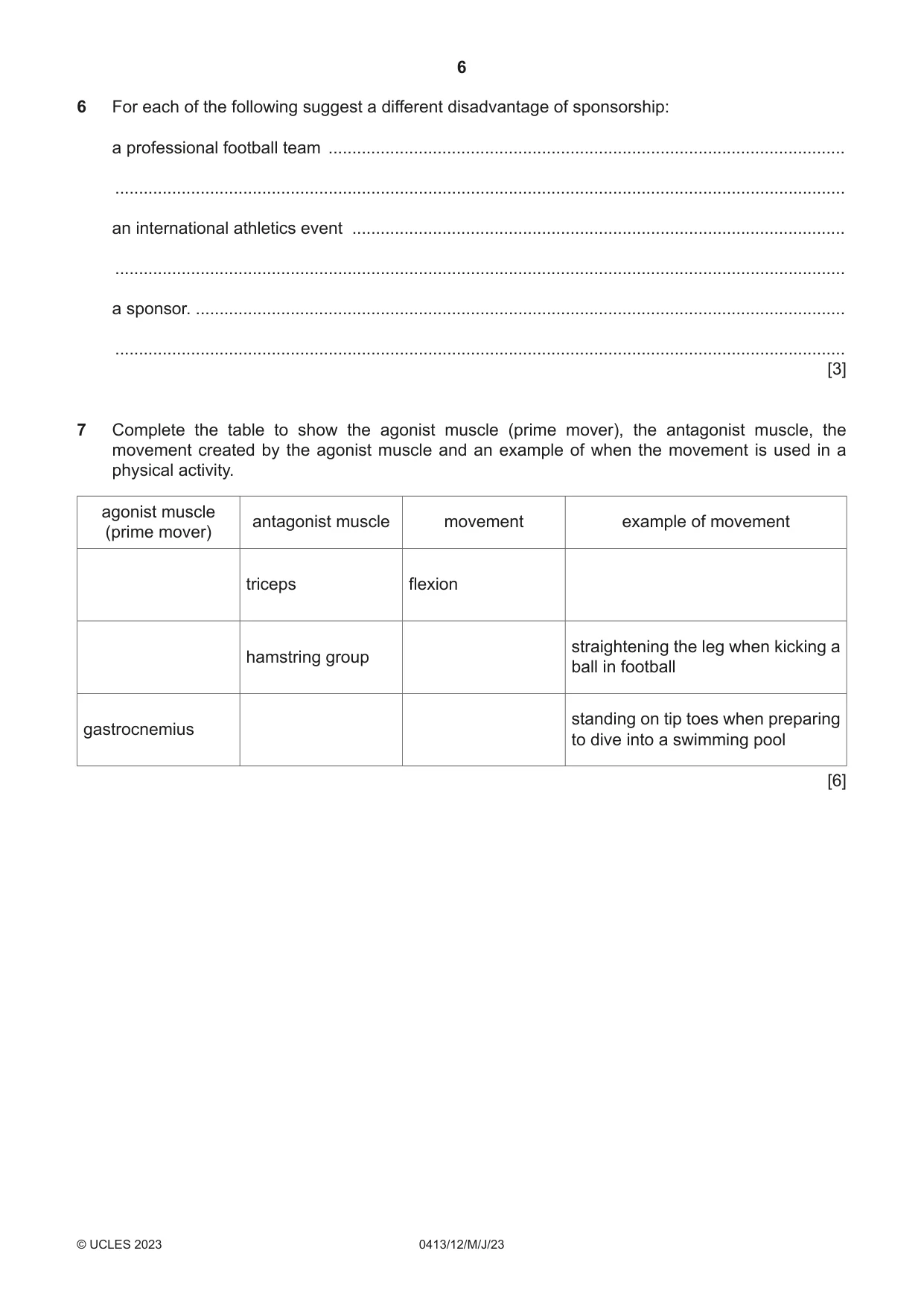
6 0413/12/M/J/23 © UCLES 2023 6 For each of the following suggest a different disadvantage of sponsorship: a professional football team … … an international athletics event … … a sponsor. … … [3] 7 Complete the table to show the agonist muscle (prime mover), the antagonist muscle, the movement created by the agonist muscle and an example of when the movement is used in a physical activity. agonist muscle (prime mover) antagonist muscle movement example of movement triceps flexion hamstring group straightening the leg when kicking a ball in football gastrocnemius standing on tip toes when preparing to dive into a swimming pool [6]
Question paper, page 7
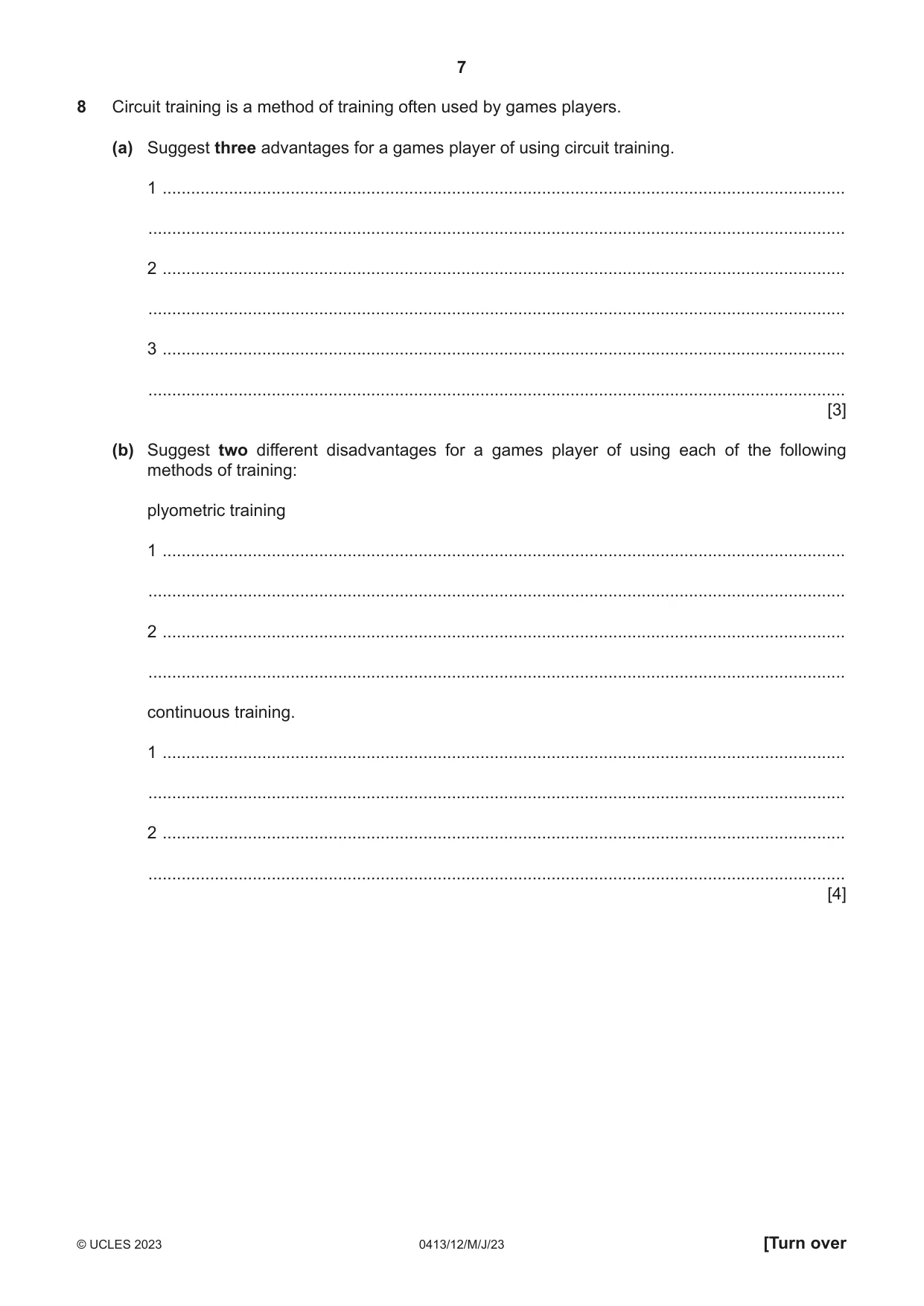
7 0413/12/M/J/23 © UCLES 2023 [Turn over 8 Circuit training is a method of training often used by games players. (a) Suggest three advantages for a games player of using circuit training. 1 … … 2 … … 3 … … [3] (b) Suggest two different disadvantages for a games player of using each of the following methods of training: plyometric training 1 … … 2 … … continuous training. 1 … … 2 … … [4]
Question paper, page 8
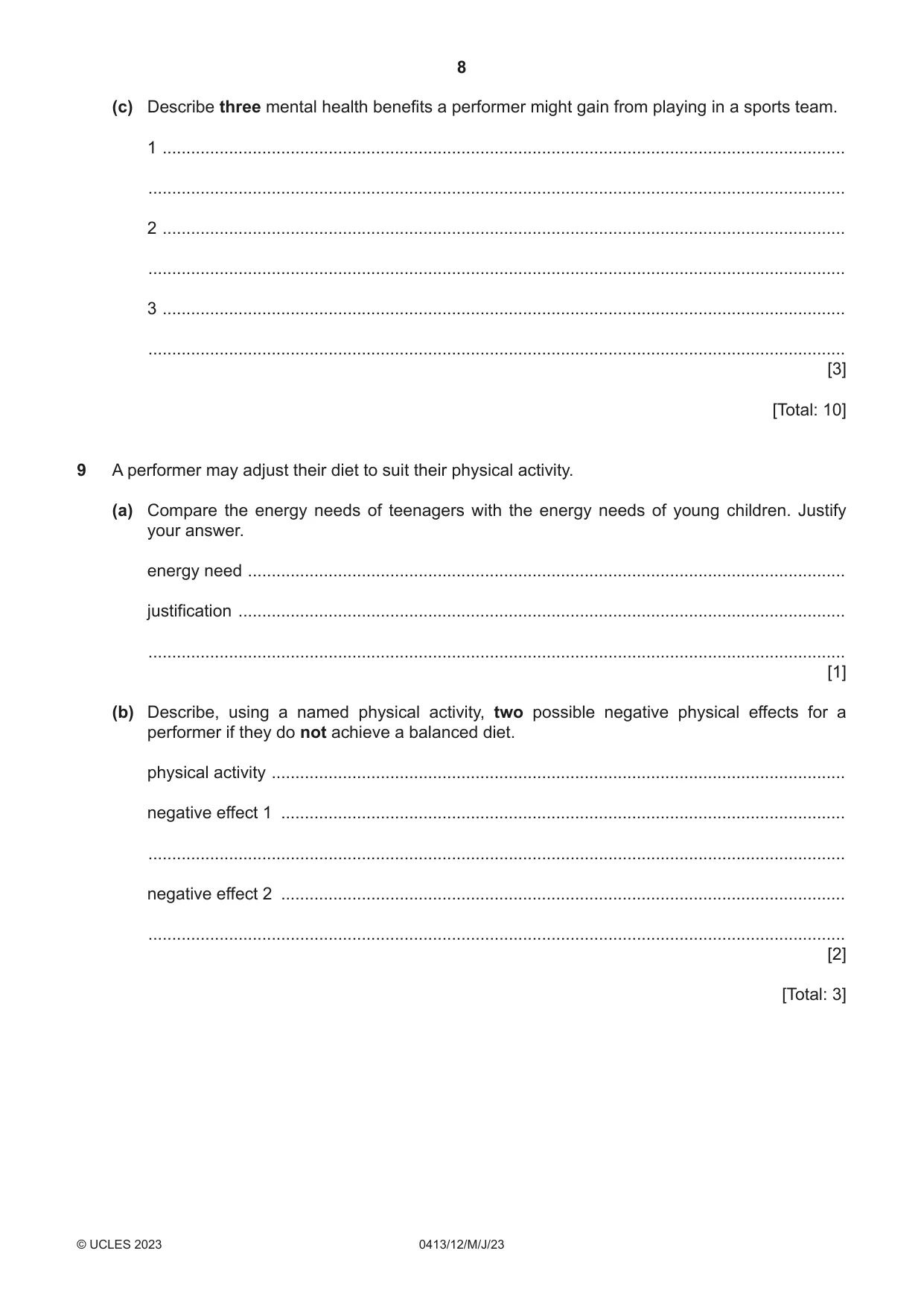
8 0413/12/M/J/23 © UCLES 2023 (c) Describe three mental health benefits a performer might gain from playing in a sports team. 1 … … 2 … … 3 … … [3] [Total: 10] 9 A performer may adjust their diet to suit their physical activity. (a) Compare the energy needs of teenagers with the energy needs of young children. Justify your answer. energy need … justification … … [1] (b) Describe, using a named physical activity, two possible negative physical effects for a performer if they do not achieve a balanced diet. physical activity … negative effect 1 … … negative effect 2 … … [2] [Total: 3]
Question paper, page 9
9 0413/12/M/J/23 © UCLES 2023 [Turn over BLANK PAGE
Question paper, page 10
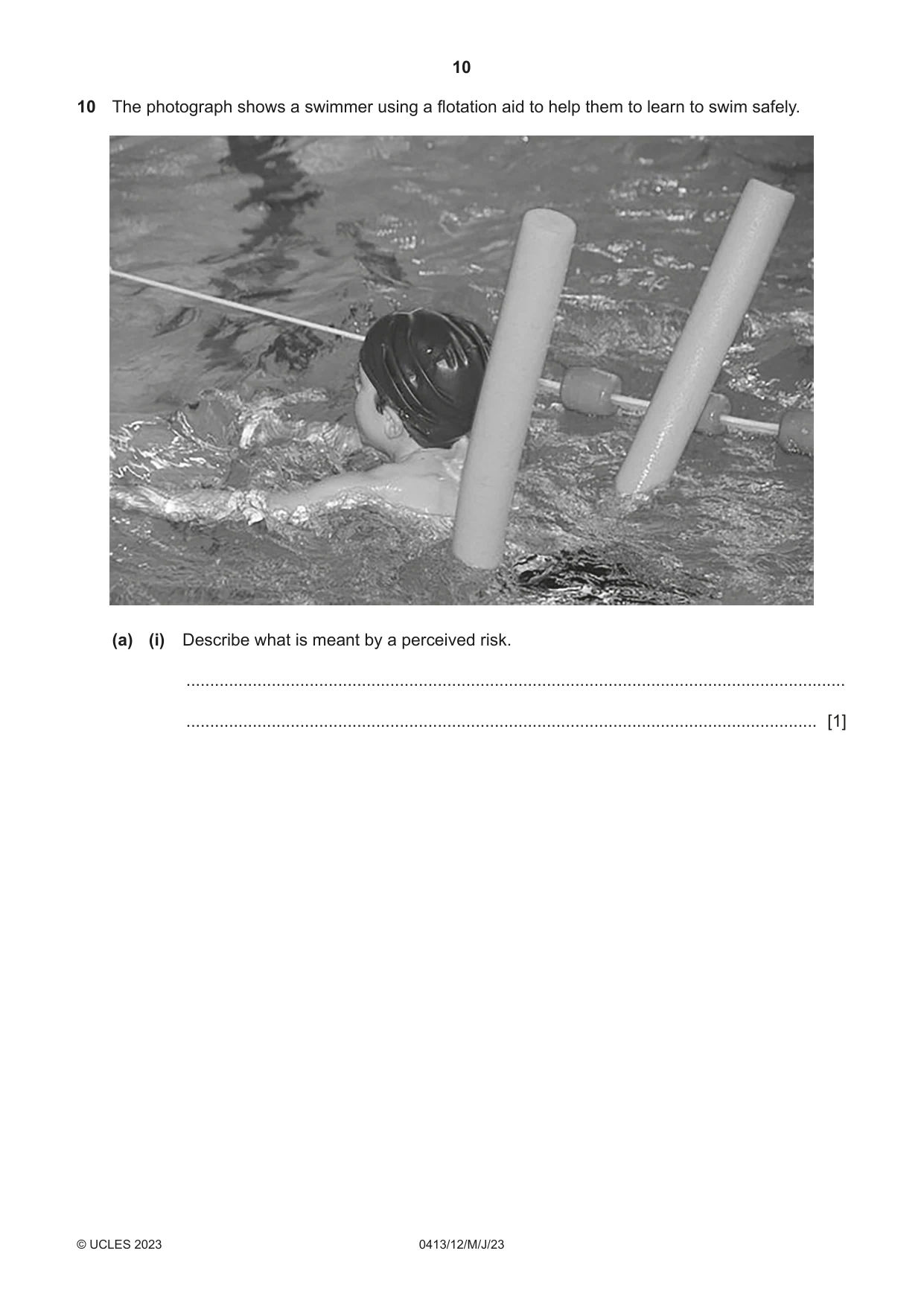
10 0413/12/M/J/23 © UCLES 2023 10 The photograph shows a swimmer using a flotation aid to help them to learn to swim safely. (a) (i) Describe what is meant by a perceived risk. … … [1]
Question paper, page 11
11 0413/12/M/J/23 © UCLES 2023 [Turn over (ii) Identify three real risks that could occur when swimming in a pool. Describe a different strategy, other than using a flotation aid, to reduce each risk. risk 1 … … strategy … … risk 2 … … strategy … … risk 3 … … strategy … … [6] (b) When learning how to swim, a performer may become anxious. Explain how a relaxation technique can help reduce a performer’s level of anxiety. method … explanation … … [2] [Total: 9]
Question paper, page 12
12 0413/12/M/J/23 © UCLES 2023 11 (a) Describe two features of play. 1 … … 2 … … [2] (b) Explain how two named factors, other than a person’s age and interests, can influence the recreational activities they take part in. factor 1 … explanation … … factor 2 … explanation … … [4] [Total: 6]
Question paper, page 13
13 0413/12/M/J/23 © UCLES 2023 [Turn over 12 When learning a skill, a performer may go through three stages of learning. (a) Identify the first and third stages of learning. Using examples from a named physical activity describe two different characteristics of a performer at each stage. physical activity … first stage of learning … characteristic 1 … … characteristic 2 … … third stage of learning … characteristic 1 … … characteristic 2 … … [6]
Question paper, page 14
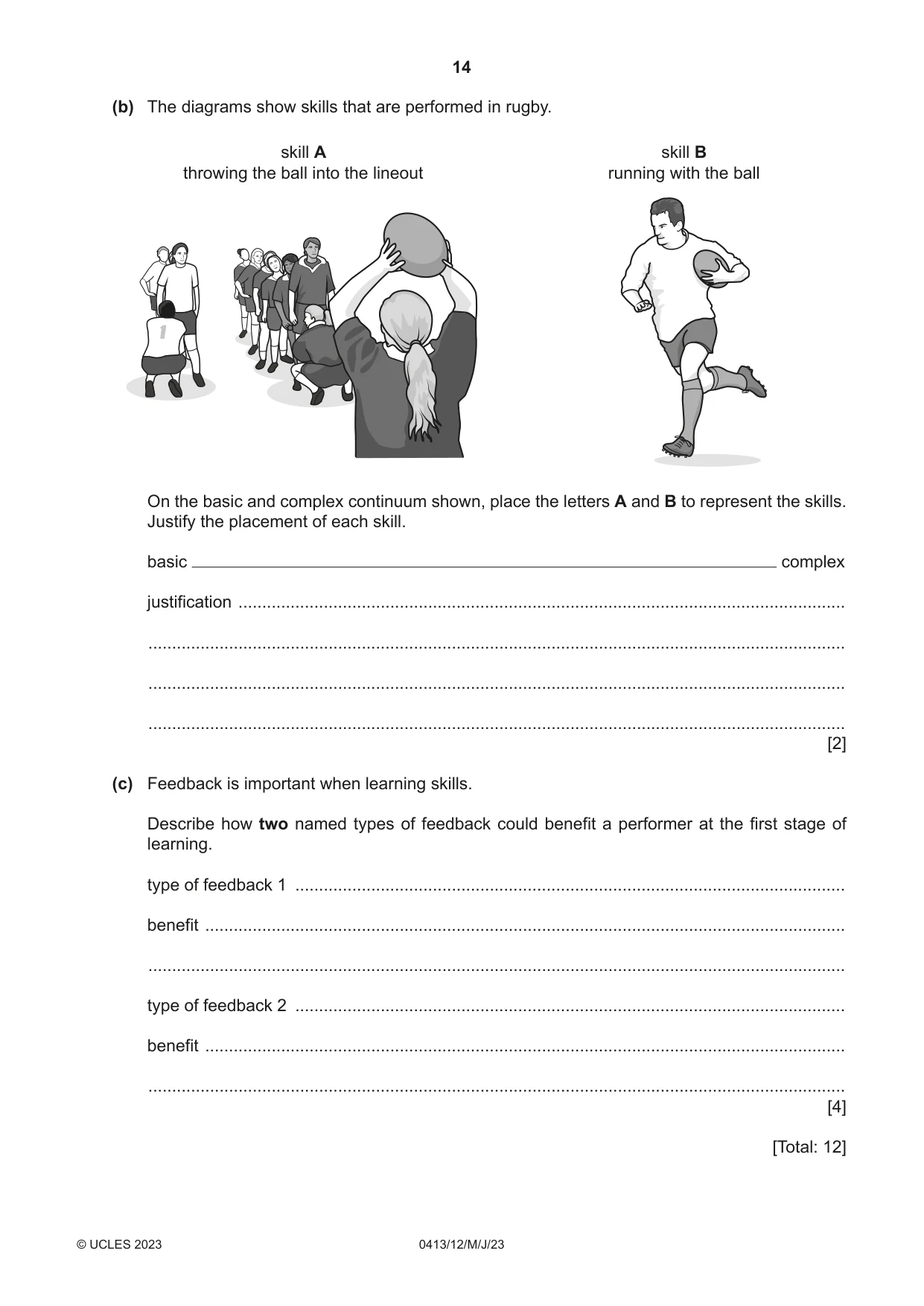
14 0413/12/M/J/23 © UCLES 2023 (b) The diagrams show skills that are performed in rugby. skill B running with the ball skill A throwing the ball into the lineout On the basic and complex continuum shown, place the letters A and B to represent the skills. Justify the placement of each skill. basic complex justification … … … … [2] (c) Feedback is important when learning skills. Describe how two named types of feedback could benefit a performer at the first stage of learning. type of feedback 1 … benefit … … type of feedback 2 … benefit … … [4] [Total: 12]
Question paper, page 15
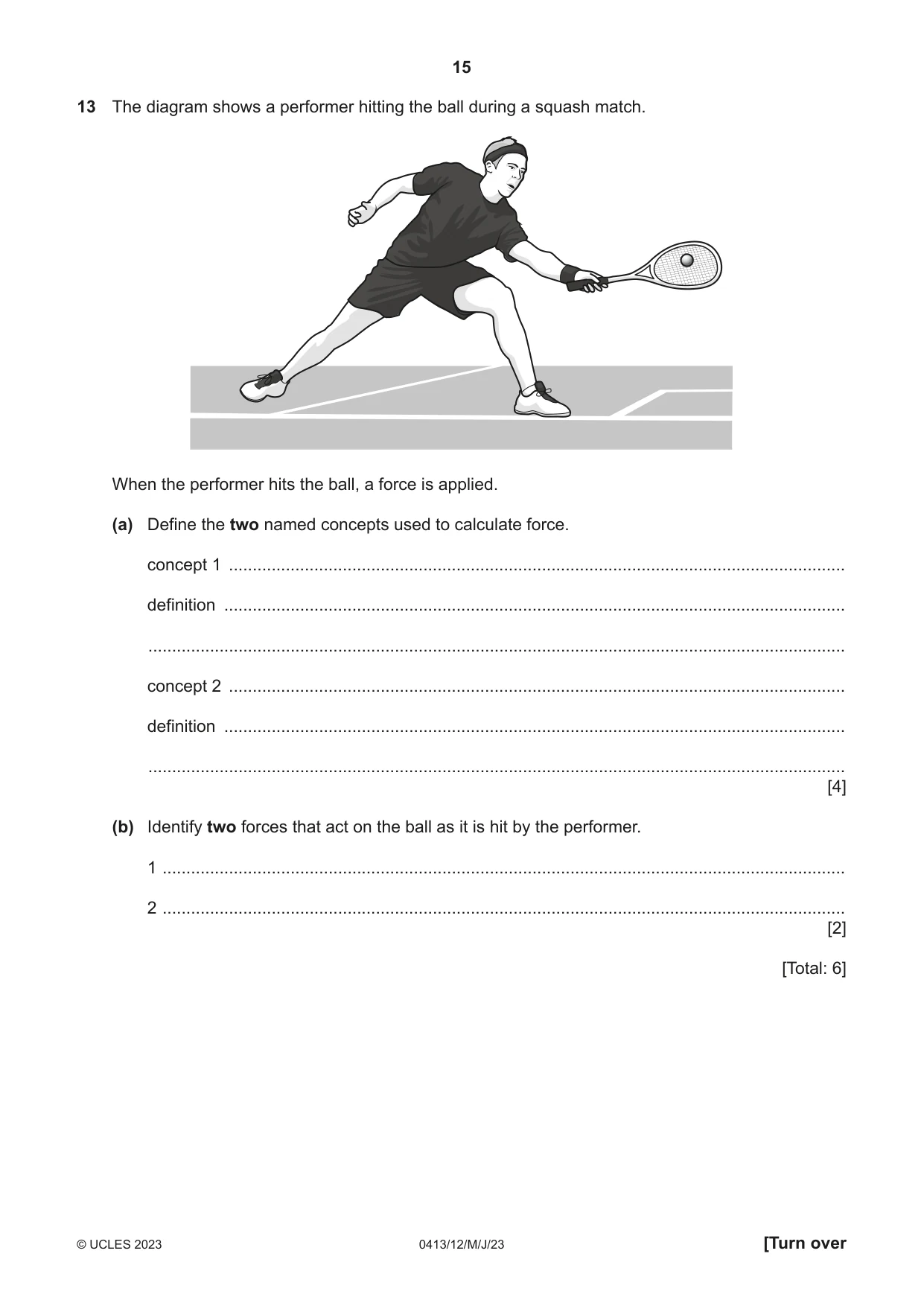
15 0413/12/M/J/23 © UCLES 2023 [Turn over 13 The diagram shows a performer hitting the ball during a squash match. When the performer hits the ball, a force is applied. (a) Define the two named concepts used to calculate force. concept 1 … definition … … concept 2 … definition … … [4] (b) Identify two forces that act on the ball as it is hit by the performer. 1 … 2 … [2] [Total: 6]
Question paper, page 16
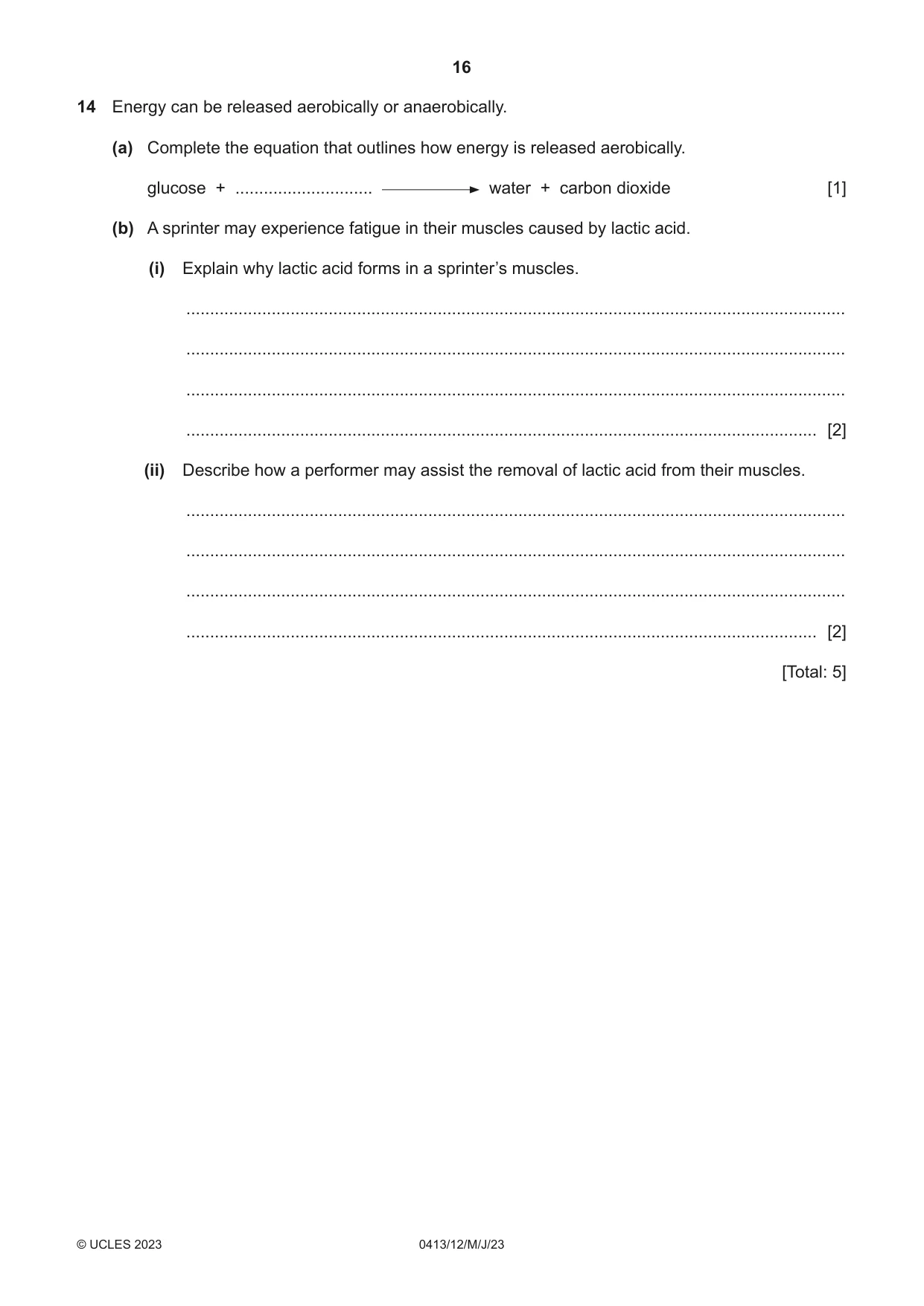
16 0413/12/M/J/23 © UCLES 2023 14 Energy can be released aerobically or anaerobically. (a) Complete the equation that outlines how energy is released aerobically. glucose + … water + carbon dioxide [1] (b) A sprinter may experience fatigue in their muscles caused by lactic acid. (i) Explain why lactic acid forms in a sprinter’s muscles. … … … … [2] (ii) Describe how a performer may assist the removal of lactic acid from their muscles. … … … … [2] [Total: 5]
Question paper, page 17
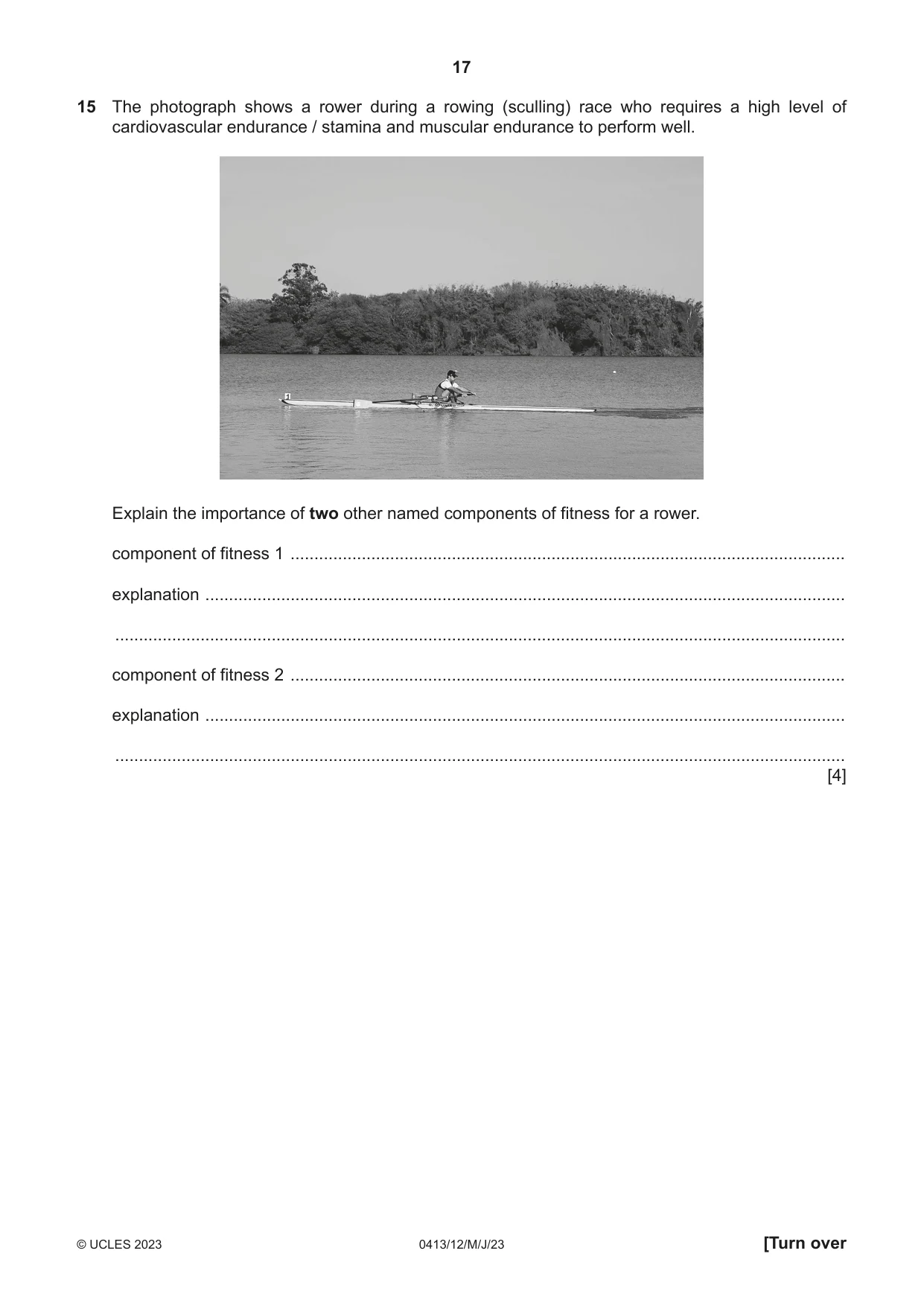
17 0413/12/M/J/23 © UCLES 2023 [Turn over 15 The photograph shows a rower during a rowing (sculling) race who requires a high level of cardiovascular endurance / stamina and muscular endurance to perform well. Explain the importance of two other named components of fitness for a rower. component of fitness 1 … explanation … … component of fitness 2 … explanation … … [4]
Question paper, page 18
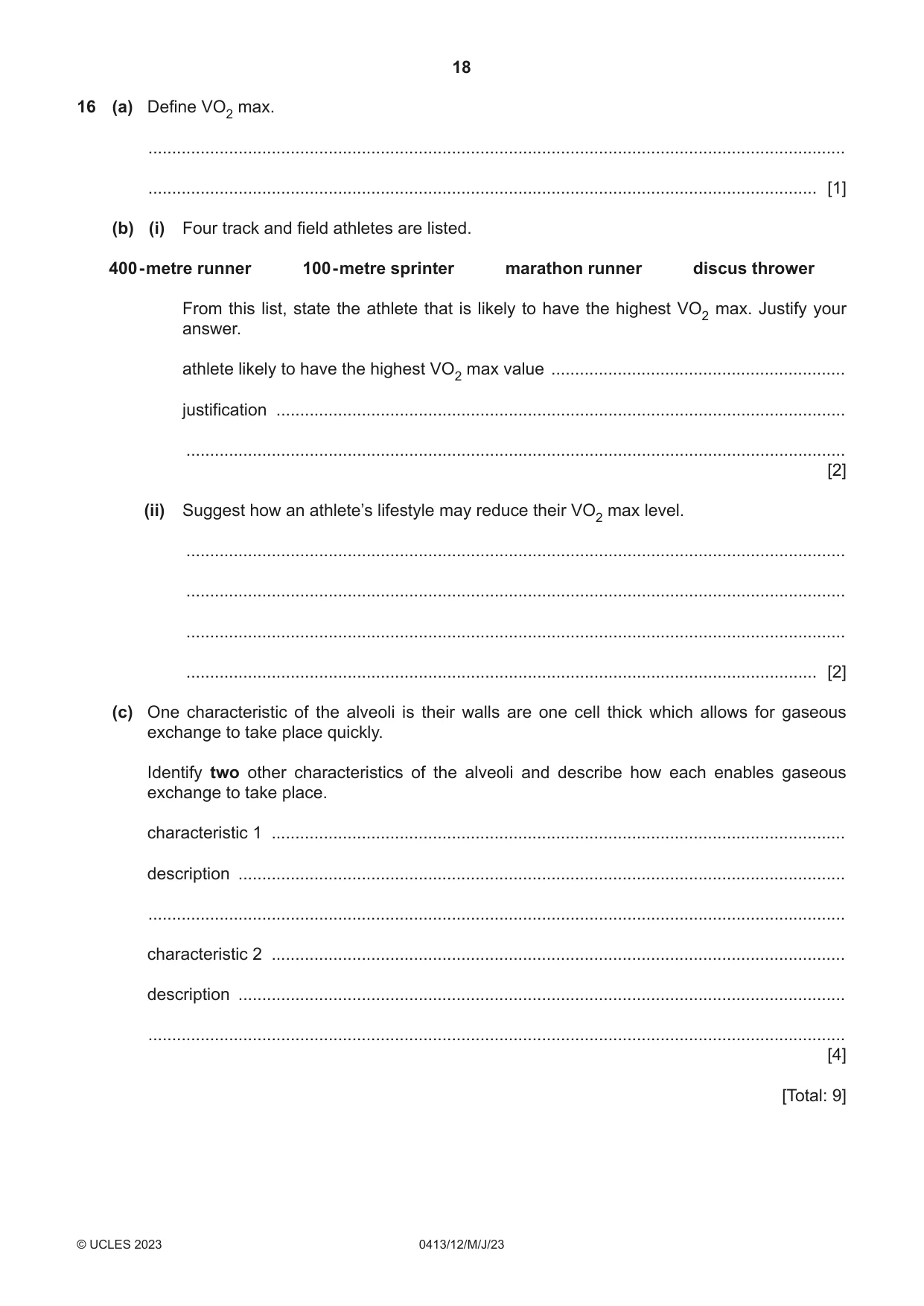
18 0413/12/M/J/23 © UCLES 2023 16 (a) Define VO2 max. … … [1] (b) (i) Four track and field athletes are listed. 400 - metre runner 100 - metre sprinter marathon runner discus thrower From this list, state the athlete that is likely to have the highest VO2 max. Justify your answer. athlete likely to have the highest VO2 max value … justification … … [2] (ii) Suggest how an athlete’s lifestyle may reduce their VO2 max level. … … … … [2] (c) One characteristic of the alveoli is their walls are one cell thick which allows for gaseous exchange to take place quickly. Identify two other characteristics of the alveoli and describe how each enables gaseous exchange to take place. characteristic 1 … description … … characteristic 2 … description … … [4] [Total: 9]
Question paper, page 19
19 0413/12/M/J/23 © UCLES 2023 BLANK PAGE
Question paper, page 20
20 0413/12/M/J/23 © UCLES 2023 Permission to reproduce items where third-party owned material protected by copyright is included has been sought and cleared where possible. Every reasonable effort has been made by the publisher (UCLES) to trace copyright holders, but if any items requiring clearance have unwittingly been included, the publisher will be pleased to make amends at the earliest possible opportunity. To avoid the issue of disclosure of answer-related information to candidates, all copyright acknowledgements are reproduced online in the Cambridge Assessment International Education Copyright Acknowledgements Booklet. This is produced for each series of examinations and is freely available to download at www.cambridgeinternational.org after the live examination series. Cambridge Assessment International Education is part of Cambridge Assessment. Cambridge Assessment is the brand name of the University of Cambridge Local Examinations Syndicate (UCLES), which is a department of the University of Cambridge. BLANK PAGE
Mark scheme, page 1
This document consists of 19 printed pages. © UCLES 2023 [Turn over Cambridge IGCSE™ PHYSICAL EDUCATION 0413/12 Paper 1 Theory May/June 2023 MARK SCHEME Maximum Mark: 100 Published This mark scheme is published as an aid to teachers and candidates, to indicate the requirements of the examination. It shows the basis on which Examiners were instructed to award marks. It does not indicate the details of the discussions that took place at an Examiners’ meeting before marking began, which would have considered the acceptability of alternative answers. Mark schemes should be read in conjunction with the question paper and the Principal Examiner Report for Teachers. Cambridge International will not enter into discussions about these mark schemes. Cambridge International is publishing the mark schemes for the May/June 2023 series for most Cambridge IGCSE, Cambridge International A and AS Level and Cambridge Pre-U components, and some Cambridge O Level components.
Mark scheme, page 2
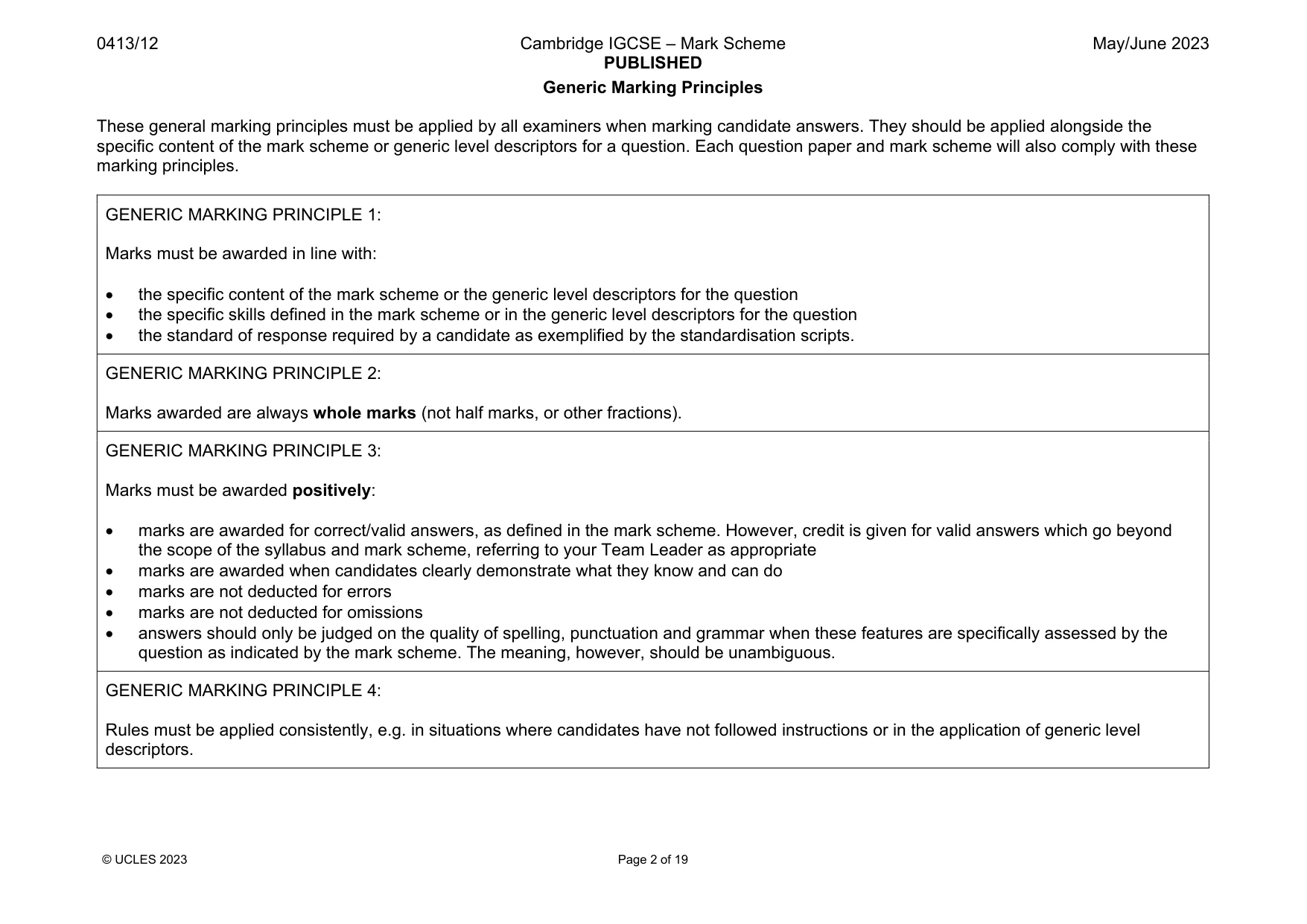
0413/12 Cambridge IGCSE – Mark Scheme PUBLISHED May/June 2023 © UCLES 2023 Page 2 of 19 Generic Marking Principles These general marking principles must be applied by all examiners when marking candidate answers. They should be applied alongside the specific content of the mark scheme or generic level descriptors for a question. Each question paper and mark scheme will also comply with these marking principles. GENERIC MARKING PRINCIPLE 1: Marks must be awarded in line with: the specific content of the mark scheme or the generic level descriptors for the question the specific skills defined in the mark scheme or in the generic level descriptors for the question the standard of response required by a candidate as exemplified by the standardisation scripts. GENERIC MARKING PRINCIPLE 2: Marks awarded are always whole marks (not half marks, or other fractions). GENERIC MARKING PRINCIPLE 3: Marks must be awarded positively: marks are awarded for correct/valid answers, as defined in the mark scheme. However, credit is given for valid answers which go beyond the scope of the syllabus and mark scheme, referring to your Team Leader as appropriate marks are awarded when candidates clearly demonstrate what they know and can do marks are not deducted for errors marks are not deducted for omissions answers should only be judged on the quality of spelling, punctuation and grammar when these features are specifically assessed by the question as indicated by the mark scheme. The meaning, however, should be unambiguous. GENERIC MARKING PRINCIPLE 4: Rules must be applied consistently, e.g. in situations where candidates have not followed instructions or in the application of generic level descriptors.
Mark scheme, page 3
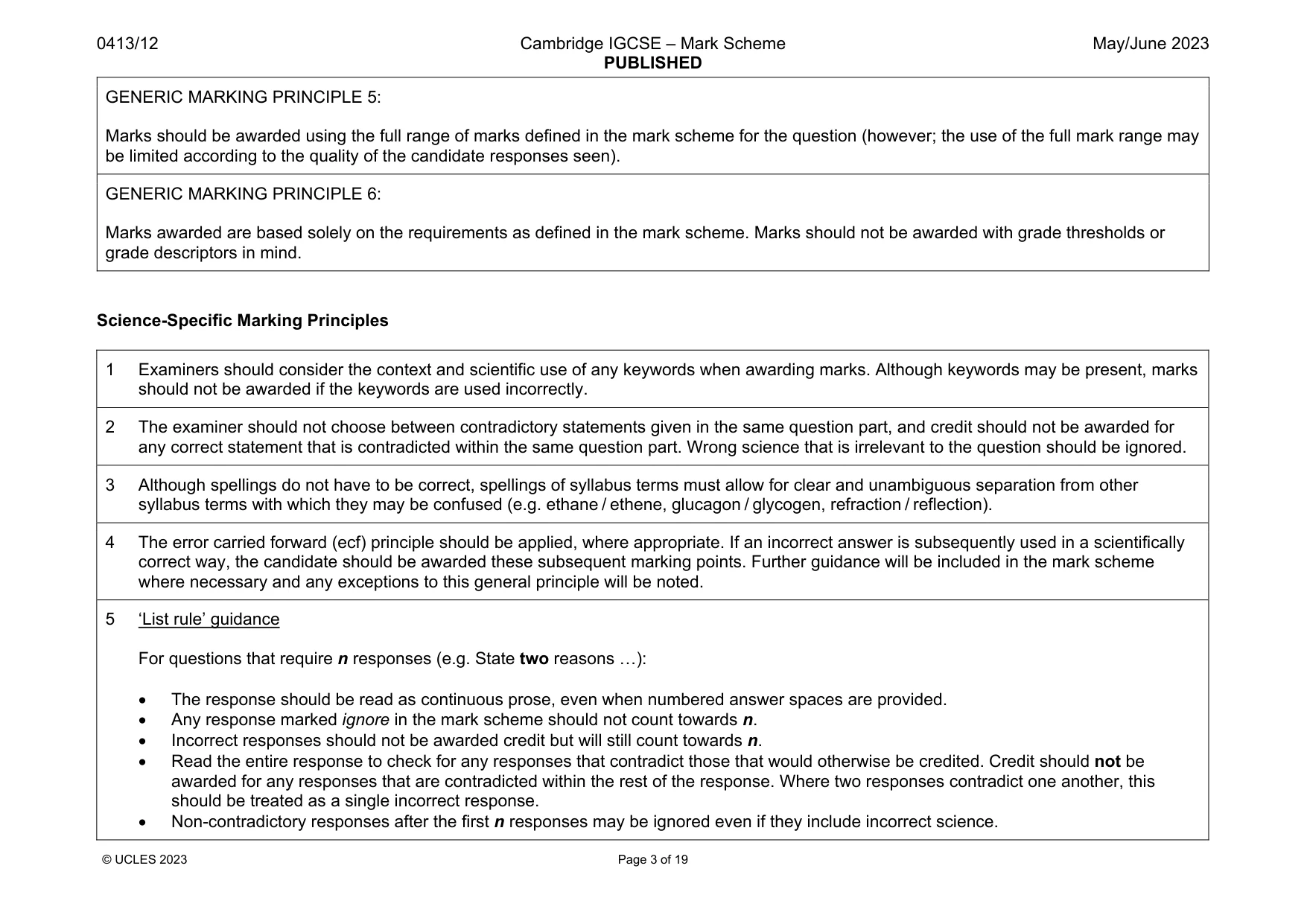
0413/12 Cambridge IGCSE – Mark Scheme PUBLISHED May/June 2023 © UCLES 2023 Page 3 of 19 GENERIC MARKING PRINCIPLE 5: Marks should be awarded using the full range of marks defined in the mark scheme for the question (however; the use of the full mark range may be limited according to the quality of the candidate responses seen). GENERIC MARKING PRINCIPLE 6: Marks awarded are based solely on the requirements as defined in the mark scheme. Marks should not be awarded with grade thresholds or grade descriptors in mind. Science-Specific Marking Principles 1 Examiners should consider the context and scientific use of any keywords when awarding marks. Although keywords may be present, marks should not be awarded if the keywords are used incorrectly. 2 The examiner should not choose between contradictory statements given in the same question part, and credit should not be awarded for any correct statement that is contradicted within the same question part. Wrong science that is irrelevant to the question should be ignored. 3 Although spellings do not have to be correct, spellings of syllabus terms must allow for clear and unambiguous separation from other syllabus terms with which they may be confused (e.g. ethane / ethene, glucagon / glycogen, refraction / reflection). 4 The error carried forward (ecf) principle should be applied, where appropriate. If an incorrect answer is subsequently used in a scientifically correct way, the candidate should be awarded these subsequent marking points. Further guidance will be included in the mark scheme where necessary and any exceptions to this general principle will be noted. 5 ‘List rule’ guidance For questions that require n responses (e.g. State two reasons …): The response should be read as continuous prose, even when numbered answer spaces are provided. Any response marked ignore in the mark scheme should not count towards n. Incorrect responses should not be awarded credit but will still count towards n. Read the entire response to check for any responses that contradict those that would otherwise be credited. Credit should not be awarded for any responses that are contradicted within the rest of the response. Where two responses contradict one another, this should be treated as a single incorrect response. Non-contradictory responses after the first n responses may be ignored even if they include incorrect science.
Mark scheme, page 4
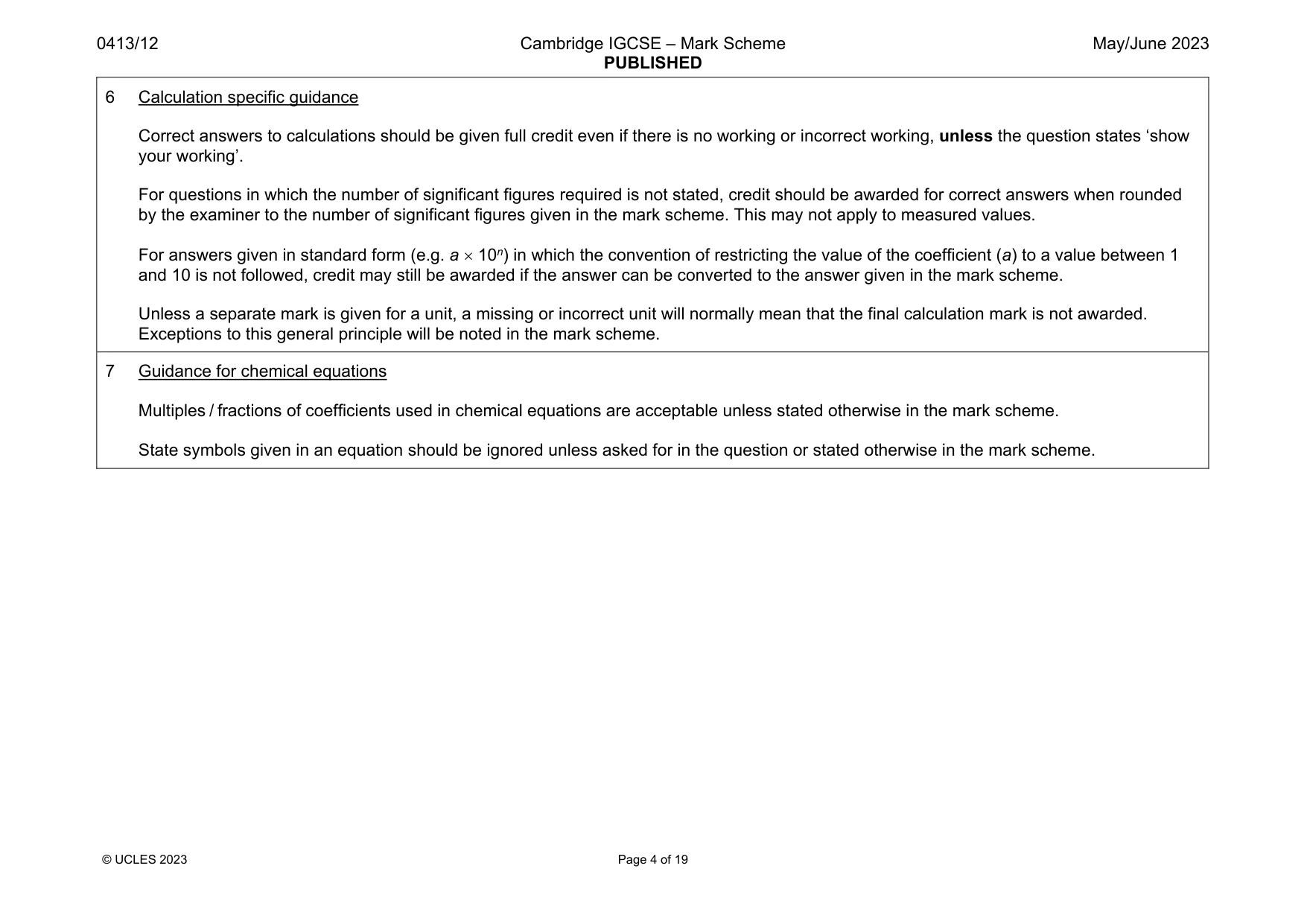
0413/12 Cambridge IGCSE – Mark Scheme PUBLISHED May/June 2023 © UCLES 2023 Page 4 of 19 6 Calculation specific guidance Correct answers to calculations should be given full credit even if there is no working or incorrect working, unless the question states ‘show your working’. For questions in which the number of significant figures required is not stated, credit should be awarded for correct answers when rounded by the examiner to the number of significant figures given in the mark scheme. This may not apply to measured values. For answers given in standard form (e.g. a 10n) in which the convention of restricting the value of the coefficient (a) to a value between 1 and 10 is not followed, credit may still be awarded if the answer can be converted to the answer given in the mark scheme. Unless a separate mark is given for a unit, a missing or incorrect unit will normally mean that the final calculation mark is not awarded. Exceptions to this general principle will be noted in the mark scheme. 7 Guidance for chemical equations Multiples / fractions of coefficients used in chemical equations are acceptable unless stated otherwise in the mark scheme. State symbols given in an equation should be ignored unless asked for in the question or stated otherwise in the mark scheme.
Mark scheme, page 5
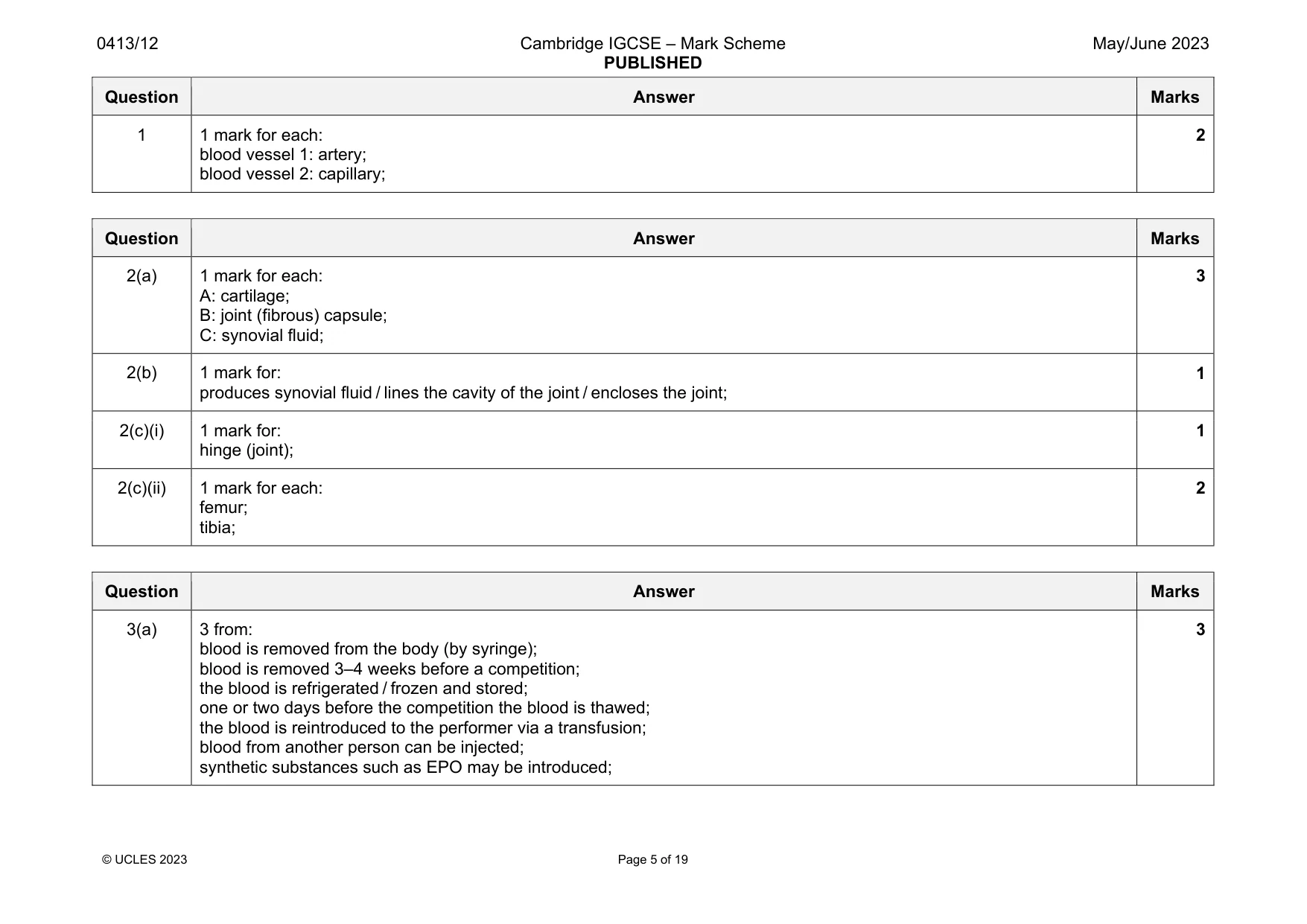
0413/12 Cambridge IGCSE – Mark Scheme PUBLISHED May/June 2023 © UCLES 2023 Page 5 of 19 Question Answer Marks 1 1 mark for each: blood vessel 1: artery; blood vessel 2: capillary; 2 Question Answer Marks 2(a) 1 mark for each: A: cartilage; B: joint (fibrous) capsule; C: synovial fluid; 3 2(b) 1 mark for: produces synovial fluid / lines the cavity of the joint / encloses the joint; 1 2(c)(i) 1 mark for: hinge (joint); 1 2(c)(ii) 1 mark for each: femur; tibia; 2 Question Answer Marks 3(a) 3 from: blood is removed from the body (by syringe); blood is removed 3–4 weeks before a competition; the blood is refrigerated / frozen and stored; one or two days before the competition the blood is thawed; the blood is reintroduced to the performer via a transfusion; blood from another person can be injected; synthetic substances such as EPO may be introduced; 3
Mark scheme, page 6
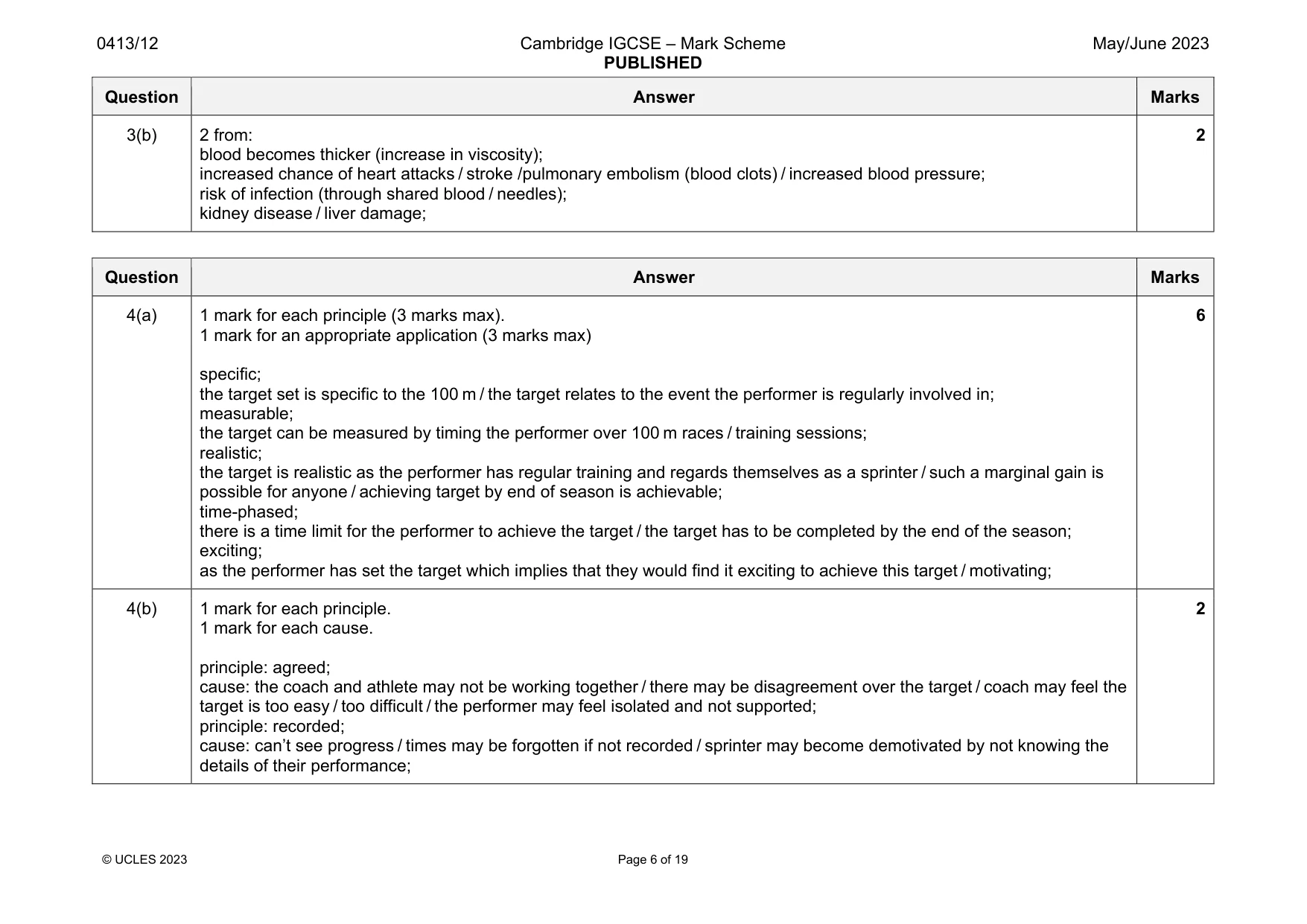
0413/12 Cambridge IGCSE – Mark Scheme PUBLISHED May/June 2023 © UCLES 2023 Page 6 of 19 Question Answer Marks 3(b) 2 from: blood becomes thicker (increase in viscosity); increased chance of heart attacks / stroke /pulmonary embolism (blood clots) / increased blood pressure; risk of infection (through shared blood / needles); kidney disease / liver damage; 2 Question Answer Marks 4(a) 1 mark for each principle (3 marks max). 1 mark for an appropriate application (3 marks max) specific; the target set is specific to the 100 m / the target relates to the event the performer is regularly involved in; measurable; the target can be measured by timing the performer over 100 m races / training sessions; realistic; the target is realistic as the performer has regular training and regards themselves as a sprinter / such a marginal gain is possible for anyone / achieving target by end of season is achievable; time-phased; there is a time limit for the performer to achieve the target / the target has to be completed by the end of the season; exciting; as the performer has set the target which implies that they would find it exciting to achieve this target / motivating; 6 4(b) 1 mark for each principle. 1 mark for each cause. principle: agreed; cause: the coach and athlete may not be working together / there may be disagreement over the target / coach may feel the target is too easy / too difficult / the performer may feel isolated and not supported; principle: recorded; cause: can’t see progress / times may be forgotten if not recorded / sprinter may become demotivated by not knowing the details of their performance; 2
Mark scheme, page 7
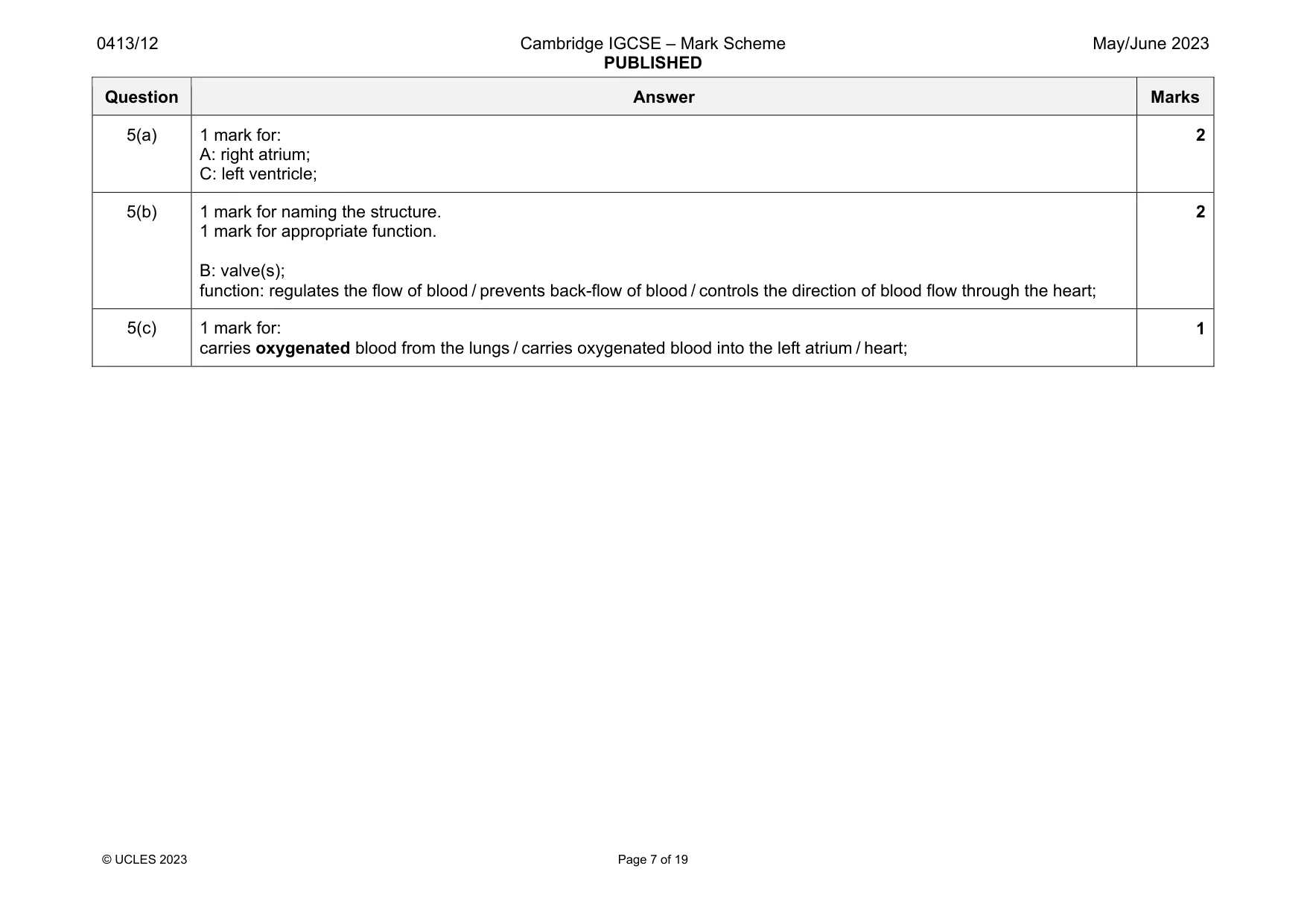
0413/12 Cambridge IGCSE – Mark Scheme PUBLISHED May/June 2023 © UCLES 2023 Page 7 of 19 Question Answer Marks 5(a) 1 mark for: A: right atrium; C: left ventricle; 2 5(b) 1 mark for naming the structure. 1 mark for appropriate function. B: valve(s); function: regulates the flow of blood / prevents back-flow of blood / controls the direction of blood flow through the heart; 2 5(c) 1 mark for: carries oxygenated blood from the lungs / carries oxygenated blood into the left atrium / heart; 1
Mark scheme, page 8
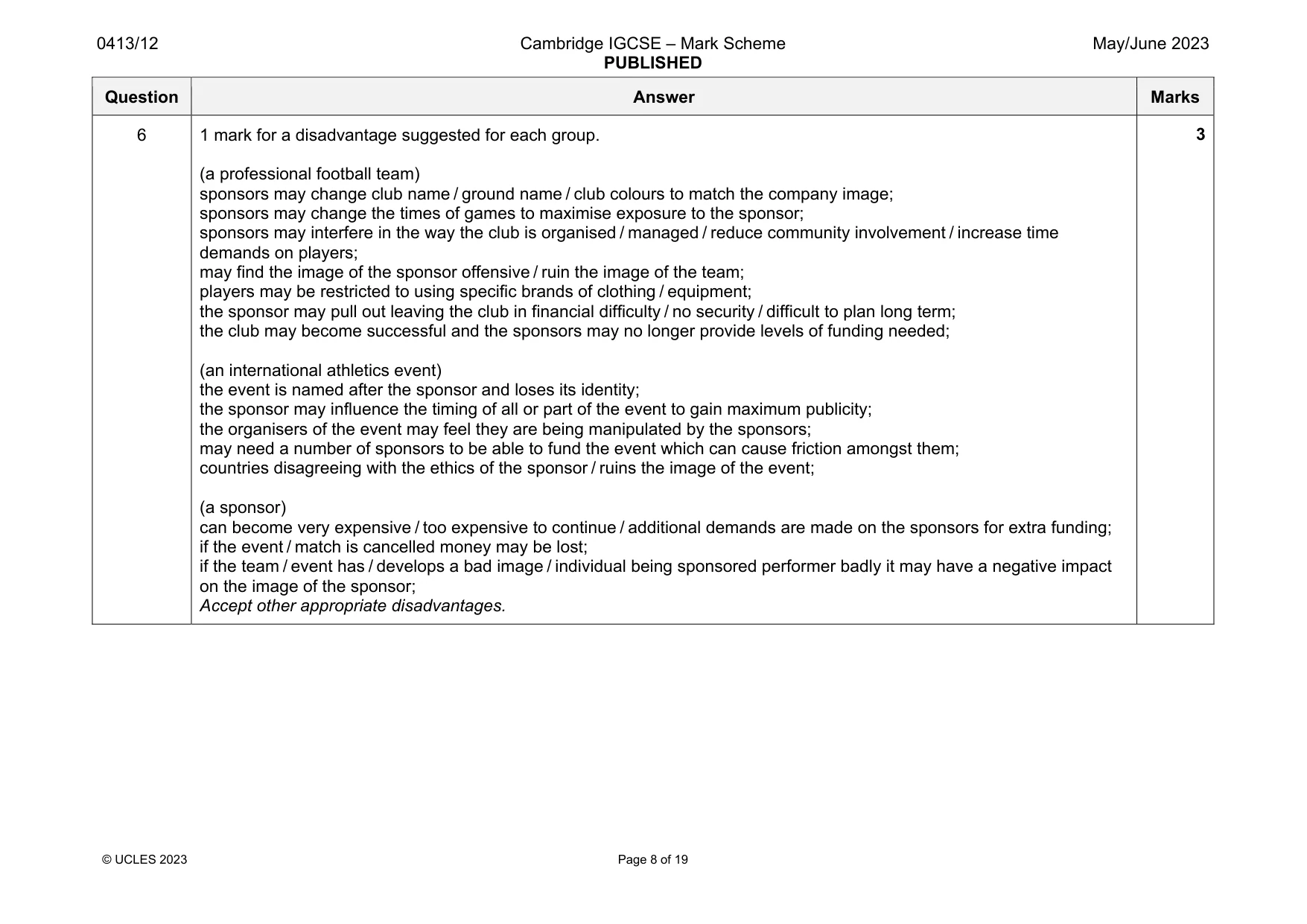
0413/12 Cambridge IGCSE – Mark Scheme PUBLISHED May/June 2023 © UCLES 2023 Page 8 of 19 Question Answer Marks 6 1 mark for a disadvantage suggested for each group. (a professional football team) sponsors may change club name / ground name / club colours to match the company image; sponsors may change the times of games to maximise exposure to the sponsor; sponsors may interfere in the way the club is organised / managed / reduce community involvement / increase time demands on players; may find the image of the sponsor offensive / ruin the image of the team; players may be restricted to using specific brands of clothing / equipment; the sponsor may pull out leaving the club in financial difficulty / no security / difficult to plan long term; the club may become successful and the sponsors may no longer provide levels of funding needed; (an international athletics event) the event is named after the sponsor and loses its identity; the sponsor may influence the timing of all or part of the event to gain maximum publicity; the organisers of the event may feel they are being manipulated by the sponsors; may need a number of sponsors to be able to fund the event which can cause friction amongst them; countries disagreeing with the ethics of the sponsor / ruins the image of the event; (a sponsor) can become very expensive / too expensive to continue / additional demands are made on the sponsors for extra funding; if the event / match is cancelled money may be lost; if the team / event has / develops a bad image / individual being sponsored performer badly it may have a negative impact on the image of the sponsor; Accept other appropriate disadvantages. 3
Mark scheme, page 9
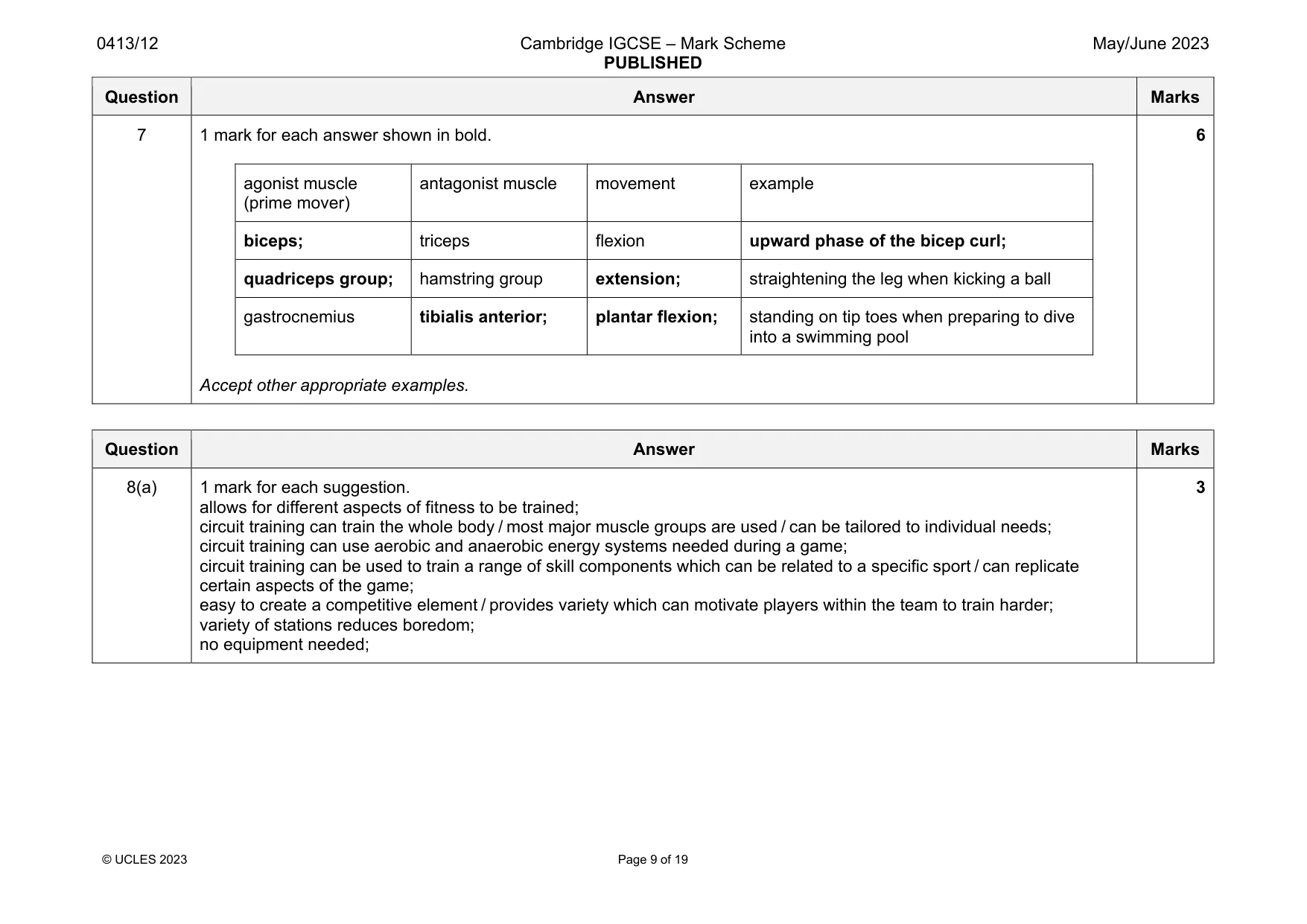
0413/12 Cambridge IGCSE – Mark Scheme PUBLISHED May/June 2023 © UCLES 2023 Page 9 of 19 Question Answer Marks 7 1 mark for each answer shown in bold. agonist muscle (prime mover) antagonist muscle movement example biceps; triceps flexion upward phase of the bicep curl; quadriceps group; hamstring group extension; straightening the leg when kicking a ball gastrocnemius tibialis anterior; plantar flexion; standing on tip toes when preparing to dive into a swimming pool Accept other appropriate examples. 6 Question Answer Marks 8(a) 1 mark for each suggestion. allows for different aspects of fitness to be trained; circuit training can train the whole body / most major muscle groups are used / can be tailored to individual needs; circuit training can use aerobic and anaerobic energy systems needed during a game; circuit training can be used to train a range of skill components which can be related to a specific sport / can replicate certain aspects of the game; easy to create a competitive element / provides variety which can motivate players within the team to train harder; variety of stations reduces boredom; no equipment needed; 3
Mark scheme, page 10
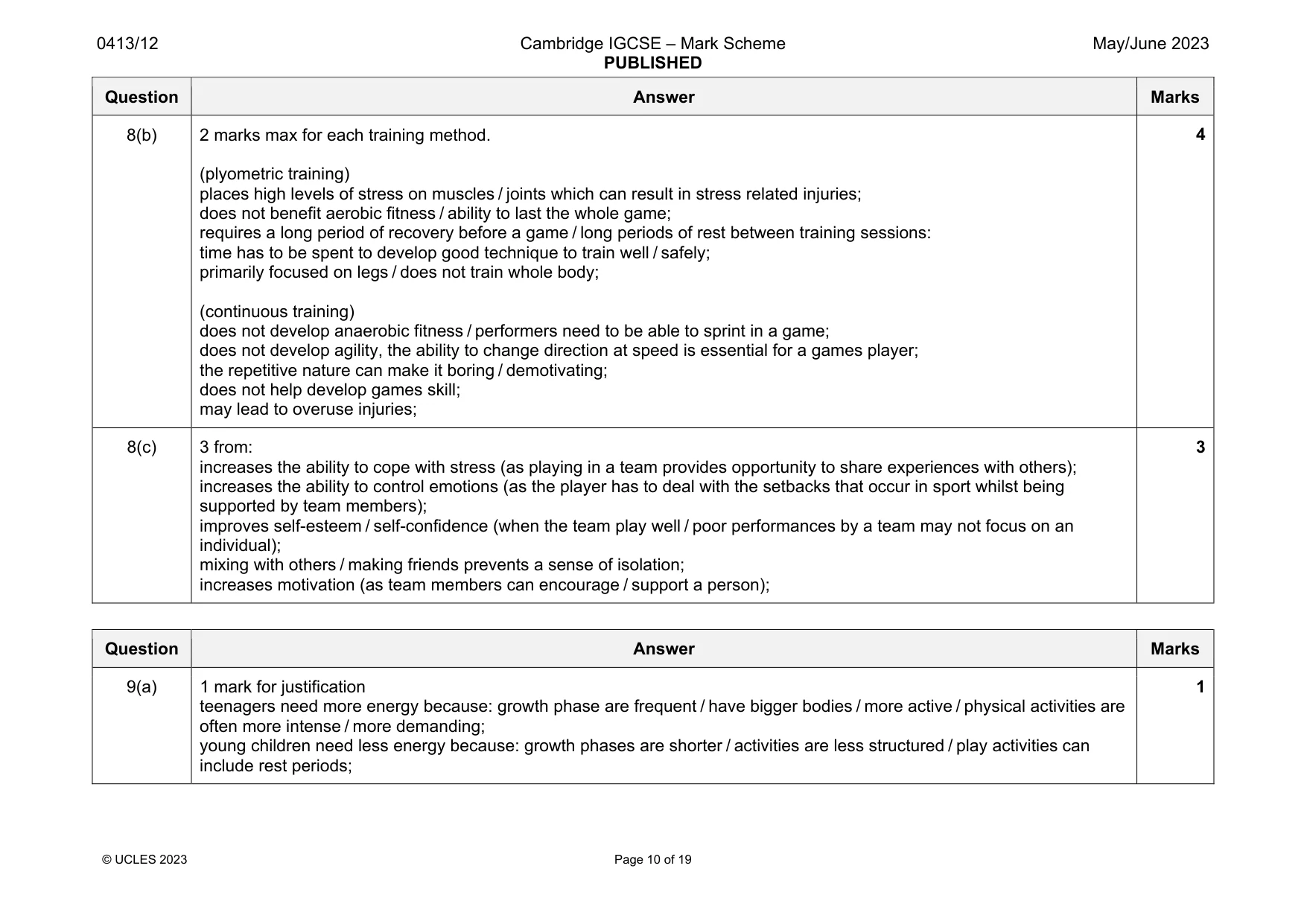
0413/12 Cambridge IGCSE – Mark Scheme PUBLISHED May/June 2023 © UCLES 2023 Page 10 of 19 Question Answer Marks 8(b) 2 marks max for each training method. (plyometric training) places high levels of stress on muscles / joints which can result in stress related injuries; does not benefit aerobic fitness / ability to last the whole game; requires a long period of recovery before a game / long periods of rest between training sessions: time has to be spent to develop good technique to train well / safely; primarily focused on legs / does not train whole body; (continuous training) does not develop anaerobic fitness / performers need to be able to sprint in a game; does not develop agility, the ability to change direction at speed is essential for a games player; the repetitive nature can make it boring / demotivating; does not help develop games skill; may lead to overuse injuries; 4 8(c) 3 from: increases the ability to cope with stress (as playing in a team provides opportunity to share experiences with others); increases the ability to control emotions (as the player has to deal with the setbacks that occur in sport whilst being supported by team members); improves self-esteem / self-confidence (when the team play well / poor performances by a team may not focus on an individual); mixing with others / making friends prevents a sense of isolation; increases motivation (as team members can encourage / support a person); 3 Question Answer Marks 9(a) 1 mark for justification teenagers need more energy because: growth phase are frequent / have bigger bodies / more active / physical activities are often more intense / more demanding; young children need less energy because: growth phases are shorter / activities are less structured / play activities can include rest periods; 1
Mark scheme, page 11
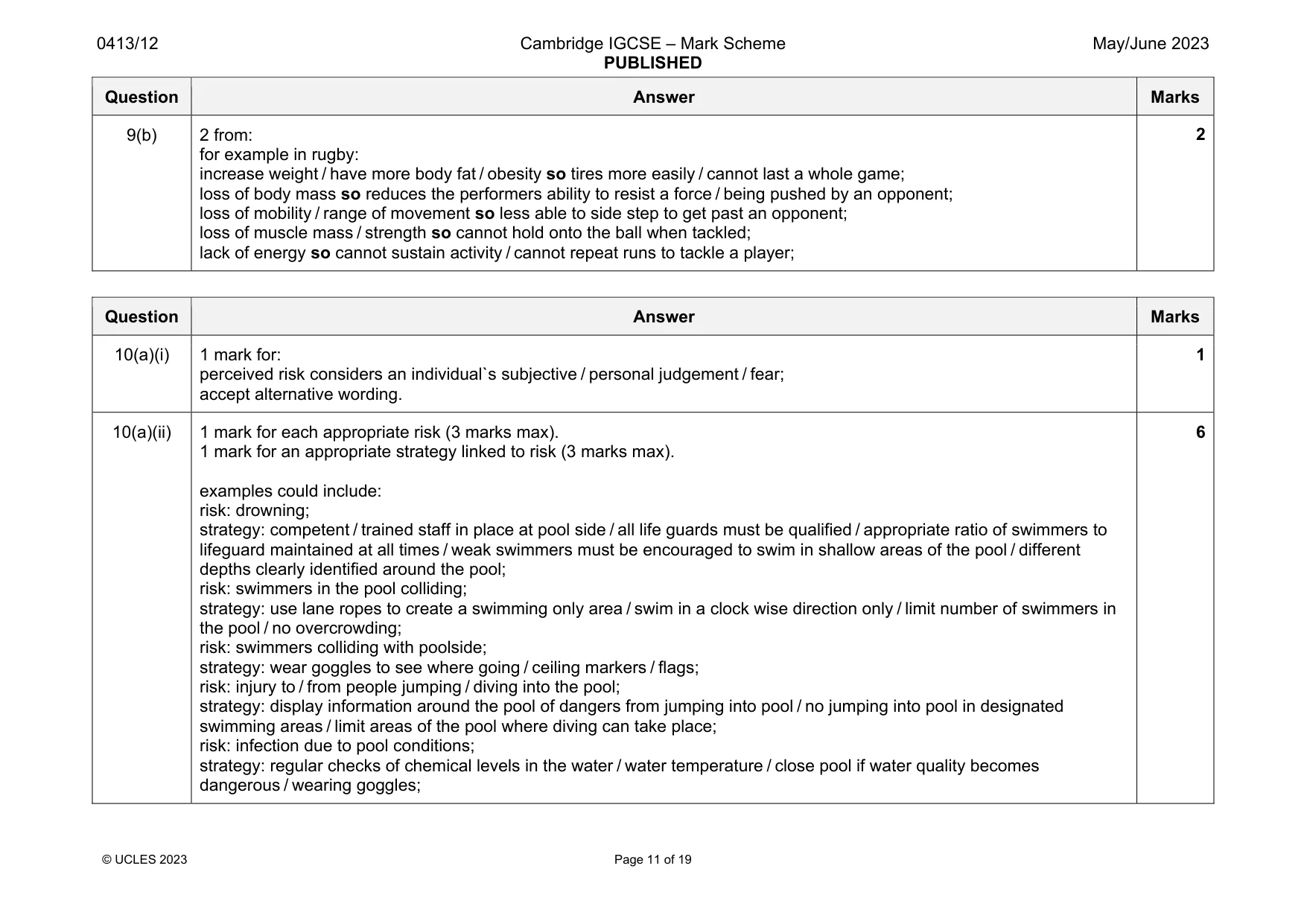
0413/12 Cambridge IGCSE – Mark Scheme PUBLISHED May/June 2023 © UCLES 2023 Page 11 of 19 Question Answer Marks 9(b) 2 from: for example in rugby: increase weight / have more body fat / obesity so tires more easily / cannot last a whole game; loss of body mass so reduces the performers ability to resist a force / being pushed by an opponent; loss of mobility / range of movement so less able to side step to get past an opponent; loss of muscle mass / strength so cannot hold onto the ball when tackled; lack of energy so cannot sustain activity / cannot repeat runs to tackle a player; 2 Question Answer Marks 10(a)(i) 1 mark for: perceived risk considers an individual`s subjective / personal judgement / fear; accept alternative wording. 1 10(a)(ii) 1 mark for each appropriate risk (3 marks max). 1 mark for an appropriate strategy linked to risk (3 marks max). examples could include: risk: drowning; strategy: competent / trained staff in place at pool side / all life guards must be qualified / appropriate ratio of swimmers to lifeguard maintained at all times / weak swimmers must be encouraged to swim in shallow areas of the pool / different depths clearly identified around the pool; risk: swimmers in the pool colliding; strategy: use lane ropes to create a swimming only area / swim in a clock wise direction only / limit number of swimmers in the pool / no overcrowding; risk: swimmers colliding with poolside; strategy: wear goggles to see where going / ceiling markers / flags; risk: injury to / from people jumping / diving into the pool; strategy: display information around the pool of dangers from jumping into pool / no jumping into pool in designated swimming areas / limit areas of the pool where diving can take place; risk: infection due to pool conditions; strategy: regular checks of chemical levels in the water / water temperature / close pool if water quality becomes dangerous / wearing goggles; 6
Mark scheme, page 12
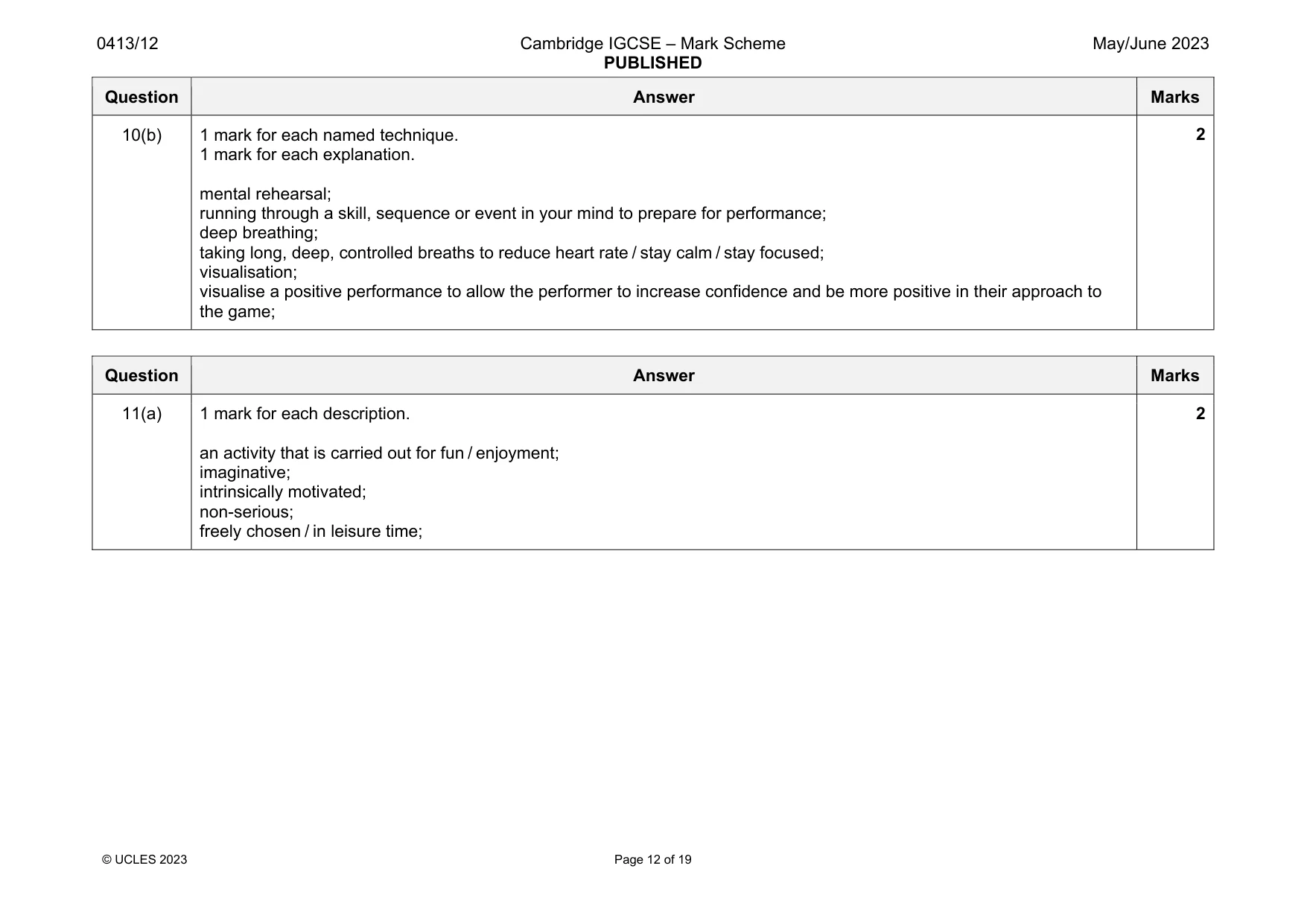
0413/12 Cambridge IGCSE – Mark Scheme PUBLISHED May/June 2023 © UCLES 2023 Page 12 of 19 Question Answer Marks 10(b) 1 mark for each named technique. 1 mark for each explanation. mental rehearsal; running through a skill, sequence or event in your mind to prepare for performance; deep breathing; taking long, deep, controlled breaths to reduce heart rate / stay calm / stay focused; visualisation; visualise a positive performance to allow the performer to increase confidence and be more positive in their approach to the game; 2 Question Answer Marks 11(a) 1 mark for each description. an activity that is carried out for fun / enjoyment; imaginative; intrinsically motivated; non-serious; freely chosen / in leisure time; 2
Mark scheme, page 13
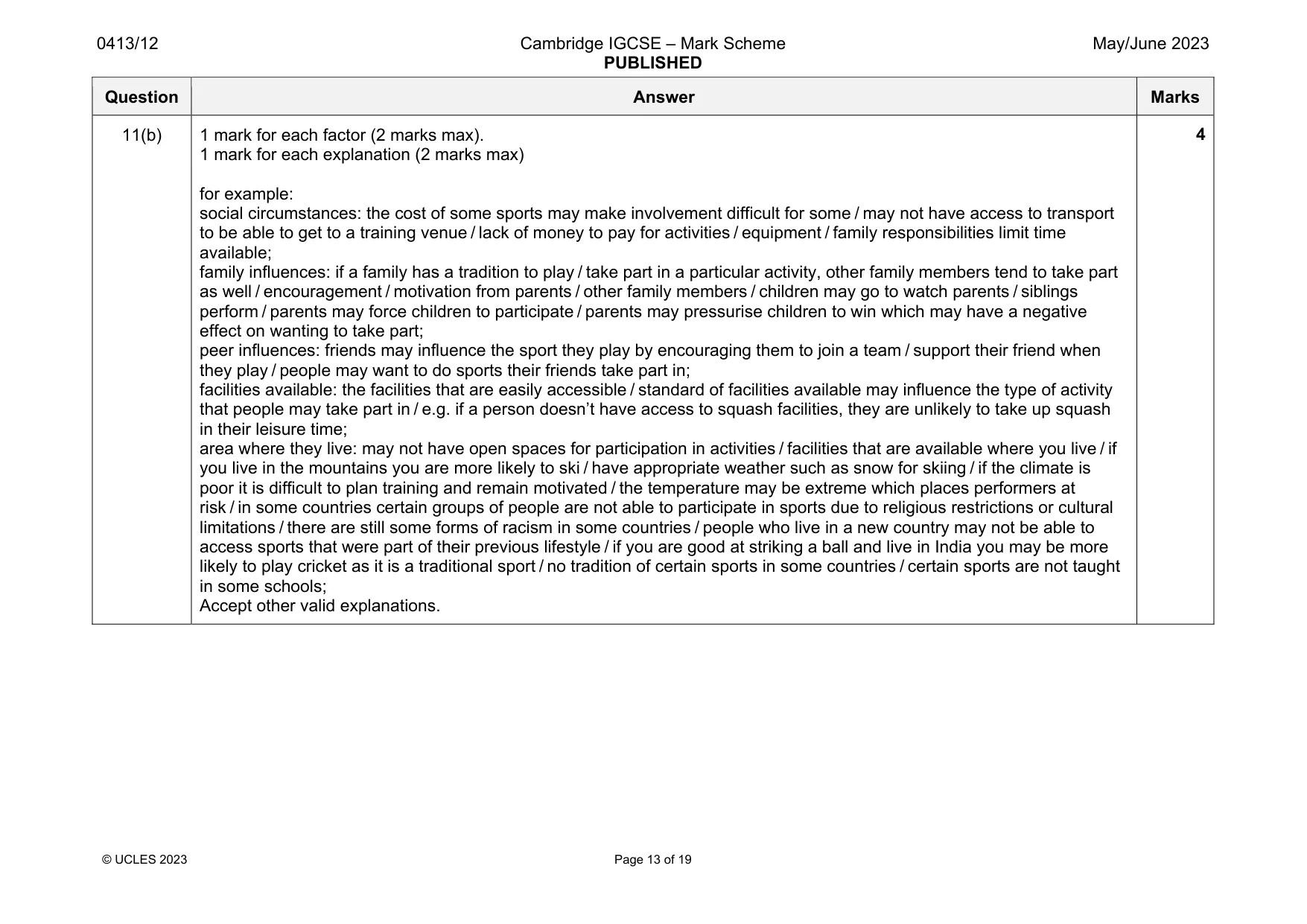
0413/12 Cambridge IGCSE – Mark Scheme PUBLISHED May/June 2023 © UCLES 2023 Page 13 of 19 Question Answer Marks 11(b) 1 mark for each factor (2 marks max). 1 mark for each explanation (2 marks max) for example: social circumstances: the cost of some sports may make involvement difficult for some / may not have access to transport to be able to get to a training venue / lack of money to pay for activities / equipment / family responsibilities limit time available; family influences: if a family has a tradition to play / take part in a particular activity, other family members tend to take part as well / encouragement / motivation from parents / other family members / children may go to watch parents / siblings perform / parents may force children to participate / parents may pressurise children to win which may have a negative effect on wanting to take part; peer influences: friends may influence the sport they play by encouraging them to join a team / support their friend when they play / people may want to do sports their friends take part in; facilities available: the facilities that are easily accessible / standard of facilities available may influence the type of activity that people may take part in / e.g. if a person doesn’t have access to squash facilities, they are unlikely to take up squash in their leisure time; area where they live: may not have open spaces for participation in activities / facilities that are available where you live / if you live in the mountains you are more likely to ski / have appropriate weather such as snow for skiing / if the climate is poor it is difficult to plan training and remain motivated / the temperature may be extreme which places performers at risk / in some countries certain groups of people are not able to participate in sports due to religious restrictions or cultural limitations / there are still some forms of racism in some countries / people who live in a new country may not be able to access sports that were part of their previous lifestyle / if you are good at striking a ball and live in India you may be more likely to play cricket as it is a traditional sport / no tradition of certain sports in some countries / certain sports are not taught in some schools; Accept other valid explanations. 4
Mark scheme, page 14
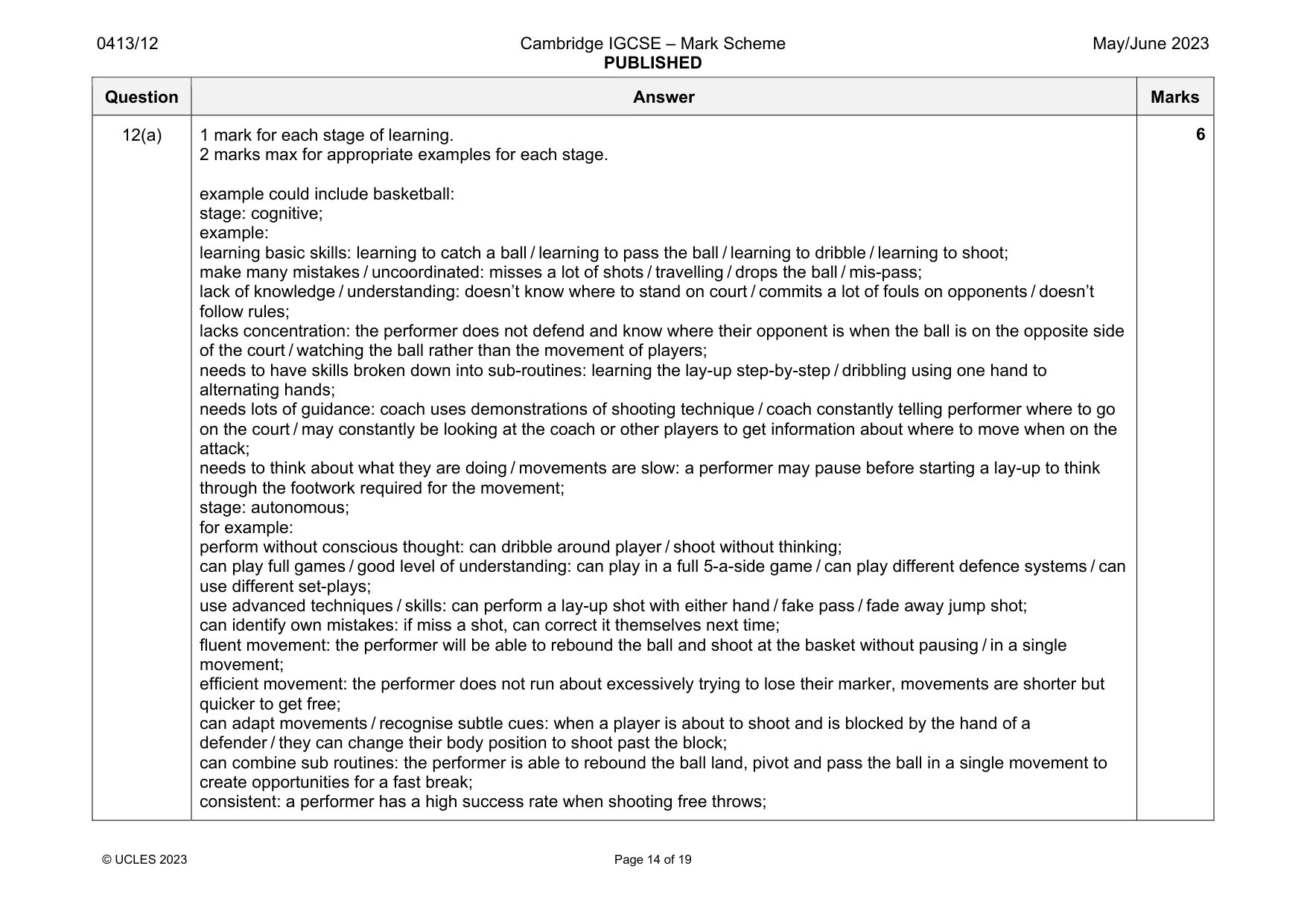
0413/12 Cambridge IGCSE – Mark Scheme PUBLISHED May/June 2023 © UCLES 2023 Page 14 of 19 Question Answer Marks 12(a) 1 mark for each stage of learning. 2 marks max for appropriate examples for each stage. example could include basketball: stage: cognitive; example: learning basic skills: learning to catch a ball / learning to pass the ball / learning to dribble / learning to shoot; make many mistakes / uncoordinated: misses a lot of shots / travelling / drops the ball / mis-pass; lack of knowledge / understanding: doesn’t know where to stand on court / commits a lot of fouls on opponents / doesn’t follow rules; lacks concentration: the performer does not defend and know where their opponent is when the ball is on the opposite side of the court / watching the ball rather than the movement of players; needs to have skills broken down into sub-routines: learning the lay-up step-by-step / dribbling using one hand to alternating hands; needs lots of guidance: coach uses demonstrations of shooting technique / coach constantly telling performer where to go on the court / may constantly be looking at the coach or other players to get information about where to move when on the attack; needs to think about what they are doing / movements are slow: a performer may pause before starting a lay-up to think through the footwork required for the movement; stage: autonomous; for example: perform without conscious thought: can dribble around player / shoot without thinking; can play full games / good level of understanding: can play in a full 5-a-side game / can play different defence systems / can use different set-plays; use advanced techniques / skills: can perform a lay-up shot with either hand / fake pass / fade away jump shot; can identify own mistakes: if miss a shot, can correct it themselves next time; fluent movement: the performer will be able to rebound the ball and shoot at the basket without pausing / in a single movement; efficient movement: the performer does not run about excessively trying to lose their marker, movements are shorter but quicker to get free; can adapt movements / recognise subtle cues: when a player is about to shoot and is blocked by the hand of a defender / they can change their body position to shoot past the block; can combine sub routines: the performer is able to rebound the ball land, pivot and pass the ball in a single movement to create opportunities for a fast break; consistent: a performer has a high success rate when shooting free throws; 6
Mark scheme, page 15
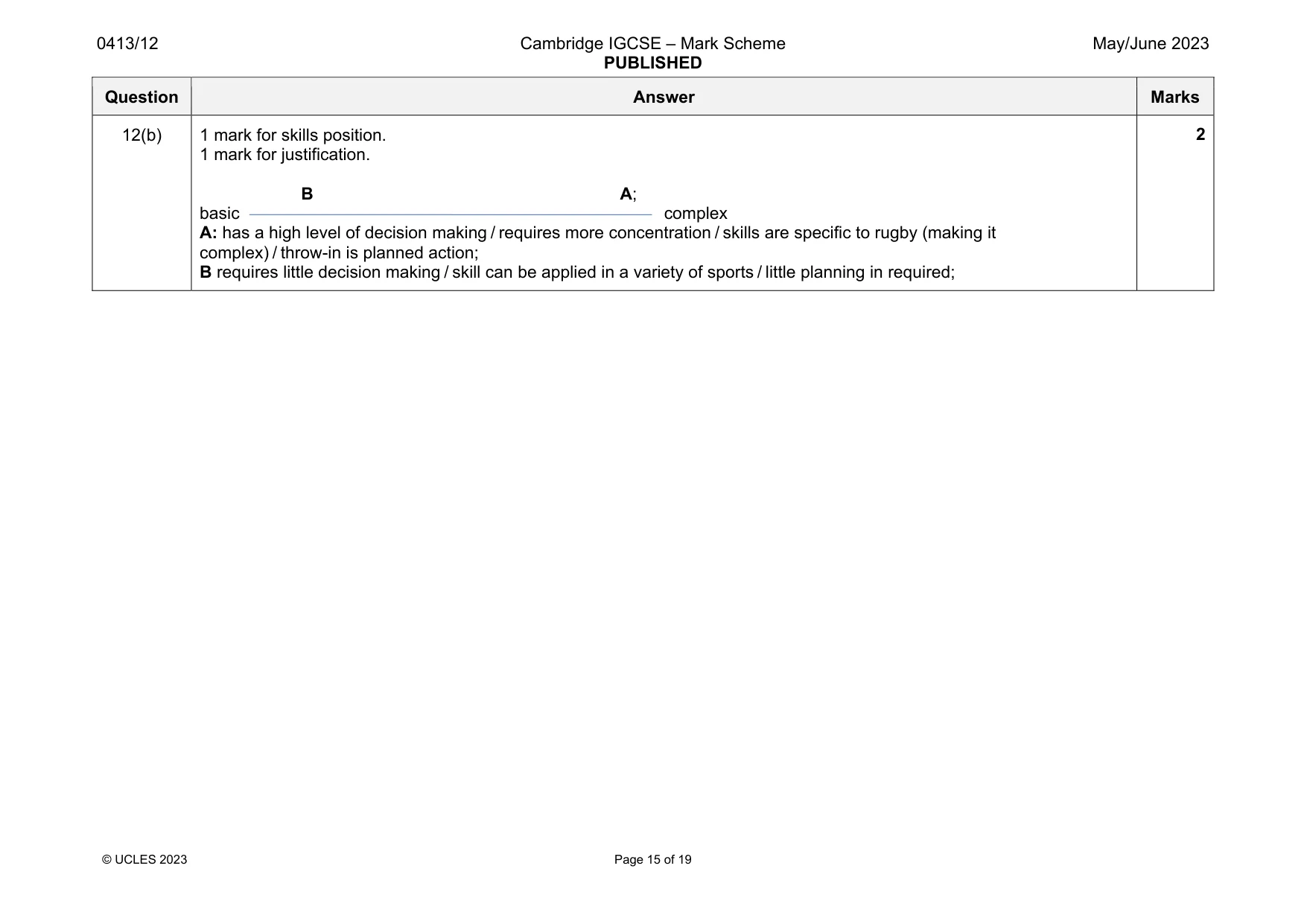
0413/12 Cambridge IGCSE – Mark Scheme PUBLISHED May/June 2023 © UCLES 2023 Page 15 of 19 Question Answer Marks 12(b) 1 mark for skills position. 1 mark for justification. B A; basic complex A: has a high level of decision making / requires more concentration / skills are specific to rugby (making it complex) / throw-in is planned action; B requires little decision making / skill can be applied in a variety of sports / little planning in required; 2
Mark scheme, page 16
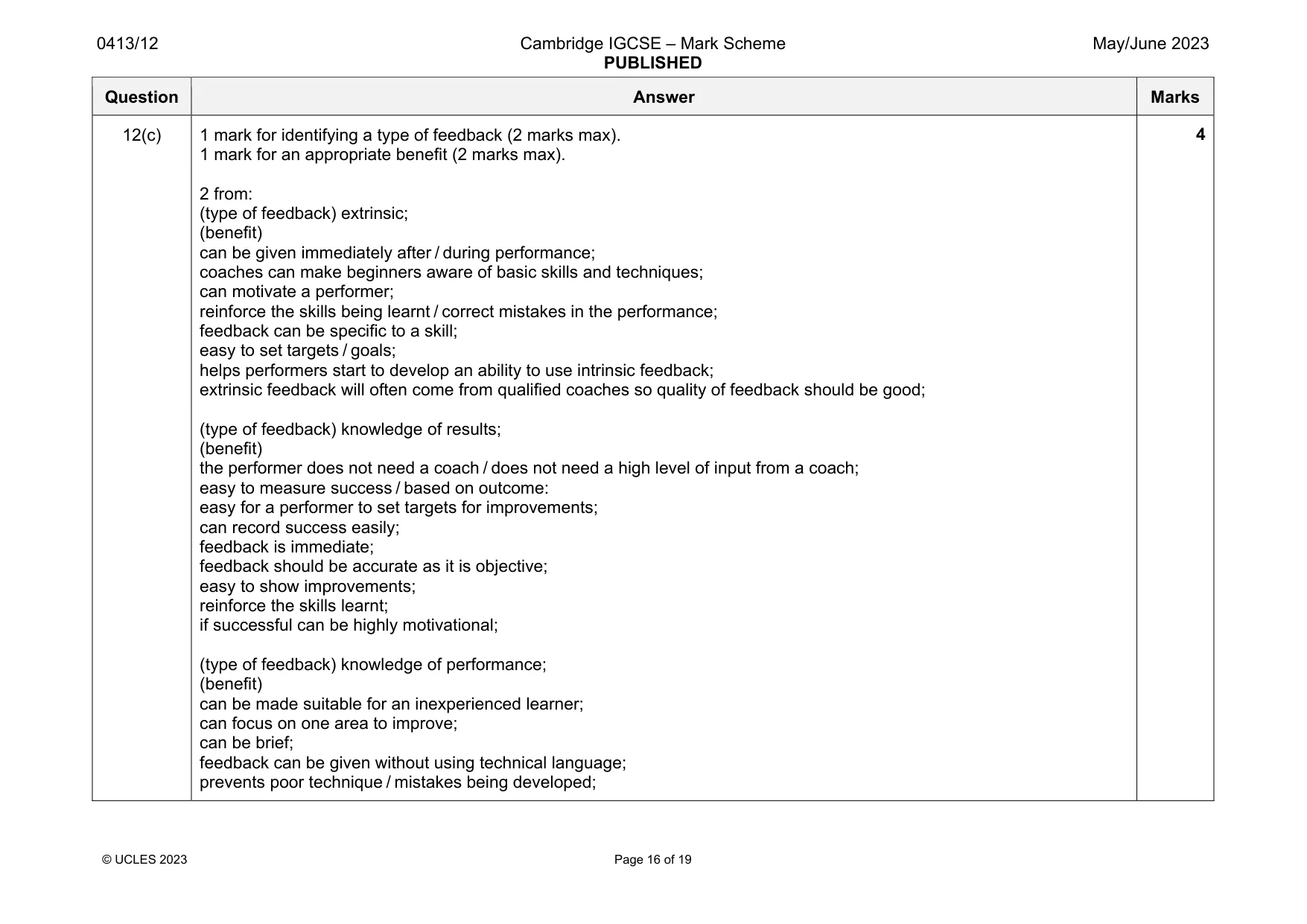
0413/12 Cambridge IGCSE – Mark Scheme PUBLISHED May/June 2023 © UCLES 2023 Page 16 of 19 Question Answer Marks 12(c) 1 mark for identifying a type of feedback (2 marks max). 1 mark for an appropriate benefit (2 marks max). 2 from: (type of feedback) extrinsic; (benefit) can be given immediately after / during performance; coaches can make beginners aware of basic skills and techniques; can motivate a performer; reinforce the skills being learnt / correct mistakes in the performance; feedback can be specific to a skill; easy to set targets / goals; helps performers start to develop an ability to use intrinsic feedback; extrinsic feedback will often come from qualified coaches so quality of feedback should be good; (type of feedback) knowledge of results; (benefit) the performer does not need a coach / does not need a high level of input from a coach; easy to measure success / based on outcome: easy for a performer to set targets for improvements; can record success easily; feedback is immediate; feedback should be accurate as it is objective; easy to show improvements; reinforce the skills learnt; if successful can be highly motivational; (type of feedback) knowledge of performance; (benefit) can be made suitable for an inexperienced learner; can focus on one area to improve; can be brief; feedback can be given without using technical language; prevents poor technique / mistakes being developed; 4
Mark scheme, page 17
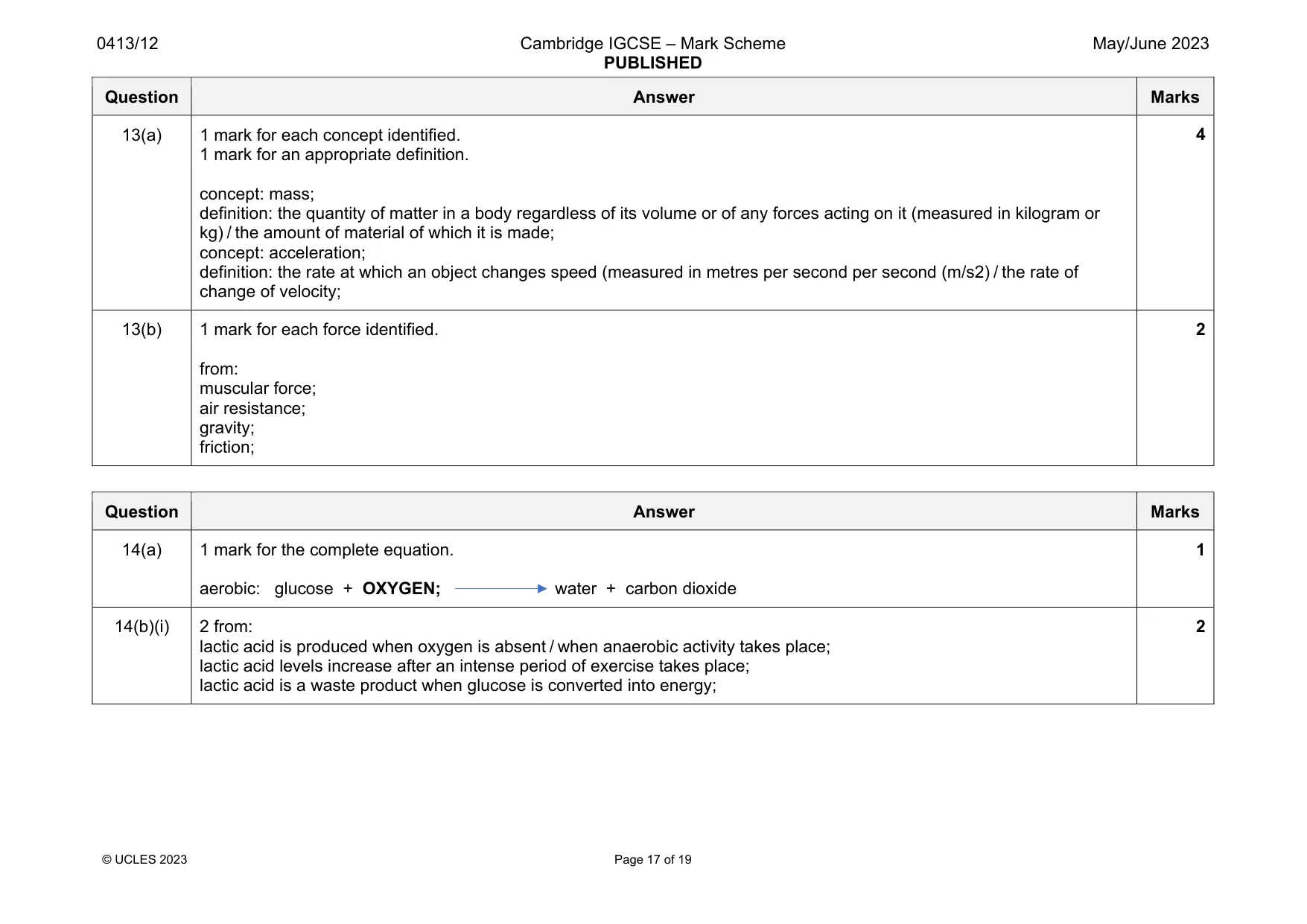
0413/12 Cambridge IGCSE – Mark Scheme PUBLISHED May/June 2023 © UCLES 2023 Page 17 of 19 Question Answer Marks 13(a) 1 mark for each concept identified. 1 mark for an appropriate definition. concept: mass; definition: the quantity of matter in a body regardless of its volume or of any forces acting on it (measured in kilogram or kg) / the amount of material of which it is made; concept: acceleration; definition: the rate at which an object changes speed (measured in metres per second per second (m/s2) / the rate of change of velocity; 4 13(b) 1 mark for each force identified. from: muscular force; air resistance; gravity; friction; 2 Question Answer Marks 14(a) 1 mark for the complete equation. aerobic: glucose + OXYGEN; water + carbon dioxide 1 14(b)(i) 2 from: lactic acid is produced when oxygen is absent / when anaerobic activity takes place; lactic acid levels increase after an intense period of exercise takes place; lactic acid is a waste product when glucose is converted into energy; 2
Mark scheme, page 18
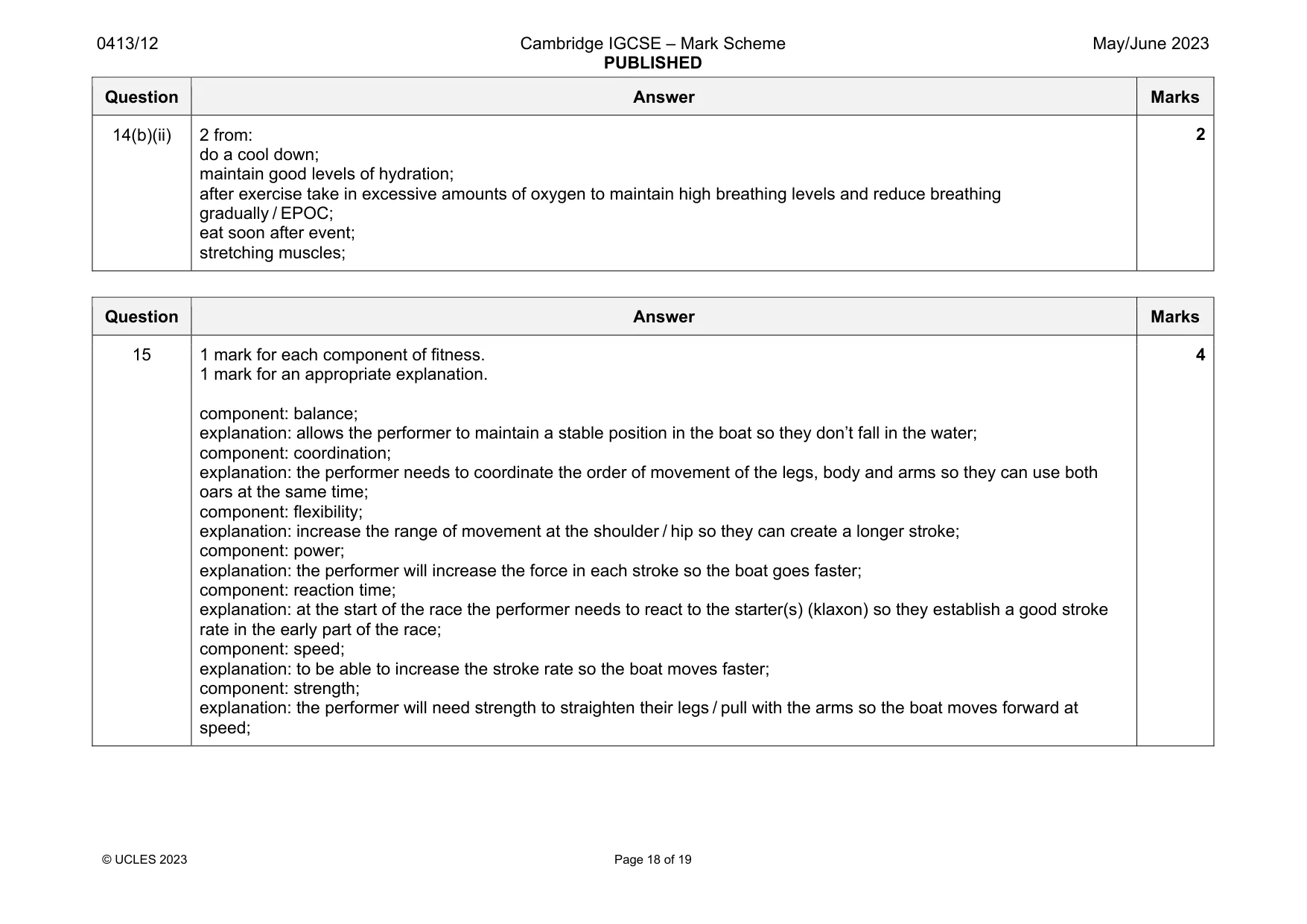
0413/12 Cambridge IGCSE – Mark Scheme PUBLISHED May/June 2023 © UCLES 2023 Page 18 of 19 Question Answer Marks 14(b)(ii) 2 from: do a cool down; maintain good levels of hydration; after exercise take in excessive amounts of oxygen to maintain high breathing levels and reduce breathing gradually / EPOC; eat soon after event; stretching muscles; 2 Question Answer Marks 15 1 mark for each component of fitness. 1 mark for an appropriate explanation. component: balance; explanation: allows the performer to maintain a stable position in the boat so they don’t fall in the water; component: coordination; explanation: the performer needs to coordinate the order of movement of the legs, body and arms so they can use both oars at the same time; component: flexibility; explanation: increase the range of movement at the shoulder / hip so they can create a longer stroke; component: power; explanation: the performer will increase the force in each stroke so the boat goes faster; component: reaction time; explanation: at the start of the race the performer needs to react to the starter(s) (klaxon) so they establish a good stroke rate in the early part of the race; component: speed; explanation: to be able to increase the stroke rate so the boat moves faster; component: strength; explanation: the performer will need strength to straighten their legs / pull with the arms so the boat moves forward at speed; 4
Mark scheme, page 19
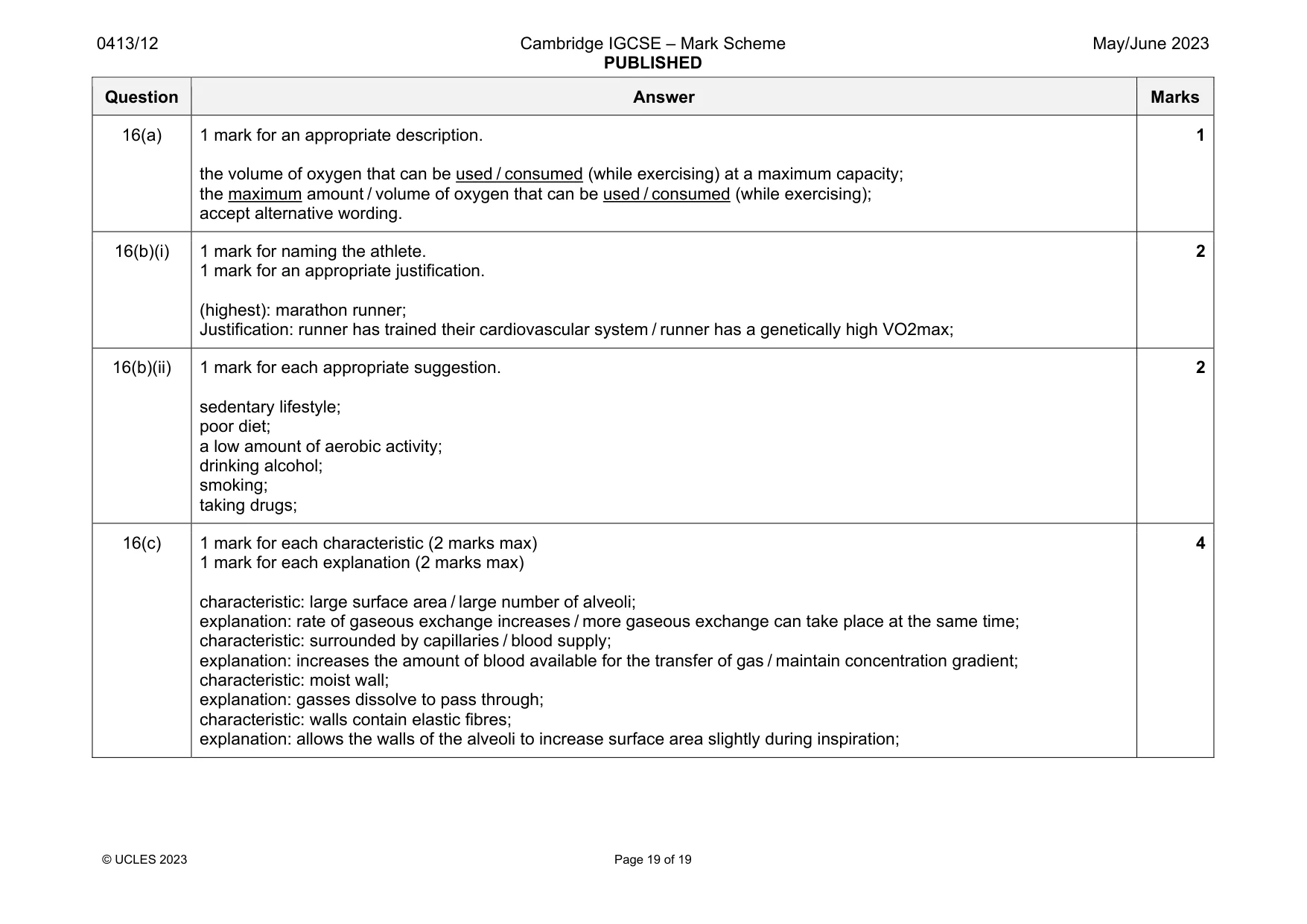
0413/12 Cambridge IGCSE – Mark Scheme PUBLISHED May/June 2023 © UCLES 2023 Page 19 of 19 Question Answer Marks 16(a) 1 mark for an appropriate description. the volume of oxygen that can be used / consumed (while exercising) at a maximum capacity; the maximum amount / volume of oxygen that can be used / consumed (while exercising); accept alternative wording. 1 16(b)(i) 1 mark for naming the athlete. 1 mark for an appropriate justification. (highest): marathon runner; Justification: runner has trained their cardiovascular system / runner has a genetically high VO2max; 2 16(b)(ii) 1 mark for each appropriate suggestion. sedentary lifestyle; poor diet; a low amount of aerobic activity; drinking alcohol; smoking; taking drugs; 2 16(c) 1 mark for each characteristic (2 marks max) 1 mark for each explanation (2 marks max) characteristic: large surface area / large number of alveoli; explanation: rate of gaseous exchange increases / more gaseous exchange can take place at the same time; characteristic: surrounded by capillaries / blood supply; explanation: increases the amount of blood available for the transfer of gas / maintain concentration gradient; characteristic: moist wall; explanation: gasses dissolve to pass through; characteristic: walls contain elastic fibres; explanation: allows the walls of the alveoli to increase surface area slightly during inspiration; 4
What you needed in this session
Cambridge’s own grade thresholds for 2023 May/June, Paper 1 · Variant 2. A higher threshold means an easier paper — the bar moves with how the cohort did.