Cambridge IGCSE Physical Education 0413 — 2022 May/June Paper 1 · Variant 2
0413/12/M/J/22 · 100 marks · ≈113 min
The question paper and its mark scheme, free to read here and free to download. This is Cambridge’s own paper, exactly as it was sat.
Question paper20 pages




Mark scheme20 pages
Answers below. Sit the paper first if you are practising.
Paper as text
Question paper, page 1
This document has 20 pages. Any blank pages are indicated. [Turn over Cambridge IGCSE™ DC (PQ/SW) 303526/3 © UCLES 2022 * 7 7 0 5 6 9 0 7 5 3 * PHYSICAL EDUCATION 0413/12 Paper 1 Theory May/June 2022 1 hour 45 minutes You must answer on the question paper. No additional materials are needed. INSTRUCTIONS ● Answer all questions. ● Use a black or dark blue pen. You may use an HB pencil for any diagrams or graphs. ● Write your name, centre number and candidate number in the boxes at the top of the page. ● Write your answer to each question in the space provided. ● Do not use an erasable pen or correction fluid. ● Do not write on any bar codes. ● You may use a calculator. ● You should show all your working and use appropriate units. INFORMATION ● The total mark for this paper is 100. ● The number of marks for each question or part question is shown in brackets [ ].
Question paper, page 2
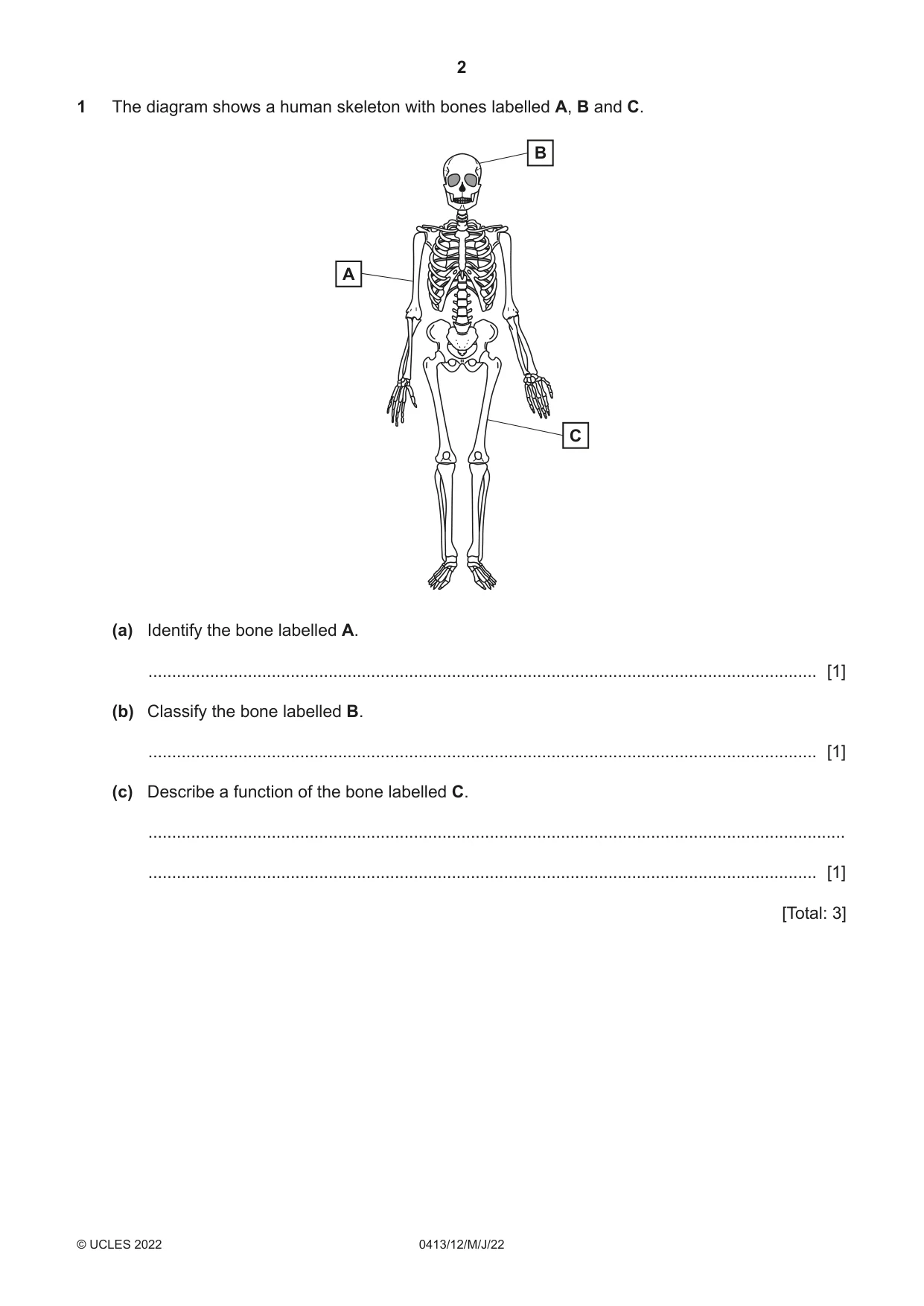
2 0413/12/M/J/22 © UCLES 2022 1 The diagram shows a human skeleton with bones labelled A, B and C. B C A (a) Identify the bone labelled A. … [1] (b) Classify the bone labelled B. … [1] (c) Describe a function of the bone labelled C. … … [1] [Total: 3]
Question paper, page 3
3 0413/12/M/J/22 © UCLES 2022 [Turn over 2 (a) Describe two named types of anxiety. type of anxiety 1 … description … … type of anxiety 2 … description … … [4] (b) Suggest a factor that could cause a performer to feel anxious during a physical activity. … … [1] (c) Explain how one named relaxation technique may be used to reduce a performer’s anxiety. technique … explanation … … [2] [Total: 7]
Question paper, page 4
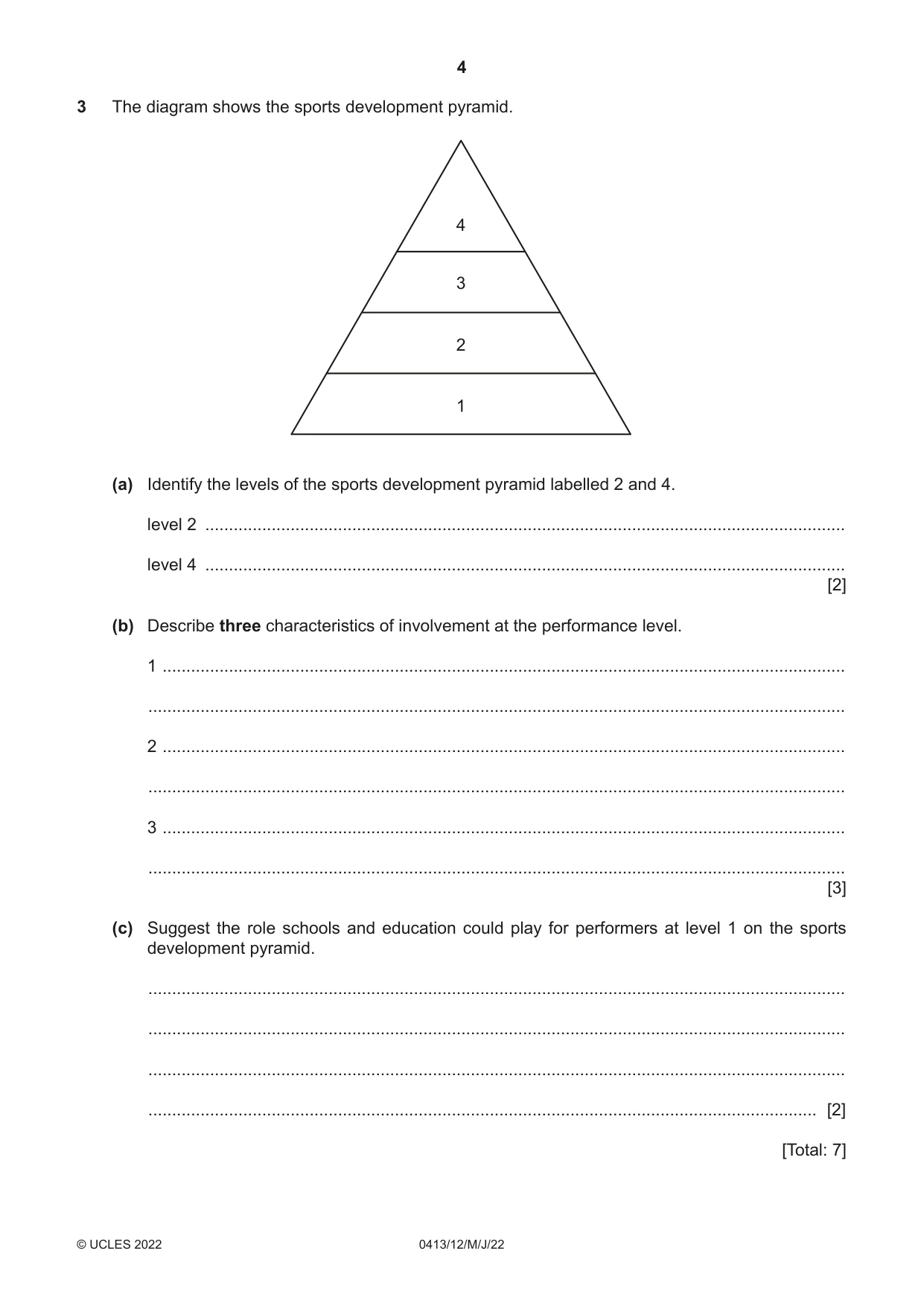
4 0413/12/M/J/22 © UCLES 2022 3 The diagram shows the sports development pyramid. 4 3 2 1 (a) Identify the levels of the sports development pyramid labelled 2 and 4. level 2 … level 4 … [2] (b) Describe three characteristics of involvement at the performance level. 1 … … 2 … … 3 … … [3] (c) Suggest the role schools and education could play for performers at level 1 on the sports development pyramid. … … … … [2] [Total: 7]
Question paper, page 5
5 0413/12/M/J/22 © UCLES 2022 [Turn over 4 State two parts of the RICE method for treating injuries and describe a different benefit of each treatment for a performer. part 1 … benefit … … part 2 … benefit … … [4]
Question paper, page 6
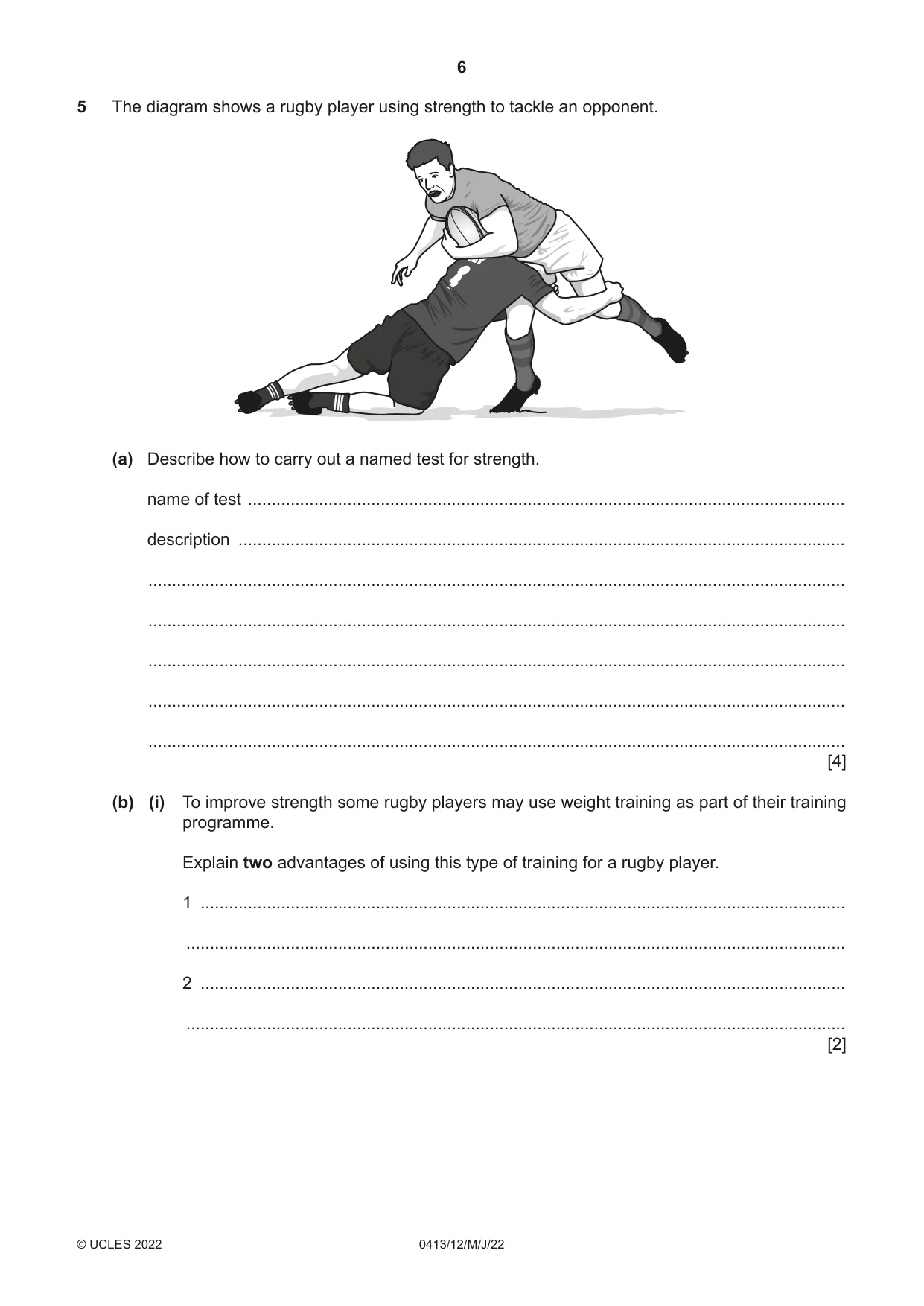
6 0413/12/ M / J /22 © UCLES 2022 5 The diagram shows a rugby player using strength to tackle an opponent. (a) Describe how to carry out a named test for strength. name of test … description … … … … … … [4] (b) (i) To improve strength some rugby players may use weight training as part of their training programme. Explain two advantages of using this type of training for a rugby player. 1 … … 2 … … [2]
Question paper, page 7
7 0413/12/M/J/22 © UCLES 2022 [Turn over (ii) Describe two safety considerations when taking part in weight training. 1 … … 2 … … [2] [Total: 8]
Question paper, page 8
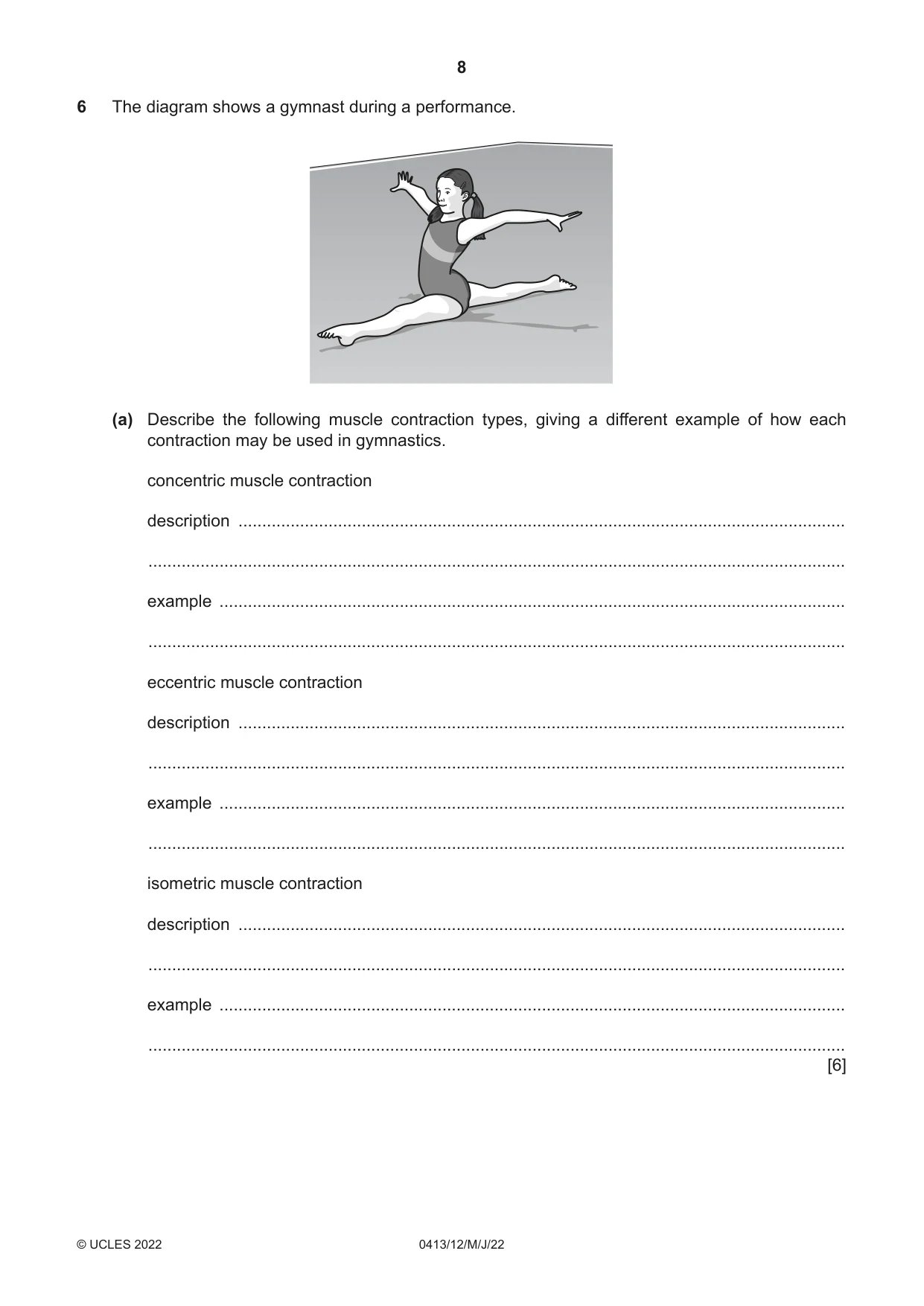
8 0413/12/M/J/22 © UCLES 2022 6 The diagram shows a gymnast during a performance. (a) Describe the following muscle contraction types, giving a different example of how each contraction may be used in gymnastics. concentric muscle contraction description … … example … … eccentric muscle contraction description … … example … … isometric muscle contraction description … … example … … [6]
Question paper, page 9
9 0413/12/M/J/22 © UCLES 2022 [Turn over (b) State two named types of movement possible at the ankle joint. Describe a different example of how each type of movement may be used in a named physical activity. physical activity … type of movement 1 … … example … … type of movement 2 … … example … … [4] [Total: 10]
Question paper, page 10
10 0413/12/M/J/22 © UCLES 2022 7 Sponsorship is needed to fund a global event such as the Olympic Games. (a) Suggest three advantages for sponsors of the Olympic Games. 1 … … 2 … … 3 … … [3] (b) Describe three advantages for performers representing the host nation at a global event. 1 … … 2 … … 3 … … [3] (c) Amateur and professional performers may compete against each other at the Olympic Games. Suggest three advantages that professional performers may have when competing against amateur performers. 1 … … 2 … … 3 … … [3] [Total: 9]
Question paper, page 11
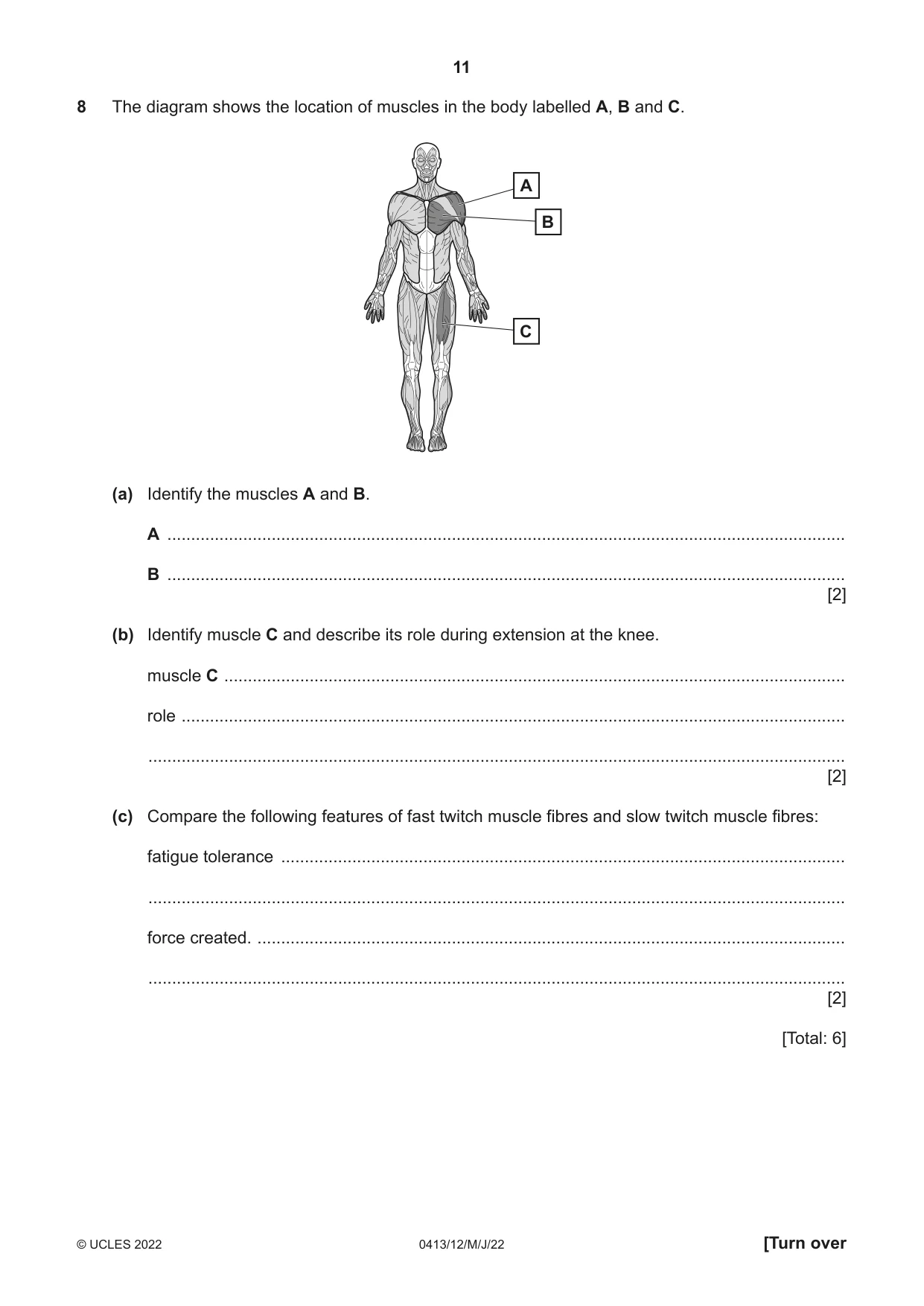
11 0413/12/M/J/22 © UCLES 2022 [Turn over 8 The diagram shows the location of muscles in the body labelled A, B and C. A C B (a) Identify the muscles A and B. A … B … [2] (b) Identify muscle C and describe its role during extension at the knee. muscle C … role … … [2] (c) Compare the following features of fast twitch muscle fibres and slow twitch muscle fibres: fatigue tolerance … … force created. … … [2] [Total: 6]
Question paper, page 12
12 0413/12/M/J/22 © UCLES 2022 9 (a) Identify two characteristics of the alveoli and explain how each characteristic enables gaseous exchange to take place. characteristic 1 … explanation … … … characteristic 2 … explanation … … … [4] (b) Residual volume is a breathing volume. Describe two other named breathing volumes and state the effect of exercise on each volume. volume 1 … description … … effect of exercise … volume 2 … description … … effect of exercise … [6] [Total: 10]
Question paper, page 13
13 0413/12/M/J/22 © UCLES 2022 [Turn over 10 The quality of teaching and coaching can affect the skill level of a performer. (a) Explain four other factors that could cause the skill level of performers to differ. 1 … … 2 … … 3 … … 4 … … [4] (b) Suggest two reasons why extrinsic motivation is important for a performer. 1 … … 2 … … [2] [Total: 6]
Question paper, page 14
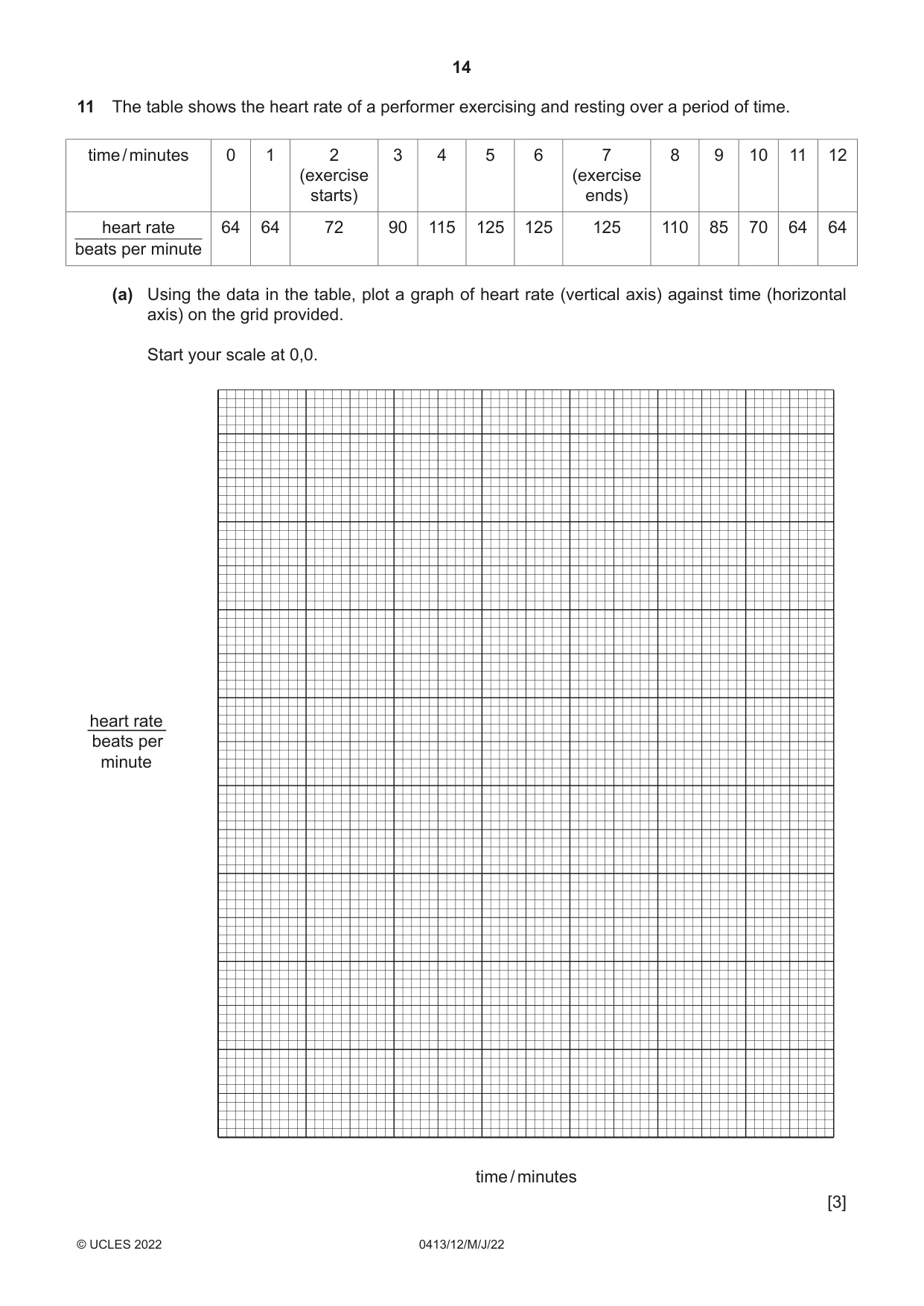
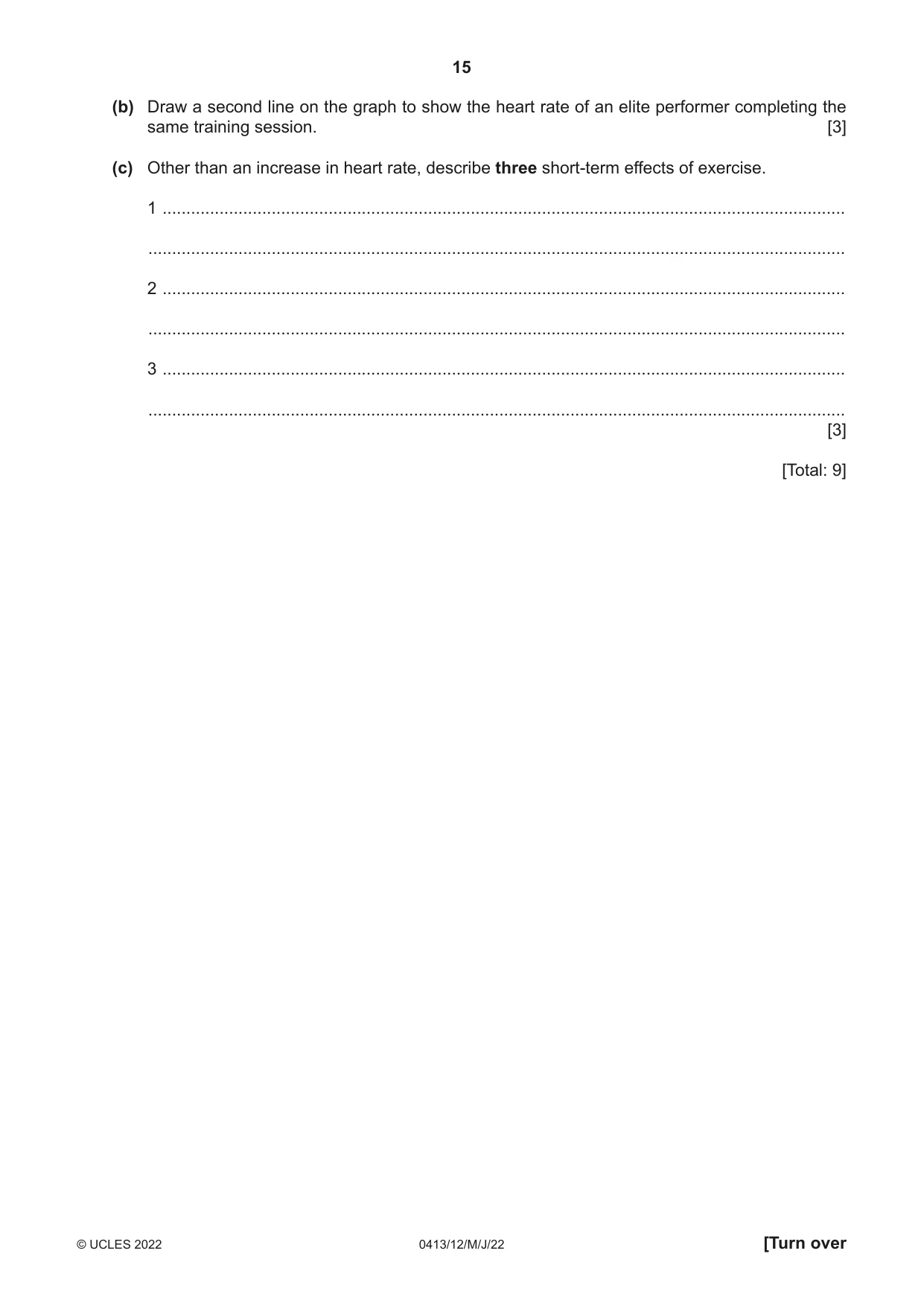
14 0413/12/M/J/22 © UCLES 2022 11 The table shows the heart rate of a performer exercising and resting over a period of time. time / minutes 0 1 2 (exercise starts) 3 4 5 6 7 (exercise ends) 8 9 10 11 12 heart rate beats per minute 64 64 72 90 115 125 125 125 110 85 70 64 64 (a) Using the data in the table, plot a graph of heart rate (vertical axis) against time (horizontal axis) on the grid provided. Start your scale at 0,0. time / minutes heart rate beats per minute [3]
Question paper, page 15
15 0413/12/M/J/22 © UCLES 2022 [Turn over (b) Draw a second line on the graph to show the heart rate of an elite performer completing the same training session. [3] (c) Other than an increase in heart rate, describe three short-term effects of exercise. 1 … … 2 … … 3 … … [3] [Total: 9]
Question paper, page 16
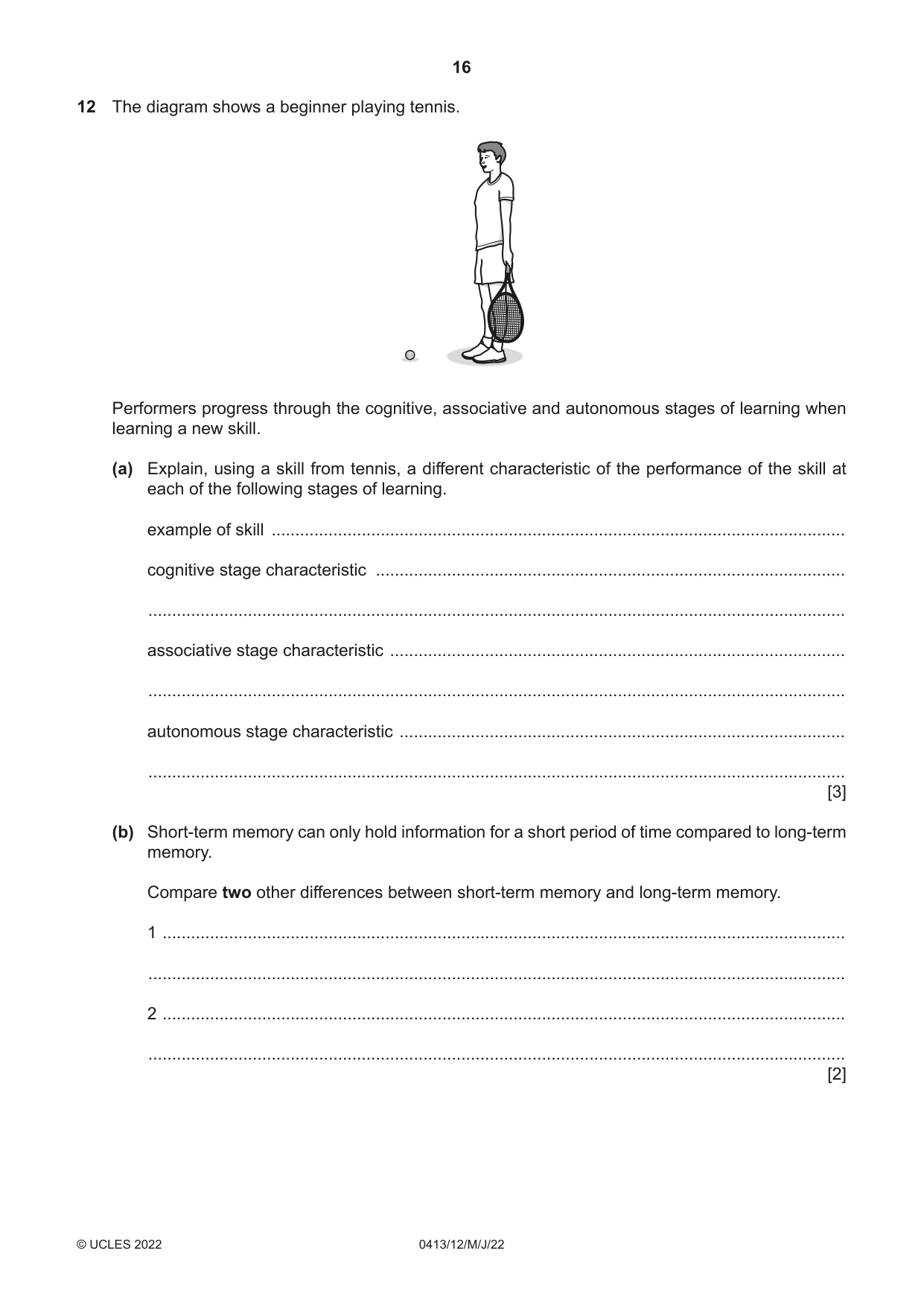
16 0413/12/M/J/22 © UCLES 2022 12 The diagram shows a beginner playing tennis. Performers progress through the cognitive, associative and autonomous stages of learning when learning a new skill. (a) Explain, using a skill from tennis, a different characteristic of the performance of the skill at each of the following stages of learning. example of skill … cognitive stage characteristic … … associative stage characteristic … … autonomous stage characteristic … … [3] (b) Short-term memory can only hold information for a short period of time compared to long-term memory. Compare two other differences between short-term memory and long-term memory. 1 … … 2 … … [2]
Question paper, page 17
17 0413/12/M/J/22 © UCLES 2022 [Turn over (c) (i) Explain the concept of limited channel capacity (single-channel hypothesis). … … [1] (ii) Suggest how an understanding of limited channel capacity may affect how a coach provides guidance to a performer. … … [1] [Total: 7] 13 (a) Describe, using different examples, how technology has improved the decision-making of officials. example 1 … … … example 2 … … … example 3 … … … [3] (b) Describe three examples of negative impacts of using technology for a sport. example 1 … … example 2 … … example 3 … … [3] [Total: 6]
Question paper, page 18
18 0413/12/M/J/22 © UCLES 2022 14 (a) Describe the relationship between health and fitness. … … [1] (b) Explain how three different lifestyle choices may affect a person’s physical health. 1 … … 2 … … 3 … … [3] (c) Explain two positive effects that exercise and fitness can have on a person’s mental health. 1 … … 2 … … [2] [Total: 6] 15 Describe an example of each of the following class of levers being used in a named physical activity. physical activity … first class lever example … … third class lever example … … [2]
Question paper, page 19
19 0413/12/M/J/22 © UCLES 2022 BLANK PAGE
Question paper, page 20
20 0413/12/M/J/22 © UCLES 2022 Permission to reproduce items where third-party owned material protected by copyright is included has been sought and cleared where possible. Every reasonable effort has been made by the publisher (UCLES) to trace copyright holders, but if any items requiring clearance have unwittingly been included, the publisher will be pleased to make amends at the earliest possible opportunity. To avoid the issue of disclosure of answer-related information to candidates, all copyright acknowledgements are reproduced online in the Cambridge Assessment International Education Copyright Acknowledgements Booklet. This is produced for each series of examinations and is freely available to download at www.cambridgeinternational.org after the live examination series. Cambridge Assessment International Education is part of Cambridge Assessment. Cambridge Assessment is the brand name of the University of Cambridge Local Examinations Syndicate (UCLES), which is a department of the University of Cambridge. BLANK PAGE
Mark scheme, page 1
This document consists of 20 printed pages. © UCLES 2022 [Turn over Cambridge IGCSE™ PHYSICAL EDUCATION 0413/12 Paper 1 Theory May/June 2022 MARK SCHEME Maximum Mark: 100 Published This mark scheme is published as an aid to teachers and candidates, to indicate the requirements of the examination. It shows the basis on which Examiners were instructed to award marks. It does not indicate the details of the discussions that took place at an Examiners’ meeting before marking began, which would have considered the acceptability of alternative answers. Mark schemes should be read in conjunction with the question paper and the Principal Examiner Report for Teachers. Cambridge International will not enter into discussions about these mark schemes. Cambridge International is publishing the mark schemes for the May/June 2022 series for most Cambridge IGCSE, Cambridge International A and AS Level and Cambridge Pre-U components, and some Cambridge O Level components.
Mark scheme, page 2
0413/12 Cambridge IGCSE – Mark Scheme PUBLISHED May/June 2022 © UCLES 2022 Page 2 of 20 Generic Marking Principles These general marking principles must be applied by all examiners when marking candidate answers. They should be applied alongside the specific content of the mark scheme or generic level descriptors for a question. Each question paper and mark scheme will also comply with these marking principles. GENERIC MARKING PRINCIPLE 1: Marks must be awarded in line with: the specific content of the mark scheme or the generic level descriptors for the question the specific skills defined in the mark scheme or in the generic level descriptors for the question the standard of response required by a candidate as exemplified by the standardisation scripts. GENERIC MARKING PRINCIPLE 2: Marks awarded are always whole marks (not half marks, or other fractions). GENERIC MARKING PRINCIPLE 3: Marks must be awarded positively: marks are awarded for correct/valid answers, as defined in the mark scheme. However, credit is given for valid answers which go beyond the scope of the syllabus and mark scheme, referring to your Team Leader as appropriate marks are awarded when candidates clearly demonstrate what they know and can do marks are not deducted for errors marks are not deducted for omissions answers should only be judged on the quality of spelling, punctuation and grammar when these features are specifically assessed by the question as indicated by the mark scheme. The meaning, however, should be unambiguous. GENERIC MARKING PRINCIPLE 4: Rules must be applied consistently, e.g. in situations where candidates have not followed instructions or in the application of generic level descriptors.
Mark scheme, page 3
0413/12 Cambridge IGCSE – Mark Scheme PUBLISHED May/June 2022 © UCLES 2022 Page 3 of 20 GENERIC MARKING PRINCIPLE 5: Marks should be awarded using the full range of marks defined in the mark scheme for the question (however; the use of the full mark range may be limited according to the quality of the candidate responses seen). GENERIC MARKING PRINCIPLE 6: Marks awarded are based solely on the requirements as defined in the mark scheme. Marks should not be awarded with grade thresholds or grade descriptors in mind. Science-Specific Marking Principles 1 Examiners should consider the context and scientific use of any keywords when awarding marks. Although keywords may be present, marks should not be awarded if the keywords are used incorrectly. 2 The examiner should not choose between contradictory statements given in the same question part, and credit should not be awarded for any correct statement that is contradicted within the same question part. Wrong science that is irrelevant to the question should be ignored. 3 Although spellings do not have to be correct, spellings of syllabus terms must allow for clear and unambiguous separation from other syllabus terms with which they may be confused (e.g. ethane / ethene, glucagon / glycogen, refraction / reflection). 4 The error carried forward (ecf) principle should be applied, where appropriate. If an incorrect answer is subsequently used in a scientifically correct way, the candidate should be awarded these subsequent marking points. Further guidance will be included in the mark scheme where necessary and any exceptions to this general principle will be noted. 5 ‘List rule’ guidance For questions that require n responses (e.g. State two reasons …): The response should be read as continuous prose, even when numbered answer spaces are provided. Any response marked ignore in the mark scheme should not count towards n. Incorrect responses should not be awarded credit but will still count towards n. Read the entire response to check for any responses that contradict those that would otherwise be credited. Credit should not be awarded for any responses that are contradicted within the rest of the response. Where two responses contradict one another, this should be treated as a single incorrect response. Non-contradictory responses after the first n responses may be ignored even if they include incorrect science.
Mark scheme, page 4
0413/12 Cambridge IGCSE – Mark Scheme PUBLISHED May/June 2022 © UCLES 2022 Page 4 of 20 6 Calculation specific guidance Correct answers to calculations should be given full credit even if there is no working or incorrect working, unless the question states ‘show your working’. For questions in which the number of significant figures required is not stated, credit should be awarded for correct answers when rounded by the examiner to the number of significant figures given in the mark scheme. This may not apply to measured values. For answers given in standard form (e.g. a 10n) in which the convention of restricting the value of the coefficient (a) to a value between 1 and 10 is not followed, credit may still be awarded if the answer can be converted to the answer given in the mark scheme. Unless a separate mark is given for a unit, a missing or incorrect unit will normally mean that the final calculation mark is not awarded. Exceptions to this general principle will be noted in the mark scheme. 7 Guidance for chemical equations Multiples / fractions of coefficients used in chemical equations are acceptable unless stated otherwise in the mark scheme. State symbols given in an equation should be ignored unless asked for in the question or stated otherwise in the mark scheme.
Mark scheme, page 5
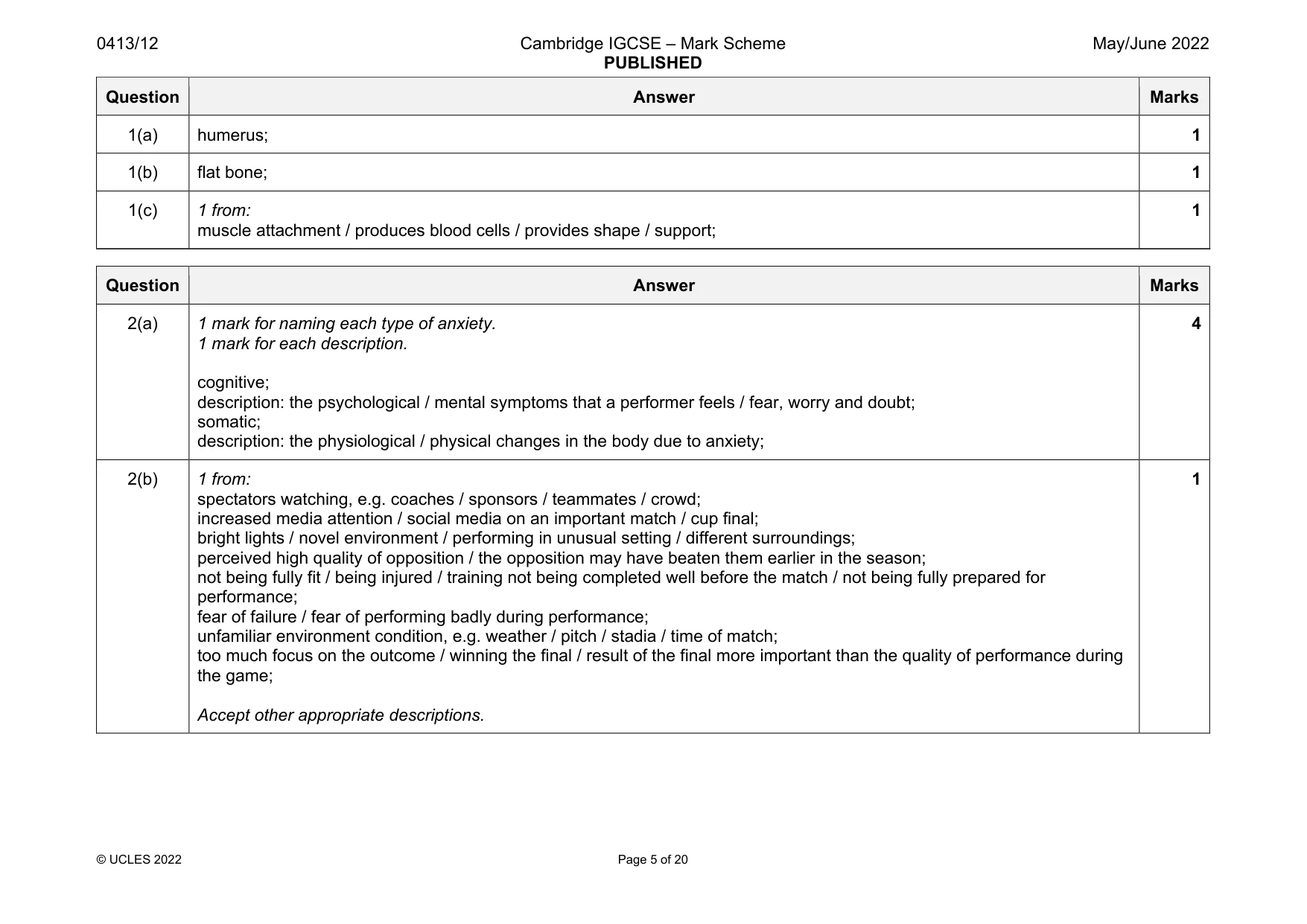
0413/12 Cambridge IGCSE – Mark Scheme PUBLISHED May/June 2022 © UCLES 2022 Page 5 of 20 Question Answer Marks 1(a) humerus; 1 1(b) flat bone; 1 1(c) 1 from: muscle attachment / produces blood cells / provides shape / support; 1 Question Answer Marks 2(a) 1 mark for naming each type of anxiety. 1 mark for each description. cognitive; description: the psychological / mental symptoms that a performer feels / fear, worry and doubt; somatic; description: the physiological / physical changes in the body due to anxiety; 4 2(b) 1 from: spectators watching, e.g. coaches / sponsors / teammates / crowd; increased media attention / social media on an important match / cup final; bright lights / novel environment / performing in unusual setting / different surroundings; perceived high quality of opposition / the opposition may have beaten them earlier in the season; not being fully fit / being injured / training not being completed well before the match / not being fully prepared for performance; fear of failure / fear of performing badly during performance; unfamiliar environment condition, e.g. weather / pitch / stadia / time of match; too much focus on the outcome / winning the final / result of the final more important than the quality of performance during the game; Accept other appropriate descriptions. 1
Mark scheme, page 6
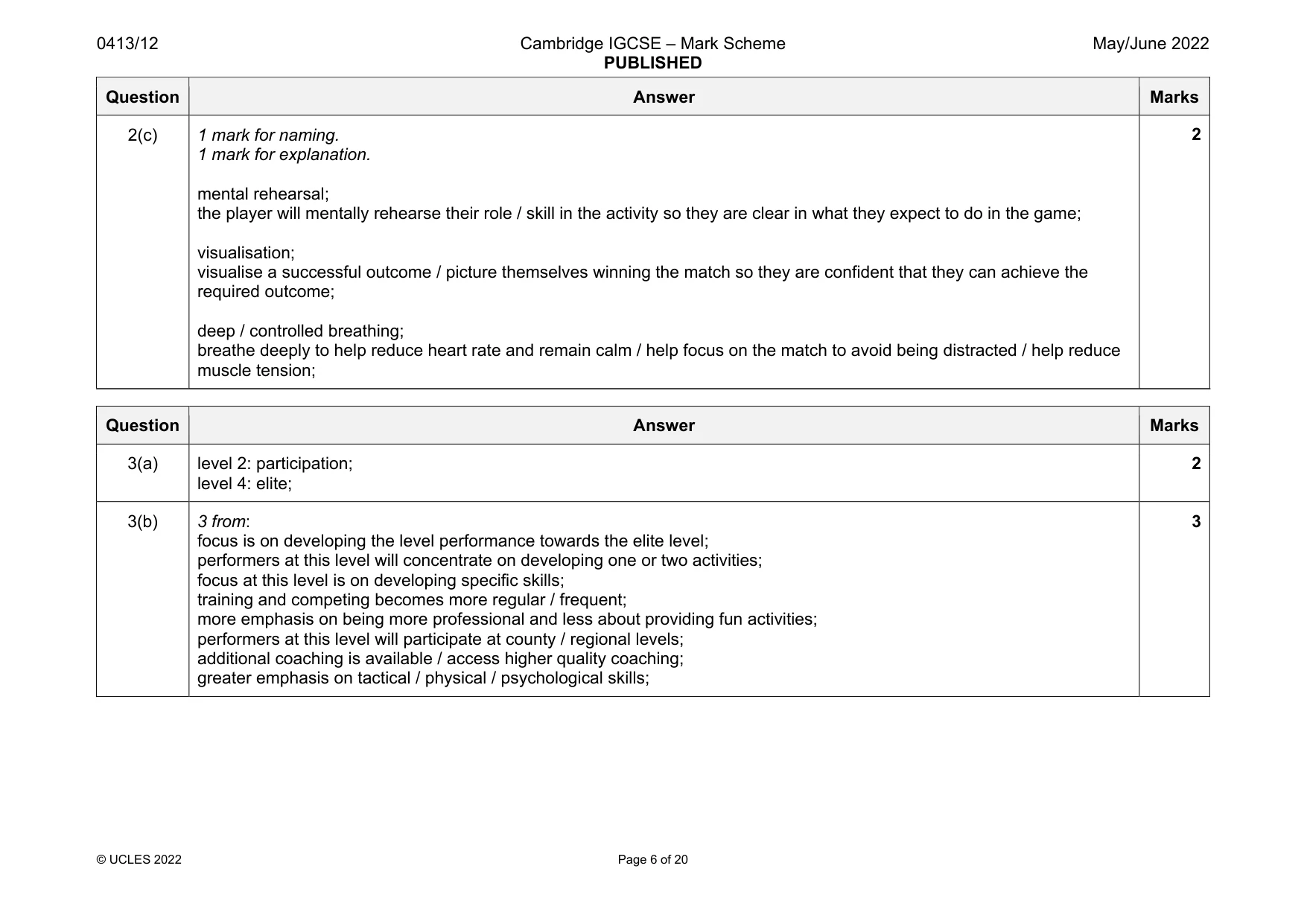
0413/12 Cambridge IGCSE – Mark Scheme PUBLISHED May/June 2022 © UCLES 2022 Page 6 of 20 Question Answer Marks 2(c) 1 mark for naming. 1 mark for explanation. mental rehearsal; the player will mentally rehearse their role / skill in the activity so they are clear in what they expect to do in the game; visualisation; visualise a successful outcome / picture themselves winning the match so they are confident that they can achieve the required outcome; deep / controlled breathing; breathe deeply to help reduce heart rate and remain calm / help focus on the match to avoid being distracted / help reduce muscle tension; 2 Question Answer Marks 3(a) level 2: participation; level 4: elite; 2 3(b) 3 from: focus is on developing the level performance towards the elite level; performers at this level will concentrate on developing one or two activities; focus at this level is on developing specific skills; training and competing becomes more regular / frequent; more emphasis on being more professional and less about providing fun activities; performers at this level will participate at county / regional levels; additional coaching is available / access higher quality coaching; greater emphasis on tactical / physical / psychological skills; 3
Mark scheme, page 7
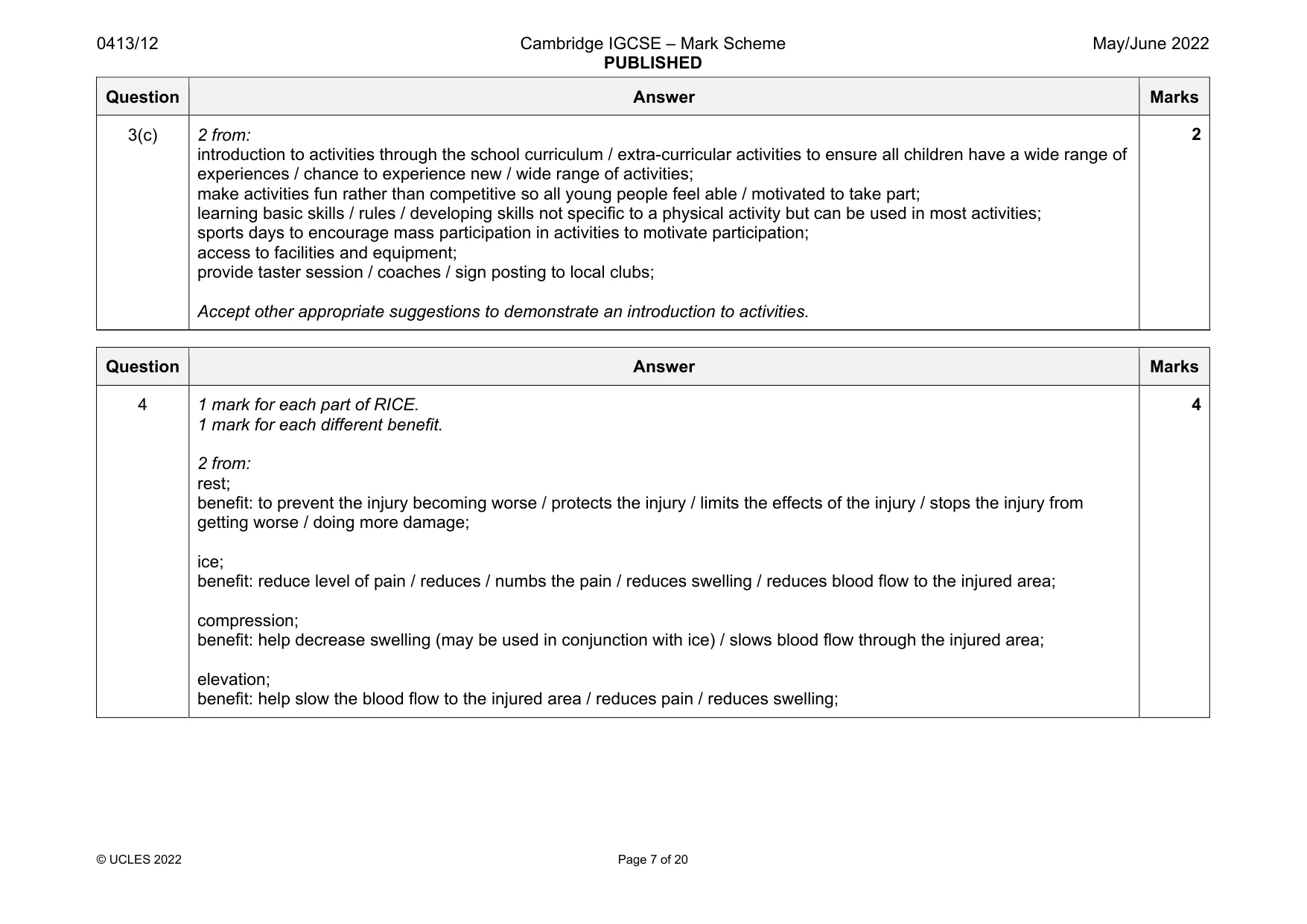
0413/12 Cambridge IGCSE – Mark Scheme PUBLISHED May/June 2022 © UCLES 2022 Page 7 of 20 Question Answer Marks 3(c) 2 from: introduction to activities through the school curriculum / extra-curricular activities to ensure all children have a wide range of experiences / chance to experience new / wide range of activities; make activities fun rather than competitive so all young people feel able / motivated to take part; learning basic skills / rules / developing skills not specific to a physical activity but can be used in most activities; sports days to encourage mass participation in activities to motivate participation; access to facilities and equipment; provide taster session / coaches / sign posting to local clubs; Accept other appropriate suggestions to demonstrate an introduction to activities. 2 Question Answer Marks 4 1 mark for each part of RICE. 1 mark for each different benefit. 2 from: rest; benefit: to prevent the injury becoming worse / protects the injury / limits the effects of the injury / stops the injury from getting worse / doing more damage; ice; benefit: reduce level of pain / reduces / numbs the pain / reduces swelling / reduces blood flow to the injured area; compression; benefit: help decrease swelling (may be used in conjunction with ice) / slows blood flow through the injured area; elevation; benefit: help slow the blood flow to the injured area / reduces pain / reduces swelling; 4
Mark scheme, page 8
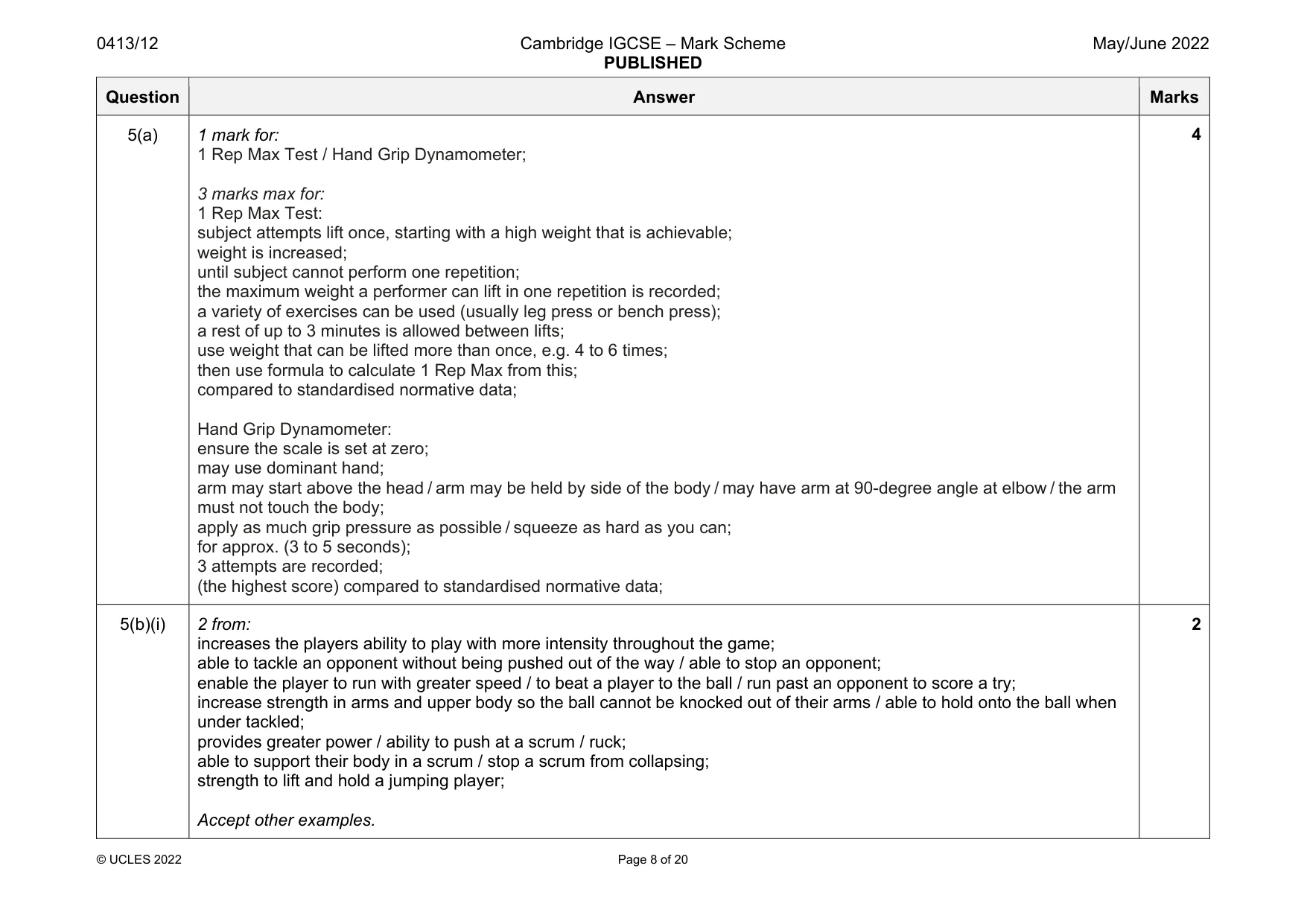
0413/12 Cambridge IGCSE – Mark Scheme PUBLISHED May/June 2022 © UCLES 2022 Page 8 of 20 Question Answer Marks 5(a) 1 mark for: 1 Rep Max Test / Hand Grip Dynamometer; 3 marks max for: 1 Rep Max Test: subject attempts lift once, starting with a high weight that is achievable; weight is increased; until subject cannot perform one repetition; the maximum weight a performer can lift in one repetition is recorded; a variety of exercises can be used (usually leg press or bench press); a rest of up to 3 minutes is allowed between lifts; use weight that can be lifted more than once, e.g. 4 to 6 times; then use formula to calculate 1 Rep Max from this; compared to standardised normative data; Hand Grip Dynamometer: ensure the scale is set at zero; may use dominant hand; arm may start above the head / arm may be held by side of the body / may have arm at 90-degree angle at elbow / the arm must not touch the body; apply as much grip pressure as possible / squeeze as hard as you can; for approx. (3 to 5 seconds); 3 attempts are recorded; (the highest score) compared to standardised normative data; 4 5(b)(i) 2 from: increases the players ability to play with more intensity throughout the game; able to tackle an opponent without being pushed out of the way / able to stop an opponent; enable the player to run with greater speed / to beat a player to the ball / run past an opponent to score a try; increase strength in arms and upper body so the ball cannot be knocked out of their arms / able to hold onto the ball when under tackled; provides greater power / ability to push at a scrum / ruck; able to support their body in a scrum / stop a scrum from collapsing; strength to lift and hold a jumping player; Accept other examples. 2
Mark scheme, page 9
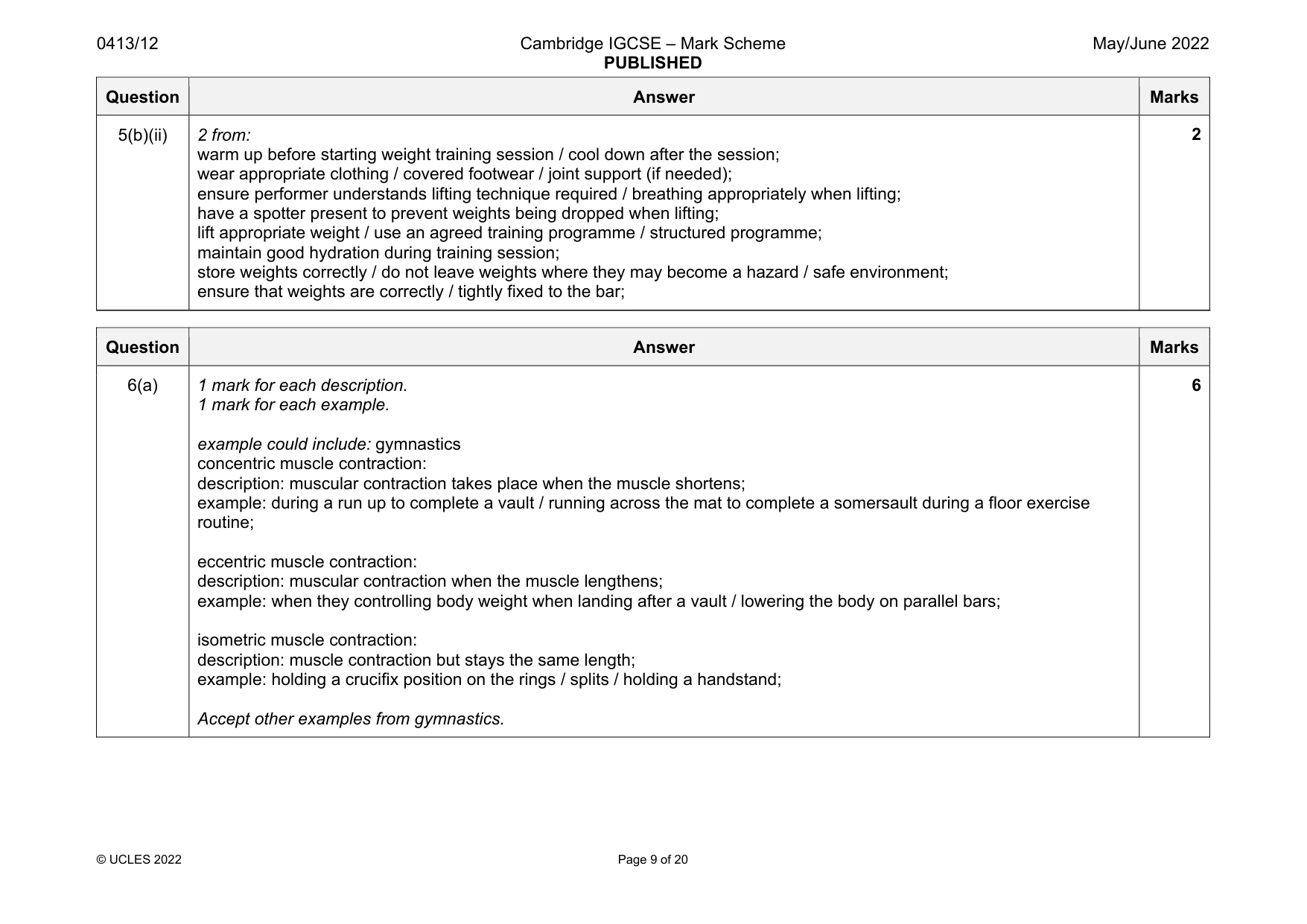
0413/12 Cambridge IGCSE – Mark Scheme PUBLISHED May/June 2022 © UCLES 2022 Page 9 of 20 Question Answer Marks 5(b)(ii) 2 from: warm up before starting weight training session / cool down after the session; wear appropriate clothing / covered footwear / joint support (if needed); ensure performer understands lifting technique required / breathing appropriately when lifting; have a spotter present to prevent weights being dropped when lifting; lift appropriate weight / use an agreed training programme / structured programme; maintain good hydration during training session; store weights correctly / do not leave weights where they may become a hazard / safe environment; ensure that weights are correctly / tightly fixed to the bar; 2 Question Answer Marks 6(a) 1 mark for each description. 1 mark for each example. example could include: gymnastics concentric muscle contraction: description: muscular contraction takes place when the muscle shortens; example: during a run up to complete a vault / running across the mat to complete a somersault during a floor exercise routine; eccentric muscle contraction: description: muscular contraction when the muscle lengthens; example: when they controlling body weight when landing after a vault / lowering the body on parallel bars; isometric muscle contraction: description: muscle contraction but stays the same length; example: holding a crucifix position on the rings / splits / holding a handstand; Accept other examples from gymnastics. 6
Mark scheme, page 10
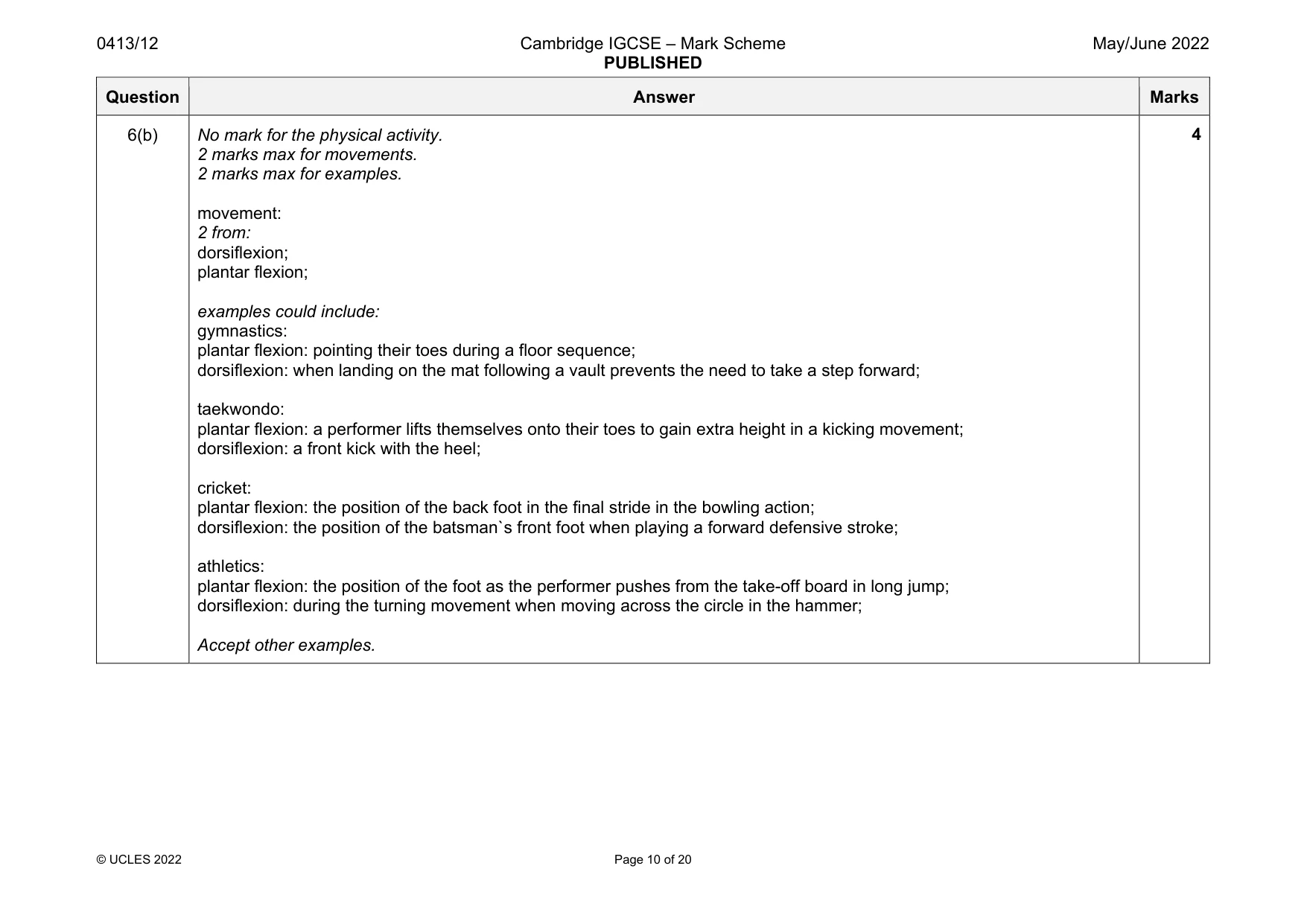
0413/12 Cambridge IGCSE – Mark Scheme PUBLISHED May/June 2022 © UCLES 2022 Page 10 of 20 Question Answer Marks 6(b) No mark for the physical activity. 2 marks max for movements. 2 marks max for examples. movement: 2 from: dorsiflexion; plantar flexion; examples could include: gymnastics: plantar flexion: pointing their toes during a floor sequence; dorsiflexion: when landing on the mat following a vault prevents the need to take a step forward; taekwondo: plantar flexion: a performer lifts themselves onto their toes to gain extra height in a kicking movement; dorsiflexion: a front kick with the heel; cricket: plantar flexion: the position of the back foot in the final stride in the bowling action; dorsiflexion: the position of the batsman`s front foot when playing a forward defensive stroke; athletics: plantar flexion: the position of the foot as the performer pushes from the take-off board in long jump; dorsiflexion: during the turning movement when moving across the circle in the hammer; Accept other examples. 4
Mark scheme, page 11
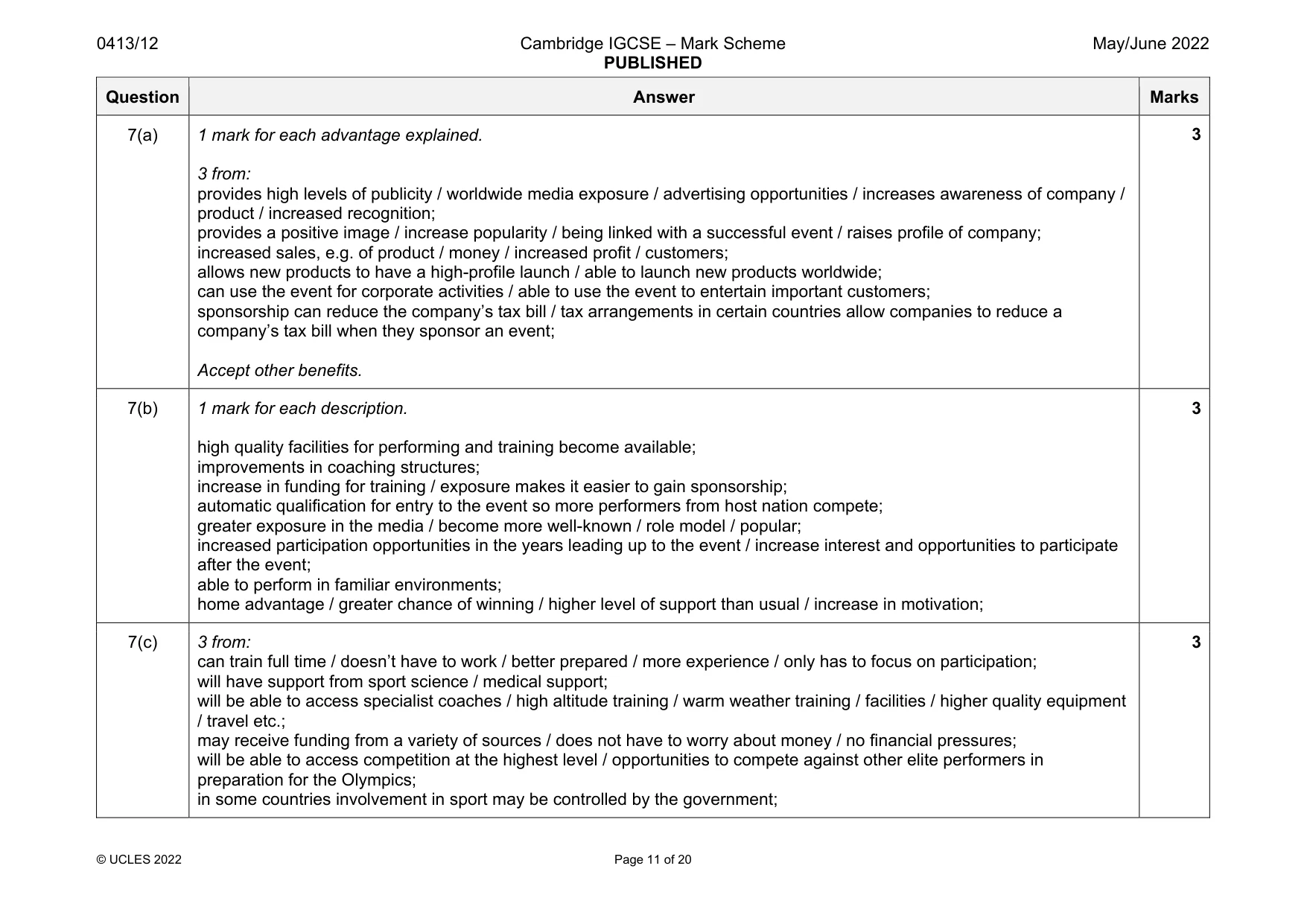
0413/12 Cambridge IGCSE – Mark Scheme PUBLISHED May/June 2022 © UCLES 2022 Page 11 of 20 Question Answer Marks 7(a) 1 mark for each advantage explained. 3 from: provides high levels of publicity / worldwide media exposure / advertising opportunities / increases awareness of company / product / increased recognition; provides a positive image / increase popularity / being linked with a successful event / raises profile of company; increased sales, e.g. of product / money / increased profit / customers; allows new products to have a high-profile launch / able to launch new products worldwide; can use the event for corporate activities / able to use the event to entertain important customers; sponsorship can reduce the company’s tax bill / tax arrangements in certain countries allow companies to reduce a company’s tax bill when they sponsor an event; Accept other benefits. 3 7(b) 1 mark for each description. high quality facilities for performing and training become available; improvements in coaching structures; increase in funding for training / exposure makes it easier to gain sponsorship; automatic qualification for entry to the event so more performers from host nation compete; greater exposure in the media / become more well-known / role model / popular; increased participation opportunities in the years leading up to the event / increase interest and opportunities to participate after the event; able to perform in familiar environments; home advantage / greater chance of winning / higher level of support than usual / increase in motivation; 3 7(c) 3 from: can train full time / doesn’t have to work / better prepared / more experience / only has to focus on participation; will have support from sport science / medical support; will be able to access specialist coaches / high altitude training / warm weather training / facilities / higher quality equipment / travel etc.; may receive funding from a variety of sources / does not have to worry about money / no financial pressures; will be able to access competition at the highest level / opportunities to compete against other elite performers in preparation for the Olympics; in some countries involvement in sport may be controlled by the government; 3
Mark scheme, page 12
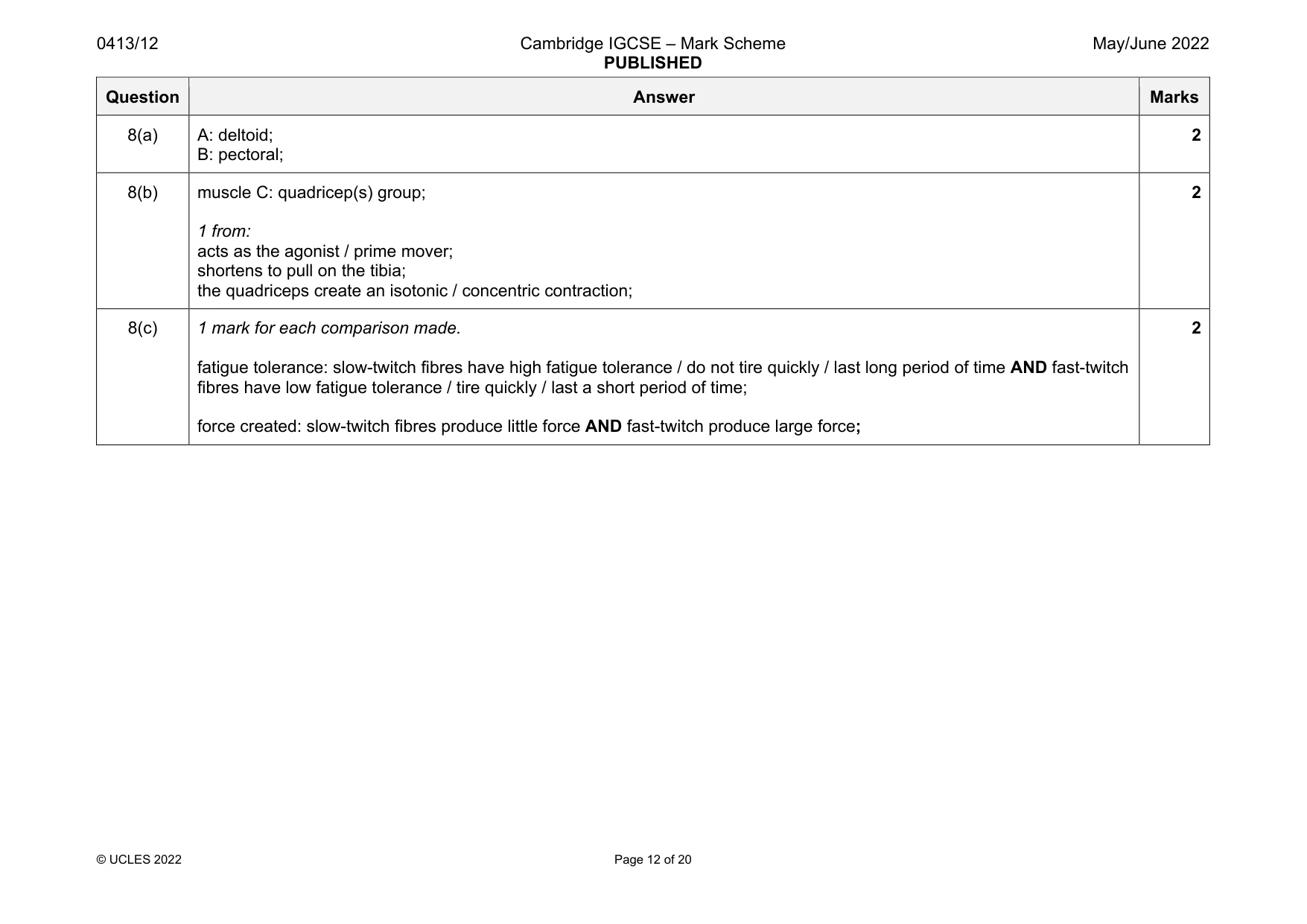
0413/12 Cambridge IGCSE – Mark Scheme PUBLISHED May/June 2022 © UCLES 2022 Page 12 of 20 Question Answer Marks 8(a) A: deltoid; B: pectoral; 2 8(b) muscle C: quadricep(s) group; 1 from: acts as the agonist / prime mover; shortens to pull on the tibia; the quadriceps create an isotonic / concentric contraction; 2 8(c) 1 mark for each comparison made. fatigue tolerance: slow-twitch fibres have high fatigue tolerance / do not tire quickly / last long period of time AND fast-twitch fibres have low fatigue tolerance / tire quickly / last a short period of time; force created: slow-twitch fibres produce little force AND fast-twitch produce large force; 2
Mark scheme, page 13
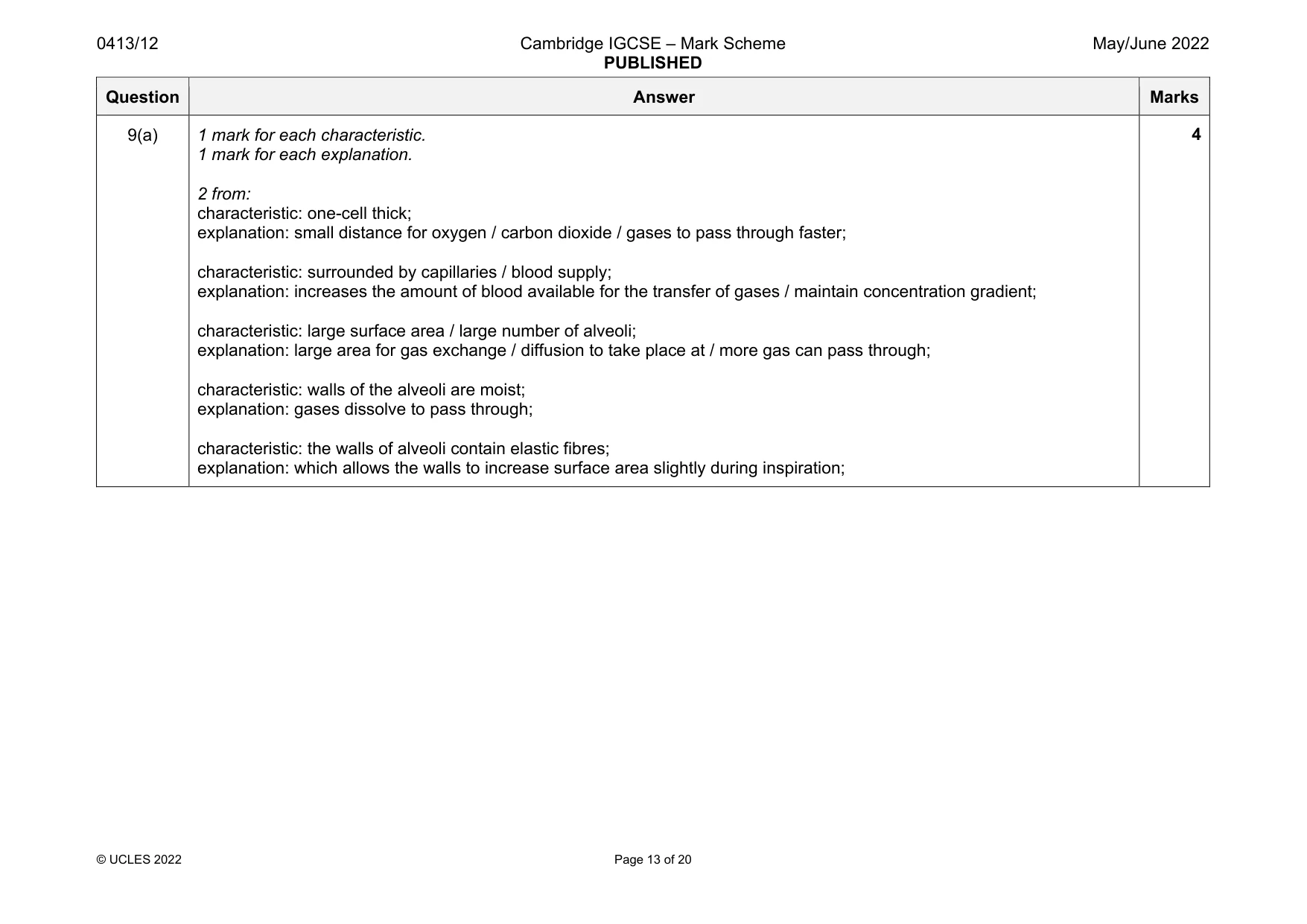
0413/12 Cambridge IGCSE – Mark Scheme PUBLISHED May/June 2022 © UCLES 2022 Page 13 of 20 Question Answer Marks 9(a) 1 mark for each characteristic. 1 mark for each explanation. 2 from: characteristic: one-cell thick; explanation: small distance for oxygen / carbon dioxide / gases to pass through faster; characteristic: surrounded by capillaries / blood supply; explanation: increases the amount of blood available for the transfer of gases / maintain concentration gradient; characteristic: large surface area / large number of alveoli; explanation: large area for gas exchange / diffusion to take place at / more gas can pass through; characteristic: walls of the alveoli are moist; explanation: gases dissolve to pass through; characteristic: the walls of alveoli contain elastic fibres; explanation: which allows the walls to increase surface area slightly during inspiration; 4
Mark scheme, page 14
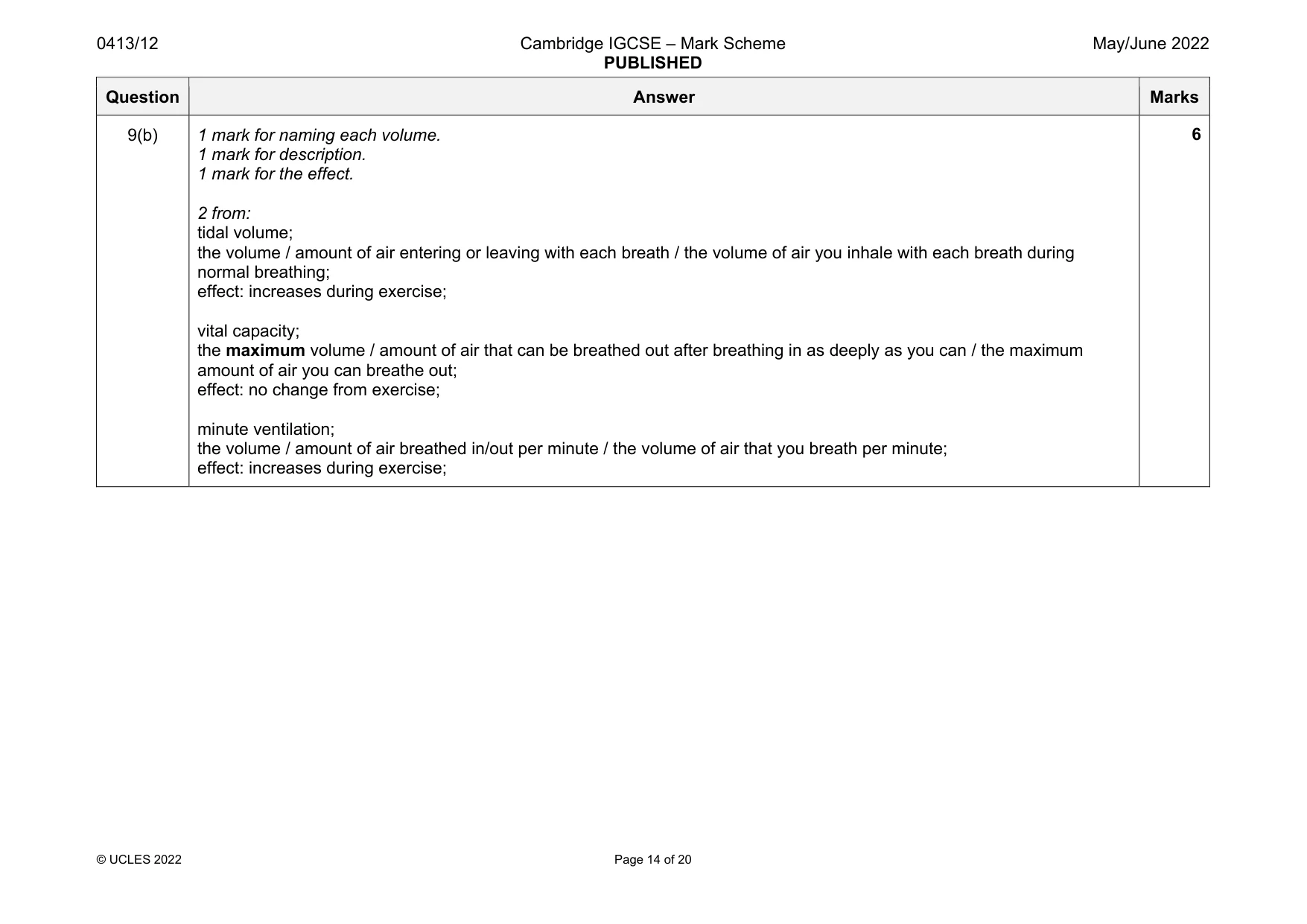
0413/12 Cambridge IGCSE – Mark Scheme PUBLISHED May/June 2022 © UCLES 2022 Page 14 of 20 Question Answer Marks 9(b) 1 mark for naming each volume. 1 mark for description. 1 mark for the effect. 2 from: tidal volume; the volume / amount of air entering or leaving with each breath / the volume of air you inhale with each breath during normal breathing; effect: increases during exercise; vital capacity; the maximum volume / amount of air that can be breathed out after breathing in as deeply as you can / the maximum amount of air you can breathe out; effect: no change from exercise; minute ventilation; the volume / amount of air breathed in/out per minute / the volume of air that you breath per minute; effect: increases during exercise; 6
Mark scheme, page 15
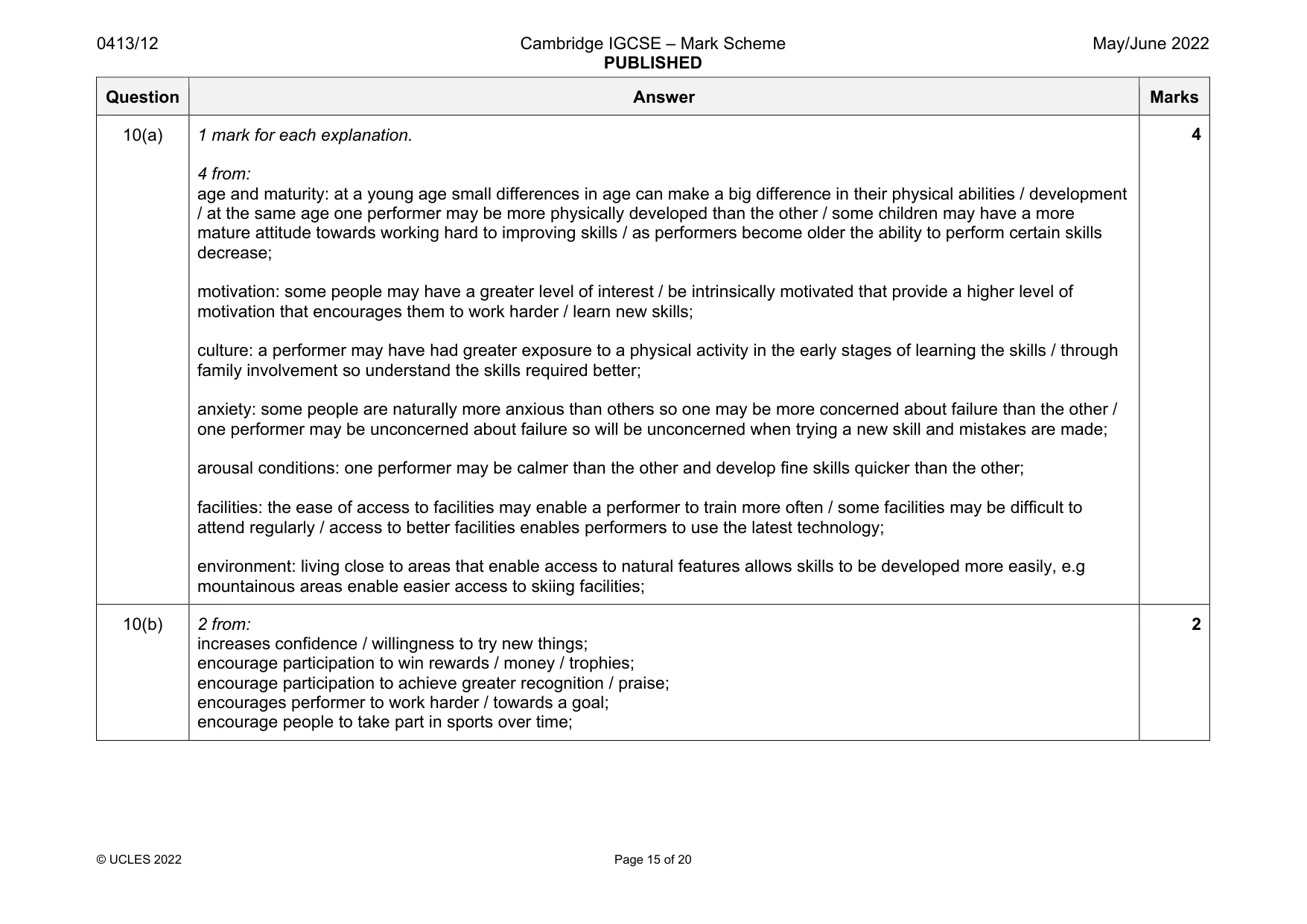
0413/12 Cambridge IGCSE – Mark Scheme PUBLISHED May/June 2022 © UCLES 2022 Page 15 of 20 Question Answer Marks 10(a) 1 mark for each explanation. 4 from: age and maturity: at a young age small differences in age can make a big difference in their physical abilities / development / at the same age one performer may be more physically developed than the other / some children may have a more mature attitude towards working hard to improving skills / as performers become older the ability to perform certain skills decrease; motivation: some people may have a greater level of interest / be intrinsically motivated that provide a higher level of motivation that encourages them to work harder / learn new skills; culture: a performer may have had greater exposure to a physical activity in the early stages of learning the skills / through family involvement so understand the skills required better; anxiety: some people are naturally more anxious than others so one may be more concerned about failure than the other / one performer may be unconcerned about failure so will be unconcerned when trying a new skill and mistakes are made; arousal conditions: one performer may be calmer than the other and develop fine skills quicker than the other; facilities: the ease of access to facilities may enable a performer to train more often / some facilities may be difficult to attend regularly / access to better facilities enables performers to use the latest technology; environment: living close to areas that enable access to natural features allows skills to be developed more easily, e.g mountainous areas enable easier access to skiing facilities; 4 10(b) 2 from: increases confidence / willingness to try new things; encourage participation to win rewards / money / trophies; encourage participation to achieve greater recognition / praise; encourages performer to work harder / towards a goal; encourage people to take part in sports over time; 2
Mark scheme, page 16
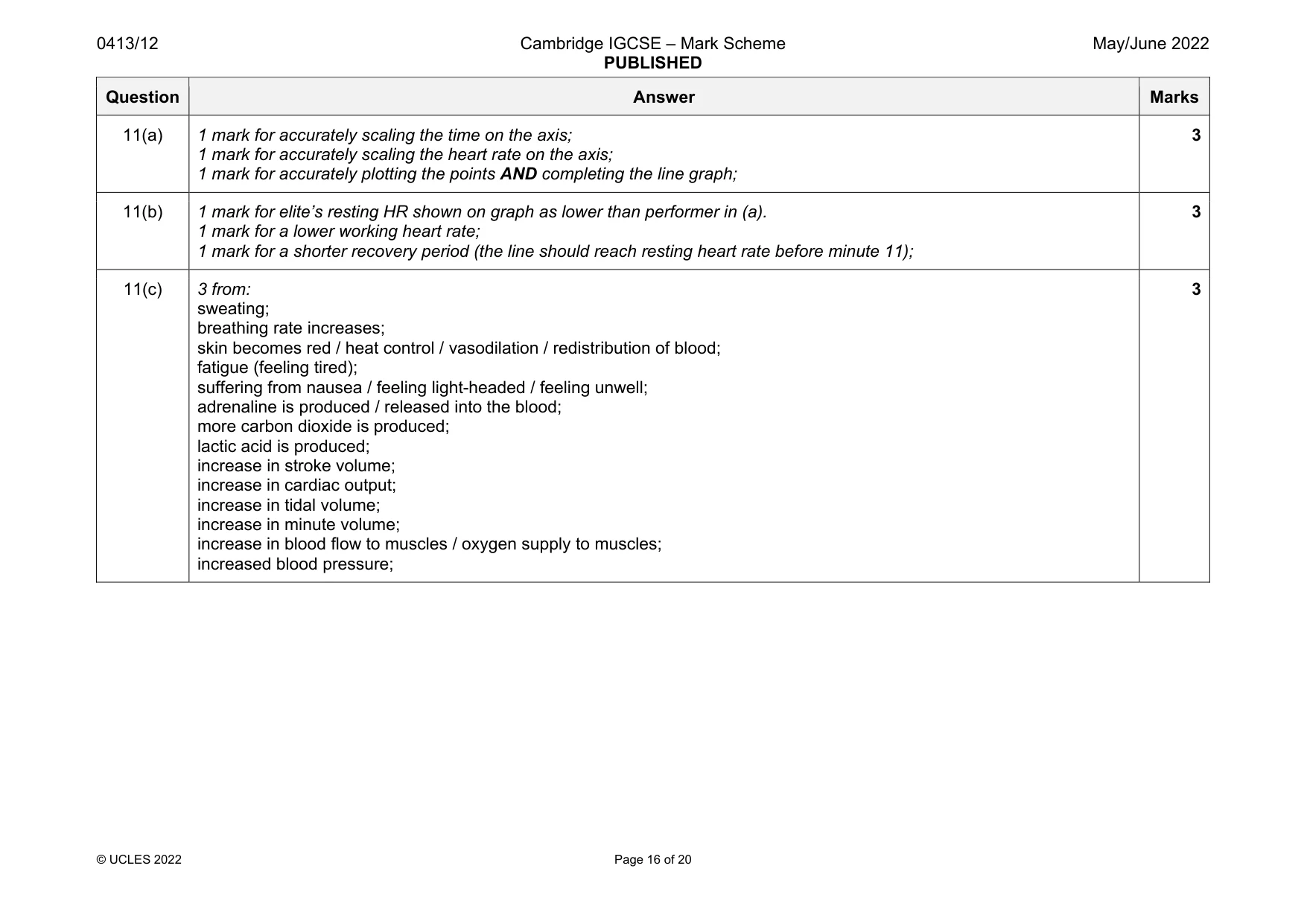
0413/12 Cambridge IGCSE – Mark Scheme PUBLISHED May/June 2022 © UCLES 2022 Page 16 of 20 Question Answer Marks 11(a) 1 mark for accurately scaling the time on the axis; 1 mark for accurately scaling the heart rate on the axis; 1 mark for accurately plotting the points AND completing the line graph; 3 11(b) 1 mark for elite’s resting HR shown on graph as lower than performer in (a). 1 mark for a lower working heart rate; 1 mark for a shorter recovery period (the line should reach resting heart rate before minute 11); 3 11(c) 3 from: sweating; breathing rate increases; skin becomes red / heat control / vasodilation / redistribution of blood; fatigue (feeling tired); suffering from nausea / feeling light-headed / feeling unwell; adrenaline is produced / released into the blood; more carbon dioxide is produced; lactic acid is produced; increase in stroke volume; increase in cardiac output; increase in tidal volume; increase in minute volume; increase in blood flow to muscles / oxygen supply to muscles; increased blood pressure; 3
Mark scheme, page 17
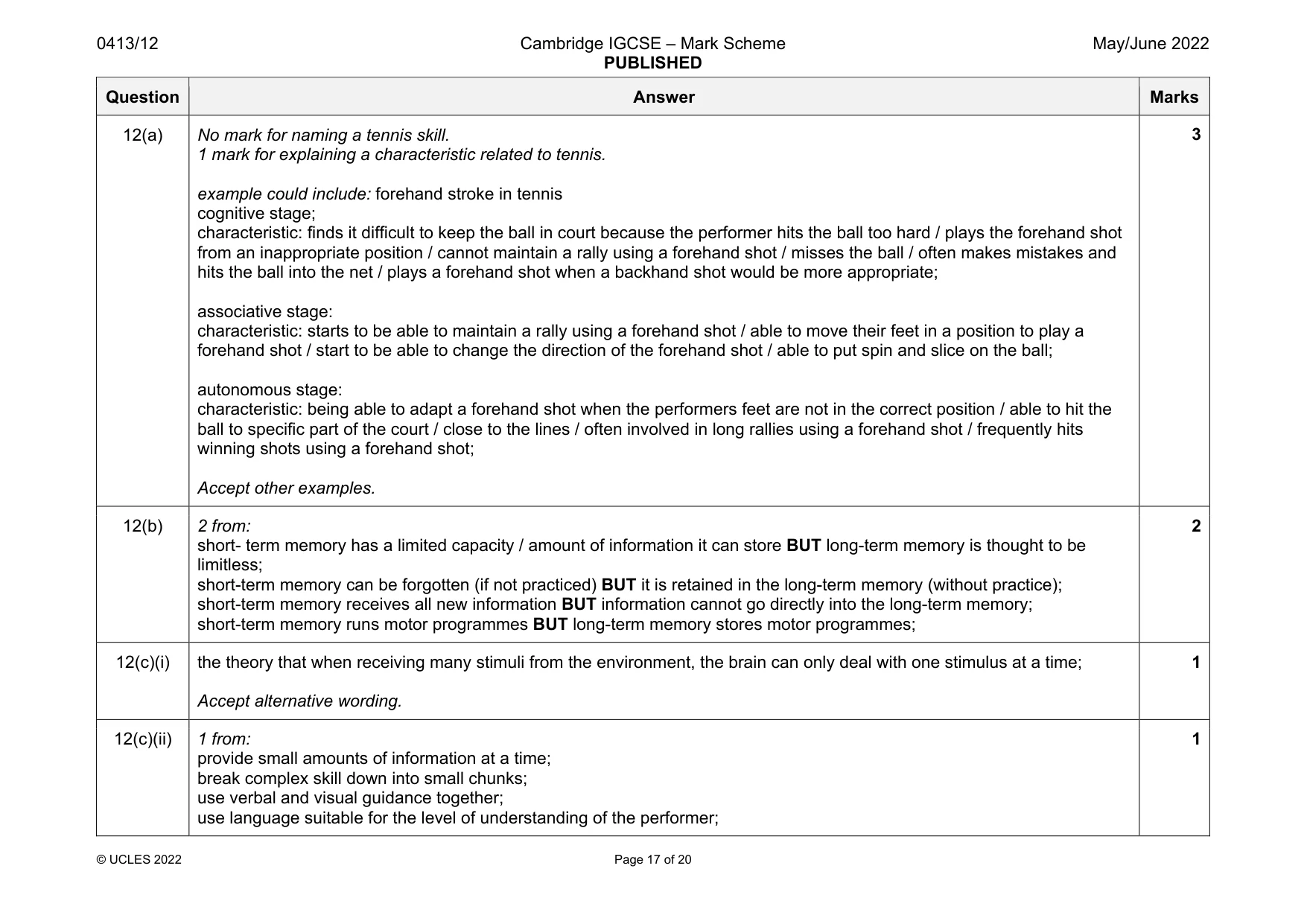
0413/12 Cambridge IGCSE – Mark Scheme PUBLISHED May/June 2022 © UCLES 2022 Page 17 of 20 Question Answer Marks 12(a) No mark for naming a tennis skill. 1 mark for explaining a characteristic related to tennis. example could include: forehand stroke in tennis cognitive stage; characteristic: finds it difficult to keep the ball in court because the performer hits the ball too hard / plays the forehand shot from an inappropriate position / cannot maintain a rally using a forehand shot / misses the ball / often makes mistakes and hits the ball into the net / plays a forehand shot when a backhand shot would be more appropriate; associative stage: characteristic: starts to be able to maintain a rally using a forehand shot / able to move their feet in a position to play a forehand shot / start to be able to change the direction of the forehand shot / able to put spin and slice on the ball; autonomous stage: characteristic: being able to adapt a forehand shot when the performers feet are not in the correct position / able to hit the ball to specific part of the court / close to the lines / often involved in long rallies using a forehand shot / frequently hits winning shots using a forehand shot; Accept other examples. 3 12(b) 2 from: short- term memory has a limited capacity / amount of information it can store BUT long-term memory is thought to be limitless; short-term memory can be forgotten (if not practiced) BUT it is retained in the long-term memory (without practice); short-term memory receives all new information BUT information cannot go directly into the long-term memory; short-term memory runs motor programmes BUT long-term memory stores motor programmes; 2 12(c)(i) the theory that when receiving many stimuli from the environment, the brain can only deal with one stimulus at a time; Accept alternative wording. 1 12(c)(ii) 1 from: provide small amounts of information at a time; break complex skill down into small chunks; use verbal and visual guidance together; use language suitable for the level of understanding of the performer; 1
Mark scheme, page 18
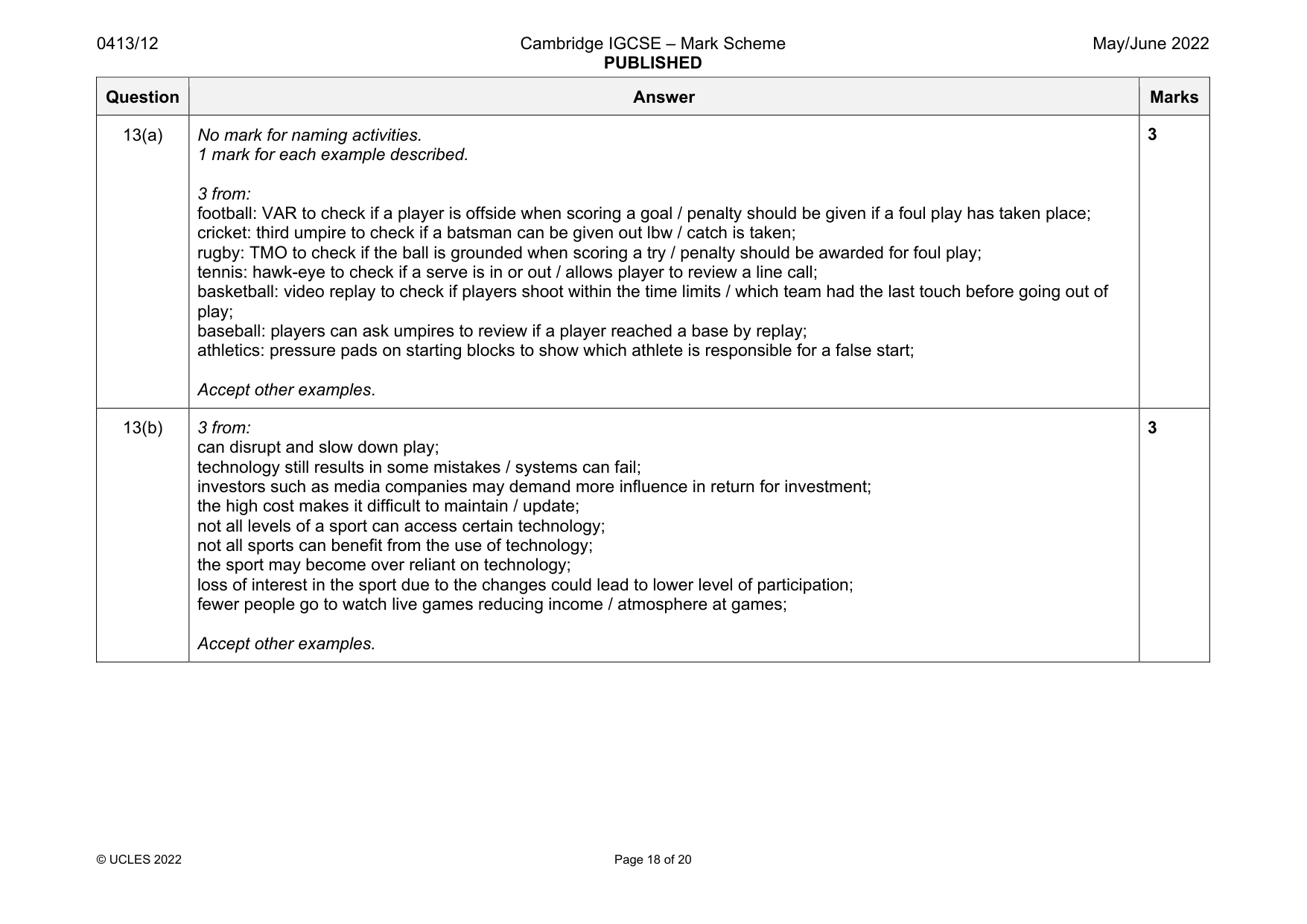
0413/12 Cambridge IGCSE – Mark Scheme PUBLISHED May/June 2022 © UCLES 2022 Page 18 of 20 Question Answer Marks 13(a) No mark for naming activities. 1 mark for each example described. 3 from: football: VAR to check if a player is offside when scoring a goal / penalty should be given if a foul play has taken place; cricket: third umpire to check if a batsman can be given out lbw / catch is taken; rugby: TMO to check if the ball is grounded when scoring a try / penalty should be awarded for foul play; tennis: hawk-eye to check if a serve is in or out / allows player to review a line call; basketball: video replay to check if players shoot within the time limits / which team had the last touch before going out of play; baseball: players can ask umpires to review if a player reached a base by replay; athletics: pressure pads on starting blocks to show which athlete is responsible for a false start; Accept other examples. 3 13(b) 3 from: can disrupt and slow down play; technology still results in some mistakes / systems can fail; investors such as media companies may demand more influence in return for investment; the high cost makes it difficult to maintain / update; not all levels of a sport can access certain technology; not all sports can benefit from the use of technology; the sport may become over reliant on technology; loss of interest in the sport due to the changes could lead to lower level of participation; fewer people go to watch live games reducing income / atmosphere at games; Accept other examples. 3
Mark scheme, page 19
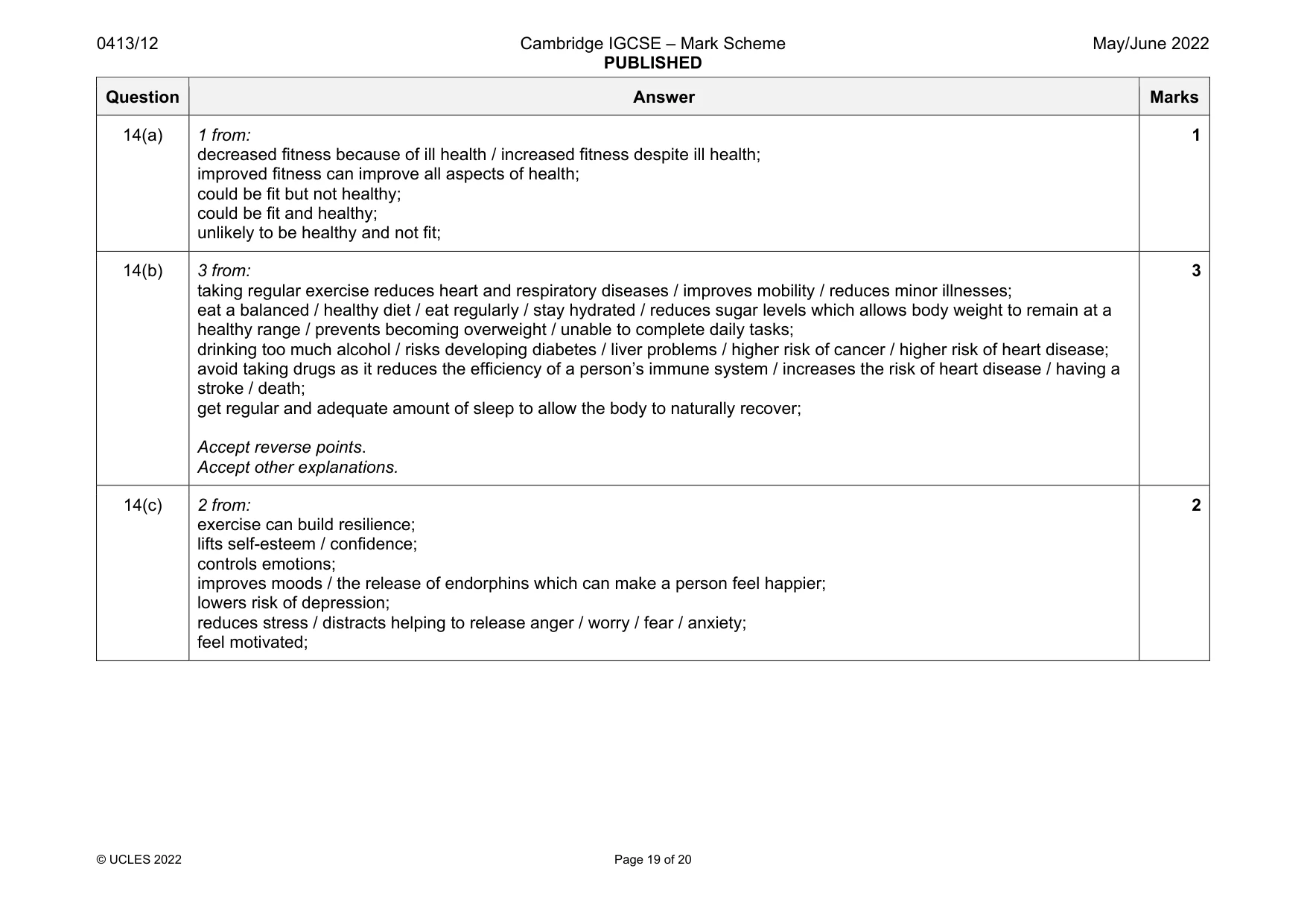
0413/12 Cambridge IGCSE – Mark Scheme PUBLISHED May/June 2022 © UCLES 2022 Page 19 of 20 Question Answer Marks 14(a) 1 from: decreased fitness because of ill health / increased fitness despite ill health; improved fitness can improve all aspects of health; could be fit but not healthy; could be fit and healthy; unlikely to be healthy and not fit; 1 14(b) 3 from: taking regular exercise reduces heart and respiratory diseases / improves mobility / reduces minor illnesses; eat a balanced / healthy diet / eat regularly / stay hydrated / reduces sugar levels which allows body weight to remain at a healthy range / prevents becoming overweight / unable to complete daily tasks; drinking too much alcohol / risks developing diabetes / liver problems / higher risk of cancer / higher risk of heart disease; avoid taking drugs as it reduces the efficiency of a person’s immune system / increases the risk of heart disease / having a stroke / death; get regular and adequate amount of sleep to allow the body to naturally recover; Accept reverse points. Accept other explanations. 3 14(c) 2 from: exercise can build resilience; lifts self-esteem / confidence; controls emotions; improves moods / the release of endorphins which can make a person feel happier; lowers risk of depression; reduces stress / distracts helping to release anger / worry / fear / anxiety; feel motivated; 2
Mark scheme, page 20
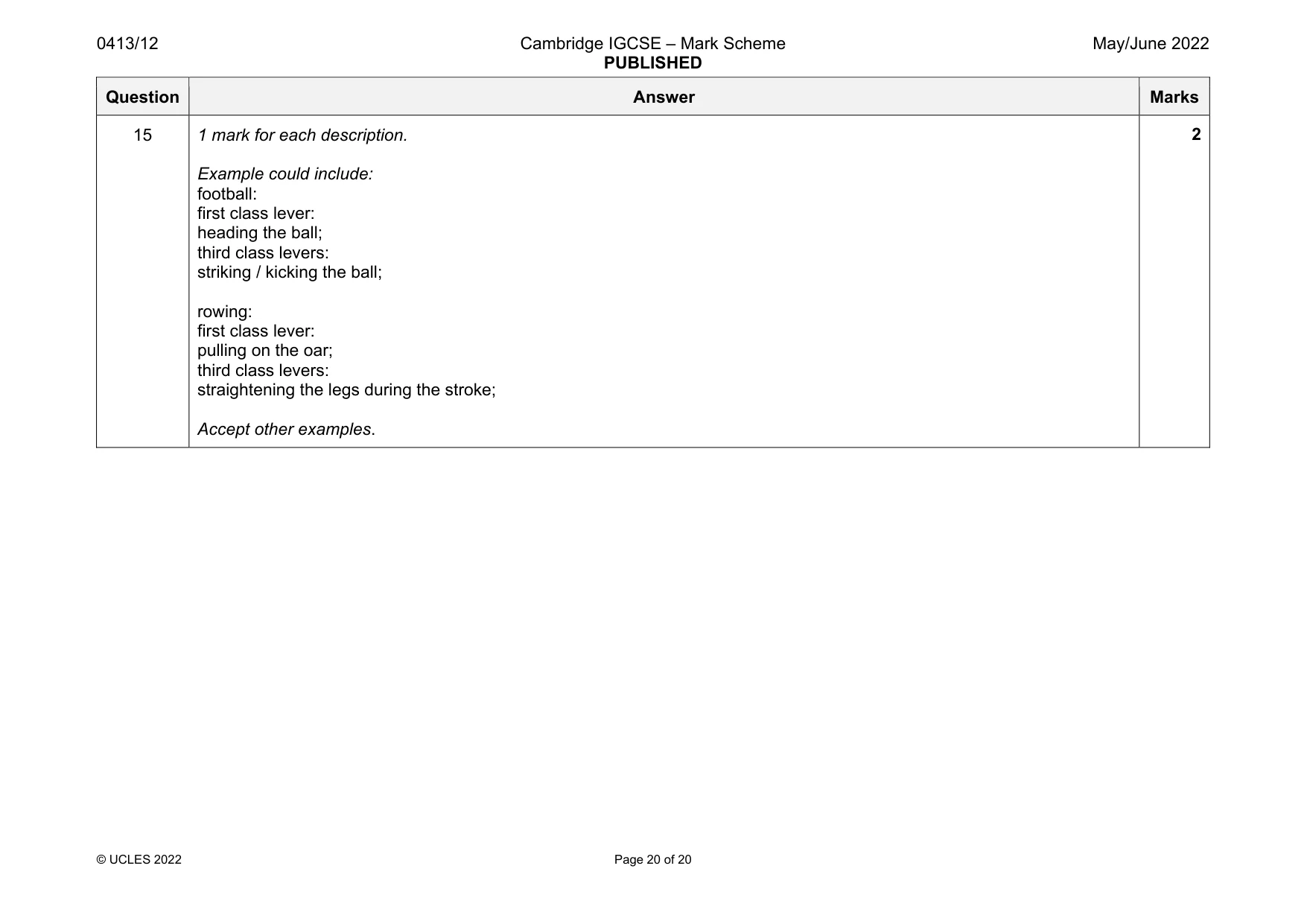
0413/12 Cambridge IGCSE – Mark Scheme PUBLISHED May/June 2022 © UCLES 2022 Page 20 of 20 Question Answer Marks 15 1 mark for each description. Example could include: football: first class lever: heading the ball; third class levers: striking / kicking the ball; rowing: first class lever: pulling on the oar; third class levers: straightening the legs during the stroke; Accept other examples. 2
What you needed in this session
Cambridge’s own grade thresholds for 2022 May/June, Paper 1 · Variant 2. A higher threshold means an easier paper — the bar moves with how the cohort did.