Cambridge IGCSE Physical Education 0413 — 2022 May/June Paper 1 · Variant 3
0413/13/M/J/22 · 100 marks · ≈113 min
The question paper and its mark scheme, free to read here and free to download. This is Cambridge’s own paper, exactly as it was sat.
Question paper16 pages
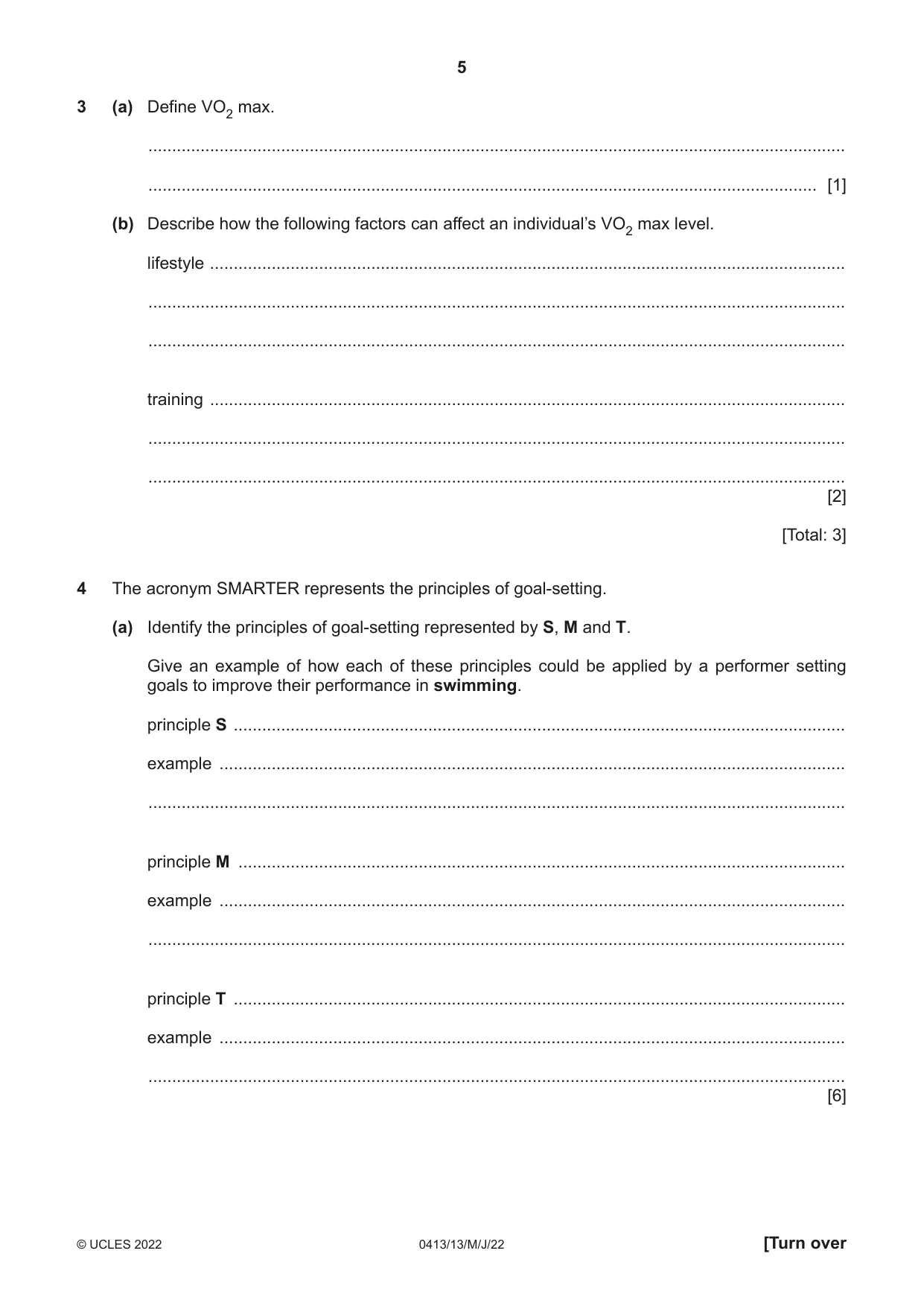
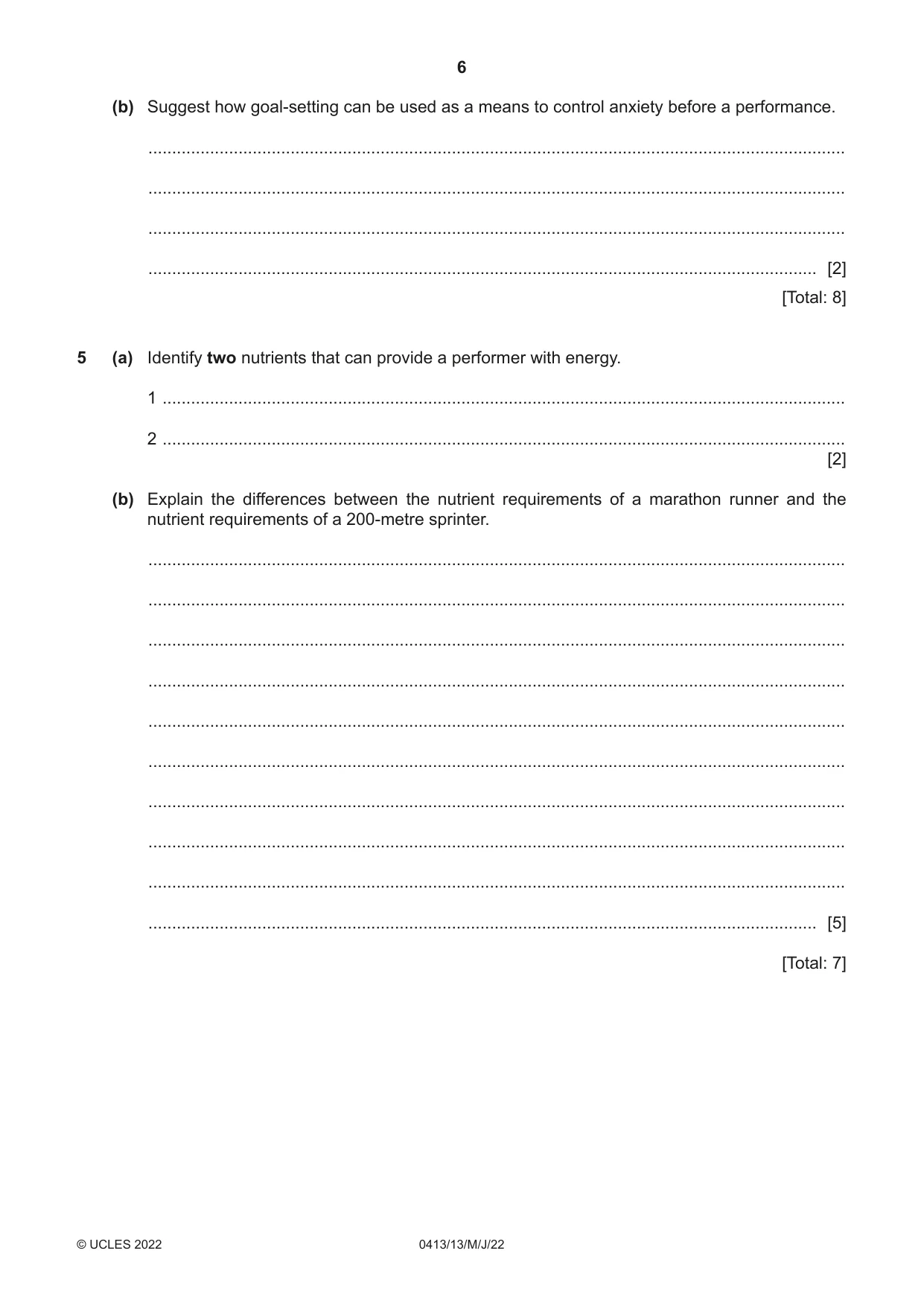
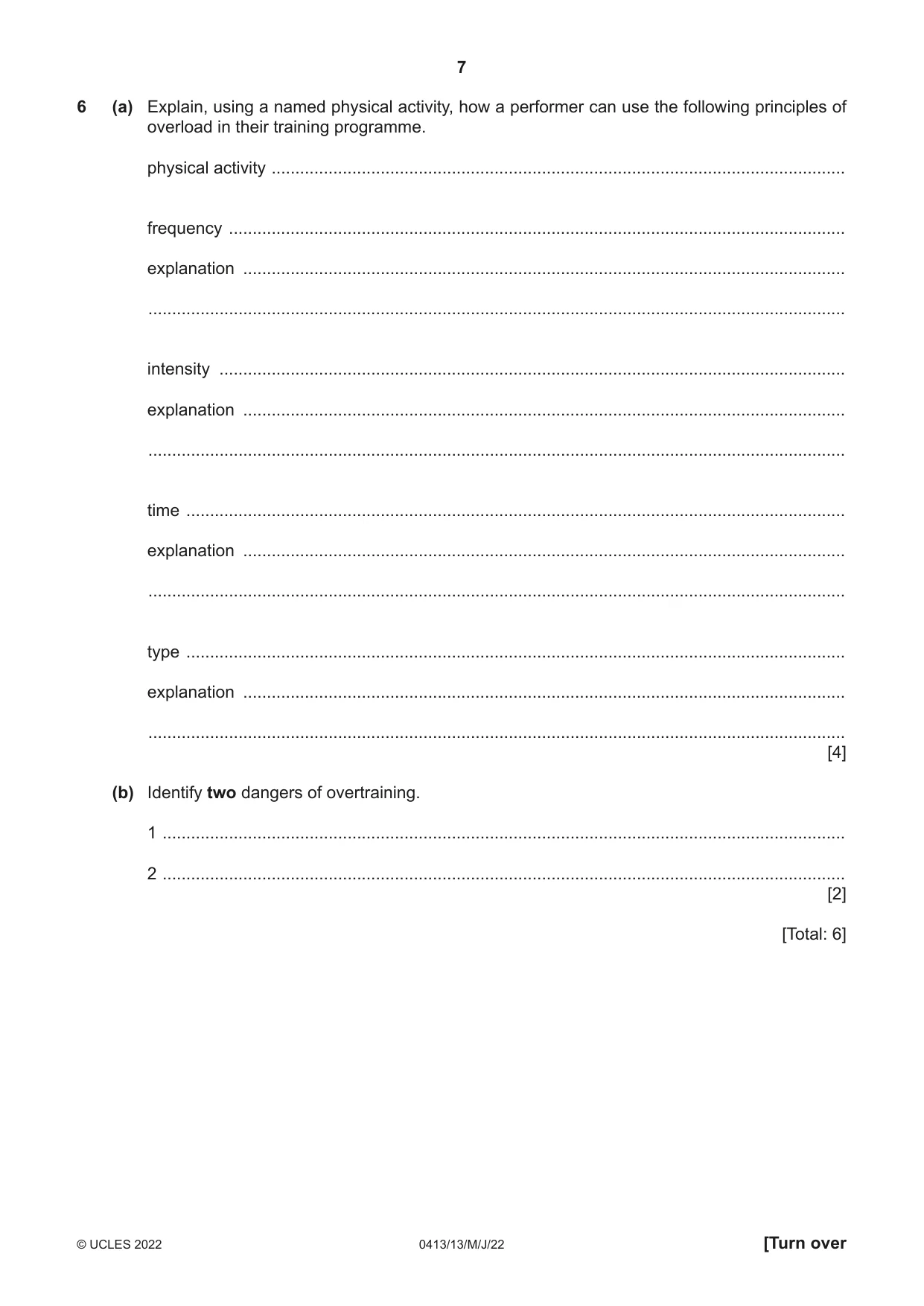
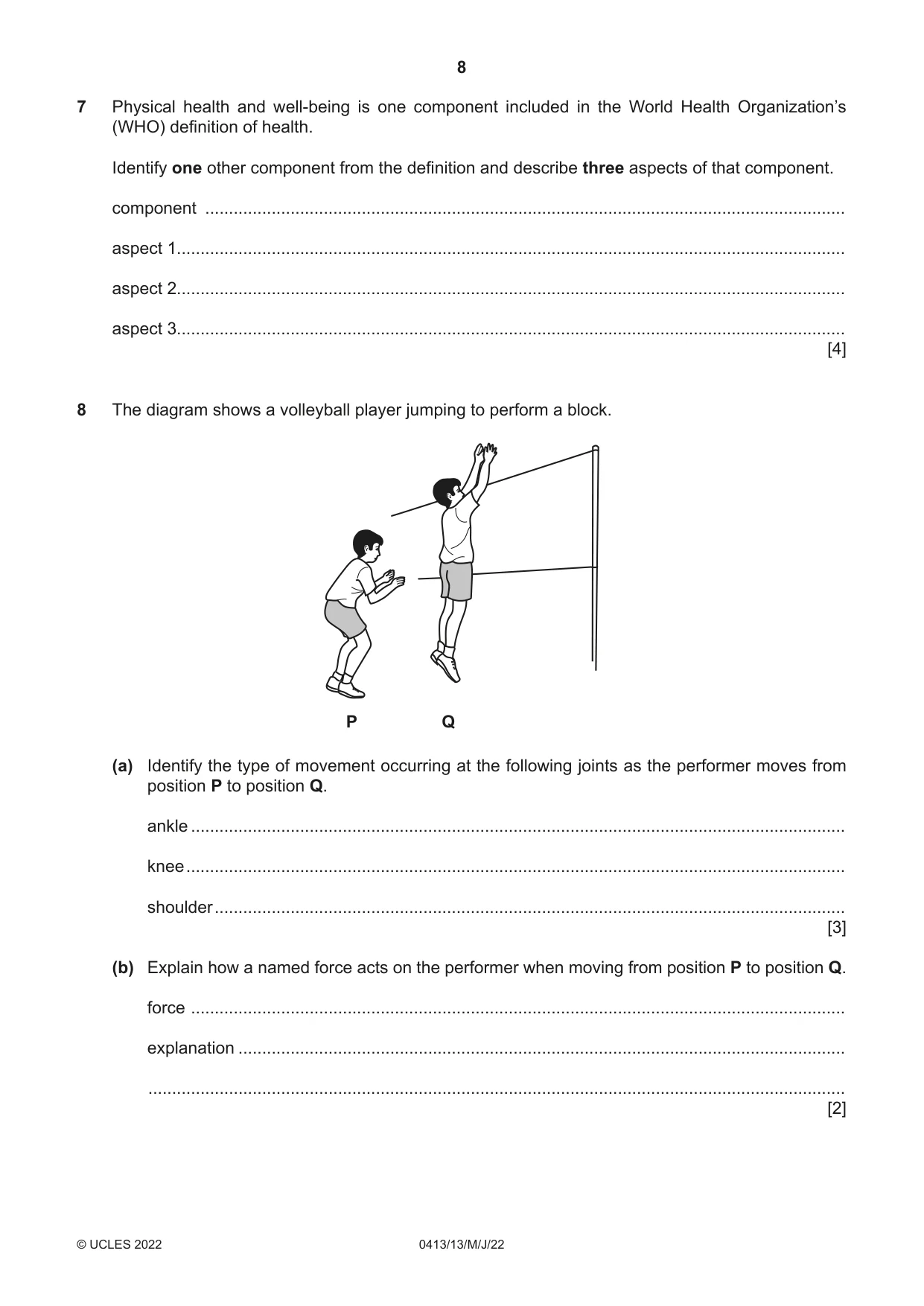

Mark scheme16 pages
Answers below. Sit the paper first if you are practising.
Paper as text
Question paper, page 1
This document has 16 pages. Any blank pages are indicated. [Turn over DC (JP/JG) 303517/3 © UCLES 2022 * 3 9 7 9 2 3 7 5 7 0 * PHYSICAL EDUCATION 0413/13 Paper 1 Theory May/June 2022 1 hour 45 minutes You must answer on the question paper. No additional materials are needed. INSTRUCTIONS ● Answer all questions. ● Use a black or dark blue pen. You may use an HB pencil for any diagrams or graphs. ● Write your name, centre number and candidate number in the boxes at the top of the page. ● Write your answer to each question in the space provided. ● Do not use an erasable pen or correction fluid. ● Do not write on any bar codes. ● You may use a calculator. ● You should show all your working and use appropriate units. INFORMATION ● The total mark for this paper is 100. ● The number of marks for each question or part question is shown in brackets [ ]. Cambridge IGCSE™
Question paper, page 2
2 0413/13/M/J/22 © UCLES 2022 1 (a) Identify the two bones in the lower leg located between the knee joint and the ankle joint. … … [2] (b) (i) Identify the type of synovial joint located at the knee. … [1] (ii) Identify one other type of synovial joint found in the body. … [1]
Question paper, page 3
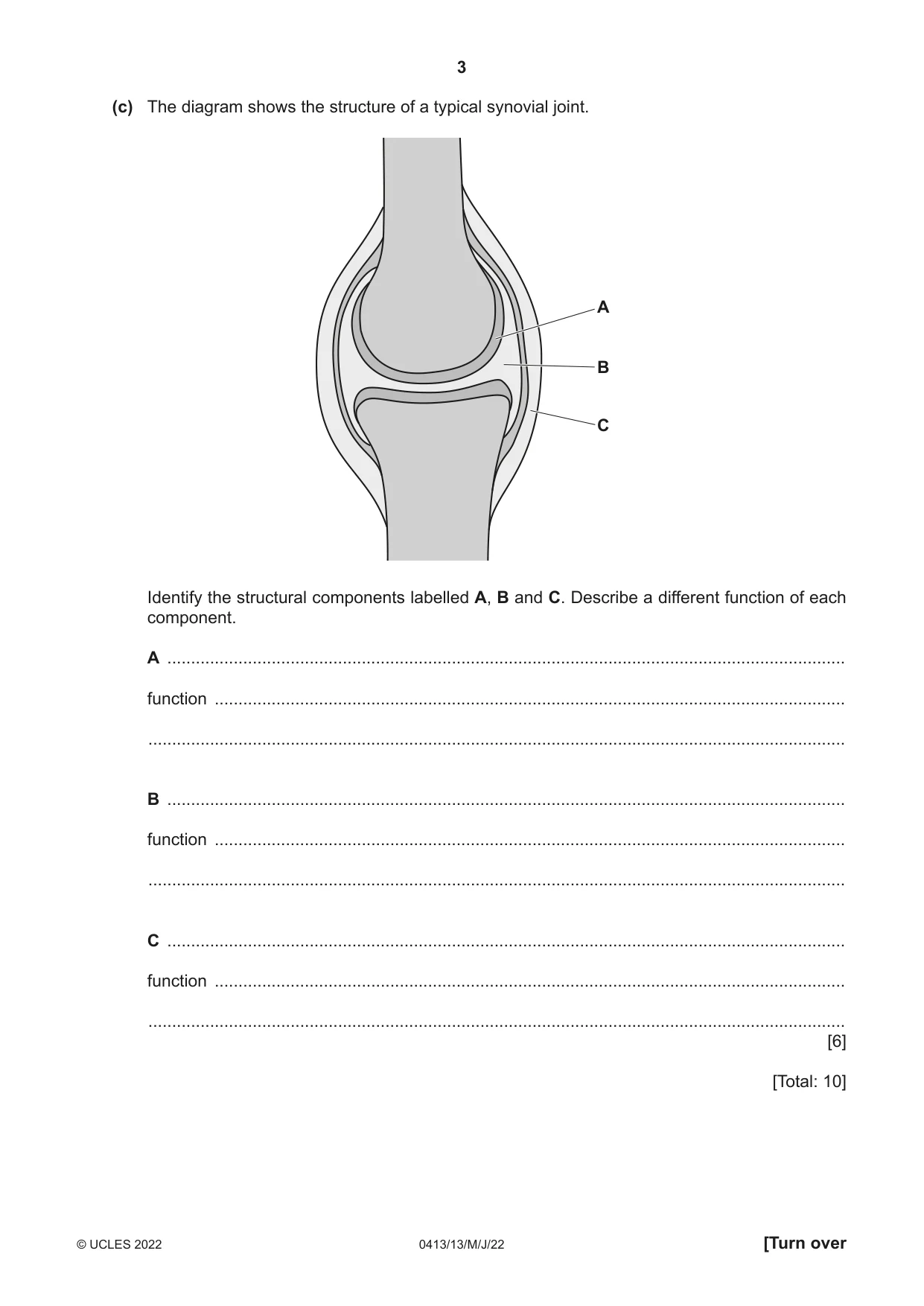
3 0413/13/M/J/22 © UCLES 2022 [Turn over (c) The diagram shows the structure of a typical synovial joint. A B C Identify the structural components labelled A, B and C. Describe a different function of each component. A … function … … B … function … … C … function … … [6] [Total: 10]
Question paper, page 4
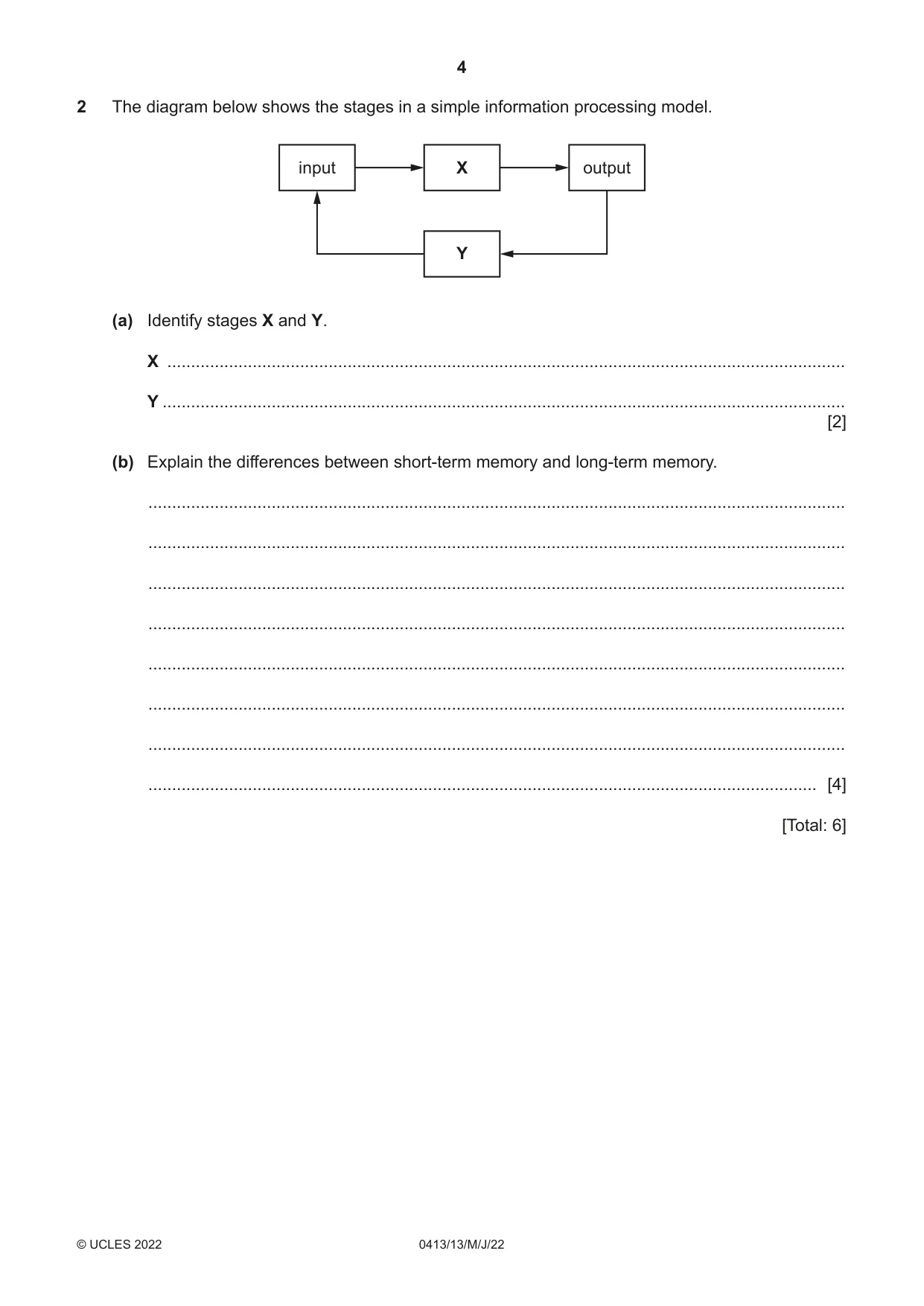
4 0413/13/M/J/22 © UCLES 2022 2 The diagram below shows the stages in a simple information processing model. input X Y output (a) Identify stages X and Y. X … Y … [2] (b) Explain the differences between short-term memory and long-term memory. … … … … … … … … [4] [Total: 6]
Question paper, page 5
5 0413/13/M/J/22 © UCLES 2022 [Turn over 3 (a) Define VO2 max. … … [1] (b) Describe how the following factors can affect an individual’s VO2 max level. lifestyle … … … training … … … [2] [Total: 3] 4 The acronym SMARTER represents the principles of goal-setting. (a) Identify the principles of goal-setting represented by S, M and T. Give an example of how each of these principles could be applied by a performer setting goals to improve their performance in swimming. principle S … example … … principle M … example … … principle T … example … … [6]
Question paper, page 6
6 0413/13/M/J/22 © UCLES 2022 (b) Suggest how goal-setting can be used as a means to control anxiety before a performance. … … … … [2] [Total: 8] 5 (a) Identify two nutrients that can provide a performer with energy. 1 … 2 … [2] (b) Explain the differences between the nutrient requirements of a marathon runner and the nutrient requirements of a 200-metre sprinter. … … … … … … … … … … [5] [Total: 7]
Question paper, page 7
7 0413/13/M/J/22 © UCLES 2022 [Turn over 6 (a) Explain, using a named physical activity, how a performer can use the following principles of overload in their training programme. physical activity … frequency … explanation … … intensity … explanation … … time … explanation … … type … explanation … … [4] (b) Identify two dangers of overtraining. 1 … 2 … [2] [Total: 6]
Question paper, page 8
8 0413/13/M/J/22 © UCLES 2022 7 Physical health and well-being is one component included in the World Health Organization’s (WHO) definition of health. Identify one other component from the definition and describe three aspects of that component. component … aspect 1… aspect 2… aspect 3… [4] 8 The diagram shows a volleyball player jumping to perform a block. P Q (a) Identify the type of movement occurring at the following joints as the performer moves from position P to position Q. ankle … knee … shoulder … [3] (b) Explain how a named force acts on the performer when moving from position P to position Q. force … explanation … … [2]
Question paper, page 9
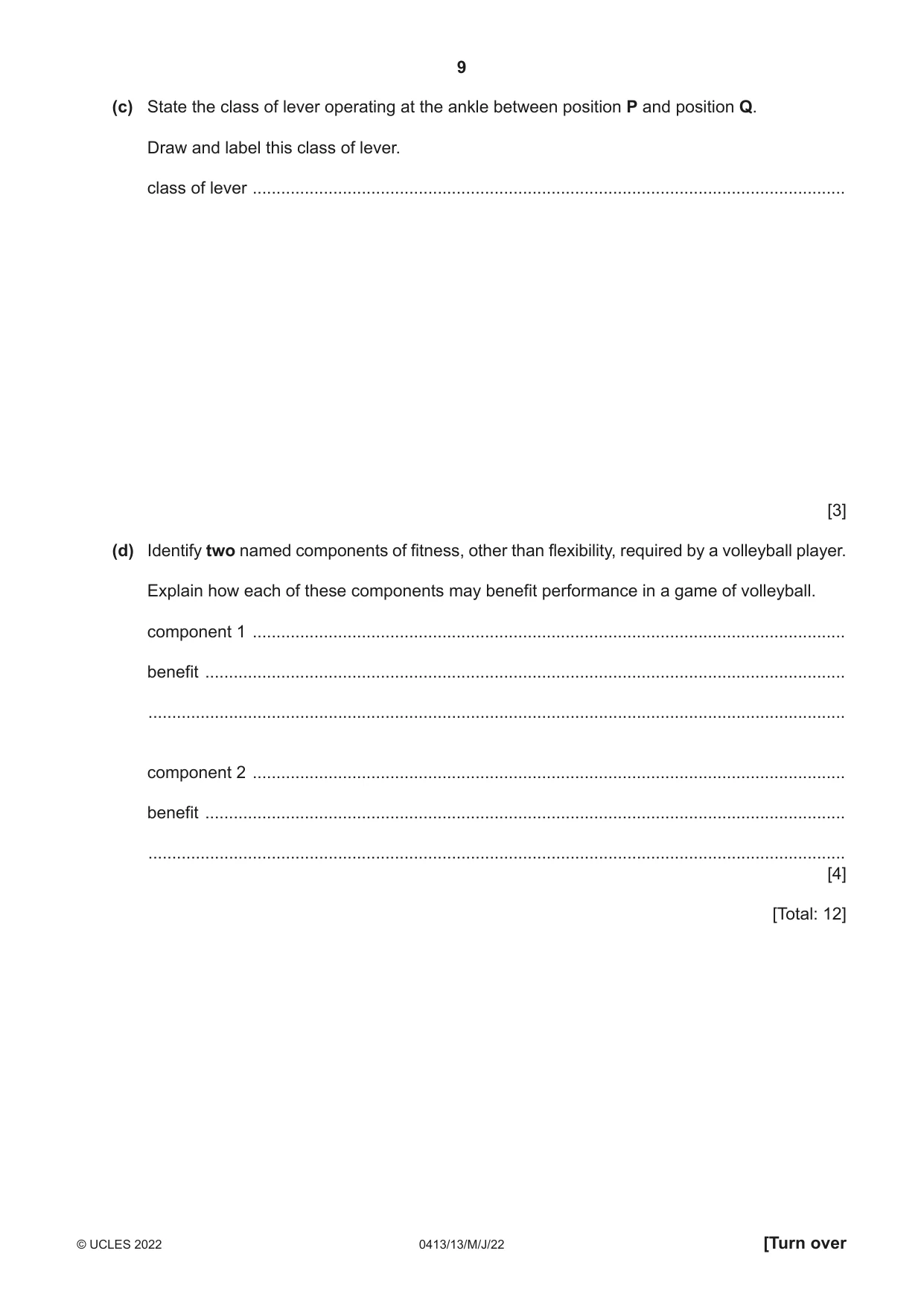
9 0413/13/M/J/22 © UCLES 2022 [Turn over (c) State the class of lever operating at the ankle between position P and position Q. Draw and label this class of lever. class of lever … [3] (d) Identify two named components of fitness, other than flexibility, required by a volleyball player. Explain how each of these components may benefit performance in a game of volleyball. component 1 … benefit … … component 2 … benefit … … [4] [Total: 12]
Question paper, page 10
10 0413/13/M/J/22 © UCLES 2022 9 (a) Identify two types of sponsorship that can be given to a performer. 1 … … 2 … … [2] (b) Explain, using examples, how sponsorship can have a negative impact on sport. … … … … … … … … [4] [Total: 6]
Question paper, page 11
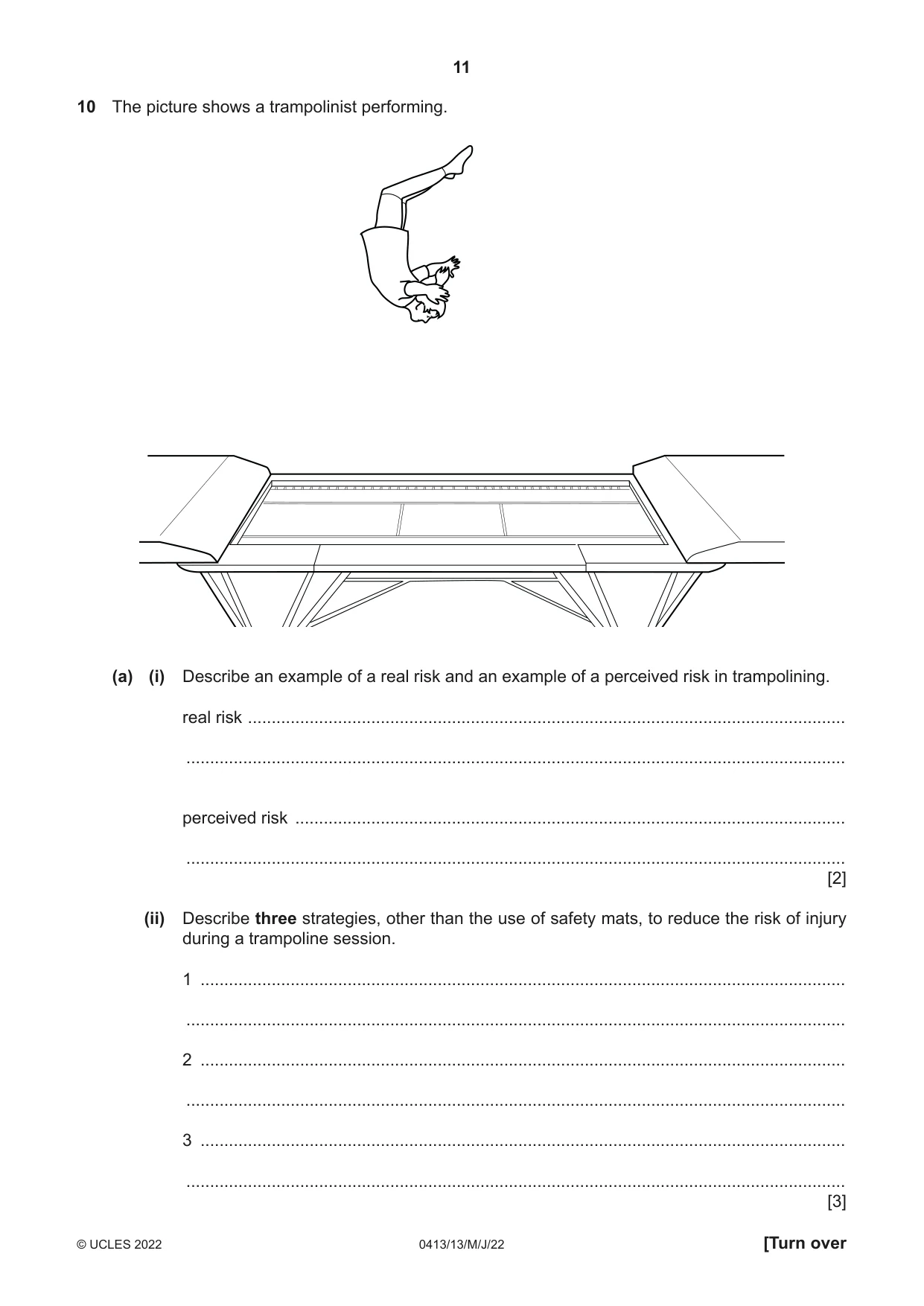
11 0413/13/M/J/22 © UCLES 2022 [Turn over 10 The picture shows a trampolinist performing. (a) (i) Describe an example of a real risk and an example of a perceived risk in trampolining. real risk … … perceived risk … … [2] (ii) Describe three strategies, other than the use of safety mats, to reduce the risk of injury during a trampoline session. 1 … … 2 … … 3 … … [3]
Question paper, page 12
12 0413/13/M/J/22 © UCLES 2022 (b) Flexibility is one fitness component required by a trampolinist. Describe how to carry out a named test of flexibility. name of test … description … … … … … … [4] [Total: 9] 11 Suggest strategies that could be used to increase the level of female participation in Association Football. … … … … … … … … … … [6]
Question paper, page 13
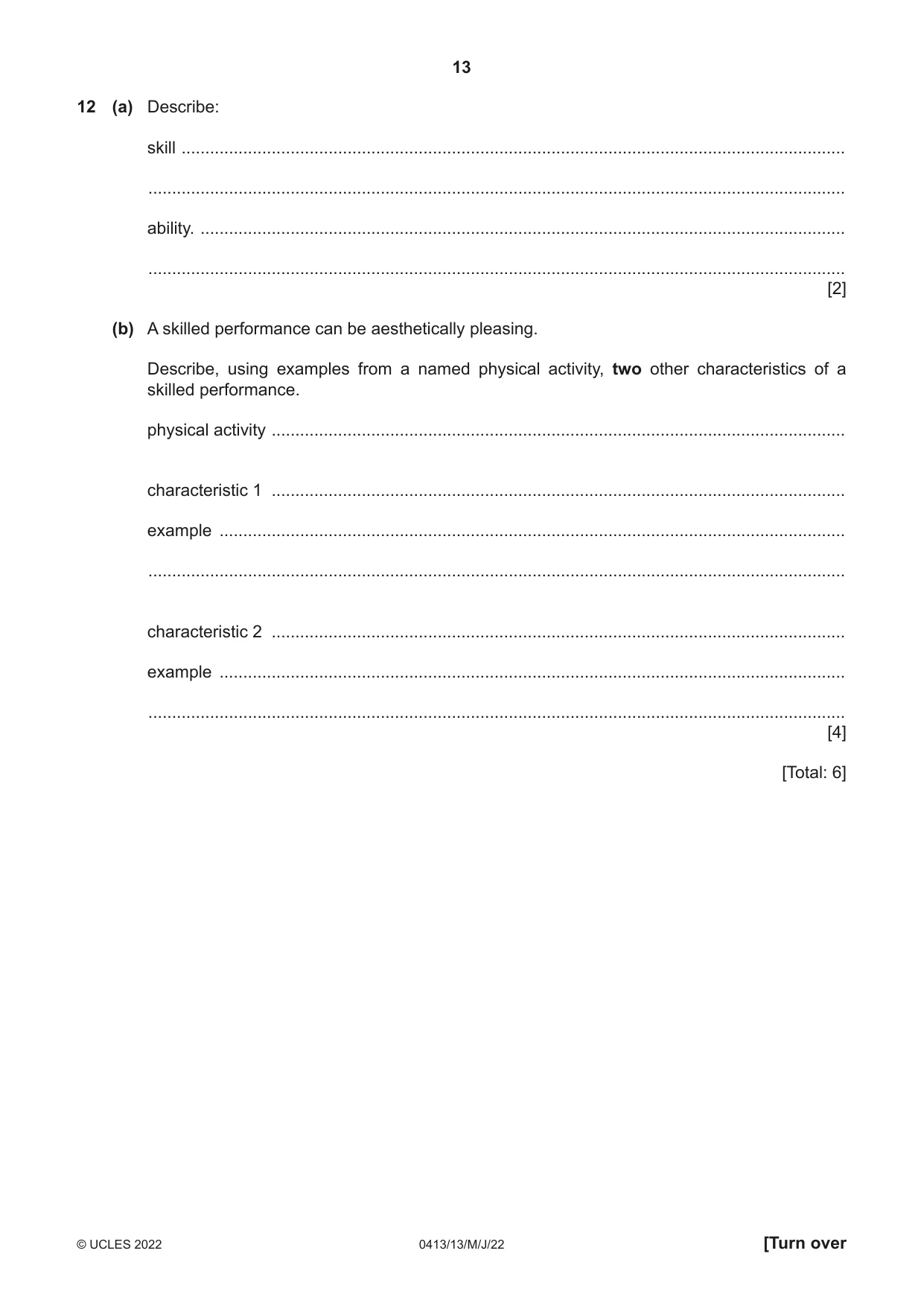
13 0413/13/M/J/22 © UCLES 2022 [Turn over 12 (a) Describe: skill … … ability. … … [2] (b) A skilled performance can be aesthetically pleasing. Describe, using examples from a named physical activity, two other characteristics of a skilled performance. physical activity … characteristic 1 … example … … characteristic 2 … example … … [4] [Total: 6]
Question paper, page 14
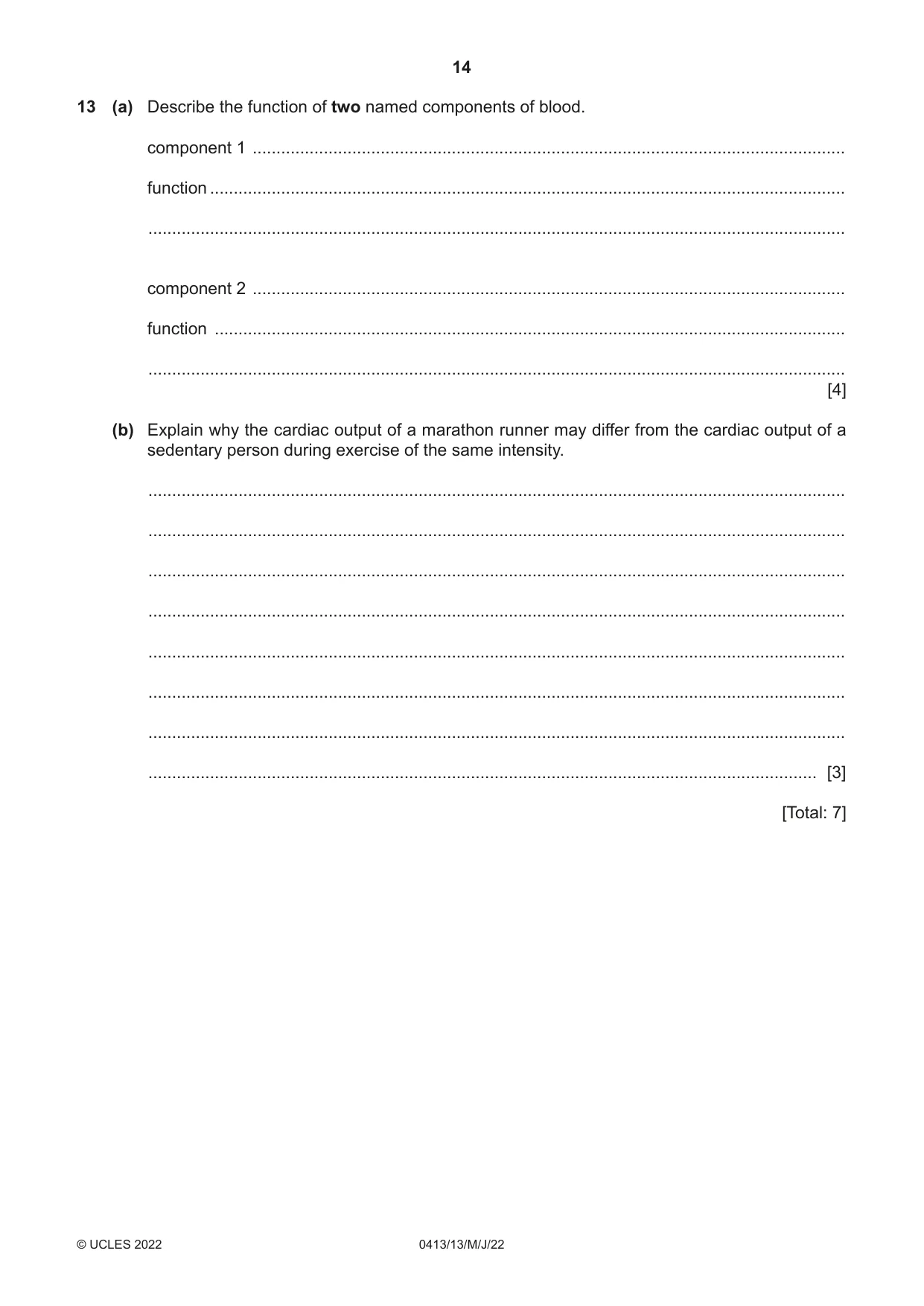
14 0413/13/M/J/22 © UCLES 2022 13 (a) Describe the function of two named components of blood. component 1 … function … … component 2 … function … … [4] (b) Explain why the cardiac output of a marathon runner may differ from the cardiac output of a sedentary person during exercise of the same intensity. … … … … … … … … [3] [Total: 7]
Question paper, page 15
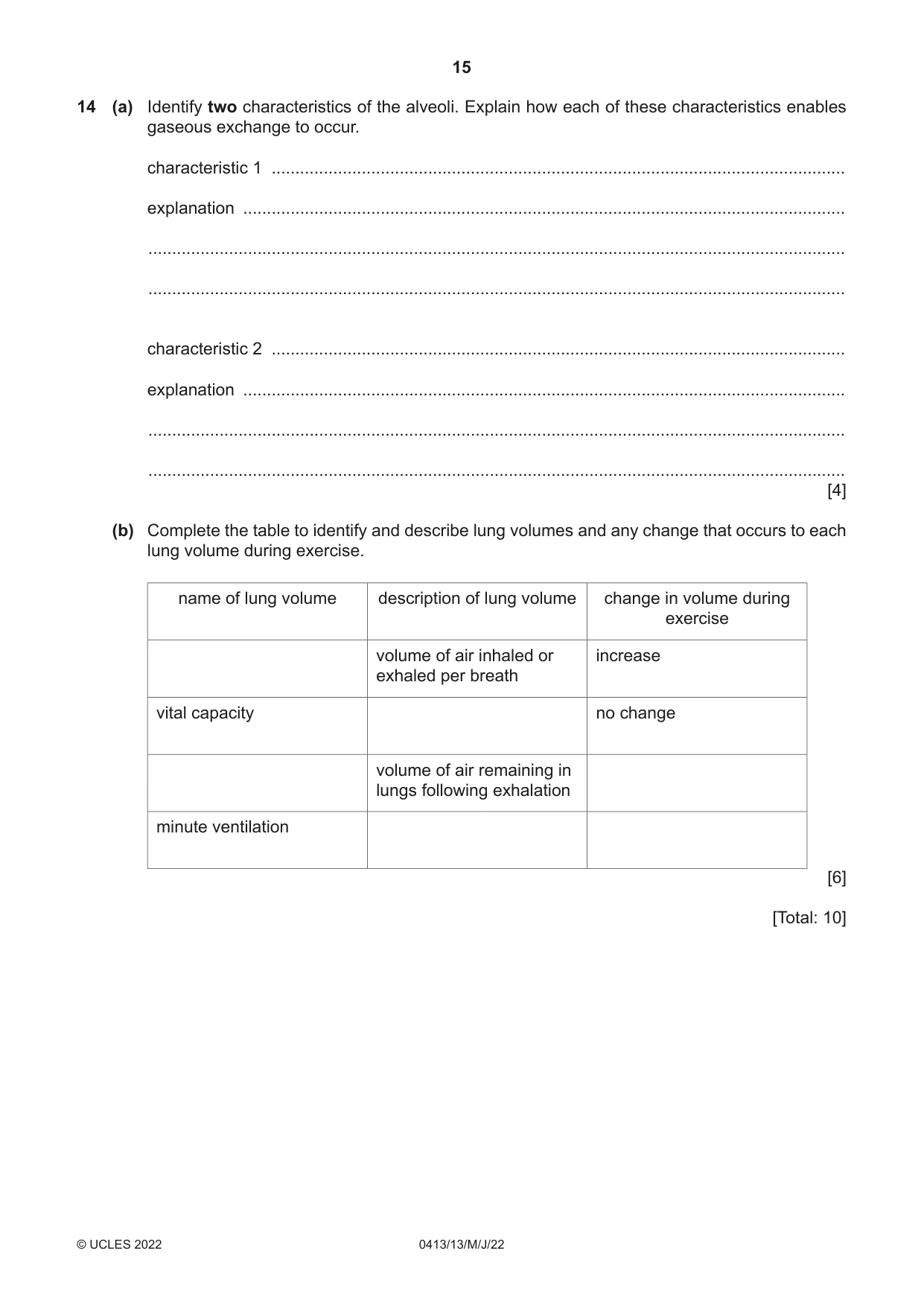
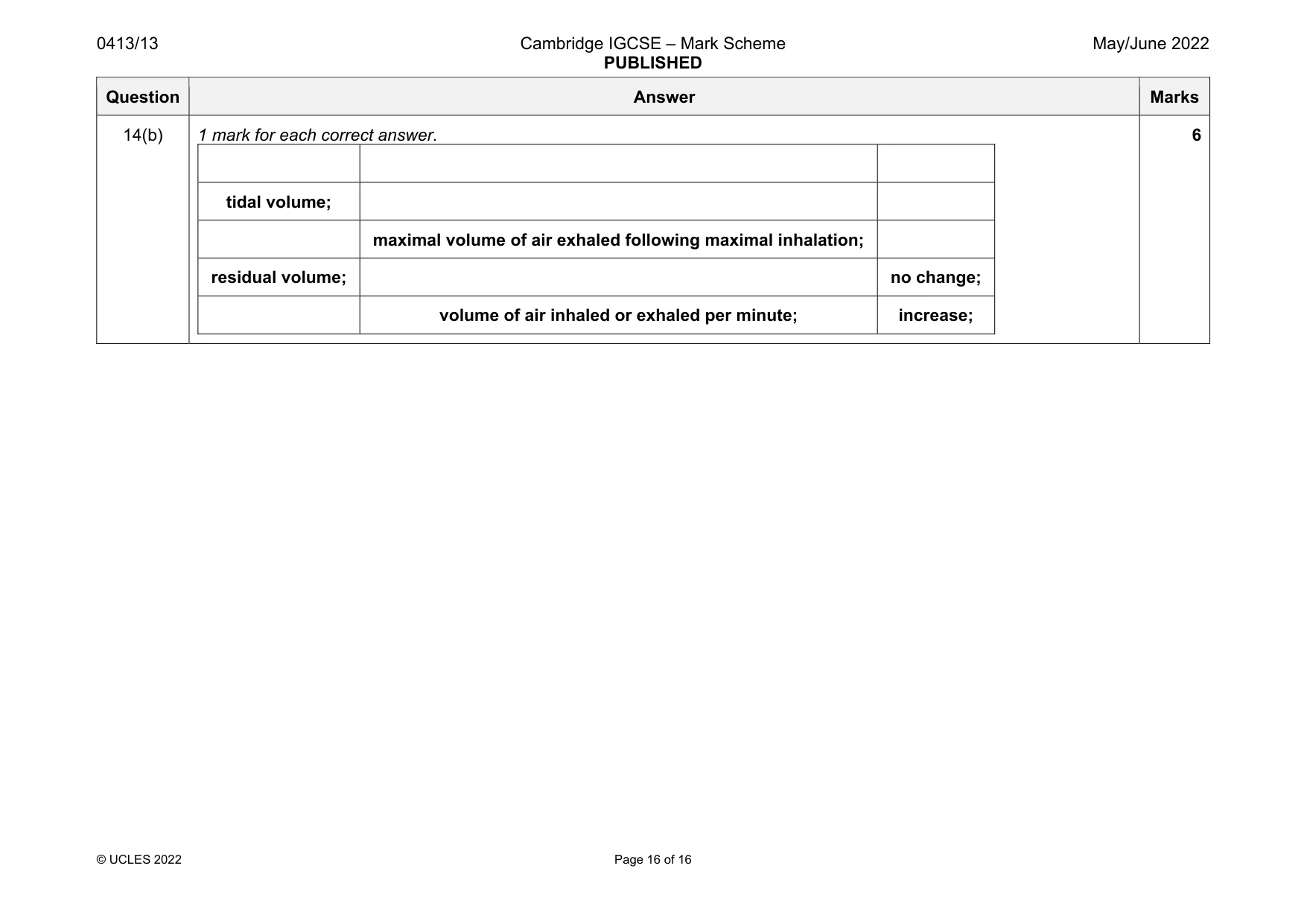
15 0413/13/M/J/22 © UCLES 2022 14 (a) Identify two characteristics of the alveoli. Explain how each of these characteristics enables gaseous exchange to occur. characteristic 1 … explanation … … … characteristic 2 … explanation … … … [4] (b) Complete the table to identify and describe lung volumes and any change that occurs to each lung volume during exercise. name of lung volume description of lung volume change in volume during exercise volume of air inhaled or exhaled per breath increase vital capacity no change volume of air remaining in lungs following exhalation minute ventilation [6] [Total: 10]
Question paper, page 16
16 0413/13/M/J/22 © UCLES 2022 Permission to reproduce items where third-party owned material protected by copyright is included has been sought and cleared where possible. Every reasonable effort has been made by the publisher (UCLES) to trace copyright holders, but if any items requiring clearance have unwittingly been included, the publisher will be pleased to make amends at the earliest possible opportunity. To avoid the issue of disclosure of answer-related information to candidates, all copyright acknowledgements are reproduced online in the Cambridge Assessment International Education Copyright Acknowledgements Booklet. This is produced for each series of examinations and is freely available to download at www.cambridgeinternational.org after the live examination series. Cambridge Assessment International Education is part of Cambridge Assessment. Cambridge Assessment is the brand name of the University of Cambridge Local Examinations Syndicate (UCLES), which is a department of the University of Cambridge. BLANK PAGE
Mark scheme, page 1
This document consists of 16 printed pages. © UCLES 2022 [Turn over Cambridge IGCSE™ PHYSICAL EDUCATION 0413/13 Paper 1 Theory May/June 2022 MARK SCHEME Maximum Mark: 100 Published This mark scheme is published as an aid to teachers and candidates, to indicate the requirements of the examination. It shows the basis on which Examiners were instructed to award marks. It does not indicate the details of the discussions that took place at an Examiners’ meeting before marking began, which would have considered the acceptability of alternative answers. Mark schemes should be read in conjunction with the question paper and the Principal Examiner Report for Teachers. Cambridge International will not enter into discussions about these mark schemes. Cambridge International is publishing the mark schemes for the May/June 2022 series for most Cambridge IGCSE, Cambridge International A and AS Level and Cambridge Pre-U components, and some Cambridge O Level components.
Mark scheme, page 2
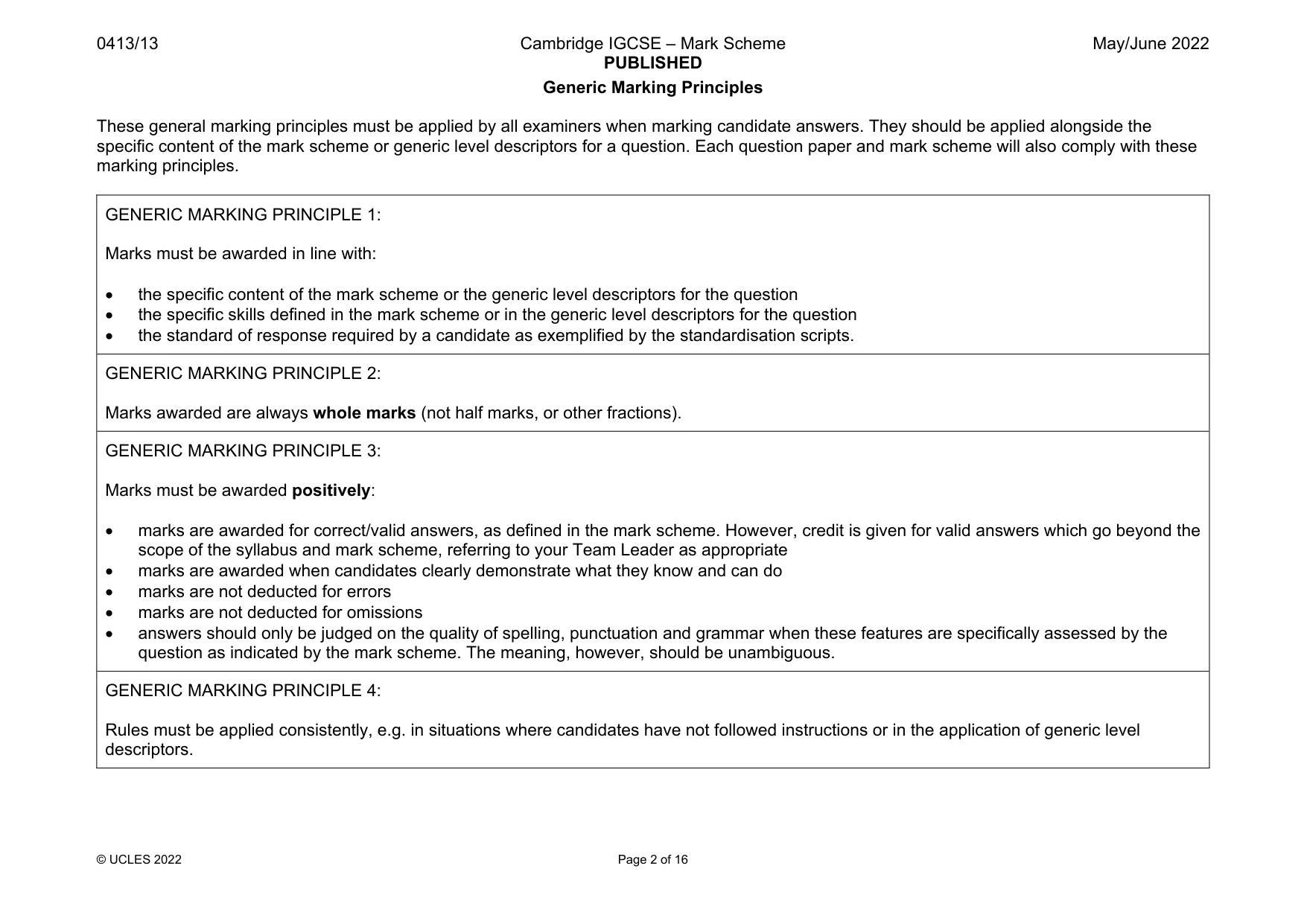
0413/13 Cambridge IGCSE – Mark Scheme PUBLISHED May/June 2022 © UCLES 2022 Page 2 of 16 Generic Marking Principles These general marking principles must be applied by all examiners when marking candidate answers. They should be applied alongside the specific content of the mark scheme or generic level descriptors for a question. Each question paper and mark scheme will also comply with these marking principles. GENERIC MARKING PRINCIPLE 1: Marks must be awarded in line with: the specific content of the mark scheme or the generic level descriptors for the question the specific skills defined in the mark scheme or in the generic level descriptors for the question the standard of response required by a candidate as exemplified by the standardisation scripts. GENERIC MARKING PRINCIPLE 2: Marks awarded are always whole marks (not half marks, or other fractions). GENERIC MARKING PRINCIPLE 3: Marks must be awarded positively: marks are awarded for correct/valid answers, as defined in the mark scheme. However, credit is given for valid answers which go beyond the scope of the syllabus and mark scheme, referring to your Team Leader as appropriate marks are awarded when candidates clearly demonstrate what they know and can do marks are not deducted for errors marks are not deducted for omissions answers should only be judged on the quality of spelling, punctuation and grammar when these features are specifically assessed by the question as indicated by the mark scheme. The meaning, however, should be unambiguous. GENERIC MARKING PRINCIPLE 4: Rules must be applied consistently, e.g. in situations where candidates have not followed instructions or in the application of generic level descriptors.
Mark scheme, page 3
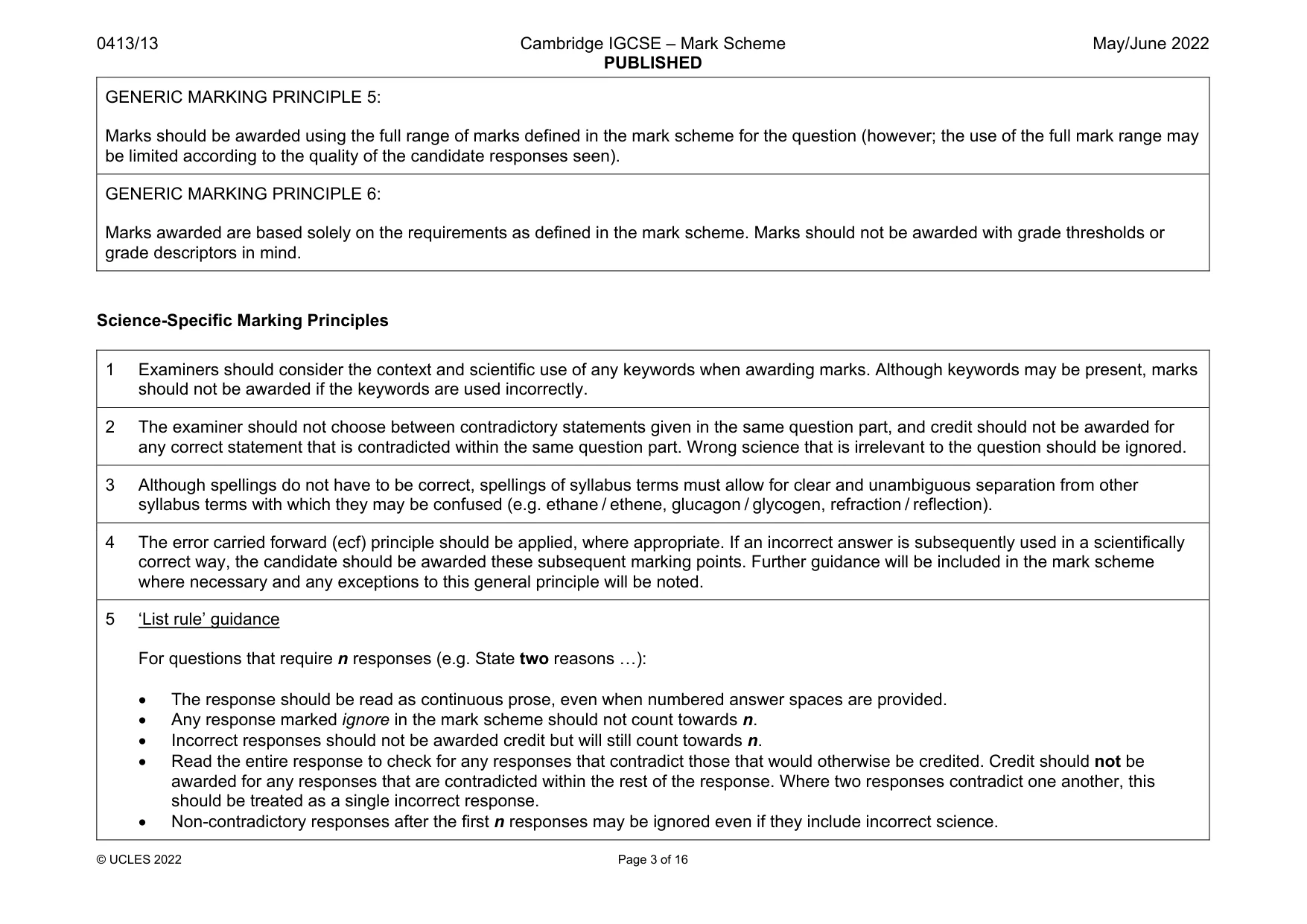
0413/13 Cambridge IGCSE – Mark Scheme PUBLISHED May/June 2022 © UCLES 2022 Page 3 of 16 GENERIC MARKING PRINCIPLE 5: Marks should be awarded using the full range of marks defined in the mark scheme for the question (however; the use of the full mark range may be limited according to the quality of the candidate responses seen). GENERIC MARKING PRINCIPLE 6: Marks awarded are based solely on the requirements as defined in the mark scheme. Marks should not be awarded with grade thresholds or grade descriptors in mind. Science-Specific Marking Principles 1 Examiners should consider the context and scientific use of any keywords when awarding marks. Although keywords may be present, marks should not be awarded if the keywords are used incorrectly. 2 The examiner should not choose between contradictory statements given in the same question part, and credit should not be awarded for any correct statement that is contradicted within the same question part. Wrong science that is irrelevant to the question should be ignored. 3 Although spellings do not have to be correct, spellings of syllabus terms must allow for clear and unambiguous separation from other syllabus terms with which they may be confused (e.g. ethane / ethene, glucagon / glycogen, refraction / reflection). 4 The error carried forward (ecf) principle should be applied, where appropriate. If an incorrect answer is subsequently used in a scientifically correct way, the candidate should be awarded these subsequent marking points. Further guidance will be included in the mark scheme where necessary and any exceptions to this general principle will be noted. 5 ‘List rule’ guidance For questions that require n responses (e.g. State two reasons …): The response should be read as continuous prose, even when numbered answer spaces are provided. Any response marked ignore in the mark scheme should not count towards n. Incorrect responses should not be awarded credit but will still count towards n. Read the entire response to check for any responses that contradict those that would otherwise be credited. Credit should not be awarded for any responses that are contradicted within the rest of the response. Where two responses contradict one another, this should be treated as a single incorrect response. Non-contradictory responses after the first n responses may be ignored even if they include incorrect science.
Mark scheme, page 4
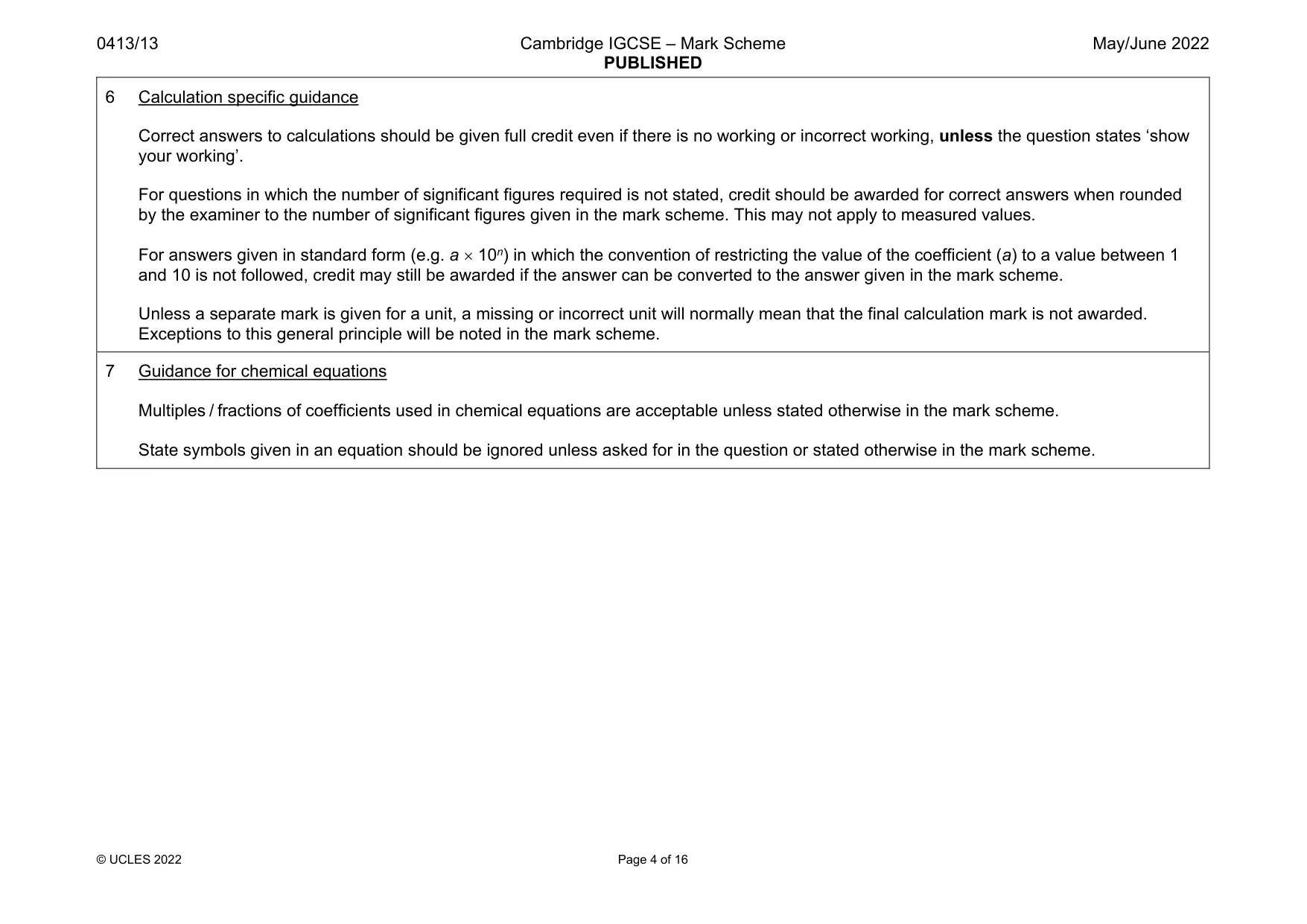
0413/13 Cambridge IGCSE – Mark Scheme PUBLISHED May/June 2022 © UCLES 2022 Page 4 of 16 6 Calculation specific guidance Correct answers to calculations should be given full credit even if there is no working or incorrect working, unless the question states ‘show your working’. For questions in which the number of significant figures required is not stated, credit should be awarded for correct answers when rounded by the examiner to the number of significant figures given in the mark scheme. This may not apply to measured values. For answers given in standard form (e.g. a 10n) in which the convention of restricting the value of the coefficient (a) to a value between 1 and 10 is not followed, credit may still be awarded if the answer can be converted to the answer given in the mark scheme. Unless a separate mark is given for a unit, a missing or incorrect unit will normally mean that the final calculation mark is not awarded. Exceptions to this general principle will be noted in the mark scheme. 7 Guidance for chemical equations Multiples / fractions of coefficients used in chemical equations are acceptable unless stated otherwise in the mark scheme. State symbols given in an equation should be ignored unless asked for in the question or stated otherwise in the mark scheme.
Mark scheme, page 5
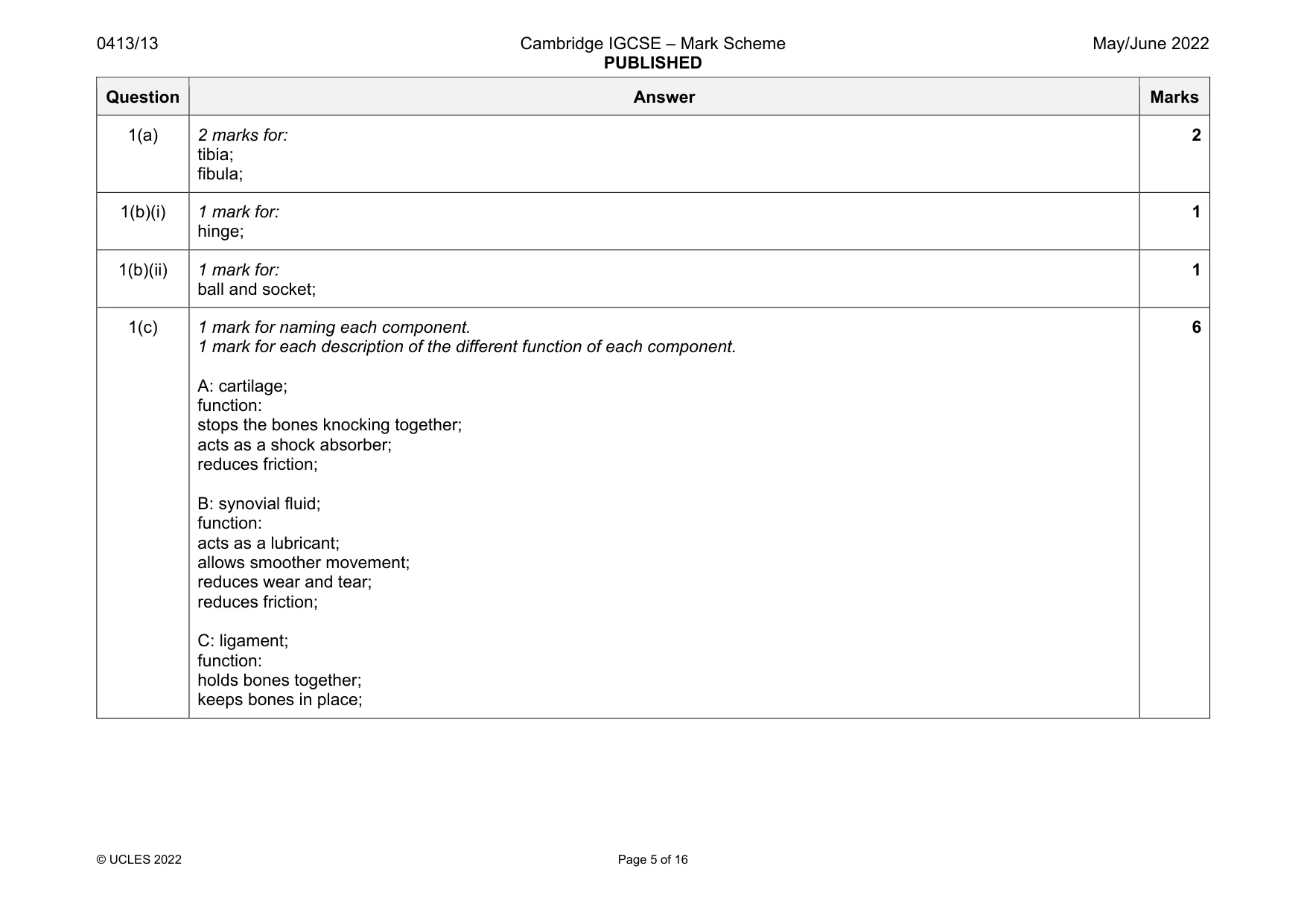
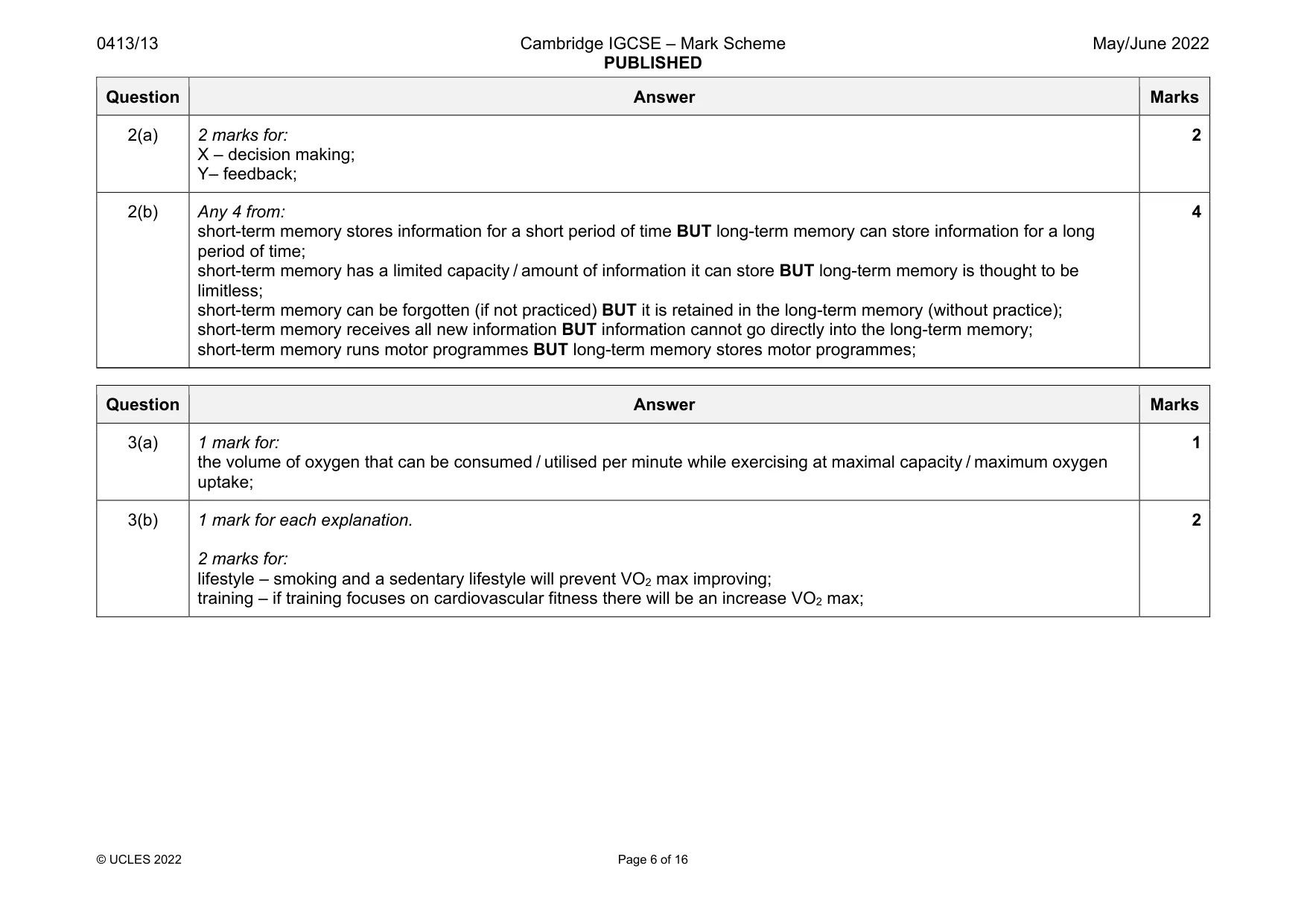
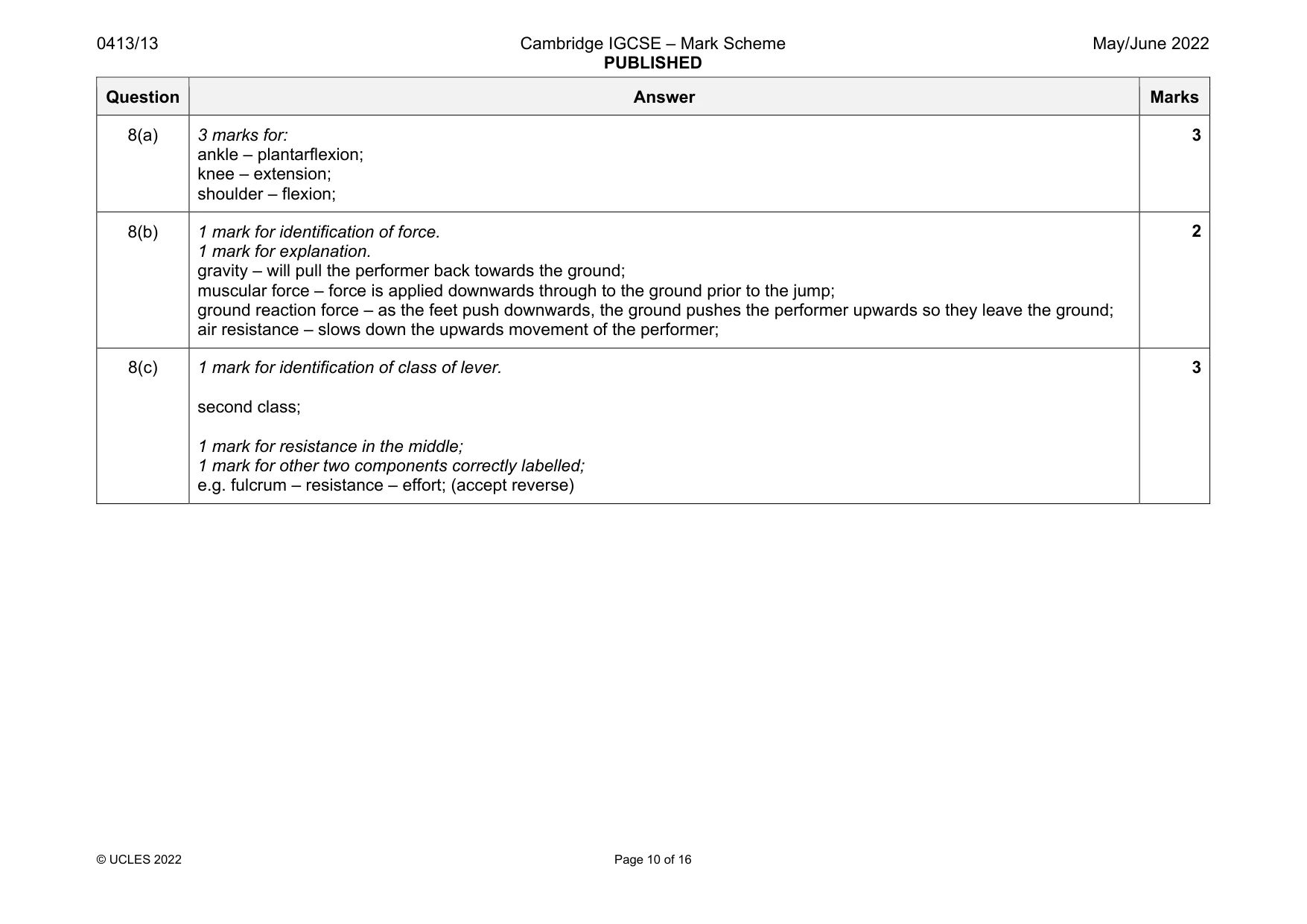
0413/13 Cambridge IGCSE – Mark Scheme PUBLISHED May/June 2022 © UCLES 2022 Page 5 of 16 Question Answer Marks 1(a) 2 marks for: tibia; fibula; 2 1(b)(i) 1 mark for: hinge; 1 1(b)(ii) 1 mark for: ball and socket; 1 1(c) 1 mark for naming each component. 1 mark for each description of the different function of each component. A: cartilage; function: stops the bones knocking together; acts as a shock absorber; reduces friction; B: synovial fluid; function: acts as a lubricant; allows smoother movement; reduces wear and tear; reduces friction; C: ligament; function: holds bones together; keeps bones in place; 6
Mark scheme, page 6
0413/13 Cambridge IGCSE – Mark Scheme PUBLISHED May/June 2022 © UCLES 2022 Page 6 of 16 Question Answer Marks 2(a) 2 marks for: X – decision making; Y– feedback; 2 2(b) Any 4 from: short-term memory stores information for a short period of time BUT long-term memory can store information for a long period of time; short-term memory has a limited capacity / amount of information it can store BUT long-term memory is thought to be limitless; short-term memory can be forgotten (if not practiced) BUT it is retained in the long-term memory (without practice); short-term memory receives all new information BUT information cannot go directly into the long-term memory; short-term memory runs motor programmes BUT long-term memory stores motor programmes; 4 Question Answer Marks 3(a) 1 mark for: the volume of oxygen that can be consumed / utilised per minute while exercising at maximal capacity / maximum oxygen uptake; 1 3(b) 1 mark for each explanation. 2 marks for: lifestyle – smoking and a sedentary lifestyle will prevent VO2 max improving; training – if training focuses on cardiovascular fitness there will be an increase VO2 max; 2
Mark scheme, page 7
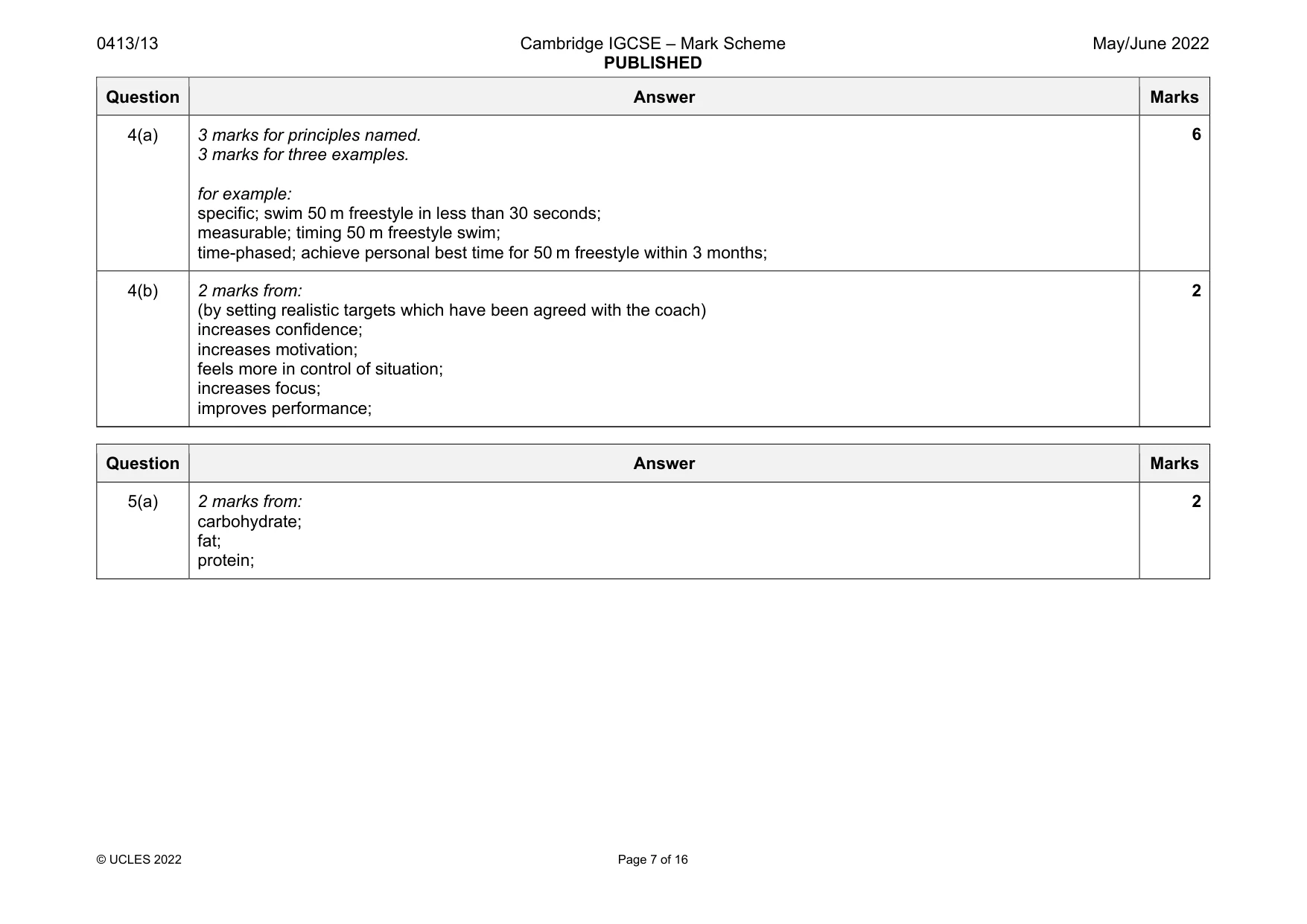
0413/13 Cambridge IGCSE – Mark Scheme PUBLISHED May/June 2022 © UCLES 2022 Page 7 of 16 Question Answer Marks 4(a) 3 marks for principles named. 3 marks for three examples. for example: specific; swim 50 m freestyle in less than 30 seconds; measurable; timing 50 m freestyle swim; time-phased; achieve personal best time for 50 m freestyle within 3 months; 6 4(b) 2 marks from: (by setting realistic targets which have been agreed with the coach) increases confidence; increases motivation; feels more in control of situation; increases focus; improves performance; 2 Question Answer Marks 5(a) 2 marks from: carbohydrate; fat; protein; 2
Mark scheme, page 8
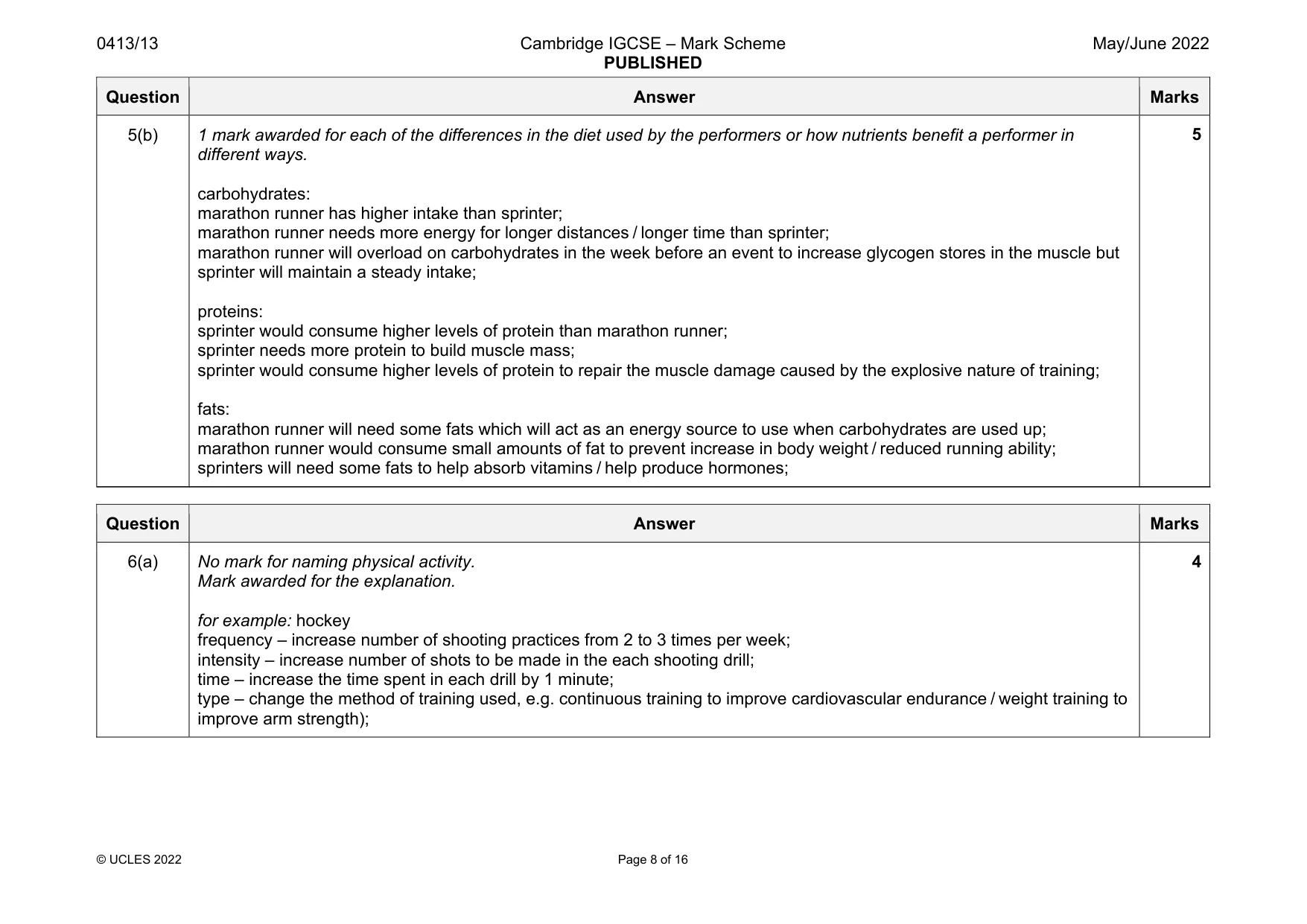
0413/13 Cambridge IGCSE – Mark Scheme PUBLISHED May/June 2022 © UCLES 2022 Page 8 of 16 Question Answer Marks 5(b) 1 mark awarded for each of the differences in the diet used by the performers or how nutrients benefit a performer in different ways. carbohydrates: marathon runner has higher intake than sprinter; marathon runner needs more energy for longer distances / longer time than sprinter; marathon runner will overload on carbohydrates in the week before an event to increase glycogen stores in the muscle but sprinter will maintain a steady intake; proteins: sprinter would consume higher levels of protein than marathon runner; sprinter needs more protein to build muscle mass; sprinter would consume higher levels of protein to repair the muscle damage caused by the explosive nature of training; fats: marathon runner will need some fats which will act as an energy source to use when carbohydrates are used up; marathon runner would consume small amounts of fat to prevent increase in body weight / reduced running ability; sprinters will need some fats to help absorb vitamins / help produce hormones; 5 Question Answer Marks 6(a) No mark for naming physical activity. Mark awarded for the explanation. for example: hockey frequency – increase number of shooting practices from 2 to 3 times per week; intensity – increase number of shots to be made in the each shooting drill; time – increase the time spent in each drill by 1 minute; type – change the method of training used, e.g. continuous training to improve cardiovascular endurance / weight training to improve arm strength); 4
Mark scheme, page 9
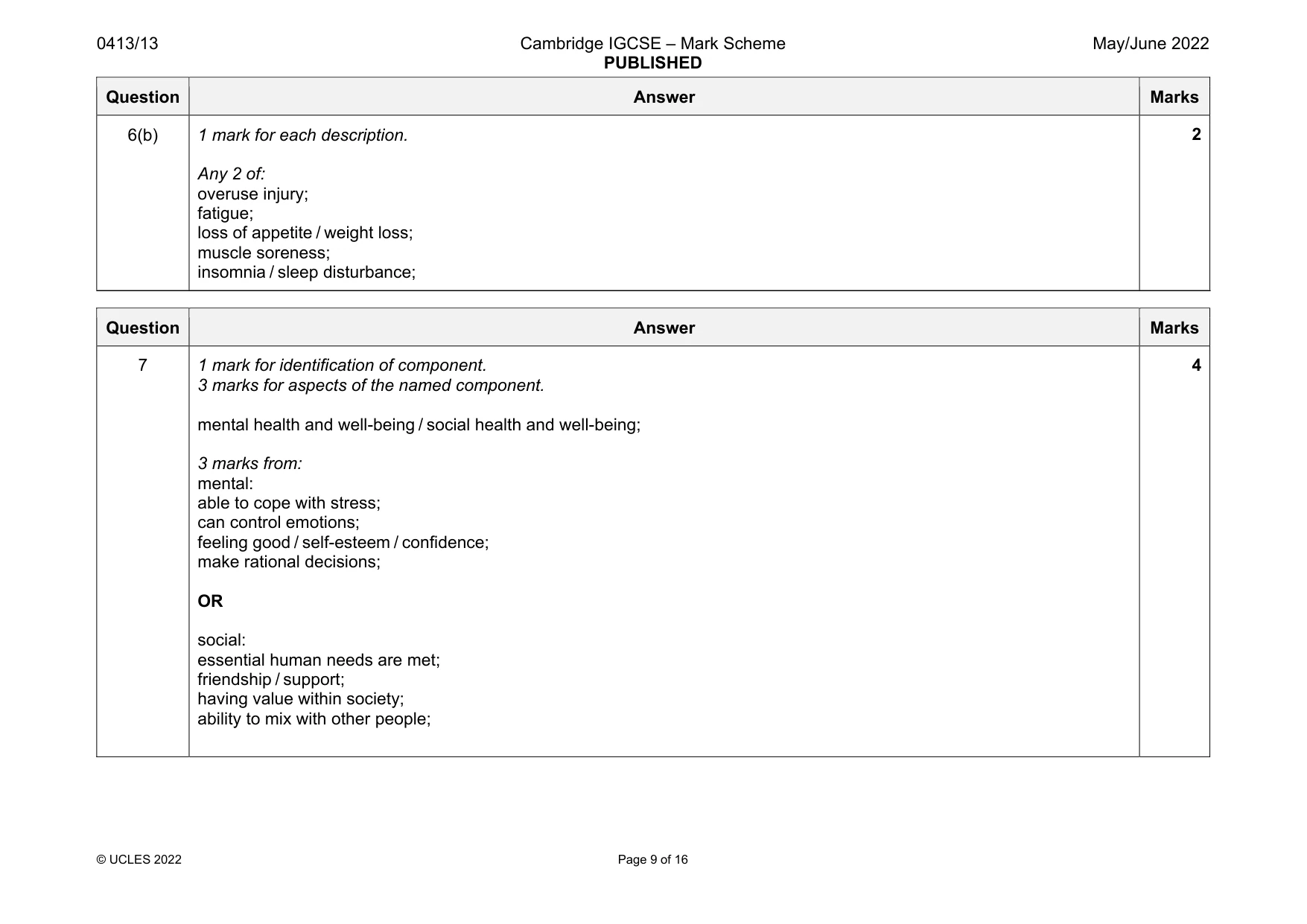
0413/13 Cambridge IGCSE – Mark Scheme PUBLISHED May/June 2022 © UCLES 2022 Page 9 of 16 Question Answer Marks 6(b) 1 mark for each description. Any 2 of: overuse injury; fatigue; loss of appetite / weight loss; muscle soreness; insomnia / sleep disturbance; 2 Question Answer Marks 7 1 mark for identification of component. 3 marks for aspects of the named component. mental health and well-being / social health and well-being; 3 marks from: mental: able to cope with stress; can control emotions; feeling good / self-esteem / confidence; make rational decisions; OR social: essential human needs are met; friendship / support; having value within society; ability to mix with other people; 4
Mark scheme, page 10
0413/13 Cambridge IGCSE – Mark Scheme PUBLISHED May/June 2022 © UCLES 2022 Page 10 of 16 Question Answer Marks 8(a) 3 marks for: ankle – plantarflexion; knee – extension; shoulder – flexion; 3 8(b) 1 mark for identification of force. 1 mark for explanation. gravity – will pull the performer back towards the ground; muscular force – force is applied downwards through to the ground prior to the jump; ground reaction force – as the feet push downwards, the ground pushes the performer upwards so they leave the ground; air resistance – slows down the upwards movement of the performer; 2 8(c) 1 mark for identification of class of lever. second class; 1 mark for resistance in the middle; 1 mark for other two components correctly labelled; e.g. fulcrum – resistance – effort; (accept reverse) 3
Mark scheme, page 11
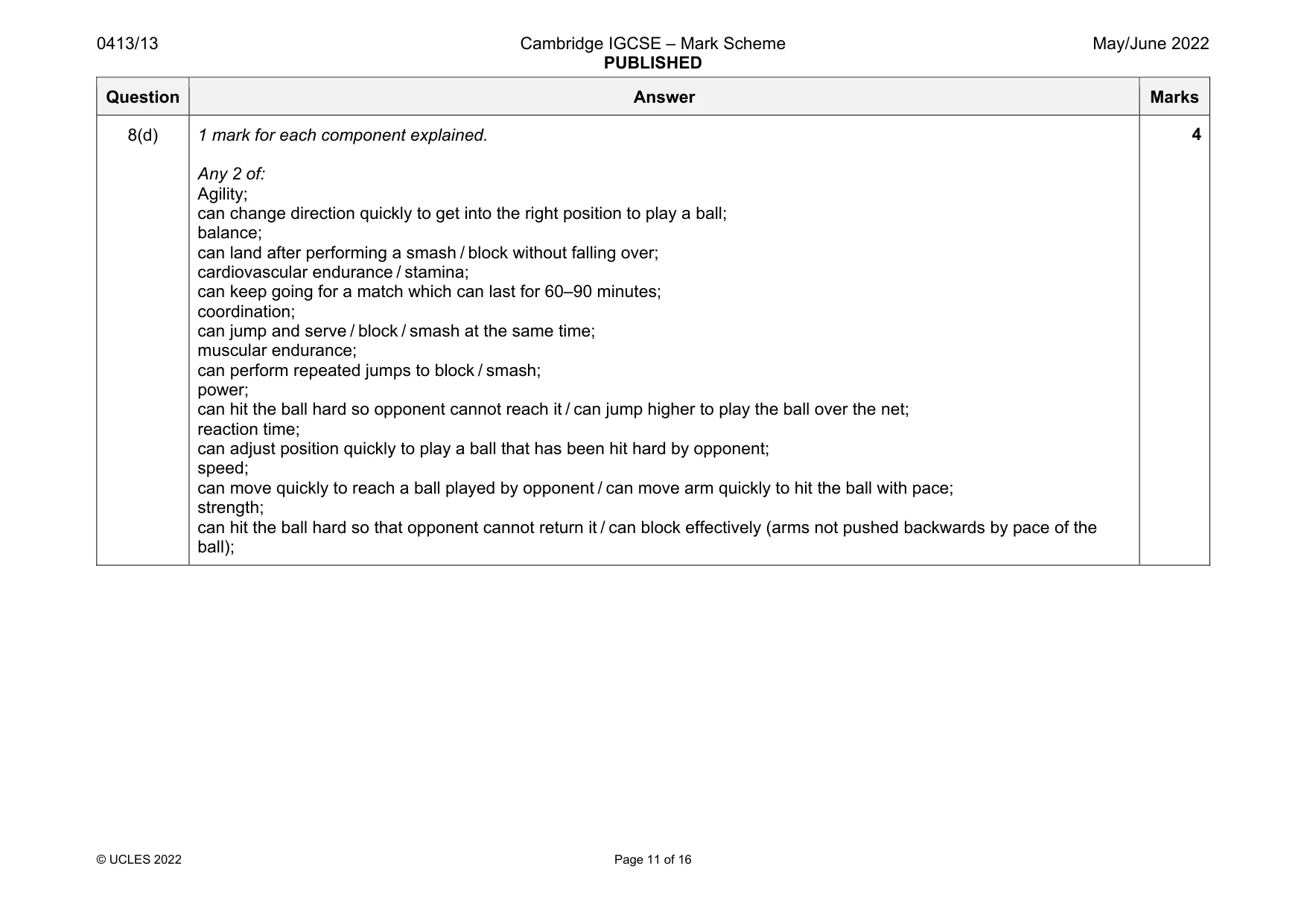
0413/13 Cambridge IGCSE – Mark Scheme PUBLISHED May/June 2022 © UCLES 2022 Page 11 of 16 Question Answer Marks 8(d) 1 mark for each component explained. Any 2 of: Agility; can change direction quickly to get into the right position to play a ball; balance; can land after performing a smash / block without falling over; cardiovascular endurance / stamina; can keep going for a match which can last for 60–90 minutes; coordination; can jump and serve / block / smash at the same time; muscular endurance; can perform repeated jumps to block / smash; power; can hit the ball hard so opponent cannot reach it / can jump higher to play the ball over the net; reaction time; can adjust position quickly to play a ball that has been hit hard by opponent; speed; can move quickly to reach a ball played by opponent / can move arm quickly to hit the ball with pace; strength; can hit the ball hard so that opponent cannot return it / can block effectively (arms not pushed backwards by pace of the ball); 4
Mark scheme, page 12
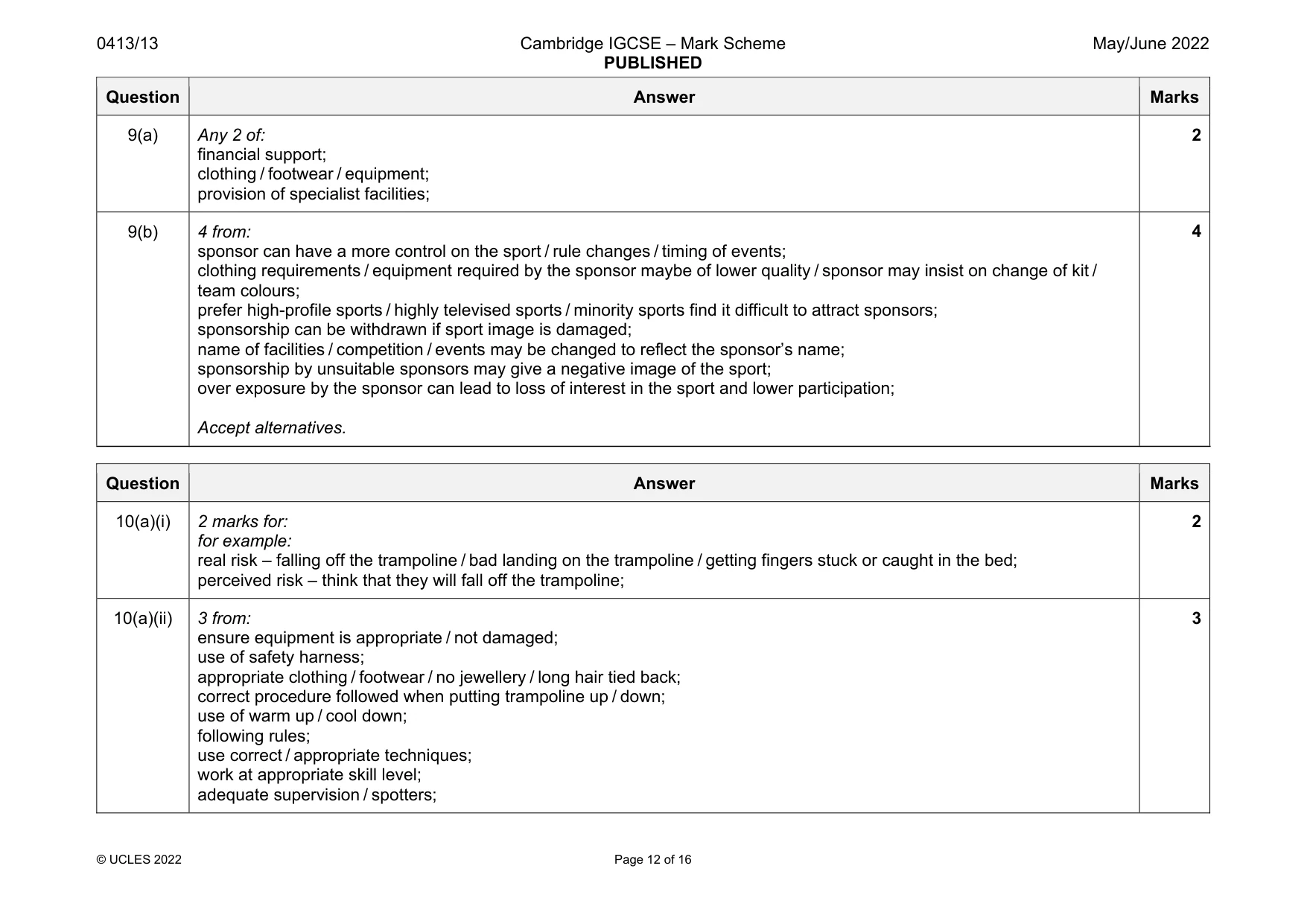
0413/13 Cambridge IGCSE – Mark Scheme PUBLISHED May/June 2022 © UCLES 2022 Page 12 of 16 Question Answer Marks 9(a) Any 2 of: financial support; clothing / footwear / equipment; provision of specialist facilities; 2 9(b) 4 from: sponsor can have a more control on the sport / rule changes / timing of events; clothing requirements / equipment required by the sponsor maybe of lower quality / sponsor may insist on change of kit / team colours; prefer high-profile sports / highly televised sports / minority sports find it difficult to attract sponsors; sponsorship can be withdrawn if sport image is damaged; name of facilities / competition / events may be changed to reflect the sponsor’s name; sponsorship by unsuitable sponsors may give a negative image of the sport; over exposure by the sponsor can lead to loss of interest in the sport and lower participation; Accept alternatives. 4 Question Answer Marks 10(a)(i) 2 marks for: for example: real risk – falling off the trampoline / bad landing on the trampoline / getting fingers stuck or caught in the bed; perceived risk – think that they will fall off the trampoline; 2 10(a)(ii) 3 from: ensure equipment is appropriate / not damaged; use of safety harness; appropriate clothing / footwear / no jewellery / long hair tied back; correct procedure followed when putting trampoline up / down; use of warm up / cool down; following rules; use correct / appropriate techniques; work at appropriate skill level; adequate supervision / spotters; 3
Mark scheme, page 13
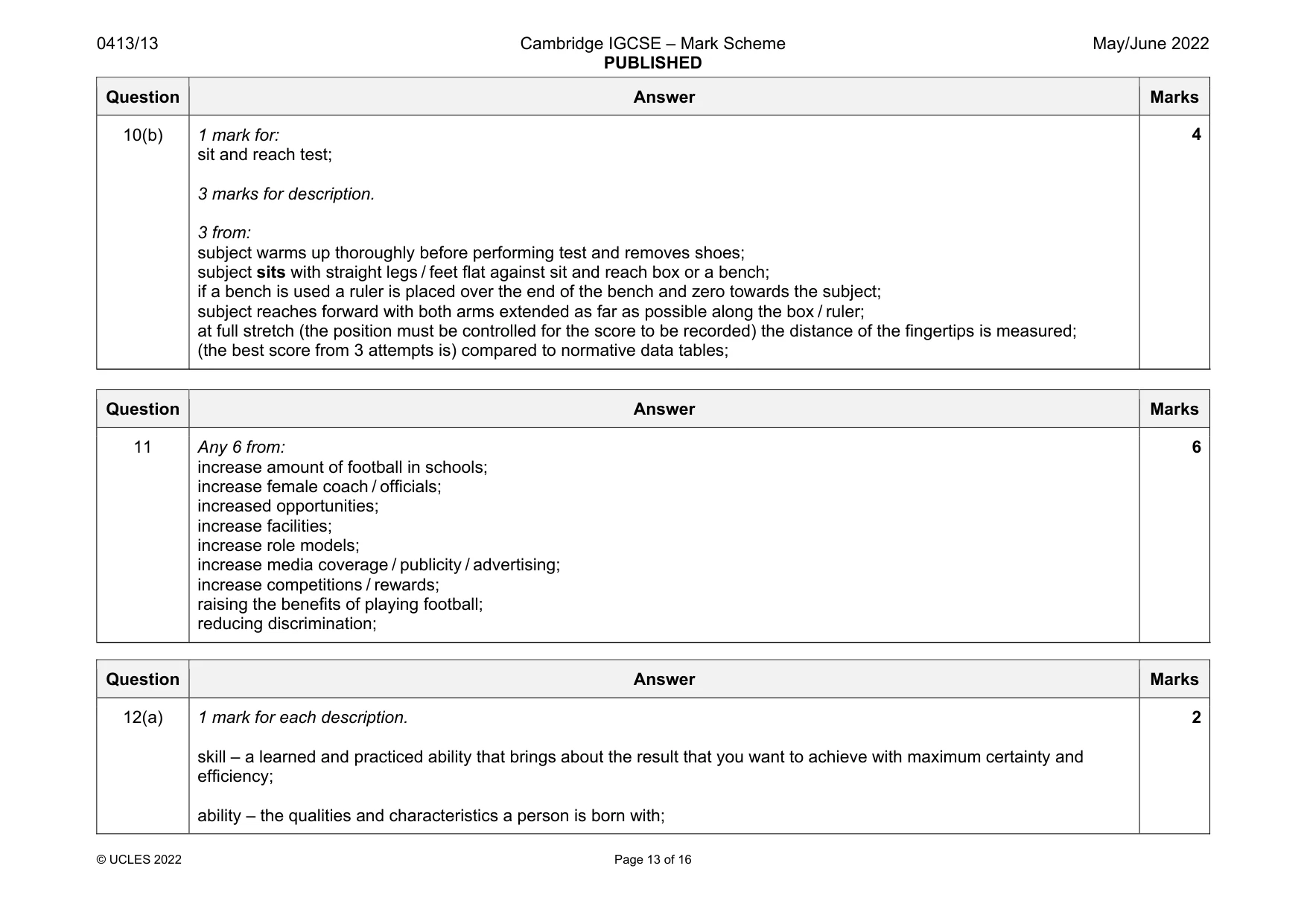
0413/13 Cambridge IGCSE – Mark Scheme PUBLISHED May/June 2022 © UCLES 2022 Page 13 of 16 Question Answer Marks 10(b) 1 mark for: sit and reach test; 3 marks for description. 3 from: subject warms up thoroughly before performing test and removes shoes; subject sits with straight legs / feet flat against sit and reach box or a bench; if a bench is used a ruler is placed over the end of the bench and zero towards the subject; subject reaches forward with both arms extended as far as possible along the box / ruler; at full stretch (the position must be controlled for the score to be recorded) the distance of the fingertips is measured; (the best score from 3 attempts is) compared to normative data tables; 4 Question Answer Marks 11 Any 6 from: increase amount of football in schools; increase female coach / officials; increased opportunities; increase facilities; increase role models; increase media coverage / publicity / advertising; increase competitions / rewards; raising the benefits of playing football; reducing discrimination; 6 Question Answer Marks 12(a) 1 mark for each description. skill – a learned and practiced ability that brings about the result that you want to achieve with maximum certainty and efficiency; ability – the qualities and characteristics a person is born with; 2
Mark scheme, page 14
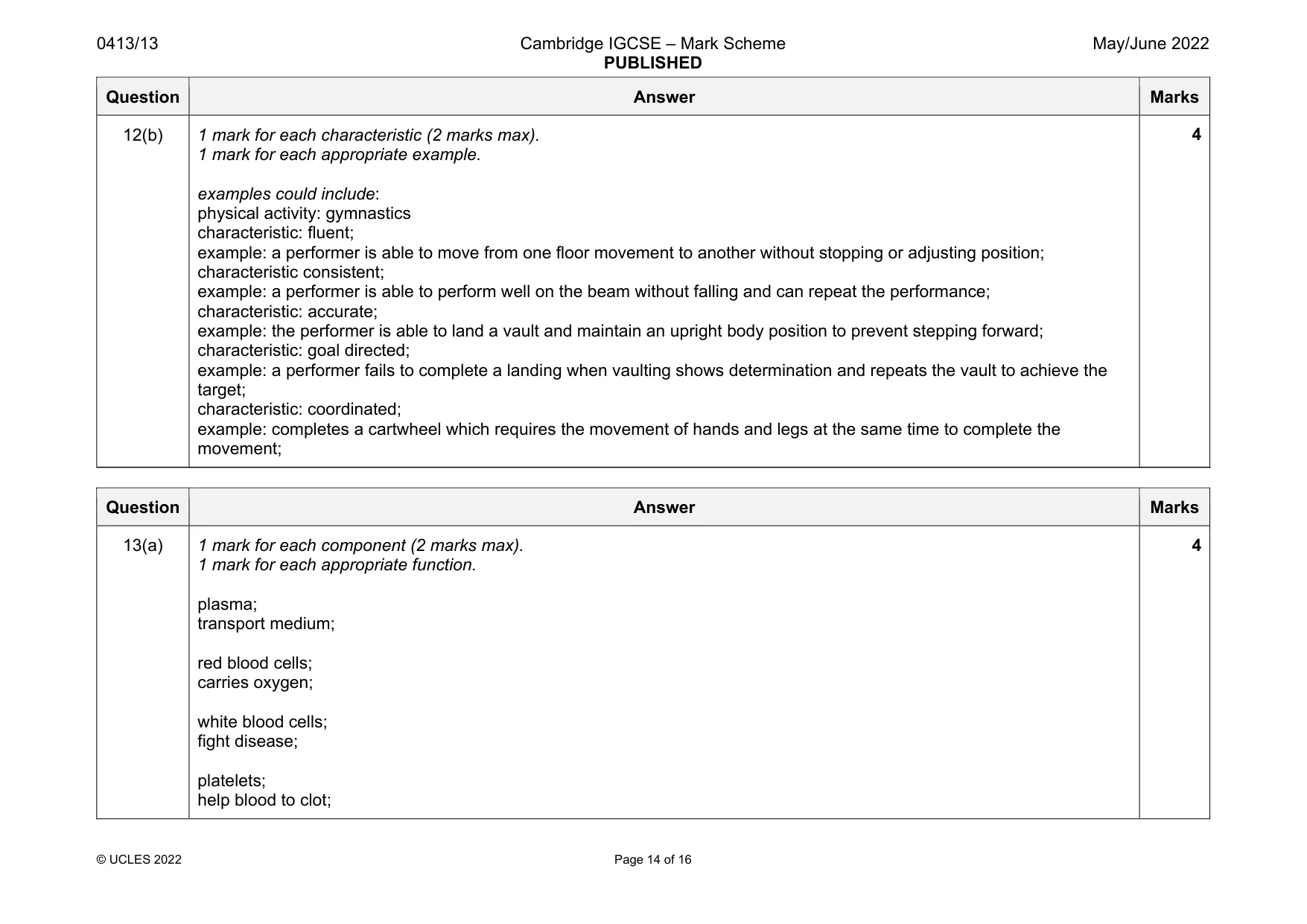
0413/13 Cambridge IGCSE – Mark Scheme PUBLISHED May/June 2022 © UCLES 2022 Page 14 of 16 Question Answer Marks 12(b) 1 mark for each characteristic (2 marks max). 1 mark for each appropriate example. examples could include: physical activity: gymnastics characteristic: fluent; example: a performer is able to move from one floor movement to another without stopping or adjusting position; characteristic consistent; example: a performer is able to perform well on the beam without falling and can repeat the performance; characteristic: accurate; example: the performer is able to land a vault and maintain an upright body position to prevent stepping forward; characteristic: goal directed; example: a performer fails to complete a landing when vaulting shows determination and repeats the vault to achieve the target; characteristic: coordinated; example: completes a cartwheel which requires the movement of hands and legs at the same time to complete the movement; 4 Question Answer Marks 13(a) 1 mark for each component (2 marks max). 1 mark for each appropriate function. plasma; transport medium; red blood cells; carries oxygen; white blood cells; fight disease; platelets; help blood to clot; 4
Mark scheme, page 15
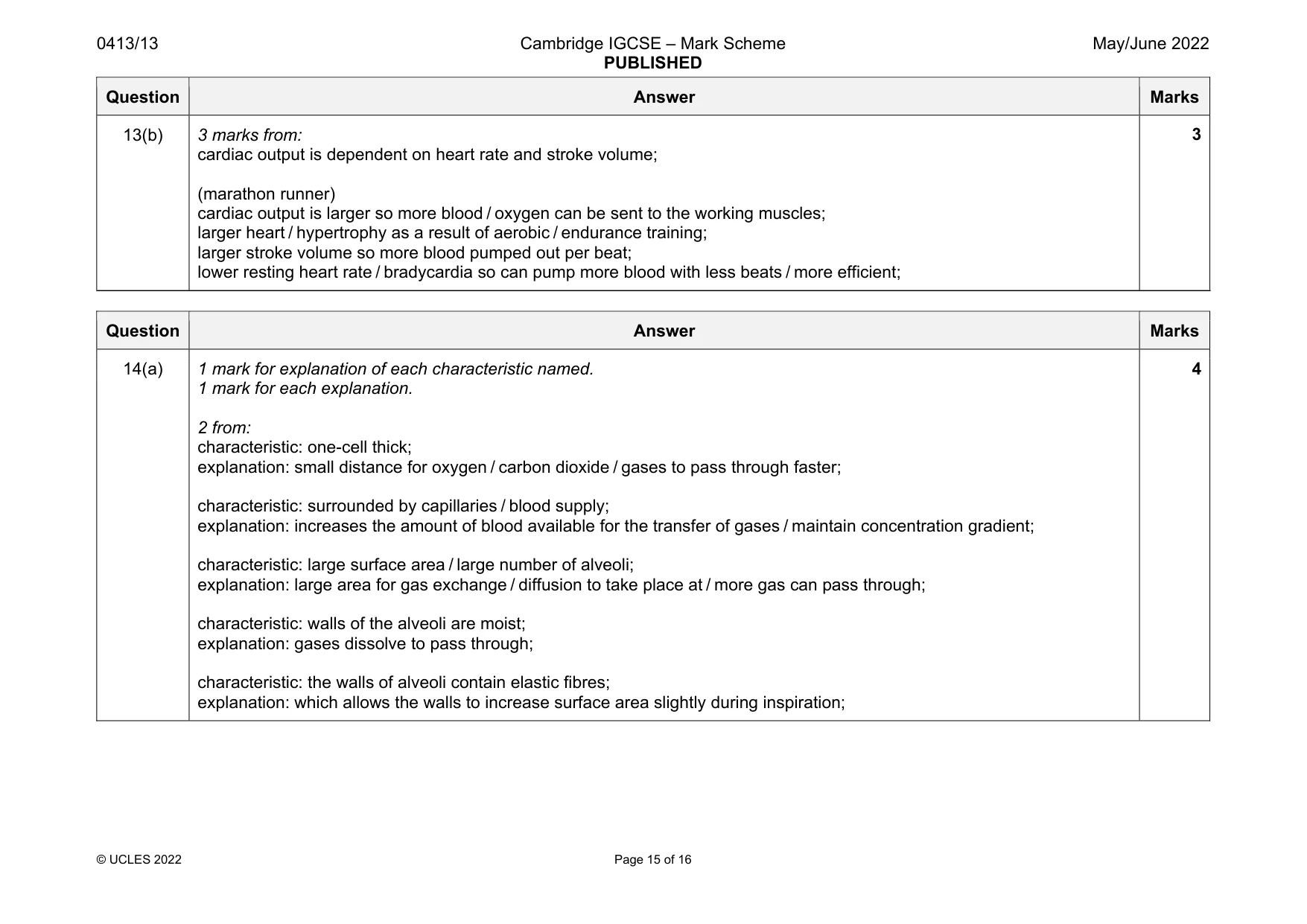
0413/13 Cambridge IGCSE – Mark Scheme PUBLISHED May/June 2022 © UCLES 2022 Page 15 of 16 Question Answer Marks 13(b) 3 marks from: cardiac output is dependent on heart rate and stroke volume; (marathon runner) cardiac output is larger so more blood / oxygen can be sent to the working muscles; larger heart / hypertrophy as a result of aerobic / endurance training; larger stroke volume so more blood pumped out per beat; lower resting heart rate / bradycardia so can pump more blood with less beats / more efficient; 3 Question Answer Marks 14(a) 1 mark for explanation of each characteristic named. 1 mark for each explanation. 2 from: characteristic: one-cell thick; explanation: small distance for oxygen / carbon dioxide / gases to pass through faster; characteristic: surrounded by capillaries / blood supply; explanation: increases the amount of blood available for the transfer of gases / maintain concentration gradient; characteristic: large surface area / large number of alveoli; explanation: large area for gas exchange / diffusion to take place at / more gas can pass through; characteristic: walls of the alveoli are moist; explanation: gases dissolve to pass through; characteristic: the walls of alveoli contain elastic fibres; explanation: which allows the walls to increase surface area slightly during inspiration; 4
Mark scheme, page 16
0413/13 Cambridge IGCSE – Mark Scheme PUBLISHED May/June 2022 © UCLES 2022 Page 16 of 16 Question Answer Marks 14(b) 1 mark for each correct answer. tidal volume; maximal volume of air exhaled following maximal inhalation; residual volume; no change; volume of air inhaled or exhaled per minute; increase; 6
What you needed in this session
Cambridge’s own grade thresholds for 2022 May/June, Paper 1 · Variant 3. A higher threshold means an easier paper — the bar moves with how the cohort did.