Cambridge IGCSE Physical Education 0413 — 2019 Oct/Nov Paper 1 · Variant 2
0413/12/O/N/19 · 100 marks · ≈113 min
The question paper and its mark scheme, free to read here and free to download. This is Cambridge’s own paper, exactly as it was sat.
Question paper20 pages



Mark scheme23 pages
Answers below. Sit the paper first if you are practising.
Paper as text
Question paper, page 1
This document consists of 17 printed pages and 3 blank pages. DC (RW/TP) 164478/4 © UCLES 2019 [Turn over Cambridge Assessment International Education Cambridge International General Certificate of Secondary Education * 8 2 5 5 7 9 3 8 6 6 * PHYSICAL EDUCATION 0413/12 Paper 1 Theory October/November 2019 1 hour 45 minutes Candidates answer on the Question Paper. No Additional Materials are required. READ THESE INSTRUCTIONS FIRST Write your centre number, candidate number and name on all the work you hand in. Write in dark blue or black pen. You may use an HB pencil for any diagrams or graphs. Do not use staples, paper clips, glue or correction fluid. DO NOT WRITE IN ANY BARCODES. Answer all questions. Electronic calculators may be used. You may lose marks if you do not show your working or if you do not use appropriate units. The number of marks is given in brackets [ ] at the end of each question or part question. The total mark for this paper is 100.
Question paper, page 2
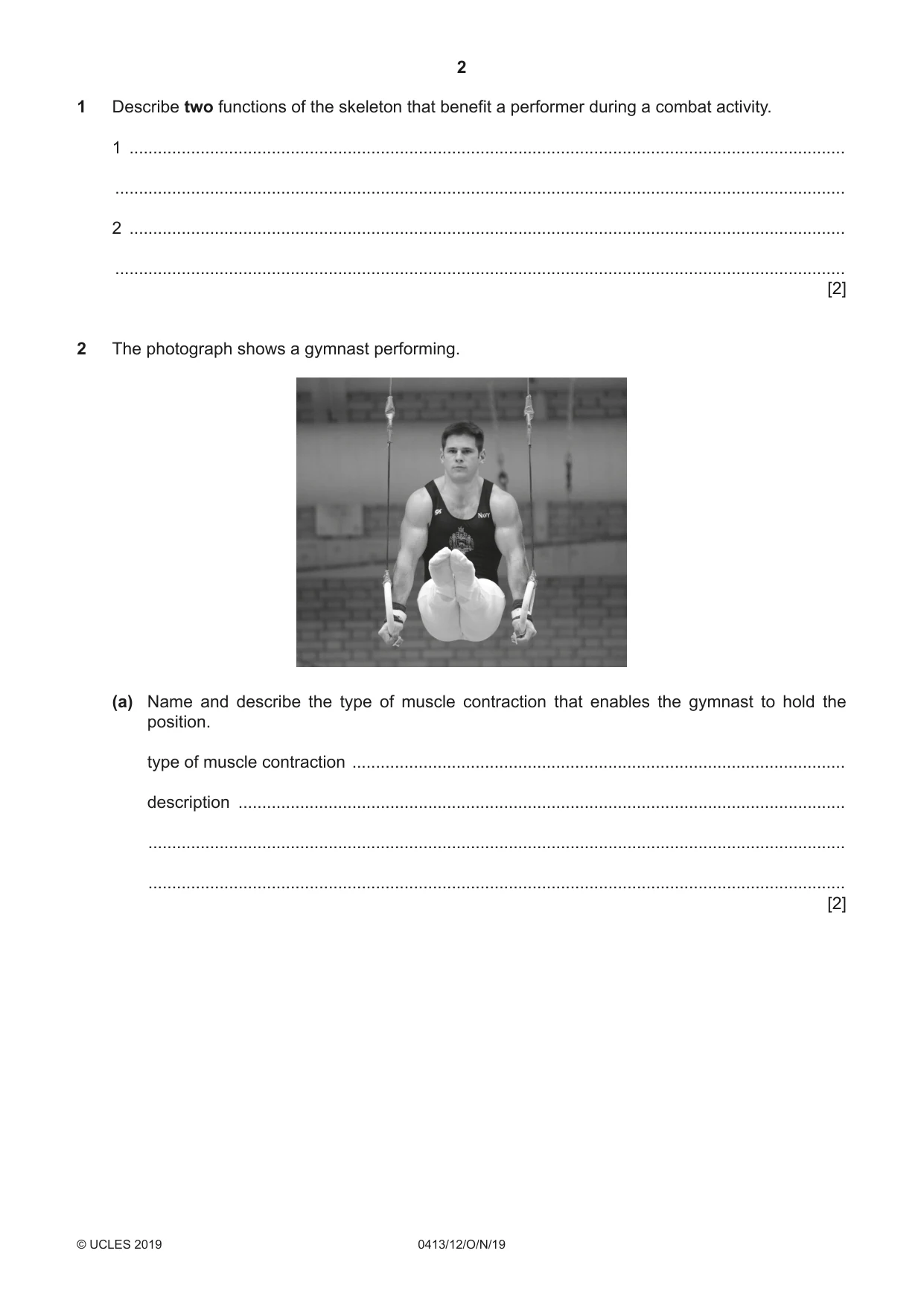
2 0413/12/O/N/19 © UCLES 2019 1 Describe two functions of the skeleton that benefit a performer during a combat activity. 1 … … 2 … … [2] 2 The photograph shows a gymnast performing. (a) Name and describe the type of muscle contraction that enables the gymnast to hold the position. type of muscle contraction … description … … … [2]
Question paper, page 3
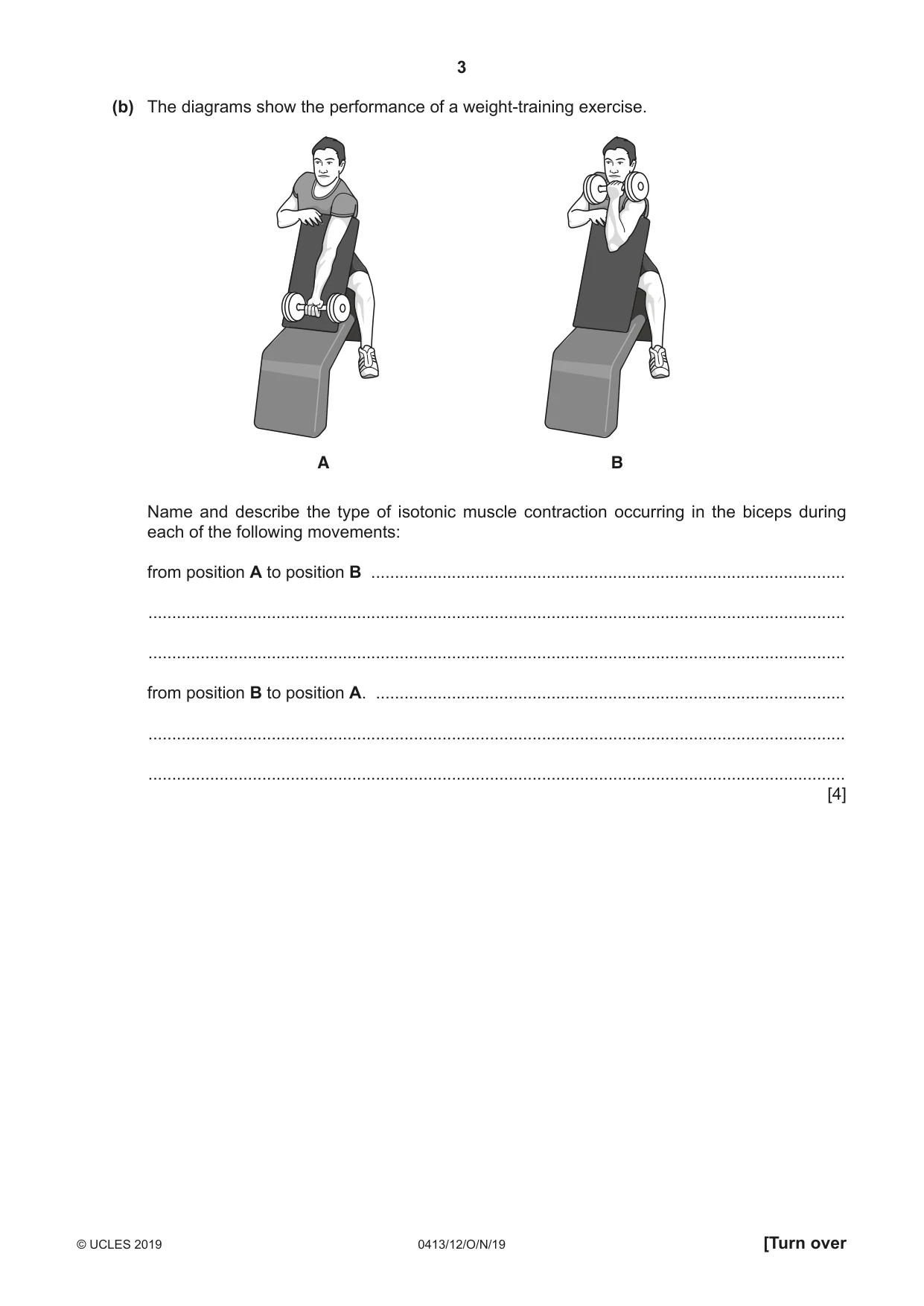
3 0413/12/O/N/19 © UCLES 2019 [Turn over (b) The diagrams show the performance of a weight-training exercise. B A Name and describe the type of isotonic muscle contraction occurring in the biceps during each of the following movements: from position A to position B … … … from position B to position A. … … … [4]
Question paper, page 4
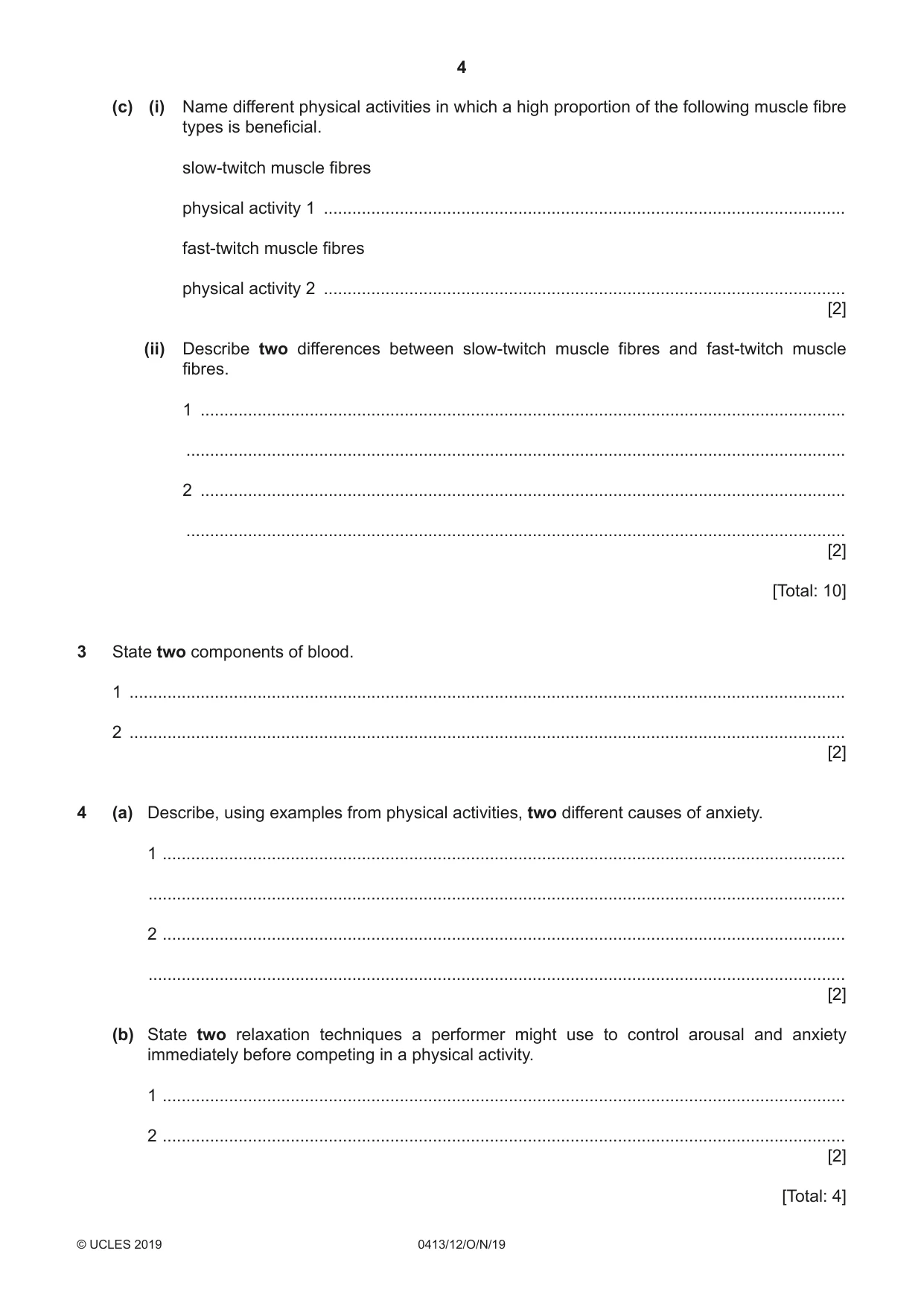
4 0413/12/O/N/19 © UCLES 2019 (c) (i) Name different physical activities in which a high proportion of the following muscle fibre types is beneficial. slow-twitch muscle fibres physical activity 1 … fast-twitch muscle fibres physical activity 2 … [2] (ii) Describe two differences between slow-twitch muscle fibres and fast-twitch muscle fibres. 1 … … 2 … … [2] [Total: 10] 3 State two components of blood. 1 … 2 … [2] 4 (a) Describe, using examples from physical activities, two different causes of anxiety. 1 … … 2 … … [2] (b) State two relaxation techniques a performer might use to control arousal and anxiety immediately before competing in a physical activity. 1 … 2 … [2] [Total: 4]
Question paper, page 5
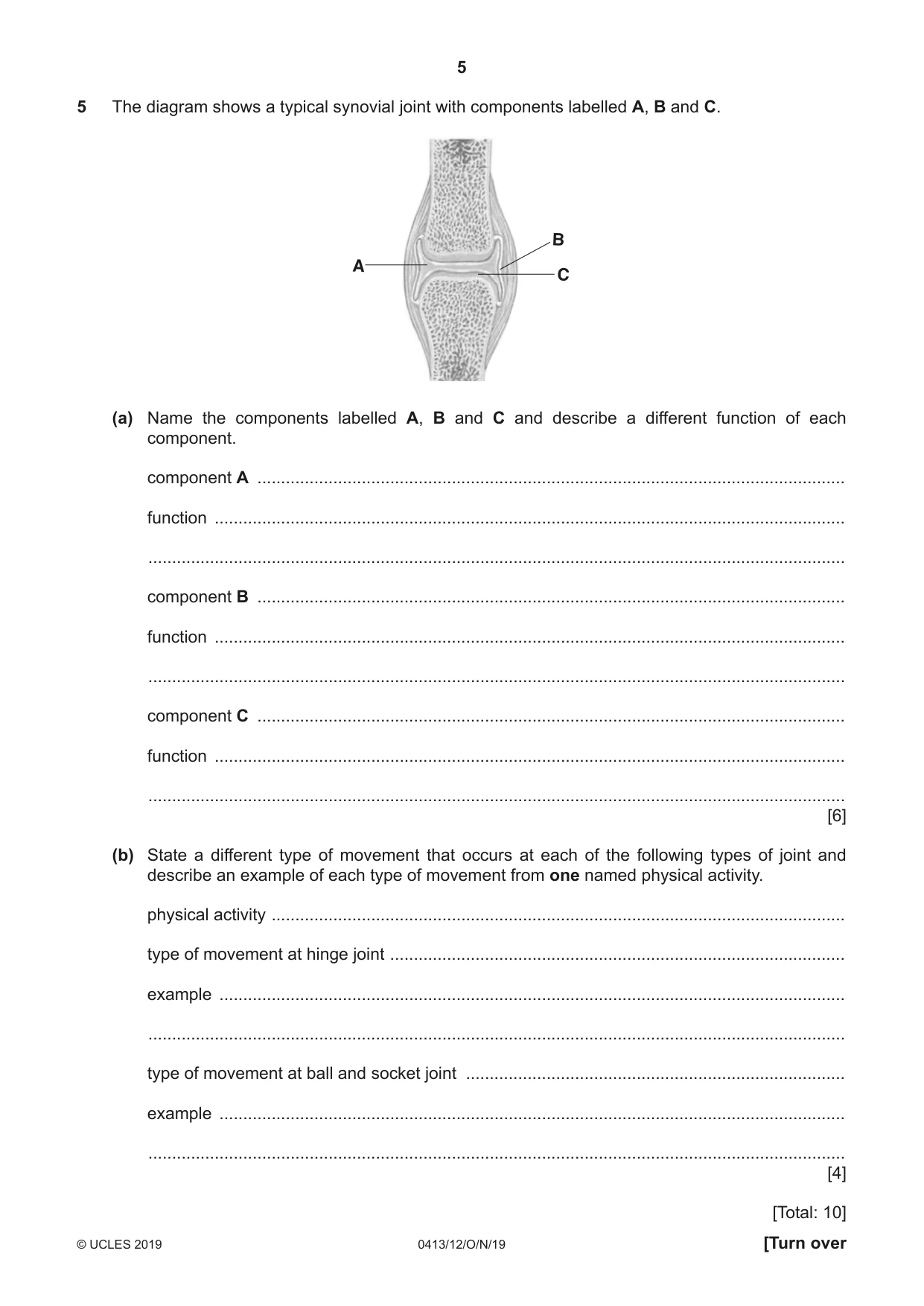
5 0413/12/O/N/19 © UCLES 2019 [Turn over 5 The diagram shows a typical synovial joint with components labelled A, B and C. C B A (a) Name the components labelled A, B and C and describe a different function of each component. component A … function … … component B … function … … component C … function … … [6] (b) State a different type of movement that occurs at each of the following types of joint and describe an example of each type of movement from one named physical activity. physical activity … type of movement at hinge joint … example … … type of movement at ball and socket joint … example … … [4] [Total: 10]
Question paper, page 6
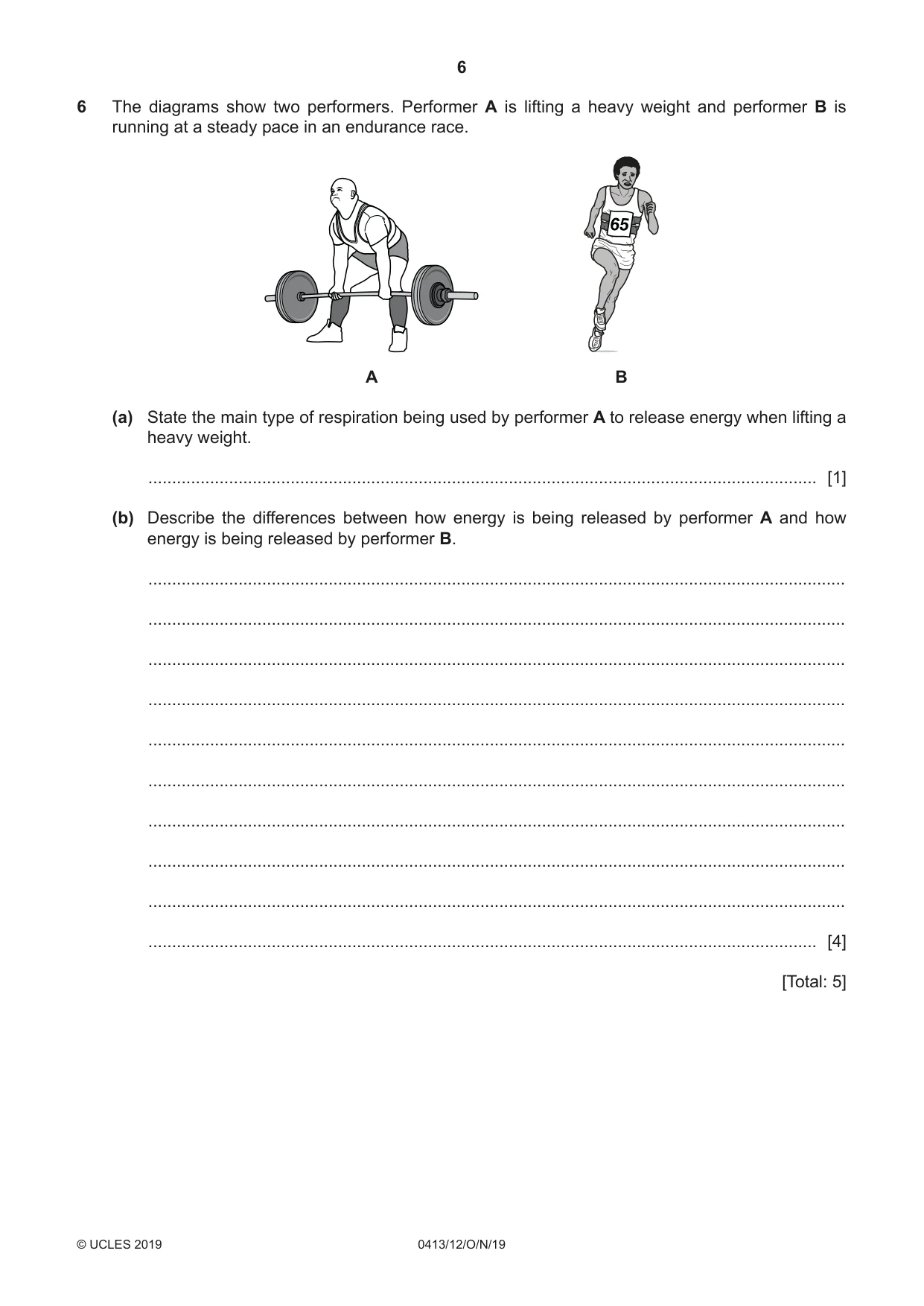
6 0413/12/O/N/19 © UCLES 2019 6 The diagrams show two performers. Performer A is lifting a heavy weight and performer B is running at a steady pace in an endurance race. A B (a) State the main type of respiration being used by performer A to release energy when lifting a heavy weight. … [1] (b) Describe the differences between how energy is being released by performer A and how energy is being released by performer B. … … … … … … … … … … [4] [Total: 5]
Question paper, page 7
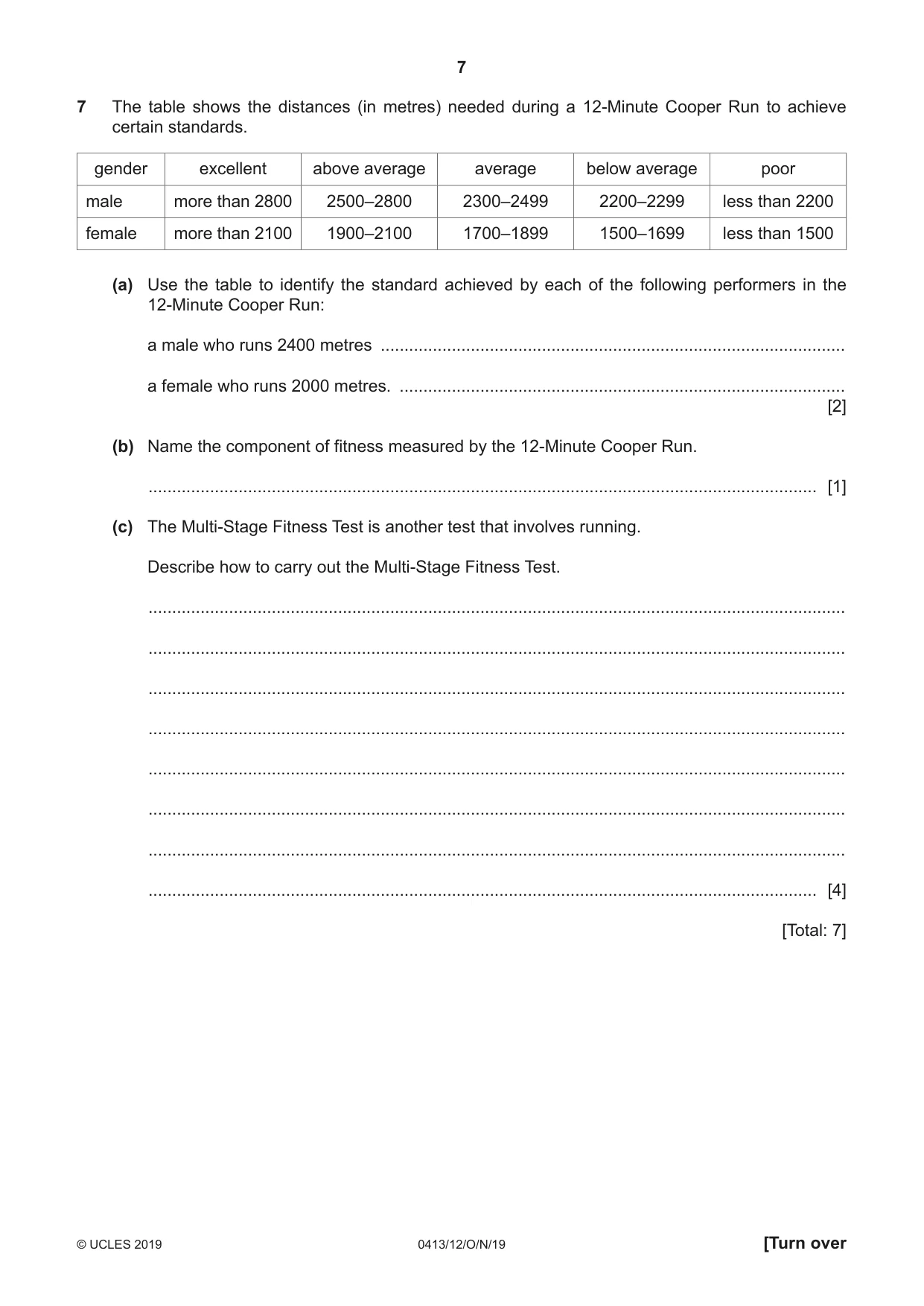
7 0413/12/O/N/19 © UCLES 2019 [Turn over 7 The table shows the distances (in metres) needed during a 12-Minute Cooper Run to achieve certain standards. gender excellent above average average below average poor male more than 2800 2500–2800 2300–2499 2200–2299 less than 2200 female more than 2100 1900–2100 1700–1899 1500–1699 less than 1500 (a) Use the table to identify the standard achieved by each of the following performers in the 12-Minute Cooper Run: a male who runs 2400 metres … a female who runs 2000 metres. … [2] (b) Name the component of fitness measured by the 12-Minute Cooper Run. … [1] (c) The Multi-Stage Fitness Test is another test that involves running. Describe how to carry out the Multi-Stage Fitness Test. … … … … … … … … [4] [Total: 7]
Question paper, page 8
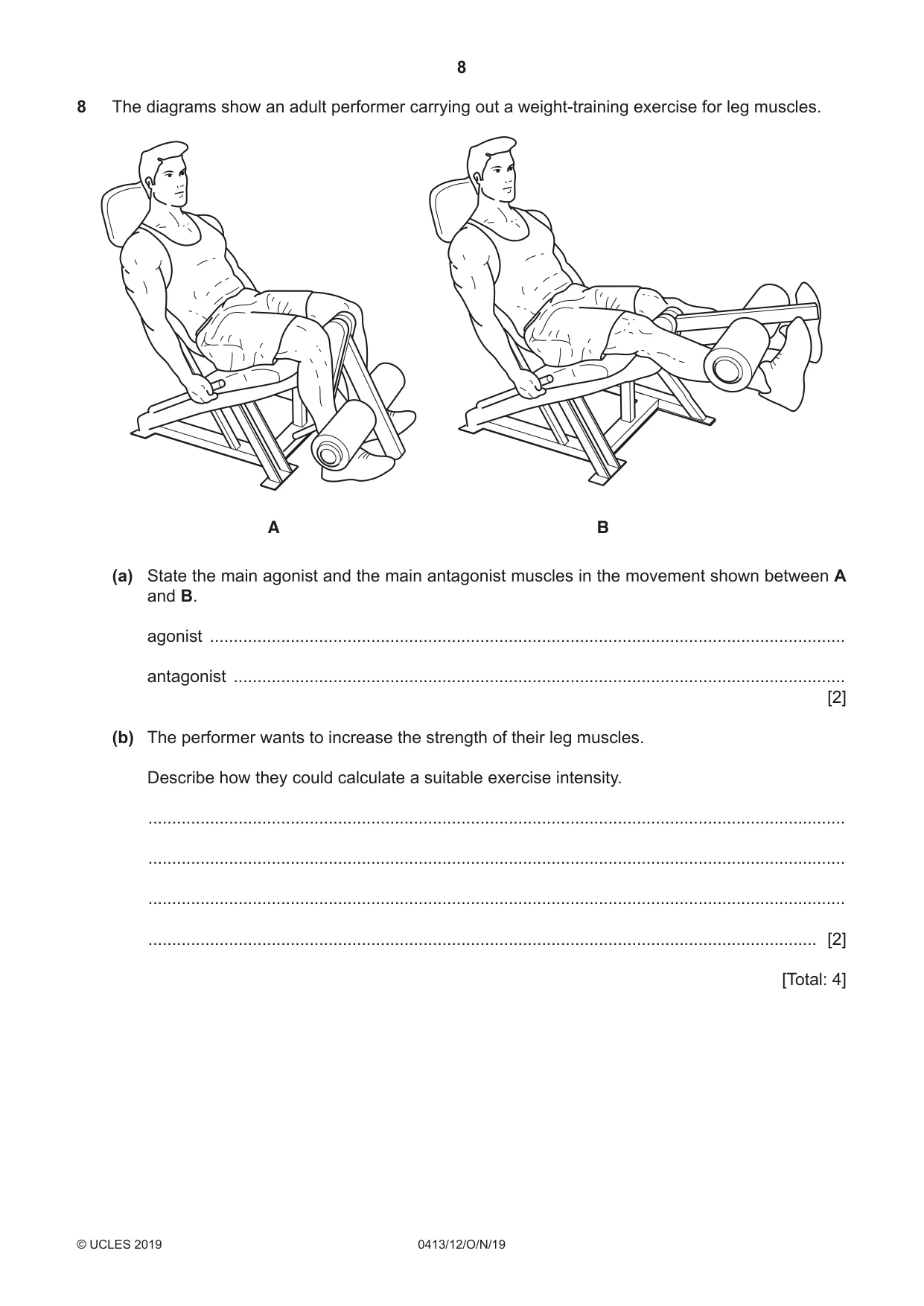
8 0413/12/O/N/19 © UCLES 2019 8 The diagrams show an adult performer carrying out a weight-training exercise for leg muscles. A B (a) State the main agonist and the main antagonist muscles in the movement shown between A and B. agonist … antagonist … [2] (b) The performer wants to increase the strength of their leg muscles. Describe how they could calculate a suitable exercise intensity. … … … … [2] [Total: 4]
Question paper, page 9
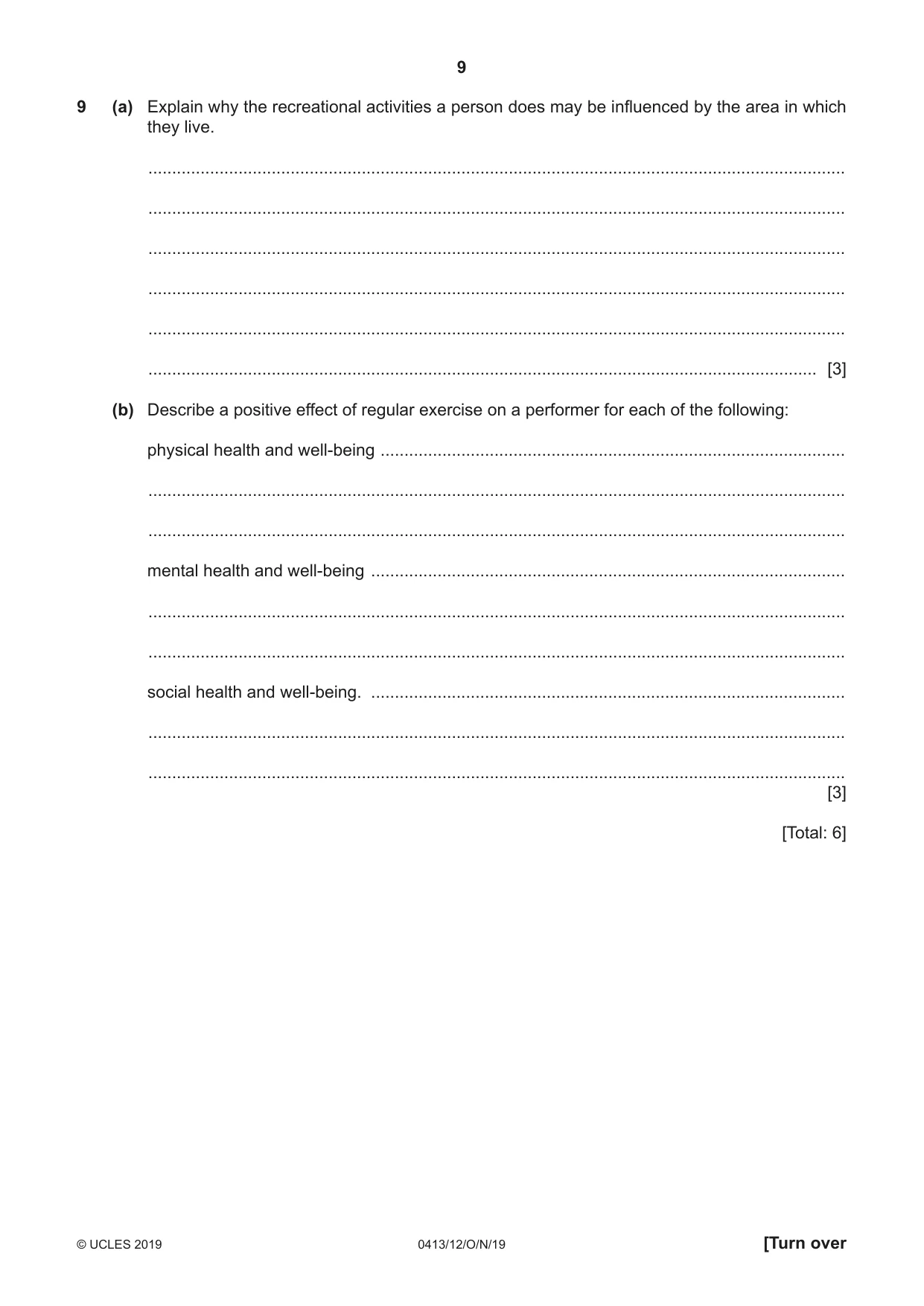
9 0413/12/O/N/19 © UCLES 2019 [Turn over 9 (a) Explain why the recreational activities a person does may be influenced by the area in which they live. … … … … … … [3] (b) Describe a positive effect of regular exercise on a performer for each of the following: physical health and well-being … … … mental health and well-being … … … social health and well-being. … … … [3] [Total: 6]
Question paper, page 10
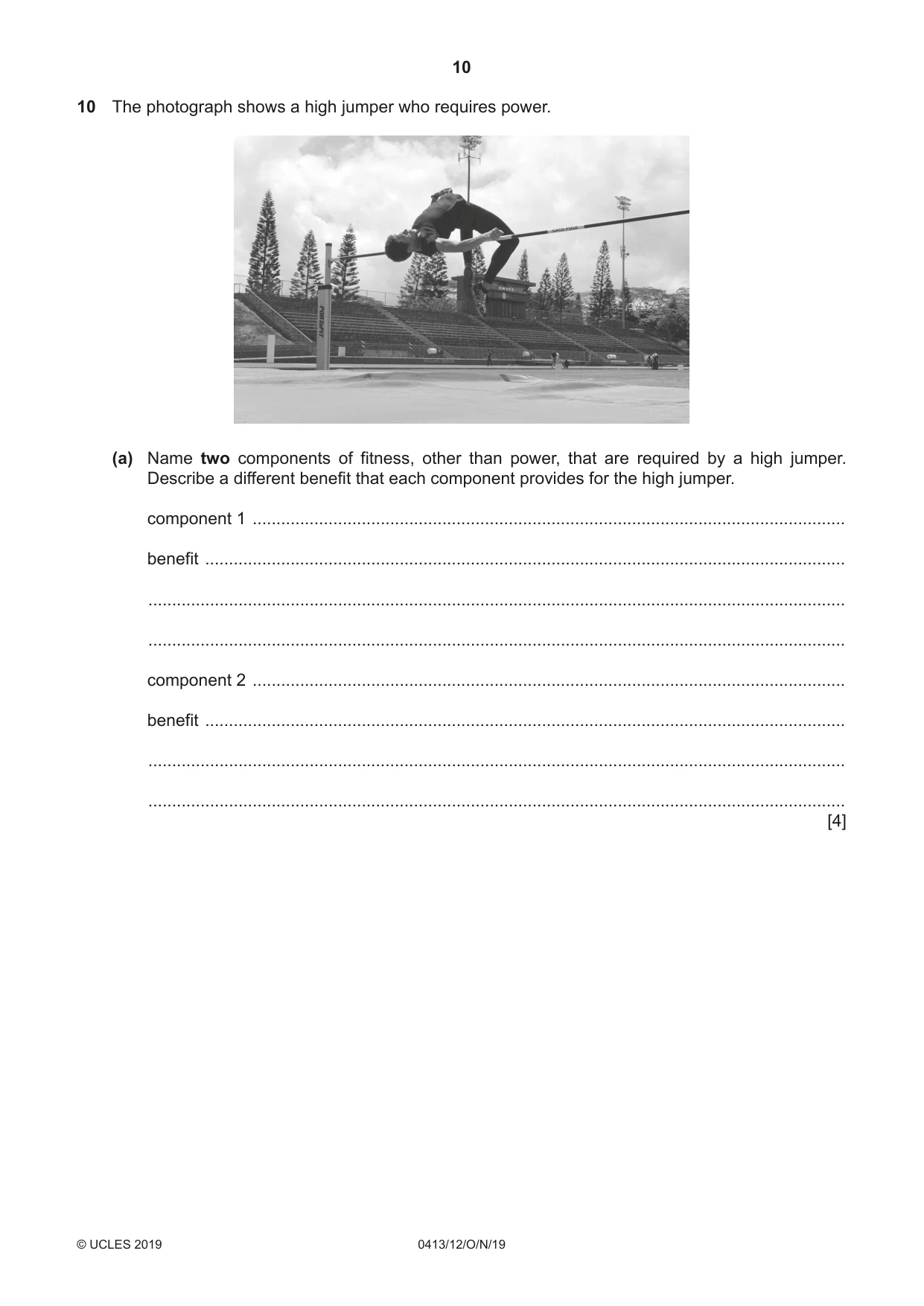
10 0413/12/O/N/19 © UCLES 2019 10 The photograph shows a high jumper who requires power. (a) Name two components of fitness, other than power, that are required by a high jumper. Describe a different benefit that each component provides for the high jumper. component 1 … benefit … … … component 2 … benefit … … … [4]
Question paper, page 11
11 0413/12/O/N/19 © UCLES 2019 [Turn over (b) Name two different training methods. For each training method describe two examples of exercises that could be used to improve power. training method 1 … example 1 … … … example 2 … … … training method 2 … example 1 … … … example 2 … … … [6] [Total: 10]
Question paper, page 12
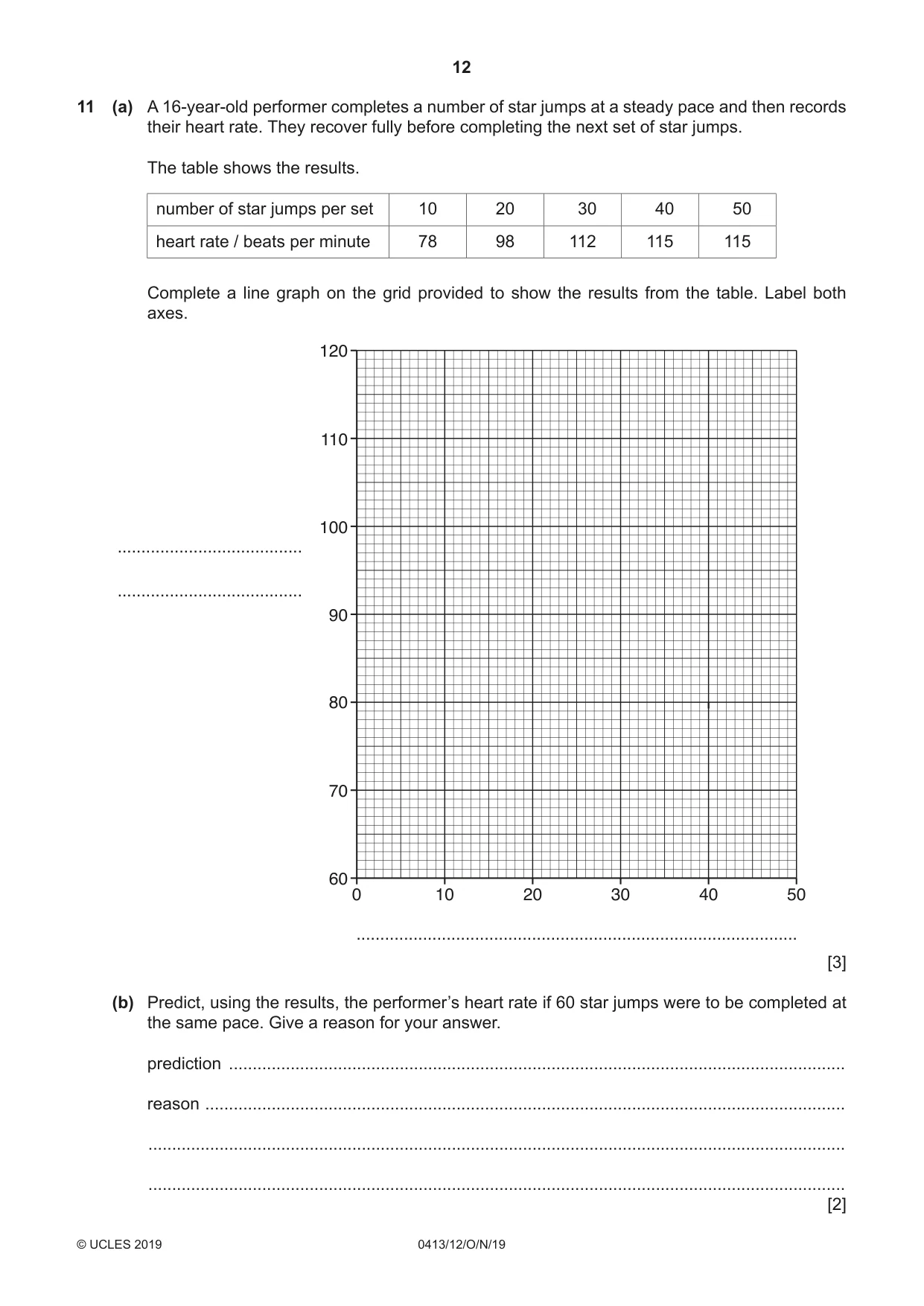
12 0413/12/O/N/19 © UCLES 2019 11 (a) A 16-year-old performer completes a number of star jumps at a steady pace and then records their heart rate. They recover fully before completing the next set of star jumps. The table shows the results. number of star jumps per set 10 20 30 40 50 heart rate / beats per minute 78 98 112 115 115 Complete a line graph on the grid provided to show the results from the table. Label both axes. 80 70 60 90 100 110 120 10 … … … 0 20 30 40 50 [3] (b) Predict, using the results, the performer’s heart rate if 60 star jumps were to be completed at the same pace. Give a reason for your answer. prediction … reason … … … [2]
Question paper, page 13
13 0413/12/O/N/19 © UCLES 2019 [Turn over (c) Suggest the short-term effects on the body, other than an increase in heart rate, of performing a set of star jumps. … … … … … … … … [4] [Total: 9] 12 (a) State three characteristics of a skilled performance. 1 … 2 … 3 … [3] (b) Explain, using examples, how two factors could cause variations in the skill level of performers. 1 … … … … 2 … … … … [4] [Total: 7]
Question paper, page 14
14 0413/12/O/N/19 © UCLES 2019 13 (a) Describe the advantages and disadvantages of being a sponsor. advantages … … … … … … disadvantages … … … … … … [6] (b) Describe the different types of sponsorship in sport. … … … … … … [3] [Total: 9]
Question paper, page 15
15 0413/12/O/N/19 © UCLES 2019 [Turn over 14 (a) Describe what is meant by the following terms: intrinsic motivation … … … extrinsic motivation. … … … [2] (b) Suggest the disadvantages for a performer of high levels of extrinsic motivation. … … … … [2] [Total: 4]
Question paper, page 16
16 0413/12/O/N/19 © UCLES 2019 15 The photograph shows performers involved in a water-based outdoor and adventurous activity. (a) Define the term perceived risk and suggest an example of a perceived risk in a water-based outdoor and adventurous activity. definition … … example … … [2] (b) Describe three different strategies that could be used to reduce the real risk to performers in a water-based outdoor and adventurous activity. 1 … … … 2 … … … 3 … … … [3] [Total: 5]
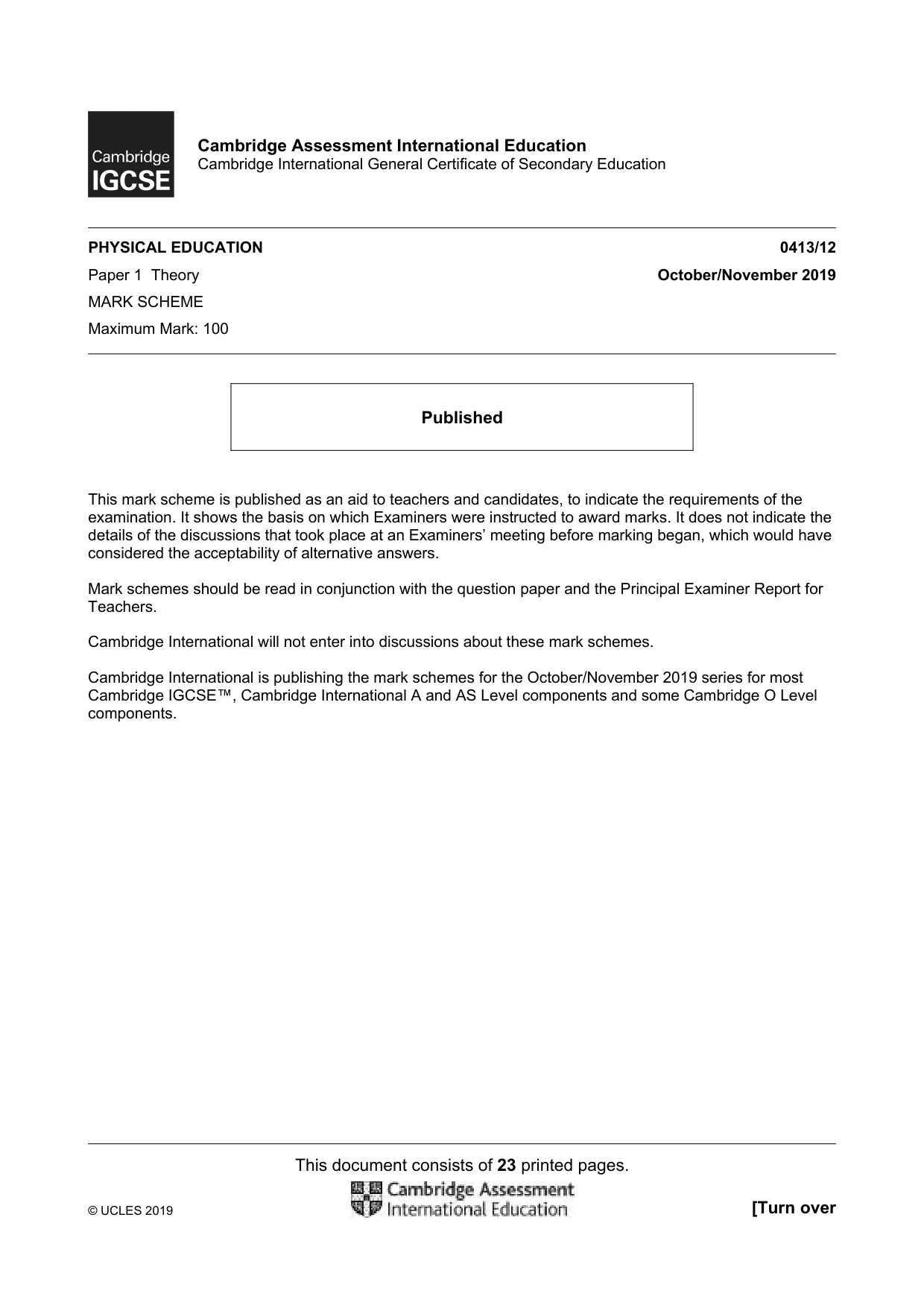
Question paper, page 17
17 0413/12/O/N/19 © UCLES 2019 16 (a) Describe how education can affect participation in physical activities. … … … … [2] (b) Describe ways that leisure facilities have tried to overcome the barriers to participation for performers with disabilities. … … … … … … … … [4] [Total: 6]
Question paper, page 18
18 0413/12/O/N/19 © UCLES 2019 BLANK PAGE
Question paper, page 19
19 0413/12/O/N/19 © UCLES 2019 BLANK PAGE
Question paper, page 20
20 0413/12/O/N/19 © UCLES 2019 Permission to reproduce items where third-party owned material protected by copyright is included has been sought and cleared where possible. Every reasonable effort has been made by the publisher (UCLES) to trace copyright holders, but if any items requiring clearance have unwittingly been included, the publisher will be pleased to make amends at the earliest possible opportunity. To avoid the issue of disclosure of answer-related information to candidates, all copyright acknowledgements are reproduced online in the Cambridge Assessment International Education Copyright Acknowledgements Booklet. This is produced for each series of examinations and is freely available to download at www.cambridgeinternational.org after the live examination series. Cambridge Assessment International Education is part of the Cambridge Assessment Group. Cambridge Assessment is the brand name of the University of Cambridge Local Examinations Syndicate (UCLES), which itself is a department of the University of Cambridge. BLANK PAGE
Mark scheme, page 1
This document consists of 23 printed pages. © UCLES 2019 [Turn over Cambridge Assessment International Education Cambridge International General Certificate of Secondary Education PHYSICAL EDUCATION 0413/12 Paper 1 Theory October/November 2019 MARK SCHEME Maximum Mark: 100 Published This mark scheme is published as an aid to teachers and candidates, to indicate the requirements of the examination. It shows the basis on which Examiners were instructed to award marks. It does not indicate the details of the discussions that took place at an Examiners’ meeting before marking began, which would have considered the acceptability of alternative answers. Mark schemes should be read in conjunction with the question paper and the Principal Examiner Report for Teachers. Cambridge International will not enter into discussions about these mark schemes. Cambridge International is publishing the mark schemes for the October/November 2019 series for most Cambridge IGCSE™, Cambridge International A and AS Level components and some Cambridge O Level components.
Mark scheme, page 2
0413/12 Cambridge IGCSE – Mark Scheme PUBLISHED October/November 2019 © UCLES 2019 Page 2 of 23 Generic Marking Principles These general marking principles must be applied by all examiners when marking candidate answers. They should be applied alongside the specific content of the mark scheme or generic level descriptors for a question. Each question paper and mark scheme will also comply with these marking principles. GENERIC MARKING PRINCIPLE 1: Marks must be awarded in line with: • the specific content of the mark scheme or the generic level descriptors for the question • the specific skills defined in the mark scheme or in the generic level descriptors for the question • the standard of response required by a candidate as exemplified by the standardisation scripts. GENERIC MARKING PRINCIPLE 2: Marks awarded are always whole marks (not half marks, or other fractions). GENERIC MARKING PRINCIPLE 3: Marks must be awarded positively: • marks are awarded for correct/valid answers, as defined in the mark scheme. However, credit is given for valid answers which go beyond the scope of the syllabus and mark scheme, referring to your Team Leader as appropriate • marks are awarded when candidates clearly demonstrate what they know and can do • marks are not deducted for errors • marks are not deducted for omissions • answers should only be judged on the quality of spelling, punctuation and grammar when these features are specifically assessed by the question as indicated by the mark scheme. The meaning, however, should be unambiguous. GENERIC MARKING PRINCIPLE 4: Rules must be applied consistently e.g. in situations where candidates have not followed instructions or in the application of generic level descriptors.
Mark scheme, page 3
0413/12 Cambridge IGCSE – Mark Scheme PUBLISHED October/November 2019 © UCLES 2019 Page 3 of 23 GENERIC MARKING PRINCIPLE 5: Marks should be awarded using the full range of marks defined in the mark scheme for the question (however; the use of the full mark range may be limited according to the quality of the candidate responses seen). GENERIC MARKING PRINCIPLE 6: Marks awarded are based solely on the requirements as defined in the mark scheme. Marks should not be awarded with grade thresholds or grade descriptors in mind.
Mark scheme, page 4
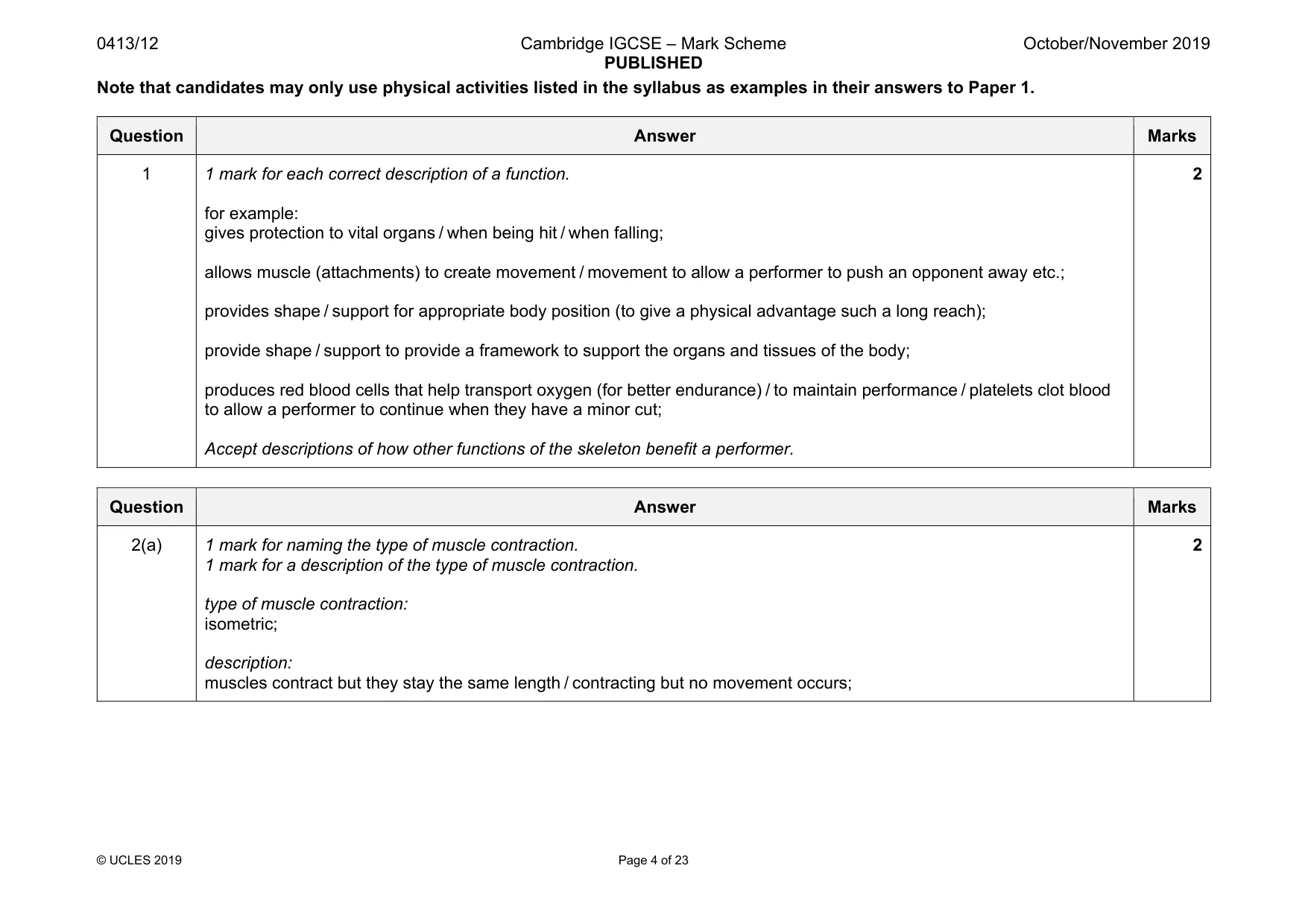
0413/12 Cambridge IGCSE – Mark Scheme PUBLISHED October/November 2019 © UCLES 2019 Page 4 of 23 Note that candidates may only use physical activities listed in the syllabus as examples in their answers to Paper 1. Question Answer Marks 1 1 mark for each correct description of a function. for example: gives protection to vital organs / when being hit / when falling; allows muscle (attachments) to create movement / movement to allow a performer to push an opponent away etc.; provides shape / support for appropriate body position (to give a physical advantage such a long reach); provide shape / support to provide a framework to support the organs and tissues of the body; produces red blood cells that help transport oxygen (for better endurance) / to maintain performance / platelets clot blood to allow a performer to continue when they have a minor cut; Accept descriptions of how other functions of the skeleton benefit a performer. 2 Question Answer Marks 2(a) 1 mark for naming the type of muscle contraction. 1 mark for a description of the type of muscle contraction. type of muscle contraction: isometric; description: muscles contract but they stay the same length / contracting but no movement occurs; 2
Mark scheme, page 5
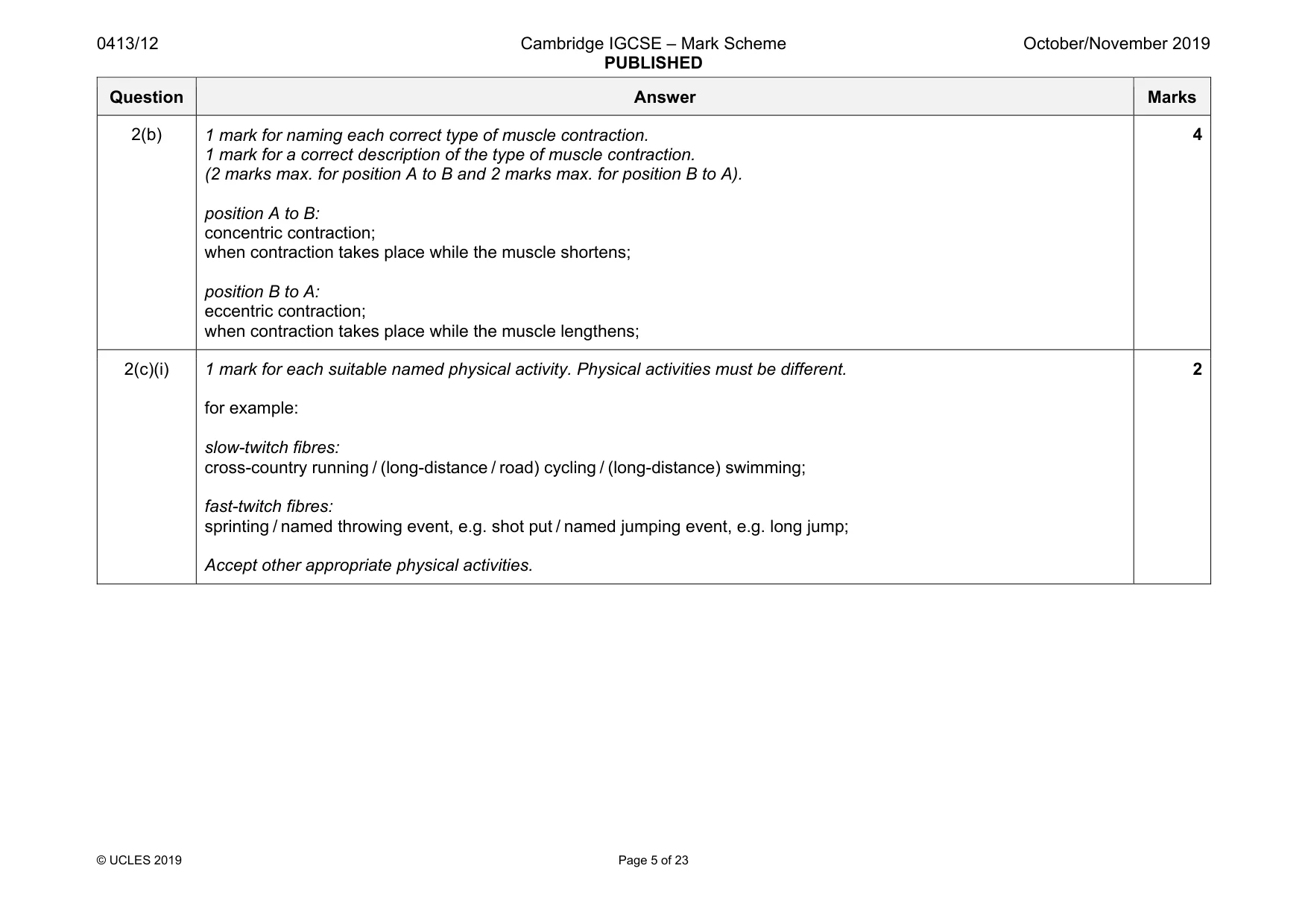
0413/12 Cambridge IGCSE – Mark Scheme PUBLISHED October/November 2019 © UCLES 2019 Page 5 of 23 Question Answer Marks 2(b) 1 mark for naming each correct type of muscle contraction. 1 mark for a correct description of the type of muscle contraction. (2 marks max. for position A to B and 2 marks max. for position B to A). position A to B: concentric contraction; when contraction takes place while the muscle shortens; position B to A: eccentric contraction; when contraction takes place while the muscle lengthens; 4 2(c)(i) 1 mark for each suitable named physical activity. Physical activities must be different. for example: slow-twitch fibres: cross-country running / (long-distance / road) cycling / (long-distance) swimming; fast-twitch fibres: sprinting / named throwing event, e.g. shot put / named jumping event, e.g. long jump; Accept other appropriate physical activities. 2
Mark scheme, page 6
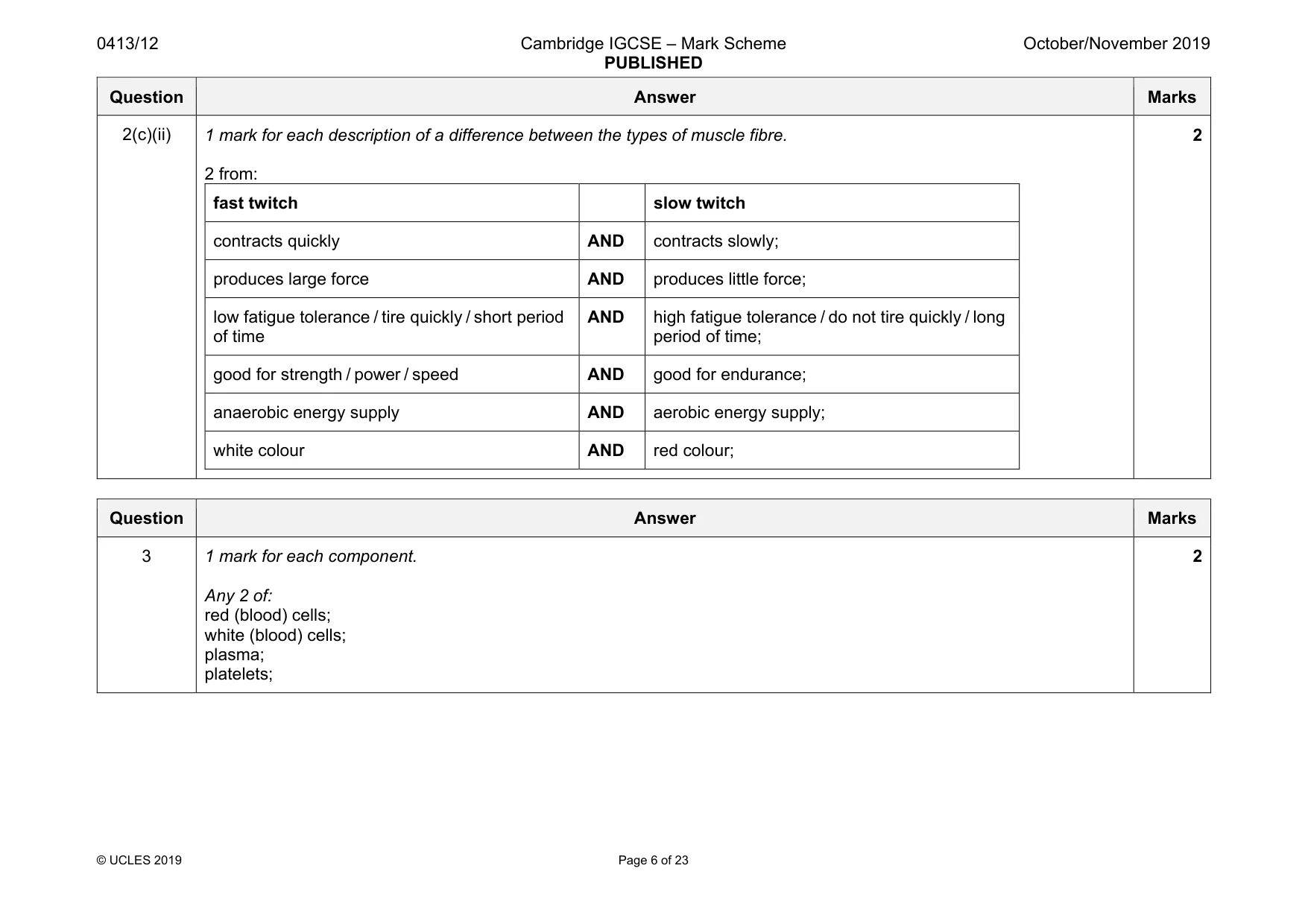
0413/12 Cambridge IGCSE – Mark Scheme PUBLISHED October/November 2019 © UCLES 2019 Page 6 of 23 Question Answer Marks 2(c)(ii) 1 mark for each description of a difference between the types of muscle fibre. 2 from: fast twitch slow twitch contracts quickly AND contracts slowly; produces large force AND produces little force; low fatigue tolerance / tire quickly / short period of time AND high fatigue tolerance / do not tire quickly / long period of time; good for strength / power / speed AND good for endurance; anaerobic energy supply AND aerobic energy supply; white colour AND red colour; 2 Question Answer Marks 3 1 mark for each component. Any 2 of: red (blood) cells; white (blood) cells; plasma; platelets; 2
Mark scheme, page 7
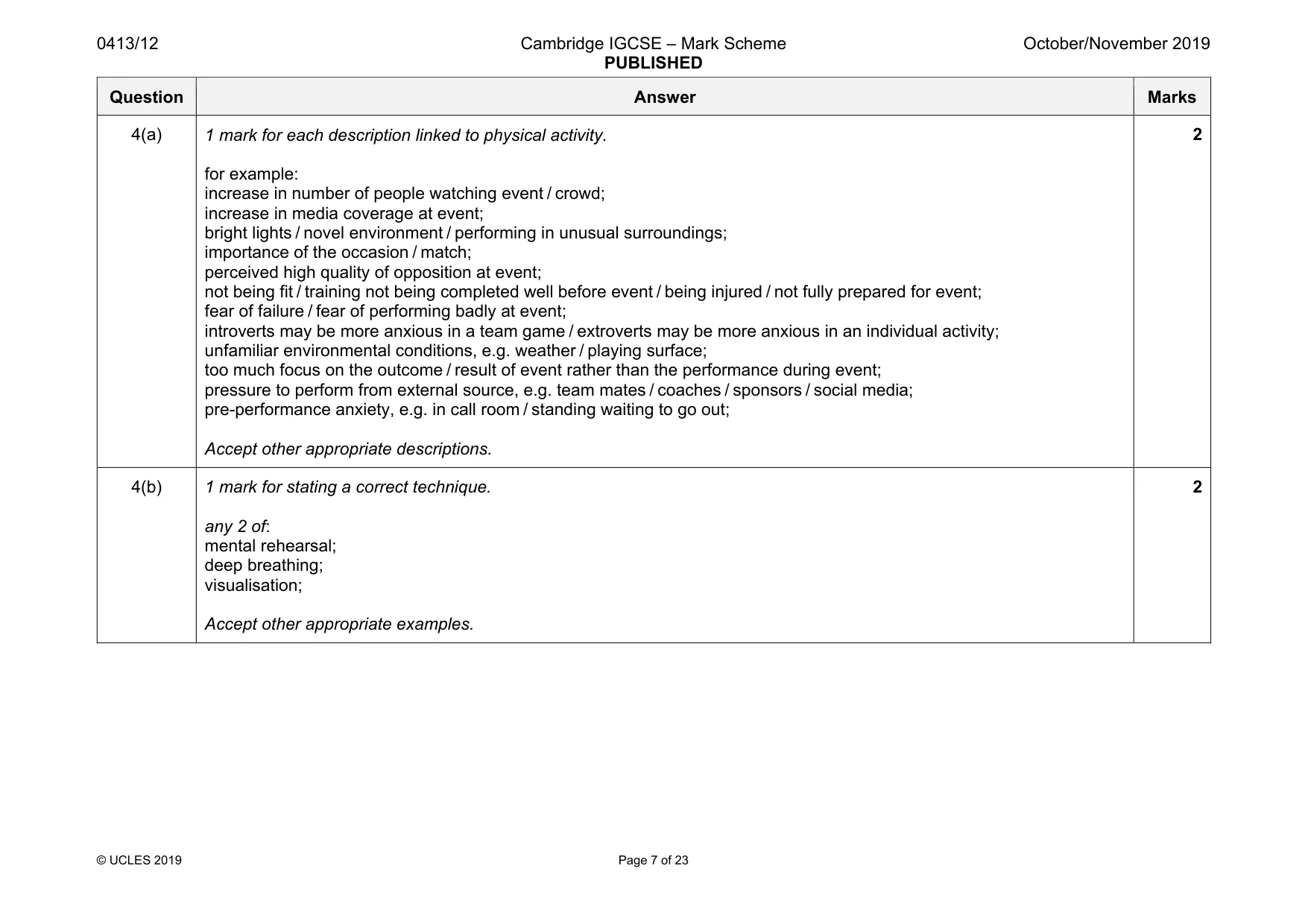
0413/12 Cambridge IGCSE – Mark Scheme PUBLISHED October/November 2019 © UCLES 2019 Page 7 of 23 Question Answer Marks 4(a) 1 mark for each description linked to physical activity. for example: increase in number of people watching event / crowd; increase in media coverage at event; bright lights / novel environment / performing in unusual surroundings; importance of the occasion / match; perceived high quality of opposition at event; not being fit / training not being completed well before event / being injured / not fully prepared for event; fear of failure / fear of performing badly at event; introverts may be more anxious in a team game / extroverts may be more anxious in an individual activity; unfamiliar environmental conditions, e.g. weather / playing surface; too much focus on the outcome / result of event rather than the performance during event; pressure to perform from external source, e.g. team mates / coaches / sponsors / social media; pre-performance anxiety, e.g. in call room / standing waiting to go out; Accept other appropriate descriptions. 2 4(b) 1 mark for stating a correct technique. any 2 of: mental rehearsal; deep breathing; visualisation; Accept other appropriate examples. 2
Mark scheme, page 8
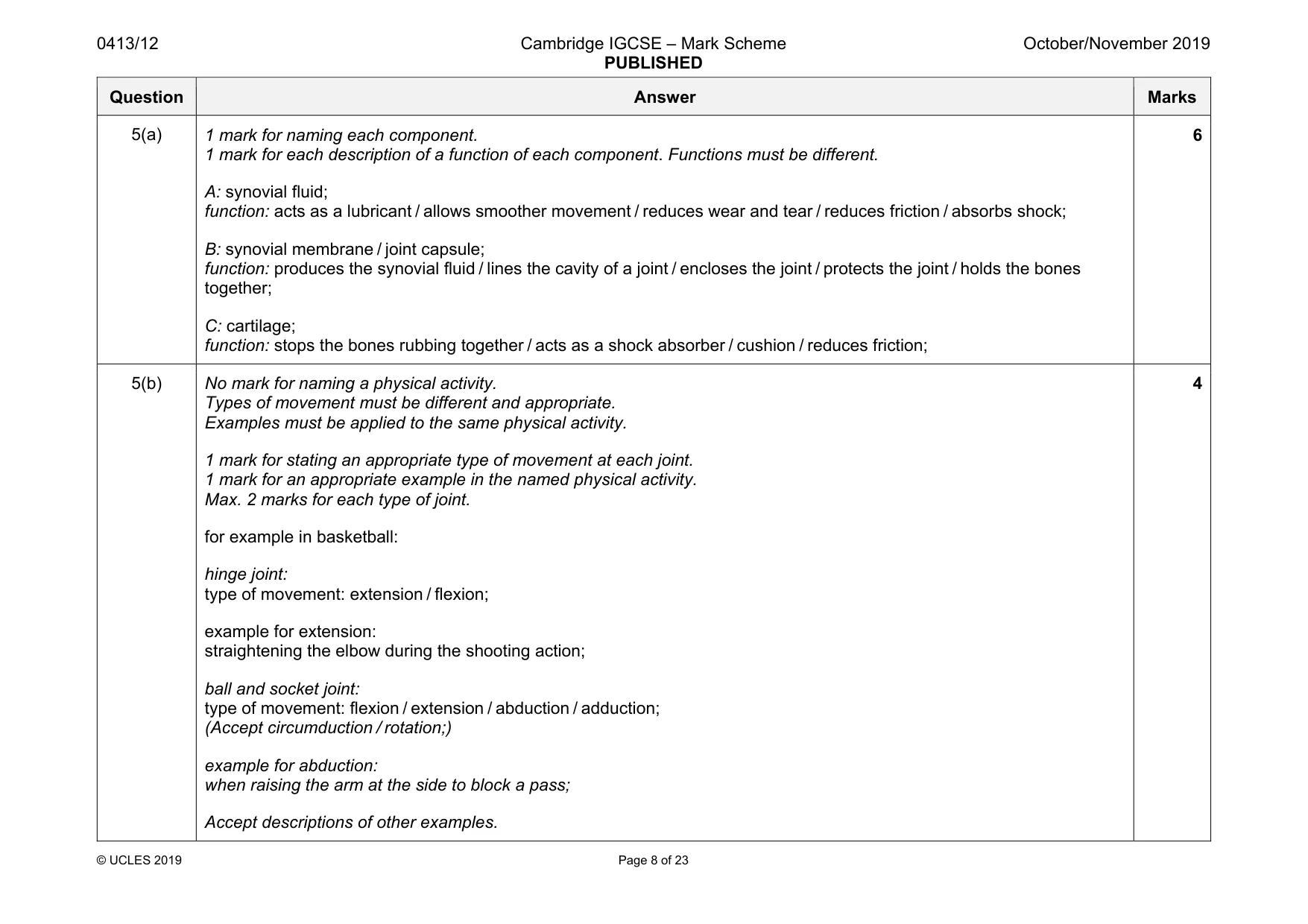
0413/12 Cambridge IGCSE – Mark Scheme PUBLISHED October/November 2019 © UCLES 2019 Page 8 of 23 Question Answer Marks 5(a) 1 mark for naming each component. 1 mark for each description of a function of each component. Functions must be different. A: synovial fluid; function: acts as a lubricant / allows smoother movement / reduces wear and tear / reduces friction / absorbs shock; B: synovial membrane / joint capsule; function: produces the synovial fluid / lines the cavity of a joint / encloses the joint / protects the joint / holds the bones together; C: cartilage; function: stops the bones rubbing together / acts as a shock absorber / cushion / reduces friction; 6 5(b) No mark for naming a physical activity. Types of movement must be different and appropriate. Examples must be applied to the same physical activity. 1 mark for stating an appropriate type of movement at each joint. 1 mark for an appropriate example in the named physical activity. Max. 2 marks for each type of joint. for example in basketball: hinge joint: type of movement: extension / flexion; example for extension: straightening the elbow during the shooting action; ball and socket joint: type of movement: flexion / extension / abduction / adduction; (Accept circumduction / rotation;) example for abduction: when raising the arm at the side to block a pass; Accept descriptions of other examples. 4
Mark scheme, page 9
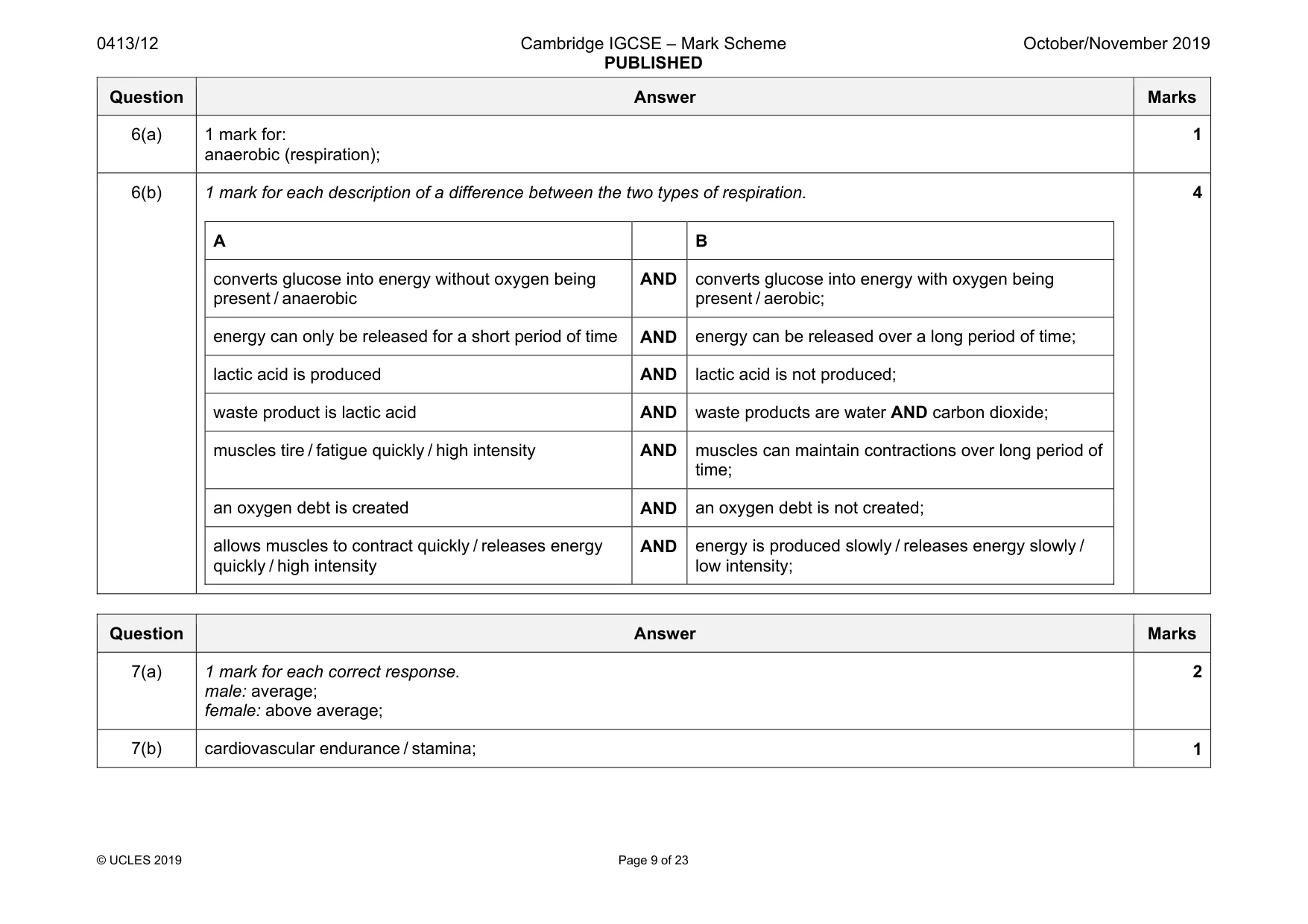
0413/12 Cambridge IGCSE – Mark Scheme PUBLISHED October/November 2019 © UCLES 2019 Page 9 of 23 Question Answer Marks 6(a) 1 mark for: anaerobic (respiration); 1 6(b) 1 mark for each description of a difference between the two types of respiration. A B converts glucose into energy without oxygen being present / anaerobic AND converts glucose into energy with oxygen being present / aerobic; energy can only be released for a short period of time AND energy can be released over a long period of time; lactic acid is produced AND lactic acid is not produced; waste product is lactic acid AND waste products are water AND carbon dioxide; muscles tire / fatigue quickly / high intensity AND muscles can maintain contractions over long period of time; an oxygen debt is created AND an oxygen debt is not created; allows muscles to contract quickly / releases energy quickly / high intensity AND energy is produced slowly / releases energy slowly / low intensity; 4 Question Answer Marks 7(a) 1 mark for each correct response. male: average; female: above average; 2 7(b) cardiovascular endurance / stamina; 1
Mark scheme, page 10
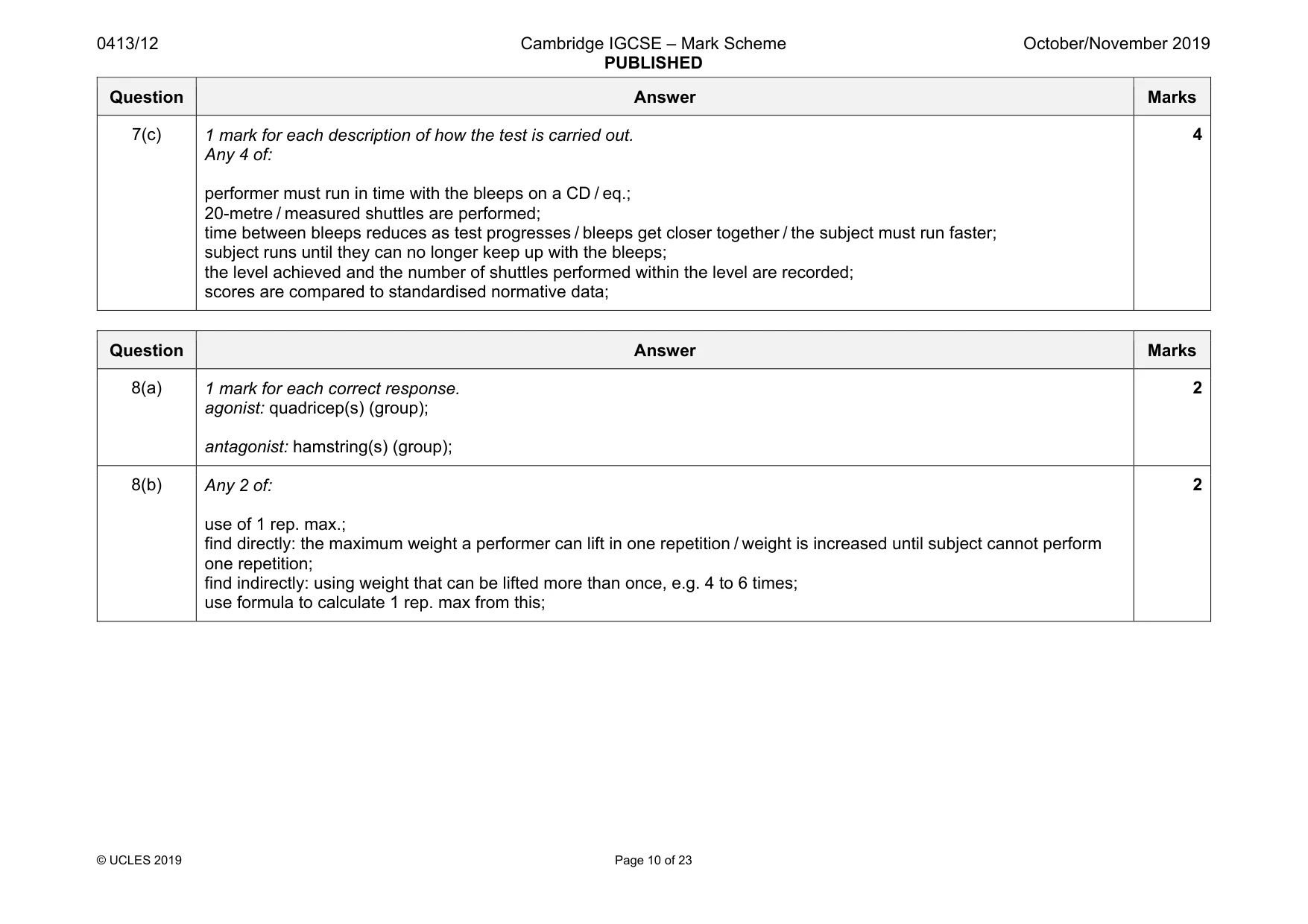
0413/12 Cambridge IGCSE – Mark Scheme PUBLISHED October/November 2019 © UCLES 2019 Page 10 of 23 Question Answer Marks 7(c) 1 mark for each description of how the test is carried out. Any 4 of: performer must run in time with the bleeps on a CD / eq.; 20-metre / measured shuttles are performed; time between bleeps reduces as test progresses / bleeps get closer together / the subject must run faster; subject runs until they can no longer keep up with the bleeps; the level achieved and the number of shuttles performed within the level are recorded; scores are compared to standardised normative data; 4 Question Answer Marks 8(a) 1 mark for each correct response. agonist: quadricep(s) (group); antagonist: hamstring(s) (group); 2 8(b) Any 2 of: use of 1 rep. max.; find directly: the maximum weight a performer can lift in one repetition / weight is increased until subject cannot perform one repetition; find indirectly: using weight that can be lifted more than once, e.g. 4 to 6 times; use formula to calculate 1 rep. max from this; 2
Mark scheme, page 11
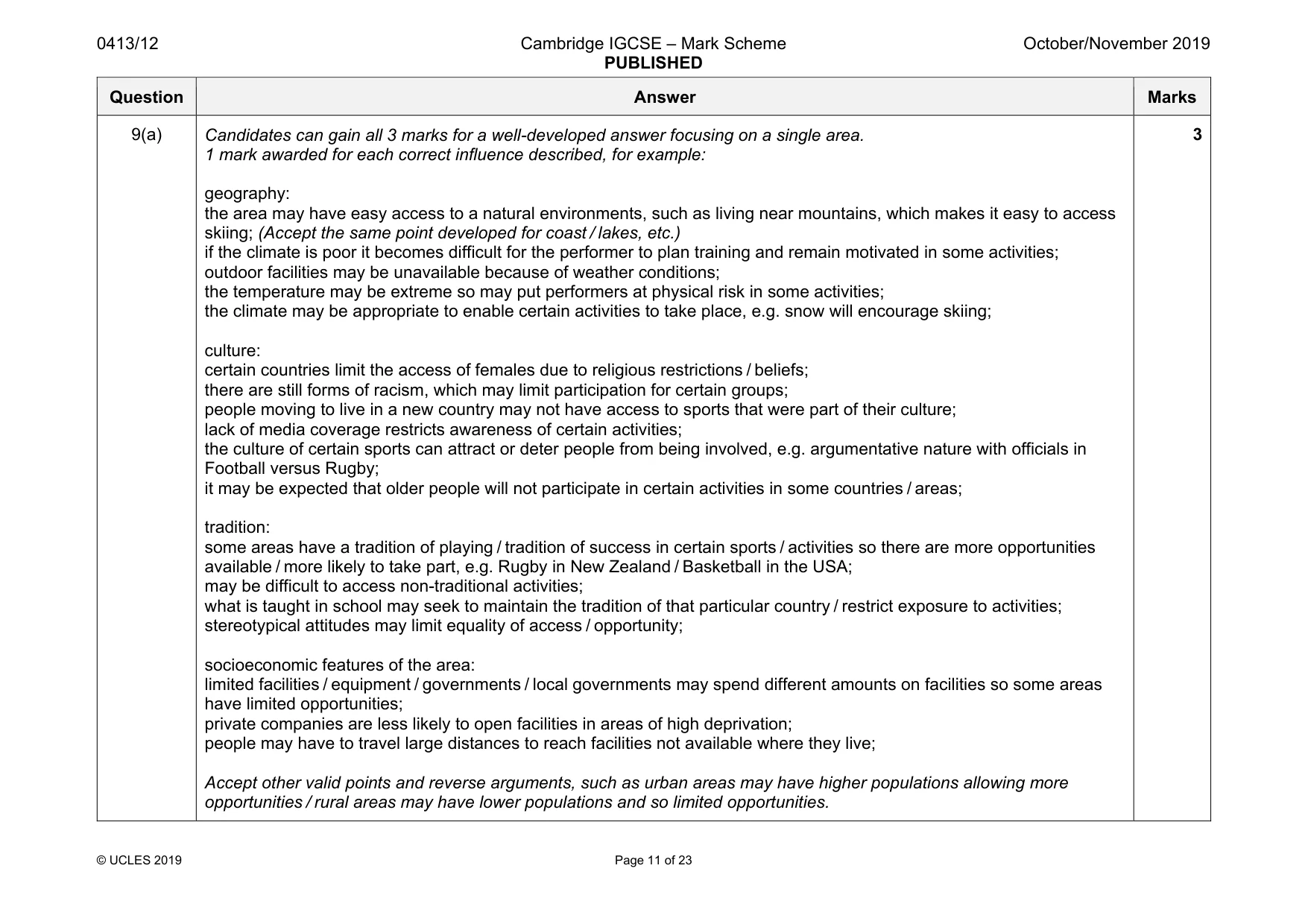
0413/12 Cambridge IGCSE – Mark Scheme PUBLISHED October/November 2019 © UCLES 2019 Page 11 of 23 Question Answer Marks 9(a) Candidates can gain all 3 marks for a well-developed answer focusing on a single area. 1 mark awarded for each correct influence described, for example: geography: the area may have easy access to a natural environments, such as living near mountains, which makes it easy to access skiing; (Accept the same point developed for coast / lakes, etc.) if the climate is poor it becomes difficult for the performer to plan training and remain motivated in some activities; outdoor facilities may be unavailable because of weather conditions; the temperature may be extreme so may put performers at physical risk in some activities; the climate may be appropriate to enable certain activities to take place, e.g. snow will encourage skiing; culture: certain countries limit the access of females due to religious restrictions / beliefs; there are still forms of racism, which may limit participation for certain groups; people moving to live in a new country may not have access to sports that were part of their culture; lack of media coverage restricts awareness of certain activities; the culture of certain sports can attract or deter people from being involved, e.g. argumentative nature with officials in Football versus Rugby; it may be expected that older people will not participate in certain activities in some countries / areas; tradition: some areas have a tradition of playing / tradition of success in certain sports / activities so there are more opportunities available / more likely to take part, e.g. Rugby in New Zealand / Basketball in the USA; may be difficult to access non-traditional activities; what is taught in school may seek to maintain the tradition of that particular country / restrict exposure to activities; stereotypical attitudes may limit equality of access / opportunity; socioeconomic features of the area: limited facilities / equipment / governments / local governments may spend different amounts on facilities so some areas have limited opportunities; private companies are less likely to open facilities in areas of high deprivation; people may have to travel large distances to reach facilities not available where they live; Accept other valid points and reverse arguments, such as urban areas may have higher populations allowing more opportunities / rural areas may have lower populations and so limited opportunities. 3
Mark scheme, page 12
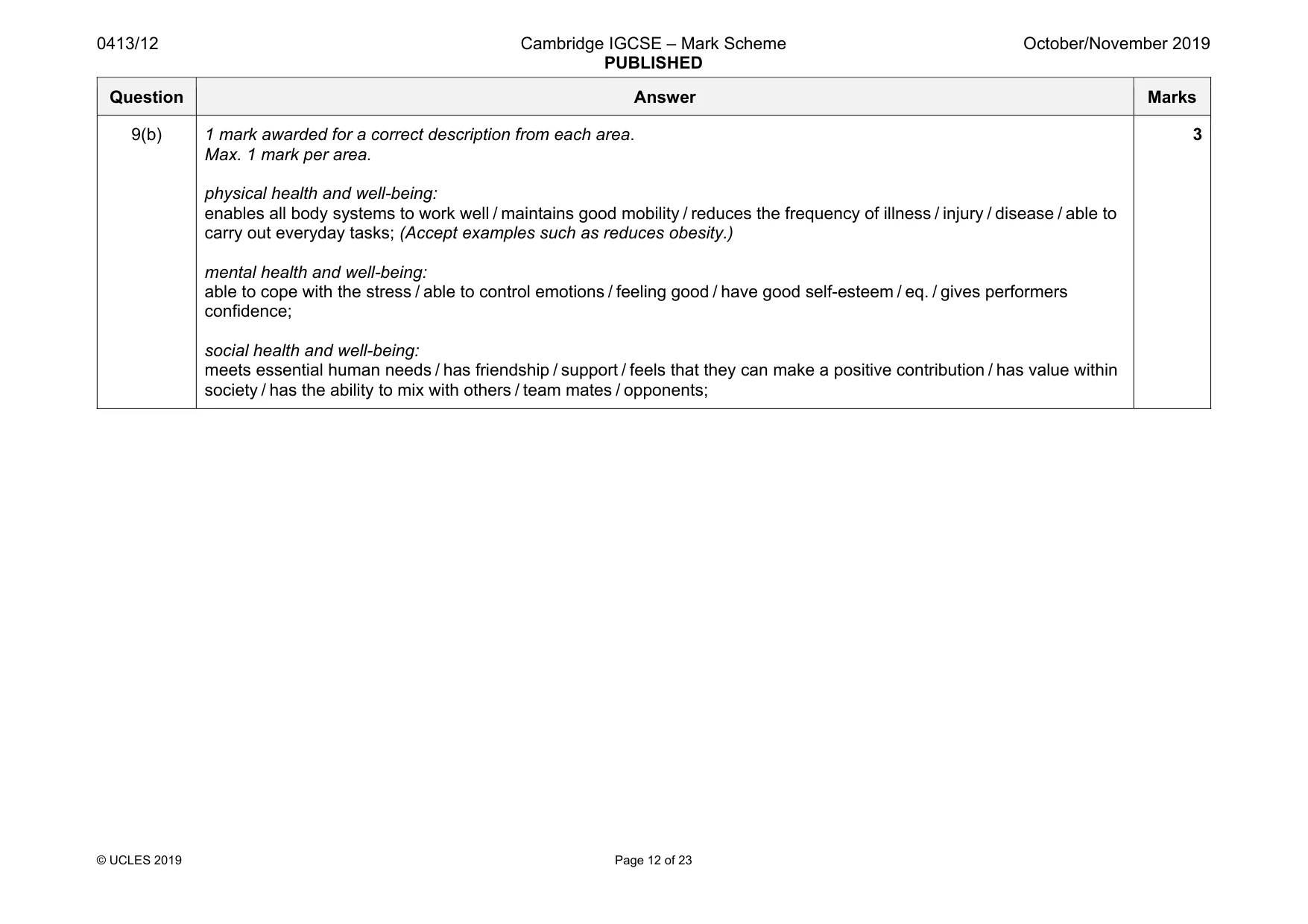
0413/12 Cambridge IGCSE – Mark Scheme PUBLISHED October/November 2019 © UCLES 2019 Page 12 of 23 Question Answer Marks 9(b) 1 mark awarded for a correct description from each area. Max. 1 mark per area. physical health and well-being: enables all body systems to work well / maintains good mobility / reduces the frequency of illness / injury / disease / able to carry out everyday tasks; (Accept examples such as reduces obesity.) mental health and well-being: able to cope with the stress / able to control emotions / feeling good / have good self-esteem / eq. / gives performers confidence; social health and well-being: meets essential human needs / has friendship / support / feels that they can make a positive contribution / has value within society / has the ability to mix with others / team mates / opponents; 3
Mark scheme, page 13
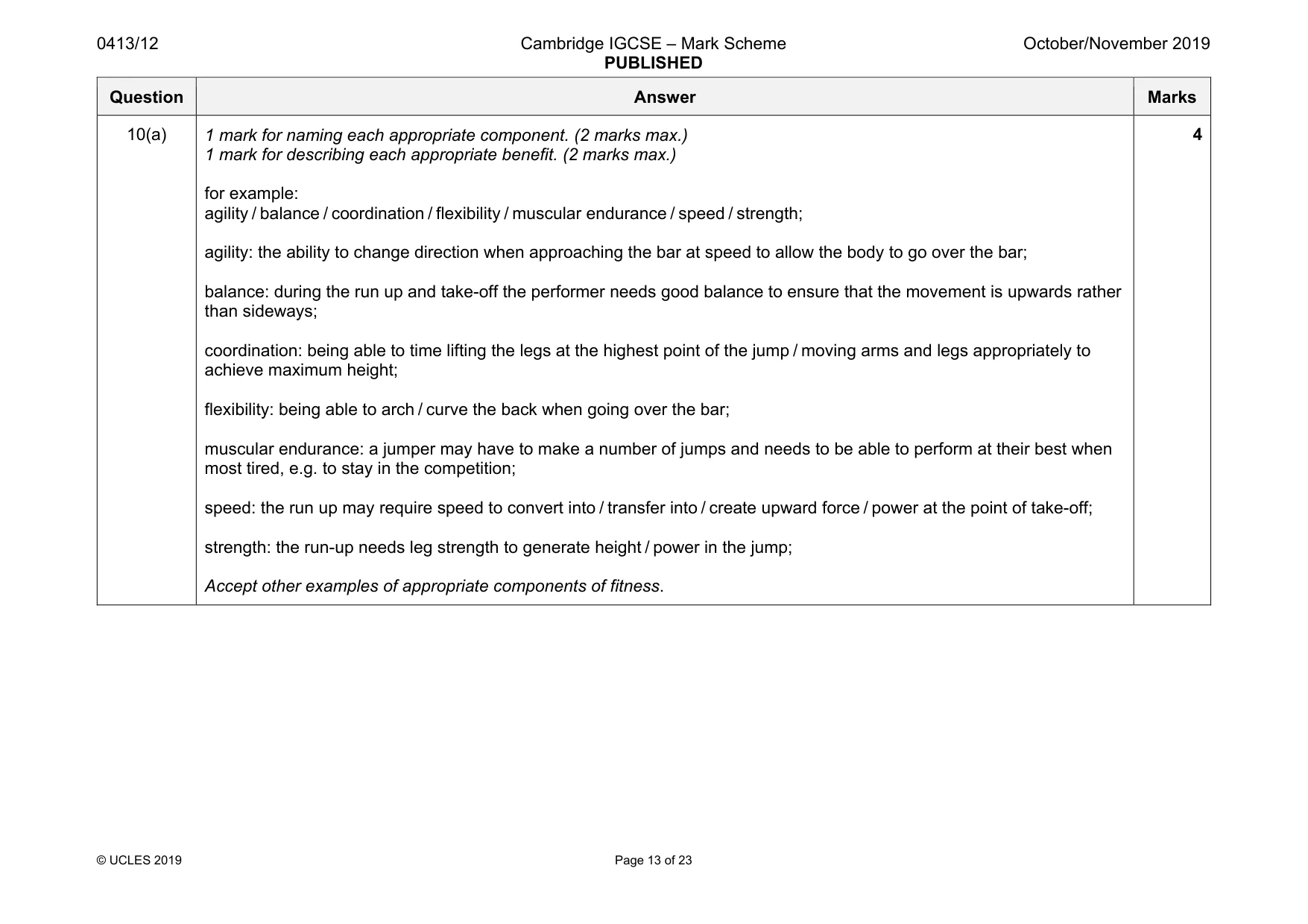
0413/12 Cambridge IGCSE – Mark Scheme PUBLISHED October/November 2019 © UCLES 2019 Page 13 of 23 Question Answer Marks 10(a) 1 mark for naming each appropriate component. (2 marks max.) 1 mark for describing each appropriate benefit. (2 marks max.) for example: agility / balance / coordination / flexibility / muscular endurance / speed / strength; agility: the ability to change direction when approaching the bar at speed to allow the body to go over the bar; balance: during the run up and take-off the performer needs good balance to ensure that the movement is upwards rather than sideways; coordination: being able to time lifting the legs at the highest point of the jump / moving arms and legs appropriately to achieve maximum height; flexibility: being able to arch / curve the back when going over the bar; muscular endurance: a jumper may have to make a number of jumps and needs to be able to perform at their best when most tired, e.g. to stay in the competition; speed: the run up may require speed to convert into / transfer into / create upward force / power at the point of take-off; strength: the run-up needs leg strength to generate height / power in the jump; Accept other examples of appropriate components of fitness. 4
Mark scheme, page 14
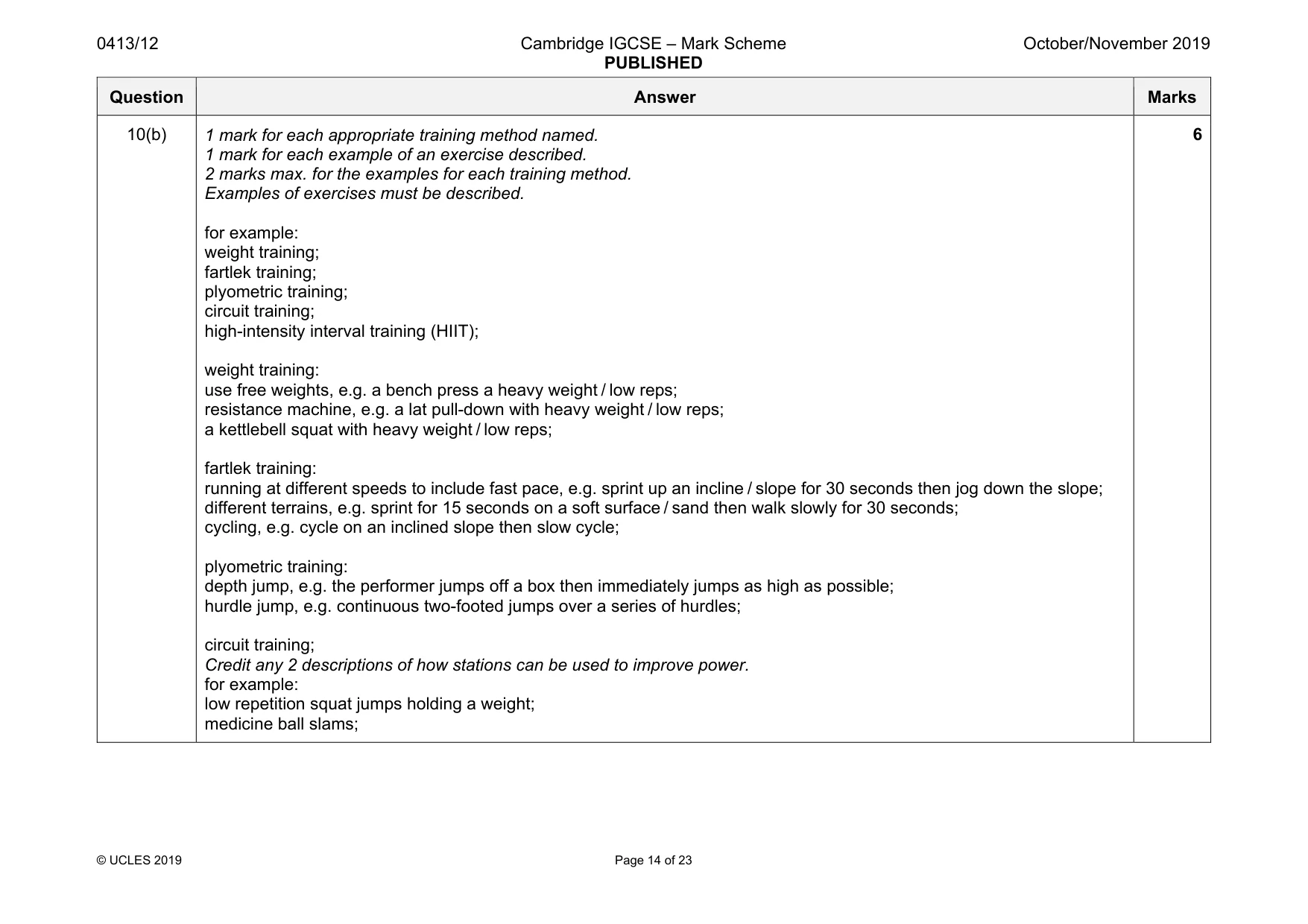
0413/12 Cambridge IGCSE – Mark Scheme PUBLISHED October/November 2019 © UCLES 2019 Page 14 of 23 Question Answer Marks 10(b) 1 mark for each appropriate training method named. 1 mark for each example of an exercise described. 2 marks max. for the examples for each training method. Examples of exercises must be described. for example: weight training; fartlek training; plyometric training; circuit training; high-intensity interval training (HIIT); weight training: use free weights, e.g. a bench press a heavy weight / low reps; resistance machine, e.g. a lat pull-down with heavy weight / low reps; a kettlebell squat with heavy weight / low reps; fartlek training: running at different speeds to include fast pace, e.g. sprint up an incline / slope for 30 seconds then jog down the slope; different terrains, e.g. sprint for 15 seconds on a soft surface / sand then walk slowly for 30 seconds; cycling, e.g. cycle on an inclined slope then slow cycle; plyometric training: depth jump, e.g. the performer jumps off a box then immediately jumps as high as possible; hurdle jump, e.g. continuous two-footed jumps over a series of hurdles; circuit training; Credit any 2 descriptions of how stations can be used to improve power. for example: low repetition squat jumps holding a weight; medicine ball slams; 6
Mark scheme, page 15
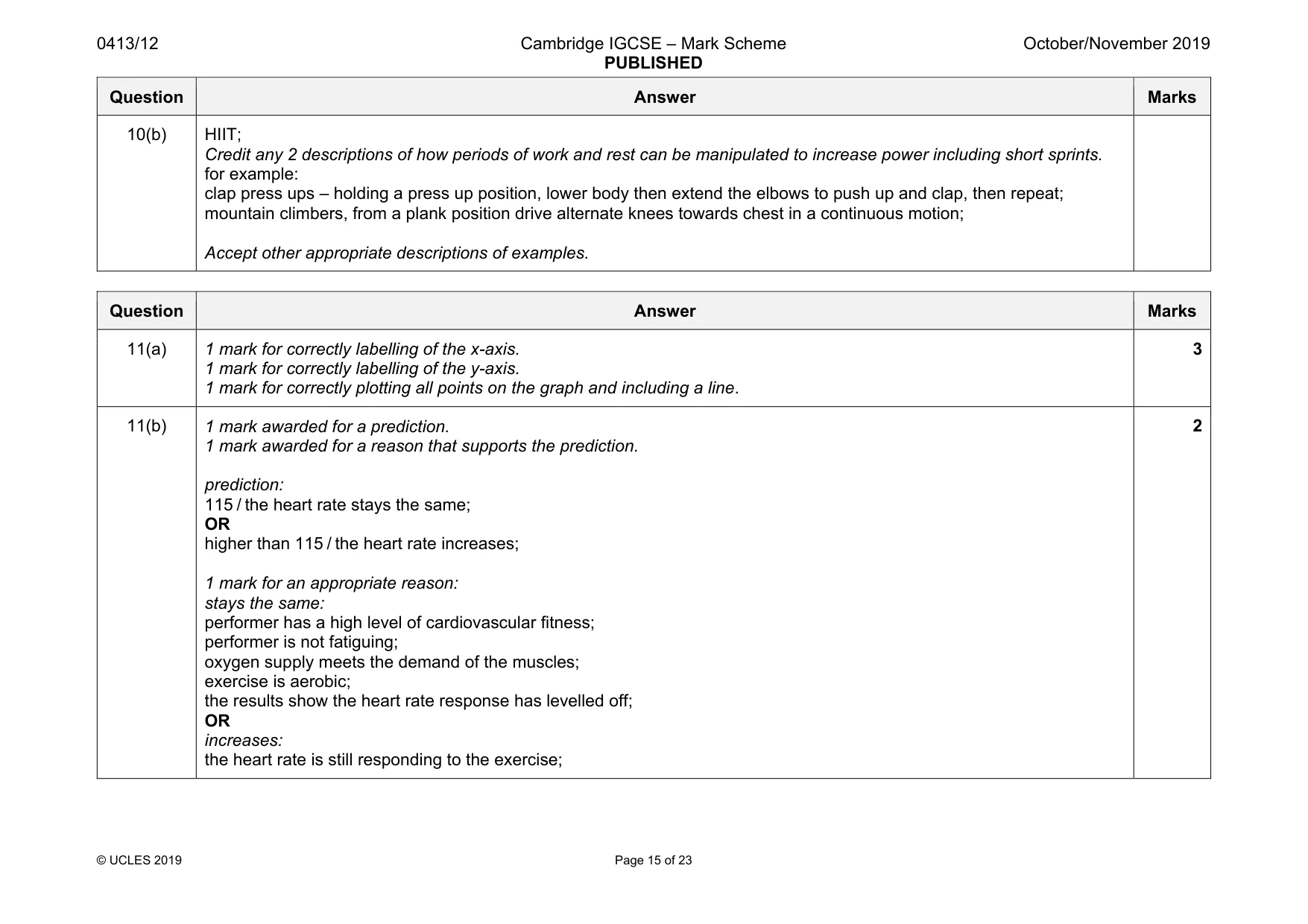
0413/12 Cambridge IGCSE – Mark Scheme PUBLISHED October/November 2019 © UCLES 2019 Page 15 of 23 Question Answer Marks 10(b) HIIT; Credit any 2 descriptions of how periods of work and rest can be manipulated to increase power including short sprints. for example: clap press ups – holding a press up position, lower body then extend the elbows to push up and clap, then repeat; mountain climbers, from a plank position drive alternate knees towards chest in a continuous motion; Accept other appropriate descriptions of examples. Question Answer Marks 11(a) 1 mark for correctly labelling of the x-axis. 1 mark for correctly labelling of the y-axis. 1 mark for correctly plotting all points on the graph and including a line. 3 11(b) 1 mark awarded for a prediction. 1 mark awarded for a reason that supports the prediction. prediction: 115 / the heart rate stays the same; OR higher than 115 / the heart rate increases; 1 mark for an appropriate reason: stays the same: performer has a high level of cardiovascular fitness; performer is not fatiguing; oxygen supply meets the demand of the muscles; exercise is aerobic; the results show the heart rate response has levelled off; OR increases: the heart rate is still responding to the exercise; 2
Mark scheme, page 16
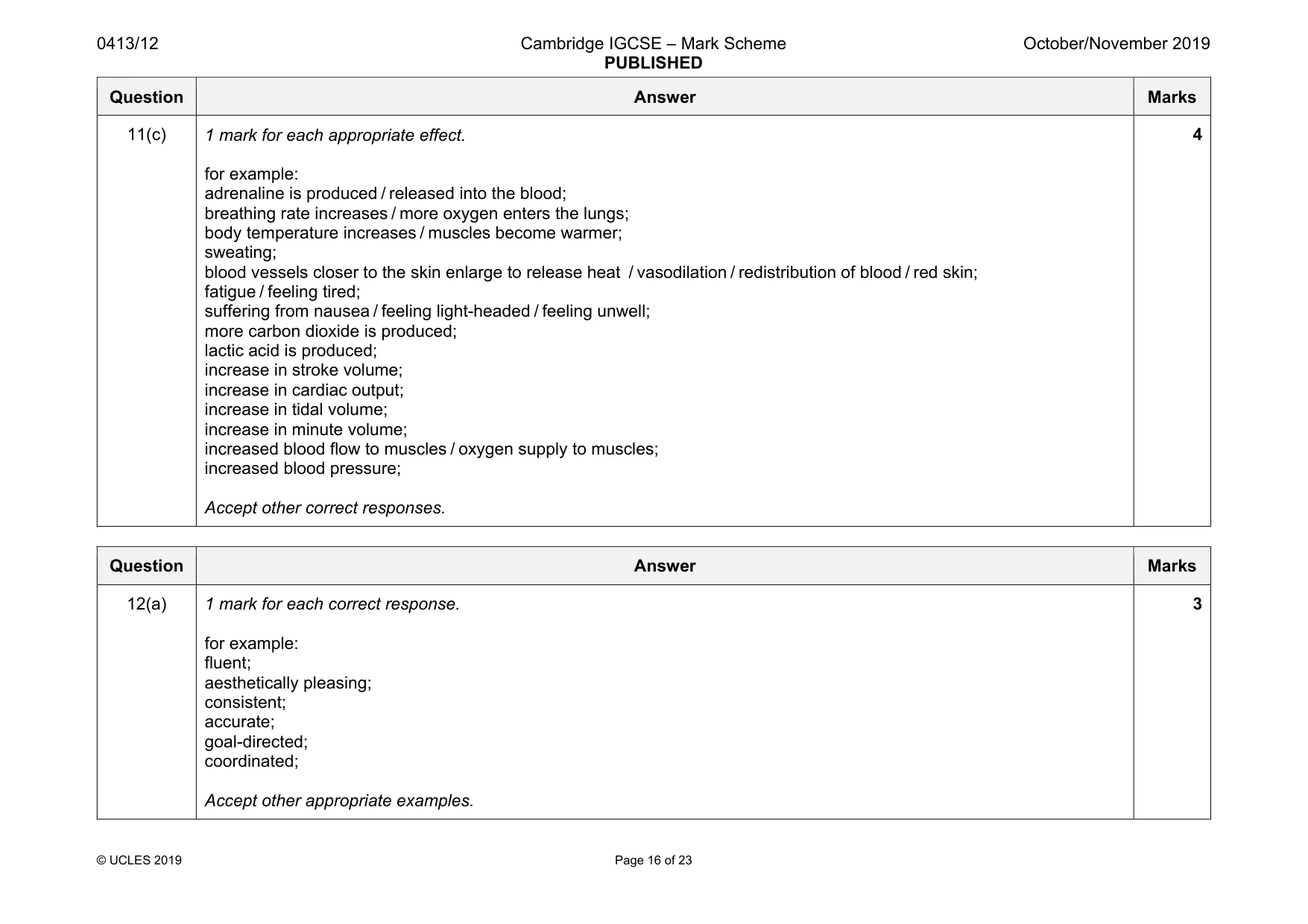
0413/12 Cambridge IGCSE – Mark Scheme PUBLISHED October/November 2019 © UCLES 2019 Page 16 of 23 Question Answer Marks 11(c) 1 mark for each appropriate effect. for example: adrenaline is produced / released into the blood; breathing rate increases / more oxygen enters the lungs; body temperature increases / muscles become warmer; sweating; blood vessels closer to the skin enlarge to release heat / vasodilation / redistribution of blood / red skin; fatigue / feeling tired; suffering from nausea / feeling light-headed / feeling unwell; more carbon dioxide is produced; lactic acid is produced; increase in stroke volume; increase in cardiac output; increase in tidal volume; increase in minute volume; increased blood flow to muscles / oxygen supply to muscles; increased blood pressure; Accept other correct responses. 4 Question Answer Marks 12(a) 1 mark for each correct response. for example: fluent; aesthetically pleasing; consistent; accurate; goal-directed; coordinated; Accept other appropriate examples. 3
Mark scheme, page 17
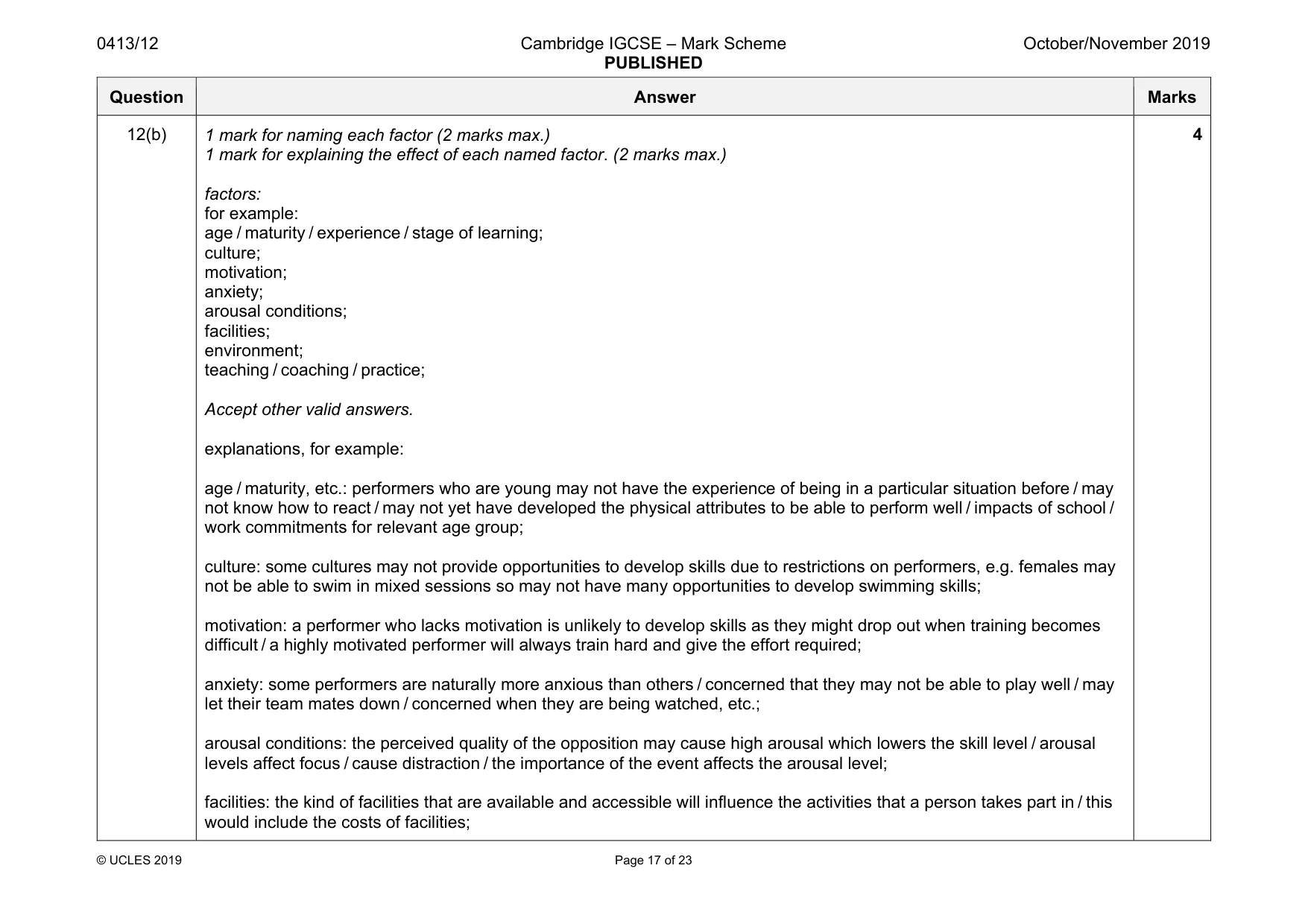
0413/12 Cambridge IGCSE – Mark Scheme PUBLISHED October/November 2019 © UCLES 2019 Page 17 of 23 Question Answer Marks 12(b) 1 mark for naming each factor (2 marks max.) 1 mark for explaining the effect of each named factor. (2 marks max.) factors: for example: age / maturity / experience / stage of learning; culture; motivation; anxiety; arousal conditions; facilities; environment; teaching / coaching / practice; Accept other valid answers. explanations, for example: age / maturity, etc.: performers who are young may not have the experience of being in a particular situation before / may not know how to react / may not yet have developed the physical attributes to be able to perform well / impacts of school / work commitments for relevant age group; culture: some cultures may not provide opportunities to develop skills due to restrictions on performers, e.g. females may not be able to swim in mixed sessions so may not have many opportunities to develop swimming skills; motivation: a performer who lacks motivation is unlikely to develop skills as they might drop out when training becomes difficult / a highly motivated performer will always train hard and give the effort required; anxiety: some performers are naturally more anxious than others / concerned that they may not be able to play well / may let their team mates down / concerned when they are being watched, etc.; arousal conditions: the perceived quality of the opposition may cause high arousal which lowers the skill level / arousal levels affect focus / cause distraction / the importance of the event affects the arousal level; facilities: the kind of facilities that are available and accessible will influence the activities that a person takes part in / this would include the costs of facilities; 4
Mark scheme, page 18
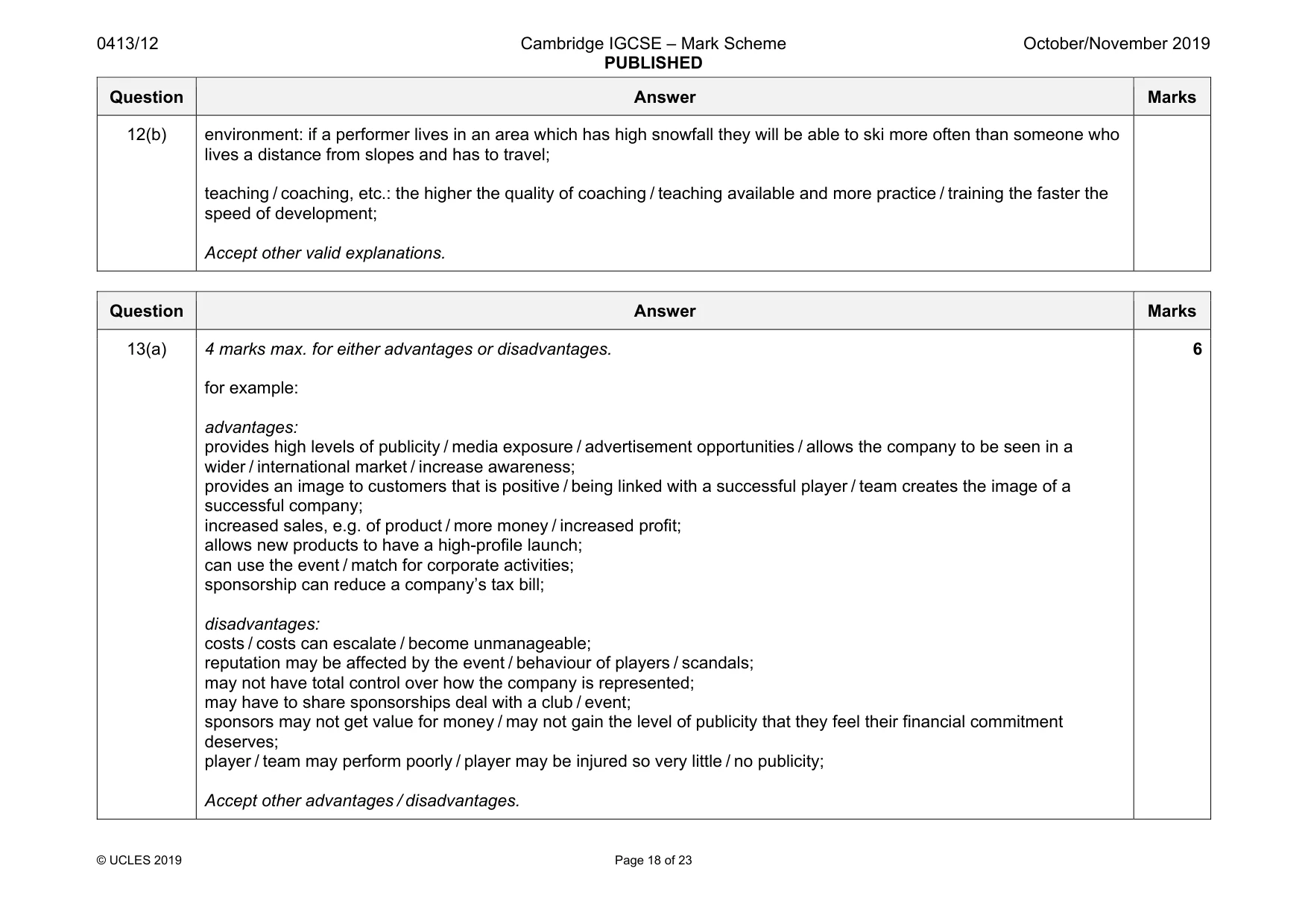
0413/12 Cambridge IGCSE – Mark Scheme PUBLISHED October/November 2019 © UCLES 2019 Page 18 of 23 Question Answer Marks 12(b) environment: if a performer lives in an area which has high snowfall they will be able to ski more often than someone who lives a distance from slopes and has to travel; teaching / coaching, etc.: the higher the quality of coaching / teaching available and more practice / training the faster the speed of development; Accept other valid explanations. Question Answer Marks 13(a) 4 marks max. for either advantages or disadvantages. for example: advantages: provides high levels of publicity / media exposure / advertisement opportunities / allows the company to be seen in a wider / international market / increase awareness; provides an image to customers that is positive / being linked with a successful player / team creates the image of a successful company; increased sales, e.g. of product / more money / increased profit; allows new products to have a high-profile launch; can use the event / match for corporate activities; sponsorship can reduce a company’s tax bill; disadvantages: costs / costs can escalate / become unmanageable; reputation may be affected by the event / behaviour of players / scandals; may not have total control over how the company is represented; may have to share sponsorships deal with a club / event; sponsors may not get value for money / may not gain the level of publicity that they feel their financial commitment deserves; player / team may perform poorly / player may be injured so very little / no publicity; Accept other advantages / disadvantages. 6
Mark scheme, page 19
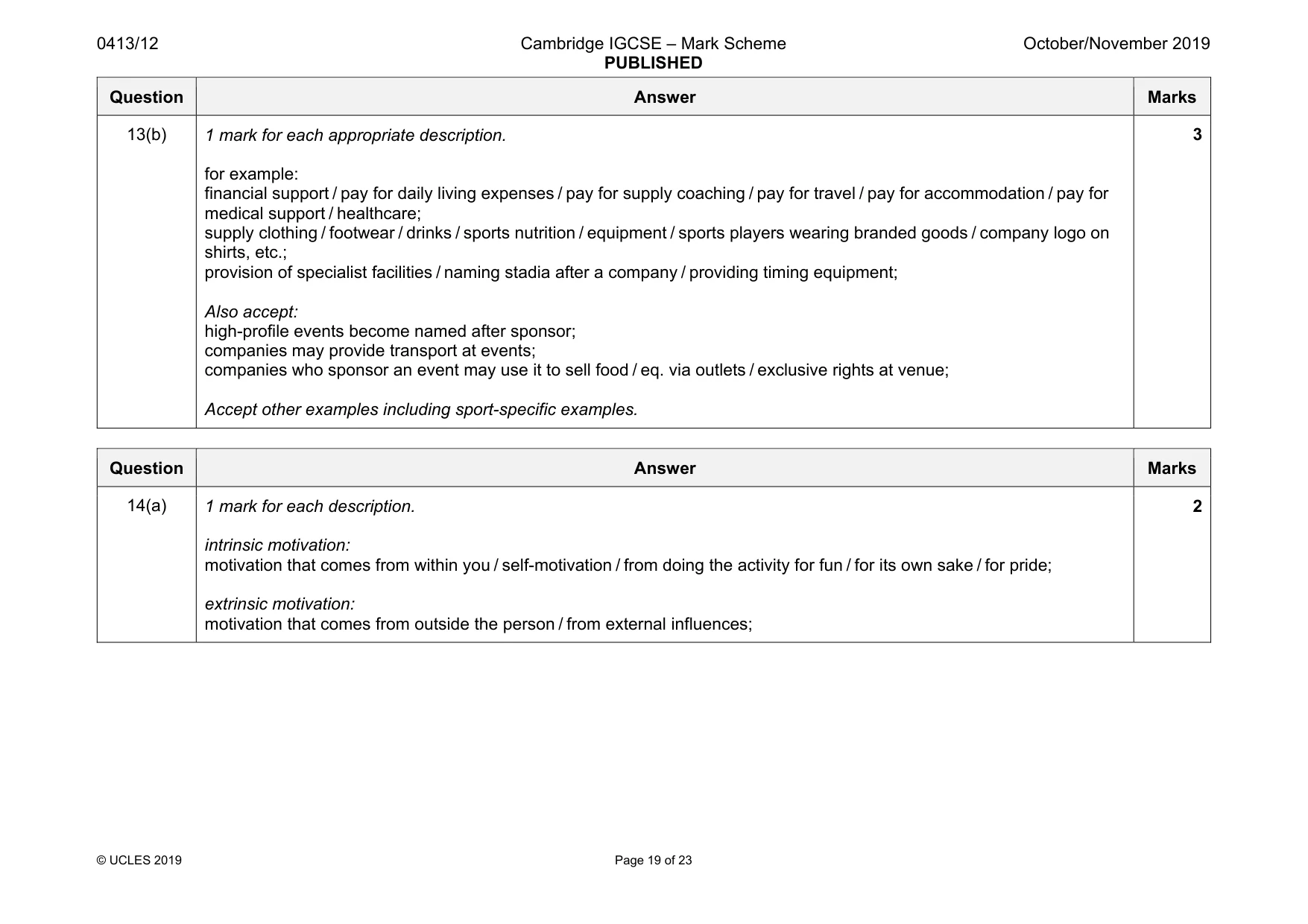
0413/12 Cambridge IGCSE – Mark Scheme PUBLISHED October/November 2019 © UCLES 2019 Page 19 of 23 Question Answer Marks 13(b) 1 mark for each appropriate description. for example: financial support / pay for daily living expenses / pay for supply coaching / pay for travel / pay for accommodation / pay for medical support / healthcare; supply clothing / footwear / drinks / sports nutrition / equipment / sports players wearing branded goods / company logo on shirts, etc.; provision of specialist facilities / naming stadia after a company / providing timing equipment; Also accept: high-profile events become named after sponsor; companies may provide transport at events; companies who sponsor an event may use it to sell food / eq. via outlets / exclusive rights at venue; Accept other examples including sport-specific examples. 3 Question Answer Marks 14(a) 1 mark for each description. intrinsic motivation: motivation that comes from within you / self-motivation / from doing the activity for fun / for its own sake / for pride; extrinsic motivation: motivation that comes from outside the person / from external influences; 2
Mark scheme, page 20
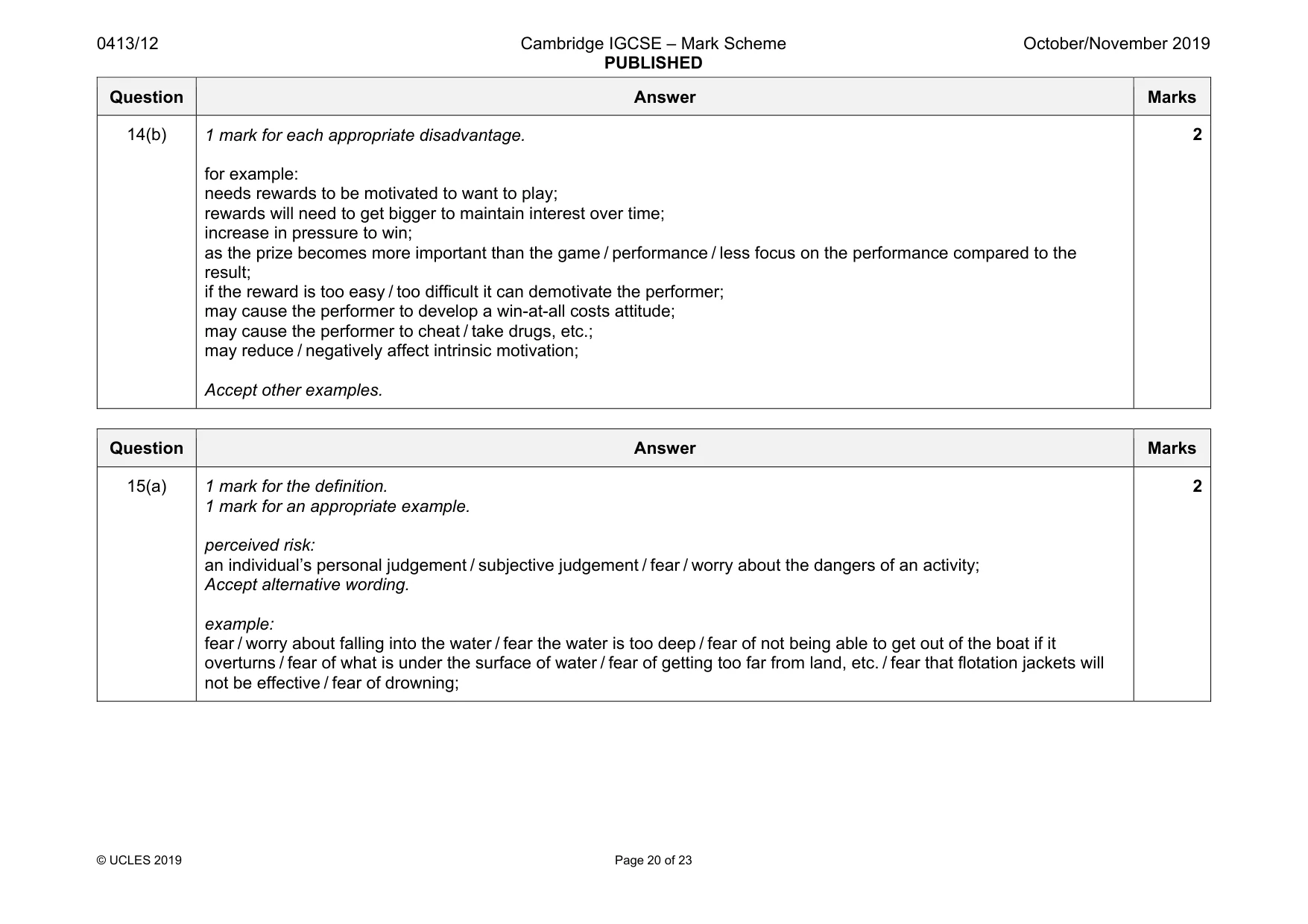
0413/12 Cambridge IGCSE – Mark Scheme PUBLISHED October/November 2019 © UCLES 2019 Page 20 of 23 Question Answer Marks 14(b) 1 mark for each appropriate disadvantage. for example: needs rewards to be motivated to want to play; rewards will need to get bigger to maintain interest over time; increase in pressure to win; as the prize becomes more important than the game / performance / less focus on the performance compared to the result; if the reward is too easy / too difficult it can demotivate the performer; may cause the performer to develop a win-at-all costs attitude; may cause the performer to cheat / take drugs, etc.; may reduce / negatively affect intrinsic motivation; Accept other examples. 2 Question Answer Marks 15(a) 1 mark for the definition. 1 mark for an appropriate example. perceived risk: an individual’s personal judgement / subjective judgement / fear / worry about the dangers of an activity; Accept alternative wording. example: fear / worry about falling into the water / fear the water is too deep / fear of not being able to get out of the boat if it overturns / fear of what is under the surface of water / fear of getting too far from land, etc. / fear that flotation jackets will not be effective / fear of drowning; 2
Mark scheme, page 21
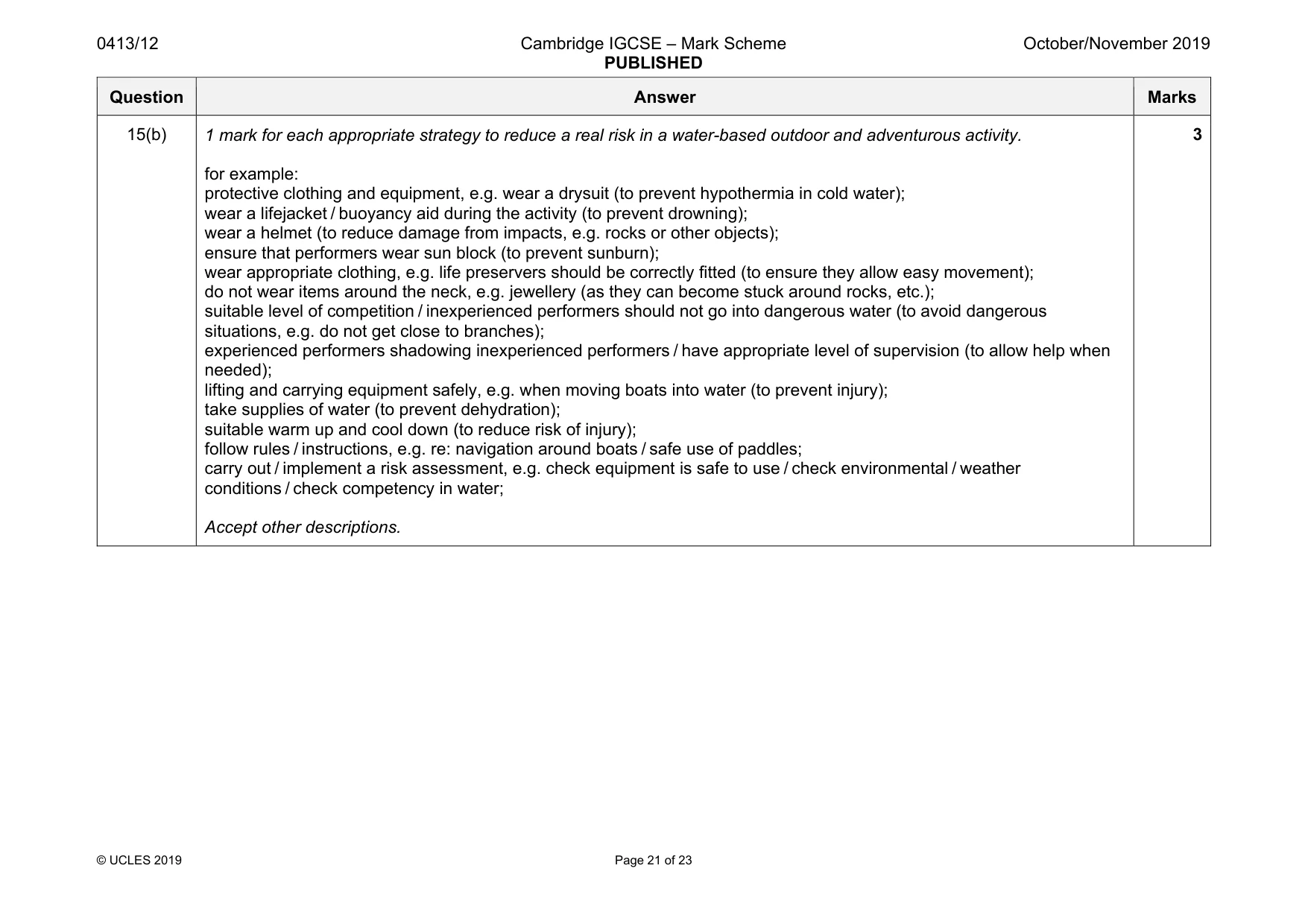
0413/12 Cambridge IGCSE – Mark Scheme PUBLISHED October/November 2019 © UCLES 2019 Page 21 of 23 Question Answer Marks 15(b) 1 mark for each appropriate strategy to reduce a real risk in a water-based outdoor and adventurous activity. for example: protective clothing and equipment, e.g. wear a drysuit (to prevent hypothermia in cold water); wear a lifejacket / buoyancy aid during the activity (to prevent drowning); wear a helmet (to reduce damage from impacts, e.g. rocks or other objects); ensure that performers wear sun block (to prevent sunburn); wear appropriate clothing, e.g. life preservers should be correctly fitted (to ensure they allow easy movement); do not wear items around the neck, e.g. jewellery (as they can become stuck around rocks, etc.); suitable level of competition / inexperienced performers should not go into dangerous water (to avoid dangerous situations, e.g. do not get close to branches); experienced performers shadowing inexperienced performers / have appropriate level of supervision (to allow help when needed); lifting and carrying equipment safely, e.g. when moving boats into water (to prevent injury); take supplies of water (to prevent dehydration); suitable warm up and cool down (to reduce risk of injury); follow rules / instructions, e.g. re: navigation around boats / safe use of paddles; carry out / implement a risk assessment, e.g. check equipment is safe to use / check environmental / weather conditions / check competency in water; Accept other descriptions. 3
Mark scheme, page 22
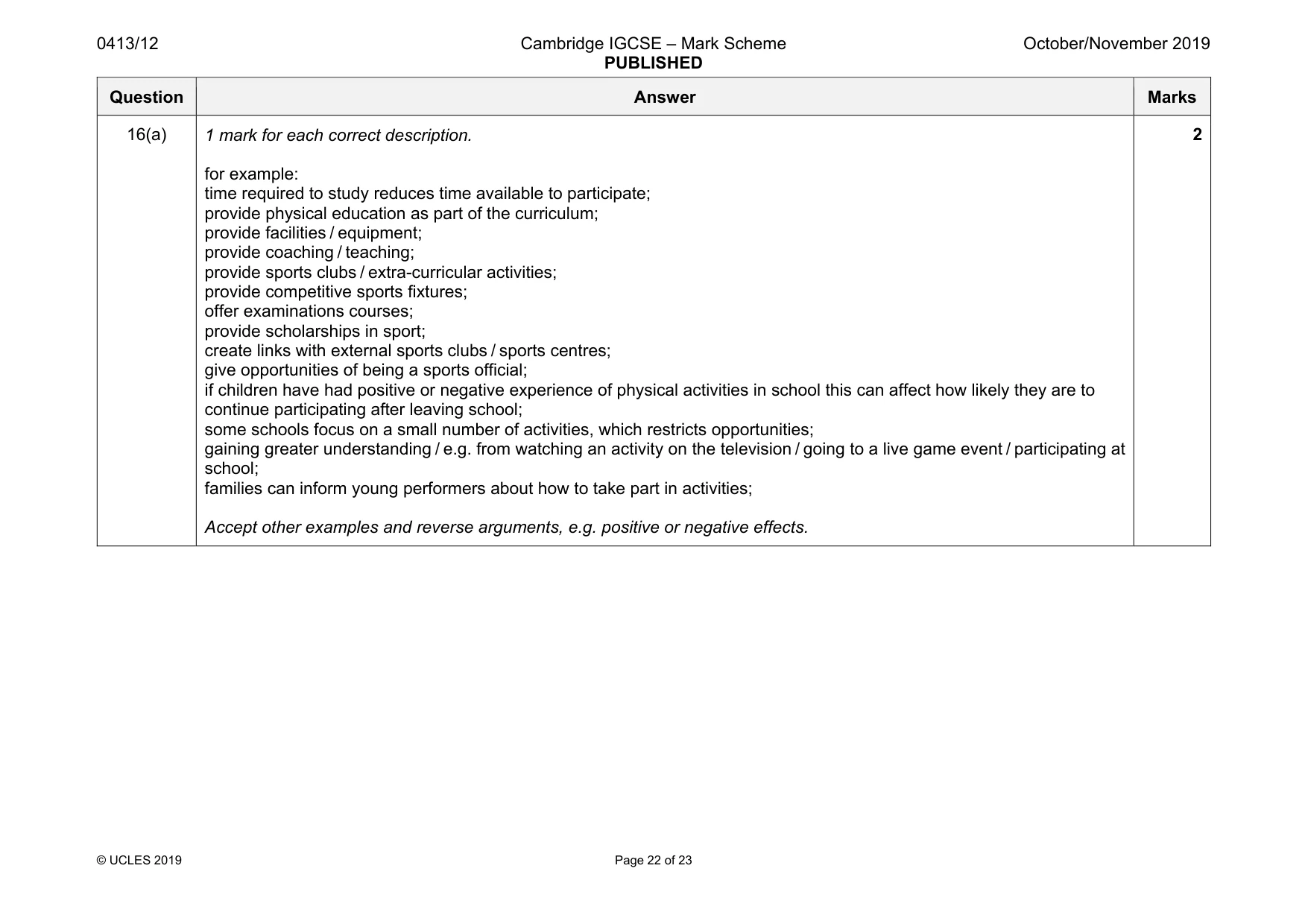
0413/12 Cambridge IGCSE – Mark Scheme PUBLISHED October/November 2019 © UCLES 2019 Page 22 of 23 Question Answer Marks 16(a) 1 mark for each correct description. for example: time required to study reduces time available to participate; provide physical education as part of the curriculum; provide facilities / equipment; provide coaching / teaching; provide sports clubs / extra-curricular activities; provide competitive sports fixtures; offer examinations courses; provide scholarships in sport; create links with external sports clubs / sports centres; give opportunities of being a sports official; if children have had positive or negative experience of physical activities in school this can affect how likely they are to continue participating after leaving school; some schools focus on a small number of activities, which restricts opportunities; gaining greater understanding / e.g. from watching an activity on the television / going to a live game event / participating at school; families can inform young performers about how to take part in activities; Accept other examples and reverse arguments, e.g. positive or negative effects. 2
Mark scheme, page 23
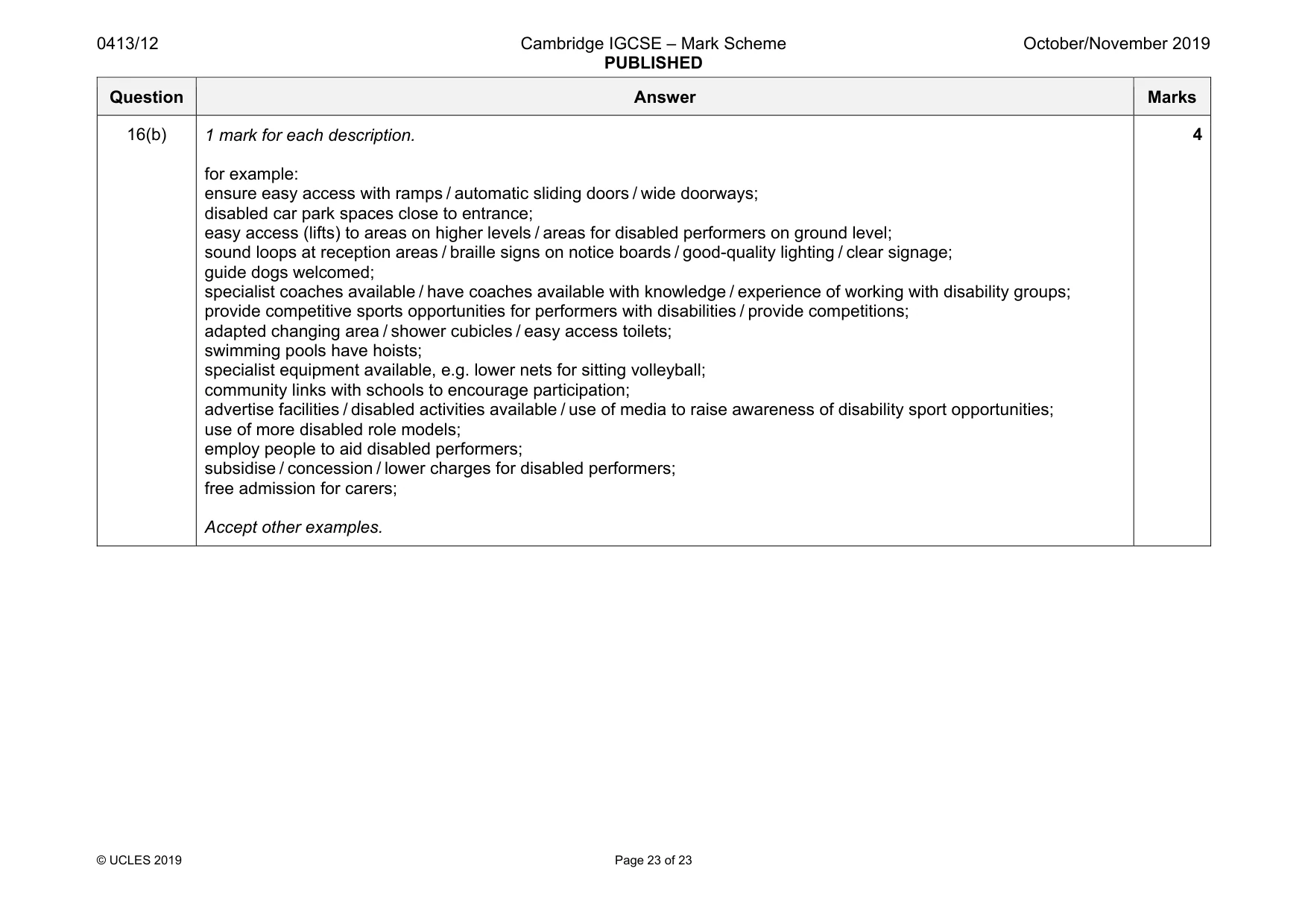
0413/12 Cambridge IGCSE – Mark Scheme PUBLISHED October/November 2019 © UCLES 2019 Page 23 of 23 Question Answer Marks 16(b) 1 mark for each description. for example: ensure easy access with ramps / automatic sliding doors / wide doorways; disabled car park spaces close to entrance; easy access (lifts) to areas on higher levels / areas for disabled performers on ground level; sound loops at reception areas / braille signs on notice boards / good-quality lighting / clear signage; guide dogs welcomed; specialist coaches available / have coaches available with knowledge / experience of working with disability groups; provide competitive sports opportunities for performers with disabilities / provide competitions; adapted changing area / shower cubicles / easy access toilets; swimming pools have hoists; specialist equipment available, e.g. lower nets for sitting volleyball; community links with schools to encourage participation; advertise facilities / disabled activities available / use of media to raise awareness of disability sport opportunities; use of more disabled role models; employ people to aid disabled performers; subsidise / concession / lower charges for disabled performers; free admission for carers; Accept other examples. 4
What you needed in this session
Cambridge’s own grade thresholds for 2019 Oct/Nov, Paper 1 · Variant 2. A higher threshold means an easier paper — the bar moves with how the cohort did.