Cambridge IGCSE Physical Education 0413 — 2019 Oct/Nov Paper 1 · Variant 3
0413/13/O/N/19 · 100 marks · ≈113 min
The question paper and its mark scheme, free to read here and free to download. This is Cambridge’s own paper, exactly as it was sat.
Question paper20 pages


Mark scheme21 pages
Answers below. Sit the paper first if you are practising.
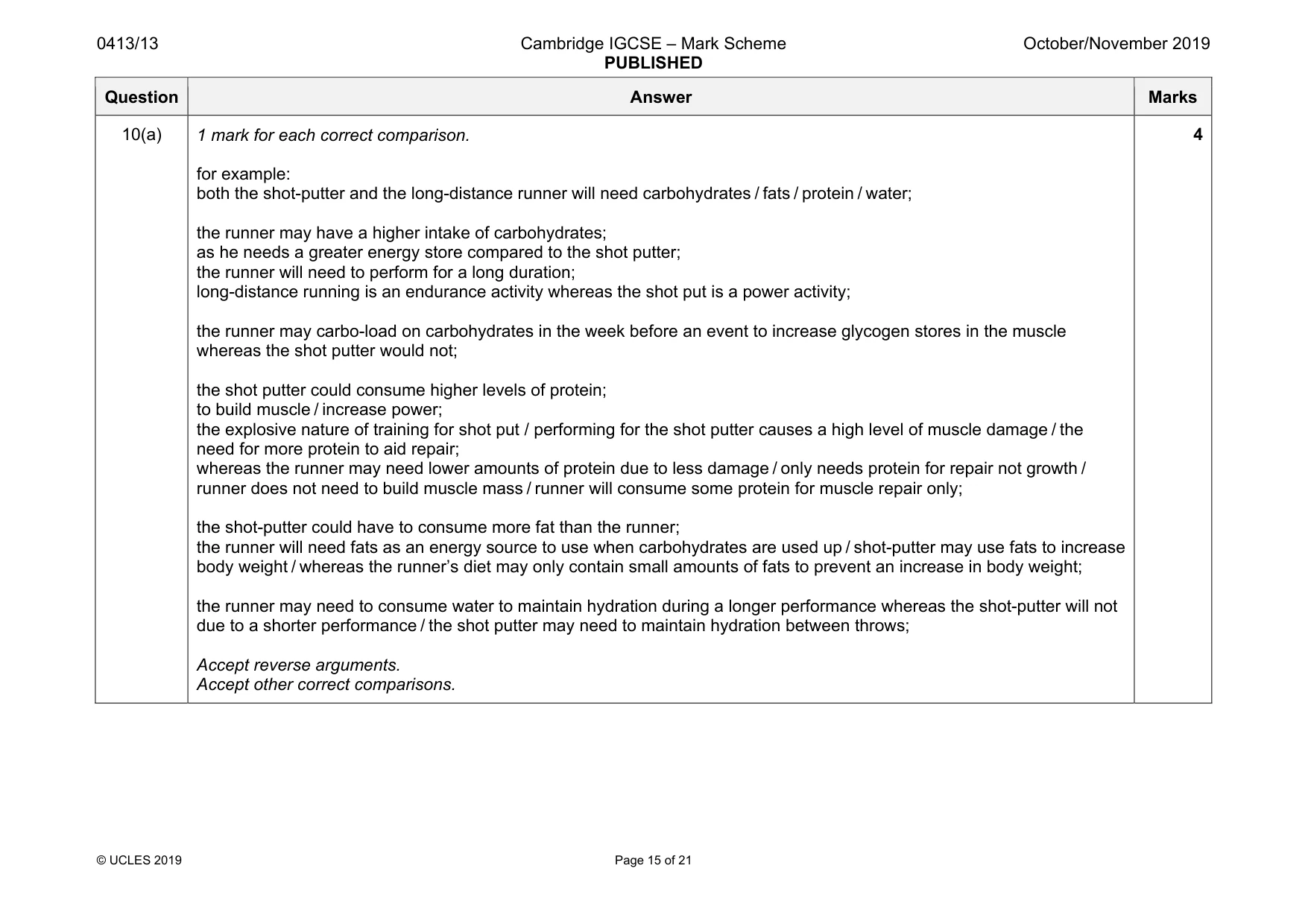
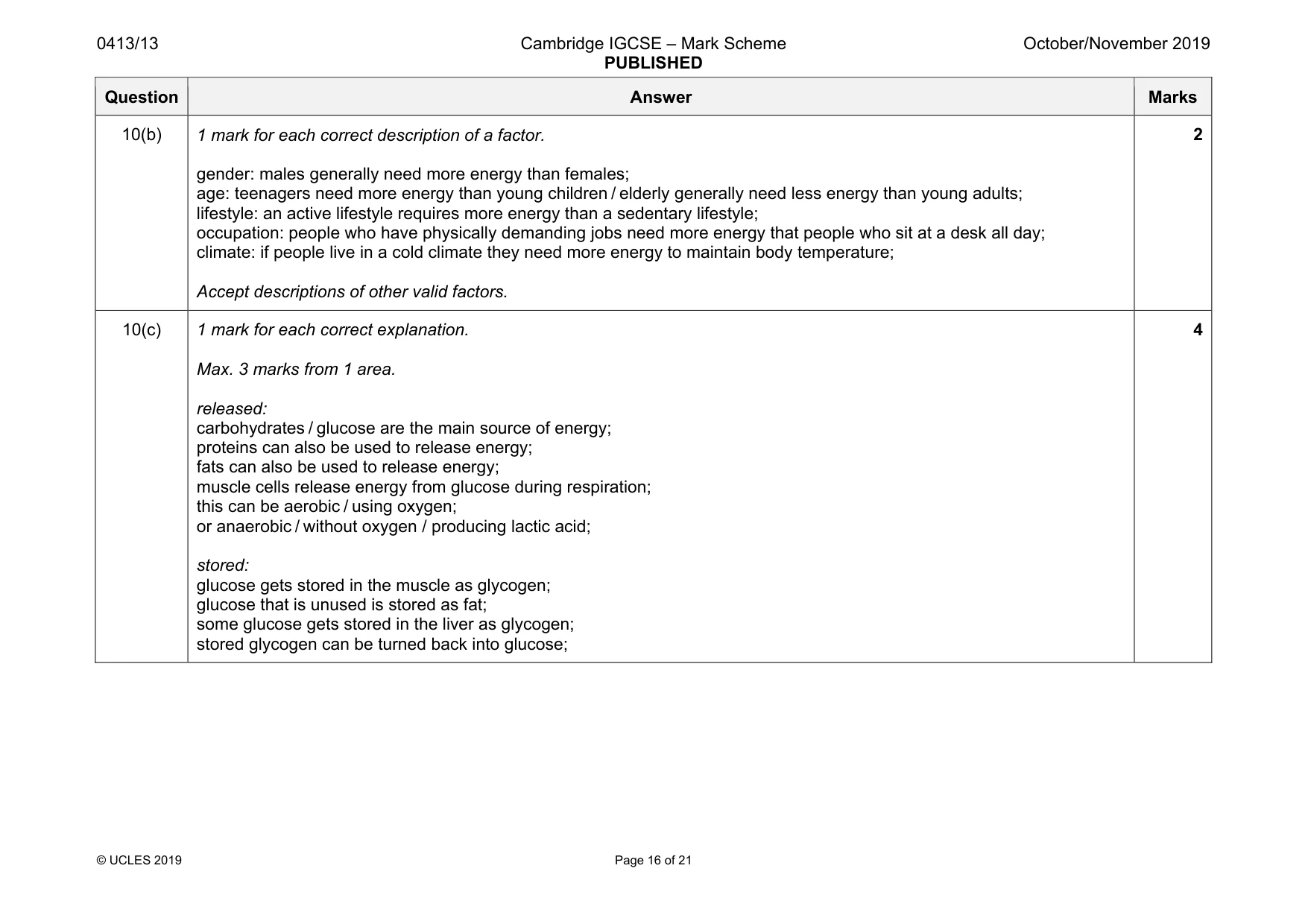
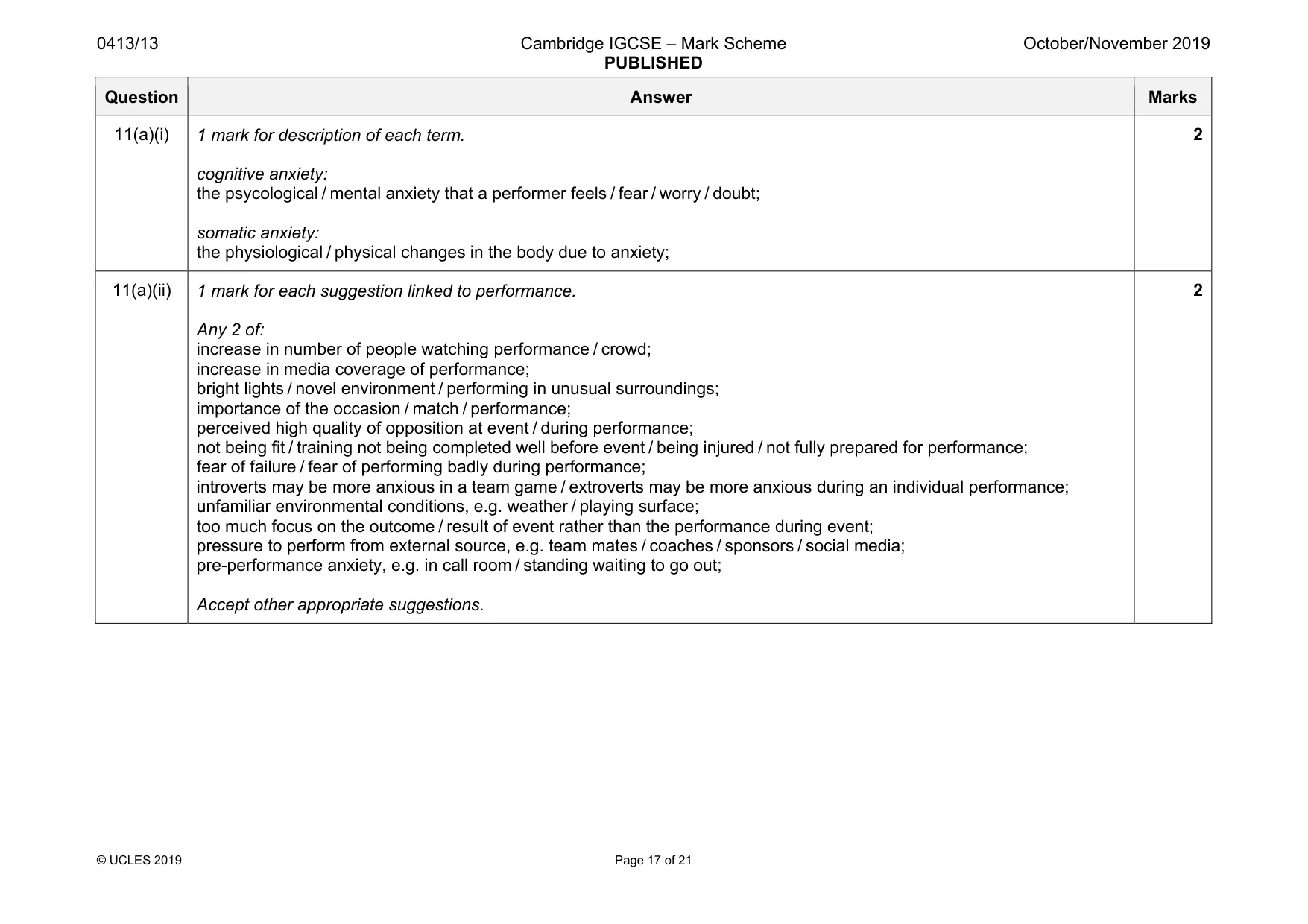
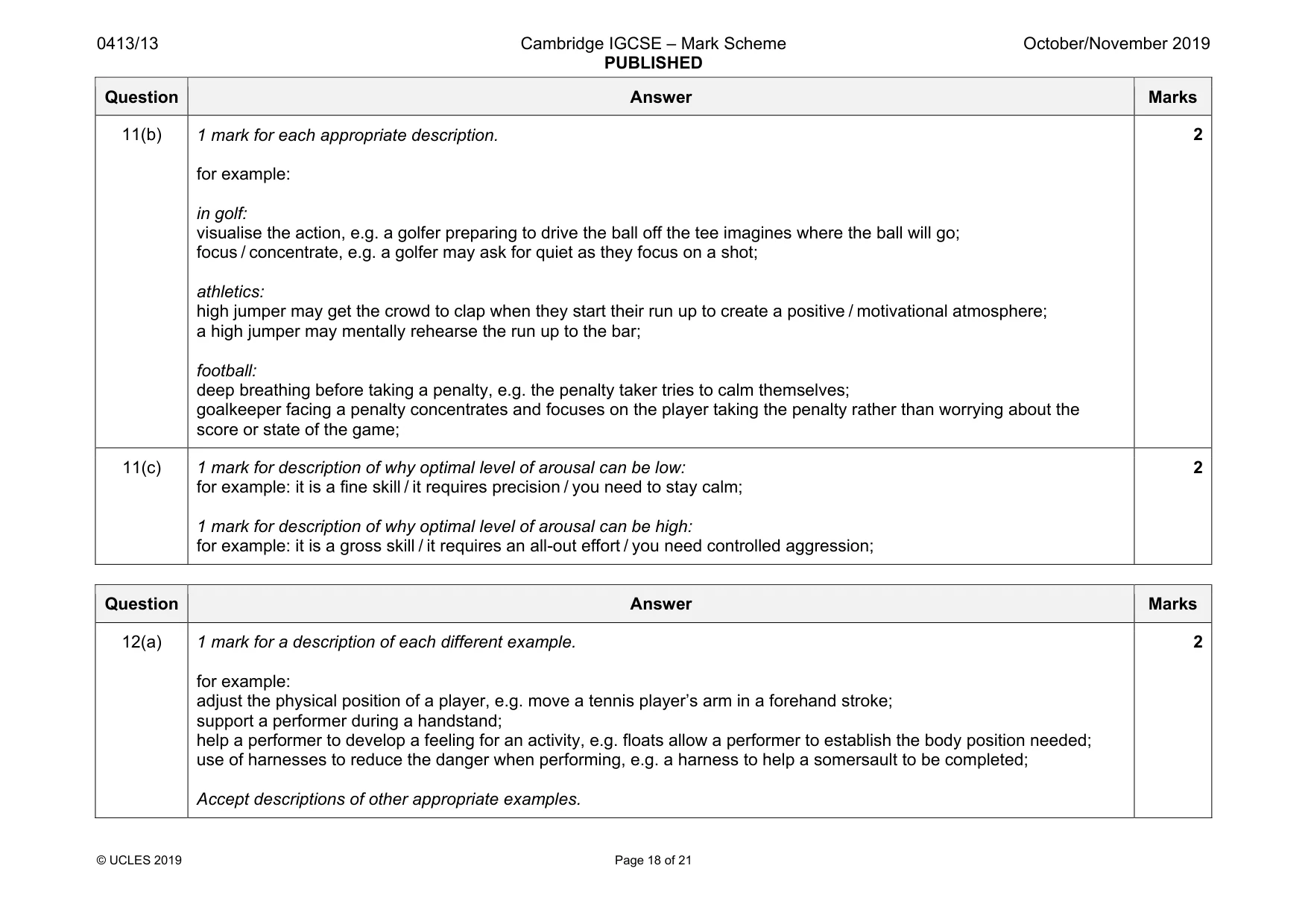
Paper as text
Question paper, page 1
This document consists of 18 printed pages and 2 blank pages. DC (ST/CT) 164482/3 © UCLES 2019 [Turn over Cambridge Assessment International Education Cambridge International General Certificate of Secondary Education * 2 0 1 2 3 0 5 9 8 8 * PHYSICAL EDUCATION 0413/13 Paper 1 Theory October/November 2019 1 hour 45 minutes Candidates answer on the Question Paper. No Additional Materials are required. READ THESE INSTRUCTIONS FIRST Write your centre number, candidate number and name on all the work you hand in. Write in dark blue or black pen. You may use an HB pencil for any diagrams or graphs. Do not use staples, paper clips, glue or correction fluid. DO NOT WRITE IN ANY BARCODES. Answer all questions. Electronic calculators may be used. You may lose marks if you do not show your working or if you do not use appropriate units. The number of marks is given in brackets [ ] at the end of each question or part question. The total mark for this paper is 100.
Question paper, page 2
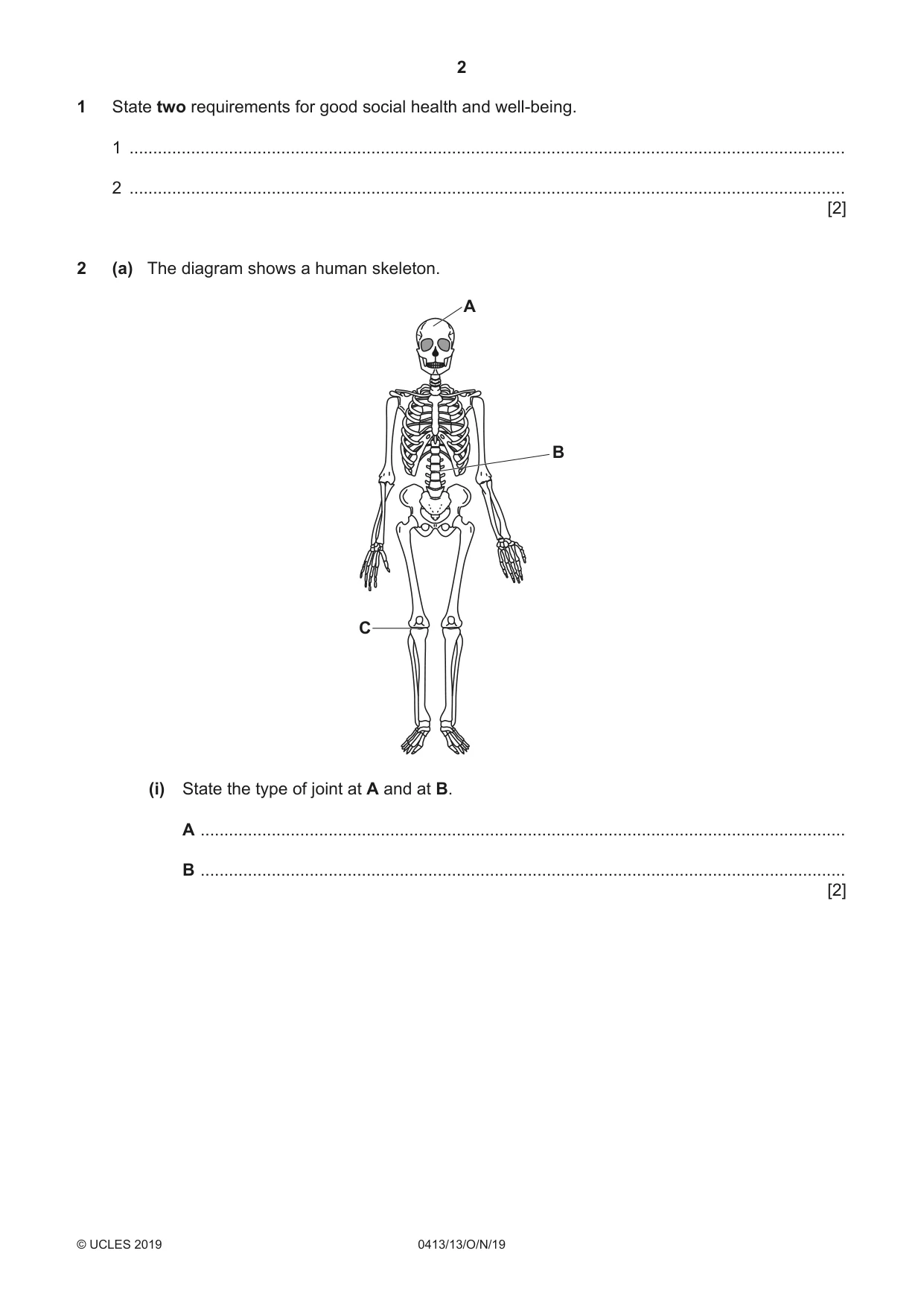
2 0413/13/O/N/19 © UCLES 2019 1 State two requirements for good social health and well-being. 1 … 2 … [2] 2 (a) The diagram shows a human skeleton. A B C (i) State the type of joint at A and at B. A … B … [2]
Question paper, page 3
3 0413/13/O/N/19 © UCLES 2019 [Turn over (ii) The joint at C is a type of synovial joint. Name this type of synovial joint and describe the function of two components in a synovial joint. type of synovial joint … component 1 … function … … component 2 … function … … [5] (b) Name three types of movement that can occur at the hip joint. 1 … 2 … 3 … [3] [Total: 10]
Question paper, page 4
4 0413/13/O/N/19 © UCLES 2019 3 (a) State a physical activity with an energy demand that is mainly aerobic. Give a reason for your answer. physical activity … reason … … [2] (b) Describe, using examples of different situations from three named physical activities, when there is a change in energy demand. physical activity 1 … example … … physical activity 2 … example … … physical activity 3 … example … … [3] [Total: 5] 4 Draw and label a diagram of a second class lever. [2]
Question paper, page 5
5 0413/13/O/N/19 © UCLES 2019 [Turn over 5 (a) Suggest one advantage for a performer of applying the principles of training to a training programme. … … [1] (b) The photograph shows a performer swimming. Explain how two named principles of training could be applied to the training programme of a swimmer. principle of training 1 … application … … … principle of training 2 … application … … … [4]
Question paper, page 6
6 0413/13/O/N/19 © UCLES 2019 (c) Suggest three benefits of high-altitude training for endurance athletes. 1 … … 2 … … 3 … … [3] (d) Describe three long-term effects of regular exercise on the heart. 1 … … 2 … … 3 … … [3] [Total: 11]
Question paper, page 7
7 0413/13/O/N/19 © UCLES 2019 [Turn over 6 (a) Skills can be classified on different continua. (i) Identify, from a named physical activity, one open skill and one closed skill. Justify your answers. physical activity … open skill … justification … … closed skill … justification … … [4] (ii) Explain, using an example of each, the difference between basic and complex skills. … … … … … … … … [4] (b) Name the first stage of learning and describe two characteristics of a performer at this stage. first stage of learning … characteristic 1 … … … characteristic 2 … … … [3] [Total: 11]
Question paper, page 8
8 0413/13/O/N/19 © UCLES 2019 7 Goals should be measurable, realistic and exciting. Suggest, using a named physical activity, how each of these goal-setting principles can be applied. physical activity … measurable … … … realistic … … … exciting … … … [3]
Question paper, page 9
9 0413/13/O/N/19 © UCLES 2019 [Turn over 8 (a) The table shows approximate percentages of slow-twitch muscle fibres and fast-twitch muscle fibres for performers that have taken part in different physical activities. physical activity percentage of slow-twitch muscle fibres percentage of fast-twitch muscle fibres 100 m/200 m sprinting 25 75 cross-country running 80 20 Suggest why the percentage of slow-twitch muscle fibres and the percentage of fast-twitch muscle fibres shown in the table benefits each of the following performers: a 100 m/200 m sprinter … … … … a cross-country runner. … … … … [4] (b) State three differences between slow-twitch muscle fibres and fast-twitch muscle fibres. 1 … … 2 … … 3 … … [3]
Question paper, page 10
10 0413/13/O/N/19 © UCLES 2019 (c) Speed is a component of fitness required by sprinters. Name a fitness test to measure speed and describe how to carry out this test. name of test … description … … … … … … [4] [Total: 11]
Question paper, page 11
11 0413/13/O/N/19 © UCLES 2019 [Turn over 9 (a) Explain how two characteristics of the alveoli enable gaseous exchange to occur in the lungs. 1 … … … … 2 … … … … [4] (b) Describe what is meant by the term tidal volume and state how this changes during exercise. description … … … change during exercise … [2] [Total: 6]
Question paper, page 12
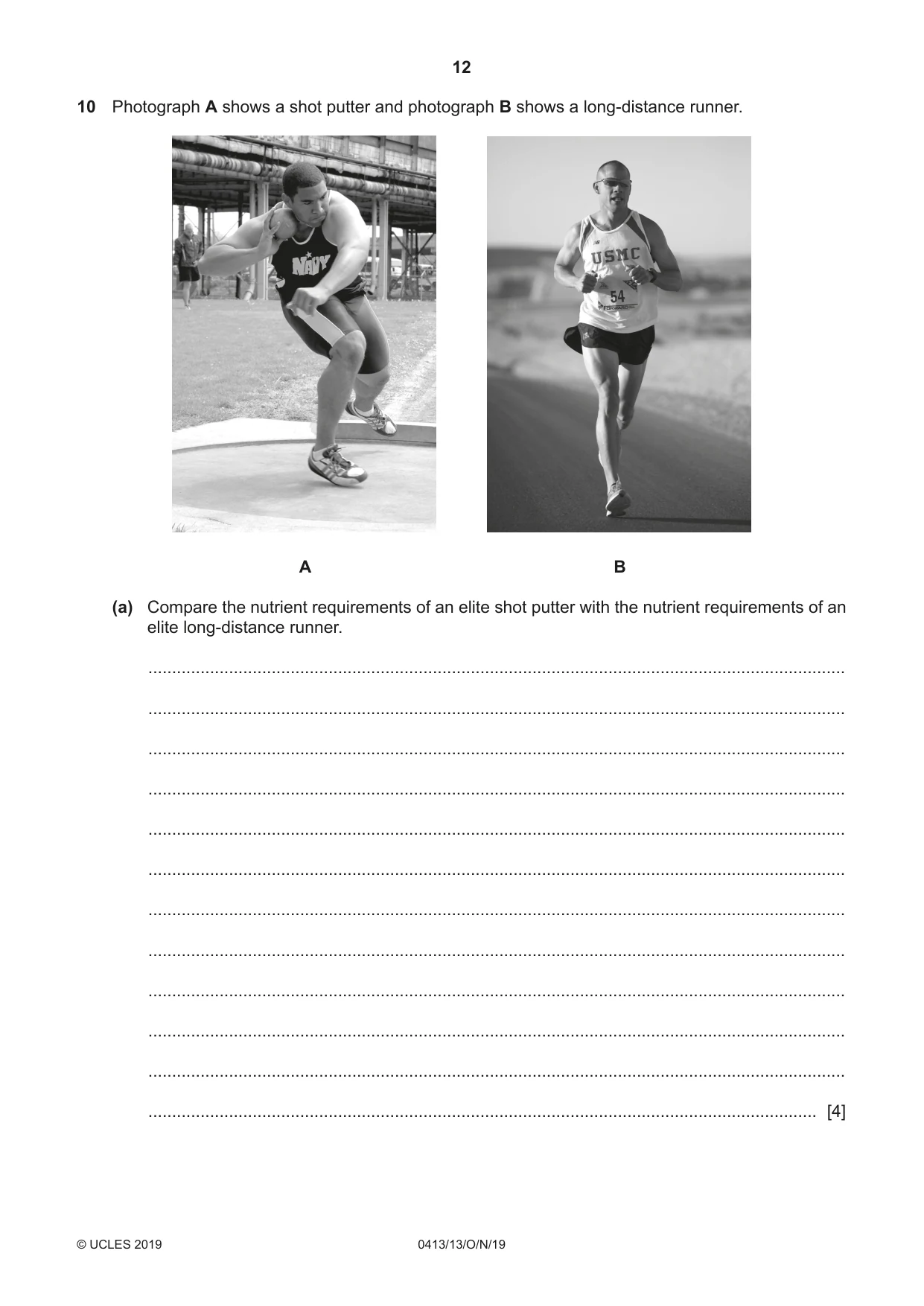
12 0413/13/O/N/19 © UCLES 2019 10 Photograph A shows a shot putter and photograph B shows a long-distance runner. A B (a) Compare the nutrient requirements of an elite shot putter with the nutrient requirements of an elite long-distance runner. … … … … … … … … … … … … [4]
Question paper, page 13
13 0413/13/O/N/19 © UCLES 2019 [Turn over (b) Describe two factors, other than the type of activity, that affect the energy needs of a performer. 1 … … 2 … … [2] (c) Explain different ways energy from food sources can be stored or released by the body. … … … … … … … … [4] [Total: 10]
Question paper, page 14
14 0413/13/O/N/19 © UCLES 2019 11 (a) (i) Describe what is meant by the following terms: cognitive anxiety … … somatic anxiety. … … [2] (ii) Suggest two different causes of anxiety during performance. 1 … … 2 … … [2] (b) Describe two ways that a performer may try to control their anxiety during a named physical activity. physical activity … 1 … … 2 … … [2] (c) Describe how the optimal level of arousal varies for different skills. … … … … [2] [Total: 8]
Question paper, page 15
15 0413/13/O/N/19 © UCLES 2019 [Turn over 12 (a) Describe, using two different examples, how manual or mechanical guidance can be used by a coach. 1 … … 2 … … [2] (b) Suggest why a coach should mainly use verbal guidance for a performer at the autonomous stage of learning. … … … … [2] [Total: 4]
Question paper, page 16
16 0413/13/O/N/19 © UCLES 2019 13 (a) Describe two real risks to performers in a named physical activity and suggest a strategy to reduce each risk. physical activity … risk 1 … … strategy … … risk 2 … … strategy … … [4] (b) The RICE method can be used to treat some injuries. Other than ice, name two parts of the RICE method. 1 … 2 … [2] [Total: 6]
Question paper, page 17
17 0413/13/O/N/19 © UCLES 2019 [Turn over 14 The diagram shows a performer kicking a ball. (a) State what is meant by the term force. … … [1] (b) Name two forces and explain how each force acts on the ball when it is in the air. name of force 1 … explanation … … … name of force 2 … explanation … … … [4] [Total: 5]
Question paper, page 18
18 0413/13/O/N/19 © UCLES 2019 15 (a) Describe the role of haemoglobin in the blood. … … … … [2] (b) Describe two functions of each of the following types of blood vessel: artery 1 … … 2 … … vein. 1 … … 2 … … [4] [Total: 6]
Question paper, page 19
19 0413/13/O/N/19 © UCLES 2019 BLANK PAGE
Question paper, page 20
20 0413/13/O/N/19 © UCLES 2019 Permission to reproduce items where third-party owned material protected by copyright is included has been sought and cleared where possible. Every reasonable effort has been made by the publisher (UCLES) to trace copyright holders, but if any items requiring clearance have unwittingly been included, the publisher will be pleased to make amends at the earliest possible opportunity. To avoid the issue of disclosure of answer-related information to candidates, all copyright acknowledgements are reproduced online in the Cambridge Assessment International Education Copyright Acknowledgements Booklet. This is produced for each series of examinations and is freely available to download at www.cambridgeinternational.org after the live examination series. Cambridge Assessment International Education is part of the Cambridge Assessment Group. Cambridge Assessment is the brand name of the University of Cambridge Local Examinations Syndicate (UCLES), which itself is a department of the University of Cambridge. BLANK PAGE
Mark scheme, page 1
This document consists of 21 printed pages. © UCLES 2019 [Turn over Cambridge Assessment International Education Cambridge International General Certificate of Secondary Education PHYSICAL EDUCATION 0413/13 Paper 1 Theory October/November 2019 MARK SCHEME Maximum Mark: 100 Published This mark scheme is published as an aid to teachers and candidates, to indicate the requirements of the examination. It shows the basis on which Examiners were instructed to award marks. It does not indicate the details of the discussions that took place at an Examiners’ meeting before marking began, which would have considered the acceptability of alternative answers. Mark schemes should be read in conjunction with the question paper and the Principal Examiner Report for Teachers. Cambridge International will not enter into discussions about these mark schemes. Cambridge International is publishing the mark schemes for the October/November 2019 series for most Cambridge IGCSE™, Cambridge International A and AS Level components and some Cambridge O Level components.
Mark scheme, page 2
0413/13 Cambridge IGCSE – Mark Scheme PUBLISHED October/November 2019 © UCLES 2019 Page 2 of 21 Generic Marking Principles These general marking principles must be applied by all examiners when marking candidate answers. They should be applied alongside the specific content of the mark scheme or generic level descriptors for a question. Each question paper and mark scheme will also comply with these marking principles. GENERIC MARKING PRINCIPLE 1: Marks must be awarded in line with: • the specific content of the mark scheme or the generic level descriptors for the question • the specific skills defined in the mark scheme or in the generic level descriptors for the question • the standard of response required by a candidate as exemplified by the standardisation scripts. GENERIC MARKING PRINCIPLE 2: Marks awarded are always whole marks (not half marks, or other fractions). GENERIC MARKING PRINCIPLE 3: Marks must be awarded positively: • marks are awarded for correct/valid answers, as defined in the mark scheme. However, credit is given for valid answers which go beyond the scope of the syllabus and mark scheme, referring to your Team Leader as appropriate • marks are awarded when candidates clearly demonstrate what they know and can do • marks are not deducted for errors • marks are not deducted for omissions • answers should only be judged on the quality of spelling, punctuation and grammar when these features are specifically assessed by the question as indicated by the mark scheme. The meaning, however, should be unambiguous. GENERIC MARKING PRINCIPLE 4: Rules must be applied consistently e.g. in situations where candidates have not followed instructions or in the application of generic level descriptors.
Mark scheme, page 3
0413/13 Cambridge IGCSE – Mark Scheme PUBLISHED October/November 2019 © UCLES 2019 Page 3 of 21 GENERIC MARKING PRINCIPLE 5: Marks should be awarded using the full range of marks defined in the mark scheme for the question (however; the use of the full mark range may be limited according to the quality of the candidate responses seen). GENERIC MARKING PRINCIPLE 6: Marks awarded are based solely on the requirements as defined in the mark scheme. Marks should not be awarded with grade thresholds or grade descriptors in mind.
Mark scheme, page 4
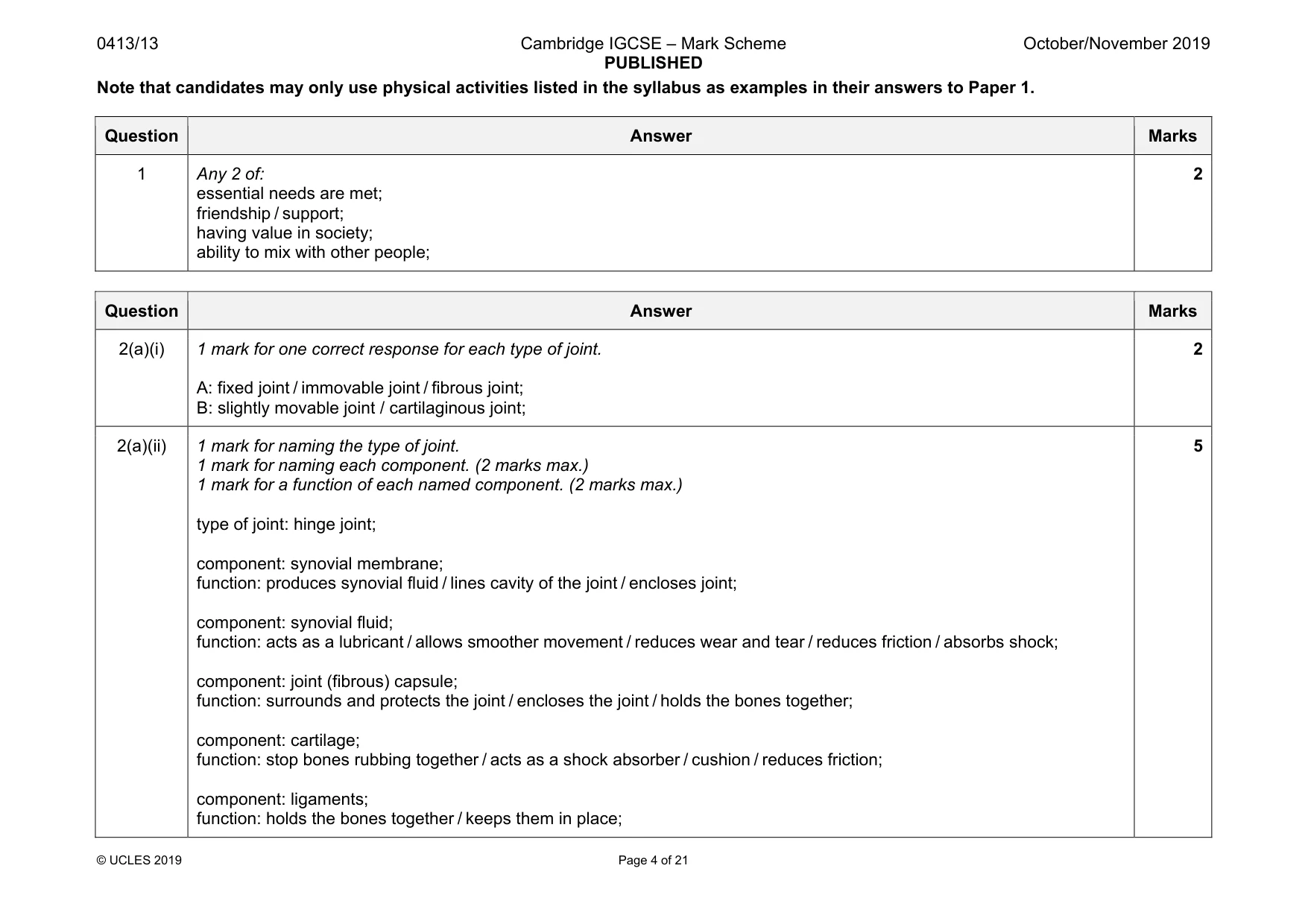
0413/13 Cambridge IGCSE – Mark Scheme PUBLISHED October/November 2019 © UCLES 2019 Page 4 of 21 Note that candidates may only use physical activities listed in the syllabus as examples in their answers to Paper 1. Question Answer Marks 1 Any 2 of: essential needs are met; friendship / support; having value in society; ability to mix with other people; 2 Question Answer Marks 2(a)(i) 1 mark for one correct response for each type of joint. A: fixed joint / immovable joint / fibrous joint; B: slightly movable joint / cartilaginous joint; 2 2(a)(ii) 1 mark for naming the type of joint. 1 mark for naming each component. (2 marks max.) 1 mark for a function of each named component. (2 marks max.) type of joint: hinge joint; component: synovial membrane; function: produces synovial fluid / lines cavity of the joint / encloses joint; component: synovial fluid; function: acts as a lubricant / allows smoother movement / reduces wear and tear / reduces friction / absorbs shock; component: joint (fibrous) capsule; function: surrounds and protects the joint / encloses the joint / holds the bones together; component: cartilage; function: stop bones rubbing together / acts as a shock absorber / cushion / reduces friction; component: ligaments; function: holds the bones together / keeps them in place; 5
Mark scheme, page 5
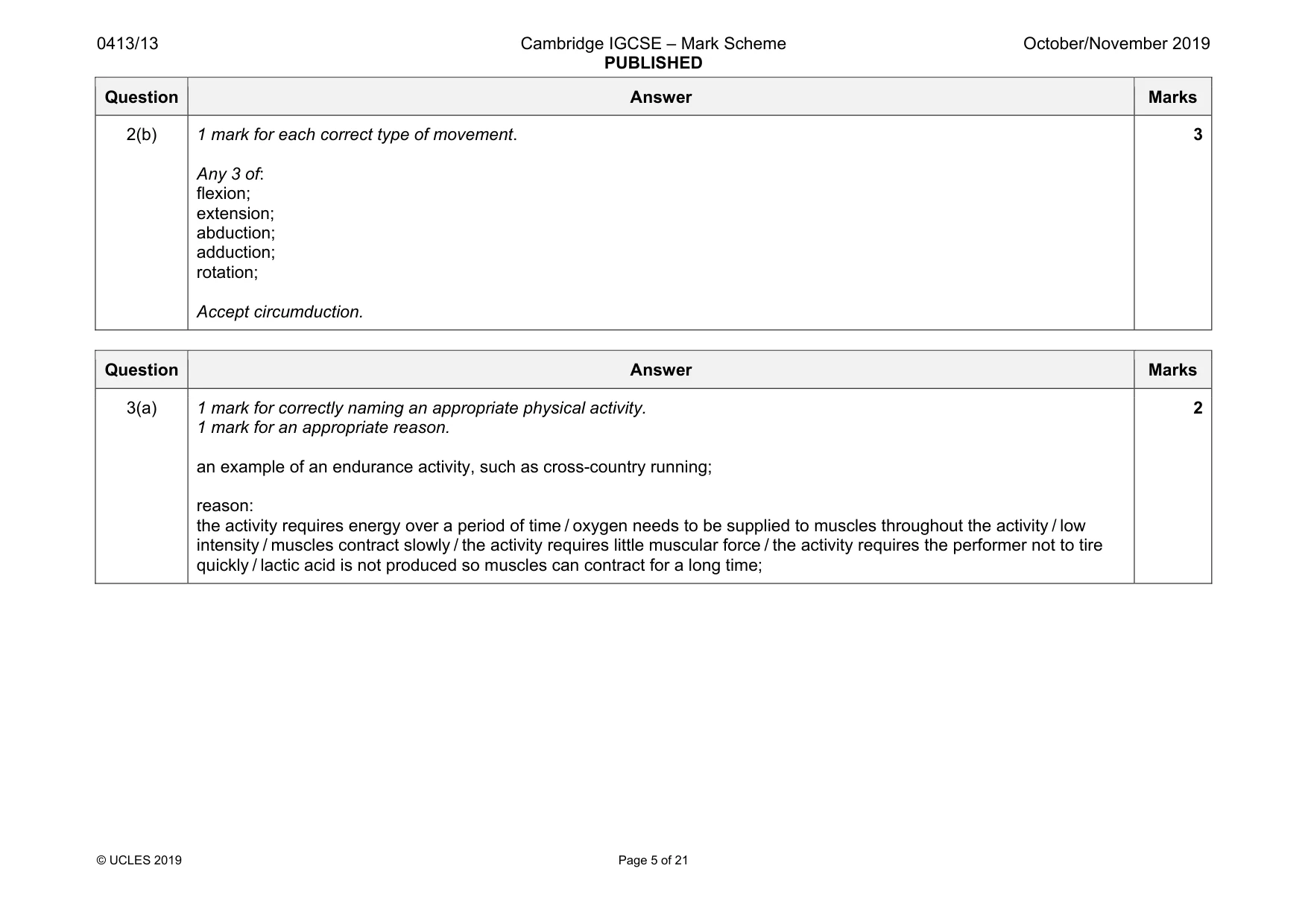
0413/13 Cambridge IGCSE – Mark Scheme PUBLISHED October/November 2019 © UCLES 2019 Page 5 of 21 Question Answer Marks 2(b) 1 mark for each correct type of movement. Any 3 of: flexion; extension; abduction; adduction; rotation; Accept circumduction. 3 Question Answer Marks 3(a) 1 mark for correctly naming an appropriate physical activity. 1 mark for an appropriate reason. an example of an endurance activity, such as cross-country running; reason: the activity requires energy over a period of time / oxygen needs to be supplied to muscles throughout the activity / low intensity / muscles contract slowly / the activity requires little muscular force / the activity requires the performer not to tire quickly / lactic acid is not produced so muscles can contract for a long time; 2
Mark scheme, page 6
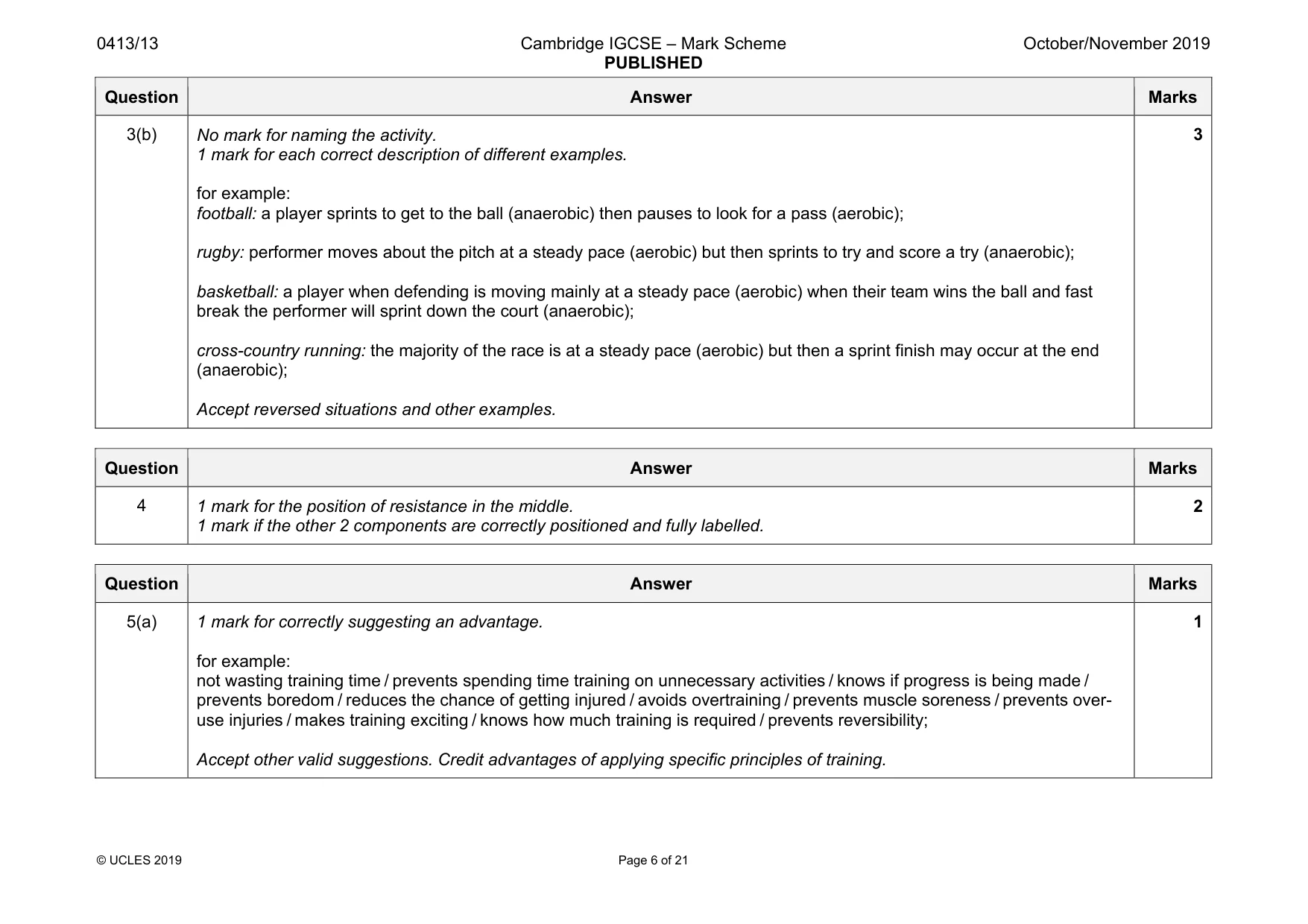
0413/13 Cambridge IGCSE – Mark Scheme PUBLISHED October/November 2019 © UCLES 2019 Page 6 of 21 Question Answer Marks 3(b) No mark for naming the activity. 1 mark for each correct description of different examples. for example: football: a player sprints to get to the ball (anaerobic) then pauses to look for a pass (aerobic); rugby: performer moves about the pitch at a steady pace (aerobic) but then sprints to try and score a try (anaerobic); basketball: a player when defending is moving mainly at a steady pace (aerobic) when their team wins the ball and fast break the performer will sprint down the court (anaerobic); cross-country running: the majority of the race is at a steady pace (aerobic) but then a sprint finish may occur at the end (anaerobic); Accept reversed situations and other examples. 3 Question Answer Marks 4 1 mark for the position of resistance in the middle. 1 mark if the other 2 components are correctly positioned and fully labelled. 2 Question Answer Marks 5(a) 1 mark for correctly suggesting an advantage. for example: not wasting training time / prevents spending time training on unnecessary activities / knows if progress is being made / prevents boredom / reduces the chance of getting injured / avoids overtraining / prevents muscle soreness / prevents over- use injuries / makes training exciting / knows how much training is required / prevents reversibility; Accept other valid suggestions. Credit advantages of applying specific principles of training. 1
Mark scheme, page 7
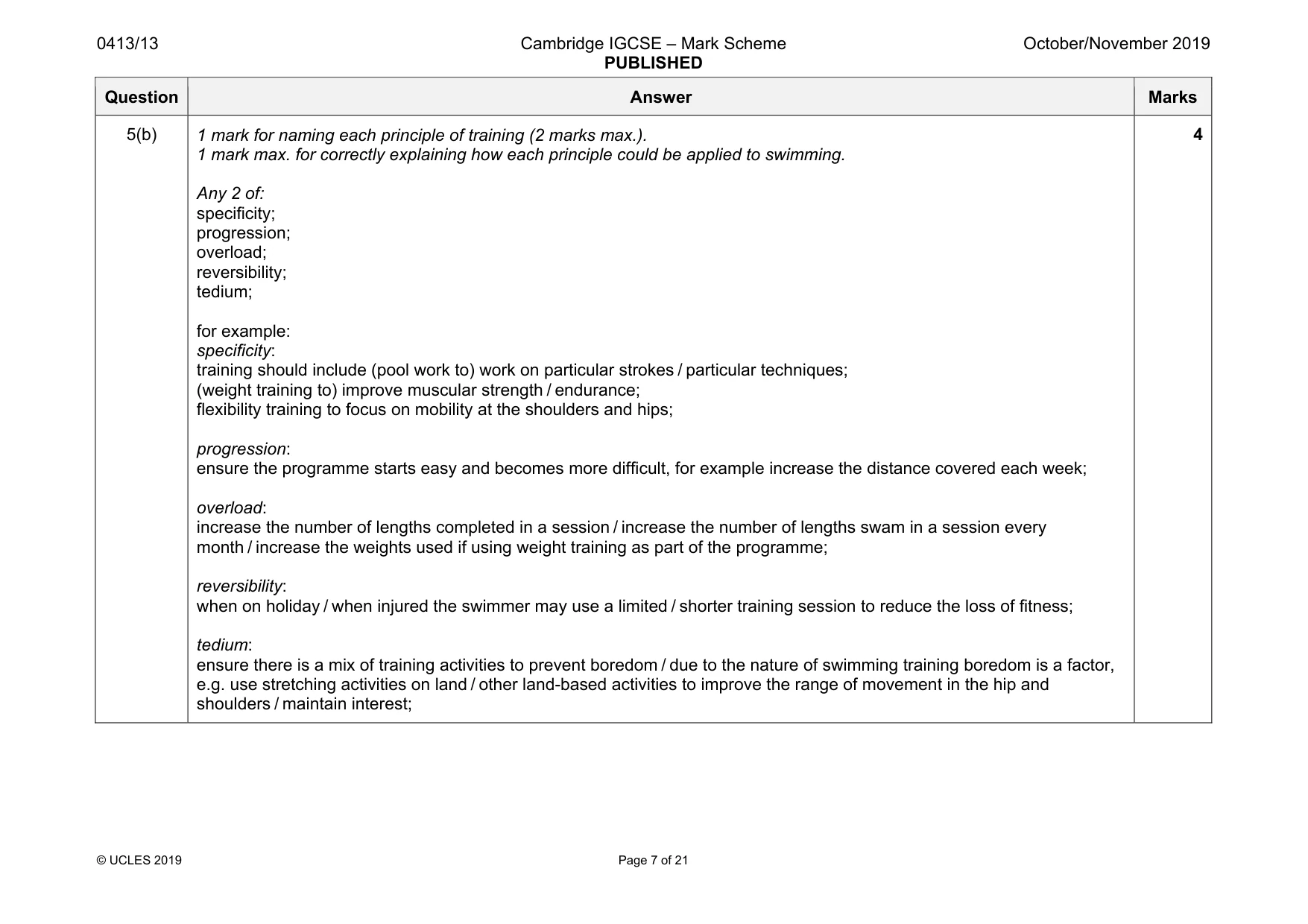
0413/13 Cambridge IGCSE – Mark Scheme PUBLISHED October/November 2019 © UCLES 2019 Page 7 of 21 Question Answer Marks 5(b) 1 mark for naming each principle of training (2 marks max.). 1 mark max. for correctly explaining how each principle could be applied to swimming. Any 2 of: specificity; progression; overload; reversibility; tedium; for example: specificity: training should include (pool work to) work on particular strokes / particular techniques; (weight training to) improve muscular strength / endurance; flexibility training to focus on mobility at the shoulders and hips; progression: ensure the programme starts easy and becomes more difficult, for example increase the distance covered each week; overload: increase the number of lengths completed in a session / increase the number of lengths swam in a session every month / increase the weights used if using weight training as part of the programme; reversibility: when on holiday / when injured the swimmer may use a limited / shorter training session to reduce the loss of fitness; tedium: ensure there is a mix of training activities to prevent boredom / due to the nature of swimming training boredom is a factor, e.g. use stretching activities on land / other land-based activities to improve the range of movement in the hip and shoulders / maintain interest; 4
Mark scheme, page 8
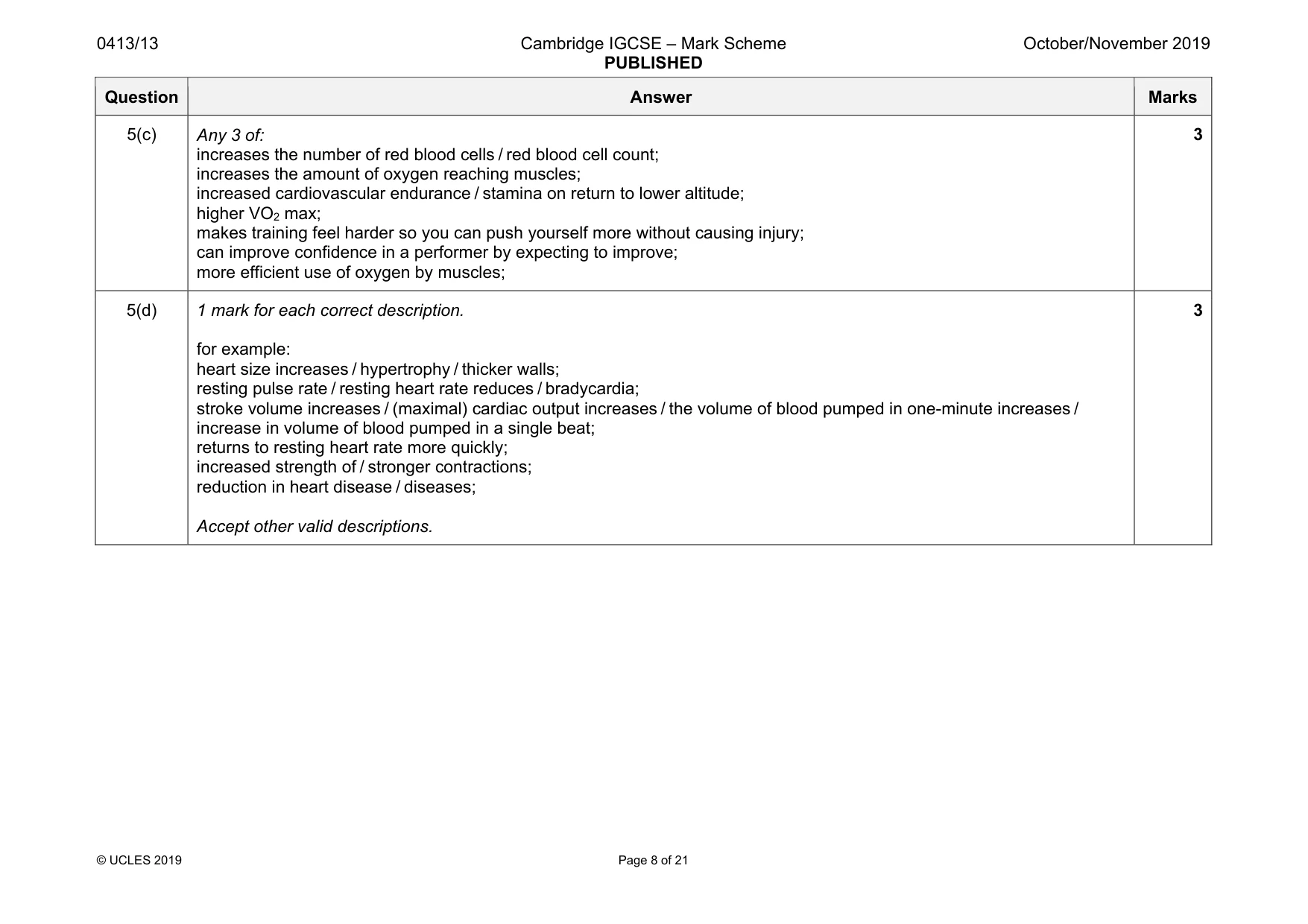
0413/13 Cambridge IGCSE – Mark Scheme PUBLISHED October/November 2019 © UCLES 2019 Page 8 of 21 Question Answer Marks 5(c) Any 3 of: increases the number of red blood cells / red blood cell count; increases the amount of oxygen reaching muscles; increased cardiovascular endurance / stamina on return to lower altitude; higher VO2 max; makes training feel harder so you can push yourself more without causing injury; can improve confidence in a performer by expecting to improve; more efficient use of oxygen by muscles; 3 5(d) 1 mark for each correct description. for example: heart size increases / hypertrophy / thicker walls; resting pulse rate / resting heart rate reduces / bradycardia; stroke volume increases / (maximal) cardiac output increases / the volume of blood pumped in one-minute increases / increase in volume of blood pumped in a single beat; returns to resting heart rate more quickly; increased strength of / stronger contractions; reduction in heart disease / diseases; Accept other valid descriptions. 3
Mark scheme, page 9
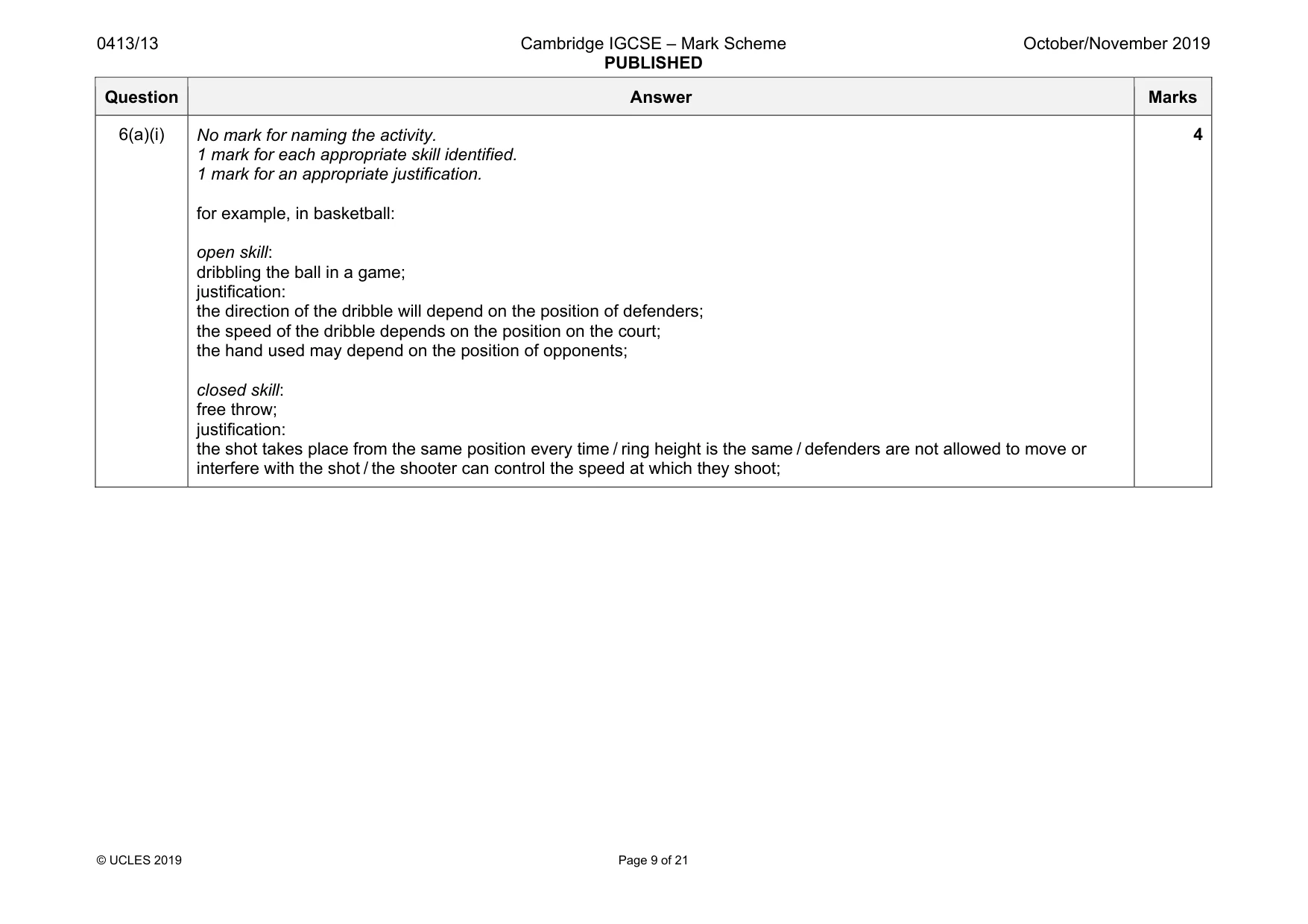
0413/13 Cambridge IGCSE – Mark Scheme PUBLISHED October/November 2019 © UCLES 2019 Page 9 of 21 Question Answer Marks 6(a)(i) No mark for naming the activity. 1 mark for each appropriate skill identified. 1 mark for an appropriate justification. for example, in basketball: open skill: dribbling the ball in a game; justification: the direction of the dribble will depend on the position of defenders; the speed of the dribble depends on the position on the court; the hand used may depend on the position of opponents; closed skill: free throw; justification: the shot takes place from the same position every time / ring height is the same / defenders are not allowed to move or interfere with the shot / the shooter can control the speed at which they shoot; 4
Mark scheme, page 10
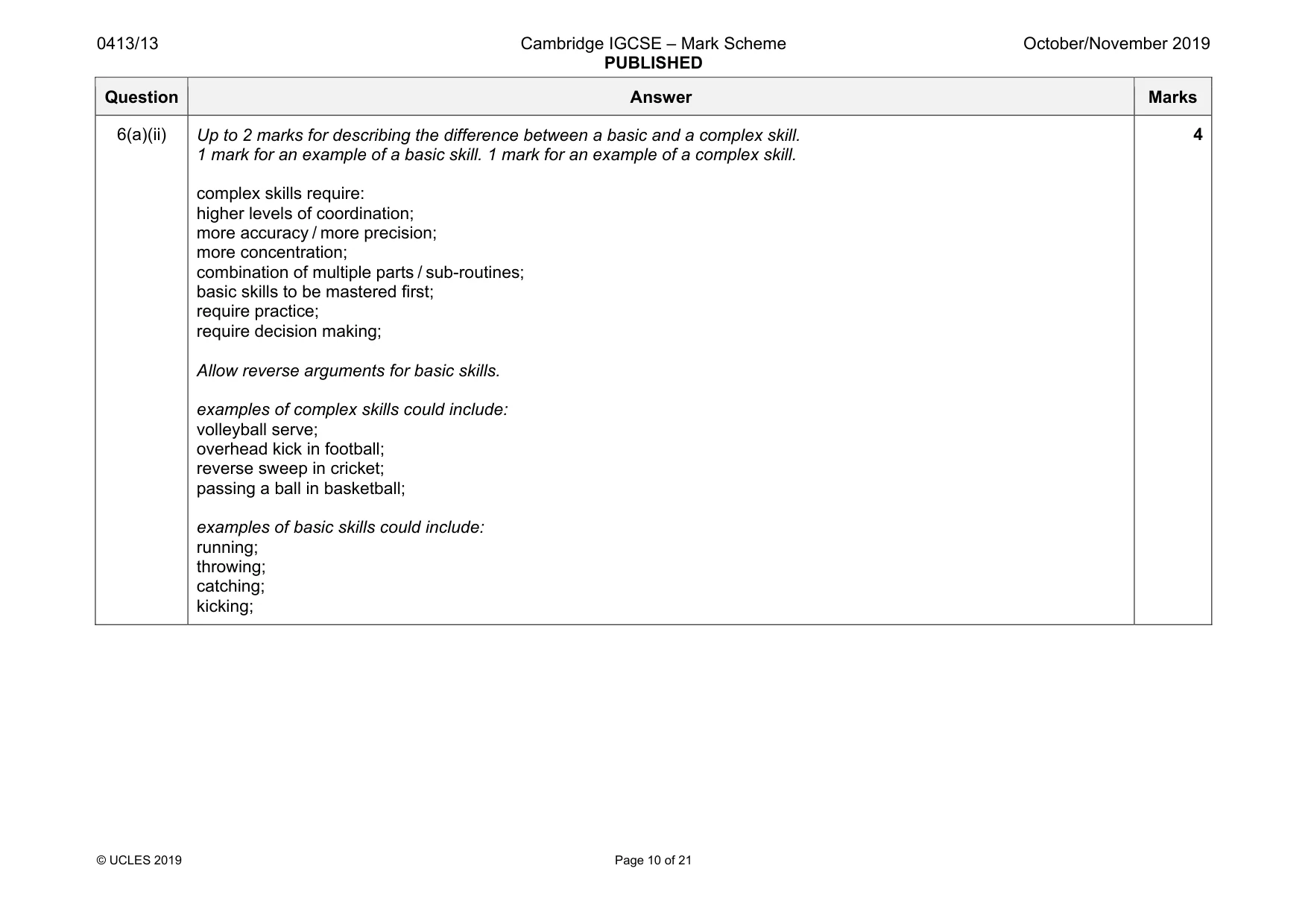
0413/13 Cambridge IGCSE – Mark Scheme PUBLISHED October/November 2019 © UCLES 2019 Page 10 of 21 Question Answer Marks 6(a)(ii) Up to 2 marks for describing the difference between a basic and a complex skill. 1 mark for an example of a basic skill. 1 mark for an example of a complex skill. complex skills require: higher levels of coordination; more accuracy / more precision; more concentration; combination of multiple parts / sub-routines; basic skills to be mastered first; require practice; require decision making; Allow reverse arguments for basic skills. examples of complex skills could include: volleyball serve; overhead kick in football; reverse sweep in cricket; passing a ball in basketball; examples of basic skills could include: running; throwing; catching; kicking; 4
Mark scheme, page 11
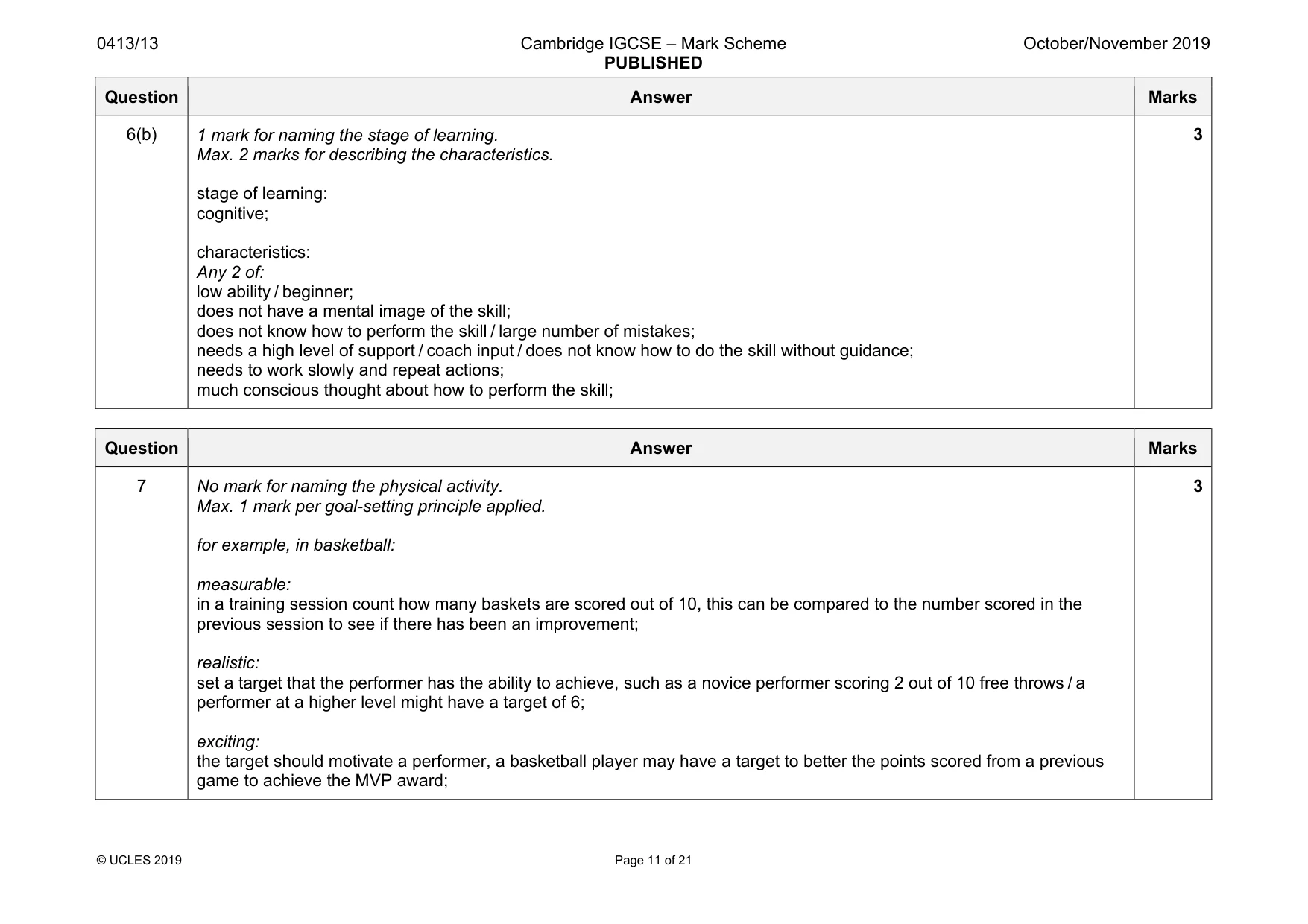
0413/13 Cambridge IGCSE – Mark Scheme PUBLISHED October/November 2019 © UCLES 2019 Page 11 of 21 Question Answer Marks 6(b) 1 mark for naming the stage of learning. Max. 2 marks for describing the characteristics. stage of learning: cognitive; characteristics: Any 2 of: low ability / beginner; does not have a mental image of the skill; does not know how to perform the skill / large number of mistakes; needs a high level of support / coach input / does not know how to do the skill without guidance; needs to work slowly and repeat actions; much conscious thought about how to perform the skill; 3 Question Answer Marks 7 No mark for naming the physical activity. Max. 1 mark per goal-setting principle applied. for example, in basketball: measurable: in a training session count how many baskets are scored out of 10, this can be compared to the number scored in the previous session to see if there has been an improvement; realistic: set a target that the performer has the ability to achieve, such as a novice performer scoring 2 out of 10 free throws / a performer at a higher level might have a target of 6; exciting: the target should motivate a performer, a basketball player may have a target to better the points scored from a previous game to achieve the MVP award; 3
Mark scheme, page 12
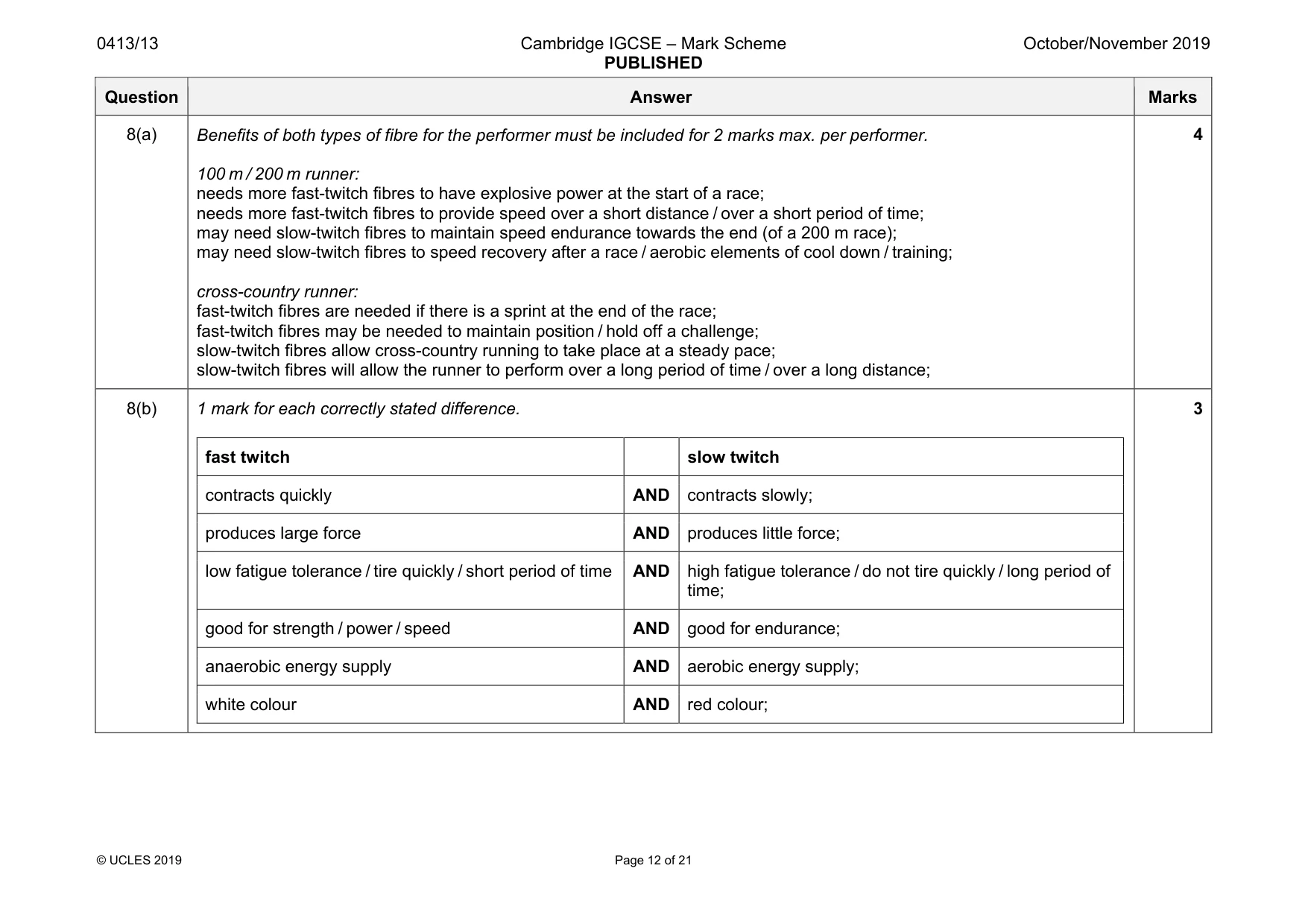
0413/13 Cambridge IGCSE – Mark Scheme PUBLISHED October/November 2019 © UCLES 2019 Page 12 of 21 Question Answer Marks 8(a) Benefits of both types of fibre for the performer must be included for 2 marks max. per performer. 100 m / 200 m runner: needs more fast-twitch fibres to have explosive power at the start of a race; needs more fast-twitch fibres to provide speed over a short distance / over a short period of time; may need slow-twitch fibres to maintain speed endurance towards the end (of a 200 m race); may need slow-twitch fibres to speed recovery after a race / aerobic elements of cool down / training; cross-country runner: fast-twitch fibres are needed if there is a sprint at the end of the race; fast-twitch fibres may be needed to maintain position / hold off a challenge; slow-twitch fibres allow cross-country running to take place at a steady pace; slow-twitch fibres will allow the runner to perform over a long period of time / over a long distance; 4 8(b) 1 mark for each correctly stated difference. fast twitch slow twitch contracts quickly AND contracts slowly; produces large force AND produces little force; low fatigue tolerance / tire quickly / short period of time AND high fatigue tolerance / do not tire quickly / long period of time; good for strength / power / speed AND good for endurance; anaerobic energy supply AND aerobic energy supply; white colour AND red colour; 3
Mark scheme, page 13
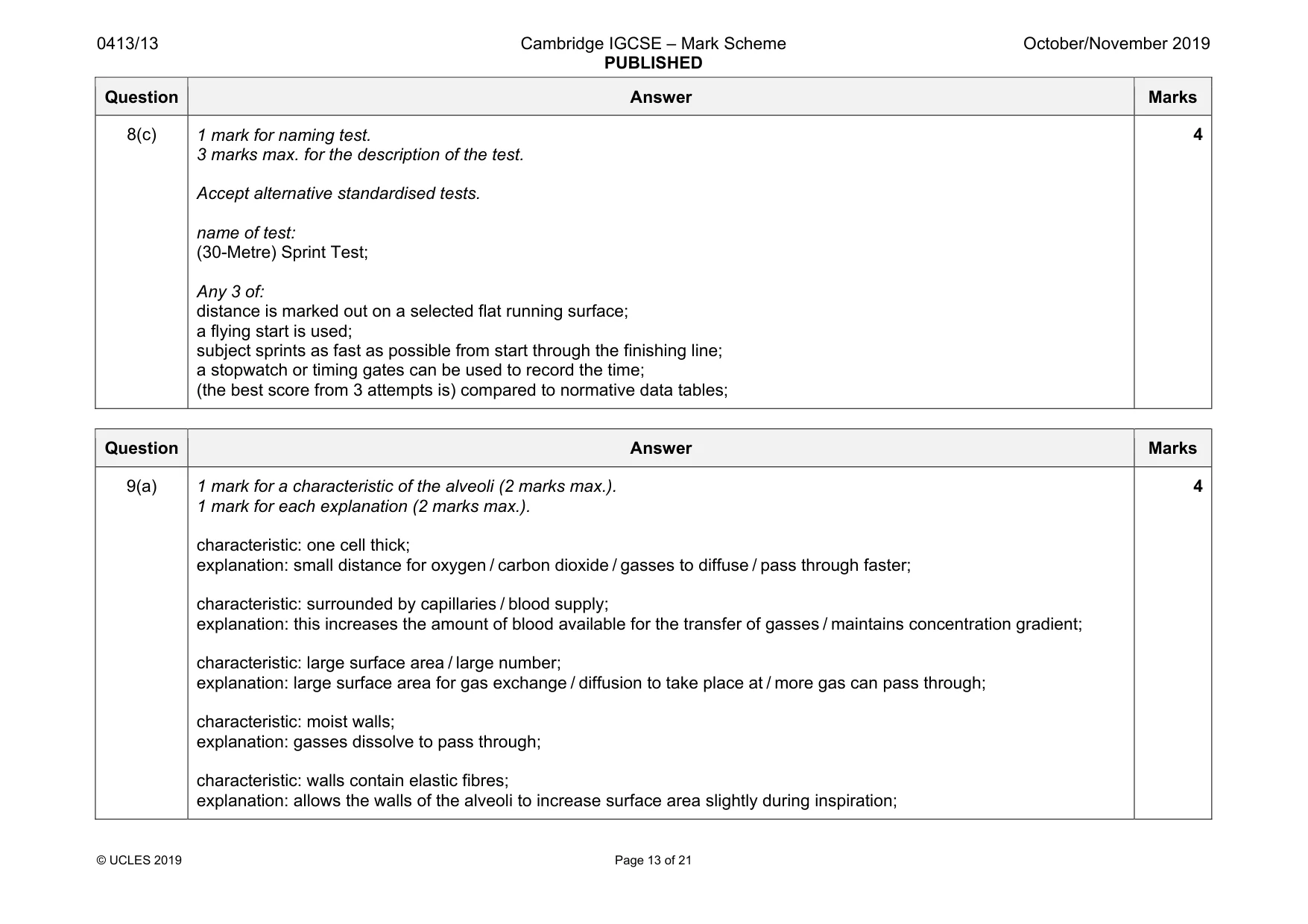
0413/13 Cambridge IGCSE – Mark Scheme PUBLISHED October/November 2019 © UCLES 2019 Page 13 of 21 Question Answer Marks 8(c) 1 mark for naming test. 3 marks max. for the description of the test. Accept alternative standardised tests. name of test: (30-Metre) Sprint Test; Any 3 of: distance is marked out on a selected flat running surface; a flying start is used; subject sprints as fast as possible from start through the finishing line; a stopwatch or timing gates can be used to record the time; (the best score from 3 attempts is) compared to normative data tables; 4 Question Answer Marks 9(a) 1 mark for a characteristic of the alveoli (2 marks max.). 1 mark for each explanation (2 marks max.). characteristic: one cell thick; explanation: small distance for oxygen / carbon dioxide / gasses to diffuse / pass through faster; characteristic: surrounded by capillaries / blood supply; explanation: this increases the amount of blood available for the transfer of gasses / maintains concentration gradient; characteristic: large surface area / large number; explanation: large surface area for gas exchange / diffusion to take place at / more gas can pass through; characteristic: moist walls; explanation: gasses dissolve to pass through; characteristic: walls contain elastic fibres; explanation: allows the walls of the alveoli to increase surface area slightly during inspiration; 4
Mark scheme, page 14
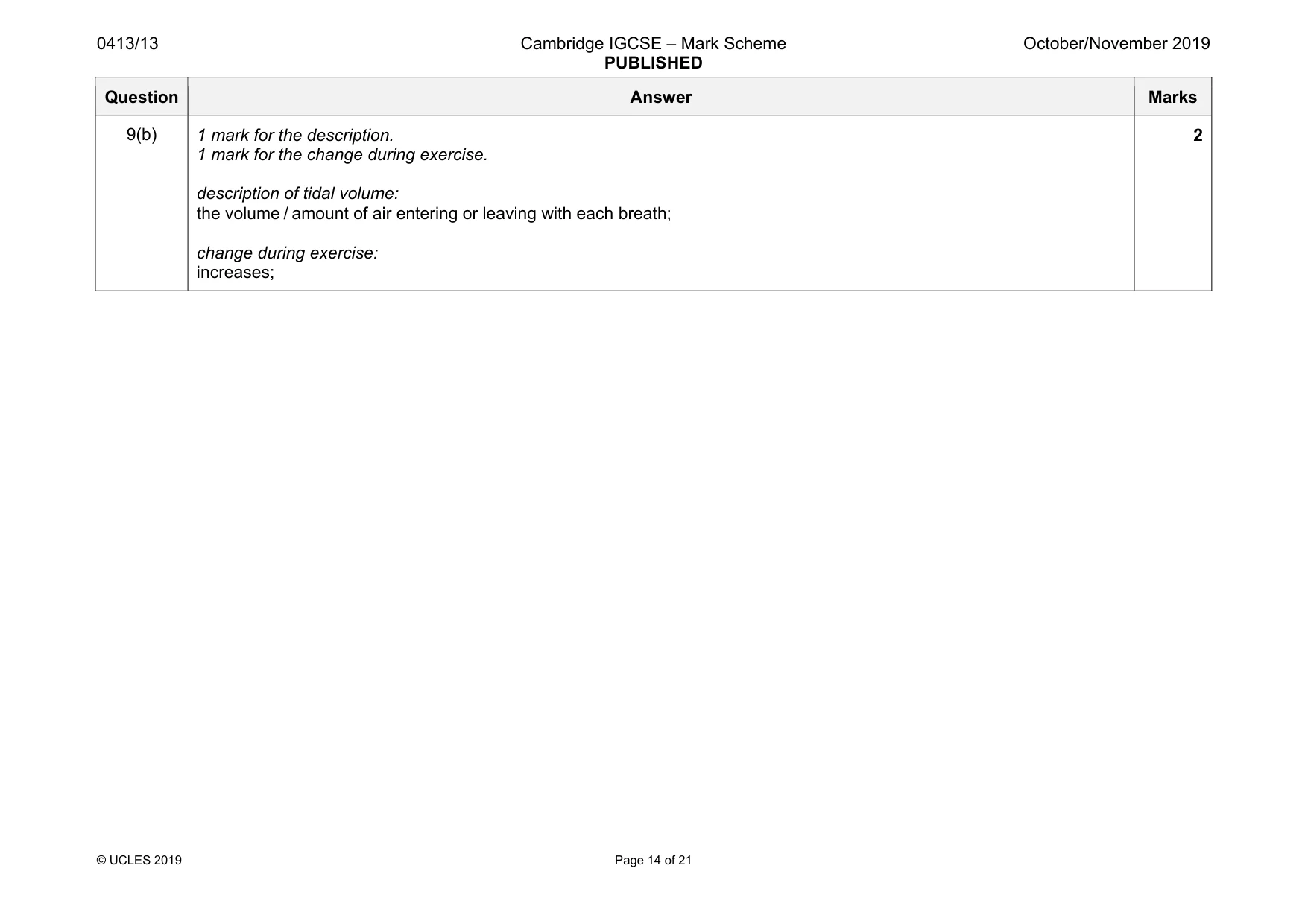
0413/13 Cambridge IGCSE – Mark Scheme PUBLISHED October/November 2019 © UCLES 2019 Page 14 of 21 Question Answer Marks 9(b) 1 mark for the description. 1 mark for the change during exercise. description of tidal volume: the volume / amount of air entering or leaving with each breath; change during exercise: increases; 2
Mark scheme, page 15
0413/13 Cambridge IGCSE – Mark Scheme PUBLISHED October/November 2019 © UCLES 2019 Page 15 of 21 Question Answer Marks 10(a) 1 mark for each correct comparison. for example: both the shot-putter and the long-distance runner will need carbohydrates / fats / protein / water; the runner may have a higher intake of carbohydrates; as he needs a greater energy store compared to the shot putter; the runner will need to perform for a long duration; long-distance running is an endurance activity whereas the shot put is a power activity; the runner may carbo-load on carbohydrates in the week before an event to increase glycogen stores in the muscle whereas the shot putter would not; the shot putter could consume higher levels of protein; to build muscle / increase power; the explosive nature of training for shot put / performing for the shot putter causes a high level of muscle damage / the need for more protein to aid repair; whereas the runner may need lower amounts of protein due to less damage / only needs protein for repair not growth / runner does not need to build muscle mass / runner will consume some protein for muscle repair only; the shot-putter could have to consume more fat than the runner; the runner will need fats as an energy source to use when carbohydrates are used up / shot-putter may use fats to increase body weight / whereas the runner’s diet may only contain small amounts of fats to prevent an increase in body weight; the runner may need to consume water to maintain hydration during a longer performance whereas the shot-putter will not due to a shorter performance / the shot putter may need to maintain hydration between throws; Accept reverse arguments. Accept other correct comparisons. 4
Mark scheme, page 16
0413/13 Cambridge IGCSE – Mark Scheme PUBLISHED October/November 2019 © UCLES 2019 Page 16 of 21 Question Answer Marks 10(b) 1 mark for each correct description of a factor. gender: males generally need more energy than females; age: teenagers need more energy than young children / elderly generally need less energy than young adults; lifestyle: an active lifestyle requires more energy than a sedentary lifestyle; occupation: people who have physically demanding jobs need more energy that people who sit at a desk all day; climate: if people live in a cold climate they need more energy to maintain body temperature; Accept descriptions of other valid factors. 2 10(c) 1 mark for each correct explanation. Max. 3 marks from 1 area. released: carbohydrates / glucose are the main source of energy; proteins can also be used to release energy; fats can also be used to release energy; muscle cells release energy from glucose during respiration; this can be aerobic / using oxygen; or anaerobic / without oxygen / producing lactic acid; stored: glucose gets stored in the muscle as glycogen; glucose that is unused is stored as fat; some glucose gets stored in the liver as glycogen; stored glycogen can be turned back into glucose; 4
Mark scheme, page 17
0413/13 Cambridge IGCSE – Mark Scheme PUBLISHED October/November 2019 © UCLES 2019 Page 17 of 21 Question Answer Marks 11(a)(i) 1 mark for description of each term. cognitive anxiety: the psycological / mental anxiety that a performer feels / fear / worry / doubt; somatic anxiety: the physiological / physical changes in the body due to anxiety; 2 11(a)(ii) 1 mark for each suggestion linked to performance. Any 2 of: increase in number of people watching performance / crowd; increase in media coverage of performance; bright lights / novel environment / performing in unusual surroundings; importance of the occasion / match / performance; perceived high quality of opposition at event / during performance; not being fit / training not being completed well before event / being injured / not fully prepared for performance; fear of failure / fear of performing badly during performance; introverts may be more anxious in a team game / extroverts may be more anxious during an individual performance; unfamiliar environmental conditions, e.g. weather / playing surface; too much focus on the outcome / result of event rather than the performance during event; pressure to perform from external source, e.g. team mates / coaches / sponsors / social media; pre-performance anxiety, e.g. in call room / standing waiting to go out; Accept other appropriate suggestions. 2
Mark scheme, page 18
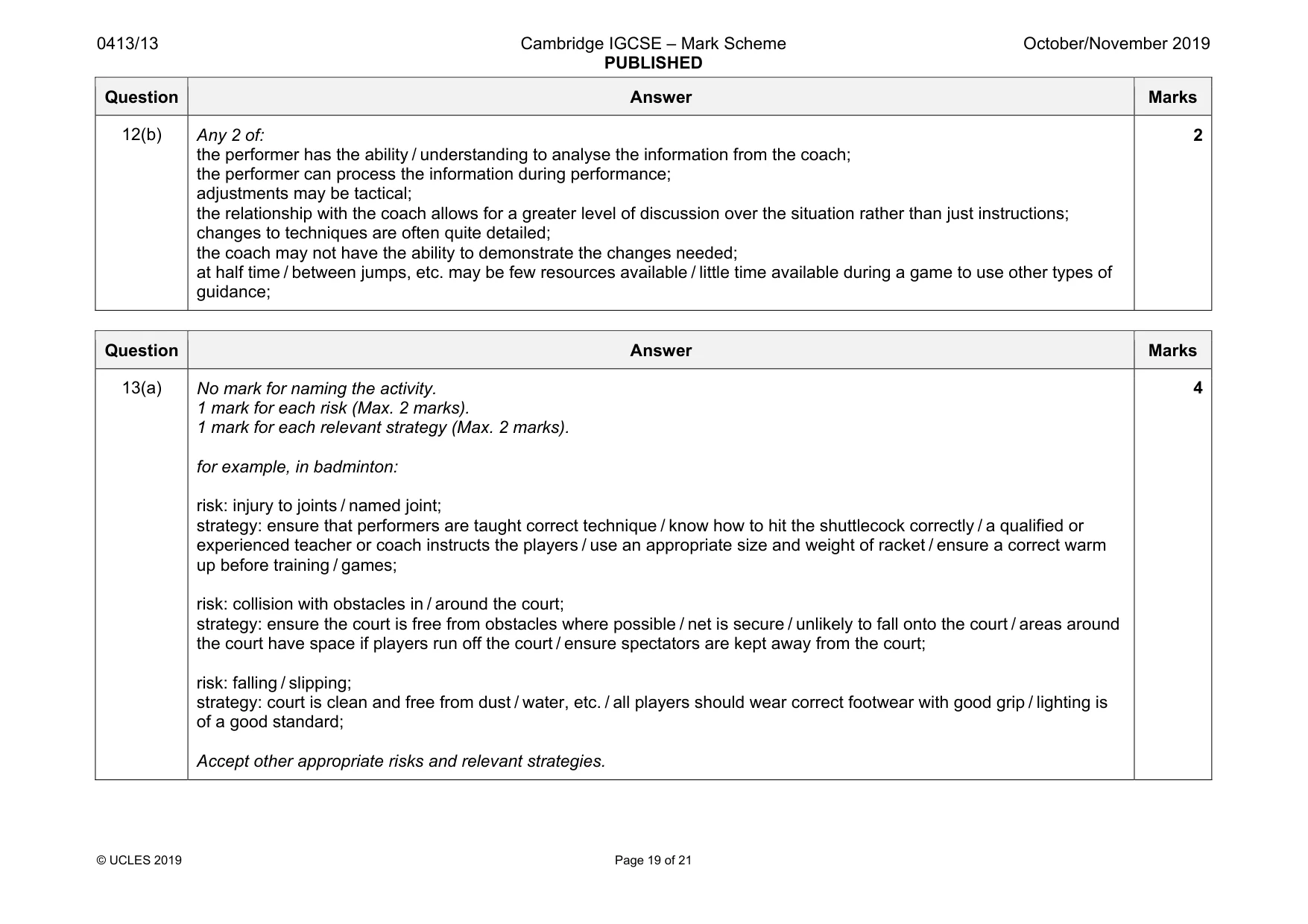
0413/13 Cambridge IGCSE – Mark Scheme PUBLISHED October/November 2019 © UCLES 2019 Page 18 of 21 Question Answer Marks 11(b) 1 mark for each appropriate description. for example: in golf: visualise the action, e.g. a golfer preparing to drive the ball off the tee imagines where the ball will go; focus / concentrate, e.g. a golfer may ask for quiet as they focus on a shot; athletics: high jumper may get the crowd to clap when they start their run up to create a positive / motivational atmosphere; a high jumper may mentally rehearse the run up to the bar; football: deep breathing before taking a penalty, e.g. the penalty taker tries to calm themselves; goalkeeper facing a penalty concentrates and focuses on the player taking the penalty rather than worrying about the score or state of the game; 2 11(c) 1 mark for description of why optimal level of arousal can be low: for example: it is a fine skill / it requires precision / you need to stay calm; 1 mark for description of why optimal level of arousal can be high: for example: it is a gross skill / it requires an all-out effort / you need controlled aggression; 2 Question Answer Marks 12(a) 1 mark for a description of each different example. for example: adjust the physical position of a player, e.g. move a tennis player’s arm in a forehand stroke; support a performer during a handstand; help a performer to develop a feeling for an activity, e.g. floats allow a performer to establish the body position needed; use of harnesses to reduce the danger when performing, e.g. a harness to help a somersault to be completed; Accept descriptions of other appropriate examples. 2
Mark scheme, page 19
0413/13 Cambridge IGCSE – Mark Scheme PUBLISHED October/November 2019 © UCLES 2019 Page 19 of 21 Question Answer Marks 12(b) Any 2 of: the performer has the ability / understanding to analyse the information from the coach; the performer can process the information during performance; adjustments may be tactical; the relationship with the coach allows for a greater level of discussion over the situation rather than just instructions; changes to techniques are often quite detailed; the coach may not have the ability to demonstrate the changes needed; at half time / between jumps, etc. may be few resources available / little time available during a game to use other types of guidance; 2 Question Answer Marks 13(a) No mark for naming the activity. 1 mark for each risk (Max. 2 marks). 1 mark for each relevant strategy (Max. 2 marks). for example, in badminton: risk: injury to joints / named joint; strategy: ensure that performers are taught correct technique / know how to hit the shuttlecock correctly / a qualified or experienced teacher or coach instructs the players / use an appropriate size and weight of racket / ensure a correct warm up before training / games; risk: collision with obstacles in / around the court; strategy: ensure the court is free from obstacles where possible / net is secure / unlikely to fall onto the court / areas around the court have space if players run off the court / ensure spectators are kept away from the court; risk: falling / slipping; strategy: court is clean and free from dust / water, etc. / all players should wear correct footwear with good grip / lighting is of a good standard; Accept other appropriate risks and relevant strategies. 4
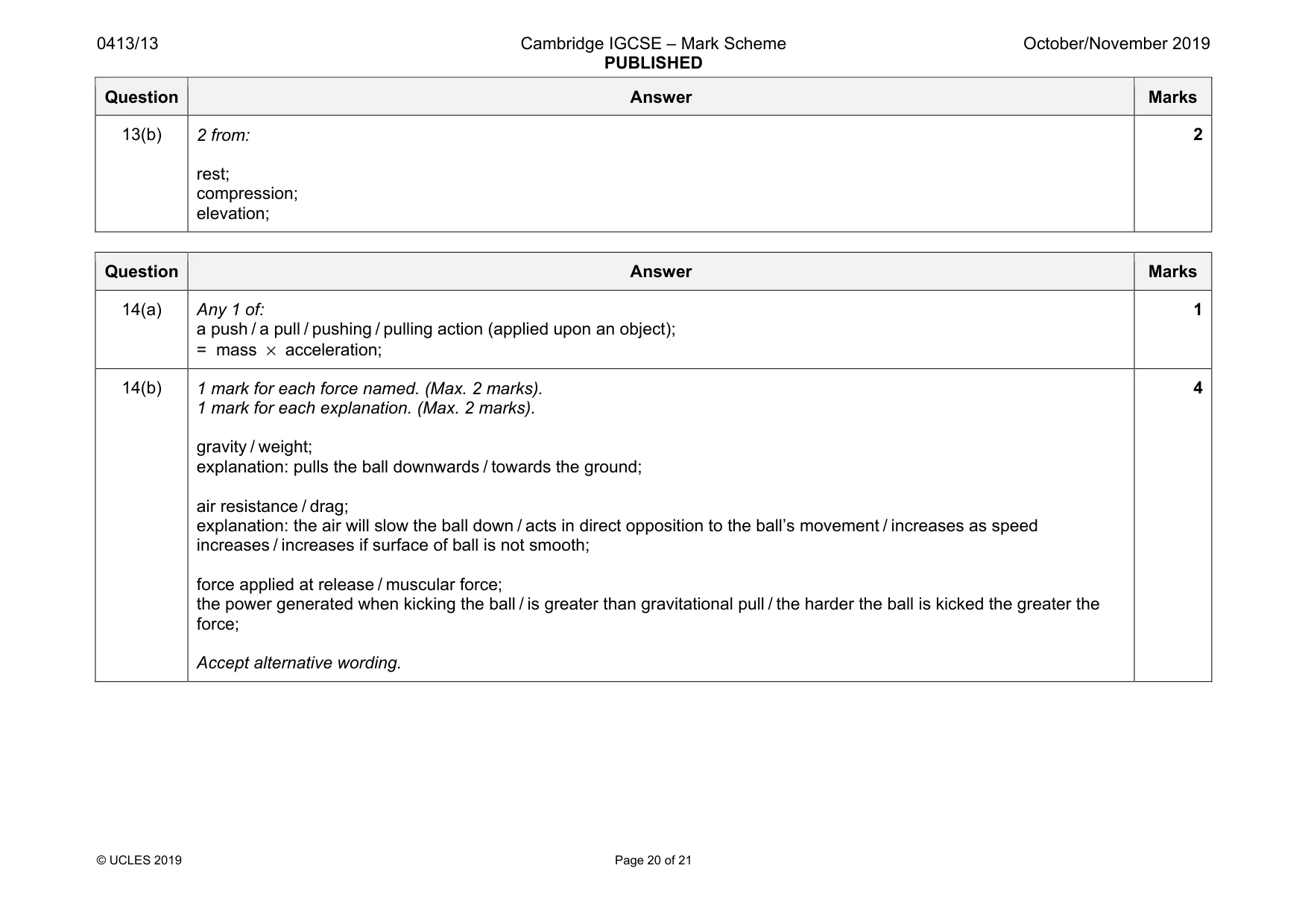
Mark scheme, page 20
0413/13 Cambridge IGCSE – Mark Scheme PUBLISHED October/November 2019 © UCLES 2019 Page 20 of 21 Question Answer Marks 13(b) 2 from: rest; compression; elevation; 2 Question Answer Marks 14(a) Any 1 of: a push / a pull / pushing / pulling action (applied upon an object); = mass × acceleration; 1 14(b) 1 mark for each force named. (Max. 2 marks). 1 mark for each explanation. (Max. 2 marks). gravity / weight; explanation: pulls the ball downwards / towards the ground; air resistance / drag; explanation: the air will slow the ball down / acts in direct opposition to the ball’s movement / increases as speed increases / increases if surface of ball is not smooth; force applied at release / muscular force; the power generated when kicking the ball / is greater than gravitational pull / the harder the ball is kicked the greater the force; Accept alternative wording. 4
Mark scheme, page 21
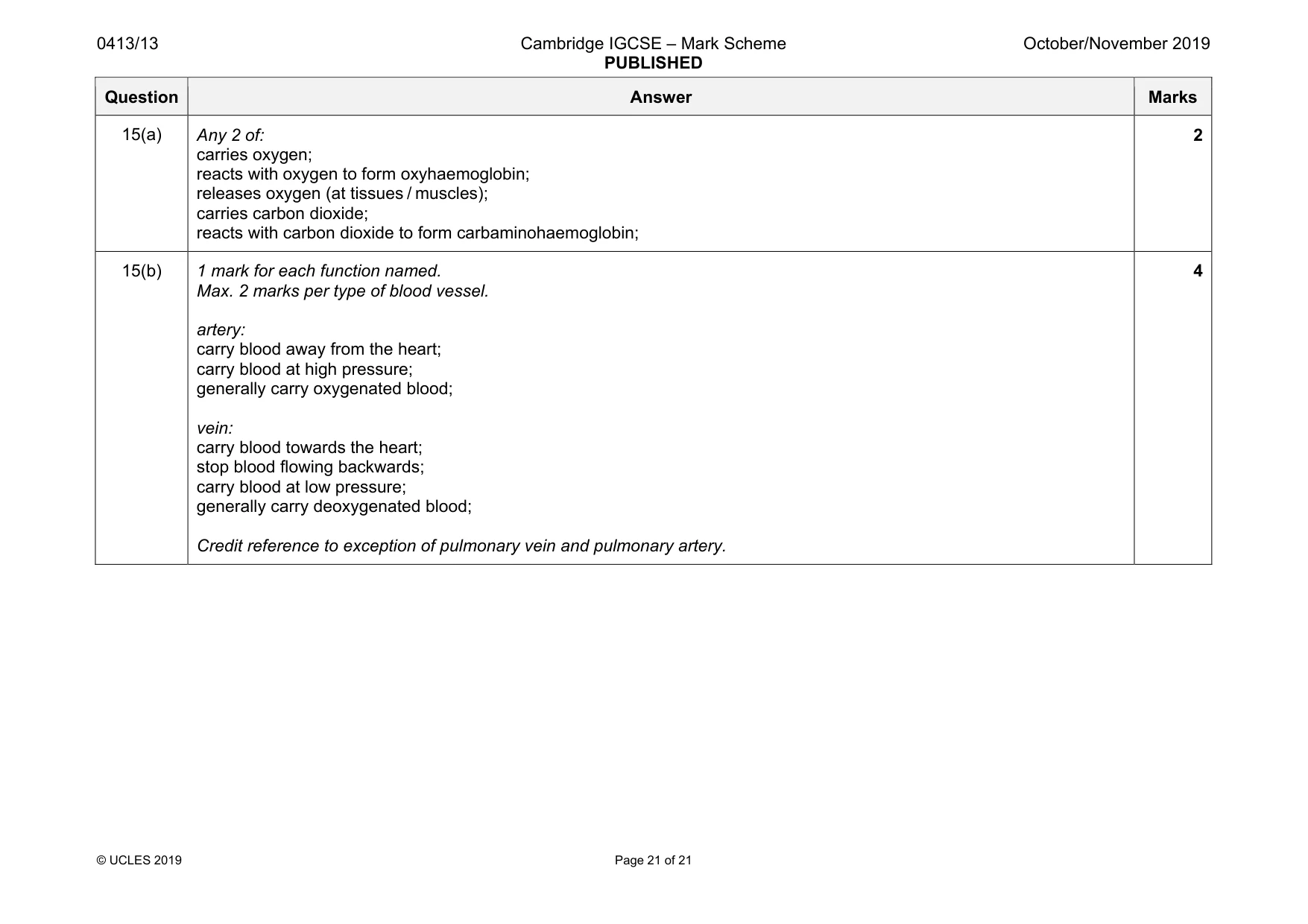
0413/13 Cambridge IGCSE – Mark Scheme PUBLISHED October/November 2019 © UCLES 2019 Page 21 of 21 Question Answer Marks 15(a) Any 2 of: carries oxygen; reacts with oxygen to form oxyhaemoglobin; releases oxygen (at tissues / muscles); carries carbon dioxide; reacts with carbon dioxide to form carbaminohaemoglobin; 2 15(b) 1 mark for each function named. Max. 2 marks per type of blood vessel. artery: carry blood away from the heart; carry blood at high pressure; generally carry oxygenated blood; vein: carry blood towards the heart; stop blood flowing backwards; carry blood at low pressure; generally carry deoxygenated blood; Credit reference to exception of pulmonary vein and pulmonary artery. 4
What you needed in this session
Cambridge’s own grade thresholds for 2019 Oct/Nov, Paper 1 · Variant 3. A higher threshold means an easier paper — the bar moves with how the cohort did.