Cambridge IGCSE Physical Education 0413 — 2019 Oct/Nov Paper 1 · Variant 1
0413/11/O/N/19 · 100 marks · ≈113 min
The question paper and its mark scheme, free to read here and free to download. This is Cambridge’s own paper, exactly as it was sat.
Question paper20 pages



Mark scheme21 pages
Answers below. Sit the paper first if you are practising.
Paper as text
Question paper, page 1
This document consists of 17 printed pages and 3 blank pages. DC (NF/SW) 164477/3 © UCLES 2019 [Turn over Cambridge Assessment International Education Cambridge International General Certificate of Secondary Education * 1 0 5 4 2 6 7 5 9 2 * PHYSICAL EDUCATION 0413/11 Paper 1 Theory October/November 2019 1 hour 45 minutes Candidates answer on the Question Paper. No Additional Materials are required. READ THESE INSTRUCTIONS FIRST Write your centre number, candidate number and name on all the work you hand in. Write in dark blue or black pen. You may use an HB pencil for any diagrams or graphs. Do not use staples, paper clips, glue or correction fluid. DO NOT WRITE IN ANY BARCODES. Answer all questions. Electronic calculators may be used. You may lose marks if you do not show your working or if you do not use appropriate units. The number of marks is given in brackets [ ] at the end of each question or part question. The total mark for this paper is 100.
Question paper, page 2
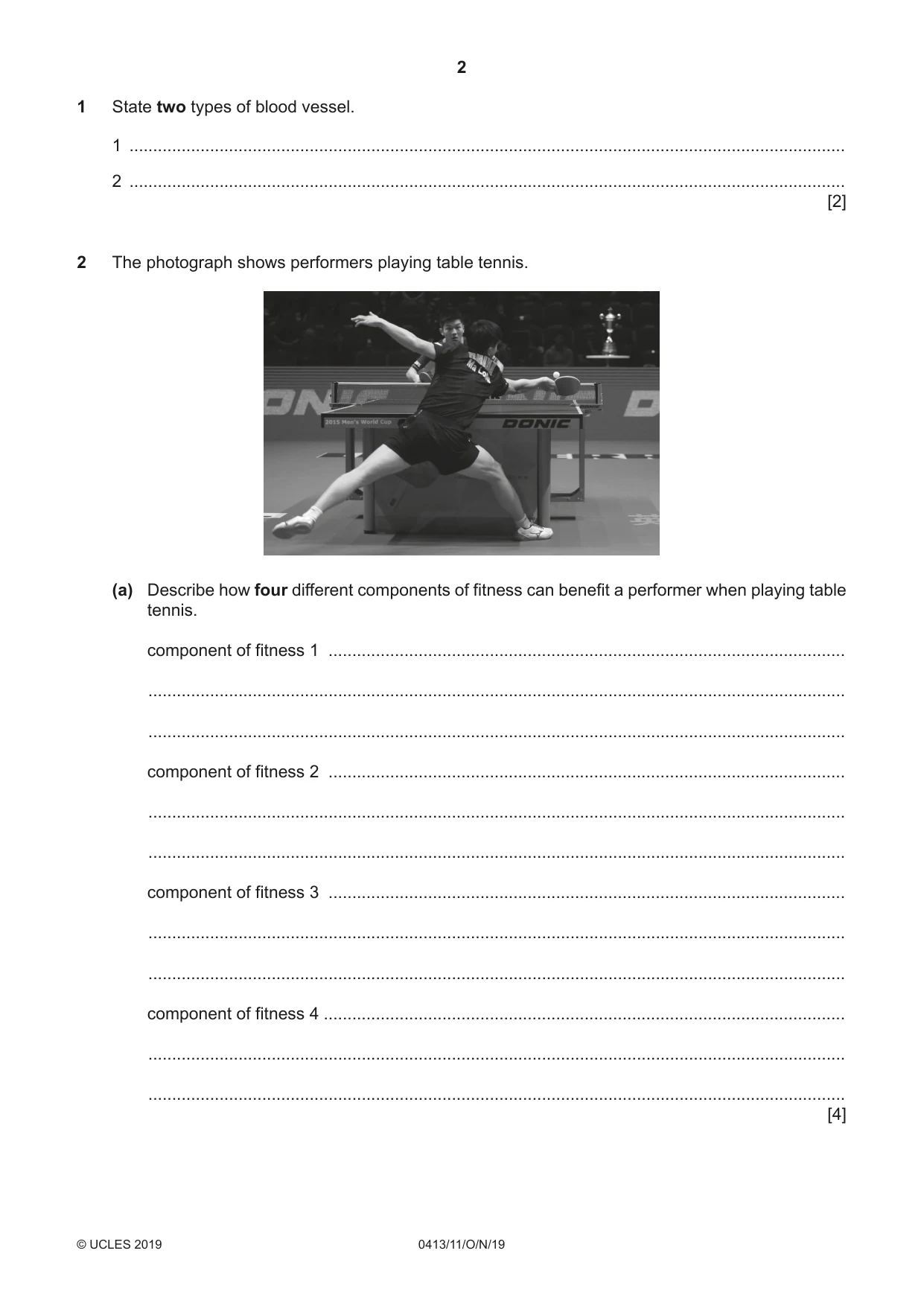
2 0413/11/O/N/19 © UCLES 2019 1 State two types of blood vessel. 1 … 2 … [2] 2 The photograph shows performers playing table tennis. (a) Describe how four different components of fitness can benefit a performer when playing table tennis. component of fitness 1 … … … component of fitness 2 … … … component of fitness 3 … … … component of fitness 4 … … … [4]
Question paper, page 3
3 0413/11/O/N/19 © UCLES 2019 [Turn over (b) Describe how to carry out two named fitness tests. name of test 1 … description … … … … … … name of test 2 … description … … … … … … [6] [Total: 10]
Question paper, page 4
4 0413/11/O/N/19 © UCLES 2019 3 When kicking a ball flexion occurs at the knee. Name the agonist and the antagonist in the upper leg during this movement. agonist … antagonist … [2] 4 The Olympic Games is a global event that allows amateur performers and professional performers to compete against each other. (a) Describe two disadvantages that amateur performers may have when competing against professional performers at the Olympic Games. 1 … … 2 … … [2] (b) Suggest how a nation might try to create a legacy after a global event. … … … … [2] [Total: 4]
Question paper, page 5
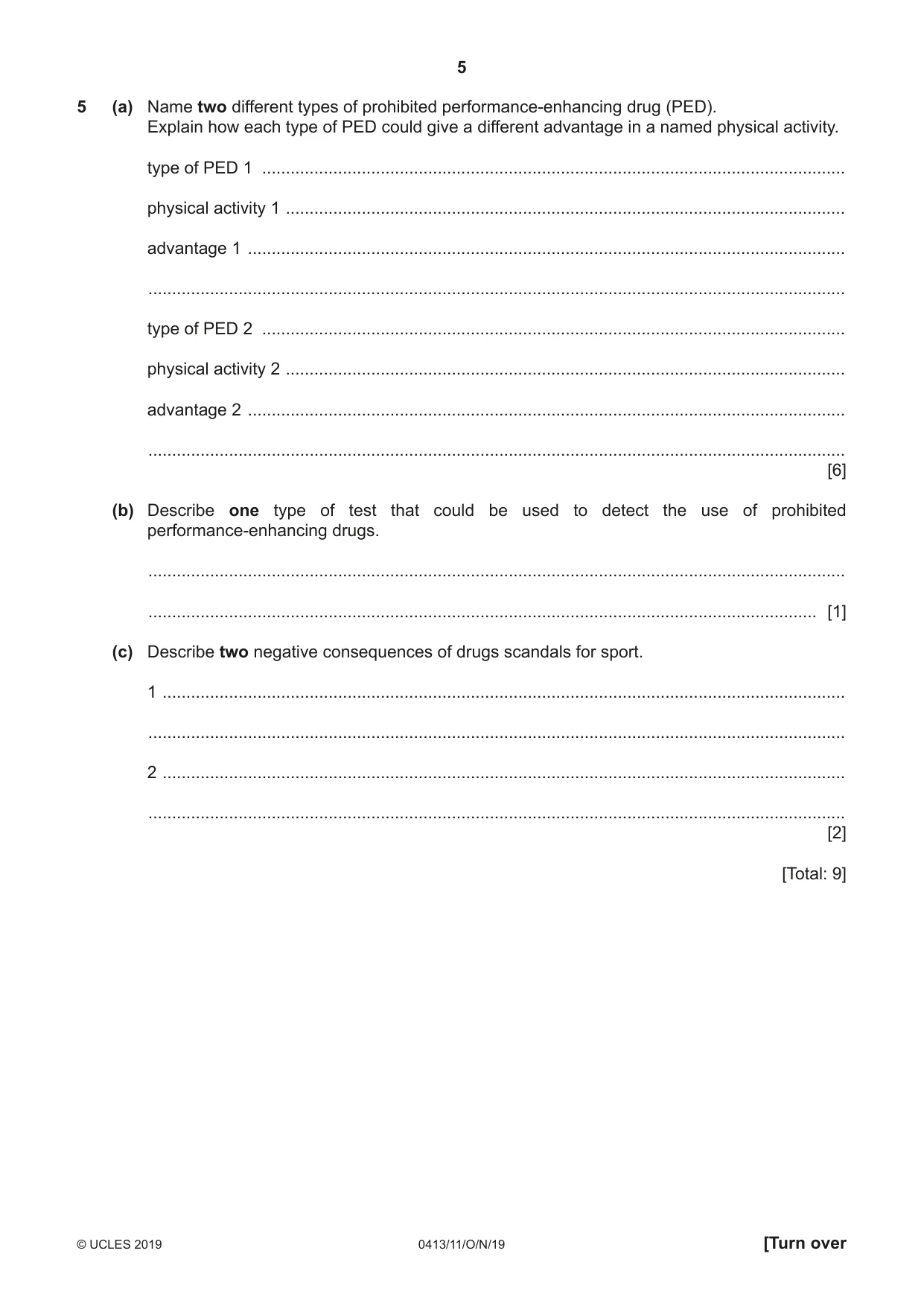
5 0413/11/O/N/19 © UCLES 2019 [Turn over 5 (a) Name two different types of prohibited performance-enhancing drug (PED). Explain how each type of PED could give a different advantage in a named physical activity. type of PED 1 … physical activity 1 … advantage 1 … … type of PED 2 … physical activity 2 … advantage 2 … … [6] (b) Describe one type of test that could be used to detect the use of prohibited performance-enhancing drugs. … … [1] (c) Describe two negative consequences of drugs scandals for sport. 1 … … 2 … … [2] [Total: 9]
Question paper, page 6
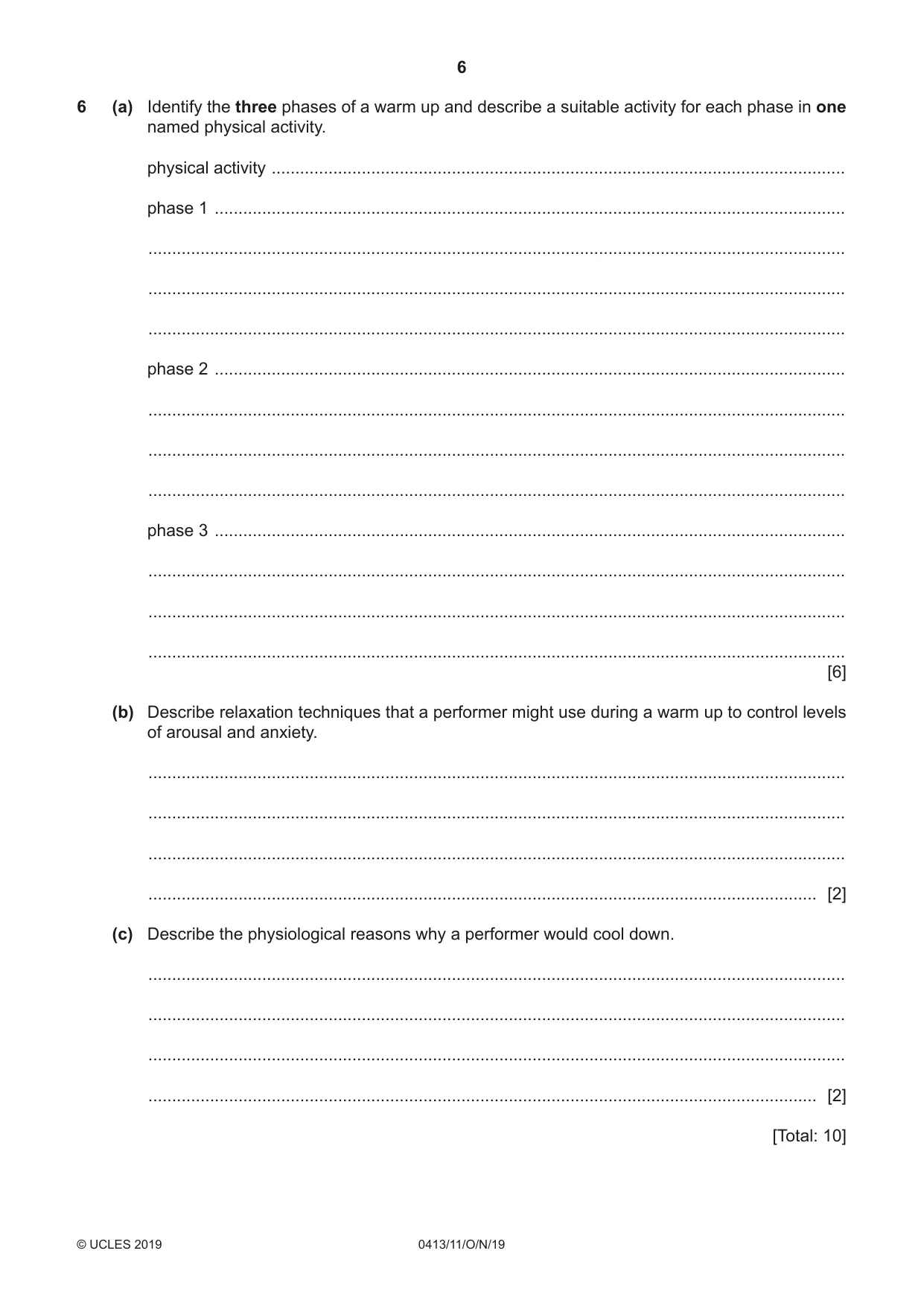
6 0413/11/O/N/19 © UCLES 2019 6 (a) Identify the three phases of a warm up and describe a suitable activity for each phase in one named physical activity. physical activity … phase 1 … … … … phase 2 … … … … phase 3 … … … … [6] (b) Describe relaxation techniques that a performer might use during a warm up to control levels of arousal and anxiety. … … … … [2] (c) Describe the physiological reasons why a performer would cool down. … … … … [2] [Total: 10]
Question paper, page 7
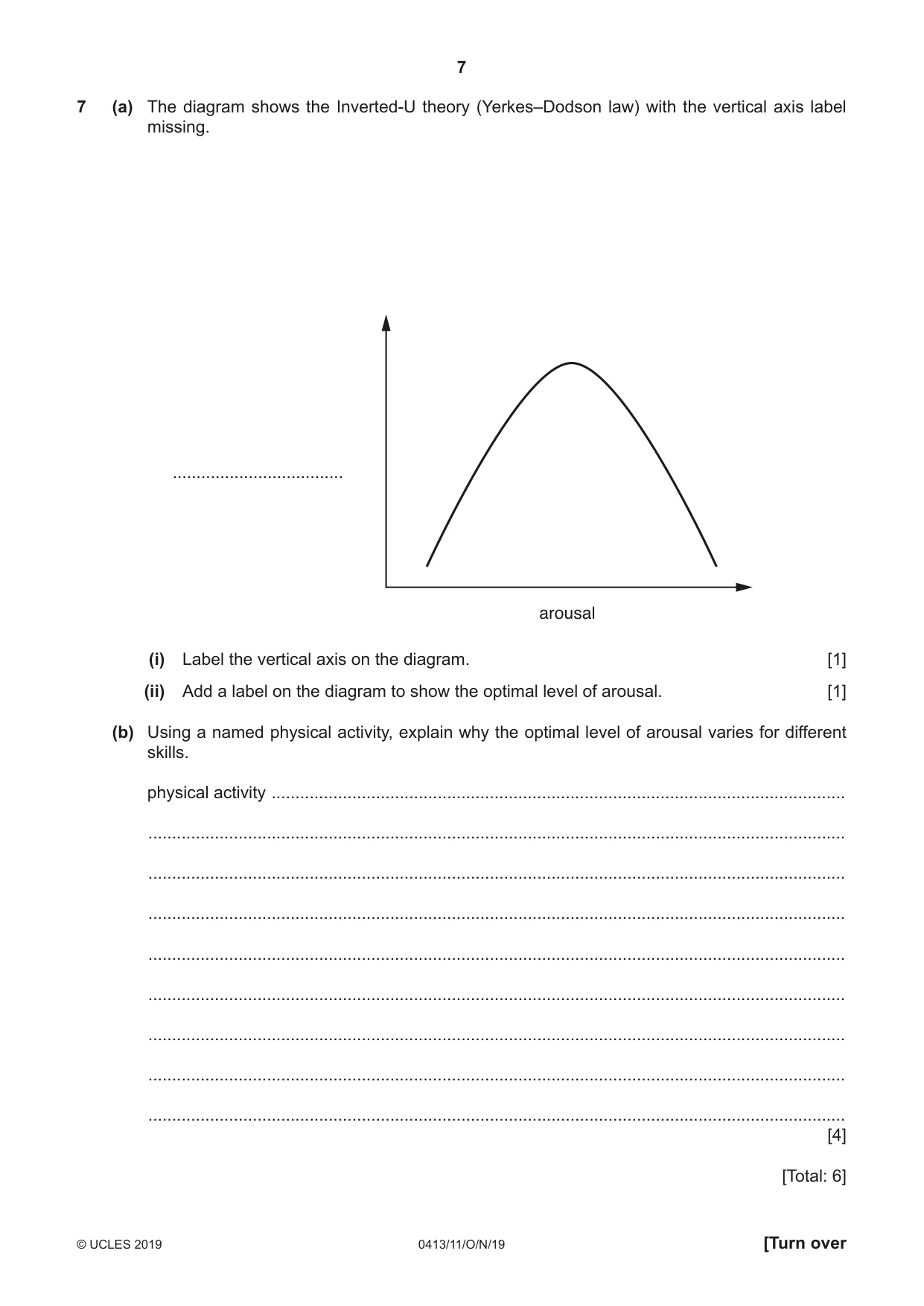
7 0413/11/O/N/19 © UCLES 2019 [Turn over 7 (a) The diagram shows the Inverted-U theory (Yerkes–Dodson law) with the vertical axis label missing. arousal … (i) Label the vertical axis on the diagram. [1] (ii) Add a label on the diagram to show the optimal level of arousal. [1] (b) Using a named physical activity, explain why the optimal level of arousal varies for different skills. physical activity … … … … … … … … … [4] [Total: 6]
Question paper, page 8
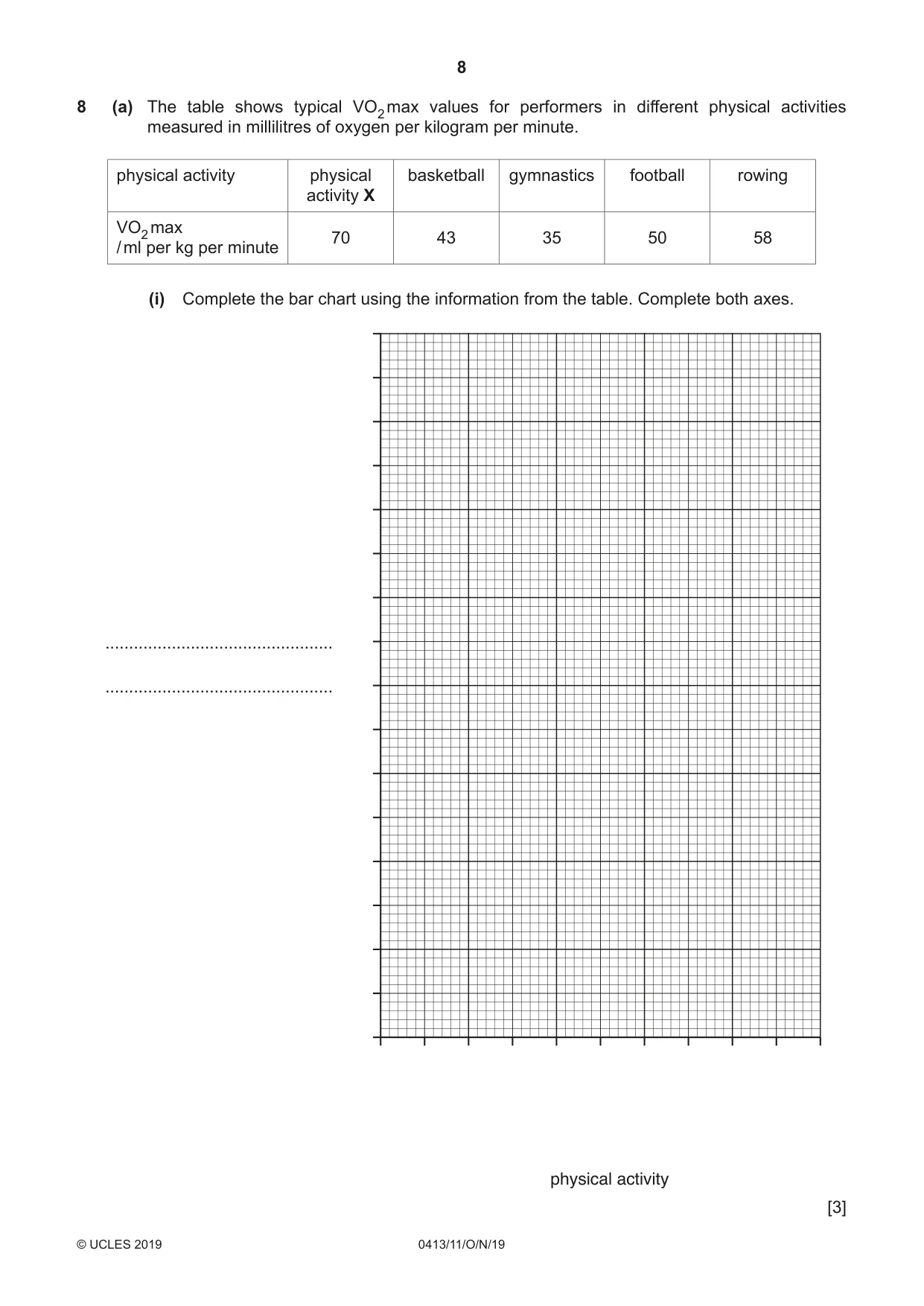
8 0413/11/O/N/19 © UCLES 2019 8 (a) The table shows typical VO2 max values for performers in different physical activities measured in millilitres of oxygen per kilogram per minute. physical activity physical activity X basketball gymnastics football rowing VO2 max / ml per kg per minute 70 43 35 50 58 (i) Complete the bar chart using the information from the table. Complete both axes. … … physical activity [3]
Question paper, page 9
9 0413/11/O/N/19 © UCLES 2019 [Turn over (ii) Suggest a physical activity that might be represented by physical activity X. Give one reason for your answer. physical activity … reason … … [2] (b) Describe how factors can affect a performer’s VO2 max. … … … … … … … … … … [5] [Total: 10]
Question paper, page 10
10 0413/11/O/N/19 © UCLES 2019 9 Complete the table to classify each bone as either long, short or flat. bone classification scapula femur carpal [3] 10 (a) State a different food source that is rich in each of the following nutrients: carbohydrates … proteins … fats. … [3] (b) The photographs show a shot putter and a long-distance runner. A B
Question paper, page 11
11 0413/11/O/N/19 © UCLES 2019 [Turn over Suggest reasons why the performers shown in photographs A and B may have different diets. … … … … … … … … … … … … [6] [Total: 9]
Question paper, page 12
12 0413/11/O/N/19 © UCLES 2019 11 (a) Explain the term cardiac output. … … [1] (b) Calculate the cardiac output of a performer who has a heart rate of 75 beats per minute and a stroke volume of 85 ml. Show your working and give the unit. cardiac output … unit … [3] (c) The diagram shows the heart. A C B
Question paper, page 13
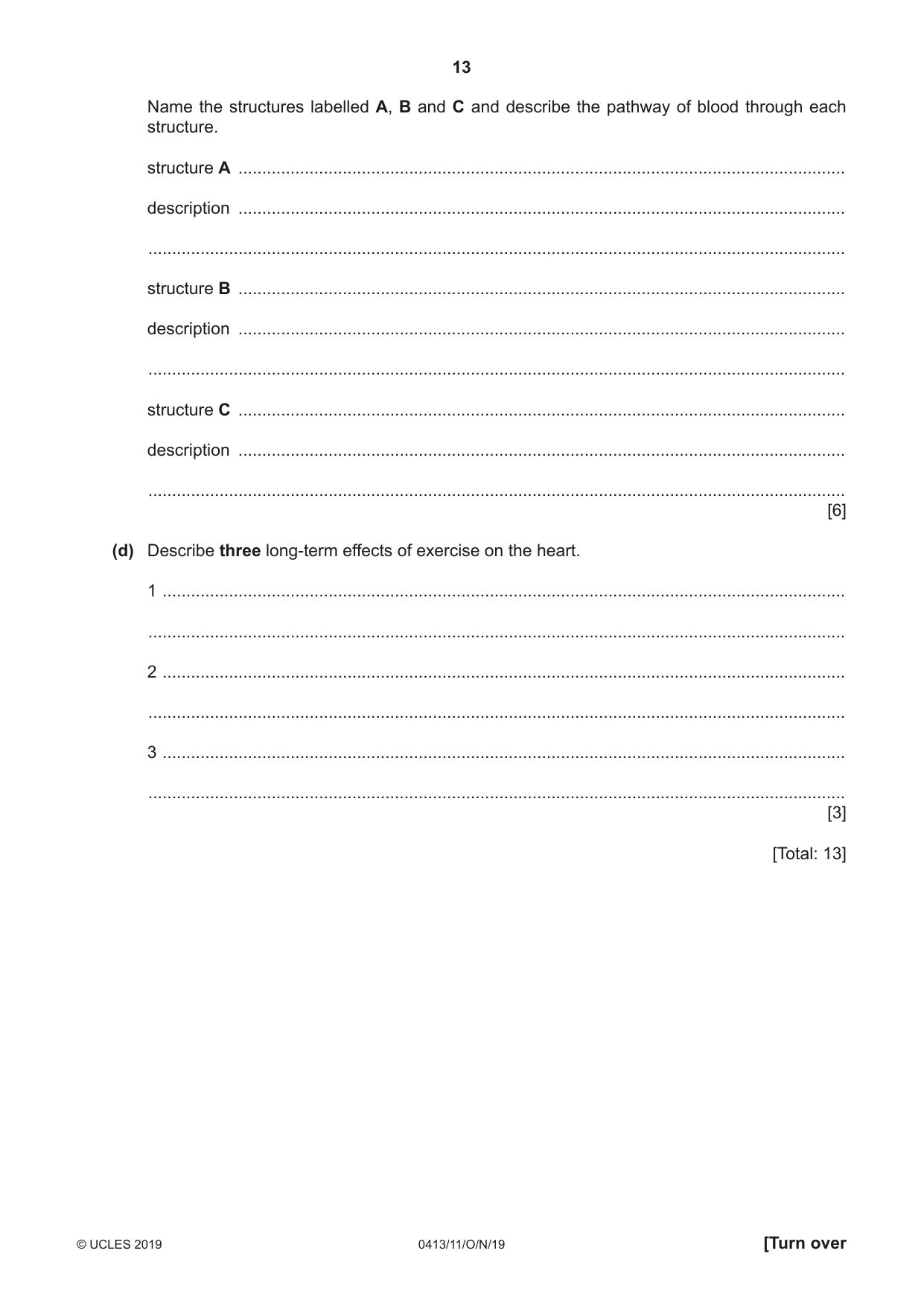
13 0413/11/O/N/19 © UCLES 2019 [Turn over Name the structures labelled A, B and C and describe the pathway of blood through each structure. structure A … description … … structure B … description … … structure C … description … … [6] (d) Describe three long-term effects of exercise on the heart. 1 … … 2 … … 3 … … [3] [Total: 13]
Question paper, page 14
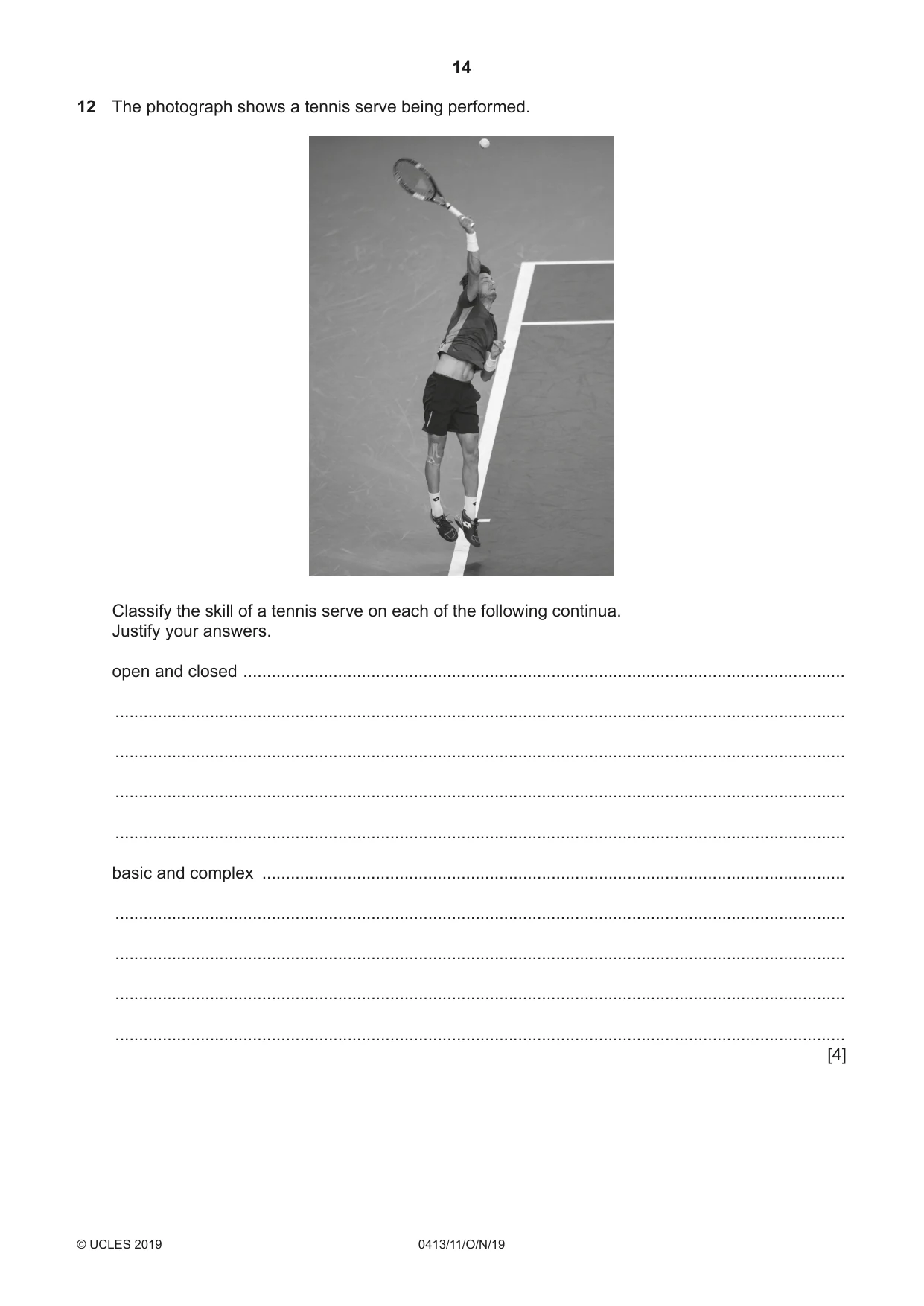
14 0413/11/O/N/19 © UCLES 2019 12 The photograph shows a tennis serve being performed. Classify the skill of a tennis serve on each of the following continua. Justify your answers. open and closed … … … … … basic and complex … … … … … [4]
Question paper, page 15
15 0413/11/O/N/19 © UCLES 2019 [Turn over 13 (a) Name the stages of learning and describe a different characteristic of a performer at each stage. first stage of learning … characteristic of a performer at this stage … … … second stage of learning … characteristic of a performer at this stage … … … third stage of learning … characteristic of a performer at this stage … … … [6] (b) Name one type of guidance and describe two different examples of how this type of guidance could be applied when learning a skill. type of guidance … example 1 … … example 2 … … [3] [Total: 9]
Question paper, page 16
16 0413/11/O/N/19 © UCLES 2019 14 (a) Describe one benefit of the use of technology in sport for officials. … … [1] (b) Describe, using examples from two named physical activities, the positive impact of technology on spectators. physical activity 1 … example 1 … … physical activity 2 … example 2 … … [2] (c) Suggest two ways that the internet and social media may benefit a performer. 1 … … 2 … … [2] [Total: 5]
Question paper, page 17
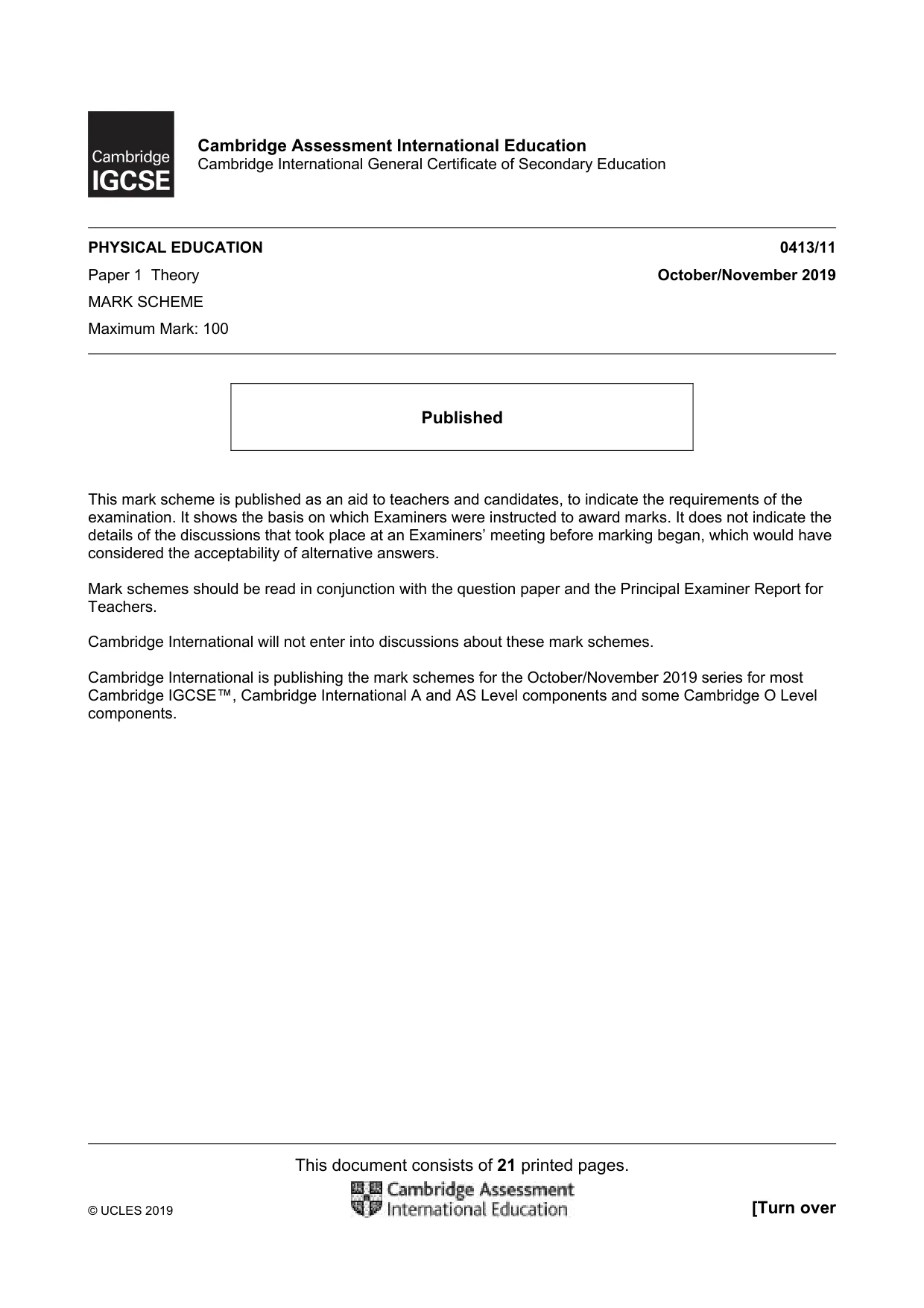
17 0413/11/O/N/19 © UCLES 2019 15 (a) Describe two typical characteristics of an extrovert personality type. 1 … … 2 … … [2] (b) Suggest a physical activity that is typically performed by introverts. Give a reason for your answer. physical activity … reason … … [2] [Total: 4]
Question paper, page 18
18 0413/11/O/N/19 © UCLES 2019 BLANK PAGE
Question paper, page 19
19 0413/11/O/N/19 © UCLES 2019 BLANK PAGE
Question paper, page 20
20 0413/11/O/N/19 © UCLES 2019 Permission to reproduce items where third-party owned material protected by copyright is included has been sought and cleared where possible. Every reasonable effort has been made by the publisher (UCLES) to trace copyright holders, but if any items requiring clearance have unwittingly been included, the publisher will be pleased to make amends at the earliest possible opportunity. To avoid the issue of disclosure of answer-related information to candidates, all copyright acknowledgements are reproduced online in the Cambridge Assessment International Education Copyright Acknowledgements Booklet. This is produced for each series of examinations and is freely available to download at www.cambridgeinternational.org after the live examination series. Cambridge Assessment International Education is part of the Cambridge Assessment Group. Cambridge Assessment is the brand name of the University of Cambridge Local Examinations Syndicate (UCLES), which itself is a department of the University of Cambridge. BLANK PAGE
Mark scheme, page 1
This document consists of 21 printed pages. © UCLES 2019 [Turn over Cambridge Assessment International Education Cambridge International General Certificate of Secondary Education PHYSICAL EDUCATION 0413/11 Paper 1 Theory October/November 2019 MARK SCHEME Maximum Mark: 100 Published This mark scheme is published as an aid to teachers and candidates, to indicate the requirements of the examination. It shows the basis on which Examiners were instructed to award marks. It does not indicate the details of the discussions that took place at an Examiners’ meeting before marking began, which would have considered the acceptability of alternative answers. Mark schemes should be read in conjunction with the question paper and the Principal Examiner Report for Teachers. Cambridge International will not enter into discussions about these mark schemes. Cambridge International is publishing the mark schemes for the October/November 2019 series for most Cambridge IGCSE™, Cambridge International A and AS Level components and some Cambridge O Level components.
Mark scheme, page 2
0413/11 Cambridge IGCSE – Mark Scheme PUBLISHED October/November 2019 © UCLES 2019 Page 2 of 21 Generic Marking Principles These general marking principles must be applied by all examiners when marking candidate answers. They should be applied alongside the specific content of the mark scheme or generic level descriptors for a question. Each question paper and mark scheme will also comply with these marking principles. GENERIC MARKING PRINCIPLE 1: Marks must be awarded in line with: • the specific content of the mark scheme or the generic level descriptors for the question • the specific skills defined in the mark scheme or in the generic level descriptors for the question • the standard of response required by a candidate as exemplified by the standardisation scripts. GENERIC MARKING PRINCIPLE 2: Marks awarded are always whole marks (not half marks, or other fractions). GENERIC MARKING PRINCIPLE 3: Marks must be awarded positively: • marks are awarded for correct/valid answers, as defined in the mark scheme. However, credit is given for valid answers which go beyond the scope of the syllabus and mark scheme, referring to your Team Leader as appropriate • marks are awarded when candidates clearly demonstrate what they know and can do • marks are not deducted for errors • marks are not deducted for omissions • answers should only be judged on the quality of spelling, punctuation and grammar when these features are specifically assessed by the question as indicated by the mark scheme. The meaning, however, should be unambiguous. GENERIC MARKING PRINCIPLE 4: Rules must be applied consistently e.g. in situations where candidates have not followed instructions or in the application of generic level descriptors.
Mark scheme, page 3
0413/11 Cambridge IGCSE – Mark Scheme PUBLISHED October/November 2019 © UCLES 2019 Page 3 of 21 GENERIC MARKING PRINCIPLE 5: Marks should be awarded using the full range of marks defined in the mark scheme for the question (however; the use of the full mark range may be limited according to the quality of the candidate responses seen). GENERIC MARKING PRINCIPLE 6: Marks awarded are based solely on the requirements as defined in the mark scheme. Marks should not be awarded with grade thresholds or grade descriptors in mind.
Mark scheme, page 4
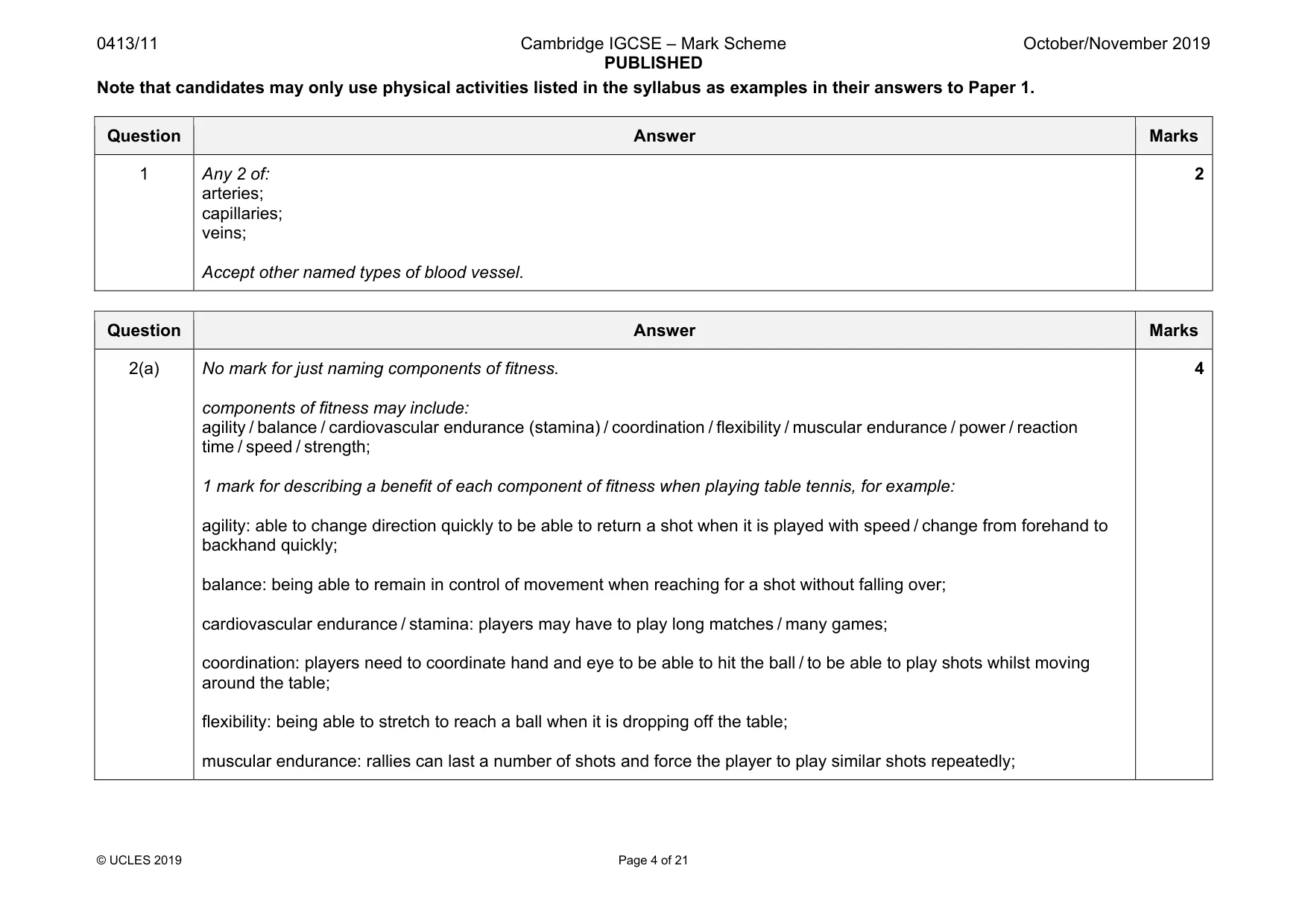
0413/11 Cambridge IGCSE – Mark Scheme PUBLISHED October/November 2019 © UCLES 2019 Page 4 of 21 Note that candidates may only use physical activities listed in the syllabus as examples in their answers to Paper 1. Question Answer Marks 1 Any 2 of: arteries; capillaries; veins; Accept other named types of blood vessel. 2 Question Answer Marks 2(a) No mark for just naming components of fitness. components of fitness may include: agility / balance / cardiovascular endurance (stamina) / coordination / flexibility / muscular endurance / power / reaction time / speed / strength; 1 mark for describing a benefit of each component of fitness when playing table tennis, for example: agility: able to change direction quickly to be able to return a shot when it is played with speed / change from forehand to backhand quickly; balance: being able to remain in control of movement when reaching for a shot without falling over; cardiovascular endurance / stamina: players may have to play long matches / many games; coordination: players need to coordinate hand and eye to be able to hit the ball / to be able to play shots whilst moving around the table; flexibility: being able to stretch to reach a ball when it is dropping off the table; muscular endurance: rallies can last a number of shots and force the player to play similar shots repeatedly; 4
Mark scheme, page 5
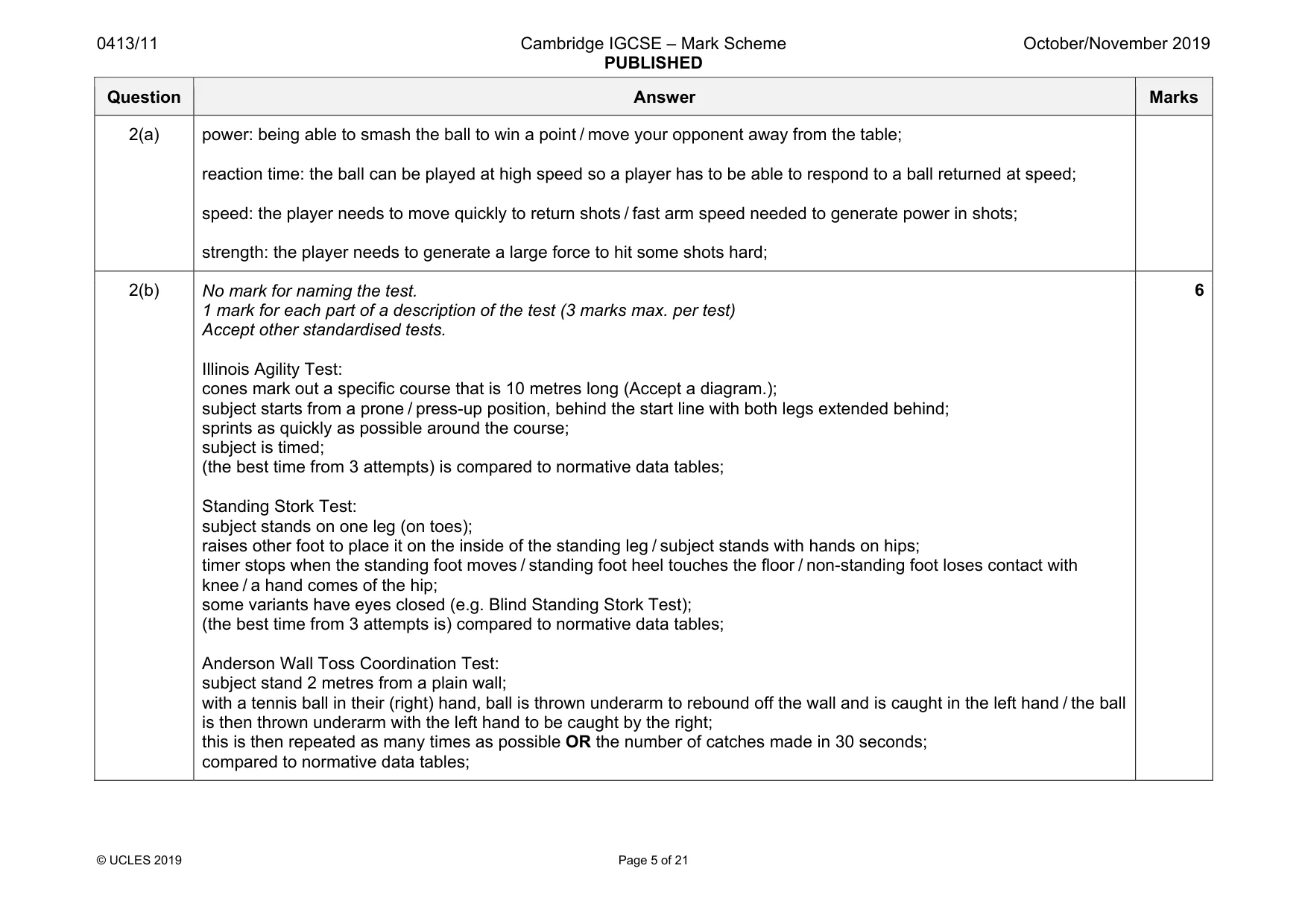
0413/11 Cambridge IGCSE – Mark Scheme PUBLISHED October/November 2019 © UCLES 2019 Page 5 of 21 Question Answer Marks 2(a) power: being able to smash the ball to win a point / move your opponent away from the table; reaction time: the ball can be played at high speed so a player has to be able to respond to a ball returned at speed; speed: the player needs to move quickly to return shots / fast arm speed needed to generate power in shots; strength: the player needs to generate a large force to hit some shots hard; 2(b) No mark for naming the test. 1 mark for each part of a description of the test (3 marks max. per test) Accept other standardised tests. Illinois Agility Test: cones mark out a specific course that is 10 metres long (Accept a diagram.); subject starts from a prone / press-up position, behind the start line with both legs extended behind; sprints as quickly as possible around the course; subject is timed; (the best time from 3 attempts) is compared to normative data tables; Standing Stork Test: subject stands on one leg (on toes); raises other foot to place it on the inside of the standing leg / subject stands with hands on hips; timer stops when the standing foot moves / standing foot heel touches the floor / non-standing foot loses contact with knee / a hand comes of the hip; some variants have eyes closed (e.g. Blind Standing Stork Test); (the best time from 3 attempts is) compared to normative data tables; Anderson Wall Toss Coordination Test: subject stand 2 metres from a plain wall; with a tennis ball in their (right) hand, ball is thrown underarm to rebound off the wall and is caught in the left hand / the ball is then thrown underarm with the left hand to be caught by the right; this is then repeated as many times as possible OR the number of catches made in 30 seconds; compared to normative data tables; 6
Mark scheme, page 6
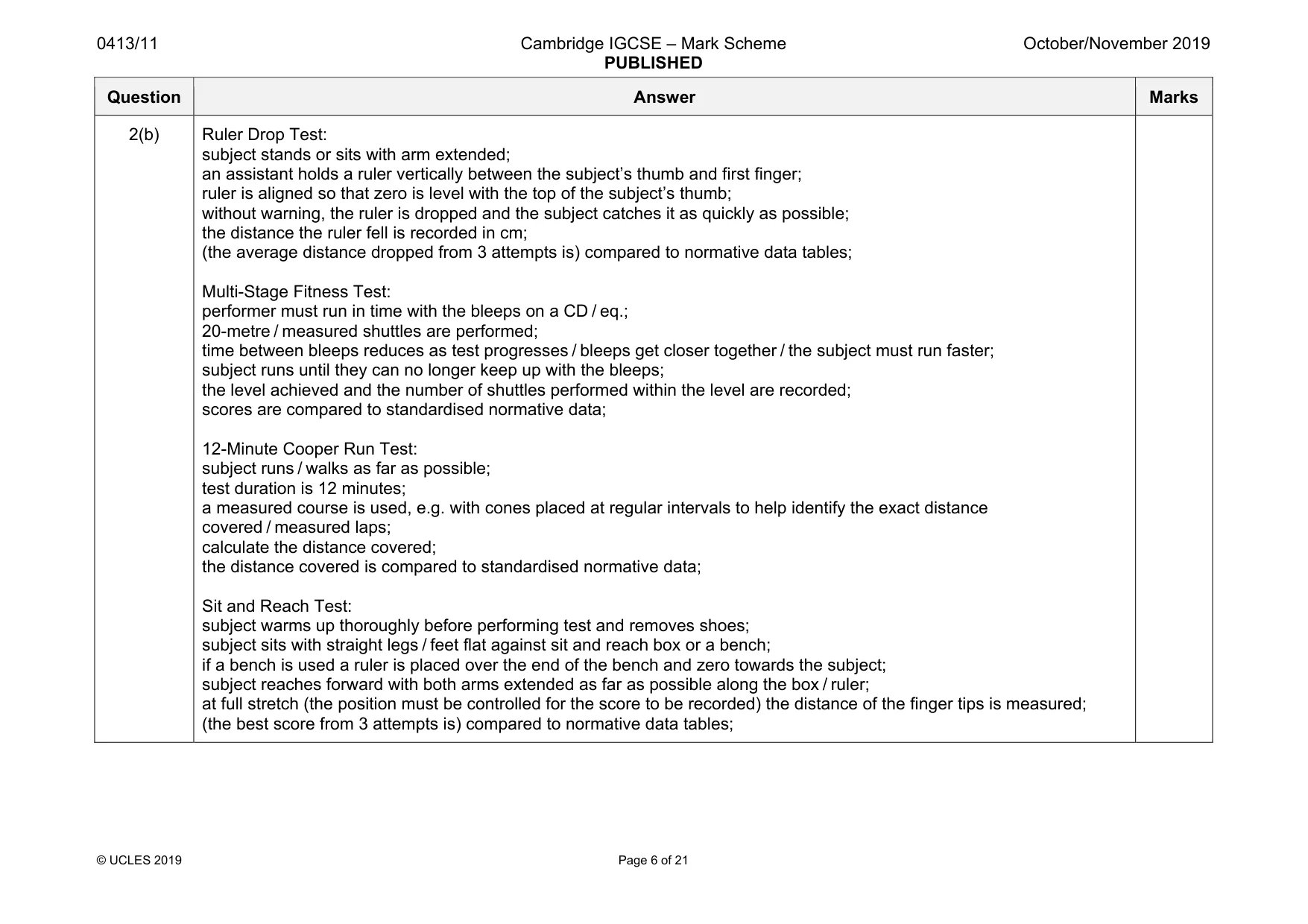
0413/11 Cambridge IGCSE – Mark Scheme PUBLISHED October/November 2019 © UCLES 2019 Page 6 of 21 Question Answer Marks 2(b) Ruler Drop Test: subject stands or sits with arm extended; an assistant holds a ruler vertically between the subject’s thumb and first finger; ruler is aligned so that zero is level with the top of the subject’s thumb; without warning, the ruler is dropped and the subject catches it as quickly as possible; the distance the ruler fell is recorded in cm; (the average distance dropped from 3 attempts is) compared to normative data tables; Multi-Stage Fitness Test: performer must run in time with the bleeps on a CD / eq.; 20-metre / measured shuttles are performed; time between bleeps reduces as test progresses / bleeps get closer together / the subject must run faster; subject runs until they can no longer keep up with the bleeps; the level achieved and the number of shuttles performed within the level are recorded; scores are compared to standardised normative data; 12-Minute Cooper Run Test: subject runs / walks as far as possible; test duration is 12 minutes; a measured course is used, e.g. with cones placed at regular intervals to help identify the exact distance covered / measured laps; calculate the distance covered; the distance covered is compared to standardised normative data; Sit and Reach Test: subject warms up thoroughly before performing test and removes shoes; subject sits with straight legs / feet flat against sit and reach box or a bench; if a bench is used a ruler is placed over the end of the bench and zero towards the subject; subject reaches forward with both arms extended as far as possible along the box / ruler; at full stretch (the position must be controlled for the score to be recorded) the distance of the finger tips is measured; (the best score from 3 attempts is) compared to normative data tables;
Mark scheme, page 7
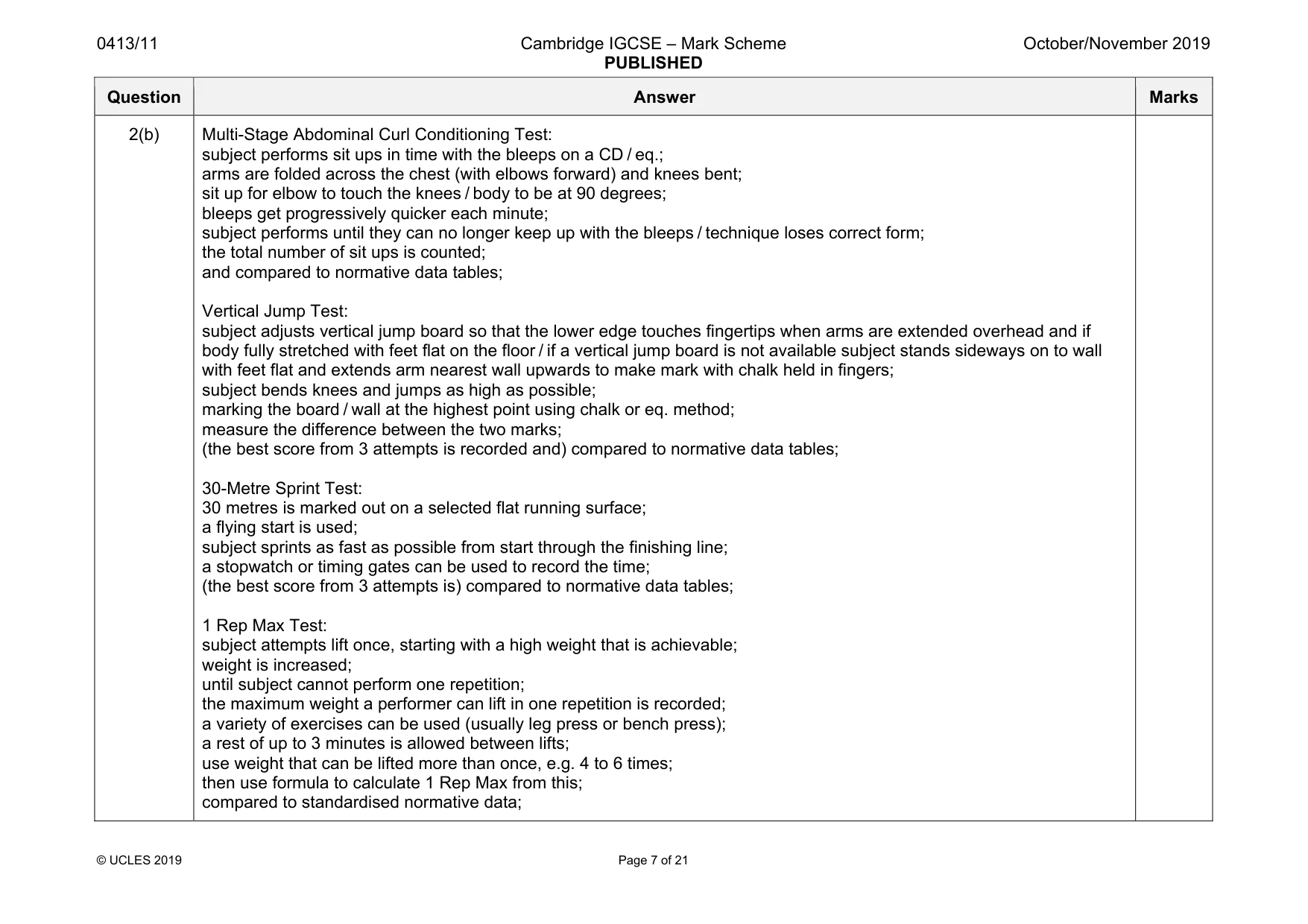
0413/11 Cambridge IGCSE – Mark Scheme PUBLISHED October/November 2019 © UCLES 2019 Page 7 of 21 Question Answer Marks 2(b) Multi-Stage Abdominal Curl Conditioning Test: subject performs sit ups in time with the bleeps on a CD / eq.; arms are folded across the chest (with elbows forward) and knees bent; sit up for elbow to touch the knees / body to be at 90 degrees; bleeps get progressively quicker each minute; subject performs until they can no longer keep up with the bleeps / technique loses correct form; the total number of sit ups is counted; and compared to normative data tables; Vertical Jump Test: subject adjusts vertical jump board so that the lower edge touches fingertips when arms are extended overhead and if body fully stretched with feet flat on the floor / if a vertical jump board is not available subject stands sideways on to wall with feet flat and extends arm nearest wall upwards to make mark with chalk held in fingers; subject bends knees and jumps as high as possible; marking the board / wall at the highest point using chalk or eq. method; measure the difference between the two marks; (the best score from 3 attempts is recorded and) compared to normative data tables; 30-Metre Sprint Test: 30 metres is marked out on a selected flat running surface; a flying start is used; subject sprints as fast as possible from start through the finishing line; a stopwatch or timing gates can be used to record the time; (the best score from 3 attempts is) compared to normative data tables; 1 Rep Max Test: subject attempts lift once, starting with a high weight that is achievable; weight is increased; until subject cannot perform one repetition; the maximum weight a performer can lift in one repetition is recorded; a variety of exercises can be used (usually leg press or bench press); a rest of up to 3 minutes is allowed between lifts; use weight that can be lifted more than once, e.g. 4 to 6 times; then use formula to calculate 1 Rep Max from this; compared to standardised normative data;
Mark scheme, page 8
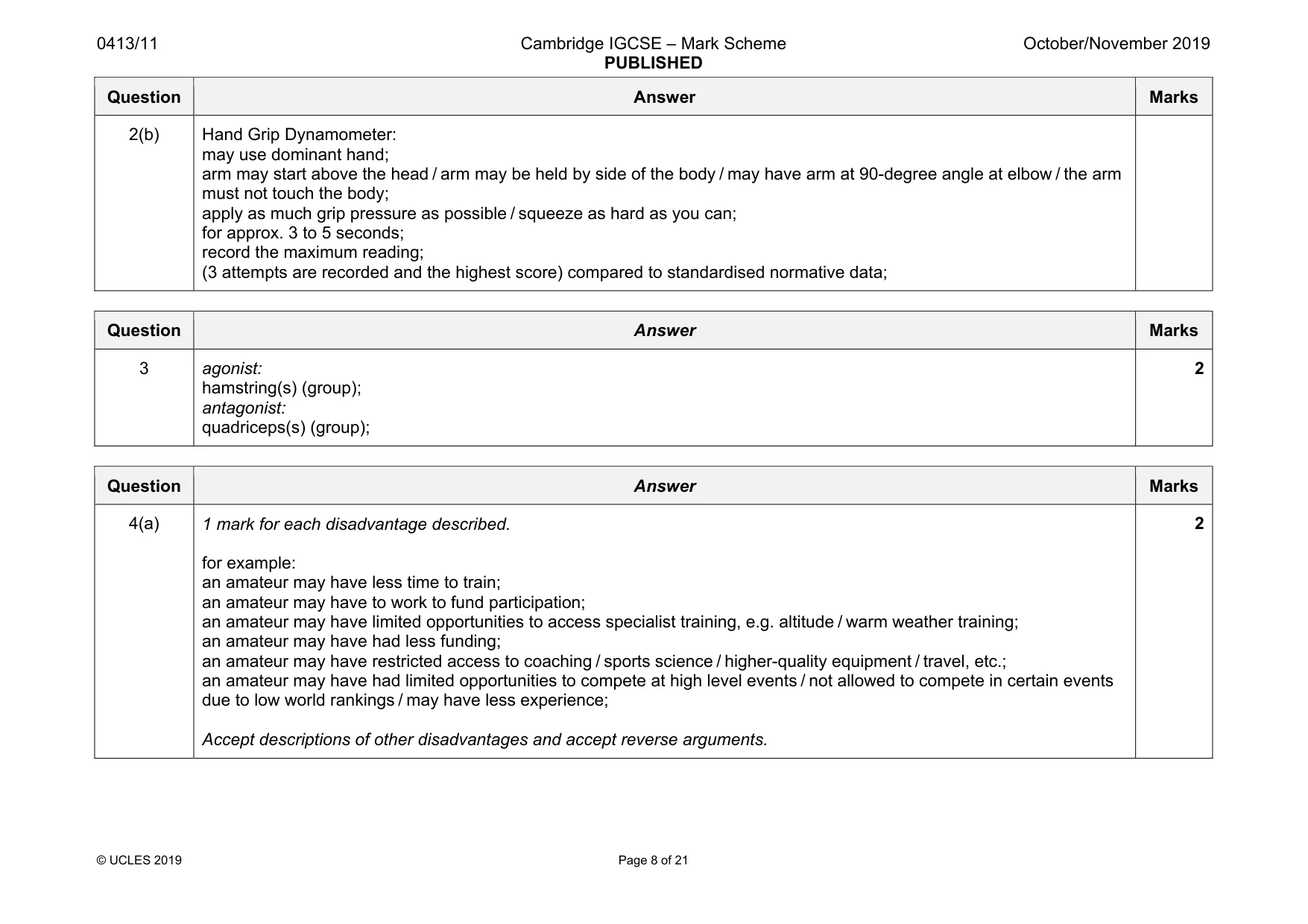
0413/11 Cambridge IGCSE – Mark Scheme PUBLISHED October/November 2019 © UCLES 2019 Page 8 of 21 Question Answer Marks 2(b) Hand Grip Dynamometer: may use dominant hand; arm may start above the head / arm may be held by side of the body / may have arm at 90-degree angle at elbow / the arm must not touch the body; apply as much grip pressure as possible / squeeze as hard as you can; for approx. 3 to 5 seconds; record the maximum reading; (3 attempts are recorded and the highest score) compared to standardised normative data; Question Answer Marks 3 agonist: hamstring(s) (group); antagonist: quadriceps(s) (group); 2 Question Answer Marks 4(a) 1 mark for each disadvantage described. for example: an amateur may have less time to train; an amateur may have to work to fund participation; an amateur may have limited opportunities to access specialist training, e.g. altitude / warm weather training; an amateur may have had less funding; an amateur may have restricted access to coaching / sports science / higher-quality equipment / travel, etc.; an amateur may have had limited opportunities to compete at high level events / not allowed to compete in certain events due to low world rankings / may have less experience; Accept descriptions of other disadvantages and accept reverse arguments. 2
Mark scheme, page 9
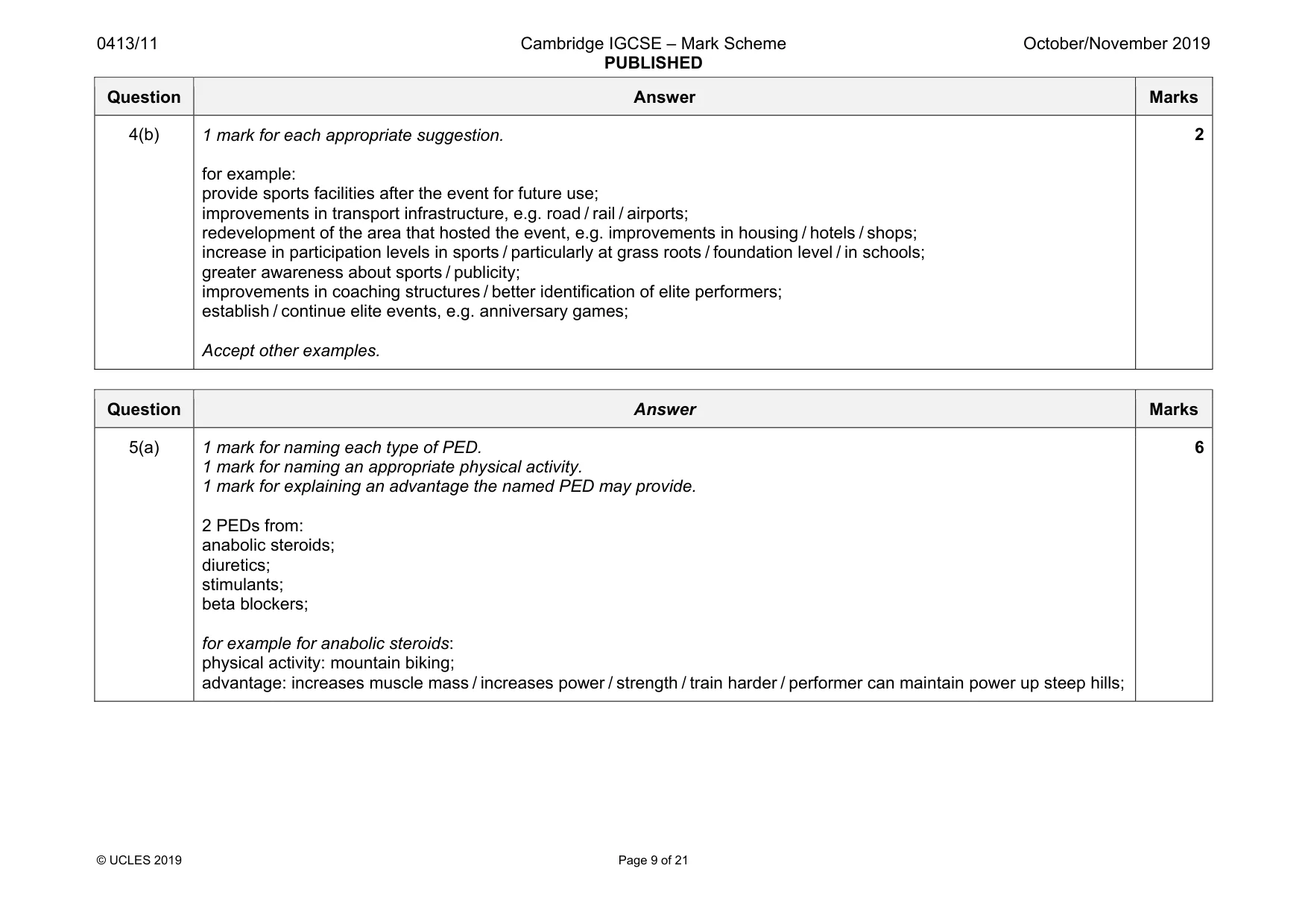
0413/11 Cambridge IGCSE – Mark Scheme PUBLISHED October/November 2019 © UCLES 2019 Page 9 of 21 Question Answer Marks 4(b) 1 mark for each appropriate suggestion. for example: provide sports facilities after the event for future use; improvements in transport infrastructure, e.g. road / rail / airports; redevelopment of the area that hosted the event, e.g. improvements in housing / hotels / shops; increase in participation levels in sports / particularly at grass roots / foundation level / in schools; greater awareness about sports / publicity; improvements in coaching structures / better identification of elite performers; establish / continue elite events, e.g. anniversary games; Accept other examples. 2 Question Answer Marks 5(a) 1 mark for naming each type of PED. 1 mark for naming an appropriate physical activity. 1 mark for explaining an advantage the named PED may provide. 2 PEDs from: anabolic steroids; diuretics; stimulants; beta blockers; for example for anabolic steroids: physical activity: mountain biking; advantage: increases muscle mass / increases power / strength / train harder / performer can maintain power up steep hills; 6
Mark scheme, page 10
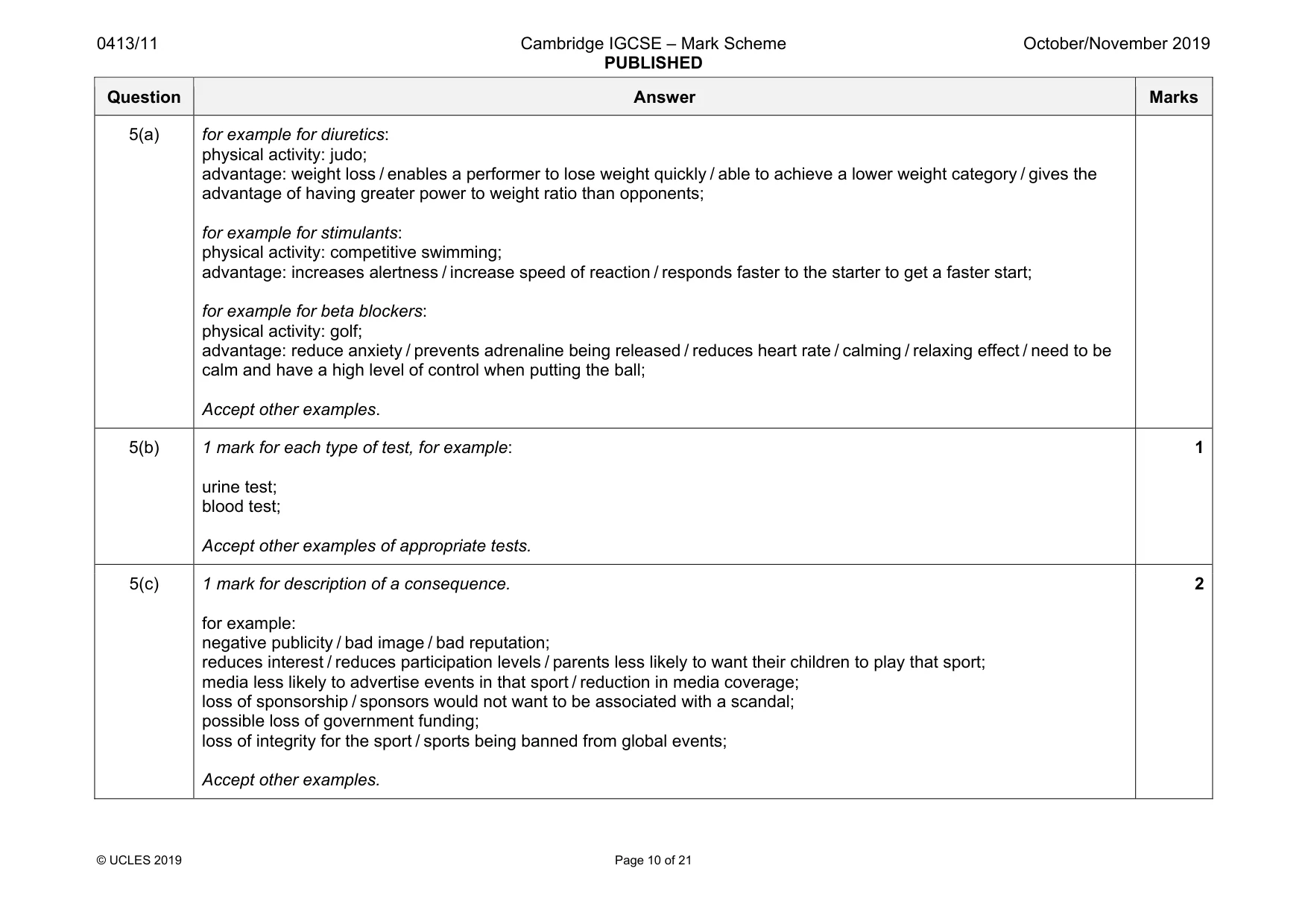
0413/11 Cambridge IGCSE – Mark Scheme PUBLISHED October/November 2019 © UCLES 2019 Page 10 of 21 Question Answer Marks 5(a) for example for diuretics: physical activity: judo; advantage: weight loss / enables a performer to lose weight quickly / able to achieve a lower weight category / gives the advantage of having greater power to weight ratio than opponents; for example for stimulants: physical activity: competitive swimming; advantage: increases alertness / increase speed of reaction / responds faster to the starter to get a faster start; for example for beta blockers: physical activity: golf; advantage: reduce anxiety / prevents adrenaline being released / reduces heart rate / calming / relaxing effect / need to be calm and have a high level of control when putting the ball; Accept other examples. 5(b) 1 mark for each type of test, for example: urine test; blood test; Accept other examples of appropriate tests. 1 5(c) 1 mark for description of a consequence. for example: negative publicity / bad image / bad reputation; reduces interest / reduces participation levels / parents less likely to want their children to play that sport; media less likely to advertise events in that sport / reduction in media coverage; loss of sponsorship / sponsors would not want to be associated with a scandal; possible loss of government funding; loss of integrity for the sport / sports being banned from global events; Accept other examples. 2
Mark scheme, page 11
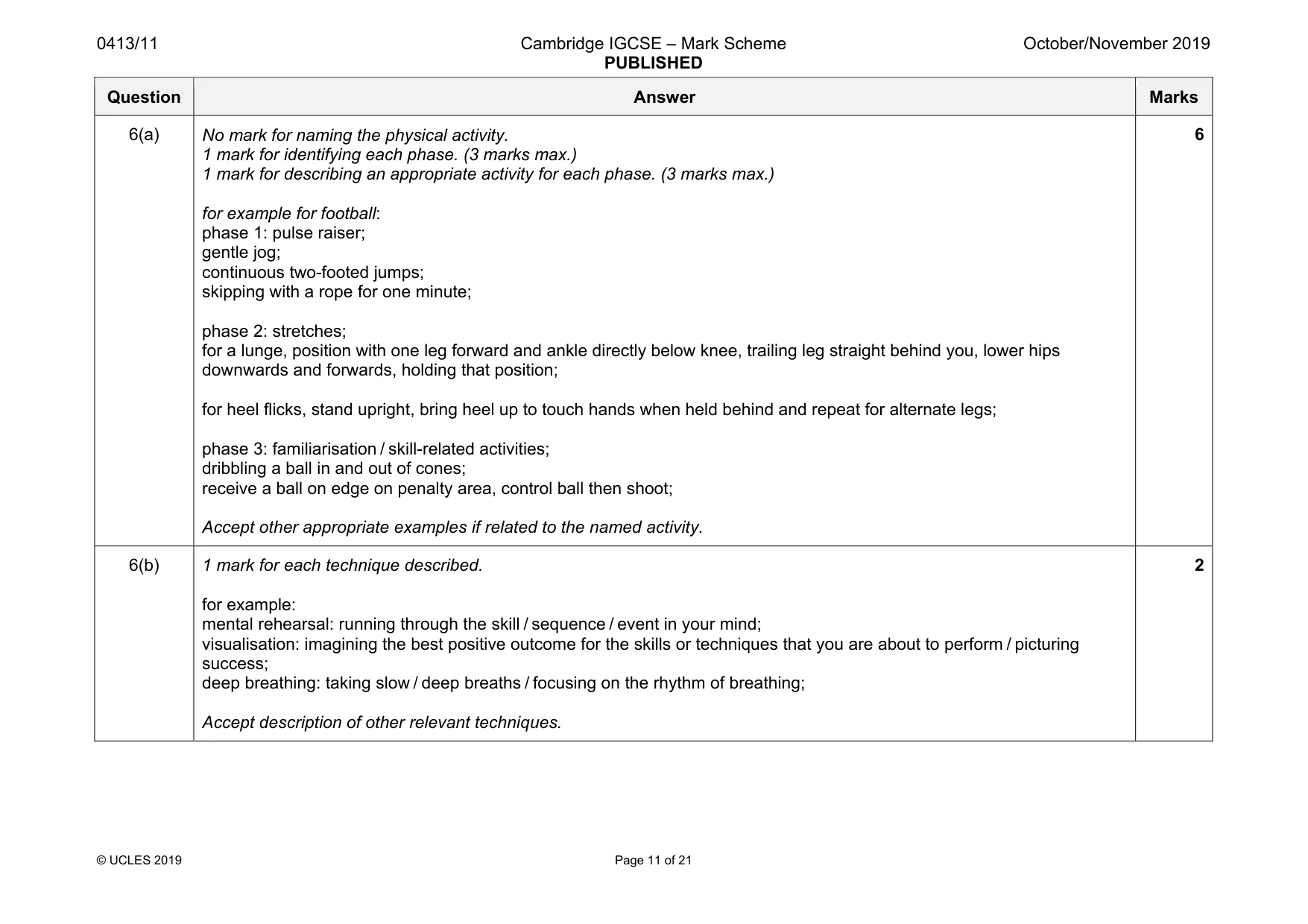
0413/11 Cambridge IGCSE – Mark Scheme PUBLISHED October/November 2019 © UCLES 2019 Page 11 of 21 Question Answer Marks 6(a) No mark for naming the physical activity. 1 mark for identifying each phase. (3 marks max.) 1 mark for describing an appropriate activity for each phase. (3 marks max.) for example for football: phase 1: pulse raiser; gentle jog; continuous two-footed jumps; skipping with a rope for one minute; phase 2: stretches; for a lunge, position with one leg forward and ankle directly below knee, trailing leg straight behind you, lower hips downwards and forwards, holding that position; for heel flicks, stand upright, bring heel up to touch hands when held behind and repeat for alternate legs; phase 3: familiarisation / skill-related activities; dribbling a ball in and out of cones; receive a ball on edge on penalty area, control ball then shoot; Accept other appropriate examples if related to the named activity. 6 6(b) 1 mark for each technique described. for example: mental rehearsal: running through the skill / sequence / event in your mind; visualisation: imagining the best positive outcome for the skills or techniques that you are about to perform / picturing success; deep breathing: taking slow / deep breaths / focusing on the rhythm of breathing; Accept description of other relevant techniques. 2
Mark scheme, page 12
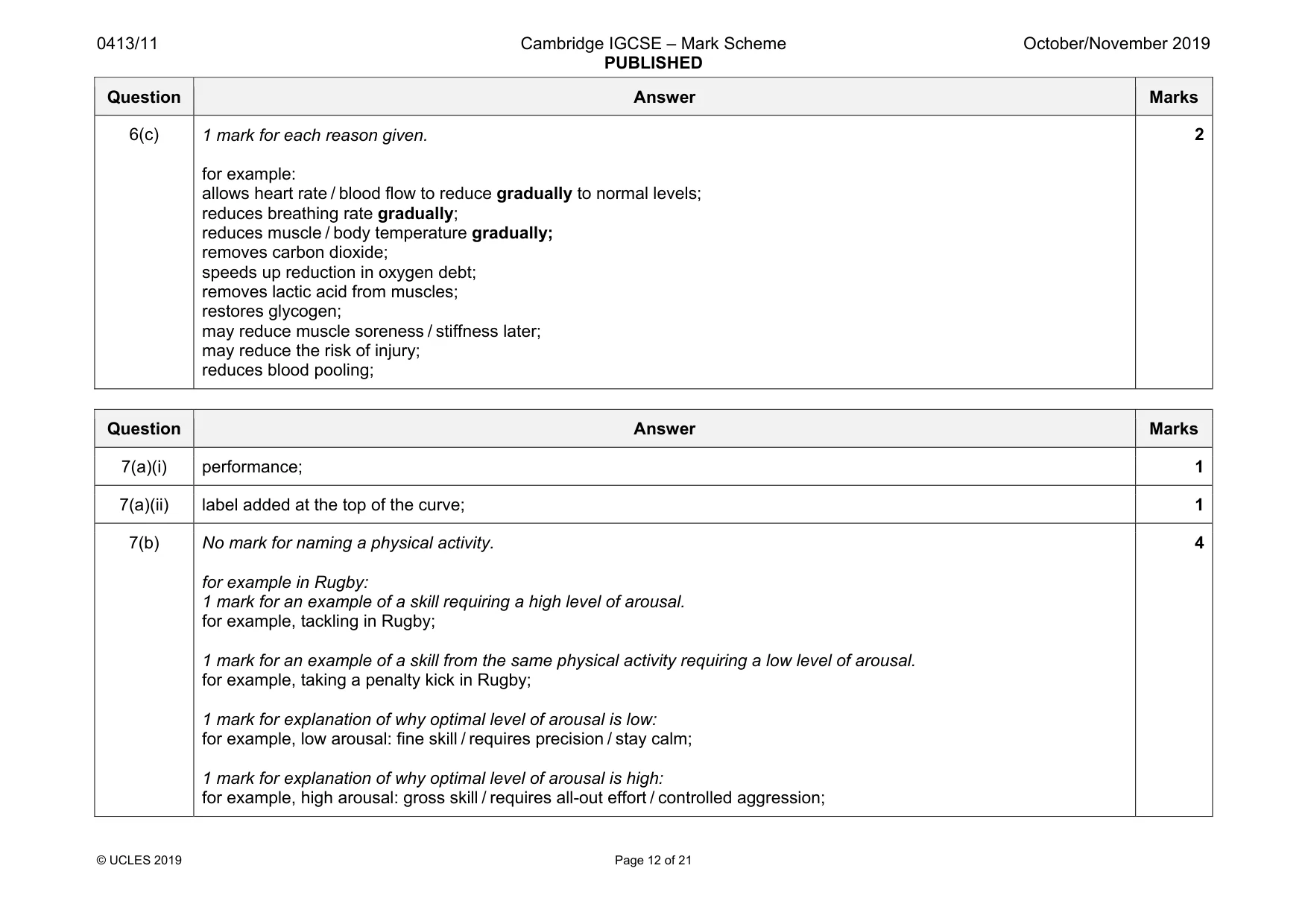
0413/11 Cambridge IGCSE – Mark Scheme PUBLISHED October/November 2019 © UCLES 2019 Page 12 of 21 Question Answer Marks 6(c) 1 mark for each reason given. for example: allows heart rate / blood flow to reduce gradually to normal levels; reduces breathing rate gradually; reduces muscle / body temperature gradually; removes carbon dioxide; speeds up reduction in oxygen debt; removes lactic acid from muscles; restores glycogen; may reduce muscle soreness / stiffness later; may reduce the risk of injury; reduces blood pooling; 2 Question Answer Marks 7(a)(i) performance; 1 7(a)(ii) label added at the top of the curve; 1 7(b) No mark for naming a physical activity. for example in Rugby: 1 mark for an example of a skill requiring a high level of arousal. for example, tackling in Rugby; 1 mark for an example of a skill from the same physical activity requiring a low level of arousal. for example, taking a penalty kick in Rugby; 1 mark for explanation of why optimal level of arousal is low: for example, low arousal: fine skill / requires precision / stay calm; 1 mark for explanation of why optimal level of arousal is high: for example, high arousal: gross skill / requires all-out effort / controlled aggression; 4
Mark scheme, page 13
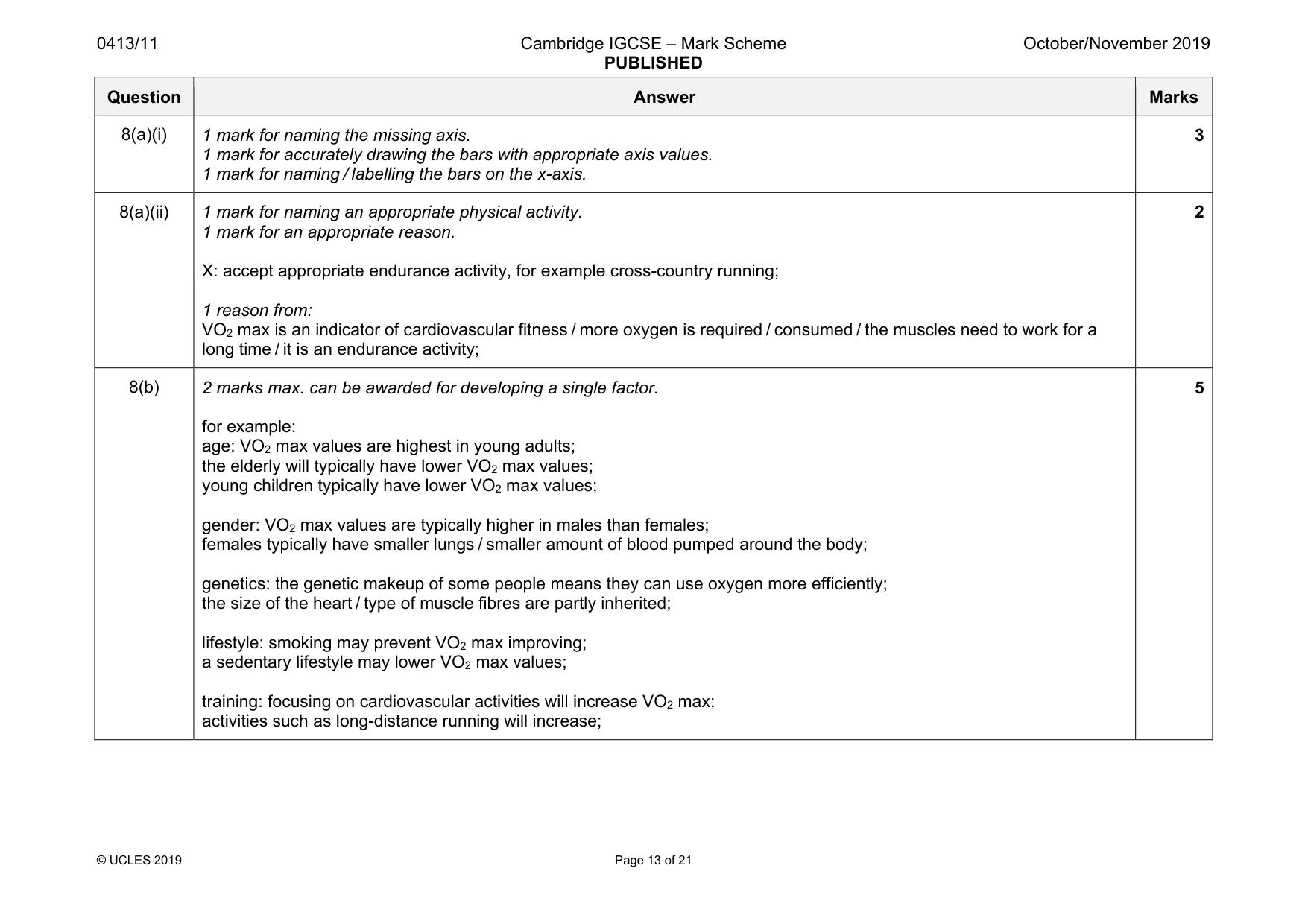
0413/11 Cambridge IGCSE – Mark Scheme PUBLISHED October/November 2019 © UCLES 2019 Page 13 of 21 Question Answer Marks 8(a)(i) 1 mark for naming the missing axis. 1 mark for accurately drawing the bars with appropriate axis values. 1 mark for naming / labelling the bars on the x-axis. 3 8(a)(ii) 1 mark for naming an appropriate physical activity. 1 mark for an appropriate reason. X: accept appropriate endurance activity, for example cross-country running; 1 reason from: VO2 max is an indicator of cardiovascular fitness / more oxygen is required / consumed / the muscles need to work for a long time / it is an endurance activity; 2 8(b) 2 marks max. can be awarded for developing a single factor. for example: age: VO2 max values are highest in young adults; the elderly will typically have lower VO2 max values; young children typically have lower VO2 max values; gender: VO2 max values are typically higher in males than females; females typically have smaller lungs / smaller amount of blood pumped around the body; genetics: the genetic makeup of some people means they can use oxygen more efficiently; the size of the heart / type of muscle fibres are partly inherited; lifestyle: smoking may prevent VO2 max improving; a sedentary lifestyle may lower VO2 max values; training: focusing on cardiovascular activities will increase VO2 max; activities such as long-distance running will increase; 5
Mark scheme, page 14
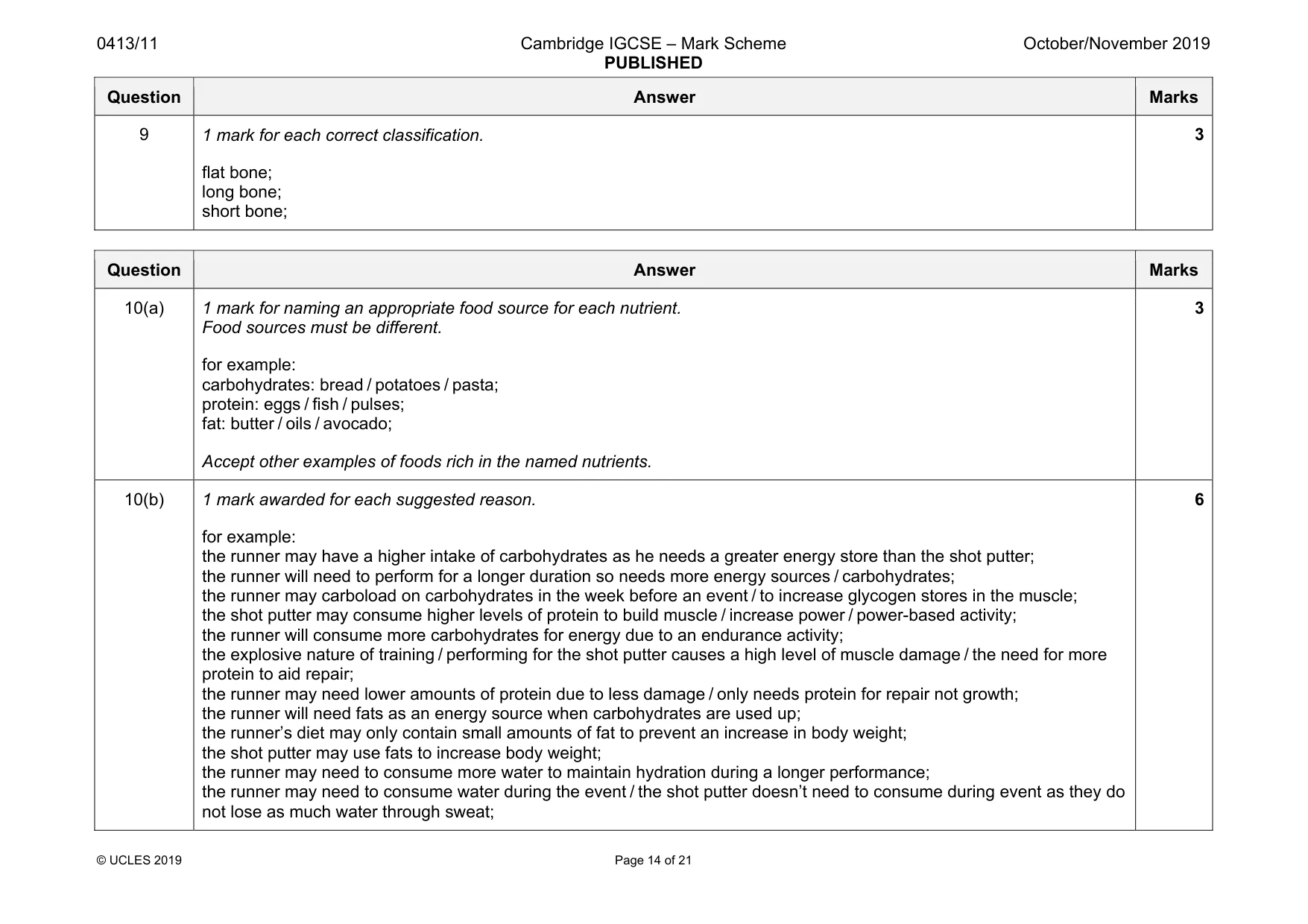
0413/11 Cambridge IGCSE – Mark Scheme PUBLISHED October/November 2019 © UCLES 2019 Page 14 of 21 Question Answer Marks 9 1 mark for each correct classification. flat bone; long bone; short bone; 3 Question Answer Marks 10(a) 1 mark for naming an appropriate food source for each nutrient. Food sources must be different. for example: carbohydrates: bread / potatoes / pasta; protein: eggs / fish / pulses; fat: butter / oils / avocado; Accept other examples of foods rich in the named nutrients. 3 10(b) 1 mark awarded for each suggested reason. for example: the runner may have a higher intake of carbohydrates as he needs a greater energy store than the shot putter; the runner will need to perform for a longer duration so needs more energy sources / carbohydrates; the runner may carboload on carbohydrates in the week before an event / to increase glycogen stores in the muscle; the shot putter may consume higher levels of protein to build muscle / increase power / power-based activity; the runner will consume more carbohydrates for energy due to an endurance activity; the explosive nature of training / performing for the shot putter causes a high level of muscle damage / the need for more protein to aid repair; the runner may need lower amounts of protein due to less damage / only needs protein for repair not growth; the runner will need fats as an energy source when carbohydrates are used up; the runner’s diet may only contain small amounts of fat to prevent an increase in body weight; the shot putter may use fats to increase body weight; the runner may need to consume more water to maintain hydration during a longer performance; the runner may need to consume water during the event / the shot putter doesn’t need to consume during event as they do not lose as much water through sweat; 6
Mark scheme, page 15
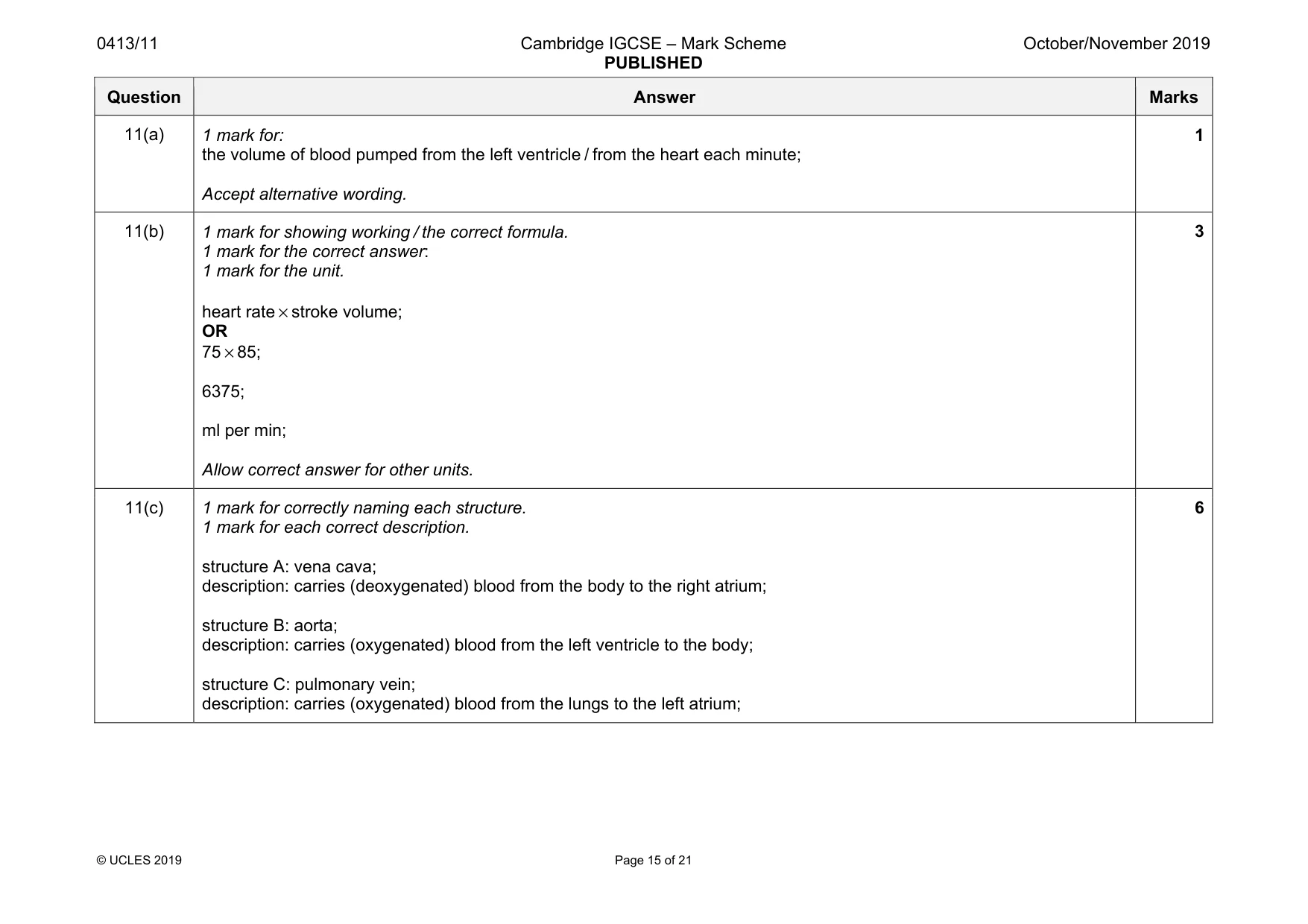
0413/11 Cambridge IGCSE – Mark Scheme PUBLISHED October/November 2019 © UCLES 2019 Page 15 of 21 Question Answer Marks 11(a) 1 mark for: the volume of blood pumped from the left ventricle / from the heart each minute; Accept alternative wording. 1 11(b) 1 mark for showing working / the correct formula. 1 mark for the correct answer: 1 mark for the unit. heart rate × stroke volume; OR 75 × 85; 6375; ml per min; Allow correct answer for other units. 3 11(c) 1 mark for correctly naming each structure. 1 mark for each correct description. structure A: vena cava; description: carries (deoxygenated) blood from the body to the right atrium; structure B: aorta; description: carries (oxygenated) blood from the left ventricle to the body; structure C: pulmonary vein; description: carries (oxygenated) blood from the lungs to the left atrium; 6
Mark scheme, page 16
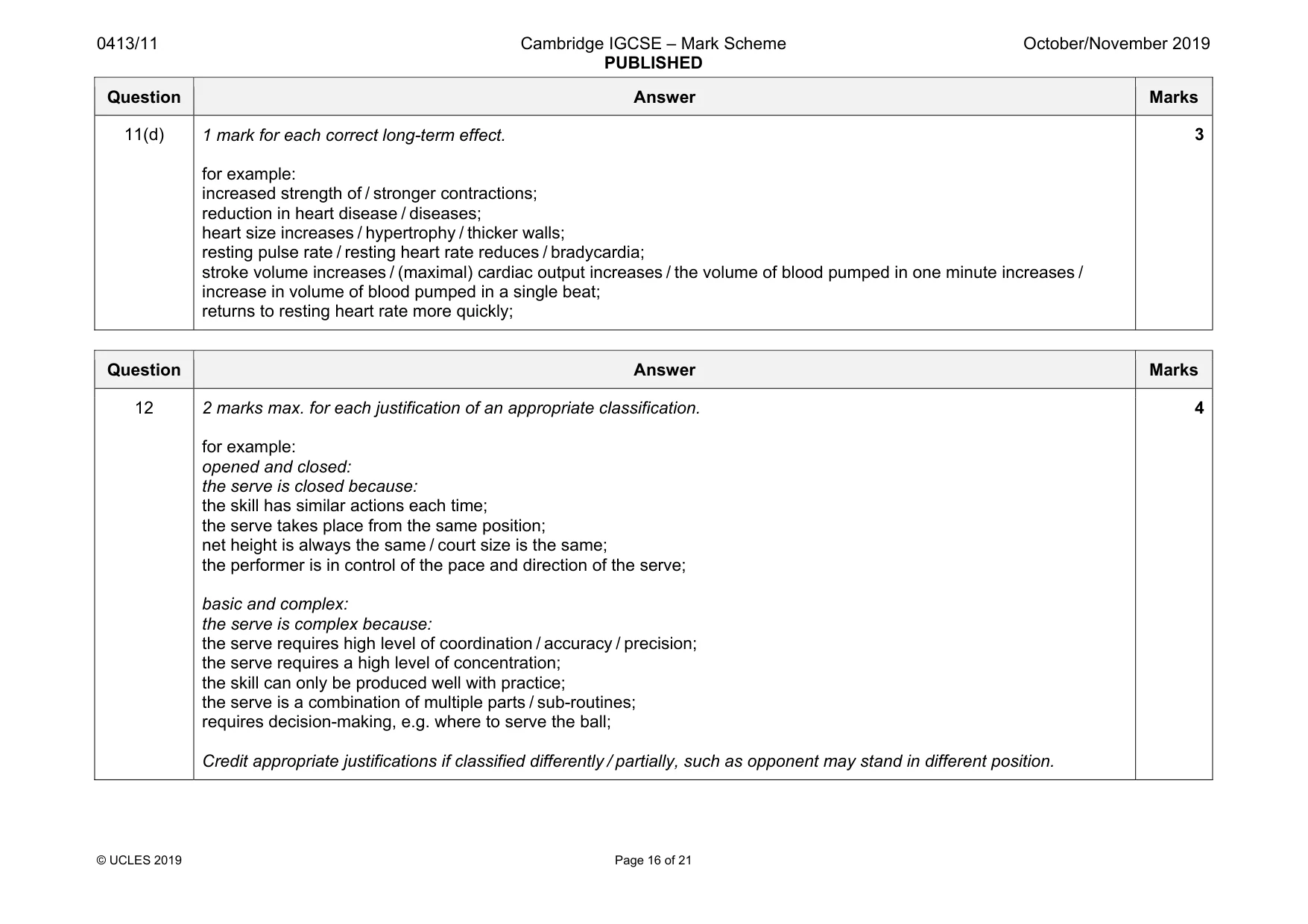
0413/11 Cambridge IGCSE – Mark Scheme PUBLISHED October/November 2019 © UCLES 2019 Page 16 of 21 Question Answer Marks 11(d) 1 mark for each correct long-term effect. for example: increased strength of / stronger contractions; reduction in heart disease / diseases; heart size increases / hypertrophy / thicker walls; resting pulse rate / resting heart rate reduces / bradycardia; stroke volume increases / (maximal) cardiac output increases / the volume of blood pumped in one minute increases / increase in volume of blood pumped in a single beat; returns to resting heart rate more quickly; 3 Question Answer Marks 12 2 marks max. for each justification of an appropriate classification. for example: opened and closed: the serve is closed because: the skill has similar actions each time; the serve takes place from the same position; net height is always the same / court size is the same; the performer is in control of the pace and direction of the serve; basic and complex: the serve is complex because: the serve requires high level of coordination / accuracy / precision; the serve requires a high level of concentration; the skill can only be produced well with practice; the serve is a combination of multiple parts / sub-routines; requires decision-making, e.g. where to serve the ball; Credit appropriate justifications if classified differently / partially, such as opponent may stand in different position. 4
Mark scheme, page 17
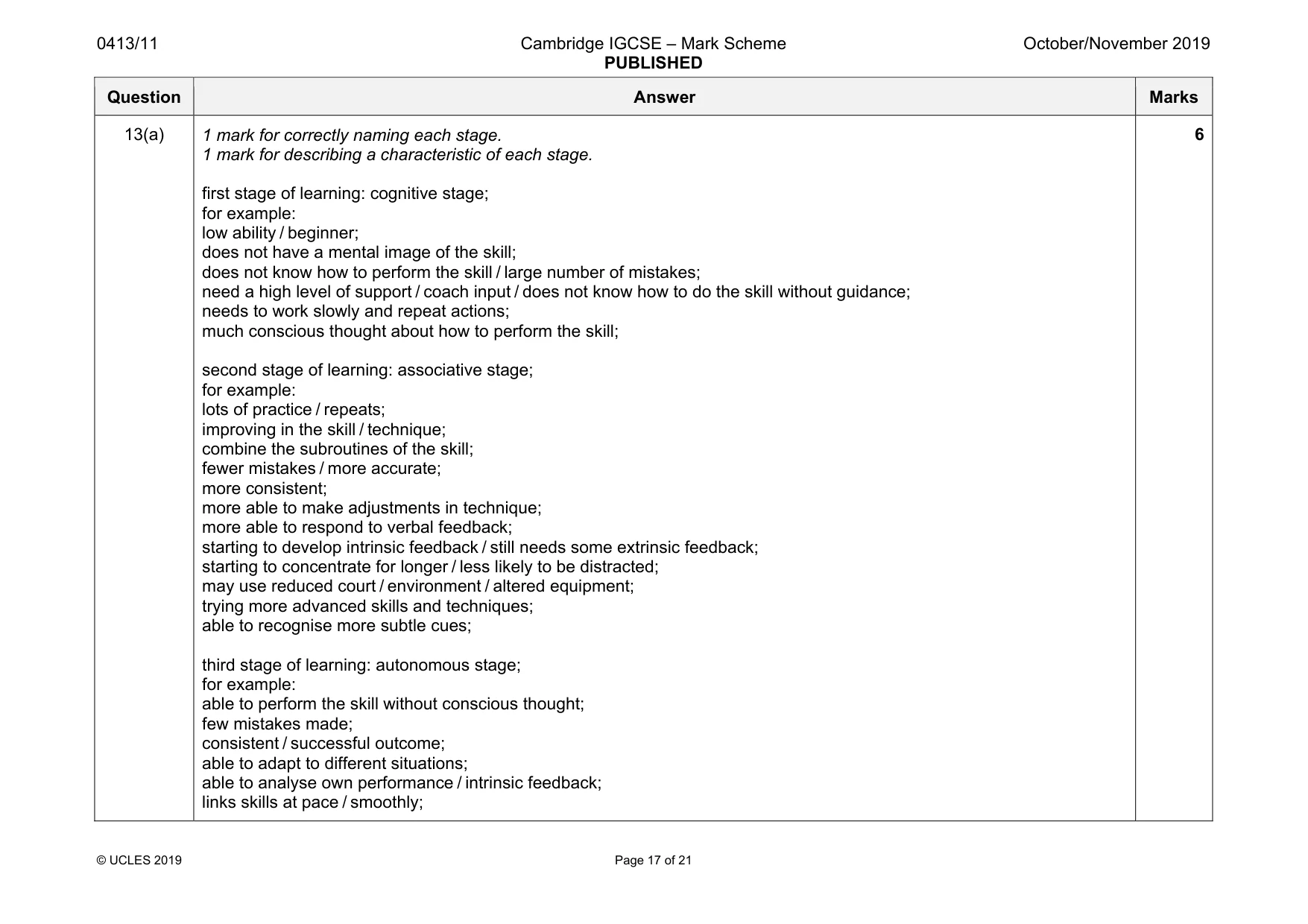
0413/11 Cambridge IGCSE – Mark Scheme PUBLISHED October/November 2019 © UCLES 2019 Page 17 of 21 Question Answer Marks 13(a) 1 mark for correctly naming each stage. 1 mark for describing a characteristic of each stage. first stage of learning: cognitive stage; for example: low ability / beginner; does not have a mental image of the skill; does not know how to perform the skill / large number of mistakes; need a high level of support / coach input / does not know how to do the skill without guidance; needs to work slowly and repeat actions; much conscious thought about how to perform the skill; second stage of learning: associative stage; for example: lots of practice / repeats; improving in the skill / technique; combine the subroutines of the skill; fewer mistakes / more accurate; more consistent; more able to make adjustments in technique; more able to respond to verbal feedback; starting to develop intrinsic feedback / still needs some extrinsic feedback; starting to concentrate for longer / less likely to be distracted; may use reduced court / environment / altered equipment; trying more advanced skills and techniques; able to recognise more subtle cues; third stage of learning: autonomous stage; for example: able to perform the skill without conscious thought; few mistakes made; consistent / successful outcome; able to adapt to different situations; able to analyse own performance / intrinsic feedback; links skills at pace / smoothly; 6
Mark scheme, page 18
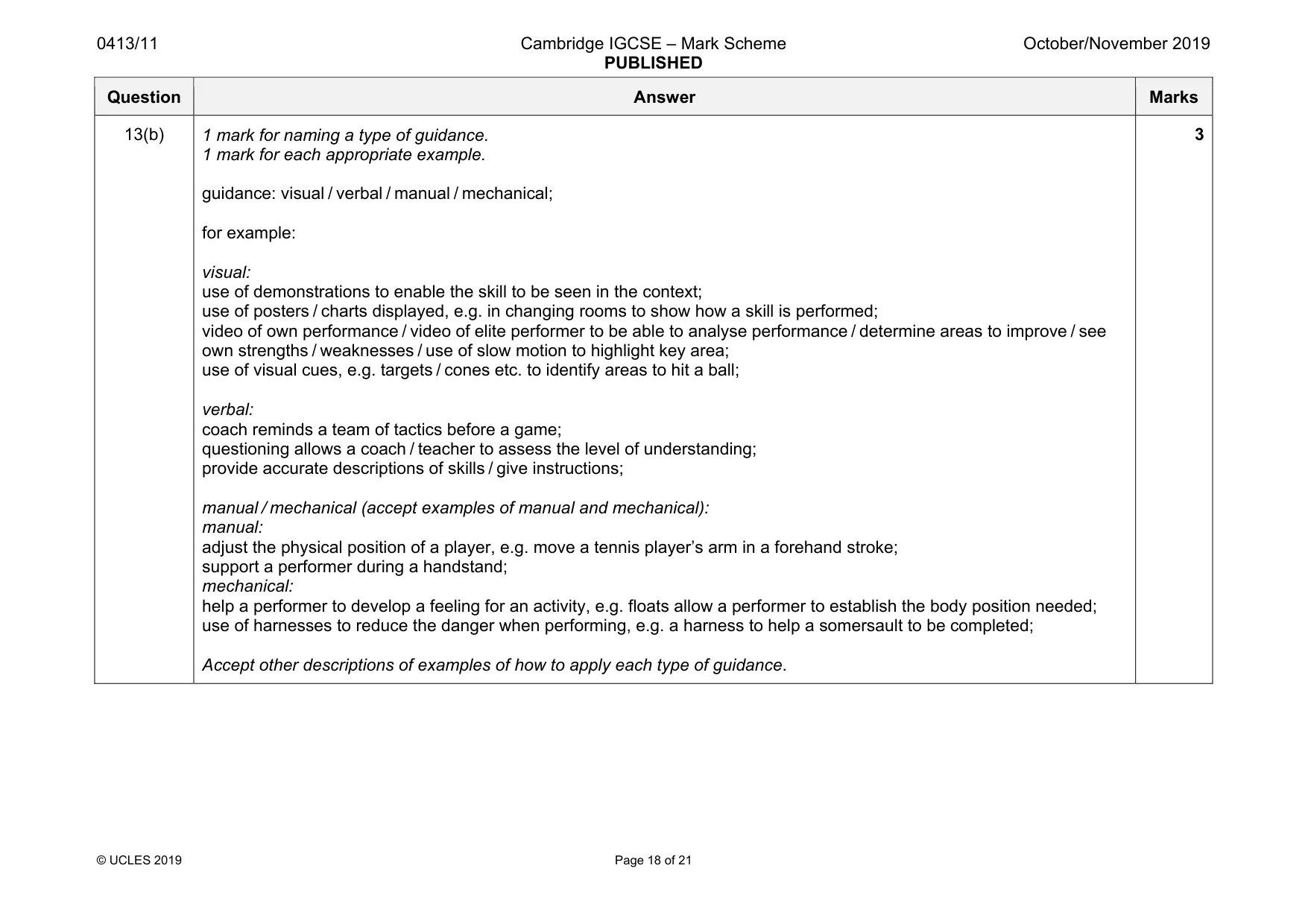
0413/11 Cambridge IGCSE – Mark Scheme PUBLISHED October/November 2019 © UCLES 2019 Page 18 of 21 Question Answer Marks 13(b) 1 mark for naming a type of guidance. 1 mark for each appropriate example. guidance: visual / verbal / manual / mechanical; for example: visual: use of demonstrations to enable the skill to be seen in the context; use of posters / charts displayed, e.g. in changing rooms to show how a skill is performed; video of own performance / video of elite performer to be able to analyse performance / determine areas to improve / see own strengths / weaknesses / use of slow motion to highlight key area; use of visual cues, e.g. targets / cones etc. to identify areas to hit a ball; verbal: coach reminds a team of tactics before a game; questioning allows a coach / teacher to assess the level of understanding; provide accurate descriptions of skills / give instructions; manual / mechanical (accept examples of manual and mechanical): manual: adjust the physical position of a player, e.g. move a tennis player’s arm in a forehand stroke; support a performer during a handstand; mechanical: help a performer to develop a feeling for an activity, e.g. floats allow a performer to establish the body position needed; use of harnesses to reduce the danger when performing, e.g. a harness to help a somersault to be completed; Accept other descriptions of examples of how to apply each type of guidance. 3
Mark scheme, page 19
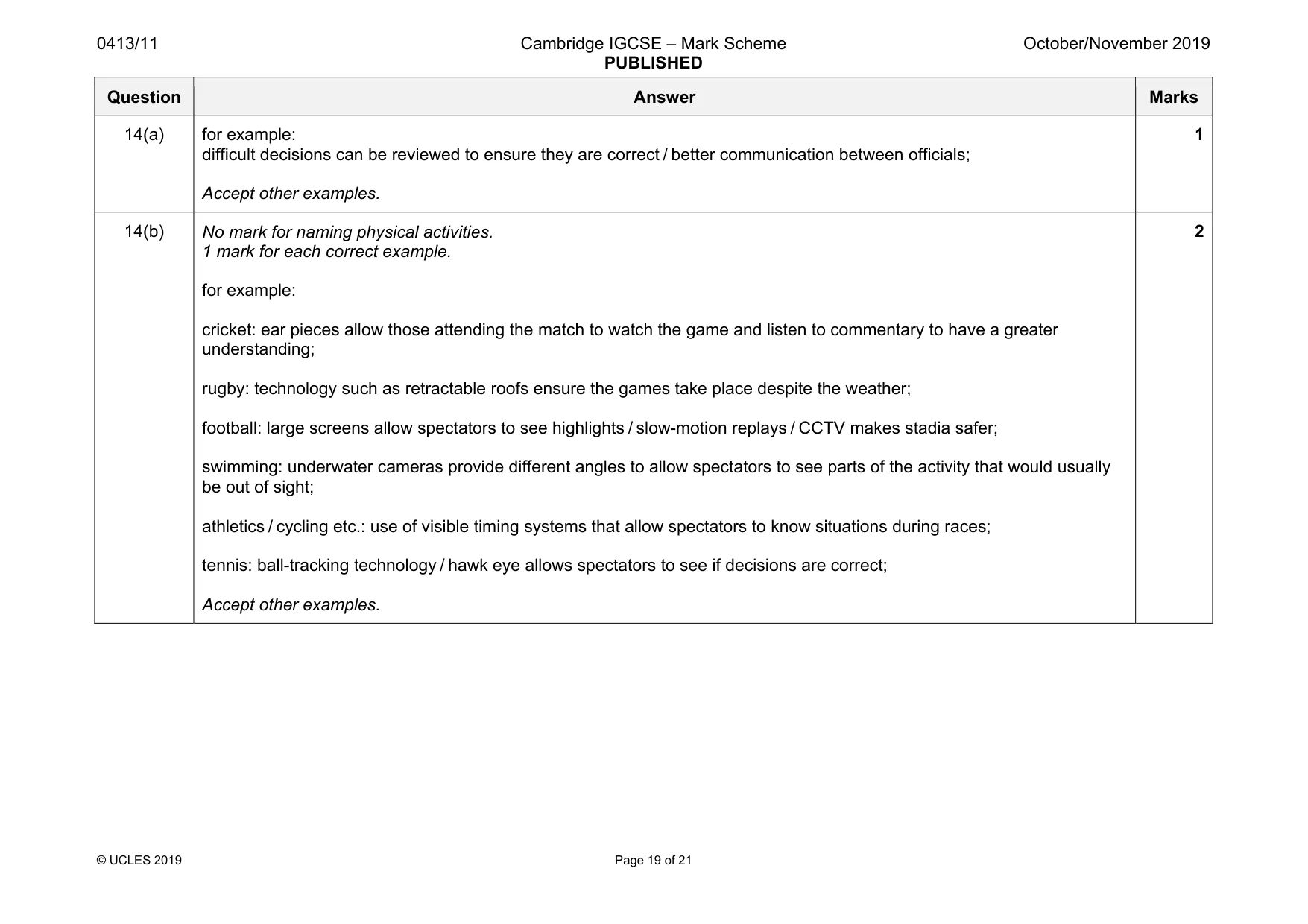
0413/11 Cambridge IGCSE – Mark Scheme PUBLISHED October/November 2019 © UCLES 2019 Page 19 of 21 Question Answer Marks 14(a) for example: difficult decisions can be reviewed to ensure they are correct / better communication between officials; Accept other examples. 1 14(b) No mark for naming physical activities. 1 mark for each correct example. for example: cricket: ear pieces allow those attending the match to watch the game and listen to commentary to have a greater understanding; rugby: technology such as retractable roofs ensure the games take place despite the weather; football: large screens allow spectators to see highlights / slow-motion replays / CCTV makes stadia safer; swimming: underwater cameras provide different angles to allow spectators to see parts of the activity that would usually be out of sight; athletics / cycling etc.: use of visible timing systems that allow spectators to know situations during races; tennis: ball-tracking technology / hawk eye allows spectators to see if decisions are correct; Accept other examples. 2
Mark scheme, page 20
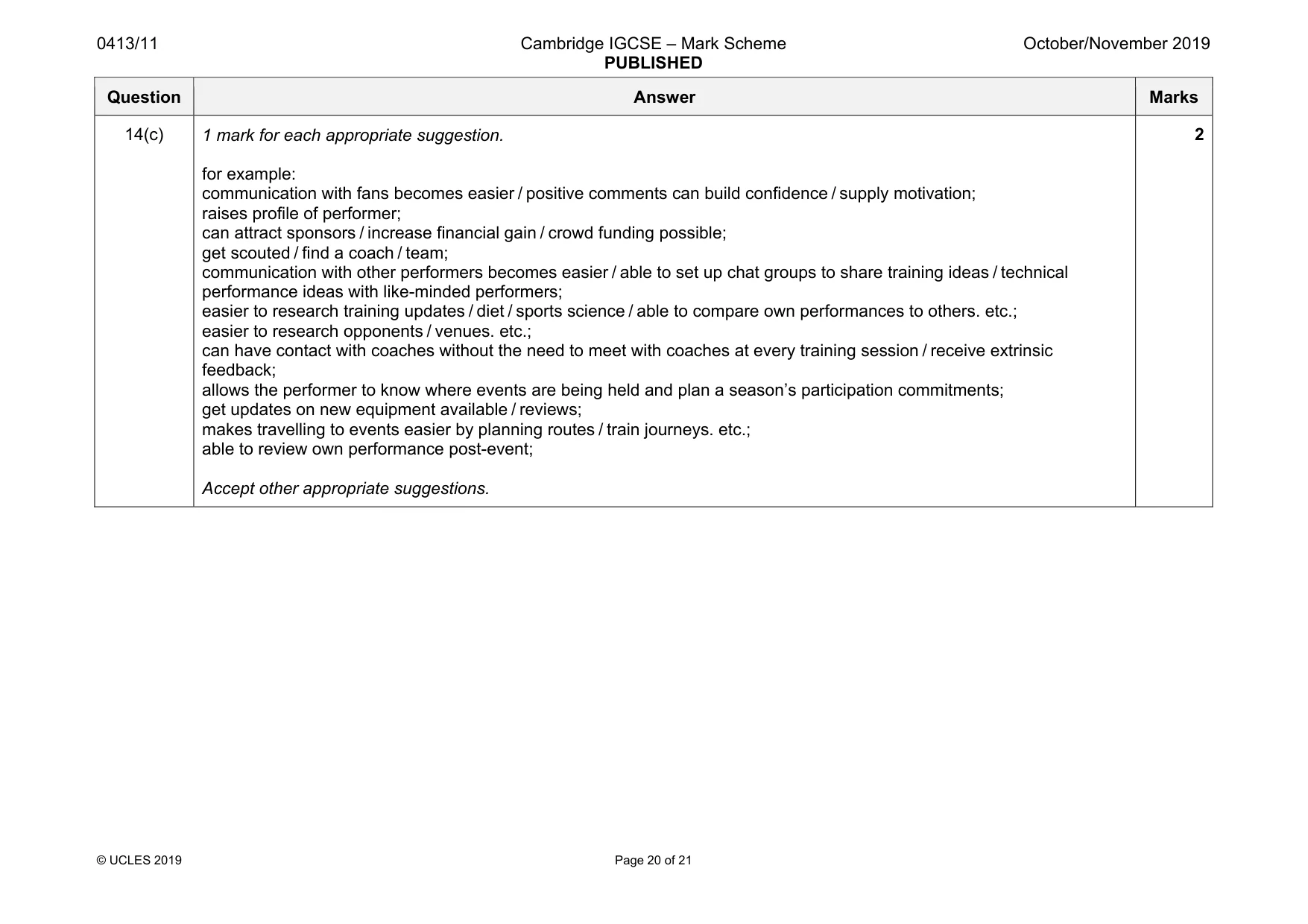
0413/11 Cambridge IGCSE – Mark Scheme PUBLISHED October/November 2019 © UCLES 2019 Page 20 of 21 Question Answer Marks 14(c) 1 mark for each appropriate suggestion. for example: communication with fans becomes easier / positive comments can build confidence / supply motivation; raises profile of performer; can attract sponsors / increase financial gain / crowd funding possible; get scouted / find a coach / team; communication with other performers becomes easier / able to set up chat groups to share training ideas / technical performance ideas with like-minded performers; easier to research training updates / diet / sports science / able to compare own performances to others. etc.; easier to research opponents / venues. etc.; can have contact with coaches without the need to meet with coaches at every training session / receive extrinsic feedback; allows the performer to know where events are being held and plan a season’s participation commitments; get updates on new equipment available / reviews; makes travelling to events easier by planning routes / train journeys. etc.; able to review own performance post-event; Accept other appropriate suggestions. 2
Mark scheme, page 21
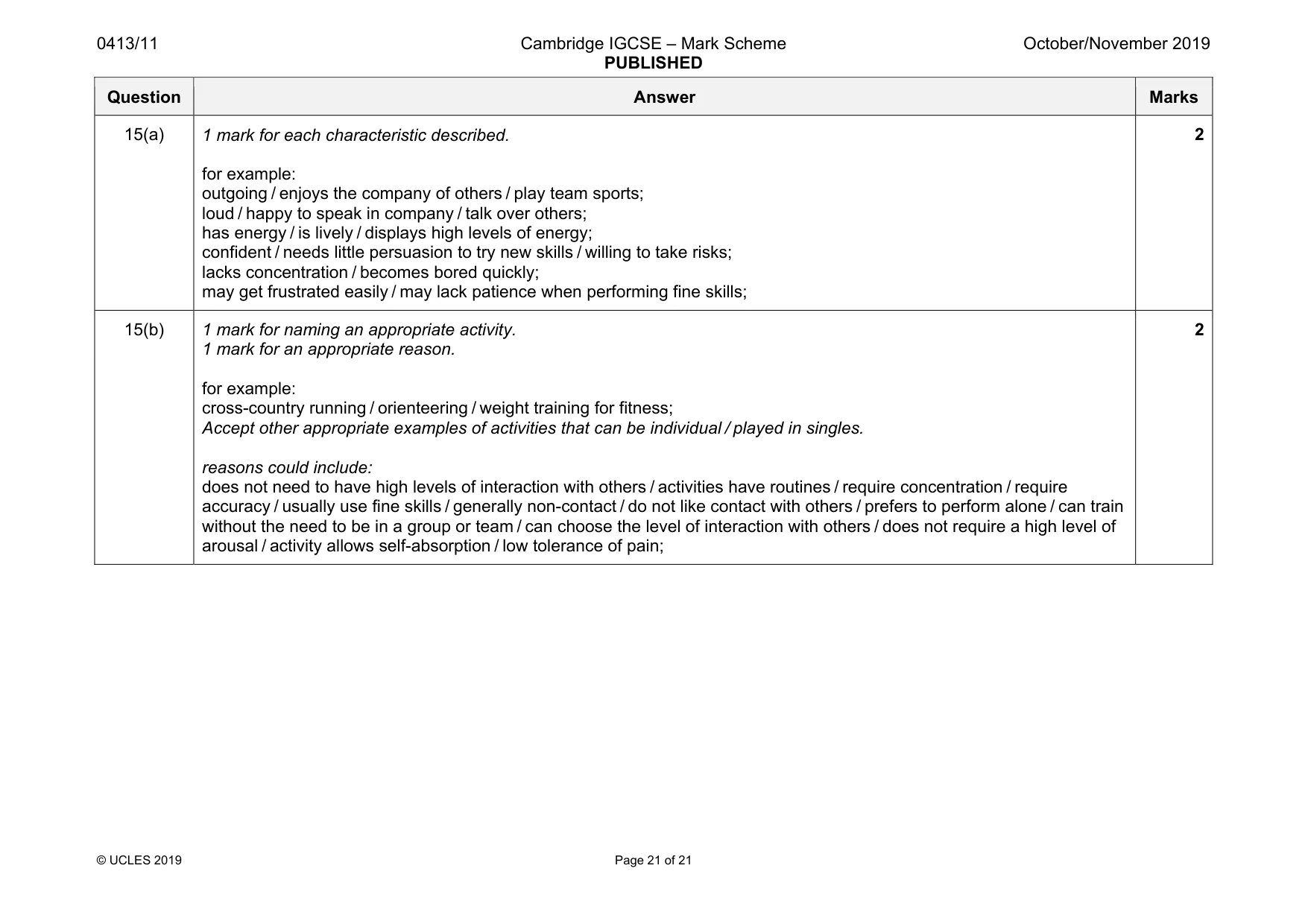
0413/11 Cambridge IGCSE – Mark Scheme PUBLISHED October/November 2019 © UCLES 2019 Page 21 of 21 Question Answer Marks 15(a) 1 mark for each characteristic described. for example: outgoing / enjoys the company of others / play team sports; loud / happy to speak in company / talk over others; has energy / is lively / displays high levels of energy; confident / needs little persuasion to try new skills / willing to take risks; lacks concentration / becomes bored quickly; may get frustrated easily / may lack patience when performing fine skills; 2 15(b) 1 mark for naming an appropriate activity. 1 mark for an appropriate reason. for example: cross-country running / orienteering / weight training for fitness; Accept other appropriate examples of activities that can be individual / played in singles. reasons could include: does not need to have high levels of interaction with others / activities have routines / require concentration / require accuracy / usually use fine skills / generally non-contact / do not like contact with others / prefers to perform alone / can train without the need to be in a group or team / can choose the level of interaction with others / does not require a high level of arousal / activity allows self-absorption / low tolerance of pain; 2
What you needed in this session
Cambridge’s own grade thresholds for 2019 Oct/Nov, Paper 1 · Variant 1. A higher threshold means an easier paper — the bar moves with how the cohort did.