Cambridge IGCSE Physical Education 0413 — 2023 Oct/Nov Paper 1 · Variant 2
0413/12/O/N/23 · 100 marks · ≈113 min
The question paper and its mark scheme, free to read here and free to download. This is Cambridge’s own paper, exactly as it was sat.
Question paper16 pages


Mark scheme15 pages
Answers below. Sit the paper first if you are practising.
Paper as text
Question paper, page 1
This document has 16 pages. Any blank pages are indicated. [Turn over Cambridge IGCSE™ * 2 3 9 6 7 8 9 6 1 0 * DC (EF/CGW) 313202/2 © UCLES 2023 PHYSICAL EDUCATION 0413/12 Paper 1 Theory October/November 2023 1 hour 45 minutes You must answer on the question paper. No additional materials are needed. INSTRUCTIONS ● Answer all questions. ● Use a black or dark blue pen. You may use an HB pencil for any diagrams or graphs. ● Write your name, centre number and candidate number in the boxes at the top of the page. ● Write your answer to each question in the space provided. ● Do not use an erasable pen or correction fluid. ● Do not write on any bar codes. ● You may use a calculator. ● You should show all your working and use appropriate units. INFORMATION ● The total mark for this paper is 100. ● The number of marks for each question or part question is shown in brackets [ ].
Question paper, page 2
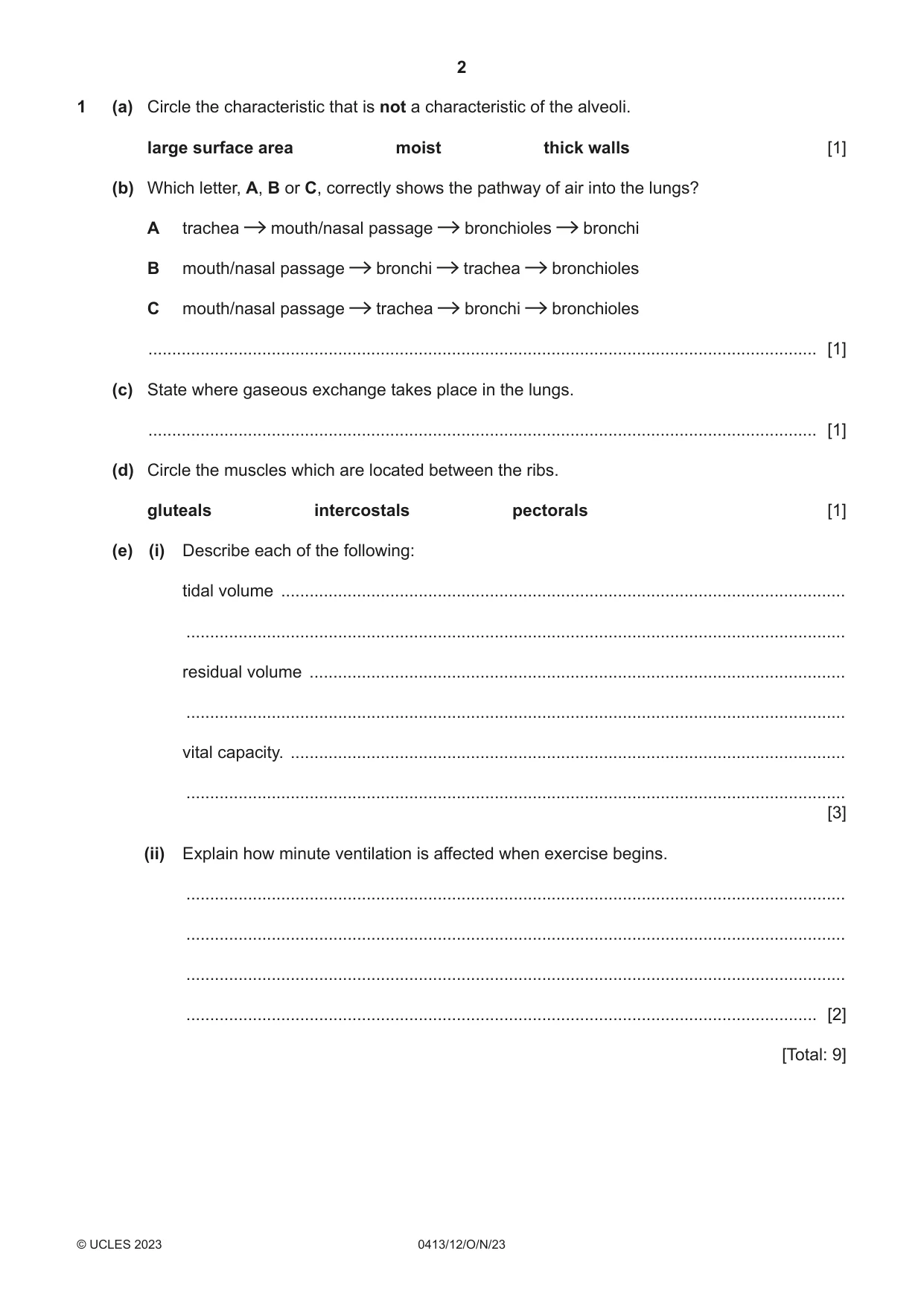
2 0413/12/O/N/23 © UCLES 2023 1 (a) Circle the characteristic that is not a characteristic of the alveoli. large surface area moist thick walls [1] (b) Which letter, A, B or C, correctly shows the pathway of air into the lungs? A trachea mouth/nasal passage bronchioles bronchi B mouth/nasal passage bronchi trachea bronchioles C mouth/nasal passage trachea bronchi bronchioles … [1] (c) State where gaseous exchange takes place in the lungs. … [1] (d) Circle the muscles which are located between the ribs. gluteals intercostals pectorals [1] (e) (i) Describe each of the following: tidal volume … … residual volume … … vital capacity. … … [3] (ii) Explain how minute ventilation is affected when exercise begins. … … … … [2] [Total: 9]
Question paper, page 3
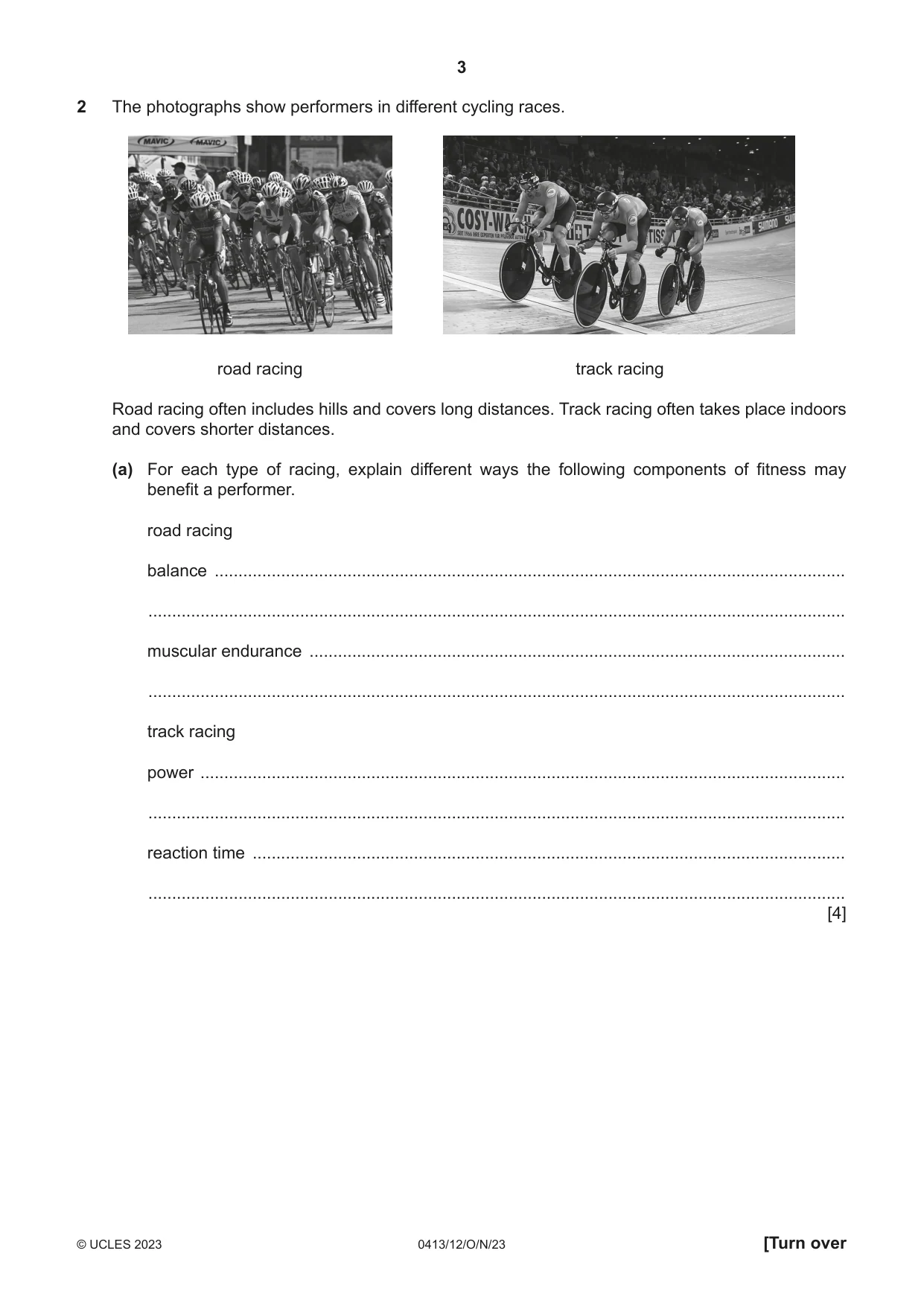
3 0413/12/O/N/23 © UCLES 2023 [Turn over 2 The photographs show performers in different cycling races. road racing track racing Road racing often includes hills and covers long distances. Track racing often takes place indoors and covers shorter distances. (a) For each type of racing, explain different ways the following components of fitness may benefit a performer. road racing balance … … muscular endurance … … track racing power … … reaction time … … [4]
Question paper, page 4
4 0413/12/O/N/23 © UCLES 2023 (b) Gravity is a force that keeps a cyclist and their bicycle in contact with the ground. Explain how two other named forces affect a cyclist during a race. force 1 … explanation … … force 2 … explanation … … [4] (c) Suggest three different ways that developments in technology may increase the speed of a cyclist. 1 … … 2 … … 3 … … [3] (d) Blood doping is an illegal method that has been used in cycling to enhance performance. (i) Describe how blood doping is carried out. … … … … … … [3] (ii) Explain how blood doping may enhance the performance of a cyclist. … … [1] [Total: 15]
Question paper, page 5
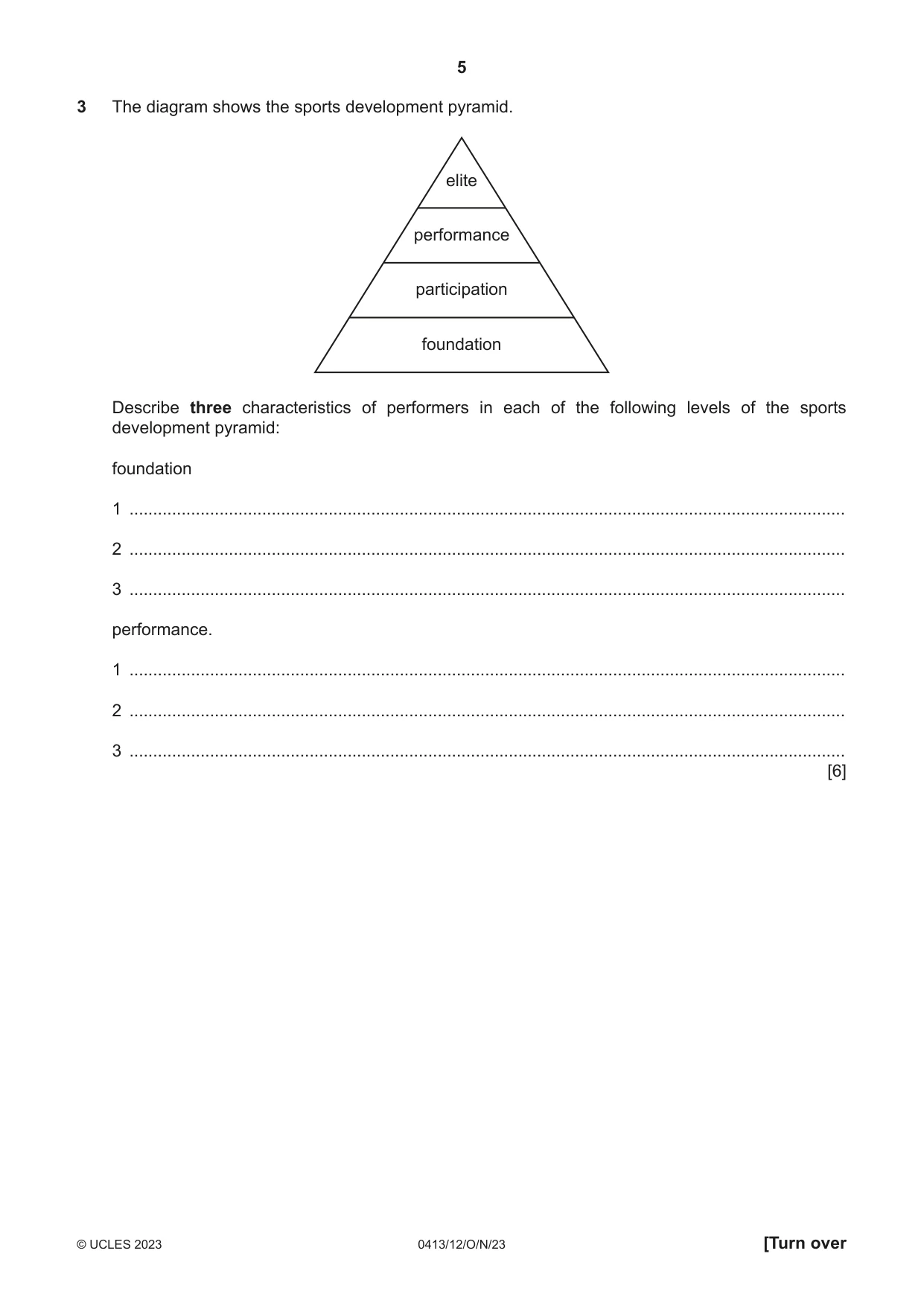
5 0413/12/O/N/23 © UCLES 2023 [Turn over 3 The diagram shows the sports development pyramid. elite performance participation foundation Describe three characteristics of performers in each of the following levels of the sports development pyramid: foundation 1 … 2 … 3 … performance. 1 … 2 … 3 … [6]
Question paper, page 6
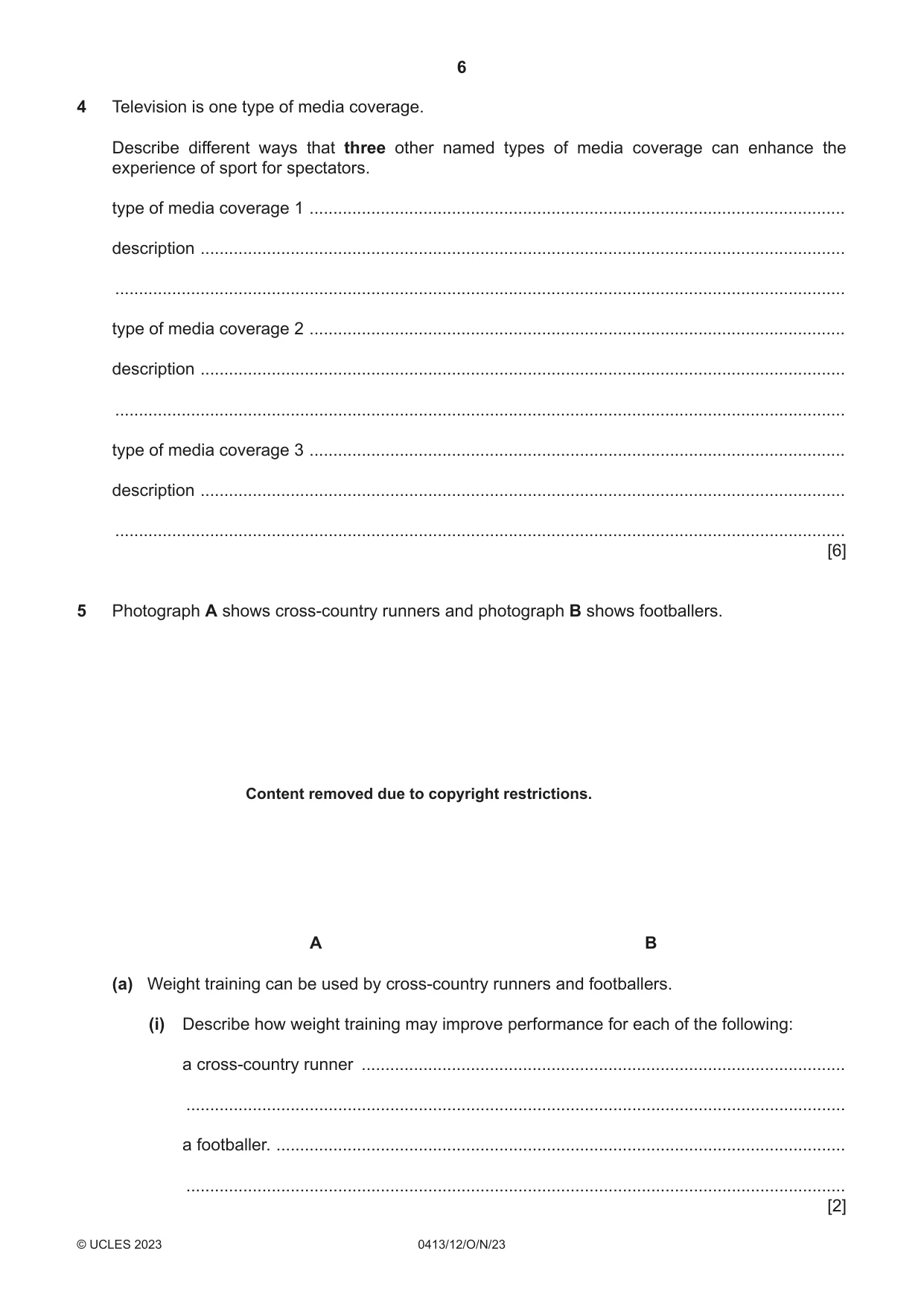
6 0413/12/O/N/23 © UCLES 2023 4 Television is one type of media coverage. Describe different ways that three other named types of media coverage can enhance the experience of sport for spectators. type of media coverage 1 … description … … type of media coverage 2 … description … … type of media coverage 3 … description … … [6] 5 Photograph A shows cross‑country runners and photograph B shows footballers. A B (a) Weight training can be used by cross‑country runners and footballers. (i) Describe how weight training may improve performance for each of the following: a cross‑country runner … … a footballer. … … [2] Content removed due to copyright restrictions.
Question paper, page 7
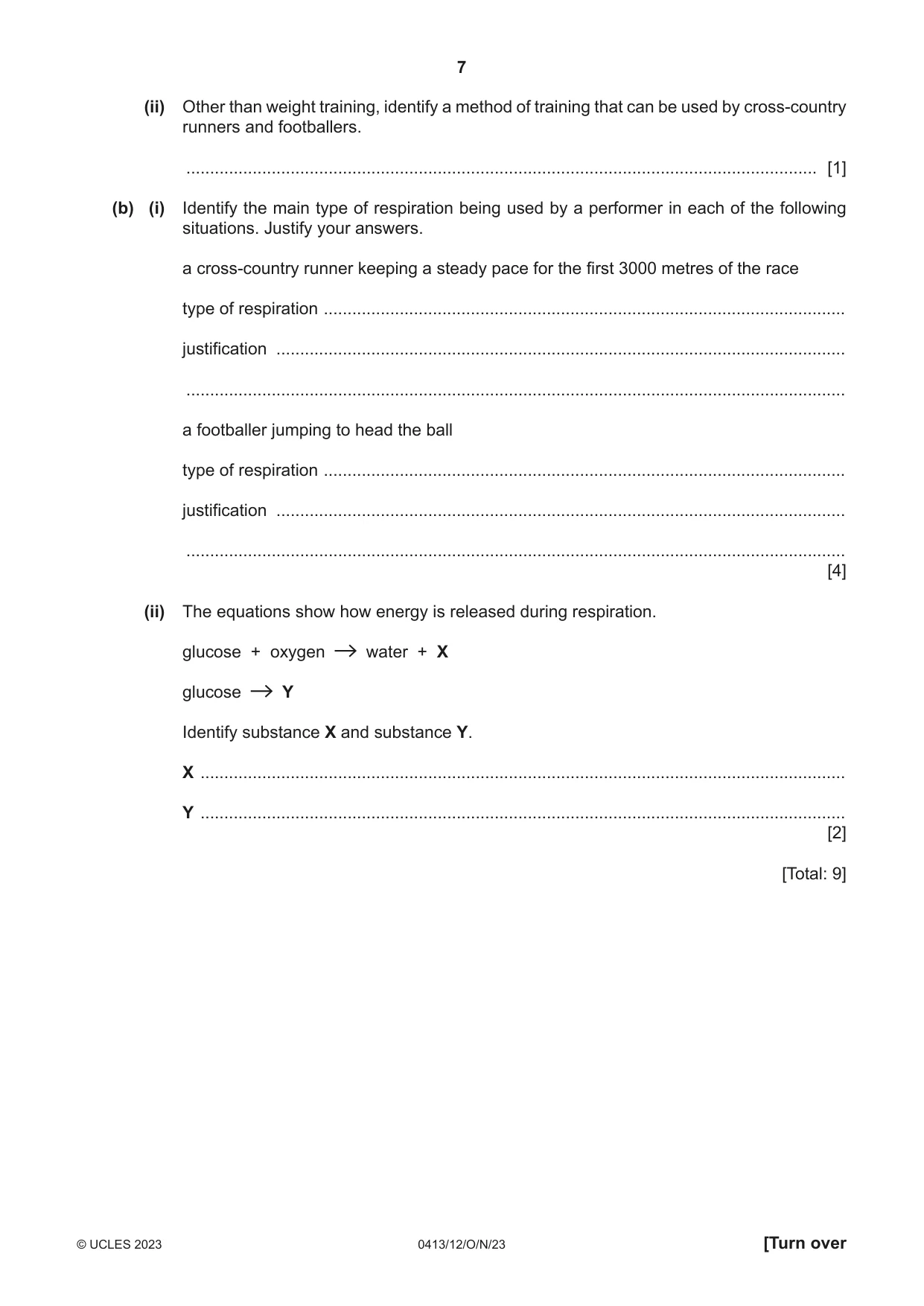
7 0413/12/O/N/23 © UCLES 2023 [Turn over (ii) Other than weight training, identify a method of training that can be used by cross‑country runners and footballers. … [1] (b) (i) Identify the main type of respiration being used by a performer in each of the following situations. Justify your answers. a cross‑country runner keeping a steady pace for the first 3000 metres of the race type of respiration … justification … … a footballer jumping to head the ball type of respiration … justification … … [4] (ii) The equations show how energy is released during respiration. glucose + oxygen water + X glucose Y Identify substance X and substance Y. X … Y … [2] [Total: 9]
Question paper, page 8
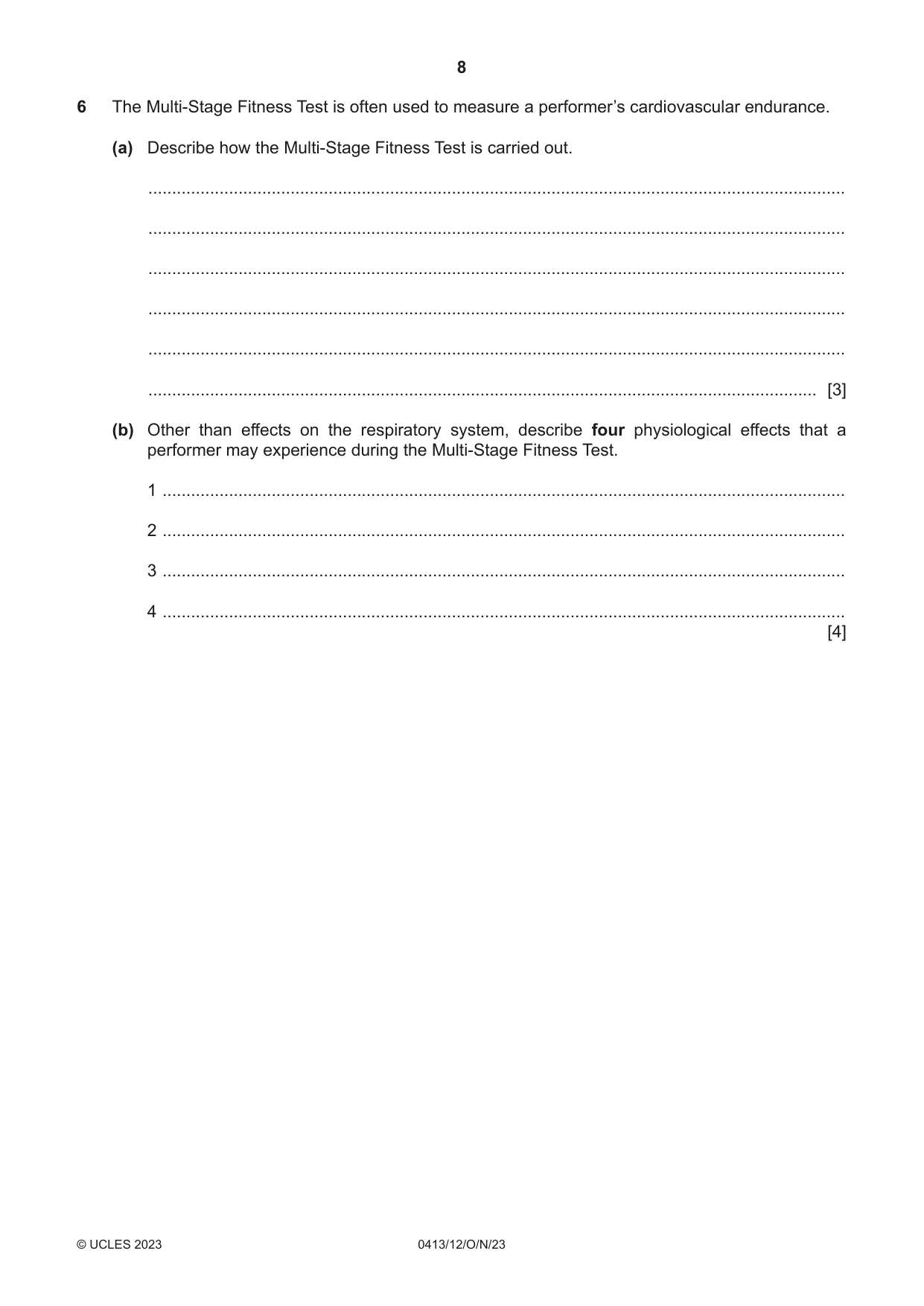
8 0413/12/O/N/23 © UCLES 2023 6 The Multi‑Stage Fitness Test is often used to measure a performer’s cardiovascular endurance. (a) Describe how the Multi‑Stage Fitness Test is carried out. … … … … … … [3] (b) Other than effects on the respiratory system, describe four physiological effects that a performer may experience during the Multi‑Stage Fitness Test. 1 … 2 … 3 … 4 … [4]
Question paper, page 9
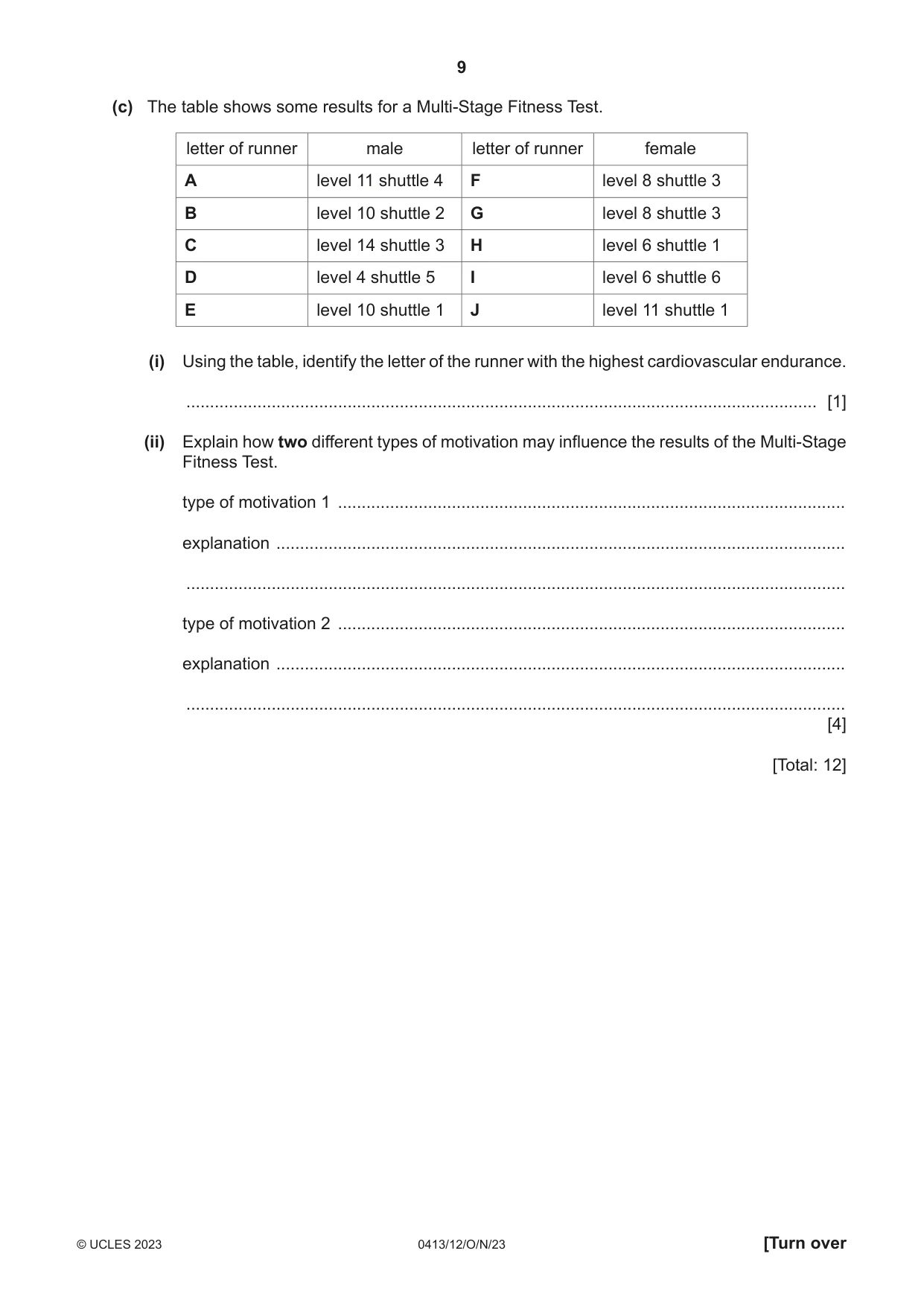
9 0413/12/O/N/23 © UCLES 2023 [Turn over (c) The table shows some results for a Multi‑Stage Fitness Test. letter of runner male letter of runner female A level 11 shuttle 4 F level 8 shuttle 3 B level 10 shuttle 2 G level 8 shuttle 3 C level 14 shuttle 3 H level 6 shuttle 1 D level 4 shuttle 5 I level 6 shuttle 6 E level 10 shuttle 1 J level 11 shuttle 1 (i) Using the table, identify the letter of the runner with the highest cardiovascular endurance. … [1] (ii) Explain how two different types of motivation may influence the results of the Multi‑Stage Fitness Test. type of motivation 1 … explanation … … type of motivation 2 … explanation … … [4] [Total: 12]
Question paper, page 10
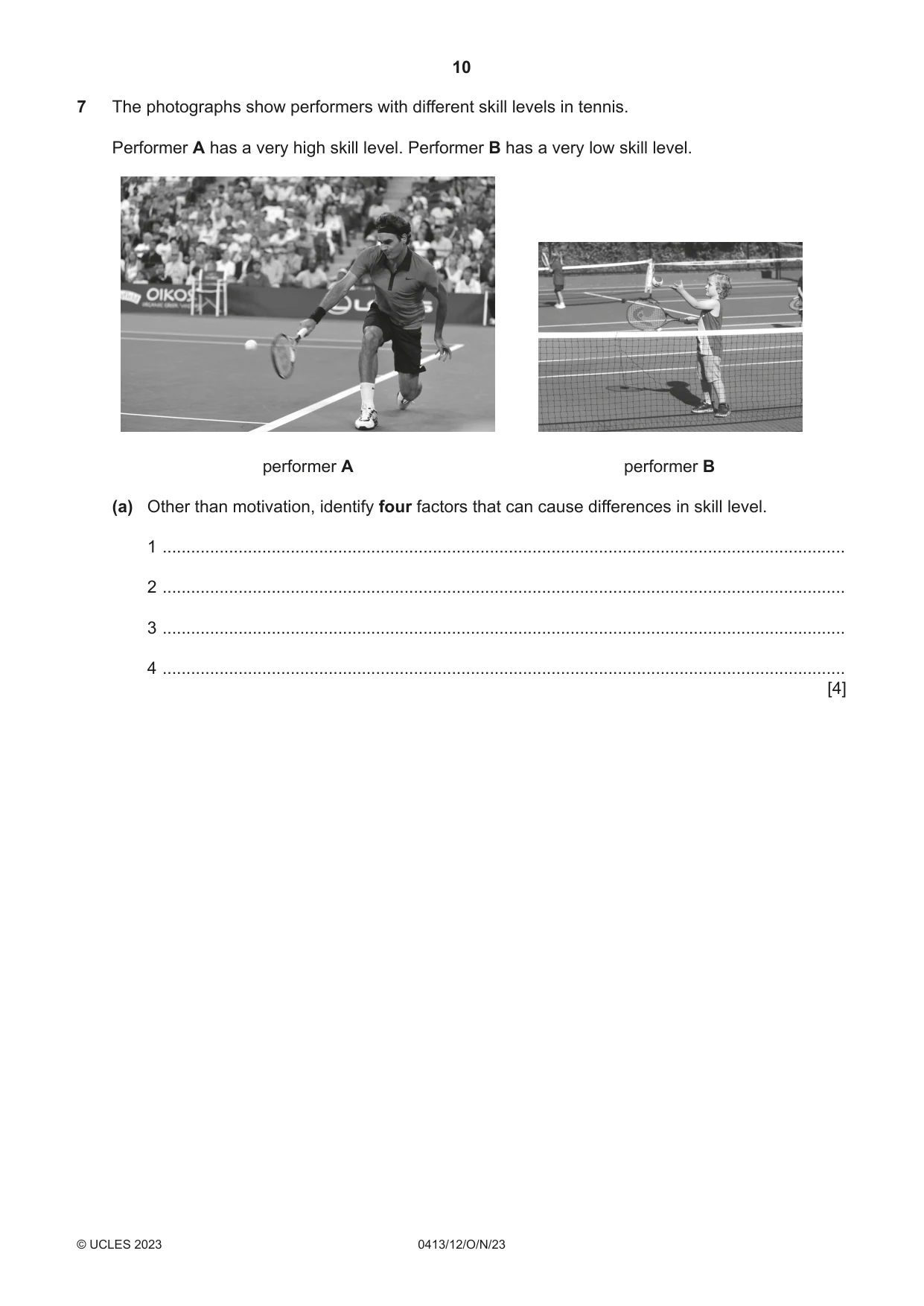
10 0413/12/O/N/23 © UCLES 2023 7 The photographs show performers with different skill levels in tennis. Performer A has a very high skill level. Performer B has a very low skill level. performer A performer B (a) Other than motivation, identify four factors that can cause differences in skill level. 1 … 2 … 3 … 4 … [4]
Question paper, page 11
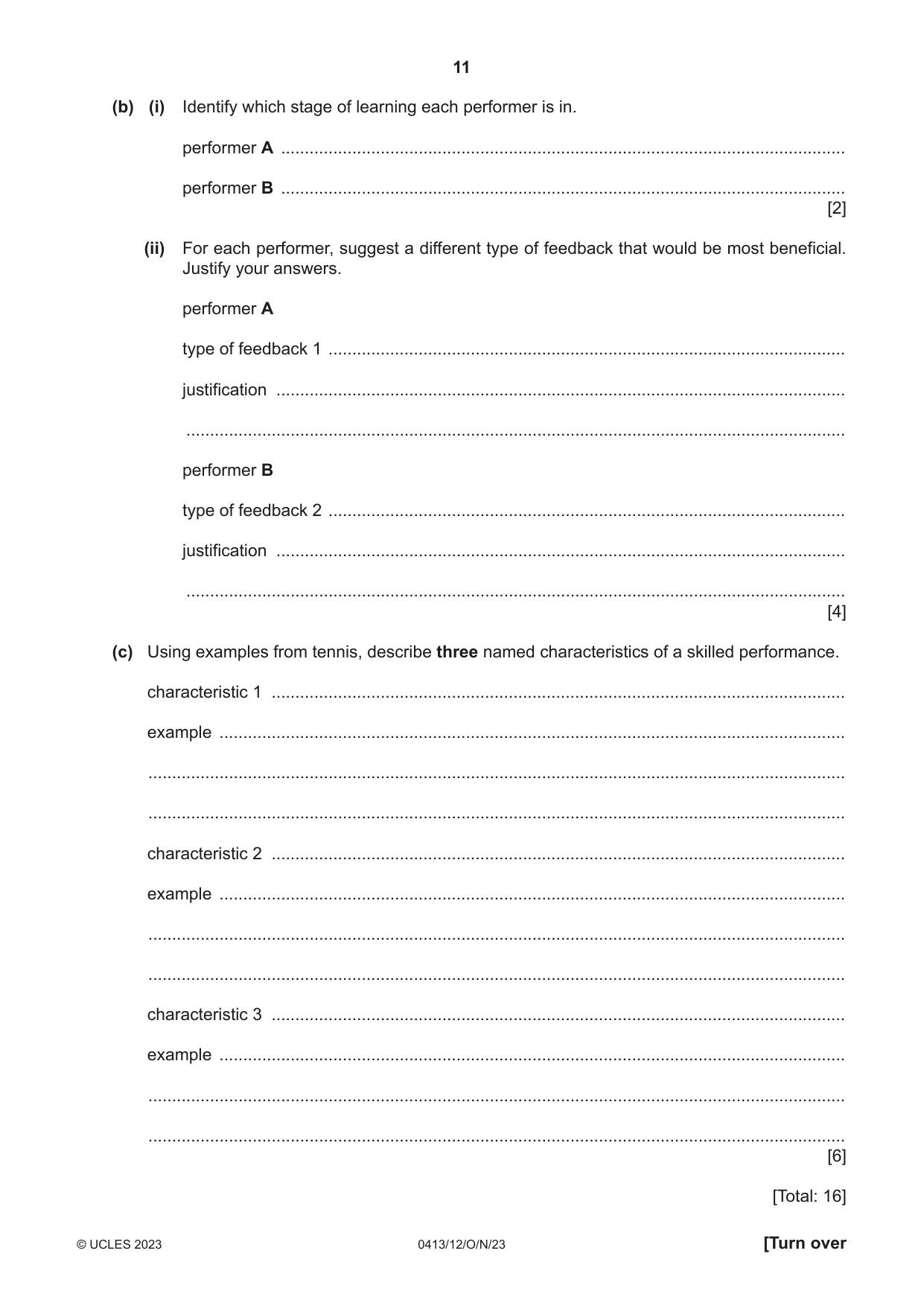
11 0413/12/O/N/23 © UCLES 2023 [Turn over (b) (i) Identify which stage of learning each performer is in. performer A … performer B … [2] (ii) For each performer, suggest a different type of feedback that would be most beneficial. Justify your answers. performer A type of feedback 1 … justification … … performer B type of feedback 2 … justification … … [4] (c) Using examples from tennis, describe three named characteristics of a skilled performance. characteristic 1 … example … … … characteristic 2 … example … … … characteristic 3 … example … … … [6] [Total: 16]
Question paper, page 12
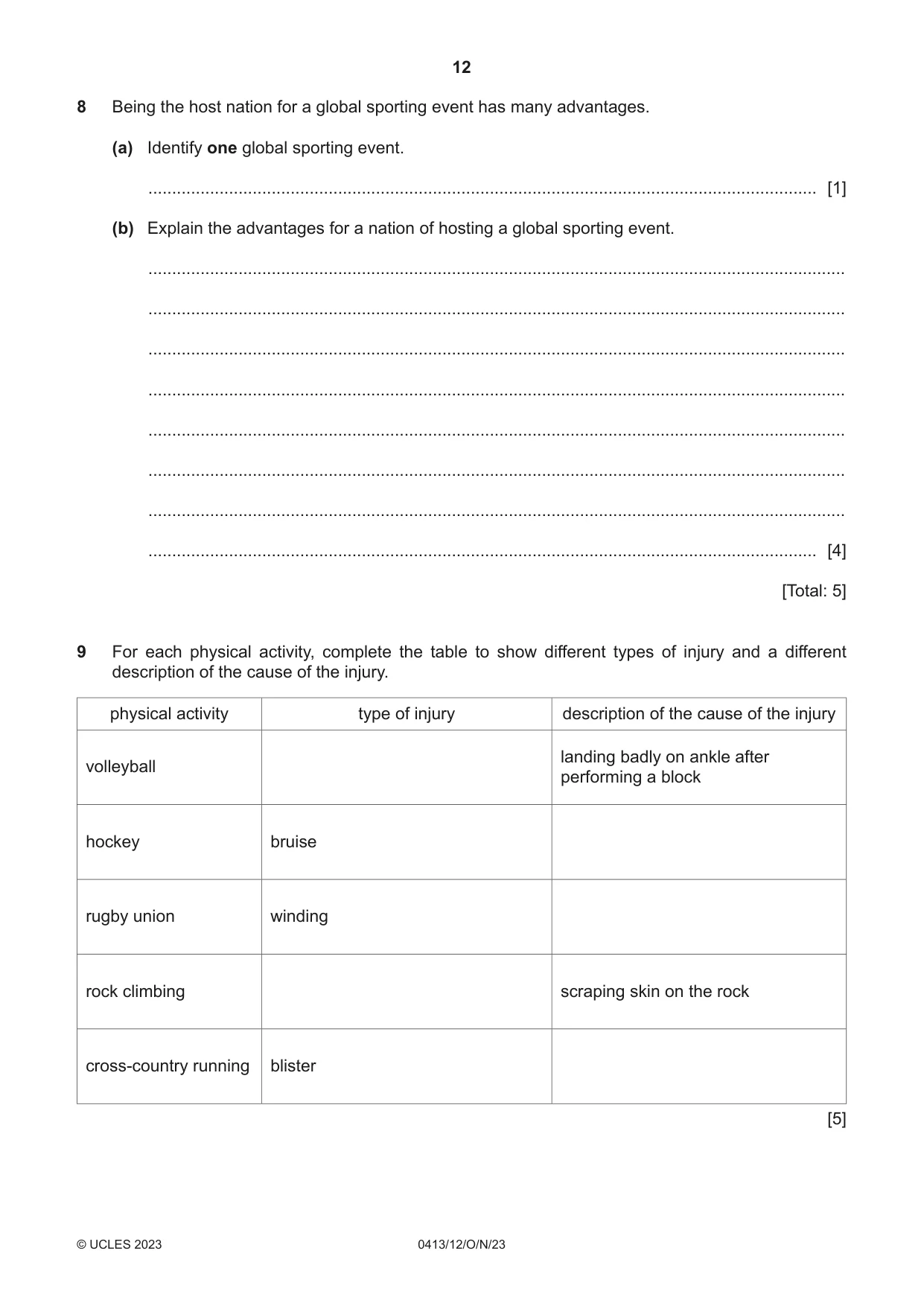
12 0413/12/O/N/23 © UCLES 2023 8 Being the host nation for a global sporting event has many advantages. (a) Identify one global sporting event. … [1] (b) Explain the advantages for a nation of hosting a global sporting event. … … … … … … … … [4] [Total: 5] 9 For each physical activity, complete the table to show different types of injury and a different description of the cause of the injury. physical activity type of injury description of the cause of the injury volleyball landing badly on ankle after performing a block hockey bruise rugby union winding rock climbing scraping skin on the rock cross‑country running blister [5]
Question paper, page 13
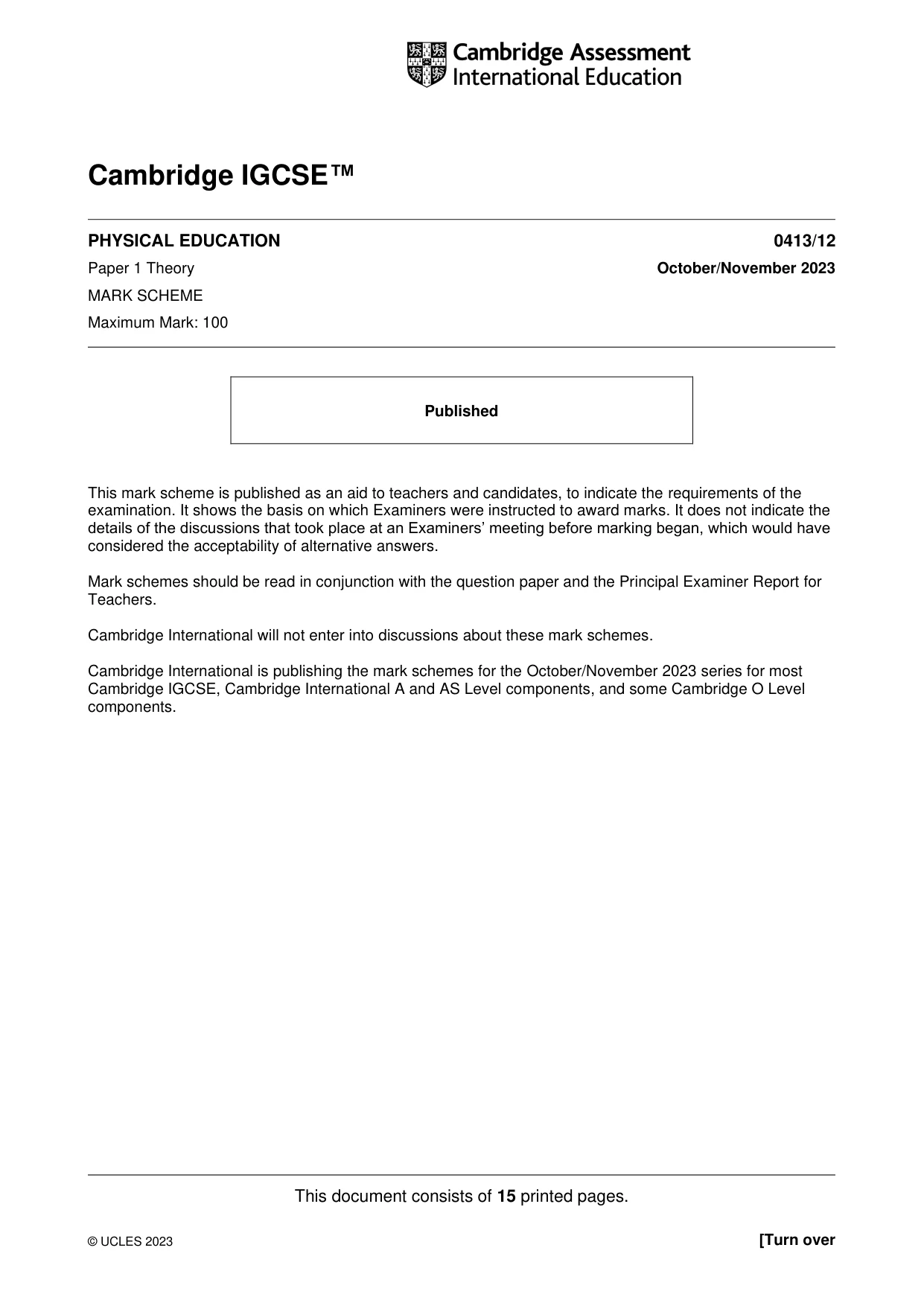
13 0413/12/O/N/23 © UCLES 2023 [Turn over 10 (a) Other than muscle attachment for movement, identify three functions of the skeleton. 1 … 2 … 3 … [3] (b) The diagram shows part of a skeleton. A B C State the name and classification of the bones at A, B and C. A … classification … B … classification … C … classification … [6] (c) Within the body there are three main types of joint. State a different name for each of the following types of joint: fixed … slightly movable … freely movable. … [3] [Total: 12]
Question paper, page 14
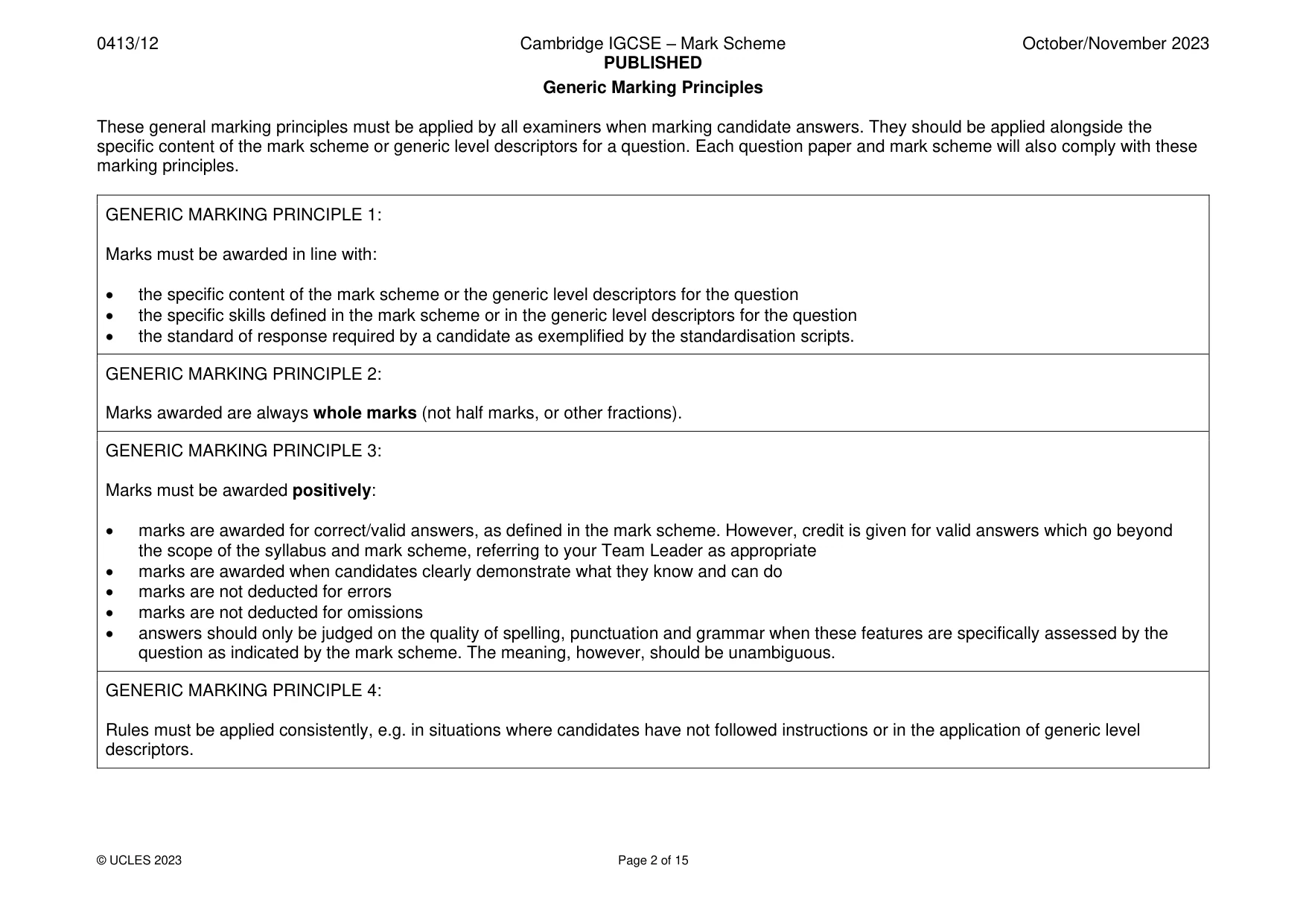
14 0413/12/O/N/23 © UCLES 2023 11 (a) Describe the function of the right ventricle in the heart. … … [1] (b) Complete the table to show different components of blood and their functions. component function plasma carry oxygen white blood cells clot the blood [4] [Total: 5]
Question paper, page 15
15 0413/12/O/N/23 © UCLES 2023 BLANK PAGE
Question paper, page 16
16 0413/12/O/N/23 © UCLES 2023 Permission to reproduce items where third‑party owned material protected by copyright is included has been sought and cleared where possible. Every reasonable effort has been made by the publisher (UCLES) to trace copyright holders, but if any items requiring clearance have unwittingly been included, the publisher will be pleased to make amends at the earliest possible opportunity. To avoid the issue of disclosure of answer‑related information to candidates, all copyright acknowledgements are reproduced online in the Cambridge Assessment International Education Copyright Acknowledgements Booklet. This is produced for each series of examinations and is freely available to download at www.cambridgeinternational.org after the live examination series. Cambridge Assessment International Education is part of Cambridge Assessment. Cambridge Assessment is the brand name of the University of Cambridge Local Examinations Syndicate (UCLES), which is a department of the University of Cambridge. BLANK PAGE
Mark scheme, page 1
This document consists of 15 printed pages. © UCLES 2023 [Turn over Cambridge IGCSE™ PHYSICAL EDUCATION 0413/12 Paper 1 Theory October/November 2023 MARK SCHEME Maximum Mark: 100 Published This mark scheme is published as an aid to teachers and candidates, to indicate the requirements of the examination. It shows the basis on which Examiners were instructed to award marks. It does not indicate the details of the discussions that took place at an Examiners’ meeting before marking began, which would have considered the acceptability of alternative answers. Mark schemes should be read in conjunction with the question paper and the Principal Examiner Report for Teachers. Cambridge International will not enter into discussions about these mark schemes. Cambridge International is publishing the mark schemes for the October/November 2023 series for most Cambridge IGCSE, Cambridge International A and AS Level components, and some Cambridge O Level components.
Mark scheme, page 2
0413/12 Cambridge IGCSE – Mark Scheme PUBLISHED October/November 2023 © UCLES 2023 Page 2 of 15 Generic Marking Principles These general marking principles must be applied by all examiners when marking candidate answers. They should be applied alongside the specific content of the mark scheme or generic level descriptors for a question. Each question paper and mark scheme will also comply with these marking principles. GENERIC MARKING PRINCIPLE 1: Marks must be awarded in line with: • the specific content of the mark scheme or the generic level descriptors for the question • the specific skills defined in the mark scheme or in the generic level descriptors for the question • the standard of response required by a candidate as exemplified by the standardisation scripts. GENERIC MARKING PRINCIPLE 2: Marks awarded are always whole marks (not half marks, or other fractions). GENERIC MARKING PRINCIPLE 3: Marks must be awarded positively: • marks are awarded for correct/valid answers, as defined in the mark scheme. However, credit is given for valid answers which go beyond the scope of the syllabus and mark scheme, referring to your Team Leader as appropriate • marks are awarded when candidates clearly demonstrate what they know and can do • marks are not deducted for errors • marks are not deducted for omissions • answers should only be judged on the quality of spelling, punctuation and grammar when these features are specifically assessed by the question as indicated by the mark scheme. The meaning, however, should be unambiguous. GENERIC MARKING PRINCIPLE 4: Rules must be applied consistently, e.g. in situations where candidates have not followed instructions or in the application of generic level descriptors.
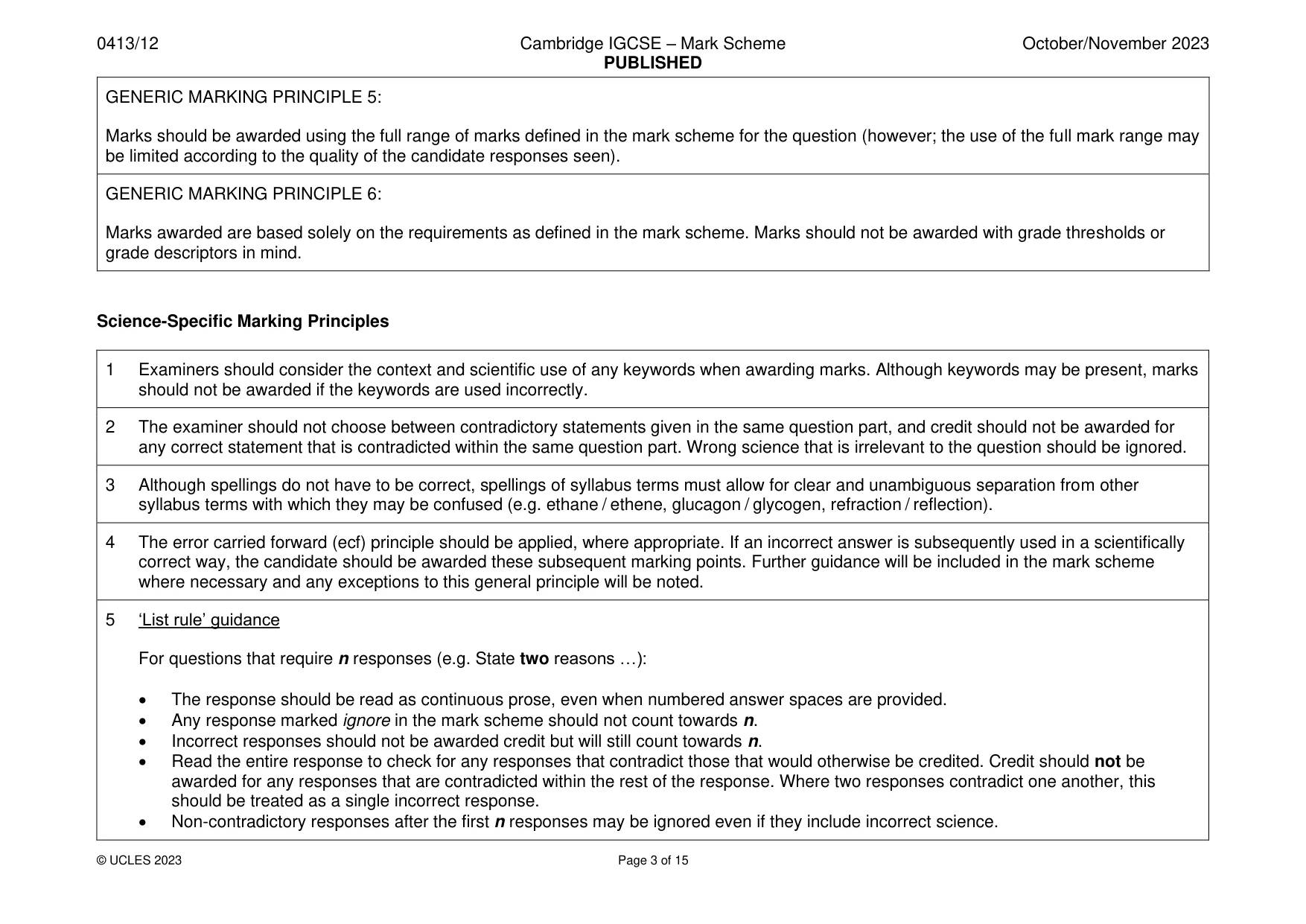
Mark scheme, page 3
0413/12 Cambridge IGCSE – Mark Scheme PUBLISHED October/November 2023 © UCLES 2023 Page 3 of 15 GENERIC MARKING PRINCIPLE 5: Marks should be awarded using the full range of marks defined in the mark scheme for the question (however; the use of the full mark range may be limited according to the quality of the candidate responses seen). GENERIC MARKING PRINCIPLE 6: Marks awarded are based solely on the requirements as defined in the mark scheme. Marks should not be awarded with grade thresholds or grade descriptors in mind. Science-Specific Marking Principles 1 Examiners should consider the context and scientific use of any keywords when awarding marks. Although keywords may be present, marks should not be awarded if the keywords are used incorrectly. 2 The examiner should not choose between contradictory statements given in the same question part, and credit should not be awarded for any correct statement that is contradicted within the same question part. Wrong science that is irrelevant to the question should be ignored. 3 Although spellings do not have to be correct, spellings of syllabus terms must allow for clear and unambiguous separation from other syllabus terms with which they may be confused (e.g. ethane / ethene, glucagon / glycogen, refraction / reflection). 4 The error carried forward (ecf) principle should be applied, where appropriate. If an incorrect answer is subsequently used in a scientifically correct way, the candidate should be awarded these subsequent marking points. Further guidance will be included in the mark scheme where necessary and any exceptions to this general principle will be noted. 5 ‘List rule’ guidance For questions that require n responses (e.g. State two reasons …): • The response should be read as continuous prose, even when numbered answer spaces are provided. • Any response marked ignore in the mark scheme should not count towards n. • Incorrect responses should not be awarded credit but will still count towards n. • Read the entire response to check for any responses that contradict those that would otherwise be credited. Credit should not be awarded for any responses that are contradicted within the rest of the response. Where two responses contradict one another, this should be treated as a single incorrect response. • Non-contradictory responses after the first n responses may be ignored even if they include incorrect science.
Mark scheme, page 4
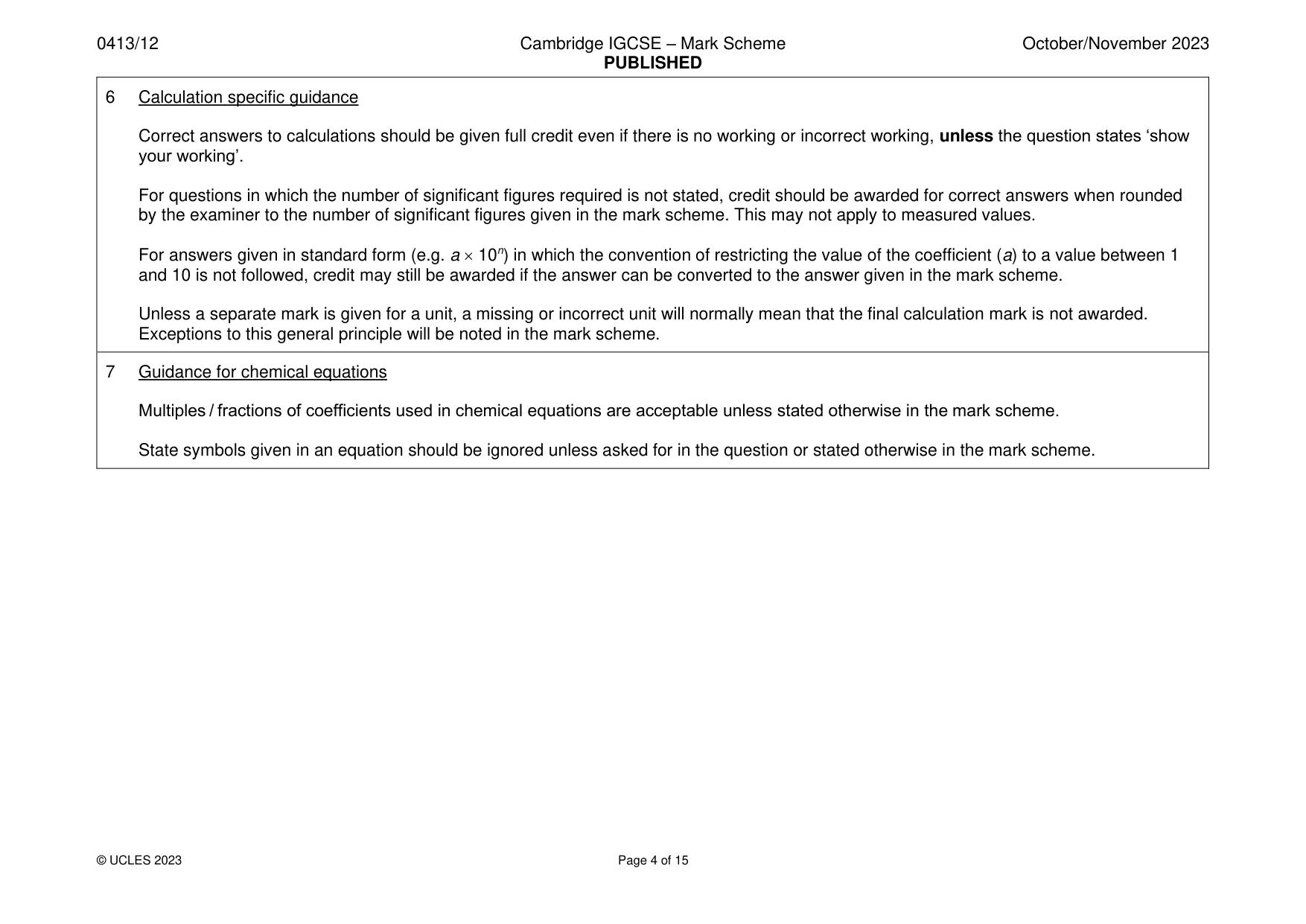
0413/12 Cambridge IGCSE – Mark Scheme PUBLISHED October/November 2023 © UCLES 2023 Page 4 of 15 6 Calculation specific guidance Correct answers to calculations should be given full credit even if there is no working or incorrect working, unless the question states ‘show your working’. For questions in which the number of significant figures required is not stated, credit should be awarded for correct answers when rounded by the examiner to the number of significant figures given in the mark scheme. This may not apply to measured values. For answers given in standard form (e.g. a 10n) in which the convention of restricting the value of the coefficient (a) to a value between 1 and 10 is not followed, credit may still be awarded if the answer can be converted to the answer given in the mark scheme. Unless a separate mark is given for a unit, a missing or incorrect unit will normally mean that the final calculation mark is not awarded. Exceptions to this general principle will be noted in the mark scheme. 7 Guidance for chemical equations Multiples / fractions of coefficients used in chemical equations are acceptable unless stated otherwise in the mark scheme. State symbols given in an equation should be ignored unless asked for in the question or stated otherwise in the mark scheme.
Mark scheme, page 5
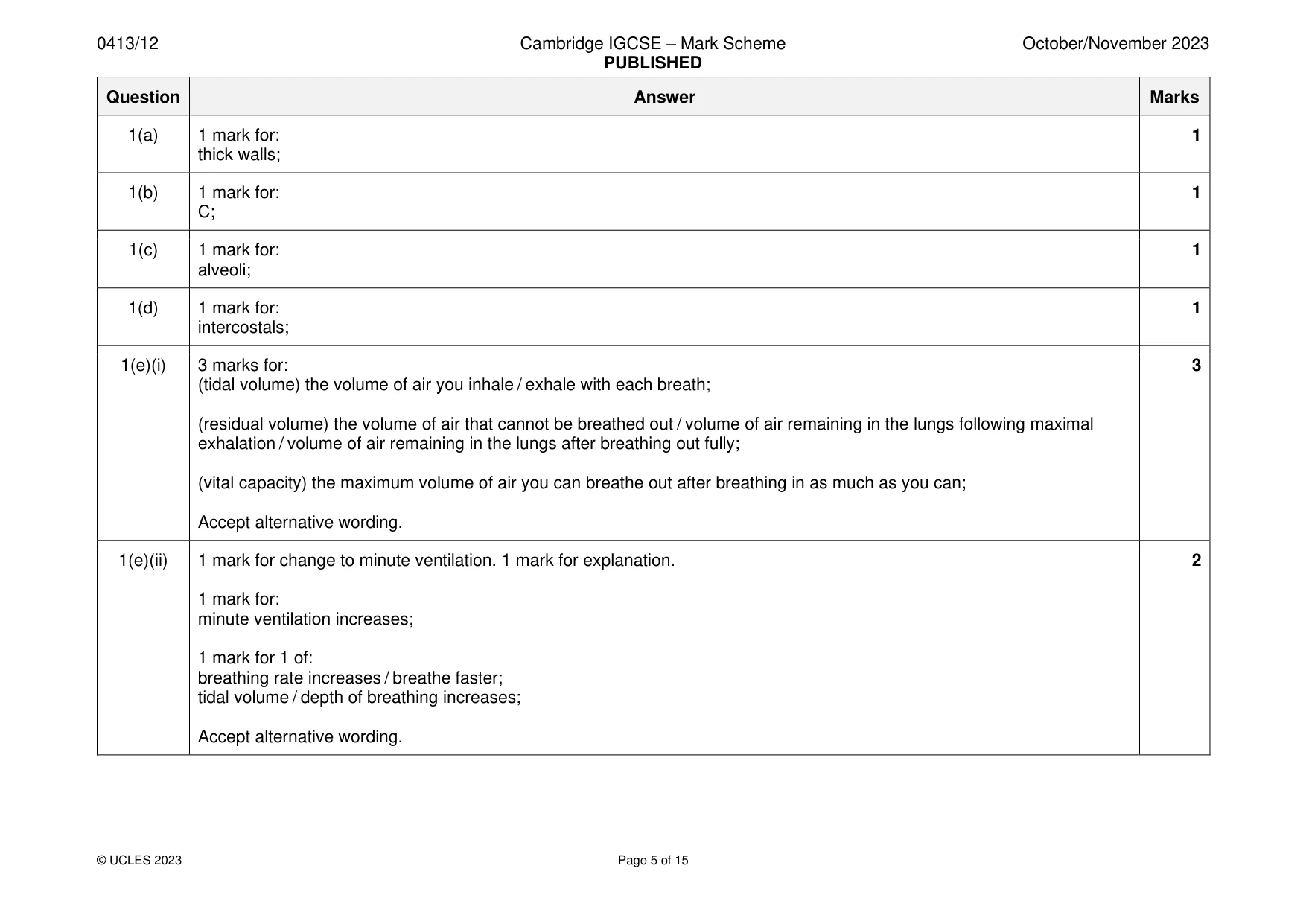
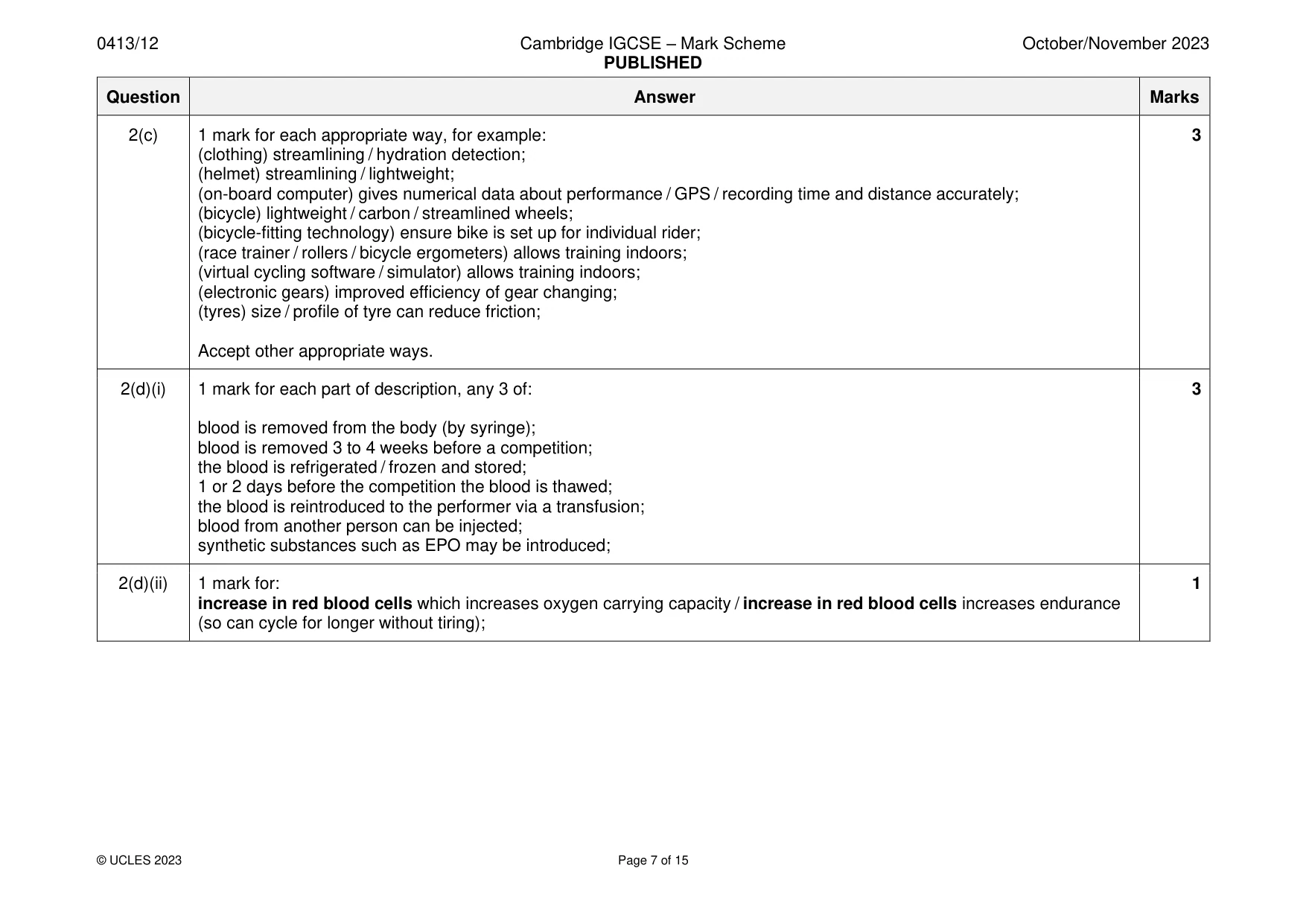
0413/12 Cambridge IGCSE – Mark Scheme PUBLISHED October/November 2023 © UCLES 2023 Page 5 of 15 Question Answer Marks 1(a) 1 mark for: thick walls; 1 1(b) 1 mark for: C; 1 1(c) 1 mark for: alveoli; 1 1(d) 1 mark for: intercostals; 1 1(e)(i) 3 marks for: (tidal volume) the volume of air you inhale / exhale with each breath; (residual volume) the volume of air that cannot be breathed out / volume of air remaining in the lungs following maximal exhalation / volume of air remaining in the lungs after breathing out fully; (vital capacity) the maximum volume of air you can breathe out after breathing in as much as you can; Accept alternative wording. 3 1(e)(ii) 1 mark for change to minute ventilation. 1 mark for explanation. 1 mark for: minute ventilation increases; 1 mark for 1 of: breathing rate increases / breathe faster; tidal volume / depth of breathing increases; Accept alternative wording. 2
Mark scheme, page 6
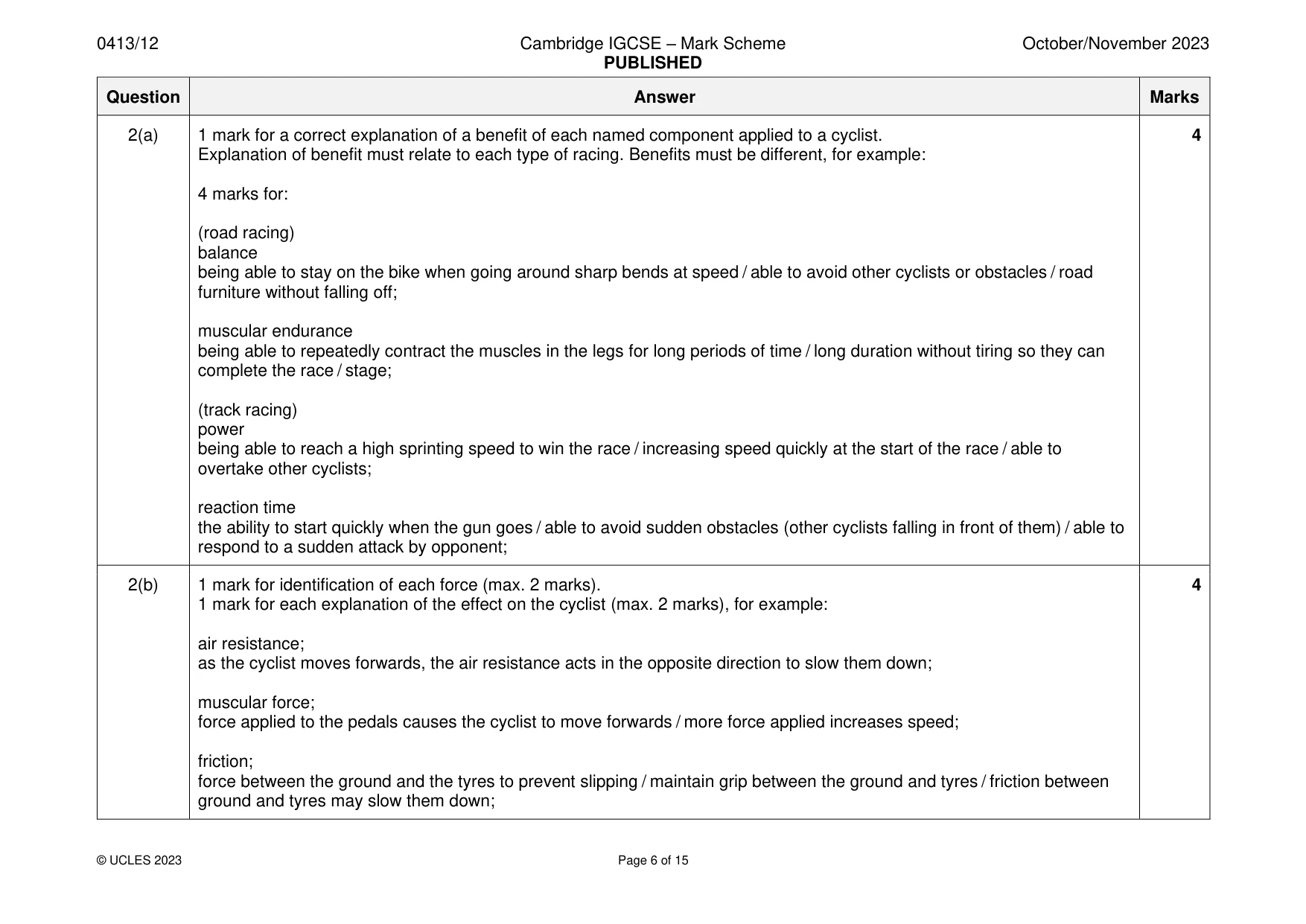
0413/12 Cambridge IGCSE – Mark Scheme PUBLISHED October/November 2023 © UCLES 2023 Page 6 of 15 Question Answer Marks 2(a) 1 mark for a correct explanation of a benefit of each named component applied to a cyclist. Explanation of benefit must relate to each type of racing. Benefits must be different, for example: 4 marks for: (road racing) balance being able to stay on the bike when going around sharp bends at speed / able to avoid other cyclists or obstacles / road furniture without falling off; muscular endurance being able to repeatedly contract the muscles in the legs for long periods of time / long duration without tiring so they can complete the race / stage; (track racing) power being able to reach a high sprinting speed to win the race / increasing speed quickly at the start of the race / able to overtake other cyclists; reaction time the ability to start quickly when the gun goes / able to avoid sudden obstacles (other cyclists falling in front of them) / able to respond to a sudden attack by opponent; 4 2(b) 1 mark for identification of each force (max. 2 marks). 1 mark for each explanation of the effect on the cyclist (max. 2 marks), for example: air resistance; as the cyclist moves forwards, the air resistance acts in the opposite direction to slow them down; muscular force; force applied to the pedals causes the cyclist to move forwards / more force applied increases speed; friction; force between the ground and the tyres to prevent slipping / maintain grip between the ground and tyres / friction between ground and tyres may slow them down; 4
Mark scheme, page 7
0413/12 Cambridge IGCSE – Mark Scheme PUBLISHED October/November 2023 © UCLES 2023 Page 7 of 15 Question Answer Marks 2(c) 1 mark for each appropriate way, for example: (clothing) streamlining / hydration detection; (helmet) streamlining / lightweight; (on-board computer) gives numerical data about performance / GPS / recording time and distance accurately; (bicycle) lightweight / carbon / streamlined wheels; (bicycle-fitting technology) ensure bike is set up for individual rider; (race trainer / rollers / bicycle ergometers) allows training indoors; (virtual cycling software / simulator) allows training indoors; (electronic gears) improved efficiency of gear changing; (tyres) size / profile of tyre can reduce friction; Accept other appropriate ways. 3 2(d)(i) 1 mark for each part of description, any 3 of: blood is removed from the body (by syringe); blood is removed 3 to 4 weeks before a competition; the blood is refrigerated / frozen and stored; 1 or 2 days before the competition the blood is thawed; the blood is reintroduced to the performer via a transfusion; blood from another person can be injected; synthetic substances such as EPO may be introduced; 3 2(d)(ii) 1 mark for: increase in red blood cells which increases oxygen carrying capacity / increase in red blood cells increases endurance (so can cycle for longer without tiring); 1
Mark scheme, page 8
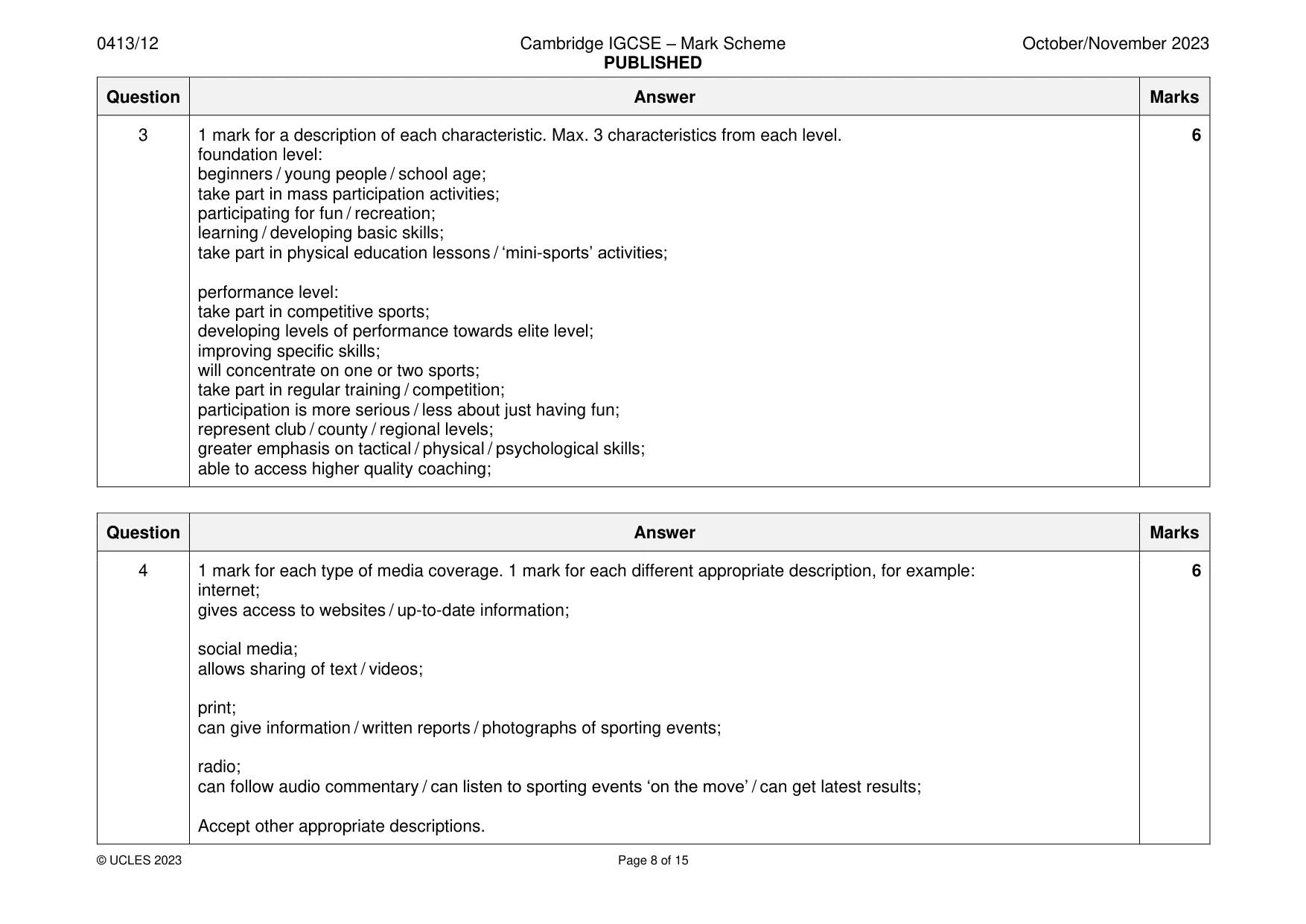
0413/12 Cambridge IGCSE – Mark Scheme PUBLISHED October/November 2023 © UCLES 2023 Page 8 of 15 Question Answer Marks 3 1 mark for a description of each characteristic. Max. 3 characteristics from each level. foundation level: beginners / young people / school age; take part in mass participation activities; participating for fun / recreation; learning / developing basic skills; take part in physical education lessons / ‘mini-sports’ activities; performance level: take part in competitive sports; developing levels of performance towards elite level; improving specific skills; will concentrate on one or two sports; take part in regular training / competition; participation is more serious / less about just having fun; represent club / county / regional levels; greater emphasis on tactical / physical / psychological skills; able to access higher quality coaching; 6 Question Answer Marks 4 1 mark for each type of media coverage. 1 mark for each different appropriate description, for example: internet; gives access to websites / up-to-date information; social media; allows sharing of text / videos; print; can give information / written reports / photographs of sporting events; radio; can follow audio commentary / can listen to sporting events ‘on the move’ / can get latest results; Accept other appropriate descriptions. 6
Mark scheme, page 9
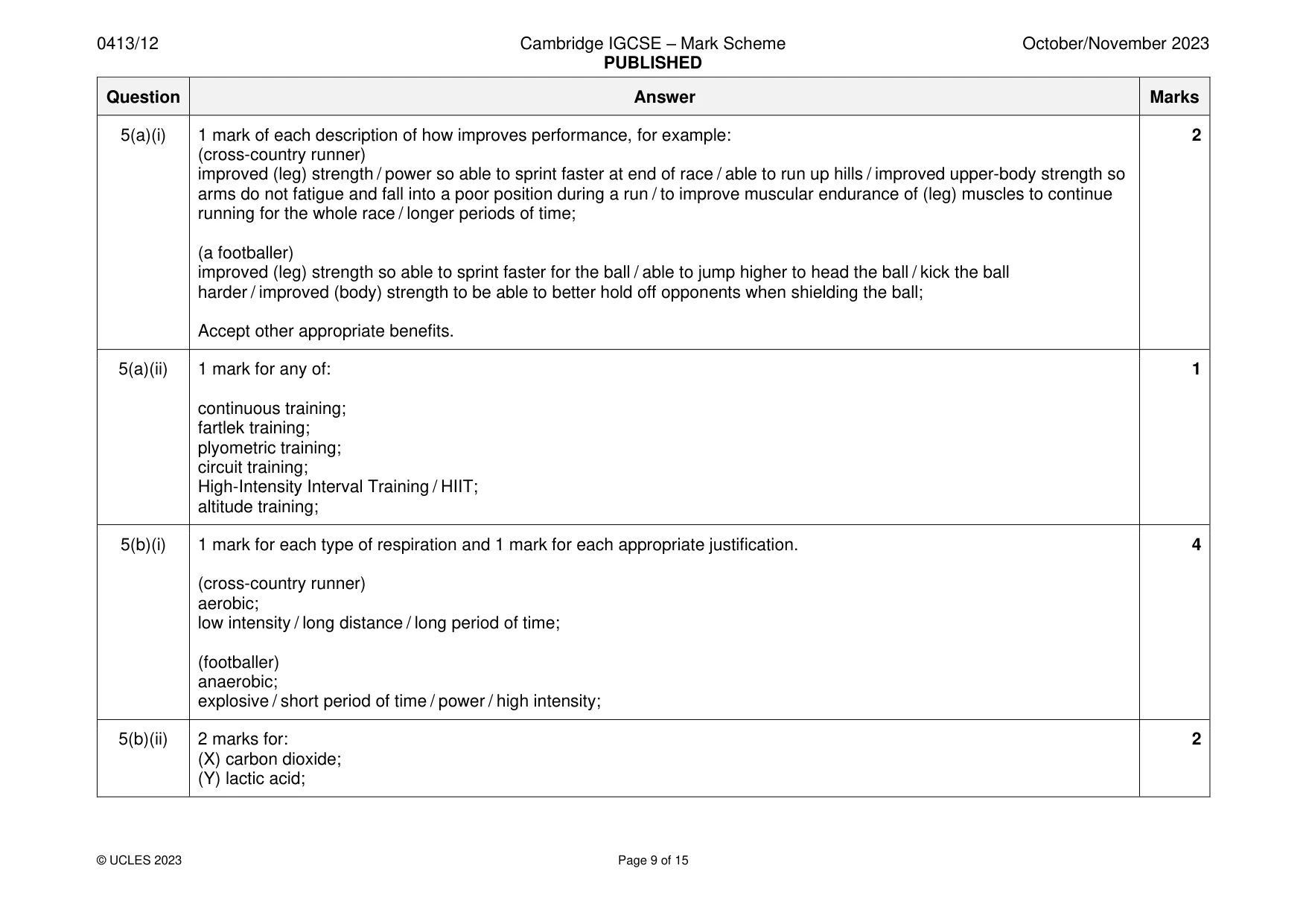
0413/12 Cambridge IGCSE – Mark Scheme PUBLISHED October/November 2023 © UCLES 2023 Page 9 of 15 Question Answer Marks 5(a)(i) 1 mark of each description of how improves performance, for example: (cross-country runner) improved (leg) strength / power so able to sprint faster at end of race / able to run up hills / improved upper-body strength so arms do not fatigue and fall into a poor position during a run / to improve muscular endurance of (leg) muscles to continue running for the whole race / longer periods of time; (a footballer) improved (leg) strength so able to sprint faster for the ball / able to jump higher to head the ball / kick the ball harder / improved (body) strength to be able to better hold off opponents when shielding the ball; Accept other appropriate benefits. 2 5(a)(ii) 1 mark for any of: continuous training; fartlek training; plyometric training; circuit training; High-Intensity Interval Training / HIIT; altitude training; 1 5(b)(i) 1 mark for each type of respiration and 1 mark for each appropriate justification. (cross-country runner) aerobic; low intensity / long distance / long period of time; (footballer) anaerobic; explosive / short period of time / power / high intensity; 4 5(b)(ii) 2 marks for: (X) carbon dioxide; (Y) lactic acid; 2
Mark scheme, page 10
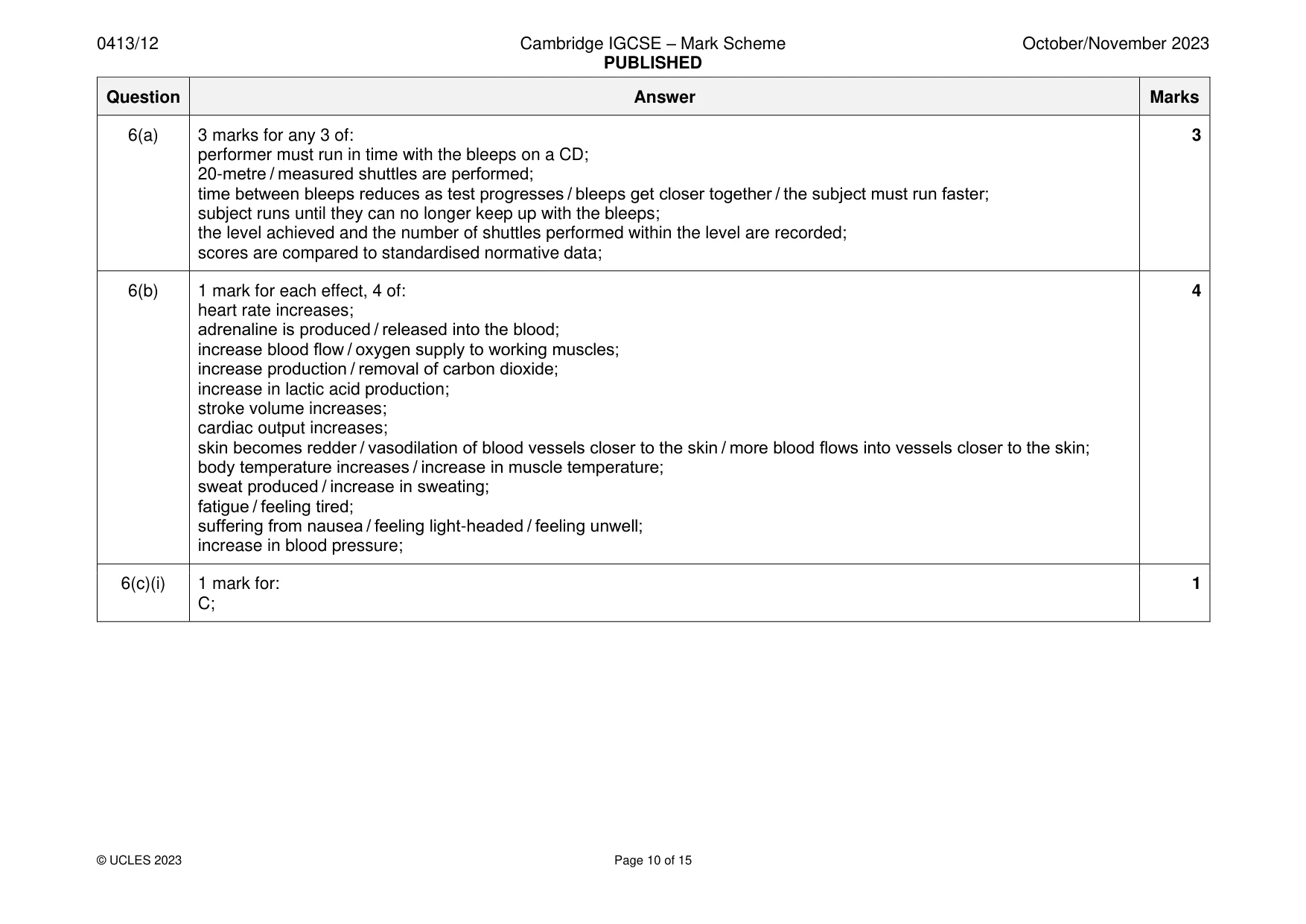
0413/12 Cambridge IGCSE – Mark Scheme PUBLISHED October/November 2023 © UCLES 2023 Page 10 of 15 Question Answer Marks 6(a) 3 marks for any 3 of: performer must run in time with the bleeps on a CD; 20-metre / measured shuttles are performed; time between bleeps reduces as test progresses / bleeps get closer together / the subject must run faster; subject runs until they can no longer keep up with the bleeps; the level achieved and the number of shuttles performed within the level are recorded; scores are compared to standardised normative data; 3 6(b) 1 mark for each effect, 4 of: heart rate increases; adrenaline is produced / released into the blood; increase blood flow / oxygen supply to working muscles; increase production / removal of carbon dioxide; increase in lactic acid production; stroke volume increases; cardiac output increases; skin becomes redder / vasodilation of blood vessels closer to the skin / more blood flows into vessels closer to the skin; body temperature increases / increase in muscle temperature; sweat produced / increase in sweating; fatigue / feeling tired; suffering from nausea / feeling light-headed / feeling unwell; increase in blood pressure; 4 6(c)(i) 1 mark for: C; 1
Mark scheme, page 11
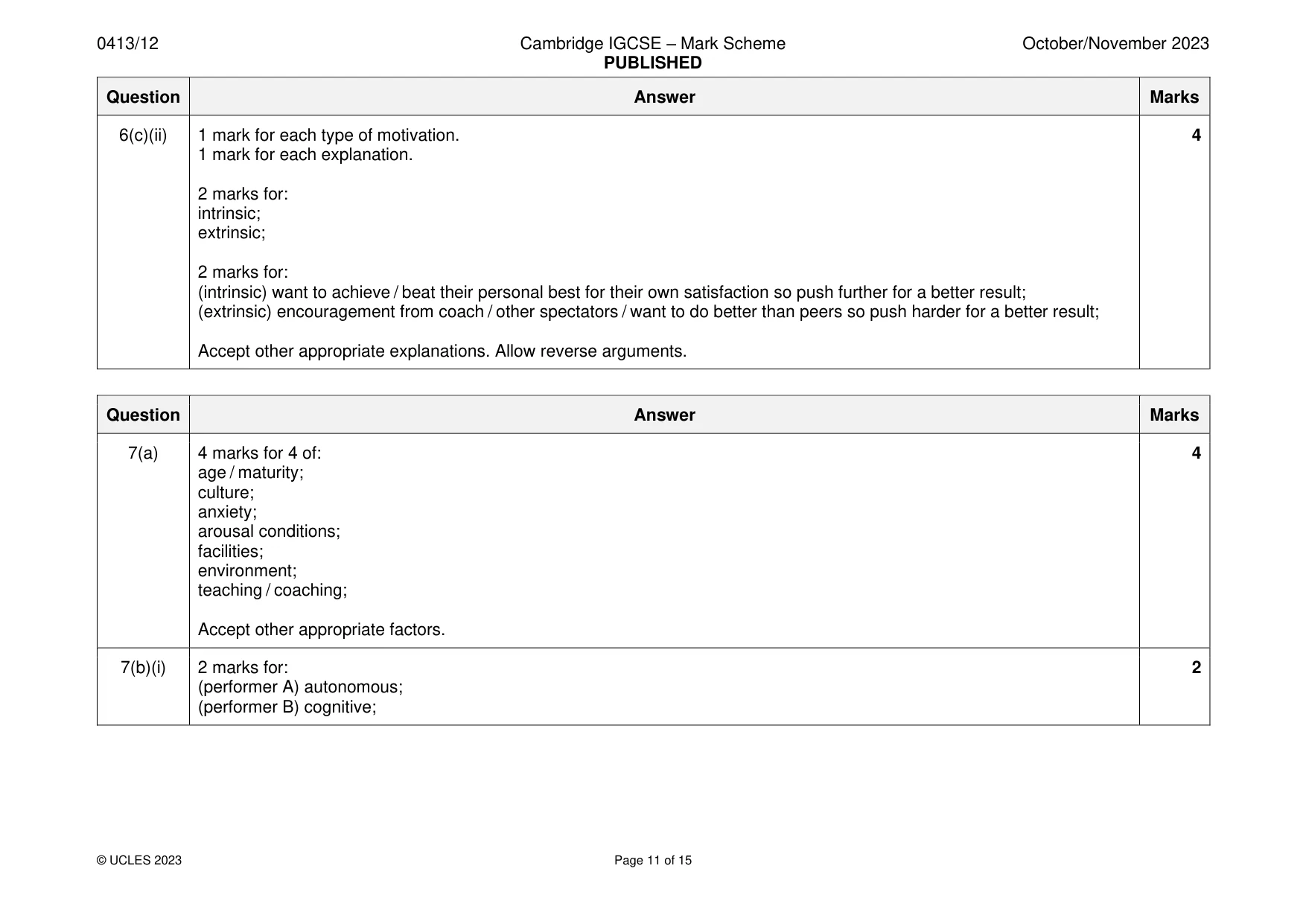
0413/12 Cambridge IGCSE – Mark Scheme PUBLISHED October/November 2023 © UCLES 2023 Page 11 of 15 Question Answer Marks 6(c)(ii) 1 mark for each type of motivation. 1 mark for each explanation. 2 marks for: intrinsic; extrinsic; 2 marks for: (intrinsic) want to achieve / beat their personal best for their own satisfaction so push further for a better result; (extrinsic) encouragement from coach / other spectators / want to do better than peers so push harder for a better result; Accept other appropriate explanations. Allow reverse arguments. 4 Question Answer Marks 7(a) 4 marks for 4 of: age / maturity; culture; anxiety; arousal conditions; facilities; environment; teaching / coaching; Accept other appropriate factors. 4 7(b)(i) 2 marks for: (performer A) autonomous; (performer B) cognitive; 2
Mark scheme, page 12
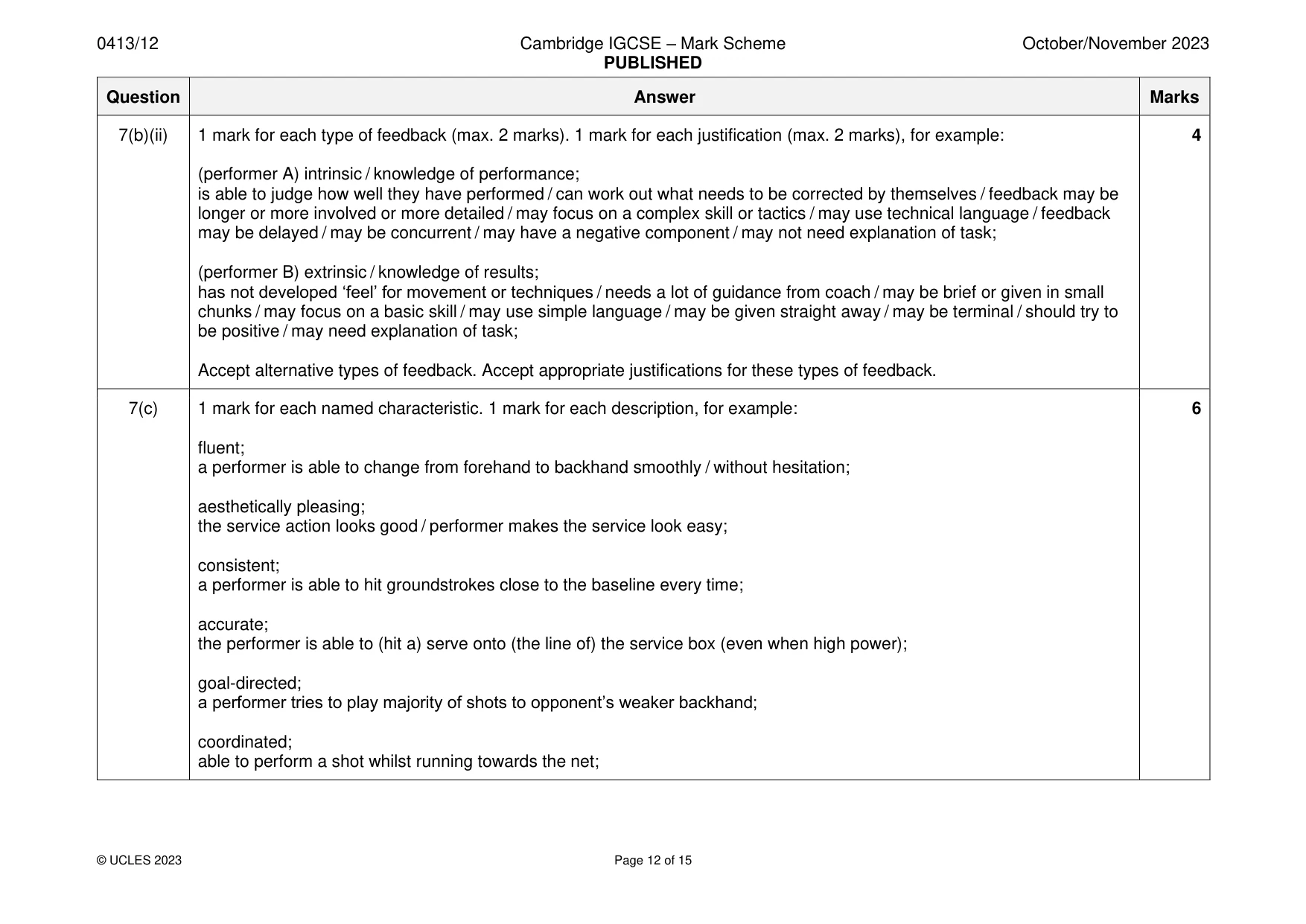
0413/12 Cambridge IGCSE – Mark Scheme PUBLISHED October/November 2023 © UCLES 2023 Page 12 of 15 Question Answer Marks 7(b)(ii) 1 mark for each type of feedback (max. 2 marks). 1 mark for each justification (max. 2 marks), for example: (performer A) intrinsic / knowledge of performance; is able to judge how well they have performed / can work out what needs to be corrected by themselves / feedback may be longer or more involved or more detailed / may focus on a complex skill or tactics / may use technical language / feedback may be delayed / may be concurrent / may have a negative component / may not need explanation of task; (performer B) extrinsic / knowledge of results; has not developed ‘feel’ for movement or techniques / needs a lot of guidance from coach / may be brief or given in small chunks / may focus on a basic skill / may use simple language / may be given straight away / may be terminal / should try to be positive / may need explanation of task; Accept alternative types of feedback. Accept appropriate justifications for these types of feedback. 4 7(c) 1 mark for each named characteristic. 1 mark for each description, for example: fluent; a performer is able to change from forehand to backhand smoothly / without hesitation; aesthetically pleasing; the service action looks good / performer makes the service look easy; consistent; a performer is able to hit groundstrokes close to the baseline every time; accurate; the performer is able to (hit a) serve onto (the line of) the service box (even when high power); goal-directed; a performer tries to play majority of shots to opponent’s weaker backhand; coordinated; able to perform a shot whilst running towards the net; 6
Mark scheme, page 13
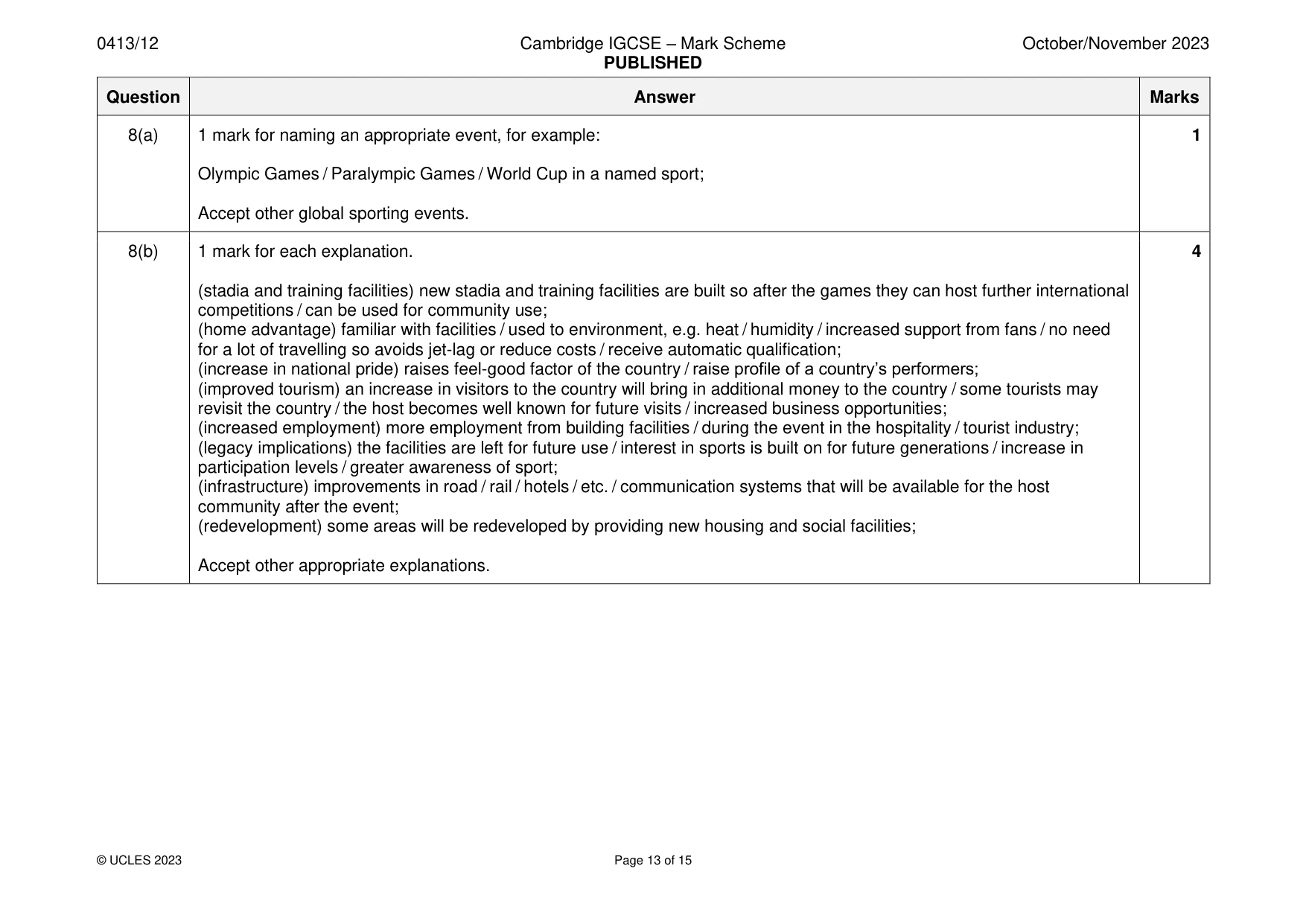
0413/12 Cambridge IGCSE – Mark Scheme PUBLISHED October/November 2023 © UCLES 2023 Page 13 of 15 Question Answer Marks 8(a) 1 mark for naming an appropriate event, for example: Olympic Games / Paralympic Games / World Cup in a named sport; Accept other global sporting events. 1 8(b) 1 mark for each explanation. (stadia and training facilities) new stadia and training facilities are built so after the games they can host further international competitions / can be used for community use; (home advantage) familiar with facilities / used to environment, e.g. heat / humidity / increased support from fans / no need for a lot of travelling so avoids jet-lag or reduce costs / receive automatic qualification; (increase in national pride) raises feel-good factor of the country / raise profile of a country’s performers; (improved tourism) an increase in visitors to the country will bring in additional money to the country / some tourists may revisit the country / the host becomes well known for future visits / increased business opportunities; (increased employment) more employment from building facilities / during the event in the hospitality / tourist industry; (legacy implications) the facilities are left for future use / interest in sports is built on for future generations / increase in participation levels / greater awareness of sport; (infrastructure) improvements in road / rail / hotels / etc. / communication systems that will be available for the host community after the event; (redevelopment) some areas will be redeveloped by providing new housing and social facilities; Accept other appropriate explanations. 4
Mark scheme, page 14
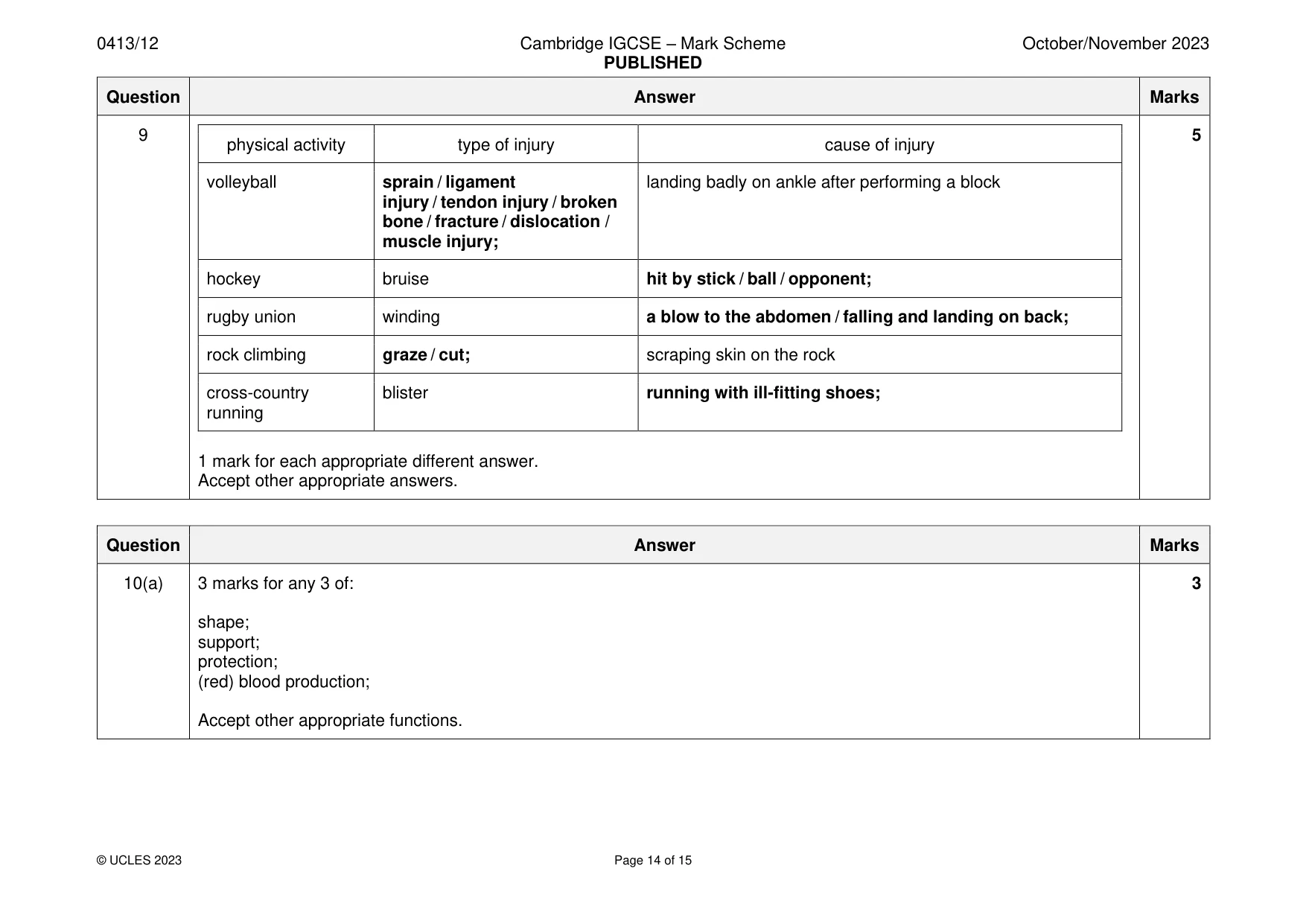
0413/12 Cambridge IGCSE – Mark Scheme PUBLISHED October/November 2023 © UCLES 2023 Page 14 of 15 Question Answer Marks 9 physical activity type of injury cause of injury volleyball sprain / ligament injury / tendon injury / broken bone / fracture / dislocation / muscle injury; landing badly on ankle after performing a block hockey bruise hit by stick / ball / opponent; rugby union winding a blow to the abdomen / falling and landing on back; rock climbing graze / cut; scraping skin on the rock cross-country running blister running with ill-fitting shoes; 1 mark for each appropriate different answer. Accept other appropriate answers. 5 Question Answer Marks 10(a) 3 marks for any 3 of: shape; support; protection; (red) blood production; Accept other appropriate functions. 3
Mark scheme, page 15
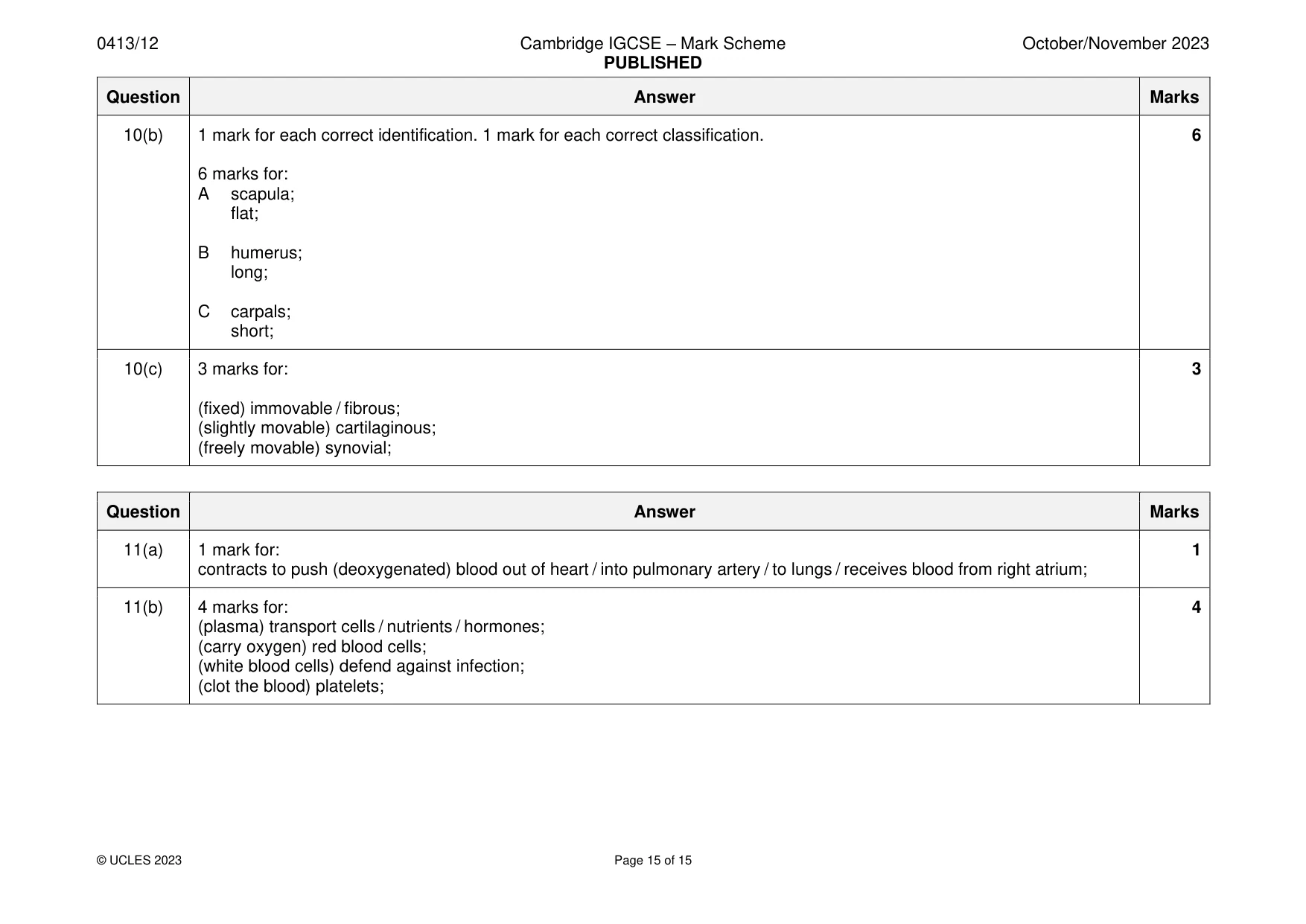
0413/12 Cambridge IGCSE – Mark Scheme PUBLISHED October/November 2023 © UCLES 2023 Page 15 of 15 Question Answer Marks 10(b) 1 mark for each correct identification. 1 mark for each correct classification. 6 marks for: A scapula; flat; B humerus; long; C carpals; short; 6 10(c) 3 marks for: (fixed) immovable / fibrous; (slightly movable) cartilaginous; (freely movable) synovial; 3 Question Answer Marks 11(a) 1 mark for: contracts to push (deoxygenated) blood out of heart / into pulmonary artery / to lungs / receives blood from right atrium; 1 11(b) 4 marks for: (plasma) transport cells / nutrients / hormones; (carry oxygen) red blood cells; (white blood cells) defend against infection; (clot the blood) platelets; 4
What you needed in this session
Cambridge’s own grade thresholds for 2023 Oct/Nov, Paper 1 · Variant 2. A higher threshold means an easier paper — the bar moves with how the cohort did.