Cambridge IGCSE Physical Education 0413 — 2018 Oct/Nov Paper 1 · Variant 2
0413/12/O/N/18 · 80 marks · ≈90 min
The question paper and its mark scheme, free to read here and free to download. This is Cambridge’s own paper, exactly as it was sat.
Question paper16 pages





Mark scheme19 pages
Answers below. Sit the paper first if you are practising.
Paper as text
Question paper, page 1
Cambridge International Examinations Cambridge International General Certificate of Secondary Education 0413/12 October/November 2018 1 hour 45 minutes PHYSICAL EDUCATION Paper 1 Candidates answer on the Question Paper. No Additional Materials are required. READ THESE INSTRUCTIONS FIRST Write your Centre number, candidate number and name on all the work you hand in. Write in dark blue or black pen. You may use an HB pencil for any diagrams or graphs. Do not use staples, paper clips, glue or correction fluid. DO NOT WRITE IN ANY BARCODES. Section A Answer all questions in this section. Write your answers in the spaces provided on the Question Paper. Section B Answer all questions in this section. Write your answers in the spaces provided on the Question Paper. Electronic calculators may be used. You may lose marks if you do not show your working or if you do not use appropriate units. At the end of the examination, fasten all your work securely together. The number of marks is given in brackets [ ] at the end of each question or part question. This document consists of 14 printed pages and 2 blank pages. [Turn over 11_0413_12_2018_1.14 © UCLES 2018 *2145863219*
Question paper, page 2
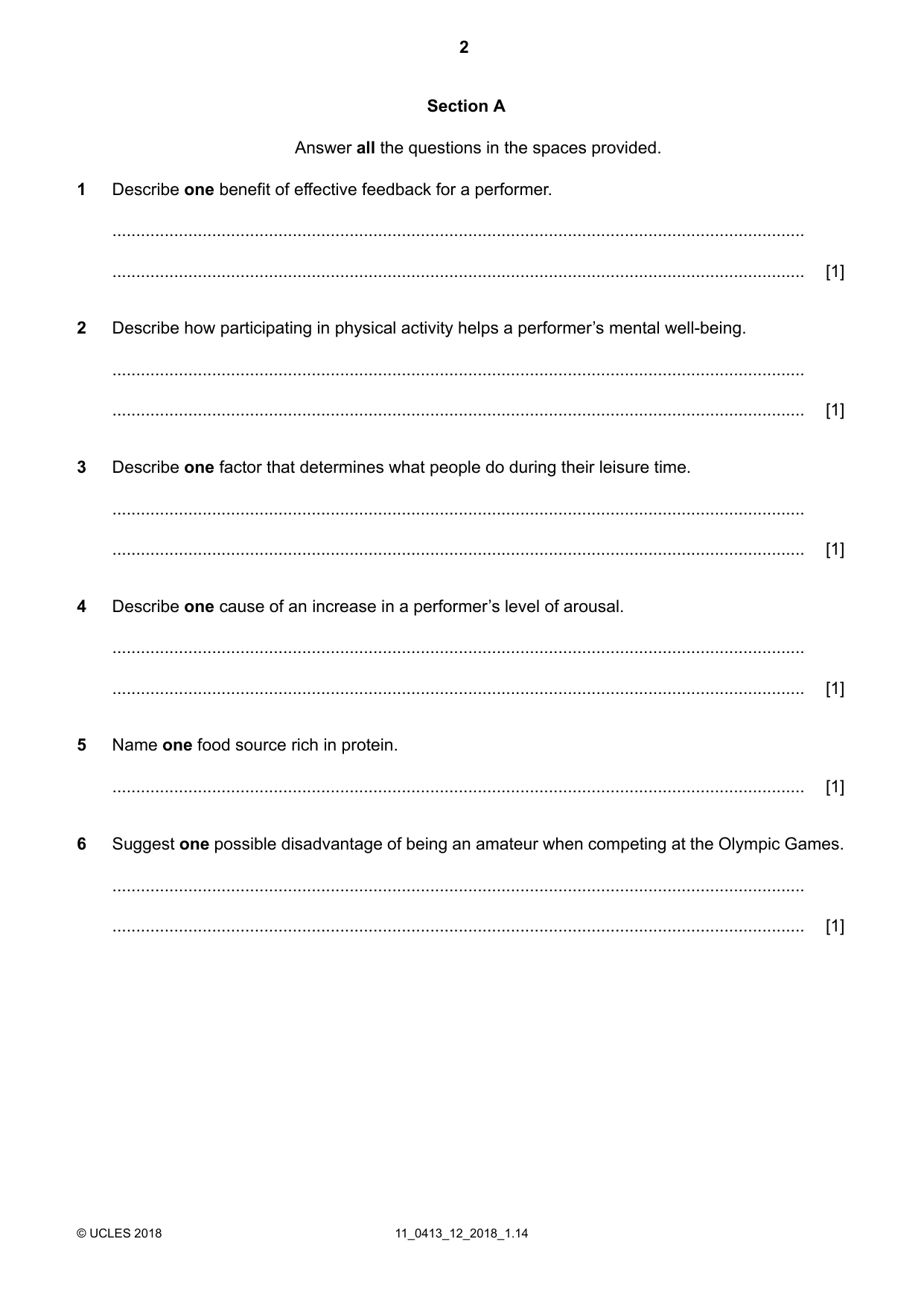
Section A Answer all the questions in the spaces provided. Describe one benefit of effective feedback for a performer. 1 … … [1] Describe how participating in physical activity helps a performer’s mental well-being. 2 … … [1] Describe one factor that determines what people do during their leisure time. 3 … … [1] Describe one cause of an increase in a performer’s level of arousal. 4 … … [1] Name one food source rich in protein. 5 … [1] Suggest one possible disadvantage of being an amateur when competing at the Olympic Games. 6 … … [1] 11_0413_12_2018_1.14 © UCLES 2018 2
Question paper, page 3
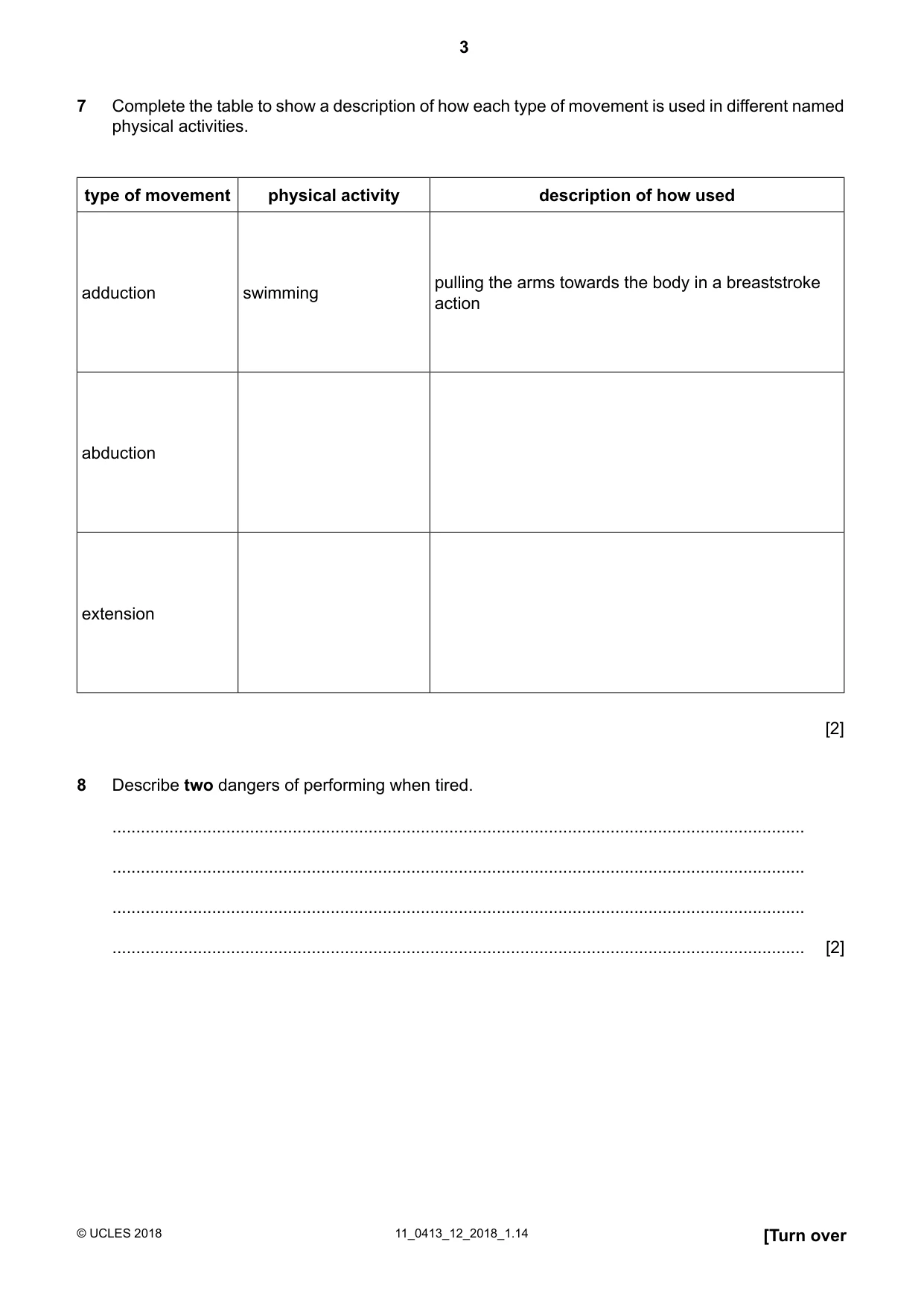
Complete the table to show a description of how each type of movement is used in different named physical activities. 7 description of how used physical activity type of movement pulling the arms towards the body in a breaststroke action swimming adduction abduction extension [2] Describe two dangers of performing when tired. 8 … … … … [2] [Turn over 11_0413_12_2018_1.14 © UCLES 2018 3
Question paper, page 4
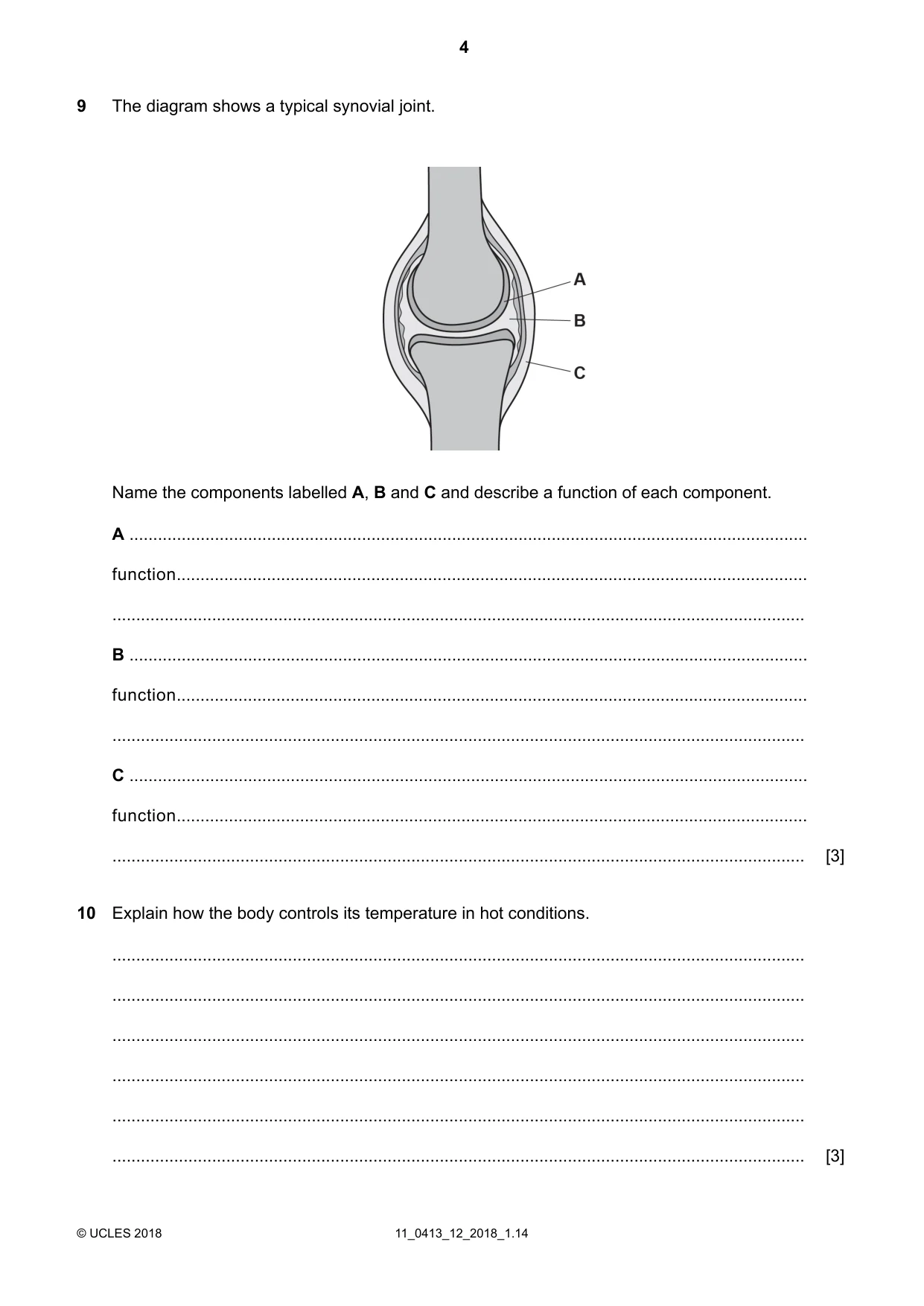
The diagram shows a typical synovial joint. 9 Name the components labelled A, B and C and describe a function of each component. A … function… … B … function… … C … function… … [3] Explain how the body controls its temperature in hot conditions. 10 … … … … … … [3] 11_0413_12_2018_1.14 © UCLES 2018 4
Question paper, page 5
Suggest reasons why some countries choose not to host global events. 11 … … … … … … … … [4] [Total: 20] [Turn over 11_0413_12_2018_1.14 © UCLES 2018 5
Question paper, page 6
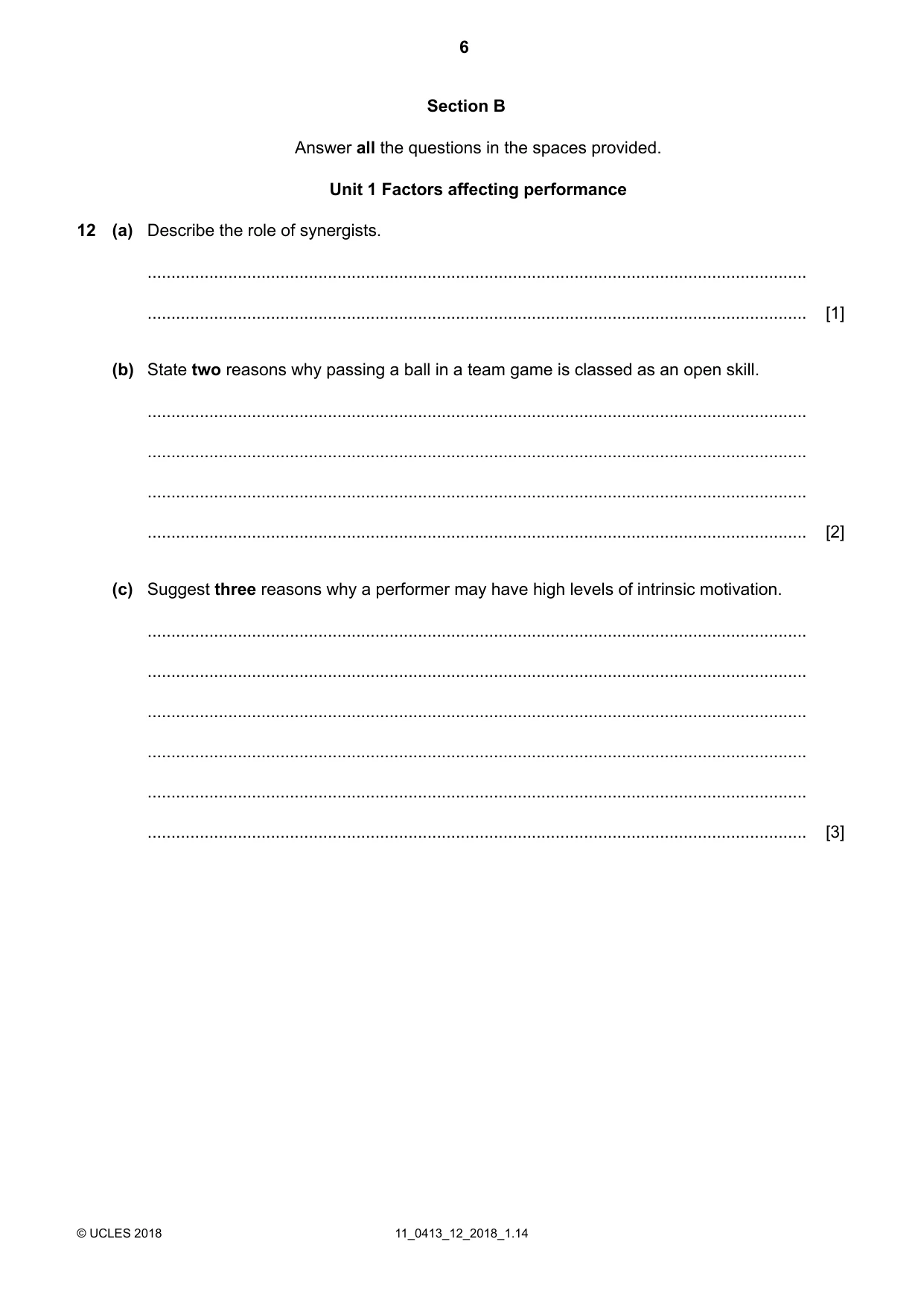
Section B Answer all the questions in the spaces provided. Unit 1 Factors affecting performance Describe the role of synergists. (a) 12 … … [1] State two reasons why passing a ball in a team game is classed as an open skill. (b) … … … … [2] Suggest three reasons why a performer may have high levels of intrinsic motivation. (c) … … … … … … [3] 11_0413_12_2018_1.14 © UCLES 2018 6
Question paper, page 7
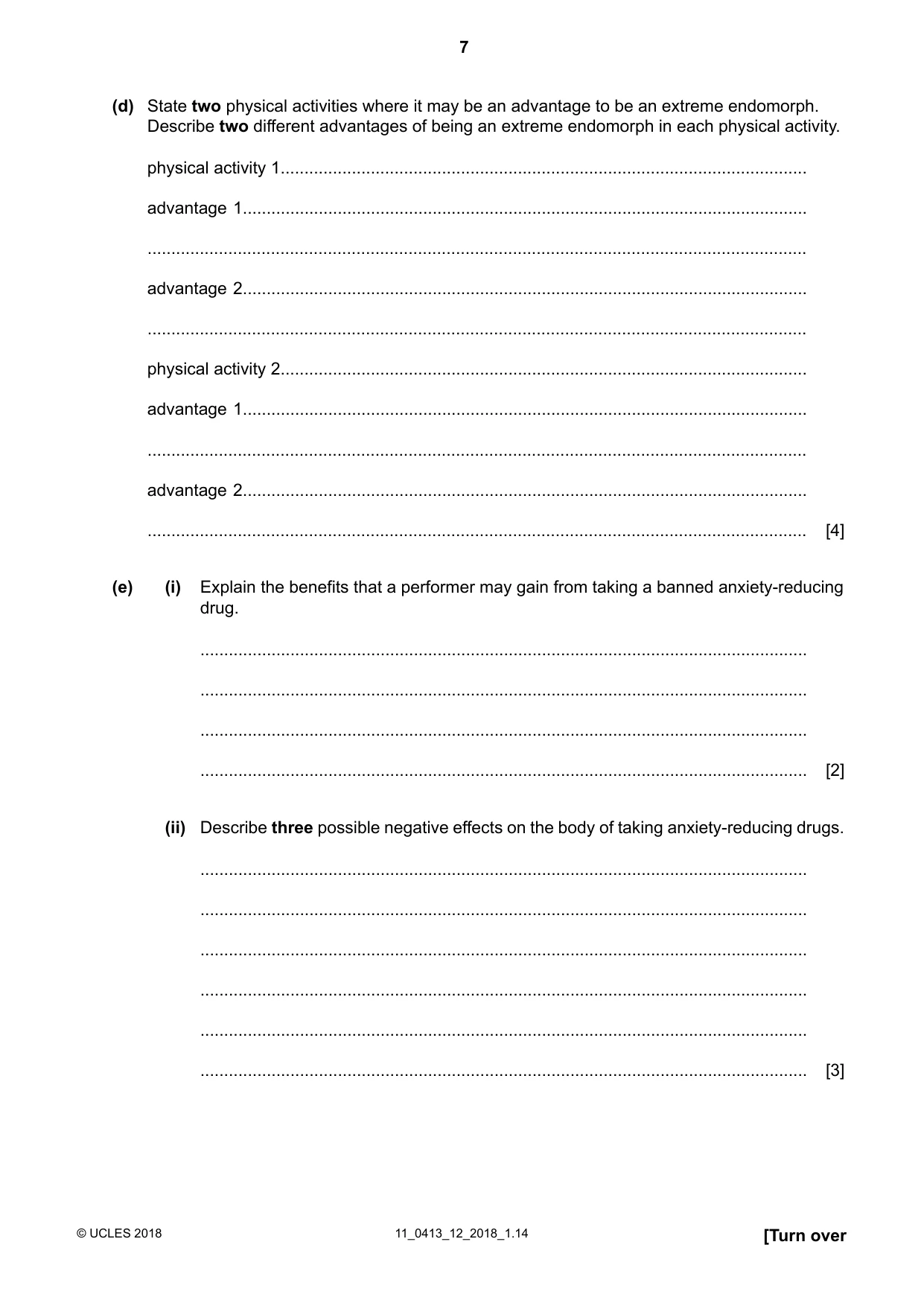
State two physical activities where it may be an advantage to be an extreme endomorph. Describe two different advantages of being an extreme endomorph in each physical activity. (d) physical activity 1… advantage 1… … advantage 2… … physical activity 2… advantage 1… … advantage 2… … [4] Explain the benefits that a performer may gain from taking a banned anxiety-reducing drug. (i) (e) … … … … [2] Describe three possible negative effects on the body of taking anxiety-reducing drugs. (ii) … … … … … … [3] [Turn over 11_0413_12_2018_1.14 © UCLES 2018 7
Question paper, page 8
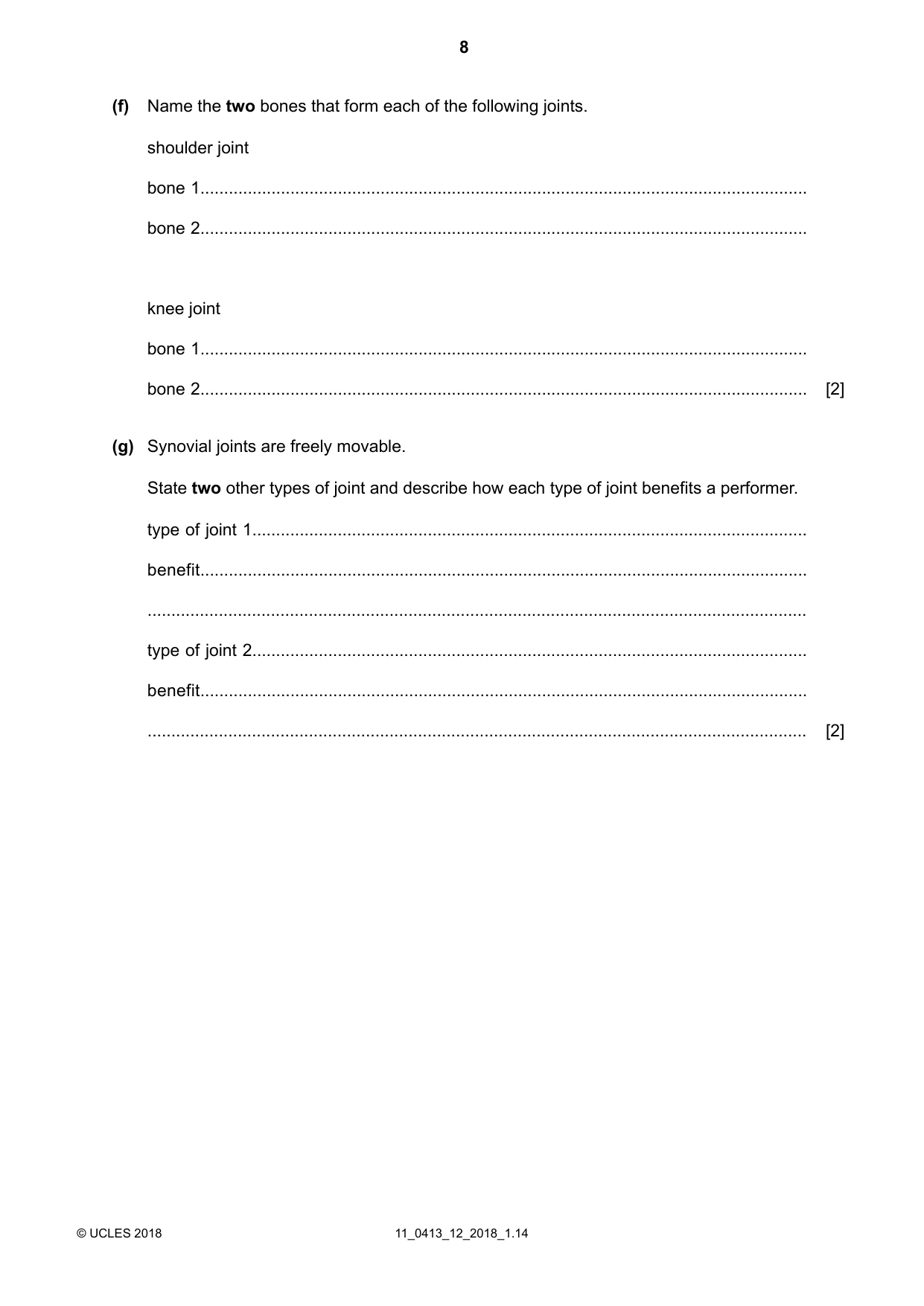
Name the two bones that form each of the following joints. (f) shoulder joint bone 1… bone 2… knee joint bone 1… bone 2… [2] Synovial joints are freely movable. State two other types of joint and describe how each type of joint benefits a performer. (g) type of joint 1… benefit… … type of joint 2… benefit… … [2] 11_0413_12_2018_1.14 © UCLES 2018 8
Question paper, page 9
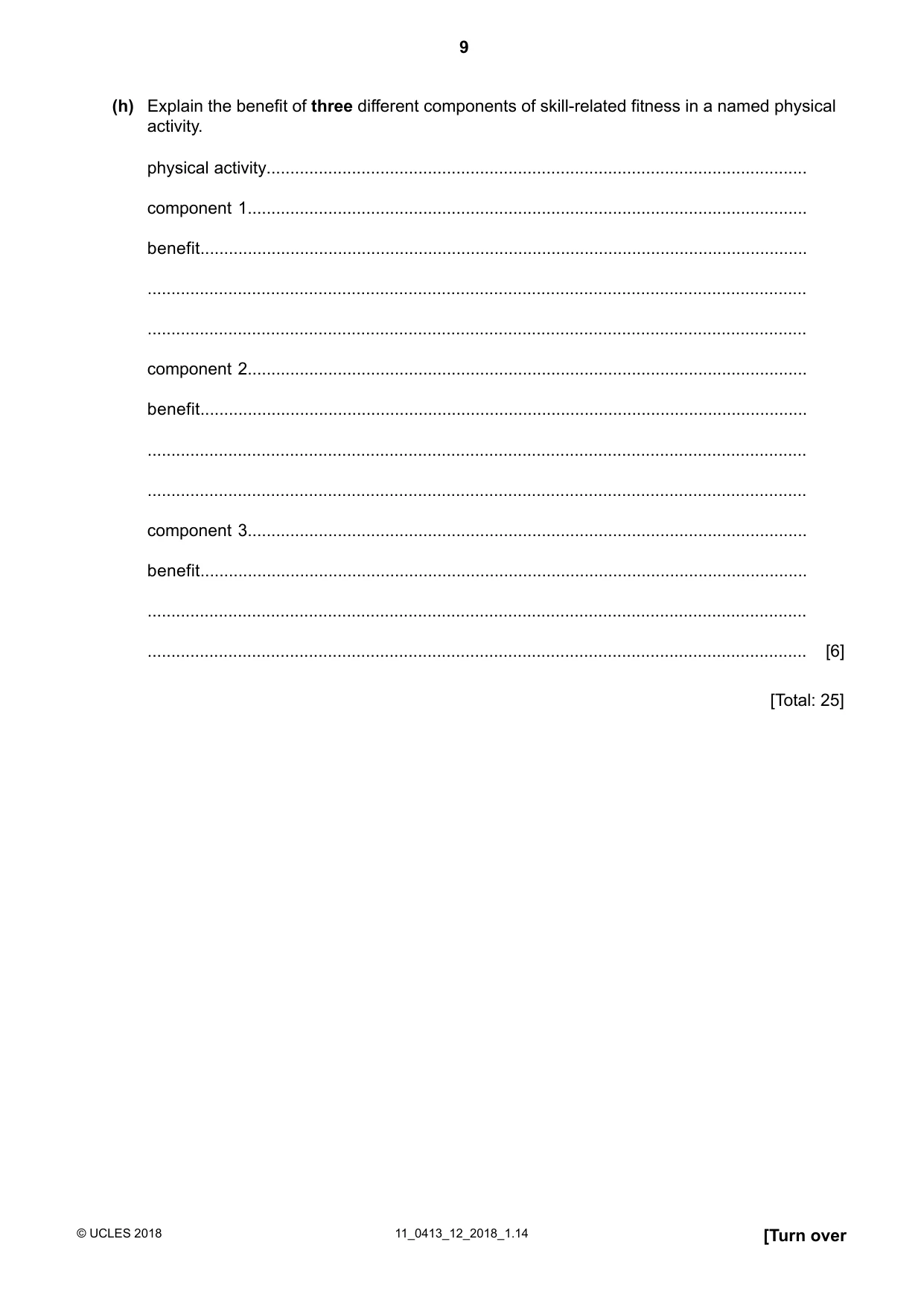
Explain the benefit of three different components of skill-related fitness in a named physical activity. (h) physical activity… component 1… benefit… … … component 2… benefit… … … component 3… benefit… … … [6] [Total: 25] [Turn over 11_0413_12_2018_1.14 © UCLES 2018 9
Question paper, page 10
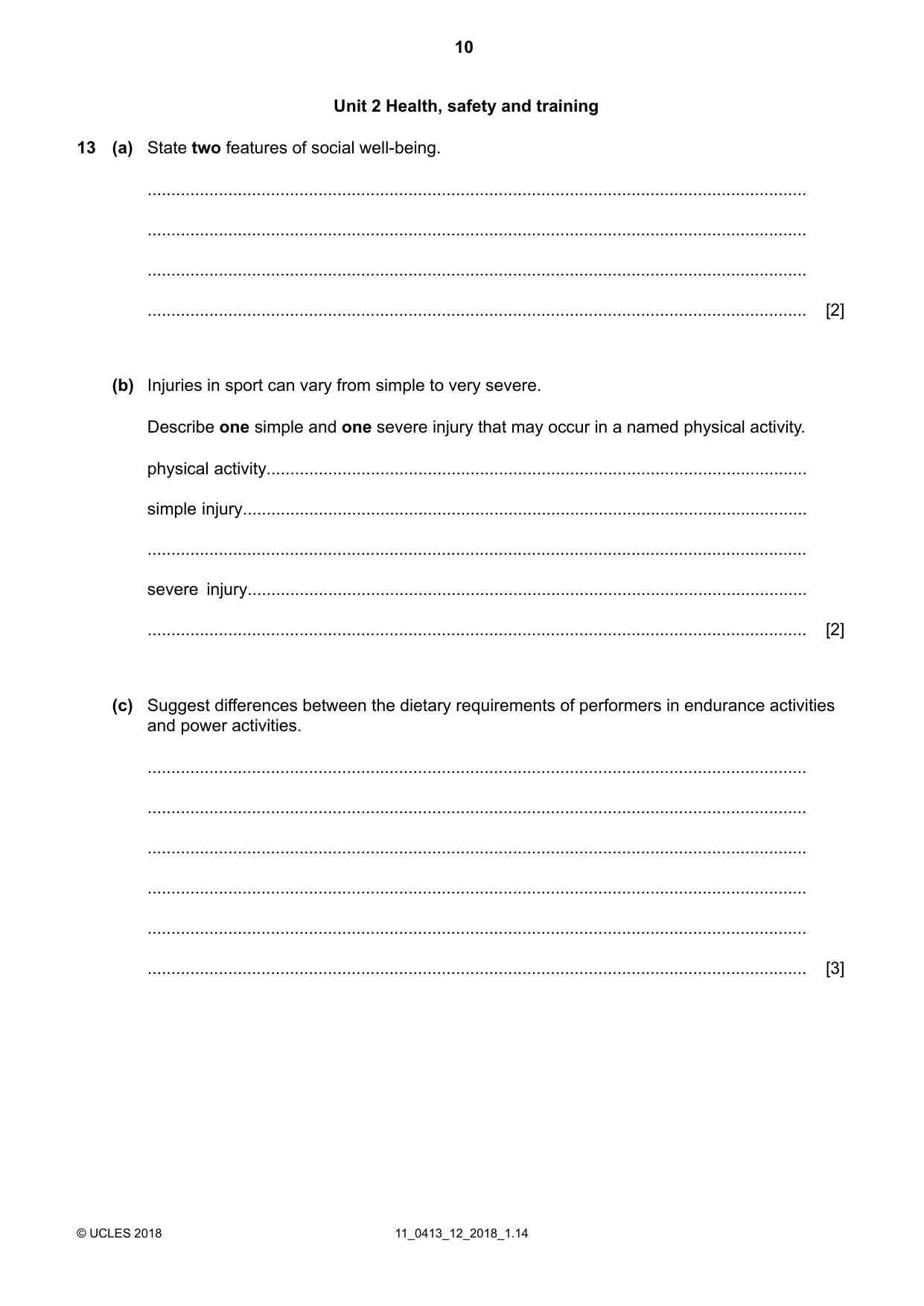
Unit 2 Health, safety and training State two features of social well-being. (a) 13 … … … … [2] Injuries in sport can vary from simple to very severe. Describe one simple and one severe injury that may occur in a named physical activity. (b) physical activity… simple injury… … severe injury… … [2] Suggest differences between the dietary requirements of performers in endurance activities and power activities. (c) … … … … … … [3] 11_0413_12_2018_1.14 © UCLES 2018 10
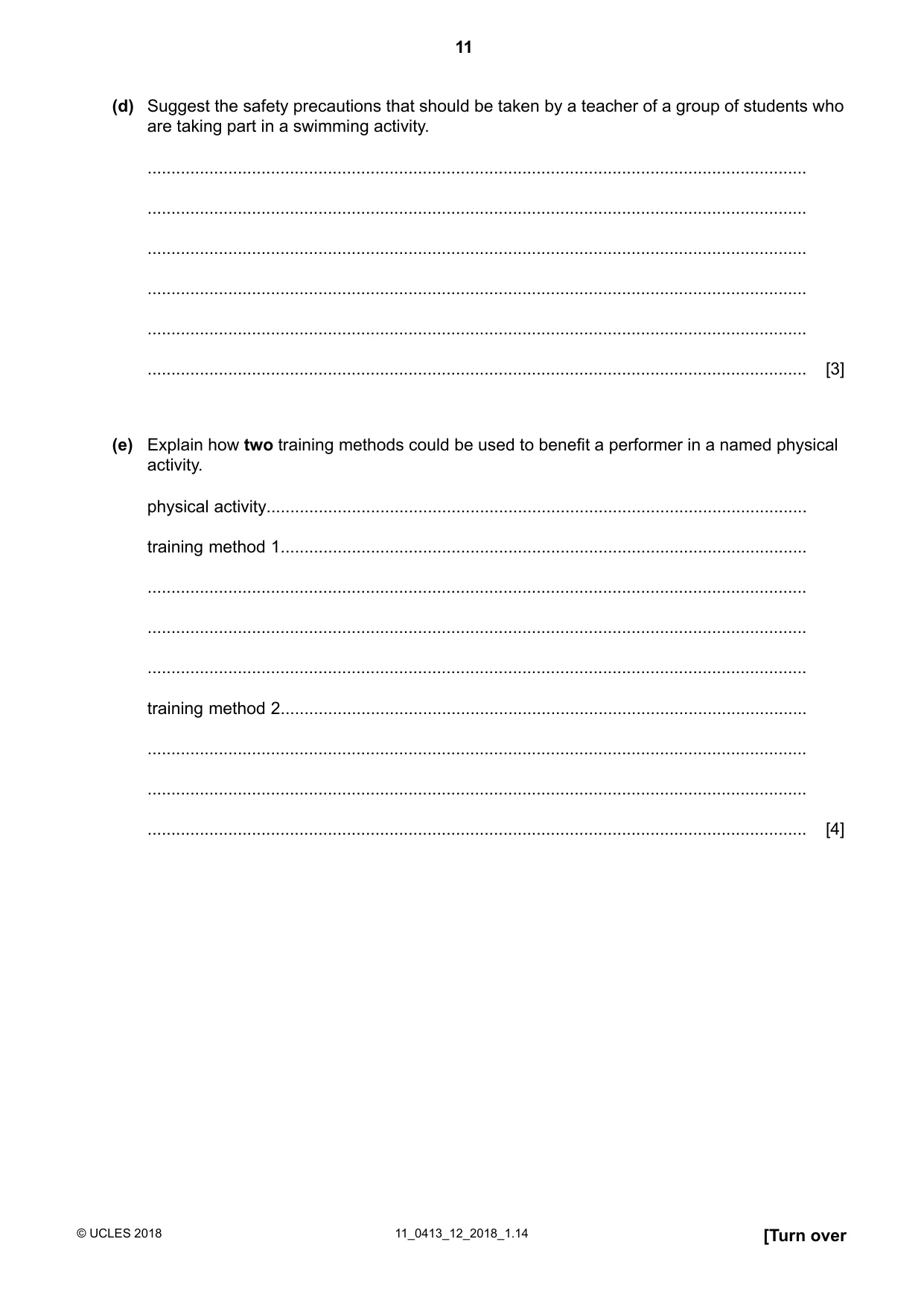
Question paper, page 11
Suggest the safety precautions that should be taken by a teacher of a group of students who are taking part in a swimming activity. (d) … … … … … … [3] Explain how two training methods could be used to benefit a performer in a named physical activity. (e) physical activity… training method 1… … … … training method 2… … … … [4] [Turn over 11_0413_12_2018_1.14 © UCLES 2018 11
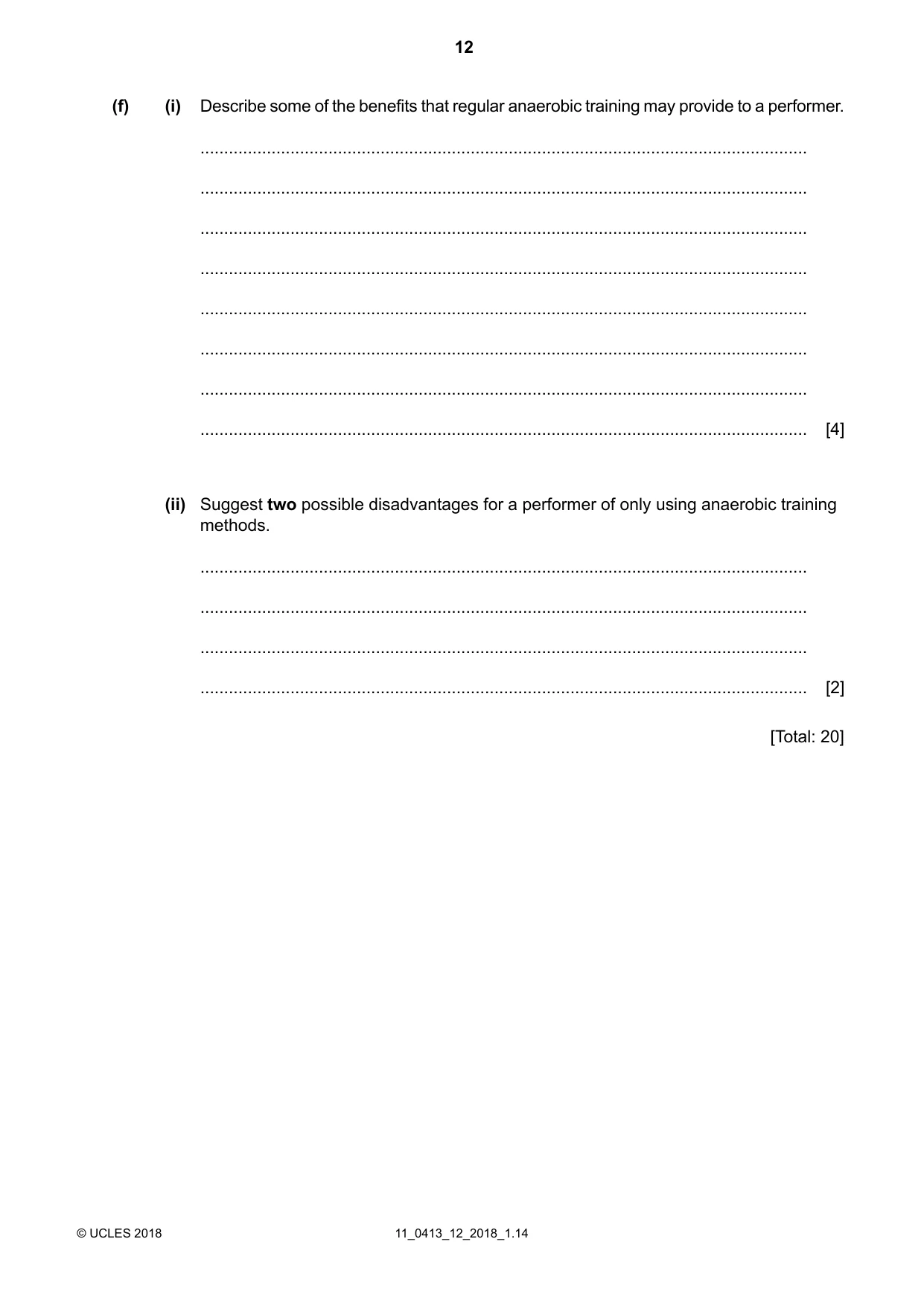
Question paper, page 12
Describe some of the benefits that regular anaerobic training may provide to a performer. (i) (f) … … … … … … … … [4] Suggest two possible disadvantages for a performer of only using anaerobic training methods. (ii) … … … … [2] [Total: 20] 11_0413_12_2018_1.14 © UCLES 2018 12
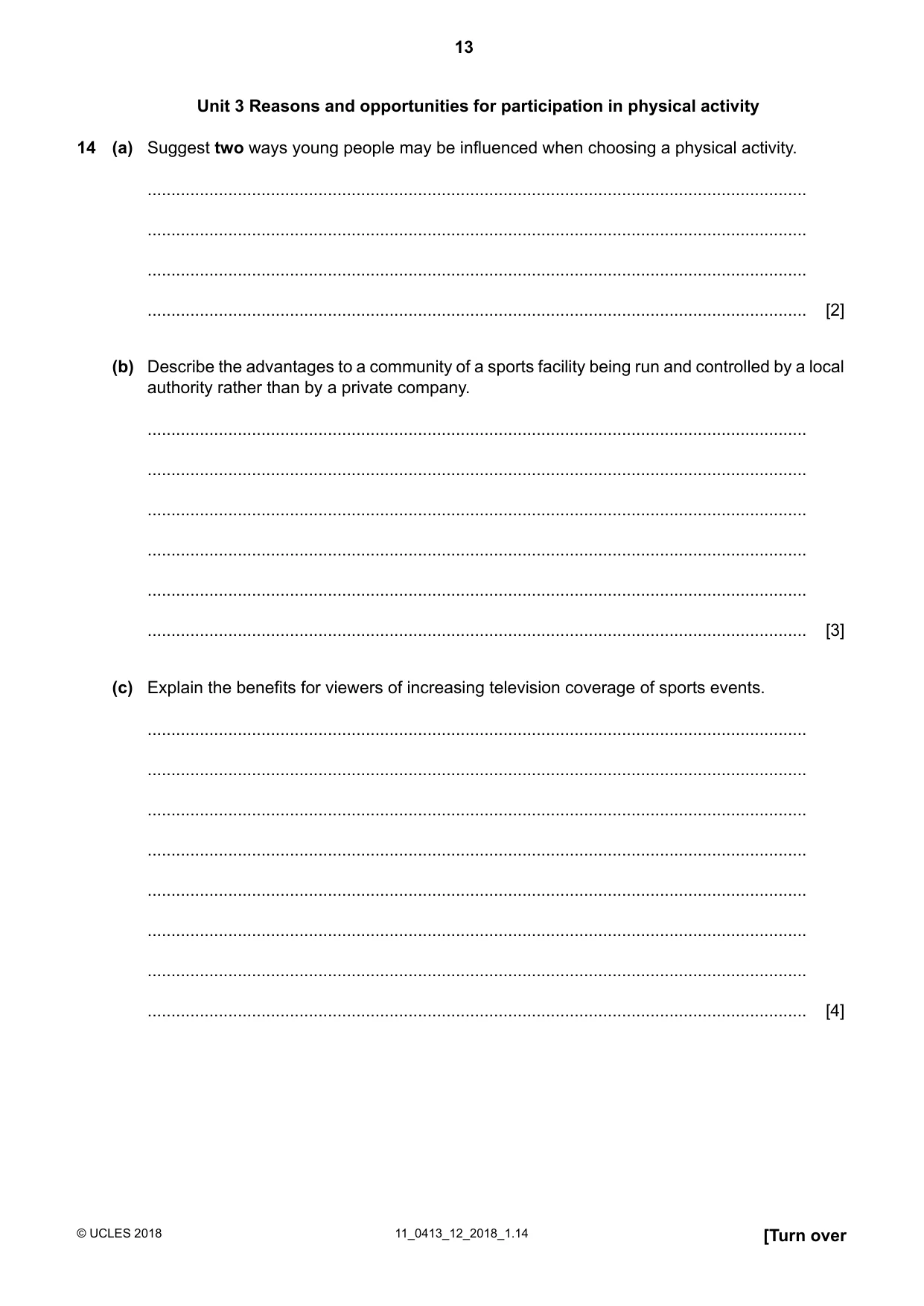
Question paper, page 13
Unit 3 Reasons and opportunities for participation in physical activity Suggest two ways young people may be influenced when choosing a physical activity. (a) 14 … … … … [2] Describe the advantages to a community of a sports facility being run and controlled by a local authority rather than by a private company. (b) … … … … … … [3] Explain the benefits for viewers of increasing television coverage of sports events. (c) … … … … … … … … [4] [Turn over 11_0413_12_2018_1.14 © UCLES 2018 13
Question paper, page 14
Suggest reasons why there has been a large increase in participation at recent disability games, such as the Paralympics. (d) … … … … … … … … … … … … [6] [Total: 15] 11_0413_12_2018_1.14 © UCLES 2018 14
Question paper, page 15
BLANK PAGE 11_0413_12_2018_1.14 © UCLES 2018 15
Question paper, page 16
BLANK PAGE Permission to reproduce items where third-party owned material protected by copyright is included has been sought and cleared where possible. Every reasonable effort has been made by the publisher (UCLES) to trace copyright holders, but if any items requiring clearance have unwittingly been included, the publisher will be pleased to make amends at the earliest possible opportunity. To avoid the issue of disclosure of answer-related information to candidates, all copyright acknowledgements are reproduced online in the Cambridge International Examinations Copyright Acknowledgements Booklet. This is produced for each series of examinations and is freely available to download at www.cie.org.uk after the live examination series. Cambridge International Examinations is part of the Cambridge Assessment Group. Cambridge Assessment is the brand name of University of Cambridge Local Examinations Syndicate (UCLES), which is itself a department of the University of Cambridge. 11_0413_12_2018_1.14 © UCLES 2018 16
Mark scheme, page 1
This document consists of 19 printed pages. © UCLES 2018 [Turn over Cambridge Assessment International Education Cambridge International General Certificate of Secondary Education PHYSICAL EDUCATION 0413/12 Paper 1 October/November 2018 MARK SCHEME Maximum Mark: 80 Published This mark scheme is published as an aid to teachers and candidates, to indicate the requirements of the examination. It shows the basis on which Examiners were instructed to award marks. It does not indicate the details of the discussions that took place at an Examiners’ meeting before marking began, which would have considered the acceptability of alternative answers. Mark schemes should be read in conjunction with the question paper and the Principal Examiner Report for Teachers. Cambridge International will not enter into discussions about these mark schemes. Cambridge International is publishing the mark schemes for the October/November 2018 series for most Cambridge IGCSE™, Cambridge International A and AS Level components and some Cambridge O Level components.
Mark scheme, page 2
0413/12 Cambridge IGCSE – Mark Scheme PUBLISHED October/November 2018 © UCLES 2018 Page 2 of 19 Generic Marking Principles These general marking principles must be applied by all examiners when marking candidate answers. They should be applied alongside the specific content of the mark scheme or generic level descriptors for a question. Each question paper and mark scheme will also comply with these marking principles. GENERIC MARKING PRINCIPLE 1: Marks must be awarded in line with: • the specific content of the mark scheme or the generic level descriptors for the question • the specific skills defined in the mark scheme or in the generic level descriptors for the question • the standard of response required by a candidate as exemplified by the standardisation scripts. GENERIC MARKING PRINCIPLE 2: Marks awarded are always whole marks (not half marks, or other fractions). GENERIC MARKING PRINCIPLE 3: Marks must be awarded positively: • marks are awarded for correct/valid answers, as defined in the mark scheme. However, credit is given for valid answers which go beyond the scope of the syllabus and mark scheme, referring to your Team Leader as appropriate • marks are awarded when candidates clearly demonstrate what they know and can do • marks are not deducted for errors • marks are not deducted for omissions • answers should only be judged on the quality of spelling, punctuation and grammar when these features are specifically assessed by the question as indicated by the mark scheme. The meaning, however, should be unambiguous. GENERIC MARKING PRINCIPLE 4: Rules must be applied consistently e.g. in situations where candidates have not followed instructions or in the application of generic level descriptors.
Mark scheme, page 3
0413/12 Cambridge IGCSE – Mark Scheme PUBLISHED October/November 2018 © UCLES 2018 Page 3 of 19 GENERIC MARKING PRINCIPLE 5: Marks should be awarded using the full range of marks defined in the mark scheme for the question (however; the use of the full mark range may be limited according to the quality of the candidate responses seen). GENERIC MARKING PRINCIPLE 6: Marks awarded are based solely on the requirements as defined in the mark scheme. Marks should not be awarded with grade thresholds or grade descriptors in mind.
Mark scheme, page 4
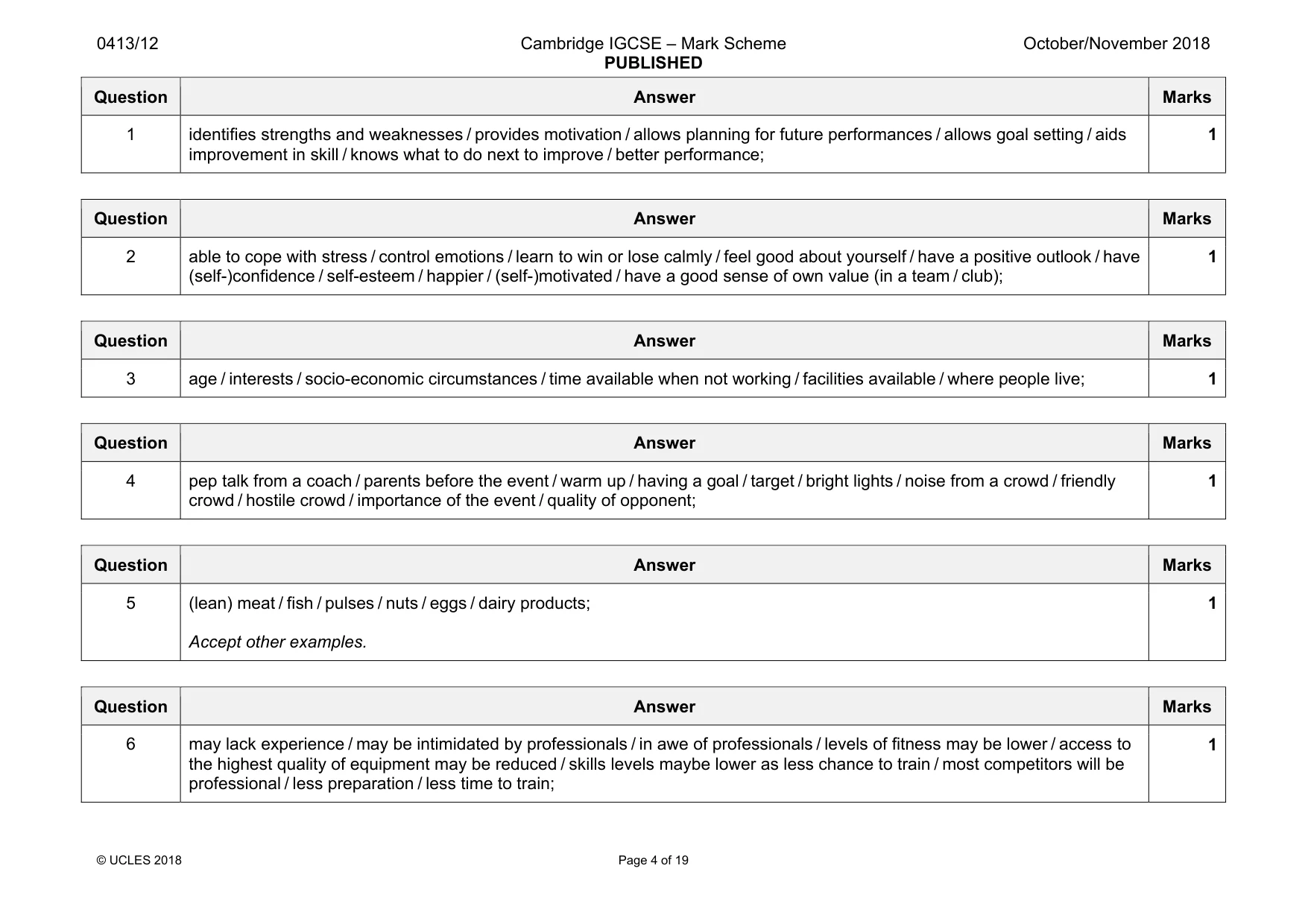
0413/12 Cambridge IGCSE – Mark Scheme PUBLISHED October/November 2018 © UCLES 2018 Page 4 of 19 Question Answer Marks 1 identifies strengths and weaknesses / provides motivation / allows planning for future performances / allows goal setting / aids improvement in skill / knows what to do next to improve / better performance; 1 Question Answer Marks 2 able to cope with stress / control emotions / learn to win or lose calmly / feel good about yourself / have a positive outlook / have (self-)confidence / self-esteem / happier / (self-)motivated / have a good sense of own value (in a team / club); 1 Question Answer Marks 3 age / interests / socio-economic circumstances / time available when not working / facilities available / where people live; 1 Question Answer Marks 4 pep talk from a coach / parents before the event / warm up / having a goal / target / bright lights / noise from a crowd / friendly crowd / hostile crowd / importance of the event / quality of opponent; 1 Question Answer Marks 5 (lean) meat / fish / pulses / nuts / eggs / dairy products; Accept other examples. 1 Question Answer Marks 6 may lack experience / may be intimidated by professionals / in awe of professionals / levels of fitness may be lower / access to the highest quality of equipment may be reduced / skills levels maybe lower as less chance to train / most competitors will be professional / less preparation / less time to train; 1
Mark scheme, page 5
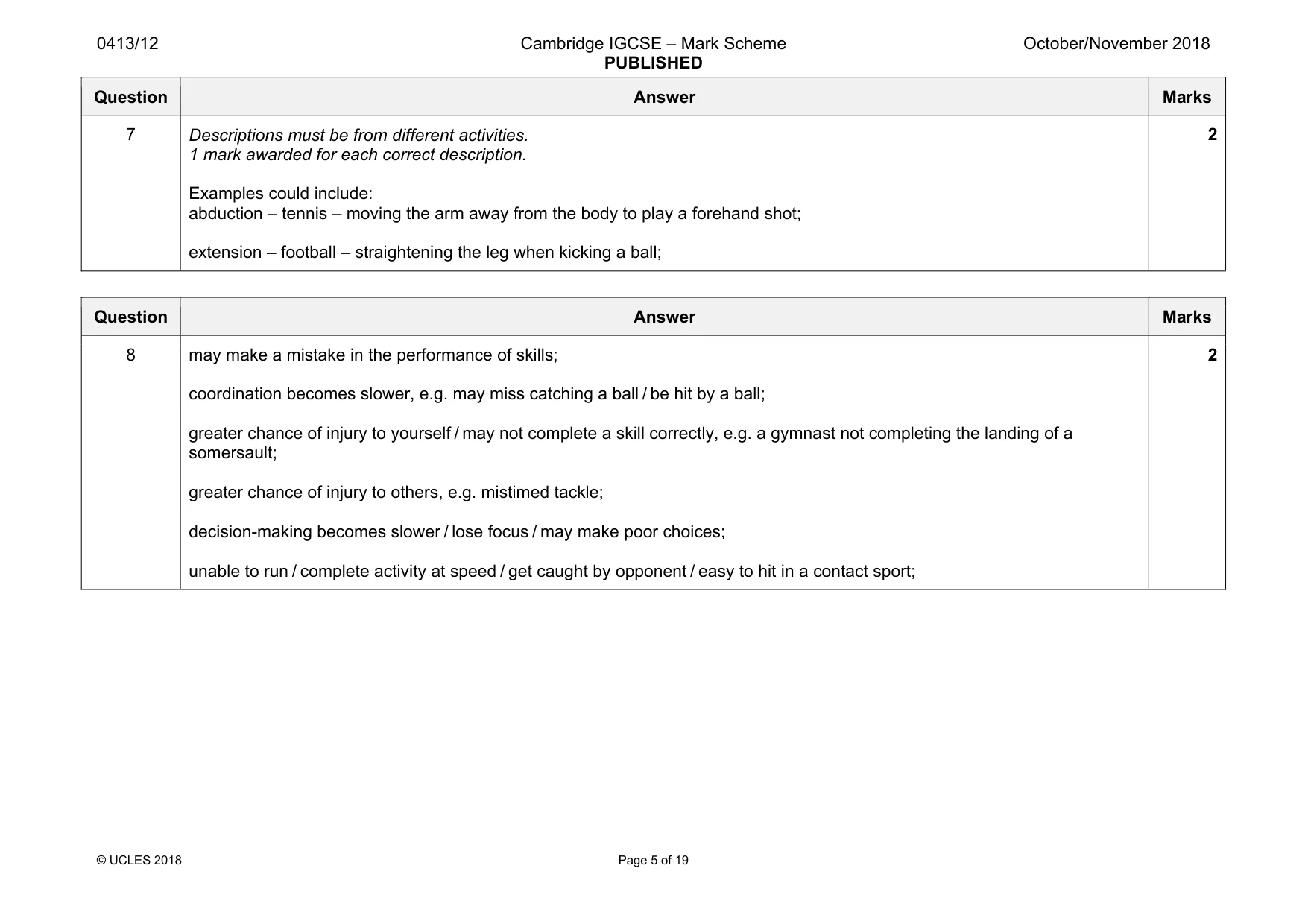
0413/12 Cambridge IGCSE – Mark Scheme PUBLISHED October/November 2018 © UCLES 2018 Page 5 of 19 Question Answer Marks 7 Descriptions must be from different activities. 1 mark awarded for each correct description. Examples could include: abduction – tennis – moving the arm away from the body to play a forehand shot; extension – football – straightening the leg when kicking a ball; 2 Question Answer Marks 8 may make a mistake in the performance of skills; coordination becomes slower, e.g. may miss catching a ball / be hit by a ball; greater chance of injury to yourself / may not complete a skill correctly, e.g. a gymnast not completing the landing of a somersault; greater chance of injury to others, e.g. mistimed tackle; decision-making becomes slower / lose focus / may make poor choices; unable to run / complete activity at speed / get caught by opponent / easy to hit in a contact sport; 2
Mark scheme, page 6
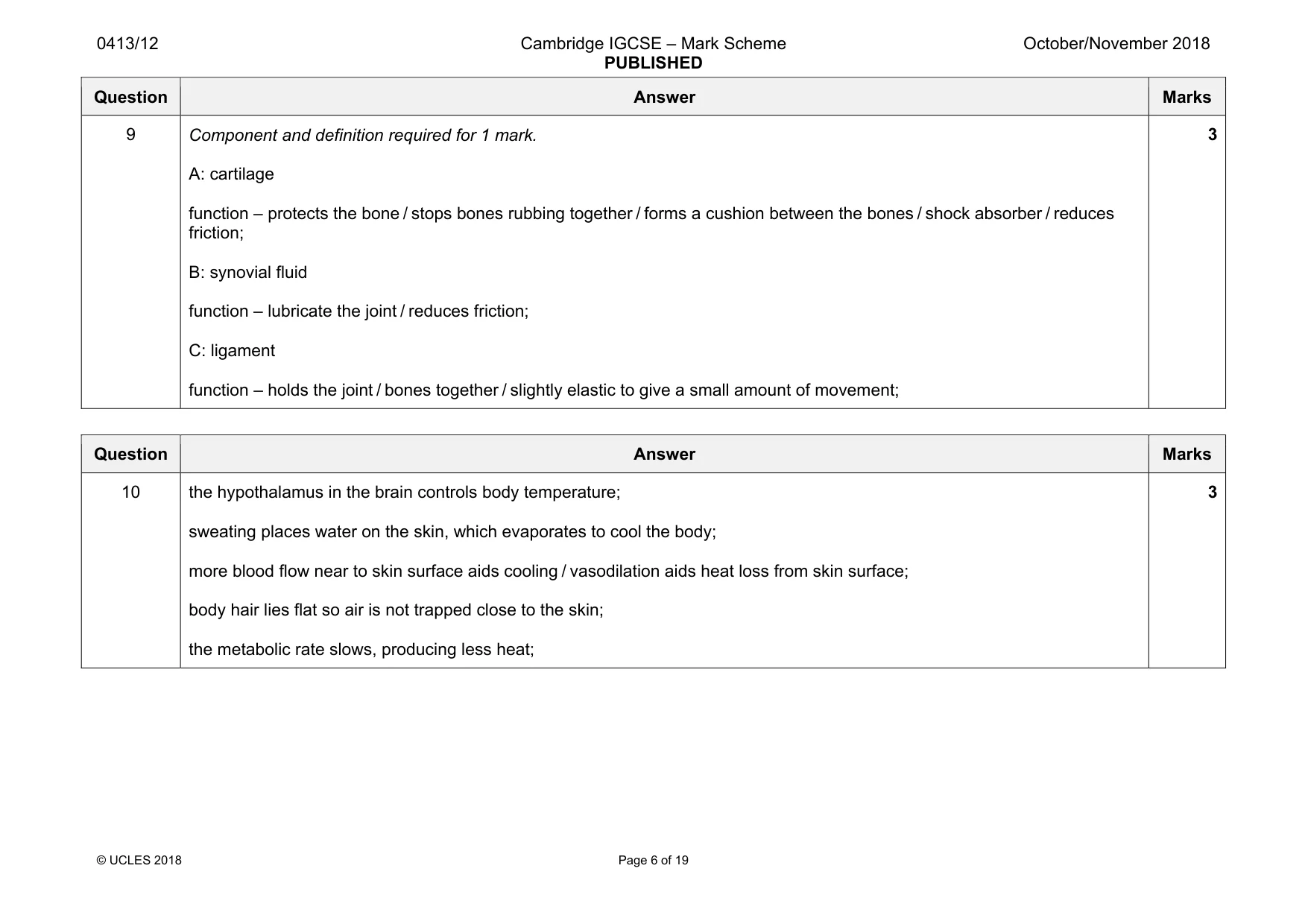
0413/12 Cambridge IGCSE – Mark Scheme PUBLISHED October/November 2018 © UCLES 2018 Page 6 of 19 Question Answer Marks 9 Component and definition required for 1 mark. A: cartilage function – protects the bone / stops bones rubbing together / forms a cushion between the bones / shock absorber / reduces friction; B: synovial fluid function – lubricate the joint / reduces friction; C: ligament function – holds the joint / bones together / slightly elastic to give a small amount of movement; 3 Question Answer Marks 10 the hypothalamus in the brain controls body temperature; sweating places water on the skin, which evaporates to cool the body; more blood flow near to skin surface aids cooling / vasodilation aids heat loss from skin surface; body hair lies flat so air is not trapped close to the skin; the metabolic rate slows, producing less heat; 3
Mark scheme, page 7
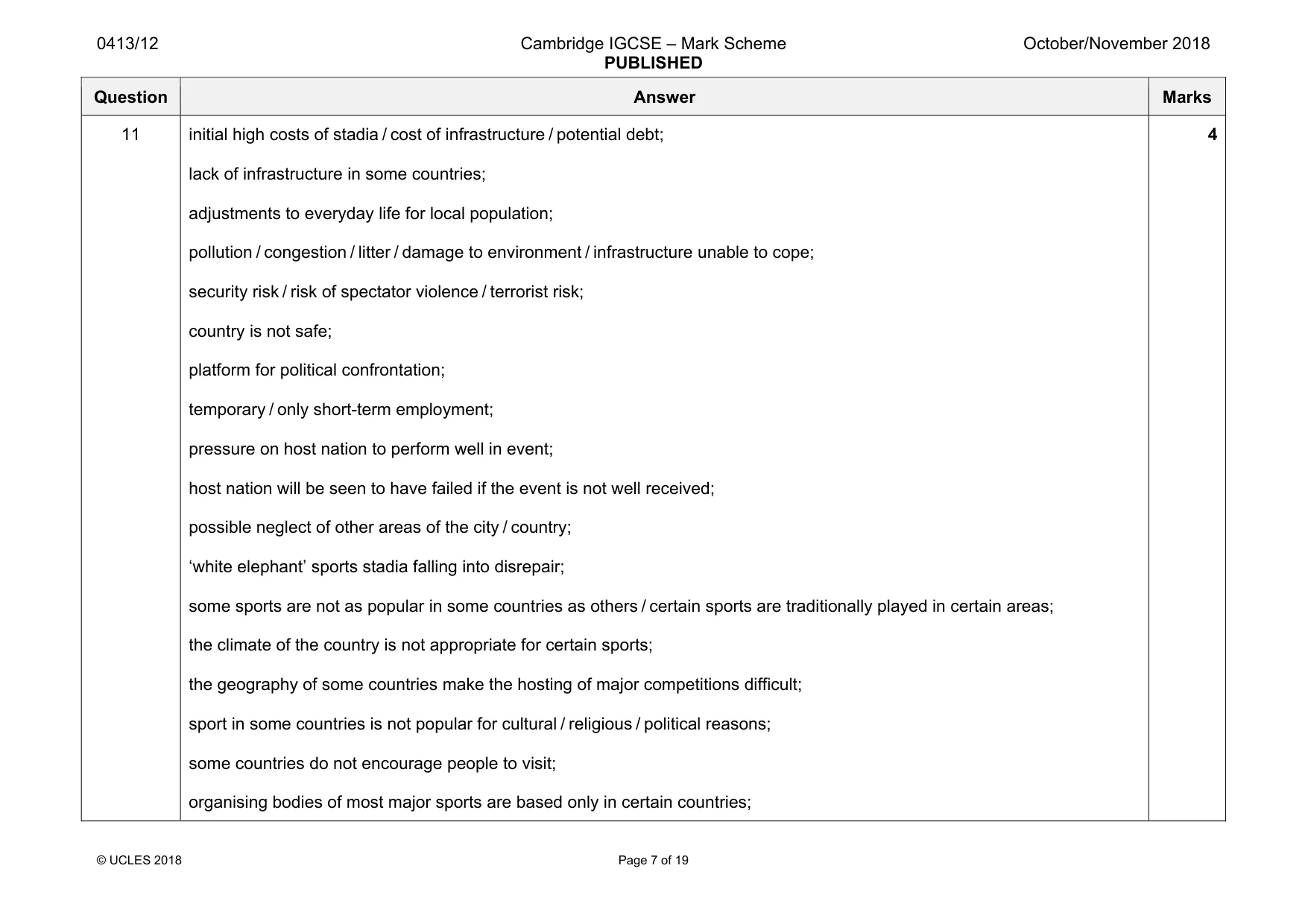
0413/12 Cambridge IGCSE – Mark Scheme PUBLISHED October/November 2018 © UCLES 2018 Page 7 of 19 Question Answer Marks 11 initial high costs of stadia / cost of infrastructure / potential debt; lack of infrastructure in some countries; adjustments to everyday life for local population; pollution / congestion / litter / damage to environment / infrastructure unable to cope; security risk / risk of spectator violence / terrorist risk; country is not safe; platform for political confrontation; temporary / only short-term employment; pressure on host nation to perform well in event; host nation will be seen to have failed if the event is not well received; possible neglect of other areas of the city / country; ‘white elephant’ sports stadia falling into disrepair; some sports are not as popular in some countries as others / certain sports are traditionally played in certain areas; the climate of the country is not appropriate for certain sports; the geography of some countries make the hosting of major competitions difficult; sport in some countries is not popular for cultural / religious / political reasons; some countries do not encourage people to visit; organising bodies of most major sports are based only in certain countries; 4
Mark scheme, page 8
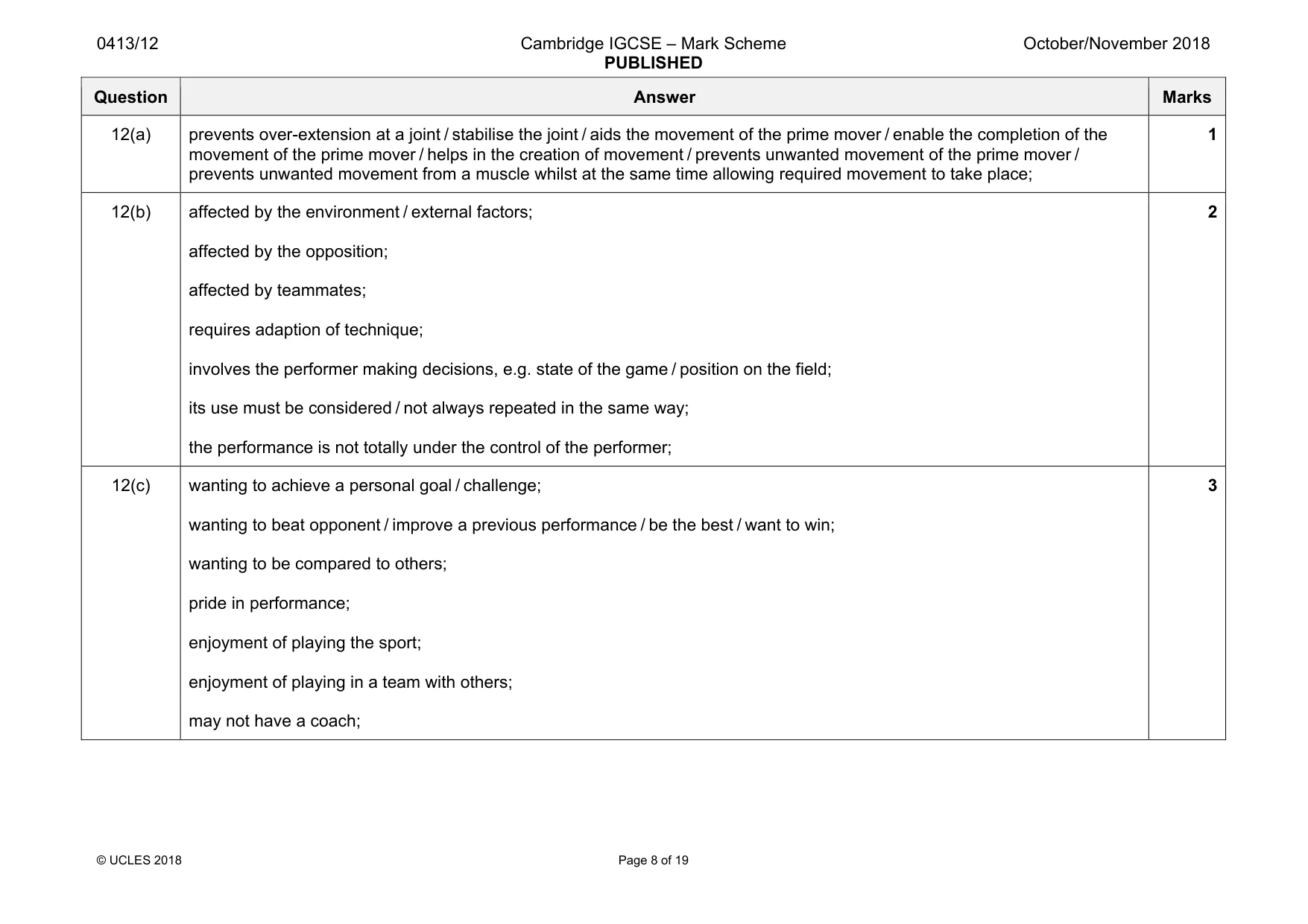
0413/12 Cambridge IGCSE – Mark Scheme PUBLISHED October/November 2018 © UCLES 2018 Page 8 of 19 Question Answer Marks 12(a) prevents over-extension at a joint / stabilise the joint / aids the movement of the prime mover / enable the completion of the movement of the prime mover / helps in the creation of movement / prevents unwanted movement of the prime mover / prevents unwanted movement from a muscle whilst at the same time allowing required movement to take place; 1 12(b) affected by the environment / external factors; affected by the opposition; affected by teammates; requires adaption of technique; involves the performer making decisions, e.g. state of the game / position on the field; its use must be considered / not always repeated in the same way; the performance is not totally under the control of the performer; 2 12(c) wanting to achieve a personal goal / challenge; wanting to beat opponent / improve a previous performance / be the best / want to win; wanting to be compared to others; pride in performance; enjoyment of playing the sport; enjoyment of playing in a team with others; may not have a coach; 3
Mark scheme, page 9
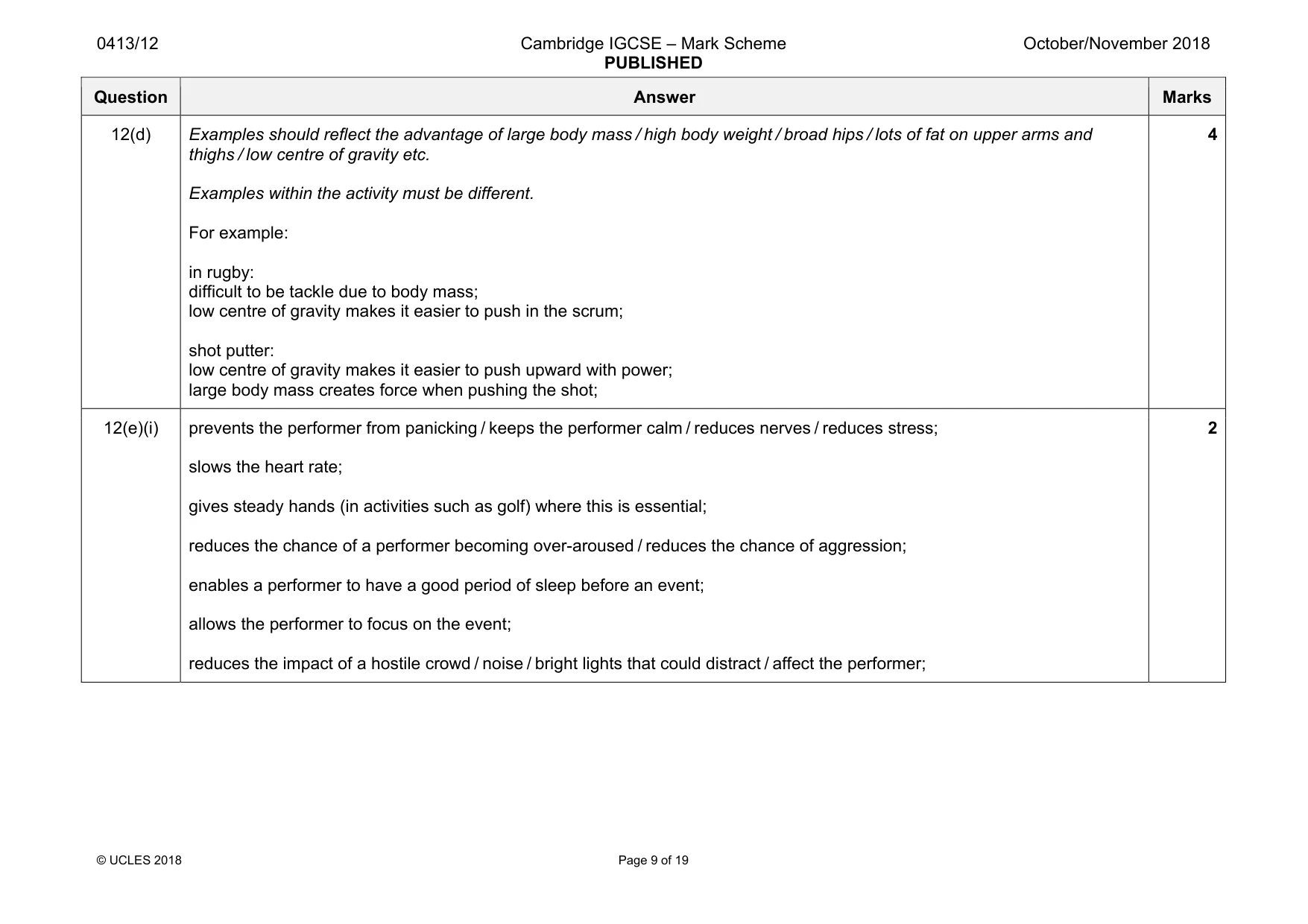
0413/12 Cambridge IGCSE – Mark Scheme PUBLISHED October/November 2018 © UCLES 2018 Page 9 of 19 Question Answer Marks 12(d) Examples should reflect the advantage of large body mass / high body weight / broad hips / lots of fat on upper arms and thighs / low centre of gravity etc. Examples within the activity must be different. For example: in rugby: difficult to be tackle due to body mass; low centre of gravity makes it easier to push in the scrum; shot putter: low centre of gravity makes it easier to push upward with power; large body mass creates force when pushing the shot; 4 12(e)(i) prevents the performer from panicking / keeps the performer calm / reduces nerves / reduces stress; slows the heart rate; gives steady hands (in activities such as golf) where this is essential; reduces the chance of a performer becoming over-aroused / reduces the chance of aggression; enables a performer to have a good period of sleep before an event; allows the performer to focus on the event; reduces the impact of a hostile crowd / noise / bright lights that could distract / affect the performer; 2
Mark scheme, page 10
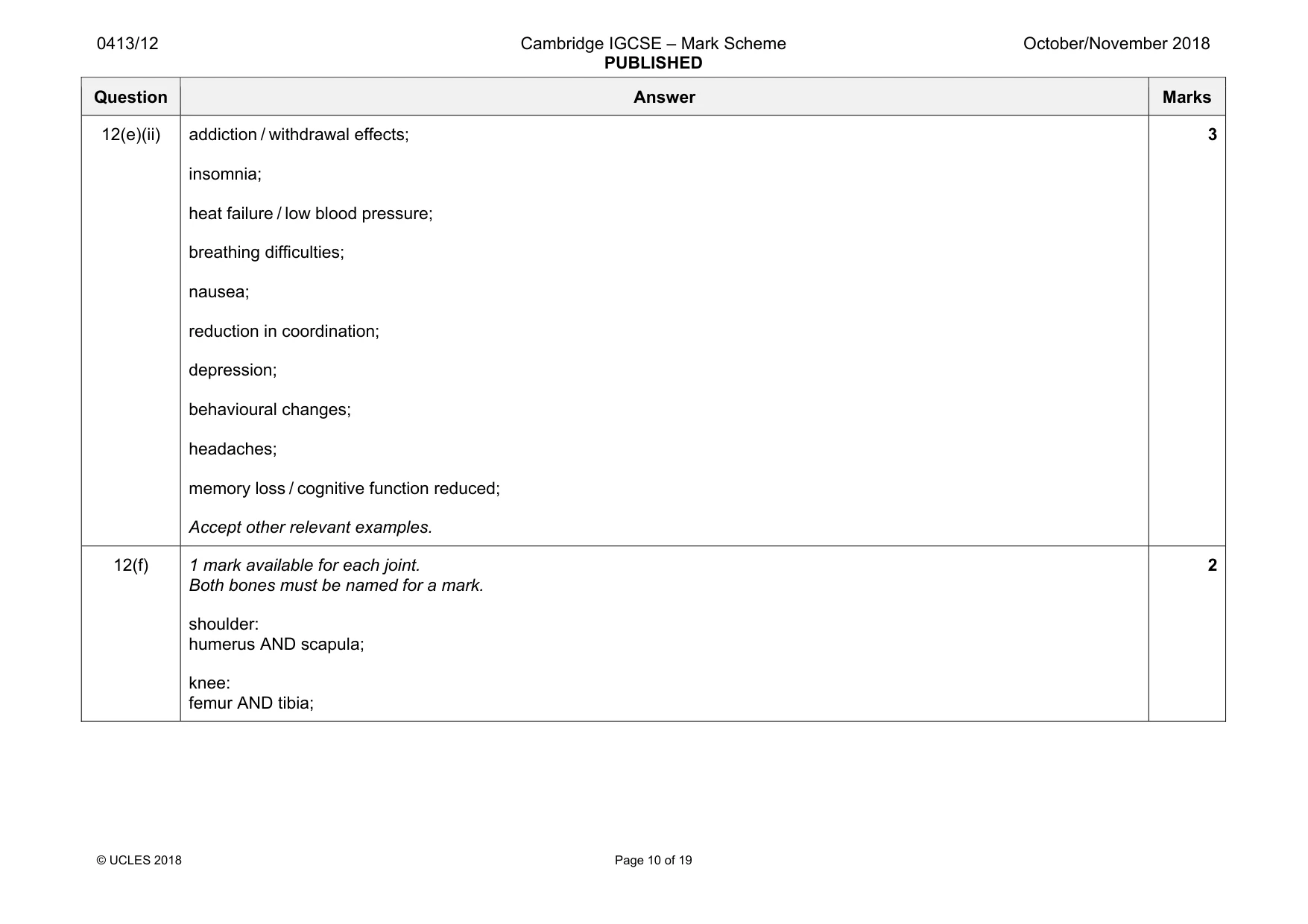
0413/12 Cambridge IGCSE – Mark Scheme PUBLISHED October/November 2018 © UCLES 2018 Page 10 of 19 Question Answer Marks 12(e)(ii) addiction / withdrawal effects; insomnia; heat failure / low blood pressure; breathing difficulties; nausea; reduction in coordination; depression; behavioural changes; headaches; memory loss / cognitive function reduced; Accept other relevant examples. 3 12(f) 1 mark available for each joint. Both bones must be named for a mark. shoulder: humerus AND scapula; knee: femur AND tibia; 2
Mark scheme, page 11
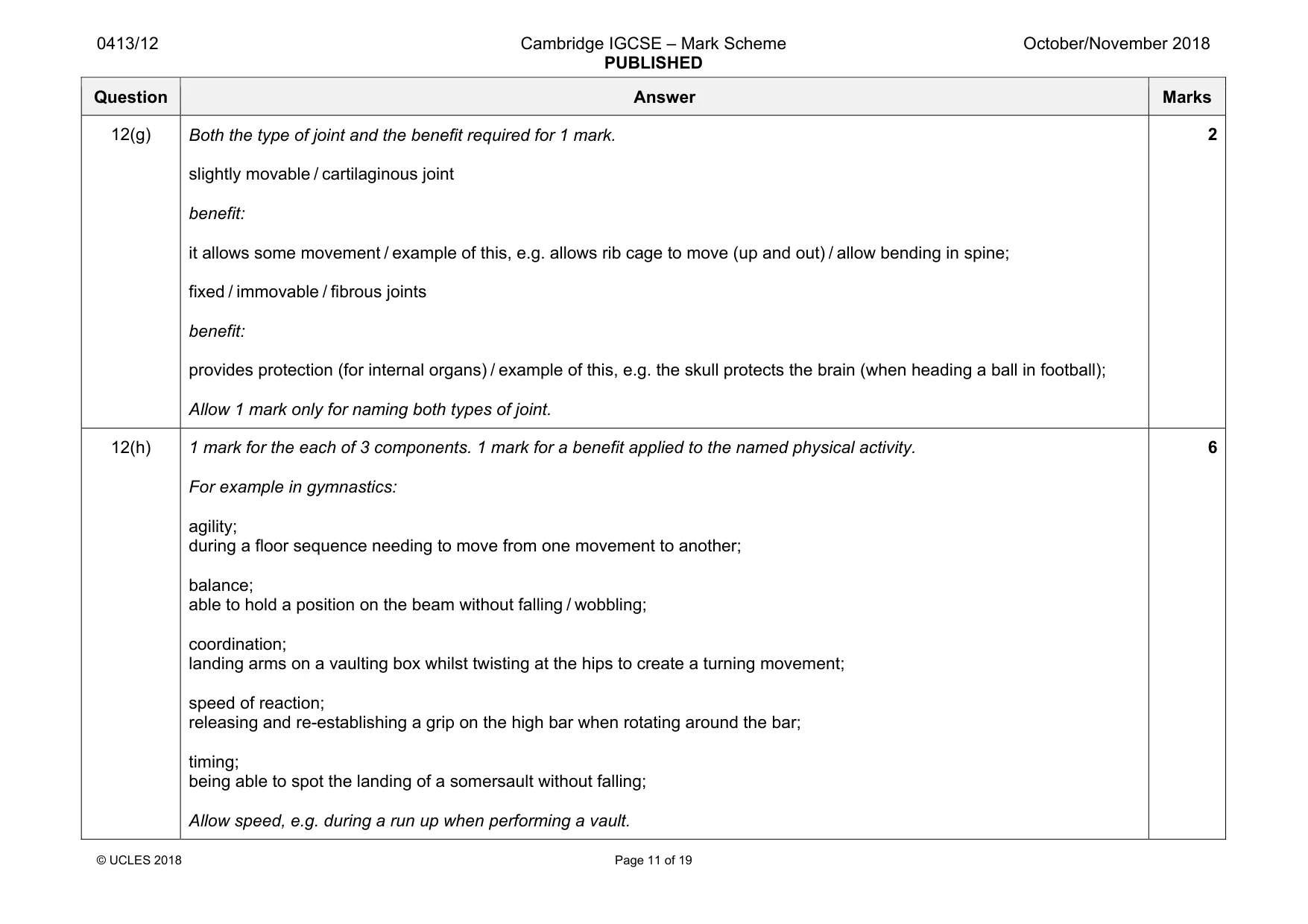
0413/12 Cambridge IGCSE – Mark Scheme PUBLISHED October/November 2018 © UCLES 2018 Page 11 of 19 Question Answer Marks 12(g) Both the type of joint and the benefit required for 1 mark. slightly movable / cartilaginous joint benefit: it allows some movement / example of this, e.g. allows rib cage to move (up and out) / allow bending in spine; fixed / immovable / fibrous joints benefit: provides protection (for internal organs) / example of this, e.g. the skull protects the brain (when heading a ball in football); Allow 1 mark only for naming both types of joint. 2 12(h) 1 mark for the each of 3 components. 1 mark for a benefit applied to the named physical activity. For example in gymnastics: agility; during a floor sequence needing to move from one movement to another; balance; able to hold a position on the beam without falling / wobbling; coordination; landing arms on a vaulting box whilst twisting at the hips to create a turning movement; speed of reaction; releasing and re-establishing a grip on the high bar when rotating around the bar; timing; being able to spot the landing of a somersault without falling; Allow speed, e.g. during a run up when performing a vault. 6
Mark scheme, page 12
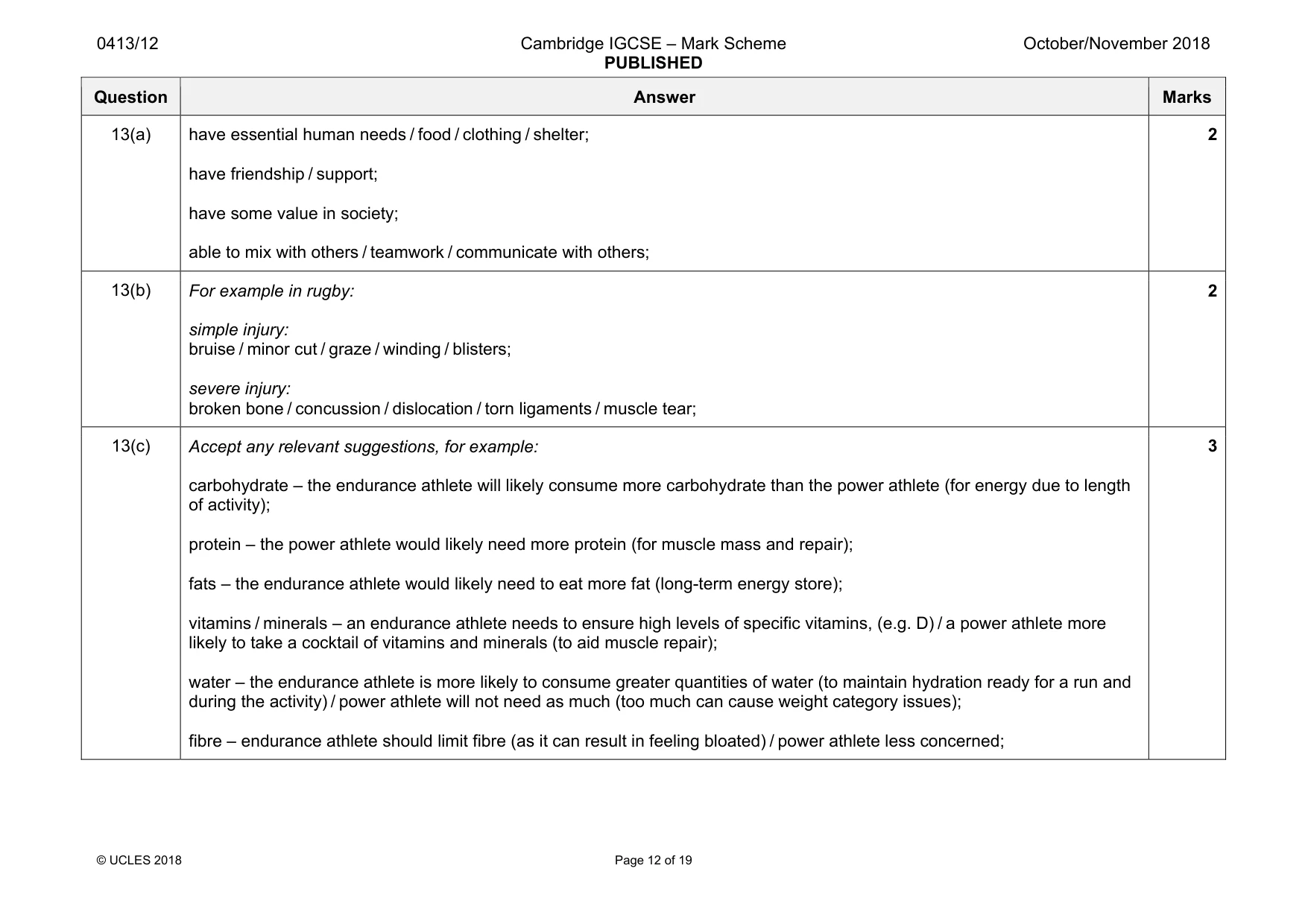
0413/12 Cambridge IGCSE – Mark Scheme PUBLISHED October/November 2018 © UCLES 2018 Page 12 of 19 Question Answer Marks 13(a) have essential human needs / food / clothing / shelter; have friendship / support; have some value in society; able to mix with others / teamwork / communicate with others; 2 13(b) For example in rugby: simple injury: bruise / minor cut / graze / winding / blisters; severe injury: broken bone / concussion / dislocation / torn ligaments / muscle tear; 2 13(c) Accept any relevant suggestions, for example: carbohydrate – the endurance athlete will likely consume more carbohydrate than the power athlete (for energy due to length of activity); protein – the power athlete would likely need more protein (for muscle mass and repair); fats – the endurance athlete would likely need to eat more fat (long-term energy store); vitamins / minerals – an endurance athlete needs to ensure high levels of specific vitamins, (e.g. D) / a power athlete more likely to take a cocktail of vitamins and minerals (to aid muscle repair); water – the endurance athlete is more likely to consume greater quantities of water (to maintain hydration ready for a run and during the activity) / power athlete will not need as much (too much can cause weight category issues); fibre – endurance athlete should limit fibre (as it can result in feeling bloated) / power athlete less concerned; 3
Mark scheme, page 13
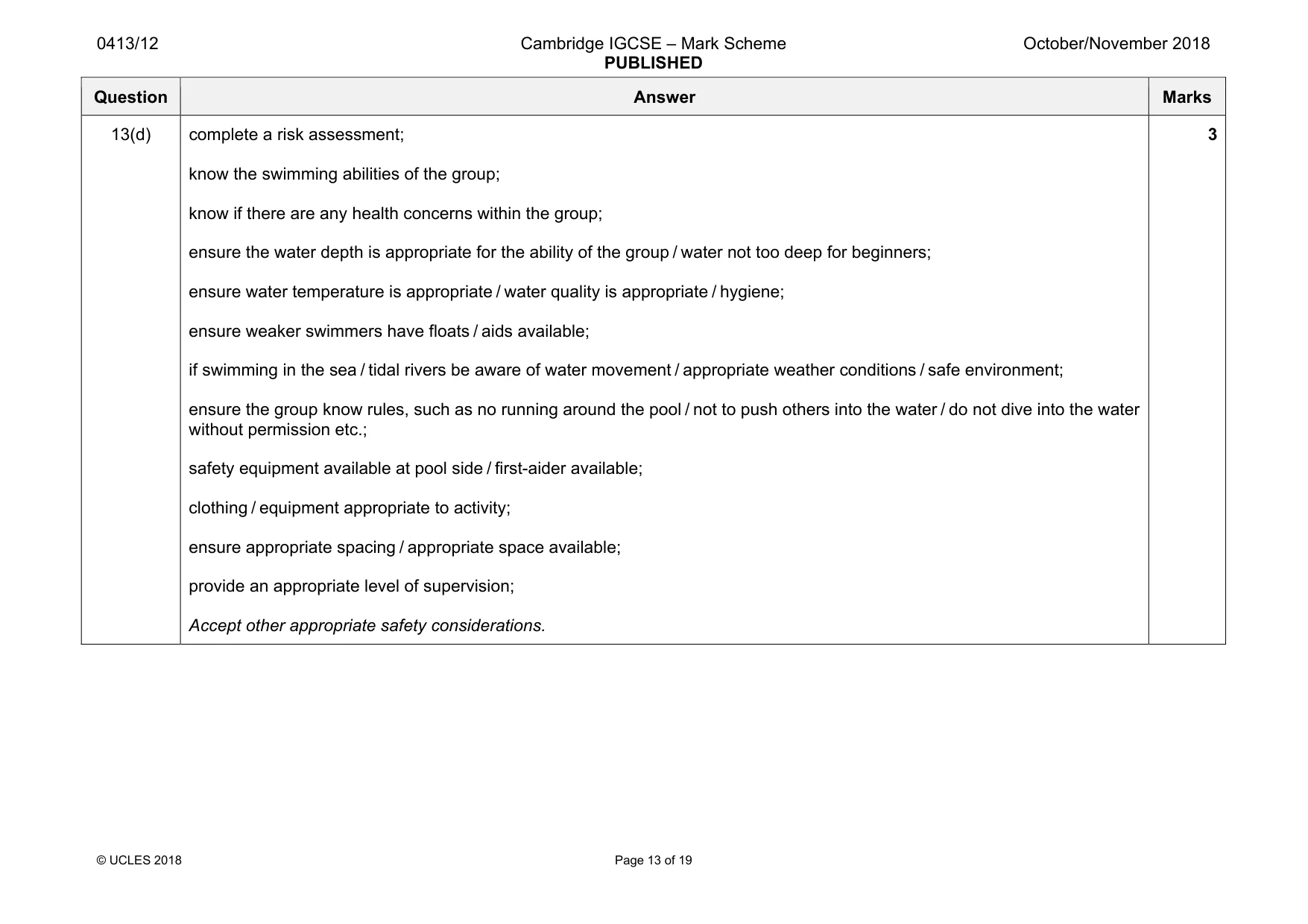
0413/12 Cambridge IGCSE – Mark Scheme PUBLISHED October/November 2018 © UCLES 2018 Page 13 of 19 Question Answer Marks 13(d) complete a risk assessment; know the swimming abilities of the group; know if there are any health concerns within the group; ensure the water depth is appropriate for the ability of the group / water not too deep for beginners; ensure water temperature is appropriate / water quality is appropriate / hygiene; ensure weaker swimmers have floats / aids available; if swimming in the sea / tidal rivers be aware of water movement / appropriate weather conditions / safe environment; ensure the group know rules, such as no running around the pool / not to push others into the water / do not dive into the water without permission etc.; safety equipment available at pool side / first-aider available; clothing / equipment appropriate to activity; ensure appropriate spacing / appropriate space available; provide an appropriate level of supervision; Accept other appropriate safety considerations. 3
Mark scheme, page 14
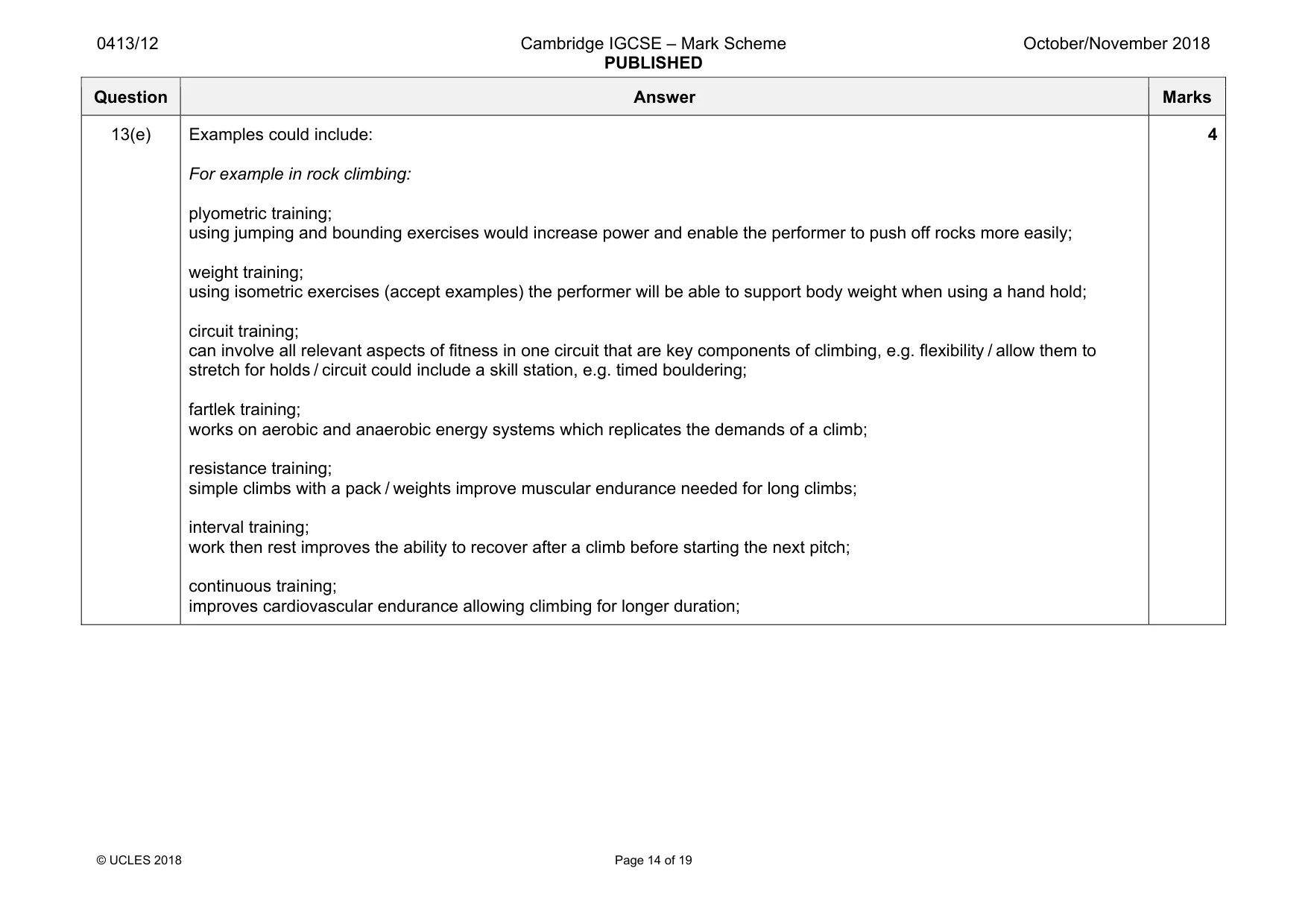
0413/12 Cambridge IGCSE – Mark Scheme PUBLISHED October/November 2018 © UCLES 2018 Page 14 of 19 Question Answer Marks 13(e) Examples could include: For example in rock climbing: plyometric training; using jumping and bounding exercises would increase power and enable the performer to push off rocks more easily; weight training; using isometric exercises (accept examples) the performer will be able to support body weight when using a hand hold; circuit training; can involve all relevant aspects of fitness in one circuit that are key components of climbing, e.g. flexibility / allow them to stretch for holds / circuit could include a skill station, e.g. timed bouldering; fartlek training; works on aerobic and anaerobic energy systems which replicates the demands of a climb; resistance training; simple climbs with a pack / weights improve muscular endurance needed for long climbs; interval training; work then rest improves the ability to recover after a climb before starting the next pitch; continuous training; improves cardiovascular endurance allowing climbing for longer duration; 4
Mark scheme, page 15
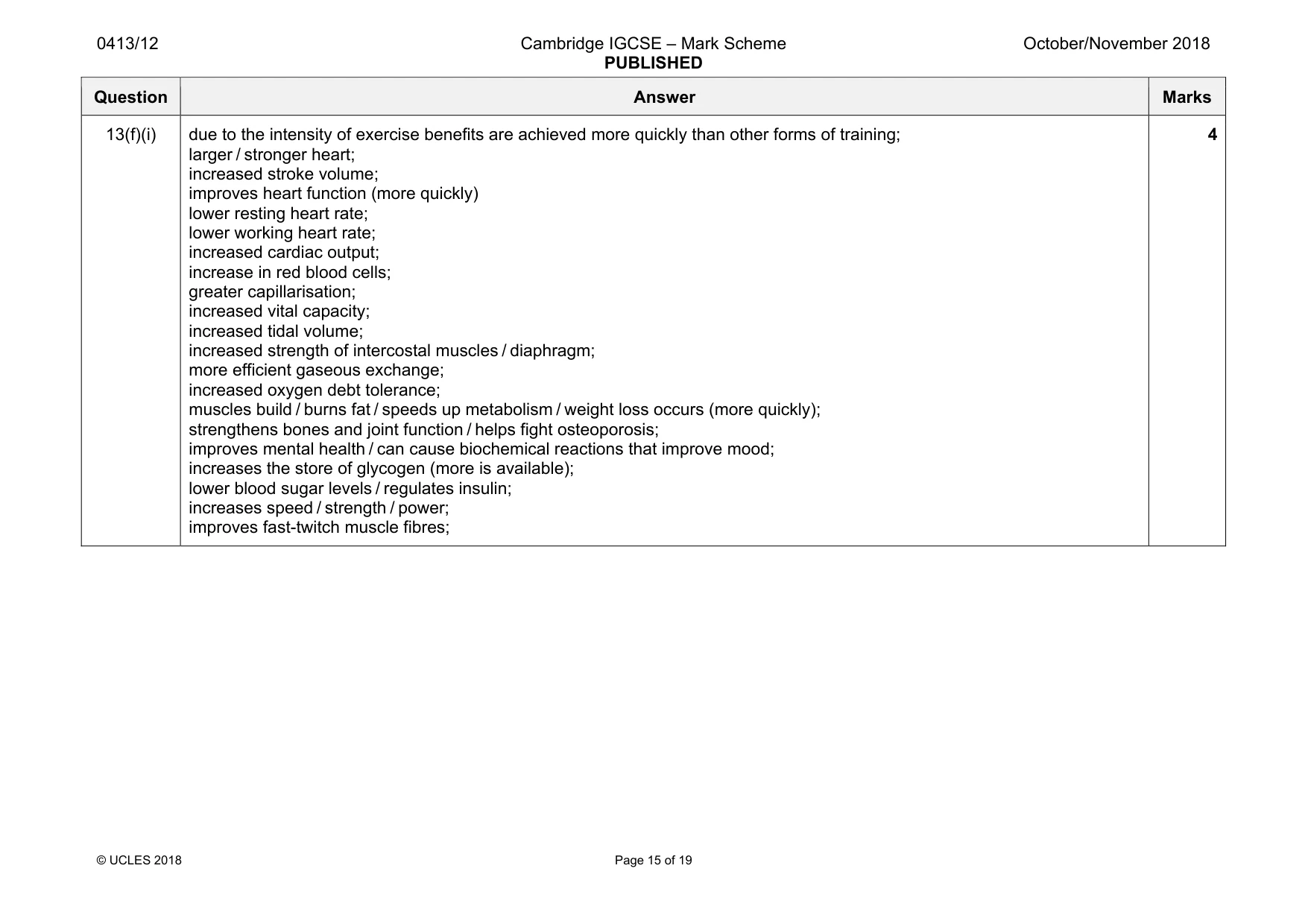
0413/12 Cambridge IGCSE – Mark Scheme PUBLISHED October/November 2018 © UCLES 2018 Page 15 of 19 Question Answer Marks 13(f)(i) due to the intensity of exercise benefits are achieved more quickly than other forms of training; larger / stronger heart; increased stroke volume; improves heart function (more quickly) lower resting heart rate; lower working heart rate; increased cardiac output; increase in red blood cells; greater capillarisation; increased vital capacity; increased tidal volume; increased strength of intercostal muscles / diaphragm; more efficient gaseous exchange; increased oxygen debt tolerance; muscles build / burns fat / speeds up metabolism / weight loss occurs (more quickly); strengthens bones and joint function / helps fight osteoporosis; improves mental health / can cause biochemical reactions that improve mood; increases the store of glycogen (more is available); lower blood sugar levels / regulates insulin; increases speed / strength / power; improves fast-twitch muscle fibres; 4
Mark scheme, page 16
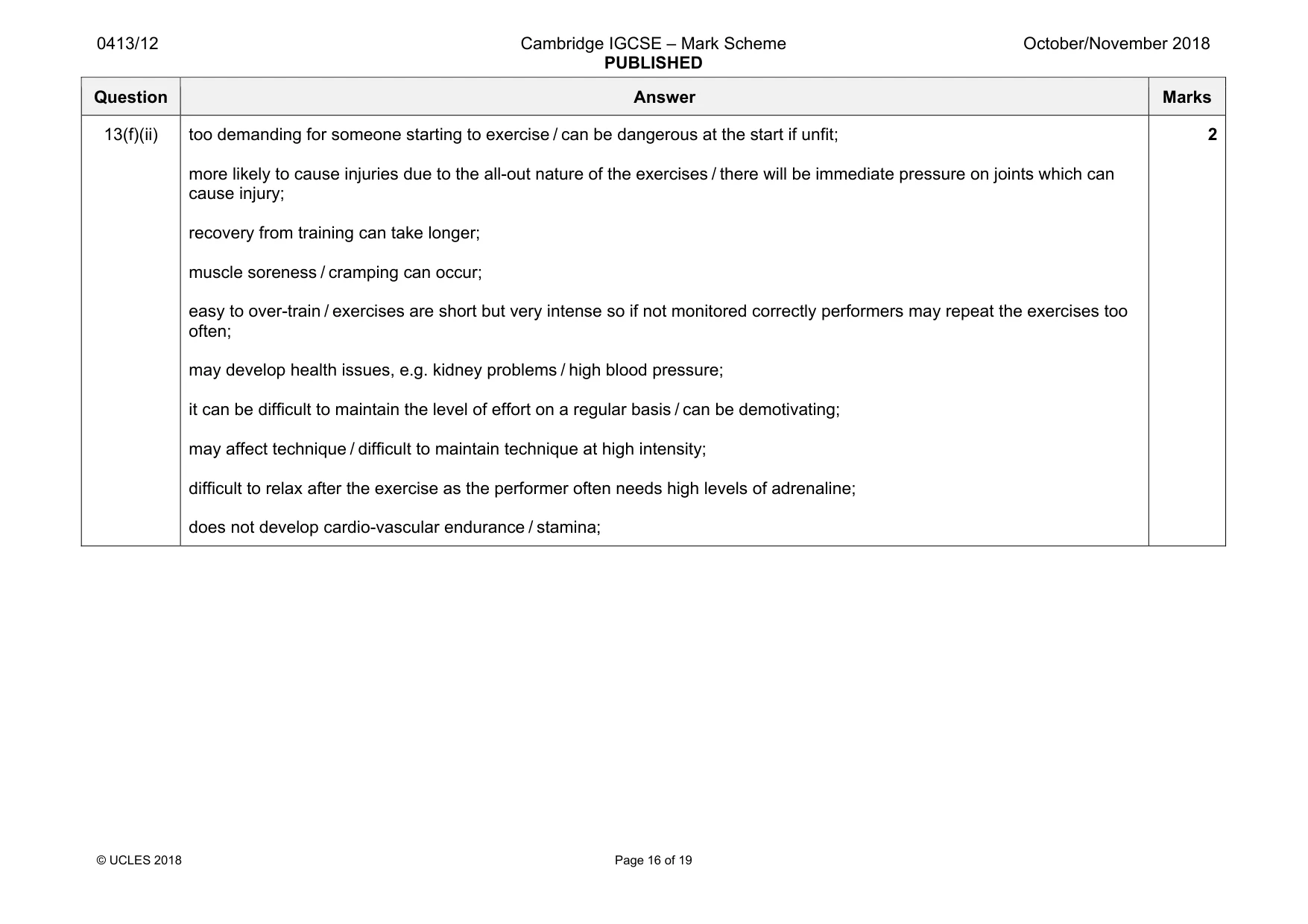
0413/12 Cambridge IGCSE – Mark Scheme PUBLISHED October/November 2018 © UCLES 2018 Page 16 of 19 Question Answer Marks 13(f)(ii) too demanding for someone starting to exercise / can be dangerous at the start if unfit; more likely to cause injuries due to the all-out nature of the exercises / there will be immediate pressure on joints which can cause injury; recovery from training can take longer; muscle soreness / cramping can occur; easy to over-train / exercises are short but very intense so if not monitored correctly performers may repeat the exercises too often; may develop health issues, e.g. kidney problems / high blood pressure; it can be difficult to maintain the level of effort on a regular basis / can be demotivating; may affect technique / difficult to maintain technique at high intensity; difficult to relax after the exercise as the performer often needs high levels of adrenaline; does not develop cardio-vascular endurance / stamina; 2
Mark scheme, page 17
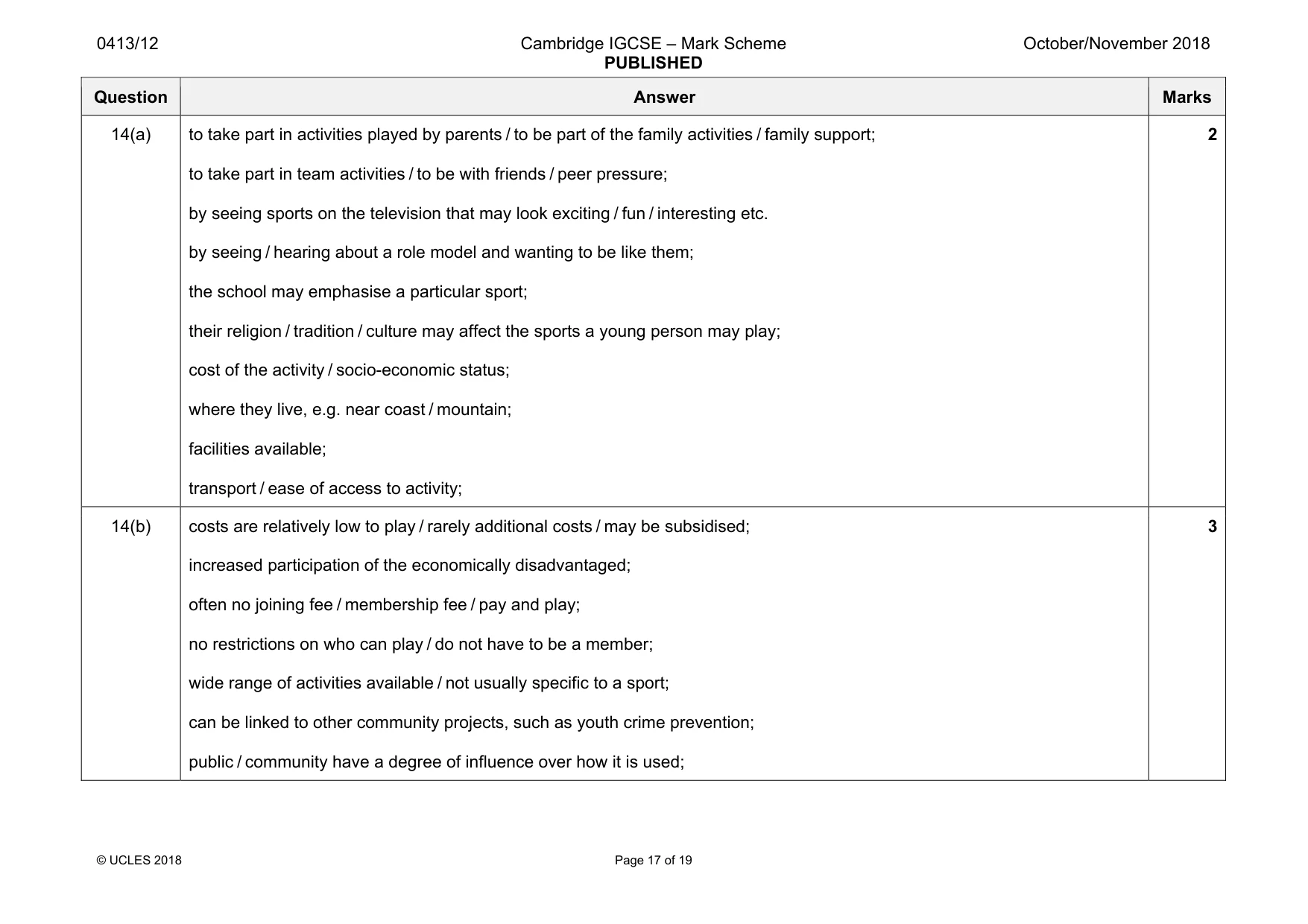
0413/12 Cambridge IGCSE – Mark Scheme PUBLISHED October/November 2018 © UCLES 2018 Page 17 of 19 Question Answer Marks 14(a) to take part in activities played by parents / to be part of the family activities / family support; to take part in team activities / to be with friends / peer pressure; by seeing sports on the television that may look exciting / fun / interesting etc. by seeing / hearing about a role model and wanting to be like them; the school may emphasise a particular sport; their religion / tradition / culture may affect the sports a young person may play; cost of the activity / socio-economic status; where they live, e.g. near coast / mountain; facilities available; transport / ease of access to activity; 2 14(b) costs are relatively low to play / rarely additional costs / may be subsidised; increased participation of the economically disadvantaged; often no joining fee / membership fee / pay and play; no restrictions on who can play / do not have to be a member; wide range of activities available / not usually specific to a sport; can be linked to other community projects, such as youth crime prevention; public / community have a degree of influence over how it is used; 3
Mark scheme, page 18
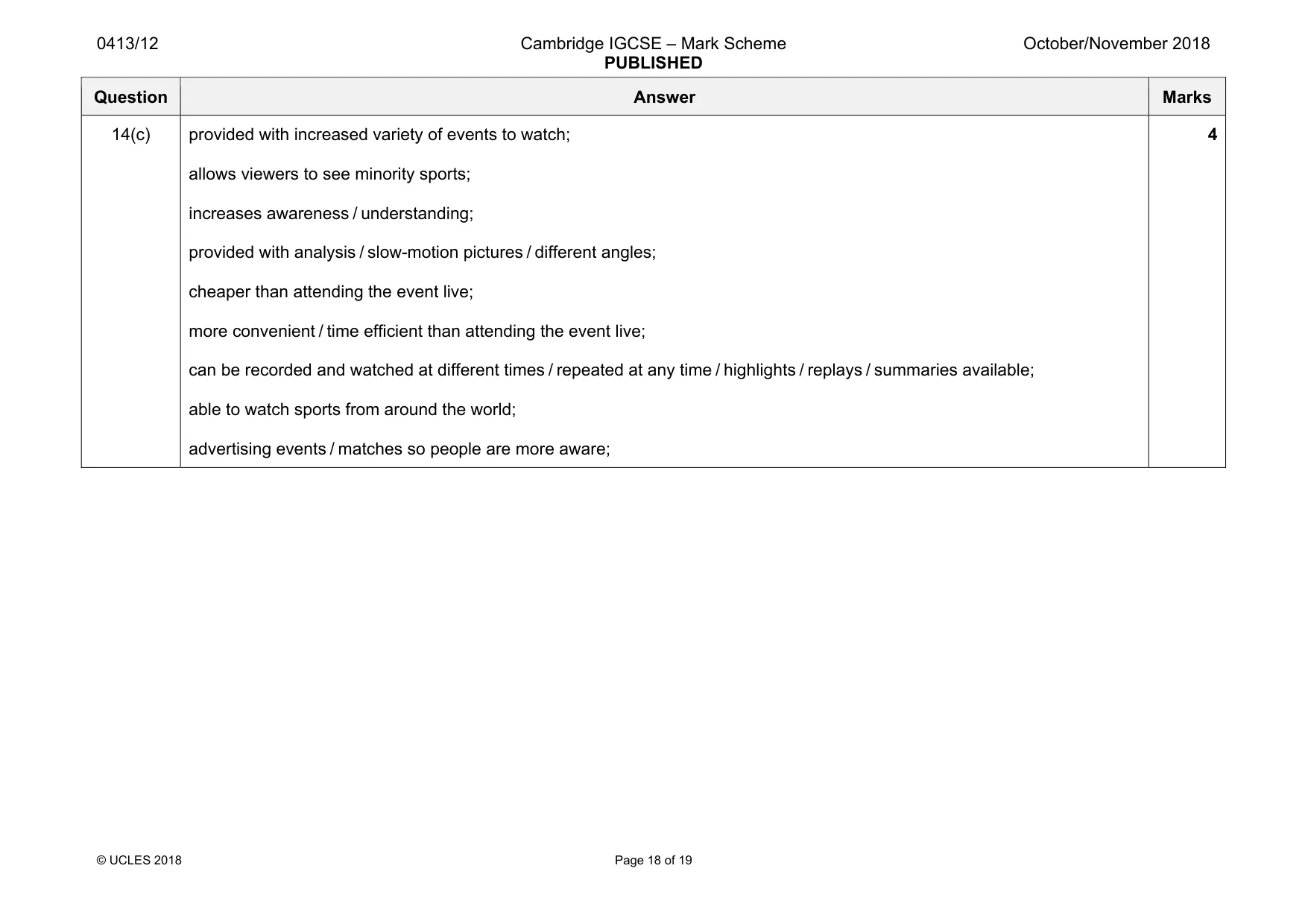
0413/12 Cambridge IGCSE – Mark Scheme PUBLISHED October/November 2018 © UCLES 2018 Page 18 of 19 Question Answer Marks 14(c) provided with increased variety of events to watch; allows viewers to see minority sports; increases awareness / understanding; provided with analysis / slow-motion pictures / different angles; cheaper than attending the event live; more convenient / time efficient than attending the event live; can be recorded and watched at different times / repeated at any time / highlights / replays / summaries available; able to watch sports from around the world; advertising events / matches so people are more aware; 4
Mark scheme, page 19
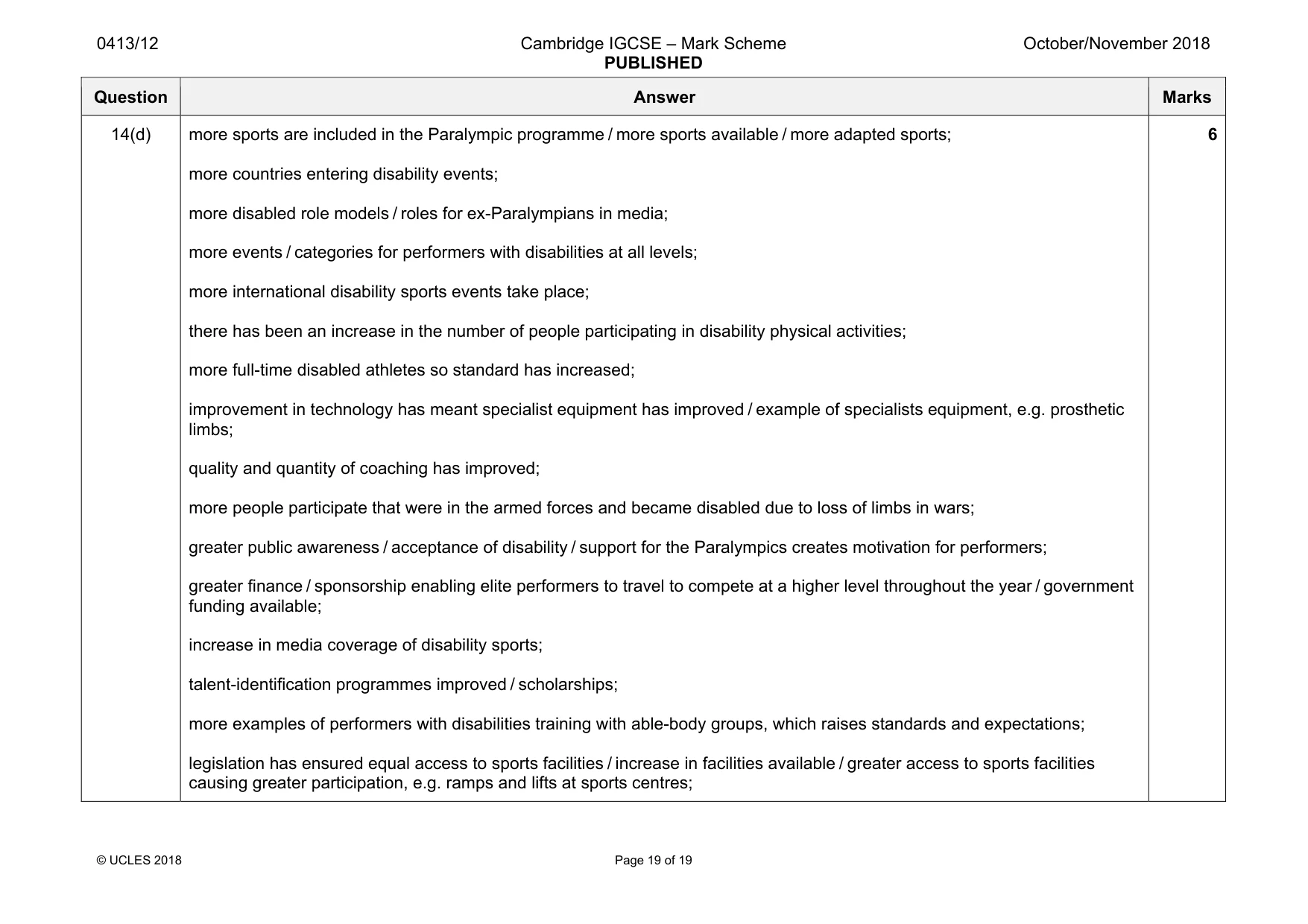
0413/12 Cambridge IGCSE – Mark Scheme PUBLISHED October/November 2018 © UCLES 2018 Page 19 of 19 Question Answer Marks 14(d) more sports are included in the Paralympic programme / more sports available / more adapted sports; more countries entering disability events; more disabled role models / roles for ex-Paralympians in media; more events / categories for performers with disabilities at all levels; more international disability sports events take place; there has been an increase in the number of people participating in disability physical activities; more full-time disabled athletes so standard has increased; improvement in technology has meant specialist equipment has improved / example of specialists equipment, e.g. prosthetic limbs; quality and quantity of coaching has improved; more people participate that were in the armed forces and became disabled due to loss of limbs in wars; greater public awareness / acceptance of disability / support for the Paralympics creates motivation for performers; greater finance / sponsorship enabling elite performers to travel to compete at a higher level throughout the year / government funding available; increase in media coverage of disability sports; talent-identification programmes improved / scholarships; more examples of performers with disabilities training with able-body groups, which raises standards and expectations; legislation has ensured equal access to sports facilities / increase in facilities available / greater access to sports facilities causing greater participation, e.g. ramps and lifts at sports centres; 6
What you needed in this session
Cambridge’s own grade thresholds for 2018 Oct/Nov, Paper 1 · Variant 2. A higher threshold means an easier paper — the bar moves with how the cohort did.