Cambridge IGCSE Physical Education 0413 — 2018 Oct/Nov Paper 1 · Variant 1
0413/11/O/N/18 · 80 marks · ≈90 min
The question paper and its mark scheme, free to read here and free to download. This is Cambridge’s own paper, exactly as it was sat.
Question paper16 pages
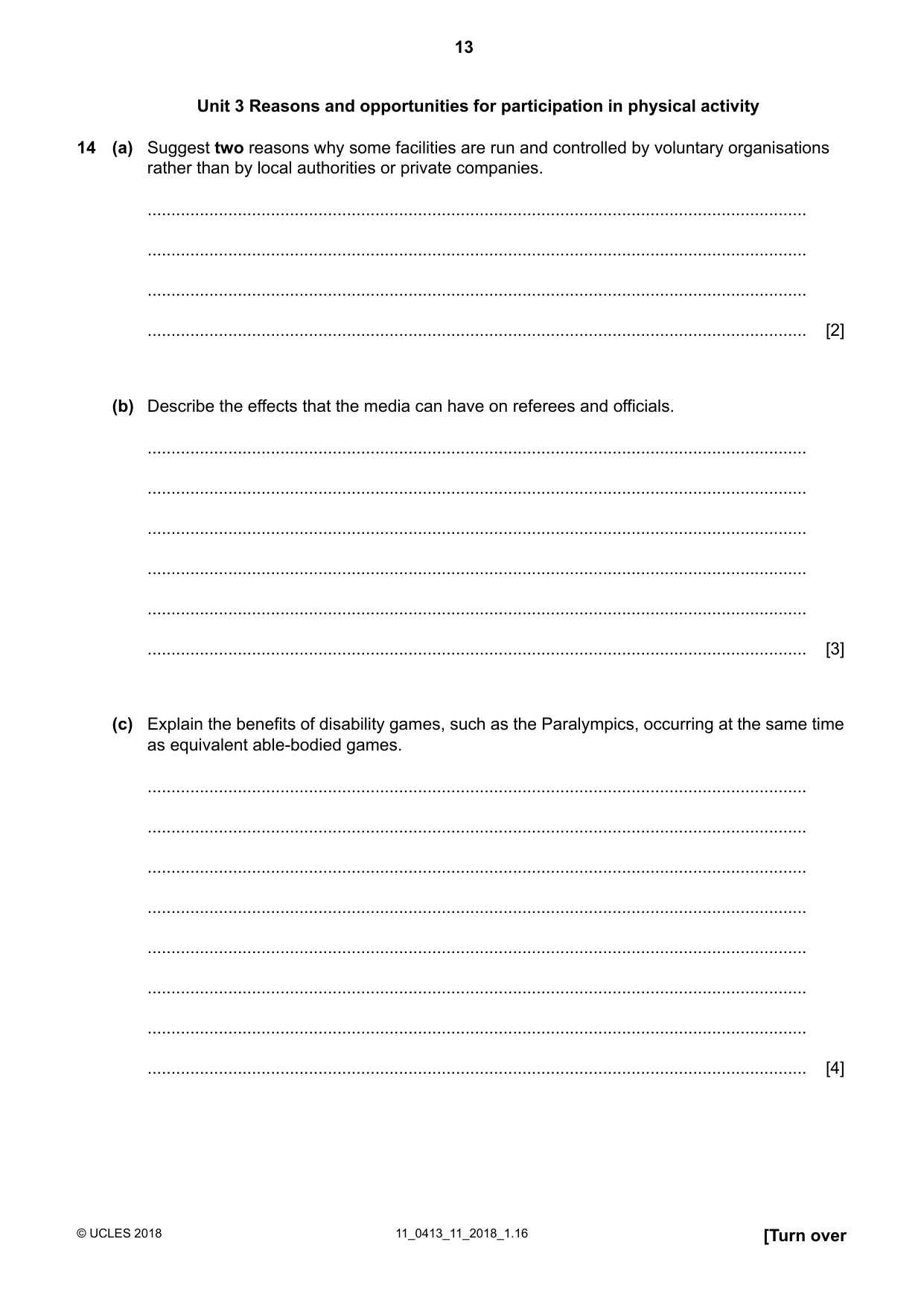
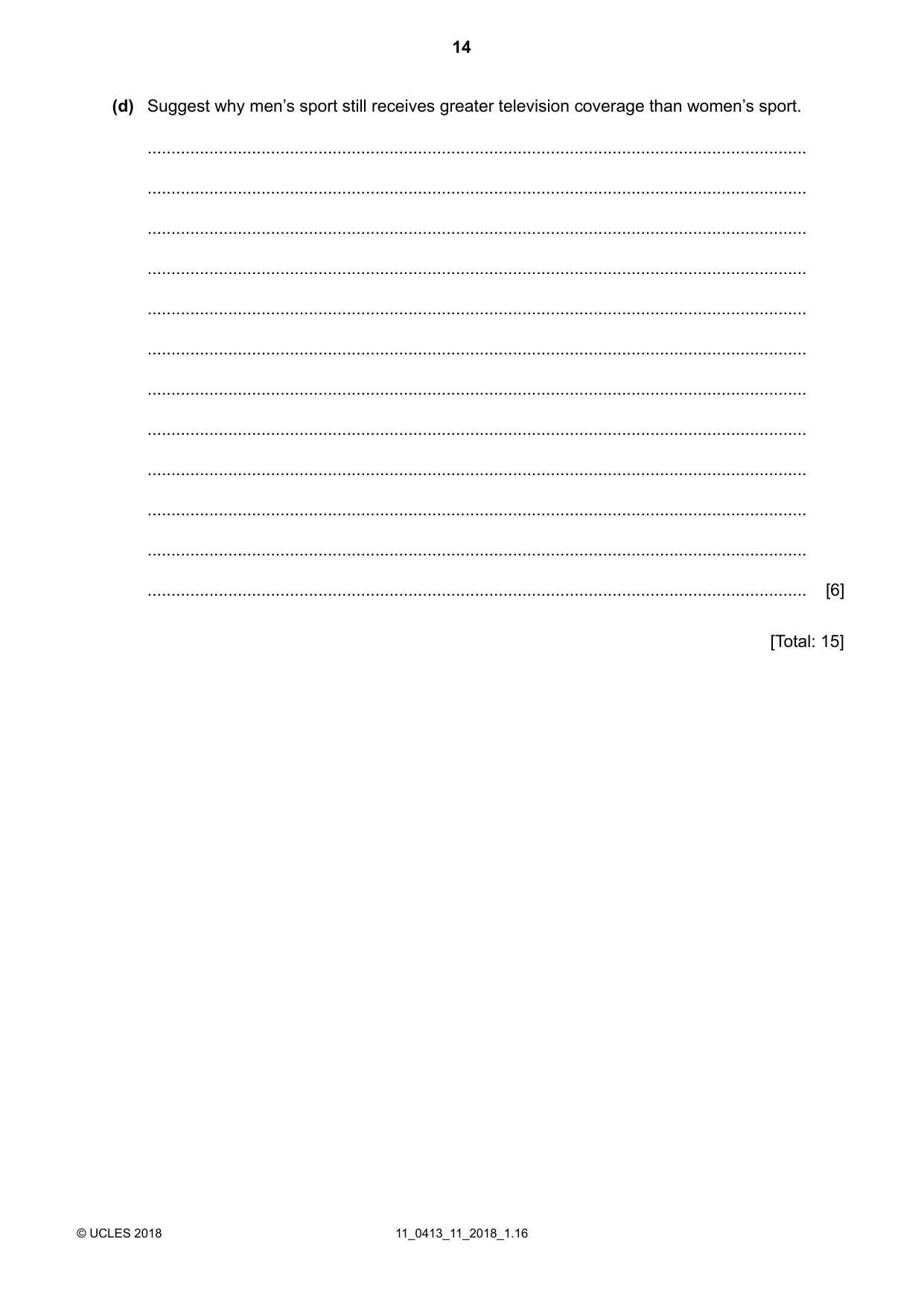


Mark scheme17 pages
Answers below. Sit the paper first if you are practising.
Paper as text
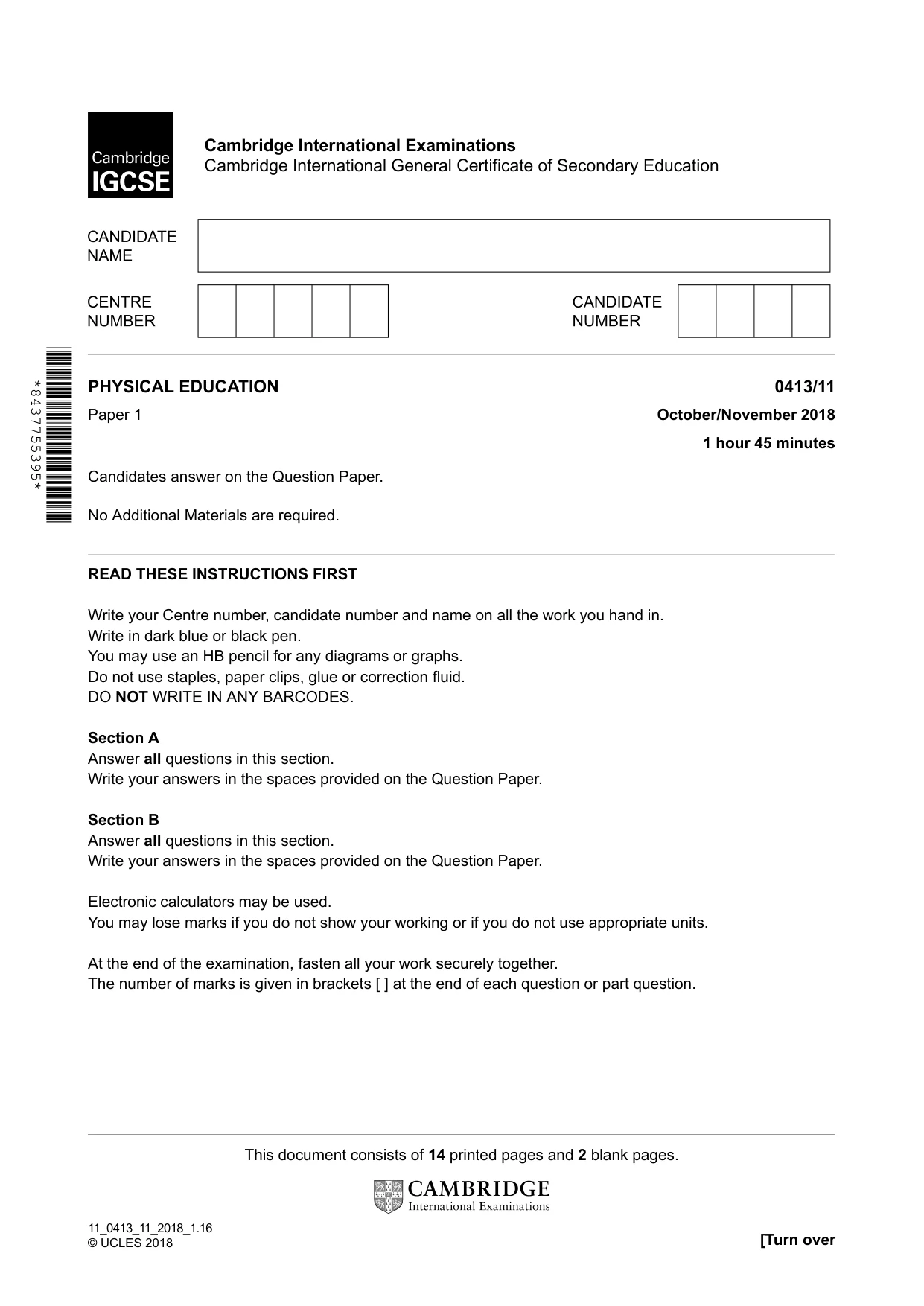
Question paper, page 1
Cambridge International Examinations Cambridge International General Certificate of Secondary Education 0413/11 PHYSICAL EDUCATION October/November 2018 Paper 1 1 hour 45 minutes Candidates answer on the Question Paper. No Additional Materials are required. READ THESE INSTRUCTIONS FIRST Write your Centre number, candidate number and name on all the work you hand in. Write in dark blue or black pen. You may use an HB pencil for any diagrams or graphs. Do not use staples, paper clips, glue or correction fluid. DO NOT WRITE IN ANY BARCODES. Section A Answer all questions in this section. Write your answers in the spaces provided on the Question Paper. Section B Answer all questions in this section. Write your answers in the spaces provided on the Question Paper. Electronic calculators may be used. You may lose marks if you do not show your working or if you do not use appropriate units. At the end of the examination, fasten all your work securely together. The number of marks is given in brackets [ ] at the end of each question or part question. This document consists of 14 printed pages and 2 blank pages. [Turn over 11_0413_11_2018_1.16 © UCLES 2018 *8437755395*
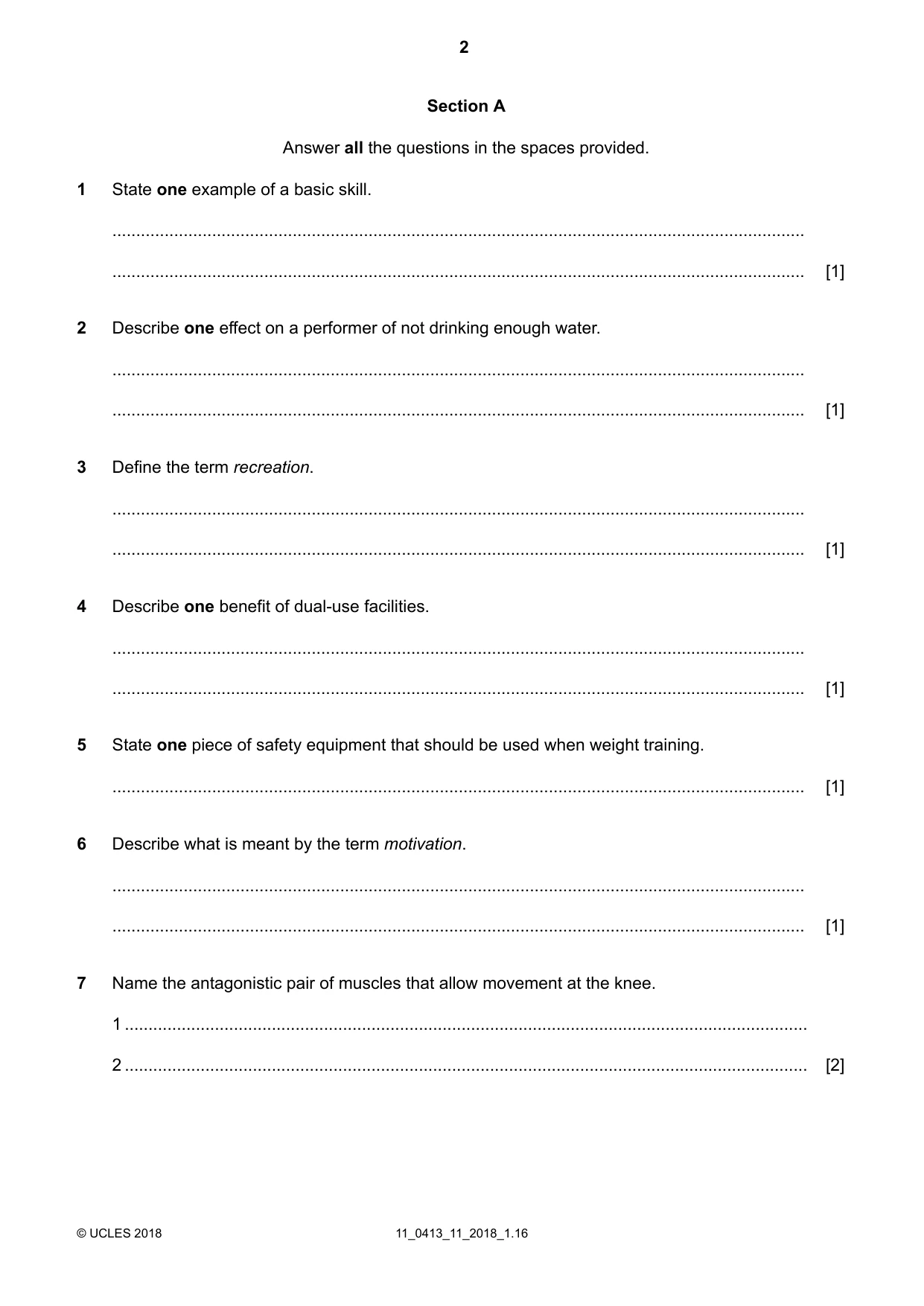
Question paper, page 2
Section A Answer all the questions in the spaces provided. State one example of a basic skill. 1 … … [1] Describe one effect on a performer of not drinking enough water. 2 … … [1] Define the term recreation. 3 … … [1] Describe one benefit of dual-use facilities. 4 … … [1] State one piece of safety equipment that should be used when weight training. 5 … [1] Describe what is meant by the term motivation. 6 … … [1] Name the antagonistic pair of muscles that allow movement at the knee. 7 1 … 2 … [2] 11_0413_11_2018_1.16 © UCLES 2018 2
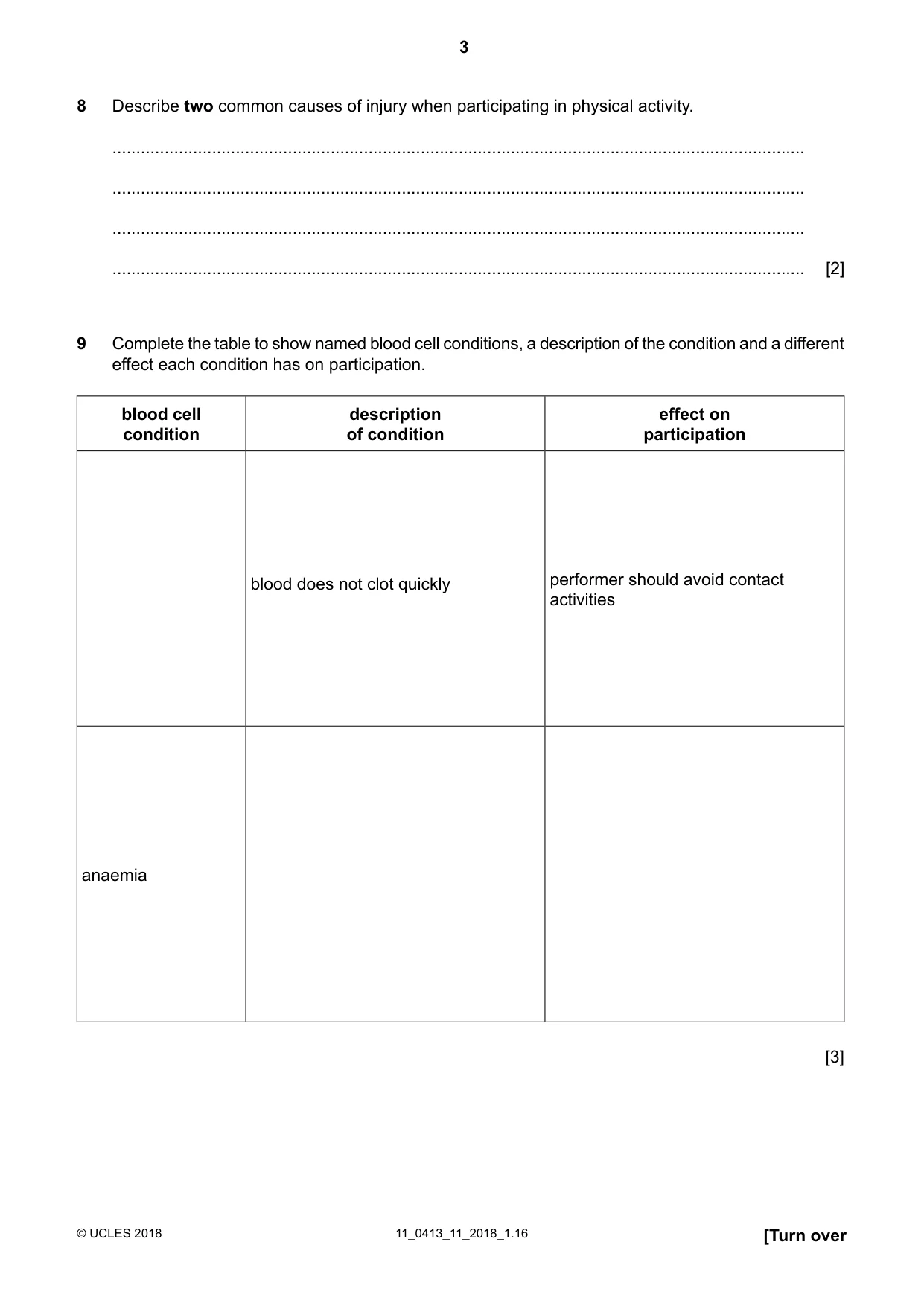
Question paper, page 3
Describe two common causes of injury when participating in physical activity. 8 … … … … [2] Complete the table to show named blood cell conditions, a description of the condition and a different effect each condition has on participation. 9 effect on participation description of condition blood cell condition performer should avoid contact activities blood does not clot quickly anaemia [3] [Turn over 11_0413_11_2018_1.16 © UCLES 2018 3
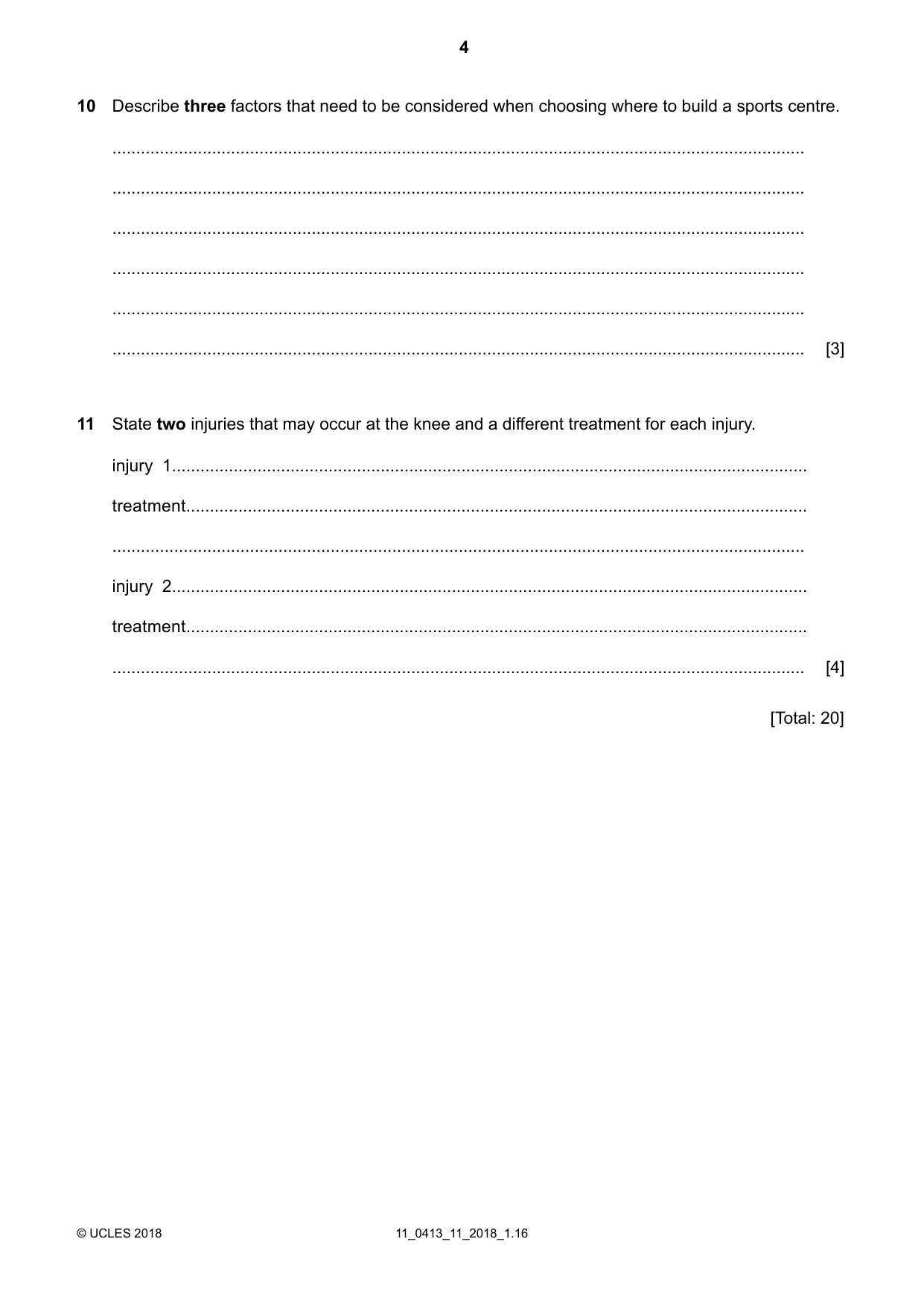
Question paper, page 4
Describe three factors that need to be considered when choosing where to build a sports centre. 10 … … … … … … [3] State two injuries that may occur at the knee and a different treatment for each injury. 11 injury 1… treatment… … injury 2… treatment… … [4] [Total: 20] 11_0413_11_2018_1.16 © UCLES 2018 4
Question paper, page 5
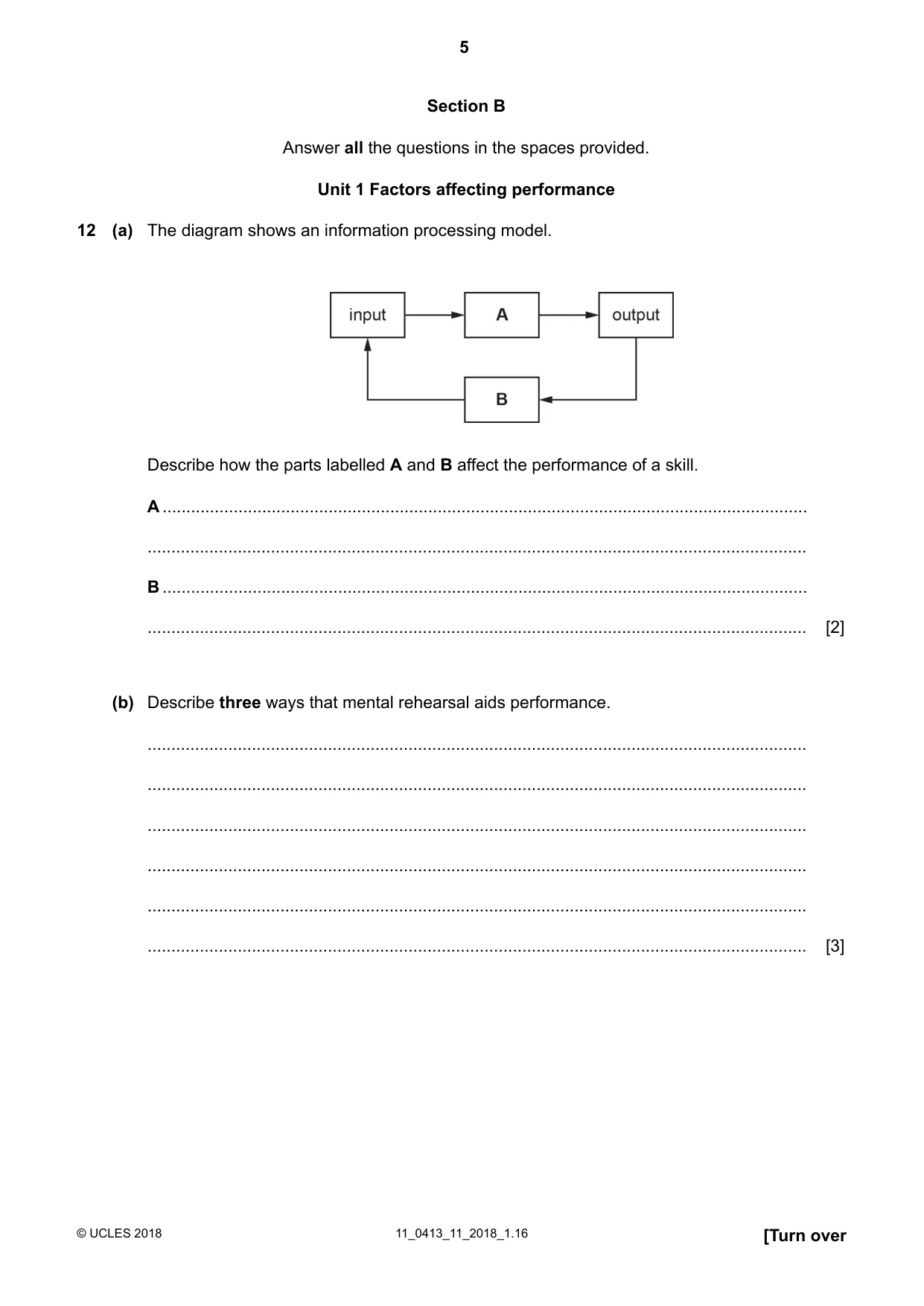
Section B Answer all the questions in the spaces provided. Unit 1 Factors affecting performance The diagram shows an information processing model. (a) 12 Describe how the parts labelled A and B affect the performance of a skill. A … … B … … [2] Describe three ways that mental rehearsal aids performance. (b) … … … … … … [3] [Turn over 11_0413_11_2018_1.16 © UCLES 2018 5
Question paper, page 6
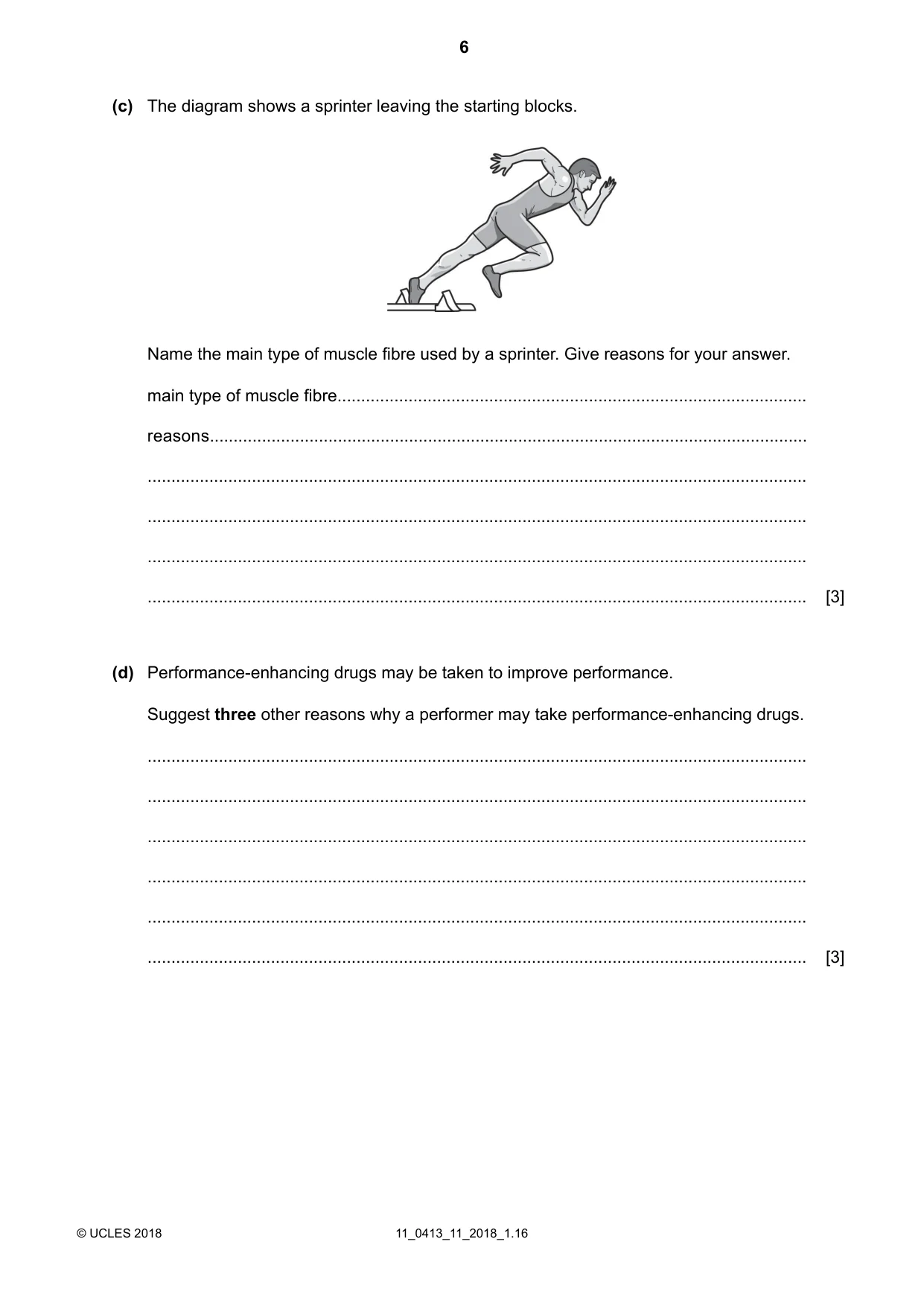
The diagram shows a sprinter leaving the starting blocks. (c) Name the main type of muscle fibre used by a sprinter. Give reasons for your answer. main type of muscle fibre… reasons… … … … … [3] Performance-enhancing drugs may be taken to improve performance. (d) Suggest three other reasons why a performer may take performance-enhancing drugs. … … … … … … [3] 11_0413_11_2018_1.16 © UCLES 2018 6
Question paper, page 7
State four of the factors that affect skill level. (e) … … … … … … … … [4] [Turn over 11_0413_11_2018_1.16 © UCLES 2018 7
Question paper, page 8
Timing is a component of skill-related fitness. (f) State what is meant by the term timing. (i) … … [1] Describe two examples from different physical activities of the effect of poor timing. (ii) physical activity 1… example of effect… … … … physical activity 2… example of effect… … … … [2] Suggest one way that a performer’s timing can be improved. (iii) … … [1] 11_0413_11_2018_1.16 © UCLES 2018 8
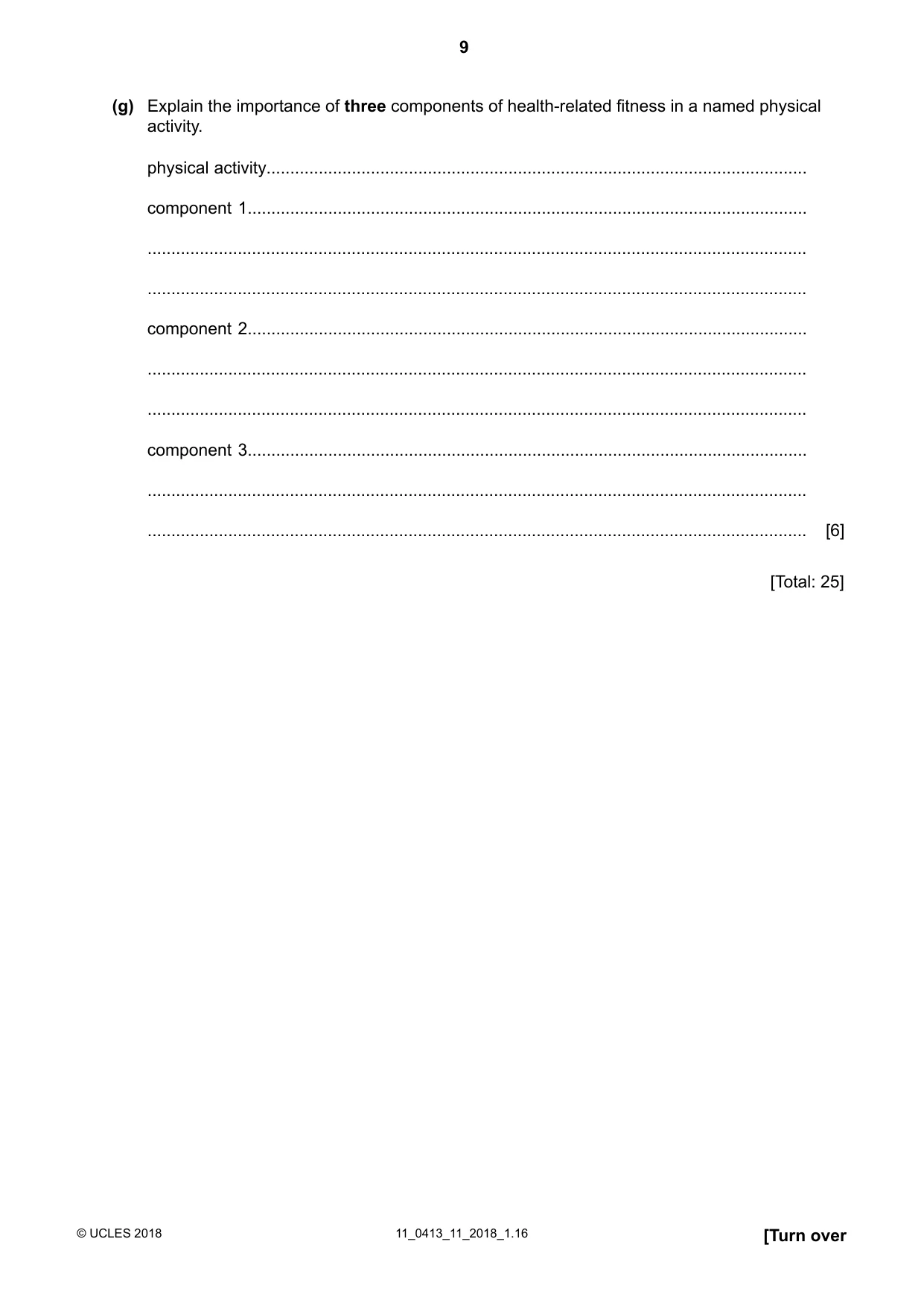
Question paper, page 9
Explain the importance of three components of health-related fitness in a named physical activity. (g) physical activity… component 1… … … component 2… … … component 3… … … [6] [Total: 25] [Turn over 11_0413_11_2018_1.16 © UCLES 2018 9
Question paper, page 10
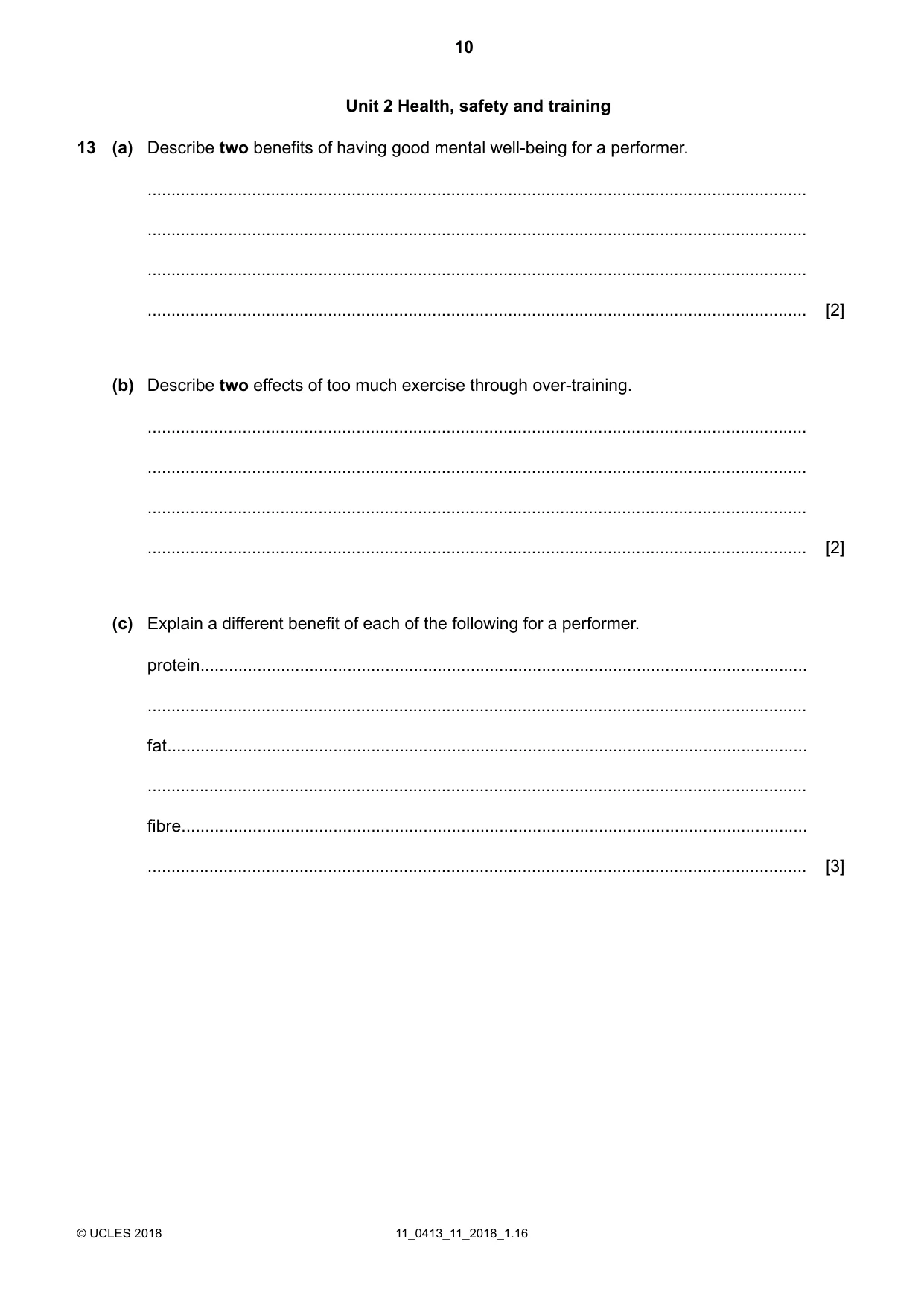
Unit 2 Health, safety and training Describe two benefits of having good mental well-being for a performer. (a) 13 … … … … [2] Describe two effects of too much exercise through over-training. (b) … … … … [2] Explain a different benefit of each of the following for a performer. (c) protein… … fat… … fibre… … [3] 11_0413_11_2018_1.16 © UCLES 2018 10
Question paper, page 11
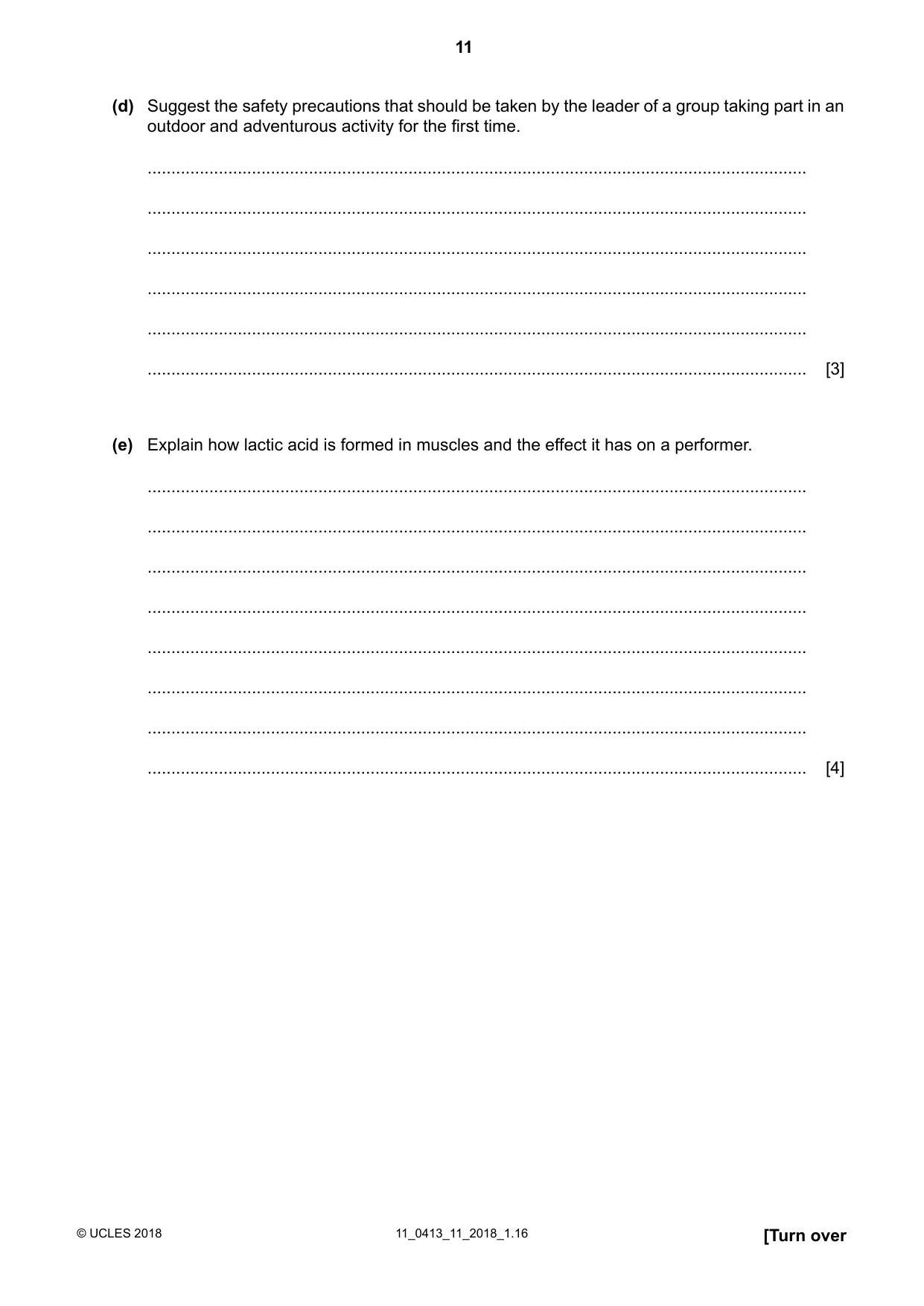
Suggest the safety precautions that should be taken by the leader of a group taking part in an outdoor and adventurous activity for the first time. (d) … … … … … … [3] Explain how lactic acid is formed in muscles and the effect it has on a performer. (e) … … … … … … … … [4] [Turn over 11_0413_11_2018_1.16 © UCLES 2018 11
Question paper, page 12
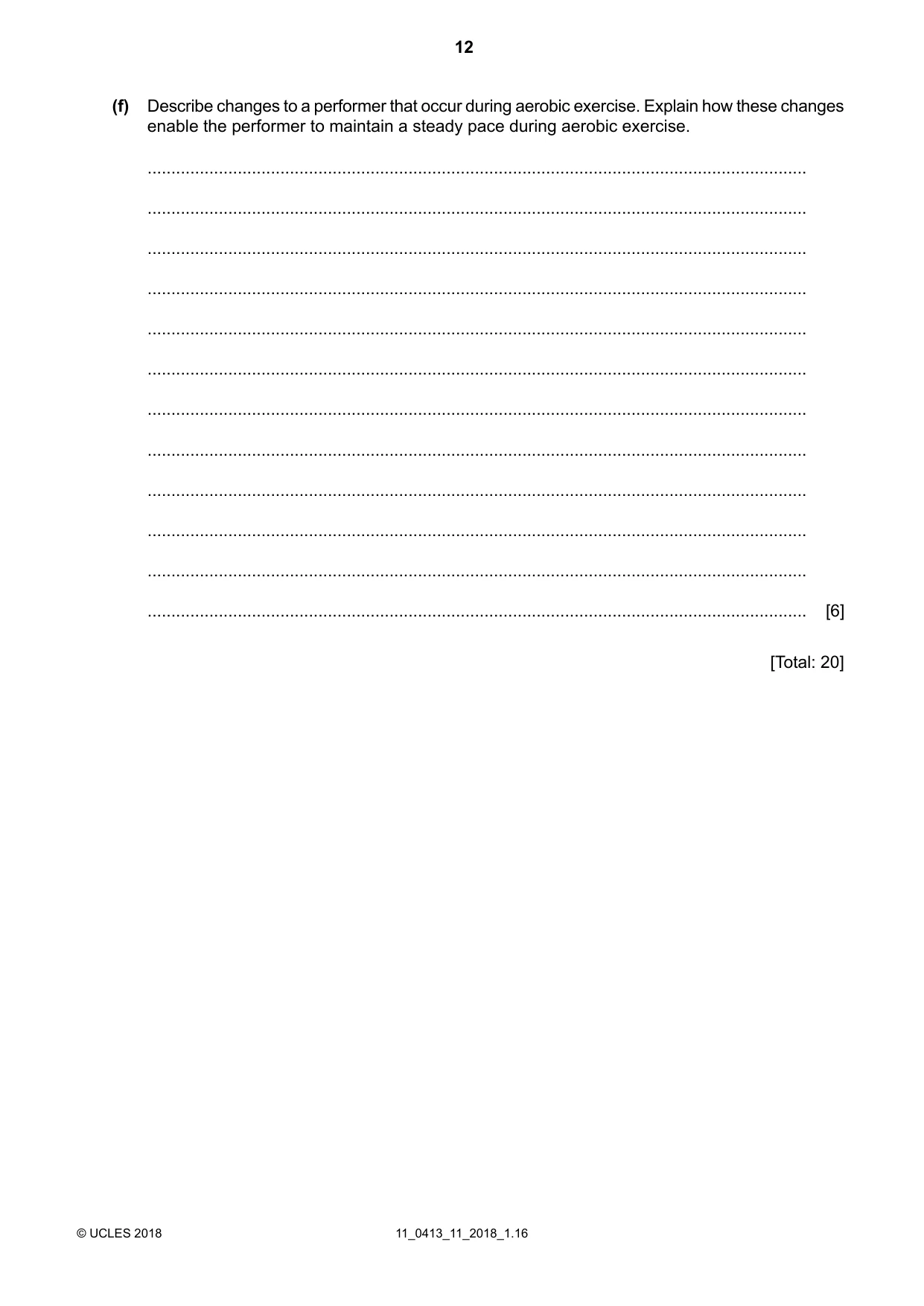
Describe changes to a performer that occur during aerobic exercise. Explain how these changes enable the performer to maintain a steady pace during aerobic exercise. (f) … … … … … … … … … … … … [6] [Total: 20] 11_0413_11_2018_1.16 © UCLES 2018 12
Question paper, page 13
Unit 3 Reasons and opportunities for participation in physical activity Suggest two reasons why some facilities are run and controlled by voluntary organisations rather than by local authorities or private companies. (a) 14 … … … … [2] Describe the effects that the media can have on referees and officials. (b) … … … … … … [3] Explain the benefits of disability games, such as the Paralympics, occurring at the same time as equivalent able-bodied games. (c) … … … … … … … … [4] [Turn over 11_0413_11_2018_1.16 © UCLES 2018 13
Question paper, page 14
Suggest why men’s sport still receives greater television coverage than women’s sport. (d) … … … … … … … … … … … … [6] [Total: 15] 11_0413_11_2018_1.16 © UCLES 2018 14
Question paper, page 15
BLANK PAGE 11_0413_11_2018_1.16 © UCLES 2018 15
Question paper, page 16
BLANK PAGE Permission to reproduce items where third-party owned material protected by copyright is included has been sought and cleared where possible. Every reasonable effort has been made by the publisher (UCLES) to trace copyright holders, but if any items requiring clearance have unwittingly been included, the publisher will be pleased to make amends at the earliest possible opportunity. To avoid the issue of disclosure of answer-related information to candidates, all copyright acknowledgements are reproduced online in the Cambridge International Examinations Copyright Acknowledgements Booklet. This is produced for each series of examinations and is freely available to download at www.cie.org.uk after the live examination series. Cambridge International Examinations is part of the Cambridge Assessment Group. Cambridge Assessment is the brand name of University of Cambridge Local Examinations Syndicate (UCLES), which is itself a department of the University of Cambridge. 11_0413_11_2018_1.16 © UCLES 2018 16
Mark scheme, page 1
This document consists of 17 printed pages. © UCLES 2018 [Turn over Cambridge Assessment International Education Cambridge International General Certificate of Secondary Education PHYSICAL EDUCATION 0413/11 Paper 1 October/November 2018 MARK SCHEME Maximum Mark: 80 Published This mark scheme is published as an aid to teachers and candidates, to indicate the requirements of the examination. It shows the basis on which Examiners were instructed to award marks. It does not indicate the details of the discussions that took place at an Examiners’ meeting before marking began, which would have considered the acceptability of alternative answers. Mark schemes should be read in conjunction with the question paper and the Principal Examiner Report for Teachers. Cambridge International will not enter into discussions about these mark schemes. Cambridge International is publishing the mark schemes for the October/November 2018 series for most Cambridge IGCSE™, Cambridge International A and AS Level components and some Cambridge O Level components.
Mark scheme, page 2
0413/11 Cambridge IGCSE – Mark Scheme PUBLISHED October/November 2018 © UCLES 2018 Page 2 of 17 Generic Marking Principles These general marking principles must be applied by all examiners when marking candidate answers. They should be applied alongside the specific content of the mark scheme or generic level descriptors for a question. Each question paper and mark scheme will also comply with these marking principles. GENERIC MARKING PRINCIPLE 1: Marks must be awarded in line with: • the specific content of the mark scheme or the generic level descriptors for the question • the specific skills defined in the mark scheme or in the generic level descriptors for the question • the standard of response required by a candidate as exemplified by the standardisation scripts. GENERIC MARKING PRINCIPLE 2: Marks awarded are always whole marks (not half marks, or other fractions). GENERIC MARKING PRINCIPLE 3: Marks must be awarded positively: • marks are awarded for correct/valid answers, as defined in the mark scheme. However, credit is given for valid answers which go beyond the scope of the syllabus and mark scheme, referring to your Team Leader as appropriate • marks are awarded when candidates clearly demonstrate what they know and can do • marks are not deducted for errors • marks are not deducted for omissions • answers should only be judged on the quality of spelling, punctuation and grammar when these features are specifically assessed by the question as indicated by the mark scheme. The meaning, however, should be unambiguous. GENERIC MARKING PRINCIPLE 4: Rules must be applied consistently e.g. in situations where candidates have not followed instructions or in the application of generic level descriptors.
Mark scheme, page 3
0413/11 Cambridge IGCSE – Mark Scheme PUBLISHED October/November 2018 © UCLES 2018 Page 3 of 17 GENERIC MARKING PRINCIPLE 5: Marks should be awarded using the full range of marks defined in the mark scheme for the question (however; the use of the full mark range may be limited according to the quality of the candidate responses seen). GENERIC MARKING PRINCIPLE 6: Marks awarded are based solely on the requirements as defined in the mark scheme. Marks should not be awarded with grade thresholds or grade descriptors in mind.
Mark scheme, page 4
0413/11 Cambridge IGCSE – Mark Scheme PUBLISHED October/November 2018 © UCLES 2018 Page 4 of 17 Question Answer Marks 1 running / walking / jumping / skipping / throwing / catching / hitting a ball; Accept relevant examples. 1 Question Answer Marks 2 weakness / dizziness / unable to carry on / muscle cramp / increased thirst / palpitations / confusion / fainting / thicker blood / dehydration / headache; 1 Question Answer Marks 3 any voluntary activity a person might do during leisure time; Responses must describe at least one of the bold parts of the statement. Accept alternative wording, e.g. leisure activity / hobby. 1 Question Answer Marks 4 increased participation / more and better facilities available / schools have a wider range of facilities available / more groups can use facilities / enables greater development of facilities / reduces the costs for community and schools / schools can have access to a wider curriculum / easy access to external clubs for students / easy to access for the community; 1 Question Answer Marks 5 back support belts / chalk / joint straps and support / lifting hooks / stands of weights / good fitting clothes that do not restrict movement / appropriate footwear with solid sole / gloves; 1
Mark scheme, page 5
0413/11 Cambridge IGCSE – Mark Scheme PUBLISHED October/November 2018 © UCLES 2018 Page 5 of 17 Question Answer Marks 6 a drive / influence that causes someone to do something / the act or process of giving someone a reason for doing something / the desire to be successful / determines how much effort a person makes; Accept alternative wording. 1 Question Answer Marks 7 hamstring(s); quadricep(s); 2 Question Answer Marks 8 impact with the ground / hard surface; impact with another person; impact with object / sharp object; overstretching; sudden / twisting movement; friction / rubbing of footwear / clothing; inadequate clothing / body protection; environment (hot or cold, wet or dry); not following instructions / not following rules / incorrect / inappropriate technique; 2 Question Answer Marks 9 haemophilia; iron deficiency / decrease in red blood cells; lack of energy / unable to sustain a high level of performance / tires more quickly; 3
Mark scheme, page 6
0413/11 Cambridge IGCSE – Mark Scheme PUBLISHED October/November 2018 © UCLES 2018 Page 6 of 17 Question Answer Marks 10 availability of land / suitability of land; cost of land / budget available; being close to / within a community / population levels / access; position of other similar facilities; needs of the community / interest in participation; transport links / public transport available / road network; relationship to natural resources / appropriate environment / climate; Accept other relevant factors. 3
Mark scheme, page 7
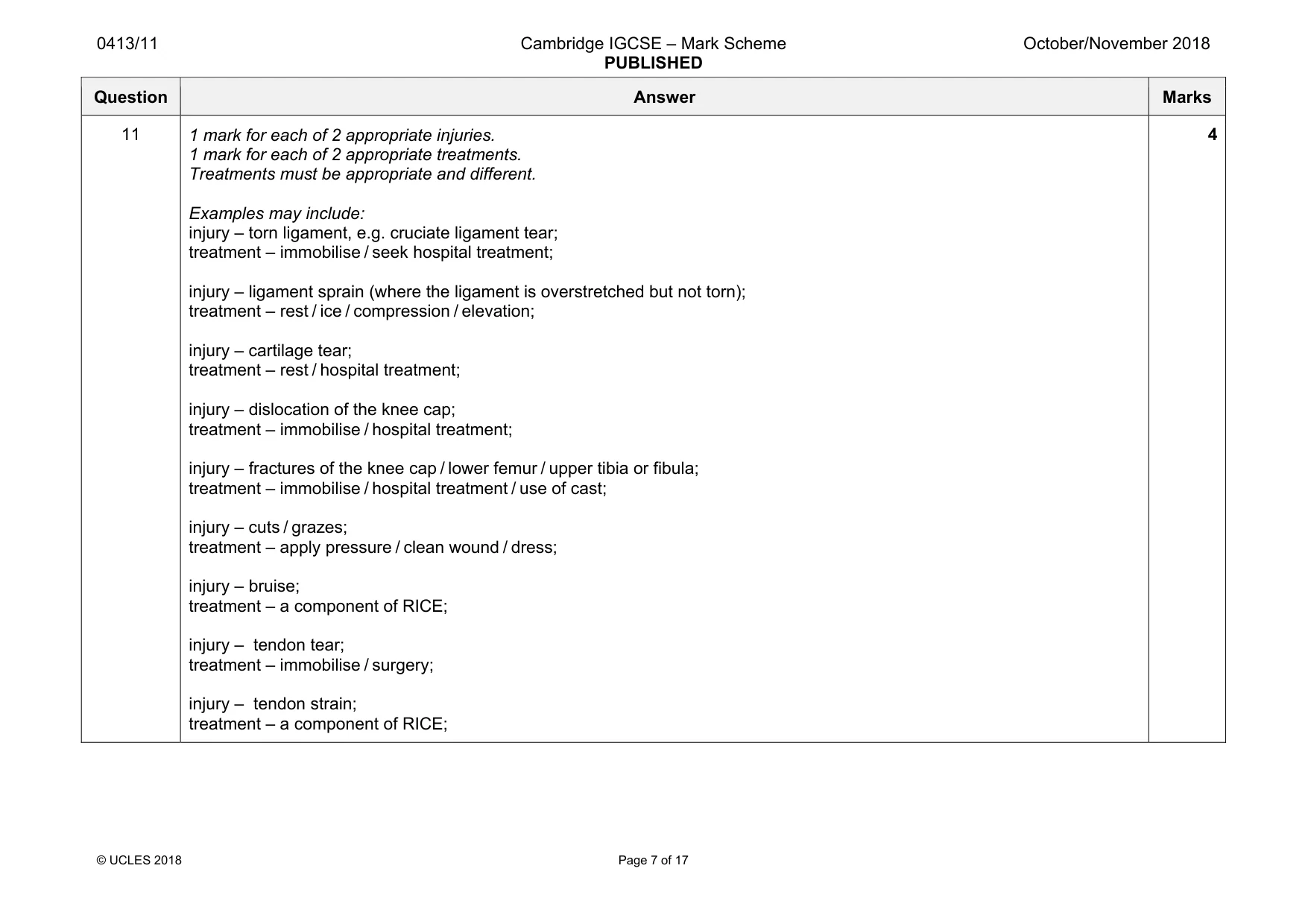
0413/11 Cambridge IGCSE – Mark Scheme PUBLISHED October/November 2018 © UCLES 2018 Page 7 of 17 Question Answer Marks 11 1 mark for each of 2 appropriate injuries. 1 mark for each of 2 appropriate treatments. Treatments must be appropriate and different. Examples may include: injury – torn ligament, e.g. cruciate ligament tear; treatment – immobilise / seek hospital treatment; injury – ligament sprain (where the ligament is overstretched but not torn); treatment – rest / ice / compression / elevation; injury – cartilage tear; treatment – rest / hospital treatment; injury – dislocation of the knee cap; treatment – immobilise / hospital treatment; injury – fractures of the knee cap / lower femur / upper tibia or fibula; treatment – immobilise / hospital treatment / use of cast; injury – cuts / grazes; treatment – apply pressure / clean wound / dress; injury – bruise; treatment – a component of RICE; injury – tendon tear; treatment – immobilise / surgery; injury – tendon strain; treatment – a component of RICE; 4
Mark scheme, page 8
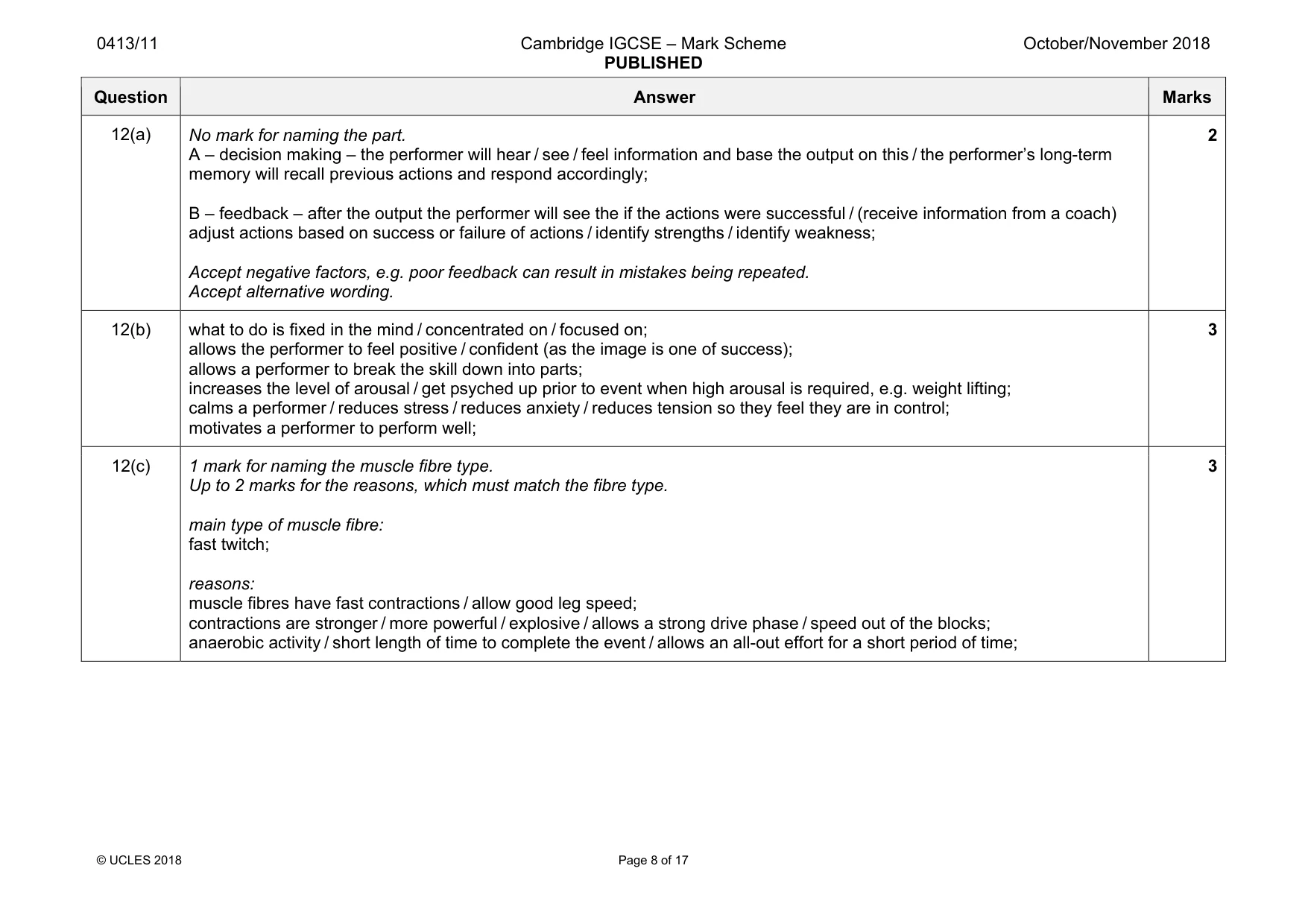
0413/11 Cambridge IGCSE – Mark Scheme PUBLISHED October/November 2018 © UCLES 2018 Page 8 of 17 Question Answer Marks 12(a) No mark for naming the part. A – decision making – the performer will hear / see / feel information and base the output on this / the performer’s long-term memory will recall previous actions and respond accordingly; B – feedback – after the output the performer will see the if the actions were successful / (receive information from a coach) adjust actions based on success or failure of actions / identify strengths / identify weakness; Accept negative factors, e.g. poor feedback can result in mistakes being repeated. Accept alternative wording. 2 12(b) what to do is fixed in the mind / concentrated on / focused on; allows the performer to feel positive / confident (as the image is one of success); allows a performer to break the skill down into parts; increases the level of arousal / get psyched up prior to event when high arousal is required, e.g. weight lifting; calms a performer / reduces stress / reduces anxiety / reduces tension so they feel they are in control; motivates a performer to perform well; 3 12(c) 1 mark for naming the muscle fibre type. Up to 2 marks for the reasons, which must match the fibre type. main type of muscle fibre: fast twitch; reasons: muscle fibres have fast contractions / allow good leg speed; contractions are stronger / more powerful / explosive / allows a strong drive phase / speed out of the blocks; anaerobic activity / short length of time to complete the event / allows an all-out effort for a short period of time; 3
Mark scheme, page 9
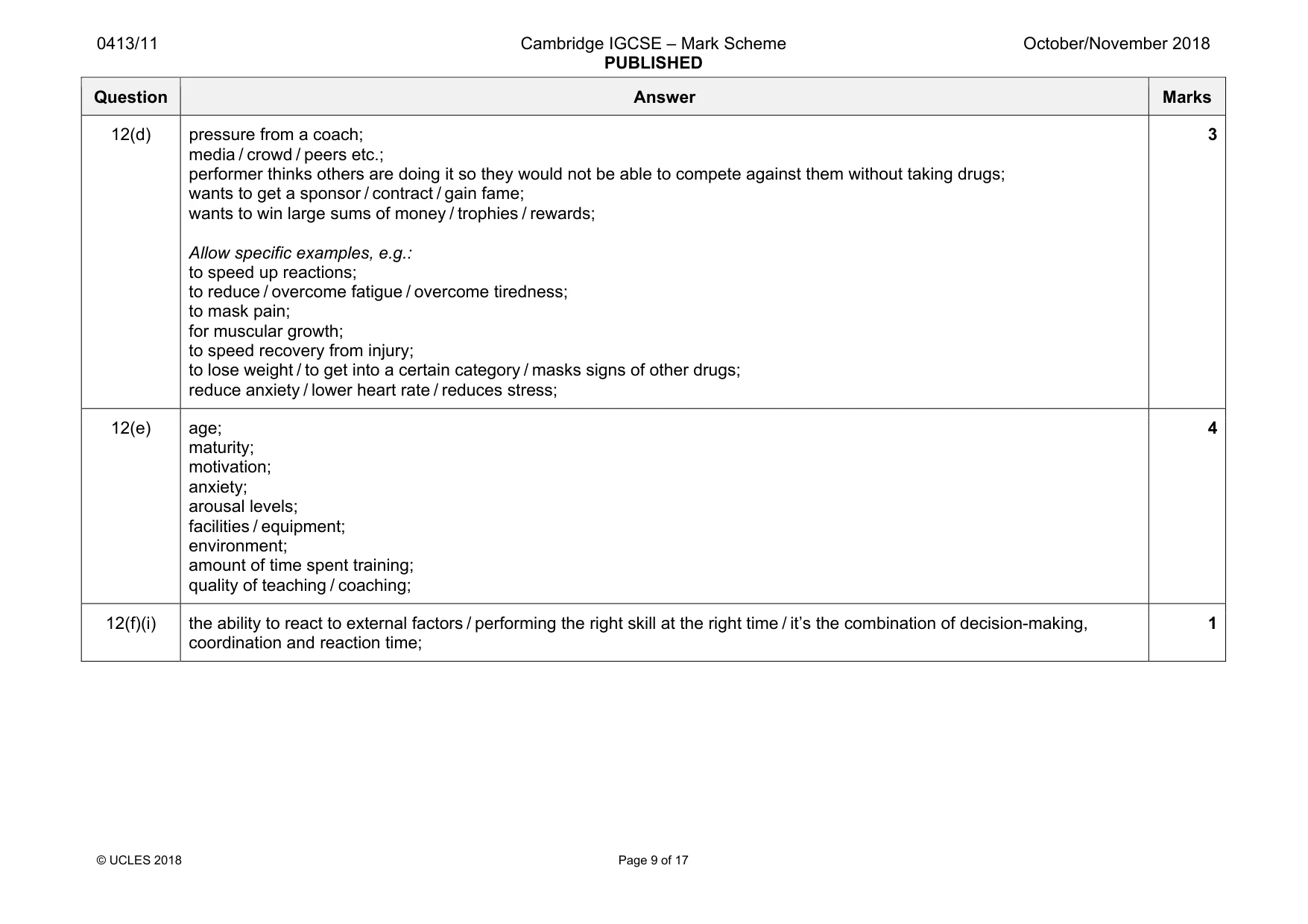
0413/11 Cambridge IGCSE – Mark Scheme PUBLISHED October/November 2018 © UCLES 2018 Page 9 of 17 Question Answer Marks 12(d) pressure from a coach; media / crowd / peers etc.; performer thinks others are doing it so they would not be able to compete against them without taking drugs; wants to get a sponsor / contract / gain fame; wants to win large sums of money / trophies / rewards; Allow specific examples, e.g.: to speed up reactions; to reduce / overcome fatigue / overcome tiredness; to mask pain; for muscular growth; to speed recovery from injury; to lose weight / to get into a certain category / masks signs of other drugs; reduce anxiety / lower heart rate / reduces stress; 3 12(e) age; maturity; motivation; anxiety; arousal levels; facilities / equipment; environment; amount of time spent training; quality of teaching / coaching; 4 12(f)(i) the ability to react to external factors / performing the right skill at the right time / it’s the combination of decision-making, coordination and reaction time; 1
Mark scheme, page 10
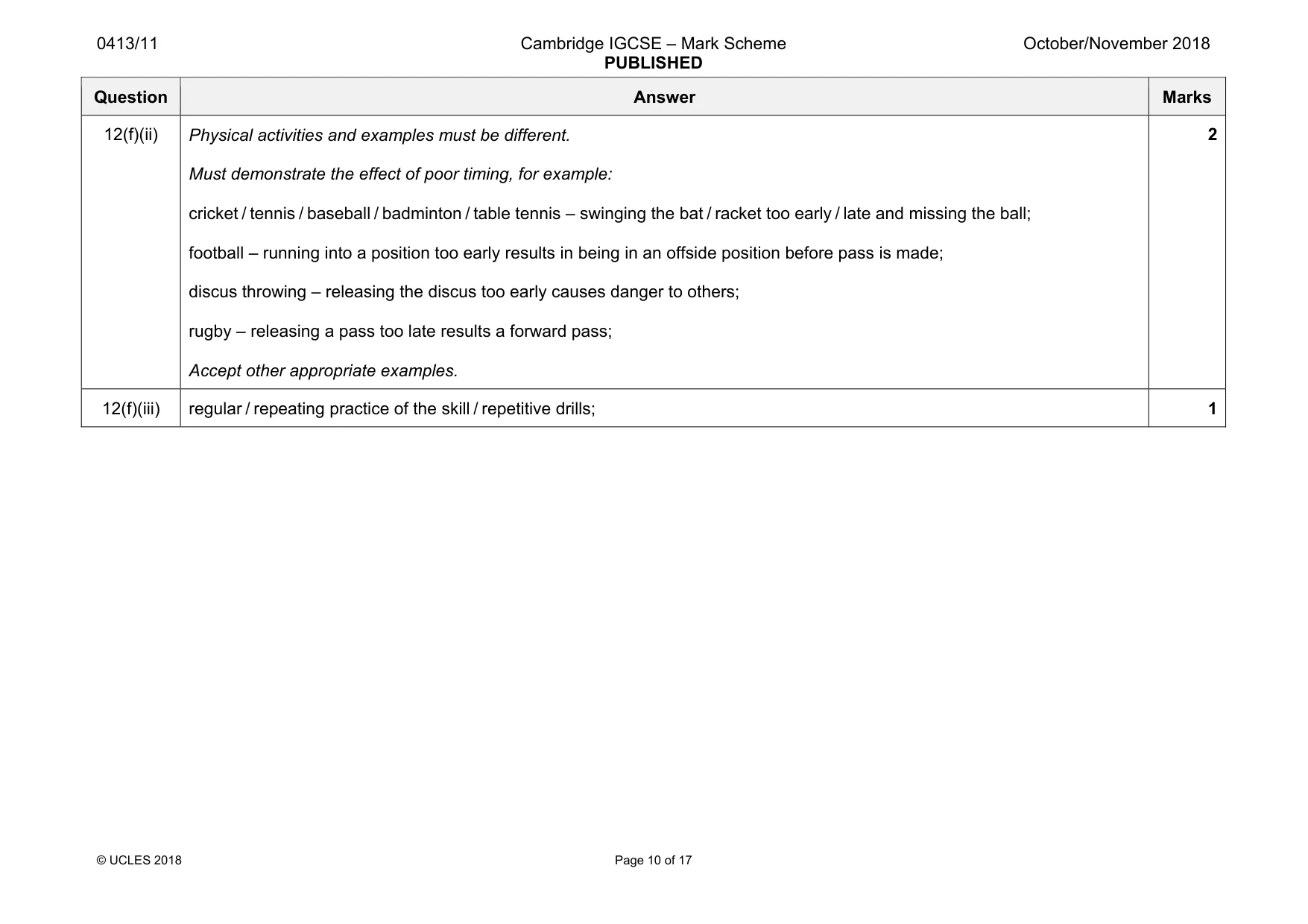
0413/11 Cambridge IGCSE – Mark Scheme PUBLISHED October/November 2018 © UCLES 2018 Page 10 of 17 Question Answer Marks 12(f)(ii) Physical activities and examples must be different. Must demonstrate the effect of poor timing, for example: cricket / tennis / baseball / badminton / table tennis – swinging the bat / racket too early / late and missing the ball; football – running into a position too early results in being in an offside position before pass is made; discus throwing – releasing the discus too early causes danger to others; rugby – releasing a pass too late results a forward pass; Accept other appropriate examples. 2 12(f)(iii) regular / repeating practice of the skill / repetitive drills; 1
Mark scheme, page 11
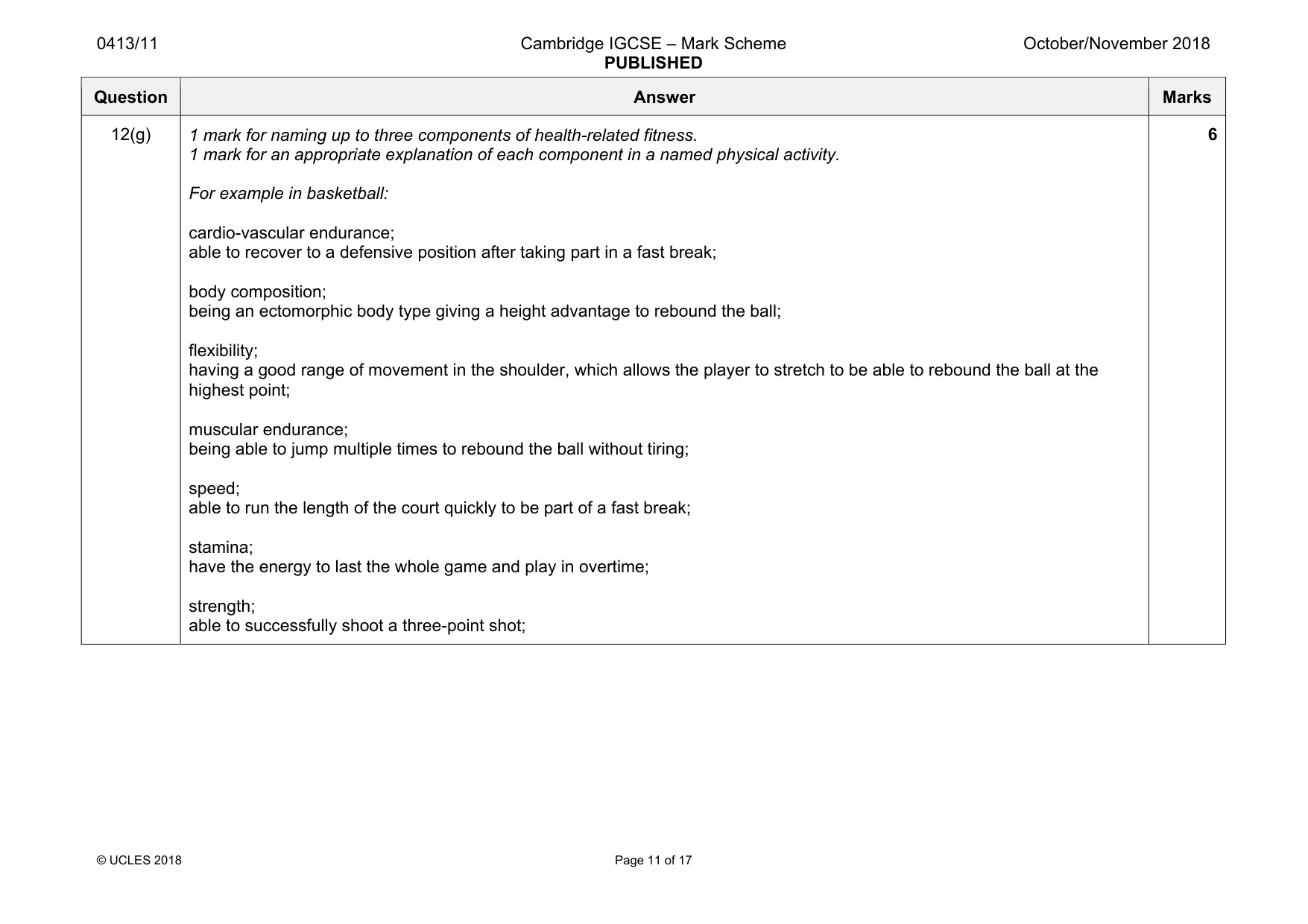
0413/11 Cambridge IGCSE – Mark Scheme PUBLISHED October/November 2018 © UCLES 2018 Page 11 of 17 Question Answer Marks 12(g) 1 mark for naming up to three components of health-related fitness. 1 mark for an appropriate explanation of each component in a named physical activity. For example in basketball: cardio-vascular endurance; able to recover to a defensive position after taking part in a fast break; body composition; being an ectomorphic body type giving a height advantage to rebound the ball; flexibility; having a good range of movement in the shoulder, which allows the player to stretch to be able to rebound the ball at the highest point; muscular endurance; being able to jump multiple times to rebound the ball without tiring; speed; able to run the length of the court quickly to be part of a fast break; stamina; have the energy to last the whole game and play in overtime; strength; able to successfully shoot a three-point shot; 6
Mark scheme, page 12
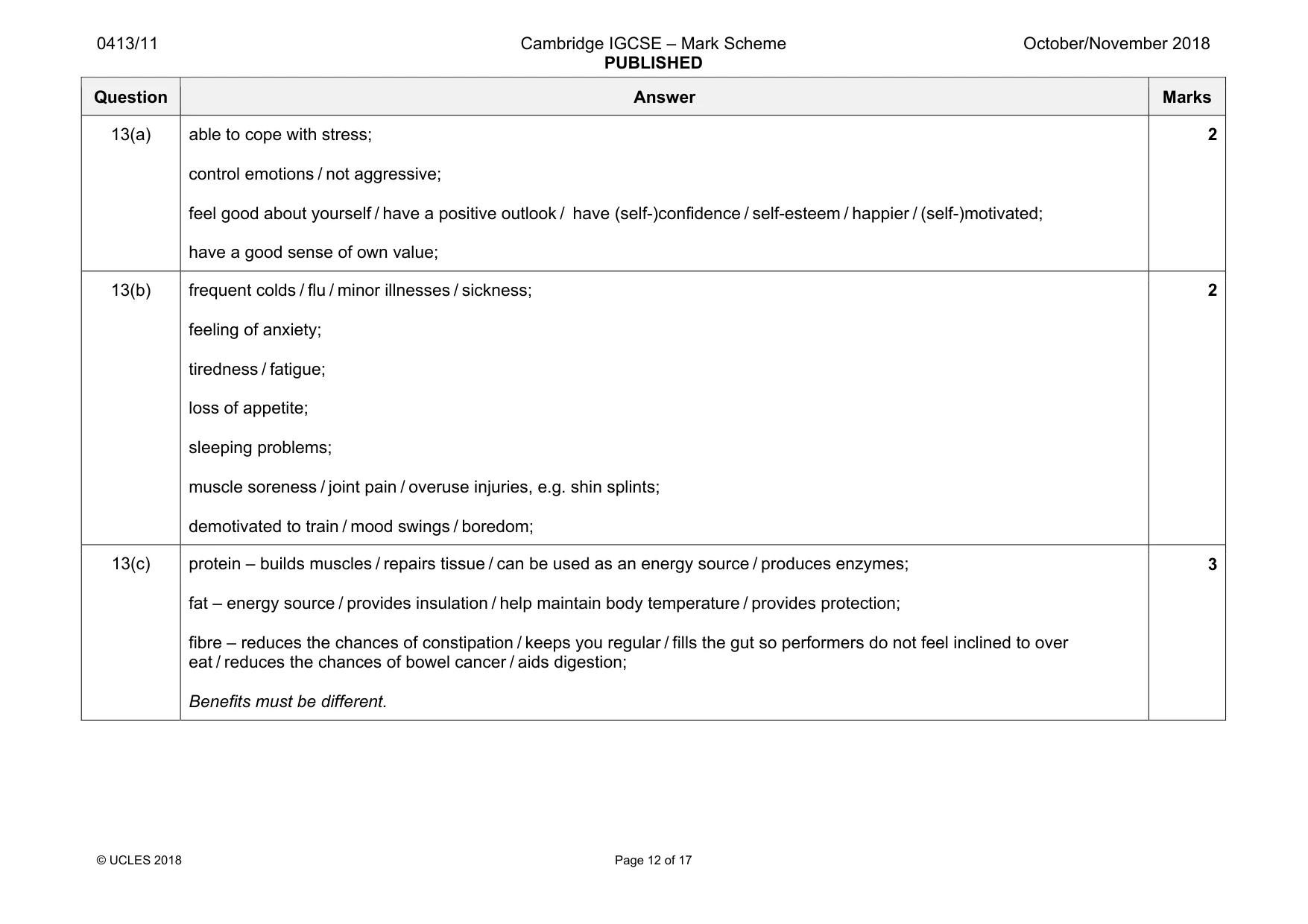
0413/11 Cambridge IGCSE – Mark Scheme PUBLISHED October/November 2018 © UCLES 2018 Page 12 of 17 Question Answer Marks 13(a) able to cope with stress; control emotions / not aggressive; feel good about yourself / have a positive outlook / have (self-)confidence / self-esteem / happier / (self-)motivated; have a good sense of own value; 2 13(b) frequent colds / flu / minor illnesses / sickness; feeling of anxiety; tiredness / fatigue; loss of appetite; sleeping problems; muscle soreness / joint pain / overuse injuries, e.g. shin splints; demotivated to train / mood swings / boredom; 2 13(c) protein – builds muscles / repairs tissue / can be used as an energy source / produces enzymes; fat – energy source / provides insulation / help maintain body temperature / provides protection; fibre – reduces the chances of constipation / keeps you regular / fills the gut so performers do not feel inclined to over eat / reduces the chances of bowel cancer / aids digestion; Benefits must be different. 3
Mark scheme, page 13
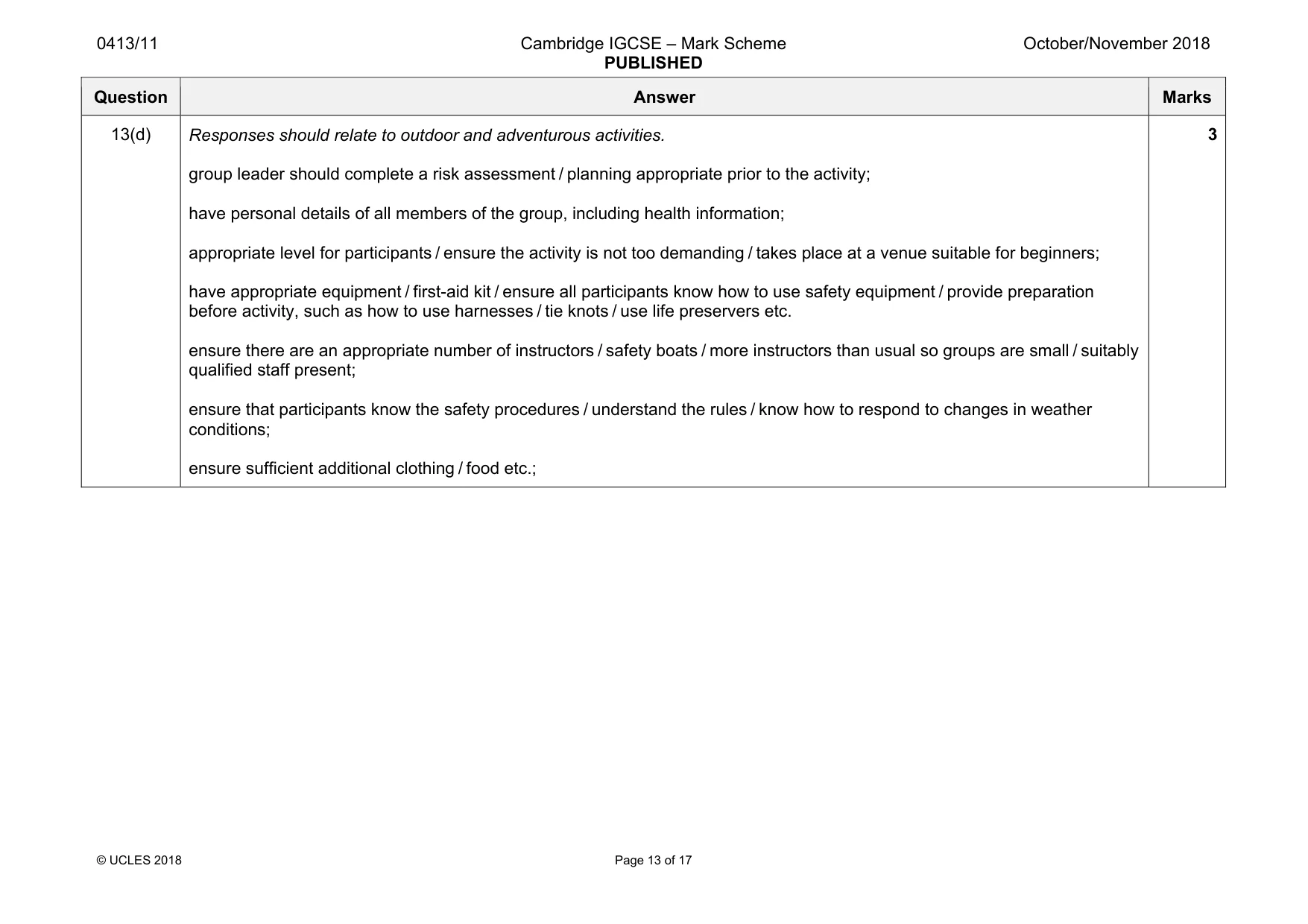
0413/11 Cambridge IGCSE – Mark Scheme PUBLISHED October/November 2018 © UCLES 2018 Page 13 of 17 Question Answer Marks 13(d) Responses should relate to outdoor and adventurous activities. group leader should complete a risk assessment / planning appropriate prior to the activity; have personal details of all members of the group, including health information; appropriate level for participants / ensure the activity is not too demanding / takes place at a venue suitable for beginners; have appropriate equipment / first-aid kit / ensure all participants know how to use safety equipment / provide preparation before activity, such as how to use harnesses / tie knots / use life preservers etc. ensure there are an appropriate number of instructors / safety boats / more instructors than usual so groups are small / suitably qualified staff present; ensure that participants know the safety procedures / understand the rules / know how to respond to changes in weather conditions; ensure sufficient additional clothing / food etc.; 3
Mark scheme, page 14
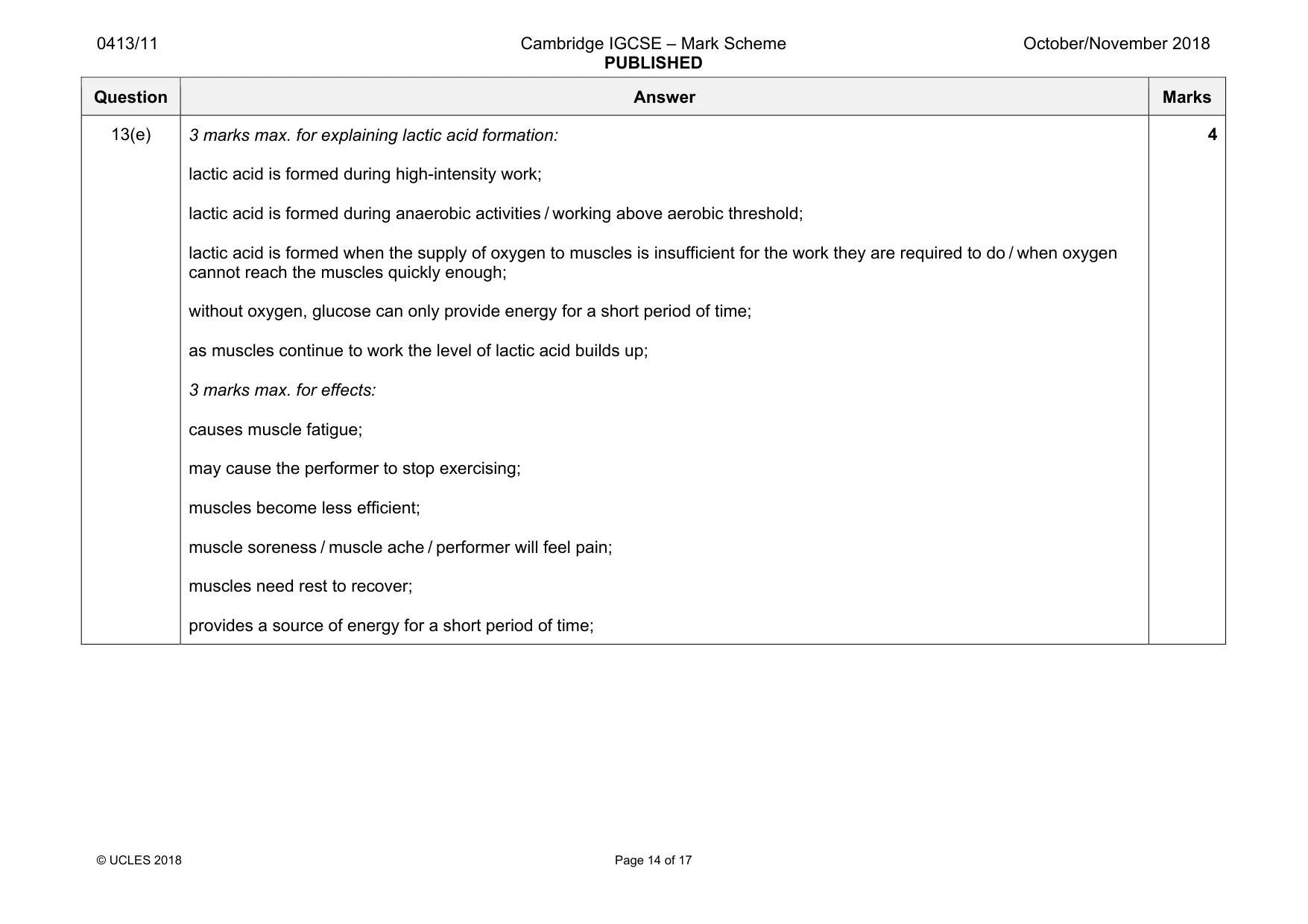
0413/11 Cambridge IGCSE – Mark Scheme PUBLISHED October/November 2018 © UCLES 2018 Page 14 of 17 Question Answer Marks 13(e) 3 marks max. for explaining lactic acid formation: lactic acid is formed during high-intensity work; lactic acid is formed during anaerobic activities / working above aerobic threshold; lactic acid is formed when the supply of oxygen to muscles is insufficient for the work they are required to do / when oxygen cannot reach the muscles quickly enough; without oxygen, glucose can only provide energy for a short period of time; as muscles continue to work the level of lactic acid builds up; 3 marks max. for effects: causes muscle fatigue; may cause the performer to stop exercising; muscles become less efficient; muscle soreness / muscle ache / performer will feel pain; muscles need rest to recover; provides a source of energy for a short period of time; 4
Mark scheme, page 15
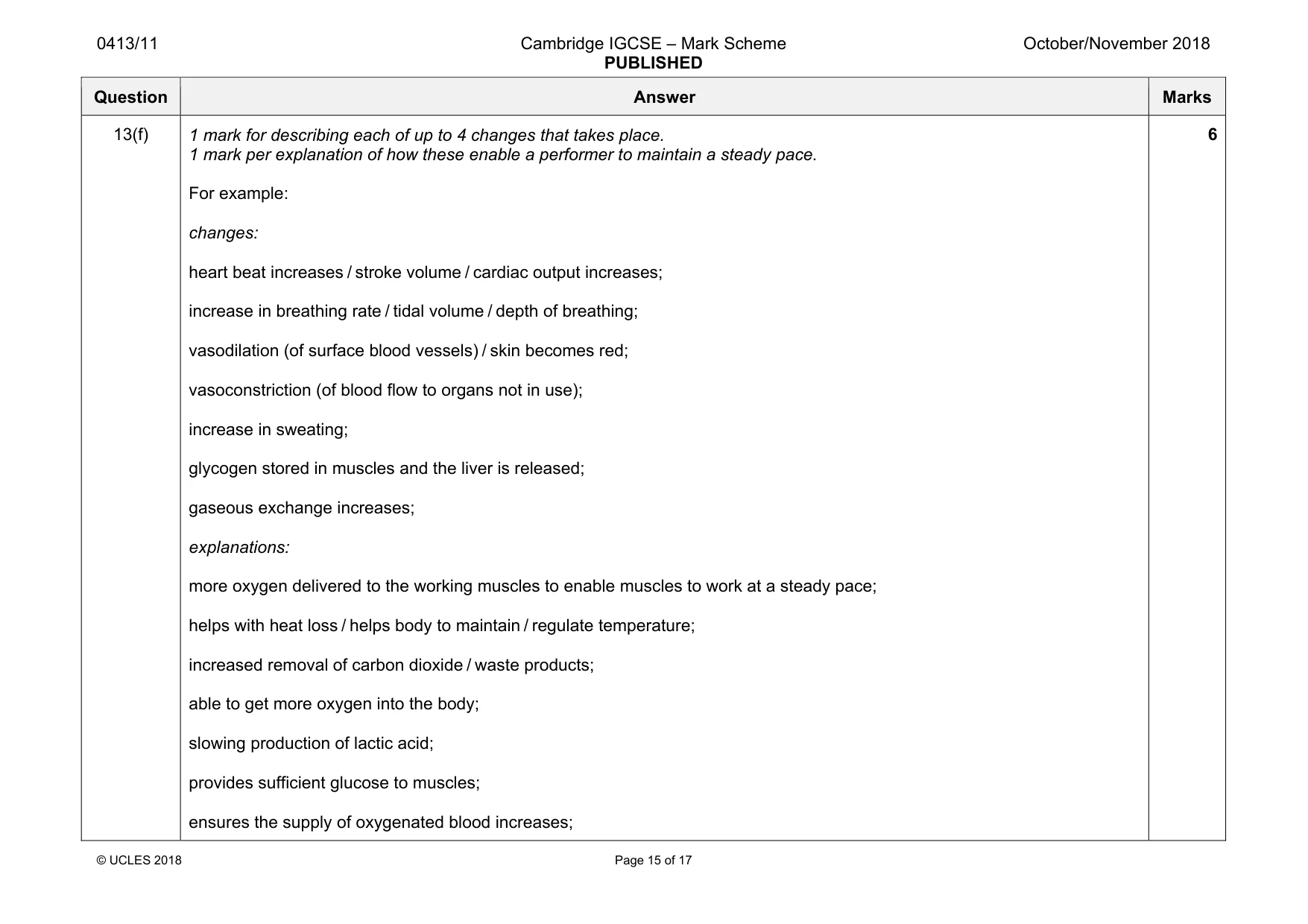
0413/11 Cambridge IGCSE – Mark Scheme PUBLISHED October/November 2018 © UCLES 2018 Page 15 of 17 Question Answer Marks 13(f) 1 mark for describing each of up to 4 changes that takes place. 1 mark per explanation of how these enable a performer to maintain a steady pace. For example: changes: heart beat increases / stroke volume / cardiac output increases; increase in breathing rate / tidal volume / depth of breathing; vasodilation (of surface blood vessels) / skin becomes red; vasoconstriction (of blood flow to organs not in use); increase in sweating; glycogen stored in muscles and the liver is released; gaseous exchange increases; explanations: more oxygen delivered to the working muscles to enable muscles to work at a steady pace; helps with heat loss / helps body to maintain / regulate temperature; increased removal of carbon dioxide / waste products; able to get more oxygen into the body; slowing production of lactic acid; provides sufficient glucose to muscles; ensures the supply of oxygenated blood increases; 6
Mark scheme, page 16
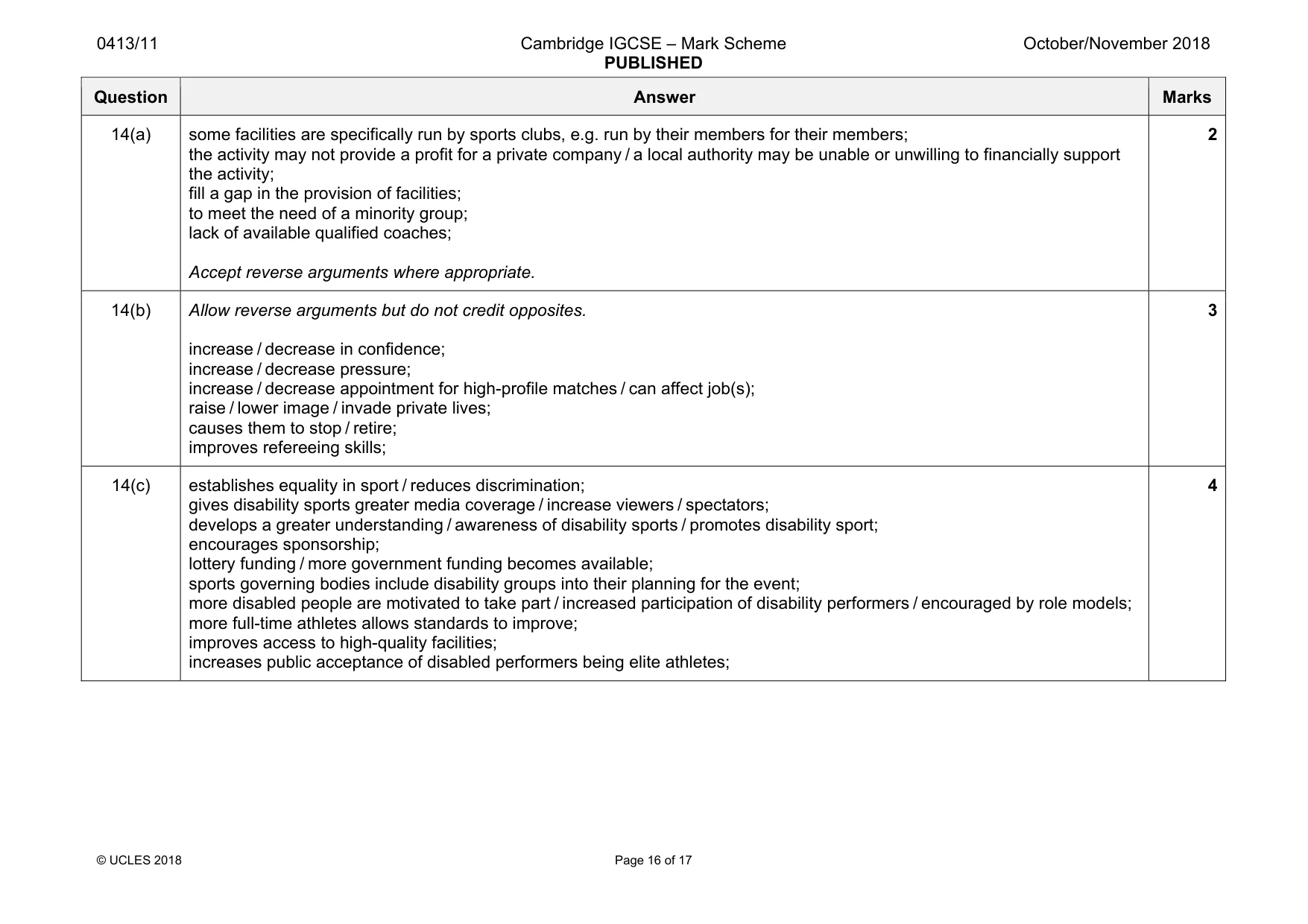
0413/11 Cambridge IGCSE – Mark Scheme PUBLISHED October/November 2018 © UCLES 2018 Page 16 of 17 Question Answer Marks 14(a) some facilities are specifically run by sports clubs, e.g. run by their members for their members; the activity may not provide a profit for a private company / a local authority may be unable or unwilling to financially support the activity; fill a gap in the provision of facilities; to meet the need of a minority group; lack of available qualified coaches; Accept reverse arguments where appropriate. 2 14(b) Allow reverse arguments but do not credit opposites. increase / decrease in confidence; increase / decrease pressure; increase / decrease appointment for high-profile matches / can affect job(s); raise / lower image / invade private lives; causes them to stop / retire; improves refereeing skills; 3 14(c) establishes equality in sport / reduces discrimination; gives disability sports greater media coverage / increase viewers / spectators; develops a greater understanding / awareness of disability sports / promotes disability sport; encourages sponsorship; lottery funding / more government funding becomes available; sports governing bodies include disability groups into their planning for the event; more disabled people are motivated to take part / increased participation of disability performers / encouraged by role models; more full-time athletes allows standards to improve; improves access to high-quality facilities; increases public acceptance of disabled performers being elite athletes; 4
Mark scheme, page 17
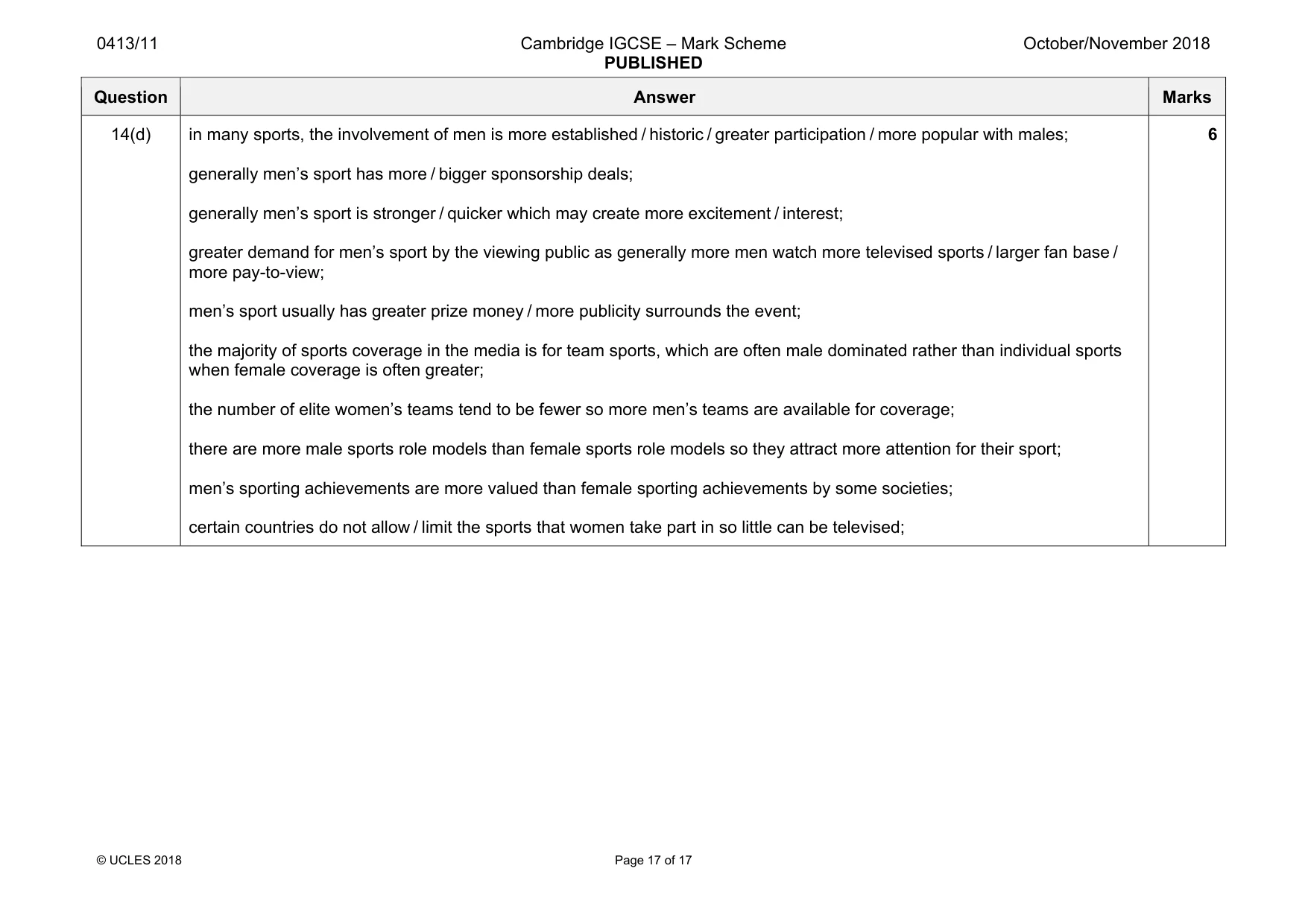
0413/11 Cambridge IGCSE – Mark Scheme PUBLISHED October/November 2018 © UCLES 2018 Page 17 of 17 Question Answer Marks 14(d) in many sports, the involvement of men is more established / historic / greater participation / more popular with males; generally men’s sport has more / bigger sponsorship deals; generally men’s sport is stronger / quicker which may create more excitement / interest; greater demand for men’s sport by the viewing public as generally more men watch more televised sports / larger fan base / more pay-to-view; men’s sport usually has greater prize money / more publicity surrounds the event; the majority of sports coverage in the media is for team sports, which are often male dominated rather than individual sports when female coverage is often greater; the number of elite women’s teams tend to be fewer so more men’s teams are available for coverage; there are more male sports role models than female sports role models so they attract more attention for their sport; men’s sporting achievements are more valued than female sporting achievements by some societies; certain countries do not allow / limit the sports that women take part in so little can be televised; 6
What you needed in this session
Cambridge’s own grade thresholds for 2018 Oct/Nov, Paper 1 · Variant 1. A higher threshold means an easier paper — the bar moves with how the cohort did.