Cambridge IGCSE Physical Education 0413 — 2018 Oct/Nov Paper 1 · Variant 3
0413/13/O/N/18 · 80 marks · ≈90 min
The question paper and its mark scheme, free to read here and free to download. This is Cambridge’s own paper, exactly as it was sat.
Question paper12 pages
Mark scheme17 pages
Answers below. Sit the paper first if you are practising.
Paper as text
Question paper, page 1
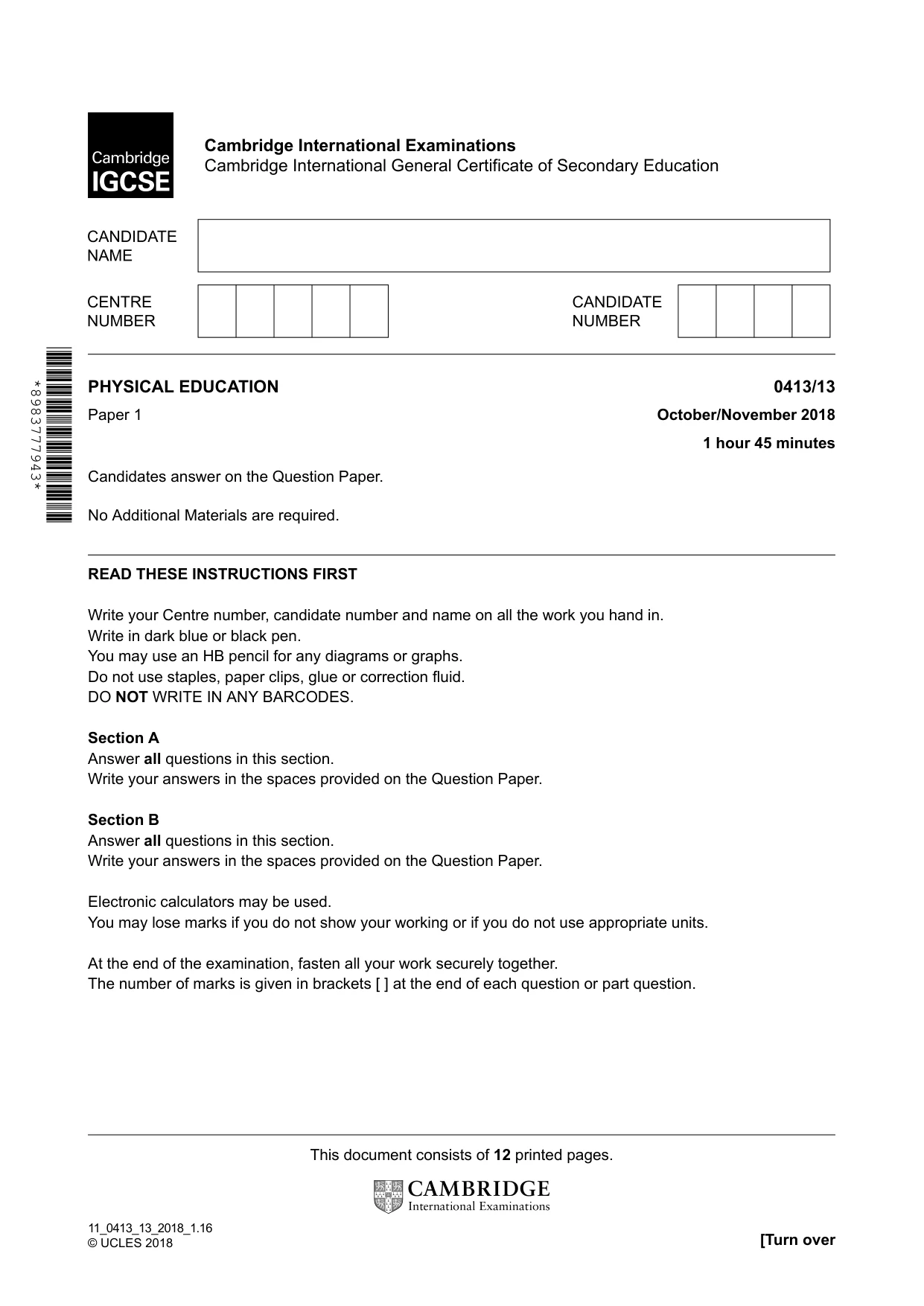
Cambridge International Examinations Cambridge International General Certificate of Secondary Education 0413/13 October/November 2018 1 hour 45 minutes PHYSICAL EDUCATION Paper 1 Candidates answer on the Question Paper. No Additional Materials are required. READ THESE INSTRUCTIONS FIRST Write your Centre number, candidate number and name on all the work you hand in. Write in dark blue or black pen. You may use an HB pencil for any diagrams or graphs. Do not use staples, paper clips, glue or correction fluid. DO NOT WRITE IN ANY BARCODES. Section A Answer all questions in this section. Write your answers in the spaces provided on the Question Paper. Section B Answer all questions in this section. Write your answers in the spaces provided on the Question Paper. Electronic calculators may be used. You may lose marks if you do not show your working or if you do not use appropriate units. At the end of the examination, fasten all your work securely together. The number of marks is given in brackets [ ] at the end of each question or part question. This document consists of 12 printed pages. [Turn over 11_0413_13_2018_1.16 © UCLES 2018 *8983777943*
Question paper, page 2
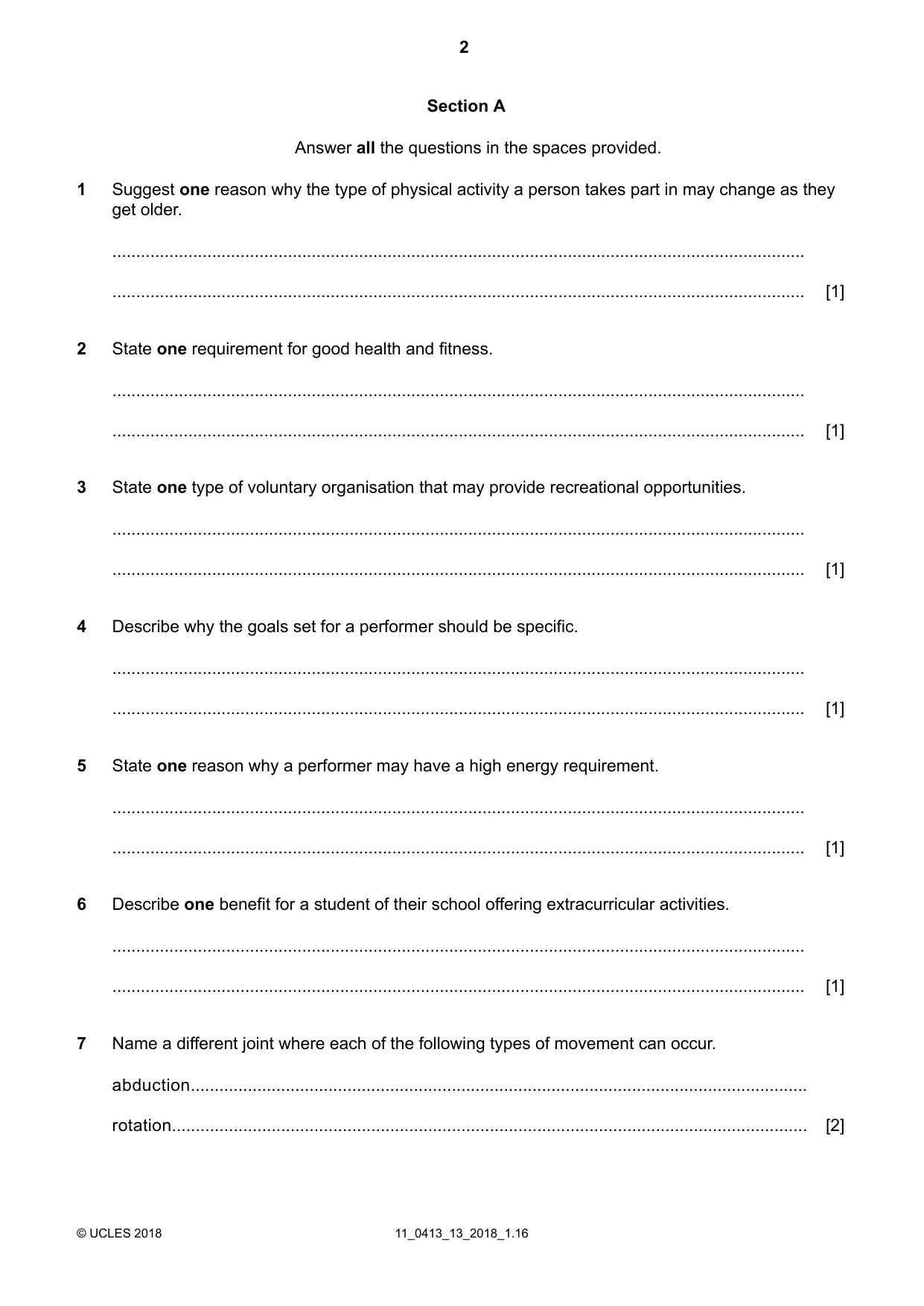
Section A Answer all the questions in the spaces provided. Suggest one reason why the type of physical activity a person takes part in may change as they get older. 1 … … [1] State one requirement for good health and fitness. 2 … … [1] State one type of voluntary organisation that may provide recreational opportunities. 3 … … [1] Describe why the goals set for a performer should be specific. 4 … … [1] State one reason why a performer may have a high energy requirement. 5 … … [1] Describe one benefit for a student of their school offering extracurricular activities. 6 … … [1] Name a different joint where each of the following types of movement can occur. 7 abduction… rotation… [2] 11_0413_13_2018_1.16 © UCLES 2018 2
Question paper, page 3
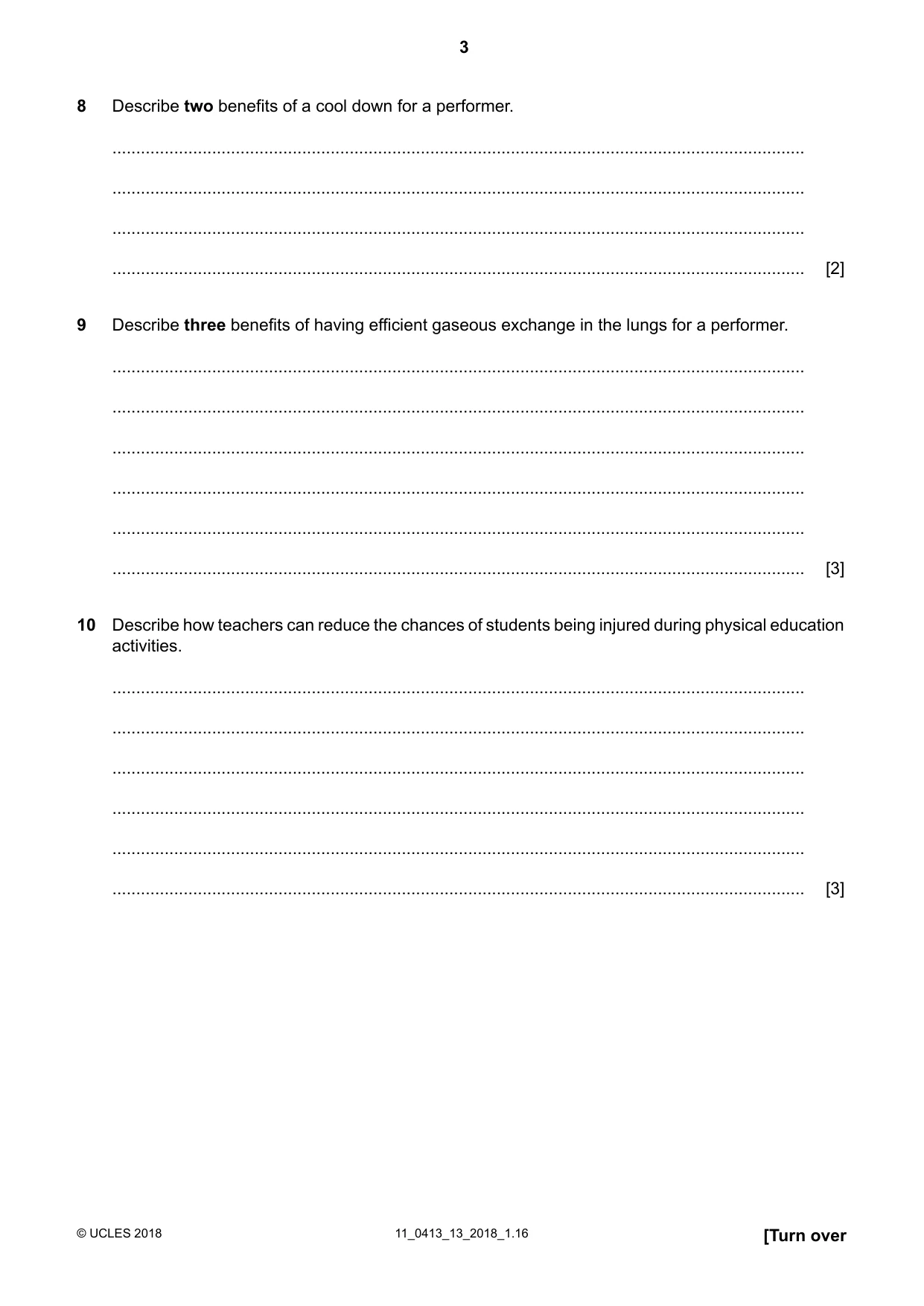
Describe two benefits of a cool down for a performer. 8 … … … … [2] Describe three benefits of having efficient gaseous exchange in the lungs for a performer. 9 … … … … … … [3] Describe how teachers can reduce the chances of students being injured during physical education activities. 10 … … … … … … [3] [Turn over 11_0413_13_2018_1.16 © UCLES 2018 3
Question paper, page 4
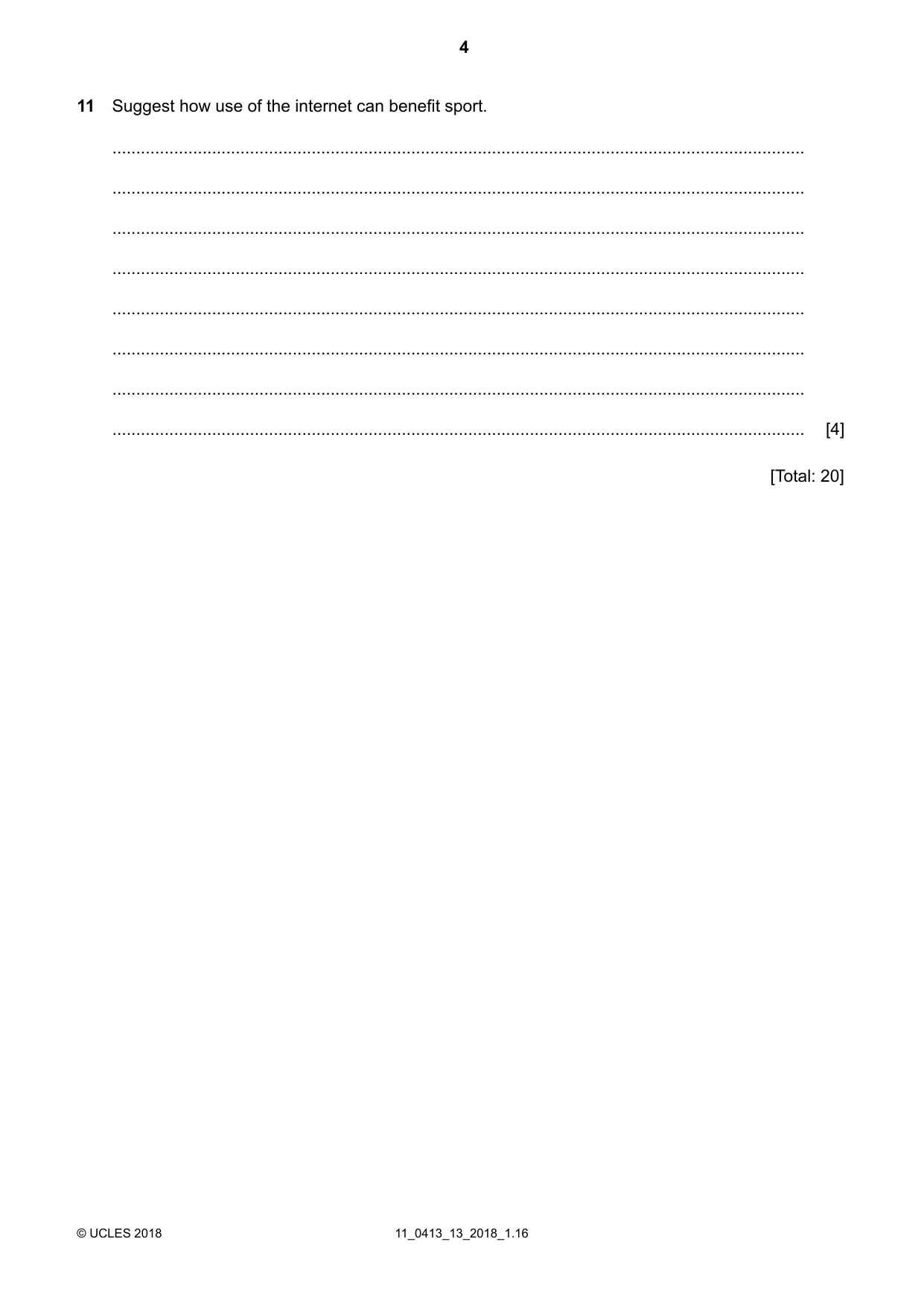
Suggest how use of the internet can benefit sport. 11 … … … … … … … … [4] [Total: 20] 11_0413_13_2018_1.16 © UCLES 2018 4
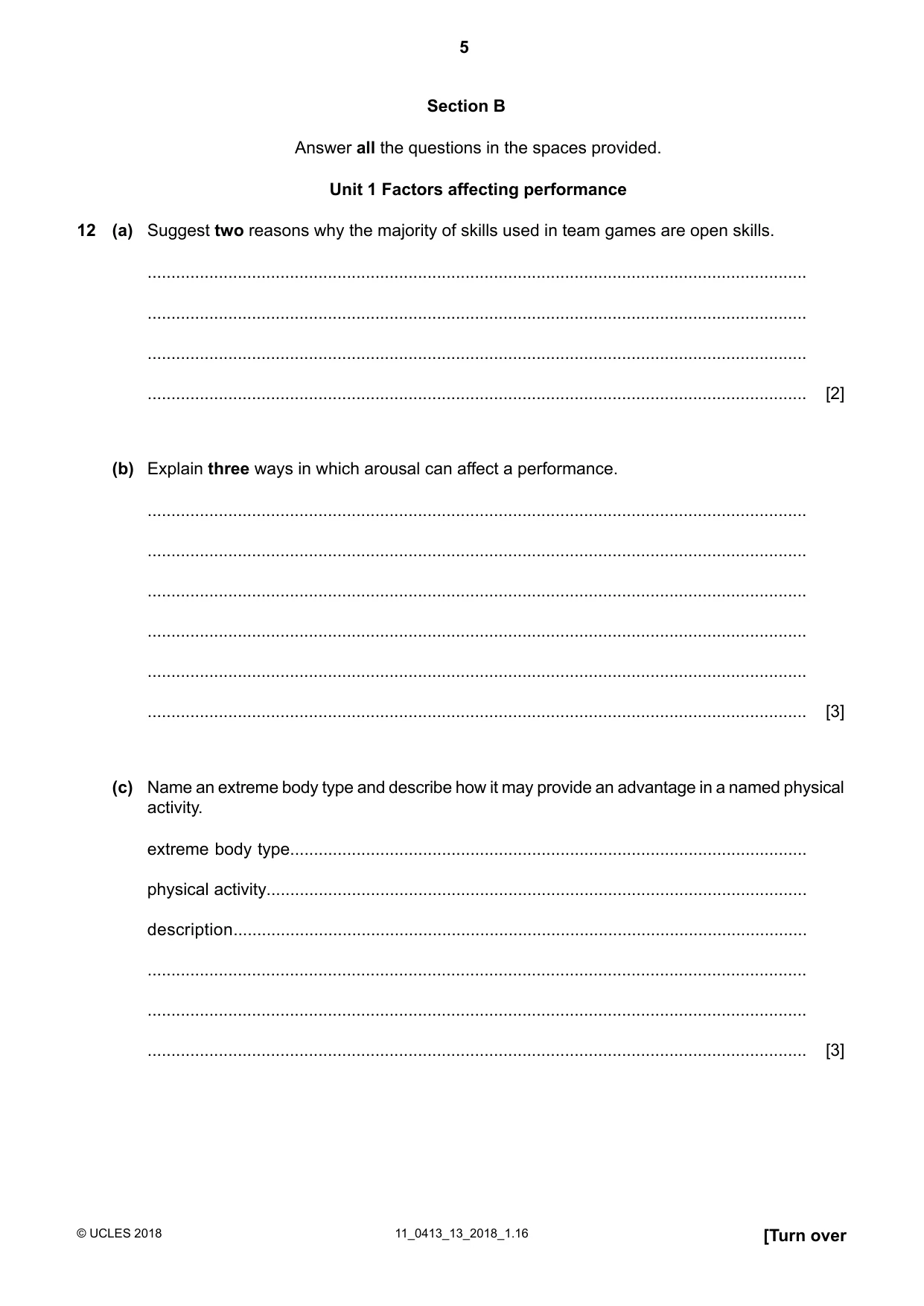
Question paper, page 5
Section B Answer all the questions in the spaces provided. Unit 1 Factors affecting performance Suggest two reasons why the majority of skills used in team games are open skills. (a) 12 … … … … [2] Explain three ways in which arousal can affect a performance. (b) … … … … … … [3] Name an extreme body type and describe how it may provide an advantage in a named physical activity. (c) extreme body type… physical activity… description… … … … [3] [Turn over 11_0413_13_2018_1.16 © UCLES 2018 5
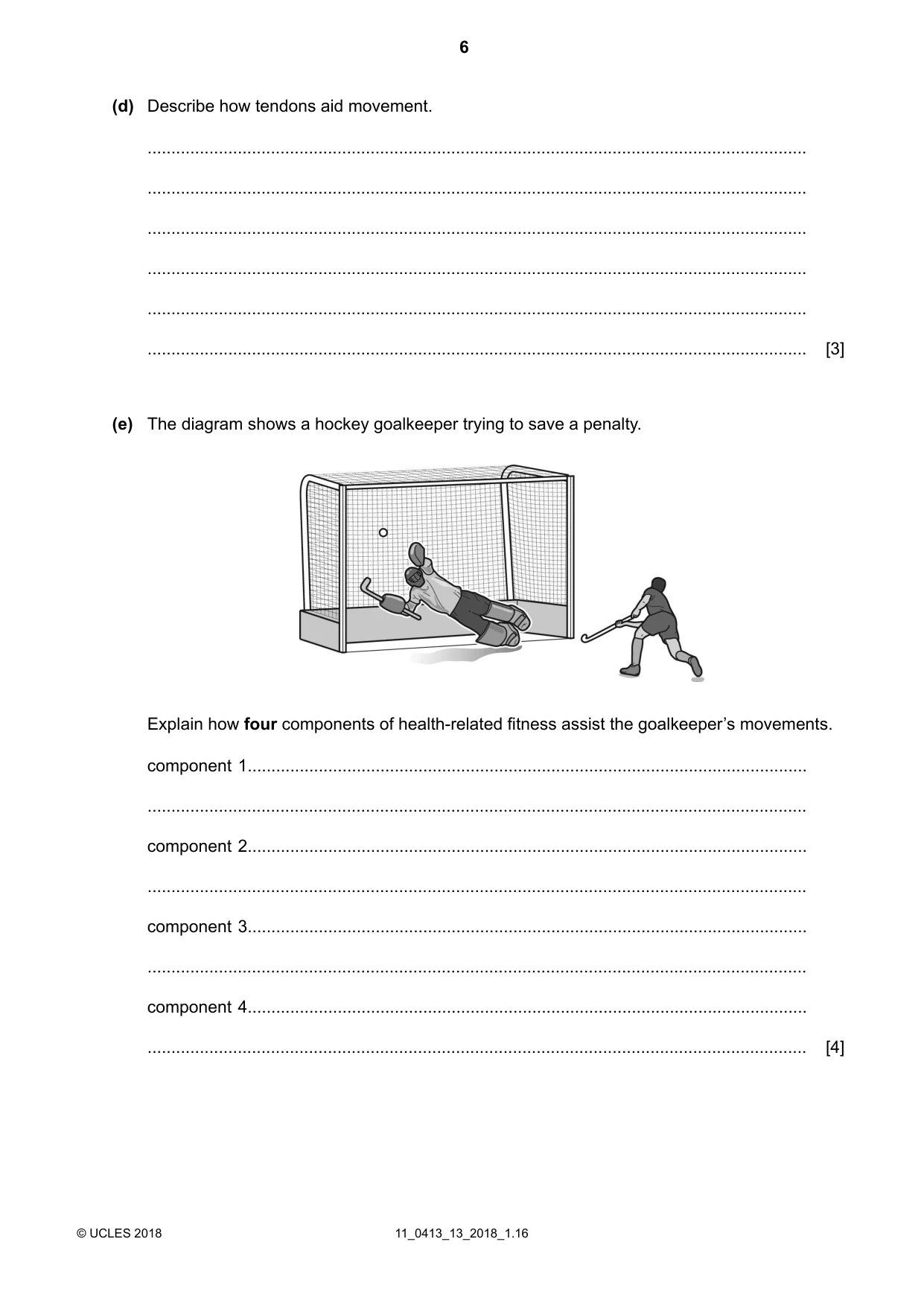
Question paper, page 6
Describe how tendons aid movement. (d) … … … … … … [3] The diagram shows a hockey goalkeeper trying to save a penalty. (e) Explain how four components of health-related fitness assist the goalkeeper’s movements. component 1… … component 2… … component 3… … component 4… … [4] 11_0413_13_2018_1.16 © UCLES 2018 6
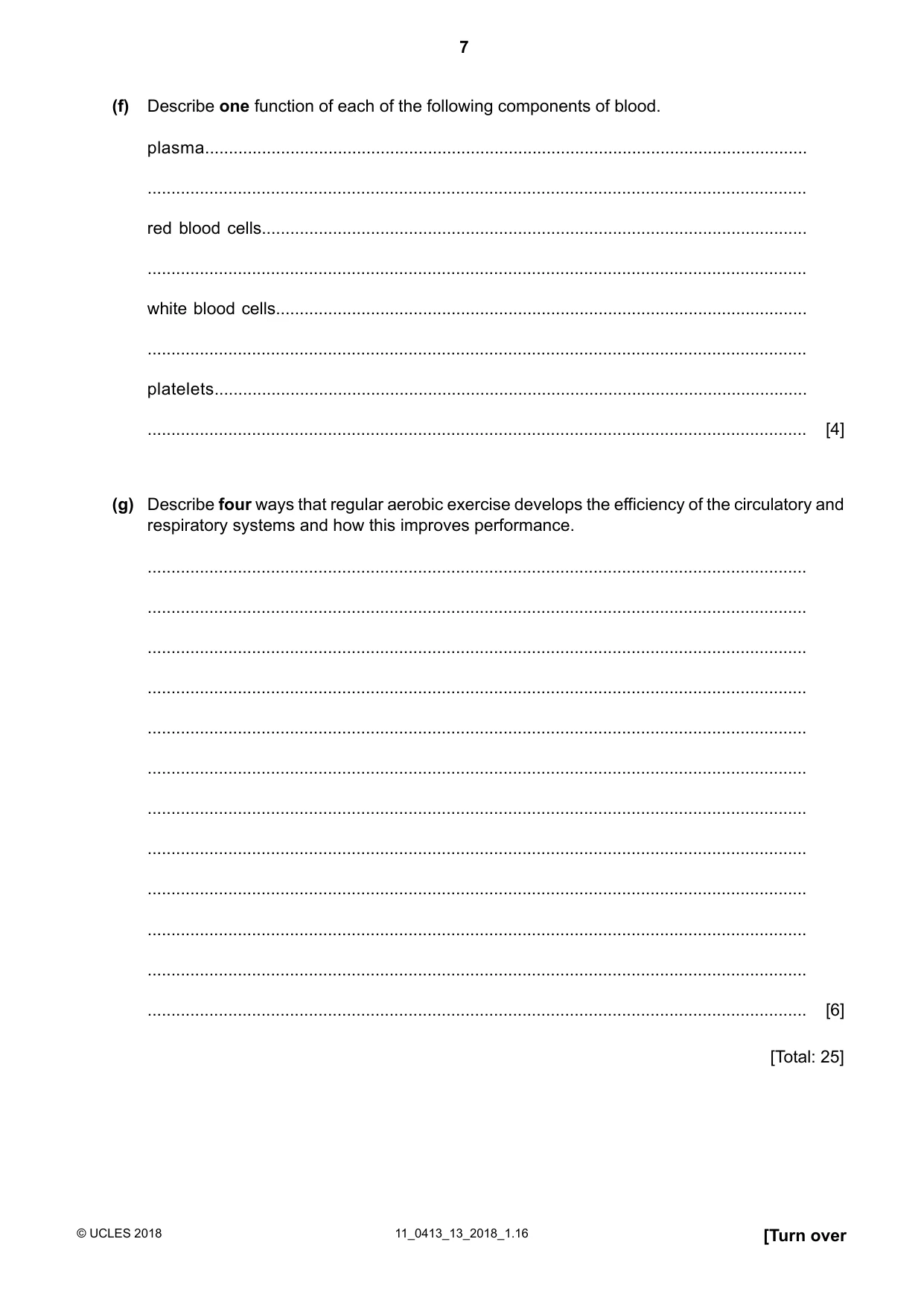
Question paper, page 7
Describe one function of each of the following components of blood. (f) plasma… … red blood cells… … white blood cells… … platelets… … [4] Describe four ways that regular aerobic exercise develops the efficiency of the circulatory and respiratory systems and how this improves performance. (g) … … … … … … … … … … … … [6] [Total: 25] [Turn over 11_0413_13_2018_1.16 © UCLES 2018 7
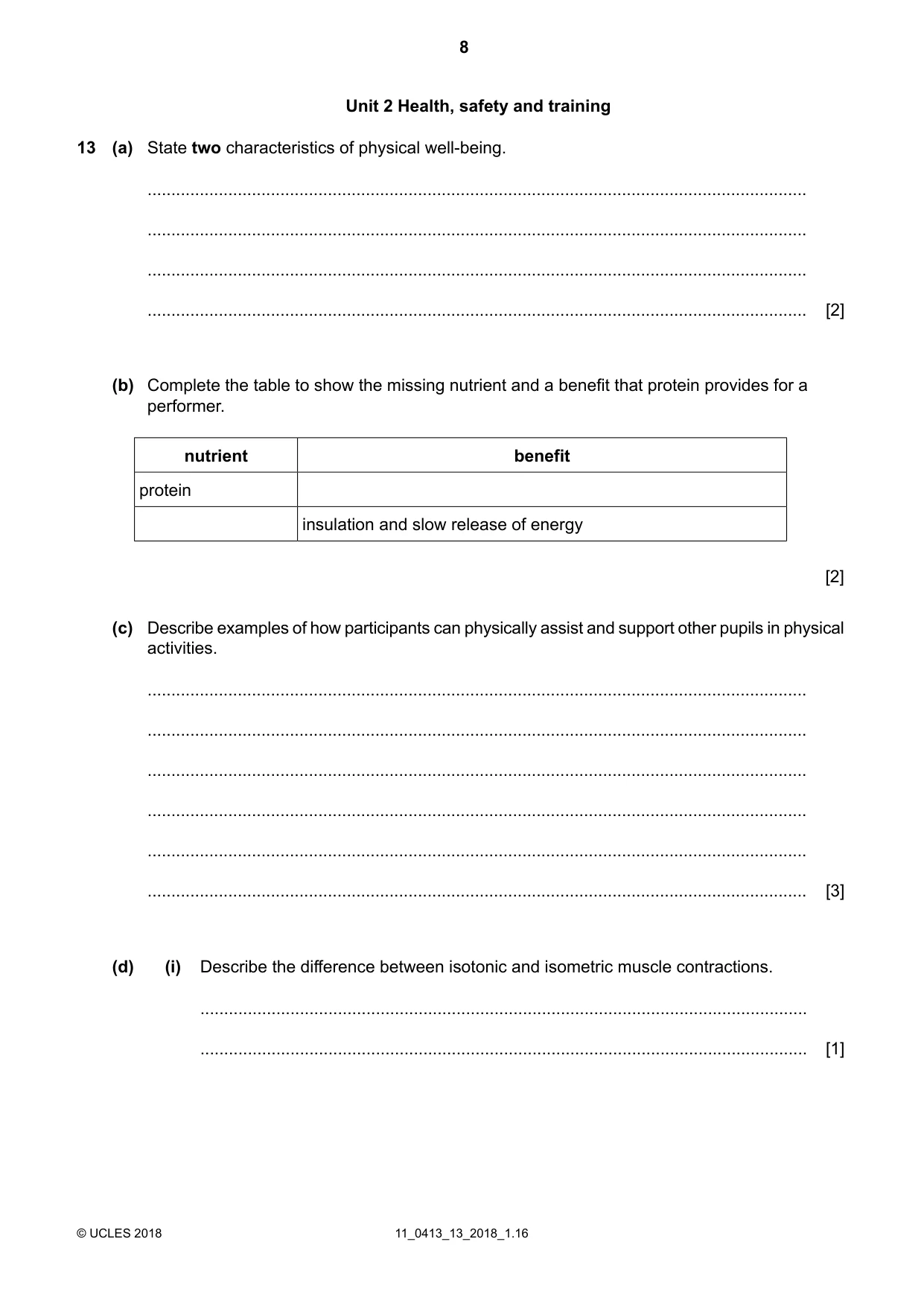
Question paper, page 8
Unit 2 Health, safety and training State two characteristics of physical well-being. (a) 13 … … … … [2] Complete the table to show the missing nutrient and a benefit that protein provides for a performer. (b) benefit nutrient protein insulation and slow release of energy [2] Describe examples of how participants can physically assist and support other pupils in physical activities. (c) … … … … … … [3] Describe the difference between isotonic and isometric muscle contractions. (i) (d) … … [1] 11_0413_13_2018_1.16 © UCLES 2018 8
Question paper, page 9
Describe two examples from different physical activities of isometric muscle contractions. (ii) physical activity 1… example… … physical activity 2… example… … [2] Explain the long-term effects of regular aerobic training on skeletal muscles. (e) … … … … … … … … [4] [Turn over 11_0413_13_2018_1.16 © UCLES 2018 9
Question paper, page 10
Explain, using examples from a named physical activity, how training principles can be applied to bring about an improvement in performance. (i) (f) physical activity… … … … … … … … … [4] Suggest two signs that a performer is over-training. (ii) … … … … [2] [Total: 20] 11_0413_13_2018_1.16 © UCLES 2018 10
Question paper, page 11
Unit 3 Reasons and opportunities for participation in physical activity Kenya and Ethiopia are two countries with areas located at high altitude. Many athletes from both countries excel in middle and long-distance running. Suggest two reasons why some other countries with areas located at high altitude do not achieve excellence in these activities. (a) 14 … … … … [2] Describe how television has increased people’s understanding of sport. (b) … … … … … … [3] Describe factors that have led to a growth in leisure activities. (c) … … … … … … … … [4] [Turn over 11_0413_13_2018_1.16 © UCLES 2018 11
Question paper, page 12
Describe why a company may choose to sponsor a performer. (d) … … … … … … … … … … … … [6] [Total: 15] Permission to reproduce items where third-party owned material protected by copyright is included has been sought and cleared where possible. Every reasonable effort has been made by the publisher (UCLES) to trace copyright holders, but if any items requiring clearance have unwittingly been included, the publisher will be pleased to make amends at the earliest possible opportunity. To avoid the issue of disclosure of answer-related information to candidates, all copyright acknowledgements are reproduced online in the Cambridge International Examinations Copyright Acknowledgements Booklet. This is produced for each series of examinations and is freely available to download at www.cie.org.uk after the live examination series. Cambridge International Examinations is part of the Cambridge Assessment Group. Cambridge Assessment is the brand name of University of Cambridge Local Examinations Syndicate (UCLES), which is itself a department of the University of Cambridge. 11_0413_13_2018_1.16 © UCLES 2018 12
Mark scheme, page 1
This document consists of 17 printed pages. © UCLES 2018 [Turn over Cambridge Assessment International Education Cambridge International General Certificate of Secondary Education PHYSICAL EDUCATION 0413/13 Paper 1 October/November 2018 MARK SCHEME Maximum Mark: 80 Published This mark scheme is published as an aid to teachers and candidates, to indicate the requirements of the examination. It shows the basis on which Examiners were instructed to award marks. It does not indicate the details of the discussions that took place at an Examiners’ meeting before marking began, which would have considered the acceptability of alternative answers. Mark schemes should be read in conjunction with the question paper and the Principal Examiner Report for Teachers. Cambridge International will not enter into discussions about these mark schemes. Cambridge International is publishing the mark schemes for the October/November 2018 series for most Cambridge IGCSE™, Cambridge International A and AS Level components and some Cambridge O Level components.
Mark scheme, page 2
0413/13 Cambridge IGCSE – Mark Scheme PUBLISHED October/November 2018 © UCLES 2018 Page 2 of 17 Generic Marking Principles These general marking principles must be applied by all examiners when marking candidate answers. They should be applied alongside the specific content of the mark scheme or generic level descriptors for a question. Each question paper and mark scheme will also comply with these marking principles. GENERIC MARKING PRINCIPLE 1: Marks must be awarded in line with: • the specific content of the mark scheme or the generic level descriptors for the question • the specific skills defined in the mark scheme or in the generic level descriptors for the question • the standard of response required by a candidate as exemplified by the standardisation scripts. GENERIC MARKING PRINCIPLE 2: Marks awarded are always whole marks (not half marks, or other fractions). GENERIC MARKING PRINCIPLE 3: Marks must be awarded positively: • marks are awarded for correct/valid answers, as defined in the mark scheme. However, credit is given for valid answers which go beyond the scope of the syllabus and mark scheme, referring to your Team Leader as appropriate • marks are awarded when candidates clearly demonstrate what they know and can do • marks are not deducted for errors • marks are not deducted for omissions • answers should only be judged on the quality of spelling, punctuation and grammar when these features are specifically assessed by the question as indicated by the mark scheme. The meaning, however, should be unambiguous. GENERIC MARKING PRINCIPLE 4: Rules must be applied consistently e.g. in situations where candidates have not followed instructions or in the application of generic level descriptors.
Mark scheme, page 3
0413/13 Cambridge IGCSE – Mark Scheme PUBLISHED October/November 2018 © UCLES 2018 Page 3 of 17 GENERIC MARKING PRINCIPLE 5: Marks should be awarded using the full range of marks defined in the mark scheme for the question (however; the use of the full mark range may be limited according to the quality of the candidate responses seen). GENERIC MARKING PRINCIPLE 6: Marks awarded are based solely on the requirements as defined in the mark scheme. Marks should not be awarded with grade thresholds or grade descriptors in mind.
Mark scheme, page 4
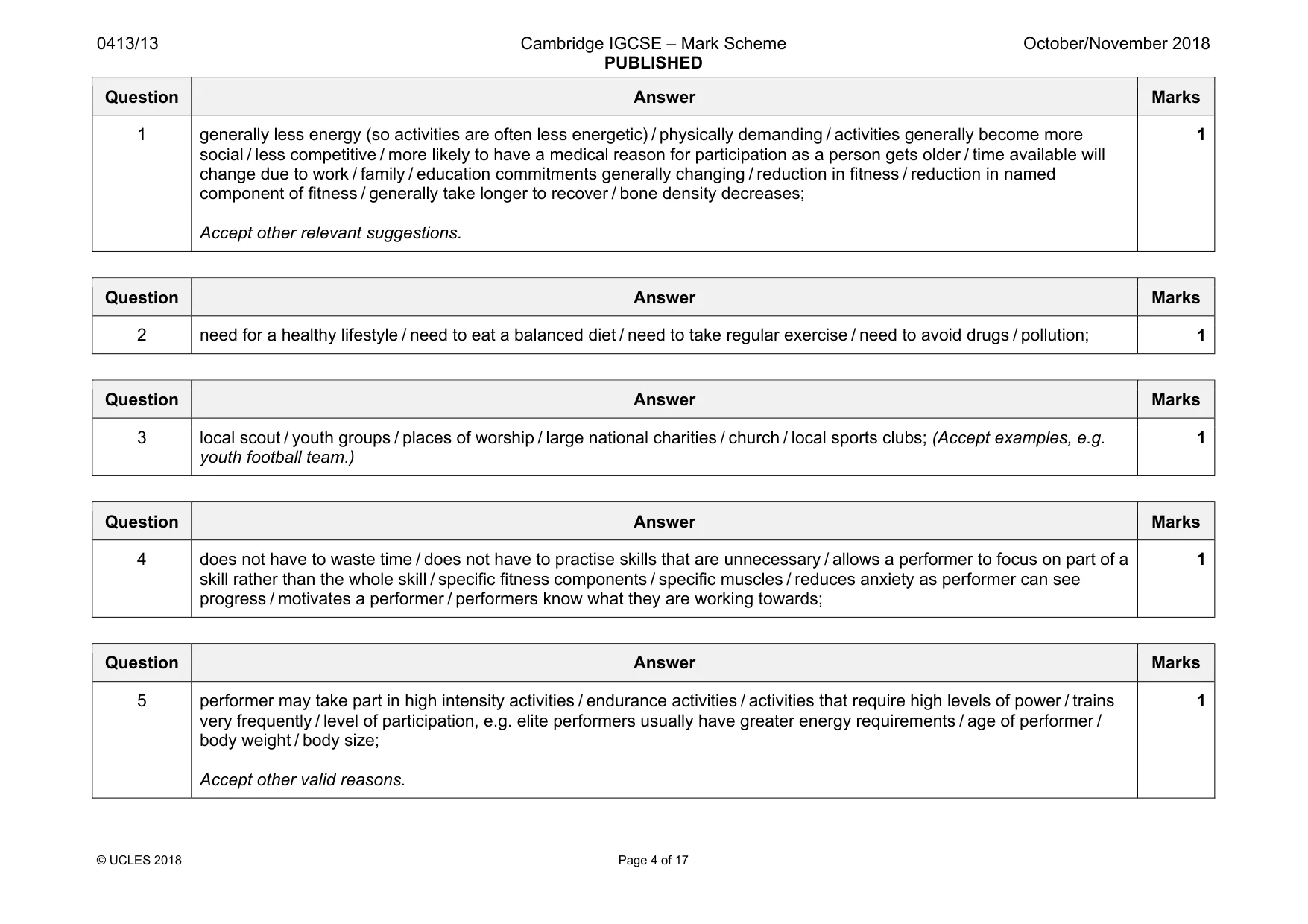
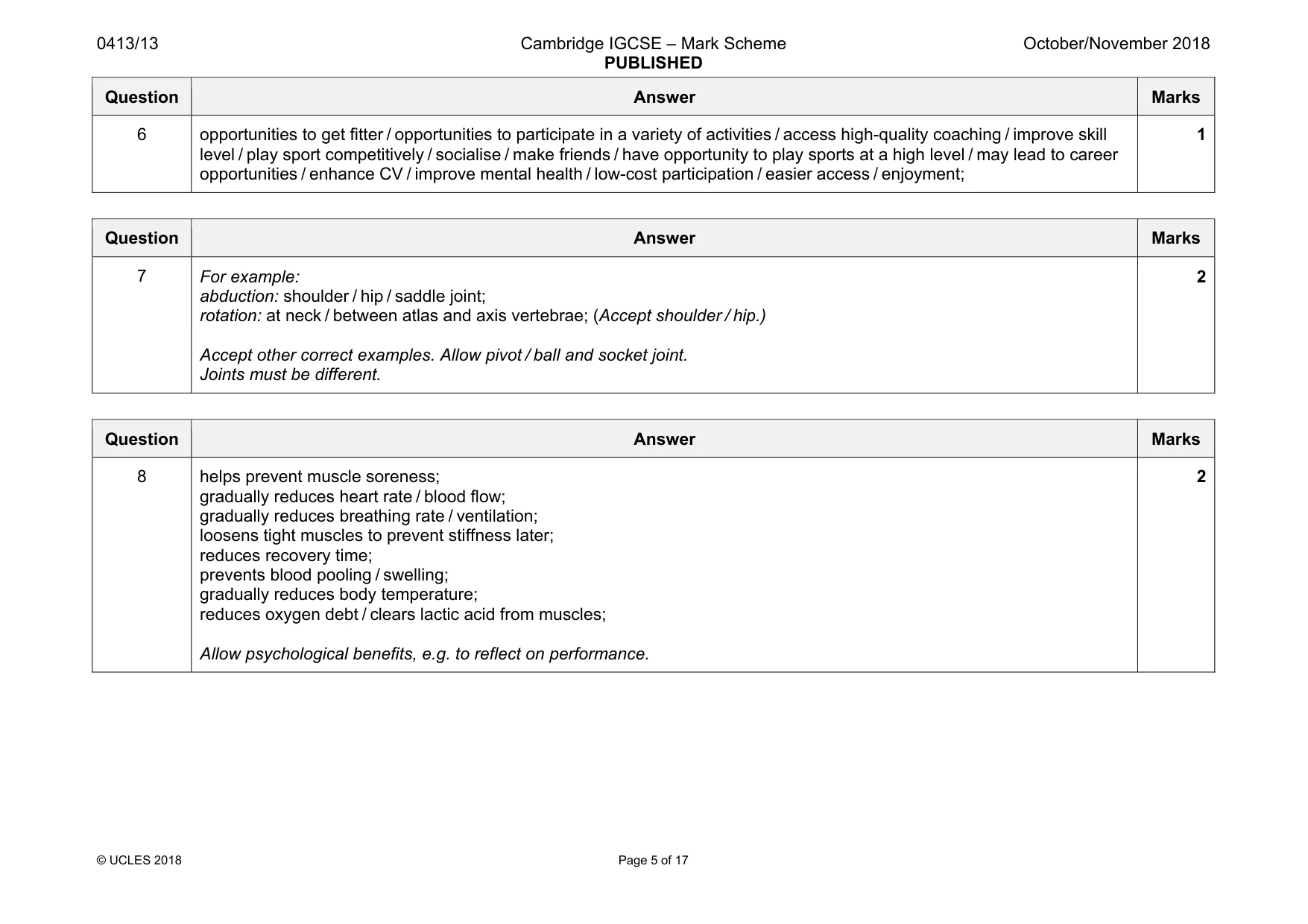
0413/13 Cambridge IGCSE – Mark Scheme PUBLISHED October/November 2018 © UCLES 2018 Page 4 of 17 Question Answer Marks 1 generally less energy (so activities are often less energetic) / physically demanding / activities generally become more social / less competitive / more likely to have a medical reason for participation as a person gets older / time available will change due to work / family / education commitments generally changing / reduction in fitness / reduction in named component of fitness / generally take longer to recover / bone density decreases; Accept other relevant suggestions. 1 Question Answer Marks 2 need for a healthy lifestyle / need to eat a balanced diet / need to take regular exercise / need to avoid drugs / pollution; 1 Question Answer Marks 3 local scout / youth groups / places of worship / large national charities / church / local sports clubs; (Accept examples, e.g. youth football team.) 1 Question Answer Marks 4 does not have to waste time / does not have to practise skills that are unnecessary / allows a performer to focus on part of a skill rather than the whole skill / specific fitness components / specific muscles / reduces anxiety as performer can see progress / motivates a performer / performers know what they are working towards; 1 Question Answer Marks 5 performer may take part in high intensity activities / endurance activities / activities that require high levels of power / trains very frequently / level of participation, e.g. elite performers usually have greater energy requirements / age of performer / body weight / body size; Accept other valid reasons. 1
Mark scheme, page 5
0413/13 Cambridge IGCSE – Mark Scheme PUBLISHED October/November 2018 © UCLES 2018 Page 5 of 17 Question Answer Marks 6 opportunities to get fitter / opportunities to participate in a variety of activities / access high-quality coaching / improve skill level / play sport competitively / socialise / make friends / have opportunity to play sports at a high level / may lead to career opportunities / enhance CV / improve mental health / low-cost participation / easier access / enjoyment; 1 Question Answer Marks 7 For example: abduction: shoulder / hip / saddle joint; rotation: at neck / between atlas and axis vertebrae; (Accept shoulder / hip.) Accept other correct examples. Allow pivot / ball and socket joint. Joints must be different. 2 Question Answer Marks 8 helps prevent muscle soreness; gradually reduces heart rate / blood flow; gradually reduces breathing rate / ventilation; loosens tight muscles to prevent stiffness later; reduces recovery time; prevents blood pooling / swelling; gradually reduces body temperature; reduces oxygen debt / clears lactic acid from muscles; Allow psychological benefits, e.g. to reflect on performance. 2
Mark scheme, page 6
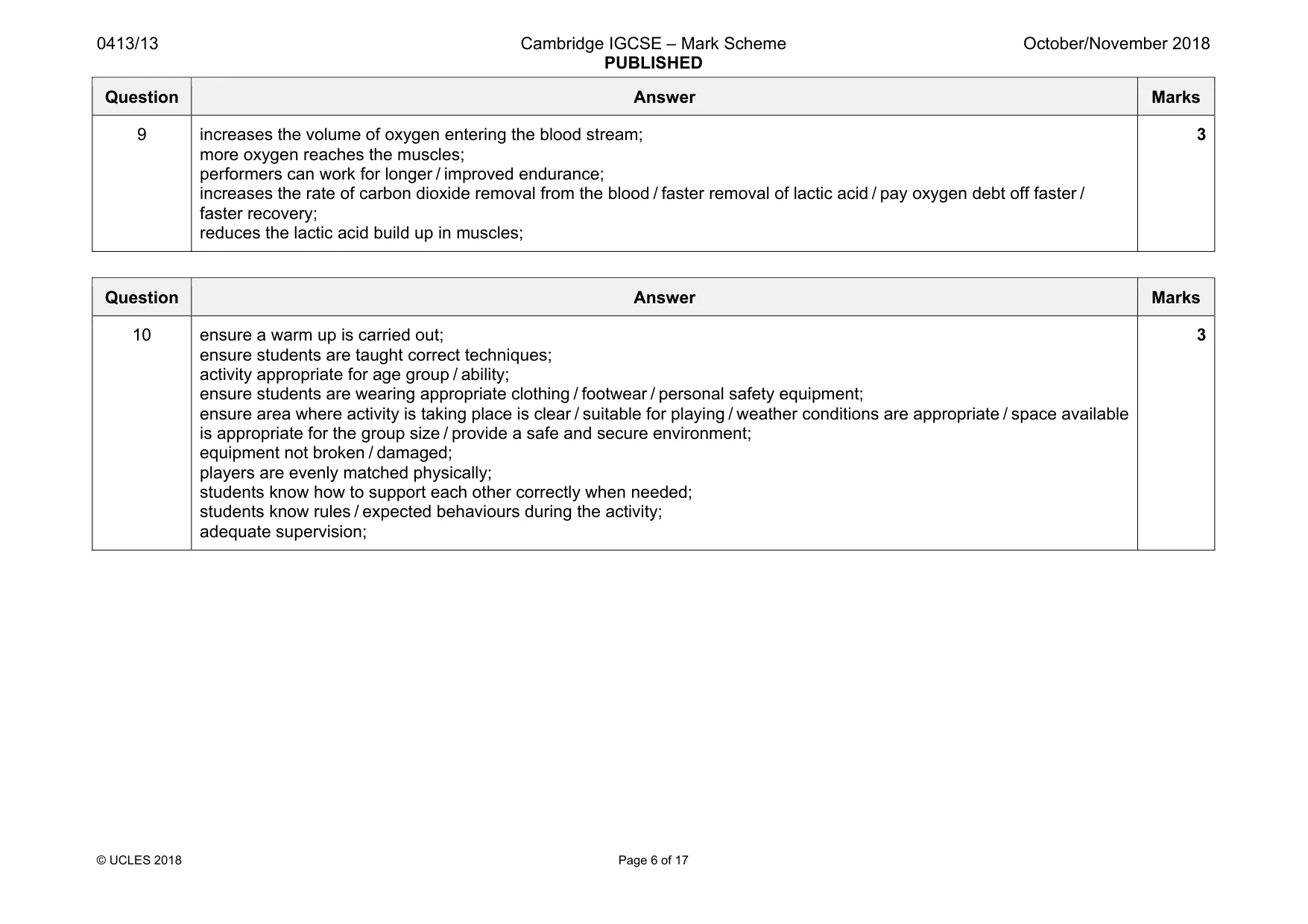
0413/13 Cambridge IGCSE – Mark Scheme PUBLISHED October/November 2018 © UCLES 2018 Page 6 of 17 Question Answer Marks 9 increases the volume of oxygen entering the blood stream; more oxygen reaches the muscles; performers can work for longer / improved endurance; increases the rate of carbon dioxide removal from the blood / faster removal of lactic acid / pay oxygen debt off faster / faster recovery; reduces the lactic acid build up in muscles; 3 Question Answer Marks 10 ensure a warm up is carried out; ensure students are taught correct techniques; activity appropriate for age group / ability; ensure students are wearing appropriate clothing / footwear / personal safety equipment; ensure area where activity is taking place is clear / suitable for playing / weather conditions are appropriate / space available is appropriate for the group size / provide a safe and secure environment; equipment not broken / damaged; players are evenly matched physically; students know how to support each other correctly when needed; students know rules / expected behaviours during the activity; adequate supervision; 3
Mark scheme, page 7
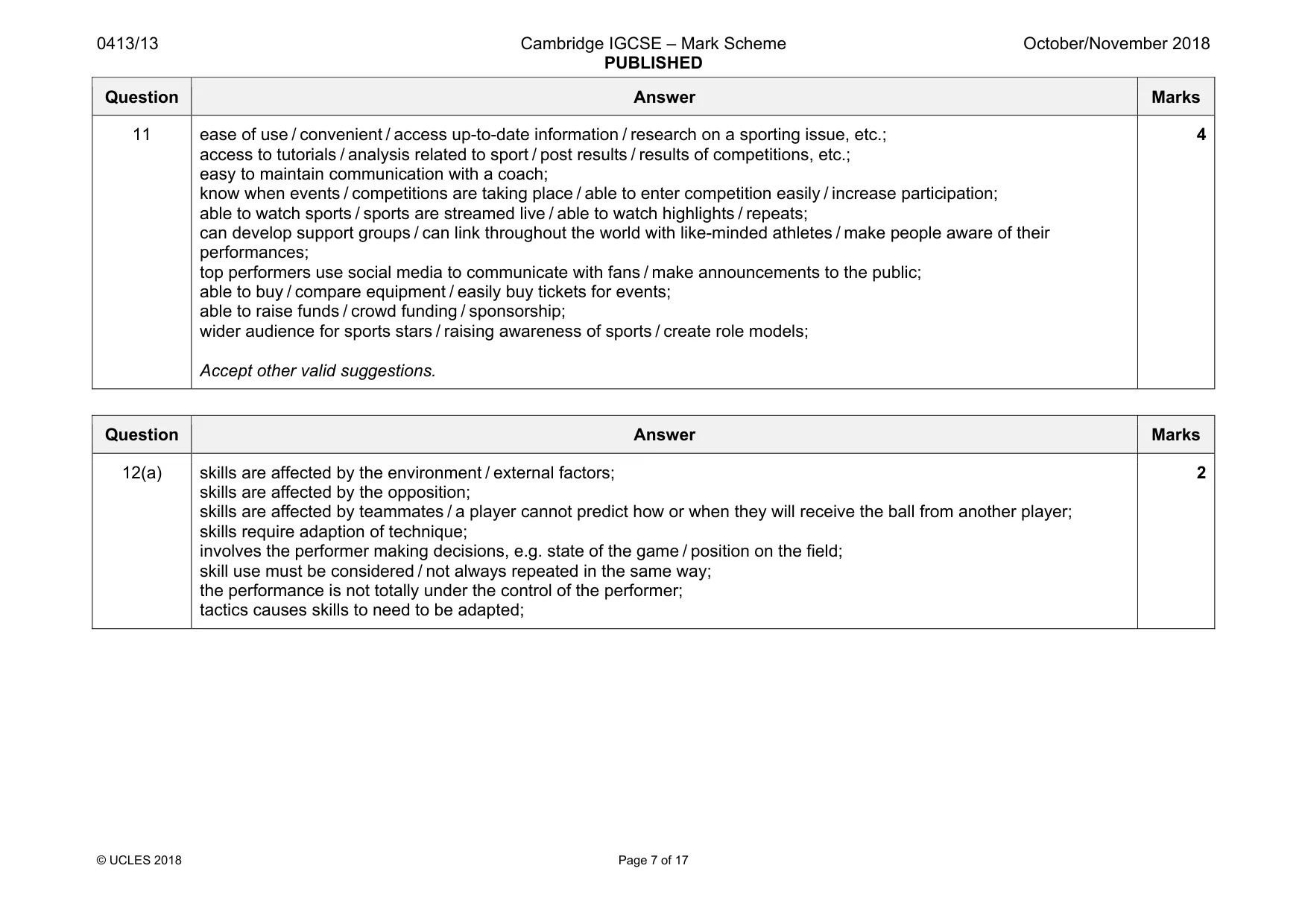
0413/13 Cambridge IGCSE – Mark Scheme PUBLISHED October/November 2018 © UCLES 2018 Page 7 of 17 Question Answer Marks 11 ease of use / convenient / access up-to-date information / research on a sporting issue, etc.; access to tutorials / analysis related to sport / post results / results of competitions, etc.; easy to maintain communication with a coach; know when events / competitions are taking place / able to enter competition easily / increase participation; able to watch sports / sports are streamed live / able to watch highlights / repeats; can develop support groups / can link throughout the world with like-minded athletes / make people aware of their performances; top performers use social media to communicate with fans / make announcements to the public; able to buy / compare equipment / easily buy tickets for events; able to raise funds / crowd funding / sponsorship; wider audience for sports stars / raising awareness of sports / create role models; Accept other valid suggestions. 4 Question Answer Marks 12(a) skills are affected by the environment / external factors; skills are affected by the opposition; skills are affected by teammates / a player cannot predict how or when they will receive the ball from another player; skills require adaption of technique; involves the performer making decisions, e.g. state of the game / position on the field; skill use must be considered / not always repeated in the same way; the performance is not totally under the control of the performer; tactics causes skills to need to be adapted; 2
Mark scheme, page 8
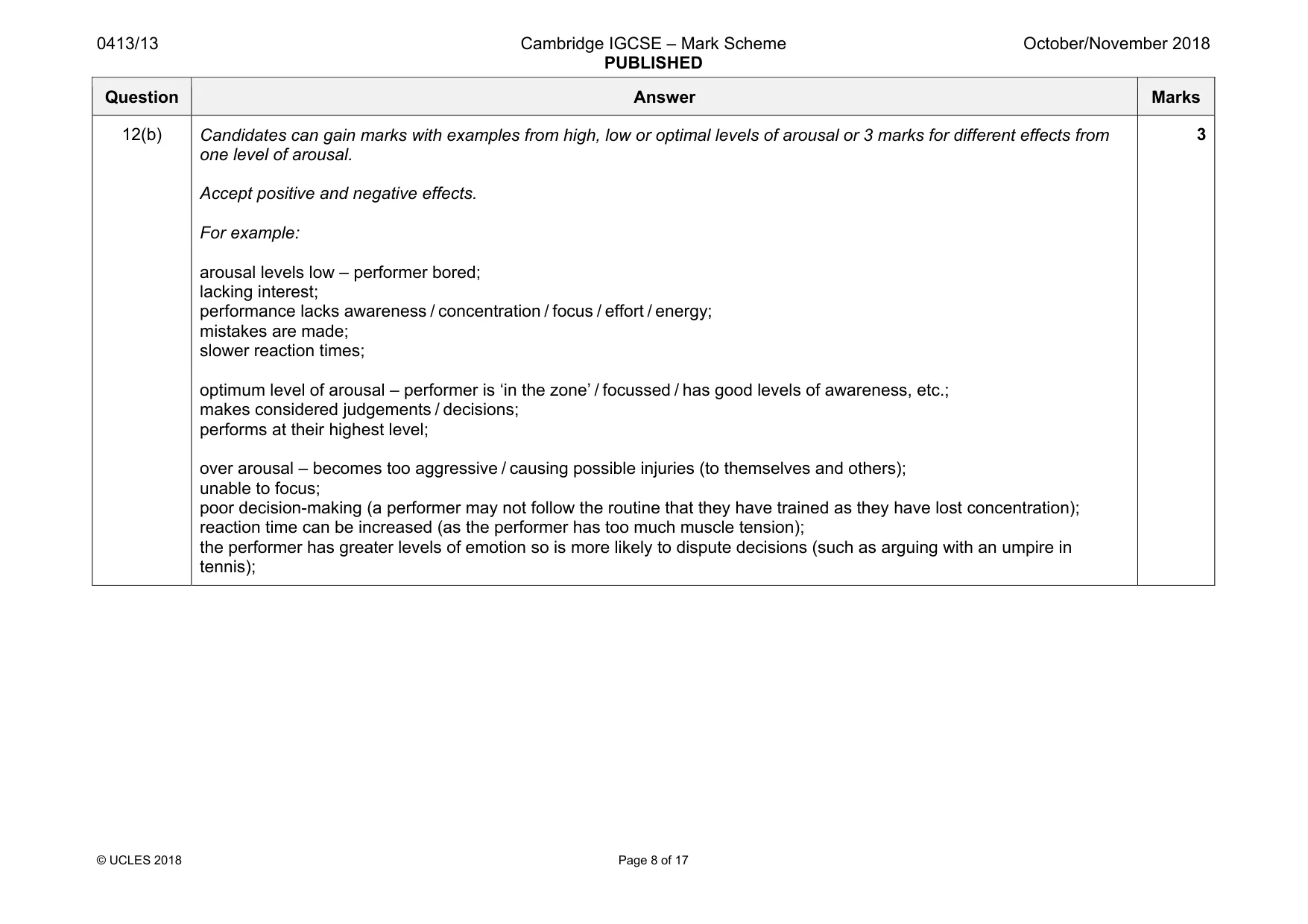
0413/13 Cambridge IGCSE – Mark Scheme PUBLISHED October/November 2018 © UCLES 2018 Page 8 of 17 Question Answer Marks 12(b) Candidates can gain marks with examples from high, low or optimal levels of arousal or 3 marks for different effects from one level of arousal. Accept positive and negative effects. For example: arousal levels low – performer bored; lacking interest; performance lacks awareness / concentration / focus / effort / energy; mistakes are made; slower reaction times; optimum level of arousal – performer is ‘in the zone’ / focussed / has good levels of awareness, etc.; makes considered judgements / decisions; performs at their highest level; over arousal – becomes too aggressive / causing possible injuries (to themselves and others); unable to focus; poor decision-making (a performer may not follow the routine that they have trained as they have lost concentration); reaction time can be increased (as the performer has too much muscle tension); the performer has greater levels of emotion so is more likely to dispute decisions (such as arguing with an umpire in tennis); 3
Mark scheme, page 9
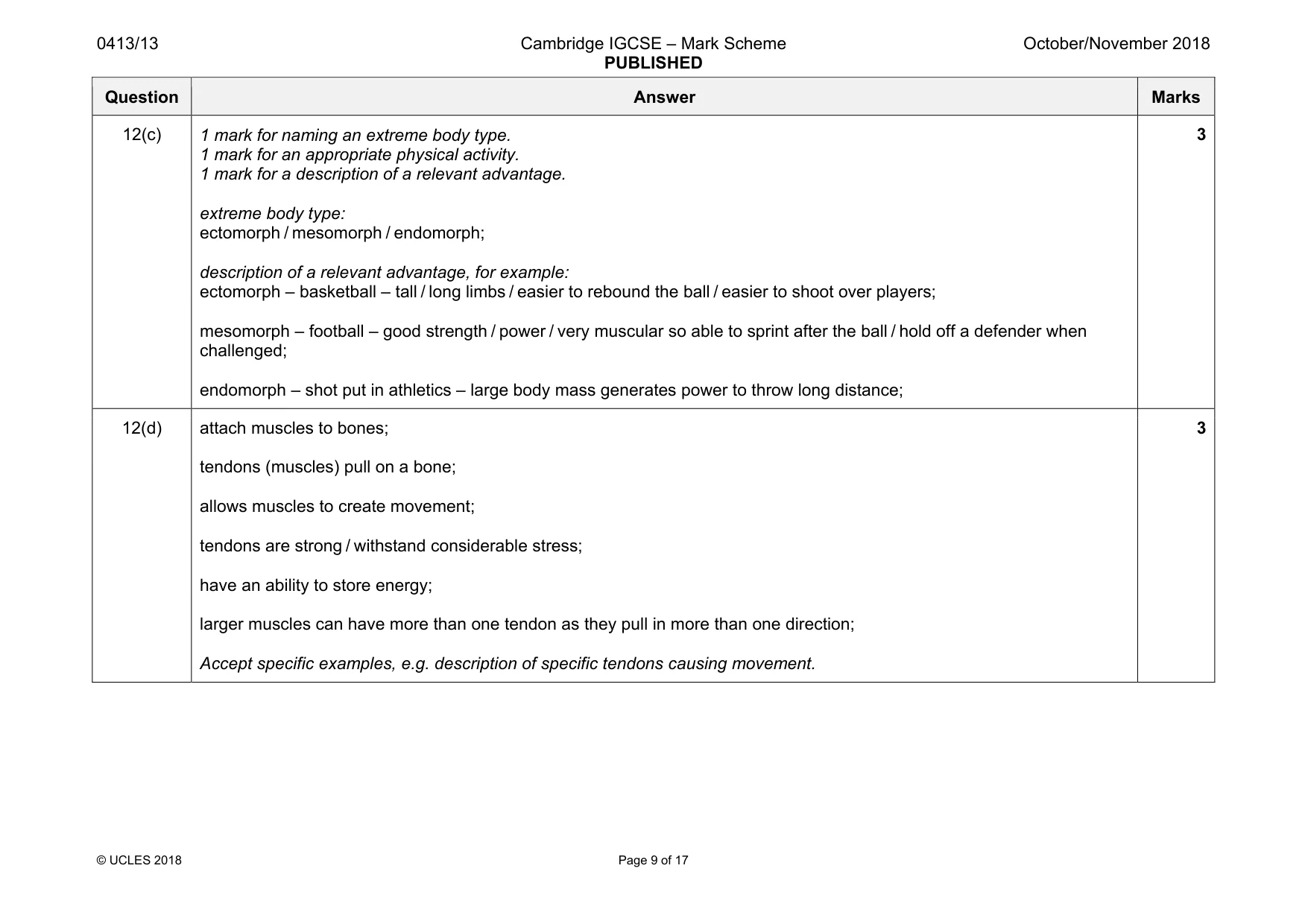
0413/13 Cambridge IGCSE – Mark Scheme PUBLISHED October/November 2018 © UCLES 2018 Page 9 of 17 Question Answer Marks 12(c) 1 mark for naming an extreme body type. 1 mark for an appropriate physical activity. 1 mark for a description of a relevant advantage. extreme body type: ectomorph / mesomorph / endomorph; description of a relevant advantage, for example: ectomorph – basketball – tall / long limbs / easier to rebound the ball / easier to shoot over players; mesomorph – football – good strength / power / very muscular so able to sprint after the ball / hold off a defender when challenged; endomorph – shot put in athletics – large body mass generates power to throw long distance; 3 12(d) attach muscles to bones; tendons (muscles) pull on a bone; allows muscles to create movement; tendons are strong / withstand considerable stress; have an ability to store energy; larger muscles can have more than one tendon as they pull in more than one direction; Accept specific examples, e.g. description of specific tendons causing movement. 3
Mark scheme, page 10
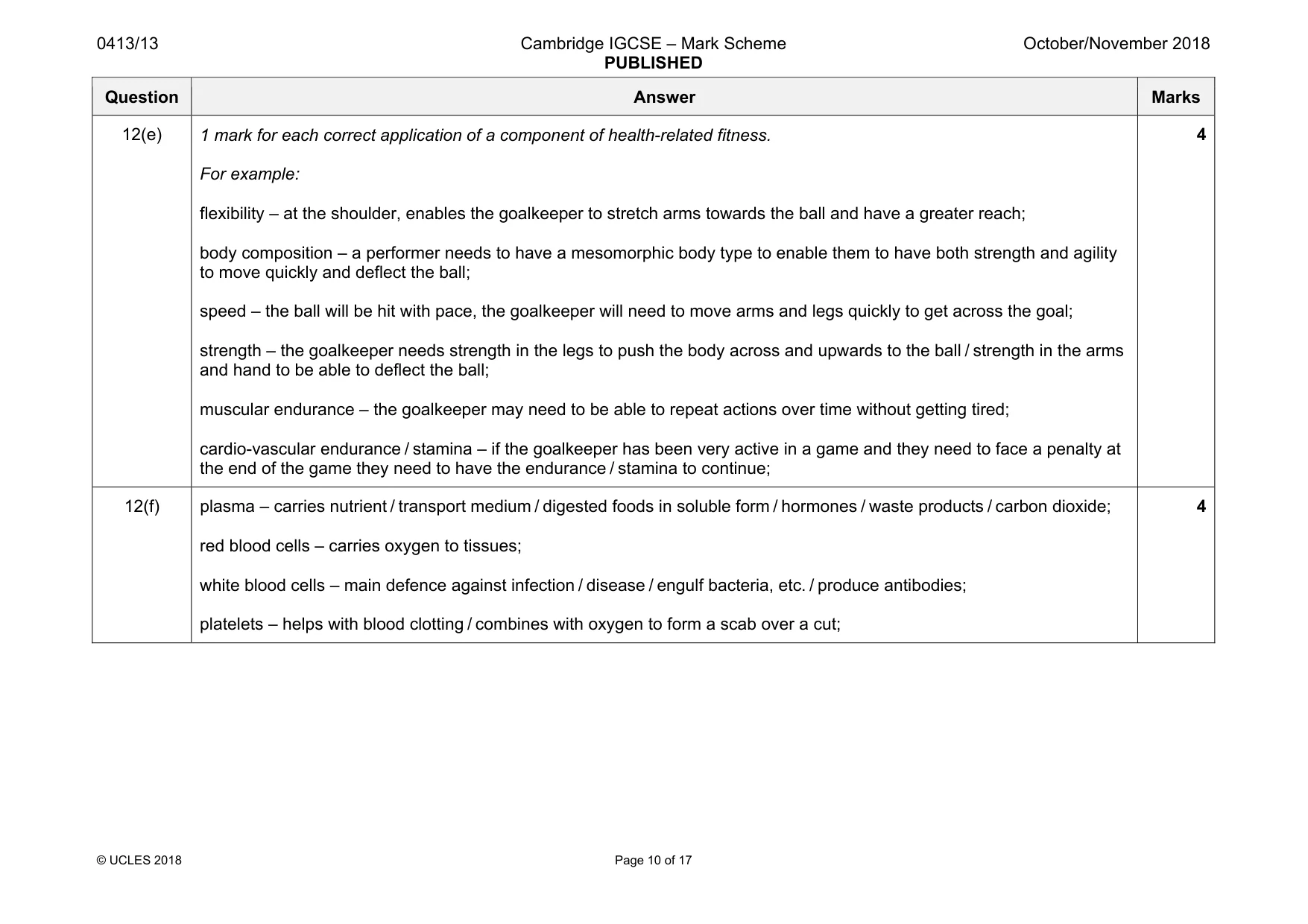
0413/13 Cambridge IGCSE – Mark Scheme PUBLISHED October/November 2018 © UCLES 2018 Page 10 of 17 Question Answer Marks 12(e) 1 mark for each correct application of a component of health-related fitness. For example: flexibility – at the shoulder, enables the goalkeeper to stretch arms towards the ball and have a greater reach; body composition – a performer needs to have a mesomorphic body type to enable them to have both strength and agility to move quickly and deflect the ball; speed – the ball will be hit with pace, the goalkeeper will need to move arms and legs quickly to get across the goal; strength – the goalkeeper needs strength in the legs to push the body across and upwards to the ball / strength in the arms and hand to be able to deflect the ball; muscular endurance – the goalkeeper may need to be able to repeat actions over time without getting tired; cardio-vascular endurance / stamina – if the goalkeeper has been very active in a game and they need to face a penalty at the end of the game they need to have the endurance / stamina to continue; 4 12(f) plasma – carries nutrient / transport medium / digested foods in soluble form / hormones / waste products / carbon dioxide; red blood cells – carries oxygen to tissues; white blood cells – main defence against infection / disease / engulf bacteria, etc. / produce antibodies; platelets – helps with blood clotting / combines with oxygen to form a scab over a cut; 4
Mark scheme, page 11
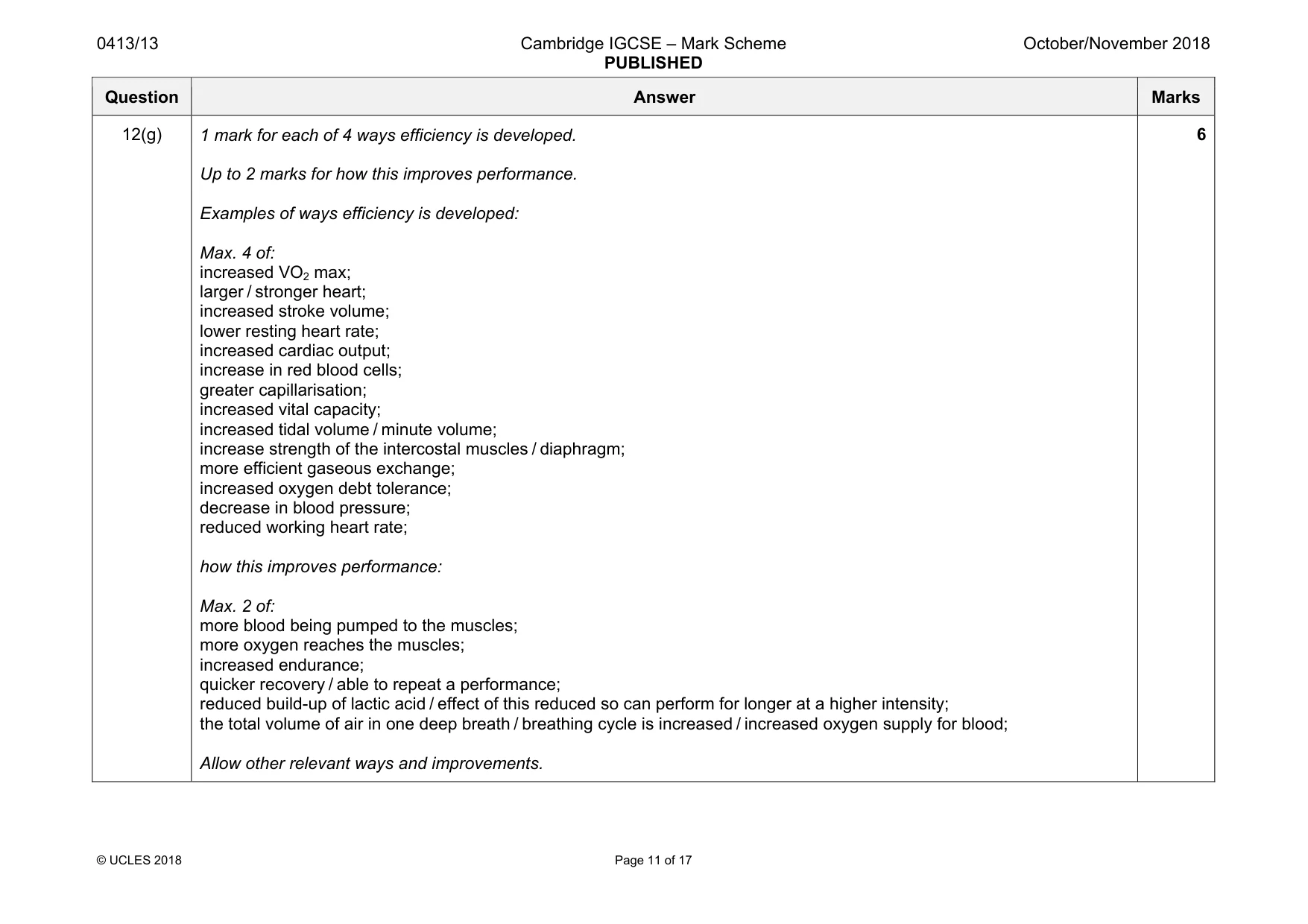
0413/13 Cambridge IGCSE – Mark Scheme PUBLISHED October/November 2018 © UCLES 2018 Page 11 of 17 Question Answer Marks 12(g) 1 mark for each of 4 ways efficiency is developed. Up to 2 marks for how this improves performance. Examples of ways efficiency is developed: Max. 4 of: increased VO2 max; larger / stronger heart; increased stroke volume; lower resting heart rate; increased cardiac output; increase in red blood cells; greater capillarisation; increased vital capacity; increased tidal volume / minute volume; increase strength of the intercostal muscles / diaphragm; more efficient gaseous exchange; increased oxygen debt tolerance; decrease in blood pressure; reduced working heart rate; how this improves performance: Max. 2 of: more blood being pumped to the muscles; more oxygen reaches the muscles; increased endurance; quicker recovery / able to repeat a performance; reduced build-up of lactic acid / effect of this reduced so can perform for longer at a higher intensity; the total volume of air in one deep breath / breathing cycle is increased / increased oxygen supply for blood; Allow other relevant ways and improvements. 6
Mark scheme, page 12
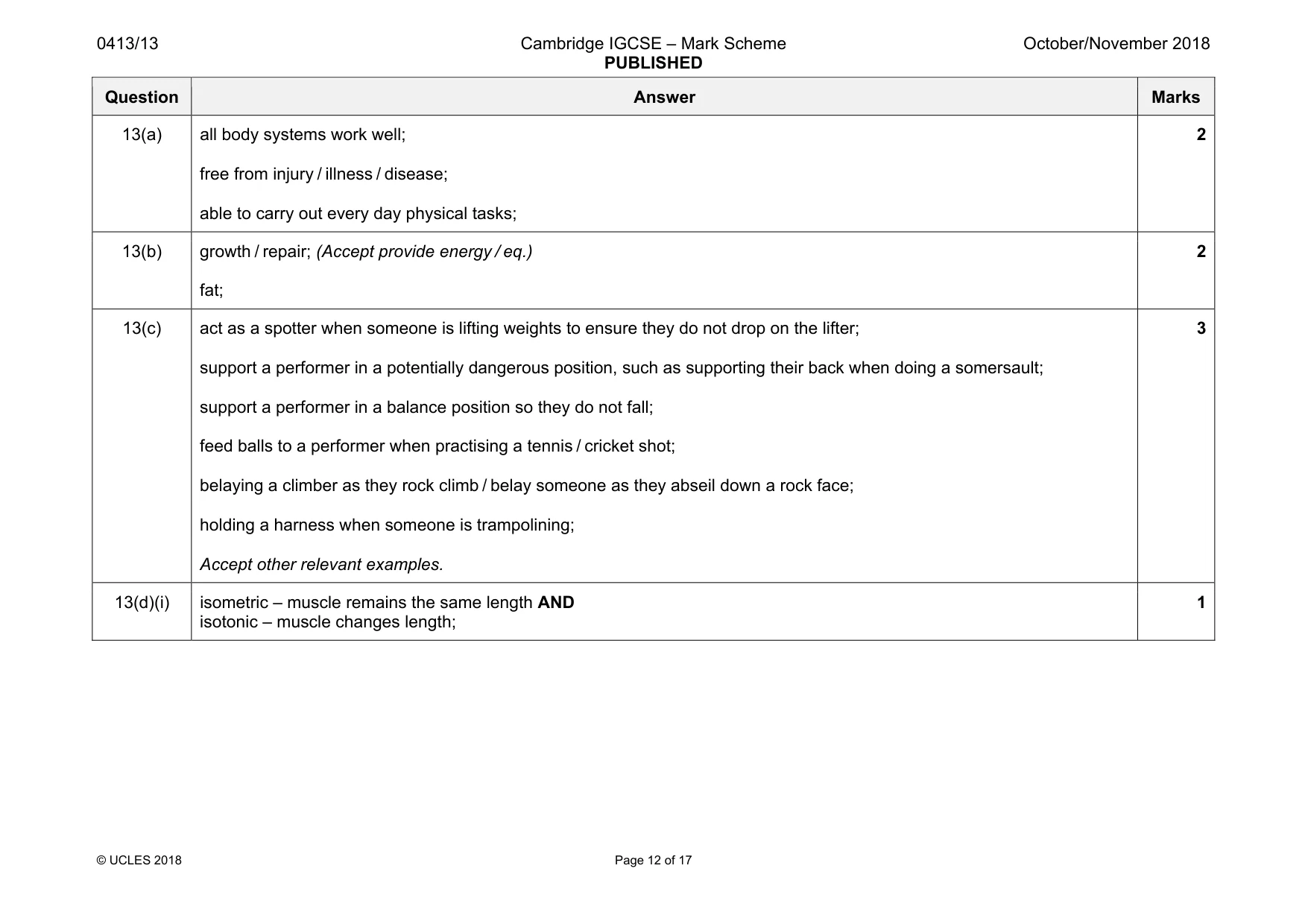
0413/13 Cambridge IGCSE – Mark Scheme PUBLISHED October/November 2018 © UCLES 2018 Page 12 of 17 Question Answer Marks 13(a) all body systems work well; free from injury / illness / disease; able to carry out every day physical tasks; 2 13(b) growth / repair; (Accept provide energy / eq.) fat; 2 13(c) act as a spotter when someone is lifting weights to ensure they do not drop on the lifter; support a performer in a potentially dangerous position, such as supporting their back when doing a somersault; support a performer in a balance position so they do not fall; feed balls to a performer when practising a tennis / cricket shot; belaying a climber as they rock climb / belay someone as they abseil down a rock face; holding a harness when someone is trampolining; Accept other relevant examples. 3 13(d)(i) isometric – muscle remains the same length AND isotonic – muscle changes length; 1
Mark scheme, page 13
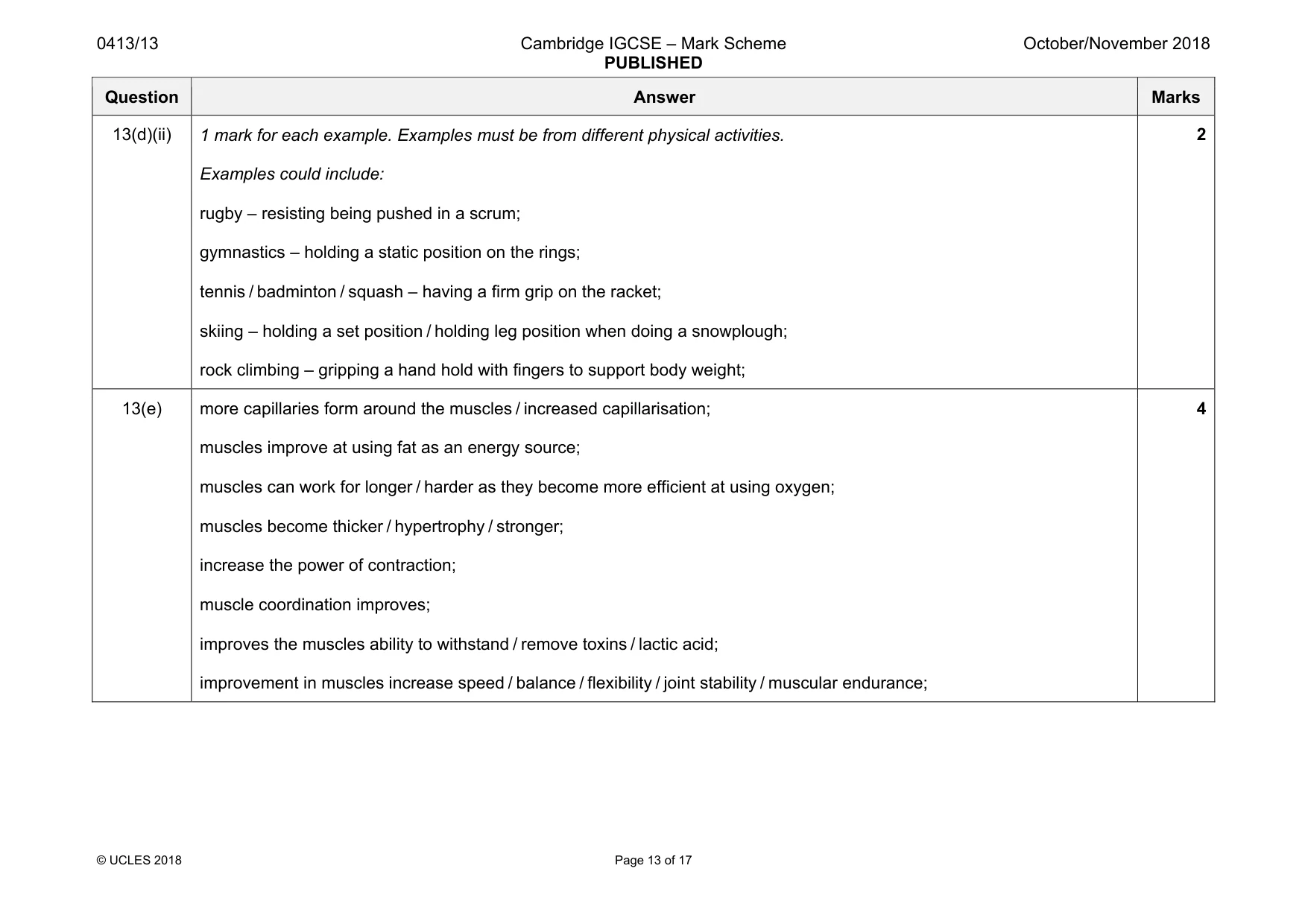
0413/13 Cambridge IGCSE – Mark Scheme PUBLISHED October/November 2018 © UCLES 2018 Page 13 of 17 Question Answer Marks 13(d)(ii) 1 mark for each example. Examples must be from different physical activities. Examples could include: rugby – resisting being pushed in a scrum; gymnastics – holding a static position on the rings; tennis / badminton / squash – having a firm grip on the racket; skiing – holding a set position / holding leg position when doing a snowplough; rock climbing – gripping a hand hold with fingers to support body weight; 2 13(e) more capillaries form around the muscles / increased capillarisation; muscles improve at using fat as an energy source; muscles can work for longer / harder as they become more efficient at using oxygen; muscles become thicker / hypertrophy / stronger; increase the power of contraction; muscle coordination improves; improves the muscles ability to withstand / remove toxins / lactic acid; improvement in muscles increase speed / balance / flexibility / joint stability / muscular endurance; 4
Mark scheme, page 14
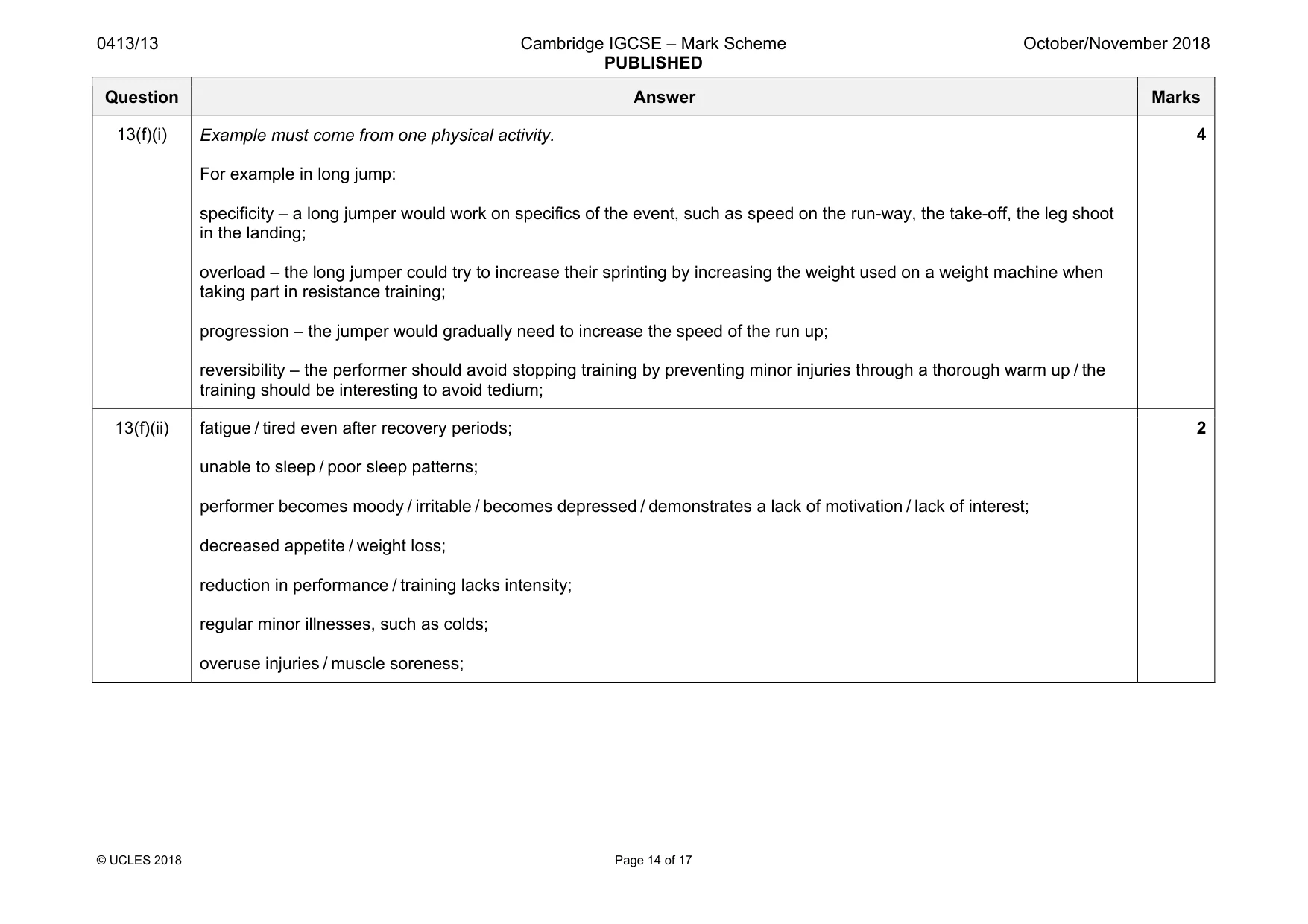
0413/13 Cambridge IGCSE – Mark Scheme PUBLISHED October/November 2018 © UCLES 2018 Page 14 of 17 Question Answer Marks 13(f)(i) Example must come from one physical activity. For example in long jump: specificity – a long jumper would work on specifics of the event, such as speed on the run-way, the take-off, the leg shoot in the landing; overload – the long jumper could try to increase their sprinting by increasing the weight used on a weight machine when taking part in resistance training; progression – the jumper would gradually need to increase the speed of the run up; reversibility – the performer should avoid stopping training by preventing minor injuries through a thorough warm up / the training should be interesting to avoid tedium; 4 13(f)(ii) fatigue / tired even after recovery periods; unable to sleep / poor sleep patterns; performer becomes moody / irritable / becomes depressed / demonstrates a lack of motivation / lack of interest; decreased appetite / weight loss; reduction in performance / training lacks intensity; regular minor illnesses, such as colds; overuse injuries / muscle soreness; 2
Mark scheme, page 15
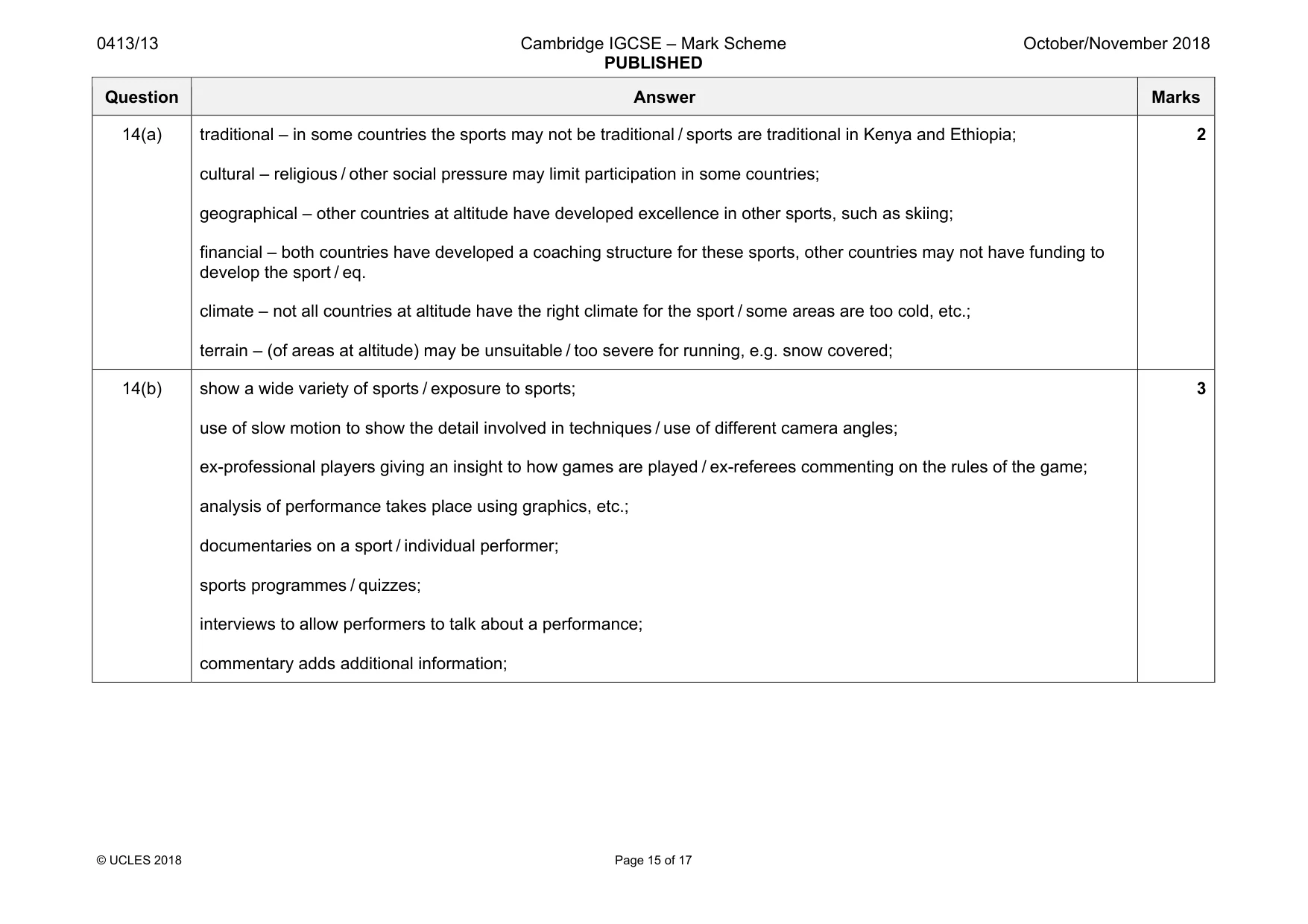
0413/13 Cambridge IGCSE – Mark Scheme PUBLISHED October/November 2018 © UCLES 2018 Page 15 of 17 Question Answer Marks 14(a) traditional – in some countries the sports may not be traditional / sports are traditional in Kenya and Ethiopia; cultural – religious / other social pressure may limit participation in some countries; geographical – other countries at altitude have developed excellence in other sports, such as skiing; financial – both countries have developed a coaching structure for these sports, other countries may not have funding to develop the sport / eq. climate – not all countries at altitude have the right climate for the sport / some areas are too cold, etc.; terrain – (of areas at altitude) may be unsuitable / too severe for running, e.g. snow covered; 2 14(b) show a wide variety of sports / exposure to sports; use of slow motion to show the detail involved in techniques / use of different camera angles; ex-professional players giving an insight to how games are played / ex-referees commenting on the rules of the game; analysis of performance takes place using graphics, etc.; documentaries on a sport / individual performer; sports programmes / quizzes; interviews to allow performers to talk about a performance; commentary adds additional information; 3
Mark scheme, page 16
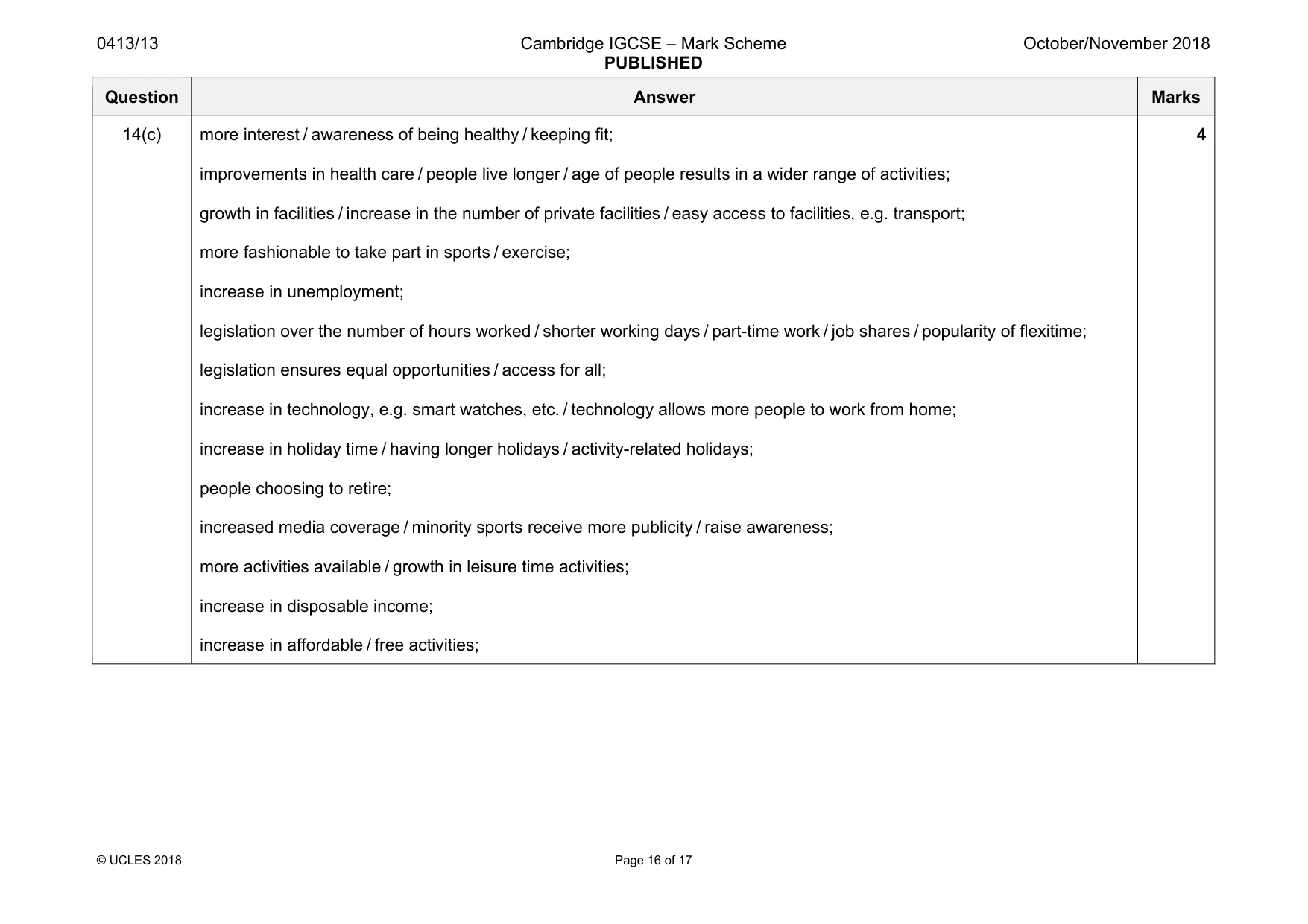
0413/13 Cambridge IGCSE – Mark Scheme PUBLISHED October/November 2018 © UCLES 2018 Page 16 of 17 Question Answer Marks 14(c) more interest / awareness of being healthy / keeping fit; improvements in health care / people live longer / age of people results in a wider range of activities; growth in facilities / increase in the number of private facilities / easy access to facilities, e.g. transport; more fashionable to take part in sports / exercise; increase in unemployment; legislation over the number of hours worked / shorter working days / part-time work / job shares / popularity of flexitime; legislation ensures equal opportunities / access for all; increase in technology, e.g. smart watches, etc. / technology allows more people to work from home; increase in holiday time / having longer holidays / activity-related holidays; people choosing to retire; increased media coverage / minority sports receive more publicity / raise awareness; more activities available / growth in leisure time activities; increase in disposable income; increase in affordable / free activities; 4
Mark scheme, page 17
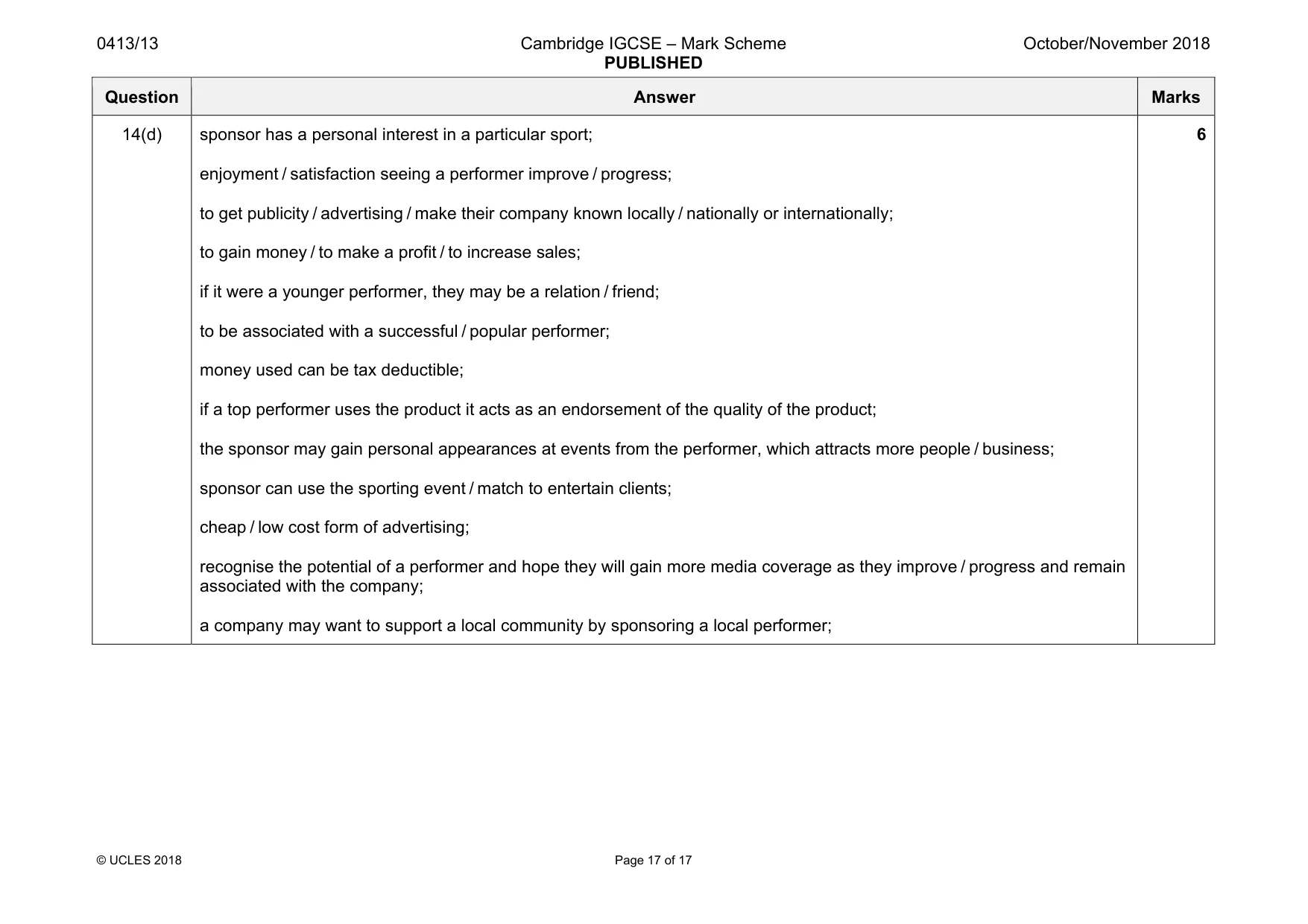
0413/13 Cambridge IGCSE – Mark Scheme PUBLISHED October/November 2018 © UCLES 2018 Page 17 of 17 Question Answer Marks 14(d) sponsor has a personal interest in a particular sport; enjoyment / satisfaction seeing a performer improve / progress; to get publicity / advertising / make their company known locally / nationally or internationally; to gain money / to make a profit / to increase sales; if it were a younger performer, they may be a relation / friend; to be associated with a successful / popular performer; money used can be tax deductible; if a top performer uses the product it acts as an endorsement of the quality of the product; the sponsor may gain personal appearances at events from the performer, which attracts more people / business; sponsor can use the sporting event / match to entertain clients; cheap / low cost form of advertising; recognise the potential of a performer and hope they will gain more media coverage as they improve / progress and remain associated with the company; a company may want to support a local community by sponsoring a local performer; 6
What you needed in this session
Cambridge’s own grade thresholds for 2018 Oct/Nov, Paper 1 · Variant 3. A higher threshold means an easier paper — the bar moves with how the cohort did.