Cambridge IGCSE Physical Education 0413 — 2018 May/June Paper 1 · Variant 2
0413/12/M/J/18 · 80 marks · ≈90 min
The question paper and its mark scheme, free to read here and free to download. This is Cambridge’s own paper, exactly as it was sat.
Question paper12 pages
Mark scheme18 pages
Answers below. Sit the paper first if you are practising.
Paper as text
Question paper, page 1
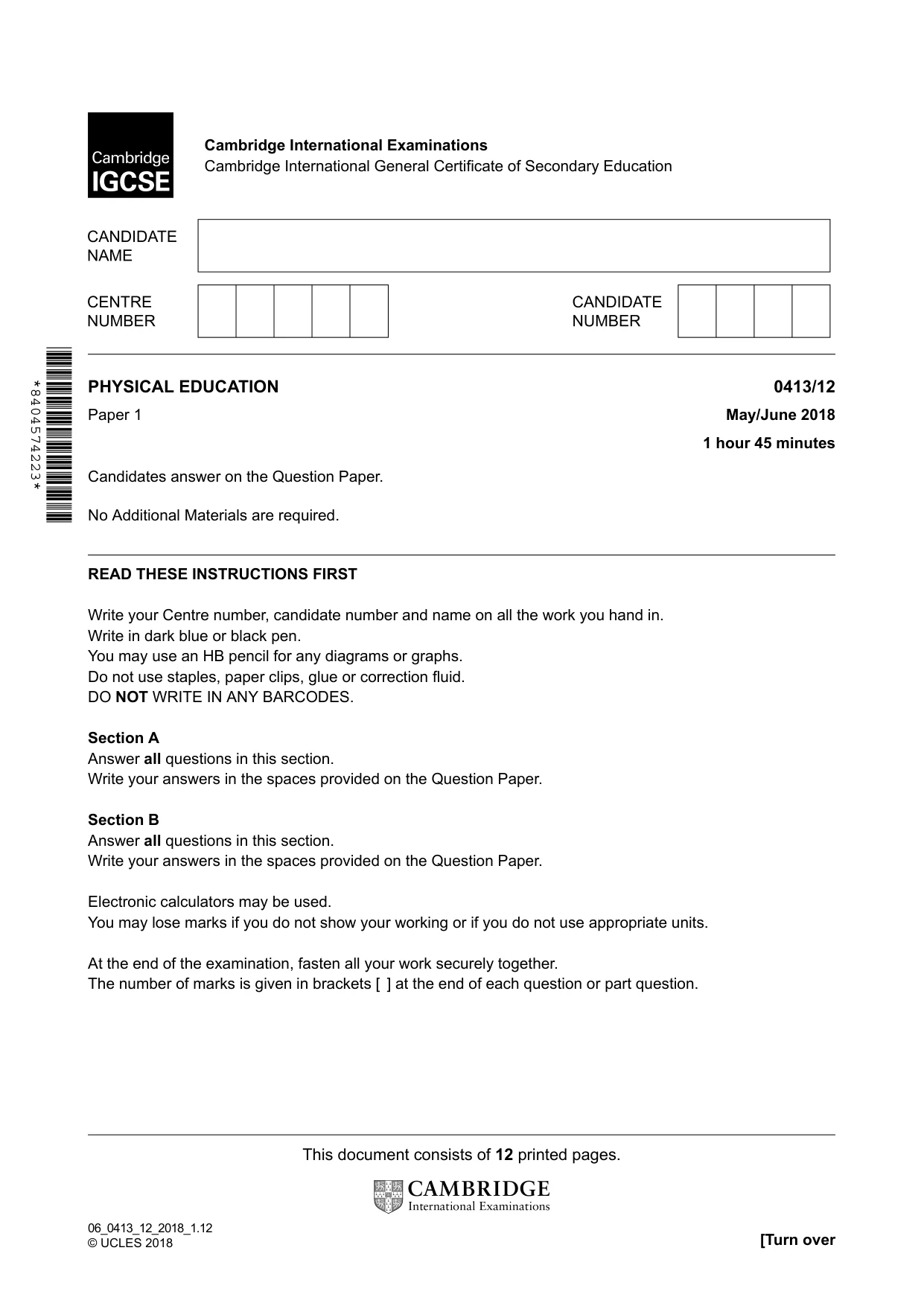
Cambridge International Examinations Cambridge International General Certificate of Secondary Education 0413/12 May/June 2018 1 hour 45 minutes PHYSICAL EDUCATION Paper 1 Candidates answer on the Question Paper. No Additional Materials are required. READ THESE INSTRUCTIONS FIRST Write your Centre number, candidate number and name on all the work you hand in. Write in dark blue or black pen. You may use an HB pencil for any diagrams or graphs. Do not use staples, paper clips, glue or correction fluid. DO NOT WRITE IN ANY BARCODES. Section A Answer all questions in this section. Write your answers in the spaces provided on the Question Paper. Section B Answer all questions in this section. Write your answers in the spaces provided on the Question Paper. Electronic calculators may be used. You may lose marks if you do not show your working or if you do not use appropriate units. At the end of the examination, fasten all your work securely together. The number of marks is given in brackets [ ] at the end of each question or part question. This document consists of 12 printed pages. [Turn over 06_0413_12_2018_1.12 © UCLES 2018 *8404574223*
Question paper, page 2
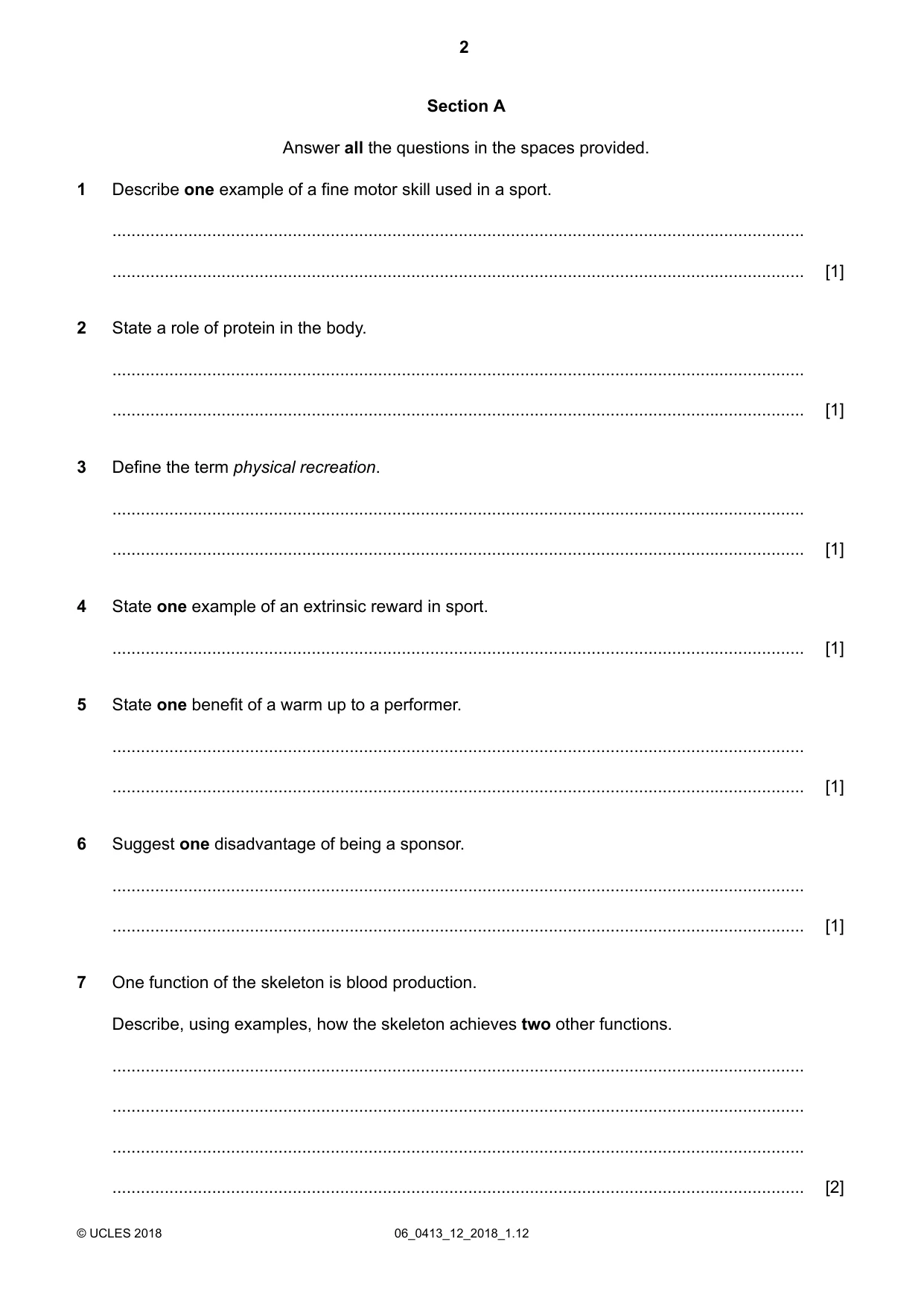
Section A Answer all the questions in the spaces provided. Describe one example of a fine motor skill used in a sport. 1 … … [1] State a role of protein in the body. 2 … … [1] Define the term physical recreation. 3 … … [1] State one example of an extrinsic reward in sport. 4 … [1] State one benefit of a warm up to a performer. 5 … … [1] Suggest one disadvantage of being a sponsor. 6 … … [1] One function of the skeleton is blood production. Describe, using examples, how the skeleton achieves two other functions. 7 … … … … [2] 06_0413_12_2018_1.12 © UCLES 2018 2
Question paper, page 3
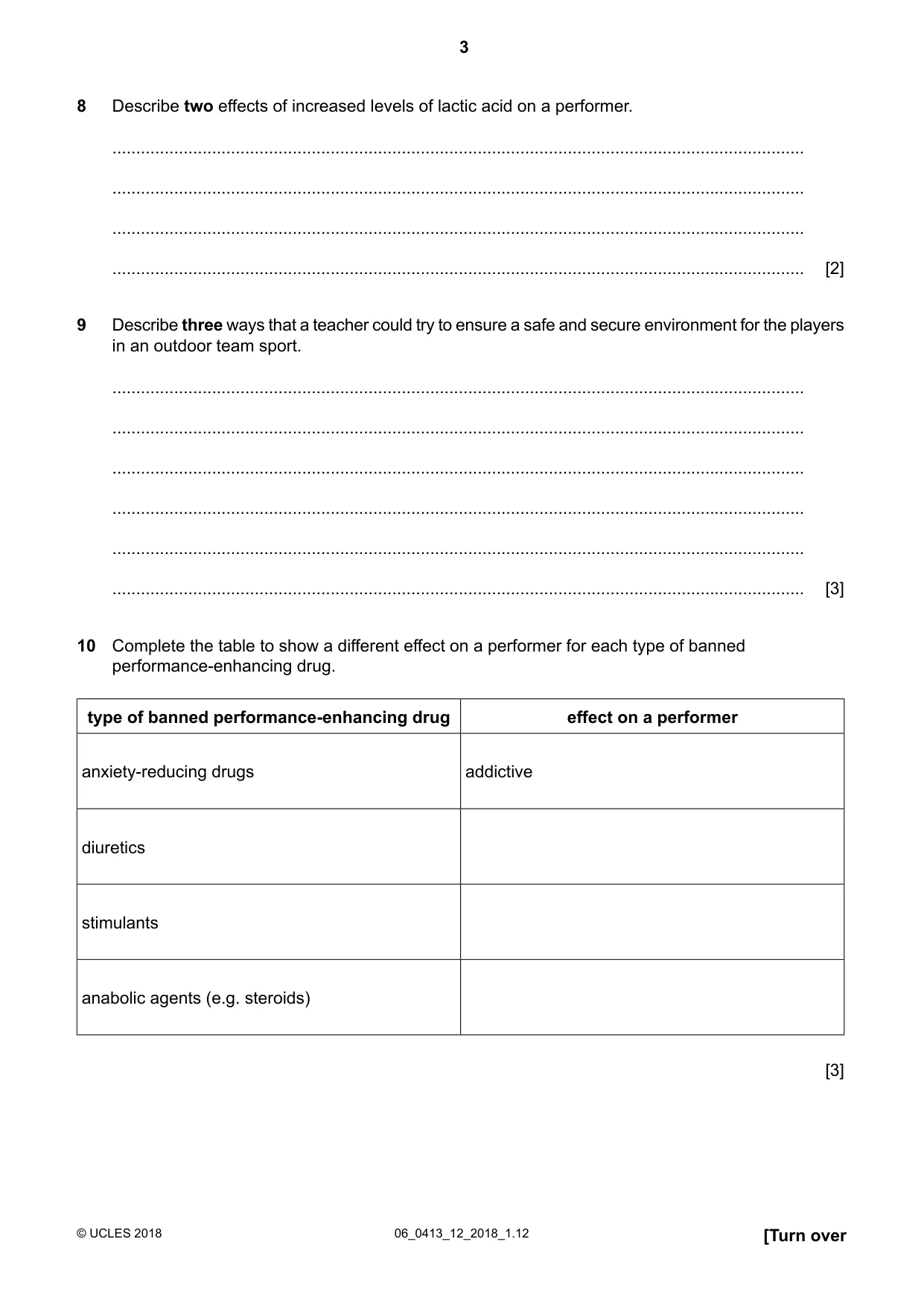
Describe two effects of increased levels of lactic acid on a performer. 8 … … … … [2] Describe three ways that a teacher could try to ensure a safe and secure environment for the players in an outdoor team sport. 9 … … … … … … [3] Complete the table to show a different effect on a performer for each type of banned performance-enhancing drug. 10 effect on a performer type of banned performance-enhancing drug addictive anxiety-reducing drugs diuretics stimulants anabolic agents (e.g. steroids) [3] [Turn over 06_0413_12_2018_1.12 © UCLES 2018 3
Question paper, page 4
Suggest positive and negative effects that the media can have on minority sports. 11 … … … … … … … … [4] [Total: 20] 06_0413_12_2018_1.12 © UCLES 2018 4
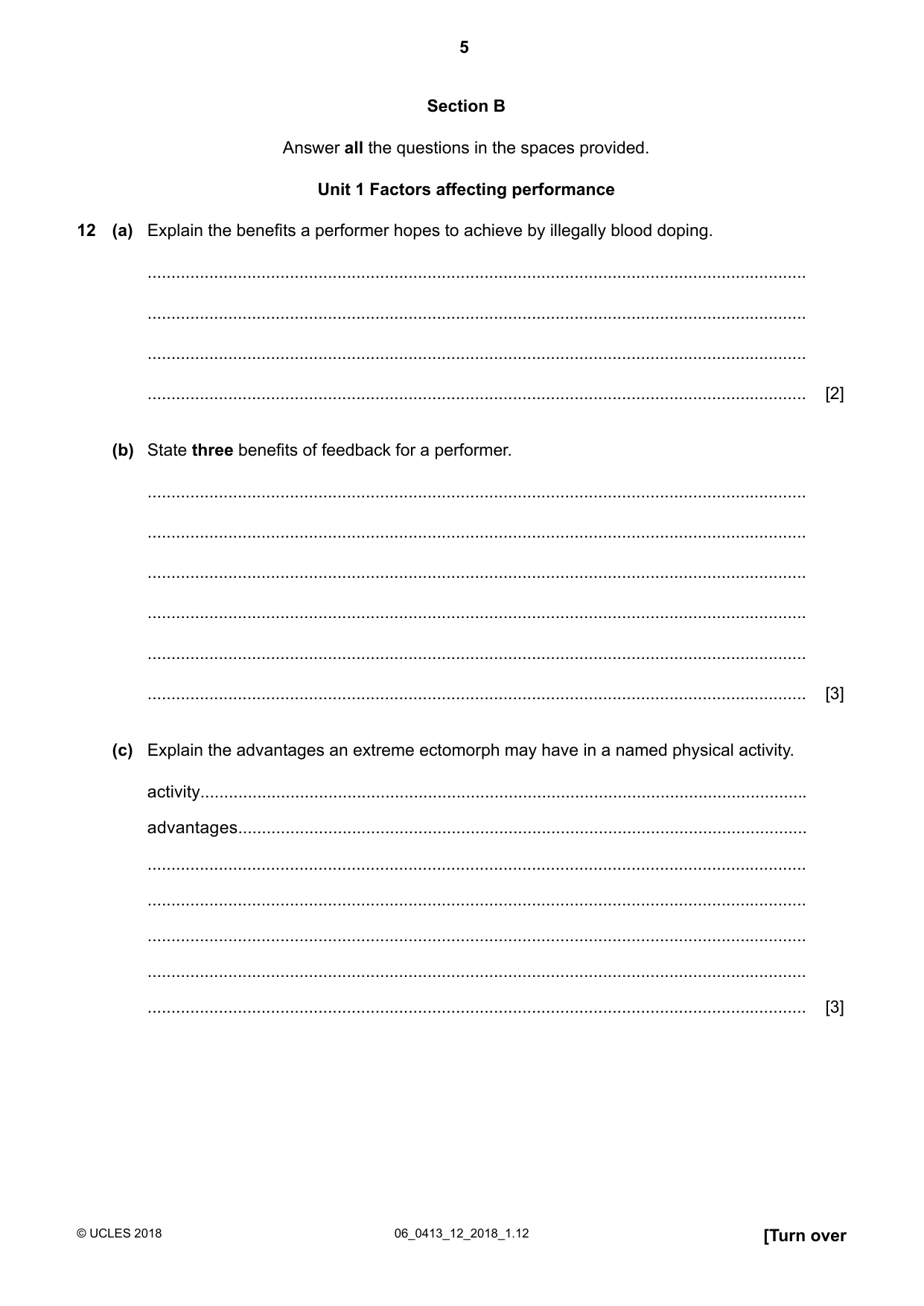
Question paper, page 5
Section B Answer all the questions in the spaces provided. Unit 1 Factors affecting performance Explain the benefits a performer hopes to achieve by illegally blood doping. (a) 12 … … … … [2] State three benefits of feedback for a performer. (b) … … … … … … [3] Explain the advantages an extreme ectomorph may have in a named physical activity. (c) activity… advantages… … … … … … [3] [Turn over 06_0413_12_2018_1.12 © UCLES 2018 5
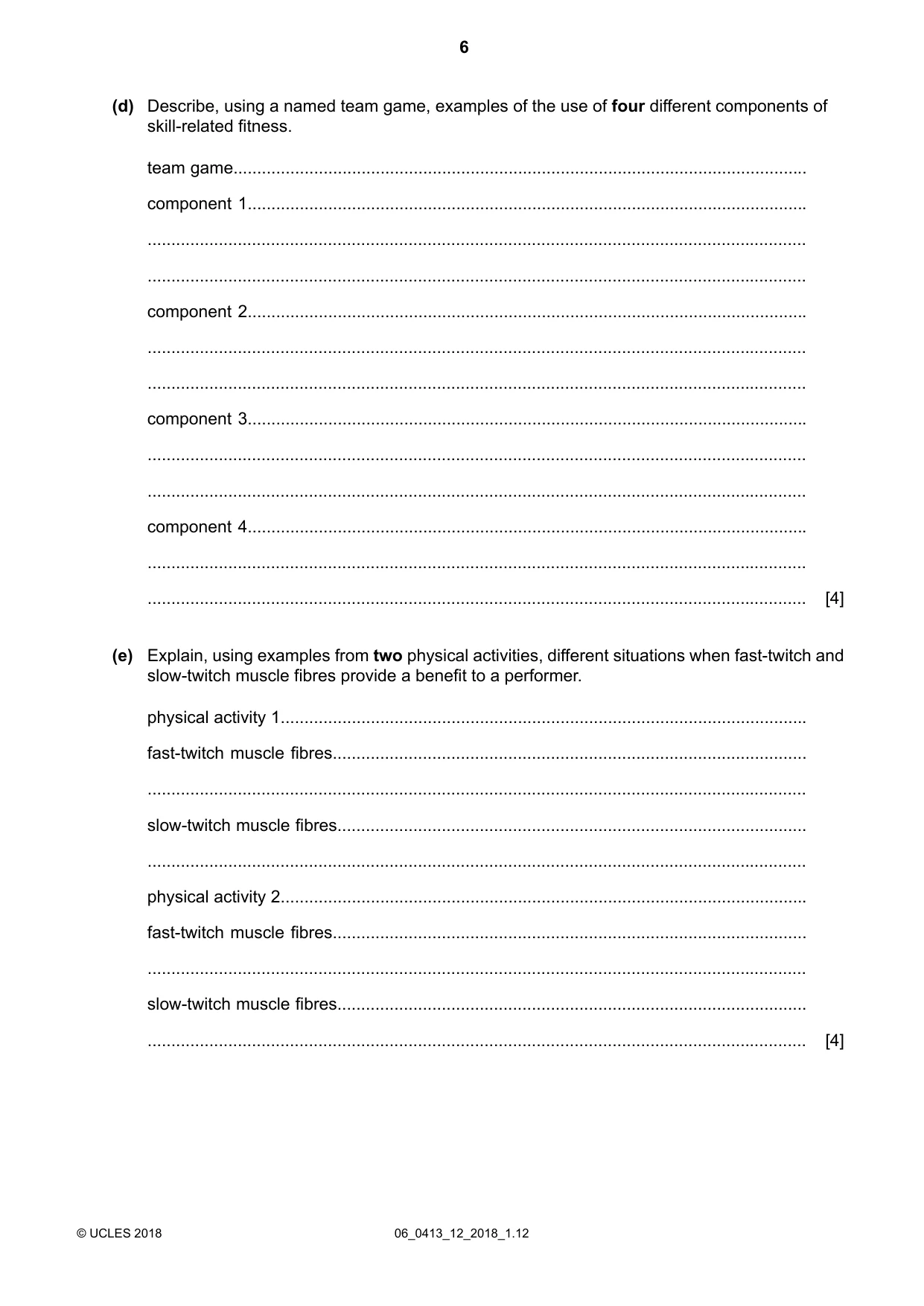
Question paper, page 6
Describe, using a named team game, examples of the use of four different components of skill-related fitness. (d) team game… component 1… … … component 2… … … component 3… … … component 4… … … [4] Explain, using examples from two physical activities, different situations when fast-twitch and slow-twitch muscle fibres provide a benefit to a performer. (e) physical activity 1… fast-twitch muscle fibres… … slow-twitch muscle fibres… … physical activity 2… fast-twitch muscle fibres… … slow-twitch muscle fibres… … [4] 06_0413_12_2018_1.12 © UCLES 2018 6
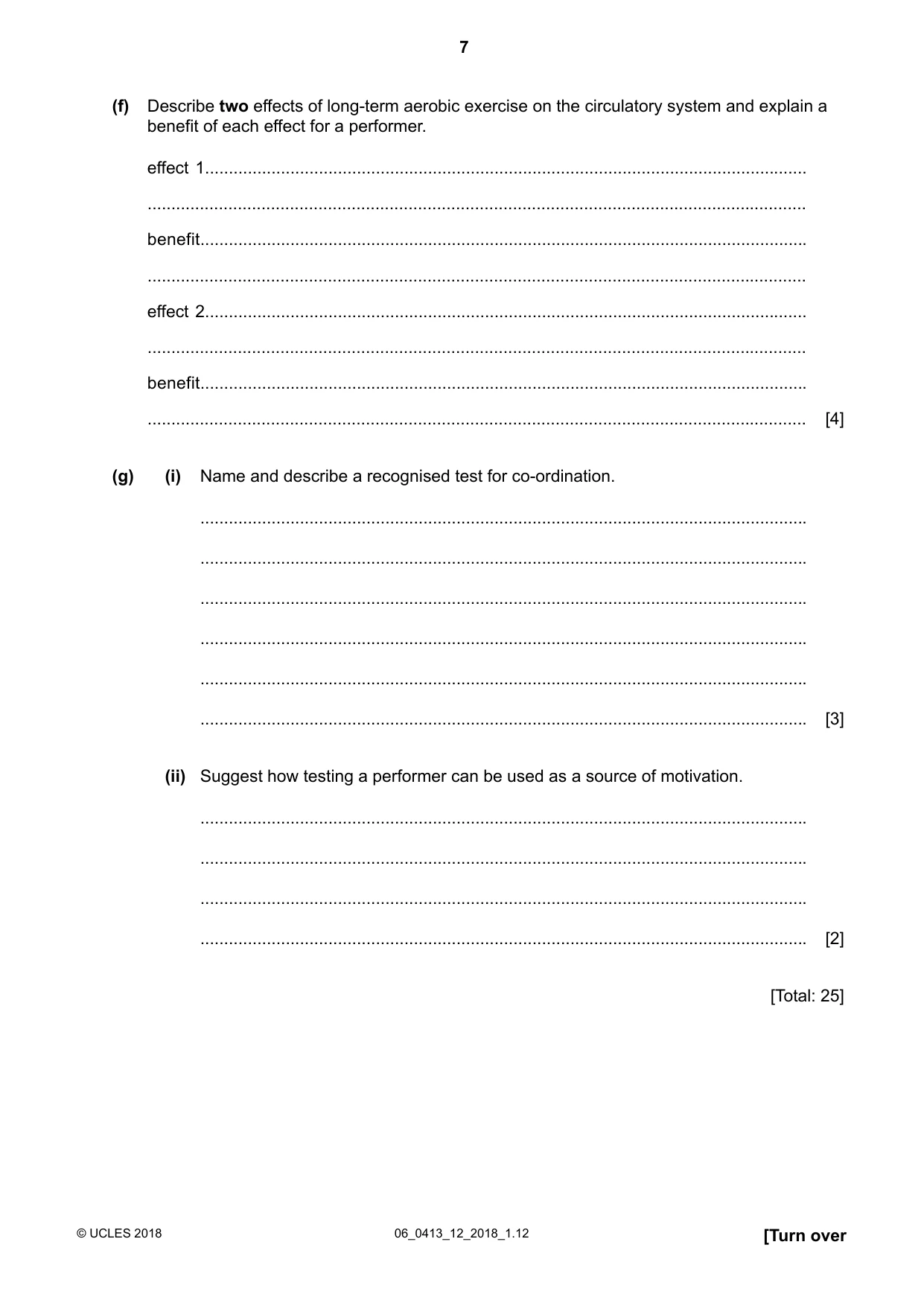
Question paper, page 7
Describe two effects of long-term aerobic exercise on the circulatory system and explain a benefit of each effect for a performer. (f) effect 1… … benefit… … effect 2… … benefit… … [4] Name and describe a recognised test for co-ordination. (i) (g) … … … … … … [3] Suggest how testing a performer can be used as a source of motivation. (ii) … … … … [2] [Total: 25] [Turn over 06_0413_12_2018_1.12 © UCLES 2018 7
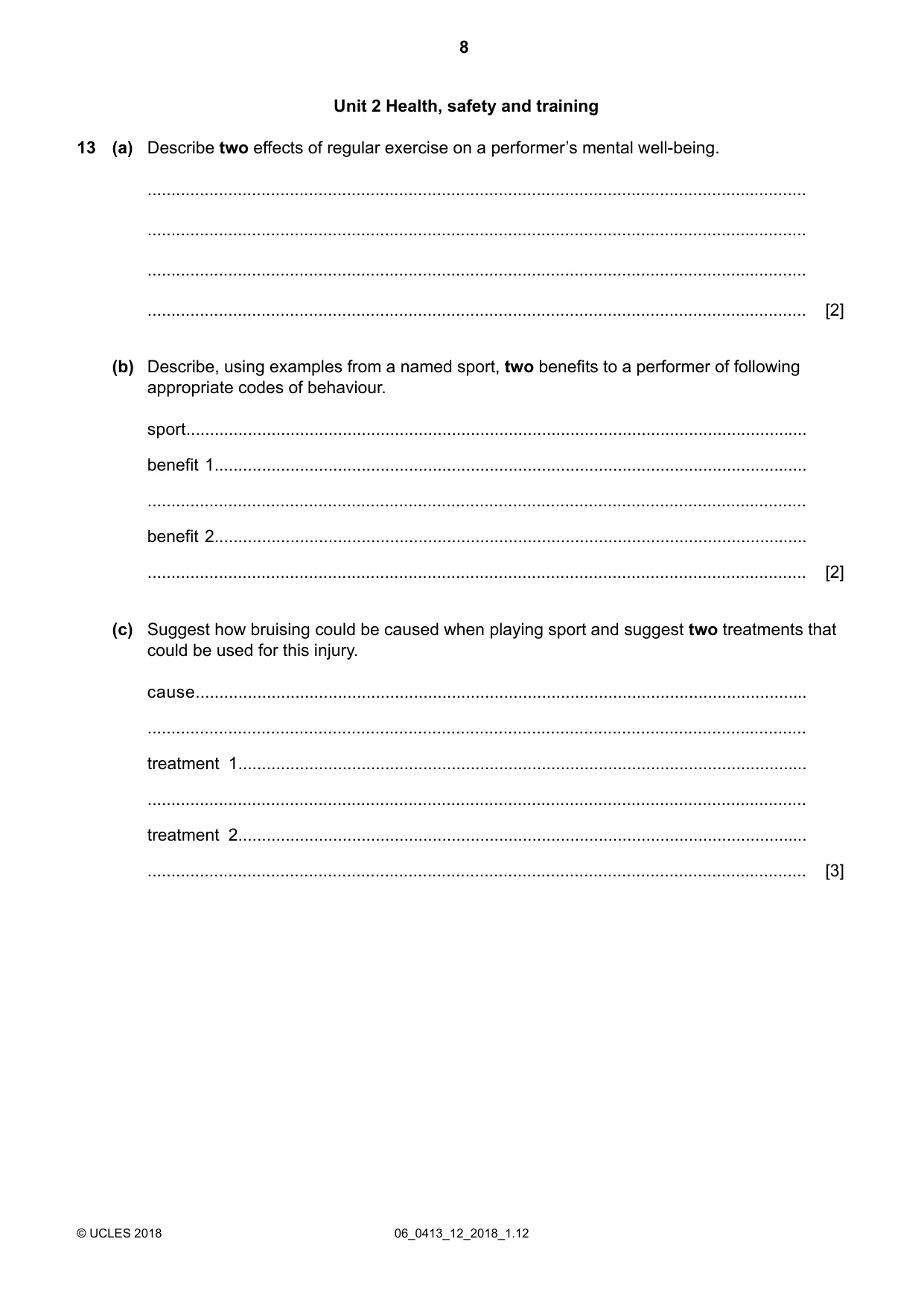
Question paper, page 8
Unit 2 Health, safety and training Describe two effects of regular exercise on a performer’s mental well-being. (a) 13 … … … … [2] Describe, using examples from a named sport, two benefits to a performer of following appropriate codes of behaviour. (b) sport… benefit 1… … benefit 2… … [2] Suggest how bruising could be caused when playing sport and suggest two treatments that could be used for this injury. (c) cause… … treatment 1… … treatment 2… … [3] 06_0413_12_2018_1.12 © UCLES 2018 8
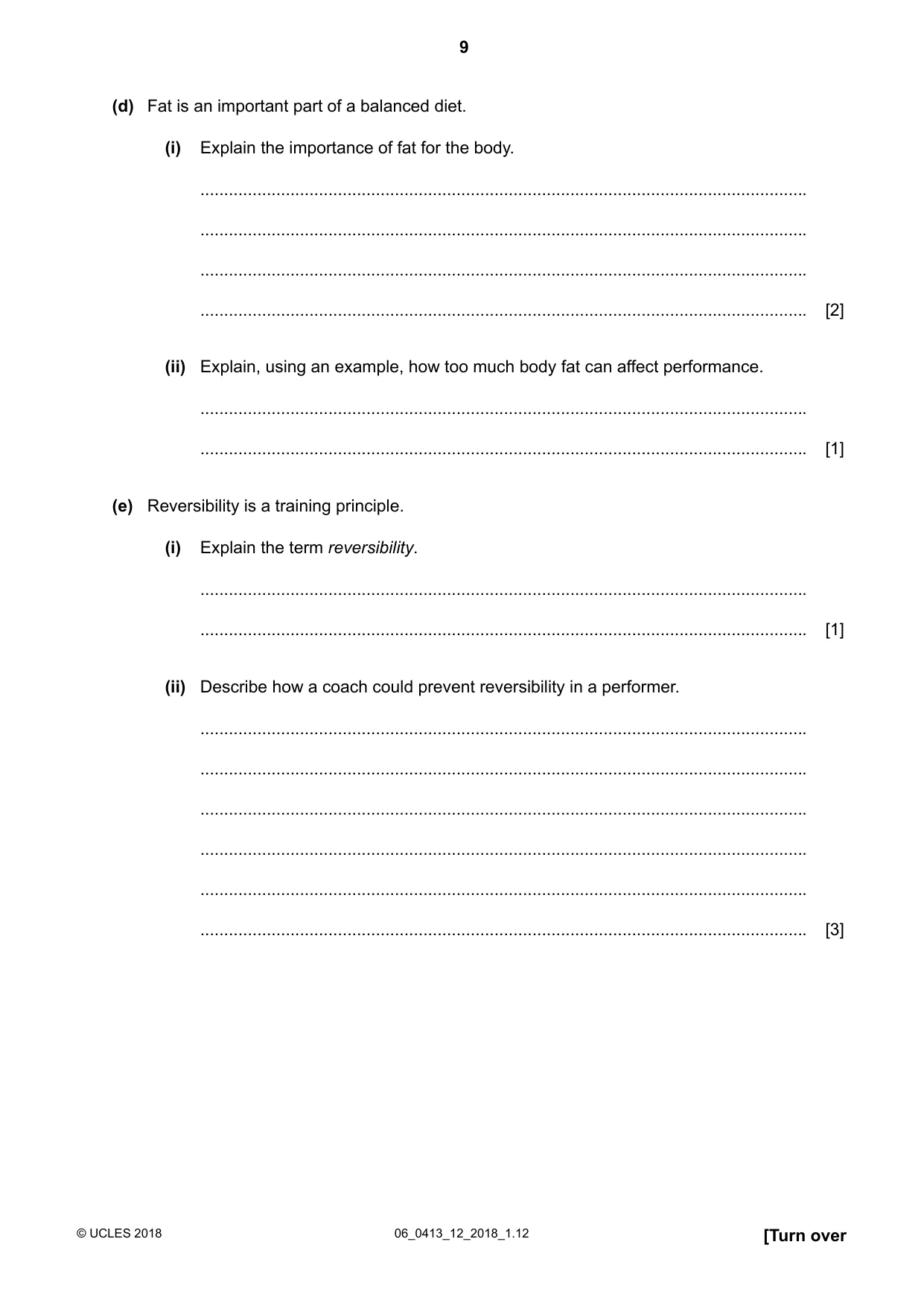
Question paper, page 9
Fat is an important part of a balanced diet. (d) Explain the importance of fat for the body. (i) … … … … [2] Explain, using an example, how too much body fat can affect performance. (ii) … … [1] Reversibility is a training principle. (e) Explain the term reversibility. (i) … … [1] Describe how a coach could prevent reversibility in a performer. (ii) … … … … … … [3] [Turn over 06_0413_12_2018_1.12 © UCLES 2018 9
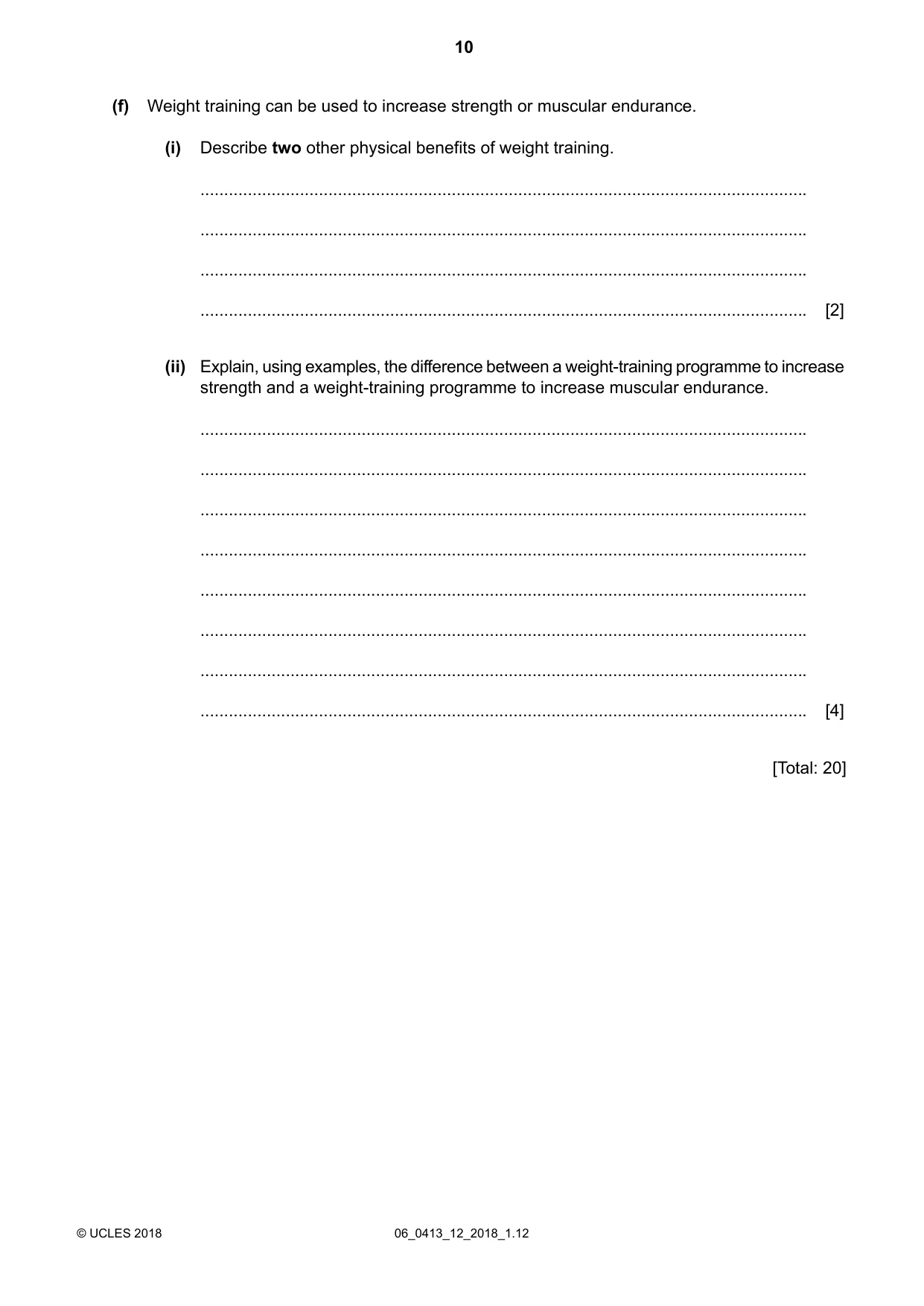
Question paper, page 10
Weight training can be used to increase strength or muscular endurance. (f) Describe two other physical benefits of weight training. (i) … … … … [2] Explain, using examples, the difference between a weight-training programme to increase strength and a weight-training programme to increase muscular endurance. (ii) … … … … … … … … [4] [Total: 20] 06_0413_12_2018_1.12 © UCLES 2018 10
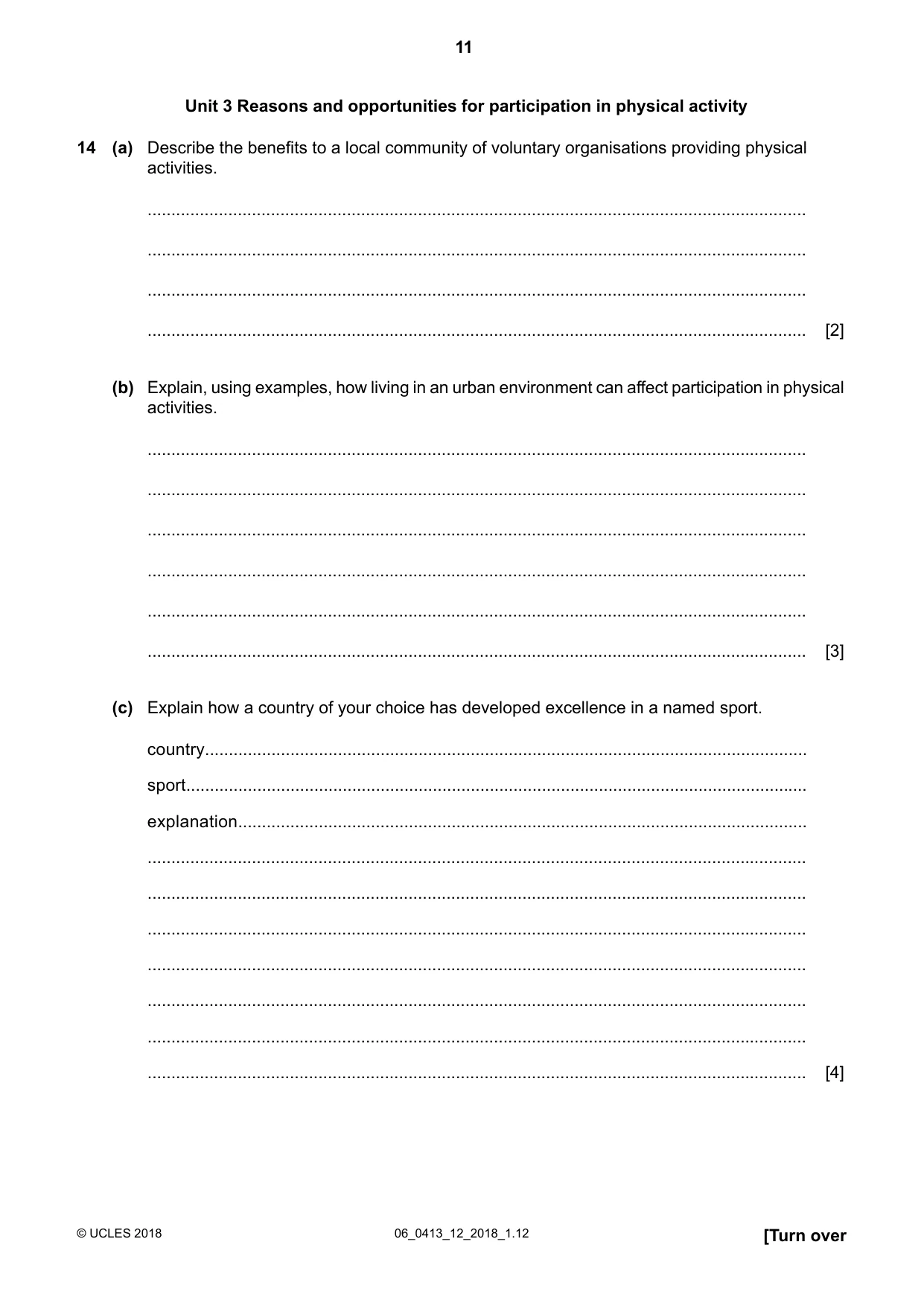
Question paper, page 11
Unit 3 Reasons and opportunities for participation in physical activity Describe the benefits to a local community of voluntary organisations providing physical activities. (a) 14 … … … … [2] Explain, using examples, how living in an urban environment can affect participation in physical activities. (b) … … … … … … [3] Explain how a country of your choice has developed excellence in a named sport. (c) country… sport… explanation… … … … … … … … [4] [Turn over 06_0413_12_2018_1.12 © UCLES 2018 11
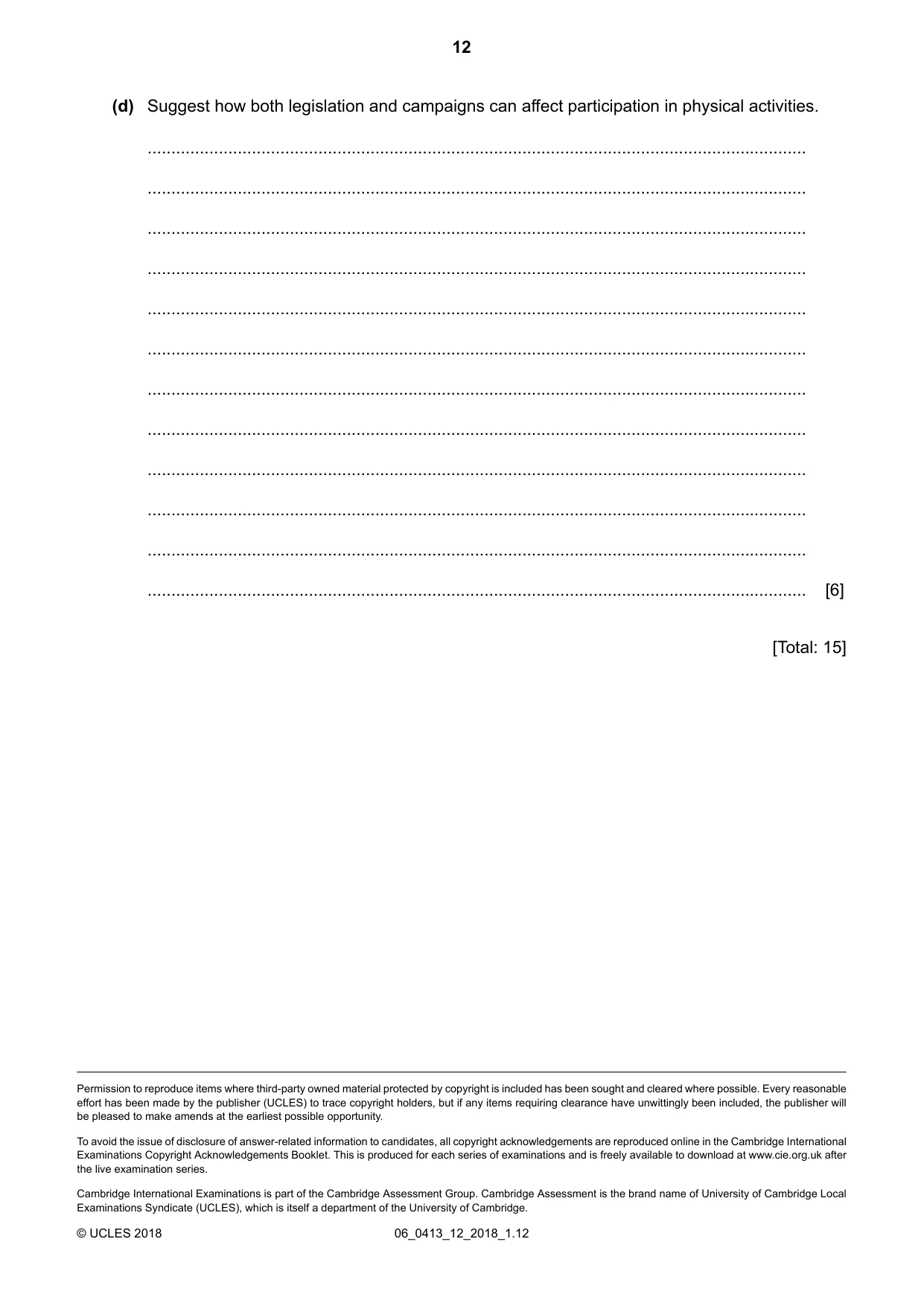
Question paper, page 12
Suggest how both legislation and campaigns can affect participation in physical activities. (d) … … … … … … … … … … … … [6] [Total: 15] Permission to reproduce items where third-party owned material protected by copyright is included has been sought and cleared where possible. Every reasonable effort has been made by the publisher (UCLES) to trace copyright holders, but if any items requiring clearance have unwittingly been included, the publisher will be pleased to make amends at the earliest possible opportunity. To avoid the issue of disclosure of answer-related information to candidates, all copyright acknowledgements are reproduced online in the Cambridge International Examinations Copyright Acknowledgements Booklet. This is produced for each series of examinations and is freely available to download at www.cie.org.uk after the live examination series. Cambridge International Examinations is part of the Cambridge Assessment Group. Cambridge Assessment is the brand name of University of Cambridge Local Examinations Syndicate (UCLES), which is itself a department of the University of Cambridge. 06_0413_12_2018_1.12 © UCLES 2018 12
Mark scheme, page 1
IGCSE™ is a registered trademark. This document consists of 18 printed pages. © UCLES 2018 [Turn over Cambridge Assessment International Education Cambridge International General Certificate of Secondary Education PHYSICAL EDUCATION 0413/12 Paper 1 May/June 2018 MARK SCHEME Maximum Mark: 80 Published This mark scheme is published as an aid to teachers and candidates, to indicate the requirements of the examination. It shows the basis on which Examiners were instructed to award marks. It does not indicate the details of the discussions that took place at an Examiners’ meeting before marking began, which would have considered the acceptability of alternative answers. Mark schemes should be read in conjunction with the question paper and the Principal Examiner Report for Teachers. Cambridge International will not enter into discussions about these mark schemes. Cambridge International is publishing the mark schemes for the May/June 2018 series for most Cambridge IGCSE™, Cambridge International A and AS Level and Cambridge Pre-U components, and some Cambridge O Level components.
Mark scheme, page 2
0413/12 Cambridge IGCSE – Mark Scheme PUBLISHED May/June 2018 © UCLES 2018 Page 2 of 18 Generic Marking Principles These general marking principles must be applied by all examiners when marking candidate answers. They should be applied alongside the specific content of the mark scheme or generic level descriptors for a question. Each question paper and mark scheme will also comply with these marking principles. GENERIC MARKING PRINCIPLE 1: Marks must be awarded in line with: • the specific content of the mark scheme or the generic level descriptors for the question • the specific skills defined in the mark scheme or in the generic level descriptors for the question • the standard of response required by a candidate as exemplified by the standardisation scripts. GENERIC MARKING PRINCIPLE 2: Marks awarded are always whole marks (not half marks, or other fractions). GENERIC MARKING PRINCIPLE 3: Marks must be awarded positively: • marks are awarded for correct/valid answers, as defined in the mark scheme. However, credit is given for valid answers which go beyond the scope of the syllabus and mark scheme, referring to your Team Leader as appropriate • marks are awarded when candidates clearly demonstrate what they know and can do • marks are not deducted for errors • marks are not deducted for omissions • answers should only be judged on the quality of spelling, punctuation and grammar when these features are specifically assessed by the question as indicated by the mark scheme. The meaning, however, should be unambiguous. GENERIC MARKING PRINCIPLE 4: Rules must be applied consistently e.g. in situations where candidates have not followed instructions or in the application of generic level descriptors.
Mark scheme, page 3
0413/12 Cambridge IGCSE – Mark Scheme PUBLISHED May/June 2018 © UCLES 2018 Page 3 of 18 GENERIC MARKING PRINCIPLE 5: Marks should be awarded using the full range of marks defined in the mark scheme for the question (however; the use of the full mark range may be limited according to the quality of the candidate responses seen). GENERIC MARKING PRINCIPLE 6: Marks awarded are based solely on the requirements as defined in the mark scheme. Marks should not be awarded with grade thresholds or grade descriptors in mind.
Mark scheme, page 4
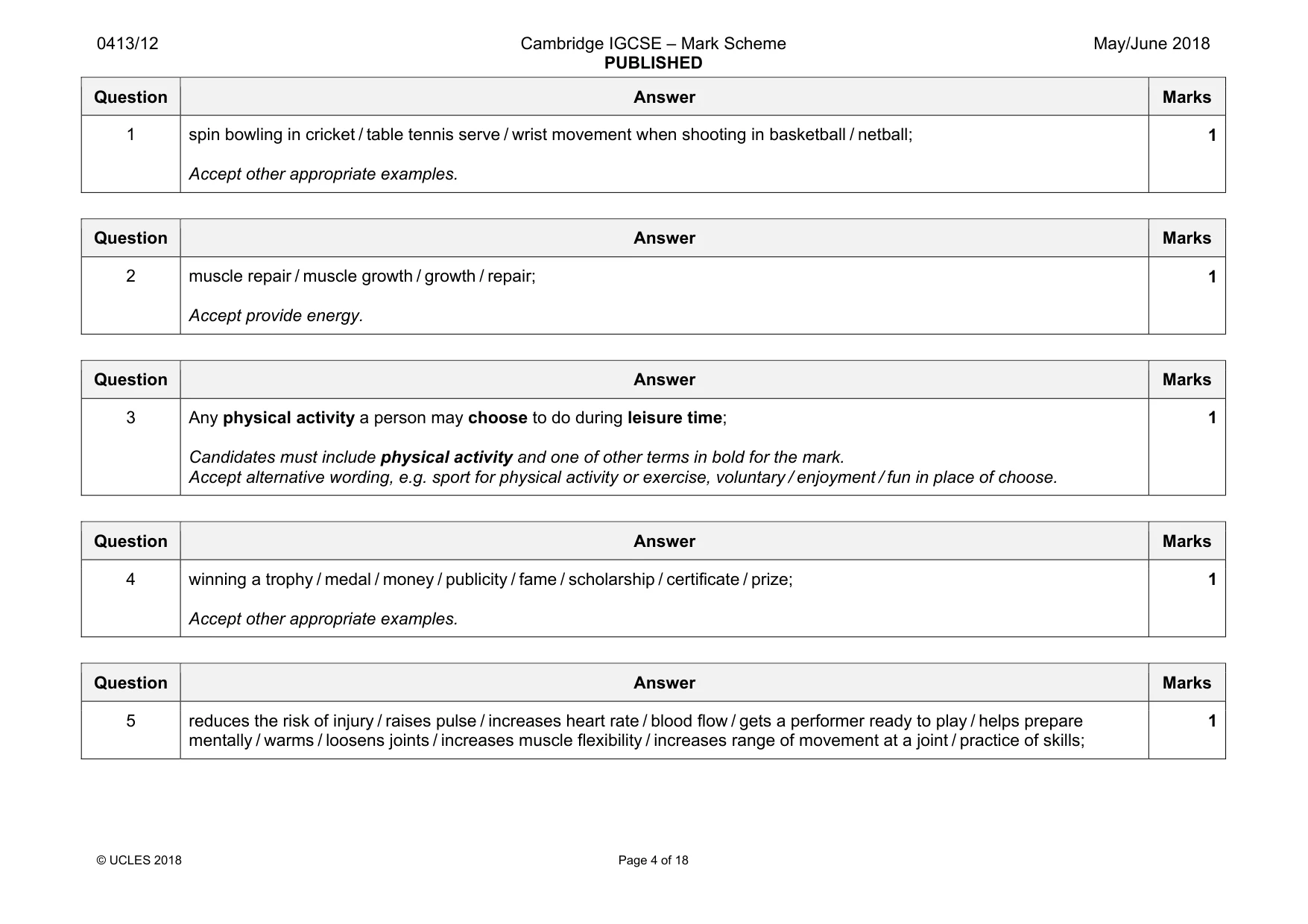
0413/12 Cambridge IGCSE – Mark Scheme PUBLISHED May/June 2018 © UCLES 2018 Page 4 of 18 Question Answer Marks 1 spin bowling in cricket / table tennis serve / wrist movement when shooting in basketball / netball; Accept other appropriate examples. 1 Question Answer Marks 2 muscle repair / muscle growth / growth / repair; Accept provide energy. 1 Question Answer Marks 3 Any physical activity a person may choose to do during leisure time; Candidates must include physical activity and one of other terms in bold for the mark. Accept alternative wording, e.g. sport for physical activity or exercise, voluntary / enjoyment / fun in place of choose. 1 Question Answer Marks 4 winning a trophy / medal / money / publicity / fame / scholarship / certificate / prize; Accept other appropriate examples. 1 Question Answer Marks 5 reduces the risk of injury / raises pulse / increases heart rate / blood flow / gets a performer ready to play / helps prepare mentally / warms / loosens joints / increases muscle flexibility / increases range of movement at a joint / practice of skills; 1
Mark scheme, page 5
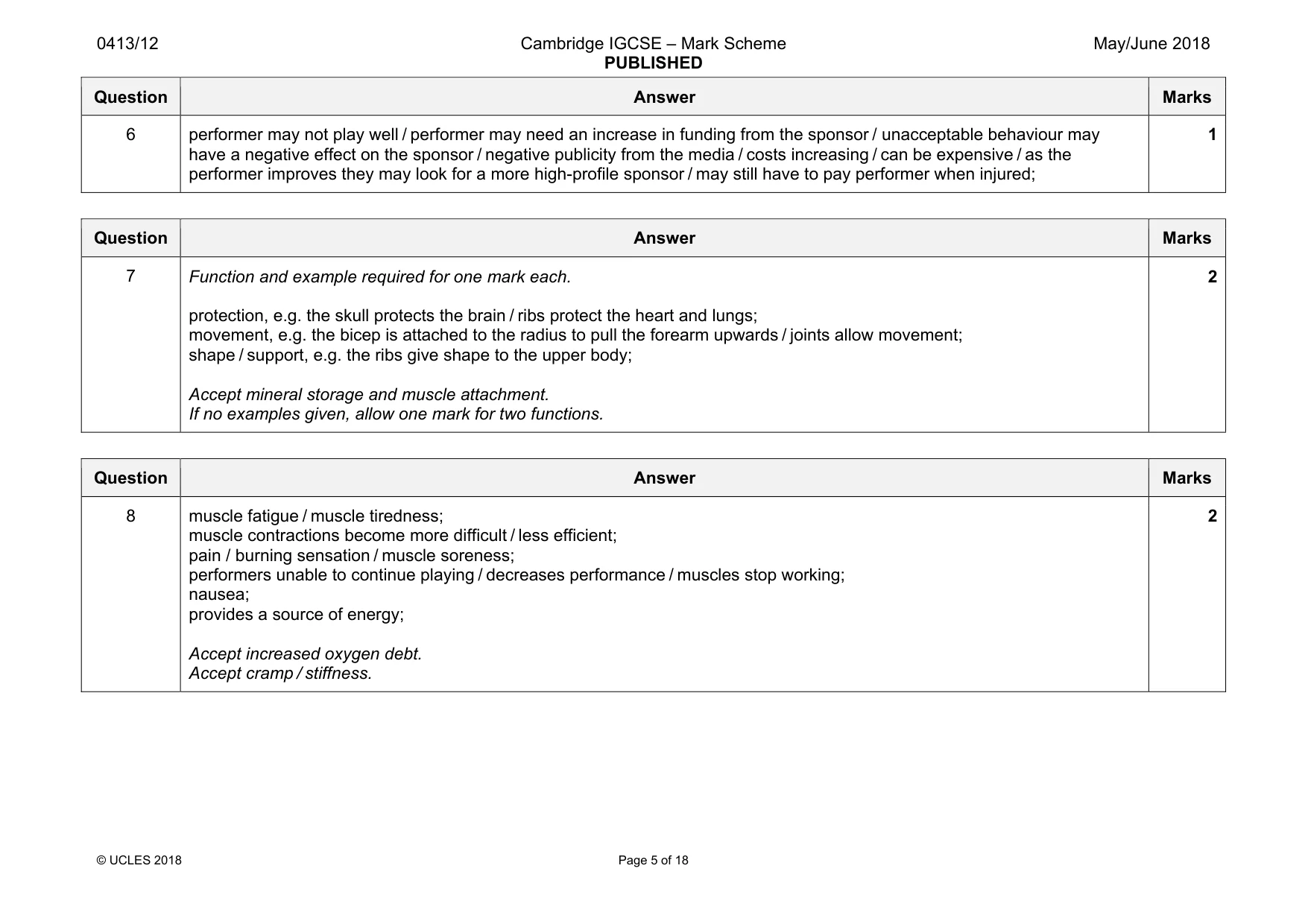
0413/12 Cambridge IGCSE – Mark Scheme PUBLISHED May/June 2018 © UCLES 2018 Page 5 of 18 Question Answer Marks 6 performer may not play well / performer may need an increase in funding from the sponsor / unacceptable behaviour may have a negative effect on the sponsor / negative publicity from the media / costs increasing / can be expensive / as the performer improves they may look for a more high-profile sponsor / may still have to pay performer when injured; 1 Question Answer Marks 7 Function and example required for one mark each. protection, e.g. the skull protects the brain / ribs protect the heart and lungs; movement, e.g. the bicep is attached to the radius to pull the forearm upwards / joints allow movement; shape / support, e.g. the ribs give shape to the upper body; Accept mineral storage and muscle attachment. If no examples given, allow one mark for two functions. 2 Question Answer Marks 8 muscle fatigue / muscle tiredness; muscle contractions become more difficult / less efficient; pain / burning sensation / muscle soreness; performers unable to continue playing / decreases performance / muscles stop working; nausea; provides a source of energy; Accept increased oxygen debt. Accept cramp / stiffness. 2
Mark scheme, page 6
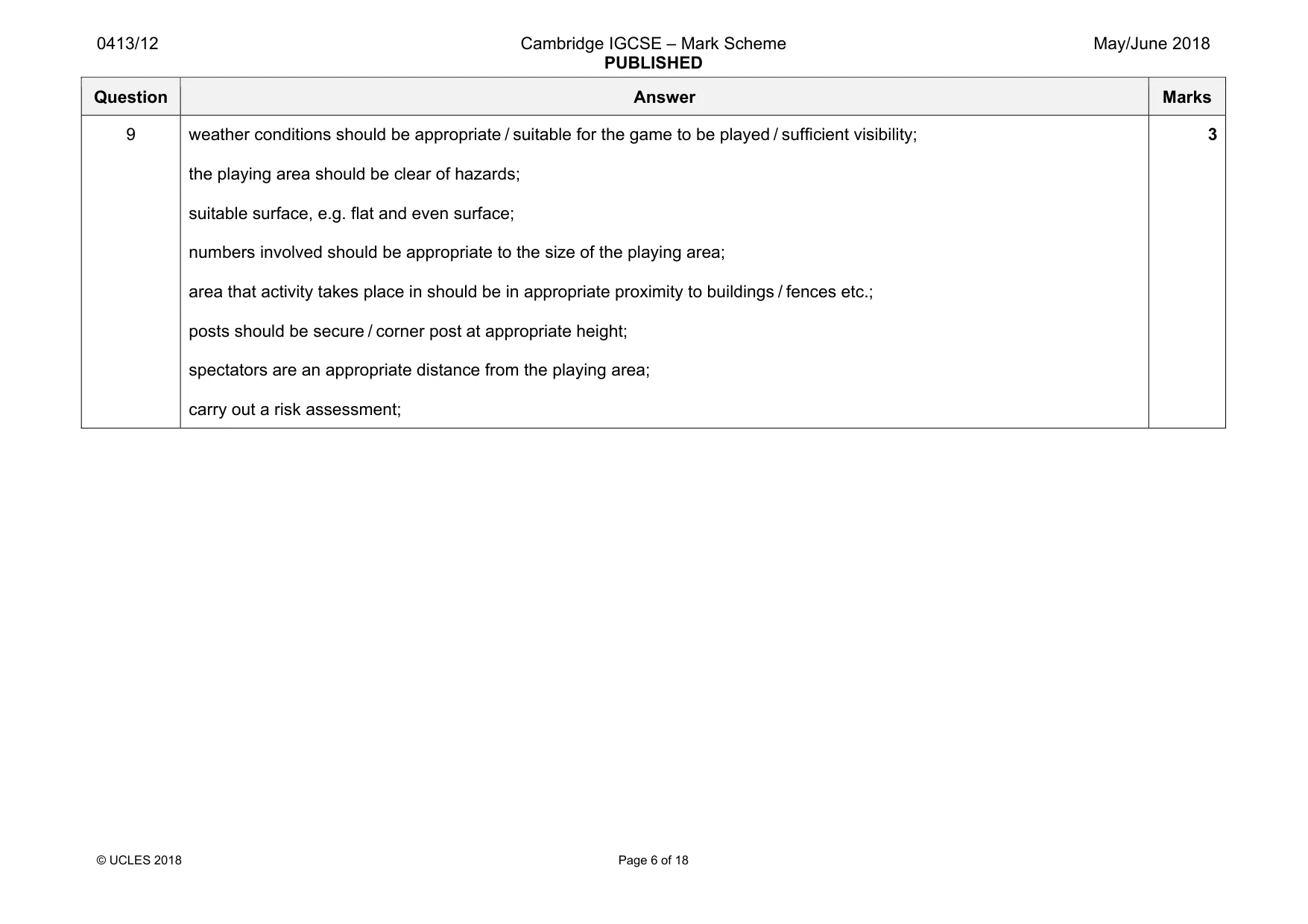
0413/12 Cambridge IGCSE – Mark Scheme PUBLISHED May/June 2018 © UCLES 2018 Page 6 of 18 Question Answer Marks 9 weather conditions should be appropriate / suitable for the game to be played / sufficient visibility; the playing area should be clear of hazards; suitable surface, e.g. flat and even surface; numbers involved should be appropriate to the size of the playing area; area that activity takes place in should be in appropriate proximity to buildings / fences etc.; posts should be secure / corner post at appropriate height; spectators are an appropriate distance from the playing area; carry out a risk assessment; 3
Mark scheme, page 7
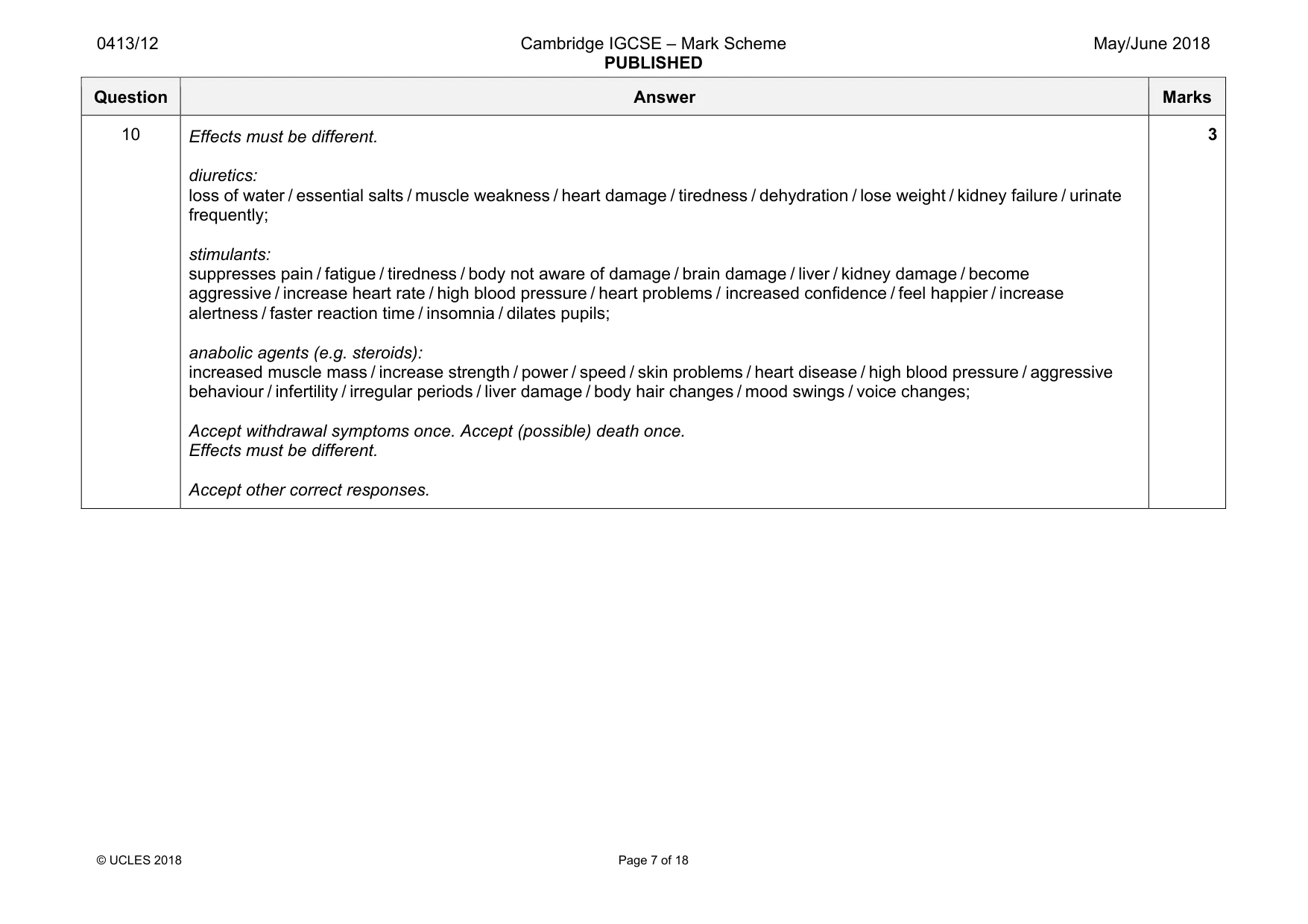
0413/12 Cambridge IGCSE – Mark Scheme PUBLISHED May/June 2018 © UCLES 2018 Page 7 of 18 Question Answer Marks 10 Effects must be different. diuretics: loss of water / essential salts / muscle weakness / heart damage / tiredness / dehydration / lose weight / kidney failure / urinate frequently; stimulants: suppresses pain / fatigue / tiredness / body not aware of damage / brain damage / liver / kidney damage / become aggressive / increase heart rate / high blood pressure / heart problems / increased confidence / feel happier / increase alertness / faster reaction time / insomnia / dilates pupils; anabolic agents (e.g. steroids): increased muscle mass / increase strength / power / speed / skin problems / heart disease / high blood pressure / aggressive behaviour / infertility / irregular periods / liver damage / body hair changes / mood swings / voice changes; Accept withdrawal symptoms once. Accept (possible) death once. Effects must be different. Accept other correct responses. 3
Mark scheme, page 8
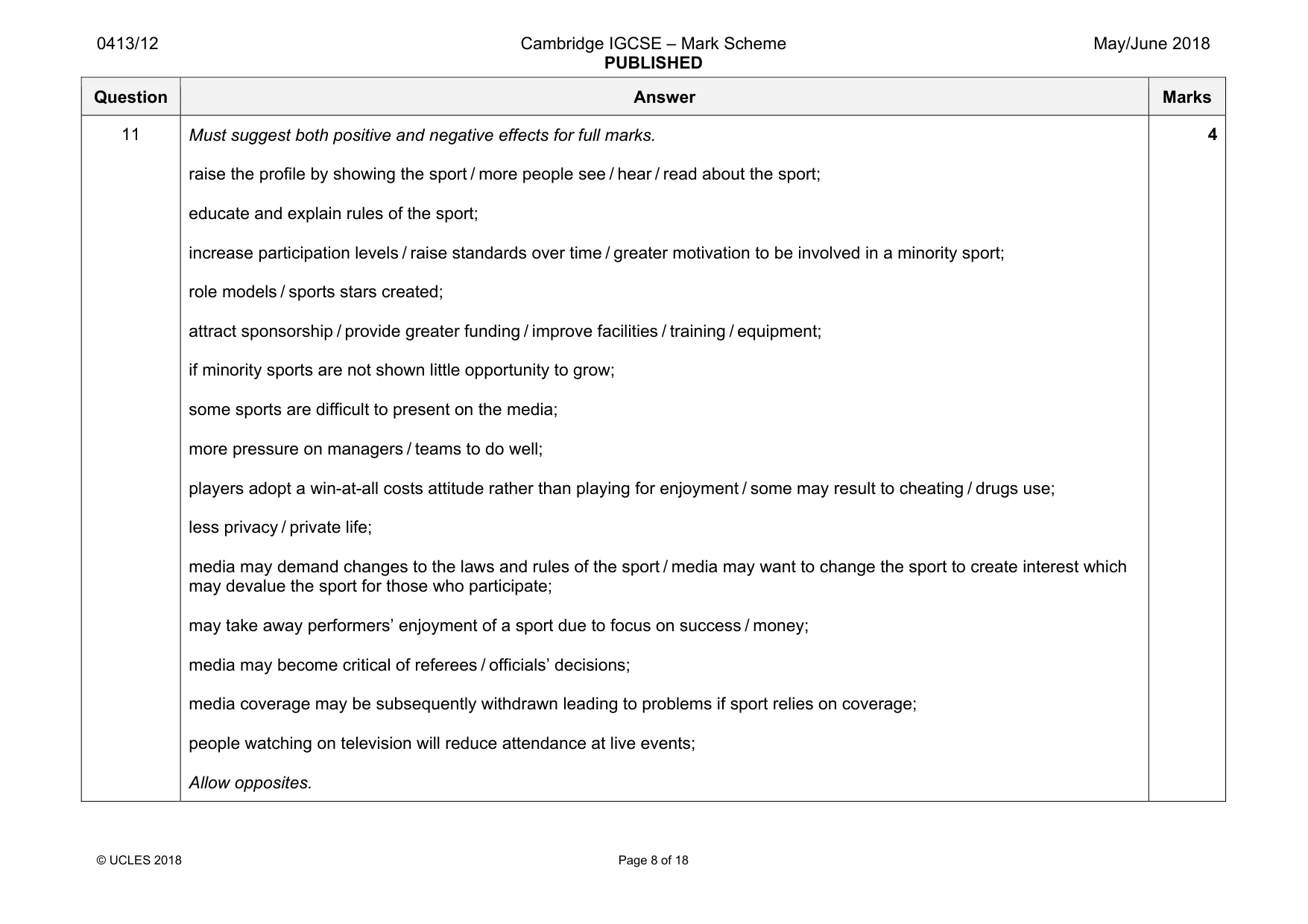
0413/12 Cambridge IGCSE – Mark Scheme PUBLISHED May/June 2018 © UCLES 2018 Page 8 of 18 Question Answer Marks 11 Must suggest both positive and negative effects for full marks. raise the profile by showing the sport / more people see / hear / read about the sport; educate and explain rules of the sport; increase participation levels / raise standards over time / greater motivation to be involved in a minority sport; role models / sports stars created; attract sponsorship / provide greater funding / improve facilities / training / equipment; if minority sports are not shown little opportunity to grow; some sports are difficult to present on the media; more pressure on managers / teams to do well; players adopt a win-at-all costs attitude rather than playing for enjoyment / some may result to cheating / drugs use; less privacy / private life; media may demand changes to the laws and rules of the sport / media may want to change the sport to create interest which may devalue the sport for those who participate; may take away performers’ enjoyment of a sport due to focus on success / money; media may become critical of referees / officials’ decisions; media coverage may be subsequently withdrawn leading to problems if sport relies on coverage; people watching on television will reduce attendance at live events; Allow opposites. 4
Mark scheme, page 9
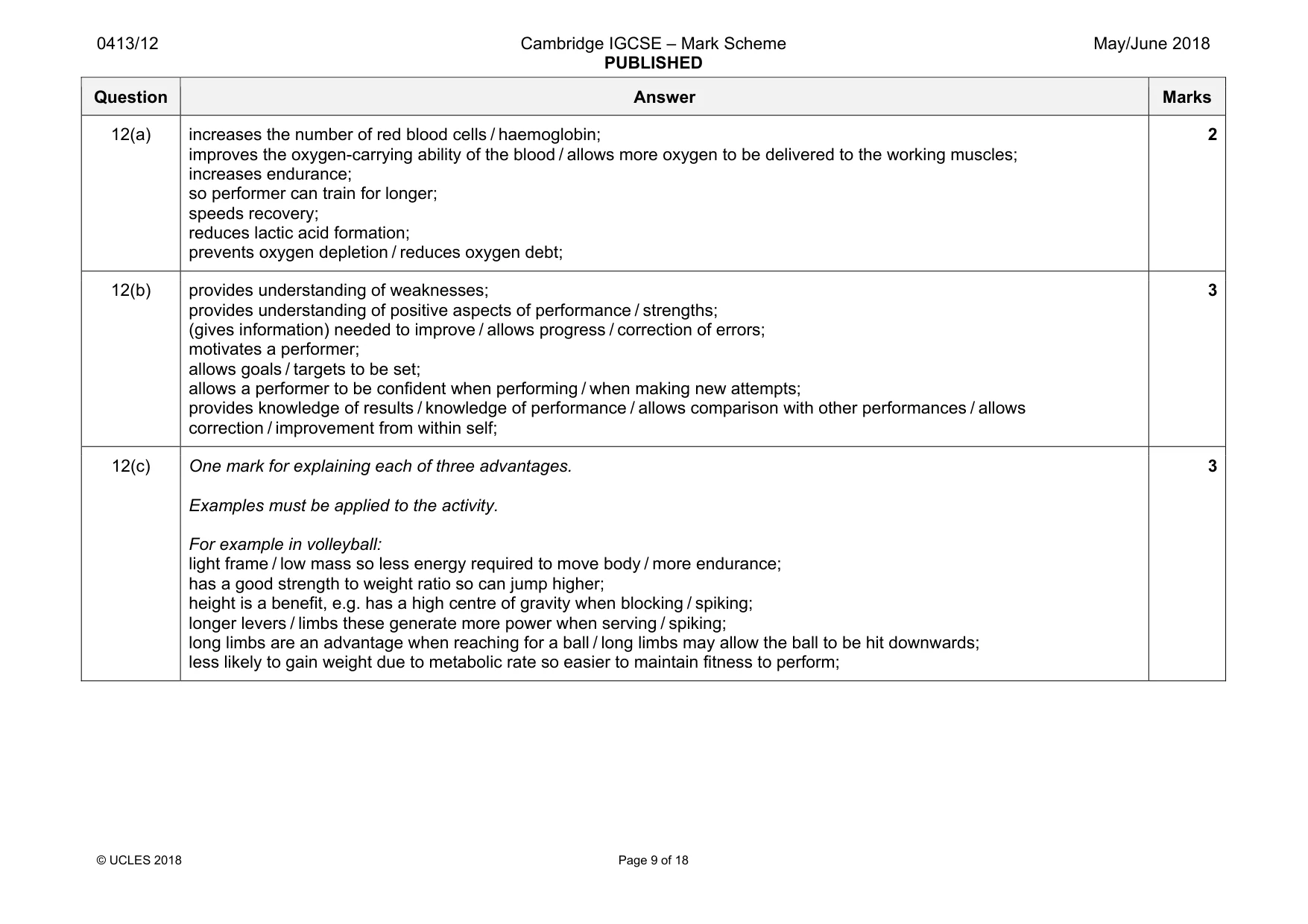
0413/12 Cambridge IGCSE – Mark Scheme PUBLISHED May/June 2018 © UCLES 2018 Page 9 of 18 Question Answer Marks 12(a) increases the number of red blood cells / haemoglobin; improves the oxygen-carrying ability of the blood / allows more oxygen to be delivered to the working muscles; increases endurance; so performer can train for longer; speeds recovery; reduces lactic acid formation; prevents oxygen depletion / reduces oxygen debt; 2 12(b) provides understanding of weaknesses; provides understanding of positive aspects of performance / strengths; (gives information) needed to improve / allows progress / correction of errors; motivates a performer; allows goals / targets to be set; allows a performer to be confident when performing / when making new attempts; provides knowledge of results / knowledge of performance / allows comparison with other performances / allows correction / improvement from within self; 3 12(c) One mark for explaining each of three advantages. Examples must be applied to the activity. For example in volleyball: light frame / low mass so less energy required to move body / more endurance; has a good strength to weight ratio so can jump higher; height is a benefit, e.g. has a high centre of gravity when blocking / spiking; longer levers / limbs these generate more power when serving / spiking; long limbs are an advantage when reaching for a ball / long limbs may allow the ball to be hit downwards; less likely to gain weight due to metabolic rate so easier to maintain fitness to perform; 3
Mark scheme, page 10
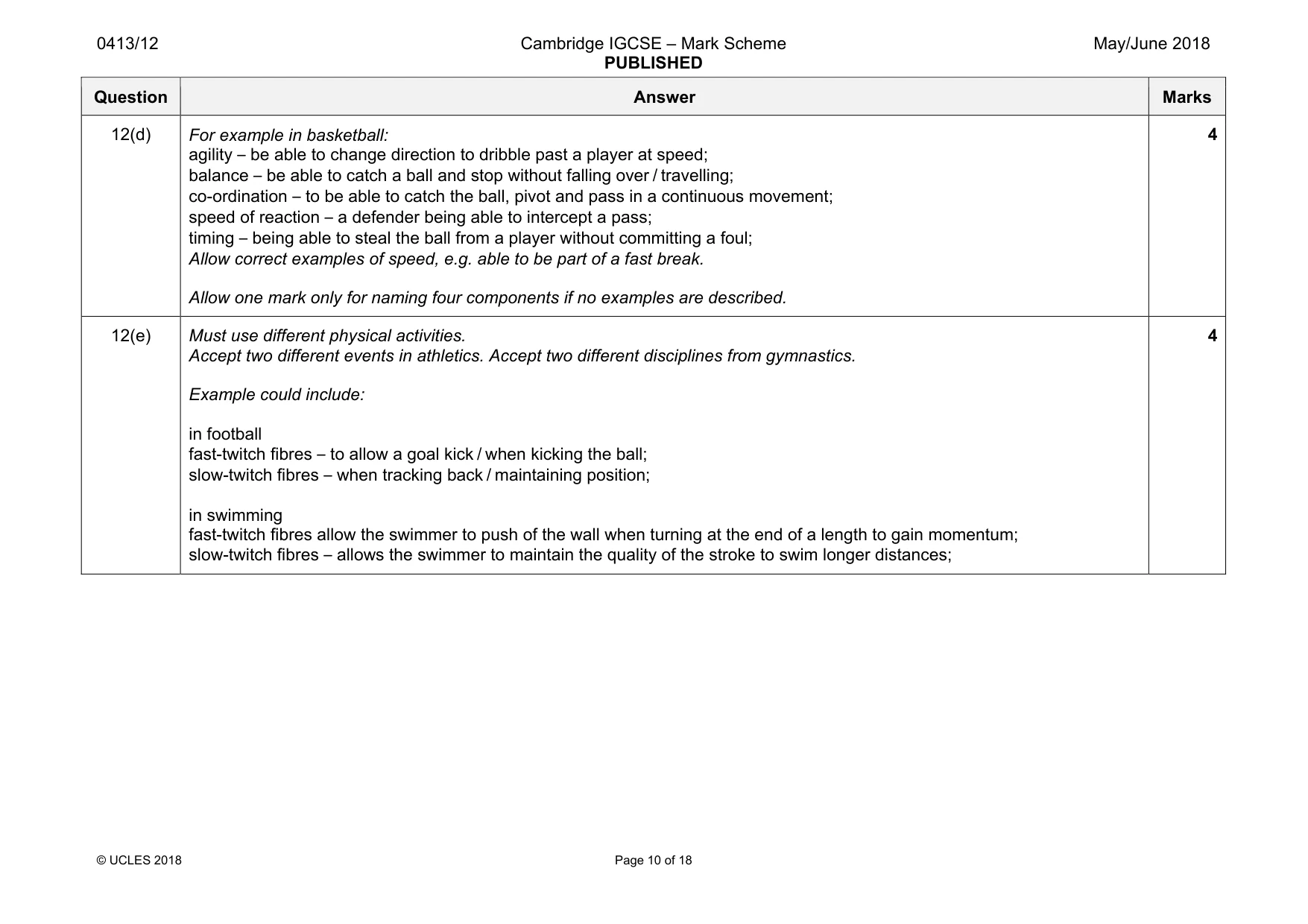
0413/12 Cambridge IGCSE – Mark Scheme PUBLISHED May/June 2018 © UCLES 2018 Page 10 of 18 Question Answer Marks 12(d) For example in basketball: agility – be able to change direction to dribble past a player at speed; balance – be able to catch a ball and stop without falling over / travelling; co-ordination – to be able to catch the ball, pivot and pass in a continuous movement; speed of reaction – a defender being able to intercept a pass; timing – being able to steal the ball from a player without committing a foul; Allow correct examples of speed, e.g. able to be part of a fast break. Allow one mark only for naming four components if no examples are described. 4 12(e) Must use different physical activities. Accept two different events in athletics. Accept two different disciplines from gymnastics. Example could include: in football fast-twitch fibres – to allow a goal kick / when kicking the ball; slow-twitch fibres – when tracking back / maintaining position; in swimming fast-twitch fibres allow the swimmer to push of the wall when turning at the end of a length to gain momentum; slow-twitch fibres – allows the swimmer to maintain the quality of the stroke to swim longer distances; 4
Mark scheme, page 11
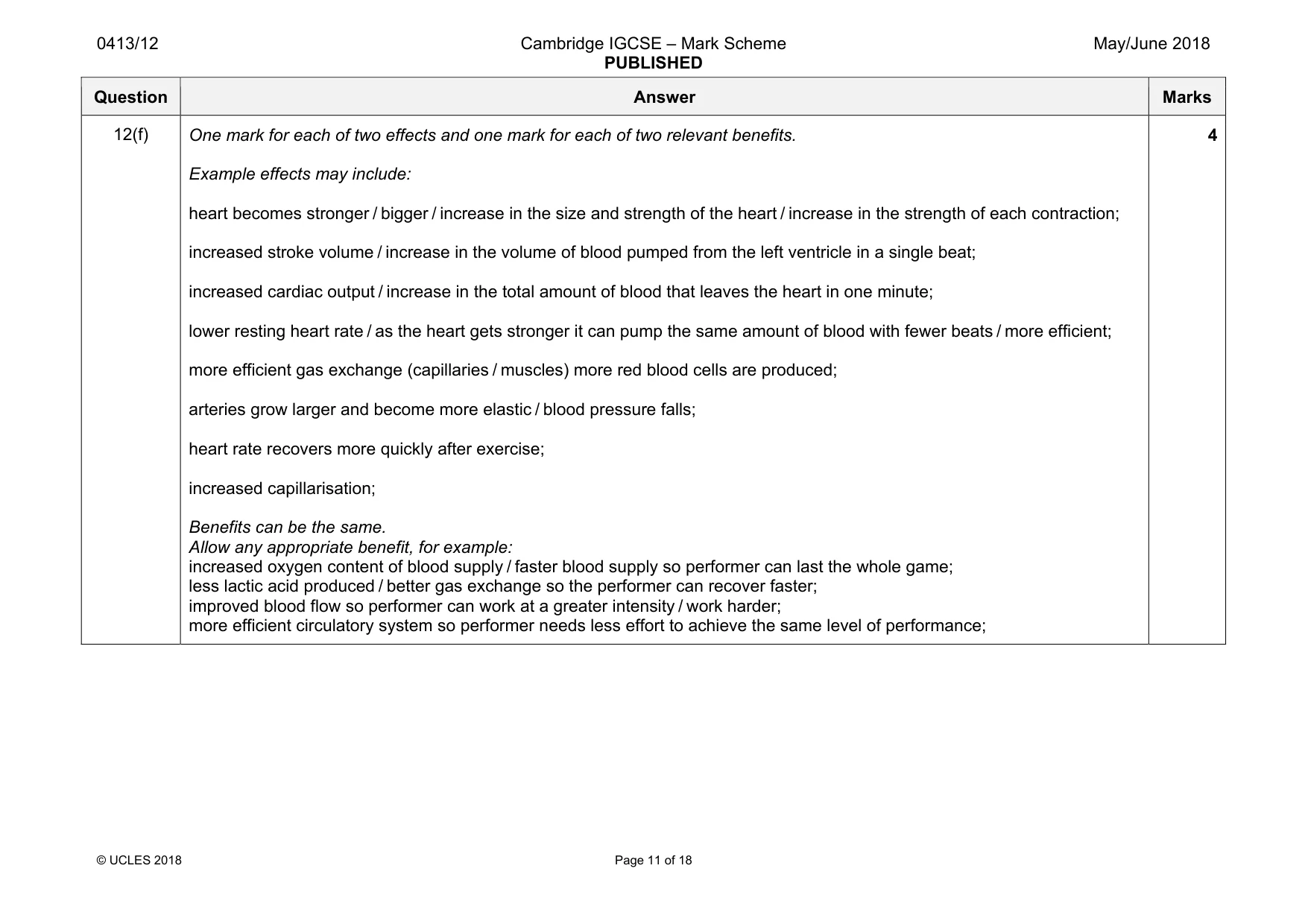
0413/12 Cambridge IGCSE – Mark Scheme PUBLISHED May/June 2018 © UCLES 2018 Page 11 of 18 Question Answer Marks 12(f) One mark for each of two effects and one mark for each of two relevant benefits. Example effects may include: heart becomes stronger / bigger / increase in the size and strength of the heart / increase in the strength of each contraction; increased stroke volume / increase in the volume of blood pumped from the left ventricle in a single beat; increased cardiac output / increase in the total amount of blood that leaves the heart in one minute; lower resting heart rate / as the heart gets stronger it can pump the same amount of blood with fewer beats / more efficient; more efficient gas exchange (capillaries / muscles) more red blood cells are produced; arteries grow larger and become more elastic / blood pressure falls; heart rate recovers more quickly after exercise; increased capillarisation; Benefits can be the same. Allow any appropriate benefit, for example: increased oxygen content of blood supply / faster blood supply so performer can last the whole game; less lactic acid produced / better gas exchange so the performer can recover faster; improved blood flow so performer can work at a greater intensity / work harder; more efficient circulatory system so performer needs less effort to achieve the same level of performance; 4
Mark scheme, page 12
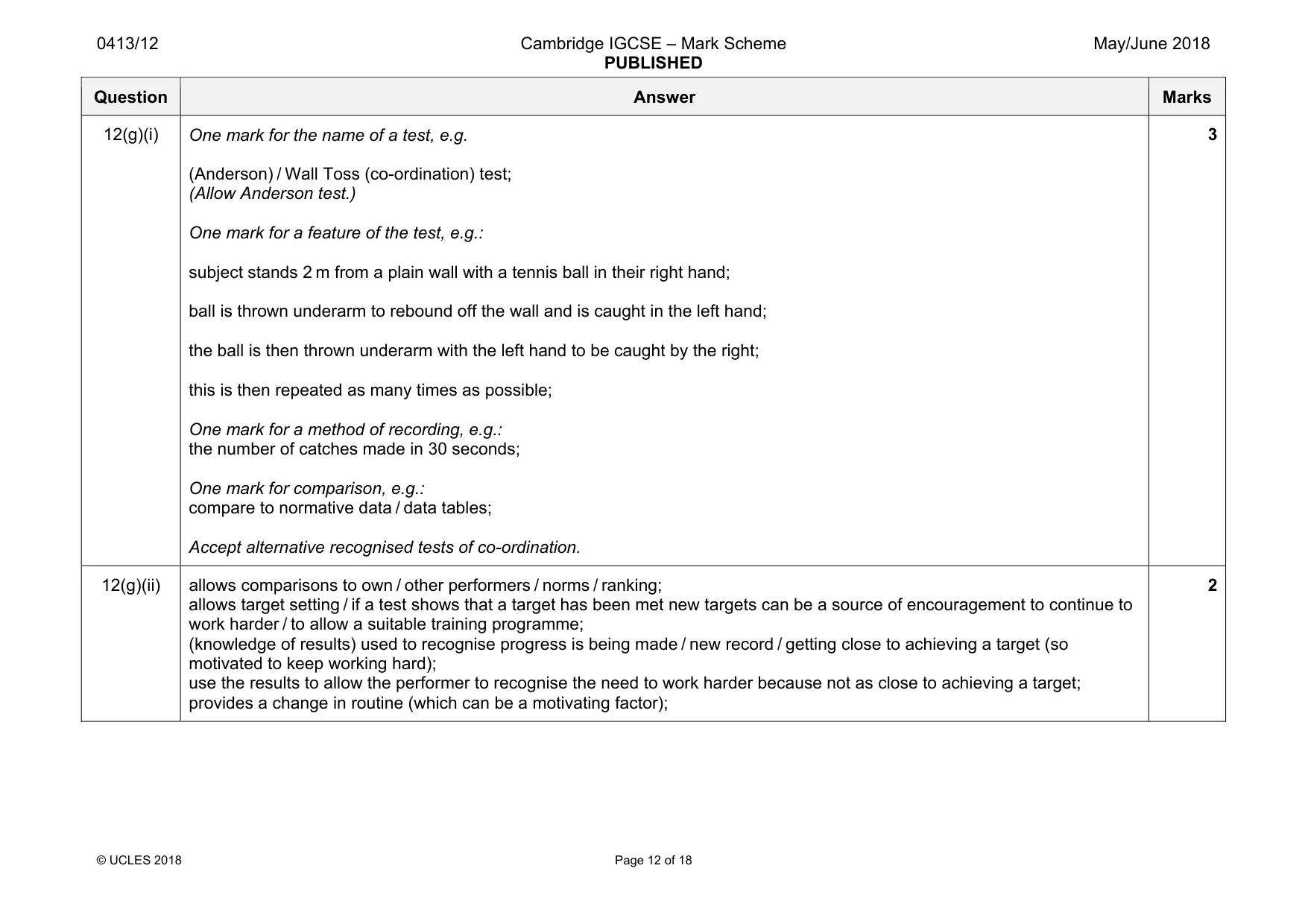
0413/12 Cambridge IGCSE – Mark Scheme PUBLISHED May/June 2018 © UCLES 2018 Page 12 of 18 Question Answer Marks 12(g)(i) One mark for the name of a test, e.g. (Anderson) / Wall Toss (co-ordination) test; (Allow Anderson test.) One mark for a feature of the test, e.g.: subject stands 2 m from a plain wall with a tennis ball in their right hand; ball is thrown underarm to rebound off the wall and is caught in the left hand; the ball is then thrown underarm with the left hand to be caught by the right; this is then repeated as many times as possible; One mark for a method of recording, e.g.: the number of catches made in 30 seconds; One mark for comparison, e.g.: compare to normative data / data tables; Accept alternative recognised tests of co-ordination. 3 12(g)(ii) allows comparisons to own / other performers / norms / ranking; allows target setting / if a test shows that a target has been met new targets can be a source of encouragement to continue to work harder / to allow a suitable training programme; (knowledge of results) used to recognise progress is being made / new record / getting close to achieving a target (so motivated to keep working hard); use the results to allow the performer to recognise the need to work harder because not as close to achieving a target; provides a change in routine (which can be a motivating factor); 2
Mark scheme, page 13
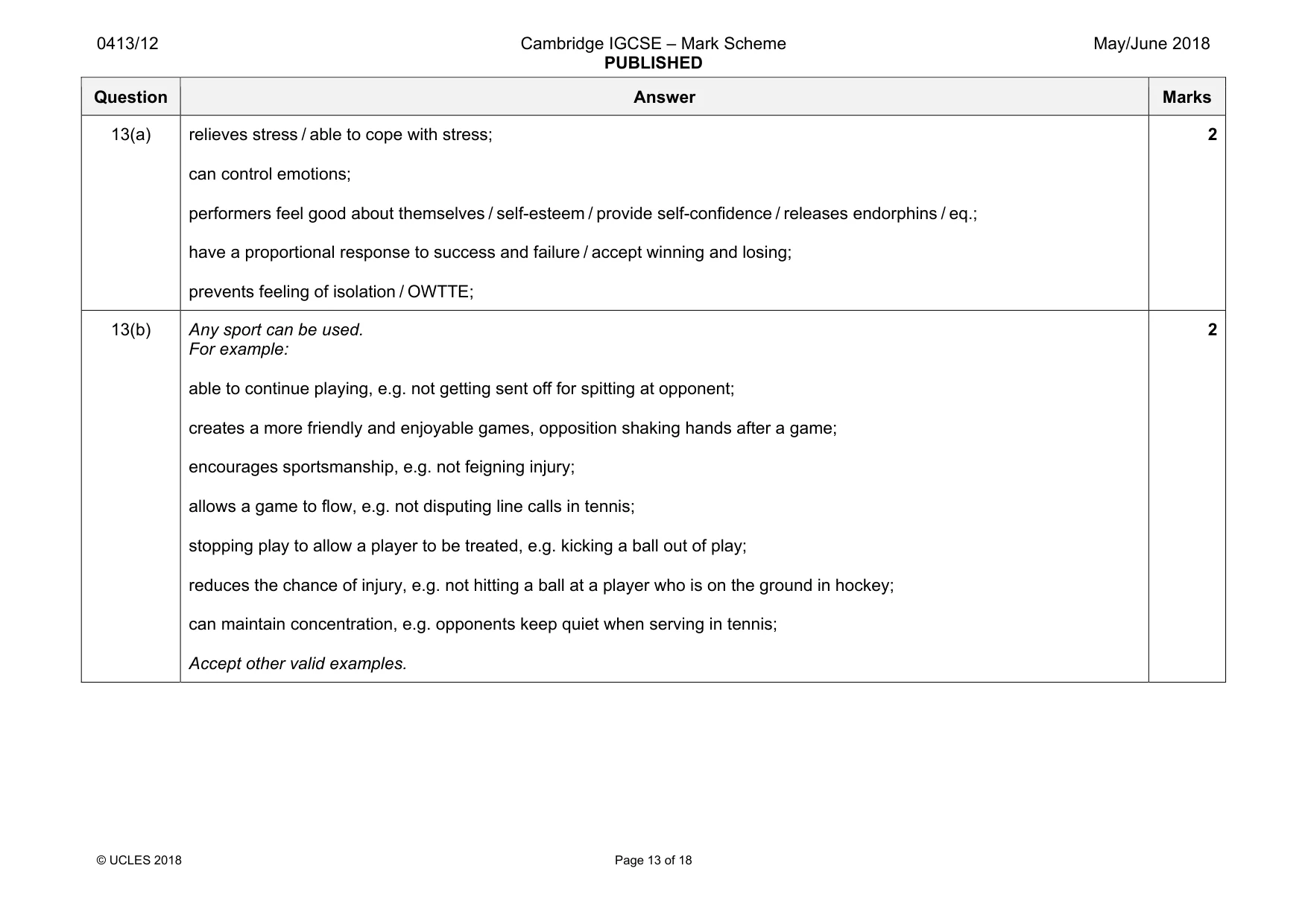
0413/12 Cambridge IGCSE – Mark Scheme PUBLISHED May/June 2018 © UCLES 2018 Page 13 of 18 Question Answer Marks 13(a) relieves stress / able to cope with stress; can control emotions; performers feel good about themselves / self-esteem / provide self-confidence / releases endorphins / eq.; have a proportional response to success and failure / accept winning and losing; prevents feeling of isolation / OWTTE; 2 13(b) Any sport can be used. For example: able to continue playing, e.g. not getting sent off for spitting at opponent; creates a more friendly and enjoyable games, opposition shaking hands after a game; encourages sportsmanship, e.g. not feigning injury; allows a game to flow, e.g. not disputing line calls in tennis; stopping play to allow a player to be treated, e.g. kicking a ball out of play; reduces the chance of injury, e.g. not hitting a ball at a player who is on the ground in hockey; can maintain concentration, e.g. opponents keep quiet when serving in tennis; Accept other valid examples. 2
Mark scheme, page 14
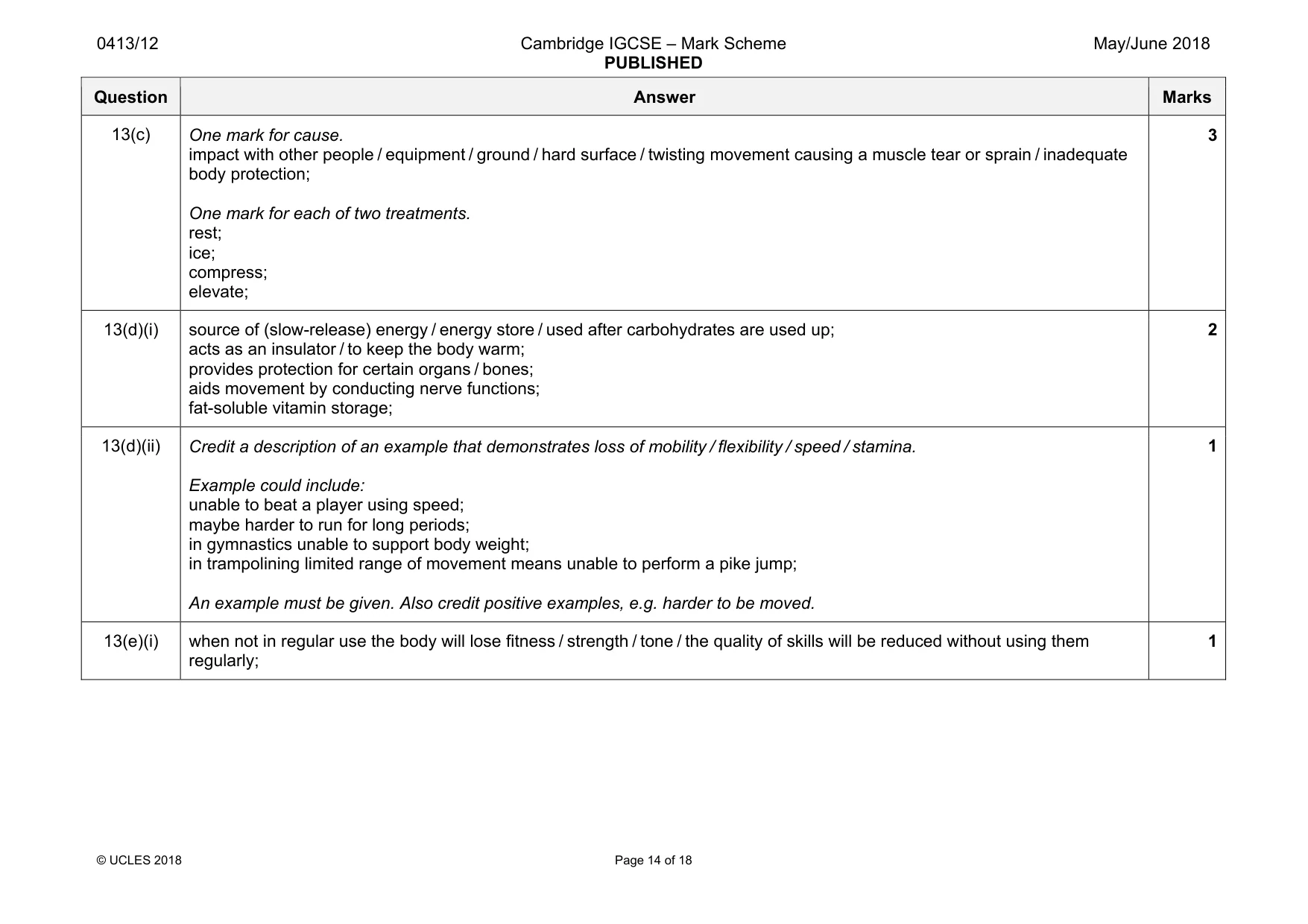
0413/12 Cambridge IGCSE – Mark Scheme PUBLISHED May/June 2018 © UCLES 2018 Page 14 of 18 Question Answer Marks 13(c) One mark for cause. impact with other people / equipment / ground / hard surface / twisting movement causing a muscle tear or sprain / inadequate body protection; One mark for each of two treatments. rest; ice; compress; elevate; 3 13(d)(i) source of (slow-release) energy / energy store / used after carbohydrates are used up; acts as an insulator / to keep the body warm; provides protection for certain organs / bones; aids movement by conducting nerve functions; fat-soluble vitamin storage; 2 13(d)(ii) Credit a description of an example that demonstrates loss of mobility / flexibility / speed / stamina. Example could include: unable to beat a player using speed; maybe harder to run for long periods; in gymnastics unable to support body weight; in trampolining limited range of movement means unable to perform a pike jump; An example must be given. Also credit positive examples, e.g. harder to be moved. 1 13(e)(i) when not in regular use the body will lose fitness / strength / tone / the quality of skills will be reduced without using them regularly; 1
Mark scheme, page 15
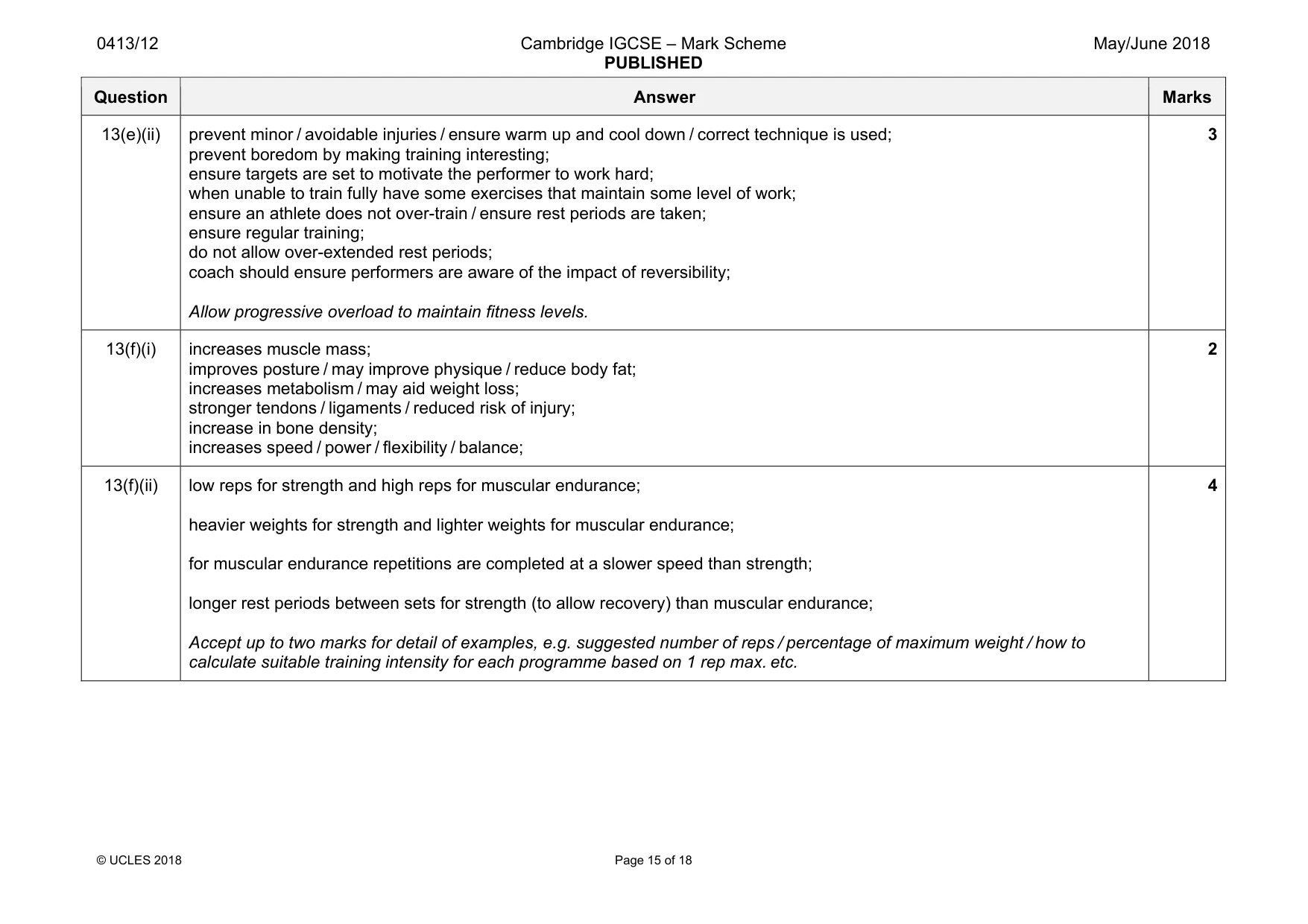
0413/12 Cambridge IGCSE – Mark Scheme PUBLISHED May/June 2018 © UCLES 2018 Page 15 of 18 Question Answer Marks 13(e)(ii) prevent minor / avoidable injuries / ensure warm up and cool down / correct technique is used; prevent boredom by making training interesting; ensure targets are set to motivate the performer to work hard; when unable to train fully have some exercises that maintain some level of work; ensure an athlete does not over-train / ensure rest periods are taken; ensure regular training; do not allow over-extended rest periods; coach should ensure performers are aware of the impact of reversibility; Allow progressive overload to maintain fitness levels. 3 13(f)(i) increases muscle mass; improves posture / may improve physique / reduce body fat; increases metabolism / may aid weight loss; stronger tendons / ligaments / reduced risk of injury; increase in bone density; increases speed / power / flexibility / balance; 2 13(f)(ii) low reps for strength and high reps for muscular endurance; heavier weights for strength and lighter weights for muscular endurance; for muscular endurance repetitions are completed at a slower speed than strength; longer rest periods between sets for strength (to allow recovery) than muscular endurance; Accept up to two marks for detail of examples, e.g. suggested number of reps / percentage of maximum weight / how to calculate suitable training intensity for each programme based on 1 rep max. etc. 4
Mark scheme, page 16
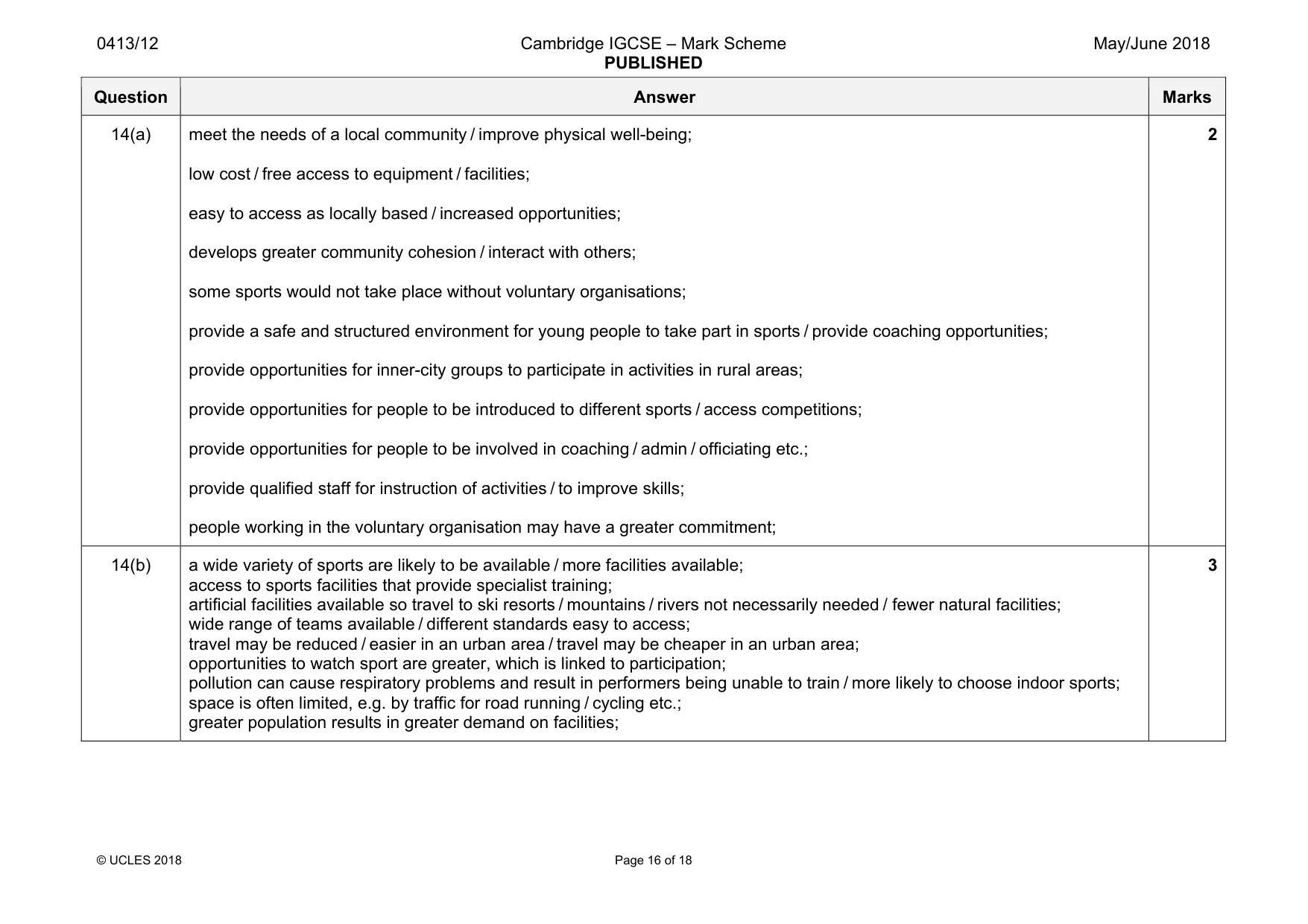
0413/12 Cambridge IGCSE – Mark Scheme PUBLISHED May/June 2018 © UCLES 2018 Page 16 of 18 Question Answer Marks 14(a) meet the needs of a local community / improve physical well-being; low cost / free access to equipment / facilities; easy to access as locally based / increased opportunities; develops greater community cohesion / interact with others; some sports would not take place without voluntary organisations; provide a safe and structured environment for young people to take part in sports / provide coaching opportunities; provide opportunities for inner-city groups to participate in activities in rural areas; provide opportunities for people to be introduced to different sports / access competitions; provide opportunities for people to be involved in coaching / admin / officiating etc.; provide qualified staff for instruction of activities / to improve skills; people working in the voluntary organisation may have a greater commitment; 2 14(b) a wide variety of sports are likely to be available / more facilities available; access to sports facilities that provide specialist training; artificial facilities available so travel to ski resorts / mountains / rivers not necessarily needed / fewer natural facilities; wide range of teams available / different standards easy to access; travel may be reduced / easier in an urban area / travel may be cheaper in an urban area; opportunities to watch sport are greater, which is linked to participation; pollution can cause respiratory problems and result in performers being unable to train / more likely to choose indoor sports; space is often limited, e.g. by traffic for road running / cycling etc.; greater population results in greater demand on facilities; 3
Mark scheme, page 17
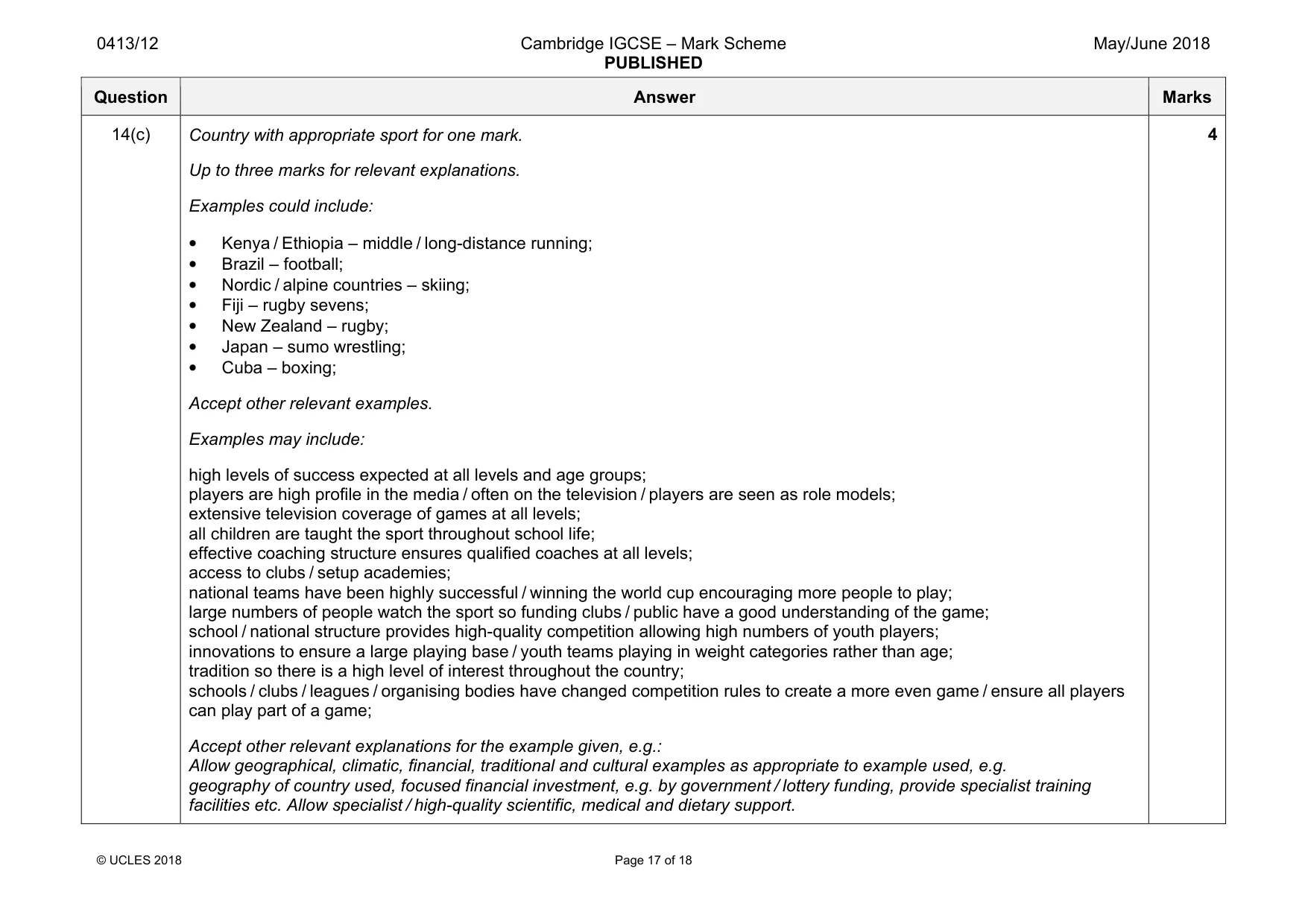
0413/12 Cambridge IGCSE – Mark Scheme PUBLISHED May/June 2018 © UCLES 2018 Page 17 of 18 Question Answer Marks 14(c) Country with appropriate sport for one mark. Up to three marks for relevant explanations. Examples could include: • Kenya / Ethiopia – middle / long-distance running; • Brazil – football; • Nordic / alpine countries – skiing; • Fiji – rugby sevens; • New Zealand – rugby; • Japan – sumo wrestling; • Cuba – boxing; Accept other relevant examples. Examples may include: high levels of success expected at all levels and age groups; players are high profile in the media / often on the television / players are seen as role models; extensive television coverage of games at all levels; all children are taught the sport throughout school life; effective coaching structure ensures qualified coaches at all levels; access to clubs / setup academies; national teams have been highly successful / winning the world cup encouraging more people to play; large numbers of people watch the sport so funding clubs / public have a good understanding of the game; school / national structure provides high-quality competition allowing high numbers of youth players; innovations to ensure a large playing base / youth teams playing in weight categories rather than age; tradition so there is a high level of interest throughout the country; schools / clubs / leagues / organising bodies have changed competition rules to create a more even game / ensure all players can play part of a game; Accept other relevant explanations for the example given, e.g.: Allow geographical, climatic, financial, traditional and cultural examples as appropriate to example used, e.g. geography of country used, focused financial investment, e.g. by government / lottery funding, provide specialist training facilities etc. Allow specialist / high-quality scientific, medical and dietary support. 4
Mark scheme, page 18
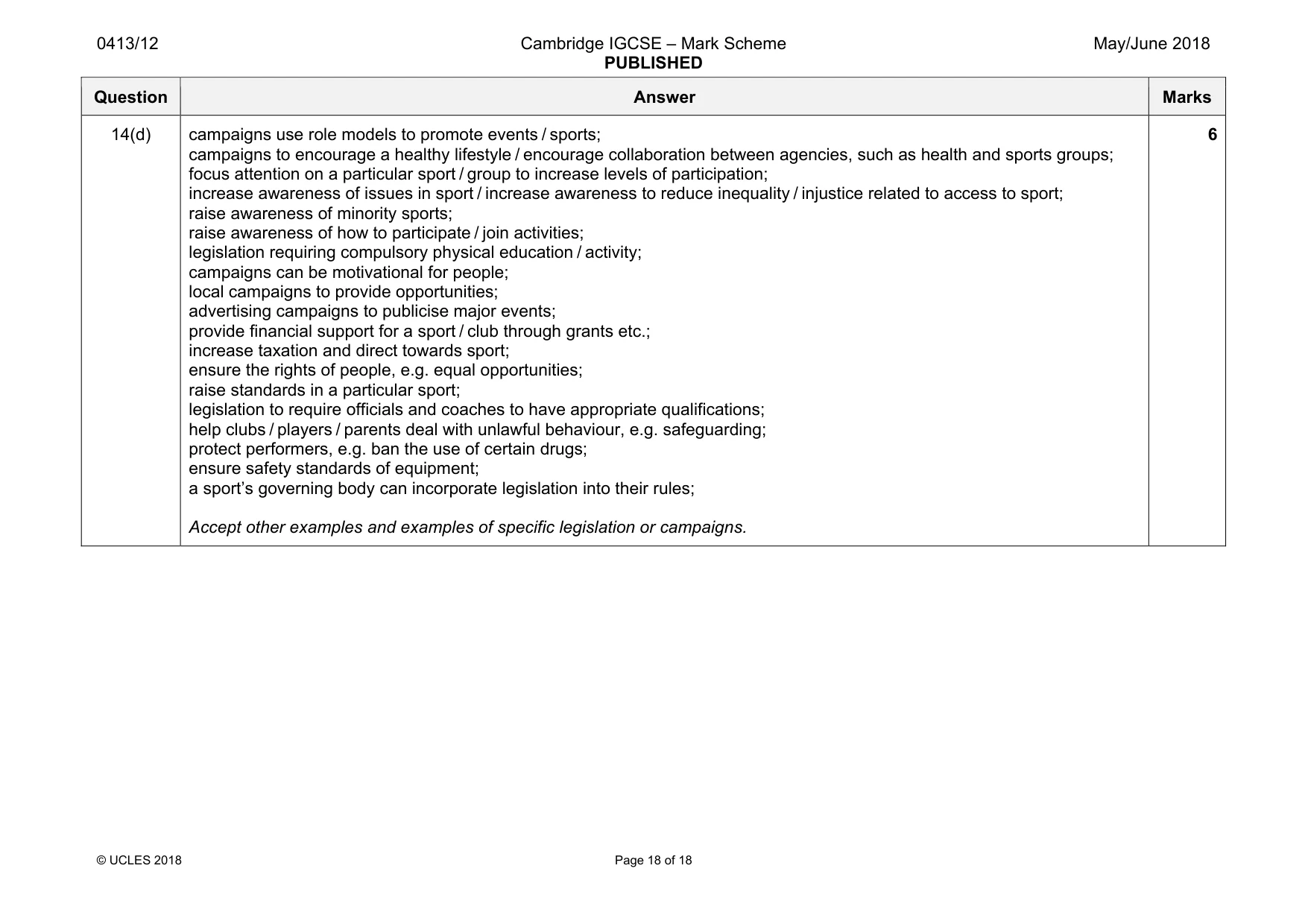
0413/12 Cambridge IGCSE – Mark Scheme PUBLISHED May/June 2018 © UCLES 2018 Page 18 of 18 Question Answer Marks 14(d) campaigns use role models to promote events / sports; campaigns to encourage a healthy lifestyle / encourage collaboration between agencies, such as health and sports groups; focus attention on a particular sport / group to increase levels of participation; increase awareness of issues in sport / increase awareness to reduce inequality / injustice related to access to sport; raise awareness of minority sports; raise awareness of how to participate / join activities; legislation requiring compulsory physical education / activity; campaigns can be motivational for people; local campaigns to provide opportunities; advertising campaigns to publicise major events; provide financial support for a sport / club through grants etc.; increase taxation and direct towards sport; ensure the rights of people, e.g. equal opportunities; raise standards in a particular sport; legislation to require officials and coaches to have appropriate qualifications; help clubs / players / parents deal with unlawful behaviour, e.g. safeguarding; protect performers, e.g. ban the use of certain drugs; ensure safety standards of equipment; a sport’s governing body can incorporate legislation into their rules; Accept other examples and examples of specific legislation or campaigns. 6
What you needed in this session
Cambridge’s own grade thresholds for 2018 May/June, Paper 1 · Variant 2. A higher threshold means an easier paper — the bar moves with how the cohort did.