Cambridge IGCSE Physical Education 0413 — 2018 May/June Paper 1 · Variant 3
0413/13/M/J/18 · 80 marks · ≈90 min
The question paper and its mark scheme, free to read here and free to download. This is Cambridge’s own paper, exactly as it was sat.
Question paper12 pages
Mark scheme21 pages
Answers below. Sit the paper first if you are practising.
Paper as text
Question paper, page 1
Cambridge International Examinations Cambridge International General Certificate of Secondary Education 0413/13 May/June 2018 1 hour 45 minutes PHYSICAL EDUCATION Paper 1 Candidates answer on the Question Paper. No Additional Materials are required. READ THESE INSTRUCTIONS FIRST Write your Centre number, candidate number and name on all the work you hand in. Write in dark blue or black pen. You may use an HB pencil for any diagrams or graphs. Do not use staples, paper clips, glue or correction fluid. DO NOT WRITE IN ANY BARCODES. Section A Answer all questions in this section. Write your answers in the spaces provided on the Question Paper. Section B Answer all questions in this section. Write your answers in the spaces provided on the Question Paper. Electronic calculators may be used. You may lose marks if you do not show your working or if you do not use appropriate units. At the end of the examination, fasten all your work securely together. The number of marks is given in brackets [ ] at the end of each question or part question. This document consists of 12 printed pages. [Turn over 06_0413_13_2018_1.13 © UCLES 2018 *4550521132*
Question paper, page 2
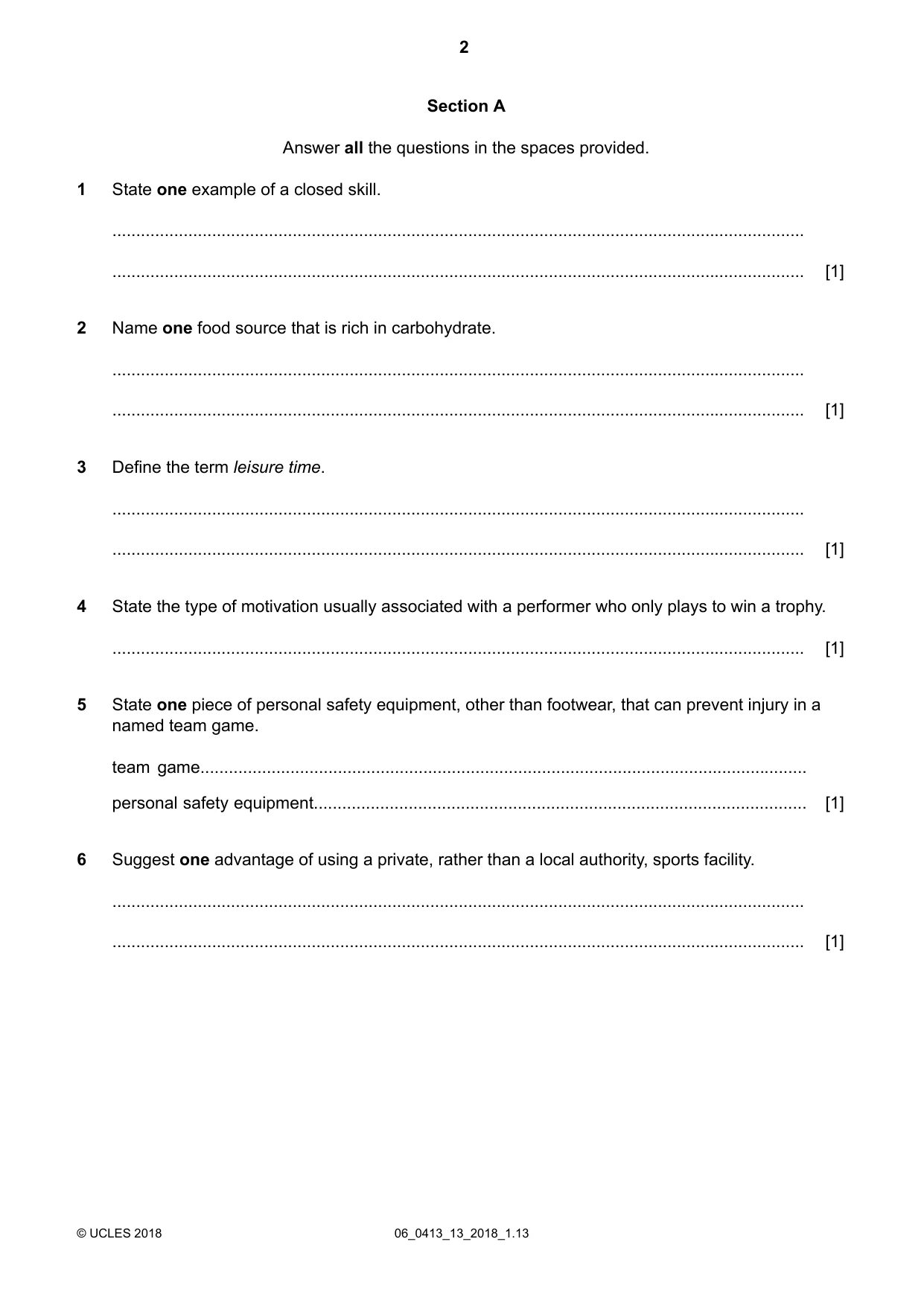
Section A Answer all the questions in the spaces provided. State one example of a closed skill. 1 … … [1] Name one food source that is rich in carbohydrate. 2 … … [1] Define the term leisure time. 3 … … [1] State the type of motivation usually associated with a performer who only plays to win a trophy. 4 … [1] State one piece of personal safety equipment, other than footwear, that can prevent injury in a named team game. 5 team game… personal safety equipment… [1] Suggest one advantage of using a private, rather than a local authority, sports facility. 6 … … [1] 06_0413_13_2018_1.13 © UCLES 2018 2
Question paper, page 3
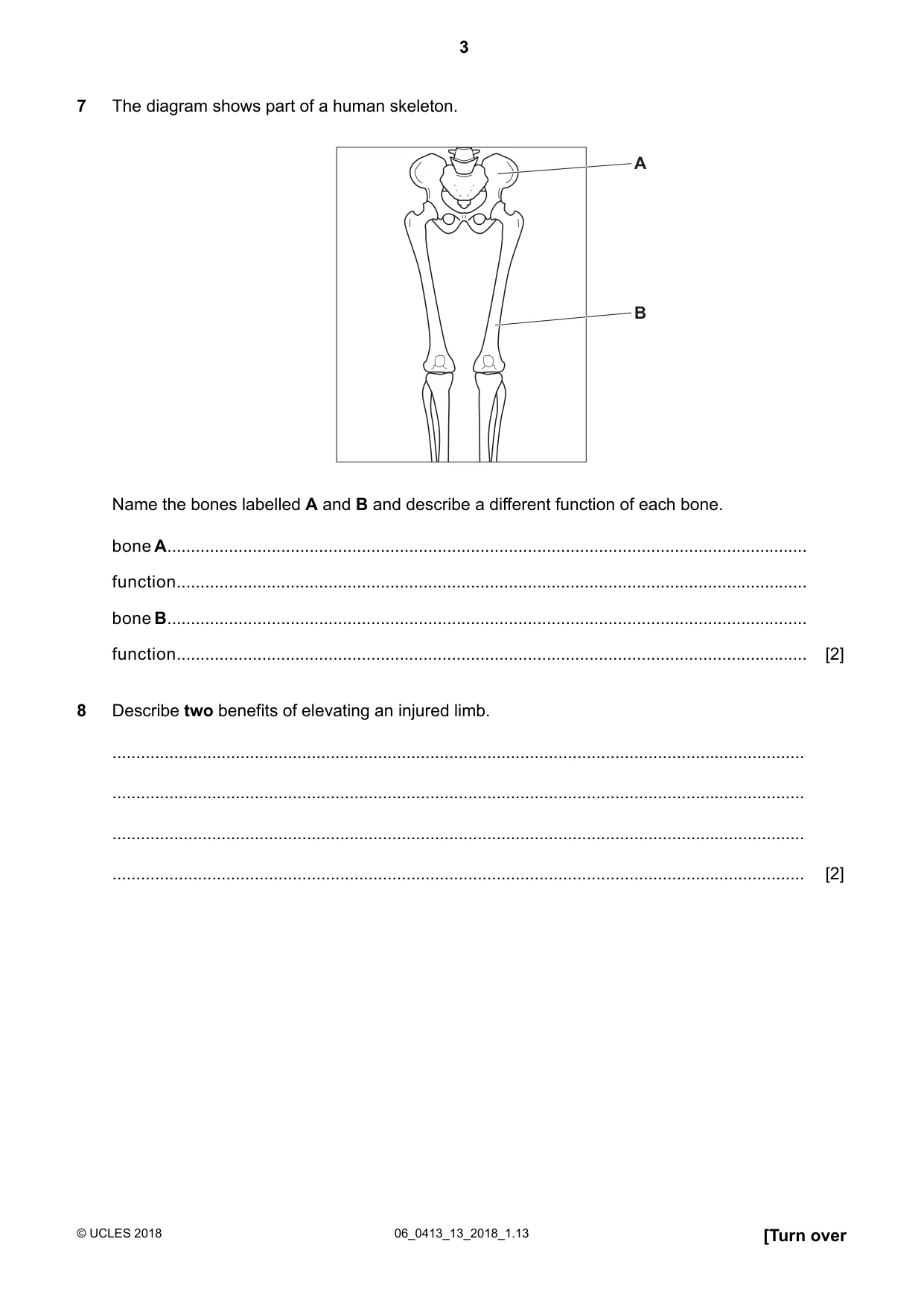
The diagram shows part of a human skeleton. 7 A B Name the bones labelled A and B and describe a different function of each bone. bone A… function… bone B… function… [2] Describe two benefits of elevating an injured limb. 8 … … … … [2] [Turn over 06_0413_13_2018_1.13 © UCLES 2018 3
Question paper, page 4
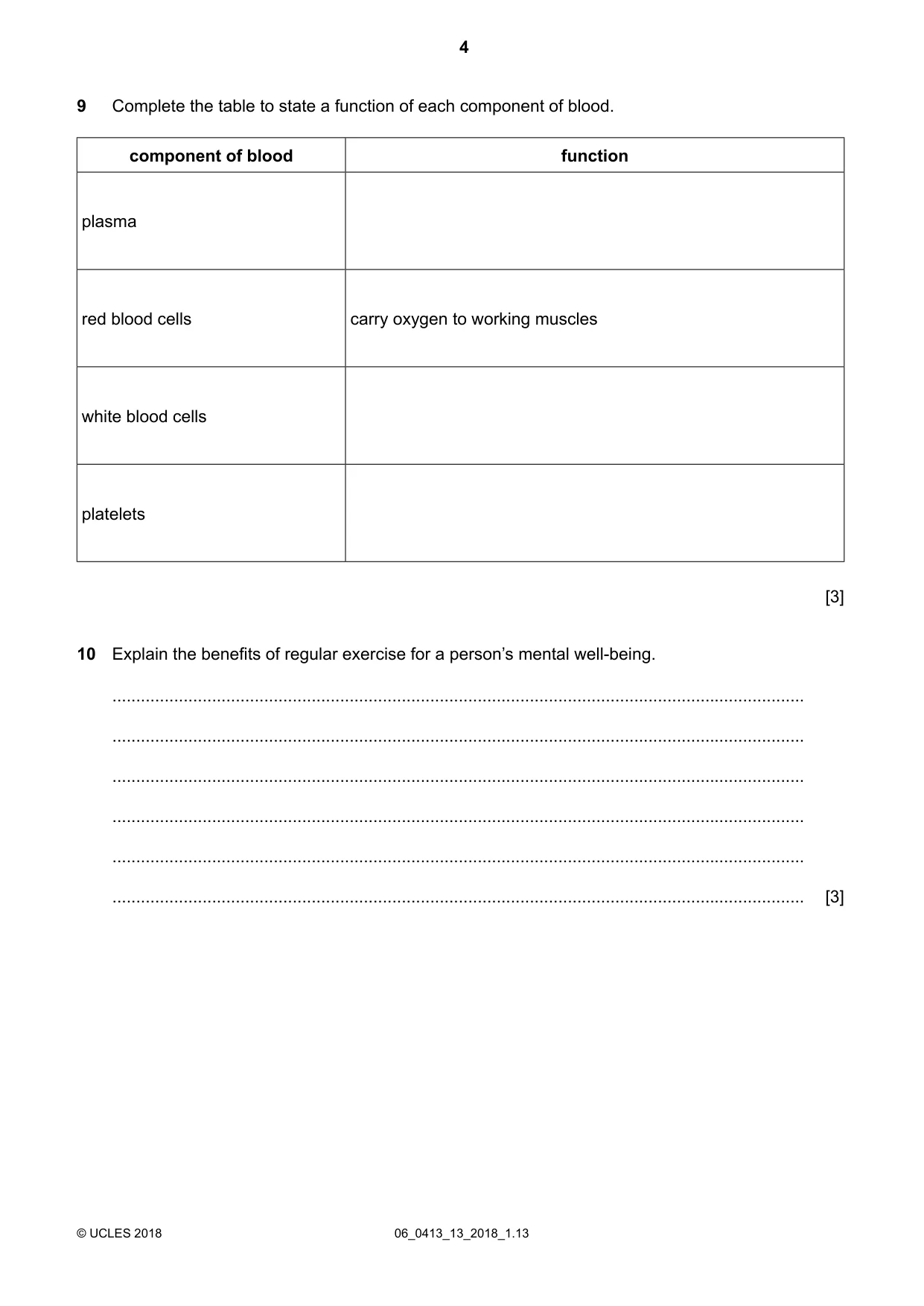
Complete the table to state a function of each component of blood. 9 function component of blood plasma carry oxygen to working muscles red blood cells white blood cells platelets [3] Explain the benefits of regular exercise for a person’s mental well-being. 10 … … … … … … [3] 06_0413_13_2018_1.13 © UCLES 2018 4
Question paper, page 5
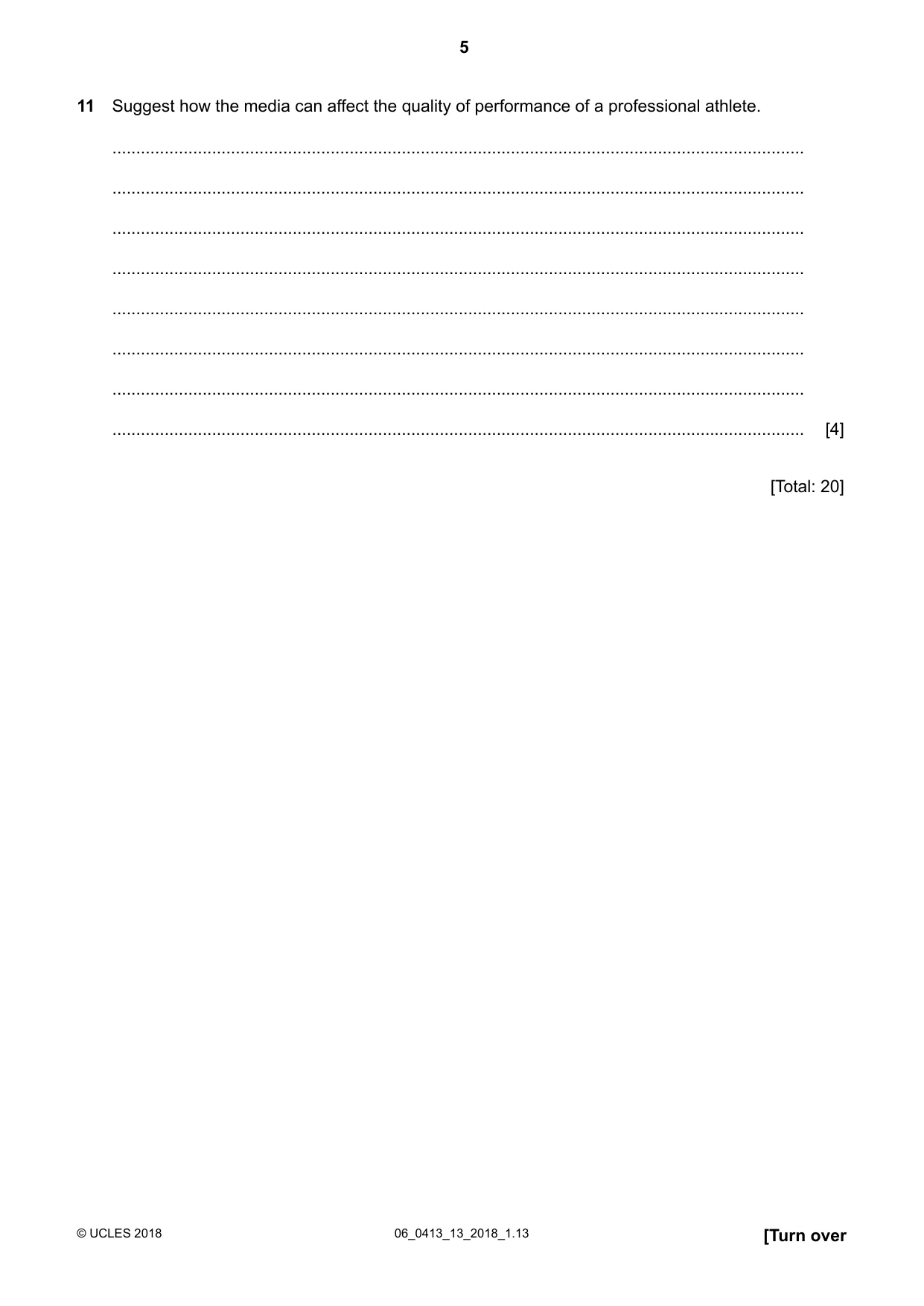
Suggest how the media can affect the quality of performance of a professional athlete. 11 … … … … … … … … [4] [Total: 20] [Turn over 06_0413_13_2018_1.13 © UCLES 2018 5
Question paper, page 6
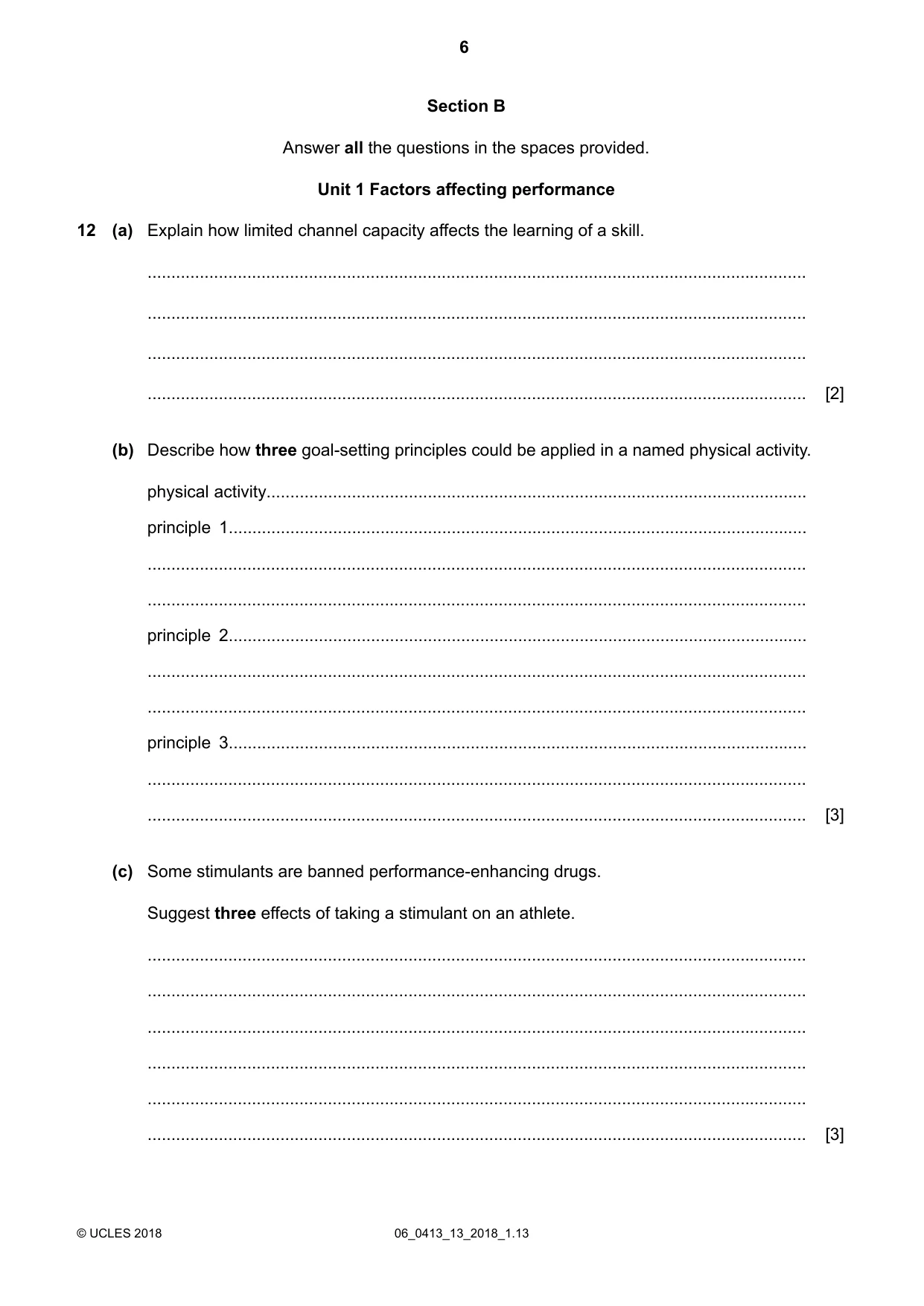
Section B Answer all the questions in the spaces provided. Unit 1 Factors affecting performance Explain how limited channel capacity affects the learning of a skill. (a) 12 … … … … [2] Describe how three goal-setting principles could be applied in a named physical activity. (b) physical activity… principle 1… … … principle 2… … … principle 3… … … [3] Some stimulants are banned performance-enhancing drugs. Suggest three effects of taking a stimulant on an athlete. (c) … … … … … … [3] 06_0413_13_2018_1.13 © UCLES 2018 6
Question paper, page 7
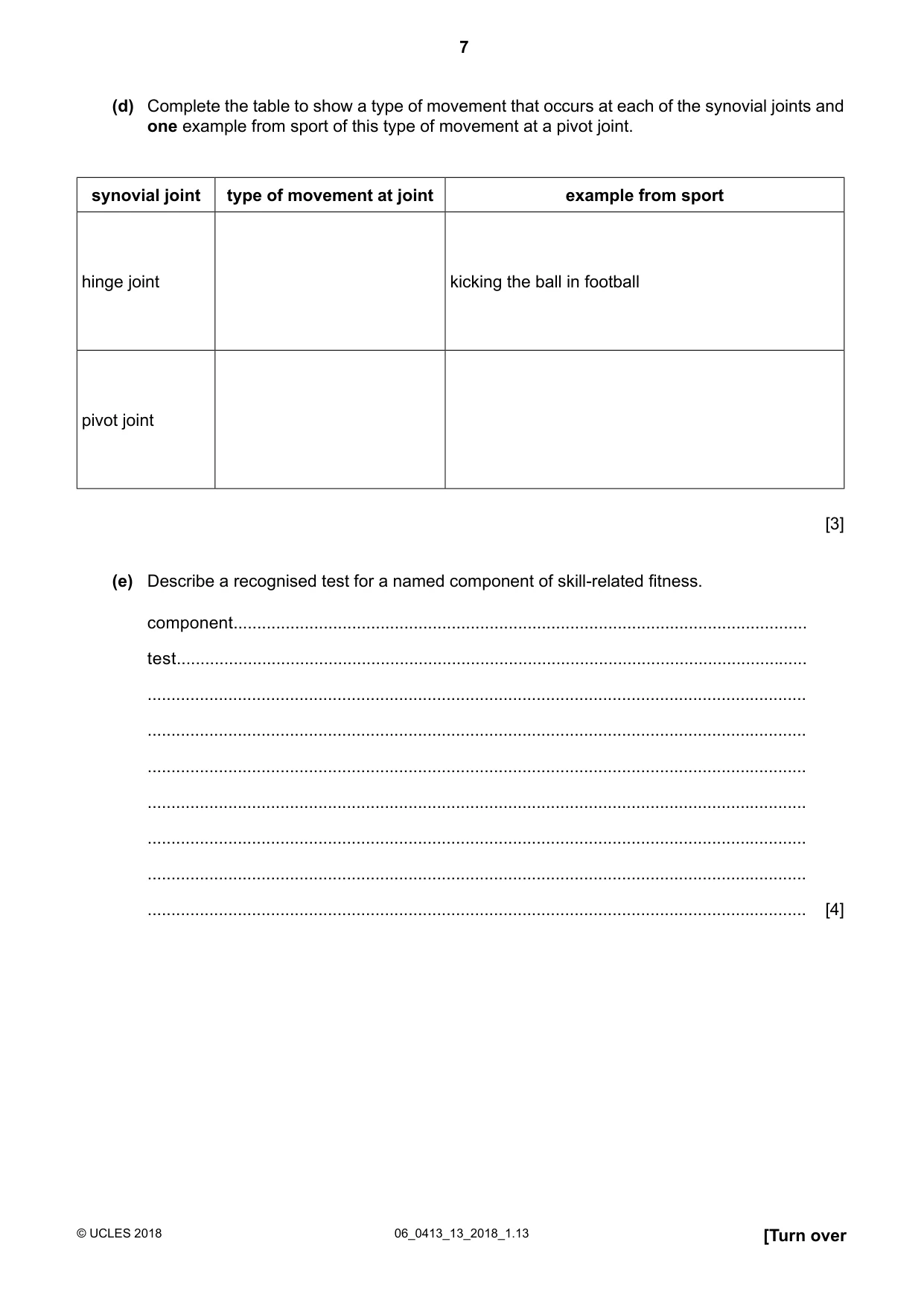
Complete the table to show a type of movement that occurs at each of the synovial joints and one example from sport of this type of movement at a pivot joint. (d) example from sport type of movement at joint synovial joint kicking the ball in football hinge joint pivot joint [3] Describe a recognised test for a named component of skill-related fitness. (e) component… test… … … … … … … … [4] [Turn over 06_0413_13_2018_1.13 © UCLES 2018 7
Question paper, page 8
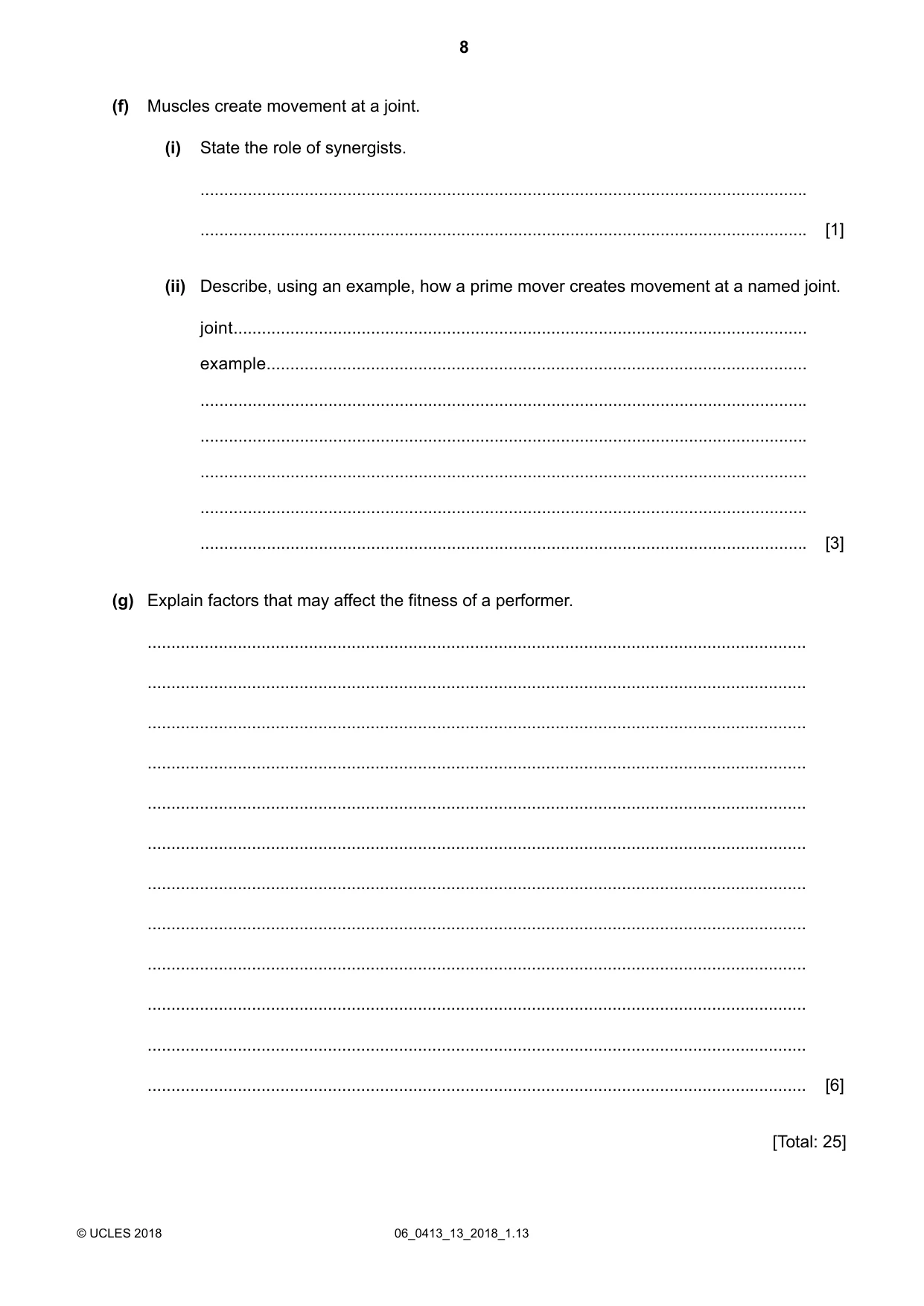
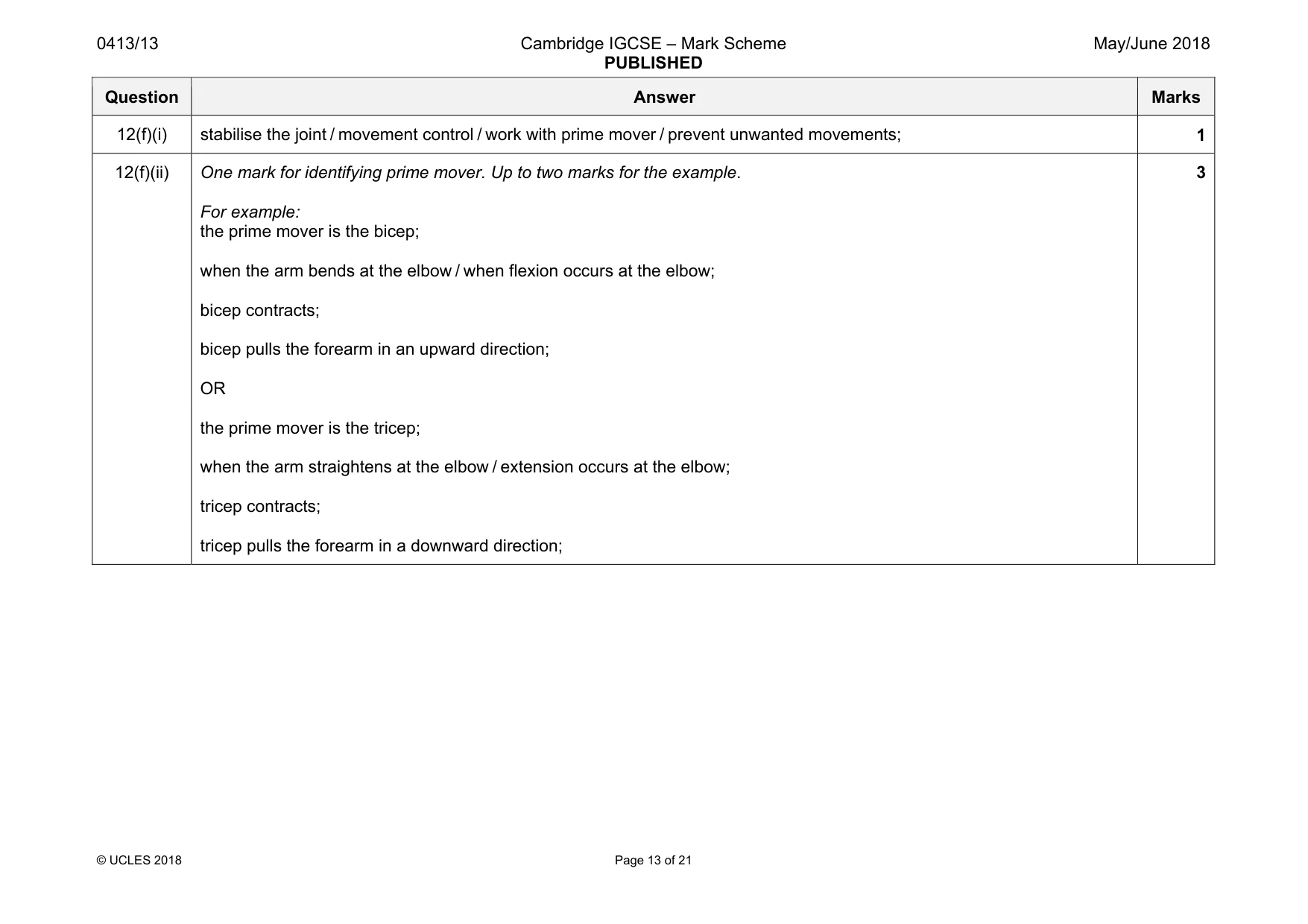
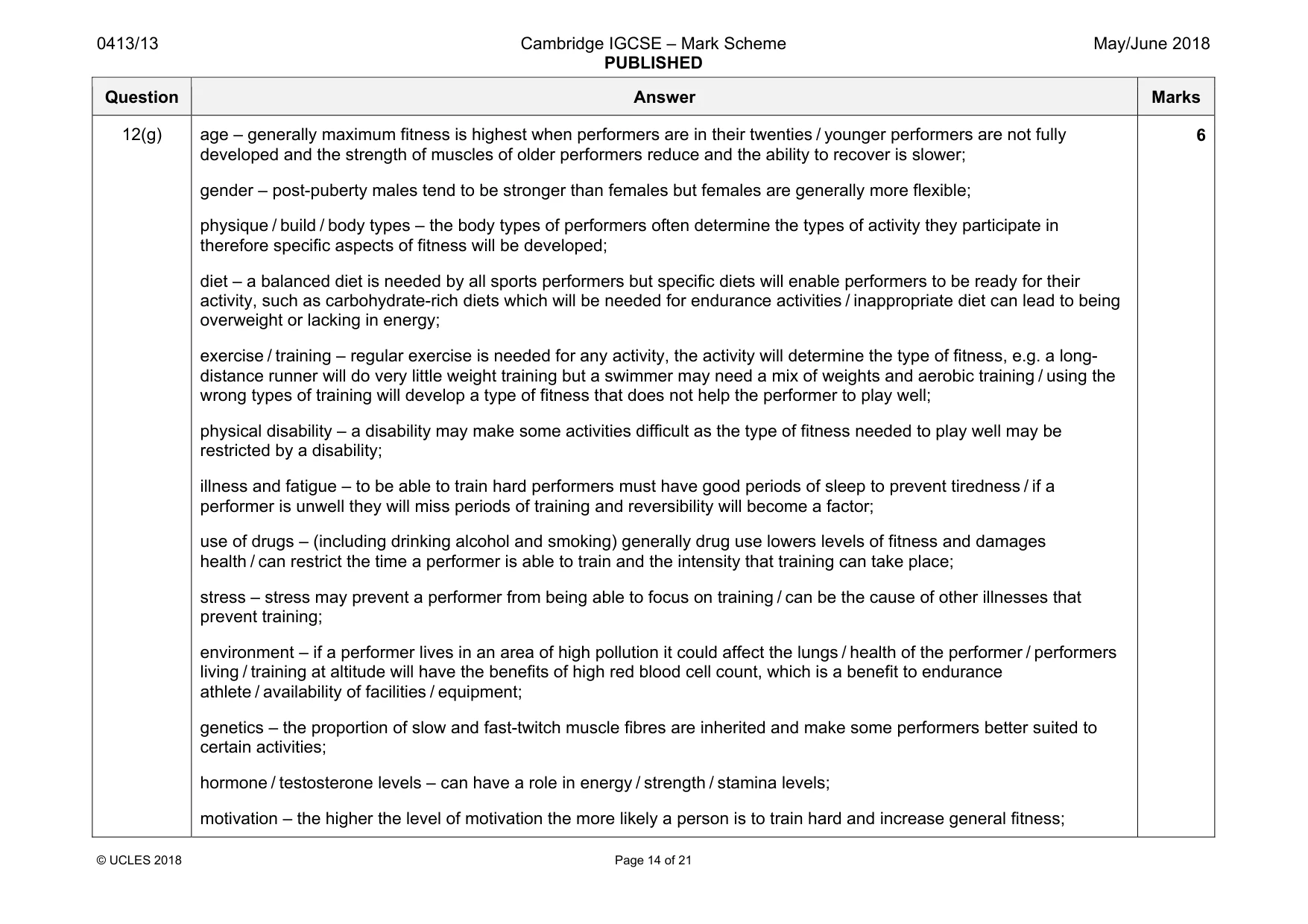
Muscles create movement at a joint. (f) State the role of synergists. (i) … … [1] Describe, using an example, how a prime mover creates movement at a named joint. (ii) joint… example… … … … … … [3] Explain factors that may affect the fitness of a performer. (g) … … … … … … … … … … … … [6] [Total: 25] 06_0413_13_2018_1.13 © UCLES 2018 8
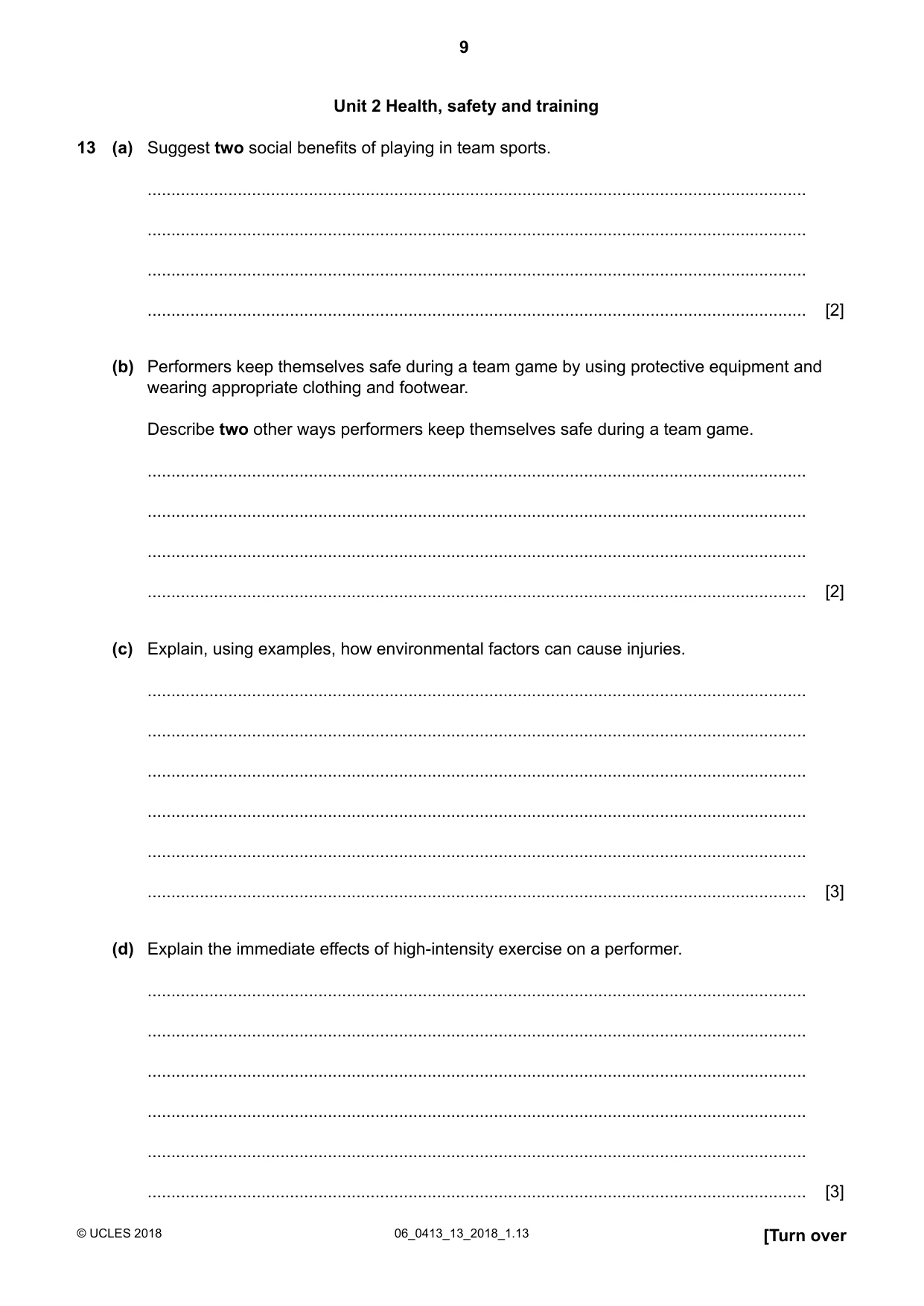
Question paper, page 9
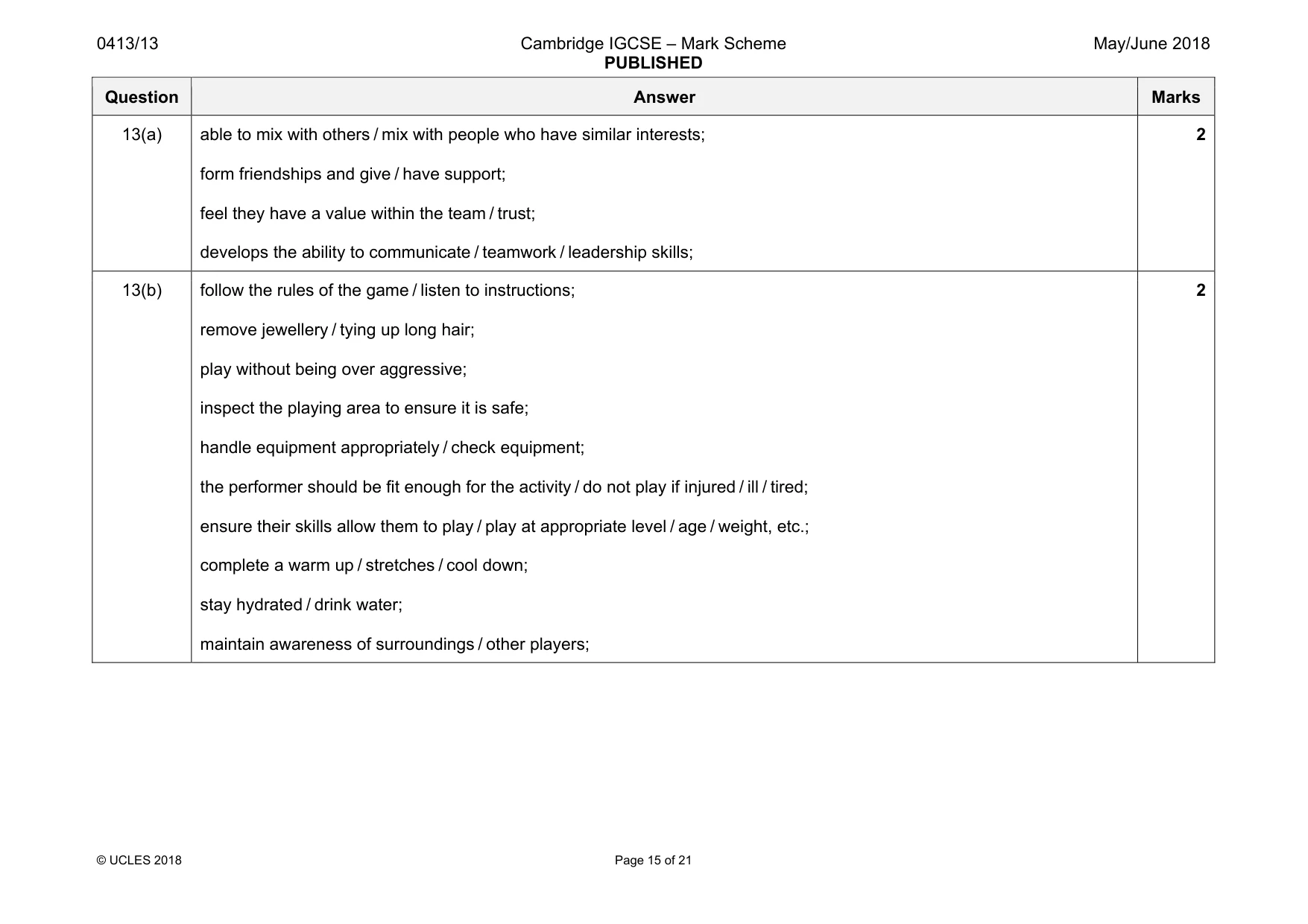
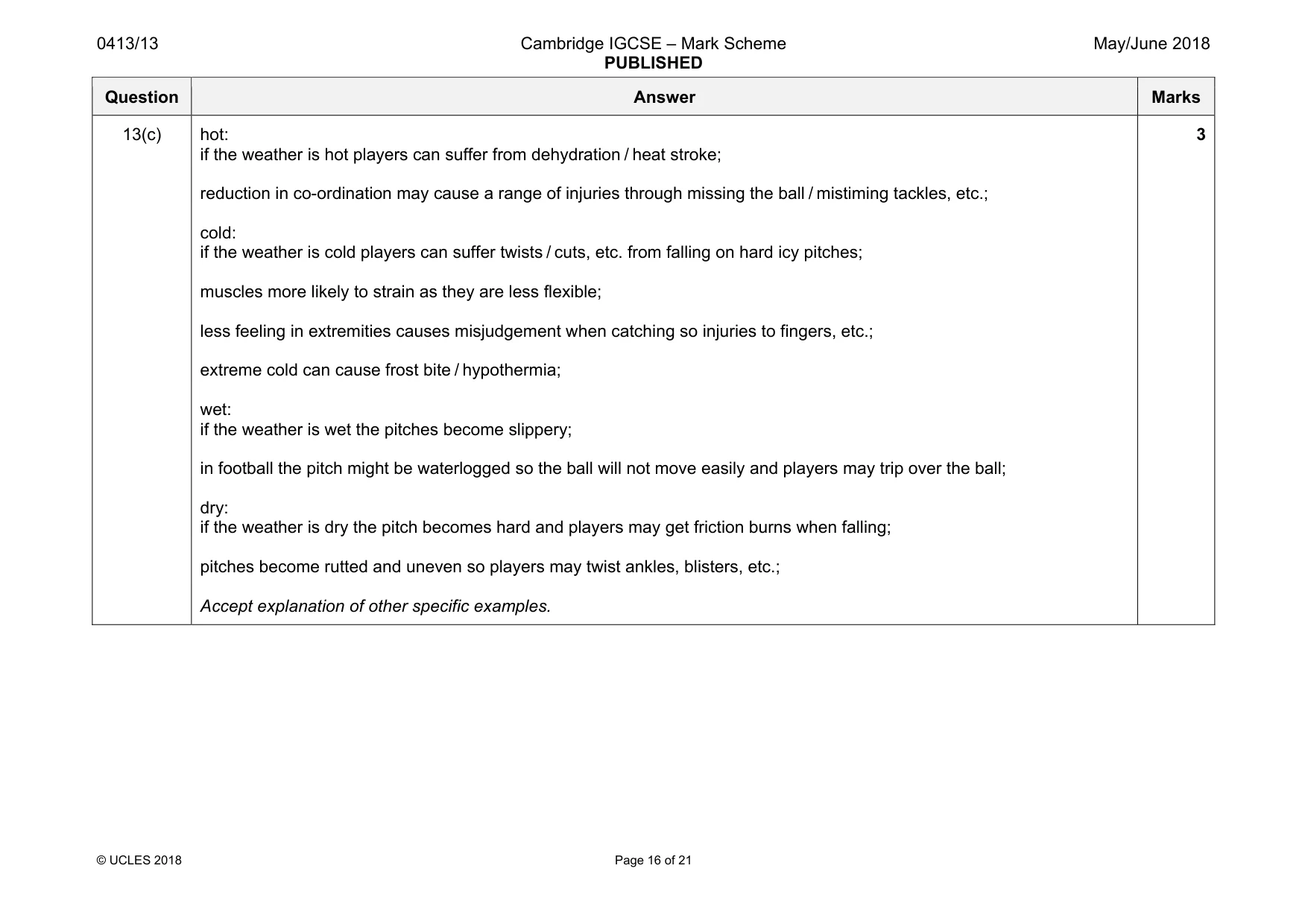
Unit 2 Health, safety and training Suggest two social benefits of playing in team sports. (a) 13 … … … … [2] Performers keep themselves safe during a team game by using protective equipment and wearing appropriate clothing and footwear. Describe two other ways performers keep themselves safe during a team game. (b) … … … … [2] Explain, using examples, how environmental factors can cause injuries. (c) … … … … … … [3] Explain the immediate effects of high-intensity exercise on a performer. (d) … … … … … … [3] [Turn over 06_0413_13_2018_1.13 © UCLES 2018 9
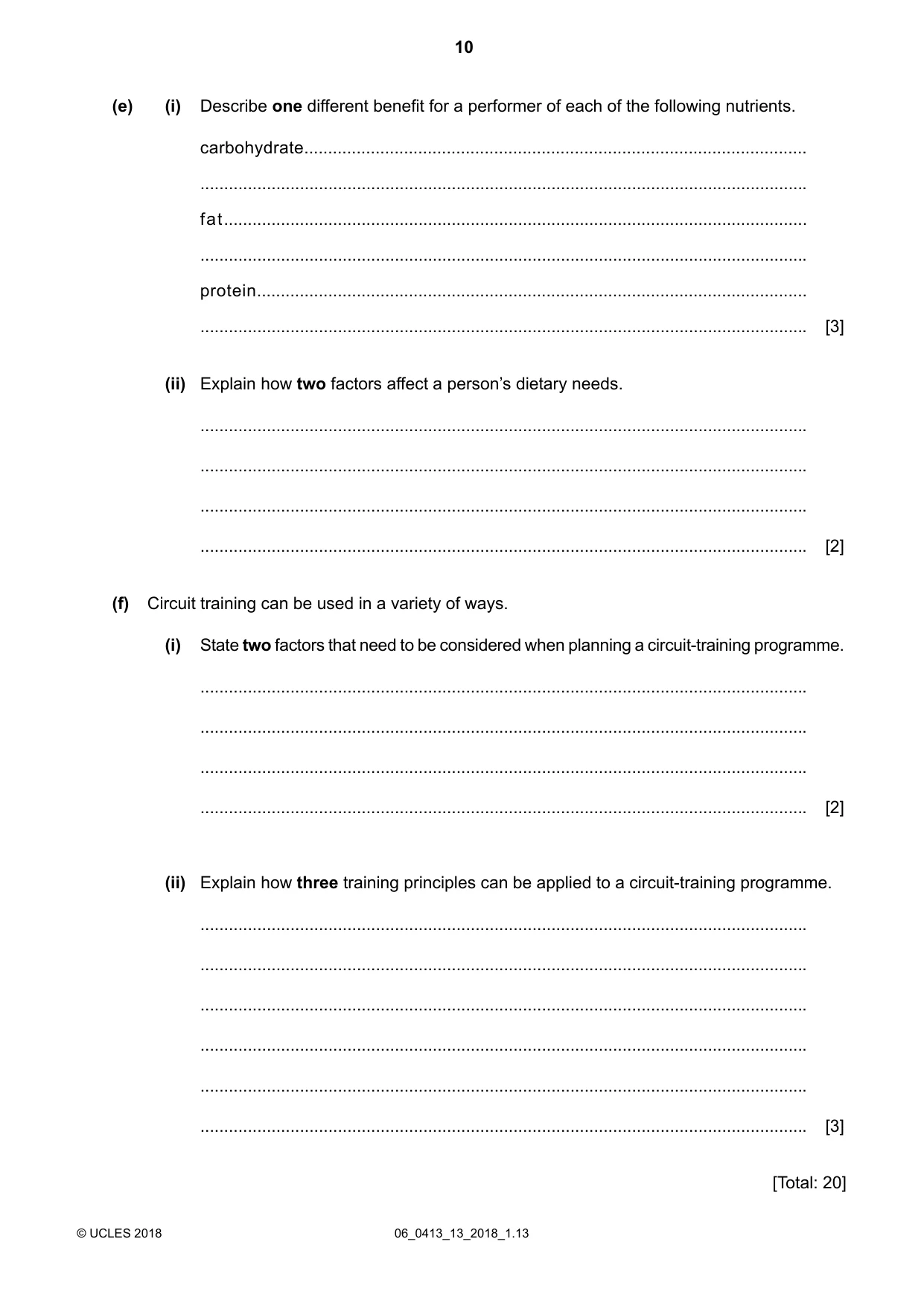
Question paper, page 10
Describe one different benefit for a performer of each of the following nutrients. (i) (e) carbohydrate… … fat… … protein… … [3] Explain how two factors affect a person’s dietary needs. (ii) … … … … [2] Circuit training can be used in a variety of ways. (f) State two factors that need to be considered when planning a circuit-training programme. (i) … … … … [2] Explain how three training principles can be applied to a circuit-training programme. (ii) … … … … … … [3] [Total: 20] 06_0413_13_2018_1.13 © UCLES 2018 10
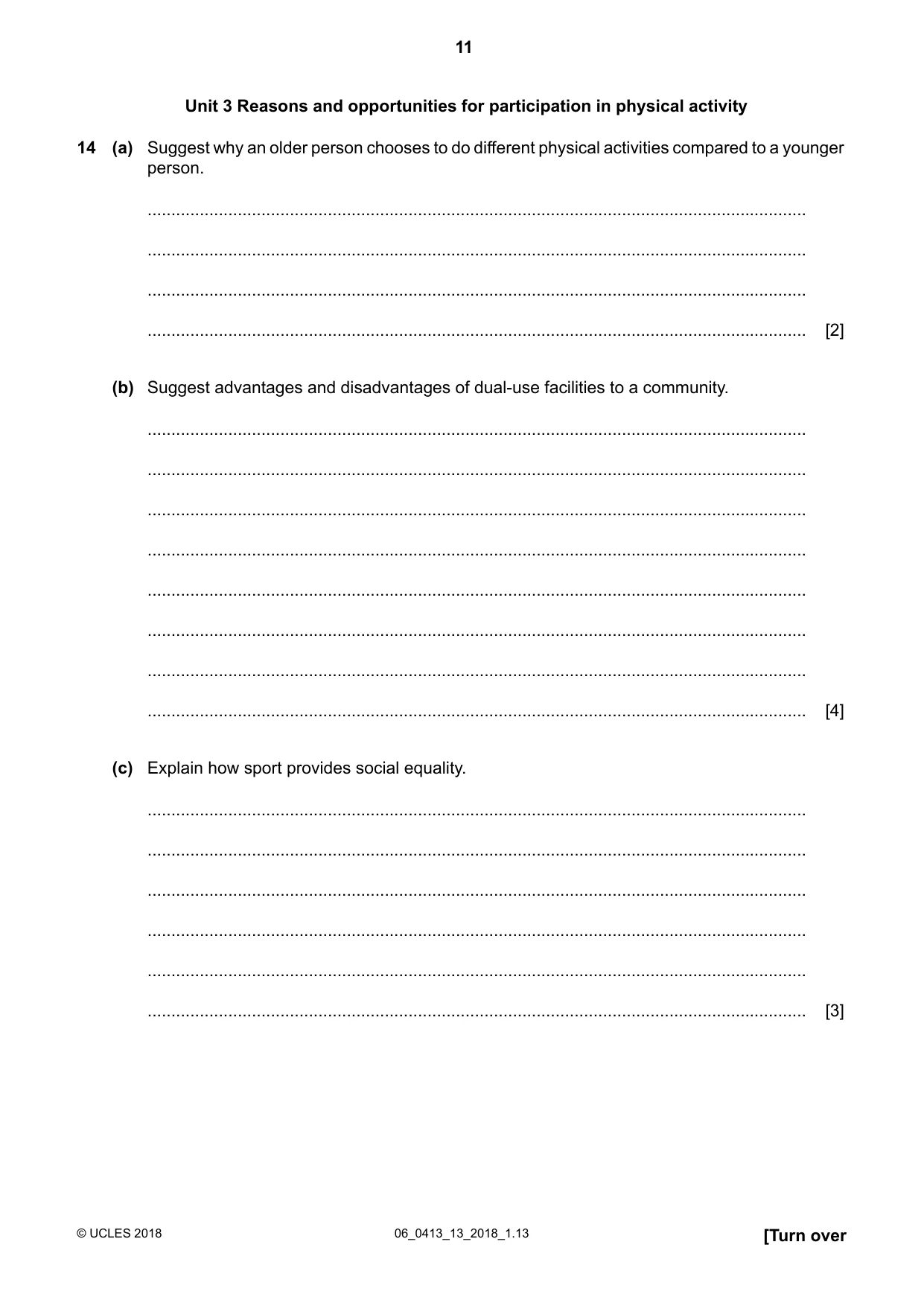
Question paper, page 11
Unit 3 Reasons and opportunities for participation in physical activity Suggest why an older person chooses to do different physical activities compared to a younger person. (a) 14 … … … … [2] Suggest advantages and disadvantages of dual-use facilities to a community. (b) … … … … … … … … [4] Explain how sport provides social equality. (c) … … … … … … [3] [Turn over 06_0413_13_2018_1.13 © UCLES 2018 11
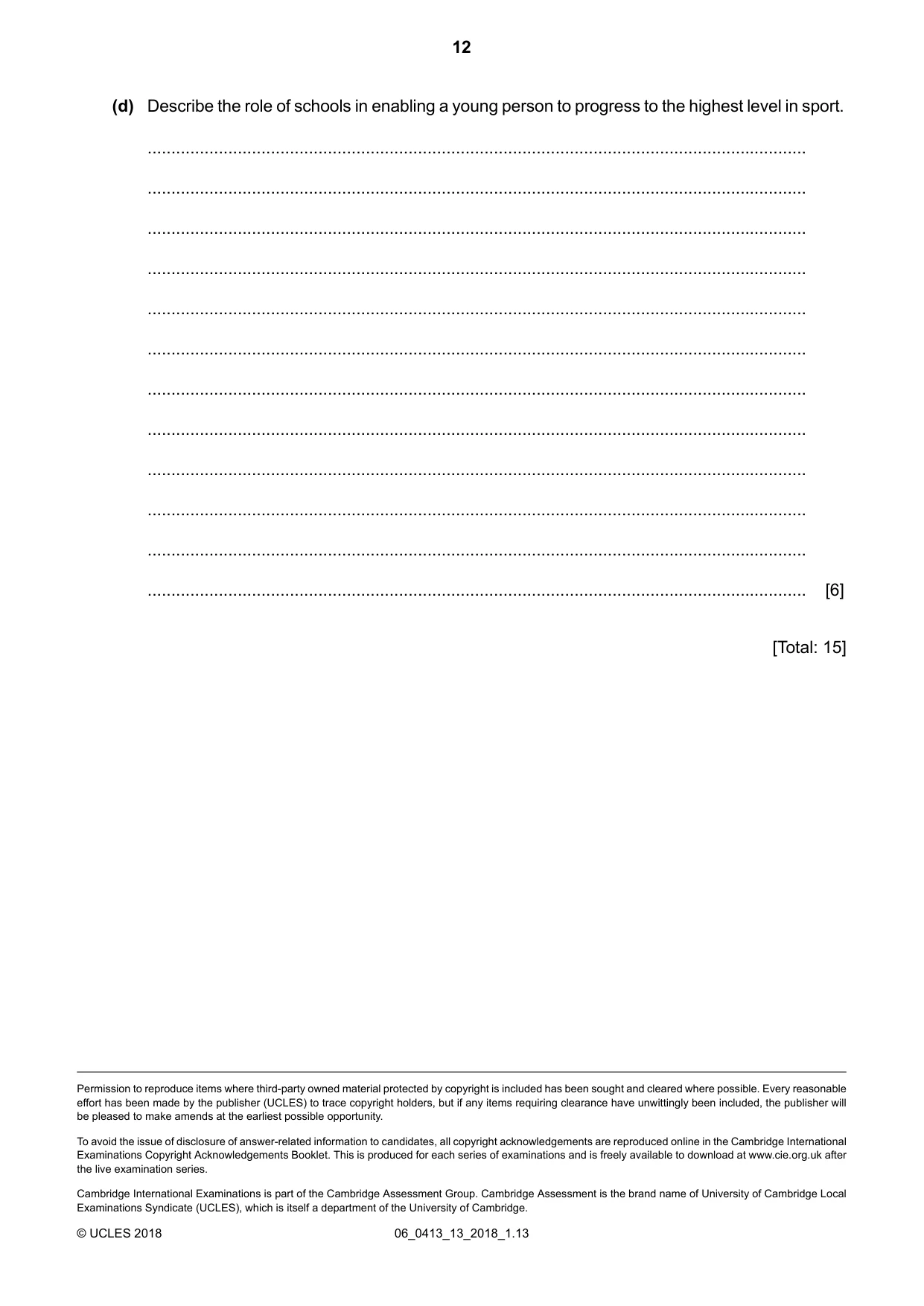
Question paper, page 12
Describe the role of schools in enabling a young person to progress to the highest level in sport. (d) … … … … … … … … … … … … [6] [Total: 15] Permission to reproduce items where third-party owned material protected by copyright is included has been sought and cleared where possible. Every reasonable effort has been made by the publisher (UCLES) to trace copyright holders, but if any items requiring clearance have unwittingly been included, the publisher will be pleased to make amends at the earliest possible opportunity. To avoid the issue of disclosure of answer-related information to candidates, all copyright acknowledgements are reproduced online in the Cambridge International Examinations Copyright Acknowledgements Booklet. This is produced for each series of examinations and is freely available to download at www.cie.org.uk after the live examination series. Cambridge International Examinations is part of the Cambridge Assessment Group. Cambridge Assessment is the brand name of University of Cambridge Local Examinations Syndicate (UCLES), which is itself a department of the University of Cambridge. 06_0413_13_2018_1.13 © UCLES 2018 12
Mark scheme, page 1
IGCSE™ is a registered trademark. This document consists of 21 printed pages. © UCLES 2018 [Turn over Cambridge Assessment International Education Cambridge International General Certificate of Secondary Education PHYSICAL EDUCATION 0413/13 Paper 1 May/June 2018 MARK SCHEME Maximum Mark: 80 Published This mark scheme is published as an aid to teachers and candidates, to indicate the requirements of the examination. It shows the basis on which Examiners were instructed to award marks. It does not indicate the details of the discussions that took place at an Examiners’ meeting before marking began, which would have considered the acceptability of alternative answers. Mark schemes should be read in conjunction with the question paper and the Principal Examiner Report for Teachers. Cambridge International will not enter into discussions about these mark schemes. Cambridge International is publishing the mark schemes for the May/June 2018 series for most Cambridge IGCSE™, Cambridge International A and AS Level and Cambridge Pre-U components, and some Cambridge O Level components.
Mark scheme, page 2
0413/13 Cambridge IGCSE – Mark Scheme PUBLISHED May/June 2018 © UCLES 2018 Page 2 of 21 Generic Marking Principles These general marking principles must be applied by all examiners when marking candidate answers. They should be applied alongside the specific content of the mark scheme or generic level descriptors for a question. Each question paper and mark scheme will also comply with these marking principles. GENERIC MARKING PRINCIPLE 1: Marks must be awarded in line with: • the specific content of the mark scheme or the generic level descriptors for the question • the specific skills defined in the mark scheme or in the generic level descriptors for the question • the standard of response required by a candidate as exemplified by the standardisation scripts. GENERIC MARKING PRINCIPLE 2: Marks awarded are always whole marks (not half marks, or other fractions). GENERIC MARKING PRINCIPLE 3: Marks must be awarded positively: • marks are awarded for correct/valid answers, as defined in the mark scheme. However, credit is given for valid answers which go beyond the scope of the syllabus and mark scheme, referring to your Team Leader as appropriate • marks are awarded when candidates clearly demonstrate what they know and can do • marks are not deducted for errors • marks are not deducted for omissions • answers should only be judged on the quality of spelling, punctuation and grammar when these features are specifically assessed by the question as indicated by the mark scheme. The meaning, however, should be unambiguous. GENERIC MARKING PRINCIPLE 4: Rules must be applied consistently e.g. in situations where candidates have not followed instructions or in the application of generic level descriptors.
Mark scheme, page 3
0413/13 Cambridge IGCSE – Mark Scheme PUBLISHED May/June 2018 © UCLES 2018 Page 3 of 21 GENERIC MARKING PRINCIPLE 5: Marks should be awarded using the full range of marks defined in the mark scheme for the question (however; the use of the full mark range may be limited according to the quality of the candidate responses seen). GENERIC MARKING PRINCIPLE 6: Marks awarded are based solely on the requirements as defined in the mark scheme. Marks should not be awarded with grade thresholds or grade descriptors in mind.
Mark scheme, page 4
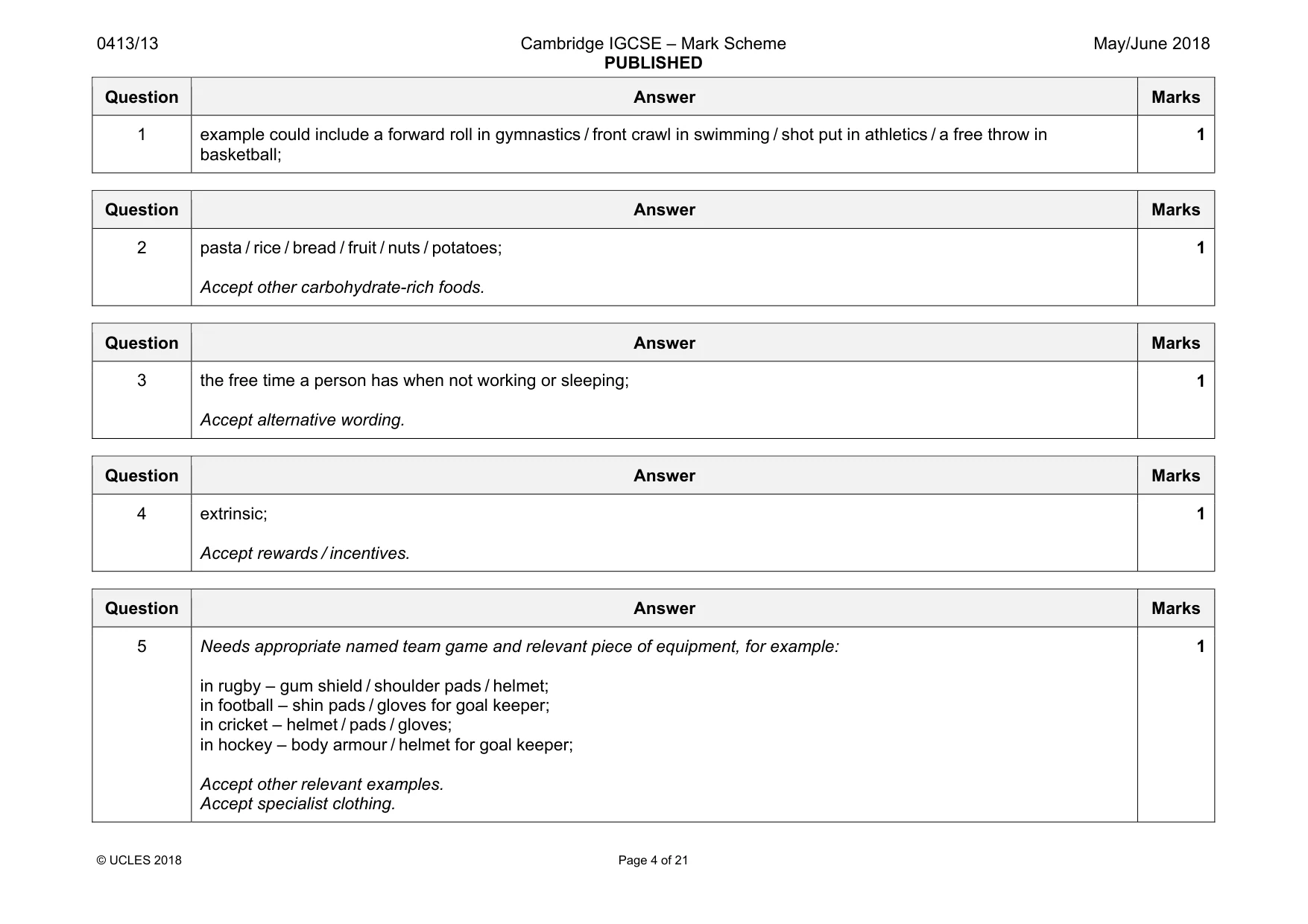
0413/13 Cambridge IGCSE – Mark Scheme PUBLISHED May/June 2018 © UCLES 2018 Page 4 of 21 Question Answer Marks 1 example could include a forward roll in gymnastics / front crawl in swimming / shot put in athletics / a free throw in basketball; 1 Question Answer Marks 2 pasta / rice / bread / fruit / nuts / potatoes; Accept other carbohydrate-rich foods. 1 Question Answer Marks 3 the free time a person has when not working or sleeping; Accept alternative wording. 1 Question Answer Marks 4 extrinsic; Accept rewards / incentives. 1 Question Answer Marks 5 Needs appropriate named team game and relevant piece of equipment, for example: in rugby – gum shield / shoulder pads / helmet; in football – shin pads / gloves for goal keeper; in cricket – helmet / pads / gloves; in hockey – body armour / helmet for goal keeper; Accept other relevant examples. Accept specialist clothing. 1
Mark scheme, page 5
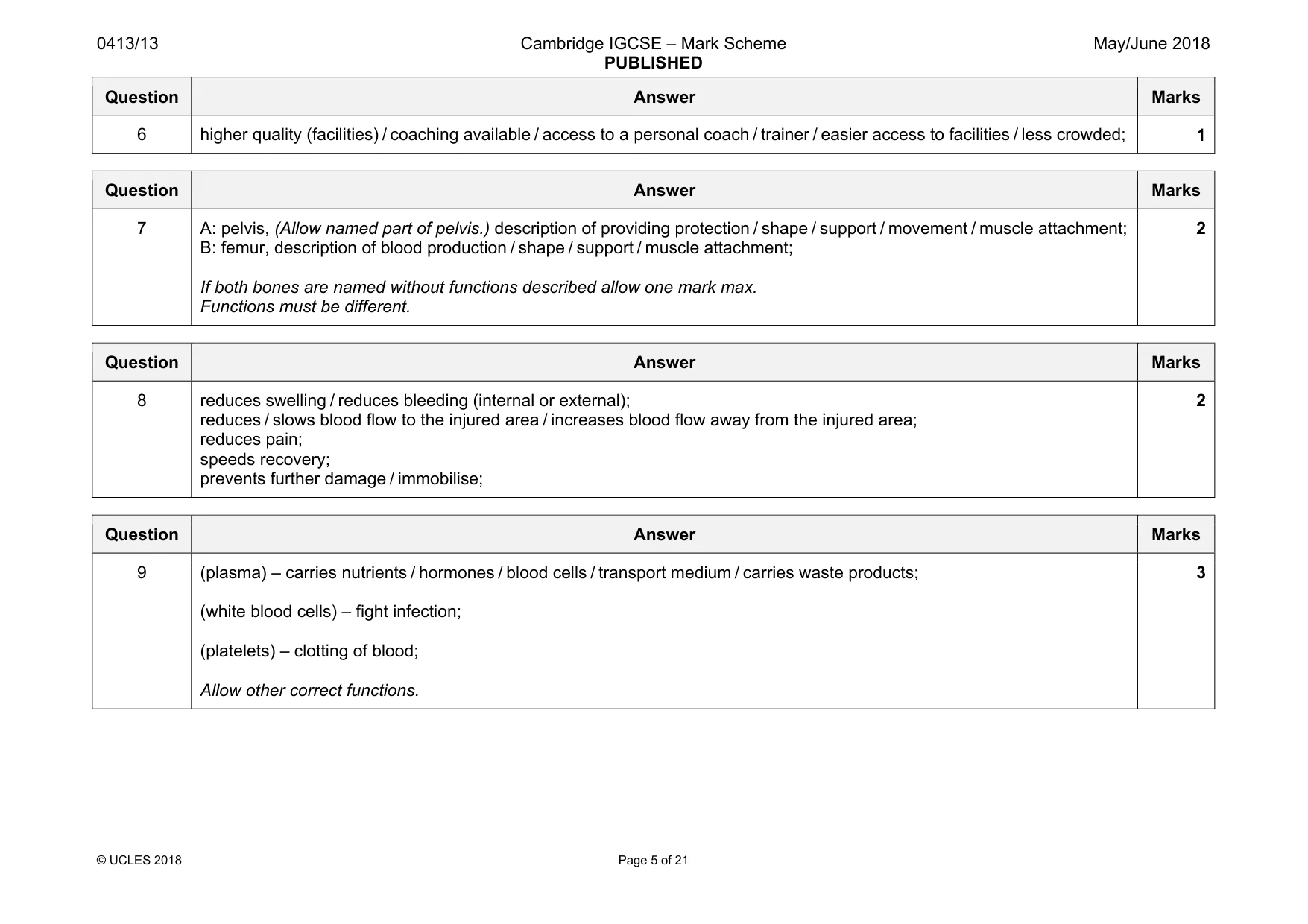
0413/13 Cambridge IGCSE – Mark Scheme PUBLISHED May/June 2018 © UCLES 2018 Page 5 of 21 Question Answer Marks 6 higher quality (facilities) / coaching available / access to a personal coach / trainer / easier access to facilities / less crowded; 1 Question Answer Marks 7 A: pelvis, (Allow named part of pelvis.) description of providing protection / shape / support / movement / muscle attachment; B: femur, description of blood production / shape / support / muscle attachment; If both bones are named without functions described allow one mark max. Functions must be different. 2 Question Answer Marks 8 reduces swelling / reduces bleeding (internal or external); reduces / slows blood flow to the injured area / increases blood flow away from the injured area; reduces pain; speeds recovery; prevents further damage / immobilise; 2 Question Answer Marks 9 (plasma) – carries nutrients / hormones / blood cells / transport medium / carries waste products; (white blood cells) – fight infection; (platelets) – clotting of blood; Allow other correct functions. 3
Mark scheme, page 6
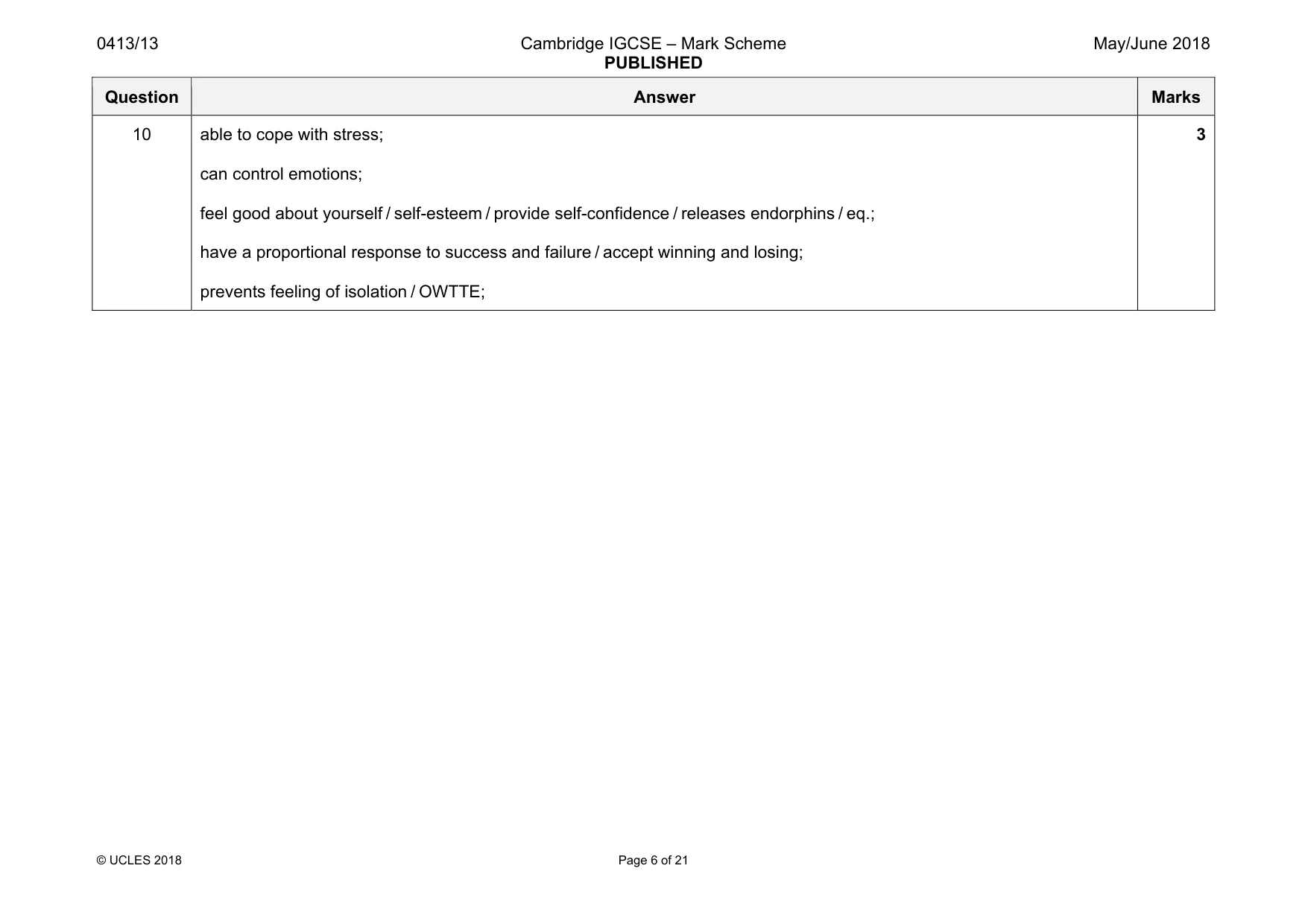
0413/13 Cambridge IGCSE – Mark Scheme PUBLISHED May/June 2018 © UCLES 2018 Page 6 of 21 Question Answer Marks 10 able to cope with stress; can control emotions; feel good about yourself / self-esteem / provide self-confidence / releases endorphins / eq.; have a proportional response to success and failure / accept winning and losing; prevents feeling of isolation / OWTTE; 3
Mark scheme, page 7
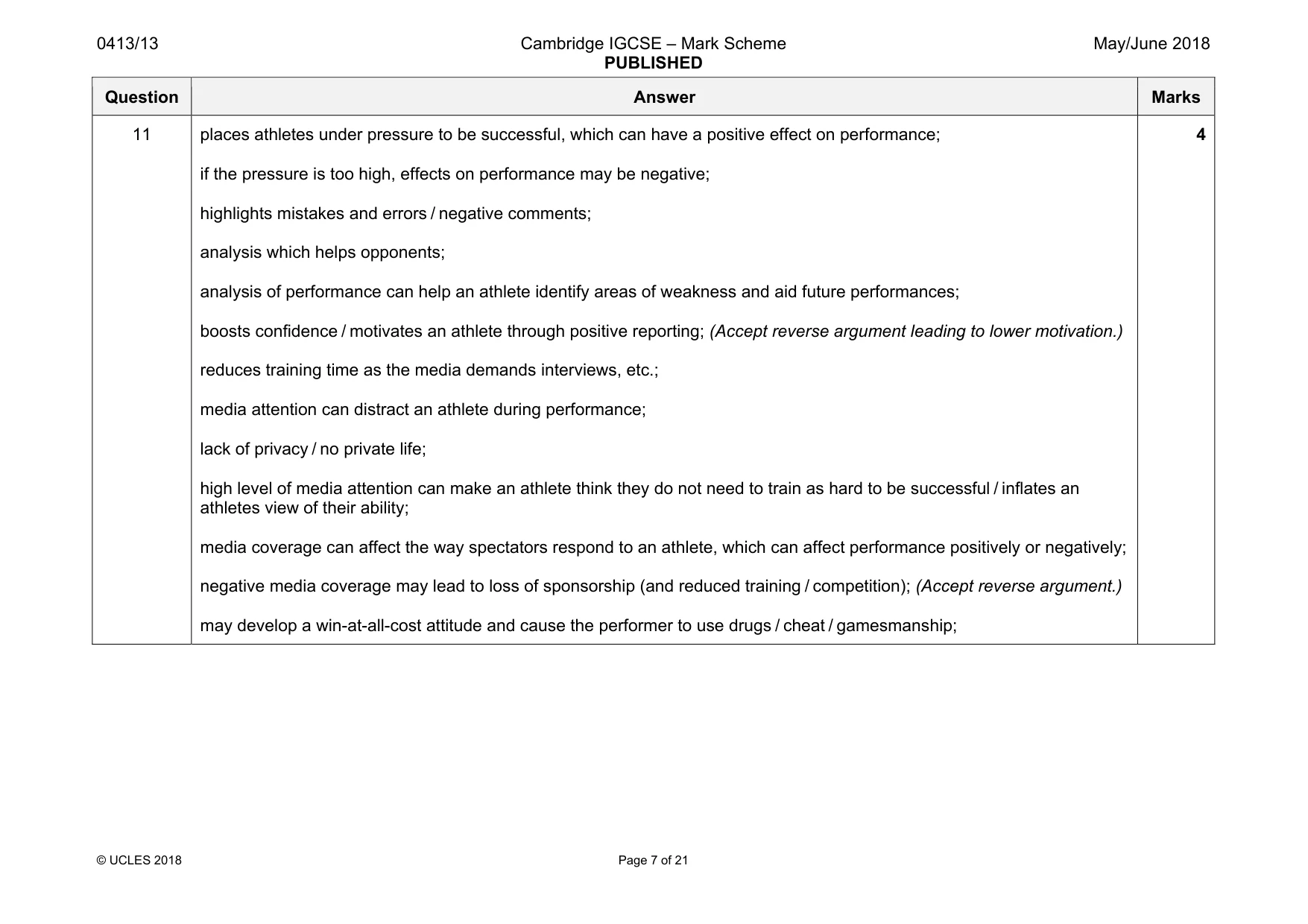
0413/13 Cambridge IGCSE – Mark Scheme PUBLISHED May/June 2018 © UCLES 2018 Page 7 of 21 Question Answer Marks 11 places athletes under pressure to be successful, which can have a positive effect on performance; if the pressure is too high, effects on performance may be negative; highlights mistakes and errors / negative comments; analysis which helps opponents; analysis of performance can help an athlete identify areas of weakness and aid future performances; boosts confidence / motivates an athlete through positive reporting; (Accept reverse argument leading to lower motivation.) reduces training time as the media demands interviews, etc.; media attention can distract an athlete during performance; lack of privacy / no private life; high level of media attention can make an athlete think they do not need to train as hard to be successful / inflates an athletes view of their ability; media coverage can affect the way spectators respond to an athlete, which can affect performance positively or negatively; negative media coverage may lead to loss of sponsorship (and reduced training / competition); (Accept reverse argument.) may develop a win-at-all-cost attitude and cause the performer to use drugs / cheat / gamesmanship; 4
Mark scheme, page 8
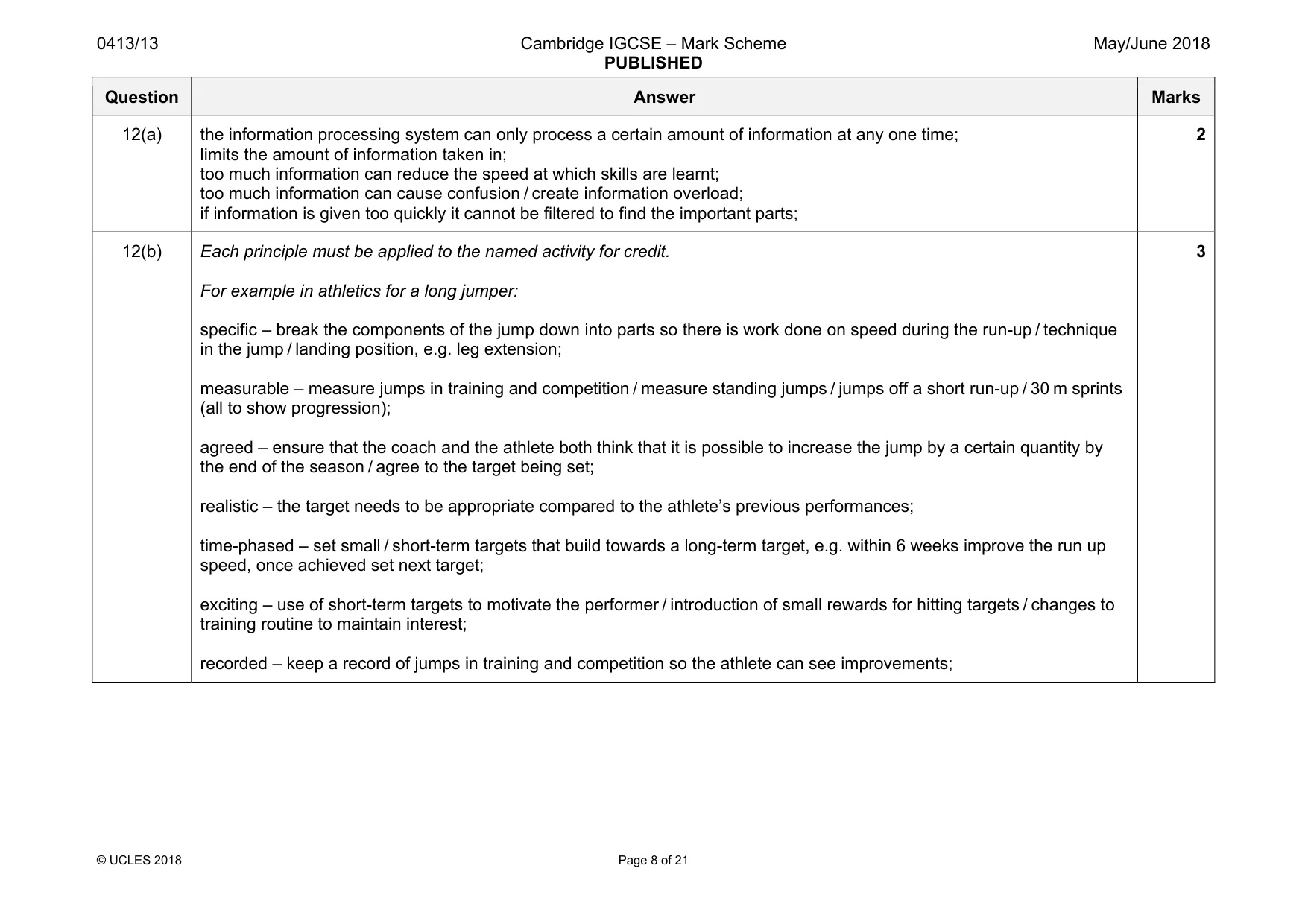
0413/13 Cambridge IGCSE – Mark Scheme PUBLISHED May/June 2018 © UCLES 2018 Page 8 of 21 Question Answer Marks 12(a) the information processing system can only process a certain amount of information at any one time; limits the amount of information taken in; too much information can reduce the speed at which skills are learnt; too much information can cause confusion / create information overload; if information is given too quickly it cannot be filtered to find the important parts; 2 12(b) Each principle must be applied to the named activity for credit. For example in athletics for a long jumper: specific – break the components of the jump down into parts so there is work done on speed during the run-up / technique in the jump / landing position, e.g. leg extension; measurable – measure jumps in training and competition / measure standing jumps / jumps off a short run-up / 30 m sprints (all to show progression); agreed – ensure that the coach and the athlete both think that it is possible to increase the jump by a certain quantity by the end of the season / agree to the target being set; realistic – the target needs to be appropriate compared to the athlete’s previous performances; time-phased – set small / short-term targets that build towards a long-term target, e.g. within 6 weeks improve the run up speed, once achieved set next target; exciting – use of short-term targets to motivate the performer / introduction of small rewards for hitting targets / changes to training routine to maintain interest; recorded – keep a record of jumps in training and competition so the athlete can see improvements; 3
Mark scheme, page 9
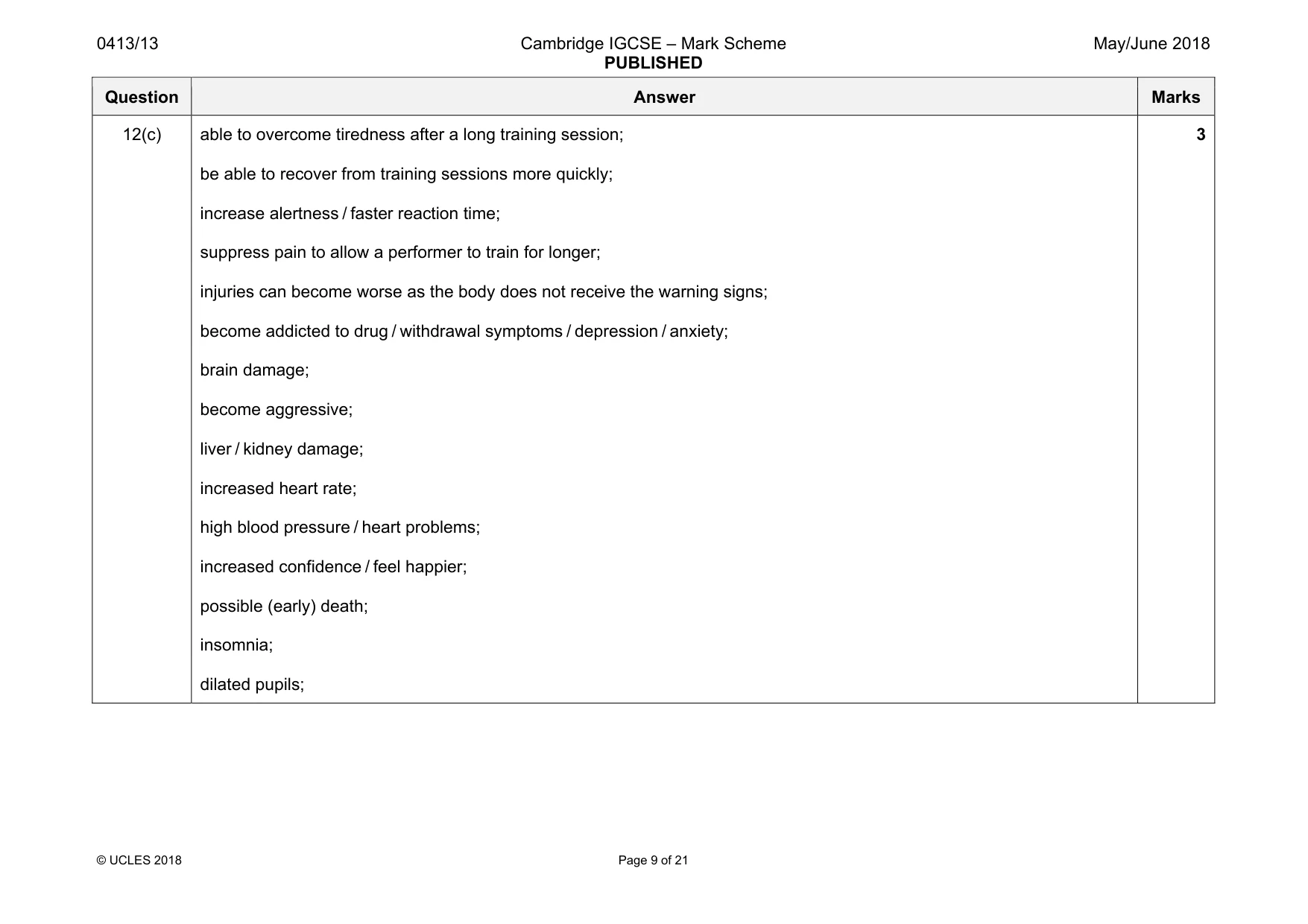
0413/13 Cambridge IGCSE – Mark Scheme PUBLISHED May/June 2018 © UCLES 2018 Page 9 of 21 Question Answer Marks 12(c) able to overcome tiredness after a long training session; be able to recover from training sessions more quickly; increase alertness / faster reaction time; suppress pain to allow a performer to train for longer; injuries can become worse as the body does not receive the warning signs; become addicted to drug / withdrawal symptoms / depression / anxiety; brain damage; become aggressive; liver / kidney damage; increased heart rate; high blood pressure / heart problems; increased confidence / feel happier; possible (early) death; insomnia; dilated pupils; 3
Mark scheme, page 10
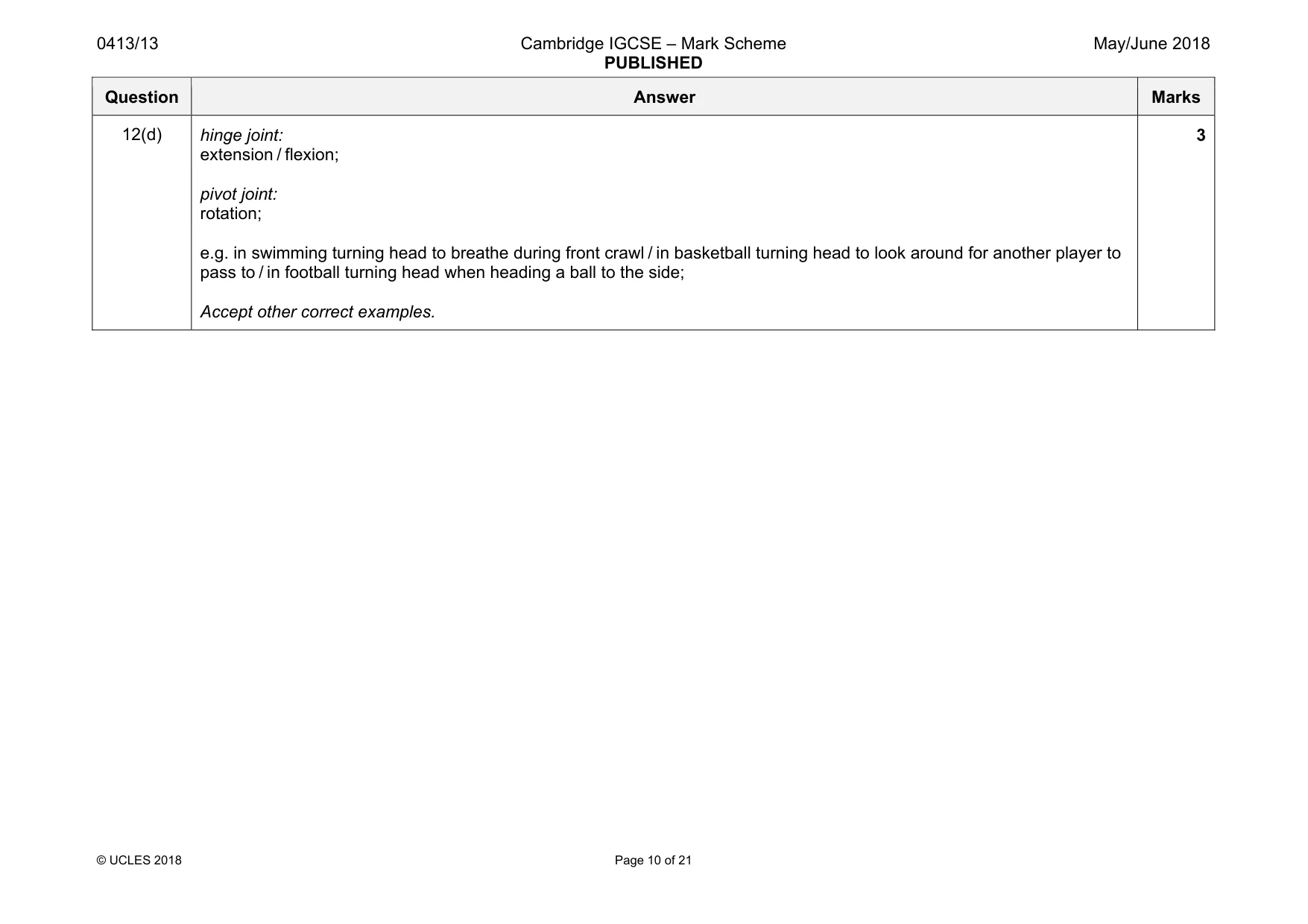
0413/13 Cambridge IGCSE – Mark Scheme PUBLISHED May/June 2018 © UCLES 2018 Page 10 of 21 Question Answer Marks 12(d) hinge joint: extension / flexion; pivot joint: rotation; e.g. in swimming turning head to breathe during front crawl / in basketball turning head to look around for another player to pass to / in football turning head when heading a ball to the side; Accept other correct examples. 3
Mark scheme, page 11
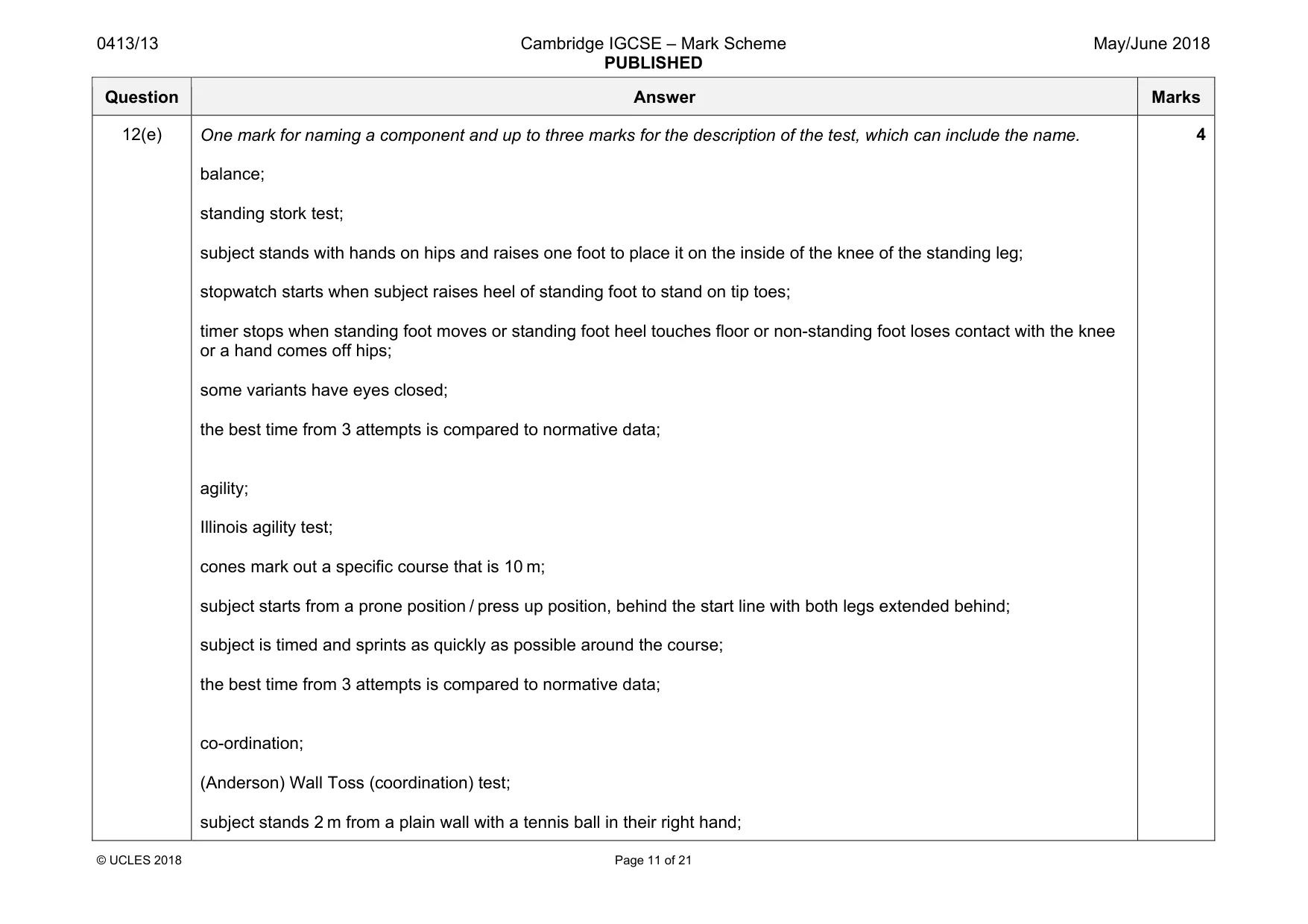
0413/13 Cambridge IGCSE – Mark Scheme PUBLISHED May/June 2018 © UCLES 2018 Page 11 of 21 Question Answer Marks 12(e) One mark for naming a component and up to three marks for the description of the test, which can include the name. balance; standing stork test; subject stands with hands on hips and raises one foot to place it on the inside of the knee of the standing leg; stopwatch starts when subject raises heel of standing foot to stand on tip toes; timer stops when standing foot moves or standing foot heel touches floor or non-standing foot loses contact with the knee or a hand comes off hips; some variants have eyes closed; the best time from 3 attempts is compared to normative data; agility; Illinois agility test; cones mark out a specific course that is 10 m; subject starts from a prone position / press up position, behind the start line with both legs extended behind; subject is timed and sprints as quickly as possible around the course; the best time from 3 attempts is compared to normative data; co-ordination; (Anderson) Wall Toss (coordination) test; subject stands 2 m from a plain wall with a tennis ball in their right hand; 4
Mark scheme, page 12
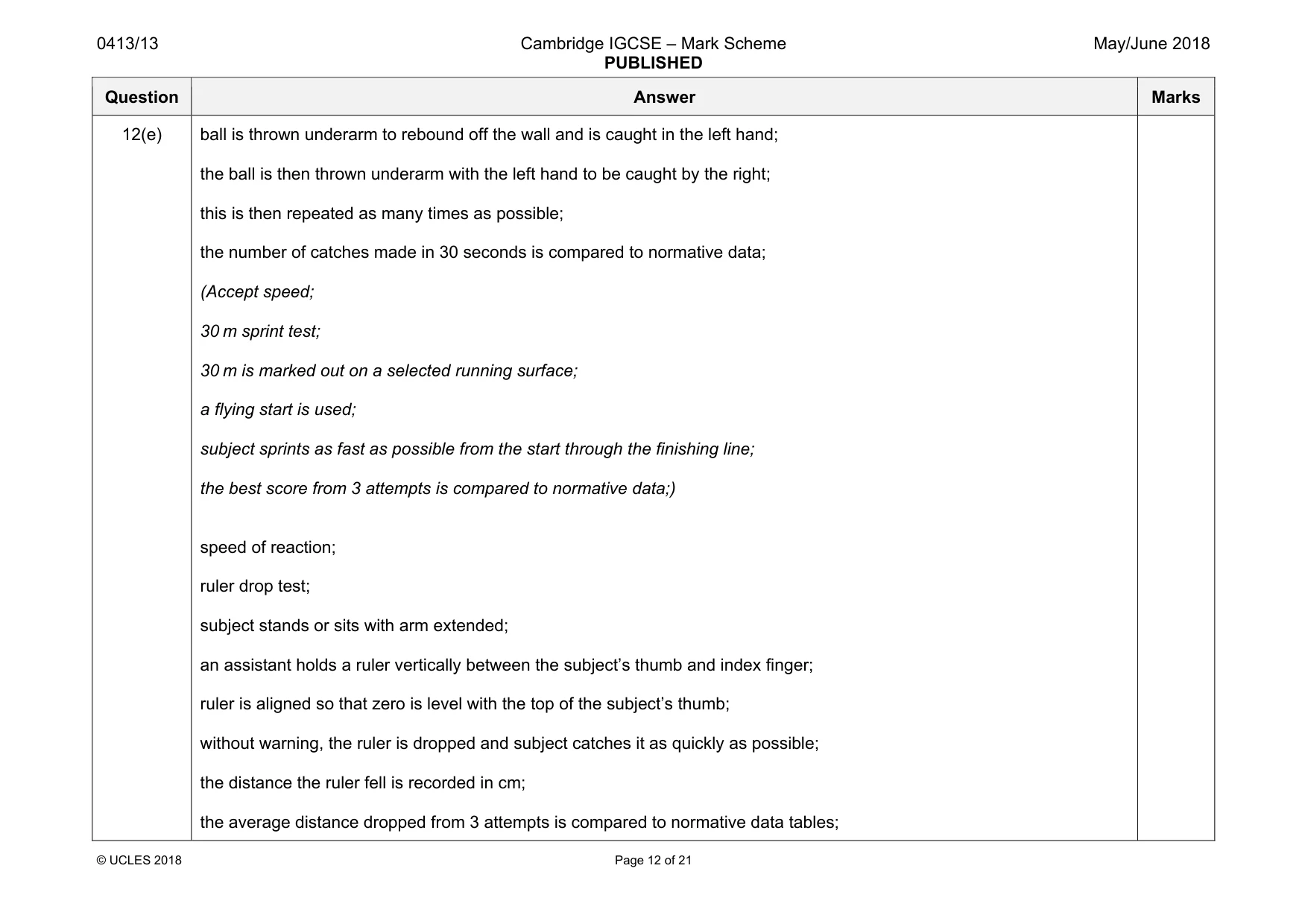
0413/13 Cambridge IGCSE – Mark Scheme PUBLISHED May/June 2018 © UCLES 2018 Page 12 of 21 Question Answer Marks 12(e) ball is thrown underarm to rebound off the wall and is caught in the left hand; the ball is then thrown underarm with the left hand to be caught by the right; this is then repeated as many times as possible; the number of catches made in 30 seconds is compared to normative data; (Accept speed; 30 m sprint test; 30 m is marked out on a selected running surface; a flying start is used; subject sprints as fast as possible from the start through the finishing line; the best score from 3 attempts is compared to normative data;) speed of reaction; ruler drop test; subject stands or sits with arm extended; an assistant holds a ruler vertically between the subject’s thumb and index finger; ruler is aligned so that zero is level with the top of the subject’s thumb; without warning, the ruler is dropped and subject catches it as quickly as possible; the distance the ruler fell is recorded in cm; the average distance dropped from 3 attempts is compared to normative data tables;
Mark scheme, page 13
0413/13 Cambridge IGCSE – Mark Scheme PUBLISHED May/June 2018 © UCLES 2018 Page 13 of 21 Question Answer Marks 12(f)(i) stabilise the joint / movement control / work with prime mover / prevent unwanted movements; 1 12(f)(ii) One mark for identifying prime mover. Up to two marks for the example. For example: the prime mover is the bicep; when the arm bends at the elbow / when flexion occurs at the elbow; bicep contracts; bicep pulls the forearm in an upward direction; OR the prime mover is the tricep; when the arm straightens at the elbow / extension occurs at the elbow; tricep contracts; tricep pulls the forearm in a downward direction; 3
Mark scheme, page 14
0413/13 Cambridge IGCSE – Mark Scheme PUBLISHED May/June 2018 © UCLES 2018 Page 14 of 21 Question Answer Marks 12(g) age – generally maximum fitness is highest when performers are in their twenties / younger performers are not fully developed and the strength of muscles of older performers reduce and the ability to recover is slower; gender – post-puberty males tend to be stronger than females but females are generally more flexible; physique / build / body types – the body types of performers often determine the types of activity they participate in therefore specific aspects of fitness will be developed; diet – a balanced diet is needed by all sports performers but specific diets will enable performers to be ready for their activity, such as carbohydrate-rich diets which will be needed for endurance activities / inappropriate diet can lead to being overweight or lacking in energy; exercise / training – regular exercise is needed for any activity, the activity will determine the type of fitness, e.g. a long- distance runner will do very little weight training but a swimmer may need a mix of weights and aerobic training / using the wrong types of training will develop a type of fitness that does not help the performer to play well; physical disability – a disability may make some activities difficult as the type of fitness needed to play well may be restricted by a disability; illness and fatigue – to be able to train hard performers must have good periods of sleep to prevent tiredness / if a performer is unwell they will miss periods of training and reversibility will become a factor; use of drugs – (including drinking alcohol and smoking) generally drug use lowers levels of fitness and damages health / can restrict the time a performer is able to train and the intensity that training can take place; stress – stress may prevent a performer from being able to focus on training / can be the cause of other illnesses that prevent training; environment – if a performer lives in an area of high pollution it could affect the lungs / health of the performer / performers living / training at altitude will have the benefits of high red blood cell count, which is a benefit to endurance athlete / availability of facilities / equipment; genetics – the proportion of slow and fast-twitch muscle fibres are inherited and make some performers better suited to certain activities; hormone / testosterone levels – can have a role in energy / strength / stamina levels; motivation – the higher the level of motivation the more likely a person is to train hard and increase general fitness; 6
Mark scheme, page 15
0413/13 Cambridge IGCSE – Mark Scheme PUBLISHED May/June 2018 © UCLES 2018 Page 15 of 21 Question Answer Marks 13(a) able to mix with others / mix with people who have similar interests; form friendships and give / have support; feel they have a value within the team / trust; develops the ability to communicate / teamwork / leadership skills; 2 13(b) follow the rules of the game / listen to instructions; remove jewellery / tying up long hair; play without being over aggressive; inspect the playing area to ensure it is safe; handle equipment appropriately / check equipment; the performer should be fit enough for the activity / do not play if injured / ill / tired; ensure their skills allow them to play / play at appropriate level / age / weight, etc.; complete a warm up / stretches / cool down; stay hydrated / drink water; maintain awareness of surroundings / other players; 2
Mark scheme, page 16
0413/13 Cambridge IGCSE – Mark Scheme PUBLISHED May/June 2018 © UCLES 2018 Page 16 of 21 Question Answer Marks 13(c) hot: if the weather is hot players can suffer from dehydration / heat stroke; reduction in co-ordination may cause a range of injuries through missing the ball / mistiming tackles, etc.; cold: if the weather is cold players can suffer twists / cuts, etc. from falling on hard icy pitches; muscles more likely to strain as they are less flexible; less feeling in extremities causes misjudgement when catching so injuries to fingers, etc.; extreme cold can cause frost bite / hypothermia; wet: if the weather is wet the pitches become slippery; in football the pitch might be waterlogged so the ball will not move easily and players may trip over the ball; dry: if the weather is dry the pitch becomes hard and players may get friction burns when falling; pitches become rutted and uneven so players may twist ankles, blisters, etc.; Accept explanation of other specific examples. 3
Mark scheme, page 17
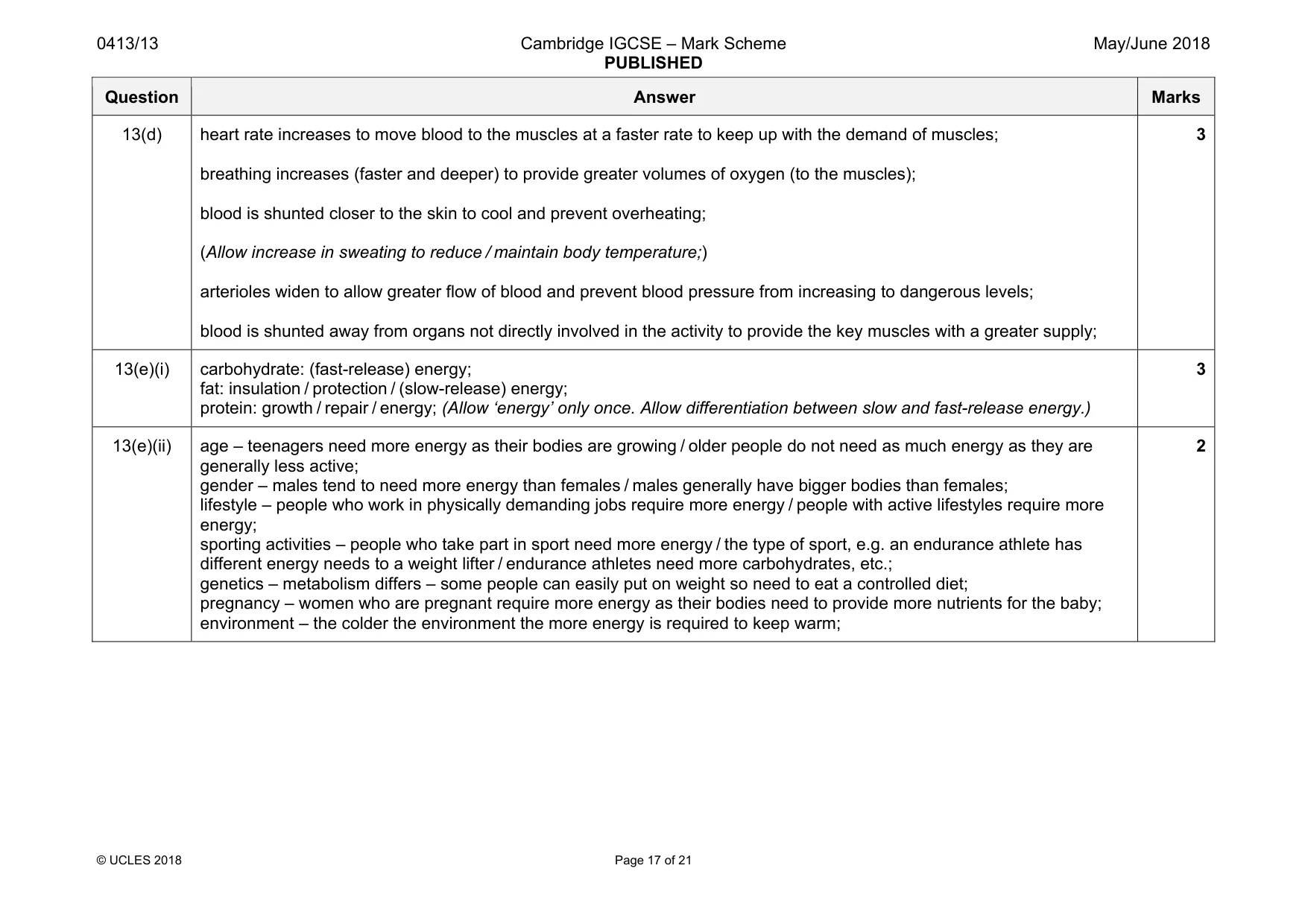
0413/13 Cambridge IGCSE – Mark Scheme PUBLISHED May/June 2018 © UCLES 2018 Page 17 of 21 Question Answer Marks 13(d) heart rate increases to move blood to the muscles at a faster rate to keep up with the demand of muscles; breathing increases (faster and deeper) to provide greater volumes of oxygen (to the muscles); blood is shunted closer to the skin to cool and prevent overheating; (Allow increase in sweating to reduce / maintain body temperature;) arterioles widen to allow greater flow of blood and prevent blood pressure from increasing to dangerous levels; blood is shunted away from organs not directly involved in the activity to provide the key muscles with a greater supply; 3 13(e)(i) carbohydrate: (fast-release) energy; fat: insulation / protection / (slow-release) energy; protein: growth / repair / energy; (Allow ‘energy’ only once. Allow differentiation between slow and fast-release energy.) 3 13(e)(ii) age – teenagers need more energy as their bodies are growing / older people do not need as much energy as they are generally less active; gender – males tend to need more energy than females / males generally have bigger bodies than females; lifestyle – people who work in physically demanding jobs require more energy / people with active lifestyles require more energy; sporting activities – people who take part in sport need more energy / the type of sport, e.g. an endurance athlete has different energy needs to a weight lifter / endurance athletes need more carbohydrates, etc.; genetics – metabolism differs – some people can easily put on weight so need to eat a controlled diet; pregnancy – women who are pregnant require more energy as their bodies need to provide more nutrients for the baby; environment – the colder the environment the more energy is required to keep warm; 2
Mark scheme, page 18
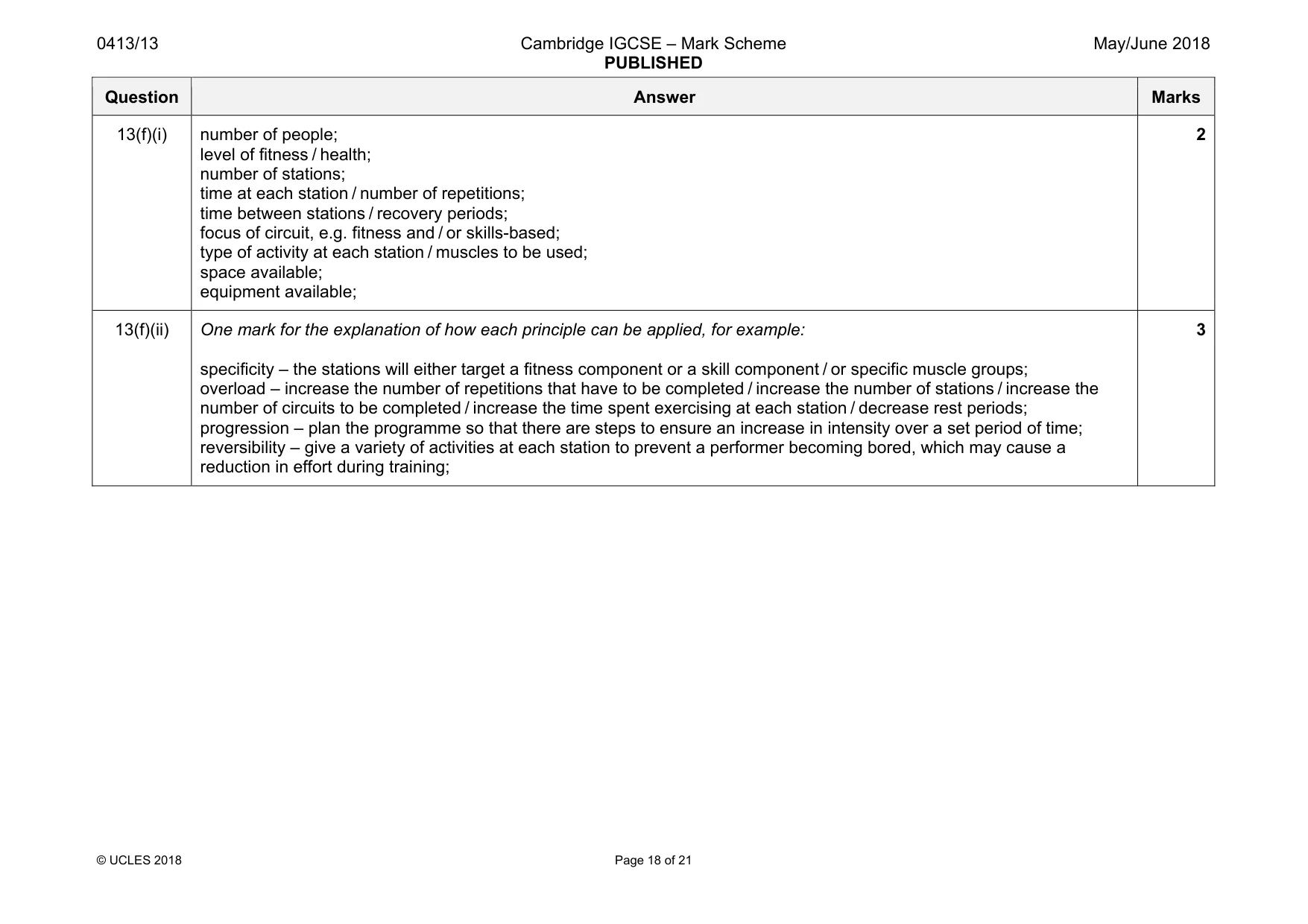
0413/13 Cambridge IGCSE – Mark Scheme PUBLISHED May/June 2018 © UCLES 2018 Page 18 of 21 Question Answer Marks 13(f)(i) number of people; level of fitness / health; number of stations; time at each station / number of repetitions; time between stations / recovery periods; focus of circuit, e.g. fitness and / or skills-based; type of activity at each station / muscles to be used; space available; equipment available; 2 13(f)(ii) One mark for the explanation of how each principle can be applied, for example: specificity – the stations will either target a fitness component or a skill component / or specific muscle groups; overload – increase the number of repetitions that have to be completed / increase the number of stations / increase the number of circuits to be completed / increase the time spent exercising at each station / decrease rest periods; progression – plan the programme so that there are steps to ensure an increase in intensity over a set period of time; reversibility – give a variety of activities at each station to prevent a performer becoming bored, which may cause a reduction in effort during training; 3
Mark scheme, page 19
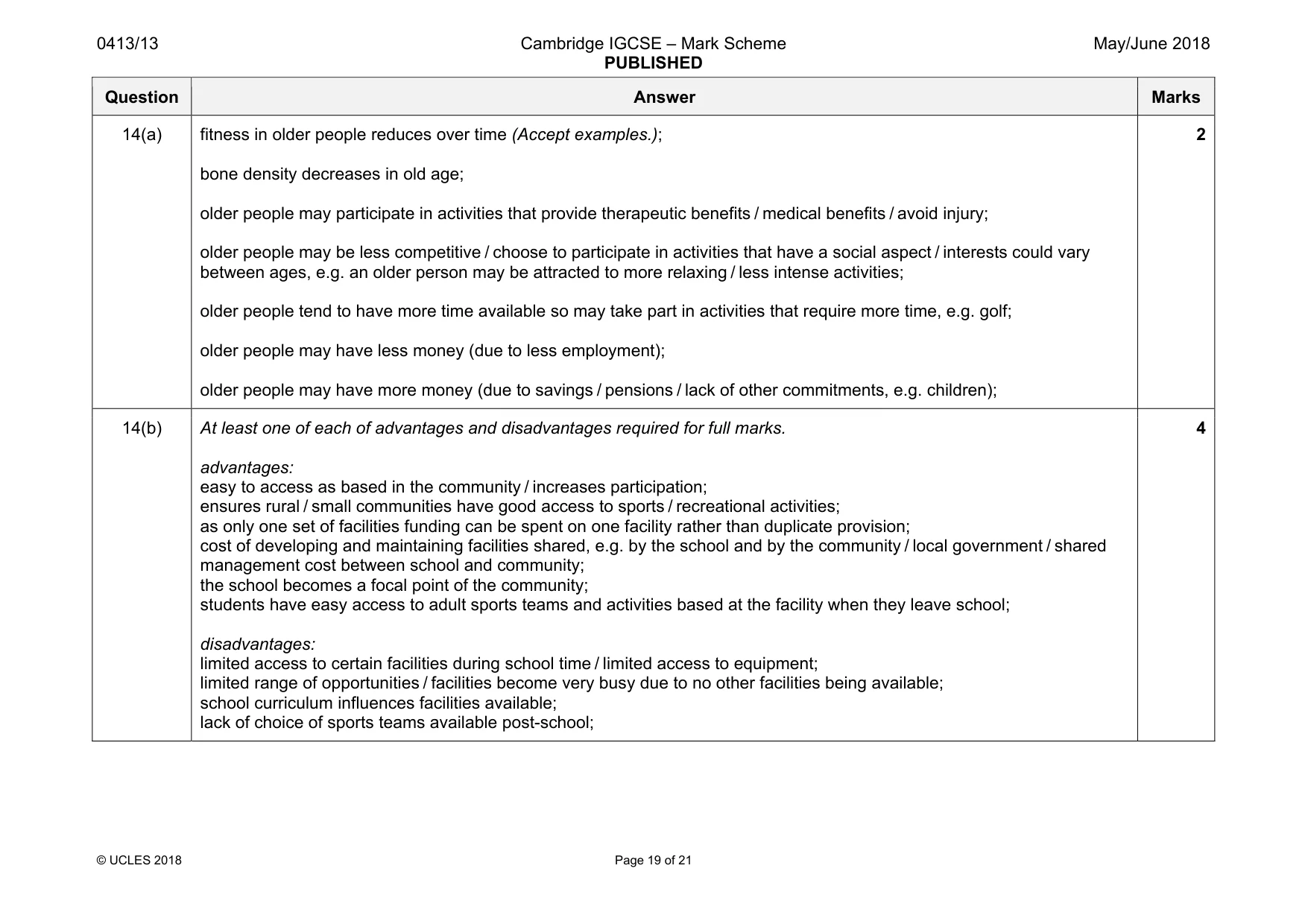
0413/13 Cambridge IGCSE – Mark Scheme PUBLISHED May/June 2018 © UCLES 2018 Page 19 of 21 Question Answer Marks 14(a) fitness in older people reduces over time (Accept examples.); bone density decreases in old age; older people may participate in activities that provide therapeutic benefits / medical benefits / avoid injury; older people may be less competitive / choose to participate in activities that have a social aspect / interests could vary between ages, e.g. an older person may be attracted to more relaxing / less intense activities; older people tend to have more time available so may take part in activities that require more time, e.g. golf; older people may have less money (due to less employment); older people may have more money (due to savings / pensions / lack of other commitments, e.g. children); 2 14(b) At least one of each of advantages and disadvantages required for full marks. advantages: easy to access as based in the community / increases participation; ensures rural / small communities have good access to sports / recreational activities; as only one set of facilities funding can be spent on one facility rather than duplicate provision; cost of developing and maintaining facilities shared, e.g. by the school and by the community / local government / shared management cost between school and community; the school becomes a focal point of the community; students have easy access to adult sports teams and activities based at the facility when they leave school; disadvantages: limited access to certain facilities during school time / limited access to equipment; limited range of opportunities / facilities become very busy due to no other facilities being available; school curriculum influences facilities available; lack of choice of sports teams available post-school; 4
Mark scheme, page 20
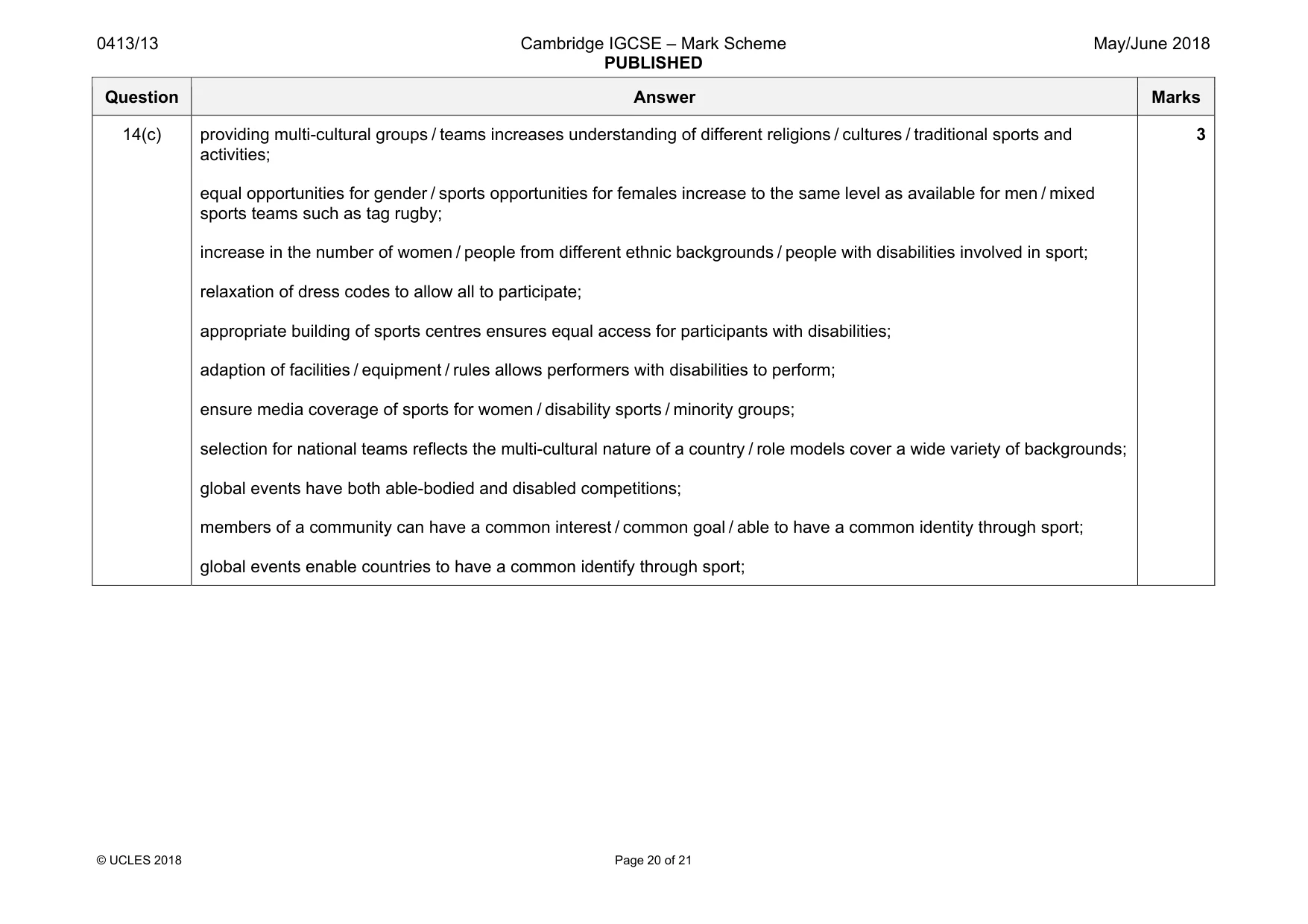
0413/13 Cambridge IGCSE – Mark Scheme PUBLISHED May/June 2018 © UCLES 2018 Page 20 of 21 Question Answer Marks 14(c) providing multi-cultural groups / teams increases understanding of different religions / cultures / traditional sports and activities; equal opportunities for gender / sports opportunities for females increase to the same level as available for men / mixed sports teams such as tag rugby; increase in the number of women / people from different ethnic backgrounds / people with disabilities involved in sport; relaxation of dress codes to allow all to participate; appropriate building of sports centres ensures equal access for participants with disabilities; adaption of facilities / equipment / rules allows performers with disabilities to perform; ensure media coverage of sports for women / disability sports / minority groups; selection for national teams reflects the multi-cultural nature of a country / role models cover a wide variety of backgrounds; global events have both able-bodied and disabled competitions; members of a community can have a common interest / common goal / able to have a common identity through sport; global events enable countries to have a common identify through sport; 3
Mark scheme, page 21
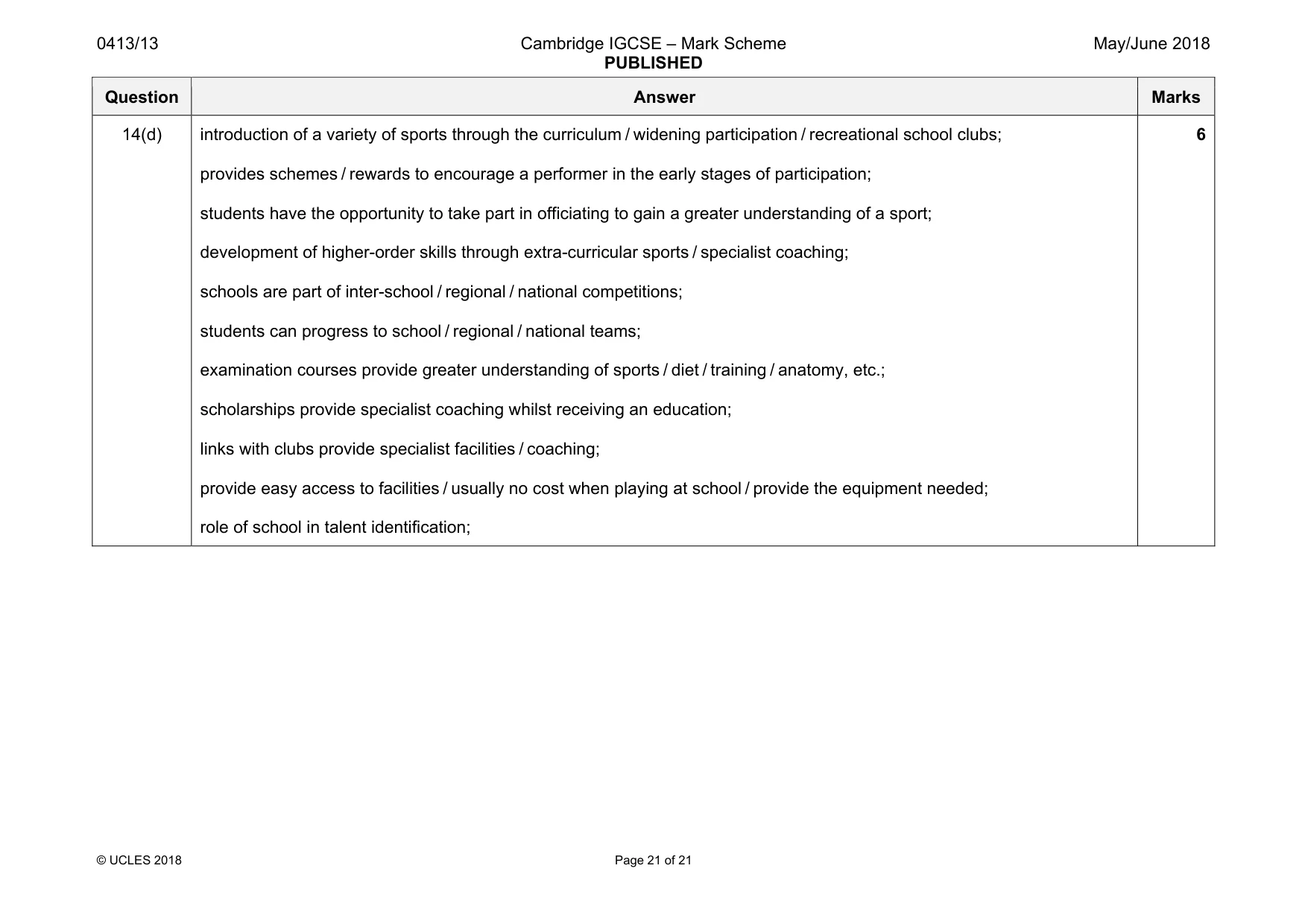
0413/13 Cambridge IGCSE – Mark Scheme PUBLISHED May/June 2018 © UCLES 2018 Page 21 of 21 Question Answer Marks 14(d) introduction of a variety of sports through the curriculum / widening participation / recreational school clubs; provides schemes / rewards to encourage a performer in the early stages of participation; students have the opportunity to take part in officiating to gain a greater understanding of a sport; development of higher-order skills through extra-curricular sports / specialist coaching; schools are part of inter-school / regional / national competitions; students can progress to school / regional / national teams; examination courses provide greater understanding of sports / diet / training / anatomy, etc.; scholarships provide specialist coaching whilst receiving an education; links with clubs provide specialist facilities / coaching; provide easy access to facilities / usually no cost when playing at school / provide the equipment needed; role of school in talent identification; 6
What you needed in this session
Cambridge’s own grade thresholds for 2018 May/June, Paper 1 · Variant 3. A higher threshold means an easier paper — the bar moves with how the cohort did.