Cambridge IGCSE Physical Education 0413 — 2018 May/June Paper 1 · Variant 1
0413/11/M/J/18 · 80 marks · ≈90 min
The question paper and its mark scheme, free to read here and free to download. This is Cambridge’s own paper, exactly as it was sat.
Question paper12 pages



Mark scheme18 pages
Answers below. Sit the paper first if you are practising.
Paper as text
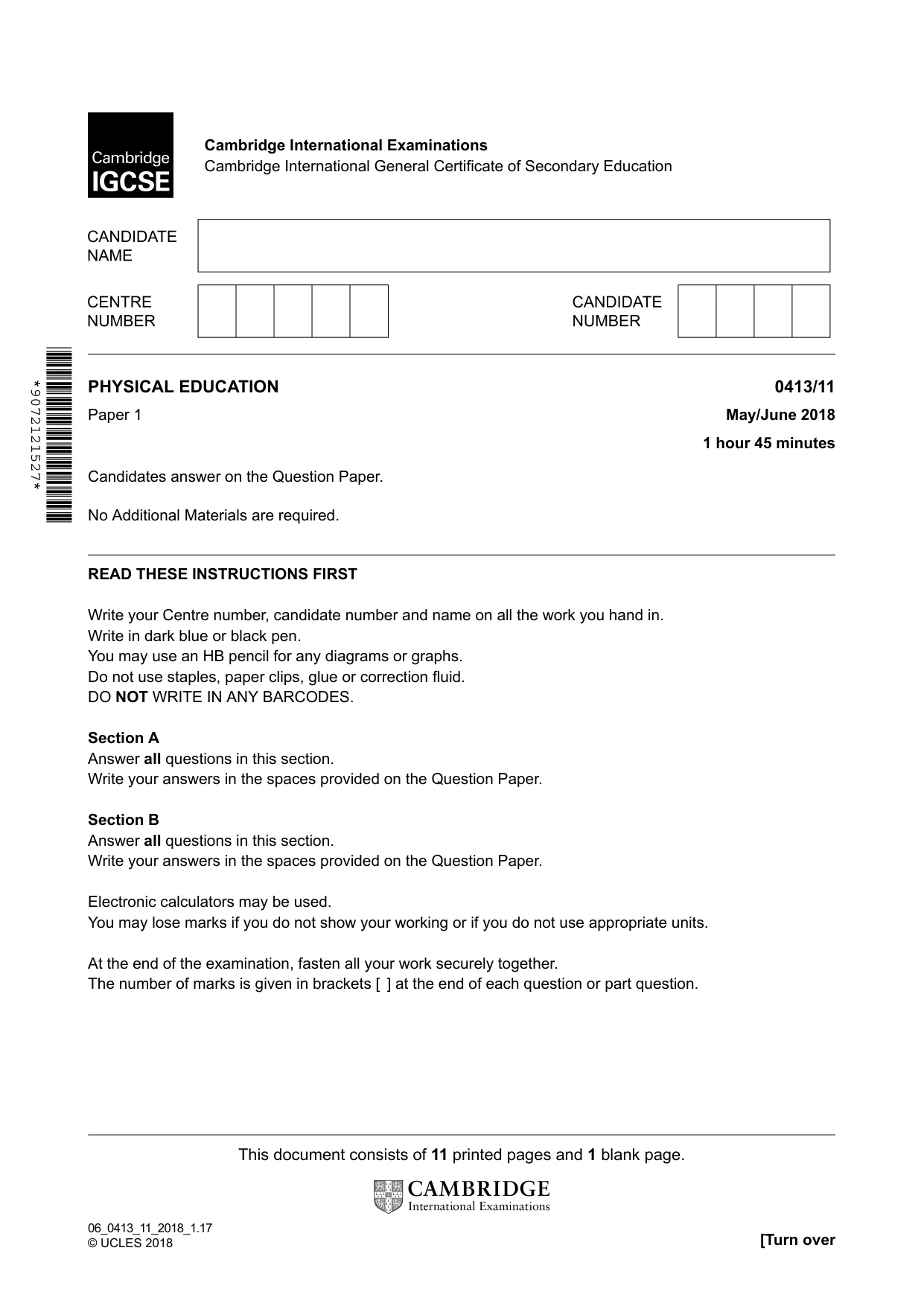
Question paper, page 1
Cambridge International Examinations Cambridge International General Certificate of Secondary Education 0413/11 May/June 2018 1 hour 45 minutes PHYSICAL EDUCATION Paper 1 Candidates answer on the Question Paper. No Additional Materials are required. READ THESE INSTRUCTIONS FIRST Write your Centre number, candidate number and name on all the work you hand in. Write in dark blue or black pen. You may use an HB pencil for any diagrams or graphs. Do not use staples, paper clips, glue or correction fluid. DO NOT WRITE IN ANY BARCODES. Section A Answer all questions in this section. Write your answers in the spaces provided on the Question Paper. Section B Answer all questions in this section. Write your answers in the spaces provided on the Question Paper. Electronic calculators may be used. You may lose marks if you do not show your working or if you do not use appropriate units. At the end of the examination, fasten all your work securely together. The number of marks is given in brackets [ ] at the end of each question or part question. This document consists of 11 printed pages and 1 blank page. [Turn over 06_0413_11_2018_1.17 © UCLES 2018 *9072121527*
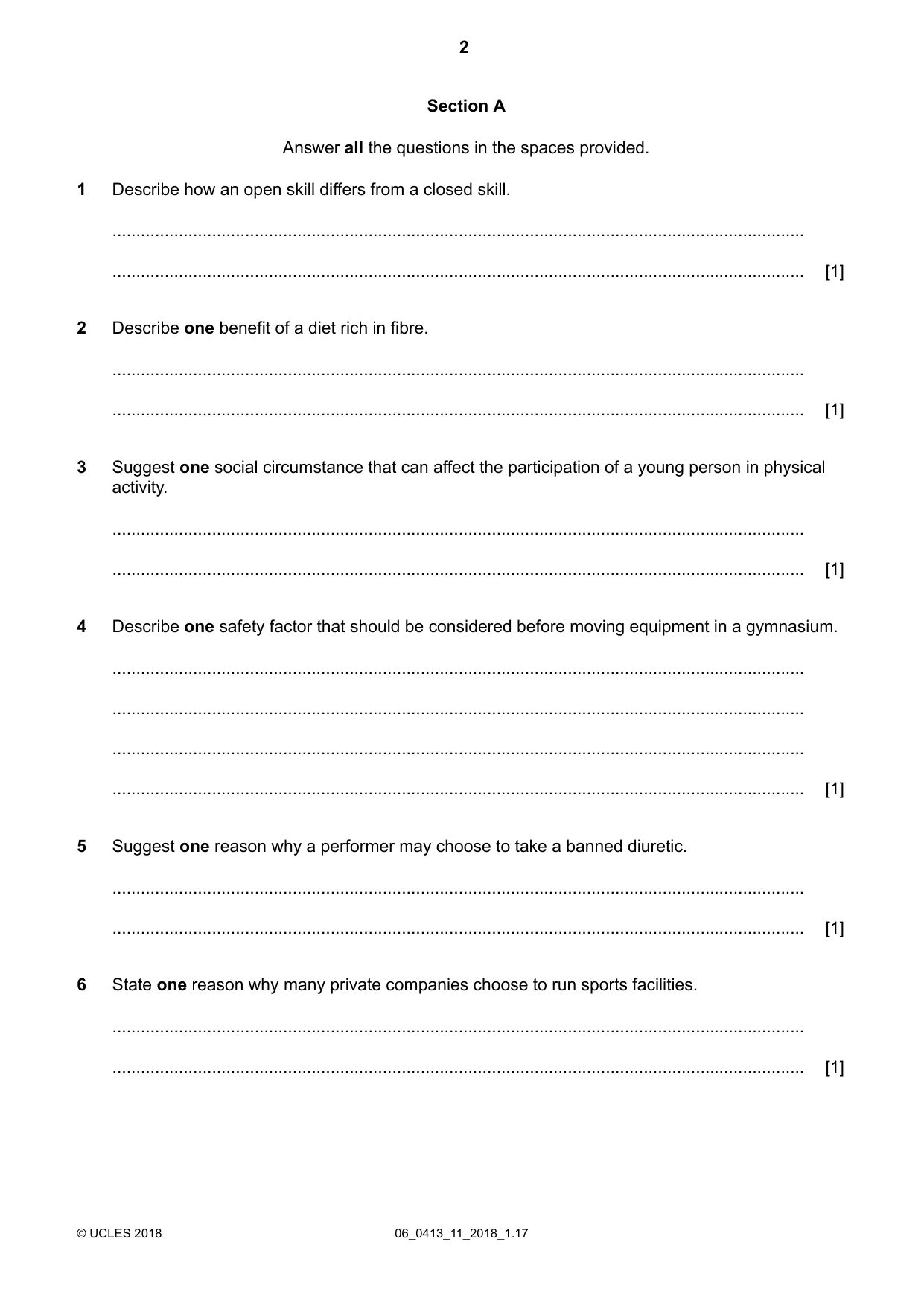
Question paper, page 2
Section A Answer all the questions in the spaces provided. Describe how an open skill differs from a closed skill. 1 … … [1] Describe one benefit of a diet rich in fibre. 2 … … [1] Suggest one social circumstance that can affect the participation of a young person in physical activity. 3 … … [1] Describe one safety factor that should be considered before moving equipment in a gymnasium. 4 … … … … [1] Suggest one reason why a performer may choose to take a banned diuretic. 5 … … [1] State one reason why many private companies choose to run sports facilities. 6 … … [1] 06_0413_11_2018_1.17 © UCLES 2018 2
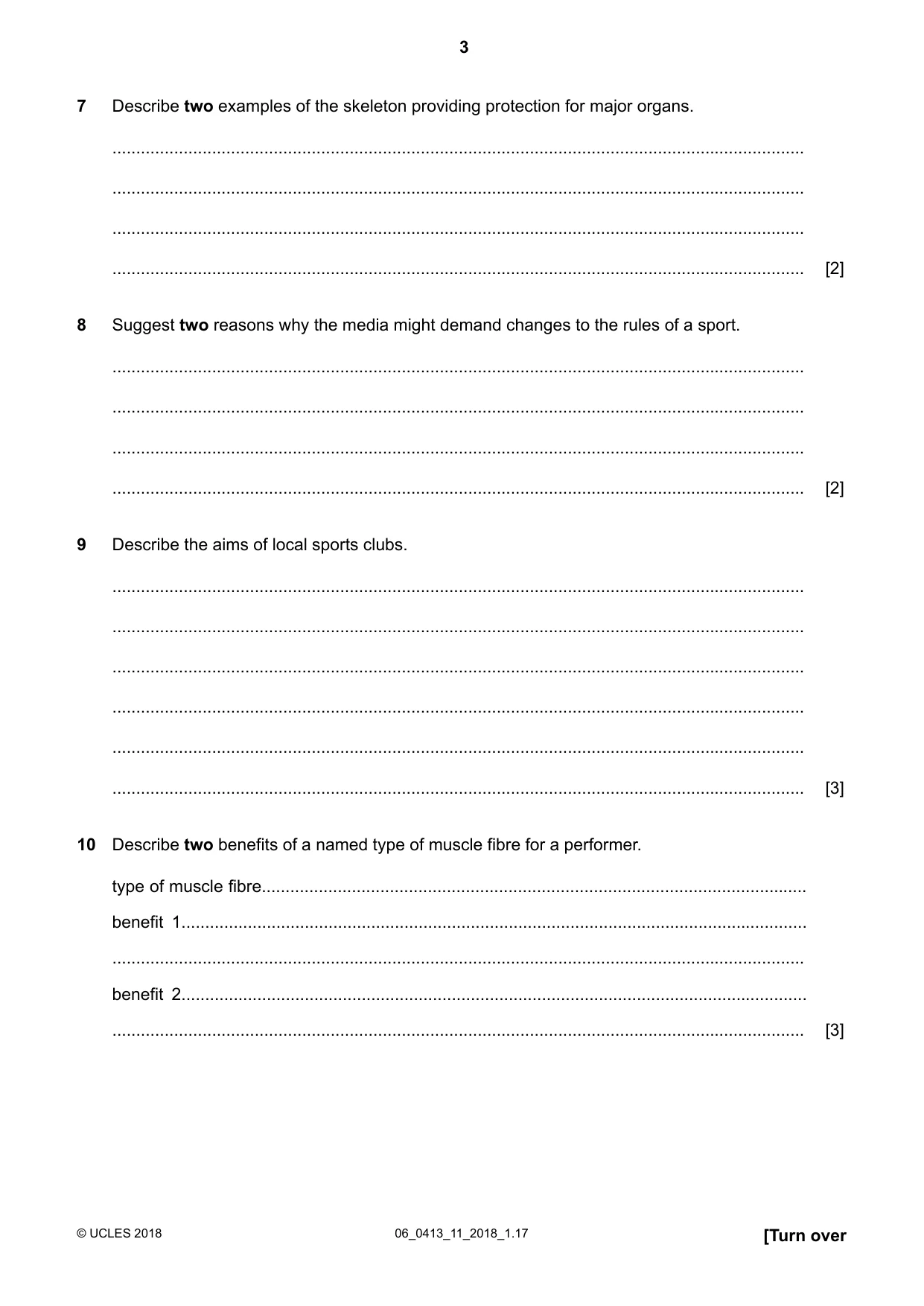
Question paper, page 3
Describe two examples of the skeleton providing protection for major organs. 7 … … … … [2] Suggest two reasons why the media might demand changes to the rules of a sport. 8 … … … … [2] Describe the aims of local sports clubs. 9 … … … … … … [3] Describe two benefits of a named type of muscle fibre for a performer. 10 type of muscle fibre… benefit 1… … benefit 2… … [3] [Turn over 06_0413_11_2018_1.17 © UCLES 2018 3
Question paper, page 4
An athlete performs well in training but then suffers a decline in performance when taking part in competitions. Suggest reasons why. 11 … … … … … … … … [4] [Total: 20] 06_0413_11_2018_1.17 © UCLES 2018 4
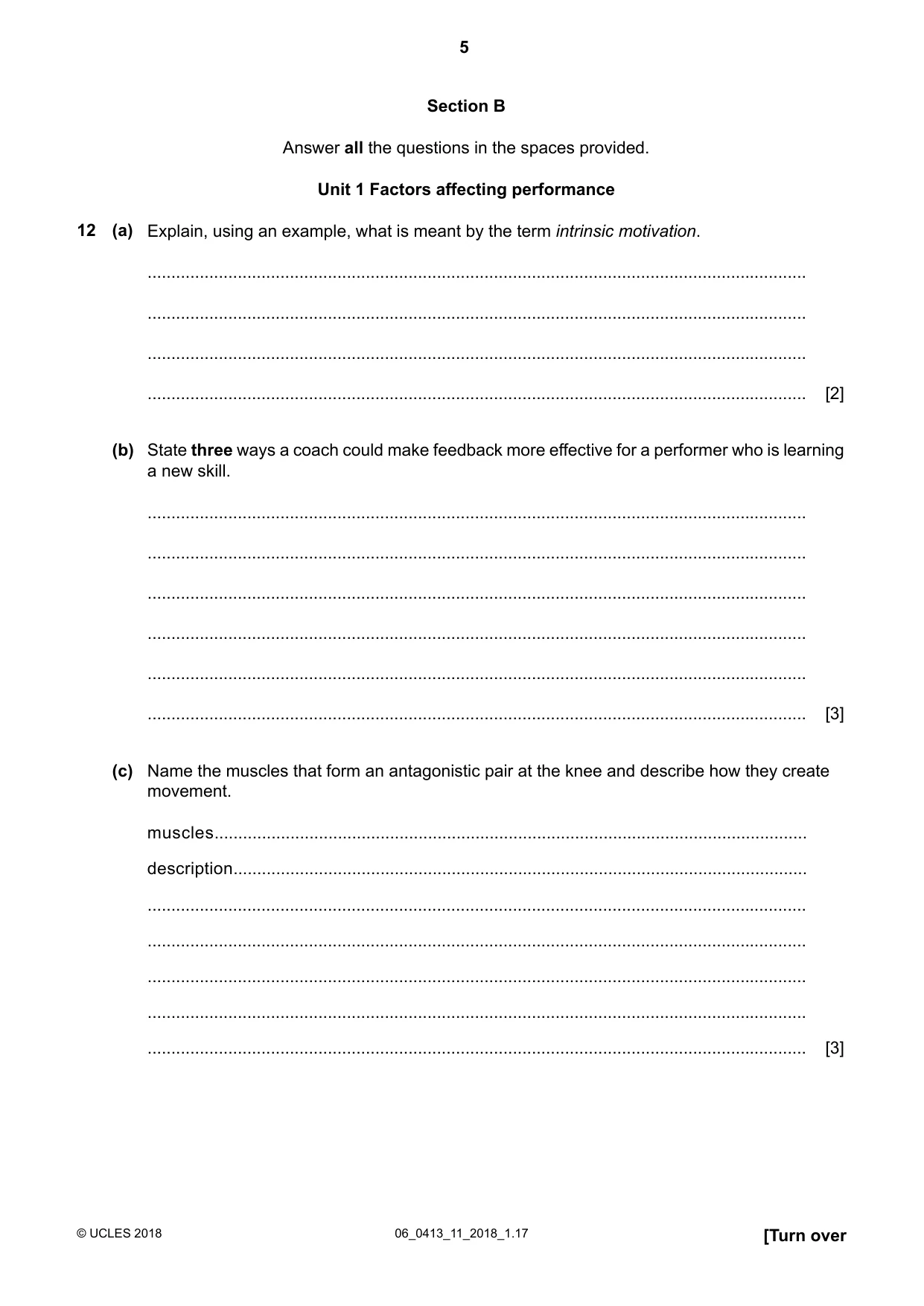
Question paper, page 5
Section B Answer all the questions in the spaces provided. Unit 1 Factors affecting performance Explain, using an example, what is meant by the term intrinsic motivation. (a) 12 … … … … [2] State three ways a coach could make feedback more effective for a performer who is learning a new skill. (b) … … … … … … [3] Name the muscles that form an antagonistic pair at the knee and describe how they create movement. (c) muscles… description… … … … … … [3] [Turn over 06_0413_11_2018_1.17 © UCLES 2018 5
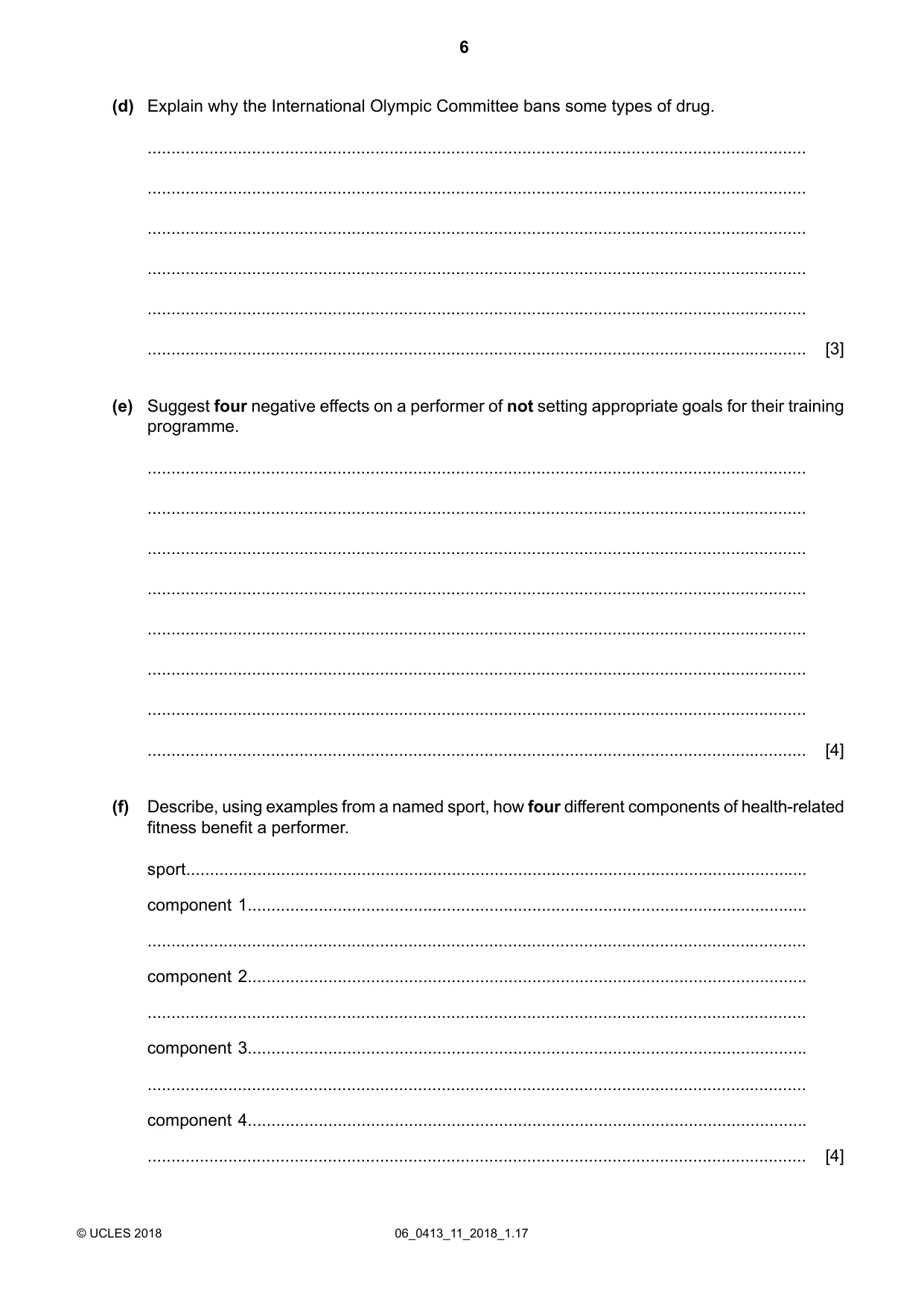
Question paper, page 6
Explain why the International Olympic Committee bans some types of drug. (d) … … … … … … [3] Suggest four negative effects on a performer of not setting appropriate goals for their training programme. (e) … … … … … … … … [4] Describe, using examples from a named sport, how four different components of health-related fitness benefit a performer. (f) sport… component 1… … component 2… … component 3… … component 4… … [4] 06_0413_11_2018_1.17 © UCLES 2018 6
Question paper, page 7
Explain how changes to the efficiency of the circulatory and respiratory systems that result from exercise can benefit a performer. (g) … … … … … … … … … … … … [6] [Total: 25] [Turn over 06_0413_11_2018_1.17 © UCLES 2018 7
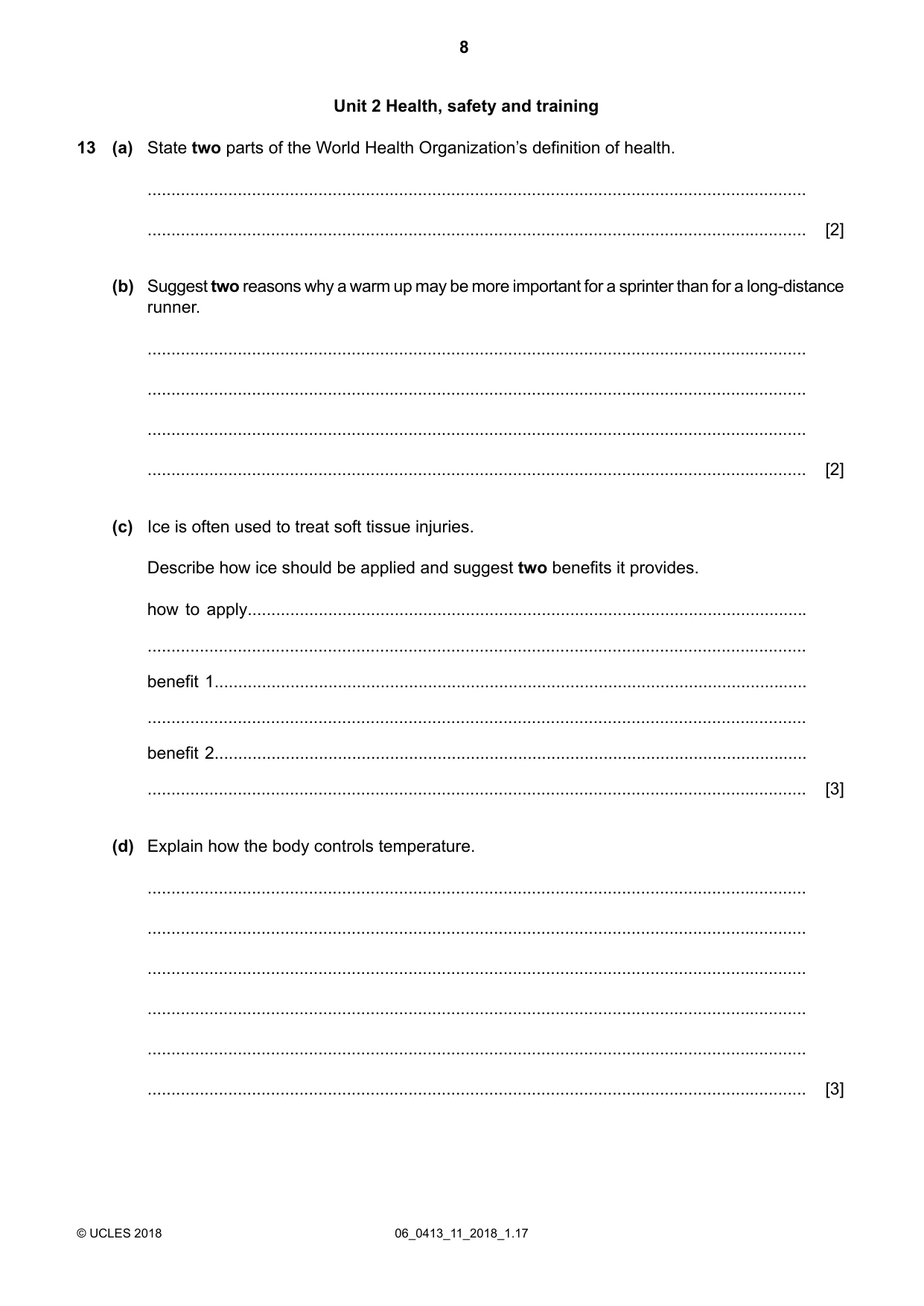
Question paper, page 8
Unit 2 Health, safety and training State two parts of the World Health Organization’s definition of health. (a) 13 … … [2] Suggest two reasons why a warm up may be more important for a sprinter than for a long-distance runner. (b) … … … … [2] Ice is often used to treat soft tissue injuries. Describe how ice should be applied and suggest two benefits it provides. (c) how to apply… … benefit 1… … benefit 2… … [3] Explain how the body controls temperature. (d) … … … … … … [3] 06_0413_11_2018_1.17 © UCLES 2018 8
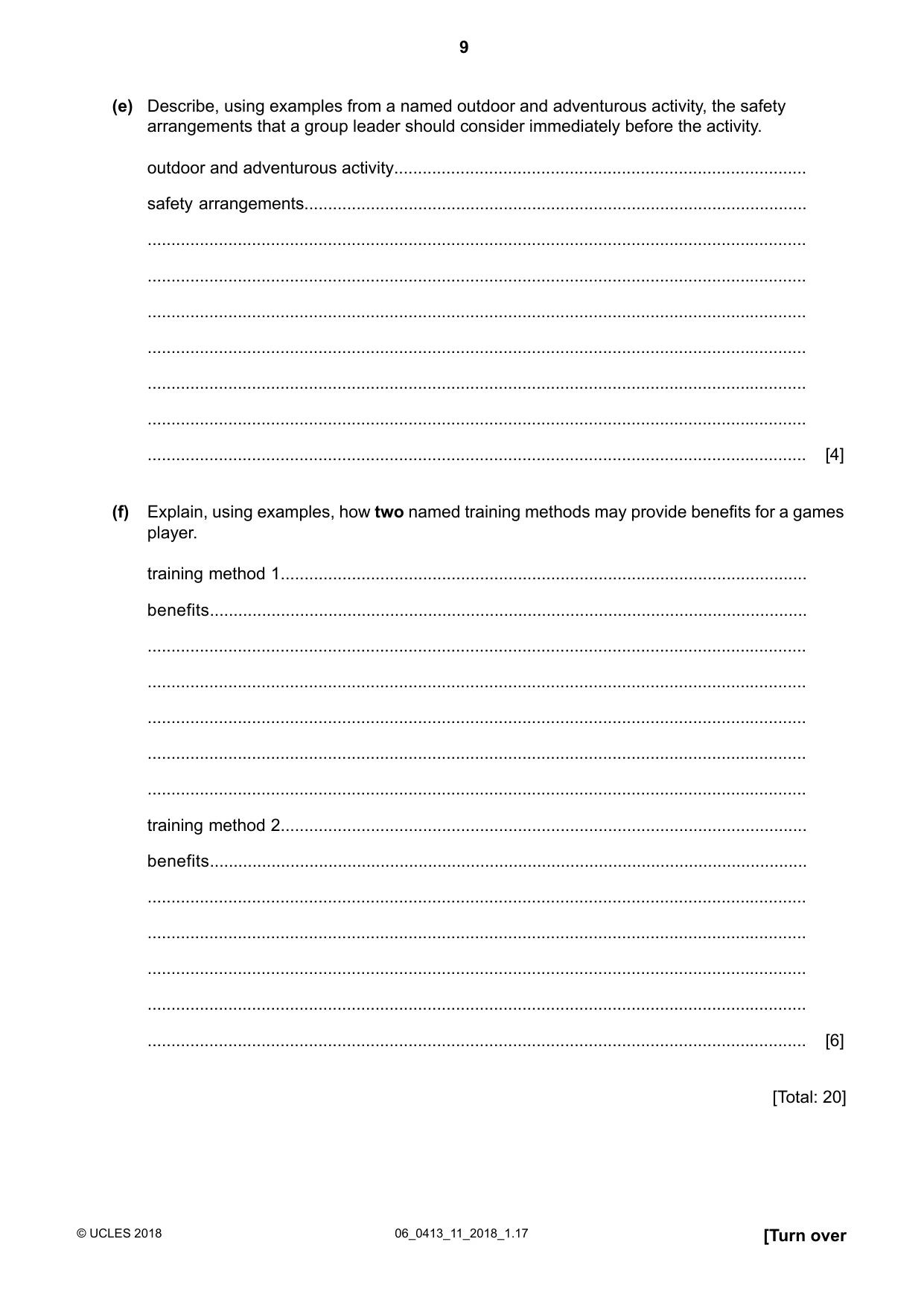
Question paper, page 9
Describe, using examples from a named outdoor and adventurous activity, the safety arrangements that a group leader should consider immediately before the activity. (e) outdoor and adventurous activity… safety arrangements… … … … … … … … [4] Explain, using examples, how two named training methods may provide benefits for a games player. (f) training method 1… benefits… … … … … … training method 2… benefits… … … … … … [6] [Total: 20] [Turn over 06_0413_11_2018_1.17 © UCLES 2018 9
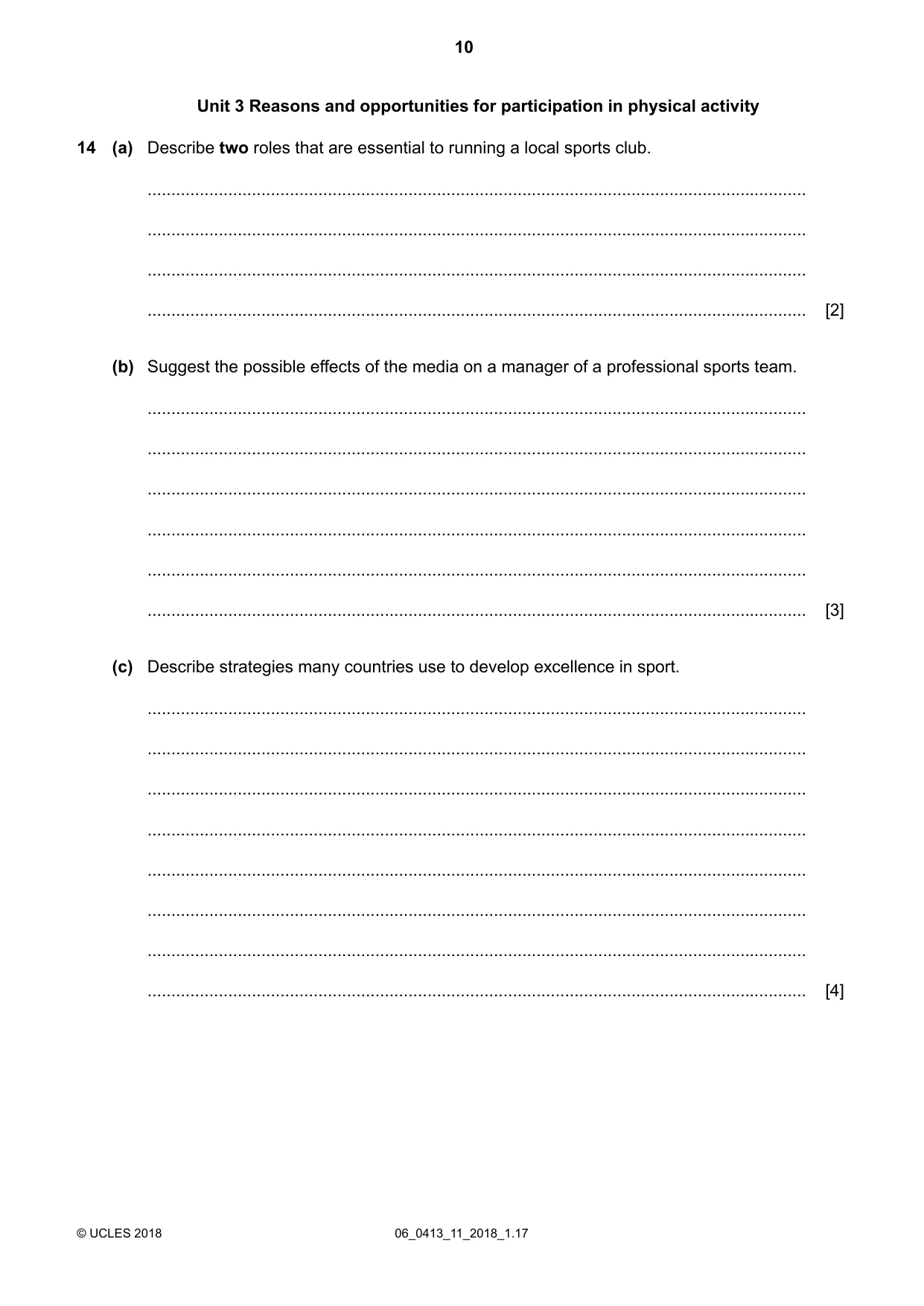
Question paper, page 10
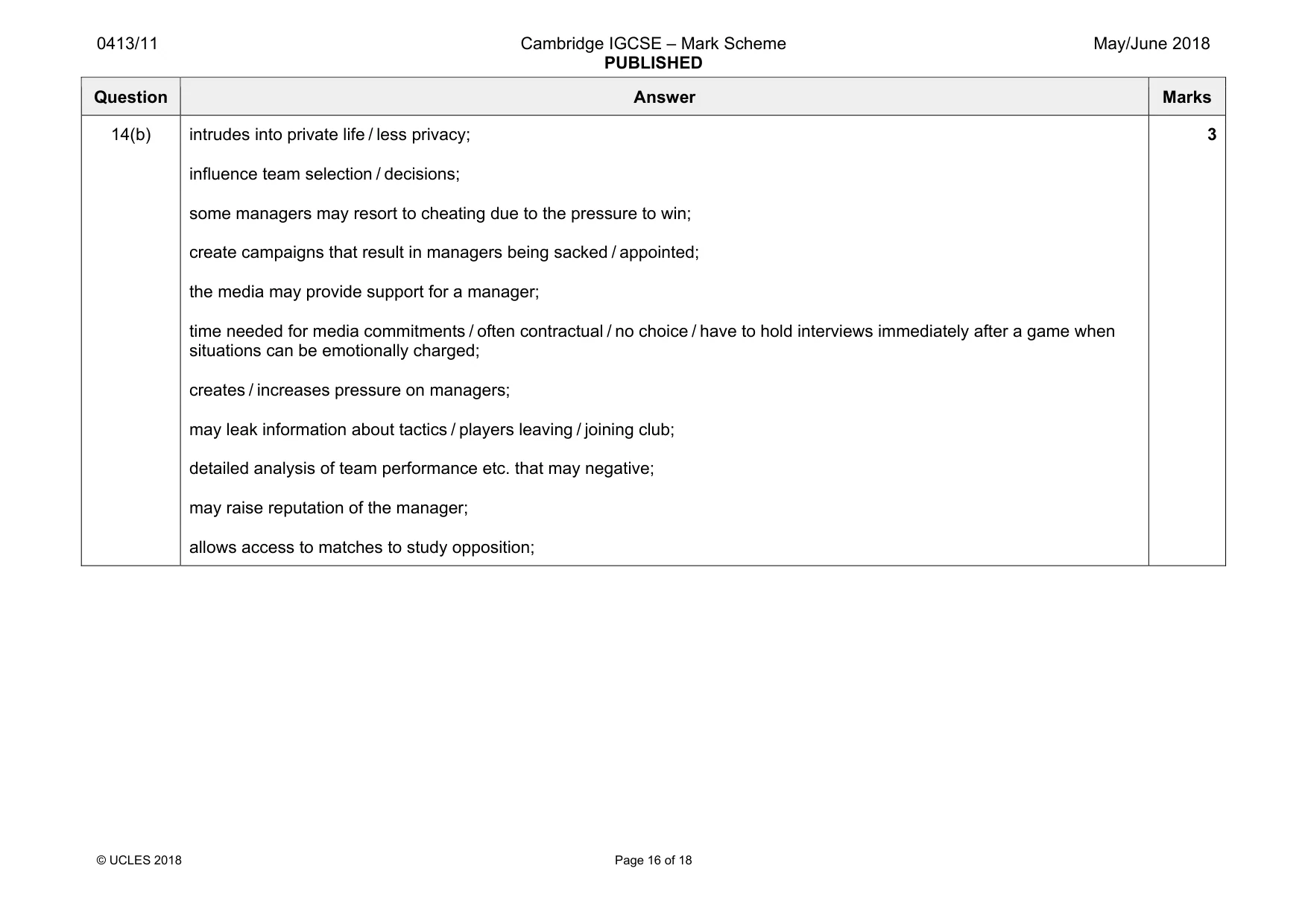
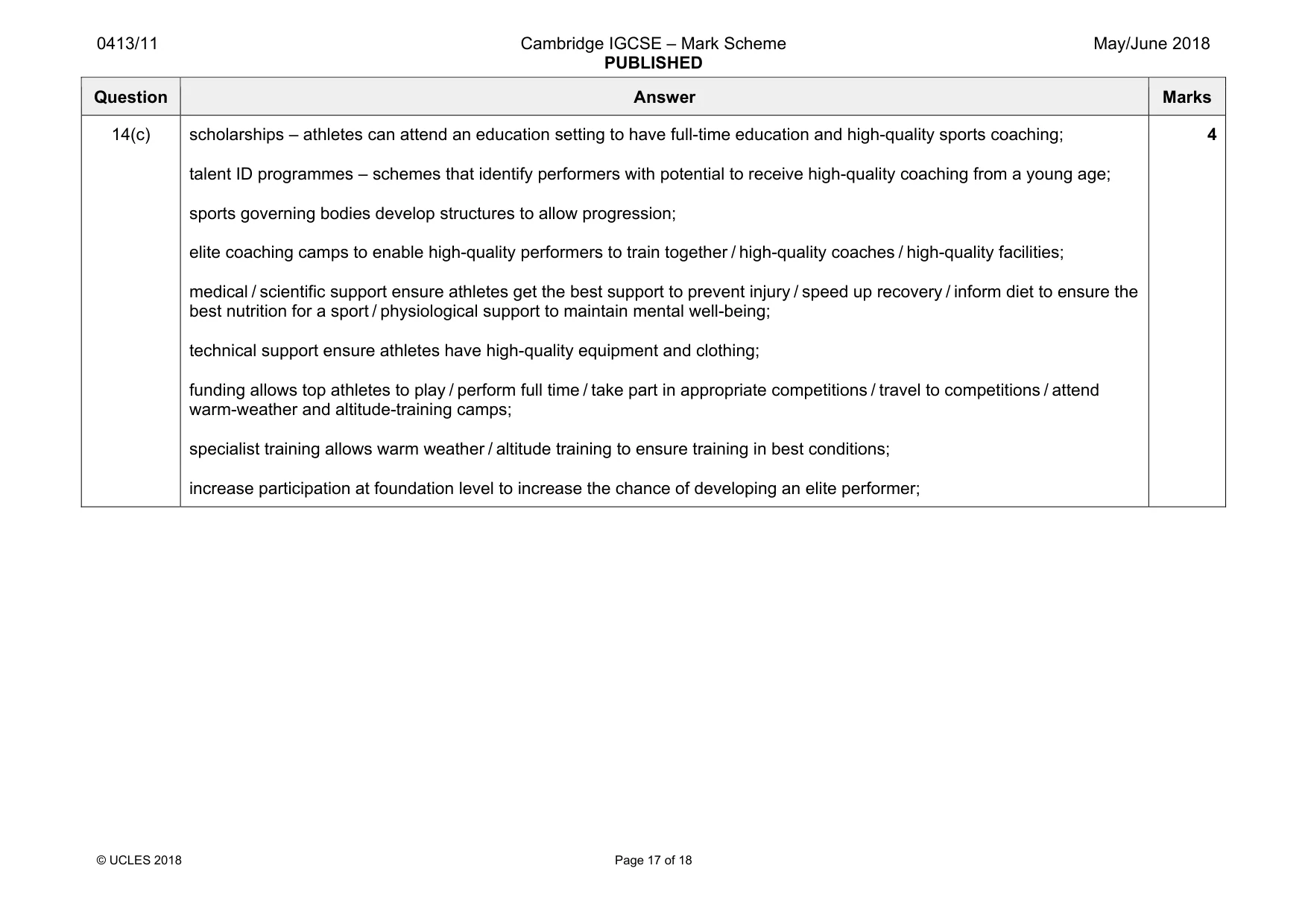
Unit 3 Reasons and opportunities for participation in physical activity Describe two roles that are essential to running a local sports club. (a) 14 … … … … [2] Suggest the possible effects of the media on a manager of a professional sports team. (b) … … … … … … [3] Describe strategies many countries use to develop excellence in sport. (c) … … … … … … … … [4] 06_0413_11_2018_1.17 © UCLES 2018 10
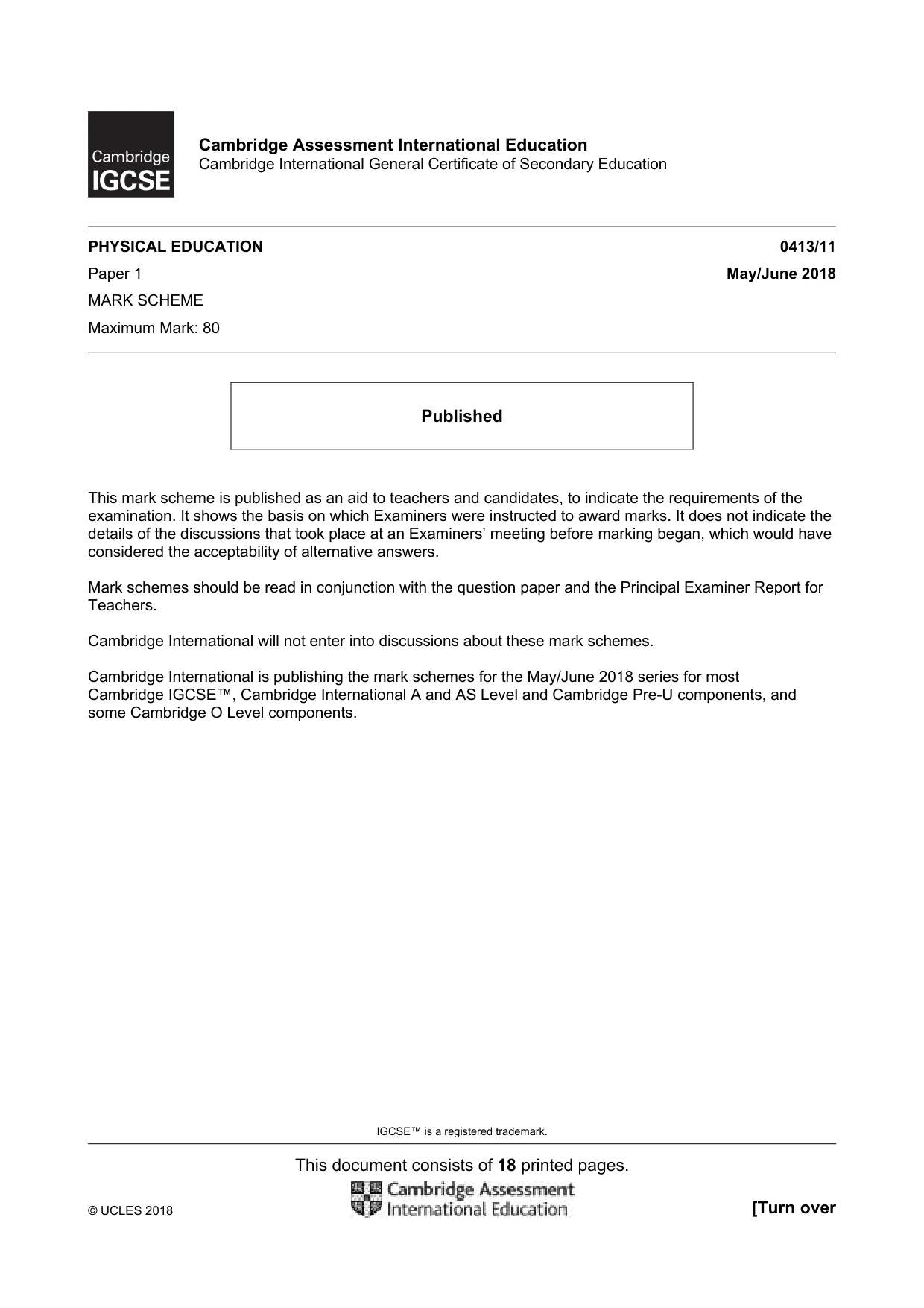
Question paper, page 11
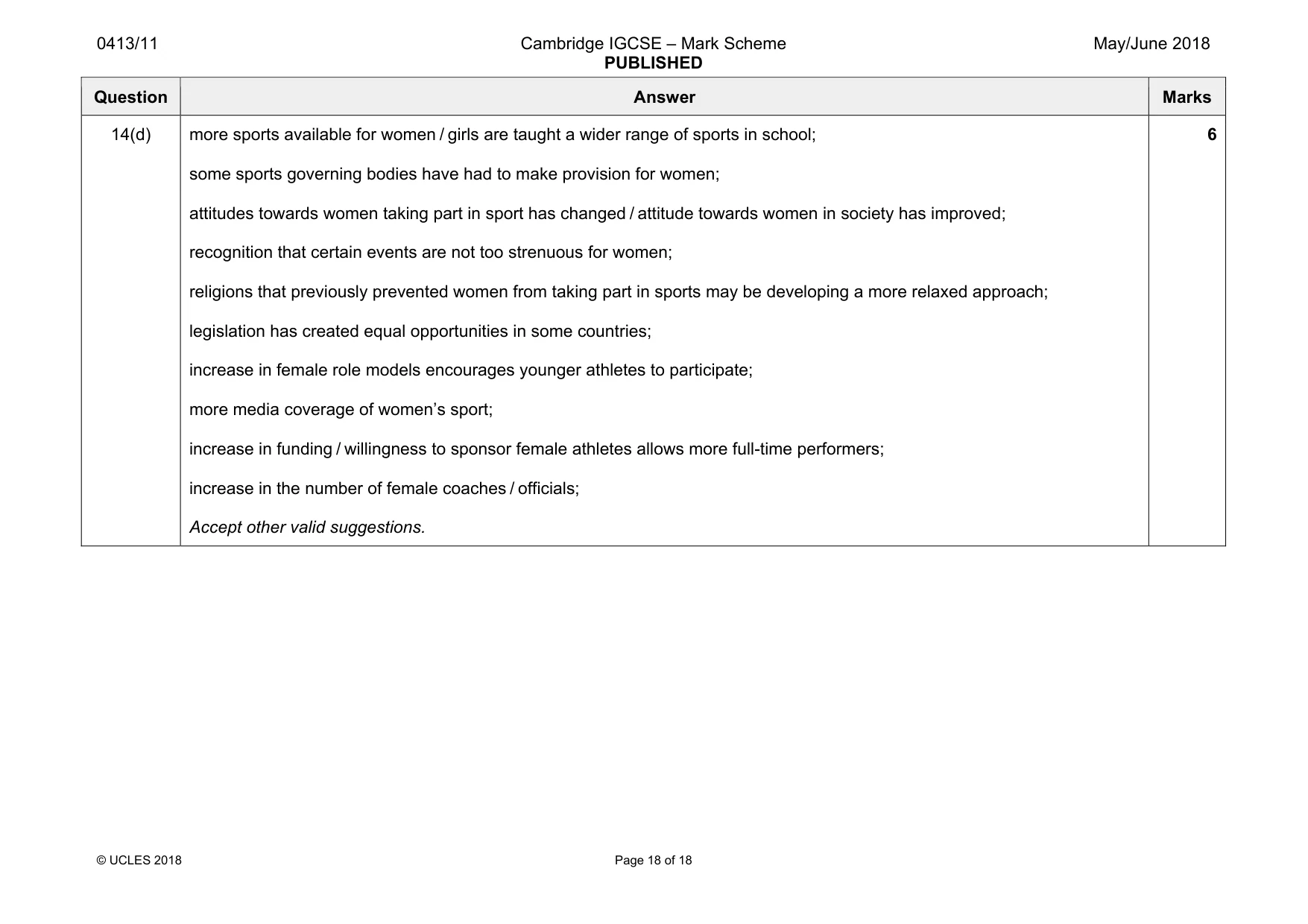
The table shows the number of women that have taken part in some Olympic Games since 1960. (d) number of women who participated year of Olympic Games 611 1960 1059 1972 1566 1984 3512 1996 4637 2008 Suggest reasons why there has been an increase in the number of women taking part in the Olympic Games since 1960. … … … … … … … … … … … … [6] [Total: 15] 06_0413_11_2018_1.17 © UCLES 2018 11
Question paper, page 12
BLANK PAGE Permission to reproduce items where third-party owned material protected by copyright is included has been sought and cleared where possible. Every reasonable effort has been made by the publisher (UCLES) to trace copyright holders, but if any items requiring clearance have unwittingly been included, the publisher will be pleased to make amends at the earliest possible opportunity. To avoid the issue of disclosure of answer-related information to candidates, all copyright acknowledgements are reproduced online in the Cambridge International Examinations Copyright Acknowledgements Booklet. This is produced for each series of examinations and is freely available to download at www.cie.org.uk after the live examination series. Cambridge International Examinations is part of the Cambridge Assessment Group. Cambridge Assessment is the brand name of University of Cambridge Local Examinations Syndicate (UCLES), which is itself a department of the University of Cambridge. 06_0413_11_2018_1.17 © UCLES 2018 12
Mark scheme, page 1
IGCSE™ is a registered trademark. This document consists of 18 printed pages. © UCLES 2018 [Turn over Cambridge Assessment International Education Cambridge International General Certificate of Secondary Education PHYSICAL EDUCATION 0413/11 Paper 1 May/June 2018 MARK SCHEME Maximum Mark: 80 Published This mark scheme is published as an aid to teachers and candidates, to indicate the requirements of the examination. It shows the basis on which Examiners were instructed to award marks. It does not indicate the details of the discussions that took place at an Examiners’ meeting before marking began, which would have considered the acceptability of alternative answers. Mark schemes should be read in conjunction with the question paper and the Principal Examiner Report for Teachers. Cambridge International will not enter into discussions about these mark schemes. Cambridge International is publishing the mark schemes for the May/June 2018 series for most Cambridge IGCSE™, Cambridge International A and AS Level and Cambridge Pre-U components, and some Cambridge O Level components.
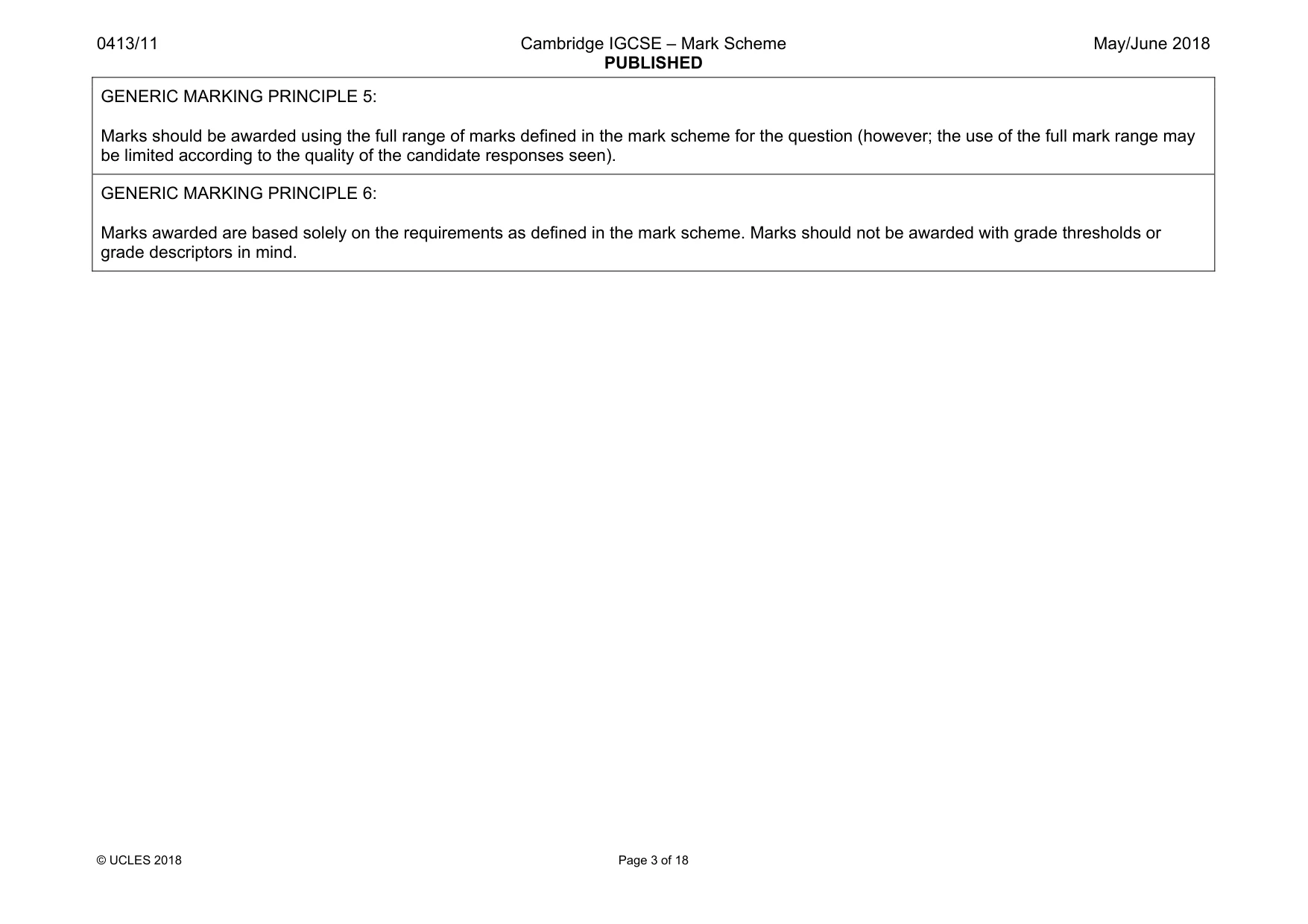
Mark scheme, page 2
0413/11 Cambridge IGCSE – Mark Scheme PUBLISHED May/June 2018 © UCLES 2018 Page 2 of 18 Generic Marking Principles These general marking principles must be applied by all examiners when marking candidate answers. They should be applied alongside the specific content of the mark scheme or generic level descriptors for a question. Each question paper and mark scheme will also comply with these marking principles. GENERIC MARKING PRINCIPLE 1: Marks must be awarded in line with: • the specific content of the mark scheme or the generic level descriptors for the question • the specific skills defined in the mark scheme or in the generic level descriptors for the question • the standard of response required by a candidate as exemplified by the standardisation scripts. GENERIC MARKING PRINCIPLE 2: Marks awarded are always whole marks (not half marks, or other fractions). GENERIC MARKING PRINCIPLE 3: Marks must be awarded positively: • marks are awarded for correct/valid answers, as defined in the mark scheme. However, credit is given for valid answers which go beyond the scope of the syllabus and mark scheme, referring to your Team Leader as appropriate • marks are awarded when candidates clearly demonstrate what they know and can do • marks are not deducted for errors • marks are not deducted for omissions • answers should only be judged on the quality of spelling, punctuation and grammar when these features are specifically assessed by the question as indicated by the mark scheme. The meaning, however, should be unambiguous. GENERIC MARKING PRINCIPLE 4: Rules must be applied consistently e.g. in situations where candidates have not followed instructions or in the application of generic level descriptors.
Mark scheme, page 3
0413/11 Cambridge IGCSE – Mark Scheme PUBLISHED May/June 2018 © UCLES 2018 Page 3 of 18 GENERIC MARKING PRINCIPLE 5: Marks should be awarded using the full range of marks defined in the mark scheme for the question (however; the use of the full mark range may be limited according to the quality of the candidate responses seen). GENERIC MARKING PRINCIPLE 6: Marks awarded are based solely on the requirements as defined in the mark scheme. Marks should not be awarded with grade thresholds or grade descriptors in mind.
Mark scheme, page 4
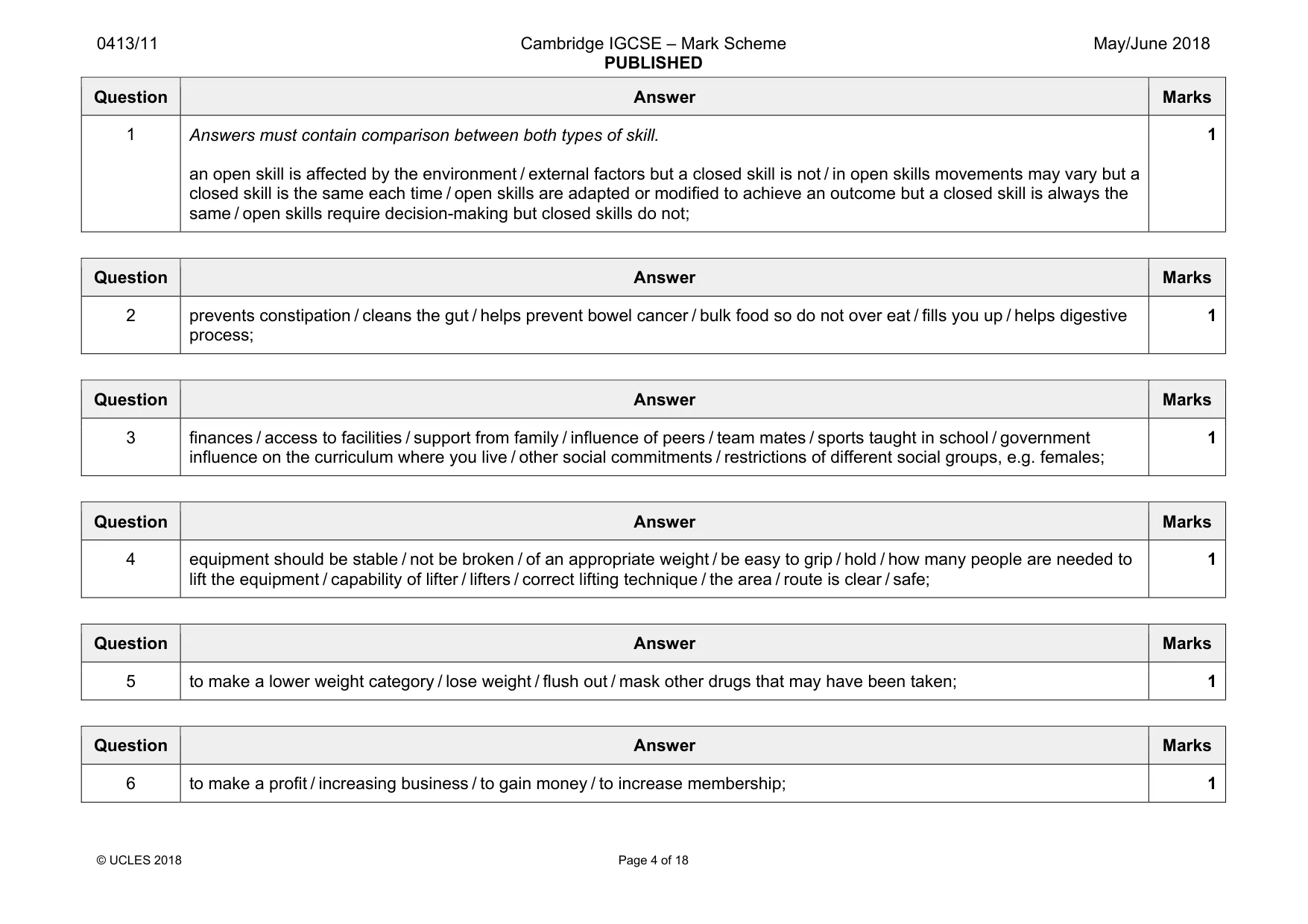
0413/11 Cambridge IGCSE – Mark Scheme PUBLISHED May/June 2018 © UCLES 2018 Page 4 of 18 Question Answer Marks 1 Answers must contain comparison between both types of skill. an open skill is affected by the environment / external factors but a closed skill is not / in open skills movements may vary but a closed skill is the same each time / open skills are adapted or modified to achieve an outcome but a closed skill is always the same / open skills require decision-making but closed skills do not; 1 Question Answer Marks 2 prevents constipation / cleans the gut / helps prevent bowel cancer / bulk food so do not over eat / fills you up / helps digestive process; 1 Question Answer Marks 3 finances / access to facilities / support from family / influence of peers / team mates / sports taught in school / government influence on the curriculum where you live / other social commitments / restrictions of different social groups, e.g. females; 1 Question Answer Marks 4 equipment should be stable / not be broken / of an appropriate weight / be easy to grip / hold / how many people are needed to lift the equipment / capability of lifter / lifters / correct lifting technique / the area / route is clear / safe; 1 Question Answer Marks 5 to make a lower weight category / lose weight / flush out / mask other drugs that may have been taken; 1 Question Answer Marks 6 to make a profit / increasing business / to gain money / to increase membership; 1
Mark scheme, page 5
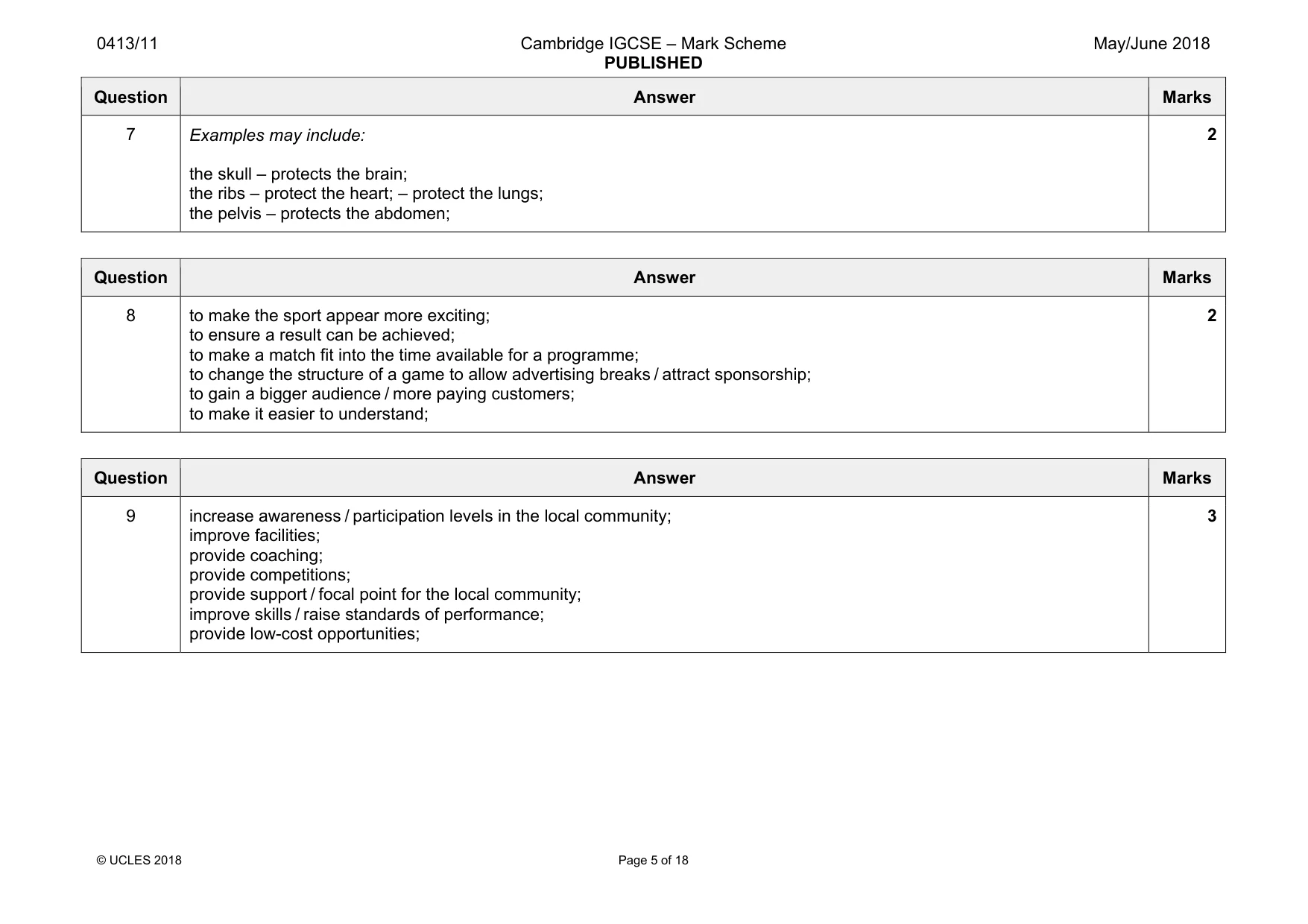
0413/11 Cambridge IGCSE – Mark Scheme PUBLISHED May/June 2018 © UCLES 2018 Page 5 of 18 Question Answer Marks 7 Examples may include: the skull – protects the brain; the ribs – protect the heart; – protect the lungs; the pelvis – protects the abdomen; 2 Question Answer Marks 8 to make the sport appear more exciting; to ensure a result can be achieved; to make a match fit into the time available for a programme; to change the structure of a game to allow advertising breaks / attract sponsorship; to gain a bigger audience / more paying customers; to make it easier to understand; 2 Question Answer Marks 9 increase awareness / participation levels in the local community; improve facilities; provide coaching; provide competitions; provide support / focal point for the local community; improve skills / raise standards of performance; provide low-cost opportunities; 3
Mark scheme, page 6
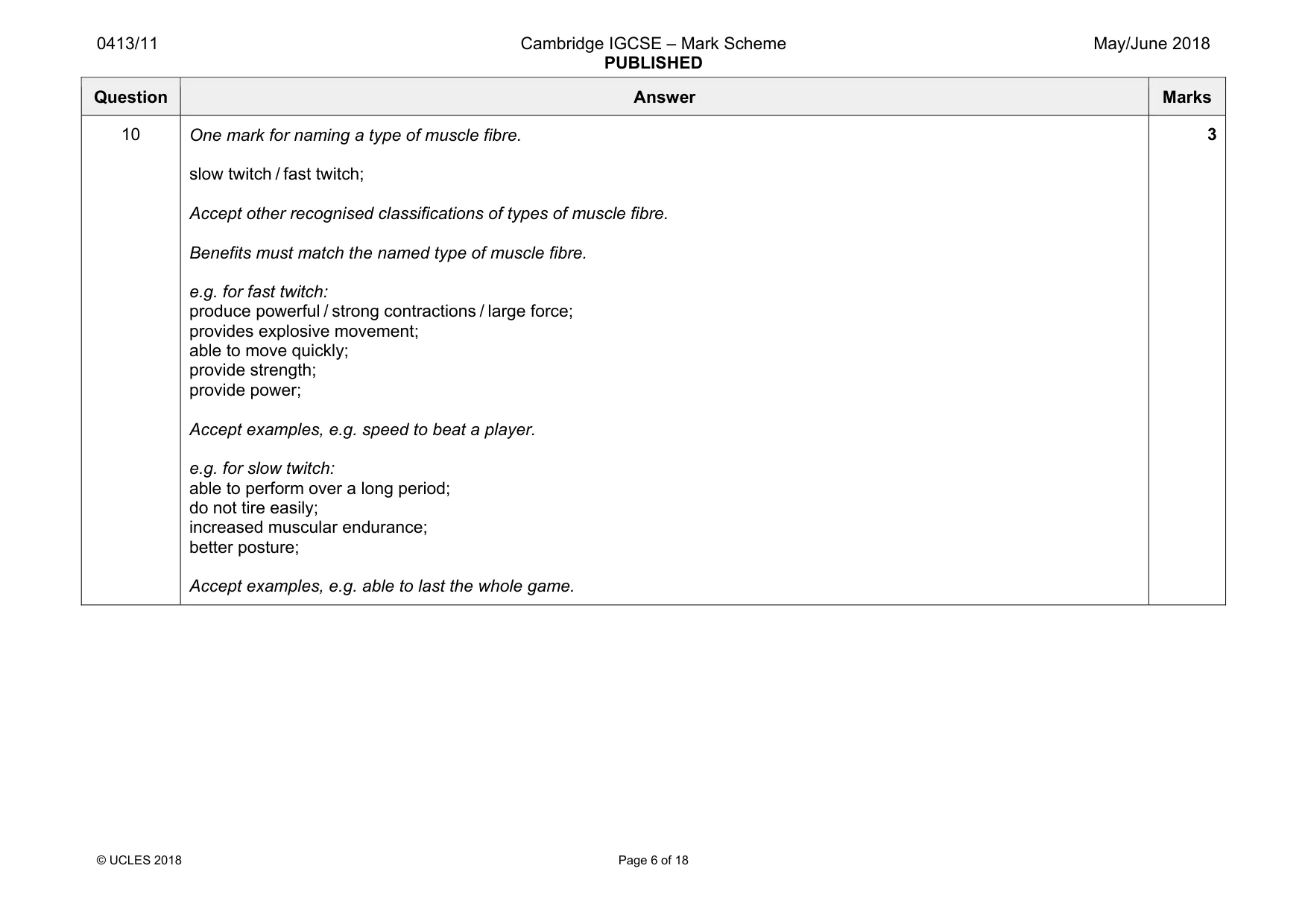
0413/11 Cambridge IGCSE – Mark Scheme PUBLISHED May/June 2018 © UCLES 2018 Page 6 of 18 Question Answer Marks 10 One mark for naming a type of muscle fibre. slow twitch / fast twitch; Accept other recognised classifications of types of muscle fibre. Benefits must match the named type of muscle fibre. e.g. for fast twitch: produce powerful / strong contractions / large force; provides explosive movement; able to move quickly; provide strength; provide power; Accept examples, e.g. speed to beat a player. e.g. for slow twitch: able to perform over a long period; do not tire easily; increased muscular endurance; better posture; Accept examples, e.g. able to last the whole game. 3
Mark scheme, page 7
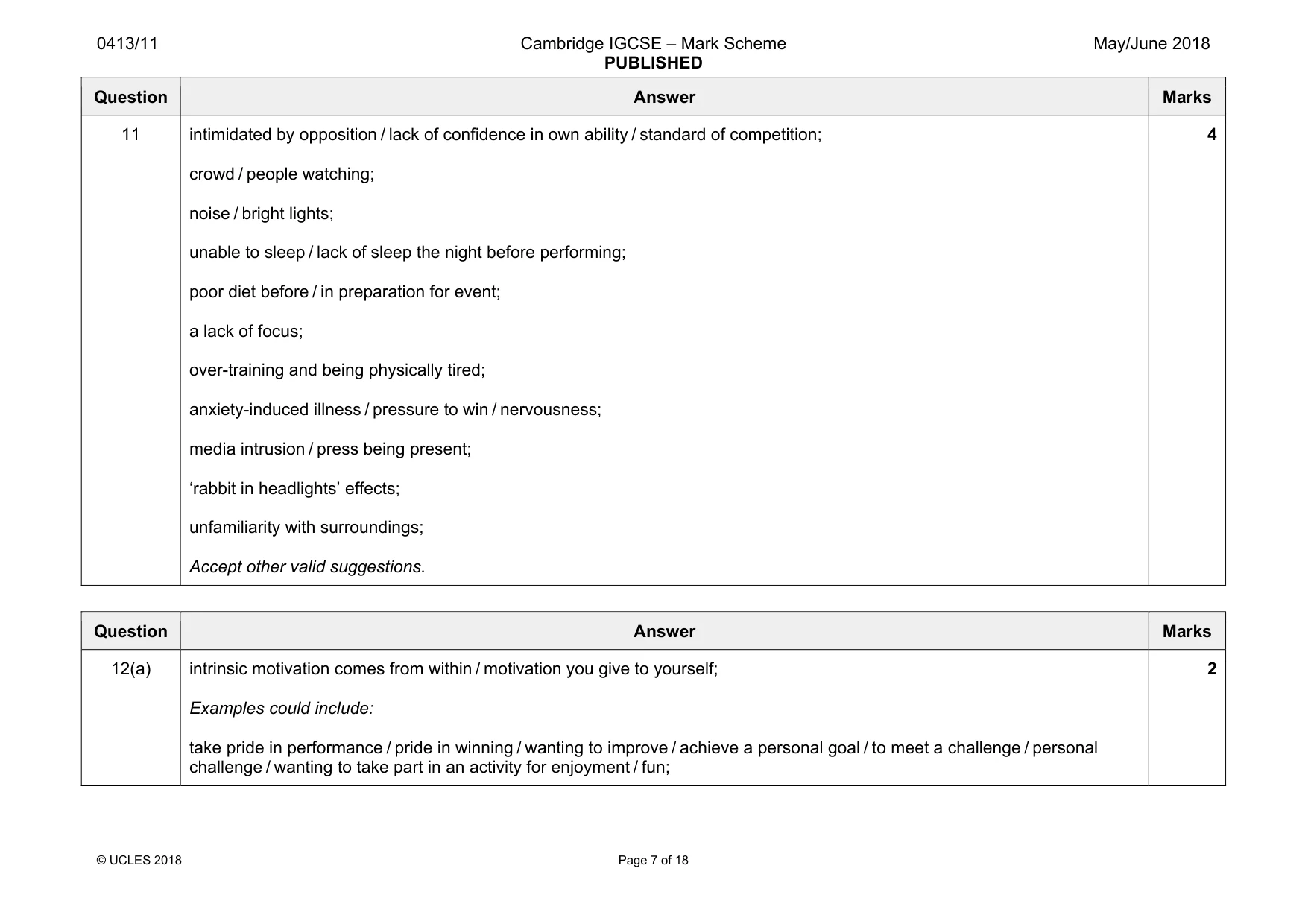
0413/11 Cambridge IGCSE – Mark Scheme PUBLISHED May/June 2018 © UCLES 2018 Page 7 of 18 Question Answer Marks 11 intimidated by opposition / lack of confidence in own ability / standard of competition; crowd / people watching; noise / bright lights; unable to sleep / lack of sleep the night before performing; poor diet before / in preparation for event; a lack of focus; over-training and being physically tired; anxiety-induced illness / pressure to win / nervousness; media intrusion / press being present; ‘rabbit in headlights’ effects; unfamiliarity with surroundings; Accept other valid suggestions. 4 Question Answer Marks 12(a) intrinsic motivation comes from within / motivation you give to yourself; Examples could include: take pride in performance / pride in winning / wanting to improve / achieve a personal goal / to meet a challenge / personal challenge / wanting to take part in an activity for enjoyment / fun; 2
Mark scheme, page 8
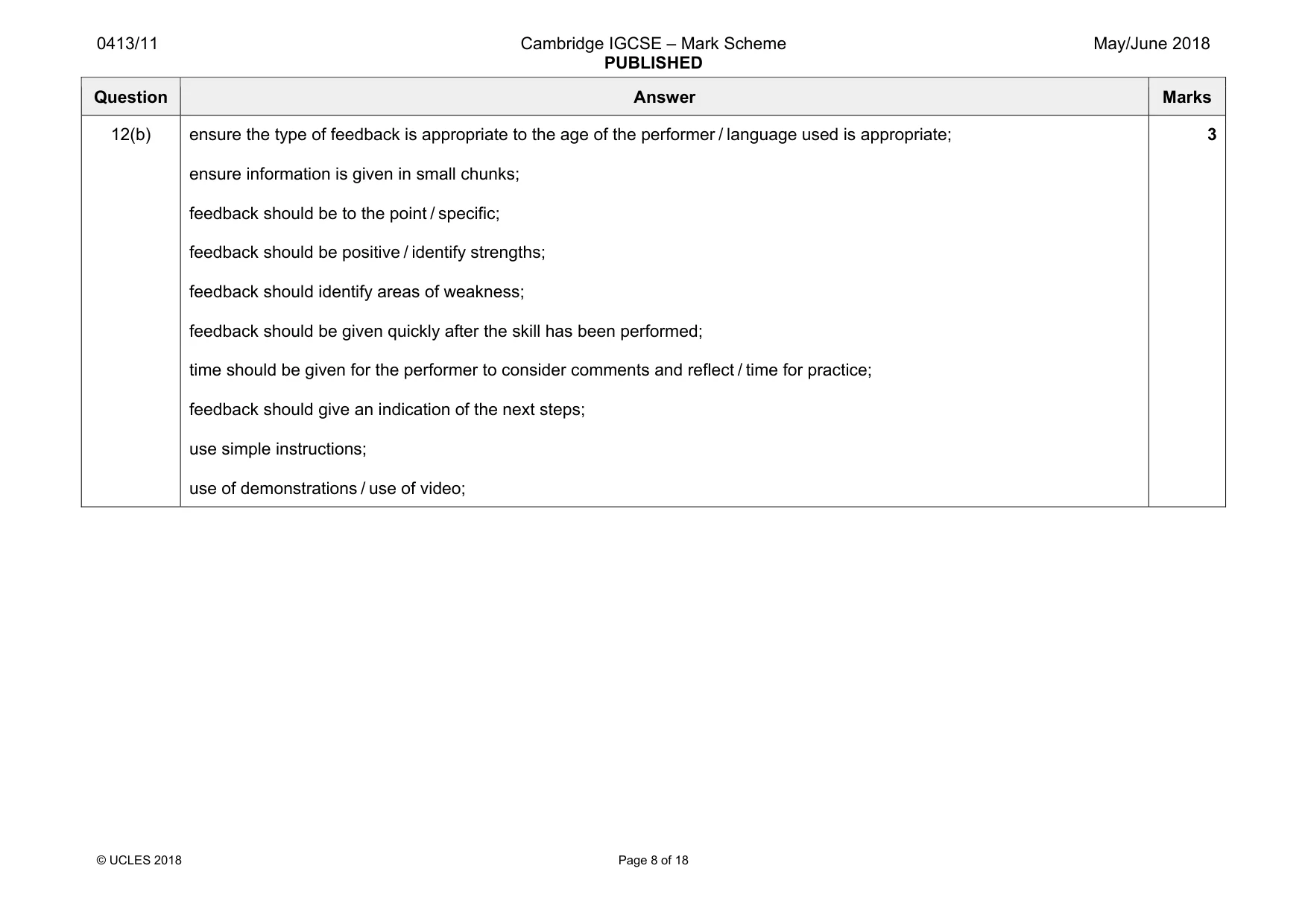
0413/11 Cambridge IGCSE – Mark Scheme PUBLISHED May/June 2018 © UCLES 2018 Page 8 of 18 Question Answer Marks 12(b) ensure the type of feedback is appropriate to the age of the performer / language used is appropriate; ensure information is given in small chunks; feedback should be to the point / specific; feedback should be positive / identify strengths; feedback should identify areas of weakness; feedback should be given quickly after the skill has been performed; time should be given for the performer to consider comments and reflect / time for practice; feedback should give an indication of the next steps; use simple instructions; use of demonstrations / use of video; 3
Mark scheme, page 9
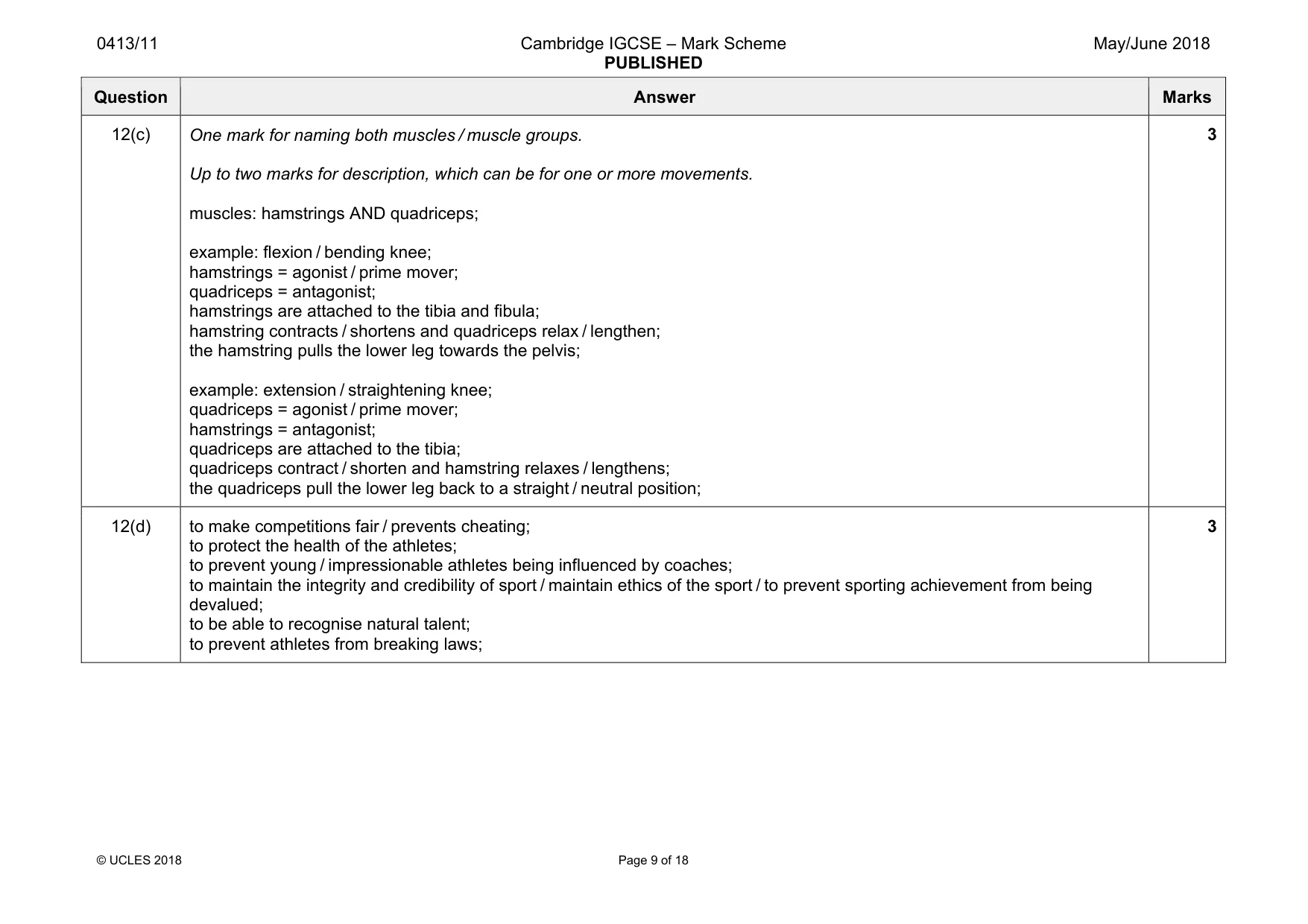
0413/11 Cambridge IGCSE – Mark Scheme PUBLISHED May/June 2018 © UCLES 2018 Page 9 of 18 Question Answer Marks 12(c) One mark for naming both muscles / muscle groups. Up to two marks for description, which can be for one or more movements. muscles: hamstrings AND quadriceps; example: flexion / bending knee; hamstrings = agonist / prime mover; quadriceps = antagonist; hamstrings are attached to the tibia and fibula; hamstring contracts / shortens and quadriceps relax / lengthen; the hamstring pulls the lower leg towards the pelvis; example: extension / straightening knee; quadriceps = agonist / prime mover; hamstrings = antagonist; quadriceps are attached to the tibia; quadriceps contract / shorten and hamstring relaxes / lengthens; the quadriceps pull the lower leg back to a straight / neutral position; 3 12(d) to make competitions fair / prevents cheating; to protect the health of the athletes; to prevent young / impressionable athletes being influenced by coaches; to maintain the integrity and credibility of sport / maintain ethics of the sport / to prevent sporting achievement from being devalued; to be able to recognise natural talent; to prevent athletes from breaking laws; 3
Mark scheme, page 10
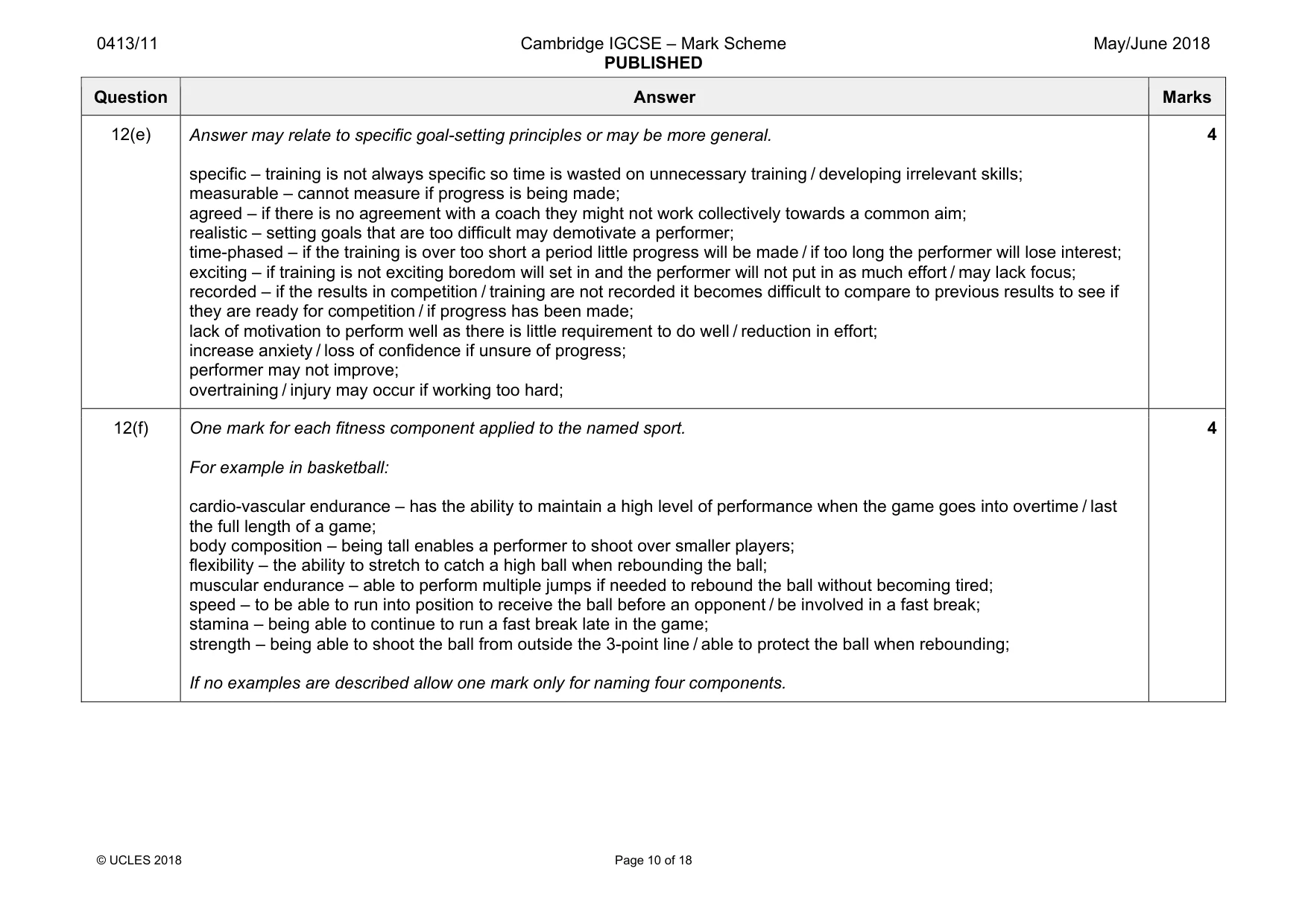
0413/11 Cambridge IGCSE – Mark Scheme PUBLISHED May/June 2018 © UCLES 2018 Page 10 of 18 Question Answer Marks 12(e) Answer may relate to specific goal-setting principles or may be more general. specific – training is not always specific so time is wasted on unnecessary training / developing irrelevant skills; measurable – cannot measure if progress is being made; agreed – if there is no agreement with a coach they might not work collectively towards a common aim; realistic – setting goals that are too difficult may demotivate a performer; time-phased – if the training is over too short a period little progress will be made / if too long the performer will lose interest; exciting – if training is not exciting boredom will set in and the performer will not put in as much effort / may lack focus; recorded – if the results in competition / training are not recorded it becomes difficult to compare to previous results to see if they are ready for competition / if progress has been made; lack of motivation to perform well as there is little requirement to do well / reduction in effort; increase anxiety / loss of confidence if unsure of progress; performer may not improve; overtraining / injury may occur if working too hard; 4 12(f) One mark for each fitness component applied to the named sport. For example in basketball: cardio-vascular endurance – has the ability to maintain a high level of performance when the game goes into overtime / last the full length of a game; body composition – being tall enables a performer to shoot over smaller players; flexibility – the ability to stretch to catch a high ball when rebounding the ball; muscular endurance – able to perform multiple jumps if needed to rebound the ball without becoming tired; speed – to be able to run into position to receive the ball before an opponent / be involved in a fast break; stamina – being able to continue to run a fast break late in the game; strength – being able to shoot the ball from outside the 3-point line / able to protect the ball when rebounding; If no examples are described allow one mark only for naming four components. 4
Mark scheme, page 11
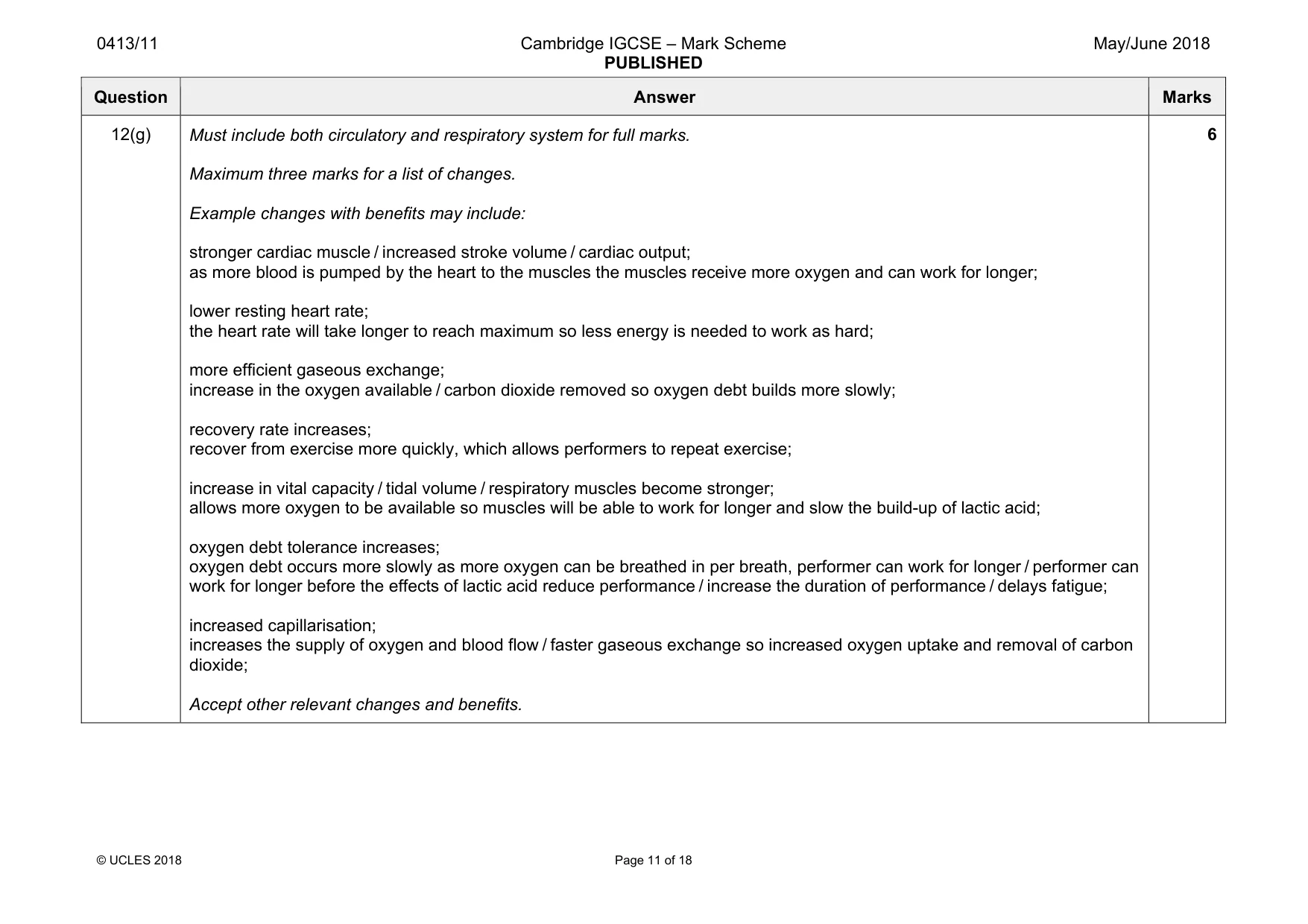
0413/11 Cambridge IGCSE – Mark Scheme PUBLISHED May/June 2018 © UCLES 2018 Page 11 of 18 Question Answer Marks 12(g) Must include both circulatory and respiratory system for full marks. Maximum three marks for a list of changes. Example changes with benefits may include: stronger cardiac muscle / increased stroke volume / cardiac output; as more blood is pumped by the heart to the muscles the muscles receive more oxygen and can work for longer; lower resting heart rate; the heart rate will take longer to reach maximum so less energy is needed to work as hard; more efficient gaseous exchange; increase in the oxygen available / carbon dioxide removed so oxygen debt builds more slowly; recovery rate increases; recover from exercise more quickly, which allows performers to repeat exercise; increase in vital capacity / tidal volume / respiratory muscles become stronger; allows more oxygen to be available so muscles will be able to work for longer and slow the build-up of lactic acid; oxygen debt tolerance increases; oxygen debt occurs more slowly as more oxygen can be breathed in per breath, performer can work for longer / performer can work for longer before the effects of lactic acid reduce performance / increase the duration of performance / delays fatigue; increased capillarisation; increases the supply of oxygen and blood flow / faster gaseous exchange so increased oxygen uptake and removal of carbon dioxide; Accept other relevant changes and benefits. 6
Mark scheme, page 12
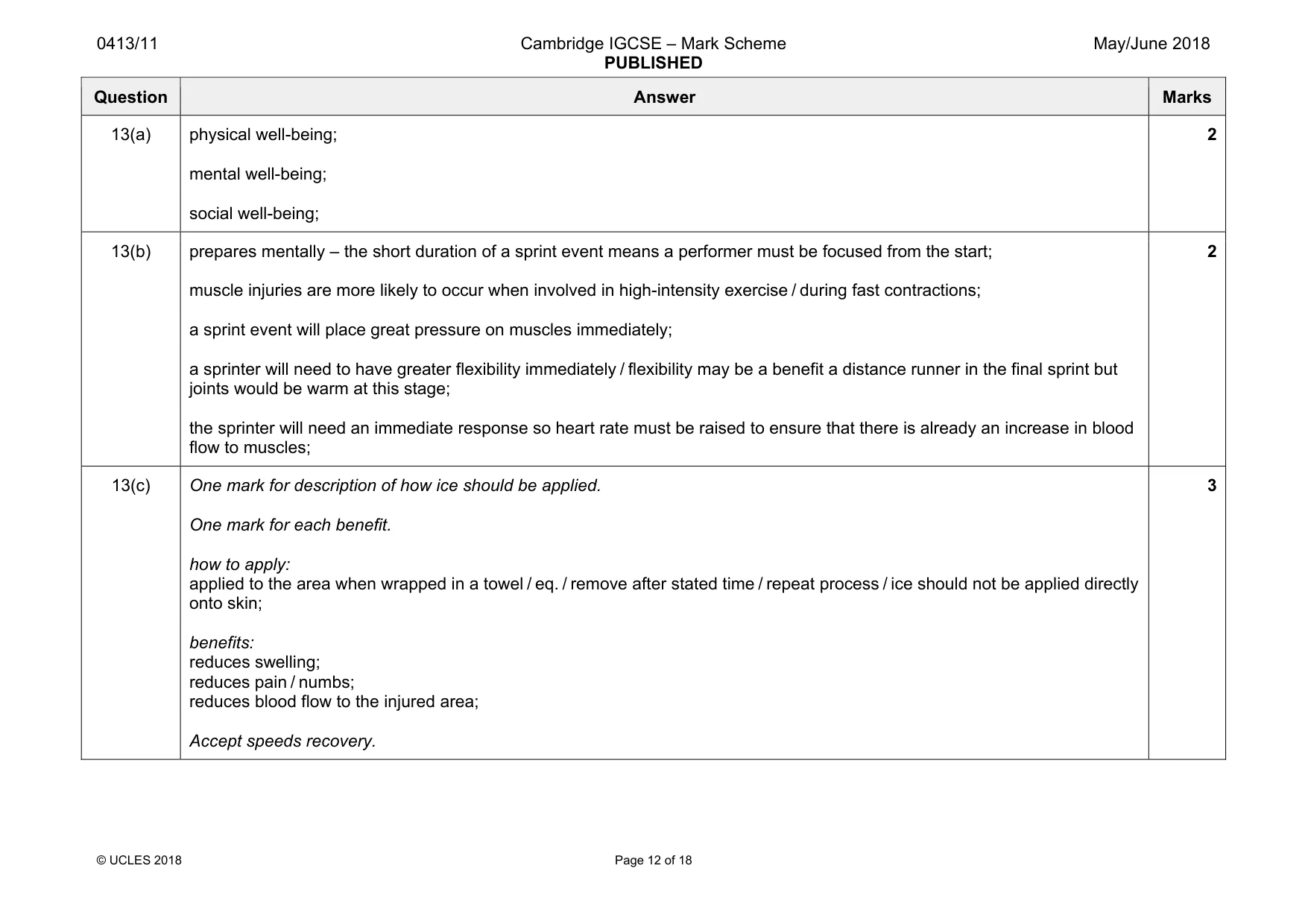
0413/11 Cambridge IGCSE – Mark Scheme PUBLISHED May/June 2018 © UCLES 2018 Page 12 of 18 Question Answer Marks 13(a) physical well-being; mental well-being; social well-being; 2 13(b) prepares mentally – the short duration of a sprint event means a performer must be focused from the start; muscle injuries are more likely to occur when involved in high-intensity exercise / during fast contractions; a sprint event will place great pressure on muscles immediately; a sprinter will need to have greater flexibility immediately / flexibility may be a benefit a distance runner in the final sprint but joints would be warm at this stage; the sprinter will need an immediate response so heart rate must be raised to ensure that there is already an increase in blood flow to muscles; 2 13(c) One mark for description of how ice should be applied. One mark for each benefit. how to apply: applied to the area when wrapped in a towel / eq. / remove after stated time / repeat process / ice should not be applied directly onto skin; benefits: reduces swelling; reduces pain / numbs; reduces blood flow to the injured area; Accept speeds recovery. 3
Mark scheme, page 13
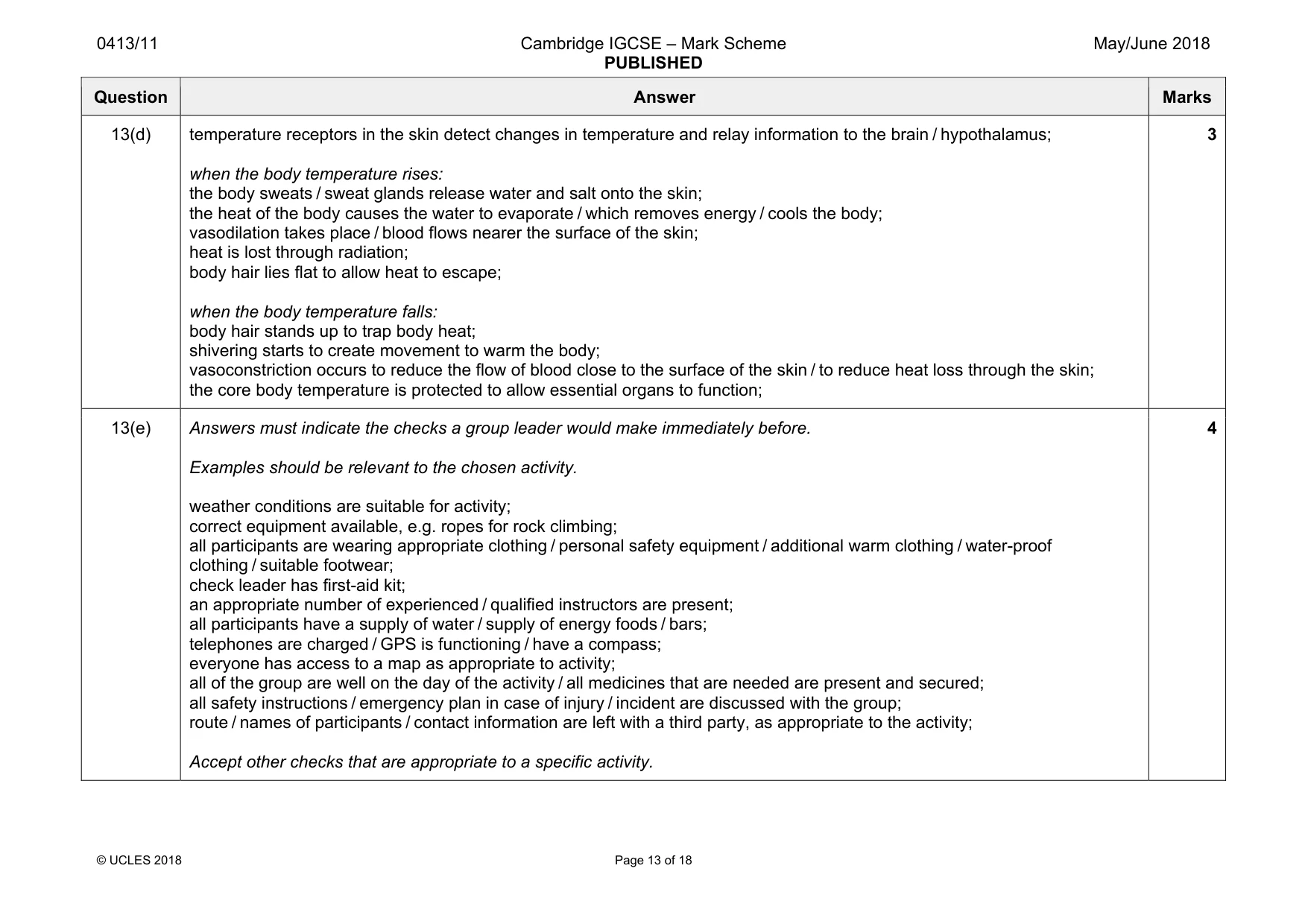
0413/11 Cambridge IGCSE – Mark Scheme PUBLISHED May/June 2018 © UCLES 2018 Page 13 of 18 Question Answer Marks 13(d) temperature receptors in the skin detect changes in temperature and relay information to the brain / hypothalamus; when the body temperature rises: the body sweats / sweat glands release water and salt onto the skin; the heat of the body causes the water to evaporate / which removes energy / cools the body; vasodilation takes place / blood flows nearer the surface of the skin; heat is lost through radiation; body hair lies flat to allow heat to escape; when the body temperature falls: body hair stands up to trap body heat; shivering starts to create movement to warm the body; vasoconstriction occurs to reduce the flow of blood close to the surface of the skin / to reduce heat loss through the skin; the core body temperature is protected to allow essential organs to function; 3 13(e) Answers must indicate the checks a group leader would make immediately before. Examples should be relevant to the chosen activity. weather conditions are suitable for activity; correct equipment available, e.g. ropes for rock climbing; all participants are wearing appropriate clothing / personal safety equipment / additional warm clothing / water-proof clothing / suitable footwear; check leader has first-aid kit; an appropriate number of experienced / qualified instructors are present; all participants have a supply of water / supply of energy foods / bars; telephones are charged / GPS is functioning / have a compass; everyone has access to a map as appropriate to activity; all of the group are well on the day of the activity / all medicines that are needed are present and secured; all safety instructions / emergency plan in case of injury / incident are discussed with the group; route / names of participants / contact information are left with a third party, as appropriate to the activity; Accept other checks that are appropriate to a specific activity. 4
Mark scheme, page 14
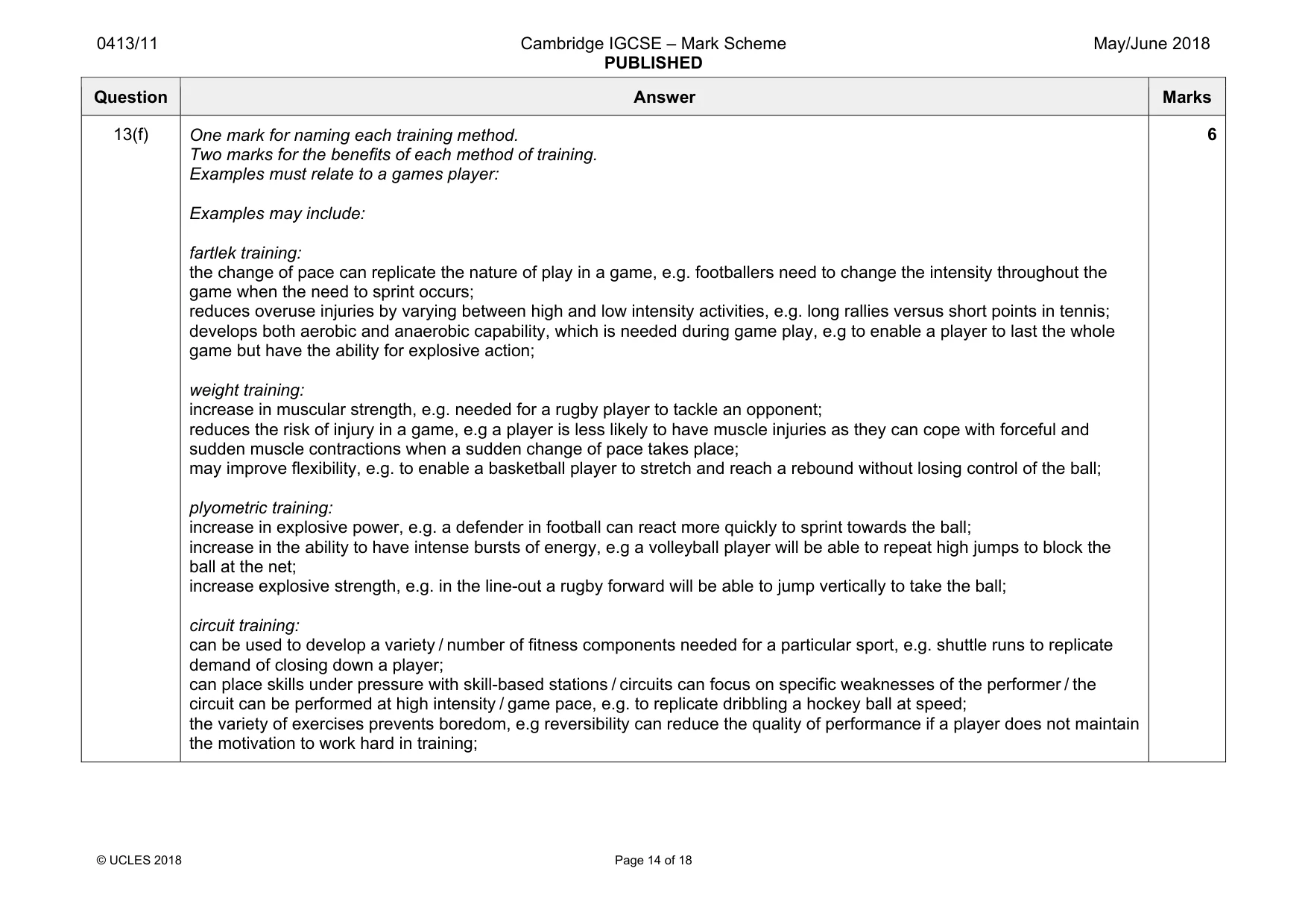
0413/11 Cambridge IGCSE – Mark Scheme PUBLISHED May/June 2018 © UCLES 2018 Page 14 of 18 Question Answer Marks 13(f) One mark for naming each training method. Two marks for the benefits of each method of training. Examples must relate to a games player: Examples may include: fartlek training: the change of pace can replicate the nature of play in a game, e.g. footballers need to change the intensity throughout the game when the need to sprint occurs; reduces overuse injuries by varying between high and low intensity activities, e.g. long rallies versus short points in tennis; develops both aerobic and anaerobic capability, which is needed during game play, e.g to enable a player to last the whole game but have the ability for explosive action; weight training: increase in muscular strength, e.g. needed for a rugby player to tackle an opponent; reduces the risk of injury in a game, e.g a player is less likely to have muscle injuries as they can cope with forceful and sudden muscle contractions when a sudden change of pace takes place; may improve flexibility, e.g. to enable a basketball player to stretch and reach a rebound without losing control of the ball; plyometric training: increase in explosive power, e.g. a defender in football can react more quickly to sprint towards the ball; increase in the ability to have intense bursts of energy, e.g a volleyball player will be able to repeat high jumps to block the ball at the net; increase explosive strength, e.g. in the line-out a rugby forward will be able to jump vertically to take the ball; circuit training: can be used to develop a variety / number of fitness components needed for a particular sport, e.g. shuttle runs to replicate demand of closing down a player; can place skills under pressure with skill-based stations / circuits can focus on specific weaknesses of the performer / the circuit can be performed at high intensity / game pace, e.g. to replicate dribbling a hockey ball at speed; the variety of exercises prevents boredom, e.g reversibility can reduce the quality of performance if a player does not maintain the motivation to work hard in training; 6
Mark scheme, page 15
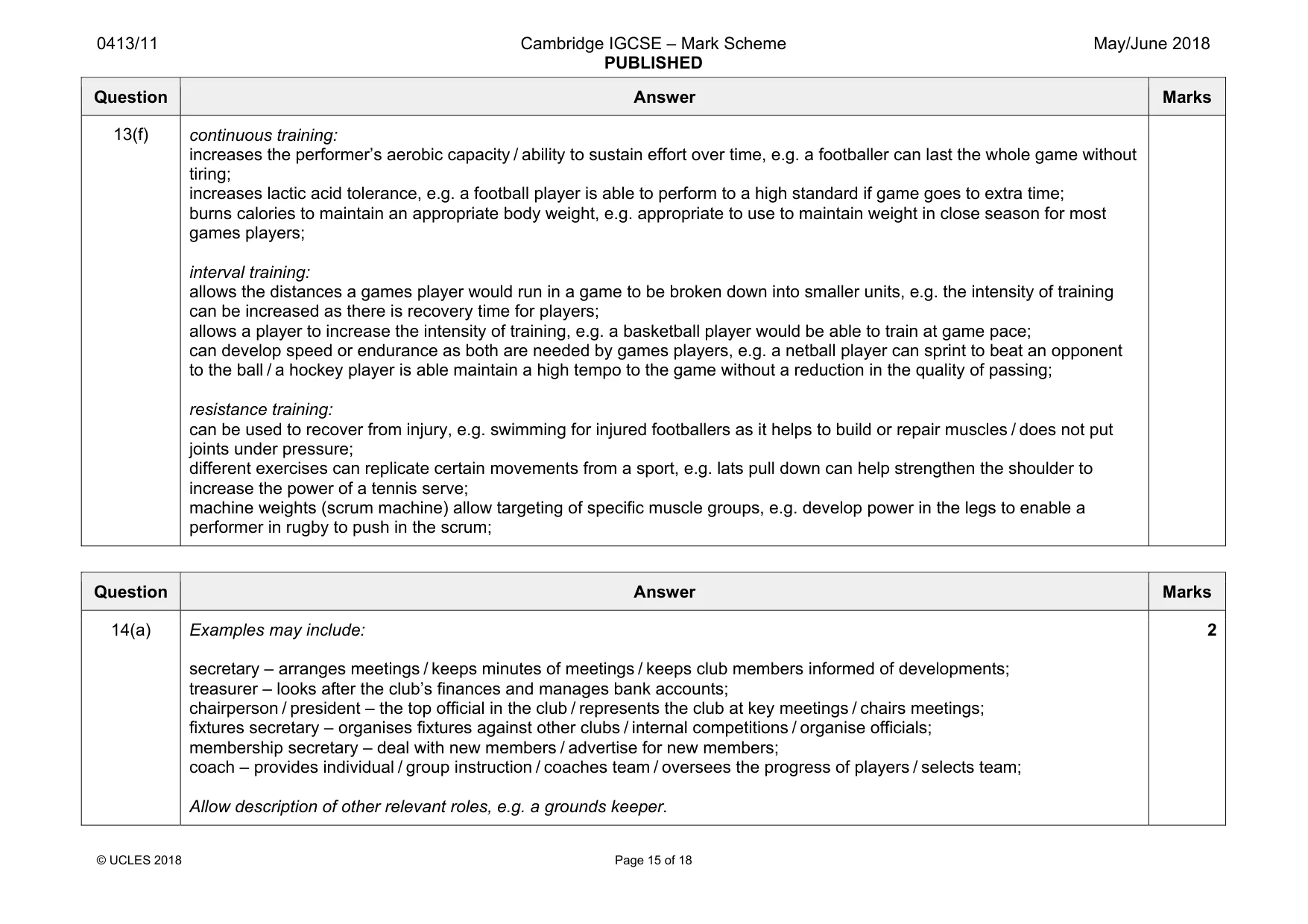
0413/11 Cambridge IGCSE – Mark Scheme PUBLISHED May/June 2018 © UCLES 2018 Page 15 of 18 Question Answer Marks 13(f) continuous training: increases the performer’s aerobic capacity / ability to sustain effort over time, e.g. a footballer can last the whole game without tiring; increases lactic acid tolerance, e.g. a football player is able to perform to a high standard if game goes to extra time; burns calories to maintain an appropriate body weight, e.g. appropriate to use to maintain weight in close season for most games players; interval training: allows the distances a games player would run in a game to be broken down into smaller units, e.g. the intensity of training can be increased as there is recovery time for players; allows a player to increase the intensity of training, e.g. a basketball player would be able to train at game pace; can develop speed or endurance as both are needed by games players, e.g. a netball player can sprint to beat an opponent to the ball / a hockey player is able maintain a high tempo to the game without a reduction in the quality of passing; resistance training: can be used to recover from injury, e.g. swimming for injured footballers as it helps to build or repair muscles / does not put joints under pressure; different exercises can replicate certain movements from a sport, e.g. lats pull down can help strengthen the shoulder to increase the power of a tennis serve; machine weights (scrum machine) allow targeting of specific muscle groups, e.g. develop power in the legs to enable a performer in rugby to push in the scrum; Question Answer Marks 14(a) Examples may include: secretary – arranges meetings / keeps minutes of meetings / keeps club members informed of developments; treasurer – looks after the club’s finances and manages bank accounts; chairperson / president – the top official in the club / represents the club at key meetings / chairs meetings; fixtures secretary – organises fixtures against other clubs / internal competitions / organise officials; membership secretary – deal with new members / advertise for new members; coach – provides individual / group instruction / coaches team / oversees the progress of players / selects team; Allow description of other relevant roles, e.g. a grounds keeper. 2
Mark scheme, page 16
0413/11 Cambridge IGCSE – Mark Scheme PUBLISHED May/June 2018 © UCLES 2018 Page 16 of 18 Question Answer Marks 14(b) intrudes into private life / less privacy; influence team selection / decisions; some managers may resort to cheating due to the pressure to win; create campaigns that result in managers being sacked / appointed; the media may provide support for a manager; time needed for media commitments / often contractual / no choice / have to hold interviews immediately after a game when situations can be emotionally charged; creates / increases pressure on managers; may leak information about tactics / players leaving / joining club; detailed analysis of team performance etc. that may negative; may raise reputation of the manager; allows access to matches to study opposition; 3
Mark scheme, page 17
0413/11 Cambridge IGCSE – Mark Scheme PUBLISHED May/June 2018 © UCLES 2018 Page 17 of 18 Question Answer Marks 14(c) scholarships – athletes can attend an education setting to have full-time education and high-quality sports coaching; talent ID programmes – schemes that identify performers with potential to receive high-quality coaching from a young age; sports governing bodies develop structures to allow progression; elite coaching camps to enable high-quality performers to train together / high-quality coaches / high-quality facilities; medical / scientific support ensure athletes get the best support to prevent injury / speed up recovery / inform diet to ensure the best nutrition for a sport / physiological support to maintain mental well-being; technical support ensure athletes have high-quality equipment and clothing; funding allows top athletes to play / perform full time / take part in appropriate competitions / travel to competitions / attend warm-weather and altitude-training camps; specialist training allows warm weather / altitude training to ensure training in best conditions; increase participation at foundation level to increase the chance of developing an elite performer; 4
Mark scheme, page 18
0413/11 Cambridge IGCSE – Mark Scheme PUBLISHED May/June 2018 © UCLES 2018 Page 18 of 18 Question Answer Marks 14(d) more sports available for women / girls are taught a wider range of sports in school; some sports governing bodies have had to make provision for women; attitudes towards women taking part in sport has changed / attitude towards women in society has improved; recognition that certain events are not too strenuous for women; religions that previously prevented women from taking part in sports may be developing a more relaxed approach; legislation has created equal opportunities in some countries; increase in female role models encourages younger athletes to participate; more media coverage of women’s sport; increase in funding / willingness to sponsor female athletes allows more full-time performers; increase in the number of female coaches / officials; Accept other valid suggestions. 6
What you needed in this session
Cambridge’s own grade thresholds for 2018 May/June, Paper 1 · Variant 1. A higher threshold means an easier paper — the bar moves with how the cohort did.