Cambridge IGCSE Physical Education 0413 — 2017 Oct/Nov Paper 1 · Variant 2
0413/12/O/N/17 · 80 marks · ≈90 min
The question paper and its mark scheme, free to read here and free to download. This is Cambridge’s own paper, exactly as it was sat.
Question paper16 pages


Mark scheme22 pages
Answers below. Sit the paper first if you are practising.
Paper as text
Question paper, page 1
Cambridge International Examinations Cambridge International General Certificate of Secondary Education 0413/12 October/November 2017 1 hour 45 minutes PHYSICAL EDUCATION Paper 1 Candidates answer on the Question Paper. No Additional Materials are required. READ THESE INSTRUCTIONS FIRST Write your Centre number, candidate number and name on all the work you hand in. Write in dark blue or black pen. You may use an HB pencil for any diagrams or graphs. Do not use staples, paper clips, glue or correction fluid. DO NOT WRITE IN ANY BARCODES. Section A Answer all questions in this section. Write your answers in the spaces provided on the Question Paper. Section B Answer all questions in this section. Write your answers in the spaces provided on the Question Paper. Electronic calculators may be used. You may lose marks if you do not show your working or if you do not use appropriate units. At the end of the examination, fasten all your work securely together. The number of marks is given in brackets [ ] at the end of each question or part question. This document consists of 14 printed pages and 2 blank pages. [Turn over 11_0413_12_2017_1.21 © UCLES 2017 *6654277899*
Question paper, page 2
Section A Answer all the questions in the spaces provided. State one type of motivation. 1 … … [1] Describe one feature of physical well-being. 2 … … [1] Describe one benefit of sports events being shown on television for a viewer. 3 … … [1] Name one example of a hinge joint from the body. 4 … [1] Describe one long-term effect on the body if energy intake is greater than energy need. 5 … … [1] State one example of a physical activity that can take place in a natural environment. 6 … [1] 11_0413_12_2017_1.21 © UCLES 2017 2
Question paper, page 3
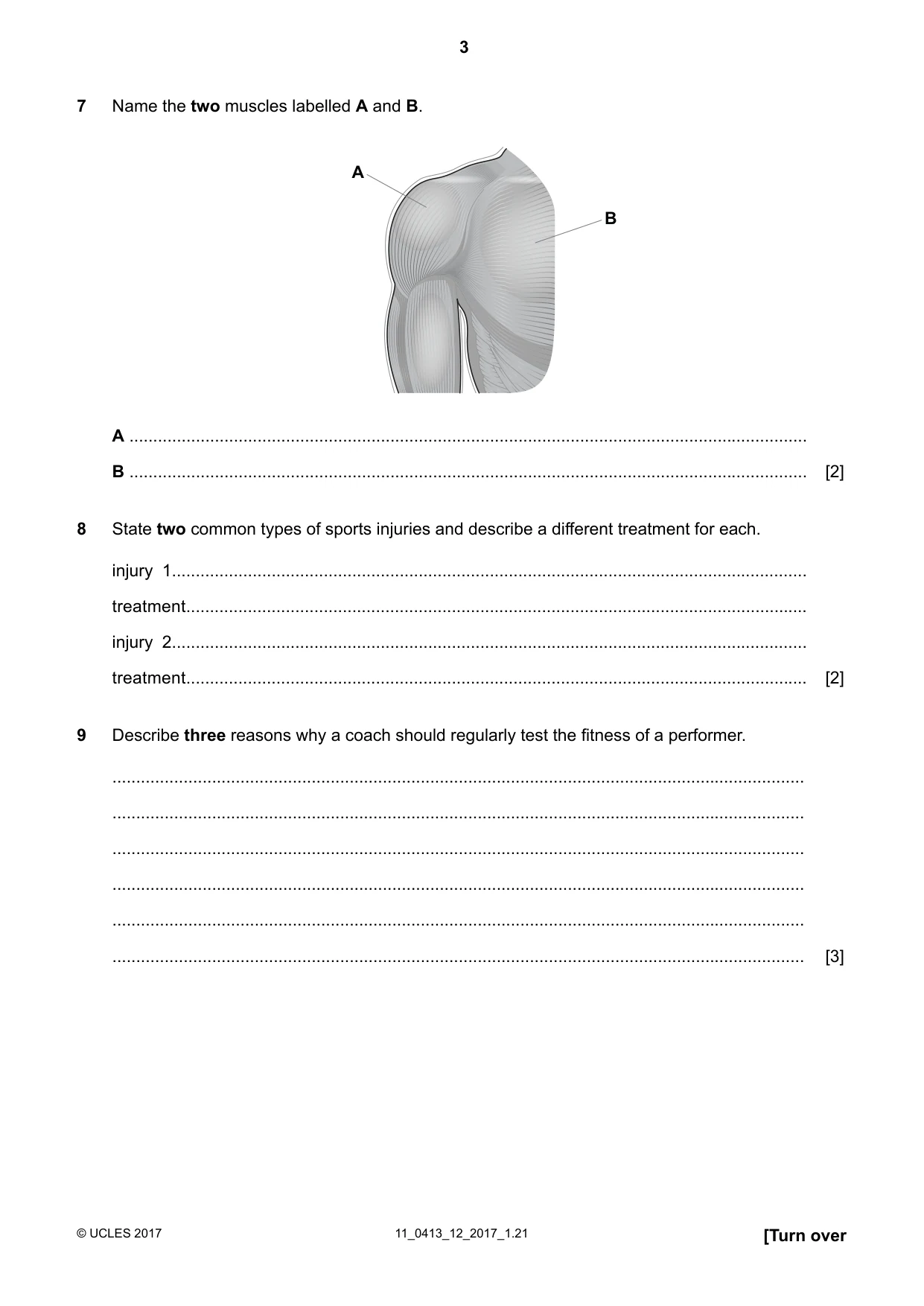
Name the two muscles labelled A and B. 7 A B A … B … [2] State two common types of sports injuries and describe a different treatment for each. 8 injury 1… treatment… injury 2… treatment… [2] Describe three reasons why a coach should regularly test the fitness of a performer. 9 … … … … … … [3] [Turn over 11_0413_12_2017_1.21 © UCLES 2017 3
Question paper, page 4
Describe three benefits of a cool down. 10 … … … … … … [3] Suggest, using four physical activities, different ways that technology helps performers to achieve excellence. 11 activity 1… … … activity 2… … … activity 3… … … activity 4… … … [4] [Total: 20] 11_0413_12_2017_1.21 © UCLES 2017 4
Question paper, page 5
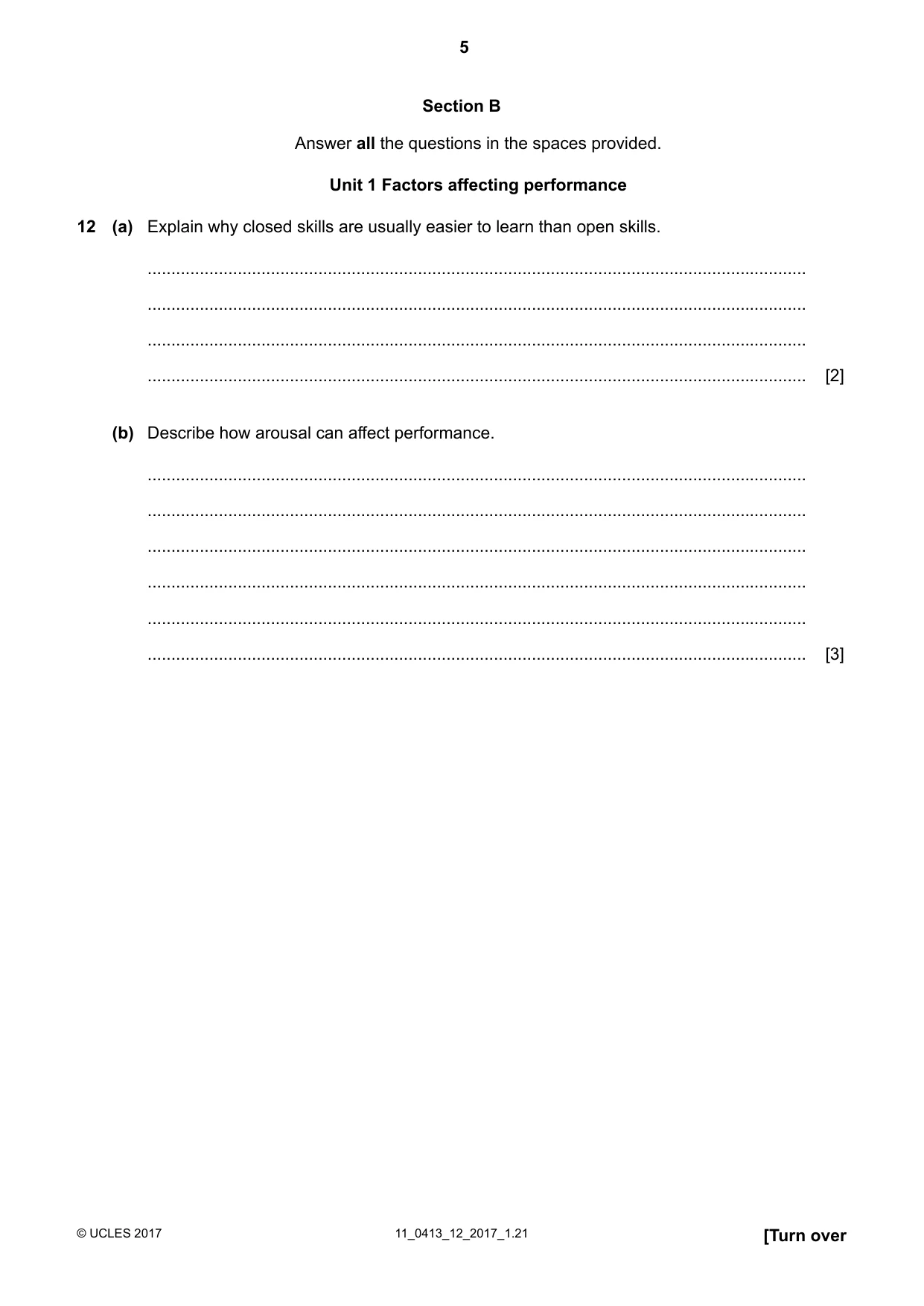
Section B Answer all the questions in the spaces provided. Unit 1 Factors affecting performance Explain why closed skills are usually easier to learn than open skills. (a) 12 … … … … [2] Describe how arousal can affect performance. (b) … … … … … … [3] [Turn over 11_0413_12_2017_1.21 © UCLES 2017 5
Question paper, page 6
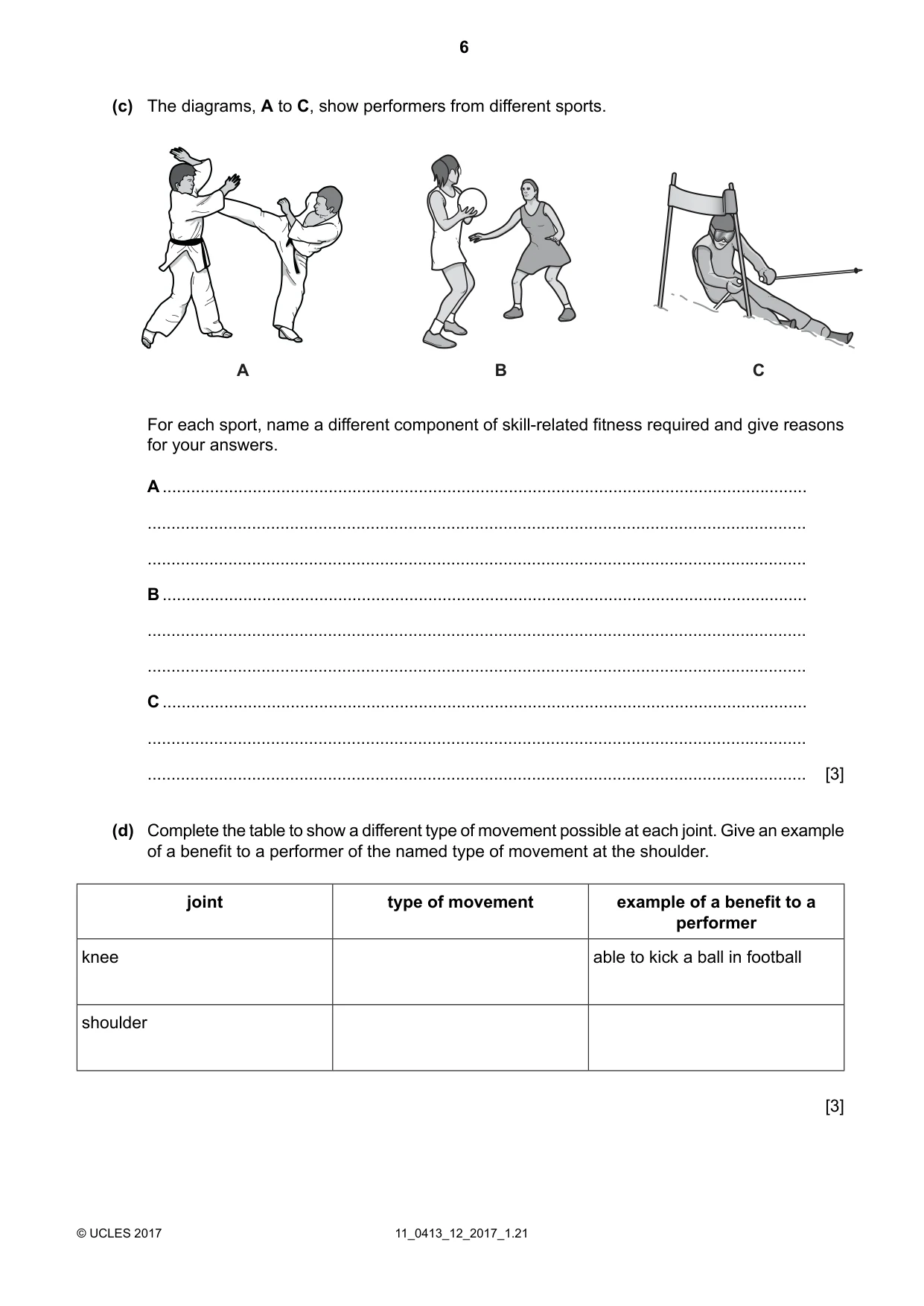
The diagrams, A to C, show performers from different sports. (c) A B C For each sport, name a different component of skill-related fitness required and give reasons for your answers. A … … … B … … … C … … … [3] Complete the table to show a different type of movement possible at each joint. Give an example of a benefit to a performer of the named type of movement at the shoulder. (d) example of a benefit to a performer type of movement joint able to kick a ball in football knee shoulder [3] 11_0413_12_2017_1.21 © UCLES 2017 6
Question paper, page 7
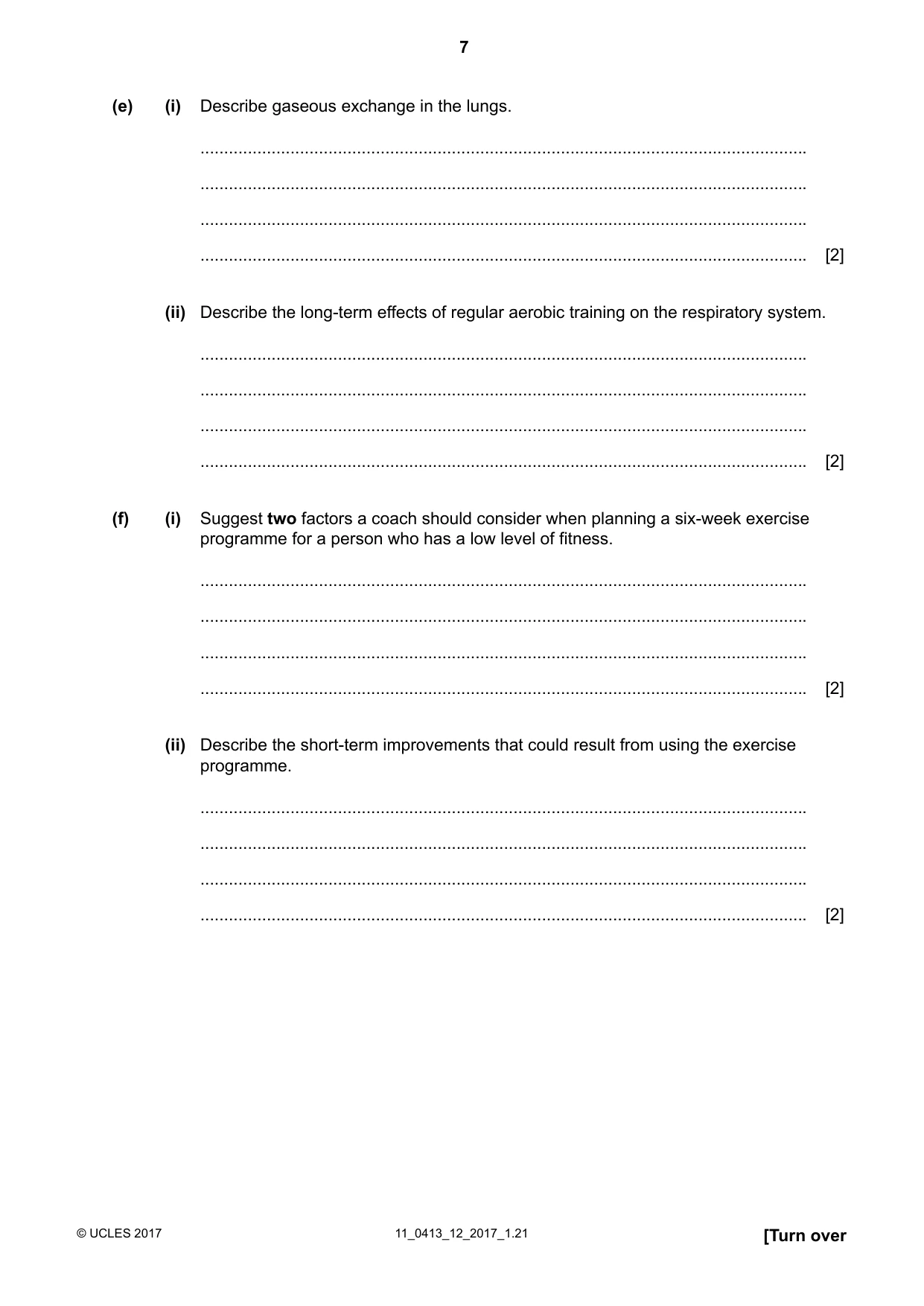
Describe gaseous exchange in the lungs. (i) (e) … … … … [2] Describe the long-term effects of regular aerobic training on the respiratory system. (ii) … … … … [2] Suggest two factors a coach should consider when planning a six-week exercise programme for a person who has a low level of fitness. (i) (f) … … … … [2] Describe the short-term improvements that could result from using the exercise programme. (ii) … … … … [2] [Turn over 11_0413_12_2017_1.21 © UCLES 2017 7
Question paper, page 8
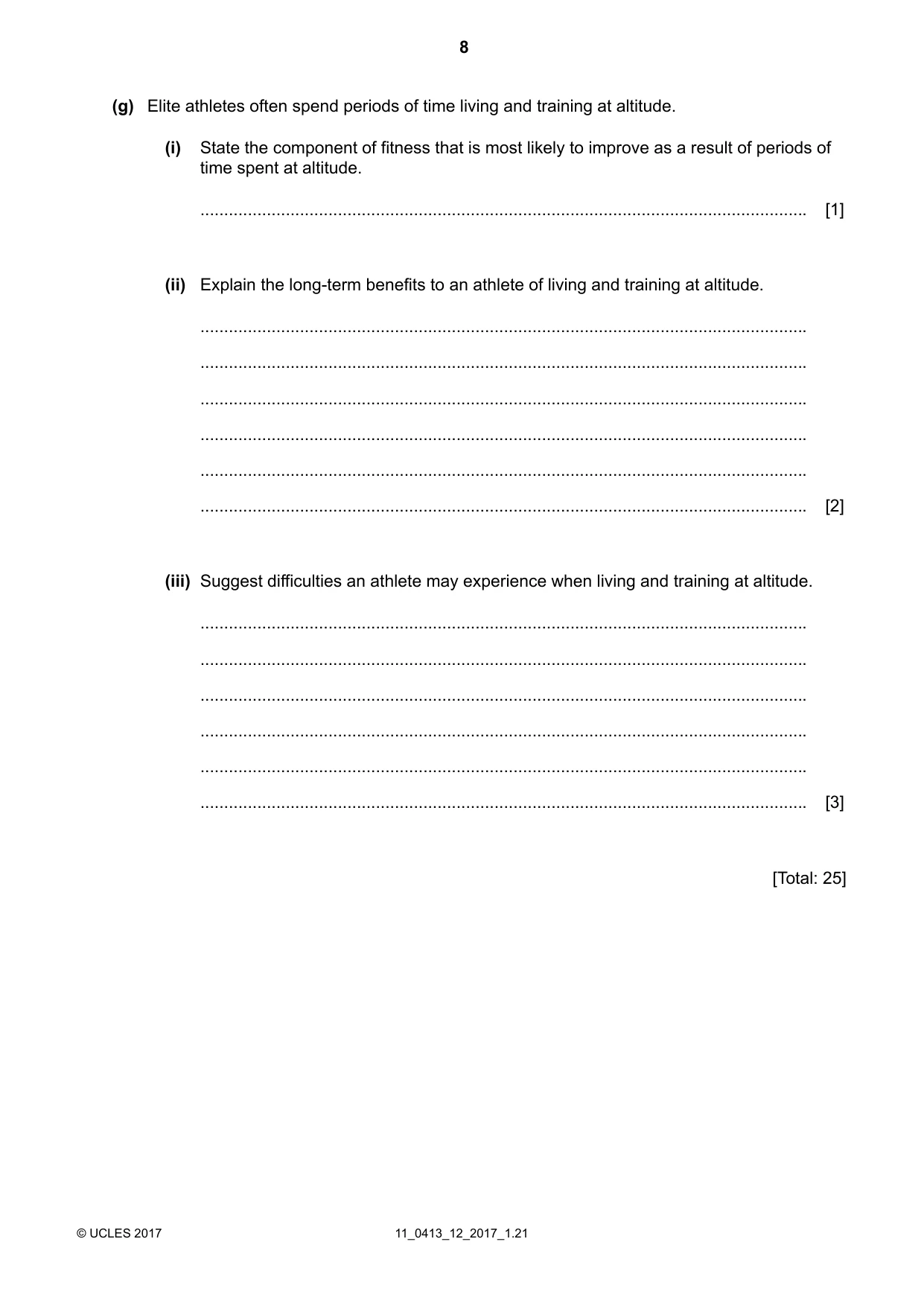
Elite athletes often spend periods of time living and training at altitude. (g) State the component of fitness that is most likely to improve as a result of periods of time spent at altitude. (i) … [1] Explain the long-term benefits to an athlete of living and training at altitude. (ii) … … … … … … [2] Suggest difficulties an athlete may experience when living and training at altitude. (iii) … … … … … … [3] [Total: 25] 11_0413_12_2017_1.21 © UCLES 2017 8
Question paper, page 9
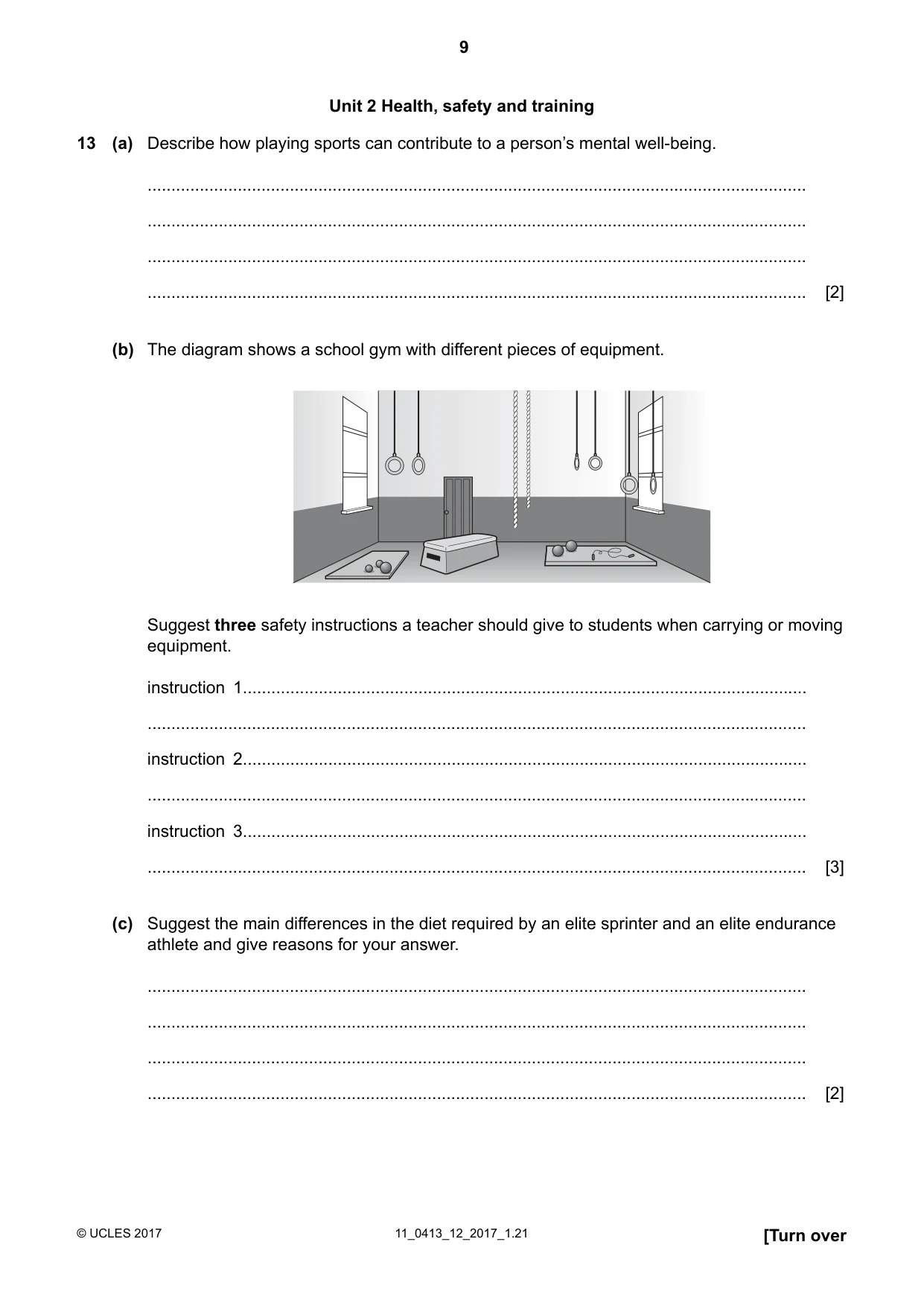
Unit 2 Health, safety and training Describe how playing sports can contribute to a person’s mental well-being. (a) 13 … … … … [2] The diagram shows a school gym with different pieces of equipment. (b) Suggest three safety instructions a teacher should give to students when carrying or moving equipment. instruction 1… … instruction 2… … instruction 3… … [3] Suggest the main differences in the diet required by an elite sprinter and an elite endurance athlete and give reasons for your answer. (c) … … … … [2] [Turn over 11_0413_12_2017_1.21 © UCLES 2017 9
Question paper, page 10
Describe two ways that a participant can reduce the risk of injury to themselves. (d) … … … … … … [2] Name a training method that should be used by a person who is preparing for a 5000-metre (5K) charity run and has a low level of fitness. (i) (e) … [1] State the advantages and disadvantages of using this type of training for the person. (ii) advantages… … … … disadvantages… … … … [4] 11_0413_12_2017_1.21 © UCLES 2017 10
Question paper, page 11
Training can involve different types of muscle contraction. (f) Name two types of muscle contraction. (i) … … [2] Describe the advantages of using exercises to improve one named type of muscle contraction. (ii) type of muscle contraction… advantages… … … … [2] Describe, in two named sports, a different example that demonstrates the use of one type of muscle contraction by a performer. (iii) type of muscle contraction… sport 1… example… … sport 2… example… … [2] [Total: 20] [Turn over 11_0413_12_2017_1.21 © UCLES 2017 11
Question paper, page 12
Unit 3 Reasons and opportunities for participation in physical activity Suggest the effects of regular television coverage on sports. (a) 14 … … … … [2] Scout groups are an example of a voluntary organisation providing leisure opportunities for young people. Explain the benefits of voluntary organisations. (b) … … … … … … [3] 11_0413_12_2017_1.21 © UCLES 2017 12
Question paper, page 13
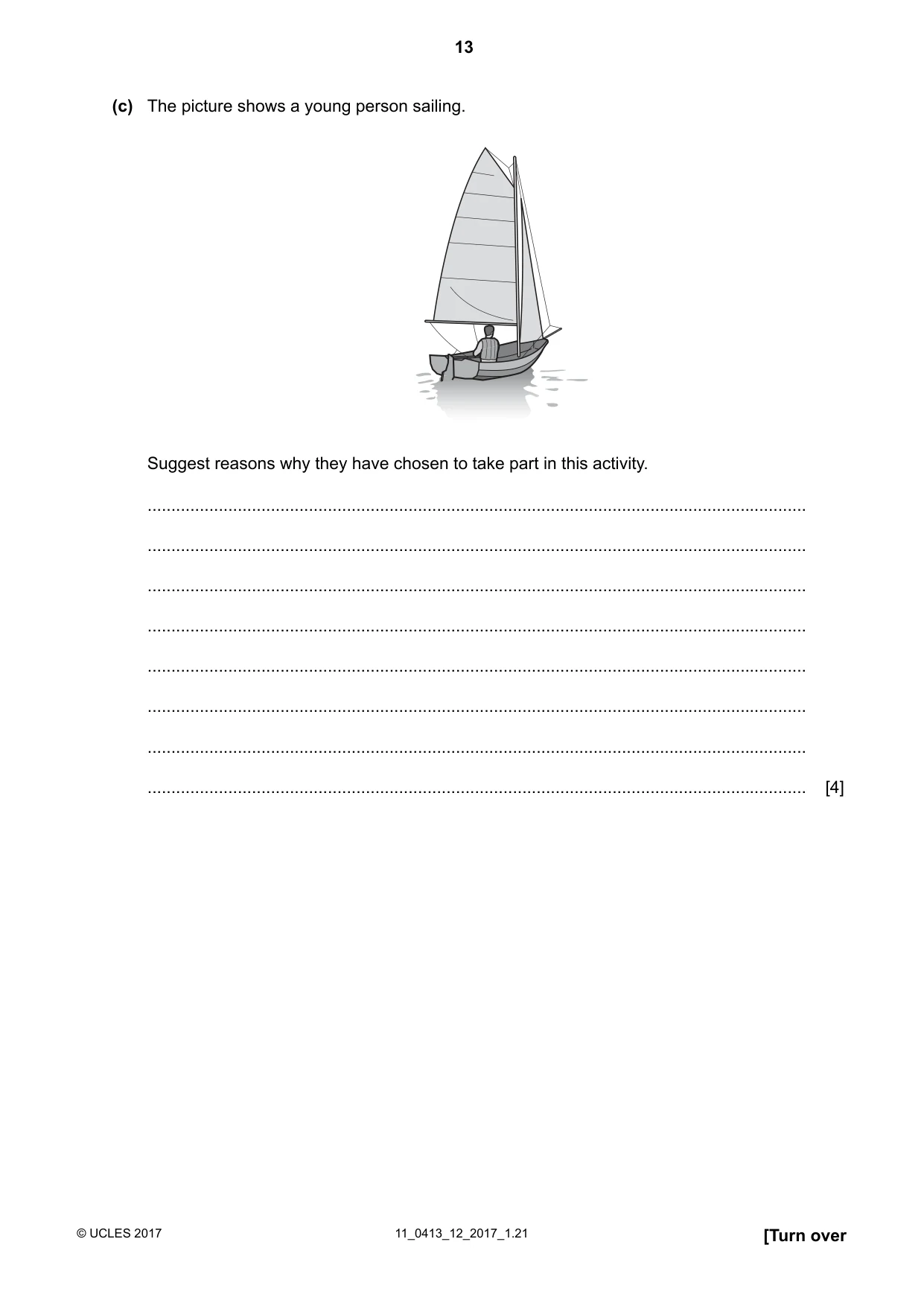
The picture shows a young person sailing. (c) Suggest reasons why they have chosen to take part in this activity. … … … … … … … … [4] [Turn over 11_0413_12_2017_1.21 © UCLES 2017 13
Question paper, page 14
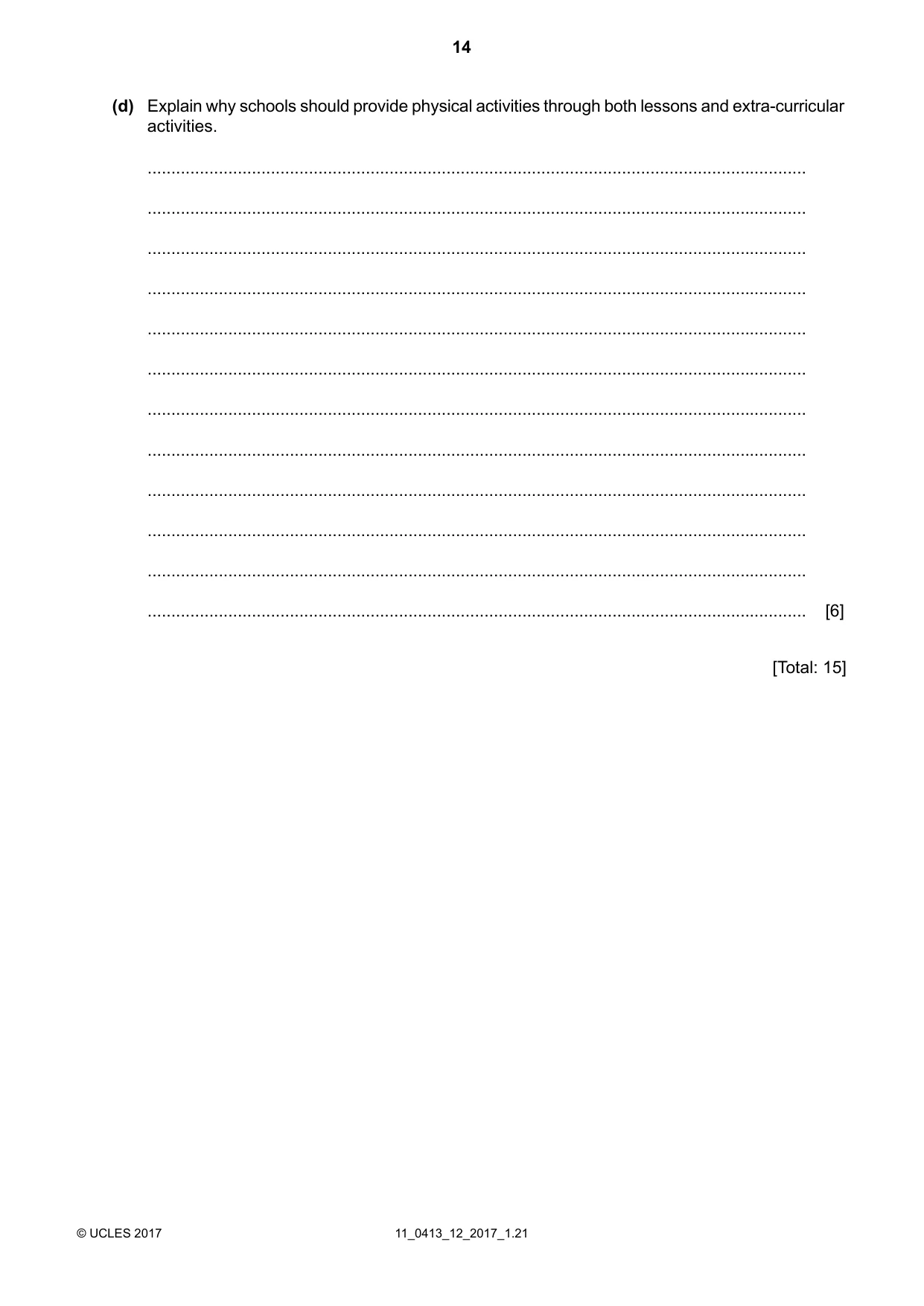
Explain why schools should provide physical activities through both lessons and extra-curricular activities. (d) … … … … … … … … … … … … [6] [Total: 15] 11_0413_12_2017_1.21 © UCLES 2017 14
Question paper, page 15
BLANK PAGE 11_0413_12_2017_1.21 © UCLES 2017 15
Question paper, page 16
BLANK PAGE Permission to reproduce items where third-party owned material protected by copyright is included has been sought and cleared where possible. Every reasonable effort has been made by the publisher (UCLES) to trace copyright holders, but if any items requiring clearance have unwittingly been included, the publisher will be pleased to make amends at the earliest possible opportunity. To avoid the issue of disclosure of answer-related information to candidates, all copyright acknowledgements are reproduced online in the Cambridge International Examinations Copyright Acknowledgements Booklet. This is produced for each series of examinations and is freely available to download at www.cie.org.uk after the live examination series. Cambridge International Examinations is part of the Cambridge Assessment Group. Cambridge Assessment is the brand name of University of Cambridge Local Examinations Syndicate (UCLES), which is itself a department of the University of Cambridge. 11_0413_12_2017_1.21 © UCLES 2017 16
Mark scheme, page 1
® IGCSE is a registered trademark. This document consists of 22 printed pages. © UCLES 2017 [Turn over Cambridge Assessment International Education Cambridge International General Certificate of Secondary Education PHYSICAL EDUCATION 0413/12 Paper 1 October/November 2017 MARK SCHEME Maximum Mark: 80 Published This mark scheme is published as an aid to teachers and candidates, to indicate the requirements of the examination. It shows the basis on which Examiners were instructed to award marks. It does not indicate the details of the discussions that took place at an Examiners’ meeting before marking began, which would have considered the acceptability of alternative answers. Mark schemes should be read in conjunction with the question paper and the Principal Examiner Report for Teachers. Cambridge International will not enter into discussions about these mark schemes. Cambridge International is publishing the mark schemes for the October/November 2017 series for most Cambridge IGCSE®, Cambridge International A and AS Level components and some Cambridge O Level components.
Mark scheme, page 2
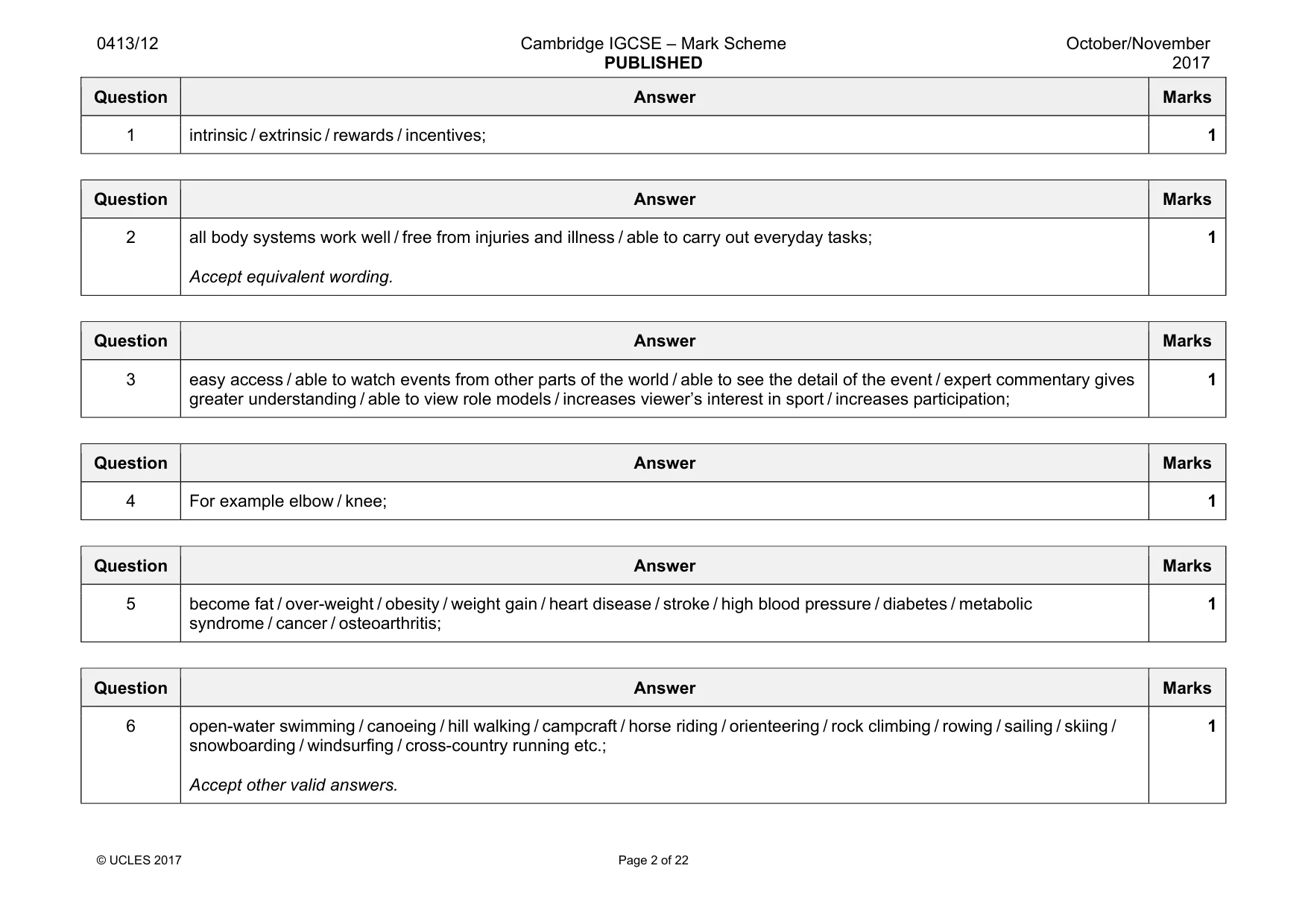
0413/12 Cambridge IGCSE – Mark Scheme PUBLISHED October/November 2017 © UCLES 2017 Page 2 of 22 Question Answer Marks 1 intrinsic / extrinsic / rewards / incentives; 1 Question Answer Marks 2 all body systems work well / free from injuries and illness / able to carry out everyday tasks; Accept equivalent wording. 1 Question Answer Marks 3 easy access / able to watch events from other parts of the world / able to see the detail of the event / expert commentary gives greater understanding / able to view role models / increases viewer’s interest in sport / increases participation; 1 Question Answer Marks 4 For example elbow / knee; 1 Question Answer Marks 5 become fat / over-weight / obesity / weight gain / heart disease / stroke / high blood pressure / diabetes / metabolic syndrome / cancer / osteoarthritis; 1 Question Answer Marks 6 open-water swimming / canoeing / hill walking / campcraft / horse riding / orienteering / rock climbing / rowing / sailing / skiing / snowboarding / windsurfing / cross-country running etc.; Accept other valid answers. 1
Mark scheme, page 3
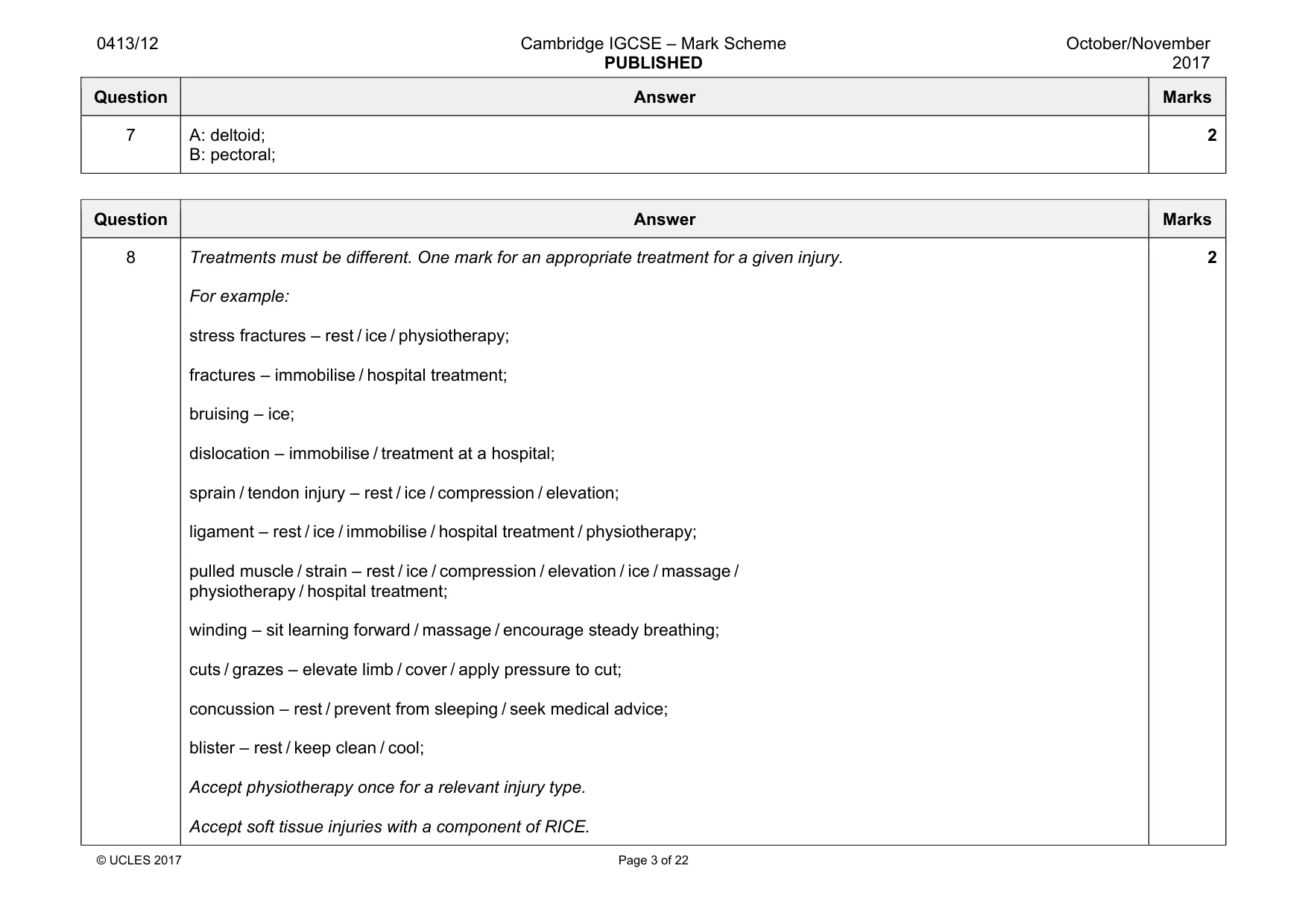
0413/12 Cambridge IGCSE – Mark Scheme PUBLISHED October/November 2017 © UCLES 2017 Page 3 of 22 Question Answer Marks 7 A: deltoid; B: pectoral; 2 Question Answer Marks 8 Treatments must be different. One mark for an appropriate treatment for a given injury. For example: stress fractures – rest / ice / physiotherapy; fractures – immobilise / hospital treatment; bruising – ice; dislocation – immobilise / treatment at a hospital; sprain / tendon injury – rest / ice / compression / elevation; ligament – rest / ice / immobilise / hospital treatment / physiotherapy; pulled muscle / strain – rest / ice / compression / elevation / ice / massage / physiotherapy / hospital treatment; winding – sit learning forward / massage / encourage steady breathing; cuts / grazes – elevate limb / cover / apply pressure to cut; concussion – rest / prevent from sleeping / seek medical advice; blister – rest / keep clean / cool; Accept physiotherapy once for a relevant injury type. Accept soft tissue injuries with a component of RICE. 2
Mark scheme, page 4
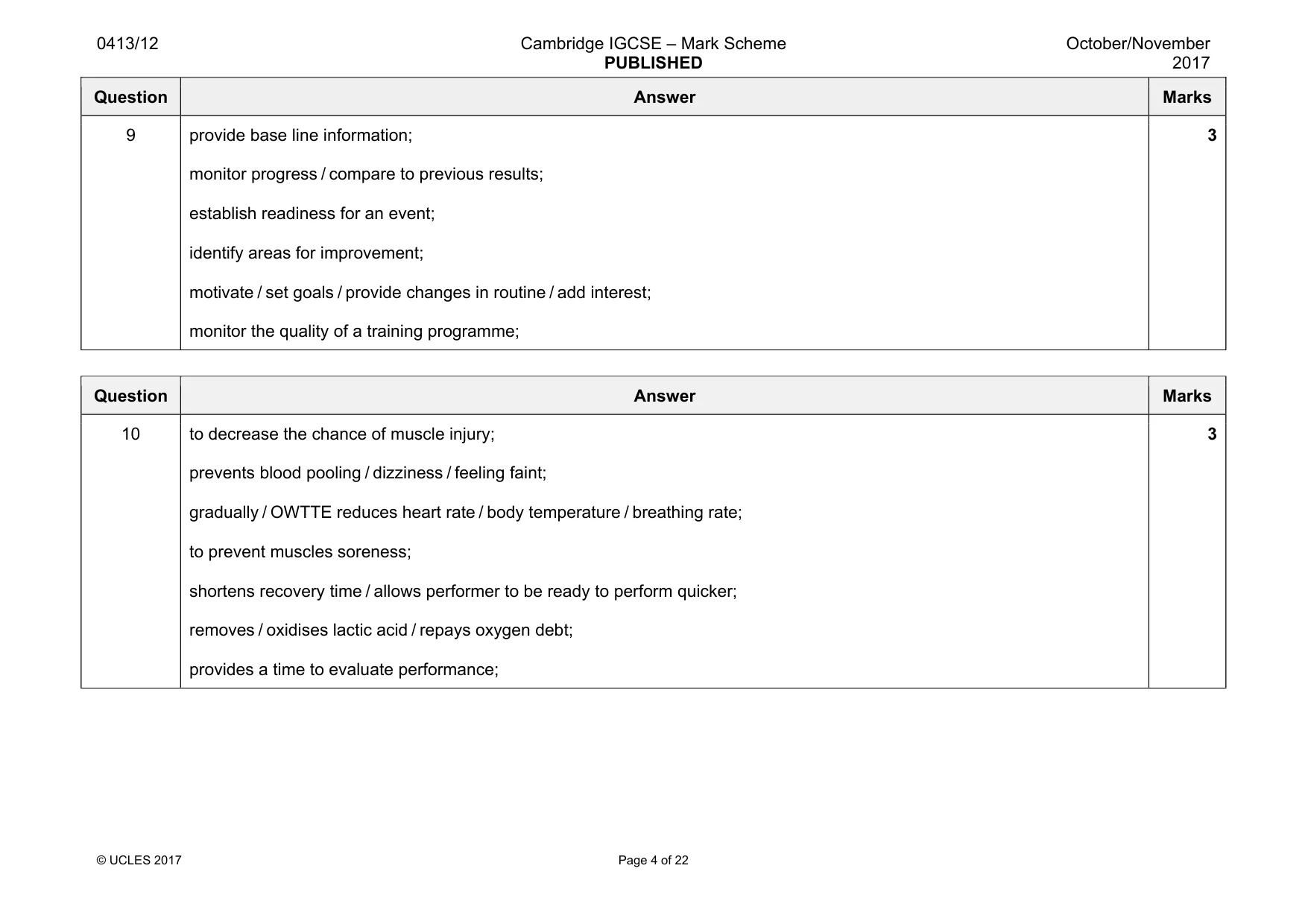
0413/12 Cambridge IGCSE – Mark Scheme PUBLISHED October/November 2017 © UCLES 2017 Page 4 of 22 Question Answer Marks 9 provide base line information; monitor progress / compare to previous results; establish readiness for an event; identify areas for improvement; motivate / set goals / provide changes in routine / add interest; monitor the quality of a training programme; 3 Question Answer Marks 10 to decrease the chance of muscle injury; prevents blood pooling / dizziness / feeling faint; gradually / OWTTE reduces heart rate / body temperature / breathing rate; to prevent muscles soreness; shortens recovery time / allows performer to be ready to perform quicker; removes / oxidises lactic acid / repays oxygen debt; provides a time to evaluate performance; 3
Mark scheme, page 5
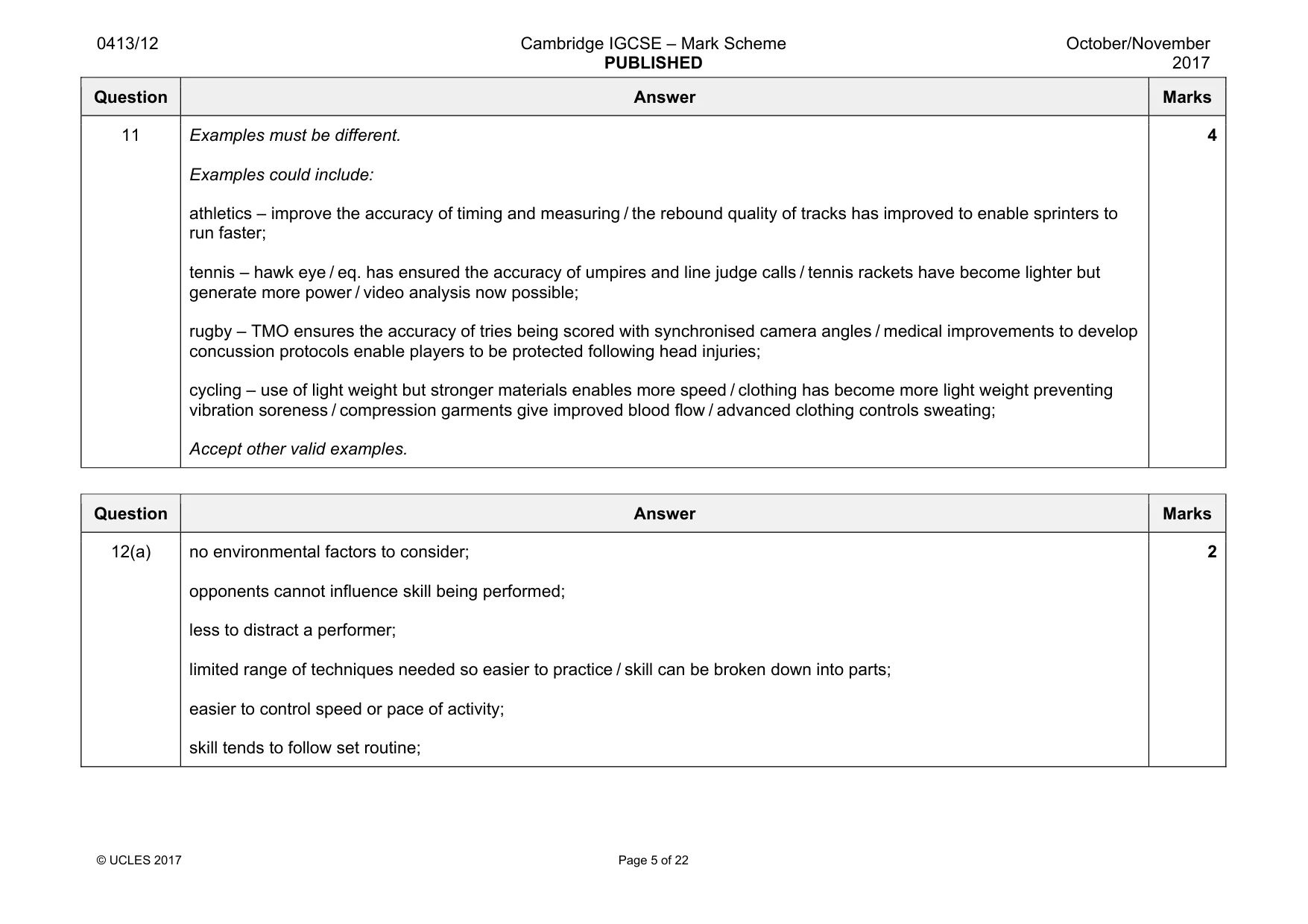
0413/12 Cambridge IGCSE – Mark Scheme PUBLISHED October/November 2017 © UCLES 2017 Page 5 of 22 Question Answer Marks 11 Examples must be different. Examples could include: athletics – improve the accuracy of timing and measuring / the rebound quality of tracks has improved to enable sprinters to run faster; tennis – hawk eye / eq. has ensured the accuracy of umpires and line judge calls / tennis rackets have become lighter but generate more power / video analysis now possible; rugby – TMO ensures the accuracy of tries being scored with synchronised camera angles / medical improvements to develop concussion protocols enable players to be protected following head injuries; cycling – use of light weight but stronger materials enables more speed / clothing has become more light weight preventing vibration soreness / compression garments give improved blood flow / advanced clothing controls sweating; Accept other valid examples. 4 Question Answer Marks 12(a) no environmental factors to consider; opponents cannot influence skill being performed; less to distract a performer; limited range of techniques needed so easier to practice / skill can be broken down into parts; easier to control speed or pace of activity; skill tends to follow set routine; 2
Mark scheme, page 6
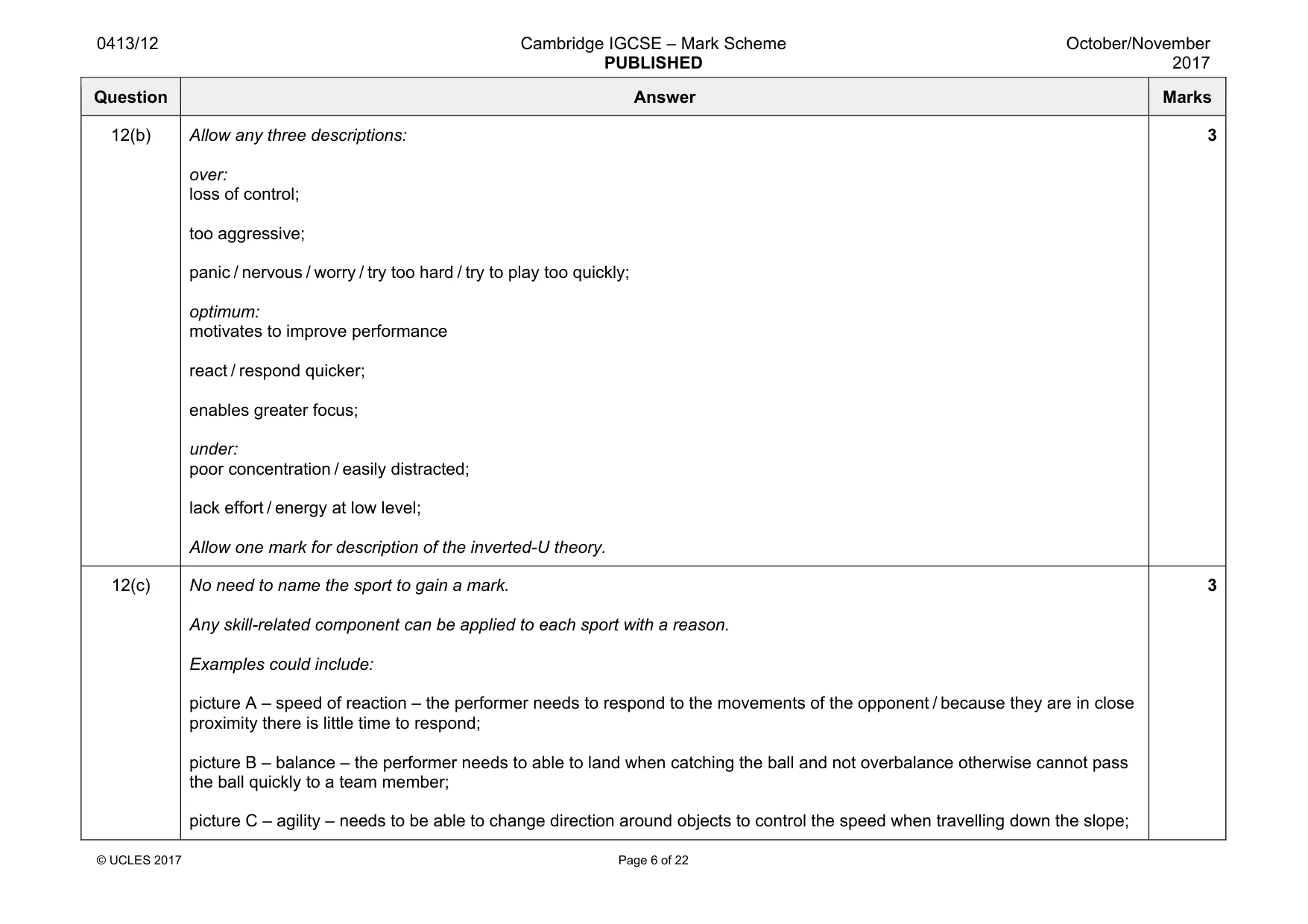
0413/12 Cambridge IGCSE – Mark Scheme PUBLISHED October/November 2017 © UCLES 2017 Page 6 of 22 Question Answer Marks 12(b) Allow any three descriptions: over: loss of control; too aggressive; panic / nervous / worry / try too hard / try to play too quickly; optimum: motivates to improve performance react / respond quicker; enables greater focus; under: poor concentration / easily distracted; lack effort / energy at low level; Allow one mark for description of the inverted-U theory. 3 12(c) No need to name the sport to gain a mark. Any skill-related component can be applied to each sport with a reason. Examples could include: picture A – speed of reaction – the performer needs to respond to the movements of the opponent / because they are in close proximity there is little time to respond; picture B – balance – the performer needs to able to land when catching the ball and not overbalance otherwise cannot pass the ball quickly to a team member; picture C – agility – needs to be able to change direction around objects to control the speed when travelling down the slope; 3
Mark scheme, page 7
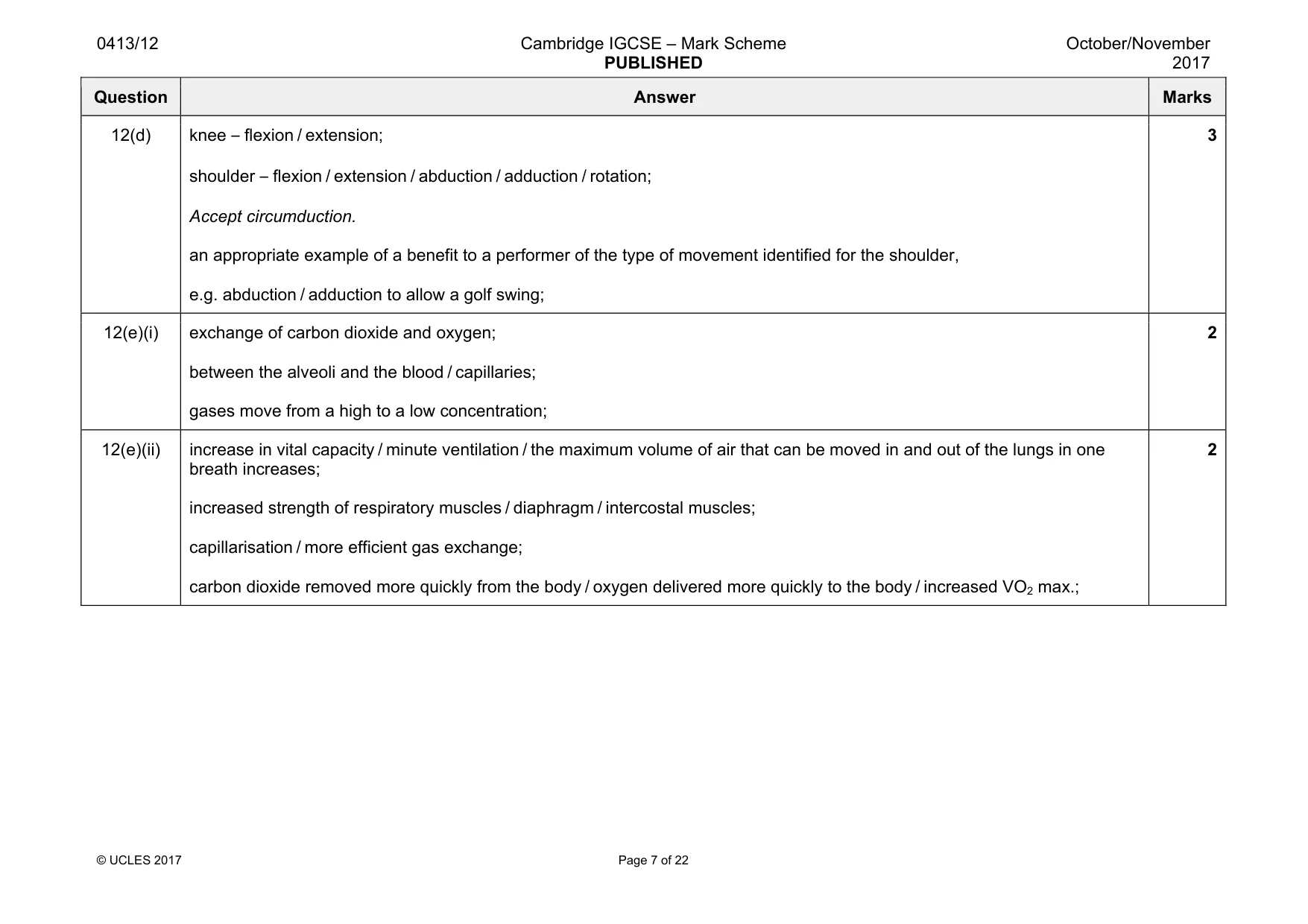
0413/12 Cambridge IGCSE – Mark Scheme PUBLISHED October/November 2017 © UCLES 2017 Page 7 of 22 Question Answer Marks 12(d) knee – flexion / extension; shoulder – flexion / extension / abduction / adduction / rotation; Accept circumduction. an appropriate example of a benefit to a performer of the type of movement identified for the shoulder, e.g. abduction / adduction to allow a golf swing; 3 12(e)(i) exchange of carbon dioxide and oxygen; between the alveoli and the blood / capillaries; gases move from a high to a low concentration; 2 12(e)(ii) increase in vital capacity / minute ventilation / the maximum volume of air that can be moved in and out of the lungs in one breath increases; increased strength of respiratory muscles / diaphragm / intercostal muscles; capillarisation / more efficient gas exchange; carbon dioxide removed more quickly from the body / oxygen delivered more quickly to the body / increased VO2 max.; 2
Mark scheme, page 8
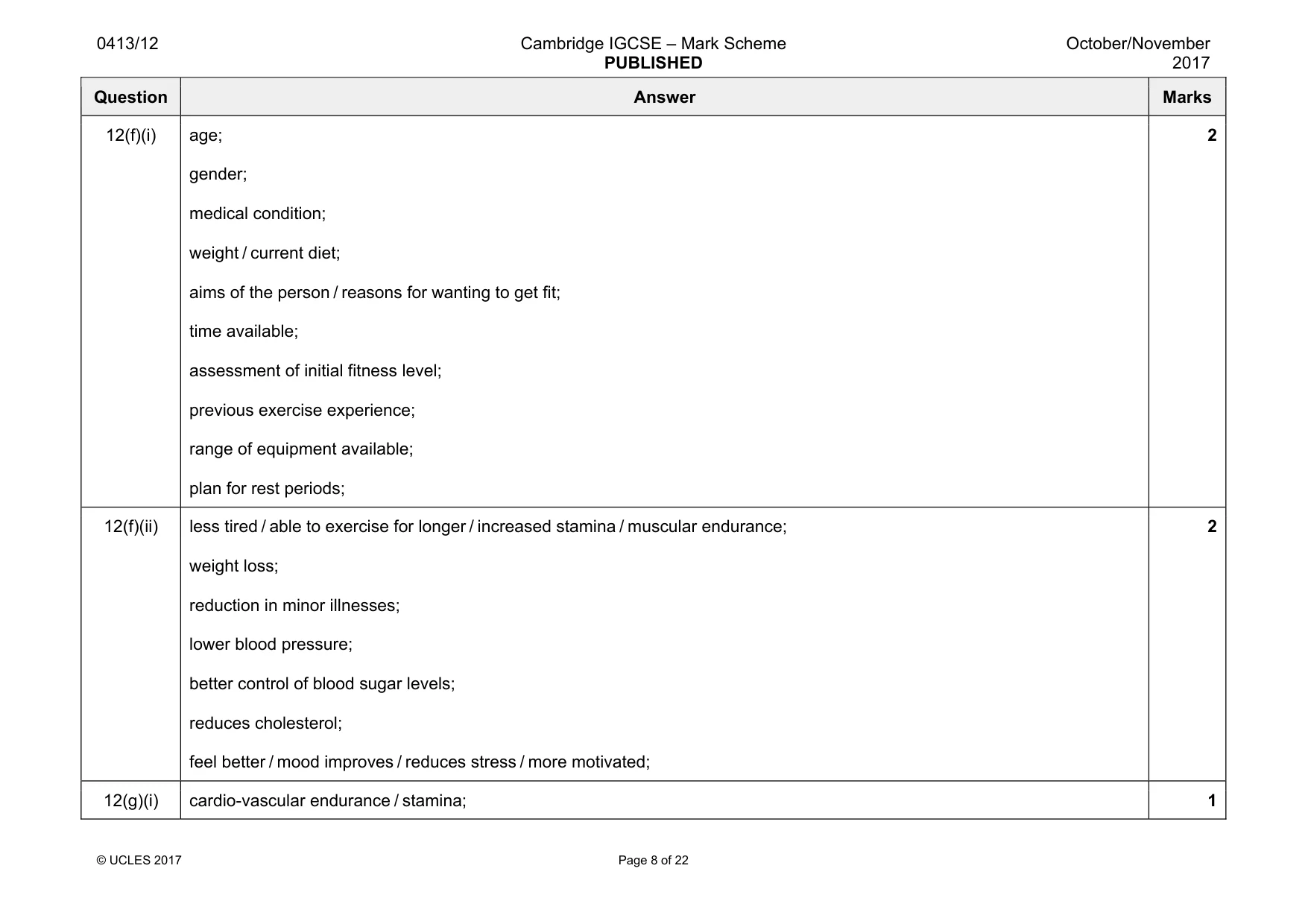
0413/12 Cambridge IGCSE – Mark Scheme PUBLISHED October/November 2017 © UCLES 2017 Page 8 of 22 Question Answer Marks 12(f)(i) age; gender; medical condition; weight / current diet; aims of the person / reasons for wanting to get fit; time available; assessment of initial fitness level; previous exercise experience; range of equipment available; plan for rest periods; 2 12(f)(ii) less tired / able to exercise for longer / increased stamina / muscular endurance; weight loss; reduction in minor illnesses; lower blood pressure; better control of blood sugar levels; reduces cholesterol; feel better / mood improves / reduces stress / more motivated; 2 12(g)(i) cardio-vascular endurance / stamina; 1
Mark scheme, page 9
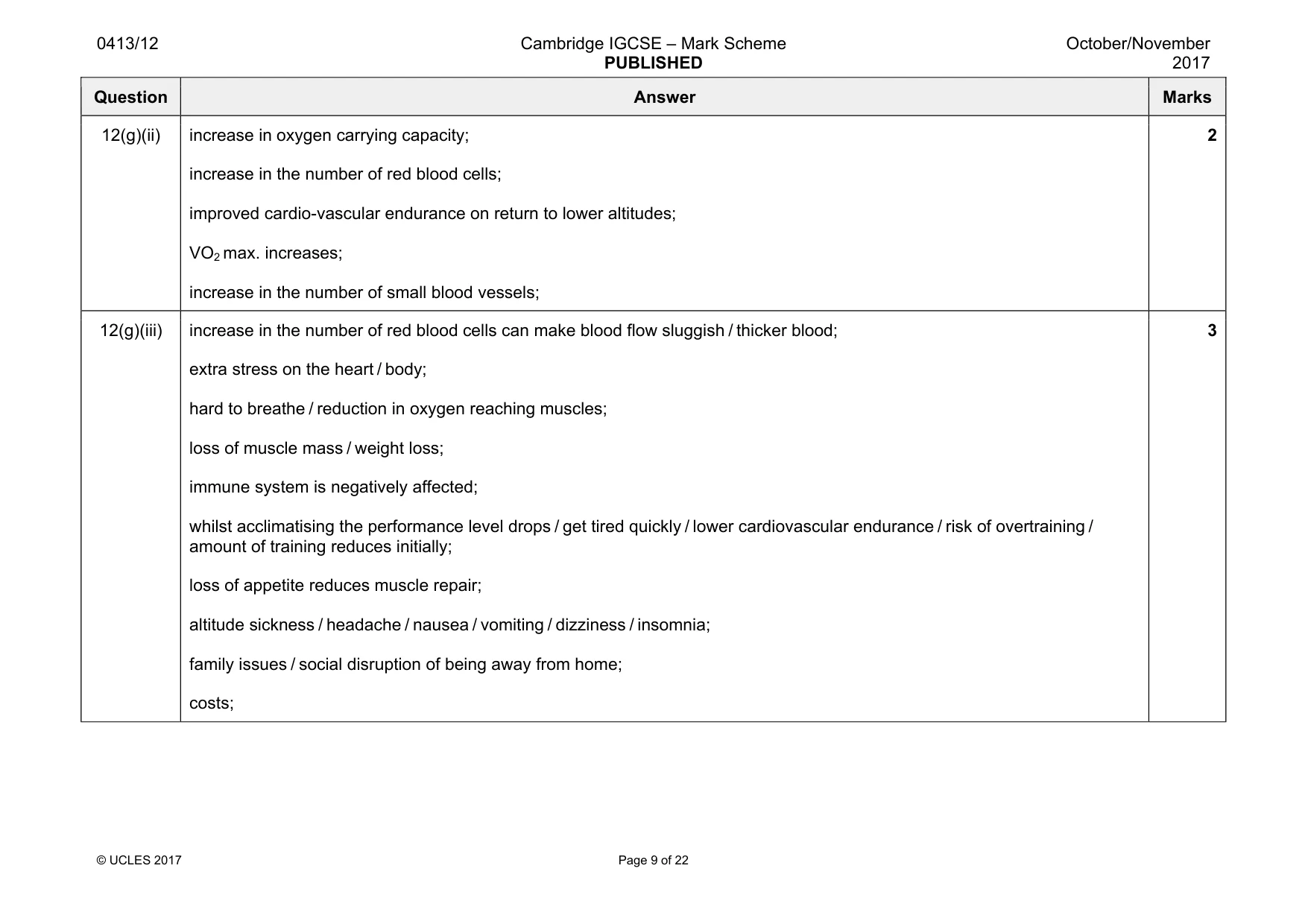
0413/12 Cambridge IGCSE – Mark Scheme PUBLISHED October/November 2017 © UCLES 2017 Page 9 of 22 Question Answer Marks 12(g)(ii) increase in oxygen carrying capacity; increase in the number of red blood cells; improved cardio-vascular endurance on return to lower altitudes; VO2 max. increases; increase in the number of small blood vessels; 2 12(g)(iii) increase in the number of red blood cells can make blood flow sluggish / thicker blood; extra stress on the heart / body; hard to breathe / reduction in oxygen reaching muscles; loss of muscle mass / weight loss; immune system is negatively affected; whilst acclimatising the performance level drops / get tired quickly / lower cardiovascular endurance / risk of overtraining / amount of training reduces initially; loss of appetite reduces muscle repair; altitude sickness / headache / nausea / vomiting / dizziness / insomnia; family issues / social disruption of being away from home; costs; 3
Mark scheme, page 10
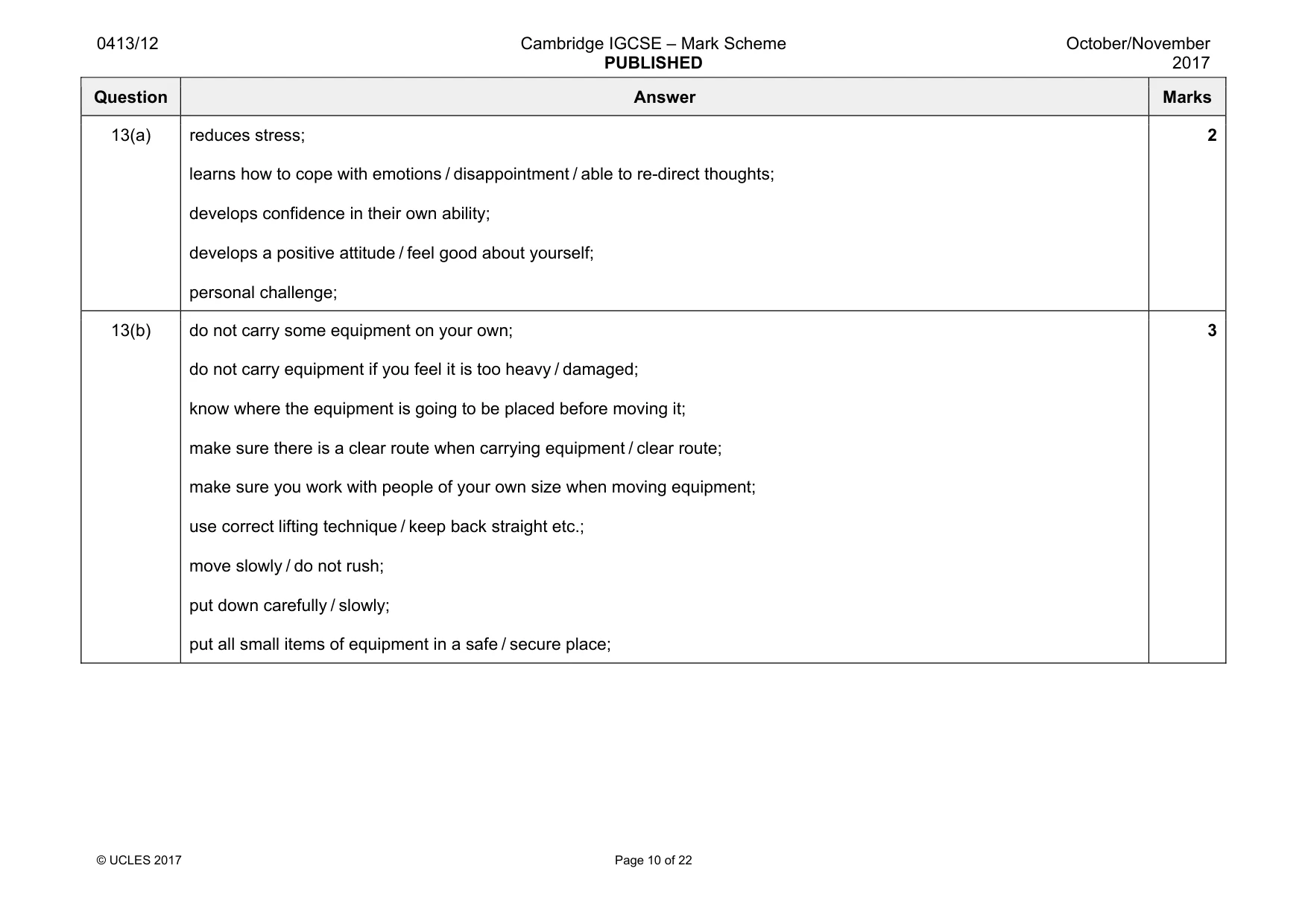
0413/12 Cambridge IGCSE – Mark Scheme PUBLISHED October/November 2017 © UCLES 2017 Page 10 of 22 Question Answer Marks 13(a) reduces stress; learns how to cope with emotions / disappointment / able to re-direct thoughts; develops confidence in their own ability; develops a positive attitude / feel good about yourself; personal challenge; 2 13(b) do not carry some equipment on your own; do not carry equipment if you feel it is too heavy / damaged; know where the equipment is going to be placed before moving it; make sure there is a clear route when carrying equipment / clear route; make sure you work with people of your own size when moving equipment; use correct lifting technique / keep back straight etc.; move slowly / do not rush; put down carefully / slowly; put all small items of equipment in a safe / secure place; 3
Mark scheme, page 11
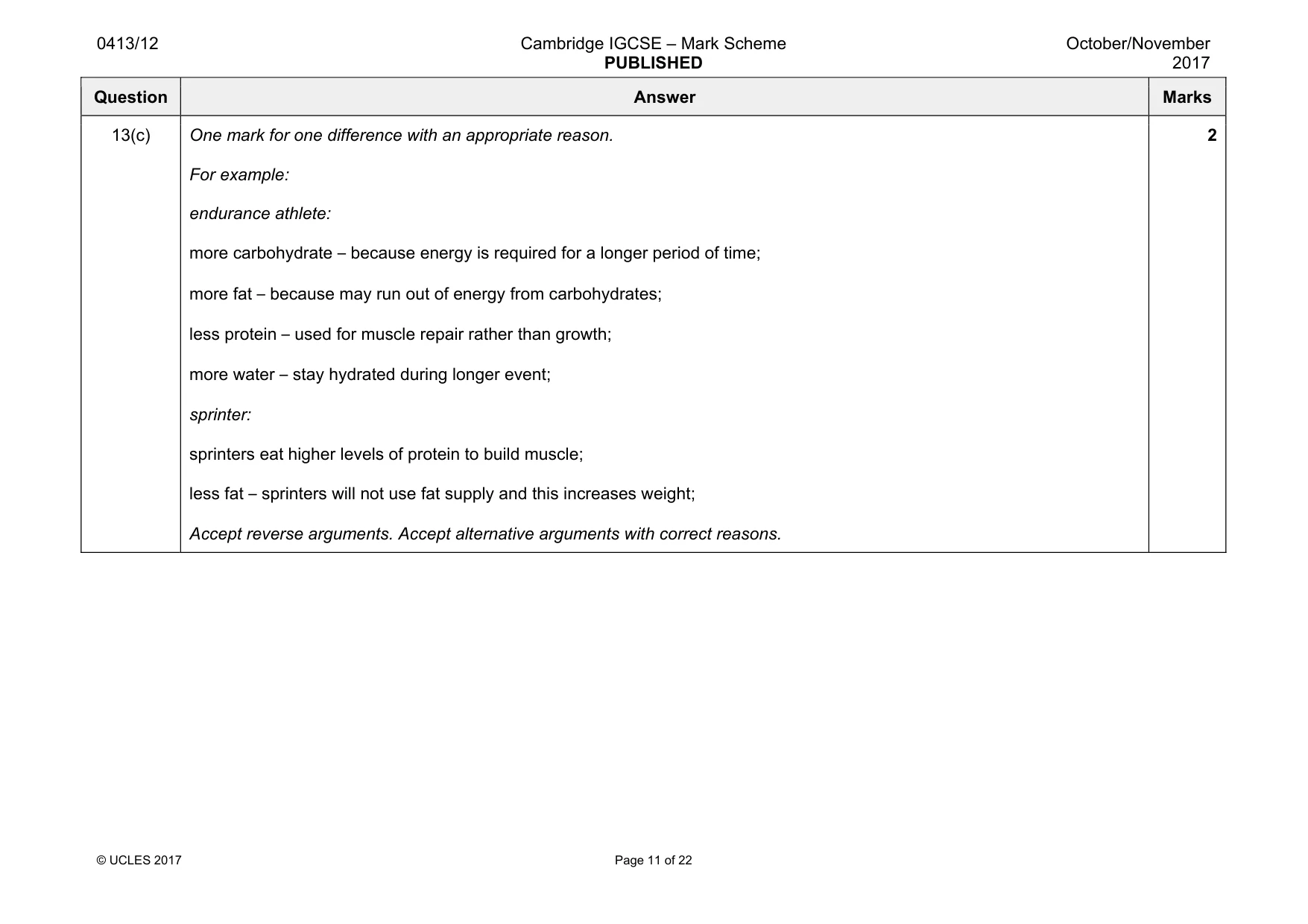
0413/12 Cambridge IGCSE – Mark Scheme PUBLISHED October/November 2017 © UCLES 2017 Page 11 of 22 Question Answer Marks 13(c) One mark for one difference with an appropriate reason. For example: endurance athlete: more carbohydrate – because energy is required for a longer period of time; more fat – because may run out of energy from carbohydrates; less protein – used for muscle repair rather than growth; more water – stay hydrated during longer event; sprinter: sprinters eat higher levels of protein to build muscle; less fat – sprinters will not use fat supply and this increases weight; Accept reverse arguments. Accept alternative arguments with correct reasons. 2
Mark scheme, page 12
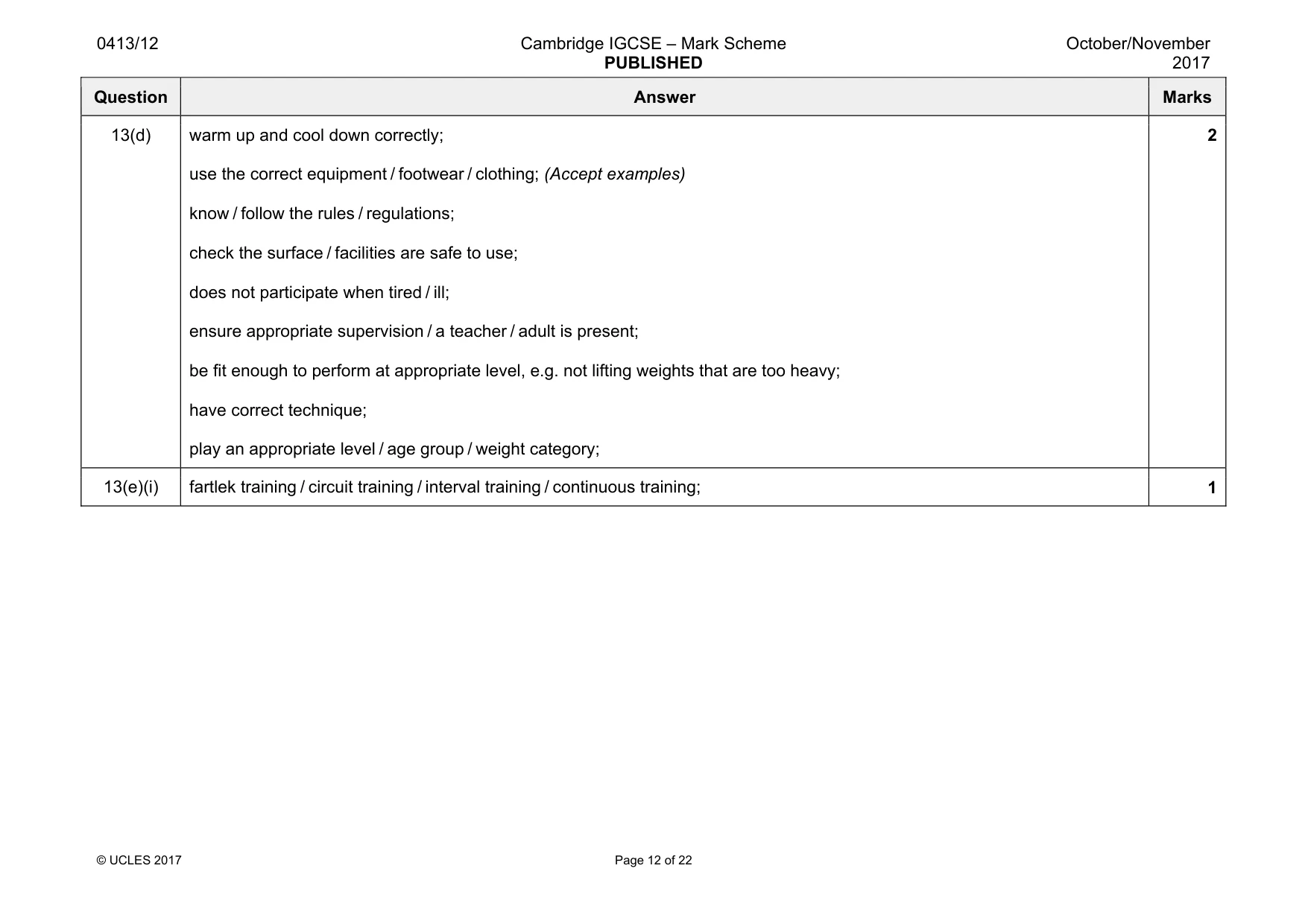
0413/12 Cambridge IGCSE – Mark Scheme PUBLISHED October/November 2017 © UCLES 2017 Page 12 of 22 Question Answer Marks 13(d) warm up and cool down correctly; use the correct equipment / footwear / clothing; (Accept examples) know / follow the rules / regulations; check the surface / facilities are safe to use; does not participate when tired / ill; ensure appropriate supervision / a teacher / adult is present; be fit enough to perform at appropriate level, e.g. not lifting weights that are too heavy; have correct technique; play an appropriate level / age group / weight category; 2 13(e)(i) fartlek training / circuit training / interval training / continuous training; 1
Mark scheme, page 13
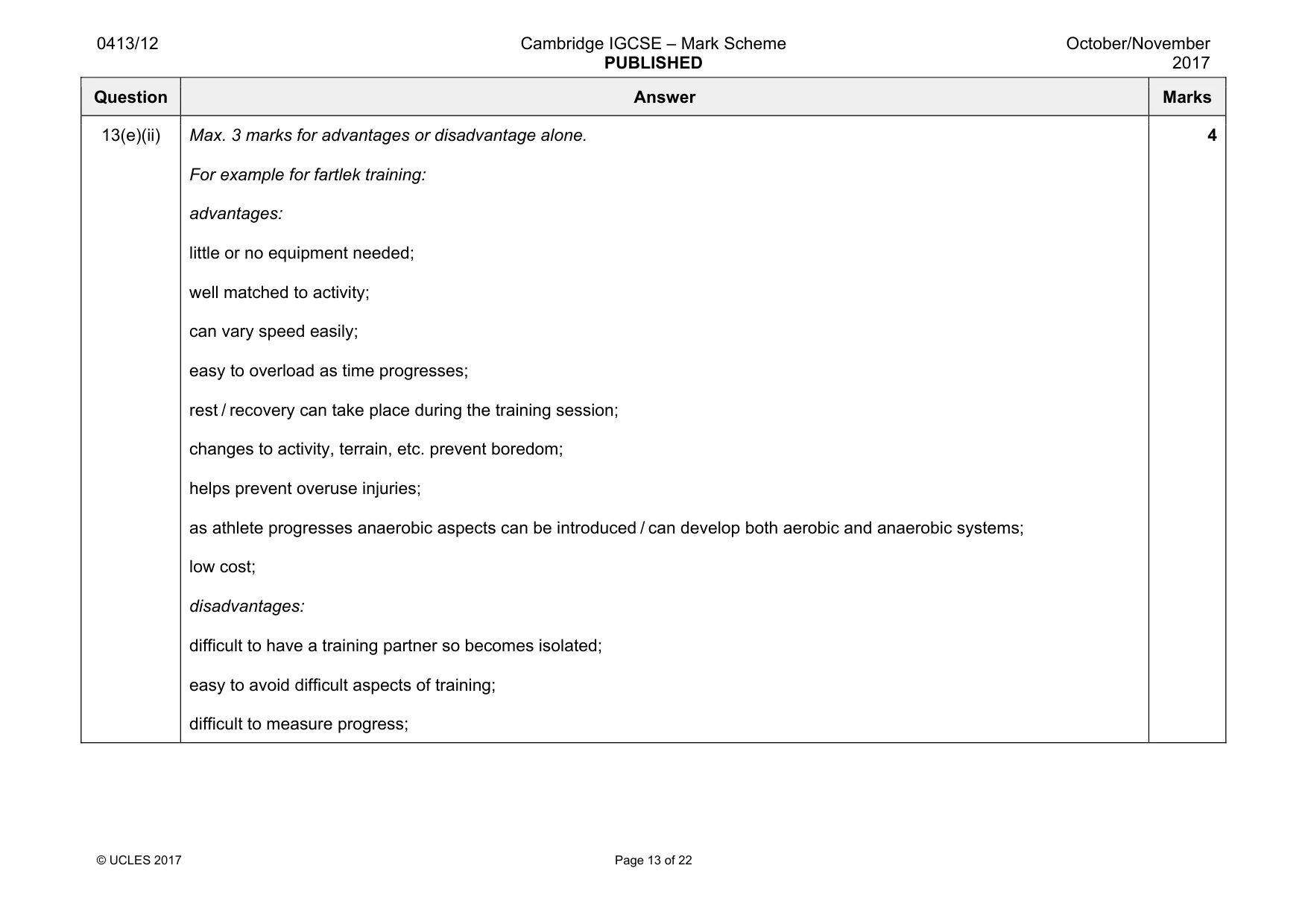
0413/12 Cambridge IGCSE – Mark Scheme PUBLISHED October/November 2017 © UCLES 2017 Page 13 of 22 Question Answer Marks 13(e)(ii) Max. 3 marks for advantages or disadvantage alone. For example for fartlek training: advantages: little or no equipment needed; well matched to activity; can vary speed easily; easy to overload as time progresses; rest / recovery can take place during the training session; changes to activity, terrain, etc. prevent boredom; helps prevent overuse injuries; as athlete progresses anaerobic aspects can be introduced / can develop both aerobic and anaerobic systems; low cost; disadvantages: difficult to have a training partner so becomes isolated; easy to avoid difficult aspects of training; difficult to measure progress; 4
Mark scheme, page 14
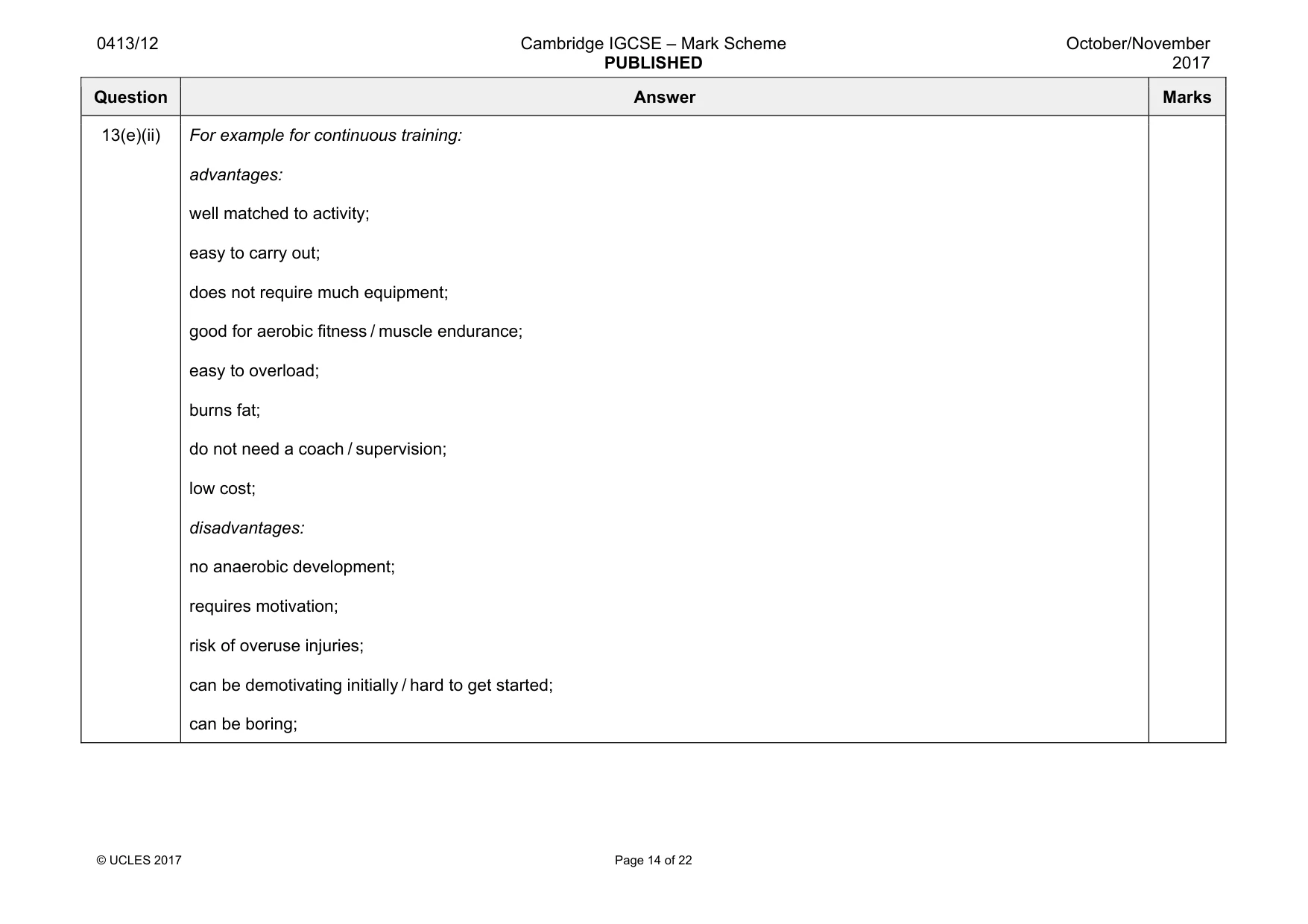
0413/12 Cambridge IGCSE – Mark Scheme PUBLISHED October/November 2017 © UCLES 2017 Page 14 of 22 Question Answer Marks 13(e)(ii) For example for continuous training: advantages: well matched to activity; easy to carry out; does not require much equipment; good for aerobic fitness / muscle endurance; easy to overload; burns fat; do not need a coach / supervision; low cost; disadvantages: no anaerobic development; requires motivation; risk of overuse injuries; can be demotivating initially / hard to get started; can be boring;
Mark scheme, page 15
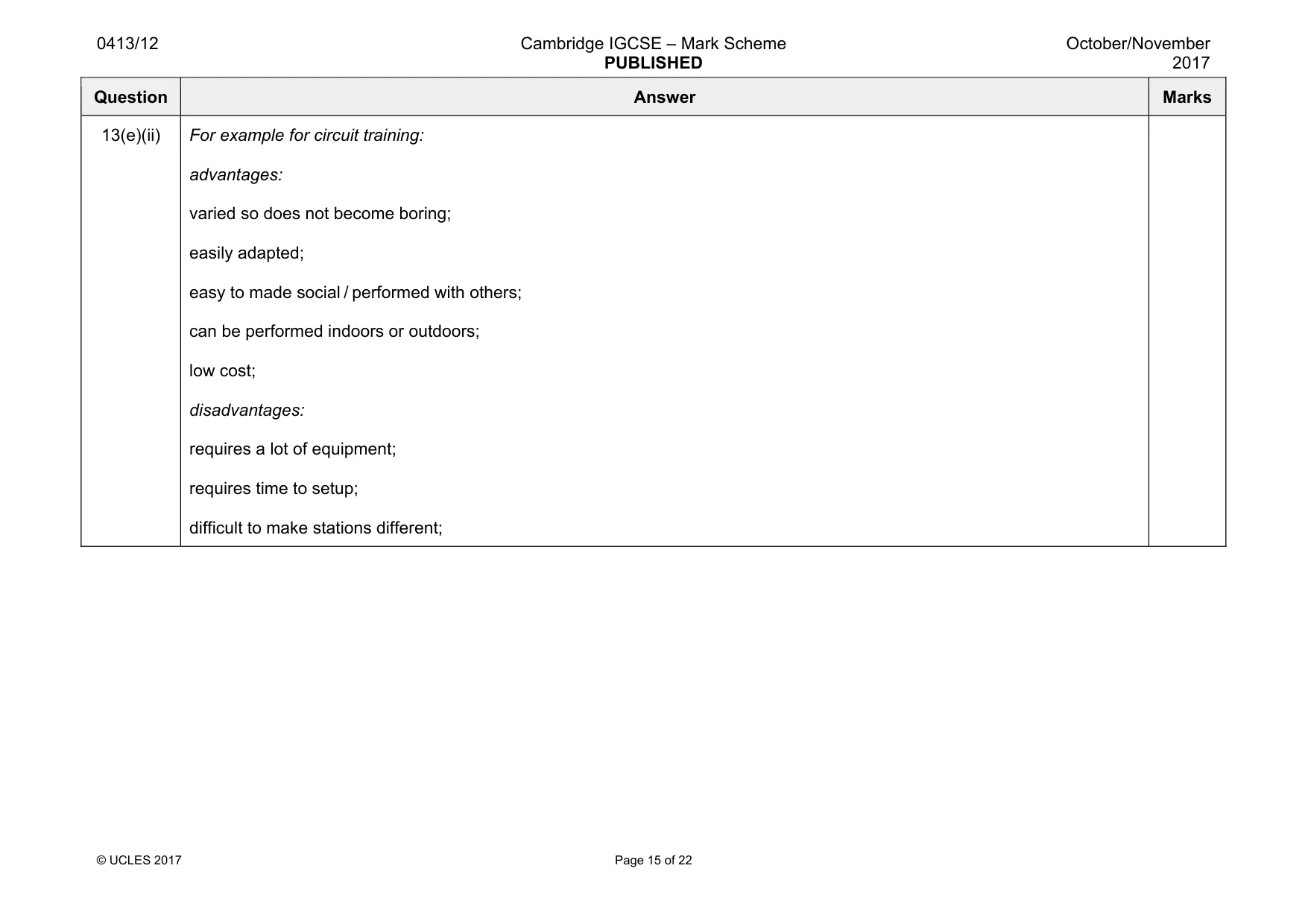
0413/12 Cambridge IGCSE – Mark Scheme PUBLISHED October/November 2017 © UCLES 2017 Page 15 of 22 Question Answer Marks 13(e)(ii) For example for circuit training: advantages: varied so does not become boring; easily adapted; easy to made social / performed with others; can be performed indoors or outdoors; low cost; disadvantages: requires a lot of equipment; requires time to setup; difficult to make stations different;
Mark scheme, page 16
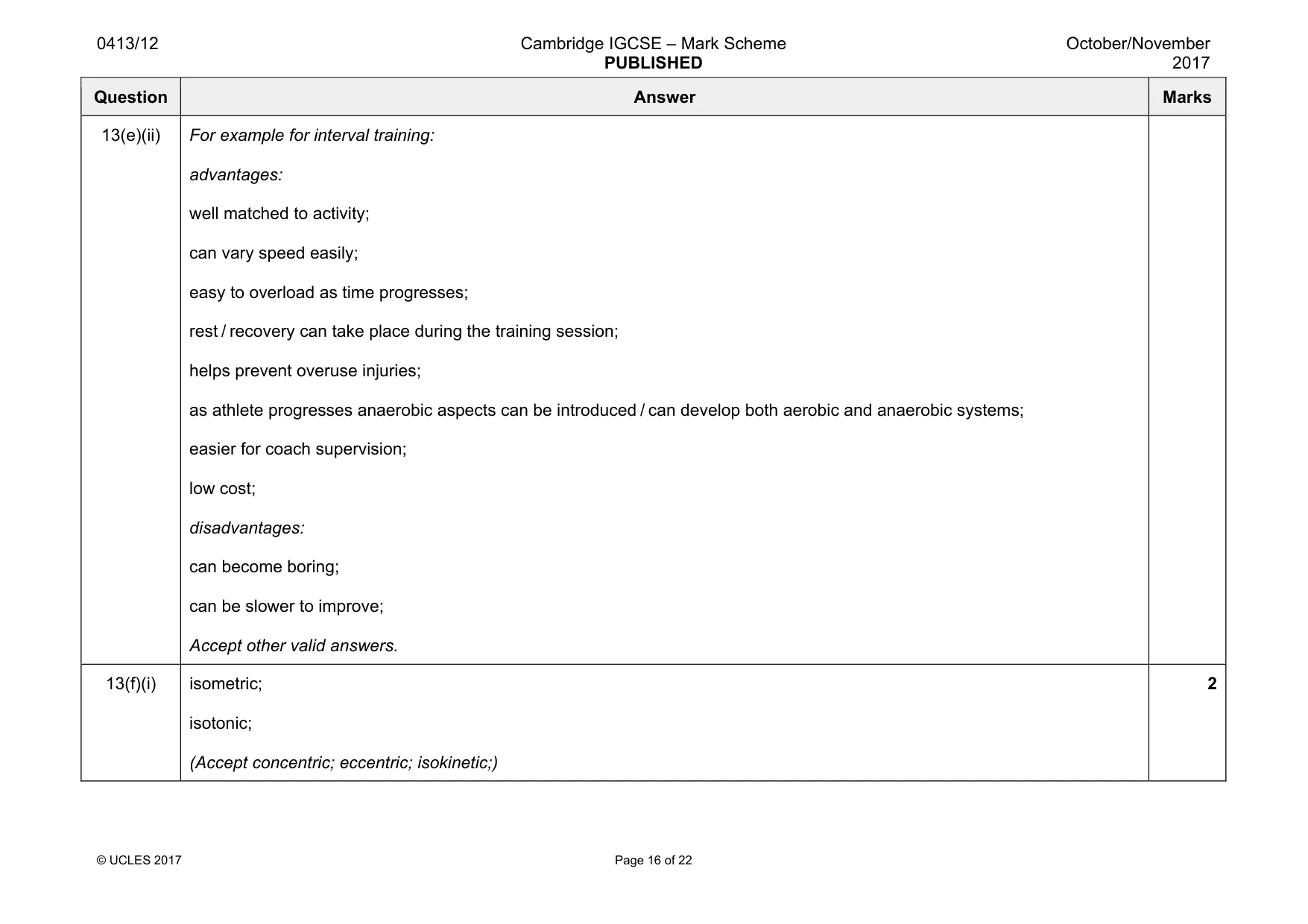
0413/12 Cambridge IGCSE – Mark Scheme PUBLISHED October/November 2017 © UCLES 2017 Page 16 of 22 Question Answer Marks 13(e)(ii) For example for interval training: advantages: well matched to activity; can vary speed easily; easy to overload as time progresses; rest / recovery can take place during the training session; helps prevent overuse injuries; as athlete progresses anaerobic aspects can be introduced / can develop both aerobic and anaerobic systems; easier for coach supervision; low cost; disadvantages: can become boring; can be slower to improve; Accept other valid answers. 13(f)(i) isometric; isotonic; (Accept concentric; eccentric; isokinetic;) 2
Mark scheme, page 17
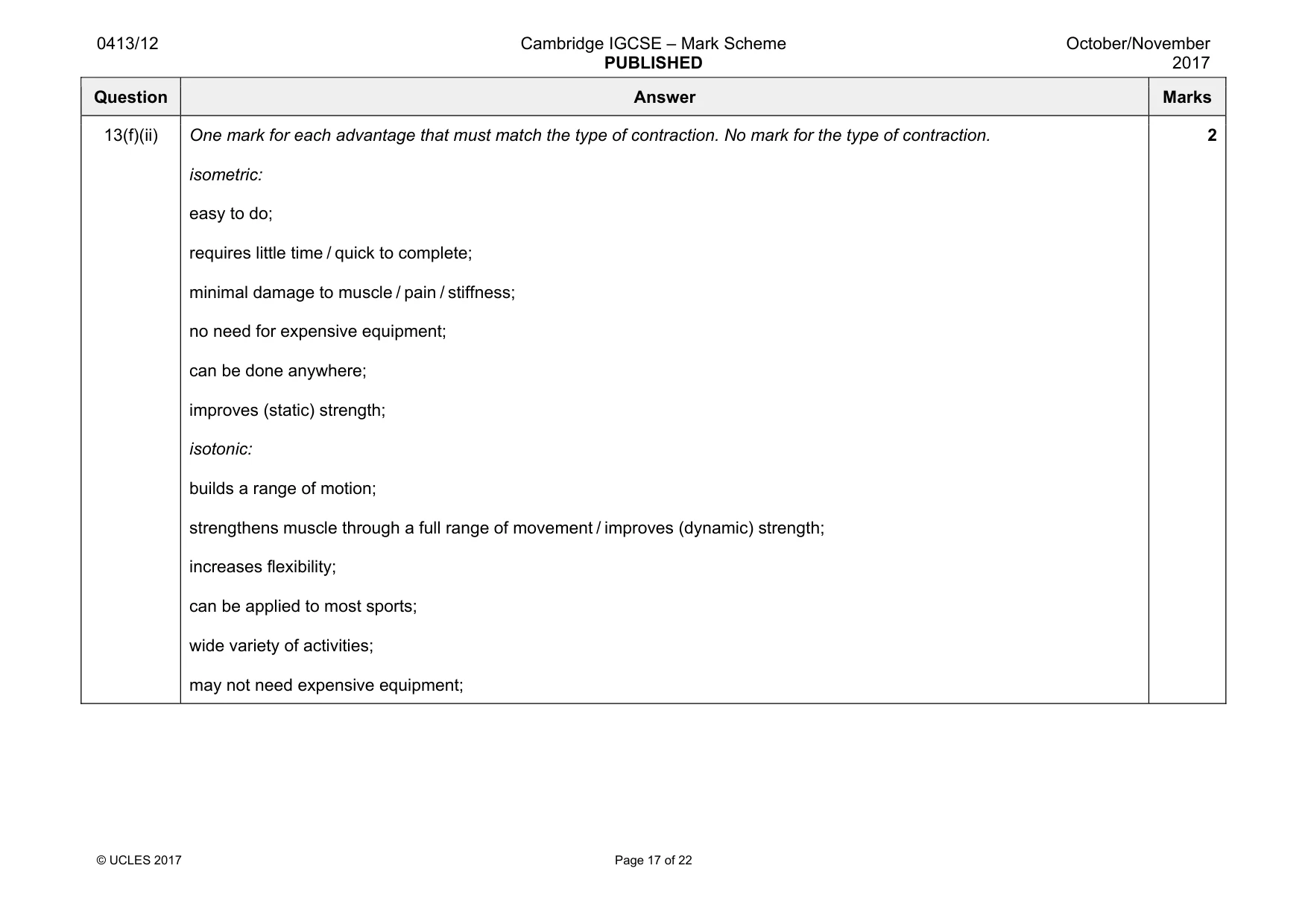
0413/12 Cambridge IGCSE – Mark Scheme PUBLISHED October/November 2017 © UCLES 2017 Page 17 of 22 Question Answer Marks 13(f)(ii) One mark for each advantage that must match the type of contraction. No mark for the type of contraction. isometric: easy to do; requires little time / quick to complete; minimal damage to muscle / pain / stiffness; no need for expensive equipment; can be done anywhere; improves (static) strength; isotonic: builds a range of motion; strengthens muscle through a full range of movement / improves (dynamic) strength; increases flexibility; can be applied to most sports; wide variety of activities; may not need expensive equipment; 2
Mark scheme, page 18
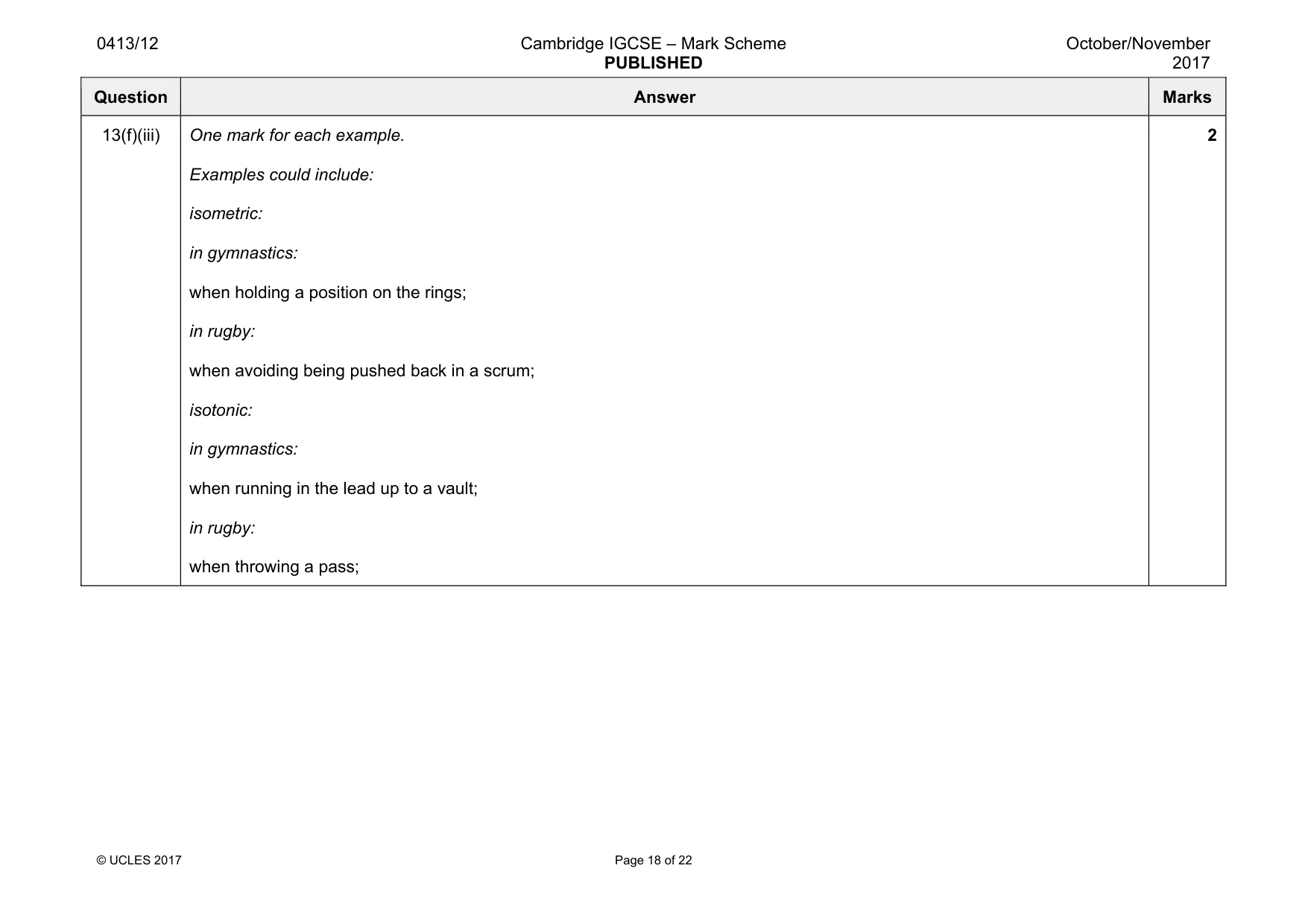
0413/12 Cambridge IGCSE – Mark Scheme PUBLISHED October/November 2017 © UCLES 2017 Page 18 of 22 Question Answer Marks 13(f)(iii) One mark for each example. Examples could include: isometric: in gymnastics: when holding a position on the rings; in rugby: when avoiding being pushed back in a scrum; isotonic: in gymnastics: when running in the lead up to a vault; in rugby: when throwing a pass; 2
Mark scheme, page 19
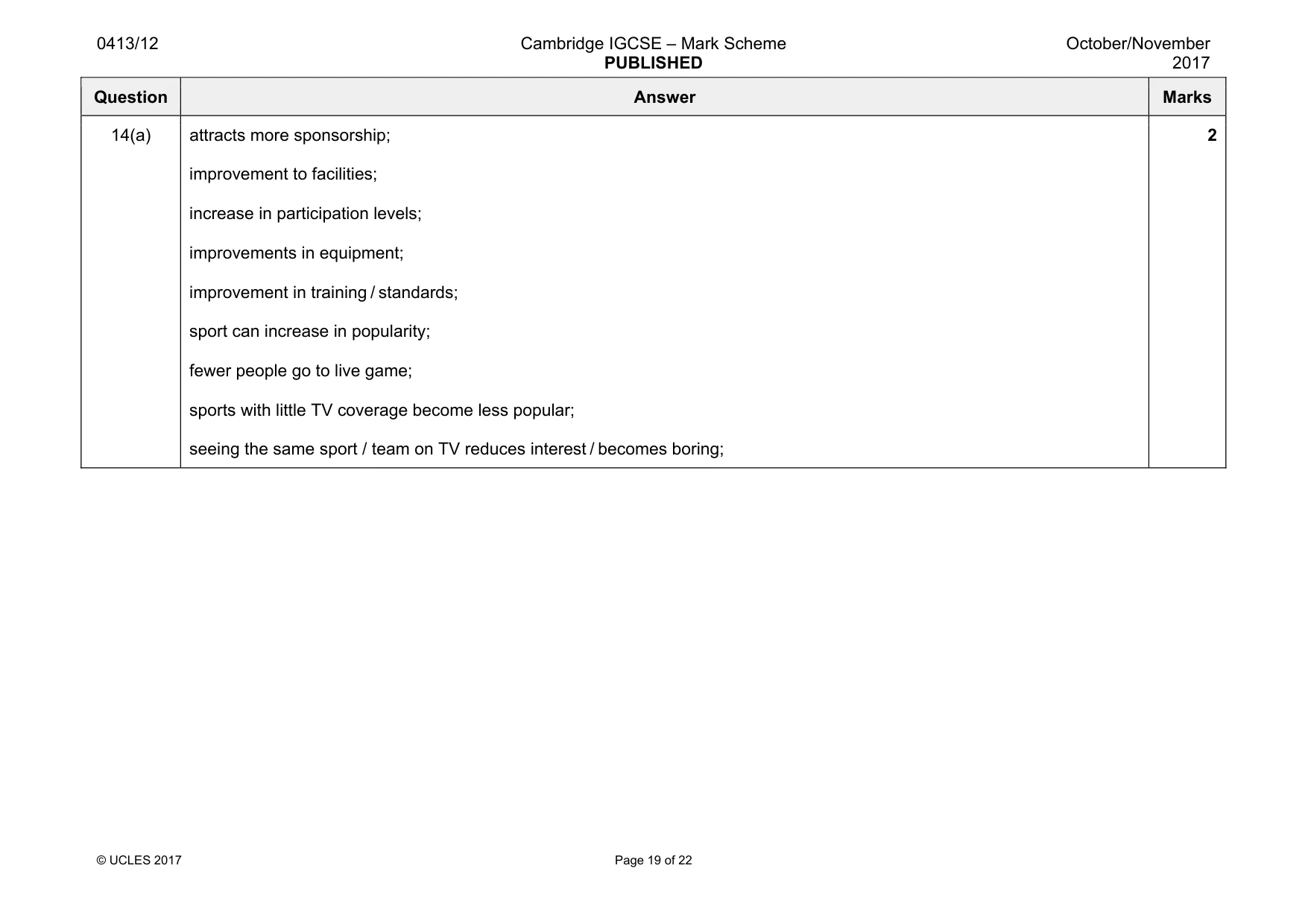
0413/12 Cambridge IGCSE – Mark Scheme PUBLISHED October/November 2017 © UCLES 2017 Page 19 of 22 Question Answer Marks 14(a) attracts more sponsorship; improvement to facilities; increase in participation levels; improvements in equipment; improvement in training / standards; sport can increase in popularity; fewer people go to live game; sports with little TV coverage become less popular; seeing the same sport / team on TV reduces interest / becomes boring; 2
Mark scheme, page 20
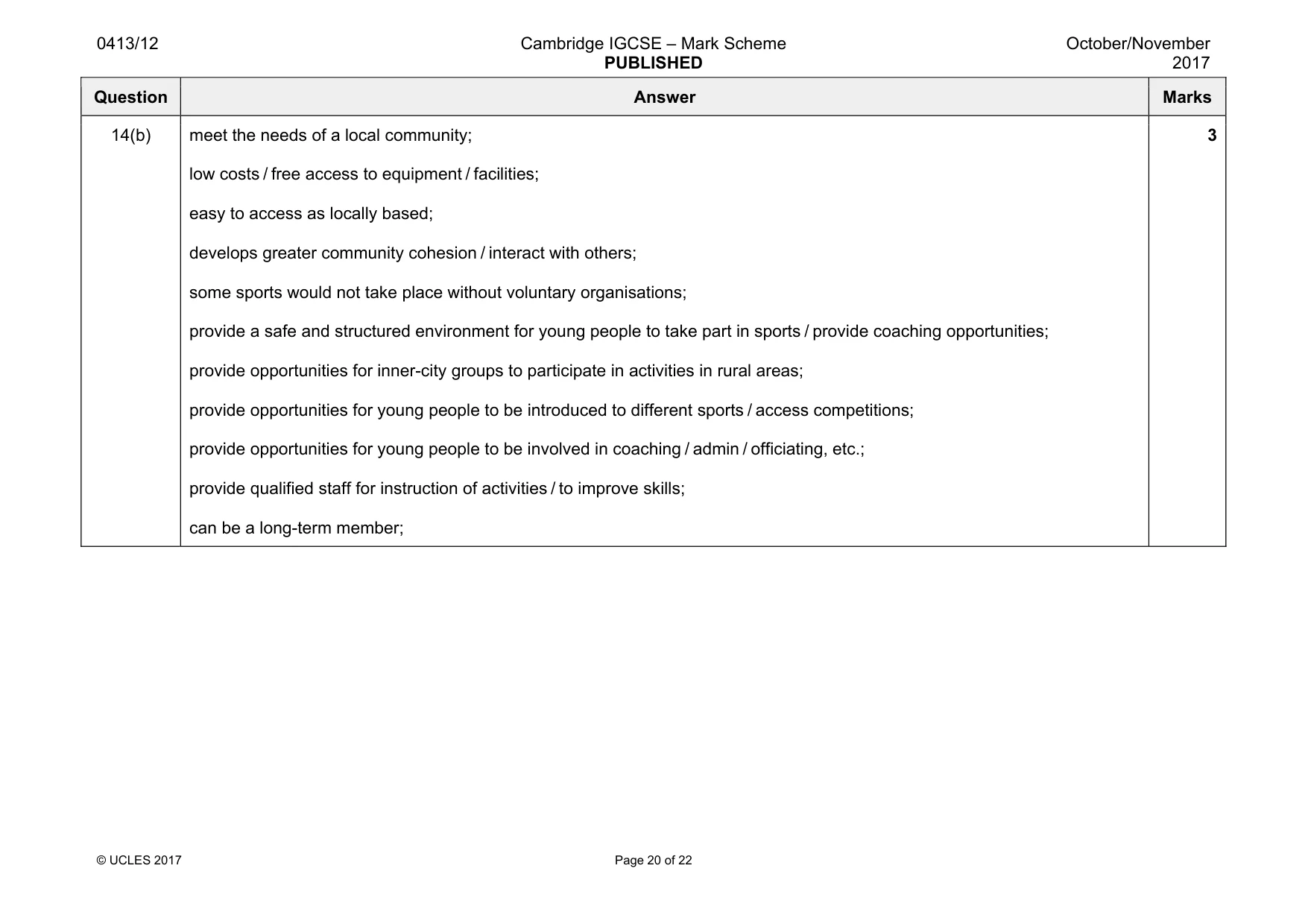
0413/12 Cambridge IGCSE – Mark Scheme PUBLISHED October/November 2017 © UCLES 2017 Page 20 of 22 Question Answer Marks 14(b) meet the needs of a local community; low costs / free access to equipment / facilities; easy to access as locally based; develops greater community cohesion / interact with others; some sports would not take place without voluntary organisations; provide a safe and structured environment for young people to take part in sports / provide coaching opportunities; provide opportunities for inner-city groups to participate in activities in rural areas; provide opportunities for young people to be introduced to different sports / access competitions; provide opportunities for young people to be involved in coaching / admin / officiating, etc.; provide qualified staff for instruction of activities / to improve skills; can be a long-term member; 3
Mark scheme, page 21
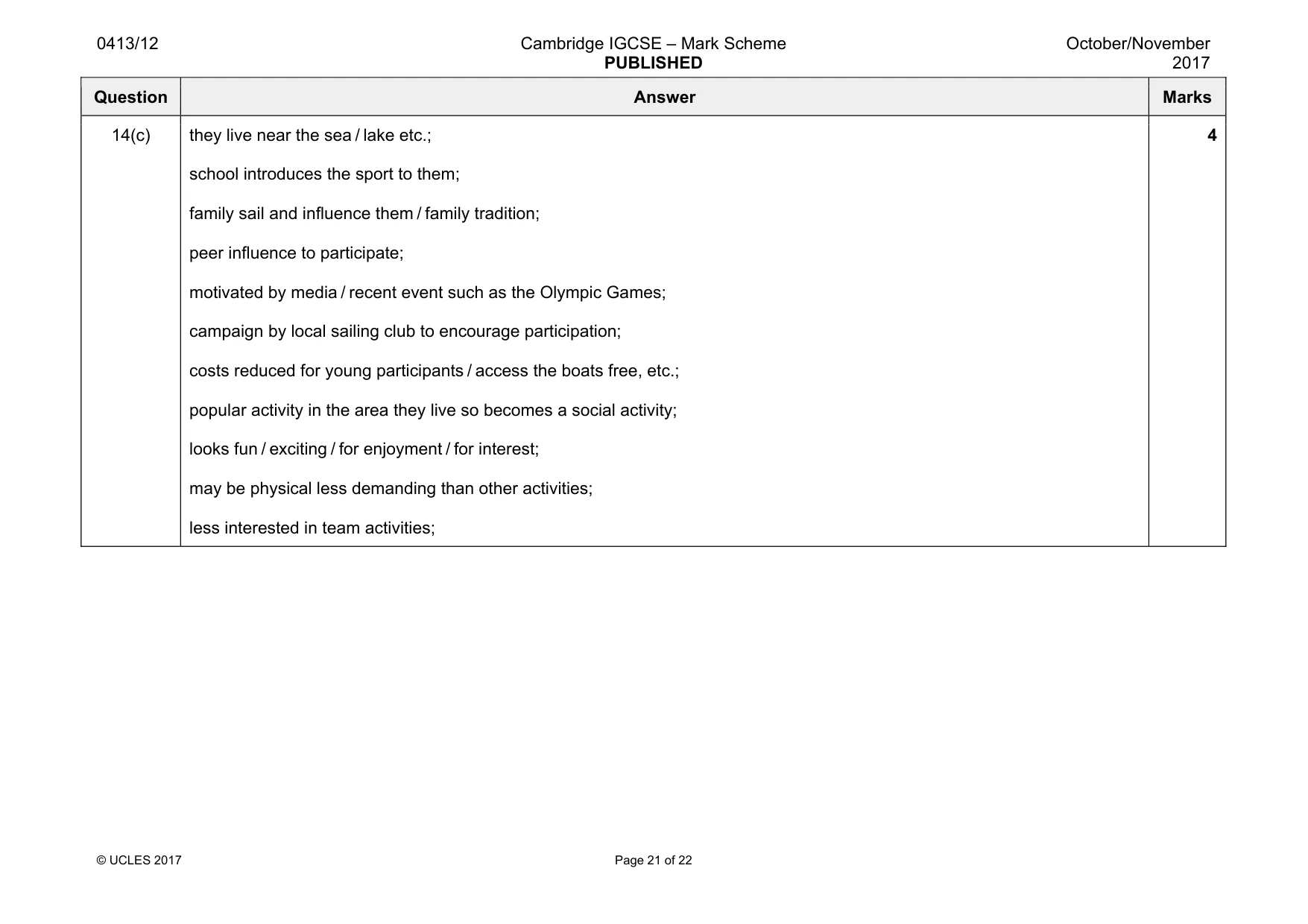
0413/12 Cambridge IGCSE – Mark Scheme PUBLISHED October/November 2017 © UCLES 2017 Page 21 of 22 Question Answer Marks 14(c) they live near the sea / lake etc.; school introduces the sport to them; family sail and influence them / family tradition; peer influence to participate; motivated by media / recent event such as the Olympic Games; campaign by local sailing club to encourage participation; costs reduced for young participants / access the boats free, etc.; popular activity in the area they live so becomes a social activity; looks fun / exciting / for enjoyment / for interest; may be physical less demanding than other activities; less interested in team activities; 4
Mark scheme, page 22
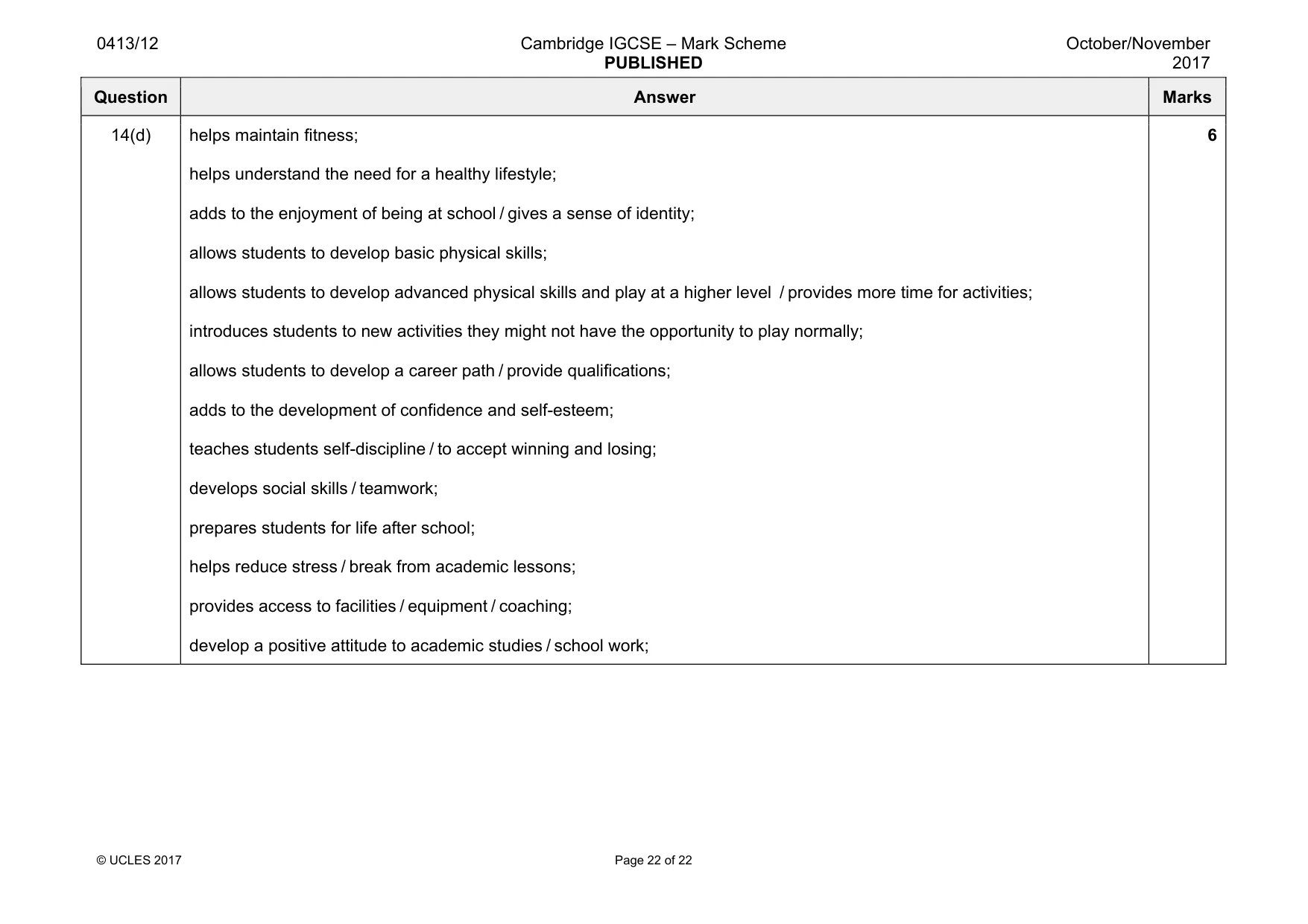
0413/12 Cambridge IGCSE – Mark Scheme PUBLISHED October/November 2017 © UCLES 2017 Page 22 of 22 Question Answer Marks 14(d) helps maintain fitness; helps understand the need for a healthy lifestyle; adds to the enjoyment of being at school / gives a sense of identity; allows students to develop basic physical skills; allows students to develop advanced physical skills and play at a higher level / provides more time for activities; introduces students to new activities they might not have the opportunity to play normally; allows students to develop a career path / provide qualifications; adds to the development of confidence and self-esteem; teaches students self-discipline / to accept winning and losing; develops social skills / teamwork; prepares students for life after school; helps reduce stress / break from academic lessons; provides access to facilities / equipment / coaching; develop a positive attitude to academic studies / school work; 6
What you needed in this session
Cambridge’s own grade thresholds for 2017 Oct/Nov, Paper 1 · Variant 2. A higher threshold means an easier paper — the bar moves with how the cohort did.