Cambridge IGCSE Physical Education 0413 — 2017 Oct/Nov Paper 1 · Variant 3
0413/13/O/N/17 · 80 marks · ≈90 min
The question paper and its mark scheme, free to read here and free to download. This is Cambridge’s own paper, exactly as it was sat.
Question paper12 pages
Mark scheme12 pages
Answers below. Sit the paper first if you are practising.
Paper as text
Question paper, page 1
Cambridge International Examinations Cambridge International General Certificate of Secondary Education 0413/13 October/November 2017 1 hour 45 minutes PHYSICAL EDUCATION Paper 1 Candidates answer on the Question Paper. No Additional Materials are required. READ THESE INSTRUCTIONS FIRST Write your Centre number, candidate number and name on all the work you hand in. Write in dark blue or black pen. You may use an HB pencil for any diagrams or graphs. Do not use staples, paper clips, glue or correction fluid. DO NOT WRITE IN ANY BARCODES. Section A Answer all questions in this section. Write your answers in the spaces provided on the Question Paper. Section B Answer all questions in this section. Write your answers in the spaces provided on the Question Paper. Electronic calculators may be used. You may lose marks if you do not show your working or if you do not use appropriate units. At the end of the examination, fasten all your work securely together. The number of marks is given in brackets [ ] at the end of each question or part question. This document consists of 12 printed pages. [Turn over 11_0413_13_2017_1.25 © UCLES 2017 *3507619582*
Question paper, page 2
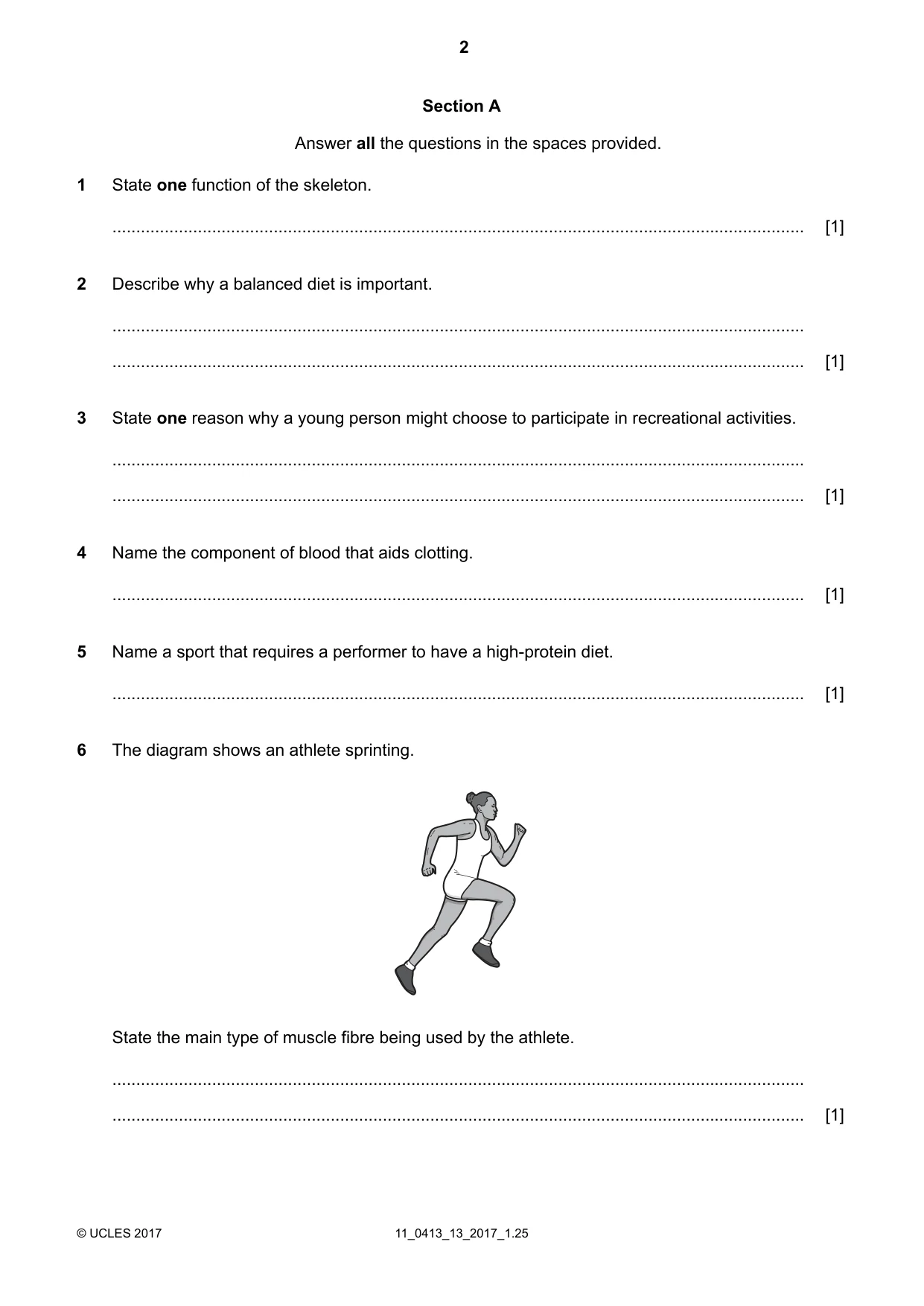
Section A Answer all the questions in the spaces provided. State one function of the skeleton. 1 … [1] Describe why a balanced diet is important. 2 … … [1] State one reason why a young person might choose to participate in recreational activities. 3 … … [1] Name the component of blood that aids clotting. 4 … [1] Name a sport that requires a performer to have a high-protein diet. 5 … [1] The diagram shows an athlete sprinting. 6 State the main type of muscle fibre being used by the athlete. … … [1] 11_0413_13_2017_1.25 © UCLES 2017 2
Question paper, page 3
Suggest two reasons why a performer might choose to take a banned performance-enhancing drug. 7 … … … … [2] Describe two factors that will affect the energy requirements of an individual. 8 … … … … [2] Describe, using a named joint as an example, two features of a fibrous joint. 9 fibrous joint… feature 1… … feature 2… … [3] Describe three benefits of a warm up. 10 … … … … … … [3] [Turn over 11_0413_13_2017_1.25 © UCLES 2017 3
Question paper, page 4
Suggest why some governments encourage participation in sport. 11 … … … … … … … … [4] [Total: 20] 11_0413_13_2017_1.25 © UCLES 2017 4
Question paper, page 5
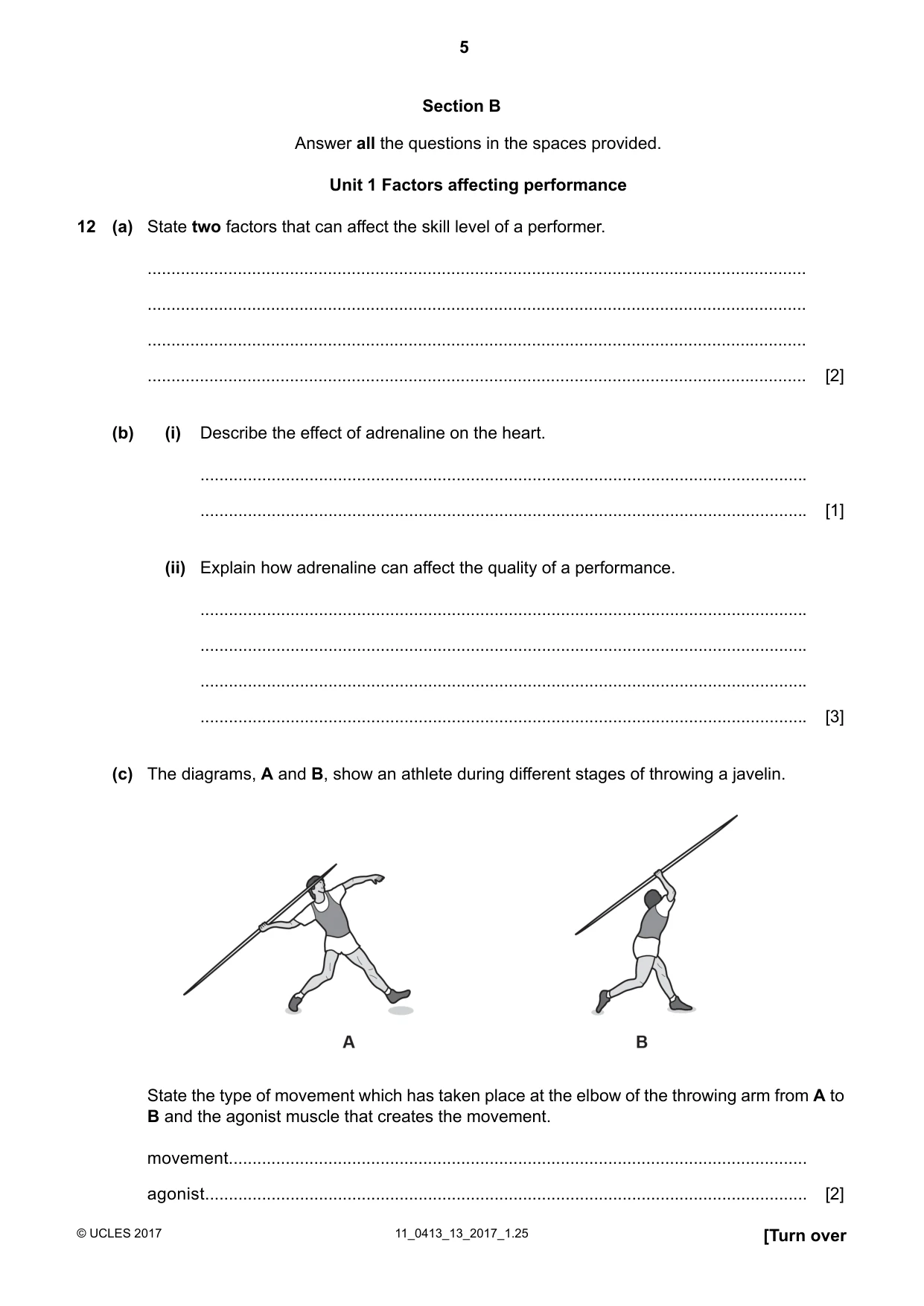
Section B Answer all the questions in the spaces provided. Unit 1 Factors affecting performance State two factors that can affect the skill level of a performer. (a) 12 … … … … [2] Describe the effect of adrenaline on the heart. (i) (b) … … [1] Explain how adrenaline can affect the quality of a performance. (ii) … … … … [3] The diagrams, A and B, show an athlete during different stages of throwing a javelin. (c) State the type of movement which has taken place at the elbow of the throwing arm from A to B and the agonist muscle that creates the movement. movement… agonist… [2] [Turn over 11_0413_13_2017_1.25 © UCLES 2017 5
Question paper, page 6
Explain factors that affect recovery time after exercise. (d) … … … … … … [3] Muscular endurance is a component of health-related fitness. (e) State what is meant by the term muscular endurance. (i) … … [1] Name a sport where muscular endurance is essential. (ii) … … [1] Name and describe a recognised test that could be used to measure muscular endurance. (iii) name of test… … description… … … … [2] 11_0413_13_2017_1.25 © UCLES 2017 6
Question paper, page 7
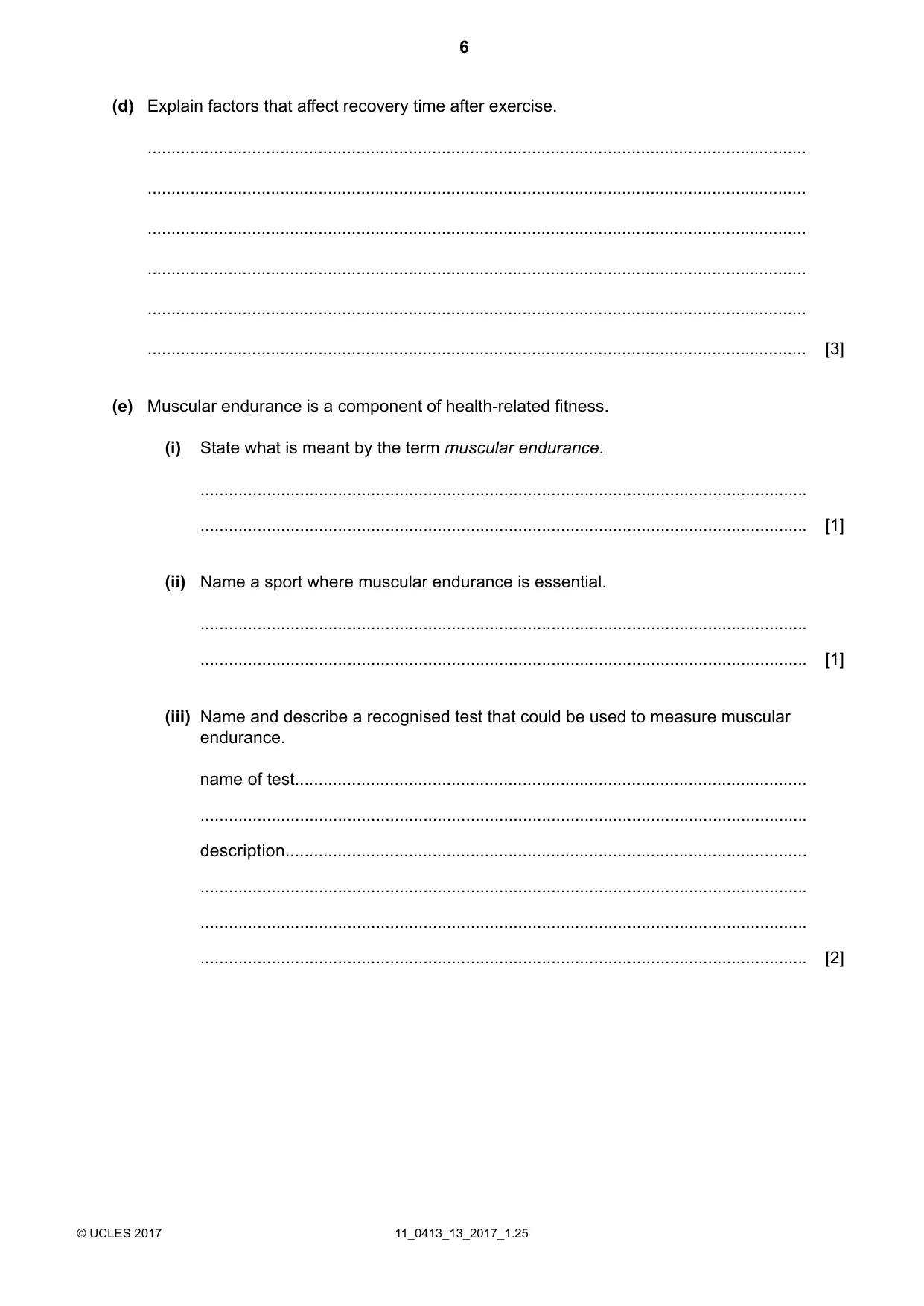
Explain why an extreme endomorph might be at a disadvantage when playing a team game such as basketball or netball. (f) … … … … … … … … [4] Explain how smoking tobacco can reduce performance in physical activity. (g) … … … … … … … … … … … … [6] [Total: 25] [Turn over 11_0413_13_2017_1.25 © UCLES 2017 7
Question paper, page 8
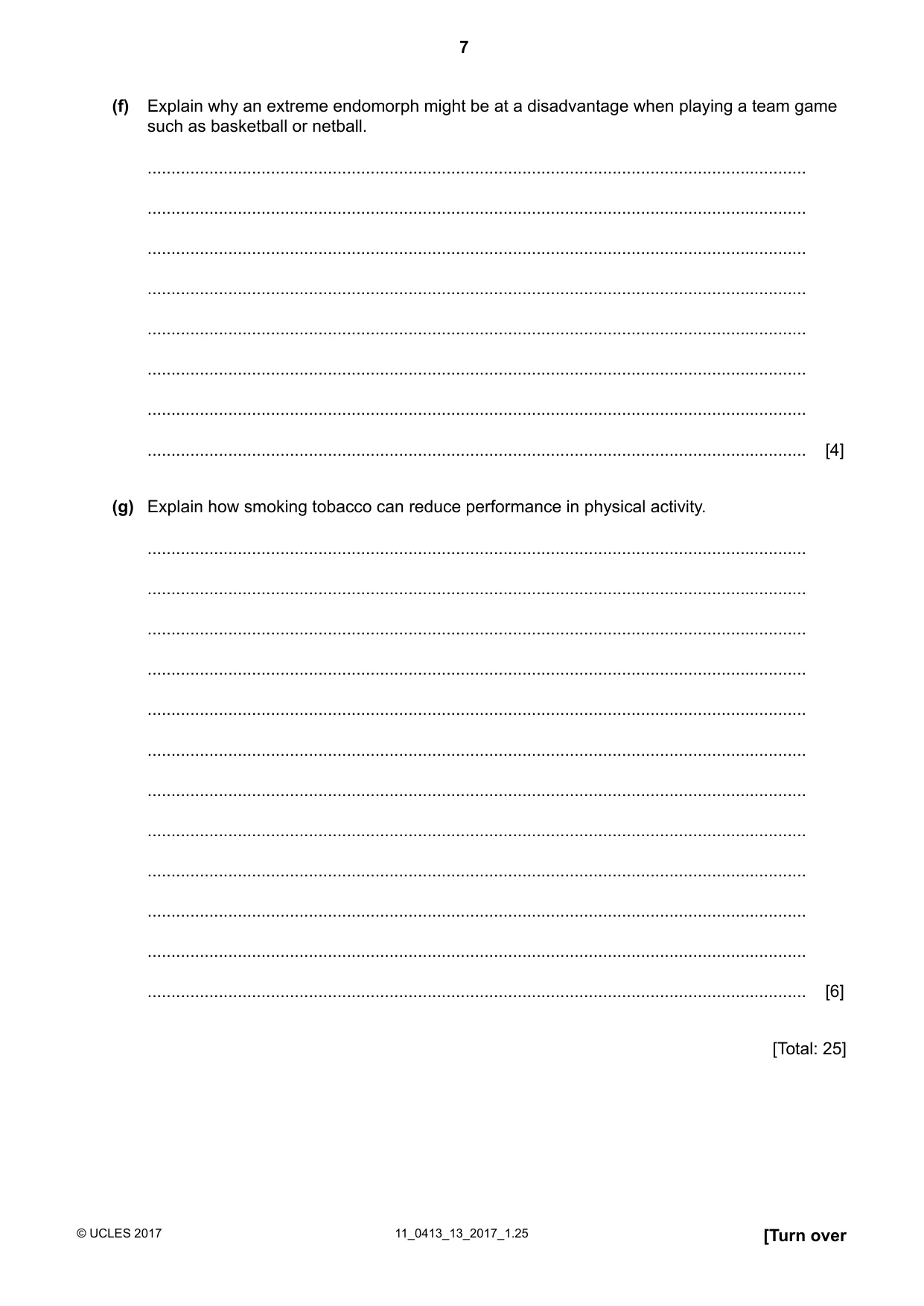
Unit 2 Health, safety and training State why taking part in sport can improve a person’s social well-being. (a) 13 … … … … [2] Suggest some of the personal safety issues, other than warming up, that should be considered before starting to exercise. (b) … … … … [2] The diagram shows a weight-training facility. (c) Explain the safety arrangements that a school teacher should consider when planning to use weight training as a group activity following a warm up. … … … … … … [3] 11_0413_13_2017_1.25 © UCLES 2017 8
Question paper, page 9
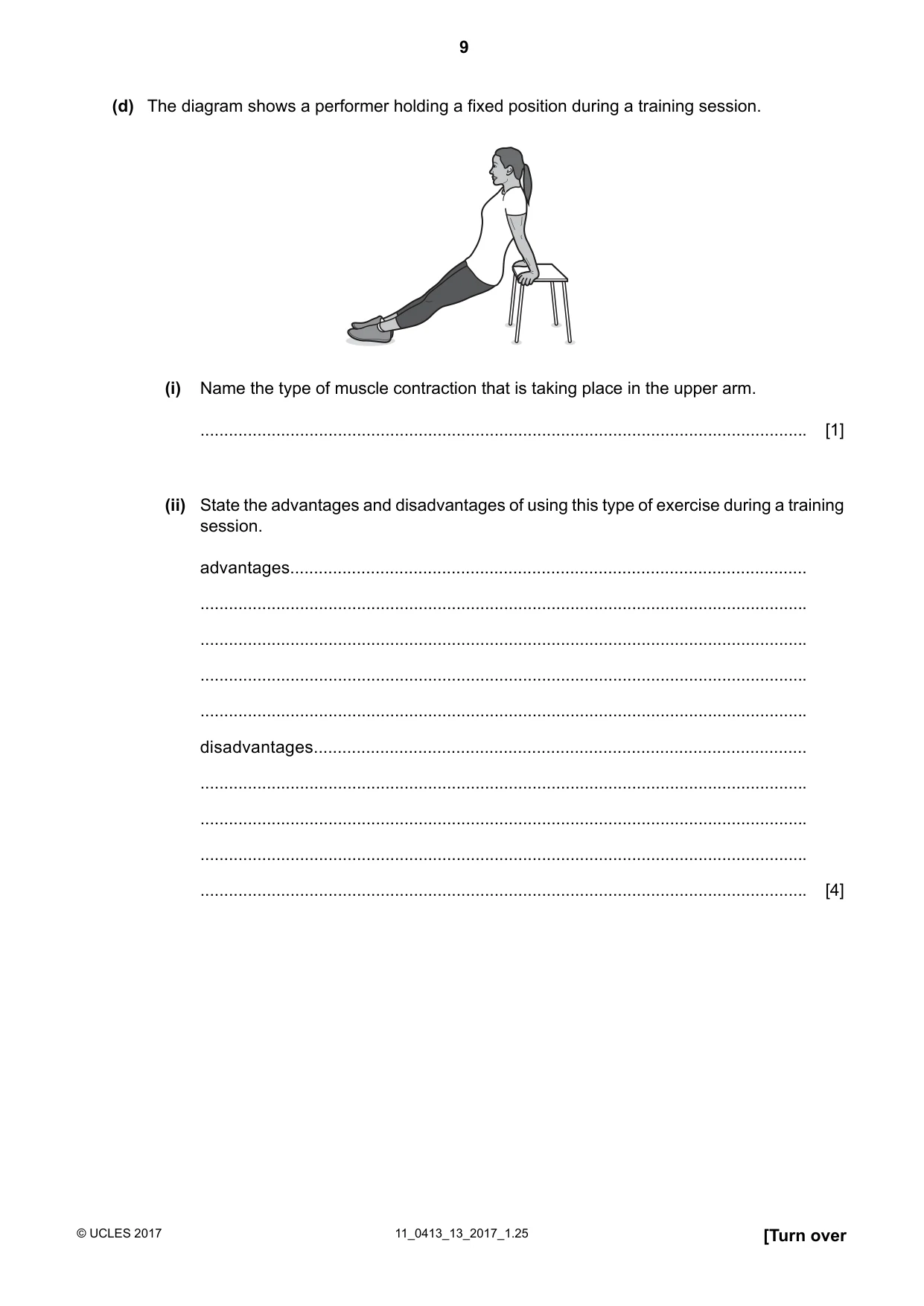
The diagram shows a performer holding a fixed position during a training session. (d) Name the type of muscle contraction that is taking place in the upper arm. (i) … [1] State the advantages and disadvantages of using this type of exercise during a training session. (ii) advantages… … … … … disadvantages… … … … … [4] [Turn over 11_0413_13_2017_1.25 © UCLES 2017 9
Question paper, page 10
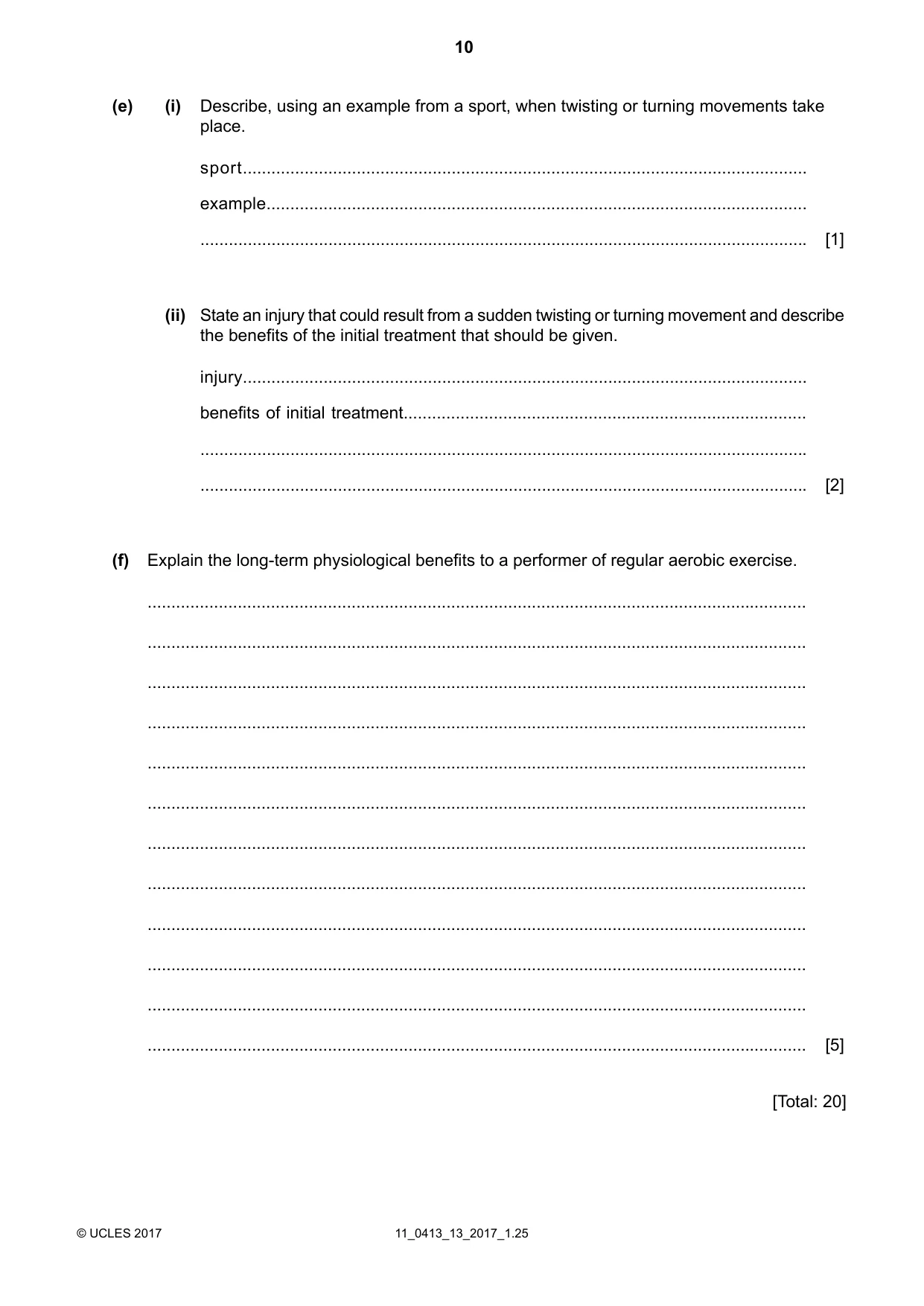
Describe, using an example from a sport, when twisting or turning movements take place. (i) (e) sport… example… … [1] State an injury that could result from a sudden twisting or turning movement and describe the benefits of the initial treatment that should be given. (ii) injury… benefits of initial treatment… … … [2] Explain the long-term physiological benefits to a performer of regular aerobic exercise. (f) … … … … … … … … … … … … [5] [Total: 20] 11_0413_13_2017_1.25 © UCLES 2017 10
Question paper, page 11
Unit 3 Reasons and opportunities for participation in physical activity State two advantages of sports commentary on the radio. (a) 14 … … … … [2] Describe some of the disadvantages that living in a rural area can have on sports participation. (b) … … … … … … [3] Explain the benefits to a sponsor of sponsoring a local amateur team. (c) … … … … … … … … [4] [Turn over 11_0413_13_2017_1.25 © UCLES 2017 11
Question paper, page 12
Suggest ways that a country can improve its athletes’ chances of success in major global events such as the Olympic Games. (d) … … … … … … … … … … … … [6] [Total: 15] Permission to reproduce items where third-party owned material protected by copyright is included has been sought and cleared where possible. Every reasonable effort has been made by the publisher (UCLES) to trace copyright holders, but if any items requiring clearance have unwittingly been included, the publisher will be pleased to make amends at the earliest possible opportunity. To avoid the issue of disclosure of answer-related information to candidates, all copyright acknowledgements are reproduced online in the Cambridge International Examinations Copyright Acknowledgements Booklet. This is produced for each series of examinations and is freely available to download at www.cie.org.uk after the live examination series. Cambridge International Examinations is part of the Cambridge Assessment Group. Cambridge Assessment is the brand name of University of Cambridge Local Examinations Syndicate (UCLES), which is itself a department of the University of Cambridge. 11_0413_13_2017_1.25 © UCLES 2017 12
Mark scheme, page 1
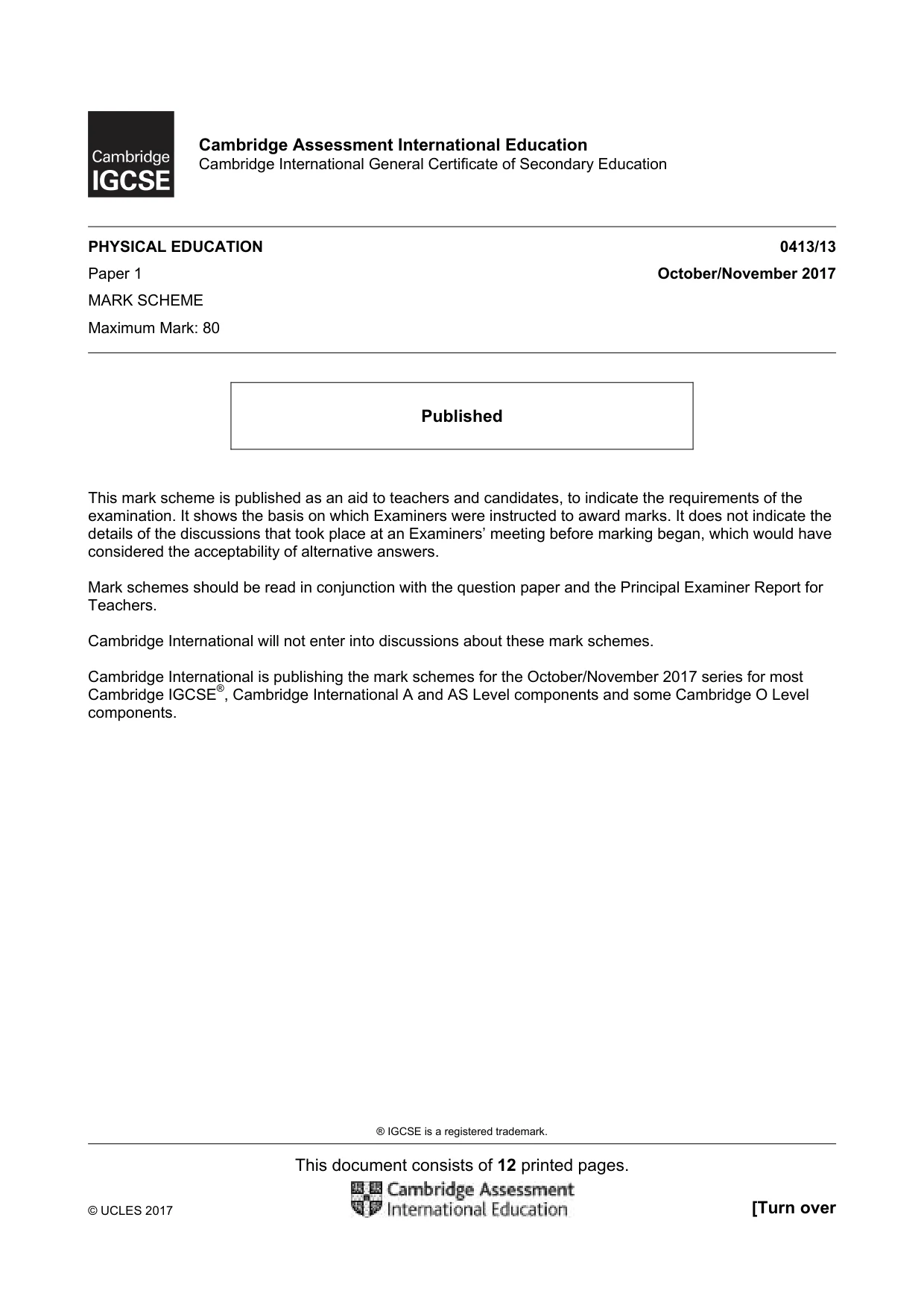
® IGCSE is a registered trademark. This document consists of 12 printed pages. © UCLES 2017 [Turn over Cambridge Assessment International Education Cambridge International General Certificate of Secondary Education PHYSICAL EDUCATION 0413/13 Paper 1 October/November 2017 MARK SCHEME Maximum Mark: 80 Published This mark scheme is published as an aid to teachers and candidates, to indicate the requirements of the examination. It shows the basis on which Examiners were instructed to award marks. It does not indicate the details of the discussions that took place at an Examiners’ meeting before marking began, which would have considered the acceptability of alternative answers. Mark schemes should be read in conjunction with the question paper and the Principal Examiner Report for Teachers. Cambridge International will not enter into discussions about these mark schemes. Cambridge International is publishing the mark schemes for the October/November 2017 series for most Cambridge IGCSE®, Cambridge International A and AS Level components and some Cambridge O Level components.
Mark scheme, page 2
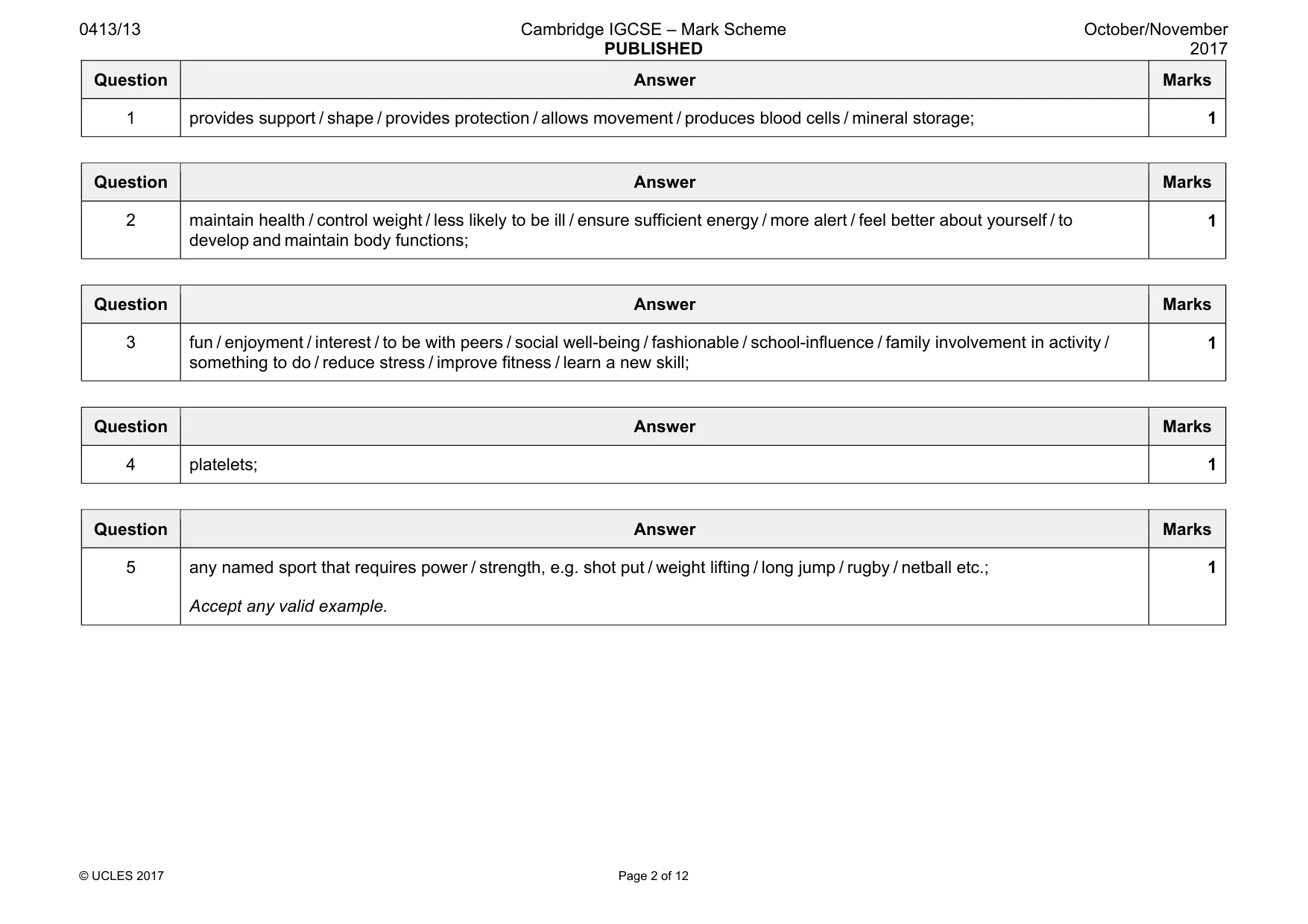
0413/13 Cambridge IGCSE – Mark Scheme PUBLISHED October/November 2017 © UCLES 2017 Page 2 of 12 Question Answer Marks 1 provides support / shape / provides protection / allows movement / produces blood cells / mineral storage; 1 Question Answer Marks 2 maintain health / control weight / less likely to be ill / ensure sufficient energy / more alert / feel better about yourself / to develop and maintain body functions; 1 Question Answer Marks 3 fun / enjoyment / interest / to be with peers / social well-being / fashionable / school-influence / family involvement in activity / something to do / reduce stress / improve fitness / learn a new skill; 1 Question Answer Marks 4 platelets; 1 Question Answer Marks 5 any named sport that requires power / strength, e.g. shot put / weight lifting / long jump / rugby / netball etc.; Accept any valid example. 1
Mark scheme, page 3
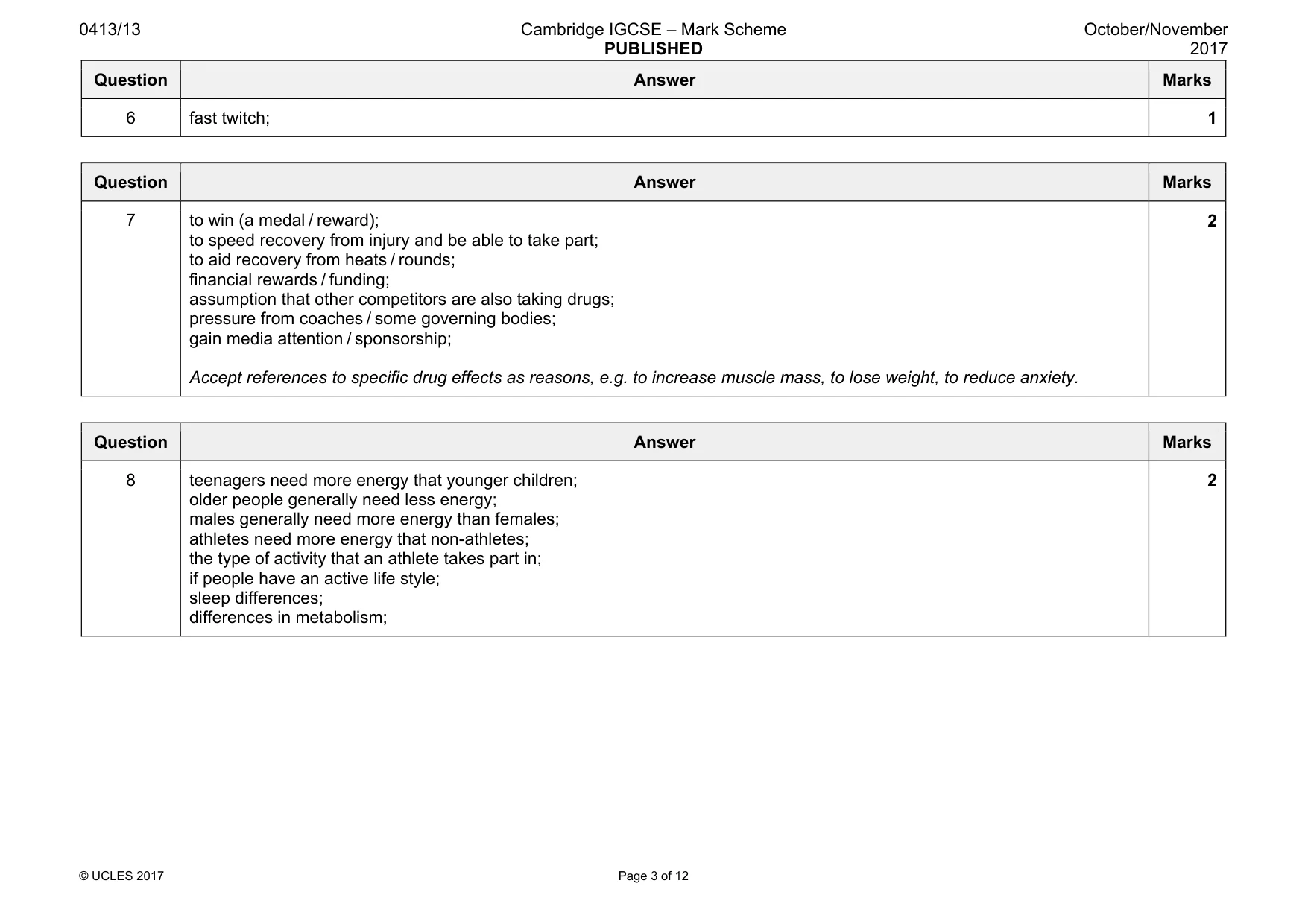
0413/13 Cambridge IGCSE – Mark Scheme PUBLISHED October/November 2017 © UCLES 2017 Page 3 of 12 Question Answer Marks 6 fast twitch; 1 Question Answer Marks 7 to win (a medal / reward); to speed recovery from injury and be able to take part; to aid recovery from heats / rounds; financial rewards / funding; assumption that other competitors are also taking drugs; pressure from coaches / some governing bodies; gain media attention / sponsorship; Accept references to specific drug effects as reasons, e.g. to increase muscle mass, to lose weight, to reduce anxiety. 2 Question Answer Marks 8 teenagers need more energy that younger children; older people generally need less energy; males generally need more energy than females; athletes need more energy that non-athletes; the type of activity that an athlete takes part in; if people have an active life style; sleep differences; differences in metabolism; 2
Mark scheme, page 4
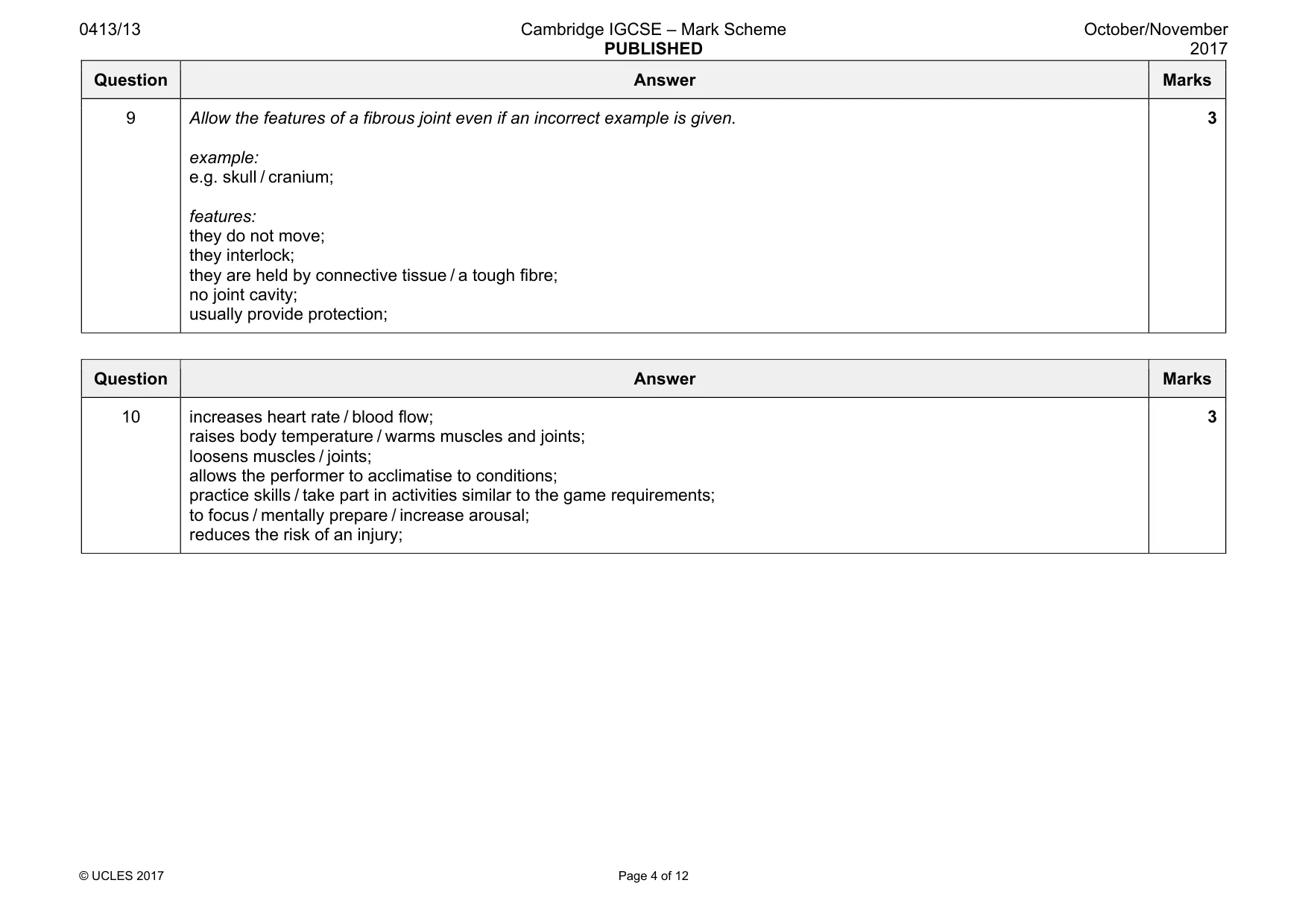
0413/13 Cambridge IGCSE – Mark Scheme PUBLISHED October/November 2017 © UCLES 2017 Page 4 of 12 Question Answer Marks 9 Allow the features of a fibrous joint even if an incorrect example is given. example: e.g. skull / cranium; features: they do not move; they interlock; they are held by connective tissue / a tough fibre; no joint cavity; usually provide protection; 3 Question Answer Marks 10 increases heart rate / blood flow; raises body temperature / warms muscles and joints; loosens muscles / joints; allows the performer to acclimatise to conditions; practice skills / take part in activities similar to the game requirements; to focus / mentally prepare / increase arousal; reduces the risk of an injury; 3
Mark scheme, page 5
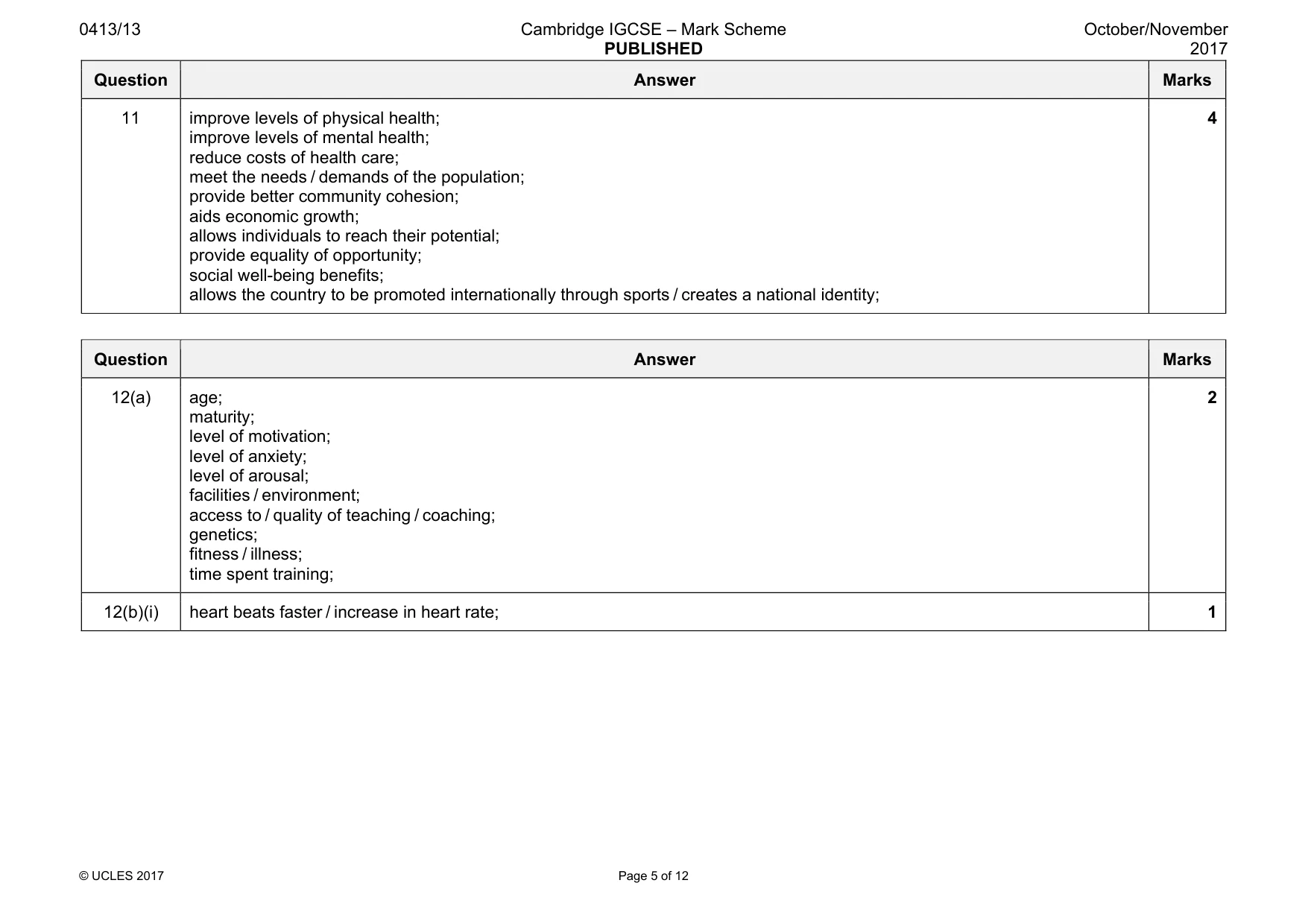
0413/13 Cambridge IGCSE – Mark Scheme PUBLISHED October/November 2017 © UCLES 2017 Page 5 of 12 Question Answer Marks 11 improve levels of physical health; improve levels of mental health; reduce costs of health care; meet the needs / demands of the population; provide better community cohesion; aids economic growth; allows individuals to reach their potential; provide equality of opportunity; social well-being benefits; allows the country to be promoted internationally through sports / creates a national identity; 4 Question Answer Marks 12(a) age; maturity; level of motivation; level of anxiety; level of arousal; facilities / environment; access to / quality of teaching / coaching; genetics; fitness / illness; time spent training; 2 12(b)(i) heart beats faster / increase in heart rate; 1
Mark scheme, page 6
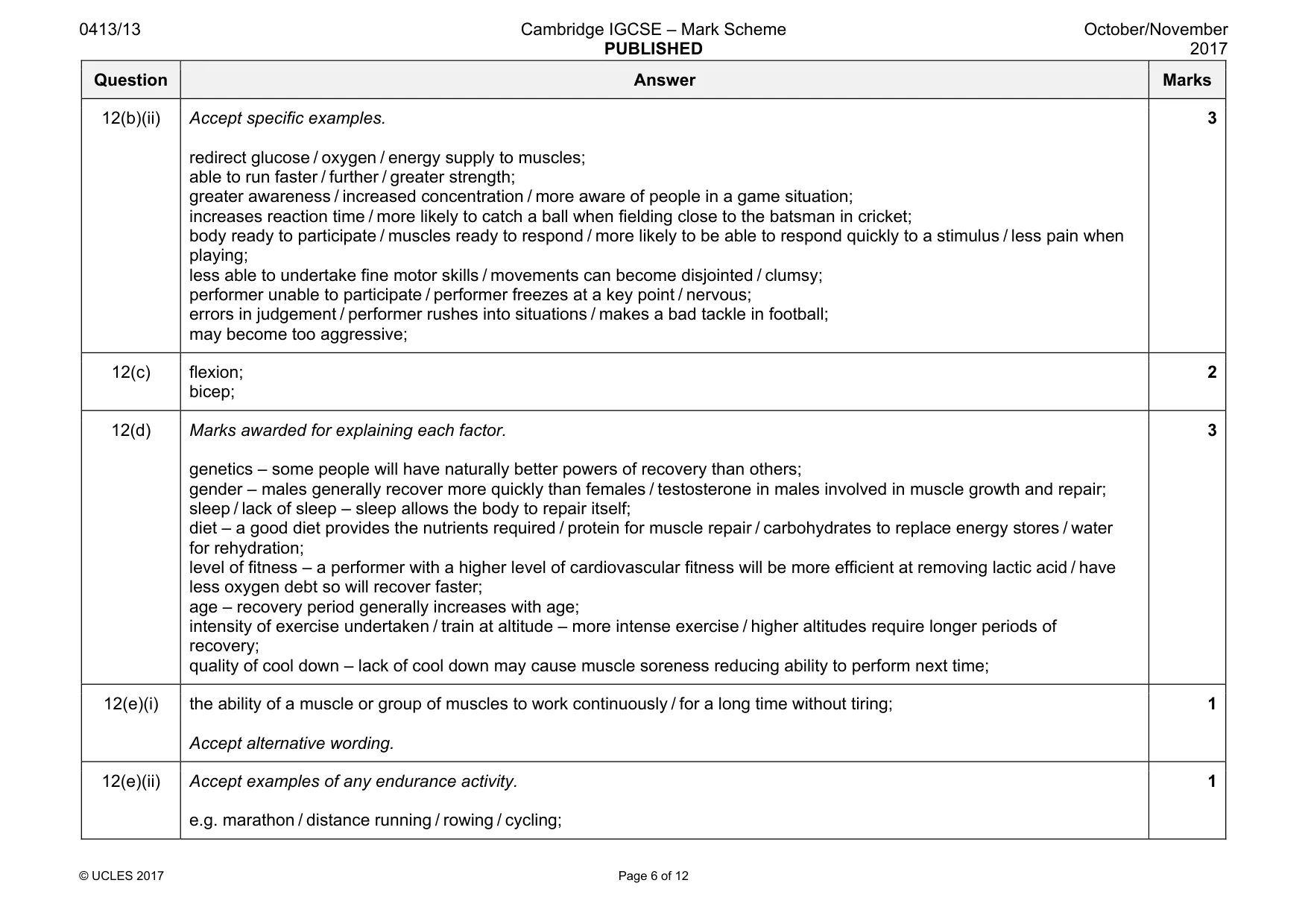
0413/13 Cambridge IGCSE – Mark Scheme PUBLISHED October/November 2017 © UCLES 2017 Page 6 of 12 Question Answer Marks 12(b)(ii) Accept specific examples. redirect glucose / oxygen / energy supply to muscles; able to run faster / further / greater strength; greater awareness / increased concentration / more aware of people in a game situation; increases reaction time / more likely to catch a ball when fielding close to the batsman in cricket; body ready to participate / muscles ready to respond / more likely to be able to respond quickly to a stimulus / less pain when playing; less able to undertake fine motor skills / movements can become disjointed / clumsy; performer unable to participate / performer freezes at a key point / nervous; errors in judgement / performer rushes into situations / makes a bad tackle in football; may become too aggressive; 3 12(c) flexion; bicep; 2 12(d) Marks awarded for explaining each factor. genetics – some people will have naturally better powers of recovery than others; gender – males generally recover more quickly than females / testosterone in males involved in muscle growth and repair; sleep / lack of sleep – sleep allows the body to repair itself; diet – a good diet provides the nutrients required / protein for muscle repair / carbohydrates to replace energy stores / water for rehydration; level of fitness – a performer with a higher level of cardiovascular fitness will be more efficient at removing lactic acid / have less oxygen debt so will recover faster; age – recovery period generally increases with age; intensity of exercise undertaken / train at altitude – more intense exercise / higher altitudes require longer periods of recovery; quality of cool down – lack of cool down may cause muscle soreness reducing ability to perform next time; 3 12(e)(i) the ability of a muscle or group of muscles to work continuously / for a long time without tiring; Accept alternative wording. 1 12(e)(ii) Accept examples of any endurance activity. e.g. marathon / distance running / rowing / cycling; 1
Mark scheme, page 7
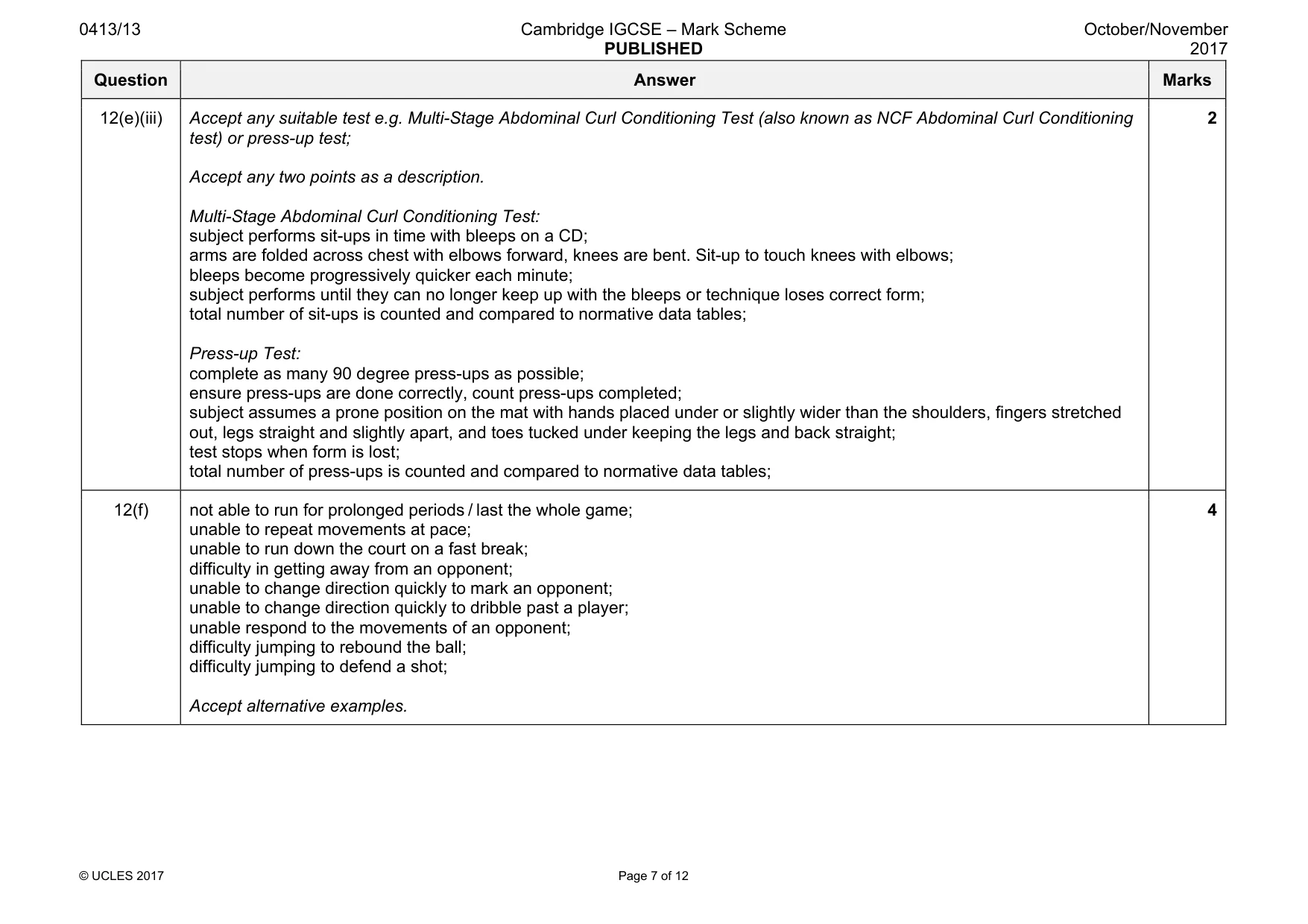
0413/13 Cambridge IGCSE – Mark Scheme PUBLISHED October/November 2017 © UCLES 2017 Page 7 of 12 Question Answer Marks 12(e)(iii) Accept any suitable test e.g. Multi-Stage Abdominal Curl Conditioning Test (also known as NCF Abdominal Curl Conditioning test) or press-up test; Accept any two points as a description. Multi-Stage Abdominal Curl Conditioning Test: subject performs sit-ups in time with bleeps on a CD; arms are folded across chest with elbows forward, knees are bent. Sit-up to touch knees with elbows; bleeps become progressively quicker each minute; subject performs until they can no longer keep up with the bleeps or technique loses correct form; total number of sit-ups is counted and compared to normative data tables; Press-up Test: complete as many 90 degree press-ups as possible; ensure press-ups are done correctly, count press-ups completed; subject assumes a prone position on the mat with hands placed under or slightly wider than the shoulders, fingers stretched out, legs straight and slightly apart, and toes tucked under keeping the legs and back straight; test stops when form is lost; total number of press-ups is counted and compared to normative data tables; 2 12(f) not able to run for prolonged periods / last the whole game; unable to repeat movements at pace; unable to run down the court on a fast break; difficulty in getting away from an opponent; unable to change direction quickly to mark an opponent; unable to change direction quickly to dribble past a player; unable respond to the movements of an opponent; difficulty jumping to rebound the ball; difficulty jumping to defend a shot; Accept alternative examples. 4
Mark scheme, page 8
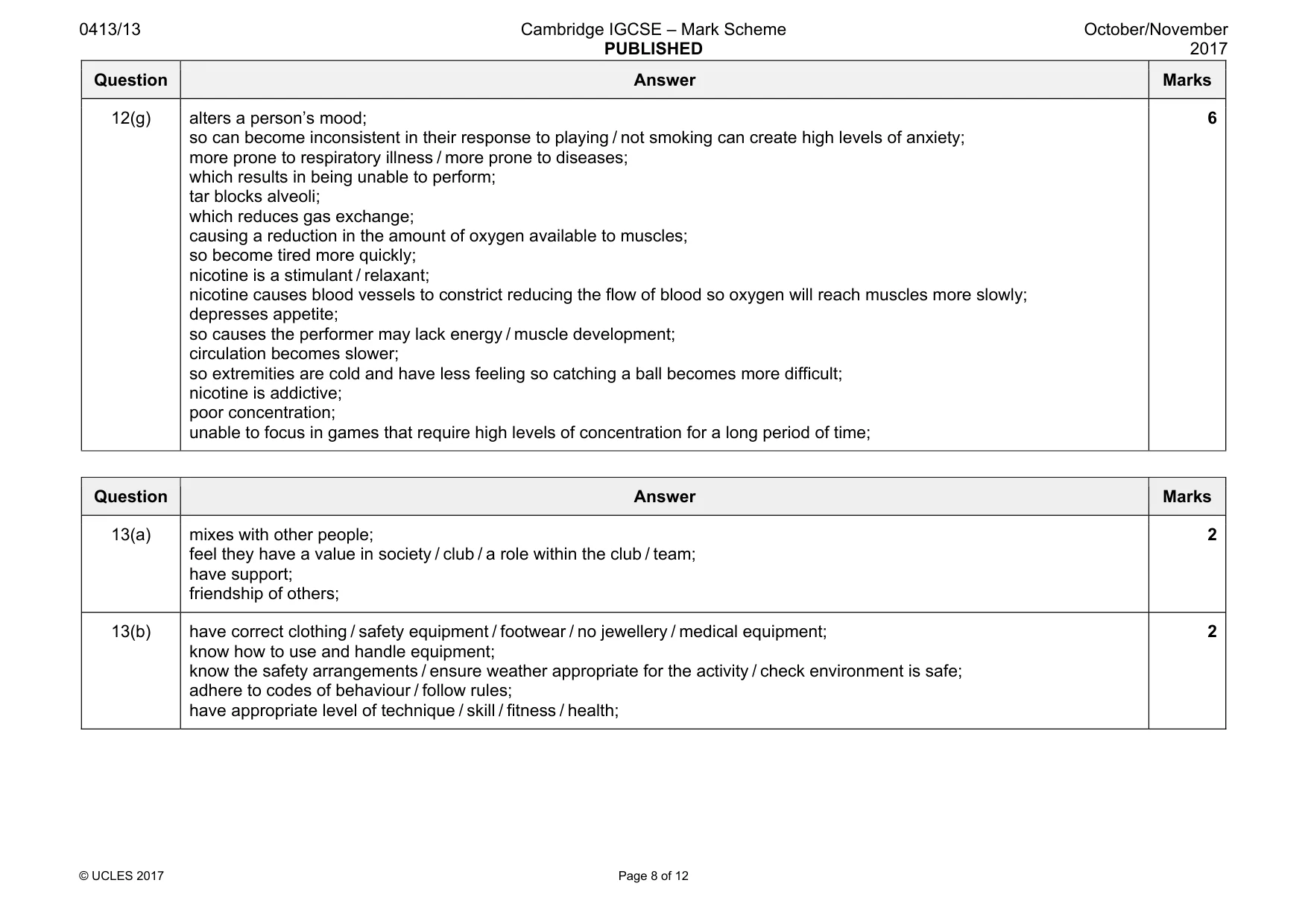
0413/13 Cambridge IGCSE – Mark Scheme PUBLISHED October/November 2017 © UCLES 2017 Page 8 of 12 Question Answer Marks 12(g) alters a person’s mood; so can become inconsistent in their response to playing / not smoking can create high levels of anxiety; more prone to respiratory illness / more prone to diseases; which results in being unable to perform; tar blocks alveoli; which reduces gas exchange; causing a reduction in the amount of oxygen available to muscles; so become tired more quickly; nicotine is a stimulant / relaxant; nicotine causes blood vessels to constrict reducing the flow of blood so oxygen will reach muscles more slowly; depresses appetite; so causes the performer may lack energy / muscle development; circulation becomes slower; so extremities are cold and have less feeling so catching a ball becomes more difficult; nicotine is addictive; poor concentration; unable to focus in games that require high levels of concentration for a long period of time; 6 Question Answer Marks 13(a) mixes with other people; feel they have a value in society / club / a role within the club / team; have support; friendship of others; 2 13(b) have correct clothing / safety equipment / footwear / no jewellery / medical equipment; know how to use and handle equipment; know the safety arrangements / ensure weather appropriate for the activity / check environment is safe; adhere to codes of behaviour / follow rules; have appropriate level of technique / skill / fitness / health; 2
Mark scheme, page 9
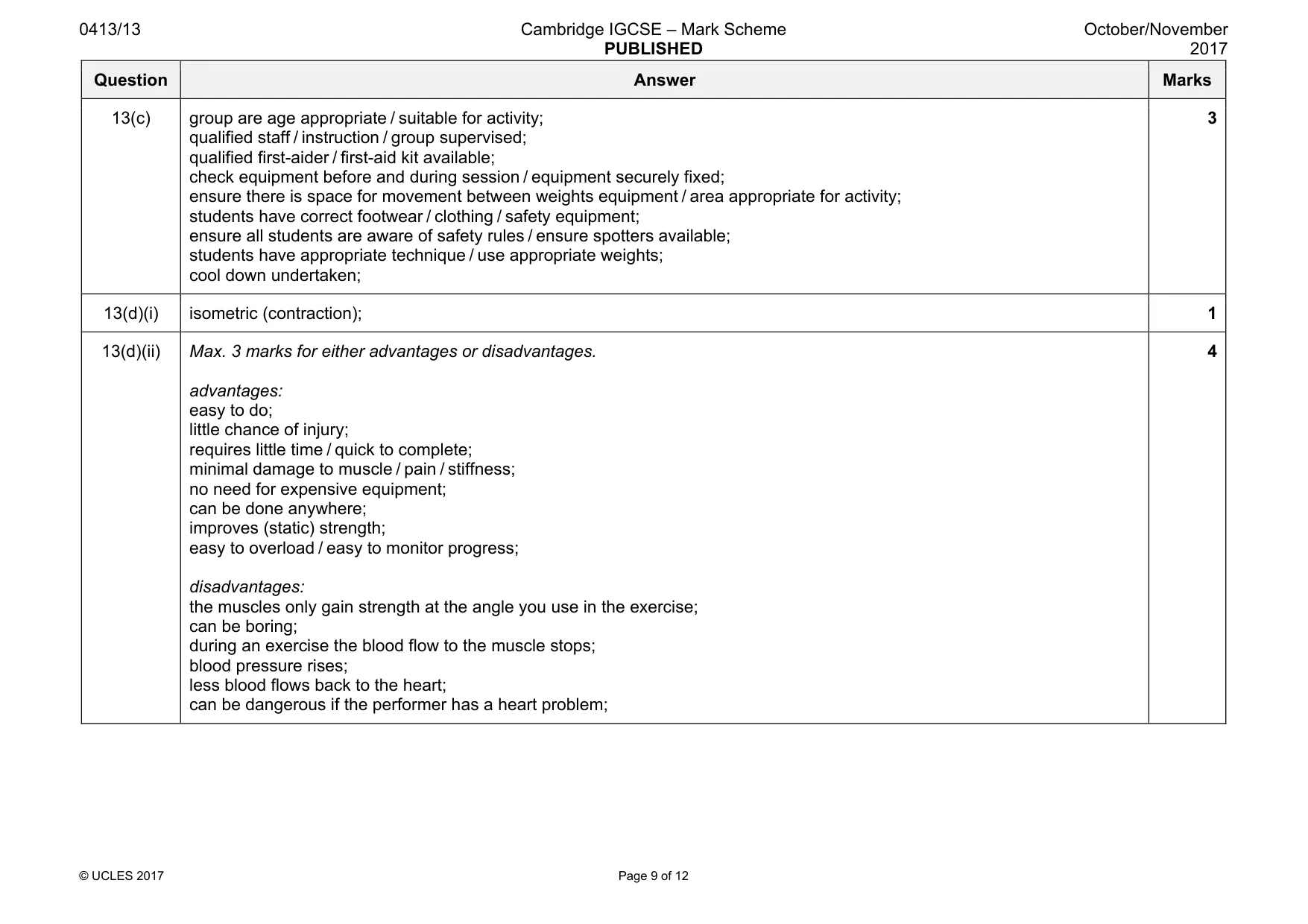
0413/13 Cambridge IGCSE – Mark Scheme PUBLISHED October/November 2017 © UCLES 2017 Page 9 of 12 Question Answer Marks 13(c) group are age appropriate / suitable for activity; qualified staff / instruction / group supervised; qualified first-aider / first-aid kit available; check equipment before and during session / equipment securely fixed; ensure there is space for movement between weights equipment / area appropriate for activity; students have correct footwear / clothing / safety equipment; ensure all students are aware of safety rules / ensure spotters available; students have appropriate technique / use appropriate weights; cool down undertaken; 3 13(d)(i) isometric (contraction); 1 13(d)(ii) Max. 3 marks for either advantages or disadvantages. advantages: easy to do; little chance of injury; requires little time / quick to complete; minimal damage to muscle / pain / stiffness; no need for expensive equipment; can be done anywhere; improves (static) strength; easy to overload / easy to monitor progress; disadvantages: the muscles only gain strength at the angle you use in the exercise; can be boring; during an exercise the blood flow to the muscle stops; blood pressure rises; less blood flows back to the heart; can be dangerous if the performer has a heart problem; 4
Mark scheme, page 10
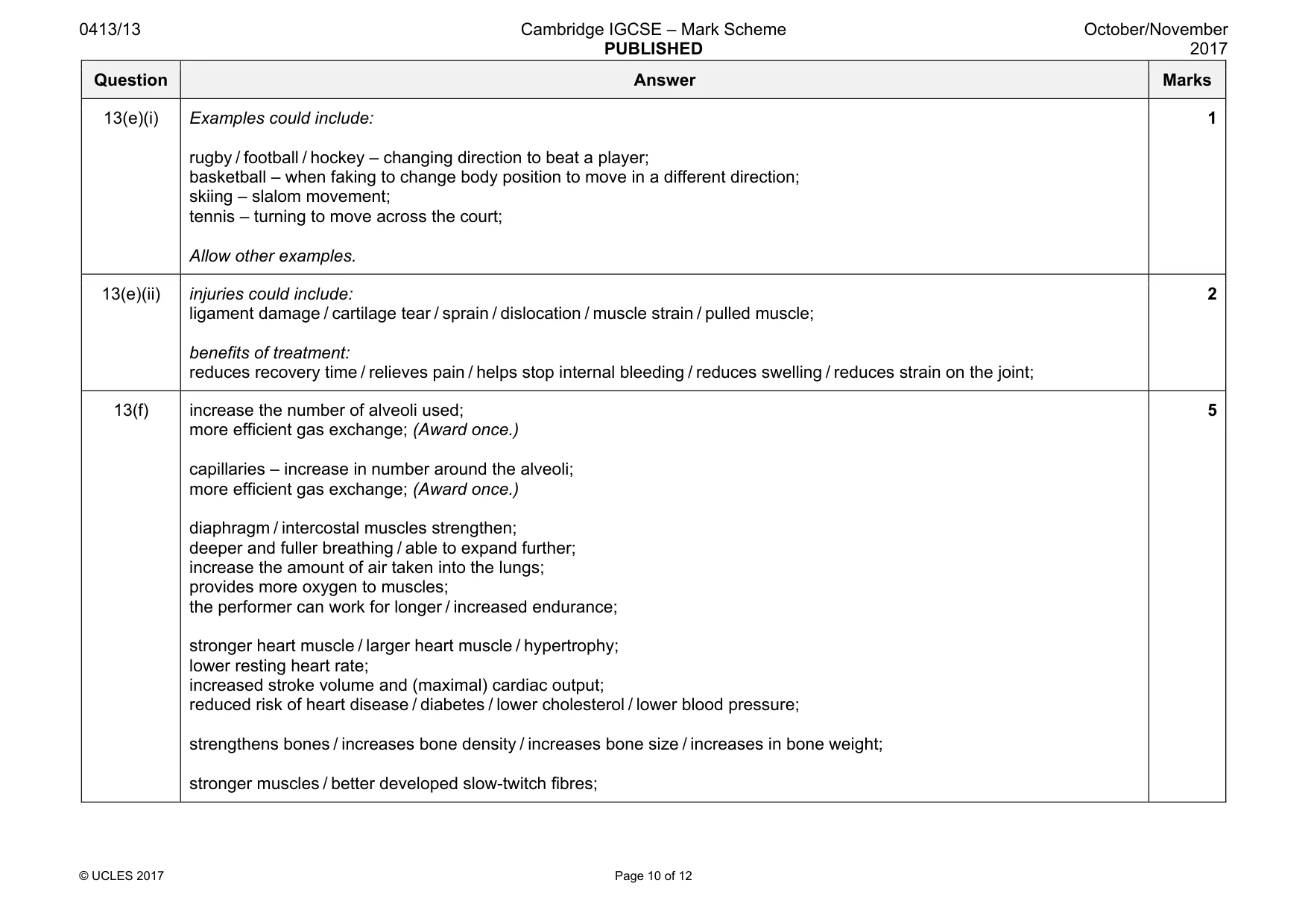
0413/13 Cambridge IGCSE – Mark Scheme PUBLISHED October/November 2017 © UCLES 2017 Page 10 of 12 Question Answer Marks 13(e)(i) Examples could include: rugby / football / hockey – changing direction to beat a player; basketball – when faking to change body position to move in a different direction; skiing – slalom movement; tennis – turning to move across the court; Allow other examples. 1 13(e)(ii) injuries could include: ligament damage / cartilage tear / sprain / dislocation / muscle strain / pulled muscle; benefits of treatment: reduces recovery time / relieves pain / helps stop internal bleeding / reduces swelling / reduces strain on the joint; 2 13(f) increase the number of alveoli used; more efficient gas exchange; (Award once.) capillaries – increase in number around the alveoli; more efficient gas exchange; (Award once.) diaphragm / intercostal muscles strengthen; deeper and fuller breathing / able to expand further; increase the amount of air taken into the lungs; provides more oxygen to muscles; the performer can work for longer / increased endurance; stronger heart muscle / larger heart muscle / hypertrophy; lower resting heart rate; increased stroke volume and (maximal) cardiac output; reduced risk of heart disease / diabetes / lower cholesterol / lower blood pressure; strengthens bones / increases bone density / increases bone size / increases in bone weight; stronger muscles / better developed slow-twitch fibres; 5
Mark scheme, page 11
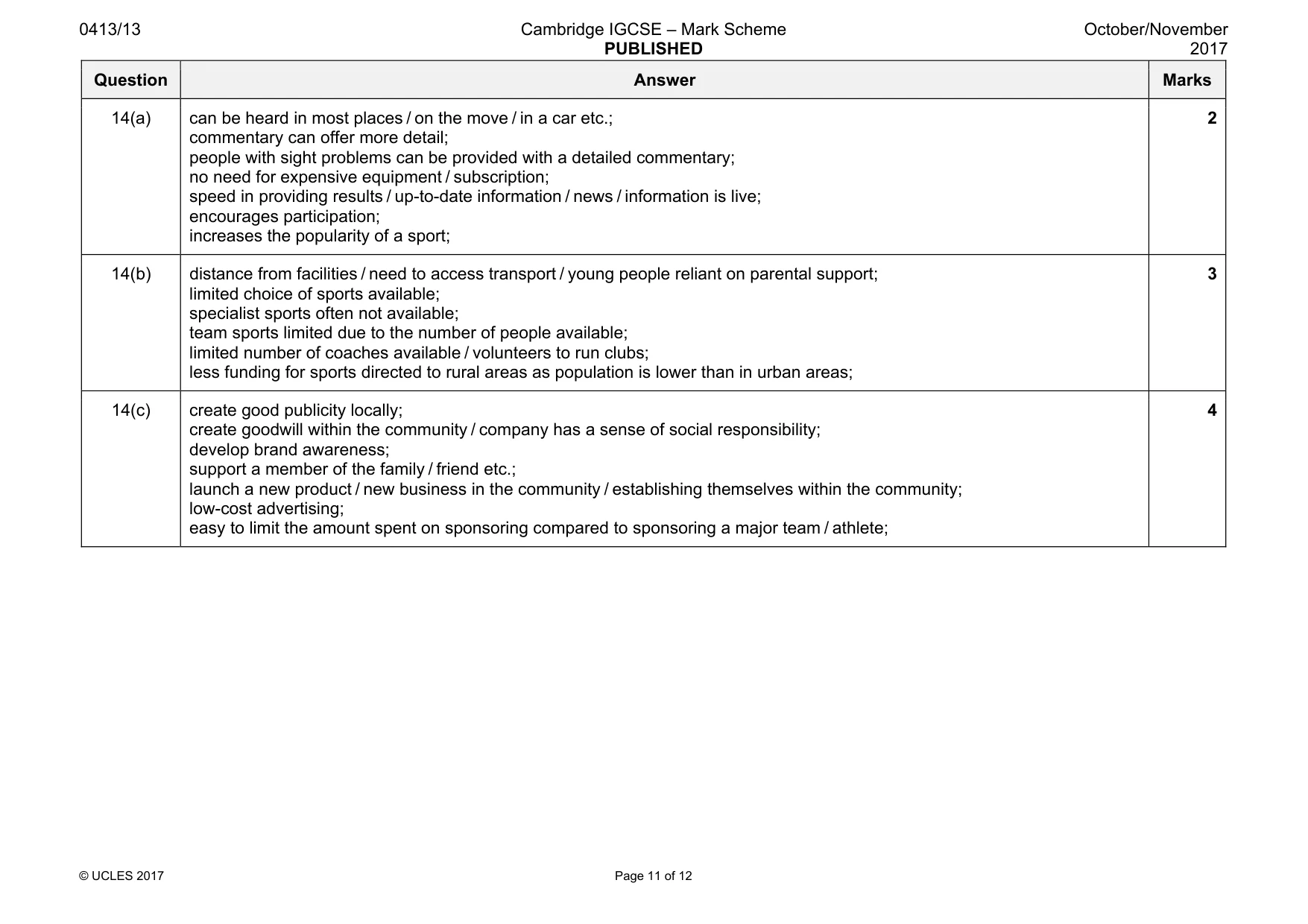
0413/13 Cambridge IGCSE – Mark Scheme PUBLISHED October/November 2017 © UCLES 2017 Page 11 of 12 Question Answer Marks 14(a) can be heard in most places / on the move / in a car etc.; commentary can offer more detail; people with sight problems can be provided with a detailed commentary; no need for expensive equipment / subscription; speed in providing results / up-to-date information / news / information is live; encourages participation; increases the popularity of a sport; 2 14(b) distance from facilities / need to access transport / young people reliant on parental support; limited choice of sports available; specialist sports often not available; team sports limited due to the number of people available; limited number of coaches available / volunteers to run clubs; less funding for sports directed to rural areas as population is lower than in urban areas; 3 14(c) create good publicity locally; create goodwill within the community / company has a sense of social responsibility; develop brand awareness; support a member of the family / friend etc.; launch a new product / new business in the community / establishing themselves within the community; low-cost advertising; easy to limit the amount spent on sponsoring compared to sponsoring a major team / athlete; 4
Mark scheme, page 12
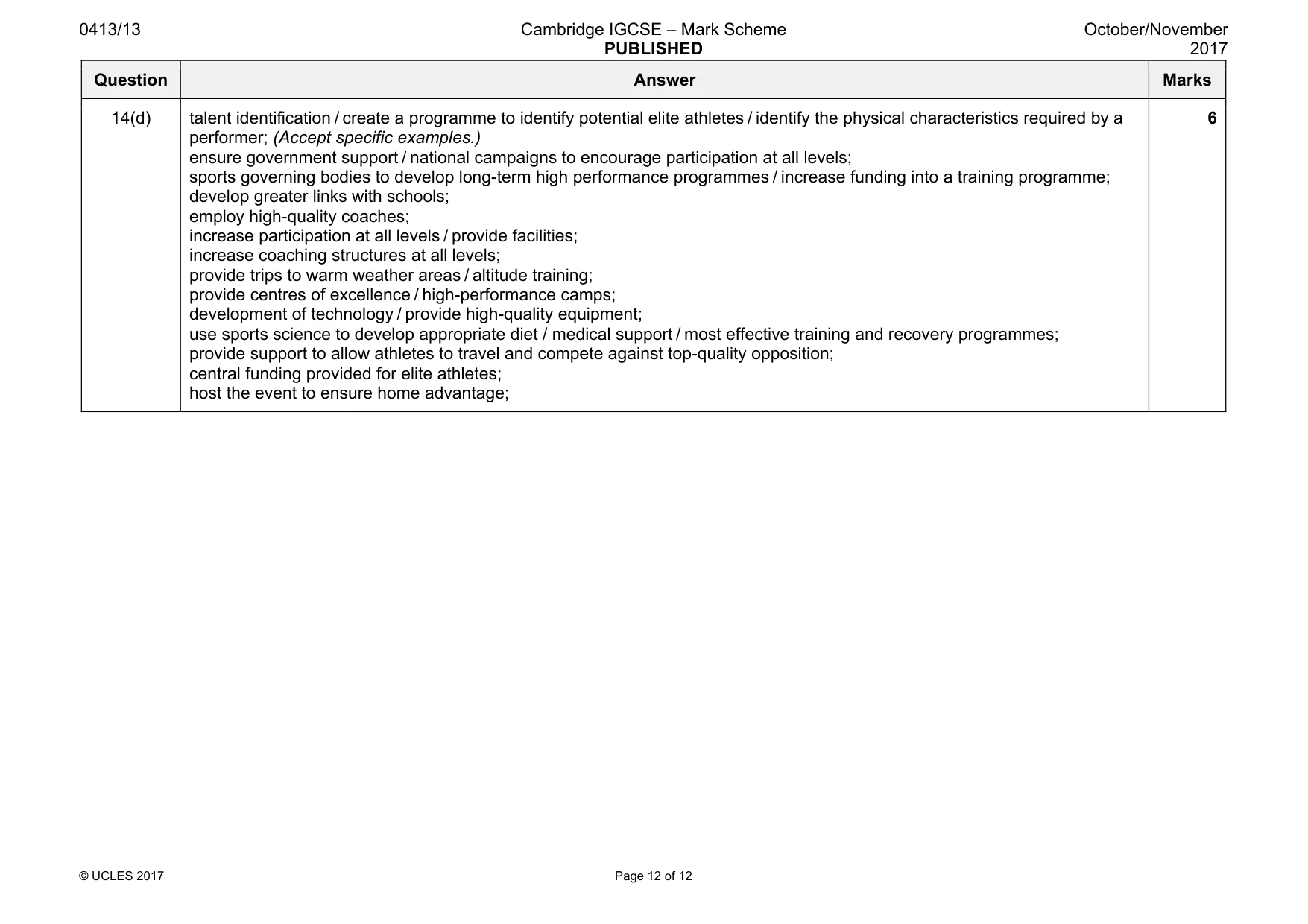
0413/13 Cambridge IGCSE – Mark Scheme PUBLISHED October/November 2017 © UCLES 2017 Page 12 of 12 Question Answer Marks 14(d) talent identification / create a programme to identify potential elite athletes / identify the physical characteristics required by a performer; (Accept specific examples.) ensure government support / national campaigns to encourage participation at all levels; sports governing bodies to develop long-term high performance programmes / increase funding into a training programme; develop greater links with schools; employ high-quality coaches; increase participation at all levels / provide facilities; increase coaching structures at all levels; provide trips to warm weather areas / altitude training; provide centres of excellence / high-performance camps; development of technology / provide high-quality equipment; use sports science to develop appropriate diet / medical support / most effective training and recovery programmes; provide support to allow athletes to travel and compete against top-quality opposition; central funding provided for elite athletes; host the event to ensure home advantage; 6
What you needed in this session
Cambridge’s own grade thresholds for 2017 Oct/Nov, Paper 1 · Variant 3. A higher threshold means an easier paper — the bar moves with how the cohort did.