Cambridge IGCSE Physical Education 0413 — 2017 Oct/Nov Paper 1 · Variant 1
0413/11/O/N/17 · 80 marks · ≈90 min
The question paper and its mark scheme, free to read here and free to download. This is Cambridge’s own paper, exactly as it was sat.
Question paper16 pages



Mark scheme16 pages
Answers below. Sit the paper first if you are practising.
Paper as text
Question paper, page 1
Cambridge International Examinations Cambridge International General Certificate of Secondary Education 0413/11 October/November 2017 1 hour 45 minutes PHYSICAL EDUCATION Paper 1 Candidates answer on the Question Paper. No Additional Materials are required. READ THESE INSTRUCTIONS FIRST Write your Centre number, candidate number and name on all the work you hand in. Write in dark blue or black pen. You may use an HB pencil for any diagrams or graphs. Do not use staples, paper clips, glue or correction fluid. DO NOT WRITE IN ANY BARCODES. Section A Answer all questions in this section. Write your answers in the spaces provided on the Question Paper. Section B Answer all questions in this section. Write your answers in the spaces provided on the Question Paper. Electronic calculators may be used. You may lose marks if you do not show your working or if you do not use appropriate units. At the end of the examination, fasten all your work securely together. The number of marks is given in brackets [ ] at the end of each question or part question. This document consists of 13 printed pages and 3 blank pages. [Turn over 11_0413_11_2017_1.34 © UCLES 2017 *5123139513*
Question paper, page 2
Section A Answer all the questions in the spaces provided. State one type of feedback. 1 … … [1] Describe one feature of a person’s social well-being. 2 … … [1] Describe how a person’s age can influence the physical activities they take part in. 3 … … [1] State one cause of an increase in arousal. 4 … … [1] State the main nutrient needed for muscle growth and repair. 5 … … [1] State what is meant by the term VO2 max. 6 … … [1] Explain why a performer’s skill level may improve as a result of practice. 7 … … … … [2] 11_0413_11_2017_1.34 © UCLES 2017 2
Question paper, page 3
State an injury that is associated with contact sports and describe a suitable treatment that could be given for this injury. 8 injury… treatment… … … [2] Describe how a performer could use mental rehearsal as part of their preparation for an activity. 9 … … … … … … [3] Describe different benefits of three different named exercises that could be used as part of a warm up. 10 exercise 1… benefit… … exercise 2… benefit… … exercise 3… benefit… … [3] [Turn over 11_0413_11_2017_1.34 © UCLES 2017 3
Question paper, page 4
Describe the positive characteristics and qualities of a sporting role model. 11 … … … … … … … … [4] [Total: 20] 11_0413_11_2017_1.34 © UCLES 2017 4
Question paper, page 5
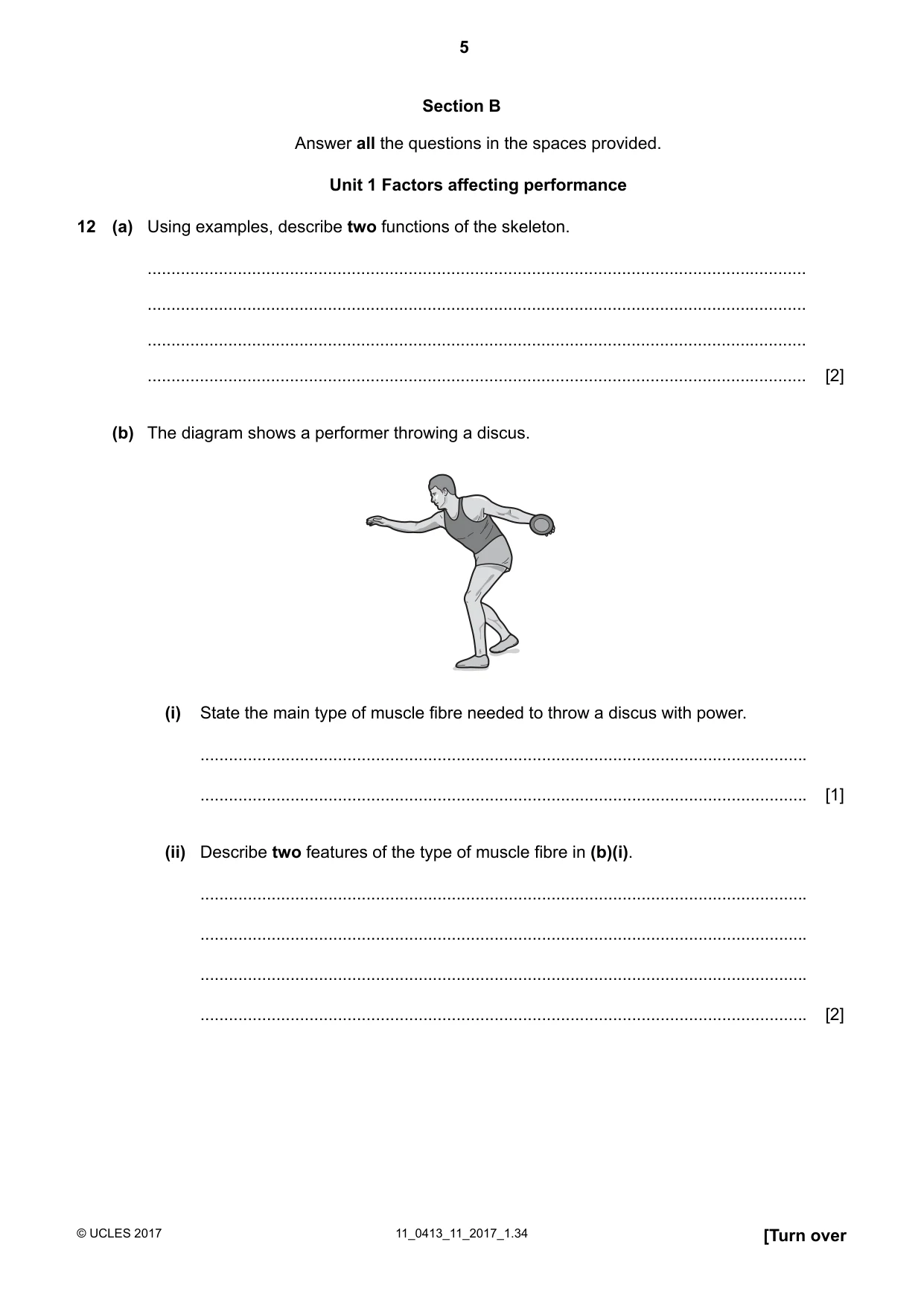
Section B Answer all the questions in the spaces provided. Unit 1 Factors affecting performance Using examples, describe two functions of the skeleton. (a) 12 … … … … [2] The diagram shows a performer throwing a discus. (b) State the main type of muscle fibre needed to throw a discus with power. (i) … … [1] Describe two features of the type of muscle fibre in (b)(i). (ii) … … … … [2] [Turn over 11_0413_11_2017_1.34 © UCLES 2017 5
Question paper, page 6
Explain why a performer’s resting heart rate reduces as they become fitter. (c) … … … … … … [3] Define the term flexibility. (i) (d) … … [1] Explain, using an example, how flexibility benefits a performer in a named sport. (ii) sport… explanation… … … … [1] Name and describe a recognised test that can be used to measure flexibility. (iii) name of test… description… … … … … … [3] 11_0413_11_2017_1.34 © UCLES 2017 6
Question paper, page 7
Suggest two reasons why performers might take banned drugs to improve performance. (i) (e) … … … … [2] Suggest how performers can be discouraged from taking banned performance-enhancing drugs. (ii) … … … … … … [3] Suggest one reason why a performer would take a diuretic. (iii) … … [1] [Turn over 11_0413_11_2017_1.34 © UCLES 2017 7
Question paper, page 8
Describe how four of the principles of goal setting could be applied to a named sport. (i) (f) sport… principle 1… … principle 2… … principle 3… … principle 4… … [4] Suggest two disadvantages to a performer of not setting goals. (ii) … … … … [2] [Total: 25] 11_0413_11_2017_1.34 © UCLES 2017 8
Question paper, page 9
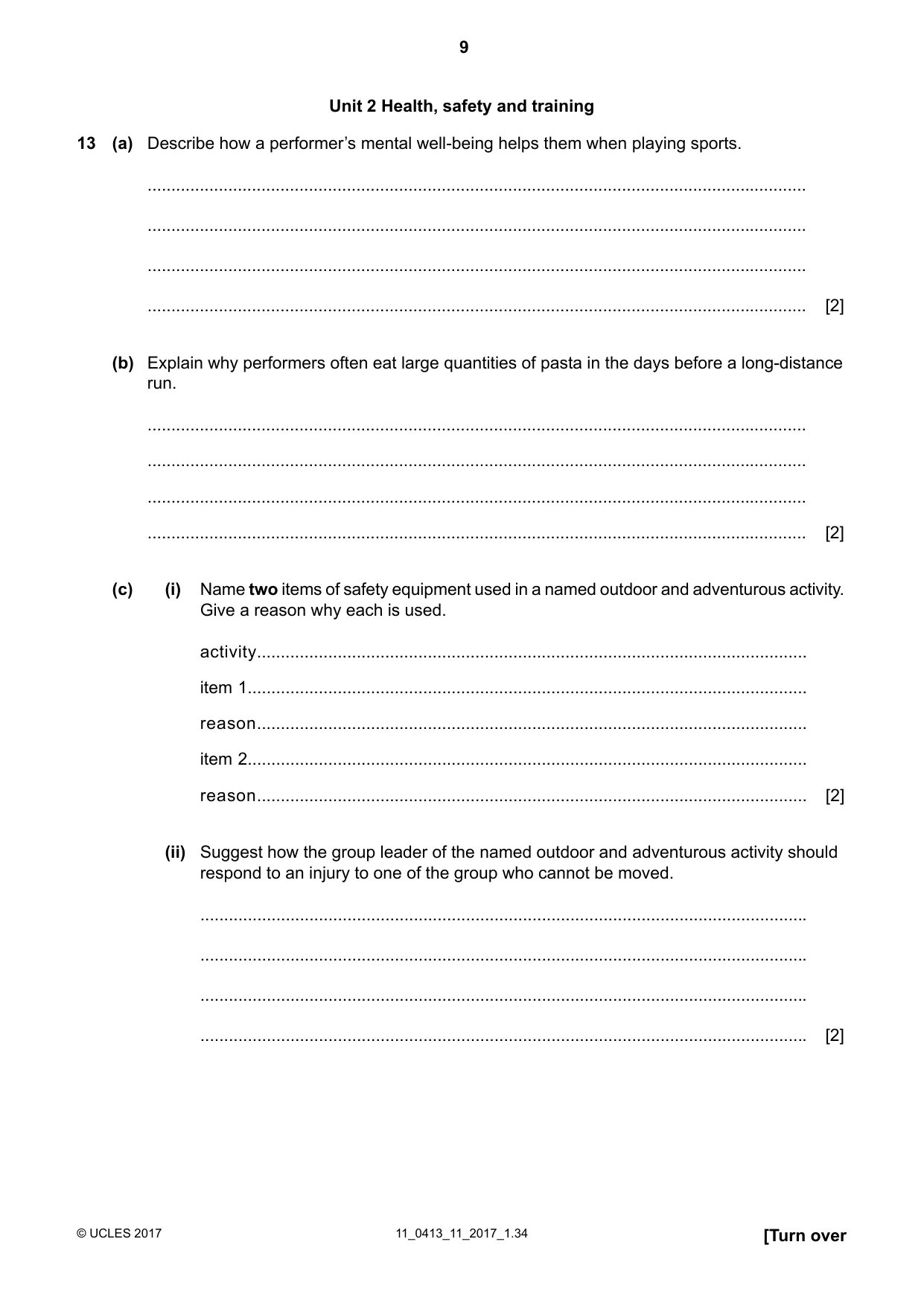
Unit 2 Health, safety and training Describe how a performer’s mental well-being helps them when playing sports. (a) 13 … … … … [2] Explain why performers often eat large quantities of pasta in the days before a long-distance run. (b) … … … … [2] Name two items of safety equipment used in a named outdoor and adventurous activity. Give a reason why each is used. (i) (c) activity… item 1… reason… item 2… reason… [2] Suggest how the group leader of the named outdoor and adventurous activity should respond to an injury to one of the group who cannot be moved. (ii) … … … … [2] [Turn over 11_0413_11_2017_1.34 © UCLES 2017 9
Question paper, page 10
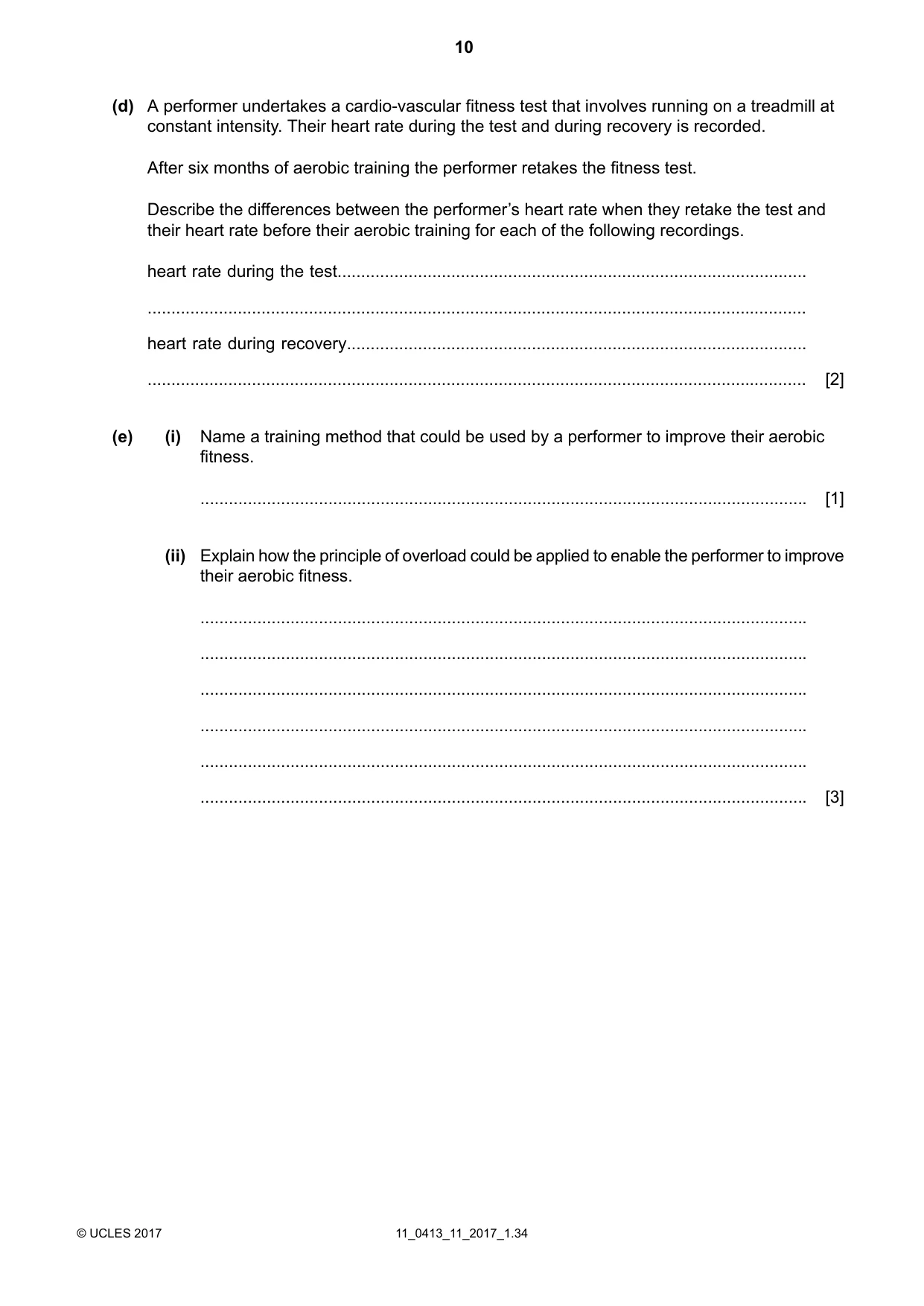
A performer undertakes a cardio-vascular fitness test that involves running on a treadmill at constant intensity. Their heart rate during the test and during recovery is recorded. After six months of aerobic training the performer retakes the fitness test. Describe the differences between the performer’s heart rate when they retake the test and their heart rate before their aerobic training for each of the following recordings. (d) heart rate during the test… … heart rate during recovery… … [2] Name a training method that could be used by a performer to improve their aerobic fitness. (i) (e) … [1] Explain how the principle of overload could be applied to enable the performer to improve their aerobic fitness. (ii) … … … … … … [3] 11_0413_11_2017_1.34 © UCLES 2017 10
Question paper, page 11
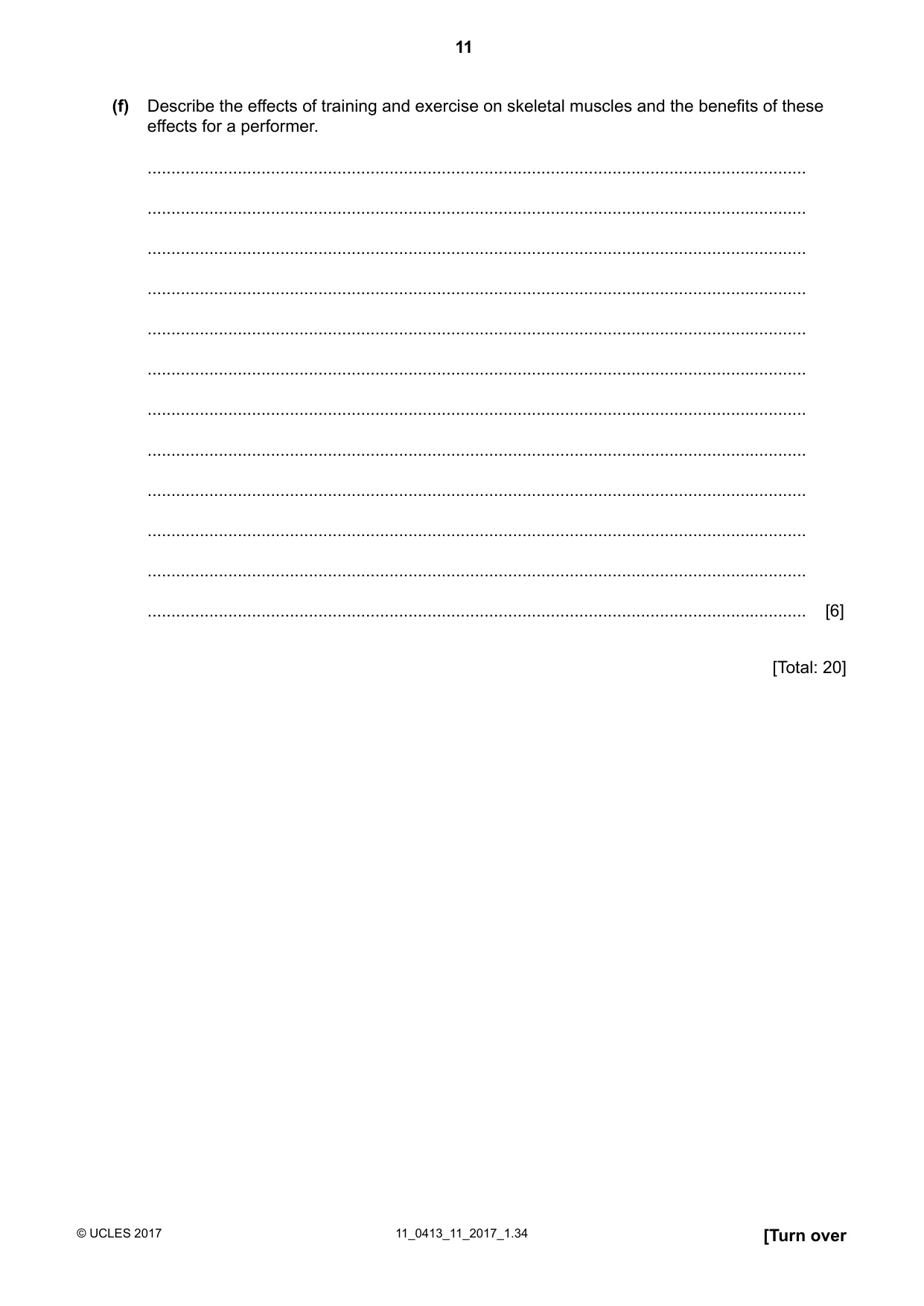
Describe the effects of training and exercise on skeletal muscles and the benefits of these effects for a performer. (f) … … … … … … … … … … … … [6] [Total: 20] [Turn over 11_0413_11_2017_1.34 © UCLES 2017 11
Question paper, page 12
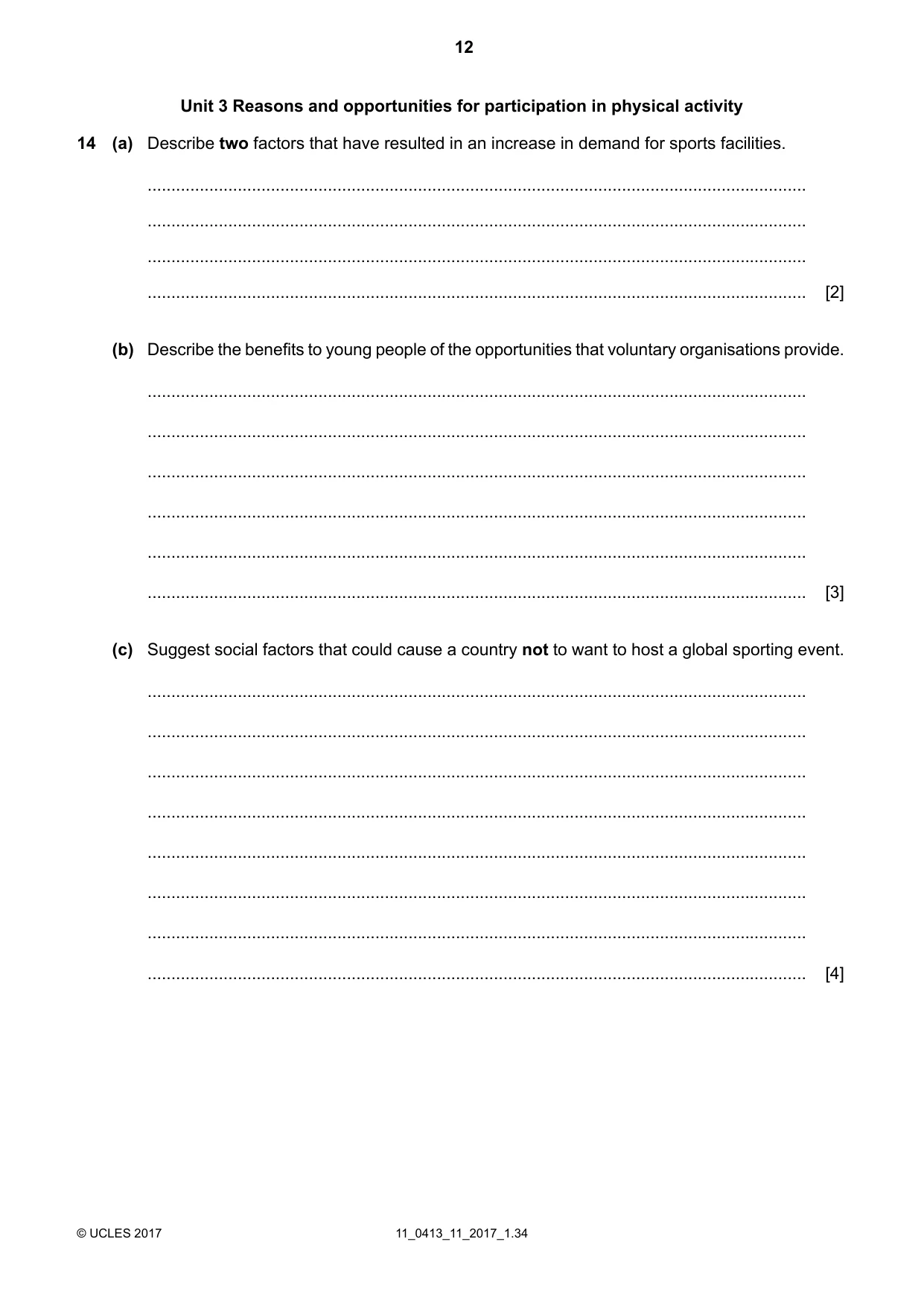
Unit 3 Reasons and opportunities for participation in physical activity Describe two factors that have resulted in an increase in demand for sports facilities. (a) 14 … … … … [2] Describe the benefits to young people of the opportunities that voluntary organisations provide. (b) … … … … … … [3] Suggest social factors that could cause a country not to want to host a global sporting event. (c) … … … … … … … … [4] 11_0413_11_2017_1.34 © UCLES 2017 12
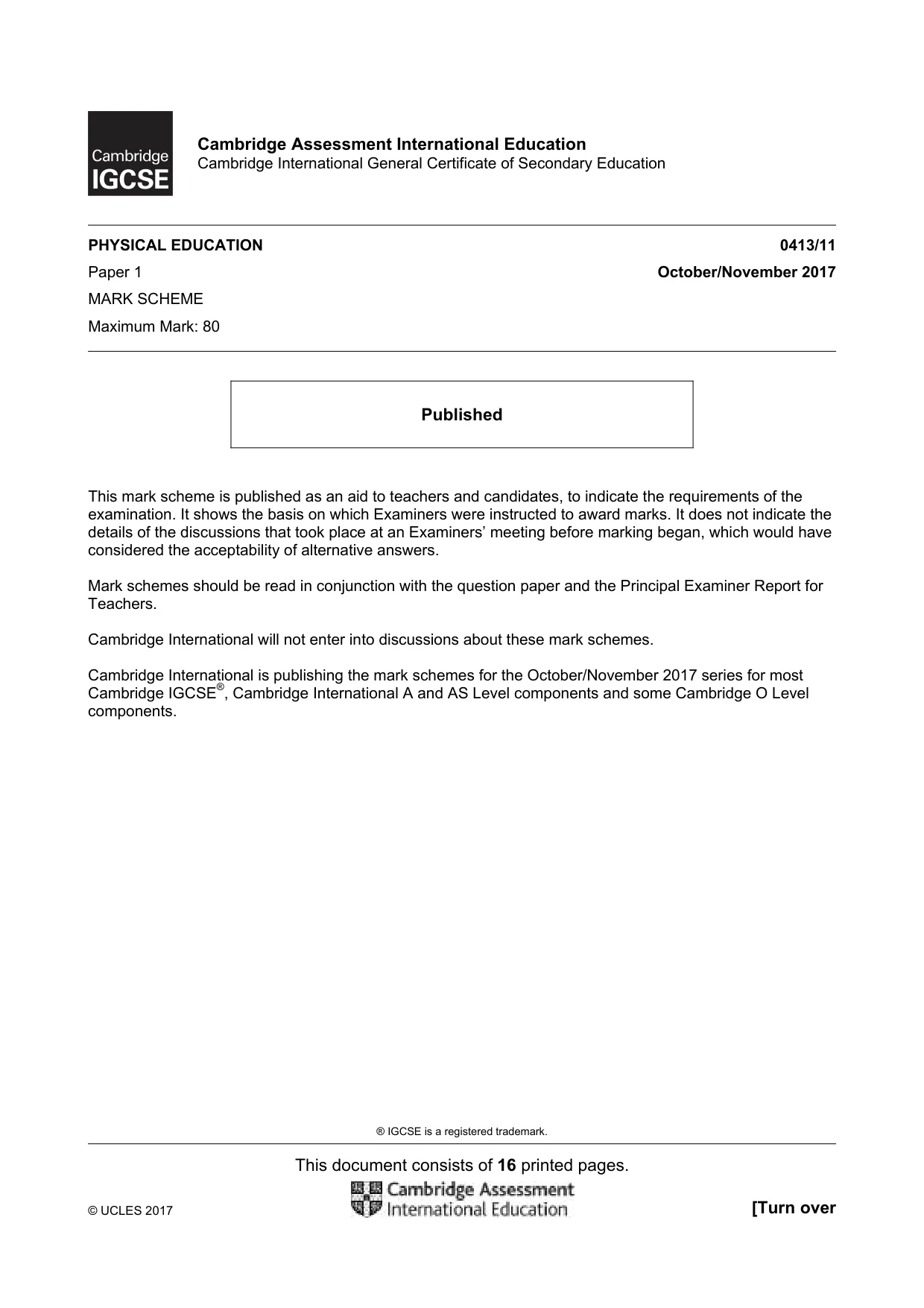
Question paper, page 13
The table shows the increase in participation at the Paralympics (disability games). (d) number of countries participating number of participants year 23 400 1960 164 4237 2012 Suggest reasons for the increase in participation. … … … … … … … … … … … … [6] [Total: 15] 11_0413_11_2017_1.34 © UCLES 2017 13
Question paper, page 14
BLANK PAGE 11_0413_11_2017_1.34 © UCLES 2017 14
Question paper, page 15
BLANK PAGE 11_0413_11_2017_1.34 © UCLES 2017 15
Question paper, page 16
BLANK PAGE Permission to reproduce items where third-party owned material protected by copyright is included has been sought and cleared where possible. Every reasonable effort has been made by the publisher (UCLES) to trace copyright holders, but if any items requiring clearance have unwittingly been included, the publisher will be pleased to make amends at the earliest possible opportunity. To avoid the issue of disclosure of answer-related information to candidates, all copyright acknowledgements are reproduced online in the Cambridge International Examinations Copyright Acknowledgements Booklet. This is produced for each series of examinations and is freely available to download at www.cie.org.uk after the live examination series. Cambridge International Examinations is part of the Cambridge Assessment Group. Cambridge Assessment is the brand name of University of Cambridge Local Examinations Syndicate (UCLES), which is itself a department of the University of Cambridge. 11_0413_11_2017_1.34 © UCLES 2017 16
Mark scheme, page 1
® IGCSE is a registered trademark. This document consists of 16 printed pages. © UCLES 2017 [Turn over Cambridge Assessment International Education Cambridge International General Certificate of Secondary Education PHYSICAL EDUCATION 0413/11 Paper 1 October/November 2017 MARK SCHEME Maximum Mark: 80 Published This mark scheme is published as an aid to teachers and candidates, to indicate the requirements of the examination. It shows the basis on which Examiners were instructed to award marks. It does not indicate the details of the discussions that took place at an Examiners’ meeting before marking began, which would have considered the acceptability of alternative answers. Mark schemes should be read in conjunction with the question paper and the Principal Examiner Report for Teachers. Cambridge International will not enter into discussions about these mark schemes. Cambridge International is publishing the mark schemes for the October/November 2017 series for most Cambridge IGCSE®, Cambridge International A and AS Level components and some Cambridge O Level components.
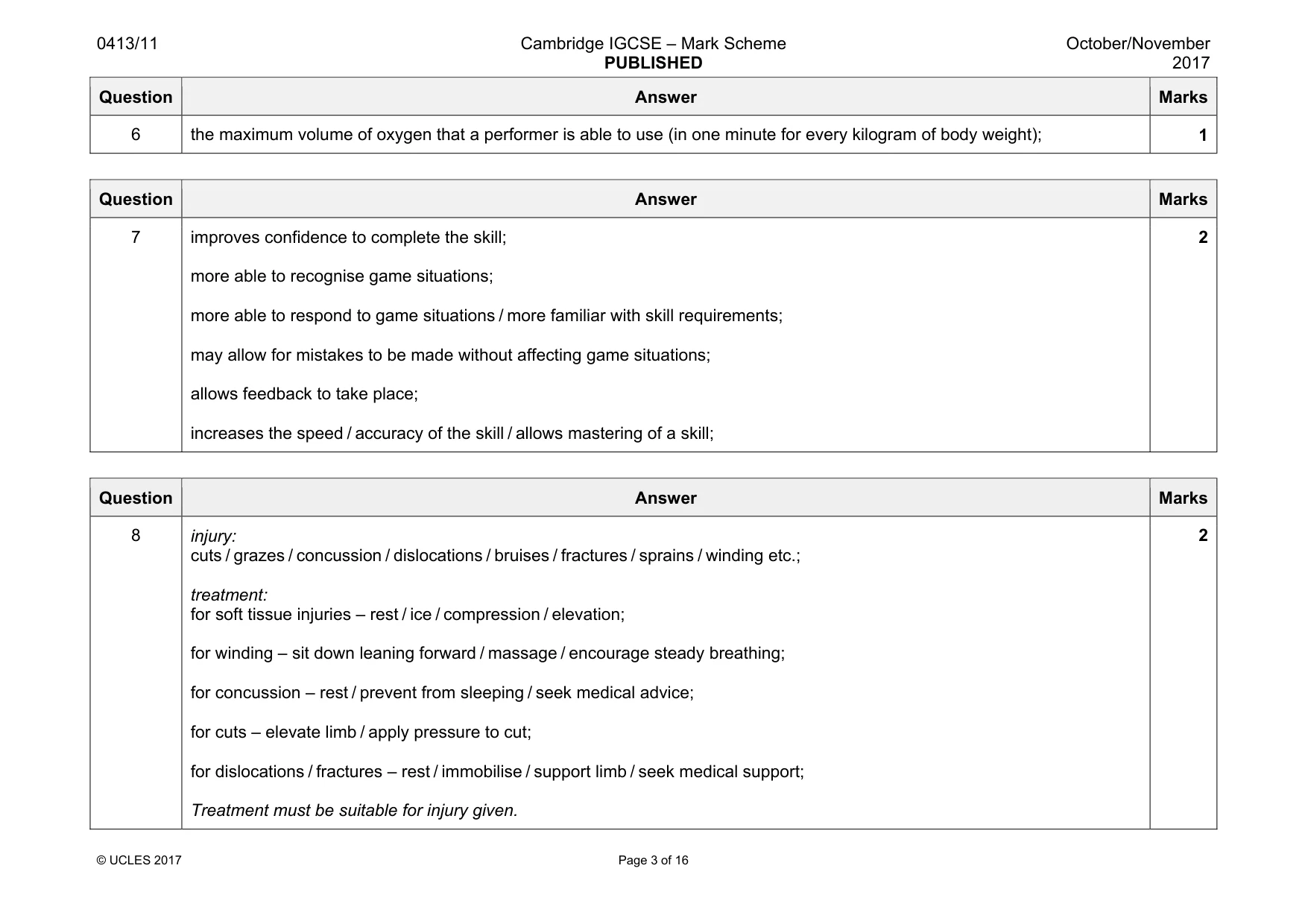
Mark scheme, page 2
0413/11 Cambridge IGCSE – Mark Scheme PUBLISHED October/November 2017 © UCLES 2017 Page 2 of 16 Question Answer Marks 1 intrinsic / extrinsic / knowledge of performance / knowledge of results; Accept visual / verbal feedback. 1 Question Answer Marks 2 have essential human needs / food / clothing / shelter / have friendship / support / have some value in society / able to mix with others; 1 Question Answer Marks 3 certain sports have age restrictions / older people often take part in less physically demanding activities / younger people more influenced by fashion and peer pressure / younger people are more influenced by body image, which can affect the choice of activity / younger people need support from adults / socio-economic factors / young children reliant on parents to fund activities / younger people are more likely to take part in activities that have a higher level of excitement or danger / older people are often less able to cope with high intensity / endurance activities / muscle deterioration due to age / older people often use physical activities as a health aid / people in 20–40s often have less time due to family and work commitments so take part in activities that take less time; Accept other valid examples. 1 Question Answer Marks 4 a pep talk from your coach / pressure from coach / the warm up before an event / working towards a goal or target / bright lights / noise from a crowd / friendly or hostile watching / importance of game or activity / quality of opposition / large audience / intimidation from opposition; 1 Question Answer Marks 5 protein; 1
Mark scheme, page 3
0413/11 Cambridge IGCSE – Mark Scheme PUBLISHED October/November 2017 © UCLES 2017 Page 3 of 16 Question Answer Marks 6 the maximum volume of oxygen that a performer is able to use (in one minute for every kilogram of body weight); 1 Question Answer Marks 7 improves confidence to complete the skill; more able to recognise game situations; more able to respond to game situations / more familiar with skill requirements; may allow for mistakes to be made without affecting game situations; allows feedback to take place; increases the speed / accuracy of the skill / allows mastering of a skill; 2 Question Answer Marks 8 injury: cuts / grazes / concussion / dislocations / bruises / fractures / sprains / winding etc.; treatment: for soft tissue injuries – rest / ice / compression / elevation; for winding – sit down leaning forward / massage / encourage steady breathing; for concussion – rest / prevent from sleeping / seek medical advice; for cuts – elevate limb / apply pressure to cut; for dislocations / fractures – rest / immobilise / support limb / seek medical support; Treatment must be suitable for injury given. 2
Mark scheme, page 4
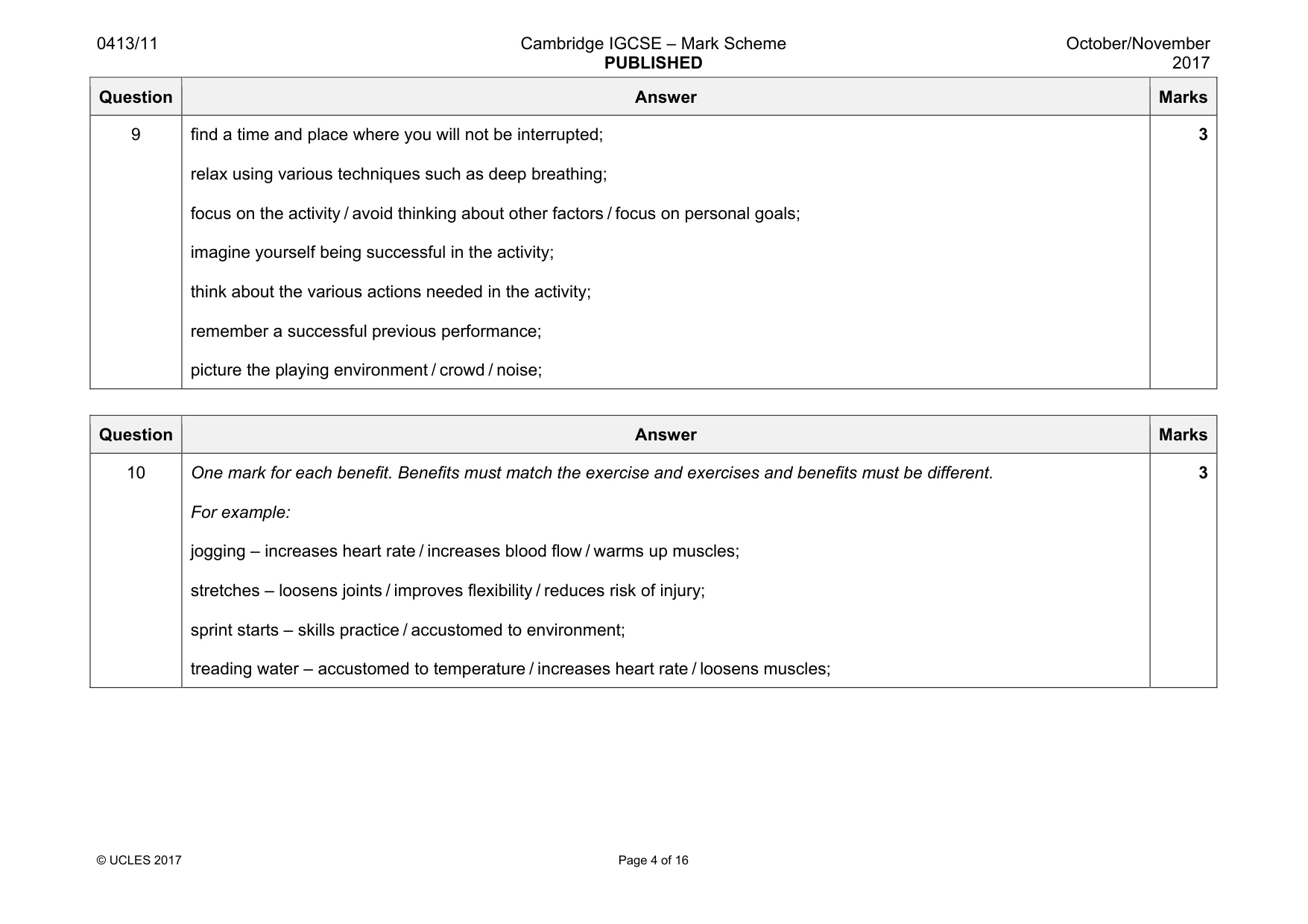
0413/11 Cambridge IGCSE – Mark Scheme PUBLISHED October/November 2017 © UCLES 2017 Page 4 of 16 Question Answer Marks 9 find a time and place where you will not be interrupted; relax using various techniques such as deep breathing; focus on the activity / avoid thinking about other factors / focus on personal goals; imagine yourself being successful in the activity; think about the various actions needed in the activity; remember a successful previous performance; picture the playing environment / crowd / noise; 3 Question Answer Marks 10 One mark for each benefit. Benefits must match the exercise and exercises and benefits must be different. For example: jogging – increases heart rate / increases blood flow / warms up muscles; stretches – loosens joints / improves flexibility / reduces risk of injury; sprint starts – skills practice / accustomed to environment; treading water – accustomed to temperature / increases heart rate / loosens muscles; 3
Mark scheme, page 5
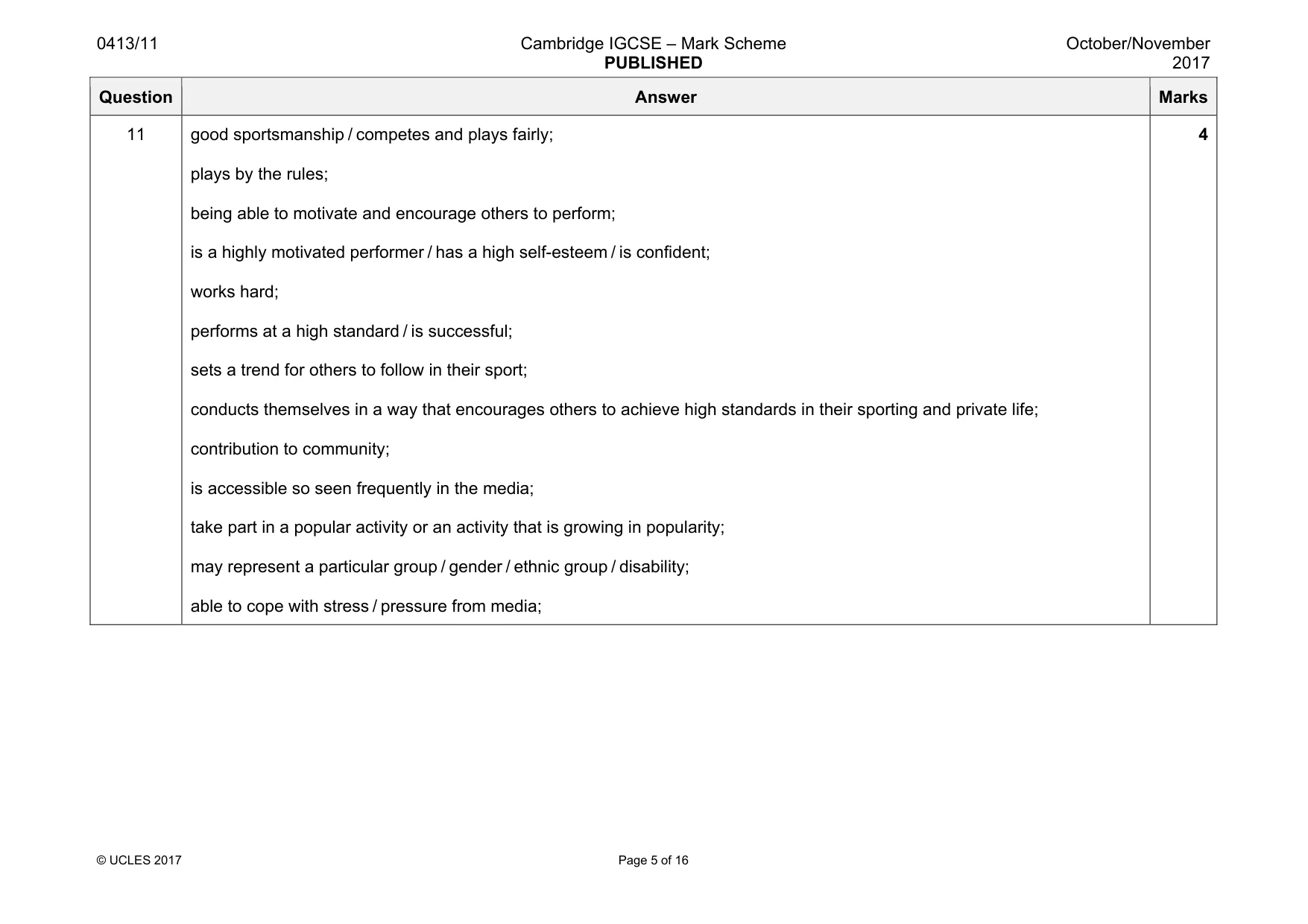
0413/11 Cambridge IGCSE – Mark Scheme PUBLISHED October/November 2017 © UCLES 2017 Page 5 of 16 Question Answer Marks 11 good sportsmanship / competes and plays fairly; plays by the rules; being able to motivate and encourage others to perform; is a highly motivated performer / has a high self-esteem / is confident; works hard; performs at a high standard / is successful; sets a trend for others to follow in their sport; conducts themselves in a way that encourages others to achieve high standards in their sporting and private life; contribution to community; is accessible so seen frequently in the media; take part in a popular activity or an activity that is growing in popularity; may represent a particular group / gender / ethnic group / disability; able to cope with stress / pressure from media; 4
Mark scheme, page 6
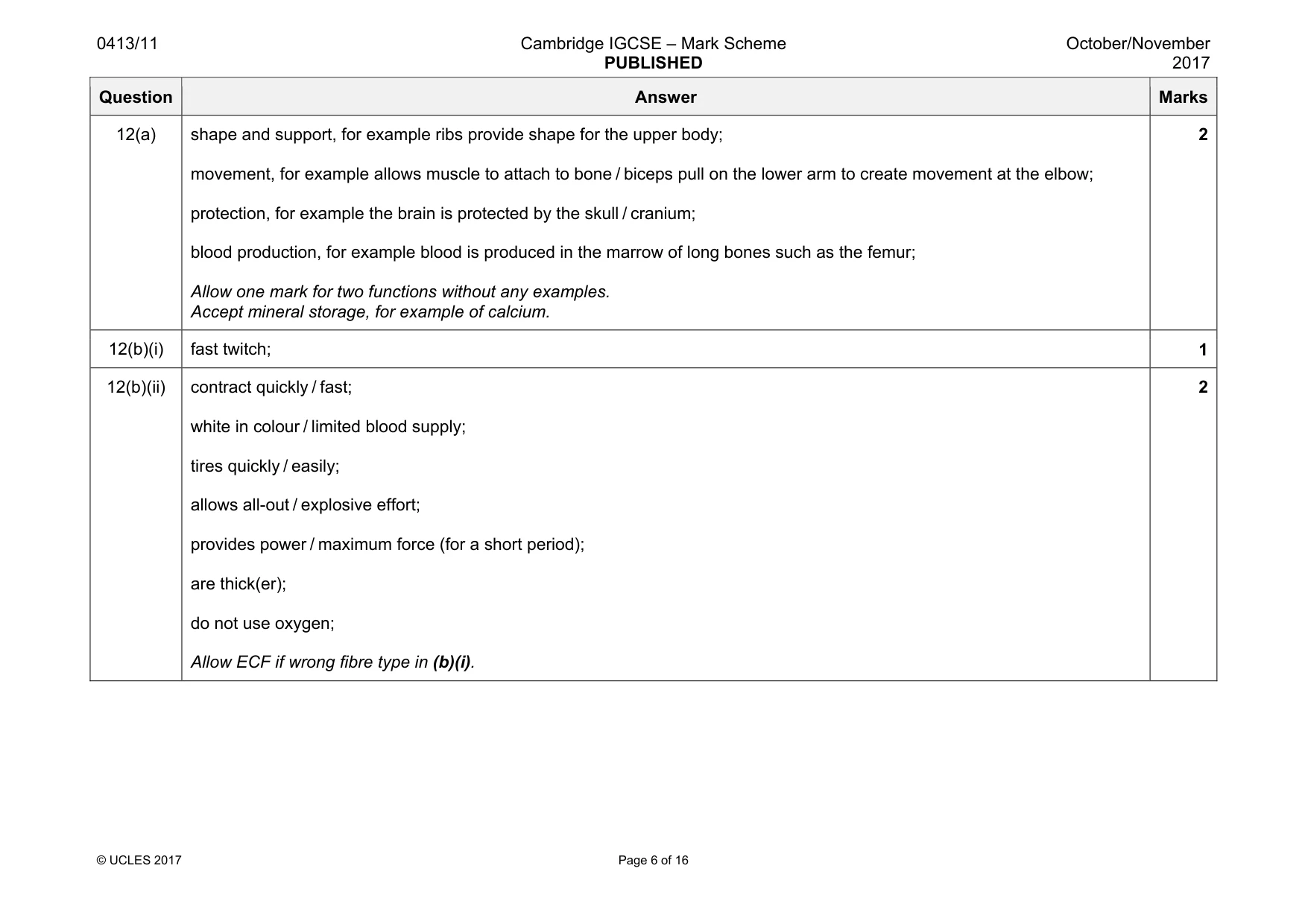
0413/11 Cambridge IGCSE – Mark Scheme PUBLISHED October/November 2017 © UCLES 2017 Page 6 of 16 Question Answer Marks 12(a) shape and support, for example ribs provide shape for the upper body; movement, for example allows muscle to attach to bone / biceps pull on the lower arm to create movement at the elbow; protection, for example the brain is protected by the skull / cranium; blood production, for example blood is produced in the marrow of long bones such as the femur; Allow one mark for two functions without any examples. Accept mineral storage, for example of calcium. 2 12(b)(i) fast twitch; 1 12(b)(ii) contract quickly / fast; white in colour / limited blood supply; tires quickly / easily; allows all-out / explosive effort; provides power / maximum force (for a short period); are thick(er); do not use oxygen; Allow ECF if wrong fibre type in (b)(i). 2
Mark scheme, page 7
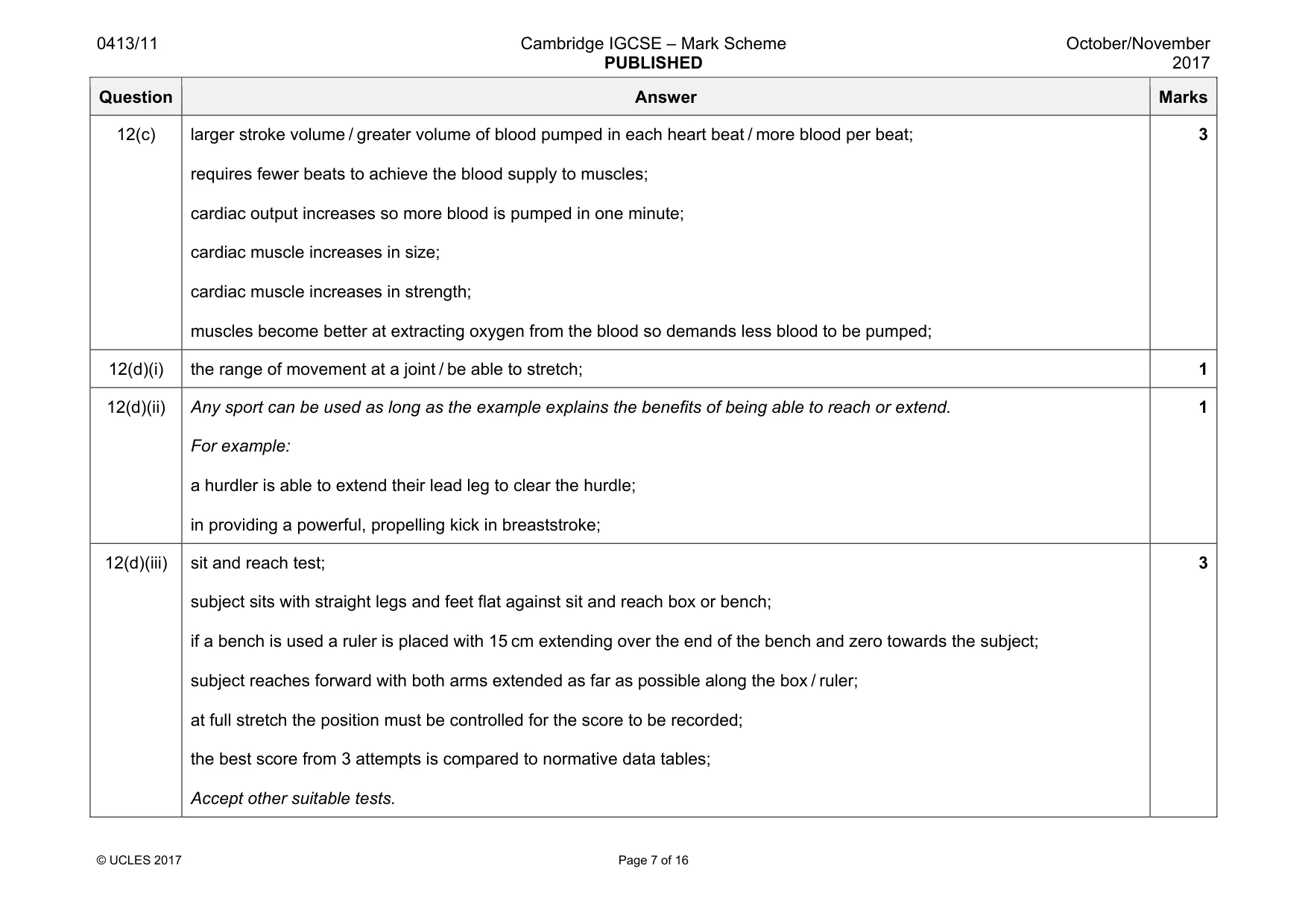
0413/11 Cambridge IGCSE – Mark Scheme PUBLISHED October/November 2017 © UCLES 2017 Page 7 of 16 Question Answer Marks 12(c) larger stroke volume / greater volume of blood pumped in each heart beat / more blood per beat; requires fewer beats to achieve the blood supply to muscles; cardiac output increases so more blood is pumped in one minute; cardiac muscle increases in size; cardiac muscle increases in strength; muscles become better at extracting oxygen from the blood so demands less blood to be pumped; 3 12(d)(i) the range of movement at a joint / be able to stretch; 1 12(d)(ii) Any sport can be used as long as the example explains the benefits of being able to reach or extend. For example: a hurdler is able to extend their lead leg to clear the hurdle; in providing a powerful, propelling kick in breaststroke; 1 12(d)(iii) sit and reach test; subject sits with straight legs and feet flat against sit and reach box or bench; if a bench is used a ruler is placed with 15 cm extending over the end of the bench and zero towards the subject; subject reaches forward with both arms extended as far as possible along the box / ruler; at full stretch the position must be controlled for the score to be recorded; the best score from 3 attempts is compared to normative data tables; Accept other suitable tests. 3
Mark scheme, page 8
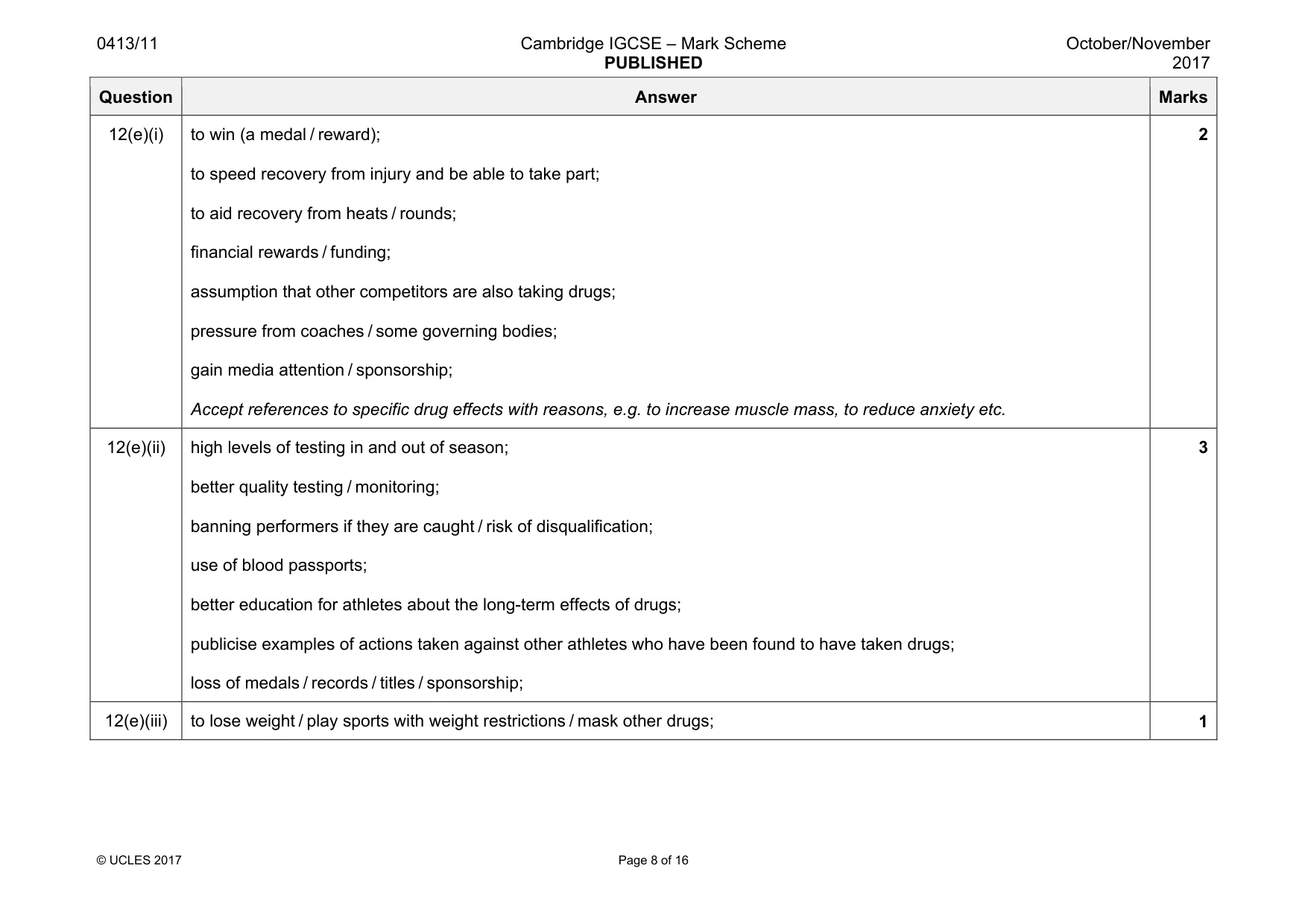
0413/11 Cambridge IGCSE – Mark Scheme PUBLISHED October/November 2017 © UCLES 2017 Page 8 of 16 Question Answer Marks 12(e)(i) to win (a medal / reward); to speed recovery from injury and be able to take part; to aid recovery from heats / rounds; financial rewards / funding; assumption that other competitors are also taking drugs; pressure from coaches / some governing bodies; gain media attention / sponsorship; Accept references to specific drug effects with reasons, e.g. to increase muscle mass, to reduce anxiety etc. 2 12(e)(ii) high levels of testing in and out of season; better quality testing / monitoring; banning performers if they are caught / risk of disqualification; use of blood passports; better education for athletes about the long-term effects of drugs; publicise examples of actions taken against other athletes who have been found to have taken drugs; loss of medals / records / titles / sponsorship; 3 12(e)(iii) to lose weight / play sports with weight restrictions / mask other drugs; 1
Mark scheme, page 9
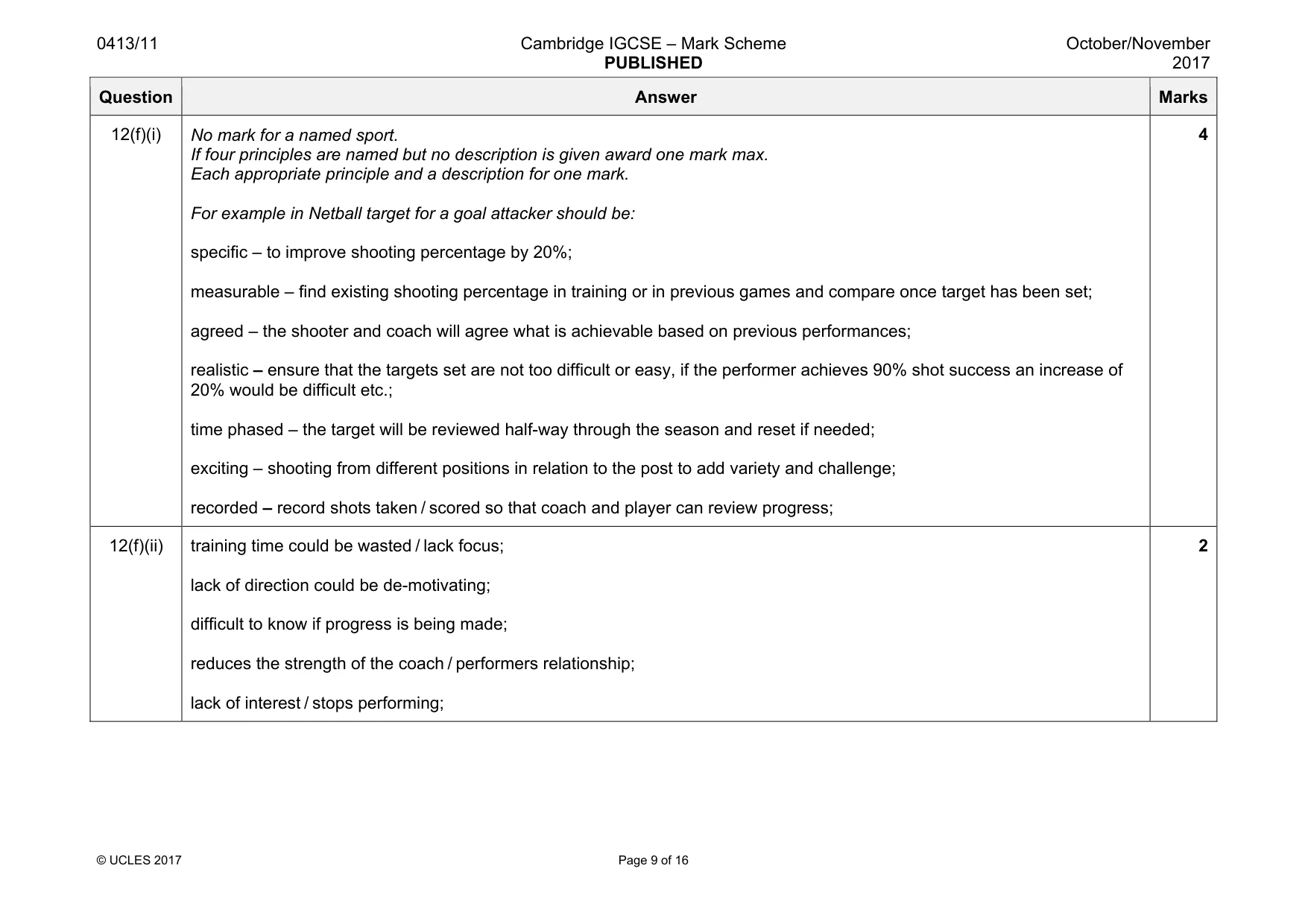
0413/11 Cambridge IGCSE – Mark Scheme PUBLISHED October/November 2017 © UCLES 2017 Page 9 of 16 Question Answer Marks 12(f)(i) No mark for a named sport. If four principles are named but no description is given award one mark max. Each appropriate principle and a description for one mark. For example in Netball target for a goal attacker should be: specific – to improve shooting percentage by 20%; measurable – find existing shooting percentage in training or in previous games and compare once target has been set; agreed – the shooter and coach will agree what is achievable based on previous performances; realistic – ensure that the targets set are not too difficult or easy, if the performer achieves 90% shot success an increase of 20% would be difficult etc.; time phased – the target will be reviewed half-way through the season and reset if needed; exciting – shooting from different positions in relation to the post to add variety and challenge; recorded – record shots taken / scored so that coach and player can review progress; 4 12(f)(ii) training time could be wasted / lack focus; lack of direction could be de-motivating; difficult to know if progress is being made; reduces the strength of the coach / performers relationship; lack of interest / stops performing; 2
Mark scheme, page 10
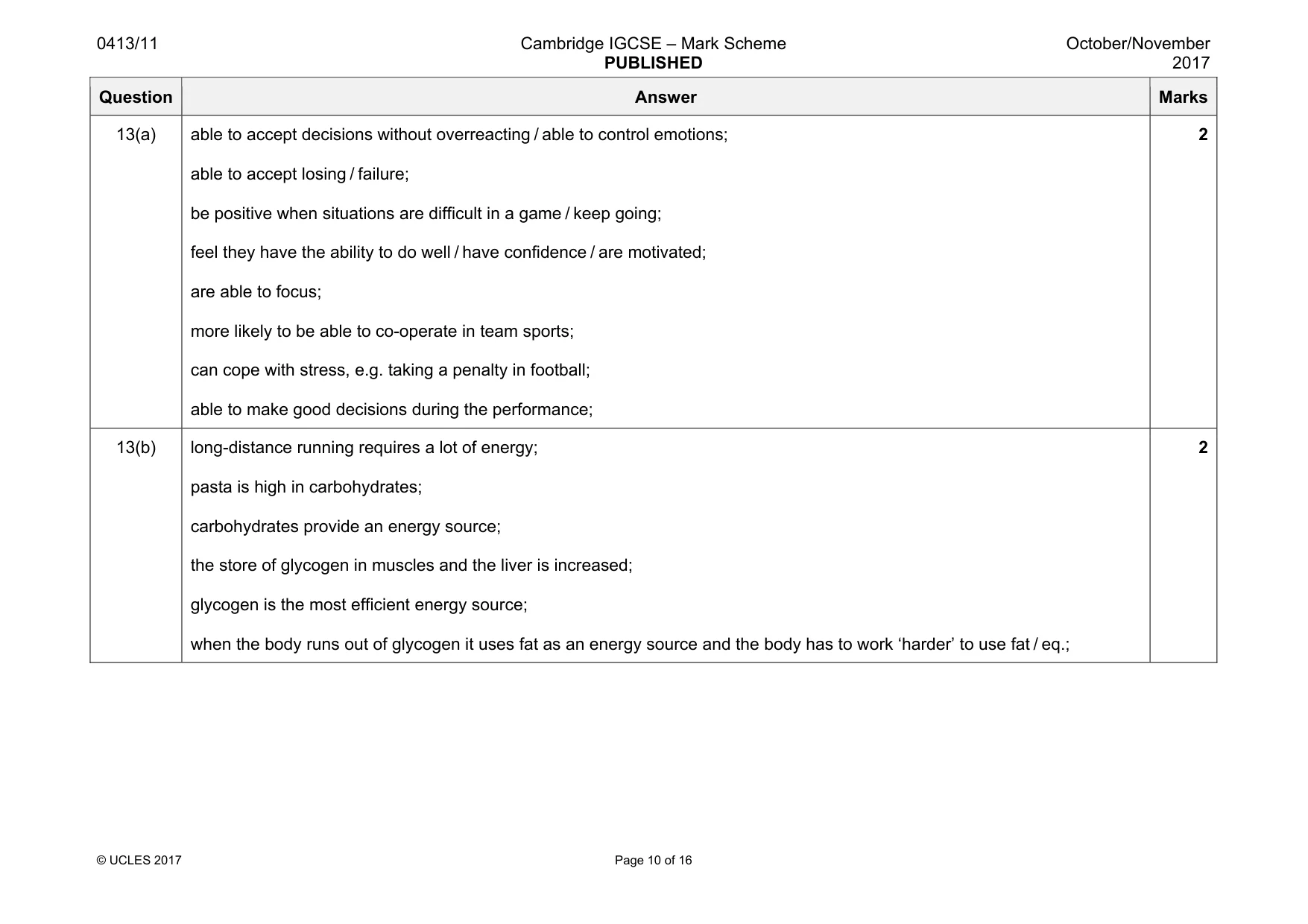
0413/11 Cambridge IGCSE – Mark Scheme PUBLISHED October/November 2017 © UCLES 2017 Page 10 of 16 Question Answer Marks 13(a) able to accept decisions without overreacting / able to control emotions; able to accept losing / failure; be positive when situations are difficult in a game / keep going; feel they have the ability to do well / have confidence / are motivated; are able to focus; more likely to be able to co-operate in team sports; can cope with stress, e.g. taking a penalty in football; able to make good decisions during the performance; 2 13(b) long-distance running requires a lot of energy; pasta is high in carbohydrates; carbohydrates provide an energy source; the store of glycogen in muscles and the liver is increased; glycogen is the most efficient energy source; when the body runs out of glycogen it uses fat as an energy source and the body has to work ‘harder’ to use fat / eq.; 2
Mark scheme, page 11
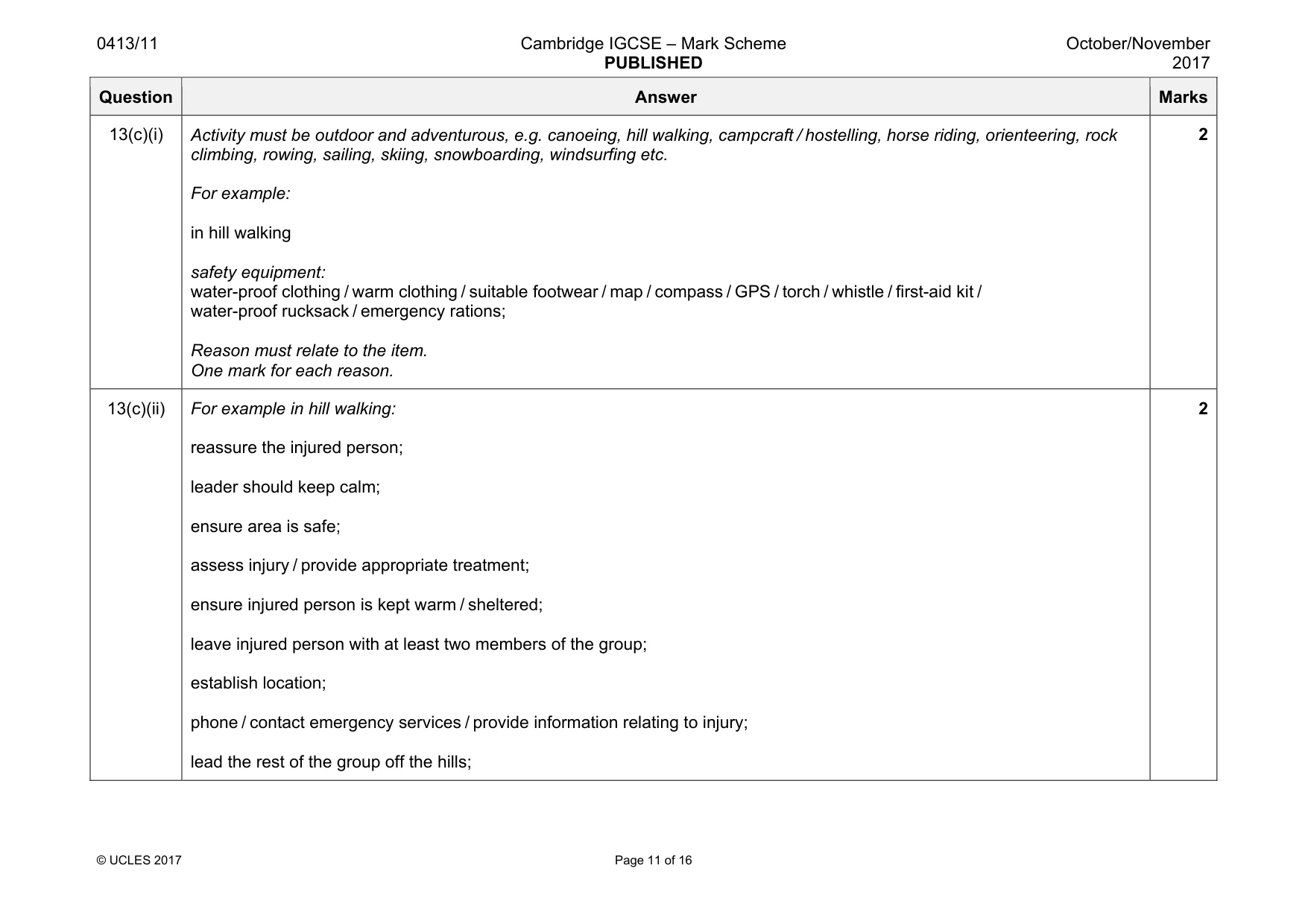
0413/11 Cambridge IGCSE – Mark Scheme PUBLISHED October/November 2017 © UCLES 2017 Page 11 of 16 Question Answer Marks 13(c)(i) Activity must be outdoor and adventurous, e.g. canoeing, hill walking, campcraft / hostelling, horse riding, orienteering, rock climbing, rowing, sailing, skiing, snowboarding, windsurfing etc. For example: in hill walking safety equipment: water-proof clothing / warm clothing / suitable footwear / map / compass / GPS / torch / whistle / first-aid kit / water-proof rucksack / emergency rations; Reason must relate to the item. One mark for each reason. 2 13(c)(ii) For example in hill walking: reassure the injured person; leader should keep calm; ensure area is safe; assess injury / provide appropriate treatment; ensure injured person is kept warm / sheltered; leave injured person with at least two members of the group; establish location; phone / contact emergency services / provide information relating to injury; lead the rest of the group off the hills; 2
Mark scheme, page 12
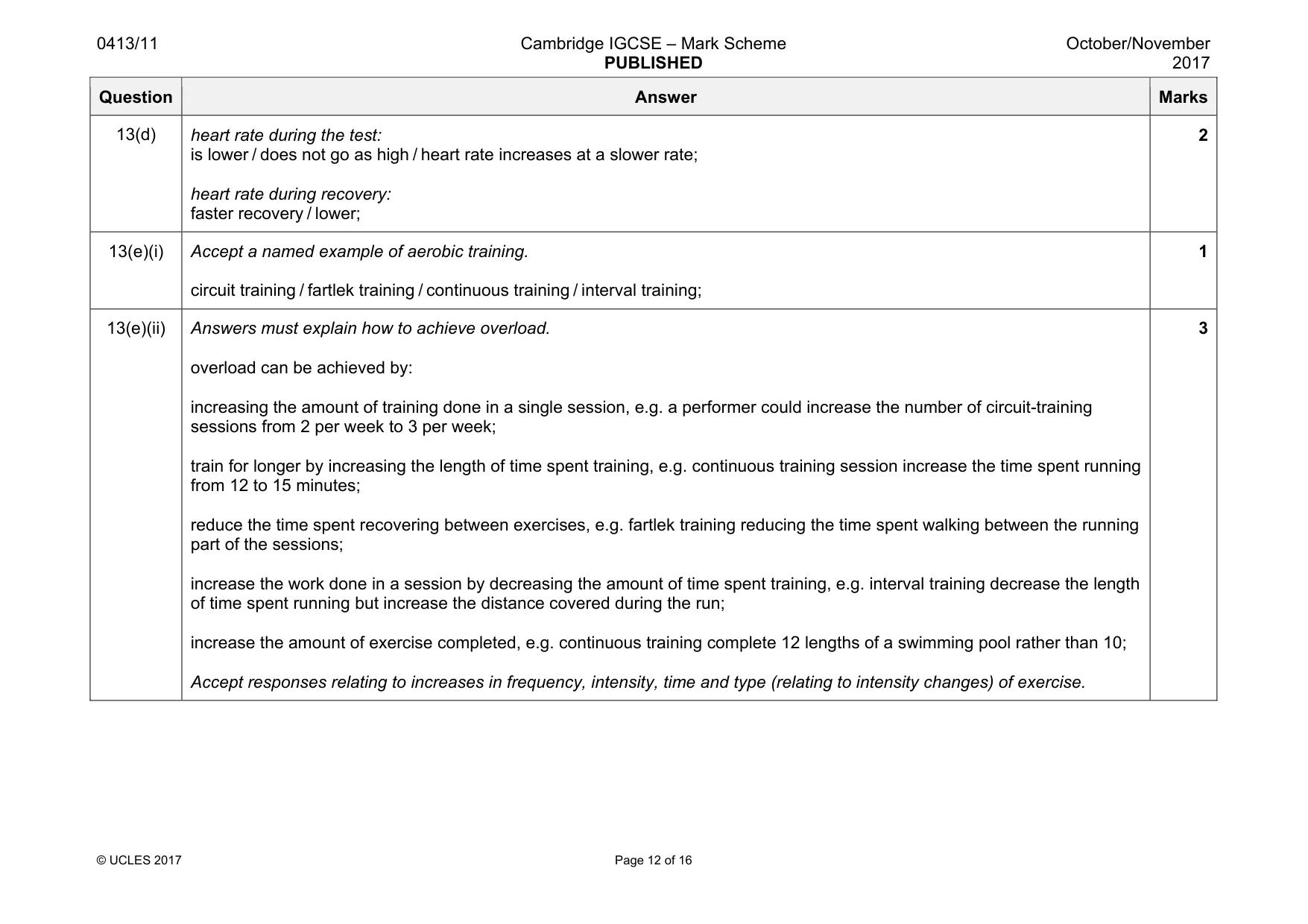
0413/11 Cambridge IGCSE – Mark Scheme PUBLISHED October/November 2017 © UCLES 2017 Page 12 of 16 Question Answer Marks 13(d) heart rate during the test: is lower / does not go as high / heart rate increases at a slower rate; heart rate during recovery: faster recovery / lower; 2 13(e)(i) Accept a named example of aerobic training. circuit training / fartlek training / continuous training / interval training; 1 13(e)(ii) Answers must explain how to achieve overload. overload can be achieved by: increasing the amount of training done in a single session, e.g. a performer could increase the number of circuit-training sessions from 2 per week to 3 per week; train for longer by increasing the length of time spent training, e.g. continuous training session increase the time spent running from 12 to 15 minutes; reduce the time spent recovering between exercises, e.g. fartlek training reducing the time spent walking between the running part of the sessions; increase the work done in a session by decreasing the amount of time spent training, e.g. interval training decrease the length of time spent running but increase the distance covered during the run; increase the amount of exercise completed, e.g. continuous training complete 12 lengths of a swimming pool rather than 10; Accept responses relating to increases in frequency, intensity, time and type (relating to intensity changes) of exercise. 3
Mark scheme, page 13
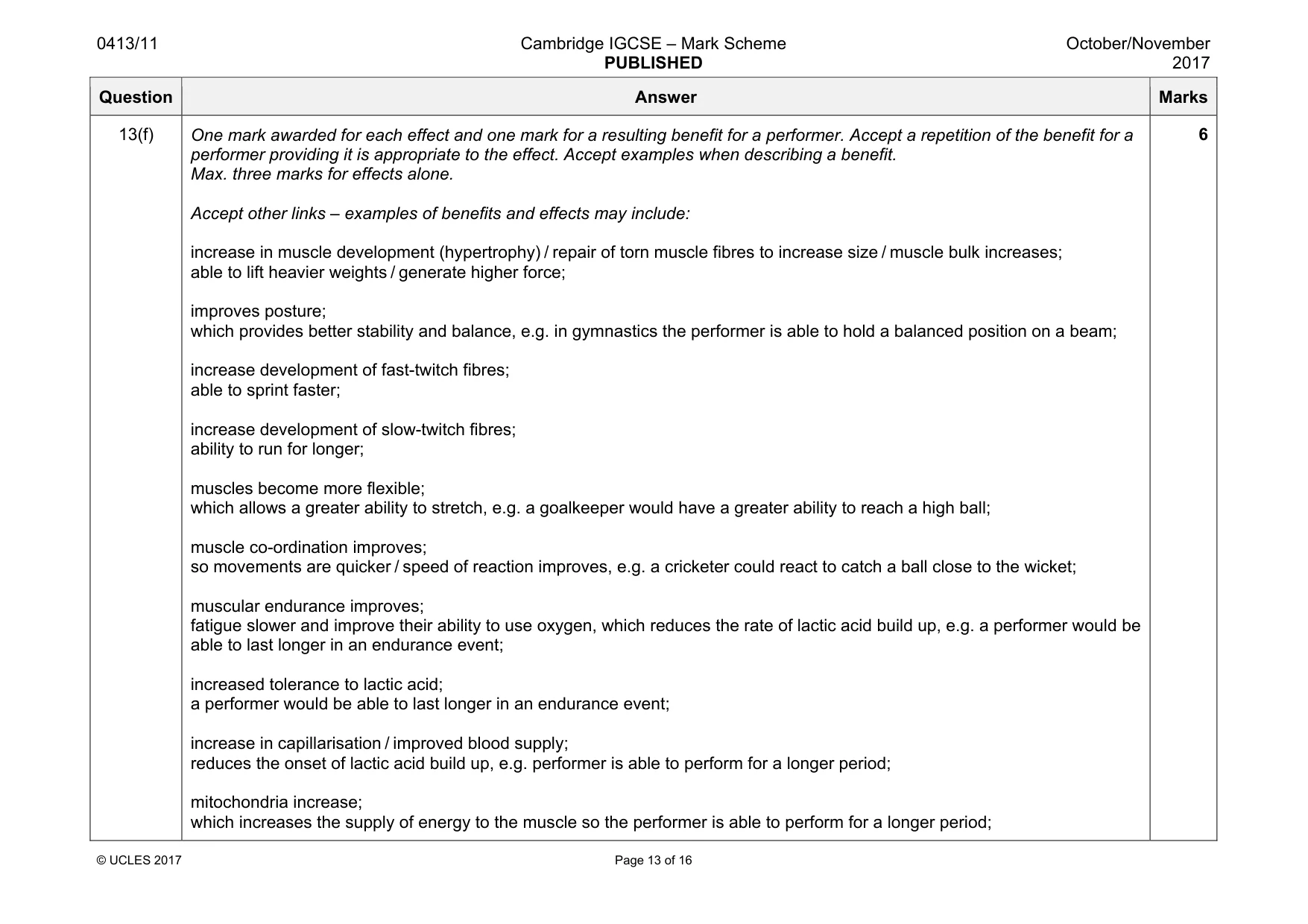
0413/11 Cambridge IGCSE – Mark Scheme PUBLISHED October/November 2017 © UCLES 2017 Page 13 of 16 Question Answer Marks 13(f) One mark awarded for each effect and one mark for a resulting benefit for a performer. Accept a repetition of the benefit for a performer providing it is appropriate to the effect. Accept examples when describing a benefit. Max. three marks for effects alone. Accept other links – examples of benefits and effects may include: increase in muscle development (hypertrophy) / repair of torn muscle fibres to increase size / muscle bulk increases; able to lift heavier weights / generate higher force; improves posture; which provides better stability and balance, e.g. in gymnastics the performer is able to hold a balanced position on a beam; increase development of fast-twitch fibres; able to sprint faster; increase development of slow-twitch fibres; ability to run for longer; muscles become more flexible; which allows a greater ability to stretch, e.g. a goalkeeper would have a greater ability to reach a high ball; muscle co-ordination improves; so movements are quicker / speed of reaction improves, e.g. a cricketer could react to catch a ball close to the wicket; muscular endurance improves; fatigue slower and improve their ability to use oxygen, which reduces the rate of lactic acid build up, e.g. a performer would be able to last longer in an endurance event; increased tolerance to lactic acid; a performer would be able to last longer in an endurance event; increase in capillarisation / improved blood supply; reduces the onset of lactic acid build up, e.g. performer is able to perform for a longer period; mitochondria increase; which increases the supply of energy to the muscle so the performer is able to perform for a longer period; 6
Mark scheme, page 14
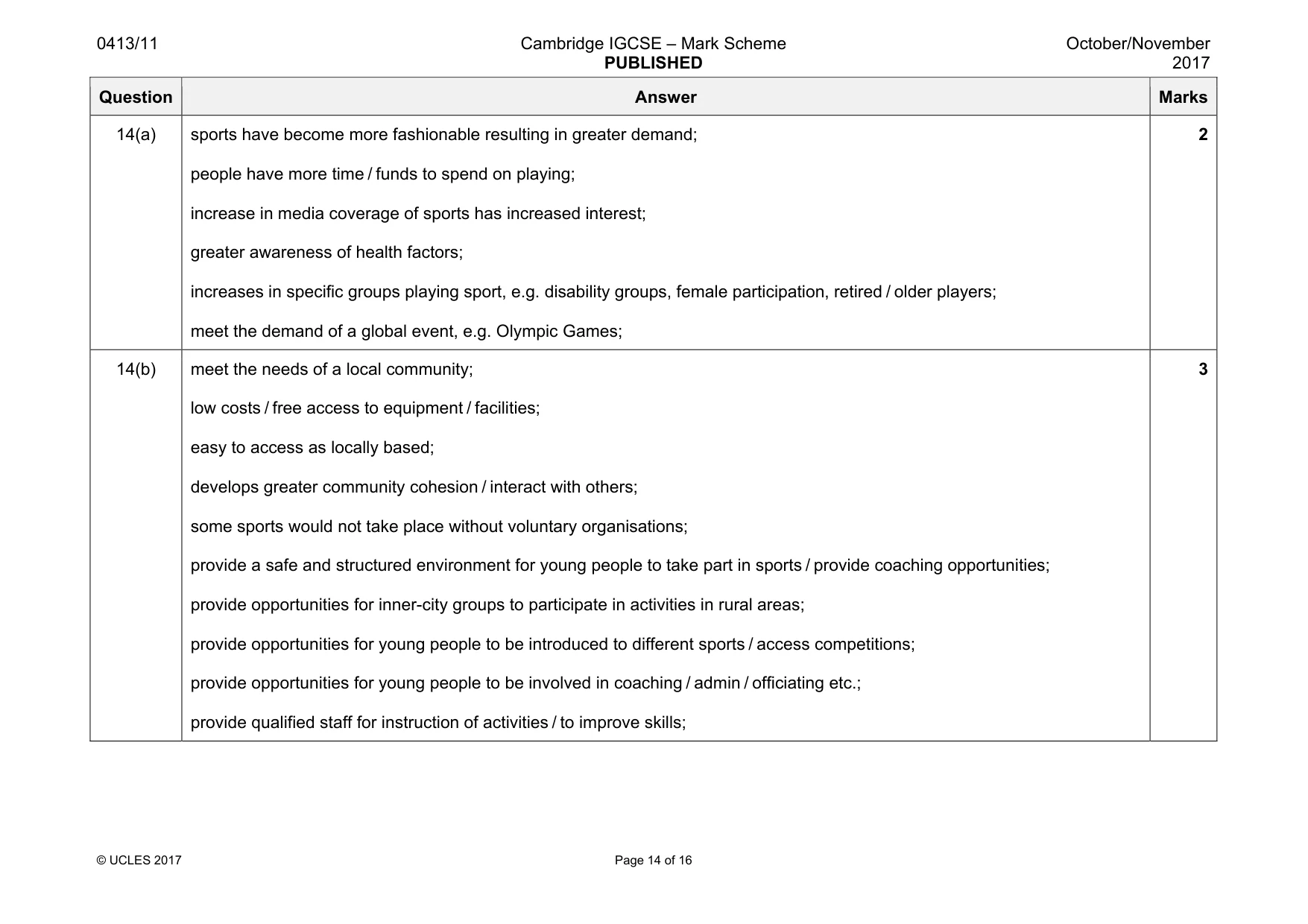
0413/11 Cambridge IGCSE – Mark Scheme PUBLISHED October/November 2017 © UCLES 2017 Page 14 of 16 Question Answer Marks 14(a) sports have become more fashionable resulting in greater demand; people have more time / funds to spend on playing; increase in media coverage of sports has increased interest; greater awareness of health factors; increases in specific groups playing sport, e.g. disability groups, female participation, retired / older players; meet the demand of a global event, e.g. Olympic Games; 2 14(b) meet the needs of a local community; low costs / free access to equipment / facilities; easy to access as locally based; develops greater community cohesion / interact with others; some sports would not take place without voluntary organisations; provide a safe and structured environment for young people to take part in sports / provide coaching opportunities; provide opportunities for inner-city groups to participate in activities in rural areas; provide opportunities for young people to be introduced to different sports / access competitions; provide opportunities for young people to be involved in coaching / admin / officiating etc.; provide qualified staff for instruction of activities / to improve skills; 3
Mark scheme, page 15
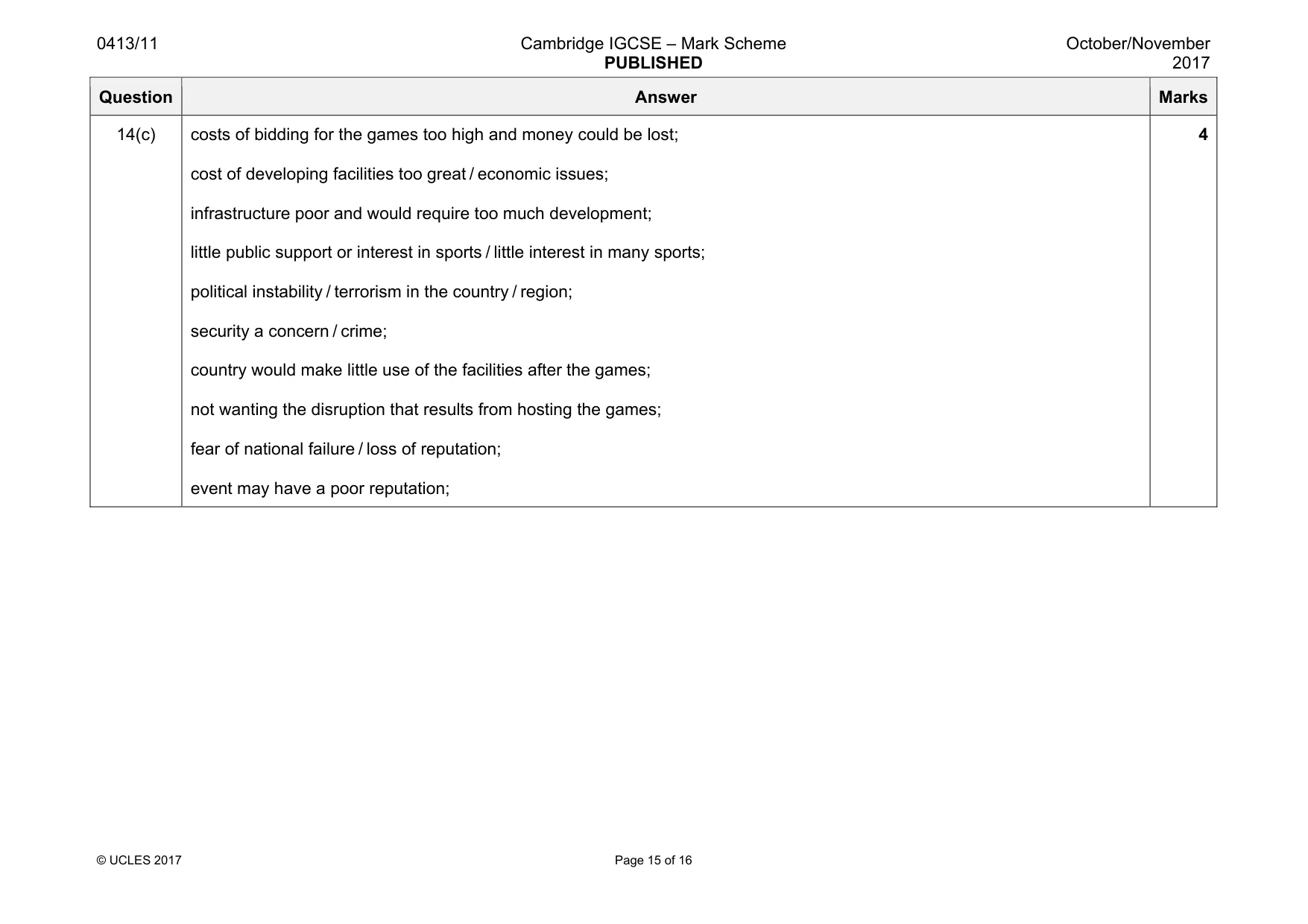
0413/11 Cambridge IGCSE – Mark Scheme PUBLISHED October/November 2017 © UCLES 2017 Page 15 of 16 Question Answer Marks 14(c) costs of bidding for the games too high and money could be lost; cost of developing facilities too great / economic issues; infrastructure poor and would require too much development; little public support or interest in sports / little interest in many sports; political instability / terrorism in the country / region; security a concern / crime; country would make little use of the facilities after the games; not wanting the disruption that results from hosting the games; fear of national failure / loss of reputation; event may have a poor reputation; 4
Mark scheme, page 16
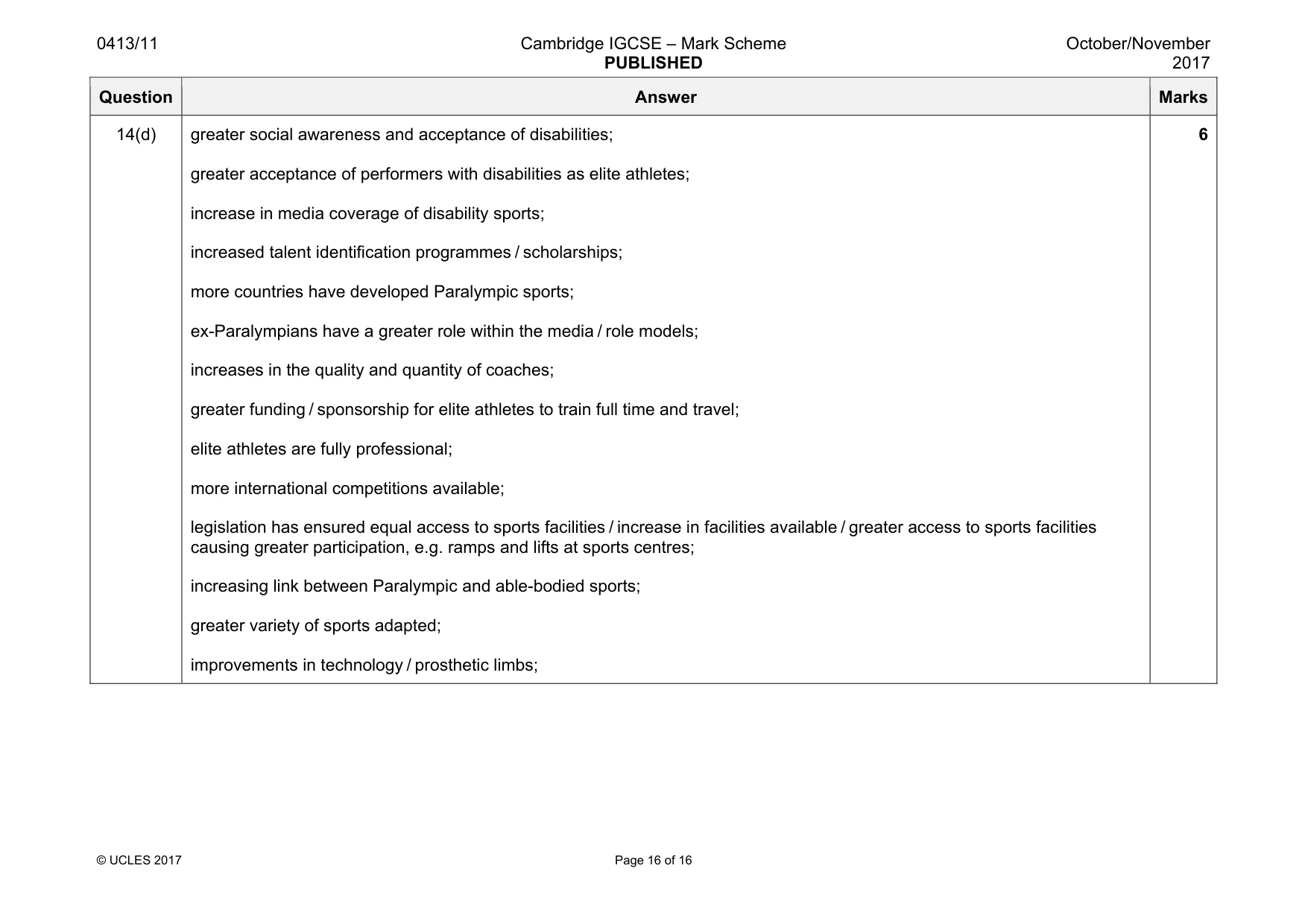
0413/11 Cambridge IGCSE – Mark Scheme PUBLISHED October/November 2017 © UCLES 2017 Page 16 of 16 Question Answer Marks 14(d) greater social awareness and acceptance of disabilities; greater acceptance of performers with disabilities as elite athletes; increase in media coverage of disability sports; increased talent identification programmes / scholarships; more countries have developed Paralympic sports; ex-Paralympians have a greater role within the media / role models; increases in the quality and quantity of coaches; greater funding / sponsorship for elite athletes to train full time and travel; elite athletes are fully professional; more international competitions available; legislation has ensured equal access to sports facilities / increase in facilities available / greater access to sports facilities causing greater participation, e.g. ramps and lifts at sports centres; increasing link between Paralympic and able-bodied sports; greater variety of sports adapted; improvements in technology / prosthetic limbs; 6
What you needed in this session
Cambridge’s own grade thresholds for 2017 Oct/Nov, Paper 1 · Variant 1. A higher threshold means an easier paper — the bar moves with how the cohort did.