Cambridge IGCSE Physical Education 0413 — 2017 May/June Paper 1 · Variant 2
0413/12/M/J/17 · 80 marks · ≈90 min
The question paper and its mark scheme, free to read here and free to download. This is Cambridge’s own paper, exactly as it was sat.
Question paper12 pages

Mark scheme21 pages
Answers below. Sit the paper first if you are practising.
Paper as text
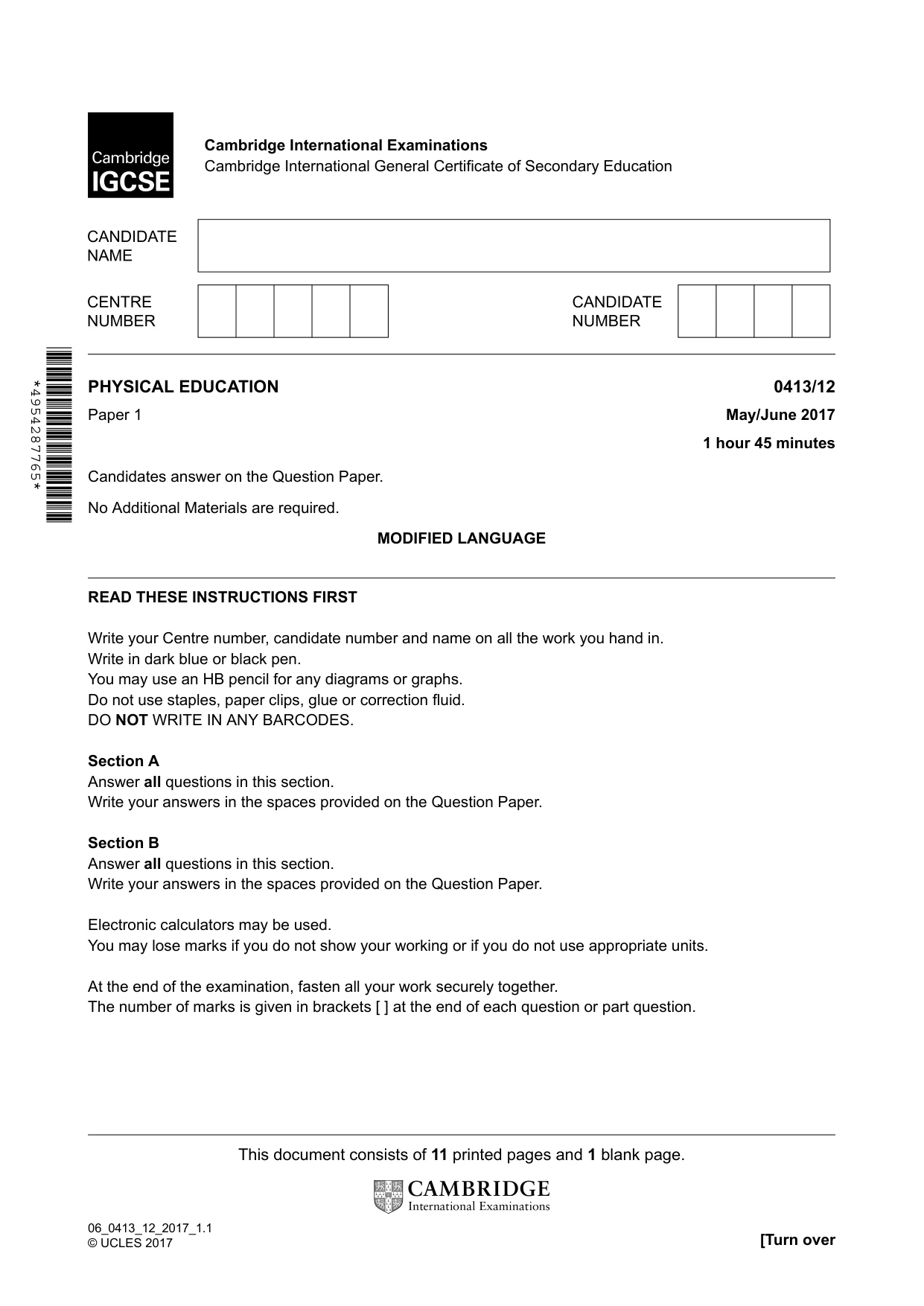
Question paper, page 1
Cambridge International Examinations Cambridge International General Certificate of Secondary Education 0413/12 May/June 2017 1 hour 45 minutes PHYSICAL EDUCATION Paper 1 Candidates answer on the Question Paper. No Additional Materials are required. MODIFIED LANGUAGE READ THESE INSTRUCTIONS FIRST Write your Centre number, candidate number and name on all the work you hand in. Write in dark blue or black pen. You may use an HB pencil for any diagrams or graphs. Do not use staples, paper clips, glue or correction fluid. DO NOT WRITE IN ANY BARCODES. Section A Answer all questions in this section. Write your answers in the spaces provided on the Question Paper. Section B Answer all questions in this section. Write your answers in the spaces provided on the Question Paper. Electronic calculators may be used. You may lose marks if you do not show your working or if you do not use appropriate units. At the end of the examination, fasten all your work securely together. The number of marks is given in brackets [ ] at the end of each question or part question. This document consists of 11 printed pages and 1 blank page. [Turn over 06_0413_12_2017_1.1 © UCLES 2017 *4954287765*
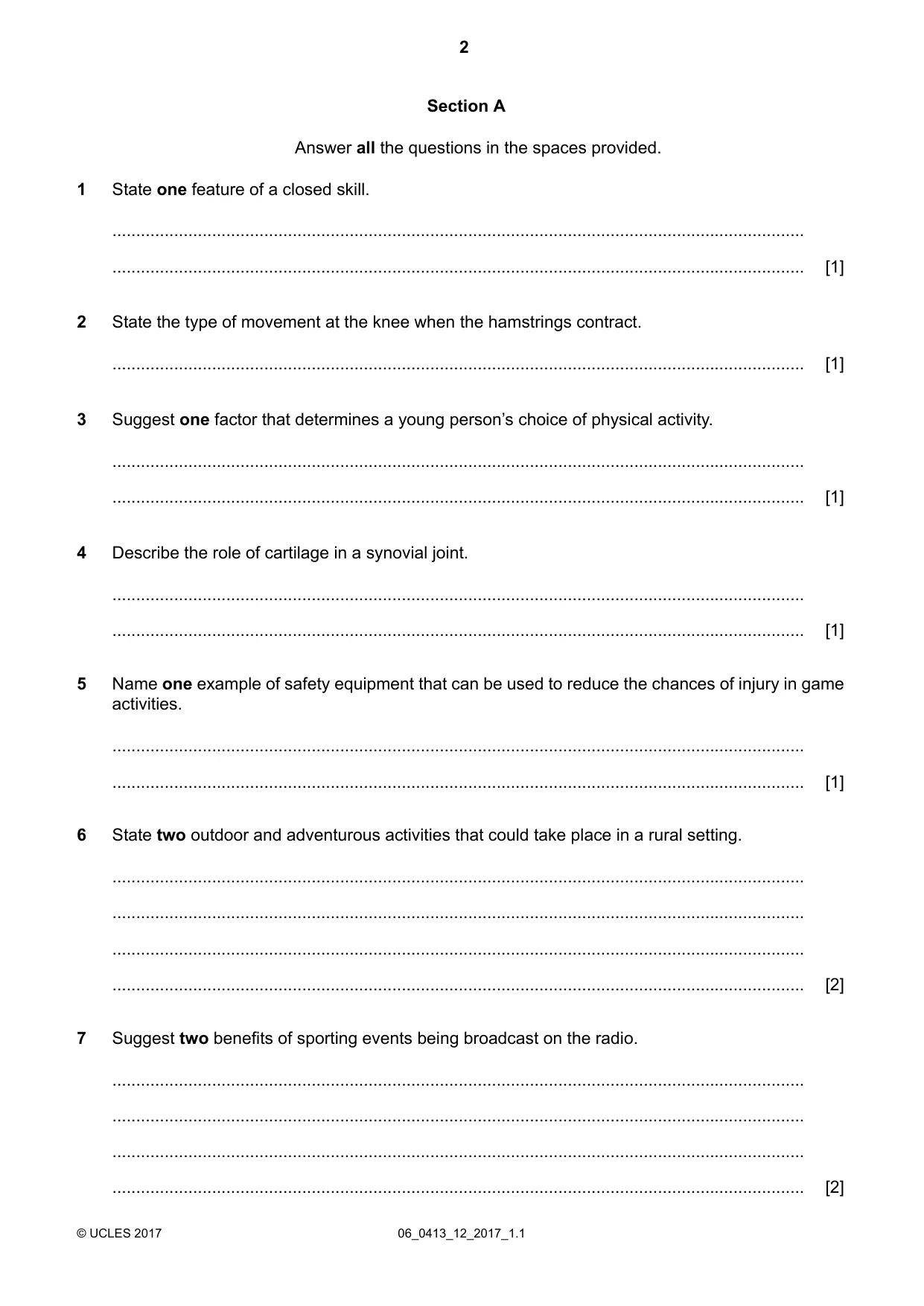
Question paper, page 2
Section A Answer all the questions in the spaces provided. State one feature of a closed skill. 1 … … [1] State the type of movement at the knee when the hamstrings contract. 2 … [1] Suggest one factor that determines a young person’s choice of physical activity. 3 … … [1] Describe the role of cartilage in a synovial joint. 4 … … [1] Name one example of safety equipment that can be used to reduce the chances of injury in game activities. 5 … … [1] State two outdoor and adventurous activities that could take place in a rural setting. 6 … … … … [2] Suggest two benefits of sporting events being broadcast on the radio. 7 … … … … [2] 06_0413_12_2017_1.1 © UCLES 2017 2
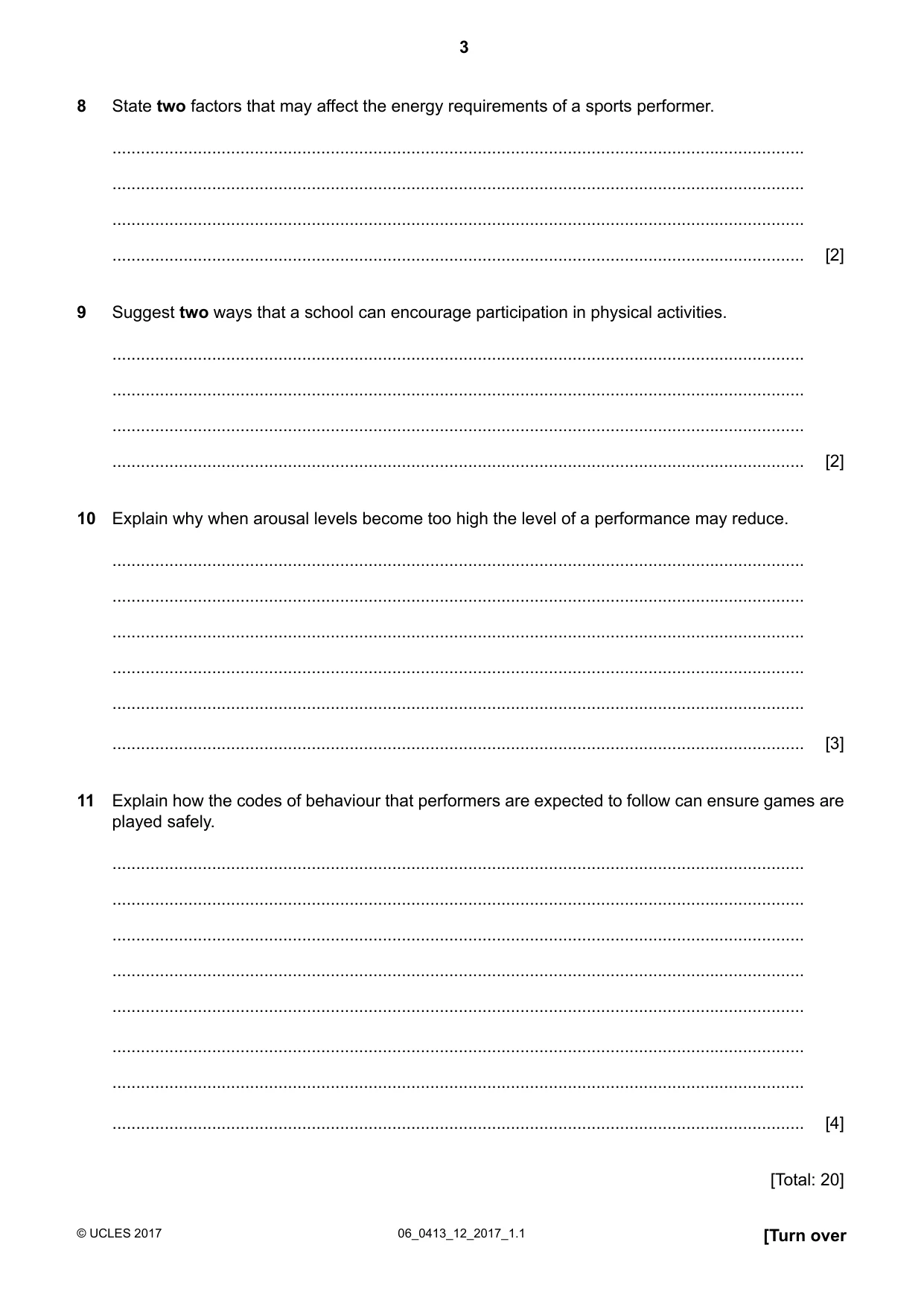
Question paper, page 3
State two factors that may affect the energy requirements of a sports performer. 8 … … … … [2] Suggest two ways that a school can encourage participation in physical activities. 9 … … … … [2] Explain why when arousal levels become too high the level of a performance may reduce. 10 … … … … … … [3] Explain how the codes of behaviour that performers are expected to follow can ensure games are played safely. 11 … … … … … … … … [4] [Total: 20] [Turn over 06_0413_12_2017_1.1 © UCLES 2017 3
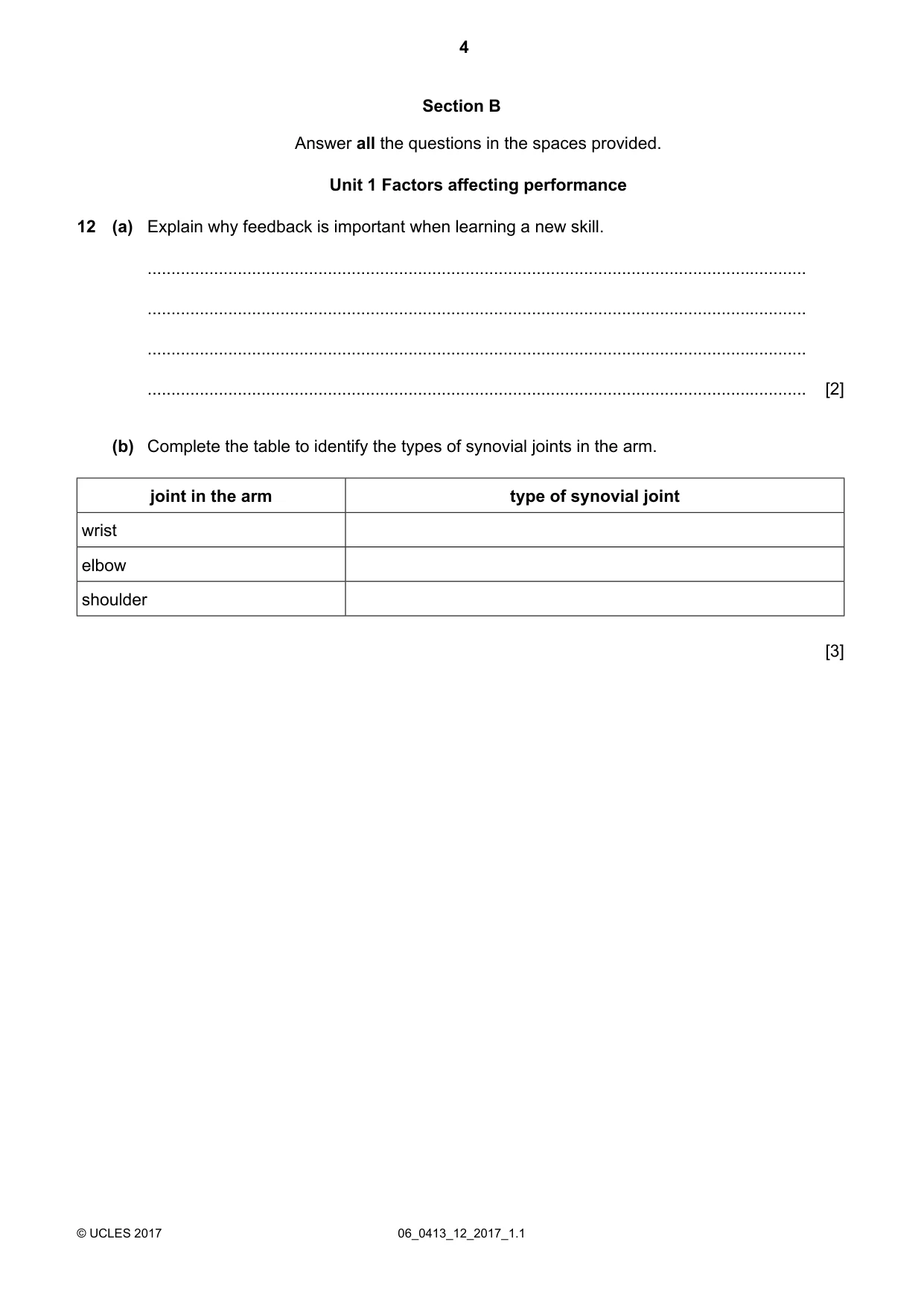
Question paper, page 4
Section B Answer all the questions in the spaces provided. Unit 1 Factors affecting performance Explain why feedback is important when learning a new skill. (a) 12 … … … … [2] Complete the table to identify the types of synovial joints in the arm. (b) type of synovial joint joint in the arm wrist elbow shoulder [3] 06_0413_12_2017_1.1 © UCLES 2017 4
Question paper, page 5
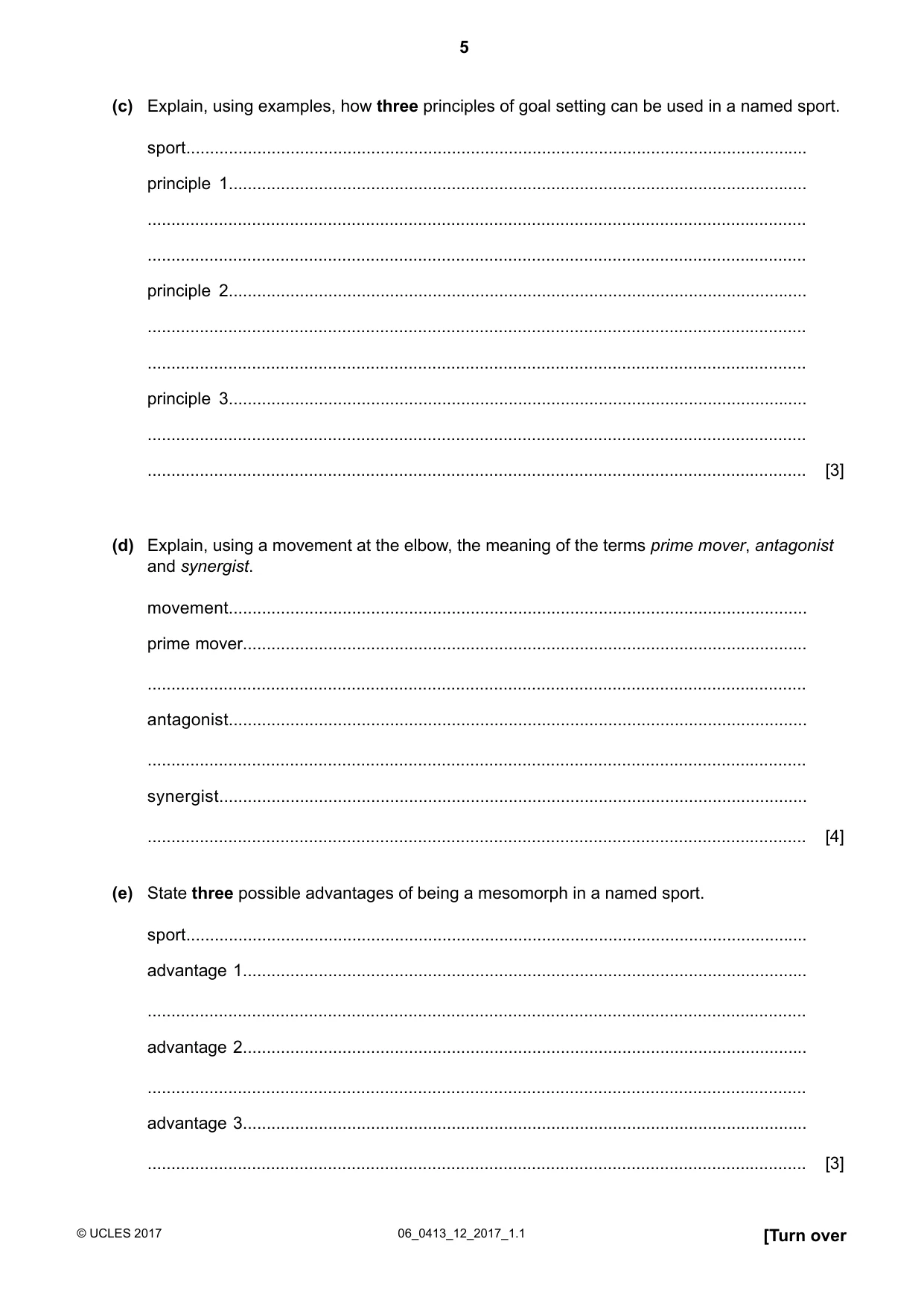
Explain, using examples, how three principles of goal setting can be used in a named sport. (c) sport… principle 1… … … principle 2… … … principle 3… … … [3] Explain, using a movement at the elbow, the meaning of the terms prime mover, antagonist and synergist. (d) movement… prime mover… … antagonist… … synergist… … [4] State three possible advantages of being a mesomorph in a named sport. (e) sport… advantage 1… … advantage 2… … advantage 3… … [3] [Turn over 06_0413_12_2017_1.1 © UCLES 2017 5
Question paper, page 6
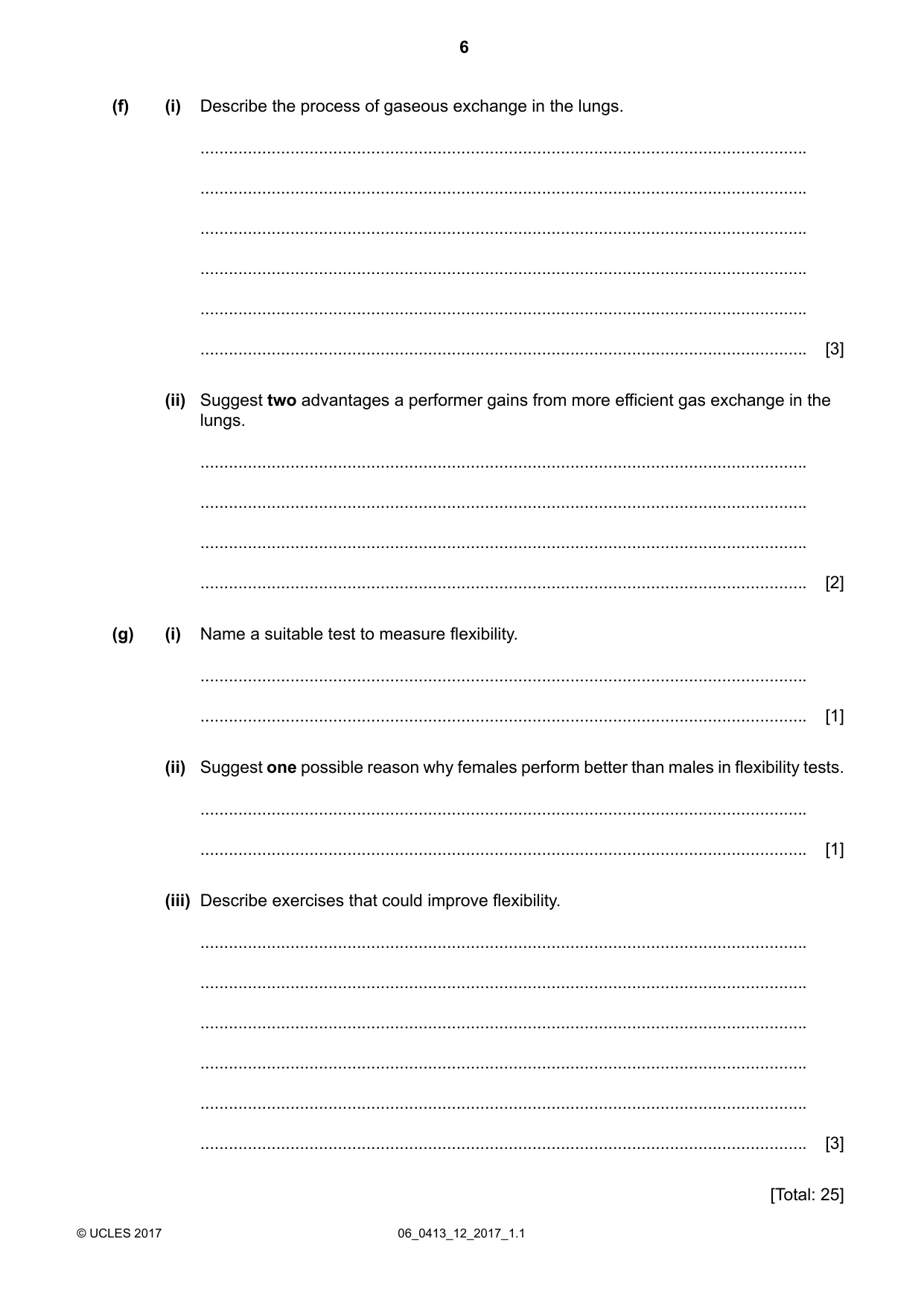
Describe the process of gaseous exchange in the lungs. (i) (f) … … … … … … [3] Suggest two advantages a performer gains from more efficient gas exchange in the lungs. (ii) … … … … [2] Name a suitable test to measure flexibility. (i) (g) … … [1] Suggest one possible reason why females perform better than males in flexibility tests. (ii) … … [1] Describe exercises that could improve flexibility. (iii) … … … … … … [3] [Total: 25] 06_0413_12_2017_1.1 © UCLES 2017 6
Question paper, page 7
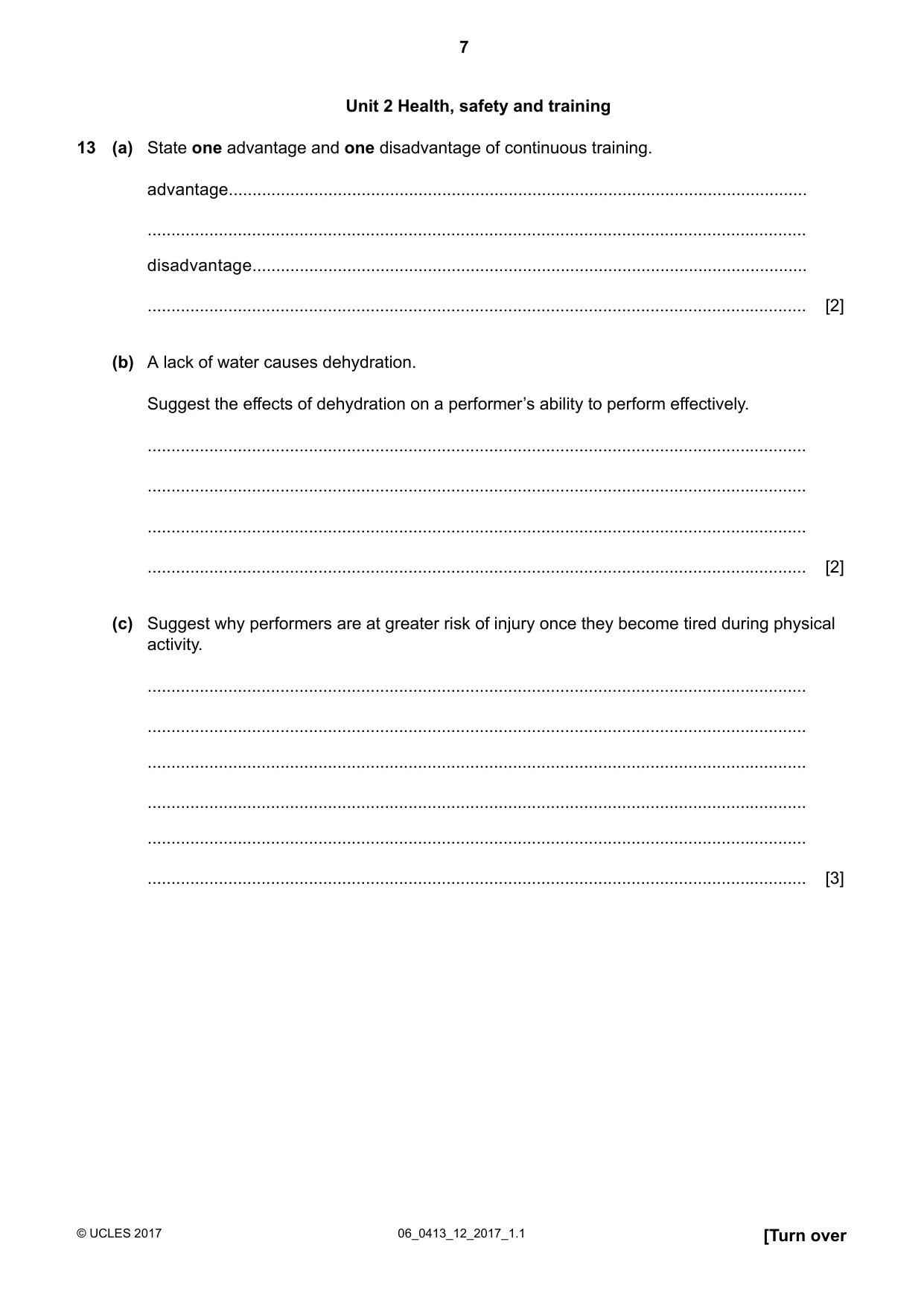
Unit 2 Health, safety and training State one advantage and one disadvantage of continuous training. (a) 13 advantage… … disadvantage… … [2] A lack of water causes dehydration. Suggest the effects of dehydration on a performer’s ability to perform effectively. (b) … … … … [2] Suggest why performers are at greater risk of injury once they become tired during physical activity. (c) … … … … … … [3] [Turn over 06_0413_12_2017_1.1 © UCLES 2017 7
Question paper, page 8
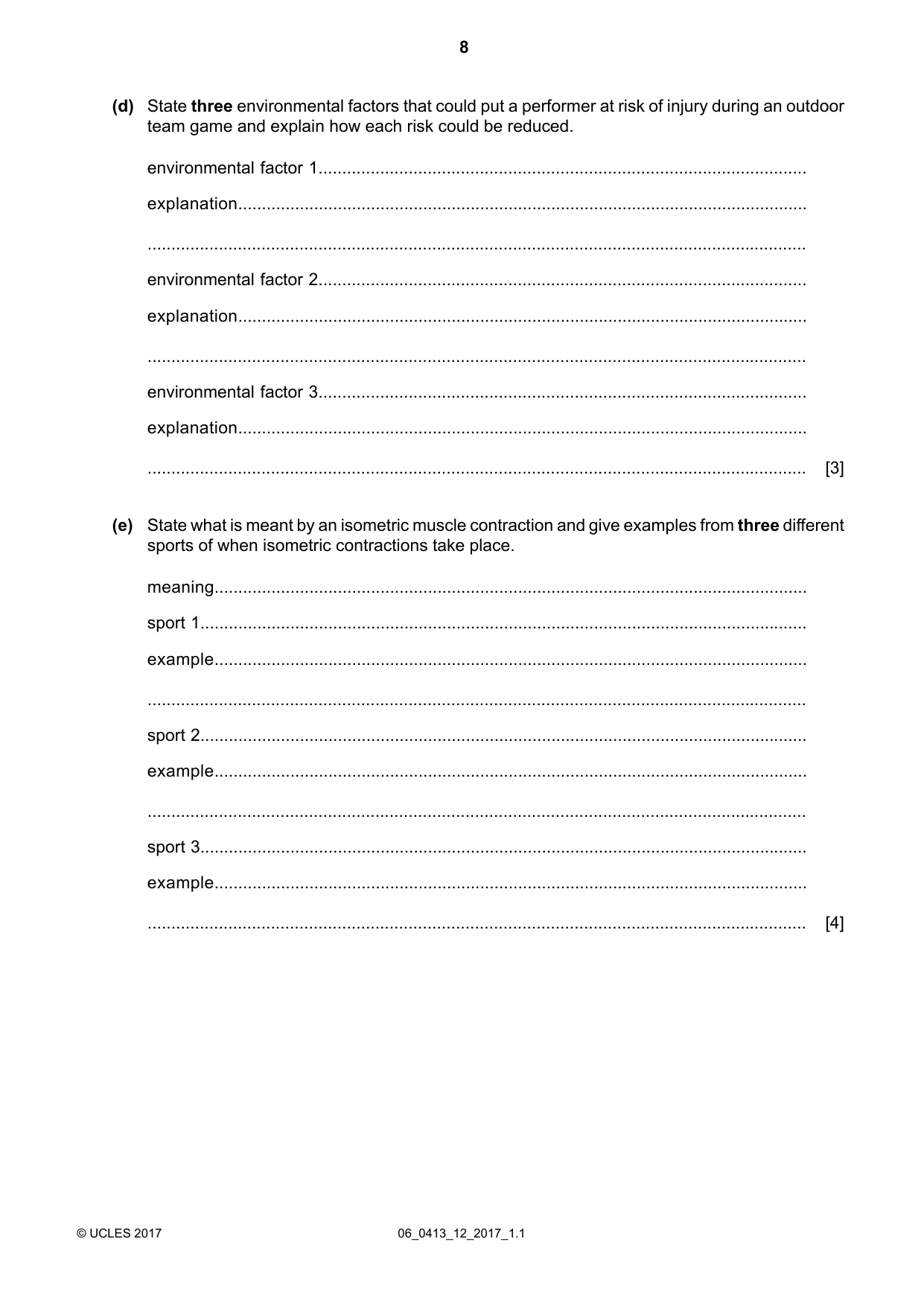
State three environmental factors that could put a performer at risk of injury during an outdoor team game and explain how each risk could be reduced. (d) environmental factor 1… explanation… … environmental factor 2… explanation… … environmental factor 3… explanation… … [3] State what is meant by an isometric muscle contraction and give examples from three different sports of when isometric contractions take place. (e) meaning… sport 1… example… … sport 2… example… … sport 3… example… … [4] 06_0413_12_2017_1.1 © UCLES 2017 8
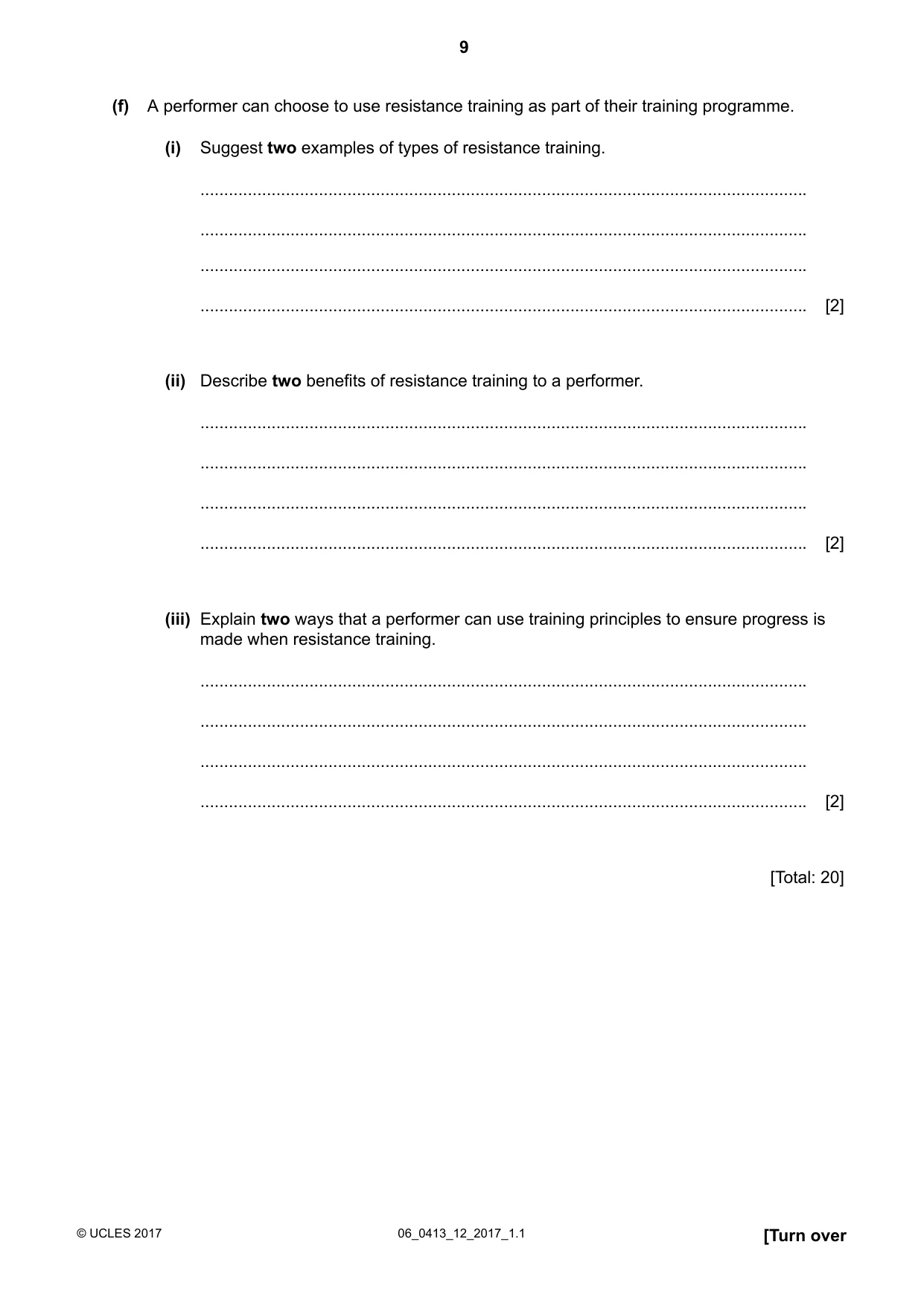
Question paper, page 9
A performer can choose to use resistance training as part of their training programme. (f) Suggest two examples of types of resistance training. (i) … … … … [2] Describe two benefits of resistance training to a performer. (ii) … … … … [2] Explain two ways that a performer can use training principles to ensure progress is made when resistance training. (iii) … … … … [2] [Total: 20] [Turn over 06_0413_12_2017_1.1 © UCLES 2017 9
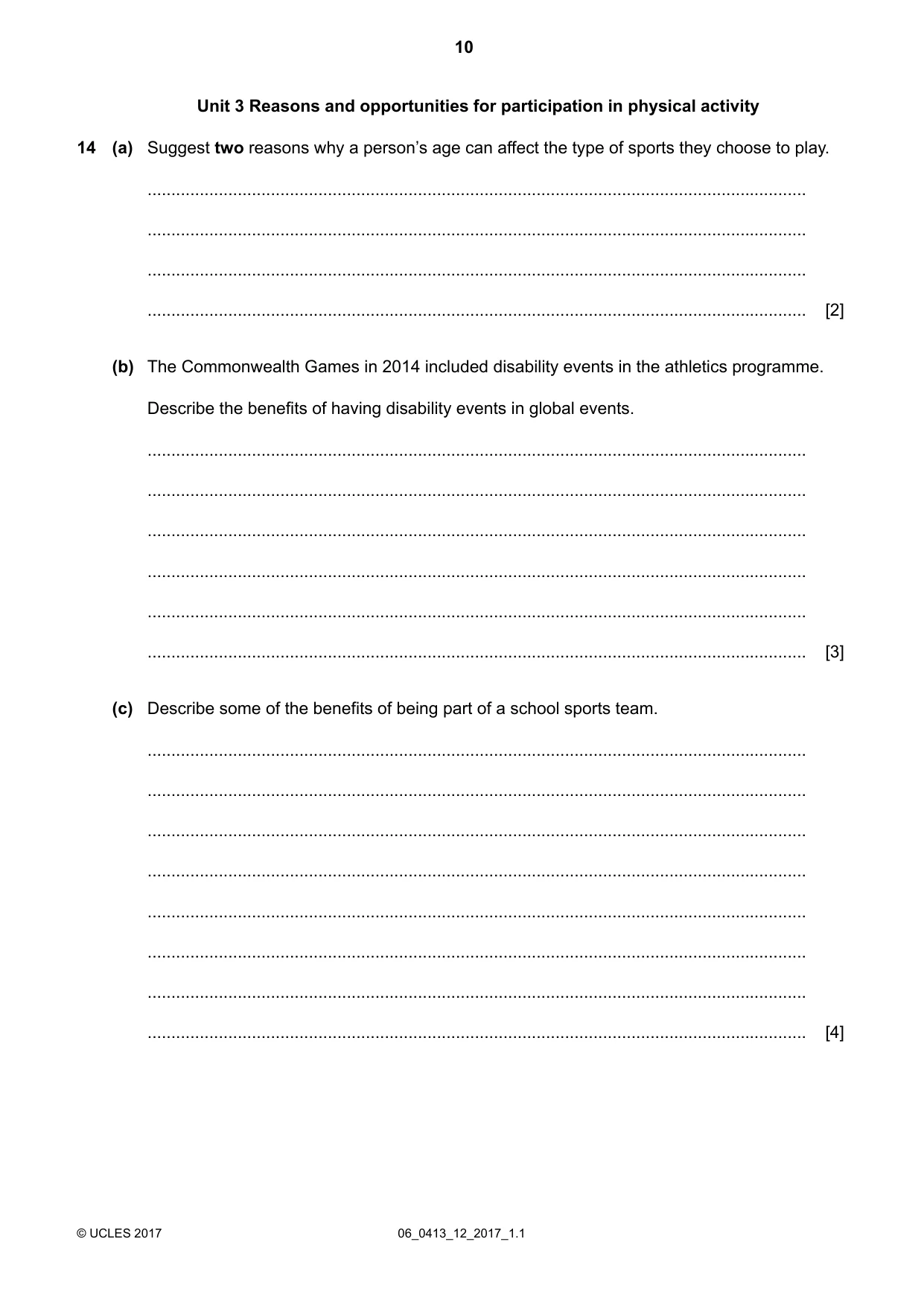
Question paper, page 10
Unit 3 Reasons and opportunities for participation in physical activity Suggest two reasons why a person’s age can affect the type of sports they choose to play. (a) 14 … … … … [2] The Commonwealth Games in 2014 included disability events in the athletics programme. Describe the benefits of having disability events in global events. (b) … … … … … … [3] Describe some of the benefits of being part of a school sports team. (c) … … … … … … … … [4] 06_0413_12_2017_1.1 © UCLES 2017 10
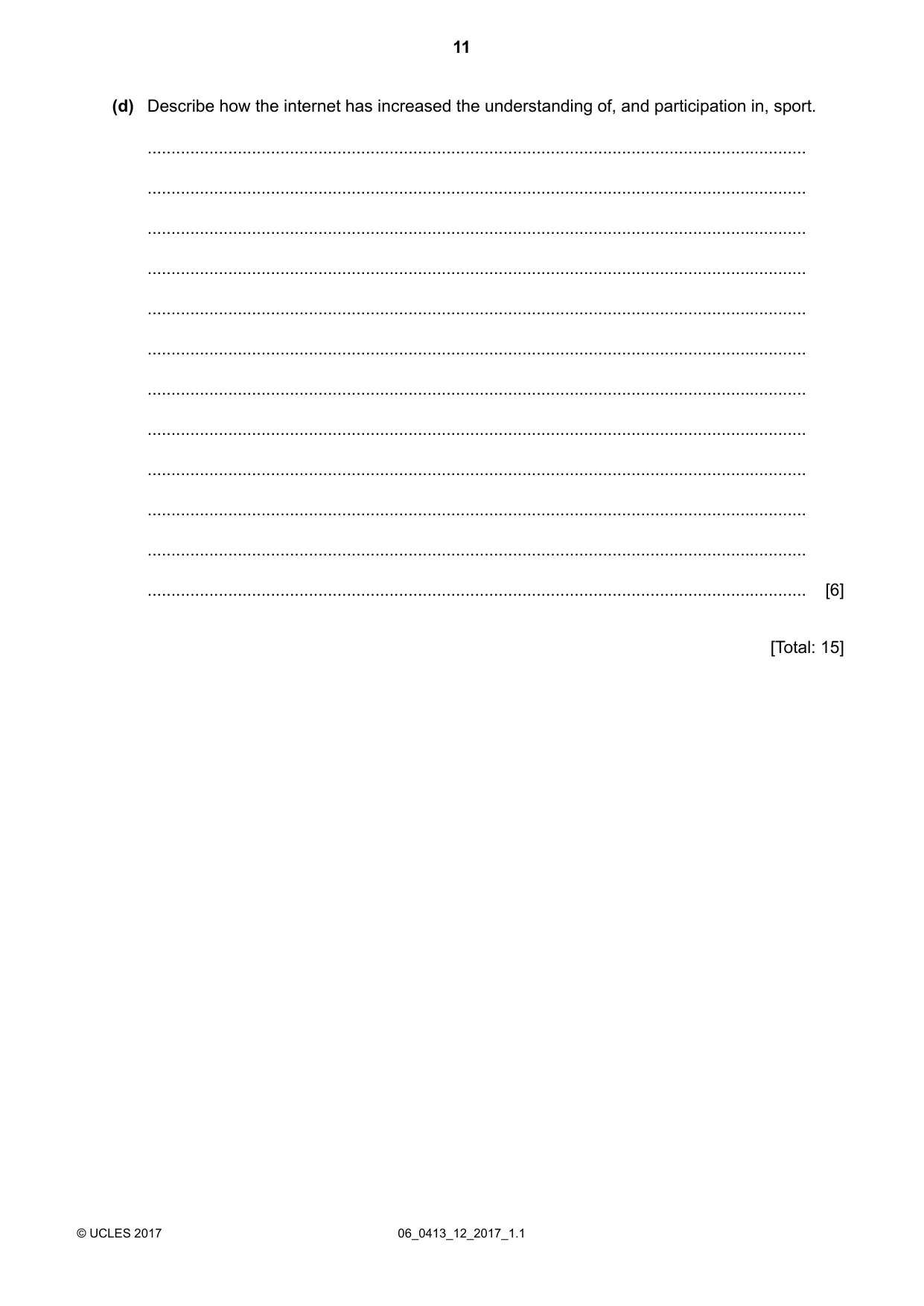
Question paper, page 11
Describe how the internet has increased the understanding of, and participation in, sport. (d) … … … … … … … … … … … … [6] [Total: 15] 06_0413_12_2017_1.1 © UCLES 2017 11
Question paper, page 12
BLANK PAGE Permission to reproduce items where third-party owned material protected by copyright is included has been sought and cleared where possible. Every reasonable effort has been made by the publisher (UCLES) to trace copyright holders, but if any items requiring clearance have unwittingly been included, the publisher will be pleased to make amends at the earliest possible opportunity. To avoid the issue of disclosure of answer-related information to candidates, all copyright acknowledgements are reproduced online in the Cambridge International Examinations Copyright Acknowledgements Booklet. This is produced for each series of examinations and is freely available to download at www.cie.org.uk after the live examination series. Cambridge International Examinations is part of the Cambridge Assessment Group. Cambridge Assessment is the brand name of University of Cambridge Local Examinations Syndicate (UCLES), which is itself a department of the University of Cambridge. 06_0413_12_2017_1.1 © UCLES 2017 12
Mark scheme, page 1
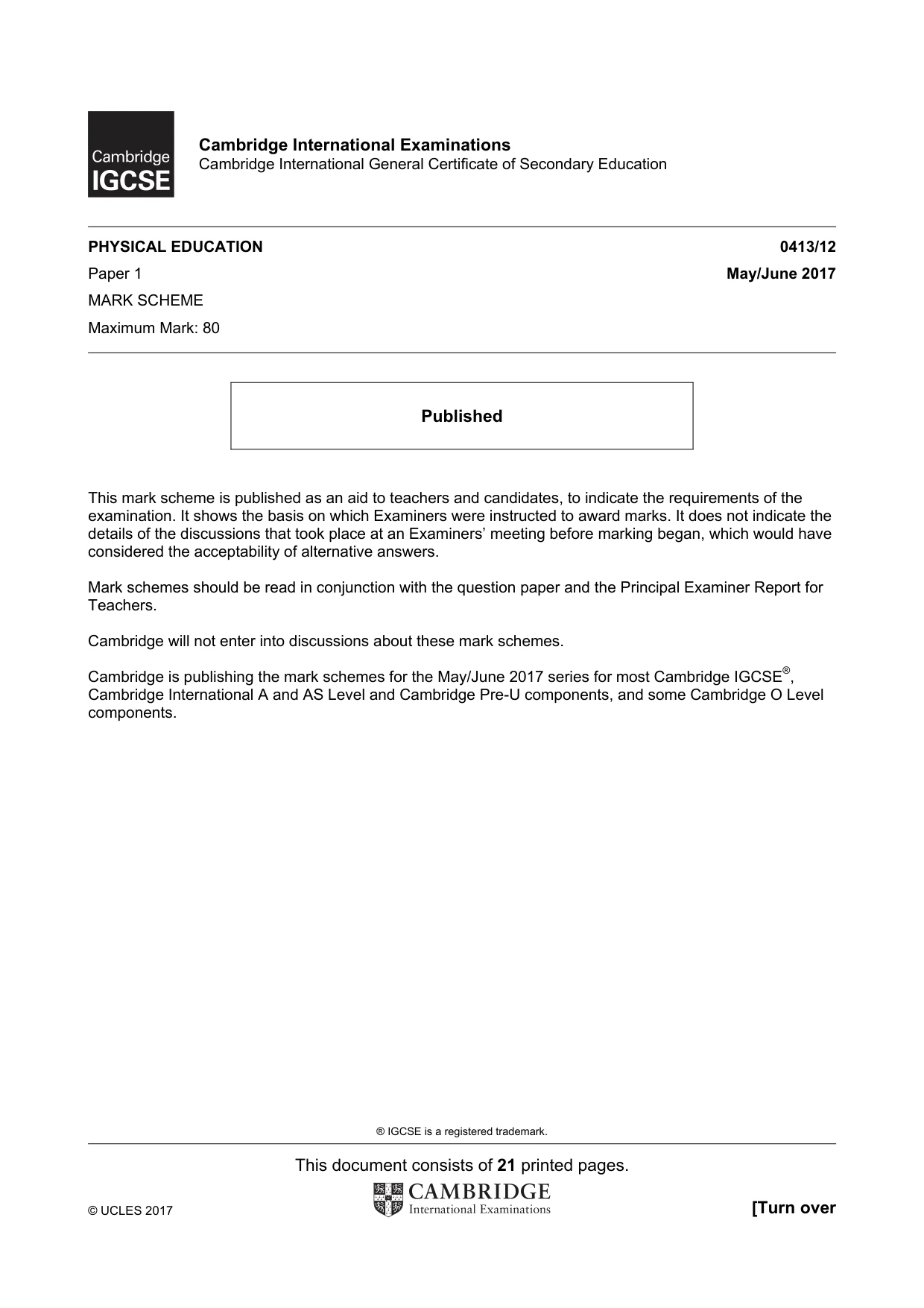
® IGCSE is a registered trademark. This document consists of 21 printed pages. © UCLES 2017 [Turn over Cambridge International Examinations Cambridge International General Certificate of Secondary Education PHYSICAL EDUCATION 0413/12 Paper 1 May/June 2017 MARK SCHEME Maximum Mark: 80 Published This mark scheme is published as an aid to teachers and candidates, to indicate the requirements of the examination. It shows the basis on which Examiners were instructed to award marks. It does not indicate the details of the discussions that took place at an Examiners’ meeting before marking began, which would have considered the acceptability of alternative answers. Mark schemes should be read in conjunction with the question paper and the Principal Examiner Report for Teachers. Cambridge will not enter into discussions about these mark schemes. Cambridge is publishing the mark schemes for the May/June 2017 series for most Cambridge IGCSE®, Cambridge International A and AS Level and Cambridge Pre-U components, and some Cambridge O Level components.
Mark scheme, page 2
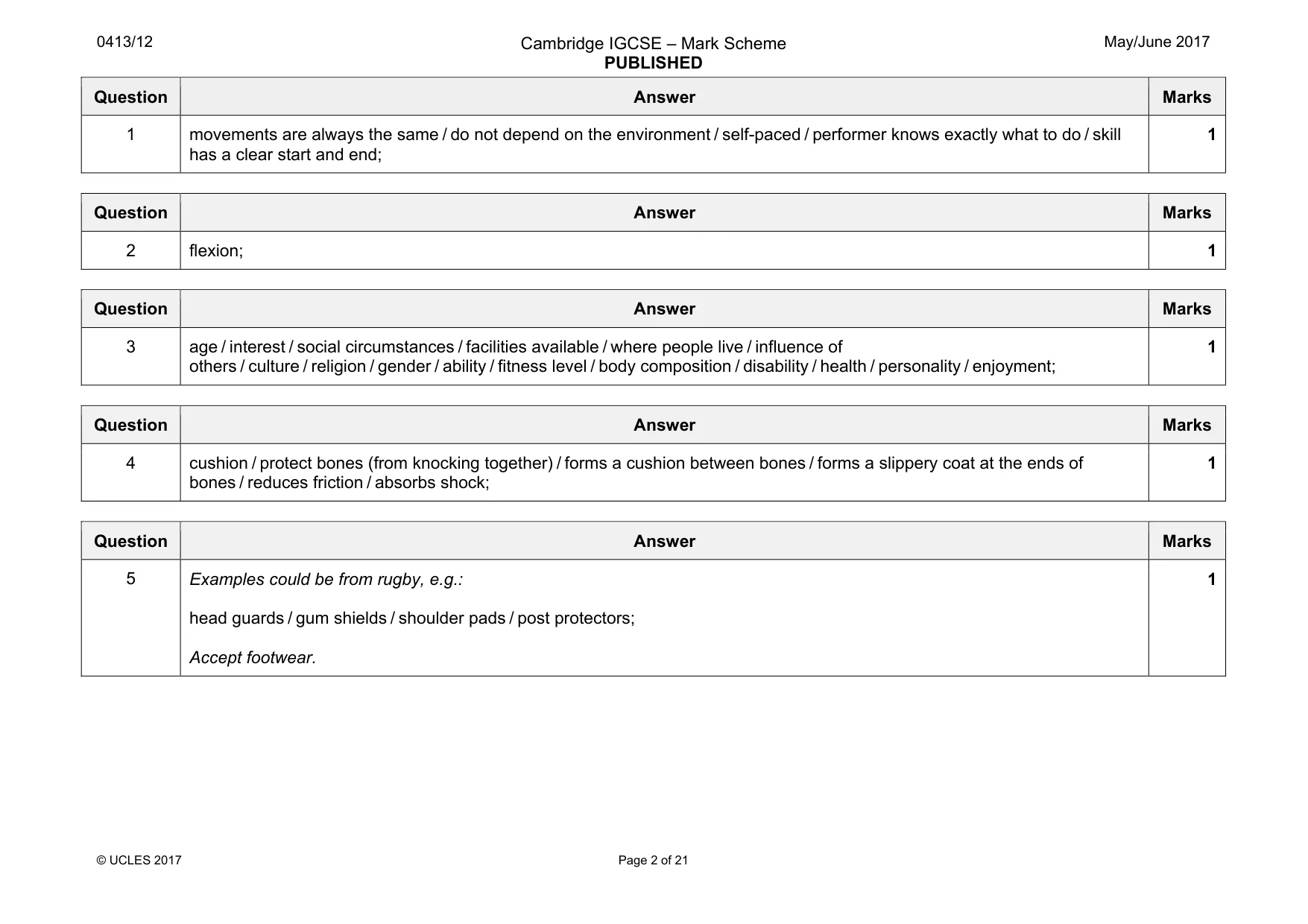
0413/12 Cambridge IGCSE – Mark Scheme PUBLISHED May/June 2017 © UCLES 2017 Page 2 of 21 Question Answer Marks 1 movements are always the same / do not depend on the environment / self-paced / performer knows exactly what to do / skill has a clear start and end; 1 Question Answer Marks 2 flexion; 1 Question Answer Marks 3 age / interest / social circumstances / facilities available / where people live / influence of others / culture / religion / gender / ability / fitness level / body composition / disability / health / personality / enjoyment; 1 Question Answer Marks 4 cushion / protect bones (from knocking together) / forms a cushion between bones / forms a slippery coat at the ends of bones / reduces friction / absorbs shock; 1 Question Answer Marks 5 Examples could be from rugby, e.g.: head guards / gum shields / shoulder pads / post protectors; Accept footwear. 1
Mark scheme, page 3
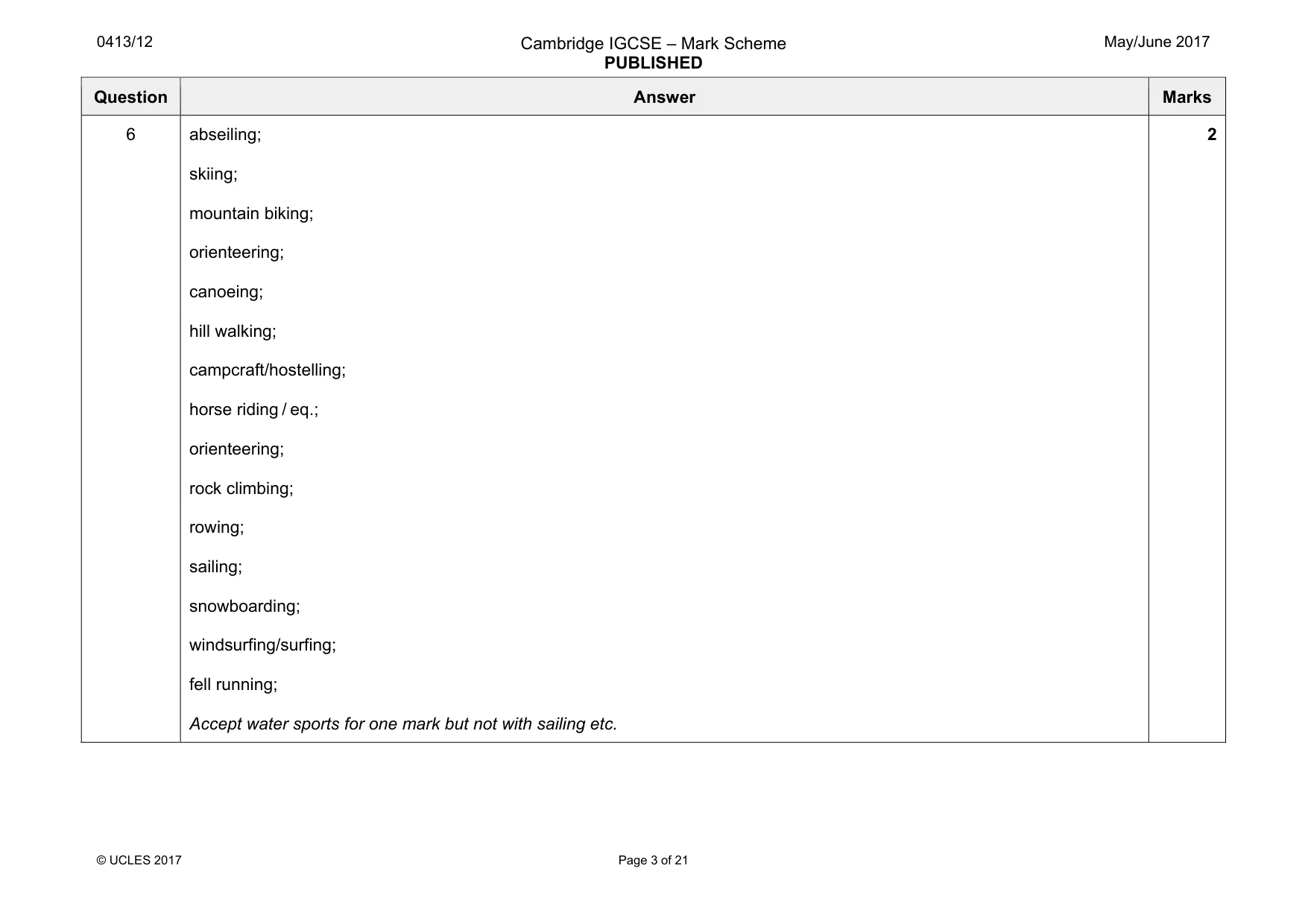
0413/12 Cambridge IGCSE – Mark Scheme PUBLISHED May/June 2017 © UCLES 2017 Page 3 of 21 Question Answer Marks 6 abseiling; skiing; mountain biking; orienteering; canoeing; hill walking; campcraft/hostelling; horse riding / eq.; orienteering; rock climbing; rowing; sailing; snowboarding; windsurfing/surfing; fell running; Accept water sports for one mark but not with sailing etc. 2
Mark scheme, page 4
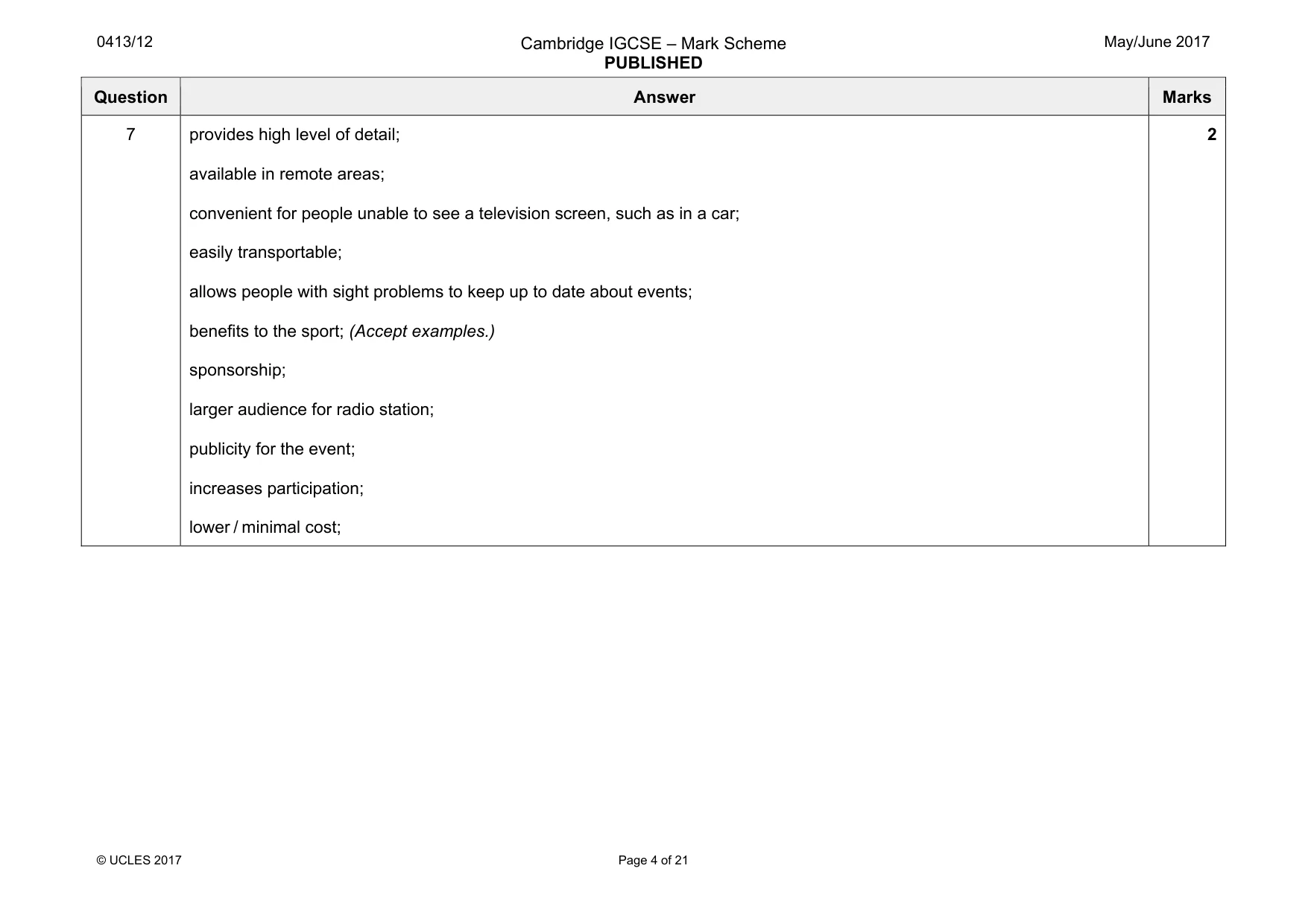
0413/12 Cambridge IGCSE – Mark Scheme PUBLISHED May/June 2017 © UCLES 2017 Page 4 of 21 Question Answer Marks 7 provides high level of detail; available in remote areas; convenient for people unable to see a television screen, such as in a car; easily transportable; allows people with sight problems to keep up to date about events; benefits to the sport; (Accept examples.) sponsorship; larger audience for radio station; publicity for the event; increases participation; lower / minimal cost; 2
Mark scheme, page 5
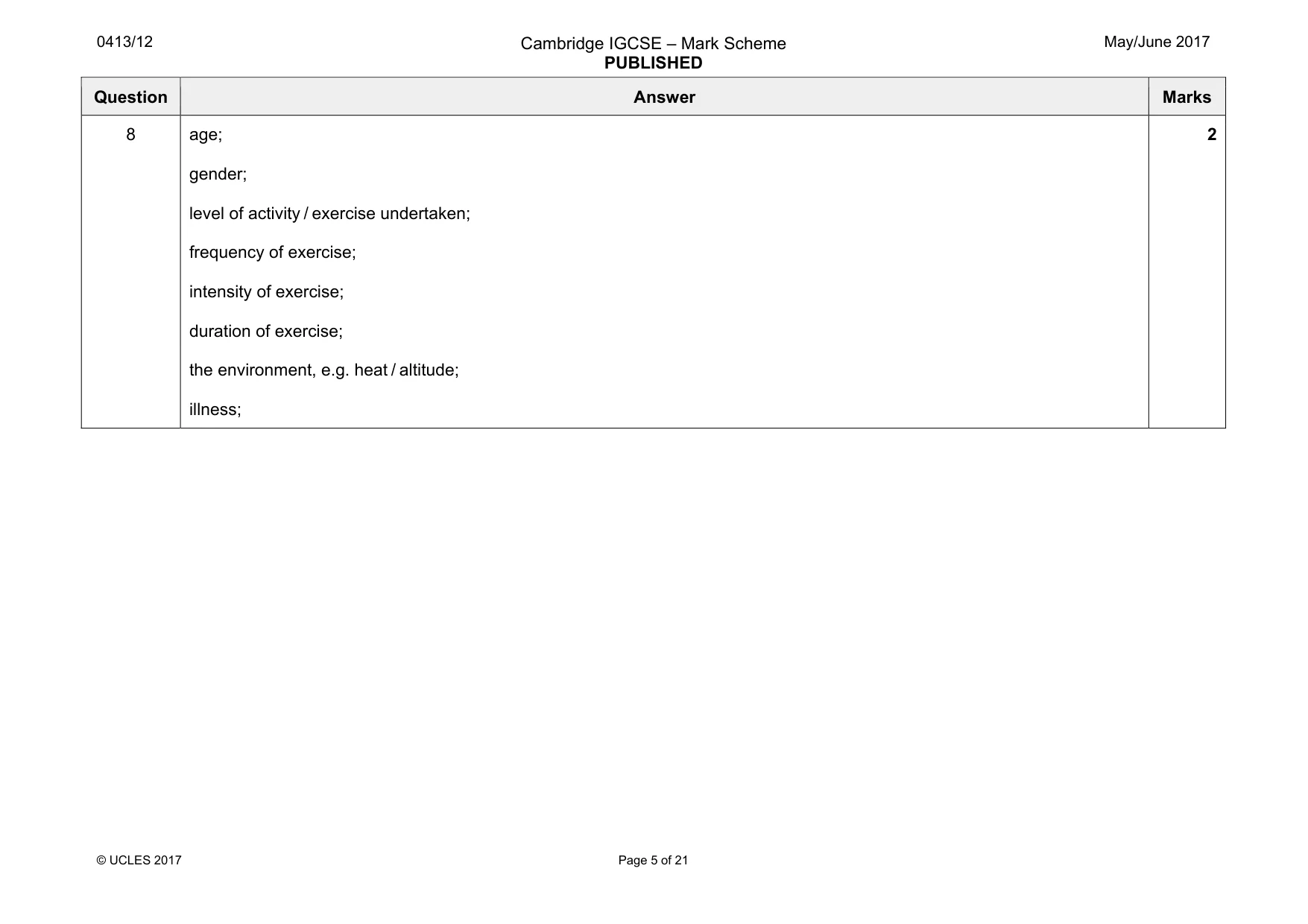
0413/12 Cambridge IGCSE – Mark Scheme PUBLISHED May/June 2017 © UCLES 2017 Page 5 of 21 Question Answer Marks 8 age; gender; level of activity / exercise undertaken; frequency of exercise; intensity of exercise; duration of exercise; the environment, e.g. heat / altitude; illness; 2
Mark scheme, page 6
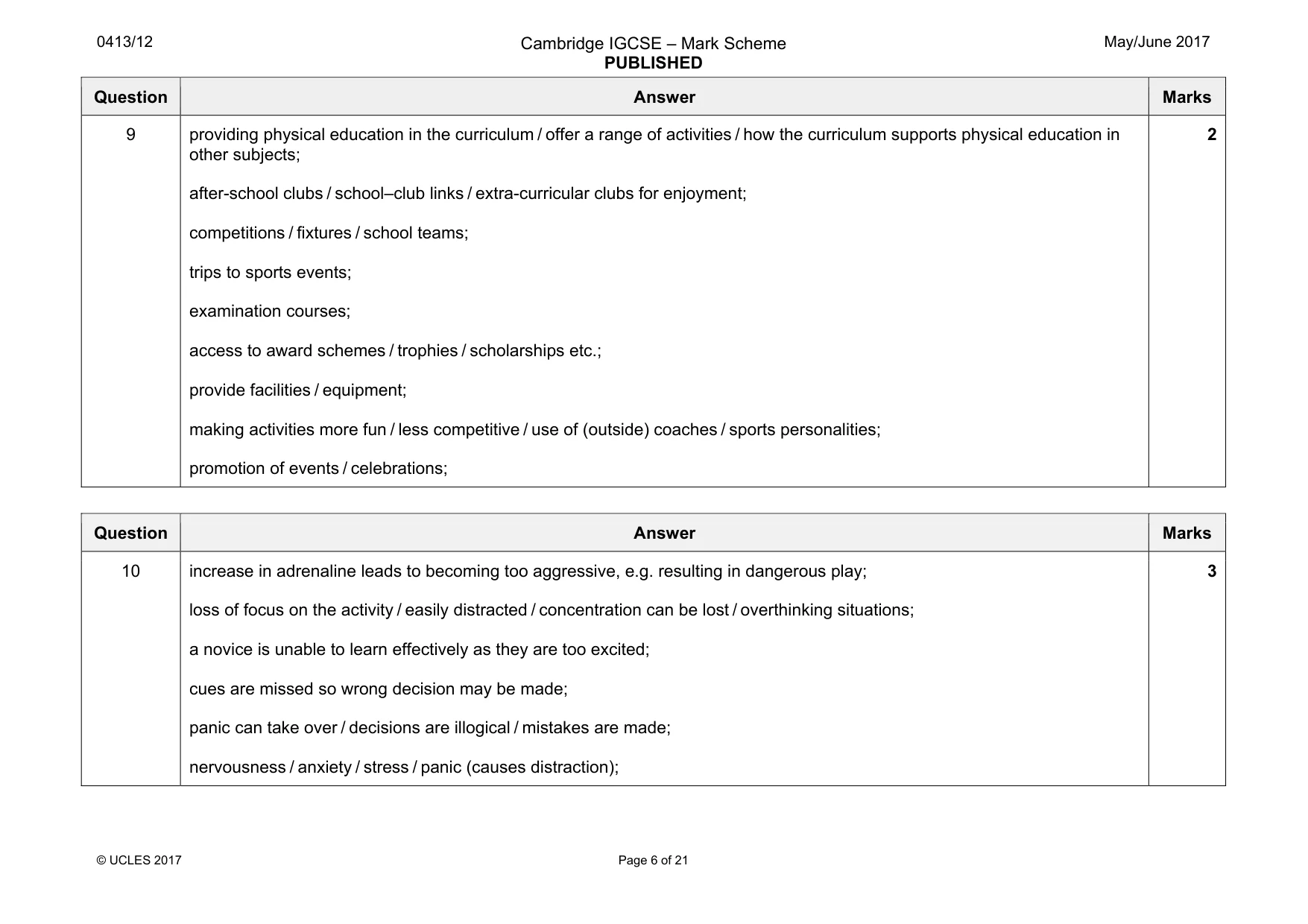
0413/12 Cambridge IGCSE – Mark Scheme PUBLISHED May/June 2017 © UCLES 2017 Page 6 of 21 Question Answer Marks 9 providing physical education in the curriculum / offer a range of activities / how the curriculum supports physical education in other subjects; after-school clubs / school–club links / extra-curricular clubs for enjoyment; competitions / fixtures / school teams; trips to sports events; examination courses; access to award schemes / trophies / scholarships etc.; provide facilities / equipment; making activities more fun / less competitive / use of (outside) coaches / sports personalities; promotion of events / celebrations; 2 Question Answer Marks 10 increase in adrenaline leads to becoming too aggressive, e.g. resulting in dangerous play; loss of focus on the activity / easily distracted / concentration can be lost / overthinking situations; a novice is unable to learn effectively as they are too excited; cues are missed so wrong decision may be made; panic can take over / decisions are illogical / mistakes are made; nervousness / anxiety / stress / panic (causes distraction); 3
Mark scheme, page 7
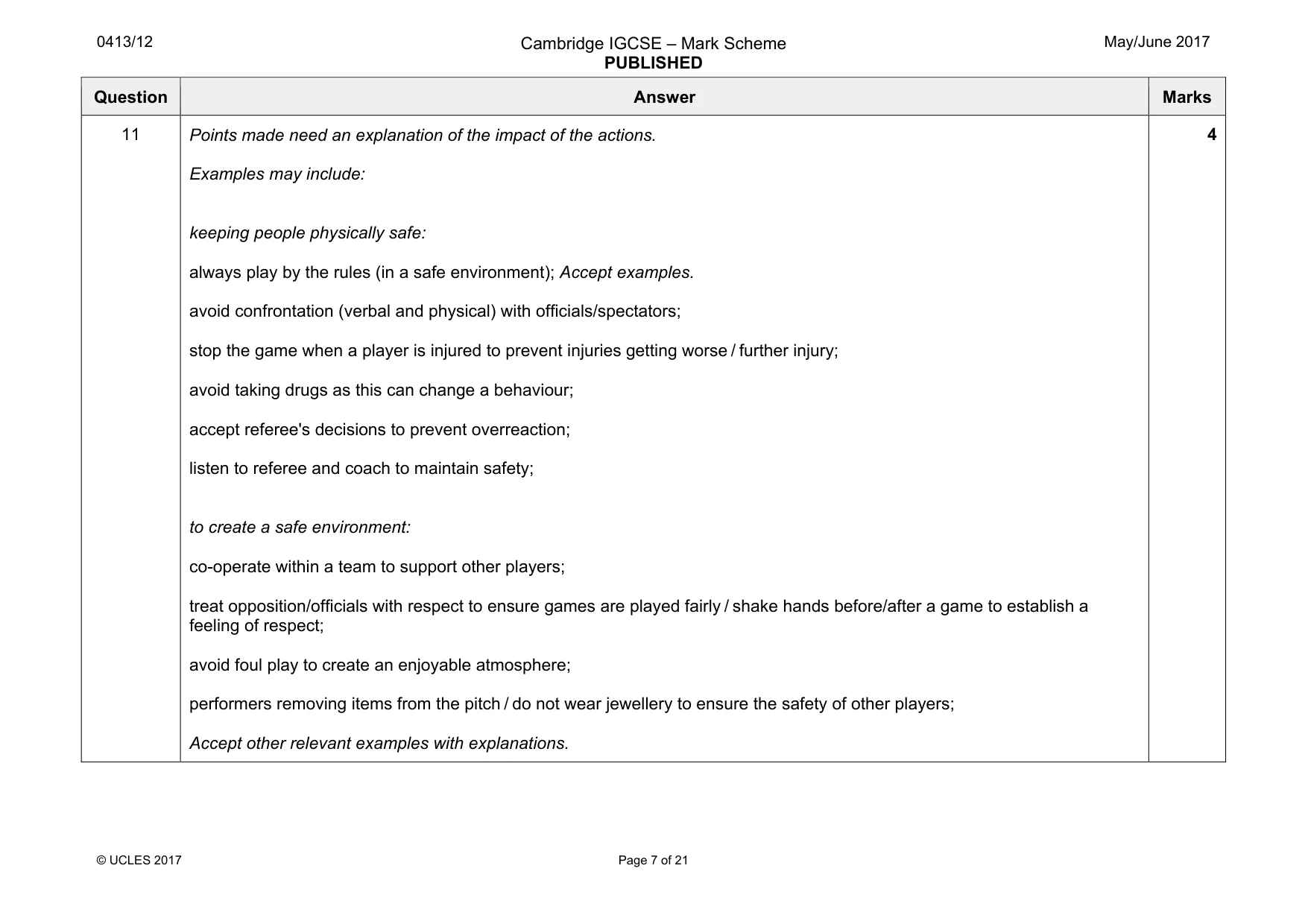
0413/12 Cambridge IGCSE – Mark Scheme PUBLISHED May/June 2017 © UCLES 2017 Page 7 of 21 Question Answer Marks 11 Points made need an explanation of the impact of the actions. Examples may include: keeping people physically safe: always play by the rules (in a safe environment); Accept examples. avoid confrontation (verbal and physical) with officials/spectators; stop the game when a player is injured to prevent injuries getting worse / further injury; avoid taking drugs as this can change a behaviour; accept referee's decisions to prevent overreaction; listen to referee and coach to maintain safety; to create a safe environment: co-operate within a team to support other players; treat opposition/officials with respect to ensure games are played fairly / shake hands before/after a game to establish a feeling of respect; avoid foul play to create an enjoyable atmosphere; performers removing items from the pitch / do not wear jewellery to ensure the safety of other players; Accept other relevant examples with explanations. 4
Mark scheme, page 8
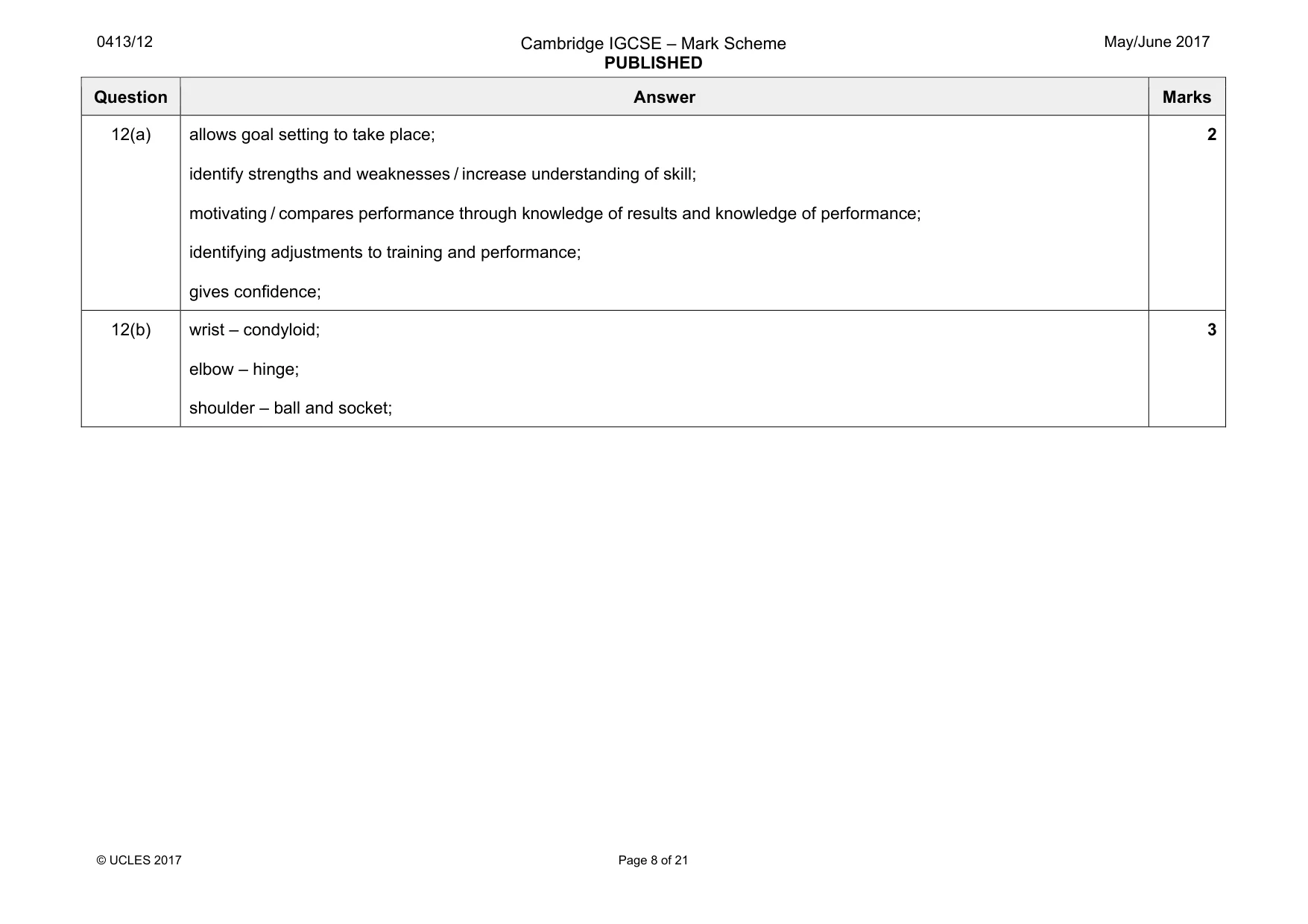
0413/12 Cambridge IGCSE – Mark Scheme PUBLISHED May/June 2017 © UCLES 2017 Page 8 of 21 Question Answer Marks 12(a) allows goal setting to take place; identify strengths and weaknesses / increase understanding of skill; motivating / compares performance through knowledge of results and knowledge of performance; identifying adjustments to training and performance; gives confidence; 2 12(b) wrist – condyloid; elbow – hinge; shoulder – ball and socket; 3
Mark scheme, page 9
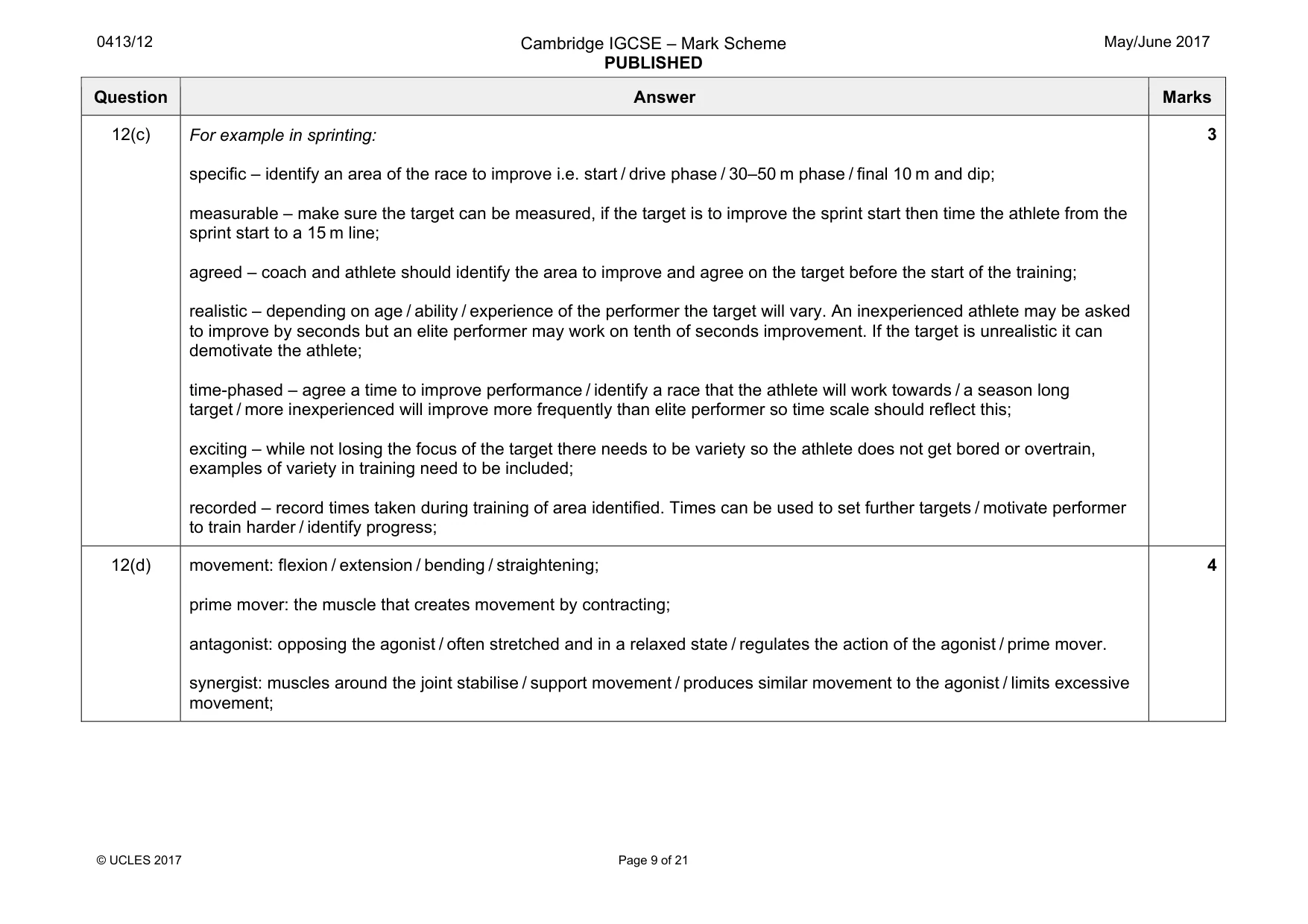
0413/12 Cambridge IGCSE – Mark Scheme PUBLISHED May/June 2017 © UCLES 2017 Page 9 of 21 Question Answer Marks 12(c) For example in sprinting: specific – identify an area of the race to improve i.e. start / drive phase / 30–50 m phase / final 10 m and dip; measurable – make sure the target can be measured, if the target is to improve the sprint start then time the athlete from the sprint start to a 15 m line; agreed – coach and athlete should identify the area to improve and agree on the target before the start of the training; realistic – depending on age / ability / experience of the performer the target will vary. An inexperienced athlete may be asked to improve by seconds but an elite performer may work on tenth of seconds improvement. If the target is unrealistic it can demotivate the athlete; time-phased – agree a time to improve performance / identify a race that the athlete will work towards / a season long target / more inexperienced will improve more frequently than elite performer so time scale should reflect this; exciting – while not losing the focus of the target there needs to be variety so the athlete does not get bored or overtrain, examples of variety in training need to be included; recorded – record times taken during training of area identified. Times can be used to set further targets / motivate performer to train harder / identify progress; 3 12(d) movement: flexion / extension / bending / straightening; prime mover: the muscle that creates movement by contracting; antagonist: opposing the agonist / often stretched and in a relaxed state / regulates the action of the agonist / prime mover. synergist: muscles around the joint stabilise / support movement / produces similar movement to the agonist / limits excessive movement; 4
Mark scheme, page 10
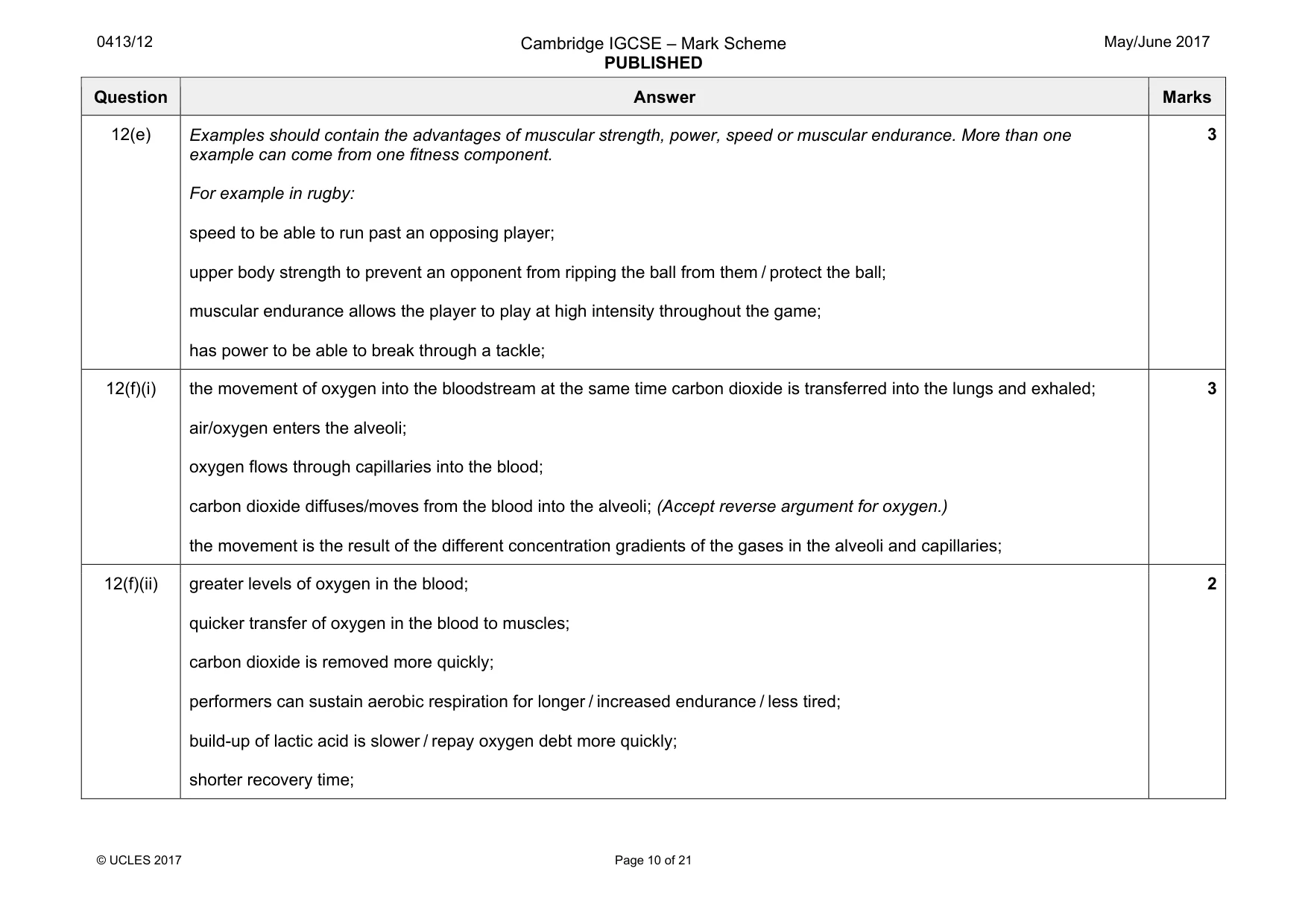
0413/12 Cambridge IGCSE – Mark Scheme PUBLISHED May/June 2017 © UCLES 2017 Page 10 of 21 Question Answer Marks 12(e) Examples should contain the advantages of muscular strength, power, speed or muscular endurance. More than one example can come from one fitness component. For example in rugby: speed to be able to run past an opposing player; upper body strength to prevent an opponent from ripping the ball from them / protect the ball; muscular endurance allows the player to play at high intensity throughout the game; has power to be able to break through a tackle; 3 12(f)(i) the movement of oxygen into the bloodstream at the same time carbon dioxide is transferred into the lungs and exhaled; air/oxygen enters the alveoli; oxygen flows through capillaries into the blood; carbon dioxide diffuses/moves from the blood into the alveoli; (Accept reverse argument for oxygen.) the movement is the result of the different concentration gradients of the gases in the alveoli and capillaries; 3 12(f)(ii) greater levels of oxygen in the blood; quicker transfer of oxygen in the blood to muscles; carbon dioxide is removed more quickly; performers can sustain aerobic respiration for longer / increased endurance / less tired; build-up of lactic acid is slower / repay oxygen debt more quickly; shorter recovery time; 2
Mark scheme, page 11
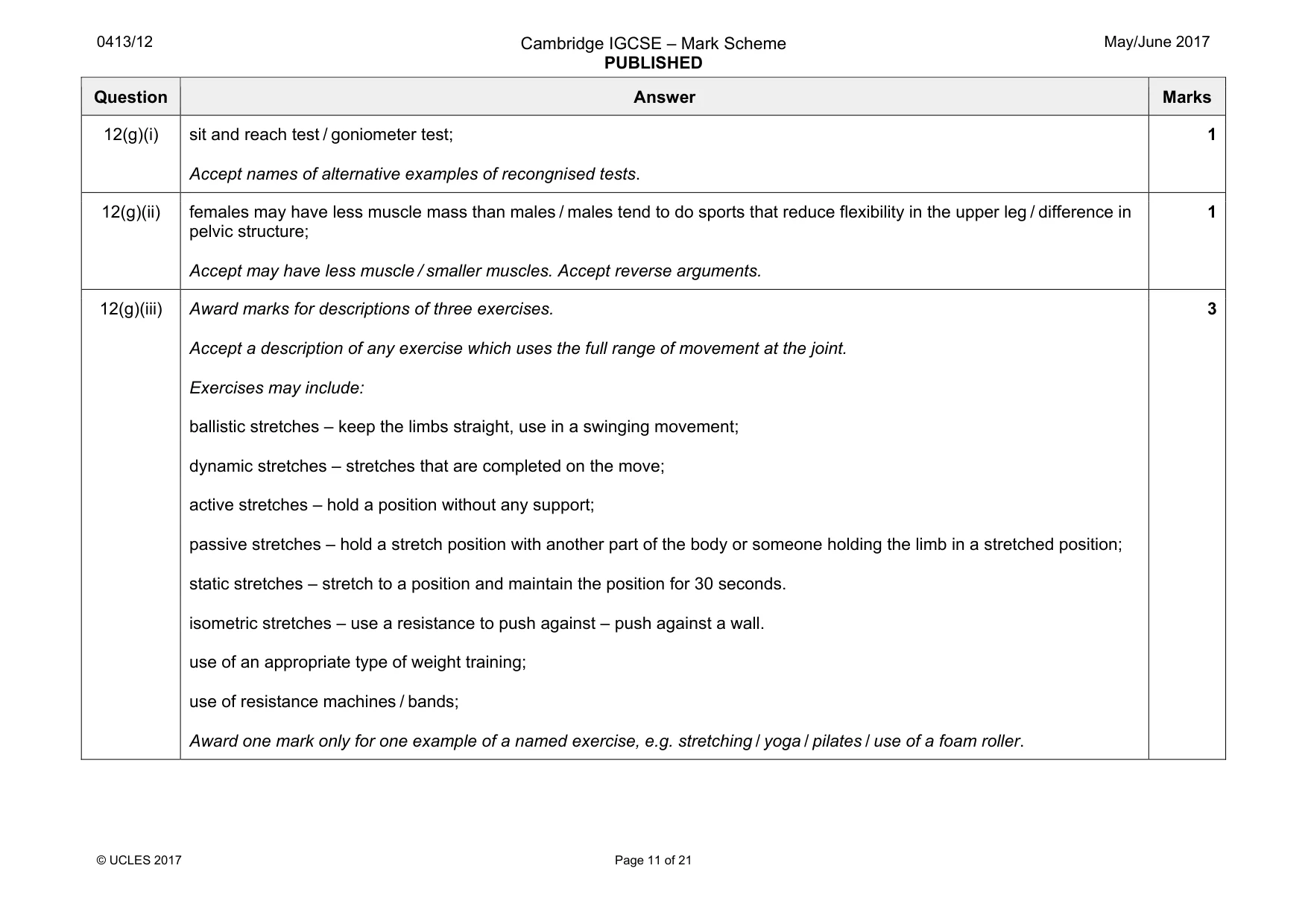
0413/12 Cambridge IGCSE – Mark Scheme PUBLISHED May/June 2017 © UCLES 2017 Page 11 of 21 Question Answer Marks 12(g)(i) sit and reach test / goniometer test; Accept names of alternative examples of recongnised tests. 1 12(g)(ii) females may have less muscle mass than males / males tend to do sports that reduce flexibility in the upper leg / difference in pelvic structure; Accept may have less muscle / smaller muscles. Accept reverse arguments. 1 12(g)(iii) Award marks for descriptions of three exercises. Accept a description of any exercise which uses the full range of movement at the joint. Exercises may include: ballistic stretches – keep the limbs straight, use in a swinging movement; dynamic stretches – stretches that are completed on the move; active stretches – hold a position without any support; passive stretches – hold a stretch position with another part of the body or someone holding the limb in a stretched position; static stretches – stretch to a position and maintain the position for 30 seconds. isometric stretches – use a resistance to push against – push against a wall. use of an appropriate type of weight training; use of resistance machines / bands; Award one mark only for one example of a named exercise, e.g. stretching / yoga / pilates / use of a foam roller. 3
Mark scheme, page 12
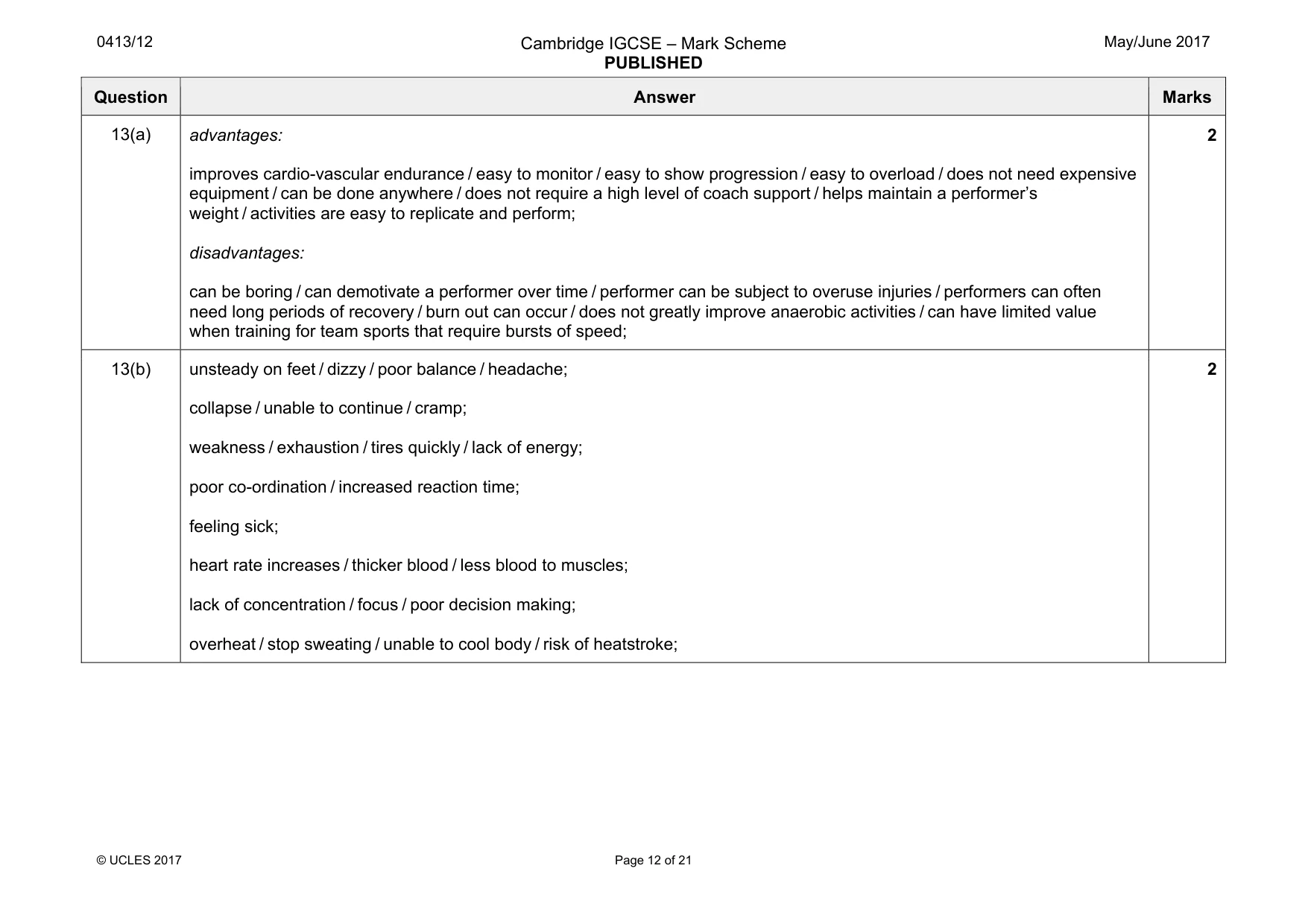
0413/12 Cambridge IGCSE – Mark Scheme PUBLISHED May/June 2017 © UCLES 2017 Page 12 of 21 Question Answer Marks 13(a) advantages: improves cardio-vascular endurance / easy to monitor / easy to show progression / easy to overload / does not need expensive equipment / can be done anywhere / does not require a high level of coach support / helps maintain a performer’s weight / activities are easy to replicate and perform; disadvantages: can be boring / can demotivate a performer over time / performer can be subject to overuse injuries / performers can often need long periods of recovery / burn out can occur / does not greatly improve anaerobic activities / can have limited value when training for team sports that require bursts of speed; 2 13(b) unsteady on feet / dizzy / poor balance / headache; collapse / unable to continue / cramp; weakness / exhaustion / tires quickly / lack of energy; poor co-ordination / increased reaction time; feeling sick; heart rate increases / thicker blood / less blood to muscles; lack of concentration / focus / poor decision making; overheat / stop sweating / unable to cool body / risk of heatstroke; 2
Mark scheme, page 13
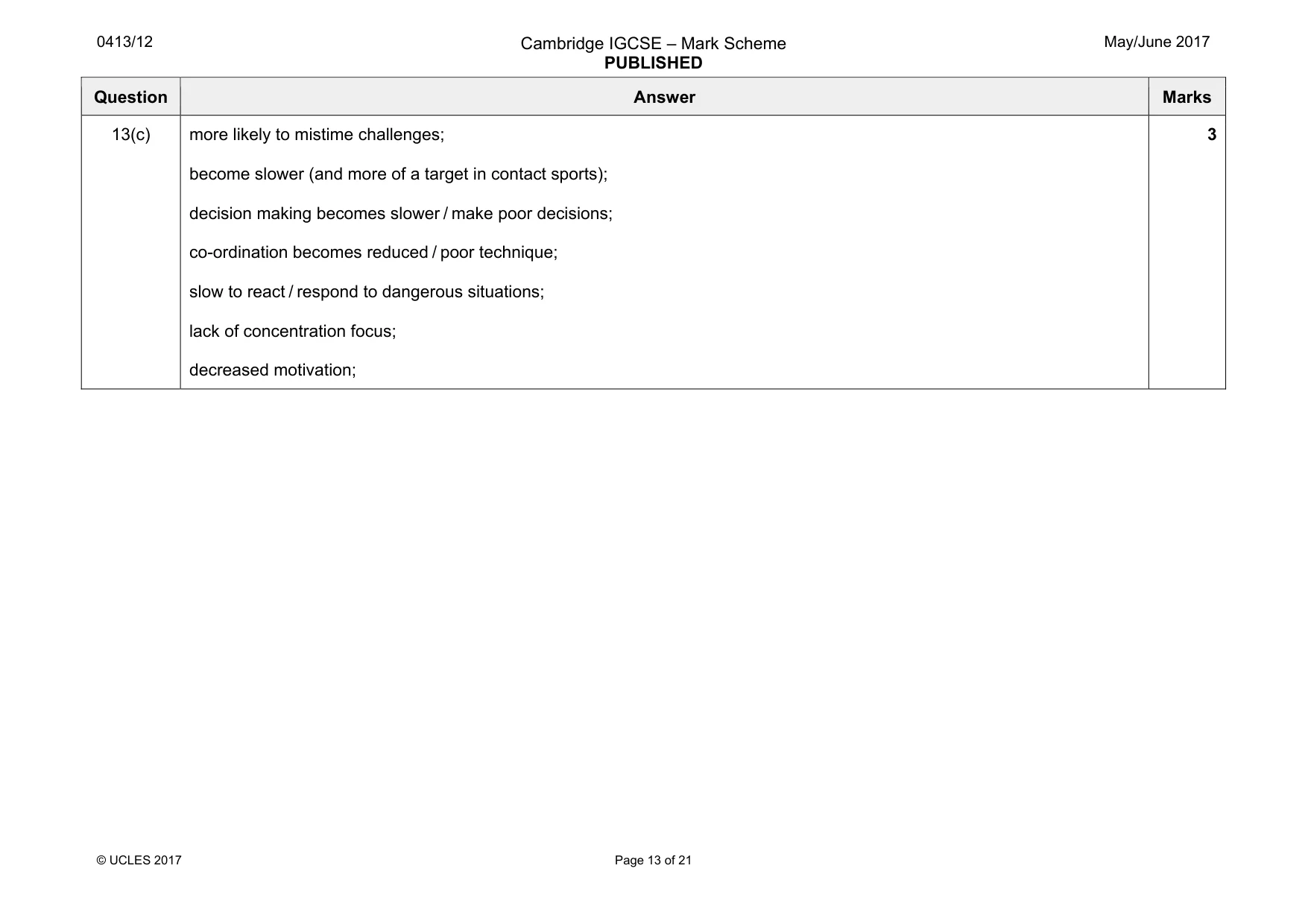
0413/12 Cambridge IGCSE – Mark Scheme PUBLISHED May/June 2017 © UCLES 2017 Page 13 of 21 Question Answer Marks 13(c) more likely to mistime challenges; become slower (and more of a target in contact sports); decision making becomes slower / make poor decisions; co-ordination becomes reduced / poor technique; slow to react / respond to dangerous situations; lack of concentration focus; decreased motivation; 3
Mark scheme, page 14
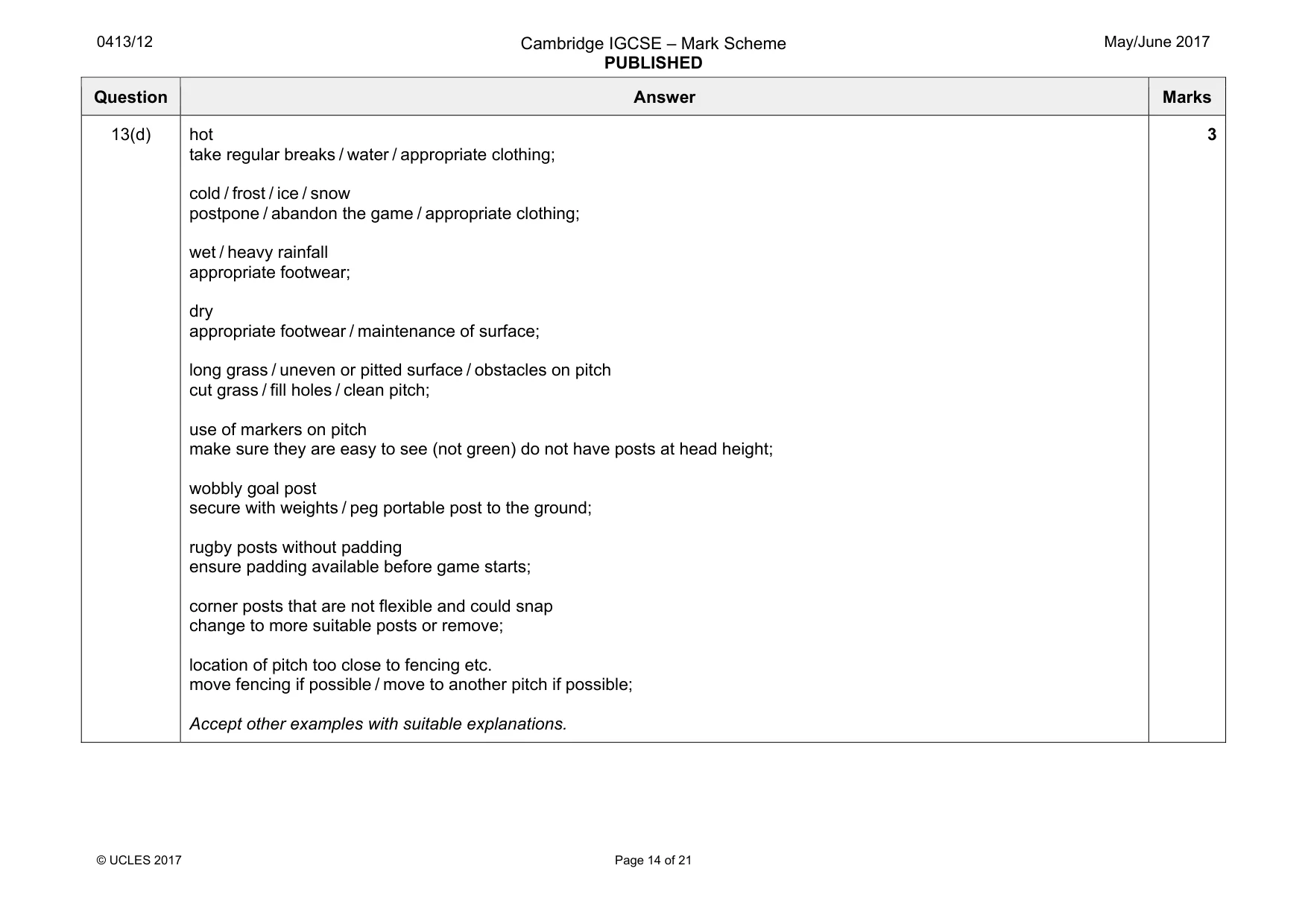
0413/12 Cambridge IGCSE – Mark Scheme PUBLISHED May/June 2017 © UCLES 2017 Page 14 of 21 Question Answer Marks 13(d) hot take regular breaks / water / appropriate clothing; cold / frost / ice / snow postpone / abandon the game / appropriate clothing; wet / heavy rainfall appropriate footwear; dry appropriate footwear / maintenance of surface; long grass / uneven or pitted surface / obstacles on pitch cut grass / fill holes / clean pitch; use of markers on pitch make sure they are easy to see (not green) do not have posts at head height; wobbly goal post secure with weights / peg portable post to the ground; rugby posts without padding ensure padding available before game starts; corner posts that are not flexible and could snap change to more suitable posts or remove; location of pitch too close to fencing etc. move fencing if possible / move to another pitch if possible; Accept other examples with suitable explanations. 3
Mark scheme, page 15
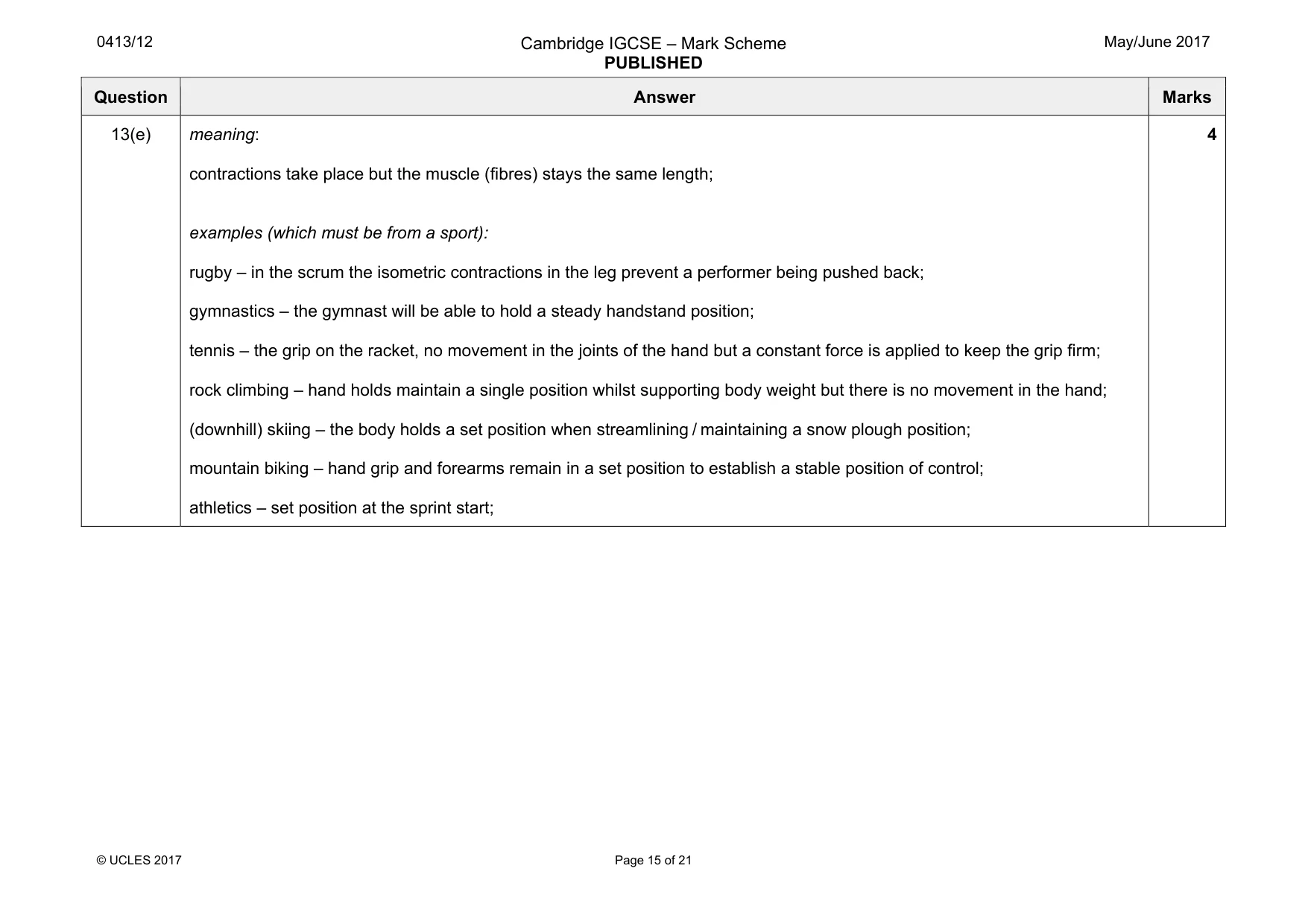
0413/12 Cambridge IGCSE – Mark Scheme PUBLISHED May/June 2017 © UCLES 2017 Page 15 of 21 Question Answer Marks 13(e) meaning: contractions take place but the muscle (fibres) stays the same length; examples (which must be from a sport): rugby – in the scrum the isometric contractions in the leg prevent a performer being pushed back; gymnastics – the gymnast will be able to hold a steady handstand position; tennis – the grip on the racket, no movement in the joints of the hand but a constant force is applied to keep the grip firm; rock climbing – hand holds maintain a single position whilst supporting body weight but there is no movement in the hand; (downhill) skiing – the body holds a set position when streamlining / maintaining a snow plough position; mountain biking – hand grip and forearms remain in a set position to establish a stable position of control; athletics – set position at the sprint start; 4
Mark scheme, page 16
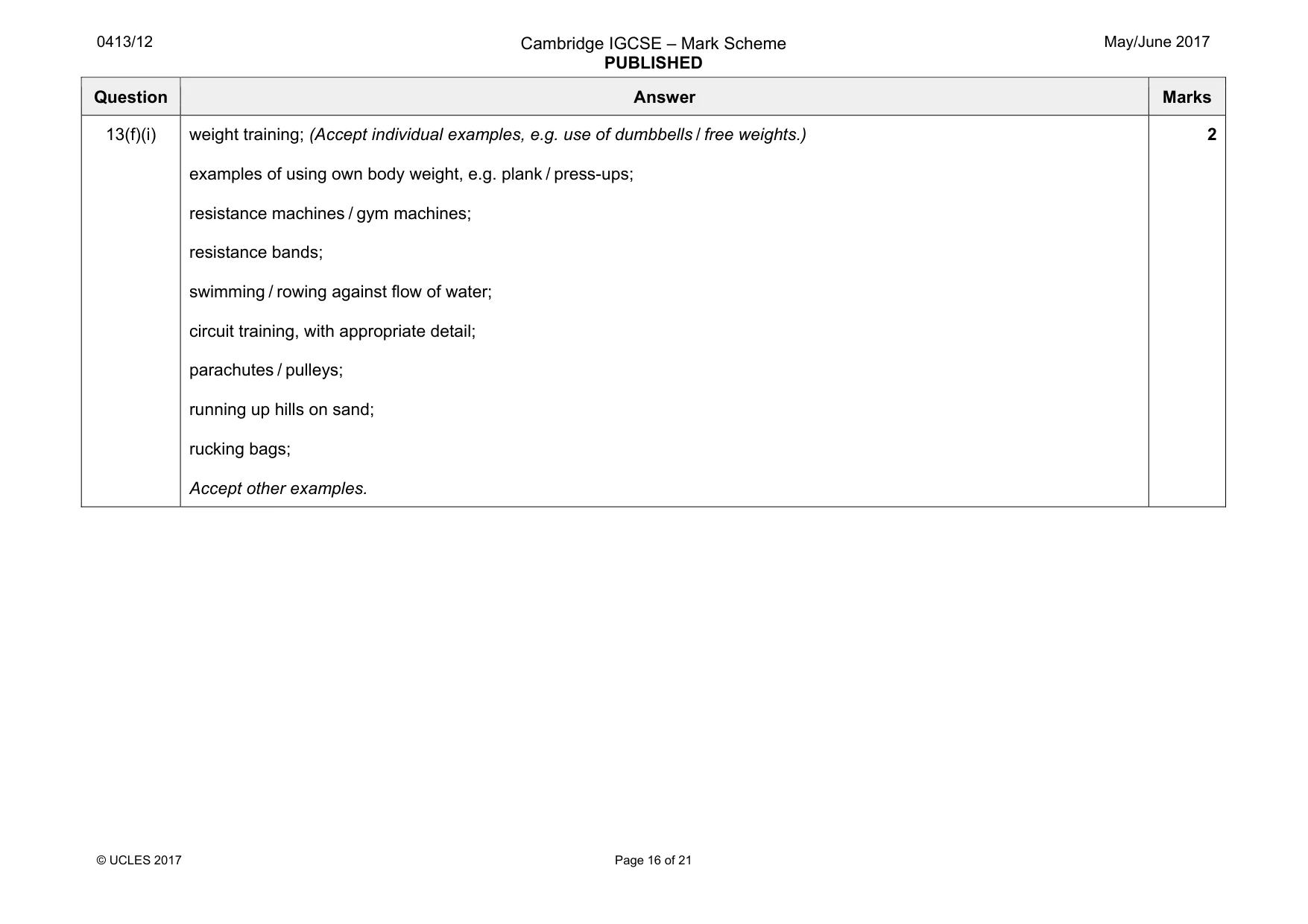
0413/12 Cambridge IGCSE – Mark Scheme PUBLISHED May/June 2017 © UCLES 2017 Page 16 of 21 Question Answer Marks 13(f)(i) weight training; (Accept individual examples, e.g. use of dumbbells / free weights.) examples of using own body weight, e.g. plank / press-ups; resistance machines / gym machines; resistance bands; swimming / rowing against flow of water; circuit training, with appropriate detail; parachutes / pulleys; running up hills on sand; rucking bags; Accept other examples. 2
Mark scheme, page 17
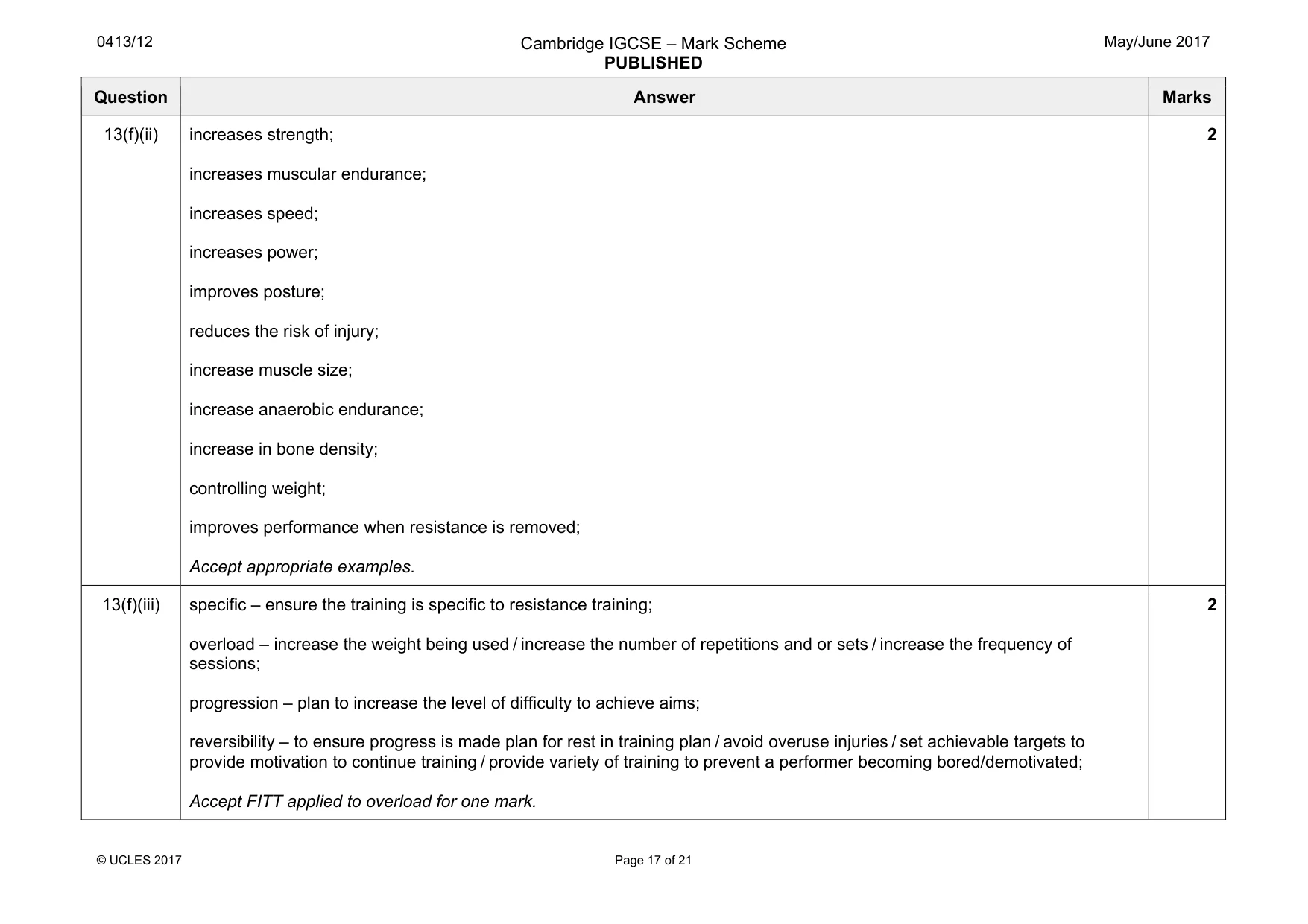
0413/12 Cambridge IGCSE – Mark Scheme PUBLISHED May/June 2017 © UCLES 2017 Page 17 of 21 Question Answer Marks 13(f)(ii) increases strength; increases muscular endurance; increases speed; increases power; improves posture; reduces the risk of injury; increase muscle size; increase anaerobic endurance; increase in bone density; controlling weight; improves performance when resistance is removed; Accept appropriate examples. 2 13(f)(iii) specific – ensure the training is specific to resistance training; overload – increase the weight being used / increase the number of repetitions and or sets / increase the frequency of sessions; progression – plan to increase the level of difficulty to achieve aims; reversibility – to ensure progress is made plan for rest in training plan / avoid overuse injuries / set achievable targets to provide motivation to continue training / provide variety of training to prevent a performer becoming bored/demotivated; Accept FITT applied to overload for one mark. 2
Mark scheme, page 18
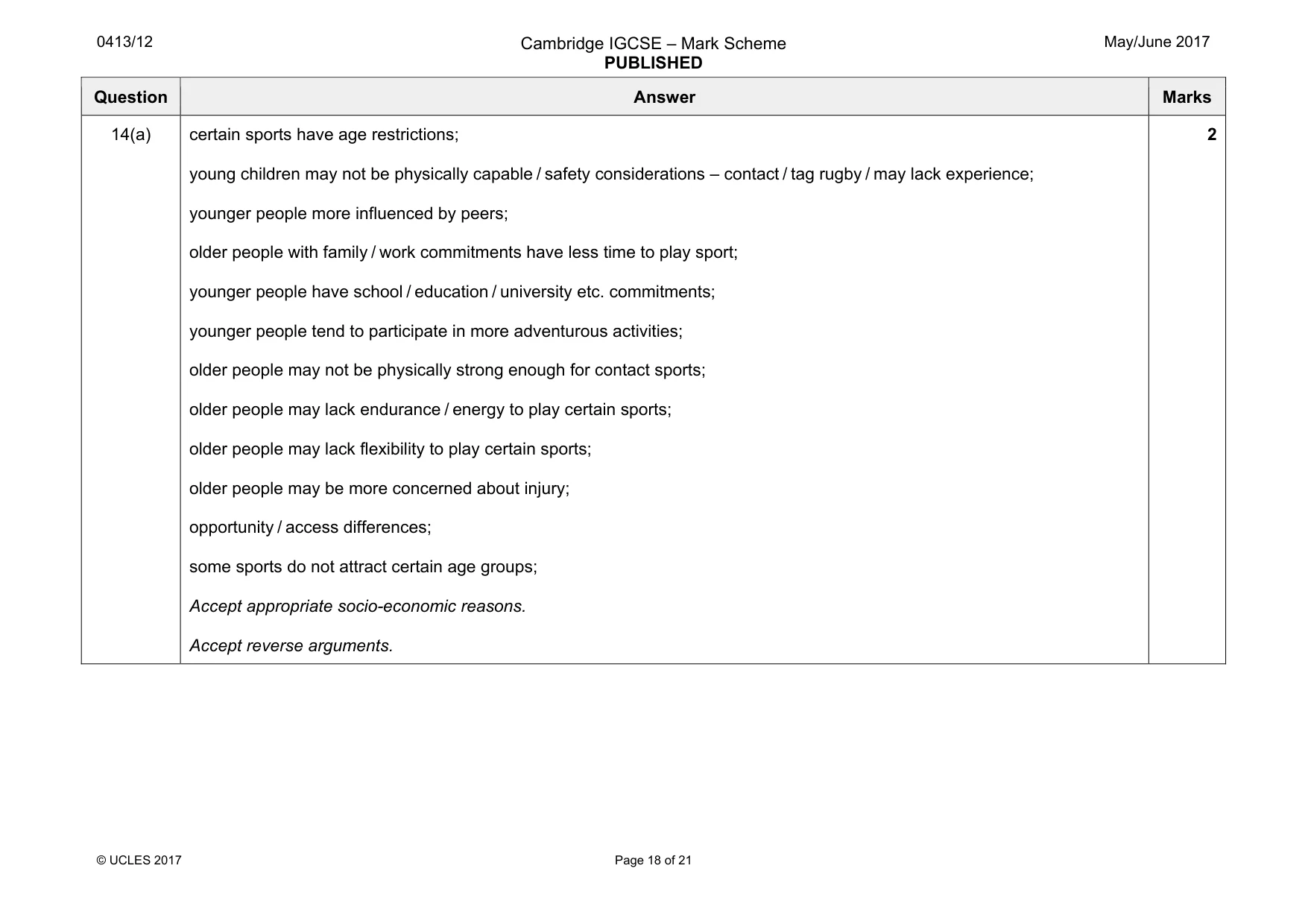
0413/12 Cambridge IGCSE – Mark Scheme PUBLISHED May/June 2017 © UCLES 2017 Page 18 of 21 Question Answer Marks 14(a) certain sports have age restrictions; young children may not be physically capable / safety considerations – contact / tag rugby / may lack experience; younger people more influenced by peers; older people with family / work commitments have less time to play sport; younger people have school / education / university etc. commitments; younger people tend to participate in more adventurous activities; older people may not be physically strong enough for contact sports; older people may lack endurance / energy to play certain sports; older people may lack flexibility to play certain sports; older people may be more concerned about injury; opportunity / access differences; some sports do not attract certain age groups; Accept appropriate socio-economic reasons. Accept reverse arguments. 2
Mark scheme, page 19
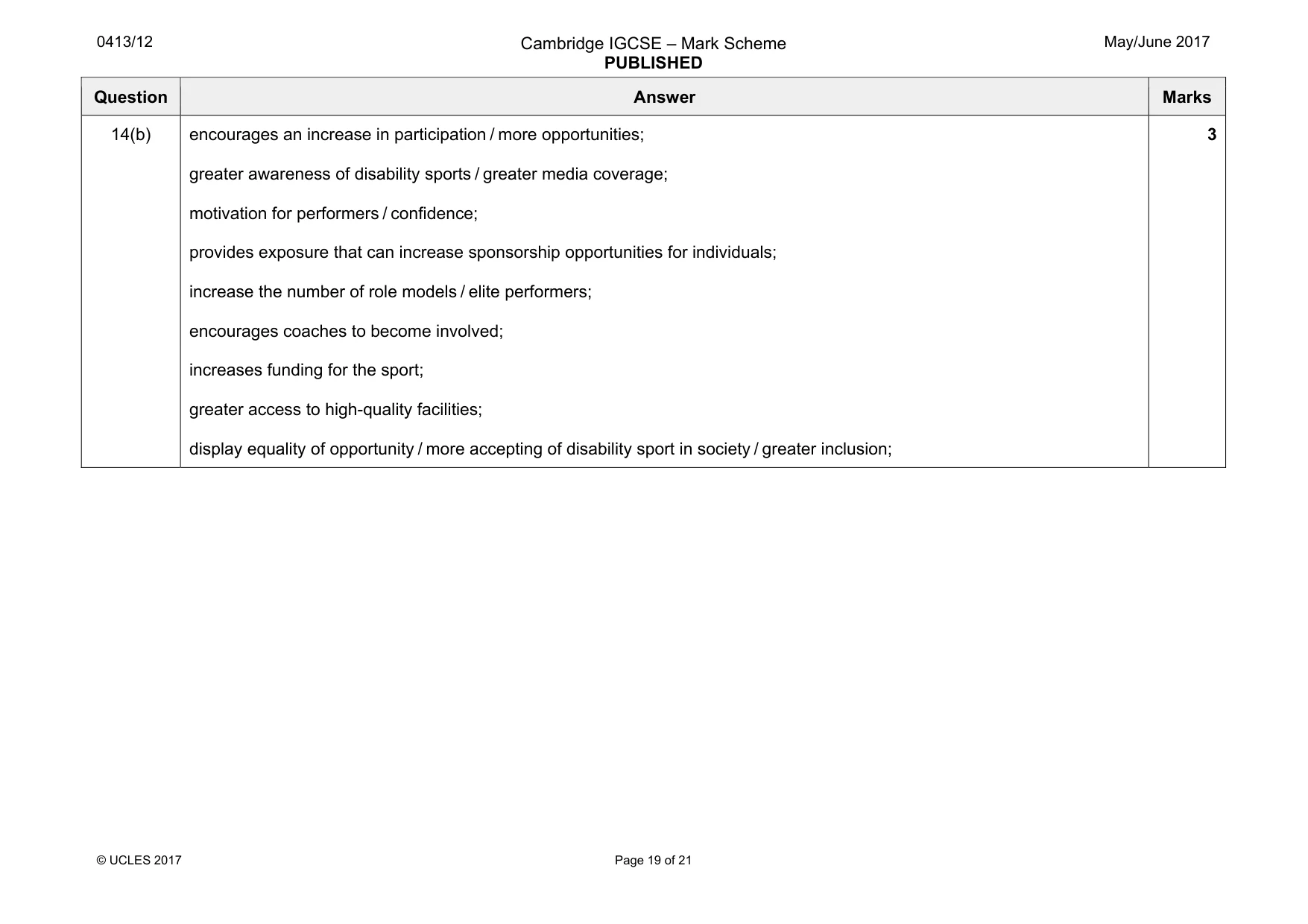
0413/12 Cambridge IGCSE – Mark Scheme PUBLISHED May/June 2017 © UCLES 2017 Page 19 of 21 Question Answer Marks 14(b) encourages an increase in participation / more opportunities; greater awareness of disability sports / greater media coverage; motivation for performers / confidence; provides exposure that can increase sponsorship opportunities for individuals; increase the number of role models / elite performers; encourages coaches to become involved; increases funding for the sport; greater access to high-quality facilities; display equality of opportunity / more accepting of disability sport in society / greater inclusion; 3
Mark scheme, page 20
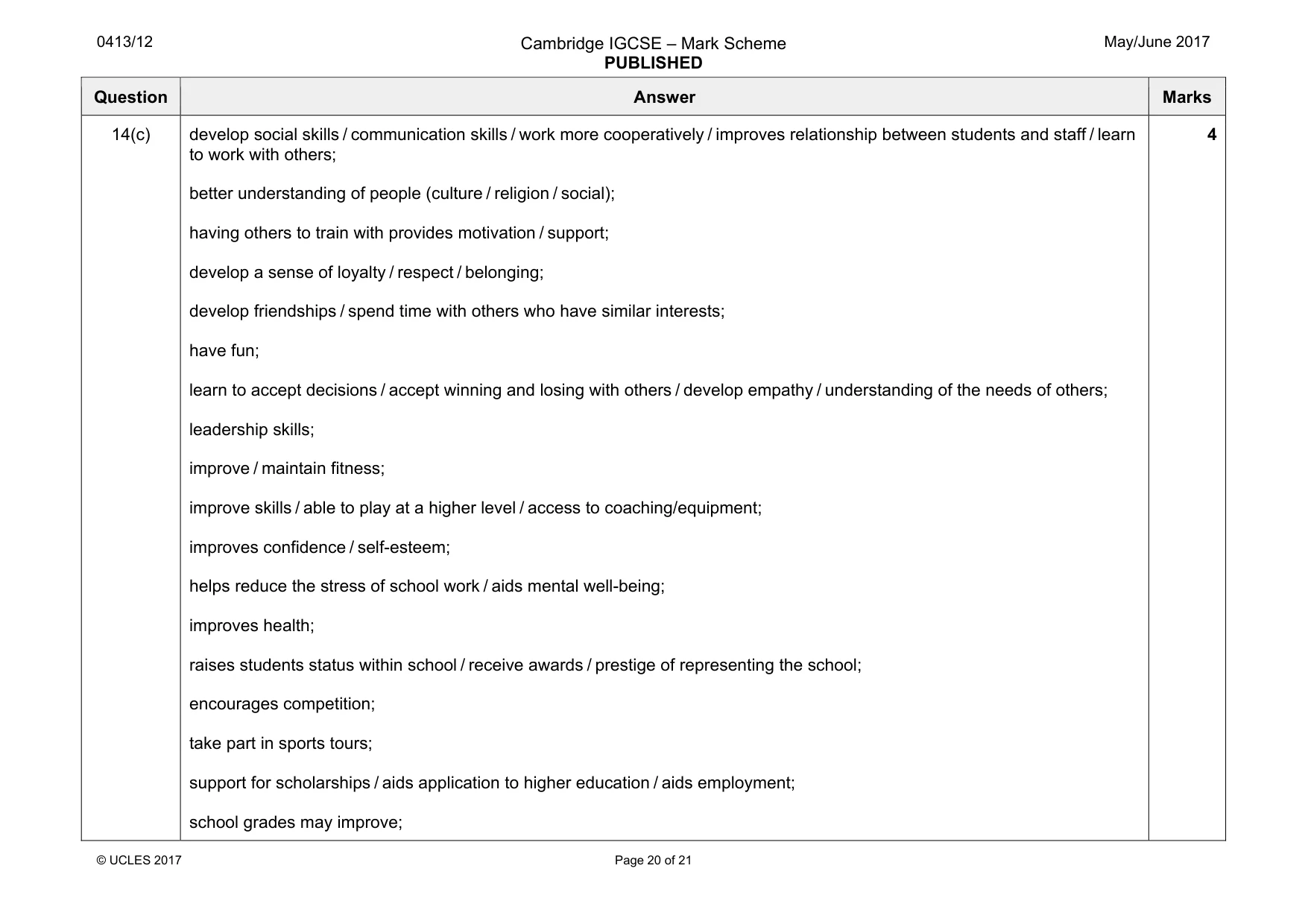
0413/12 Cambridge IGCSE – Mark Scheme PUBLISHED May/June 2017 © UCLES 2017 Page 20 of 21 Question Answer Marks 14(c) develop social skills / communication skills / work more cooperatively / improves relationship between students and staff / learn to work with others; better understanding of people (culture / religion / social); having others to train with provides motivation / support; develop a sense of loyalty / respect / belonging; develop friendships / spend time with others who have similar interests; have fun; learn to accept decisions / accept winning and losing with others / develop empathy / understanding of the needs of others; leadership skills; improve / maintain fitness; improve skills / able to play at a higher level / access to coaching/equipment; improves confidence / self-esteem; helps reduce the stress of school work / aids mental well-being; improves health; raises students status within school / receive awards / prestige of representing the school; encourages competition; take part in sports tours; support for scholarships / aids application to higher education / aids employment; school grades may improve; 4
Mark scheme, page 21
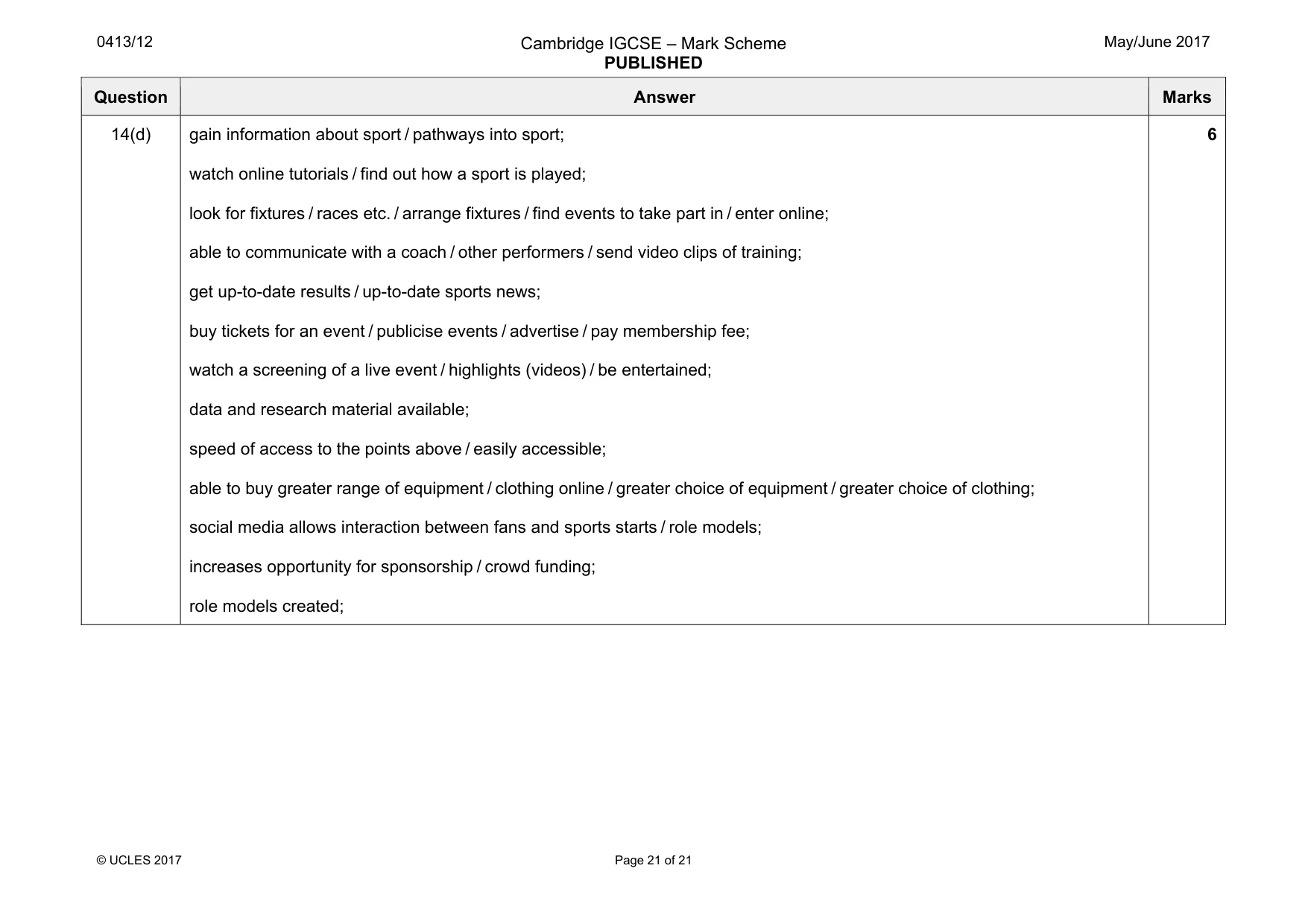
0413/12 Cambridge IGCSE – Mark Scheme PUBLISHED May/June 2017 © UCLES 2017 Page 21 of 21 Question Answer Marks 14(d) gain information about sport / pathways into sport; watch online tutorials / find out how a sport is played; look for fixtures / races etc. / arrange fixtures / find events to take part in / enter online; able to communicate with a coach / other performers / send video clips of training; get up-to-date results / up-to-date sports news; buy tickets for an event / publicise events / advertise / pay membership fee; watch a screening of a live event / highlights (videos) / be entertained; data and research material available; speed of access to the points above / easily accessible; able to buy greater range of equipment / clothing online / greater choice of equipment / greater choice of clothing; social media allows interaction between fans and sports starts / role models; increases opportunity for sponsorship / crowd funding; role models created; 6
What you needed in this session
Cambridge’s own grade thresholds for 2017 May/June, Paper 1 · Variant 2. A higher threshold means an easier paper — the bar moves with how the cohort did.