Cambridge IGCSE Physical Education 0413 — 2017 May/June Paper 1 · Variant 3
0413/13/M/J/17 · 80 marks · ≈90 min
The question paper and its mark scheme, free to read here and free to download. This is Cambridge’s own paper, exactly as it was sat.
Question paper12 pages
Mark scheme23 pages
Answers below. Sit the paper first if you are practising.
Paper as text
Question paper, page 1
Cambridge International Examinations Cambridge International General Certificate of Secondary Education 0413/13 May/June 2017 1 hour 45 minutes PHYSICAL EDUCATION Paper 1 Candidates answer on the Question Paper. No Additional Materials are required. READ THESE INSTRUCTIONS FIRST Write your Centre number, candidate number and name on all the work you hand in. Write in dark blue or black pen. You may use an HB pencil for any diagrams or graphs. Do not use staples, paper clips, glue or correction fluid. DO NOT WRITE IN ANY BARCODES. Section A Answer all questions in this section. Write your answers in the spaces provided on the Question Paper. Section B Answer all questions in this section. Write your answers in the spaces provided on the Question Paper. Electronic calculators may be used. You may lose marks if you do not show your working or if you do not use appropriate units. At the end of the examination, fasten all your work securely together. The number of marks is given in brackets [ ] at the end of each question or part question. This document consists of 12 printed pages. [Turn over 06_0413_13_2017_1.19 © UCLES 2017 *7309718589*
Question paper, page 2
Section A Answer all the questions in the spaces provided. State one example of a complex skill. 1 … … [1] Describe one physical effect of eating an unbalanced diet. 2 … … [1] Describe one way that the media has increased participation in physical activities. 3 … … [1] State one physical effect of adrenaline. 4 … … [1] Suggest how being unemployed can affect a person's fitness level. 5 … … [1] Name two roles necessary to organise and run a local sports club. 6 … … … … [2] 06_0413_13_2017_1.19 © UCLES 2017 2
Question paper, page 3
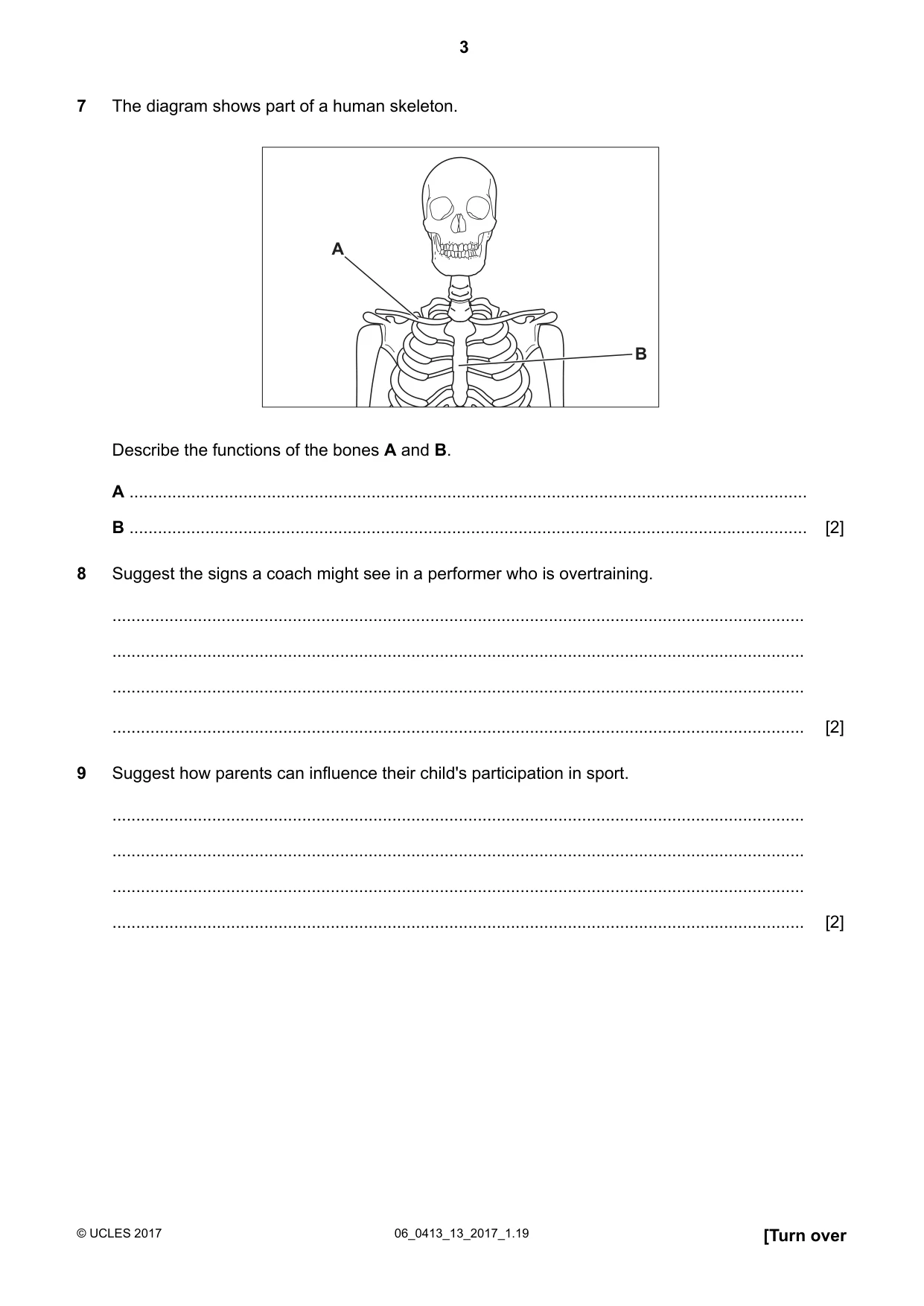
The diagram shows part of a human skeleton. 7 A B Describe the functions of the bones A and B. A … B … [2] Suggest the signs a coach might see in a performer who is overtraining. 8 … … … … [2] Suggest how parents can influence their child's participation in sport. 9 … … … … [2] [Turn over 06_0413_13_2017_1.19 © UCLES 2017 3
Question paper, page 4
Explain how smoking can affect the amount of oxygen reaching muscles and the effects it can have on performance. 10 … … … … … … [3] Warming up before a gymnastic event can prevent injuries. Describe other ways that a performer can prevent injury to themselves when competing. 11 … … … … … … … … [4] [Total: 20] 06_0413_13_2017_1.19 © UCLES 2017 4
Question paper, page 5
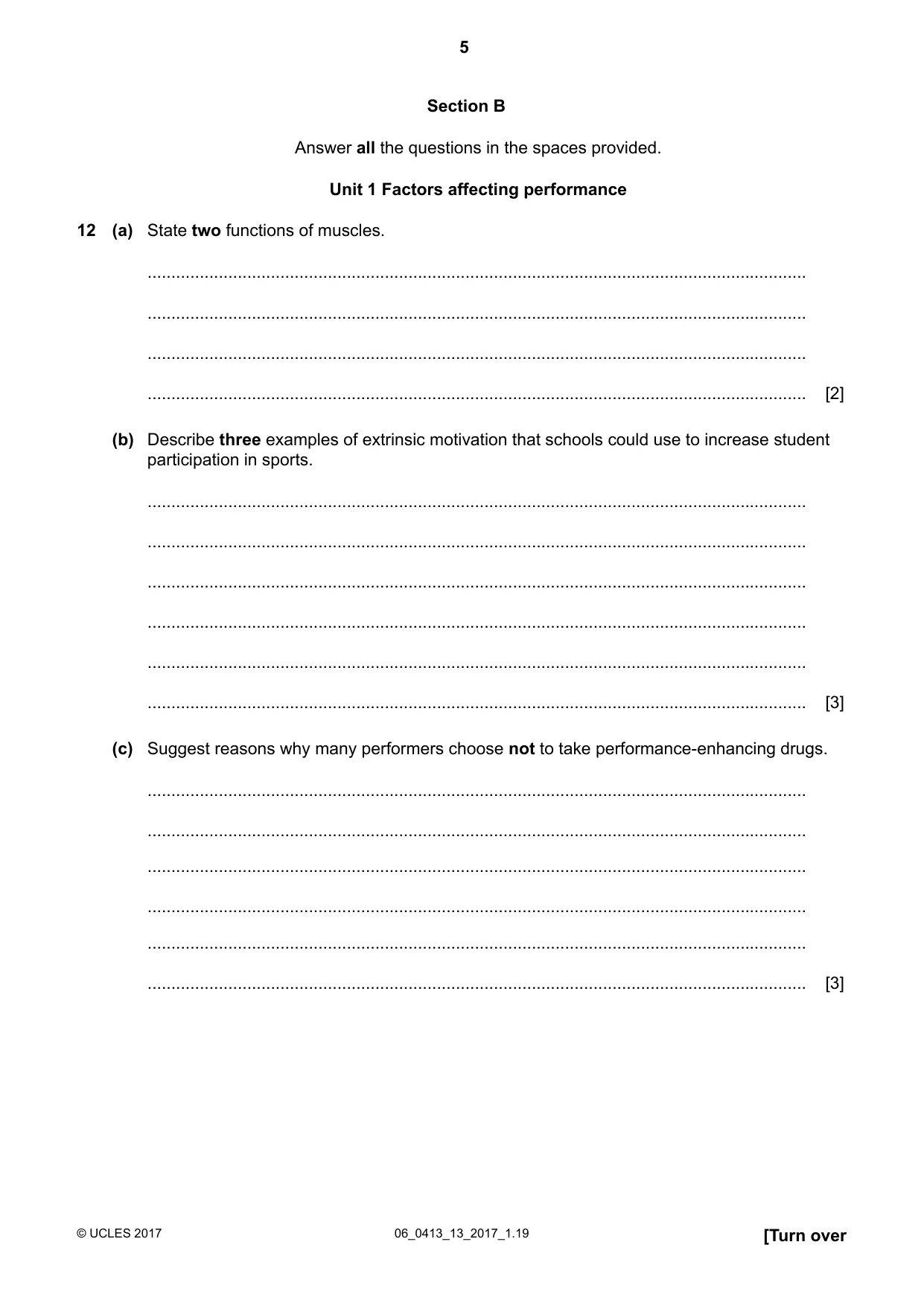
Section B Answer all the questions in the spaces provided. Unit 1 Factors affecting performance State two functions of muscles. (a) 12 … … … … [2] Describe three examples of extrinsic motivation that schools could use to increase student participation in sports. (b) … … … … … … [3] Suggest reasons why many performers choose not to take performance-enhancing drugs. (c) … … … … … … [3] [Turn over 06_0413_13_2017_1.19 © UCLES 2017 5
Question paper, page 6
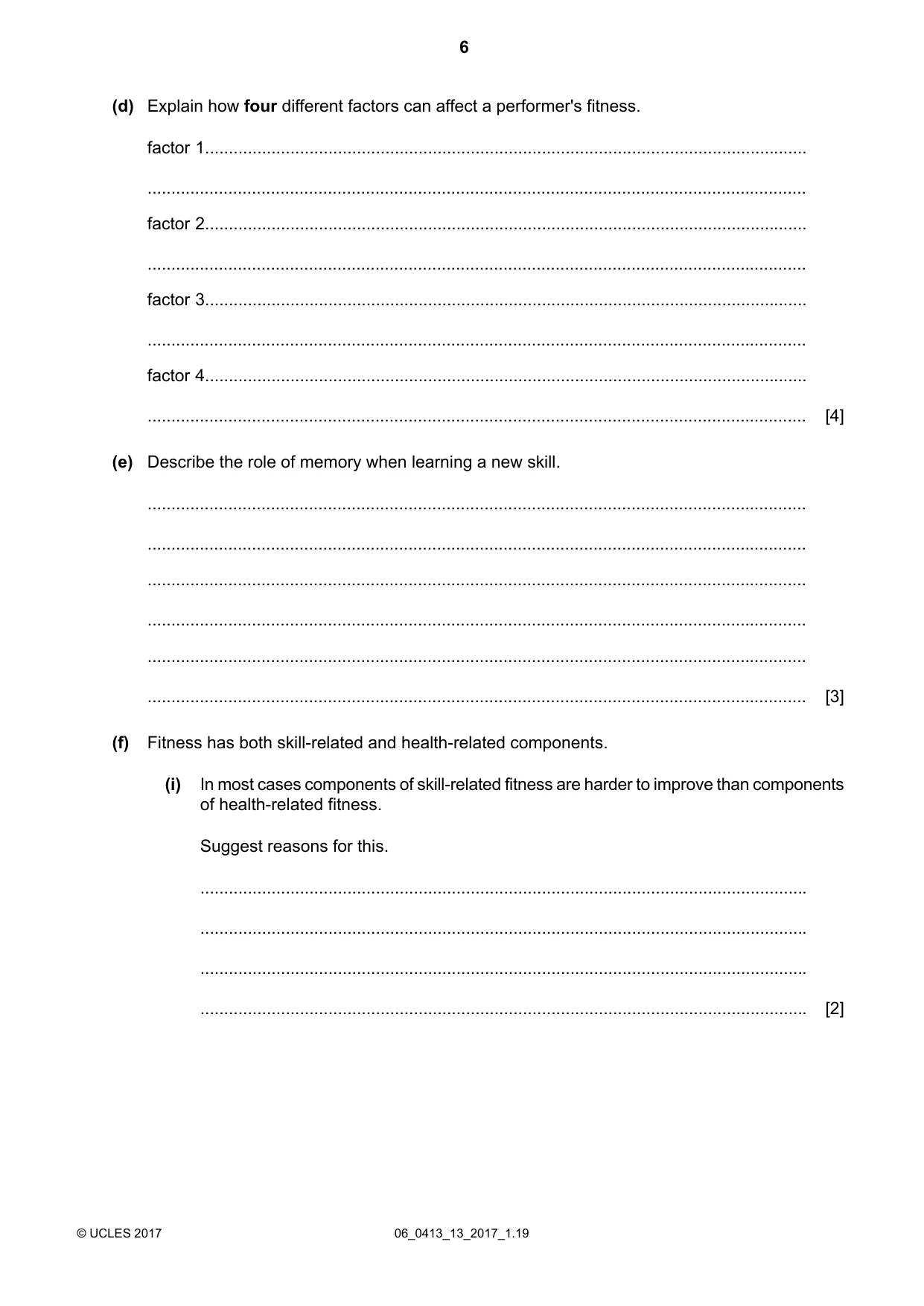
Explain how four different factors can affect a performer's fitness. (d) factor 1… … factor 2… … factor 3… … factor 4… … [4] Describe the role of memory when learning a new skill. (e) … … … … … … [3] Fitness has both skill-related and health-related components. (f) In most cases components of skill-related fitness are harder to improve than components of health-related fitness. Suggest reasons for this. (i) … … … … [2] 06_0413_13_2017_1.19 © UCLES 2017 6
Question paper, page 7
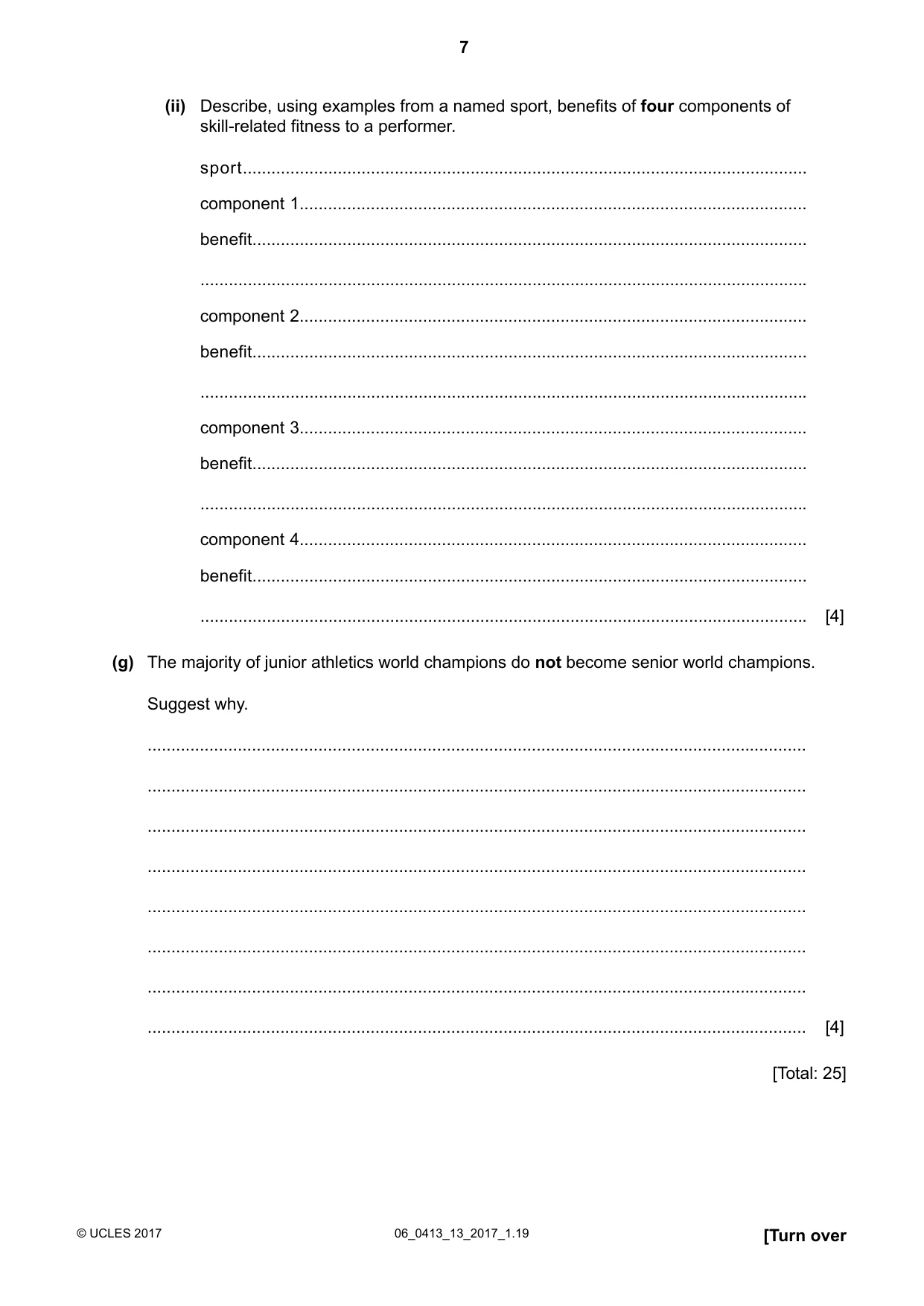
Describe, using examples from a named sport, benefits of four components of skill-related fitness to a performer. (ii) sport… component 1… benefit… … component 2… benefit… … component 3… benefit… … component 4… benefit… … [4] The majority of junior athletics world champions do not become senior world champions. Suggest why. (g) … … … … … … … … [4] [Total: 25] [Turn over 06_0413_13_2017_1.19 © UCLES 2017 7
Question paper, page 8
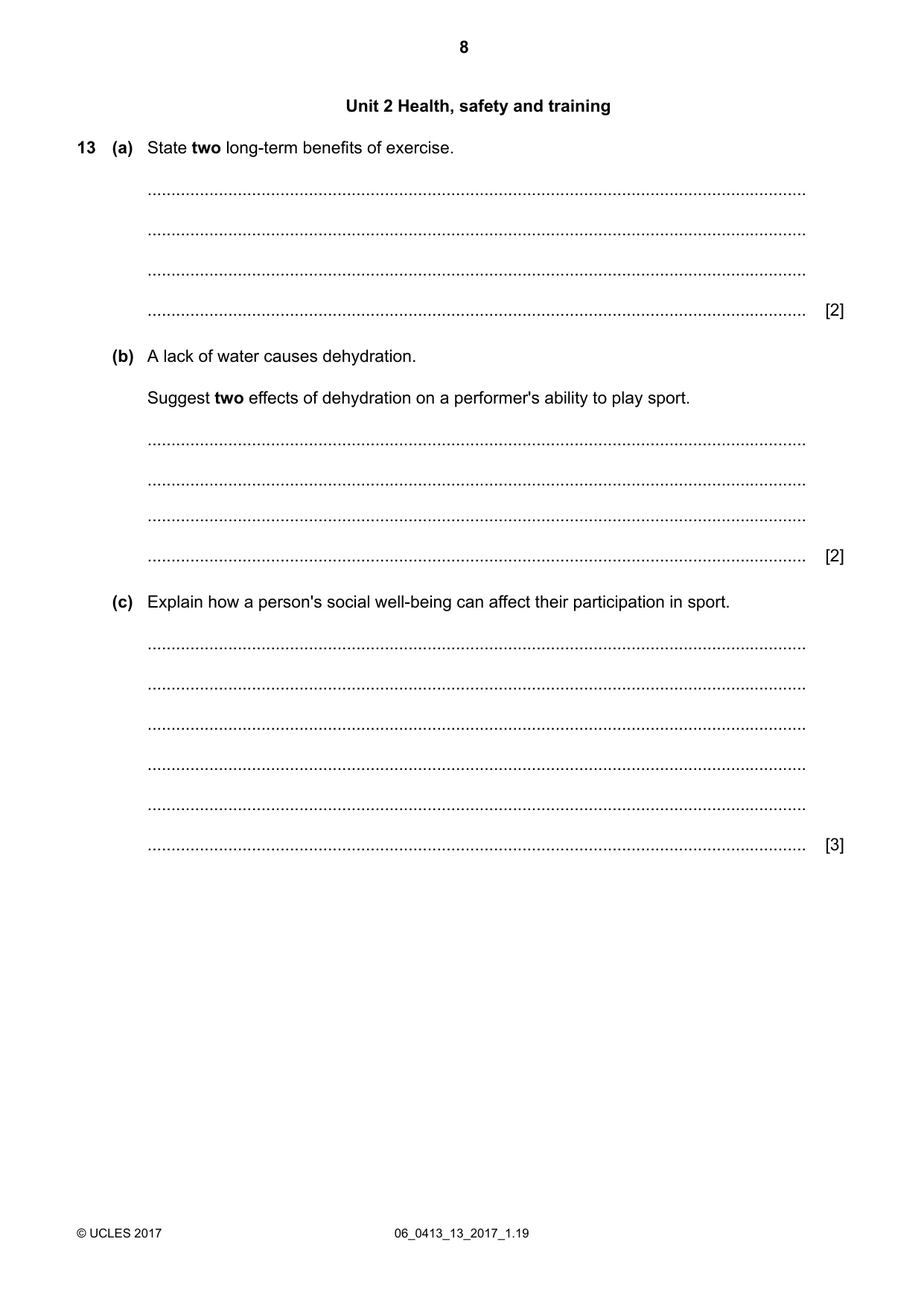
Unit 2 Health, safety and training State two long-term benefits of exercise. (a) 13 … … … … [2] A lack of water causes dehydration. Suggest two effects of dehydration on a performer's ability to play sport. (b) … … … … [2] Explain how a person's social well-being can affect their participation in sport. (c) … … … … … … [3] 06_0413_13_2017_1.19 © UCLES 2017 8
Question paper, page 9
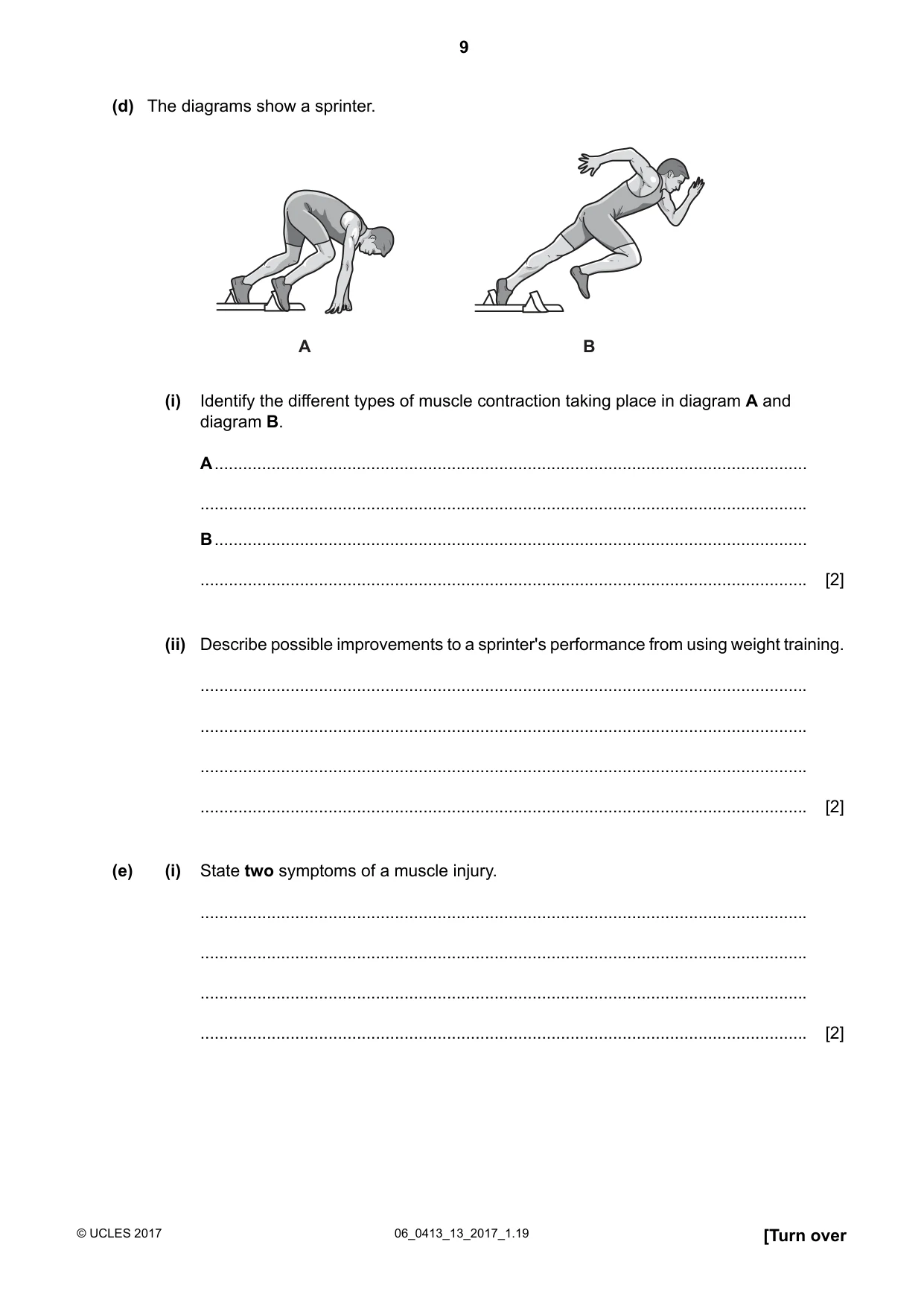
The diagrams show a sprinter. (d) A B Identify the different types of muscle contraction taking place in diagram A and diagram B. (i) A… … B… … [2] Describe possible improvements to a sprinter's performance from using weight training. (ii) … … … … [2] State two symptoms of a muscle injury. (i) (e) … … … … [2] [Turn over 06_0413_13_2017_1.19 © UCLES 2017 9
Question paper, page 10
Describe one immediate treatment and one longer-term treatment for a muscle injury. (ii) immediate treatment… … longer-term treatment… … [2] Name a physical activity in which a performer would benefit from using plyometric training. (i) (f) … [1] Describe two exercises that could be included in plyometric training and explain the benefits that the training could bring to a performer. (ii) exercise 1… explanation of benefits… … … exercise 2… explanation of benefits… … … [2] Describe the safety factors that should be considered when using plyometric training. (iii) … … … … [2] [Total: 20] 06_0413_13_2017_1.19 © UCLES 2017 10
Question paper, page 11
Unit 3 Reasons and opportunities for participation in physical activity Suggest why participation rates in sport are low for disabled people. (a) 14 … … … … [2] Improvements in health care have resulted in many people living longer. Describe how being physically active can contribute to maintaining the good health of elderly people. (b) … … … … … … [3] Describe the psychological characteristics expected from a performer who achieves excellence in their sport. (c) … … … … … … … … [4] [Turn over 06_0413_13_2017_1.19 © UCLES 2017 11
Question paper, page 12
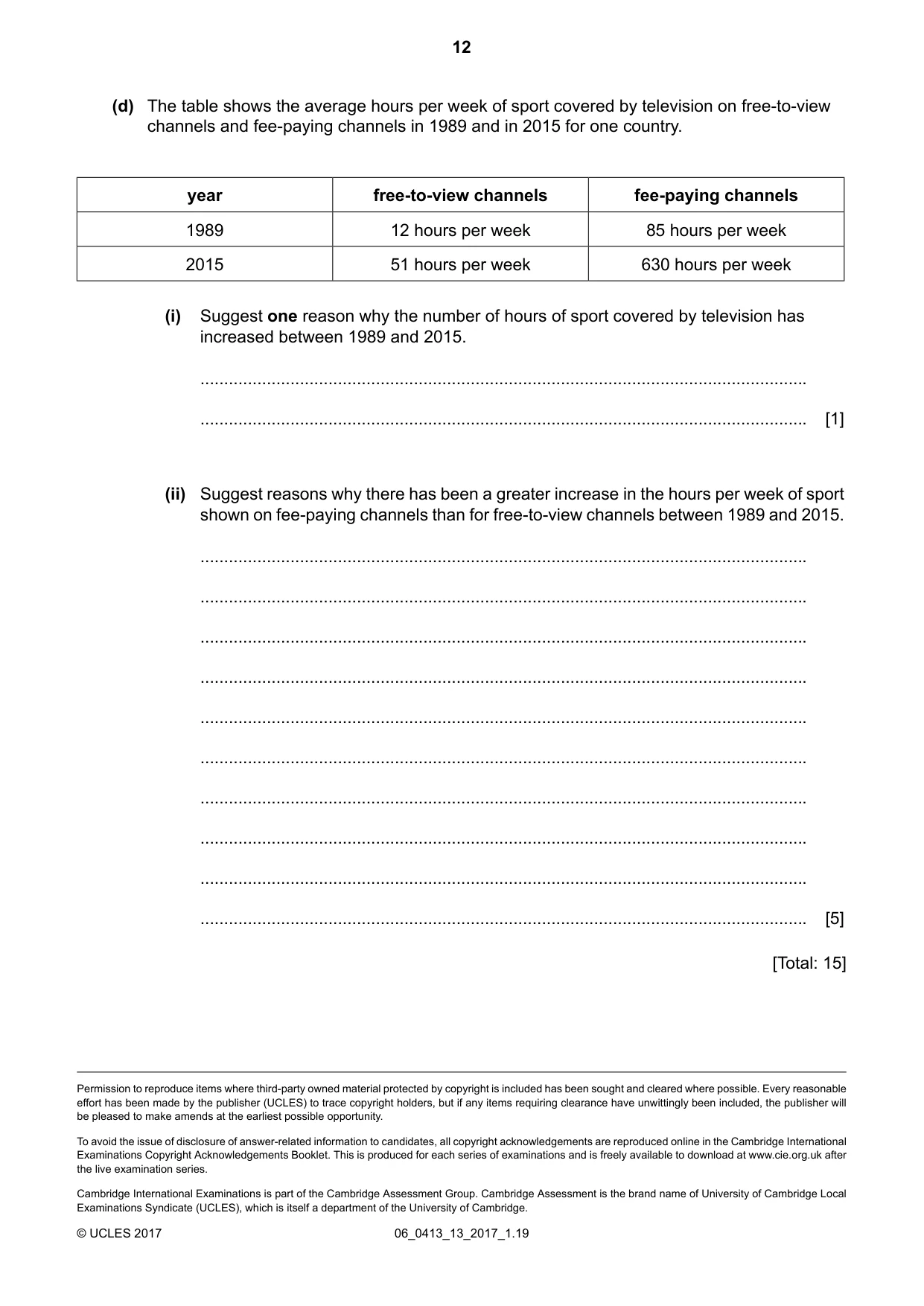
The table shows the average hours per week of sport covered by television on free-to-view channels and fee-paying channels in 1989 and in 2015 for one country. (d) fee-paying channels free-to-view channels year 85 hours per week 12 hours per week 1989 630 hours per week 51 hours per week 2015 Suggest one reason why the number of hours of sport covered by television has increased between 1989 and 2015. (i) … … [1] Suggest reasons why there has been a greater increase in the hours per week of sport shown on fee-paying channels than for free-to-view channels between 1989 and 2015. (ii) … … … … … … … … … … [5] [Total: 15] Permission to reproduce items where third-party owned material protected by copyright is included has been sought and cleared where possible. Every reasonable effort has been made by the publisher (UCLES) to trace copyright holders, but if any items requiring clearance have unwittingly been included, the publisher will be pleased to make amends at the earliest possible opportunity. To avoid the issue of disclosure of answer-related information to candidates, all copyright acknowledgements are reproduced online in the Cambridge International Examinations Copyright Acknowledgements Booklet. This is produced for each series of examinations and is freely available to download at www.cie.org.uk after the live examination series. Cambridge International Examinations is part of the Cambridge Assessment Group. Cambridge Assessment is the brand name of University of Cambridge Local Examinations Syndicate (UCLES), which is itself a department of the University of Cambridge. 06_0413_13_2017_1.19 © UCLES 2017 12
Mark scheme, page 1
® IGCSE is a registered trademark. This document consists of 23 printed pages. © UCLES 2017 [Turn over Cambridge International Examinations Cambridge International General Certificate of Secondary Education PHYSICAL EDUCATION 0413/13 Paper 1 May/June 2017 MARK SCHEME Maximum Mark: 80 Published This mark scheme is published as an aid to teachers and candidates, to indicate the requirements of the examination. It shows the basis on which Examiners were instructed to award marks. It does not indicate the details of the discussions that took place at an Examiners’ meeting before marking began, which would have considered the acceptability of alternative answers. Mark schemes should be read in conjunction with the question paper and the Principal Examiner Report for Teachers. Cambridge will not enter into discussions about these mark schemes. Cambridge is publishing the mark schemes for the May/June 2017 series for most Cambridge IGCSE®, Cambridge International A and AS Level and Cambridge Pre-U components, and some Cambridge O Level components.
Mark scheme, page 2
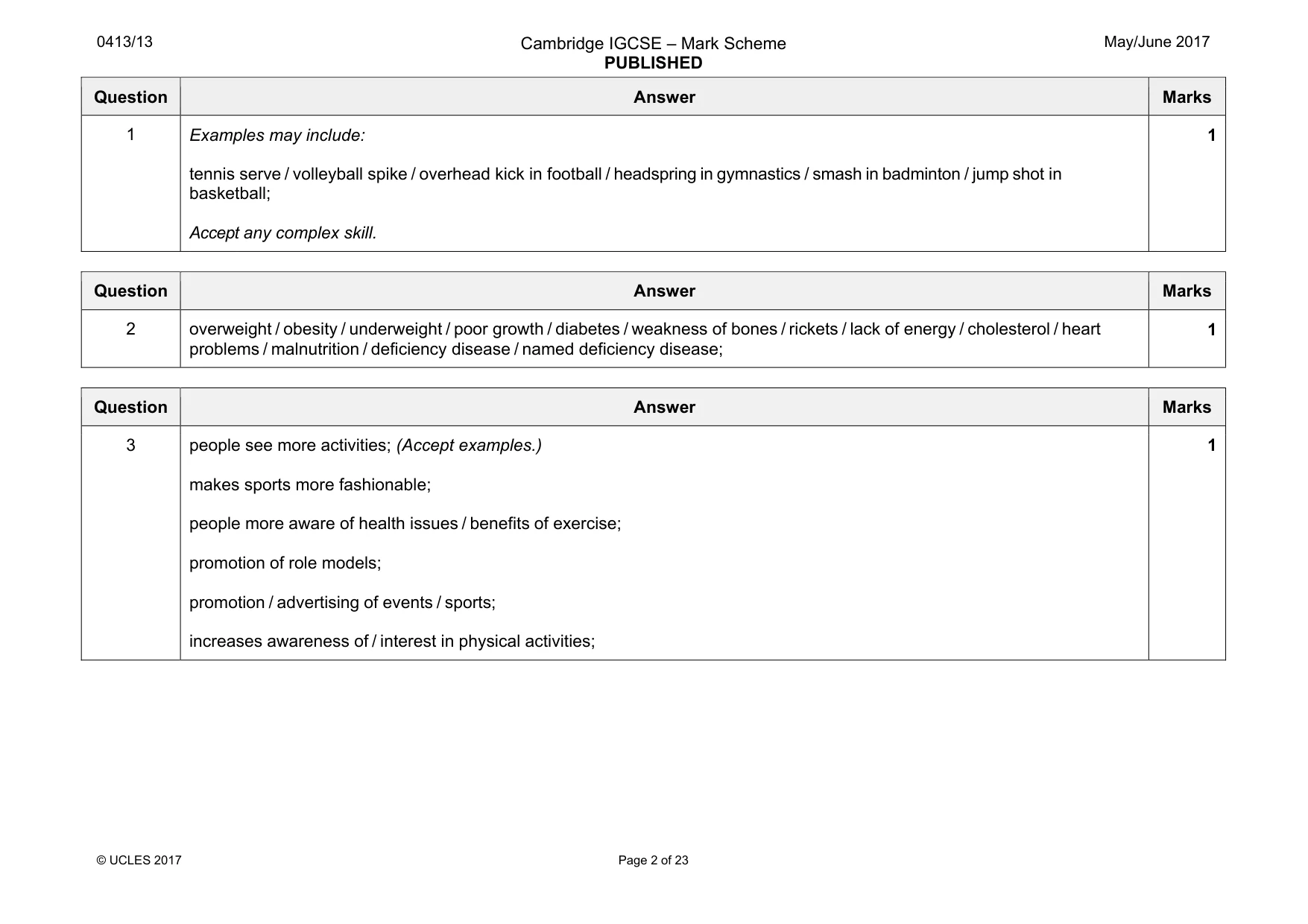
0413/13 Cambridge IGCSE – Mark Scheme PUBLISHED May/June 2017 © UCLES 2017 Page 2 of 23 Question Answer Marks 1 Examples may include: tennis serve / volleyball spike / overhead kick in football / headspring in gymnastics / smash in badminton / jump shot in basketball; Accept any complex skill. 1 Question Answer Marks 2 overweight / obesity / underweight / poor growth / diabetes / weakness of bones / rickets / lack of energy / cholesterol / heart problems / malnutrition / deficiency disease / named deficiency disease; 1 Question Answer Marks 3 people see more activities; (Accept examples.) makes sports more fashionable; people more aware of health issues / benefits of exercise; promotion of role models; promotion / advertising of events / sports; increases awareness of / interest in physical activities; 1
Mark scheme, page 3
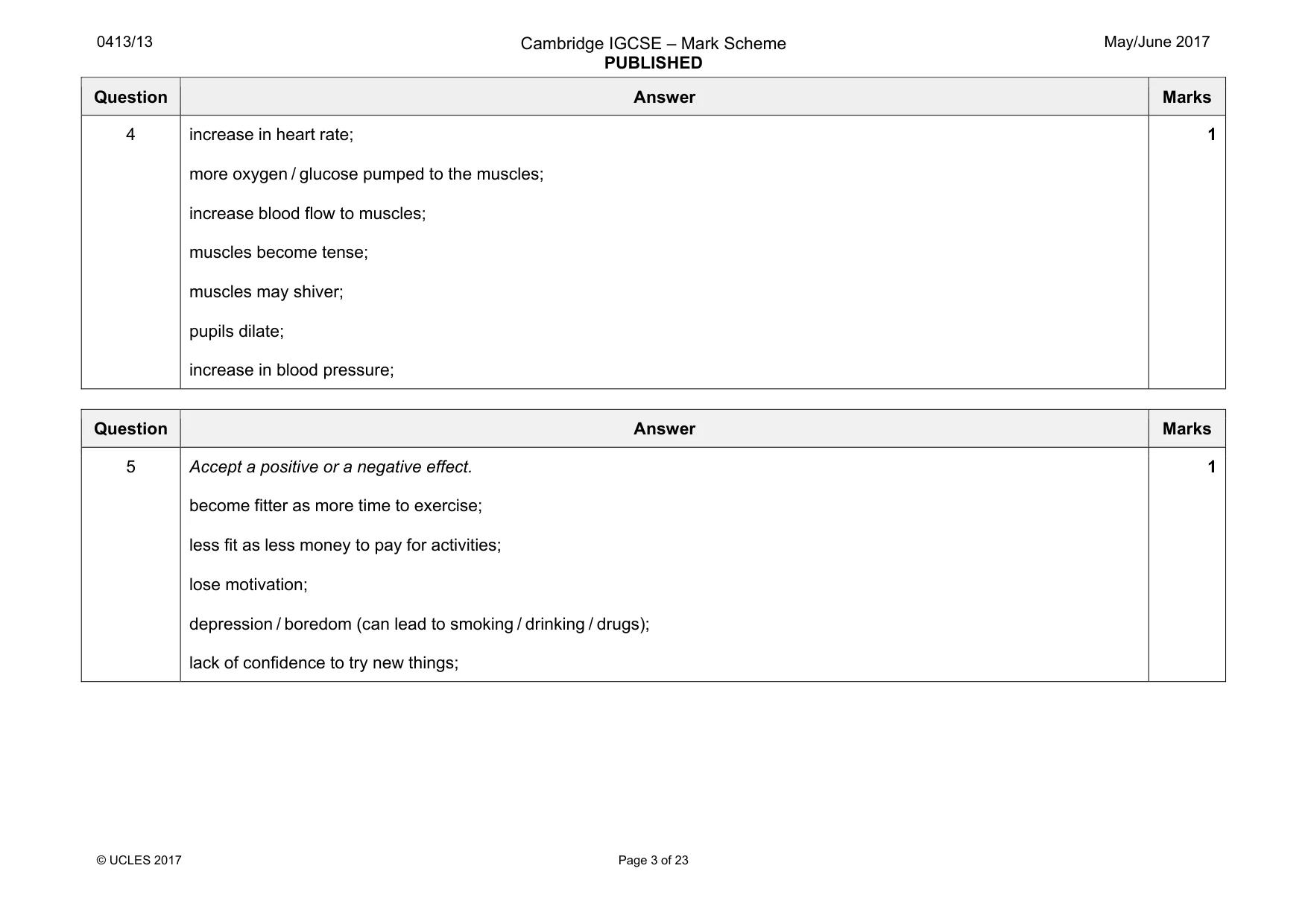
0413/13 Cambridge IGCSE – Mark Scheme PUBLISHED May/June 2017 © UCLES 2017 Page 3 of 23 Question Answer Marks 4 increase in heart rate; more oxygen / glucose pumped to the muscles; increase blood flow to muscles; muscles become tense; muscles may shiver; pupils dilate; increase in blood pressure; 1 Question Answer Marks 5 Accept a positive or a negative effect. become fitter as more time to exercise; less fit as less money to pay for activities; lose motivation; depression / boredom (can lead to smoking / drinking / drugs); lack of confidence to try new things; 1
Mark scheme, page 4
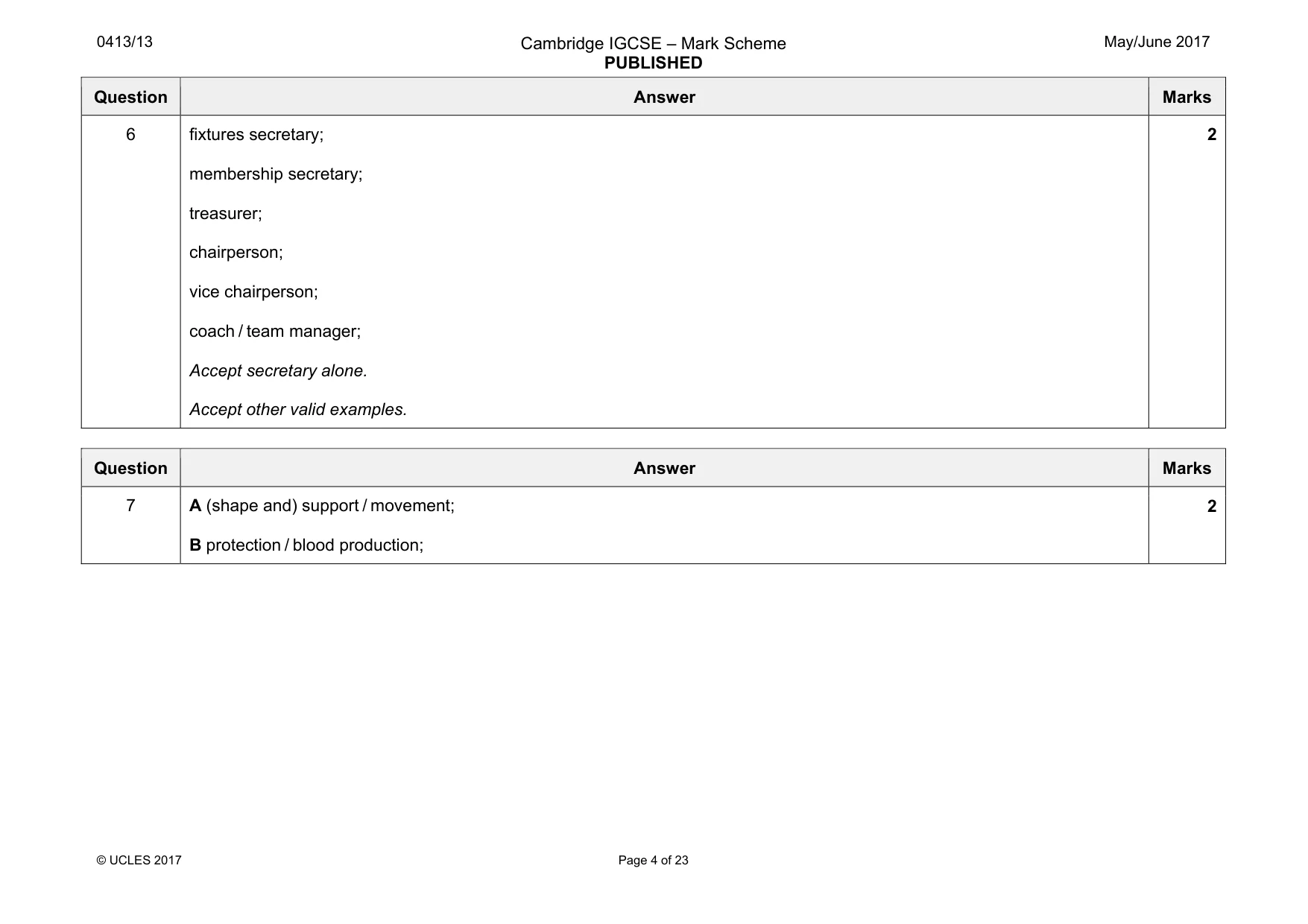
0413/13 Cambridge IGCSE – Mark Scheme PUBLISHED May/June 2017 © UCLES 2017 Page 4 of 23 Question Answer Marks 6 fixtures secretary; membership secretary; treasurer; chairperson; vice chairperson; coach / team manager; Accept secretary alone. Accept other valid examples. 2 Question Answer Marks 7 A (shape and) support / movement; B protection / blood production; 2
Mark scheme, page 5
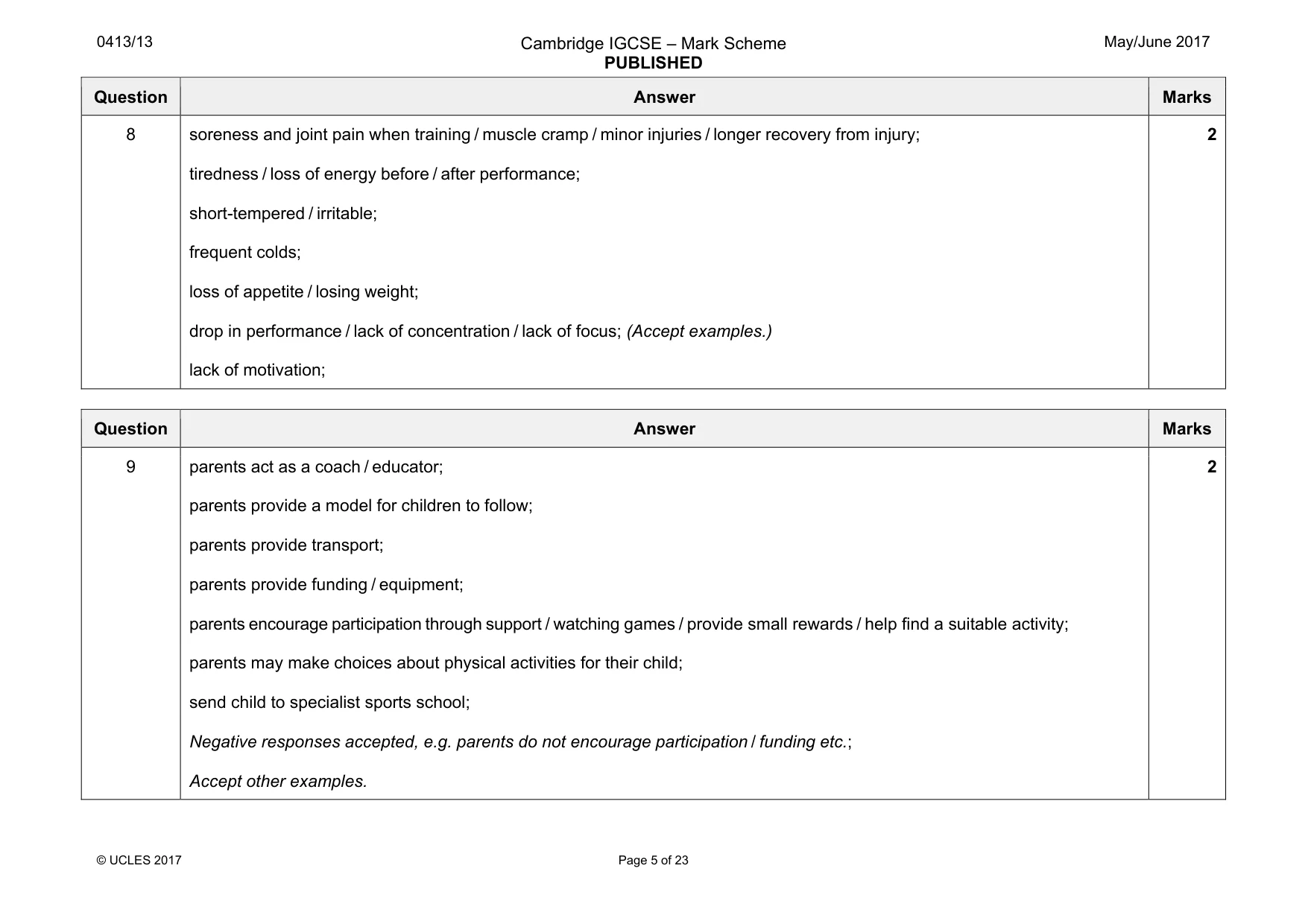
0413/13 Cambridge IGCSE – Mark Scheme PUBLISHED May/June 2017 © UCLES 2017 Page 5 of 23 Question Answer Marks 8 soreness and joint pain when training / muscle cramp / minor injuries / longer recovery from injury; tiredness / loss of energy before / after performance; short-tempered / irritable; frequent colds; loss of appetite / losing weight; drop in performance / lack of concentration / lack of focus; (Accept examples.) lack of motivation; 2 Question Answer Marks 9 parents act as a coach / educator; parents provide a model for children to follow; parents provide transport; parents provide funding / equipment; parents encourage participation through support / watching games / provide small rewards / help find a suitable activity; parents may make choices about physical activities for their child; send child to specialist sports school; Negative responses accepted, e.g. parents do not encourage participation / funding etc.; Accept other examples. 2
Mark scheme, page 6
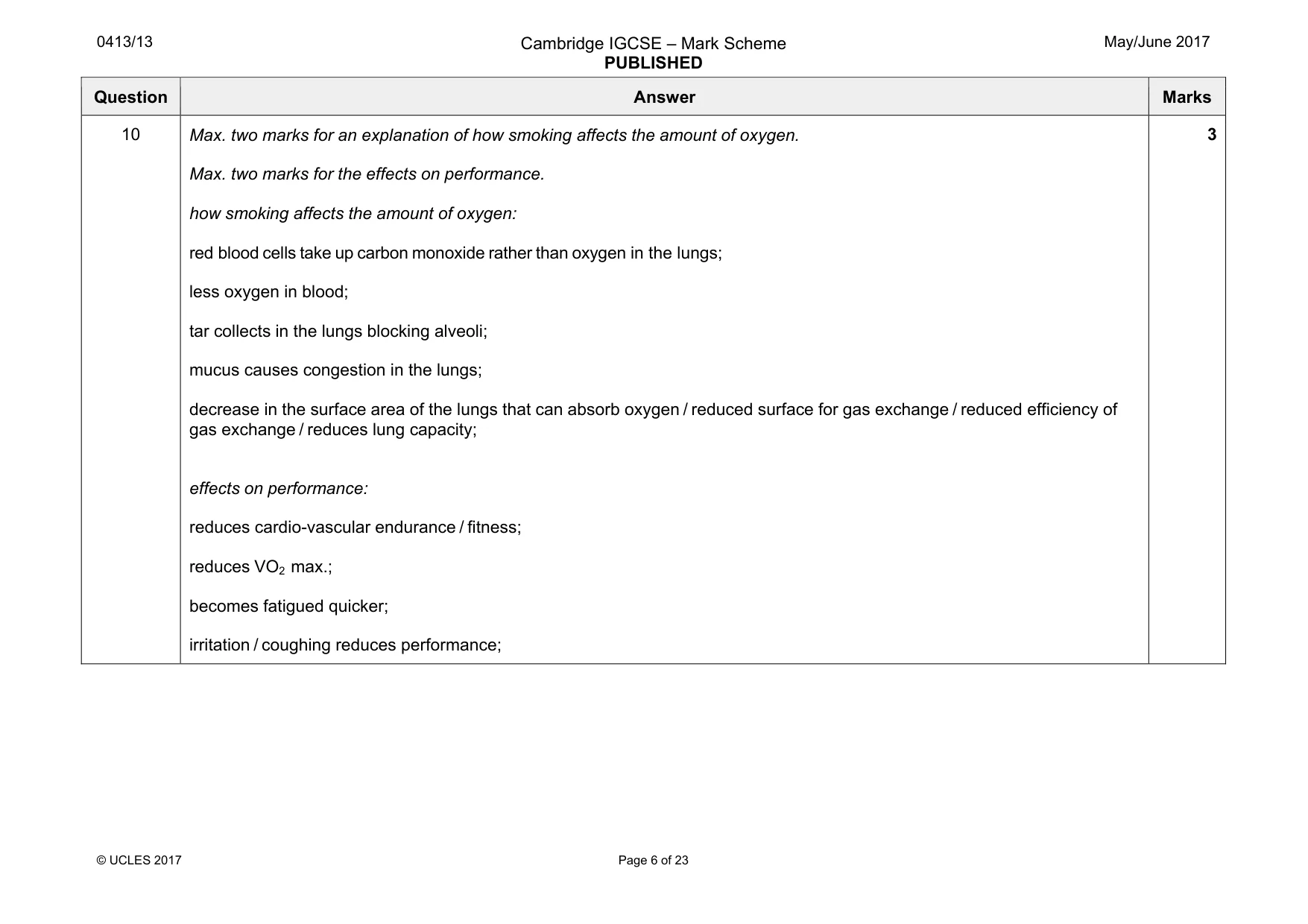
0413/13 Cambridge IGCSE – Mark Scheme PUBLISHED May/June 2017 © UCLES 2017 Page 6 of 23 Question Answer Marks 10 Max. two marks for an explanation of how smoking affects the amount of oxygen. Max. two marks for the effects on performance. how smoking affects the amount of oxygen: red blood cells take up carbon monoxide rather than oxygen in the lungs; less oxygen in blood; tar collects in the lungs blocking alveoli; mucus causes congestion in the lungs; decrease in the surface area of the lungs that can absorb oxygen / reduced surface for gas exchange / reduced efficiency of gas exchange / reduces lung capacity; effects on performance: reduces cardio-vascular endurance / fitness; reduces VO2 max.; becomes fatigued quicker; irritation / coughing reduces performance; 3
Mark scheme, page 7
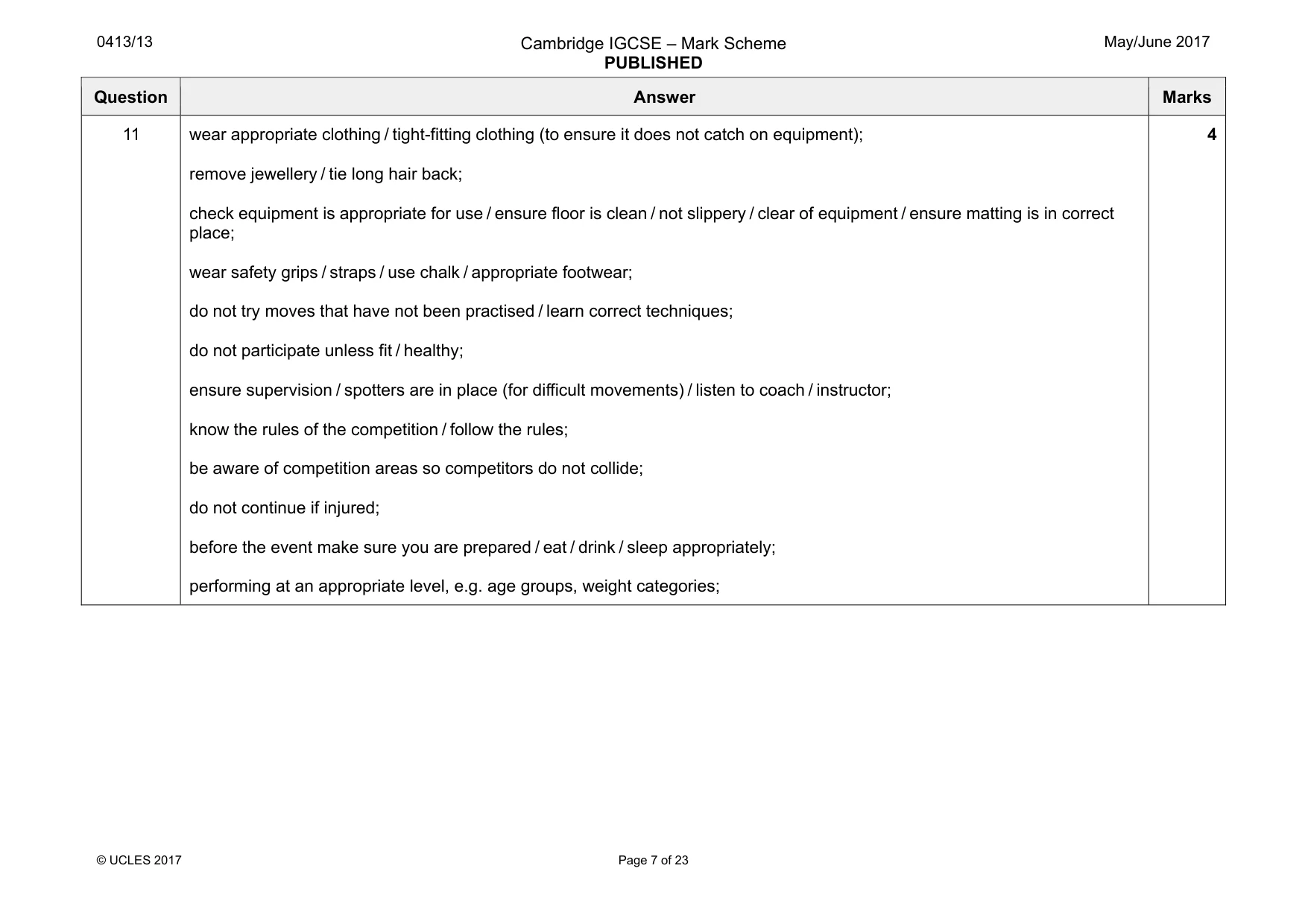
0413/13 Cambridge IGCSE – Mark Scheme PUBLISHED May/June 2017 © UCLES 2017 Page 7 of 23 Question Answer Marks 11 wear appropriate clothing / tight-fitting clothing (to ensure it does not catch on equipment); remove jewellery / tie long hair back; check equipment is appropriate for use / ensure floor is clean / not slippery / clear of equipment / ensure matting is in correct place; wear safety grips / straps / use chalk / appropriate footwear; do not try moves that have not been practised / learn correct techniques; do not participate unless fit / healthy; ensure supervision / spotters are in place (for difficult movements) / listen to coach / instructor; know the rules of the competition / follow the rules; be aware of competition areas so competitors do not collide; do not continue if injured; before the event make sure you are prepared / eat / drink / sleep appropriately; performing at an appropriate level, e.g. age groups, weight categories; 4
Mark scheme, page 8
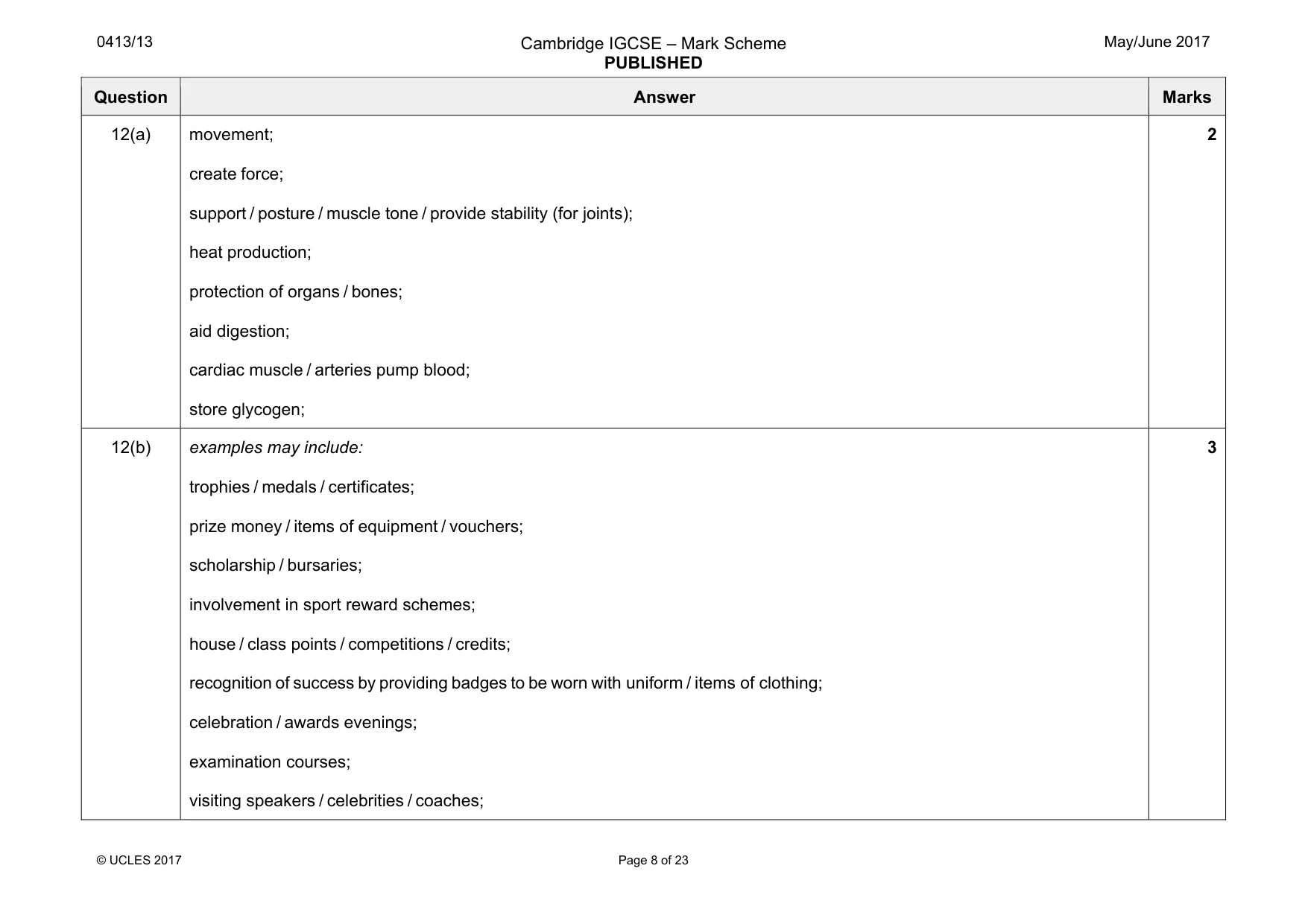
0413/13 Cambridge IGCSE – Mark Scheme PUBLISHED May/June 2017 © UCLES 2017 Page 8 of 23 Question Answer Marks 12(a) movement; create force; support / posture / muscle tone / provide stability (for joints); heat production; protection of organs / bones; aid digestion; cardiac muscle / arteries pump blood; store glycogen; 2 12(b) examples may include: trophies / medals / certificates; prize money / items of equipment / vouchers; scholarship / bursaries; involvement in sport reward schemes; house / class points / competitions / credits; recognition of success by providing badges to be worn with uniform / items of clothing; celebration / awards evenings; examination courses; visiting speakers / celebrities / coaches; 3
Mark scheme, page 9
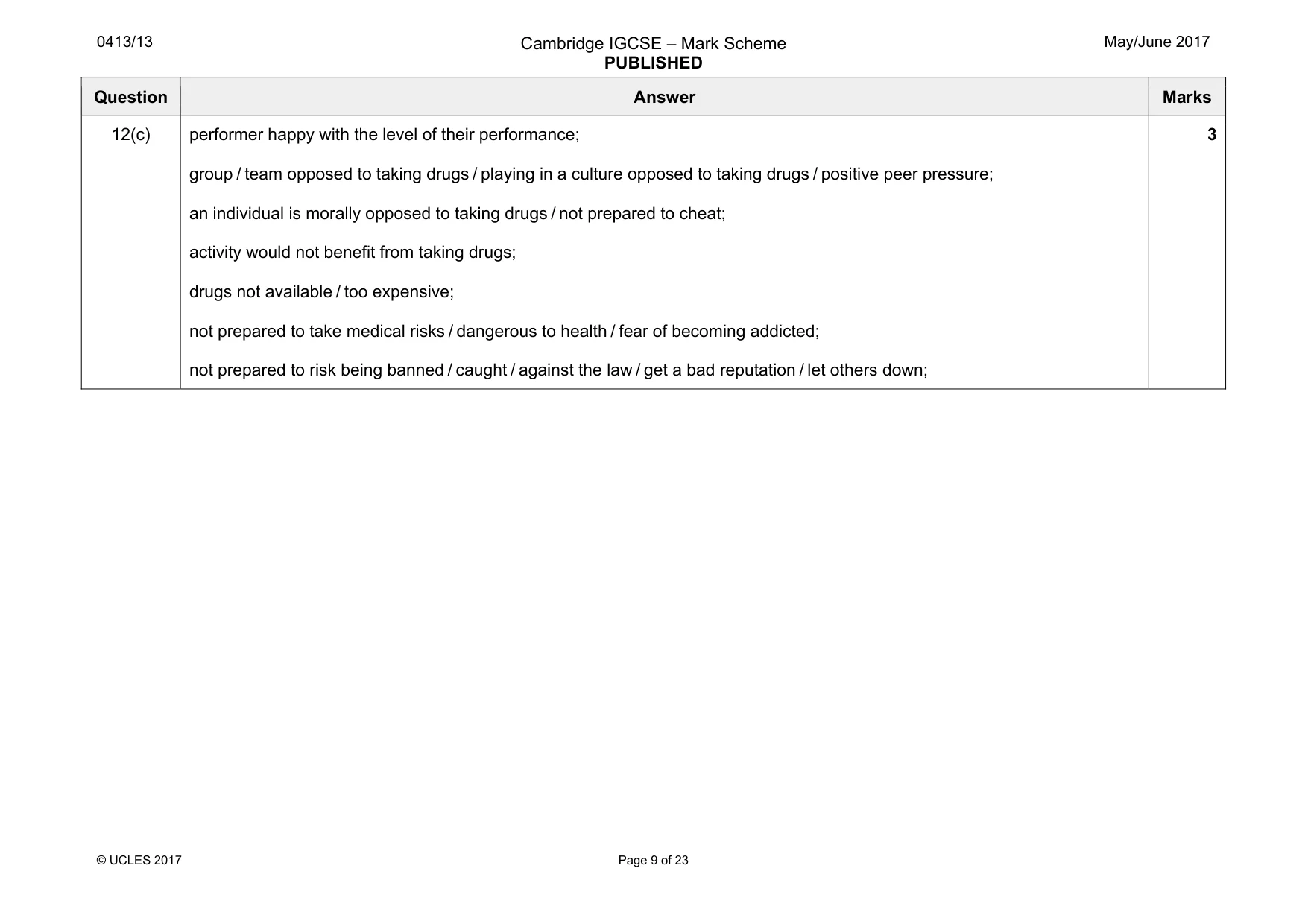
0413/13 Cambridge IGCSE – Mark Scheme PUBLISHED May/June 2017 © UCLES 2017 Page 9 of 23 Question Answer Marks 12(c) performer happy with the level of their performance; group / team opposed to taking drugs / playing in a culture opposed to taking drugs / positive peer pressure; an individual is morally opposed to taking drugs / not prepared to cheat; activity would not benefit from taking drugs; drugs not available / too expensive; not prepared to take medical risks / dangerous to health / fear of becoming addicted; not prepared to risk being banned / caught / against the law / get a bad reputation / let others down; 3
Mark scheme, page 10
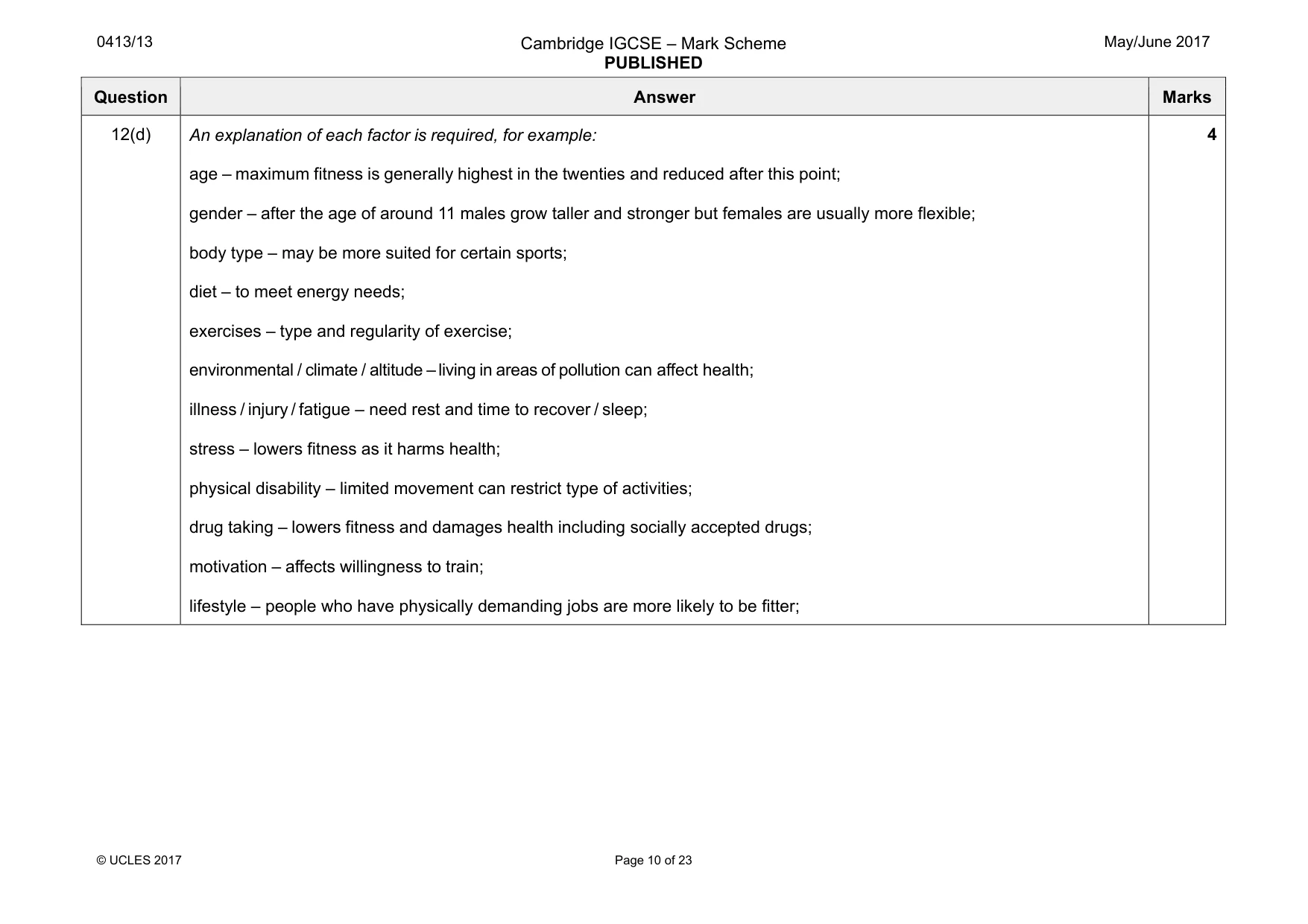
0413/13 Cambridge IGCSE – Mark Scheme PUBLISHED May/June 2017 © UCLES 2017 Page 10 of 23 Question Answer Marks 12(d) An explanation of each factor is required, for example: age – maximum fitness is generally highest in the twenties and reduced after this point; gender – after the age of around 11 males grow taller and stronger but females are usually more flexible; body type – may be more suited for certain sports; diet – to meet energy needs; exercises – type and regularity of exercise; environmental / climate / altitude – living in areas of pollution can affect health; illness / injury / fatigue – need rest and time to recover / sleep; stress – lowers fitness as it harms health; physical disability – limited movement can restrict type of activities; drug taking – lowers fitness and damages health including socially accepted drugs; motivation – affects willingness to train; lifestyle – people who have physically demanding jobs are more likely to be fitter; 4
Mark scheme, page 11
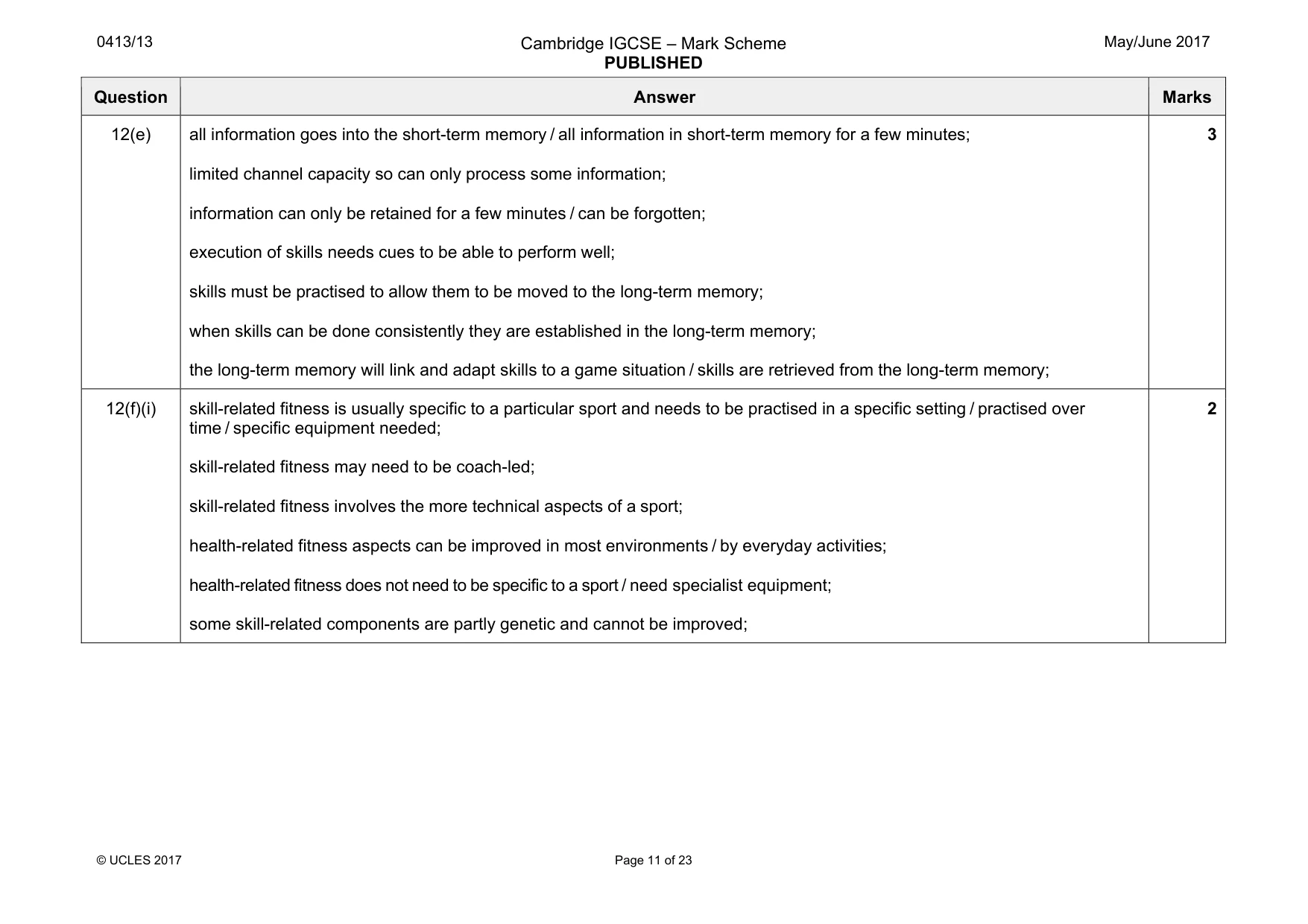
0413/13 Cambridge IGCSE – Mark Scheme PUBLISHED May/June 2017 © UCLES 2017 Page 11 of 23 Question Answer Marks 12(e) all information goes into the short-term memory / all information in short-term memory for a few minutes; limited channel capacity so can only process some information; information can only be retained for a few minutes / can be forgotten; execution of skills needs cues to be able to perform well; skills must be practised to allow them to be moved to the long-term memory; when skills can be done consistently they are established in the long-term memory; the long-term memory will link and adapt skills to a game situation / skills are retrieved from the long-term memory; 3 12(f)(i) skill-related fitness is usually specific to a particular sport and needs to be practised in a specific setting / practised over time / specific equipment needed; skill-related fitness may need to be coach-led; skill-related fitness involves the more technical aspects of a sport; health-related fitness aspects can be improved in most environments / by everyday activities; health-related fitness does not need to be specific to a sport / need specialist equipment; some skill-related components are partly genetic and cannot be improved; 2
Mark scheme, page 12
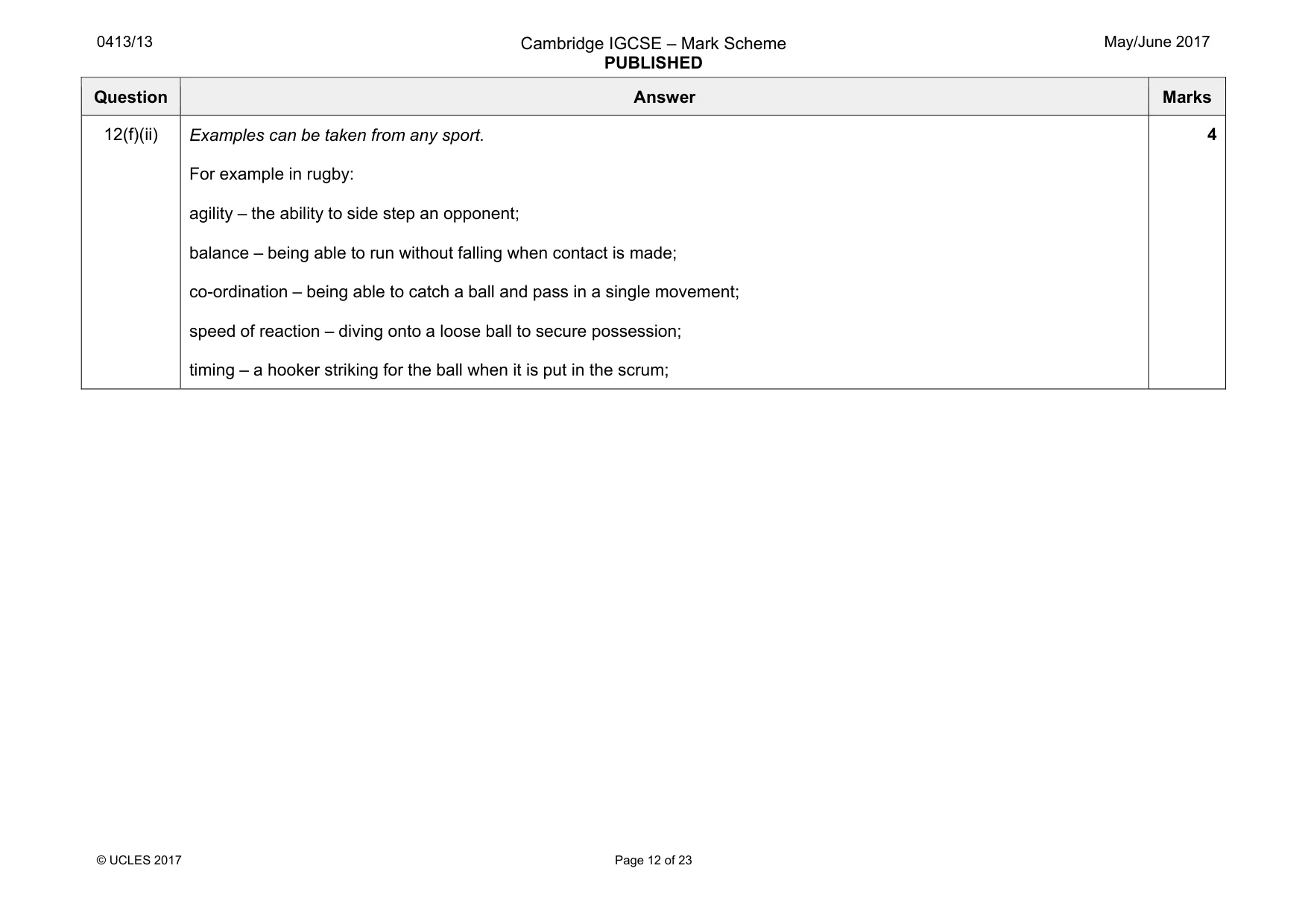
0413/13 Cambridge IGCSE – Mark Scheme PUBLISHED May/June 2017 © UCLES 2017 Page 12 of 23 Question Answer Marks 12(f)(ii) Examples can be taken from any sport. For example in rugby: agility – the ability to side step an opponent; balance – being able to run without falling when contact is made; co-ordination – being able to catch a ball and pass in a single movement; speed of reaction – diving onto a loose ball to secure possession; timing – a hooker striking for the ball when it is put in the scrum; 4
Mark scheme, page 13
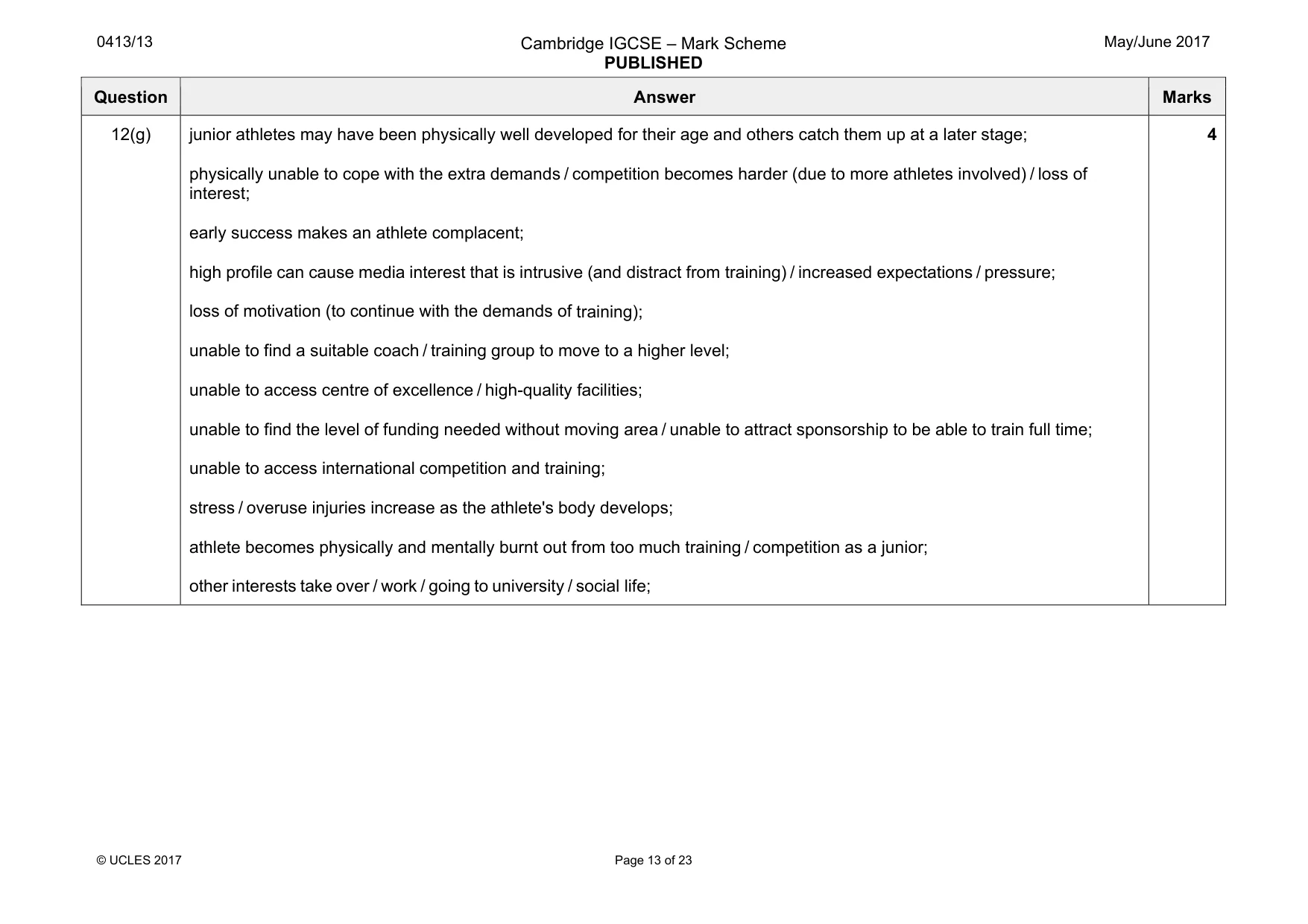
0413/13 Cambridge IGCSE – Mark Scheme PUBLISHED May/June 2017 © UCLES 2017 Page 13 of 23 Question Answer Marks 12(g) junior athletes may have been physically well developed for their age and others catch them up at a later stage; physically unable to cope with the extra demands / competition becomes harder (due to more athletes involved) / loss of interest; early success makes an athlete complacent; high profile can cause media interest that is intrusive (and distract from training) / increased expectations / pressure; loss of motivation (to continue with the demands of training); unable to find a suitable coach / training group to move to a higher level; unable to access centre of excellence / high-quality facilities; unable to find the level of funding needed without moving area / unable to attract sponsorship to be able to train full time; unable to access international competition and training; stress / overuse injuries increase as the athlete's body develops; athlete becomes physically and mentally burnt out from too much training / competition as a junior; other interests take over / work / going to university / social life; 4
Mark scheme, page 14
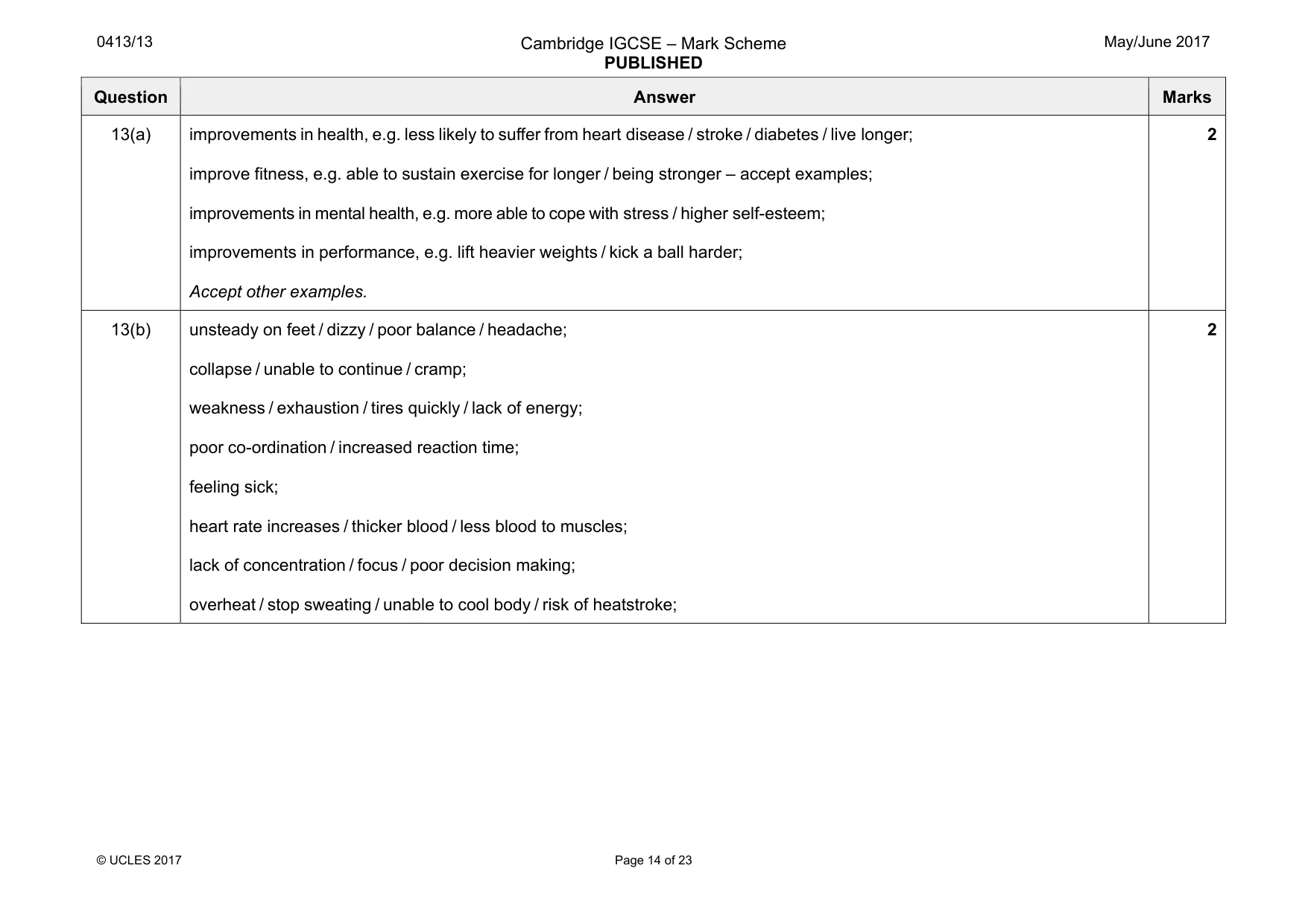
0413/13 Cambridge IGCSE – Mark Scheme PUBLISHED May/June 2017 © UCLES 2017 Page 14 of 23 Question Answer Marks 13(a) improvements in health, e.g. less likely to suffer from heart disease / stroke / diabetes / live longer; improve fitness, e.g. able to sustain exercise for longer / being stronger – accept examples; improvements in mental health, e.g. more able to cope with stress / higher self-esteem; improvements in performance, e.g. lift heavier weights / kick a ball harder; Accept other examples. 2 13(b) unsteady on feet / dizzy / poor balance / headache; collapse / unable to continue / cramp; weakness / exhaustion / tires quickly / lack of energy; poor co-ordination / increased reaction time; feeling sick; heart rate increases / thicker blood / less blood to muscles; lack of concentration / focus / poor decision making; overheat / stop sweating / unable to cool body / risk of heatstroke; 2
Mark scheme, page 15
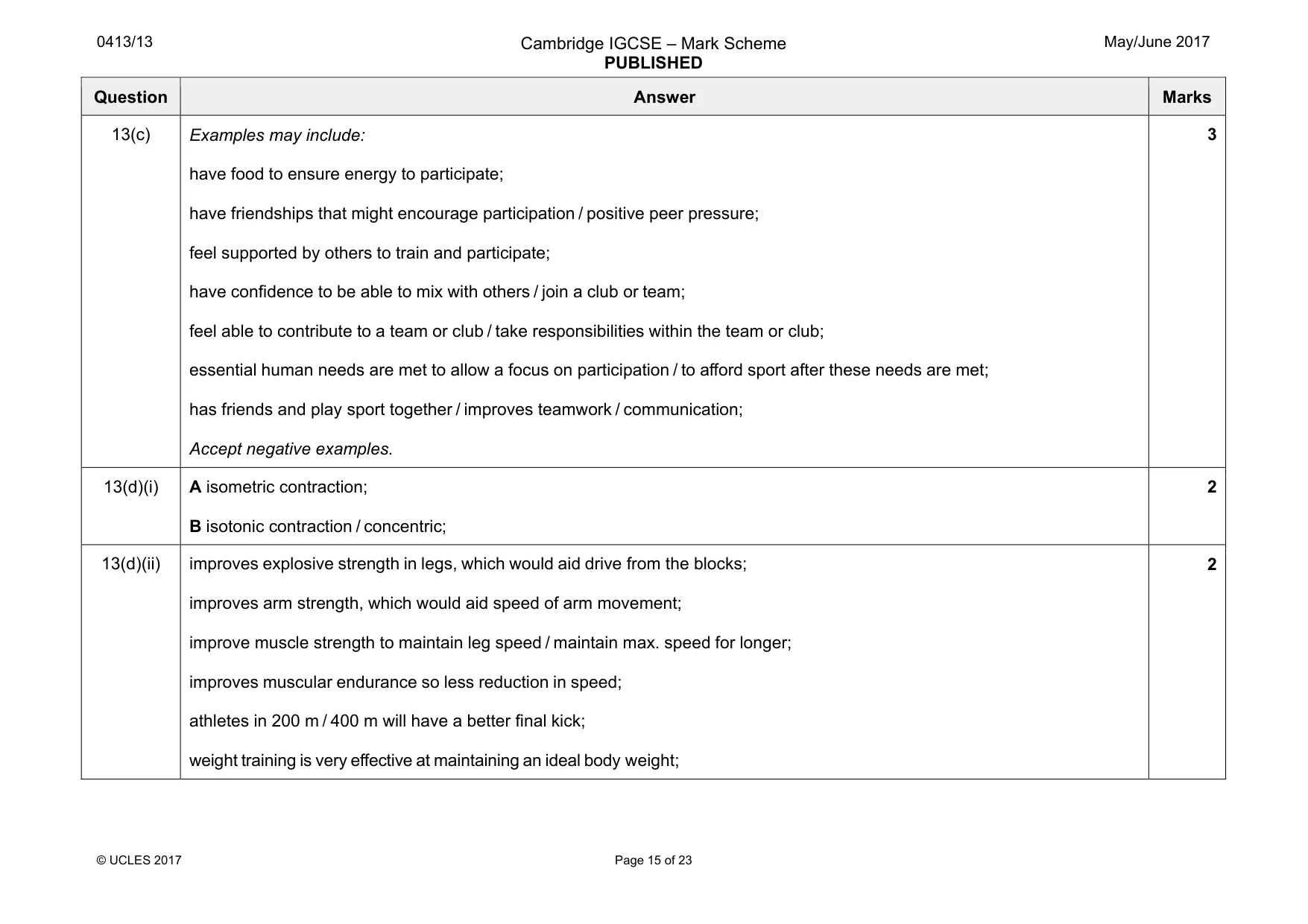
0413/13 Cambridge IGCSE – Mark Scheme PUBLISHED May/June 2017 © UCLES 2017 Page 15 of 23 Question Answer Marks 13(c) Examples may include: have food to ensure energy to participate; have friendships that might encourage participation / positive peer pressure; feel supported by others to train and participate; have confidence to be able to mix with others / join a club or team; feel able to contribute to a team or club / take responsibilities within the team or club; essential human needs are met to allow a focus on participation / to afford sport after these needs are met; has friends and play sport together / improves teamwork / communication; Accept negative examples. 3 13(d)(i) A isometric contraction; B isotonic contraction / concentric; 2 13(d)(ii) improves explosive strength in legs, which would aid drive from the blocks; improves arm strength, which would aid speed of arm movement; improve muscle strength to maintain leg speed / maintain max. speed for longer; improves muscular endurance so less reduction in speed; athletes in 200 m / 400 m will have a better final kick; weight training is very effective at maintaining an ideal body weight; 2
Mark scheme, page 16
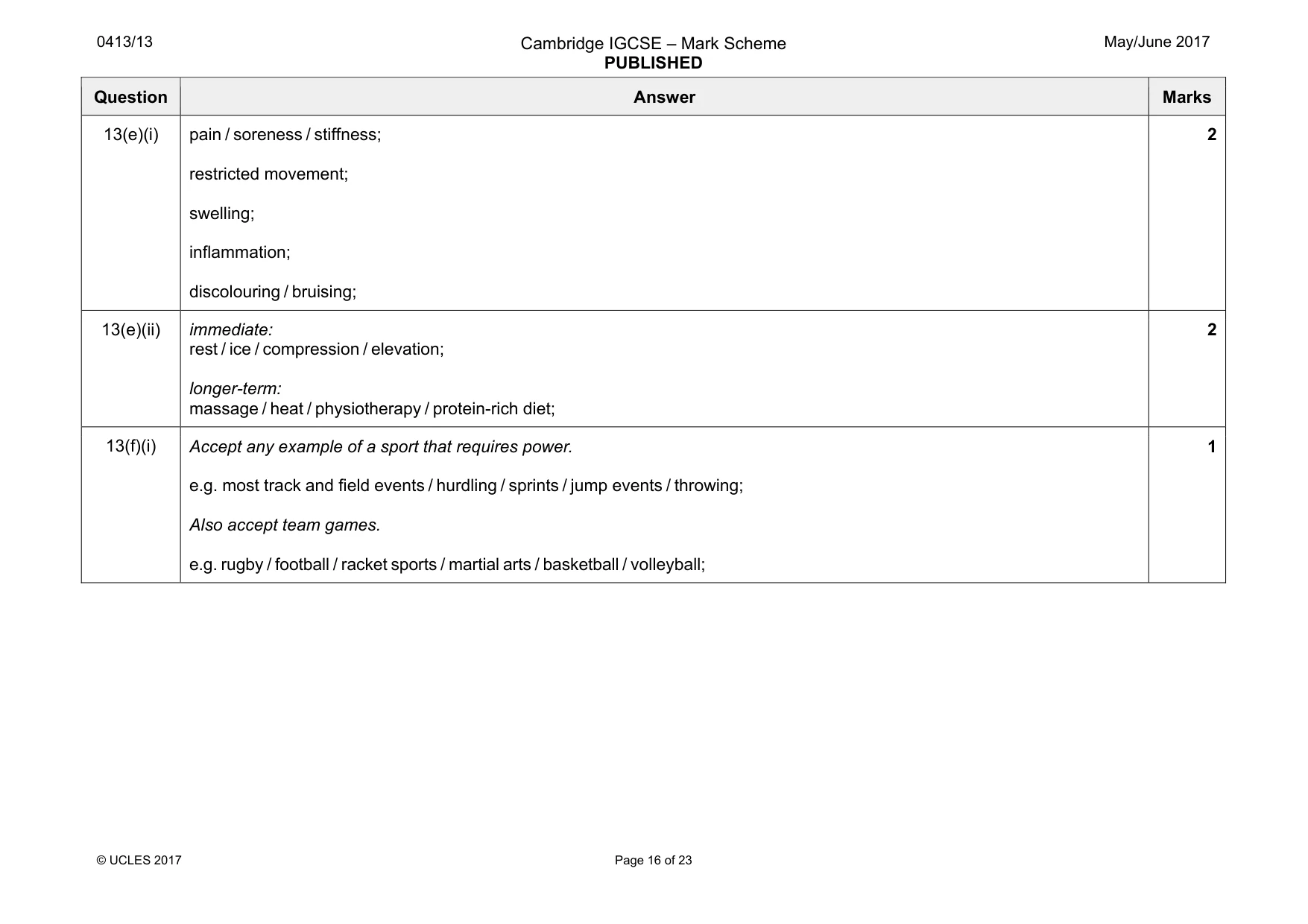
0413/13 Cambridge IGCSE – Mark Scheme PUBLISHED May/June 2017 © UCLES 2017 Page 16 of 23 Question Answer Marks 13(e)(i) pain / soreness / stiffness; restricted movement; swelling; inflammation; discolouring / bruising; 2 13(e)(ii) immediate: rest / ice / compression / elevation; longer-term: massage / heat / physiotherapy / protein-rich diet; 2 13(f)(i) Accept any example of a sport that requires power. e.g. most track and field events / hurdling / sprints / jump events / throwing; Also accept team games. e.g. rugby / football / racket sports / martial arts / basketball / volleyball; 1
Mark scheme, page 17
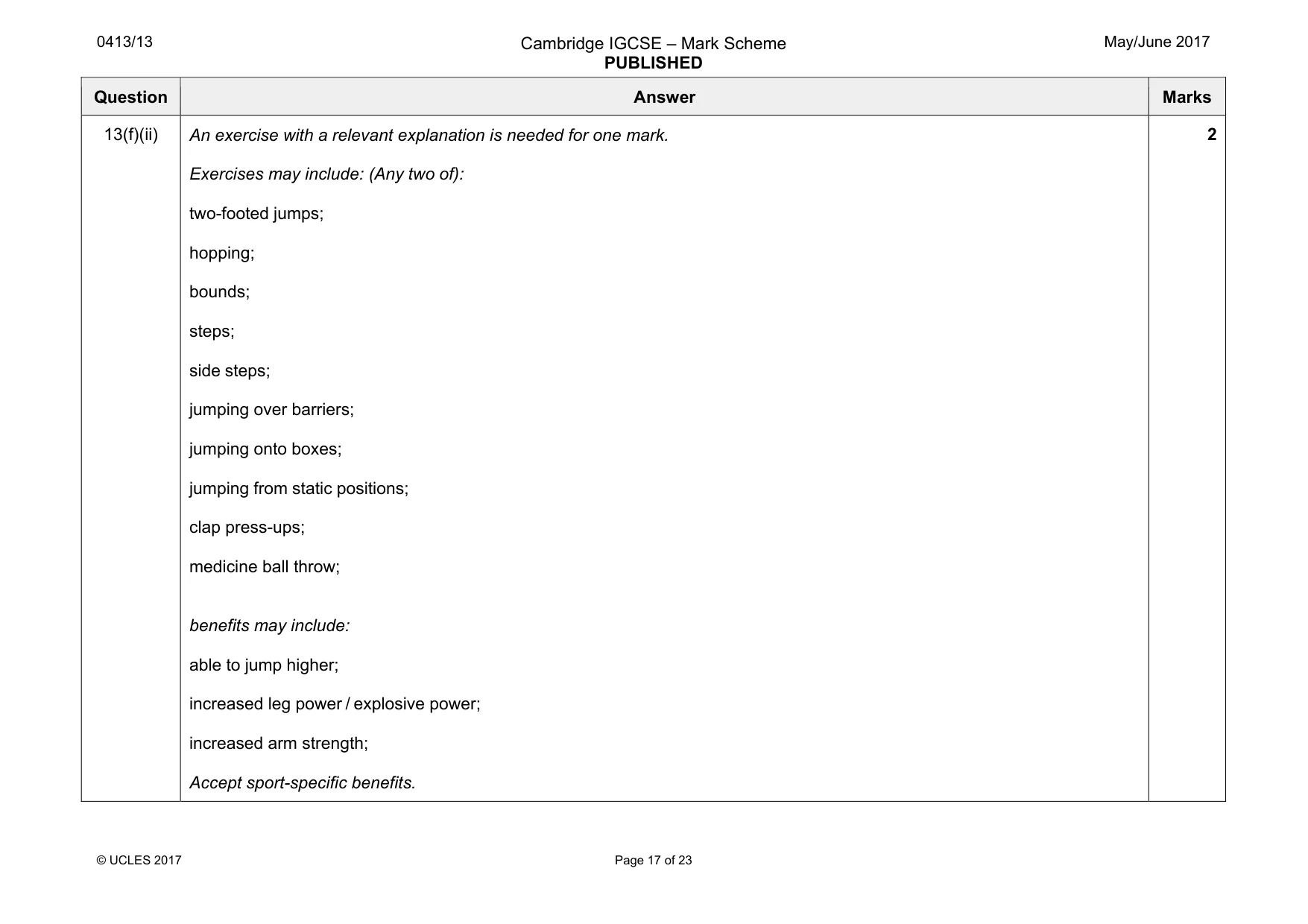
0413/13 Cambridge IGCSE – Mark Scheme PUBLISHED May/June 2017 © UCLES 2017 Page 17 of 23 Question Answer Marks 13(f)(ii) An exercise with a relevant explanation is needed for one mark. Exercises may include: (Any two of): two-footed jumps; hopping; bounds; steps; side steps; jumping over barriers; jumping onto boxes; jumping from static positions; clap press-ups; medicine ball throw; benefits may include: able to jump higher; increased leg power / explosive power; increased arm strength; Accept sport-specific benefits. 2
Mark scheme, page 18
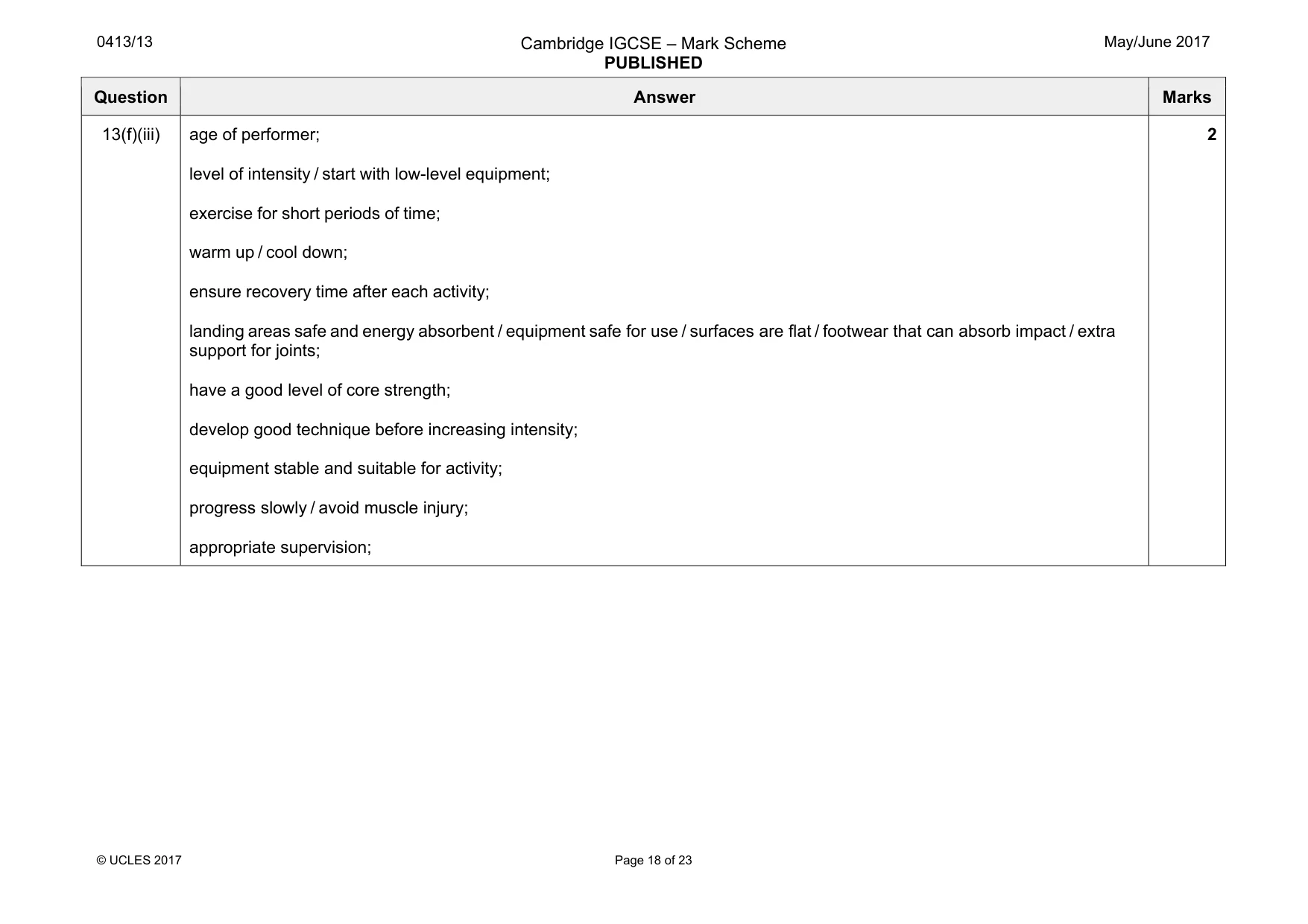
0413/13 Cambridge IGCSE – Mark Scheme PUBLISHED May/June 2017 © UCLES 2017 Page 18 of 23 Question Answer Marks 13(f)(iii) age of performer; level of intensity / start with low-level equipment; exercise for short periods of time; warm up / cool down; ensure recovery time after each activity; landing areas safe and energy absorbent / equipment safe for use / surfaces are flat / footwear that can absorb impact / extra support for joints; have a good level of core strength; develop good technique before increasing intensity; equipment stable and suitable for activity; progress slowly / avoid muscle injury; appropriate supervision; 2
Mark scheme, page 19
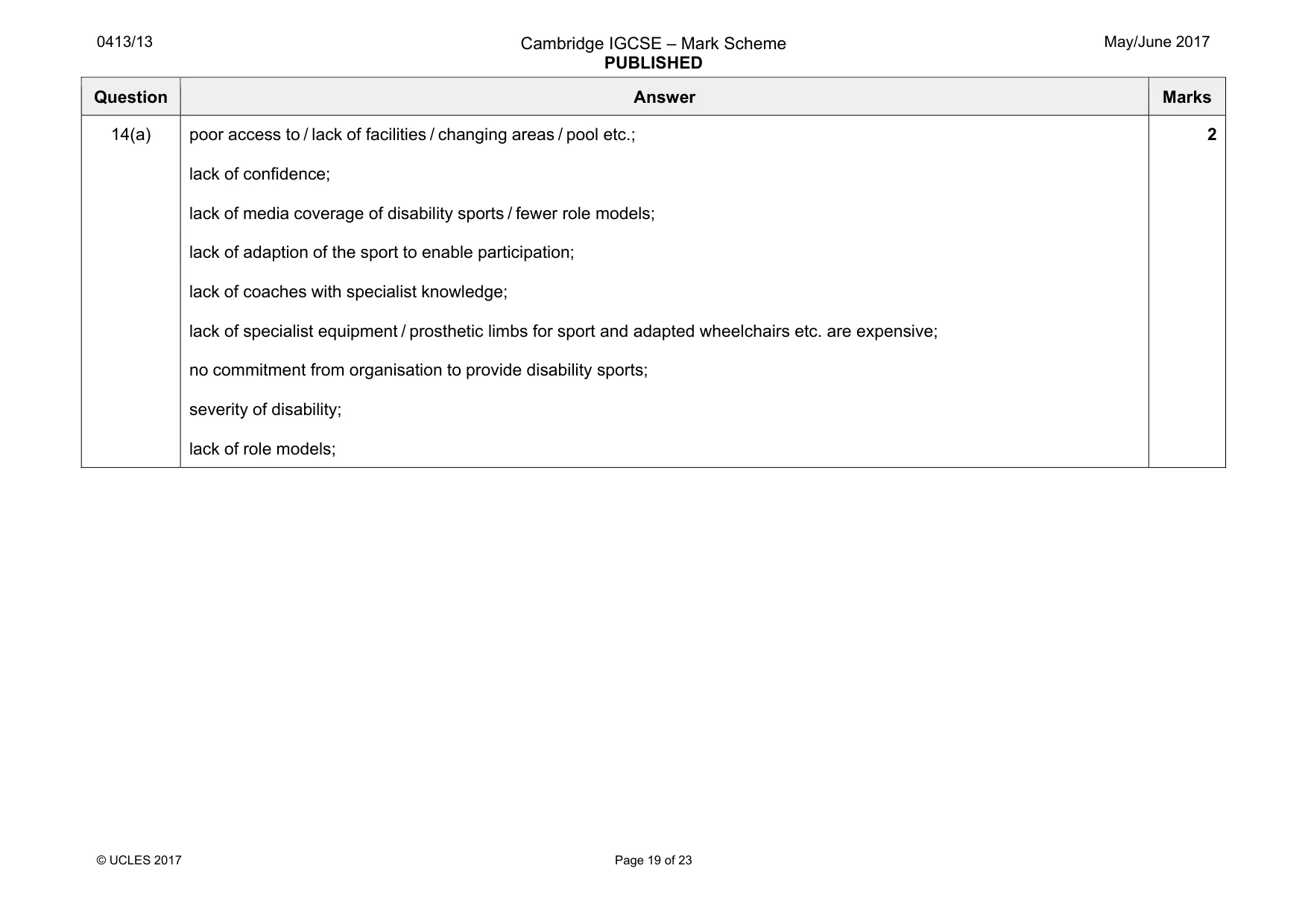
0413/13 Cambridge IGCSE – Mark Scheme PUBLISHED May/June 2017 © UCLES 2017 Page 19 of 23 Question Answer Marks 14(a) poor access to / lack of facilities / changing areas / pool etc.; lack of confidence; lack of media coverage of disability sports / fewer role models; lack of adaption of the sport to enable participation; lack of coaches with specialist knowledge; lack of specialist equipment / prosthetic limbs for sport and adapted wheelchairs etc. are expensive; no commitment from organisation to provide disability sports; severity of disability; lack of role models; 2
Mark scheme, page 20
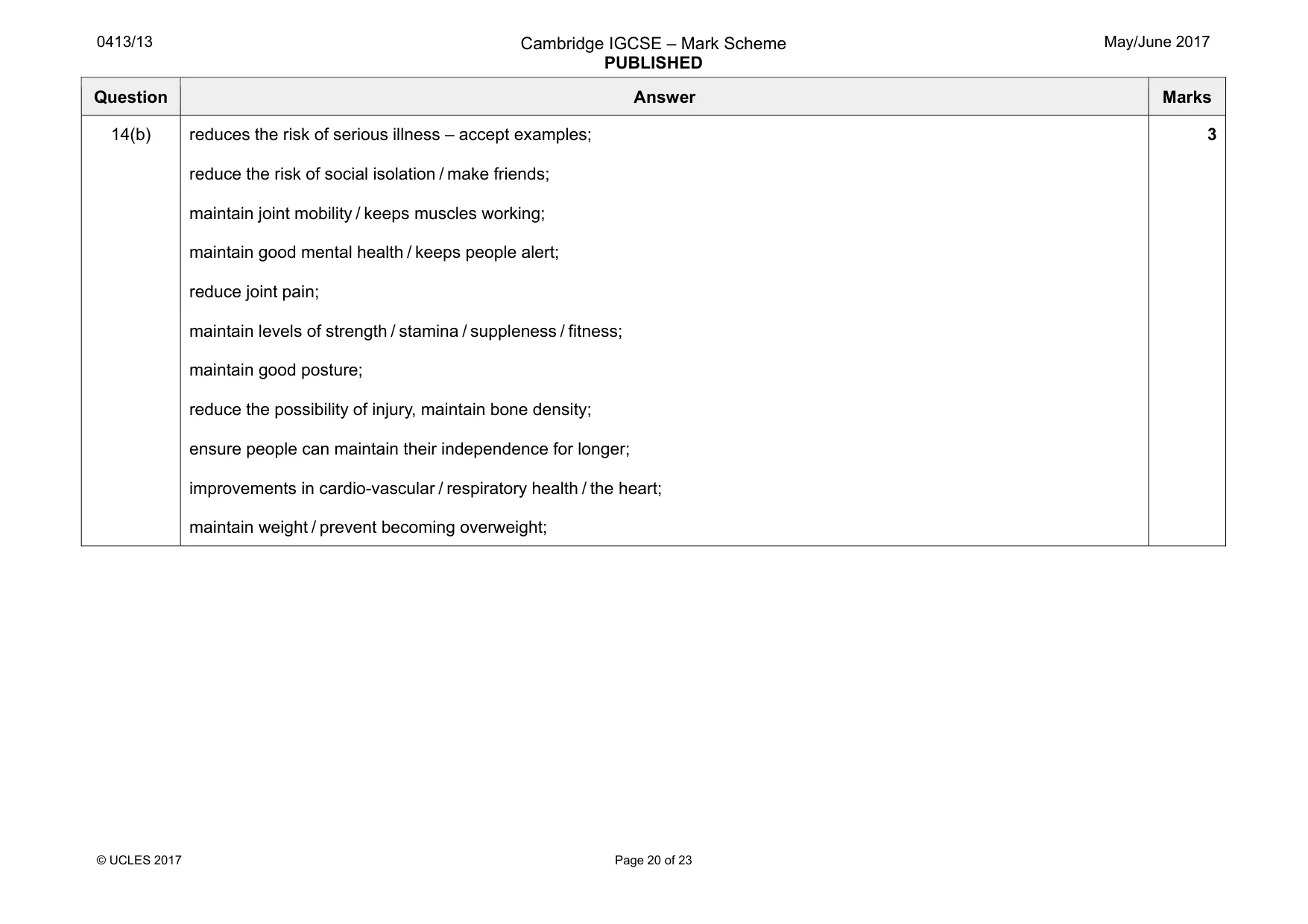
0413/13 Cambridge IGCSE – Mark Scheme PUBLISHED May/June 2017 © UCLES 2017 Page 20 of 23 Question Answer Marks 14(b) reduces the risk of serious illness – accept examples; reduce the risk of social isolation / make friends; maintain joint mobility / keeps muscles working; maintain good mental health / keeps people alert; reduce joint pain; maintain levels of strength / stamina / suppleness / fitness; maintain good posture; reduce the possibility of injury, maintain bone density; ensure people can maintain their independence for longer; improvements in cardio-vascular / respiratory health / the heart; maintain weight / prevent becoming overweight; 3
Mark scheme, page 21
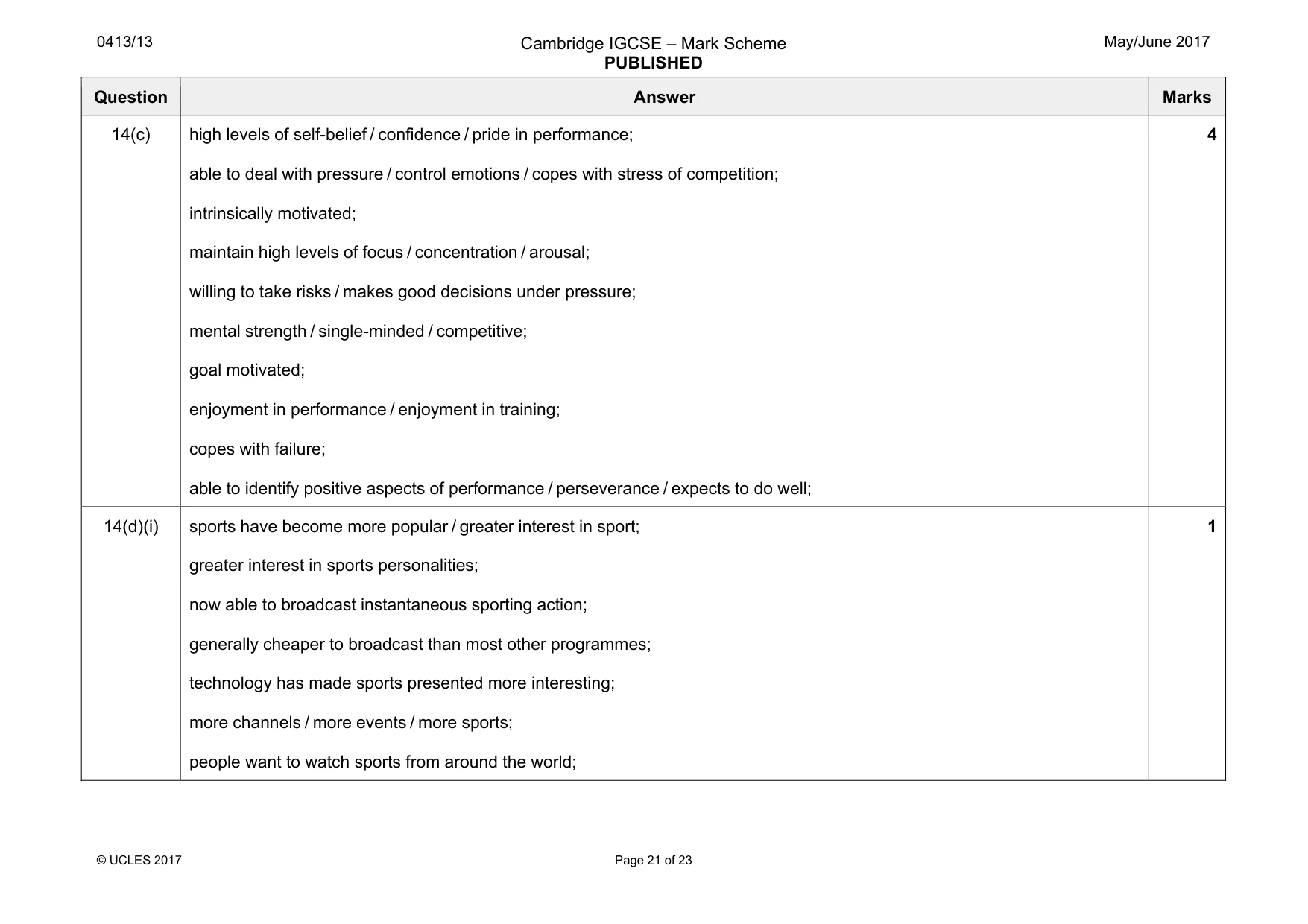
0413/13 Cambridge IGCSE – Mark Scheme PUBLISHED May/June 2017 © UCLES 2017 Page 21 of 23 Question Answer Marks 14(c) high levels of self-belief / confidence / pride in performance; able to deal with pressure / control emotions / copes with stress of competition; intrinsically motivated; maintain high levels of focus / concentration / arousal; willing to take risks / makes good decisions under pressure; mental strength / single-minded / competitive; goal motivated; enjoyment in performance / enjoyment in training; copes with failure; able to identify positive aspects of performance / perseverance / expects to do well; 4 14(d)(i) sports have become more popular / greater interest in sport; greater interest in sports personalities; now able to broadcast instantaneous sporting action; generally cheaper to broadcast than most other programmes; technology has made sports presented more interesting; more channels / more events / more sports; people want to watch sports from around the world; 1
Mark scheme, page 22
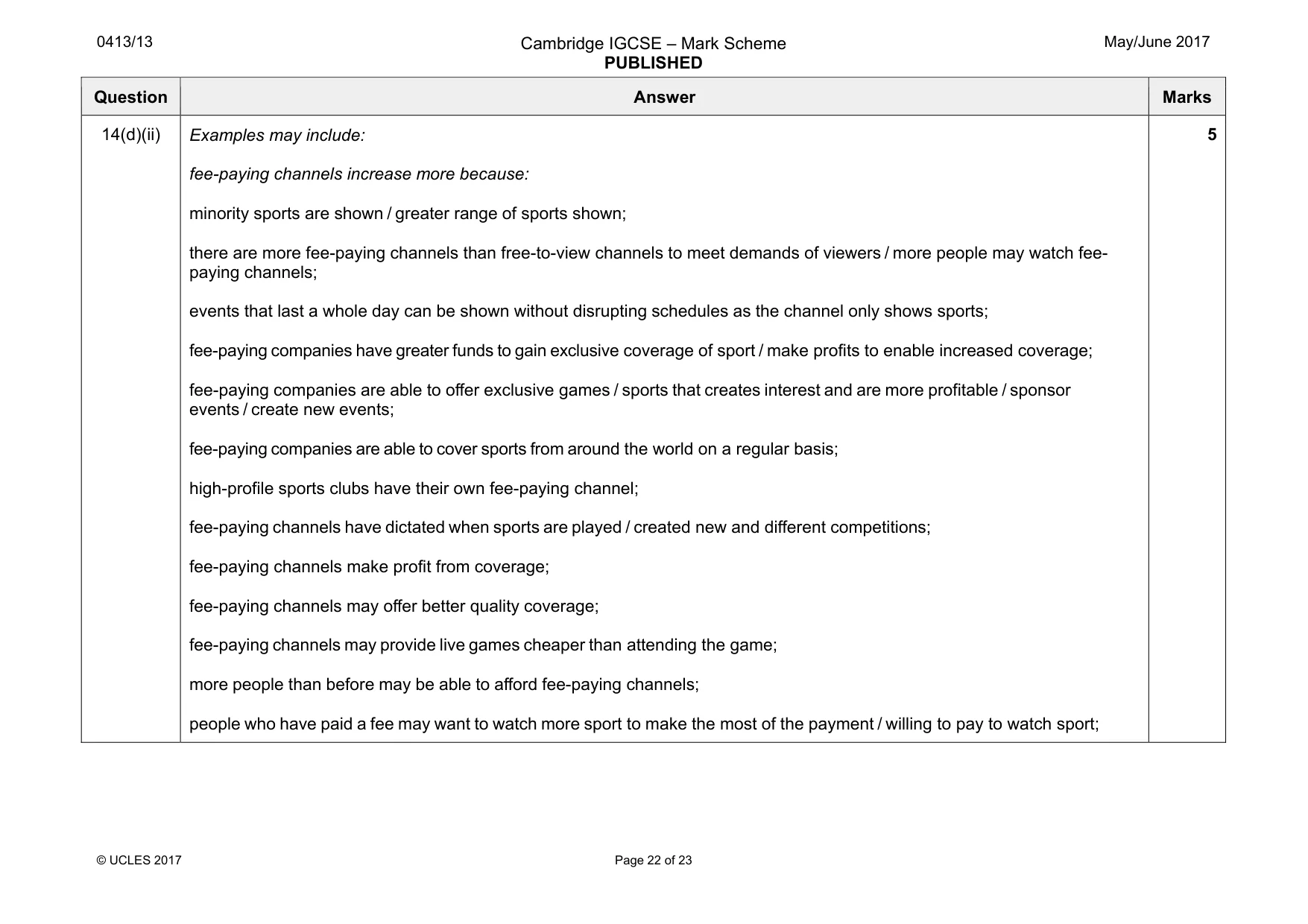
0413/13 Cambridge IGCSE – Mark Scheme PUBLISHED May/June 2017 © UCLES 2017 Page 22 of 23 Question Answer Marks 14(d)(ii) Examples may include: fee-paying channels increase more because: minority sports are shown / greater range of sports shown; there are more fee-paying channels than free-to-view channels to meet demands of viewers / more people may watch fee- paying channels; events that last a whole day can be shown without disrupting schedules as the channel only shows sports; fee-paying companies have greater funds to gain exclusive coverage of sport / make profits to enable increased coverage; fee-paying companies are able to offer exclusive games / sports that creates interest and are more profitable / sponsor events / create new events; fee-paying companies are able to cover sports from around the world on a regular basis; high-profile sports clubs have their own fee-paying channel; fee-paying channels have dictated when sports are played / created new and different competitions; fee-paying channels make profit from coverage; fee-paying channels may offer better quality coverage; fee-paying channels may provide live games cheaper than attending the game; more people than before may be able to afford fee-paying channels; people who have paid a fee may want to watch more sport to make the most of the payment / willing to pay to watch sport; 5
Mark scheme, page 23
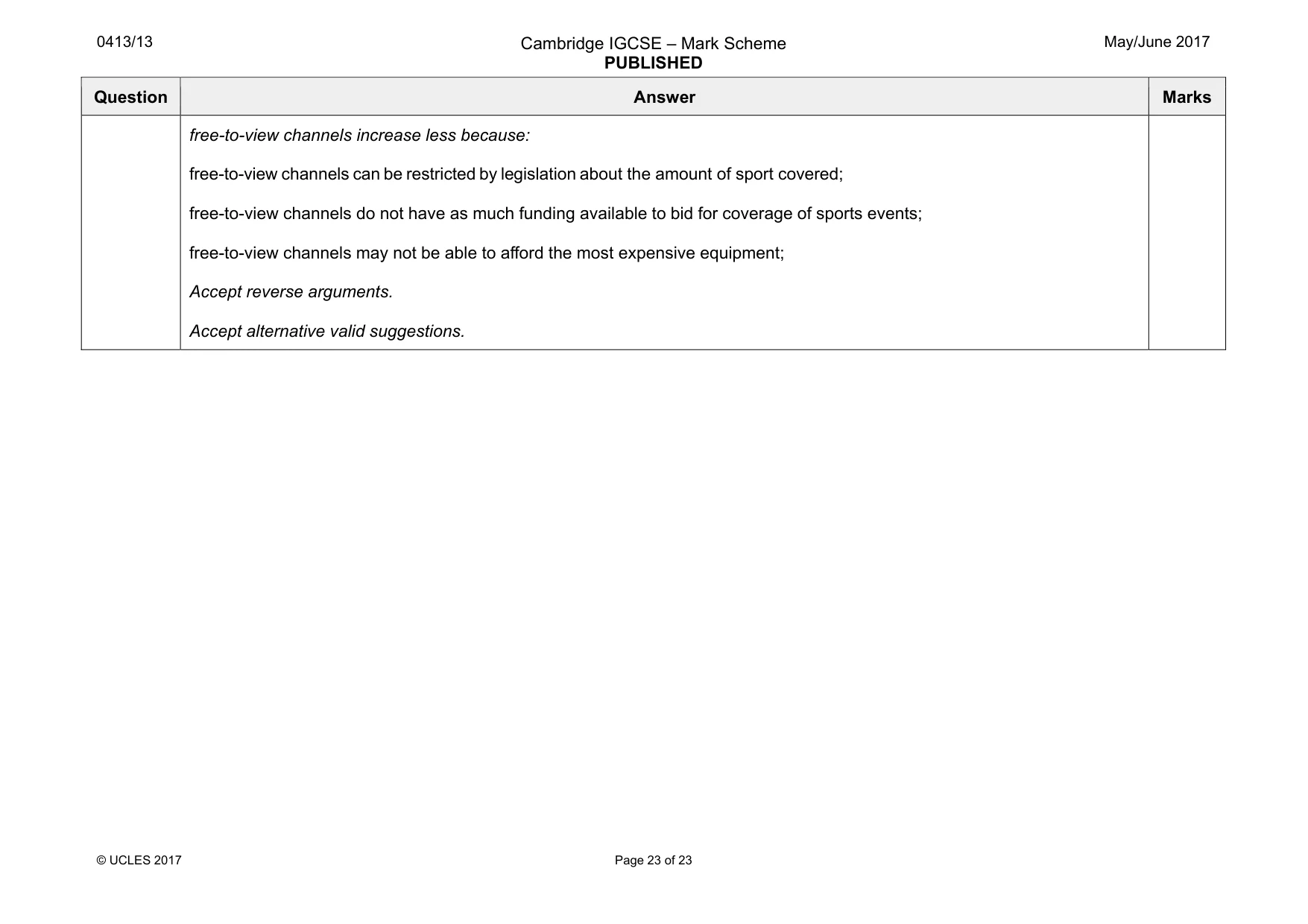
0413/13 Cambridge IGCSE – Mark Scheme PUBLISHED May/June 2017 © UCLES 2017 Page 23 of 23 Question Answer Marks free-to-view channels increase less because: free-to-view channels can be restricted by legislation about the amount of sport covered; free-to-view channels do not have as much funding available to bid for coverage of sports events; free-to-view channels may not be able to afford the most expensive equipment; Accept reverse arguments. Accept alternative valid suggestions.
What you needed in this session
Cambridge’s own grade thresholds for 2017 May/June, Paper 1 · Variant 3. A higher threshold means an easier paper — the bar moves with how the cohort did.