Cambridge IGCSE Physical Education 0413 — 2017 May/June Paper 1 · Variant 1
0413/11/M/J/17 · 80 marks · ≈90 min
The question paper and its mark scheme, free to read here and free to download. This is Cambridge’s own paper, exactly as it was sat.
Question paper12 pages
Mark scheme20 pages
Answers below. Sit the paper first if you are practising.
Paper as text
Question paper, page 1
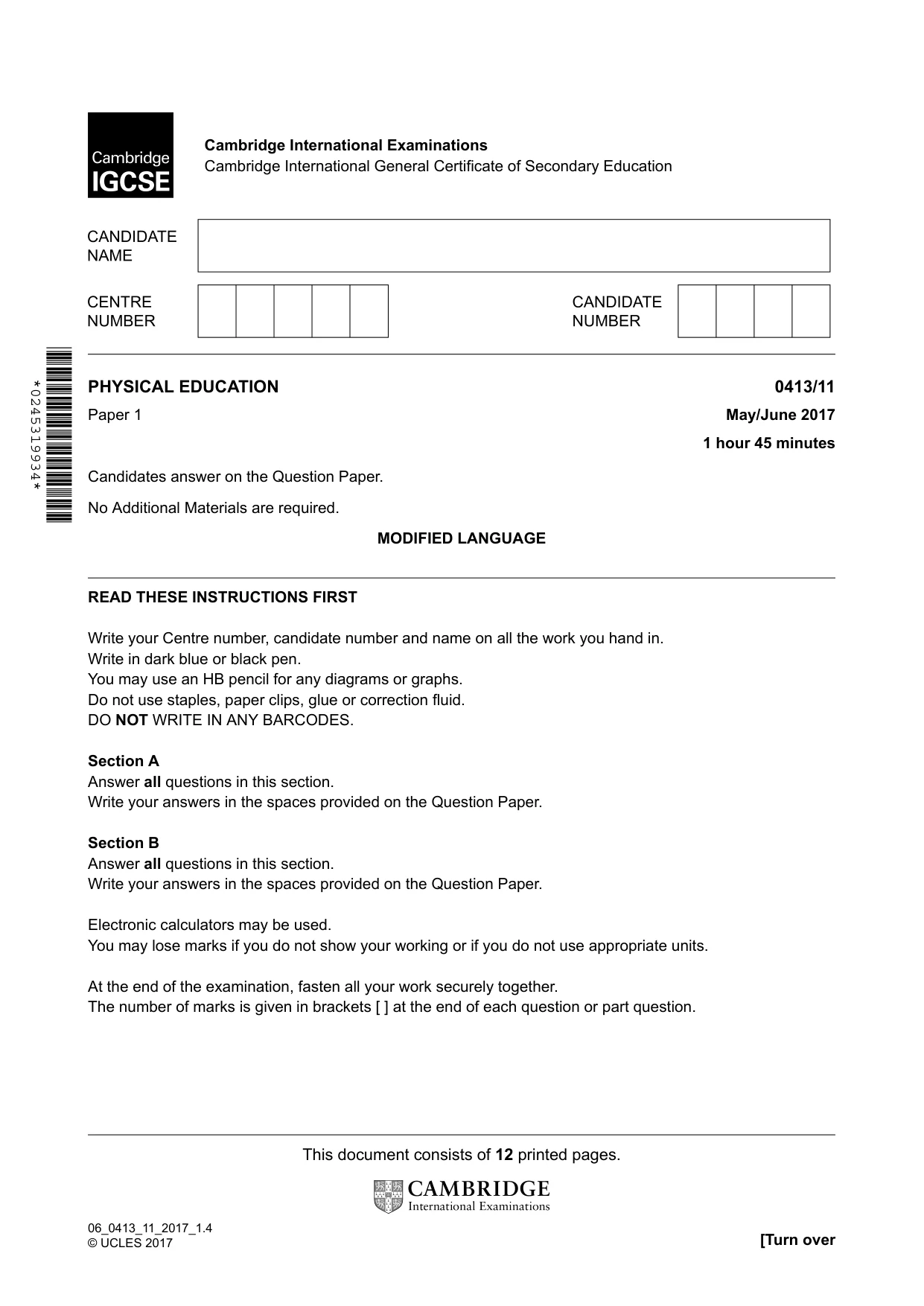
Cambridge International Examinations Cambridge International General Certificate of Secondary Education 0413/11 May/June 2017 1 hour 45 minutes PHYSICAL EDUCATION Paper 1 Candidates answer on the Question Paper. No Additional Materials are required. MODIFIED LANGUAGE READ THESE INSTRUCTIONS FIRST Write your Centre number, candidate number and name on all the work you hand in. Write in dark blue or black pen. You may use an HB pencil for any diagrams or graphs. Do not use staples, paper clips, glue or correction fluid. DO NOT WRITE IN ANY BARCODES. Section A Answer all questions in this section. Write your answers in the spaces provided on the Question Paper. Section B Answer all questions in this section. Write your answers in the spaces provided on the Question Paper. Electronic calculators may be used. You may lose marks if you do not show your working or if you do not use appropriate units. At the end of the examination, fasten all your work securely together. The number of marks is given in brackets [ ] at the end of each question or part question. This document consists of 12 printed pages. [Turn over 06_0413_11_2017_1.4 © UCLES 2017 *0245319934*
Question paper, page 2
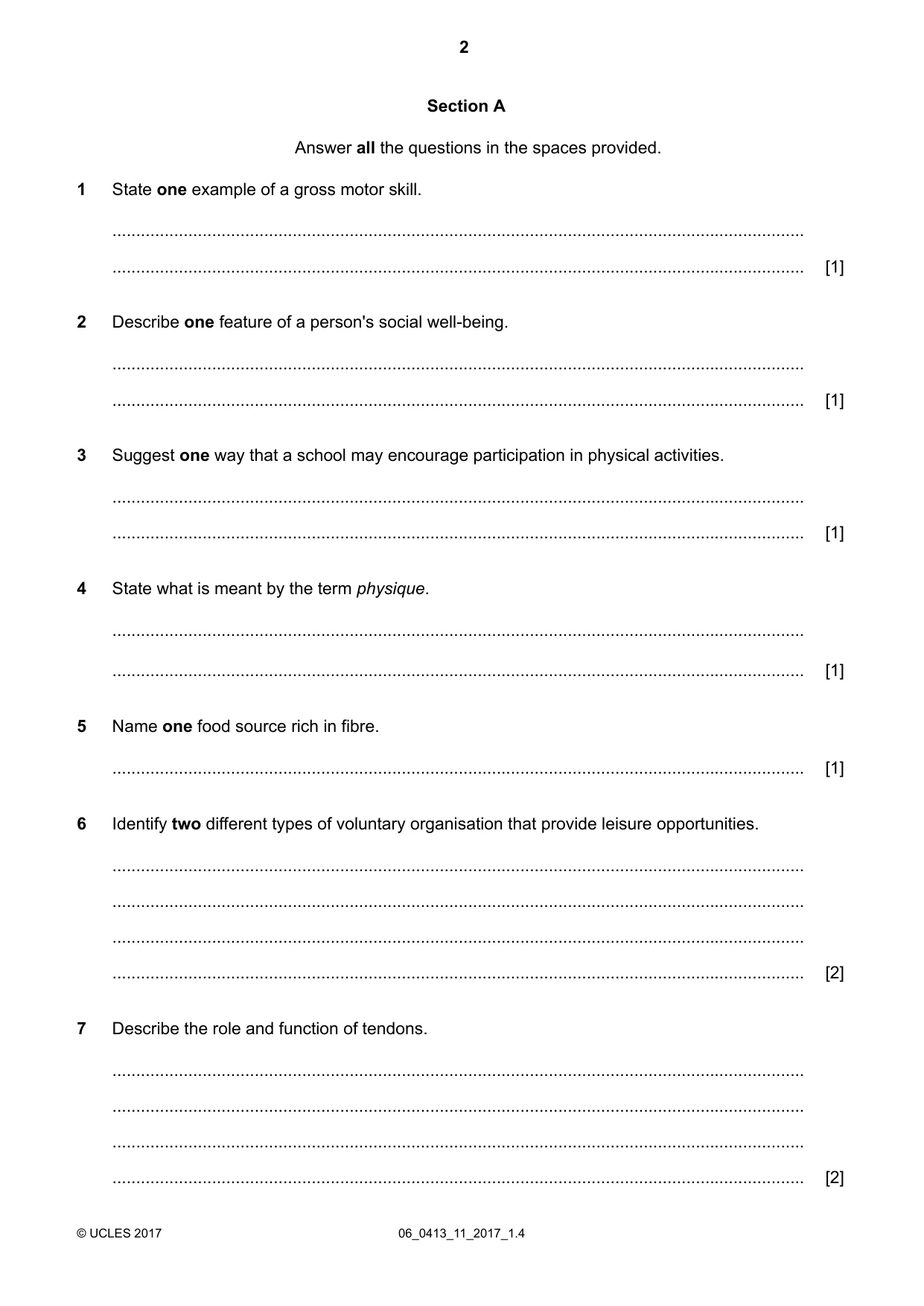
Section A Answer all the questions in the spaces provided. State one example of a gross motor skill. 1 … … [1] Describe one feature of a person's social well-being. 2 … … [1] Suggest one way that a school may encourage participation in physical activities. 3 … … [1] State what is meant by the term physique. 4 … … [1] Name one food source rich in fibre. 5 … [1] Identify two different types of voluntary organisation that provide leisure opportunities. 6 … … … … [2] Describe the role and function of tendons. 7 … … … … [2] 06_0413_11_2017_1.4 © UCLES 2017 2
Question paper, page 3
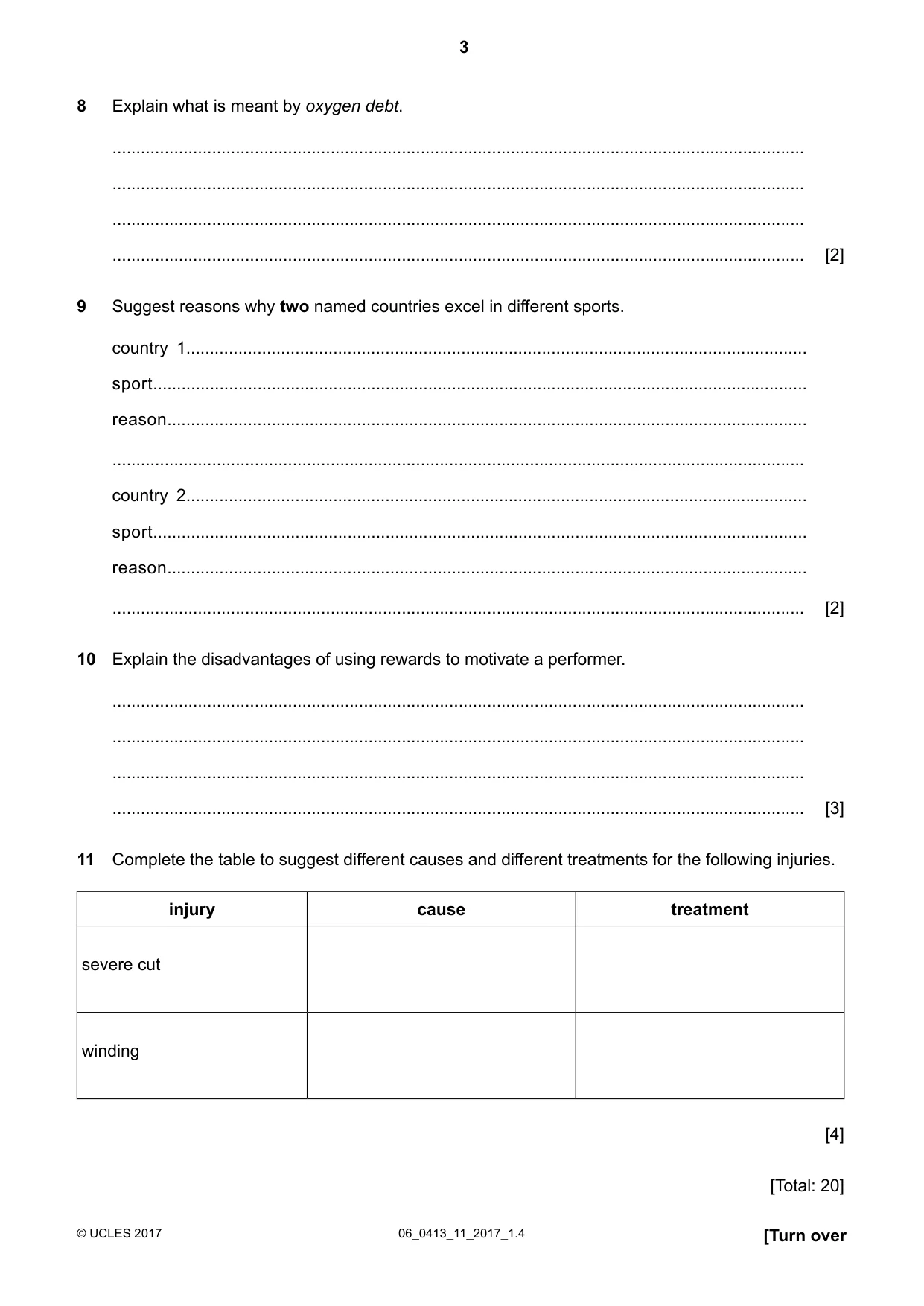
Explain what is meant by oxygen debt. 8 … … … … [2] Suggest reasons why two named countries excel in different sports. 9 country 1… sport… reason… … country 2… sport… reason… … [2] Explain the disadvantages of using rewards to motivate a performer. 10 … … … … [3] Complete the table to suggest different causes and different treatments for the following injuries. 11 treatment cause injury severe cut winding [4] [Total: 20] [Turn over 06_0413_11_2017_1.4 © UCLES 2017 3
Question paper, page 4
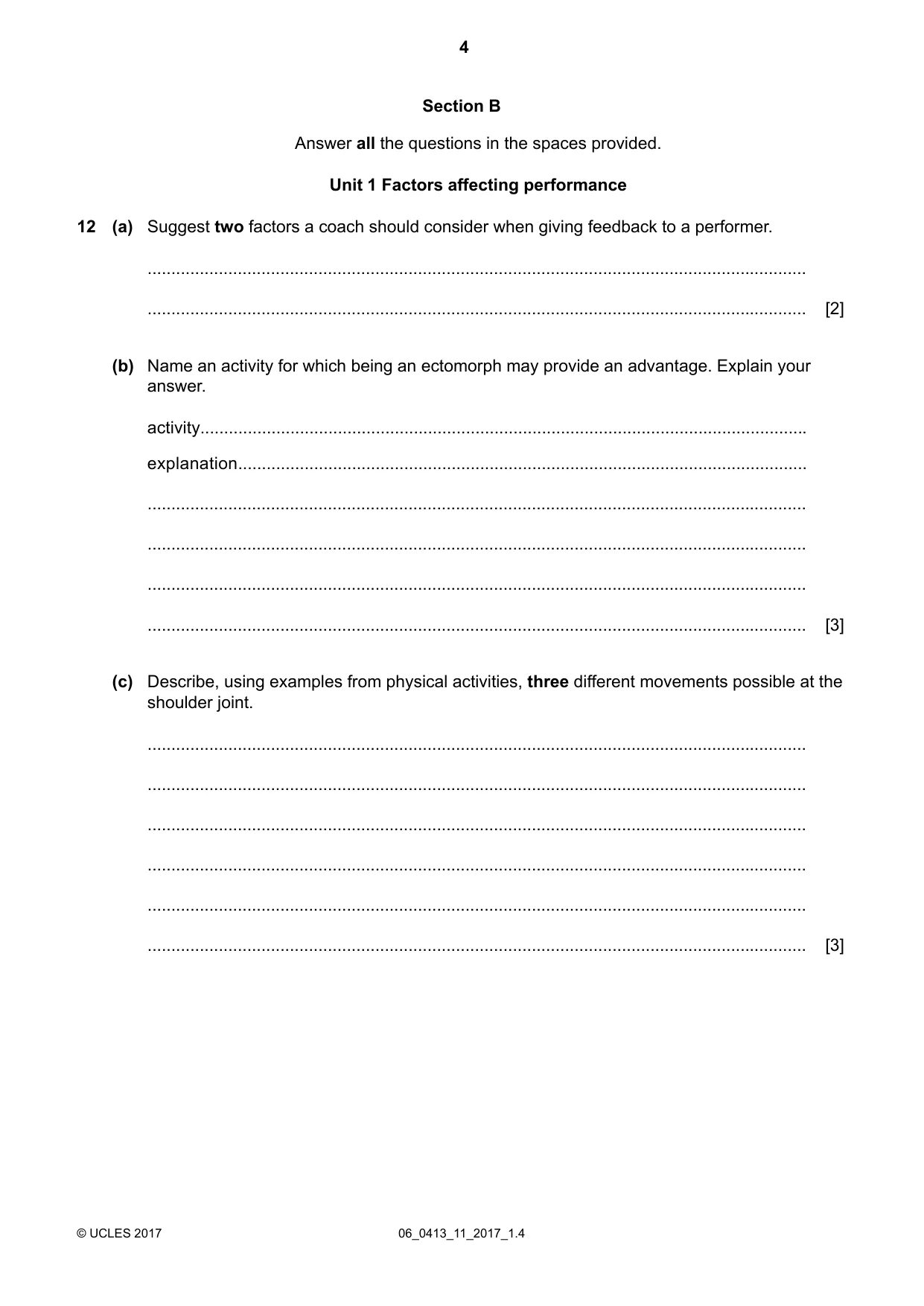
Section B Answer all the questions in the spaces provided. Unit 1 Factors affecting performance Suggest two factors a coach should consider when giving feedback to a performer. (a) 12 … … [2] Name an activity for which being an ectomorph may provide an advantage. Explain your answer. (b) activity… explanation… … … … … [3] Describe, using examples from physical activities, three different movements possible at the shoulder joint. (c) … … … … … … [3] 06_0413_11_2017_1.4 © UCLES 2017 4
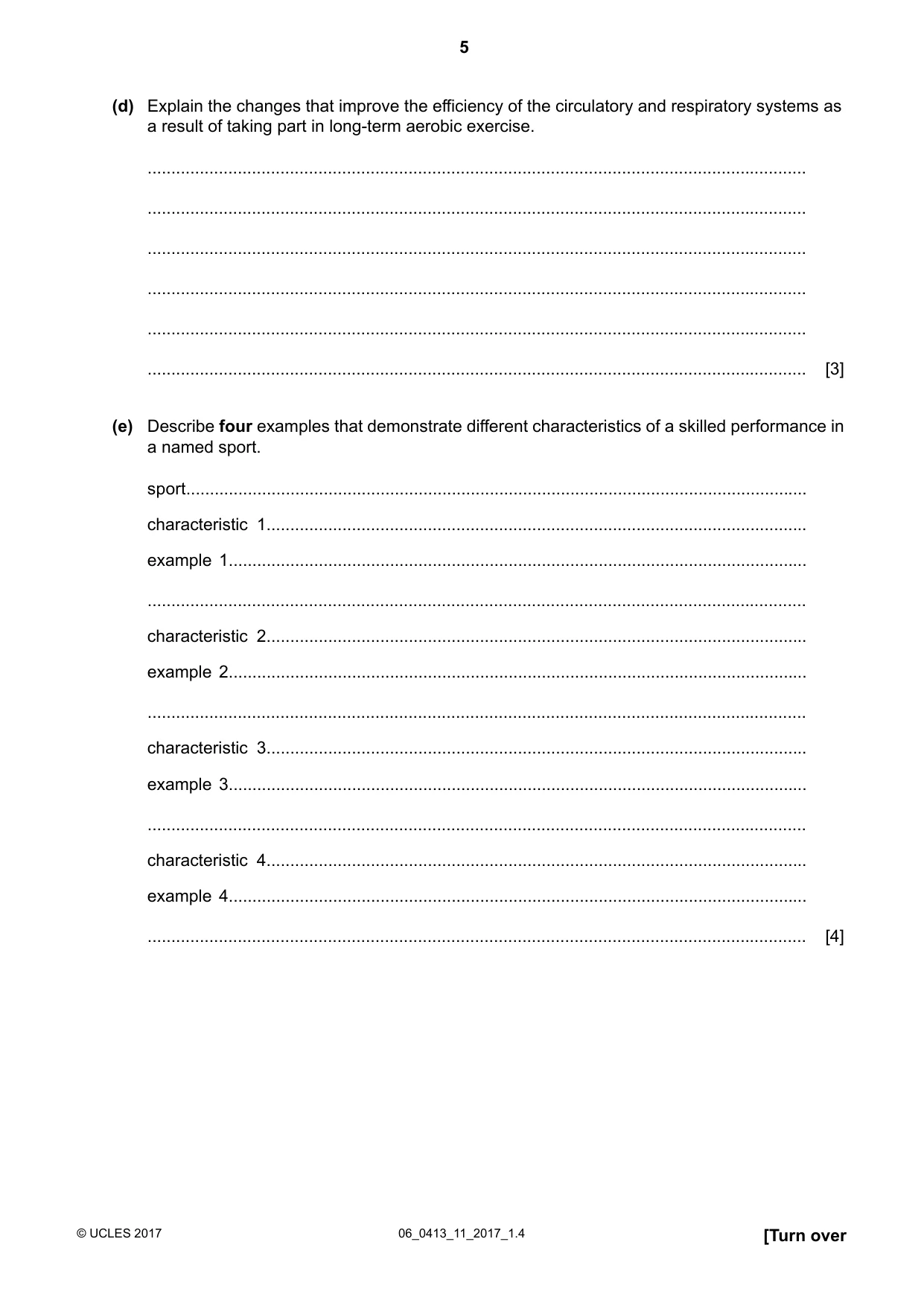
Question paper, page 5
Explain the changes that improve the efficiency of the circulatory and respiratory systems as a result of taking part in long-term aerobic exercise. (d) … … … … … … [3] Describe four examples that demonstrate different characteristics of a skilled performance in a named sport. (e) sport… characteristic 1… example 1… … characteristic 2… example 2… … characteristic 3… example 3… … characteristic 4… example 4… … [4] [Turn over 06_0413_11_2017_1.4 © UCLES 2017 5
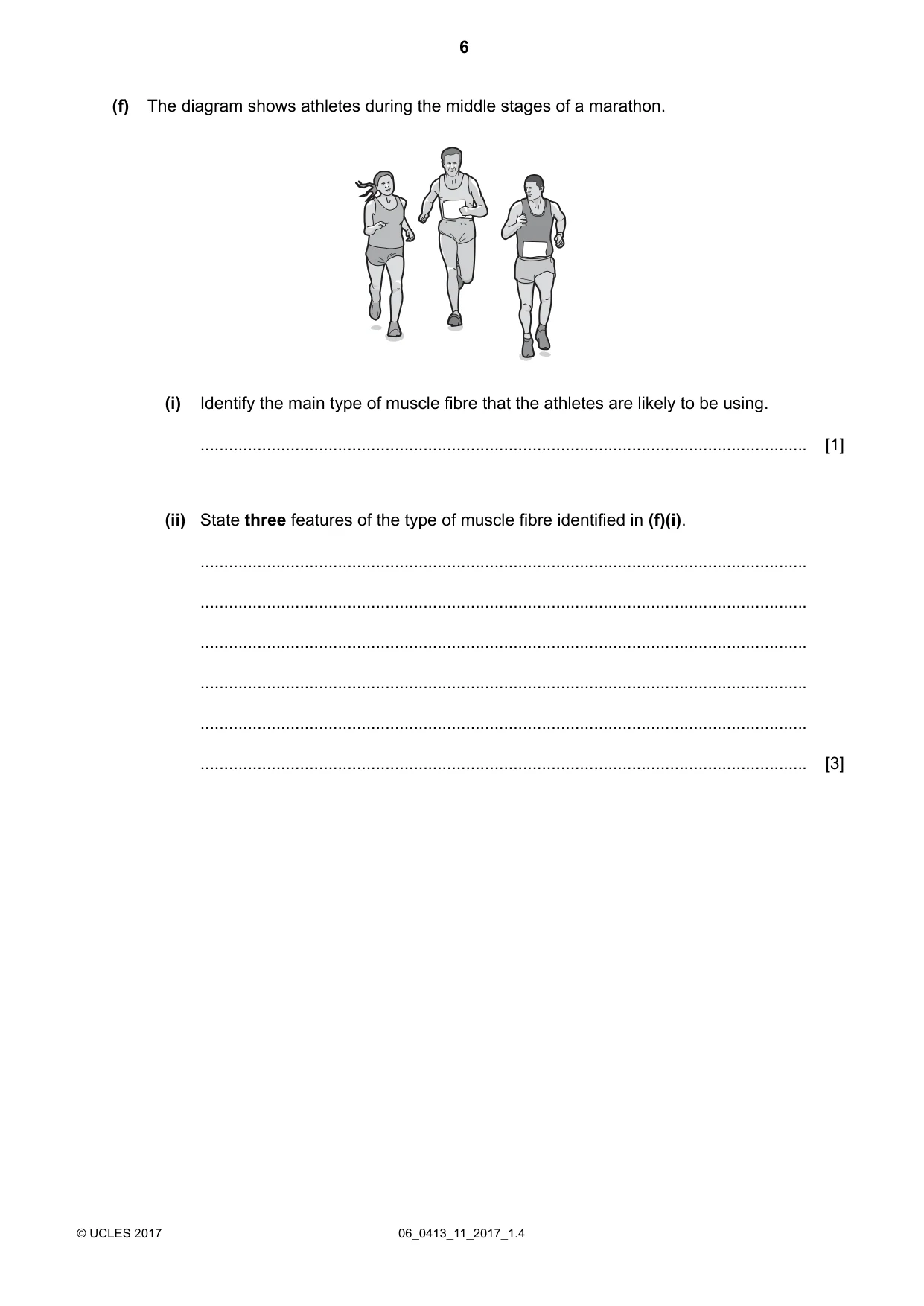
Question paper, page 6
The diagram shows athletes during the middle stages of a marathon. (f) Identify the main type of muscle fibre that the athletes are likely to be using. (i) … [1] State three features of the type of muscle fibre identified in (f)(i). (ii) … … … … … … [3] 06_0413_11_2017_1.4 © UCLES 2017 6
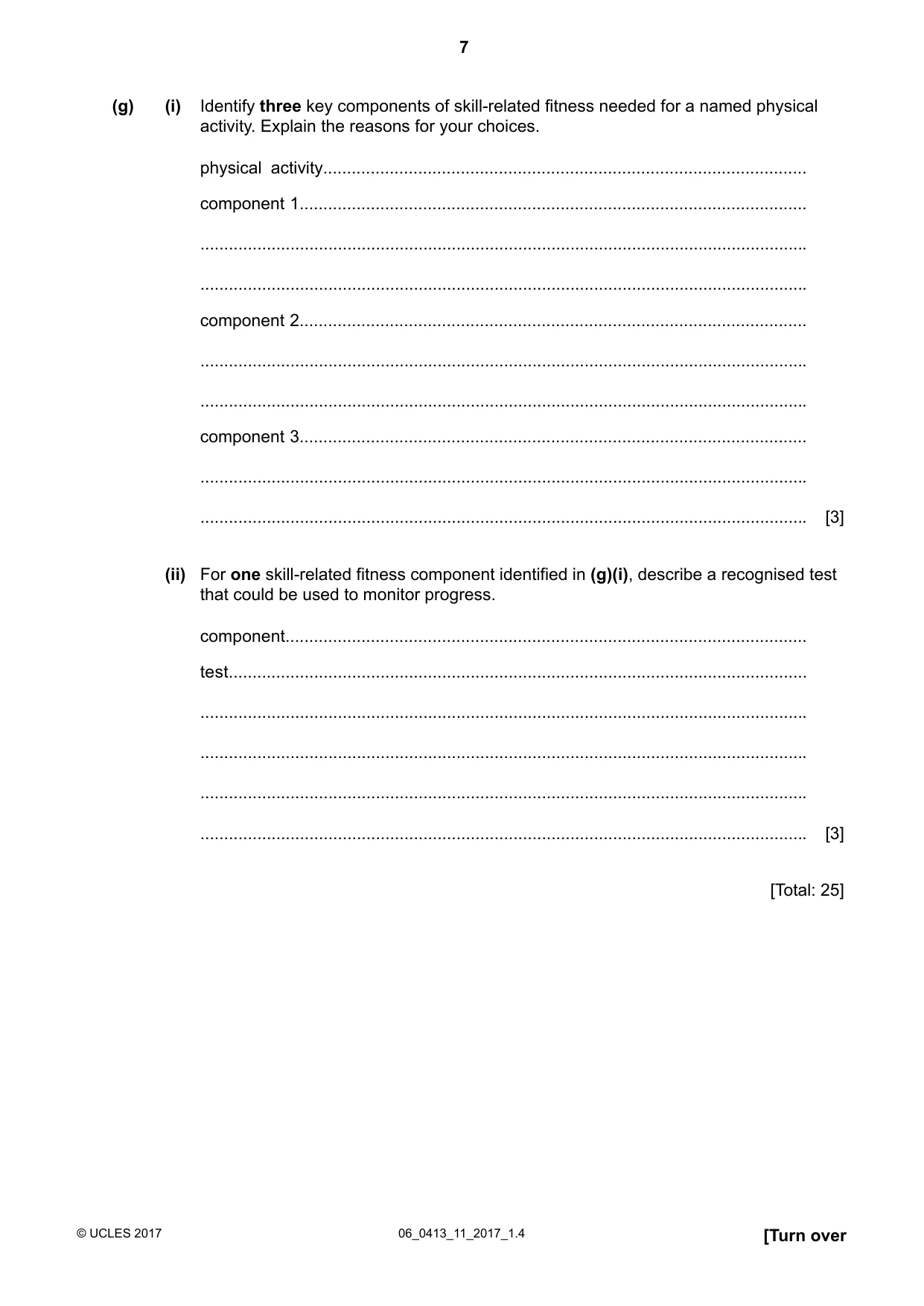
Question paper, page 7
Identify three key components of skill-related fitness needed for a named physical activity. Explain the reasons for your choices. (i) (g) physical activity… component 1… … … component 2… … … component 3… … … [3] For one skill-related fitness component identified in (g)(i), describe a recognised test that could be used to monitor progress. (ii) component… test… … … … … [3] [Total: 25] [Turn over 06_0413_11_2017_1.4 © UCLES 2017 7
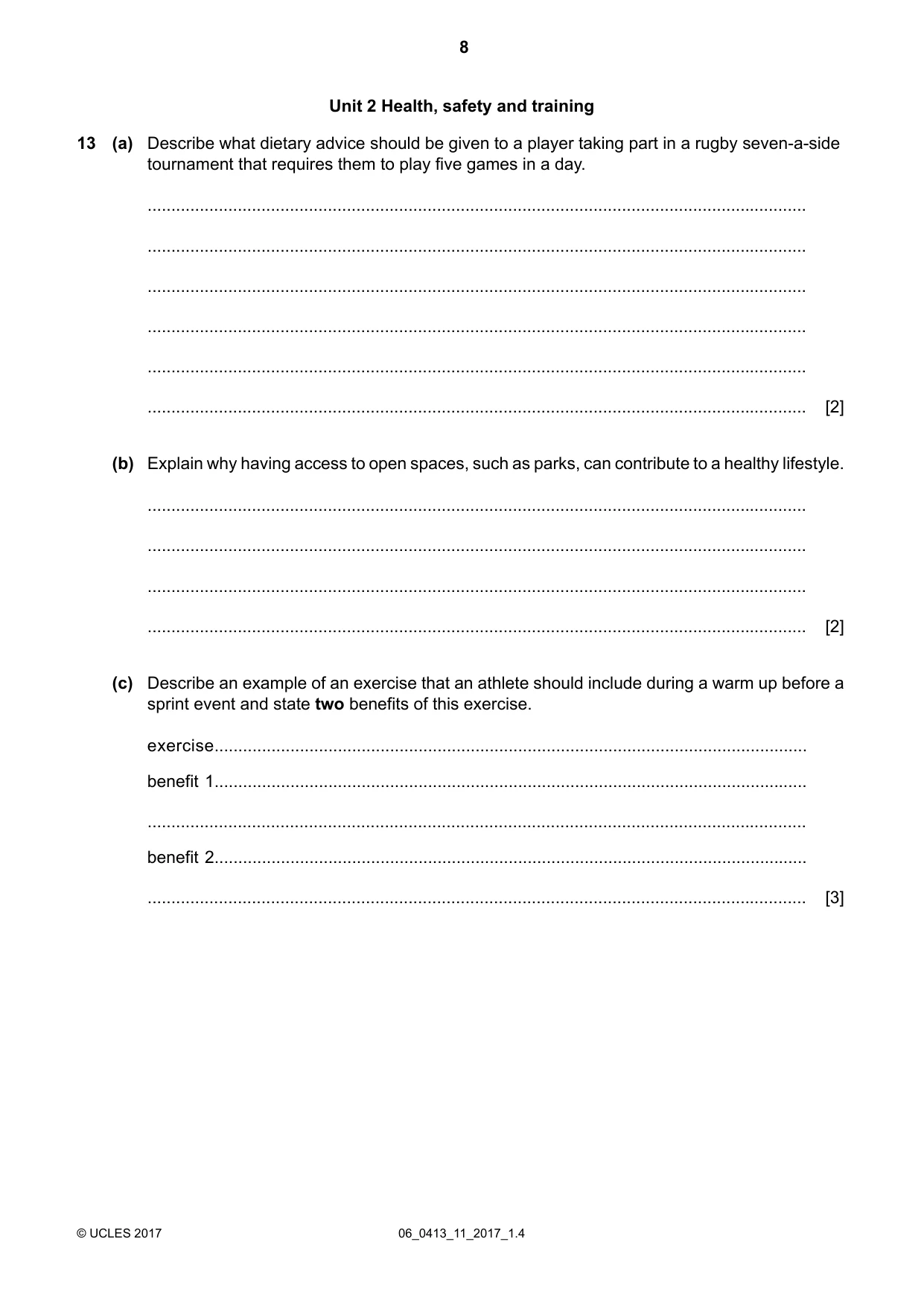
Question paper, page 8
Unit 2 Health, safety and training Describe what dietary advice should be given to a player taking part in a rugby seven-a-side tournament that requires them to play five games in a day. (a) 13 … … … … … … [2] Explain why having access to open spaces, such as parks, can contribute to a healthy lifestyle. (b) … … … … [2] Describe an example of an exercise that an athlete should include during a warm up before a sprint event and state two benefits of this exercise. (c) exercise… benefit 1… … benefit 2… … [3] 06_0413_11_2017_1.4 © UCLES 2017 8
Question paper, page 9
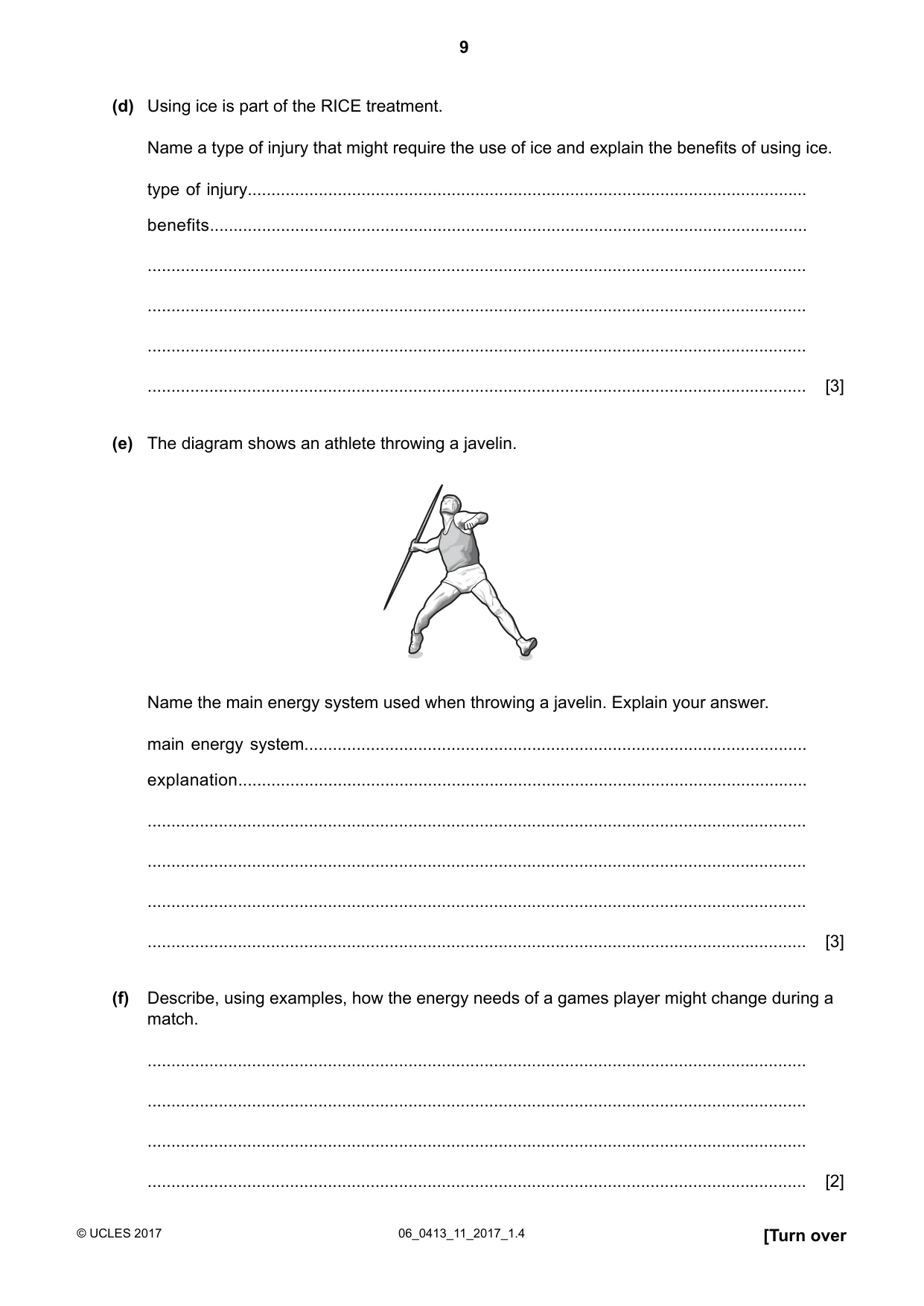
Using ice is part of the RICE treatment. Name a type of injury that might require the use of ice and explain the benefits of using ice. (d) type of injury… benefits… … … … … [3] The diagram shows an athlete throwing a javelin. (e) Name the main energy system used when throwing a javelin. Explain your answer. main energy system… explanation… … … … … [3] Describe, using examples, how the energy needs of a games player might change during a match. (f) … … … … [2] [Turn over 06_0413_11_2017_1.4 © UCLES 2017 9
Question paper, page 10
A performer regularly uses fartlek training to maintain a good level of fitness. (g) Explain three benefits for a performer of using fartlek training. (i) … … … … … … [3] Describe how two activities could be included in a fartlek training session. (ii) activity 1… … … activity 2… … … [2] [Total: 20] 06_0413_11_2017_1.4 © UCLES 2017 10
Question paper, page 11
Unit 3 Reasons and opportunities for participation in physical activity Suggest differences between recreational activity and sport. (a) 14 … … … … … … [3] Suggest why a young athlete might experience difficulties when searching for a sponsor. (b) … … … … [2] Explain the effects media can have on sport. (c) … … … … … … … … [4] [Turn over 06_0413_11_2017_1.4 © UCLES 2017 11
Question paper, page 12
This quote is from a leading international rugby coach talking about participation of girls in sport. ‘My daughter is inspired by lots of different sportswomen. There are many role models in women's netball, rugby, football, cricket and athletics. This is good because it will encourage more girls to take up sport and be active.’ Explain the factors that result in a high number of girls dropping out of regular sport and describe strategies to reduce this problem. (d) … … … … … … … … … … … … [6] [Total: 15] Permission to reproduce items where third-party owned material protected by copyright is included has been sought and cleared where possible. Every reasonable effort has been made by the publisher (UCLES) to trace copyright holders, but if any items requiring clearance have unwittingly been included, the publisher will be pleased to make amends at the earliest possible opportunity. To avoid the issue of disclosure of answer-related information to candidates, all copyright acknowledgements are reproduced online in the Cambridge International Examinations Copyright Acknowledgements Booklet. This is produced for each series of examinations and is freely available to download at www.cie.org.uk after the live examination series. Cambridge International Examinations is part of the Cambridge Assessment Group. Cambridge Assessment is the brand name of University of Cambridge Local Examinations Syndicate (UCLES), which is itself a department of the University of Cambridge. 06_0413_11_2017_1.4 © UCLES 2017 12
Mark scheme, page 1
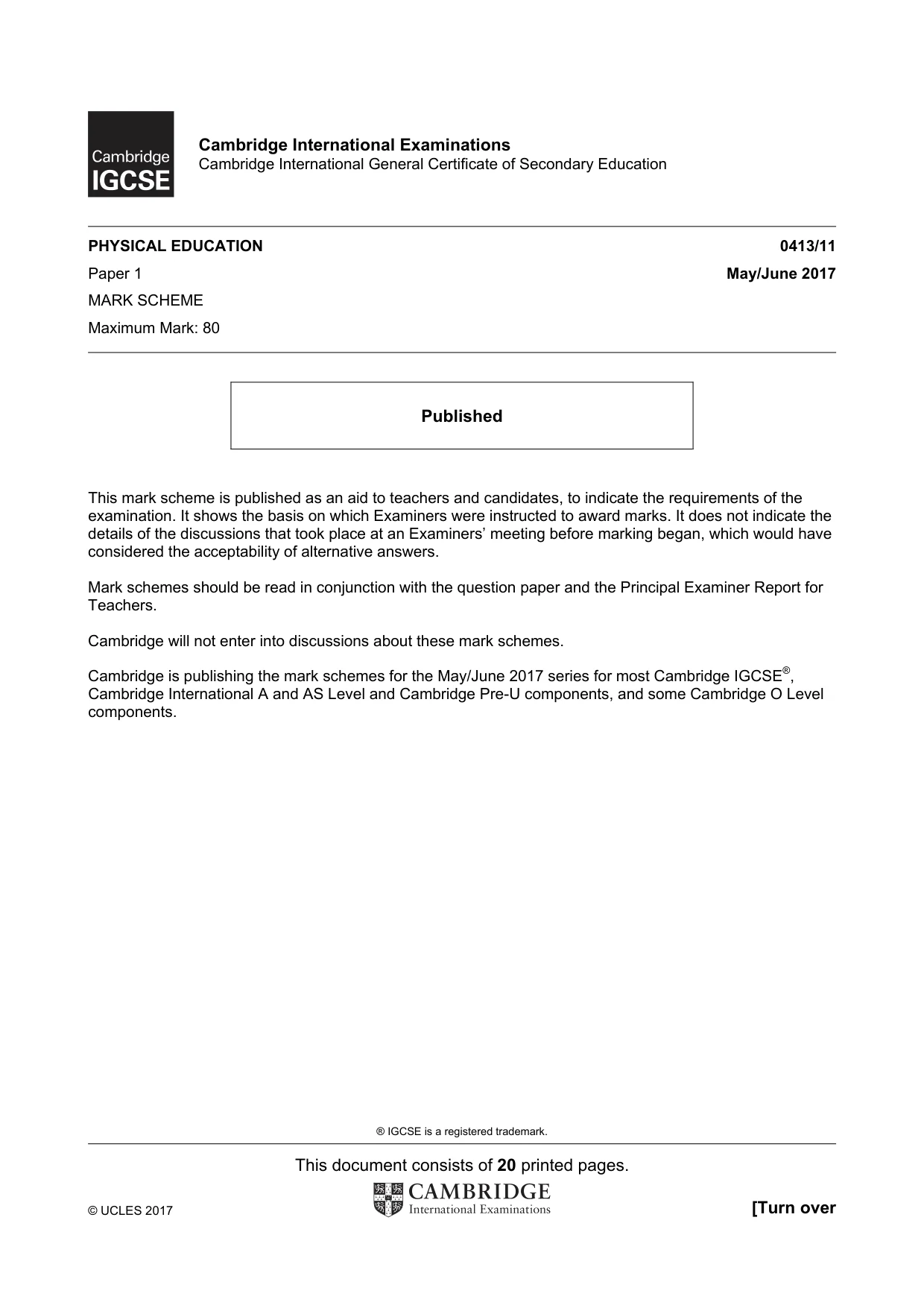
® IGCSE is a registered trademark. This document consists of 20 printed pages. © UCLES 2017 [Turn over Cambridge International Examinations Cambridge International General Certificate of Secondary Education PHYSICAL EDUCATION 0413/11 Paper 1 May/June 2017 MARK SCHEME Maximum Mark: 80 Published This mark scheme is published as an aid to teachers and candidates, to indicate the requirements of the examination. It shows the basis on which Examiners were instructed to award marks. It does not indicate the details of the discussions that took place at an Examiners’ meeting before marking began, which would have considered the acceptability of alternative answers. Mark schemes should be read in conjunction with the question paper and the Principal Examiner Report for Teachers. Cambridge will not enter into discussions about these mark schemes. Cambridge is publishing the mark schemes for the May/June 2017 series for most Cambridge IGCSE®, Cambridge International A and AS Level and Cambridge Pre-U components, and some Cambridge O Level components.
Mark scheme, page 2
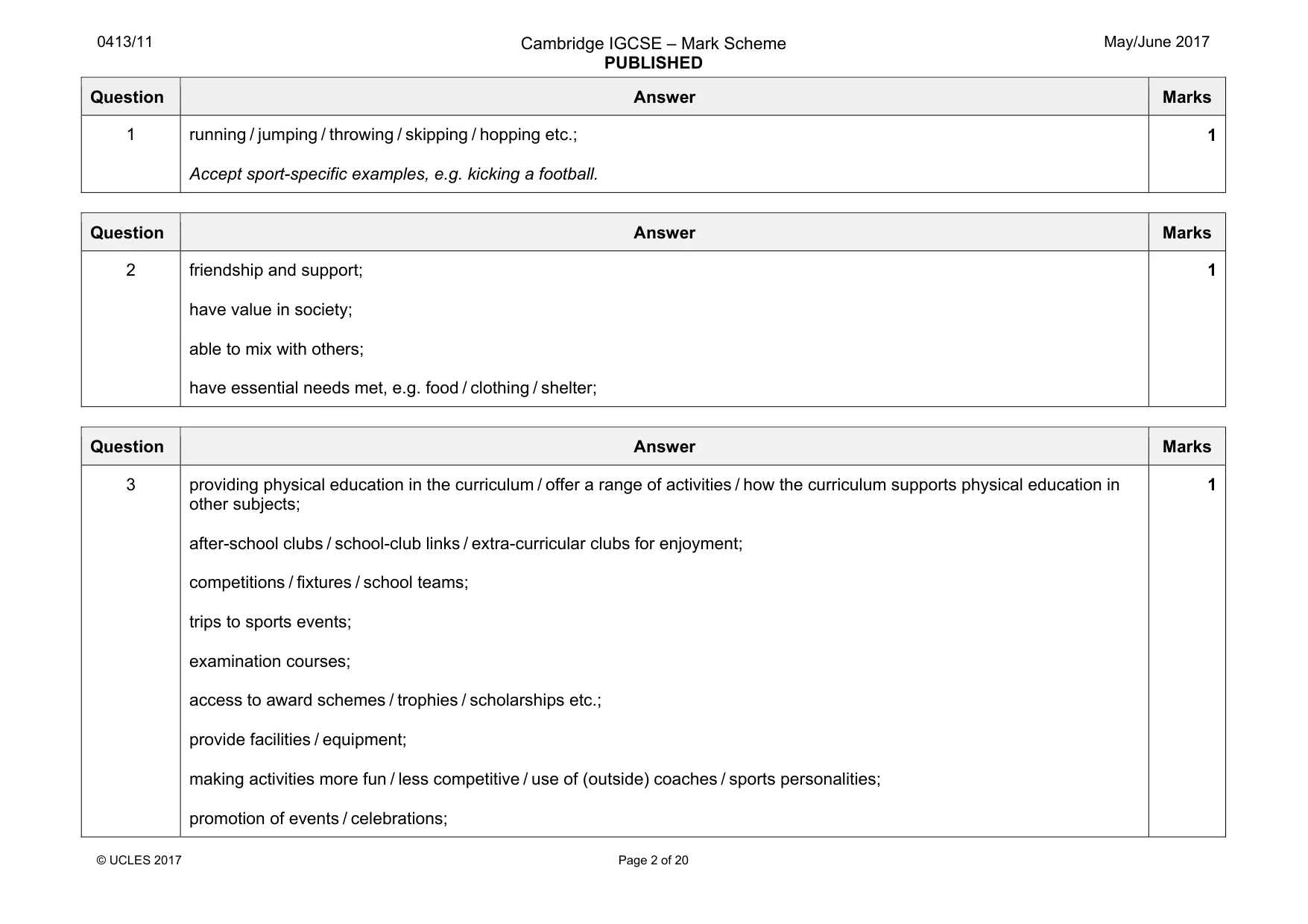
0413/11 Cambridge IGCSE – Mark Scheme PUBLISHED May/June 2017 © UCLES 2017 Page 2 of 20 Question Answer Marks 1 running / jumping / throwing / skipping / hopping etc.; Accept sport-specific examples, e.g. kicking a football. 1 Question Answer Marks 2 friendship and support; have value in society; able to mix with others; have essential needs met, e.g. food / clothing / shelter; 1 Question Answer Marks 3 providing physical education in the curriculum / offer a range of activities / how the curriculum supports physical education in other subjects; after-school clubs / school-club links / extra-curricular clubs for enjoyment; competitions / fixtures / school teams; trips to sports events; examination courses; access to award schemes / trophies / scholarships etc.; provide facilities / equipment; making activities more fun / less competitive / use of (outside) coaches / sports personalities; promotion of events / celebrations; 1
Mark scheme, page 3
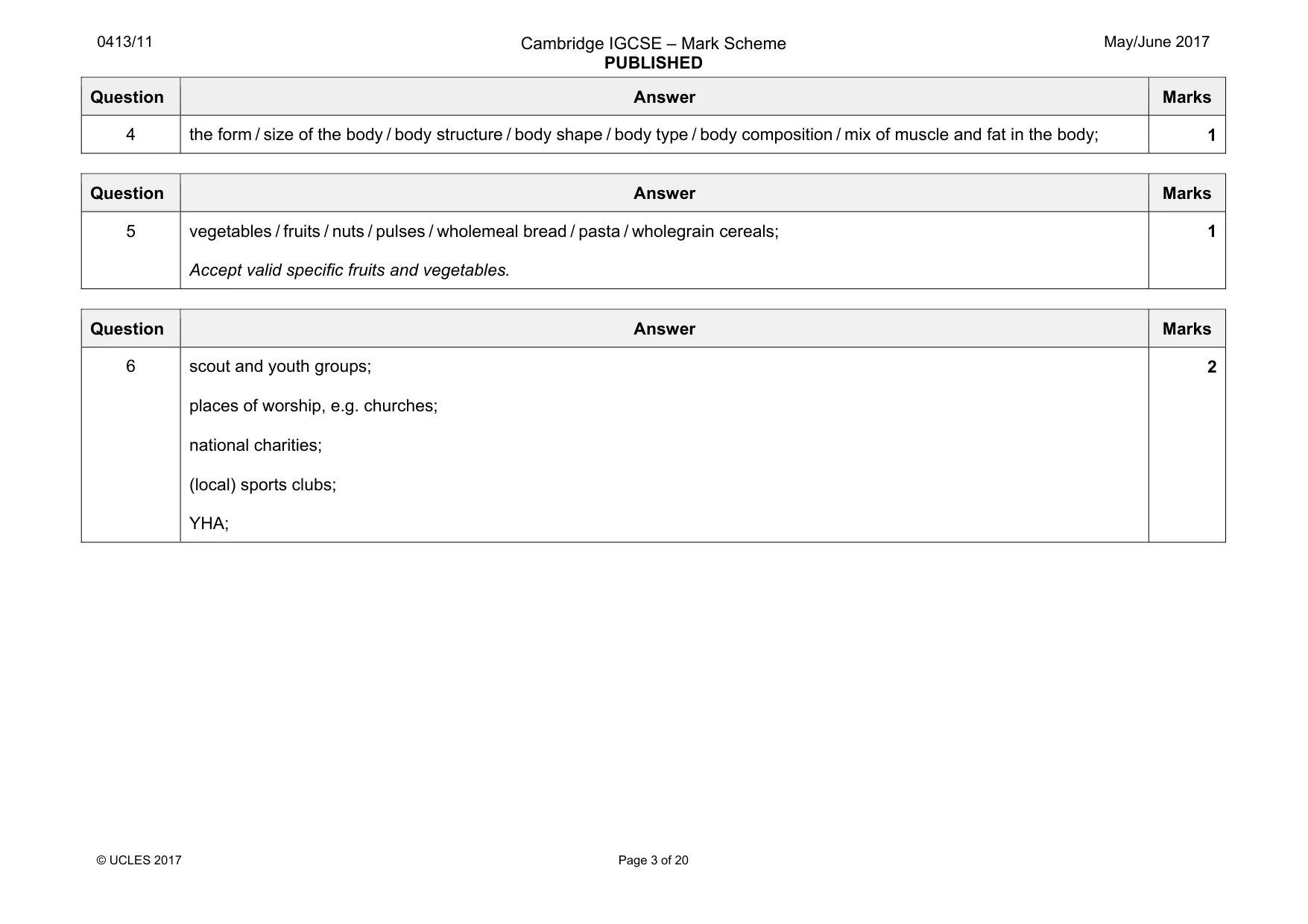
0413/11 Cambridge IGCSE – Mark Scheme PUBLISHED May/June 2017 © UCLES 2017 Page 3 of 20 Question Answer Marks 4 the form / size of the body / body structure / body shape / body type / body composition / mix of muscle and fat in the body; 1 Question Answer Marks 5 vegetables / fruits / nuts / pulses / wholemeal bread / pasta / wholegrain cereals; Accept valid specific fruits and vegetables. 1 Question Answer Marks 6 scout and youth groups; places of worship, e.g. churches; national charities; (local) sports clubs; YHA; 2
Mark scheme, page 4
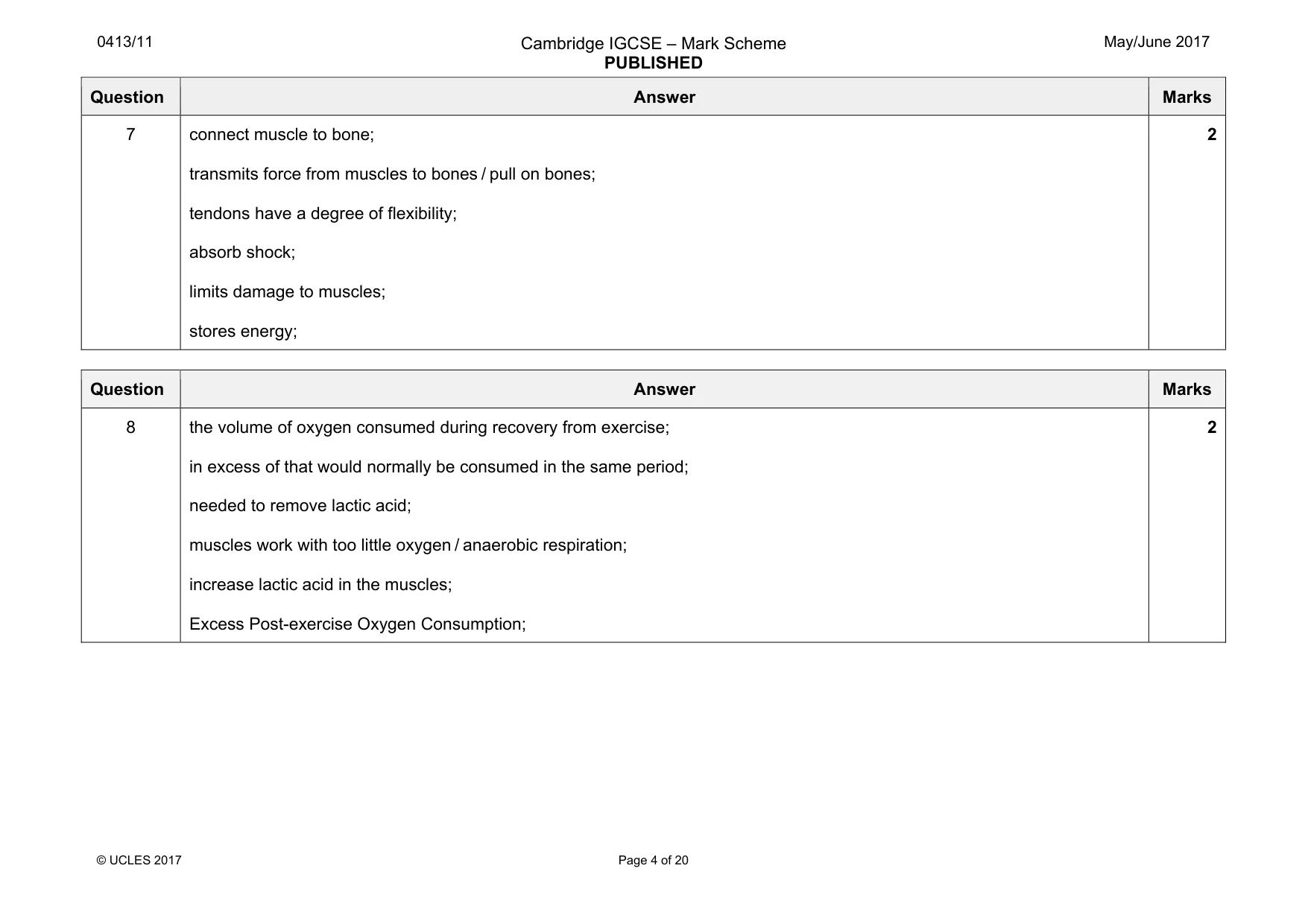
0413/11 Cambridge IGCSE – Mark Scheme PUBLISHED May/June 2017 © UCLES 2017 Page 4 of 20 Question Answer Marks 7 connect muscle to bone; transmits force from muscles to bones / pull on bones; tendons have a degree of flexibility; absorb shock; limits damage to muscles; stores energy; 2 Question Answer Marks 8 the volume of oxygen consumed during recovery from exercise; in excess of that would normally be consumed in the same period; needed to remove lactic acid; muscles work with too little oxygen / anaerobic respiration; increase lactic acid in the muscles; Excess Post-exercise Oxygen Consumption; 2
Mark scheme, page 5
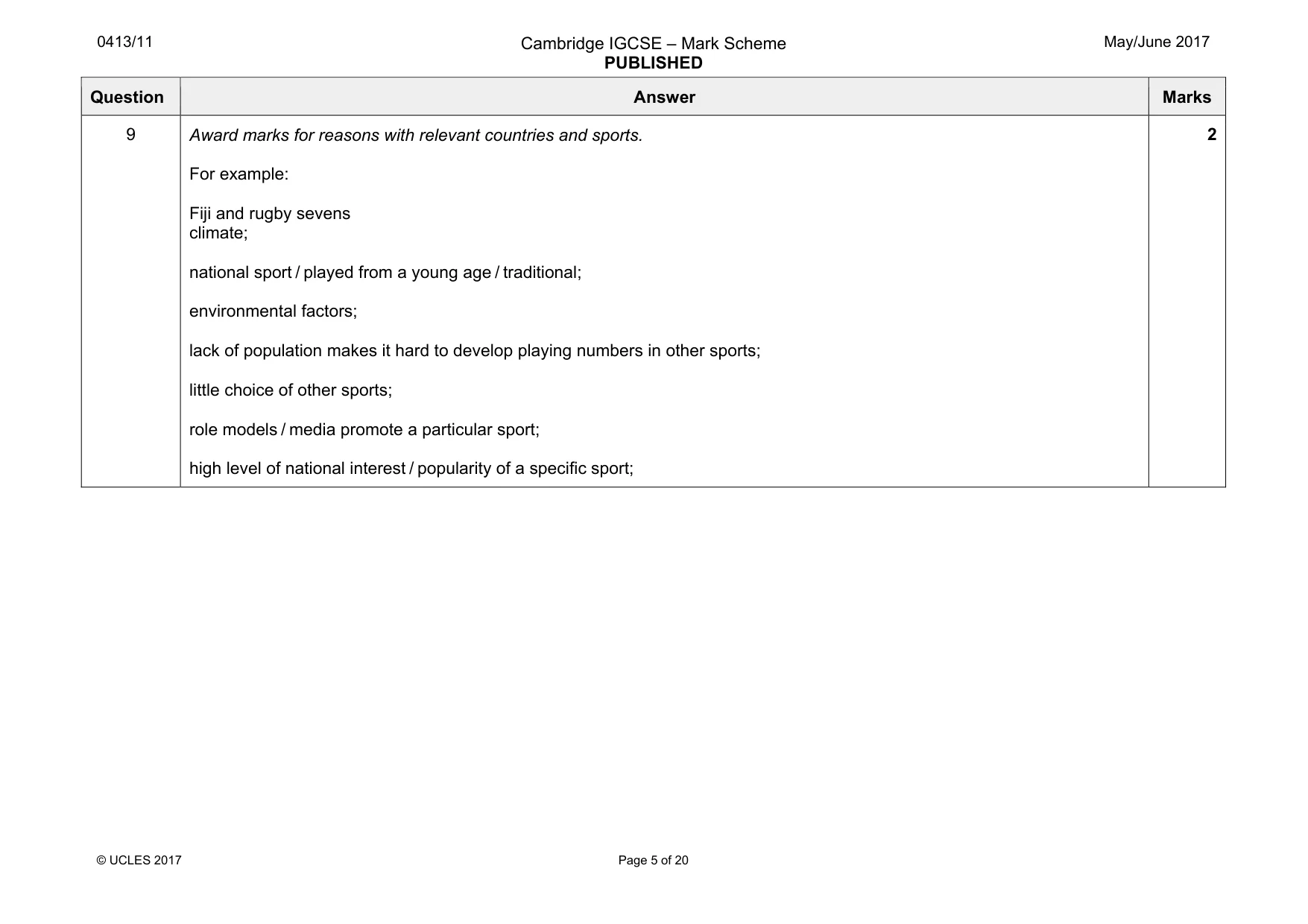
0413/11 Cambridge IGCSE – Mark Scheme PUBLISHED May/June 2017 © UCLES 2017 Page 5 of 20 Question Answer Marks 9 Award marks for reasons with relevant countries and sports. For example: Fiji and rugby sevens climate; national sport / played from a young age / traditional; environmental factors; lack of population makes it hard to develop playing numbers in other sports; little choice of other sports; role models / media promote a particular sport; high level of national interest / popularity of a specific sport; 2
Mark scheme, page 6
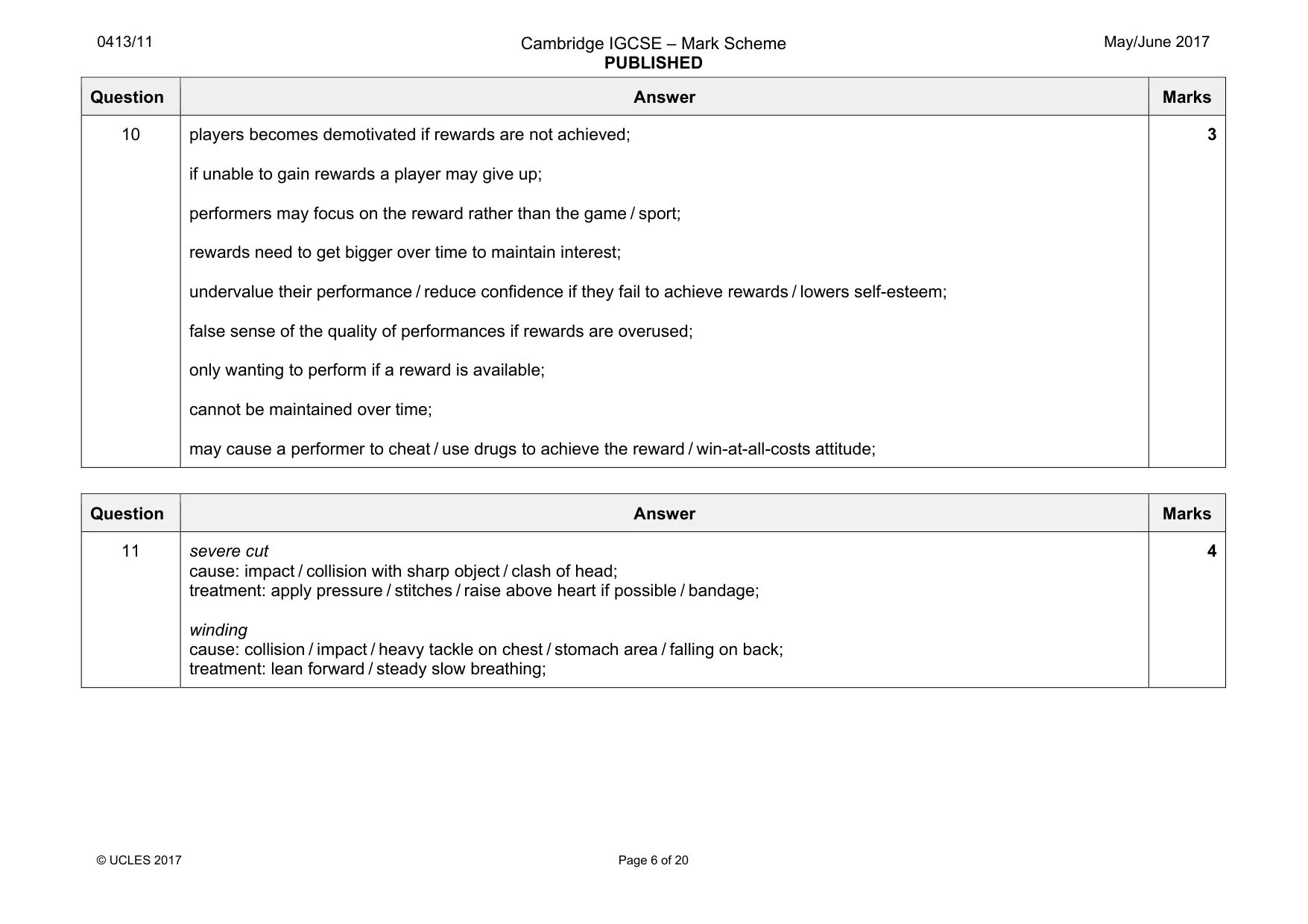
0413/11 Cambridge IGCSE – Mark Scheme PUBLISHED May/June 2017 © UCLES 2017 Page 6 of 20 Question Answer Marks 10 players becomes demotivated if rewards are not achieved; if unable to gain rewards a player may give up; performers may focus on the reward rather than the game / sport; rewards need to get bigger over time to maintain interest; undervalue their performance / reduce confidence if they fail to achieve rewards / lowers self-esteem; false sense of the quality of performances if rewards are overused; only wanting to perform if a reward is available; cannot be maintained over time; may cause a performer to cheat / use drugs to achieve the reward / win-at-all-costs attitude; 3 Question Answer Marks 11 severe cut cause: impact / collision with sharp object / clash of head; treatment: apply pressure / stitches / raise above heart if possible / bandage; winding cause: collision / impact / heavy tackle on chest / stomach area / falling on back; treatment: lean forward / steady slow breathing; 4
Mark scheme, page 7
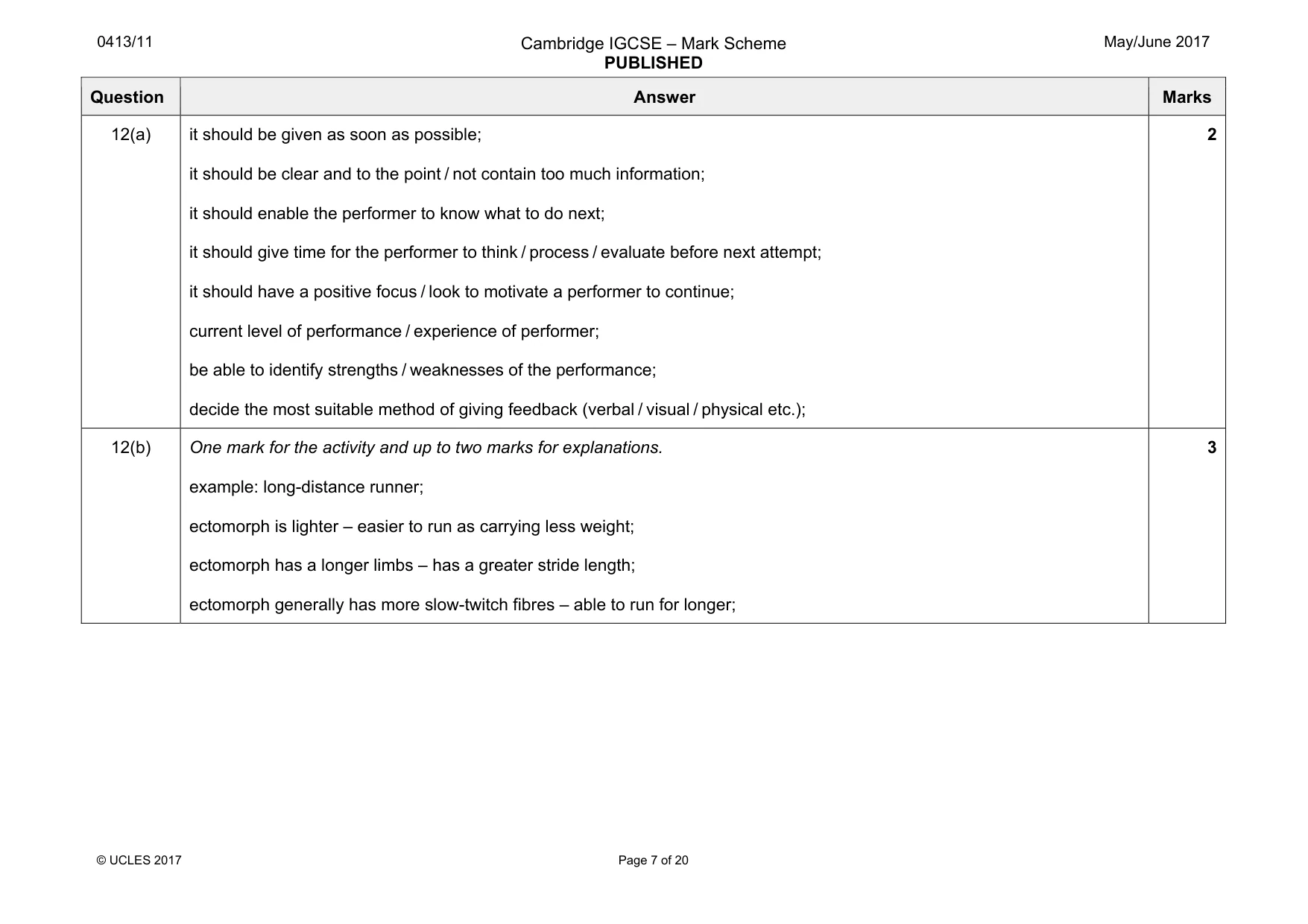
0413/11 Cambridge IGCSE – Mark Scheme PUBLISHED May/June 2017 © UCLES 2017 Page 7 of 20 Question Answer Marks 12(a) it should be given as soon as possible; it should be clear and to the point / not contain too much information; it should enable the performer to know what to do next; it should give time for the performer to think / process / evaluate before next attempt; it should have a positive focus / look to motivate a performer to continue; current level of performance / experience of performer; be able to identify strengths / weaknesses of the performance; decide the most suitable method of giving feedback (verbal / visual / physical etc.); 2 12(b) One mark for the activity and up to two marks for explanations. example: long-distance runner; ectomorph is lighter – easier to run as carrying less weight; ectomorph has a longer limbs – has a greater stride length; ectomorph generally has more slow-twitch fibres – able to run for longer; 3
Mark scheme, page 8
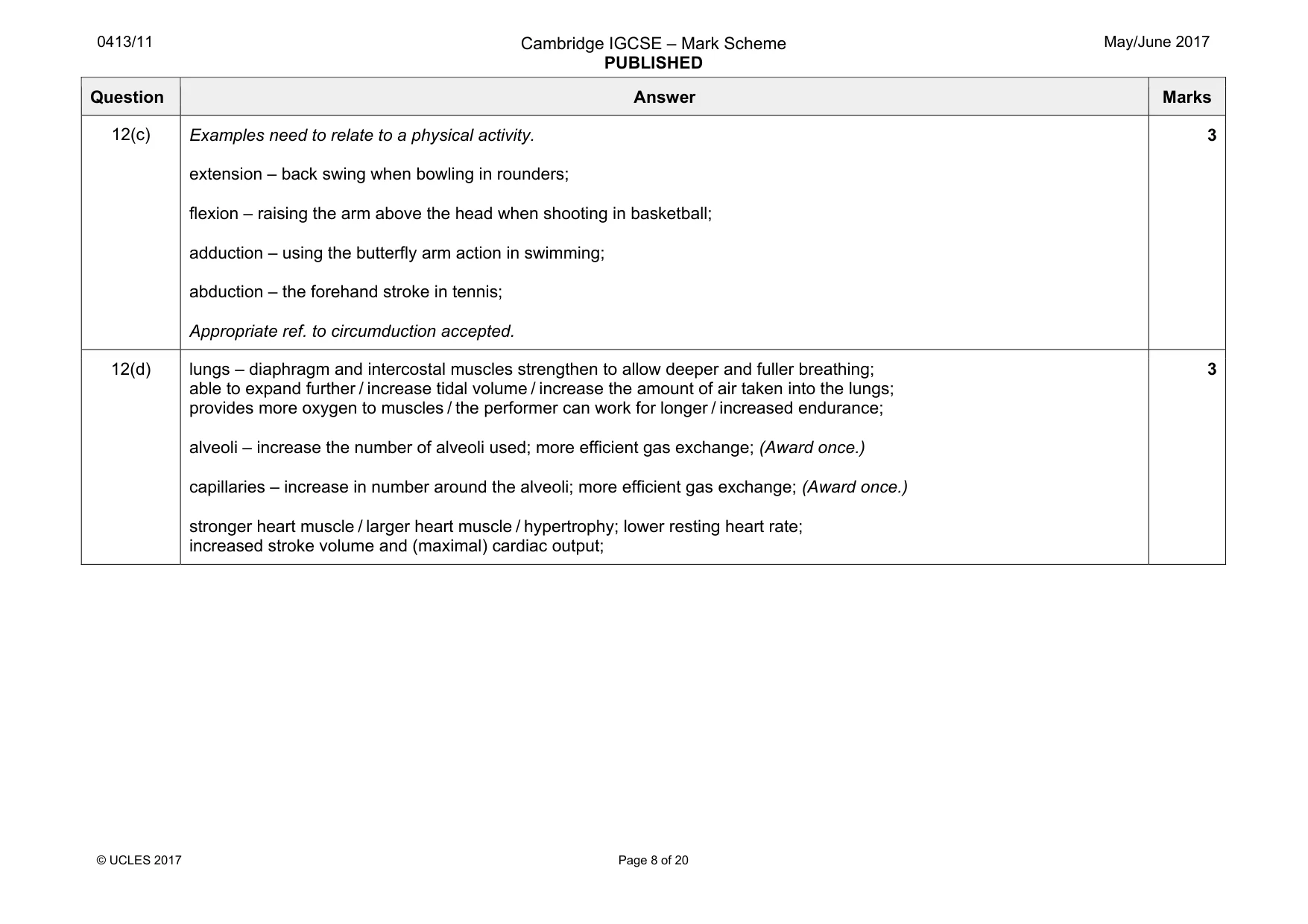
0413/11 Cambridge IGCSE – Mark Scheme PUBLISHED May/June 2017 © UCLES 2017 Page 8 of 20 Question Answer Marks 12(c) Examples need to relate to a physical activity. extension – back swing when bowling in rounders; flexion – raising the arm above the head when shooting in basketball; adduction – using the butterfly arm action in swimming; abduction – the forehand stroke in tennis; Appropriate ref. to circumduction accepted. 3 12(d) lungs – diaphragm and intercostal muscles strengthen to allow deeper and fuller breathing; able to expand further / increase tidal volume / increase the amount of air taken into the lungs; provides more oxygen to muscles / the performer can work for longer / increased endurance; alveoli – increase the number of alveoli used; more efficient gas exchange; (Award once.) capillaries – increase in number around the alveoli; more efficient gas exchange; (Award once.) stronger heart muscle / larger heart muscle / hypertrophy; lower resting heart rate; increased stroke volume and (maximal) cardiac output; 3
Mark scheme, page 9
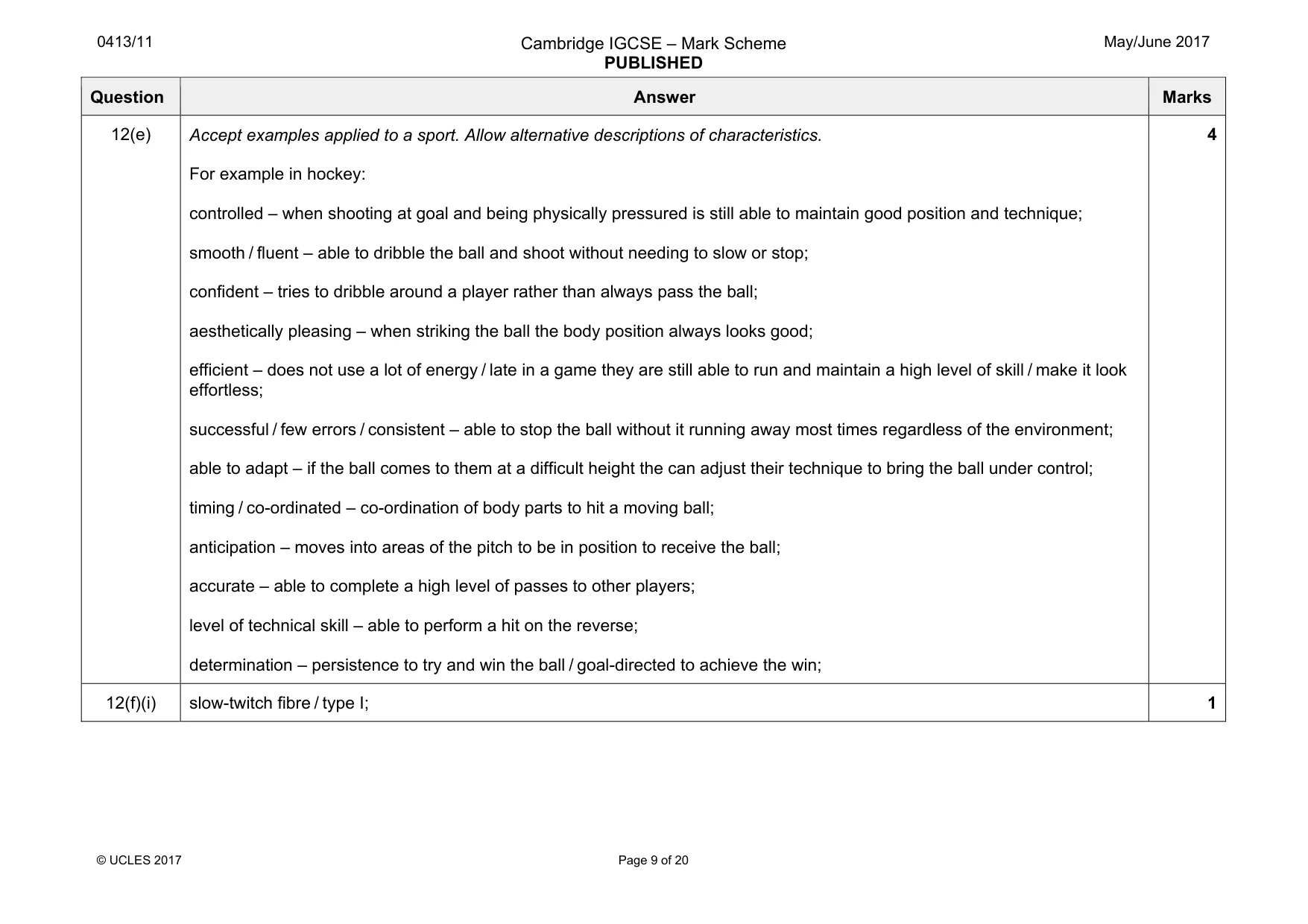
0413/11 Cambridge IGCSE – Mark Scheme PUBLISHED May/June 2017 © UCLES 2017 Page 9 of 20 Question Answer Marks 12(e) Accept examples applied to a sport. Allow alternative descriptions of characteristics. For example in hockey: controlled – when shooting at goal and being physically pressured is still able to maintain good position and technique; smooth / fluent – able to dribble the ball and shoot without needing to slow or stop; confident – tries to dribble around a player rather than always pass the ball; aesthetically pleasing – when striking the ball the body position always looks good; efficient – does not use a lot of energy / late in a game they are still able to run and maintain a high level of skill / make it look effortless; successful / few errors / consistent – able to stop the ball without it running away most times regardless of the environment; able to adapt – if the ball comes to them at a difficult height the can adjust their technique to bring the ball under control; timing / co-ordinated – co-ordination of body parts to hit a moving ball; anticipation – moves into areas of the pitch to be in position to receive the ball; accurate – able to complete a high level of passes to other players; level of technical skill – able to perform a hit on the reverse; determination – persistence to try and win the ball / goal-directed to achieve the win; 4 12(f)(i) slow-twitch fibre / type I; 1
Mark scheme, page 10
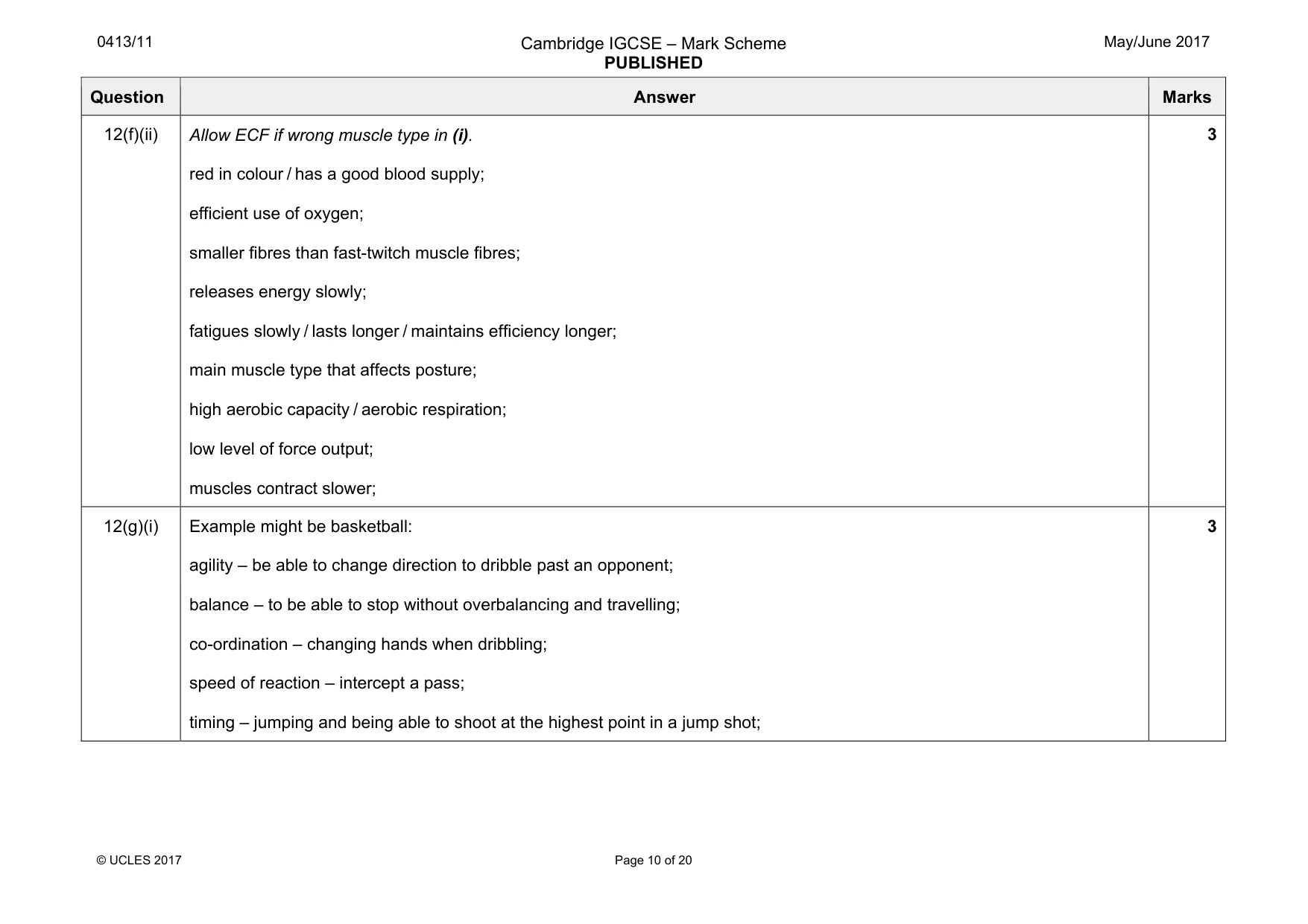
0413/11 Cambridge IGCSE – Mark Scheme PUBLISHED May/June 2017 © UCLES 2017 Page 10 of 20 Question Answer Marks 12(f)(ii) Allow ECF if wrong muscle type in (i). red in colour / has a good blood supply; efficient use of oxygen; smaller fibres than fast-twitch muscle fibres; releases energy slowly; fatigues slowly / lasts longer / maintains efficiency longer; main muscle type that affects posture; high aerobic capacity / aerobic respiration; low level of force output; muscles contract slower; 3 12(g)(i) Example might be basketball: agility – be able to change direction to dribble past an opponent; balance – to be able to stop without overbalancing and travelling; co-ordination – changing hands when dribbling; speed of reaction – intercept a pass; timing – jumping and being able to shoot at the highest point in a jump shot; 3
Mark scheme, page 11
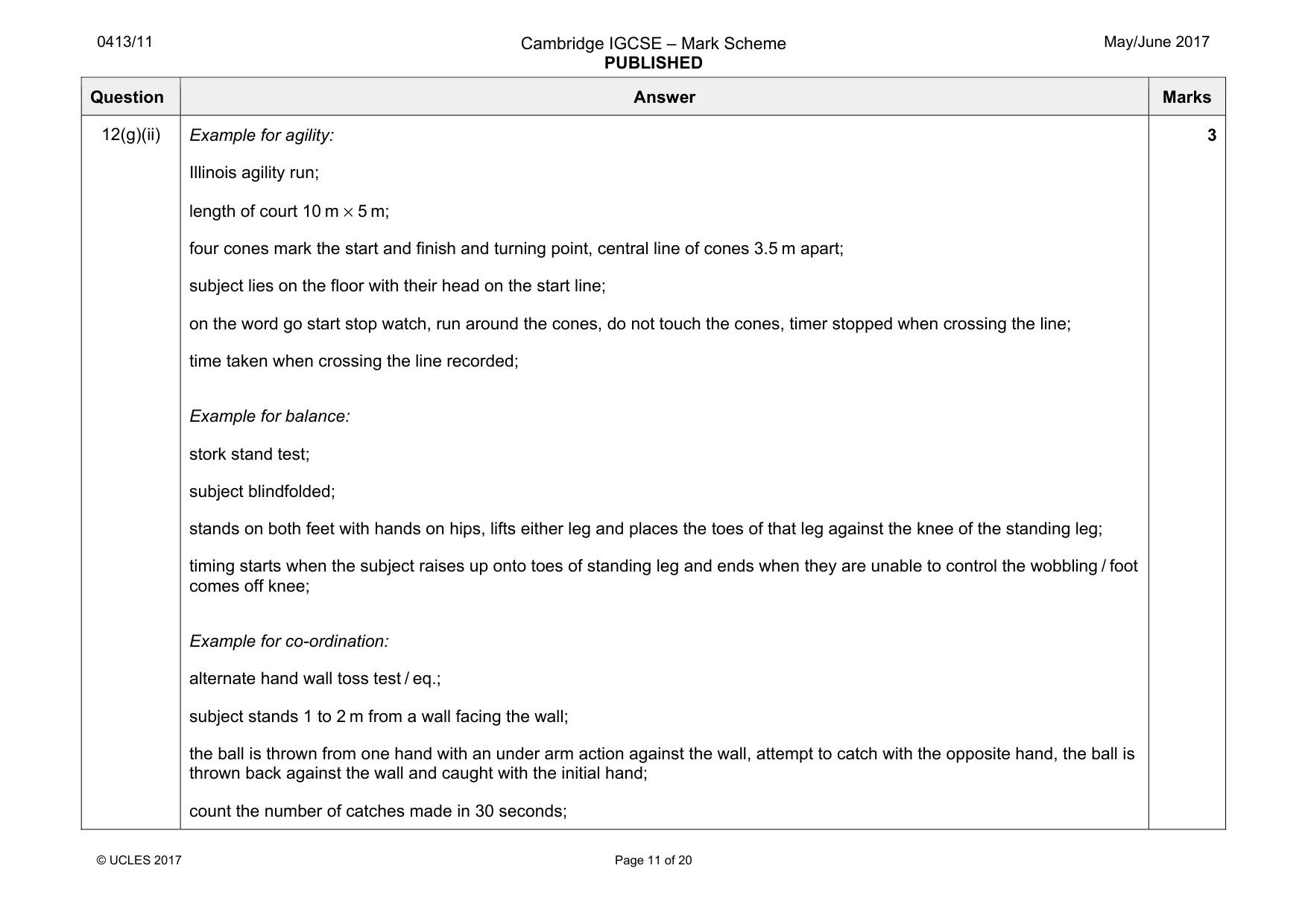
0413/11 Cambridge IGCSE – Mark Scheme PUBLISHED May/June 2017 © UCLES 2017 Page 11 of 20 Question Answer Marks 12(g)(ii) Example for agility: Illinois agility run; length of court 10 m × 5 m; four cones mark the start and finish and turning point, central line of cones 3.5 m apart; subject lies on the floor with their head on the start line; on the word go start stop watch, run around the cones, do not touch the cones, timer stopped when crossing the line; time taken when crossing the line recorded; Example for balance: stork stand test; subject blindfolded; stands on both feet with hands on hips, lifts either leg and places the toes of that leg against the knee of the standing leg; timing starts when the subject raises up onto toes of standing leg and ends when they are unable to control the wobbling / foot comes off knee; Example for co-ordination: alternate hand wall toss test / eq.; subject stands 1 to 2 m from a wall facing the wall; the ball is thrown from one hand with an under arm action against the wall, attempt to catch with the opposite hand, the ball is thrown back against the wall and caught with the initial hand; count the number of catches made in 30 seconds; 3
Mark scheme, page 12
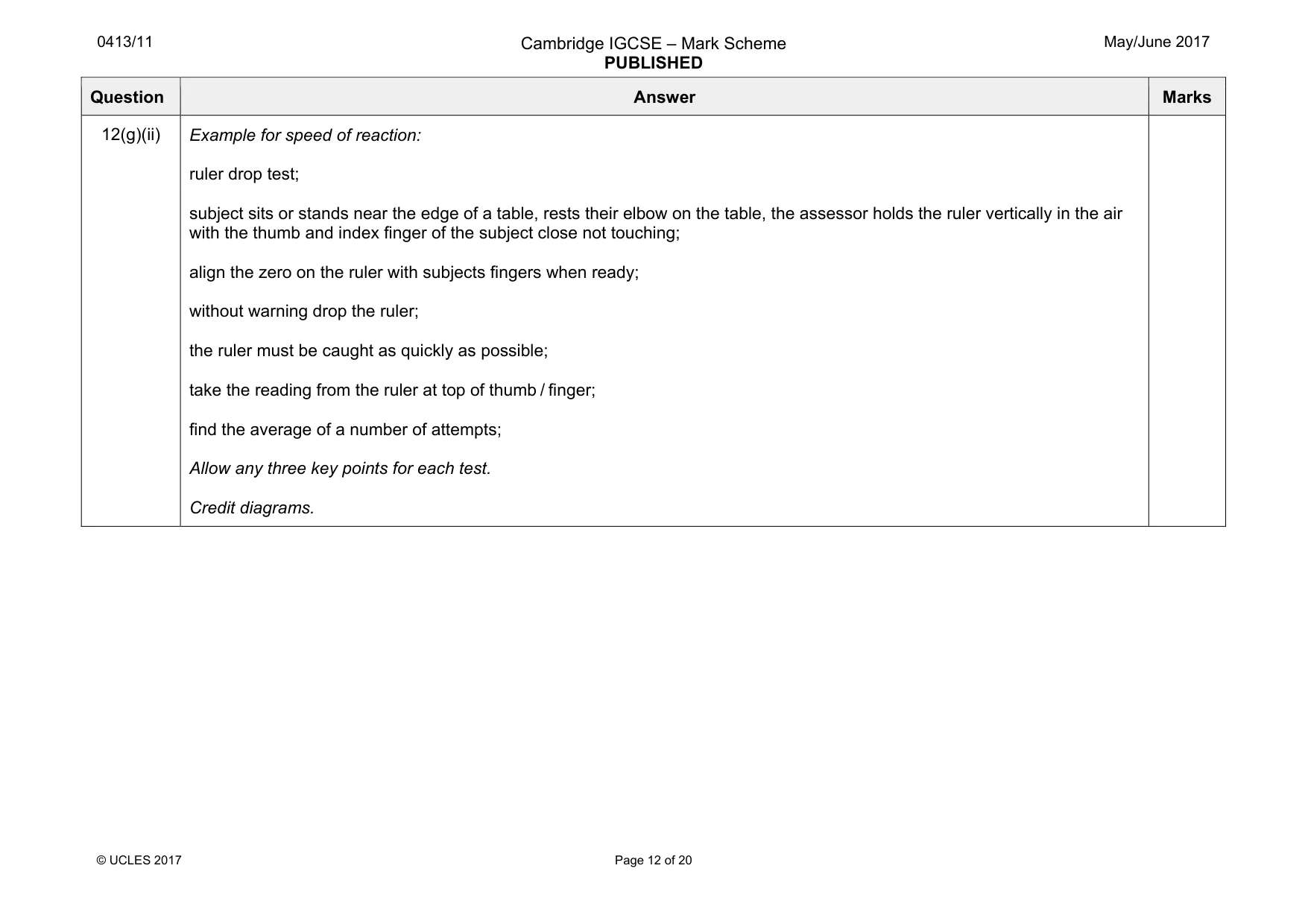
0413/11 Cambridge IGCSE – Mark Scheme PUBLISHED May/June 2017 © UCLES 2017 Page 12 of 20 Question Answer Marks 12(g)(ii) Example for speed of reaction: ruler drop test; subject sits or stands near the edge of a table, rests their elbow on the table, the assessor holds the ruler vertically in the air with the thumb and index finger of the subject close not touching; align the zero on the ruler with subjects fingers when ready; without warning drop the ruler; the ruler must be caught as quickly as possible; take the reading from the ruler at top of thumb / finger; find the average of a number of attempts; Allow any three key points for each test. Credit diagrams.
Mark scheme, page 13
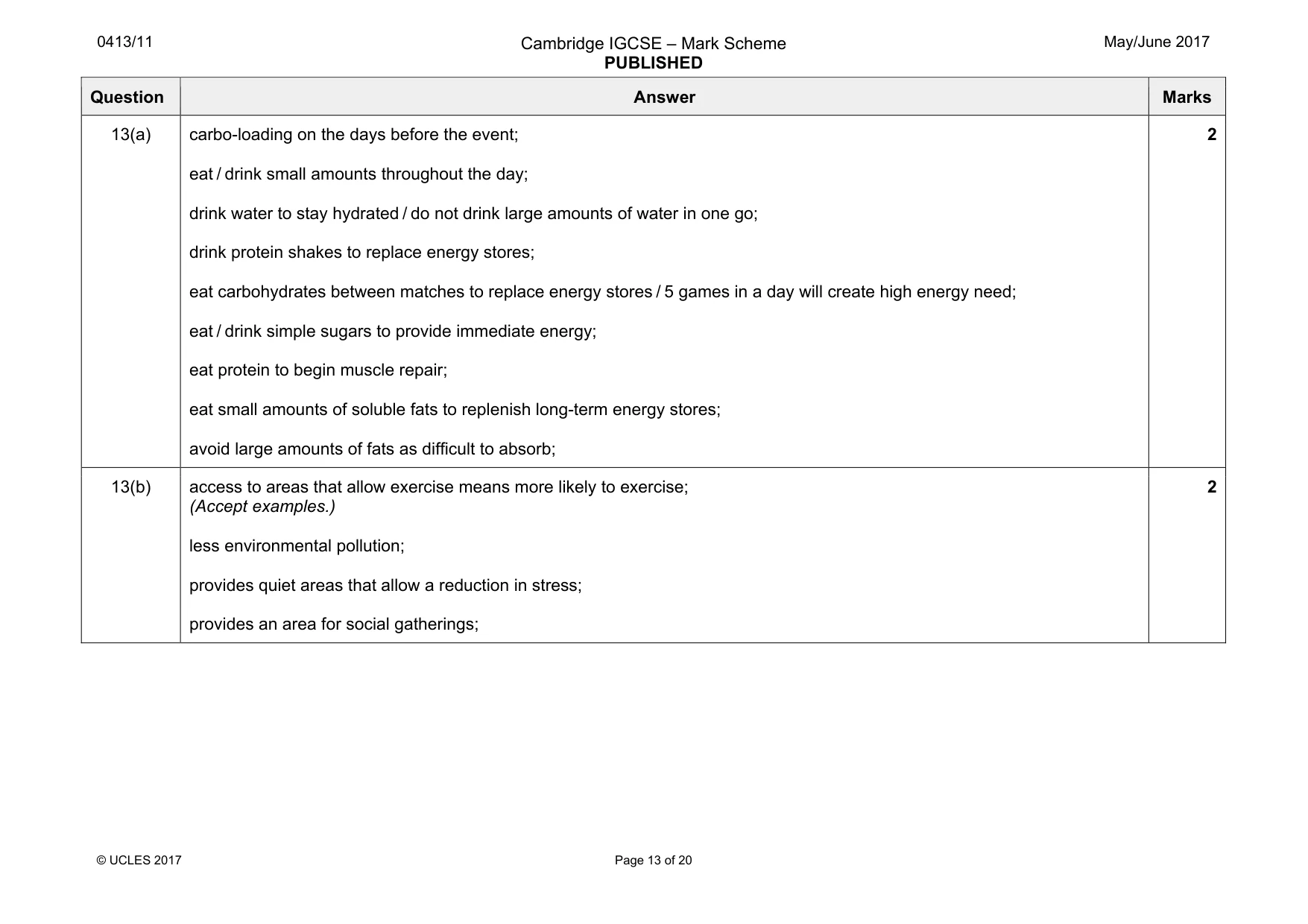
0413/11 Cambridge IGCSE – Mark Scheme PUBLISHED May/June 2017 © UCLES 2017 Page 13 of 20 Question Answer Marks 13(a) carbo-loading on the days before the event; eat / drink small amounts throughout the day; drink water to stay hydrated / do not drink large amounts of water in one go; drink protein shakes to replace energy stores; eat carbohydrates between matches to replace energy stores / 5 games in a day will create high energy need; eat / drink simple sugars to provide immediate energy; eat protein to begin muscle repair; eat small amounts of soluble fats to replenish long-term energy stores; avoid large amounts of fats as difficult to absorb; 2 13(b) access to areas that allow exercise means more likely to exercise; (Accept examples.) less environmental pollution; provides quiet areas that allow a reduction in stress; provides an area for social gatherings; 2
Mark scheme, page 14
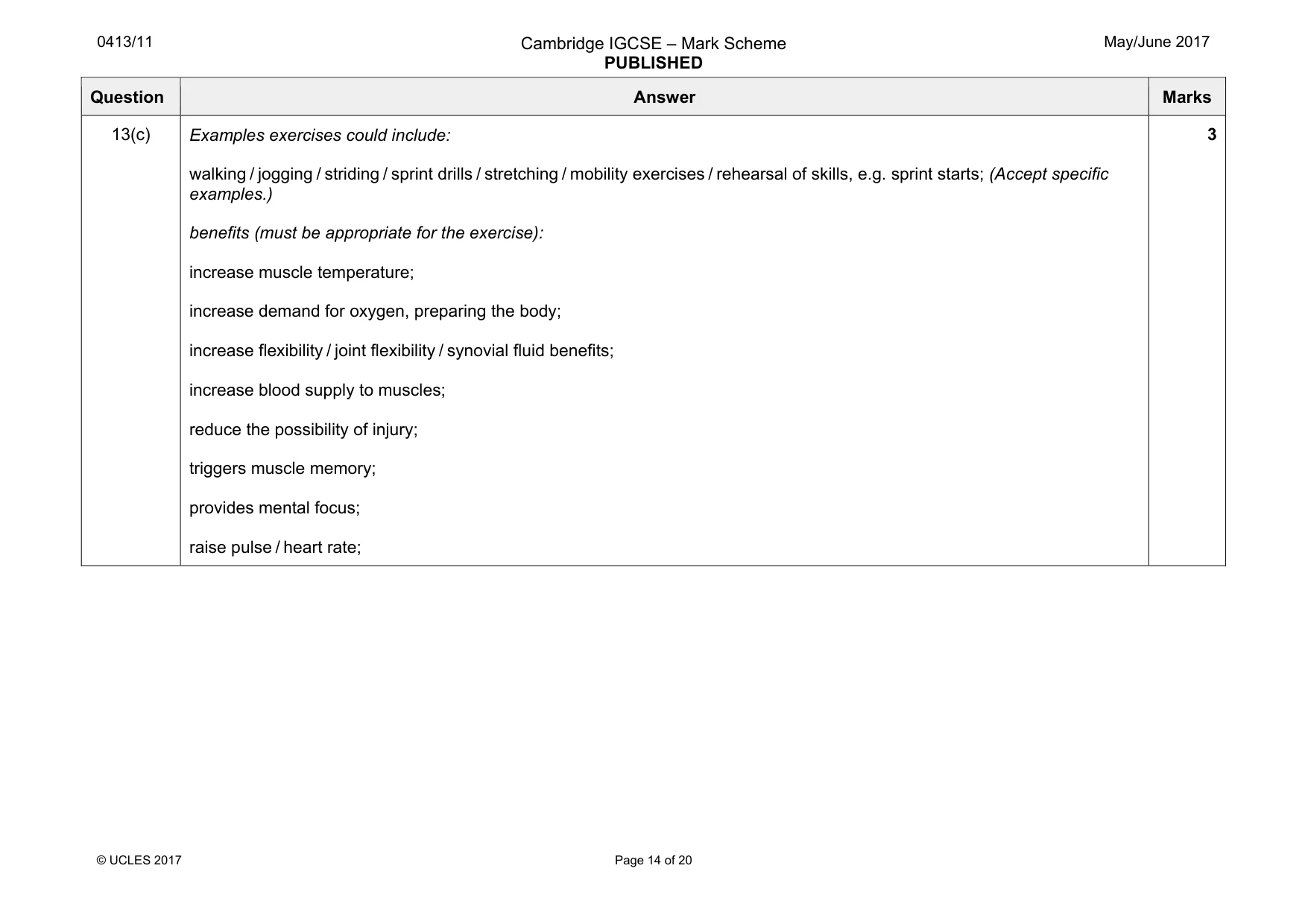
0413/11 Cambridge IGCSE – Mark Scheme PUBLISHED May/June 2017 © UCLES 2017 Page 14 of 20 Question Answer Marks 13(c) Examples exercises could include: walking / jogging / striding / sprint drills / stretching / mobility exercises / rehearsal of skills, e.g. sprint starts; (Accept specific examples.) benefits (must be appropriate for the exercise): increase muscle temperature; increase demand for oxygen, preparing the body; increase flexibility / joint flexibility / synovial fluid benefits; increase blood supply to muscles; reduce the possibility of injury; triggers muscle memory; provides mental focus; raise pulse / heart rate; 3
Mark scheme, page 15
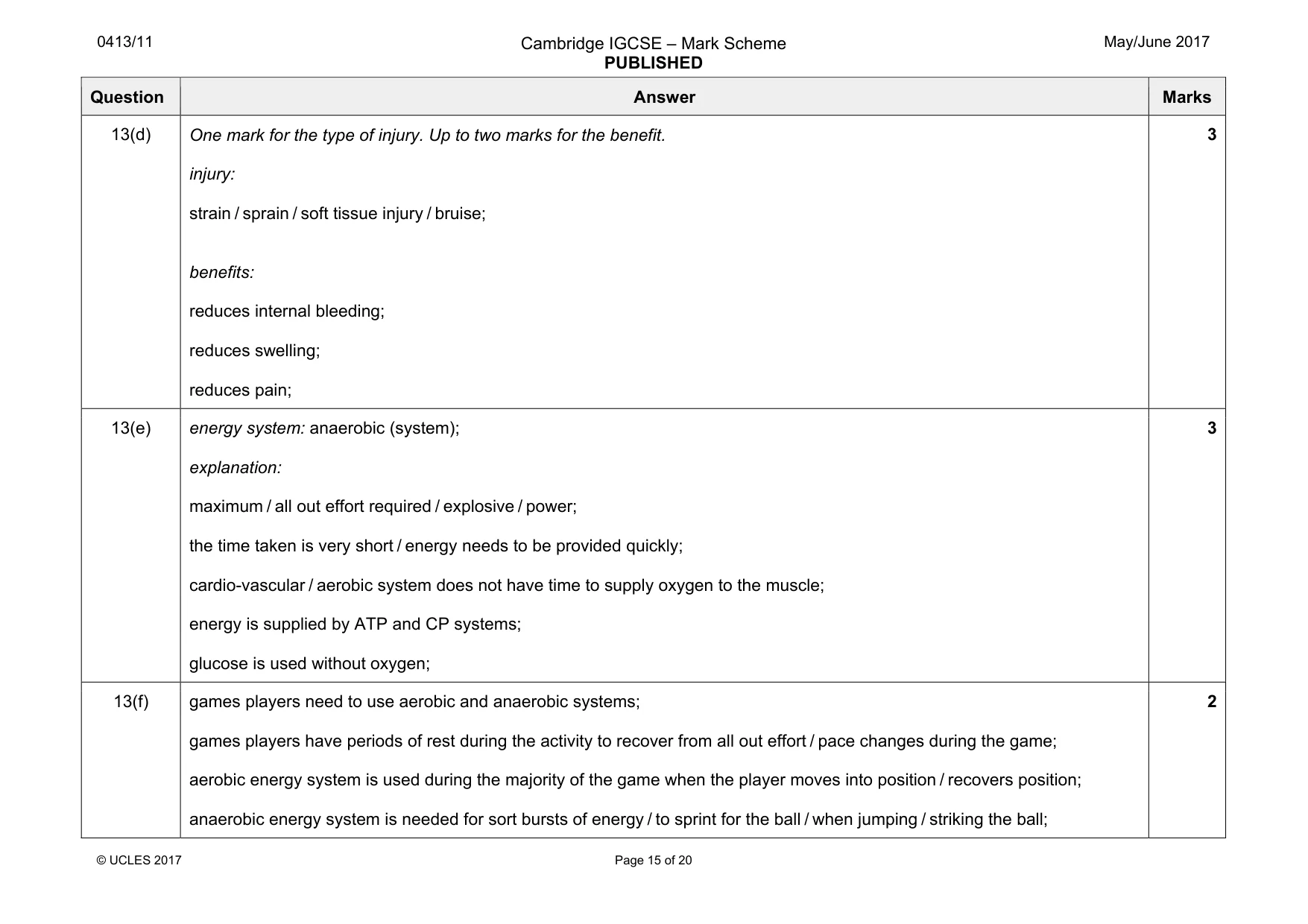
0413/11 Cambridge IGCSE – Mark Scheme PUBLISHED May/June 2017 © UCLES 2017 Page 15 of 20 Question Answer Marks 13(d) One mark for the type of injury. Up to two marks for the benefit. injury: strain / sprain / soft tissue injury / bruise; benefits: reduces internal bleeding; reduces swelling; reduces pain; 3 13(e) energy system: anaerobic (system); explanation: maximum / all out effort required / explosive / power; the time taken is very short / energy needs to be provided quickly; cardio-vascular / aerobic system does not have time to supply oxygen to the muscle; energy is supplied by ATP and CP systems; glucose is used without oxygen; 3 13(f) games players need to use aerobic and anaerobic systems; games players have periods of rest during the activity to recover from all out effort / pace changes during the game; aerobic energy system is used during the majority of the game when the player moves into position / recovers position; anaerobic energy system is needed for sort bursts of energy / to sprint for the ball / when jumping / striking the ball; 2
Mark scheme, page 16
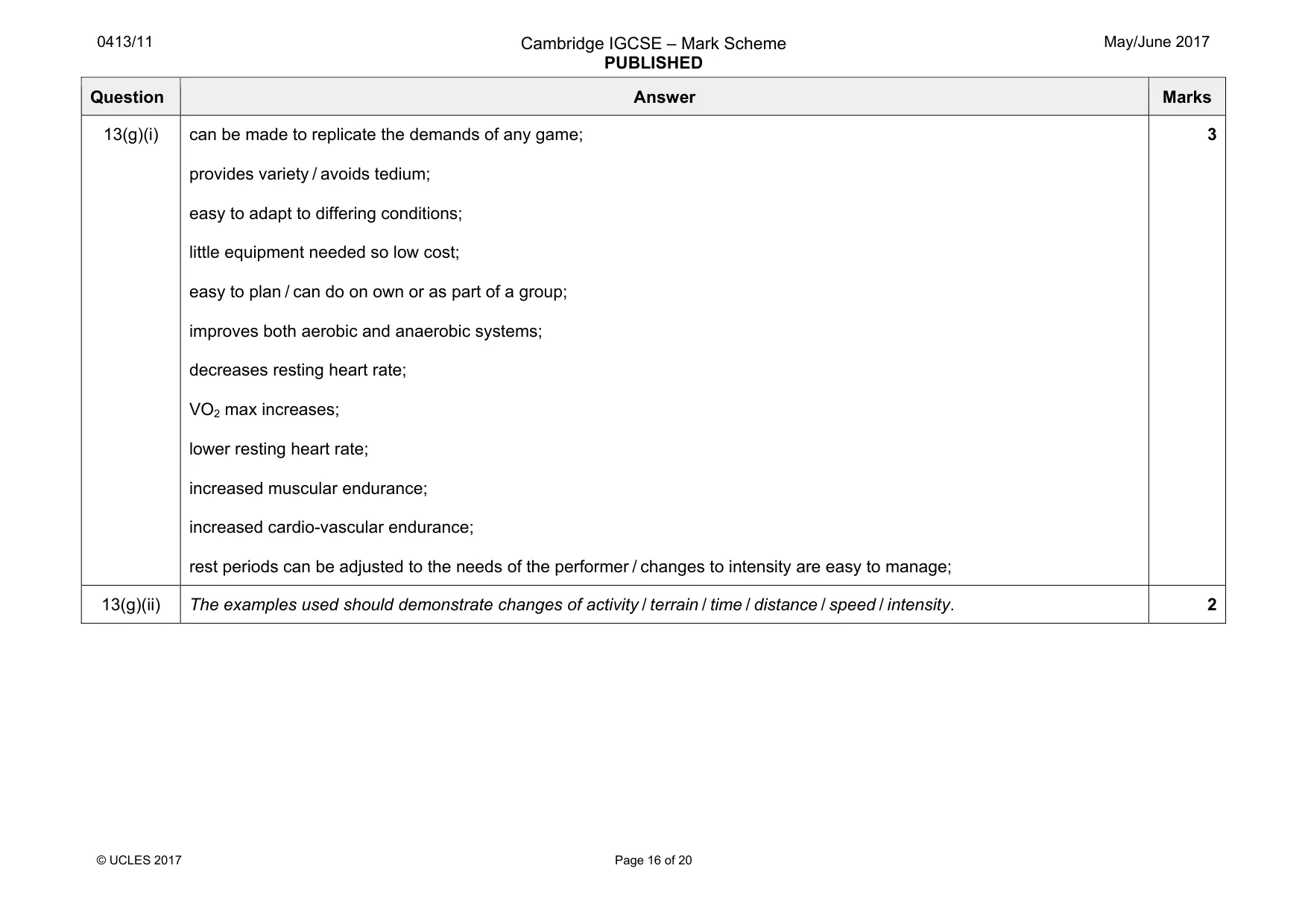
0413/11 Cambridge IGCSE – Mark Scheme PUBLISHED May/June 2017 © UCLES 2017 Page 16 of 20 Question Answer Marks 13(g)(i) can be made to replicate the demands of any game; provides variety / avoids tedium; easy to adapt to differing conditions; little equipment needed so low cost; easy to plan / can do on own or as part of a group; improves both aerobic and anaerobic systems; decreases resting heart rate; VO2 max increases; lower resting heart rate; increased muscular endurance; increased cardio-vascular endurance; rest periods can be adjusted to the needs of the performer / changes to intensity are easy to manage; 3 13(g)(ii) The examples used should demonstrate changes of activity / terrain / time / distance / speed / intensity. 2
Mark scheme, page 17
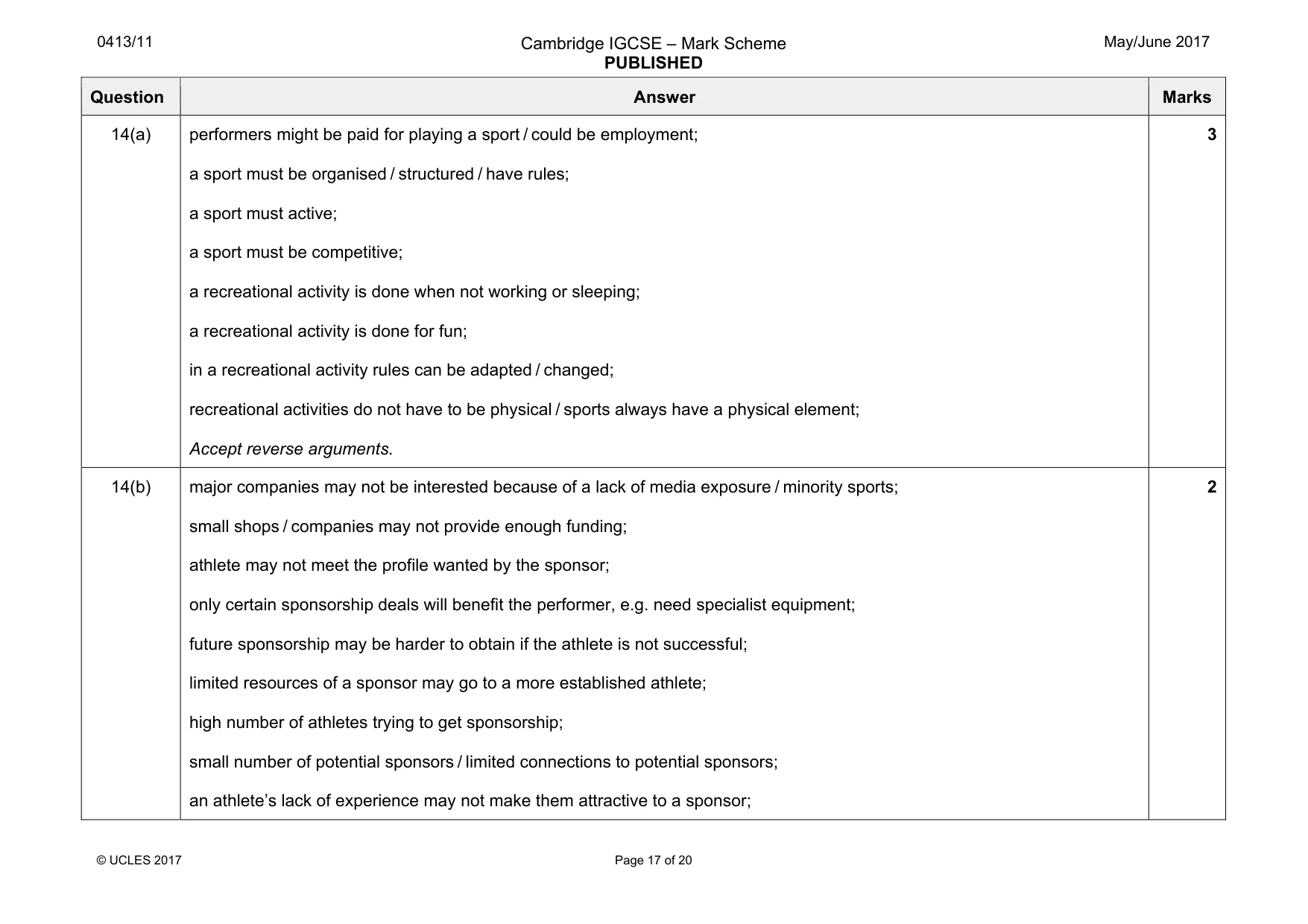
0413/11 Cambridge IGCSE – Mark Scheme PUBLISHED May/June 2017 © UCLES 2017 Page 17 of 20 Question Answer Marks 14(a) performers might be paid for playing a sport / could be employment; a sport must be organised / structured / have rules; a sport must active; a sport must be competitive; a recreational activity is done when not working or sleeping; a recreational activity is done for fun; in a recreational activity rules can be adapted / changed; recreational activities do not have to be physical / sports always have a physical element; Accept reverse arguments. 3 14(b) major companies may not be interested because of a lack of media exposure / minority sports; small shops / companies may not provide enough funding; athlete may not meet the profile wanted by the sponsor; only certain sponsorship deals will benefit the performer, e.g. need specialist equipment; future sponsorship may be harder to obtain if the athlete is not successful; limited resources of a sponsor may go to a more established athlete; high number of athletes trying to get sponsorship; small number of potential sponsors / limited connections to potential sponsors; an athlete’s lack of experience may not make them attractive to a sponsor; 2
Mark scheme, page 18
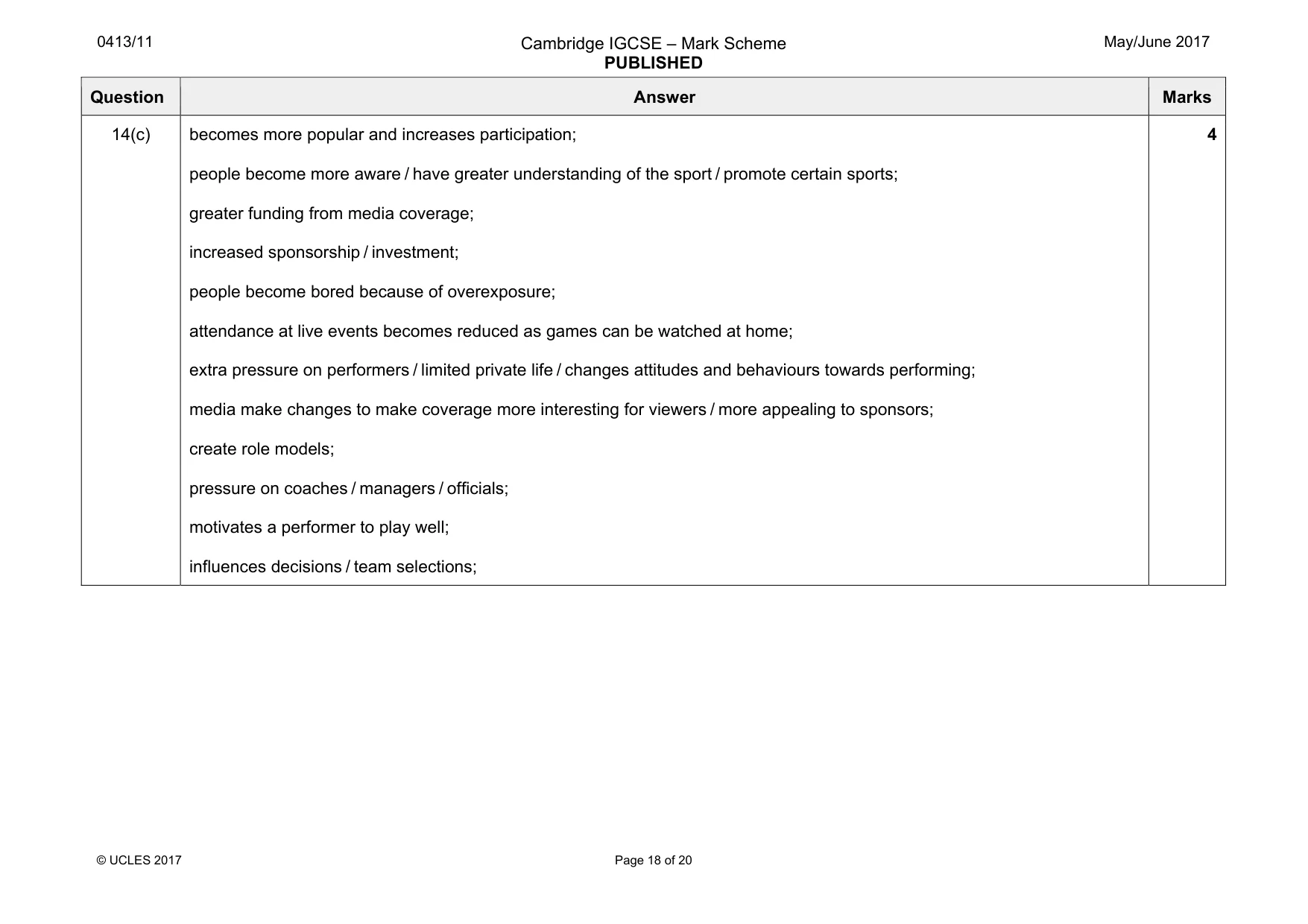
0413/11 Cambridge IGCSE – Mark Scheme PUBLISHED May/June 2017 © UCLES 2017 Page 18 of 20 Question Answer Marks 14(c) becomes more popular and increases participation; people become more aware / have greater understanding of the sport / promote certain sports; greater funding from media coverage; increased sponsorship / investment; people become bored because of overexposure; attendance at live events becomes reduced as games can be watched at home; extra pressure on performers / limited private life / changes attitudes and behaviours towards performing; media make changes to make coverage more interesting for viewers / more appealing to sponsors; create role models; pressure on coaches / managers / officials; motivates a performer to play well; influences decisions / team selections; 4
Mark scheme, page 19
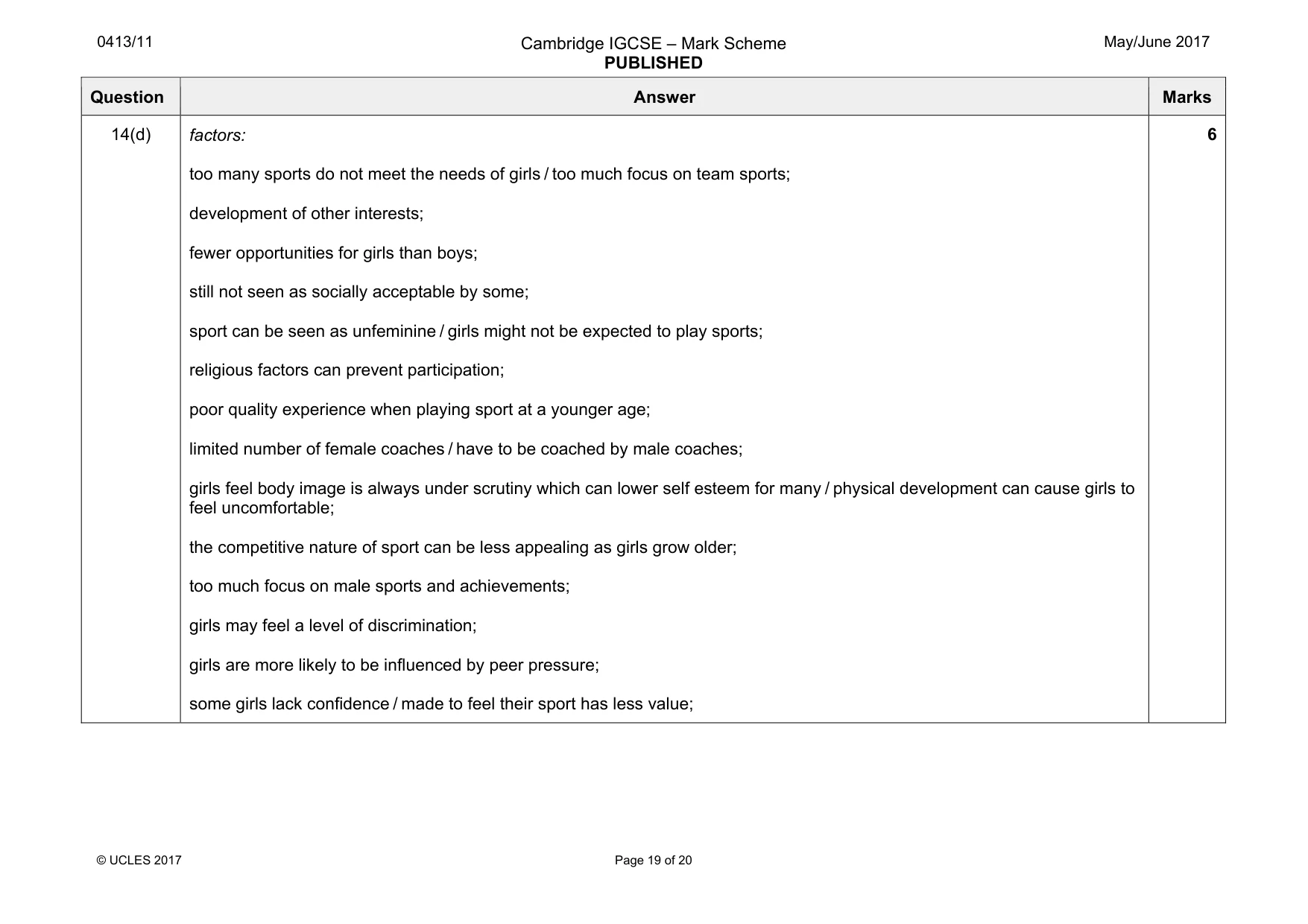
0413/11 Cambridge IGCSE – Mark Scheme PUBLISHED May/June 2017 © UCLES 2017 Page 19 of 20 Question Answer Marks 14(d) factors: too many sports do not meet the needs of girls / too much focus on team sports; development of other interests; fewer opportunities for girls than boys; still not seen as socially acceptable by some; sport can be seen as unfeminine / girls might not be expected to play sports; religious factors can prevent participation; poor quality experience when playing sport at a younger age; limited number of female coaches / have to be coached by male coaches; girls feel body image is always under scrutiny which can lower self esteem for many / physical development can cause girls to feel uncomfortable; the competitive nature of sport can be less appealing as girls grow older; too much focus on male sports and achievements; girls may feel a level of discrimination; girls are more likely to be influenced by peer pressure; some girls lack confidence / made to feel their sport has less value; 6
Mark scheme, page 20
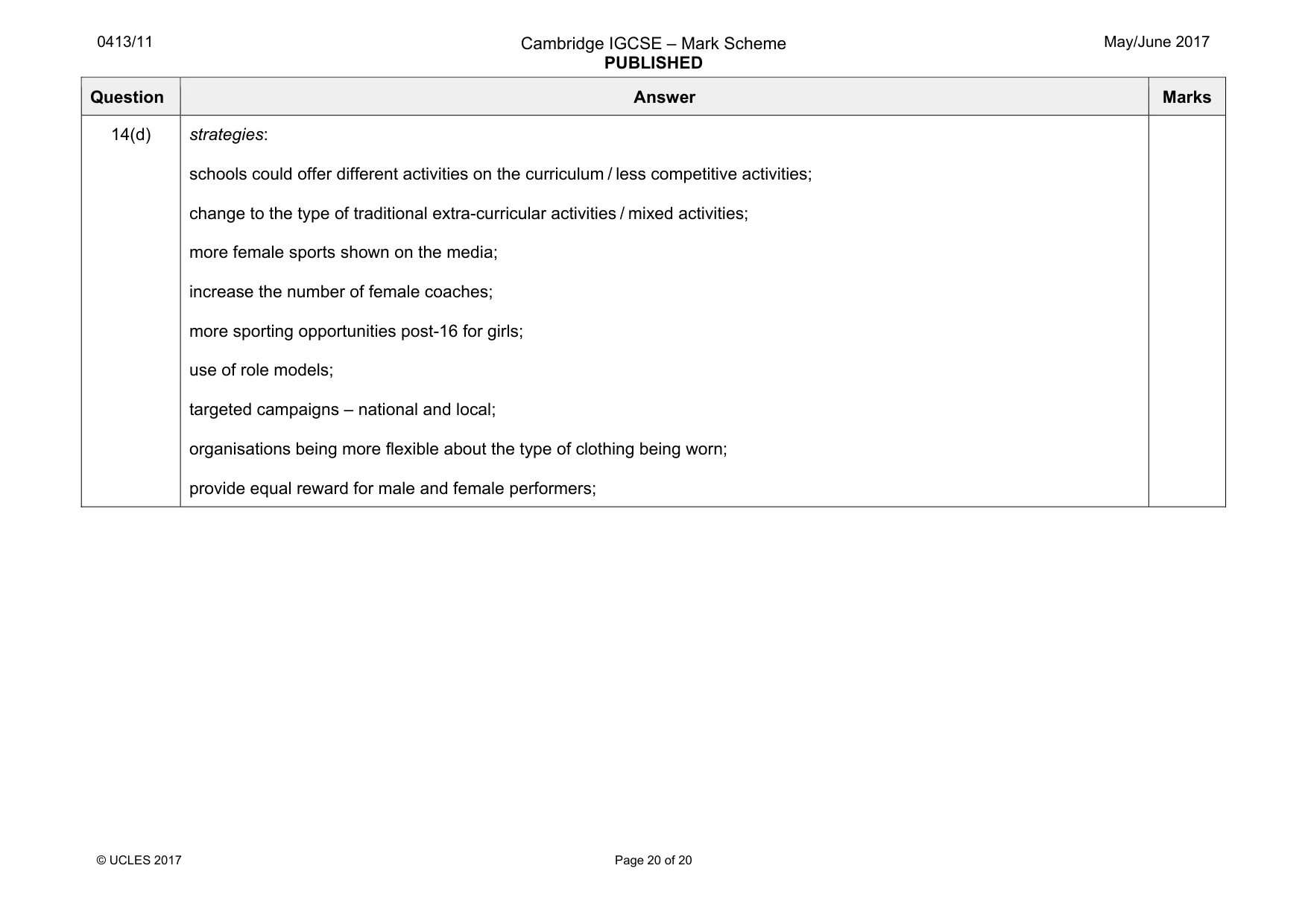
0413/11 Cambridge IGCSE – Mark Scheme PUBLISHED May/June 2017 © UCLES 2017 Page 20 of 20 Question Answer Marks 14(d) strategies: schools could offer different activities on the curriculum / less competitive activities; change to the type of traditional extra-curricular activities / mixed activities; more female sports shown on the media; increase the number of female coaches; more sporting opportunities post-16 for girls; use of role models; targeted campaigns – national and local; organisations being more flexible about the type of clothing being worn; provide equal reward for male and female performers;
What you needed in this session
Cambridge’s own grade thresholds for 2017 May/June, Paper 1 · Variant 1. A higher threshold means an easier paper — the bar moves with how the cohort did.