Cambridge IGCSE Physical Education 0413 — 2016 Oct/Nov Paper 1 · Variant 2
0413/12/O/N/16 · 80 marks · ≈90 min
The question paper and its mark scheme, free to read here and free to download. This is Cambridge’s own paper, exactly as it was sat.
Question paper12 pages

Mark scheme13 pages
Answers below. Sit the paper first if you are practising.
Paper as text
Question paper, page 1
This document consists of 11 printed pages and 1 blank page. DC (ST/FD) 118114/4 © UCLES 2016 [Turn over Cambridge International Examinations Cambridge International General Certificate of Secondary Education * 1 6 8 1 0 3 5 2 9 2 * PHYSICAL EDUCATION 0413/12 Paper 1 October/November 2016 1 hour 45 minutes Candidates answer on the Question Paper. No Additional Materials are required. READ THESE INSTRUCTIONS FIRST Write your Centre number, candidate number and name on all the work you hand in. Write in dark blue or black pen. You may use an HB pencil for any diagrams or graphs. Do not use staples, paper clips, glue or correction fluid. DO NOT WRITE IN ANY BARCODES. Section A Answer all questions in this section. Write your answers in the spaces provided on the Question Paper. Section B Answer all questions in this section. Write your answers in the spaces provided on the Question Paper. Electronic calculators may be used. You may lose marks if you do not show your working or if you do not use appropriate units. At the end of the examination, fasten all your work securely together. The number of marks is given in brackets [ ] at the end of each question or part question.
Question paper, page 2
2 0413/12/O/N/16 © UCLES 2016 Section A Answer all the questions in the spaces provided. 1 State one major function of the skeleton. … …[1] 2 Suggest one reason why someone who is able to carry out everyday physical tasks could be considered to have good physical well-being. … …[1] 3 Suggest one way that schools can encourage participation in school sport. … …[1] 4 Explain one environmental factor that can affect the skill levels of a performer. … …[1] 5 Give one source of fibre that may be included in a balanced diet. …[1] 6 Name one type of organisation that controls and runs recreational facilities. … …[1] 7 Identify two features of fast twitch muscle fibres. … …[2] 8 Explain two benefits of a cool down for a performer. … … … …[2]
Question paper, page 3
3 0413/12/O/N/16 © UCLES 2016 [Turn over 9 Describe three positive social effects that result from a country hosting a global event such as the Olympic Games. … … … … … …[3] 10 Describe three safety considerations that the activity leader would need to take into account if a group of beginners were taking part in an outdoor climbing activity. … … … … … …[3] 11 Name two sports and give examples of how two different body types provide benefits for a performer in each of these sports. sport 1 … … … … … sport 2 … … … … …[4] [Total: 20]
Question paper, page 4
4 0413/12/O/N/16 © UCLES 2016 Section B Answer all the questions in the spaces provided. Unit 1 Factors affecting performance 12 (a) Describe two features you would expect to see in the performance of a skill by an elite performer. … … … …[2] (b) Identify one sign or symptom, one cause and one treatment of a synovial joint injury. sign or symptom … … cause … … treatment … …[3] (c) Give one feature of a tendon and describe how tendons aid movement. … … … … … …[3]
Question paper, page 5
5 0413/12/O/N/16 © UCLES 2016 [Turn over (d) Give three different components of health related fitness and use examples from different sports to show how they benefit a performer. sport 1 … component … … … sport 2 … component … … … sport 3 … component … … …[3] (e) Explain four benefits of goal setting for a performer. … … … … … … … … … …[4]
Question paper, page 6
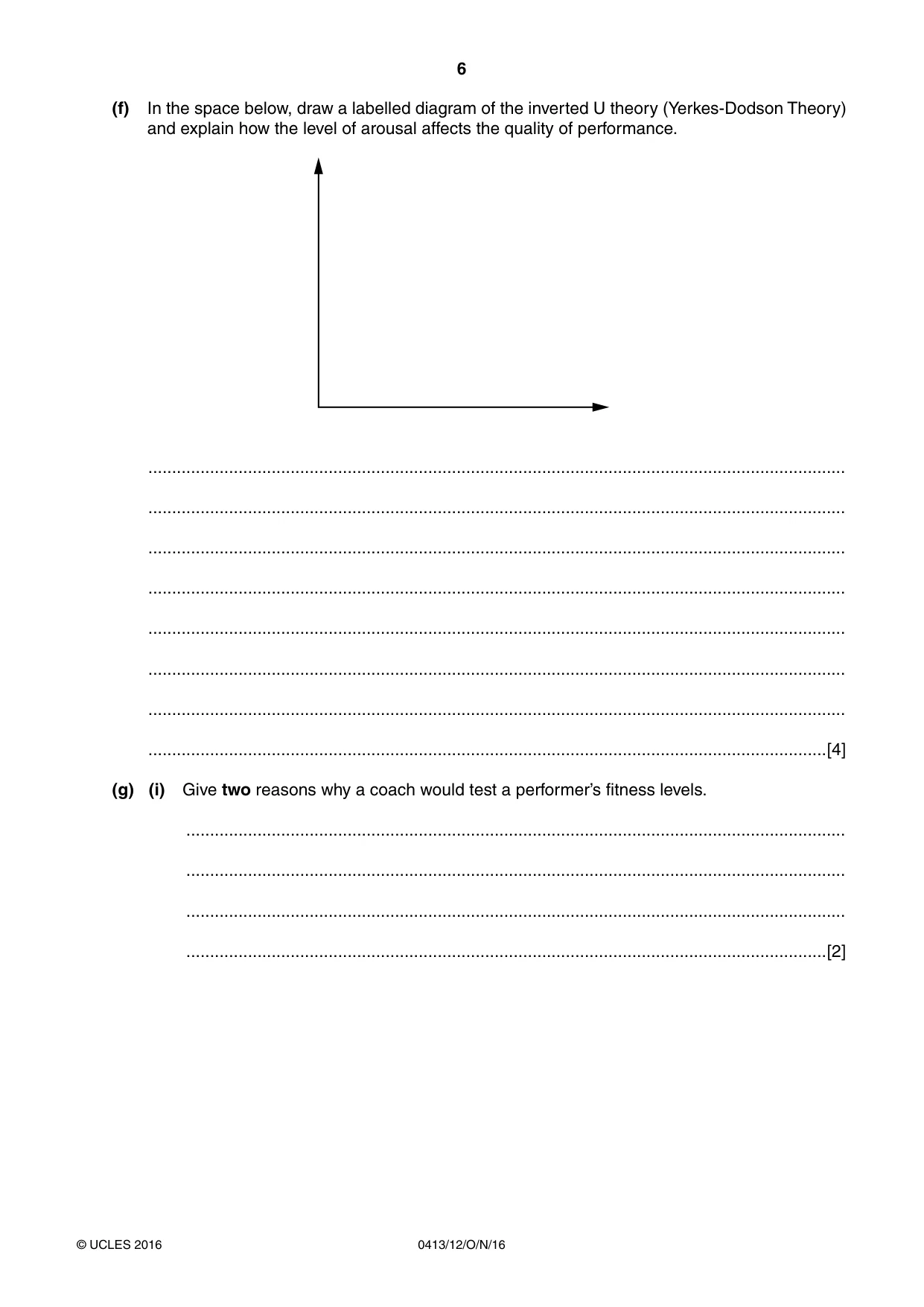
6 0413/12/O/N/16 © UCLES 2016 (f) In the space below, draw a labelled diagram of the inverted U theory (Yerkes-Dodson Theory) and explain how the level of arousal affects the quality of performance. … … … … … … … …[4] (g) (i) Give two reasons why a coach would test a performer’s fitness levels. … … … …[2]
Question paper, page 7
7 0413/12/O/N/16 © UCLES 2016 [Turn over (ii) Explain how different factors could affect the level of fitness of a performer. … … … … … … … … … …[4] [Total: 25]
Question paper, page 8
8 0413/12/O/N/16 © UCLES 2016 Unit 2 Health, safety and training 13 (a) Explain how good social well-being helps a performer when playing sport. … … … …[2] (b) Give two ways that a performer’s diet could help in the preparation for physical activity. … … … …[2] (c) Describe the negative effects on a performer of not taking part in a warm up before an activity. … … … … … …[3] (d) Describe the steps a schoolteacher would take to ensure the safety of the competitors when planning a contact sports event. … … … … … … … …[4]
Question paper, page 9
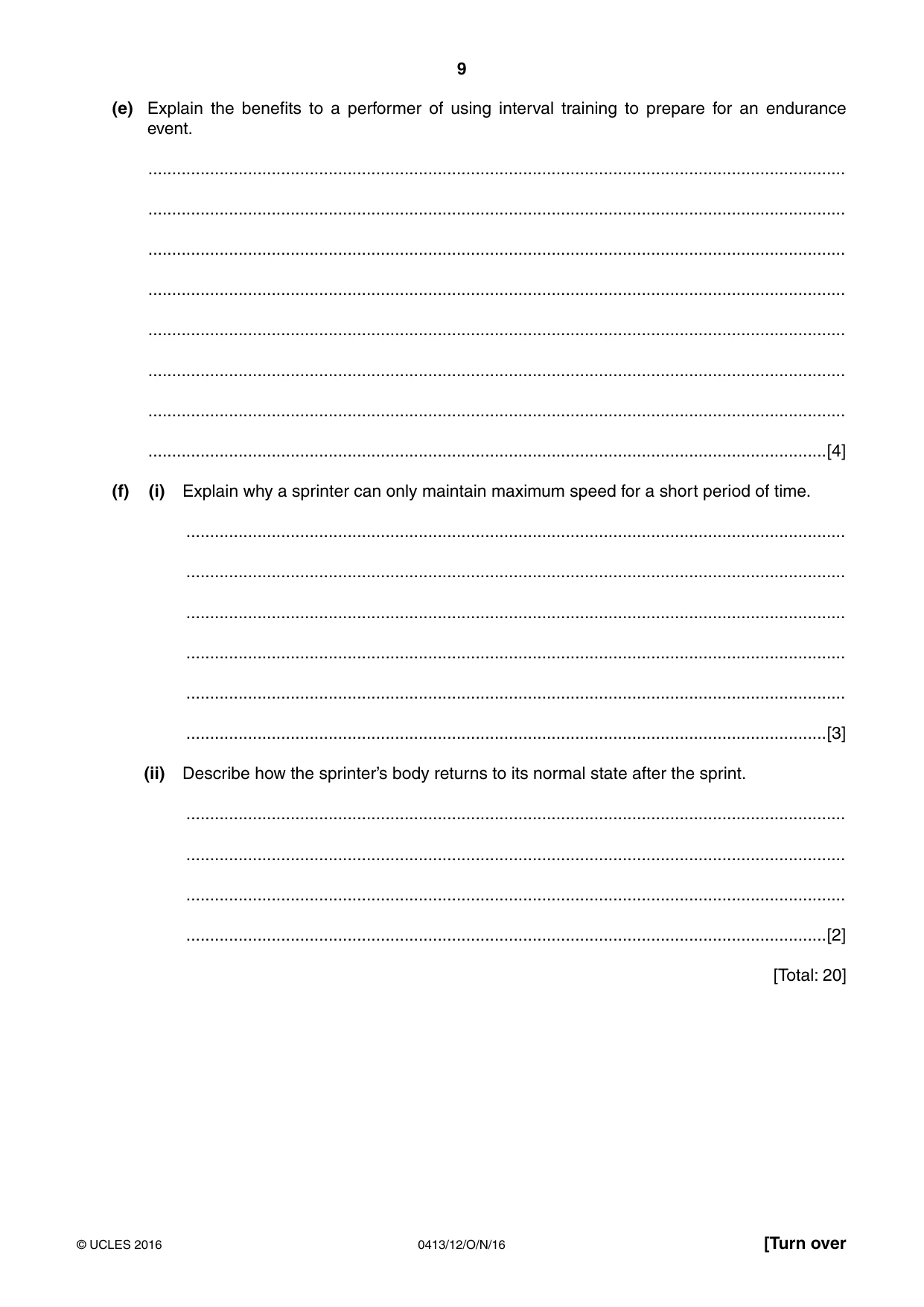
9 0413/12/O/N/16 © UCLES 2016 [Turn over (e) Explain the benefits to a performer of using interval training to prepare for an endurance event. … … … … … … … …[4] (f) (i) Explain why a sprinter can only maintain maximum speed for a short period of time. … … … … … …[3] (ii) Describe how the sprinter’s body returns to its normal state after the sprint. … … … …[2] [Total: 20]
Question paper, page 10
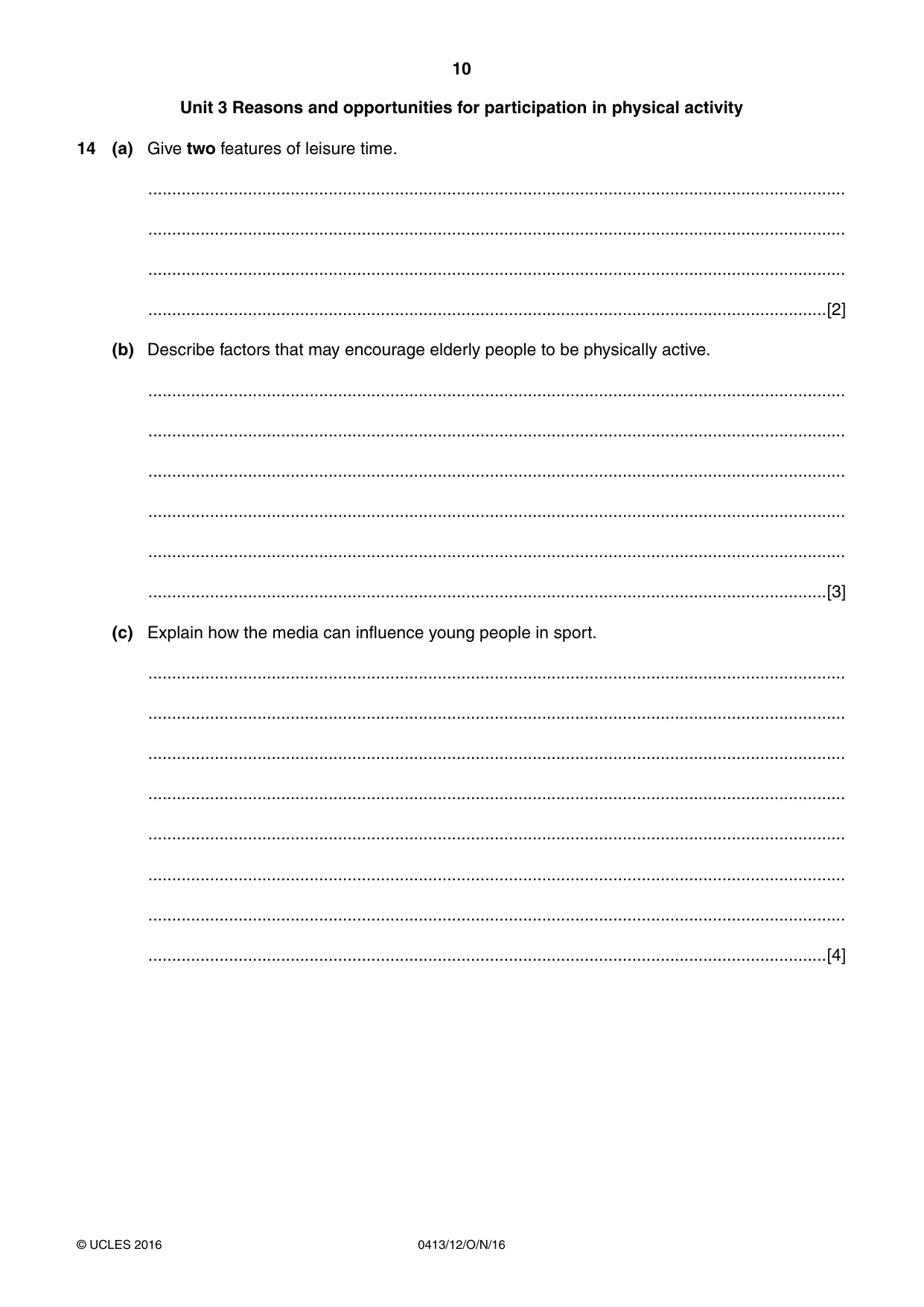
10 0413/12/O/N/16 © UCLES 2016 Unit 3 Reasons and opportunities for participation in physical activity 14 (a) Give two features of leisure time. … … … …[2] (b) Describe factors that may encourage elderly people to be physically active. … … … … … …[3] (c) Explain how the media can influence young people in sport. … … … … … … … …[4]
Question paper, page 11
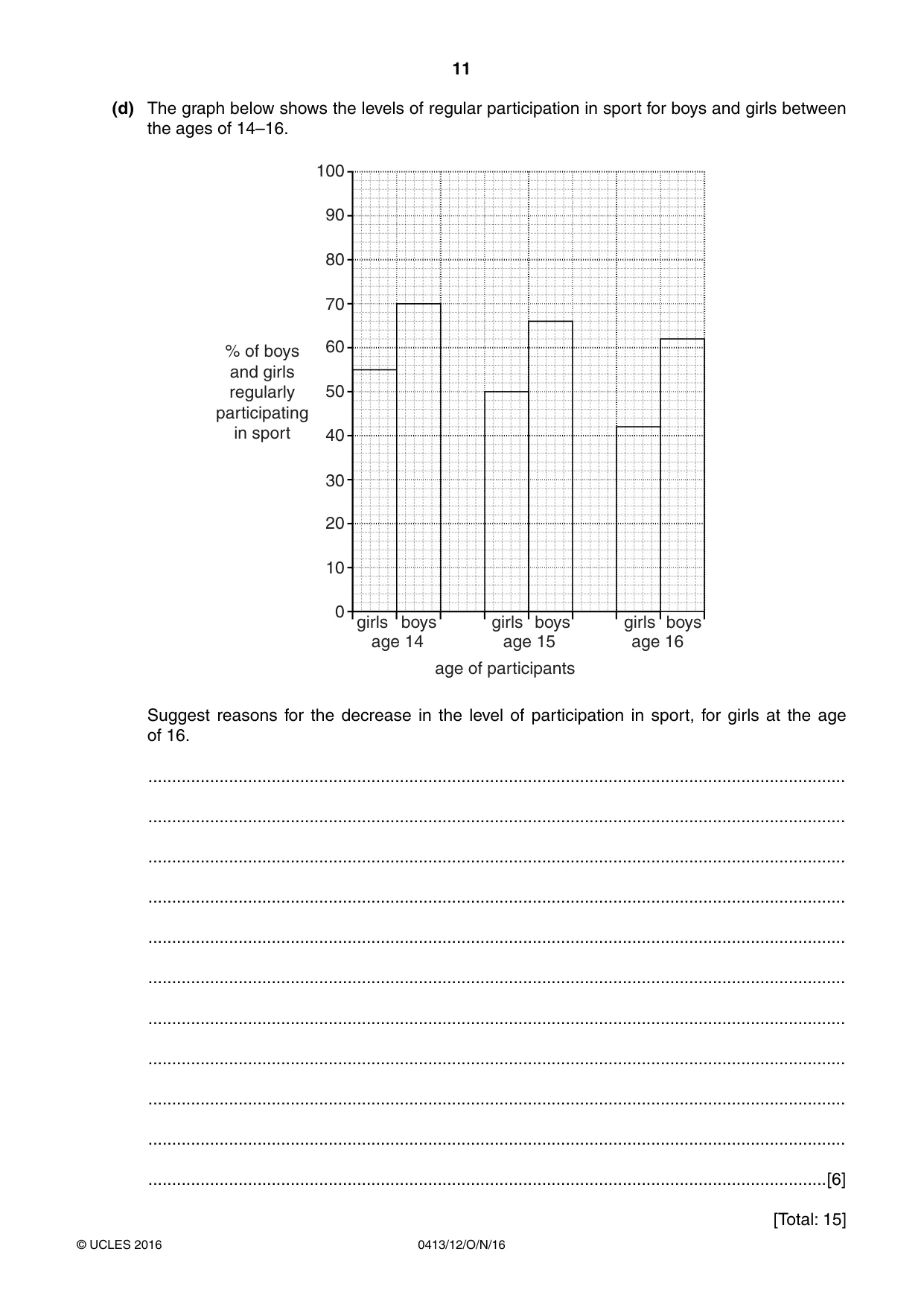
11 0413/12/O/N/16 © UCLES 2016 (d) The graph below shows the levels of regular participation in sport for boys and girls between the ages of 14–16. 0 10 20 30 40 50 60 70 % of boys and girls regularly participating in sport 80 90 100 girls boys age 14 age 15 age of participants age 16 girls boys girls boys Suggest reasons for the decrease in the level of participation in sport, for girls at the age of 16. … … … … … … … … … … …[6] [Total: 15]
Question paper, page 12
12 0413/12/O/N/16 © UCLES 2016 Permission to reproduce items where third-party owned material protected by copyright is included has been sought and cleared where possible. Every reasonable effort has been made by the publisher (UCLES) to trace copyright holders, but if any items requiring clearance have unwittingly been included, the publisher will be pleased to make amends at the earliest possible opportunity. To avoid the issue of disclosure of answer-related information to candidates, all copyright acknowledgements are reproduced online in the Cambridge International Examinations Copyright Acknowledgements Booklet. This is produced for each series of examinations and is freely available to download at www.cie.org.uk after the live examination series. Cambridge International Examinations is part of the Cambridge Assessment Group. Cambridge Assessment is the brand name of University of Cambridge Local Examinations Syndicate (UCLES), which is itself a department of the University of Cambridge. BLANK PAGE
Mark scheme, page 1
® IGCSE is the registered trademark of Cambridge International Examinations. This document consists of 13 printed pages. © UCLES 2016 [Turn over Cambridge International Examinations Cambridge International General Certificate of Secondary Education PHYSICAL EDUCATION 0413/12 Paper 1 October/November 2016 MARK SCHEME Maximum Mark: 80 Published This mark scheme is published as an aid to teachers and candidates, to indicate the requirements of the examination. It shows the basis on which Examiners were instructed to award marks. It does not indicate the details of the discussions that took place at an Examiners’ meeting before marking began, which would have considered the acceptability of alternative answers. Mark schemes should be read in conjunction with the question paper and the Principal Examiner Report for Teachers. Cambridge will not enter into discussions about these mark schemes. Cambridge is publishing the mark schemes for the October/November 2016 series for most Cambridge IGCSE®, Cambridge International A and AS Level components and some Cambridge O Level components.
Mark scheme, page 2
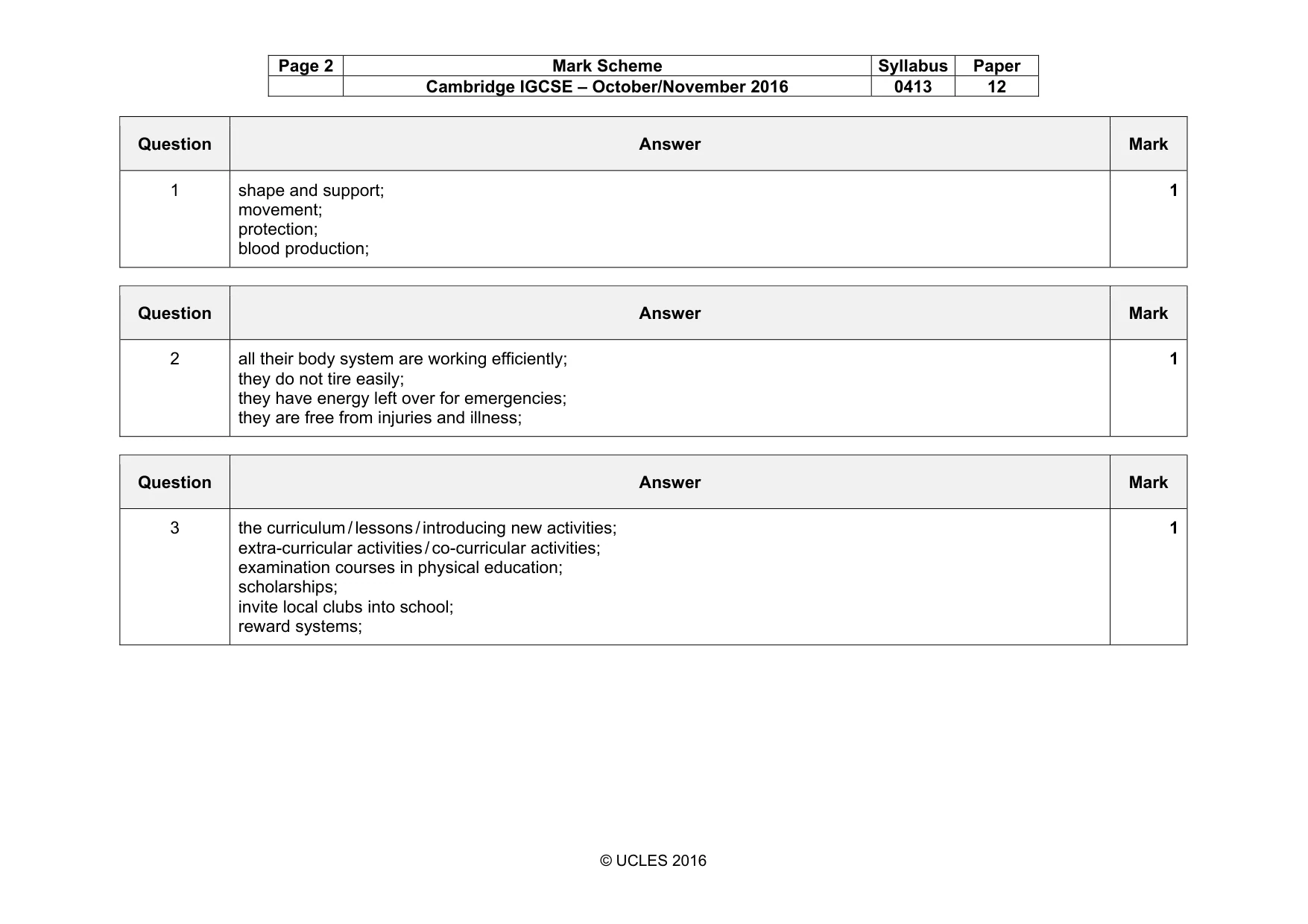
Page 2 Mark Scheme Syllabus Paper Cambridge IGCSE – October/November 2016 0413 12 © UCLES 2016 Question Answer Mark 1 shape and support; movement; protection; blood production; 1 Question Answer Mark 2 all their body system are working efficiently; they do not tire easily; they have energy left over for emergencies; they are free from injuries and illness; 1 Question Answer Mark 3 the curriculum / lessons / introducing new activities; extra-curricular activities / co-curricular activities; examination courses in physical education; scholarships; invite local clubs into school; reward systems; 1
Mark scheme, page 3
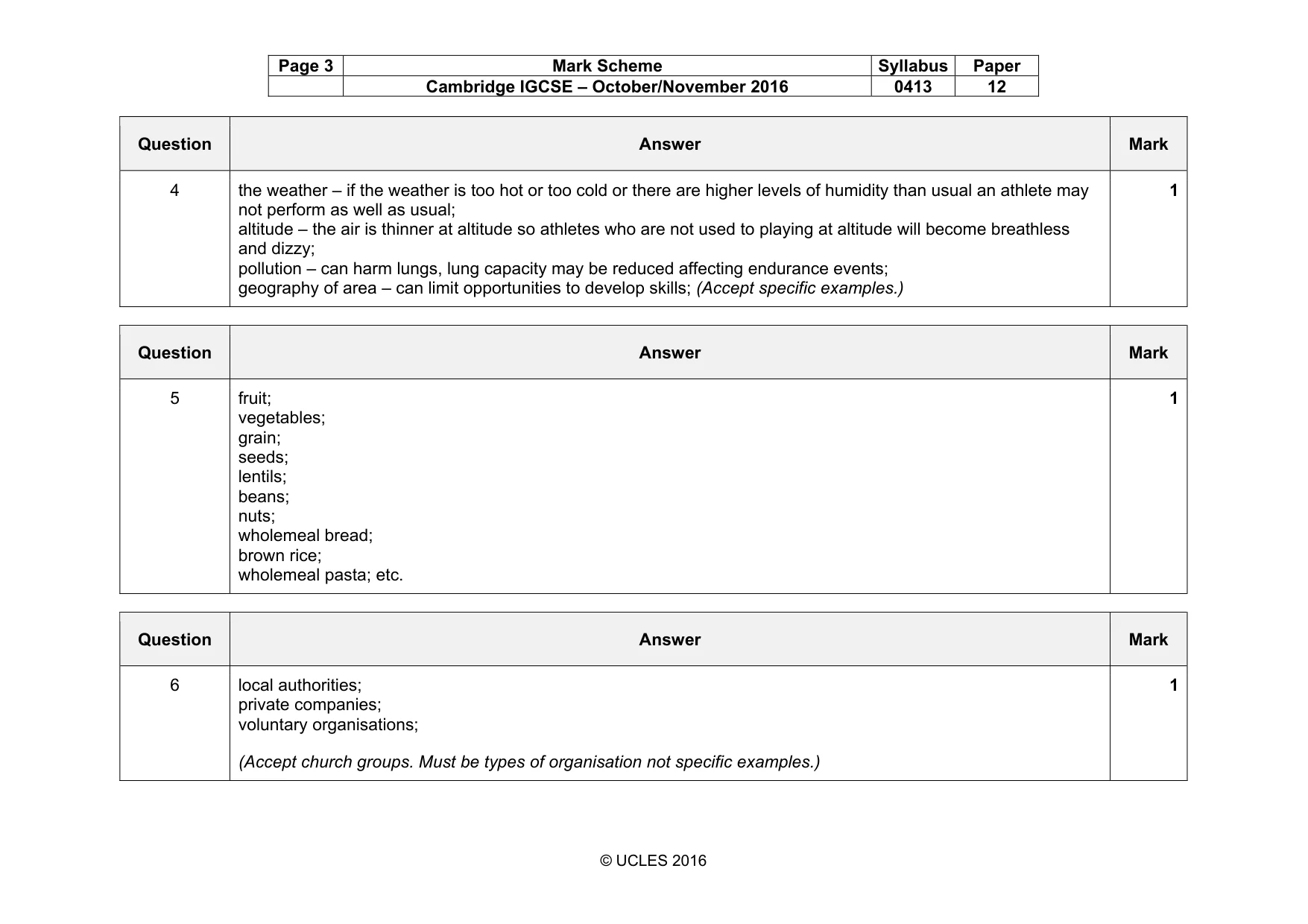
Page 3 Mark Scheme Syllabus Paper Cambridge IGCSE – October/November 2016 0413 12 © UCLES 2016 Question Answer Mark 4 the weather – if the weather is too hot or too cold or there are higher levels of humidity than usual an athlete may not perform as well as usual; altitude – the air is thinner at altitude so athletes who are not used to playing at altitude will become breathless and dizzy; pollution – can harm lungs, lung capacity may be reduced affecting endurance events; geography of area – can limit opportunities to develop skills; (Accept specific examples.) 1 Question Answer Mark 5 fruit; vegetables; grain; seeds; lentils; beans; nuts; wholemeal bread; brown rice; wholemeal pasta; etc. 1 Question Answer Mark 6 local authorities; private companies; voluntary organisations; (Accept church groups. Must be types of organisation not specific examples.) 1
Mark scheme, page 4
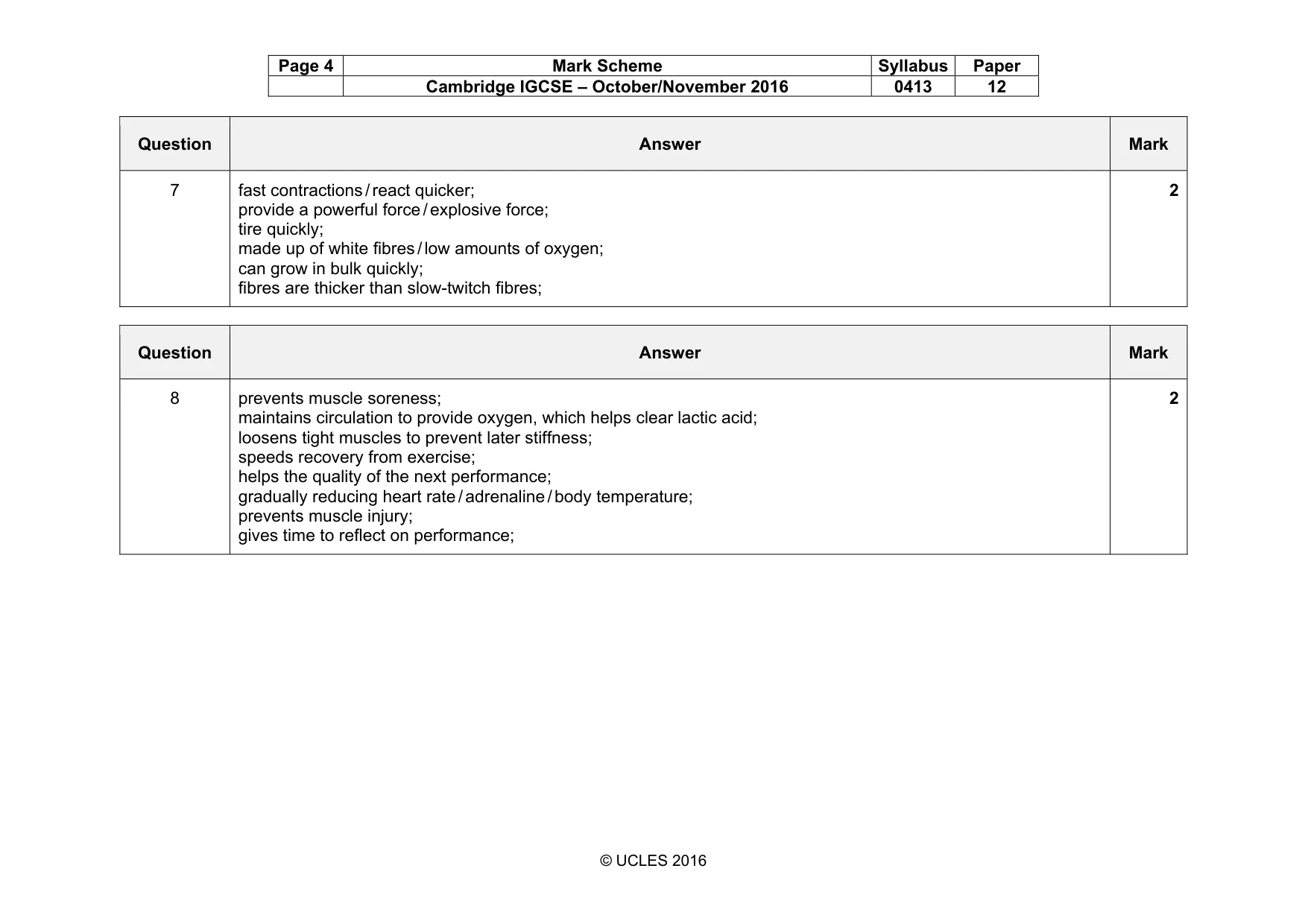
Page 4 Mark Scheme Syllabus Paper Cambridge IGCSE – October/November 2016 0413 12 © UCLES 2016 Question Answer Mark 7 fast contractions / react quicker; provide a powerful force / explosive force; tire quickly; made up of white fibres / low amounts of oxygen; can grow in bulk quickly; fibres are thicker than slow-twitch fibres; 2 Question Answer Mark 8 prevents muscle soreness; maintains circulation to provide oxygen, which helps clear lactic acid; loosens tight muscles to prevent later stiffness; speeds recovery from exercise; helps the quality of the next performance; gradually reducing heart rate / adrenaline / body temperature; prevents muscle injury; gives time to reflect on performance; 2
Mark scheme, page 5
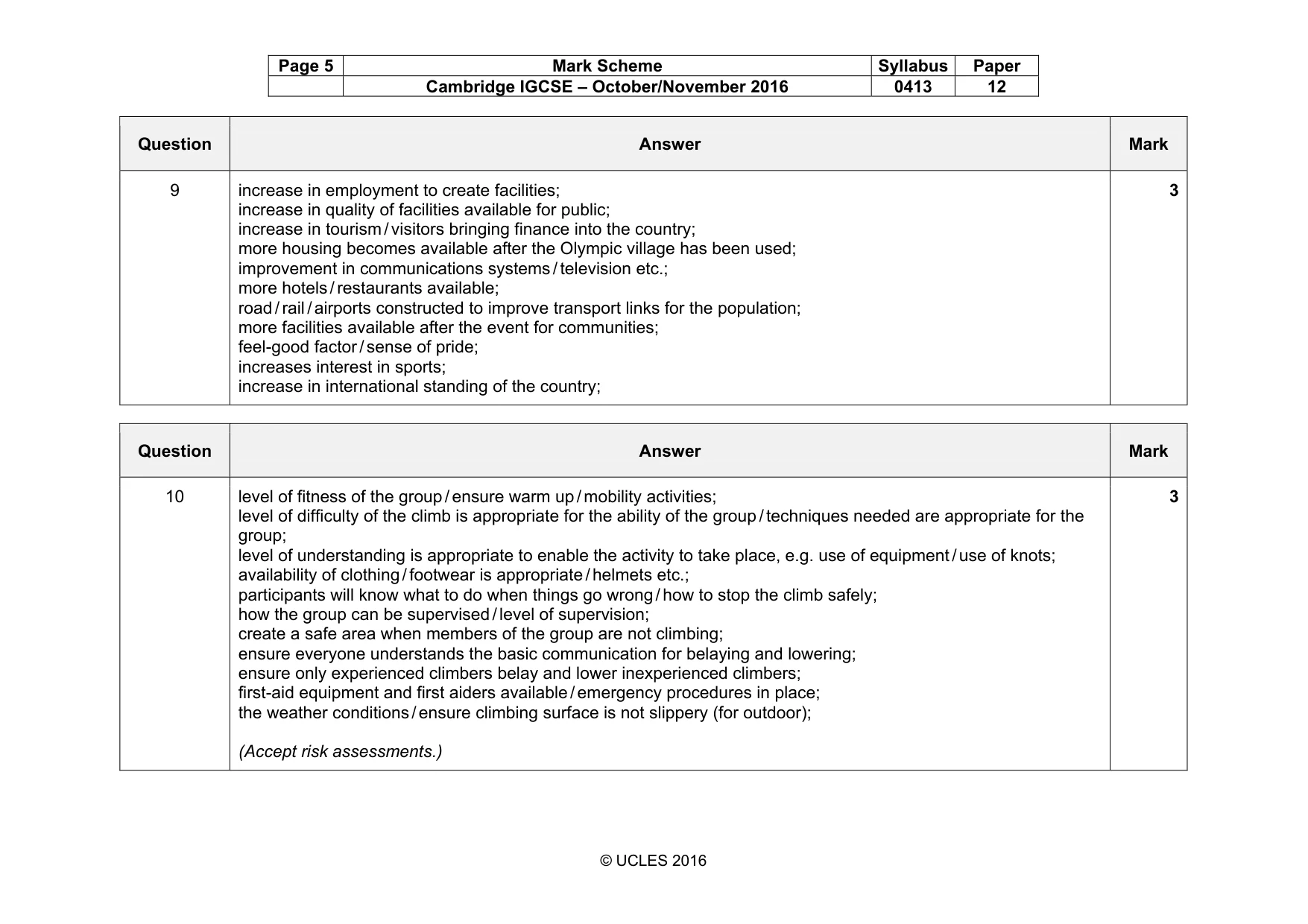
Page 5 Mark Scheme Syllabus Paper Cambridge IGCSE – October/November 2016 0413 12 © UCLES 2016 Question Answer Mark 9 increase in employment to create facilities; increase in quality of facilities available for public; increase in tourism / visitors bringing finance into the country; more housing becomes available after the Olympic village has been used; improvement in communications systems / television etc.; more hotels / restaurants available; road / rail / airports constructed to improve transport links for the population; more facilities available after the event for communities; feel-good factor / sense of pride; increases interest in sports; increase in international standing of the country; 3 Question Answer Mark 10 level of fitness of the group / ensure warm up / mobility activities; level of difficulty of the climb is appropriate for the ability of the group / techniques needed are appropriate for the group; level of understanding is appropriate to enable the activity to take place, e.g. use of equipment / use of knots; availability of clothing / footwear is appropriate / helmets etc.; participants will know what to do when things go wrong / how to stop the climb safely; how the group can be supervised / level of supervision; create a safe area when members of the group are not climbing; ensure everyone understands the basic communication for belaying and lowering; ensure only experienced climbers belay and lower inexperienced climbers; first-aid equipment and first aiders available / emergency procedures in place; the weather conditions / ensure climbing surface is not slippery (for outdoor); (Accept risk assessments.) 3
Mark scheme, page 6
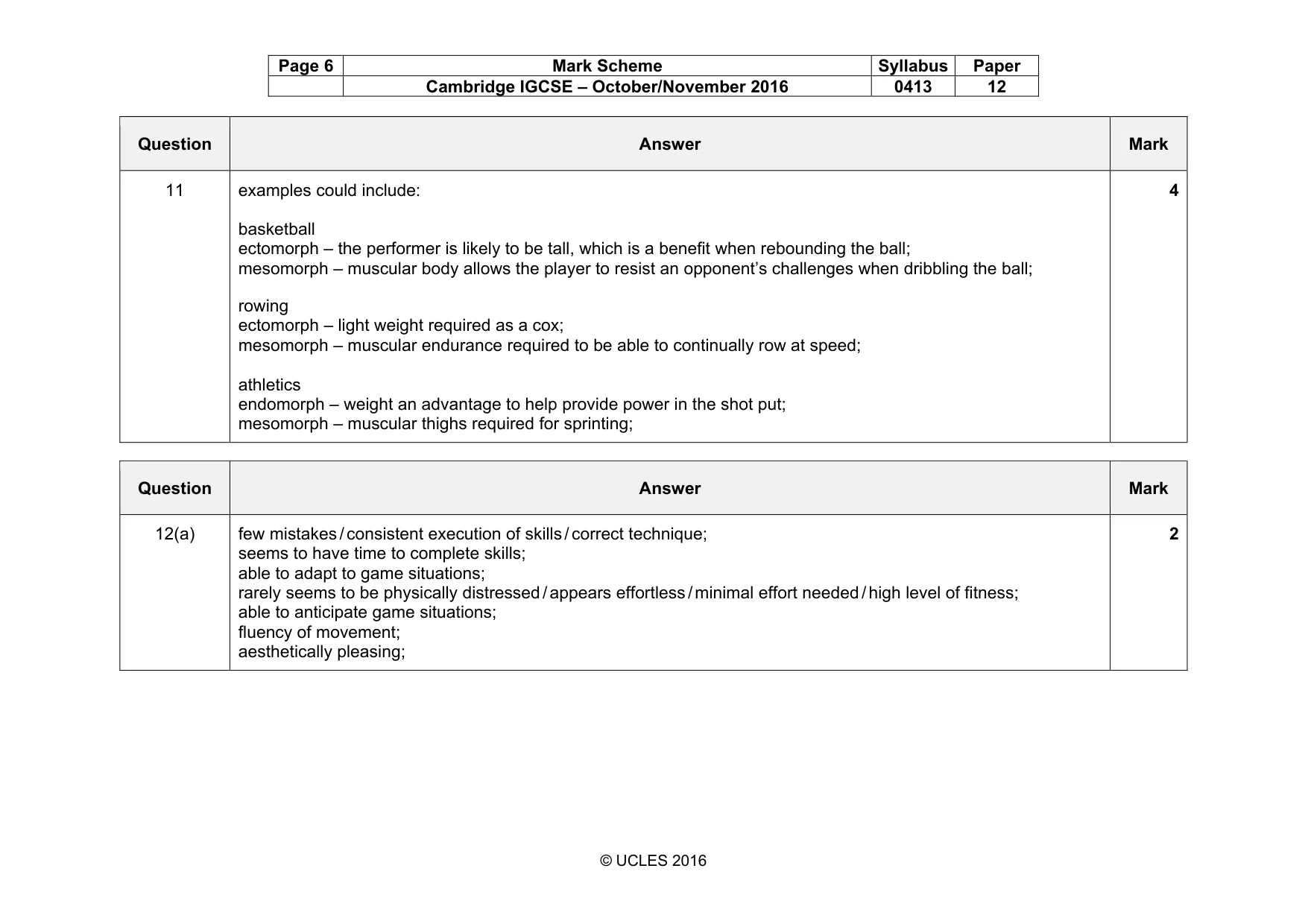
Page 6 Mark Scheme Syllabus Paper Cambridge IGCSE – October/November 2016 0413 12 © UCLES 2016 Question Answer Mark 11 examples could include: basketball ectomorph – the performer is likely to be tall, which is a benefit when rebounding the ball; mesomorph – muscular body allows the player to resist an opponent’s challenges when dribbling the ball; rowing ectomorph – light weight required as a cox; mesomorph – muscular endurance required to be able to continually row at speed; athletics endomorph – weight an advantage to help provide power in the shot put; mesomorph – muscular thighs required for sprinting; 4 Question Answer Mark 12(a) few mistakes / consistent execution of skills / correct technique; seems to have time to complete skills; able to adapt to game situations; rarely seems to be physically distressed / appears effortless / minimal effort needed / high level of fitness; able to anticipate game situations; fluency of movement; aesthetically pleasing; 2
Mark scheme, page 7
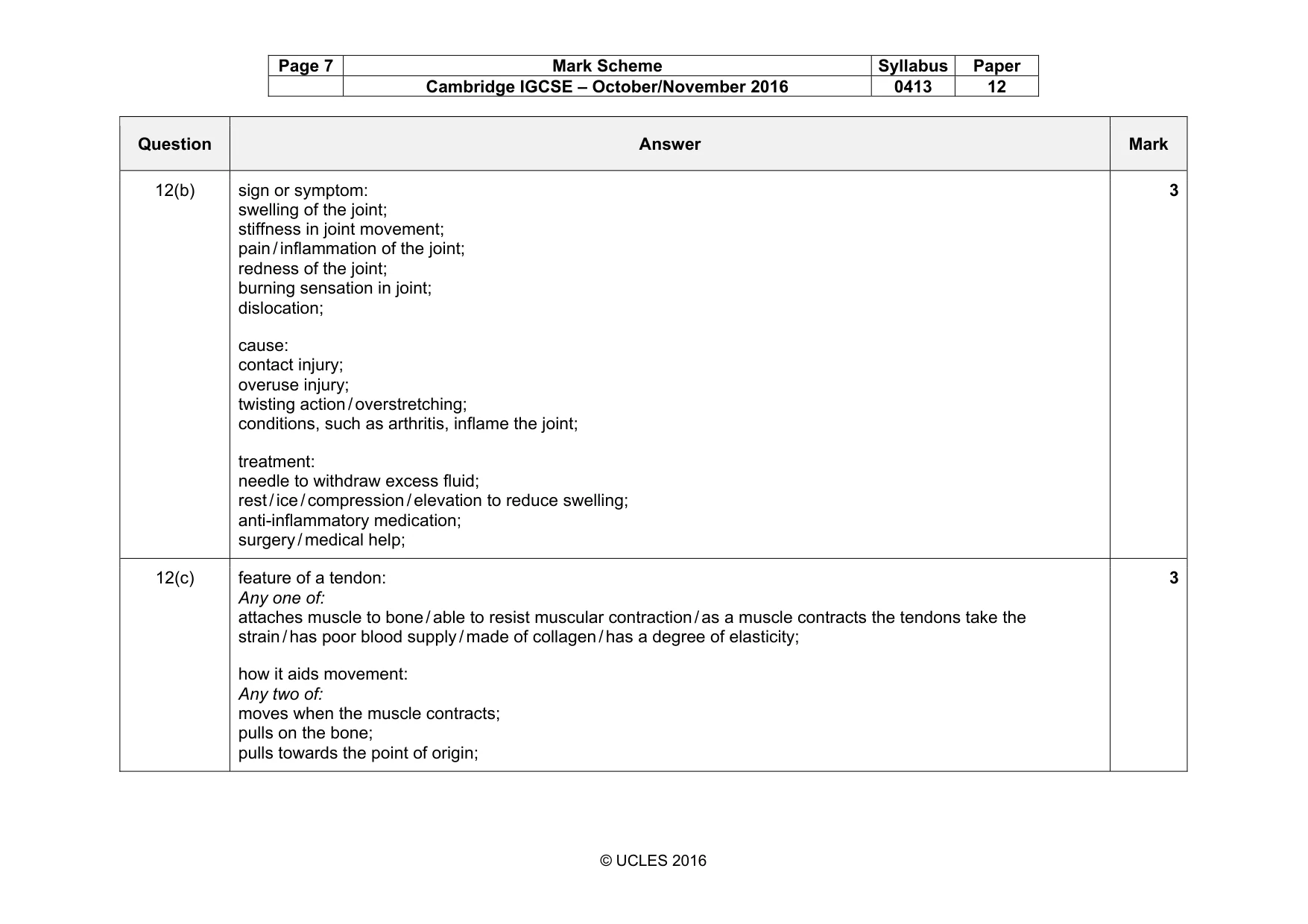
Page 7 Mark Scheme Syllabus Paper Cambridge IGCSE – October/November 2016 0413 12 © UCLES 2016 Question Answer Mark 12(b) sign or symptom: swelling of the joint; stiffness in joint movement; pain / inflammation of the joint; redness of the joint; burning sensation in joint; dislocation; cause: contact injury; overuse injury; twisting action / overstretching; conditions, such as arthritis, inflame the joint; treatment: needle to withdraw excess fluid; rest / ice / compression / elevation to reduce swelling; anti-inflammatory medication; surgery / medical help; 3 12(c) feature of a tendon: Any one of: attaches muscle to bone / able to resist muscular contraction / as a muscle contracts the tendons take the strain / has poor blood supply / made of collagen / has a degree of elasticity; how it aids movement: Any two of: moves when the muscle contracts; pulls on the bone; pulls towards the point of origin; 3
Mark scheme, page 8
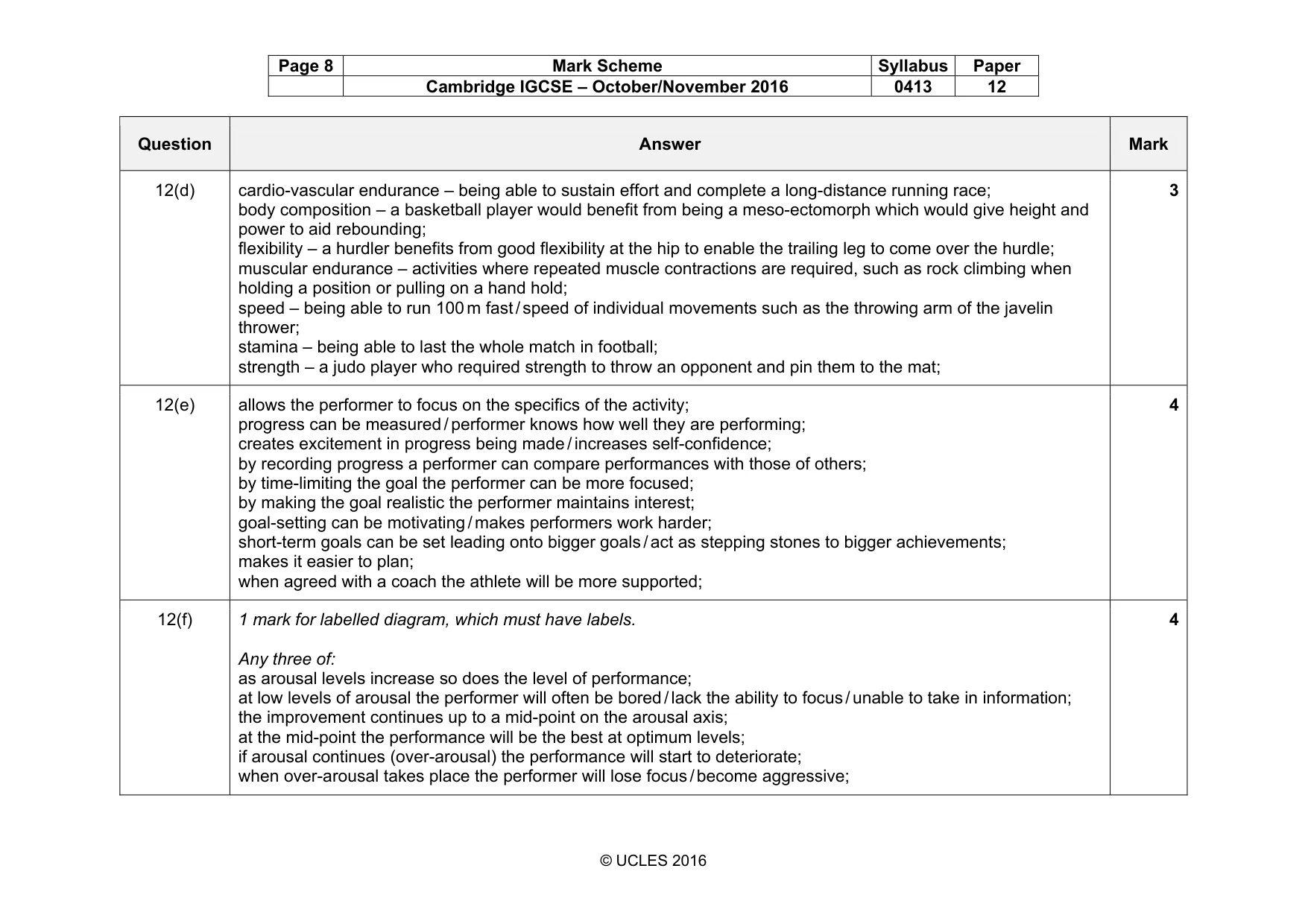
Page 8 Mark Scheme Syllabus Paper Cambridge IGCSE – October/November 2016 0413 12 © UCLES 2016 Question Answer Mark 12(d) cardio-vascular endurance – being able to sustain effort and complete a long-distance running race; body composition – a basketball player would benefit from being a meso-ectomorph which would give height and power to aid rebounding; flexibility – a hurdler benefits from good flexibility at the hip to enable the trailing leg to come over the hurdle; muscular endurance – activities where repeated muscle contractions are required, such as rock climbing when holding a position or pulling on a hand hold; speed – being able to run 100 m fast / speed of individual movements such as the throwing arm of the javelin thrower; stamina – being able to last the whole match in football; strength – a judo player who required strength to throw an opponent and pin them to the mat; 3 12(e) allows the performer to focus on the specifics of the activity; progress can be measured / performer knows how well they are performing; creates excitement in progress being made / increases self-confidence; by recording progress a performer can compare performances with those of others; by time-limiting the goal the performer can be more focused; by making the goal realistic the performer maintains interest; goal-setting can be motivating / makes performers work harder; short-term goals can be set leading onto bigger goals / act as stepping stones to bigger achievements; makes it easier to plan; when agreed with a coach the athlete will be more supported; 4 12(f) 1 mark for labelled diagram, which must have labels. Any three of: as arousal levels increase so does the level of performance; at low levels of arousal the performer will often be bored / lack the ability to focus / unable to take in information; the improvement continues up to a mid-point on the arousal axis; at the mid-point the performance will be the best at optimum levels; if arousal continues (over-arousal) the performance will start to deteriorate; when over-arousal takes place the performer will lose focus / become aggressive; 4
Mark scheme, page 9
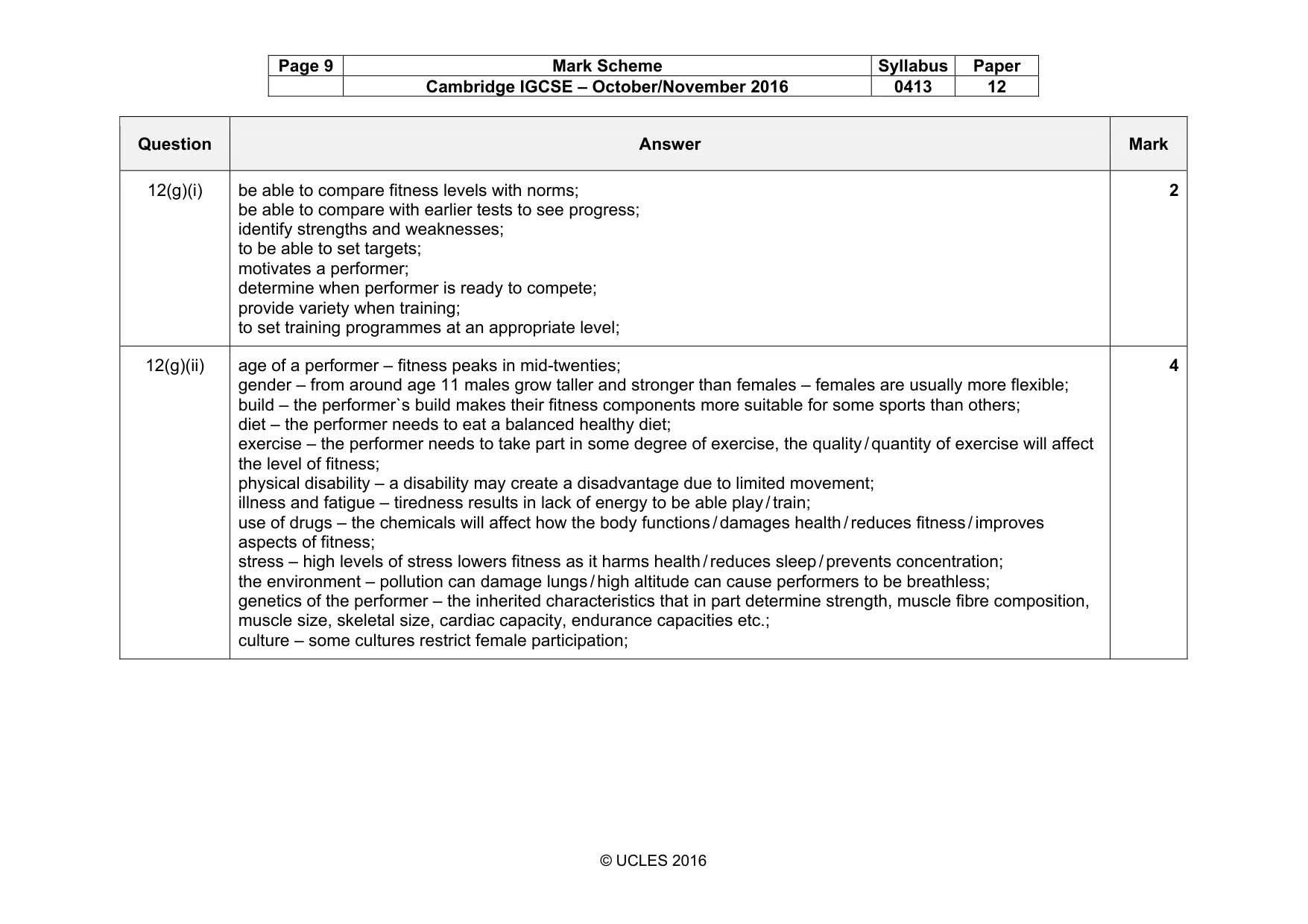
Page 9 Mark Scheme Syllabus Paper Cambridge IGCSE – October/November 2016 0413 12 © UCLES 2016 Question Answer Mark 12(g)(i) be able to compare fitness levels with norms; be able to compare with earlier tests to see progress; identify strengths and weaknesses; to be able to set targets; motivates a performer; determine when performer is ready to compete; provide variety when training; to set training programmes at an appropriate level; 2 12(g)(ii) age of a performer – fitness peaks in mid-twenties; gender – from around age 11 males grow taller and stronger than females – females are usually more flexible; build – the performer`s build makes their fitness components more suitable for some sports than others; diet – the performer needs to eat a balanced healthy diet; exercise – the performer needs to take part in some degree of exercise, the quality / quantity of exercise will affect the level of fitness; physical disability – a disability may create a disadvantage due to limited movement; illness and fatigue – tiredness results in lack of energy to be able play / train; use of drugs – the chemicals will affect how the body functions / damages health / reduces fitness / improves aspects of fitness; stress – high levels of stress lowers fitness as it harms health / reduces sleep / prevents concentration; the environment – pollution can damage lungs / high altitude can cause performers to be breathless; genetics of the performer – the inherited characteristics that in part determine strength, muscle fibre composition, muscle size, skeletal size, cardiac capacity, endurance capacities etc.; culture – some cultures restrict female participation; 4
Mark scheme, page 10
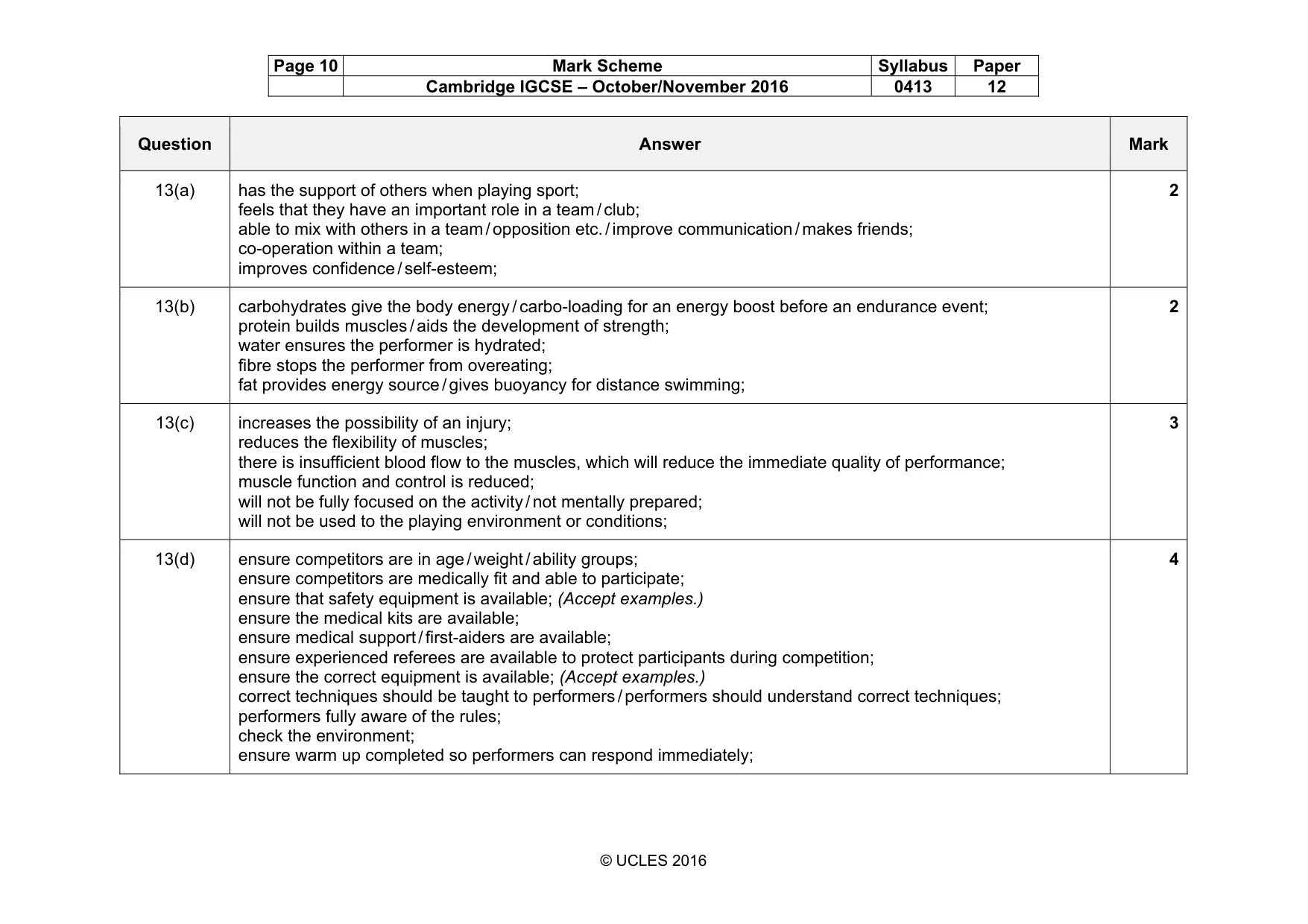
Page 10 Mark Scheme Syllabus Paper Cambridge IGCSE – October/November 2016 0413 12 © UCLES 2016 Question Answer Mark 13(a) has the support of others when playing sport; feels that they have an important role in a team / club; able to mix with others in a team / opposition etc. / improve communication / makes friends; co-operation within a team; improves confidence / self-esteem; 2 13(b) carbohydrates give the body energy / carbo-loading for an energy boost before an endurance event; protein builds muscles / aids the development of strength; water ensures the performer is hydrated; fibre stops the performer from overeating; fat provides energy source / gives buoyancy for distance swimming; 2 13(c) increases the possibility of an injury; reduces the flexibility of muscles; there is insufficient blood flow to the muscles, which will reduce the immediate quality of performance; muscle function and control is reduced; will not be fully focused on the activity / not mentally prepared; will not be used to the playing environment or conditions; 3 13(d) ensure competitors are in age / weight / ability groups; ensure competitors are medically fit and able to participate; ensure that safety equipment is available; (Accept examples.) ensure the medical kits are available; ensure medical support / first-aiders are available; ensure experienced referees are available to protect participants during competition; ensure the correct equipment is available; (Accept examples.) correct techniques should be taught to performers / performers should understand correct techniques; performers fully aware of the rules; check the environment; ensure warm up completed so performers can respond immediately; 4
Mark scheme, page 11
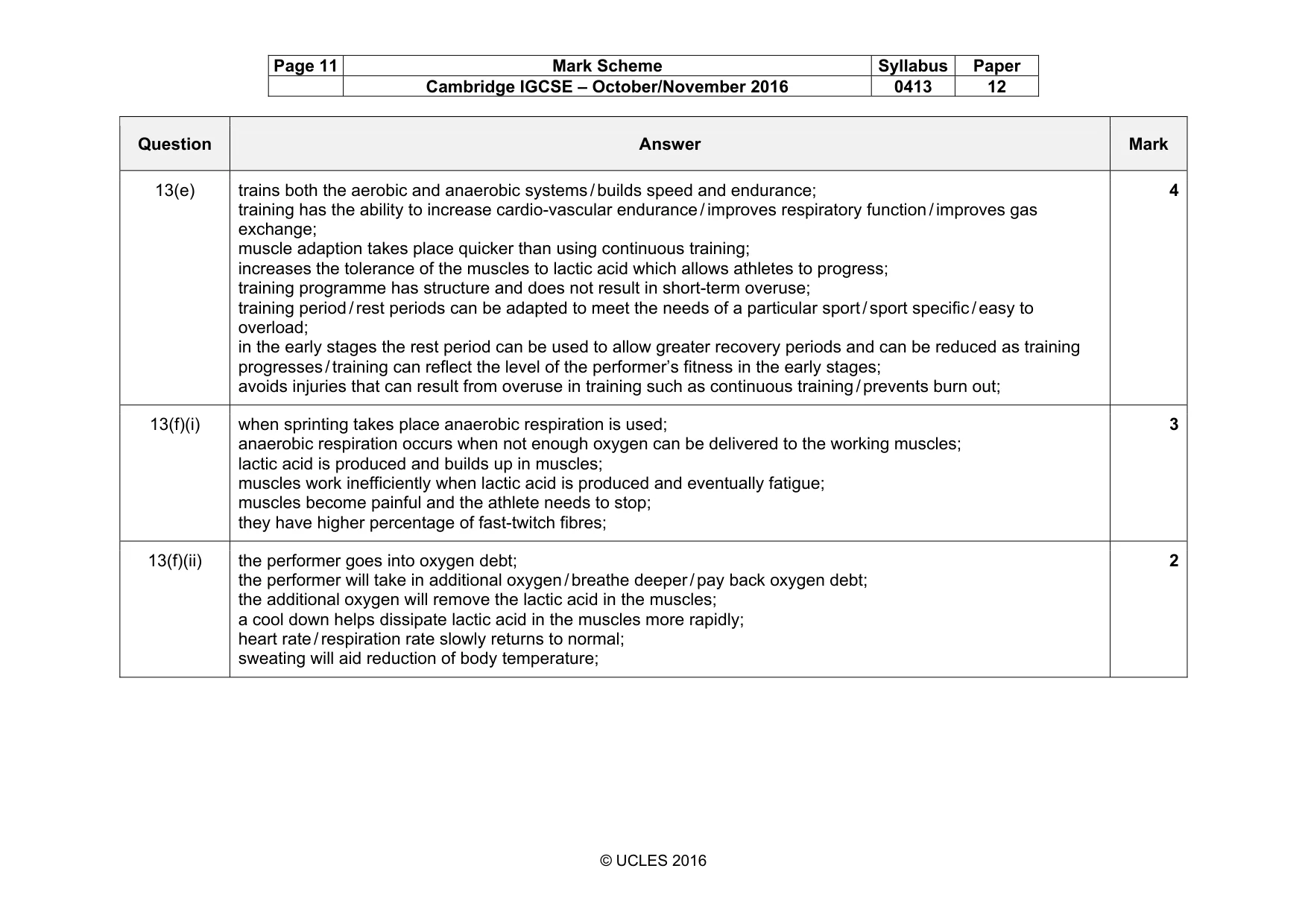
Page 11 Mark Scheme Syllabus Paper Cambridge IGCSE – October/November 2016 0413 12 © UCLES 2016 Question Answer Mark 13(e) trains both the aerobic and anaerobic systems / builds speed and endurance; training has the ability to increase cardio-vascular endurance / improves respiratory function / improves gas exchange; muscle adaption takes place quicker than using continuous training; increases the tolerance of the muscles to lactic acid which allows athletes to progress; training programme has structure and does not result in short-term overuse; training period / rest periods can be adapted to meet the needs of a particular sport / sport specific / easy to overload; in the early stages the rest period can be used to allow greater recovery periods and can be reduced as training progresses / training can reflect the level of the performer’s fitness in the early stages; avoids injuries that can result from overuse in training such as continuous training / prevents burn out; 4 13(f)(i) when sprinting takes place anaerobic respiration is used; anaerobic respiration occurs when not enough oxygen can be delivered to the working muscles; lactic acid is produced and builds up in muscles; muscles work inefficiently when lactic acid is produced and eventually fatigue; muscles become painful and the athlete needs to stop; they have higher percentage of fast-twitch fibres; 3 13(f)(ii) the performer goes into oxygen debt; the performer will take in additional oxygen / breathe deeper / pay back oxygen debt; the additional oxygen will remove the lactic acid in the muscles; a cool down helps dissipate lactic acid in the muscles more rapidly; heart rate / respiration rate slowly returns to normal; sweating will aid reduction of body temperature; 2
Mark scheme, page 12
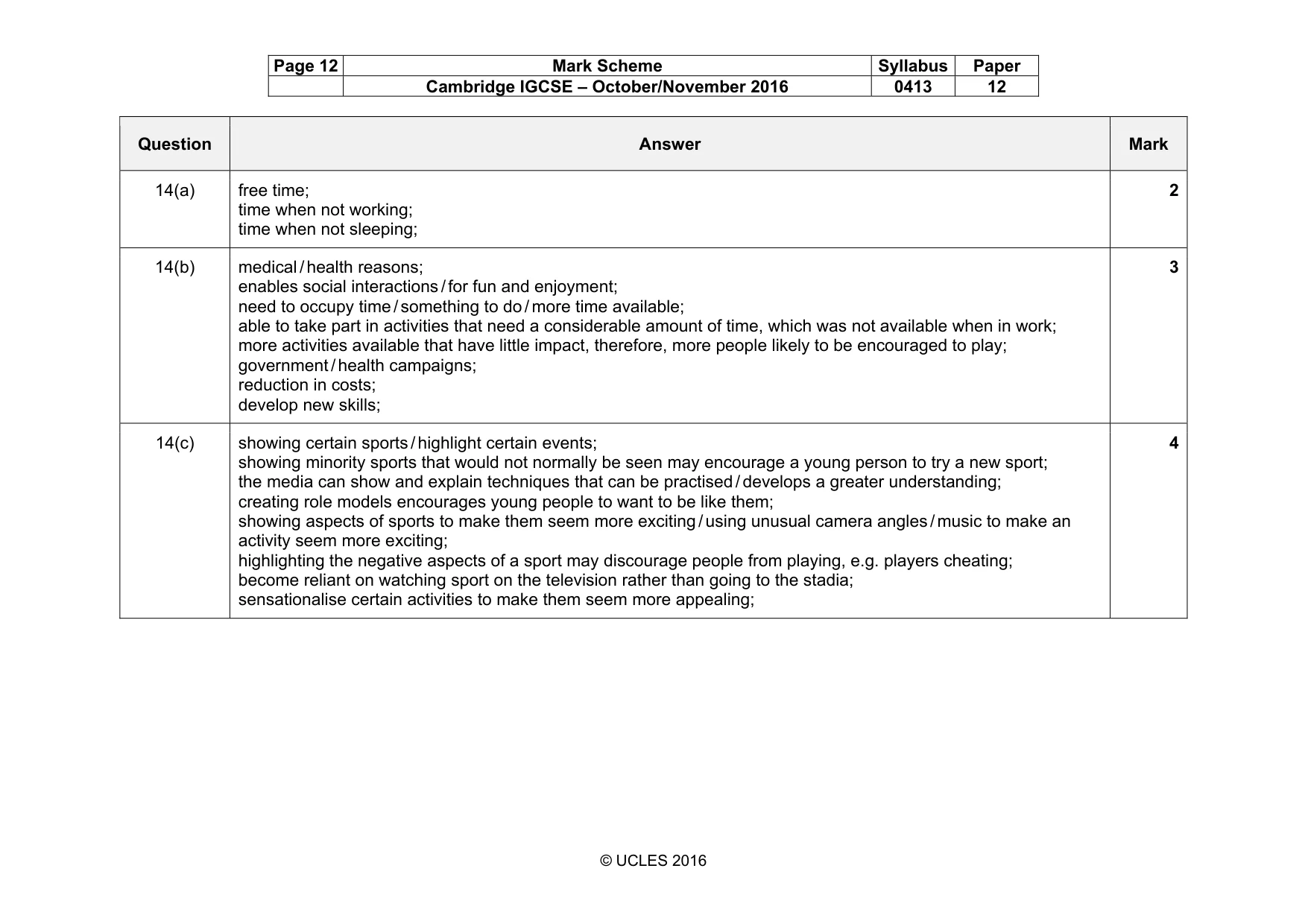
Page 12 Mark Scheme Syllabus Paper Cambridge IGCSE – October/November 2016 0413 12 © UCLES 2016 Question Answer Mark 14(a) free time; time when not working; time when not sleeping; 2 14(b) medical / health reasons; enables social interactions / for fun and enjoyment; need to occupy time / something to do / more time available; able to take part in activities that need a considerable amount of time, which was not available when in work; more activities available that have little impact, therefore, more people likely to be encouraged to play; government / health campaigns; reduction in costs; develop new skills; 3 14(c) showing certain sports / highlight certain events; showing minority sports that would not normally be seen may encourage a young person to try a new sport; the media can show and explain techniques that can be practised / develops a greater understanding; creating role models encourages young people to want to be like them; showing aspects of sports to make them seem more exciting / using unusual camera angles / music to make an activity seem more exciting; highlighting the negative aspects of a sport may discourage people from playing, e.g. players cheating; become reliant on watching sport on the television rather than going to the stadia; sensationalise certain activities to make them seem more appealing; 4
Mark scheme, page 13
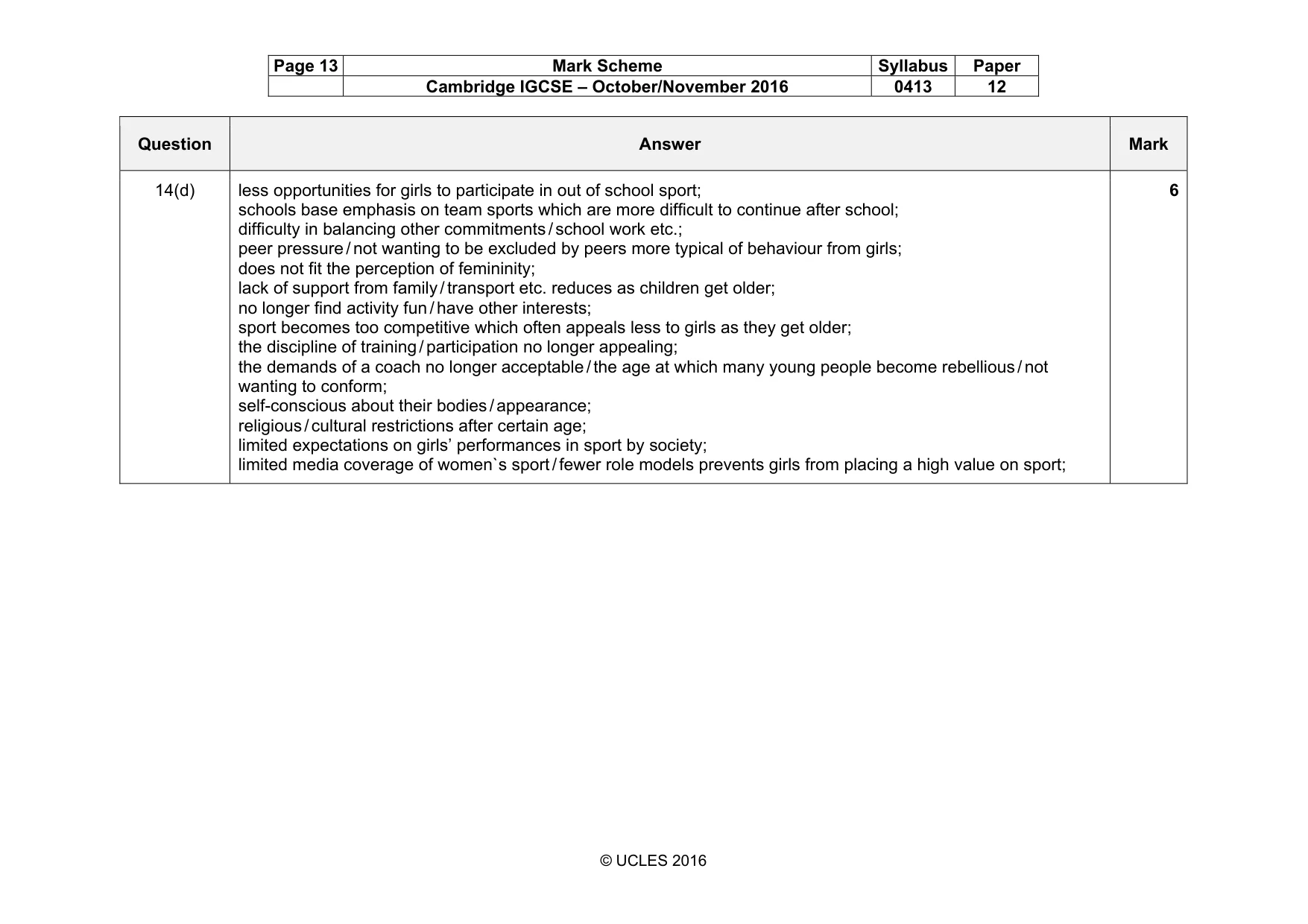
Page 13 Mark Scheme Syllabus Paper Cambridge IGCSE – October/November 2016 0413 12 © UCLES 2016 Question Answer Mark 14(d) less opportunities for girls to participate in out of school sport; schools base emphasis on team sports which are more difficult to continue after school; difficulty in balancing other commitments / school work etc.; peer pressure / not wanting to be excluded by peers more typical of behaviour from girls; does not fit the perception of femininity; lack of support from family / transport etc. reduces as children get older; no longer find activity fun / have other interests; sport becomes too competitive which often appeals less to girls as they get older; the discipline of training / participation no longer appealing; the demands of a coach no longer acceptable / the age at which many young people become rebellious / not wanting to conform; self-conscious about their bodies / appearance; religious / cultural restrictions after certain age; limited expectations on girls’ performances in sport by society; limited media coverage of women`s sport / fewer role models prevents girls from placing a high value on sport; 6
What you needed in this session
Cambridge’s own grade thresholds for 2016 Oct/Nov, Paper 1 · Variant 2. A higher threshold means an easier paper — the bar moves with how the cohort did.