Cambridge IGCSE Physical Education 0413 — 2016 Oct/Nov Paper 1 · Variant 1
0413/11/O/N/16 · 80 marks · ≈90 min
The question paper and its mark scheme, free to read here and free to download. This is Cambridge’s own paper, exactly as it was sat.
Question paper12 pages
Mark scheme15 pages
Answers below. Sit the paper first if you are practising.
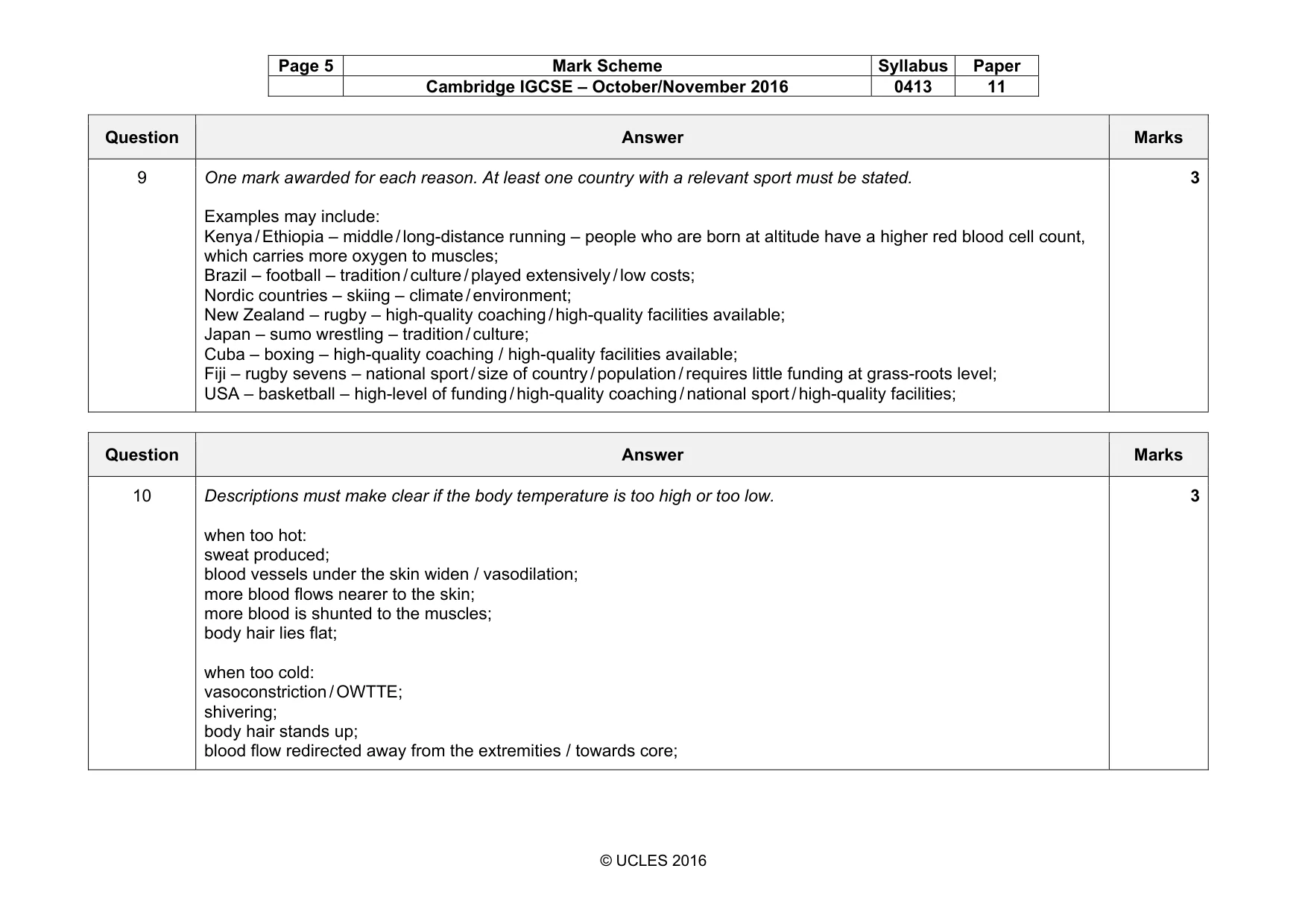
Paper as text
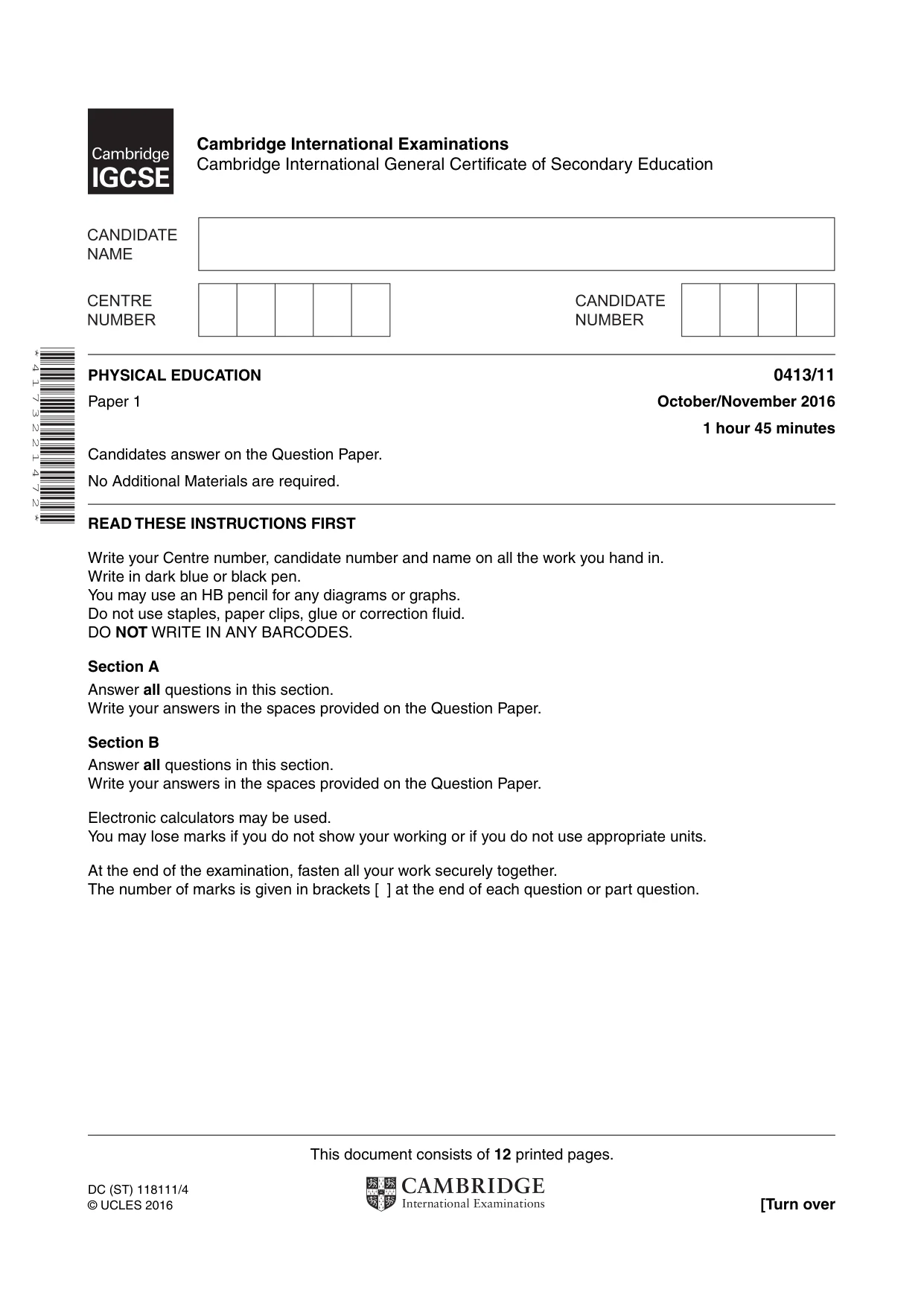
Question paper, page 1
This document consists of 12 printed pages. DC (ST) 118111/4 © UCLES 2016 [Turn over Cambridge International Examinations Cambridge International General Certificate of Secondary Education * 4 1 7 3 2 2 1 4 7 2 * PHYSICAL EDUCATION 0413/11 Paper 1 October/November 2016 1 hour 45 minutes Candidates answer on the Question Paper. No Additional Materials are required. READ THESE INSTRUCTIONS FIRST Write your Centre number, candidate number and name on all the work you hand in. Write in dark blue or black pen. You may use an HB pencil for any diagrams or graphs. Do not use staples, paper clips, glue or correction fluid. DO NOT WRITE IN ANY BARCODES. Section A Answer all questions in this section. Write your answers in the spaces provided on the Question Paper. Section B Answer all questions in this section. Write your answers in the spaces provided on the Question Paper. Electronic calculators may be used. You may lose marks if you do not show your working or if you do not use appropriate units. At the end of the examination, fasten all your work securely together. The number of marks is given in brackets [ ] at the end of each question or part question.
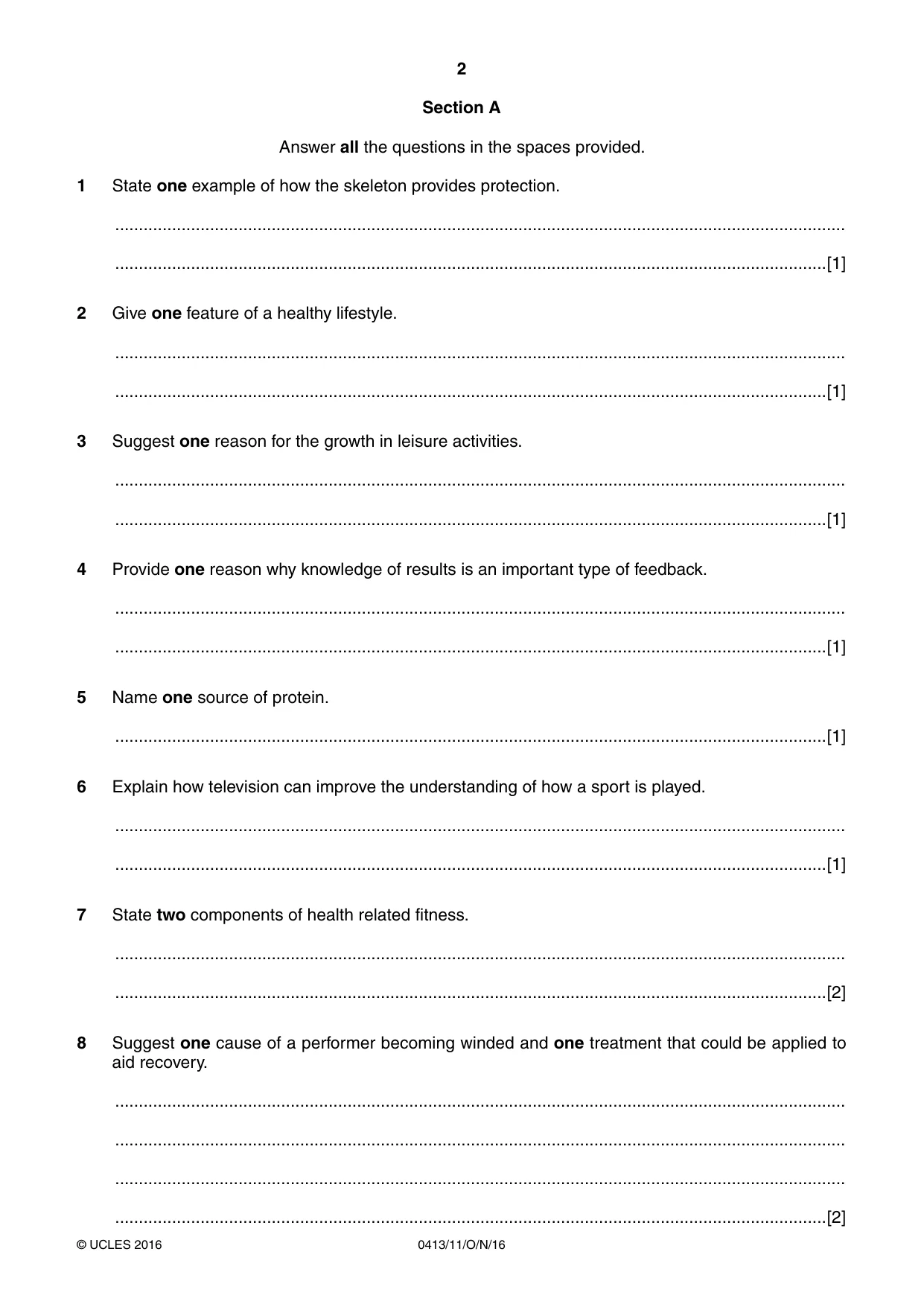
Question paper, page 2
2 0413/11/O/N/16 © UCLES 2016 Section A Answer all the questions in the spaces provided. 1 State one example of how the skeleton provides protection. … …[1] 2 Give one feature of a healthy lifestyle. … …[1] 3 Suggest one reason for the growth in leisure activities. … …[1] 4 Provide one reason why knowledge of results is an important type of feedback. … …[1] 5 Name one source of protein. …[1] 6 Explain how television can improve the understanding of how a sport is played. … …[1] 7 State two components of health related fitness. … …[2] 8 Suggest one cause of a performer becoming winded and one treatment that could be applied to aid recovery. … … … …[2]
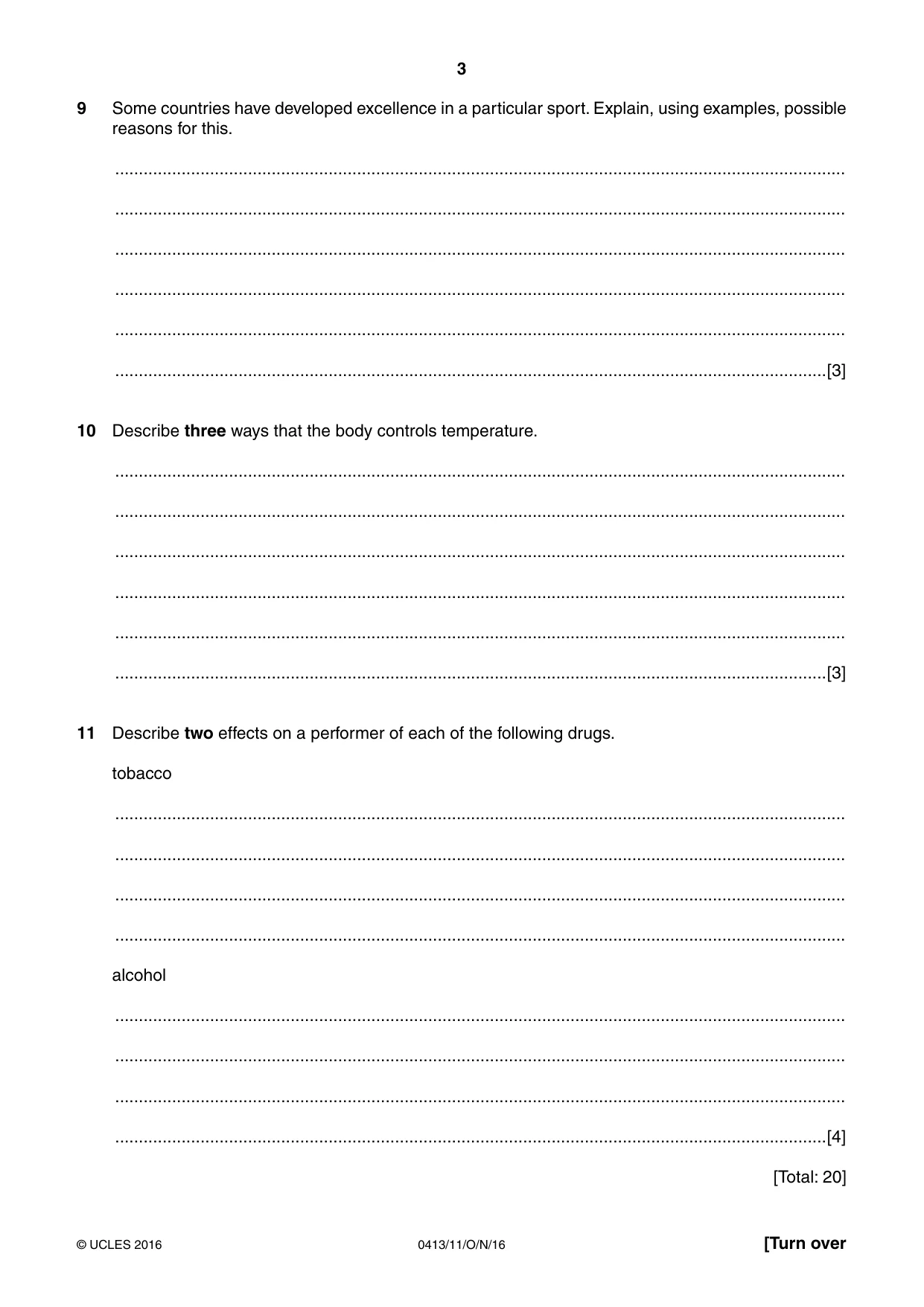
Question paper, page 3
3 0413/11/O/N/16 © UCLES 2016 [Turn over 9 Some countries have developed excellence in a particular sport. Explain, using examples, possible reasons for this. … … … … … …[3] 10 Describe three ways that the body controls temperature. … … … … … …[3] 11 Describe two effects on a performer of each of the following drugs. tobacco … … … … alcohol … … … …[4] [Total: 20]
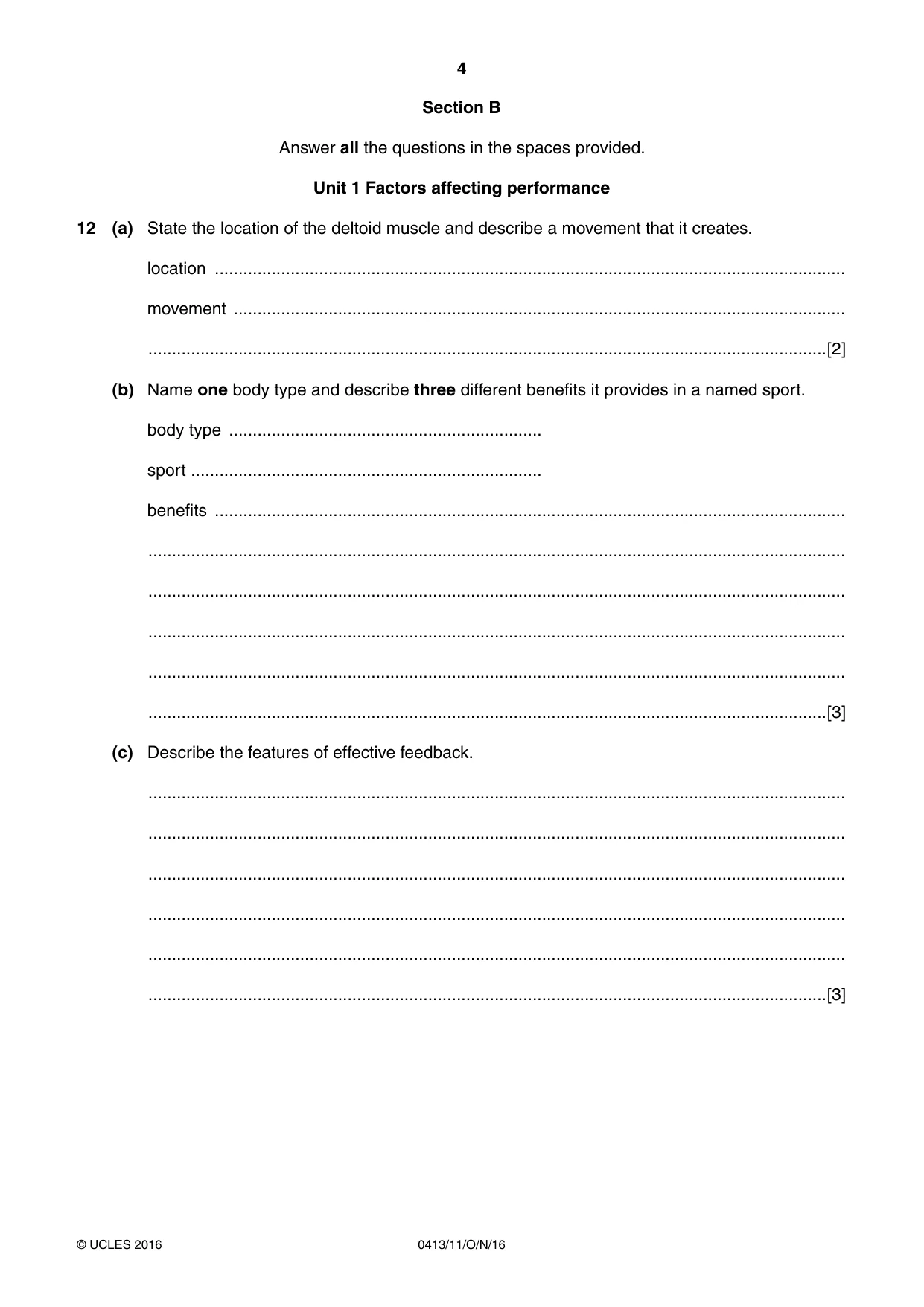
Question paper, page 4
4 0413/11/O/N/16 © UCLES 2016 Section B Answer all the questions in the spaces provided. Unit 1 Factors affecting performance 12 (a) State the location of the deltoid muscle and describe a movement that it creates. location … movement … …[2] (b) Name one body type and describe three different benefits it provides in a named sport. body type … sport … benefits … … … … … …[3] (c) Describe the features of effective feedback. … … … … … …[3]
Question paper, page 5
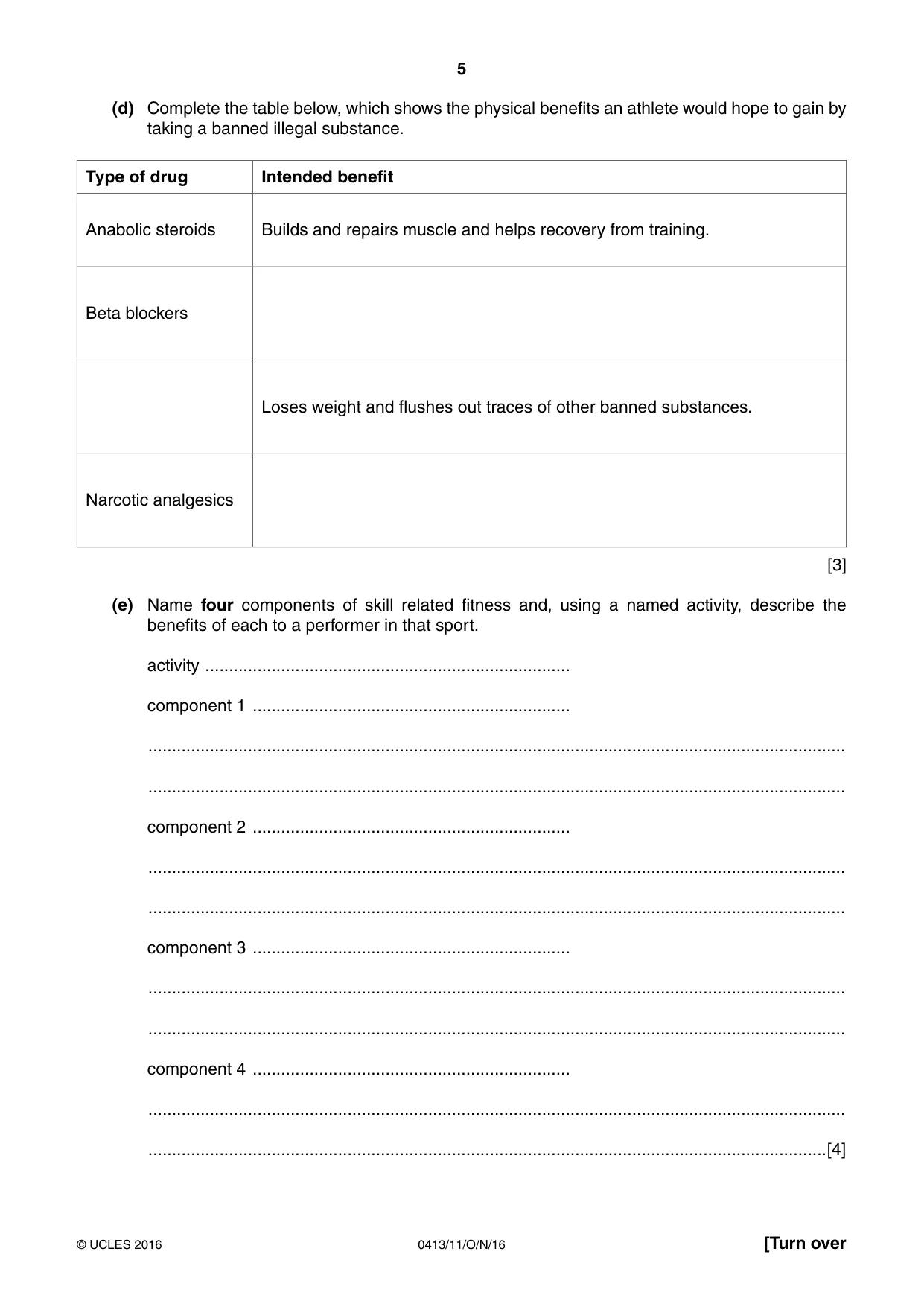
5 0413/11/O/N/16 © UCLES 2016 [Turn over (d) Complete the table below, which shows the physical benefits an athlete would hope to gain by taking a banned illegal substance. Type of drug Intended benefit Anabolic steroids Builds and repairs muscle and helps recovery from training. Beta blockers Loses weight and flushes out traces of other banned substances. Narcotic analgesics [3] (e) Name four components of skill related fitness and, using a named activity, describe the benefits of each to a performer in that sport. activity … component 1 … … … component 2 … … … component 3 … … … component 4 … … …[4]
Question paper, page 6
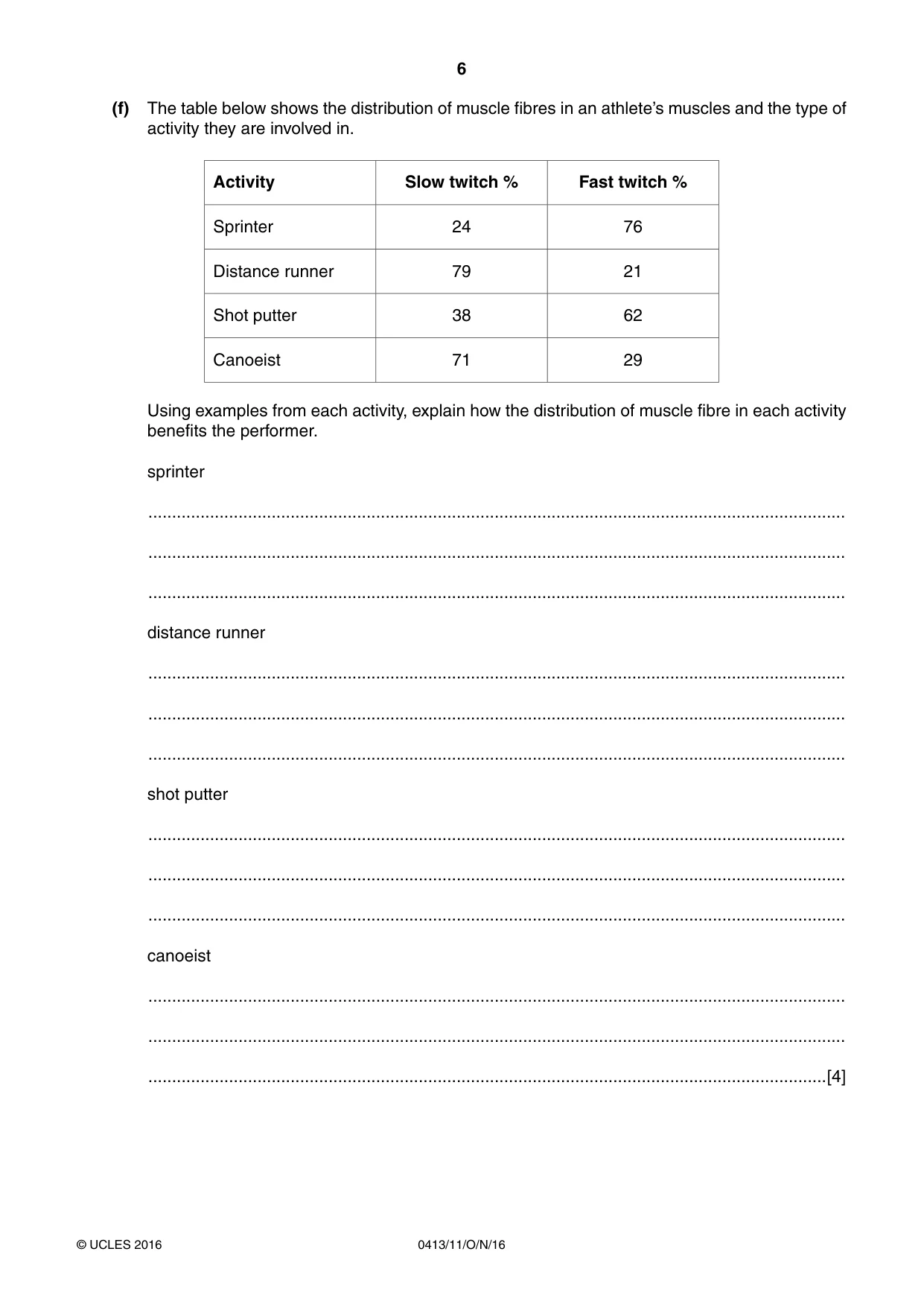
6 0413/11/O/N/16 © UCLES 2016 (f) The table below shows the distribution of muscle fibres in an athlete’s muscles and the type of activity they are involved in. Activity Slow twitch % Fast twitch % Sprinter 24 76 Distance runner 79 21 Shot putter 38 62 Canoeist 71 29 Using examples from each activity, explain how the distribution of muscle fibre in each activity benefits the performer. sprinter … … … distance runner … … … shot putter … … … canoeist … … …[4]
Question paper, page 7
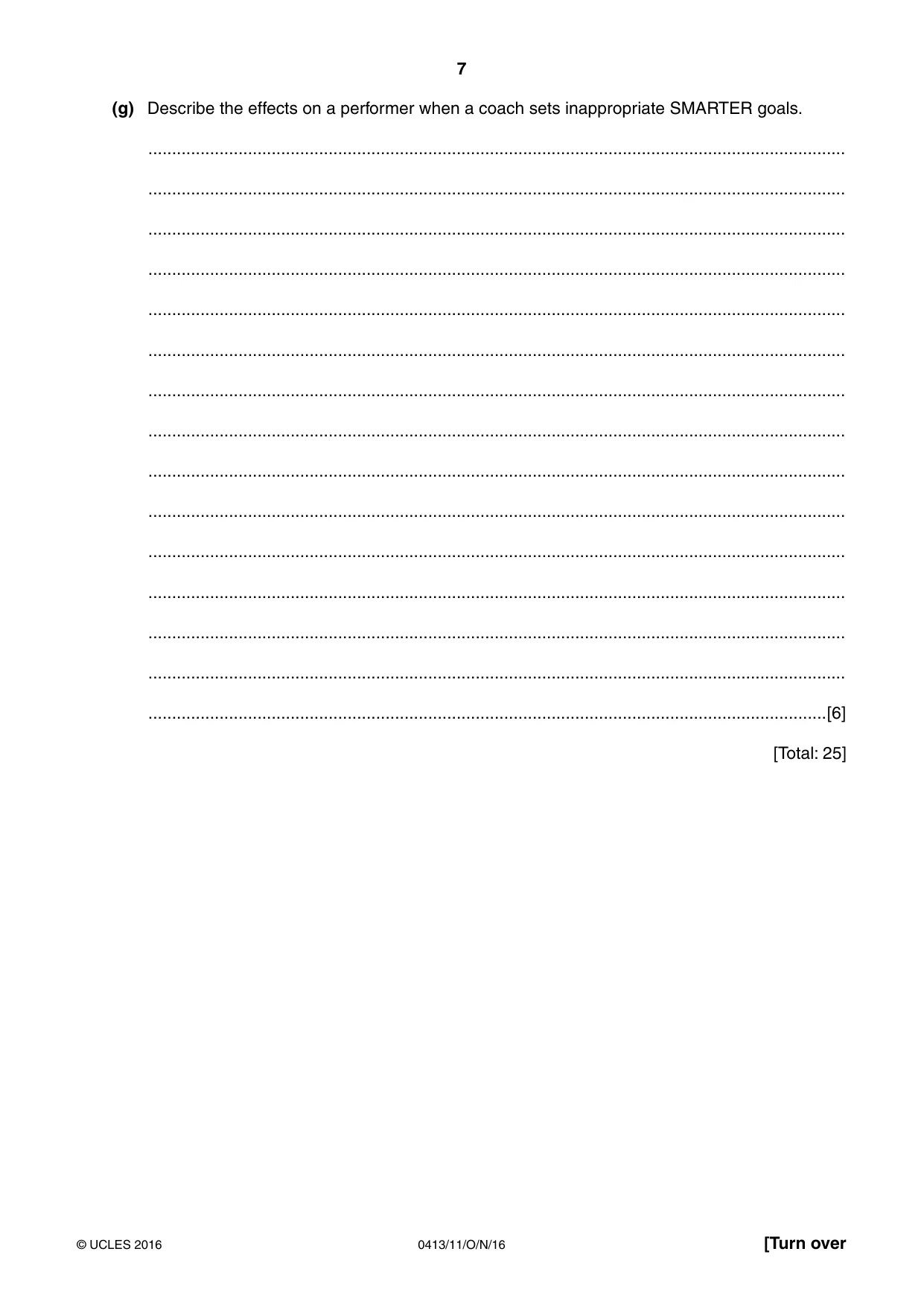
7 0413/11/O/N/16 © UCLES 2016 [Turn over (g) Describe the effects on a performer when a coach sets inappropriate SMARTER goals. … … … … … … … … … … … … … … …[6] [Total: 25]
Question paper, page 8
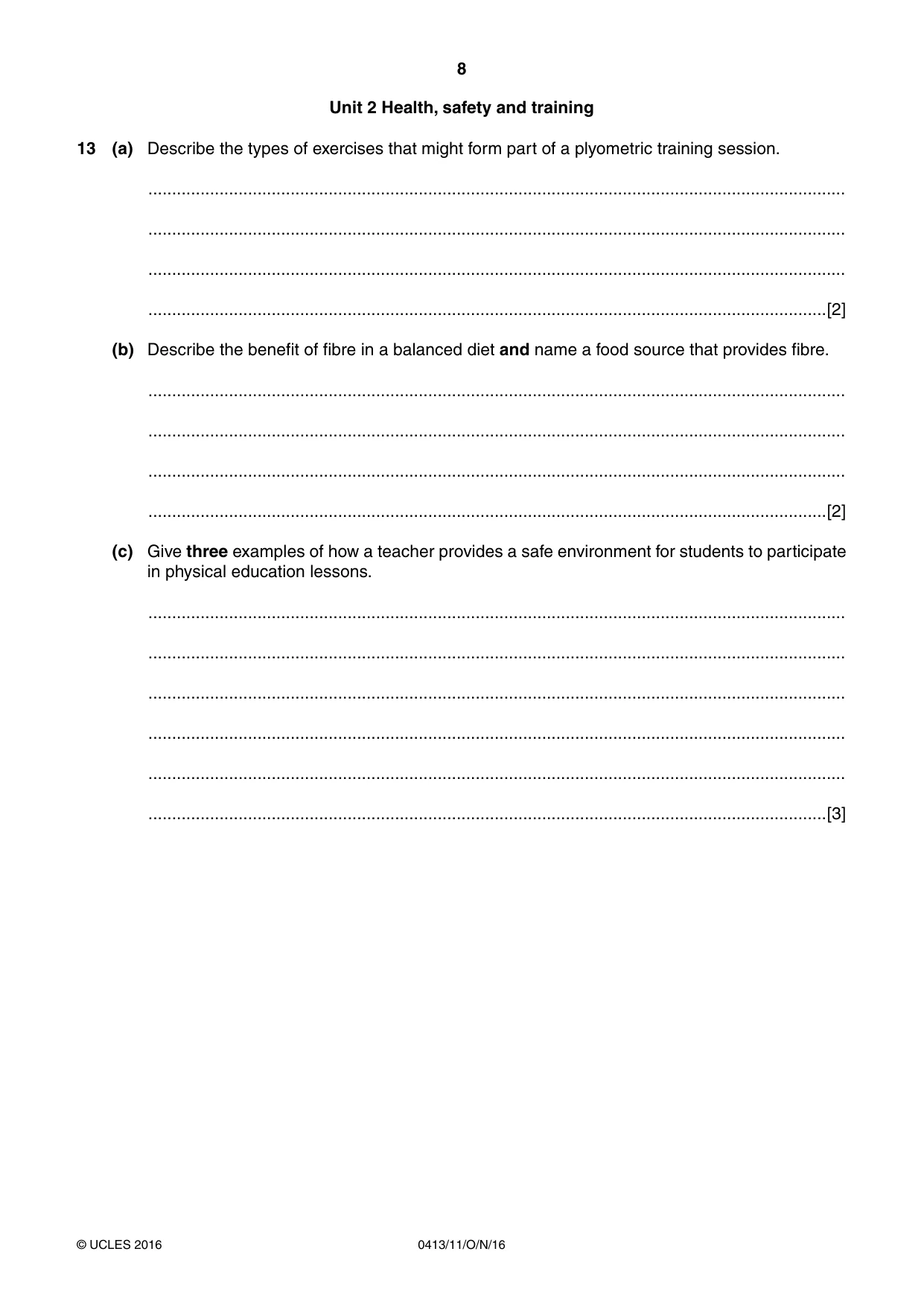
8 0413/11/O/N/16 © UCLES 2016 Unit 2 Health, safety and training 13 (a) Describe the types of exercises that might form part of a plyometric training session. … … … …[2] (b) Describe the benefit of fibre in a balanced diet and name a food source that provides fibre. … … … …[2] (c) Give three examples of how a teacher provides a safe environment for students to participate in physical education lessons. … … … … … …[3]
Question paper, page 9
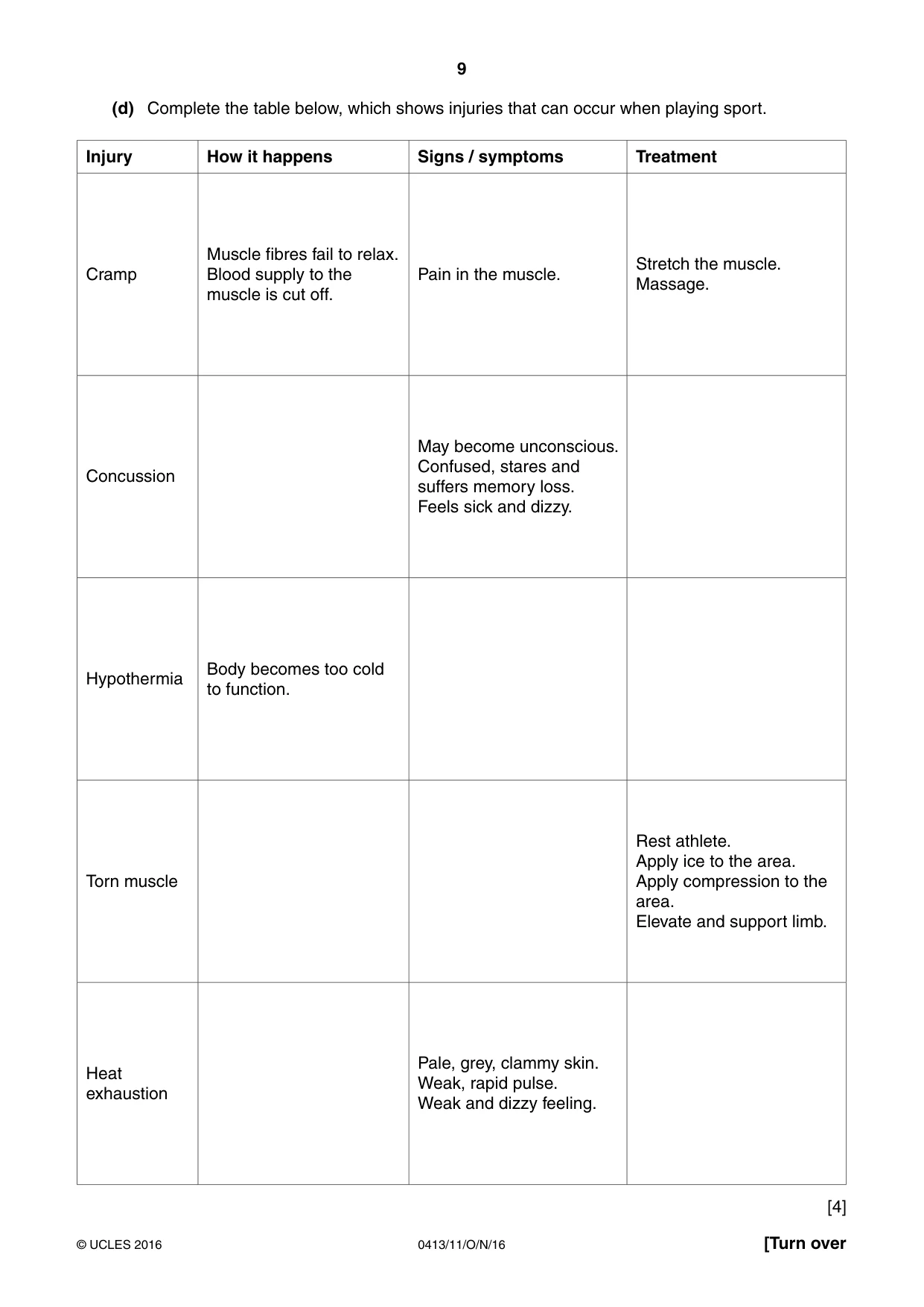
9 0413/11/O/N/16 © UCLES 2016 [Turn over (d) Complete the table below, which shows injuries that can occur when playing sport. Injury How it happens Signs / symptoms Treatment Cramp Muscle fibres fail to relax. Blood supply to the muscle is cut off. Pain in the muscle. Stretch the muscle. Massage. Concussion May become unconscious. Confused, stares and suffers memory loss. Feels sick and dizzy. Hypothermia Body becomes too cold to function. Torn muscle Rest athlete. Apply ice to the area. Apply compression to the area. Elevate and support limb. Heat exhaustion Pale, grey, clammy skin. Weak, rapid pulse. Weak and dizzy feeling. [4]
Question paper, page 10
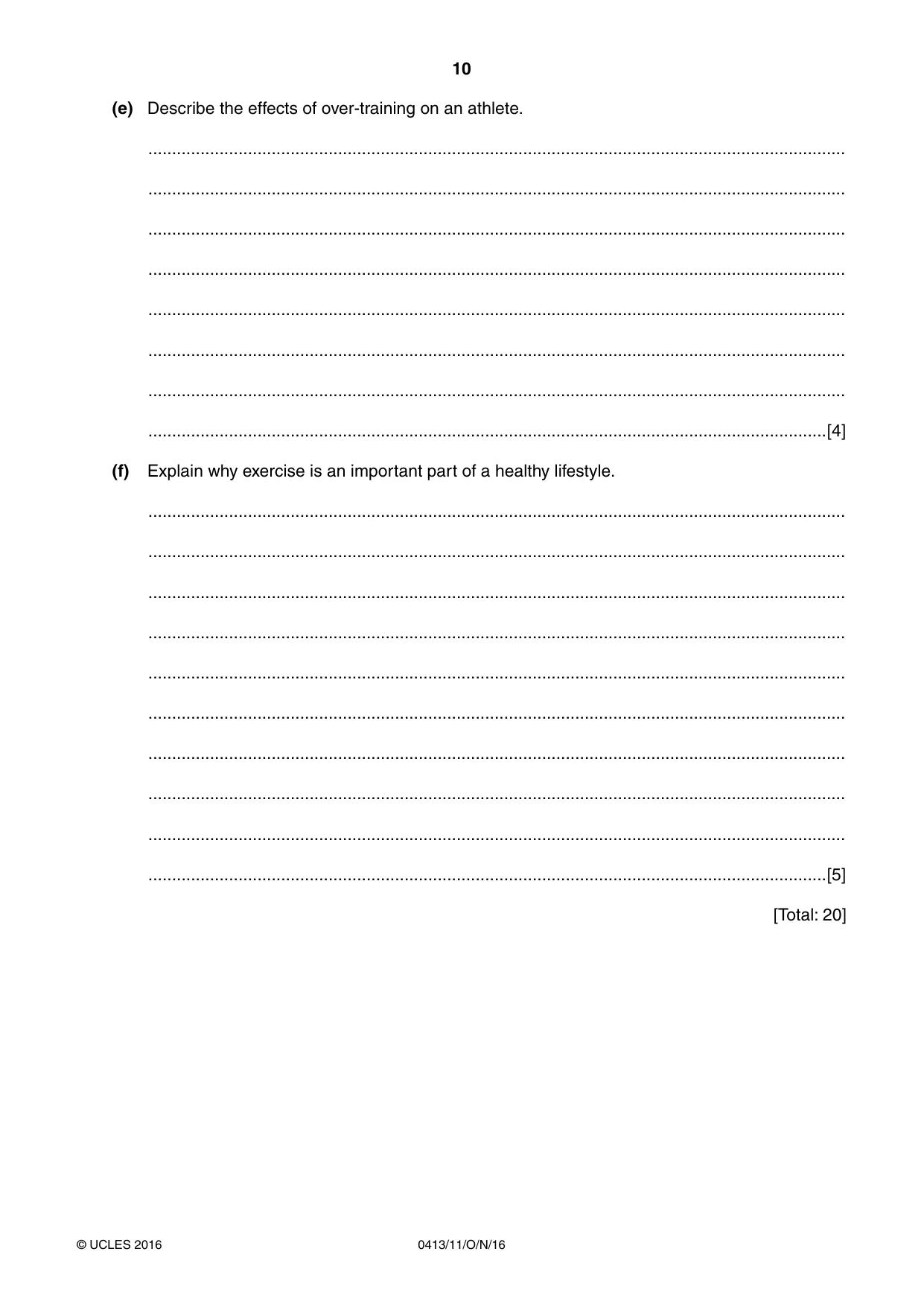
10 0413/11/O/N/16 © UCLES 2016 (e) Describe the effects of over-training on an athlete. … … … … … … … …[4] (f) Explain why exercise is an important part of a healthy lifestyle. … … … … … … … … … …[5] [Total: 20]
Question paper, page 11
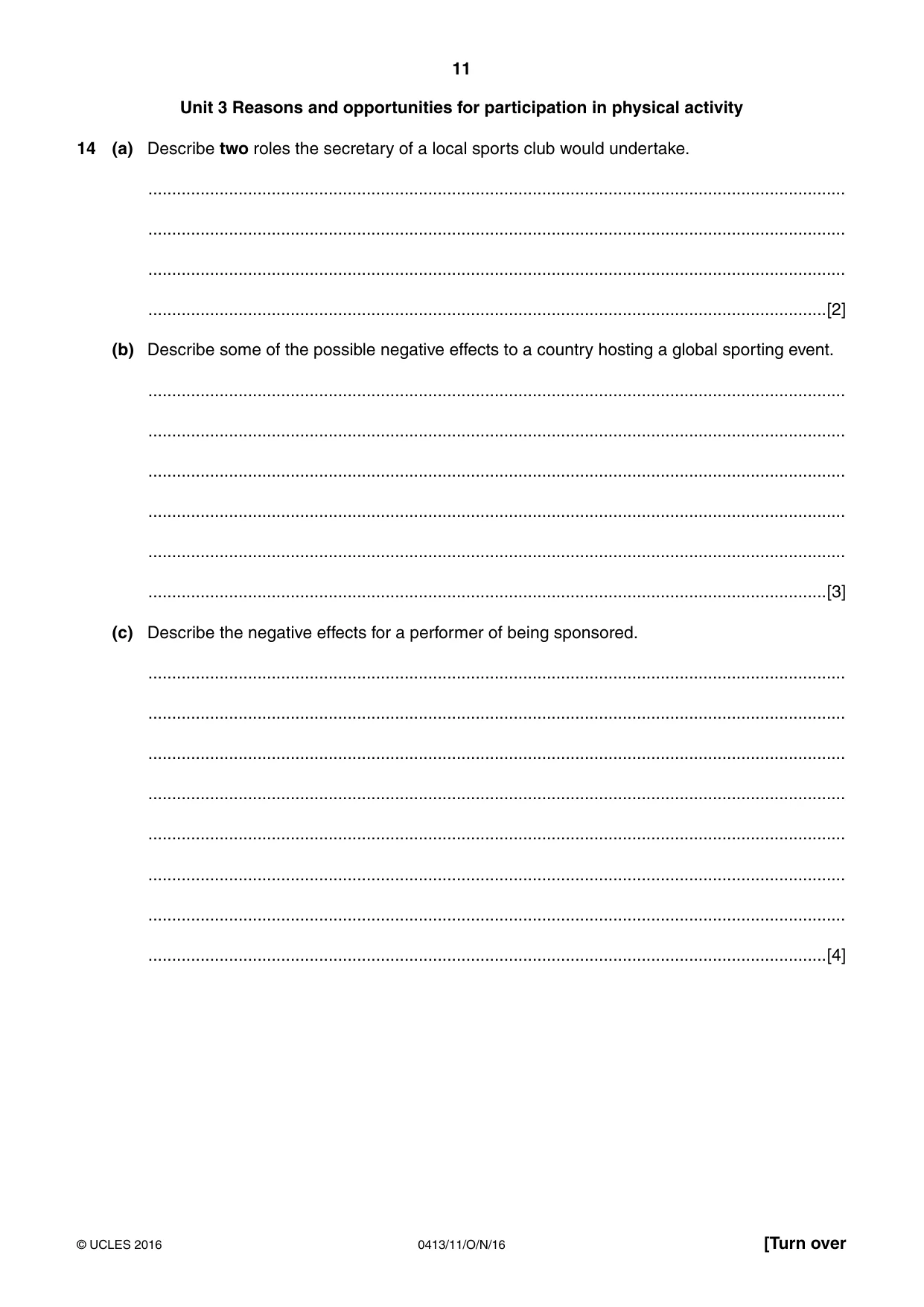
11 0413/11/O/N/16 © UCLES 2016 [Turn over Unit 3 Reasons and opportunities for participation in physical activity 14 (a) Describe two roles the secretary of a local sports club would undertake. … … … …[2] (b) Describe some of the possible negative effects to a country hosting a global sporting event. … … … … … …[3] (c) Describe the negative effects for a performer of being sponsored. … … … … … … … …[4]
Question paper, page 12
12 0413/11/O/N/16 © UCLES 2016 Permission to reproduce items where third-party owned material protected by copyright is included has been sought and cleared where possible. Every reasonable effort has been made by the publisher (UCLES) to trace copyright holders, but if any items requiring clearance have unwittingly been included, the publisher will be pleased to make amends at the earliest possible opportunity. To avoid the issue of disclosure of answer-related information to candidates, all copyright acknowledgements are reproduced online in the Cambridge International Examinations Copyright Acknowledgements Booklet. This is produced for each series of examinations and is freely available to download at www.cie.org.uk after the live examination series. Cambridge International Examinations is part of the Cambridge Assessment Group. Cambridge Assessment is the brand name of University of Cambridge Local Examinations Syndicate (UCLES), which is itself a department of the University of Cambridge. (d) Describe how a sports centre can attempt to encourage social integration through involvement in sport. … … … … … … … … … … … … … … …[6] [Total: 15]
Mark scheme, page 1
® IGCSE is the registered trademark of Cambridge International Examinations. This document consists of 15 printed pages. © UCLES 2016 [Turn over Cambridge International Examinations Cambridge International General Certificate of Secondary Education PHYSICAL EDUCATION 0413/11 Paper 1 October/November 2016 MARK SCHEME Maximum Mark: 80 Published This mark scheme is published as an aid to teachers and candidates, to indicate the requirements of the examination. It shows the basis on which Examiners were instructed to award marks. It does not indicate the details of the discussions that took place at an Examiners’ meeting before marking began, which would have considered the acceptability of alternative answers. Mark schemes should be read in conjunction with the question paper and the Principal Examiner Report for Teachers. Cambridge will not enter into discussions about these mark schemes. Cambridge is publishing the mark schemes for the October/November 2016 series for most Cambridge IGCSE®, Cambridge International A and AS Level components and some Cambridge O Level components.
Mark scheme, page 2
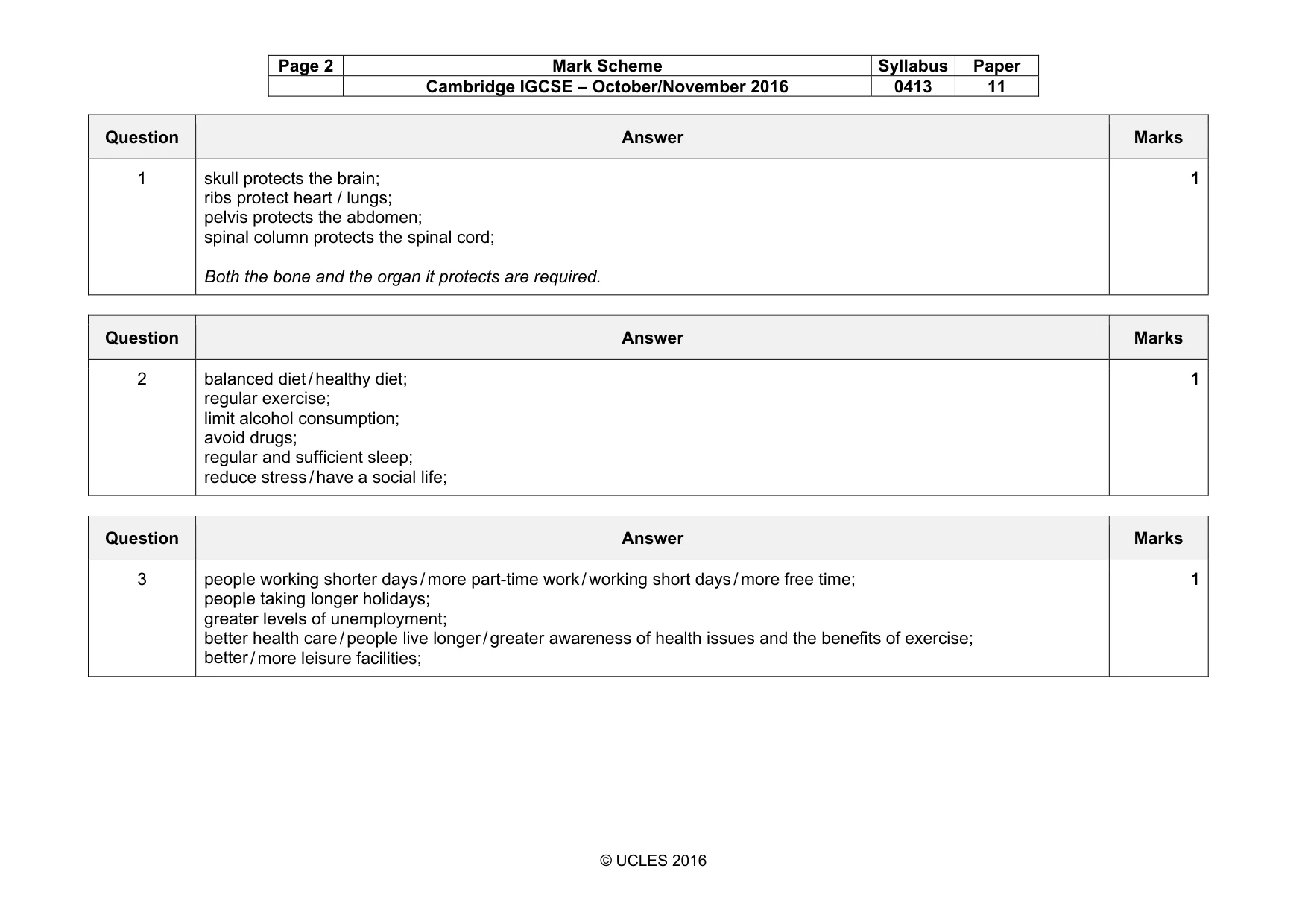
Page 2 Mark Scheme Syllabus Paper Cambridge IGCSE – October/November 2016 0413 11 © UCLES 2016 Question Answer Marks 1 skull protects the brain; ribs protect heart / lungs; pelvis protects the abdomen; spinal column protects the spinal cord; Both the bone and the organ it protects are required. 1 Question Answer Marks 2 balanced diet / healthy diet; regular exercise; limit alcohol consumption; avoid drugs; regular and sufficient sleep; reduce stress / have a social life; 1 Question Answer Marks 3 people working shorter days / more part-time work / working short days / more free time; people taking longer holidays; greater levels of unemployment; better health care / people live longer / greater awareness of health issues and the benefits of exercise; better / more leisure facilities; 1
Mark scheme, page 3
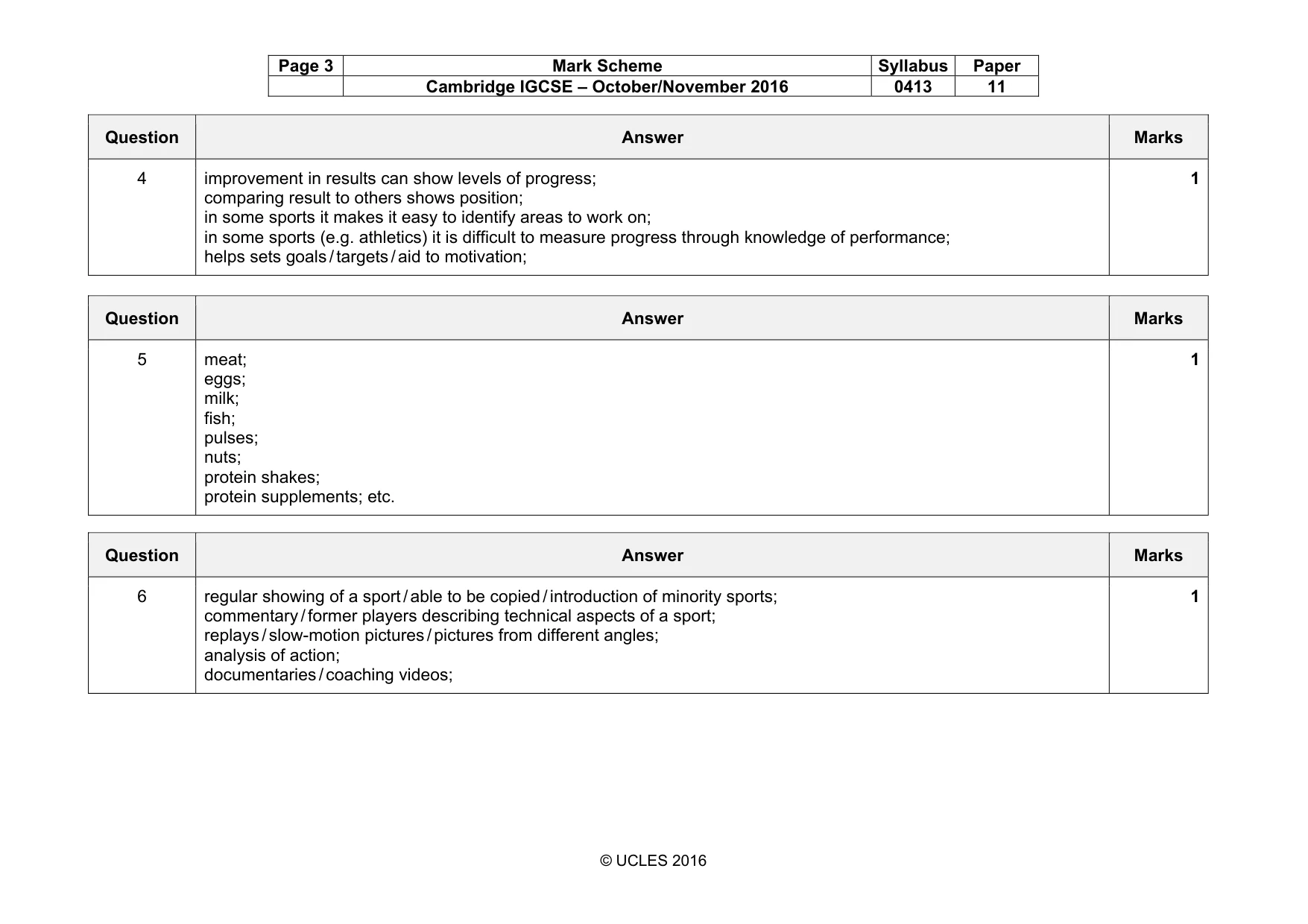
Page 3 Mark Scheme Syllabus Paper Cambridge IGCSE – October/November 2016 0413 11 © UCLES 2016 Question Answer Marks 4 improvement in results can show levels of progress; comparing result to others shows position; in some sports it makes it easy to identify areas to work on; in some sports (e.g. athletics) it is difficult to measure progress through knowledge of performance; helps sets goals / targets / aid to motivation; 1 Question Answer Marks 5 meat; eggs; milk; fish; pulses; nuts; protein shakes; protein supplements; etc. 1 Question Answer Marks 6 regular showing of a sport / able to be copied / introduction of minority sports; commentary / former players describing technical aspects of a sport; replays / slow-motion pictures / pictures from different angles; analysis of action; documentaries / coaching videos; 1
Mark scheme, page 4
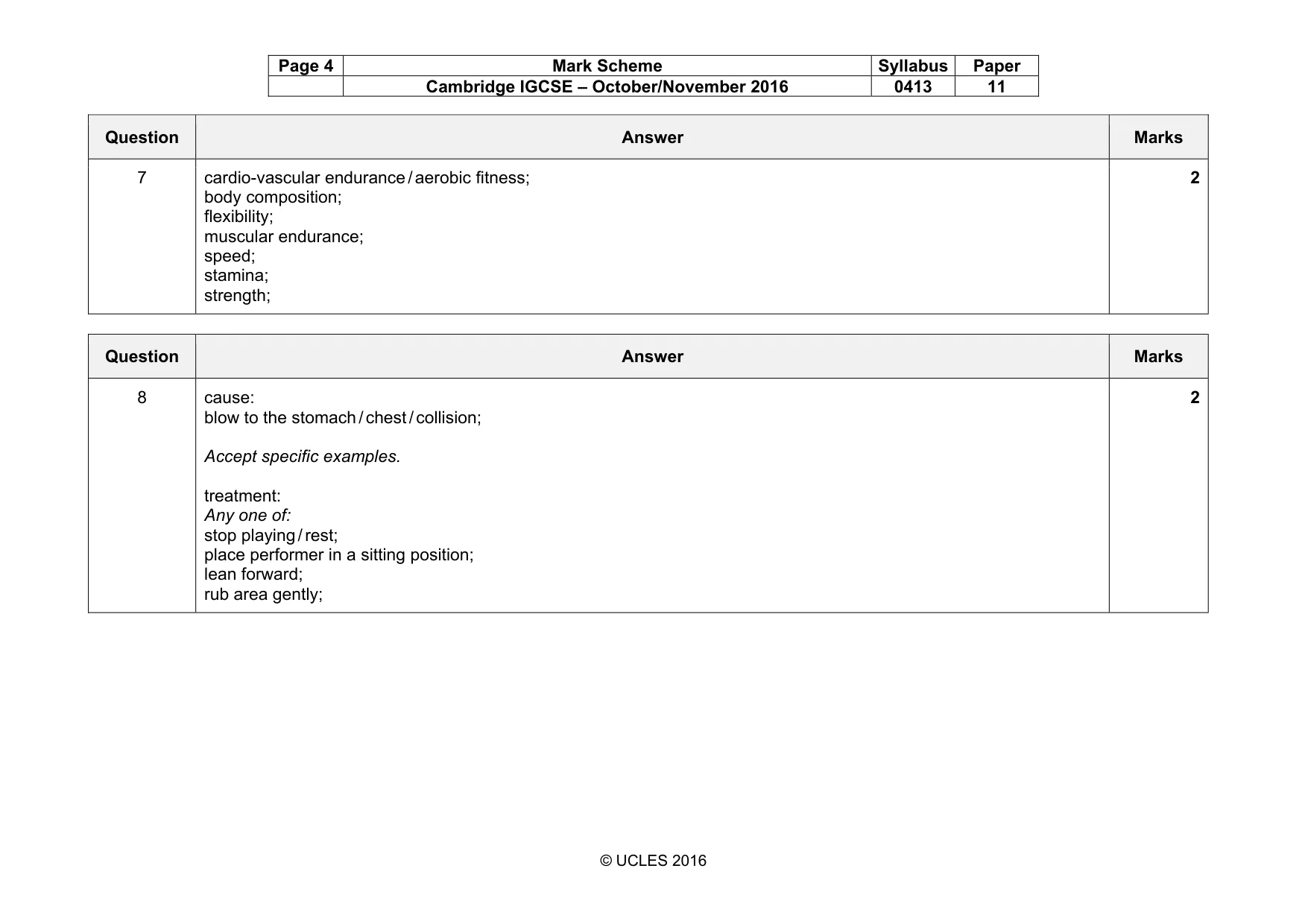
Page 4 Mark Scheme Syllabus Paper Cambridge IGCSE – October/November 2016 0413 11 © UCLES 2016 Question Answer Marks 7 cardio-vascular endurance / aerobic fitness; body composition; flexibility; muscular endurance; speed; stamina; strength; 2 Question Answer Marks 8 cause: blow to the stomach / chest / collision; Accept specific examples. treatment: Any one of: stop playing / rest; place performer in a sitting position; lean forward; rub area gently; 2
Mark scheme, page 5
Page 5 Mark Scheme Syllabus Paper Cambridge IGCSE – October/November 2016 0413 11 © UCLES 2016 Question Answer Marks 9 One mark awarded for each reason. At least one country with a relevant sport must be stated. Examples may include: Kenya / Ethiopia – middle / long-distance running – people who are born at altitude have a higher red blood cell count, which carries more oxygen to muscles; Brazil – football – tradition / culture / played extensively / low costs; Nordic countries – skiing – climate / environment; New Zealand – rugby – high-quality coaching / high-quality facilities available; Japan – sumo wrestling – tradition / culture; Cuba – boxing – high-quality coaching / high-quality facilities available; Fiji – rugby sevens – national sport / size of country / population / requires little funding at grass-roots level; USA – basketball – high-level of funding / high-quality coaching / national sport / high-quality facilities; 3 Question Answer Marks 10 Descriptions must make clear if the body temperature is too high or too low. when too hot: sweat produced; blood vessels under the skin widen / vasodilation; more blood flows nearer to the skin; more blood is shunted to the muscles; body hair lies flat; when too cold: vasoconstriction / OWTTE; shivering; body hair stands up; blood flow redirected away from the extremities / towards core; 3
Mark scheme, page 6
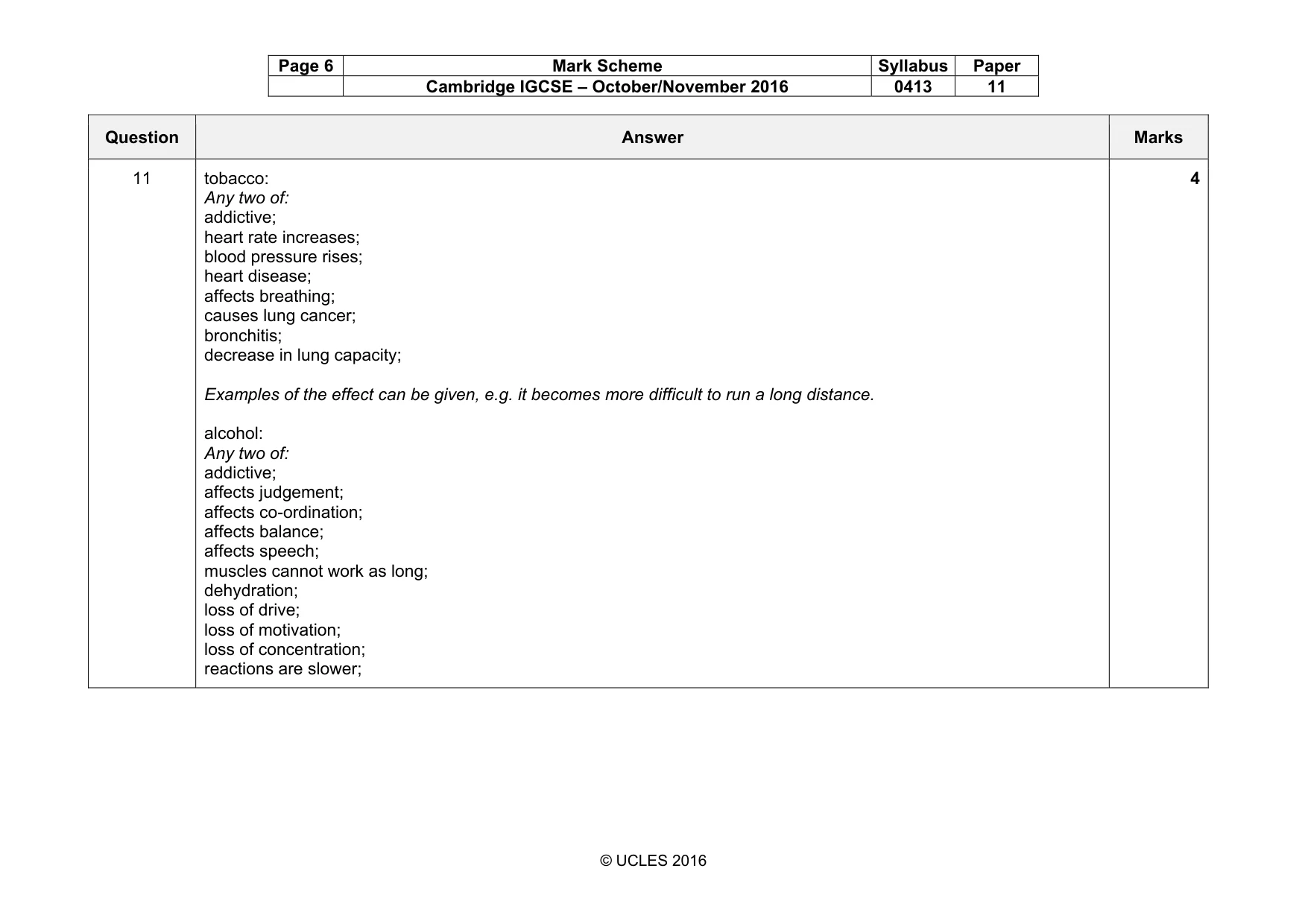
Page 6 Mark Scheme Syllabus Paper Cambridge IGCSE – October/November 2016 0413 11 © UCLES 2016 Question Answer Marks 11 tobacco: Any two of: addictive; heart rate increases; blood pressure rises; heart disease; affects breathing; causes lung cancer; bronchitis; decrease in lung capacity; Examples of the effect can be given, e.g. it becomes more difficult to run a long distance. alcohol: Any two of: addictive; affects judgement; affects co-ordination; affects balance; affects speech; muscles cannot work as long; dehydration; loss of drive; loss of motivation; loss of concentration; reactions are slower; 4
Mark scheme, page 7
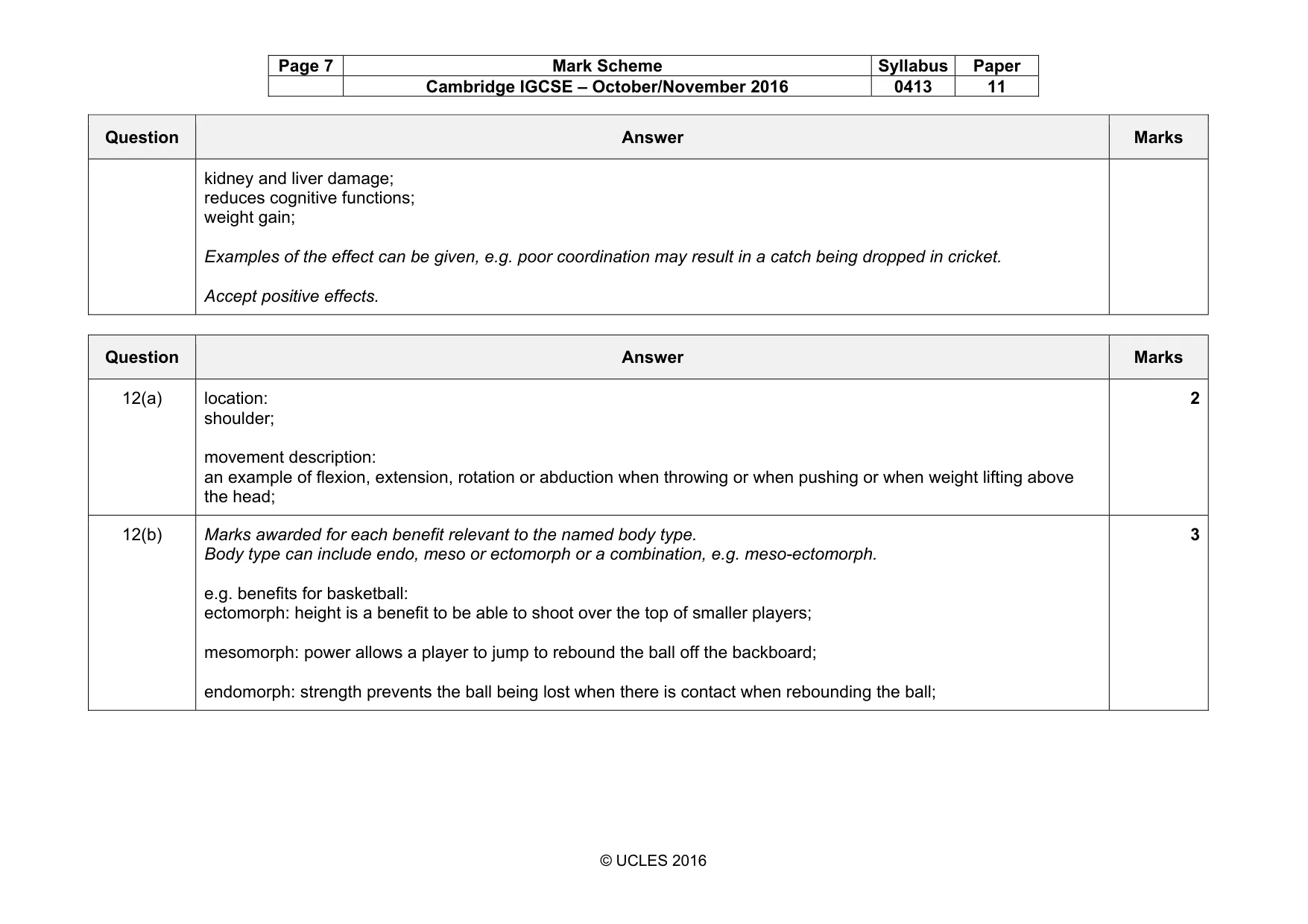
Page 7 Mark Scheme Syllabus Paper Cambridge IGCSE – October/November 2016 0413 11 © UCLES 2016 Question Answer Marks kidney and liver damage; reduces cognitive functions; weight gain; Examples of the effect can be given, e.g. poor coordination may result in a catch being dropped in cricket. Accept positive effects. Question Answer Marks 12(a) location: shoulder; movement description: an example of flexion, extension, rotation or abduction when throwing or when pushing or when weight lifting above the head; 2 12(b) Marks awarded for each benefit relevant to the named body type. Body type can include endo, meso or ectomorph or a combination, e.g. meso-ectomorph. e.g. benefits for basketball: ectomorph: height is a benefit to be able to shoot over the top of smaller players; mesomorph: power allows a player to jump to rebound the ball off the backboard; endomorph: strength prevents the ball being lost when there is contact when rebounding the ball; 3
Mark scheme, page 8
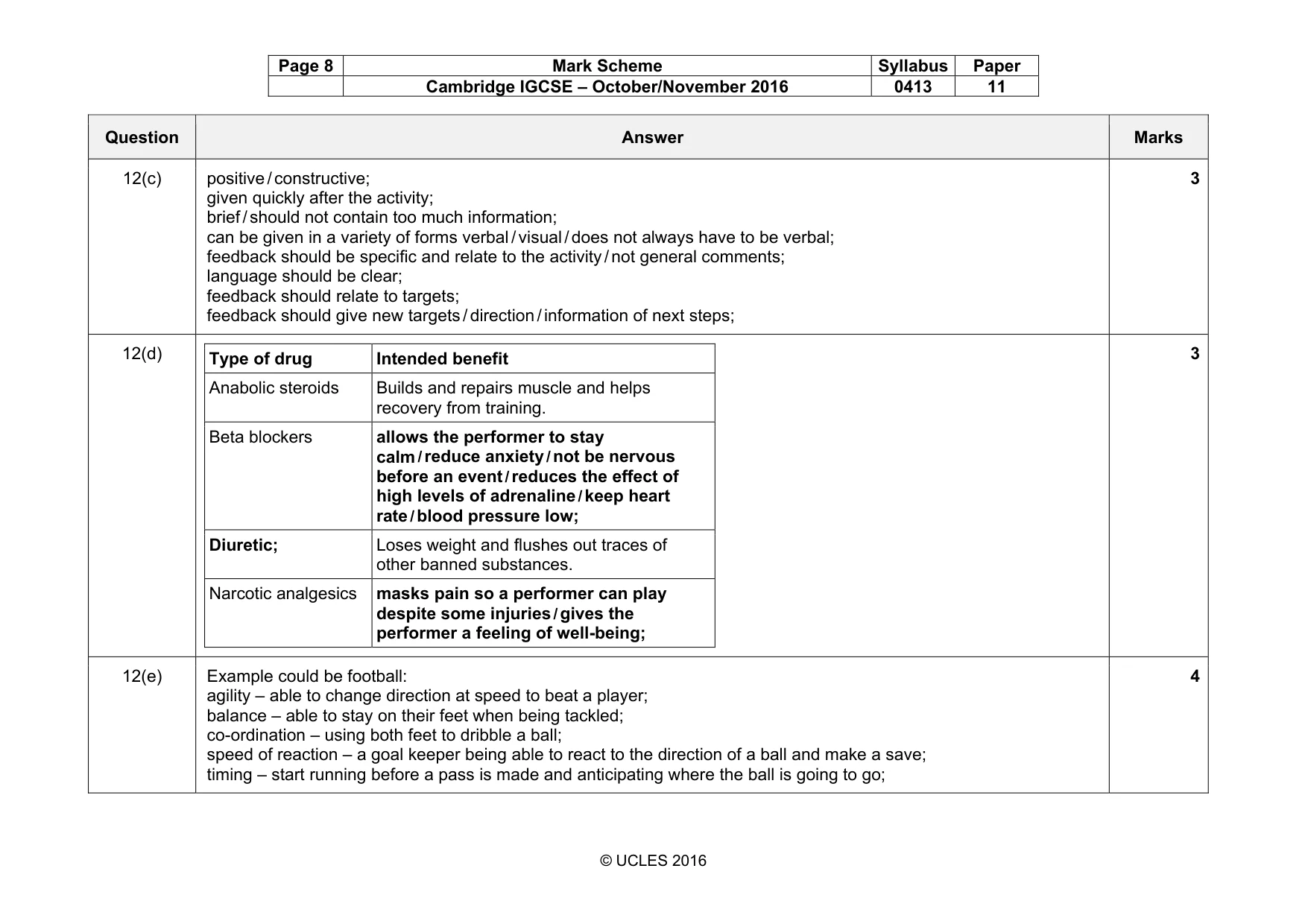
Page 8 Mark Scheme Syllabus Paper Cambridge IGCSE – October/November 2016 0413 11 © UCLES 2016 Question Answer Marks 12(c) positive / constructive; given quickly after the activity; brief / should not contain too much information; can be given in a variety of forms verbal / visual / does not always have to be verbal; feedback should be specific and relate to the activity / not general comments; language should be clear; feedback should relate to targets; feedback should give new targets / direction / information of next steps; 3 12(d) Type of drug Intended benefit Anabolic steroids Builds and repairs muscle and helps recovery from training. Beta blockers allows the performer to stay calm / reduce anxiety / not be nervous before an event / reduces the effect of high levels of adrenaline / keep heart rate / blood pressure low; Diuretic; Loses weight and flushes out traces of other banned substances. Narcotic analgesics masks pain so a performer can play despite some injuries / gives the performer a feeling of well-being; 3 12(e) Example could be football: agility – able to change direction at speed to beat a player; balance – able to stay on their feet when being tackled; co-ordination – using both feet to dribble a ball; speed of reaction – a goal keeper being able to react to the direction of a ball and make a save; timing – start running before a pass is made and anticipating where the ball is going to go; 4
Mark scheme, page 9
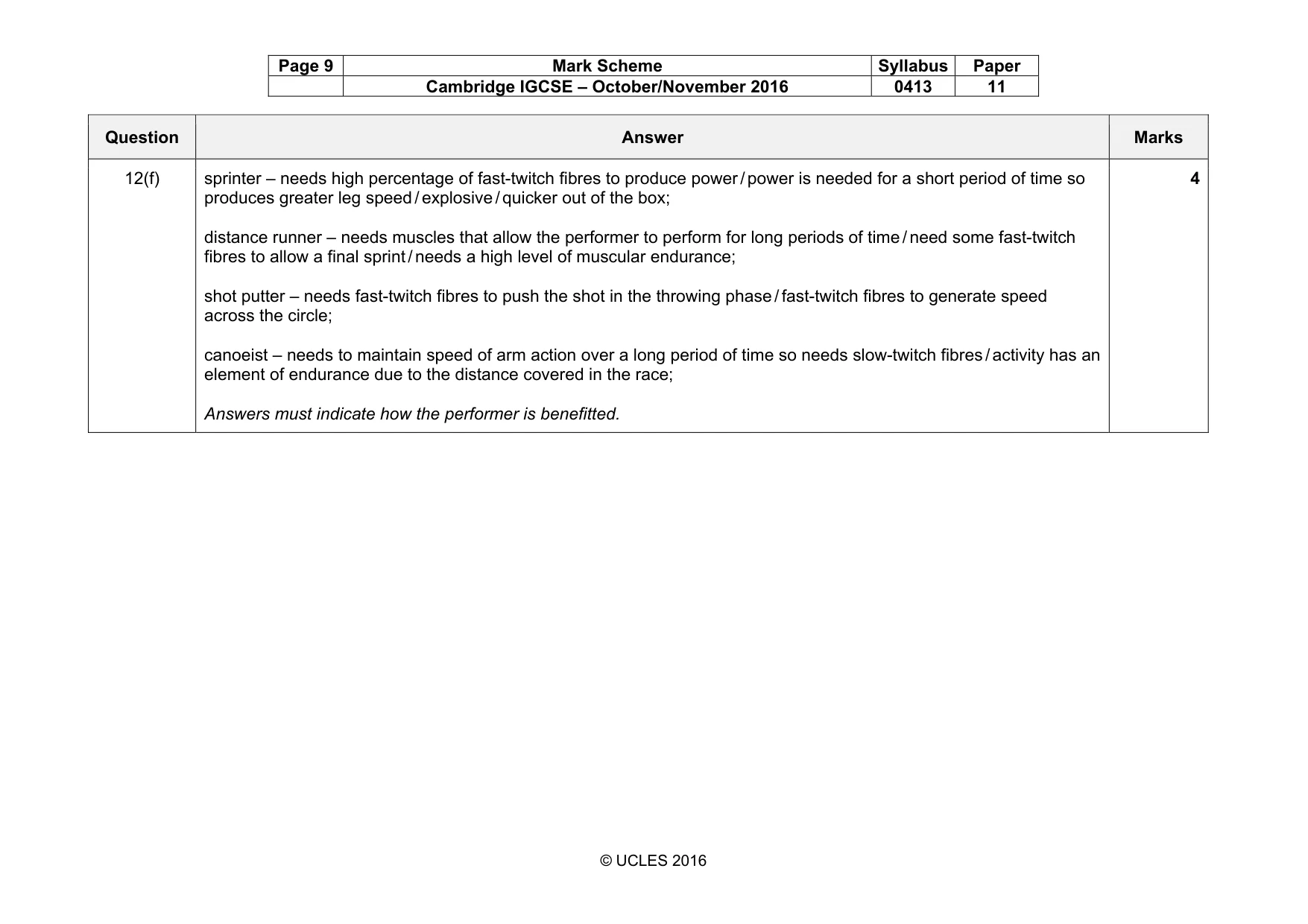
Page 9 Mark Scheme Syllabus Paper Cambridge IGCSE – October/November 2016 0413 11 © UCLES 2016 Question Answer Marks 12(f) sprinter – needs high percentage of fast-twitch fibres to produce power / power is needed for a short period of time so produces greater leg speed / explosive / quicker out of the box; distance runner – needs muscles that allow the performer to perform for long periods of time / need some fast-twitch fibres to allow a final sprint / needs a high level of muscular endurance; shot putter – needs fast-twitch fibres to push the shot in the throwing phase / fast-twitch fibres to generate speed across the circle; canoeist – needs to maintain speed of arm action over a long period of time so needs slow-twitch fibres / activity has an element of endurance due to the distance covered in the race; Answers must indicate how the performer is benefitted. 4
Mark scheme, page 10
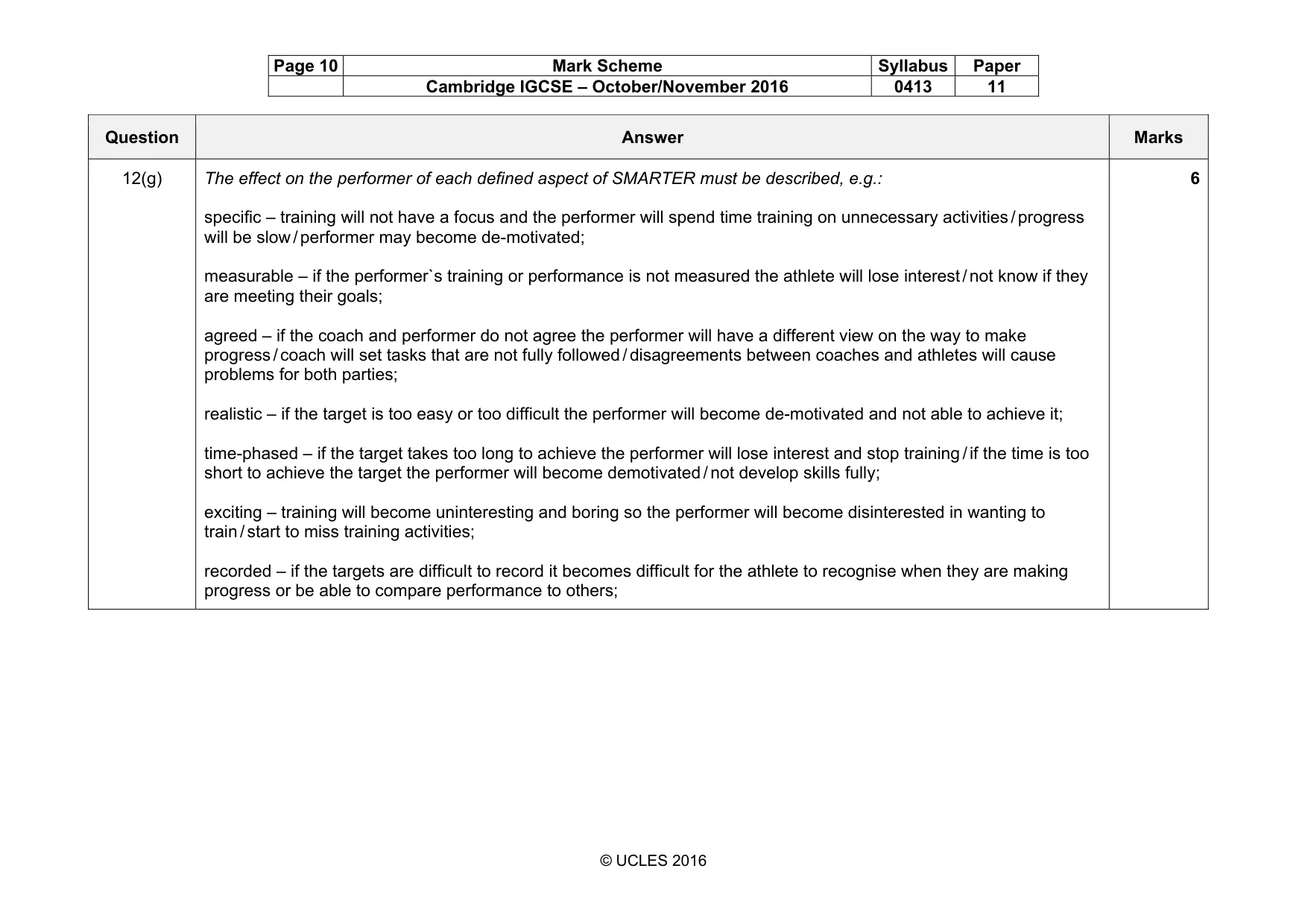
Page 10 Mark Scheme Syllabus Paper Cambridge IGCSE – October/November 2016 0413 11 © UCLES 2016 Question Answer Marks 12(g) The effect on the performer of each defined aspect of SMARTER must be described, e.g.: specific – training will not have a focus and the performer will spend time training on unnecessary activities / progress will be slow / performer may become de-motivated; measurable – if the performer`s training or performance is not measured the athlete will lose interest / not know if they are meeting their goals; agreed – if the coach and performer do not agree the performer will have a different view on the way to make progress / coach will set tasks that are not fully followed / disagreements between coaches and athletes will cause problems for both parties; realistic – if the target is too easy or too difficult the performer will become de-motivated and not able to achieve it; time-phased – if the target takes too long to achieve the performer will lose interest and stop training / if the time is too short to achieve the target the performer will become demotivated / not develop skills fully; exciting – training will become uninteresting and boring so the performer will become disinterested in wanting to train / start to miss training activities; recorded – if the targets are difficult to record it becomes difficult for the athlete to recognise when they are making progress or be able to compare performance to others; 6
Mark scheme, page 11
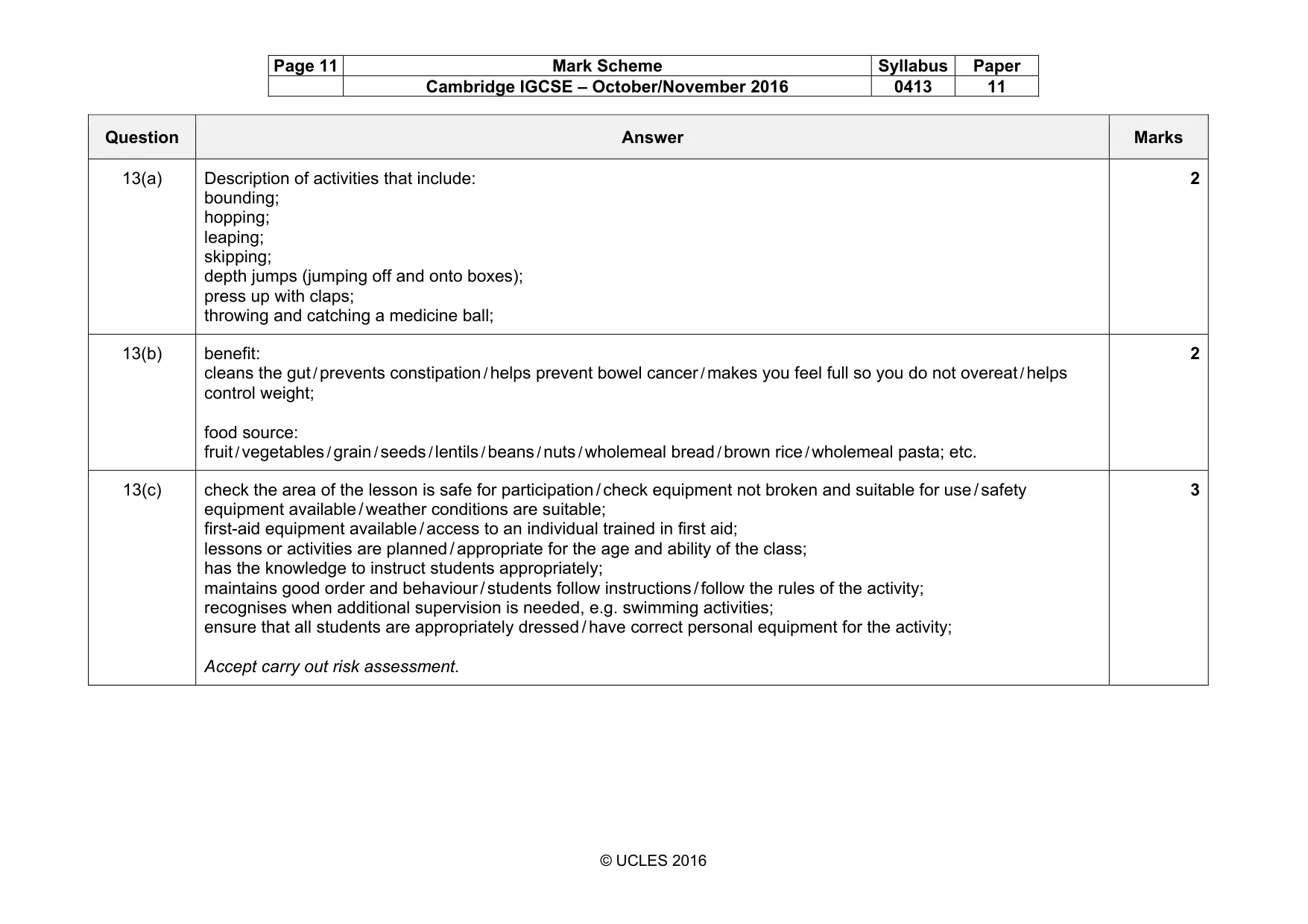
Page 11 Mark Scheme Syllabus Paper Cambridge IGCSE – October/November 2016 0413 11 © UCLES 2016 Question Answer Marks 13(a) Description of activities that include: bounding; hopping; leaping; skipping; depth jumps (jumping off and onto boxes); press up with claps; throwing and catching a medicine ball; 2 13(b) benefit: cleans the gut / prevents constipation / helps prevent bowel cancer / makes you feel full so you do not overeat / helps control weight; food source: fruit / vegetables / grain / seeds / lentils / beans / nuts / wholemeal bread / brown rice / wholemeal pasta; etc. 2 13(c) check the area of the lesson is safe for participation / check equipment not broken and suitable for use / safety equipment available / weather conditions are suitable; first-aid equipment available / access to an individual trained in first aid; lessons or activities are planned / appropriate for the age and ability of the class; has the knowledge to instruct students appropriately; maintains good order and behaviour / students follow instructions / follow the rules of the activity; recognises when additional supervision is needed, e.g. swimming activities; ensure that all students are appropriately dressed / have correct personal equipment for the activity; Accept carry out risk assessment. 3
Mark scheme, page 12
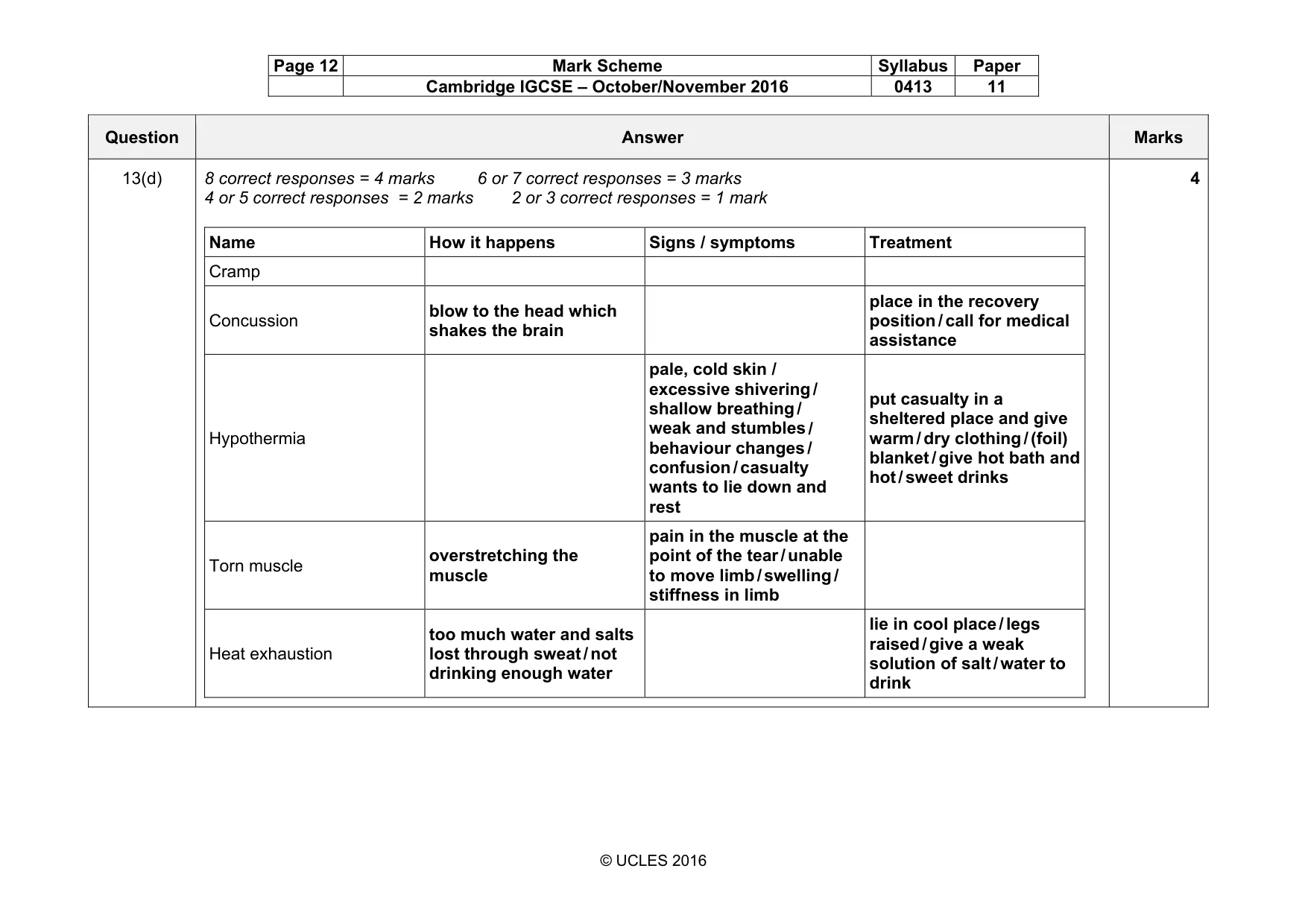
Page 12 Mark Scheme Syllabus Paper Cambridge IGCSE – October/November 2016 0413 11 © UCLES 2016 Question Answer Marks 13(d) 8 correct responses = 4 marks 6 or 7 correct responses = 3 marks 4 or 5 correct responses = 2 marks 2 or 3 correct responses = 1 mark Name How it happens Signs / symptoms Treatment Cramp Concussion blow to the head which shakes the brain place in the recovery position / call for medical assistance Hypothermia pale, cold skin / excessive shivering / shallow breathing / weak and stumbles / behaviour changes / confusion / casualty wants to lie down and rest put casualty in a sheltered place and give warm / dry clothing / (foil) blanket / give hot bath and hot / sweet drinks Torn muscle overstretching the muscle pain in the muscle at the point of the tear / unable to move limb / swelling / stiffness in limb Heat exhaustion too much water and salts lost through sweat / not drinking enough water lie in cool place / legs raised / give a weak solution of salt / water to drink 4
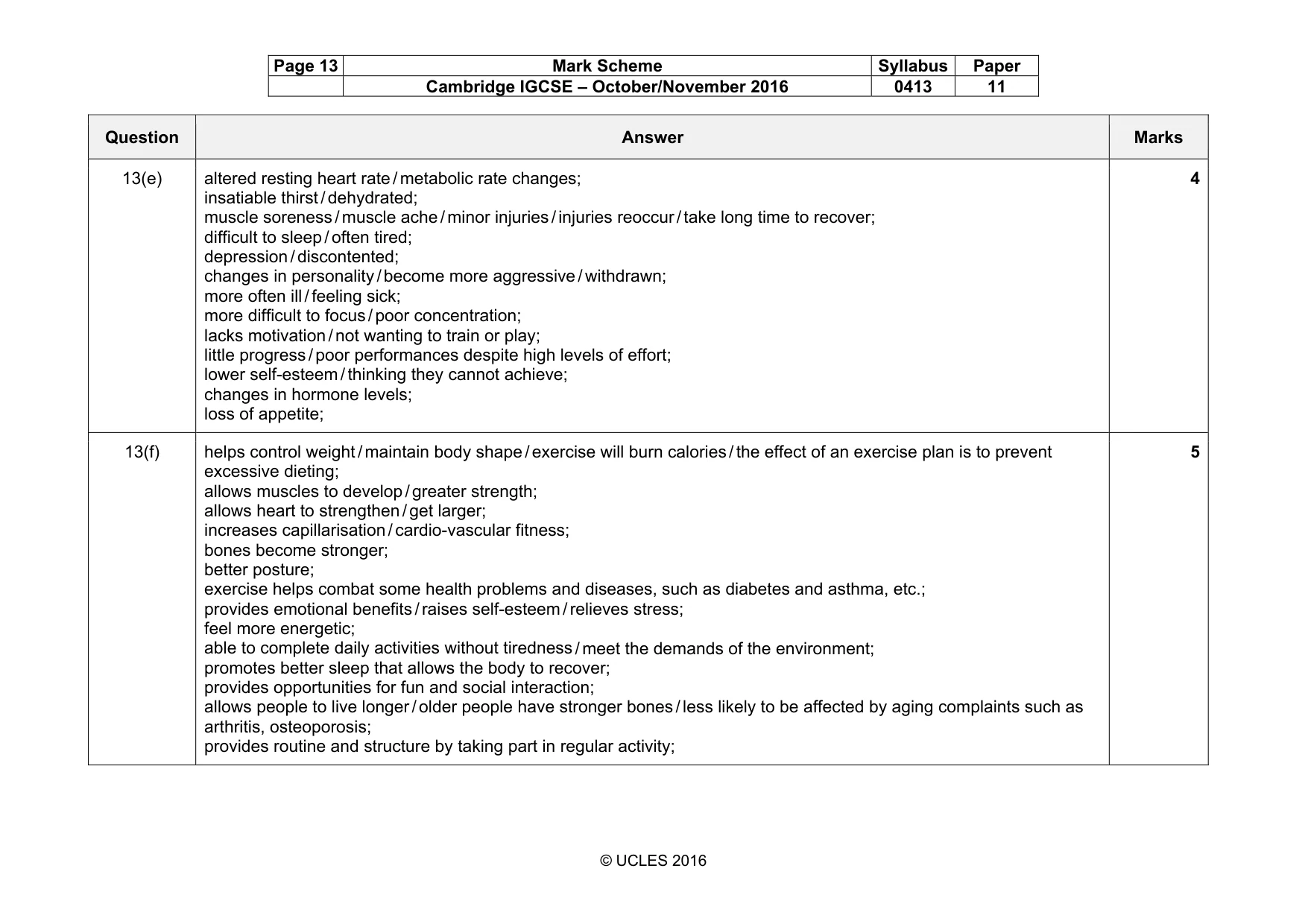
Mark scheme, page 13
Page 13 Mark Scheme Syllabus Paper Cambridge IGCSE – October/November 2016 0413 11 © UCLES 2016 Question Answer Marks 13(e) altered resting heart rate / metabolic rate changes; insatiable thirst / dehydrated; muscle soreness / muscle ache / minor injuries / injuries reoccur / take long time to recover; difficult to sleep / often tired; depression / discontented; changes in personality / become more aggressive / withdrawn; more often ill / feeling sick; more difficult to focus / poor concentration; lacks motivation / not wanting to train or play; little progress / poor performances despite high levels of effort; lower self-esteem / thinking they cannot achieve; changes in hormone levels; loss of appetite; 4 13(f) helps control weight / maintain body shape / exercise will burn calories / the effect of an exercise plan is to prevent excessive dieting; allows muscles to develop / greater strength; allows heart to strengthen / get larger; increases capillarisation / cardio-vascular fitness; bones become stronger; better posture; exercise helps combat some health problems and diseases, such as diabetes and asthma, etc.; provides emotional benefits / raises self-esteem / relieves stress; feel more energetic; able to complete daily activities without tiredness / meet the demands of the environment; promotes better sleep that allows the body to recover; provides opportunities for fun and social interaction; allows people to live longer / older people have stronger bones / less likely to be affected by aging complaints such as arthritis, osteoporosis; provides routine and structure by taking part in regular activity; 5
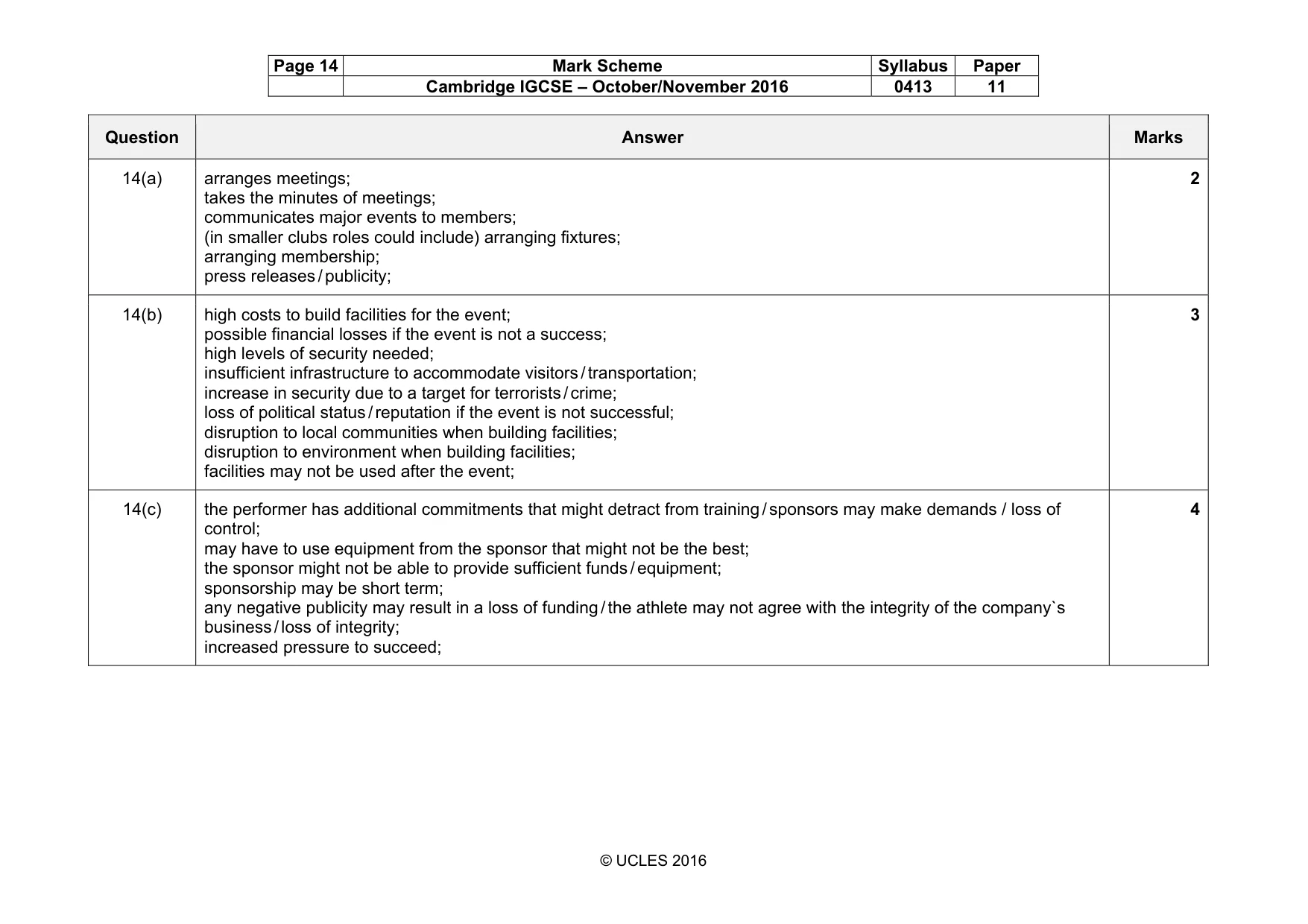
Mark scheme, page 14
Page 14 Mark Scheme Syllabus Paper Cambridge IGCSE – October/November 2016 0413 11 © UCLES 2016 Question Answer Marks 14(a) arranges meetings; takes the minutes of meetings; communicates major events to members; (in smaller clubs roles could include) arranging fixtures; arranging membership; press releases / publicity; 2 14(b) high costs to build facilities for the event; possible financial losses if the event is not a success; high levels of security needed; insufficient infrastructure to accommodate visitors / transportation; increase in security due to a target for terrorists / crime; loss of political status / reputation if the event is not successful; disruption to local communities when building facilities; disruption to environment when building facilities; facilities may not be used after the event; 3 14(c) the performer has additional commitments that might detract from training / sponsors may make demands / loss of control; may have to use equipment from the sponsor that might not be the best; the sponsor might not be able to provide sufficient funds / equipment; sponsorship may be short term; any negative publicity may result in a loss of funding / the athlete may not agree with the integrity of the company`s business / loss of integrity; increased pressure to succeed; 4
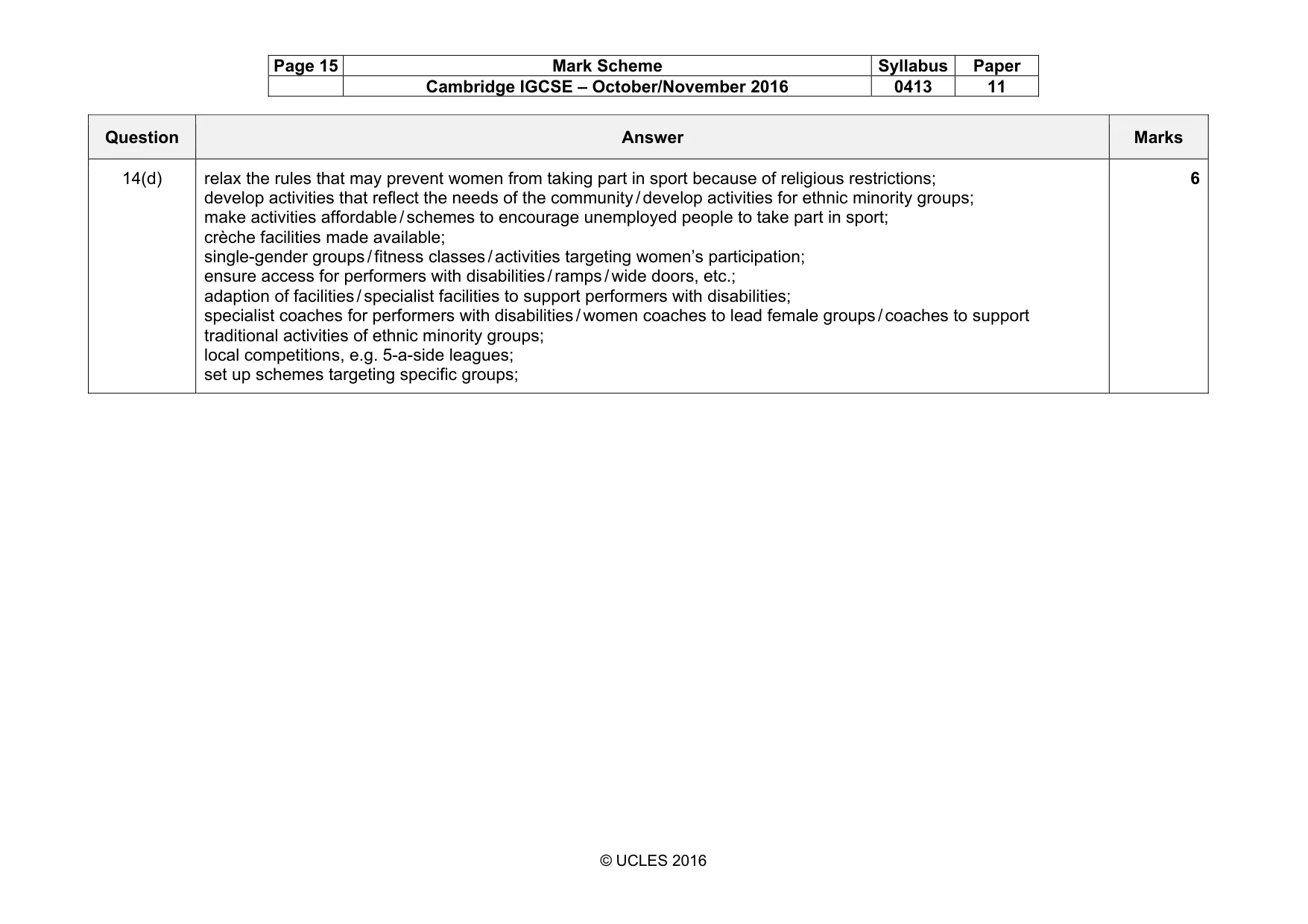
Mark scheme, page 15
Page 15 Mark Scheme Syllabus Paper Cambridge IGCSE – October/November 2016 0413 11 © UCLES 2016 Question Answer Marks 14(d) relax the rules that may prevent women from taking part in sport because of religious restrictions; develop activities that reflect the needs of the community / develop activities for ethnic minority groups; make activities affordable / schemes to encourage unemployed people to take part in sport; crèche facilities made available; single-gender groups / fitness classes / activities targeting women’s participation; ensure access for performers with disabilities / ramps / wide doors, etc.; adaption of facilities / specialist facilities to support performers with disabilities; specialist coaches for performers with disabilities / women coaches to lead female groups / coaches to support traditional activities of ethnic minority groups; local competitions, e.g. 5-a-side leagues; set up schemes targeting specific groups; 6
What you needed in this session
Cambridge’s own grade thresholds for 2016 Oct/Nov, Paper 1 · Variant 1. A higher threshold means an easier paper — the bar moves with how the cohort did.