Cambridge IGCSE Physical Education 0413 — 2016 Oct/Nov Paper 1 · Variant 3
0413/13/O/N/16 · 80 marks · ≈90 min
The question paper and its mark scheme, free to read here and free to download. This is Cambridge’s own paper, exactly as it was sat.
Question paper12 pages
Mark scheme16 pages
Answers below. Sit the paper first if you are practising.
Paper as text
Question paper, page 1
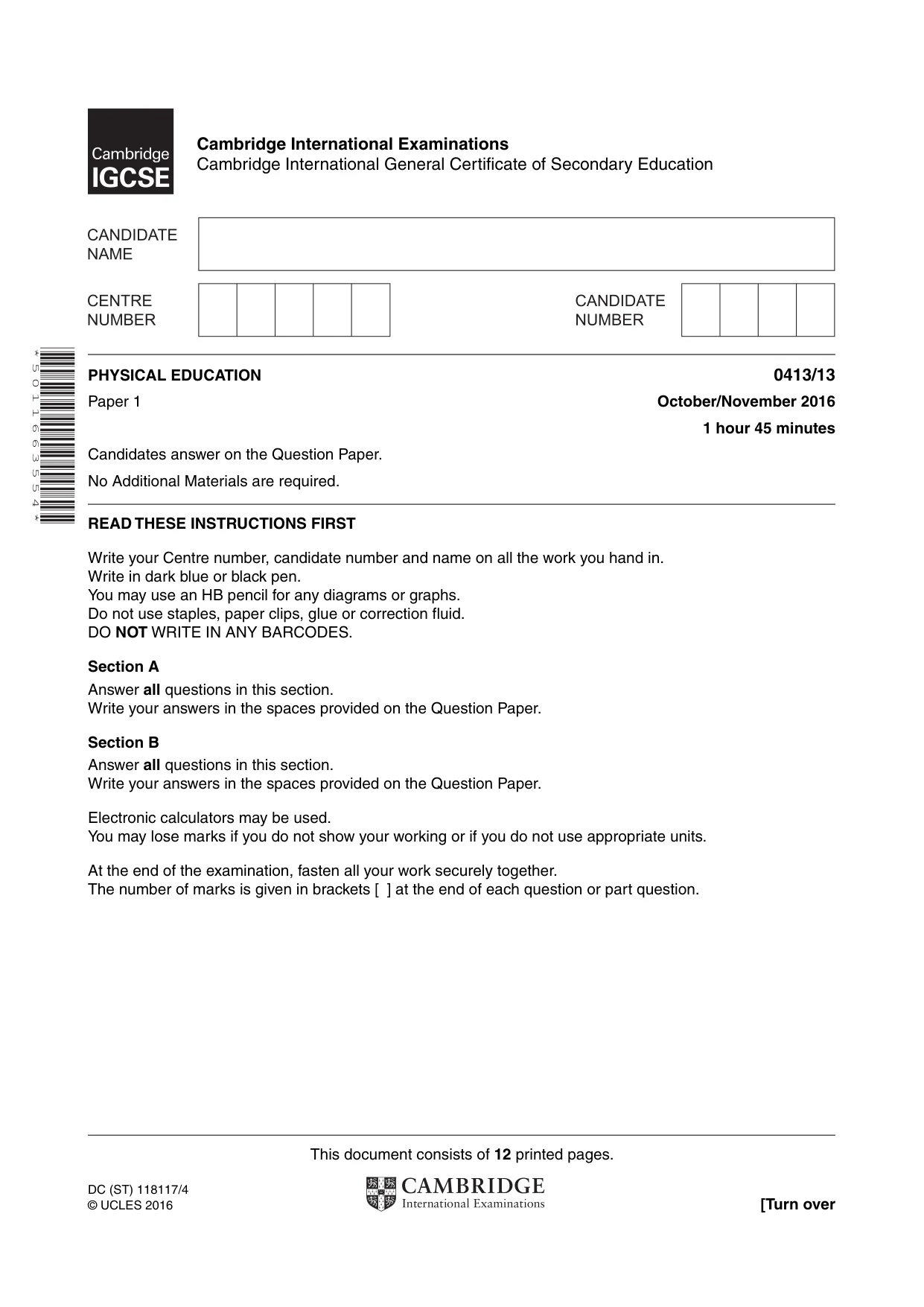
This document consists of 12 printed pages. DC (ST) 118117/4 © UCLES 2016 [Turn over Cambridge International Examinations Cambridge International General Certificate of Secondary Education * 5 0 1 1 6 6 3 5 5 4 * PHYSICAL EDUCATION 0413/13 Paper 1 October/November 2016 1 hour 45 minutes Candidates answer on the Question Paper. No Additional Materials are required. READ THESE INSTRUCTIONS FIRST Write your Centre number, candidate number and name on all the work you hand in. Write in dark blue or black pen. You may use an HB pencil for any diagrams or graphs. Do not use staples, paper clips, glue or correction fluid. DO NOT WRITE IN ANY BARCODES. Section A Answer all questions in this section. Write your answers in the spaces provided on the Question Paper. Section B Answer all questions in this section. Write your answers in the spaces provided on the Question Paper. Electronic calculators may be used. You may lose marks if you do not show your working or if you do not use appropriate units. At the end of the examination, fasten all your work securely together. The number of marks is given in brackets [ ] at the end of each question or part question.
Question paper, page 2
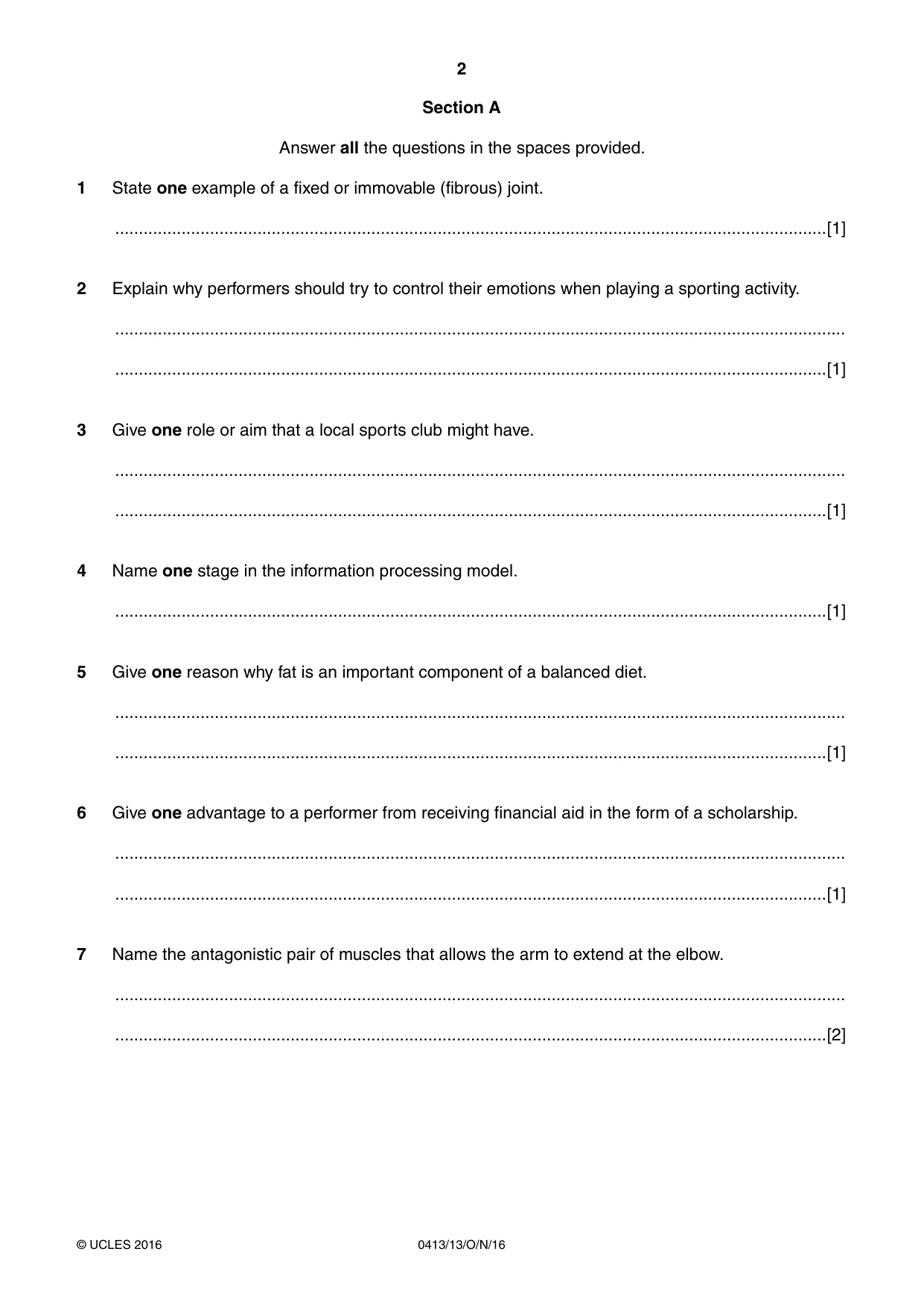
2 0413/13/O/N/16 © UCLES 2016 Section A Answer all the questions in the spaces provided. 1 State one example of a fixed or immovable (fibrous) joint. …[1] 2 Explain why performers should try to control their emotions when playing a sporting activity. … …[1] 3 Give one role or aim that a local sports club might have. … …[1] 4 Name one stage in the information processing model. …[1] 5 Give one reason why fat is an important component of a balanced diet. … …[1] 6 Give one advantage to a performer from receiving financial aid in the form of a scholarship. … …[1] 7 Name the antagonistic pair of muscles that allows the arm to extend at the elbow. … …[2]
Question paper, page 3
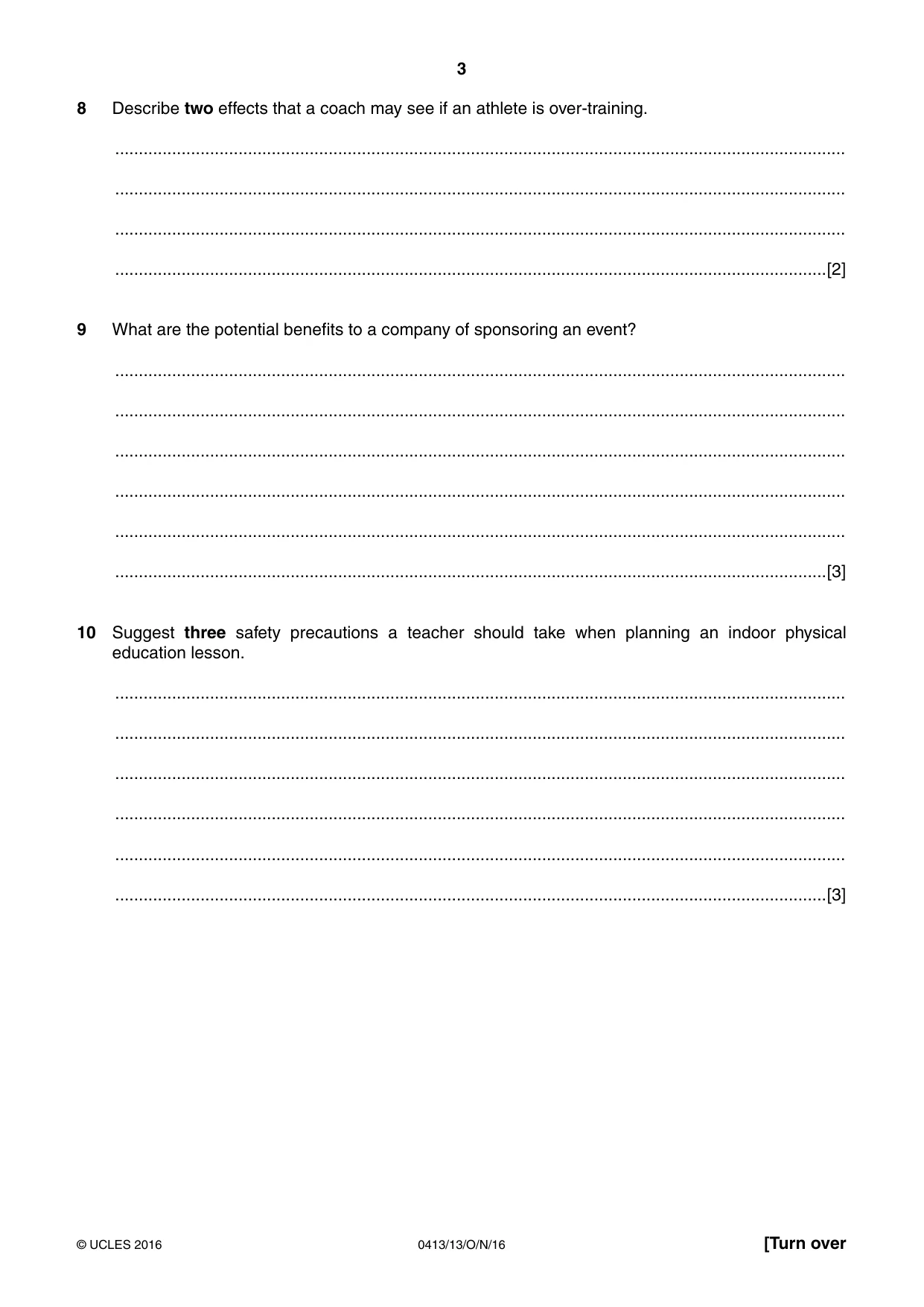
3 0413/13/O/N/16 © UCLES 2016 [Turn over 8 Describe two effects that a coach may see if an athlete is over-training. … … … …[2] 9 What are the potential benefits to a company of sponsoring an event? … … … … … …[3] 10 Suggest three safety precautions a teacher should take when planning an indoor physical education lesson. … … … … … …[3]
Question paper, page 4
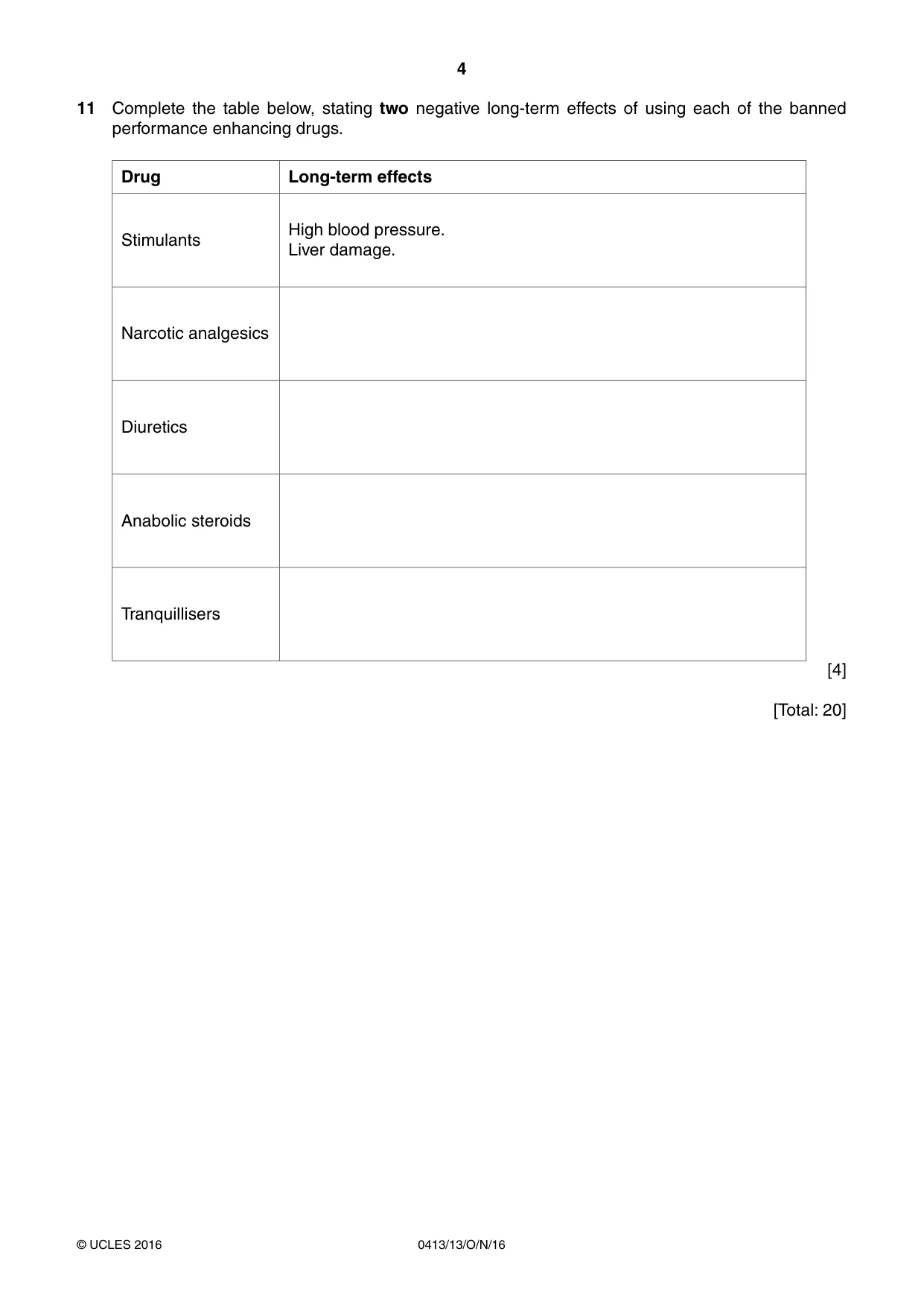
4 0413/13/O/N/16 © UCLES 2016 11 Complete the table below, stating two negative long-term effects of using each of the banned performance enhancing drugs. Drug Long-term effects Stimulants High blood pressure. Liver damage. Narcotic analgesics Diuretics Anabolic steroids Tranquillisers [4] [Total: 20]
Question paper, page 5
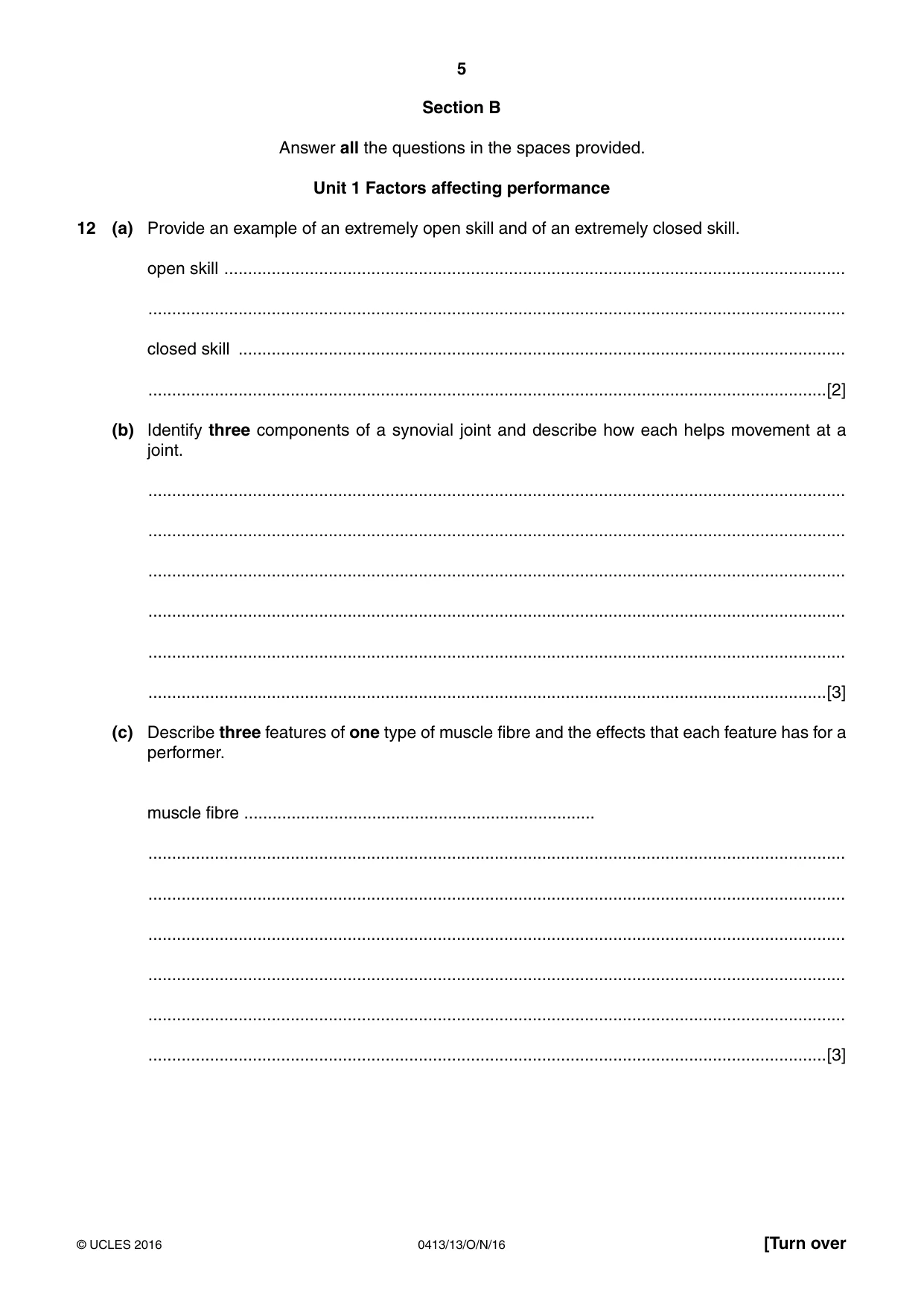
5 0413/13/O/N/16 © UCLES 2016 [Turn over Section B Answer all the questions in the spaces provided. Unit 1 Factors affecting performance 12 (a) Provide an example of an extremely open skill and of an extremely closed skill. open skill … … closed skill … …[2] (b) Identify three components of a synovial joint and describe how each helps movement at a joint. … … … … … …[3] (c) Describe three features of one type of muscle fibre and the effects that each feature has for a performer. muscle fibre … … … … … … …[3]
Question paper, page 6
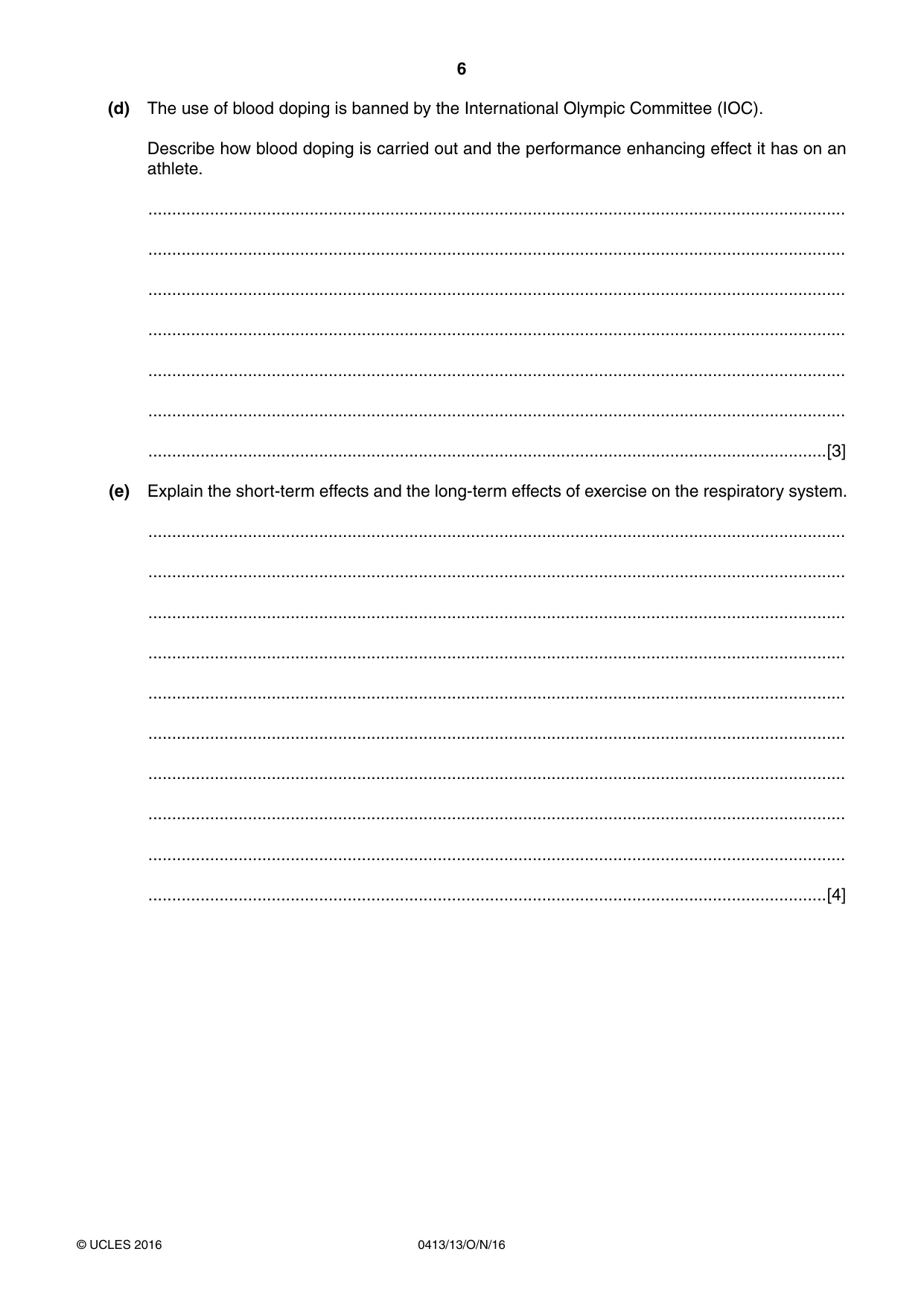
6 0413/13/O/N/16 © UCLES 2016 (d) The use of blood doping is banned by the International Olympic Committee (IOC). Describe how blood doping is carried out and the performance enhancing effect it has on an athlete. … … … … … … …[3] (e) Explain the short-term effects and the long-term effects of exercise on the respiratory system. … … … … … … … … … …[4]
Question paper, page 7
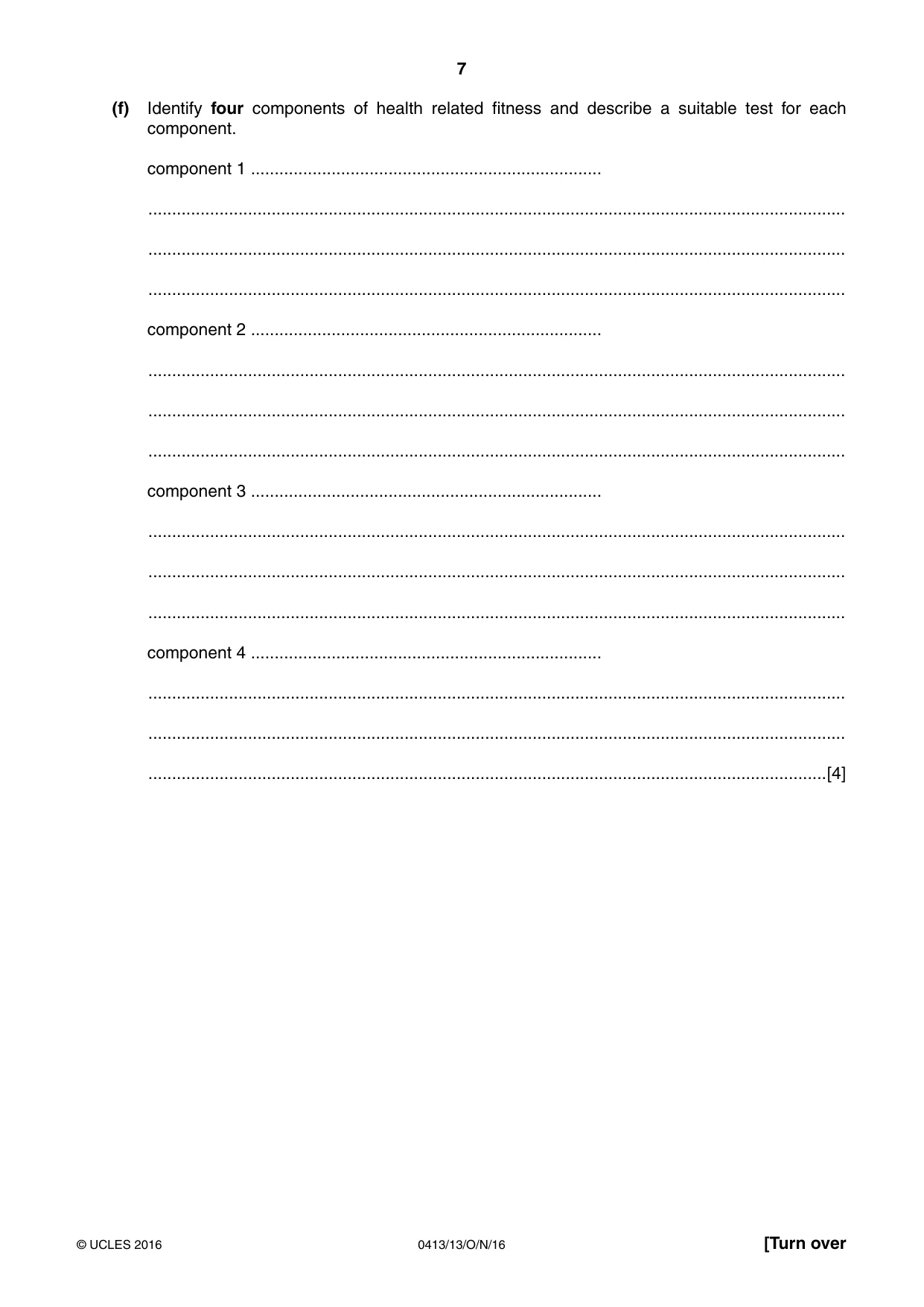
7 0413/13/O/N/16 © UCLES 2016 [Turn over (f) Identify four components of health related fitness and describe a suitable test for each component. component 1 … … … … component 2 … … … … component 3 … … … … component 4 … … … …[4]
Question paper, page 8
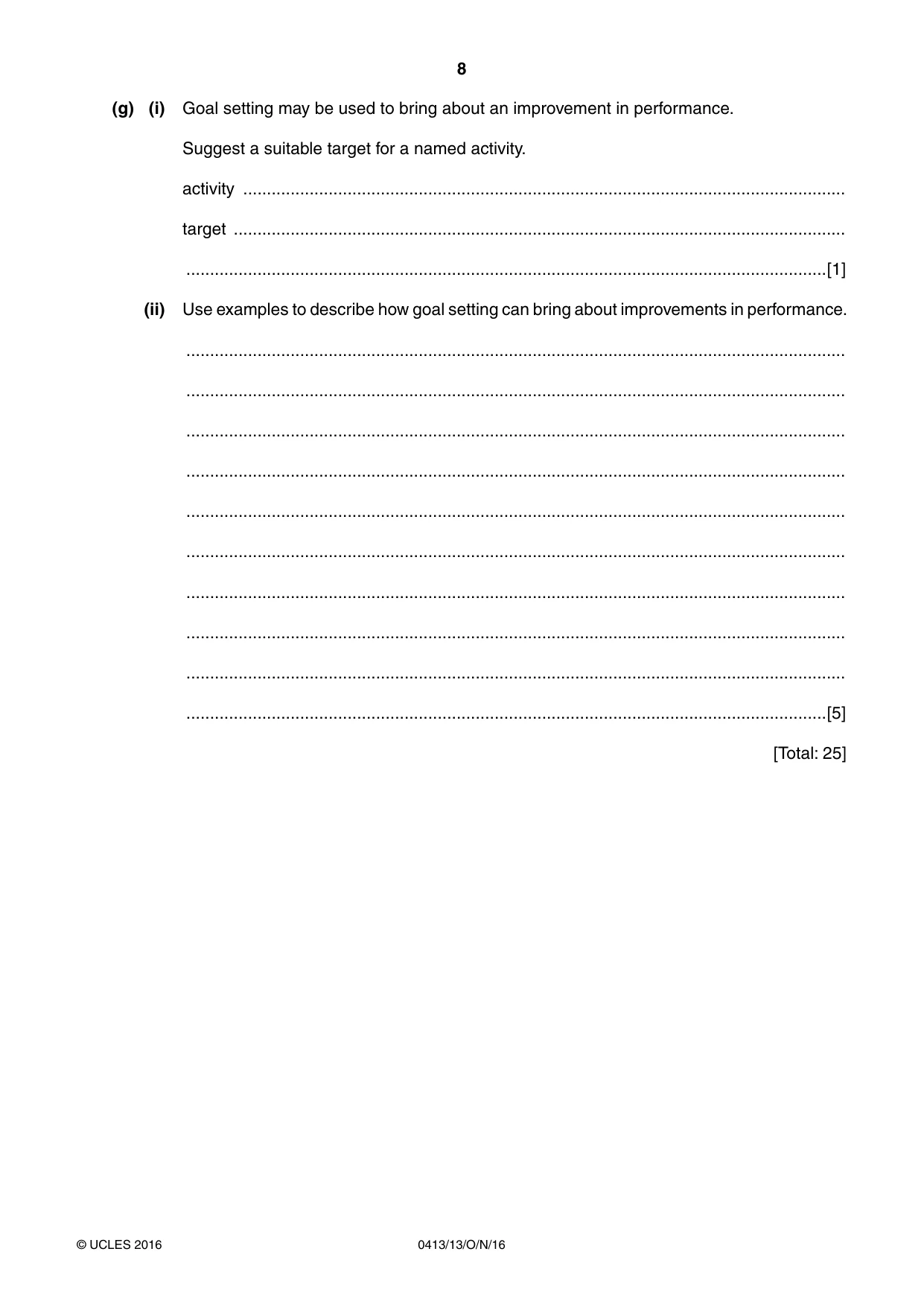
8 0413/13/O/N/16 © UCLES 2016 (g) (i) Goal setting may be used to bring about an improvement in performance. Suggest a suitable target for a named activity. activity … target … …[1] (ii) Use examples to describe how goal setting can bring about improvements in performance. … … … … … … … … … …[5] [Total: 25]
Question paper, page 9
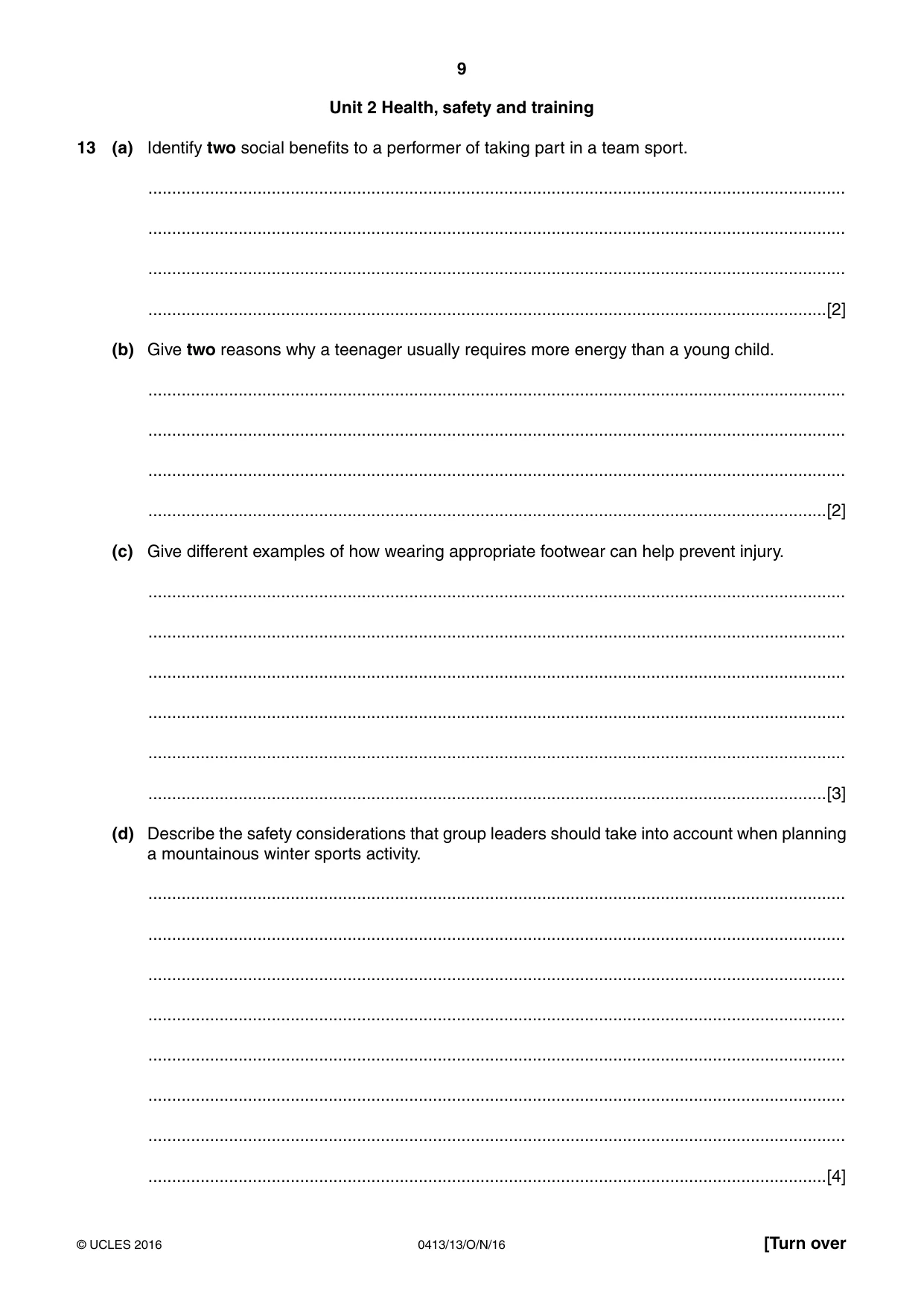
9 0413/13/O/N/16 © UCLES 2016 [Turn over Unit 2 Health, safety and training 13 (a) Identify two social benefits to a performer of taking part in a team sport. … … … …[2] (b) Give two reasons why a teenager usually requires more energy than a young child. … … … …[2] (c) Give different examples of how wearing appropriate footwear can help prevent injury. … … … … … …[3] (d) Describe the safety considerations that group leaders should take into account when planning a mountainous winter sports activity. … … … … … … … …[4]
Question paper, page 10
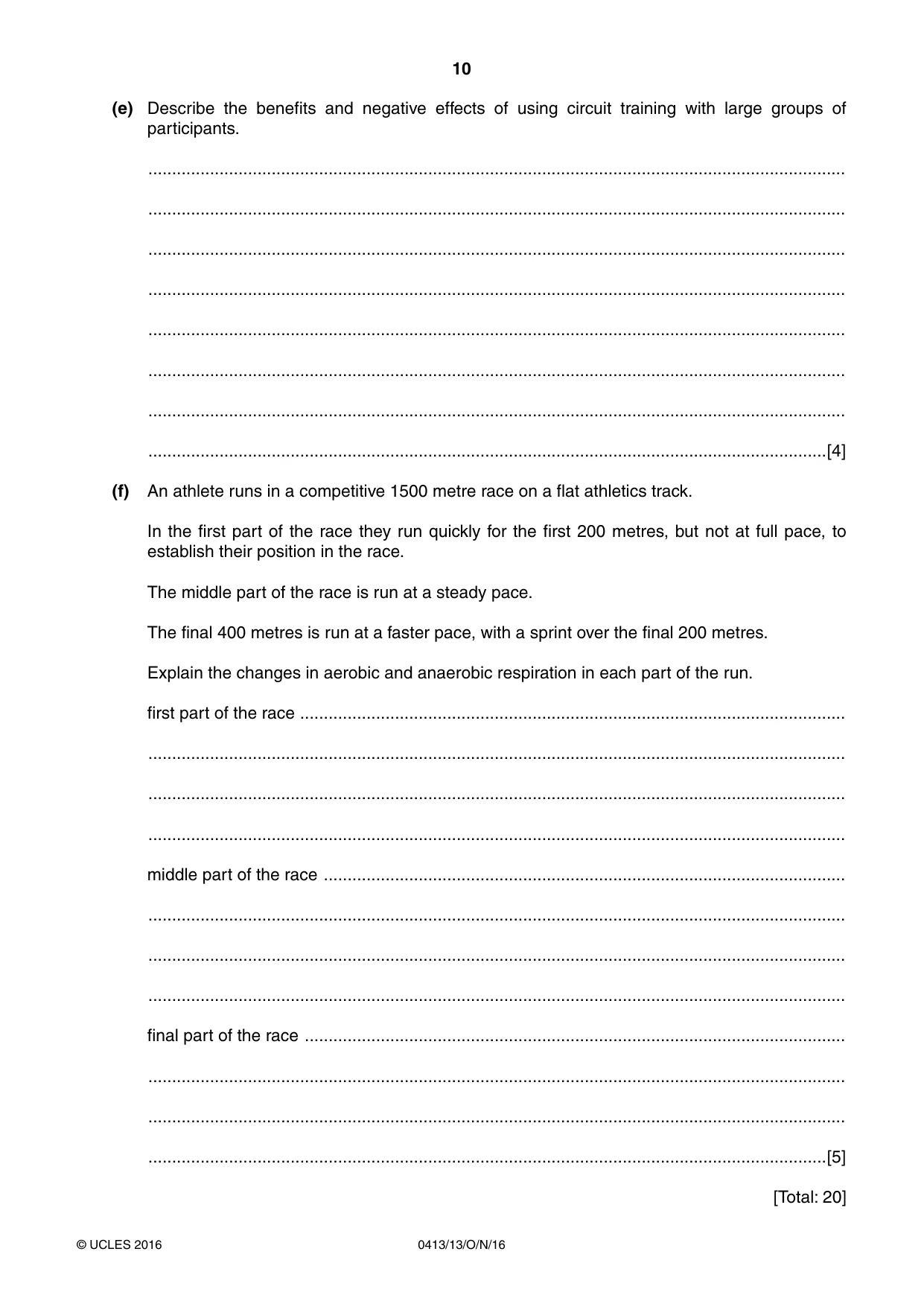
10 0413/13/O/N/16 © UCLES 2016 (e) Describe the benefits and negative effects of using circuit training with large groups of participants. … … … … … … … …[4] (f) An athlete runs in a competitive 1500 metre race on a flat athletics track. In the first part of the race they run quickly for the first 200 metres, but not at full pace, to establish their position in the race. The middle part of the race is run at a steady pace. The final 400 metres is run at a faster pace, with a sprint over the final 200 metres. Explain the changes in aerobic and anaerobic respiration in each part of the run. first part of the race … … … … middle part of the race … … … … final part of the race … … … …[5] [Total: 20]
Question paper, page 11
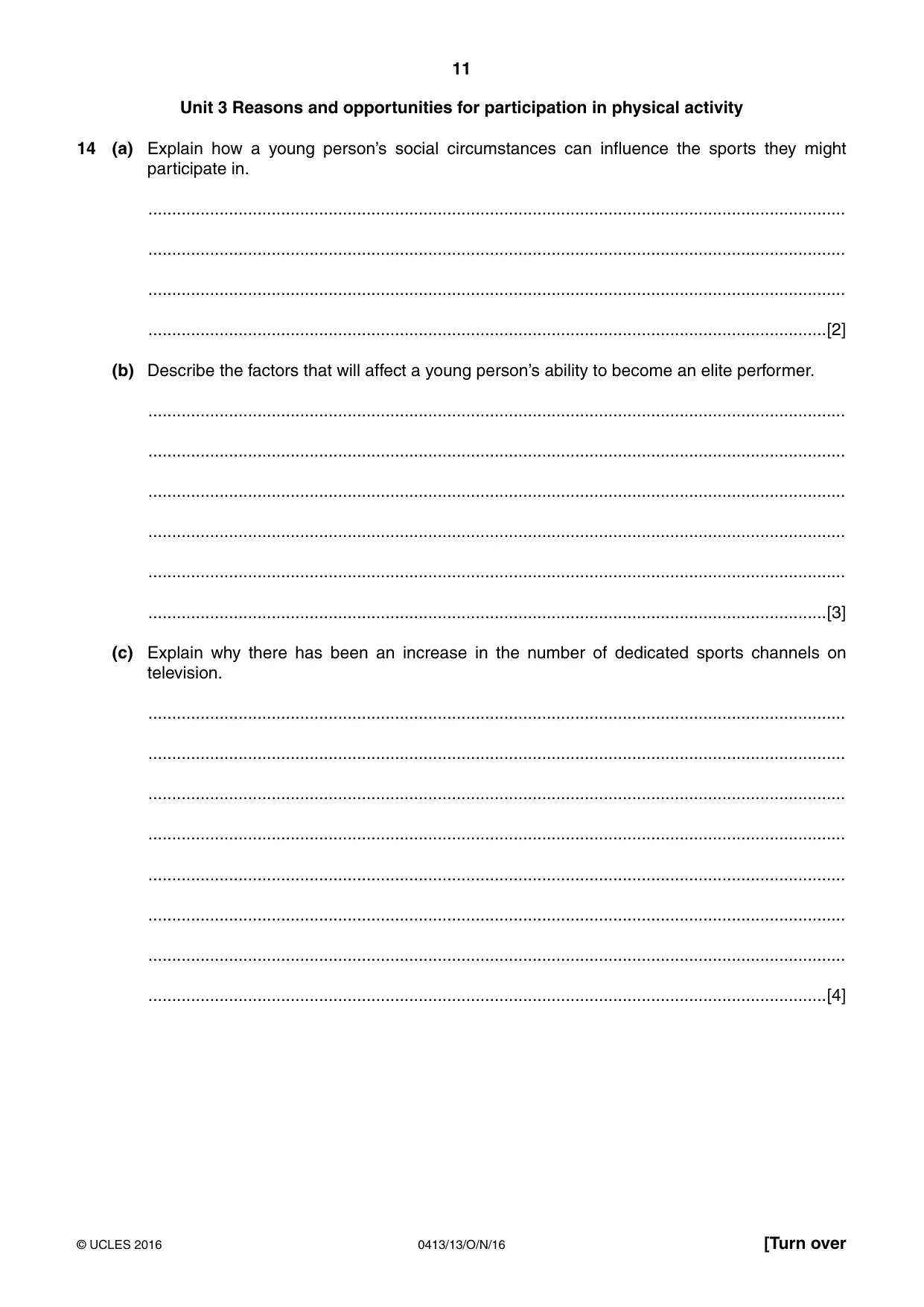
11 0413/13/O/N/16 © UCLES 2016 [Turn over Unit 3 Reasons and opportunities for participation in physical activity 14 (a) Explain how a young person’s social circumstances can influence the sports they might participate in. … … … …[2] (b) Describe the factors that will affect a young person’s ability to become an elite performer. … … … … … …[3] (c) Explain why there has been an increase in the number of dedicated sports channels on television. … … … … … … … …[4]
Question paper, page 12
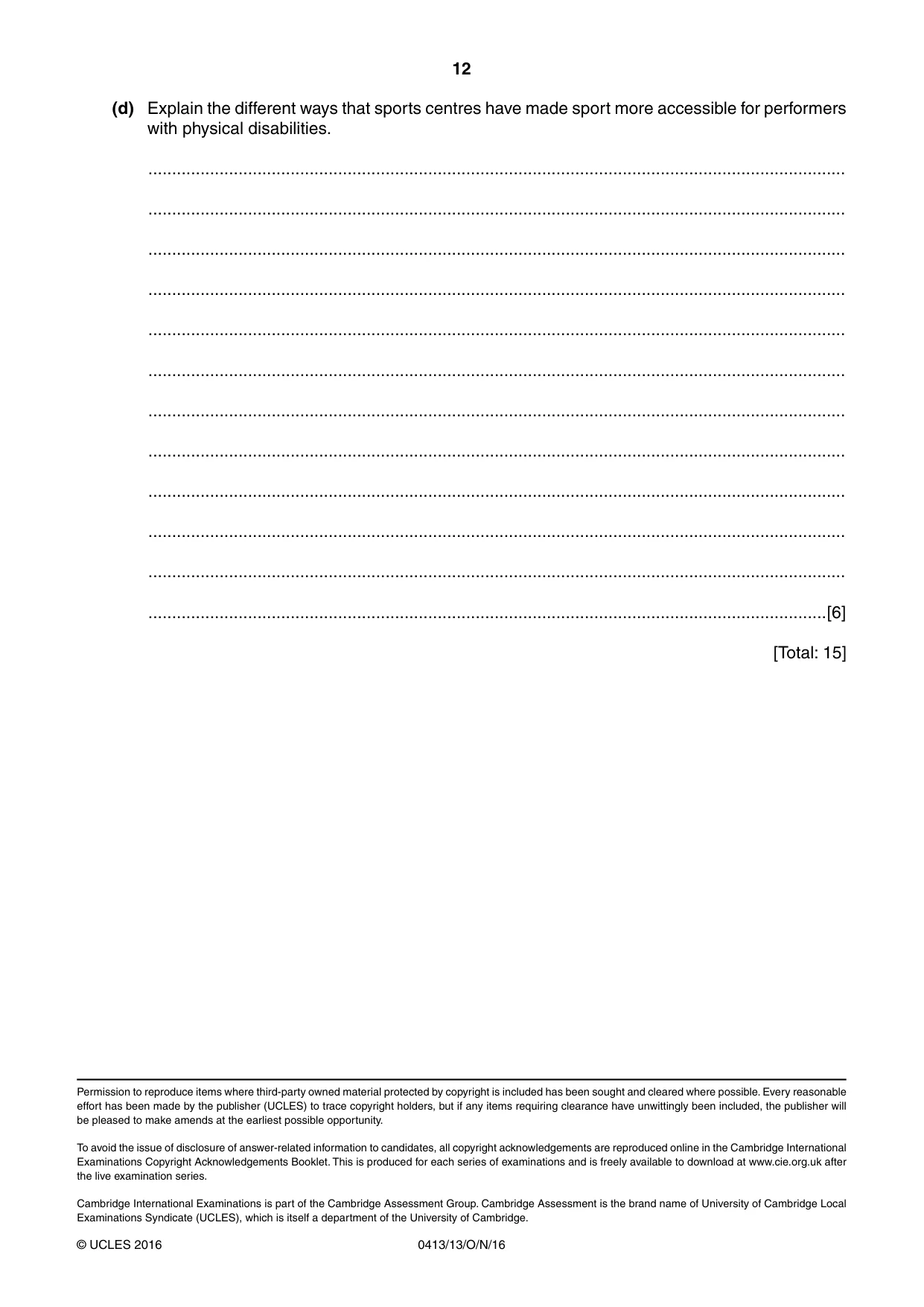
12 0413/13/O/N/16 © UCLES 2016 Permission to reproduce items where third-party owned material protected by copyright is included has been sought and cleared where possible. Every reasonable effort has been made by the publisher (UCLES) to trace copyright holders, but if any items requiring clearance have unwittingly been included, the publisher will be pleased to make amends at the earliest possible opportunity. To avoid the issue of disclosure of answer-related information to candidates, all copyright acknowledgements are reproduced online in the Cambridge International Examinations Copyright Acknowledgements Booklet. This is produced for each series of examinations and is freely available to download at www.cie.org.uk after the live examination series. Cambridge International Examinations is part of the Cambridge Assessment Group. Cambridge Assessment is the brand name of University of Cambridge Local Examinations Syndicate (UCLES), which is itself a department of the University of Cambridge. (d) Explain the different ways that sports centres have made sport more accessible for performers with physical disabilities. … … … … … … … … … … … …[6] [Total: 15]
Mark scheme, page 1
® IGCSE is the registered trademark of Cambridge International Examinations. This document consists of 16 printed pages. © UCLES 2016 [Turn over Cambridge International Examinations Cambridge International General Certificate of Secondary Education PHYSICAL EDUCATION 0413/13 Paper 1 October/November 2016 MARK SCHEME Maximum Mark: 80 Published This mark scheme is published as an aid to teachers and candidates, to indicate the requirements of the examination. It shows the basis on which Examiners were instructed to award marks. It does not indicate the details of the discussions that took place at an Examiners’ meeting before marking began, which would have considered the acceptability of alternative answers. Mark schemes should be read in conjunction with the question paper and the Principal Examiner Report for Teachers. Cambridge will not enter into discussions about these mark schemes. Cambridge is publishing the mark schemes for the October/November 2016 series for most Cambridge IGCSE®, Cambridge International A and AS Level components and some Cambridge O Level components.
Mark scheme, page 2
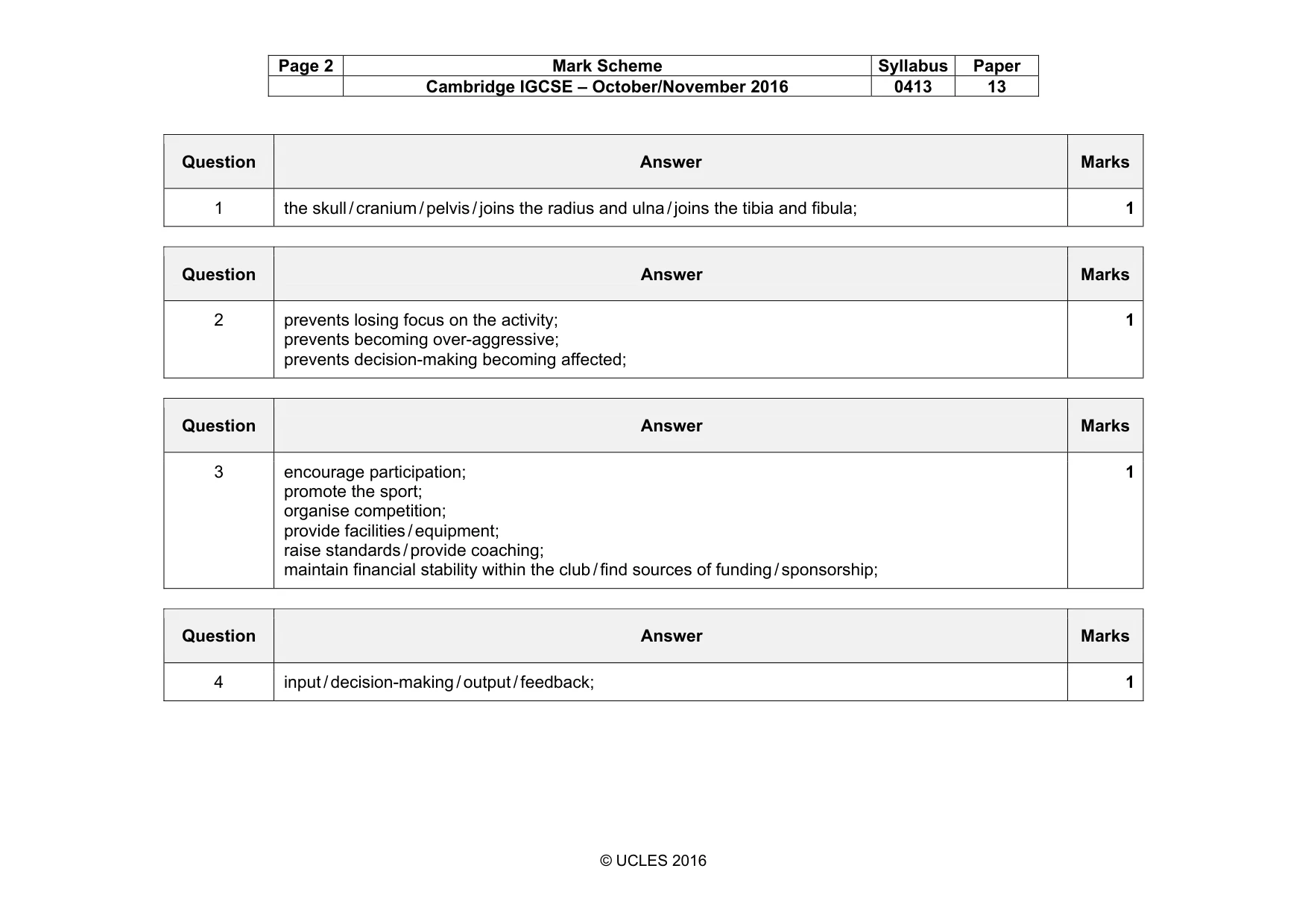
Page 2 Mark Scheme Syllabus Paper Cambridge IGCSE – October/November 2016 0413 13 © UCLES 2016 Question Answer Marks 1 the skull / cranium / pelvis / joins the radius and ulna / joins the tibia and fibula; 1 Question Answer Marks 2 prevents losing focus on the activity; prevents becoming over-aggressive; prevents decision-making becoming affected; 1 Question Answer Marks 3 encourage participation; promote the sport; organise competition; provide facilities / equipment; raise standards / provide coaching; maintain financial stability within the club / find sources of funding / sponsorship; 1 Question Answer Marks 4 input / decision-making / output / feedback; 1
Mark scheme, page 3
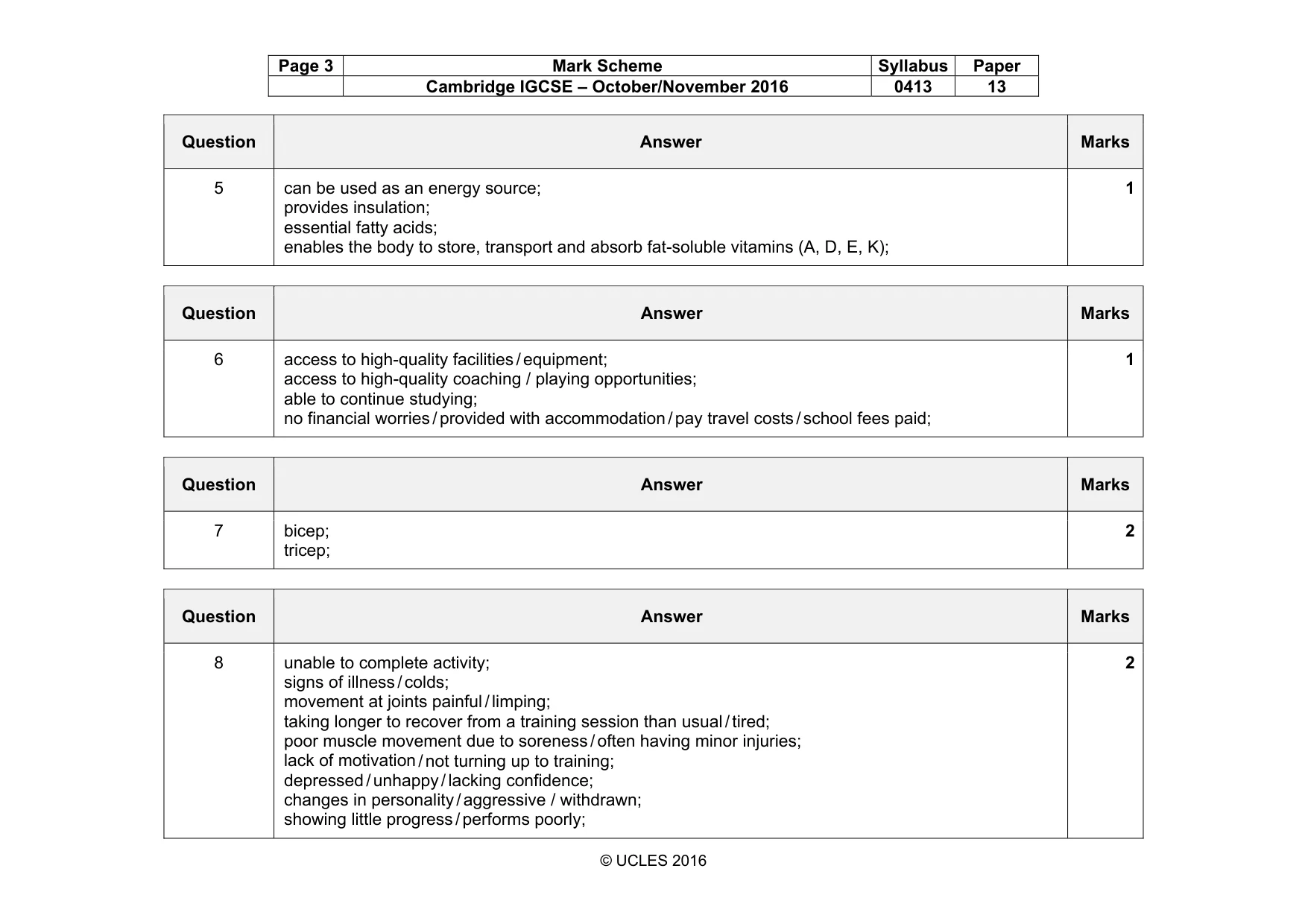
Page 3 Mark Scheme Syllabus Paper Cambridge IGCSE – October/November 2016 0413 13 © UCLES 2016 Question Answer Marks 5 can be used as an energy source; provides insulation; essential fatty acids; enables the body to store, transport and absorb fat-soluble vitamins (A, D, E, K); 1 Question Answer Marks 6 access to high-quality facilities / equipment; access to high-quality coaching / playing opportunities; able to continue studying; no financial worries / provided with accommodation / pay travel costs / school fees paid; 1 Question Answer Marks 7 bicep; tricep; 2 Question Answer Marks 8 unable to complete activity; signs of illness / colds; movement at joints painful / limping; taking longer to recover from a training session than usual / tired; poor muscle movement due to soreness / often having minor injuries; lack of motivation / not turning up to training; depressed / unhappy / lacking confidence; changes in personality / aggressive / withdrawn; showing little progress / performs poorly; 2
Mark scheme, page 4
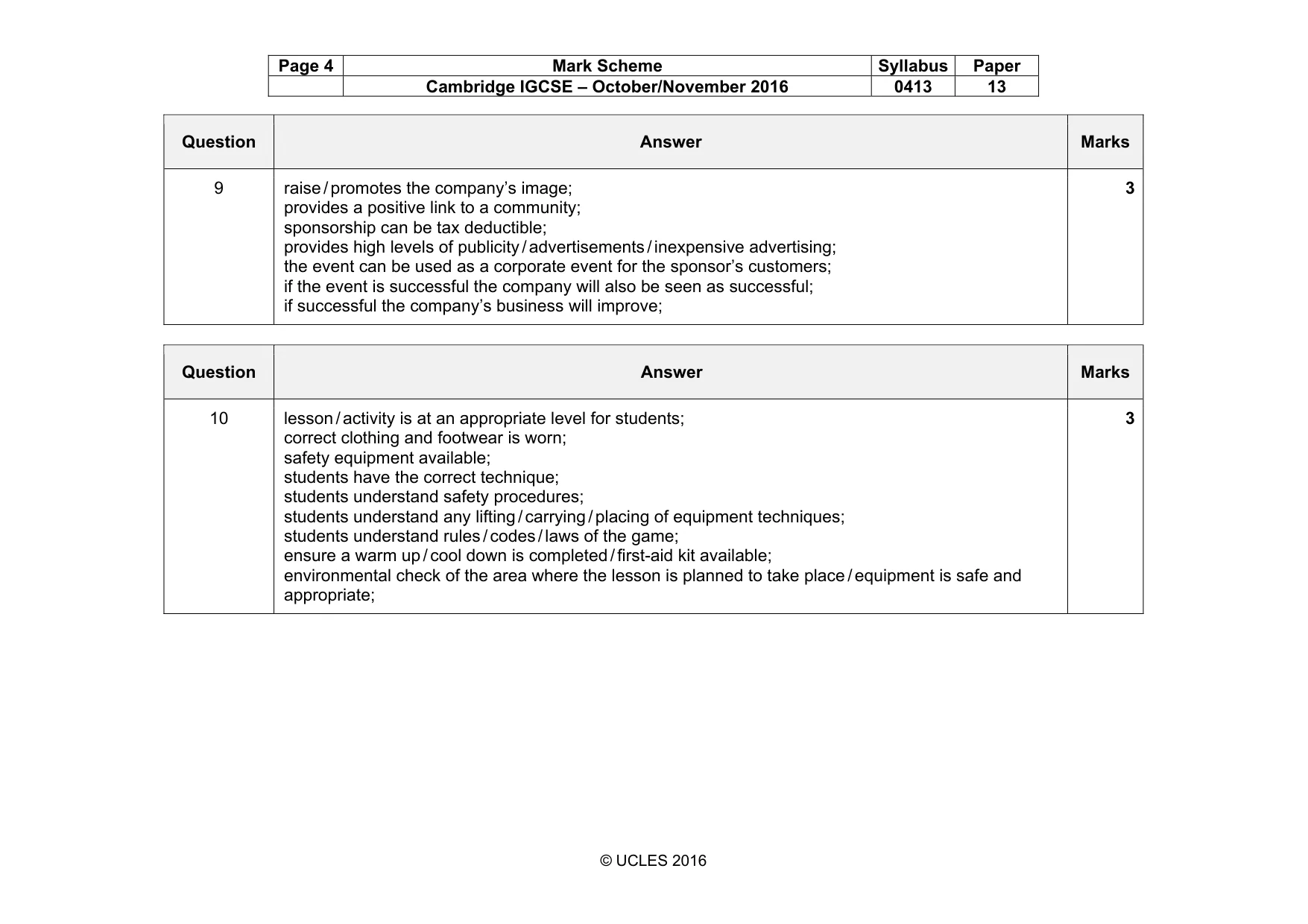
Page 4 Mark Scheme Syllabus Paper Cambridge IGCSE – October/November 2016 0413 13 © UCLES 2016 Question Answer Marks 9 raise / promotes the company’s image; provides a positive link to a community; sponsorship can be tax deductible; provides high levels of publicity / advertisements / inexpensive advertising; the event can be used as a corporate event for the sponsor’s customers; if the event is successful the company will also be seen as successful; if successful the company’s business will improve; 3 Question Answer Marks 10 lesson / activity is at an appropriate level for students; correct clothing and footwear is worn; safety equipment available; students have the correct technique; students understand safety procedures; students understand any lifting / carrying / placing of equipment techniques; students understand rules / codes / laws of the game; ensure a warm up / cool down is completed / first-aid kit available; environmental check of the area where the lesson is planned to take place / equipment is safe and appropriate; 3
Mark scheme, page 5
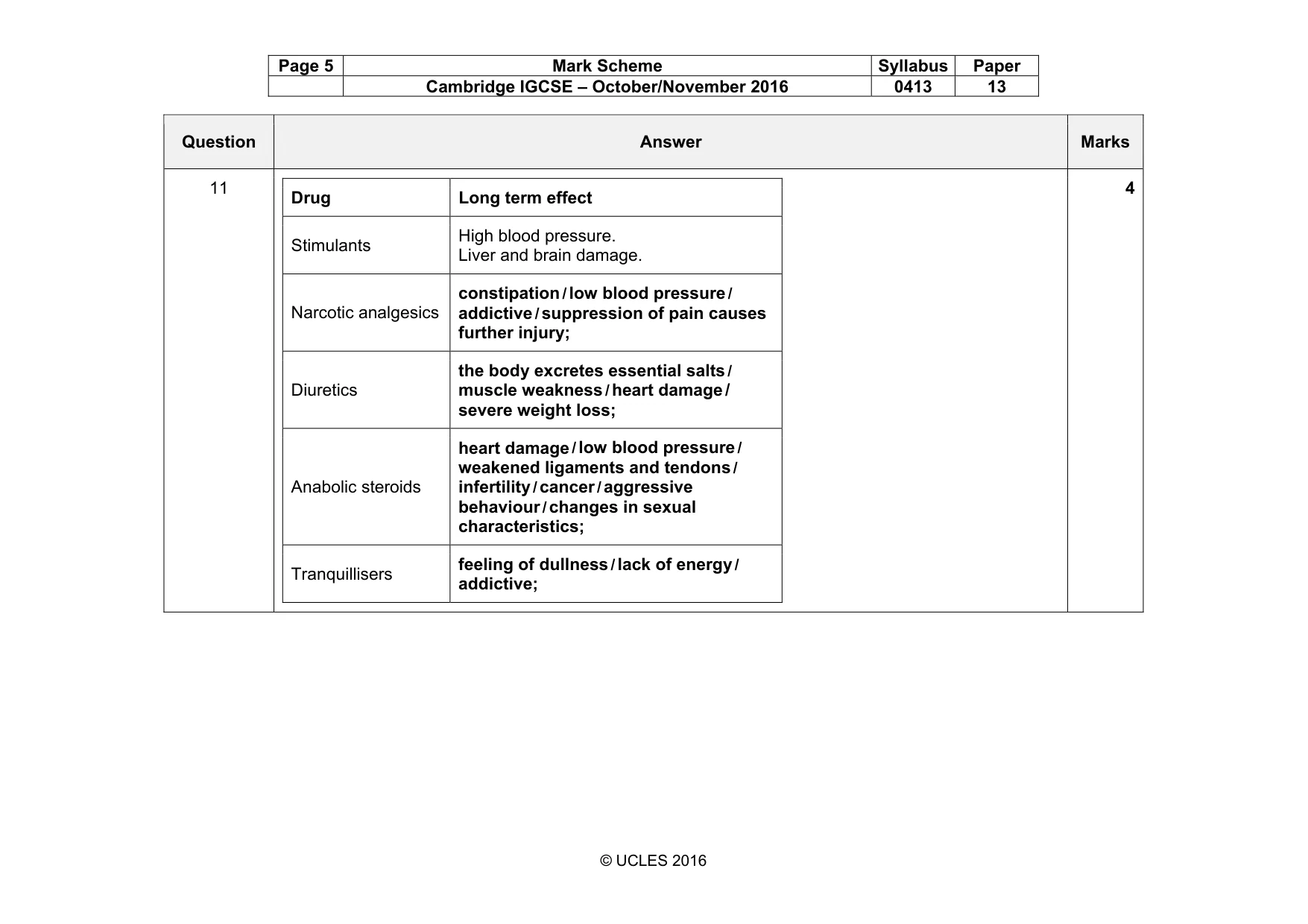
Page 5 Mark Scheme Syllabus Paper Cambridge IGCSE – October/November 2016 0413 13 © UCLES 2016 Question Answer Marks 11 Drug Long term effect Stimulants High blood pressure. Liver and brain damage. Narcotic analgesics constipation / low blood pressure / addictive / suppression of pain causes further injury; Diuretics the body excretes essential salts / muscle weakness / heart damage / severe weight loss; Anabolic steroids heart damage / low blood pressure / weakened ligaments and tendons / infertility / cancer / aggressive behaviour / changes in sexual characteristics; Tranquillisers feeling of dullness / lack of energy / addictive; 4
Mark scheme, page 6
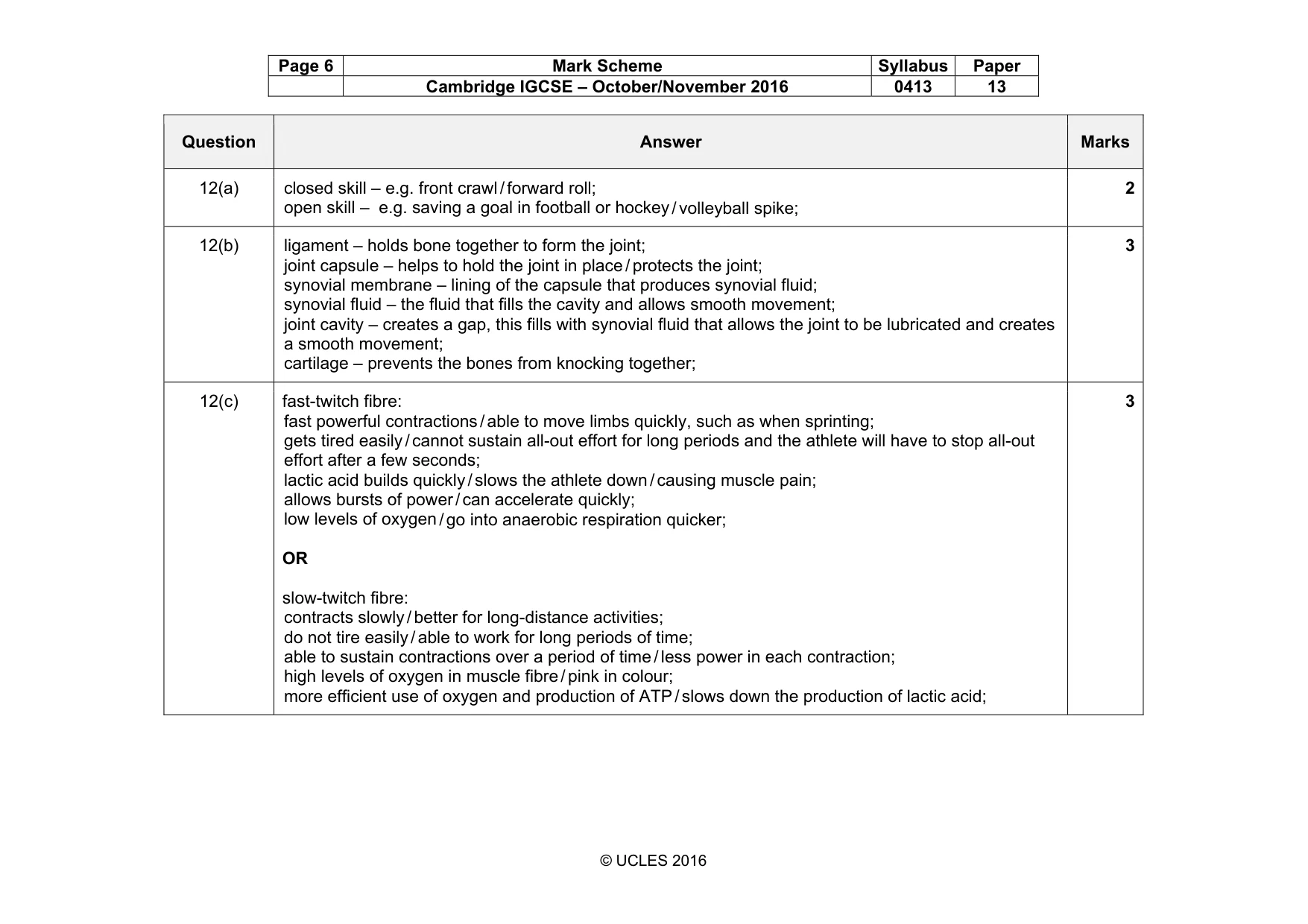
Page 6 Mark Scheme Syllabus Paper Cambridge IGCSE – October/November 2016 0413 13 © UCLES 2016 Question Answer Marks 12(a) closed skill – e.g. front crawl / forward roll; open skill – e.g. saving a goal in football or hockey / volleyball spike; 2 12(b) ligament – holds bone together to form the joint; joint capsule – helps to hold the joint in place / protects the joint; synovial membrane – lining of the capsule that produces synovial fluid; synovial fluid – the fluid that fills the cavity and allows smooth movement; joint cavity – creates a gap, this fills with synovial fluid that allows the joint to be lubricated and creates a smooth movement; cartilage – prevents the bones from knocking together; 3 12(c) fast-twitch fibre: fast powerful contractions / able to move limbs quickly, such as when sprinting; gets tired easily / cannot sustain all-out effort for long periods and the athlete will have to stop all-out effort after a few seconds; lactic acid builds quickly / slows the athlete down / causing muscle pain; allows bursts of power / can accelerate quickly; low levels of oxygen / go into anaerobic respiration quicker; OR slow-twitch fibre: contracts slowly / better for long-distance activities; do not tire easily / able to work for long periods of time; able to sustain contractions over a period of time / less power in each contraction; high levels of oxygen in muscle fibre / pink in colour; more efficient use of oxygen and production of ATP / slows down the production of lactic acid; 3
Mark scheme, page 7
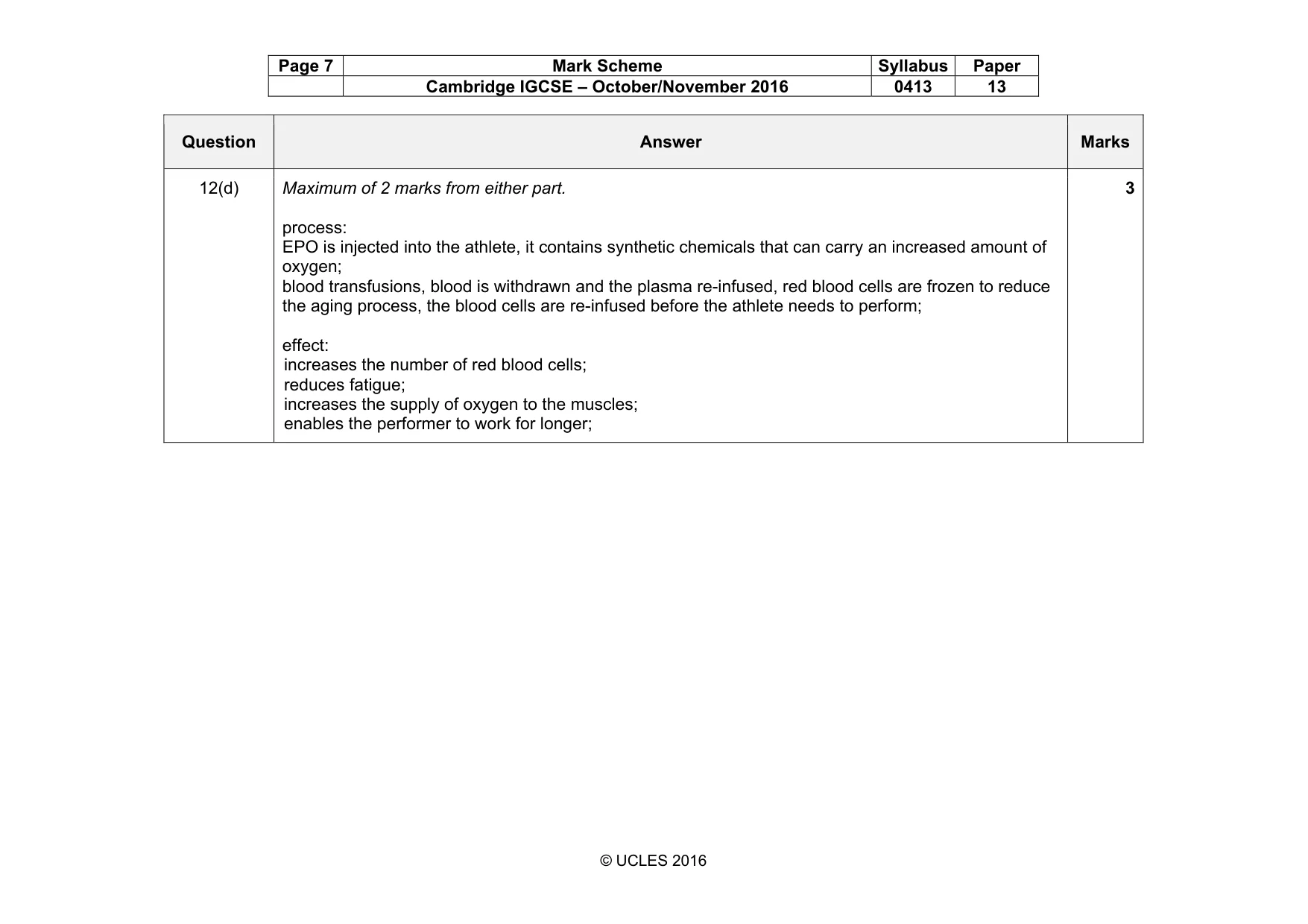
Page 7 Mark Scheme Syllabus Paper Cambridge IGCSE – October/November 2016 0413 13 © UCLES 2016 Question Answer Marks 12(d) Maximum of 2 marks from either part. process: EPO is injected into the athlete, it contains synthetic chemicals that can carry an increased amount of oxygen; blood transfusions, blood is withdrawn and the plasma re-infused, red blood cells are frozen to reduce the aging process, the blood cells are re-infused before the athlete needs to perform; effect: increases the number of red blood cells; reduces fatigue; increases the supply of oxygen to the muscles; enables the performer to work for longer; 3
Mark scheme, page 8
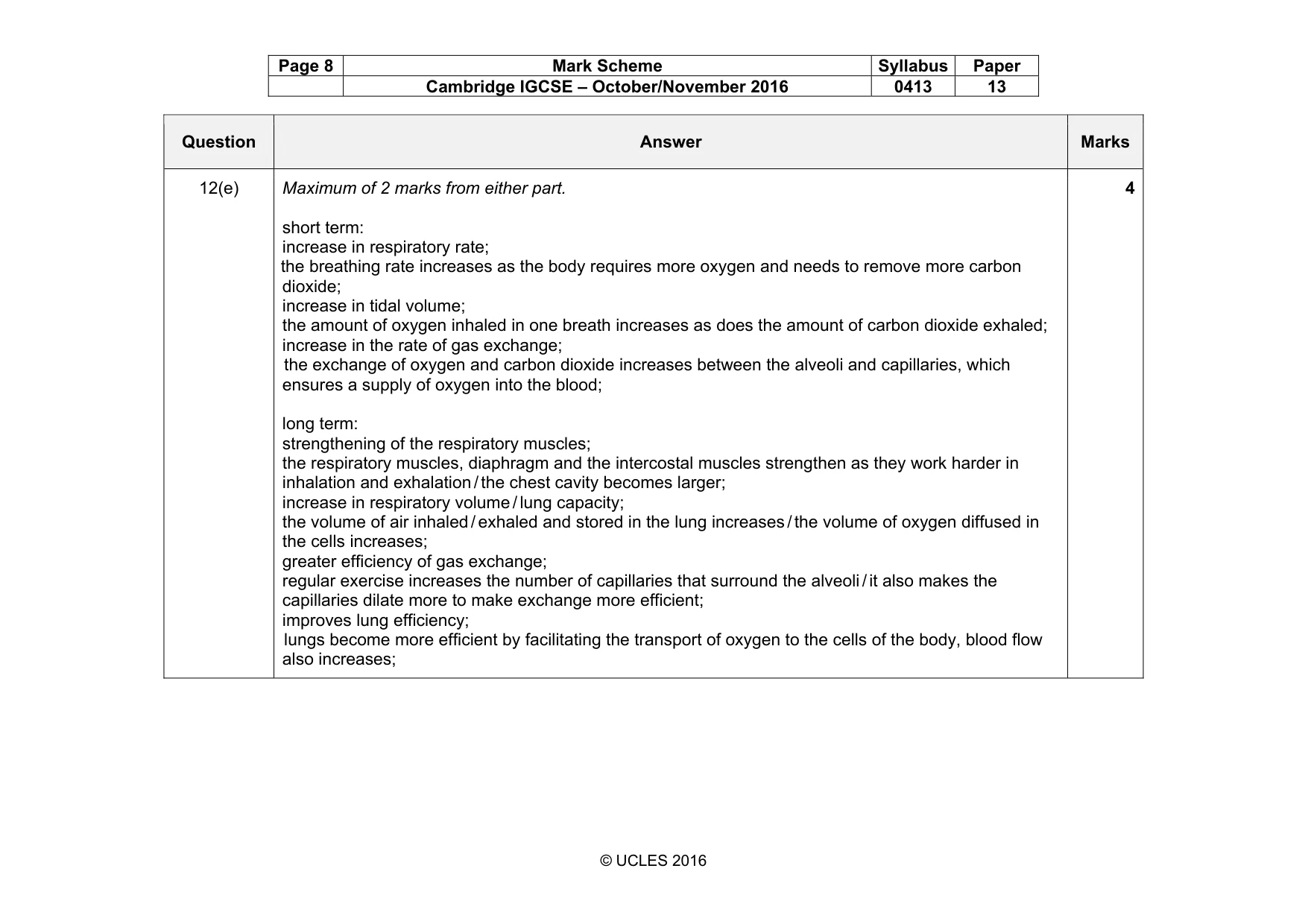
Page 8 Mark Scheme Syllabus Paper Cambridge IGCSE – October/November 2016 0413 13 © UCLES 2016 Question Answer Marks 12(e) Maximum of 2 marks from either part. short term: increase in respiratory rate; the breathing rate increases as the body requires more oxygen and needs to remove more carbon dioxide; increase in tidal volume; the amount of oxygen inhaled in one breath increases as does the amount of carbon dioxide exhaled; increase in the rate of gas exchange; the exchange of oxygen and carbon dioxide increases between the alveoli and capillaries, which ensures a supply of oxygen into the blood; long term: strengthening of the respiratory muscles; the respiratory muscles, diaphragm and the intercostal muscles strengthen as they work harder in inhalation and exhalation / the chest cavity becomes larger; increase in respiratory volume / lung capacity; the volume of air inhaled / exhaled and stored in the lung increases / the volume of oxygen diffused in the cells increases; greater efficiency of gas exchange; regular exercise increases the number of capillaries that surround the alveoli / it also makes the capillaries dilate more to make exchange more efficient; improves lung efficiency; lungs become more efficient by facilitating the transport of oxygen to the cells of the body, blood flow also increases; 4
Mark scheme, page 9
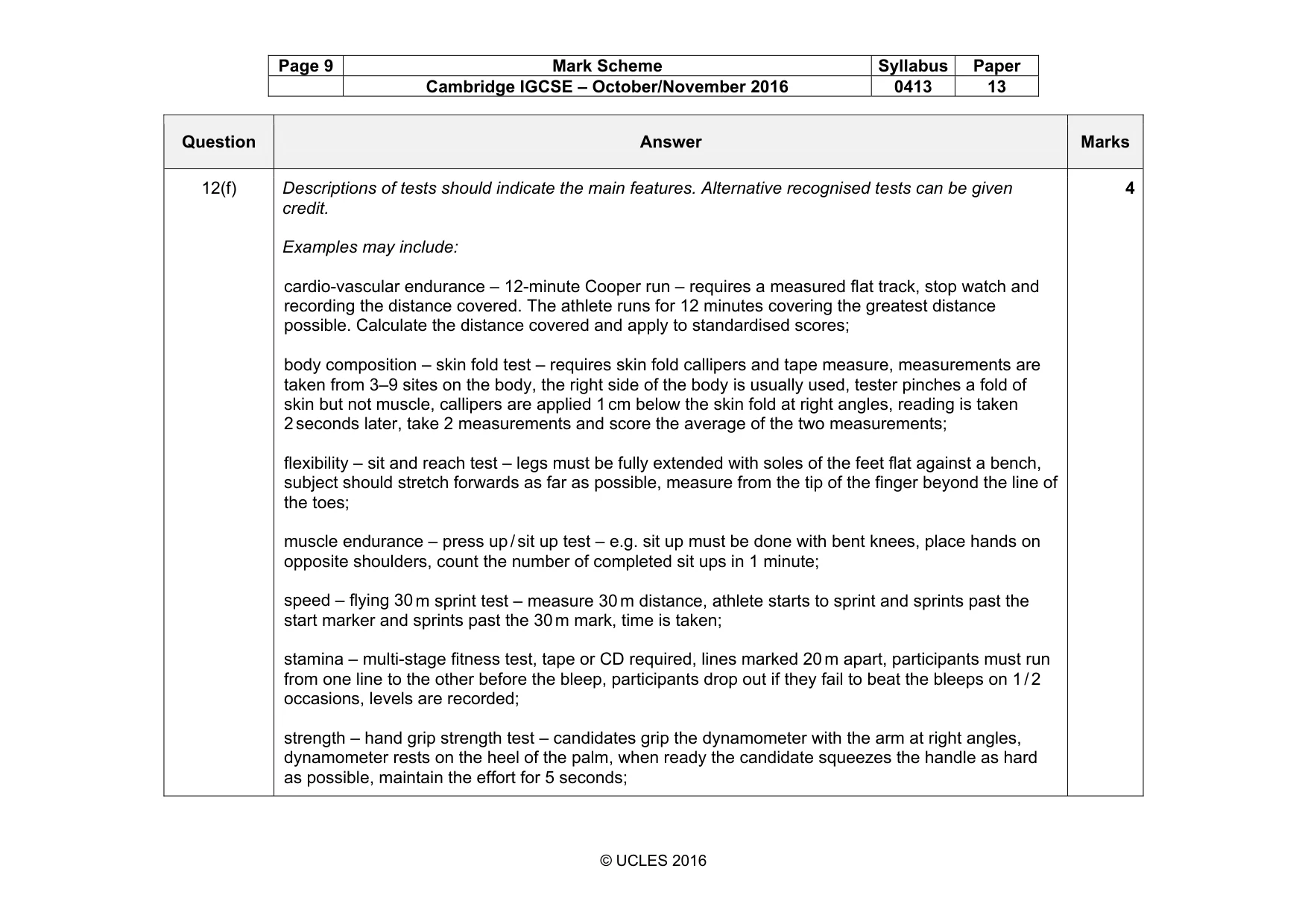
Page 9 Mark Scheme Syllabus Paper Cambridge IGCSE – October/November 2016 0413 13 © UCLES 2016 Question Answer Marks 12(f) Descriptions of tests should indicate the main features. Alternative recognised tests can be given credit. Examples may include: cardio-vascular endurance – 12-minute Cooper run – requires a measured flat track, stop watch and recording the distance covered. The athlete runs for 12 minutes covering the greatest distance possible. Calculate the distance covered and apply to standardised scores; body composition – skin fold test – requires skin fold callipers and tape measure, measurements are taken from 3–9 sites on the body, the right side of the body is usually used, tester pinches a fold of skin but not muscle, callipers are applied 1 cm below the skin fold at right angles, reading is taken 2 seconds later, take 2 measurements and score the average of the two measurements; flexibility – sit and reach test – legs must be fully extended with soles of the feet flat against a bench, subject should stretch forwards as far as possible, measure from the tip of the finger beyond the line of the toes; muscle endurance – press up / sit up test – e.g. sit up must be done with bent knees, place hands on opposite shoulders, count the number of completed sit ups in 1 minute; speed – flying 30 m sprint test – measure 30 m distance, athlete starts to sprint and sprints past the start marker and sprints past the 30 m mark, time is taken; stamina – multi-stage fitness test, tape or CD required, lines marked 20 m apart, participants must run from one line to the other before the bleep, participants drop out if they fail to beat the bleeps on 1 / 2 occasions, levels are recorded; strength – hand grip strength test – candidates grip the dynamometer with the arm at right angles, dynamometer rests on the heel of the palm, when ready the candidate squeezes the handle as hard as possible, maintain the effort for 5 seconds; 4
Mark scheme, page 10
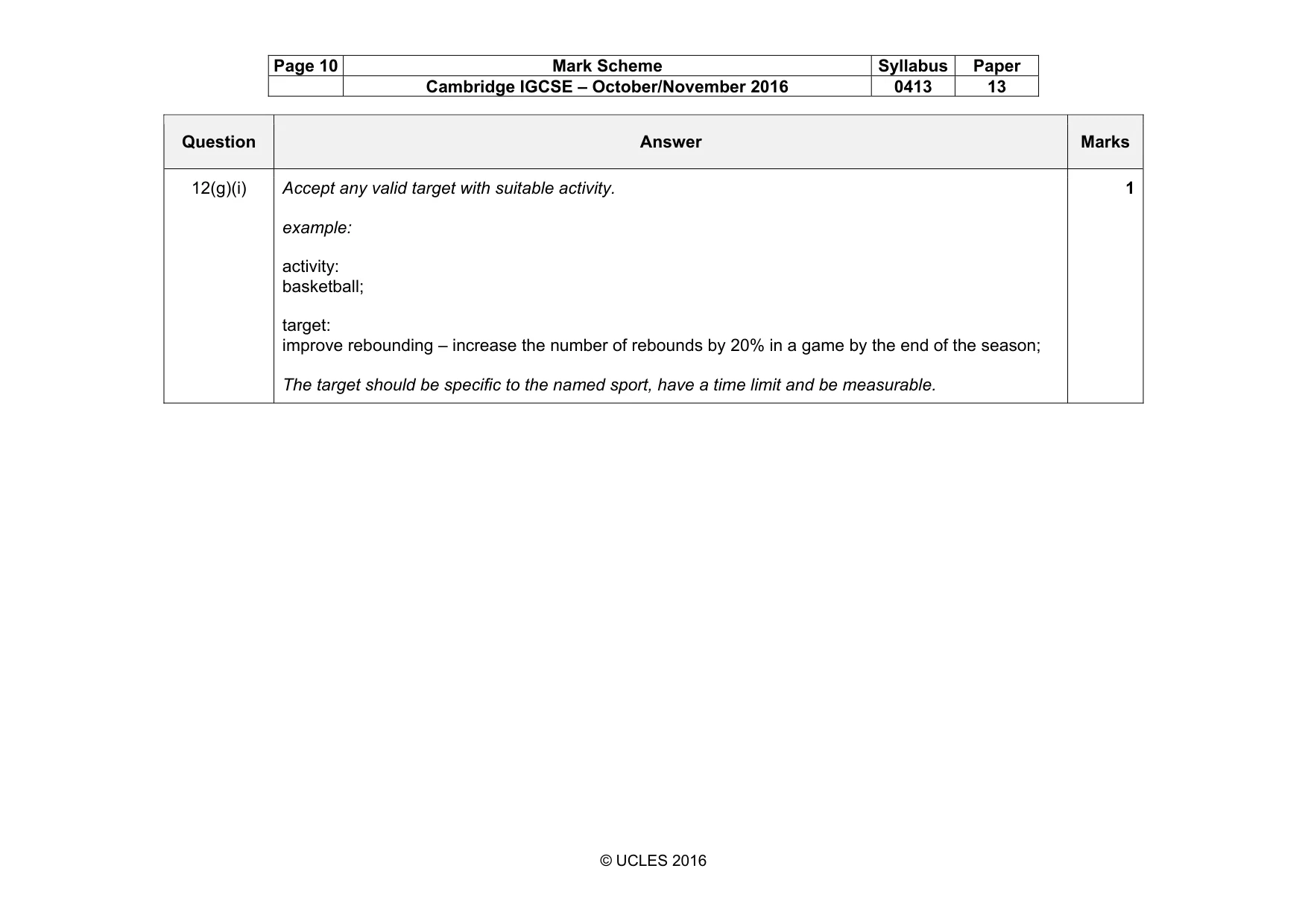
Page 10 Mark Scheme Syllabus Paper Cambridge IGCSE – October/November 2016 0413 13 © UCLES 2016 Question Answer Marks 12(g)(i) Accept any valid target with suitable activity. example: activity: basketball; target: improve rebounding – increase the number of rebounds by 20% in a game by the end of the season; The target should be specific to the named sport, have a time limit and be measurable. 1
Mark scheme, page 11
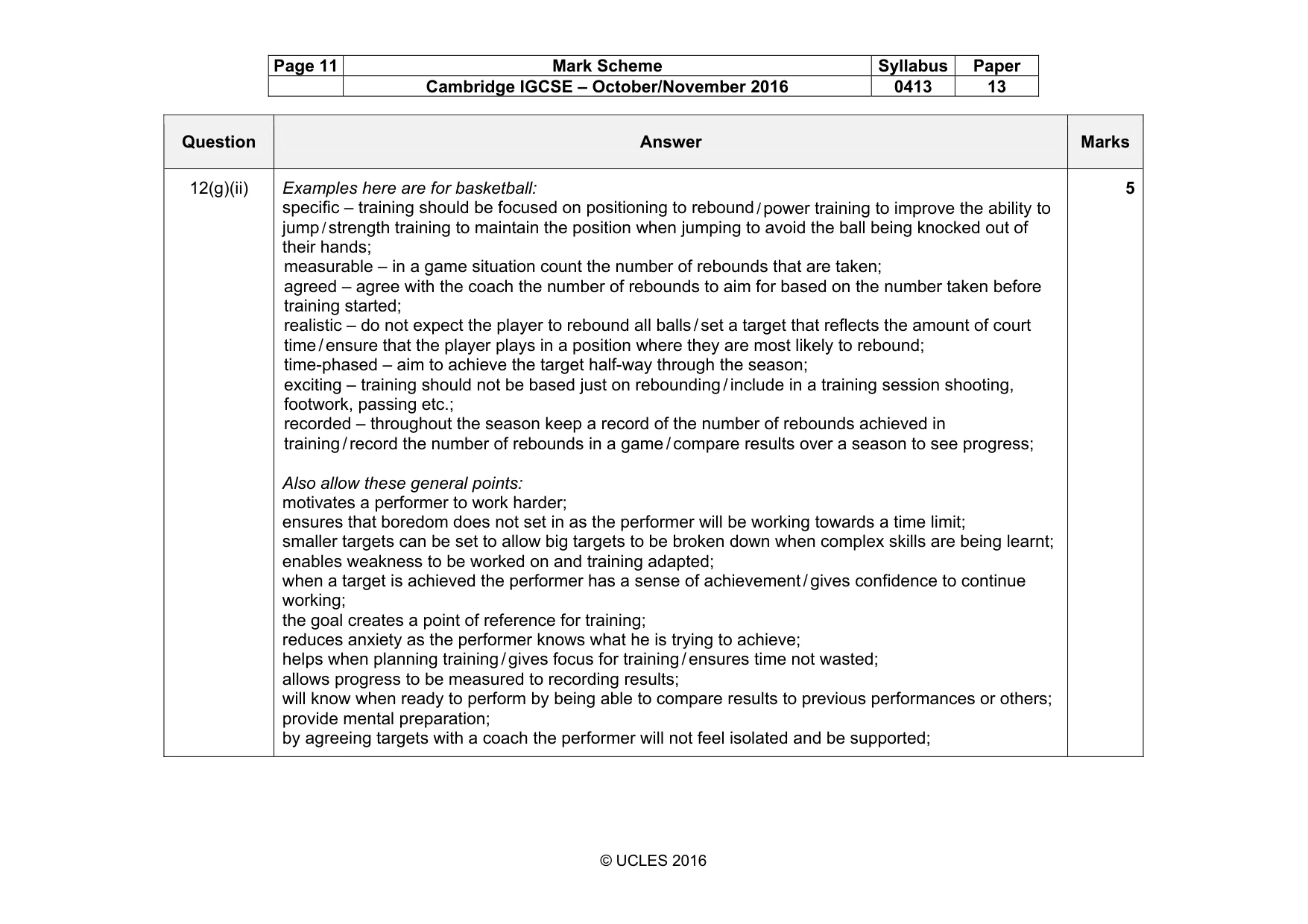
Page 11 Mark Scheme Syllabus Paper Cambridge IGCSE – October/November 2016 0413 13 © UCLES 2016 Question Answer Marks 12(g)(ii) Examples here are for basketball: specific – training should be focused on positioning to rebound / power training to improve the ability to jump / strength training to maintain the position when jumping to avoid the ball being knocked out of their hands; measurable – in a game situation count the number of rebounds that are taken; agreed – agree with the coach the number of rebounds to aim for based on the number taken before training started; realistic – do not expect the player to rebound all balls / set a target that reflects the amount of court time / ensure that the player plays in a position where they are most likely to rebound; time-phased – aim to achieve the target half-way through the season; exciting – training should not be based just on rebounding / include in a training session shooting, footwork, passing etc.; recorded – throughout the season keep a record of the number of rebounds achieved in training / record the number of rebounds in a game / compare results over a season to see progress; Also allow these general points: motivates a performer to work harder; ensures that boredom does not set in as the performer will be working towards a time limit; smaller targets can be set to allow big targets to be broken down when complex skills are being learnt; enables weakness to be worked on and training adapted; when a target is achieved the performer has a sense of achievement / gives confidence to continue working; the goal creates a point of reference for training; reduces anxiety as the performer knows what he is trying to achieve; helps when planning training / gives focus for training / ensures time not wasted; allows progress to be measured to recording results; will know when ready to perform by being able to compare results to previous performances or others; provide mental preparation; by agreeing targets with a coach the performer will not feel isolated and be supported; 5
Mark scheme, page 12
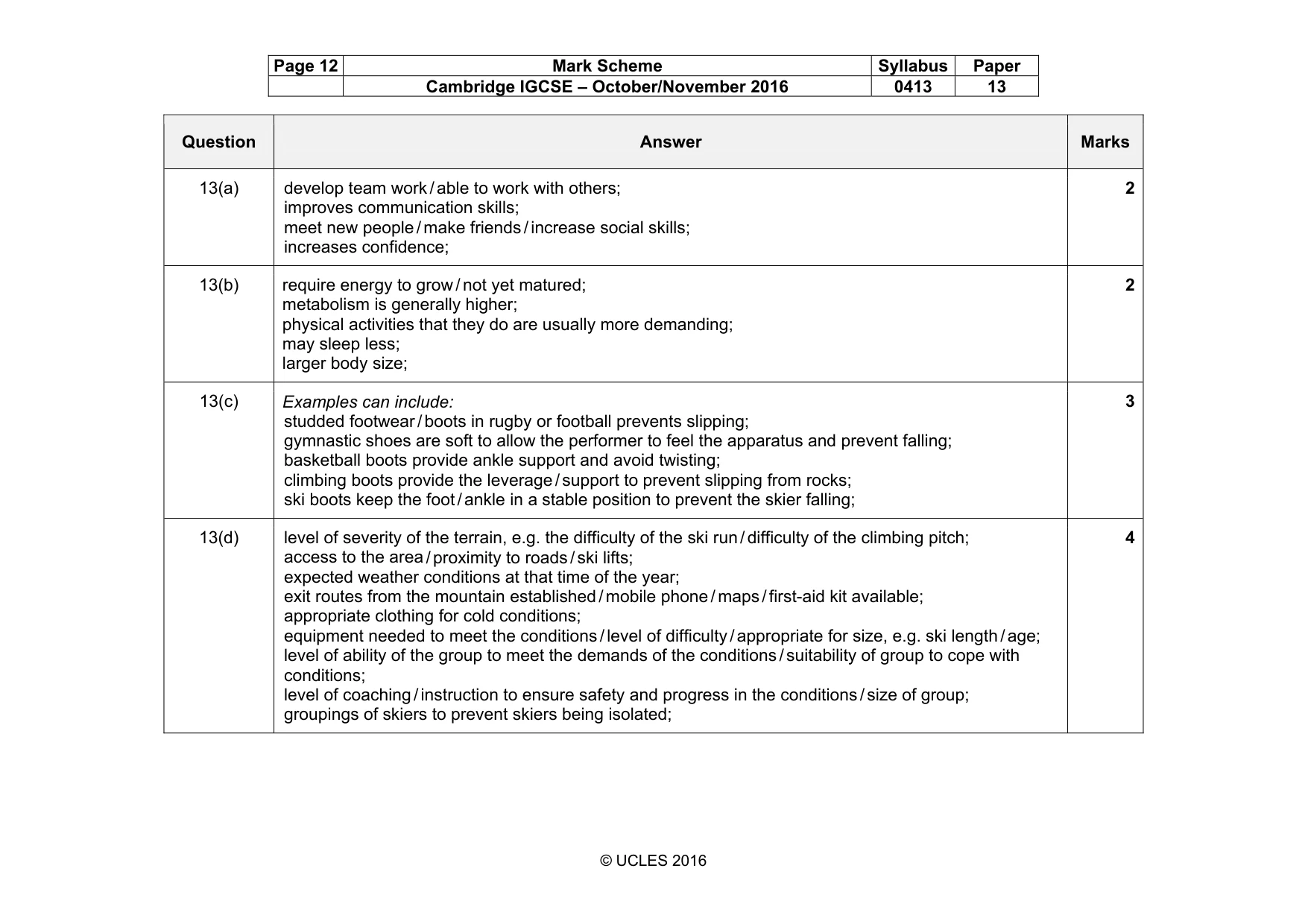
Page 12 Mark Scheme Syllabus Paper Cambridge IGCSE – October/November 2016 0413 13 © UCLES 2016 Question Answer Marks 13(a) develop team work / able to work with others; improves communication skills; meet new people / make friends / increase social skills; increases confidence; 2 13(b) require energy to grow / not yet matured; metabolism is generally higher; physical activities that they do are usually more demanding; may sleep less; larger body size; 2 13(c) Examples can include: studded footwear / boots in rugby or football prevents slipping; gymnastic shoes are soft to allow the performer to feel the apparatus and prevent falling; basketball boots provide ankle support and avoid twisting; climbing boots provide the leverage / support to prevent slipping from rocks; ski boots keep the foot / ankle in a stable position to prevent the skier falling; 3 13(d) level of severity of the terrain, e.g. the difficulty of the ski run / difficulty of the climbing pitch; access to the area / proximity to roads / ski lifts; expected weather conditions at that time of the year; exit routes from the mountain established / mobile phone / maps / first-aid kit available; appropriate clothing for cold conditions; equipment needed to meet the conditions / level of difficulty / appropriate for size, e.g. ski length / age; level of ability of the group to meet the demands of the conditions / suitability of group to cope with conditions; level of coaching / instruction to ensure safety and progress in the conditions / size of group; groupings of skiers to prevent skiers being isolated; 4
Mark scheme, page 13
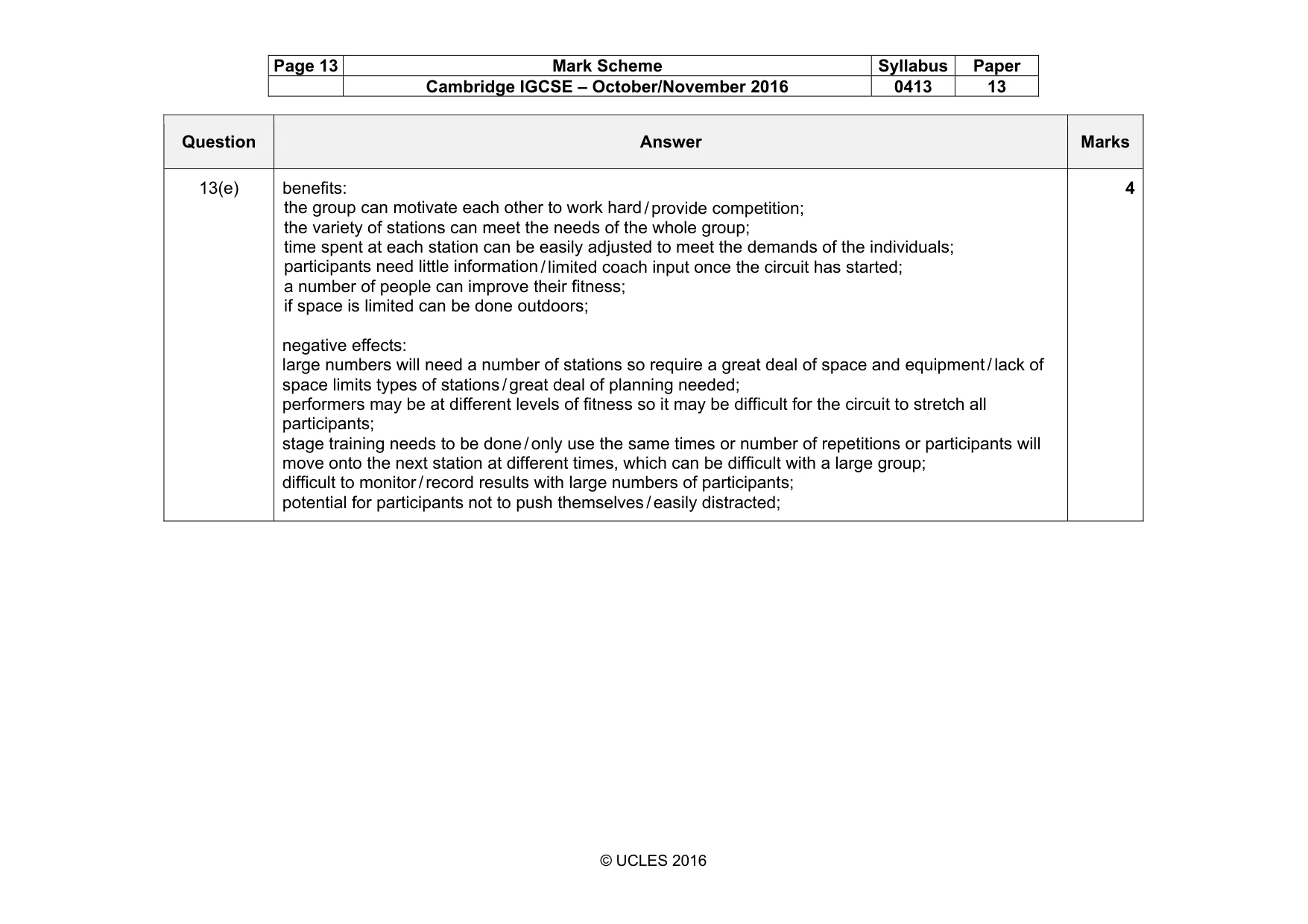
Page 13 Mark Scheme Syllabus Paper Cambridge IGCSE – October/November 2016 0413 13 © UCLES 2016 Question Answer Marks 13(e) benefits: the group can motivate each other to work hard / provide competition; the variety of stations can meet the needs of the whole group; time spent at each station can be easily adjusted to meet the demands of the individuals; participants need little information / limited coach input once the circuit has started; a number of people can improve their fitness; if space is limited can be done outdoors; negative effects: large numbers will need a number of stations so require a great deal of space and equipment / lack of space limits types of stations / great deal of planning needed; performers may be at different levels of fitness so it may be difficult for the circuit to stretch all participants; stage training needs to be done / only use the same times or number of repetitions or participants will move onto the next station at different times, which can be difficult with a large group; difficult to monitor / record results with large numbers of participants; potential for participants not to push themselves / easily distracted; 4
Mark scheme, page 14
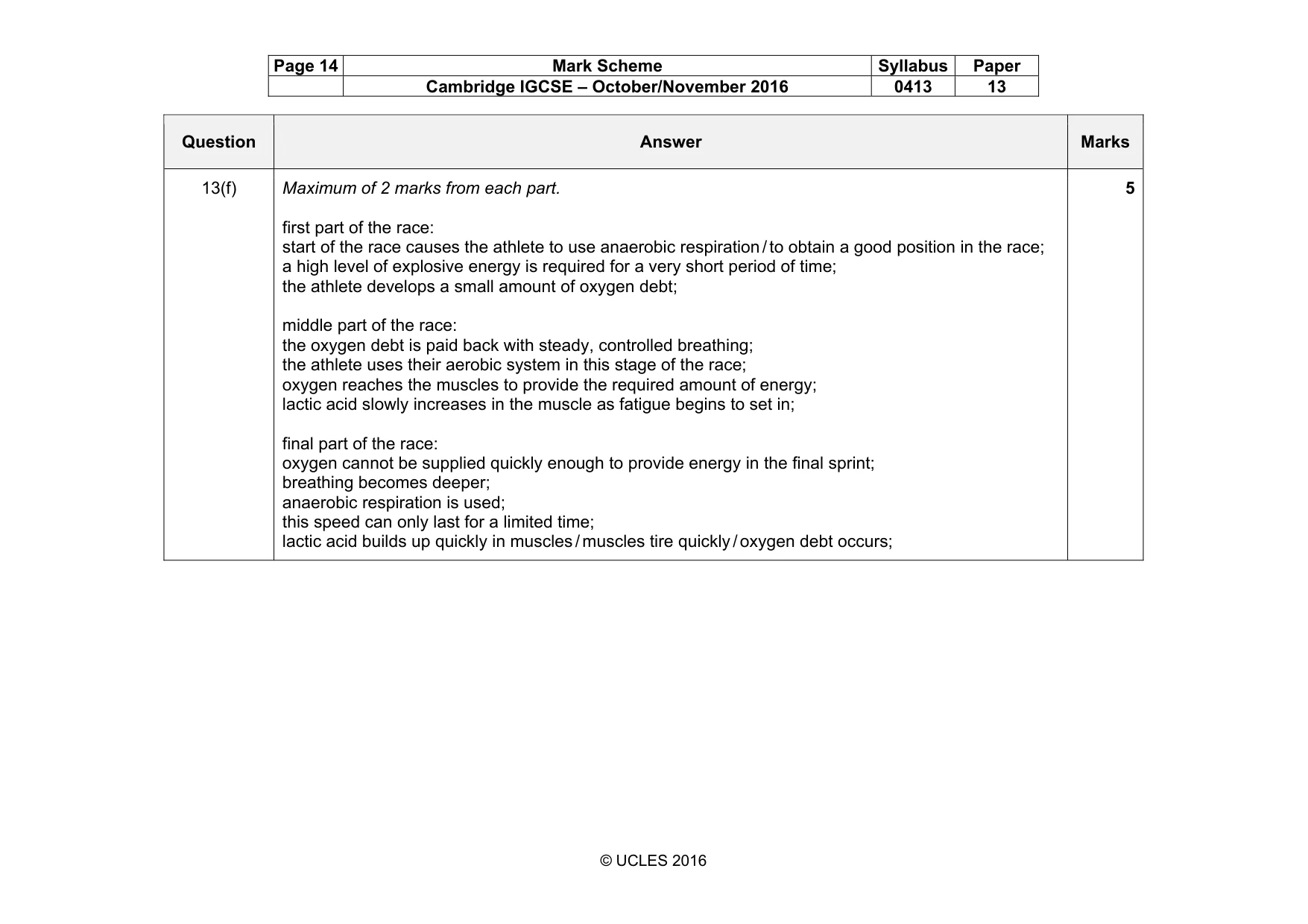
Page 14 Mark Scheme Syllabus Paper Cambridge IGCSE – October/November 2016 0413 13 © UCLES 2016 Question Answer Marks 13(f) Maximum of 2 marks from each part. first part of the race: start of the race causes the athlete to use anaerobic respiration / to obtain a good position in the race; a high level of explosive energy is required for a very short period of time; the athlete develops a small amount of oxygen debt; middle part of the race: the oxygen debt is paid back with steady, controlled breathing; the athlete uses their aerobic system in this stage of the race; oxygen reaches the muscles to provide the required amount of energy; lactic acid slowly increases in the muscle as fatigue begins to set in; final part of the race: oxygen cannot be supplied quickly enough to provide energy in the final sprint; breathing becomes deeper; anaerobic respiration is used; this speed can only last for a limited time; lactic acid builds up quickly in muscles / muscles tire quickly / oxygen debt occurs; 5
Mark scheme, page 15
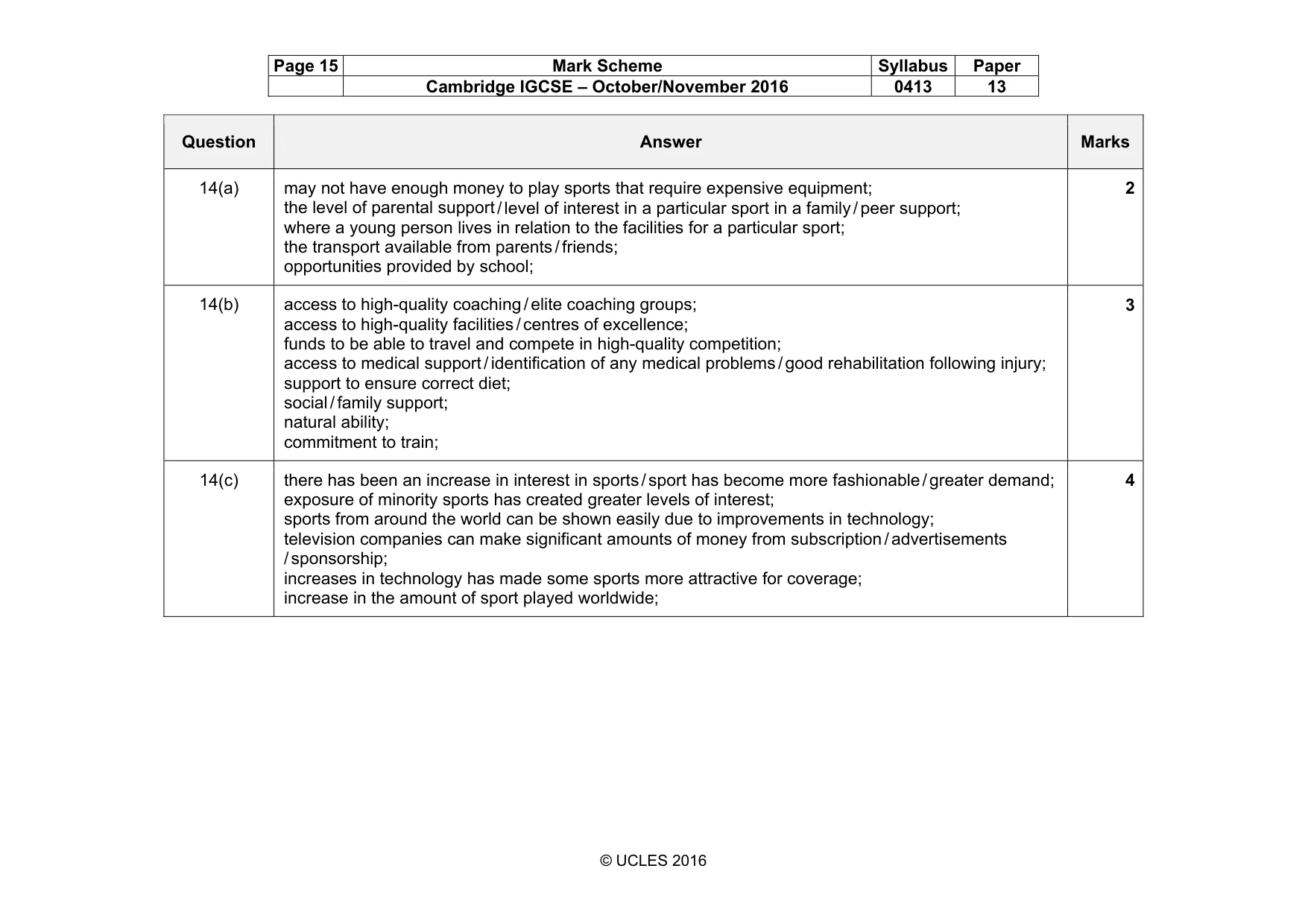
Page 15 Mark Scheme Syllabus Paper Cambridge IGCSE – October/November 2016 0413 13 © UCLES 2016 Question Answer Marks 14(a) may not have enough money to play sports that require expensive equipment; the level of parental support / level of interest in a particular sport in a family / peer support; where a young person lives in relation to the facilities for a particular sport; the transport available from parents / friends; opportunities provided by school; 2 14(b) access to high-quality coaching / elite coaching groups; access to high-quality facilities / centres of excellence; funds to be able to travel and compete in high-quality competition; access to medical support / identification of any medical problems / good rehabilitation following injury; support to ensure correct diet; social / family support; natural ability; commitment to train; 3 14(c) there has been an increase in interest in sports / sport has become more fashionable / greater demand; exposure of minority sports has created greater levels of interest; sports from around the world can be shown easily due to improvements in technology; television companies can make significant amounts of money from subscription / advertisements / sponsorship; increases in technology has made some sports more attractive for coverage; increase in the amount of sport played worldwide; 4
Mark scheme, page 16
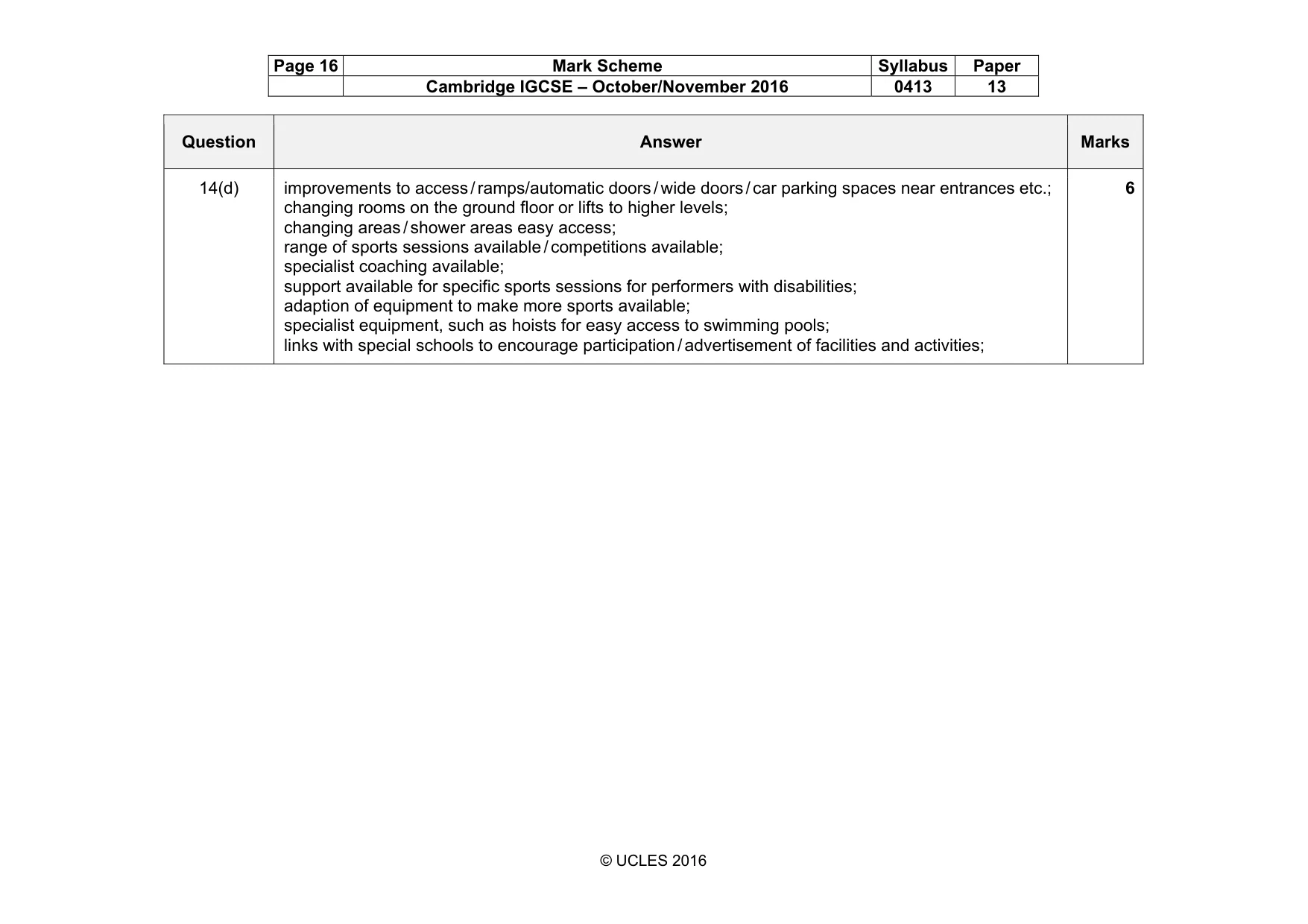
Page 16 Mark Scheme Syllabus Paper Cambridge IGCSE – October/November 2016 0413 13 © UCLES 2016 Question Answer Marks 14(d) improvements to access / ramps/automatic doors / wide doors / car parking spaces near entrances etc.; changing rooms on the ground floor or lifts to higher levels; changing areas / shower areas easy access; range of sports sessions available / competitions available; specialist coaching available; support available for specific sports sessions for performers with disabilities; adaption of equipment to make more sports available; specialist equipment, such as hoists for easy access to swimming pools; links with special schools to encourage participation / advertisement of facilities and activities; 6
What you needed in this session
Cambridge’s own grade thresholds for 2016 Oct/Nov, Paper 1 · Variant 3. A higher threshold means an easier paper — the bar moves with how the cohort did.