Cambridge IGCSE Physical Education 0413 — 2016 May/June Paper 1 · Variant 2
0413/12/M/J/16 · 80 marks · ≈90 min
The question paper and its mark scheme, free to read here and free to download. This is Cambridge’s own paper, exactly as it was sat.
Question paper12 pages
Mark scheme14 pages
Answers below. Sit the paper first if you are practising.
Paper as text
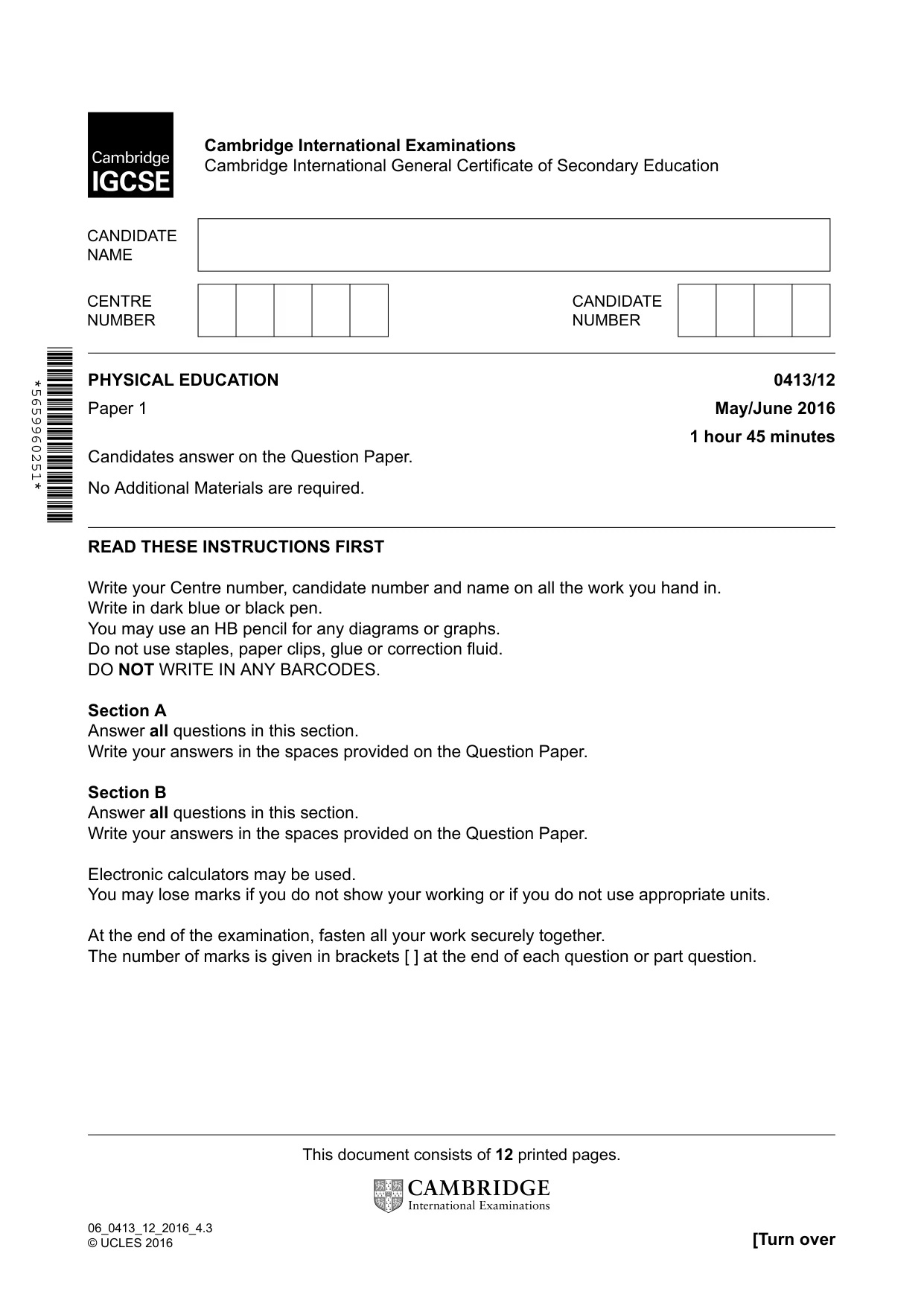
Question paper, page 1
Cambridge International Examinations Cambridge International General Certificate of Secondary Education 0413/12 May/June 2016 1 hour 45 minutes PHYSICAL EDUCATION Paper 1 Candidates answer on the Question Paper. No Additional Materials are required. READ THESE INSTRUCTIONS FIRST Write your Centre number, candidate number and name on all the work you hand in. Write in dark blue or black pen. You may use an HB pencil for any diagrams or graphs. Do not use staples, paper clips, glue or correction fluid. DO NOT WRITE IN ANY BARCODES. Section A Answer all questions in this section. Write your answers in the spaces provided on the Question Paper. Section B Answer all questions in this section. Write your answers in the spaces provided on the Question Paper. Electronic calculators may be used. You may lose marks if you do not show your working or if you do not use appropriate units. At the end of the examination, fasten all your work securely together. The number of marks is given in brackets [ ] at the end of each question or part question. This document consists of 12 printed pages. [Turn over 06_0413_12_2016_4.3 © UCLES 2016 *5659960251*
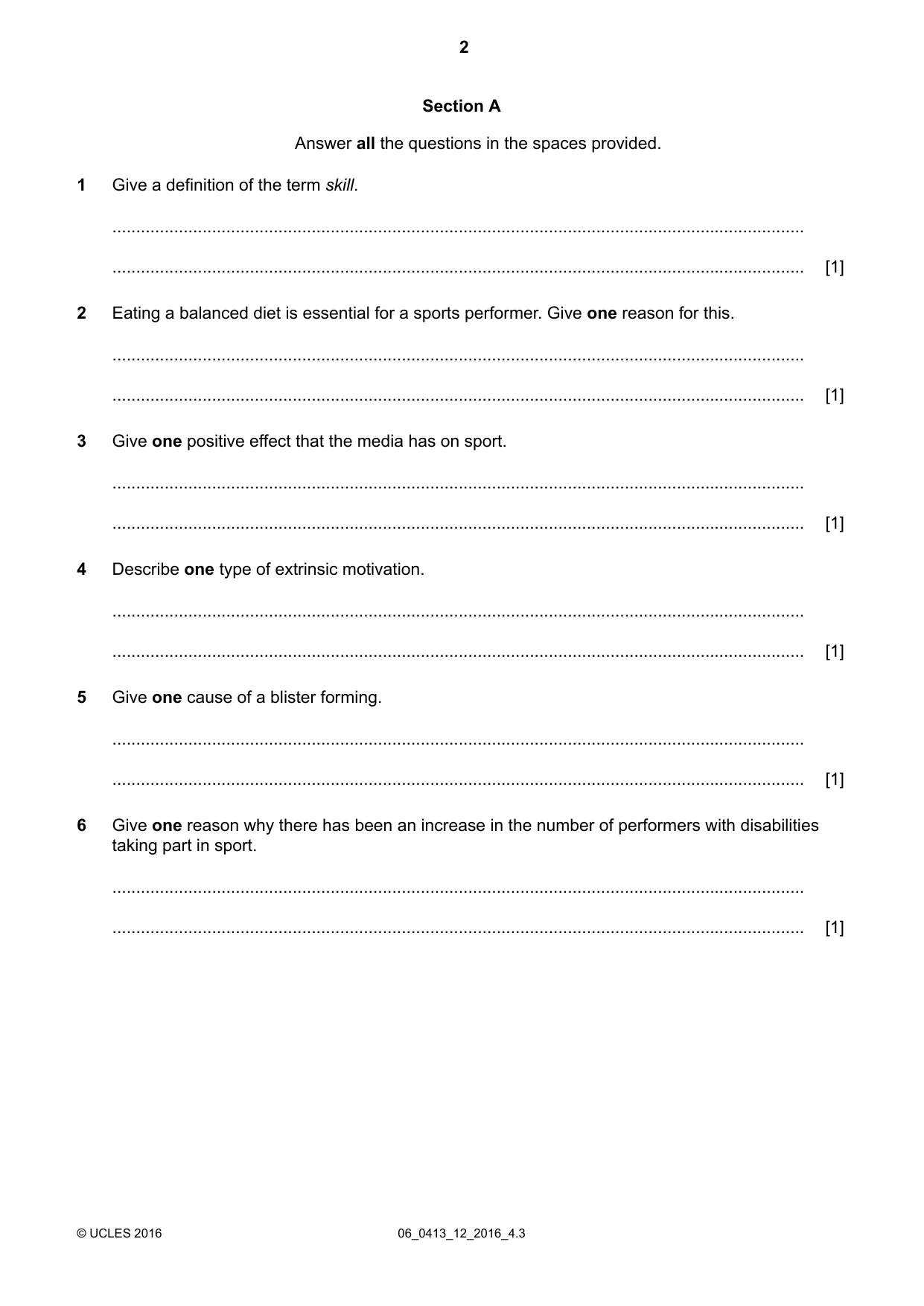
Question paper, page 2
Section A Answer all the questions in the spaces provided. Give a definition of the term skill. 1 … … [1] Eating a balanced diet is essential for a sports performer. Give one reason for this. 2 … … [1] Give one positive effect that the media has on sport. 3 … … [1] Describe one type of extrinsic motivation. 4 … … [1] Give one cause of a blister forming. 5 … … [1] Give one reason why there has been an increase in the number of performers with disabilities taking part in sport. 6 … … [1] 06_0413_12_2016_4.3 © UCLES 2016 2
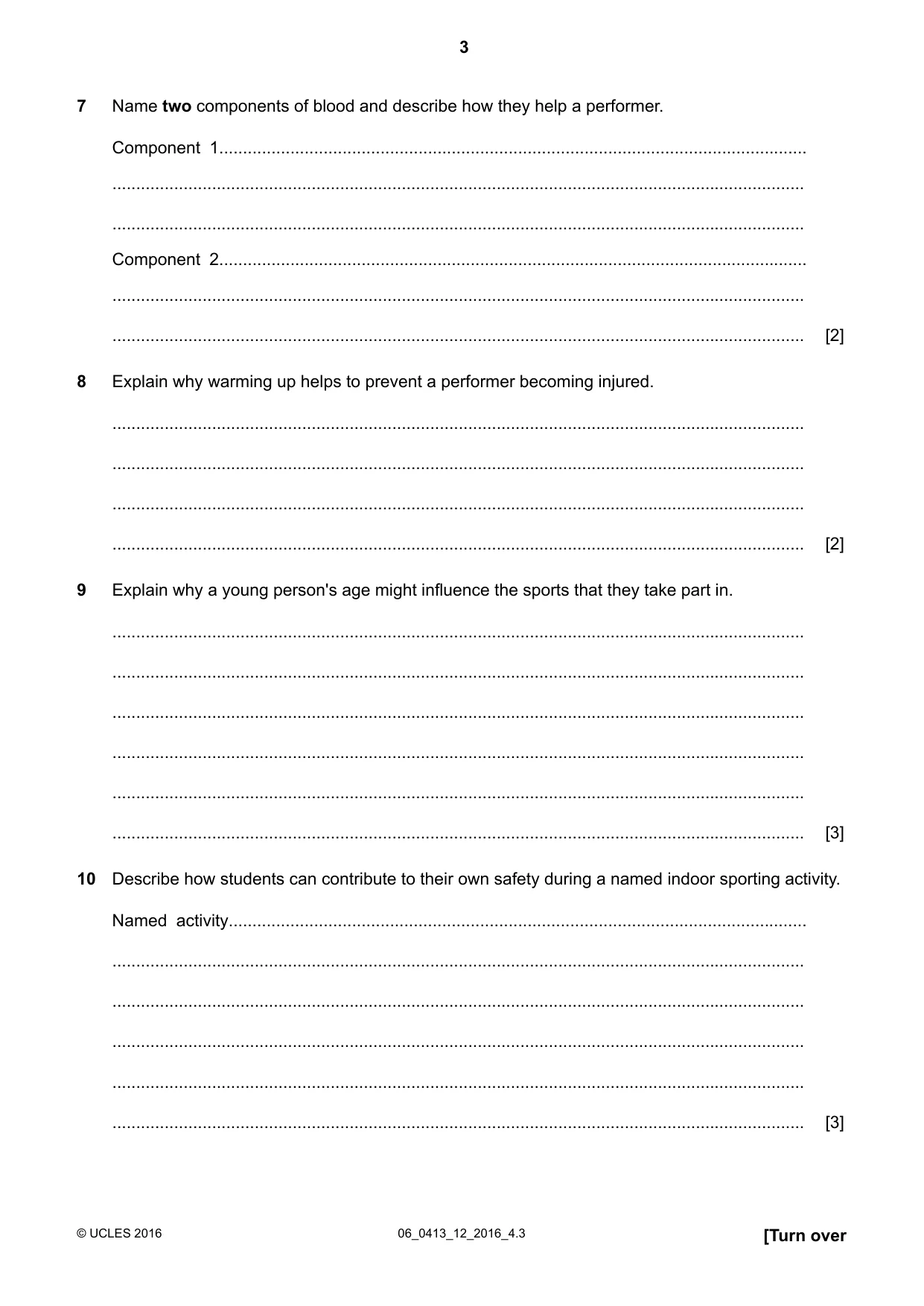
Question paper, page 3
Name two components of blood and describe how they help a performer. 7 Component 1… … … Component 2… … … [2] Explain why warming up helps to prevent a performer becoming injured. 8 … … … … [2] Explain why a young person's age might influence the sports that they take part in. 9 … … … … … … [3] Describe how students can contribute to their own safety during a named indoor sporting activity. 10 Named activity… … … … … … [3] [Turn over 06_0413_12_2016_4.3 © UCLES 2016 3
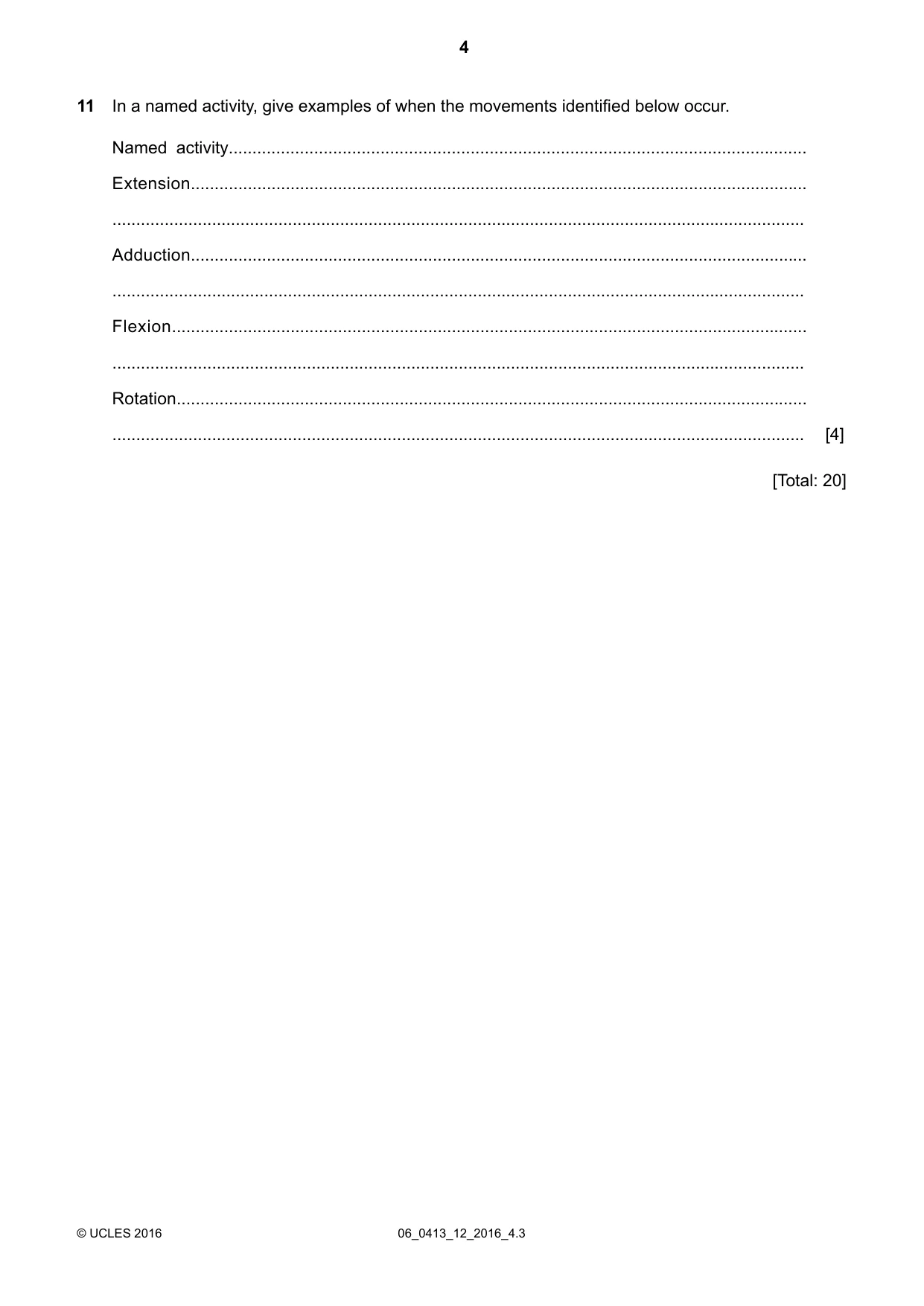
Question paper, page 4
In a named activity, give examples of when the movements identified below occur. 11 Named activity… Extension… … Adduction… … Flexion… … Rotation… … [4] [Total: 20] 06_0413_12_2016_4.3 © UCLES 2016 4
Question paper, page 5
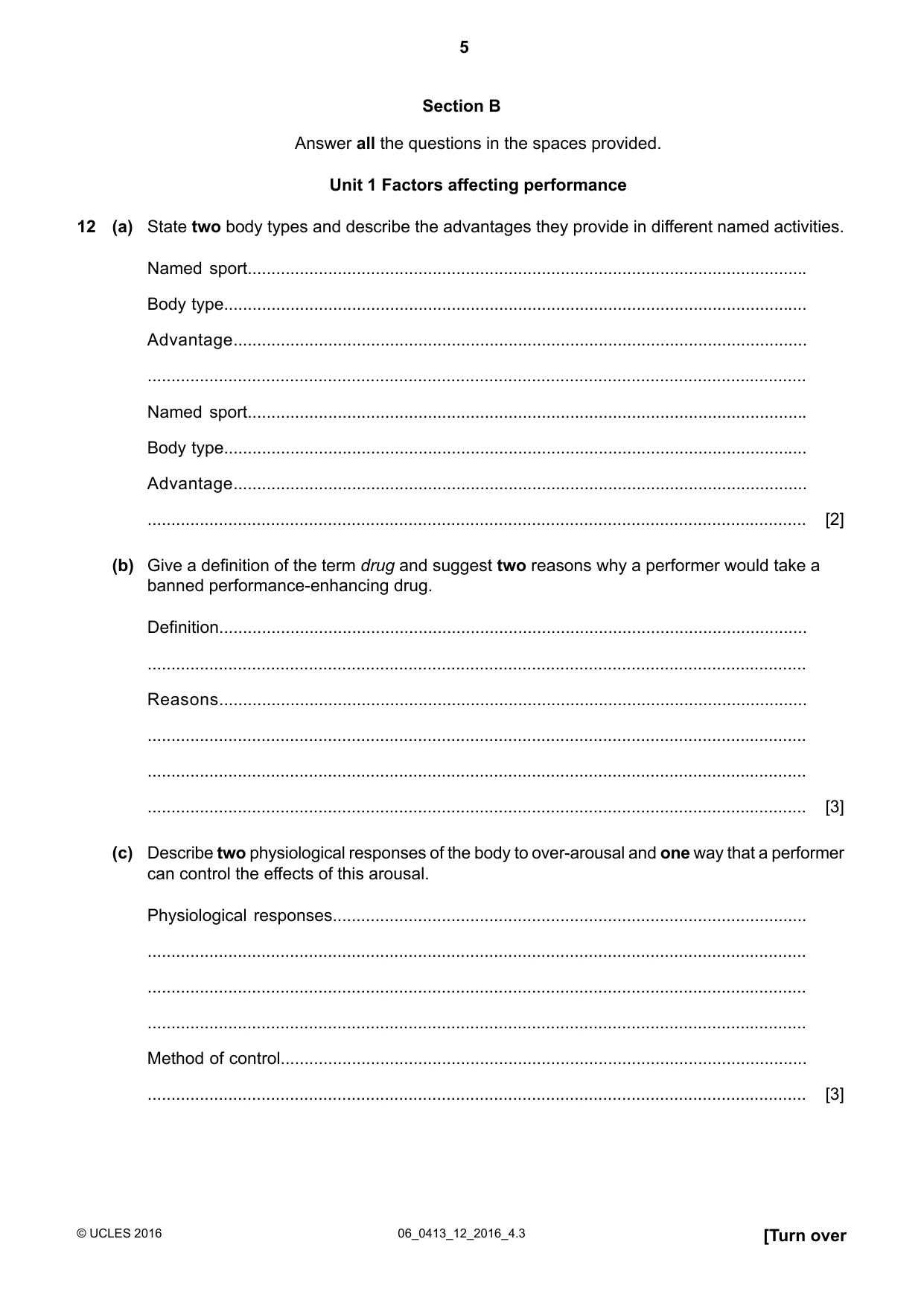
Section B Answer all the questions in the spaces provided. Unit 1 Factors affecting performance State two body types and describe the advantages they provide in different named activities. (a) 12 Named sport… Body type… Advantage… … Named sport… Body type… Advantage… … [2] Give a definition of the term drug and suggest two reasons why a performer would take a banned performance-enhancing drug. (b) Definition… … Reasons… … … … [3] Describe two physiological responses of the body to over-arousal and one way that a performer can control the effects of this arousal. (c) Physiological responses… … … … Method of control… … [3] [Turn over 06_0413_12_2016_4.3 © UCLES 2016 5
Question paper, page 6
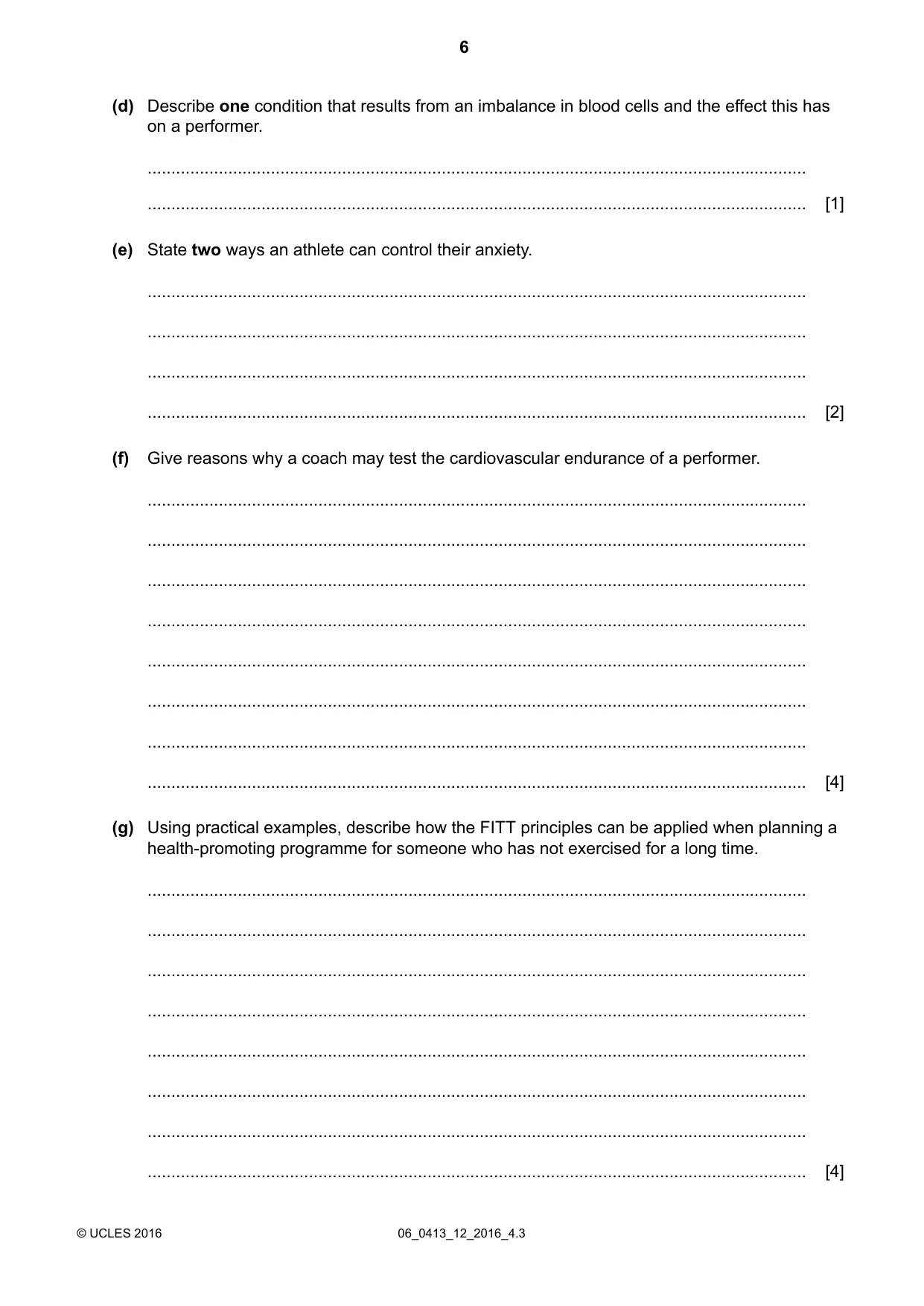
Describe one condition that results from an imbalance in blood cells and the effect this has on a performer. (d) … … [1] State two ways an athlete can control their anxiety. (e) … … … … [2] Give reasons why a coach may test the cardiovascular endurance of a performer. (f) … … … … … … … … [4] Using practical examples, describe how the FITT principles can be applied when planning a health-promoting programme for someone who has not exercised for a long time. (g) … … … … … … … … [4] 06_0413_12_2016_4.3 © UCLES 2016 6
Question paper, page 7
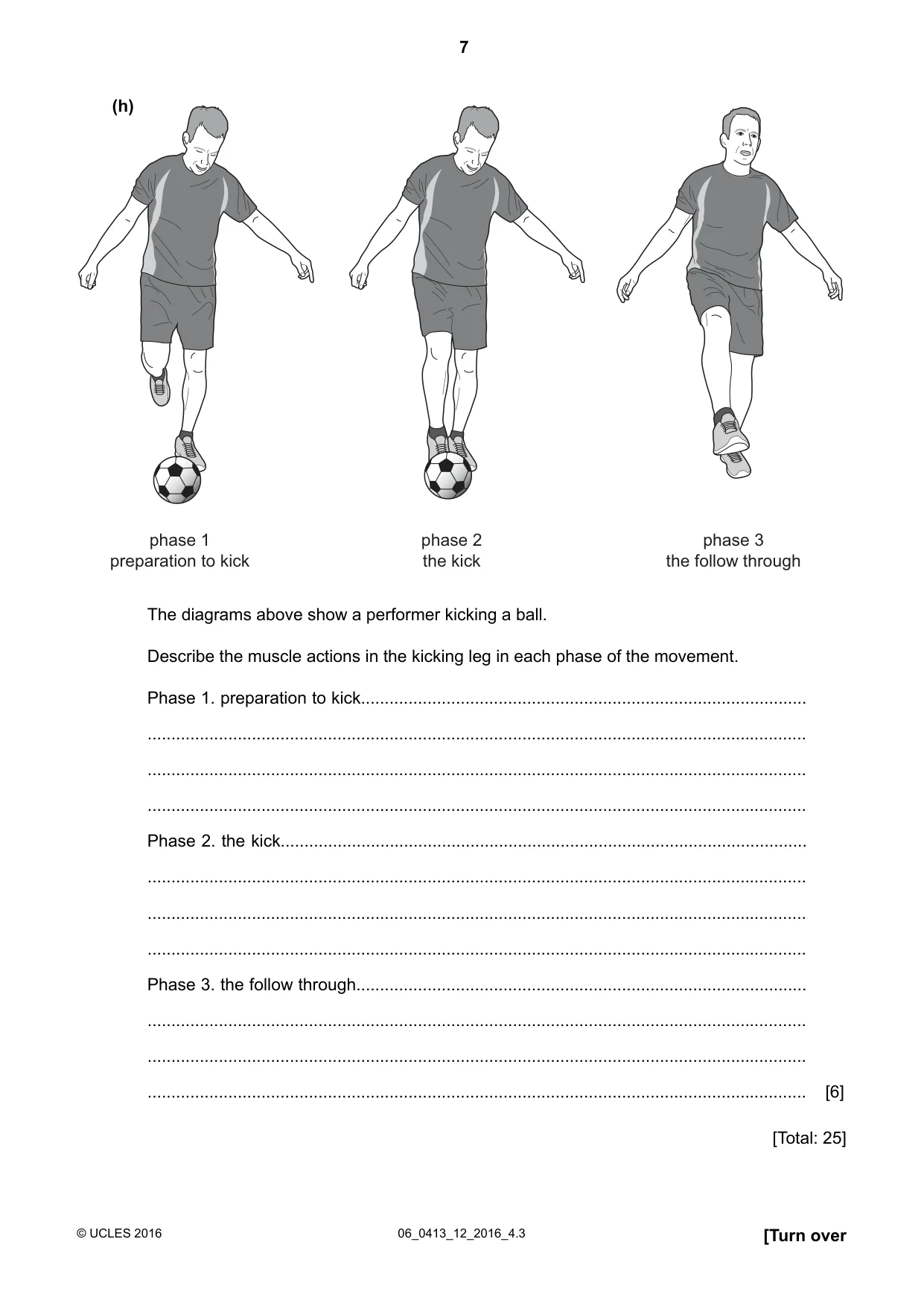
(h) phase 1 preparation to kick phase 2 the kick phase 3 the follow through The diagrams above show a performer kicking a ball. Describe the muscle actions in the kicking leg in each phase of the movement. Phase 1. preparation to kick… … … … Phase 2. the kick… … … … Phase 3. the follow through… … … … [6] [Total: 25] [Turn over 06_0413_12_2016_4.3 © UCLES 2016 7
Question paper, page 8
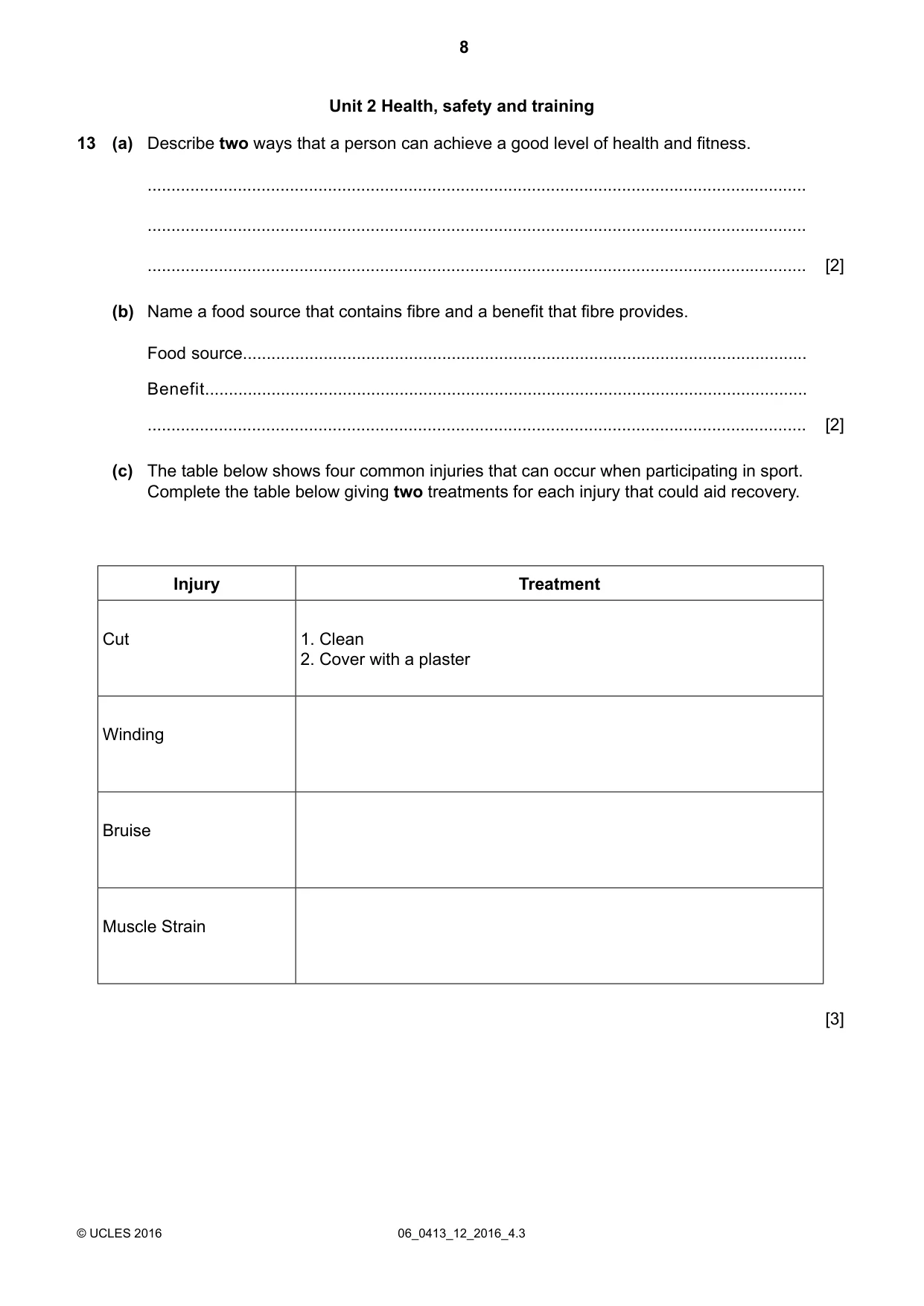
Unit 2 Health, safety and training Describe two ways that a person can achieve a good level of health and fitness. (a) 13 … … … [2] Name a food source that contains fibre and a benefit that fibre provides. (b) Food source… Benefit… … [2] The table below shows four common injuries that can occur when participating in sport. Complete the table below giving two treatments for each injury that could aid recovery. (c) Treatment Injury 1. Clean 2. Cover with a plaster Cut Winding Bruise Muscle Strain [3] 06_0413_12_2016_4.3 © UCLES 2016 8
Question paper, page 9
Name an adventurous land-based activity and describe four safety considerations that the group leader would need to take into account when starting to plan the activity. (d) Activity… … … … … … … … … … … [4] Using practical examples, describe how each of the four training principles could be applied to the training programme of a sprinter to bring about an improvement. (e) … … … … … … … … … … … [4] [Turn over 06_0413_12_2016_4.3 © UCLES 2016 9
Question paper, page 10
Regular exercise and training can improve the way the lungs work. Describe the improvements that can occur and the different benefits these improvements bring to performance. (f) … … … … … … … … … … [5] [Total: 20] 06_0413_12_2016_4.3 © UCLES 2016 10
Question paper, page 11
Unit 3 Reasons and opportunities for participation in physical activity Give reasons why a person would volunteer at a local sports club. (a) 14 … … … … [2] Describe ways that sports centres have improved opportunities for spectators with disabilities to attend events. (b) … … … … … … [3] Describe the possible disadvantages of hosting a major global event to the host nation. (c) … … … … … … … … … [4] [Turn over 06_0413_12_2016_4.3 © UCLES 2016 11
Question paper, page 12
Explain the different ways that women have been encouraged to participate in sports. (d) … … … … … … … … … … … … … … … … [6] [Total: 15] Permission to reproduce items where third-party owned material protected by copyright is included has been sought and cleared where possible. Every reasonable effort has been made by the publisher (UCLES) to trace copyright holders, but if any items requiring clearance have unwittingly been included, the publisher will be pleased to make amends at the earliest possible opportunity. To avoid the issue of disclosure of answer-related information to candidates, all copyright acknowledgements are reproduced online in the Cambridge International Examinations Copyright Acknowledgements Booklet. This is produced for each series of examinations and is freely available to download at www.cie.org.uk after the live examination series. Cambridge International Examinations is part of the Cambridge Assessment Group. Cambridge Assessment is the brand name of University of Cambridge Local Examinations Syndicate (UCLES), which is itself a department of the University of Cambridge. 06_0413_12_2016_4.3 © UCLES 2016 12
Mark scheme, page 1
® IGCSE is the registered trademark of Cambridge International Examinations. This document consists of 14 printed pages. © UCLES 2016 [Turn over Cambridge International Examinations Cambridge International General Certificate of Secondary Education PHYSICAL EDUCATION 0413/12 Paper 1 May/June 2016 MARK SCHEME Maximum Mark: 80 Published This mark scheme is published as an aid to teachers and candidates, to indicate the requirements of the examination. It shows the basis on which Examiners were instructed to award marks. It does not indicate the details of the discussions that took place at an Examiners’ meeting before marking began, which would have considered the acceptability of alternative answers. Mark schemes should be read in conjunction with the question paper and the Principal Examiner Report for Teachers. Cambridge will not enter into discussions about these mark schemes. Cambridge is publishing the mark schemes for the May/June 2016 series for most Cambridge IGCSE®, Cambridge International A and AS Level components and some Cambridge O Level components.
Mark scheme, page 2
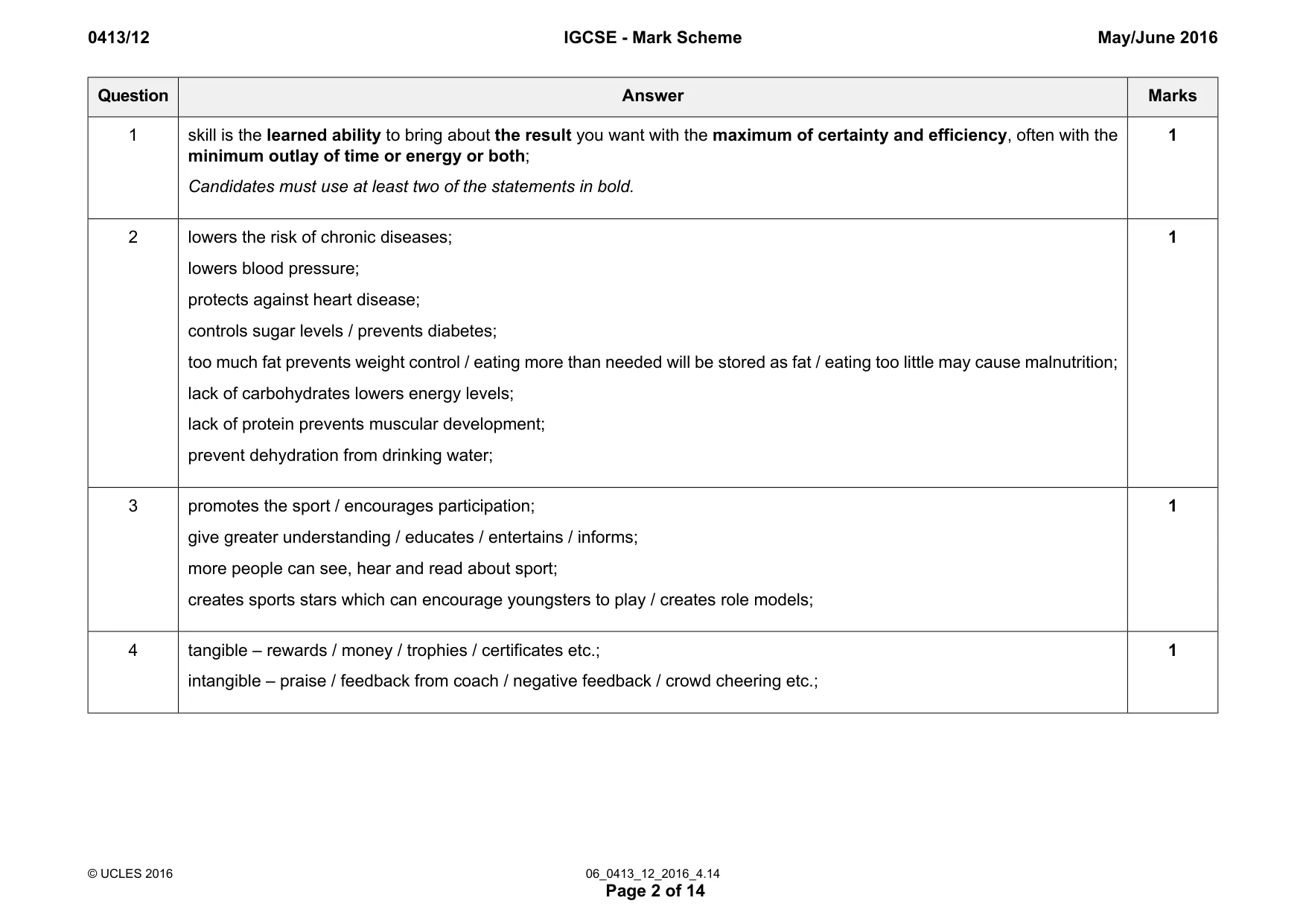
Marks Answer Question 1 skill is the learned ability to bring about the result you want with the maximum of certainty and efficiency, often with the minimum outlay of time or energy or both; 1 Candidates must use at least two of the statements in bold. 1 lowers the risk of chronic diseases; 2 lowers blood pressure; protects against heart disease; controls sugar levels / prevents diabetes; too much fat prevents weight control / eating more than needed will be stored as fat / eating too little may cause malnutrition; lack of carbohydrates lowers energy levels; lack of protein prevents muscular development; prevent dehydration from drinking water; 1 promotes the sport / encourages participation; 3 give greater understanding / educates / entertains / informs; more people can see, hear and read about sport; creates sports stars which can encourage youngsters to play / creates role models; 1 tangible – rewards / money / trophies / certificates etc.; 4 intangible – praise / feedback from coach / negative feedback / crowd cheering etc.; 06_0413_12_2016_4.14 © UCLES 2016 Page 2 of 14 May/June 2016 IGCSE - Mark Scheme 0413/12
Mark scheme, page 3
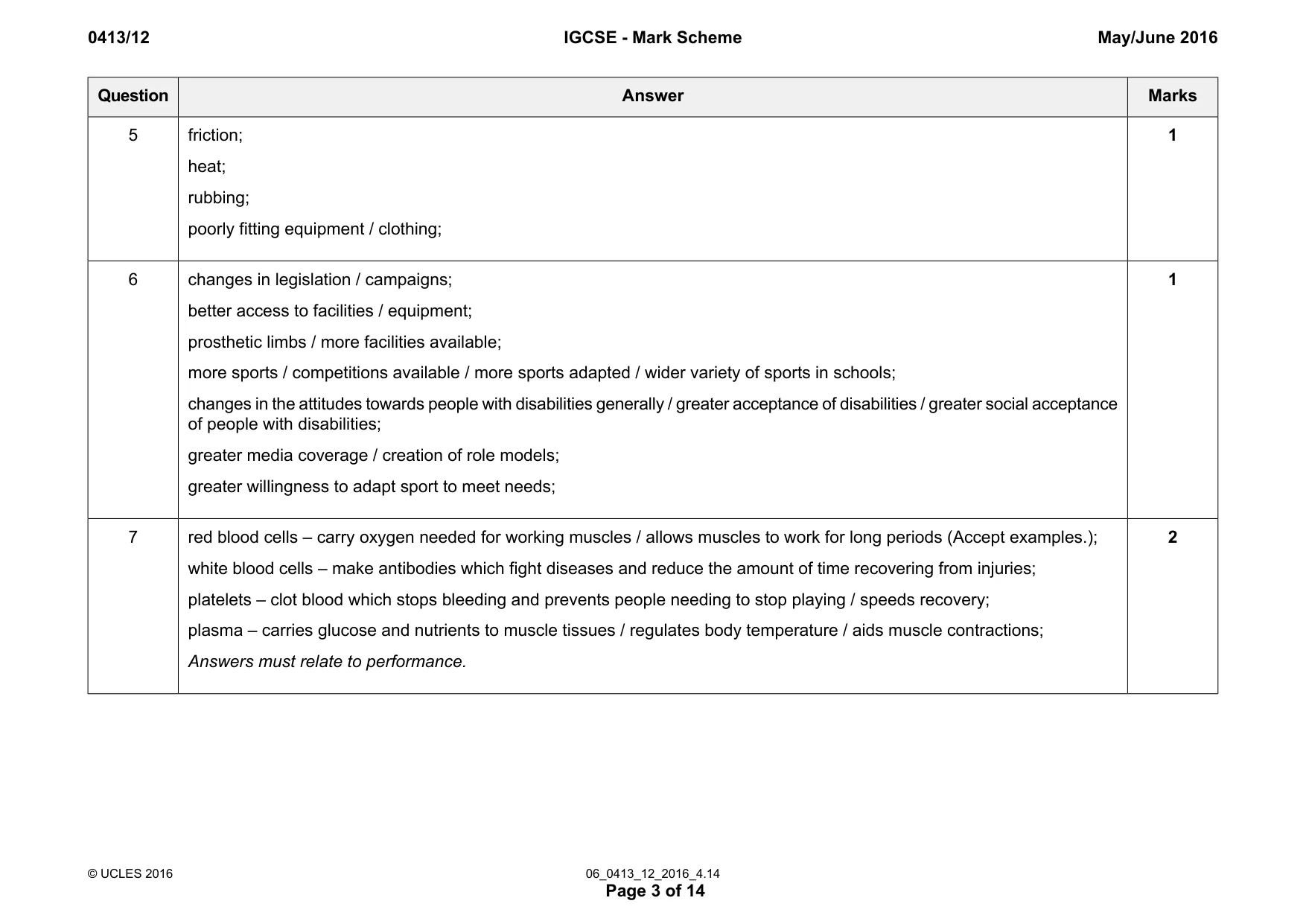
Marks Answer Question 1 friction; 5 heat; rubbing; poorly fitting equipment / clothing; 1 changes in legislation / campaigns; 6 better access to facilities / equipment; prosthetic limbs / more facilities available; more sports / competitions available / more sports adapted / wider variety of sports in schools; changes in the attitudes towards people with disabilities generally / greater acceptance of disabilities / greater social acceptance of people with disabilities; greater media coverage / creation of role models; greater willingness to adapt sport to meet needs; 2 red blood cells – carry oxygen needed for working muscles / allows muscles to work for long periods (Accept examples.); 7 white blood cells – make antibodies which fight diseases and reduce the amount of time recovering from injuries; platelets – clot blood which stops bleeding and prevents people needing to stop playing / speeds recovery; plasma – carries glucose and nutrients to muscle tissues / regulates body temperature / aids muscle contractions; Answers must relate to performance. 06_0413_12_2016_4.14 © UCLES 2016 Page 3 of 14 May/June 2016 IGCSE - Mark Scheme 0413/12
Mark scheme, page 4
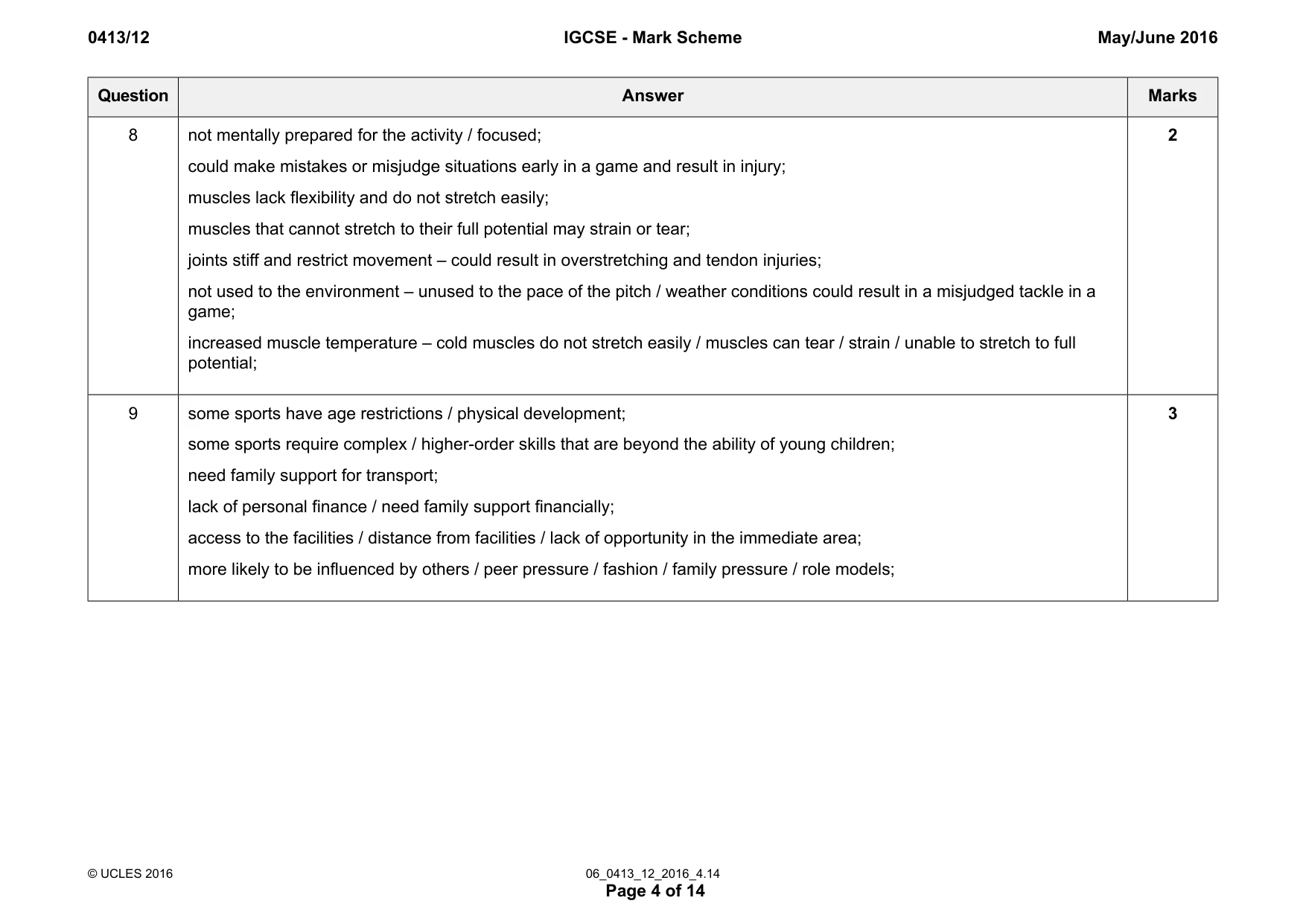
Marks Answer Question 2 not mentally prepared for the activity / focused; 8 could make mistakes or misjudge situations early in a game and result in injury; muscles lack flexibility and do not stretch easily; muscles that cannot stretch to their full potential may strain or tear; joints stiff and restrict movement – could result in overstretching and tendon injuries; not used to the environment – unused to the pace of the pitch / weather conditions could result in a misjudged tackle in a game; increased muscle temperature – cold muscles do not stretch easily / muscles can tear / strain / unable to stretch to full potential; 3 some sports have age restrictions / physical development; 9 some sports require complex / higher-order skills that are beyond the ability of young children; need family support for transport; lack of personal finance / need family support financially; access to the facilities / distance from facilities / lack of opportunity in the immediate area; more likely to be influenced by others / peer pressure / fashion / family pressure / role models; 06_0413_12_2016_4.14 © UCLES 2016 Page 4 of 14 May/June 2016 IGCSE - Mark Scheme 0413/12
Mark scheme, page 5
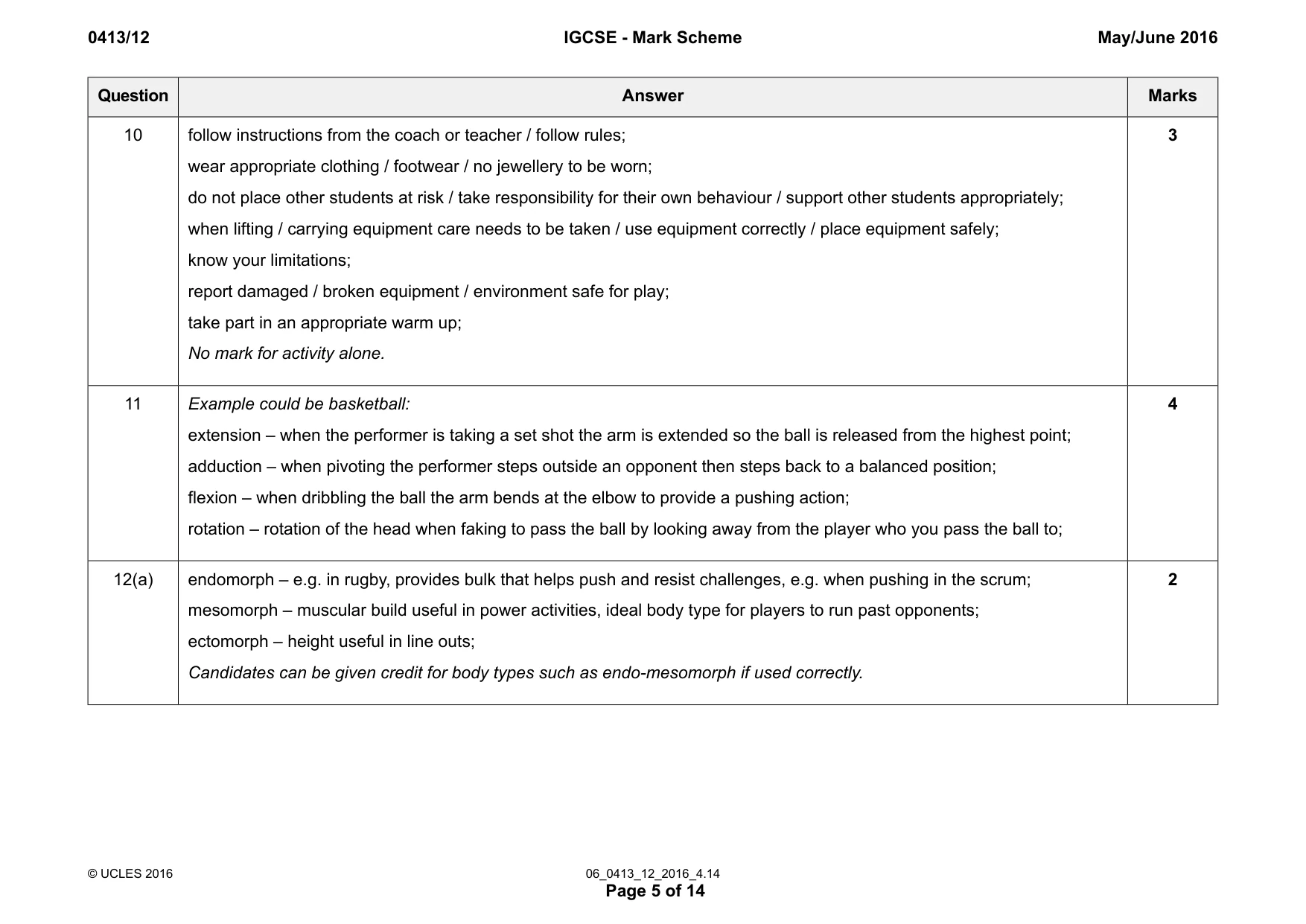
Marks Answer Question 3 follow instructions from the coach or teacher / follow rules; 10 wear appropriate clothing / footwear / no jewellery to be worn; do not place other students at risk / take responsibility for their own behaviour / support other students appropriately; when lifting / carrying equipment care needs to be taken / use equipment correctly / place equipment safely; know your limitations; report damaged / broken equipment / environment safe for play; take part in an appropriate warm up; No mark for activity alone. 4 Example could be basketball: 11 extension – when the performer is taking a set shot the arm is extended so the ball is released from the highest point; adduction – when pivoting the performer steps outside an opponent then steps back to a balanced position; flexion – when dribbling the ball the arm bends at the elbow to provide a pushing action; rotation – rotation of the head when faking to pass the ball by looking away from the player who you pass the ball to; 2 endomorph – e.g. in rugby, provides bulk that helps push and resist challenges, e.g. when pushing in the scrum; 12(a) mesomorph – muscular build useful in power activities, ideal body type for players to run past opponents; ectomorph – height useful in line outs; Candidates can be given credit for body types such as endo-mesomorph if used correctly. 06_0413_12_2016_4.14 © UCLES 2016 Page 5 of 14 May/June 2016 IGCSE - Mark Scheme 0413/12
Mark scheme, page 6
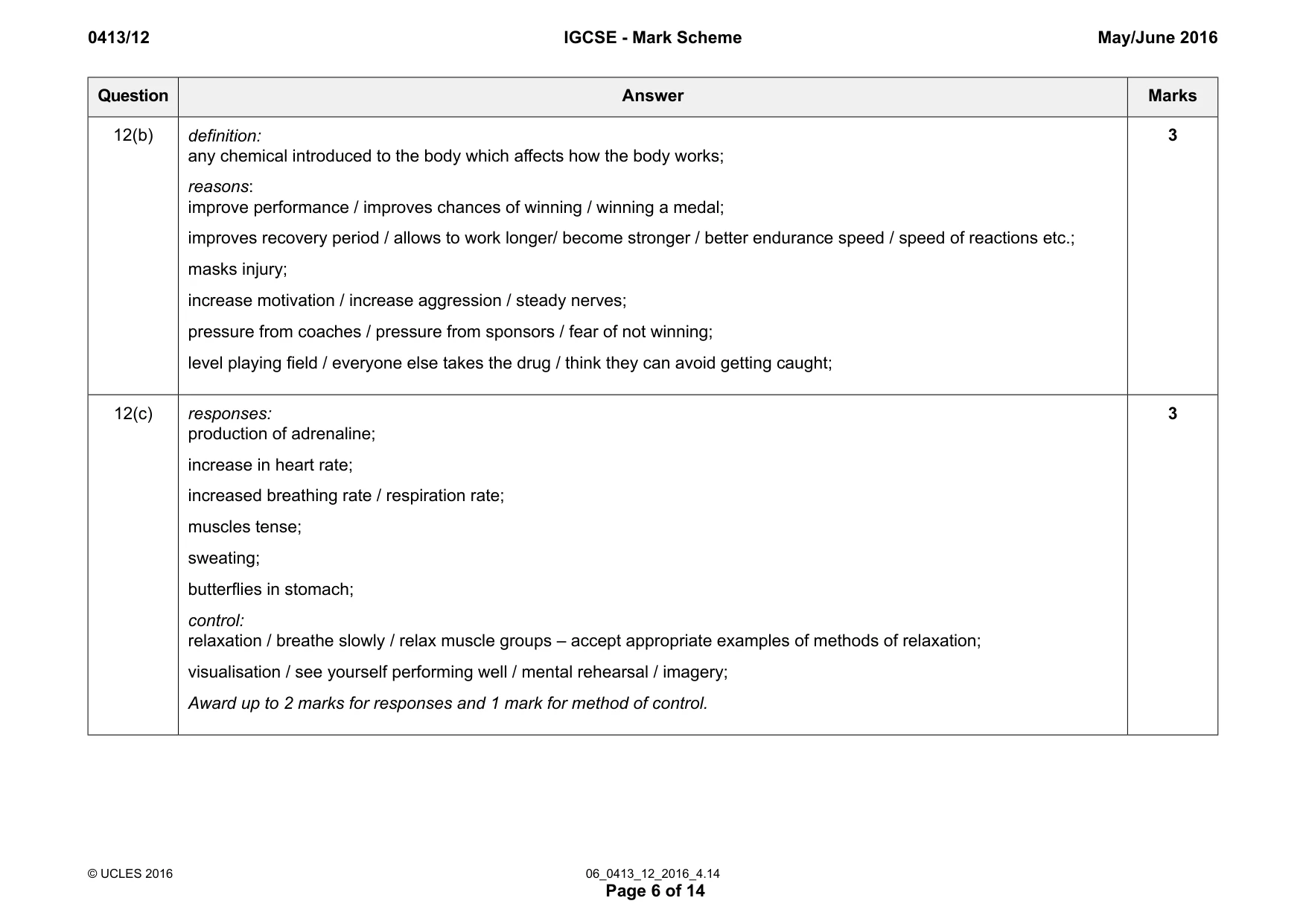
Marks Answer Question 3 definition: any chemical introduced to the body which affects how the body works; 12(b) reasons: improve performance / improves chances of winning / winning a medal; improves recovery period / allows to work longer/ become stronger / better endurance speed / speed of reactions etc.; masks injury; increase motivation / increase aggression / steady nerves; pressure from coaches / pressure from sponsors / fear of not winning; level playing field / everyone else takes the drug / think they can avoid getting caught; 3 responses: production of adrenaline; 12(c) increase in heart rate; increased breathing rate / respiration rate; muscles tense; sweating; butterflies in stomach; control: relaxation / breathe slowly / relax muscle groups – accept appropriate examples of methods of relaxation; visualisation / see yourself performing well / mental rehearsal / imagery; Award up to 2 marks for responses and 1 mark for method of control. 06_0413_12_2016_4.14 © UCLES 2016 Page 6 of 14 May/June 2016 IGCSE - Mark Scheme 0413/12
Mark scheme, page 7
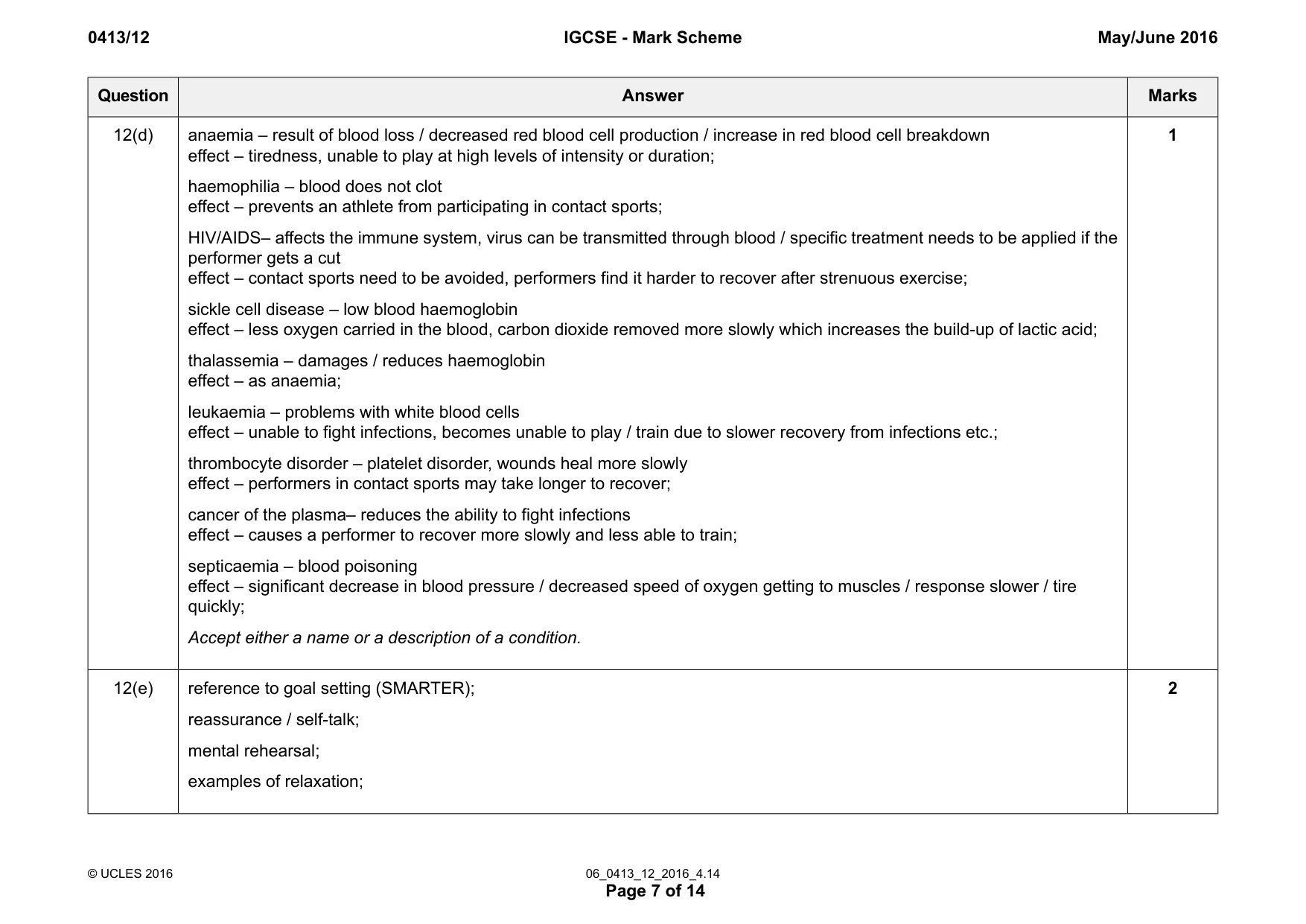
Marks Answer Question 1 anaemia – result of blood loss / decreased red blood cell production / increase in red blood cell breakdown effect – tiredness, unable to play at high levels of intensity or duration; 12(d) haemophilia – blood does not clot effect – prevents an athlete from participating in contact sports; HIV/AIDS– affects the immune system, virus can be transmitted through blood / specific treatment needs to be applied if the performer gets a cut effect – contact sports need to be avoided, performers find it harder to recover after strenuous exercise; sickle cell disease – low blood haemoglobin effect – less oxygen carried in the blood, carbon dioxide removed more slowly which increases the build-up of lactic acid; thalassemia – damages / reduces haemoglobin effect – as anaemia; leukaemia – problems with white blood cells effect – unable to fight infections, becomes unable to play / train due to slower recovery from infections etc.; thrombocyte disorder – platelet disorder, wounds heal more slowly effect – performers in contact sports may take longer to recover; cancer of the plasma– reduces the ability to fight infections effect – causes a performer to recover more slowly and less able to train; septicaemia – blood poisoning effect – significant decrease in blood pressure / decreased speed of oxygen getting to muscles / response slower / tire quickly; Accept either a name or a description of a condition. 2 reference to goal setting (SMARTER); 12(e) reassurance / self-talk; mental rehearsal; examples of relaxation; 06_0413_12_2016_4.14 © UCLES 2016 Page 7 of 14 May/June 2016 IGCSE - Mark Scheme 0413/12
Mark scheme, page 8
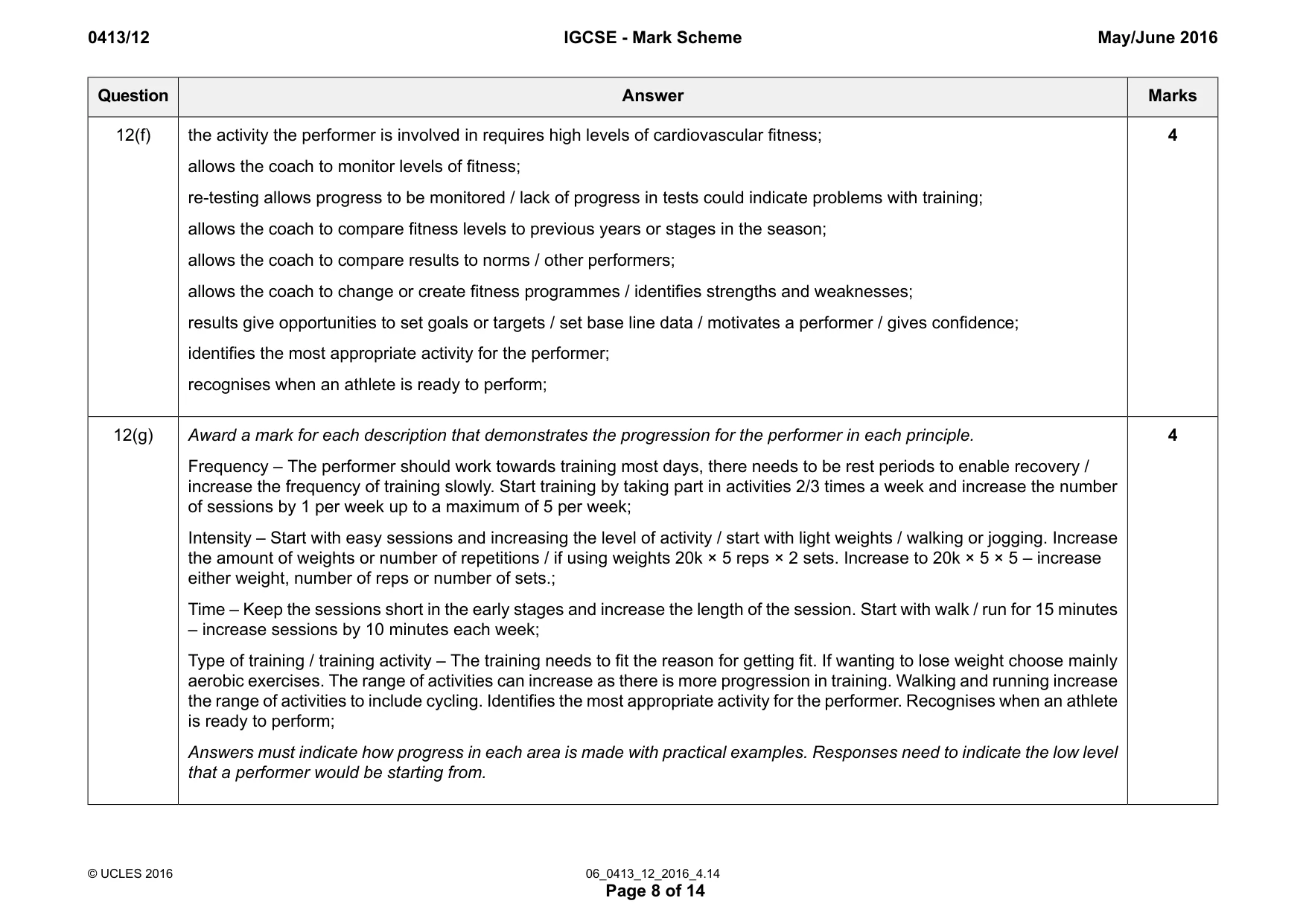
Marks Answer Question 4 the activity the performer is involved in requires high levels of cardiovascular fitness; 12(f) allows the coach to monitor levels of fitness; re-testing allows progress to be monitored / lack of progress in tests could indicate problems with training; allows the coach to compare fitness levels to previous years or stages in the season; allows the coach to compare results to norms / other performers; allows the coach to change or create fitness programmes / identifies strengths and weaknesses; results give opportunities to set goals or targets / set base line data / motivates a performer / gives confidence; identifies the most appropriate activity for the performer; recognises when an athlete is ready to perform; 4 Award a mark for each description that demonstrates the progression for the performer in each principle. 12(g) Frequency – The performer should work towards training most days, there needs to be rest periods to enable recovery / increase the frequency of training slowly. Start training by taking part in activities 2/3 times a week and increase the number of sessions by 1 per week up to a maximum of 5 per week; Intensity – Start with easy sessions and increasing the level of activity / start with light weights / walking or jogging. Increase the amount of weights or number of repetitions / if using weights 20k × 5 reps × 2 sets. Increase to 20k × 5 × 5 – increase either weight, number of reps or number of sets.; Time – Keep the sessions short in the early stages and increase the length of the session. Start with walk / run for 15 minutes – increase sessions by 10 minutes each week; Type of training / training activity – The training needs to fit the reason for getting fit. If wanting to lose weight choose mainly aerobic exercises. The range of activities can increase as there is more progression in training. Walking and running increase the range of activities to include cycling. Identifies the most appropriate activity for the performer. Recognises when an athlete is ready to perform; Answers must indicate how progress in each area is made with practical examples. Responses need to indicate the low level that a performer would be starting from. 06_0413_12_2016_4.14 © UCLES 2016 Page 8 of 14 May/June 2016 IGCSE - Mark Scheme 0413/12
Mark scheme, page 9
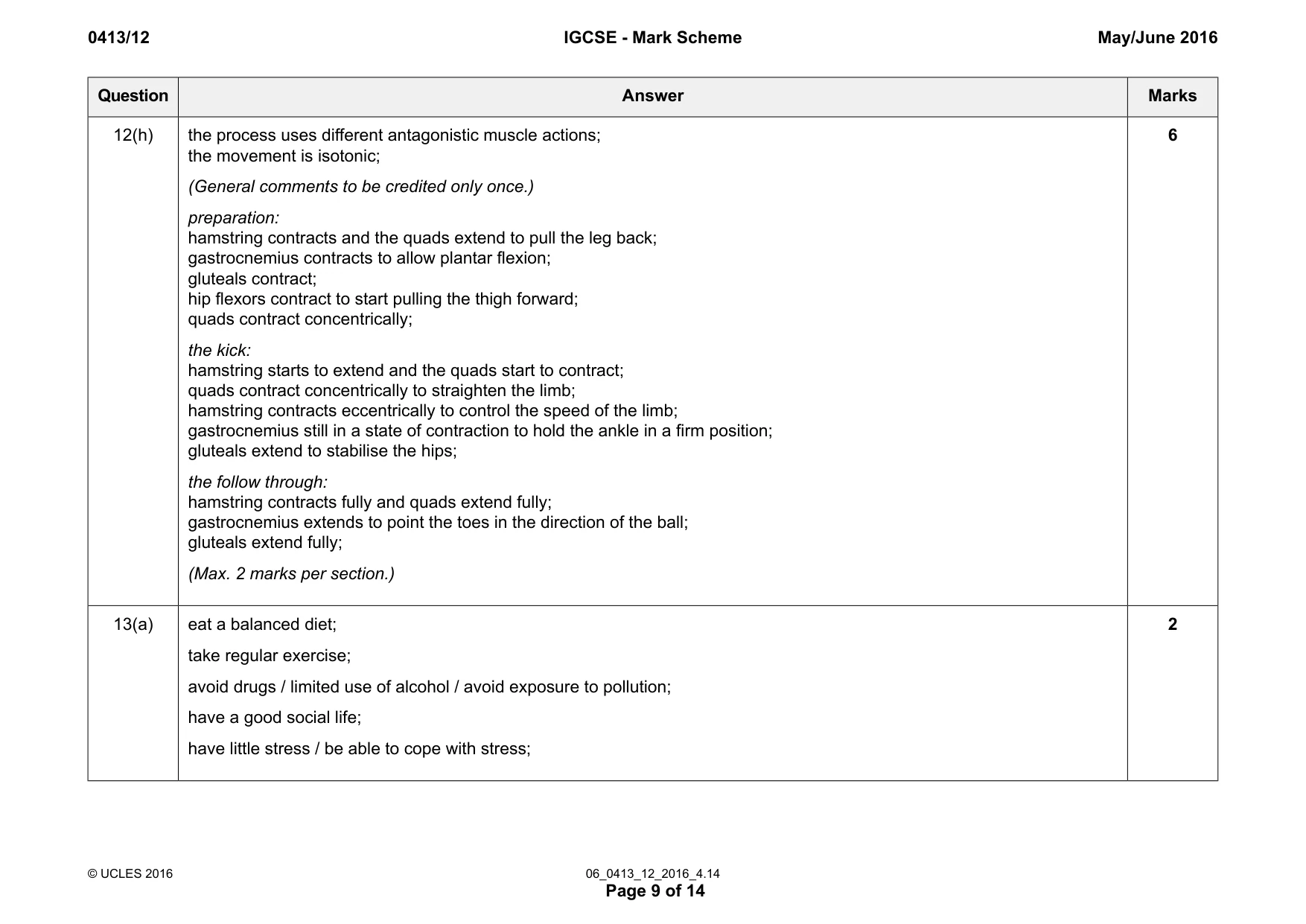
Marks Answer Question 6 the process uses different antagonistic muscle actions; the movement is isotonic; 12(h) (General comments to be credited only once.) preparation: hamstring contracts and the quads extend to pull the leg back; gastrocnemius contracts to allow plantar flexion; gluteals contract; hip flexors contract to start pulling the thigh forward; quads contract concentrically; the kick: hamstring starts to extend and the quads start to contract; quads contract concentrically to straighten the limb; hamstring contracts eccentrically to control the speed of the limb; gastrocnemius still in a state of contraction to hold the ankle in a firm position; gluteals extend to stabilise the hips; the follow through: hamstring contracts fully and quads extend fully; gastrocnemius extends to point the toes in the direction of the ball; gluteals extend fully; (Max. 2 marks per section.) 2 eat a balanced diet; 13(a) take regular exercise; avoid drugs / limited use of alcohol / avoid exposure to pollution; have a good social life; have little stress / be able to cope with stress; 06_0413_12_2016_4.14 © UCLES 2016 Page 9 of 14 May/June 2016 IGCSE - Mark Scheme 0413/12
Mark scheme, page 10
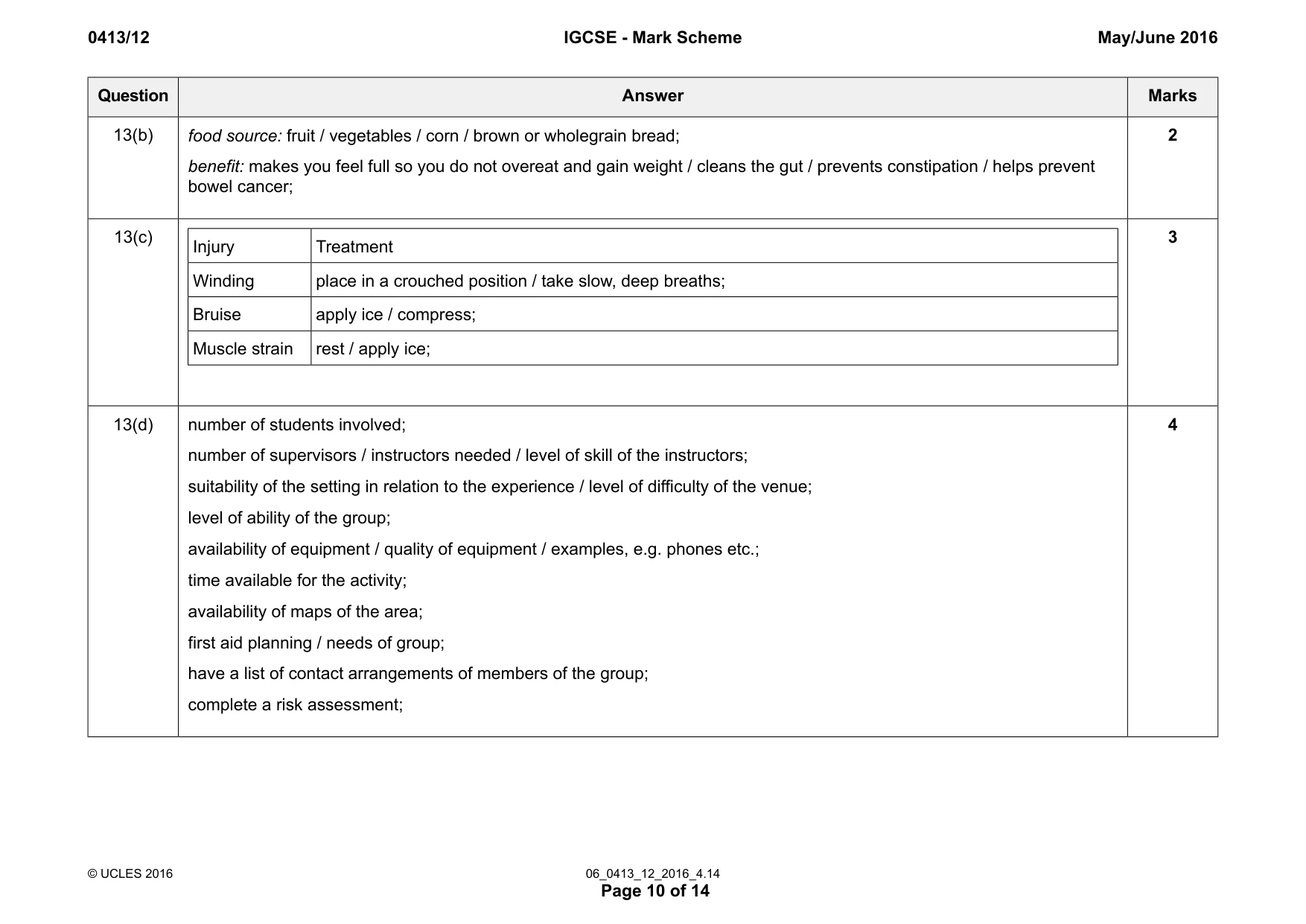
Marks Answer Question 2 food source: fruit / vegetables / corn / brown or wholegrain bread; 13(b) benefit: makes you feel full so you do not overeat and gain weight / cleans the gut / prevents constipation / helps prevent bowel cancer; 3 13(c) Treatment Injury place in a crouched position / take slow, deep breaths; Winding apply ice / compress; Bruise rest / apply ice; Muscle strain 4 number of students involved; 13(d) number of supervisors / instructors needed / level of skill of the instructors; suitability of the setting in relation to the experience / level of difficulty of the venue; level of ability of the group; availability of equipment / quality of equipment / examples, e.g. phones etc.; time available for the activity; availability of maps of the area; first aid planning / needs of group; have a list of contact arrangements of members of the group; complete a risk assessment; 06_0413_12_2016_4.14 © UCLES 2016 Page 10 of 14 May/June 2016 IGCSE - Mark Scheme 0413/12
Mark scheme, page 11
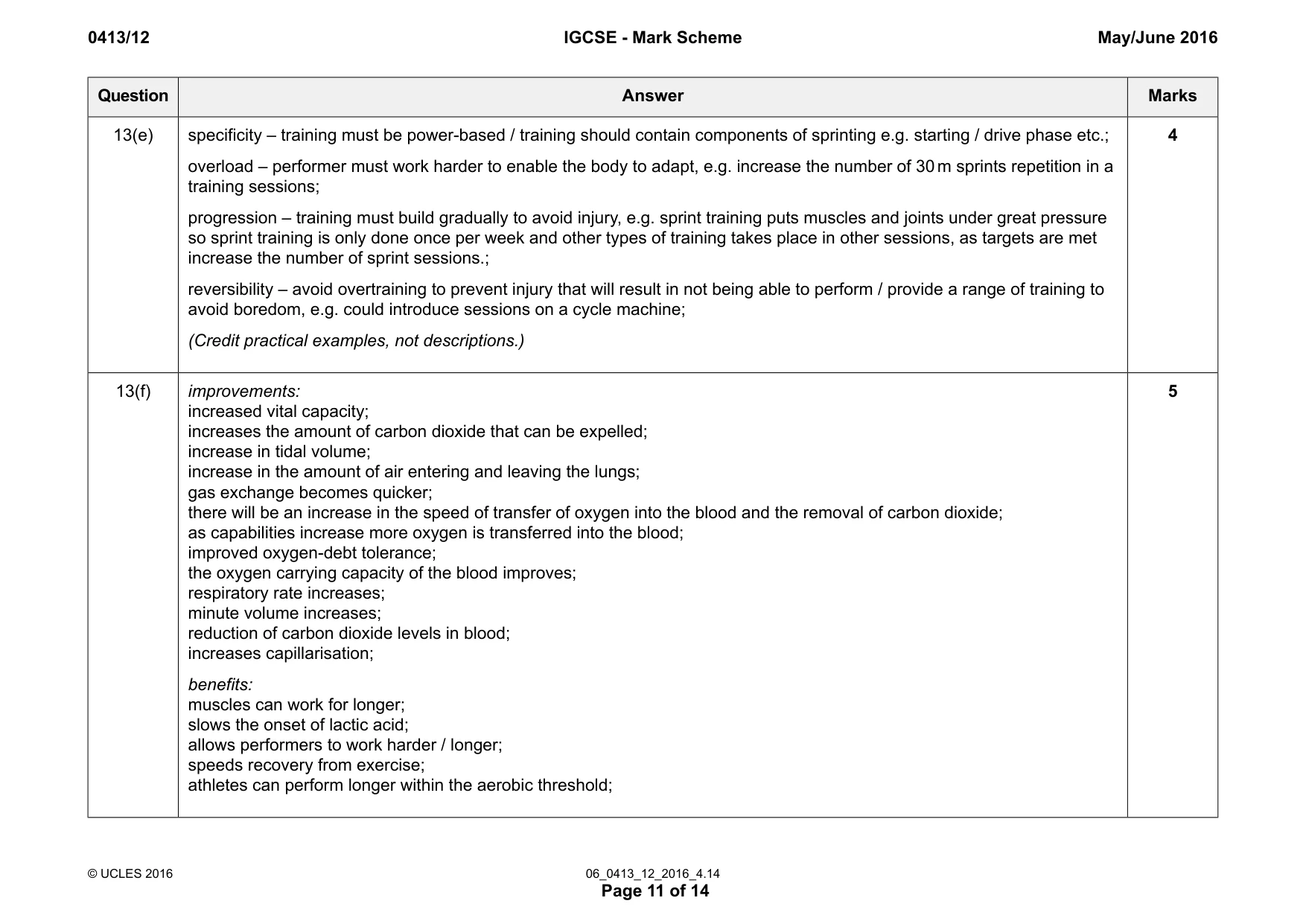
Marks Answer Question 4 specificity – training must be power-based / training should contain components of sprinting e.g. starting / drive phase etc.; 13(e) overload – performer must work harder to enable the body to adapt, e.g. increase the number of 30m sprints repetition in a training sessions; progression – training must build gradually to avoid injury, e.g. sprint training puts muscles and joints under great pressure so sprint training is only done once per week and other types of training takes place in other sessions, as targets are met increase the number of sprint sessions.; reversibility – avoid overtraining to prevent injury that will result in not being able to perform / provide a range of training to avoid boredom, e.g. could introduce sessions on a cycle machine; (Credit practical examples, not descriptions.) 5 improvements: increased vital capacity; increases the amount of carbon dioxide that can be expelled; increase in tidal volume; increase in the amount of air entering and leaving the lungs; gas exchange becomes quicker; there will be an increase in the speed of transfer of oxygen into the blood and the removal of carbon dioxide; as capabilities increase more oxygen is transferred into the blood; improved oxygen-debt tolerance; the oxygen carrying capacity of the blood improves; respiratory rate increases; minute volume increases; reduction of carbon dioxide levels in blood; increases capillarisation; 13(f) benefits: muscles can work for longer; slows the onset of lactic acid; allows performers to work harder / longer; speeds recovery from exercise; athletes can perform longer within the aerobic threshold; 06_0413_12_2016_4.14 © UCLES 2016 Page 11 of 14 May/June 2016 IGCSE - Mark Scheme 0413/12
Mark scheme, page 12
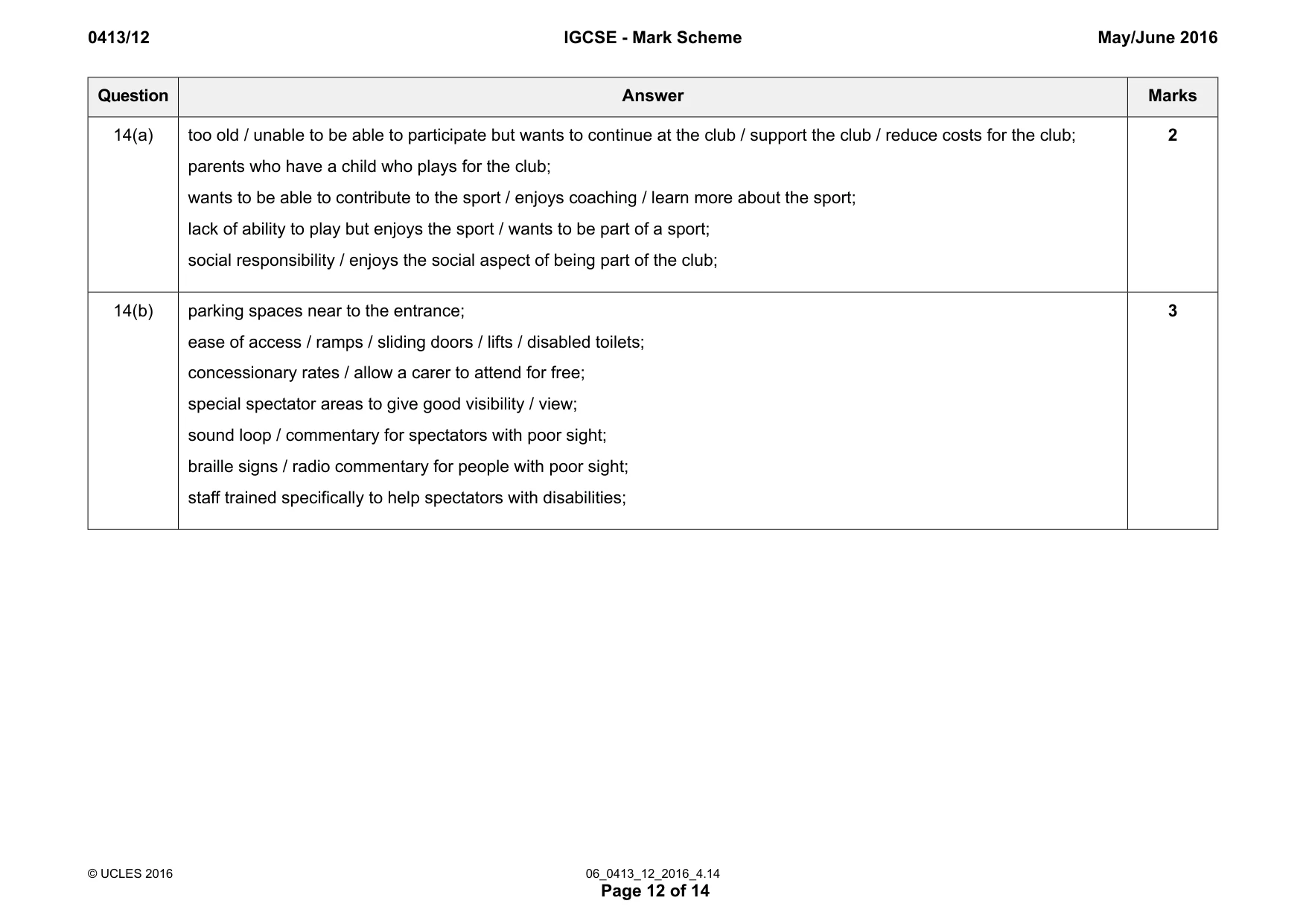
Marks Answer Question 2 too old / unable to be able to participate but wants to continue at the club / support the club / reduce costs for the club; 14(a) parents who have a child who plays for the club; wants to be able to contribute to the sport / enjoys coaching / learn more about the sport; lack of ability to play but enjoys the sport / wants to be part of a sport; social responsibility / enjoys the social aspect of being part of the club; 3 parking spaces near to the entrance; 14(b) ease of access / ramps / sliding doors / lifts / disabled toilets; concessionary rates / allow a carer to attend for free; special spectator areas to give good visibility / view; sound loop / commentary for spectators with poor sight; braille signs / radio commentary for people with poor sight; staff trained specifically to help spectators with disabilities; 06_0413_12_2016_4.14 © UCLES 2016 Page 12 of 14 May/June 2016 IGCSE - Mark Scheme 0413/12
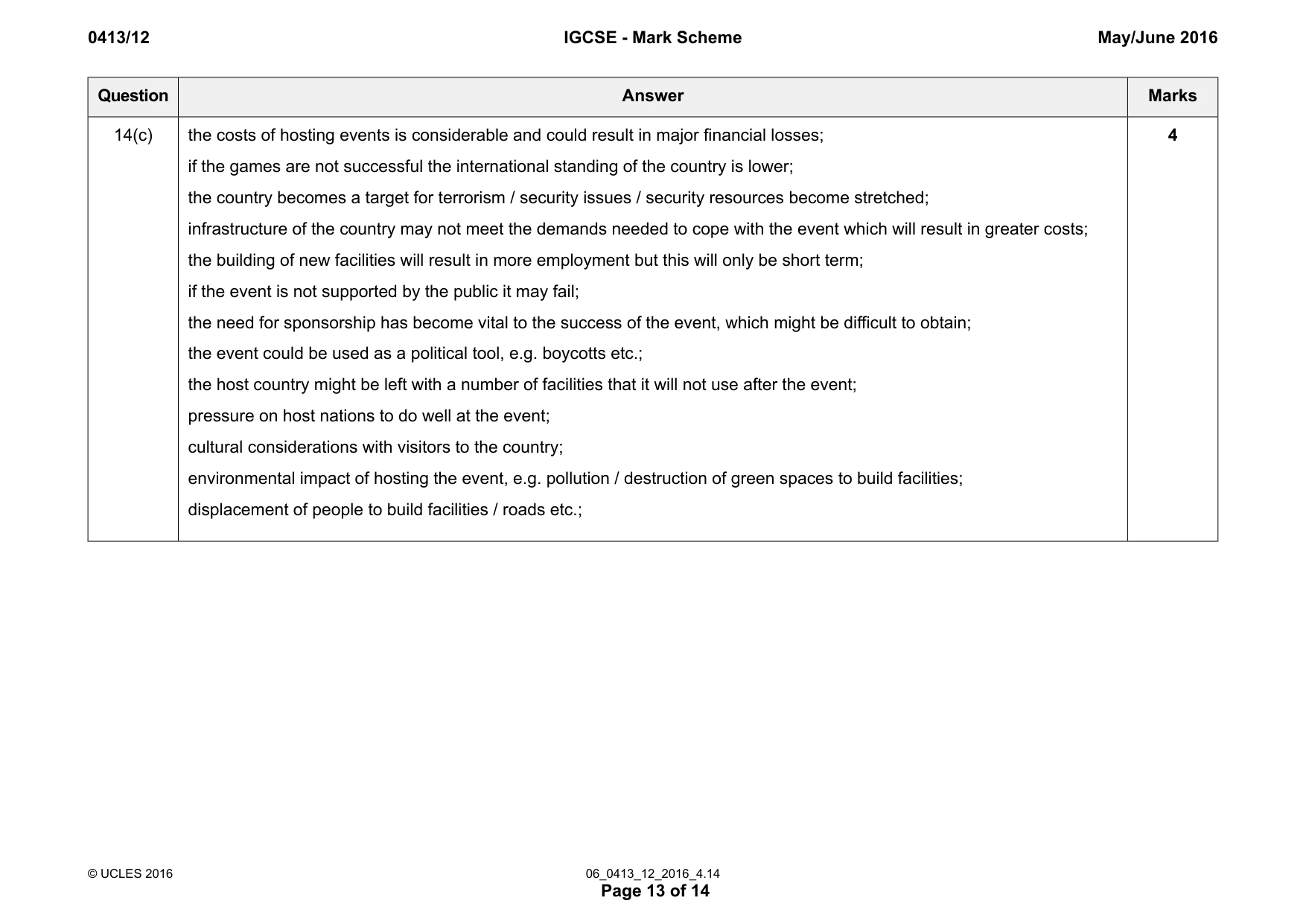
Mark scheme, page 13
Marks Answer Question 4 the costs of hosting events is considerable and could result in major financial losses; 14(c) if the games are not successful the international standing of the country is lower; the country becomes a target for terrorism / security issues / security resources become stretched; infrastructure of the country may not meet the demands needed to cope with the event which will result in greater costs; the building of new facilities will result in more employment but this will only be short term; if the event is not supported by the public it may fail; the need for sponsorship has become vital to the success of the event, which might be difficult to obtain; the event could be used as a political tool, e.g. boycotts etc.; the host country might be left with a number of facilities that it will not use after the event; pressure on host nations to do well at the event; cultural considerations with visitors to the country; environmental impact of hosting the event, e.g. pollution / destruction of green spaces to build facilities; displacement of people to build facilities / roads etc.; 06_0413_12_2016_4.14 © UCLES 2016 Page 13 of 14 May/June 2016 IGCSE - Mark Scheme 0413/12
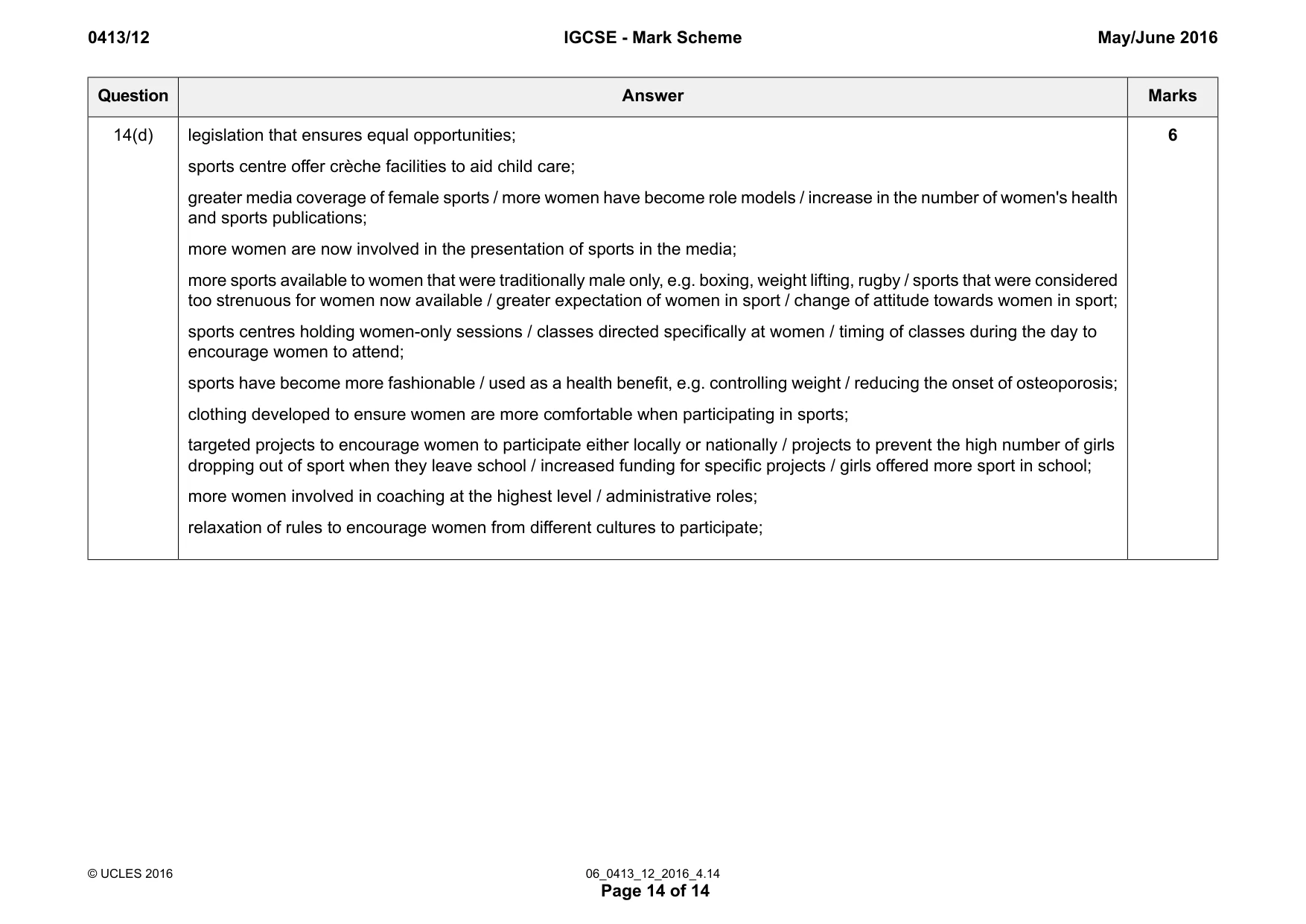
Mark scheme, page 14
Marks Answer Question 6 legislation that ensures equal opportunities; 14(d) sports centre offer crèche facilities to aid child care; greater media coverage of female sports / more women have become role models / increase in the number of women's health and sports publications; more women are now involved in the presentation of sports in the media; more sports available to women that were traditionally male only, e.g. boxing, weight lifting, rugby / sports that were considered too strenuous for women now available / greater expectation of women in sport / change of attitude towards women in sport; sports centres holding women-only sessions / classes directed specifically at women / timing of classes during the day to encourage women to attend; sports have become more fashionable / used as a health benefit, e.g. controlling weight / reducing the onset of osteoporosis; clothing developed to ensure women are more comfortable when participating in sports; targeted projects to encourage women to participate either locally or nationally / projects to prevent the high number of girls dropping out of sport when they leave school / increased funding for specific projects / girls offered more sport in school; more women involved in coaching at the highest level / administrative roles; relaxation of rules to encourage women from different cultures to participate; 06_0413_12_2016_4.14 © UCLES 2016 Page 14 of 14 May/June 2016 IGCSE - Mark Scheme 0413/12
What you needed in this session
Cambridge’s own grade thresholds for 2016 May/June, Paper 1 · Variant 2. A higher threshold means an easier paper — the bar moves with how the cohort did.