Cambridge IGCSE Physical Education 0413 — 2016 May/June Paper 1 · Variant 3
0413/13/M/J/16 · 80 marks · ≈90 min
The question paper and its mark scheme, free to read here and free to download. This is Cambridge’s own paper, exactly as it was sat.
Question paper12 pages
Mark scheme12 pages
Answers below. Sit the paper first if you are practising.
Paper as text
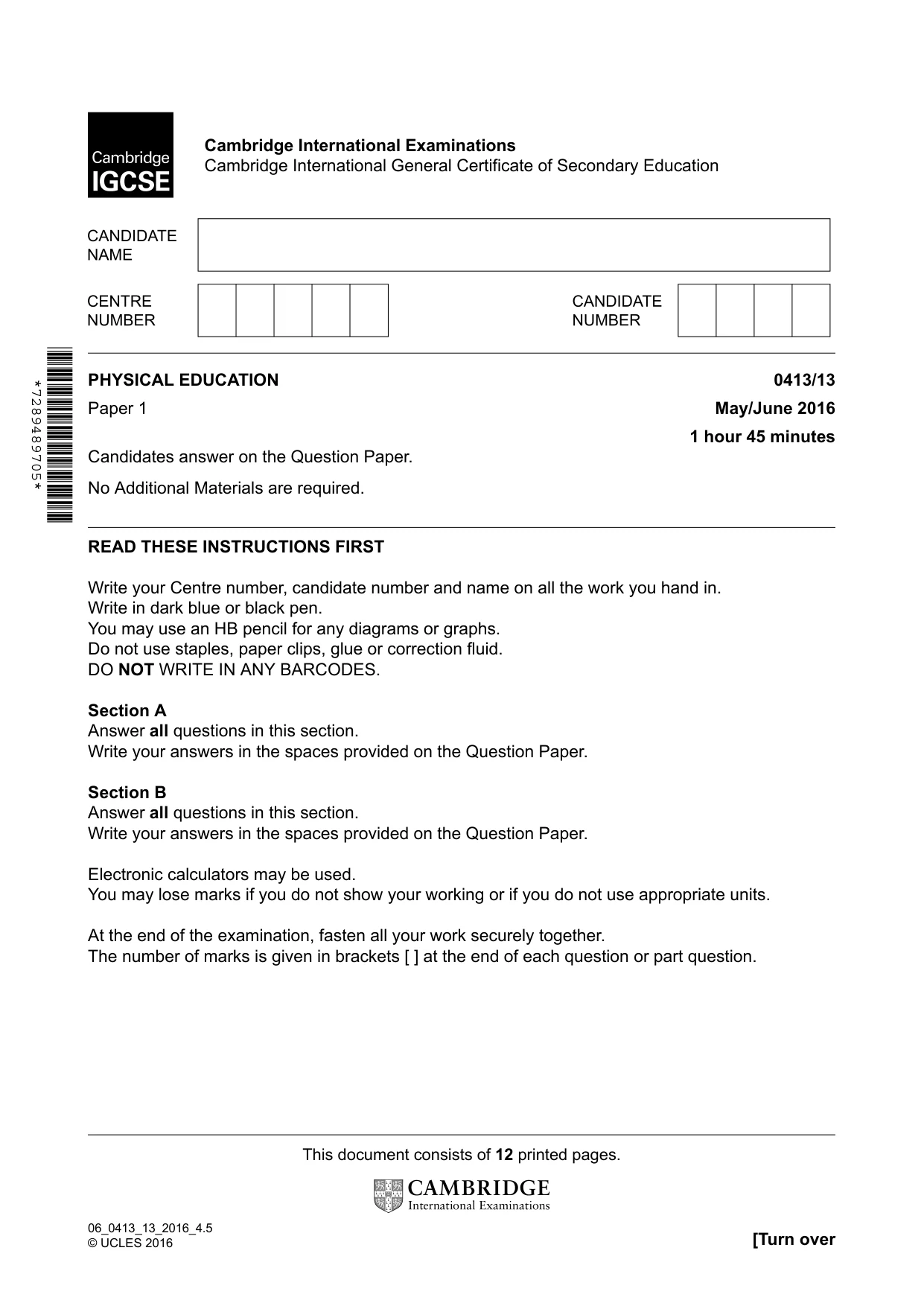
Question paper, page 1
Cambridge International Examinations Cambridge International General Certificate of Secondary Education 0413/13 May/June 2016 1 hour 45 minutes PHYSICAL EDUCATION Paper 1 Candidates answer on the Question Paper. No Additional Materials are required. READ THESE INSTRUCTIONS FIRST Write your Centre number, candidate number and name on all the work you hand in. Write in dark blue or black pen. You may use an HB pencil for any diagrams or graphs. Do not use staples, paper clips, glue or correction fluid. DO NOT WRITE IN ANY BARCODES. Section A Answer all questions in this section. Write your answers in the spaces provided on the Question Paper. Section B Answer all questions in this section. Write your answers in the spaces provided on the Question Paper. Electronic calculators may be used. You may lose marks if you do not show your working or if you do not use appropriate units. At the end of the examination, fasten all your work securely together. The number of marks is given in brackets [ ] at the end of each question or part question. This document consists of 12 printed pages. [Turn over 06_0413_13_2016_4.5 © UCLES 2016 *7289489705*
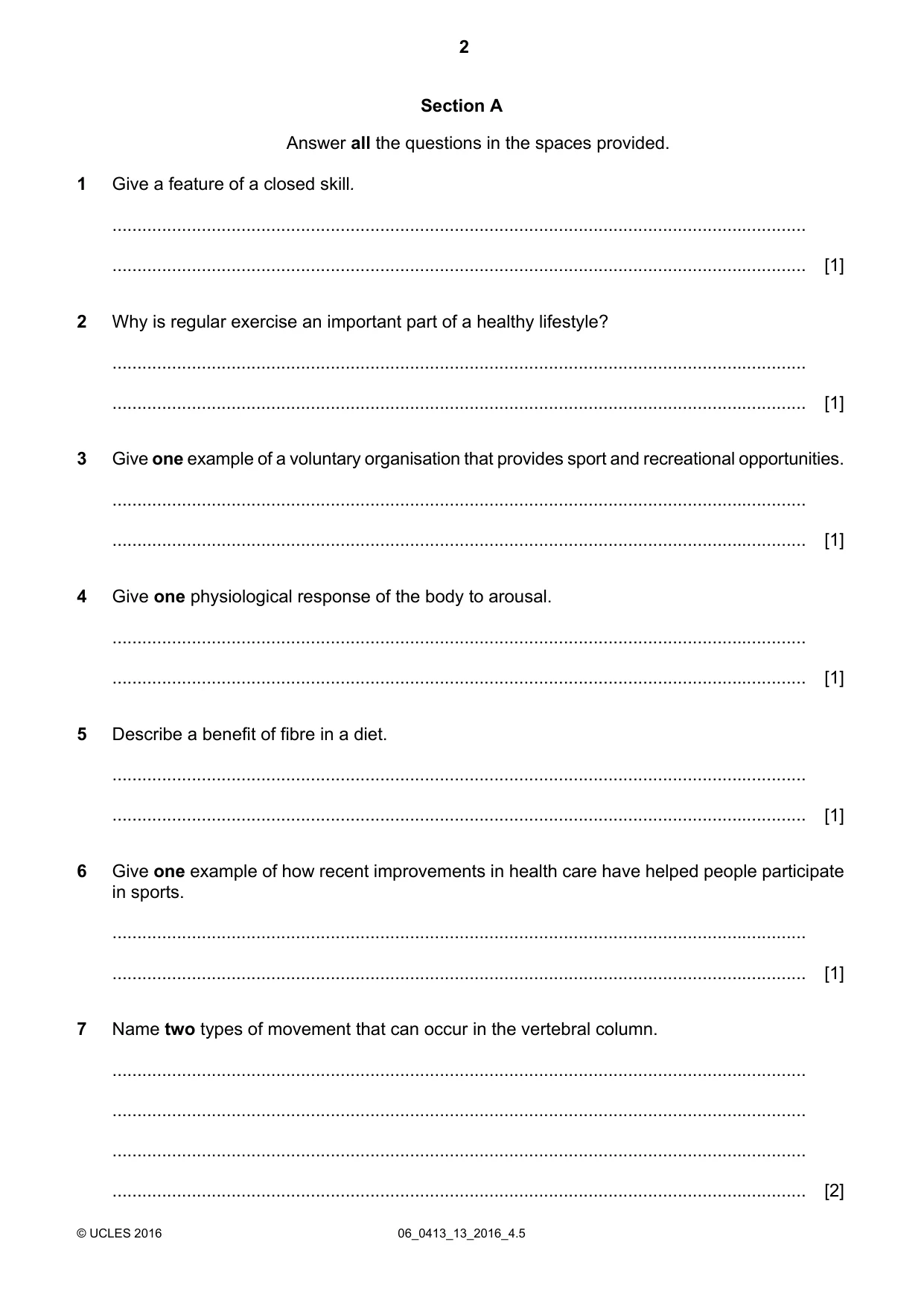
Question paper, page 2
Section A Answer all the questions in the spaces provided. Give a feature of a closed skill. 1 … … [1] Why is regular exercise an important part of a healthy lifestyle? 2 … … [1] Give one example of a voluntary organisation that provides sport and recreational opportunities. 3 … … [1] Give one physiological response of the body to arousal. 4 … … [1] Describe a benefit of fibre in a diet. 5 … … [1] Give one example of how recent improvements in health care have helped people participate in sports. 6 … … [1] Name two types of movement that can occur in the vertebral column. 7 … … … … [2] 06_0413_13_2016_4.5 © UCLES 2016 2
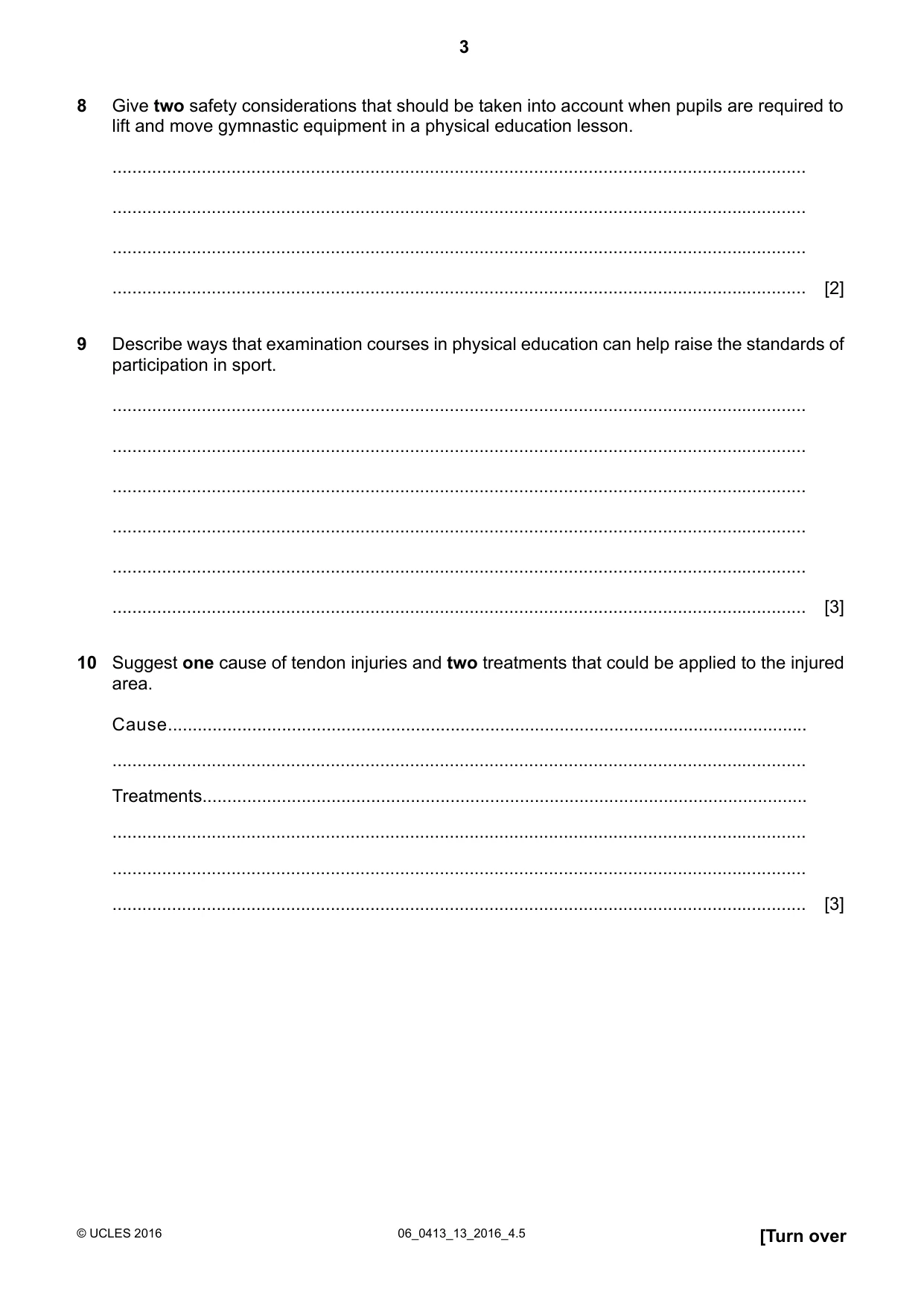
Question paper, page 3
Give two safety considerations that should be taken into account when pupils are required to lift and move gymnastic equipment in a physical education lesson. 8 … … … … [2] Describe ways that examination courses in physical education can help raise the standards of participation in sport. 9 … … … … … … [3] Suggest one cause of tendon injuries and two treatments that could be applied to the injured area. 10 Cause… … Treatments… … … … [3] [Turn over 06_0413_13_2016_4.5 © UCLES 2016 3
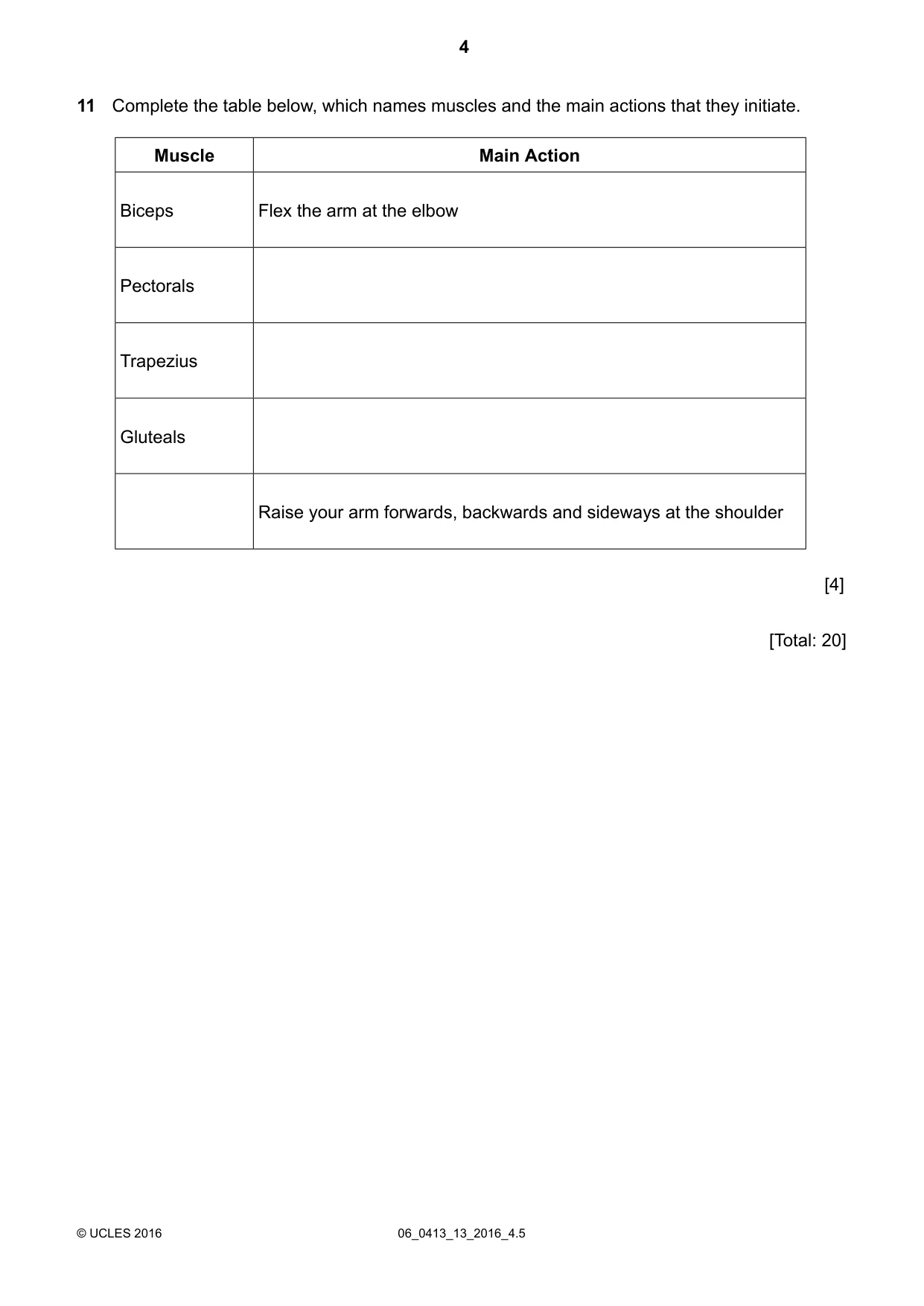
Question paper, page 4
Complete the table below, which names muscles and the main actions that they initiate. 11 Main Action Muscle Flex the arm at the elbow Biceps Pectorals Trapezius Gluteals Raise your arm forwards, backwards and sideways at the shoulder [4] [Total: 20] 06_0413_13_2016_4.5 © UCLES 2016 4
Question paper, page 5
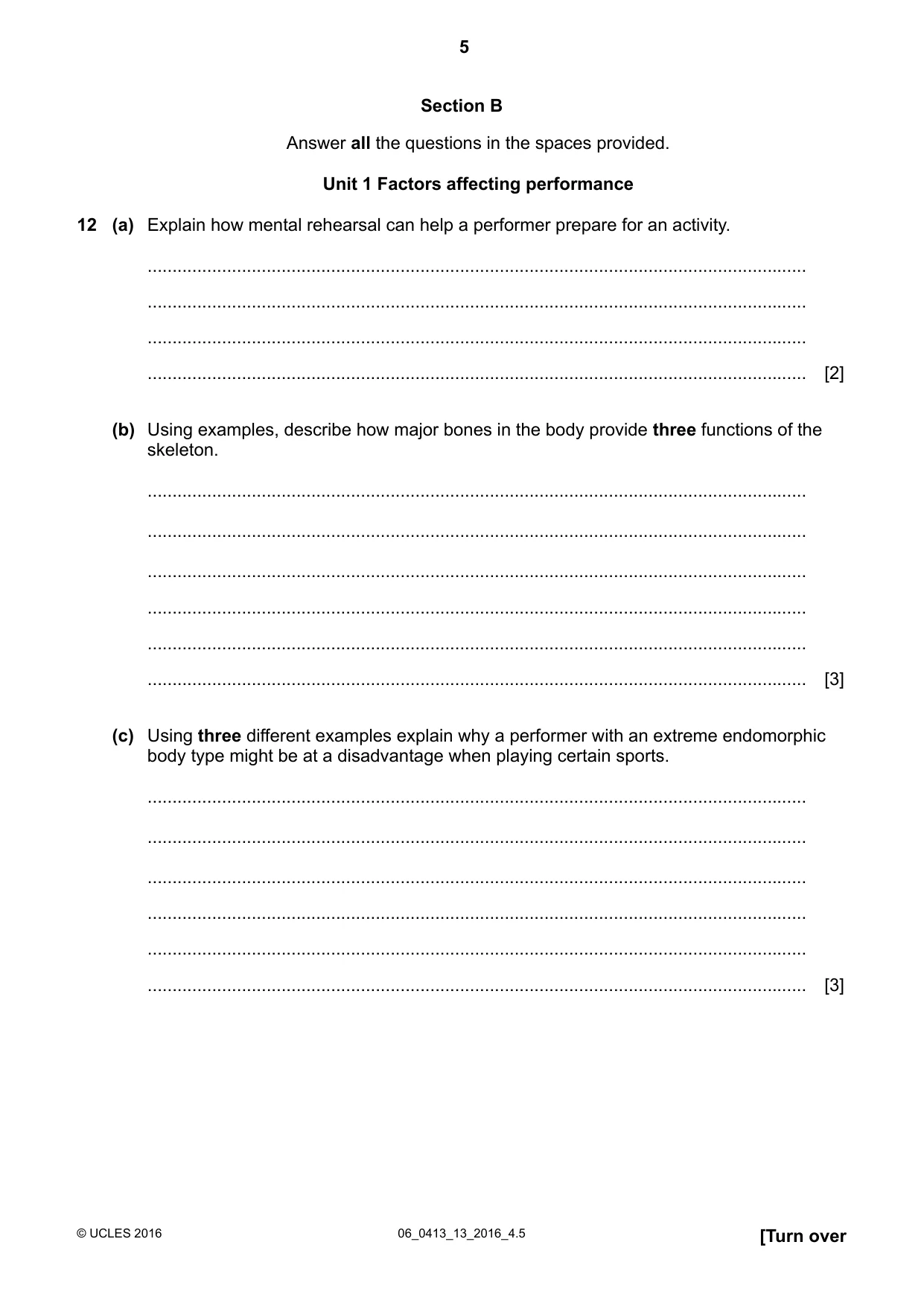
Section B Answer all the questions in the spaces provided. Unit 1 Factors affecting performance Explain how mental rehearsal can help a performer prepare for an activity. (a) 12 … … … … [2] Using examples, describe how major bones in the body provide three functions of the skeleton. (b) … … … … … … [3] Using three different examples explain why a performer with an extreme endomorphic body type might be at a disadvantage when playing certain sports. (c) … … … … … … [3] [Turn over 06_0413_13_2016_4.5 © UCLES 2016 5
Question paper, page 6
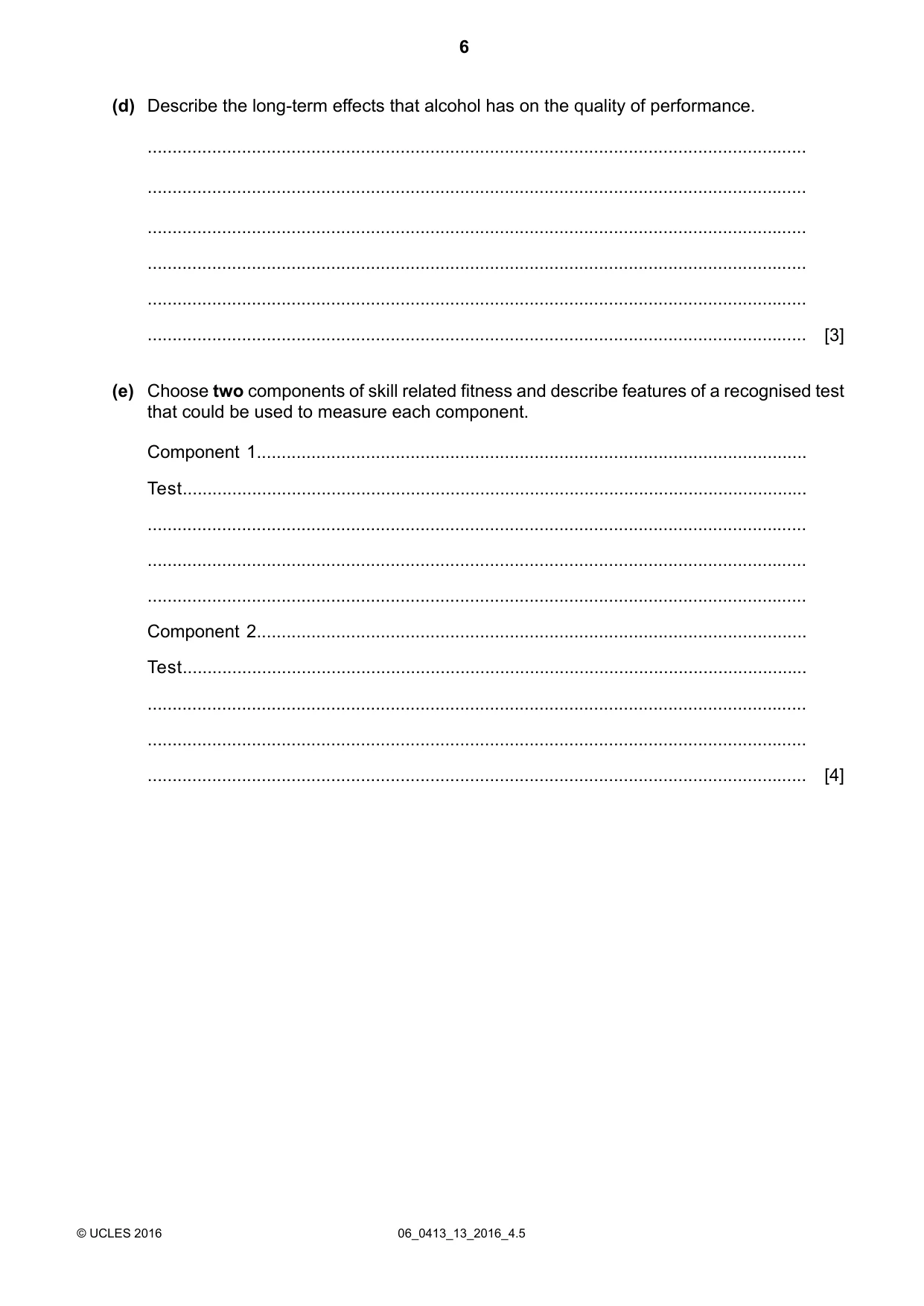
Describe the long-term effects that alcohol has on the quality of performance. (d) … … … … … … [3] Choose two components of skill related fitness and describe features of a recognised test that could be used to measure each component. (e) Component 1… Test… … … … Component 2… Test… … … … [4] 06_0413_13_2016_4.5 © UCLES 2016 6
Question paper, page 7
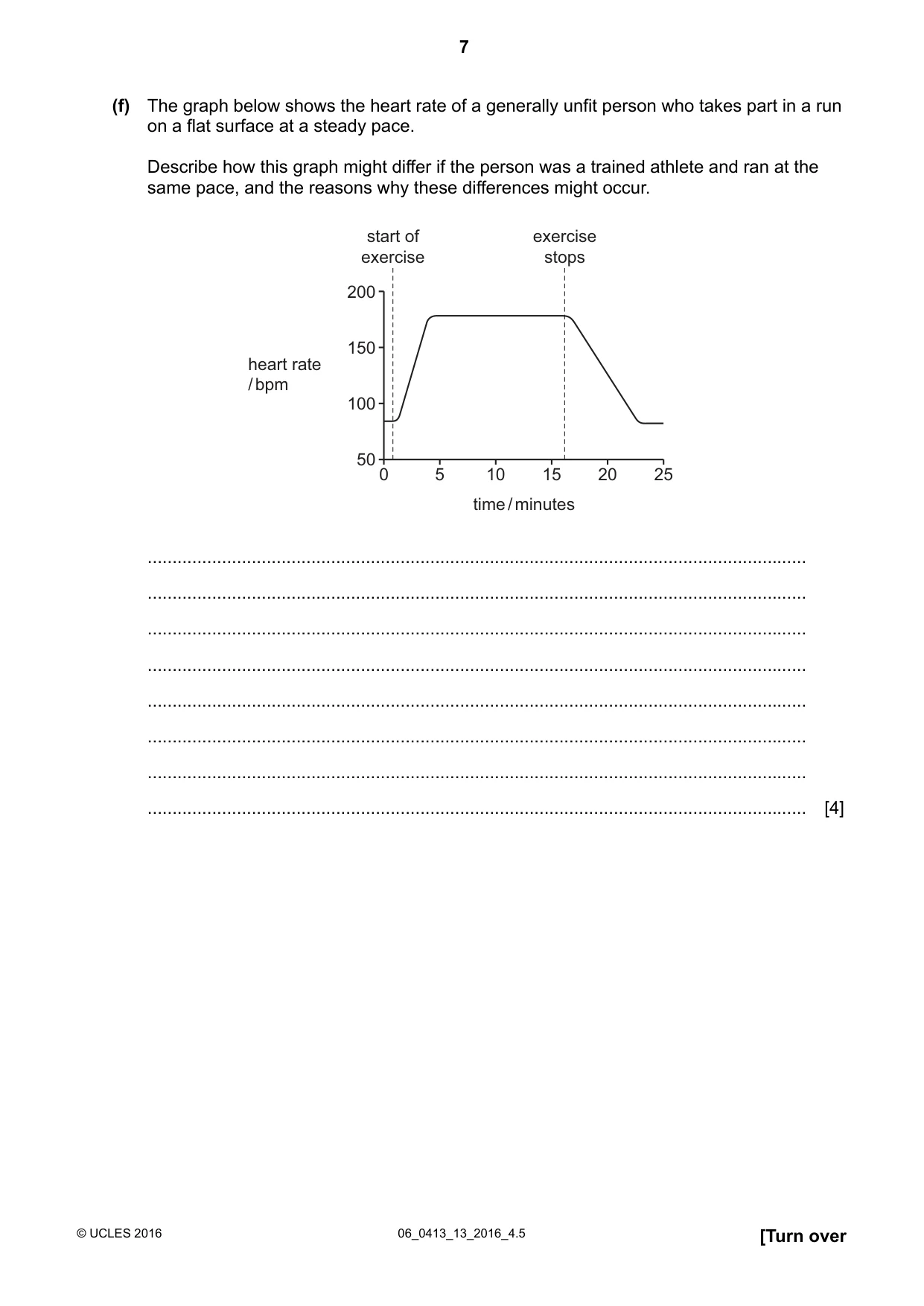
The graph below shows the heart rate of a generally unfit person who takes part in a run on a flat surface at a steady pace. Describe how this graph might differ if the person was a trained athlete and ran at the same pace, and the reasons why these differences might occur. (f) 200 150 100 50 heart rate / bpm 0 5 10 15 20 25 time / minutes exercise stops start of exercise … … … … … … … … [4] [Turn over 06_0413_13_2016_4.5 © UCLES 2016 7
Question paper, page 8
Describe the steps a coach would take when planning a training programme for a person who has a low level of fitness and wants to improve their fitness. (g) … … … … … … … … … … … … [6] [Total: 25] 06_0413_13_2016_4.5 © UCLES 2016 8
Question paper, page 9
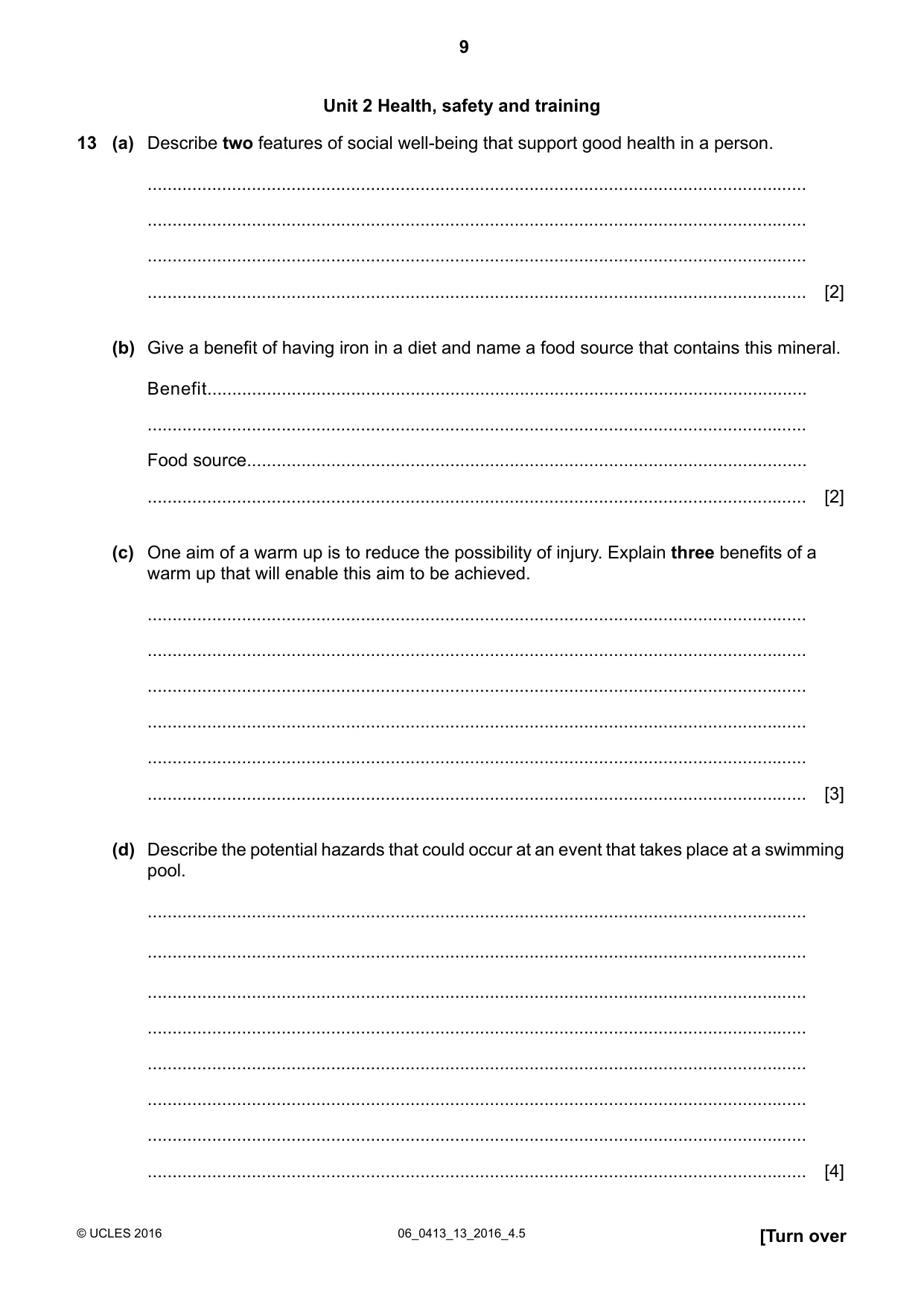
Unit 2 Health, safety and training Describe two features of social well-being that support good health in a person. (a) 13 … … … … [2] Give a benefit of having iron in a diet and name a food source that contains this mineral. (b) Benefit… … Food source… … [2] One aim of a warm up is to reduce the possibility of injury. Explain three benefits of a warm up that will enable this aim to be achieved. (c) … … … … … … [3] Describe the potential hazards that could occur at an event that takes place at a swimming pool. (d) … … … … … … … … [4] [Turn over 06_0413_13_2016_4.5 © UCLES 2016 9
Question paper, page 10
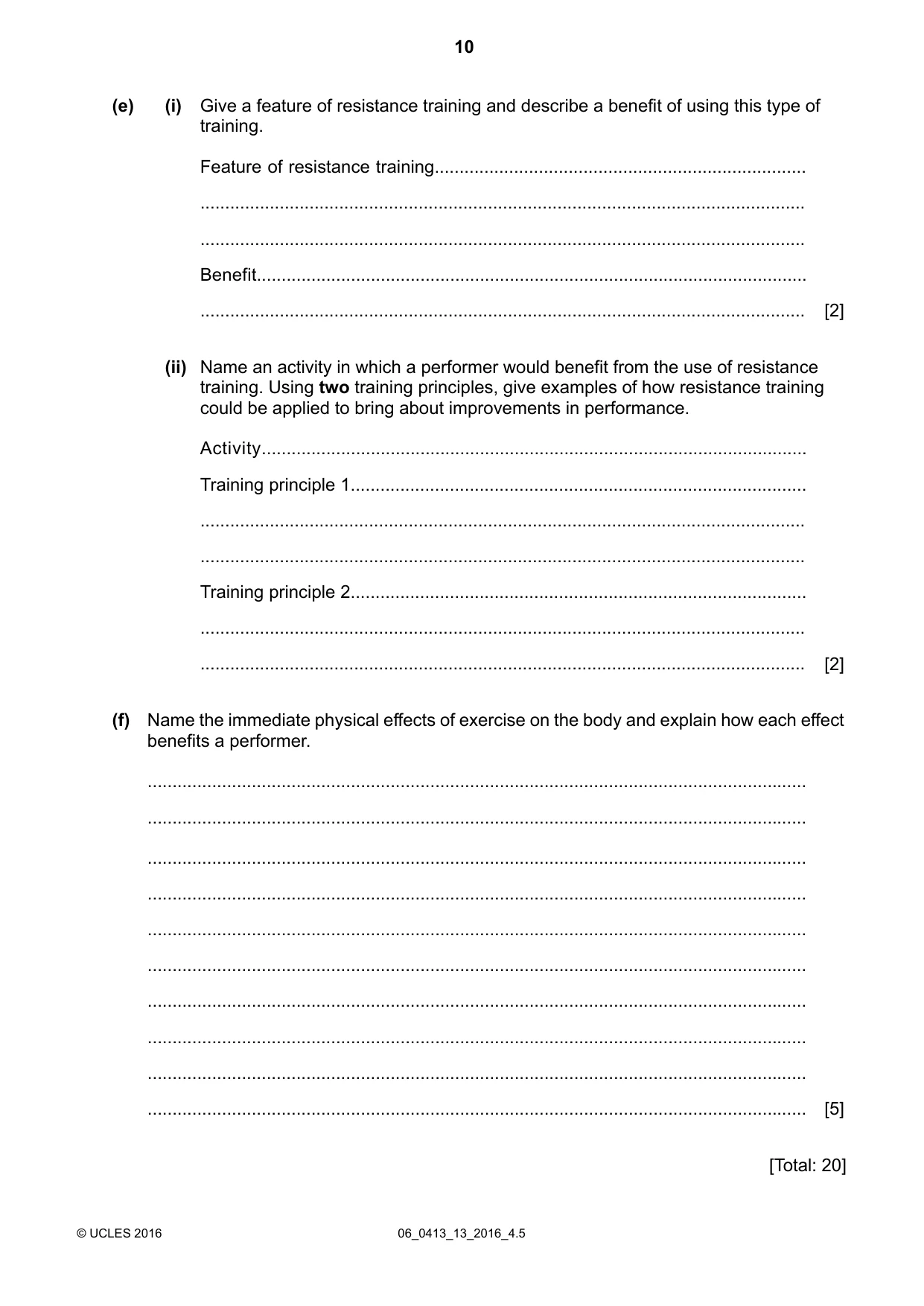
Give a feature of resistance training and describe a benefit of using this type of training. (i) (e) Feature of resistance training… … … Benefit… … [2] Name an activity in which a performer would benefit from the use of resistance training. Using two training principles, give examples of how resistance training could be applied to bring about improvements in performance. (ii) Activity… Training principle 1… … … Training principle 2… … … [2] Name the immediate physical effects of exercise on the body and explain how each effect benefits a performer. (f) … … … … … … … … … … [5] [Total: 20] 06_0413_13_2016_4.5 © UCLES 2016 10
Question paper, page 11
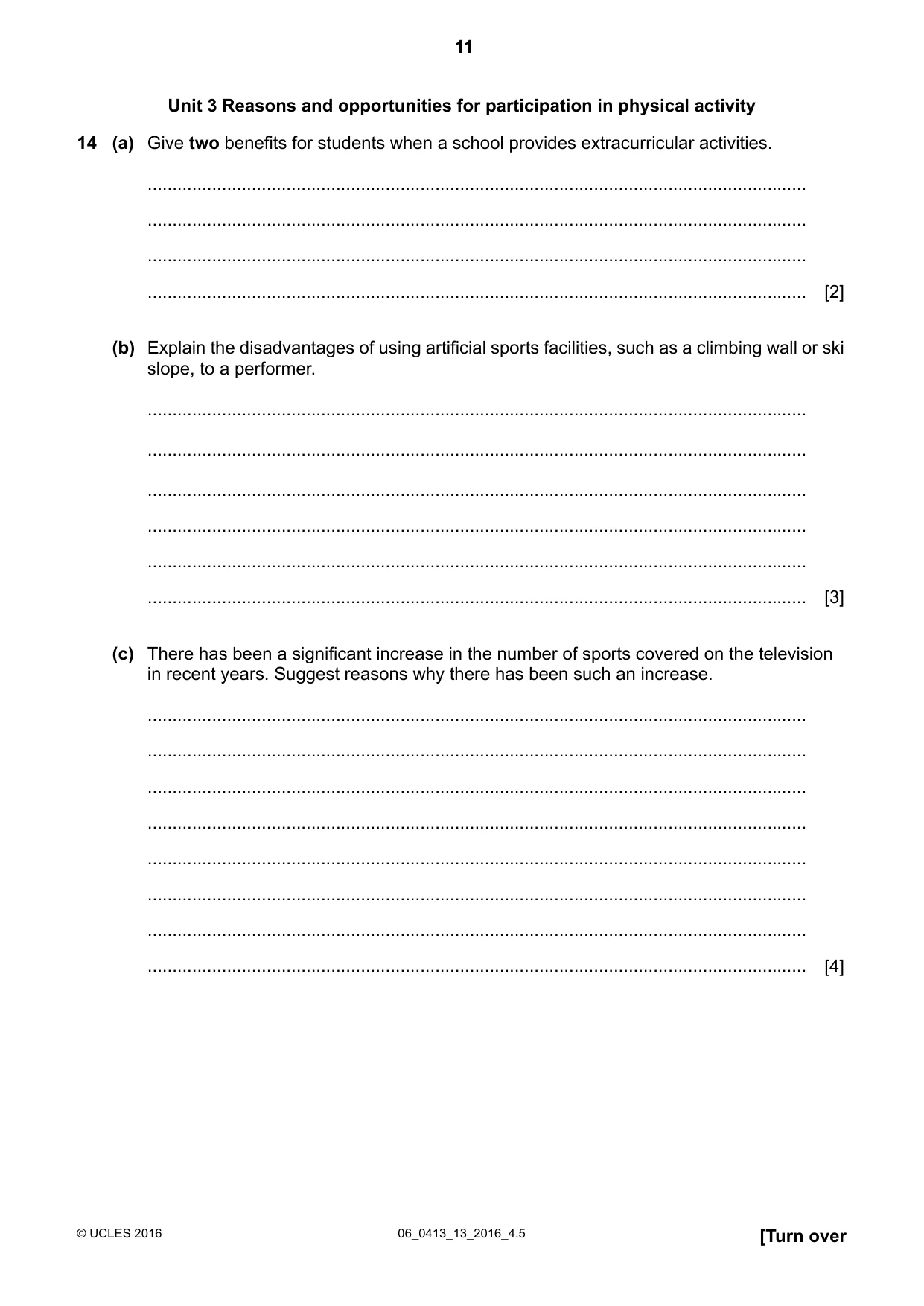
Unit 3 Reasons and opportunities for participation in physical activity Give two benefits for students when a school provides extracurricular activities. (a) 14 … … … … [2] Explain the disadvantages of using artificial sports facilities, such as a climbing wall or ski slope, to a performer. (b) … … … … … … [3] There has been a significant increase in the number of sports covered on the television in recent years. Suggest reasons why there has been such an increase. (c) … … … … … … … … [4] [Turn over 06_0413_13_2016_4.5 © UCLES 2016 11
Question paper, page 12
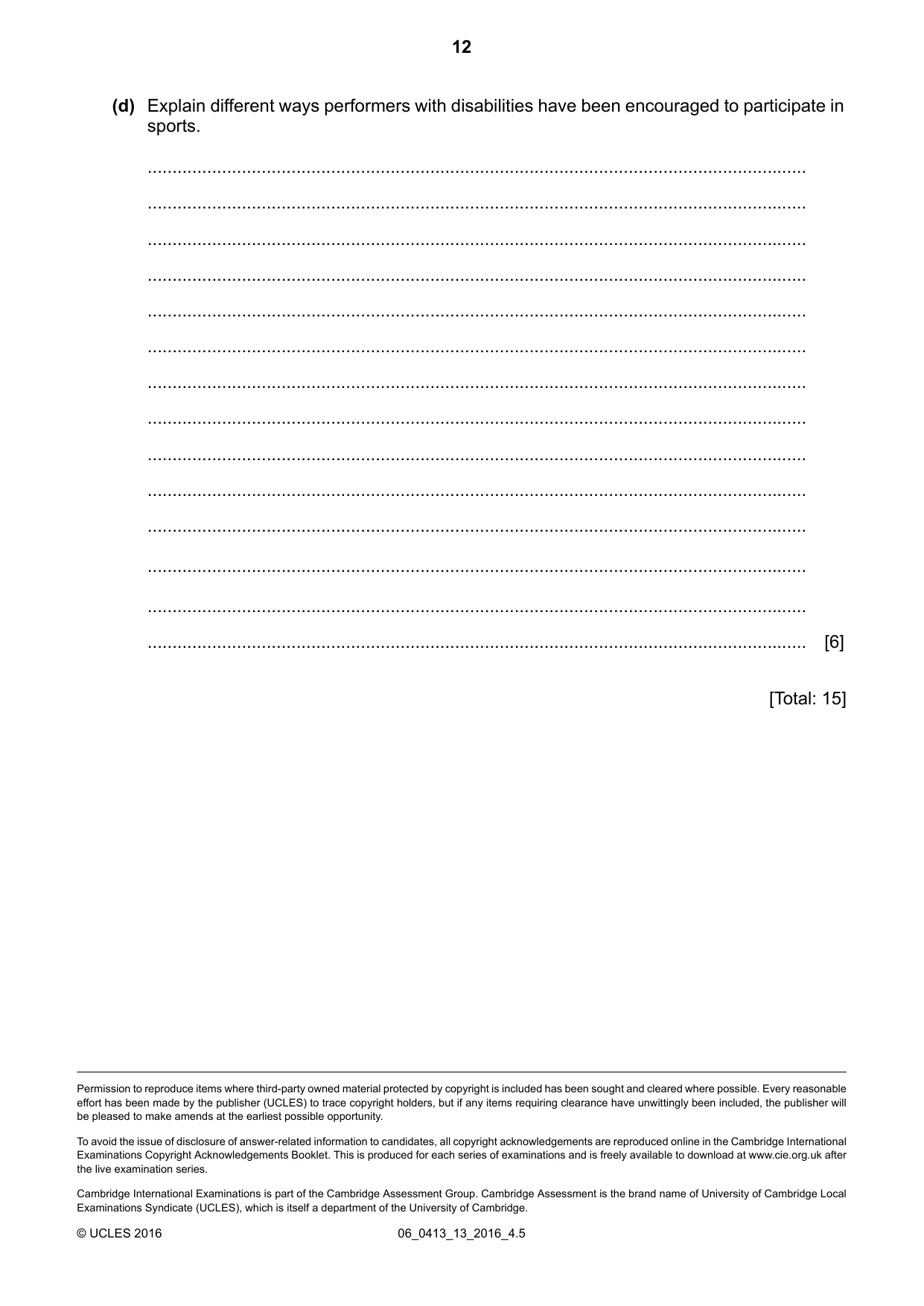
Explain different ways performers with disabilities have been encouraged to participate in sports. (d) … … … … … … … … … … … … … … [6] [Total: 15] Permission to reproduce items where third-party owned material protected by copyright is included has been sought and cleared where possible. Every reasonable effort has been made by the publisher (UCLES) to trace copyright holders, but if any items requiring clearance have unwittingly been included, the publisher will be pleased to make amends at the earliest possible opportunity. To avoid the issue of disclosure of answer-related information to candidates, all copyright acknowledgements are reproduced online in the Cambridge International Examinations Copyright Acknowledgements Booklet. This is produced for each series of examinations and is freely available to download at www.cie.org.uk after the live examination series. Cambridge International Examinations is part of the Cambridge Assessment Group. Cambridge Assessment is the brand name of University of Cambridge Local Examinations Syndicate (UCLES), which is itself a department of the University of Cambridge. 06_0413_13_2016_4.5 © UCLES 2016 12
Mark scheme, page 1
® IGCSE is the registered trademark of Cambridge International Examinations. This document consists of 12 printed pages. © UCLES 2016 [Turn over Cambridge International Examinations Cambridge International General Certificate of Secondary Education PHYSICAL EDUCATION 0413/13 Paper 1 May/June 2016 MARK SCHEME Maximum Mark: 80 Published This mark scheme is published as an aid to teachers and candidates, to indicate the requirements of the examination. It shows the basis on which Examiners were instructed to award marks. It does not indicate the details of the discussions that took place at an Examiners’ meeting before marking began, which would have considered the acceptability of alternative answers. Mark schemes should be read in conjunction with the question paper and the Principal Examiner Report for Teachers. Cambridge will not enter into discussions about these mark schemes. Cambridge is publishing the mark schemes for the May/June 2016 series for most Cambridge IGCSE®, Cambridge International A and AS Level components and some Cambridge O Level components.
Mark scheme, page 2
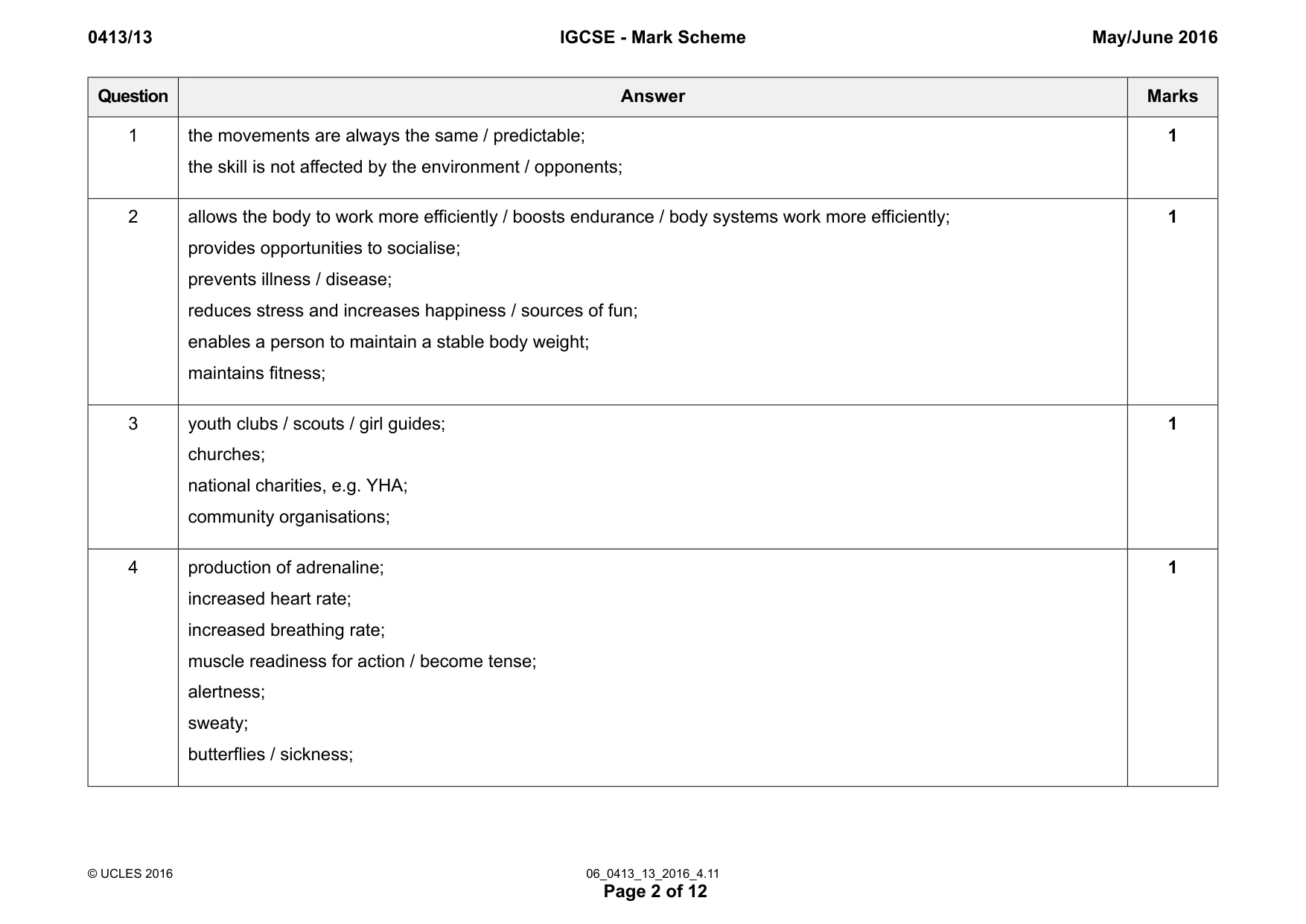
Marks Answer Question 1 the movements are always the same / predictable; 1 the skill is not affected by the environment / opponents; 1 allows the body to work more efficiently / boosts endurance / body systems work more efficiently; 2 provides opportunities to socialise; prevents illness / disease; reduces stress and increases happiness / sources of fun; enables a person to maintain a stable body weight; maintains fitness; 1 youth clubs / scouts / girl guides; 3 churches; national charities, e.g. YHA; community organisations; 1 production of adrenaline; 4 increased heart rate; increased breathing rate; muscle readiness for action / become tense; alertness; sweaty; butterflies / sickness; 06_0413_13_2016_4.11 © UCLES 2016 Page 2 of 12 May/June 2016 IGCSE - Mark Scheme 0413/13
Mark scheme, page 3
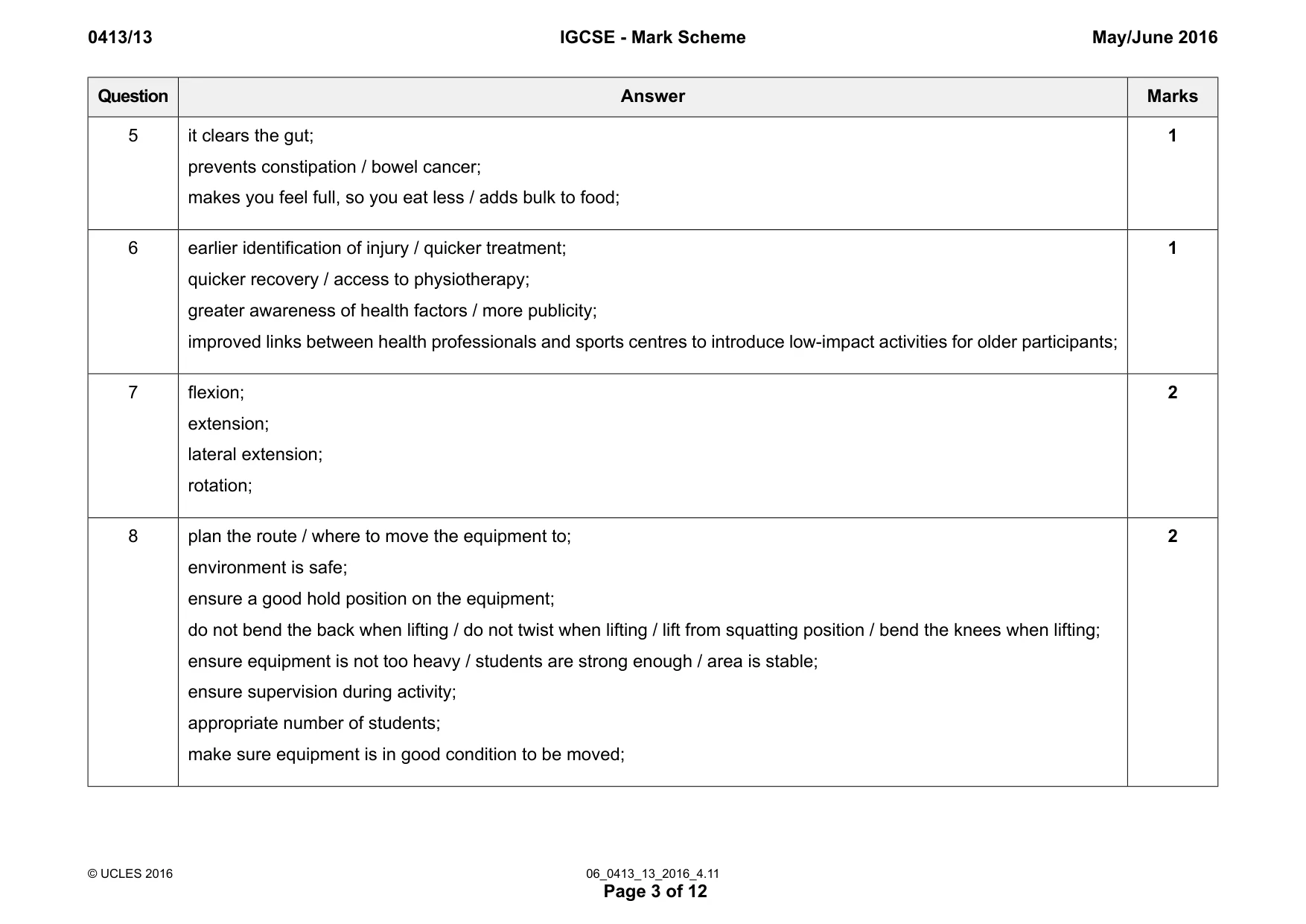
Marks Answer Question 1 it clears the gut; 5 prevents constipation / bowel cancer; makes you feel full, so you eat less / adds bulk to food; 1 earlier identification of injury / quicker treatment; 6 quicker recovery / access to physiotherapy; greater awareness of health factors / more publicity; improved links between health professionals and sports centres to introduce low-impact activities for older participants; 2 flexion; 7 extension; lateral extension; rotation; 2 plan the route / where to move the equipment to; 8 environment is safe; ensure a good hold position on the equipment; do not bend the back when lifting / do not twist when lifting / lift from squatting position / bend the knees when lifting; ensure equipment is not too heavy / students are strong enough / area is stable; ensure supervision during activity; appropriate number of students; make sure equipment is in good condition to be moved; 06_0413_13_2016_4.11 © UCLES 2016 Page 3 of 12 May/June 2016 IGCSE - Mark Scheme 0413/13
Mark scheme, page 4
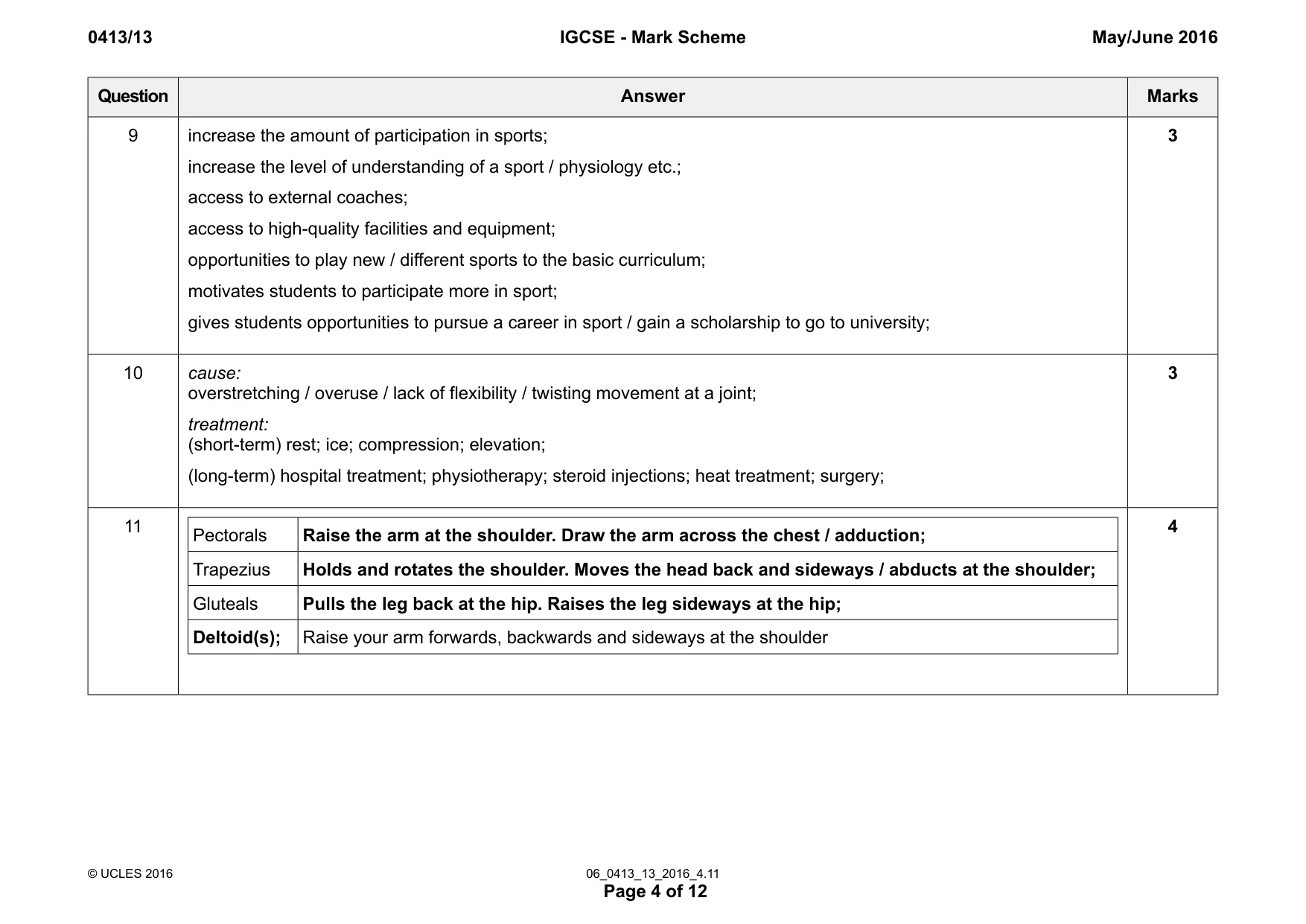
Marks Answer Question 3 increase the amount of participation in sports; 9 increase the level of understanding of a sport / physiology etc.; access to external coaches; access to high-quality facilities and equipment; opportunities to play new / different sports to the basic curriculum; motivates students to participate more in sport; gives students opportunities to pursue a career in sport / gain a scholarship to go to university; 3 cause: overstretching / overuse / lack of flexibility / twisting movement at a joint; 10 treatment: (short-term) rest; ice; compression; elevation; (long-term) hospital treatment; physiotherapy; steroid injections; heat treatment; surgery; 4 11 Raise the arm at the shoulder. Draw the arm across the chest / adduction; Pectorals Holds and rotates the shoulder. Moves the head back and sideways / abducts at the shoulder; Trapezius Pulls the leg back at the hip. Raises the leg sideways at the hip; Gluteals Raise your arm forwards, backwards and sideways at the shoulder Deltoid(s); 06_0413_13_2016_4.11 © UCLES 2016 Page 4 of 12 May/June 2016 IGCSE - Mark Scheme 0413/13
Mark scheme, page 5
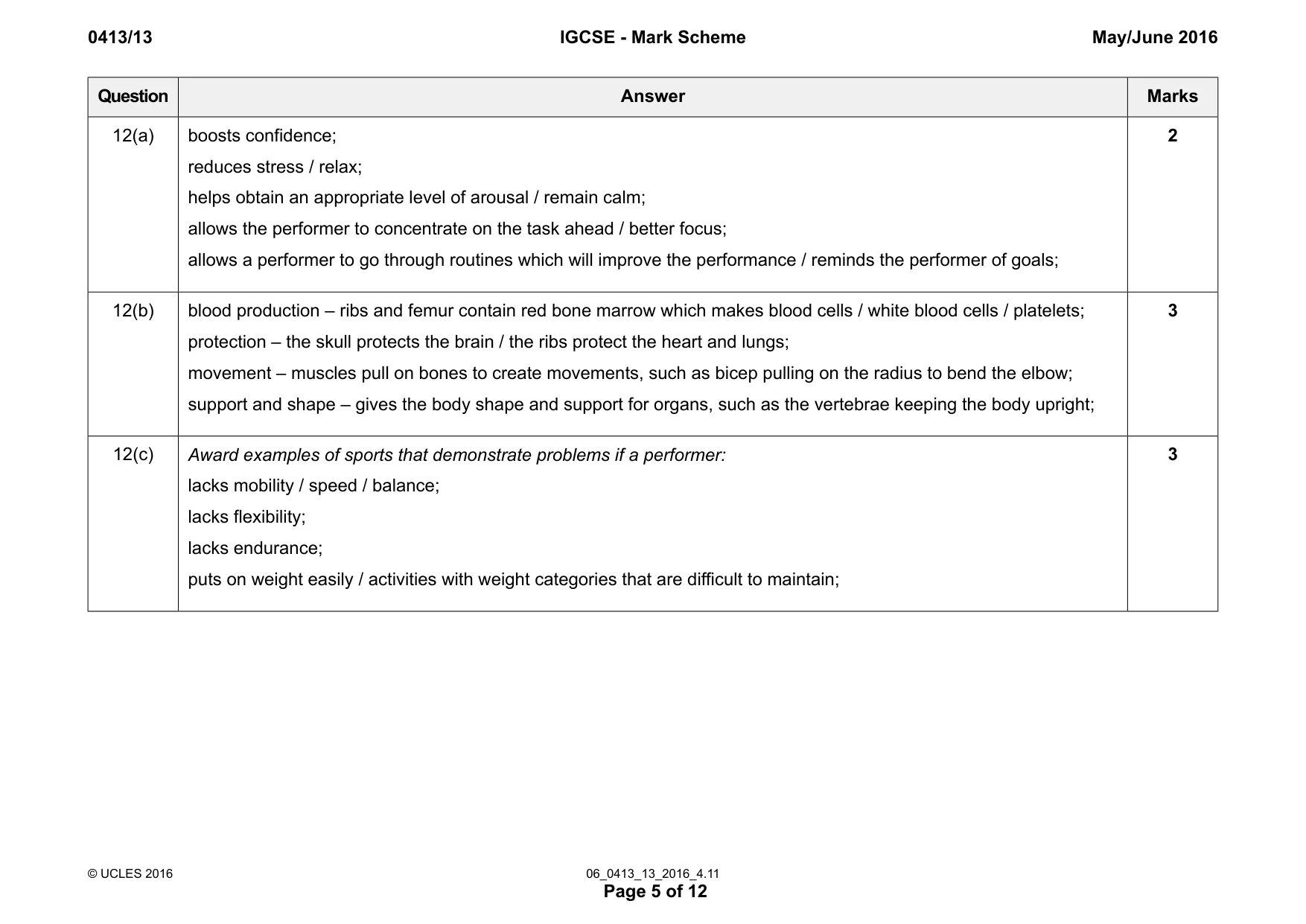
Marks Answer Question 2 boosts confidence; 12(a) reduces stress / relax; helps obtain an appropriate level of arousal / remain calm; allows the performer to concentrate on the task ahead / better focus; allows a performer to go through routines which will improve the performance / reminds the performer of goals; 3 blood production – ribs and femur contain red bone marrow which makes blood cells / white blood cells / platelets; 12(b) protection – the skull protects the brain / the ribs protect the heart and lungs; movement – muscles pull on bones to create movements, such as bicep pulling on the radius to bend the elbow; support and shape – gives the body shape and support for organs, such as the vertebrae keeping the body upright; 3 Award examples of sports that demonstrate problems if a performer: 12(c) lacks mobility / speed / balance; lacks flexibility; lacks endurance; puts on weight easily / activities with weight categories that are difficult to maintain; 06_0413_13_2016_4.11 © UCLES 2016 Page 5 of 12 May/June 2016 IGCSE - Mark Scheme 0413/13
Mark scheme, page 6
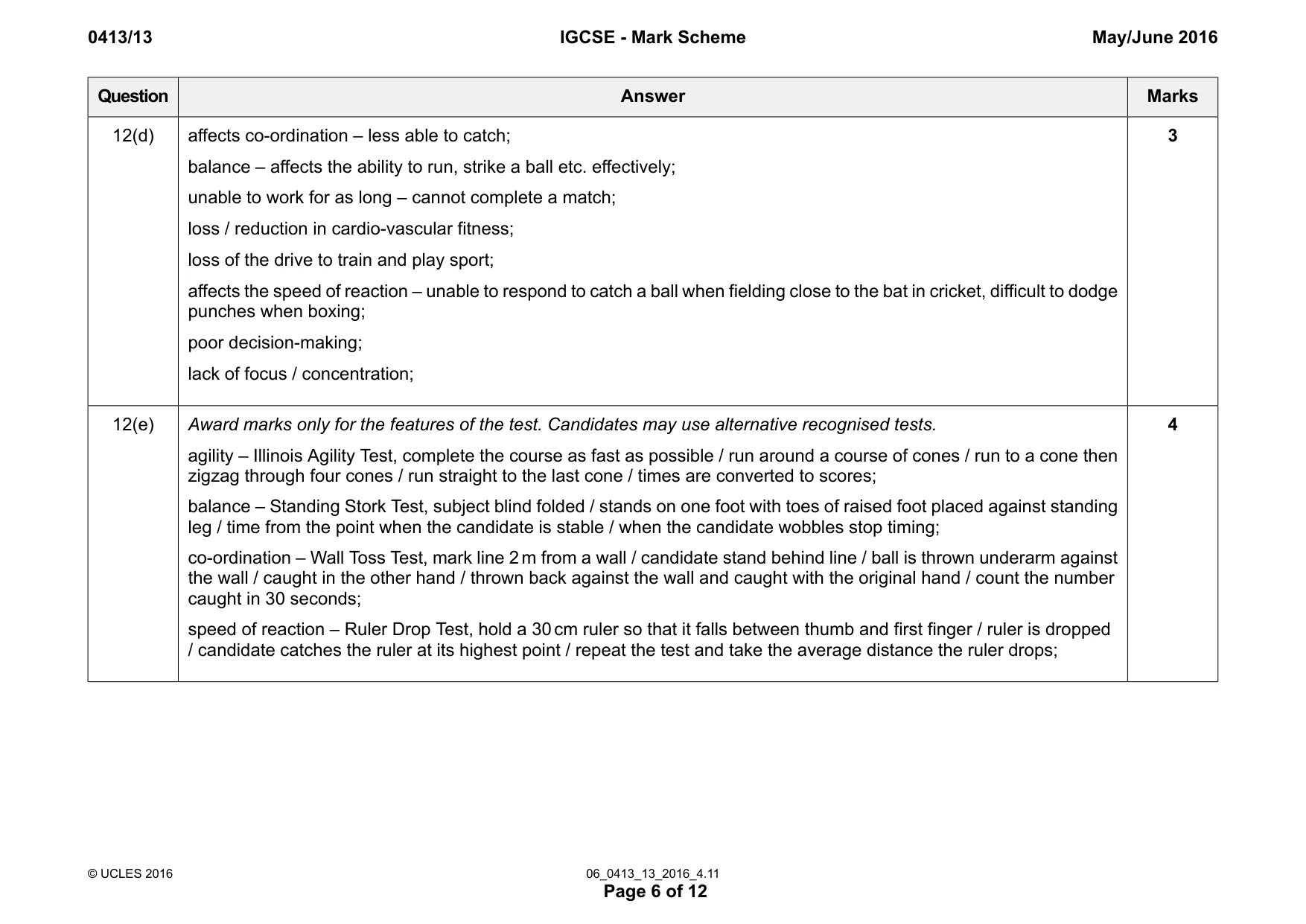
Marks Answer Question 3 affects co-ordination – less able to catch; 12(d) balance – affects the ability to run, strike a ball etc. effectively; unable to work for as long – cannot complete a match; loss / reduction in cardio-vascular fitness; loss of the drive to train and play sport; affects the speed of reaction – unable to respond to catch a ball when fielding close to the bat in cricket, difficult to dodge punches when boxing; poor decision-making; lack of focus / concentration; 4 Award marks only for the features of the test. Candidates may use alternative recognised tests. 12(e) agility – Illinois Agility Test, complete the course as fast as possible / run around a course of cones / run to a cone then zigzag through four cones / run straight to the last cone / times are converted to scores; balance – Standing Stork Test, subject blind folded / stands on one foot with toes of raised foot placed against standing leg / time from the point when the candidate is stable / when the candidate wobbles stop timing; co-ordination – Wall Toss Test, mark line 2m from a wall / candidate stand behind line / ball is thrown underarm against the wall / caught in the other hand / thrown back against the wall and caught with the original hand / count the number caught in 30 seconds; speed of reaction – Ruler Drop Test, hold a 30cm ruler so that it falls between thumb and first finger / ruler is dropped / candidate catches the ruler at its highest point / repeat the test and take the average distance the ruler drops; 06_0413_13_2016_4.11 © UCLES 2016 Page 6 of 12 May/June 2016 IGCSE - Mark Scheme 0413/13
Mark scheme, page 7
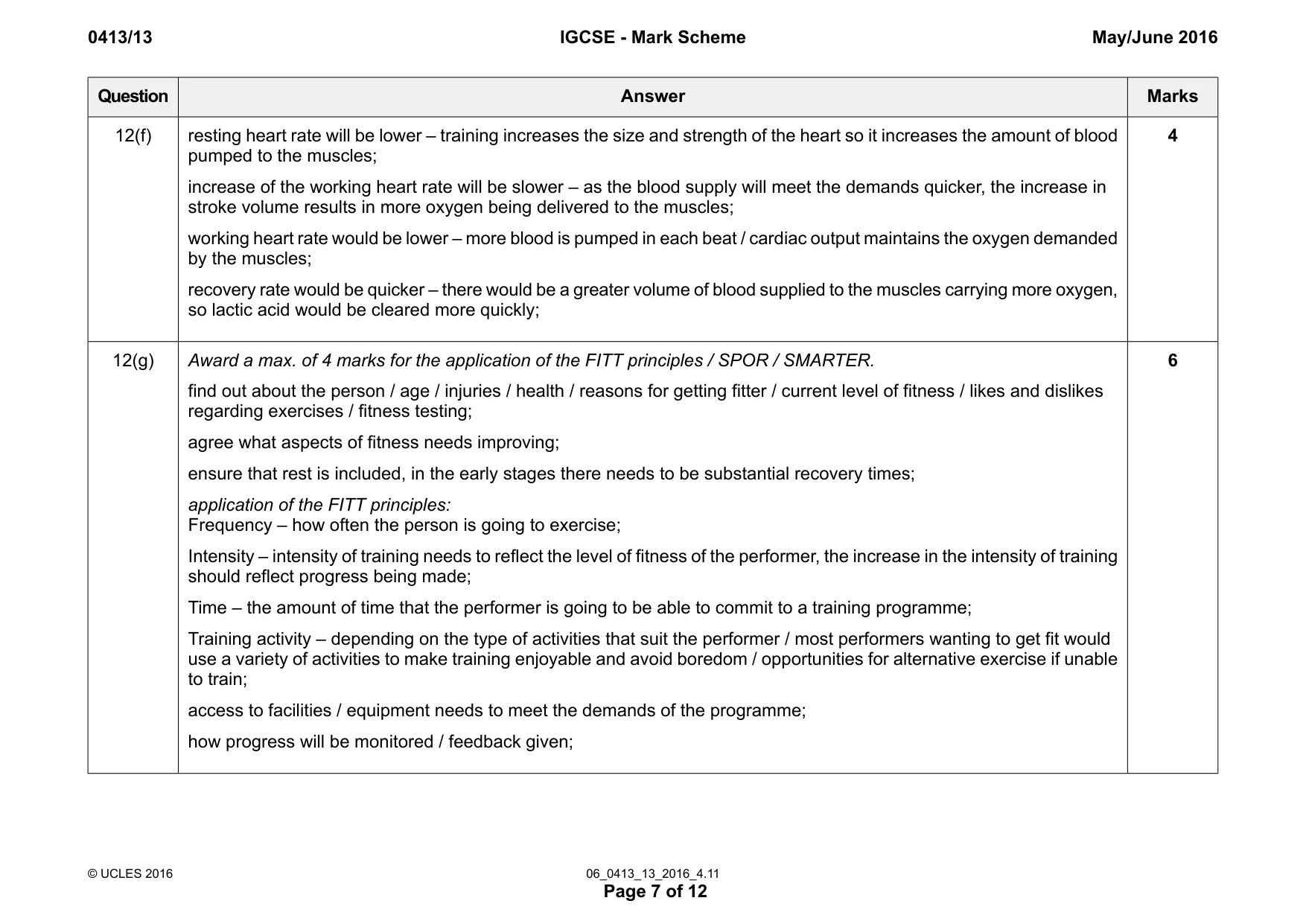
Marks Answer Question 4 resting heart rate will be lower – training increases the size and strength of the heart so it increases the amount of blood pumped to the muscles; 12(f) increase of the working heart rate will be slower – as the blood supply will meet the demands quicker, the increase in stroke volume results in more oxygen being delivered to the muscles; working heart rate would be lower – more blood is pumped in each beat / cardiac output maintains the oxygen demanded by the muscles; recovery rate would be quicker – there would be a greater volume of blood supplied to the muscles carrying more oxygen, so lactic acid would be cleared more quickly; 6 Award a max. of 4 marks for the application of the FITT principles / SPOR / SMARTER. 12(g) find out about the person / age / injuries / health / reasons for getting fitter / current level of fitness / likes and dislikes regarding exercises / fitness testing; agree what aspects of fitness needs improving; ensure that rest is included, in the early stages there needs to be substantial recovery times; application of the FITT principles: Frequency – how often the person is going to exercise; Intensity – intensity of training needs to reflect the level of fitness of the performer, the increase in the intensity of training should reflect progress being made; Time – the amount of time that the performer is going to be able to commit to a training programme; Training activity – depending on the type of activities that suit the performer / most performers wanting to get fit would use a variety of activities to make training enjoyable and avoid boredom / opportunities for alternative exercise if unable to train; access to facilities / equipment needs to meet the demands of the programme; how progress will be monitored / feedback given; 06_0413_13_2016_4.11 © UCLES 2016 Page 7 of 12 May/June 2016 IGCSE - Mark Scheme 0413/13
Mark scheme, page 8
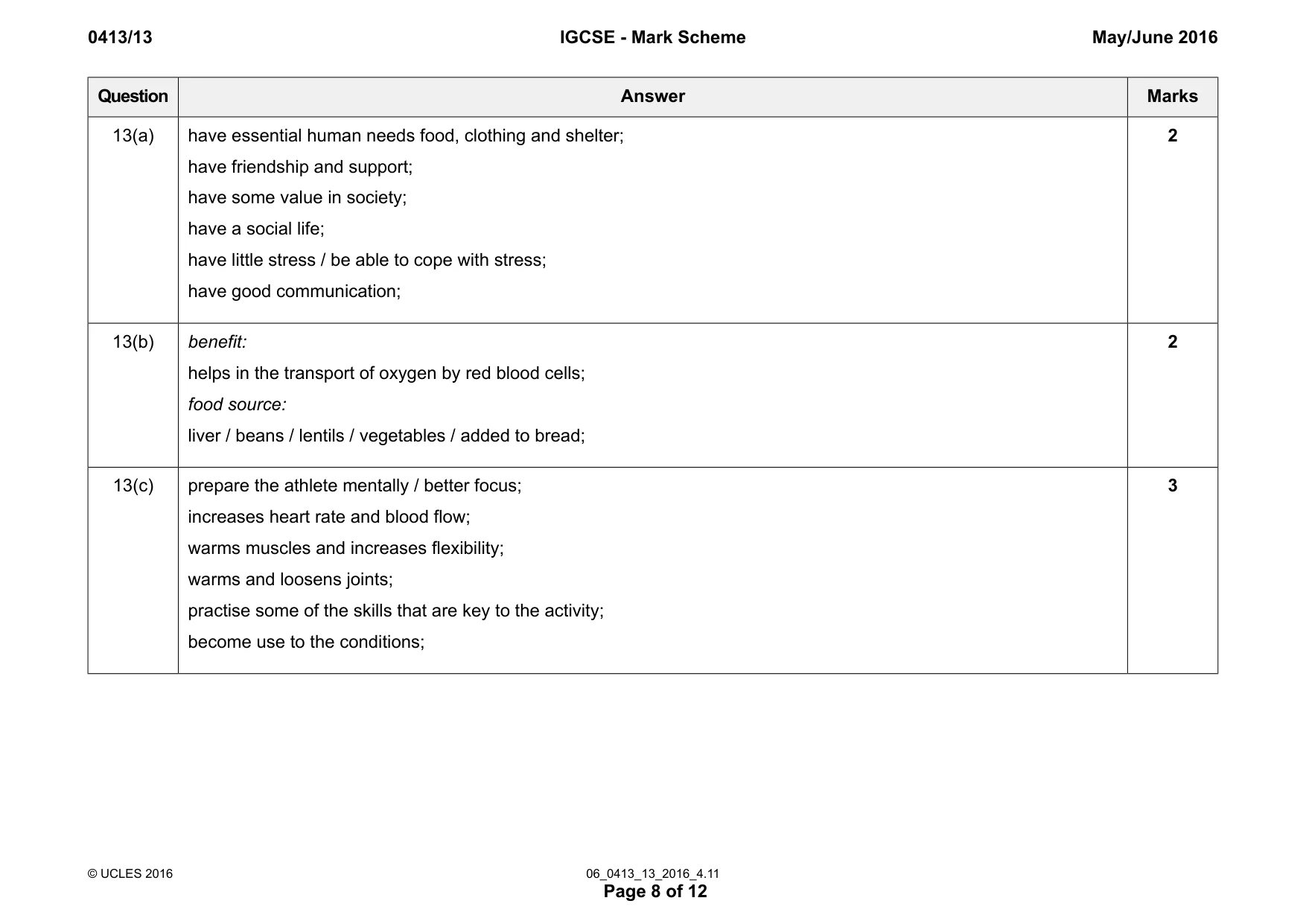
Marks Answer Question 2 have essential human needs food, clothing and shelter; 13(a) have friendship and support; have some value in society; have a social life; have little stress / be able to cope with stress; have good communication; 2 benefit: 13(b) helps in the transport of oxygen by red blood cells; food source: liver / beans / lentils / vegetables / added to bread; 3 prepare the athlete mentally / better focus; 13(c) increases heart rate and blood flow; warms muscles and increases flexibility; warms and loosens joints; practise some of the skills that are key to the activity; become use to the conditions; 06_0413_13_2016_4.11 © UCLES 2016 Page 8 of 12 May/June 2016 IGCSE - Mark Scheme 0413/13
Mark scheme, page 9
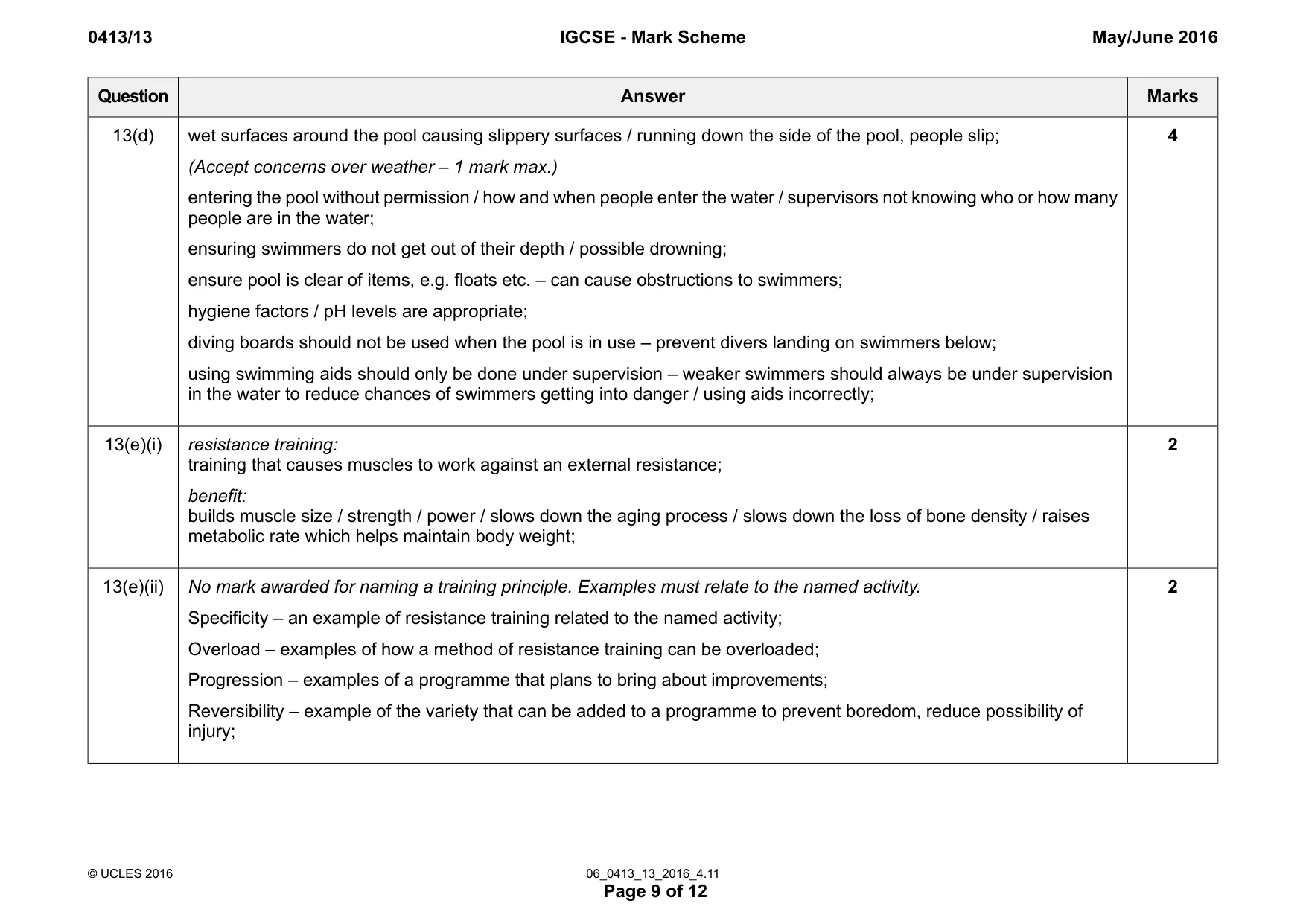
Marks Answer Question 4 wet surfaces around the pool causing slippery surfaces / running down the side of the pool, people slip; 13(d) (Accept concerns over weather – 1 mark max.) entering the pool without permission / how and when people enter the water / supervisors not knowing who or how many people are in the water; ensuring swimmers do not get out of their depth / possible drowning; ensure pool is clear of items, e.g. floats etc. – can cause obstructions to swimmers; hygiene factors / pH levels are appropriate; diving boards should not be used when the pool is in use – prevent divers landing on swimmers below; using swimming aids should only be done under supervision – weaker swimmers should always be under supervision in the water to reduce chances of swimmers getting into danger / using aids incorrectly; 2 resistance training: training that causes muscles to work against an external resistance; 13(e)(i) benefit: builds muscle size / strength / power / slows down the aging process / slows down the loss of bone density / raises metabolic rate which helps maintain body weight; 2 No mark awarded for naming a training principle. Examples must relate to the named activity. 13(e)(ii) Specificity – an example of resistance training related to the named activity; Overload – examples of how a method of resistance training can be overloaded; Progression – examples of a programme that plans to bring about improvements; Reversibility – example of the variety that can be added to a programme to prevent boredom, reduce possibility of injury; 06_0413_13_2016_4.11 © UCLES 2016 Page 9 of 12 May/June 2016 IGCSE - Mark Scheme 0413/13
Mark scheme, page 10
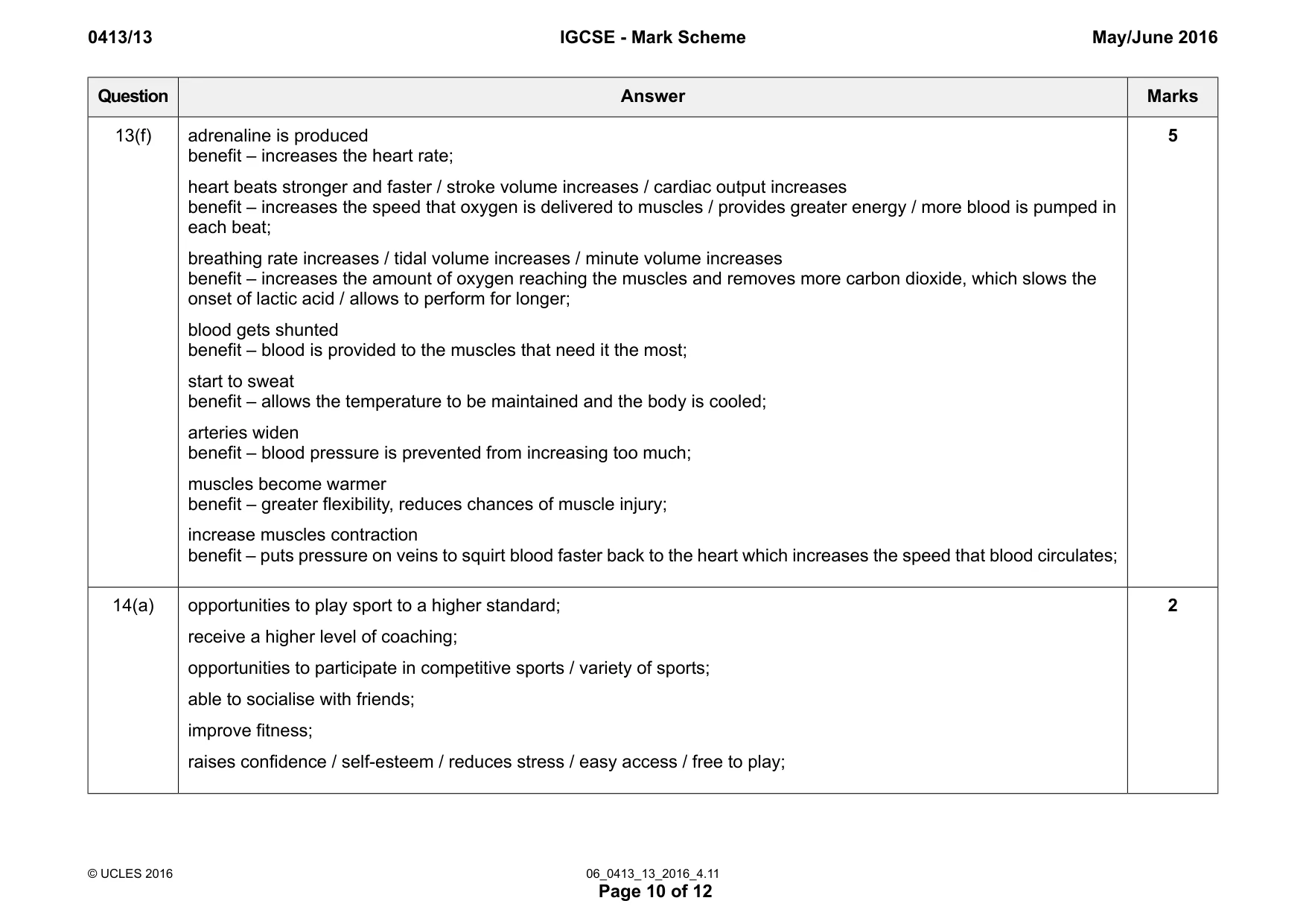
Marks Answer Question 5 adrenaline is produced benefit – increases the heart rate; 13(f) heart beats stronger and faster / stroke volume increases / cardiac output increases benefit – increases the speed that oxygen is delivered to muscles / provides greater energy / more blood is pumped in each beat; breathing rate increases / tidal volume increases / minute volume increases benefit – increases the amount of oxygen reaching the muscles and removes more carbon dioxide, which slows the onset of lactic acid / allows to perform for longer; blood gets shunted benefit – blood is provided to the muscles that need it the most; start to sweat benefit – allows the temperature to be maintained and the body is cooled; arteries widen benefit – blood pressure is prevented from increasing too much; muscles become warmer benefit – greater flexibility, reduces chances of muscle injury; increase muscles contraction benefit – puts pressure on veins to squirt blood faster back to the heart which increases the speed that blood circulates; 2 opportunities to play sport to a higher standard; 14(a) receive a higher level of coaching; opportunities to participate in competitive sports / variety of sports; able to socialise with friends; improve fitness; raises confidence / self-esteem / reduces stress / easy access / free to play; 06_0413_13_2016_4.11 © UCLES 2016 Page 10 of 12 May/June 2016 IGCSE - Mark Scheme 0413/13
Mark scheme, page 11
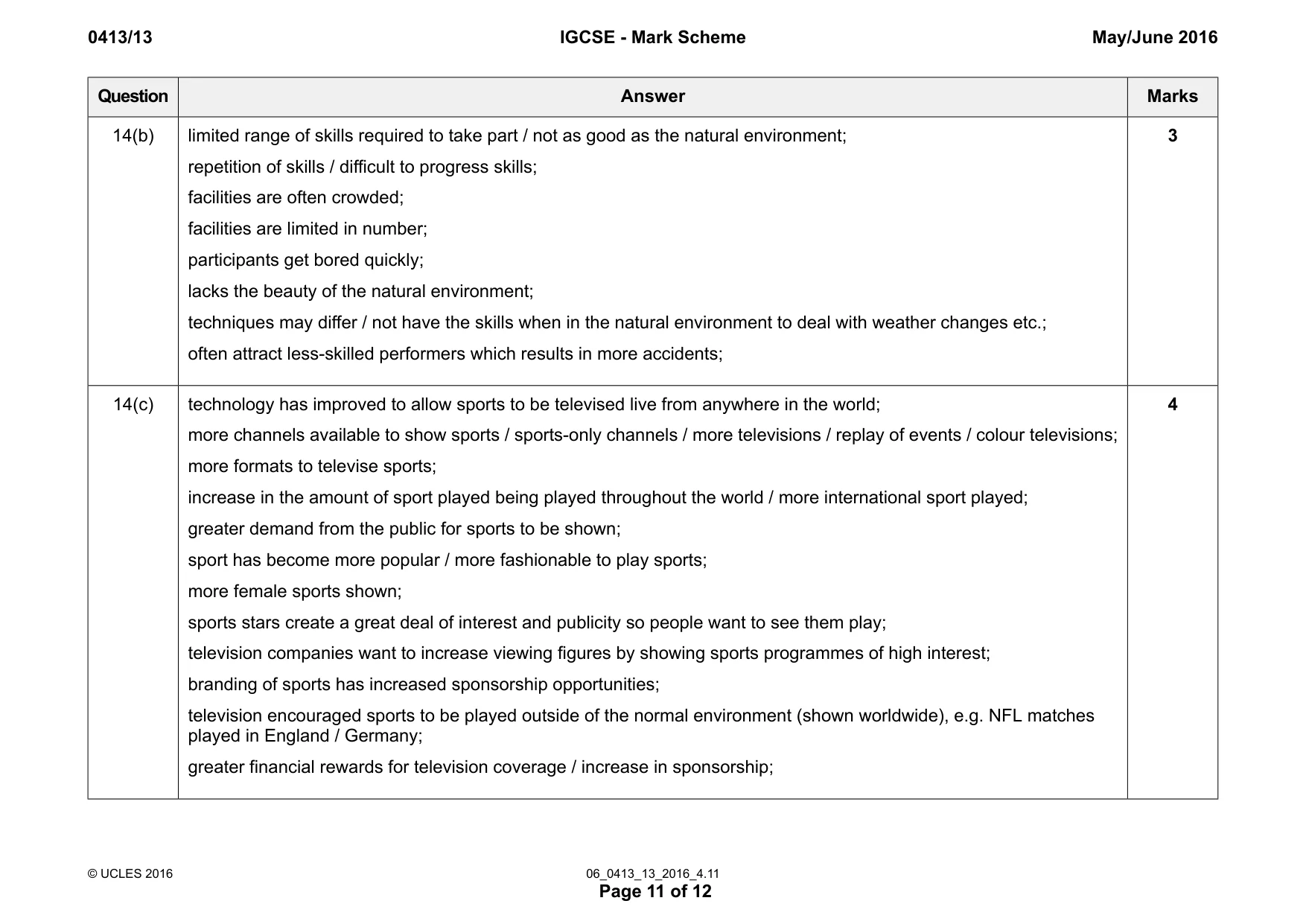
Marks Answer Question 3 limited range of skills required to take part / not as good as the natural environment; 14(b) repetition of skills / difficult to progress skills; facilities are often crowded; facilities are limited in number; participants get bored quickly; lacks the beauty of the natural environment; techniques may differ / not have the skills when in the natural environment to deal with weather changes etc.; often attract less-skilled performers which results in more accidents; 4 technology has improved to allow sports to be televised live from anywhere in the world; 14(c) more channels available to show sports / sports-only channels / more televisions / replay of events / colour televisions; more formats to televise sports; increase in the amount of sport played being played throughout the world / more international sport played; greater demand from the public for sports to be shown; sport has become more popular / more fashionable to play sports; more female sports shown; sports stars create a great deal of interest and publicity so people want to see them play; television companies want to increase viewing figures by showing sports programmes of high interest; branding of sports has increased sponsorship opportunities; television encouraged sports to be played outside of the normal environment (shown worldwide), e.g. NFL matches played in England / Germany; greater financial rewards for television coverage / increase in sponsorship; 06_0413_13_2016_4.11 © UCLES 2016 Page 11 of 12 May/June 2016 IGCSE - Mark Scheme 0413/13
Mark scheme, page 12
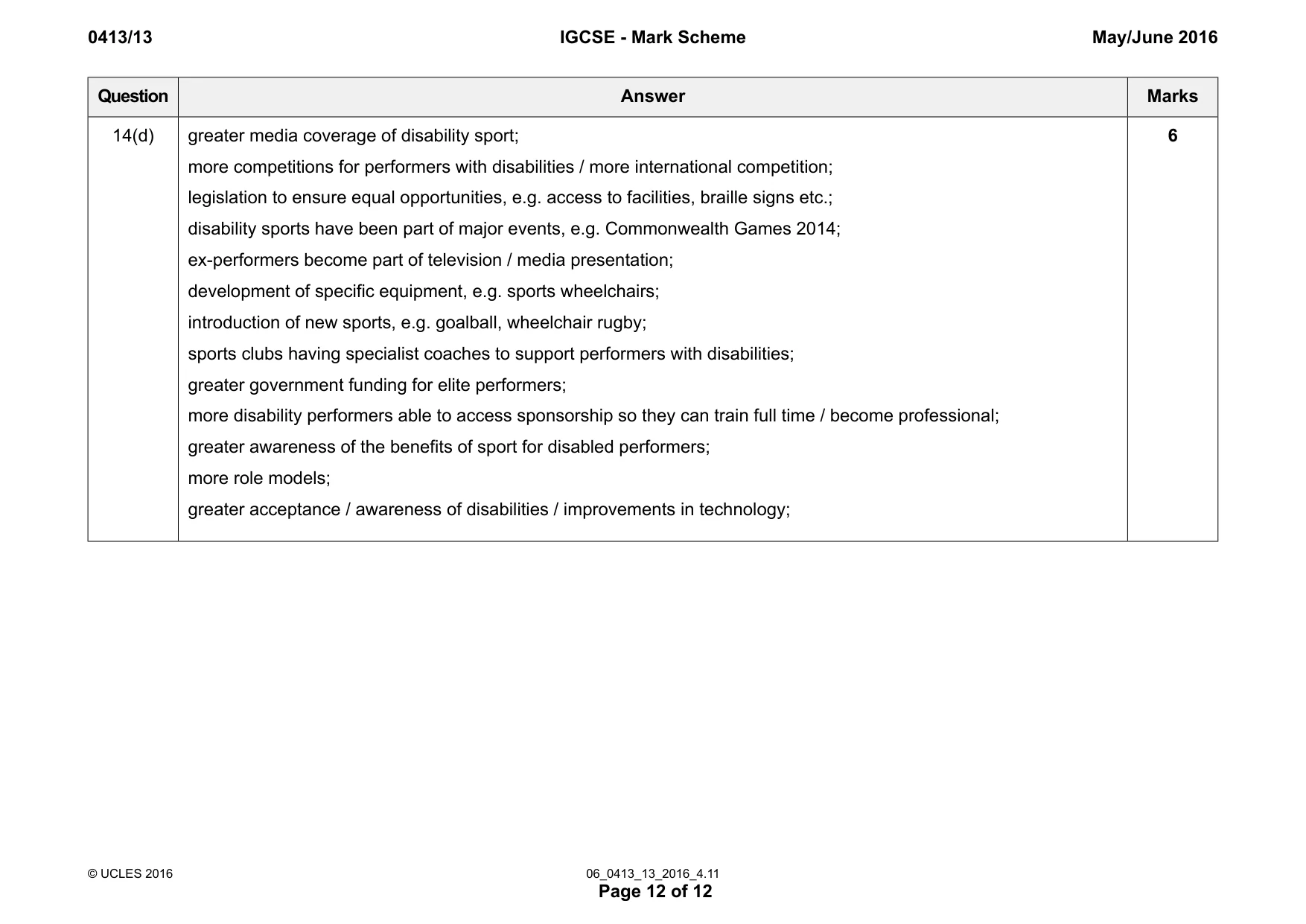
Marks Answer Question 6 greater media coverage of disability sport; 14(d) more competitions for performers with disabilities / more international competition; legislation to ensure equal opportunities, e.g. access to facilities, braille signs etc.; disability sports have been part of major events, e.g. Commonwealth Games 2014; ex-performers become part of television / media presentation; development of specific equipment, e.g. sports wheelchairs; introduction of new sports, e.g. goalball, wheelchair rugby; sports clubs having specialist coaches to support performers with disabilities; greater government funding for elite performers; more disability performers able to access sponsorship so they can train full time / become professional; greater awareness of the benefits of sport for disabled performers; more role models; greater acceptance / awareness of disabilities / improvements in technology; 06_0413_13_2016_4.11 © UCLES 2016 Page 12 of 12 May/June 2016 IGCSE - Mark Scheme 0413/13
What you needed in this session
Cambridge’s own grade thresholds for 2016 May/June, Paper 1 · Variant 3. A higher threshold means an easier paper — the bar moves with how the cohort did.