Cambridge IGCSE Physical Education 0413 — 2016 May/June Paper 1 · Variant 1
0413/11/M/J/16 · 80 marks · ≈90 min
The question paper and its mark scheme, free to read here and free to download. This is Cambridge’s own paper, exactly as it was sat.
Question paper16 pages


Mark scheme12 pages
Answers below. Sit the paper first if you are practising.
Paper as text
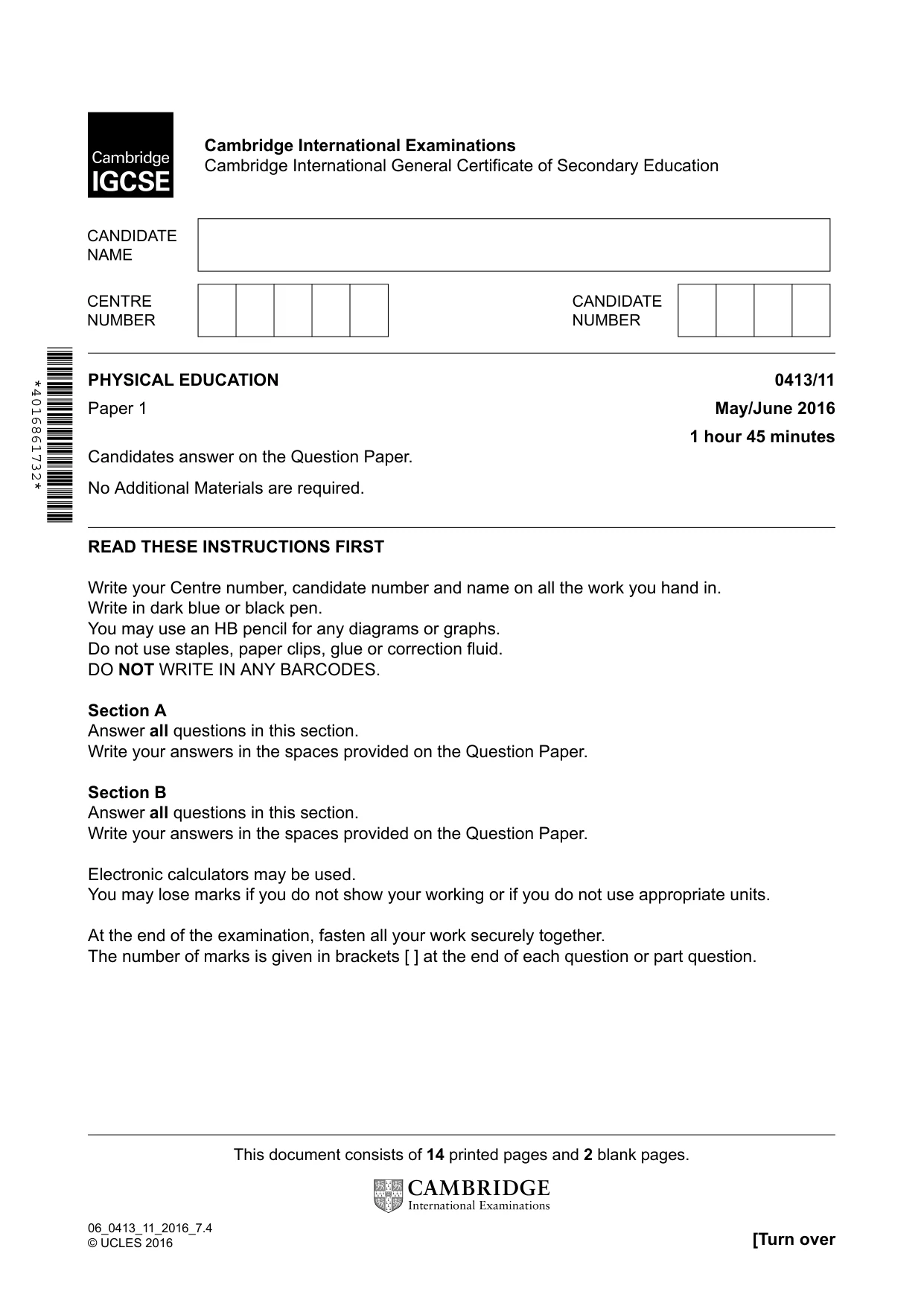
Question paper, page 1
Cambridge International Examinations Cambridge International General Certificate of Secondary Education 0413/11 May/June 2016 1 hour 45 minutes PHYSICAL EDUCATION Paper 1 Candidates answer on the Question Paper. No Additional Materials are required. READ THESE INSTRUCTIONS FIRST Write your Centre number, candidate number and name on all the work you hand in. Write in dark blue or black pen. You may use an HB pencil for any diagrams or graphs. Do not use staples, paper clips, glue or correction fluid. DO NOT WRITE IN ANY BARCODES. Section A Answer all questions in this section. Write your answers in the spaces provided on the Question Paper. Section B Answer all questions in this section. Write your answers in the spaces provided on the Question Paper. Electronic calculators may be used. You may lose marks if you do not show your working or if you do not use appropriate units. At the end of the examination, fasten all your work securely together. The number of marks is given in brackets [ ] at the end of each question or part question. This document consists of 14 printed pages and 2 blank pages. [Turn over 06_0413_11_2016_7.4 © UCLES 2016 *4016861732*
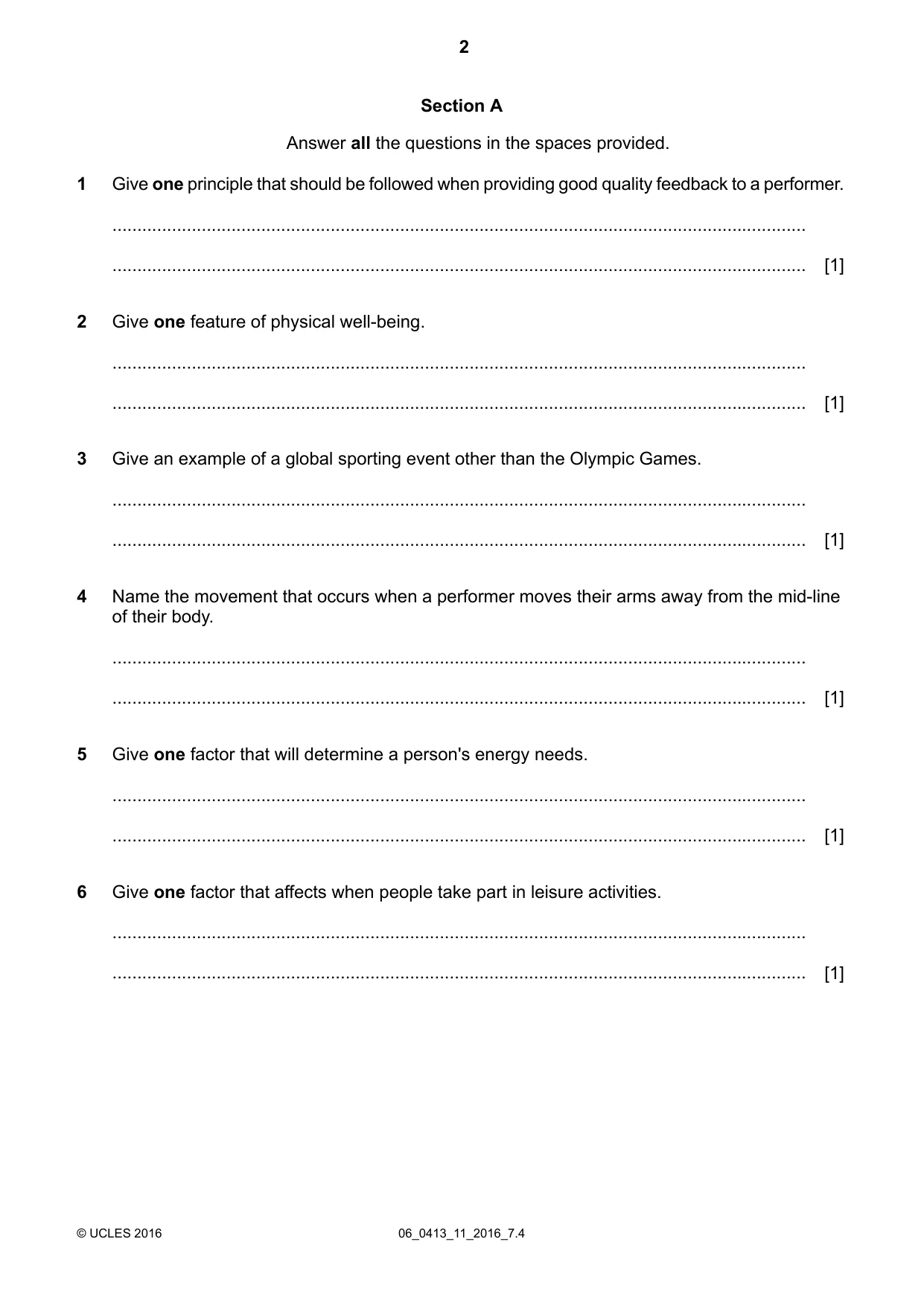
Question paper, page 2
Section A Answer all the questions in the spaces provided. Give one principle that should be followed when providing good quality feedback to a performer. 1 … … [1] Give one feature of physical well-being. 2 … … [1] Give an example of a global sporting event other than the Olympic Games. 3 … … [1] Name the movement that occurs when a performer moves their arms away from the mid-line of their body. 4 … … [1] Give one factor that will determine a person's energy needs. 5 … … [1] Give one factor that affects when people take part in leisure activities. 6 … … [1] 06_0413_11_2016_7.4 © UCLES 2016 2
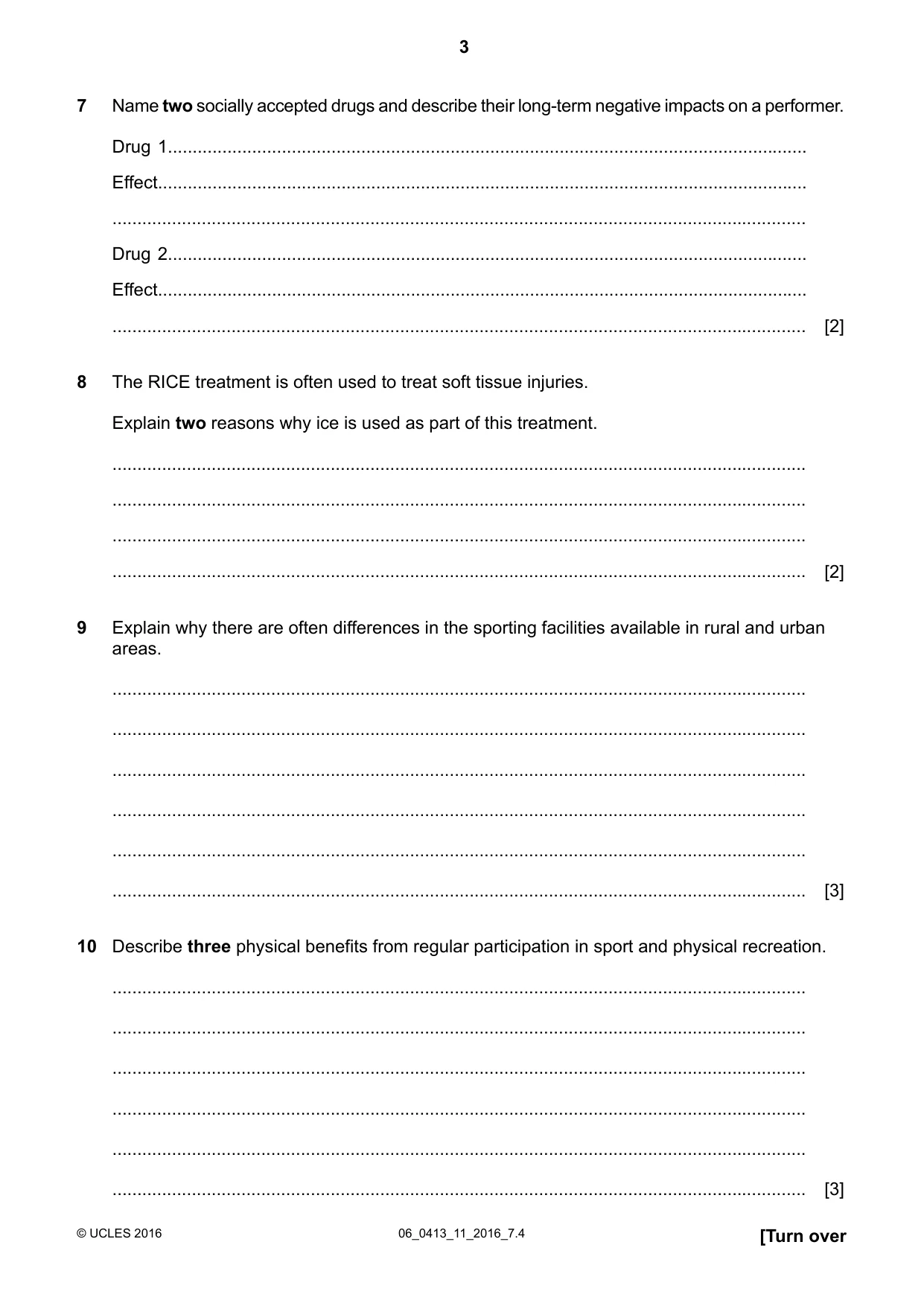
Question paper, page 3
Name two socially accepted drugs and describe their long-term negative impacts on a performer. 7 Drug 1… Effect… … Drug 2… Effect… … [2] The RICE treatment is often used to treat soft tissue injuries. Explain two reasons why ice is used as part of this treatment. 8 … … … … [2] Explain why there are often differences in the sporting facilities available in rural and urban areas. 9 … … … … … … [3] Describe three physical benefits from regular participation in sport and physical recreation. 10 … … … … … … [3] [Turn over 06_0413_11_2016_7.4 © UCLES 2016 3
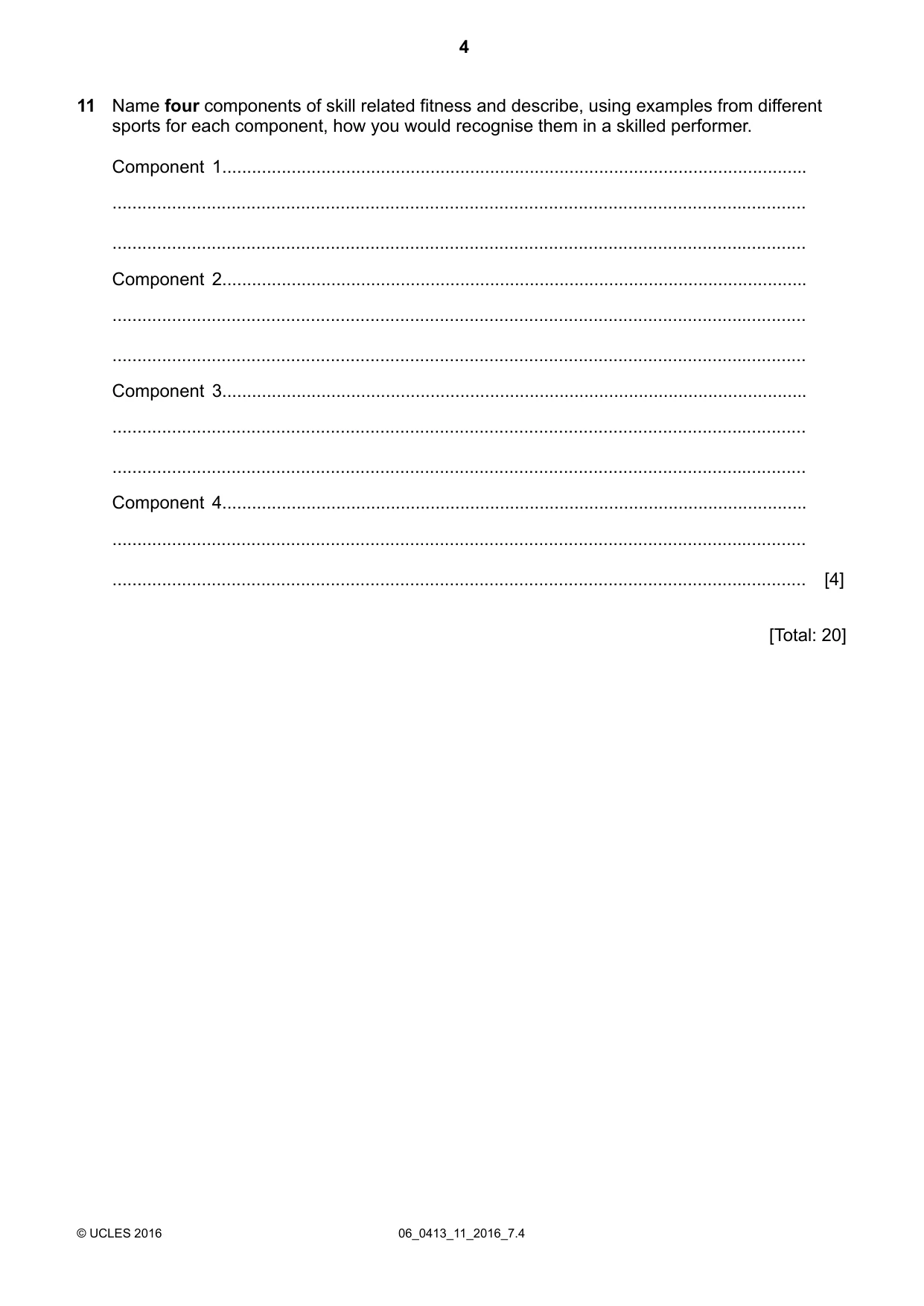
Question paper, page 4
Name four components of skill related fitness and describe, using examples from different sports for each component, how you would recognise them in a skilled performer. 11 Component 1… … … Component 2… … … Component 3… … … Component 4… … … [4] [Total: 20] 06_0413_11_2016_7.4 © UCLES 2016 4
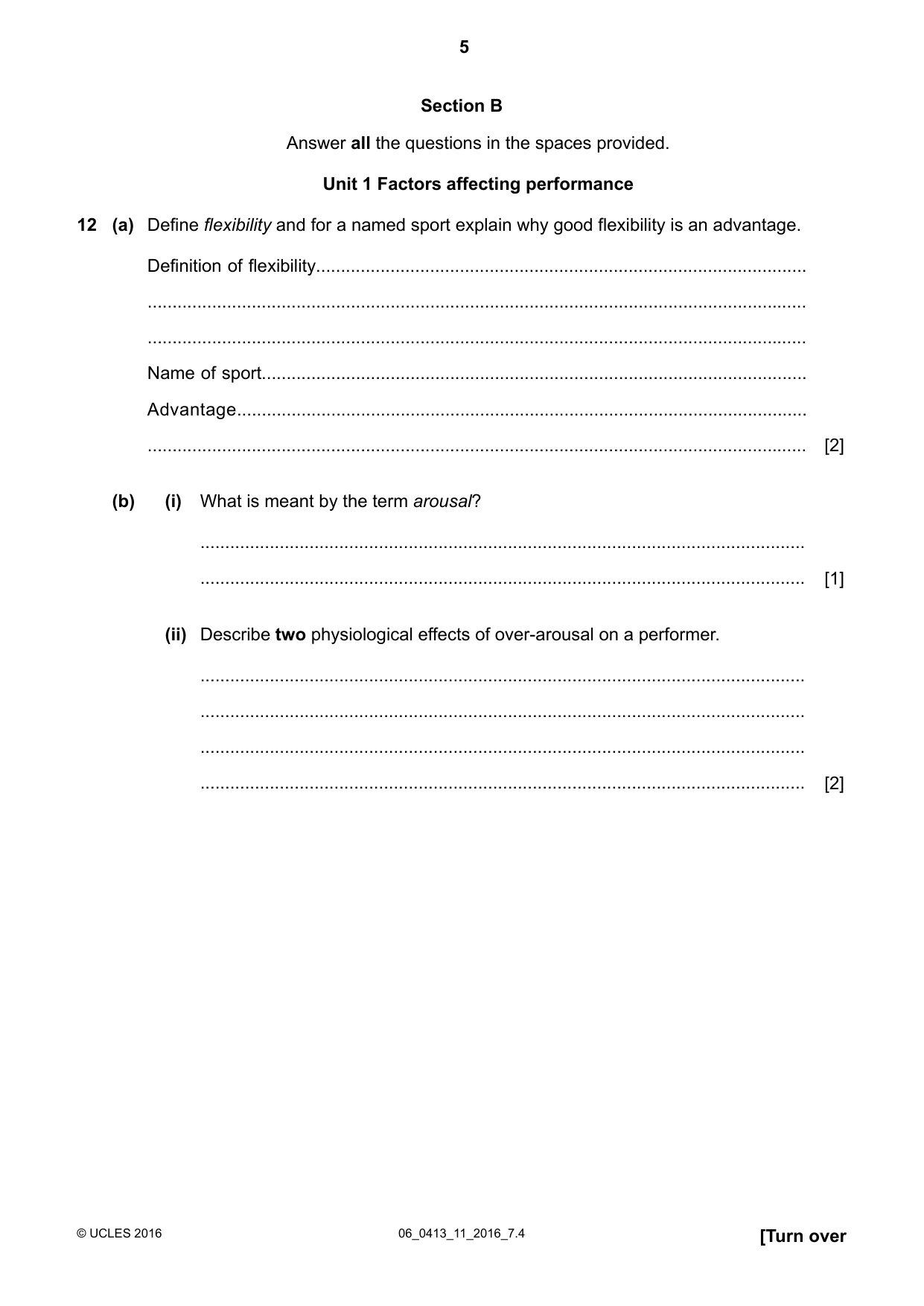
Question paper, page 5
Section B Answer all the questions in the spaces provided. Unit 1 Factors affecting performance Define flexibility and for a named sport explain why good flexibility is an advantage. (a) 12 Definition of flexibility… … … Name of sport… Advantage… … [2] What is meant by the term arousal? (i) (b) … … [1] Describe two physiological effects of over-arousal on a performer. (ii) … … … … [2] [Turn over 06_0413_11_2016_7.4 © UCLES 2016 5
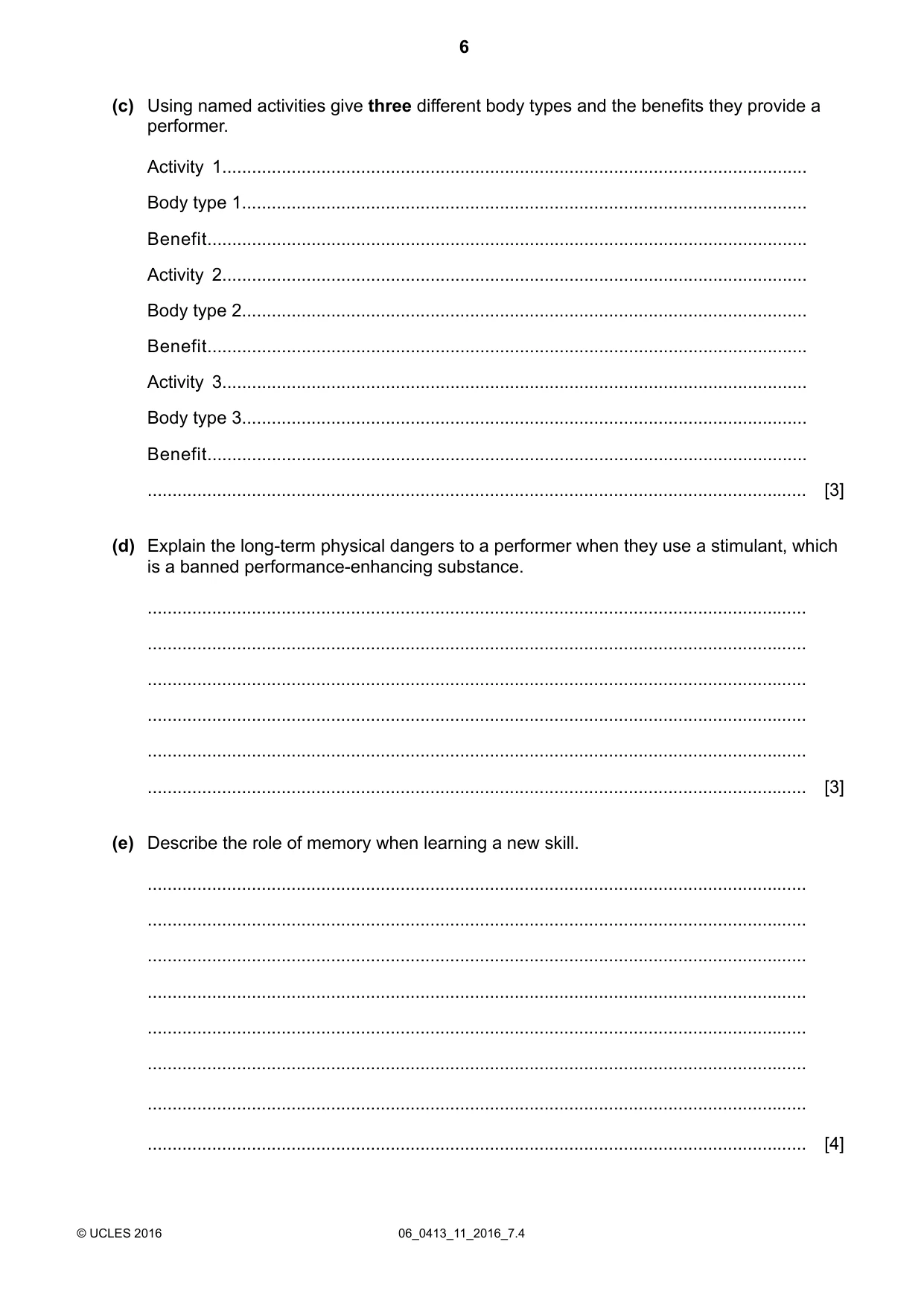
Question paper, page 6
Using named activities give three different body types and the benefits they provide a performer. (c) Activity 1… Body type 1… Benefit… Activity 2… Body type 2… Benefit… Activity 3… Body type 3… Benefit… … [3] Explain the long-term physical dangers to a performer when they use a stimulant, which is a banned performance-enhancing substance. (d) … … … … … … [3] Describe the role of memory when learning a new skill. (e) … … … … … … … … [4] 06_0413_11_2016_7.4 © UCLES 2016 6
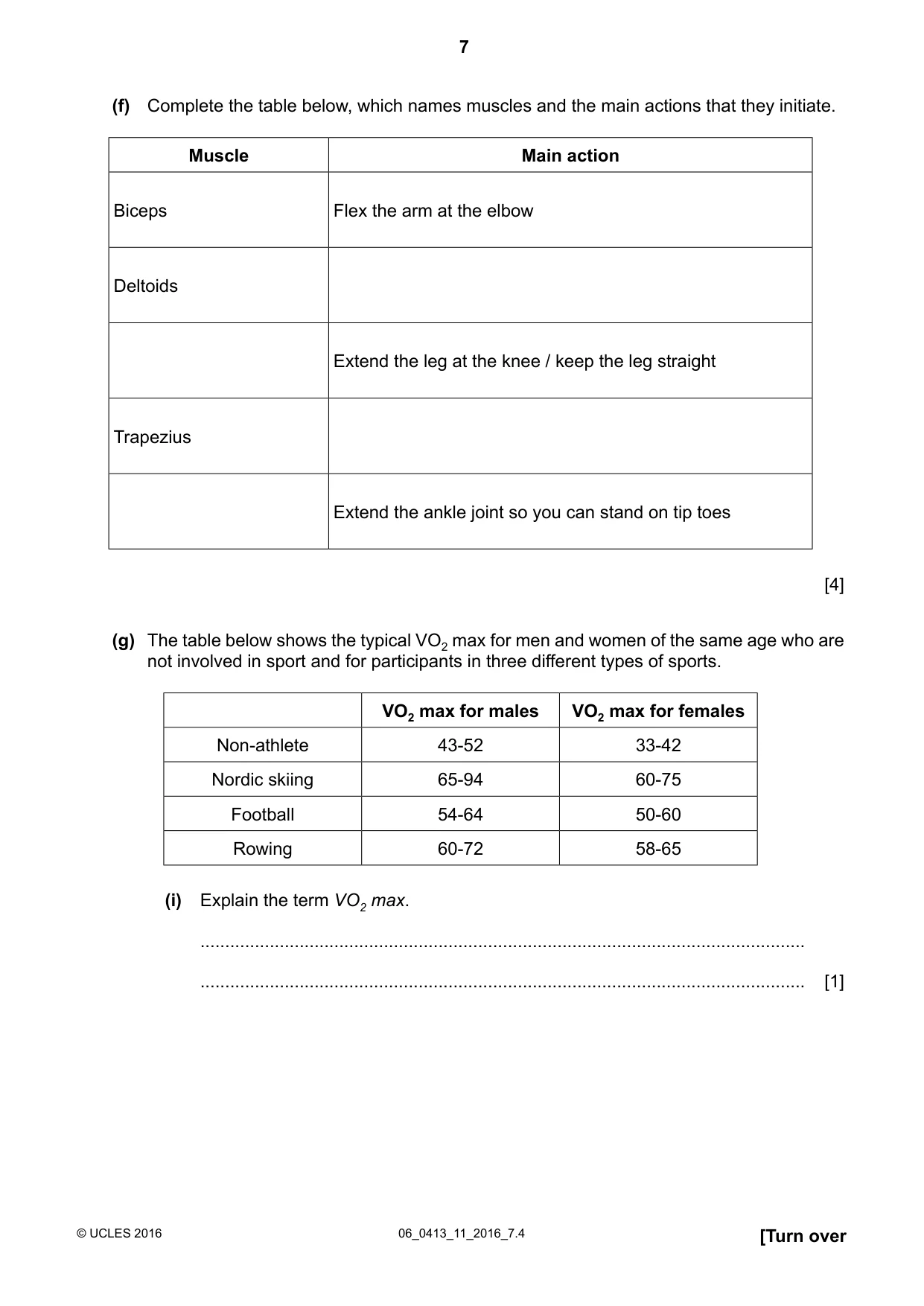
Question paper, page 7
Complete the table below, which names muscles and the main actions that they initiate. (f) Main action Muscle Flex the arm at the elbow Biceps Deltoids Extend the leg at the knee / keep the leg straight Trapezius Extend the ankle joint so you can stand on tip toes [4] The table below shows the typical VO2 max for men and women of the same age who are not involved in sport and for participants in three different types of sports. (g) VO2 max for females VO2 max for males 33-42 43-52 Non-athlete 60-75 65-94 Nordic skiing 50-60 54-64 Football 58-65 60-72 Rowing Explain the term VO2 max. (i) … … [1] [Turn over 06_0413_11_2016_7.4 © UCLES 2016 7
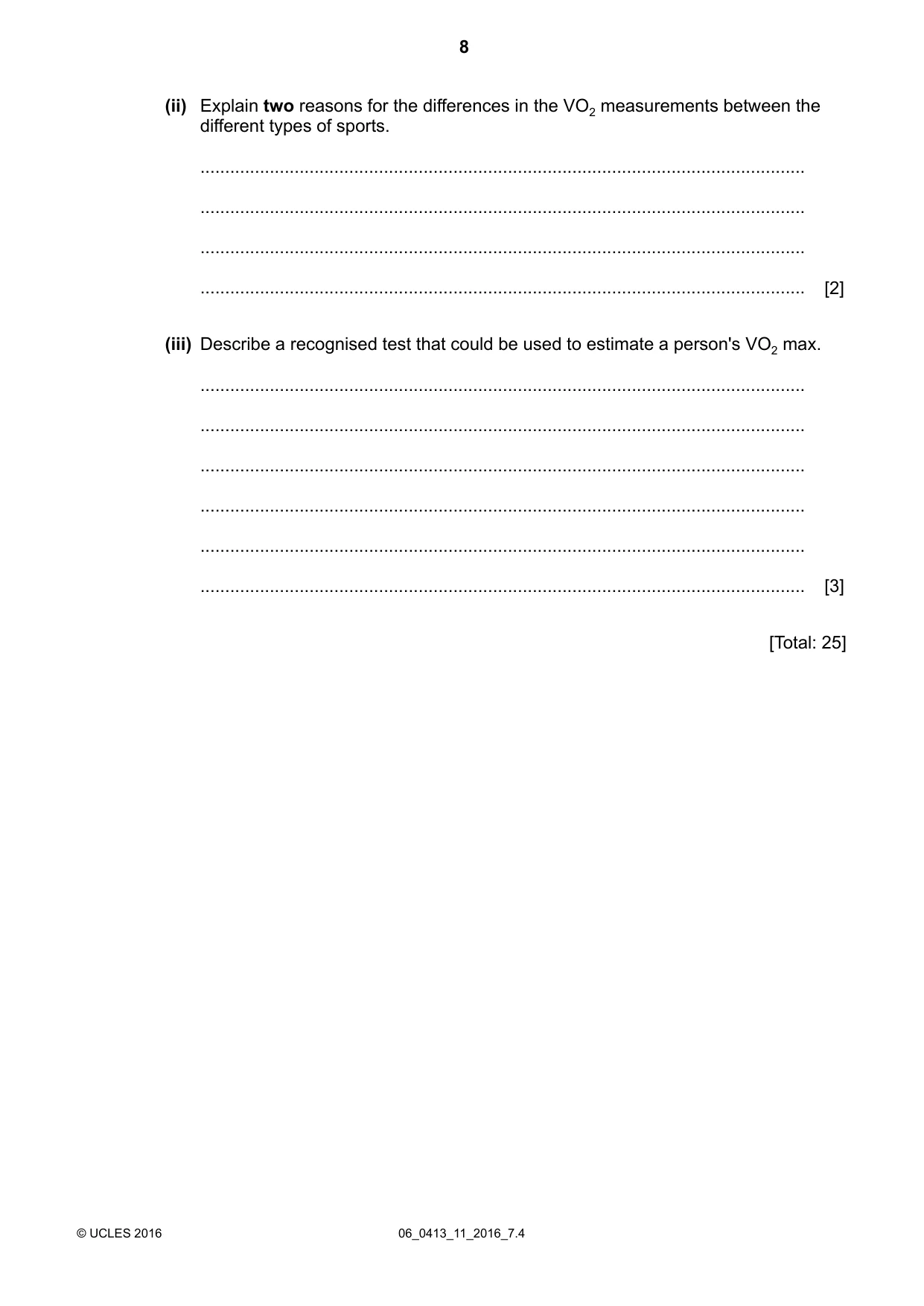
Question paper, page 8
Explain two reasons for the differences in the VO2 measurements between the different types of sports. (ii) … … … … [2] Describe a recognised test that could be used to estimate a person's VO2 max. (iii) … … … … … … [3] [Total: 25] 06_0413_11_2016_7.4 © UCLES 2016 8
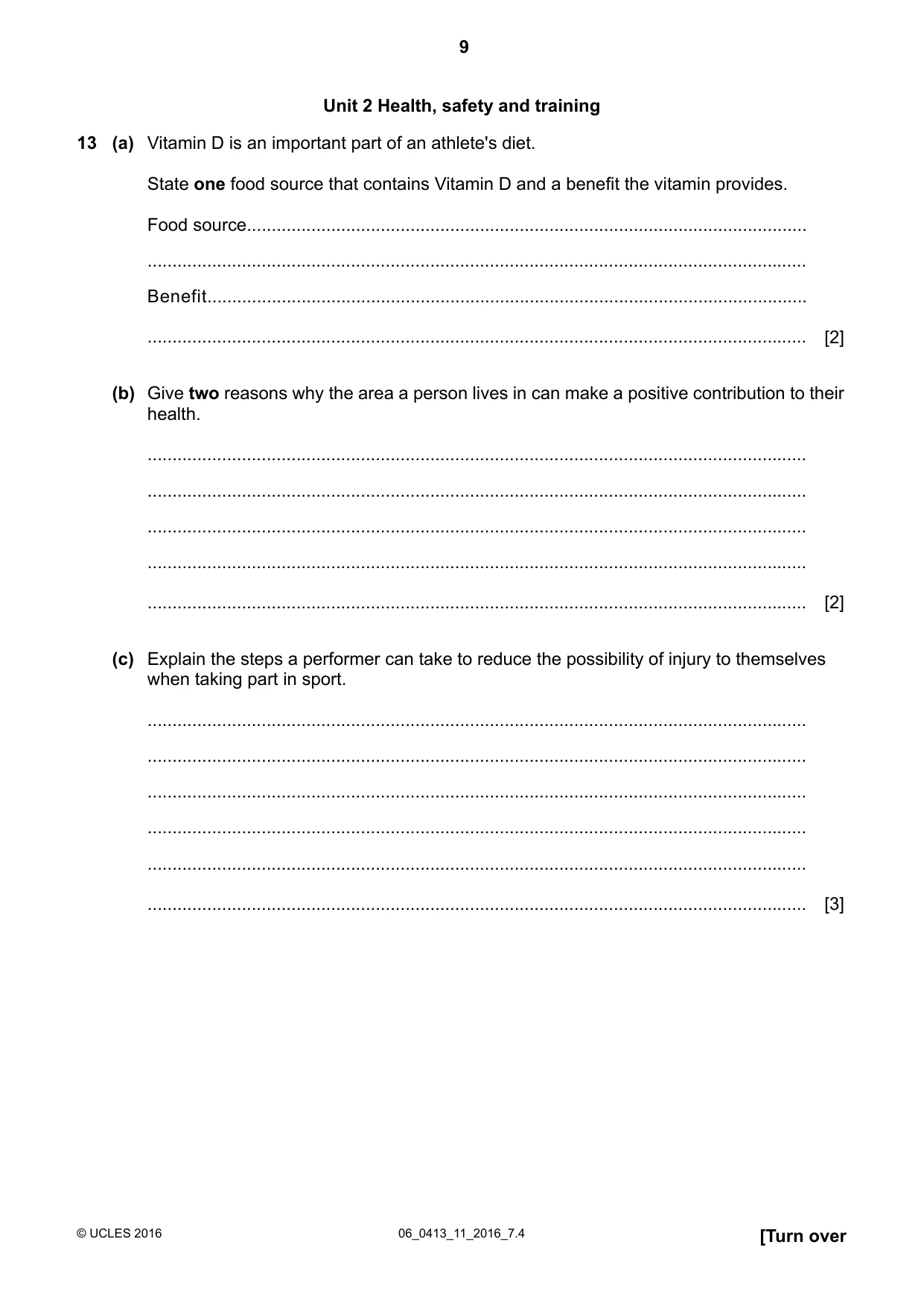
Question paper, page 9
Unit 2 Health, safety and training Vitamin D is an important part of an athlete's diet. State one food source that contains Vitamin D and a benefit the vitamin provides. (a) 13 Food source… … Benefit… … [2] Give two reasons why the area a person lives in can make a positive contribution to their health. (b) … … … … … [2] Explain the steps a performer can take to reduce the possibility of injury to themselves when taking part in sport. (c) … … … … … … [3] [Turn over 06_0413_11_2016_7.4 © UCLES 2016 9
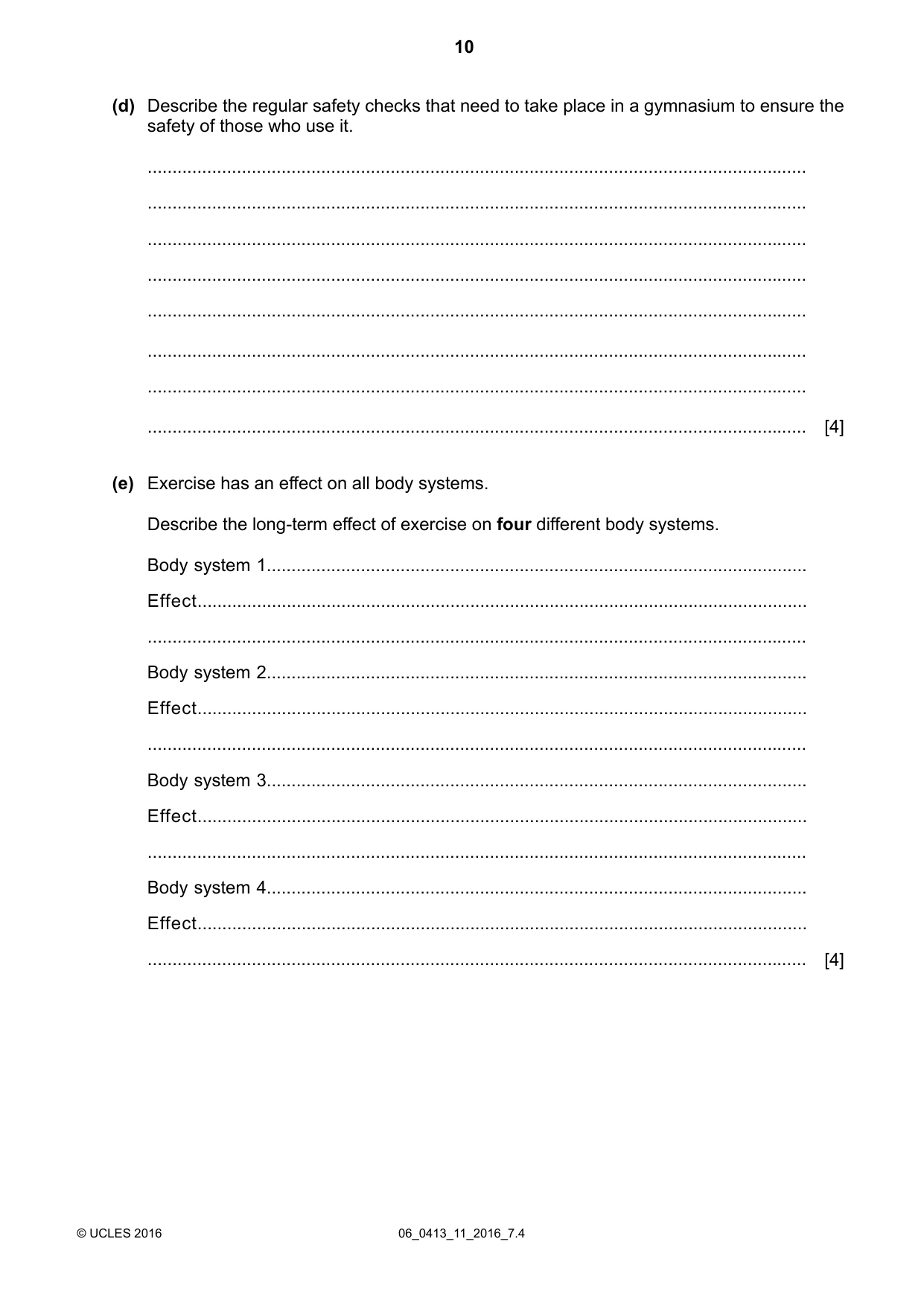
Question paper, page 10
Describe the regular safety checks that need to take place in a gymnasium to ensure the safety of those who use it. (d) … … … … … … … … [4] Exercise has an effect on all body systems. Describe the long-term effect of exercise on four different body systems. (e) Body system 1… Effect… … Body system 2… Effect… … Body system 3… Effect… … Body system 4… Effect… … [4] 06_0413_11_2016_7.4 © UCLES 2016 10
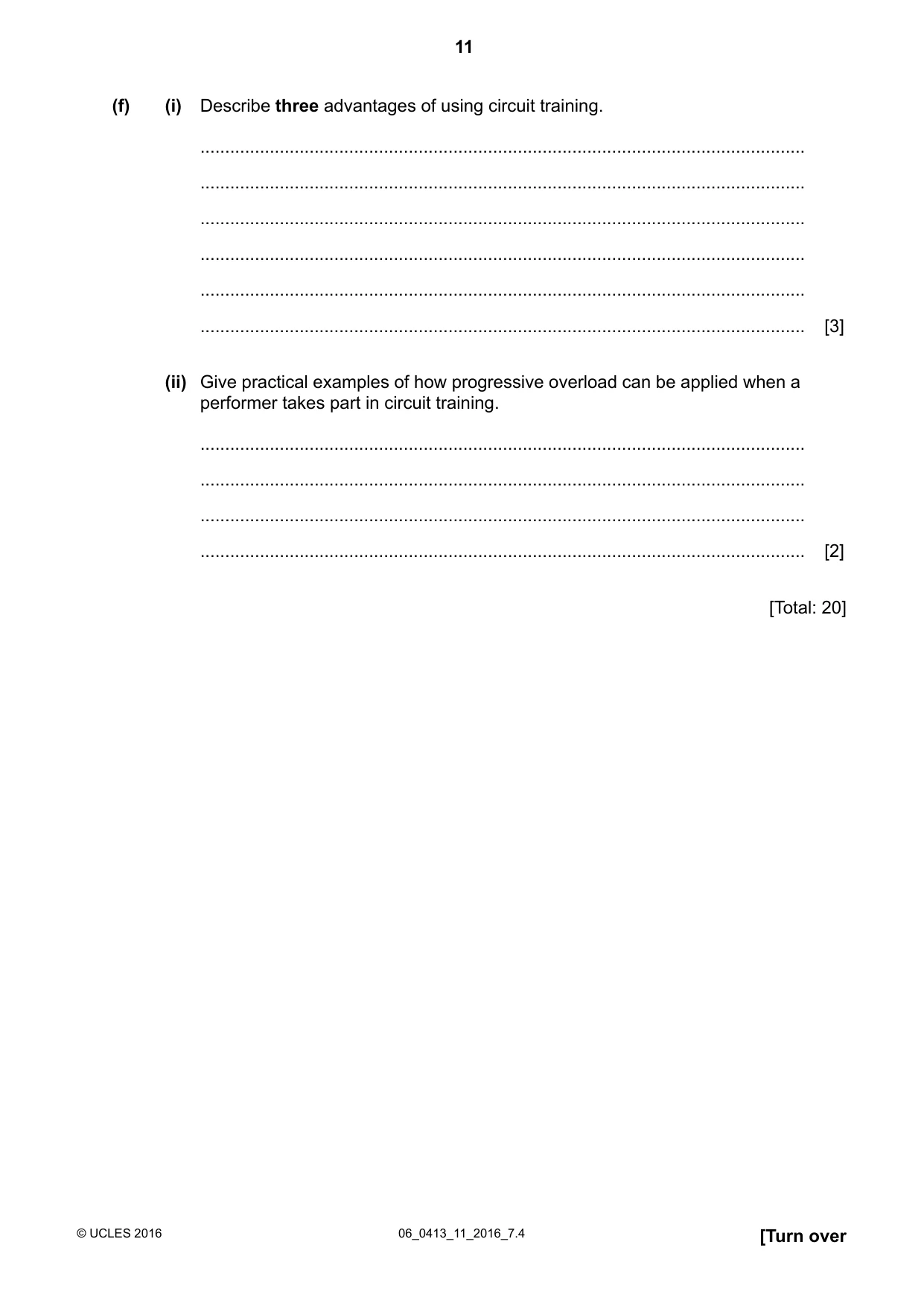
Question paper, page 11
Describe three advantages of using circuit training. (i) (f) … … … … … … [3] Give practical examples of how progressive overload can be applied when a performer takes part in circuit training. (ii) … … … … [2] [Total: 20] [Turn over 06_0413_11_2016_7.4 © UCLES 2016 11
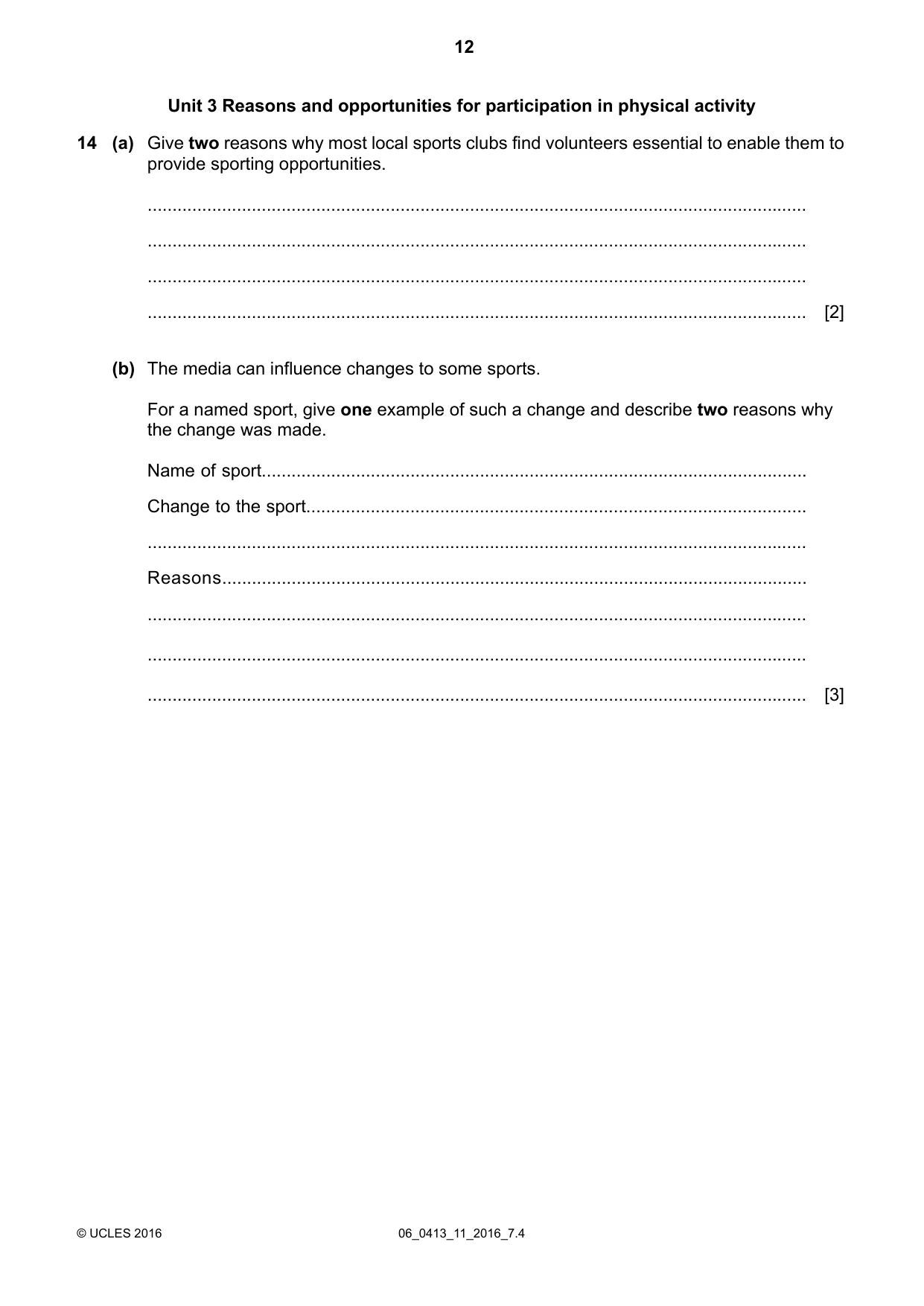
Question paper, page 12
Unit 3 Reasons and opportunities for participation in physical activity Give two reasons why most local sports clubs find volunteers essential to enable them to provide sporting opportunities. (a) 14 … … … … [2] The media can influence changes to some sports. For a named sport, give one example of such a change and describe two reasons why the change was made. (b) Name of sport… Change to the sport… … Reasons… … … … [3] 06_0413_11_2016_7.4 © UCLES 2016 12
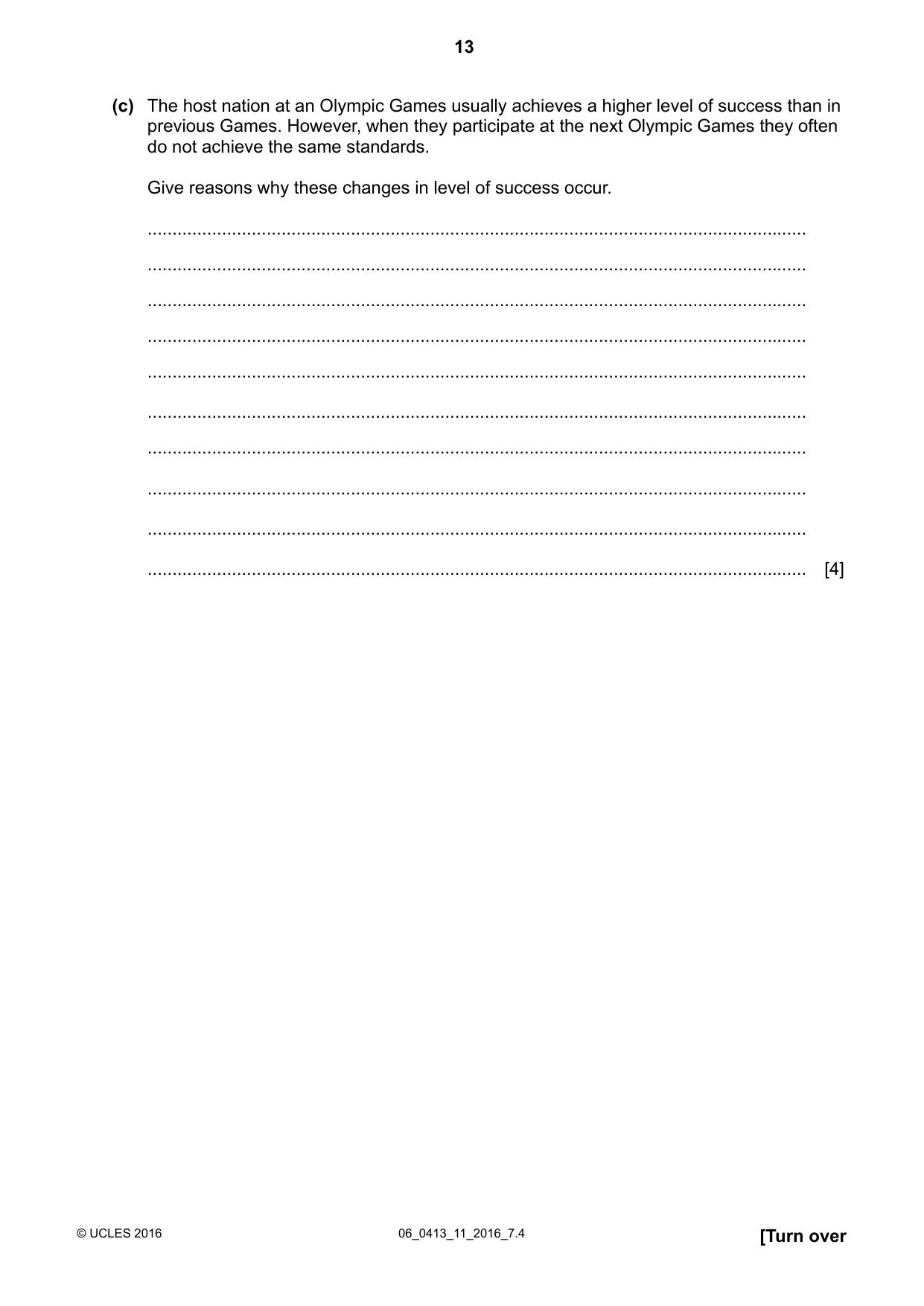
Question paper, page 13
The host nation at an Olympic Games usually achieves a higher level of success than in previous Games. However, when they participate at the next Olympic Games they often do not achieve the same standards. Give reasons why these changes in level of success occur. (c) … … … … … … … … … … [4] [Turn over 06_0413_11_2016_7.4 © UCLES 2016 13
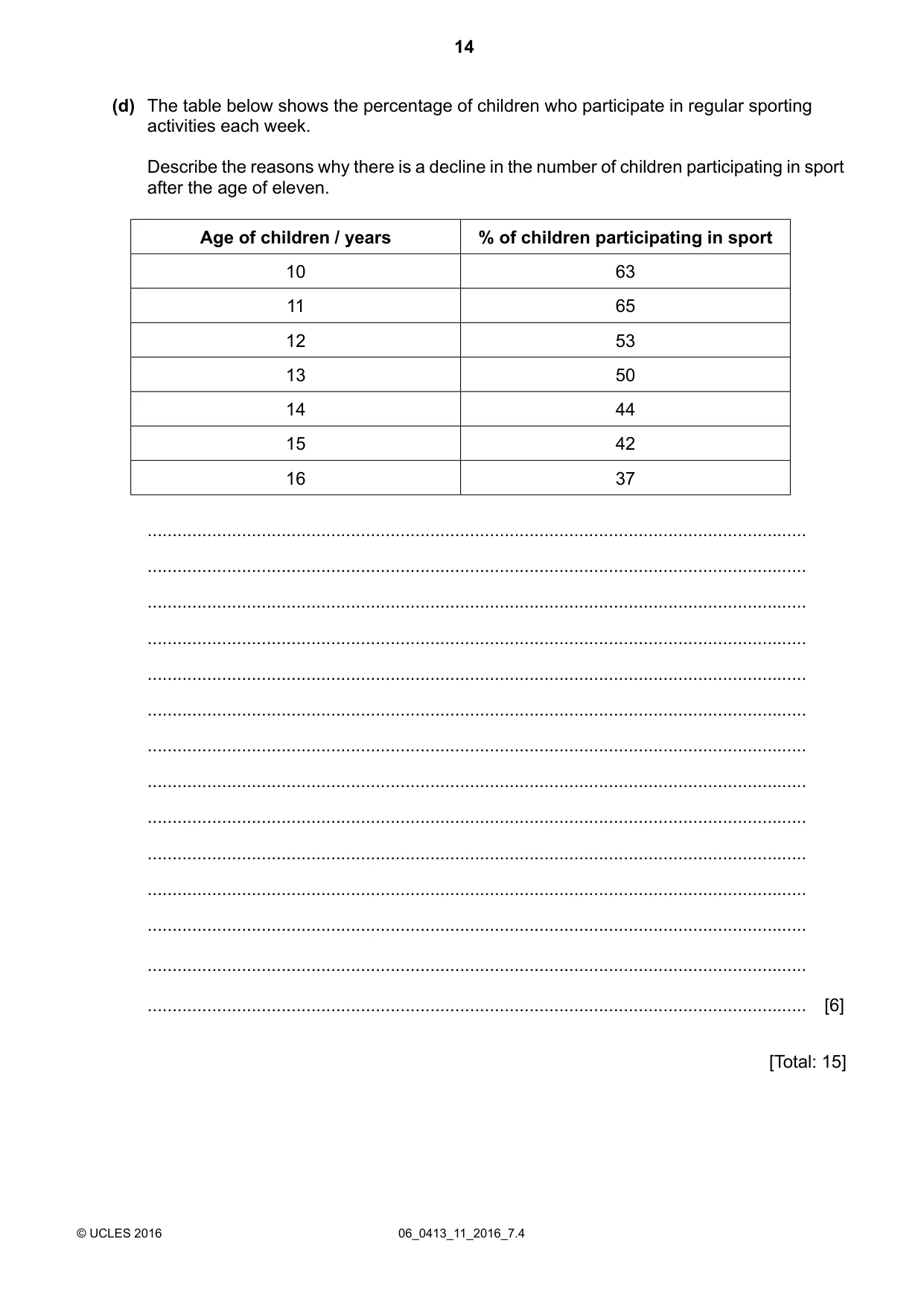
Question paper, page 14
The table below shows the percentage of children who participate in regular sporting activities each week. Describe the reasons why there is a decline in the number of children participating in sport after the age of eleven. (d) % of children participating in sport Age of children / years 63 10 65 11 53 12 50 13 44 14 42 15 37 16 … … … … … … … … … … … … … … [6] [Total: 15] 06_0413_11_2016_7.4 © UCLES 2016 14
Question paper, page 15
BLANK PAGE 06_0413_11_2016_7.4 © UCLES 2016 15
Question paper, page 16
BLANK PAGE Permission to reproduce items where third-party owned material protected by copyright is included has been sought and cleared where possible. Every reasonable effort has been made by the publisher (UCLES) to trace copyright holders, but if any items requiring clearance have unwittingly been included, the publisher will be pleased to make amends at the earliest possible opportunity. To avoid the issue of disclosure of answer-related information to candidates, all copyright acknowledgements are reproduced online in the Cambridge International Examinations Copyright Acknowledgements Booklet. This is produced for each series of examinations and is freely available to download at www.cie.org.uk after the live examination series. Cambridge International Examinations is part of the Cambridge Assessment Group. Cambridge Assessment is the brand name of University of Cambridge Local Examinations Syndicate (UCLES), which is itself a department of the University of Cambridge. 06_0413_11_2016_7.4 © UCLES 2016 16
Mark scheme, page 1
® IGCSE is the registered trademark of Cambridge International Examinations. This document consists of 12 printed pages. © UCLES 2016 [Turn over Cambridge International Examinations Cambridge International General Certificate of Secondary Education PHYSICAL EDUCATION 0413/11 Paper 1 May/June 2016 MARK SCHEME Maximum Mark: 80 Published This mark scheme is published as an aid to teachers and candidates, to indicate the requirements of the examination. It shows the basis on which Examiners were instructed to award marks. It does not indicate the details of the discussions that took place at an Examiners’ meeting before marking began, which would have considered the acceptability of alternative answers. Mark schemes should be read in conjunction with the question paper and the Principal Examiner Report for Teachers. Cambridge will not enter into discussions about these mark schemes. Cambridge is publishing the mark schemes for the May/June 2016 series for most Cambridge IGCSE®, Cambridge International A and AS Level components and some Cambridge O Level components.
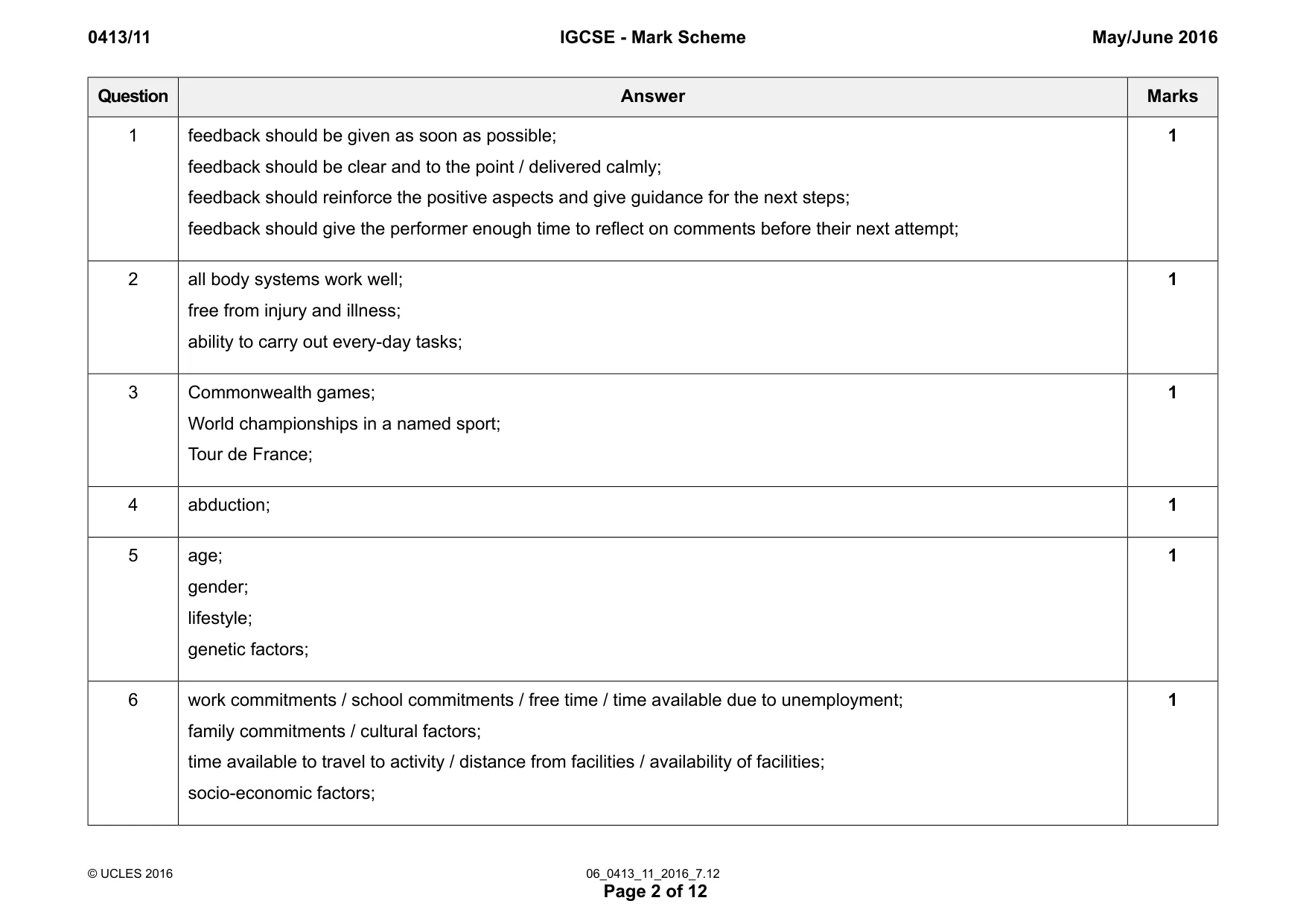
Mark scheme, page 2
Marks Answer Question 1 feedback should be given as soon as possible; 1 feedback should be clear and to the point / delivered calmly; feedback should reinforce the positive aspects and give guidance for the next steps; feedback should give the performer enough time to reflect on comments before their next attempt; 1 all body systems work well; 2 free from injury and illness; ability to carry out every-day tasks; 1 Commonwealth games; 3 World championships in a named sport; Tour de France; 1 abduction; 4 1 age; 5 gender; lifestyle; genetic factors; 1 work commitments / school commitments / free time / time available due to unemployment; 6 family commitments / cultural factors; time available to travel to activity / distance from facilities / availability of facilities; socio-economic factors; 06_0413_11_2016_7.12 © UCLES 2016 Page 2 of 12 May/June 2016 IGCSE - Mark Scheme 0413/11
Mark scheme, page 3
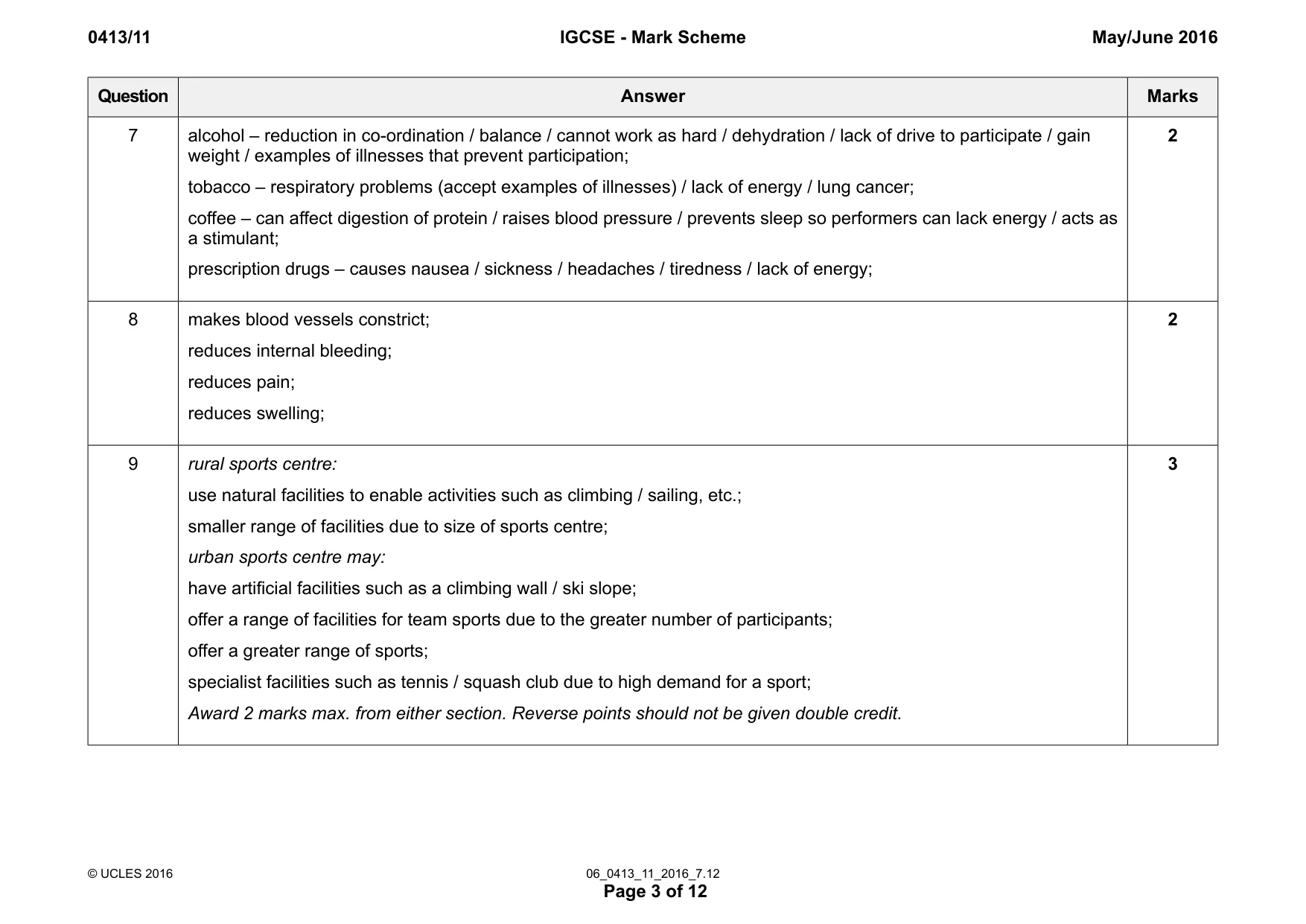
Marks Answer Question 2 alcohol – reduction in co-ordination / balance / cannot work as hard / dehydration / lack of drive to participate / gain weight / examples of illnesses that prevent participation; 7 tobacco – respiratory problems (accept examples of illnesses) / lack of energy / lung cancer; coffee – can affect digestion of protein / raises blood pressure / prevents sleep so performers can lack energy / acts as a stimulant; prescription drugs – causes nausea / sickness / headaches / tiredness / lack of energy; 2 makes blood vessels constrict; 8 reduces internal bleeding; reduces pain; reduces swelling; 3 rural sports centre: 9 use natural facilities to enable activities such as climbing / sailing, etc.; smaller range of facilities due to size of sports centre; urban sports centre may: have artificial facilities such as a climbing wall / ski slope; offer a range of facilities for team sports due to the greater number of participants; offer a greater range of sports; specialist facilities such as tennis / squash club due to high demand for a sport; Award 2 marks max. from either section. Reverse points should not be given double credit. 06_0413_11_2016_7.12 © UCLES 2016 Page 3 of 12 May/June 2016 IGCSE - Mark Scheme 0413/11
Mark scheme, page 4
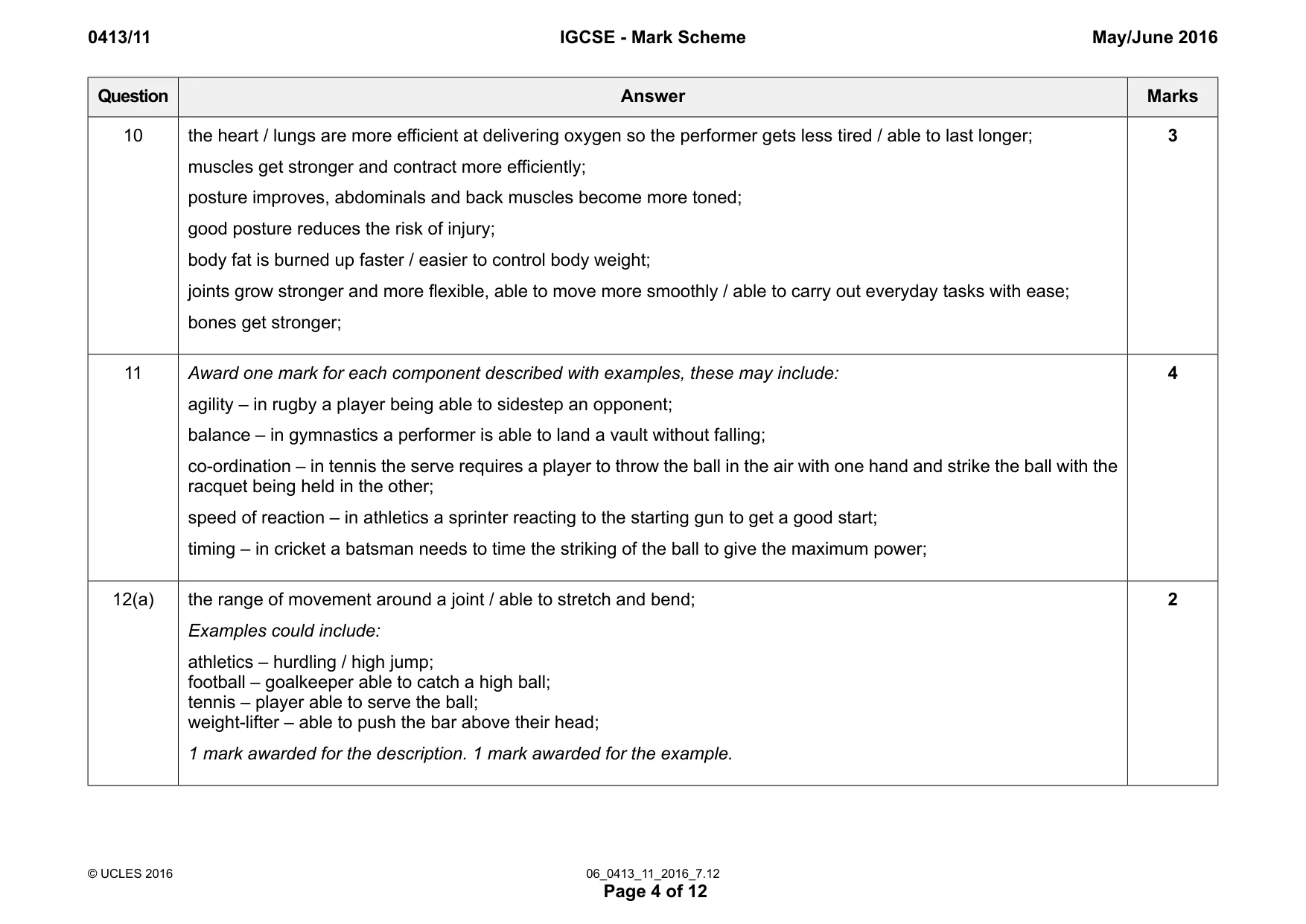
Marks Answer Question 3 the heart / lungs are more efficient at delivering oxygen so the performer gets less tired / able to last longer; 10 muscles get stronger and contract more efficiently; posture improves, abdominals and back muscles become more toned; good posture reduces the risk of injury; body fat is burned up faster / easier to control body weight; joints grow stronger and more flexible, able to move more smoothly / able to carry out everyday tasks with ease; bones get stronger; 4 Award one mark for each component described with examples, these may include: 11 agility – in rugby a player being able to sidestep an opponent; balance – in gymnastics a performer is able to land a vault without falling; co-ordination – in tennis the serve requires a player to throw the ball in the air with one hand and strike the ball with the racquet being held in the other; speed of reaction – in athletics a sprinter reacting to the starting gun to get a good start; timing – in cricket a batsman needs to time the striking of the ball to give the maximum power; 2 the range of movement around a joint / able to stretch and bend; 12(a) Examples could include: athletics – hurdling / high jump; football – goalkeeper able to catch a high ball; tennis – player able to serve the ball; weight-lifter – able to push the bar above their head; 1 mark awarded for the description. 1 mark awarded for the example. 06_0413_11_2016_7.12 © UCLES 2016 Page 4 of 12 May/June 2016 IGCSE - Mark Scheme 0413/11
Mark scheme, page 5
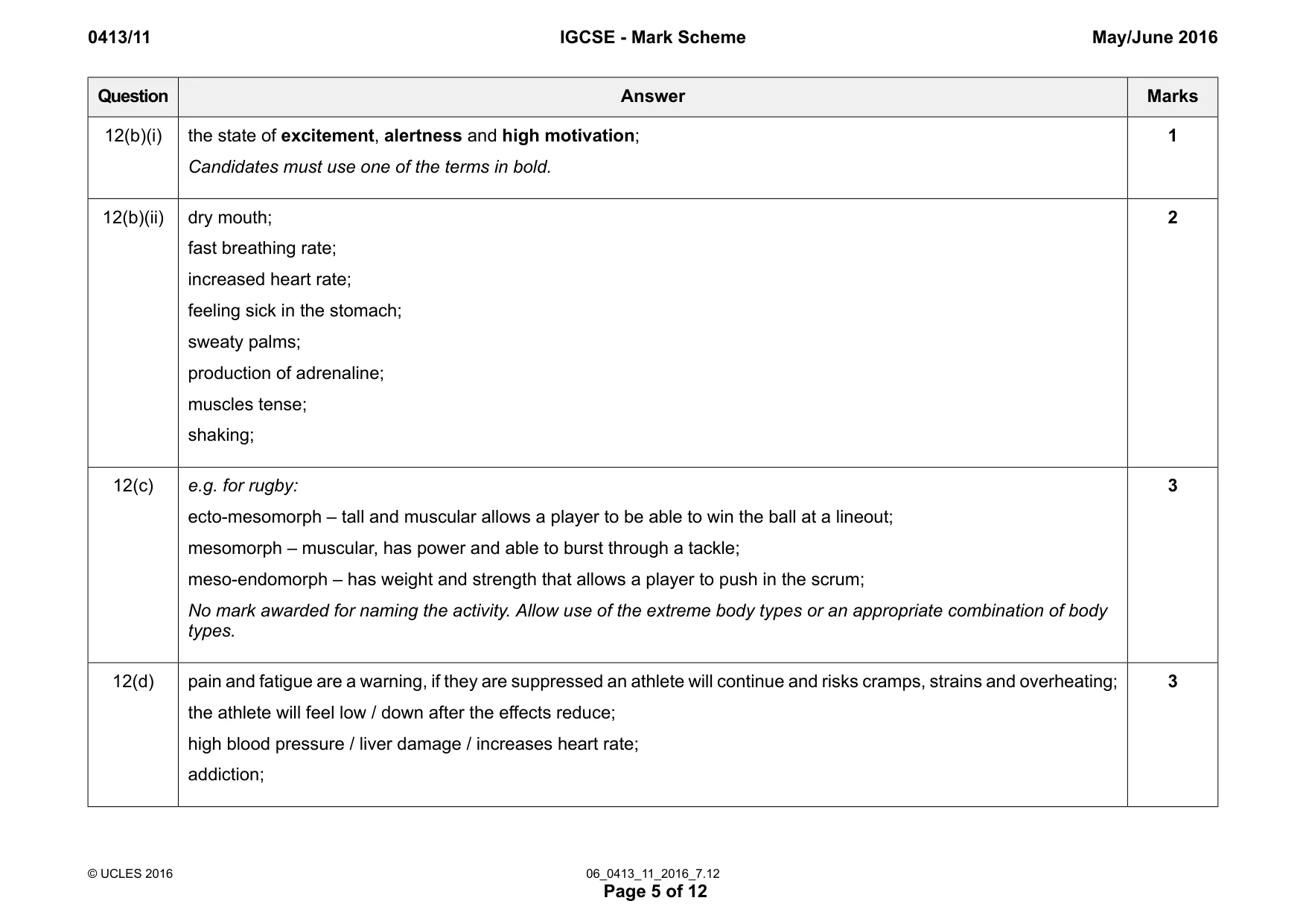
Marks Answer Question 1 the state of excitement, alertness and high motivation; 12(b)(i) Candidates must use one of the terms in bold. 2 dry mouth; 12(b)(ii) fast breathing rate; increased heart rate; feeling sick in the stomach; sweaty palms; production of adrenaline; muscles tense; shaking; 3 e.g. for rugby: 12(c) ecto-mesomorph – tall and muscular allows a player to be able to win the ball at a lineout; mesomorph – muscular, has power and able to burst through a tackle; meso-endomorph – has weight and strength that allows a player to push in the scrum; No mark awarded for naming the activity. Allow use of the extreme body types or an appropriate combination of body types. 3 pain and fatigue are a warning, if they are suppressed an athlete will continue and risks cramps, strains and overheating; 12(d) the athlete will feel low / down after the effects reduce; high blood pressure / liver damage / increases heart rate; addiction; 06_0413_11_2016_7.12 © UCLES 2016 Page 5 of 12 May/June 2016 IGCSE - Mark Scheme 0413/11
Mark scheme, page 6
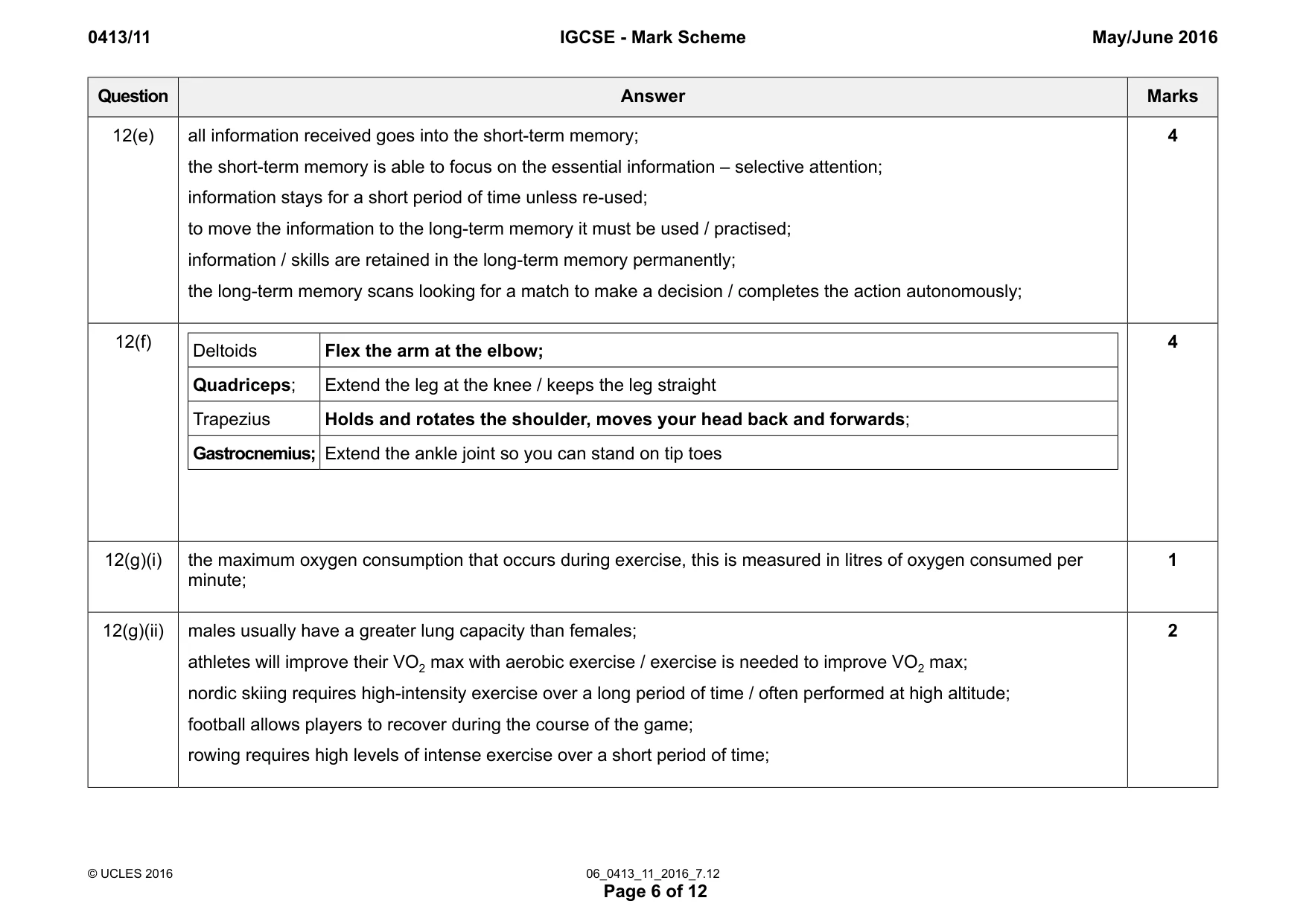
Marks Answer Question 4 all information received goes into the short-term memory; 12(e) the short-term memory is able to focus on the essential information – selective attention; information stays for a short period of time unless re-used; to move the information to the long-term memory it must be used / practised; information / skills are retained in the long-term memory permanently; the long-term memory scans looking for a match to make a decision / completes the action autonomously; 4 12(f) Flex the arm at the elbow; Deltoids Extend the leg at the knee / keeps the leg straight Quadriceps; Holds and rotates the shoulder, moves your head back and forwards; Trapezius Extend the ankle joint so you can stand on tip toes Gastrocnemius; 1 the maximum oxygen consumption that occurs during exercise, this is measured in litres of oxygen consumed per minute; 12(g)(i) 2 males usually have a greater lung capacity than females; 12(g)(ii) athletes will improve their VO2 max with aerobic exercise / exercise is needed to improve VO2 max; nordic skiing requires high-intensity exercise over a long period of time / often performed at high altitude; football allows players to recover during the course of the game; rowing requires high levels of intense exercise over a short period of time; 06_0413_11_2016_7.12 © UCLES 2016 Page 6 of 12 May/June 2016 IGCSE - Mark Scheme 0413/11
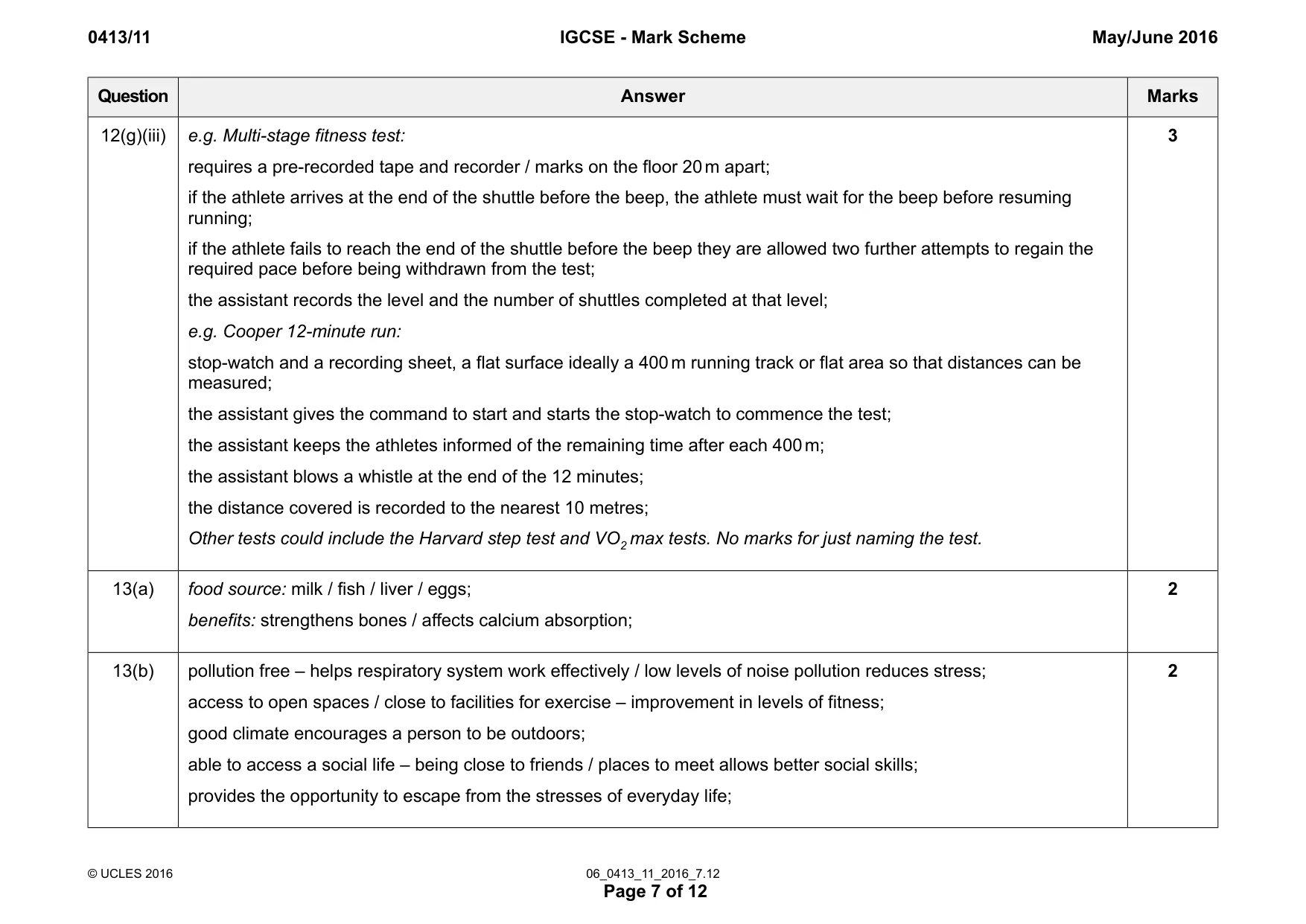
Mark scheme, page 7
Marks Answer Question 3 e.g. Multi-stage fitness test: 12(g)(iii) requires a pre-recorded tape and recorder / marks on the floor 20m apart; if the athlete arrives at the end of the shuttle before the beep, the athlete must wait for the beep before resuming running; if the athlete fails to reach the end of the shuttle before the beep they are allowed two further attempts to regain the required pace before being withdrawn from the test; the assistant records the level and the number of shuttles completed at that level; e.g. Cooper 12-minute run: stop-watch and a recording sheet, a flat surface ideally a 400m running track or flat area so that distances can be measured; the assistant gives the command to start and starts the stop-watch to commence the test; the assistant keeps the athletes informed of the remaining time after each 400m; the assistant blows a whistle at the end of the 12 minutes; the distance covered is recorded to the nearest 10 metres; Other tests could include the Harvard step test and VO2 max tests. No marks for just naming the test. 2 food source: milk / fish / liver / eggs; 13(a) benefits: strengthens bones / affects calcium absorption; 2 pollution free – helps respiratory system work effectively / low levels of noise pollution reduces stress; 13(b) access to open spaces / close to facilities for exercise – improvement in levels of fitness; good climate encourages a person to be outdoors; able to access a social life – being close to friends / places to meet allows better social skills; provides the opportunity to escape from the stresses of everyday life; 06_0413_11_2016_7.12 © UCLES 2016 Page 7 of 12 May/June 2016 IGCSE - Mark Scheme 0413/11
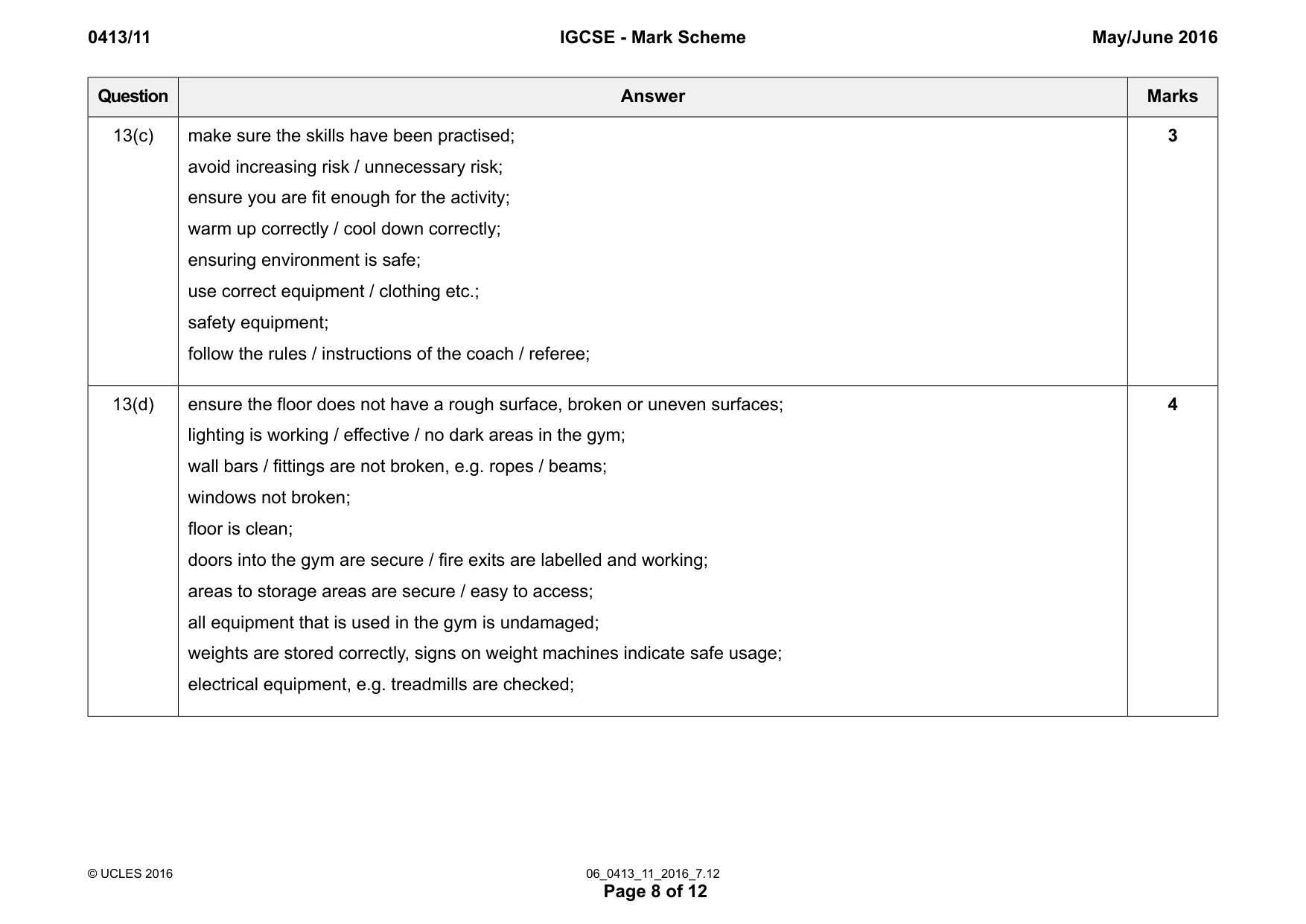
Mark scheme, page 8
Marks Answer Question 3 make sure the skills have been practised; 13(c) avoid increasing risk / unnecessary risk; ensure you are fit enough for the activity; warm up correctly / cool down correctly; ensuring environment is safe; use correct equipment / clothing etc.; safety equipment; follow the rules / instructions of the coach / referee; 4 ensure the floor does not have a rough surface, broken or uneven surfaces; 13(d) lighting is working / effective / no dark areas in the gym; wall bars / fittings are not broken, e.g. ropes / beams; windows not broken; floor is clean; doors into the gym are secure / fire exits are labelled and working; areas to storage areas are secure / easy to access; all equipment that is used in the gym is undamaged; weights are stored correctly, signs on weight machines indicate safe usage; electrical equipment, e.g. treadmills are checked; 06_0413_11_2016_7.12 © UCLES 2016 Page 8 of 12 May/June 2016 IGCSE - Mark Scheme 0413/11
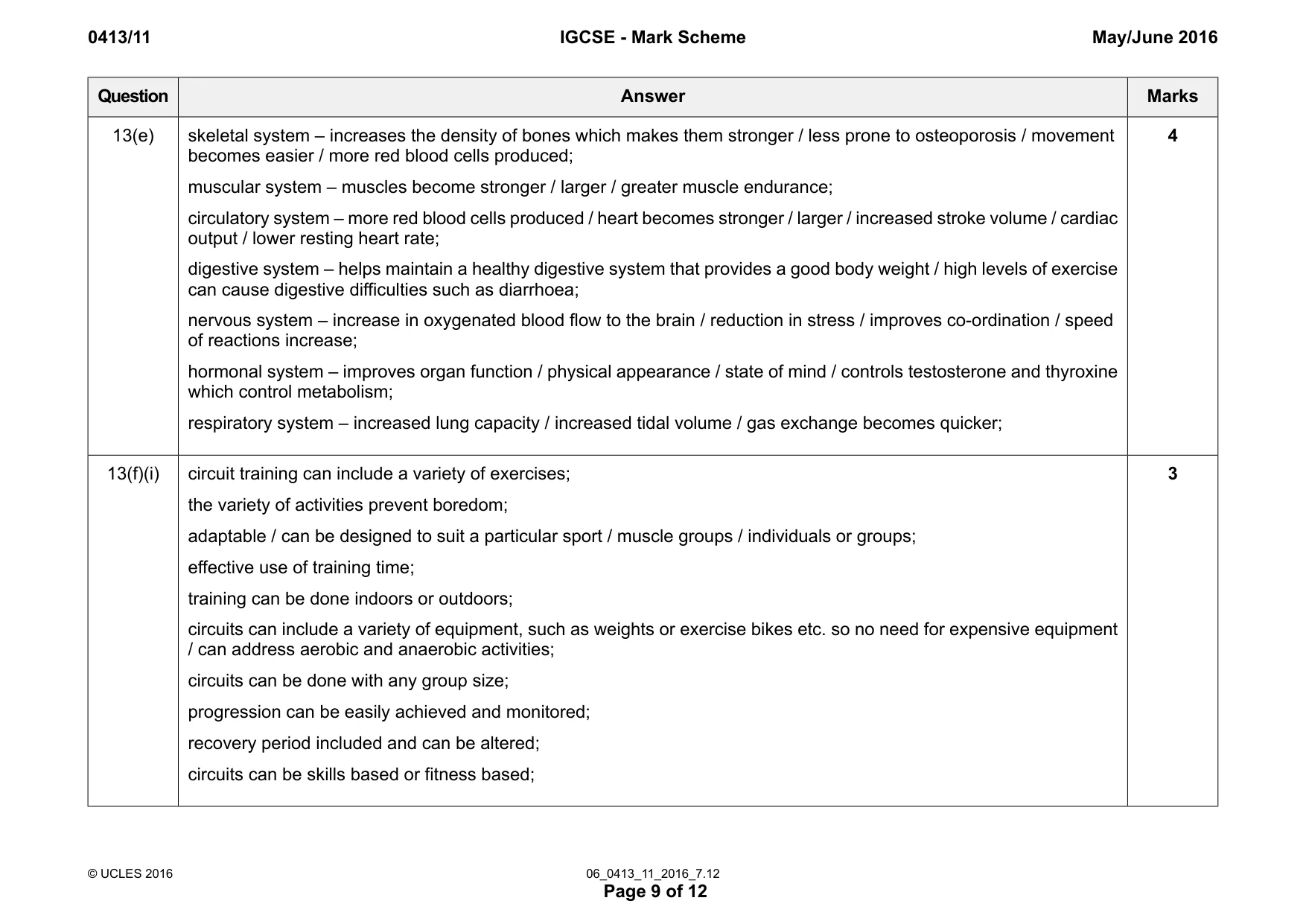
Mark scheme, page 9
Marks Answer Question 4 skeletal system – increases the density of bones which makes them stronger / less prone to osteoporosis / movement becomes easier / more red blood cells produced; 13(e) muscular system – muscles become stronger / larger / greater muscle endurance; circulatory system – more red blood cells produced / heart becomes stronger / larger / increased stroke volume / cardiac output / lower resting heart rate; digestive system – helps maintain a healthy digestive system that provides a good body weight / high levels of exercise can cause digestive difficulties such as diarrhoea; nervous system – increase in oxygenated blood flow to the brain / reduction in stress / improves co-ordination / speed of reactions increase; hormonal system – improves organ function / physical appearance / state of mind / controls testosterone and thyroxine which control metabolism; respiratory system – increased lung capacity / increased tidal volume / gas exchange becomes quicker; 3 circuit training can include a variety of exercises; 13(f)(i) the variety of activities prevent boredom; adaptable / can be designed to suit a particular sport / muscle groups / individuals or groups; effective use of training time; training can be done indoors or outdoors; circuits can include a variety of equipment, such as weights or exercise bikes etc. so no need for expensive equipment / can address aerobic and anaerobic activities; circuits can be done with any group size; progression can be easily achieved and monitored; recovery period included and can be altered; circuits can be skills based or fitness based; 06_0413_11_2016_7.12 © UCLES 2016 Page 9 of 12 May/June 2016 IGCSE - Mark Scheme 0413/11
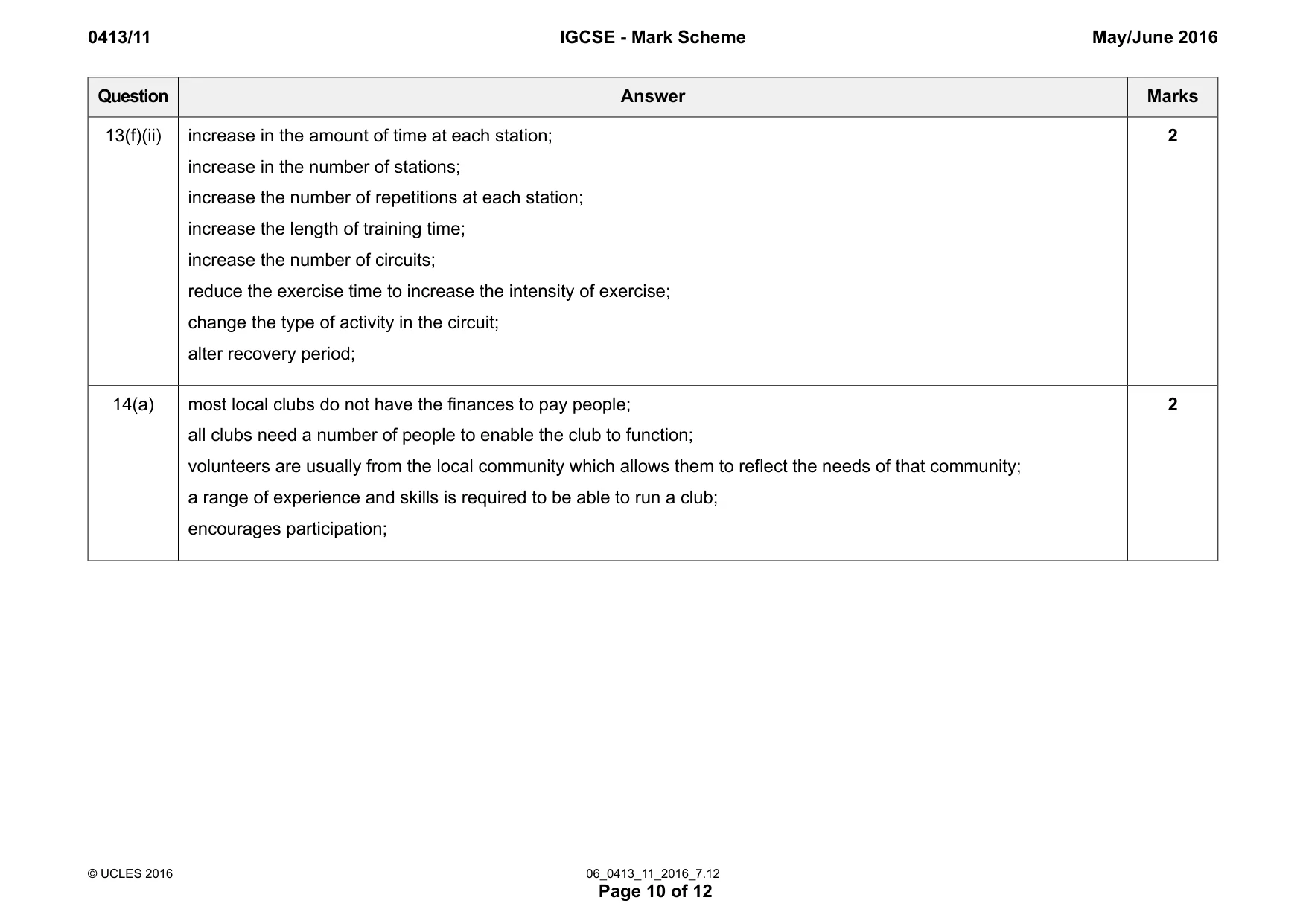
Mark scheme, page 10
Marks Answer Question 2 increase in the amount of time at each station; 13(f)(ii) increase in the number of stations; increase the number of repetitions at each station; increase the length of training time; increase the number of circuits; reduce the exercise time to increase the intensity of exercise; change the type of activity in the circuit; alter recovery period; 2 most local clubs do not have the finances to pay people; 14(a) all clubs need a number of people to enable the club to function; volunteers are usually from the local community which allows them to reflect the needs of that community; a range of experience and skills is required to be able to run a club; encourages participation; 06_0413_11_2016_7.12 © UCLES 2016 Page 10 of 12 May/June 2016 IGCSE - Mark Scheme 0413/11
Mark scheme, page 11
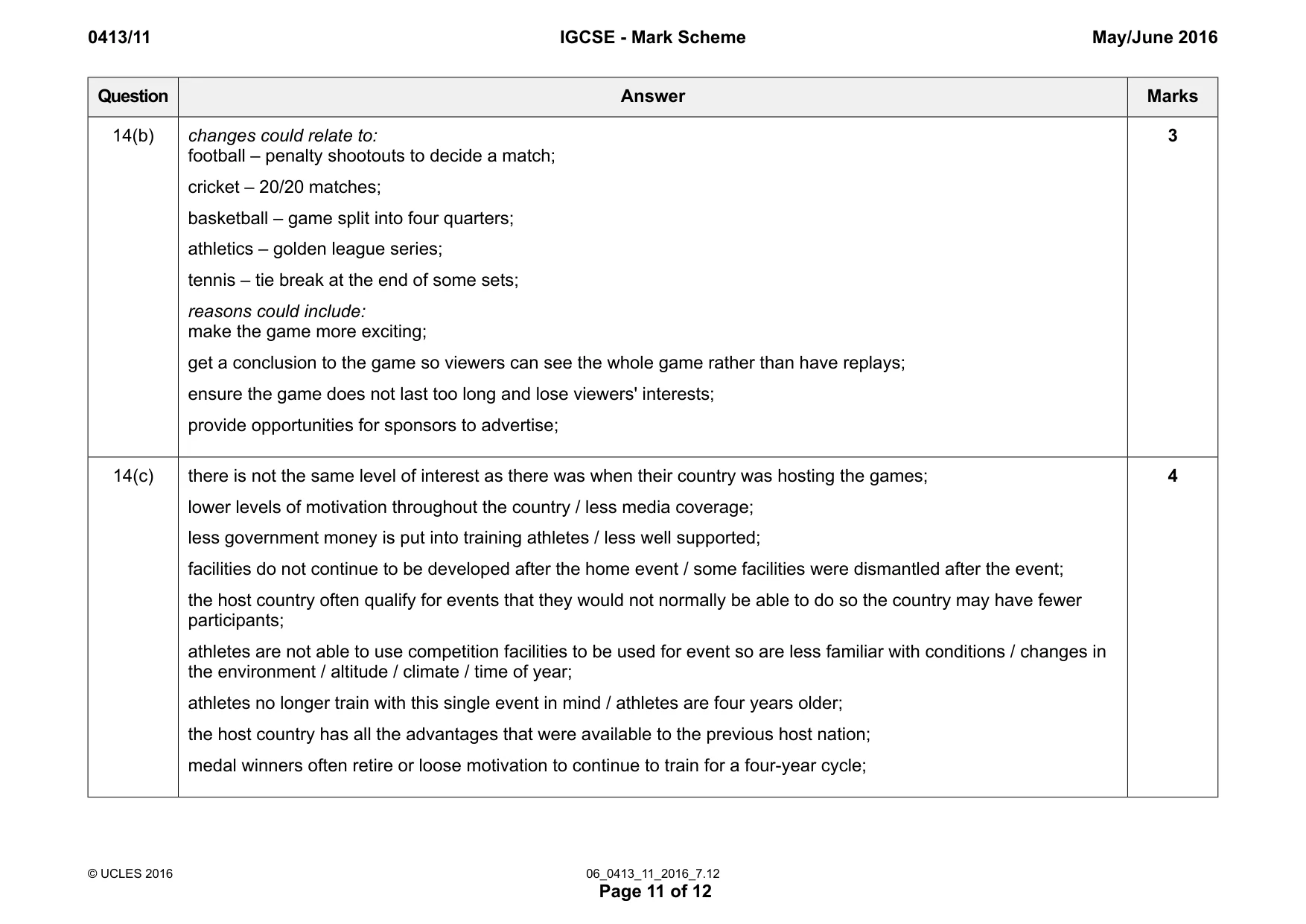
Marks Answer Question 3 changes could relate to: football – penalty shootouts to decide a match; 14(b) cricket – 20/20 matches; basketball – game split into four quarters; athletics – golden league series; tennis – tie break at the end of some sets; reasons could include: make the game more exciting; get a conclusion to the game so viewers can see the whole game rather than have replays; ensure the game does not last too long and lose viewers' interests; provide opportunities for sponsors to advertise; 4 there is not the same level of interest as there was when their country was hosting the games; 14(c) lower levels of motivation throughout the country / less media coverage; less government money is put into training athletes / less well supported; facilities do not continue to be developed after the home event / some facilities were dismantled after the event; the host country often qualify for events that they would not normally be able to do so the country may have fewer participants; athletes are not able to use competition facilities to be used for event so are less familiar with conditions / changes in the environment / altitude / climate / time of year; athletes no longer train with this single event in mind / athletes are four years older; the host country has all the advantages that were available to the previous host nation; medal winners often retire or loose motivation to continue to train for a four-year cycle; 06_0413_11_2016_7.12 © UCLES 2016 Page 11 of 12 May/June 2016 IGCSE - Mark Scheme 0413/11
Mark scheme, page 12
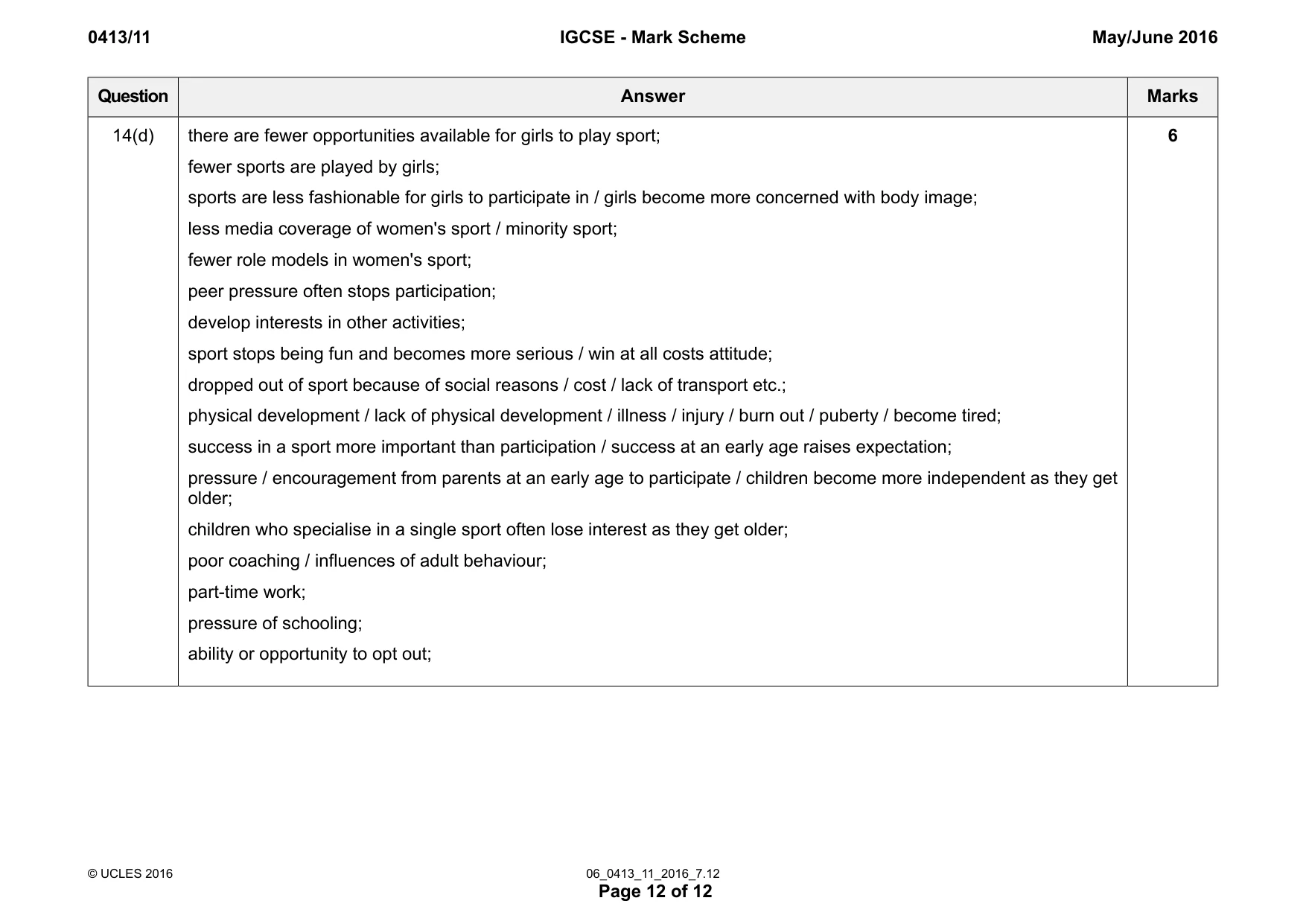
Marks Answer Question 6 there are fewer opportunities available for girls to play sport; 14(d) fewer sports are played by girls; sports are less fashionable for girls to participate in / girls become more concerned with body image; less media coverage of women's sport / minority sport; fewer role models in women's sport; peer pressure often stops participation; develop interests in other activities; sport stops being fun and becomes more serious / win at all costs attitude; dropped out of sport because of social reasons / cost / lack of transport etc.; physical development / lack of physical development / illness / injury / burn out / puberty / become tired; success in a sport more important than participation / success at an early age raises expectation; pressure / encouragement from parents at an early age to participate / children become more independent as they get older; children who specialise in a single sport often lose interest as they get older; poor coaching / influences of adult behaviour; part-time work; pressure of schooling; ability or opportunity to opt out; 06_0413_11_2016_7.12 © UCLES 2016 Page 12 of 12 May/June 2016 IGCSE - Mark Scheme 0413/11
What you needed in this session
Cambridge’s own grade thresholds for 2016 May/June, Paper 1 · Variant 1. A higher threshold means an easier paper — the bar moves with how the cohort did.