Cambridge IGCSE Physical Education 0413 — 2015 Oct/Nov Paper 1 · Variant 2
0413/12/O/N/15 · 80 marks · ≈90 min
The question paper and its mark scheme, free to read here and free to download. This is Cambridge’s own paper, exactly as it was sat.
Question paper12 pages
Mark scheme9 pages
Answers below. Sit the paper first if you are practising.
Paper as text
Question paper, page 1
This document consists of 12 printed pages. DC (RCL (JDA)) 97652/3 © UCLES 2015 [Turn over Cambridge International Examinations Cambridge International General Certificate of Secondary Education * 8 7 8 9 3 0 4 5 2 1 * PHYSICAL EDUCATION 0413/12 Paper 1 October/November 2015 1 hour 45 minutes Candidates answer on the Question Paper. No Additional Materials are required. READ THESE INSTRUCTIONS FIRST Write your Centre number, candidate number and name on all the work you hand in. Write in dark blue or black pen. You may use an HB pencil for any diagrams or graphs. Do not use staples, paper clips, glue or correction fluid. DO NOT WRITE IN ANY BARCODES. Section A Answer all questions in this section. Write your answers in the spaces provided on the Question Paper. Section B Answer all questions in this section. Write your answers in the spaces provided on the Question Paper. Electronic calculators may be used. You may lose marks if you do not show your working or if you do not use appropriate units. At the end of the examination, fasten all your work securely together. The number of marks is given in brackets [ ] at the end of each question or part question.
Question paper, page 2
2 0413/12/O/N/15 © UCLES 2015 Section A Answer all the questions in the spaces provided. 1 Give one example of a type of feedback. … …[1] 2 State one advantage to a sport of television coverage. … …[1] 3 Give one feature of mental well-being. … …[1] 4 Name one component of blood. …[1] 5 Give one factor that can determine what people do in their leisure time. …[1] 6 Name the nutrient that helps muscle tissue growth. …[1] 7 Name two muscles that would affect movement in the shoulder. 1 … 2 …[2]
Question paper, page 3
3 0413/12/O/N/15 © UCLES 2015 [Turn over 8 From different sports, name two different pieces of personal safety equipment. Sport … Safety equipment … Sport … Safety equipment …[2] 9 Give three ways that extra-curricular activities can raise the standard of sports performance. 1 … … 2 … … 3 … …[3] 10 Describe how a blister might be caused and two first aid treatments that could be given. Cause … … Treatment 1 … … … Treatment 2 … … …[3]
Question paper, page 4
4 0413/12/O/N/15 © UCLES 2015 11 Give four components of health related fitness and explain how each helps a performer in a different way. Component 1… … … … Component 2… … … … Component 3… … … … Component 4… … … …[4] [Total: 20]
Question paper, page 5
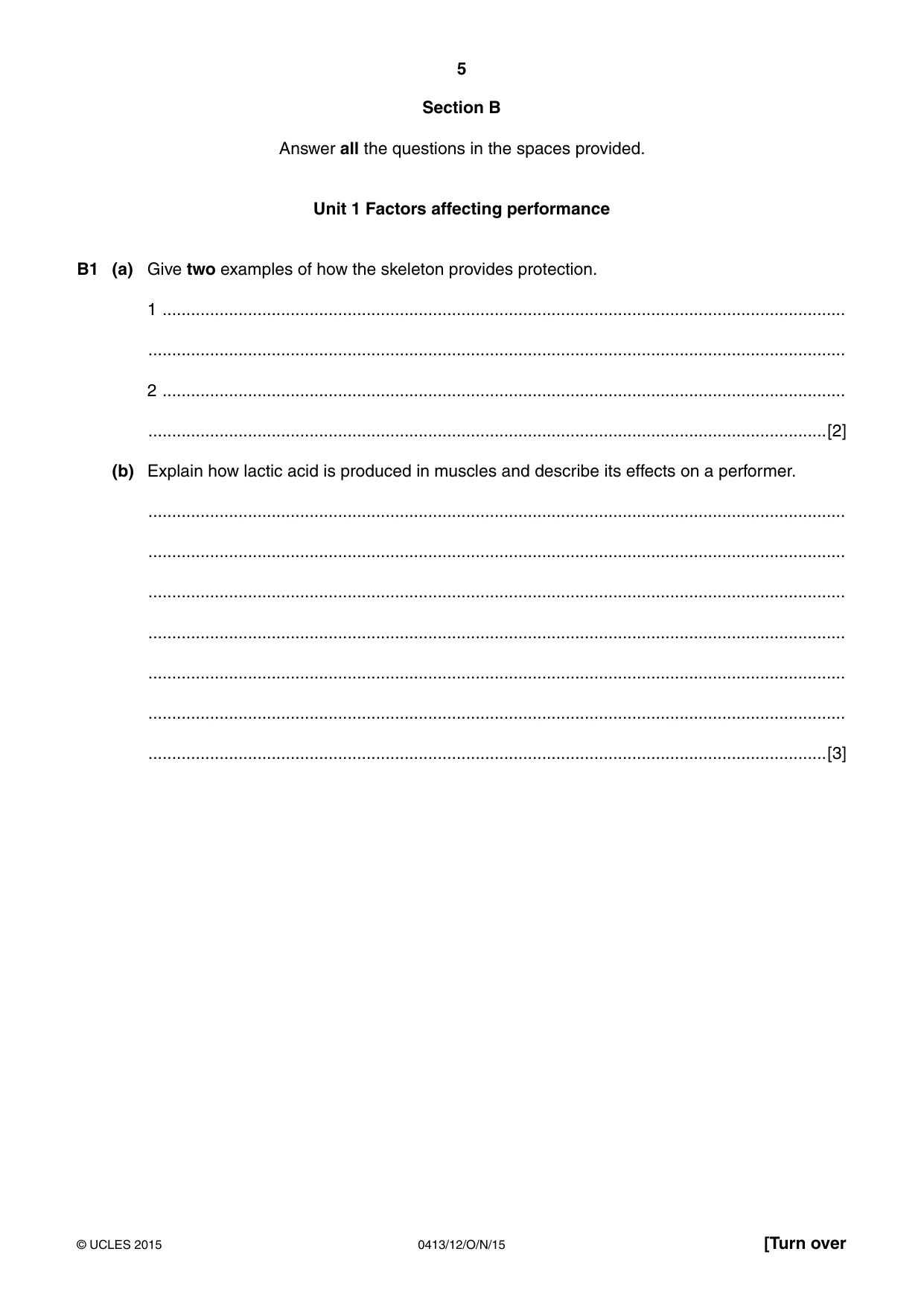
5 0413/12/O/N/15 © UCLES 2015 [Turn over Section B Answer all the questions in the spaces provided. Unit 1 Factors affecting performance B1 (a) Give two examples of how the skeleton provides protection. 1 … … 2 … …[2] (b) Explain how lactic acid is produced in muscles and describe its effects on a performer. … … … … … … …[3]
Question paper, page 6
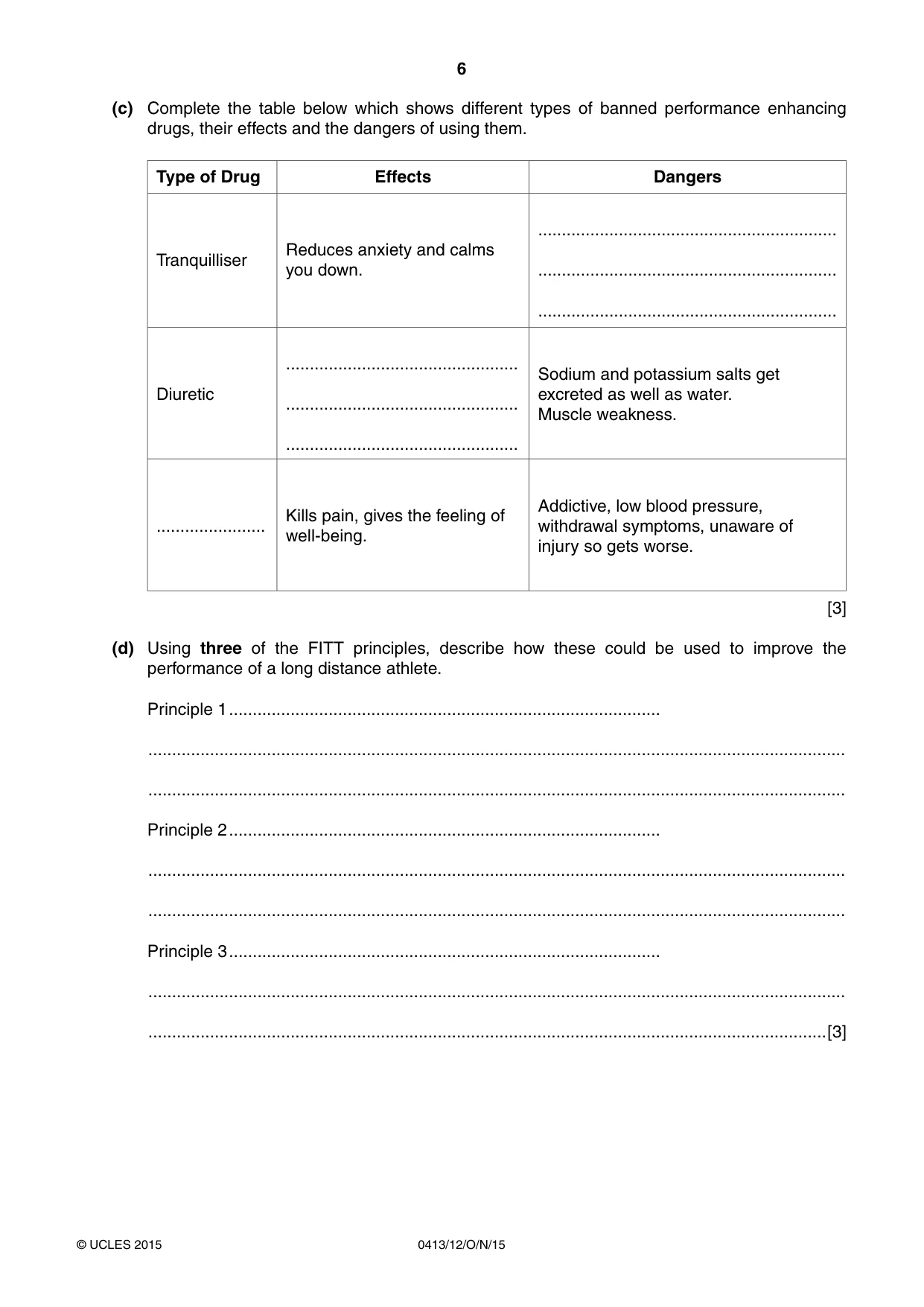
6 0413/12/O/N/15 © UCLES 2015 (c) Complete the table below which shows different types of banned performance enhancing drugs, their effects and the dangers of using them. Type of Drug Effects Dangers Tranquilliser Reduces anxiety and calms you down. … … … Diuretic … … … Sodium and potassium salts get excreted as well as water. Muscle weakness. … Kills pain, gives the feeling of well-being. Addictive, low blood pressure, withdrawal symptoms, unaware of injury so gets worse. [3] (d) Using three of the FITT principles, describe how these could be used to improve the performance of a long distance athlete. Principle 1 … … … Principle 2 … … … Principle 3 … … …[3]
Question paper, page 7
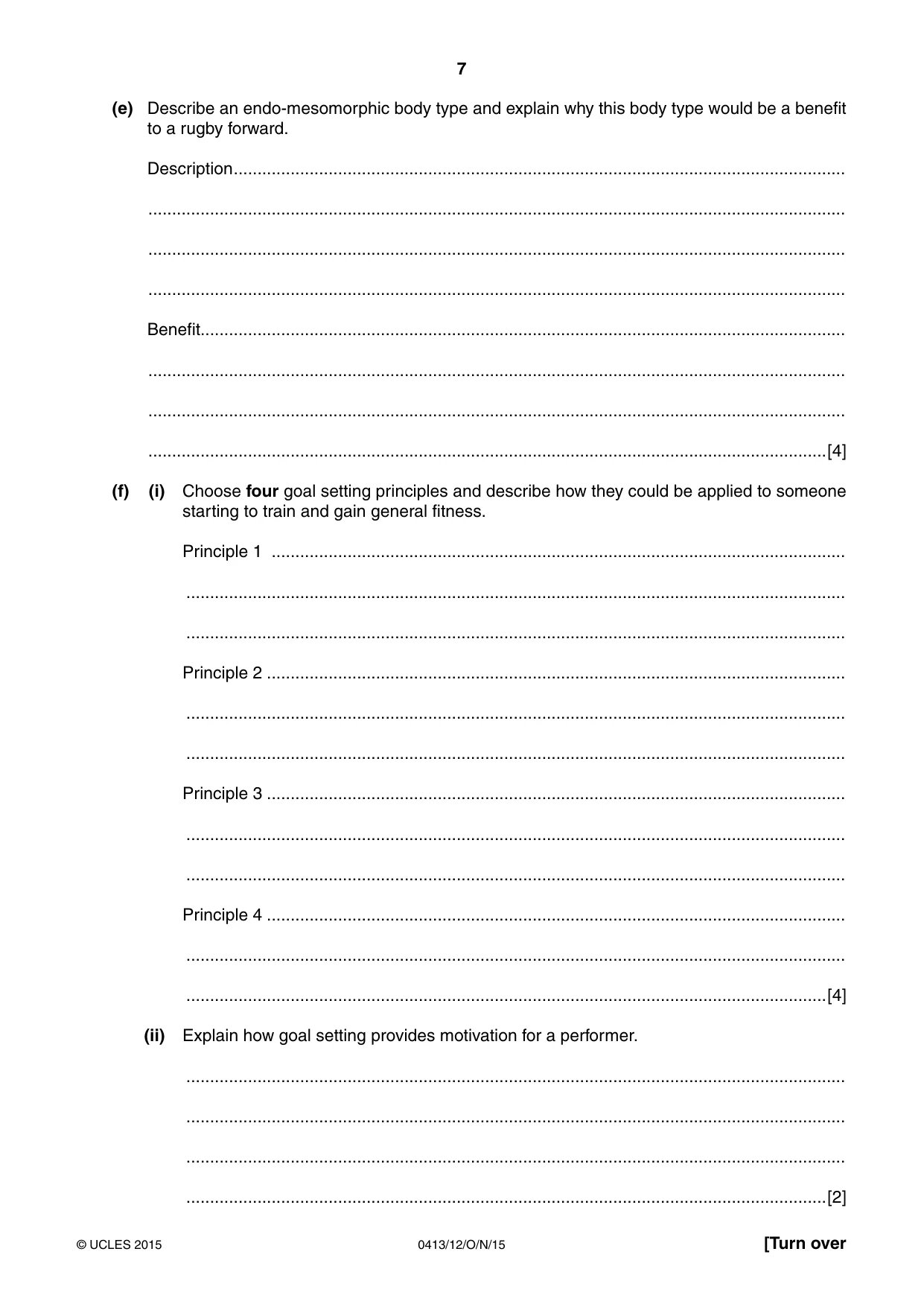
7 0413/12/O/N/15 © UCLES 2015 [Turn over (e) Describe an endo-mesomorphic body type and explain why this body type would be a benefit to a rugby forward. Description … … … … Benefit… … … …[4] (f) (i) Choose four goal setting principles and describe how they could be applied to someone starting to train and gain general fitness. Principle 1 … … … Principle 2 … … … Principle 3 … … … Principle 4 … … …[4] (ii) Explain how goal setting provides motivation for a performer. … … … …[2]
Question paper, page 8
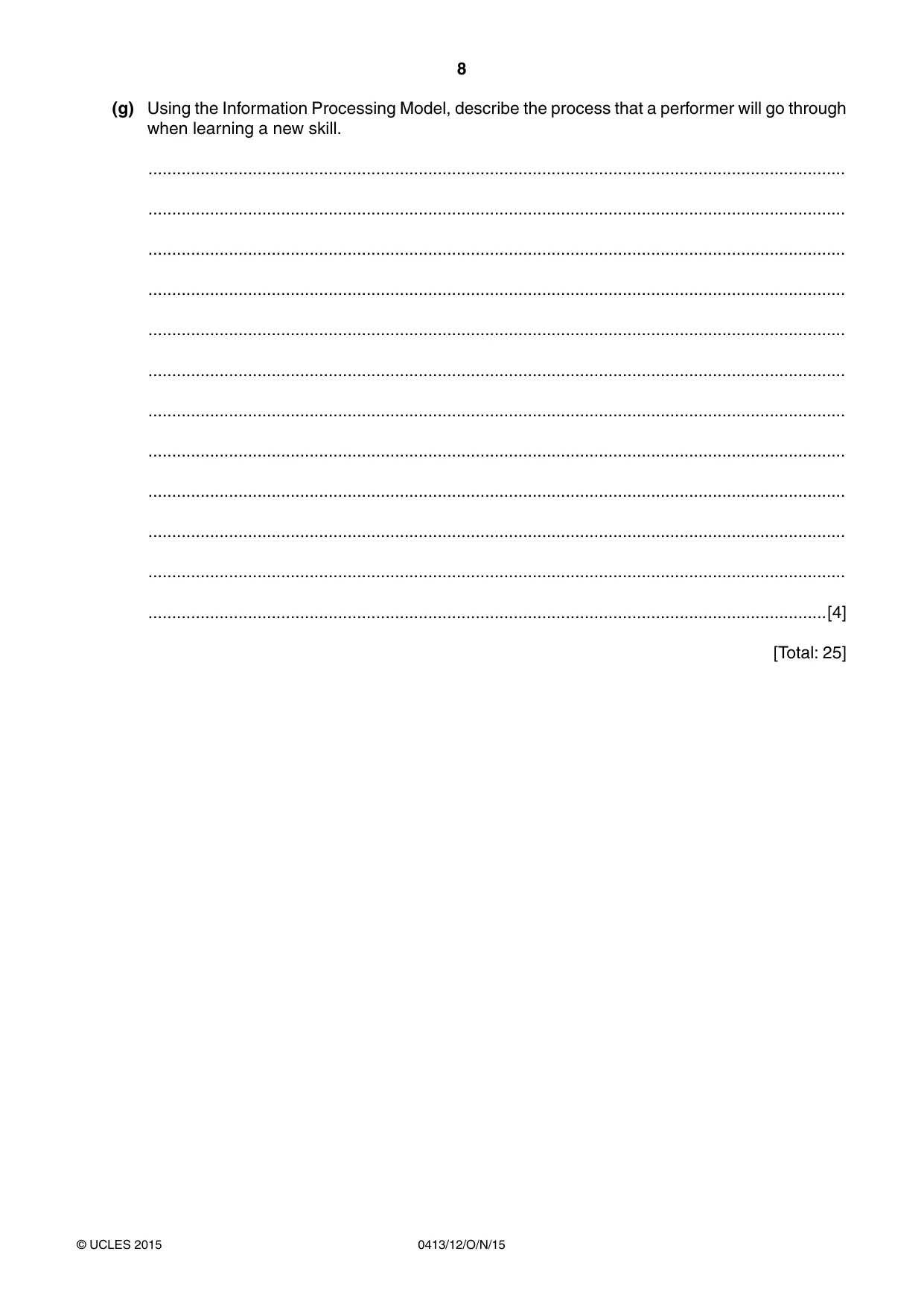
8 0413/12/O/N/15 © UCLES 2015 (g) Using the Information Processing Model, describe the process that a performer will go through when learning a new skill. … … … … … … … … … … … …[4] [Total: 25]
Question paper, page 9
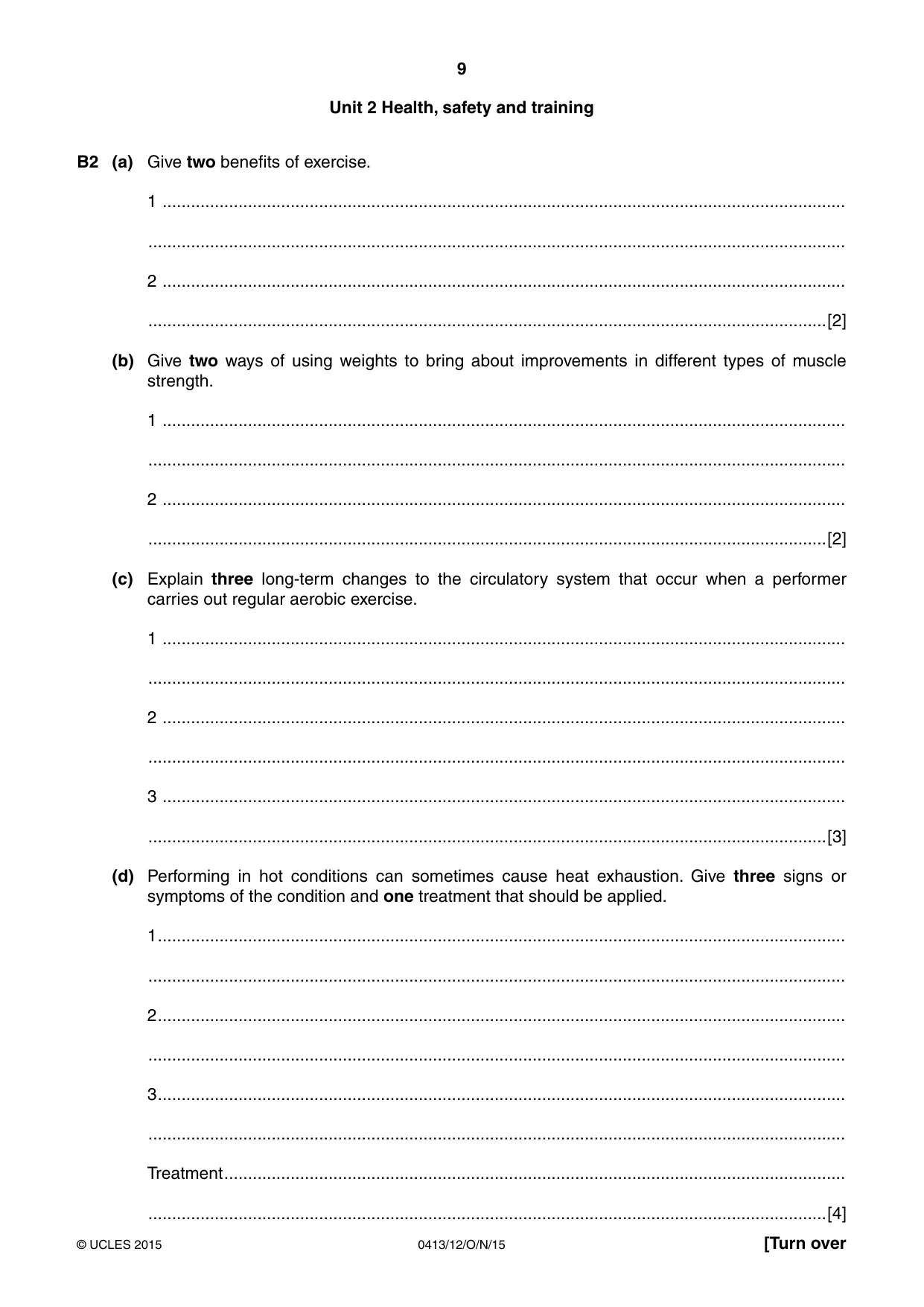
9 0413/12/O/N/15 © UCLES 2015 [Turn over Unit 2 Health, safety and training B2 (a) Give two benefits of exercise. 1 … … 2 … …[2] (b) Give two ways of using weights to bring about improvements in different types of muscle strength. 1 … … 2 … …[2] (c) Explain three long-term changes to the circulatory system that occur when a performer carries out regular aerobic exercise. 1 … … 2 … … 3 … …[3] (d) Performing in hot conditions can sometimes cause heat exhaustion. Give three signs or symptoms of the condition and one treatment that should be applied. 1 … … 2 … … 3 … … Treatment … …[4]
Question paper, page 10
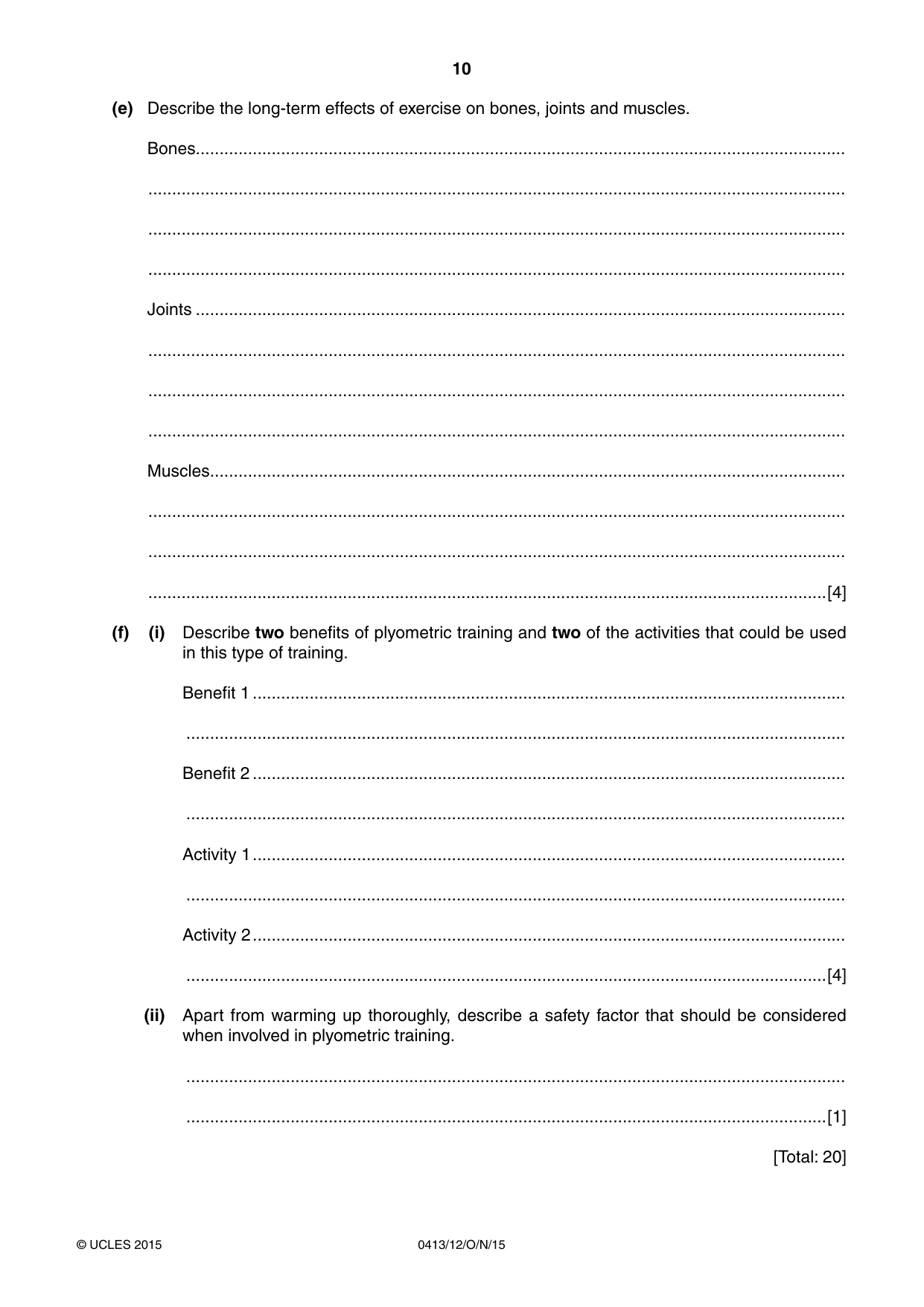
10 0413/12/O/N/15 © UCLES 2015 (e) Describe the long-term effects of exercise on bones, joints and muscles. Bones… … … … Joints … … … … Muscles… … … …[4] (f) (i) Describe two benefits of plyometric training and two of the activities that could be used in this type of training. Benefit 1 … … Benefit 2 … … Activity 1 … … Activity 2 … …[4] (ii) Apart from warming up thoroughly, describe a safety factor that should be considered when involved in plyometric training. … …[1] [Total: 20]
Question paper, page 11
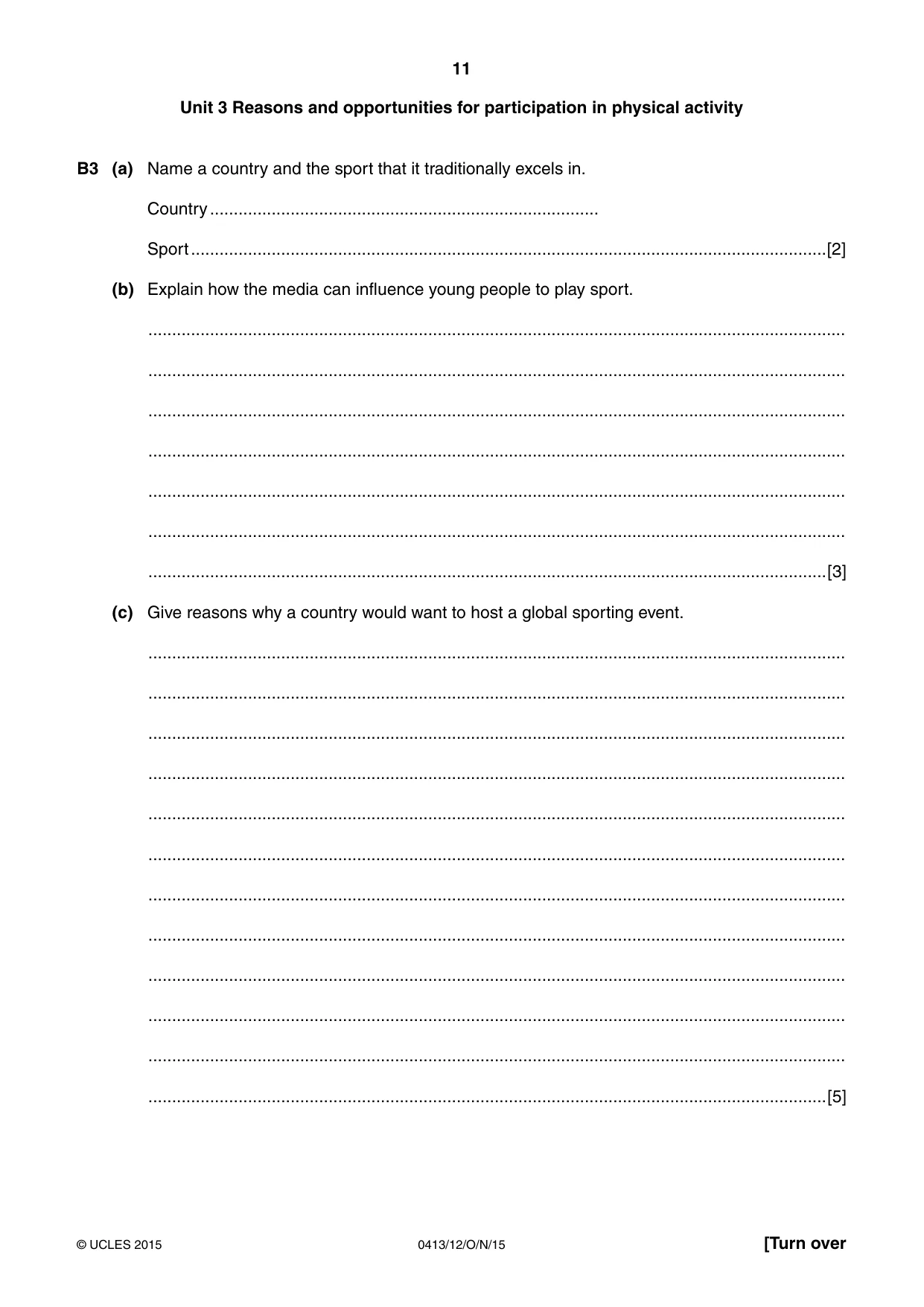
11 0413/12/O/N/15 © UCLES 2015 [Turn over Unit 3 Reasons and opportunities for participation in physical activity B3 (a) Name a country and the sport that it traditionally excels in. Country … Sport …[2] (b) Explain how the media can influence young people to play sport. … … … … … … …[3] (c) Give reasons why a country would want to host a global sporting event. … … … … … … … … … … … …[5]
Question paper, page 12
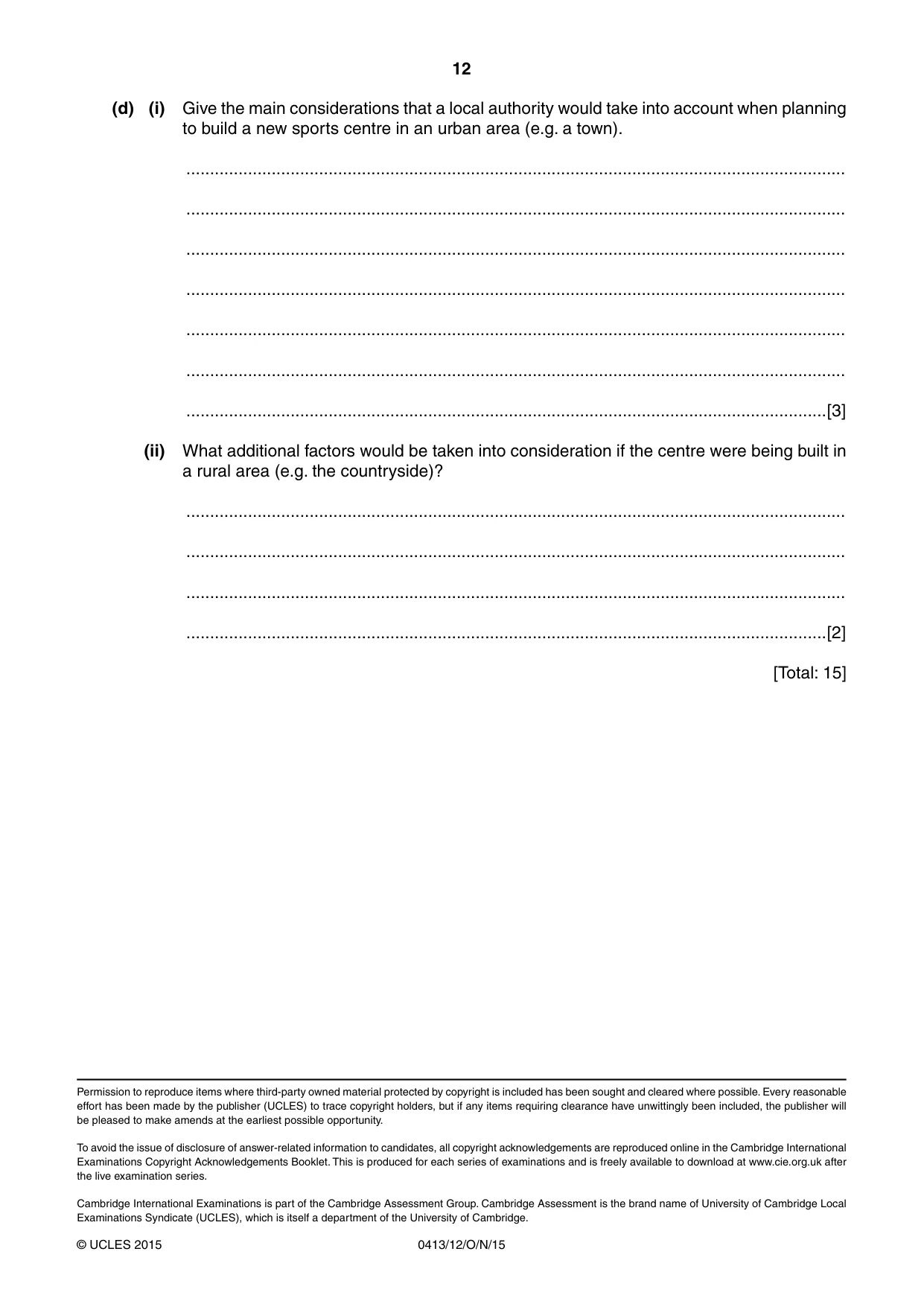
12 0413/12/O/N/15 © UCLES 2015 Permission to reproduce items where third-party owned material protected by copyright is included has been sought and cleared where possible. Every reasonable effort has been made by the publisher (UCLES) to trace copyright holders, but if any items requiring clearance have unwittingly been included, the publisher will be pleased to make amends at the earliest possible opportunity. To avoid the issue of disclosure of answer-related information to candidates, all copyright acknowledgements are reproduced online in the Cambridge International Examinations Copyright Acknowledgements Booklet. This is produced for each series of examinations and is freely available to download at www.cie.org.uk after the live examination series. Cambridge International Examinations is part of the Cambridge Assessment Group. Cambridge Assessment is the brand name of University of Cambridge Local Examinations Syndicate (UCLES), which is itself a department of the University of Cambridge. (d) (i) Give the main considerations that a local authority would take into account when planning to build a new sports centre in an urban area (e.g. a town). … … … … … … …[3] (ii) What additional factors would be taken into consideration if the centre were being built in a rural area (e.g. the countryside)? … … … …[2] [Total: 15]
Mark scheme, page 1
® IGCSE is the registered trademark of Cambridge International Examinations. CAMBRIDGE INTERNATIONAL EXAMINATIONS Cambridge International General Certificate of Secondary Education MARK SCHEME for the October/November 2015 series 0413 PHYSICAL EDUCATION 0413/12 Paper 1, maximum raw mark 80 This mark scheme is published as an aid to teachers and candidates, to indicate the requirements of the examination. It shows the basis on which Examiners were instructed to award marks. It does not indicate the details of the discussions that took place at an Examiners’ meeting before marking began, which would have considered the acceptability of alternative answers. Mark schemes should be read in conjunction with the question paper and the Principal Examiner Report for Teachers. Cambridge will not enter into discussions about these mark schemes. Cambridge is publishing the mark schemes for the October/November 2015 series for most Cambridge IGCSE®, Cambridge International A and AS Level components and some Cambridge O Level components.
Mark scheme, page 2
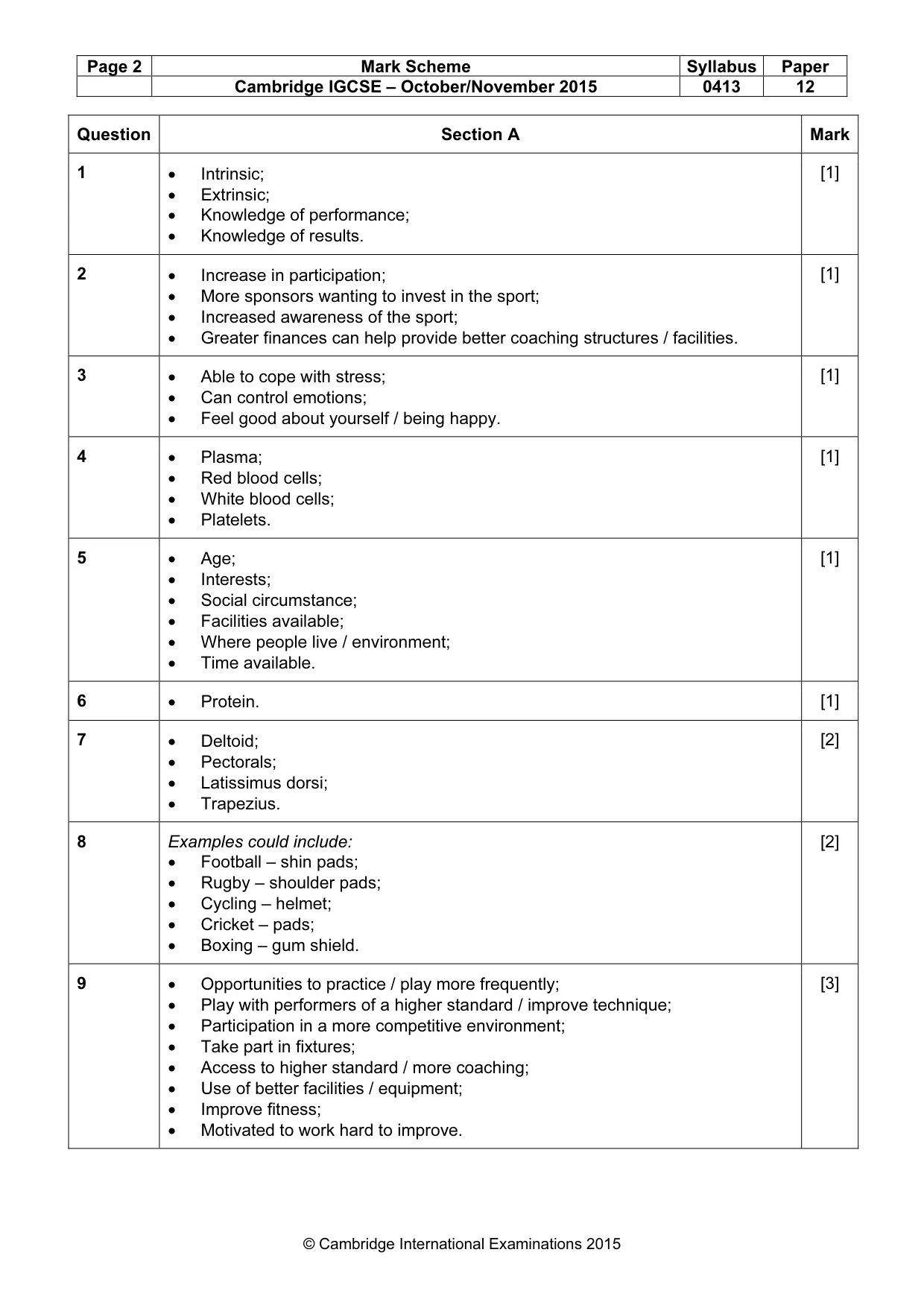
Page 2 Mark Scheme Syllabus Paper Cambridge IGCSE – October/November 2015 0413 12 © Cambridge International Examinations 2015 Question Section A Mark 1 • Intrinsic; • Extrinsic; • Knowledge of performance; • Knowledge of results. [1] 2 • Increase in participation; • More sponsors wanting to invest in the sport; • Increased awareness of the sport; • Greater finances can help provide better coaching structures / facilities. [1] 3 • Able to cope with stress; • Can control emotions; • Feel good about yourself / being happy. [1] 4 • Plasma; • Red blood cells; • White blood cells; • Platelets. [1] 5 • Age; • Interests; • Social circumstance; • Facilities available; • Where people live / environment; • Time available. [1] 6 • Protein. [1] 7 • Deltoid; • Pectorals; • Latissimus dorsi; • Trapezius. [2] 8 Examples could include: • Football – shin pads; • Rugby – shoulder pads; • Cycling – helmet; • Cricket – pads; • Boxing – gum shield. [2] 9 • Opportunities to practice / play more frequently; • Play with performers of a higher standard / improve technique; • Participation in a more competitive environment; • Take part in fixtures; • Access to higher standard / more coaching; • Use of better facilities / equipment; • Improve fitness; • Motivated to work hard to improve. [3]
Mark scheme, page 3
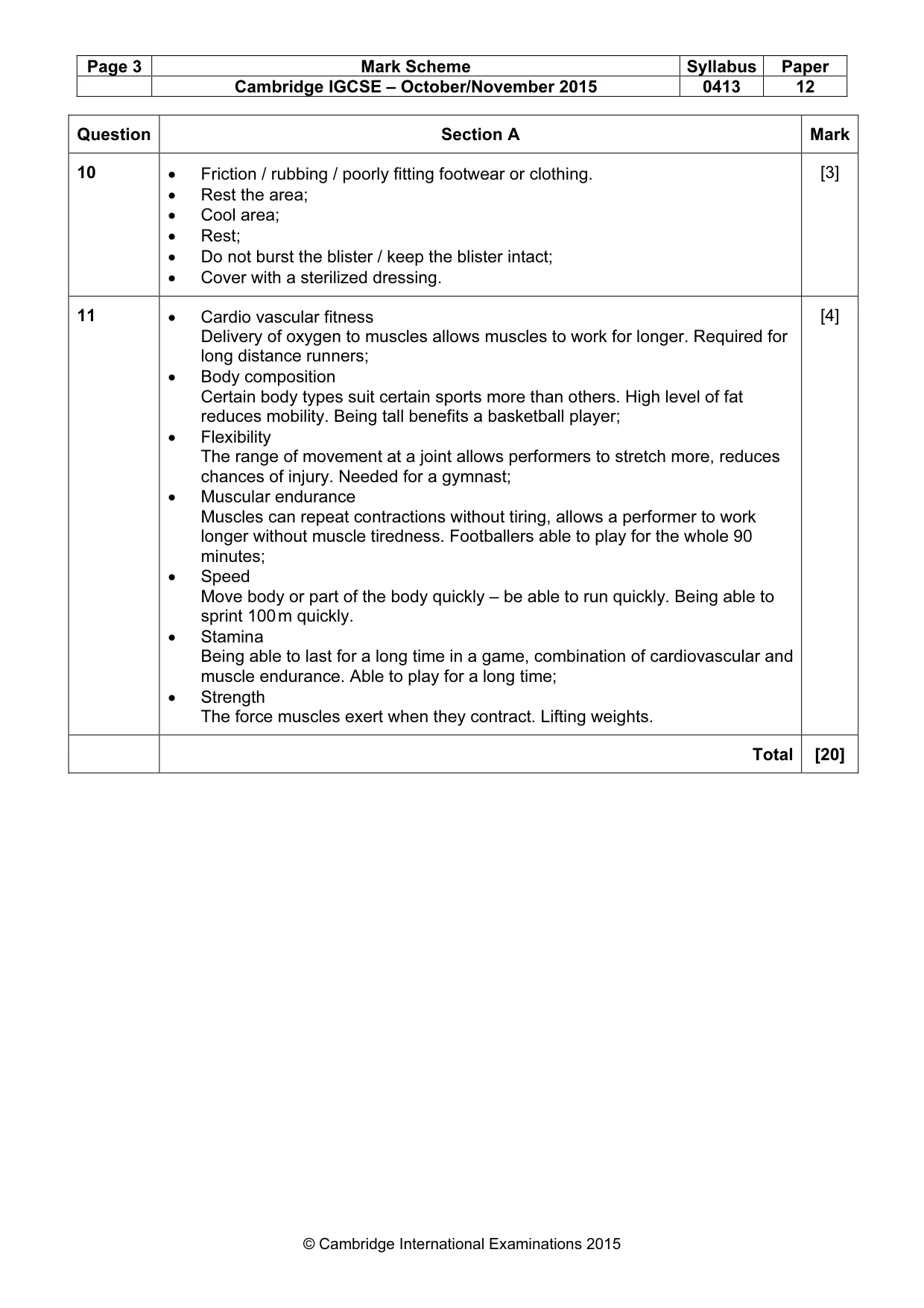
Page 3 Mark Scheme Syllabus Paper Cambridge IGCSE – October/November 2015 0413 12 © Cambridge International Examinations 2015 Question Section A Mark 10 • Friction / rubbing / poorly fitting footwear or clothing. • Rest the area; • Cool area; • Rest; • Do not burst the blister / keep the blister intact; • Cover with a sterilized dressing. [3] 11 • Cardio vascular fitness Delivery of oxygen to muscles allows muscles to work for longer. Required for long distance runners; • Body composition Certain body types suit certain sports more than others. High level of fat reduces mobility. Being tall benefits a basketball player; • Flexibility The range of movement at a joint allows performers to stretch more, reduces chances of injury. Needed for a gymnast; • Muscular endurance Muscles can repeat contractions without tiring, allows a performer to work longer without muscle tiredness. Footballers able to play for the whole 90 minutes; • Speed Move body or part of the body quickly – be able to run quickly. Being able to sprint 100 m quickly. • Stamina Being able to last for a long time in a game, combination of cardiovascular and muscle endurance. Able to play for a long time; • Strength The force muscles exert when they contract. Lifting weights. [4] Total [20]
Mark scheme, page 4
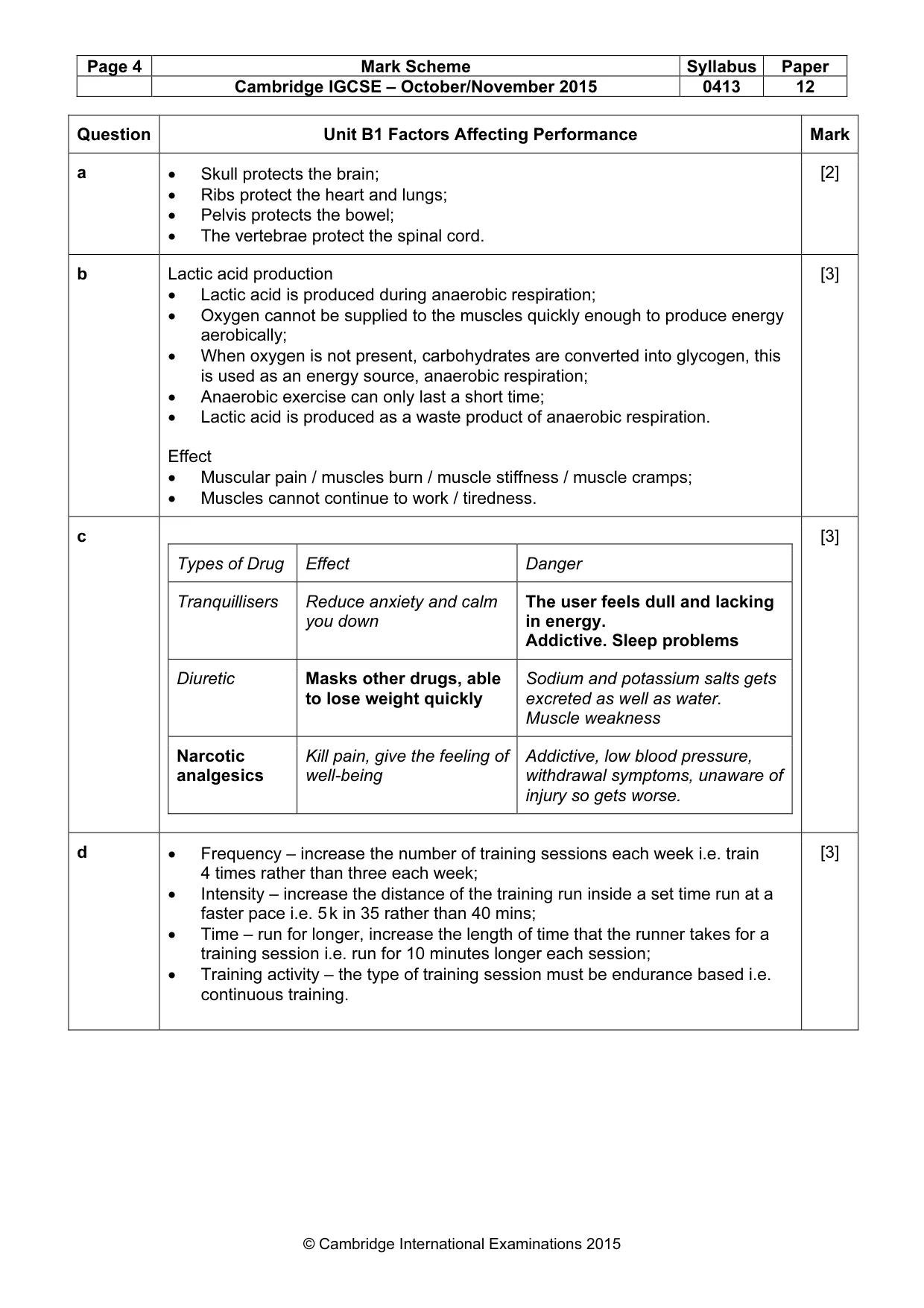
Page 4 Mark Scheme Syllabus Paper Cambridge IGCSE – October/November 2015 0413 12 © Cambridge International Examinations 2015 Question Unit B1 Factors Affecting Performance Mark a • Skull protects the brain; • Ribs protect the heart and lungs; • Pelvis protects the bowel; • The vertebrae protect the spinal cord. [2] b Lactic acid production • Lactic acid is produced during anaerobic respiration; • Oxygen cannot be supplied to the muscles quickly enough to produce energy aerobically; • When oxygen is not present, carbohydrates are converted into glycogen, this is used as an energy source, anaerobic respiration; • Anaerobic exercise can only last a short time; • Lactic acid is produced as a waste product of anaerobic respiration. Effect • Muscular pain / muscles burn / muscle stiffness / muscle cramps; • Muscles cannot continue to work / tiredness. [3] c Types of Drug Effect Danger Tranquillisers Reduce anxiety and calm you down The user feels dull and lacking in energy. Addictive. Sleep problems Diuretic Masks other drugs, able to lose weight quickly Sodium and potassium salts gets excreted as well as water. Muscle weakness Narcotic analgesics Kill pain, give the feeling of well-being Addictive, low blood pressure, withdrawal symptoms, unaware of injury so gets worse. [3] d • Frequency – increase the number of training sessions each week i.e. train 4 times rather than three each week; • Intensity – increase the distance of the training run inside a set time run at a faster pace i.e. 5 k in 35 rather than 40 mins; • Time – run for longer, increase the length of time that the runner takes for a training session i.e. run for 10 minutes longer each session; • Training activity – the type of training session must be endurance based i.e. continuous training. [3]
Mark scheme, page 5
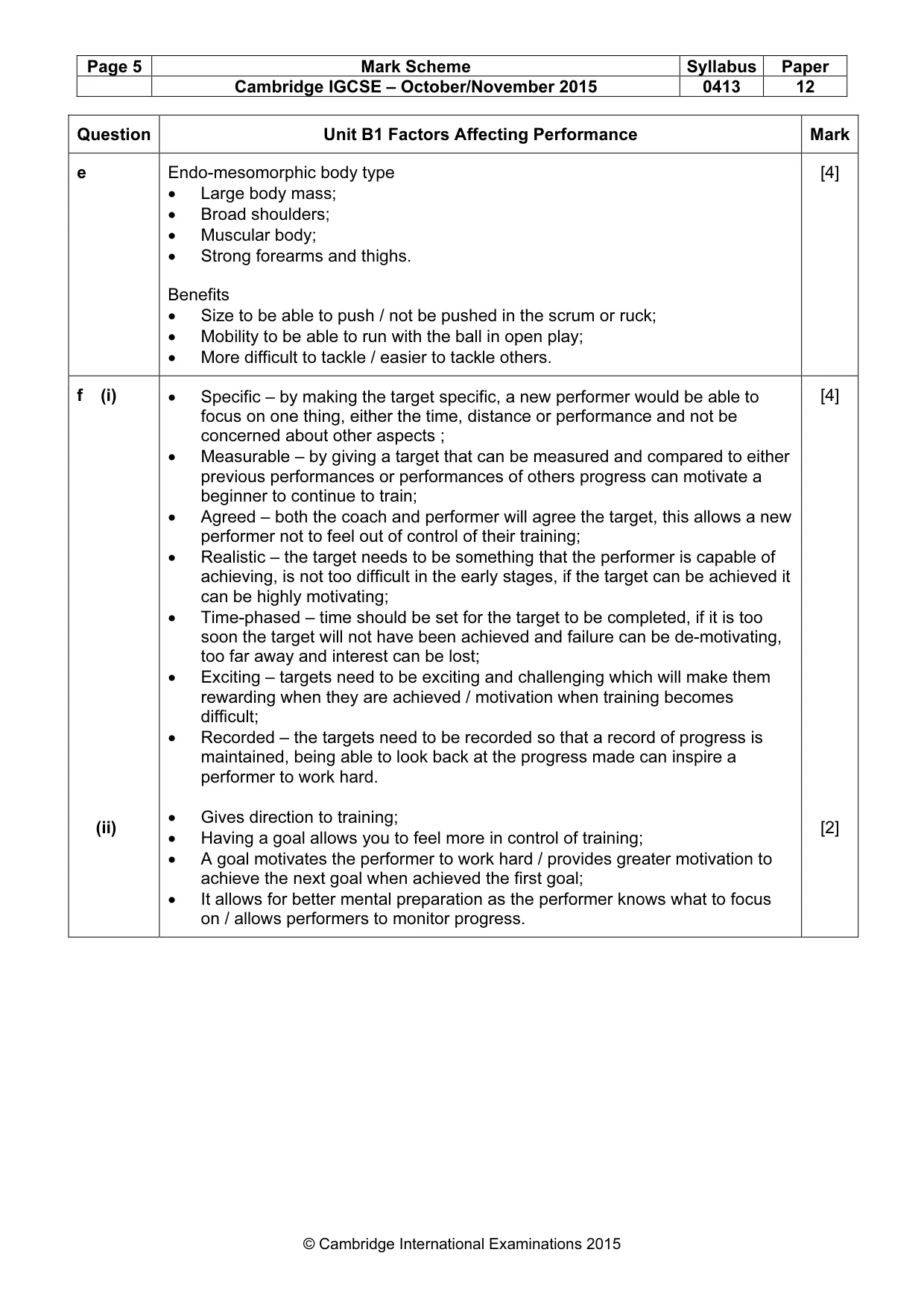
Page 5 Mark Scheme Syllabus Paper Cambridge IGCSE – October/November 2015 0413 12 © Cambridge International Examinations 2015 Question Unit B1 Factors Affecting Performance Mark e Endo-mesomorphic body type • Large body mass; • Broad shoulders; • Muscular body; • Strong forearms and thighs. Benefits • Size to be able to push / not be pushed in the scrum or ruck; • Mobility to be able to run with the ball in open play; • More difficult to tackle / easier to tackle others. [4] f (i) (ii) • Specific – by making the target specific, a new performer would be able to focus on one thing, either the time, distance or performance and not be concerned about other aspects ; • Measurable – by giving a target that can be measured and compared to either previous performances or performances of others progress can motivate a beginner to continue to train; • Agreed – both the coach and performer will agree the target, this allows a new performer not to feel out of control of their training; • Realistic – the target needs to be something that the performer is capable of achieving, is not too difficult in the early stages, if the target can be achieved it can be highly motivating; • Time-phased – time should be set for the target to be completed, if it is too soon the target will not have been achieved and failure can be de-motivating, too far away and interest can be lost; • Exciting – targets need to be exciting and challenging which will make them rewarding when they are achieved / motivation when training becomes difficult; • Recorded – the targets need to be recorded so that a record of progress is maintained, being able to look back at the progress made can inspire a performer to work hard. • Gives direction to training; • Having a goal allows you to feel more in control of training; • A goal motivates the performer to work hard / provides greater motivation to achieve the next goal when achieved the first goal; • It allows for better mental preparation as the performer knows what to focus on / allows performers to monitor progress. [4] [2]
Mark scheme, page 6
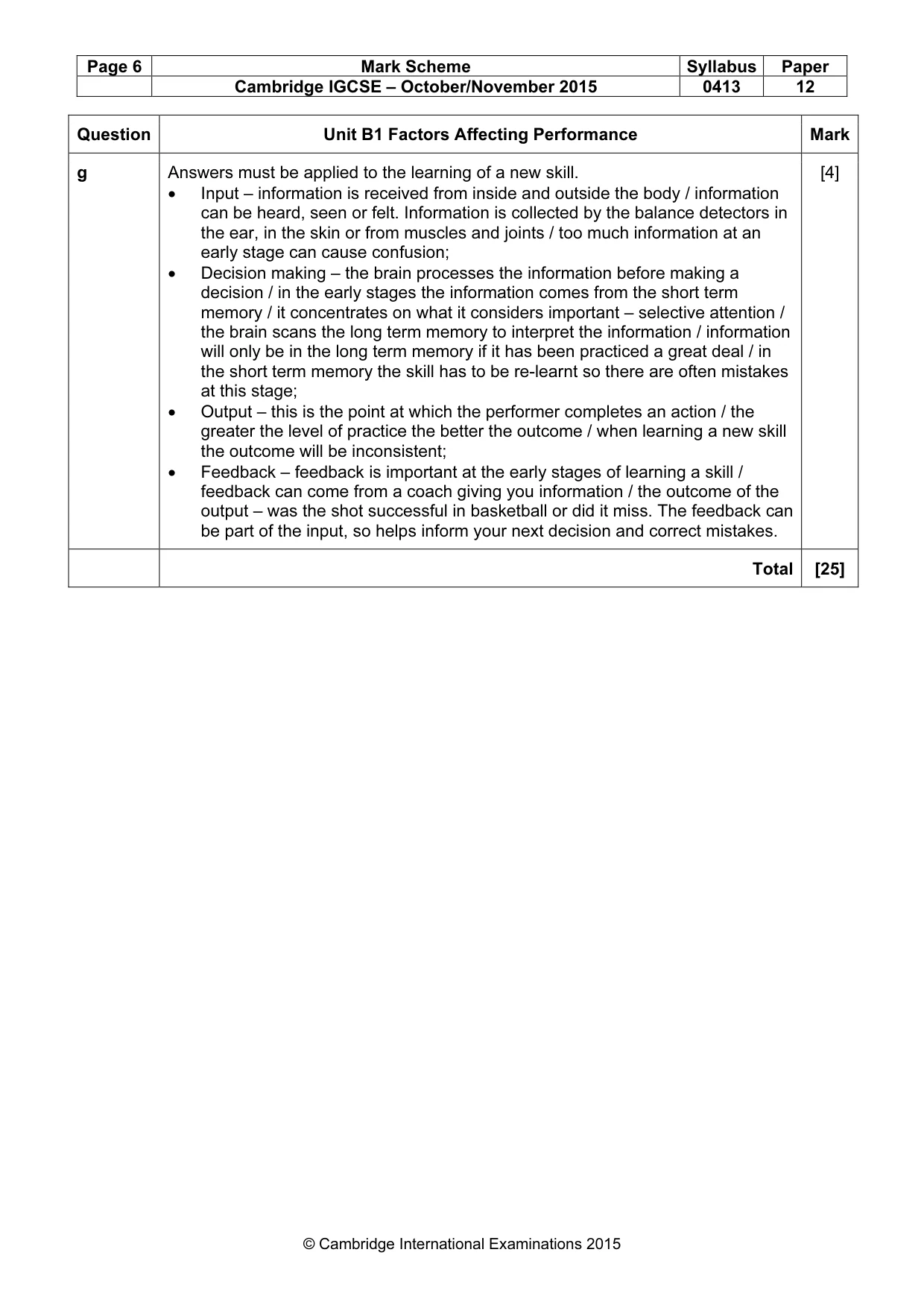
Page 6 Mark Scheme Syllabus Paper Cambridge IGCSE – October/November 2015 0413 12 © Cambridge International Examinations 2015 Question Unit B1 Factors Affecting Performance Mark g Answers must be applied to the learning of a new skill. • Input – information is received from inside and outside the body / information can be heard, seen or felt. Information is collected by the balance detectors in the ear, in the skin or from muscles and joints / too much information at an early stage can cause confusion; • Decision making – the brain processes the information before making a decision / in the early stages the information comes from the short term memory / it concentrates on what it considers important – selective attention / the brain scans the long term memory to interpret the information / information will only be in the long term memory if it has been practiced a great deal / in the short term memory the skill has to be re-learnt so there are often mistakes at this stage; • Output – this is the point at which the performer completes an action / the greater the level of practice the better the outcome / when learning a new skill the outcome will be inconsistent; • Feedback – feedback is important at the early stages of learning a skill / feedback can come from a coach giving you information / the outcome of the output – was the shot successful in basketball or did it miss. The feedback can be part of the input, so helps inform your next decision and correct mistakes. [4] Total [25]
Mark scheme, page 7
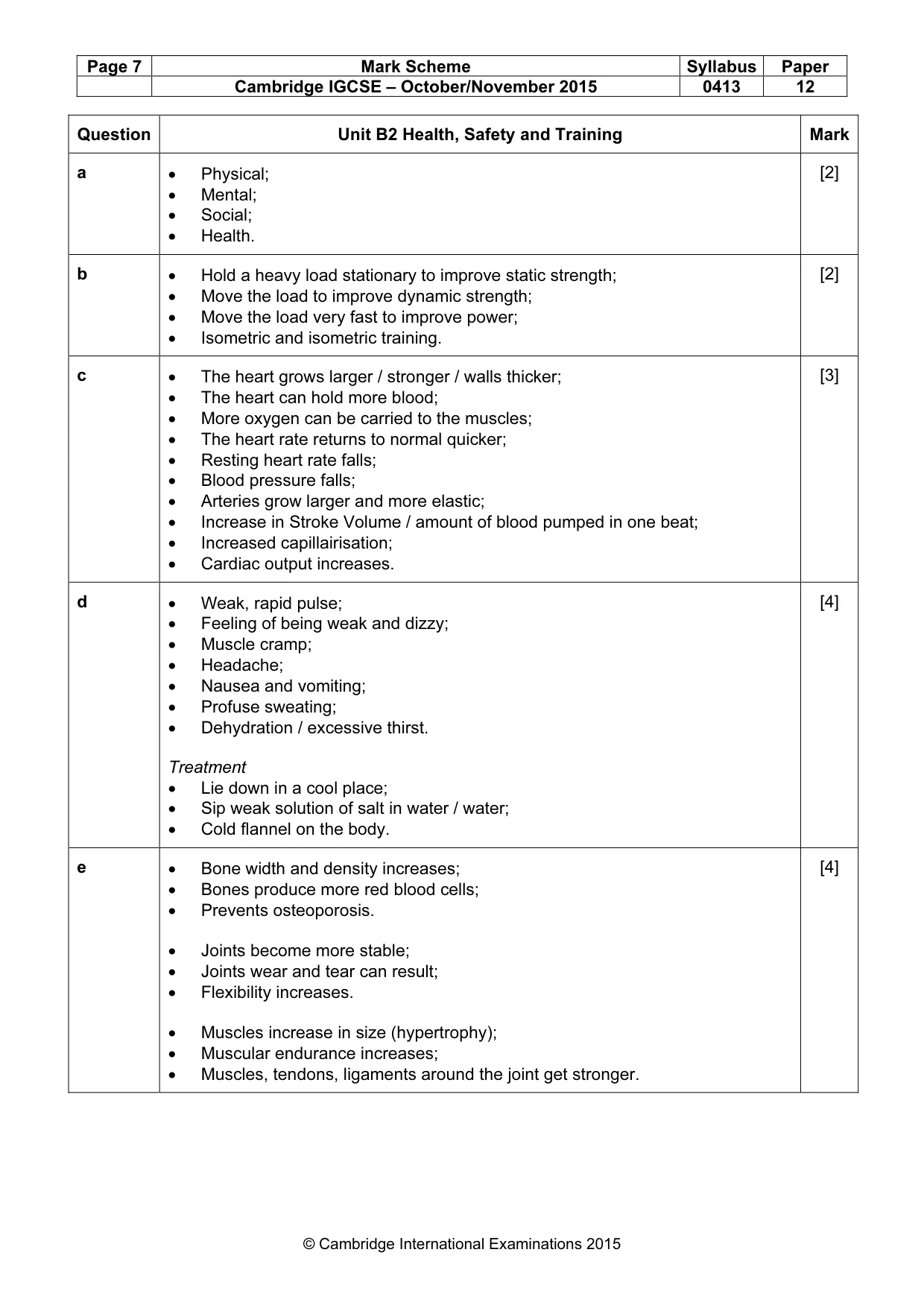
Page 7 Mark Scheme Syllabus Paper Cambridge IGCSE – October/November 2015 0413 12 © Cambridge International Examinations 2015 Question Unit B2 Health, Safety and Training Mark a • Physical; • Mental; • Social; • Health. [2] b • Hold a heavy load stationary to improve static strength; • Move the load to improve dynamic strength; • Move the load very fast to improve power; • Isometric and isometric training. [2] c • The heart grows larger / stronger / walls thicker; • The heart can hold more blood; • More oxygen can be carried to the muscles; • The heart rate returns to normal quicker; • Resting heart rate falls; • Blood pressure falls; • Arteries grow larger and more elastic; • Increase in Stroke Volume / amount of blood pumped in one beat; • Increased capillairisation; • Cardiac output increases. [3] d • Weak, rapid pulse; • Feeling of being weak and dizzy; • Muscle cramp; • Headache; • Nausea and vomiting; • Profuse sweating; • Dehydration / excessive thirst. Treatment • Lie down in a cool place; • Sip weak solution of salt in water / water; • Cold flannel on the body. [4] e • Bone width and density increases; • Bones produce more red blood cells; • Prevents osteoporosis. • Joints become more stable; • Joints wear and tear can result; • Flexibility increases. • Muscles increase in size (hypertrophy); • Muscular endurance increases; • Muscles, tendons, ligaments around the joint get stronger. [4]
Mark scheme, page 8
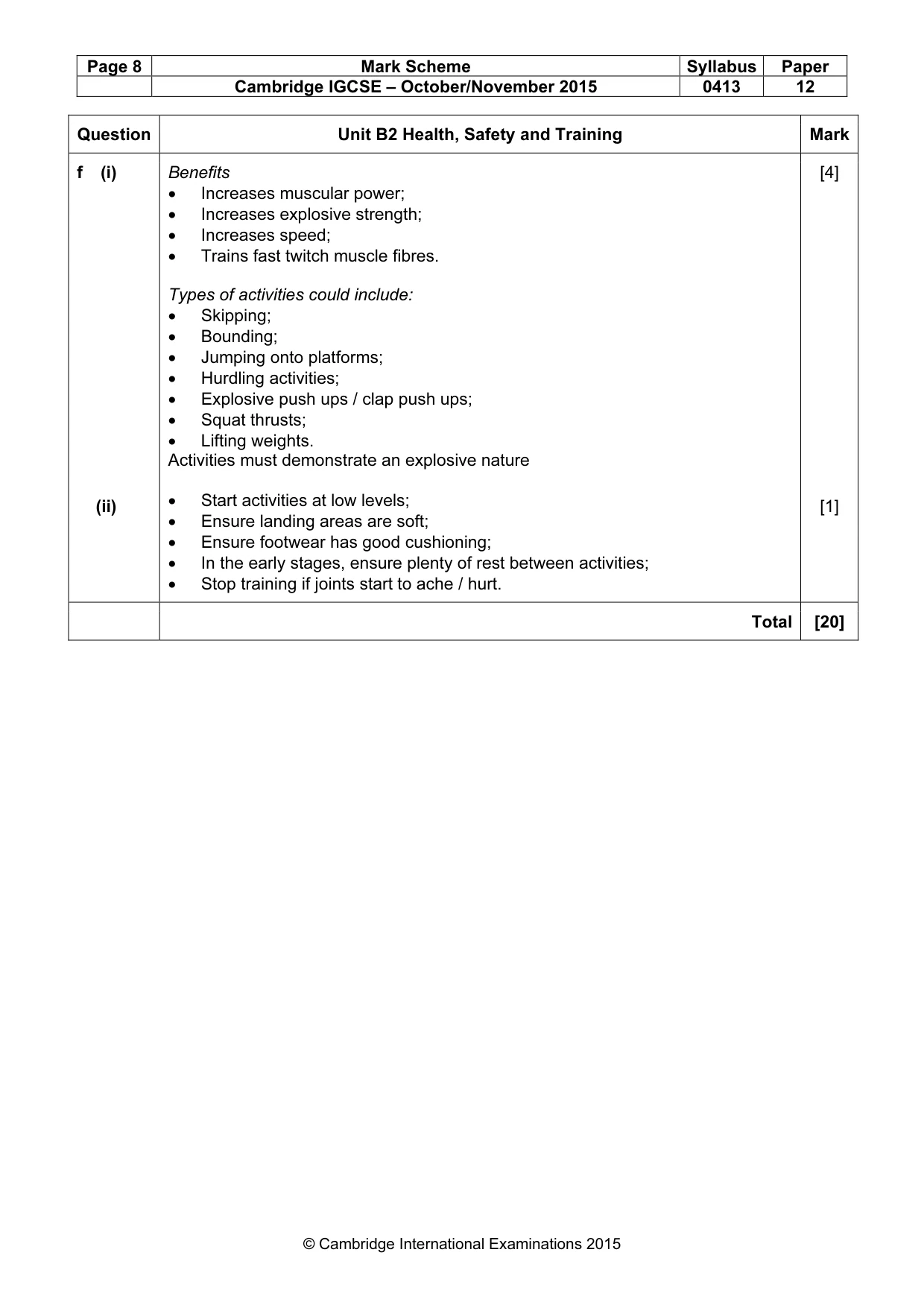
Page 8 Mark Scheme Syllabus Paper Cambridge IGCSE – October/November 2015 0413 12 © Cambridge International Examinations 2015 Question Unit B2 Health, Safety and Training Mark f (i) (ii) Benefits • Increases muscular power; • Increases explosive strength; • Increases speed; • Trains fast twitch muscle fibres. Types of activities could include: • Skipping; • Bounding; • Jumping onto platforms; • Hurdling activities; • Explosive push ups / clap push ups; • Squat thrusts; • Lifting weights. Activities must demonstrate an explosive nature • Start activities at low levels; • Ensure landing areas are soft; • Ensure footwear has good cushioning; • In the early stages, ensure plenty of rest between activities; • Stop training if joints start to ache / hurt. [4] [1] Total [20]
Mark scheme, page 9
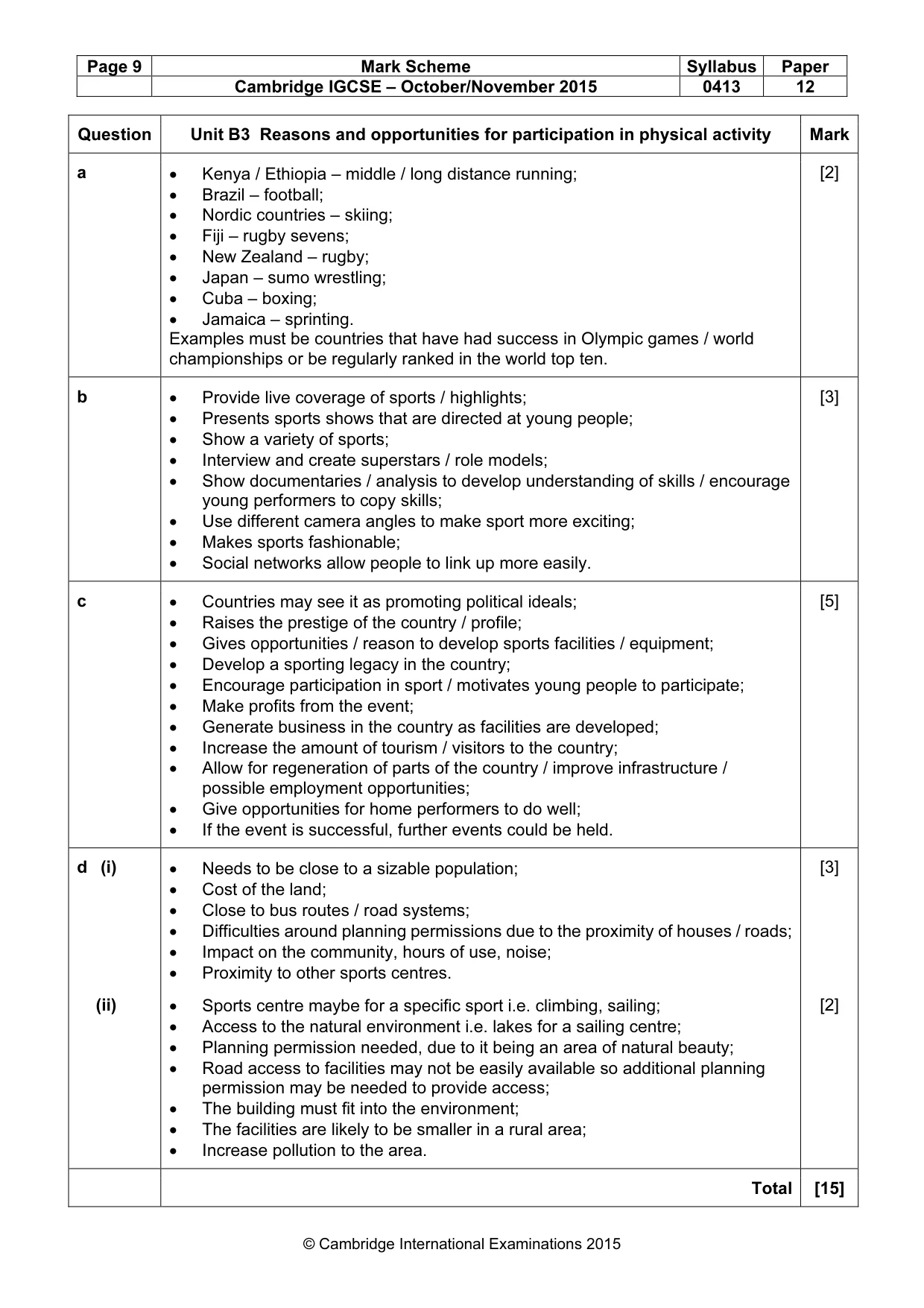
Page 9 Mark Scheme Syllabus Paper Cambridge IGCSE – October/November 2015 0413 12 © Cambridge International Examinations 2015 Question Unit B3 Reasons and opportunities for participation in physical activity Mark a • Kenya / Ethiopia – middle / long distance running; • Brazil – football; • Nordic countries – skiing; • Fiji – rugby sevens; • New Zealand – rugby; • Japan – sumo wrestling; • Cuba – boxing; • Jamaica – sprinting. Examples must be countries that have had success in Olympic games / world championships or be regularly ranked in the world top ten. [2] b • Provide live coverage of sports / highlights; • Presents sports shows that are directed at young people; • Show a variety of sports; • Interview and create superstars / role models; • Show documentaries / analysis to develop understanding of skills / encourage young performers to copy skills; • Use different camera angles to make sport more exciting; • Makes sports fashionable; • Social networks allow people to link up more easily. [3] c • Countries may see it as promoting political ideals; • Raises the prestige of the country / profile; • Gives opportunities / reason to develop sports facilities / equipment; • Develop a sporting legacy in the country; • Encourage participation in sport / motivates young people to participate; • Make profits from the event; • Generate business in the country as facilities are developed; • Increase the amount of tourism / visitors to the country; • Allow for regeneration of parts of the country / improve infrastructure / possible employment opportunities; • Give opportunities for home performers to do well; • If the event is successful, further events could be held. [5] d (i) (ii) • Needs to be close to a sizable population; • Cost of the land; • Close to bus routes / road systems; • Difficulties around planning permissions due to the proximity of houses / roads; • Impact on the community, hours of use, noise; • Proximity to other sports centres. • Sports centre maybe for a specific sport i.e. climbing, sailing; • Access to the natural environment i.e. lakes for a sailing centre; • Planning permission needed, due to it being an area of natural beauty; • Road access to facilities may not be easily available so additional planning permission may be needed to provide access; • The building must fit into the environment; • The facilities are likely to be smaller in a rural area; • Increase pollution to the area. [3] [2] Total [15]
What you needed in this session
Cambridge’s own grade thresholds for 2015 Oct/Nov, Paper 1 · Variant 2. A higher threshold means an easier paper — the bar moves with how the cohort did.