Cambridge IGCSE Physical Education 0413 — 2015 Oct/Nov Paper 1 · Variant 3
0413/13/O/N/15 · 80 marks · ≈90 min
The question paper and its mark scheme, free to read here and free to download. This is Cambridge’s own paper, exactly as it was sat.
Question paper12 pages

Mark scheme9 pages
Answers below. Sit the paper first if you are practising.
Paper as text
Question paper, page 1
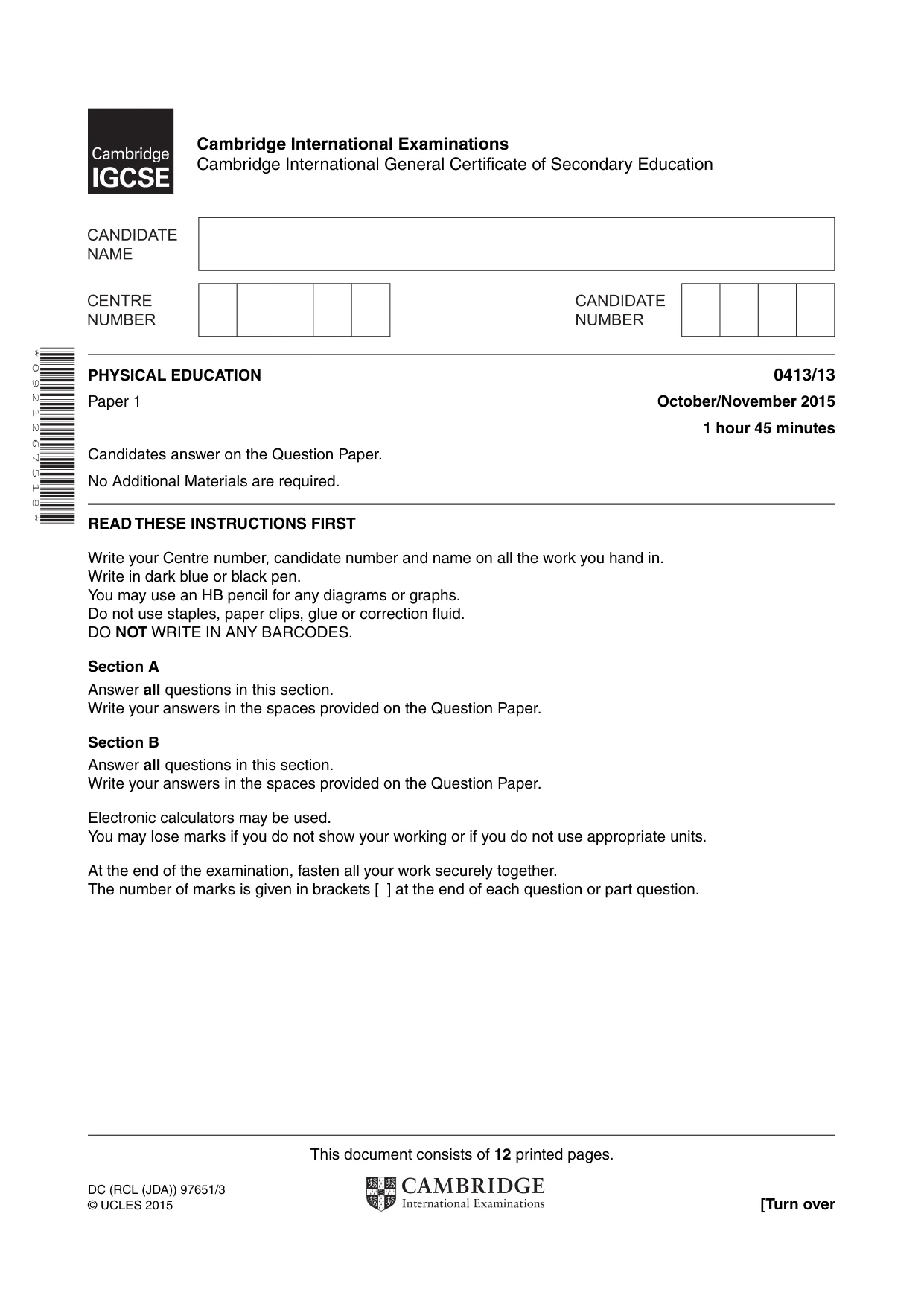
This document consists of 12 printed pages. DC (RCL (JDA)) 97651/3 © UCLES 2015 [Turn over Cambridge International Examinations Cambridge International General Certificate of Secondary Education * 0 9 2 1 2 6 7 5 1 8 * PHYSICAL EDUCATION 0413/13 Paper 1 October/November 2015 1 hour 45 minutes Candidates answer on the Question Paper. No Additional Materials are required. READ THESE INSTRUCTIONS FIRST Write your Centre number, candidate number and name on all the work you hand in. Write in dark blue or black pen. You may use an HB pencil for any diagrams or graphs. Do not use staples, paper clips, glue or correction fluid. DO NOT WRITE IN ANY BARCODES. Section A Answer all questions in this section. Write your answers in the spaces provided on the Question Paper. Section B Answer all questions in this section. Write your answers in the spaces provided on the Question Paper. Electronic calculators may be used. You may lose marks if you do not show your working or if you do not use appropriate units. At the end of the examination, fasten all your work securely together. The number of marks is given in brackets [ ] at the end of each question or part question.
Question paper, page 2
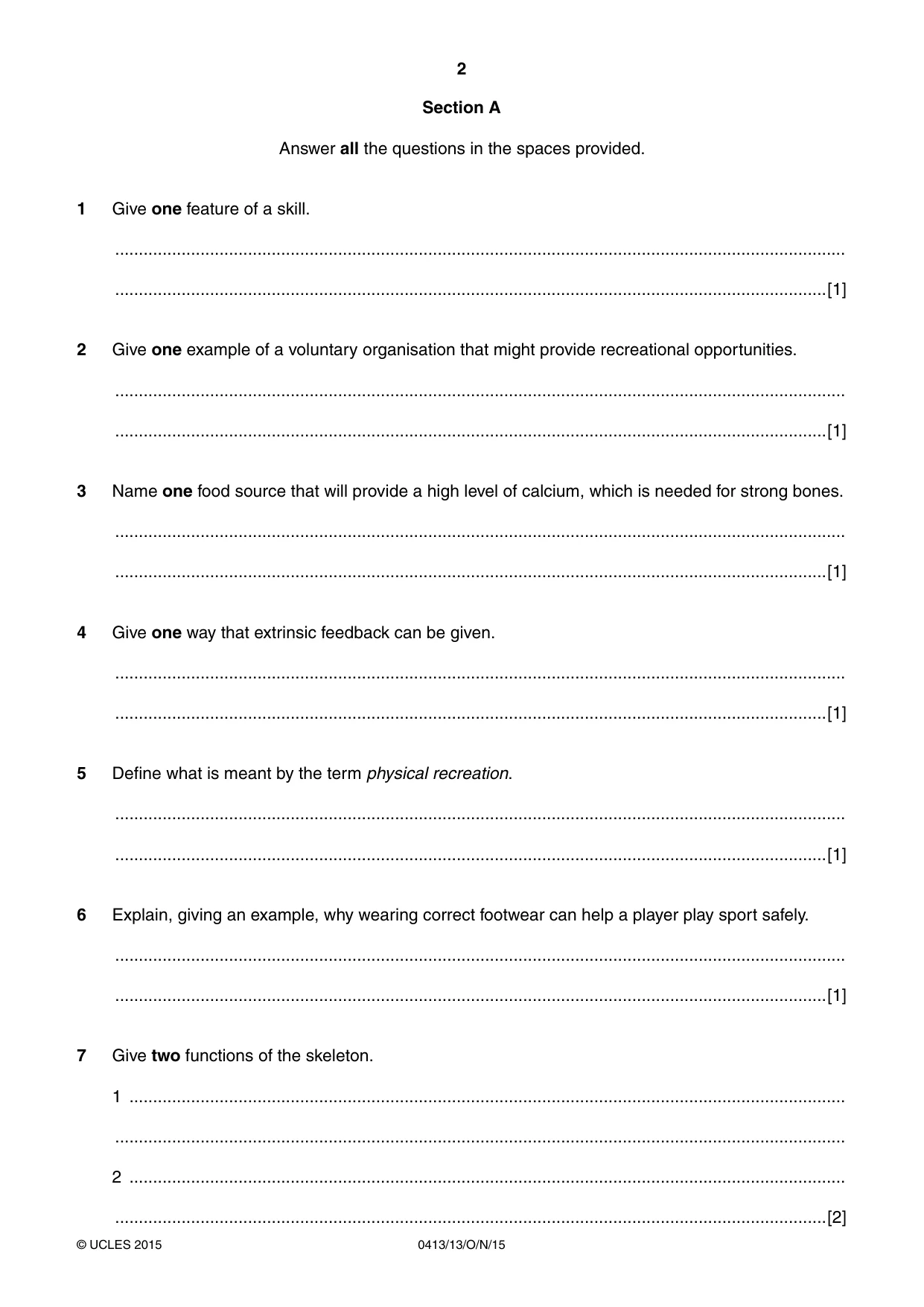
2 0413/13/O/N/15 © UCLES 2015 Section A Answer all the questions in the spaces provided. 1 Give one feature of a skill. … …[1] 2 Give one example of a voluntary organisation that might provide recreational opportunities. … …[1] 3 Name one food source that will provide a high level of calcium, which is needed for strong bones. … …[1] 4 Give one way that extrinsic feedback can be given. … …[1] 5 Define what is meant by the term physical recreation. … …[1] 6 Explain, giving an example, why wearing correct footwear can help a player play sport safely. … …[1] 7 Give two functions of the skeleton. 1 … … 2 … …[2]
Question paper, page 3
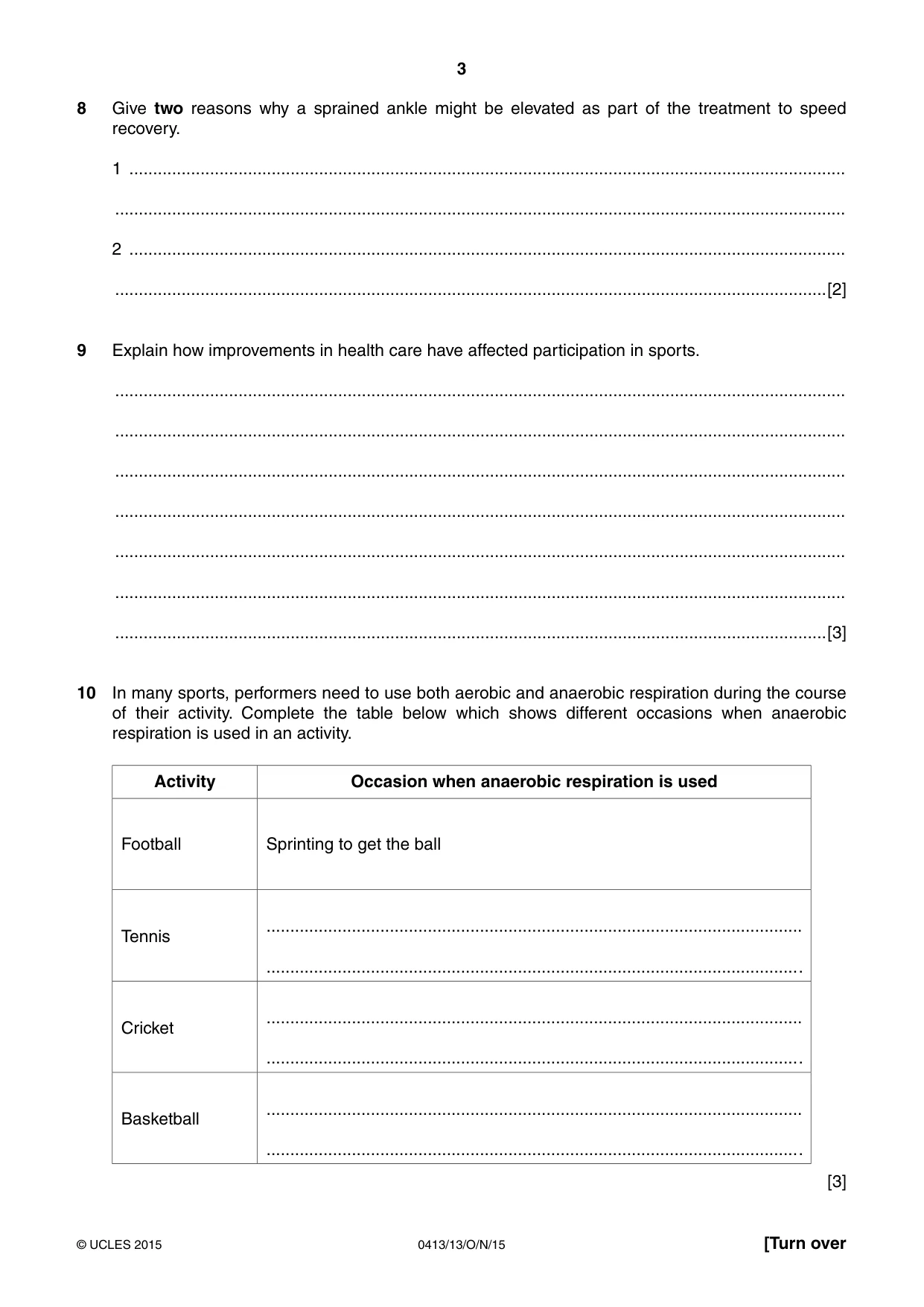
3 0413/13/O/N/15 © UCLES 2015 [Turn over 8 Give two reasons why a sprained ankle might be elevated as part of the treatment to speed recovery. 1 … … 2 … …[2] 9 Explain how improvements in health care have affected participation in sports. … … … … … … …[3] 10 In many sports, performers need to use both aerobic and anaerobic respiration during the course of their activity. Complete the table below which shows different occasions when anaerobic respiration is used in an activity. Activity Occasion when anaerobic respiration is used Football Sprinting to get the ball Tennis … … Cricket … … Basketball … … [3]
Question paper, page 4
4 0413/13/O/N/15 © UCLES 2015 11 Describe the role and function of tendons. … … … … … … … … …[4] [Total: 20]
Question paper, page 5
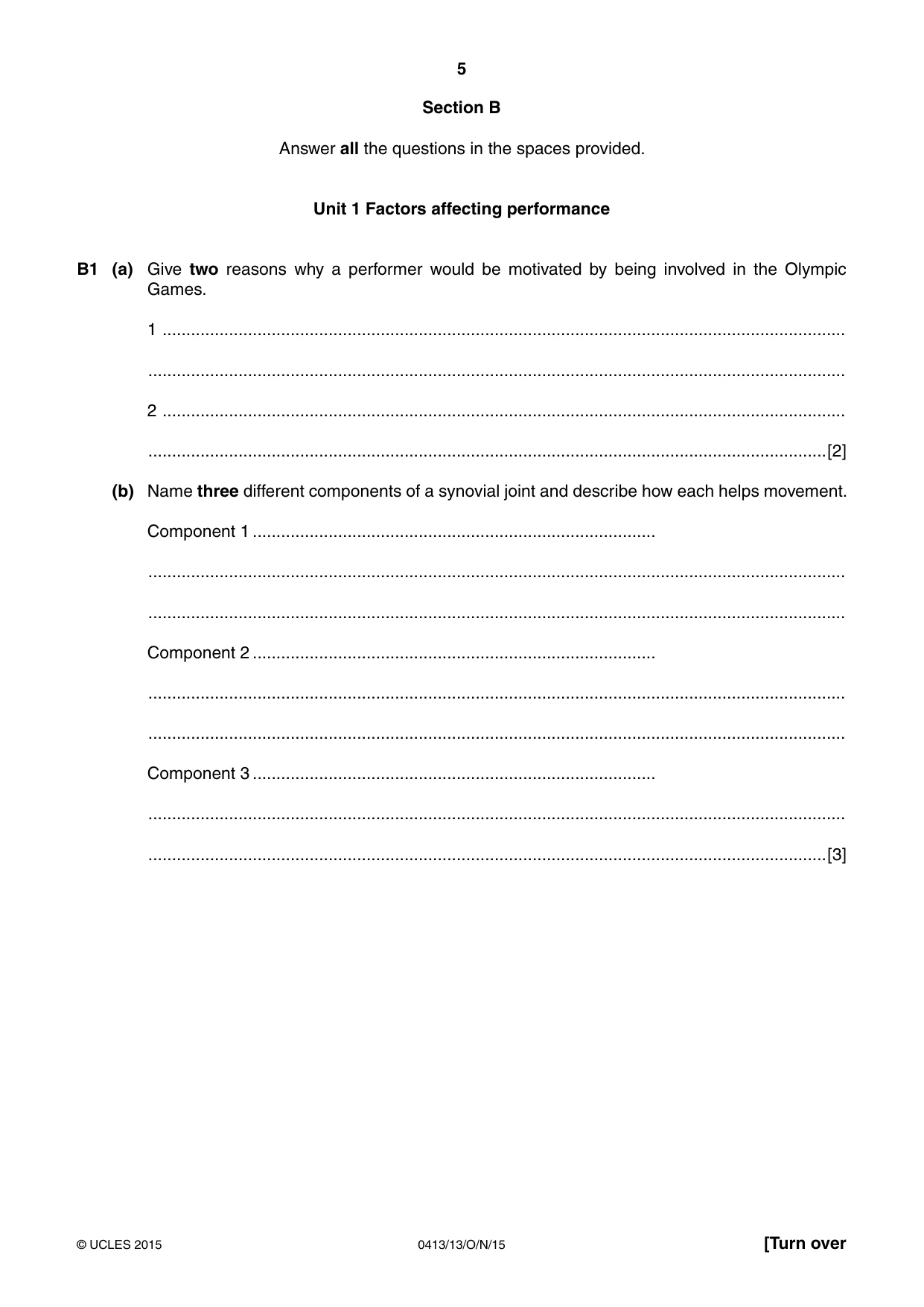
5 0413/13/O/N/15 © UCLES 2015 [Turn over Section B Answer all the questions in the spaces provided. Unit 1 Factors affecting performance B1 (a) Give two reasons why a performer would be motivated by being involved in the Olympic Games. 1 … … 2 … …[2] (b) Name three different components of a synovial joint and describe how each helps movement. Component 1 … … … Component 2 … … … Component 3 … … …[3]
Question paper, page 6
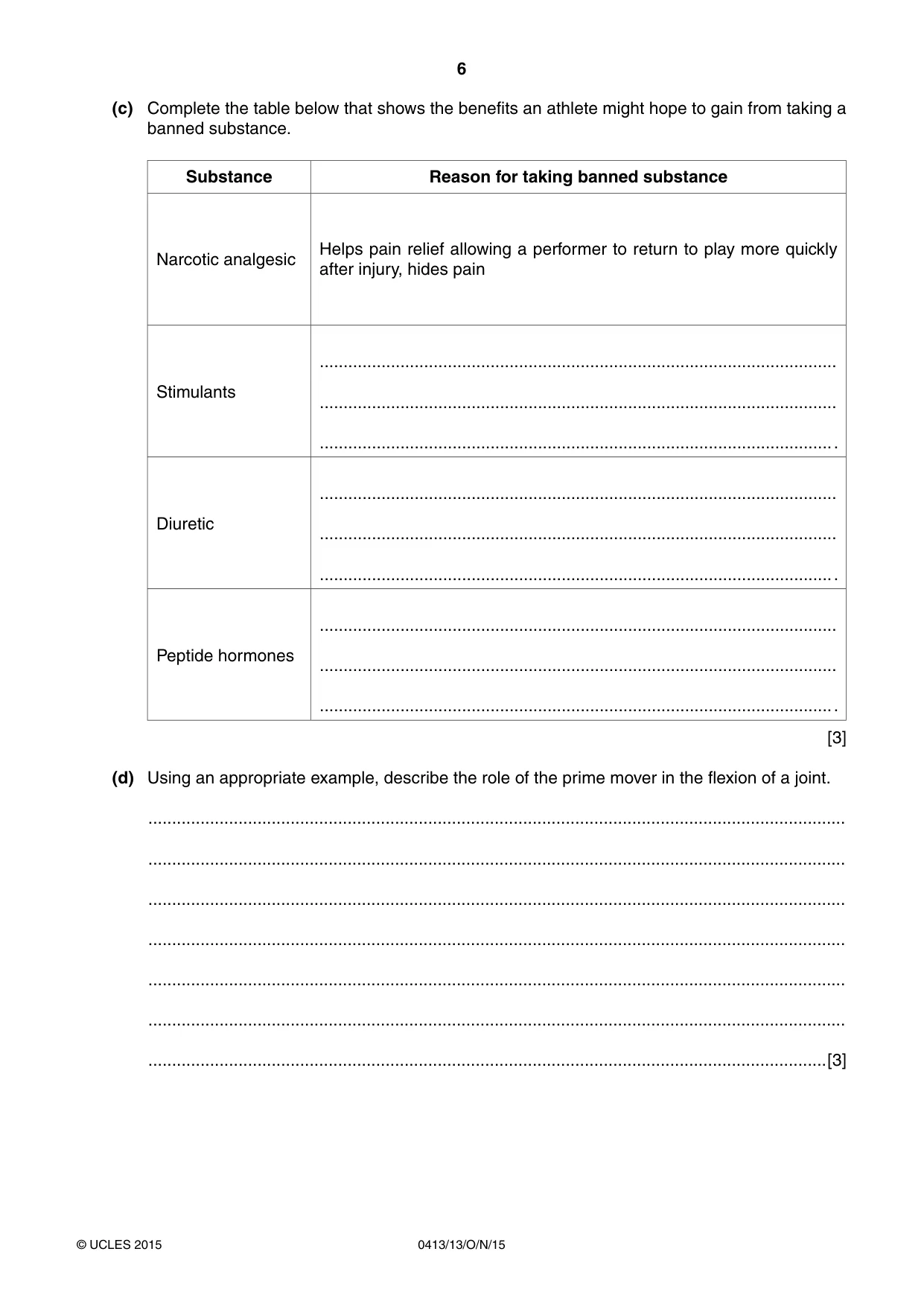
6 0413/13/O/N/15 © UCLES 2015 (c) Complete the table below that shows the benefits an athlete might hope to gain from taking a banned substance. Substance Reason for taking banned substance Narcotic analgesic Helps pain relief allowing a performer to return to play more quickly after injury, hides pain Stimulants … … … Diuretic … … … Peptide hormones … … … [3] (d) Using an appropriate example, describe the role of the prime mover in the flexion of a joint. … … … … … … …[3]
Question paper, page 7
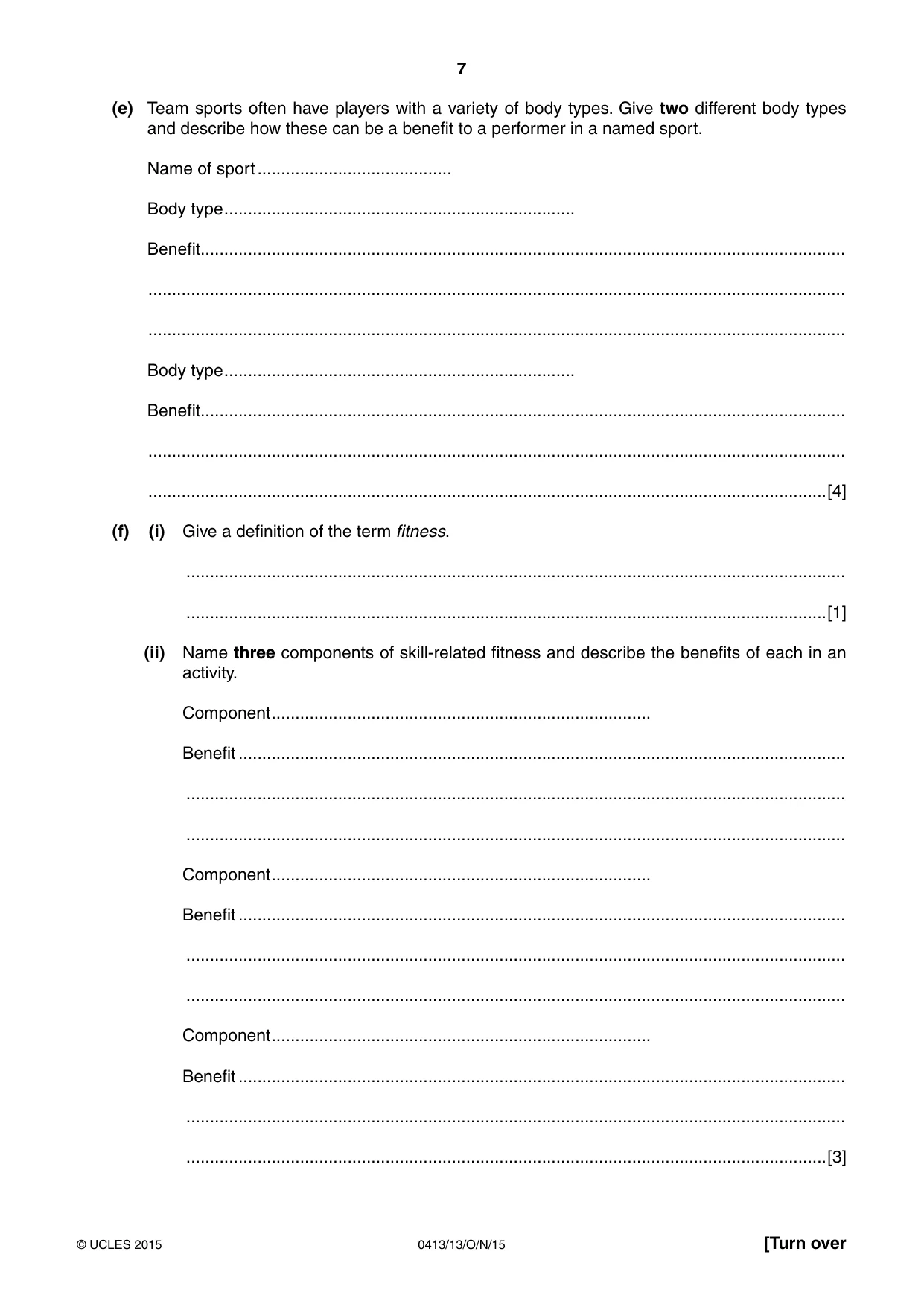
7 0413/13/O/N/15 © UCLES 2015 [Turn over (e) Team sports often have players with a variety of body types. Give two different body types and describe how these can be a benefit to a performer in a named sport. Name of sport … Body type … Benefit… … … Body type … Benefit… … …[4] (f) (i) Give a definition of the term fitness. … …[1] (ii) Name three components of skill-related fitness and describe the benefits of each in an activity. Component … Benefit … … … Component … Benefit … … … Component … Benefit … … …[3]
Question paper, page 8
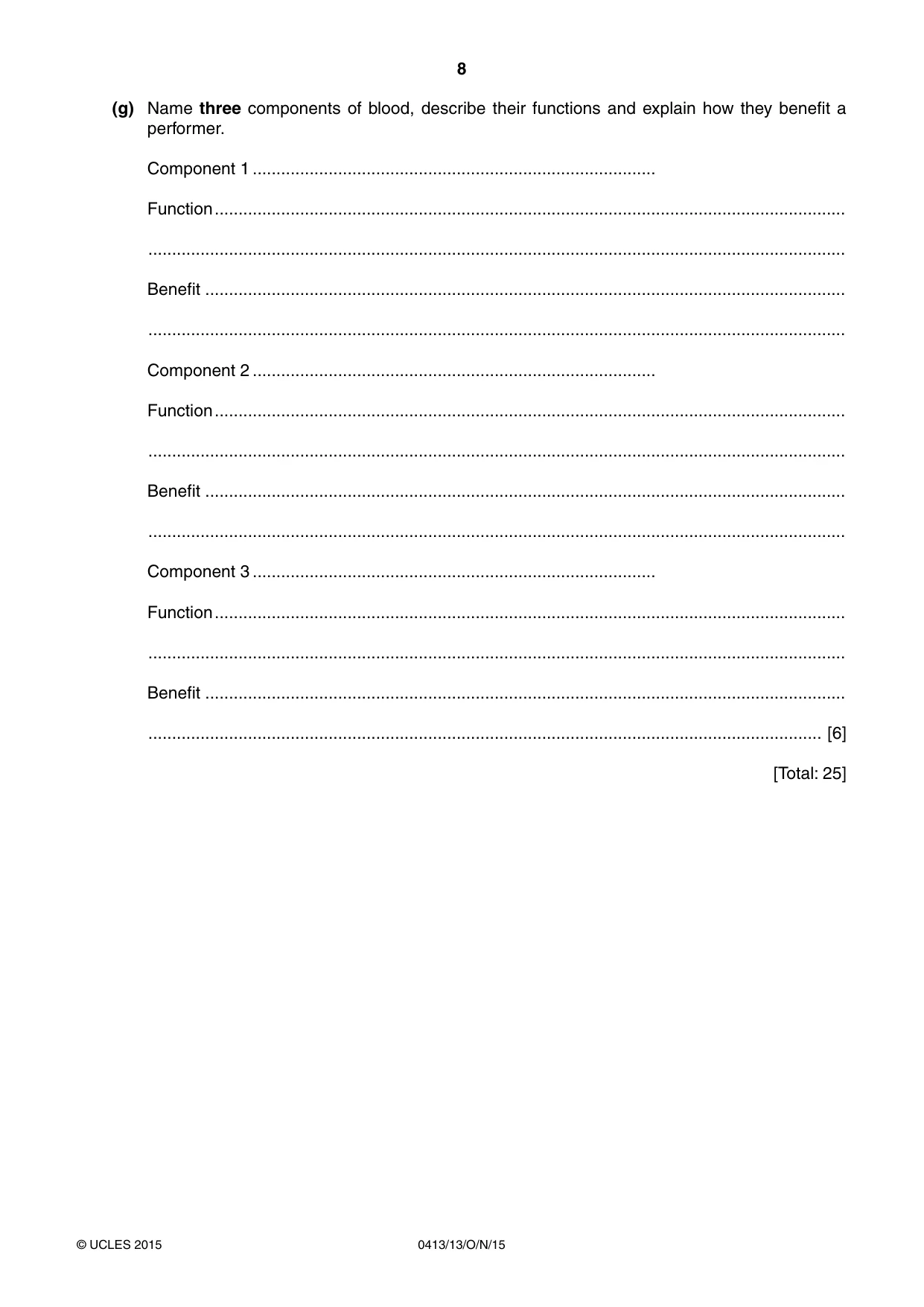
8 0413/13/O/N/15 © UCLES 2015 (g) Name three components of blood, describe their functions and explain how they benefit a performer. Component 1 … Function … … Benefit … … Component 2 … Function … … Benefit … … Component 3 … Function … … Benefit … … [6] [Total: 25]
Question paper, page 9
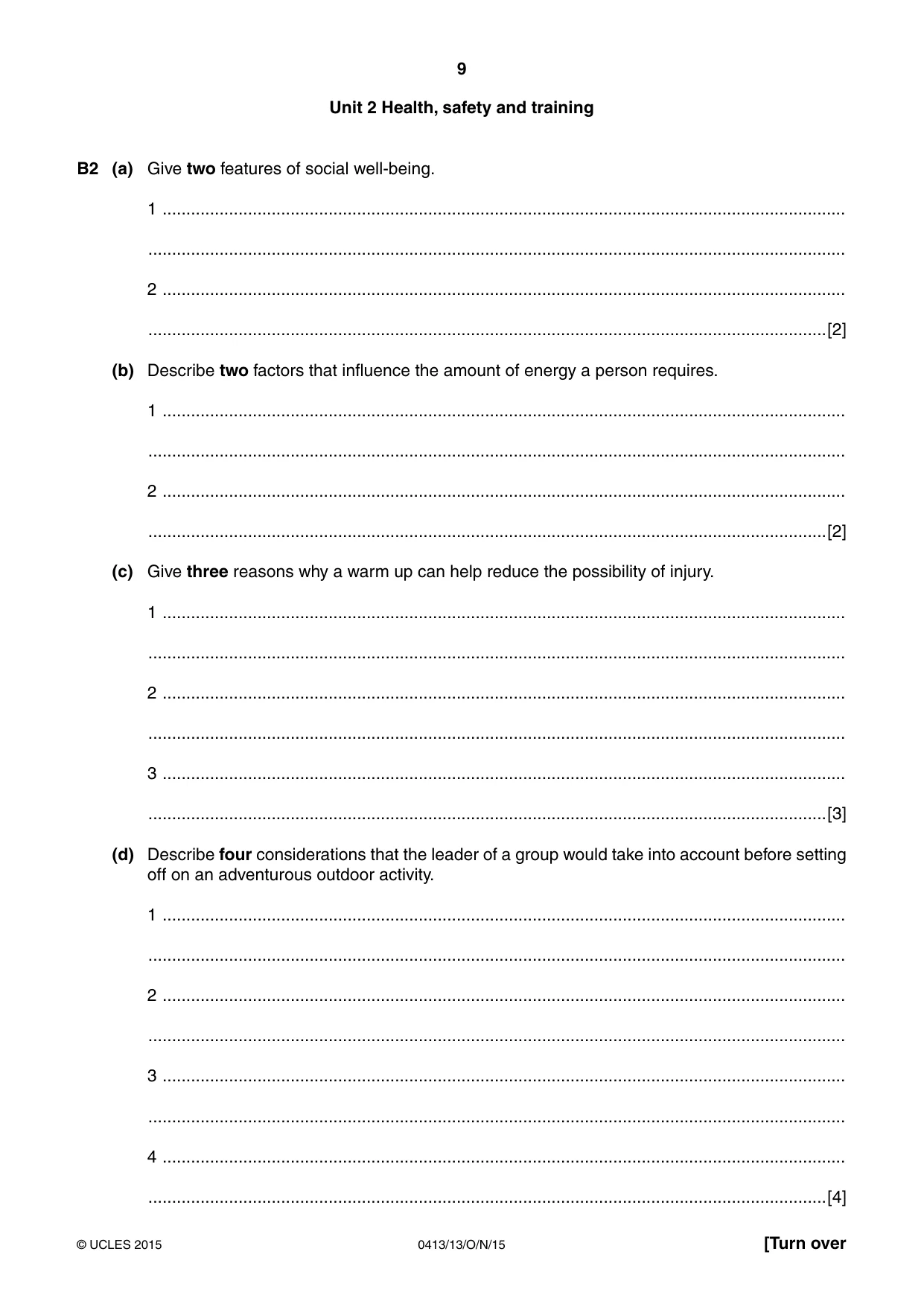
9 0413/13/O/N/15 © UCLES 2015 [Turn over Unit 2 Health, safety and training B2 (a) Give two features of social well-being. 1 … … 2 … …[2] (b) Describe two factors that influence the amount of energy a person requires. 1 … … 2 … …[2] (c) Give three reasons why a warm up can help reduce the possibility of injury. 1 … … 2 … … 3 … …[3] (d) Describe four considerations that the leader of a group would take into account before setting off on an adventurous outdoor activity. 1 … … 2 … … 3 … … 4 … …[4]
Question paper, page 10
10 0413/13/O/N/15 © UCLES 2015 (e) Explain the role of glucose in the production of energy. … … … … … … … … …[4] (f) Fartlek training is often used when people start training. Explain the benefits of using this type of training. … … … … … … … … … … … …[5] [Total: 20]
Question paper, page 11
11 0413/13/O/N/15 © UCLES 2015 [Turn over Unit 3 Reasons and opportunities for participation in physical activity B3 (a) Describe two ways that a school can help participation in sports. 1 … … 2 … …[2] (b) Describe ways that a sports centre could encourage members from different cultures to take part in sports. … … … … … …[3] (c) Discuss the potential advantages and disadvantages to a television company when showing high levels of different sports. … … … … … … … … … … … …[5]
Question paper, page 12
12 0413/13/O/N/15 © UCLES 2015 Permission to reproduce items where third-party owned material protected by copyright is included has been sought and cleared where possible. Every reasonable effort has been made by the publisher (UCLES) to trace copyright holders, but if any items requiring clearance have unwittingly been included, the publisher will be pleased to make amends at the earliest possible opportunity. To avoid the issue of disclosure of answer-related information to candidates, all copyright acknowledgements are reproduced online in the Cambridge International Examinations Copyright Acknowledgements Booklet. This is produced for each series of examinations and is freely available to download at www.cie.org.uk after the live examination series. Cambridge International Examinations is part of the Cambridge Assessment Group. Cambridge Assessment is the brand name of University of Cambridge Local Examinations Syndicate (UCLES), which is itself a department of the University of Cambridge. (d) Name one factor that will determine if a performer can achieve excellence in sport and describe how this factor influences achievement. Factor … … … … … … … … … … … … …[5] [Total: 15]
Mark scheme, page 1
® IGCSE is the registered trademark of Cambridge International Examinations. CAMBRIDGE INTERNATIONAL EXAMINATIONS Cambridge International General Certificate of Secondary Education MARK SCHEME for the October/November 2015 series 0413 PHYSICAL EDUCATION 0413/13 Paper 1, maximum raw mark 80 This mark scheme is published as an aid to teachers and candidates, to indicate the requirements of the examination. It shows the basis on which Examiners were instructed to award marks. It does not indicate the details of the discussions that took place at an Examiners’ meeting before marking began, which would have considered the acceptability of alternative answers. Mark schemes should be read in conjunction with the question paper and the Principal Examiner Report for Teachers. Cambridge will not enter into discussions about these mark schemes. Cambridge is publishing the mark schemes for the October/November 2015 series for most Cambridge IGCSE®, Cambridge International A and AS Level components and some Cambridge O Level components.
Mark scheme, page 2
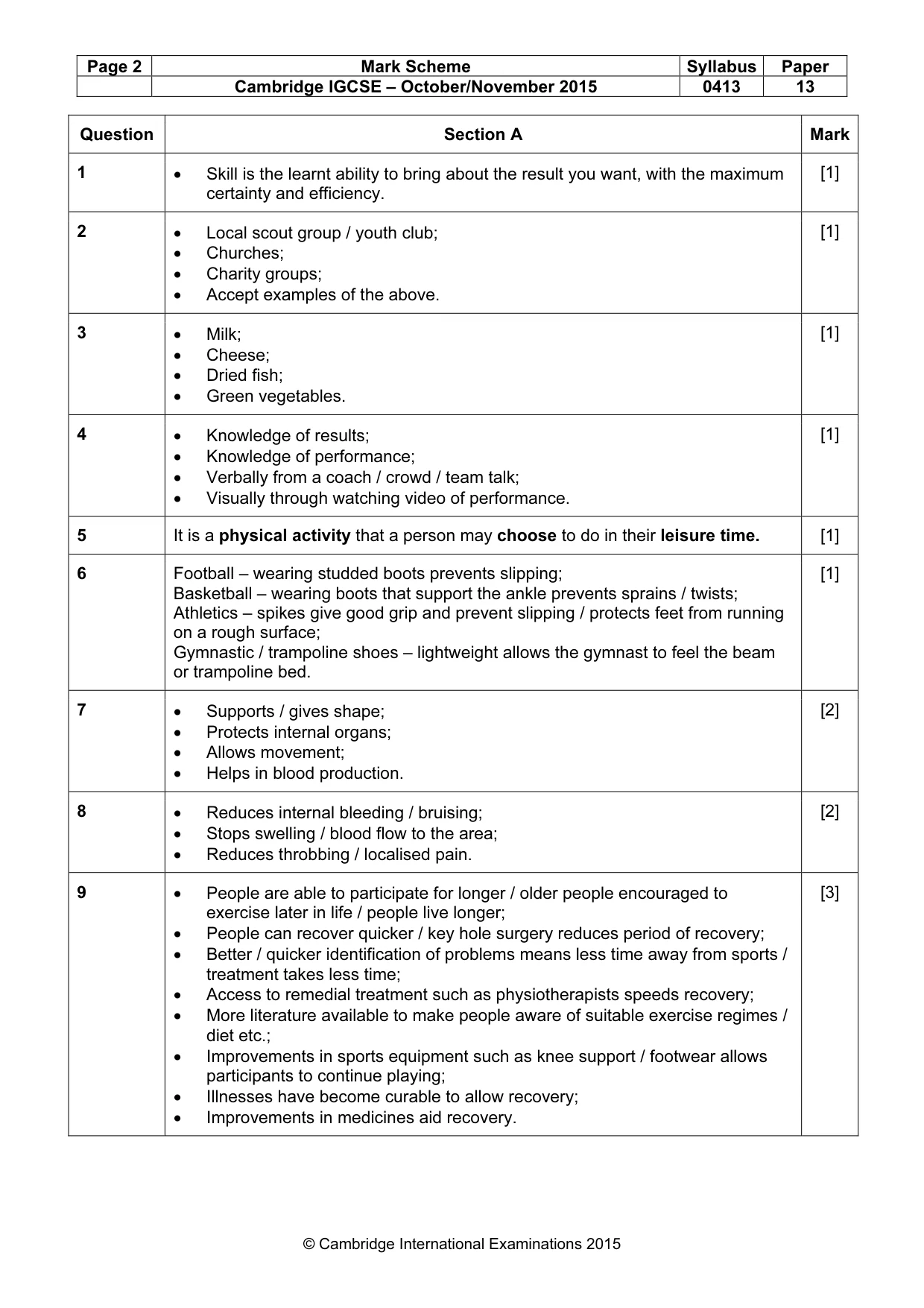
Page 2 Mark Scheme Syllabus Paper Cambridge IGCSE – October/November 2015 0413 13 © Cambridge International Examinations 2015 Question Section A Mark 1 • Skill is the learnt ability to bring about the result you want, with the maximum certainty and efficiency. [1] 2 • Local scout group / youth club; • Churches; • Charity groups; • Accept examples of the above. [1] 3 • Milk; • Cheese; • Dried fish; • Green vegetables. [1] 4 • Knowledge of results; • Knowledge of performance; • Verbally from a coach / crowd / team talk; • Visually through watching video of performance. [1] 5 It is a physical activity that a person may choose to do in their leisure time. [1] 6 Football – wearing studded boots prevents slipping; Basketball – wearing boots that support the ankle prevents sprains / twists; Athletics – spikes give good grip and prevent slipping / protects feet from running on a rough surface; Gymnastic / trampoline shoes – lightweight allows the gymnast to feel the beam or trampoline bed. [1] 7 • Supports / gives shape; • Protects internal organs; • Allows movement; • Helps in blood production. [2] 8 • Reduces internal bleeding / bruising; • Stops swelling / blood flow to the area; • Reduces throbbing / localised pain. [2] 9 • People are able to participate for longer / older people encouraged to exercise later in life / people live longer; • People can recover quicker / key hole surgery reduces period of recovery; • Better / quicker identification of problems means less time away from sports / treatment takes less time; • Access to remedial treatment such as physiotherapists speeds recovery; • More literature available to make people aware of suitable exercise regimes / diet etc.; • Improvements in sports equipment such as knee support / footwear allows participants to continue playing; • Illnesses have become curable to allow recovery; • Improvements in medicines aid recovery. [3]
Mark scheme, page 3
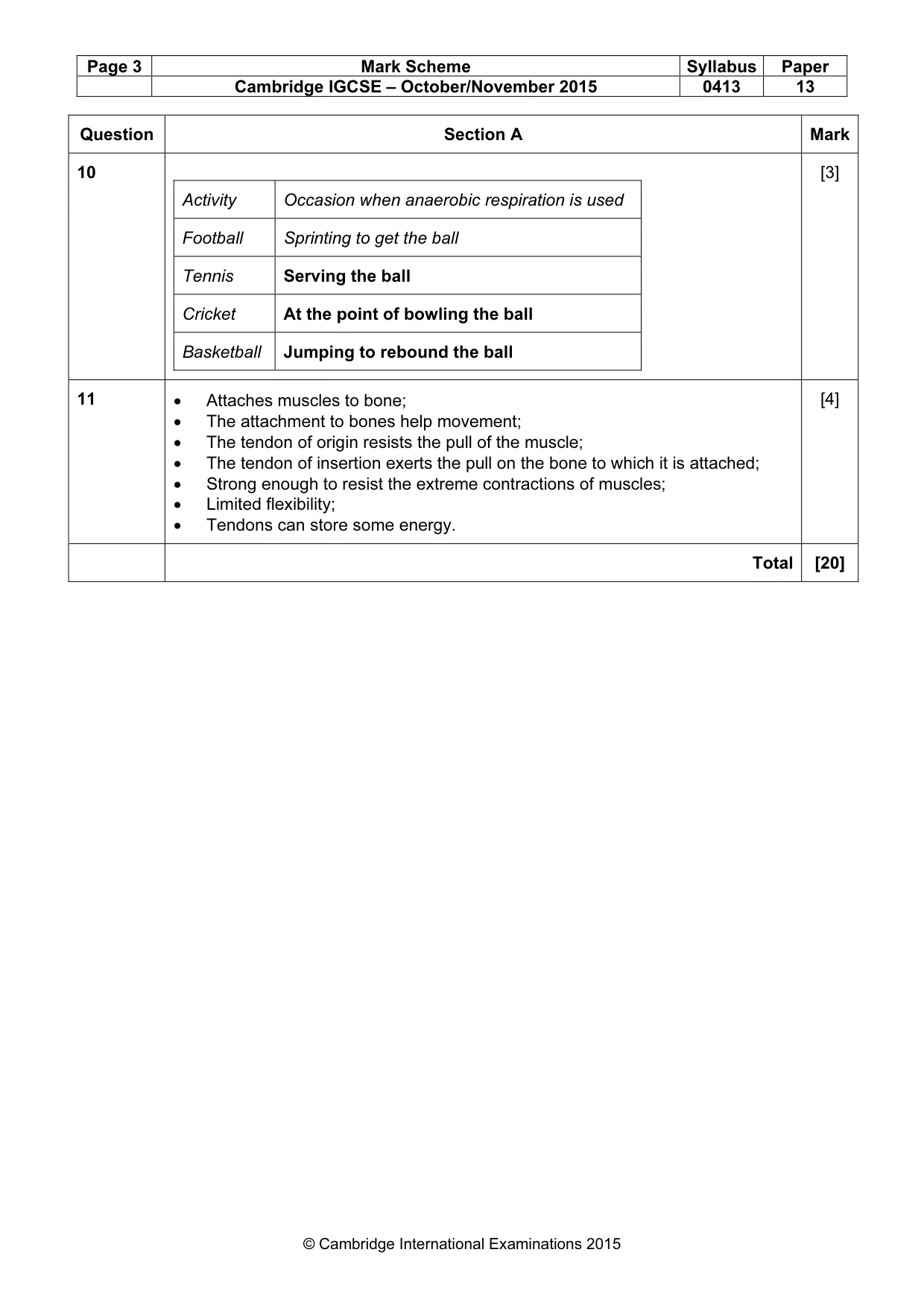
Page 3 Mark Scheme Syllabus Paper Cambridge IGCSE – October/November 2015 0413 13 © Cambridge International Examinations 2015 Question Section A Mark 10 Activity Occasion when anaerobic respiration is used Football Sprinting to get the ball Tennis Serving the ball Cricket At the point of bowling the ball Basketball Jumping to rebound the ball [3] 11 • Attaches muscles to bone; • The attachment to bones help movement; • The tendon of origin resists the pull of the muscle; • The tendon of insertion exerts the pull on the bone to which it is attached; • Strong enough to resist the extreme contractions of muscles; • Limited flexibility; • Tendons can store some energy. [4] Total [20]
Mark scheme, page 4
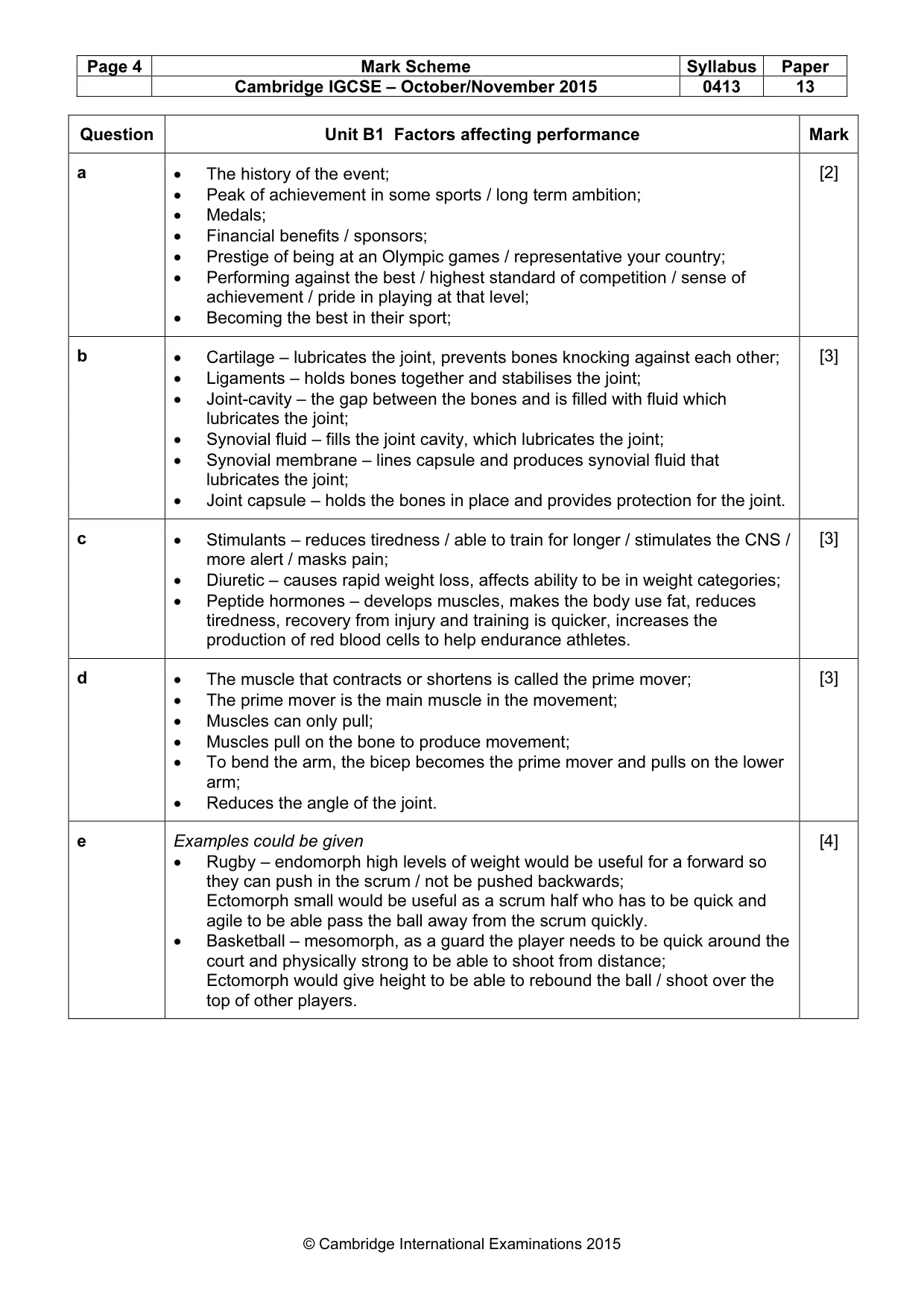
Page 4 Mark Scheme Syllabus Paper Cambridge IGCSE – October/November 2015 0413 13 © Cambridge International Examinations 2015 Question Unit B1 Factors affecting performance Mark a • The history of the event; • Peak of achievement in some sports / long term ambition; • Medals; • Financial benefits / sponsors; • Prestige of being at an Olympic games / representative your country; • Performing against the best / highest standard of competition / sense of achievement / pride in playing at that level; • Becoming the best in their sport; [2] b • Cartilage – lubricates the joint, prevents bones knocking against each other; • Ligaments – holds bones together and stabilises the joint; • Joint-cavity – the gap between the bones and is filled with fluid which lubricates the joint; • Synovial fluid – fills the joint cavity, which lubricates the joint; • Synovial membrane – lines capsule and produces synovial fluid that lubricates the joint; • Joint capsule – holds the bones in place and provides protection for the joint. [3] c • Stimulants – reduces tiredness / able to train for longer / stimulates the CNS / more alert / masks pain; • Diuretic – causes rapid weight loss, affects ability to be in weight categories; • Peptide hormones – develops muscles, makes the body use fat, reduces tiredness, recovery from injury and training is quicker, increases the production of red blood cells to help endurance athletes. [3] d • The muscle that contracts or shortens is called the prime mover; • The prime mover is the main muscle in the movement; • Muscles can only pull; • Muscles pull on the bone to produce movement; • To bend the arm, the bicep becomes the prime mover and pulls on the lower arm; • Reduces the angle of the joint. [3] e Examples could be given • Rugby – endomorph high levels of weight would be useful for a forward so they can push in the scrum / not be pushed backwards; Ectomorph small would be useful as a scrum half who has to be quick and agile to be able pass the ball away from the scrum quickly. • Basketball – mesomorph, as a guard the player needs to be quick around the court and physically strong to be able to shoot from distance; Ectomorph would give height to be able to rebound the ball / shoot over the top of other players. [4]
Mark scheme, page 5
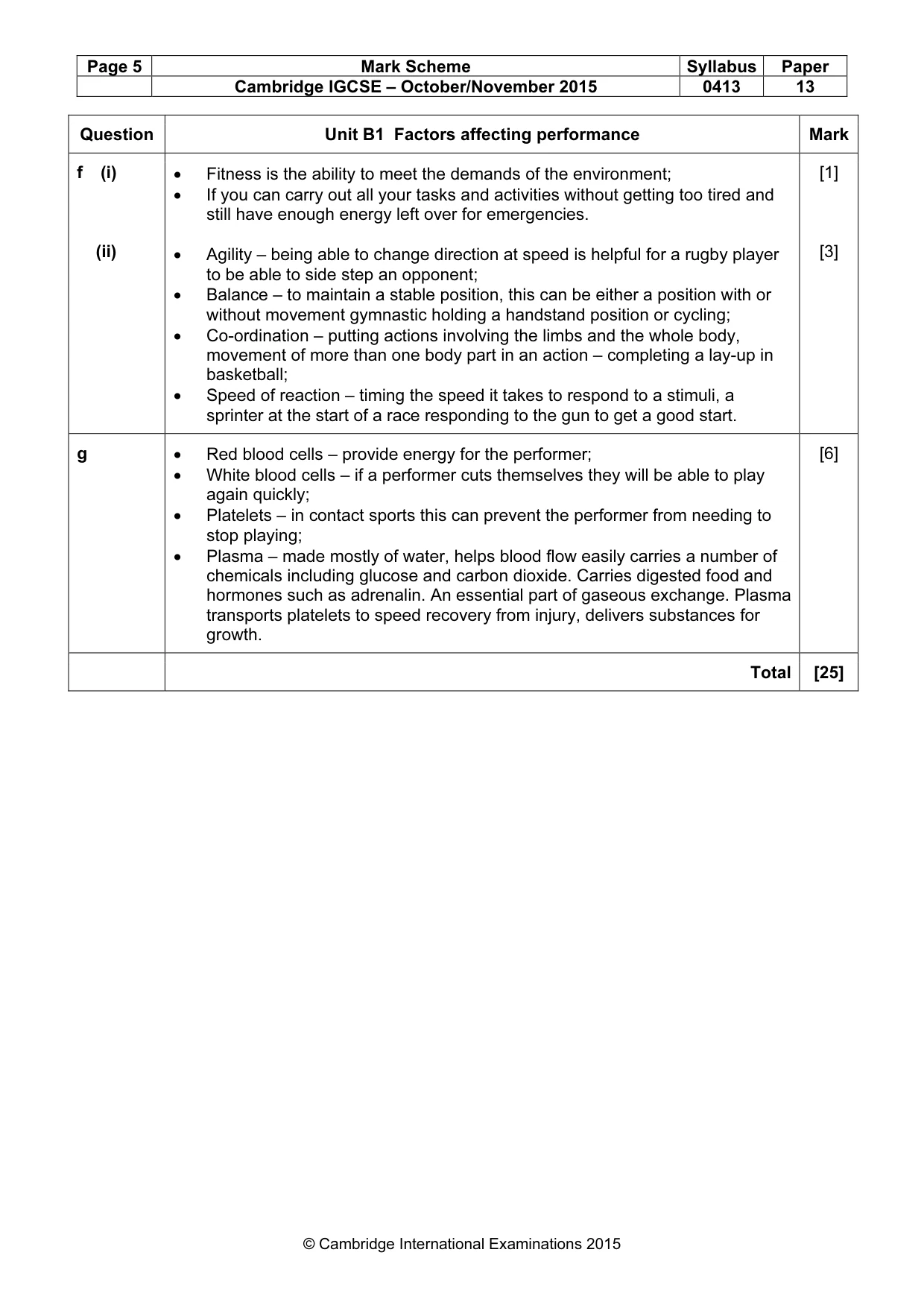
Page 5 Mark Scheme Syllabus Paper Cambridge IGCSE – October/November 2015 0413 13 © Cambridge International Examinations 2015 Question Unit B1 Factors affecting performance Mark f (i) (ii) • Fitness is the ability to meet the demands of the environment; • If you can carry out all your tasks and activities without getting too tired and still have enough energy left over for emergencies. • Agility – being able to change direction at speed is helpful for a rugby player to be able to side step an opponent; • Balance – to maintain a stable position, this can be either a position with or without movement gymnastic holding a handstand position or cycling; • Co-ordination – putting actions involving the limbs and the whole body, movement of more than one body part in an action – completing a lay-up in basketball; • Speed of reaction – timing the speed it takes to respond to a stimuli, a sprinter at the start of a race responding to the gun to get a good start. [1] [3] g • Red blood cells – provide energy for the performer; • White blood cells – if a performer cuts themselves they will be able to play again quickly; • Platelets – in contact sports this can prevent the performer from needing to stop playing; • Plasma – made mostly of water, helps blood flow easily carries a number of chemicals including glucose and carbon dioxide. Carries digested food and hormones such as adrenalin. An essential part of gaseous exchange. Plasma transports platelets to speed recovery from injury, delivers substances for growth. [6] Total [25]
Mark scheme, page 6
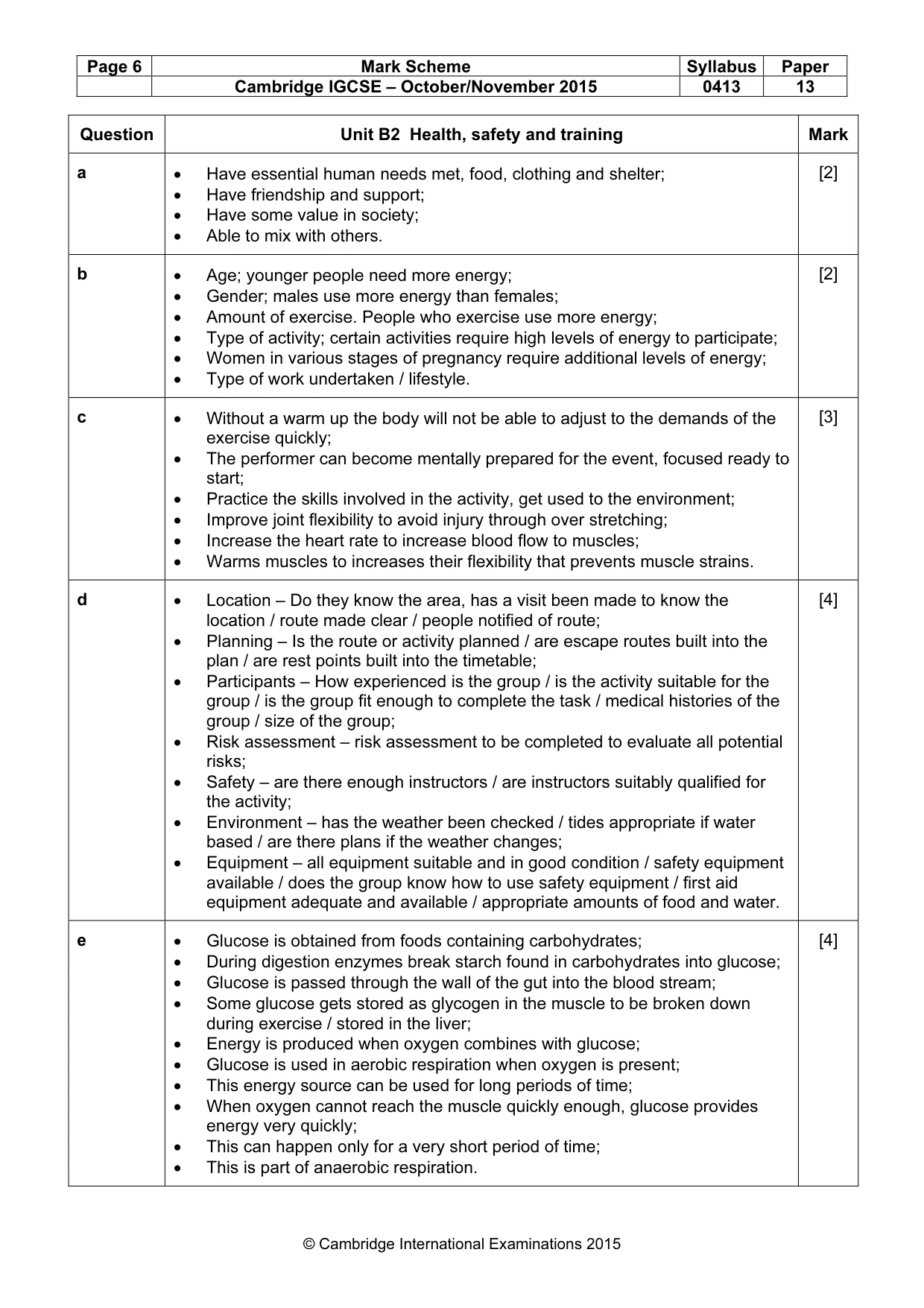
Page 6 Mark Scheme Syllabus Paper Cambridge IGCSE – October/November 2015 0413 13 © Cambridge International Examinations 2015 Question Unit B2 Health, safety and training Mark a • Have essential human needs met, food, clothing and shelter; • Have friendship and support; • Have some value in society; • Able to mix with others. [2] b • Age; younger people need more energy; • Gender; males use more energy than females; • Amount of exercise. People who exercise use more energy; • Type of activity; certain activities require high levels of energy to participate; • Women in various stages of pregnancy require additional levels of energy; • Type of work undertaken / lifestyle. [2] c • Without a warm up the body will not be able to adjust to the demands of the exercise quickly; • The performer can become mentally prepared for the event, focused ready to start; • Practice the skills involved in the activity, get used to the environment; • Improve joint flexibility to avoid injury through over stretching; • Increase the heart rate to increase blood flow to muscles; • Warms muscles to increases their flexibility that prevents muscle strains. [3] d • Location – Do they know the area, has a visit been made to know the location / route made clear / people notified of route; • Planning – Is the route or activity planned / are escape routes built into the plan / are rest points built into the timetable; • Participants – How experienced is the group / is the activity suitable for the group / is the group fit enough to complete the task / medical histories of the group / size of the group; • Risk assessment – risk assessment to be completed to evaluate all potential risks; • Safety – are there enough instructors / are instructors suitably qualified for the activity; • Environment – has the weather been checked / tides appropriate if water based / are there plans if the weather changes; • Equipment – all equipment suitable and in good condition / safety equipment available / does the group know how to use safety equipment / first aid equipment adequate and available / appropriate amounts of food and water. [4] e • Glucose is obtained from foods containing carbohydrates; • During digestion enzymes break starch found in carbohydrates into glucose; • Glucose is passed through the wall of the gut into the blood stream; • Some glucose gets stored as glycogen in the muscle to be broken down during exercise / stored in the liver; • Energy is produced when oxygen combines with glucose; • Glucose is used in aerobic respiration when oxygen is present; • This energy source can be used for long periods of time; • When oxygen cannot reach the muscle quickly enough, glucose provides energy very quickly; • This can happen only for a very short period of time; • This is part of anaerobic respiration. [4]
Mark scheme, page 7
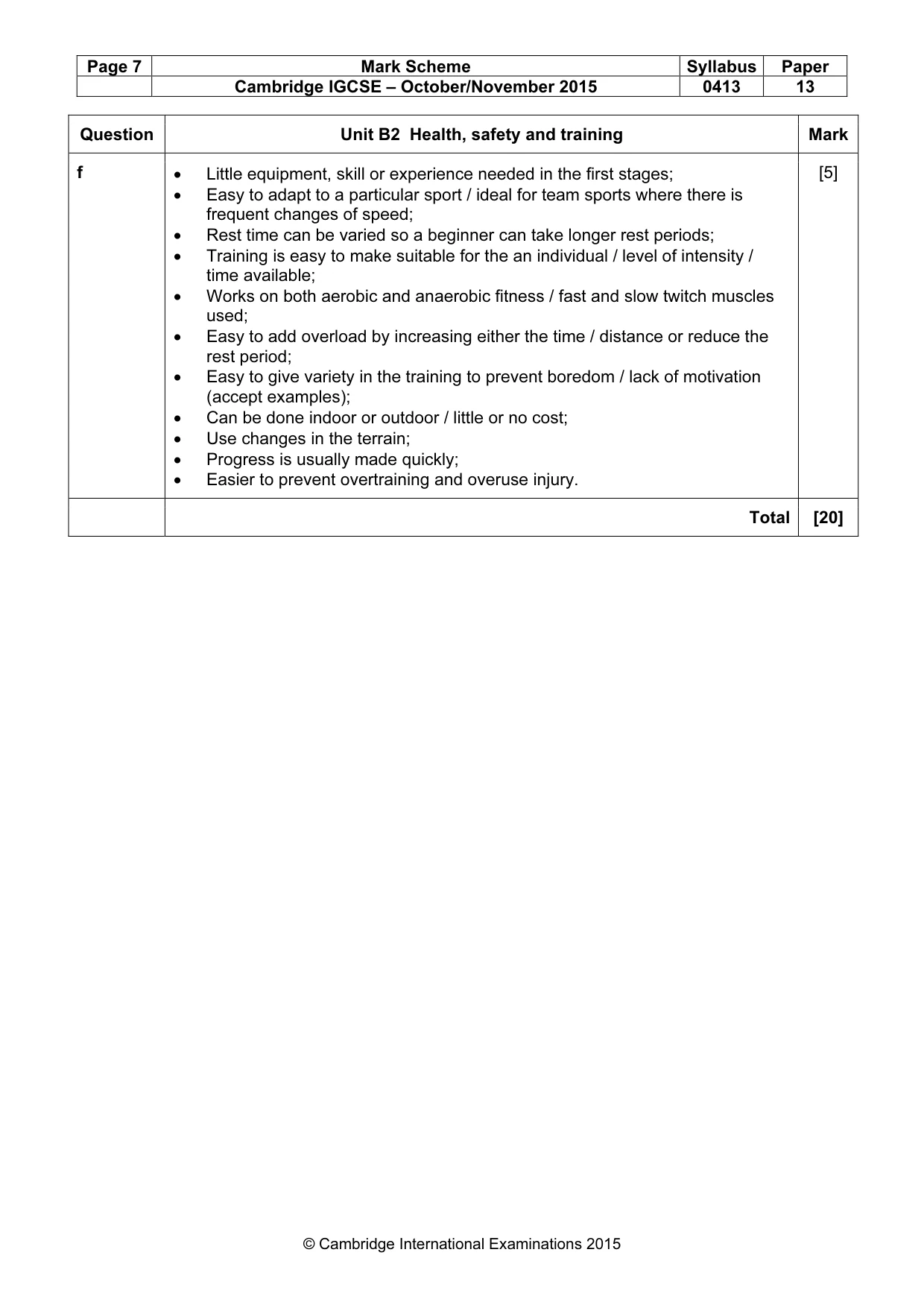
Page 7 Mark Scheme Syllabus Paper Cambridge IGCSE – October/November 2015 0413 13 © Cambridge International Examinations 2015 Question Unit B2 Health, safety and training Mark f • Little equipment, skill or experience needed in the first stages; • Easy to adapt to a particular sport / ideal for team sports where there is frequent changes of speed; • Rest time can be varied so a beginner can take longer rest periods; • Training is easy to make suitable for the an individual / level of intensity / time available; • Works on both aerobic and anaerobic fitness / fast and slow twitch muscles used; • Easy to add overload by increasing either the time / distance or reduce the rest period; • Easy to give variety in the training to prevent boredom / lack of motivation (accept examples); • Can be done indoor or outdoor / little or no cost; • Use changes in the terrain; • Progress is usually made quickly; • Easier to prevent overtraining and overuse injury. [5] Total [20]
Mark scheme, page 8
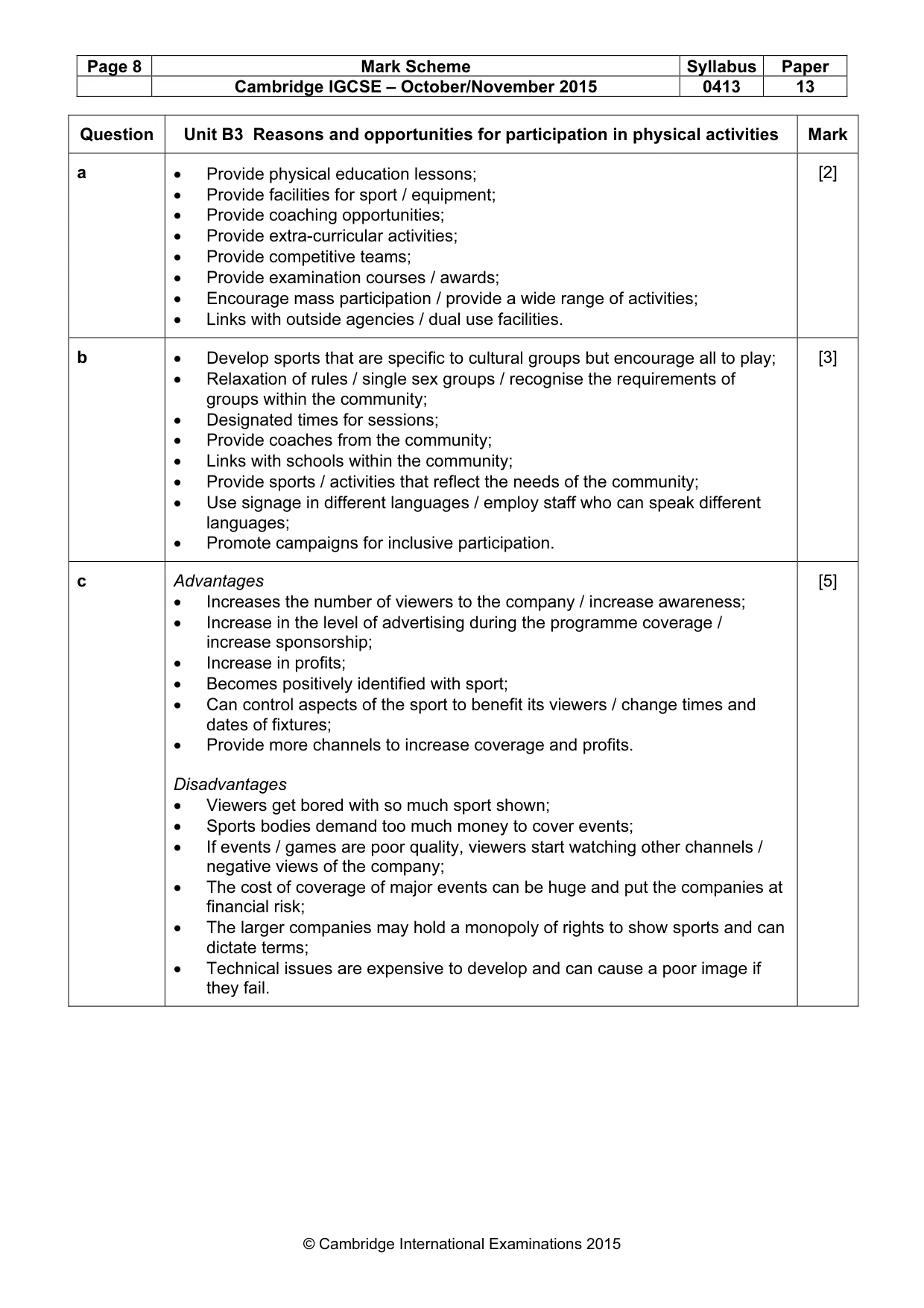
Page 8 Mark Scheme Syllabus Paper Cambridge IGCSE – October/November 2015 0413 13 © Cambridge International Examinations 2015 Question Unit B3 Reasons and opportunities for participation in physical activities Mark a • Provide physical education lessons; • Provide facilities for sport / equipment; • Provide coaching opportunities; • Provide extra-curricular activities; • Provide competitive teams; • Provide examination courses / awards; • Encourage mass participation / provide a wide range of activities; • Links with outside agencies / dual use facilities. [2] b • Develop sports that are specific to cultural groups but encourage all to play; • Relaxation of rules / single sex groups / recognise the requirements of groups within the community; • Designated times for sessions; • Provide coaches from the community; • Links with schools within the community; • Provide sports / activities that reflect the needs of the community; • Use signage in different languages / employ staff who can speak different languages; • Promote campaigns for inclusive participation. [3] c Advantages • Increases the number of viewers to the company / increase awareness; • Increase in the level of advertising during the programme coverage / increase sponsorship; • Increase in profits; • Becomes positively identified with sport; • Can control aspects of the sport to benefit its viewers / change times and dates of fixtures; • Provide more channels to increase coverage and profits. Disadvantages • Viewers get bored with so much sport shown; • Sports bodies demand too much money to cover events; • If events / games are poor quality, viewers start watching other channels / negative views of the company; • The cost of coverage of major events can be huge and put the companies at financial risk; • The larger companies may hold a monopoly of rights to show sports and can dictate terms; • Technical issues are expensive to develop and can cause a poor image if they fail. [5]
Mark scheme, page 9
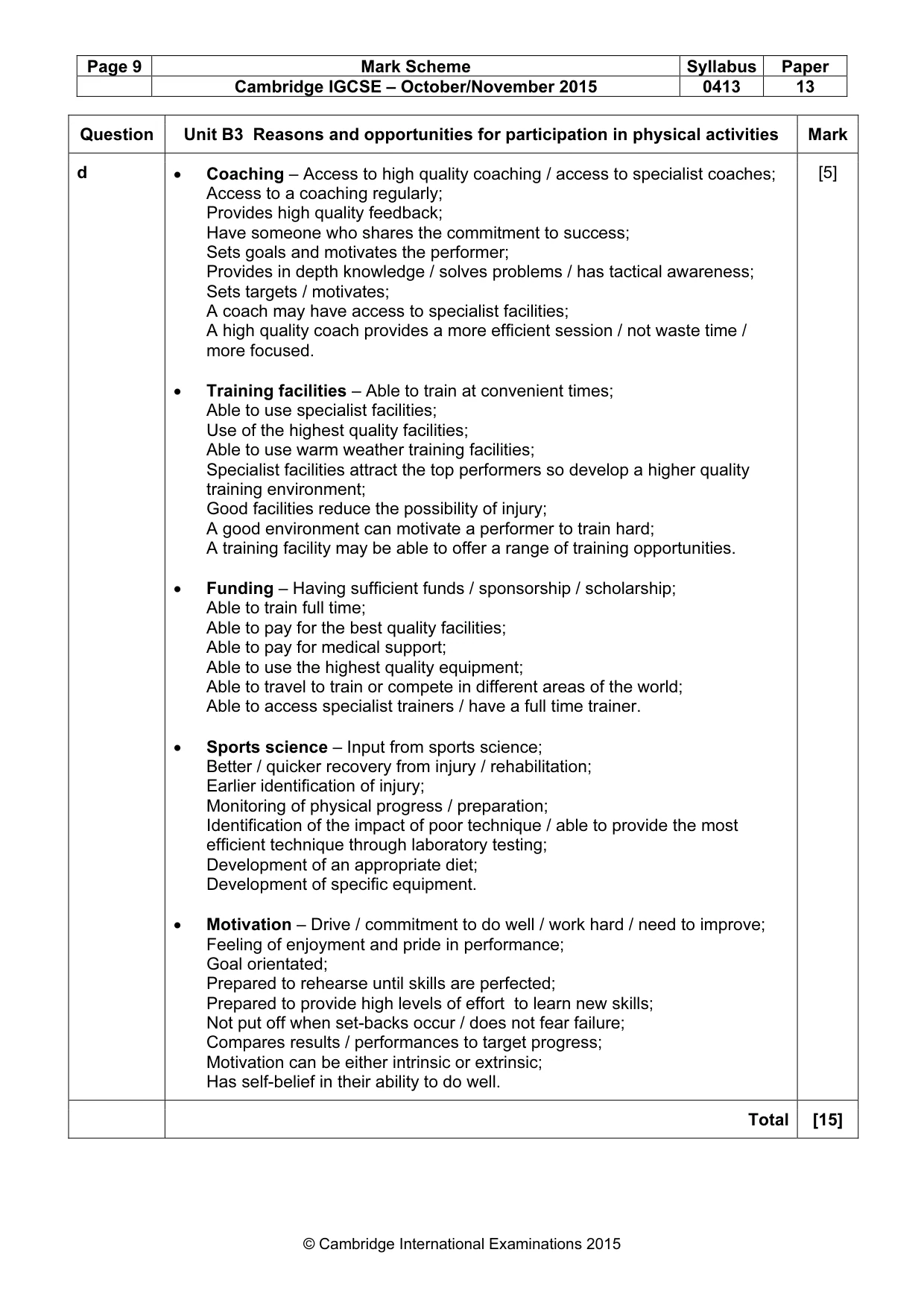
Page 9 Mark Scheme Syllabus Paper Cambridge IGCSE – October/November 2015 0413 13 © Cambridge International Examinations 2015 Question Unit B3 Reasons and opportunities for participation in physical activities Mark d • Coaching – Access to high quality coaching / access to specialist coaches; Access to a coaching regularly; Provides high quality feedback; Have someone who shares the commitment to success; Sets goals and motivates the performer; Provides in depth knowledge / solves problems / has tactical awareness; Sets targets / motivates; A coach may have access to specialist facilities; A high quality coach provides a more efficient session / not waste time / more focused. • Training facilities – Able to train at convenient times; Able to use specialist facilities; Use of the highest quality facilities; Able to use warm weather training facilities; Specialist facilities attract the top performers so develop a higher quality training environment; Good facilities reduce the possibility of injury; A good environment can motivate a performer to train hard; A training facility may be able to offer a range of training opportunities. • Funding – Having sufficient funds / sponsorship / scholarship; Able to train full time; Able to pay for the best quality facilities; Able to pay for medical support; Able to use the highest quality equipment; Able to travel to train or compete in different areas of the world; Able to access specialist trainers / have a full time trainer. • Sports science – Input from sports science; Better / quicker recovery from injury / rehabilitation; Earlier identification of injury; Monitoring of physical progress / preparation; Identification of the impact of poor technique / able to provide the most efficient technique through laboratory testing; Development of an appropriate diet; Development of specific equipment. • Motivation – Drive / commitment to do well / work hard / need to improve; Feeling of enjoyment and pride in performance; Goal orientated; Prepared to rehearse until skills are perfected; Prepared to provide high levels of effort to learn new skills; Not put off when set-backs occur / does not fear failure; Compares results / performances to target progress; Motivation can be either intrinsic or extrinsic; Has self-belief in their ability to do well. [5] Total [15]
What you needed in this session
Cambridge’s own grade thresholds for 2015 Oct/Nov, Paper 1 · Variant 3. A higher threshold means an easier paper — the bar moves with how the cohort did.