Cambridge IGCSE Physical Education 0413 — 2015 Oct/Nov Paper 1 · Variant 1
0413/11/O/N/15 · 80 marks · ≈90 min
The question paper and its mark scheme, free to read here and free to download. This is Cambridge’s own paper, exactly as it was sat.
Question paper12 pages
Mark scheme9 pages
Answers below. Sit the paper first if you are practising.
Paper as text
Question paper, page 1
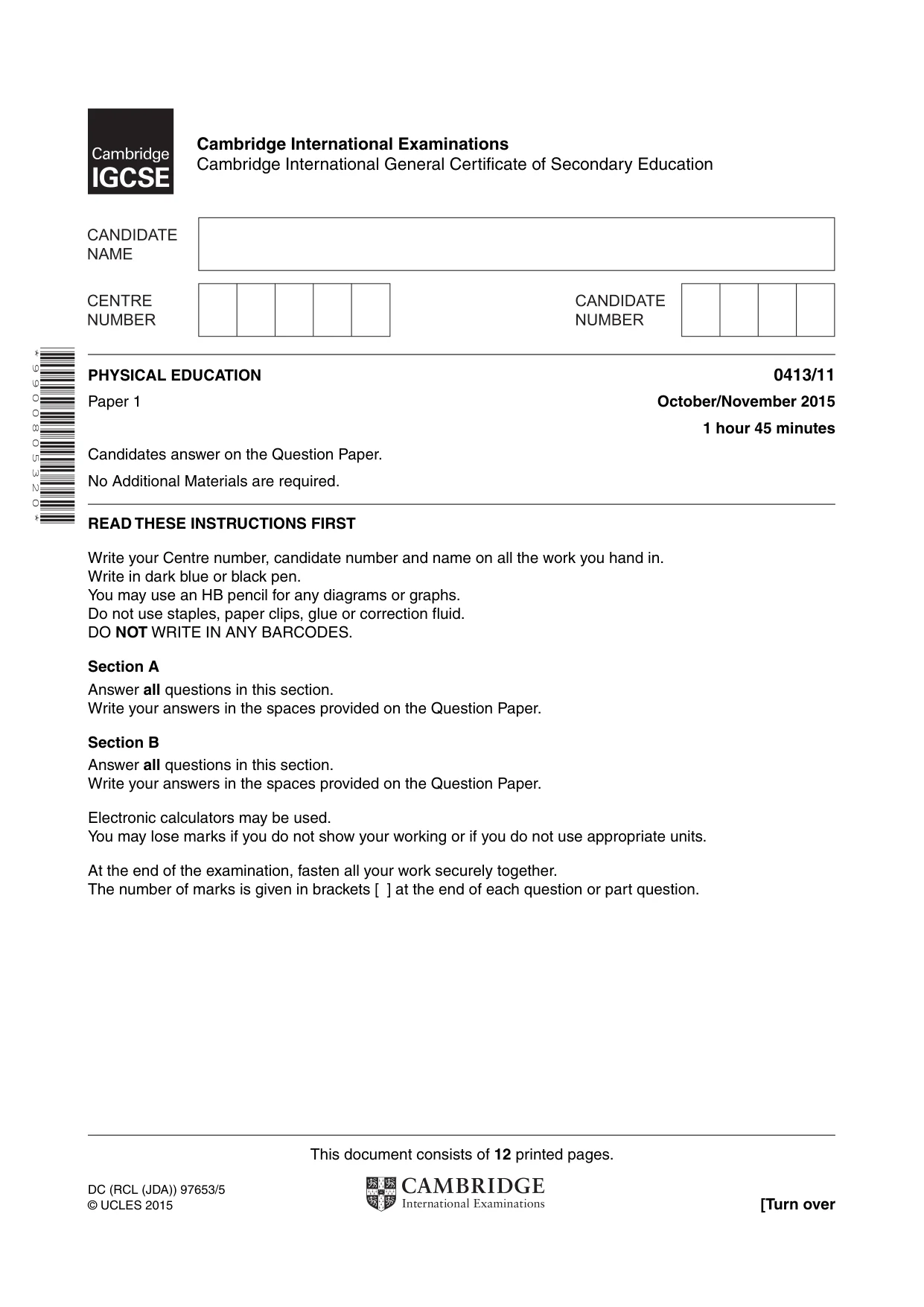
This document consists of 12 printed pages. DC (RCL (JDA)) 97653/5 © UCLES 2015 [Turn over Cambridge International Examinations Cambridge International General Certificate of Secondary Education * 9 9 0 0 8 0 5 3 2 0 * PHYSICAL EDUCATION 0413/11 Paper 1 October/November 2015 1 hour 45 minutes Candidates answer on the Question Paper. No Additional Materials are required. READ THESE INSTRUCTIONS FIRST Write your Centre number, candidate number and name on all the work you hand in. Write in dark blue or black pen. You may use an HB pencil for any diagrams or graphs. Do not use staples, paper clips, glue or correction fluid. DO NOT WRITE IN ANY BARCODES. Section A Answer all questions in this section. Write your answers in the spaces provided on the Question Paper. Section B Answer all questions in this section. Write your answers in the spaces provided on the Question Paper. Electronic calculators may be used. You may lose marks if you do not show your working or if you do not use appropriate units. At the end of the examination, fasten all your work securely together. The number of marks is given in brackets [ ] at the end of each question or part question.
Question paper, page 2
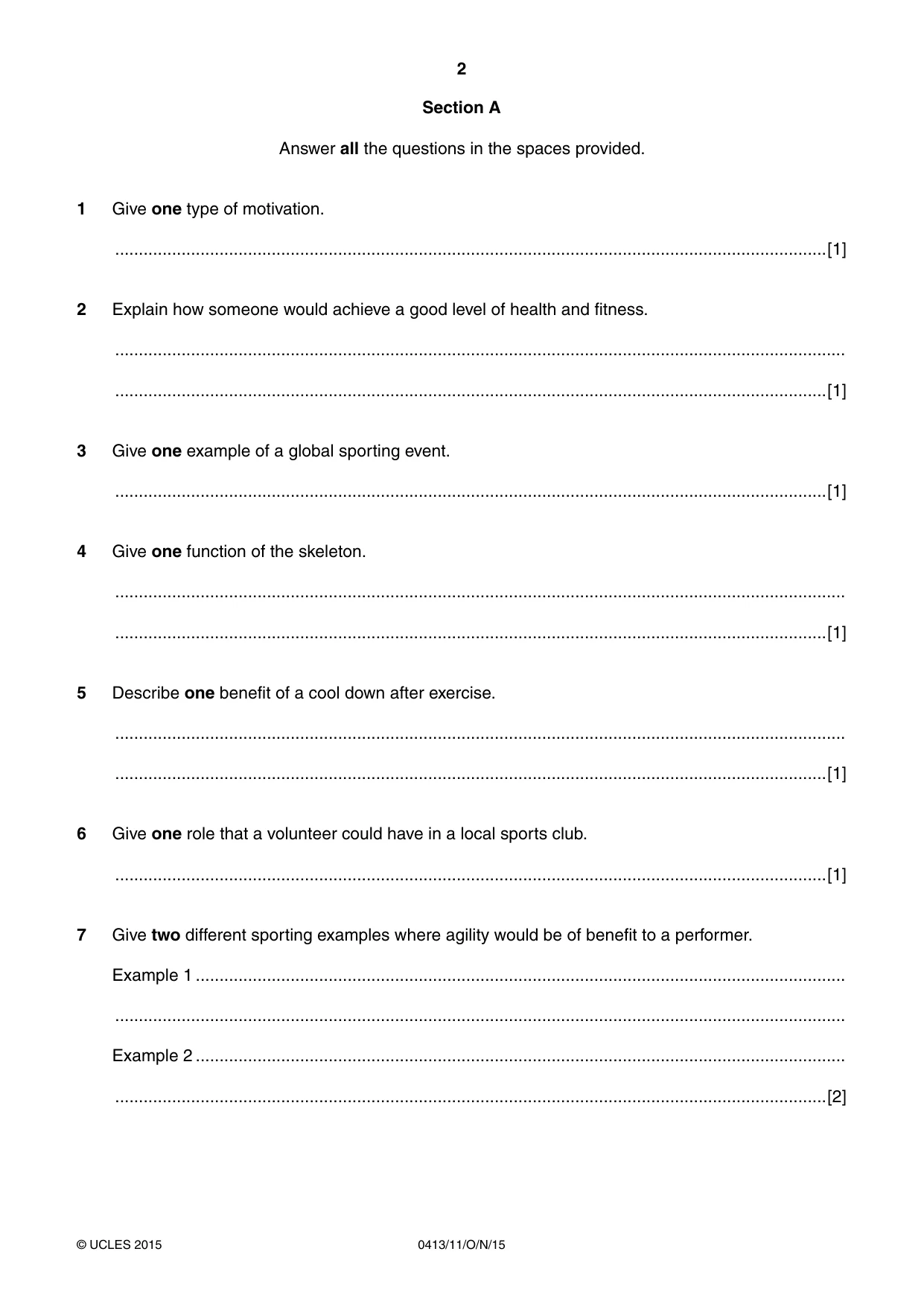
2 0413/11/O/N/15 © UCLES 2015 Section A Answer all the questions in the spaces provided. 1 Give one type of motivation. …[1] 2 Explain how someone would achieve a good level of health and fitness. … …[1] 3 Give one example of a global sporting event. …[1] 4 Give one function of the skeleton. … …[1] 5 Describe one benefit of a cool down after exercise. … …[1] 6 Give one role that a volunteer could have in a local sports club. …[1] 7 Give two different sporting examples where agility would be of benefit to a performer. Example 1 … … Example 2 … …[2]
Question paper, page 3
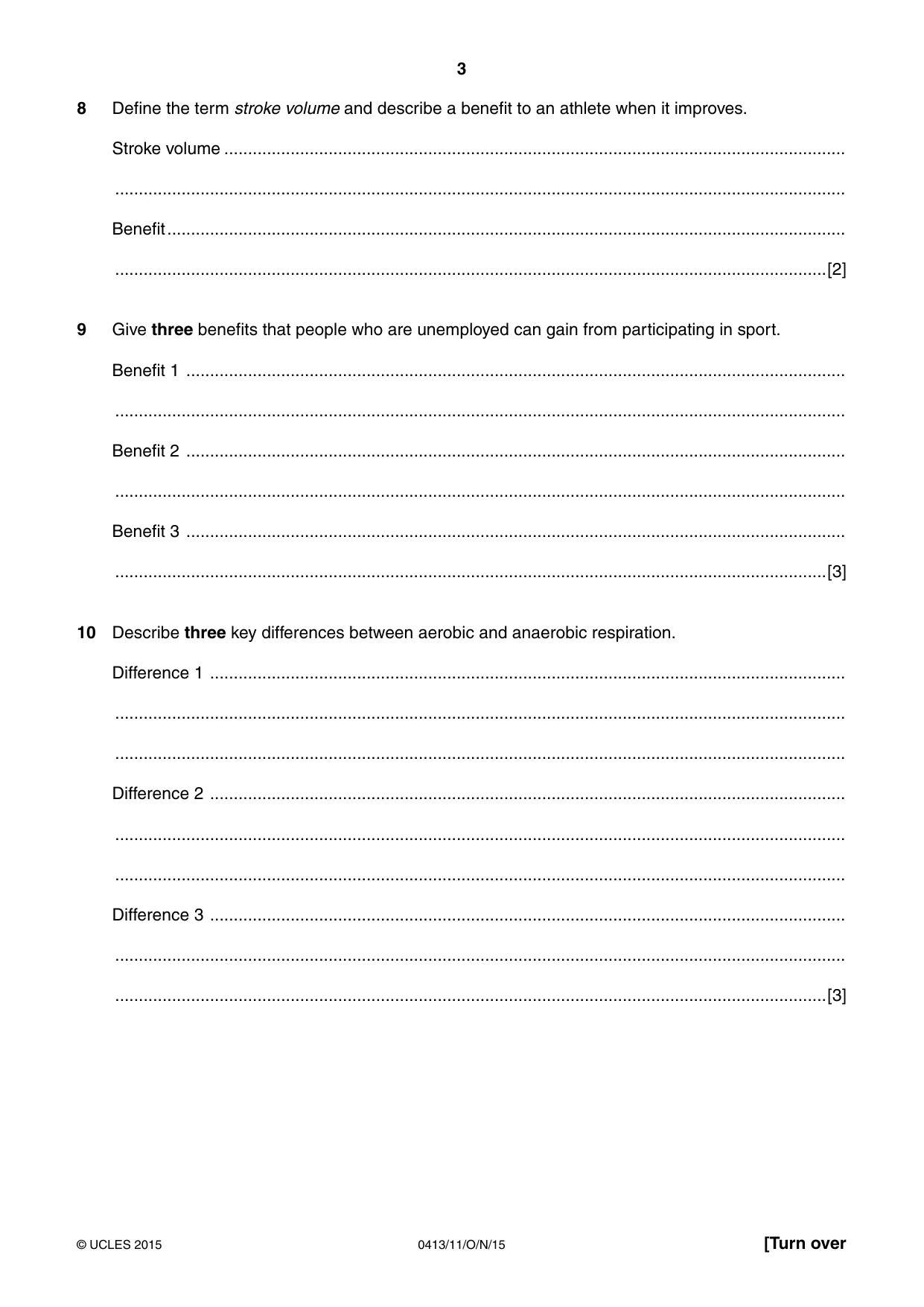
3 0413/11/O/N/15 © UCLES 2015 [Turn over 8 Define the term stroke volume and describe a benefit to an athlete when it improves. Stroke volume … … Benefit … …[2] 9 Give three benefits that people who are unemployed can gain from participating in sport. Benefit 1 … … Benefit 2 … … Benefit 3 … …[3] 10 Describe three key differences between aerobic and anaerobic respiration. Difference 1 … … … Difference 2 … … … Difference 3 … … …[3]
Question paper, page 4
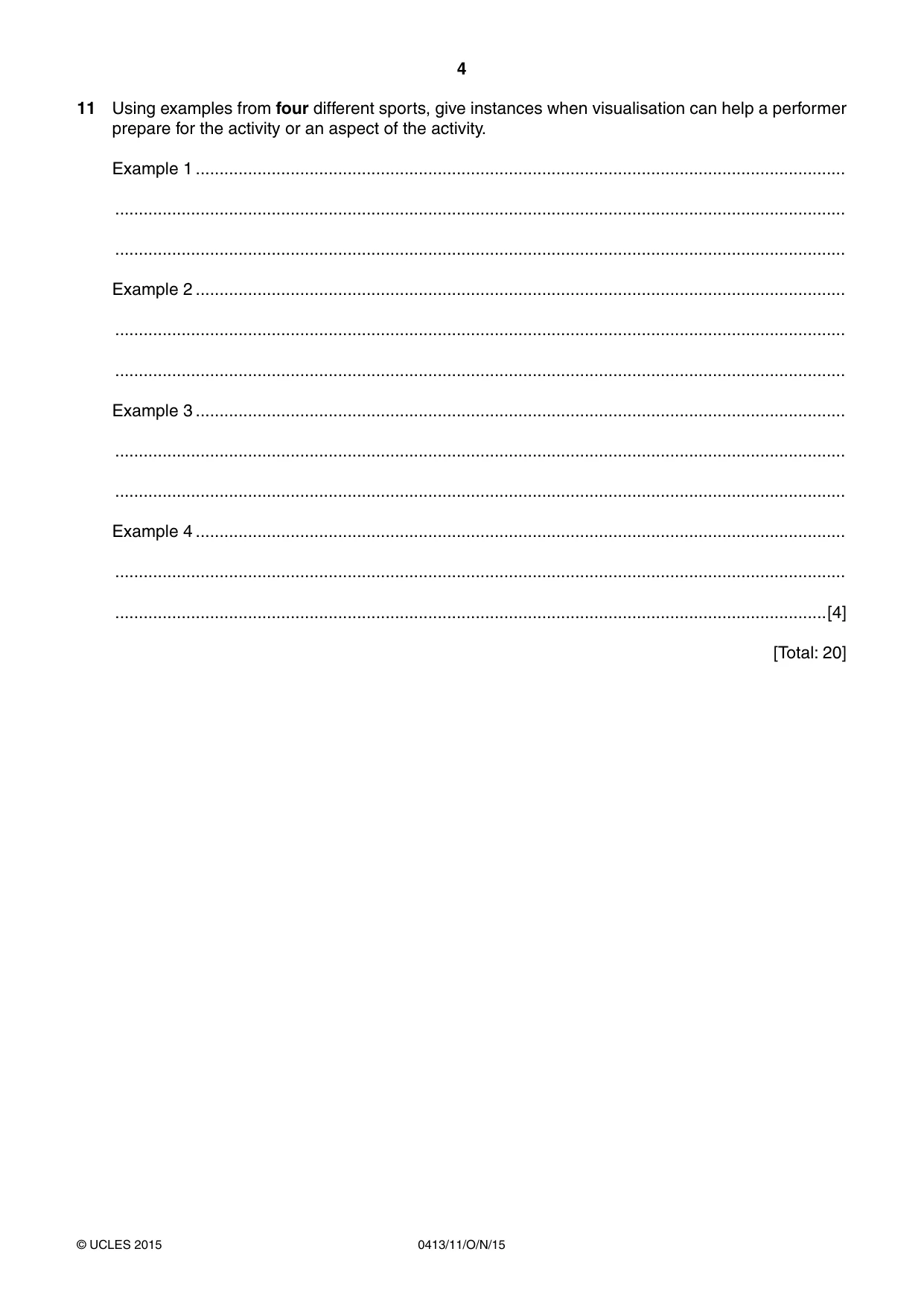
4 0413/11/O/N/15 © UCLES 2015 11 Using examples from four different sports, give instances when visualisation can help a performer prepare for the activity or an aspect of the activity. Example 1 … … … Example 2 … … … Example 3 … … … Example 4 … … …[4] [Total: 20]
Question paper, page 5
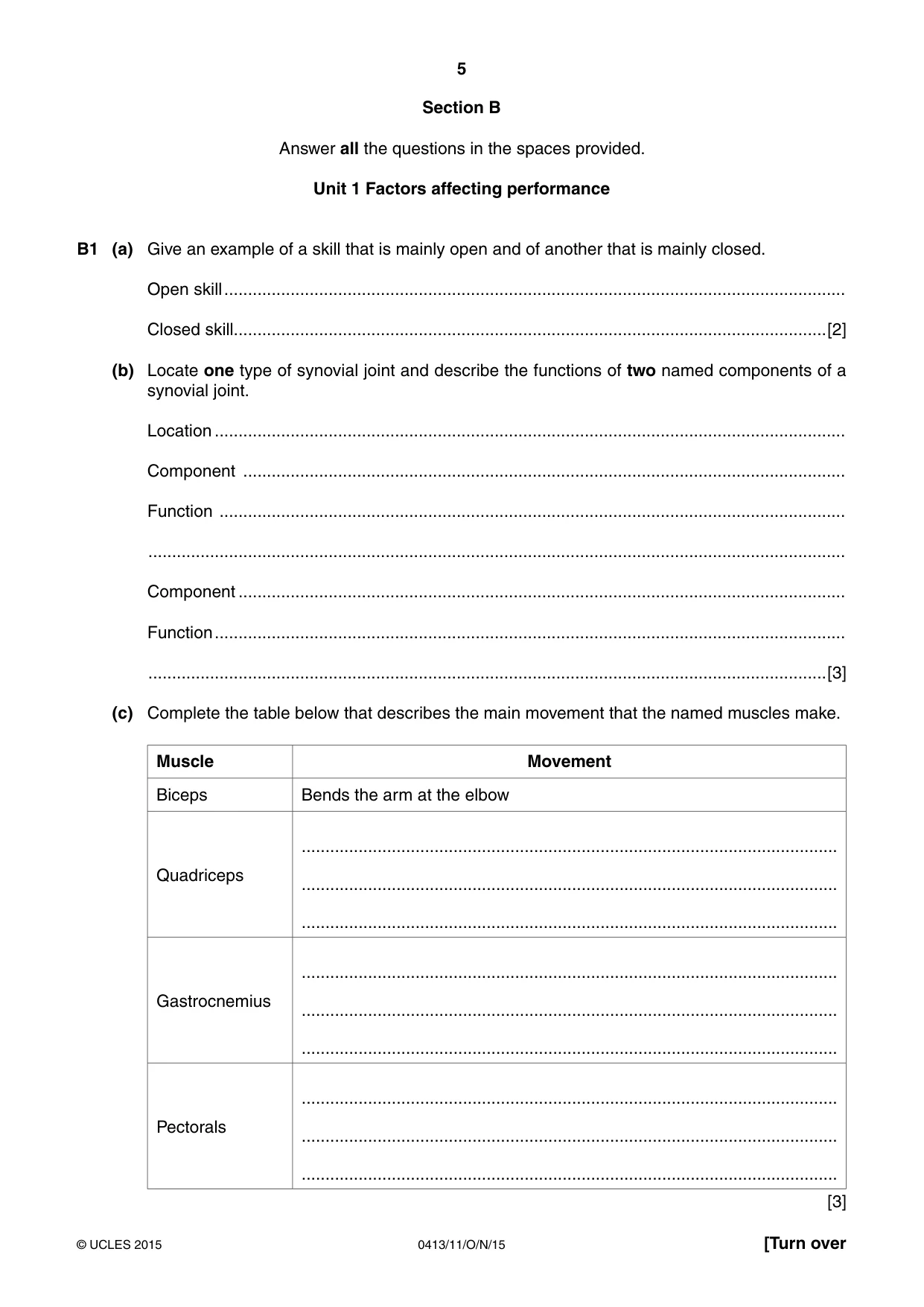
5 0413/11/O/N/15 © UCLES 2015 [Turn over Section B Answer all the questions in the spaces provided. Unit 1 Factors affecting performance B1 (a) Give an example of a skill that is mainly open and of another that is mainly closed. Open skill … Closed skill…[2] (b) Locate one type of synovial joint and describe the functions of two named components of a synovial joint. Location … Component … Function … … Component … Function … …[3] (c) Complete the table below that describes the main movement that the named muscles make. Muscle Movement Biceps Bends the arm at the elbow Quadriceps … … … Gastrocnemius … … … Pectorals … … … [3]
Question paper, page 6
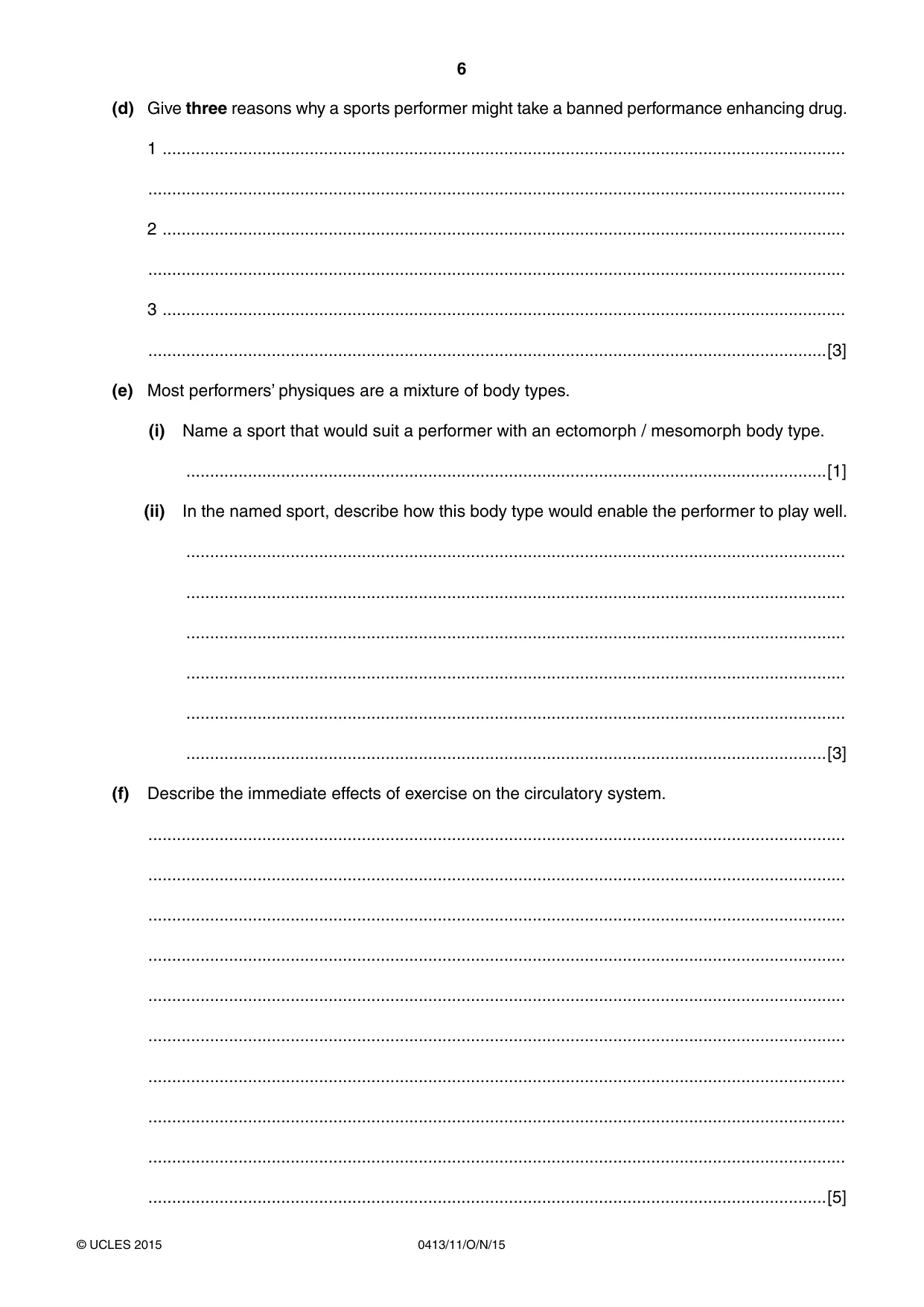
6 0413/11/O/N/15 © UCLES 2015 (d) Give three reasons why a sports performer might take a banned performance enhancing drug. 1 … … 2 … … 3 … …[3] (e) Most performers’ physiques are a mixture of body types. (i) Name a sport that would suit a performer with an ectomorph / mesomorph body type. …[1] (ii) In the named sport, describe how this body type would enable the performer to play well. … … … … … …[3] (f) Describe the immediate effects of exercise on the circulatory system. … … … … … … … … … …[5]
Question paper, page 7
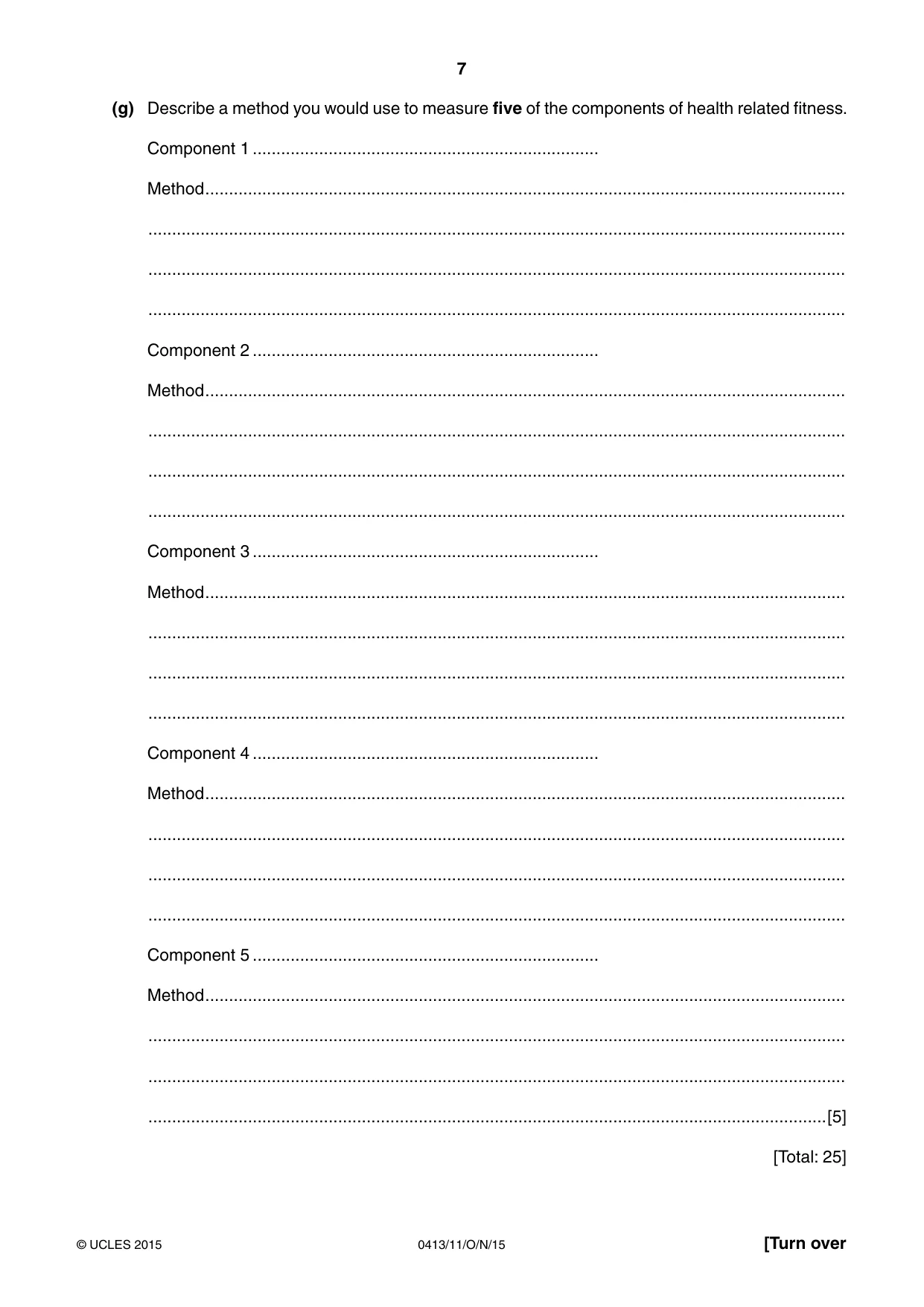
7 0413/11/O/N/15 © UCLES 2015 [Turn over (g) Describe a method you would use to measure five of the components of health related fitness. Component 1 … Method … … … … Component 2 … Method … … … … Component 3 … Method … … … … Component 4 … Method … … … … Component 5 … Method … … … …[5] [Total: 25]
Question paper, page 8
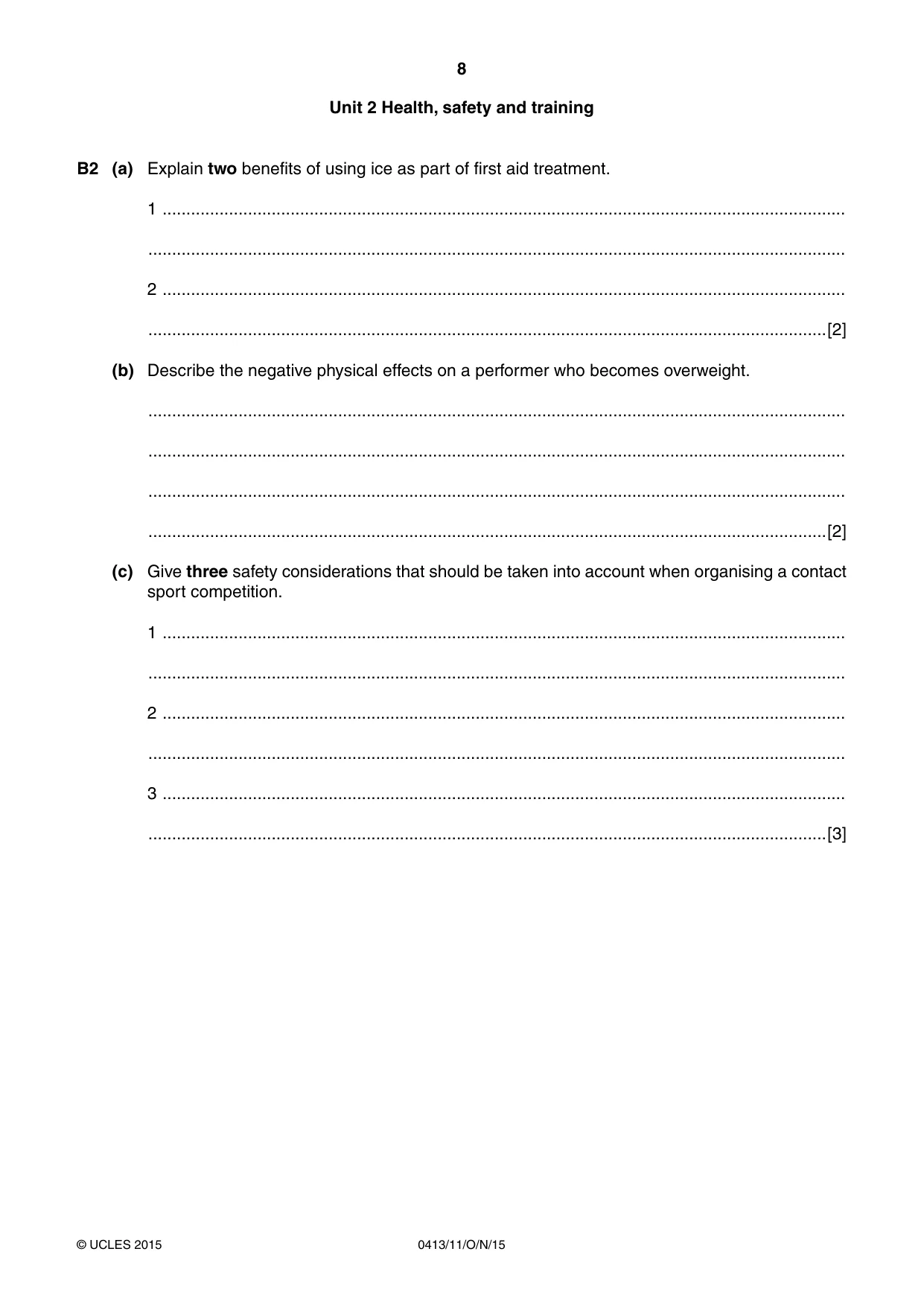
8 0413/11/O/N/15 © UCLES 2015 Unit 2 Health, safety and training B2 (a) Explain two benefits of using ice as part of first aid treatment. 1 … … 2 … …[2] (b) Describe the negative physical effects on a performer who becomes overweight. … … … …[2] (c) Give three safety considerations that should be taken into account when organising a contact sport competition. 1 … … 2 … … 3 … …[3]
Question paper, page 9
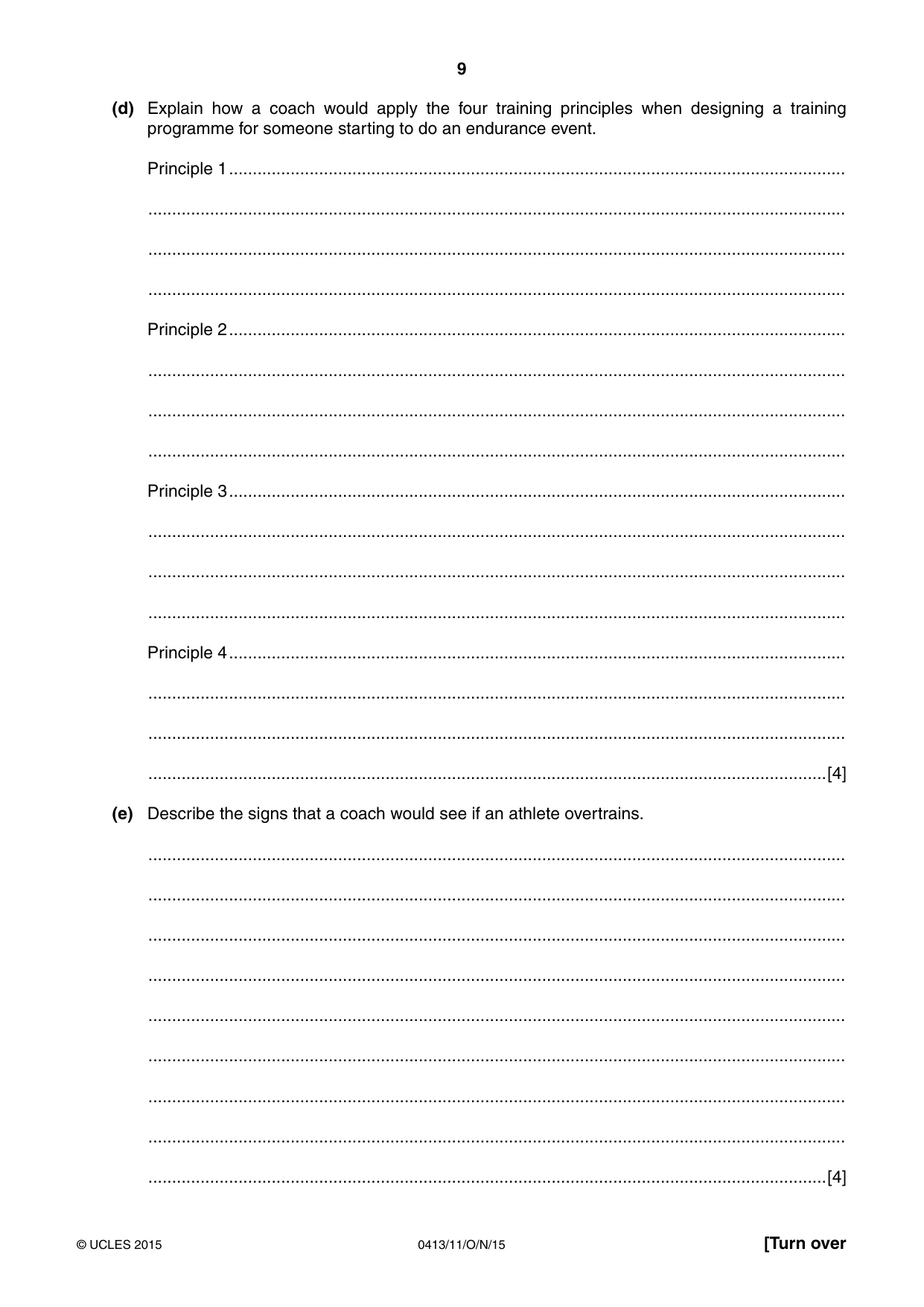
9 0413/11/O/N/15 © UCLES 2015 [Turn over (d) Explain how a coach would apply the four training principles when designing a training programme for someone starting to do an endurance event. Principle 1 … … … … Principle 2 … … … … Principle 3 … … … … Principle 4 … … … …[4] (e) Describe the signs that a coach would see if an athlete overtrains. … … … … … … … … …[4]
Question paper, page 10
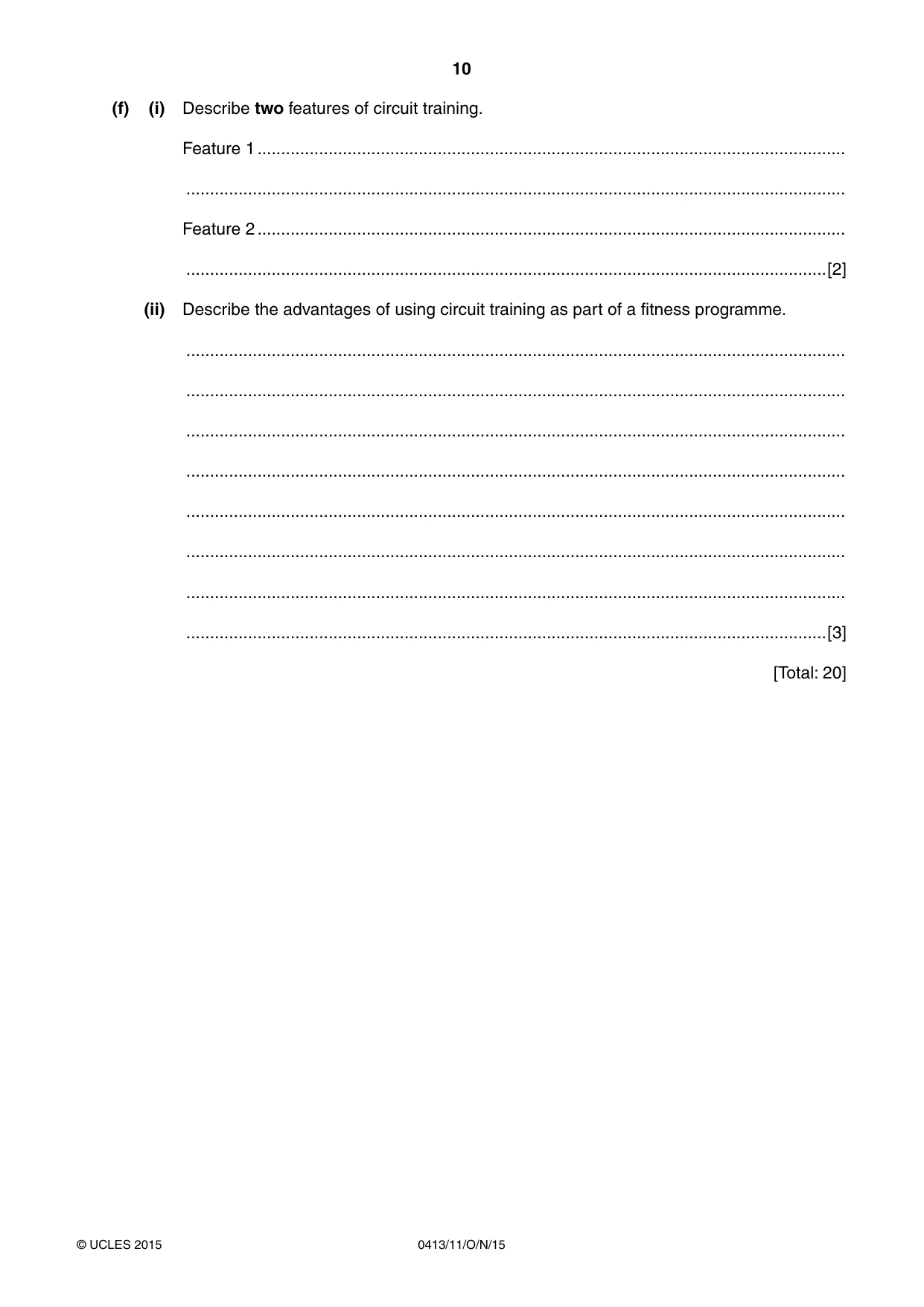
10 0413/11/O/N/15 © UCLES 2015 (f) (i) Describe two features of circuit training. Feature 1 … … Feature 2 … …[2] (ii) Describe the advantages of using circuit training as part of a fitness programme. … … … … … … … …[3] [Total: 20]
Question paper, page 11
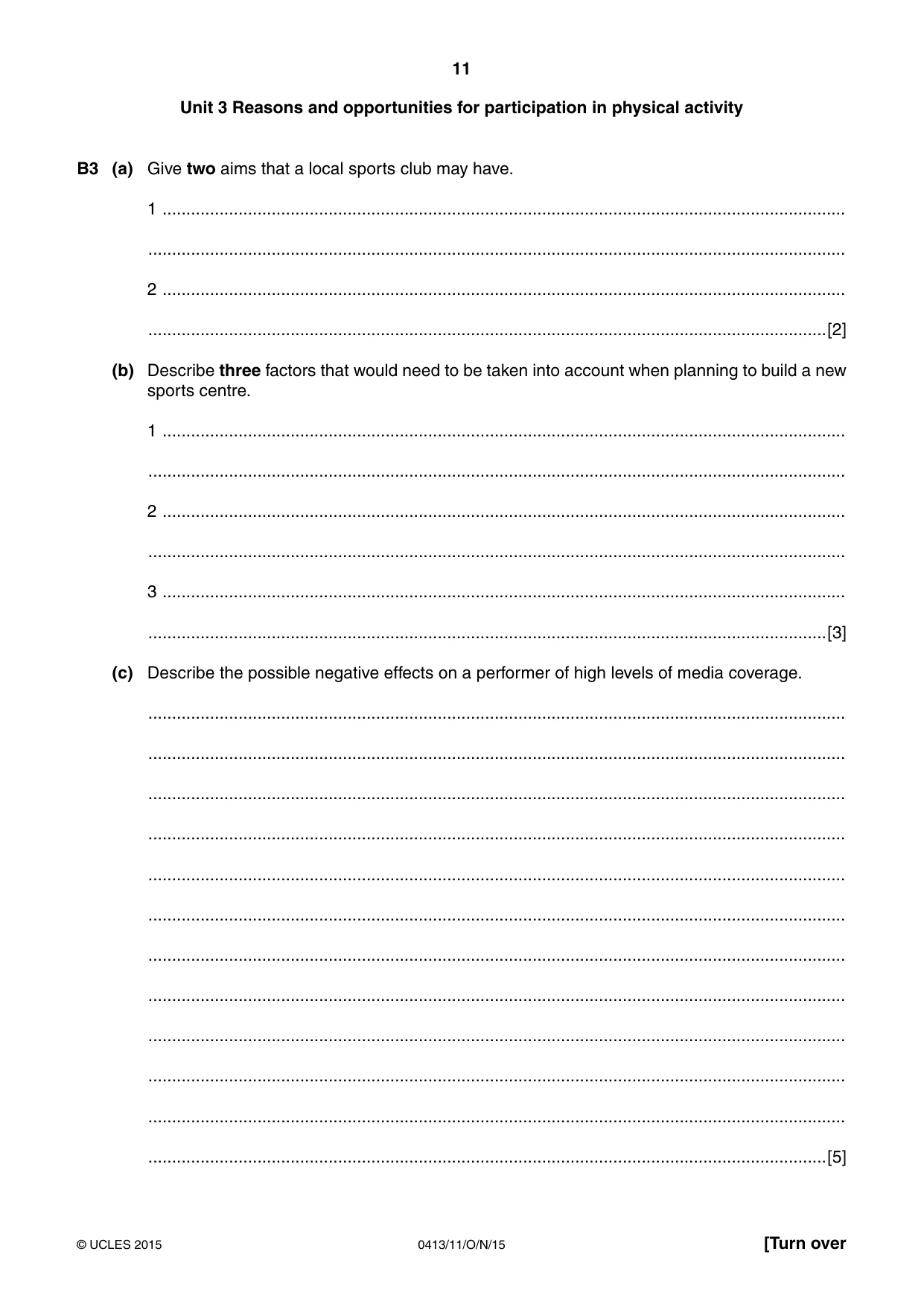
11 0413/11/O/N/15 © UCLES 2015 [Turn over Unit 3 Reasons and opportunities for participation in physical activity B3 (a) Give two aims that a local sports club may have. 1 … … 2 … …[2] (b) Describe three factors that would need to be taken into account when planning to build a new sports centre. 1 … … 2 … … 3 … …[3] (c) Describe the possible negative effects on a performer of high levels of media coverage. … … … … … … … … … … … …[5]
Question paper, page 12
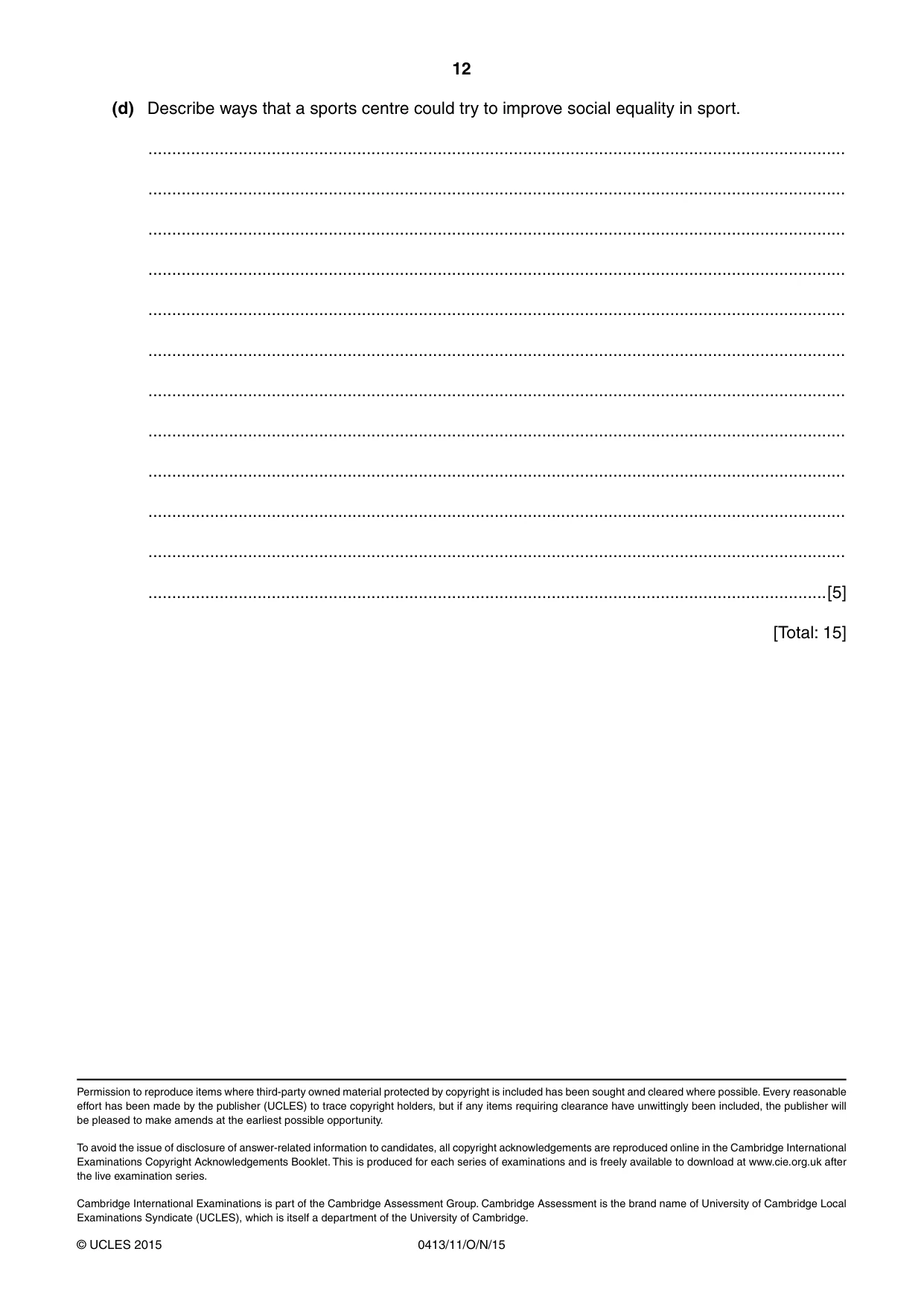
12 0413/11/O/N/15 © UCLES 2015 Permission to reproduce items where third-party owned material protected by copyright is included has been sought and cleared where possible. Every reasonable effort has been made by the publisher (UCLES) to trace copyright holders, but if any items requiring clearance have unwittingly been included, the publisher will be pleased to make amends at the earliest possible opportunity. To avoid the issue of disclosure of answer-related information to candidates, all copyright acknowledgements are reproduced online in the Cambridge International Examinations Copyright Acknowledgements Booklet. This is produced for each series of examinations and is freely available to download at www.cie.org.uk after the live examination series. Cambridge International Examinations is part of the Cambridge Assessment Group. Cambridge Assessment is the brand name of University of Cambridge Local Examinations Syndicate (UCLES), which is itself a department of the University of Cambridge. (d) Describe ways that a sports centre could try to improve social equality in sport. … … … … … … … … … … … …[5] [Total: 15]
Mark scheme, page 1
® IGCSE is the registered trademark of Cambridge International Examinations. CAMBRIDGE INTERNATIONAL EXAMINATIONS Cambridge International General Certificate of Secondary Education MARK SCHEME for the October/November 2015 series 0413 PHYSICAL EDUCATION 0413/11 Paper 1, maximum raw mark 80 This mark scheme is published as an aid to teachers and candidates, to indicate the requirements of the examination. It shows the basis on which Examiners were instructed to award marks. It does not indicate the details of the discussions that took place at an Examiners’ meeting before marking began, which would have considered the acceptability of alternative answers. Mark schemes should be read in conjunction with the question paper and the Principal Examiner Report for Teachers. Cambridge will not enter into discussions about these mark schemes. Cambridge is publishing the mark schemes for the October/November 2015 series for most Cambridge IGCSE®, Cambridge International A and AS Level components and some Cambridge O Level components.
Mark scheme, page 2
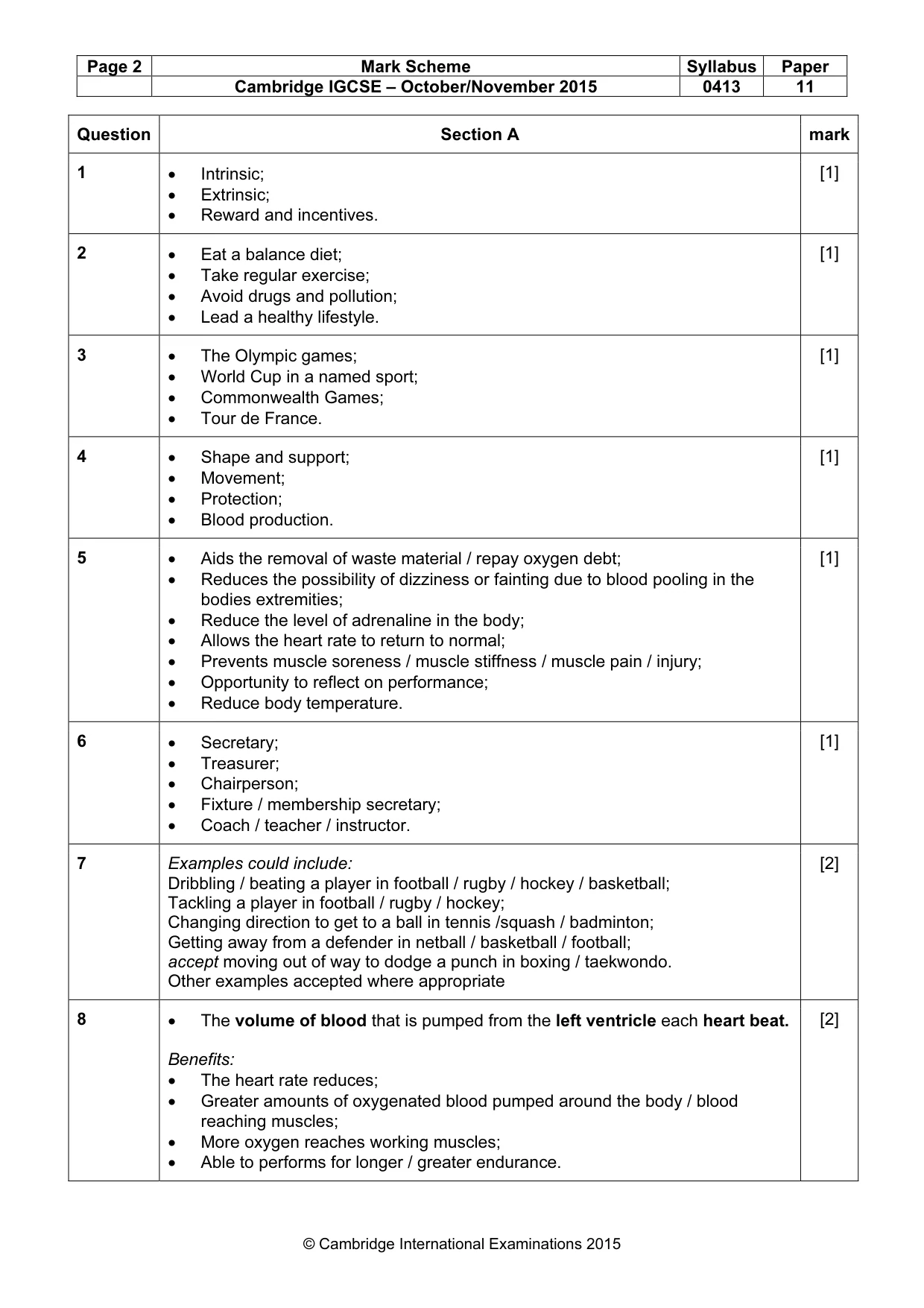
Page 2 Mark Scheme Syllabus Paper Cambridge IGCSE – October/November 2015 0413 11 © Cambridge International Examinations 2015 Question Section A mark 1 • Intrinsic; • Extrinsic; • Reward and incentives. [1] 2 • Eat a balance diet; • Take regular exercise; • Avoid drugs and pollution; • Lead a healthy lifestyle. [1] 3 • The Olympic games; • World Cup in a named sport; • Commonwealth Games; • Tour de France. [1] 4 • Shape and support; • Movement; • Protection; • Blood production. [1] 5 • Aids the removal of waste material / repay oxygen debt; • Reduces the possibility of dizziness or fainting due to blood pooling in the bodies extremities; • Reduce the level of adrenaline in the body; • Allows the heart rate to return to normal; • Prevents muscle soreness / muscle stiffness / muscle pain / injury; • Opportunity to reflect on performance; • Reduce body temperature. [1] 6 • Secretary; • Treasurer; • Chairperson; • Fixture / membership secretary; • Coach / teacher / instructor. [1] 7 Examples could include: Dribbling / beating a player in football / rugby / hockey / basketball; Tackling a player in football / rugby / hockey; Changing direction to get to a ball in tennis /squash / badminton; Getting away from a defender in netball / basketball / football; accept moving out of way to dodge a punch in boxing / taekwondo. Other examples accepted where appropriate [2] 8 • The volume of blood that is pumped from the left ventricle each heart beat. Benefits: • The heart rate reduces; • Greater amounts of oxygenated blood pumped around the body / blood reaching muscles; • More oxygen reaches working muscles; • Able to performs for longer / greater endurance. [2]
Mark scheme, page 3
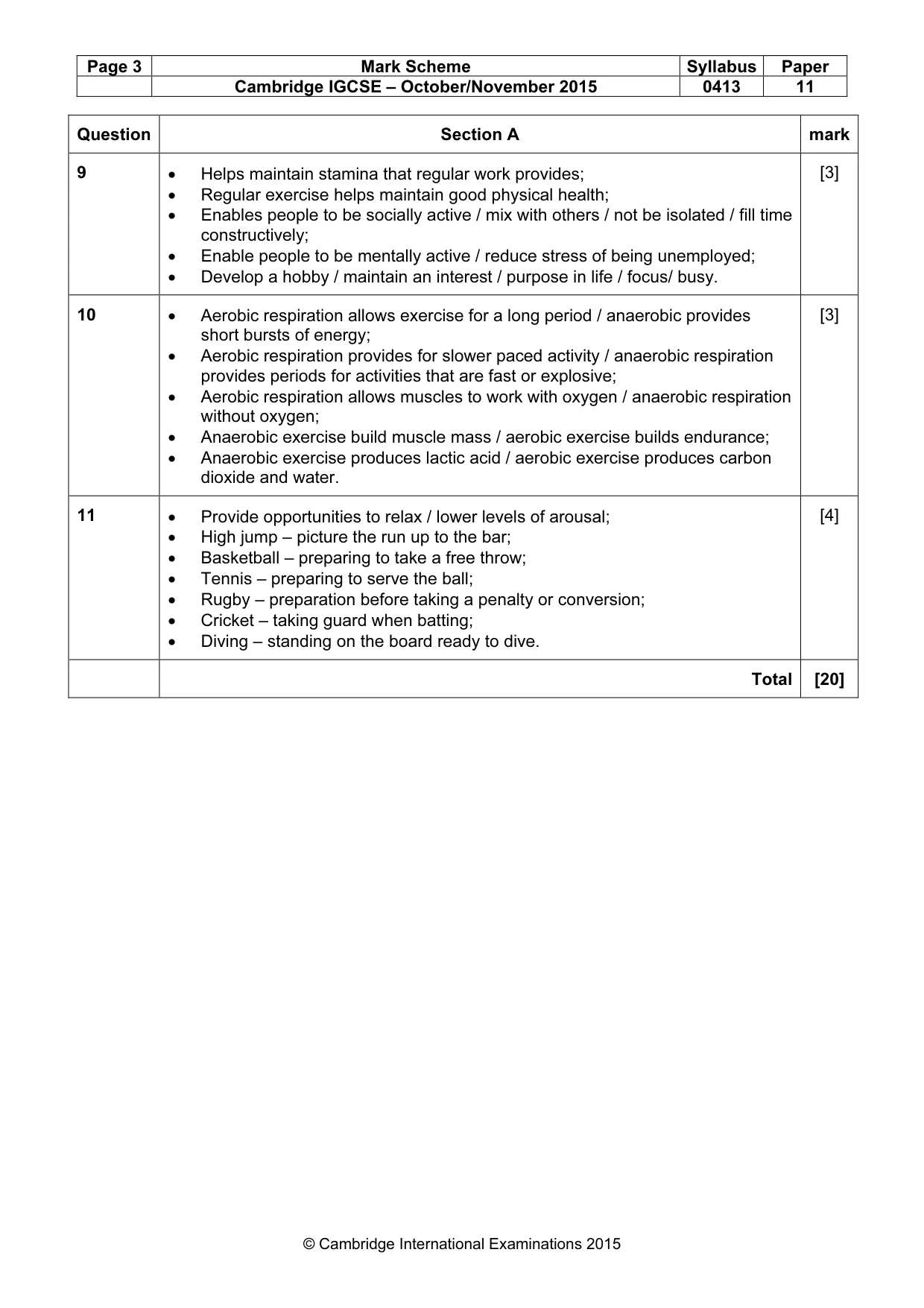
Page 3 Mark Scheme Syllabus Paper Cambridge IGCSE – October/November 2015 0413 11 © Cambridge International Examinations 2015 Question Section A mark 9 • Helps maintain stamina that regular work provides; • Regular exercise helps maintain good physical health; • Enables people to be socially active / mix with others / not be isolated / fill time constructively; • Enable people to be mentally active / reduce stress of being unemployed; • Develop a hobby / maintain an interest / purpose in life / focus/ busy. [3] 10 • Aerobic respiration allows exercise for a long period / anaerobic provides short bursts of energy; • Aerobic respiration provides for slower paced activity / anaerobic respiration provides periods for activities that are fast or explosive; • Aerobic respiration allows muscles to work with oxygen / anaerobic respiration without oxygen; • Anaerobic exercise build muscle mass / aerobic exercise builds endurance; • Anaerobic exercise produces lactic acid / aerobic exercise produces carbon dioxide and water. [3] 11 • Provide opportunities to relax / lower levels of arousal; • High jump – picture the run up to the bar; • Basketball – preparing to take a free throw; • Tennis – preparing to serve the ball; • Rugby – preparation before taking a penalty or conversion; • Cricket – taking guard when batting; • Diving – standing on the board ready to dive. [4] Total [20]
Mark scheme, page 4
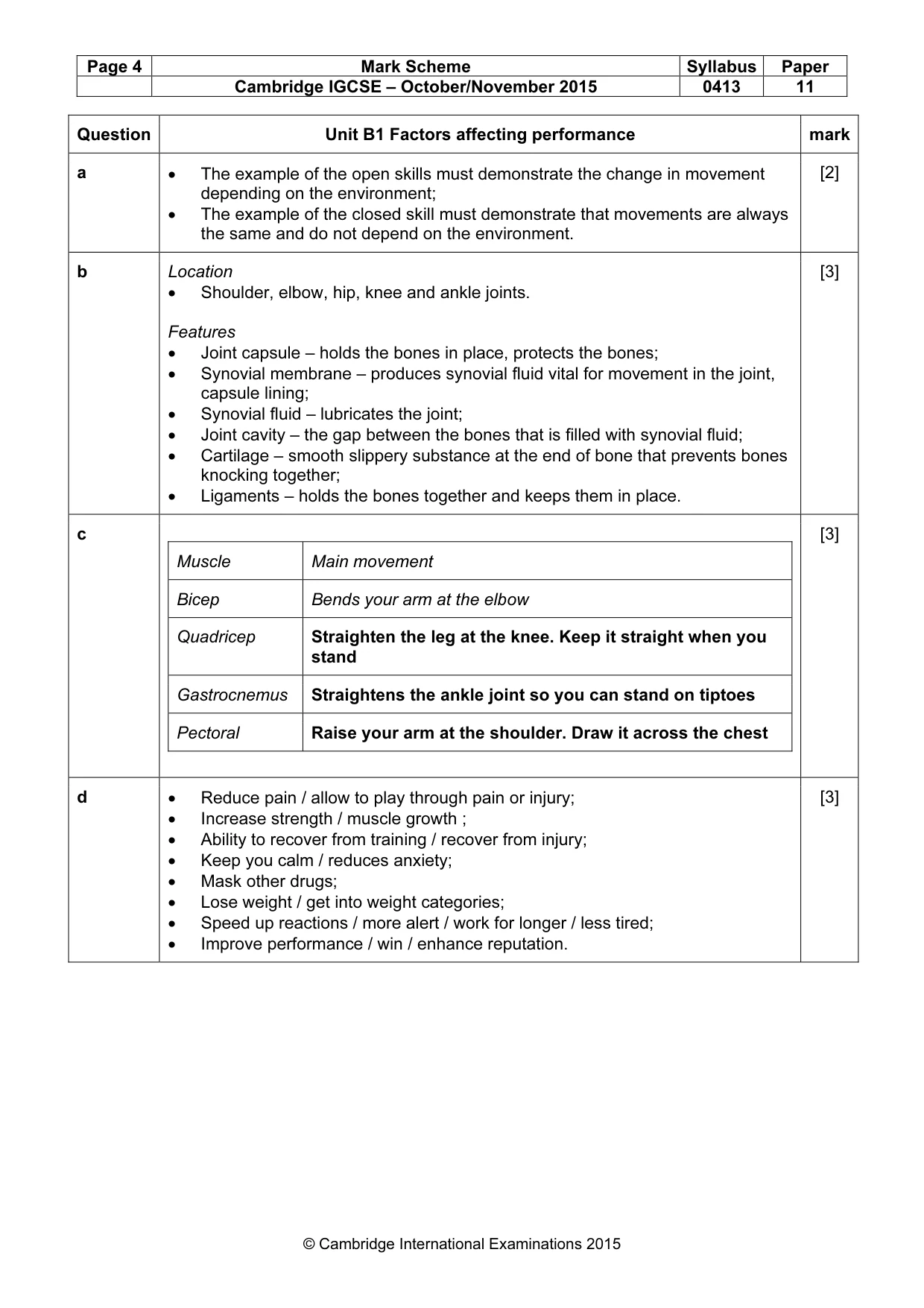
Page 4 Mark Scheme Syllabus Paper Cambridge IGCSE – October/November 2015 0413 11 © Cambridge International Examinations 2015 Question Unit B1 Factors affecting performance mark a • The example of the open skills must demonstrate the change in movement depending on the environment; • The example of the closed skill must demonstrate that movements are always the same and do not depend on the environment. [2] b Location • Shoulder, elbow, hip, knee and ankle joints. Features • Joint capsule – holds the bones in place, protects the bones; • Synovial membrane – produces synovial fluid vital for movement in the joint, capsule lining; • Synovial fluid – lubricates the joint; • Joint cavity – the gap between the bones that is filled with synovial fluid; • Cartilage – smooth slippery substance at the end of bone that prevents bones knocking together; • Ligaments – holds the bones together and keeps them in place. [3] c Muscle Main movement Bicep Bends your arm at the elbow Quadricep Straighten the leg at the knee. Keep it straight when you stand Gastrocnemus Straightens the ankle joint so you can stand on tiptoes Pectoral Raise your arm at the shoulder. Draw it across the chest [3] d • Reduce pain / allow to play through pain or injury; • Increase strength / muscle growth ; • Ability to recover from training / recover from injury; • Keep you calm / reduces anxiety; • Mask other drugs; • Lose weight / get into weight categories; • Speed up reactions / more alert / work for longer / less tired; • Improve performance / win / enhance reputation. [3]
Mark scheme, page 5
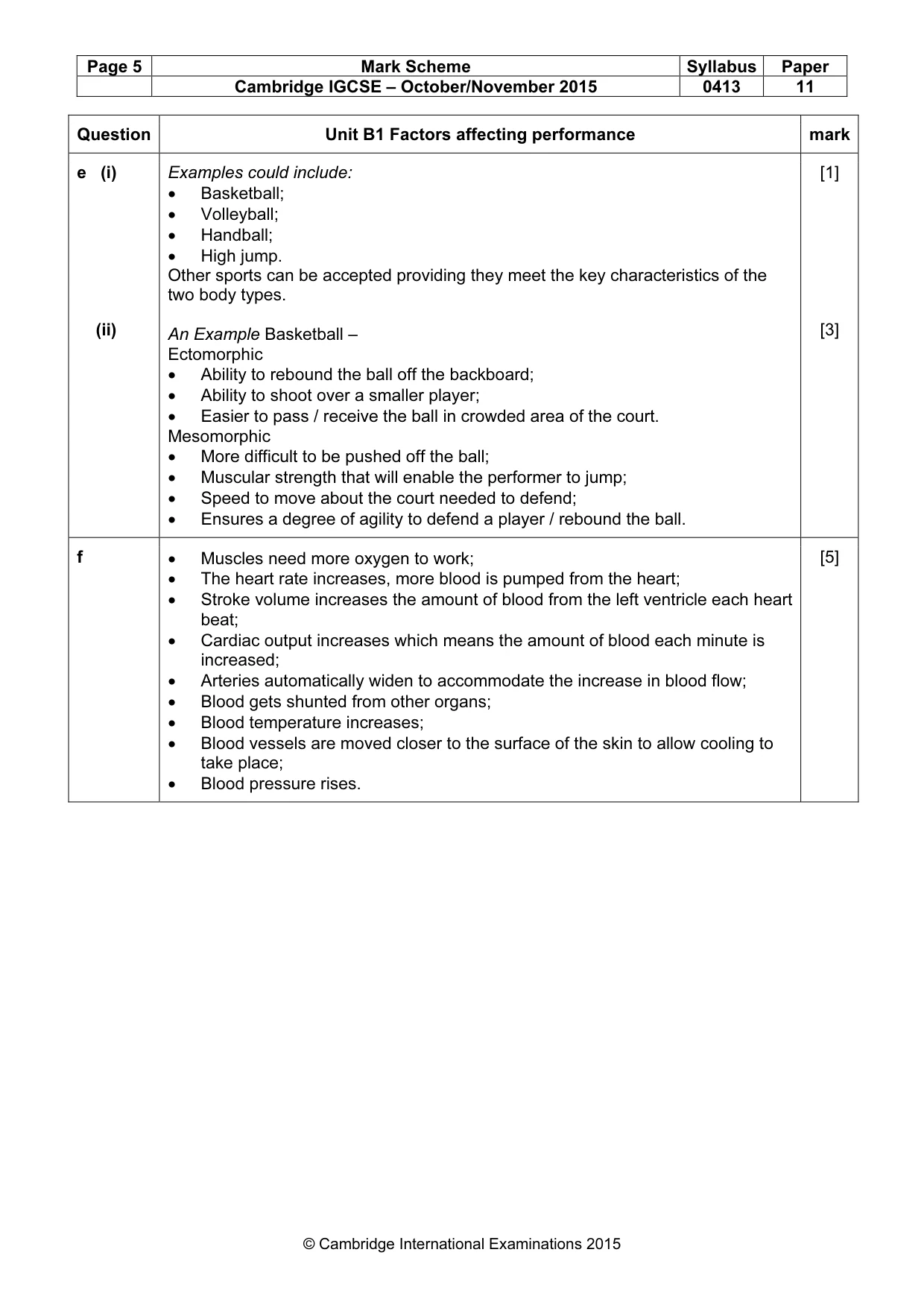
Page 5 Mark Scheme Syllabus Paper Cambridge IGCSE – October/November 2015 0413 11 © Cambridge International Examinations 2015 Question Unit B1 Factors affecting performance mark e (i) (ii) Examples could include: • Basketball; • Volleyball; • Handball; • High jump. Other sports can be accepted providing they meet the key characteristics of the two body types. An Example Basketball – Ectomorphic • Ability to rebound the ball off the backboard; • Ability to shoot over a smaller player; • Easier to pass / receive the ball in crowded area of the court. Mesomorphic • More difficult to be pushed off the ball; • Muscular strength that will enable the performer to jump; • Speed to move about the court needed to defend; • Ensures a degree of agility to defend a player / rebound the ball. [1] [3] f • Muscles need more oxygen to work; • The heart rate increases, more blood is pumped from the heart; • Stroke volume increases the amount of blood from the left ventricle each heart beat; • Cardiac output increases which means the amount of blood each minute is increased; • Arteries automatically widen to accommodate the increase in blood flow; • Blood gets shunted from other organs; • Blood temperature increases; • Blood vessels are moved closer to the surface of the skin to allow cooling to take place; • Blood pressure rises. [5]
Mark scheme, page 6
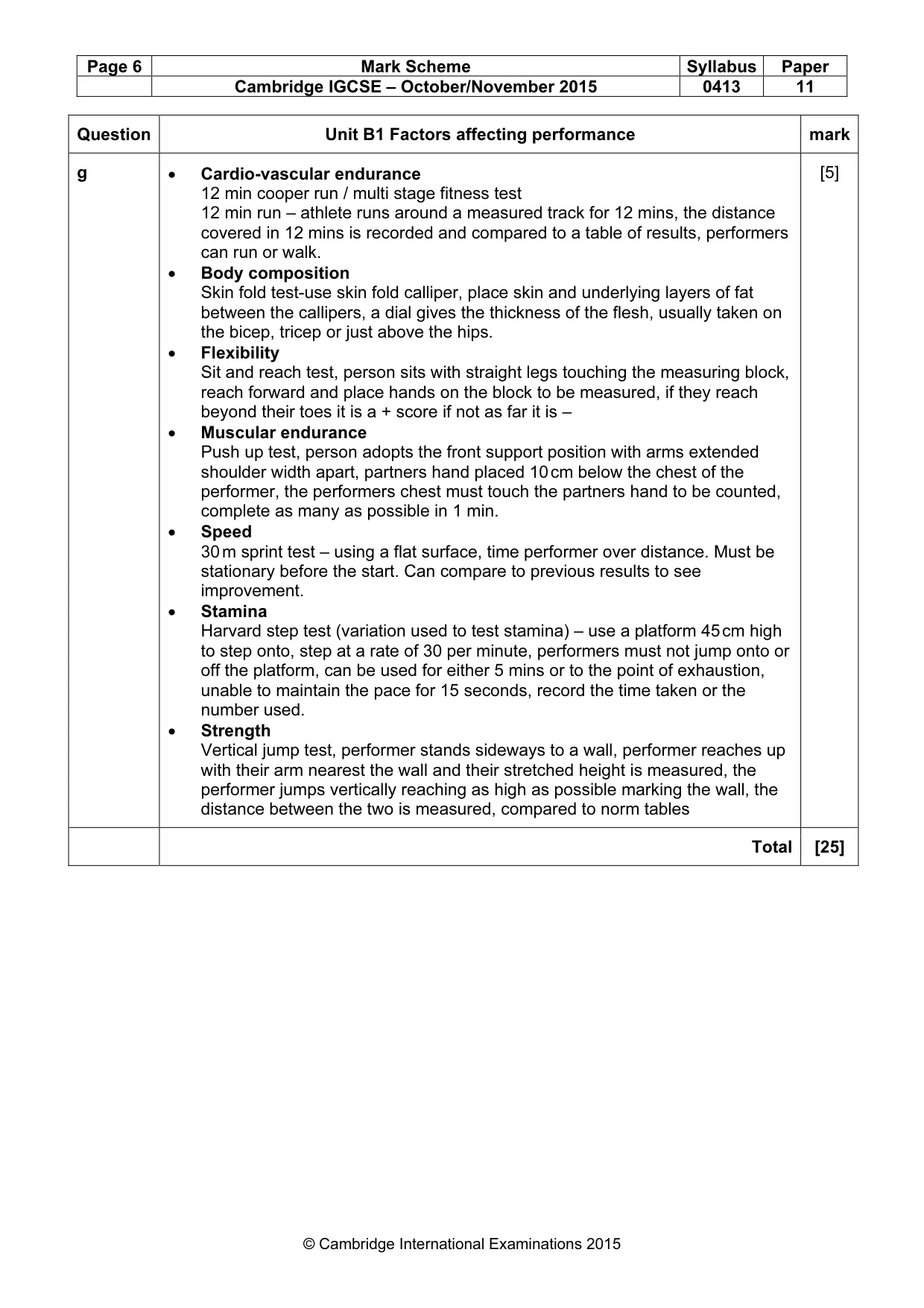
Page 6 Mark Scheme Syllabus Paper Cambridge IGCSE – October/November 2015 0413 11 © Cambridge International Examinations 2015 Question Unit B1 Factors affecting performance mark g • Cardio-vascular endurance 12 min cooper run / multi stage fitness test 12 min run – athlete runs around a measured track for 12 mins, the distance covered in 12 mins is recorded and compared to a table of results, performers can run or walk. • Body composition Skin fold test-use skin fold calliper, place skin and underlying layers of fat between the callipers, a dial gives the thickness of the flesh, usually taken on the bicep, tricep or just above the hips. • Flexibility Sit and reach test, person sits with straight legs touching the measuring block, reach forward and place hands on the block to be measured, if they reach beyond their toes it is a + score if not as far it is – • Muscular endurance Push up test, person adopts the front support position with arms extended shoulder width apart, partners hand placed 10 cm below the chest of the performer, the performers chest must touch the partners hand to be counted, complete as many as possible in 1 min. • Speed 30 m sprint test – using a flat surface, time performer over distance. Must be stationary before the start. Can compare to previous results to see improvement. • Stamina Harvard step test (variation used to test stamina) – use a platform 45 cm high to step onto, step at a rate of 30 per minute, performers must not jump onto or off the platform, can be used for either 5 mins or to the point of exhaustion, unable to maintain the pace for 15 seconds, record the time taken or the number used. • Strength Vertical jump test, performer stands sideways to a wall, performer reaches up with their arm nearest the wall and their stretched height is measured, the performer jumps vertically reaching as high as possible marking the wall, the distance between the two is measured, compared to norm tables [5] Total [25]
Mark scheme, page 7
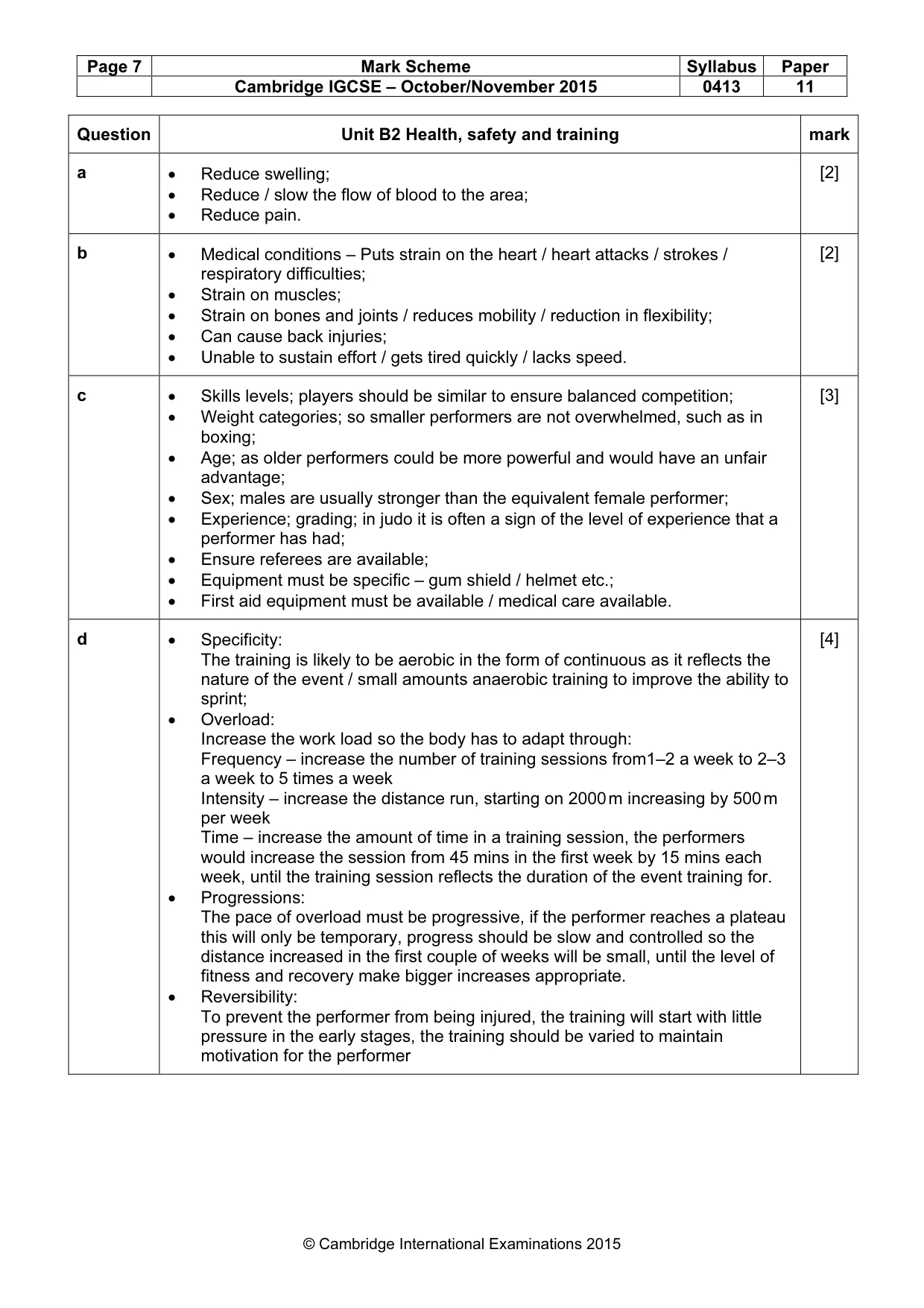
Page 7 Mark Scheme Syllabus Paper Cambridge IGCSE – October/November 2015 0413 11 © Cambridge International Examinations 2015 Question Unit B2 Health, safety and training mark a • Reduce swelling; • Reduce / slow the flow of blood to the area; • Reduce pain. [2] b • Medical conditions – Puts strain on the heart / heart attacks / strokes / respiratory difficulties; • Strain on muscles; • Strain on bones and joints / reduces mobility / reduction in flexibility; • Can cause back injuries; • Unable to sustain effort / gets tired quickly / lacks speed. [2] c • Skills levels; players should be similar to ensure balanced competition; • Weight categories; so smaller performers are not overwhelmed, such as in boxing; • Age; as older performers could be more powerful and would have an unfair advantage; • Sex; males are usually stronger than the equivalent female performer; • Experience; grading; in judo it is often a sign of the level of experience that a performer has had; • Ensure referees are available; • Equipment must be specific – gum shield / helmet etc.; • First aid equipment must be available / medical care available. [3] d • Specificity: The training is likely to be aerobic in the form of continuous as it reflects the nature of the event / small amounts anaerobic training to improve the ability to sprint; • Overload: Increase the work load so the body has to adapt through: Frequency – increase the number of training sessions from1–2 a week to 2–3 a week to 5 times a week Intensity – increase the distance run, starting on 2000 m increasing by 500 m per week Time – increase the amount of time in a training session, the performers would increase the session from 45 mins in the first week by 15 mins each week, until the training session reflects the duration of the event training for. • Progressions: The pace of overload must be progressive, if the performer reaches a plateau this will only be temporary, progress should be slow and controlled so the distance increased in the first couple of weeks will be small, until the level of fitness and recovery make bigger increases appropriate. • Reversibility: To prevent the performer from being injured, the training will start with little pressure in the early stages, the training should be varied to maintain motivation for the performer [4]
Mark scheme, page 8
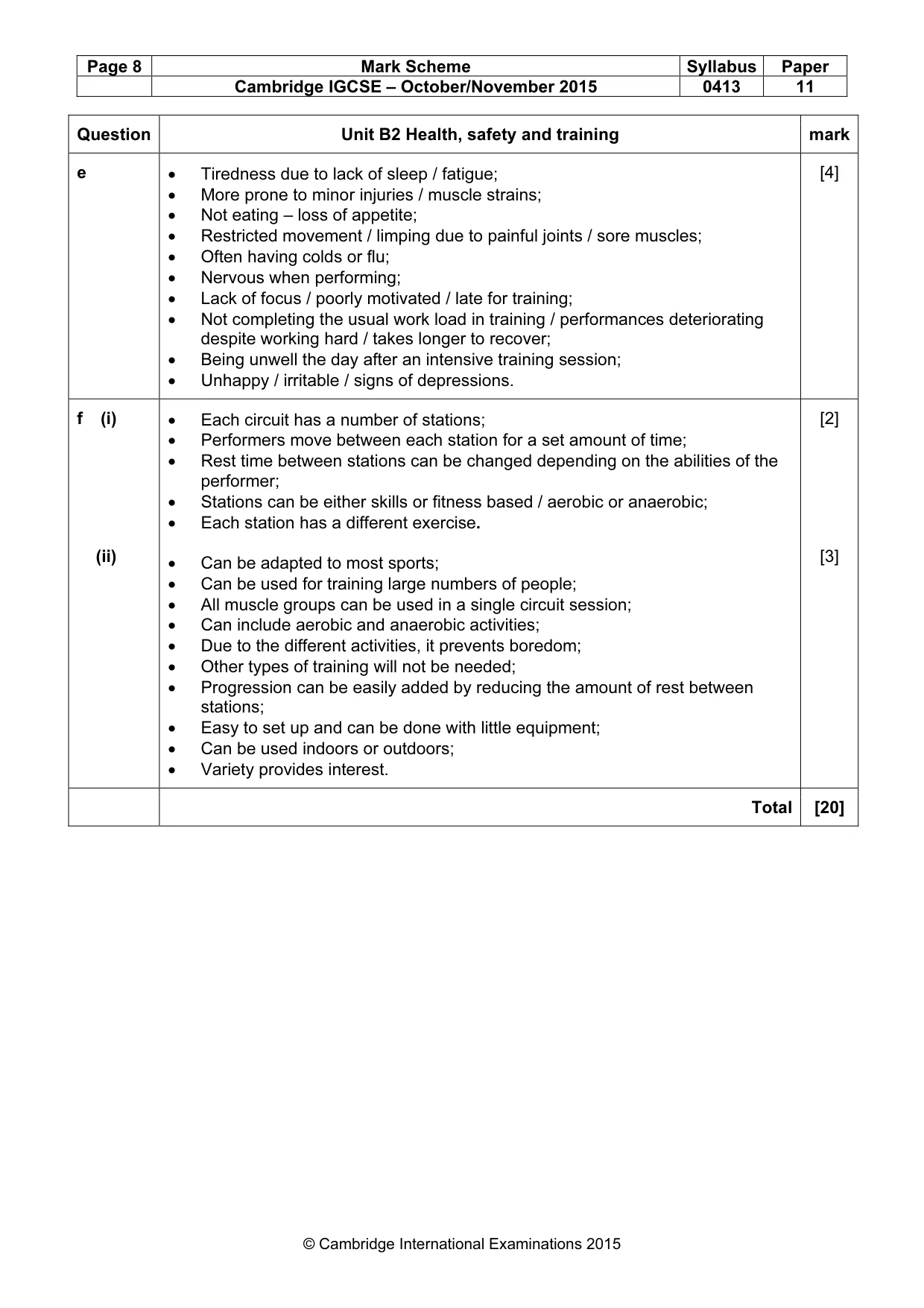
Page 8 Mark Scheme Syllabus Paper Cambridge IGCSE – October/November 2015 0413 11 © Cambridge International Examinations 2015 Question Unit B2 Health, safety and training mark e • Tiredness due to lack of sleep / fatigue; • More prone to minor injuries / muscle strains; • Not eating – loss of appetite; • Restricted movement / limping due to painful joints / sore muscles; • Often having colds or flu; • Nervous when performing; • Lack of focus / poorly motivated / late for training; • Not completing the usual work load in training / performances deteriorating despite working hard / takes longer to recover; • Being unwell the day after an intensive training session; • Unhappy / irritable / signs of depressions. [4] f (i) (ii) • Each circuit has a number of stations; • Performers move between each station for a set amount of time; • Rest time between stations can be changed depending on the abilities of the performer; • Stations can be either skills or fitness based / aerobic or anaerobic; • Each station has a different exercise. • Can be adapted to most sports; • Can be used for training large numbers of people; • All muscle groups can be used in a single circuit session; • Can include aerobic and anaerobic activities; • Due to the different activities, it prevents boredom; • Other types of training will not be needed; • Progression can be easily added by reducing the amount of rest between stations; • Easy to set up and can be done with little equipment; • Can be used indoors or outdoors; • Variety provides interest. [2] [3] Total [20]
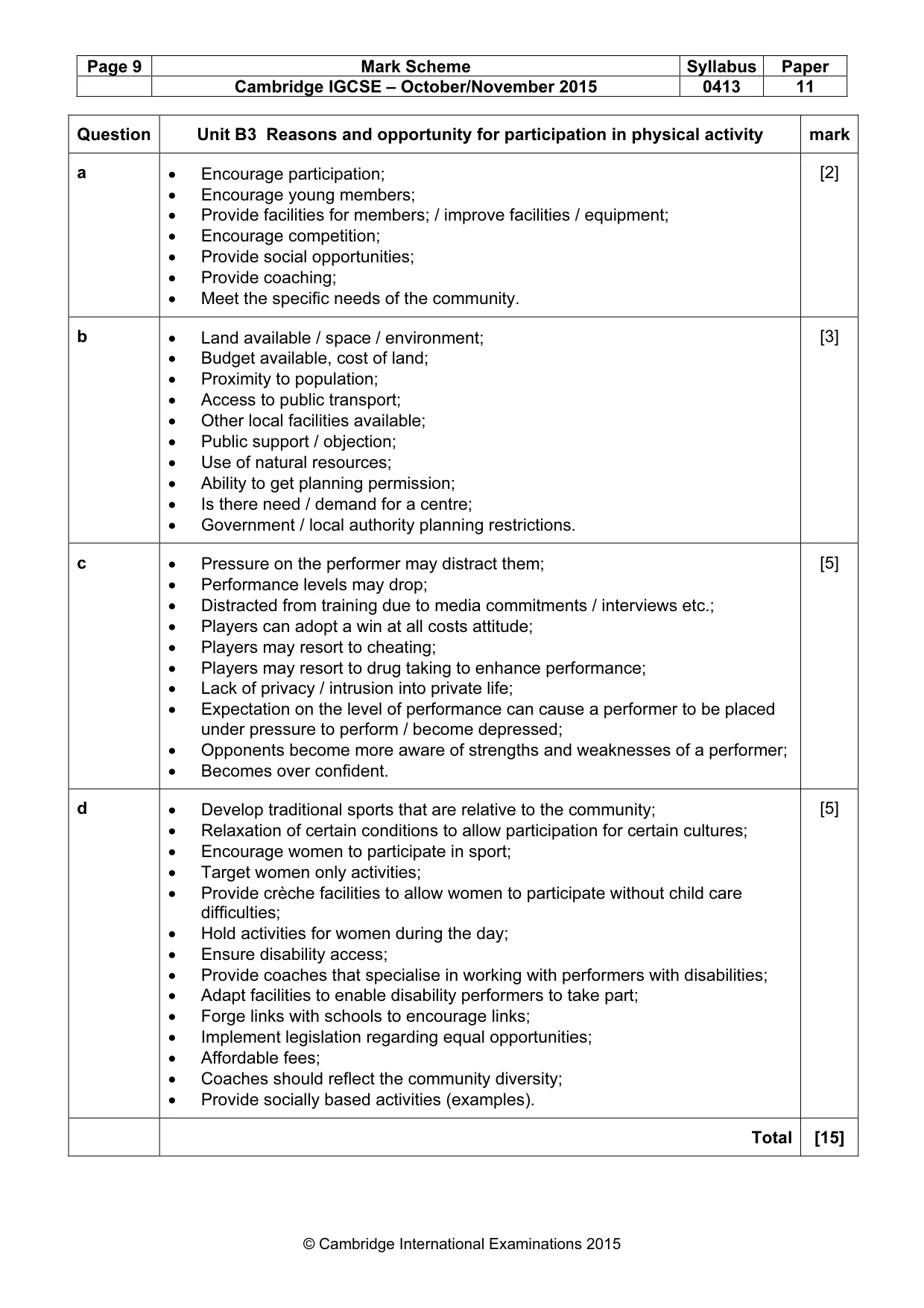
Mark scheme, page 9
Page 9 Mark Scheme Syllabus Paper Cambridge IGCSE – October/November 2015 0413 11 © Cambridge International Examinations 2015 Question Unit B3 Reasons and opportunity for participation in physical activity mark a • Encourage participation; • Encourage young members; • Provide facilities for members; / improve facilities / equipment; • Encourage competition; • Provide social opportunities; • Provide coaching; • Meet the specific needs of the community. [2] b • Land available / space / environment; • Budget available, cost of land; • Proximity to population; • Access to public transport; • Other local facilities available; • Public support / objection; • Use of natural resources; • Ability to get planning permission; • Is there need / demand for a centre; • Government / local authority planning restrictions. [3] c • Pressure on the performer may distract them; • Performance levels may drop; • Distracted from training due to media commitments / interviews etc.; • Players can adopt a win at all costs attitude; • Players may resort to cheating; • Players may resort to drug taking to enhance performance; • Lack of privacy / intrusion into private life; • Expectation on the level of performance can cause a performer to be placed under pressure to perform / become depressed; • Opponents become more aware of strengths and weaknesses of a performer; • Becomes over confident. [5] d • Develop traditional sports that are relative to the community; • Relaxation of certain conditions to allow participation for certain cultures; • Encourage women to participate in sport; • Target women only activities; • Provide crèche facilities to allow women to participate without child care difficulties; • Hold activities for women during the day; • Ensure disability access; • Provide coaches that specialise in working with performers with disabilities; • Adapt facilities to enable disability performers to take part; • Forge links with schools to encourage links; • Implement legislation regarding equal opportunities; • Affordable fees; • Coaches should reflect the community diversity; • Provide socially based activities (examples). [5] Total [15]
What you needed in this session
Cambridge’s own grade thresholds for 2015 Oct/Nov, Paper 1 · Variant 1. A higher threshold means an easier paper — the bar moves with how the cohort did.