Cambridge IGCSE Physical Education 0413 — 2014 May/June Paper 1 · Variant 2
0413/12/M/J/14 · 80 marks · ≈90 min
The question paper and its mark scheme, free to read here and free to download. This is Cambridge’s own paper, exactly as it was sat.
Question paper12 pages



Mark scheme9 pages
Answers below. Sit the paper first if you are practising.
Paper as text
Question paper, page 1
This document consists of 10 printed pages and 2 blank pages. DC (RCL (DF)) 81096/3 © UCLES 2014 [Turn over Cambridge International Examinations Cambridge International General Certificate of Secondary Education * 6 2 0 0 4 9 1 2 1 3 * PHYSICAL EDUCATION 0413/12 Paper 1 May/June 2014 1 hour 45 minutes Candidates answer on the Question Paper. No Additional Materials are required. READ THESE INSTRUCTIONS FIRST Write your Centre number, candidate number and name on all the work you hand in. Write in dark blue or black pen. You may use an HB pencil for any diagrams or graphs. Do not use staples, paper clips, glue or correction fluid. DO NOT WRITE IN ANY BARCODES. Answer all questions. At the end of the examination, fasten all your work securely together. The number of marks is given in brackets [ ] at the end of each question or part question. Electronic calculators may be used.
Question paper, page 2
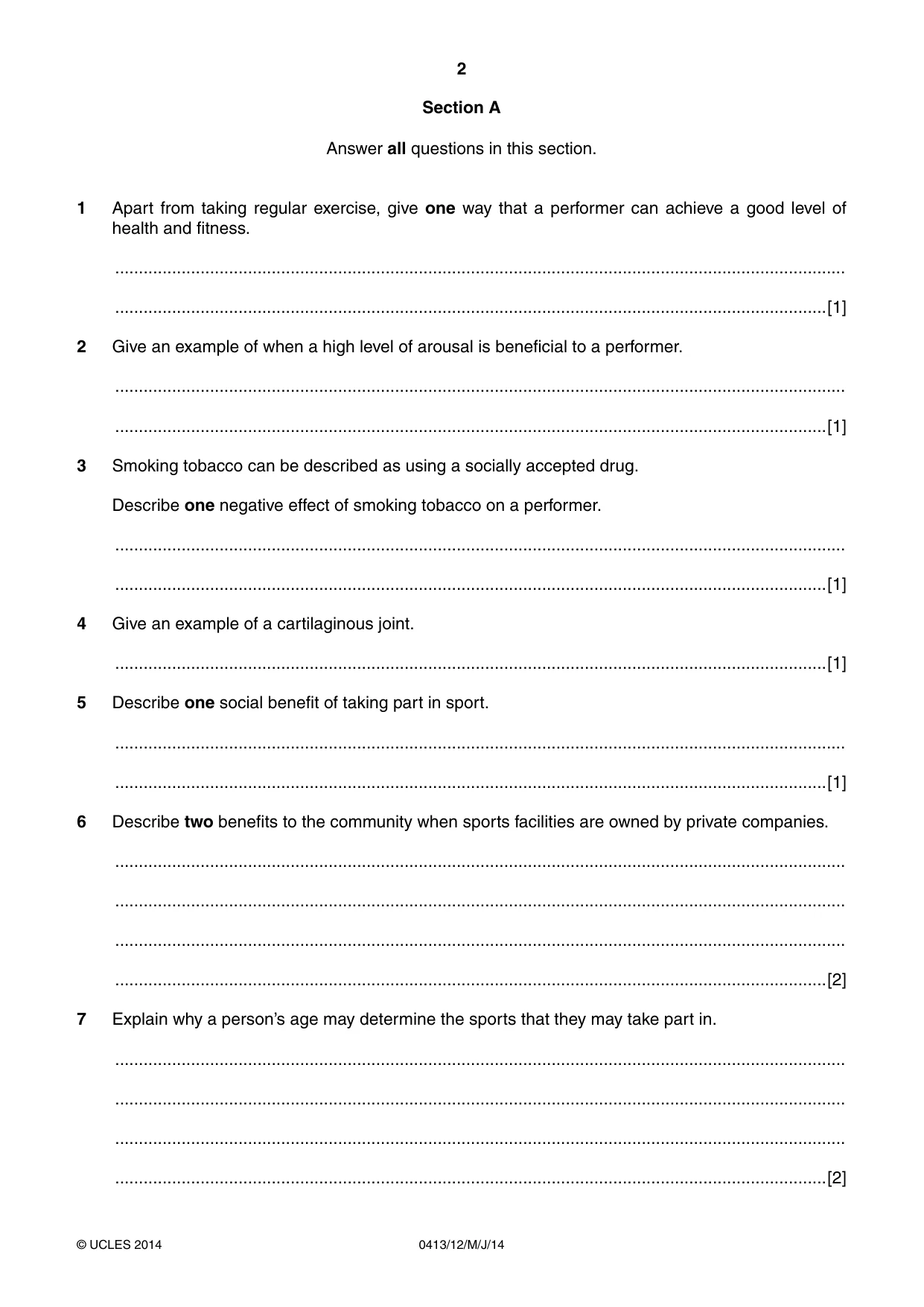
2 0413/12/M/J/14 © UCLES 2014 Section A Answer all questions in this section. 1 Apart from taking regular exercise, give one way that a performer can achieve a good level of health and fitness. … …[1] 2 Give an example of when a high level of arousal is beneficial to a performer. … …[1] 3 Smoking tobacco can be described as using a socially accepted drug. Describe one negative effect of smoking tobacco on a performer. … …[1] 4 Give an example of a cartilaginous joint. …[1] 5 Describe one social benefit of taking part in sport. … …[1] 6 Describe two benefits to the community when sports facilities are owned by private companies. … … … …[2] 7 Explain why a person’s age may determine the sports that they may take part in. … … … …[2]
Question paper, page 3
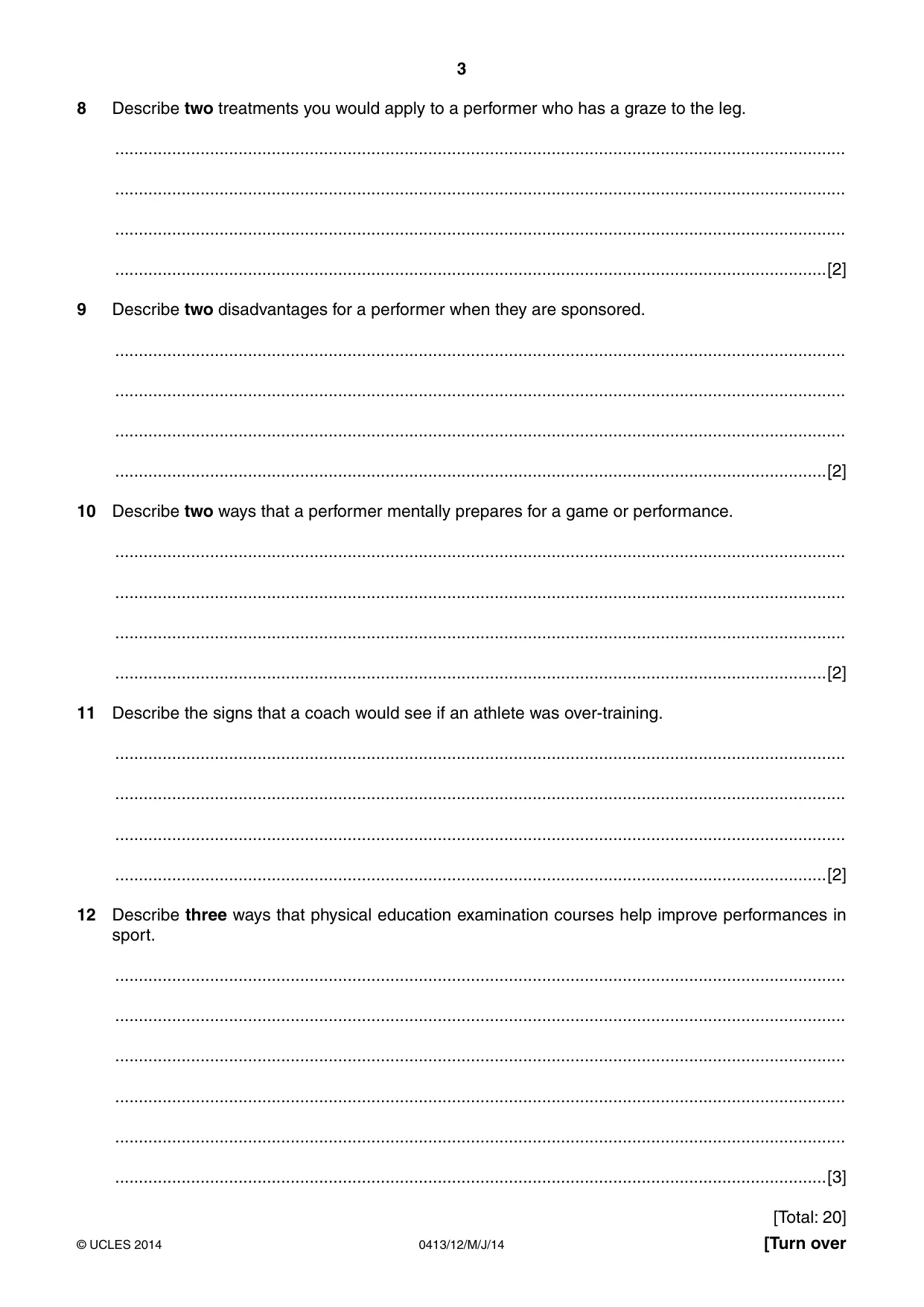
3 0413/12/M/J/14 © UCLES 2014 [Turn over 8 Describe two treatments you would apply to a performer who has a graze to the leg. … … … …[2] 9 Describe two disadvantages for a performer when they are sponsored. … … … …[2] 10 Describe two ways that a performer mentally prepares for a game or performance. … … … …[2] 11 Describe the signs that a coach would see if an athlete was over-training. … … … …[2] 12 Describe three ways that physical education examination courses help improve performances in sport. … … … … … …[3] [Total: 20]
Question paper, page 4
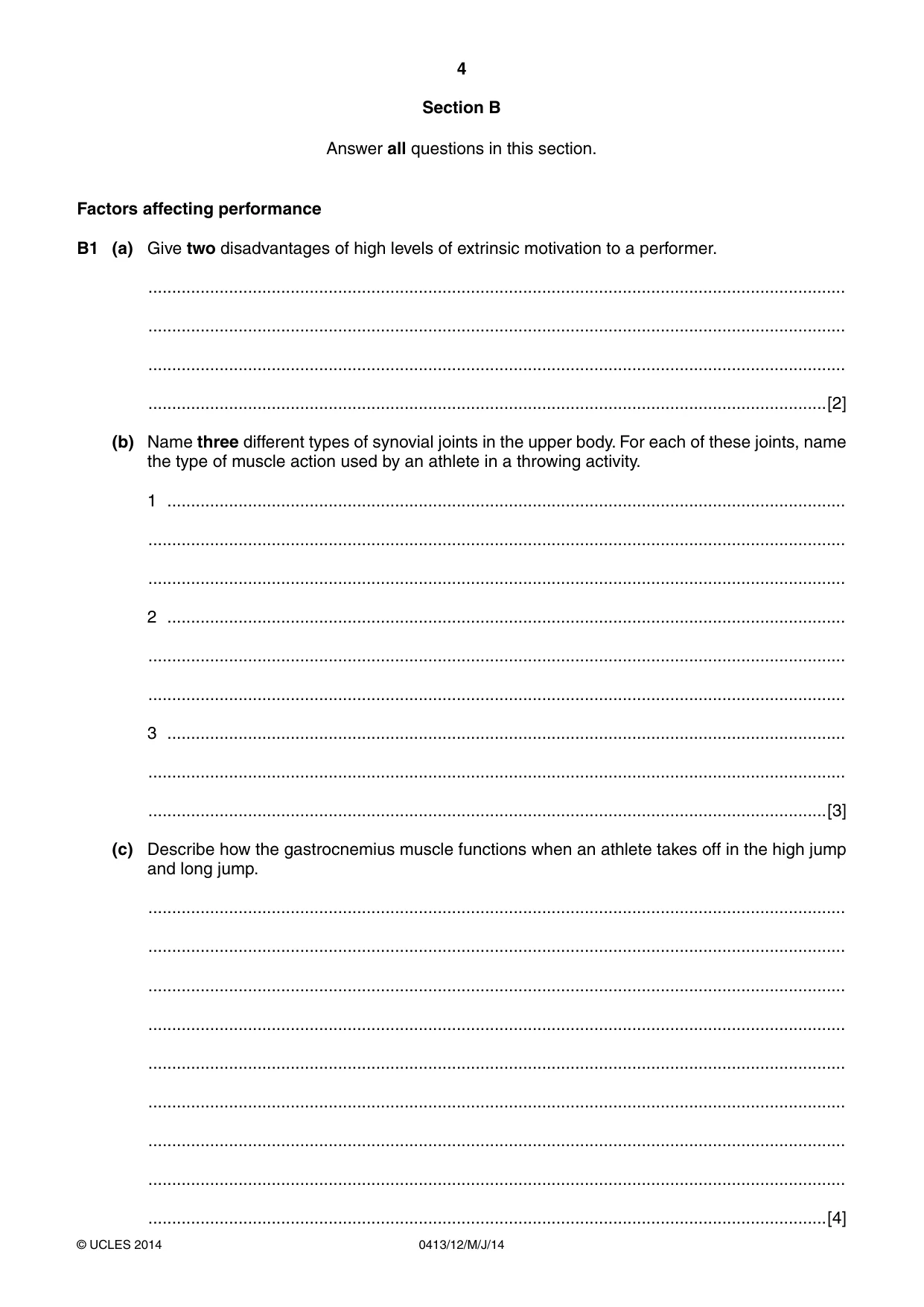
4 0413/12/M/J/14 © UCLES 2014 Section B Answer all questions in this section. Factors affecting performance B1 (a) Give two disadvantages of high levels of extrinsic motivation to a performer. … … … …[2] (b) Name three different types of synovial joints in the upper body. For each of these joints, name the type of muscle action used by an athlete in a throwing activity. 1 … … … 2 … … … 3 … … …[3] (c) Describe how the gastrocnemius muscle functions when an athlete takes off in the high jump and long jump. … … … … … … … … …[4]
Question paper, page 5
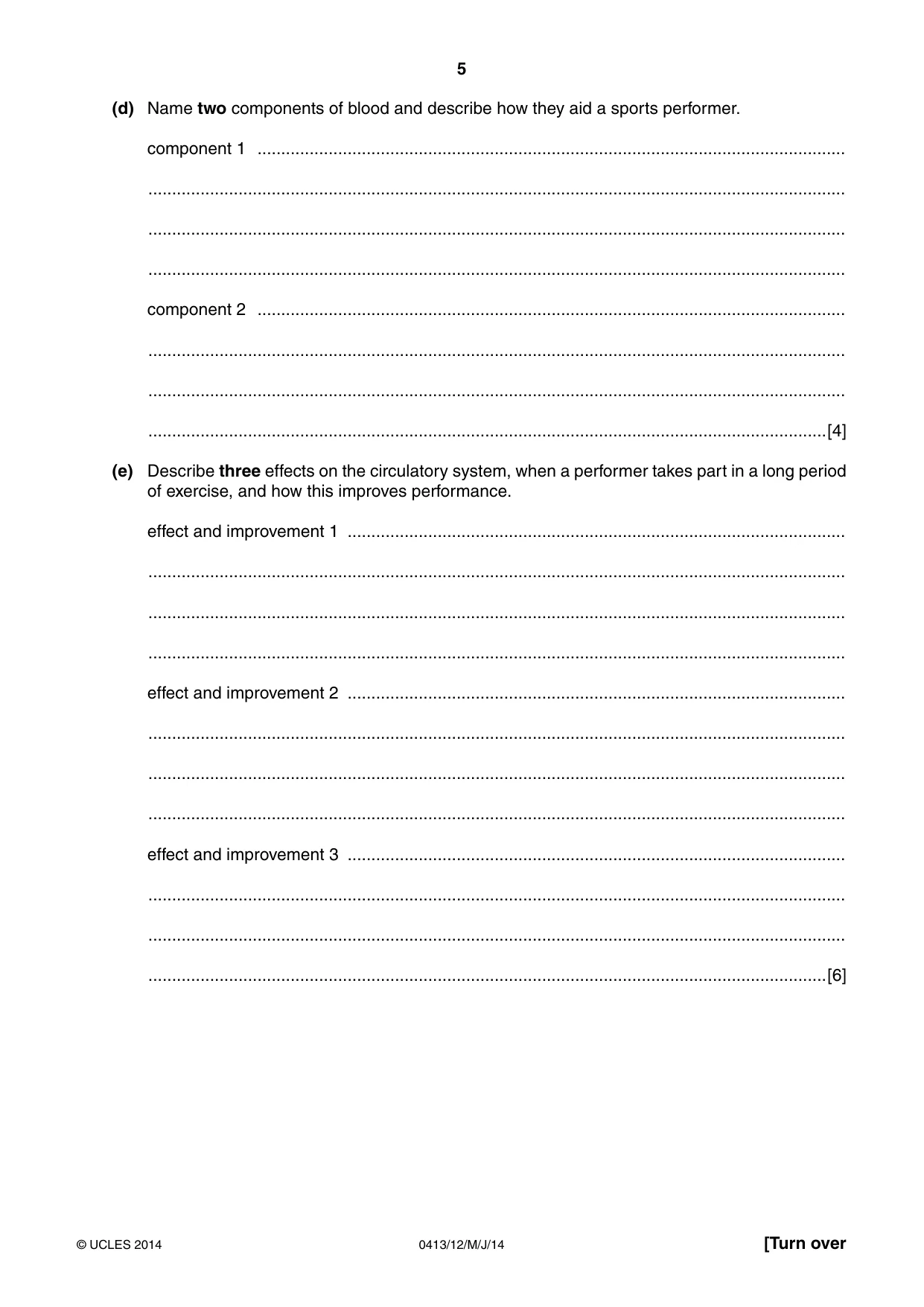
5 0413/12/M/J/14 © UCLES 2014 [Turn over (d) Name two components of blood and describe how they aid a sports performer. component 1 … … … … component 2 … … … …[4] (e) Describe three effects on the circulatory system, when a performer takes part in a long period of exercise, and how this improves performance. effect and improvement 1 … … … … effect and improvement 2 … … … … effect and improvement 3 … … … …[6]
Question paper, page 6
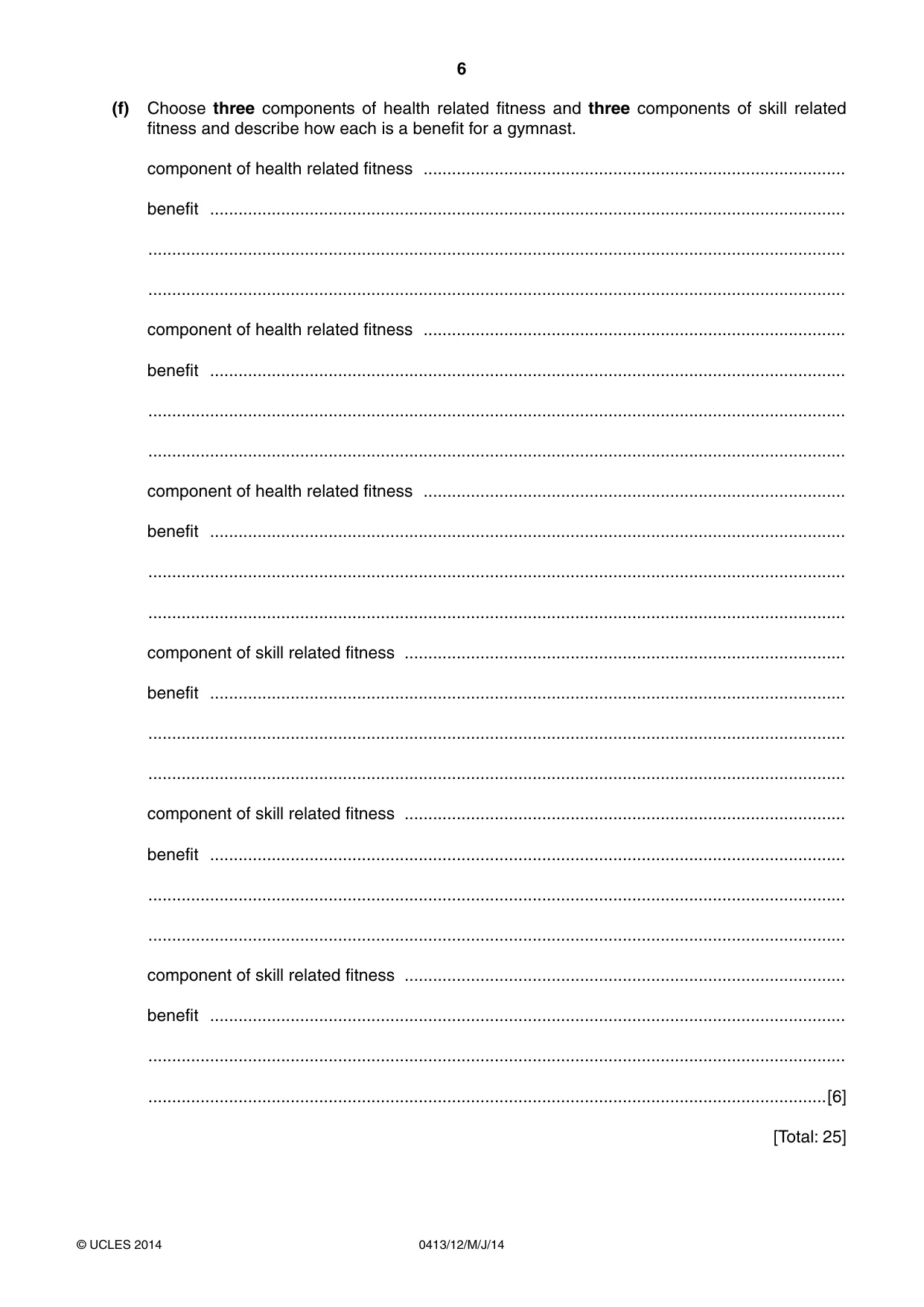
6 0413/12/M/J/14 © UCLES 2014 (f) Choose three components of health related fitness and three components of skill related fitness and describe how each is a benefit for a gymnast. component of health related fitness … benefit … … … component of health related fitness … benefit … … … component of health related fitness … benefit … … … component of skill related fitness … benefit … … … component of skill related fitness … benefit … … … component of skill related fitness … benefit … … …[6] [Total: 25]
Question paper, page 7
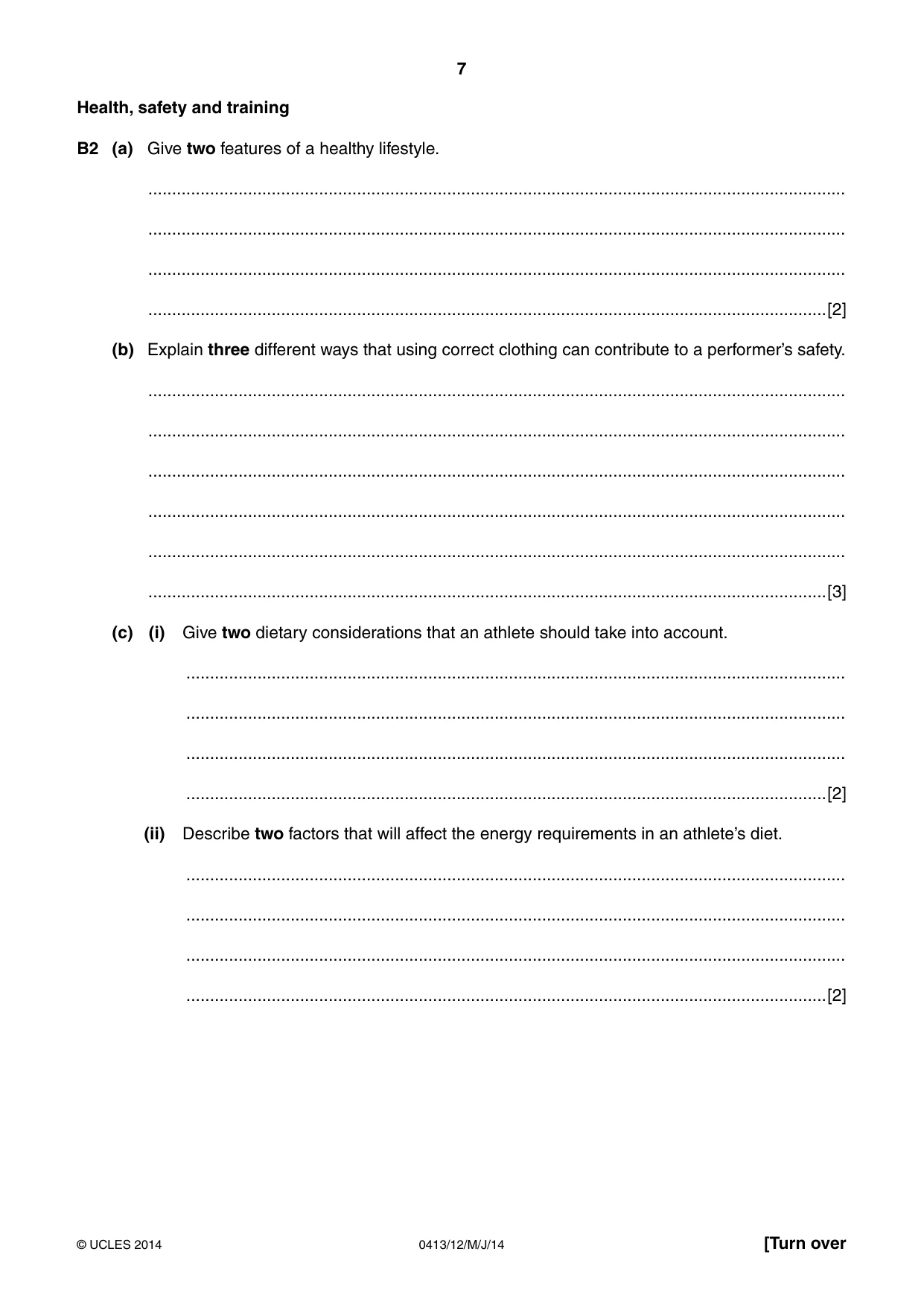
7 0413/12/M/J/14 © UCLES 2014 [Turn over Health, safety and training B2 (a) Give two features of a healthy lifestyle. … … … …[2] (b) Explain three different ways that using correct clothing can contribute to a performer’s safety. … … … … … …[3] (c) (i) Give two dietary considerations that an athlete should take into account. … … … …[2] (ii) Describe two factors that will affect the energy requirements in an athlete’s diet. … … … …[2]
Question paper, page 8
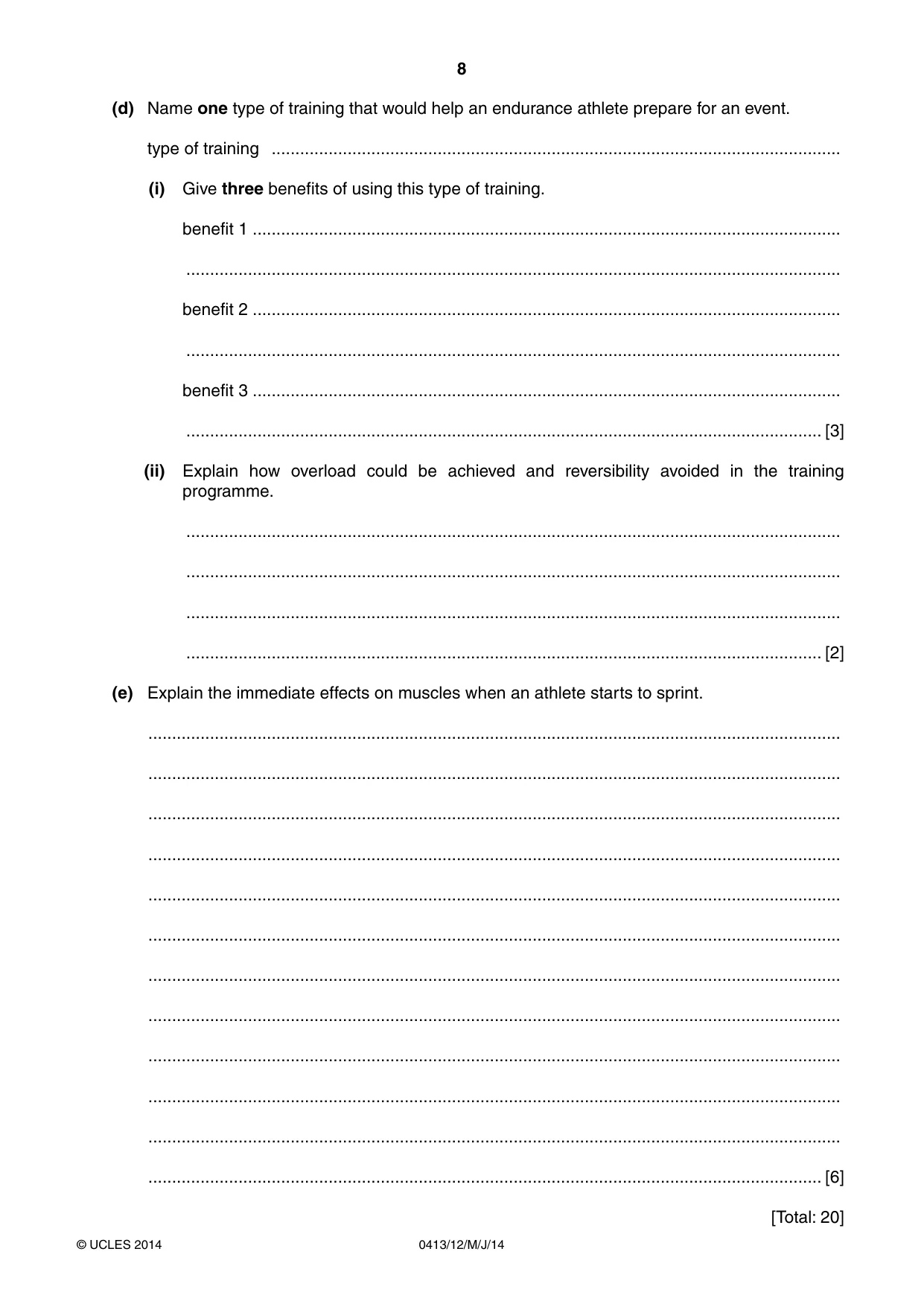
8 0413/12/M/J/14 © UCLES 2014 (d) Name one type of training that would help an endurance athlete prepare for an event. type of training … (i) Give three benefits of using this type of training. benefit 1 … … benefit 2 … … benefit 3 … … [3] (ii) Explain how overload could be achieved and reversibility avoided in the training programme. … … … … [2] (e) Explain the immediate effects on muscles when an athlete starts to sprint. … … … … … … … … … … … … [6] [Total: 20]
Question paper, page 9
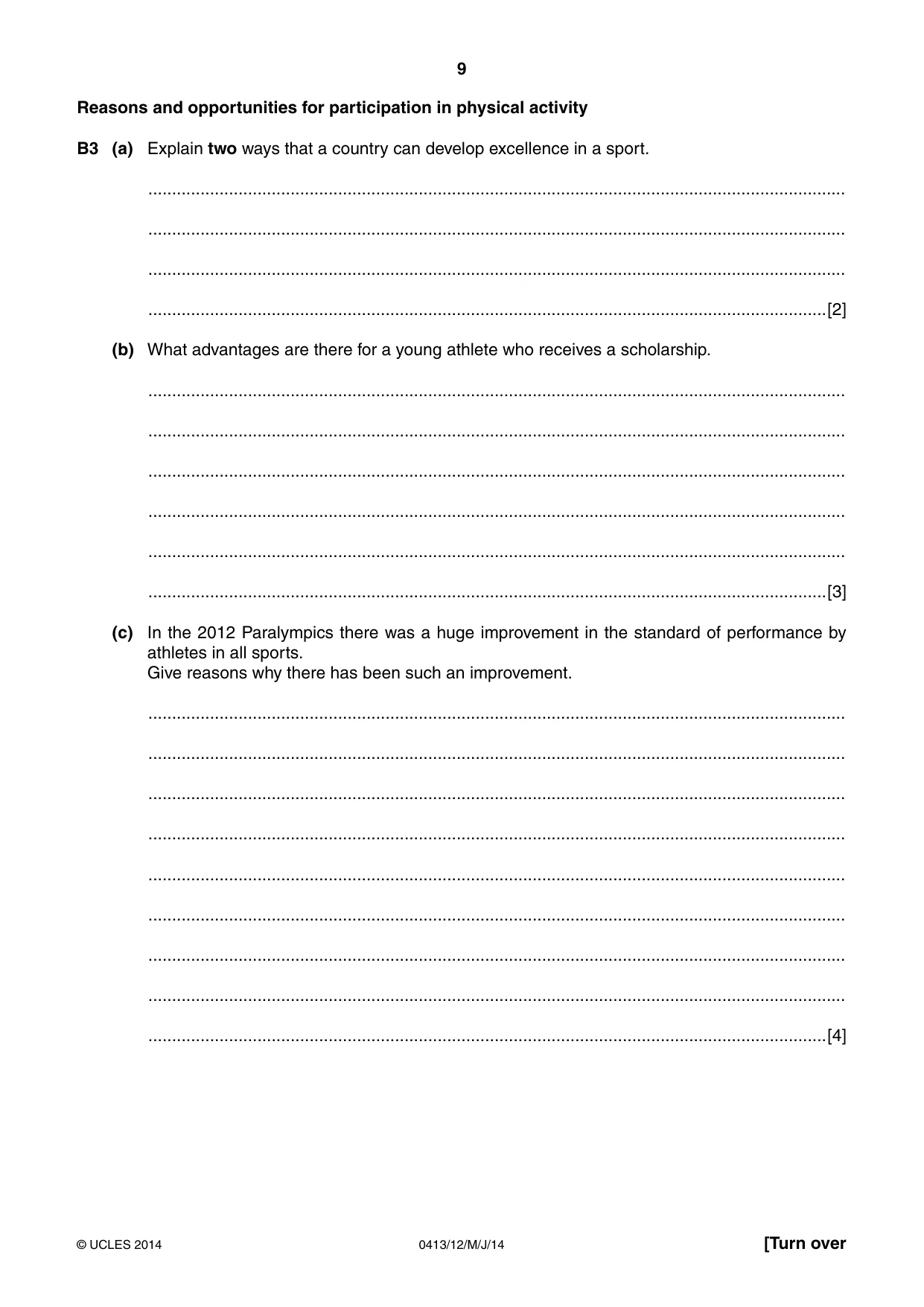
9 0413/12/M/J/14 © UCLES 2014 [Turn over Reasons and opportunities for participation in physical activity B3 (a) Explain two ways that a country can develop excellence in a sport. … … … …[2] (b) What advantages are there for a young athlete who receives a scholarship. … … … … … …[3] (c) In the 2012 Paralympics there was a huge improvement in the standard of performance by athletes in all sports. Give reasons why there has been such an improvement. … … … … … … … … …[4]
Question paper, page 10
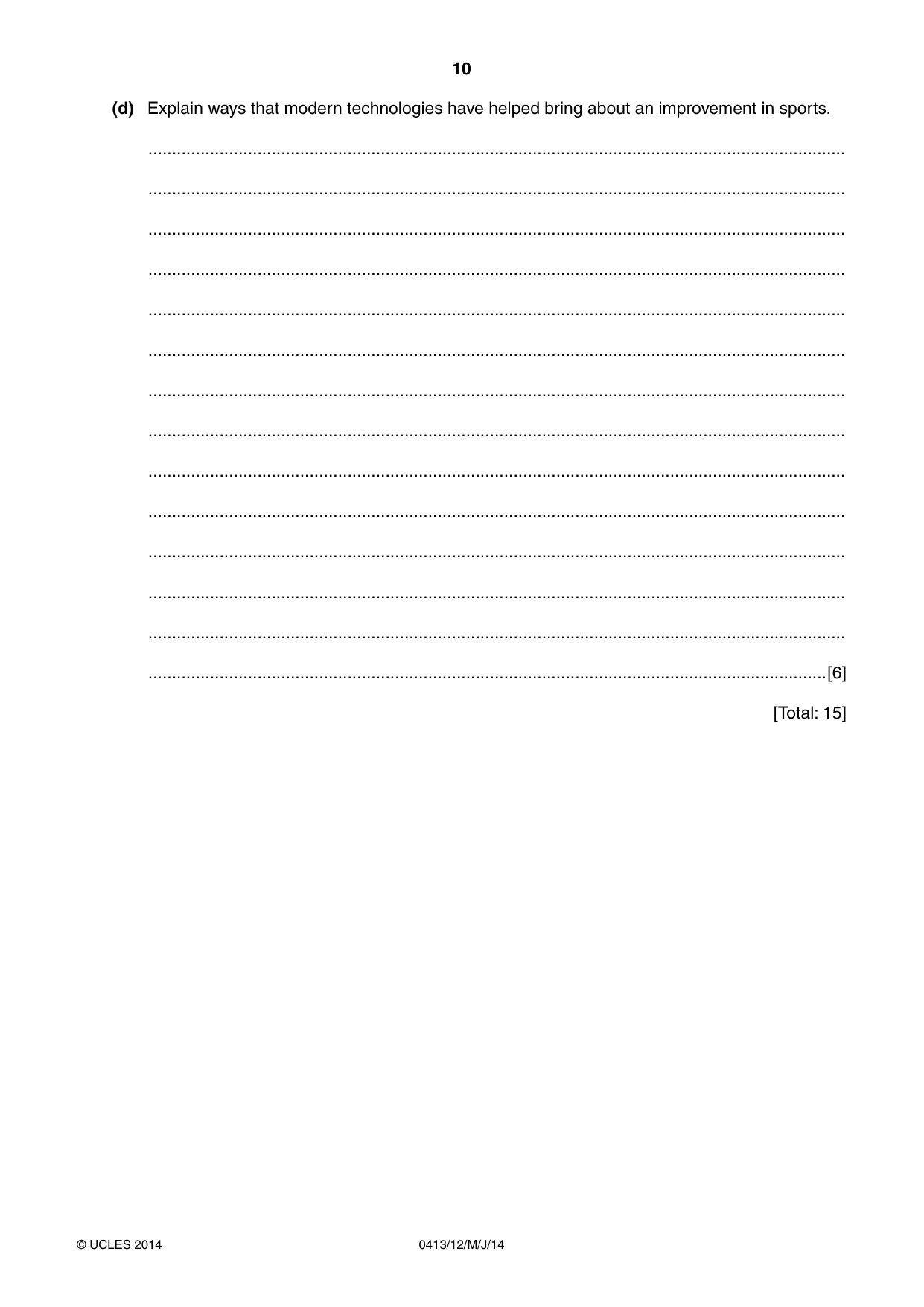
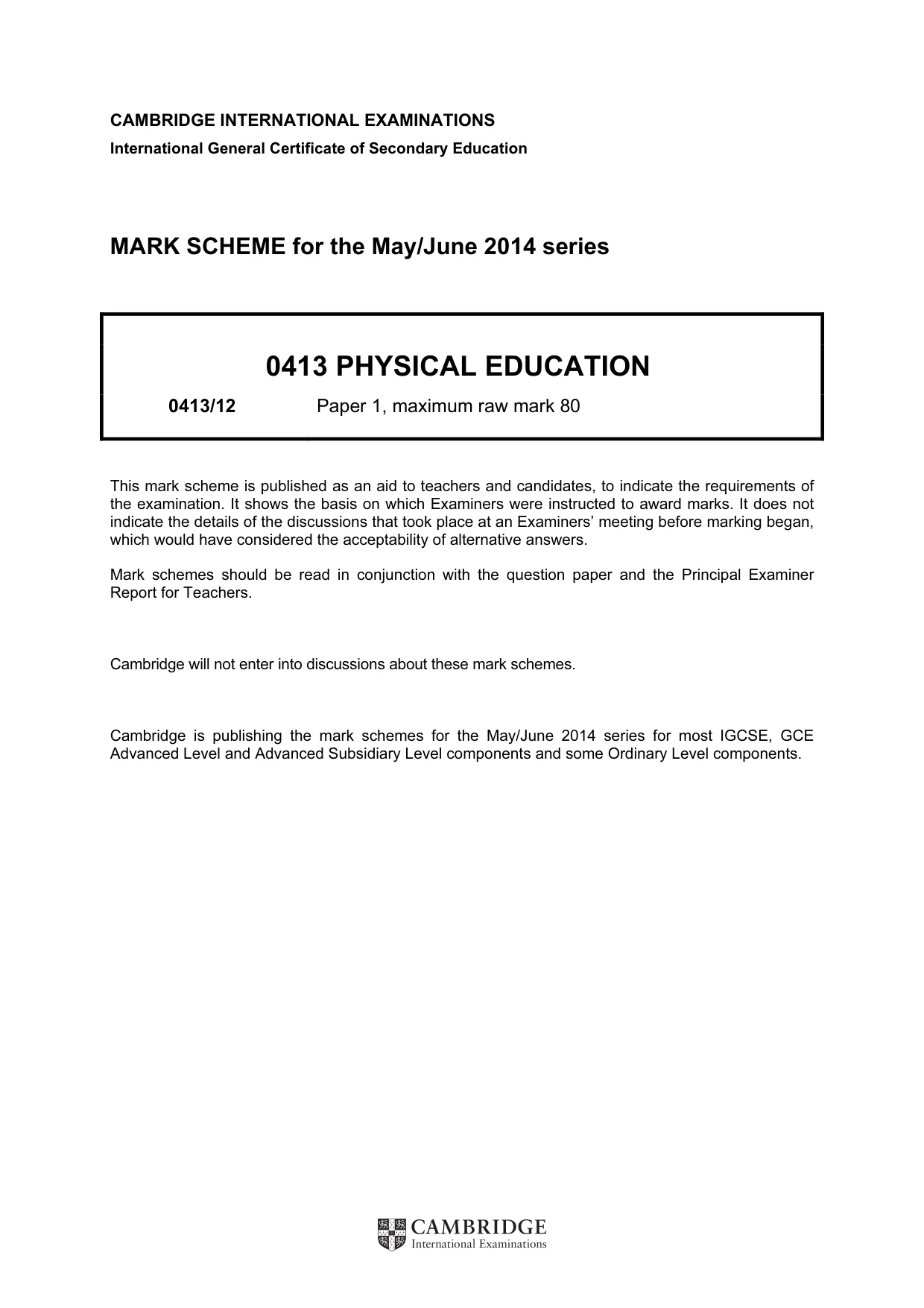
10 0413/12/M/J/14 © UCLES 2014 (d) Explain ways that modern technologies have helped bring about an improvement in sports. … … … … … … … … … … … … … …[6] [Total: 15]
Question paper, page 11
11 0413/12/M/J/14 © UCLES 2014 BLANK PAGE
Question paper, page 12
12 0413/12/M/J/14 © UCLES 2014 Permission to reproduce items where third-party owned material protected by copyright is included has been sought and cleared where possible. Every reasonable effort has been made by the publisher (UCLES) to trace copyright holders, but if any items requiring clearance have unwittingly been included, the publisher will be pleased to make amends at the earliest possible opportunity. Cambridge International Examinations is part of the Cambridge Assessment Group. Cambridge Assessment is the brand name of University of Cambridge Local Examinations Syndicate (UCLES), which is itself a department of the University of Cambridge. BLANK PAGE
Mark scheme, page 1
CAMBRIDGE INTERNATIONAL EXAMINATIONS International General Certificate of Secondary Education MARK SCHEME for the May/June 2014 series 0413 PHYSICAL EDUCATION 0413/12 Paper 1, maximum raw mark 80 This mark scheme is published as an aid to teachers and candidates, to indicate the requirements of the examination. It shows the basis on which Examiners were instructed to award marks. It does not indicate the details of the discussions that took place at an Examiners’ meeting before marking began, which would have considered the acceptability of alternative answers. Mark schemes should be read in conjunction with the question paper and the Principal Examiner Report for Teachers. Cambridge will not enter into discussions about these mark schemes. Cambridge is publishing the mark schemes for the May/June 2014 series for most IGCSE, GCE Advanced Level and Advanced Subsidiary Level components and some Ordinary Level components.
Mark scheme, page 2
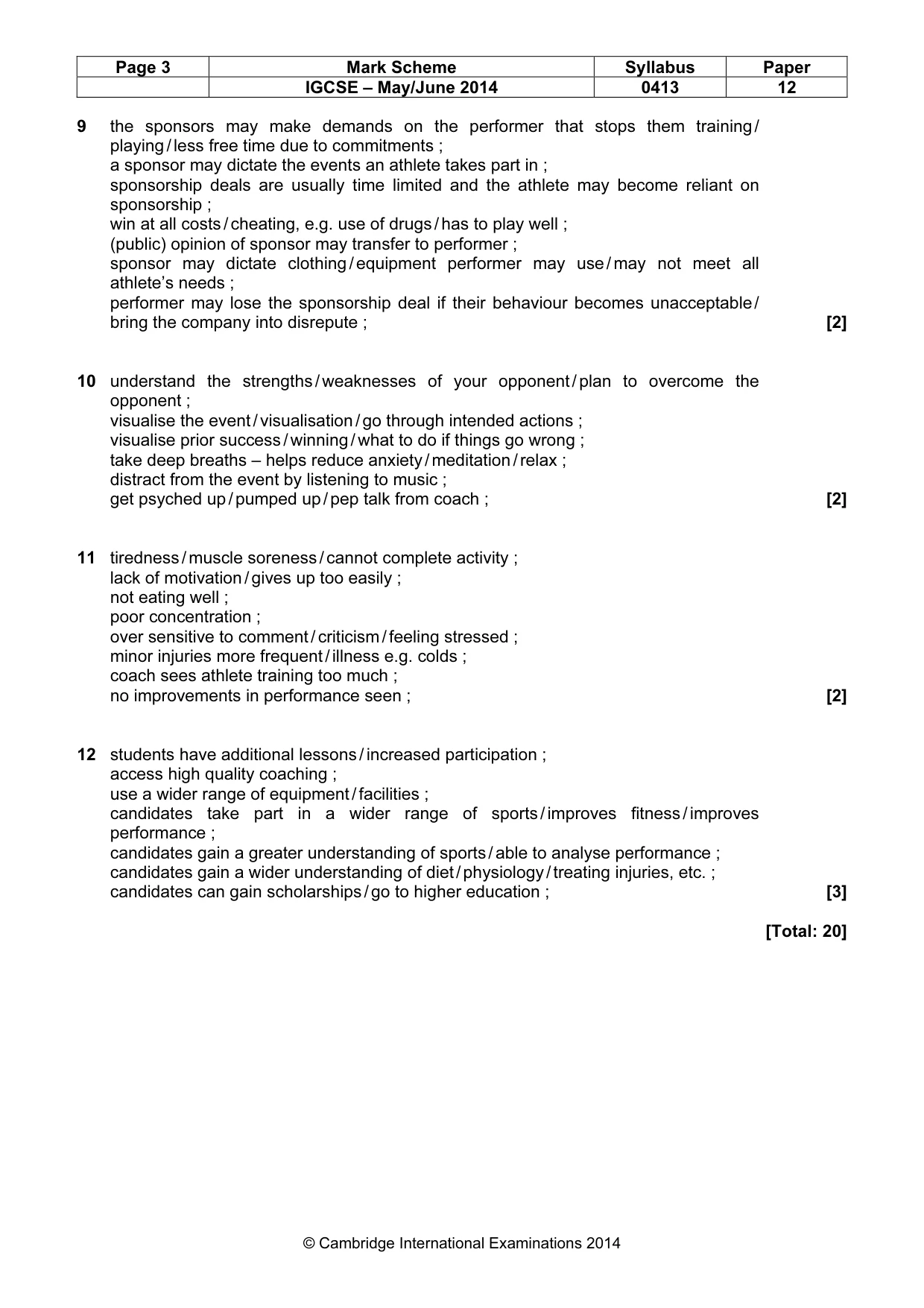
Page 2 Mark Scheme Syllabus Paper IGCSE – May/June 2014 0413 12 © Cambridge International Examinations 2014 Section A 1 lead a healthy lifestyle ; eat a balanced diet / eat healthily ; avoid drugs and pollution ; [1] 2 a long / high jumper getting the crowd to clap before the start of the run up ; getting ready for weight lifting ; psyching up before a contact sport such as rugby / American Football ; [1] 3 raises heart rate / blood pressure ; causes heart disease ; blood cells take up carbon monoxide so less oxygen gets to muscles ; tar collects in the lungs / alveoli which reduces oxygen uptake ; illness prevents / reduces participation / reduces level of performance ; causes lung cancer / causes bronchitis / breathing difficulties ; [1] 4 ribs ; joints in the spine / between vertebrae ; [1] 5 meet new people / improve social skills ; meeting people ; improved awareness of others / team work ; [1] 6 facilities are often specific to a sport, e.g. squash club, golf club ; provide high quality / better equipment / facilities ; coaching is available, including 1 to 1 / specialised coaches ; no cost to the community / community can be members and use it / facilities more accessible to the community ; [2] 7 some sports have age restrictions ; most sports have age categories ; some sports may be too dangerous for young performers / older people unable to meet physical demands of sports / very young children may find some skills too complex or demanding ; at a young age performers will need transport / help to attend ; younger participants may want more adventurous activities / older participants more passive sports / interests change with age ; [2] 8 remove any splinters, etc. from the wound / clean wound ; cover the cut and apply pressure / allow to clot ; raise the injured limb to reduce the flow of blood to the wound / keep limb still ; when the bleeding stops apply a pad or plaster ; get medical help if needed ; [2]
Mark scheme, page 3
Page 3 Mark Scheme Syllabus Paper IGCSE – May/June 2014 0413 12 © Cambridge International Examinations 2014 9 the sponsors may make demands on the performer that stops them training / playing / less free time due to commitments ; a sponsor may dictate the events an athlete takes part in ; sponsorship deals are usually time limited and the athlete may become reliant on sponsorship ; win at all costs / cheating, e.g. use of drugs / has to play well ; (public) opinion of sponsor may transfer to performer ; sponsor may dictate clothing / equipment performer may use / may not meet all athlete’s needs ; performer may lose the sponsorship deal if their behaviour becomes unacceptable / bring the company into disrepute ; [2] 10 understand the strengths / weaknesses of your opponent / plan to overcome the opponent ; visualise the event / visualisation / go through intended actions ; visualise prior success / winning / what to do if things go wrong ; take deep breaths – helps reduce anxiety / meditation / relax ; distract from the event by listening to music ; get psyched up / pumped up / pep talk from coach ; [2] 11 tiredness / muscle soreness / cannot complete activity ; lack of motivation / gives up too easily ; not eating well ; poor concentration ; over sensitive to comment / criticism / feeling stressed ; minor injuries more frequent / illness e.g. colds ; coach sees athlete training too much ; no improvements in performance seen ; [2] 12 students have additional lessons / increased participation ; access high quality coaching ; use a wider range of equipment / facilities ; candidates take part in a wider range of sports / improves fitness / improves performance ; candidates gain a greater understanding of sports / able to analyse performance ; candidates gain a wider understanding of diet / physiology / treating injuries, etc. ; candidates can gain scholarships / go to higher education ; [3] [Total: 20]
Mark scheme, page 4
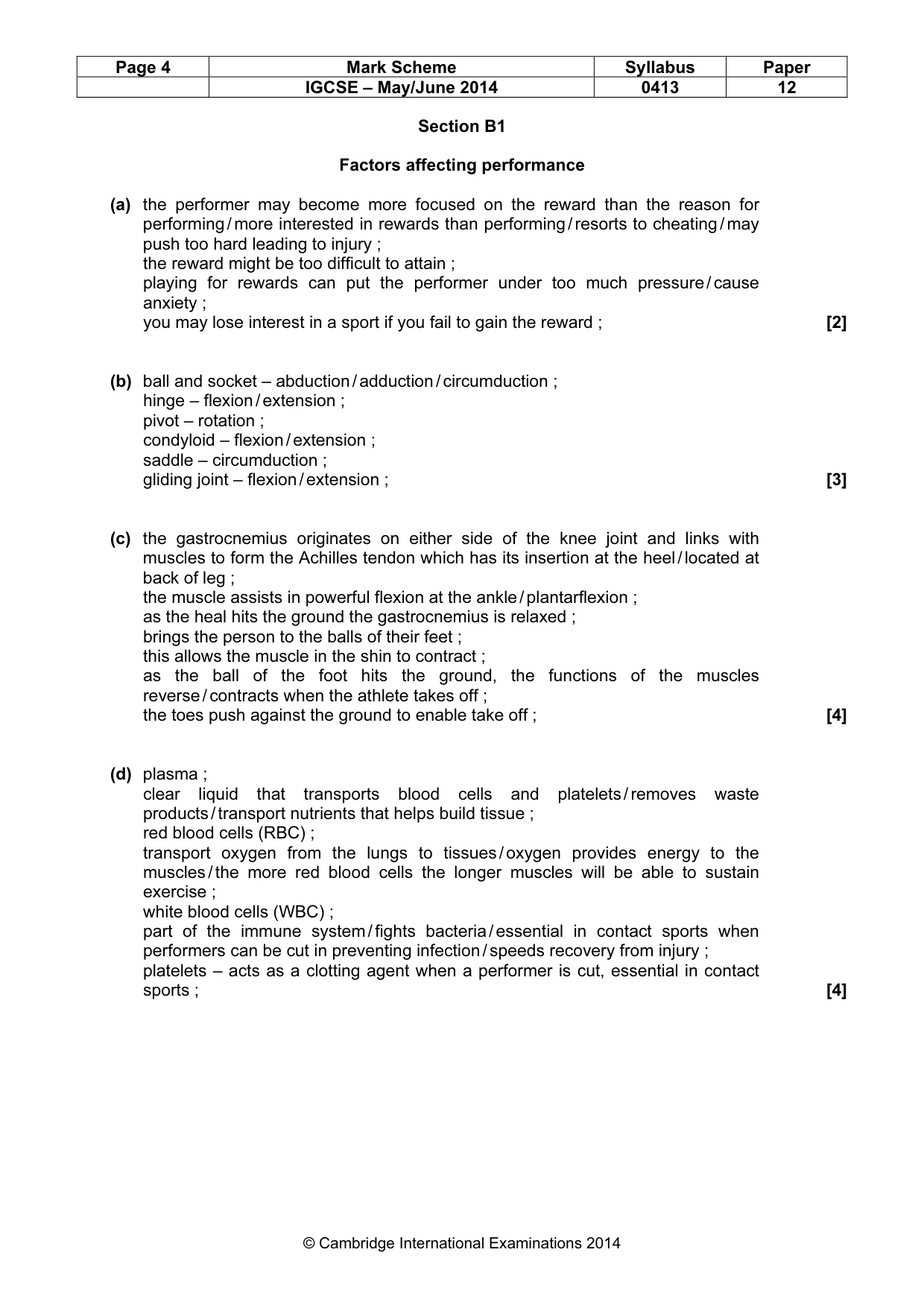
Page 4 Mark Scheme Syllabus Paper IGCSE – May/June 2014 0413 12 © Cambridge International Examinations 2014 Section B1 Factors affecting performance (a) the performer may become more focused on the reward than the reason for performing / more interested in rewards than performing / resorts to cheating / may push too hard leading to injury ; the reward might be too difficult to attain ; playing for rewards can put the performer under too much pressure / cause anxiety ; you may lose interest in a sport if you fail to gain the reward ; [2] (b) ball and socket – abduction / adduction / circumduction ; hinge – flexion / extension ; pivot – rotation ; condyloid – flexion / extension ; saddle – circumduction ; gliding joint – flexion / extension ; [3] (c) the gastrocnemius originates on either side of the knee joint and links with muscles to form the Achilles tendon which has its insertion at the heel / located at back of leg ; the muscle assists in powerful flexion at the ankle / plantarflexion ; as the heal hits the ground the gastrocnemius is relaxed ; brings the person to the balls of their feet ; this allows the muscle in the shin to contract ; as the ball of the foot hits the ground, the functions of the muscles reverse / contracts when the athlete takes off ; the toes push against the ground to enable take off ; [4] (d) plasma ; clear liquid that transports blood cells and platelets / removes waste products / transport nutrients that helps build tissue ; red blood cells (RBC) ; transport oxygen from the lungs to tissues / oxygen provides energy to the muscles / the more red blood cells the longer muscles will be able to sustain exercise ; white blood cells (WBC) ; part of the immune system / fights bacteria / essential in contact sports when performers can be cut in preventing infection / speeds recovery from injury ; platelets – acts as a clotting agent when a performer is cut, essential in contact sports ; [4]
Mark scheme, page 5
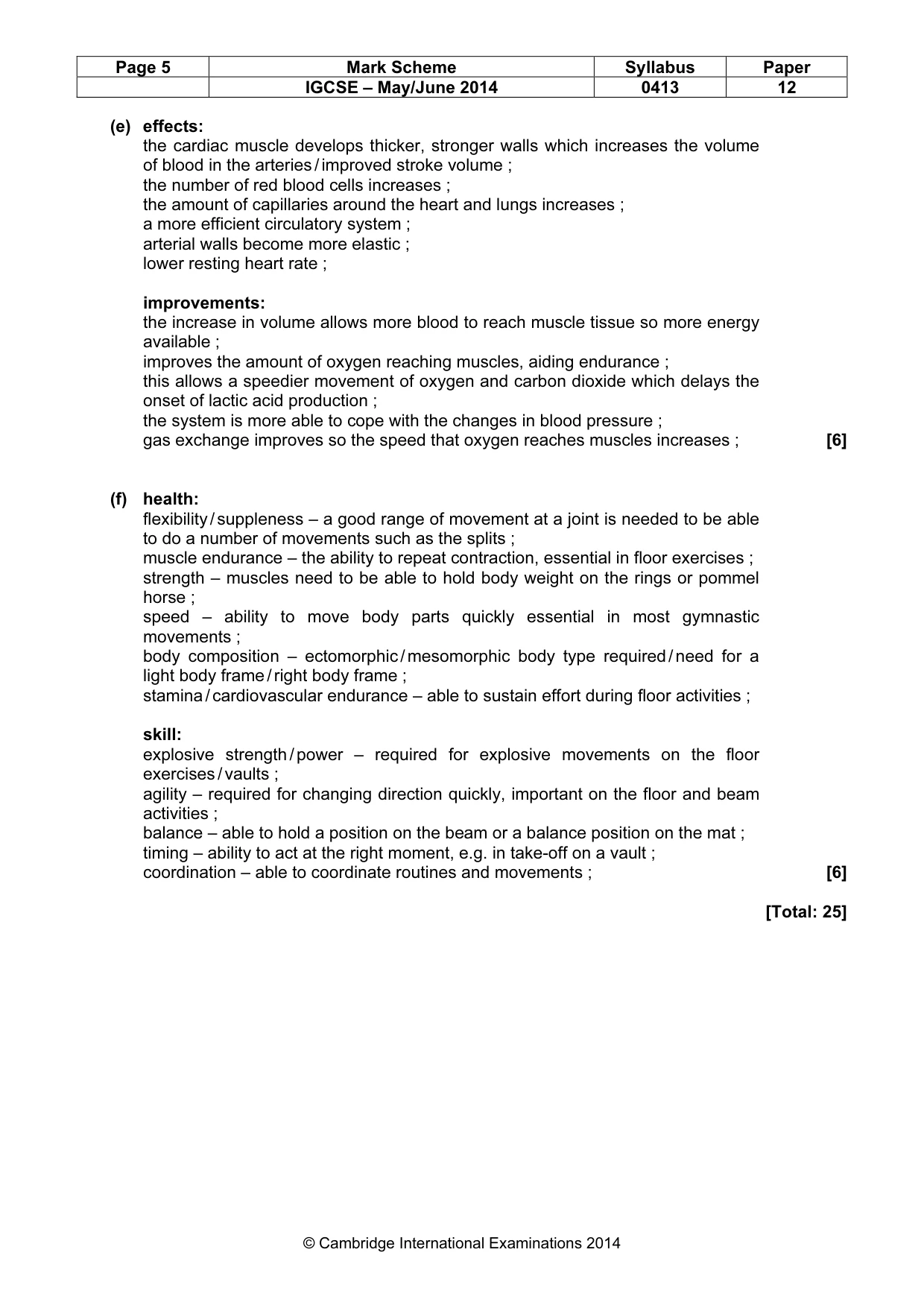
Page 5 Mark Scheme Syllabus Paper IGCSE – May/June 2014 0413 12 © Cambridge International Examinations 2014 (e) effects: the cardiac muscle develops thicker, stronger walls which increases the volume of blood in the arteries / improved stroke volume ; the number of red blood cells increases ; the amount of capillaries around the heart and lungs increases ; a more efficient circulatory system ; arterial walls become more elastic ; lower resting heart rate ; improvements: the increase in volume allows more blood to reach muscle tissue so more energy available ; improves the amount of oxygen reaching muscles, aiding endurance ; this allows a speedier movement of oxygen and carbon dioxide which delays the onset of lactic acid production ; the system is more able to cope with the changes in blood pressure ; gas exchange improves so the speed that oxygen reaches muscles increases ; [6] (f) health: flexibility / suppleness – a good range of movement at a joint is needed to be able to do a number of movements such as the splits ; muscle endurance – the ability to repeat contraction, essential in floor exercises ; strength – muscles need to be able to hold body weight on the rings or pommel horse ; speed – ability to move body parts quickly essential in most gymnastic movements ; body composition – ectomorphic / mesomorphic body type required / need for a light body frame / right body frame ; stamina / cardiovascular endurance – able to sustain effort during floor activities ; skill: explosive strength / power – required for explosive movements on the floor exercises / vaults ; agility – required for changing direction quickly, important on the floor and beam activities ; balance – able to hold a position on the beam or a balance position on the mat ; timing – ability to act at the right moment, e.g. in take-off on a vault ; coordination – able to coordinate routines and movements ; [6] [Total: 25]
Mark scheme, page 6
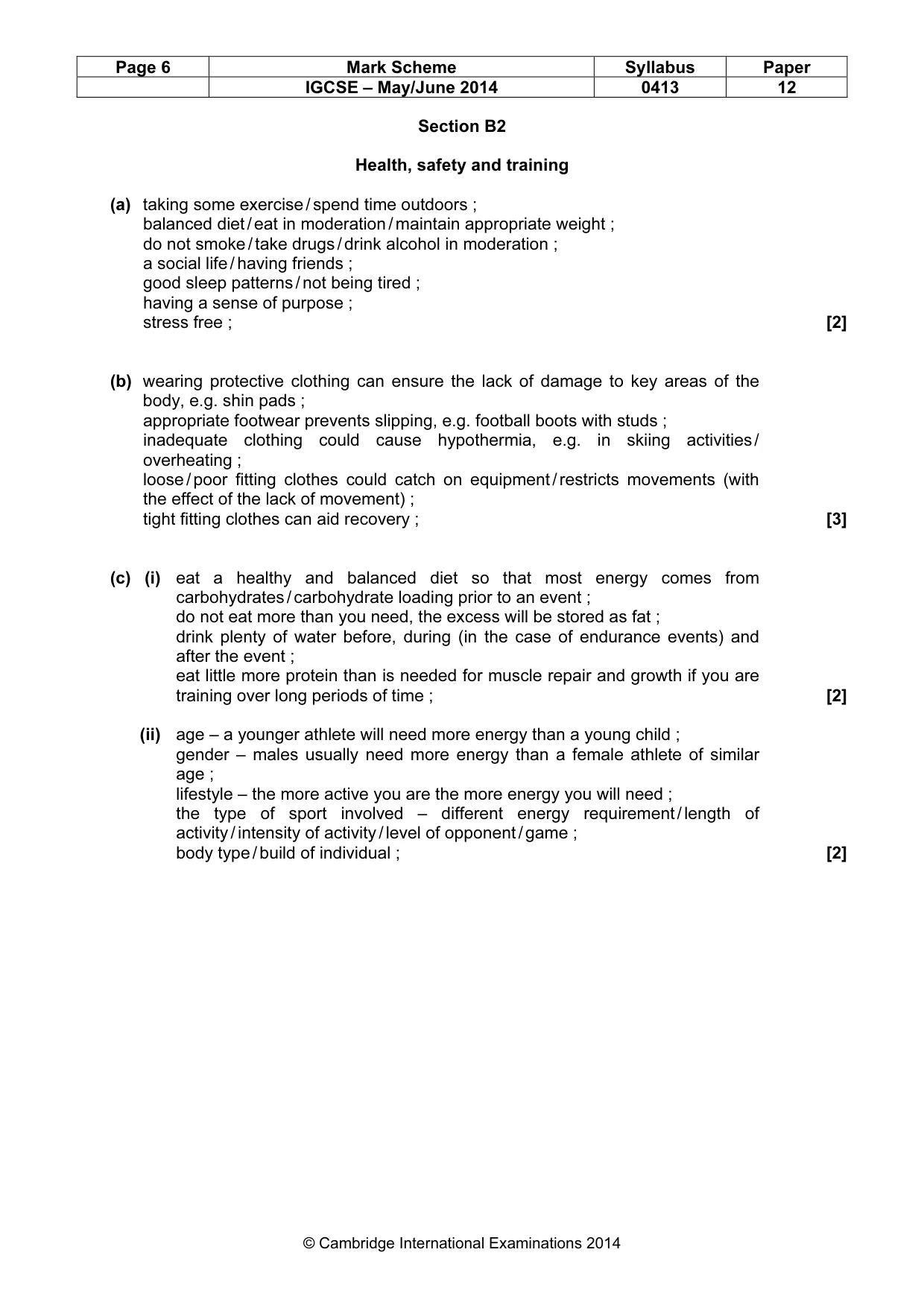
Page 6 Mark Scheme Syllabus Paper IGCSE – May/June 2014 0413 12 © Cambridge International Examinations 2014 Section B2 Health, safety and training (a) taking some exercise / spend time outdoors ; balanced diet / eat in moderation / maintain appropriate weight ; do not smoke / take drugs / drink alcohol in moderation ; a social life / having friends ; good sleep patterns / not being tired ; having a sense of purpose ; stress free ; [2] (b) wearing protective clothing can ensure the lack of damage to key areas of the body, e.g. shin pads ; appropriate footwear prevents slipping, e.g. football boots with studs ; inadequate clothing could cause hypothermia, e.g. in skiing activities / overheating ; loose / poor fitting clothes could catch on equipment / restricts movements (with the effect of the lack of movement) ; tight fitting clothes can aid recovery ; [3] (c) (i) eat a healthy and balanced diet so that most energy comes from carbohydrates / carbohydrate loading prior to an event ; do not eat more than you need, the excess will be stored as fat ; drink plenty of water before, during (in the case of endurance events) and after the event ; eat little more protein than is needed for muscle repair and growth if you are training over long periods of time ; [2] (ii) age – a younger athlete will need more energy than a young child ; gender – males usually need more energy than a female athlete of similar age ; lifestyle – the more active you are the more energy you will need ; the type of sport involved – different energy requirement / length of activity / intensity of activity / level of opponent / game ; body type / build of individual ; [2]
Mark scheme, page 7
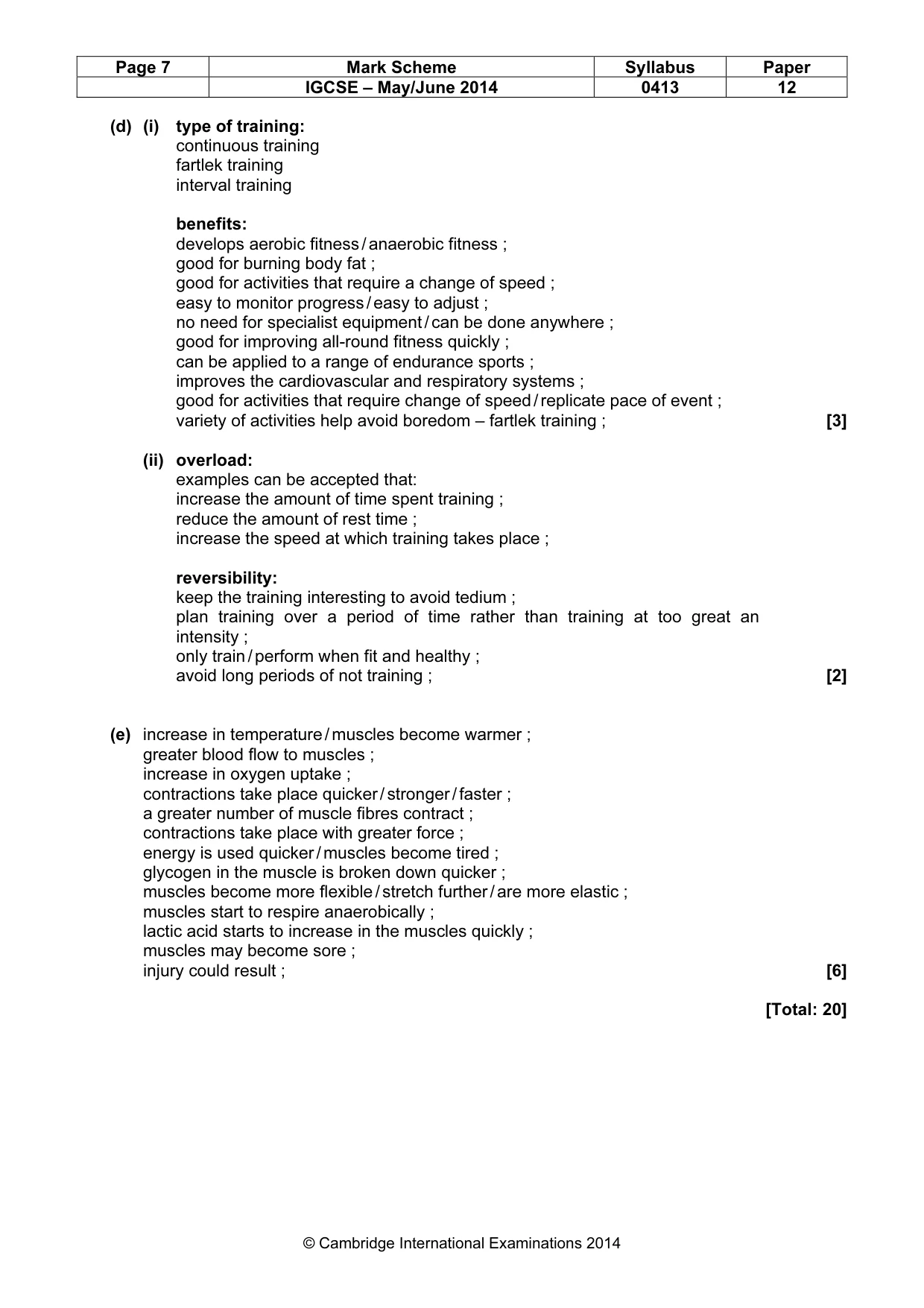
Page 7 Mark Scheme Syllabus Paper IGCSE – May/June 2014 0413 12 © Cambridge International Examinations 2014 (d) (i) type of training: continuous training fartlek training interval training benefits: develops aerobic fitness / anaerobic fitness ; good for burning body fat ; good for activities that require a change of speed ; easy to monitor progress / easy to adjust ; no need for specialist equipment / can be done anywhere ; good for improving all-round fitness quickly ; can be applied to a range of endurance sports ; improves the cardiovascular and respiratory systems ; good for activities that require change of speed / replicate pace of event ; variety of activities help avoid boredom – fartlek training ; [3] (ii) overload: examples can be accepted that: increase the amount of time spent training ; reduce the amount of rest time ; increase the speed at which training takes place ; reversibility: keep the training interesting to avoid tedium ; plan training over a period of time rather than training at too great an intensity ; only train / perform when fit and healthy ; avoid long periods of not training ; [2] (e) increase in temperature / muscles become warmer ; greater blood flow to muscles ; increase in oxygen uptake ; contractions take place quicker / stronger / faster ; a greater number of muscle fibres contract ; contractions take place with greater force ; energy is used quicker / muscles become tired ; glycogen in the muscle is broken down quicker ; muscles become more flexible / stretch further / are more elastic ; muscles start to respire anaerobically ; lactic acid starts to increase in the muscles quickly ; muscles may become sore ; injury could result ; [6] [Total: 20]
Mark scheme, page 8
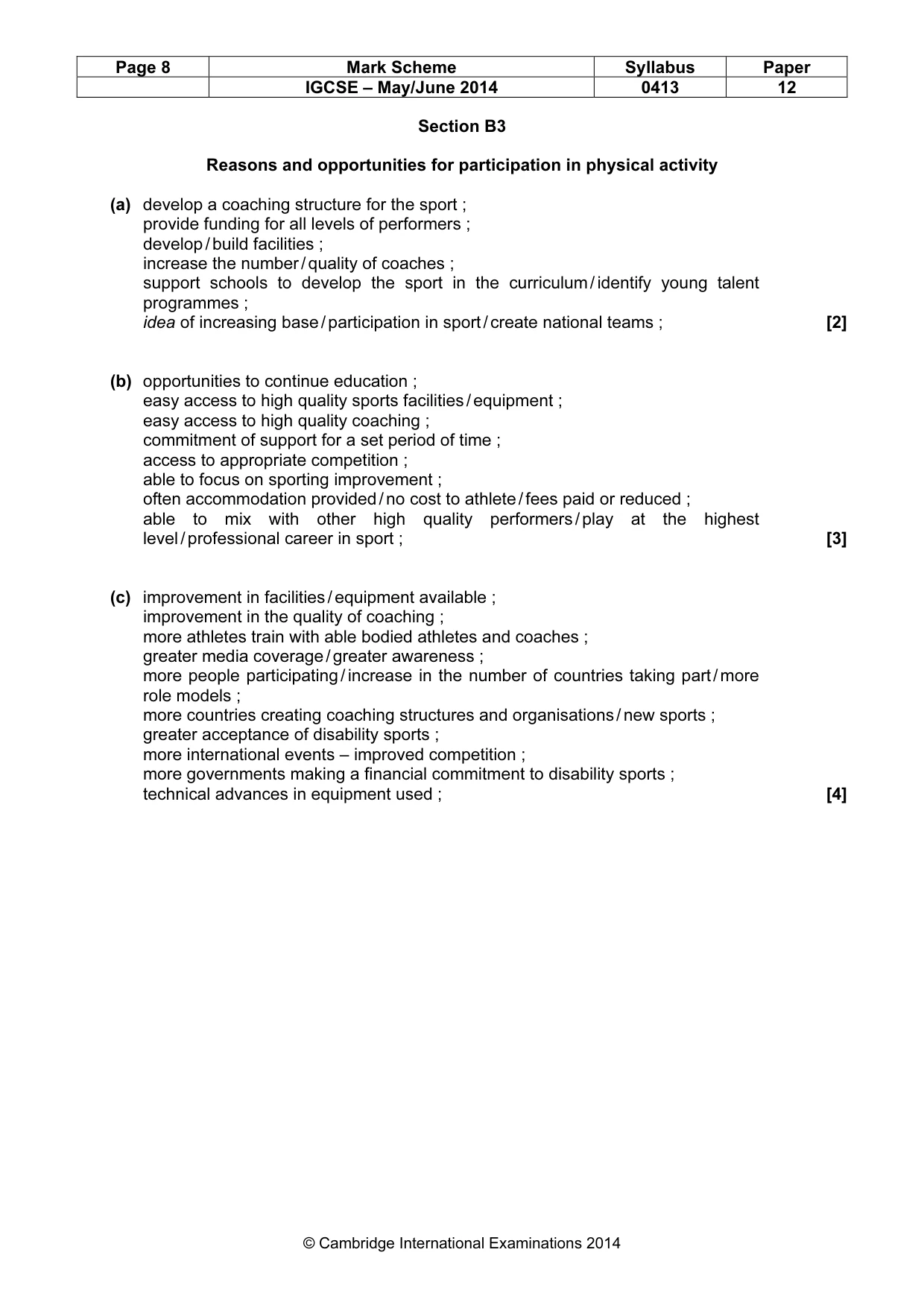
Page 8 Mark Scheme Syllabus Paper IGCSE – May/June 2014 0413 12 © Cambridge International Examinations 2014 Section B3 Reasons and opportunities for participation in physical activity (a) develop a coaching structure for the sport ; provide funding for all levels of performers ; develop / build facilities ; increase the number / quality of coaches ; support schools to develop the sport in the curriculum / identify young talent programmes ; idea of increasing base / participation in sport / create national teams ; [2] (b) opportunities to continue education ; easy access to high quality sports facilities / equipment ; easy access to high quality coaching ; commitment of support for a set period of time ; access to appropriate competition ; able to focus on sporting improvement ; often accommodation provided / no cost to athlete / fees paid or reduced ; able to mix with other high quality performers / play at the highest level / professional career in sport ; [3] (c) improvement in facilities / equipment available ; improvement in the quality of coaching ; more athletes train with able bodied athletes and coaches ; greater media coverage / greater awareness ; more people participating / increase in the number of countries taking part / more role models ; more countries creating coaching structures and organisations / new sports ; greater acceptance of disability sports ; more international events – improved competition ; more governments making a financial commitment to disability sports ; technical advances in equipment used ; [4]
Mark scheme, page 9
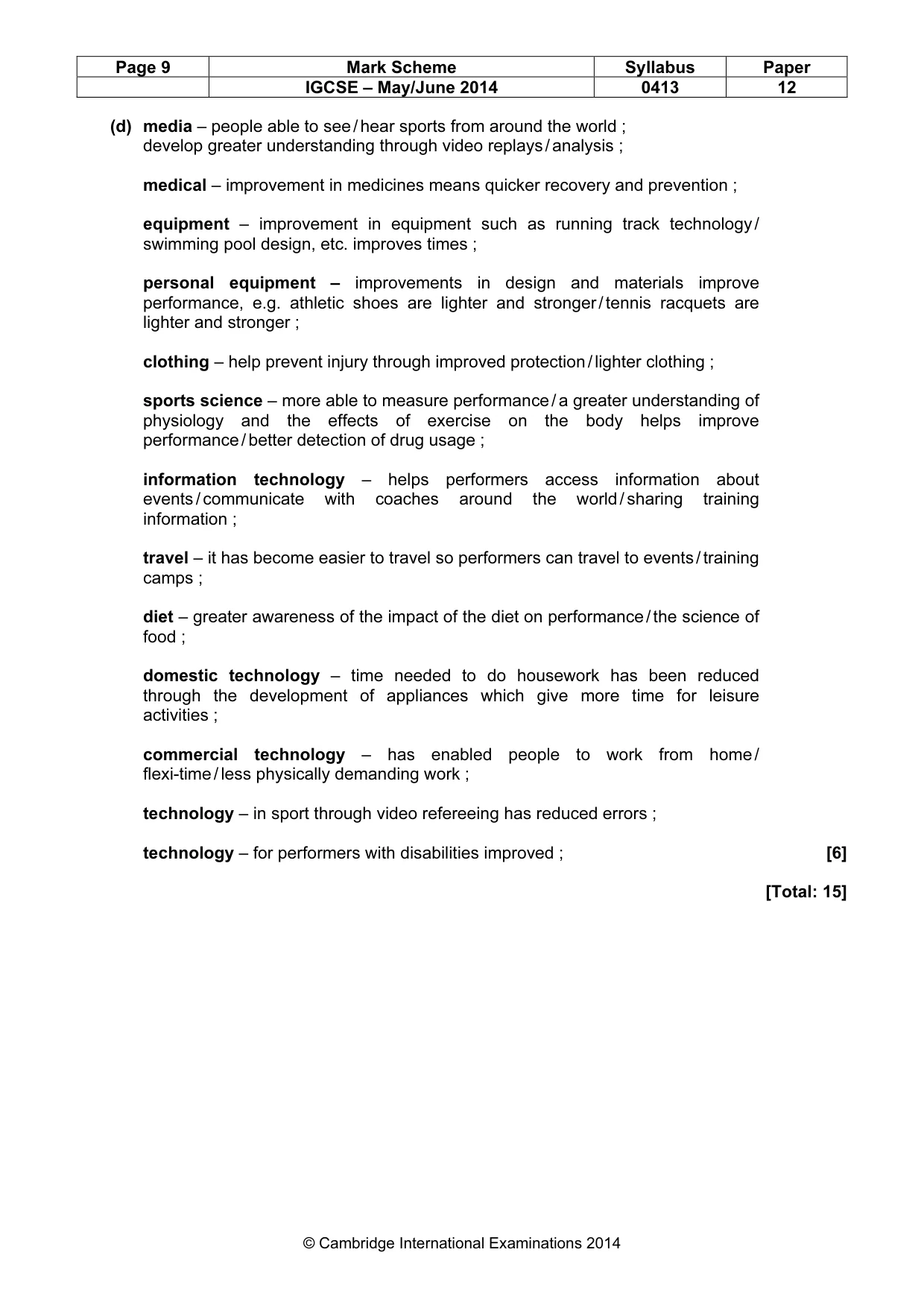
Page 9 Mark Scheme Syllabus Paper IGCSE – May/June 2014 0413 12 © Cambridge International Examinations 2014 (d) media – people able to see / hear sports from around the world ; develop greater understanding through video replays / analysis ; medical – improvement in medicines means quicker recovery and prevention ; equipment – improvement in equipment such as running track technology / swimming pool design, etc. improves times ; personal equipment – improvements in design and materials improve performance, e.g. athletic shoes are lighter and stronger / tennis racquets are lighter and stronger ; clothing – help prevent injury through improved protection / lighter clothing ; sports science – more able to measure performance / a greater understanding of physiology and the effects of exercise on the body helps improve performance / better detection of drug usage ; information technology – helps performers access information about events / communicate with coaches around the world / sharing training information ; travel – it has become easier to travel so performers can travel to events / training camps ; diet – greater awareness of the impact of the diet on performance / the science of food ; domestic technology – time needed to do housework has been reduced through the development of appliances which give more time for leisure activities ; commercial technology – has enabled people to work from home / flexi-time / less physically demanding work ; technology – in sport through video refereeing has reduced errors ; technology – for performers with disabilities improved ; [6] [Total: 15]
What you needed in this session
Cambridge’s own grade thresholds for 2014 May/June, Paper 1 · Variant 2. A higher threshold means an easier paper — the bar moves with how the cohort did.