Cambridge IGCSE Physical Education 0413 — 2014 May/June Paper 1 · Variant 3
0413/13/M/J/14 · 80 marks · ≈90 min
The question paper and its mark scheme, free to read here and free to download. This is Cambridge’s own paper, exactly as it was sat.
Question paper12 pages




Mark scheme9 pages
Answers below. Sit the paper first if you are practising.
Paper as text
Question paper, page 1
This document consists of 10 printed pages and 2 blank pages. DC (RCL (DF)) 81097/3 © UCLES 2014 [Turn over Cambridge International Examinations Cambridge International General Certificate of Secondary Education * 2 8 2 8 9 7 1 2 7 2 * PHYSICAL EDUCATION 0413/13 Paper 1 May/June 2014 1 hour 45 minutes Candidates answer on the Question Paper. No Additional Materials are required. READ THESE INSTRUCTIONS FIRST Write your Centre number, candidate number and name on all the work you hand in. Write in dark blue or black pen. You may use an HB pencil for any diagrams or graphs. Do not use staples, paper clips, glue or correction fluid. DO NOT WRITE IN ANY BARCODES. Answer all questions. At the end of the examination, fasten all your work securely together. The number of marks is given in brackets [ ] at the end of each question or part question. Electronic calculators may be used.
Question paper, page 2
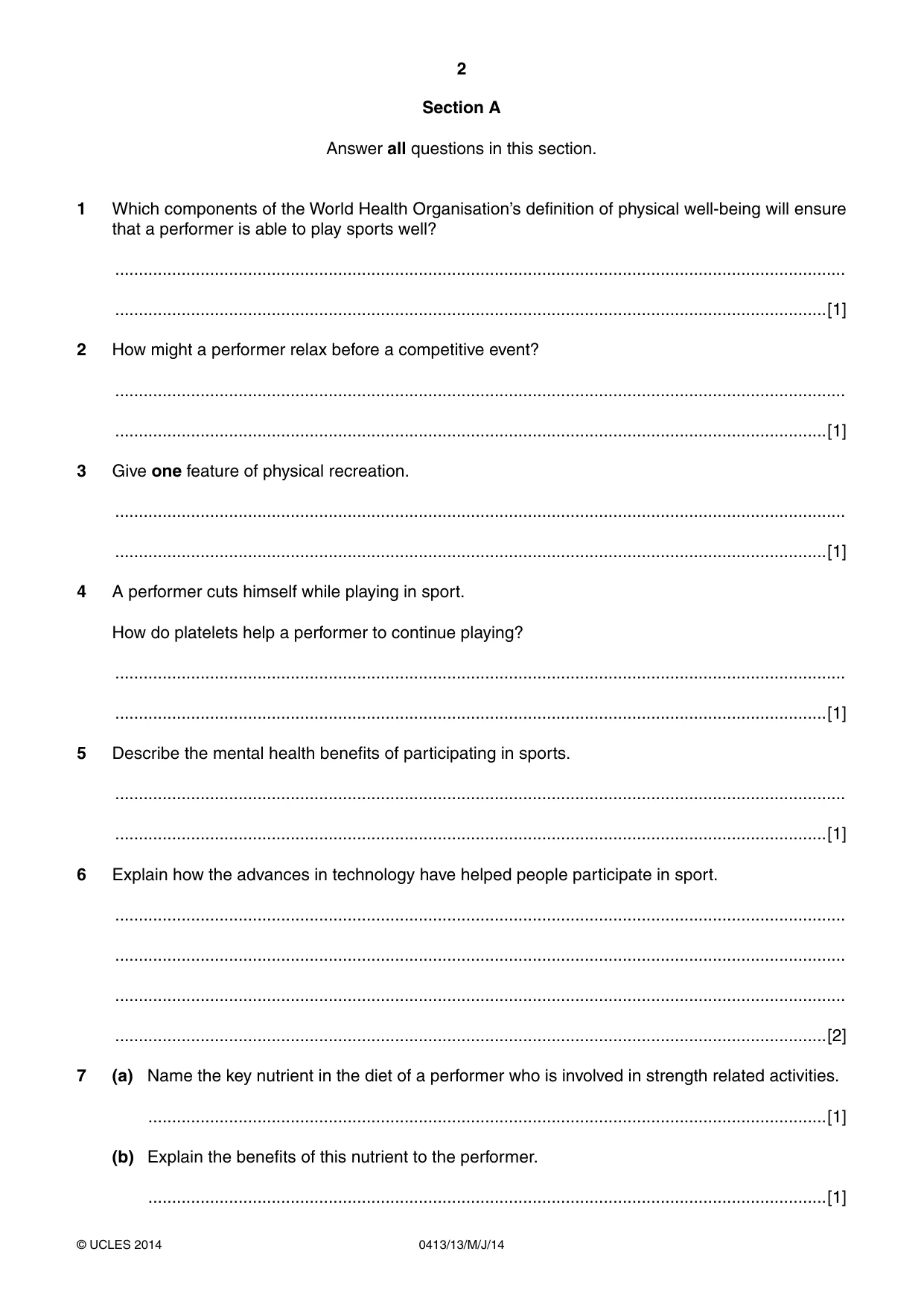
2 0413/13/M/J/14 © UCLES 2014 Section A Answer all questions in this section. 1 Which components of the World Health Organisation’s definition of physical well-being will ensure that a performer is able to play sports well? … …[1] 2 How might a performer relax before a competitive event? … …[1] 3 Give one feature of physical recreation. … …[1] 4 A performer cuts himself while playing in sport. How do platelets help a performer to continue playing? … …[1] 5 Describe the mental health benefits of participating in sports. … …[1] 6 Explain how the advances in technology have helped people participate in sport. … … … …[2] 7 (a) Name the key nutrient in the diet of a performer who is involved in strength related activities. …[1] (b) Explain the benefits of this nutrient to the performer. …[1]
Question paper, page 3
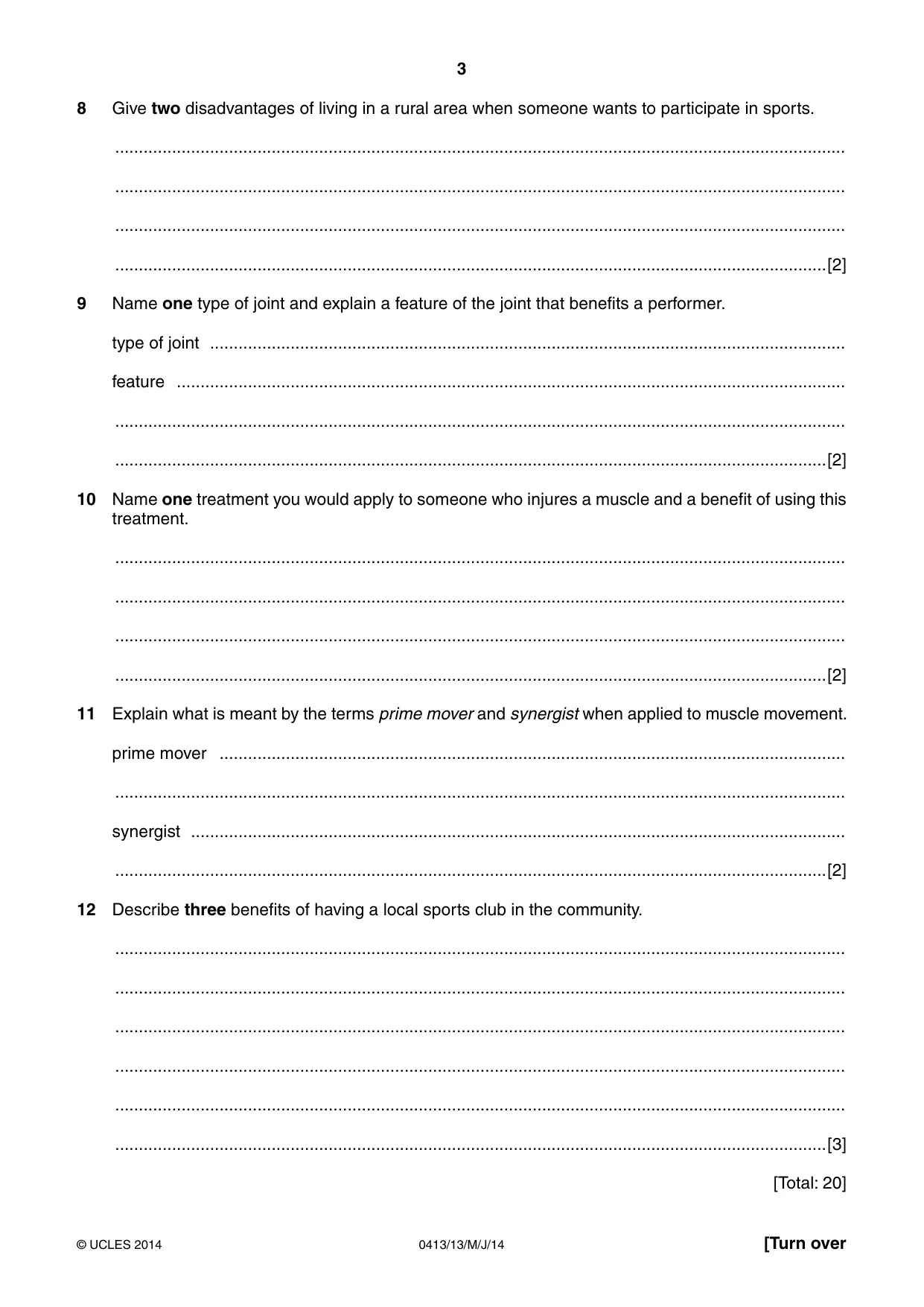
3 0413/13/M/J/14 © UCLES 2014 [Turn over 8 Give two disadvantages of living in a rural area when someone wants to participate in sports. … … … …[2] 9 Name one type of joint and explain a feature of the joint that benefits a performer. type of joint … feature … … …[2] 10 Name one treatment you would apply to someone who injures a muscle and a benefit of using this treatment. … … … …[2] 11 Explain what is meant by the terms prime mover and synergist when applied to muscle movement. prime mover … … synergist … …[2] 12 Describe three benefits of having a local sports club in the community. … … … … … …[3] [Total: 20]
Question paper, page 4
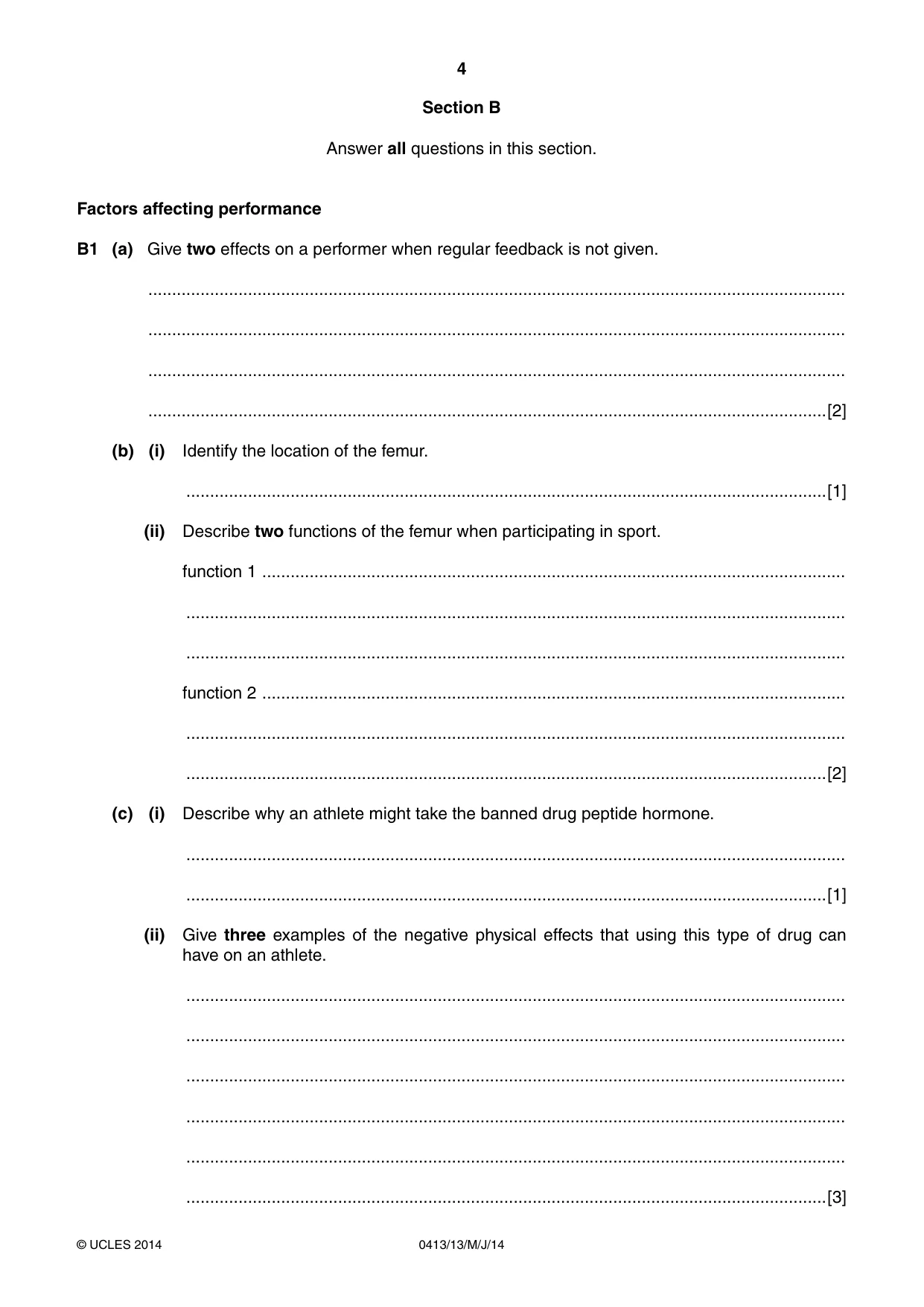
4 0413/13/M/J/14 © UCLES 2014 Section B Answer all questions in this section. Factors affecting performance B1 (a) Give two effects on a performer when regular feedback is not given. … … … …[2] (b) (i) Identify the location of the femur. …[1] (ii) Describe two functions of the femur when participating in sport. function 1 … … … function 2 … … …[2] (c) (i) Describe why an athlete might take the banned drug peptide hormone. … …[1] (ii) Give three examples of the negative physical effects that using this type of drug can have on an athlete. … … … … … …[3]
Question paper, page 5
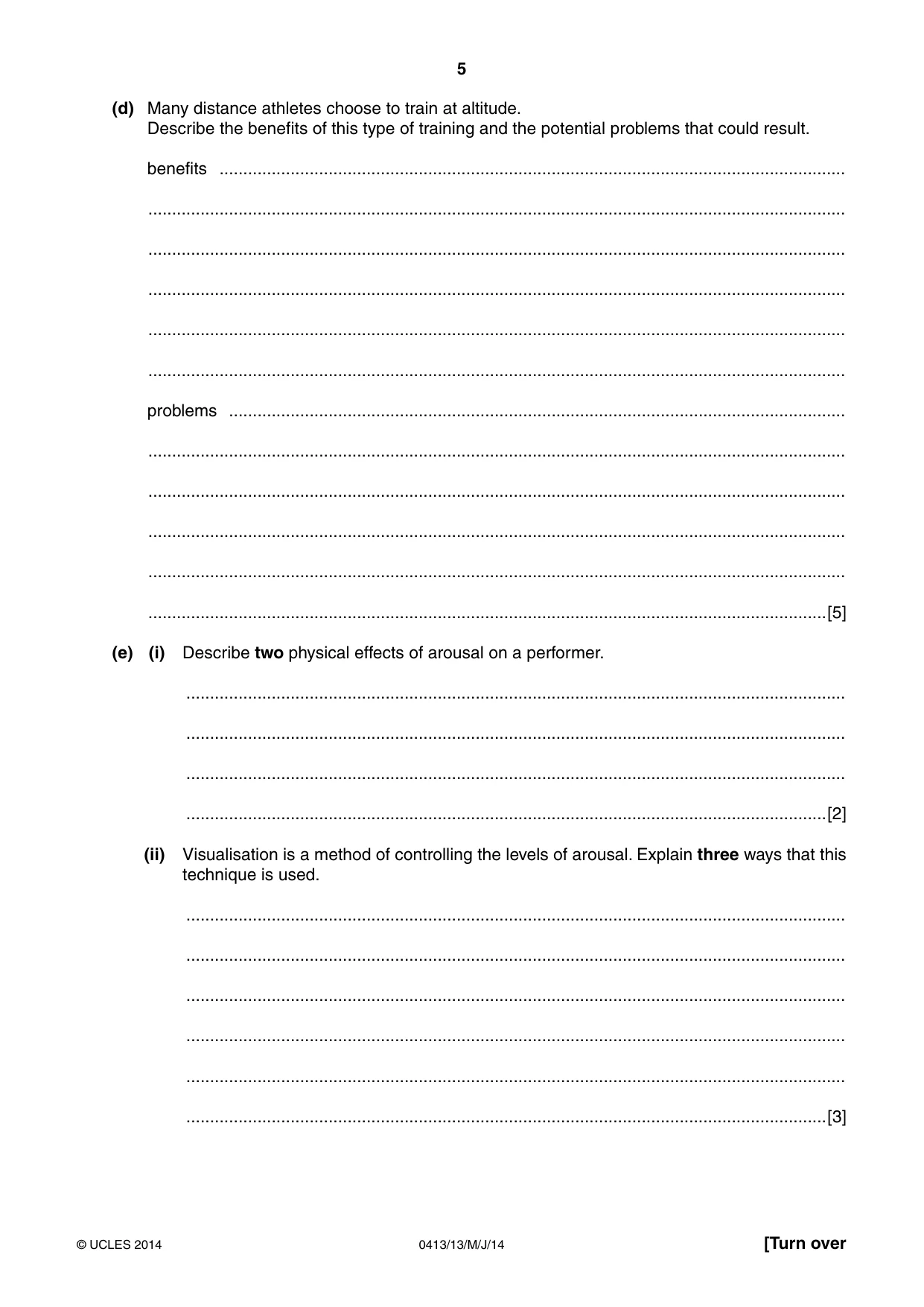
5 0413/13/M/J/14 © UCLES 2014 [Turn over (d) Many distance athletes choose to train at altitude. Describe the benefits of this type of training and the potential problems that could result. benefits … … … … … … problems … … … … … …[5] (e) (i) Describe two physical effects of arousal on a performer. … … … …[2] (ii) Visualisation is a method of controlling the levels of arousal. Explain three ways that this technique is used. … … … … … …[3]
Question paper, page 6
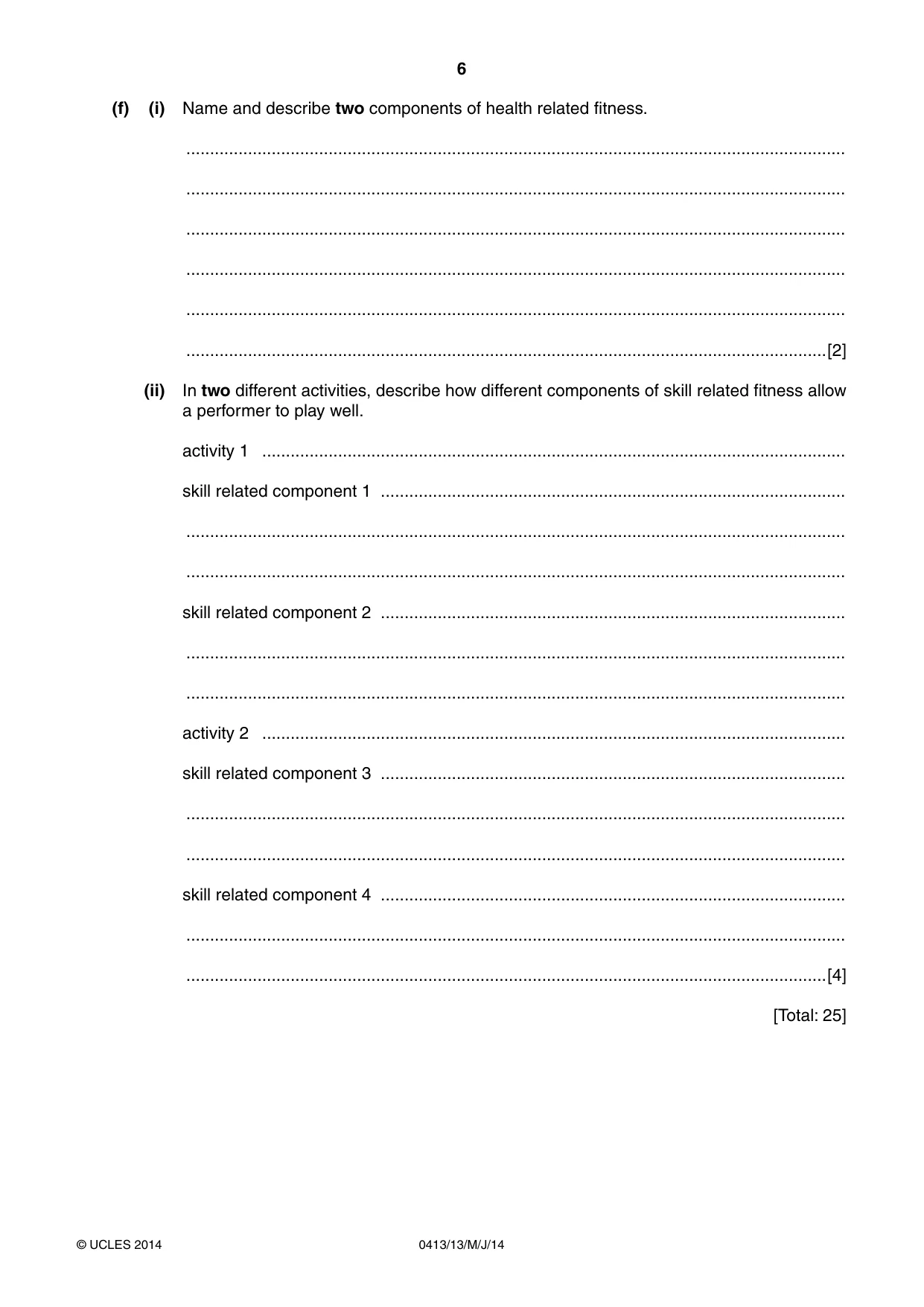
6 0413/13/M/J/14 © UCLES 2014 (f) (i) Name and describe two components of health related fitness. … … … … … …[2] (ii) In two different activities, describe how different components of skill related fitness allow a performer to play well. activity 1 … skill related component 1 … … … skill related component 2 … … … activity 2 … skill related component 3 … … … skill related component 4 … … …[4] [Total: 25]
Question paper, page 7
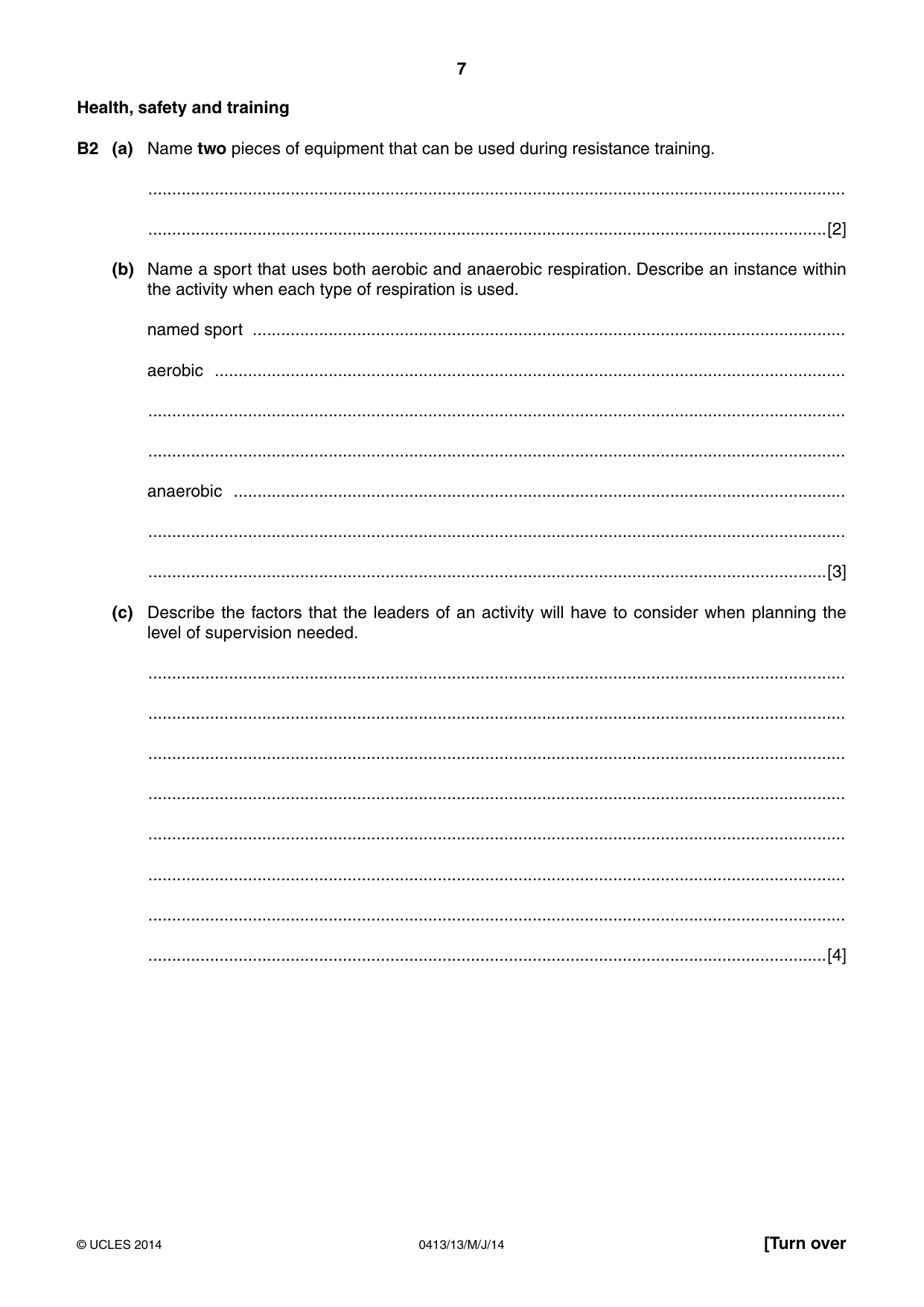
7 0413/13/M/J/14 © UCLES 2014 [Turn over Health, safety and training B2 (a) Name two pieces of equipment that can be used during resistance training. … …[2] (b) Name a sport that uses both aerobic and anaerobic respiration. Describe an instance within the activity when each type of respiration is used. named sport … aerobic … … … anaerobic … … …[3] (c) Describe the factors that the leaders of an activity will have to consider when planning the level of supervision needed. … … … … … … … …[4]
Question paper, page 8
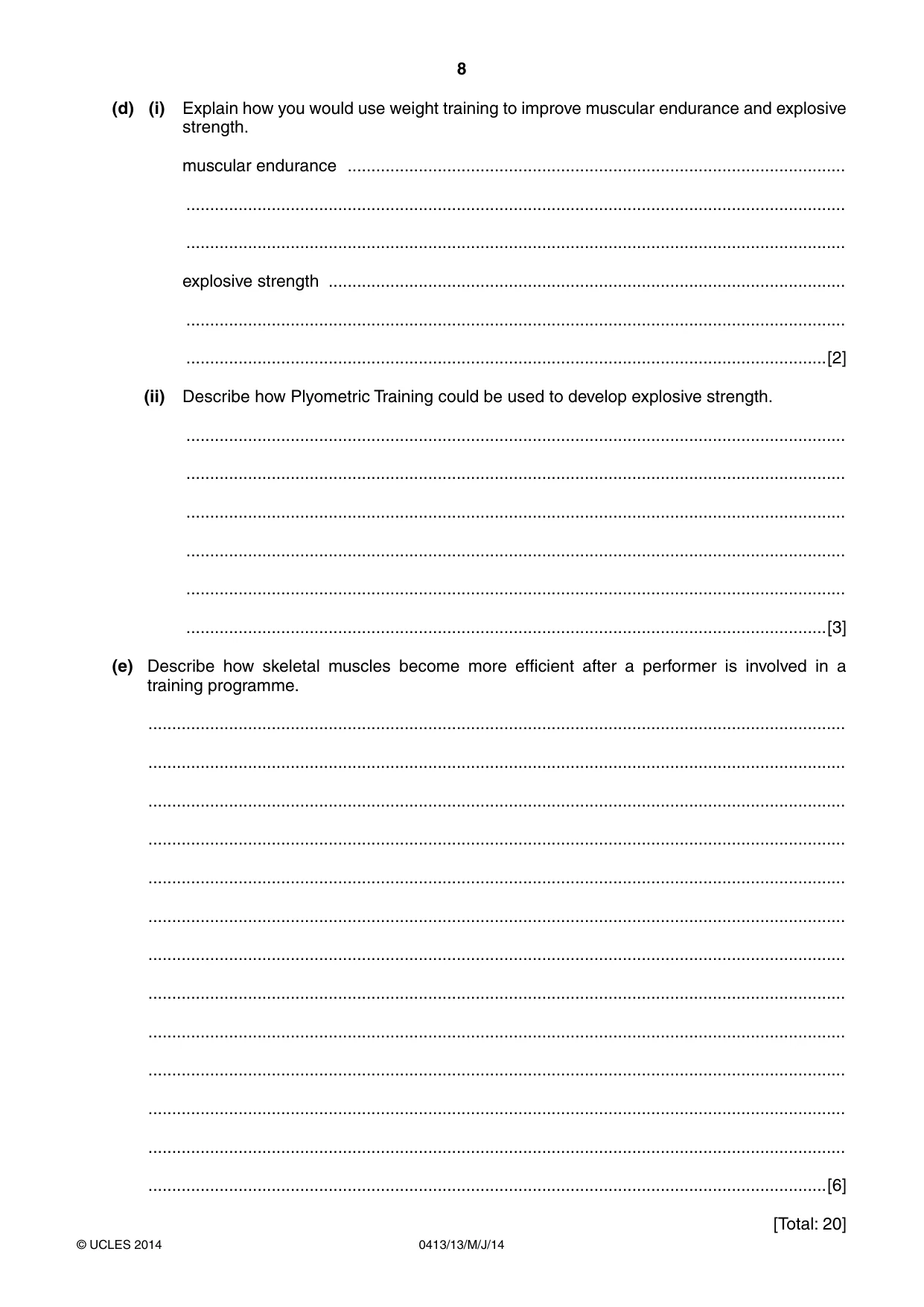
8 0413/13/M/J/14 © UCLES 2014 (d) (i) Explain how you would use weight training to improve muscular endurance and explosive strength. muscular endurance … … … explosive strength … … …[2] (ii) Describe how Plyometric Training could be used to develop explosive strength. … … … … … …[3] (e) Describe how skeletal muscles become more efficient after a performer is involved in a training programme. … … … … … … … … … … … … …[6] [Total: 20]
Question paper, page 9
9 0413/13/M/J/14 © UCLES 2014 [Turn over Reasons and opportunities for participation in physical activities B3 (a) Explain two reasons why a country would want to host a major global event. … … … … … …[2] (b) Describe three different ways that a sports centre can make sports more accessible for groups with different cultural backgrounds. … … … … … … … … …[3] (c) Explain the impact that the Internet has on sport. … … … … … … … … …[4]
Question paper, page 10
10 0413/13/M/J/14 © UCLES 2014 (d) Describe different ways that private businesses can influence sports. … … … … … … … … … … … …[6] [Total: 15]
Question paper, page 11
11 0413/13/M/J/14 © UCLES 2014 BLANK PAGE
Question paper, page 12
12 0413/13/M/J/14 © UCLES 2014 Permission to reproduce items where third-party owned material protected by copyright is included has been sought and cleared where possible. Every reasonable effort has been made by the publisher (UCLES) to trace copyright holders, but if any items requiring clearance have unwittingly been included, the publisher will be pleased to make amends at the earliest possible opportunity. Cambridge International Examinations is part of the Cambridge Assessment Group. Cambridge Assessment is the brand name of University of Cambridge Local Examinations Syndicate (UCLES), which is itself a department of the University of Cambridge. BLANK PAGE
Mark scheme, page 1
CAMBRIDGE INTERNATIONAL EXAMINATIONS International General Certificate of Secondary Education MARK SCHEME for the May/June 2014 series 0413 PHYSICAL EDUCATION 0413/13 Paper 1, maximum raw mark 80 This mark scheme is published as an aid to teachers and candidates, to indicate the requirements of the examination. It shows the basis on which Examiners were instructed to award marks. It does not indicate the details of the discussions that took place at an Examiners’ meeting before marking began, which would have considered the acceptability of alternative answers. Mark schemes should be read in conjunction with the question paper and the Principal Examiner Report for Teachers. Cambridge will not enter into discussions about these mark schemes. Cambridge is publishing the mark schemes for the May/June 2014 series for most IGCSE, GCE Advanced Level and Advanced Subsidiary Level components and some Ordinary Level components.
Mark scheme, page 2
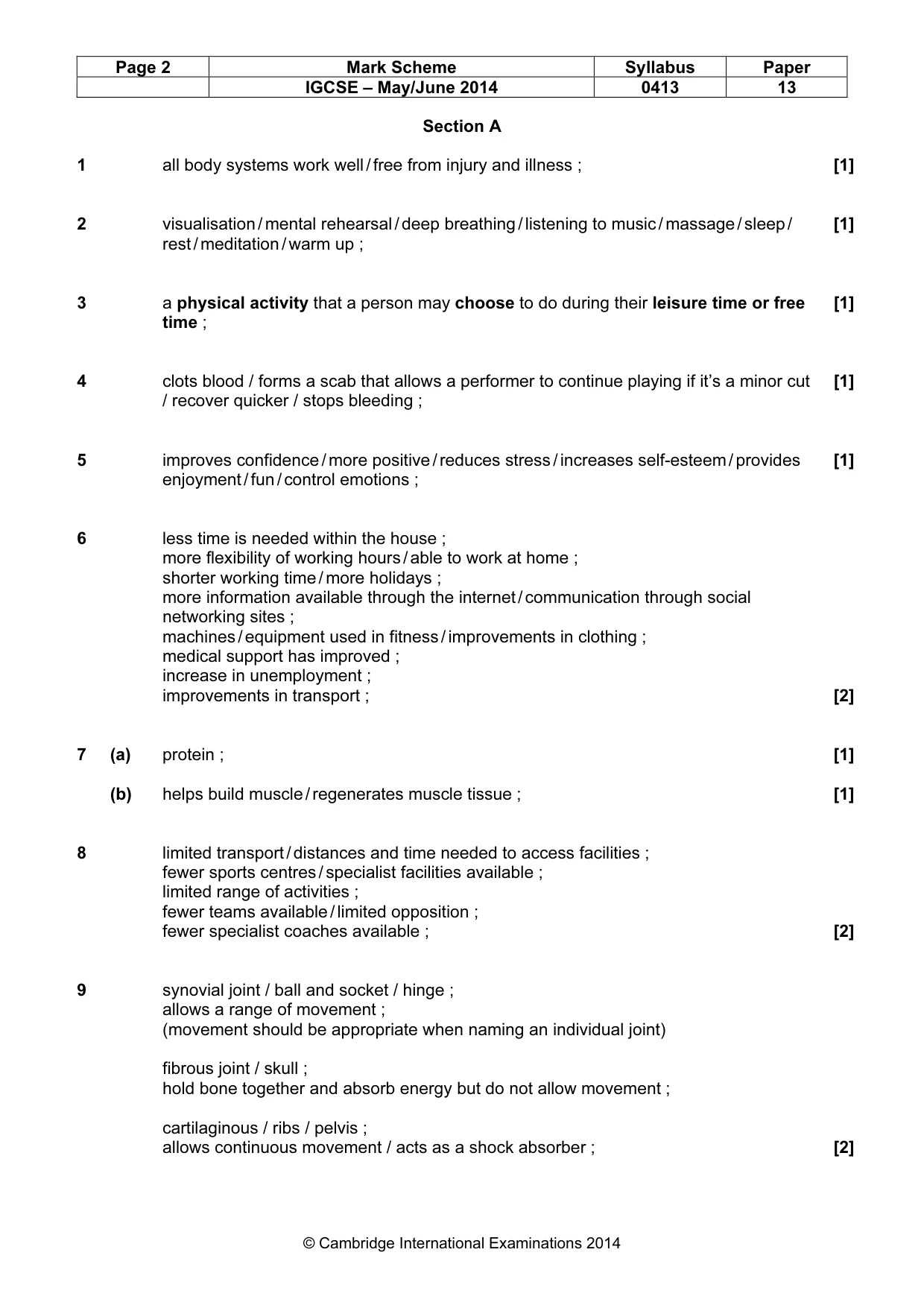
Page 2 Mark Scheme Syllabus Paper IGCSE – May/June 2014 0413 13 © Cambridge International Examinations 2014 Section A 1 all body systems work well / free from injury and illness ; [1] 2 visualisation / mental rehearsal / deep breathing / listening to music / massage / sleep / rest / meditation / warm up ; [1] 3 a physical activity that a person may choose to do during their leisure time or free time ; [1] 4 clots blood / forms a scab that allows a performer to continue playing if it’s a minor cut / recover quicker / stops bleeding ; [1] 5 improves confidence / more positive / reduces stress / increases self-esteem / provides enjoyment / fun / control emotions ; [1] 6 less time is needed within the house ; more flexibility of working hours / able to work at home ; shorter working time / more holidays ; more information available through the internet / communication through social networking sites ; machines / equipment used in fitness / improvements in clothing ; medical support has improved ; increase in unemployment ; improvements in transport ; [2] 7 (a) (b) protein ; helps build muscle / regenerates muscle tissue ; [1] [1] 8 limited transport / distances and time needed to access facilities ; fewer sports centres / specialist facilities available ; limited range of activities ; fewer teams available / limited opposition ; fewer specialist coaches available ; [2] 9 synovial joint / ball and socket / hinge ; allows a range of movement ; (movement should be appropriate when naming an individual joint) fibrous joint / skull ; hold bone together and absorb energy but do not allow movement ; cartilaginous / ribs / pelvis ; allows continuous movement / acts as a shock absorber ; [2]
Mark scheme, page 3
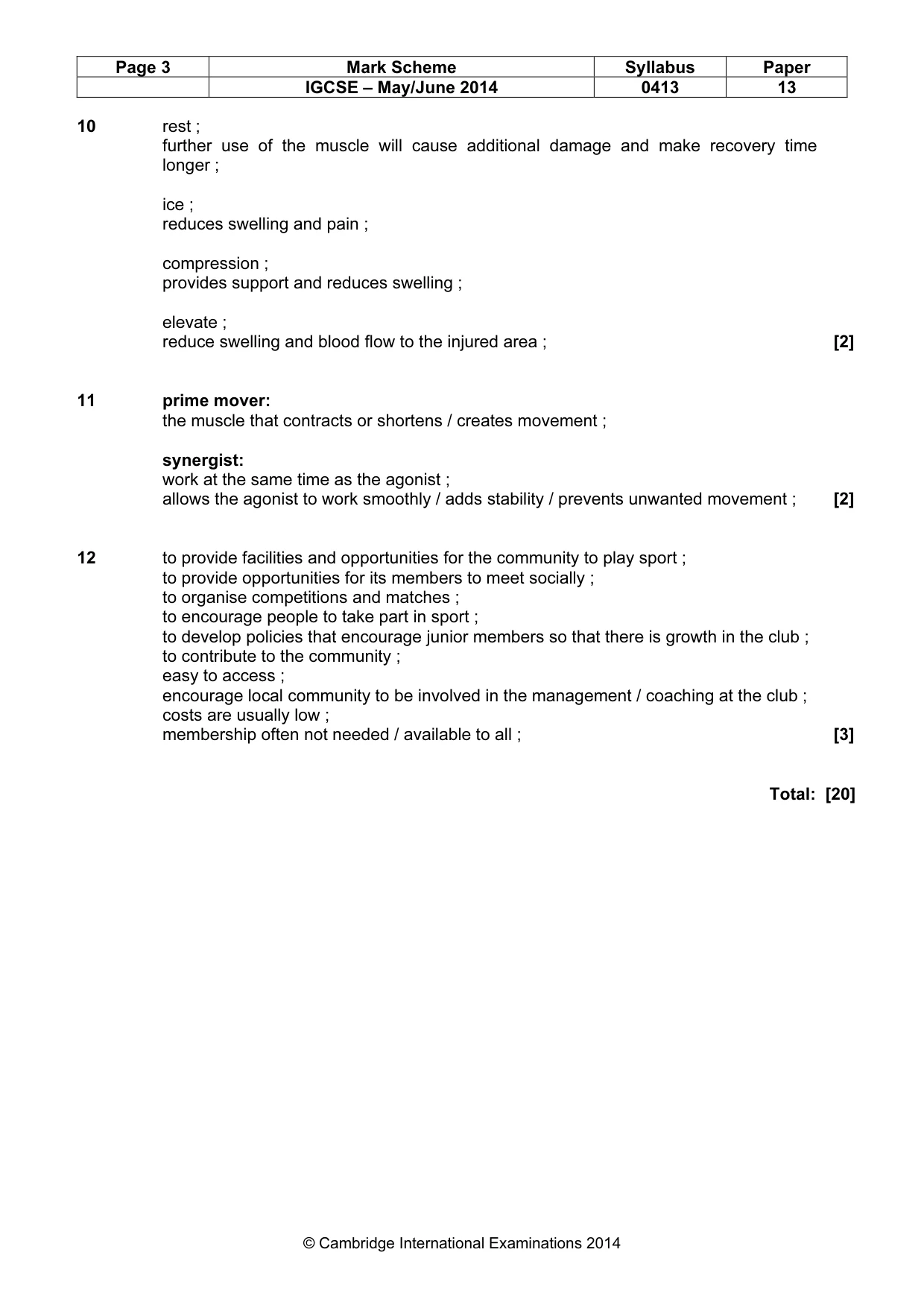
Page 3 Mark Scheme Syllabus Paper IGCSE – May/June 2014 0413 13 © Cambridge International Examinations 2014 10 rest ; further use of the muscle will cause additional damage and make recovery time longer ; ice ; reduces swelling and pain ; compression ; provides support and reduces swelling ; elevate ; reduce swelling and blood flow to the injured area ; [2] 11 prime mover: the muscle that contracts or shortens / creates movement ; synergist: work at the same time as the agonist ; allows the agonist to work smoothly / adds stability / prevents unwanted movement ; [2] 12 to provide facilities and opportunities for the community to play sport ; to provide opportunities for its members to meet socially ; to organise competitions and matches ; to encourage people to take part in sport ; to develop policies that encourage junior members so that there is growth in the club ; to contribute to the community ; easy to access ; encourage local community to be involved in the management / coaching at the club ; costs are usually low ; membership often not needed / available to all ; [3] Total: [20]
Mark scheme, page 4
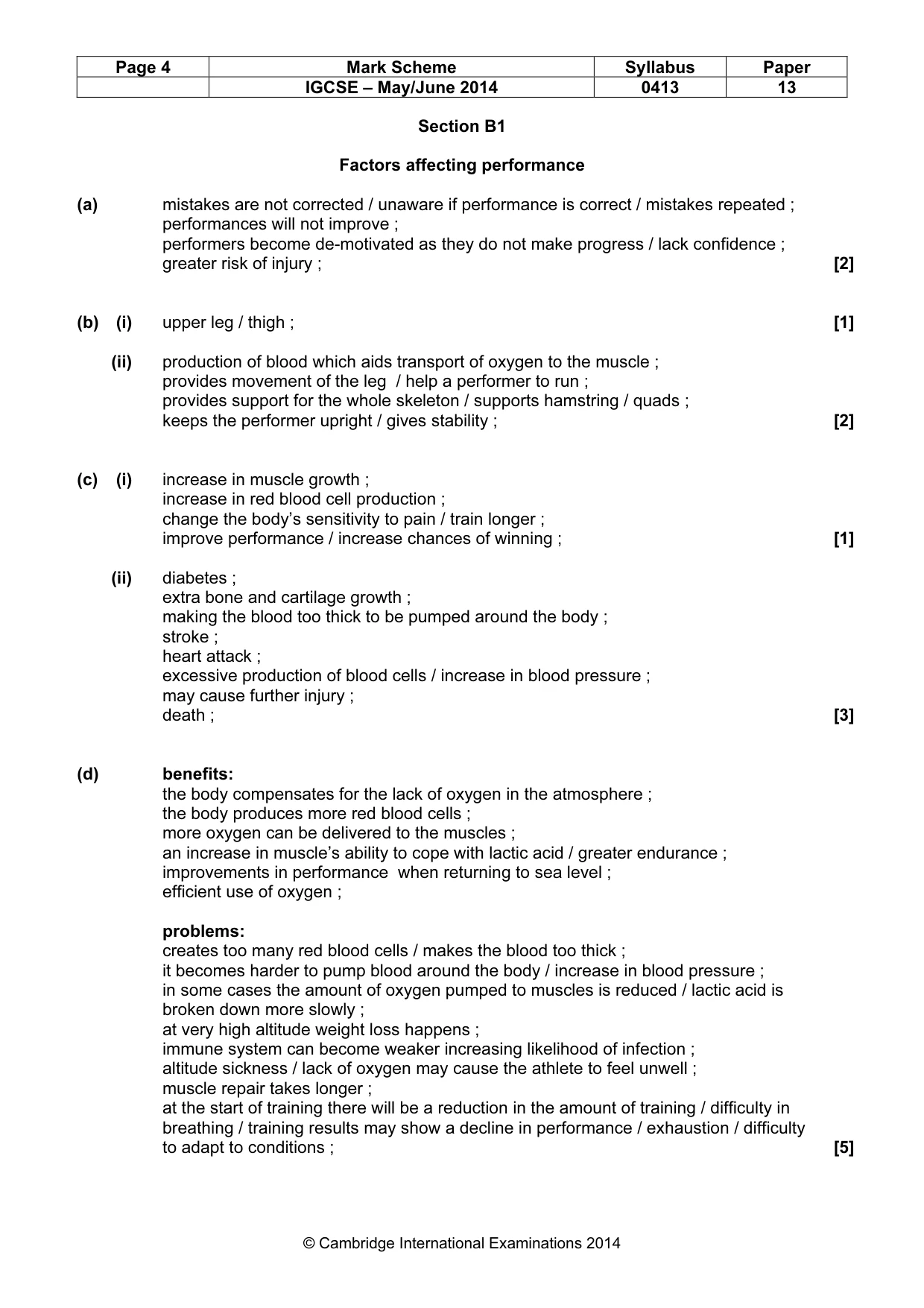
Page 4 Mark Scheme Syllabus Paper IGCSE – May/June 2014 0413 13 © Cambridge International Examinations 2014 Section B1 Factors affecting performance (a) mistakes are not corrected / unaware if performance is correct / mistakes repeated ; performances will not improve ; performers become de-motivated as they do not make progress / lack confidence ; greater risk of injury ; [2] (b) (i) (ii) upper leg / thigh ; production of blood which aids transport of oxygen to the muscle ; provides movement of the leg / help a performer to run ; provides support for the whole skeleton / supports hamstring / quads ; keeps the performer upright / gives stability ; [1] [2] (c) (i) (ii) increase in muscle growth ; increase in red blood cell production ; change the body’s sensitivity to pain / train longer ; improve performance / increase chances of winning ; diabetes ; extra bone and cartilage growth ; making the blood too thick to be pumped around the body ; stroke ; heart attack ; excessive production of blood cells / increase in blood pressure ; may cause further injury ; death ; [1] [3] (d) benefits: the body compensates for the lack of oxygen in the atmosphere ; the body produces more red blood cells ; more oxygen can be delivered to the muscles ; an increase in muscle’s ability to cope with lactic acid / greater endurance ; improvements in performance when returning to sea level ; efficient use of oxygen ; problems: creates too many red blood cells / makes the blood too thick ; it becomes harder to pump blood around the body / increase in blood pressure ; in some cases the amount of oxygen pumped to muscles is reduced / lactic acid is broken down more slowly ; at very high altitude weight loss happens ; immune system can become weaker increasing likelihood of infection ; altitude sickness / lack of oxygen may cause the athlete to feel unwell ; muscle repair takes longer ; at the start of training there will be a reduction in the amount of training / difficulty in breathing / training results may show a decline in performance / exhaustion / difficulty to adapt to conditions ; [5]
Mark scheme, page 5
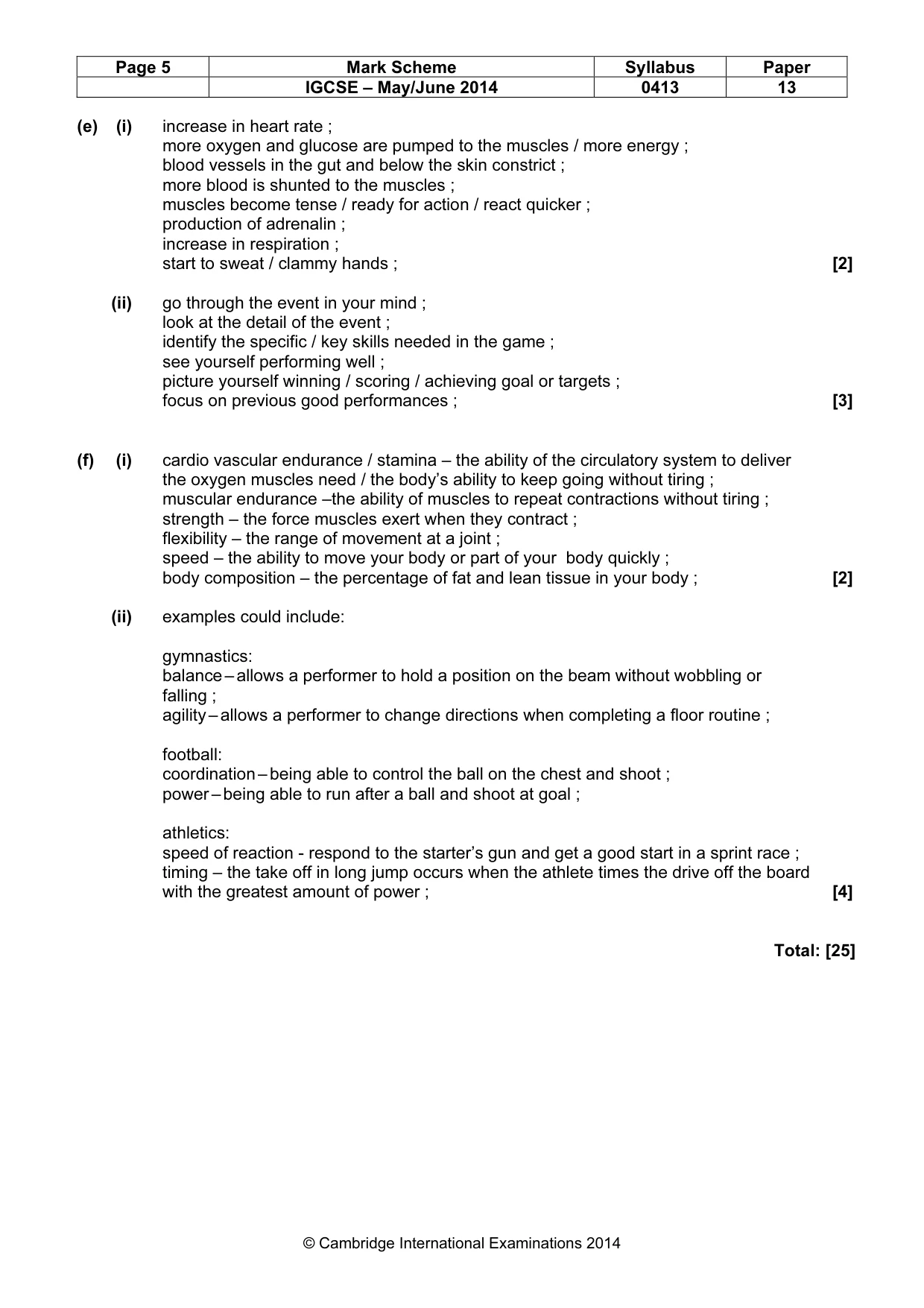
Page 5 Mark Scheme Syllabus Paper IGCSE – May/June 2014 0413 13 © Cambridge International Examinations 2014 (e) (i) (ii) increase in heart rate ; more oxygen and glucose are pumped to the muscles / more energy ; blood vessels in the gut and below the skin constrict ; more blood is shunted to the muscles ; muscles become tense / ready for action / react quicker ; production of adrenalin ; increase in respiration ; start to sweat / clammy hands ; go through the event in your mind ; look at the detail of the event ; identify the specific / key skills needed in the game ; see yourself performing well ; picture yourself winning / scoring / achieving goal or targets ; focus on previous good performances ; [2] [3] (f) (i) (ii) cardio vascular endurance / stamina – the ability of the circulatory system to deliver the oxygen muscles need / the body’s ability to keep going without tiring ; muscular endurance –the ability of muscles to repeat contractions without tiring ; strength – the force muscles exert when they contract ; flexibility – the range of movement at a joint ; speed – the ability to move your body or part of your body quickly ; body composition – the percentage of fat and lean tissue in your body ; examples could include: gymnastics: balance – allows a performer to hold a position on the beam without wobbling or falling ; agility – allows a performer to change directions when completing a floor routine ; football: coordination – being able to control the ball on the chest and shoot ; power – being able to run after a ball and shoot at goal ; athletics: speed of reaction - respond to the starter’s gun and get a good start in a sprint race ; timing – the take off in long jump occurs when the athlete times the drive off the board with the greatest amount of power ; [2] [4] Total: [25]
Mark scheme, page 6
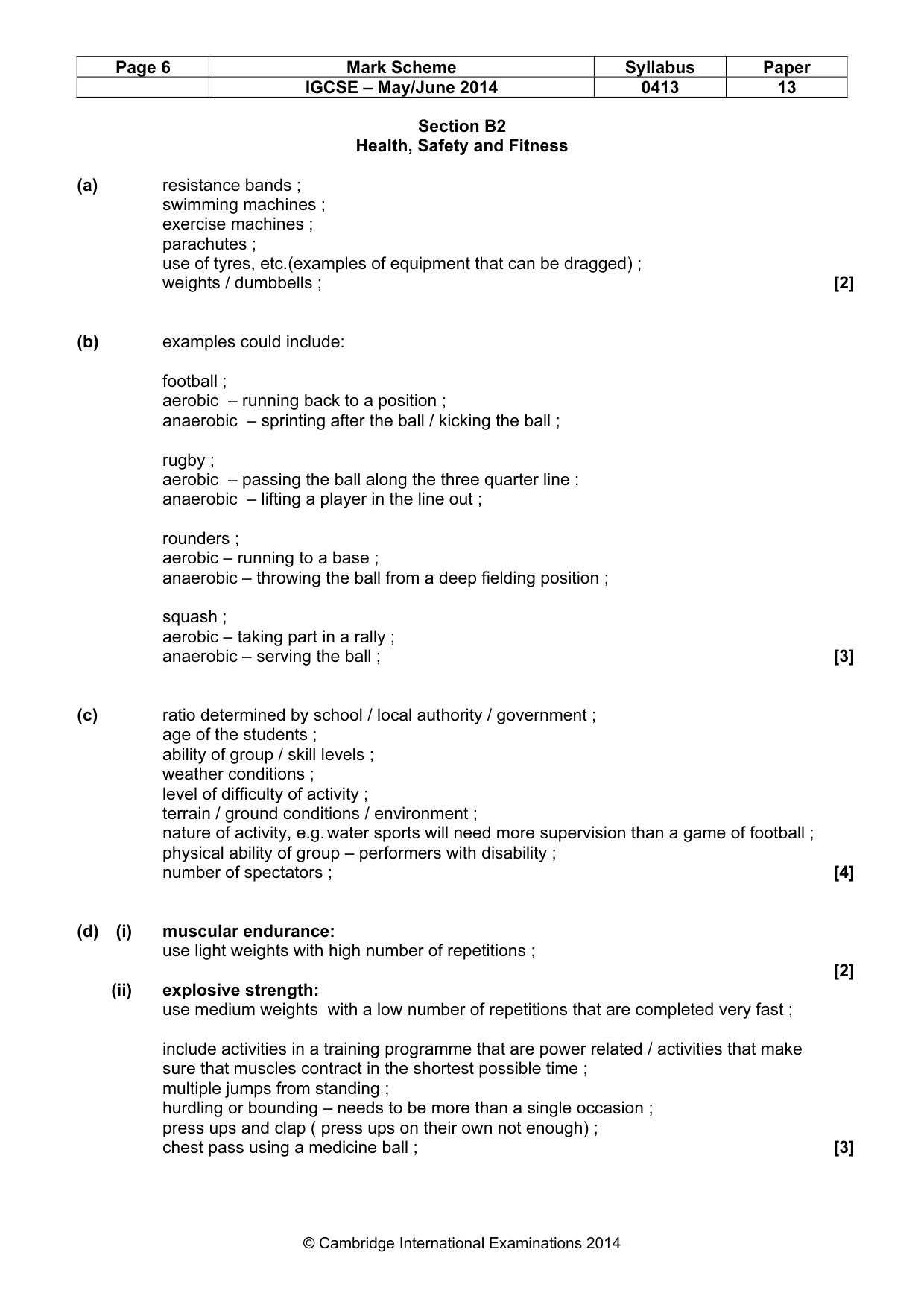
Page 6 Mark Scheme Syllabus Paper IGCSE – May/June 2014 0413 13 © Cambridge International Examinations 2014 Section B2 Health, Safety and Fitness (a) resistance bands ; swimming machines ; exercise machines ; parachutes ; use of tyres, etc.(examples of equipment that can be dragged) ; weights / dumbbells ; [2] (b) examples could include: football ; aerobic – running back to a position ; anaerobic – sprinting after the ball / kicking the ball ; rugby ; aerobic – passing the ball along the three quarter line ; anaerobic – lifting a player in the line out ; rounders ; aerobic – running to a base ; anaerobic – throwing the ball from a deep fielding position ; squash ; aerobic – taking part in a rally ; anaerobic – serving the ball ; [3] (c) ratio determined by school / local authority / government ; age of the students ; ability of group / skill levels ; weather conditions ; level of difficulty of activity ; terrain / ground conditions / environment ; nature of activity, e.g. water sports will need more supervision than a game of football ; physical ability of group – performers with disability ; number of spectators ; [4] (d) (i) (ii) muscular endurance: use light weights with high number of repetitions ; explosive strength: use medium weights with a low number of repetitions that are completed very fast ; include activities in a training programme that are power related / activities that make sure that muscles contract in the shortest possible time ; multiple jumps from standing ; hurdling or bounding – needs to be more than a single occasion ; press ups and clap ( press ups on their own not enough) ; chest pass using a medicine ball ; [2] [3]
Mark scheme, page 7
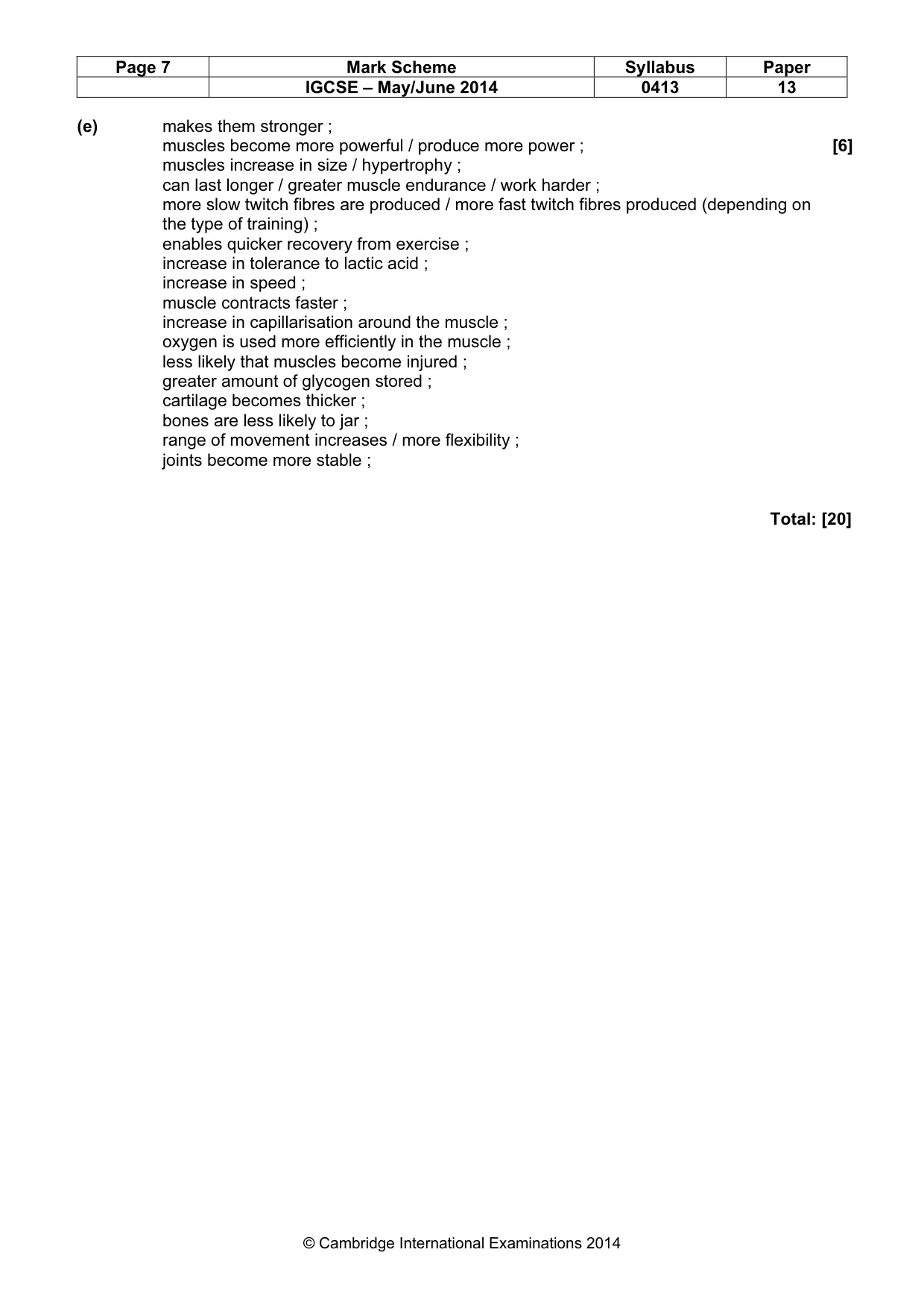
Page 7 Mark Scheme Syllabus Paper IGCSE – May/June 2014 0413 13 © Cambridge International Examinations 2014 (e) makes them stronger ; muscles become more powerful / produce more power ; muscles increase in size / hypertrophy ; can last longer / greater muscle endurance / work harder ; more slow twitch fibres are produced / more fast twitch fibres produced (depending on the type of training) ; enables quicker recovery from exercise ; increase in tolerance to lactic acid ; increase in speed ; muscle contracts faster ; increase in capillarisation around the muscle ; oxygen is used more efficiently in the muscle ; less likely that muscles become injured ; greater amount of glycogen stored ; cartilage becomes thicker ; bones are less likely to jar ; range of movement increases / more flexibility ; joints become more stable ; [6] Total: [20]
Mark scheme, page 8
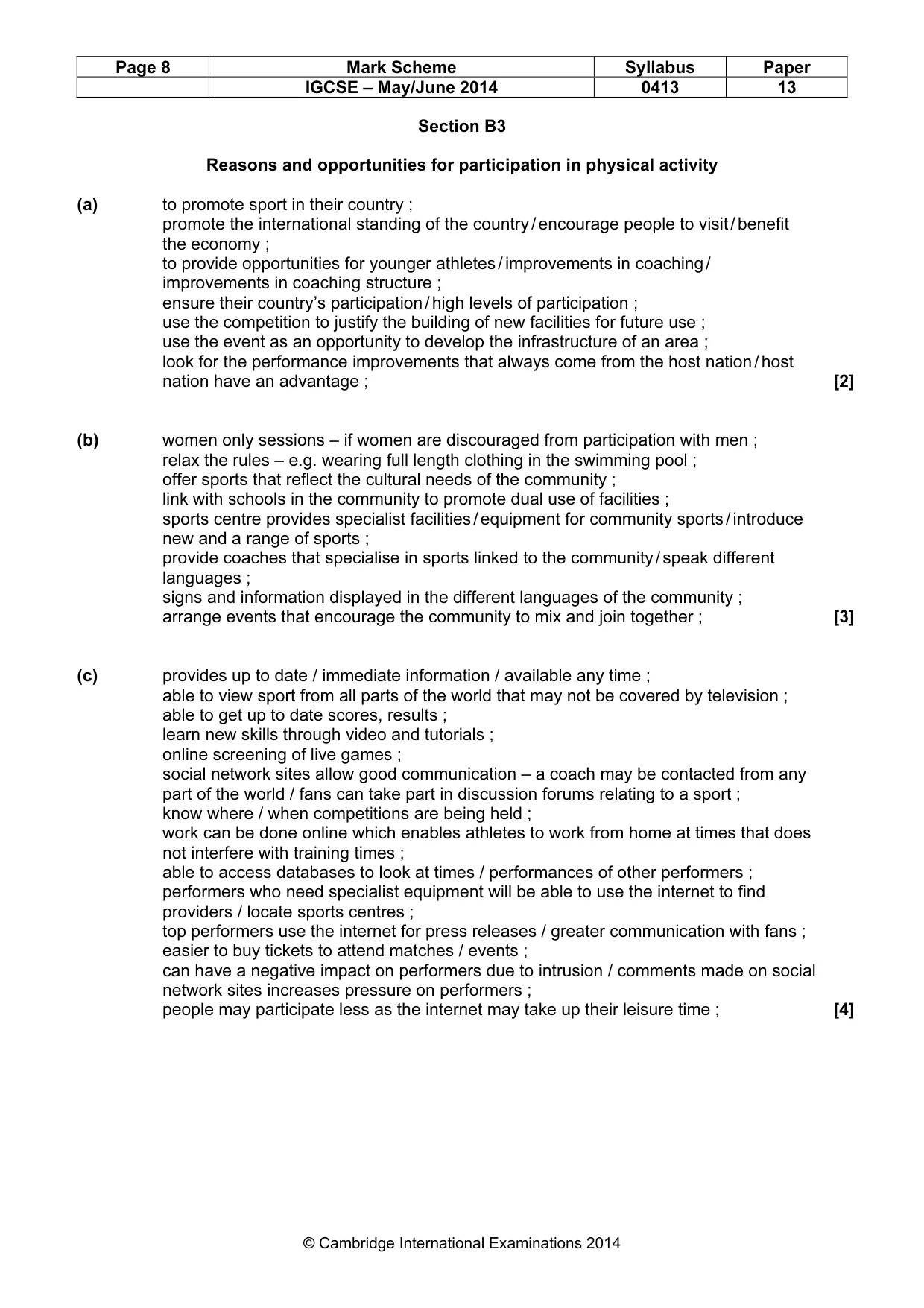
Page 8 Mark Scheme Syllabus Paper IGCSE – May/June 2014 0413 13 © Cambridge International Examinations 2014 Section B3 Reasons and opportunities for participation in physical activity (a) to promote sport in their country ; promote the international standing of the country / encourage people to visit / benefit the economy ; to provide opportunities for younger athletes / improvements in coaching / improvements in coaching structure ; ensure their country’s participation / high levels of participation ; use the competition to justify the building of new facilities for future use ; use the event as an opportunity to develop the infrastructure of an area ; look for the performance improvements that always come from the host nation / host nation have an advantage ; [2] (b) women only sessions – if women are discouraged from participation with men ; relax the rules – e.g. wearing full length clothing in the swimming pool ; offer sports that reflect the cultural needs of the community ; link with schools in the community to promote dual use of facilities ; sports centre provides specialist facilities / equipment for community sports / introduce new and a range of sports ; provide coaches that specialise in sports linked to the community / speak different languages ; signs and information displayed in the different languages of the community ; arrange events that encourage the community to mix and join together ; [3] (c) provides up to date / immediate information / available any time ; able to view sport from all parts of the world that may not be covered by television ; able to get up to date scores, results ; learn new skills through video and tutorials ; online screening of live games ; social network sites allow good communication – a coach may be contacted from any part of the world / fans can take part in discussion forums relating to a sport ; know where / when competitions are being held ; work can be done online which enables athletes to work from home at times that does not interfere with training times ; able to access databases to look at times / performances of other performers ; performers who need specialist equipment will be able to use the internet to find providers / locate sports centres ; top performers use the internet for press releases / greater communication with fans ; easier to buy tickets to attend matches / events ; can have a negative impact on performers due to intrusion / comments made on social network sites increases pressure on performers ; people may participate less as the internet may take up their leisure time ; [4]
Mark scheme, page 9
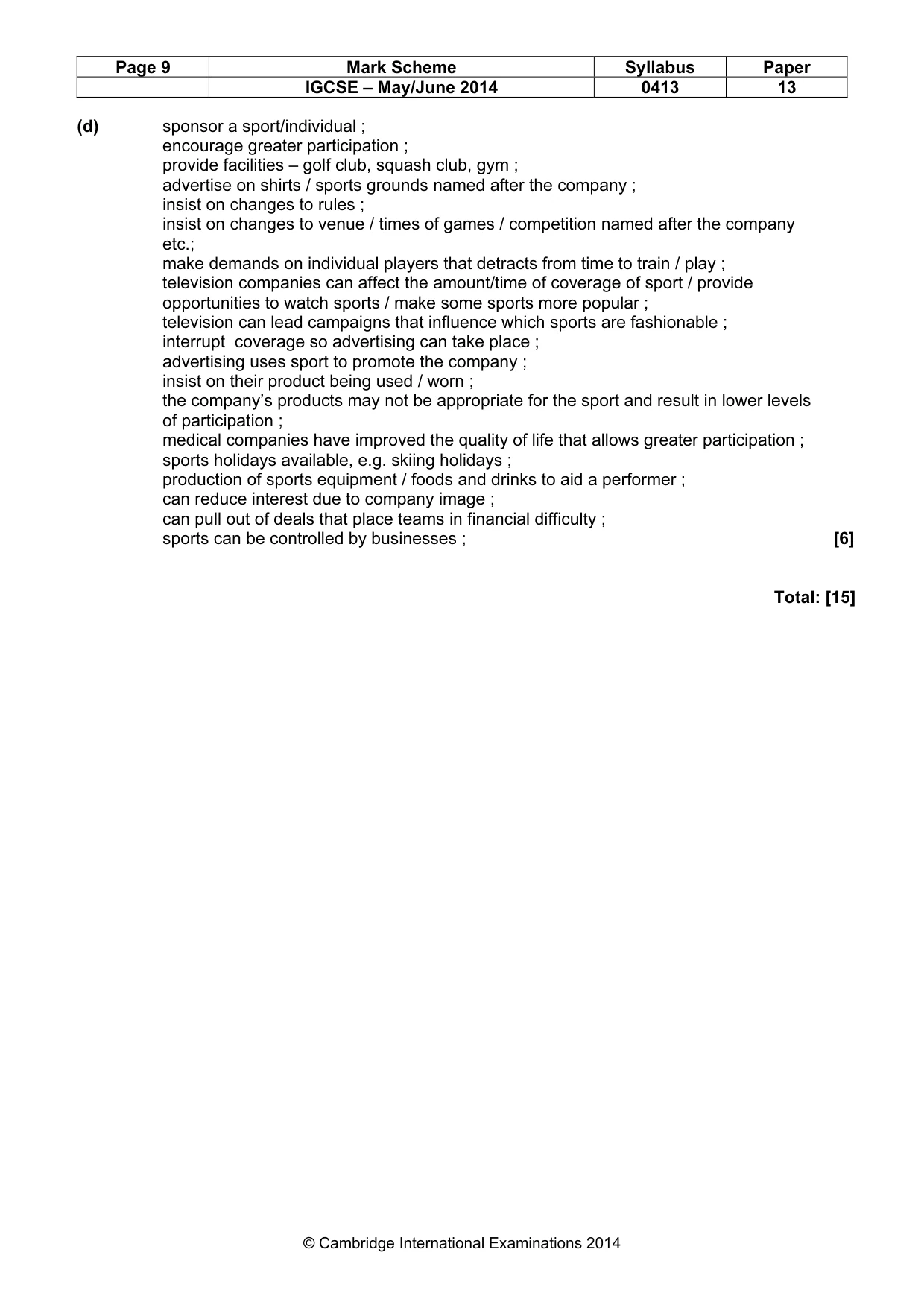
Page 9 Mark Scheme Syllabus Paper IGCSE – May/June 2014 0413 13 © Cambridge International Examinations 2014 (d) sponsor a sport/individual ; encourage greater participation ; provide facilities – golf club, squash club, gym ; advertise on shirts / sports grounds named after the company ; insist on changes to rules ; insist on changes to venue / times of games / competition named after the company etc.; make demands on individual players that detracts from time to train / play ; television companies can affect the amount/time of coverage of sport / provide opportunities to watch sports / make some sports more popular ; television can lead campaigns that influence which sports are fashionable ; interrupt coverage so advertising can take place ; advertising uses sport to promote the company ; insist on their product being used / worn ; the company’s products may not be appropriate for the sport and result in lower levels of participation ; medical companies have improved the quality of life that allows greater participation ; sports holidays available, e.g. skiing holidays ; production of sports equipment / foods and drinks to aid a performer ; can reduce interest due to company image ; can pull out of deals that place teams in financial difficulty ; sports can be controlled by businesses ; [6] Total: [15]
What you needed in this session
Cambridge’s own grade thresholds for 2014 May/June, Paper 1 · Variant 3. A higher threshold means an easier paper — the bar moves with how the cohort did.