Cambridge IGCSE Physical Education 0413 — 2014 May/June Paper 1 · Variant 1
0413/11/M/J/14 · 80 marks · ≈90 min
The question paper and its mark scheme, free to read here and free to download. This is Cambridge’s own paper, exactly as it was sat.
Question paper12 pages




Mark scheme12 pages
Answers below. Sit the paper first if you are practising.
Paper as text
Question paper, page 1
This document consists of 10 printed pages and 2 blank pages. DC (RCL (DF)) 81095/2 © UCLES 2014 [Turn over Cambridge International Examinations Cambridge International General Certificate of Secondary Education * 8 8 3 1 7 1 9 0 7 6 * PHYSICAL EDUCATION 0413/11 Paper 1 May/June 2014 1 hour 45 minutes Candidates answer on the Question Paper. No Additional Materials are required. READ THESE INSTRUCTIONS FIRST Write your Centre number, candidate number and name on all the work you hand in. Write in dark blue or black pen. You may use an HB pencil for any diagrams or graphs. Do not use staples, paper clips, glue or correction fluid. DO NOT WRITE IN ANY BARCODES. Answer all questions. At the end of the examination, fasten all your work securely together. The number of marks is given in brackets [ ] at the end of each question or part question. Electronic calculators may be used.
Question paper, page 2
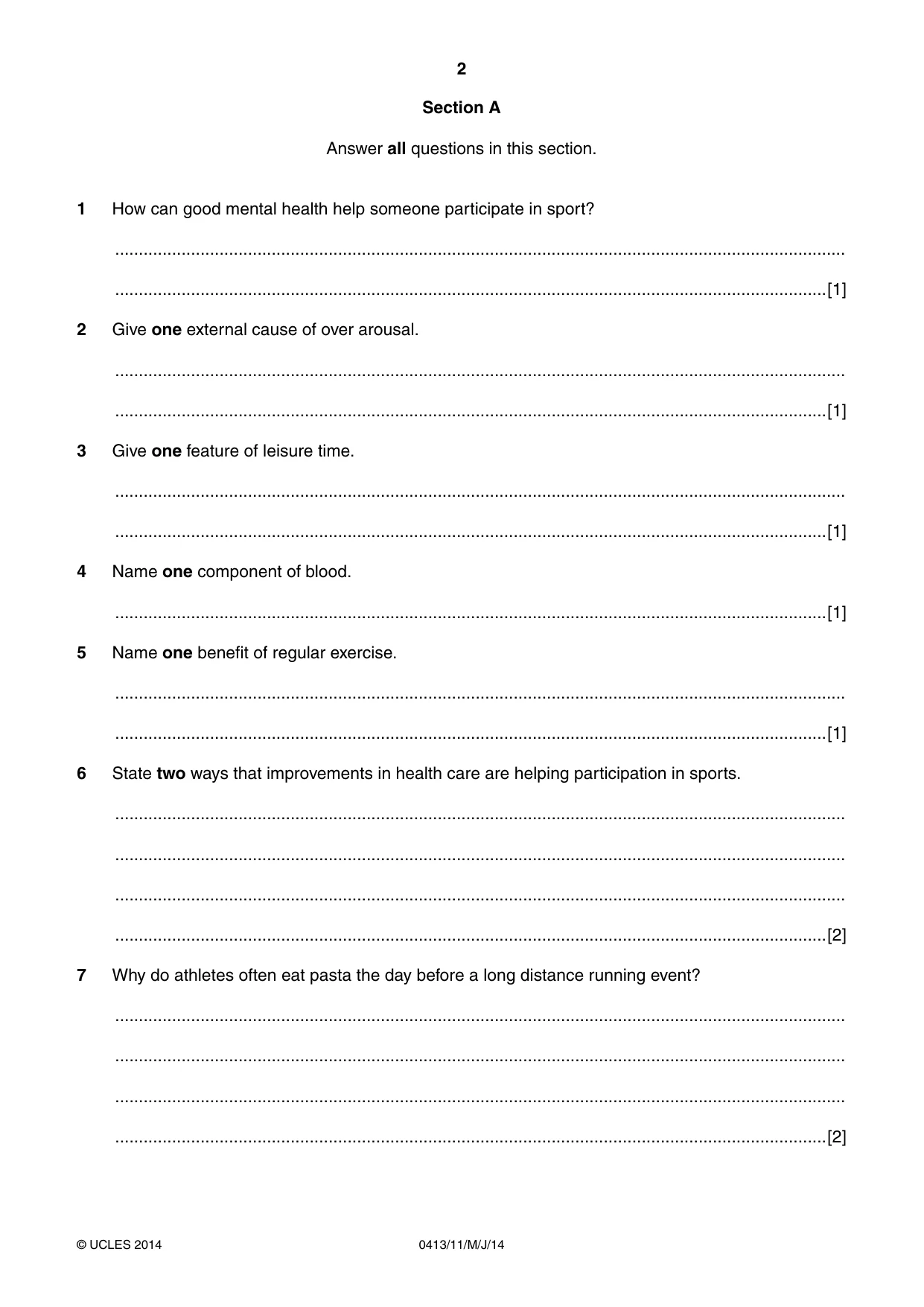
2 0413/11/M/J/14 © UCLES 2014 Section A Answer all questions in this section. 1 How can good mental health help someone participate in sport? … …[1] 2 Give one external cause of over arousal. … …[1] 3 Give one feature of leisure time. … …[1] 4 Name one component of blood. …[1] 5 Name one benefit of regular exercise. … …[1] 6 State two ways that improvements in health care are helping participation in sports. … … … …[2] 7 Why do athletes often eat pasta the day before a long distance running event? … … … …[2]
Question paper, page 3
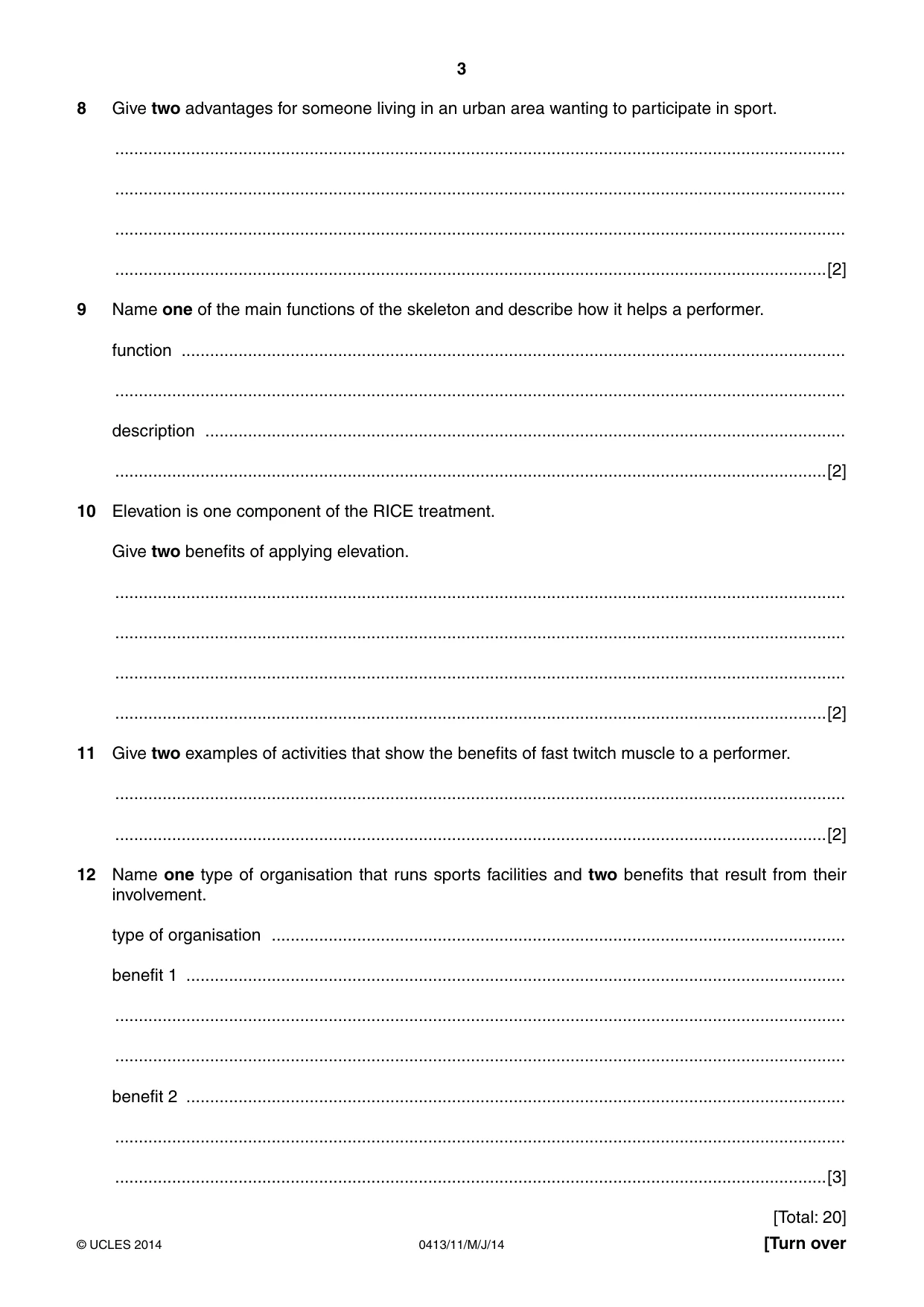
3 0413/11/M/J/14 © UCLES 2014 [Turn over 8 Give two advantages for someone living in an urban area wanting to participate in sport. … … … …[2] 9 Name one of the main functions of the skeleton and describe how it helps a performer. function … … description … …[2] 10 Elevation is one component of the RICE treatment. Give two benefits of applying elevation. … … … …[2] 11 Give two examples of activities that show the benefits of fast twitch muscle to a performer. … …[2] 12 Name one type of organisation that runs sports facilities and two benefits that result from their involvement. type of organisation … benefit 1 … … … benefit 2 … … …[3] [Total: 20]
Question paper, page 4
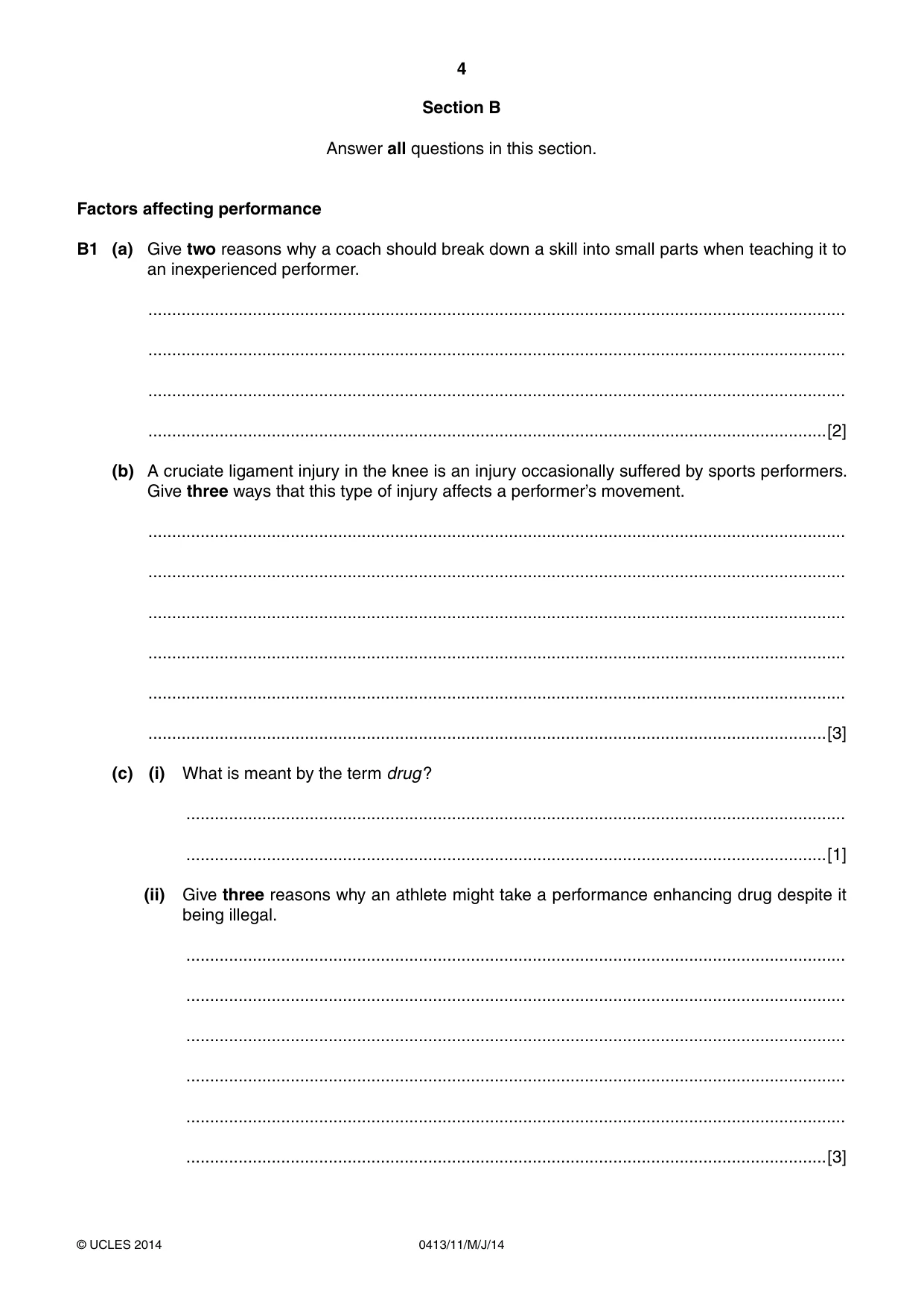
4 0413/11/M/J/14 © UCLES 2014 Section B Answer all questions in this section. Factors affecting performance B1 (a) Give two reasons why a coach should break down a skill into small parts when teaching it to an inexperienced performer. … … … …[2] (b) A cruciate ligament injury in the knee is an injury occasionally suffered by sports performers. Give three ways that this type of injury affects a performer’s movement. … … … … … …[3] (c) (i) What is meant by the term drug ? … …[1] (ii) Give three reasons why an athlete might take a performance enhancing drug despite it being illegal. … … … … … …[3]
Question paper, page 5
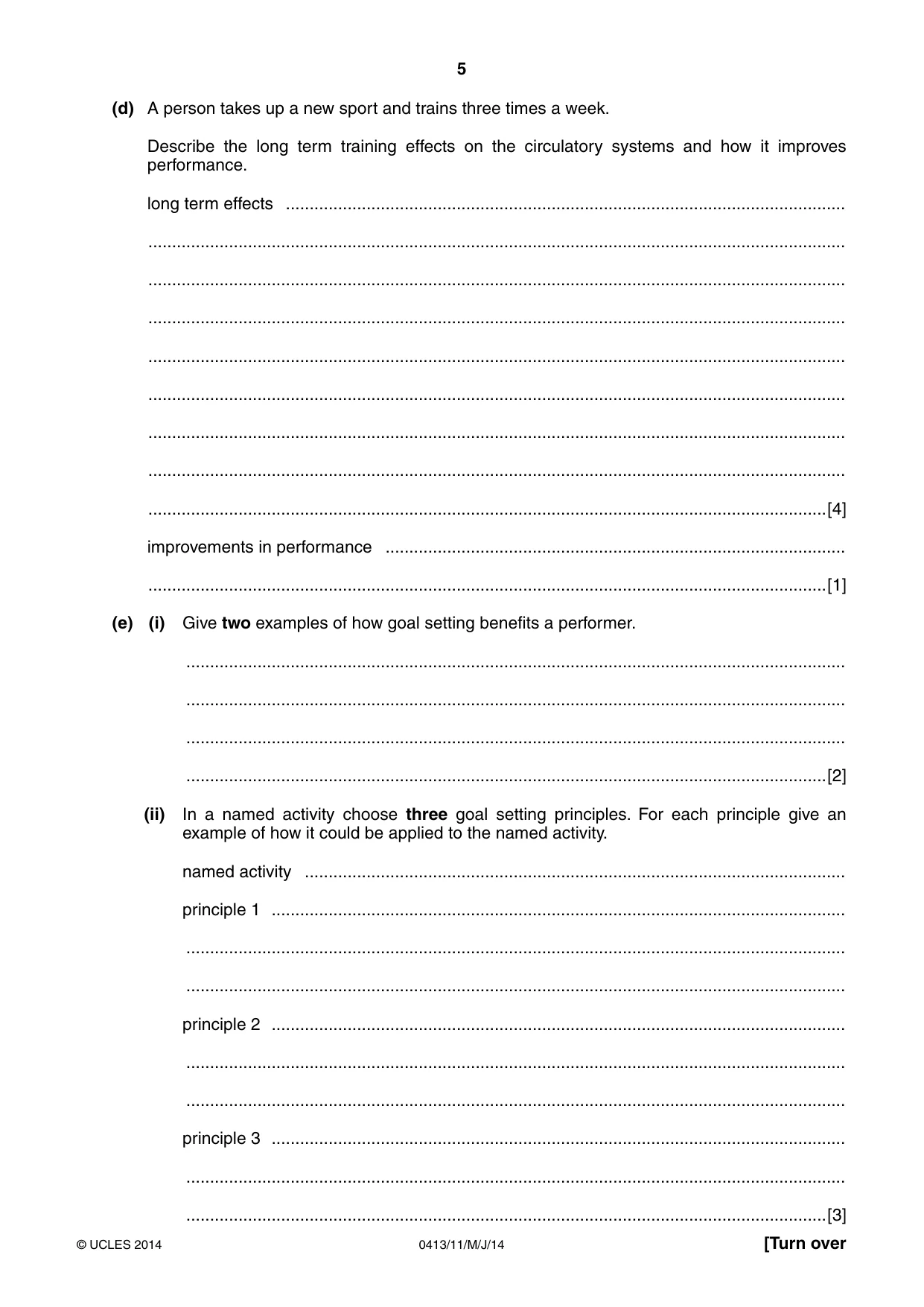
5 0413/11/M/J/14 © UCLES 2014 [Turn over (d) A person takes up a new sport and trains three times a week. Describe the long term training effects on the circulatory systems and how it improves performance. long term effects … … … … … … … … …[4] improvements in performance … …[1] (e) (i) Give two examples of how goal setting benefits a performer. … … … …[2] (ii) In a named activity choose three goal setting principles. For each principle give an example of how it could be applied to the named activity. named activity … principle 1 … … … principle 2 … … … principle 3 … … …[3]
Question paper, page 6
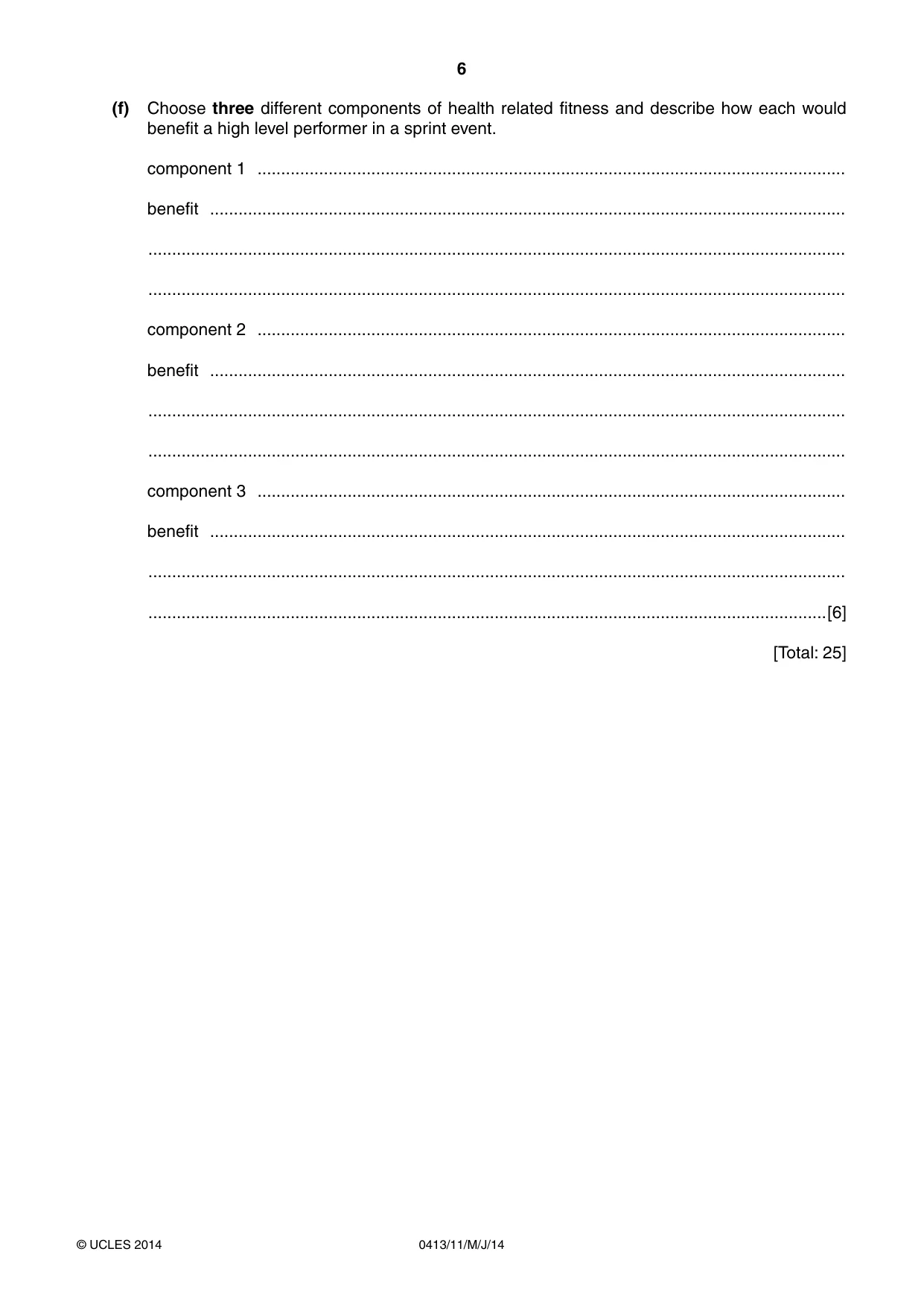
6 0413/11/M/J/14 © UCLES 2014 (f) Choose three different components of health related fitness and describe how each would benefit a high level performer in a sprint event. component 1 … benefit … … … component 2 … benefit … … … component 3 … benefit … … …[6] [Total: 25]
Question paper, page 7
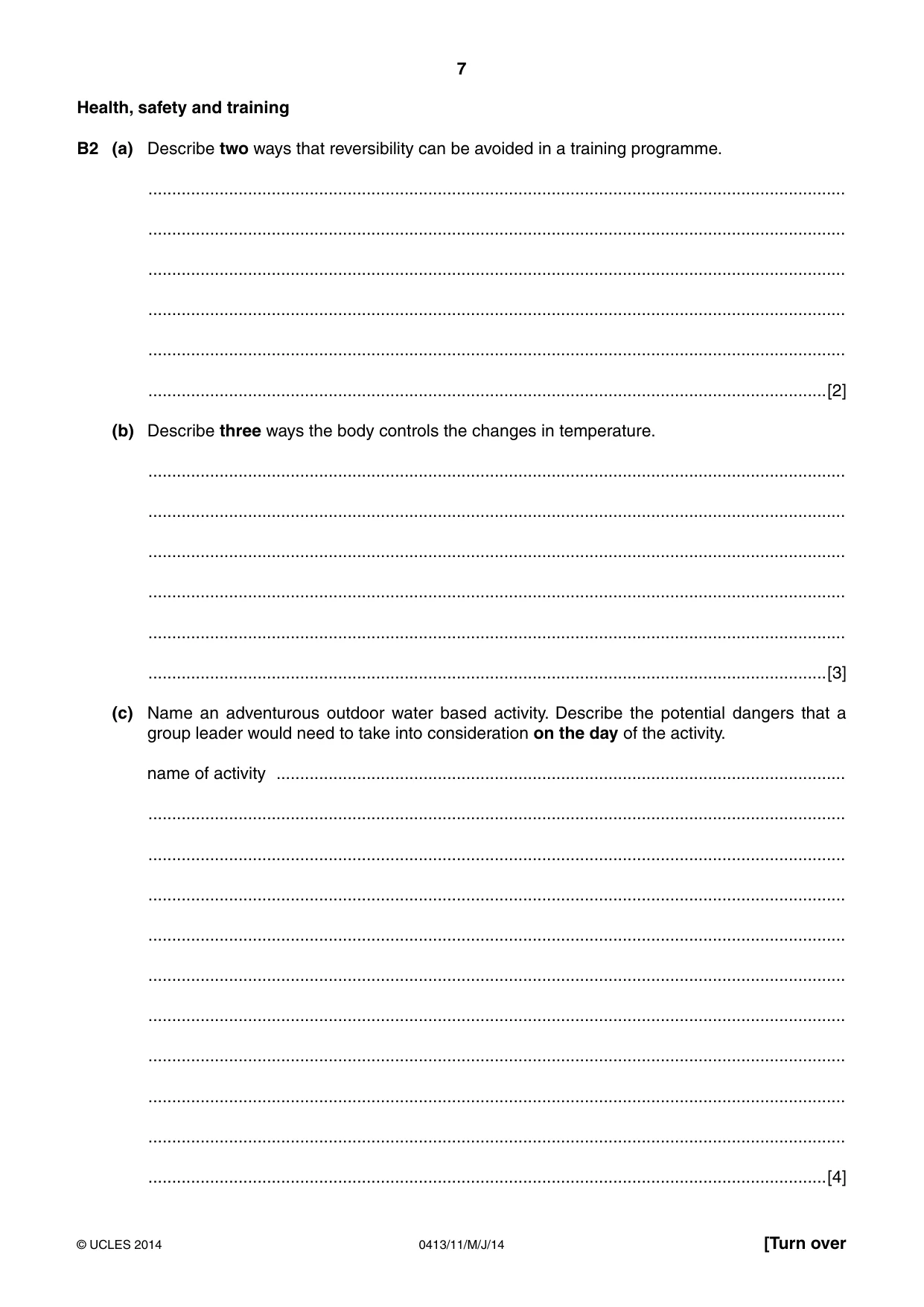
7 0413/11/M/J/14 © UCLES 2014 [Turn over Health, safety and training B2 (a) Describe two ways that reversibility can be avoided in a training programme. … … … … … …[2] (b) Describe three ways the body controls the changes in temperature. … … … … … …[3] (c) Name an adventurous outdoor water based activity. Describe the potential dangers that a group leader would need to take into consideration on the day of the activity. name of activity … … … … … … … … … … …[4]
Question paper, page 8
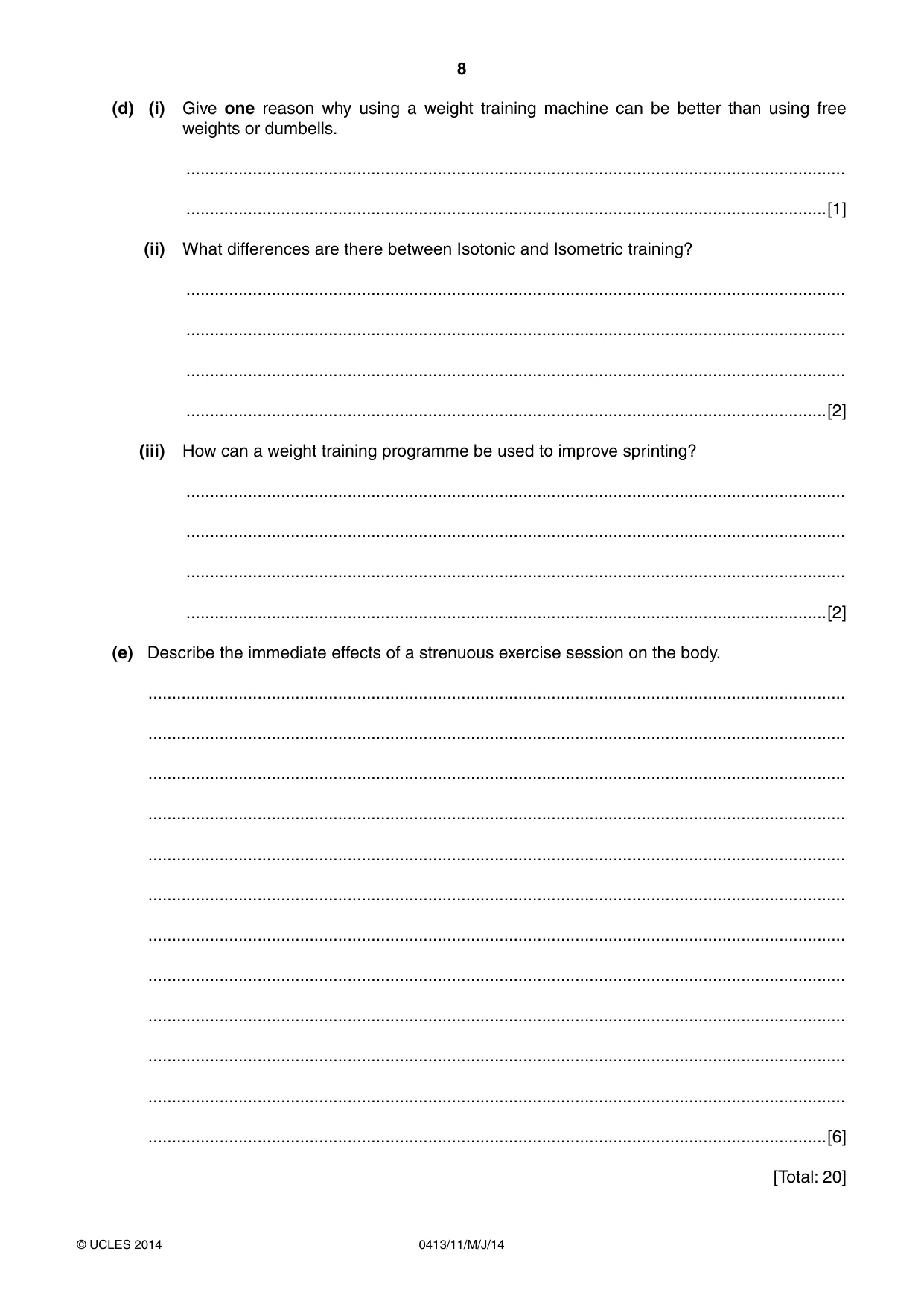
8 0413/11/M/J/14 © UCLES 2014 (d) (i) Give one reason why using a weight training machine can be better than using free weights or dumbells. … …[1] (ii) What differences are there between Isotonic and Isometric training? … … … …[2] (iii) How can a weight training programme be used to improve sprinting? … … … …[2] (e) Describe the immediate effects of a strenuous exercise session on the body. … … … … … … … … … … … …[6] [Total: 20]
Question paper, page 9
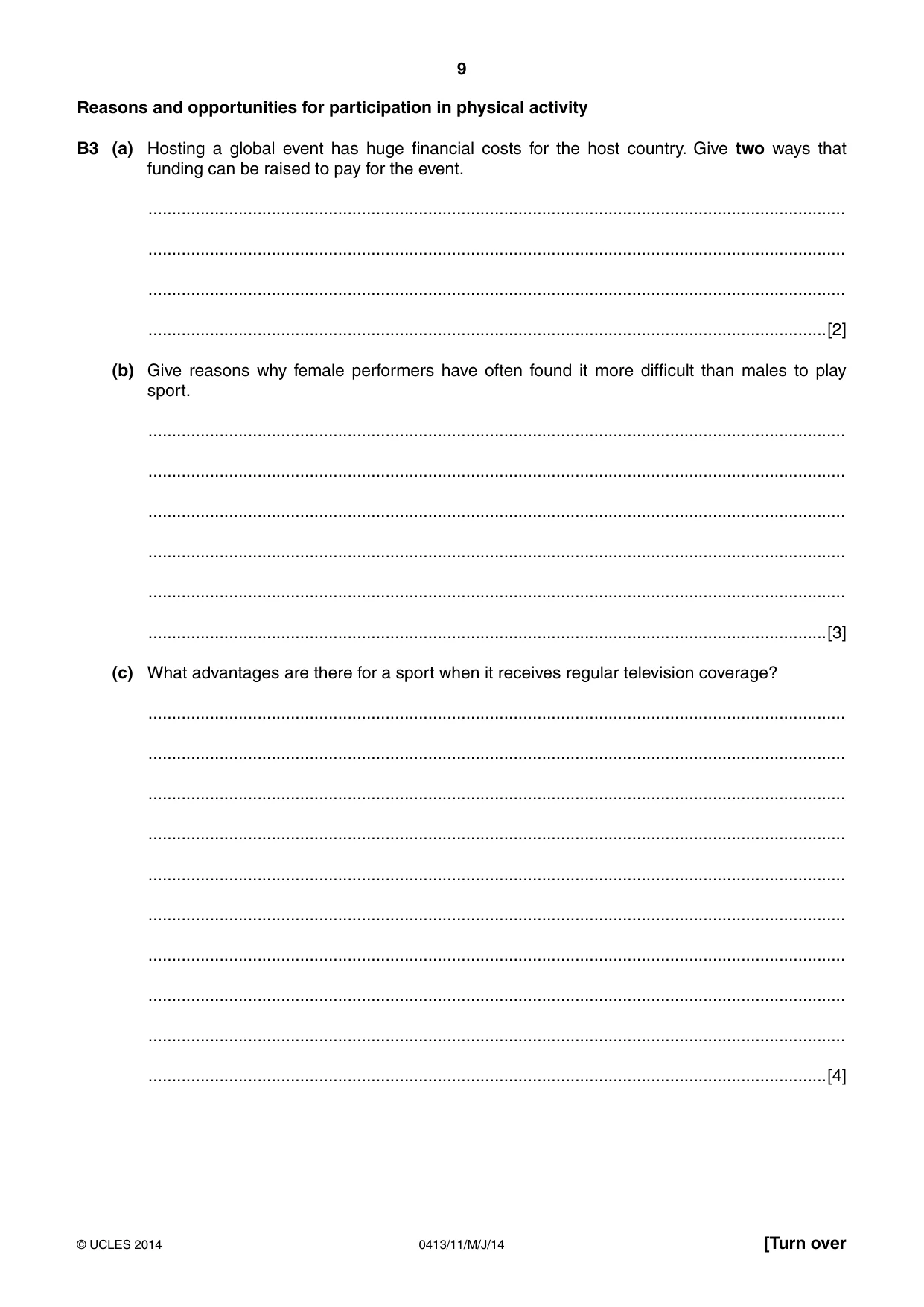
9 0413/11/M/J/14 © UCLES 2014 [Turn over Reasons and opportunities for participation in physical activity B3 (a) Hosting a global event has huge financial costs for the host country. Give two ways that funding can be raised to pay for the event. … … … …[2] (b) Give reasons why female performers have often found it more difficult than males to play sport. … … … … … …[3] (c) What advantages are there for a sport when it receives regular television coverage? … … … … … … … … … …[4]
Question paper, page 10
10 0413/11/M/J/14 © UCLES 2014 (d) Name and describe how physical factors can affect the quality of an individual’s performance. … … … … … … … … … … … … … …[6] [Total: 15]
Question paper, page 11
11 0413/11/M/J/14 © UCLES 2014 BLANK PAGE
Question paper, page 12
12 0413/11/M/J/14 © UCLES 2014 Permission to reproduce items where third-party owned material protected by copyright is included has been sought and cleared where possible. Every reasonable effort has been made by the publisher (UCLES) to trace copyright holders, but if any items requiring clearance have unwittingly been included, the publisher will be pleased to make amends at the earliest possible opportunity. Cambridge International Examinations is part of the Cambridge Assessment Group. Cambridge Assessment is the brand name of University of Cambridge Local Examinations Syndicate (UCLES), which is itself a department of the University of Cambridge. BLANK PAGE
Mark scheme, page 1
CAMBRIDGE INTERNATIONAL EXAMINATIONS International General Certificate of Secondary Education MARK SCHEME for the May/June 2014 series 0413 PHYSICAL EDUCATION 0413/11 Paper 1, maximum raw mark 80 This mark scheme is published as an aid to teachers and candidates, to indicate the requirements of the examination. It shows the basis on which Examiners were instructed to award marks. It does not indicate the details of the discussions that took place at an Examiners’ meeting before marking began, which would have considered the acceptability of alternative answers. Mark schemes should be read in conjunction with the question paper and the Principal Examiner Report for Teachers. Cambridge will not enter into discussions about these mark schemes. Cambridge is publishing the mark schemes for the May/June 2014 series for most IGCSE, GCE Advanced Level and Advanced Subsidiary Level components and some Ordinary Level components.
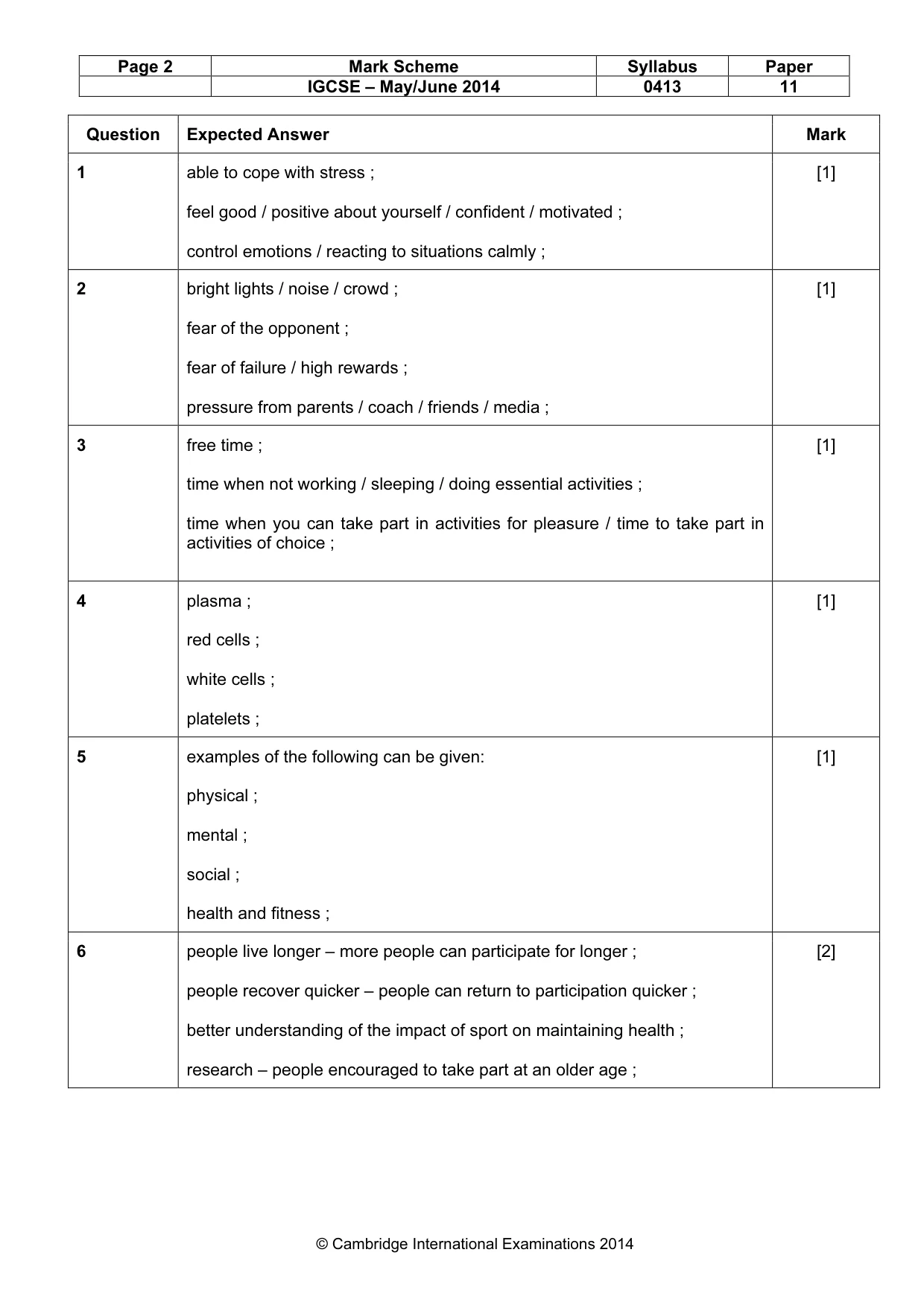
Mark scheme, page 2
Page 2 Mark Scheme Syllabus Paper IGCSE – May/June 2014 0413 11 © Cambridge International Examinations 2014 Question Expected Answer Mark 1 able to cope with stress ; feel good / positive about yourself / confident / motivated ; control emotions / reacting to situations calmly ; [1] 2 bright lights / noise / crowd ; fear of the opponent ; fear of failure / high rewards ; pressure from parents / coach / friends / media ; [1] 3 free time ; time when not working / sleeping / doing essential activities ; time when you can take part in activities for pleasure / time to take part in activities of choice ; [1] 4 plasma ; red cells ; white cells ; platelets ; [1] 5 examples of the following can be given: physical ; mental ; social ; health and fitness ; [1] 6 people live longer – more people can participate for longer ; people recover quicker – people can return to participation quicker ; better understanding of the impact of sport on maintaining health ; research – people encouraged to take part at an older age ; [2]
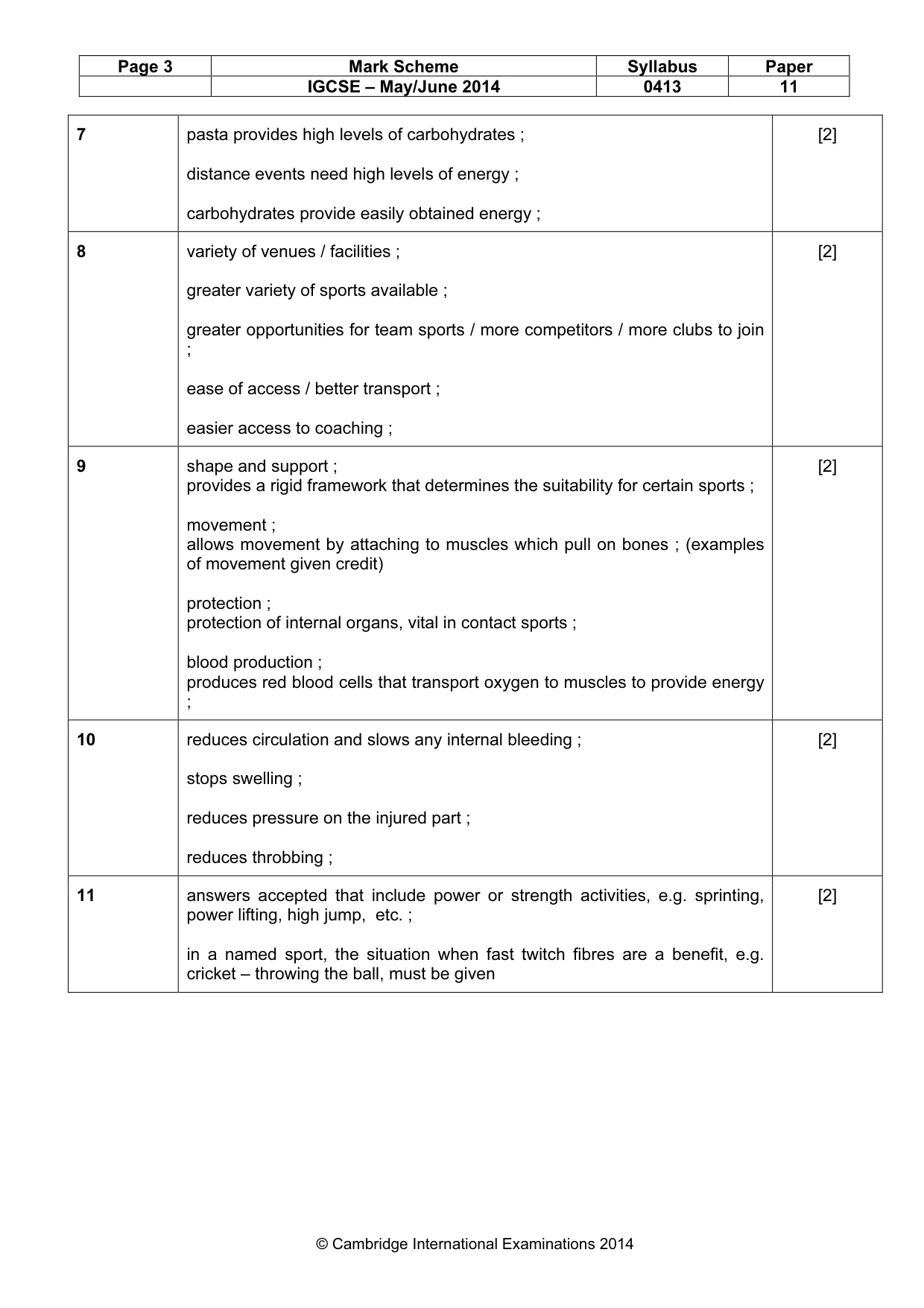
Mark scheme, page 3
Page 3 Mark Scheme Syllabus Paper IGCSE – May/June 2014 0413 11 © Cambridge International Examinations 2014 7 pasta provides high levels of carbohydrates ; distance events need high levels of energy ; carbohydrates provide easily obtained energy ; [2] 8 variety of venues / facilities ; greater variety of sports available ; greater opportunities for team sports / more competitors / more clubs to join ; ease of access / better transport ; easier access to coaching ; [2] 9 shape and support ; provides a rigid framework that determines the suitability for certain sports ; movement ; allows movement by attaching to muscles which pull on bones ; (examples of movement given credit) protection ; protection of internal organs, vital in contact sports ; blood production ; produces red blood cells that transport oxygen to muscles to provide energy ; [2] 10 reduces circulation and slows any internal bleeding ; stops swelling ; reduces pressure on the injured part ; reduces throbbing ; [2] 11 answers accepted that include power or strength activities, e.g. sprinting, power lifting, high jump, etc. ; in a named sport, the situation when fast twitch fibres are a benefit, e.g. cricket – throwing the ball, must be given [2]
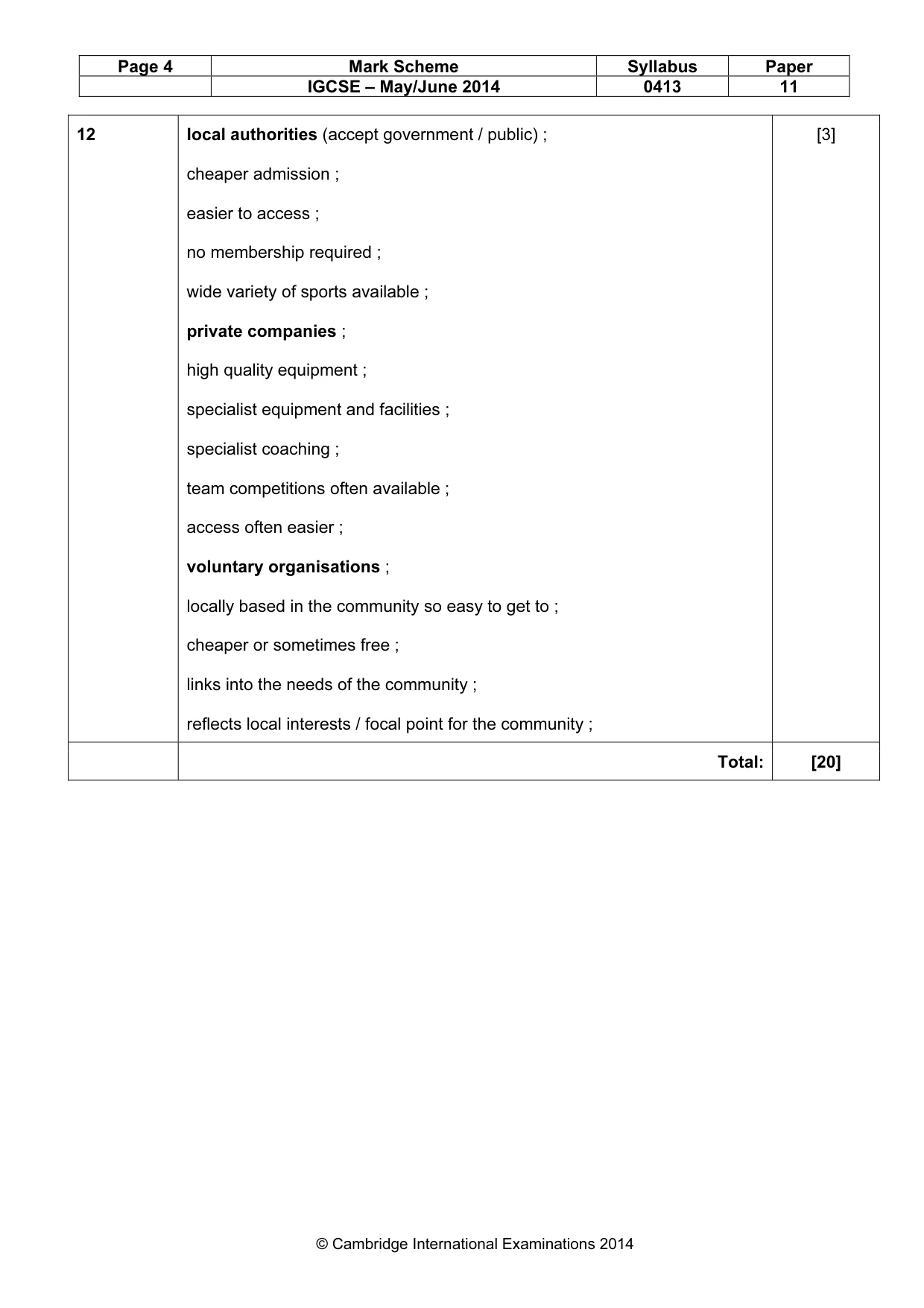
Mark scheme, page 4
Page 4 Mark Scheme Syllabus Paper IGCSE – May/June 2014 0413 11 © Cambridge International Examinations 2014 12 local authorities (accept government / public) ; cheaper admission ; easier to access ; no membership required ; wide variety of sports available ; private companies ; high quality equipment ; specialist equipment and facilities ; specialist coaching ; team competitions often available ; access often easier ; voluntary organisations ; locally based in the community so easy to get to ; cheaper or sometimes free ; links into the needs of the community ; reflects local interests / focal point for the community ; [3] Total: [20]
Mark scheme, page 5
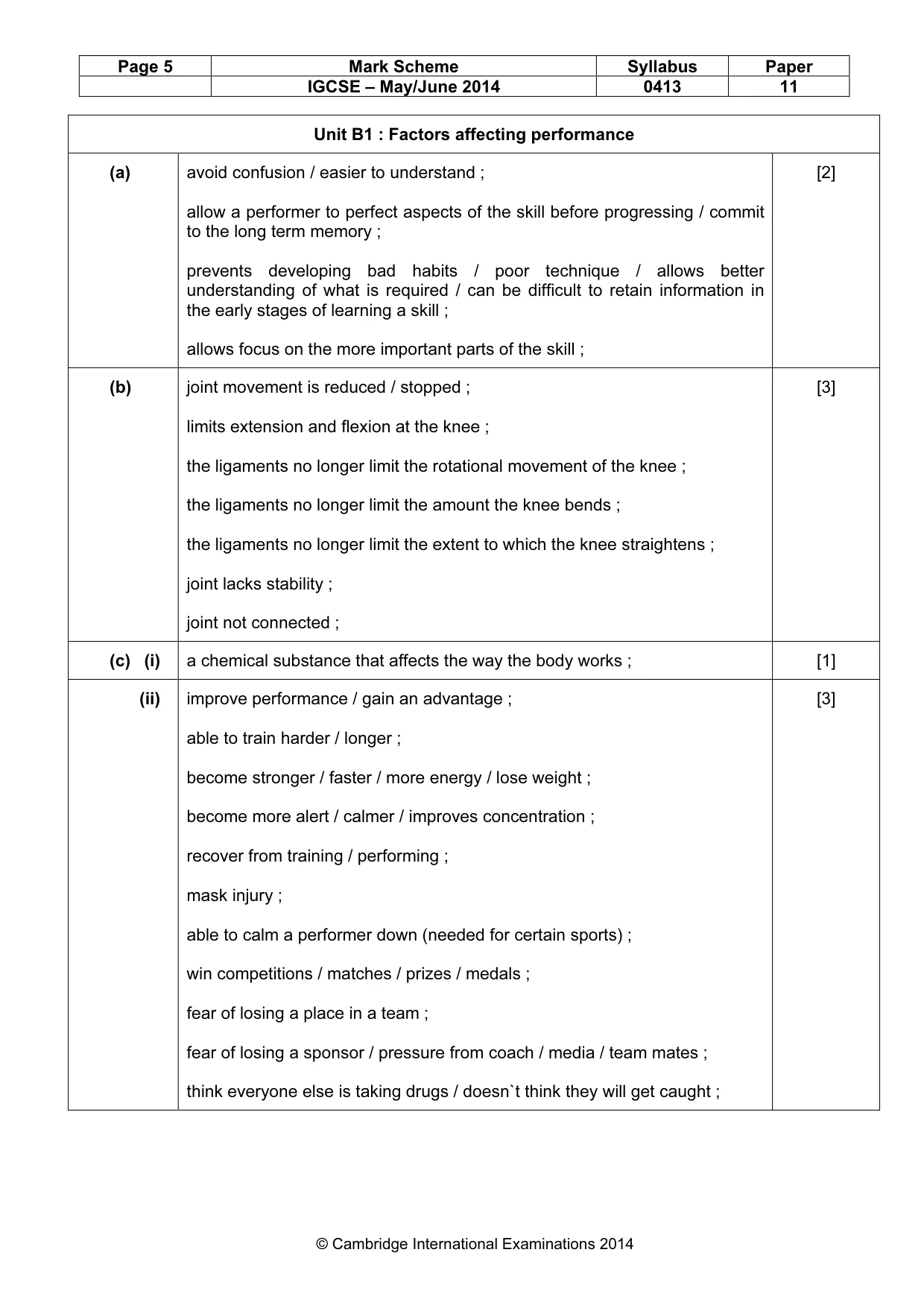
Page 5 Mark Scheme Syllabus Paper IGCSE – May/June 2014 0413 11 © Cambridge International Examinations 2014 Unit B1 : Factors affecting performance (a) avoid confusion / easier to understand ; allow a performer to perfect aspects of the skill before progressing / commit to the long term memory ; prevents developing bad habits / poor technique / allows better understanding of what is required / can be difficult to retain information in the early stages of learning a skill ; allows focus on the more important parts of the skill ; [2] (b) joint movement is reduced / stopped ; limits extension and flexion at the knee ; the ligaments no longer limit the rotational movement of the knee ; the ligaments no longer limit the amount the knee bends ; the ligaments no longer limit the extent to which the knee straightens ; joint lacks stability ; joint not connected ; [3] (c) (i) a chemical substance that affects the way the body works ; [1] (ii) improve performance / gain an advantage ; able to train harder / longer ; become stronger / faster / more energy / lose weight ; become more alert / calmer / improves concentration ; recover from training / performing ; mask injury ; able to calm a performer down (needed for certain sports) ; win competitions / matches / prizes / medals ; fear of losing a place in a team ; fear of losing a sponsor / pressure from coach / media / team mates ; think everyone else is taking drugs / doesn`t think they will get caught ; [3]
Mark scheme, page 6
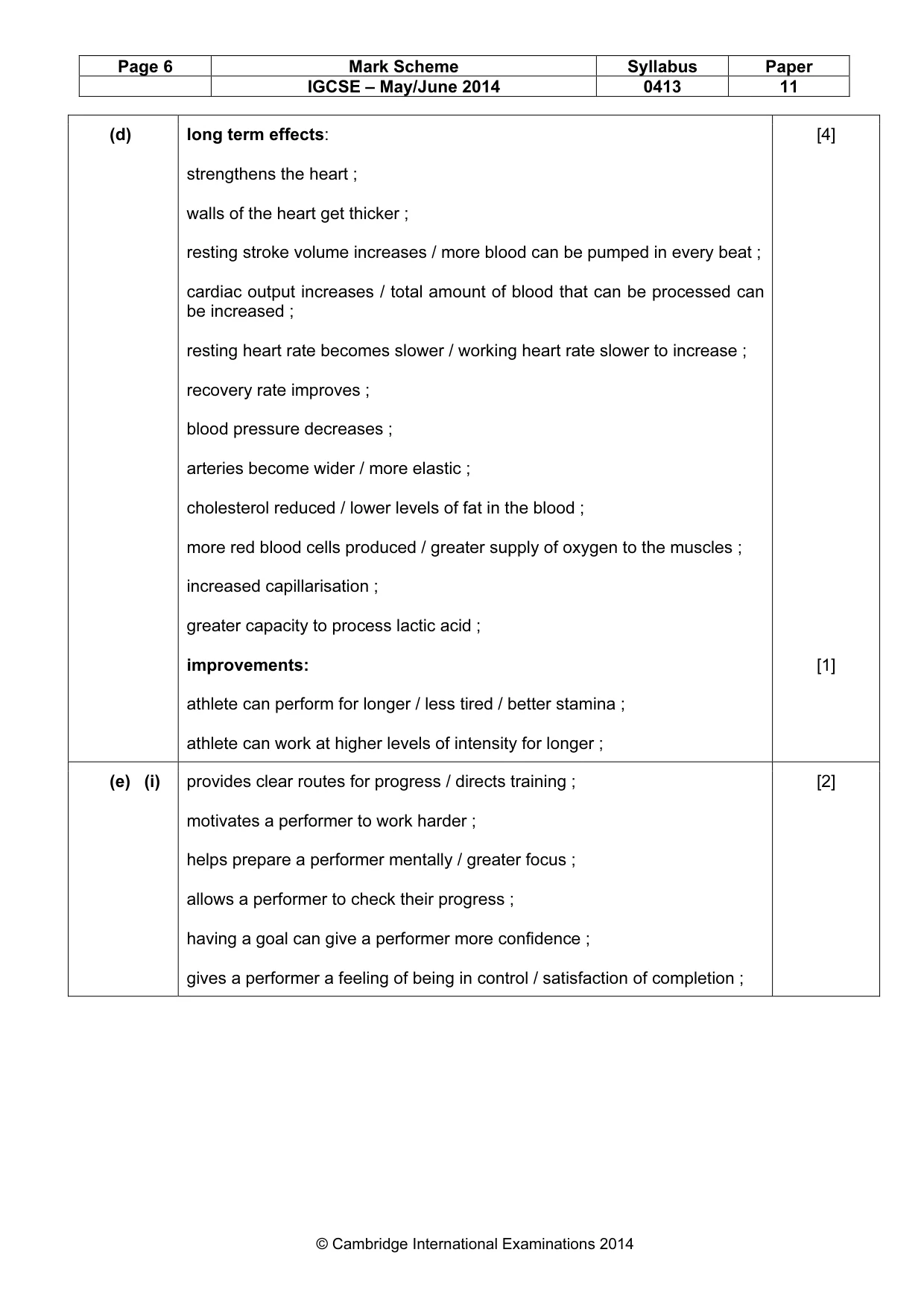
Page 6 Mark Scheme Syllabus Paper IGCSE – May/June 2014 0413 11 © Cambridge International Examinations 2014 (d) long term effects: strengthens the heart ; walls of the heart get thicker ; resting stroke volume increases / more blood can be pumped in every beat ; cardiac output increases / total amount of blood that can be processed can be increased ; resting heart rate becomes slower / working heart rate slower to increase ; recovery rate improves ; blood pressure decreases ; arteries become wider / more elastic ; cholesterol reduced / lower levels of fat in the blood ; more red blood cells produced / greater supply of oxygen to the muscles ; increased capillarisation ; greater capacity to process lactic acid ; improvements: athlete can perform for longer / less tired / better stamina ; athlete can work at higher levels of intensity for longer ; [4] [1] (e) (i) provides clear routes for progress / directs training ; motivates a performer to work harder ; helps prepare a performer mentally / greater focus ; allows a performer to check their progress ; having a goal can give a performer more confidence ; gives a performer a feeling of being in control / satisfaction of completion ; [2]
Mark scheme, page 7
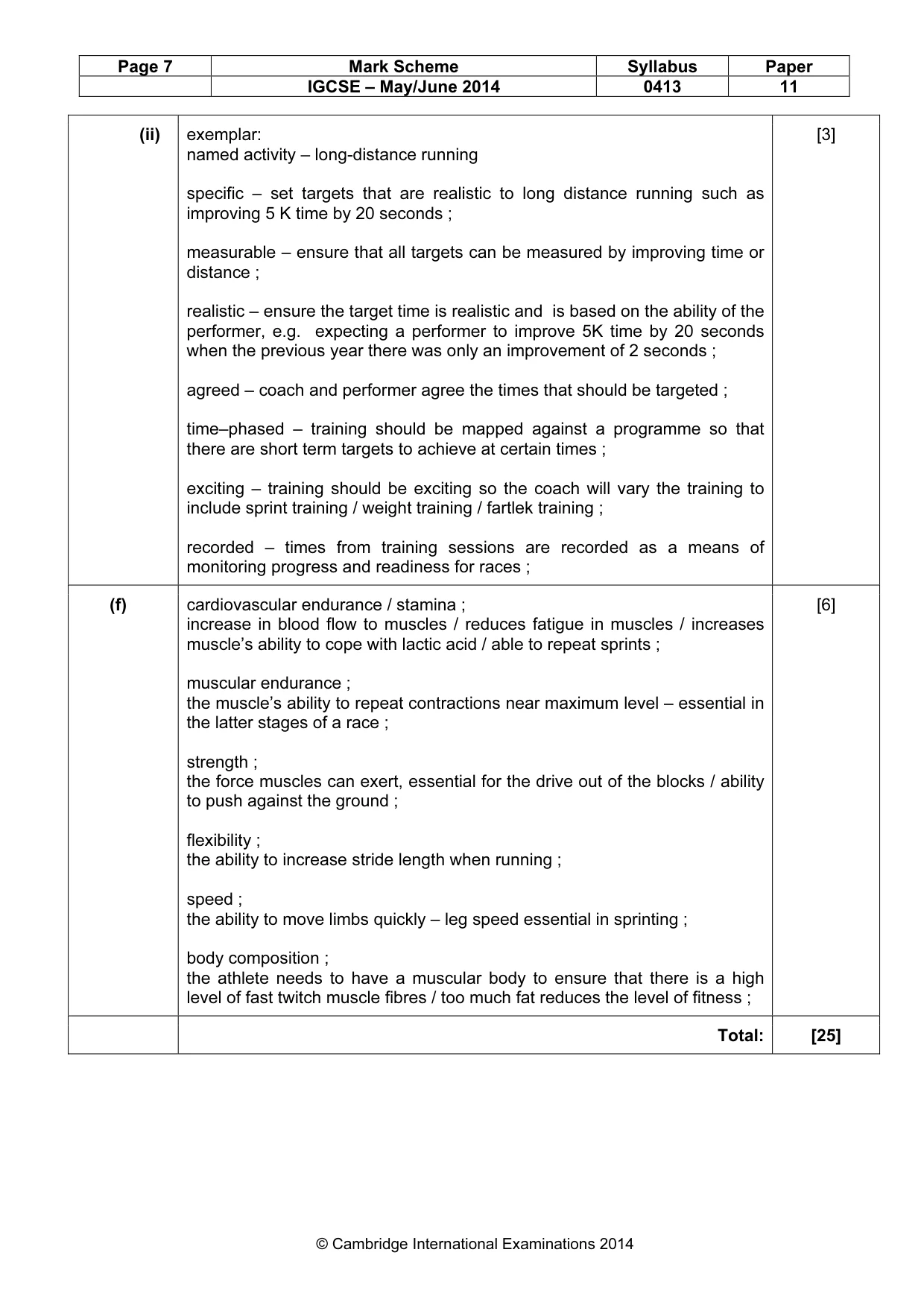
Page 7 Mark Scheme Syllabus Paper IGCSE – May/June 2014 0413 11 © Cambridge International Examinations 2014 (ii) exemplar: named activity – long-distance running specific – set targets that are realistic to long distance running such as improving 5 K time by 20 seconds ; measurable – ensure that all targets can be measured by improving time or distance ; realistic – ensure the target time is realistic and is based on the ability of the performer, e.g. expecting a performer to improve 5K time by 20 seconds when the previous year there was only an improvement of 2 seconds ; agreed – coach and performer agree the times that should be targeted ; time–phased – training should be mapped against a programme so that there are short term targets to achieve at certain times ; exciting – training should be exciting so the coach will vary the training to include sprint training / weight training / fartlek training ; recorded – times from training sessions are recorded as a means of monitoring progress and readiness for races ; [3] (f) cardiovascular endurance / stamina ; increase in blood flow to muscles / reduces fatigue in muscles / increases muscle’s ability to cope with lactic acid / able to repeat sprints ; muscular endurance ; the muscle’s ability to repeat contractions near maximum level – essential in the latter stages of a race ; strength ; the force muscles can exert, essential for the drive out of the blocks / ability to push against the ground ; flexibility ; the ability to increase stride length when running ; speed ; the ability to move limbs quickly – leg speed essential in sprinting ; body composition ; the athlete needs to have a muscular body to ensure that there is a high level of fast twitch muscle fibres / too much fat reduces the level of fitness ; [6] Total: [25]
Mark scheme, page 8
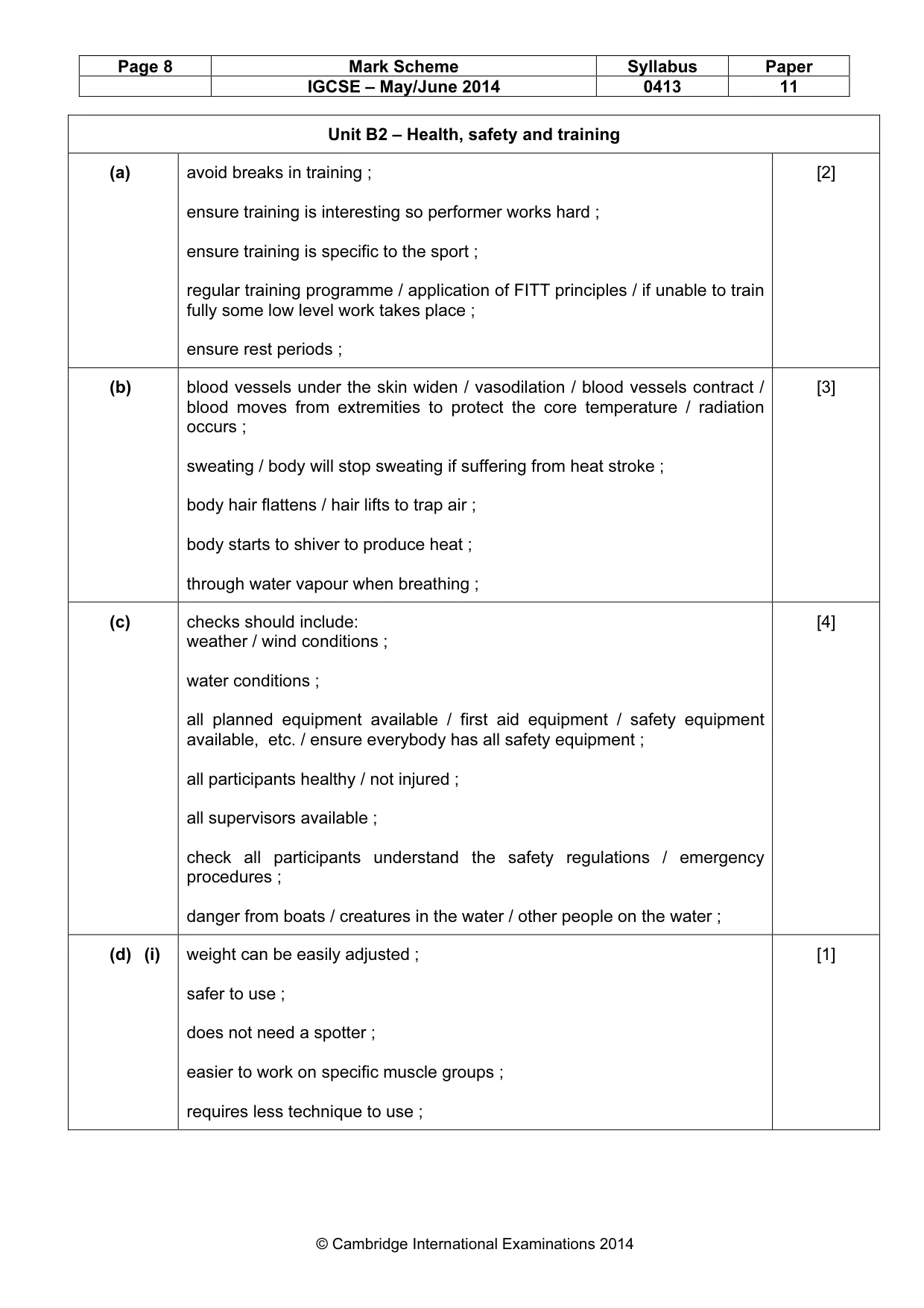
Page 8 Mark Scheme Syllabus Paper IGCSE – May/June 2014 0413 11 © Cambridge International Examinations 2014 Unit B2 – Health, safety and training (a) avoid breaks in training ; ensure training is interesting so performer works hard ; ensure training is specific to the sport ; regular training programme / application of FITT principles / if unable to train fully some low level work takes place ; ensure rest periods ; [2] (b) blood vessels under the skin widen / vasodilation / blood vessels contract / blood moves from extremities to protect the core temperature / radiation occurs ; sweating / body will stop sweating if suffering from heat stroke ; body hair flattens / hair lifts to trap air ; body starts to shiver to produce heat ; through water vapour when breathing ; [3] (c) checks should include: weather / wind conditions ; water conditions ; all planned equipment available / first aid equipment / safety equipment available, etc. / ensure everybody has all safety equipment ; all participants healthy / not injured ; all supervisors available ; check all participants understand the safety regulations / emergency procedures ; danger from boats / creatures in the water / other people on the water ; [4] (d) (i) weight can be easily adjusted ; safer to use ; does not need a spotter ; easier to work on specific muscle groups ; requires less technique to use ; [1]
Mark scheme, page 9
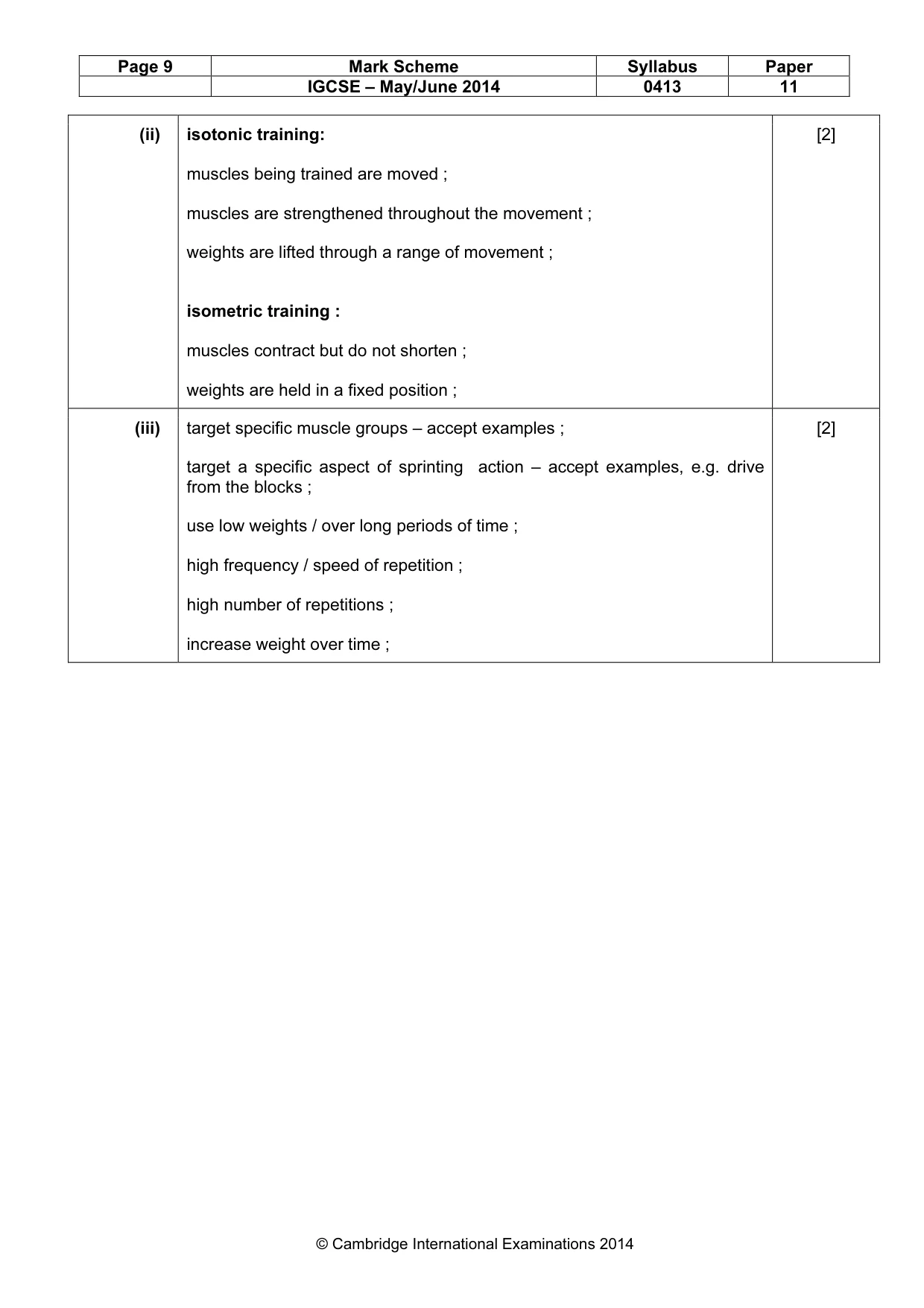
Page 9 Mark Scheme Syllabus Paper IGCSE – May/June 2014 0413 11 © Cambridge International Examinations 2014 (ii) isotonic training: muscles being trained are moved ; muscles are strengthened throughout the movement ; weights are lifted through a range of movement ; isometric training : muscles contract but do not shorten ; weights are held in a fixed position ; [2] (iii) target specific muscle groups – accept examples ; target a specific aspect of sprinting action – accept examples, e.g. drive from the blocks ; use low weights / over long periods of time ; high frequency / speed of repetition ; high number of repetitions ; increase weight over time ; [2]
Mark scheme, page 10
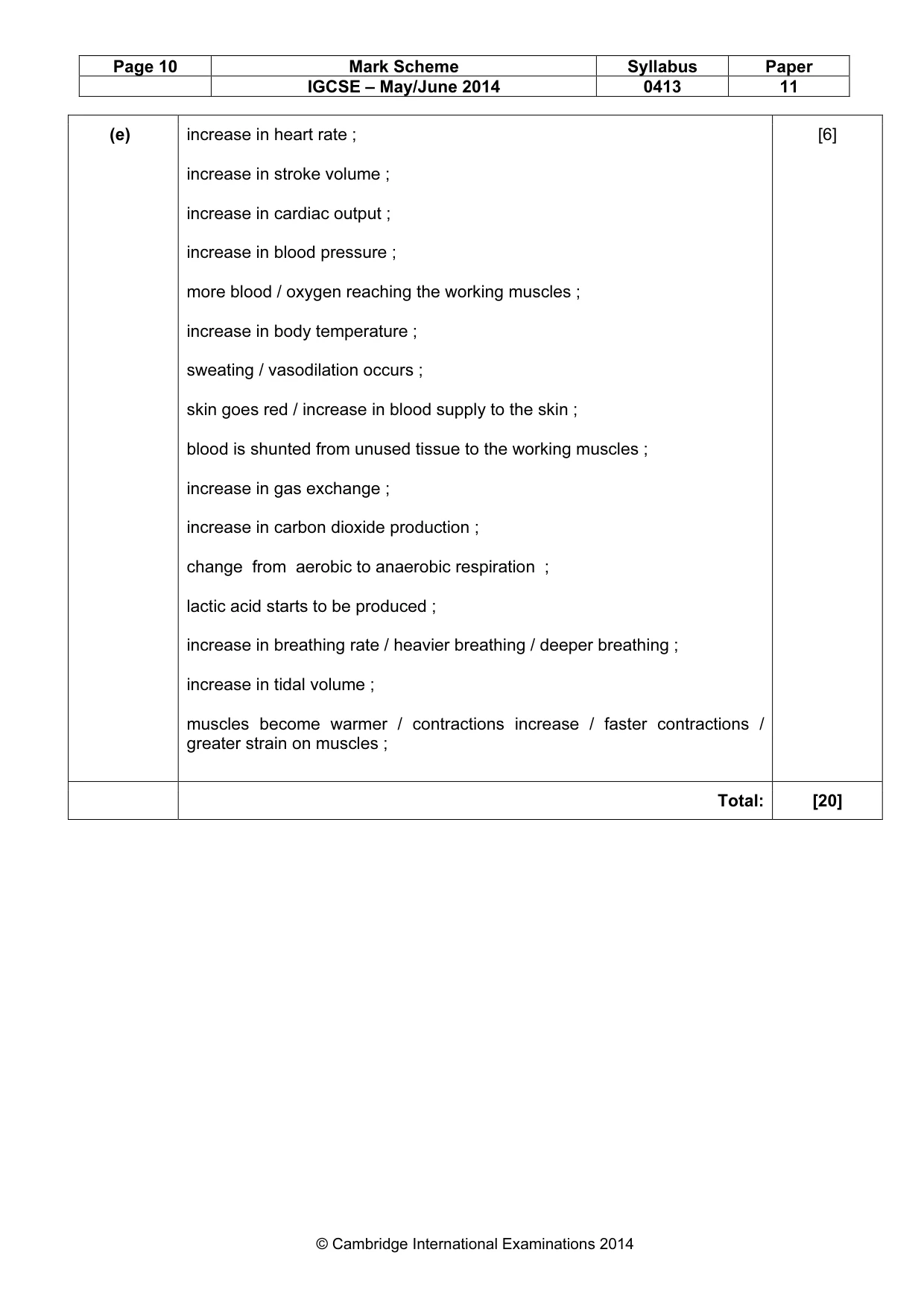
Page 10 Mark Scheme Syllabus Paper IGCSE – May/June 2014 0413 11 © Cambridge International Examinations 2014 (e) increase in heart rate ; increase in stroke volume ; increase in cardiac output ; increase in blood pressure ; more blood / oxygen reaching the working muscles ; increase in body temperature ; sweating / vasodilation occurs ; skin goes red / increase in blood supply to the skin ; blood is shunted from unused tissue to the working muscles ; increase in gas exchange ; increase in carbon dioxide production ; change from aerobic to anaerobic respiration ; lactic acid starts to be produced ; increase in breathing rate / heavier breathing / deeper breathing ; increase in tidal volume ; muscles become warmer / contractions increase / faster contractions / greater strain on muscles ; [6] Total: [20]
Mark scheme, page 11
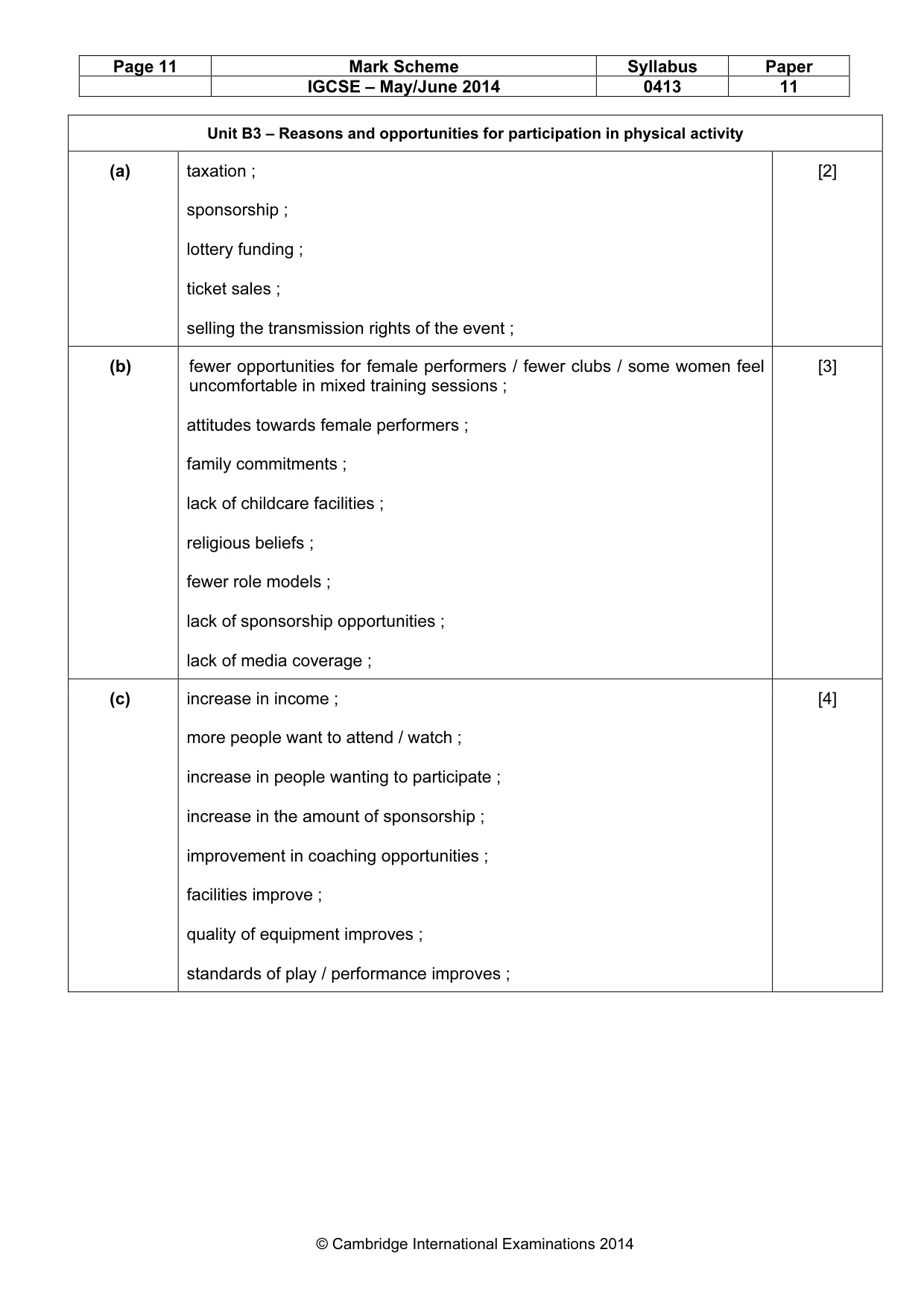
Page 11 Mark Scheme Syllabus Paper IGCSE – May/June 2014 0413 11 © Cambridge International Examinations 2014 Unit B3 – Reasons and opportunities for participation in physical activity (a) taxation ; sponsorship ; lottery funding ; ticket sales ; selling the transmission rights of the event ; [2] (b) fewer opportunities for female performers / fewer clubs / some women feel uncomfortable in mixed training sessions ; attitudes towards female performers ; family commitments ; lack of childcare facilities ; religious beliefs ; fewer role models ; lack of sponsorship opportunities ; lack of media coverage ; [3] (c) increase in income ; more people want to attend / watch ; increase in people wanting to participate ; increase in the amount of sponsorship ; improvement in coaching opportunities ; facilities improve ; quality of equipment improves ; standards of play / performance improves ; [4]
Mark scheme, page 12
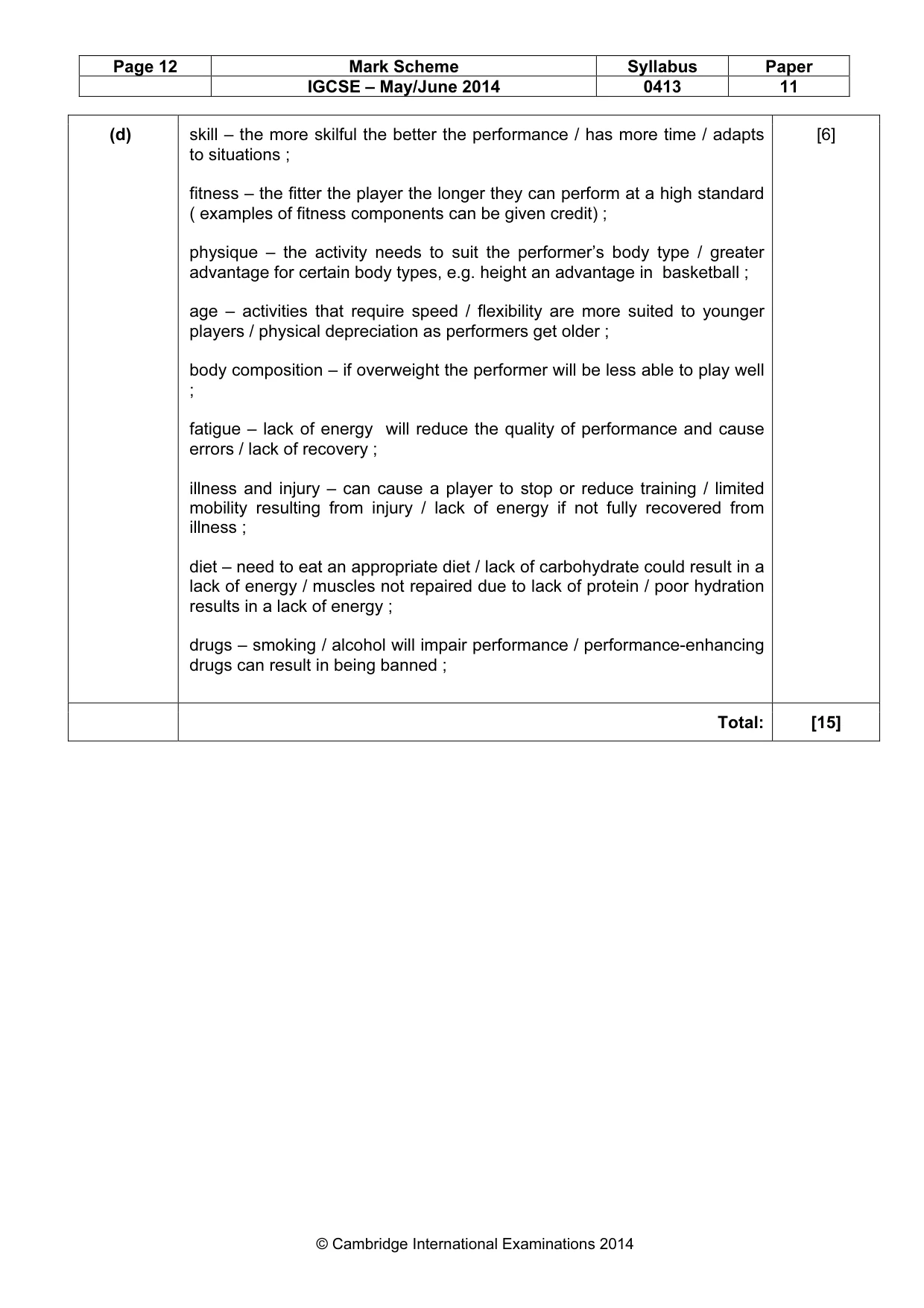
Page 12 Mark Scheme Syllabus Paper IGCSE – May/June 2014 0413 11 © Cambridge International Examinations 2014 (d) skill – the more skilful the better the performance / has more time / adapts to situations ; fitness – the fitter the player the longer they can perform at a high standard ( examples of fitness components can be given credit) ; physique – the activity needs to suit the performer’s body type / greater advantage for certain body types, e.g. height an advantage in basketball ; age – activities that require speed / flexibility are more suited to younger players / physical depreciation as performers get older ; body composition – if overweight the performer will be less able to play well ; fatigue – lack of energy will reduce the quality of performance and cause errors / lack of recovery ; illness and injury – can cause a player to stop or reduce training / limited mobility resulting from injury / lack of energy if not fully recovered from illness ; diet – need to eat an appropriate diet / lack of carbohydrate could result in a lack of energy / muscles not repaired due to lack of protein / poor hydration results in a lack of energy ; drugs – smoking / alcohol will impair performance / performance-enhancing drugs can result in being banned ; [6] Total: [15]
What you needed in this session
Cambridge’s own grade thresholds for 2014 May/June, Paper 1 · Variant 1. A higher threshold means an easier paper — the bar moves with how the cohort did.