Cambridge IGCSE Physical Education 0413 — 2011 May/June Paper 1 · Variant 2
0413/12/M/J/11 · 80 marks · ≈90 min
The question paper and its mark scheme, free to read here and free to download. This is Cambridge’s own paper, exactly as it was sat.
Question paper12 pages

Mark scheme9 pages
Answers below. Sit the paper first if you are practising.
Paper as text
Question paper, page 1
This document consists of 12 printed pages. DC (NF) 34044/3 © UCLES 2011 [Turn over UNIVERSITY OF CAMBRIDGE INTERNATIONAL EXAMINATIONS International General Certificate of Secondary Education * 7 3 2 4 1 1 7 8 1 8 * PHYSICAL EDUCATION 0413/12 Paper 1 May/June 2011 1 hour 45 minutes Candidates answer on the Question Paper. No Additional Materials are required. READ THESE INSTRUCTIONS FIRST Write your Centre number, candidate number and name on all the work you hand in. Write in dark blue or black pen. You may use a soft pencil for any diagrams, graphs or rough working. Do not use staples, paper clips, highlighters, glue or correction fluid. DO NOT WRITE IN ANY BARCODES. Answer all questions. At the end of the examination, fasten all your work securely together. The number of marks is given in brackets [ ] at the end of each question or part question. For Examiner’s Use Section A B1 B2 B3 Total www.XtremePapers.com
Question paper, page 2
2 0413/12/M/J/11 © UCLES 2011 For Examiner’s Use Section A Answer all questions in this section. 1 Give an example of a complex skill. … … [1] 2 How does a person’s poor mental well-being reduce the chances of performing well in sport? … … [1] 3 How might the type of work that someone does for a living affect the sports that they play? … … [1] 4 Give one benefit of visualisation when preparing for a game or event. … … [1] 5 Describe the impact of being overweight on a performer’s ability to play well. … … … [1] 6 Describe two ways that a school can support a local sports club. … … … [2]
Question paper, page 3
3 0413/12/M/J/11 © UCLES 2011 [Turn over For Examiner’s Use 7 What is meant by the following terms? cardiac output … … stroke volume … … [2] 8 Describe one illness or condition that is the result of a blood disorder. How can the illness or condition affect a person’s ability to play sport? … … … … [2] 9 Give two ways that a local sports centre tries to increase participation. … … … … [2] 10 Name the body type that would be most suitable for a high jumper. Explain why it gives the performer an advantage. … … … … [2]
Question paper, page 4
4 0413/12/M/J/11 © UCLES 2011 For Examiner’s Use 11 Using free weights (e.g. dumbbells) can be a feature of a weight training programme. Give two safety considerations when using free weights. … … … … [2] 12 Describe how the media impacts on sport. … … … … … … [3] [Total: 20]
Question paper, page 5
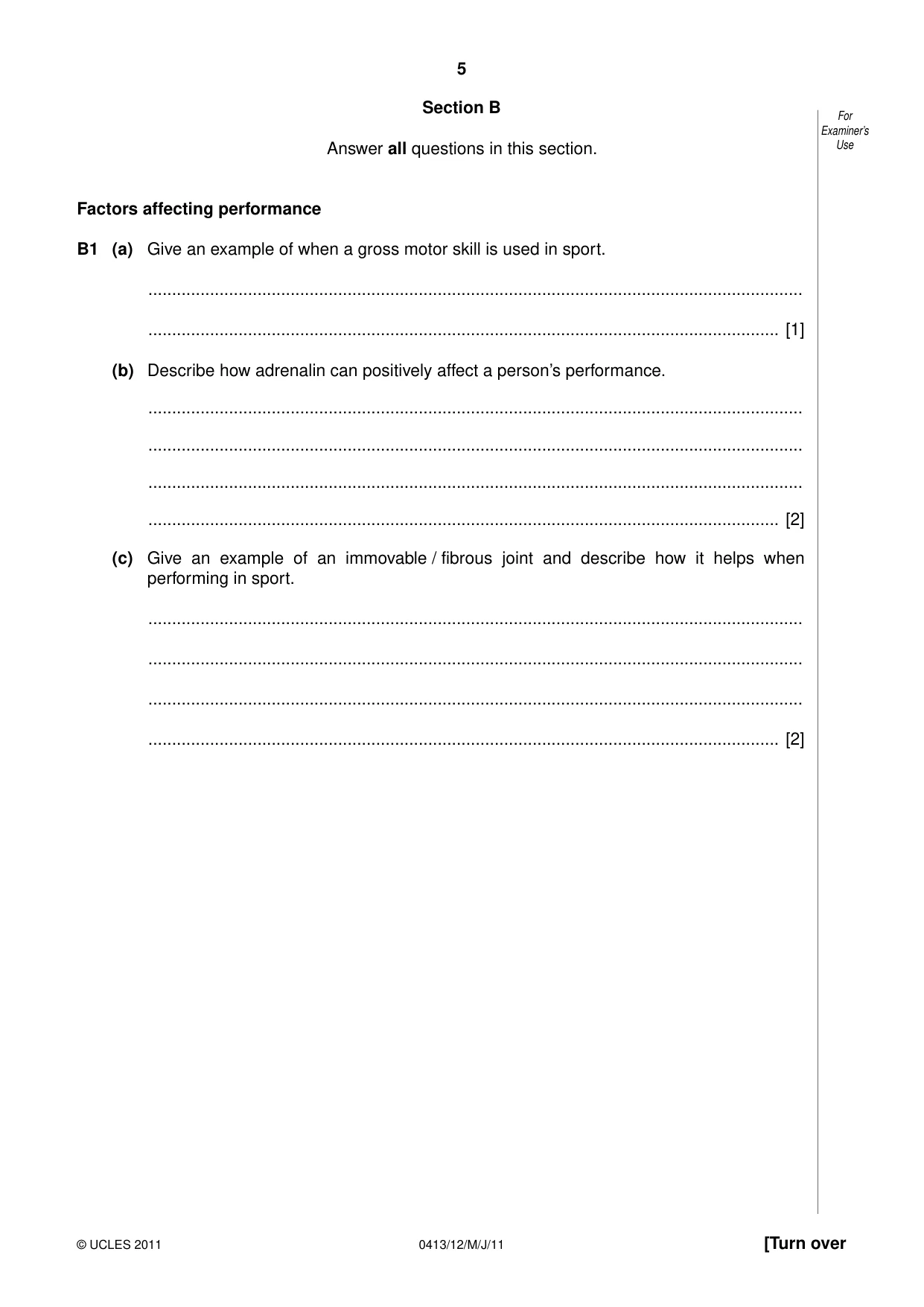
5 0413/12/M/J/11 © UCLES 2011 [Turn over For Examiner’s Use Section B Answer all questions in this section. Factors affecting performance B1 (a) Give an example of when a gross motor skill is used in sport. … … [1] (b) Describe how adrenalin can positively affect a person’s performance. … … … … [2] (c) Give an example of an immovable / fibrous joint and describe how it helps when performing in sport. … … … … [2]
Question paper, page 6
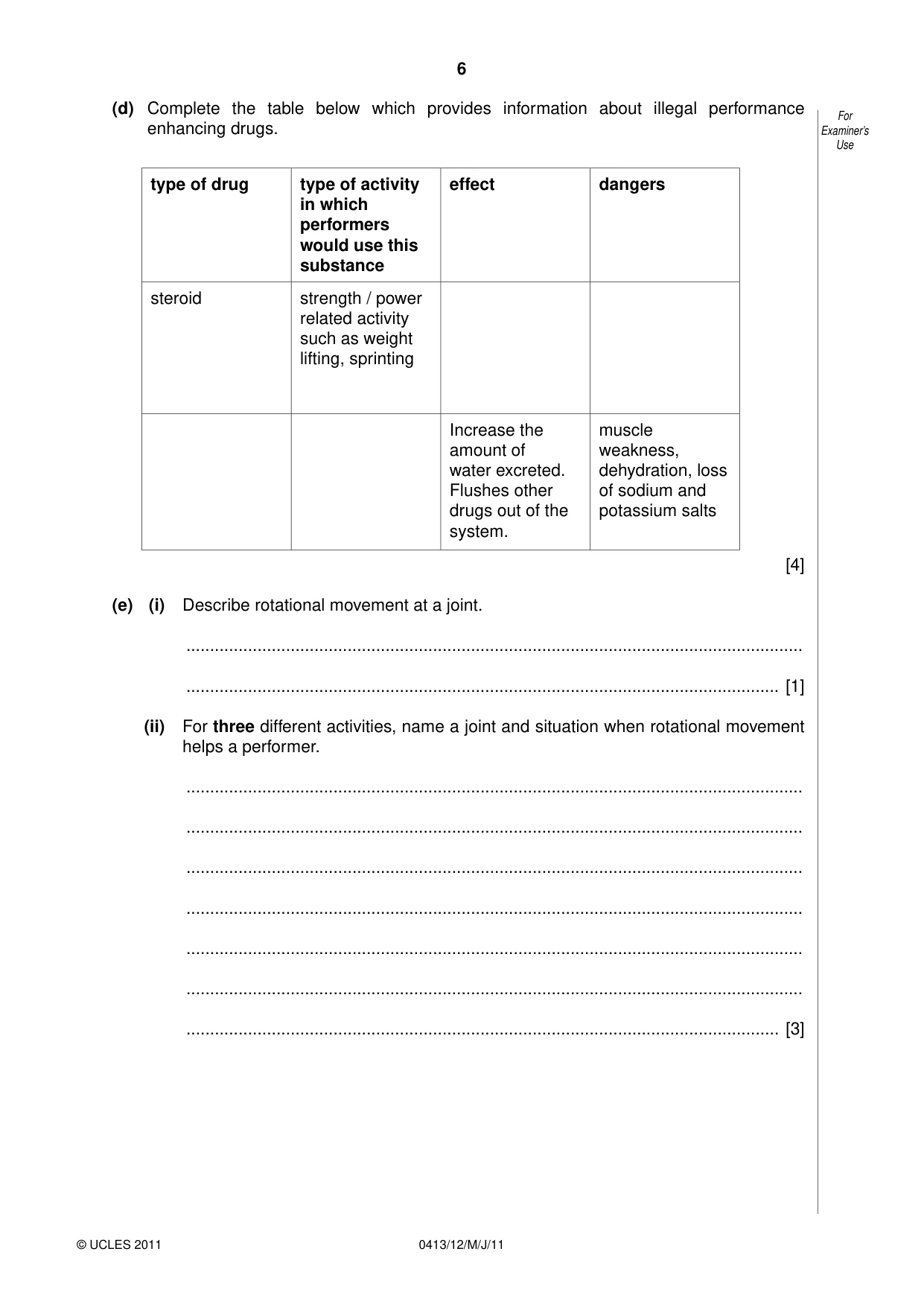
6 0413/12/M/J/11 © UCLES 2011 For Examiner’s Use (d) Complete the table below which provides information about illegal performance enhancing drugs. type of drug type of activity in which performers would use this substance effect dangers steroid strength / power related activity such as weight lifting, sprinting Increase the amount of water excreted. Flushes other drugs out of the system. muscle weakness, dehydration, loss of sodium and potassium salts [4] (e) (i) Describe rotational movement at a joint. … … [1] (ii) For three different activities, name a joint and situation when rotational movement helps a performer. … … … … … … … [3]
Question paper, page 7
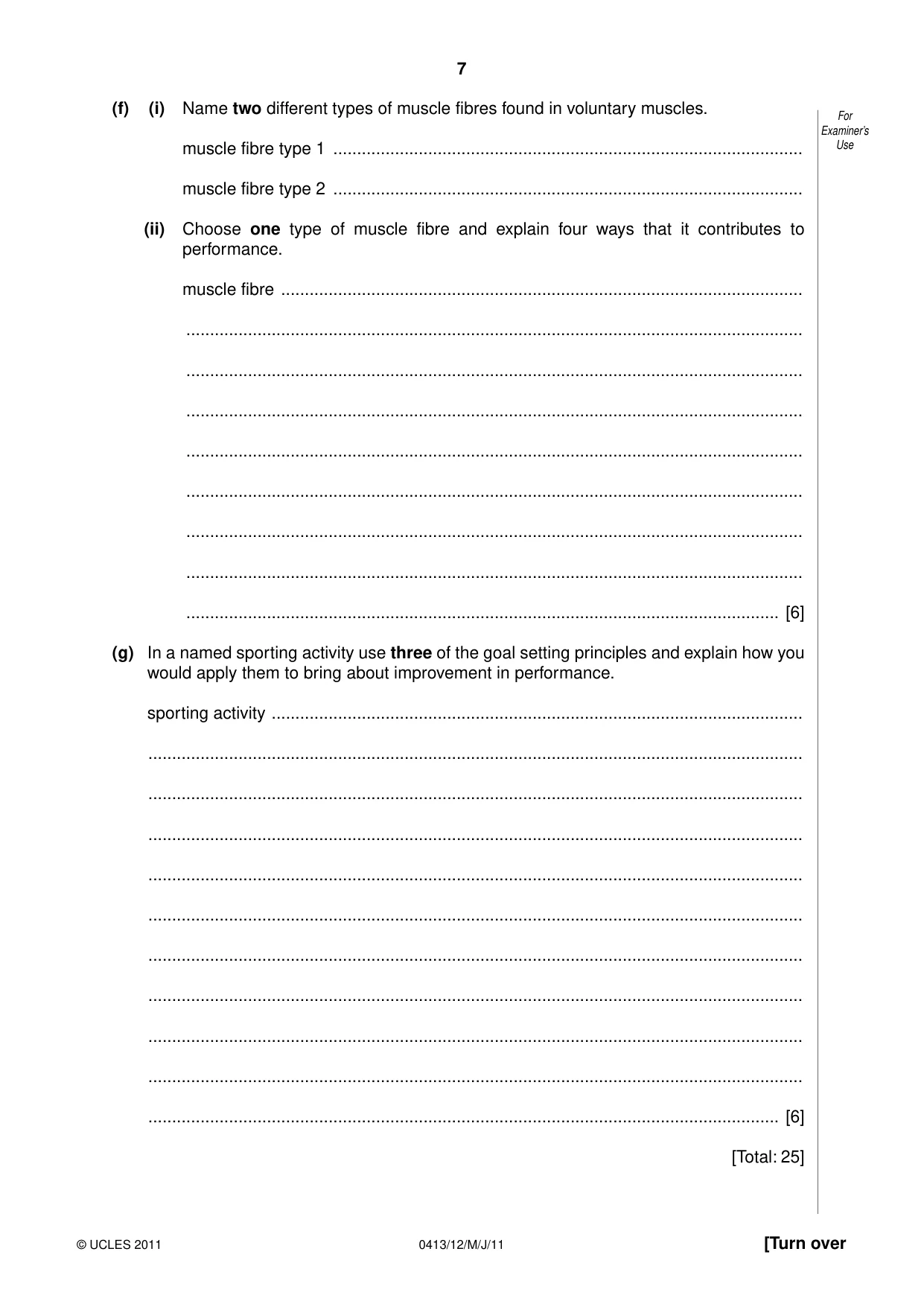
7 0413/12/M/J/11 © UCLES 2011 [Turn over For Examiner’s Use (f) (i) Name two different types of muscle fibres found in voluntary muscles. muscle fibre type 1 … muscle fibre type 2 … (ii) Choose one type of muscle fibre and explain four ways that it contributes to performance. muscle fibre … … … … … … … … … [6] (g) In a named sporting activity use three of the goal setting principles and explain how you would apply them to bring about improvement in performance. sporting activity … … … … … … … … … … … [6] [Total: 25]
Question paper, page 8
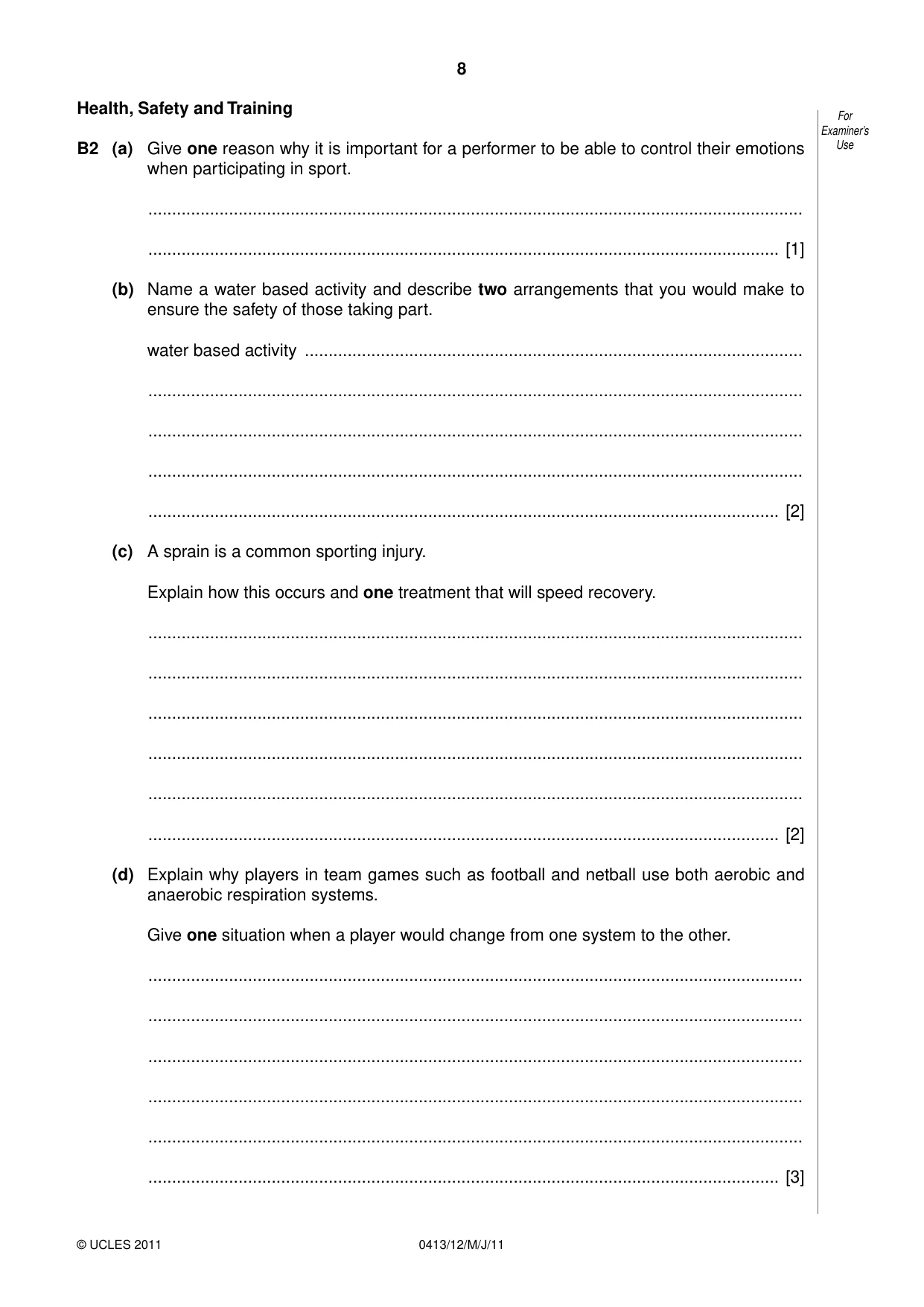
8 0413/12/M/J/11 © UCLES 2011 For Examiner’s Use Health, Safety and Training B2 (a) Give one reason why it is important for a performer to be able to control their emotions when participating in sport. … … [1] (b) Name a water based activity and describe two arrangements that you would make to ensure the safety of those taking part. water based activity … … … … … [2] (c) A sprain is a common sporting injury. Explain how this occurs and one treatment that will speed recovery. … … … … … … [2] (d) Explain why players in team games such as football and netball use both aerobic and anaerobic respiration systems. Give one situation when a player would change from one system to the other. … … … … … … [3]
Question paper, page 9
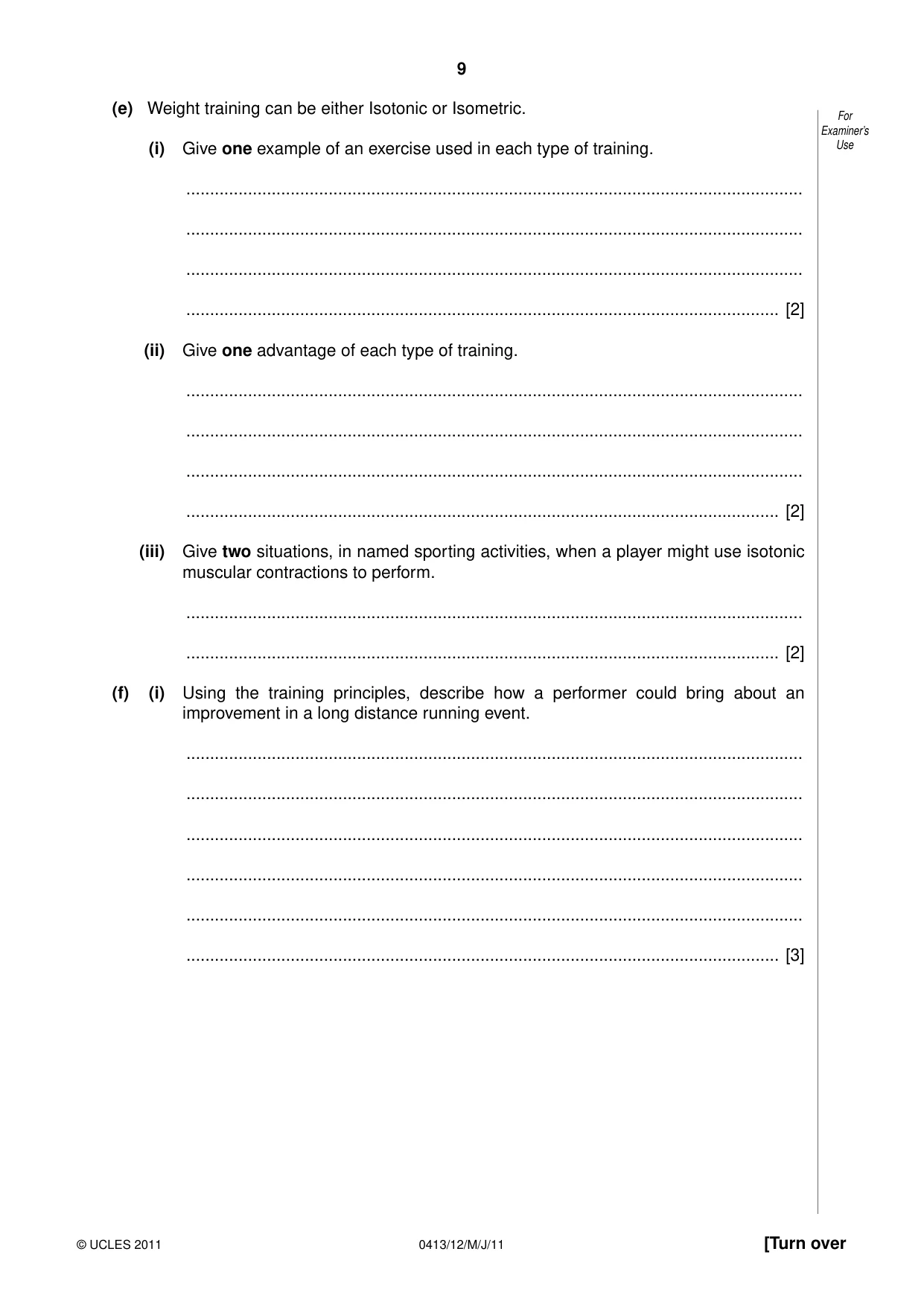
9 0413/12/M/J/11 © UCLES 2011 [Turn over For Examiner’s Use (e) Weight training can be either Isotonic or Isometric. (i) Give one example of an exercise used in each type of training. … … … … [2] (ii) Give one advantage of each type of training. … … … … [2] (iii) Give two situations, in named sporting activities, when a player might use isotonic muscular contractions to perform. … … [2] (f) (i) Using the training principles, describe how a performer could bring about an improvement in a long distance running event. … … … … … … [3]
Question paper, page 10
10 0413/12/M/J/11 © UCLES 2011 For Examiner’s Use (ii) Describe the possible outcomes, for the performer, if the fitness programme is not followed correctly. … … … … … … [3] [Total: 20]
Question paper, page 11
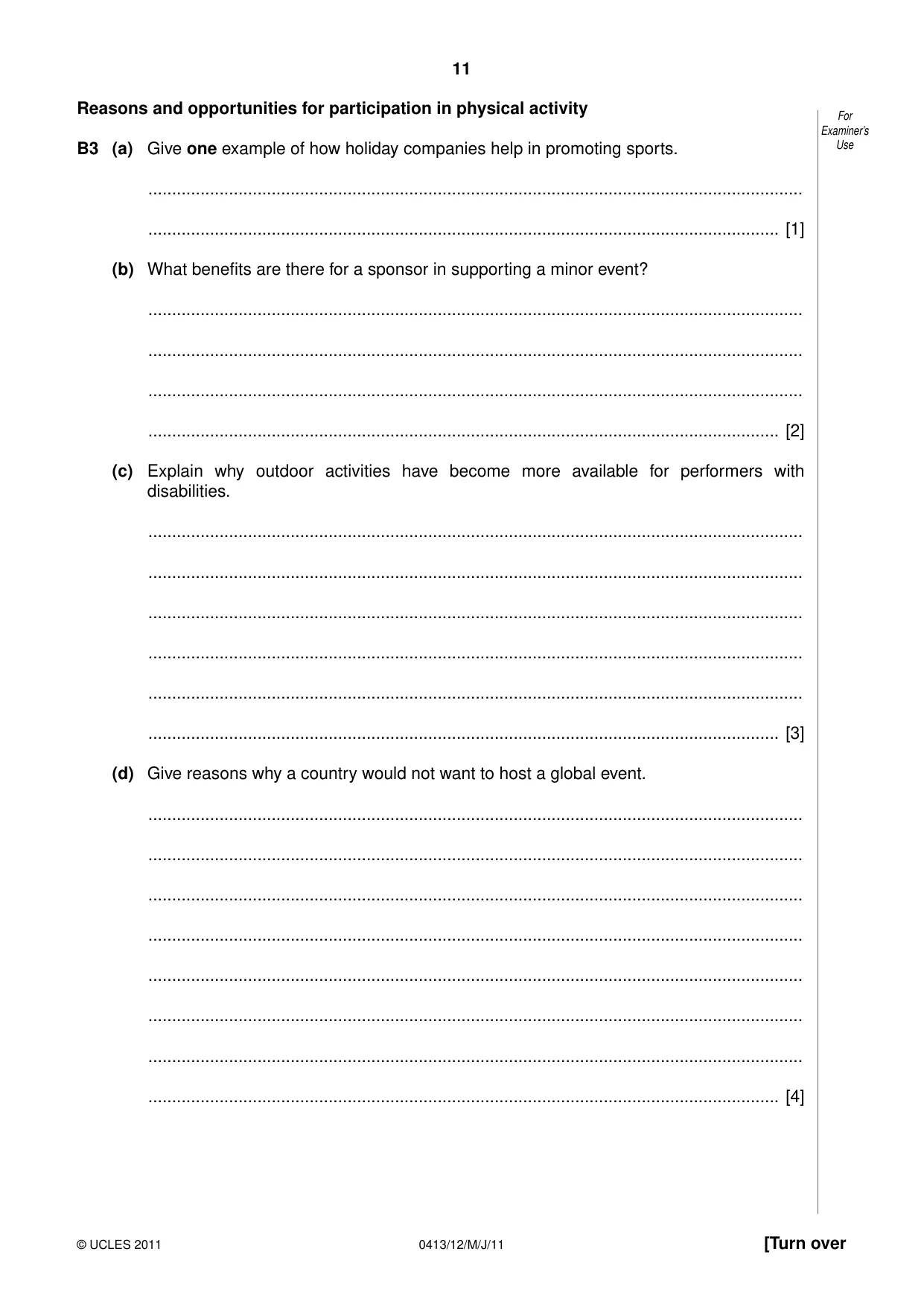
11 0413/12/M/J/11 © UCLES 2011 [Turn over For Examiner’s Use Reasons and opportunities for participation in physical activity B3 (a) Give one example of how holiday companies help in promoting sports. … … [1] (b) What benefits are there for a sponsor in supporting a minor event? … … … … [2] (c) Explain why outdoor activities have become more available for performers with disabilities. … … … … … … [3] (d) Give reasons why a country would not want to host a global event. … … … … … … … … [4]
Question paper, page 12
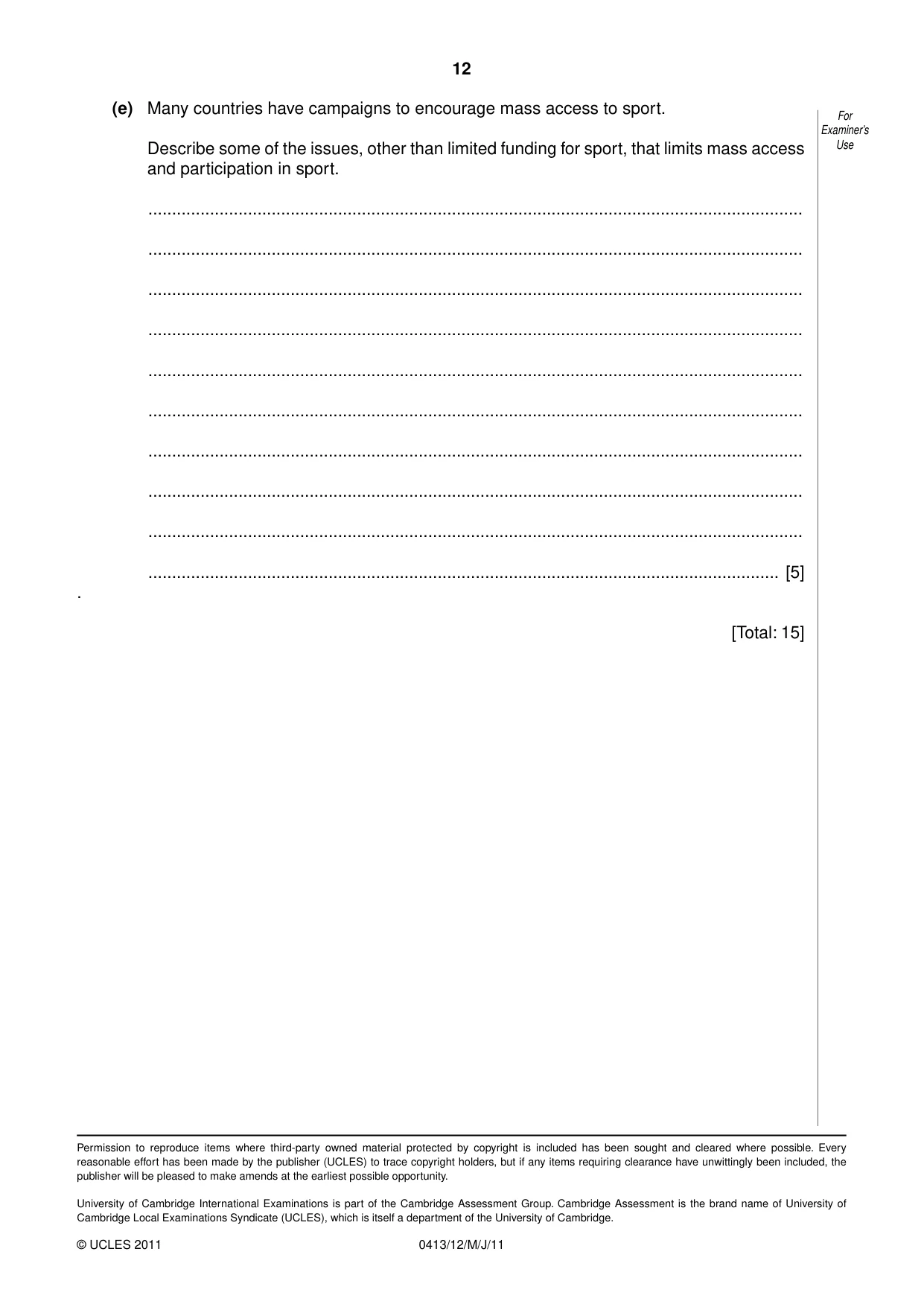
12 0413/12/M/J/11 © UCLES 2011 For Examiner’s Use Permission to reproduce items where third-party owned material protected by copyright is included has been sought and cleared where possible. Every reasonable effort has been made by the publisher (UCLES) to trace copyright holders, but if any items requiring clearance have unwittingly been included, the publisher will be pleased to make amends at the earliest possible opportunity. University of Cambridge International Examinations is part of the Cambridge Assessment Group. Cambridge Assessment is the brand name of University of Cambridge Local Examinations Syndicate (UCLES), which is itself a department of the University of Cambridge. (e) Many countries have campaigns to encourage mass access to sport. Describe some of the issues, other than limited funding for sport, that limits mass access and participation in sport. … … … … … … … … … … [5] . [Total: 15]
Mark scheme, page 1
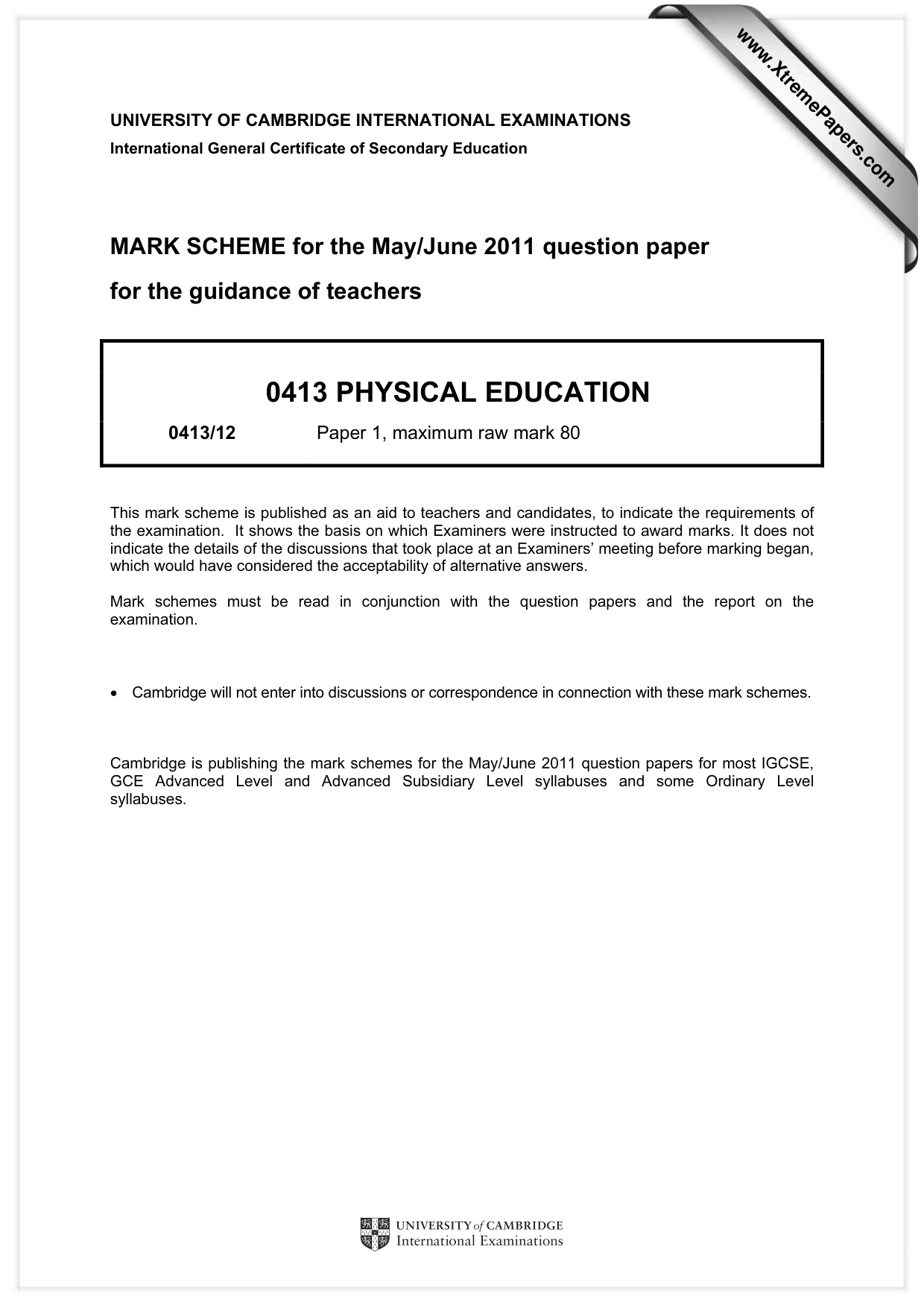
UNIVERSITY OF CAMBRIDGE INTERNATIONAL EXAMINATIONS International General Certificate of Secondary Education MARK SCHEME for the May/June 2011 question paper for the guidance of teachers 0413 PHYSICAL EDUCATION 0413/12 Paper 1, maximum raw mark 80 This mark scheme is published as an aid to teachers and candidates, to indicate the requirements of the examination. It shows the basis on which Examiners were instructed to award marks. It does not indicate the details of the discussions that took place at an Examiners’ meeting before marking began, which would have considered the acceptability of alternative answers. Mark schemes must be read in conjunction with the question papers and the report on the examination. • Cambridge will not enter into discussions or correspondence in connection with these mark schemes. Cambridge is publishing the mark schemes for the May/June 2011 question papers for most IGCSE, GCE Advanced Level and Advanced Subsidiary Level syllabuses and some Ordinary Level syllabuses. www.XtremePapers.com
Mark scheme, page 2
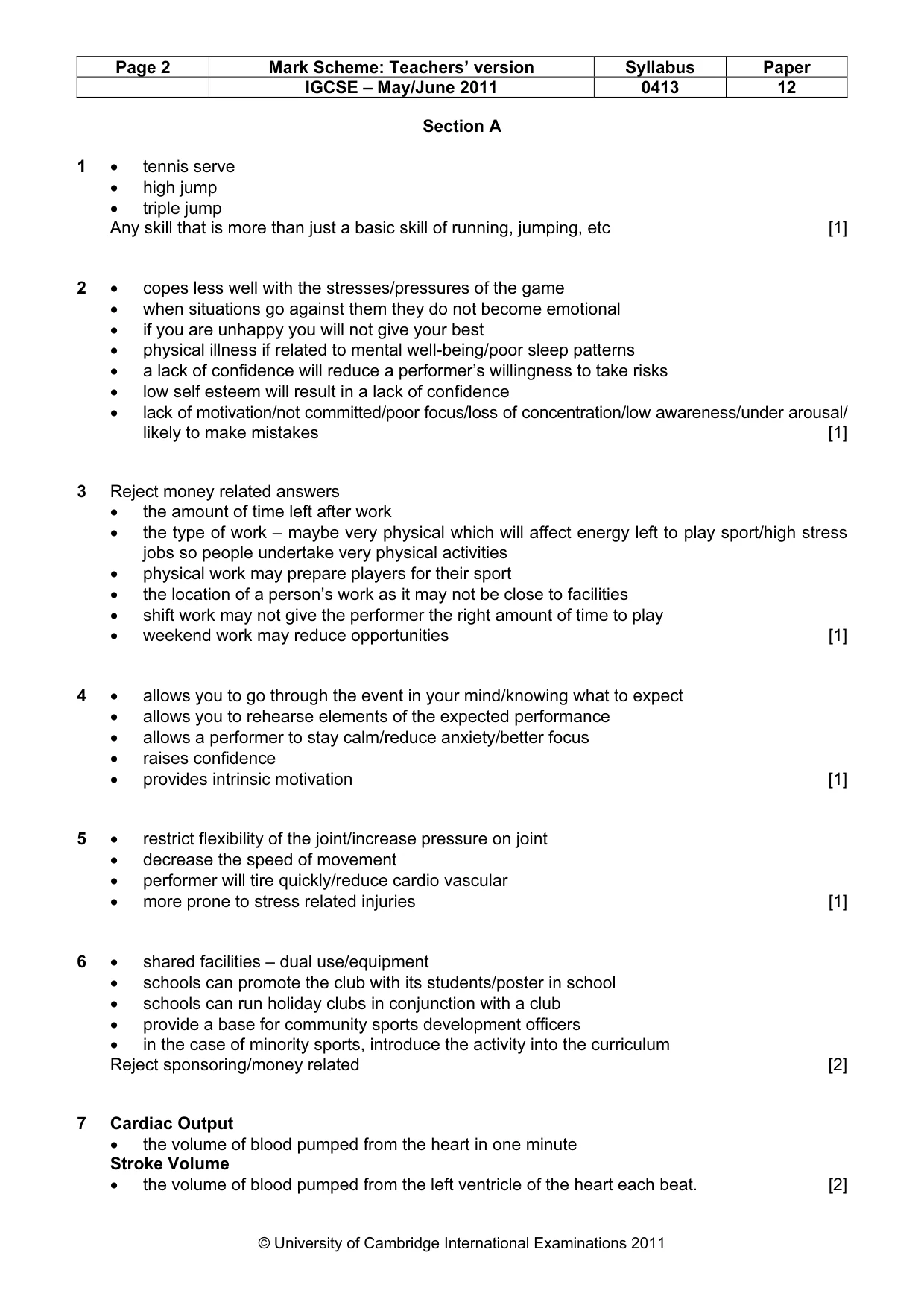
Page 2 Mark Scheme: Teachers’ version Syllabus Paper IGCSE – May/June 2011 0413 12 © University of Cambridge International Examinations 2011 Section A 1 • tennis serve • high jump • triple jump Any skill that is more than just a basic skill of running, jumping, etc [1] 2 • copes less well with the stresses/pressures of the game • when situations go against them they do not become emotional • if you are unhappy you will not give your best • physical illness if related to mental well-being/poor sleep patterns • a lack of confidence will reduce a performer’s willingness to take risks • low self esteem will result in a lack of confidence • lack of motivation/not committed/poor focus/loss of concentration/low awareness/under arousal/ likely to make mistakes [1] 3 Reject money related answers • the amount of time left after work • the type of work – maybe very physical which will affect energy left to play sport/high stress jobs so people undertake very physical activities • physical work may prepare players for their sport • the location of a person’s work as it may not be close to facilities • shift work may not give the performer the right amount of time to play • weekend work may reduce opportunities [1] 4 • allows you to go through the event in your mind/knowing what to expect • allows you to rehearse elements of the expected performance • allows a performer to stay calm/reduce anxiety/better focus • raises confidence • provides intrinsic motivation [1] 5 • restrict flexibility of the joint/increase pressure on joint • decrease the speed of movement • performer will tire quickly/reduce cardio vascular • more prone to stress related injuries [1] 6 • shared facilities – dual use/equipment • schools can promote the club with its students/poster in school • schools can run holiday clubs in conjunction with a club • provide a base for community sports development officers • in the case of minority sports, introduce the activity into the curriculum Reject sponsoring/money related [2] 7 Cardiac Output • the volume of blood pumped from the heart in one minute Stroke Volume • the volume of blood pumped from the left ventricle of the heart each beat. [2]
Mark scheme, page 3
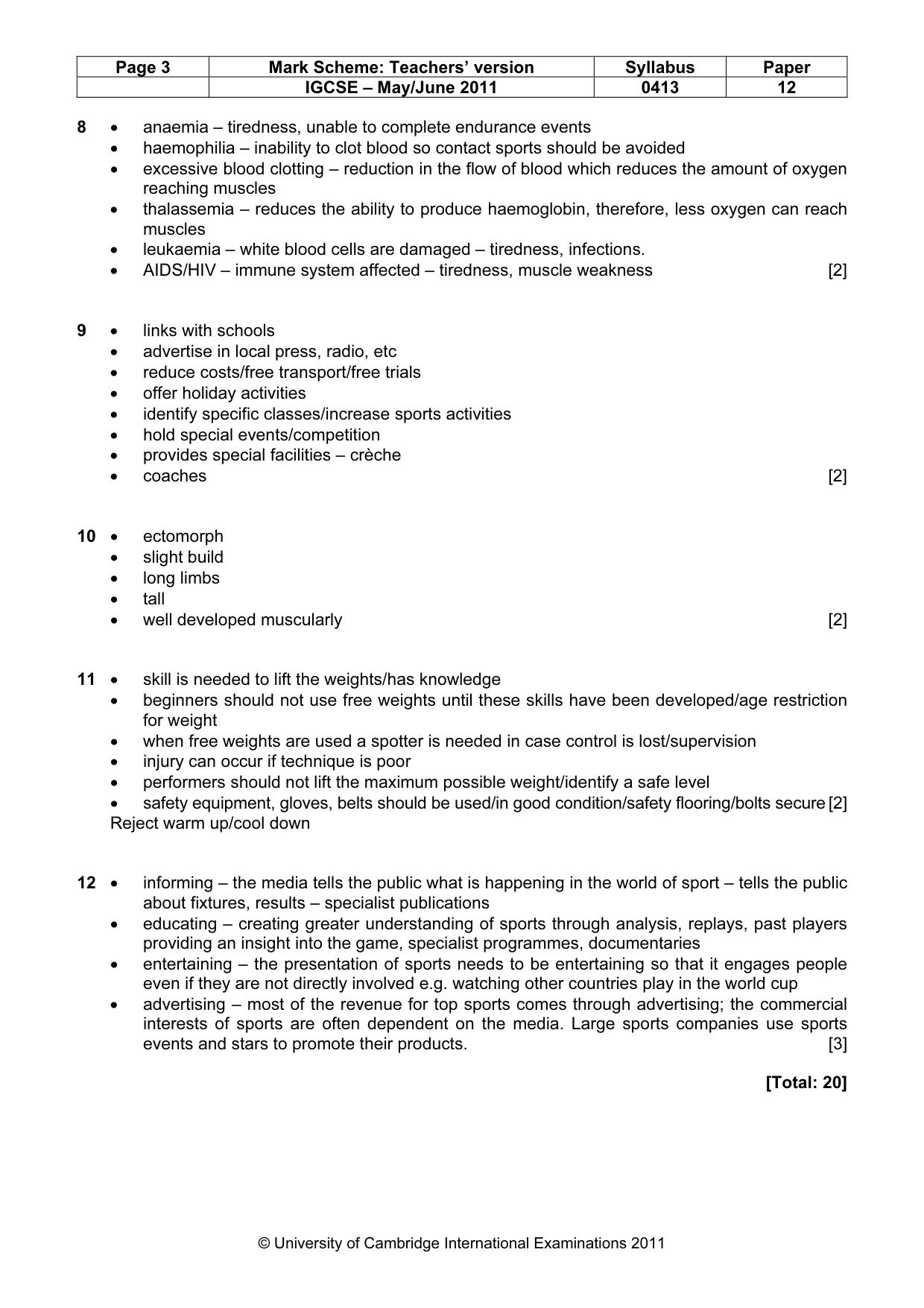
Page 3 Mark Scheme: Teachers’ version Syllabus Paper IGCSE – May/June 2011 0413 12 © University of Cambridge International Examinations 2011 8 • anaemia – tiredness, unable to complete endurance events • haemophilia – inability to clot blood so contact sports should be avoided • excessive blood clotting – reduction in the flow of blood which reduces the amount of oxygen reaching muscles • thalassemia – reduces the ability to produce haemoglobin, therefore, less oxygen can reach muscles • leukaemia – white blood cells are damaged – tiredness, infections. • AIDS/HIV – immune system affected – tiredness, muscle weakness [2] 9 • links with schools • advertise in local press, radio, etc • reduce costs/free transport/free trials • offer holiday activities • identify specific classes/increase sports activities • hold special events/competition • provides special facilities – crèche • coaches [2] 10 • ectomorph • slight build • long limbs • tall • well developed muscularly [2] 11 • skill is needed to lift the weights/has knowledge • beginners should not use free weights until these skills have been developed/age restriction for weight • when free weights are used a spotter is needed in case control is lost/supervision • injury can occur if technique is poor • performers should not lift the maximum possible weight/identify a safe level • safety equipment, gloves, belts should be used/in good condition/safety flooring/bolts secure [2] Reject warm up/cool down 12 • informing – the media tells the public what is happening in the world of sport – tells the public about fixtures, results – specialist publications • educating – creating greater understanding of sports through analysis, replays, past players providing an insight into the game, specialist programmes, documentaries • entertaining – the presentation of sports needs to be entertaining so that it engages people even if they are not directly involved e.g. watching other countries play in the world cup • advertising – most of the revenue for top sports comes through advertising; the commercial interests of sports are often dependent on the media. Large sports companies use sports events and stars to promote their products. [3] [Total: 20]
Mark scheme, page 4
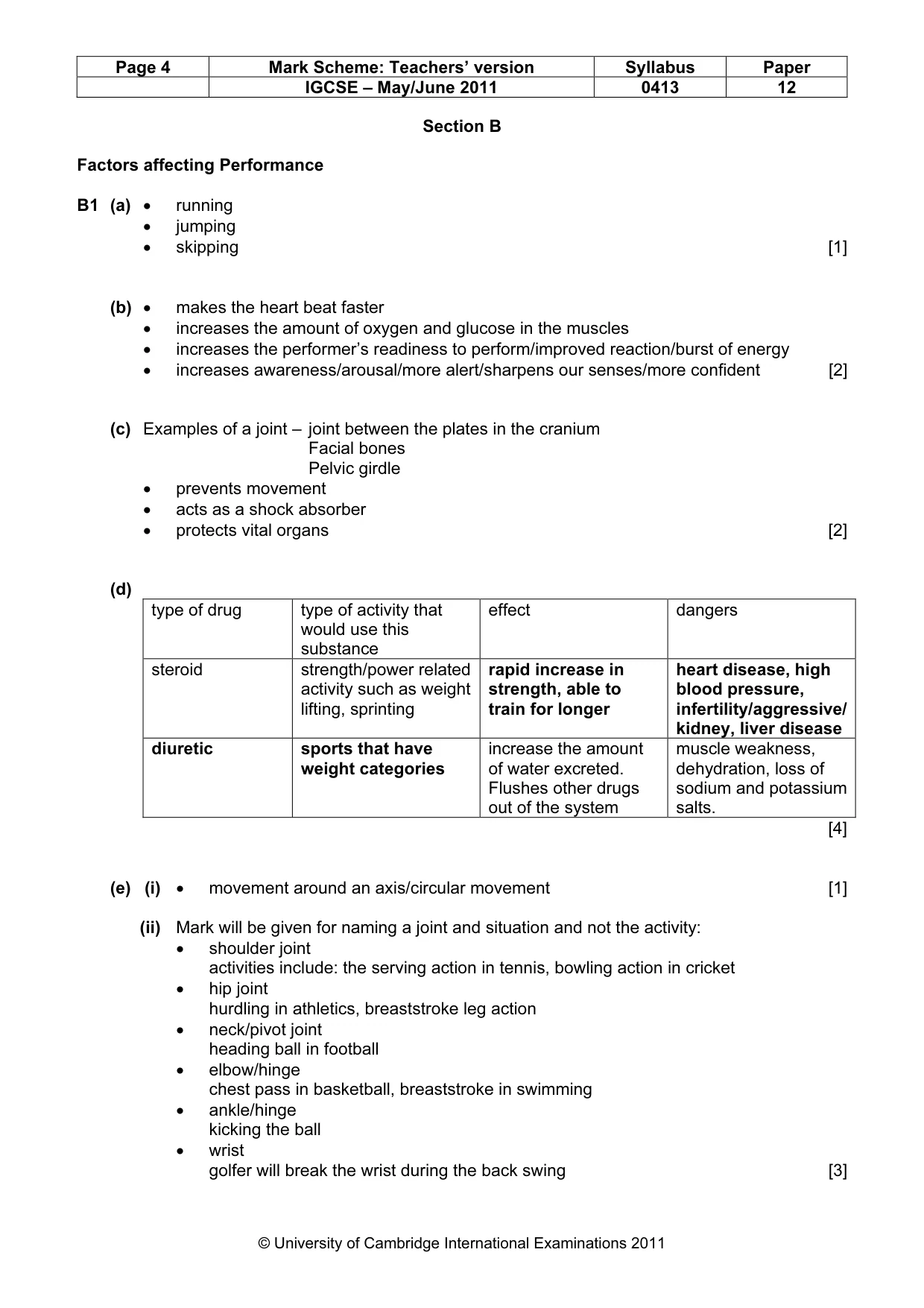
Page 4 Mark Scheme: Teachers’ version Syllabus Paper IGCSE – May/June 2011 0413 12 © University of Cambridge International Examinations 2011 Section B Factors affecting Performance B1 (a) • running • jumping • skipping [1] (b) • makes the heart beat faster • increases the amount of oxygen and glucose in the muscles • increases the performer’s readiness to perform/improved reaction/burst of energy • increases awareness/arousal/more alert/sharpens our senses/more confident [2] (c) Examples of a joint – joint between the plates in the cranium Facial bones Pelvic girdle • prevents movement • acts as a shock absorber • protects vital organs [2] (d) type of drug type of activity that would use this substance effect dangers steroid strength/power related activity such as weight lifting, sprinting rapid increase in strength, able to train for longer heart disease, high blood pressure, infertility/aggressive/ kidney, liver disease diuretic sports that have weight categories increase the amount of water excreted. Flushes other drugs out of the system muscle weakness, dehydration, loss of sodium and potassium salts. [4] (e) (i) • movement around an axis/circular movement [1] (ii) Mark will be given for naming a joint and situation and not the activity: • shoulder joint activities include: the serving action in tennis, bowling action in cricket • hip joint hurdling in athletics, breaststroke leg action • neck/pivot joint heading ball in football • elbow/hinge chest pass in basketball, breaststroke in swimming • ankle/hinge kicking the ball • wrist golfer will break the wrist during the back swing [3]
Mark scheme, page 5
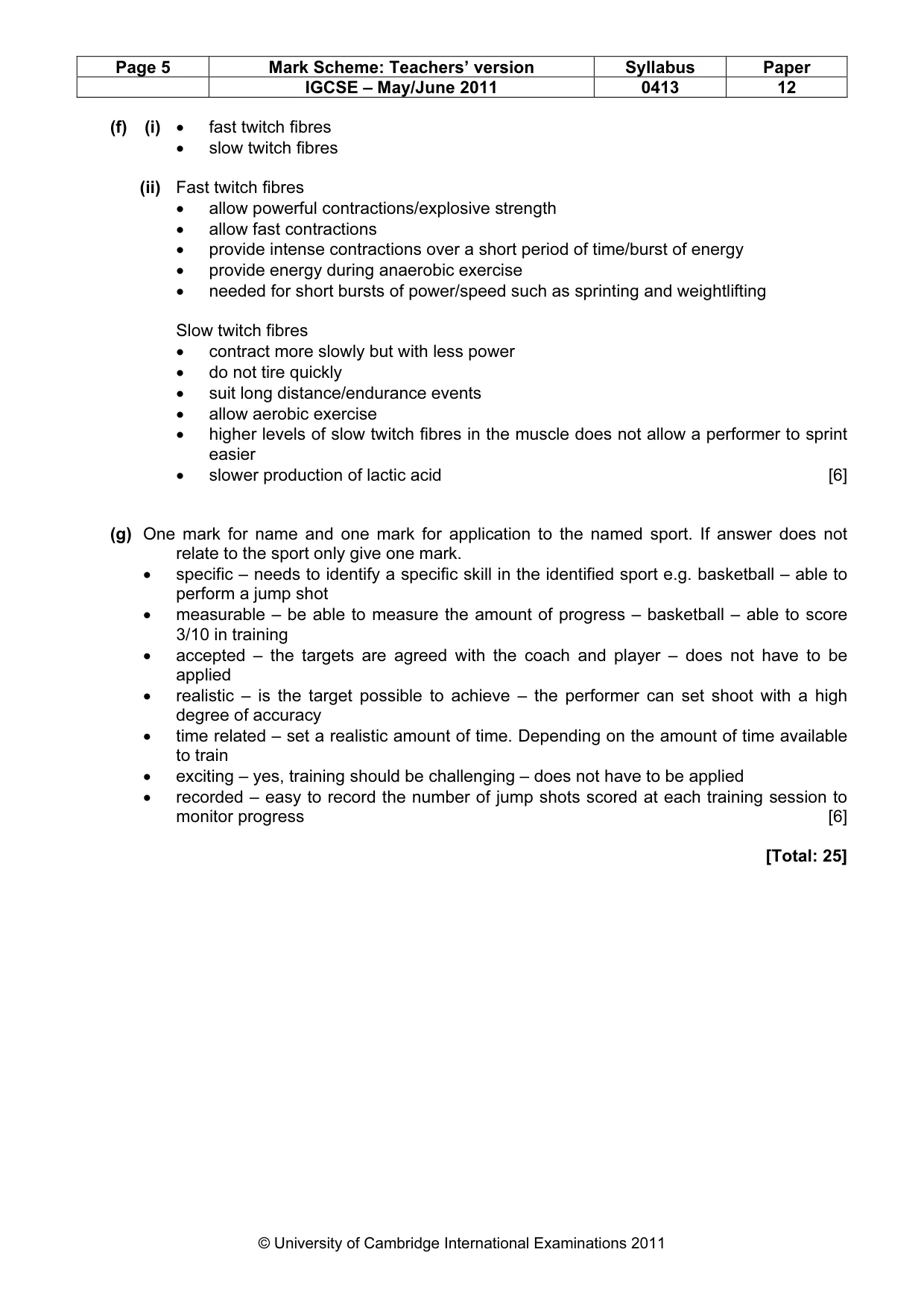
Page 5 Mark Scheme: Teachers’ version Syllabus Paper IGCSE – May/June 2011 0413 12 © University of Cambridge International Examinations 2011 (f) (i) • fast twitch fibres • slow twitch fibres (ii) Fast twitch fibres • allow powerful contractions/explosive strength • allow fast contractions • provide intense contractions over a short period of time/burst of energy • provide energy during anaerobic exercise • needed for short bursts of power/speed such as sprinting and weightlifting Slow twitch fibres • contract more slowly but with less power • do not tire quickly • suit long distance/endurance events • allow aerobic exercise • higher levels of slow twitch fibres in the muscle does not allow a performer to sprint easier • slower production of lactic acid [6] (g) One mark for name and one mark for application to the named sport. If answer does not relate to the sport only give one mark. • specific – needs to identify a specific skill in the identified sport e.g. basketball – able to perform a jump shot • measurable – be able to measure the amount of progress – basketball – able to score 3/10 in training • accepted – the targets are agreed with the coach and player – does not have to be applied • realistic – is the target possible to achieve – the performer can set shoot with a high degree of accuracy • time related – set a realistic amount of time. Depending on the amount of time available to train • exciting – yes, training should be challenging – does not have to be applied • recorded – easy to record the number of jump shots scored at each training session to monitor progress [6] [Total: 25]
Mark scheme, page 6
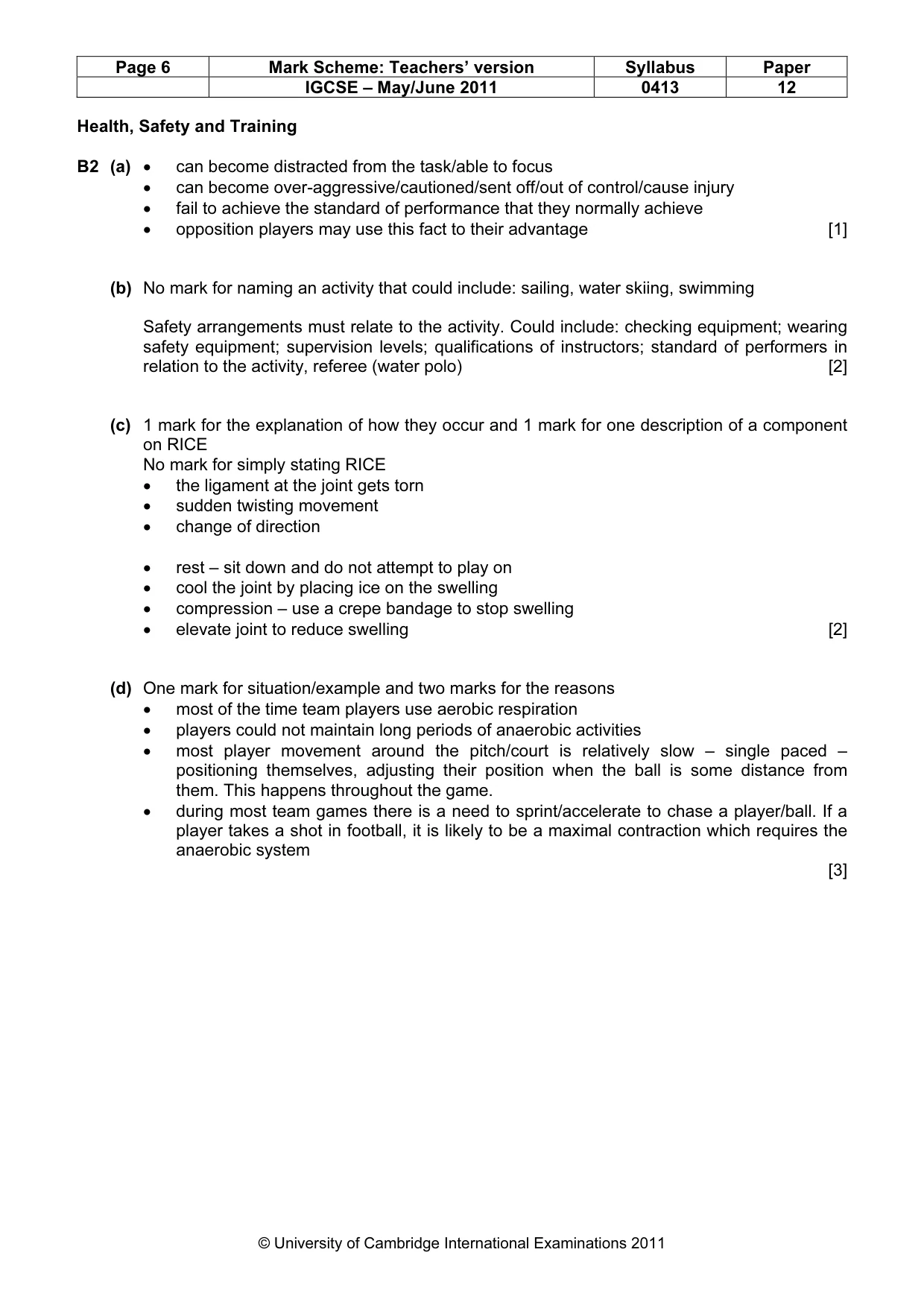
Page 6 Mark Scheme: Teachers’ version Syllabus Paper IGCSE – May/June 2011 0413 12 © University of Cambridge International Examinations 2011 Health, Safety and Training B2 (a) • can become distracted from the task/able to focus • can become over-aggressive/cautioned/sent off/out of control/cause injury • fail to achieve the standard of performance that they normally achieve • opposition players may use this fact to their advantage [1] (b) No mark for naming an activity that could include: sailing, water skiing, swimming Safety arrangements must relate to the activity. Could include: checking equipment; wearing safety equipment; supervision levels; qualifications of instructors; standard of performers in relation to the activity, referee (water polo) [2] (c) 1 mark for the explanation of how they occur and 1 mark for one description of a component on RICE No mark for simply stating RICE • the ligament at the joint gets torn • sudden twisting movement • change of direction • rest – sit down and do not attempt to play on • cool the joint by placing ice on the swelling • compression – use a crepe bandage to stop swelling • elevate joint to reduce swelling [2] (d) One mark for situation/example and two marks for the reasons • most of the time team players use aerobic respiration • players could not maintain long periods of anaerobic activities • most player movement around the pitch/court is relatively slow – single paced – positioning themselves, adjusting their position when the ball is some distance from them. This happens throughout the game. • during most team games there is a need to sprint/accelerate to chase a player/ball. If a player takes a shot in football, it is likely to be a maximal contraction which requires the anaerobic system [3]
Mark scheme, page 7
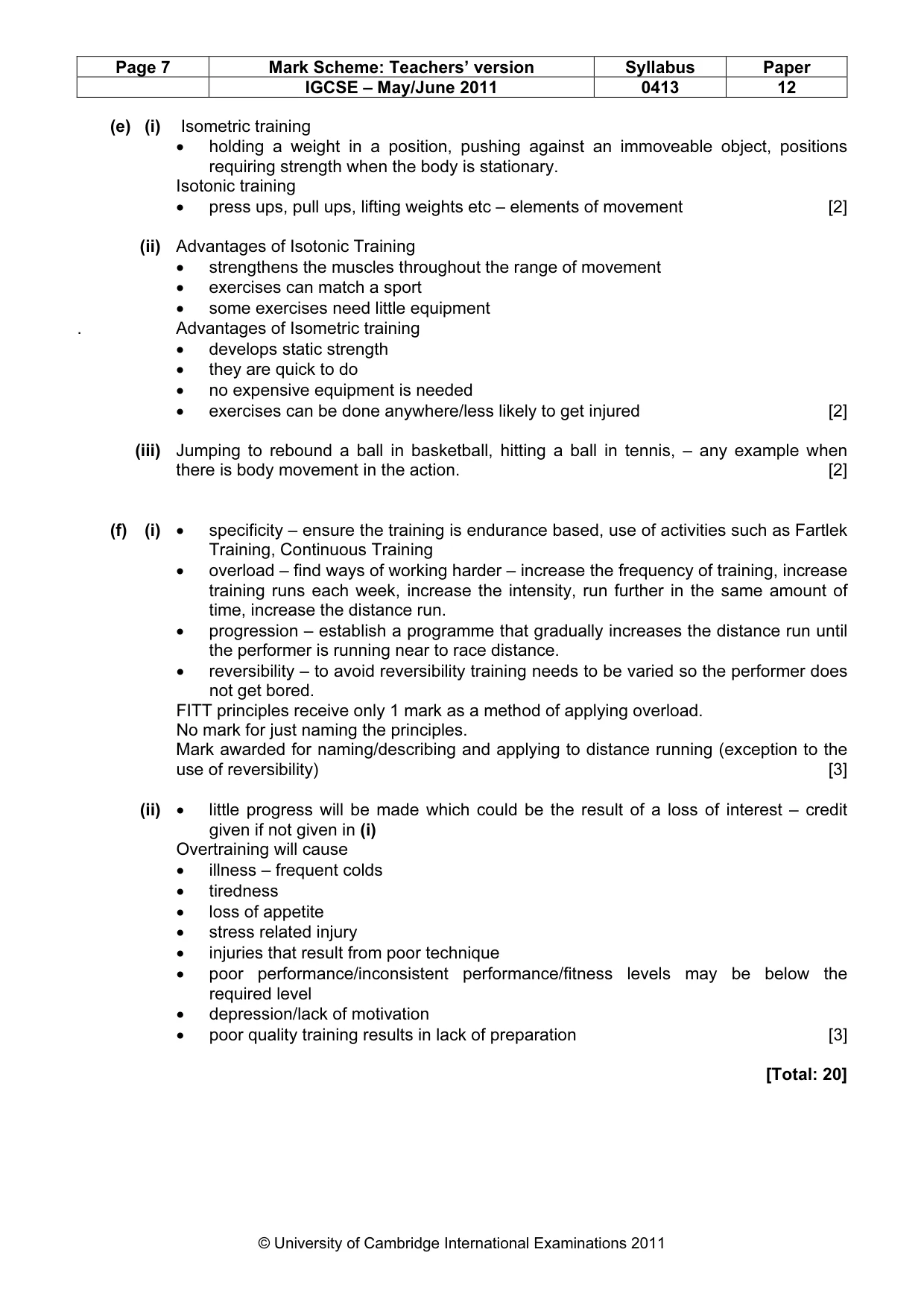
Page 7 Mark Scheme: Teachers’ version Syllabus Paper IGCSE – May/June 2011 0413 12 © University of Cambridge International Examinations 2011 (e) (i) Isometric training • holding a weight in a position, pushing against an immoveable object, positions requiring strength when the body is stationary. Isotonic training • press ups, pull ups, lifting weights etc – elements of movement [2] (ii) Advantages of Isotonic Training • strengthens the muscles throughout the range of movement • exercises can match a sport • some exercises need little equipment . Advantages of Isometric training • develops static strength • they are quick to do • no expensive equipment is needed • exercises can be done anywhere/less likely to get injured [2] (iii) Jumping to rebound a ball in basketball, hitting a ball in tennis, – any example when there is body movement in the action. [2] (f) (i) • specificity – ensure the training is endurance based, use of activities such as Fartlek Training, Continuous Training • overload – find ways of working harder – increase the frequency of training, increase training runs each week, increase the intensity, run further in the same amount of time, increase the distance run. • progression – establish a programme that gradually increases the distance run until the performer is running near to race distance. • reversibility – to avoid reversibility training needs to be varied so the performer does not get bored. FITT principles receive only 1 mark as a method of applying overload. No mark for just naming the principles. Mark awarded for naming/describing and applying to distance running (exception to the use of reversibility) [3] (ii) • little progress will be made which could be the result of a loss of interest – credit given if not given in (i) Overtraining will cause • illness – frequent colds • tiredness • loss of appetite • stress related injury • injuries that result from poor technique • poor performance/inconsistent performance/fitness levels may be below the required level • depression/lack of motivation • poor quality training results in lack of preparation [3] [Total: 20]
Mark scheme, page 8
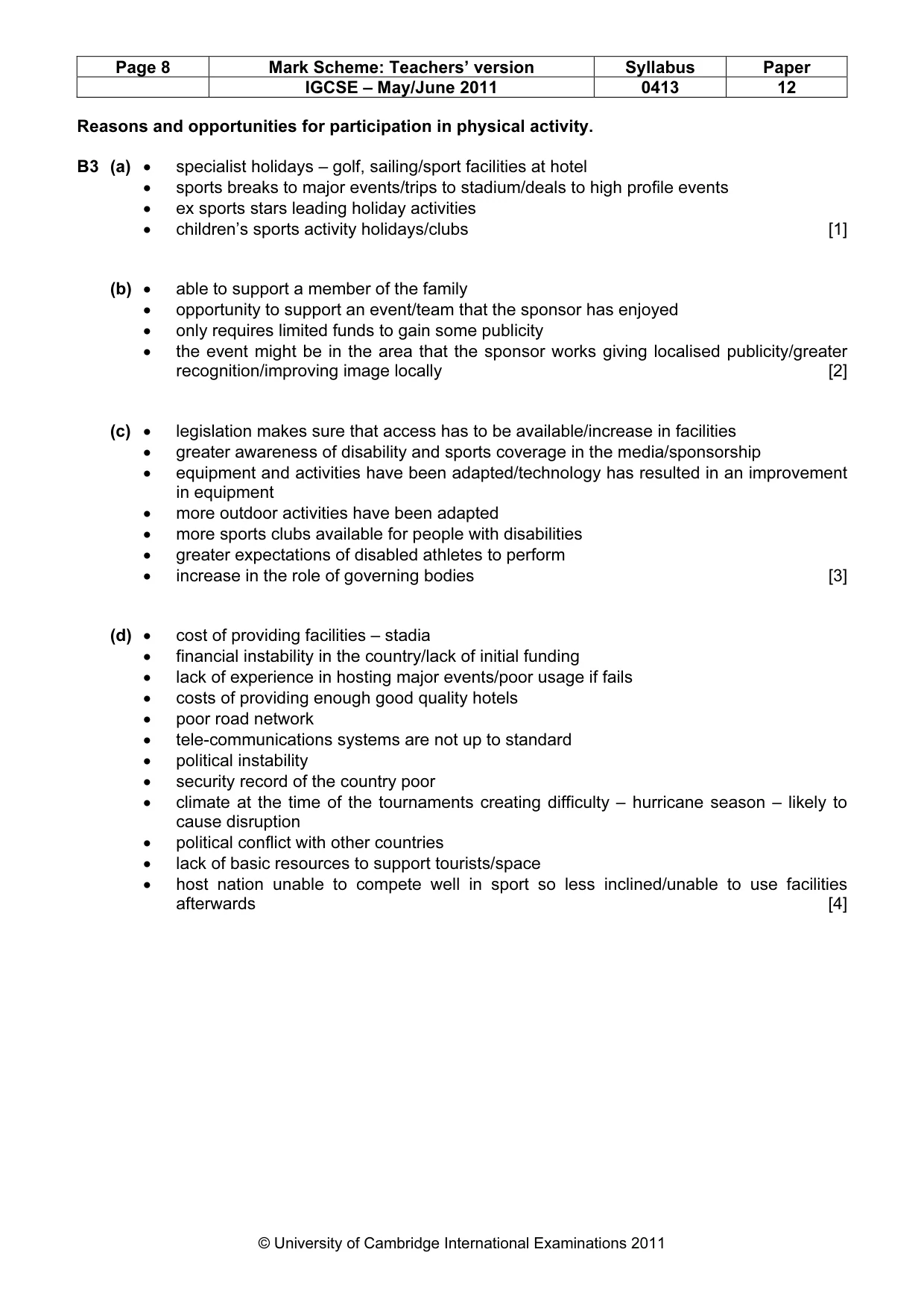
Page 8 Mark Scheme: Teachers’ version Syllabus Paper IGCSE – May/June 2011 0413 12 © University of Cambridge International Examinations 2011 Reasons and opportunities for participation in physical activity. B3 (a) • specialist holidays – golf, sailing/sport facilities at hotel • sports breaks to major events/trips to stadium/deals to high profile events • ex sports stars leading holiday activities • children’s sports activity holidays/clubs [1] (b) • able to support a member of the family • opportunity to support an event/team that the sponsor has enjoyed • only requires limited funds to gain some publicity • the event might be in the area that the sponsor works giving localised publicity/greater recognition/improving image locally [2] (c) • legislation makes sure that access has to be available/increase in facilities • greater awareness of disability and sports coverage in the media/sponsorship • equipment and activities have been adapted/technology has resulted in an improvement in equipment • more outdoor activities have been adapted • more sports clubs available for people with disabilities • greater expectations of disabled athletes to perform • increase in the role of governing bodies [3] (d) • cost of providing facilities – stadia • financial instability in the country/lack of initial funding • lack of experience in hosting major events/poor usage if fails • costs of providing enough good quality hotels • poor road network • tele-communications systems are not up to standard • political instability • security record of the country poor • climate at the time of the tournaments creating difficulty – hurricane season – likely to cause disruption • political conflict with other countries • lack of basic resources to support tourists/space • host nation unable to compete well in sport so less inclined/unable to use facilities afterwards [4]
Mark scheme, page 9
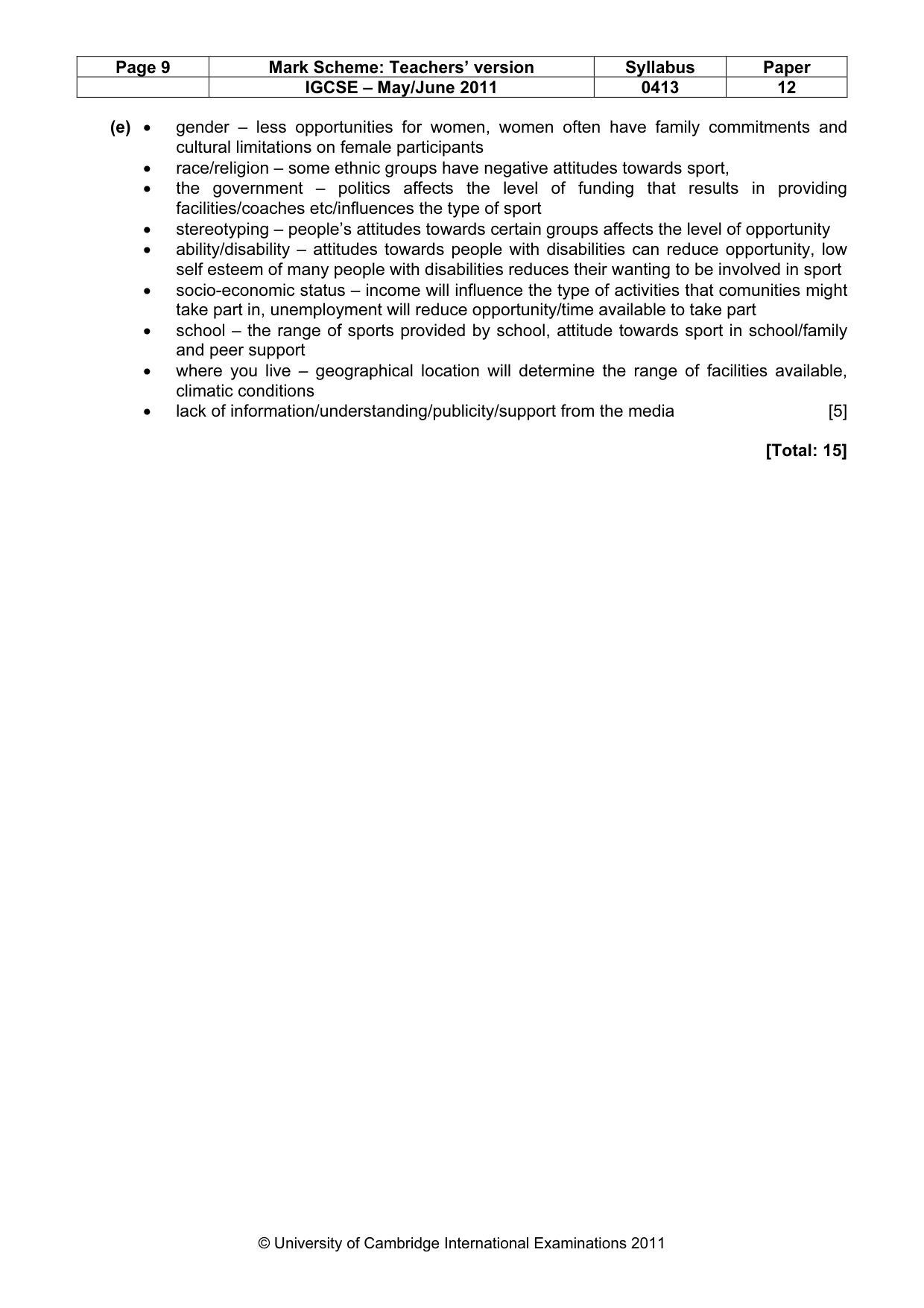
Page 9 Mark Scheme: Teachers’ version Syllabus Paper IGCSE – May/June 2011 0413 12 © University of Cambridge International Examinations 2011 (e) • gender – less opportunities for women, women often have family commitments and cultural limitations on female participants • race/religion – some ethnic groups have negative attitudes towards sport, • the government – politics affects the level of funding that results in providing facilities/coaches etc/influences the type of sport • stereotyping – people’s attitudes towards certain groups affects the level of opportunity • ability/disability – attitudes towards people with disabilities can reduce opportunity, low self esteem of many people with disabilities reduces their wanting to be involved in sport • socio-economic status – income will influence the type of activities that comunities might take part in, unemployment will reduce opportunity/time available to take part • school – the range of sports provided by school, attitude towards sport in school/family and peer support • where you live – geographical location will determine the range of facilities available, climatic conditions • lack of information/understanding/publicity/support from the media [5] [Total: 15]
What you needed in this session
Cambridge’s own grade thresholds for 2011 May/June, Paper 1 · Variant 2. A higher threshold means an easier paper — the bar moves with how the cohort did.