Cambridge IGCSE Physical Education 0413 — 2011 May/June Paper 1 · Variant 3
0413/13/M/J/11 · 80 marks · ≈90 min
The question paper and its mark scheme, free to read here and free to download. This is Cambridge’s own paper, exactly as it was sat.
Question paper12 pages



Mark scheme11 pages
Answers below. Sit the paper first if you are practising.
Paper as text
Question paper, page 1
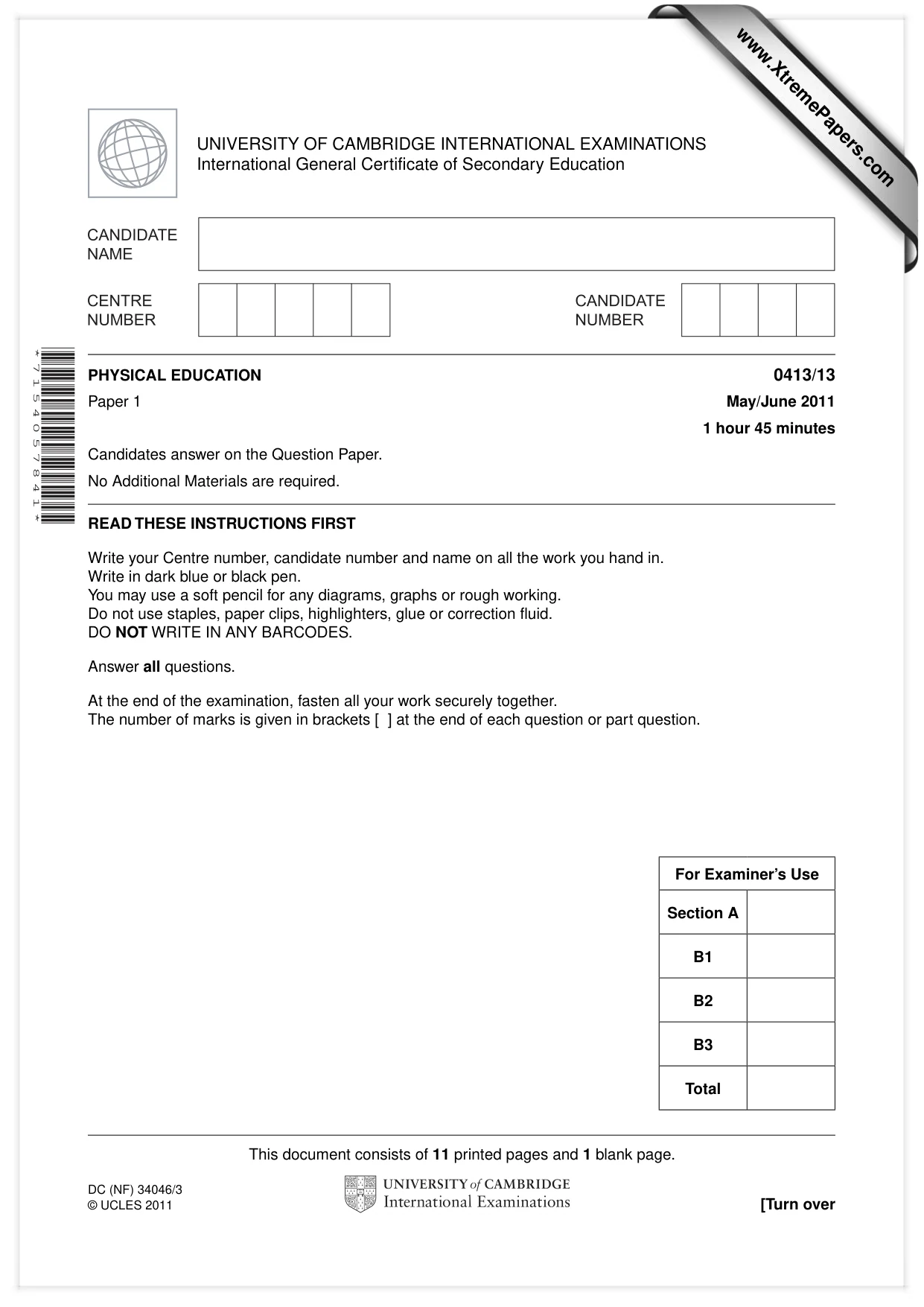
This document consists of 11 printed pages and 1 blank page. DC (NF) 34046/3 © UCLES 2011 [Turn over UNIVERSITY OF CAMBRIDGE INTERNATIONAL EXAMINATIONS International General Certificate of Secondary Education * 7 1 5 4 0 5 7 8 4 1 * PHYSICAL EDUCATION 0413/13 Paper 1 May/June 2011 1 hour 45 minutes Candidates answer on the Question Paper. No Additional Materials are required. READ THESE INSTRUCTIONS FIRST Write your Centre number, candidate number and name on all the work you hand in. Write in dark blue or black pen. You may use a soft pencil for any diagrams, graphs or rough working. Do not use staples, paper clips, highlighters, glue or correction fluid. DO NOT WRITE IN ANY BARCODES. Answer all questions. At the end of the examination, fasten all your work securely together. The number of marks is given in brackets [ ] at the end of each question or part question. For Examiner’s Use Section A B1 B2 B3 Total www.XtremePapers.com
Question paper, page 2
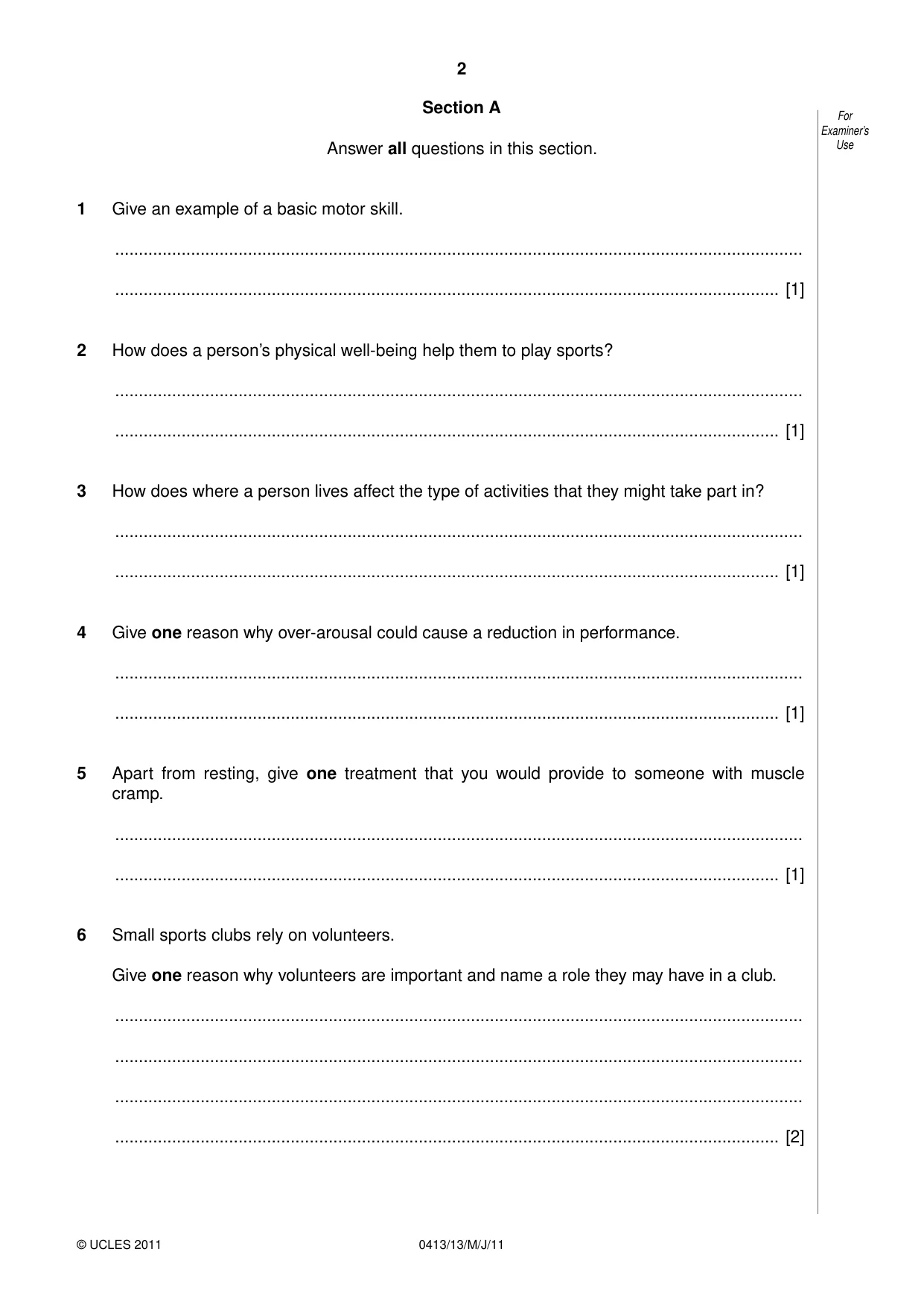
2 0413/13/M/J/11 © UCLES 2011 For Examiner’s Use Section A Answer all questions in this section. 1 Give an example of a basic motor skill. … … [1] 2 How does a person’s physical well-being help them to play sports? … … [1] 3 How does where a person lives affect the type of activities that they might take part in? … … [1] 4 Give one reason why over-arousal could cause a reduction in performance. … … [1] 5 Apart from resting, give one treatment that you would provide to someone with muscle cramp. … … [1] 6 Small sports clubs rely on volunteers. Give one reason why volunteers are important and name a role they may have in a club. … … … … [2]
Question paper, page 3
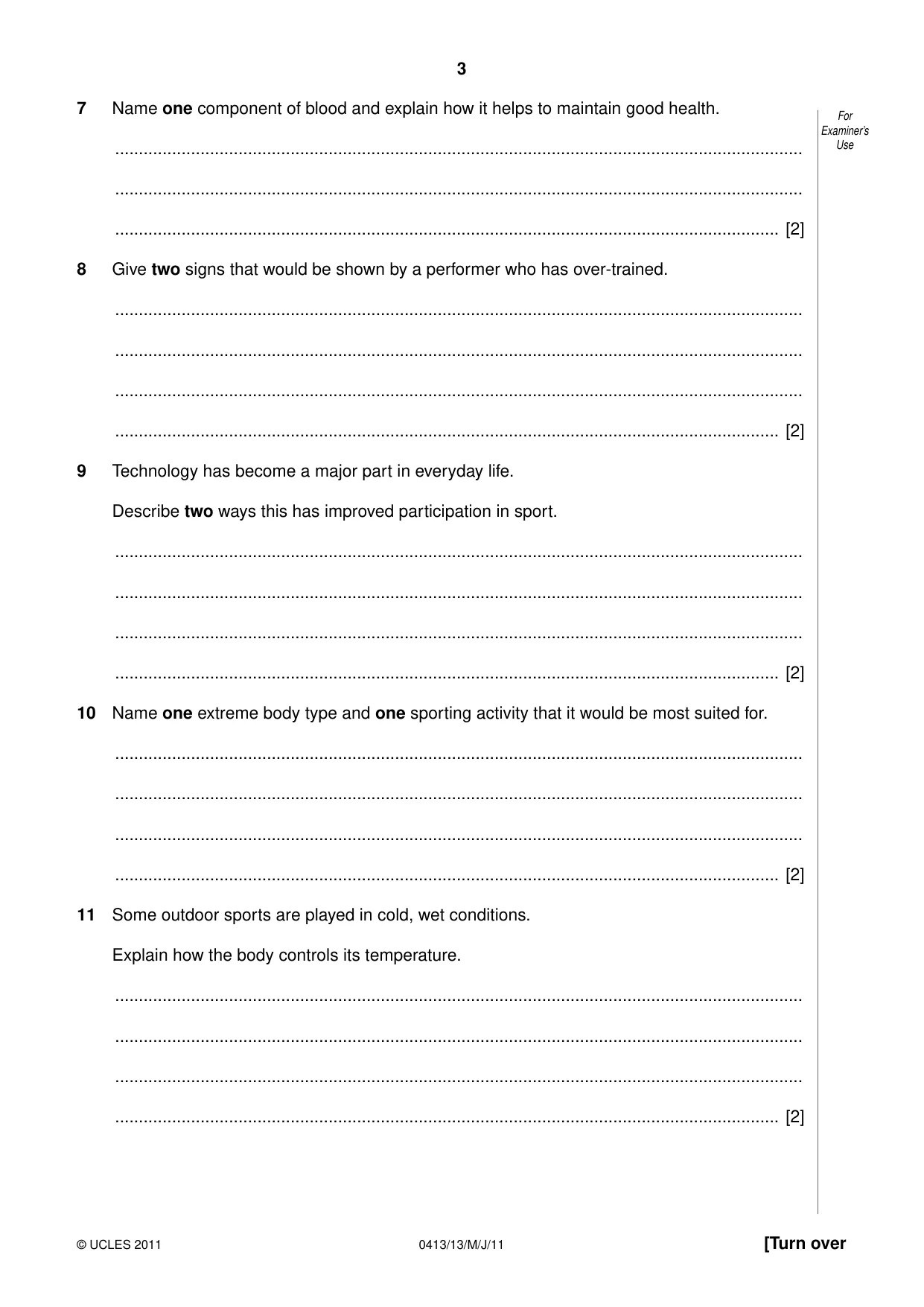
3 0413/13/M/J/11 © UCLES 2011 [Turn over For Examiner’s Use 7 Name one component of blood and explain how it helps to maintain good health. … … … [2] 8 Give two signs that would be shown by a performer who has over-trained. … … … … [2] 9 Technology has become a major part in everyday life. Describe two ways this has improved participation in sport. … … … … [2] 10 Name one extreme body type and one sporting activity that it would be most suited for. … … … … [2] 11 Some outdoor sports are played in cold, wet conditions. Explain how the body controls its temperature. … … … … [2]
Question paper, page 4
4 0413/13/M/J/11 © UCLES 2011 For Examiner’s Use 12 Describe three negative effects that media pressure can have on a performer. … … … … … … [3] [Total: 20]
Question paper, page 5
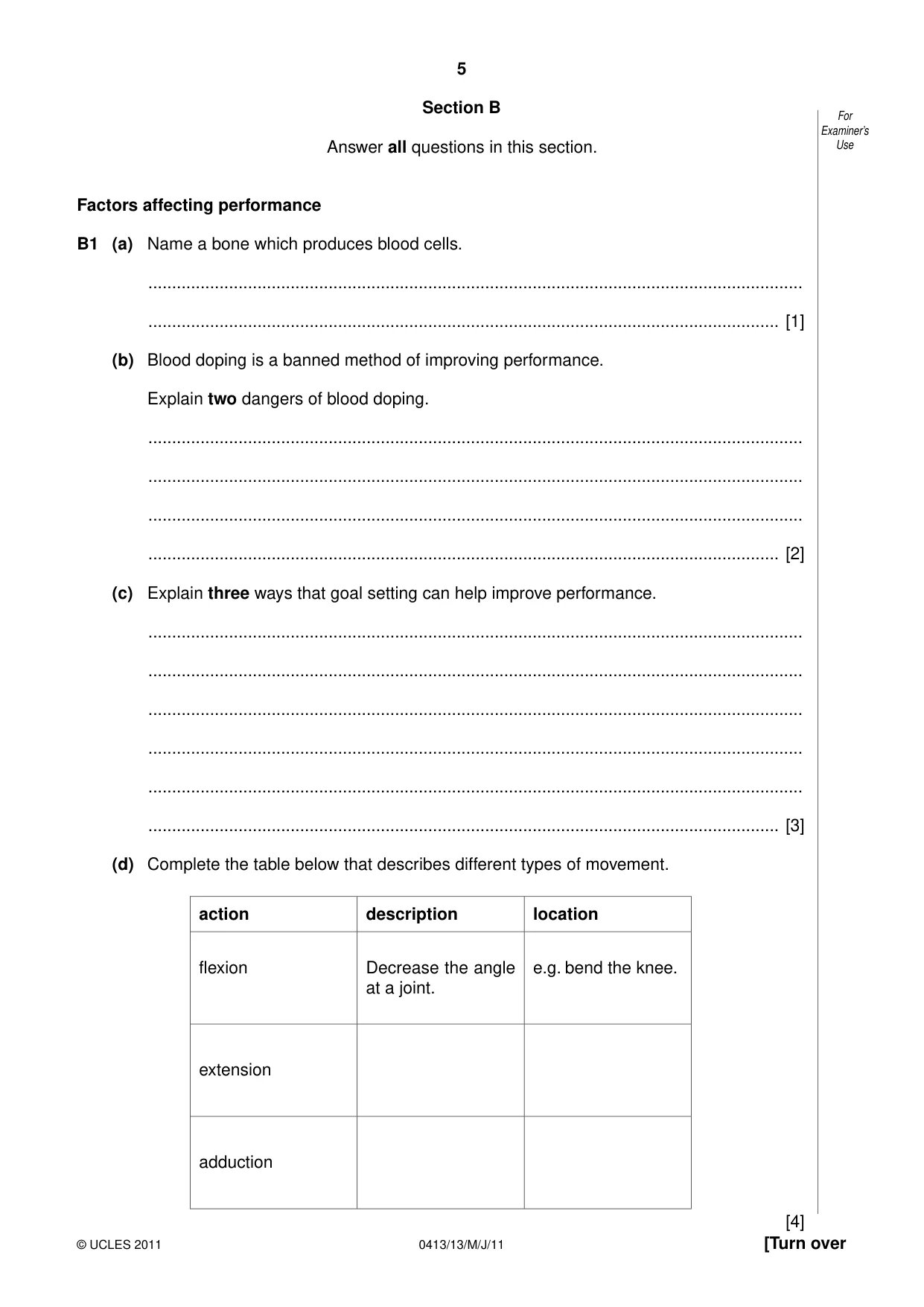
5 0413/13/M/J/11 © UCLES 2011 [Turn over For Examiner’s Use Section B Answer all questions in this section. Factors affecting performance B1 (a) Name a bone which produces blood cells. … … [1] (b) Blood doping is a banned method of improving performance. Explain two dangers of blood doping. … … … … [2] (c) Explain three ways that goal setting can help improve performance. … … … … … … [3] (d) Complete the table below that describes different types of movement. action description location flexion Decrease the angle at a joint. e.g. bend the knee. extension adduction [4]
Question paper, page 6
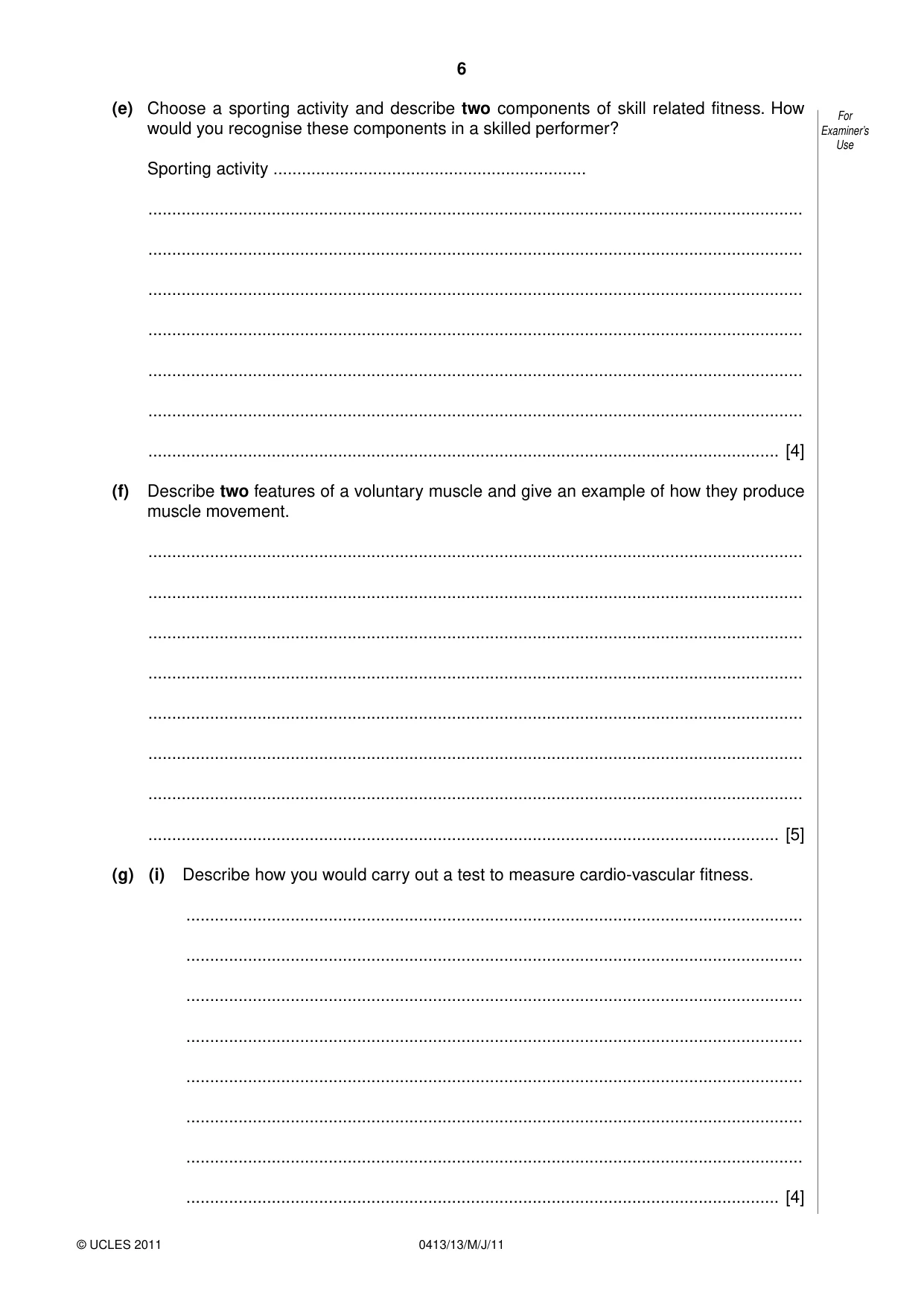
6 0413/13/M/J/11 © UCLES 2011 For Examiner’s Use (e) Choose a sporting activity and describe two components of skill related fitness. How would you recognise these components in a skilled performer? Sporting activity … … … … … … … … [4] (f) Describe two features of a voluntary muscle and give an example of how they produce muscle movement. … … … … … … … … [5] (g) (i) Describe how you would carry out a test to measure cardio-vascular fitness. … … … … … … … … [4]
Question paper, page 7
7 0413/13/M/J/11 © UCLES 2011 [Turn over For Examiner’s Use (ii) How would a coach use the results of this test to improve cardio-vascular fitness? … … … … … … [2] [Total: 25]
Question paper, page 8
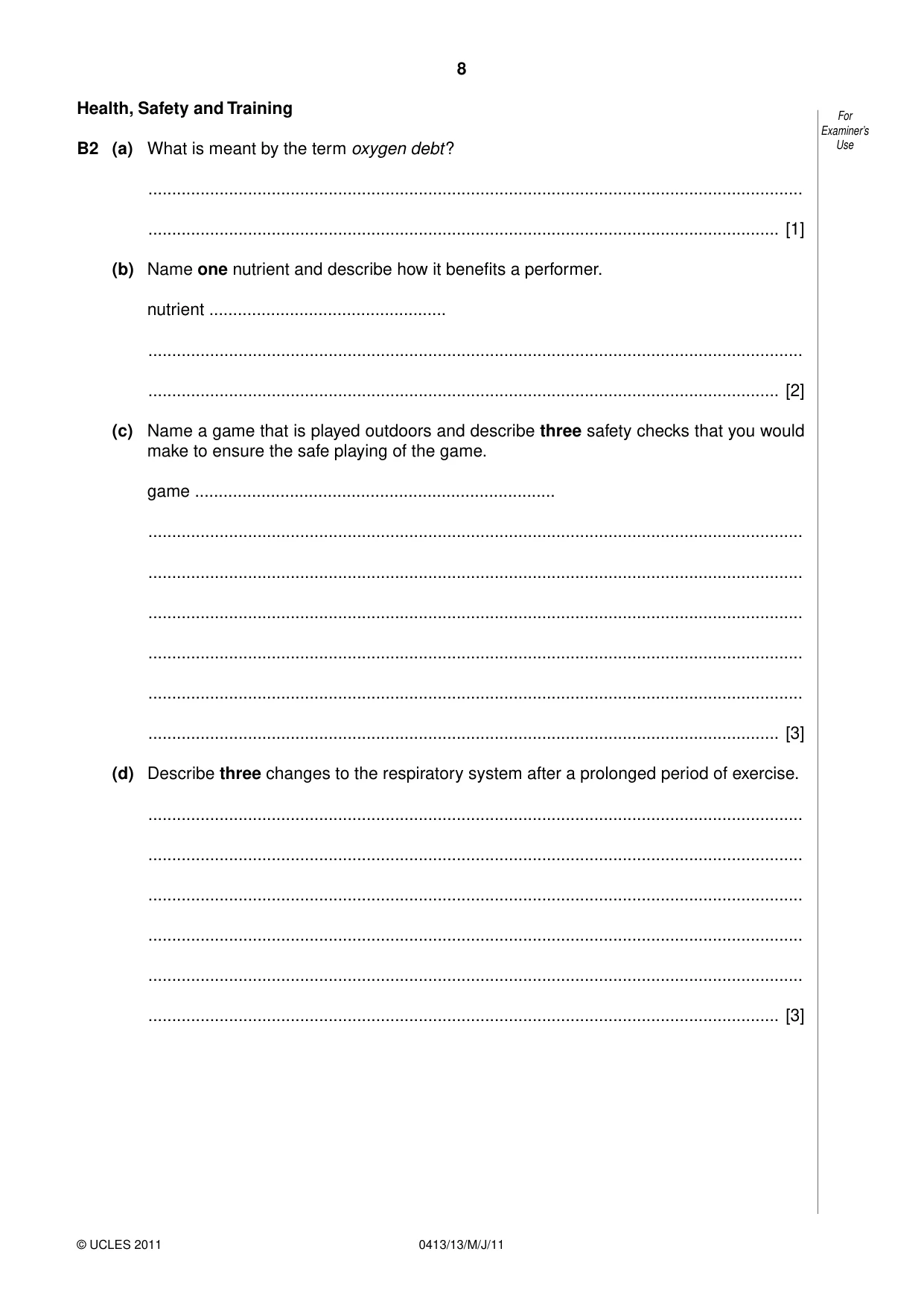
8 0413/13/M/J/11 © UCLES 2011 For Examiner’s Use Health, Safety and Training B2 (a) What is meant by the term oxygen debt? … … [1] (b) Name one nutrient and describe how it benefits a performer. nutrient … … … [2] (c) Name a game that is played outdoors and describe three safety checks that you would make to ensure the safe playing of the game. game … … … … … … … [3] (d) Describe three changes to the respiratory system after a prolonged period of exercise. … … … … … … [3]
Question paper, page 9
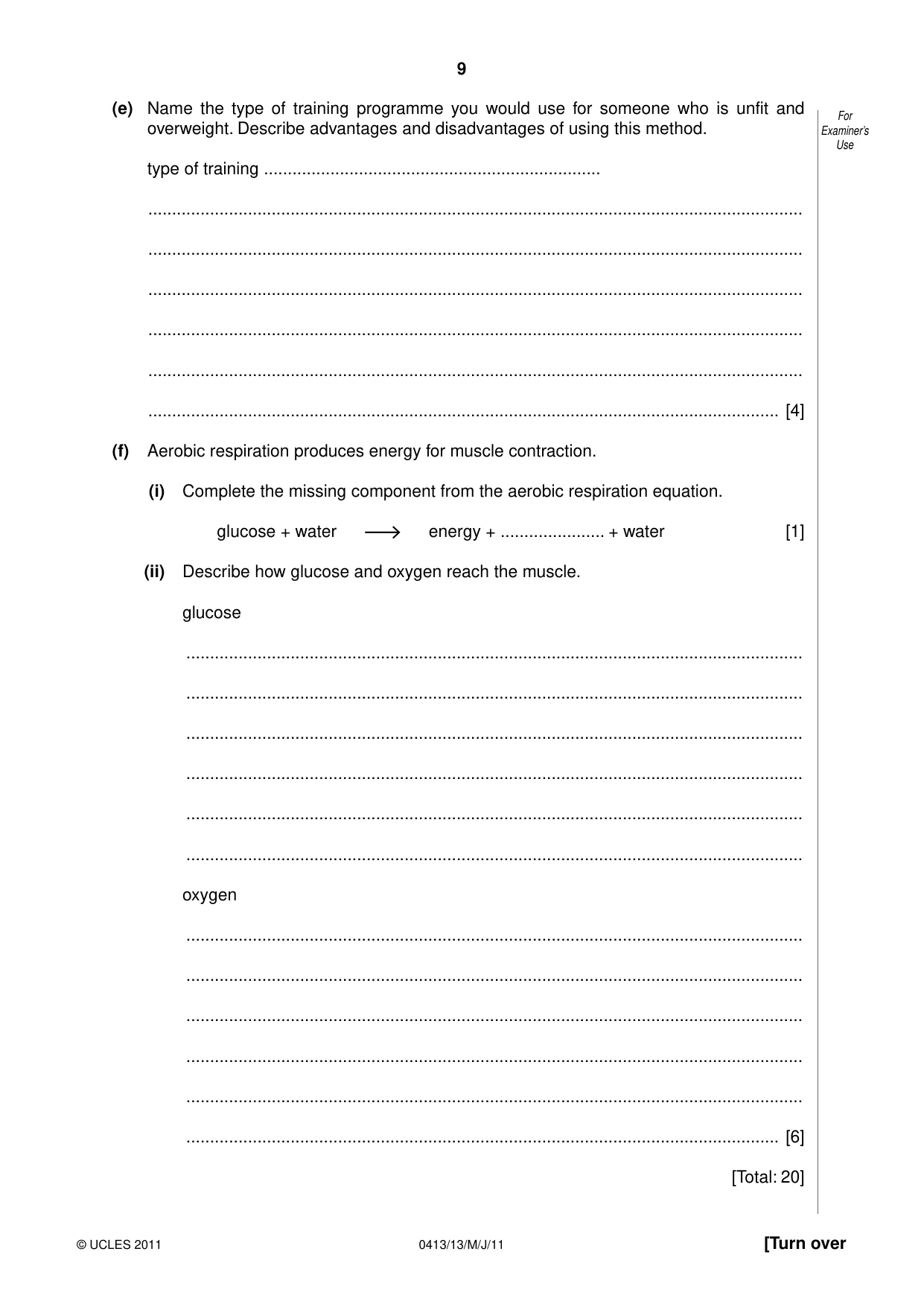
9 0413/13/M/J/11 © UCLES 2011 [Turn over For Examiner’s Use (e) Name the type of training programme you would use for someone who is unfit and overweight. Describe advantages and disadvantages of using this method. type of training … … … … … … … [4] (f) Aerobic respiration produces energy for muscle contraction. (i) Complete the missing component from the aerobic respiration equation. glucose + water energy + … + water [1] (ii) Describe how glucose and oxygen reach the muscle. glucose … … … … … … oxygen … … … … … … [6] [Total: 20]
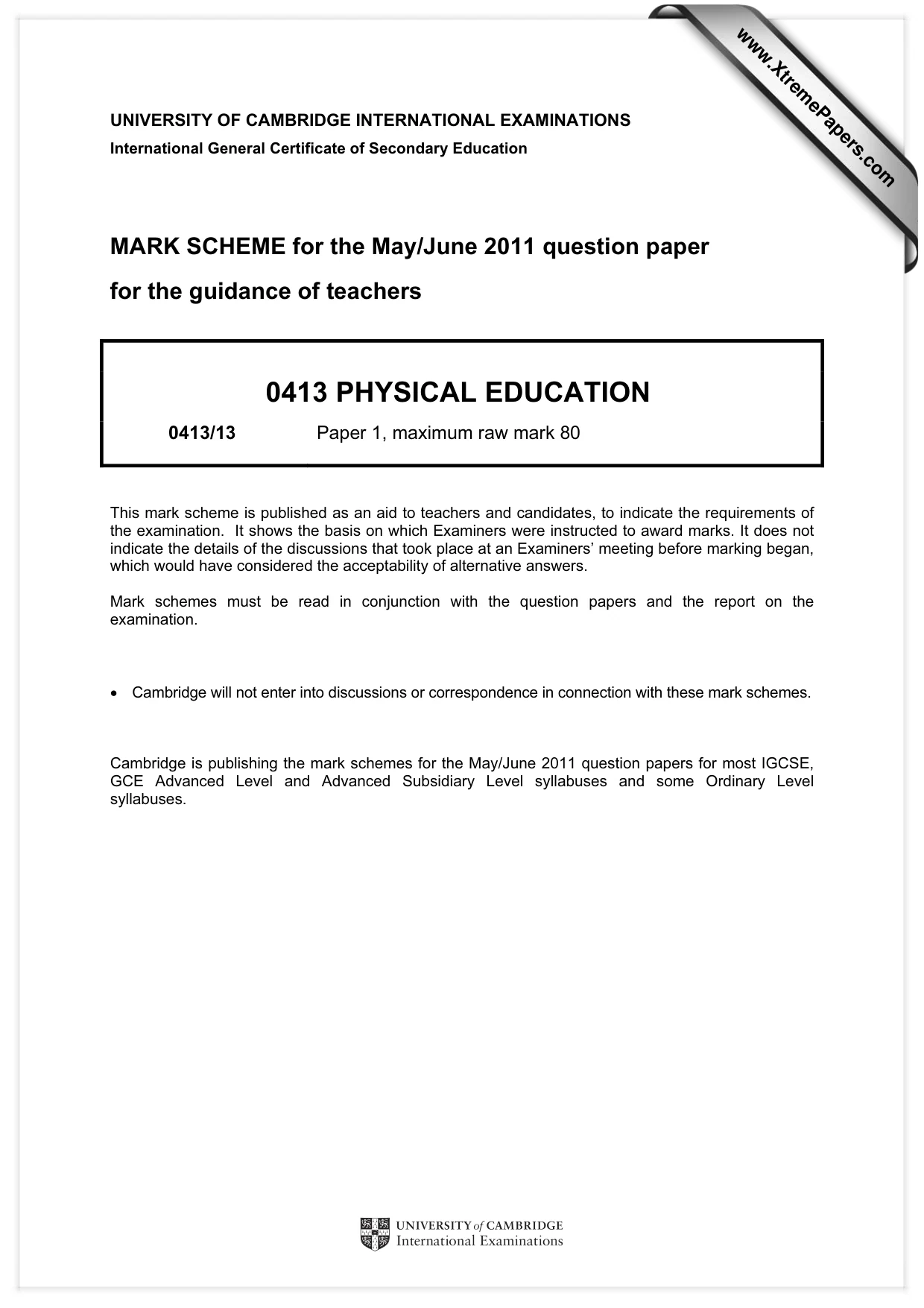
Question paper, page 10
10 0413/13/M/J/11 © UCLES 2011 For Examiner’s Use Reasons and opportunities for participation in physical activity B3 (a) Give one difference between a leisure activity and a sport. … … [1] (b) How can school Physical Education examination courses help to improve the standard of performance in sport? … … … … [2] (c) Give two factors that will determine the type of physical activities that someone who has retired from work might take part in. … … … … [2] (d) There has been an increase in the amount of media coverage of disability sports. (i) Describe how this has helped to improve the standards of performance. … … … … [2] (ii) How can a sports governing body help increase the level of participation for disabled performers in their sport? … … … … [2]
Question paper, page 11
11 0413/13/M/J/11 © UCLES 2011 For Examiner’s Use (e) After hosting a global event, what are the long term benefits that a country might experience? … … … … … … … … … … … [6] [Total: 15]
Question paper, page 12
12 0413/13/M/J/11 © UCLES 2011 Permission to reproduce items where third-party owned material protected by copyright is included has been sought and cleared where possible. Every reasonable effort has been made by the publisher (UCLES) to trace copyright holders, but if any items requiring clearance have unwittingly been included, the publisher will be pleased to make amends at the earliest possible opportunity. University of Cambridge International Examinations is part of the Cambridge Assessment Group. Cambridge Assessment is the brand name of University of Cambridge Local Examinations Syndicate (UCLES), which is itself a department of the University of Cambridge. BLANK PAGE
Mark scheme, page 1
UNIVERSITY OF CAMBRIDGE INTERNATIONAL EXAMINATIONS International General Certificate of Secondary Education MARK SCHEME for the May/June 2011 question paper for the guidance of teachers 0413 PHYSICAL EDUCATION 0413/13 Paper 1, maximum raw mark 80 This mark scheme is published as an aid to teachers and candidates, to indicate the requirements of the examination. It shows the basis on which Examiners were instructed to award marks. It does not indicate the details of the discussions that took place at an Examiners’ meeting before marking began, which would have considered the acceptability of alternative answers. Mark schemes must be read in conjunction with the question papers and the report on the examination. • Cambridge will not enter into discussions or correspondence in connection with these mark schemes. Cambridge is publishing the mark schemes for the May/June 2011 question papers for most IGCSE, GCE Advanced Level and Advanced Subsidiary Level syllabuses and some Ordinary Level syllabuses. www.XtremePapers.com
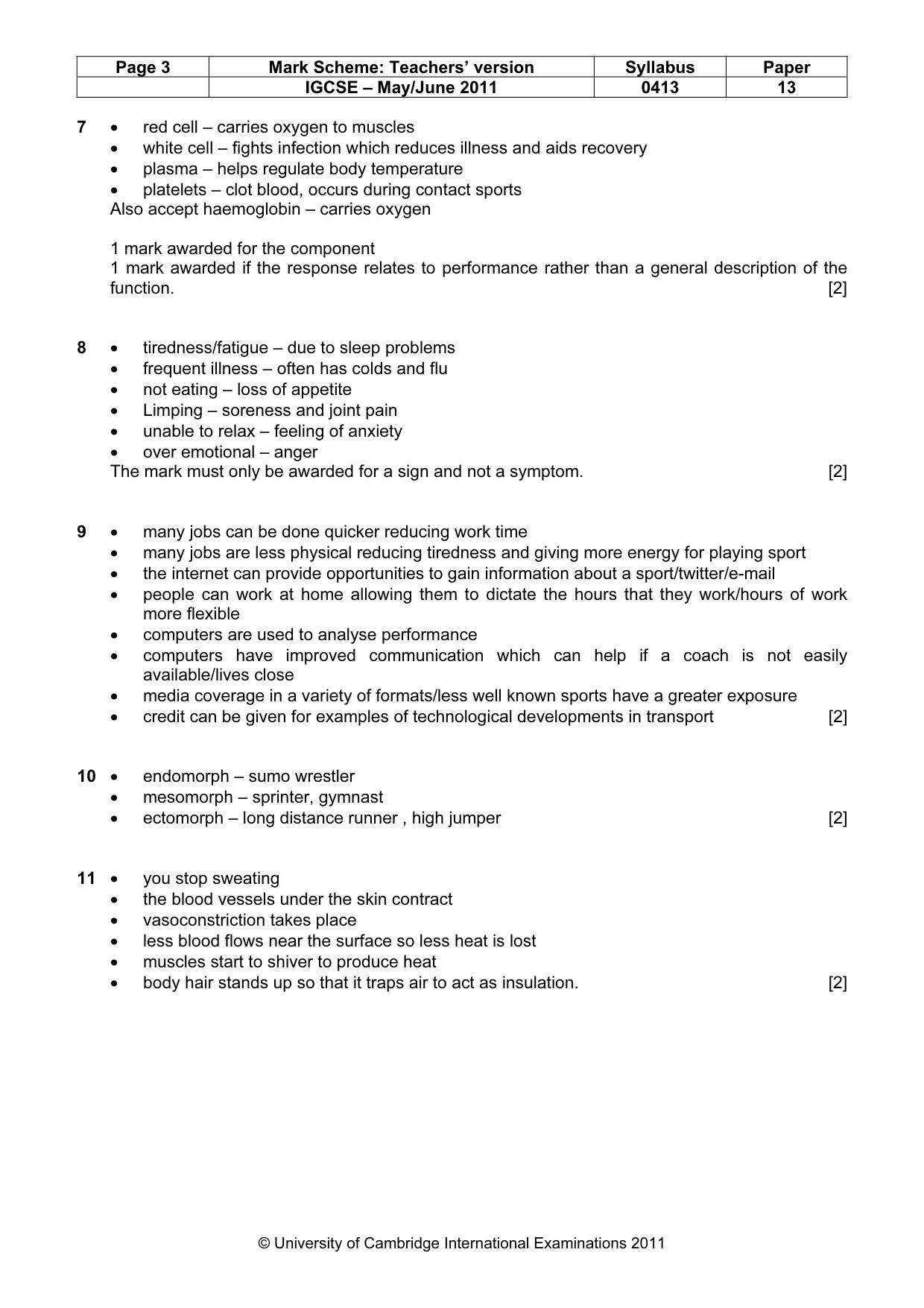
Mark scheme, page 2
Page 2 Mark Scheme: Teachers’ version Syllabus Paper IGCSE – May/June 2011 0413 13 © University of Cambridge International Examinations 2011 Section A 1 • running • jumping • throwing/punching • walking [1] 2 • all body systems work well (marks can be awarded if one is named) • no illness • free from injury • able to perform better [1] 3 • environment – near to the sea, mountains, lakes etc • location in relation to facilities – near to a sports centre/urban areas may have more choice/some sports are specific to a particular area • climate – the climate where you live may determine activities – Nordic countries – skiing etc [1] 4 • too aggressive • tension/Panic during the activity/feeling unwell • poor concentration • unable to focus on the activity • Poor decision making during the activity. [1] 5 • stretch the muscle slowly and gently • hold the stretch position • massage the muscle gently [1] 6 Reasons for the need for volunteers: • lack of any funding to pay coaches etc • maintaining clubs within a community • large numbers of people are needed when clubs provide teams/activities for young children/provide support for groups • when players no longer participate they often take the role of administrators/coaches in clubs to maintain their involvement • to raise funds for the club Roles within a club: • secretary • treasurer • chairperson • vice-chairperson • fixtures secretary • accept role of coach if not already given/referee [2]
Mark scheme, page 3
Page 3 Mark Scheme: Teachers’ version Syllabus Paper IGCSE – May/June 2011 0413 13 © University of Cambridge International Examinations 2011 7 • red cell – carries oxygen to muscles • white cell – fights infection which reduces illness and aids recovery • plasma – helps regulate body temperature • platelets – clot blood, occurs during contact sports Also accept haemoglobin – carries oxygen 1 mark awarded for the component 1 mark awarded if the response relates to performance rather than a general description of the function. [2] 8 • tiredness/fatigue – due to sleep problems • frequent illness – often has colds and flu • not eating – loss of appetite • Limping – soreness and joint pain • unable to relax – feeling of anxiety • over emotional – anger The mark must only be awarded for a sign and not a symptom. [2] 9 • many jobs can be done quicker reducing work time • many jobs are less physical reducing tiredness and giving more energy for playing sport • the internet can provide opportunities to gain information about a sport/twitter/e-mail • people can work at home allowing them to dictate the hours that they work/hours of work more flexible • computers are used to analyse performance • computers have improved communication which can help if a coach is not easily available/lives close • media coverage in a variety of formats/less well known sports have a greater exposure • credit can be given for examples of technological developments in transport [2] 10 • endomorph – sumo wrestler • mesomorph – sprinter, gymnast • ectomorph – long distance runner , high jumper [2] 11 • you stop sweating • the blood vessels under the skin contract • vasoconstriction takes place • less blood flows near the surface so less heat is lost • muscles start to shiver to produce heat • body hair stands up so that it traps air to act as insulation. [2]
Mark scheme, page 4
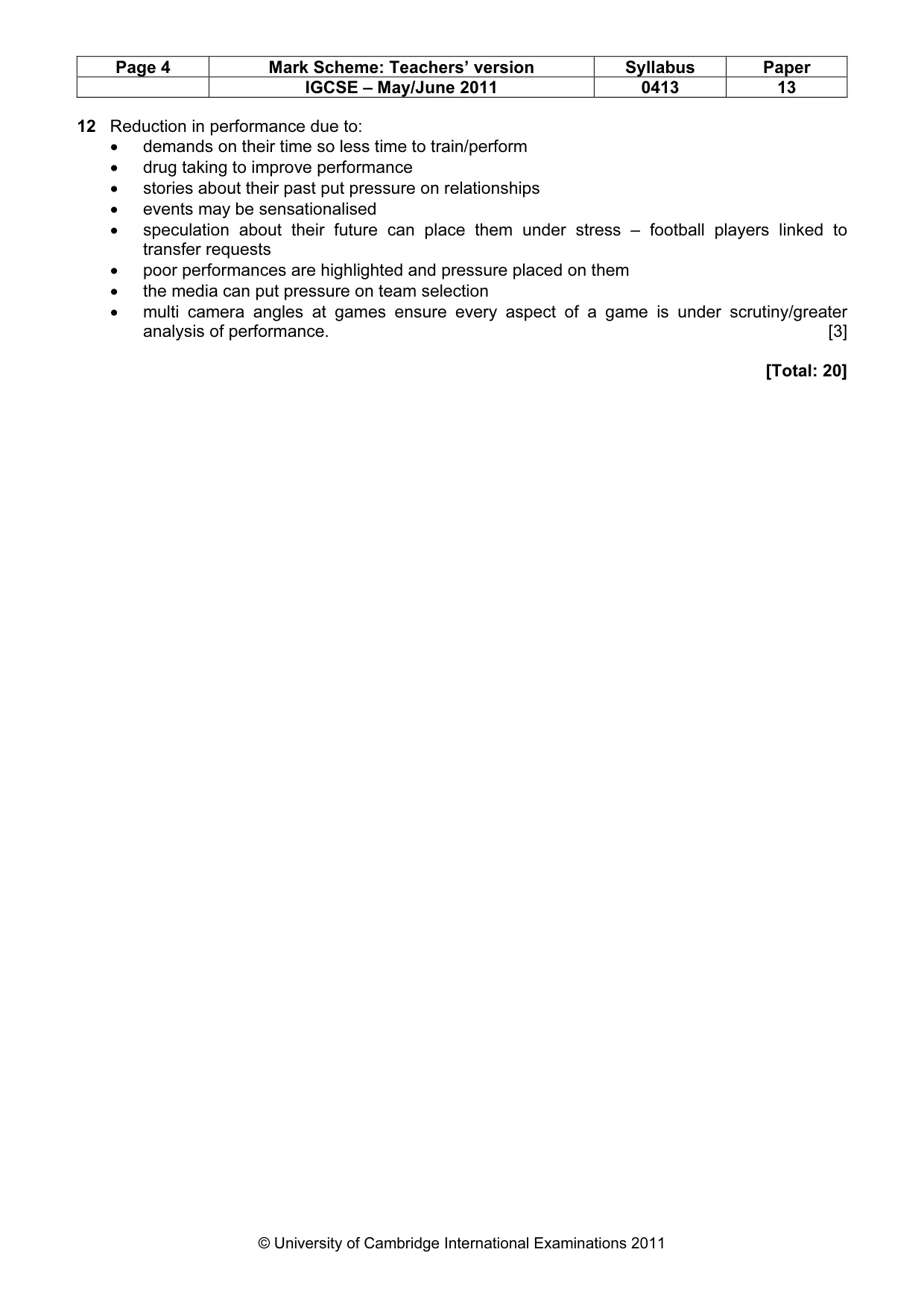
Page 4 Mark Scheme: Teachers’ version Syllabus Paper IGCSE – May/June 2011 0413 13 © University of Cambridge International Examinations 2011 12 Reduction in performance due to: • demands on their time so less time to train/perform • drug taking to improve performance • stories about their past put pressure on relationships • events may be sensationalised • speculation about their future can place them under stress – football players linked to transfer requests • poor performances are highlighted and pressure placed on them • the media can put pressure on team selection • multi camera angles at games ensure every aspect of a game is under scrutiny/greater analysis of performance. [3] [Total: 20]
Mark scheme, page 5
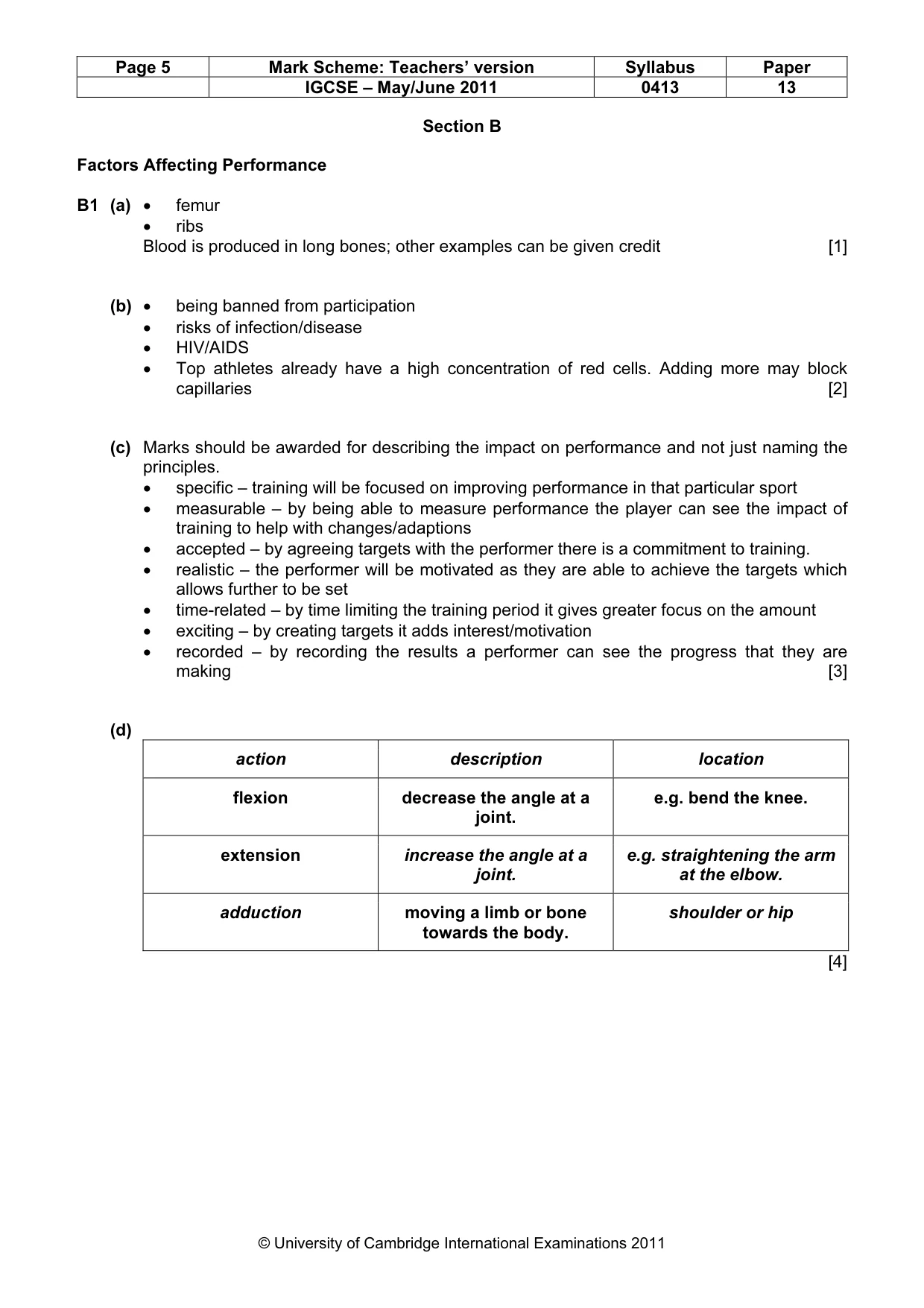
Page 5 Mark Scheme: Teachers’ version Syllabus Paper IGCSE – May/June 2011 0413 13 © University of Cambridge International Examinations 2011 Section B Factors Affecting Performance B1 (a) • femur • ribs Blood is produced in long bones; other examples can be given credit [1] (b) • being banned from participation • risks of infection/disease • HIV/AIDS • Top athletes already have a high concentration of red cells. Adding more may block capillaries [2] (c) Marks should be awarded for describing the impact on performance and not just naming the principles. • specific – training will be focused on improving performance in that particular sport • measurable – by being able to measure performance the player can see the impact of training to help with changes/adaptions • accepted – by agreeing targets with the performer there is a commitment to training. • realistic – the performer will be motivated as they are able to achieve the targets which allows further to be set • time-related – by time limiting the training period it gives greater focus on the amount • exciting – by creating targets it adds interest/motivation • recorded – by recording the results a performer can see the progress that they are making [3] (d) action description location flexion decrease the angle at a joint. e.g. bend the knee. extension increase the angle at a joint. e.g. straightening the arm at the elbow. adduction moving a limb or bone towards the body. shoulder or hip [4]
Mark scheme, page 6
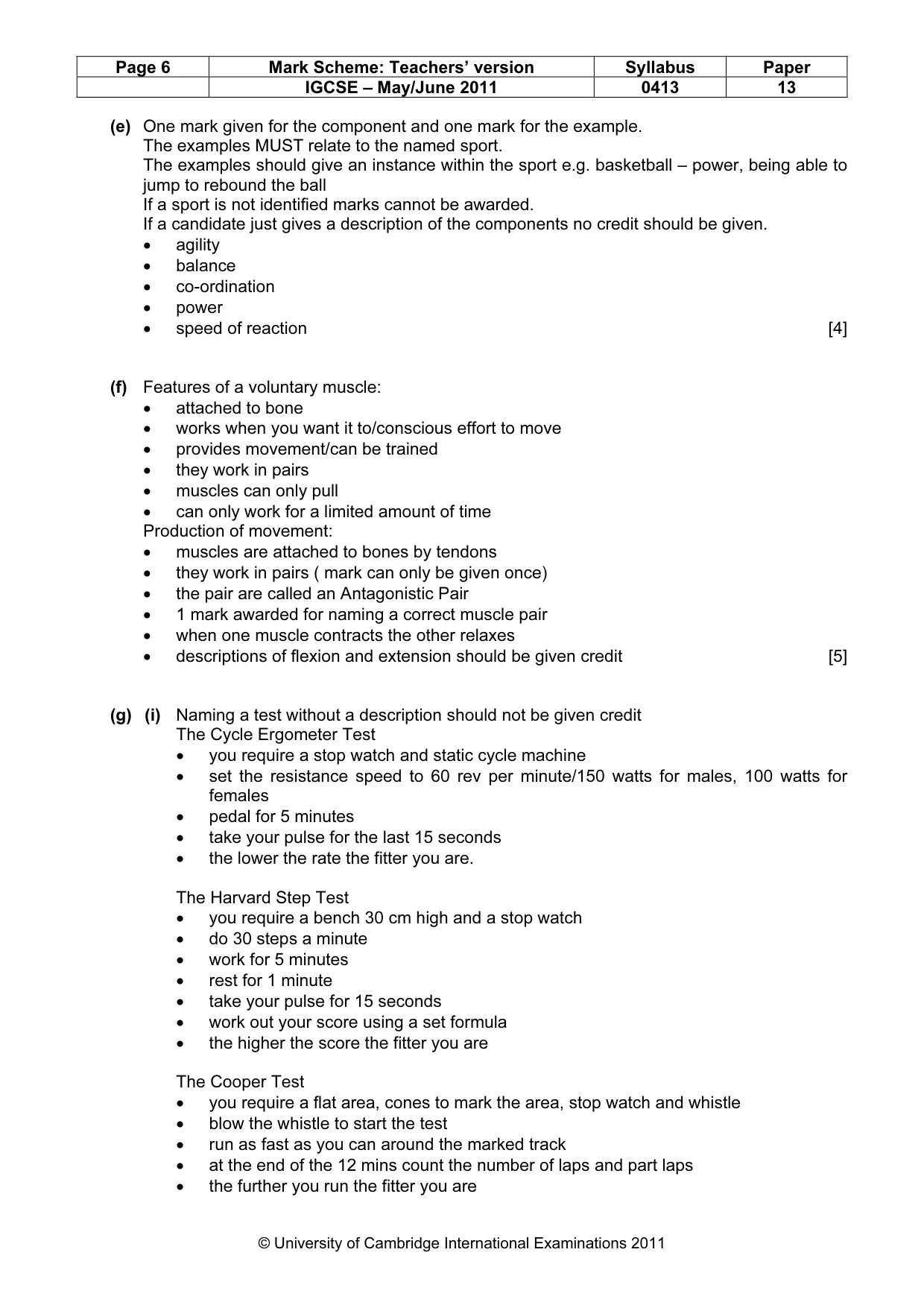
Page 6 Mark Scheme: Teachers’ version Syllabus Paper IGCSE – May/June 2011 0413 13 © University of Cambridge International Examinations 2011 (e) One mark given for the component and one mark for the example. The examples MUST relate to the named sport. The examples should give an instance within the sport e.g. basketball – power, being able to jump to rebound the ball If a sport is not identified marks cannot be awarded. If a candidate just gives a description of the components no credit should be given. • agility • balance • co-ordination • power • speed of reaction [4] (f) Features of a voluntary muscle: • attached to bone • works when you want it to/conscious effort to move • provides movement/can be trained • they work in pairs • muscles can only pull • can only work for a limited amount of time Production of movement: • muscles are attached to bones by tendons • they work in pairs ( mark can only be given once) • the pair are called an Antagonistic Pair • 1 mark awarded for naming a correct muscle pair • when one muscle contracts the other relaxes • descriptions of flexion and extension should be given credit [5] (g) (i) Naming a test without a description should not be given credit The Cycle Ergometer Test • you require a stop watch and static cycle machine • set the resistance speed to 60 rev per minute/150 watts for males, 100 watts for females • pedal for 5 minutes • take your pulse for the last 15 seconds • the lower the rate the fitter you are. The Harvard Step Test • you require a bench 30 cm high and a stop watch • do 30 steps a minute • work for 5 minutes • rest for 1 minute • take your pulse for 15 seconds • work out your score using a set formula • the higher the score the fitter you are The Cooper Test • you require a flat area, cones to mark the area, stop watch and whistle • blow the whistle to start the test • run as fast as you can around the marked track • at the end of the 12 mins count the number of laps and part laps • the further you run the fitter you are
Mark scheme, page 7
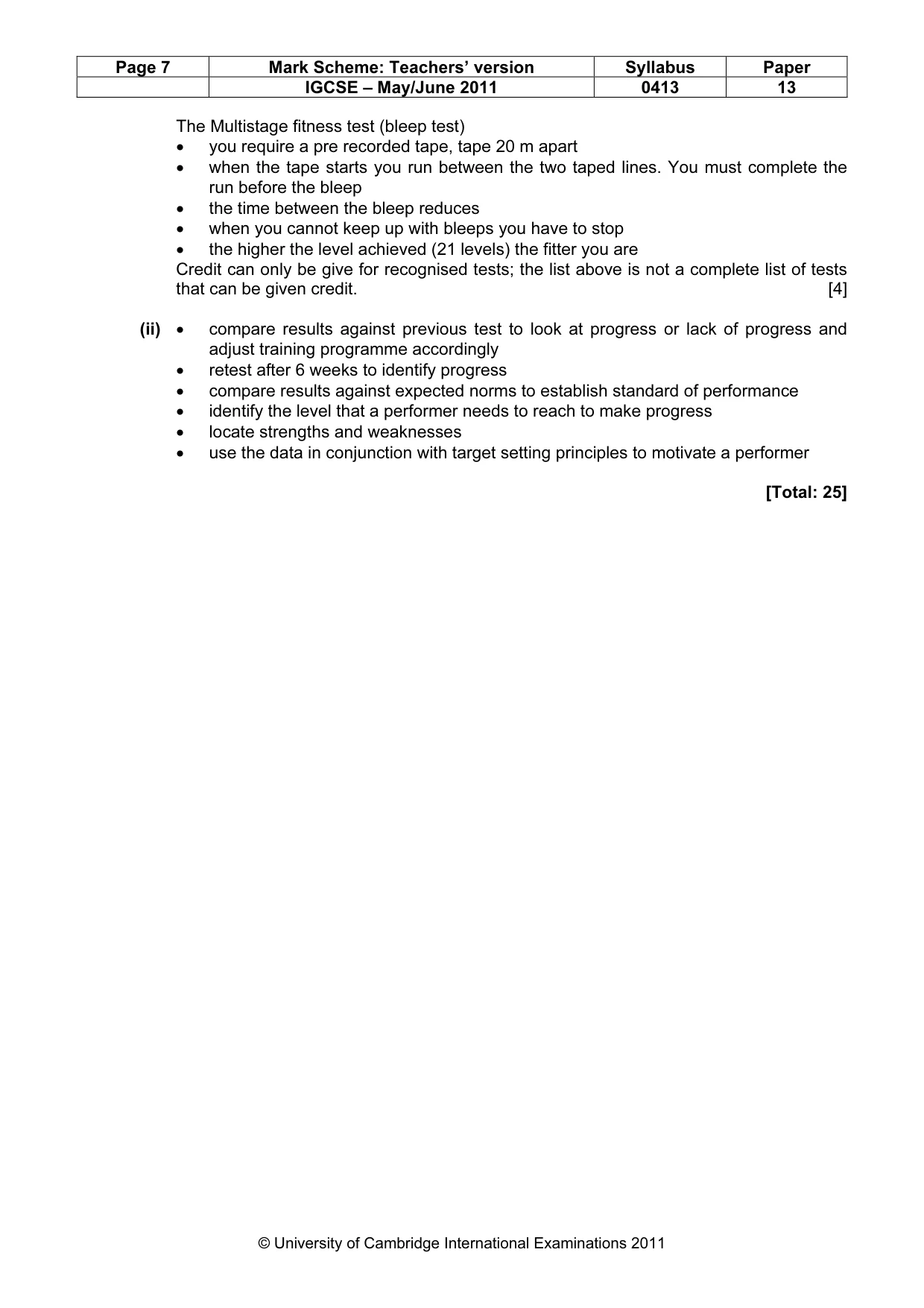
Page 7 Mark Scheme: Teachers’ version Syllabus Paper IGCSE – May/June 2011 0413 13 © University of Cambridge International Examinations 2011 The Multistage fitness test (bleep test) • you require a pre recorded tape, tape 20 m apart • when the tape starts you run between the two taped lines. You must complete the run before the bleep • the time between the bleep reduces • when you cannot keep up with bleeps you have to stop • the higher the level achieved (21 levels) the fitter you are Credit can only be give for recognised tests; the list above is not a complete list of tests that can be given credit. [4] (ii) • compare results against previous test to look at progress or lack of progress and adjust training programme accordingly • retest after 6 weeks to identify progress • compare results against expected norms to establish standard of performance • identify the level that a performer needs to reach to make progress • locate strengths and weaknesses • use the data in conjunction with target setting principles to motivate a performer [Total: 25]
Mark scheme, page 8
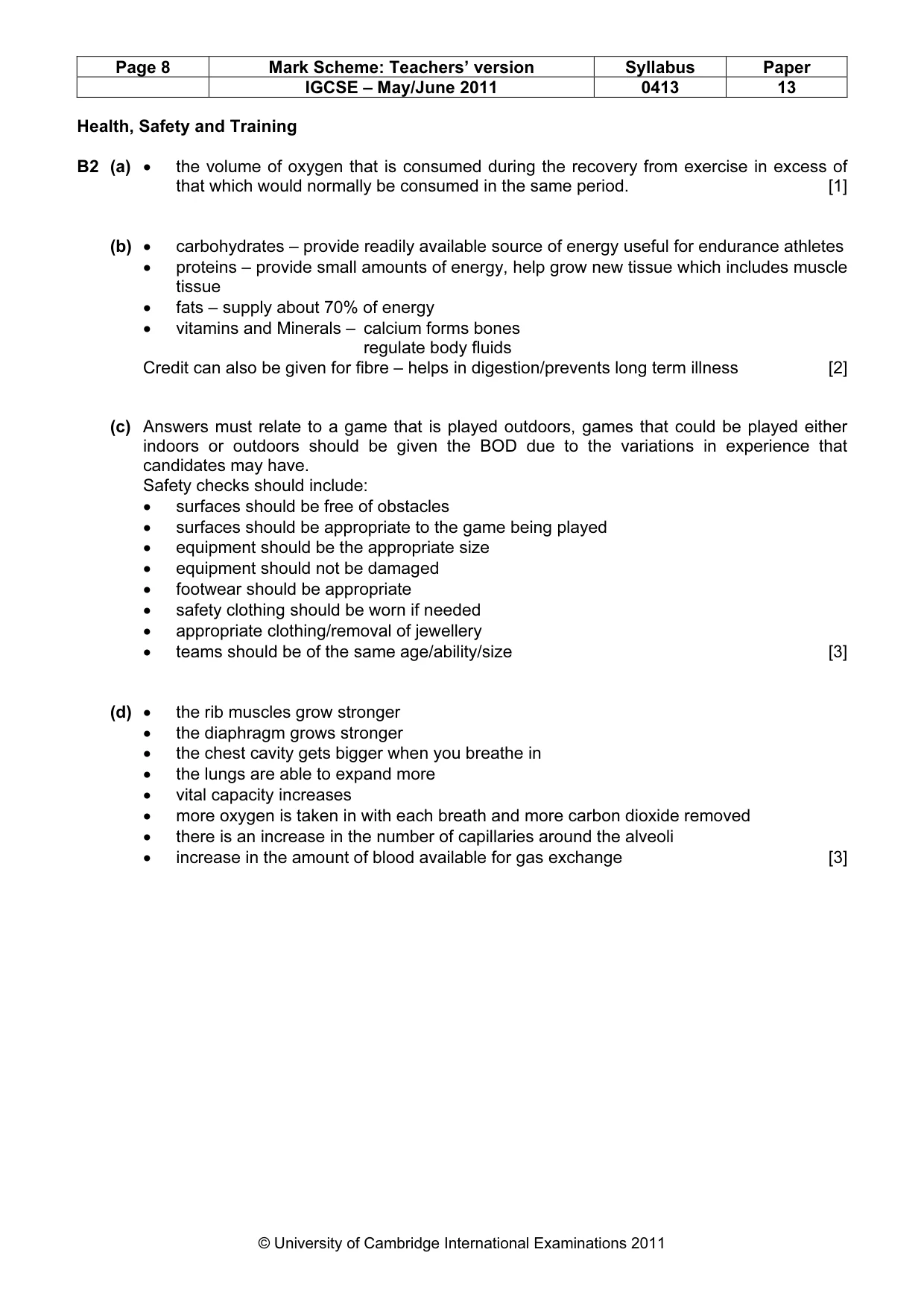
Page 8 Mark Scheme: Teachers’ version Syllabus Paper IGCSE – May/June 2011 0413 13 © University of Cambridge International Examinations 2011 Health, Safety and Training B2 (a) • the volume of oxygen that is consumed during the recovery from exercise in excess of that which would normally be consumed in the same period. [1] (b) • carbohydrates – provide readily available source of energy useful for endurance athletes • proteins – provide small amounts of energy, help grow new tissue which includes muscle tissue • fats – supply about 70% of energy • vitamins and Minerals – calcium forms bones regulate body fluids Credit can also be given for fibre – helps in digestion/prevents long term illness [2] (c) Answers must relate to a game that is played outdoors, games that could be played either indoors or outdoors should be given the BOD due to the variations in experience that candidates may have. Safety checks should include: • surfaces should be free of obstacles • surfaces should be appropriate to the game being played • equipment should be the appropriate size • equipment should not be damaged • footwear should be appropriate • safety clothing should be worn if needed • appropriate clothing/removal of jewellery • teams should be of the same age/ability/size [3] (d) • the rib muscles grow stronger • the diaphragm grows stronger • the chest cavity gets bigger when you breathe in • the lungs are able to expand more • vital capacity increases • more oxygen is taken in with each breath and more carbon dioxide removed • there is an increase in the number of capillaries around the alveoli • increase in the amount of blood available for gas exchange [3]
Mark scheme, page 9
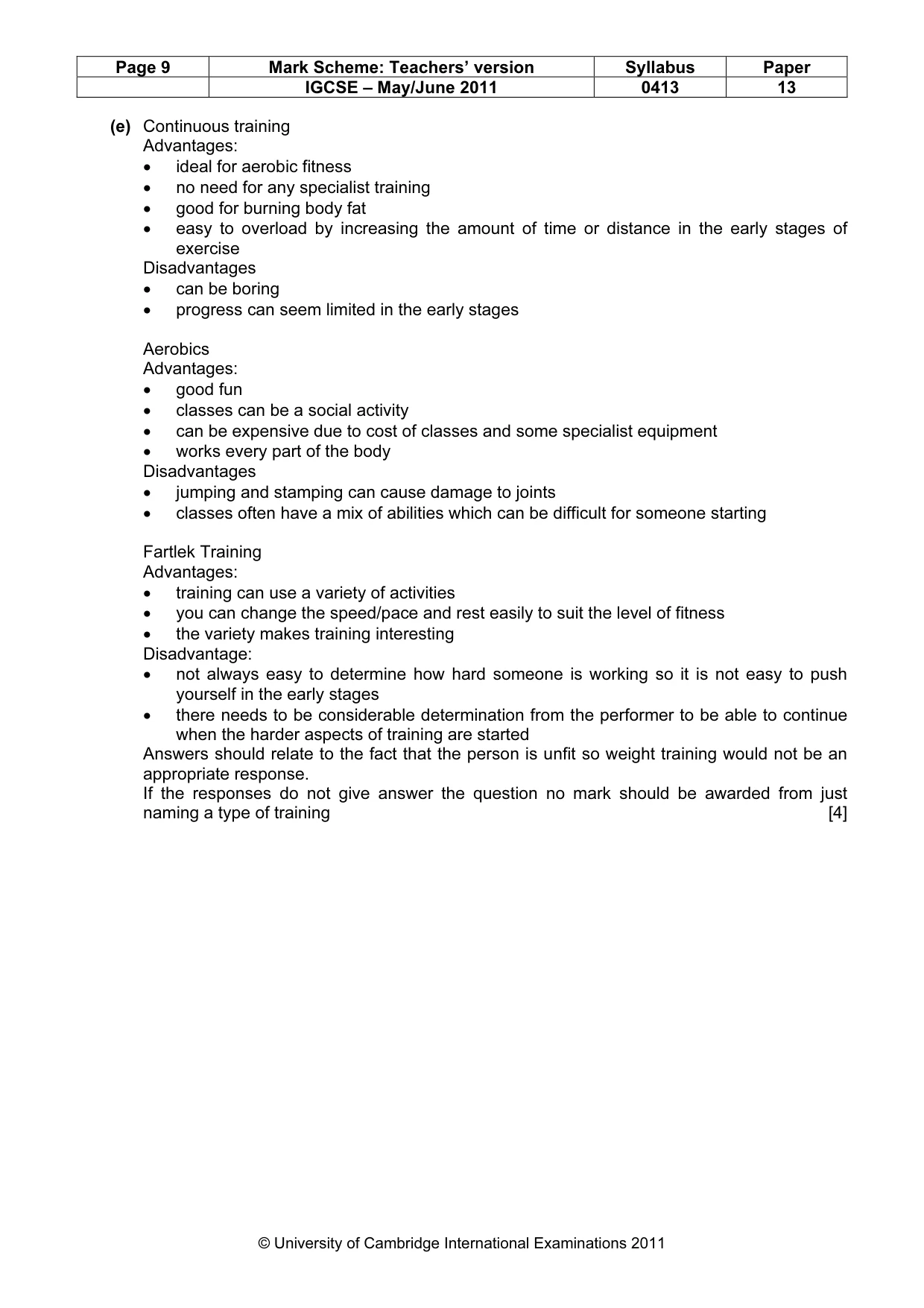
Page 9 Mark Scheme: Teachers’ version Syllabus Paper IGCSE – May/June 2011 0413 13 © University of Cambridge International Examinations 2011 (e) Continuous training Advantages: • ideal for aerobic fitness • no need for any specialist training • good for burning body fat • easy to overload by increasing the amount of time or distance in the early stages of exercise Disadvantages • can be boring • progress can seem limited in the early stages Aerobics Advantages: • good fun • classes can be a social activity • can be expensive due to cost of classes and some specialist equipment • works every part of the body Disadvantages • jumping and stamping can cause damage to joints • classes often have a mix of abilities which can be difficult for someone starting Fartlek Training Advantages: • training can use a variety of activities • you can change the speed/pace and rest easily to suit the level of fitness • the variety makes training interesting Disadvantage: • not always easy to determine how hard someone is working so it is not easy to push yourself in the early stages • there needs to be considerable determination from the performer to be able to continue when the harder aspects of training are started Answers should relate to the fact that the person is unfit so weight training would not be an appropriate response. If the responses do not give answer the question no mark should be awarded from just naming a type of training [4]
Mark scheme, page 10
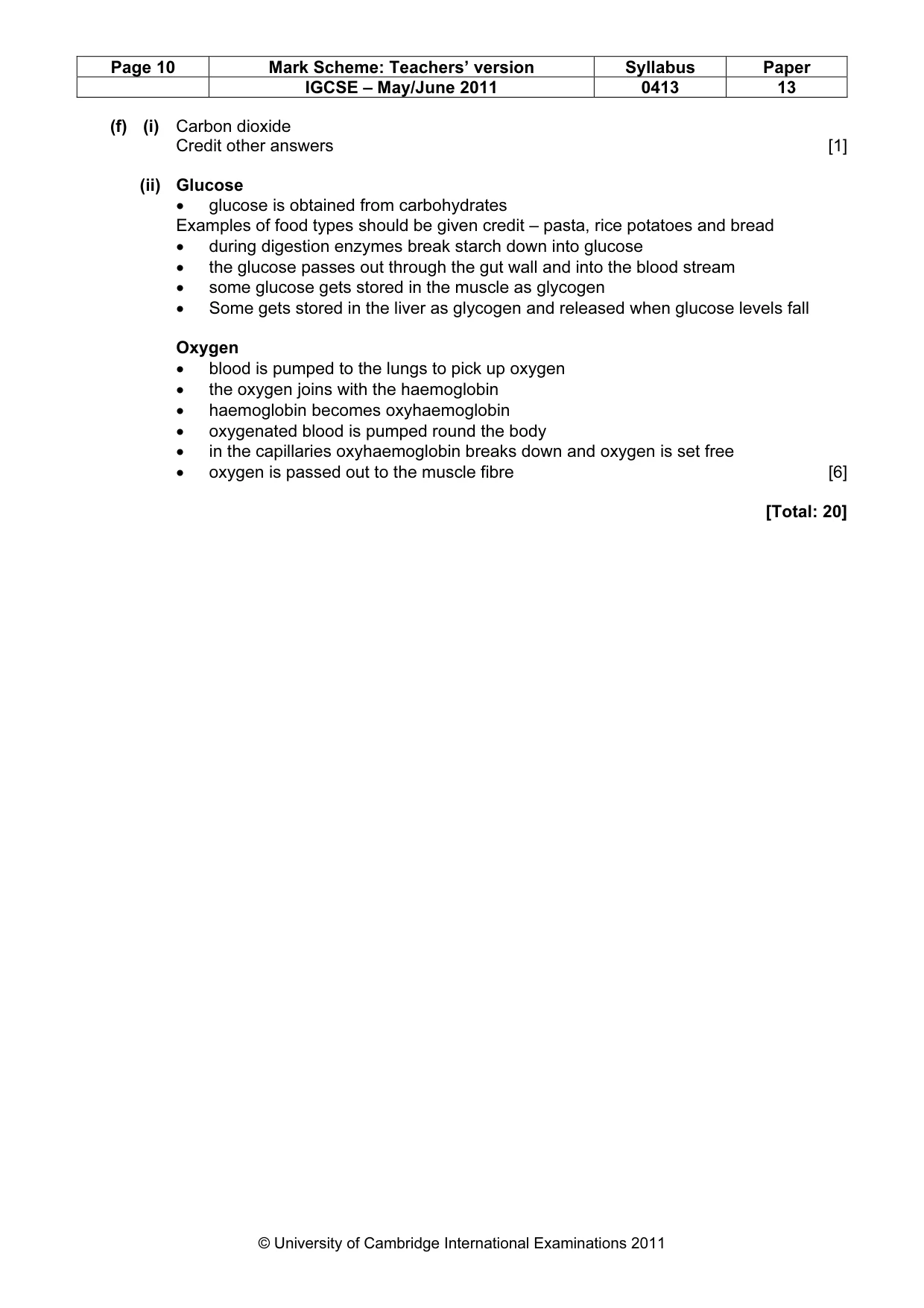
Page 10 Mark Scheme: Teachers’ version Syllabus Paper IGCSE – May/June 2011 0413 13 © University of Cambridge International Examinations 2011 (f) (i) Carbon dioxide Credit other answers [1] (ii) Glucose • glucose is obtained from carbohydrates Examples of food types should be given credit – pasta, rice potatoes and bread • during digestion enzymes break starch down into glucose • the glucose passes out through the gut wall and into the blood stream • some glucose gets stored in the muscle as glycogen • Some gets stored in the liver as glycogen and released when glucose levels fall Oxygen • blood is pumped to the lungs to pick up oxygen • the oxygen joins with the haemoglobin • haemoglobin becomes oxyhaemoglobin • oxygenated blood is pumped round the body • in the capillaries oxyhaemoglobin breaks down and oxygen is set free • oxygen is passed out to the muscle fibre [6] [Total: 20]
Mark scheme, page 11
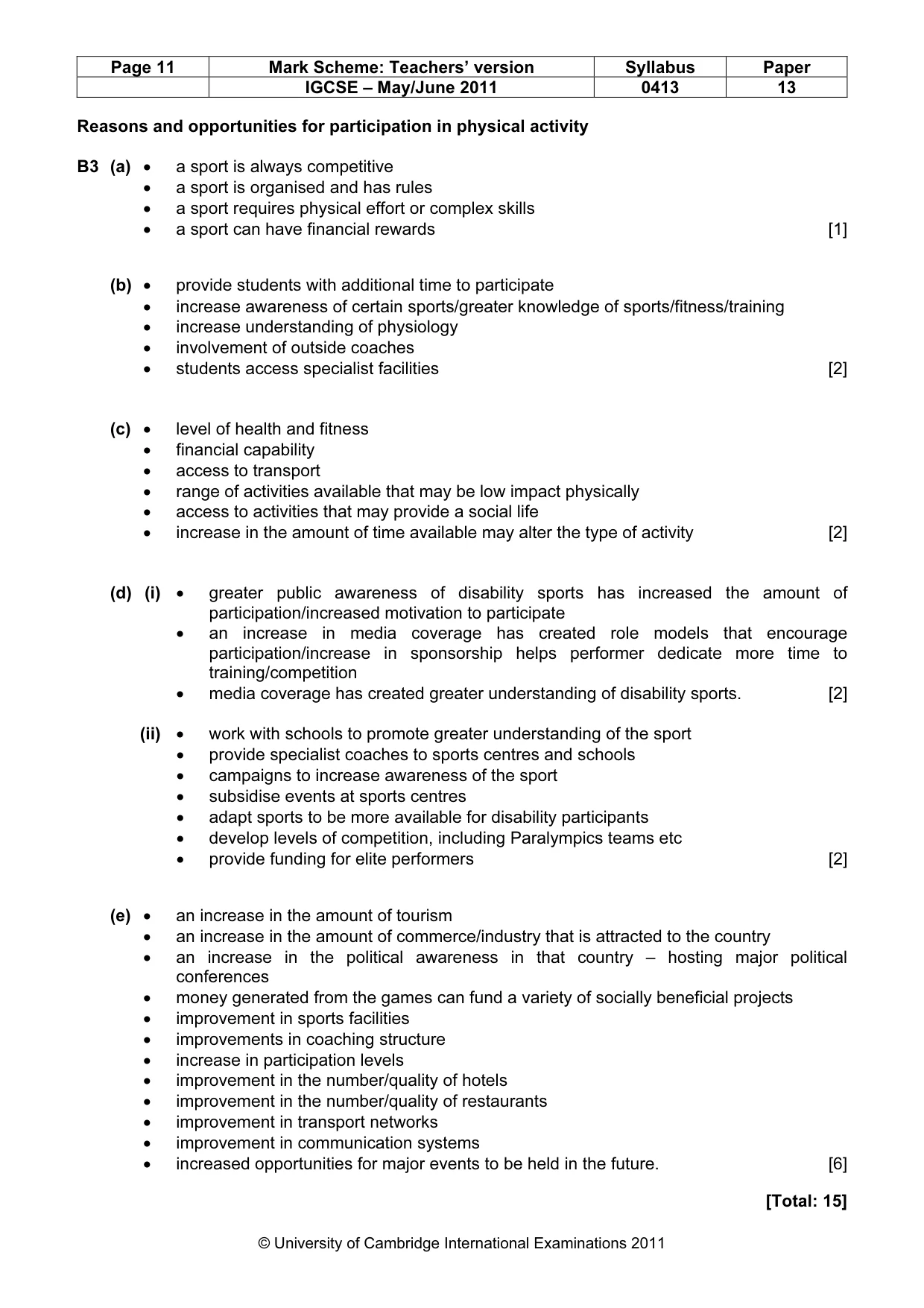
Page 11 Mark Scheme: Teachers’ version Syllabus Paper IGCSE – May/June 2011 0413 13 © University of Cambridge International Examinations 2011 Reasons and opportunities for participation in physical activity B3 (a) • a sport is always competitive • a sport is organised and has rules • a sport requires physical effort or complex skills • a sport can have financial rewards [1] (b) • provide students with additional time to participate • increase awareness of certain sports/greater knowledge of sports/fitness/training • increase understanding of physiology • involvement of outside coaches • students access specialist facilities [2] (c) • level of health and fitness • financial capability • access to transport • range of activities available that may be low impact physically • access to activities that may provide a social life • increase in the amount of time available may alter the type of activity [2] (d) (i) • greater public awareness of disability sports has increased the amount of participation/increased motivation to participate • an increase in media coverage has created role models that encourage participation/increase in sponsorship helps performer dedicate more time to training/competition • media coverage has created greater understanding of disability sports. [2] (ii) • work with schools to promote greater understanding of the sport • provide specialist coaches to sports centres and schools • campaigns to increase awareness of the sport • subsidise events at sports centres • adapt sports to be more available for disability participants • develop levels of competition, including Paralympics teams etc • provide funding for elite performers [2] (e) • an increase in the amount of tourism • an increase in the amount of commerce/industry that is attracted to the country • an increase in the political awareness in that country – hosting major political conferences • money generated from the games can fund a variety of socially beneficial projects • improvement in sports facilities • improvements in coaching structure • increase in participation levels • improvement in the number/quality of hotels • improvement in the number/quality of restaurants • improvement in transport networks • improvement in communication systems • increased opportunities for major events to be held in the future. [6] [Total: 15]
What you needed in this session
Cambridge’s own grade thresholds for 2011 May/June, Paper 1 · Variant 3. A higher threshold means an easier paper — the bar moves with how the cohort did.