Cambridge IGCSE Physical Education 0413 — 2011 May/June Paper 1 · Variant 1
0413/11/M/J/11 · 80 marks · ≈90 min
The question paper and its mark scheme, free to read here and free to download. This is Cambridge’s own paper, exactly as it was sat.
Question paper12 pages

Mark scheme11 pages
Answers below. Sit the paper first if you are practising.

Paper as text
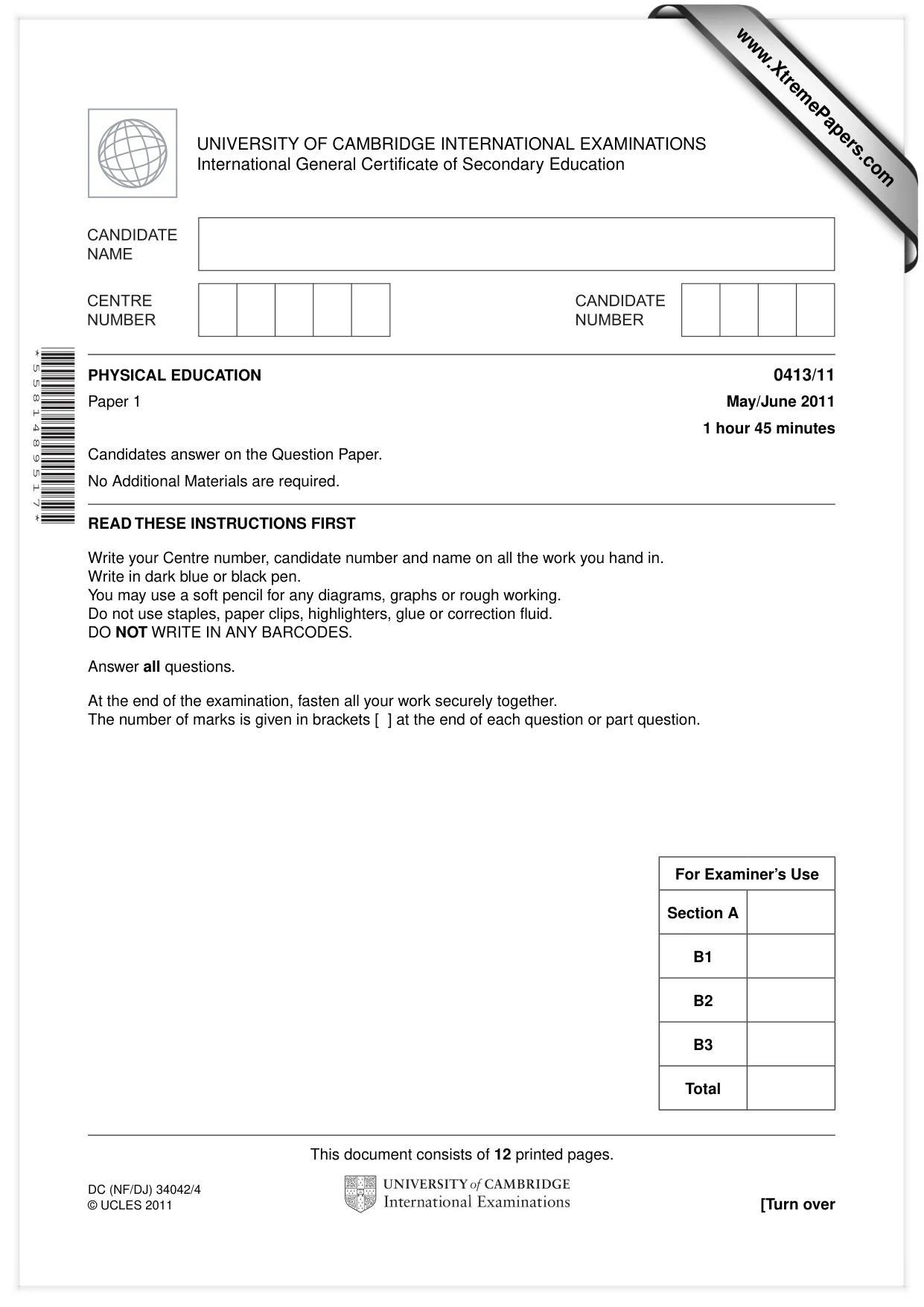
Question paper, page 1
This document consists of 12 printed pages. DC (NF/DJ) 34042/4 © UCLES 2011 [Turn over UNIVERSITY OF CAMBRIDGE INTERNATIONAL EXAMINATIONS International General Certificate of Secondary Education * 5 5 8 1 4 8 9 5 1 7 * PHYSICAL EDUCATION 0413/11 Paper 1 May/June 2011 1 hour 45 minutes Candidates answer on the Question Paper. No Additional Materials are required. READ THESE INSTRUCTIONS FIRST Write your Centre number, candidate number and name on all the work you hand in. Write in dark blue or black pen. You may use a soft pencil for any diagrams, graphs or rough working. Do not use staples, paper clips, highlighters, glue or correction fluid. DO NOT WRITE IN ANY BARCODES. Answer all questions. At the end of the examination, fasten all your work securely together. The number of marks is given in brackets [ ] at the end of each question or part question. For Examiner’s Use Section A B1 B2 B3 Total www.XtremePapers.com
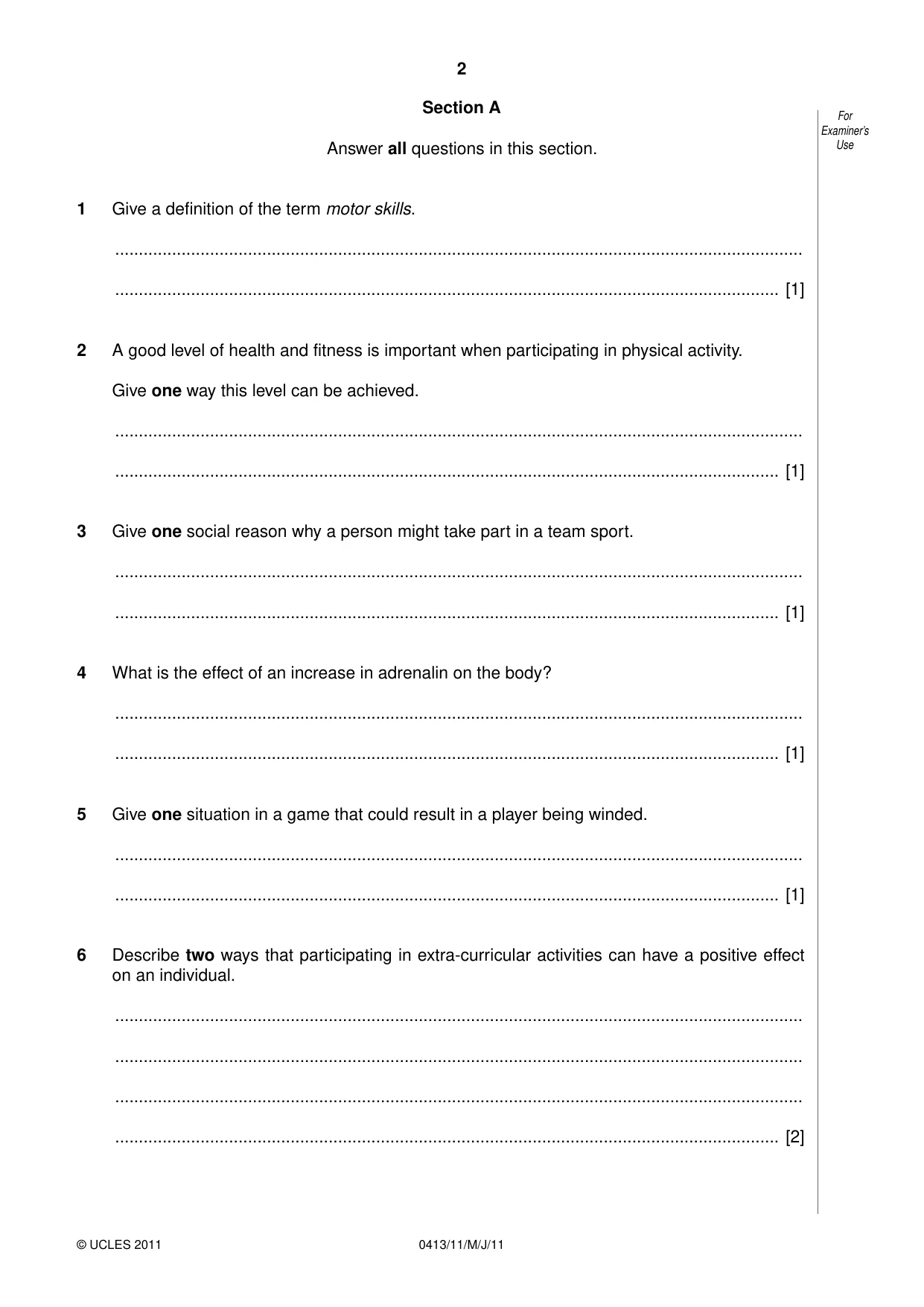
Question paper, page 2
2 0413/11/M/J/11 © UCLES 2011 For Examiner’s Use Section A Answer all questions in this section. 1 Give a definition of the term motor skills. … … [1] 2 A good level of health and fitness is important when participating in physical activity. Give one way this level can be achieved. … … [1] 3 Give one social reason why a person might take part in a team sport. … … [1] 4 What is the effect of an increase in adrenalin on the body? … … [1] 5 Give one situation in a game that could result in a player being winded. … … [1] 6 Describe two ways that participating in extra-curricular activities can have a positive effect on an individual. … … … … [2]
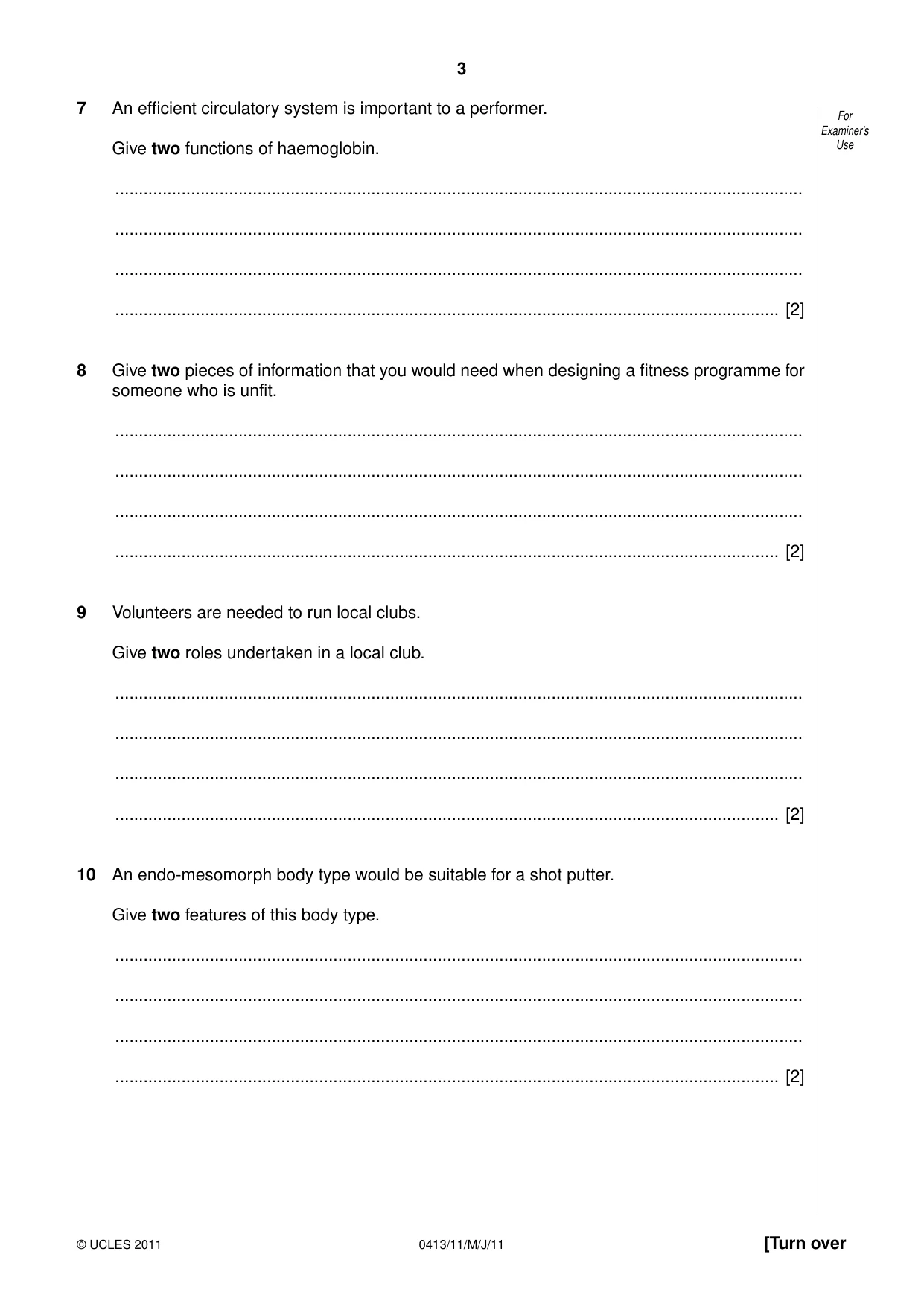
Question paper, page 3
3 0413/11/M/J/11 © UCLES 2011 [Turn over For Examiner’s Use 7 An efficient circulatory system is important to a performer. Give two functions of haemoglobin. … … … … [2] 8 Give two pieces of information that you would need when designing a fitness programme for someone who is unfit. … … … … [2] 9 Volunteers are needed to run local clubs. Give two roles undertaken in a local club. … … … … [2] 10 An endo-mesomorph body type would be suitable for a shot putter. Give two features of this body type. … … … … [2]
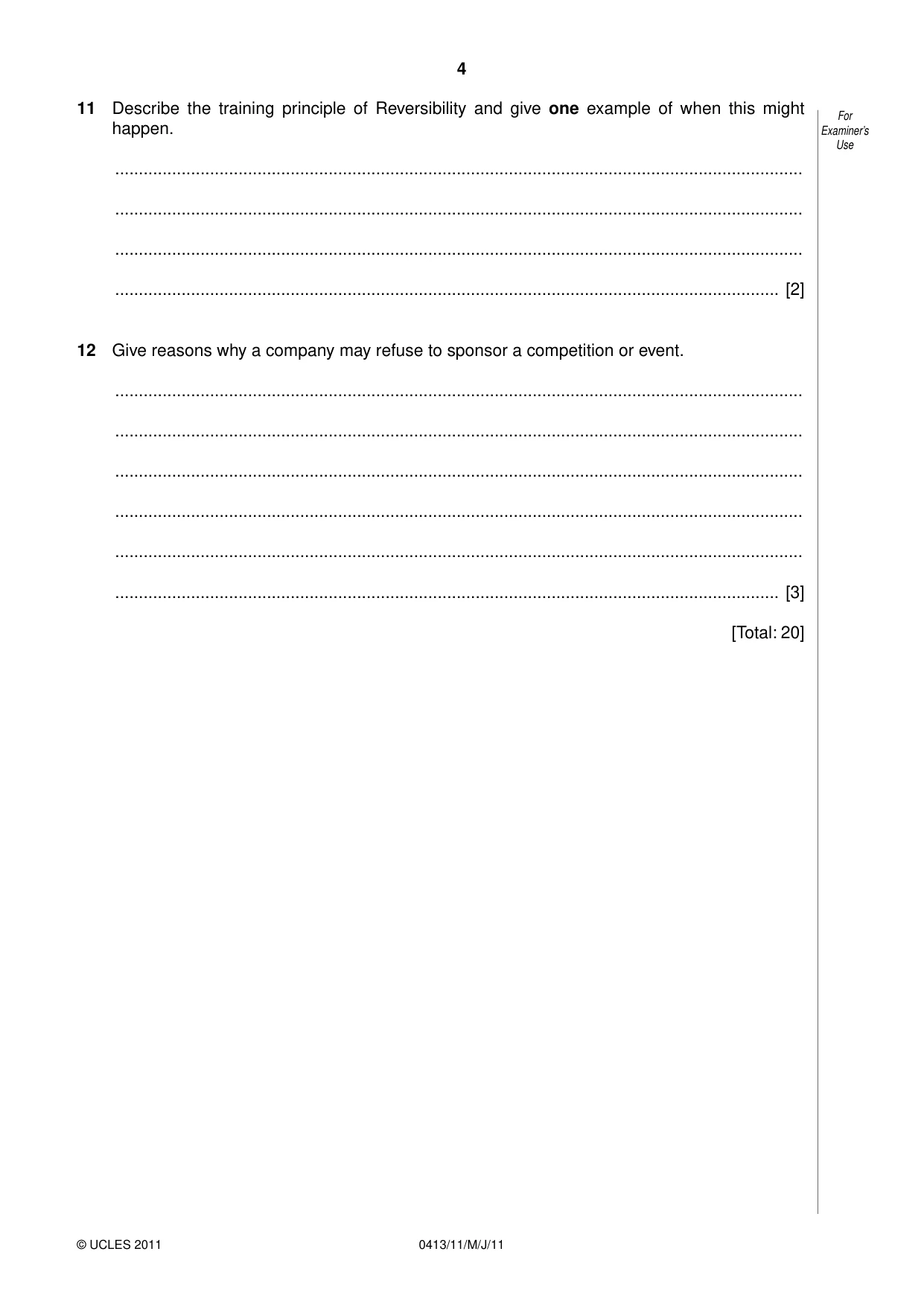
Question paper, page 4
4 0413/11/M/J/11 © UCLES 2011 For Examiner’s Use 11 Describe the training principle of Reversibility and give one example of when this might happen. … … … … [2] 12 Give reasons why a company may refuse to sponsor a competition or event. … … … … … … [3] [Total: 20]
Question paper, page 5
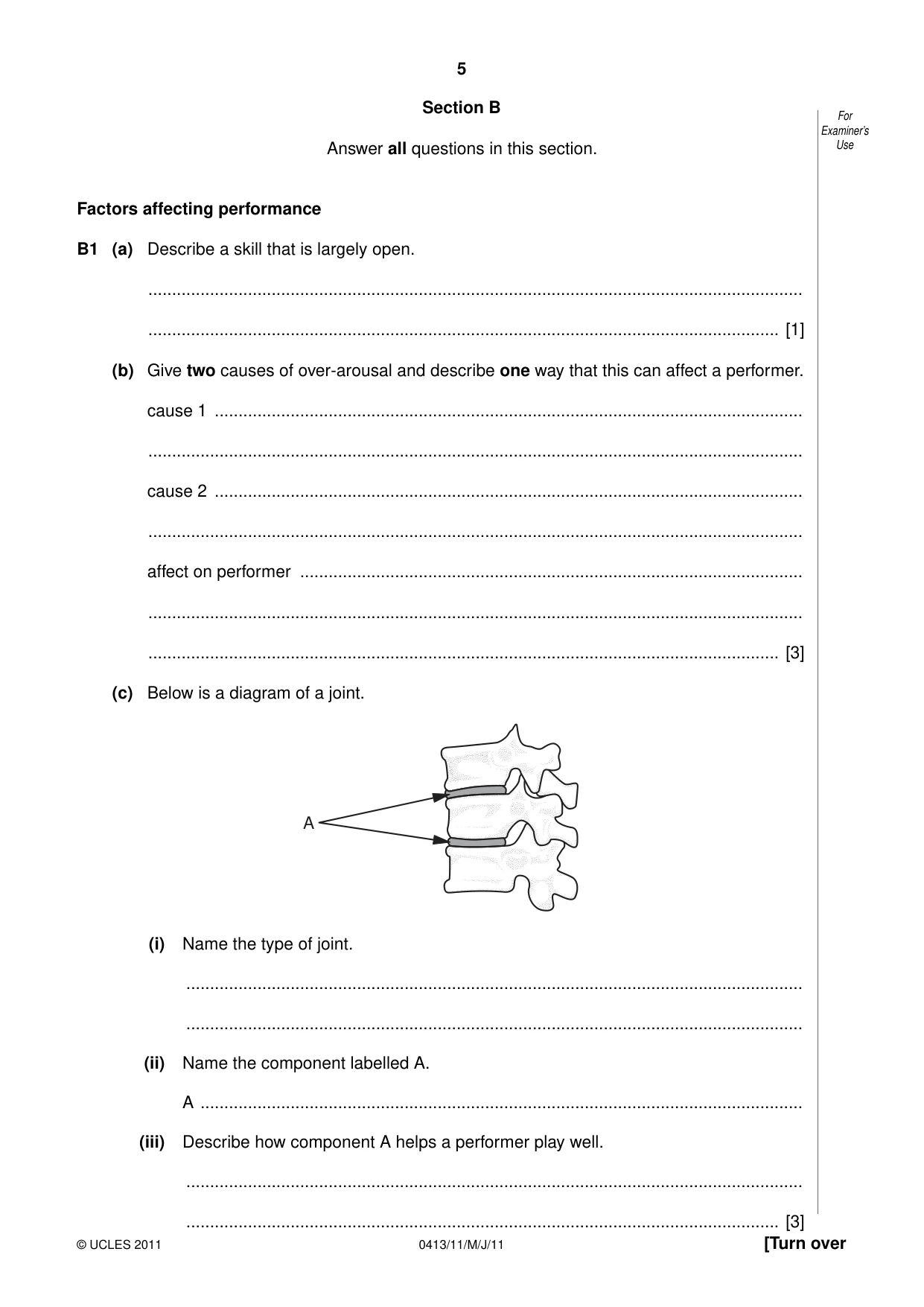
5 0413/11/M/J/11 © UCLES 2011 [Turn over For Examiner’s Use Section B Answer all questions in this section. Factors affecting performance B1 (a) Describe a skill that is largely open. … … [1] (b) Give two causes of over-arousal and describe one way that this can affect a performer. cause 1 … … cause 2 … … affect on performer … … … [3] (c) Below is a diagram of a joint. A (i) Name the type of joint. … … (ii) Name the component labelled A. A … (iii) Describe how component A helps a performer play well. … … [3]
Question paper, page 6
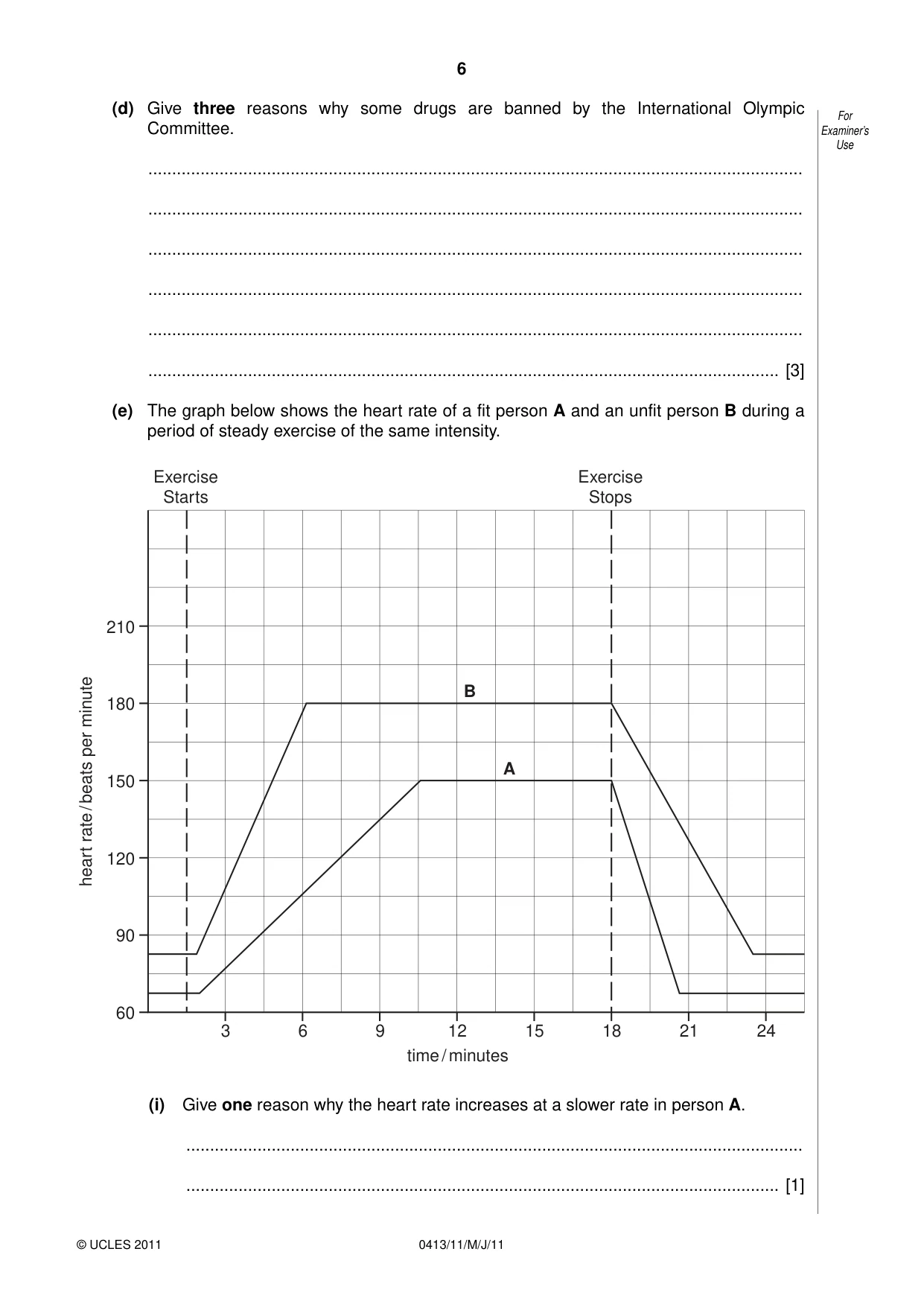
6 0413/11/M/J/11 © UCLES 2011 For Examiner’s Use (d) Give three reasons why some drugs are banned by the International Olympic Committee. … … … … … … [3] (e) The graph below shows the heart rate of a fit person A and an unfit person B during a period of steady exercise of the same intensity. 210 180 150 120 90 60 3 6 9 12 15 18 21 24 heart rate / beats per minute time / minutes A B Exercise Starts Exercise Stops (i) Give one reason why the heart rate increases at a slower rate in person A. … … [1]
Question paper, page 7
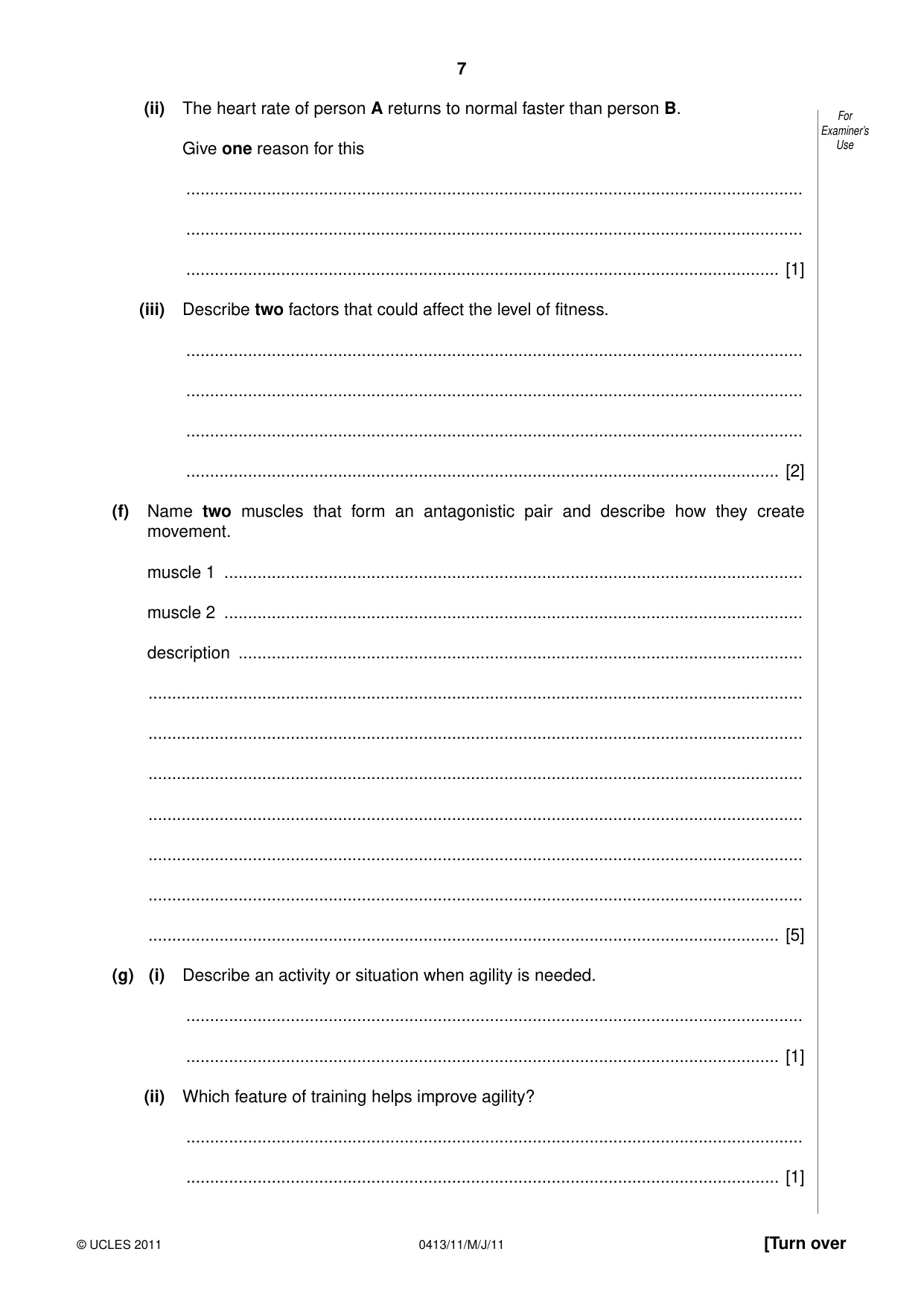
7 0413/11/M/J/11 © UCLES 2011 [Turn over For Examiner’s Use (ii) The heart rate of person A returns to normal faster than person B. Give one reason for this … … … [1] (iii) Describe two factors that could affect the level of fitness. … … … … [2] (f) Name two muscles that form an antagonistic pair and describe how they create movement. muscle 1 … muscle 2 … description … … … … … … … … [5] (g) (i) Describe an activity or situation when agility is needed. … … [1] (ii) Which feature of training helps improve agility? … … [1]
Question paper, page 8
8 0413/11/M/J/11 © UCLES 2011 For Examiner’s Use (iii) Name and describe a test that would allow progress in agility to be monitored. test name … [1] description … … … … … … [3] [Total: 25]
Question paper, page 9
9 0413/11/M/J/11 © UCLES 2011 [Turn over For Examiner’s Use Health, safety and training B2 (a) Describe how lactic acid reduces the level of performance. … … [1] (b) Explain how each of the following nutrients helps a performer. carbohydrates … … protein … … [2] (c) Describe the role of the teacher in ensuring the safe playing of a game. … … … … … … [3] (d) Describe how you would use the training principles to bring about an improvement for a performer taking part in a sprint event. … … … … … … [3]
Question paper, page 10
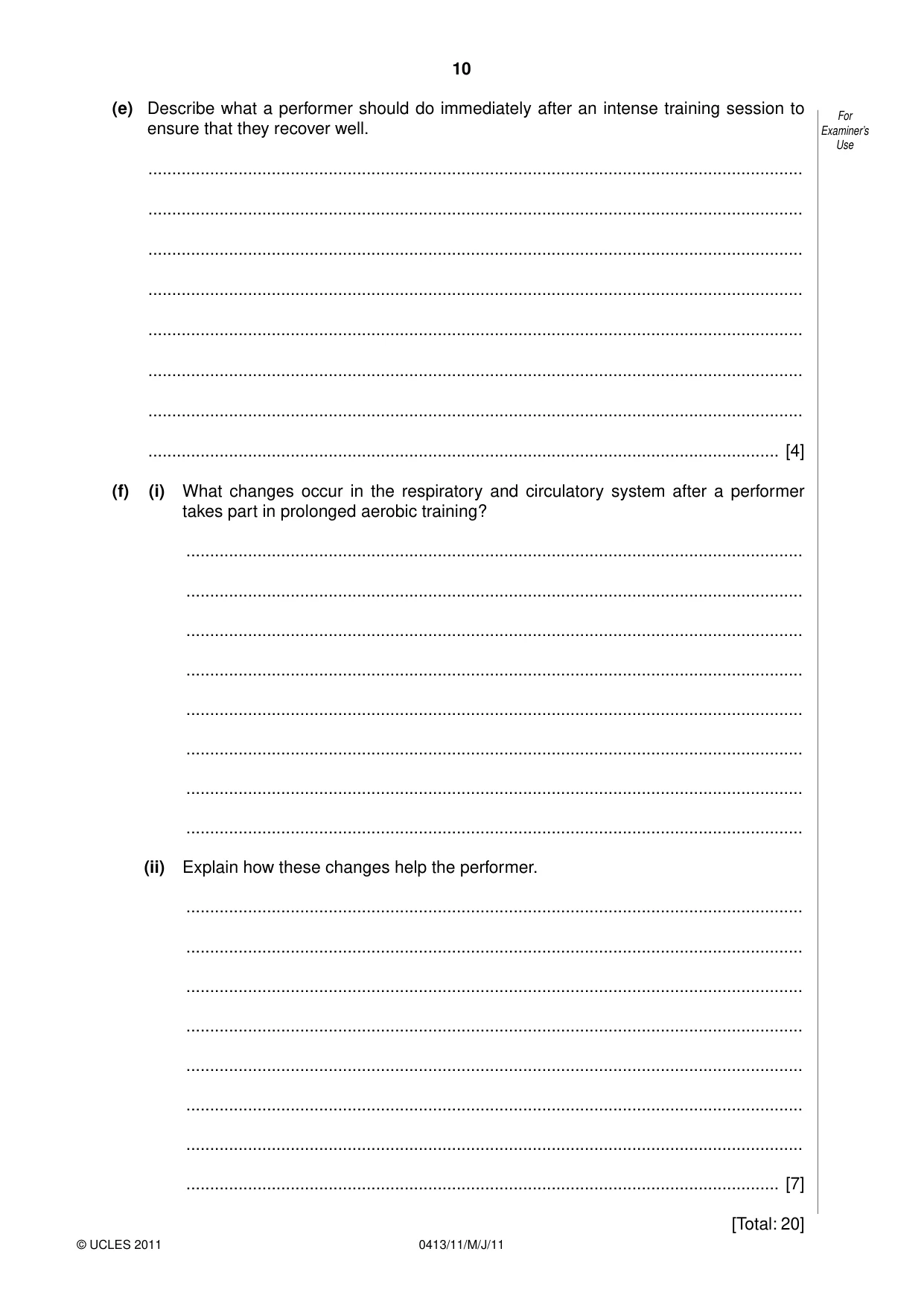
10 0413/11/M/J/11 © UCLES 2011 For Examiner’s Use (e) Describe what a performer should do immediately after an intense training session to ensure that they recover well. … … … … … … … … [4] (f) (i) What changes occur in the respiratory and circulatory system after a performer takes part in prolonged aerobic training? … … … … … … … … (ii) Explain how these changes help the performer. … … … … … … … … [7] [Total: 20]
Question paper, page 11
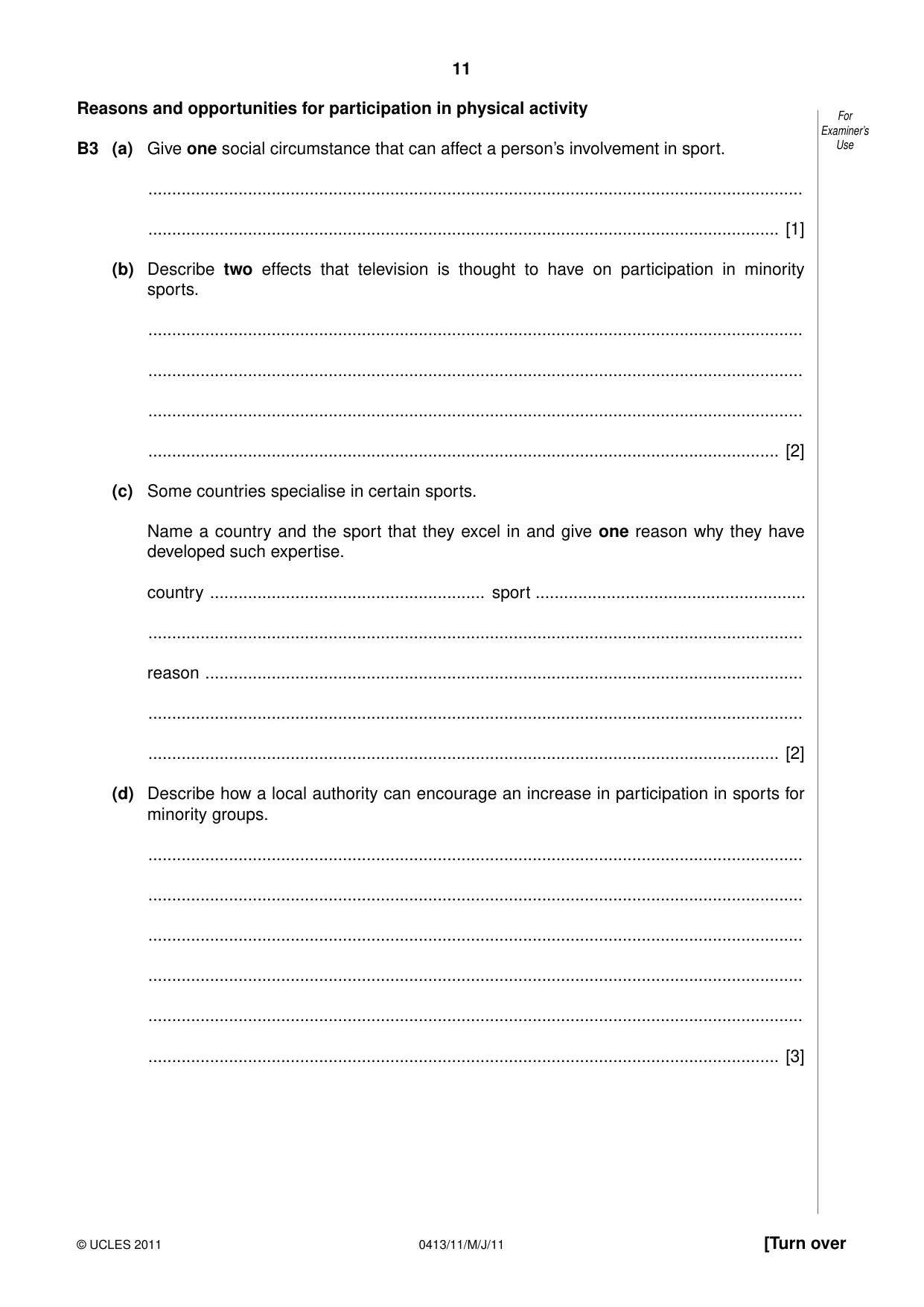
11 0413/11/M/J/11 © UCLES 2011 [Turn over For Examiner’s Use Reasons and opportunities for participation in physical activity B3 (a) Give one social circumstance that can affect a person’s involvement in sport. … … [1] (b) Describe two effects that television is thought to have on participation in minority sports. … … … … [2] (c) Some countries specialise in certain sports. Name a country and the sport that they excel in and give one reason why they have developed such expertise. country … sport … … reason … … … [2] (d) Describe how a local authority can encourage an increase in participation in sports for minority groups. … … … … … … [3]
Question paper, page 12
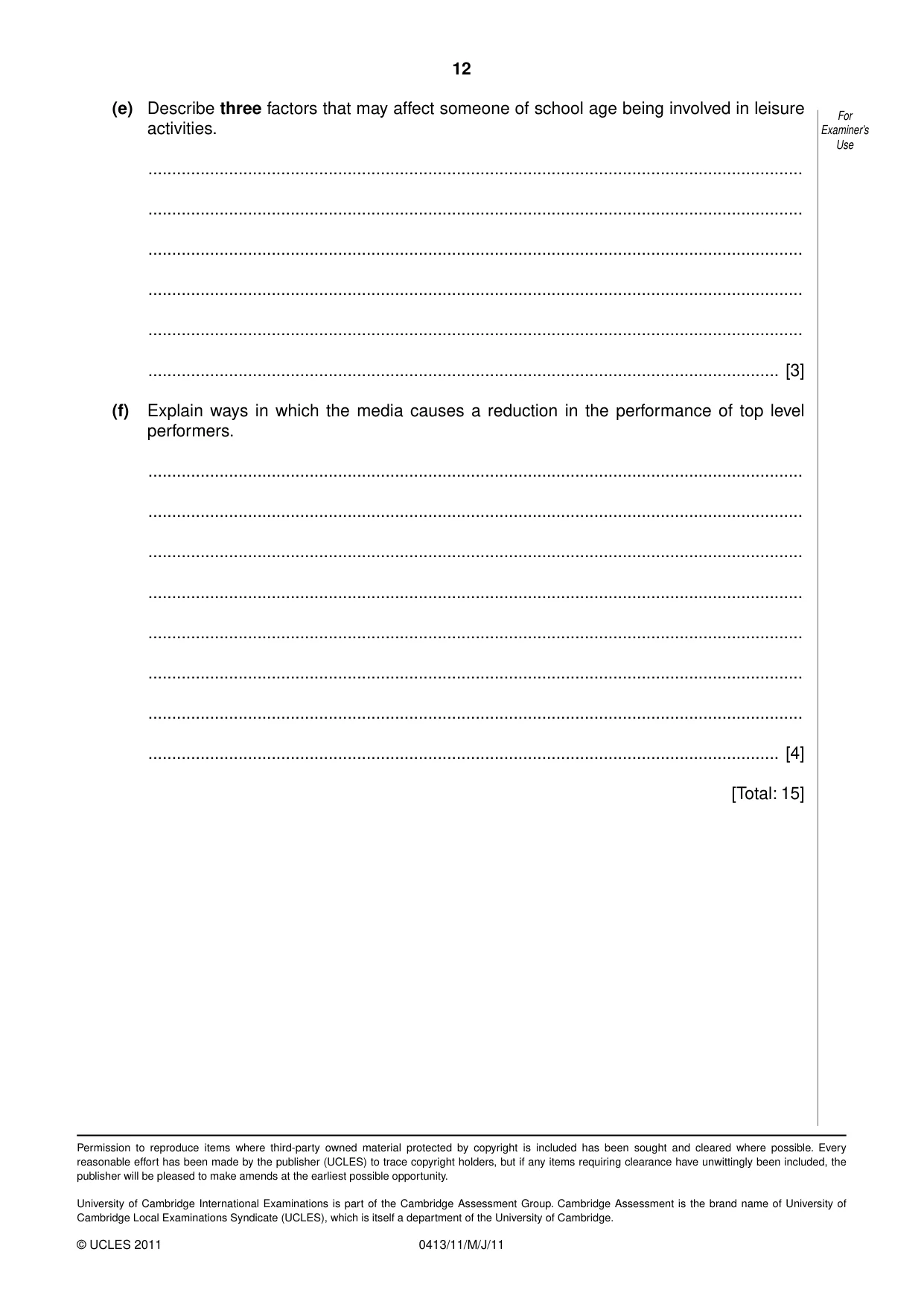
12 0413/11/M/J/11 © UCLES 2011 For Examiner’s Use Permission to reproduce items where third-party owned material protected by copyright is included has been sought and cleared where possible. Every reasonable effort has been made by the publisher (UCLES) to trace copyright holders, but if any items requiring clearance have unwittingly been included, the publisher will be pleased to make amends at the earliest possible opportunity. University of Cambridge International Examinations is part of the Cambridge Assessment Group. Cambridge Assessment is the brand name of University of Cambridge Local Examinations Syndicate (UCLES), which is itself a department of the University of Cambridge. (e) Describe three factors that may affect someone of school age being involved in leisure activities. … … … … … … [3] (f) Explain ways in which the media causes a reduction in the performance of top level performers. … … … … … … … … [4] [Total: 15]
Mark scheme, page 1
UNIVERSITY OF CAMBRIDGE INTERNATIONAL EXAMINATIONS International General Certificate of Secondary Education MARK SCHEME for the May/June 2011 question paper for the guidance of teachers 0413 PHYSICAL EDUCATION 0413/11 Paper 1, maximum raw mark 80 This mark scheme is published as an aid to teachers and candidates, to indicate the requirements of the examination. It shows the basis on which Examiners were instructed to award marks. It does not indicate the details of the discussions that took place at an Examiners’ meeting before marking began, which would have considered the acceptability of alternative answers. Mark schemes must be read in conjunction with the question papers and the report on the examination. • Cambridge will not enter into discussions or correspondence in connection with these mark schemes. Cambridge is publishing the mark schemes for the May/June 2011 question papers for most IGCSE, GCE Advanced Level and Advanced Subsidiary Level syllabuses and some Ordinary Level syllabuses. www.XtremePapers.com
Mark scheme, page 2
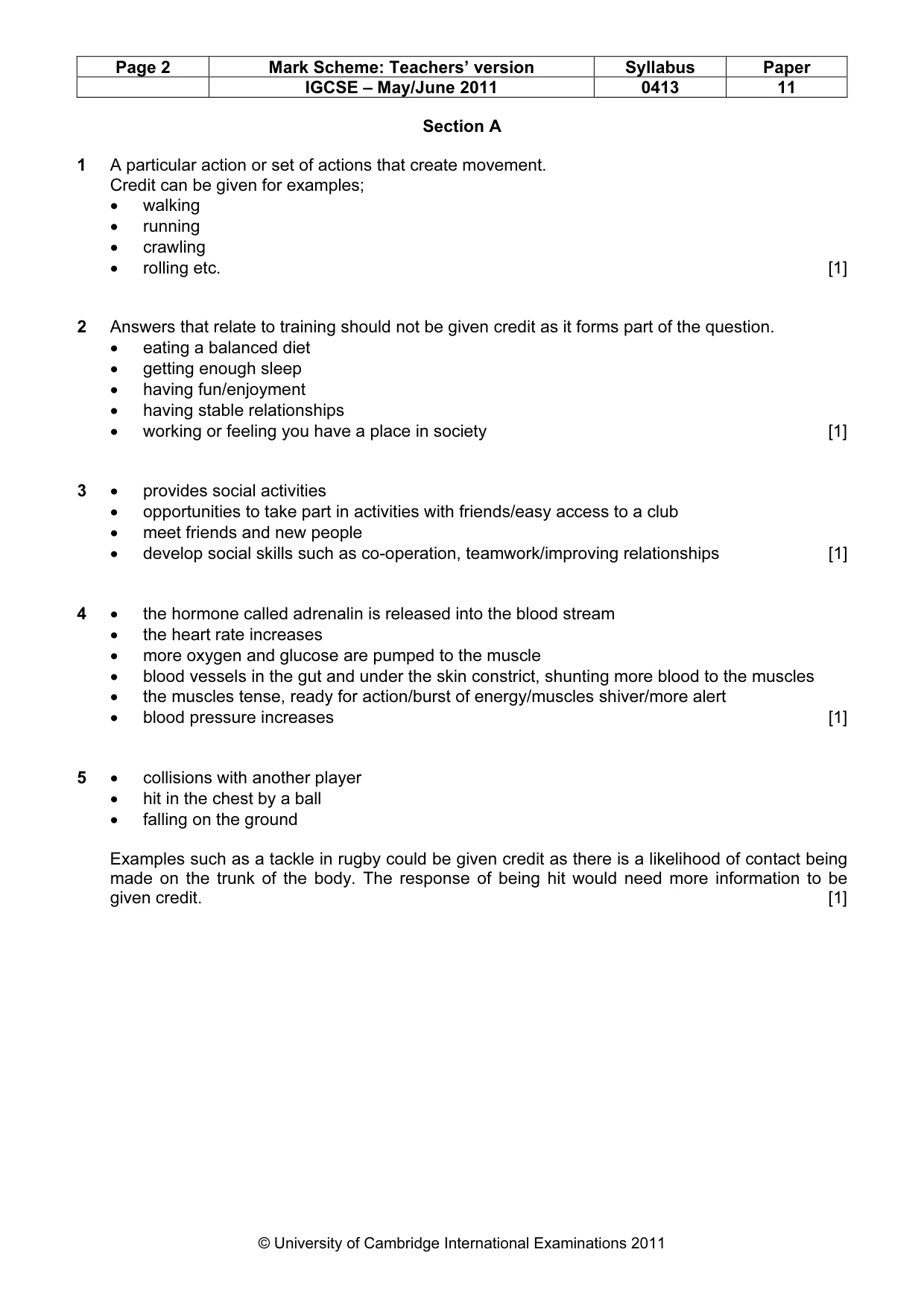
Page 2 Mark Scheme: Teachers’ version Syllabus Paper IGCSE – May/June 2011 0413 11 © University of Cambridge International Examinations 2011 Section A 1 A particular action or set of actions that create movement. Credit can be given for examples; • walking • running • crawling • rolling etc. [1] 2 Answers that relate to training should not be given credit as it forms part of the question. • eating a balanced diet • getting enough sleep • having fun/enjoyment • having stable relationships • working or feeling you have a place in society [1] 3 • provides social activities • opportunities to take part in activities with friends/easy access to a club • meet friends and new people • develop social skills such as co-operation, teamwork/improving relationships [1] 4 • the hormone called adrenalin is released into the blood stream • the heart rate increases • more oxygen and glucose are pumped to the muscle • blood vessels in the gut and under the skin constrict, shunting more blood to the muscles • the muscles tense, ready for action/burst of energy/muscles shiver/more alert • blood pressure increases [1] 5 • collisions with another player • hit in the chest by a ball • falling on the ground Examples such as a tackle in rugby could be given credit as there is a likelihood of contact being made on the trunk of the body. The response of being hit would need more information to be given credit. [1]
Mark scheme, page 3
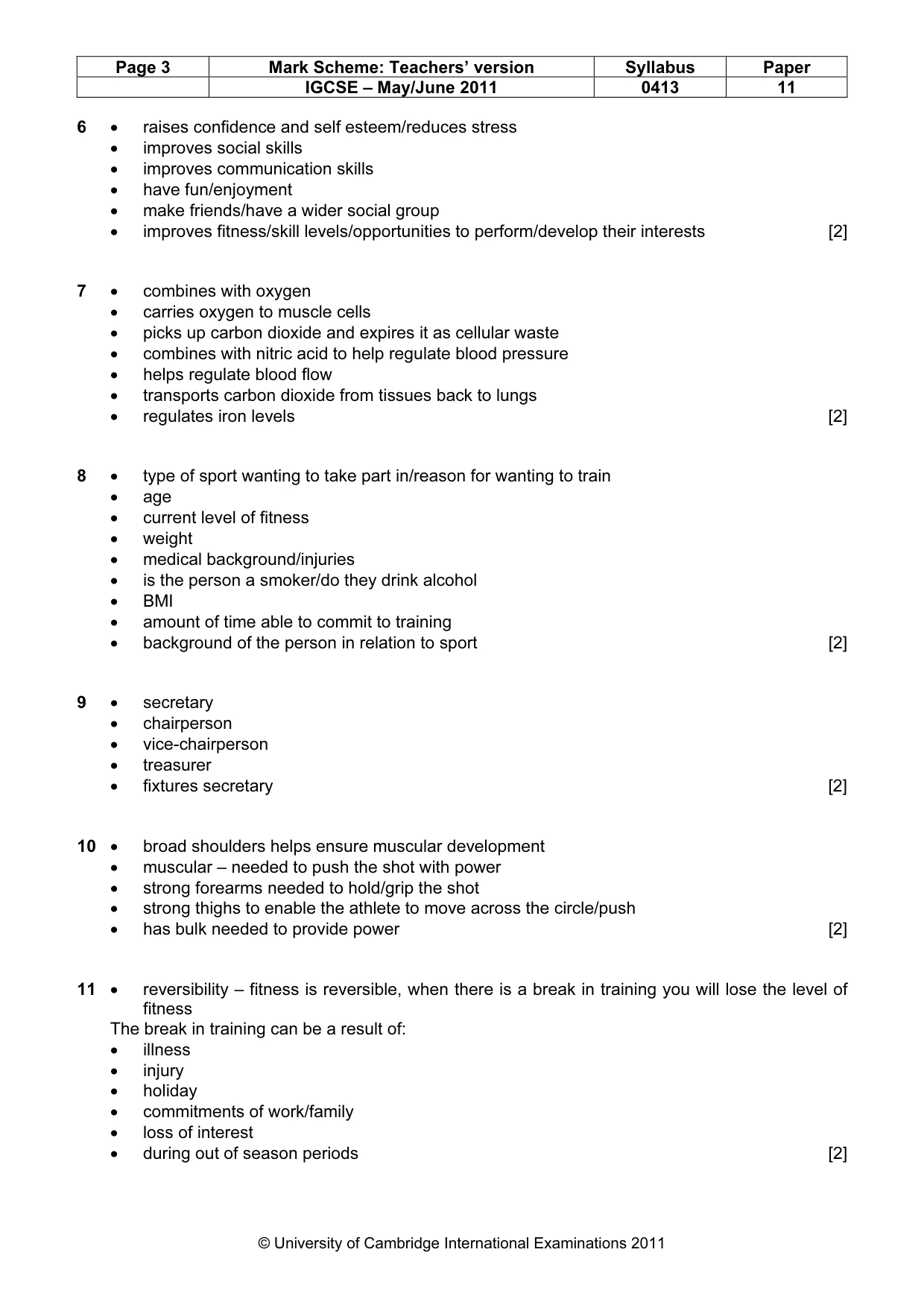
Page 3 Mark Scheme: Teachers’ version Syllabus Paper IGCSE – May/June 2011 0413 11 © University of Cambridge International Examinations 2011 6 • raises confidence and self esteem/reduces stress • improves social skills • improves communication skills • have fun/enjoyment • make friends/have a wider social group • improves fitness/skill levels/opportunities to perform/develop their interests [2] 7 • combines with oxygen • carries oxygen to muscle cells • picks up carbon dioxide and expires it as cellular waste • combines with nitric acid to help regulate blood pressure • helps regulate blood flow • transports carbon dioxide from tissues back to lungs • regulates iron levels [2] 8 • type of sport wanting to take part in/reason for wanting to train • age • current level of fitness • weight • medical background/injuries • is the person a smoker/do they drink alcohol • BMI • amount of time able to commit to training • background of the person in relation to sport [2] 9 • secretary • chairperson • vice-chairperson • treasurer • fixtures secretary [2] 10 • broad shoulders helps ensure muscular development • muscular – needed to push the shot with power • strong forearms needed to hold/grip the shot • strong thighs to enable the athlete to move across the circle/push • has bulk needed to provide power [2] 11 • reversibility – fitness is reversible, when there is a break in training you will lose the level of fitness The break in training can be a result of: • illness • injury • holiday • commitments of work/family • loss of interest • during out of season periods [2]
Mark scheme, page 4
Page 4 Mark Scheme: Teachers’ version Syllabus Paper IGCSE – May/June 2011 0413 11 © University of Cambridge International Examinations 2011 12 Candidates who respond “the company do not want to” must give a reason to gain a mark. • cost of sponsoring the event • not an activity that the company wish to be associated with/events may not meet the company image • the demands of the event organisers too great/lack of confidence in the event organiser • the event traditionally does not create enough interest • the event does not provide enough publicity/not on the television • the event does not provide enough corporate opportunities for the sponsor [3] [Total: 20]
Mark scheme, page 5
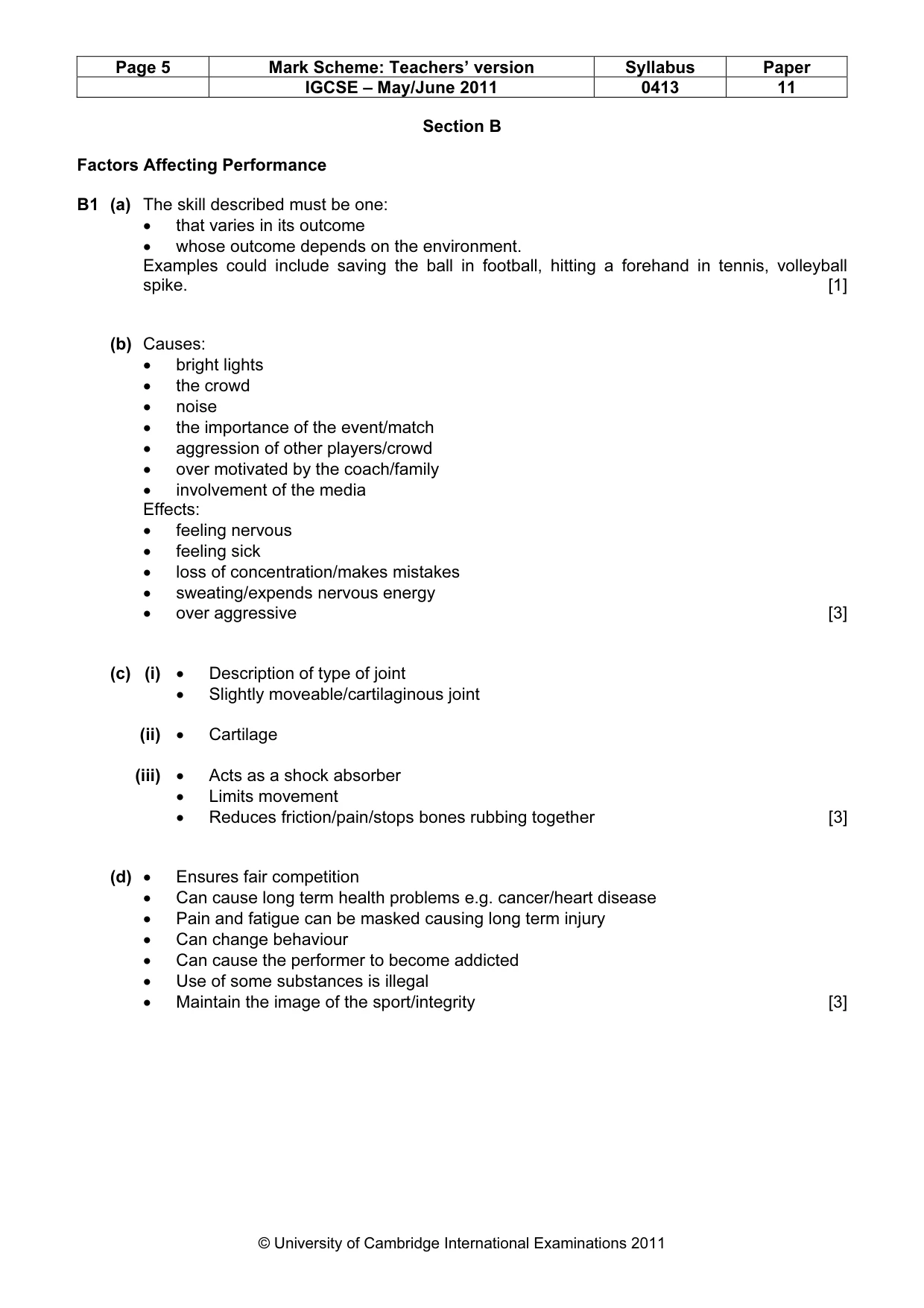
Page 5 Mark Scheme: Teachers’ version Syllabus Paper IGCSE – May/June 2011 0413 11 © University of Cambridge International Examinations 2011 Section B Factors Affecting Performance B1 (a) The skill described must be one: • that varies in its outcome • whose outcome depends on the environment. Examples could include saving the ball in football, hitting a forehand in tennis, volleyball spike. [1] (b) Causes: • bright lights • the crowd • noise • the importance of the event/match • aggression of other players/crowd • over motivated by the coach/family • involvement of the media Effects: • feeling nervous • feeling sick • loss of concentration/makes mistakes • sweating/expends nervous energy • over aggressive [3] (c) (i) • Description of type of joint • Slightly moveable/cartilaginous joint (ii) • Cartilage (iii) • Acts as a shock absorber • Limits movement • Reduces friction/pain/stops bones rubbing together [3] (d) • Ensures fair competition • Can cause long term health problems e.g. cancer/heart disease • Pain and fatigue can be masked causing long term injury • Can change behaviour • Can cause the performer to become addicted • Use of some substances is illegal • Maintain the image of the sport/integrity [3]
Mark scheme, page 6
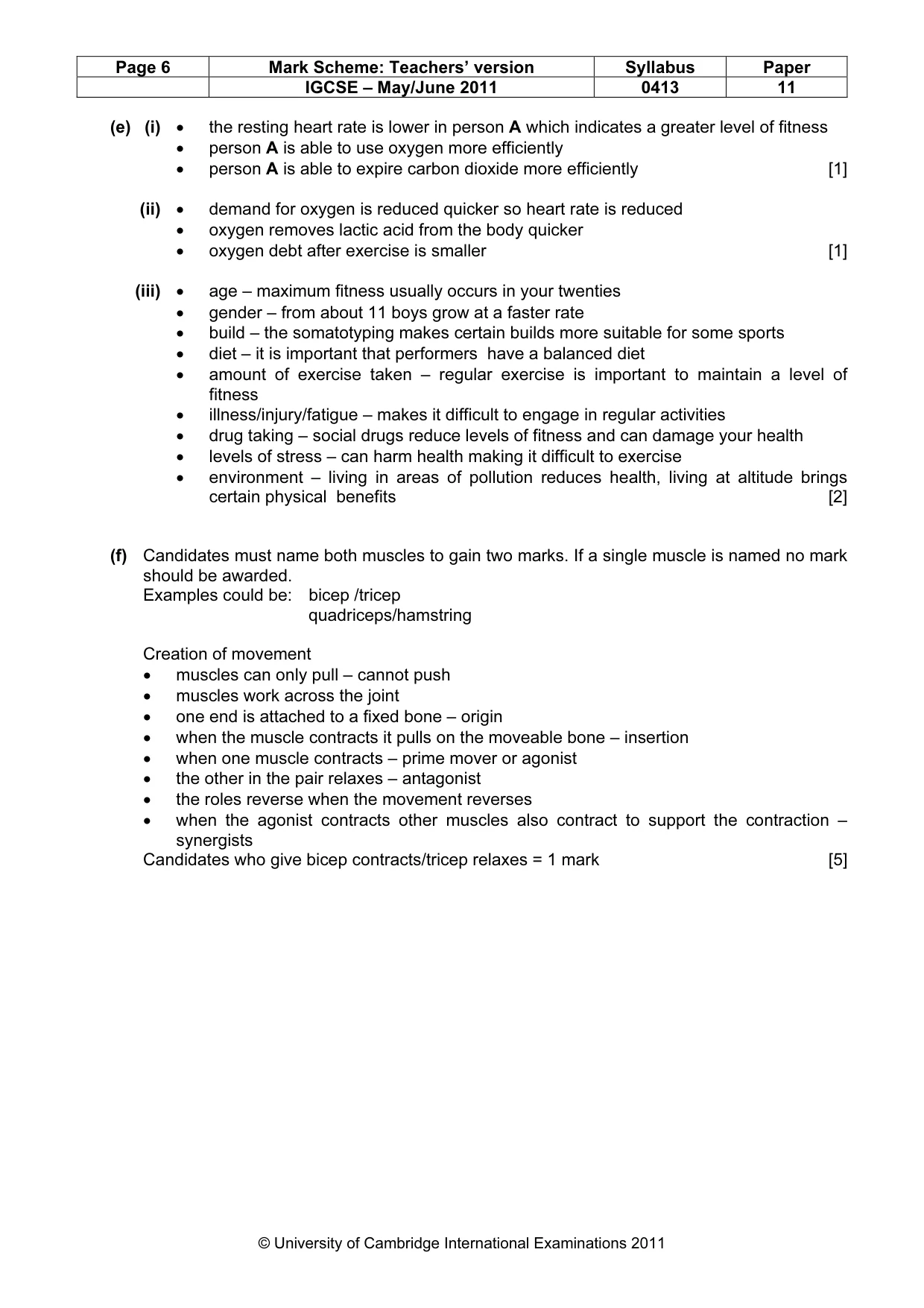
Page 6 Mark Scheme: Teachers’ version Syllabus Paper IGCSE – May/June 2011 0413 11 © University of Cambridge International Examinations 2011 (e) (i) • the resting heart rate is lower in person A which indicates a greater level of fitness • person A is able to use oxygen more efficiently • person A is able to expire carbon dioxide more efficiently [1] (ii) • demand for oxygen is reduced quicker so heart rate is reduced • oxygen removes lactic acid from the body quicker • oxygen debt after exercise is smaller [1] (iii) • age – maximum fitness usually occurs in your twenties • gender – from about 11 boys grow at a faster rate • build – the somatotyping makes certain builds more suitable for some sports • diet – it is important that performers have a balanced diet • amount of exercise taken – regular exercise is important to maintain a level of fitness • illness/injury/fatigue – makes it difficult to engage in regular activities • drug taking – social drugs reduce levels of fitness and can damage your health • levels of stress – can harm health making it difficult to exercise • environment – living in areas of pollution reduces health, living at altitude brings certain physical benefits [2] (f) Candidates must name both muscles to gain two marks. If a single muscle is named no mark should be awarded. Examples could be: bicep /tricep quadriceps/hamstring Creation of movement • muscles can only pull – cannot push • muscles work across the joint • one end is attached to a fixed bone – origin • when the muscle contracts it pulls on the moveable bone – insertion • when one muscle contracts – prime mover or agonist • the other in the pair relaxes – antagonist • the roles reverse when the movement reverses • when the agonist contracts other muscles also contract to support the contraction – synergists Candidates who give bicep contracts/tricep relaxes = 1 mark [5]
Mark scheme, page 7
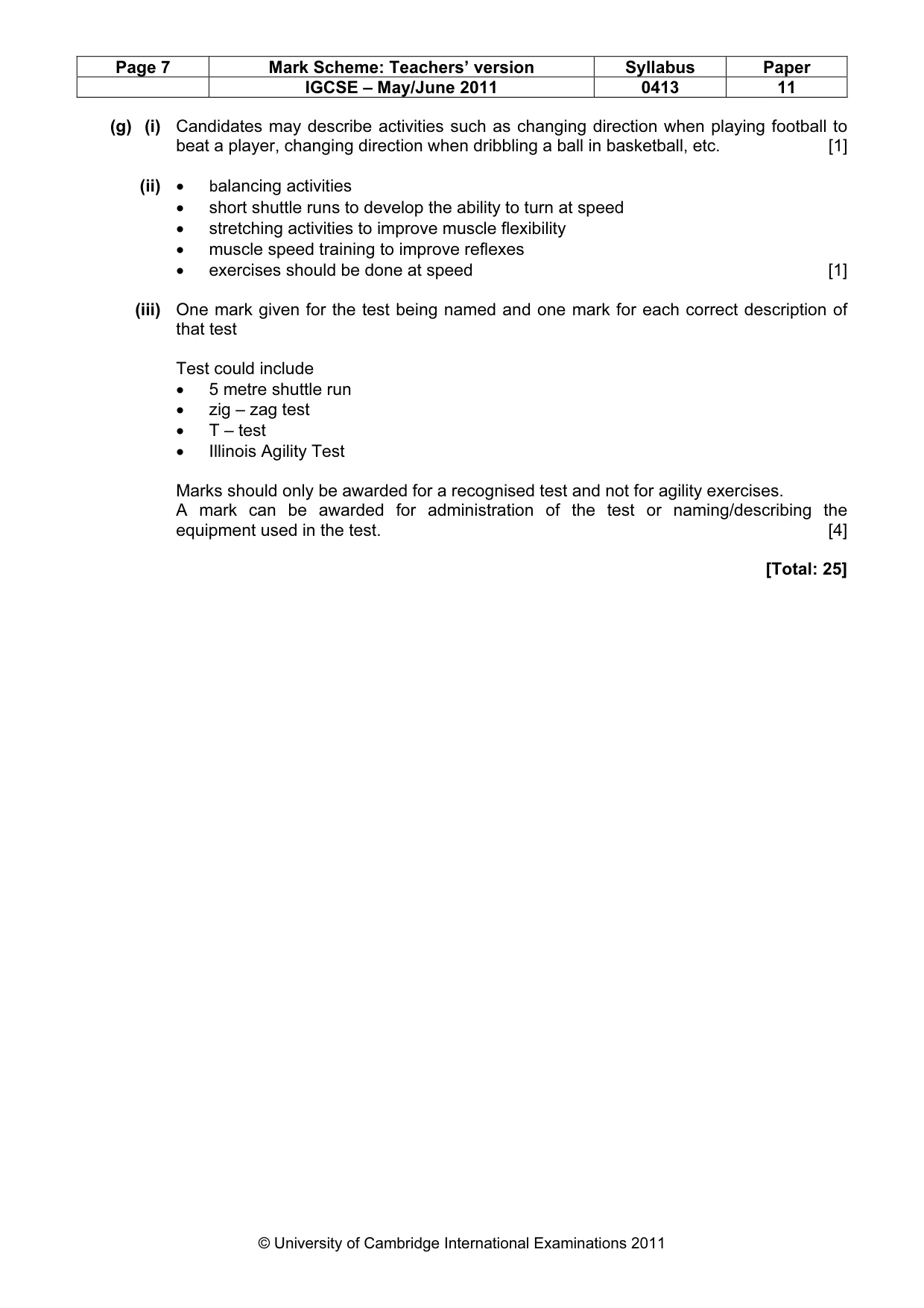
Page 7 Mark Scheme: Teachers’ version Syllabus Paper IGCSE – May/June 2011 0413 11 © University of Cambridge International Examinations 2011 (g) (i) Candidates may describe activities such as changing direction when playing football to beat a player, changing direction when dribbling a ball in basketball, etc. [1] (ii) • balancing activities • short shuttle runs to develop the ability to turn at speed • stretching activities to improve muscle flexibility • muscle speed training to improve reflexes • exercises should be done at speed [1] (iii) One mark given for the test being named and one mark for each correct description of that test Test could include • 5 metre shuttle run • zig – zag test • T – test • Illinois Agility Test Marks should only be awarded for a recognised test and not for agility exercises. A mark can be awarded for administration of the test or naming/describing the equipment used in the test. [4] [Total: 25]
Mark scheme, page 8
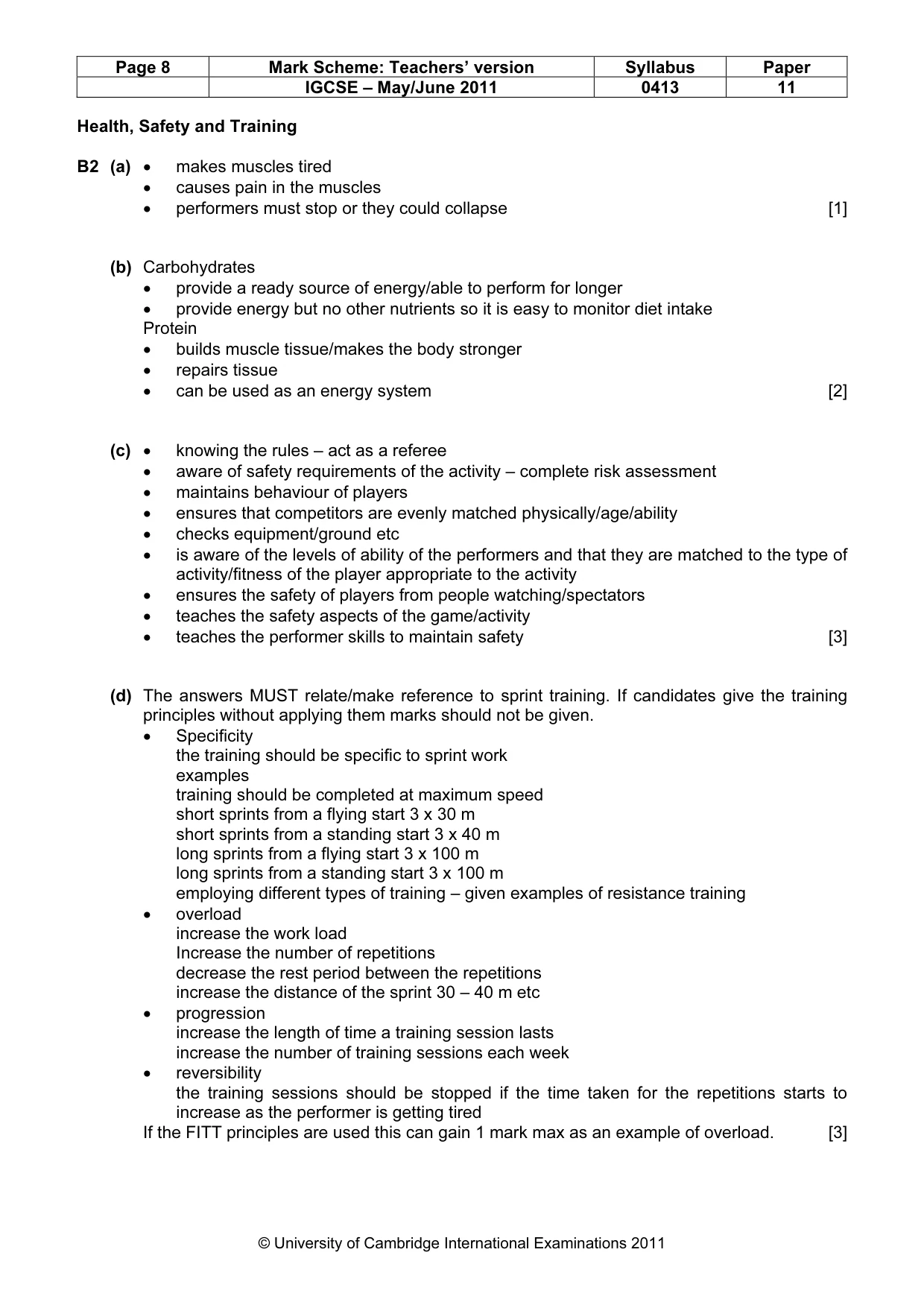
Page 8 Mark Scheme: Teachers’ version Syllabus Paper IGCSE – May/June 2011 0413 11 © University of Cambridge International Examinations 2011 Health, Safety and Training B2 (a) • makes muscles tired • causes pain in the muscles • performers must stop or they could collapse [1] (b) Carbohydrates • provide a ready source of energy/able to perform for longer • provide energy but no other nutrients so it is easy to monitor diet intake Protein • builds muscle tissue/makes the body stronger • repairs tissue • can be used as an energy system [2] (c) • knowing the rules – act as a referee • aware of safety requirements of the activity – complete risk assessment • maintains behaviour of players • ensures that competitors are evenly matched physically/age/ability • checks equipment/ground etc • is aware of the levels of ability of the performers and that they are matched to the type of activity/fitness of the player appropriate to the activity • ensures the safety of players from people watching/spectators • teaches the safety aspects of the game/activity • teaches the performer skills to maintain safety [3] (d) The answers MUST relate/make reference to sprint training. If candidates give the training principles without applying them marks should not be given. • Specificity the training should be specific to sprint work examples training should be completed at maximum speed short sprints from a flying start 3 x 30 m short sprints from a standing start 3 x 40 m long sprints from a flying start 3 x 100 m long sprints from a standing start 3 x 100 m employing different types of training – given examples of resistance training • overload increase the work load Increase the number of repetitions decrease the rest period between the repetitions increase the distance of the sprint 30 – 40 m etc • progression increase the length of time a training session lasts increase the number of training sessions each week • reversibility the training sessions should be stopped if the time taken for the repetitions starts to increase as the performer is getting tired If the FITT principles are used this can gain 1 mark max as an example of overload. [3]
Mark scheme, page 9
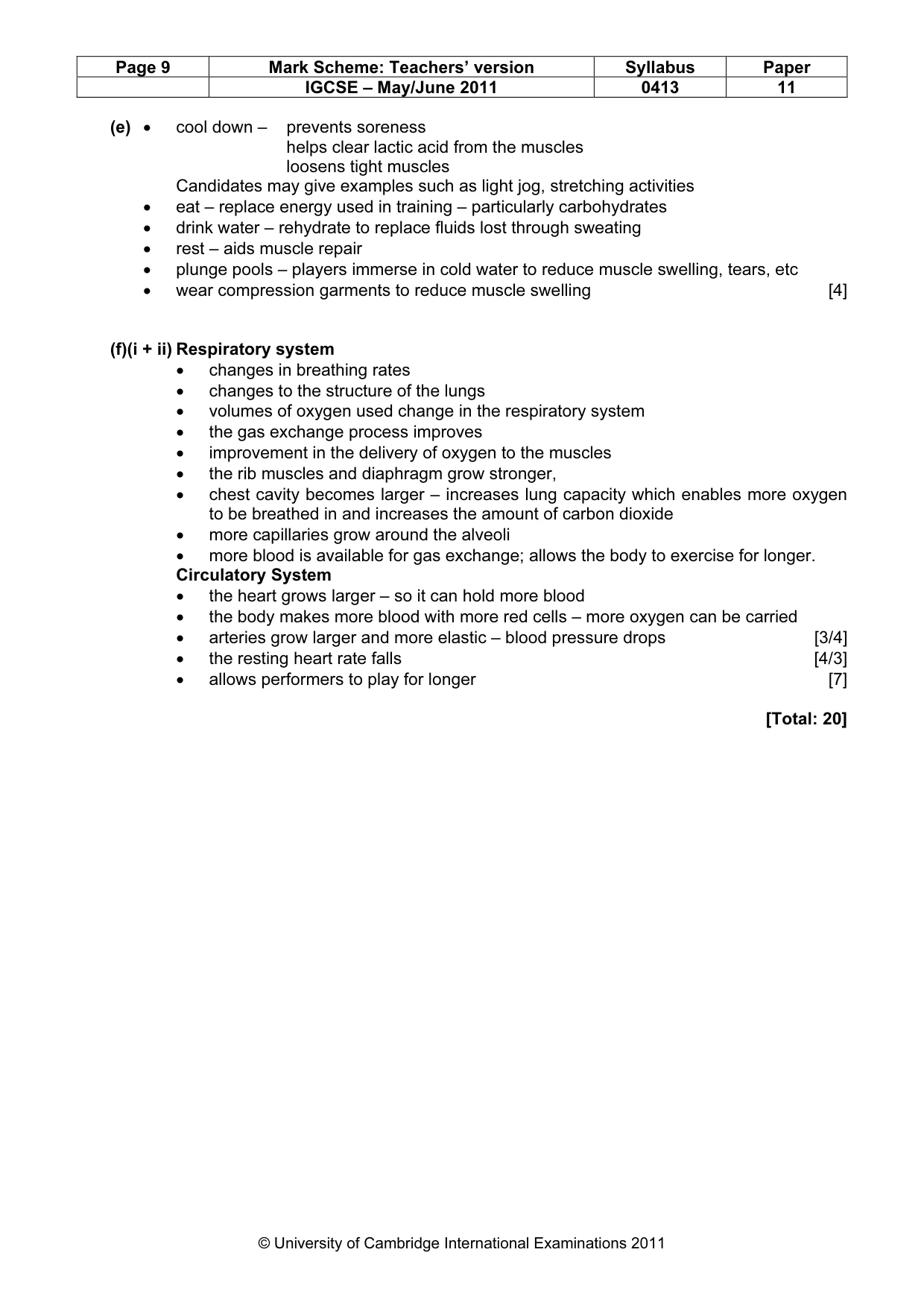
Page 9 Mark Scheme: Teachers’ version Syllabus Paper IGCSE – May/June 2011 0413 11 © University of Cambridge International Examinations 2011 (e) • cool down – prevents soreness helps clear lactic acid from the muscles loosens tight muscles Candidates may give examples such as light jog, stretching activities • eat – replace energy used in training – particularly carbohydrates • drink water – rehydrate to replace fluids lost through sweating • rest – aids muscle repair • plunge pools – players immerse in cold water to reduce muscle swelling, tears, etc • wear compression garments to reduce muscle swelling [4] (f)(i + ii) Respiratory system • changes in breathing rates • changes to the structure of the lungs • volumes of oxygen used change in the respiratory system • the gas exchange process improves • improvement in the delivery of oxygen to the muscles • the rib muscles and diaphragm grow stronger, • chest cavity becomes larger – increases lung capacity which enables more oxygen to be breathed in and increases the amount of carbon dioxide • more capillaries grow around the alveoli • more blood is available for gas exchange; allows the body to exercise for longer. Circulatory System • the heart grows larger – so it can hold more blood • the body makes more blood with more red cells – more oxygen can be carried • arteries grow larger and more elastic – blood pressure drops [3/4] • the resting heart rate falls [4/3] • allows performers to play for longer [7] [Total: 20]
Mark scheme, page 10
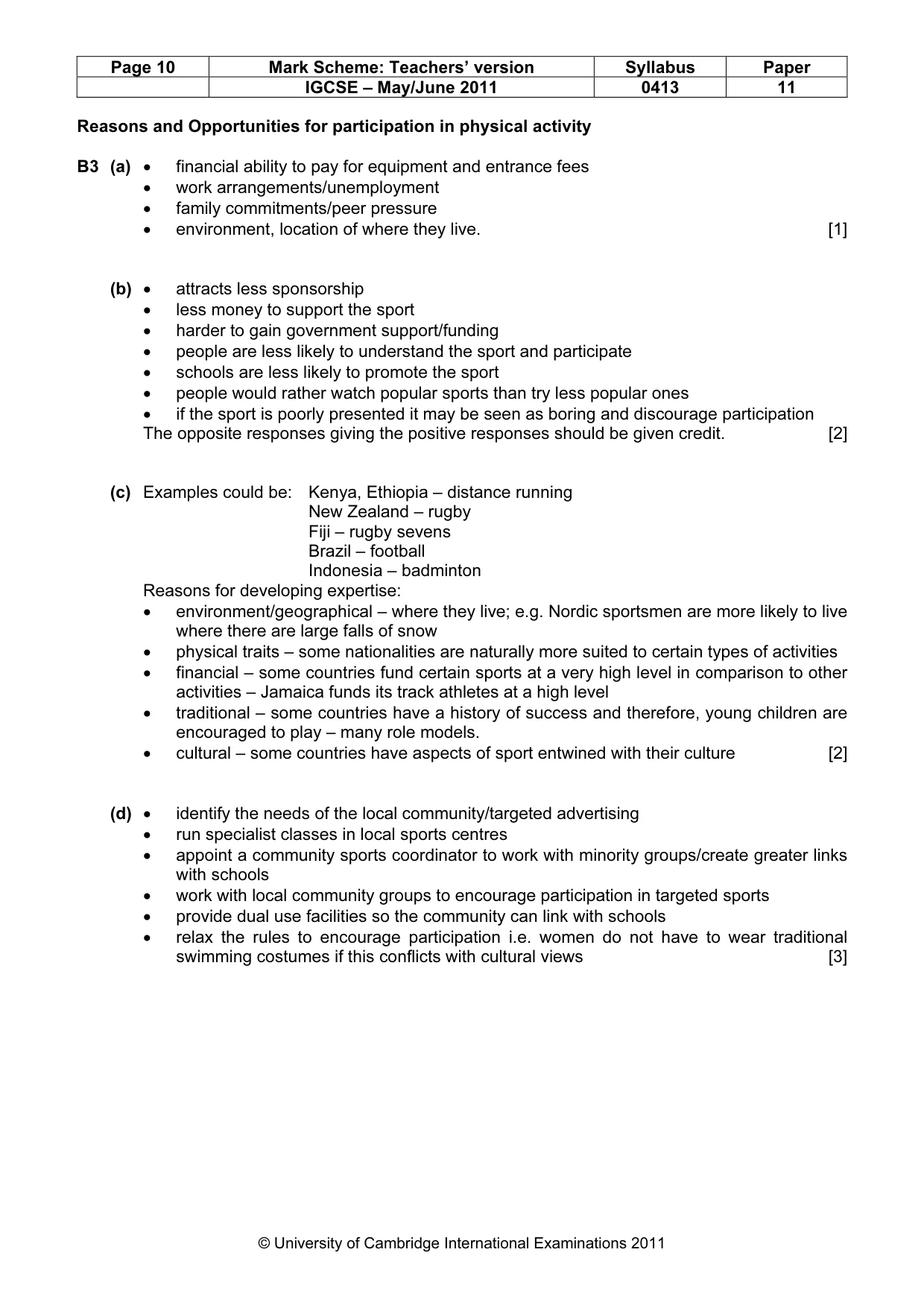
Page 10 Mark Scheme: Teachers’ version Syllabus Paper IGCSE – May/June 2011 0413 11 © University of Cambridge International Examinations 2011 Reasons and Opportunities for participation in physical activity B3 (a) • financial ability to pay for equipment and entrance fees • work arrangements/unemployment • family commitments/peer pressure • environment, location of where they live. [1] (b) • attracts less sponsorship • less money to support the sport • harder to gain government support/funding • people are less likely to understand the sport and participate • schools are less likely to promote the sport • people would rather watch popular sports than try less popular ones • if the sport is poorly presented it may be seen as boring and discourage participation The opposite responses giving the positive responses should be given credit. [2] (c) Examples could be: Kenya, Ethiopia – distance running New Zealand – rugby Fiji – rugby sevens Brazil – football Indonesia – badminton Reasons for developing expertise: • environment/geographical – where they live; e.g. Nordic sportsmen are more likely to live where there are large falls of snow • physical traits – some nationalities are naturally more suited to certain types of activities • financial – some countries fund certain sports at a very high level in comparison to other activities – Jamaica funds its track athletes at a high level • traditional – some countries have a history of success and therefore, young children are encouraged to play – many role models. • cultural – some countries have aspects of sport entwined with their culture [2] (d) • identify the needs of the local community/targeted advertising • run specialist classes in local sports centres • appoint a community sports coordinator to work with minority groups/create greater links with schools • work with local community groups to encourage participation in targeted sports • provide dual use facilities so the community can link with schools • relax the rules to encourage participation i.e. women do not have to wear traditional swimming costumes if this conflicts with cultural views [3]
Mark scheme, page 11
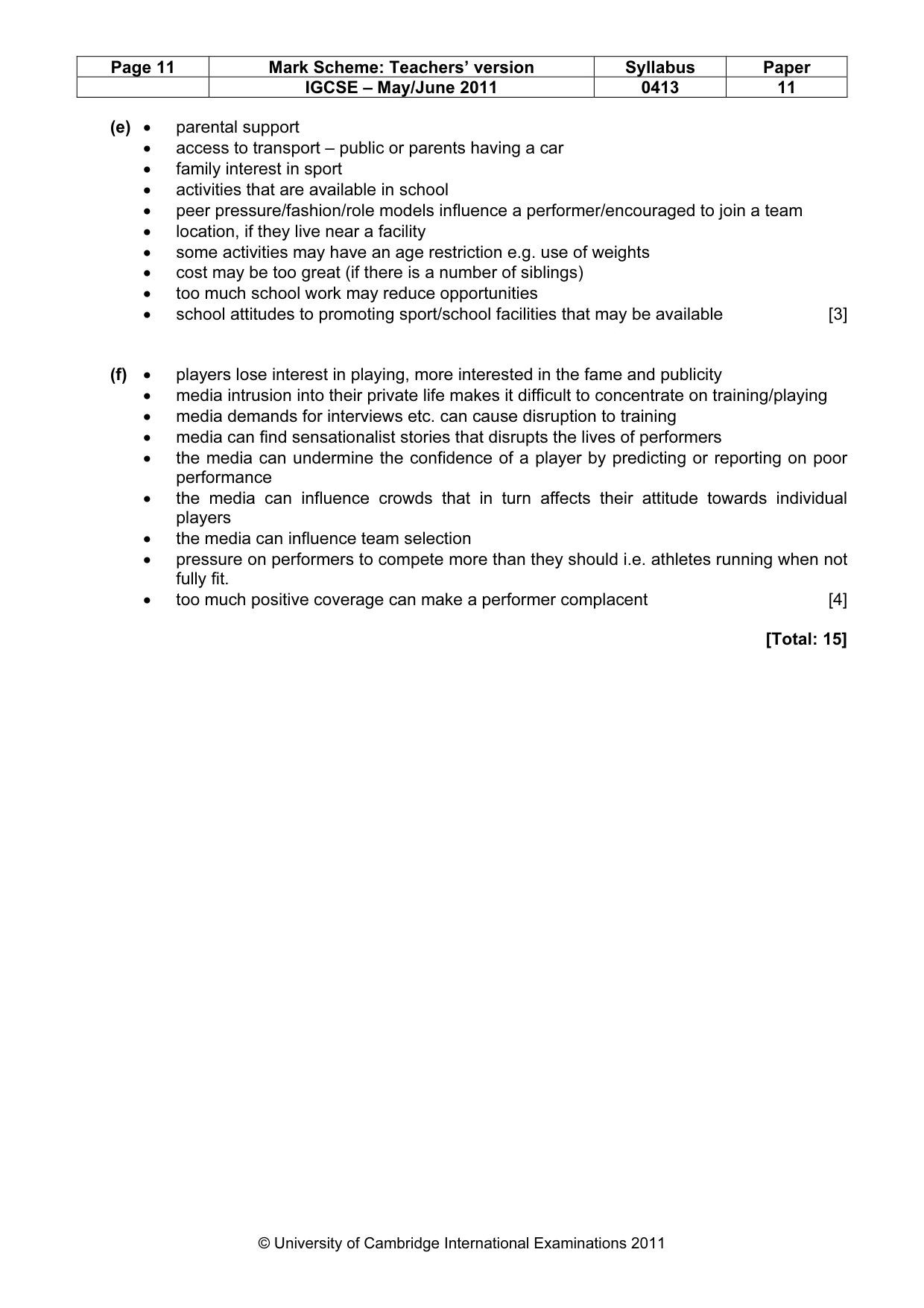
Page 11 Mark Scheme: Teachers’ version Syllabus Paper IGCSE – May/June 2011 0413 11 © University of Cambridge International Examinations 2011 (e) • parental support • access to transport – public or parents having a car • family interest in sport • activities that are available in school • peer pressure/fashion/role models influence a performer/encouraged to join a team • location, if they live near a facility • some activities may have an age restriction e.g. use of weights • cost may be too great (if there is a number of siblings) • too much school work may reduce opportunities • school attitudes to promoting sport/school facilities that may be available [3] (f) • players lose interest in playing, more interested in the fame and publicity • media intrusion into their private life makes it difficult to concentrate on training/playing • media demands for interviews etc. can cause disruption to training • media can find sensationalist stories that disrupts the lives of performers • the media can undermine the confidence of a player by predicting or reporting on poor performance • the media can influence crowds that in turn affects their attitude towards individual players • the media can influence team selection • pressure on performers to compete more than they should i.e. athletes running when not fully fit. • too much positive coverage can make a performer complacent [4] [Total: 15]
What you needed in this session
Cambridge’s own grade thresholds for 2011 May/June, Paper 1 · Variant 1. A higher threshold means an easier paper — the bar moves with how the cohort did.