Cambridge IGCSE Mathematics - International 0607 — 2021 May/June Paper 4 · Variant 1
0607/41/M/J/21 · 11 questions · 120 marks · ≈135 min
The question paper and its mark scheme, free to read here and free to download. This is Cambridge’s own paper, exactly as it was sat.
Question paper20 pages
Mark scheme9 pages
Answers below. Sit the paper first if you are practising.
Questions as text
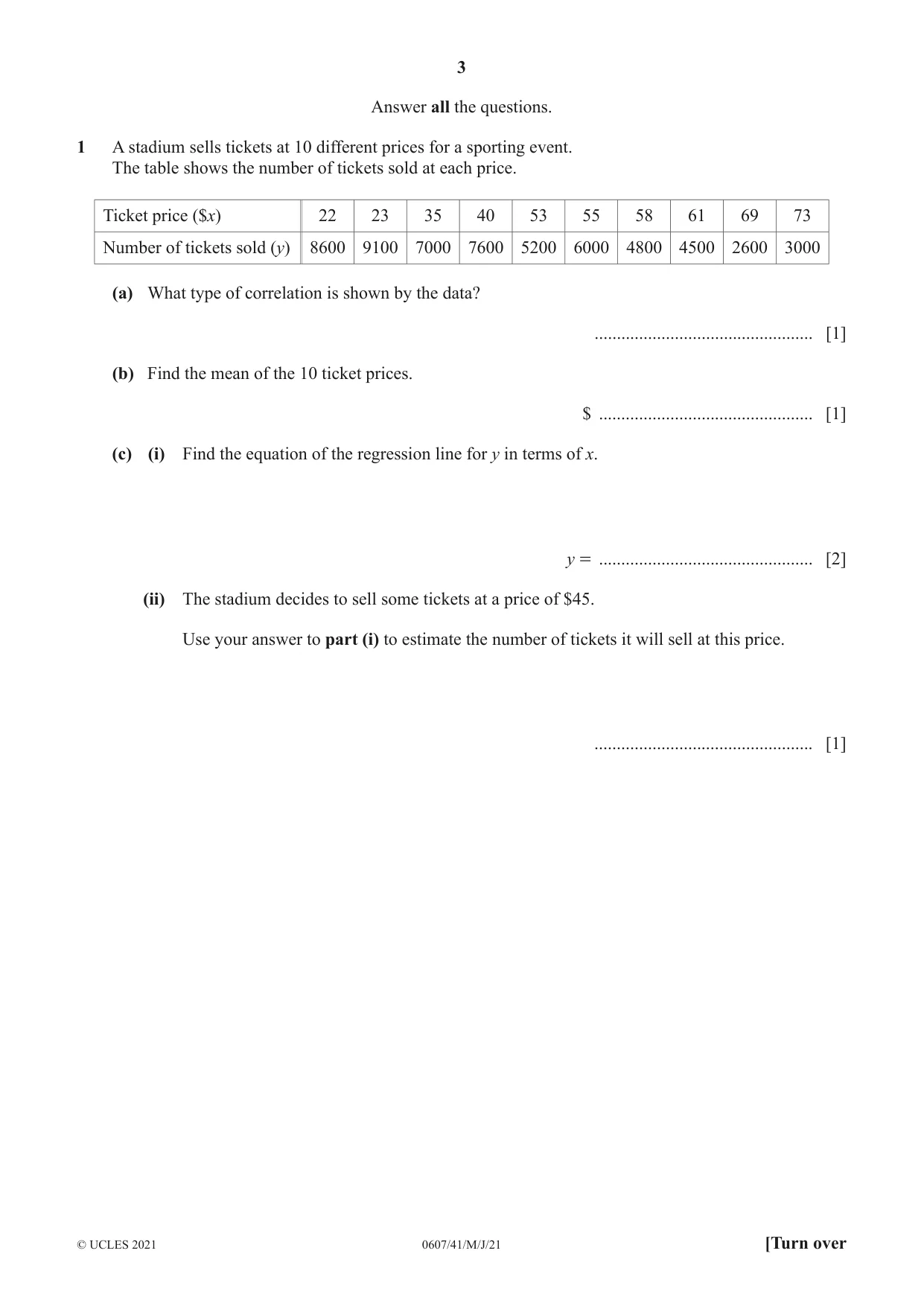
Q1 · A stadium sells tickets at 10 different prices for a sporting event
1 A stadium sells tickets at 10 different prices for a sporting event. The table shows the number of tickets sold at each price. Ticket price ($x) 22 23 35 40 53 55 58 61 69 73 Number of tickets sold (y) 8600 9100 7000 7600 5200 6000 4800 4500 2600 3000 (a) What type of correlation is shown by the data? ................................................. [1] (b) Find the mean of the 10 ticket prices. $ ................................................ [1] (c) (i) Find the equation of the regression line for y in terms of x. y = ................................................ [2] (ii) The stadium decides to sell some tickets at a price of $45. Use your answer to part (i) to estimate the number of tickets it will sell at this price. ................................................. [1]
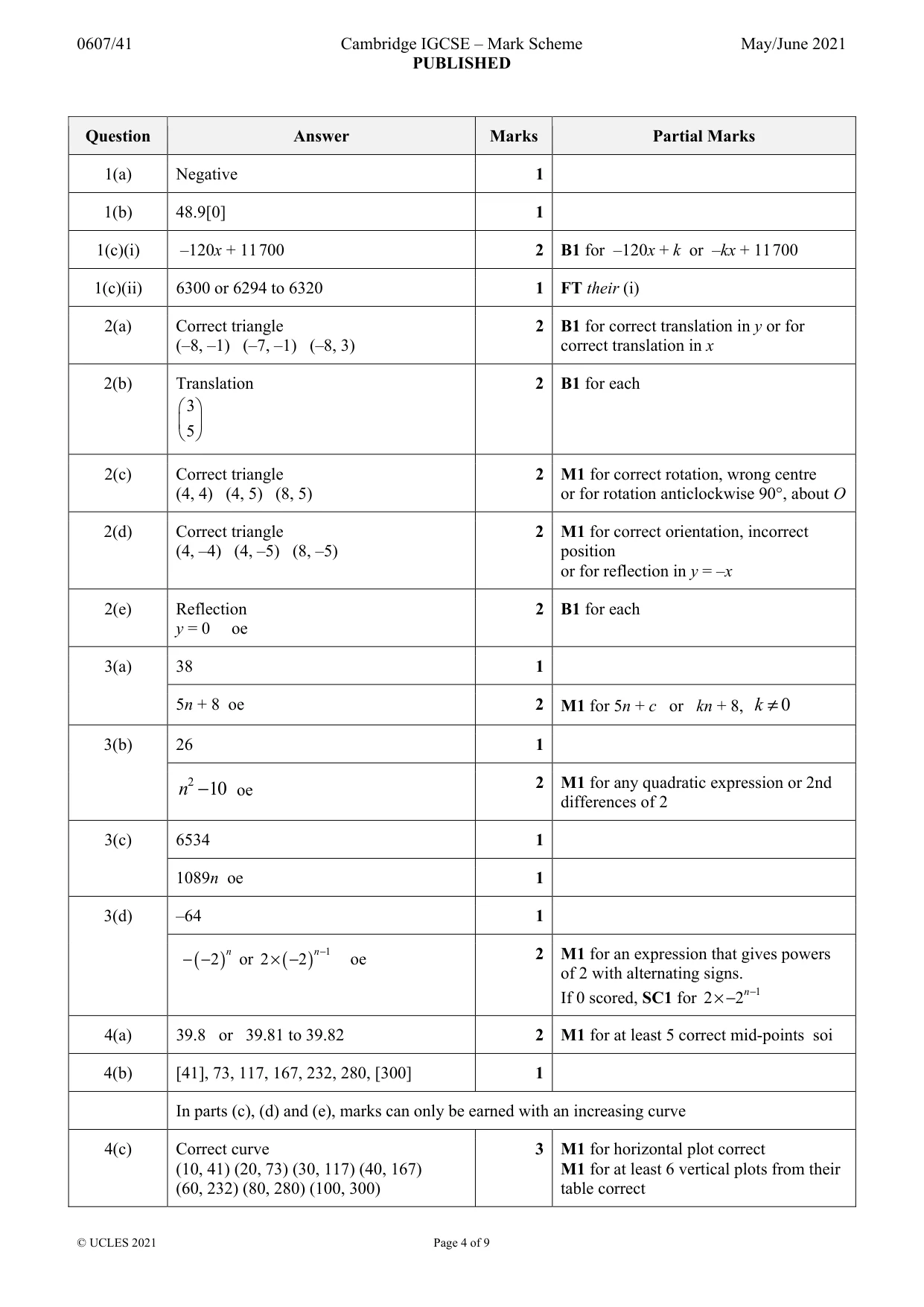
Mark scheme: Question Answer Marks Partial Marks 1(a) Negative 1 1(b) 48.9[0] 1 1(c)(i) –120x + 11 700 2 B1 for –120x + k or –kx + 11 700 1(c)(ii) 6300 or 6294 to 6320 1 FT their (i)
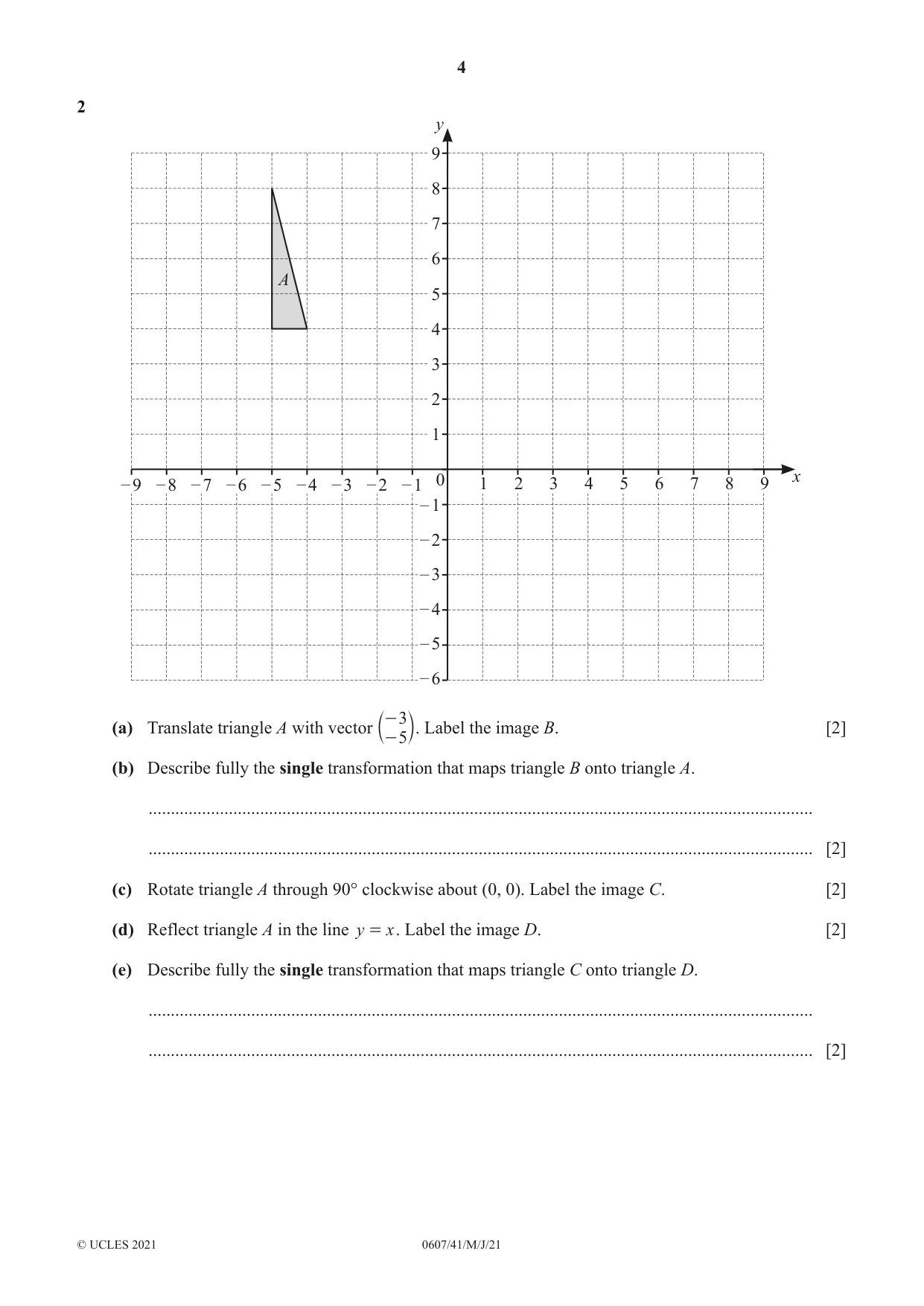
Q2 · Y 9 8 7 6 A 5 4 3 2 1 – 9 – 8 – 7 – 6 – 5 – 4 – 3 – 2 – 1 0 1 2 3 4 5 6 7 8 9 x – 1 – 2…
2 y 9 8 7 6 A 5 4 3 2 1 – 9 – 8 – 7 – 6 – 5 – 4 – 3 – 2 – 1 0 1 2 3 4 5 6 7 8 9 x – 1 – 2 – 3 – 4 – 5 – 6 - 3 (a) Translate triangle A with vector Label the image B. [2] b - 5 l. (b) Describe fully the single transformation that maps triangle B onto triangle A. ..................................................................................................................................................... ..................................................................................................................................................... [2] (c) Rotate triangle A through 90° clockwise about (0, 0). Label the image C. [2] (d) Reflect triangle A in the line y = x . Label the image D. [2] (e) Describe fully the single transformation that maps triangle C onto triangle D. ..................................................................................................................................................... ..................................................................................................................................................... [2]
Mark scheme: 2(a) Correct triangle 2 B1 for correct translation in y or for (–8, –1) (–7, –1) (–8, 3) correct translation in x 2(b) Translation 2 B1 for each 3 5 2(c) Correct triangle 2 M1 for correct rotation, wrong centre (4, 4) (4, 5) (8, 5) or for rotation anticlockwise 90°, about O 2(d) Correct triangle 2 M1 for correct orientation, incorrect (4, –4) (4, –5) (8, –5) position or for reflection in y = –x 2(e) Reflection 2 B1 for each y = 0 oe
Q3 · Find the next term and the nth term in each of the following sequences
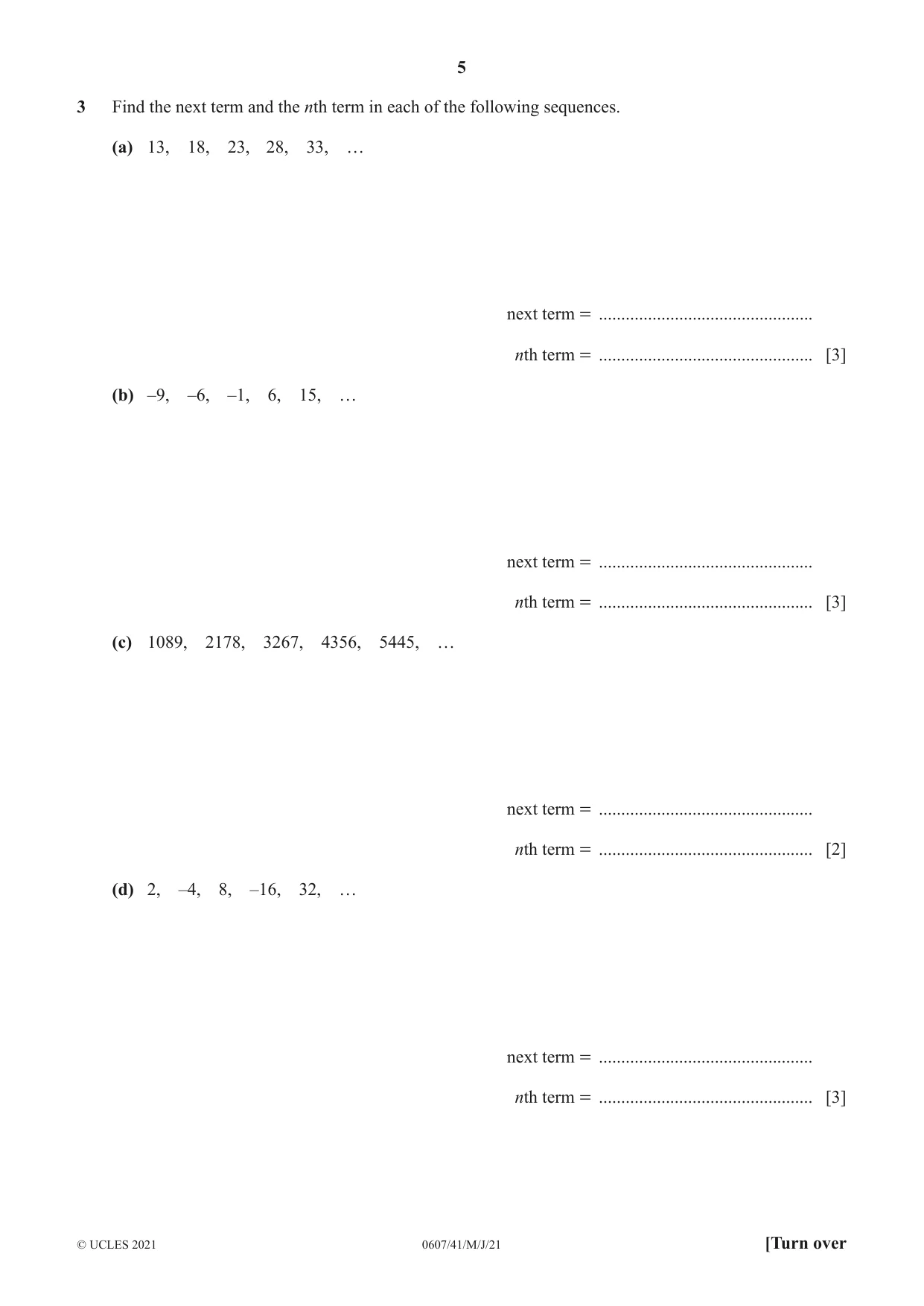
3 Find the next term and the nth term in each of the following sequences. (a) 13, 18, 23, 28, 33, … next term = ................................................ nth term = ................................................ [3] (b) –9, –6, –1, 6, 15, … next term = ................................................ nth term = ................................................ [3] (c) 1089, 2178, 3267, 4356, 5445, … next term = ................................................ nth term = ................................................ [2] (d) 2, –4, 8, –16, 32, … next term = ................................................ nth term = ................................................ [3]
Mark scheme: 3(a) 38 1 5n + 8 oe 2 M1 for 5n + c or kn + 8, k ≠ 0 3(b) 26 1 2 2 M1 for any quadratic expression or 2nd n − 10 oe differences of 2 3(c) 6534 1 1089n oe 1 3(d) –64 1 n n−1 2 M1 for an expression that gives powers −−( 2 ) or 2 × ( − 2 ) oe of 2 with alternating signs. If 0 scored, SC1 for 2 ×−2n−1
Q4 · The marks, x, of 300 students in a chemistry test are shown in the table
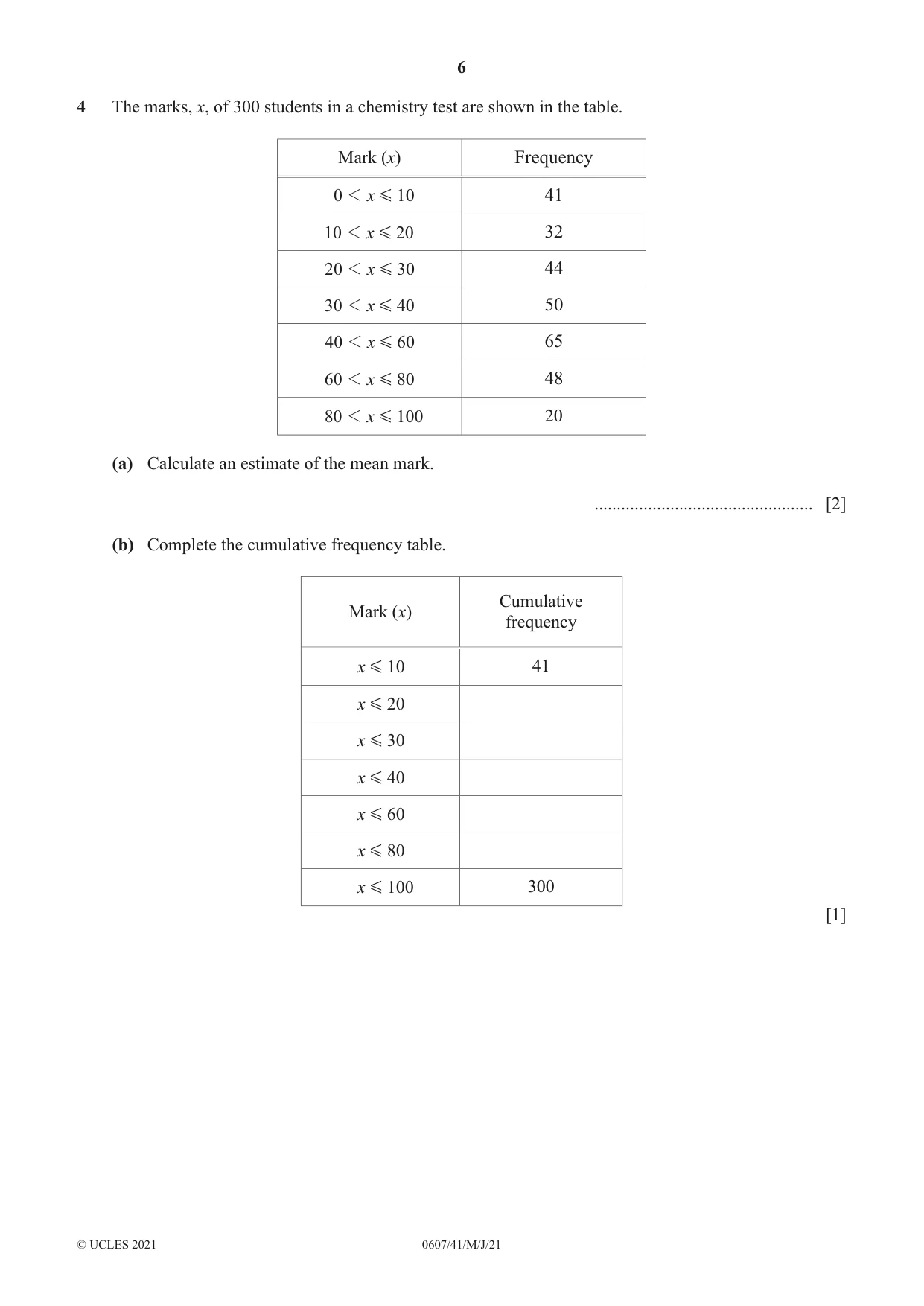
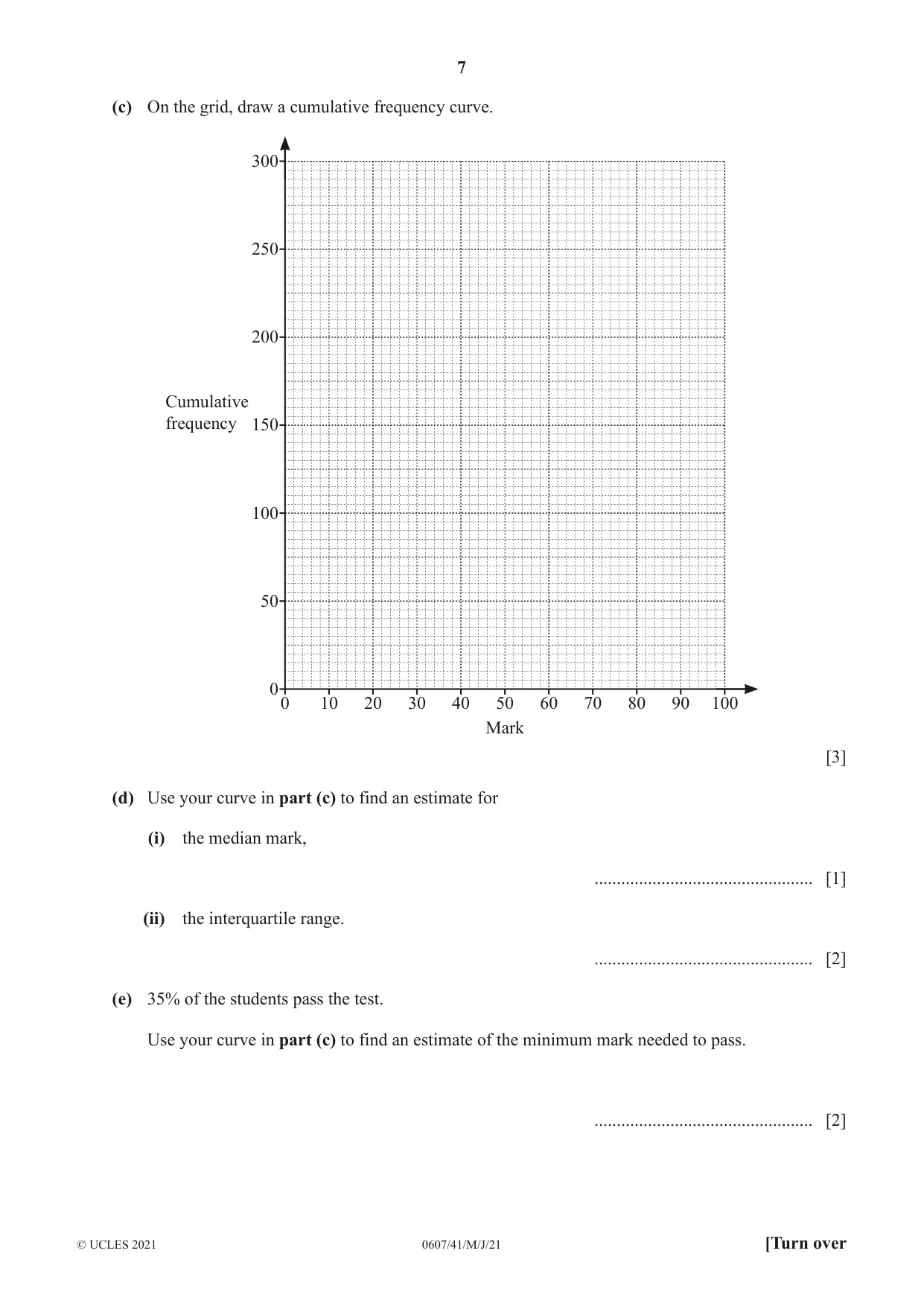
4 The marks, x, of 300 students in a chemistry test are shown in the table. Mark (x) Frequency 0 1 x G 10 41 10 1 x G 20 32 20 1 x G 3 0 44 30 1 x G 40 50 40 1 x G 60 65 60 1 x G 8 0 48 80 1 x G 100 20 (a) Calculate an estimate of the mean mark. ................................................. [2] (b) Complete the cumulative frequency table. Cumulative Mark (x) frequency x G 10 41 x G 20 x G 30 x G 40 x G 60 x G 80 x G 100 300 [1] (c) On the grid, draw a cumulative frequency curve. 300 250 200 Cumulative frequency 150 100 50 0 0 10 20 30 40 50 60 70 80 90 100 Mark [3] (d) Use your curve in part (c) to find an estimate for (i) the median mark, ................................................. [1] (ii) the interquartile range. ................................................. [2] (e) 35% of the students pass the test. Use your curve in part (c) to find an estimate of the minimum mark needed to pass. ................................................. [2]
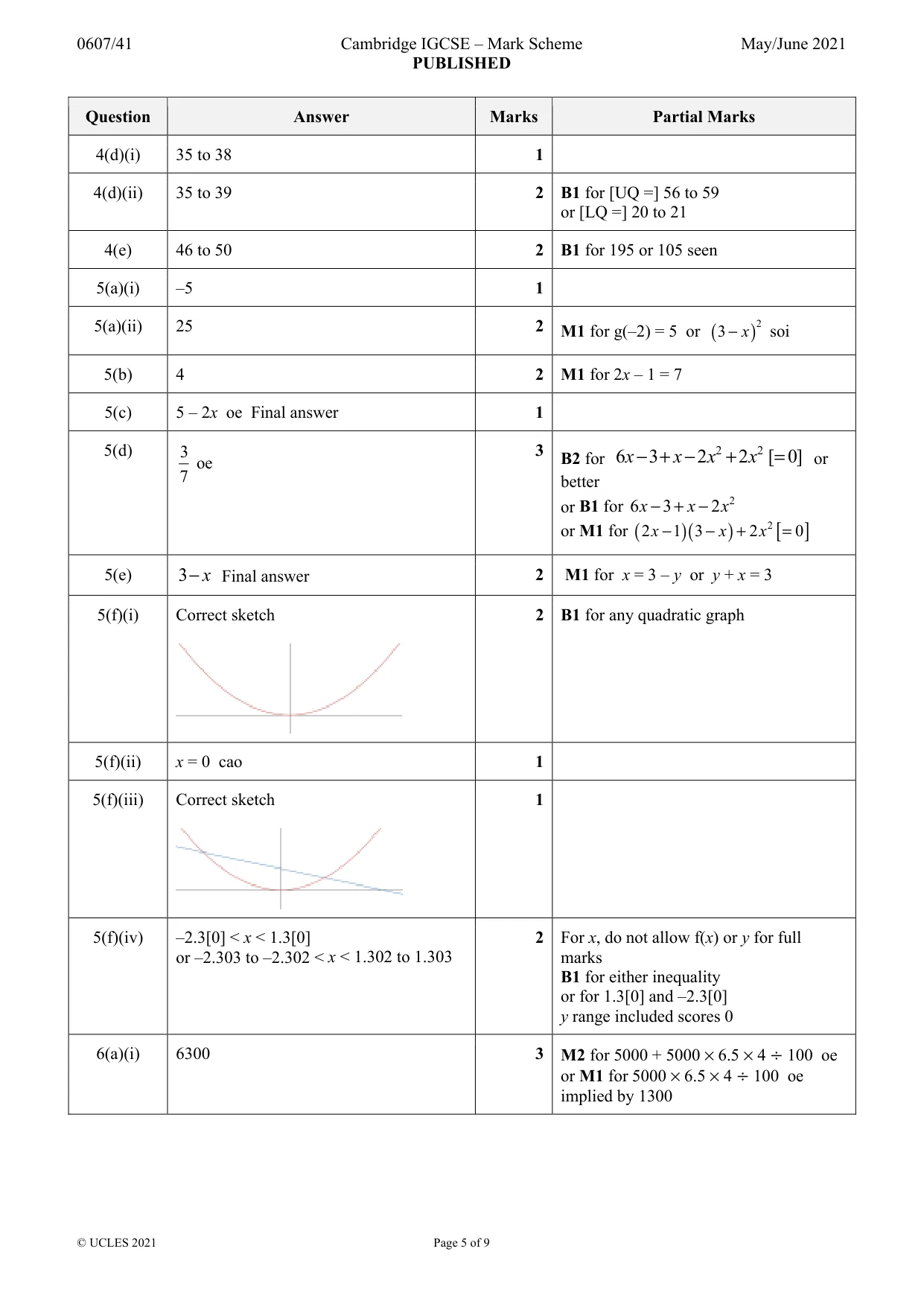
Mark scheme: 4(a) 39.8 or 39.81 to 39.82 2 M1 for at least 5 correct mid-points soi 4(b) [41], 73, 117, 167, 232, 280, [300] 1 In parts (c), (d) and (e), marks can only be earned with an increasing curve 4(c) Correct curve 3 M1 for horizontal plot correct (10, 41) (20, 73) (30, 117) (40, 167) M1 for at least 6 vertical plots from their (60, 232) (80, 280) (100, 300) table correct 4(d)(i) 35 to 38 1 4(d)(ii) 35 to 39 2 B1 for [UQ =] 56 to 59 or [LQ =] 20 to 21 4(e) 46 to 50 2 B1 for 195 or 105 seen
Q5 · F ( )x = 2 x - 1 g ( )x = 3 - x h ( )x = x 2 (a) Find (i) f ( - 2)…
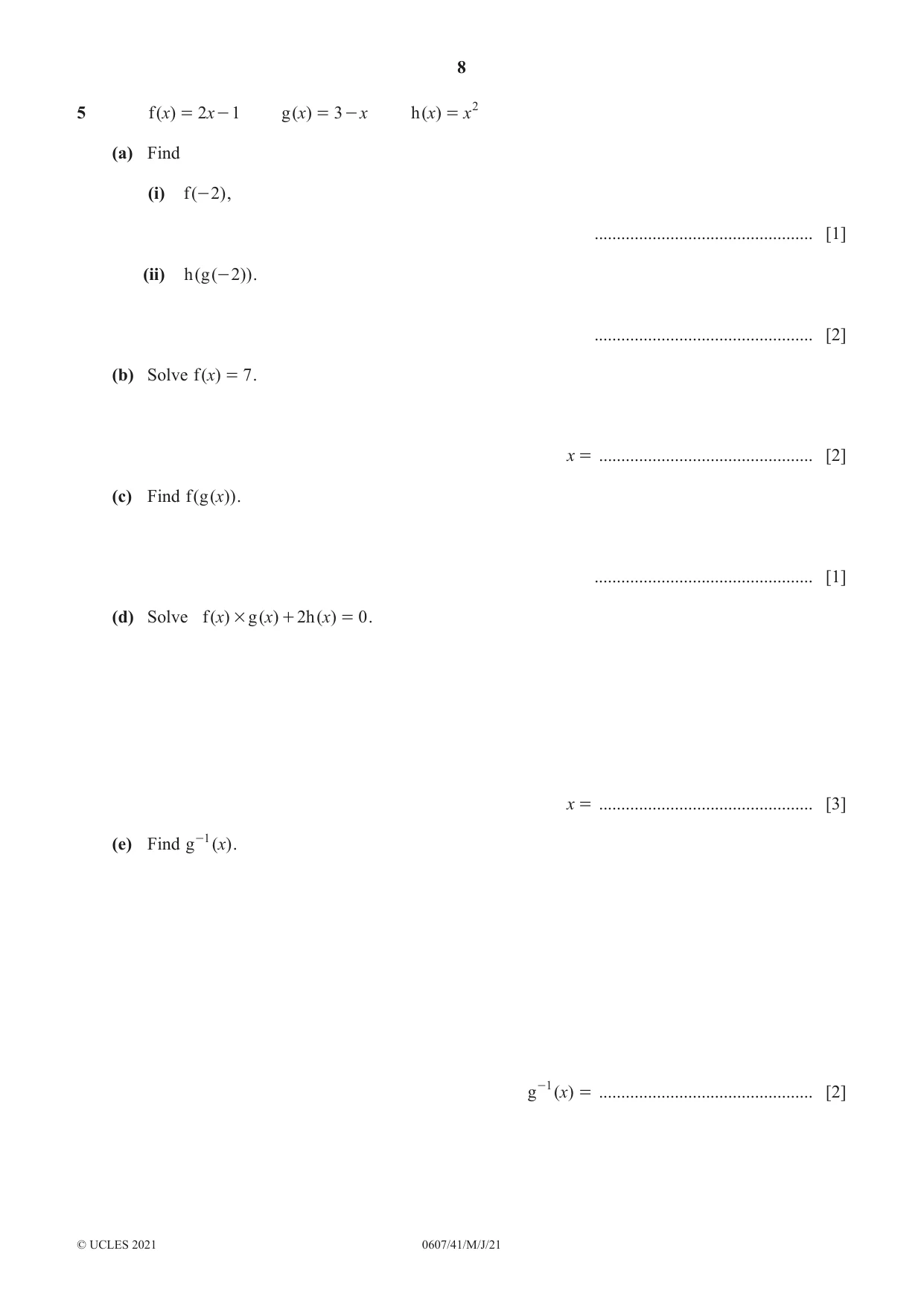
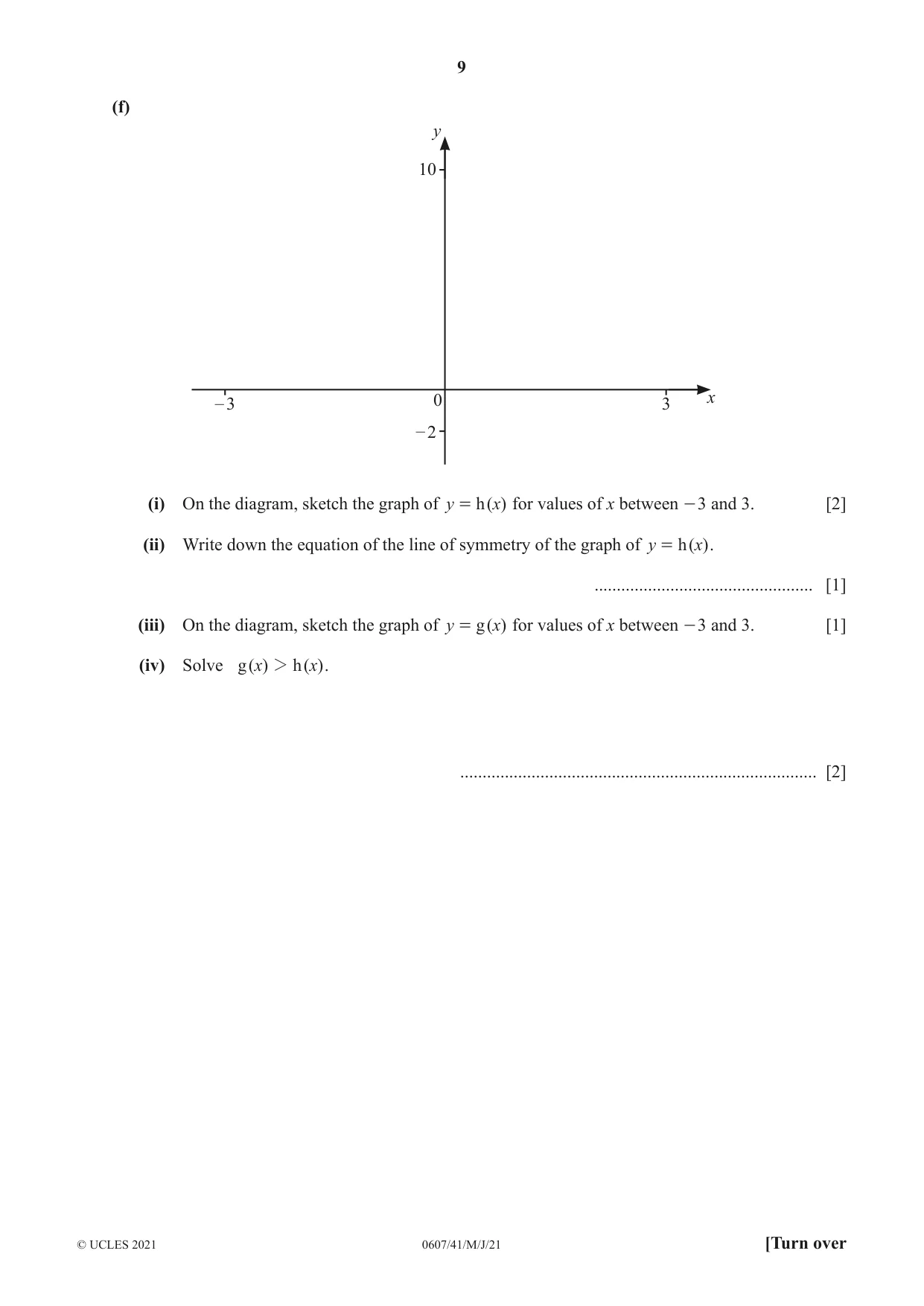
5 f ( )x = 2 x - 1 g ( )x = 3 - x h ( )x = x 2 (a) Find (i) f ( - 2) , ................................................. [1] (ii) h ( g ( - 2)) . ................................................. [2] (b) Solve f ( )x = 7 . x = ................................................ [2] (c) Find f ( g ( x)) . ................................................. [1] (d) Solve f (x) # g (x) + 2h ( x) = 0 . x = ................................................ [3] (e) Find g -1 ( )x . g -1 ( )x = ................................................ [2] (f) y 10 – 3 0 3 x – 2 (i) On the diagram, sketch the graph of y = h ( x) for values of x between - 3 and 3. [2] (ii) Write down the equation of the line of symmetry of the graph of y = h ( x) . ................................................. [1] (iii) On the diagram, sketch the graph of y = g ( x) for values of x between - 3 and 3. [1] (iv) Solve g ( x) 2 h ( x) . ................................................................................ [2]
Mark scheme: 5(a)(i) –5 1 5(a)(ii) 25 2 2 M1 for g(–2) = 5 or ( 3 − x ) soi 5(b) 4 2 M1 for 2x – 1 = 7 5(c) 5 – 2x oe Final answer 1 5(d) 3 3 2 2 oe B2 for 6 x −+3 x − 2 x + 2 x [= 0] or 7 better or B1 for 6 x −+3 x − 2 x 2 or M1 for ( 2 x − 1)( 3 − x ) + 2 x 2 [ = 0 ] 5(e) 3 − x Final answer 2 M1 for x = 3 – y or y + x = 3 5(f)(i) Correct sketch 2 B1 for any quadratic graph 5(f)(ii) x = 0 cao 1 5(f)(iii) Correct sketch 1 5(f)(iv) –2.3[0] < x < 1.3[0] 2 For x, do not allow f(x) or y for full or –2.303 to –2.302 < x < 1.302 to 1.303 marks B1 for either inequality or for 1.3[0] and –2.3[0] y range included scores 0
Q6 · Piero invests $5000 in Bank A and $5000 in Bank B
6 Piero invests $5000 in Bank A and $5000 in Bank B. (a) Bank A pays simple interest at a rate of 6.5% each year. (i) Find the total amount Piero has in Bank A at the end of 4 years. $ ................................................ [3] (ii) Find the number of complete years it takes for the total amount that Piero has in Bank A to be greater than $10 000. ................................................. [3] (b) Bank B pays compound interest at a rate of 4% each year. (i) Find the total amount Piero has in Bank B at the end of 4 years. $ ................................................ [2] (ii) Find the number of complete years it takes for the total amount that Piero has in Bank B to be greater than $10 000. ................................................. [4] (c) By sketching suitable graphs, find the number of complete years it takes for the total amount that Piero has in Bank B to be greater than the total amount in Bank A. ................................................. [4]
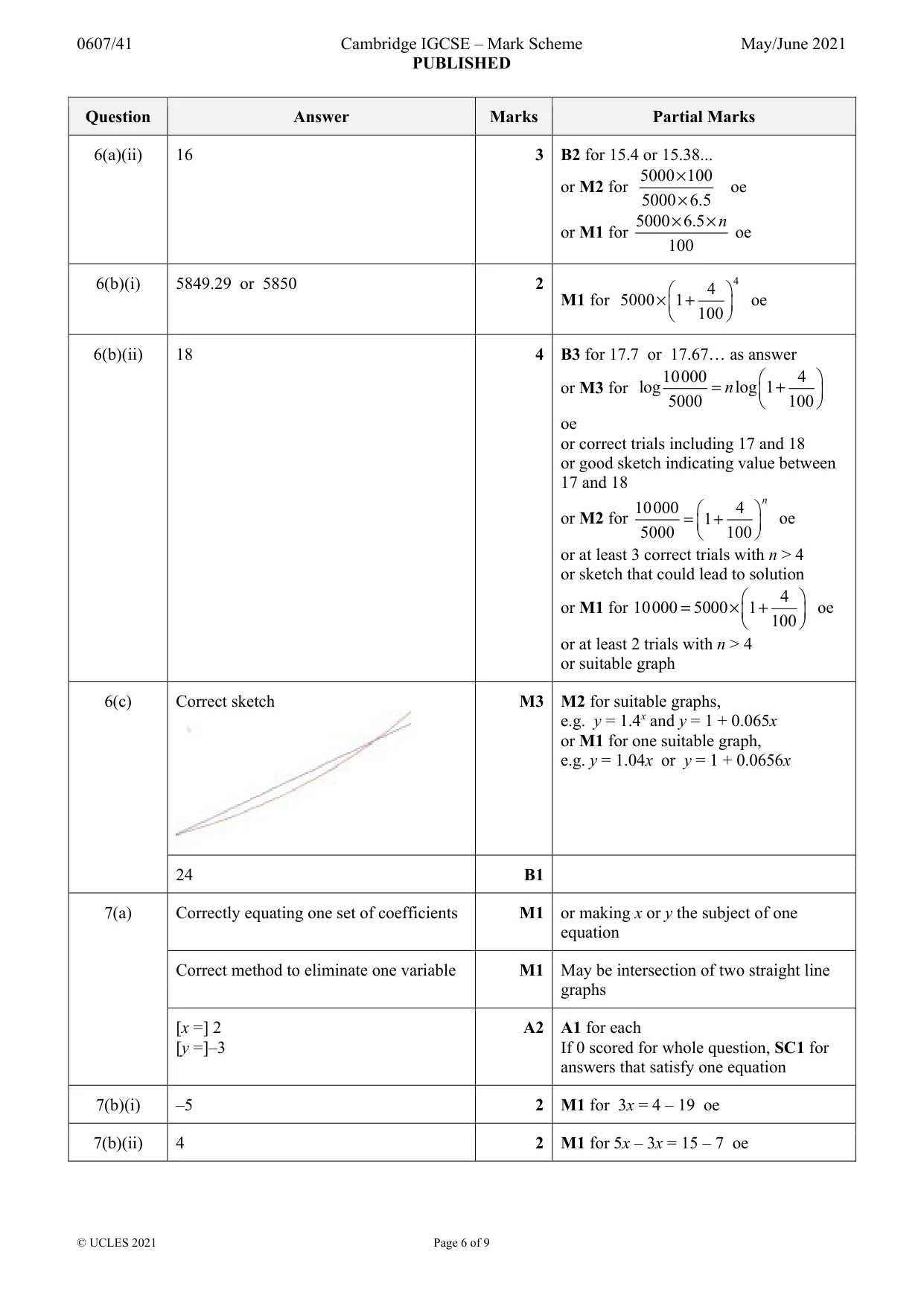
Mark scheme: 6(a)(i) 6300 3 M2 for 5000 + 5000 × 6.5 × 4 ÷ 100 oe or M1 for 5000 × 6.5 × 4 ÷ 100 oe implied by 1300 6(a)(ii) 16 3 B2 for 15.4 or 15.38... 5000 × 100 or M2 for oe 5000 × 6.5 5000 × 6.5 ×n or M1 for oe 100 6(b)(i) 5849.29 or 5850 2 4 4 M1 for 5000 × 1 + oe 100 6(b)(ii) 18 4 B3 for 17.7 or 17.67… as answer 10000 4 or M3 for log = n log 1 + 5000 100 oe or correct trials including 17 and 18 or good sketch indicating value between 17 and 18 10000 4 n or M2 for = 1 + oe 5000 100 or at least 3 correct trials with n > 4 or sketch that could lead to solution 4 or M1 for 10000 = 5000 × 1 + oe 100 or at least 2 trials with n > 4 or suitable graph 6(c) Correct sketch M3 M2 for suitable graphs, e.g. y = 1.4x and y = 1 + 0.065x or M1 for one suitable graph, e.g. y = 1.04x or y = 1 + 0.0656x 24 B1
Q7 · Solve the simultaneous equations
7 (a) Solve the simultaneous equations. You must show all your working. 7x + 2y = 8 2x - 3y = 13 x = ................................................ y = ................................................ [4] (b) Solve. (i) 3x - 4 =- 19 x = ................................................ [2] (ii) 15 - 5x = 7 - 3x x = ................................................ [2] 28 (iii) =- 4 ( x + 1) x = ................................................ [2] (c) 3 log p - log q - log 8 = 2 log x Find x in terms of p and q. x = ................................................ [3]
Mark scheme: 7(a) Correctly equating one set of coefficients M1 or making x or y the subject of one equation Correct method to eliminate one variable M1 May be intersection of two straight line graphs [x =] 2 A2 A1 for each [y =]–3 If 0 scored for whole question, SC1 for answers that satisfy one equation 7(b)(i) –5 2 M1 for 3x = 4 – 19 oe 7(b)(ii) 4 2 M1 for 5x – 3x = 15 – 7 oe 7(b)(iii) –8 2 M1 for 28 = –4(x + 1) oe 28 or = − ( x + 1) oe 4 7(c) 3 3 M1 for log p3 or log x2 or better p oe final answer M1 for correct use of 8q log a + log b = log ab a or log a − log b = log b
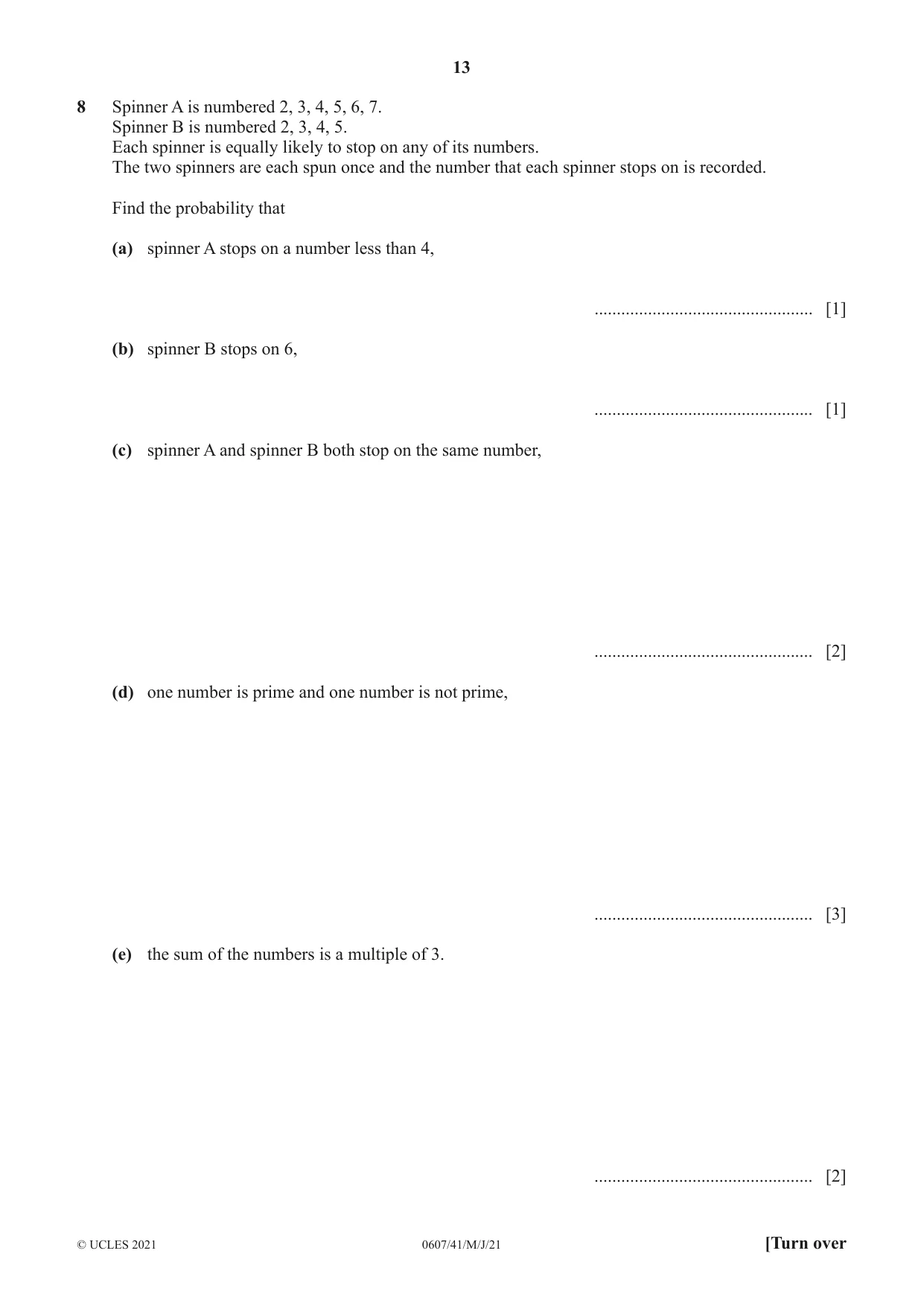
Q8 · Spinner A is numbered 2, 3, 4, 5, 6, 7
8 Spinner A is numbered 2, 3, 4, 5, 6, 7. Spinner B is numbered 2, 3, 4, 5. Each spinner is equally likely to stop on any of its numbers. The two spinners are each spun once and the number that each spinner stops on is recorded. Find the probability that (a) spinner A stops on a number less than 4, ................................................. [1] (b) spinner B stops on 6, ................................................. [1] (c) spinner A and spinner B both stop on the same number, ................................................. [2] (d) one number is prime and one number is not prime, ................................................. [3] (e) the sum of the numbers is a multiple of 3. ................................................. [2]
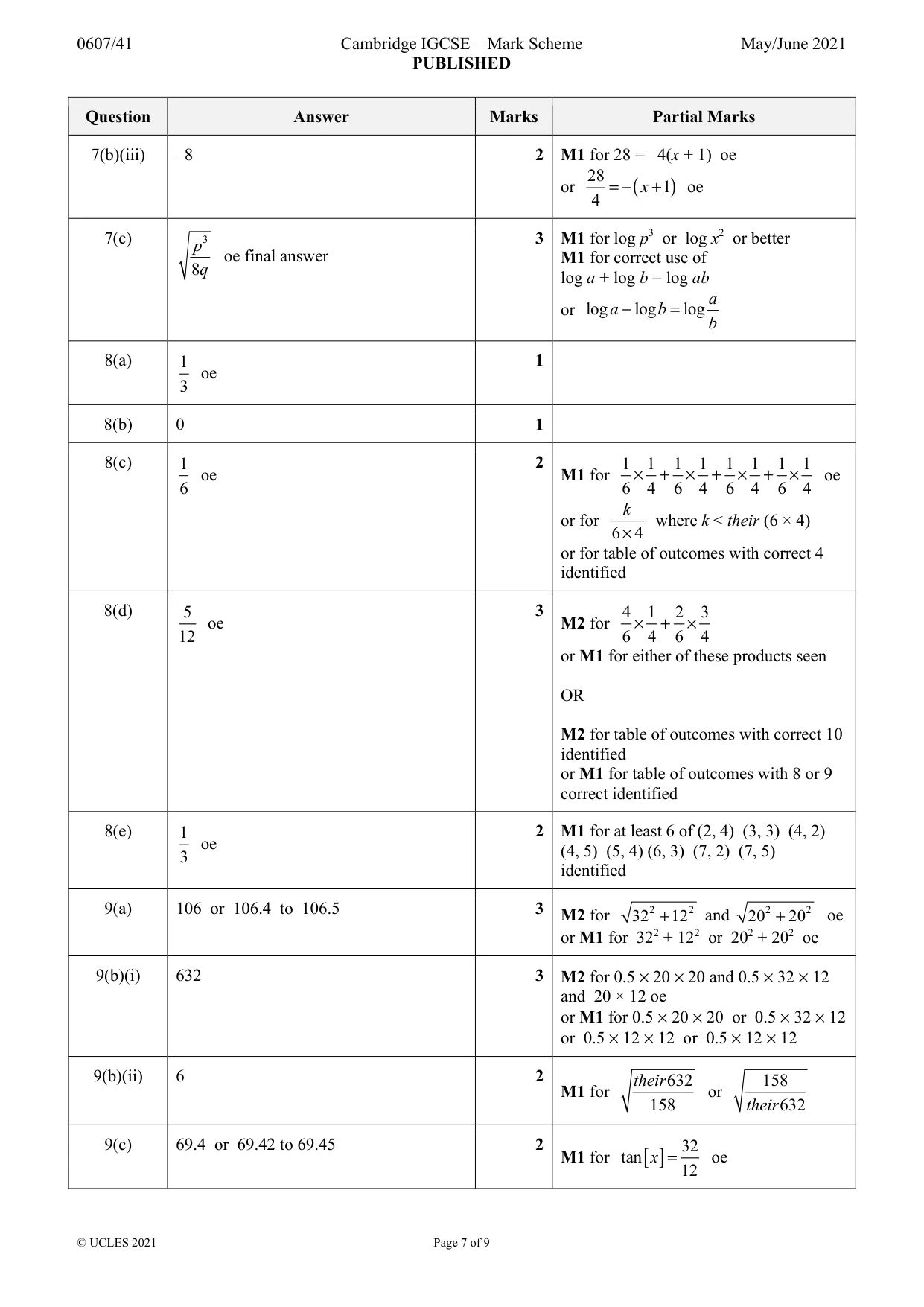
Mark scheme: 8(a) 1 1 oe 3 8(b) 0 1 8(c) 1 2 1 1 1 1 1 1 1 1 oe M1 for × + × + × + × oe 6 6 4 6 4 6 4 6 4 k or for where k < their (6 × 4) 6 × 4 or for table of outcomes with correct 4 identified 8(d) 5 3 4 1 2 3 oe M2 for × + × 12 6 4 6 4 or M1 for either of these products seen OR M2 for table of outcomes with correct 10 identified or M1 for table of outcomes with 8 or 9 correct identified 8(e) 1 2 M1 for at least 6 of (2, 4) (3, 3) (4, 2) oe (4, 5) (5, 4) (6, 3) (7, 2) (7, 5) 3 identified
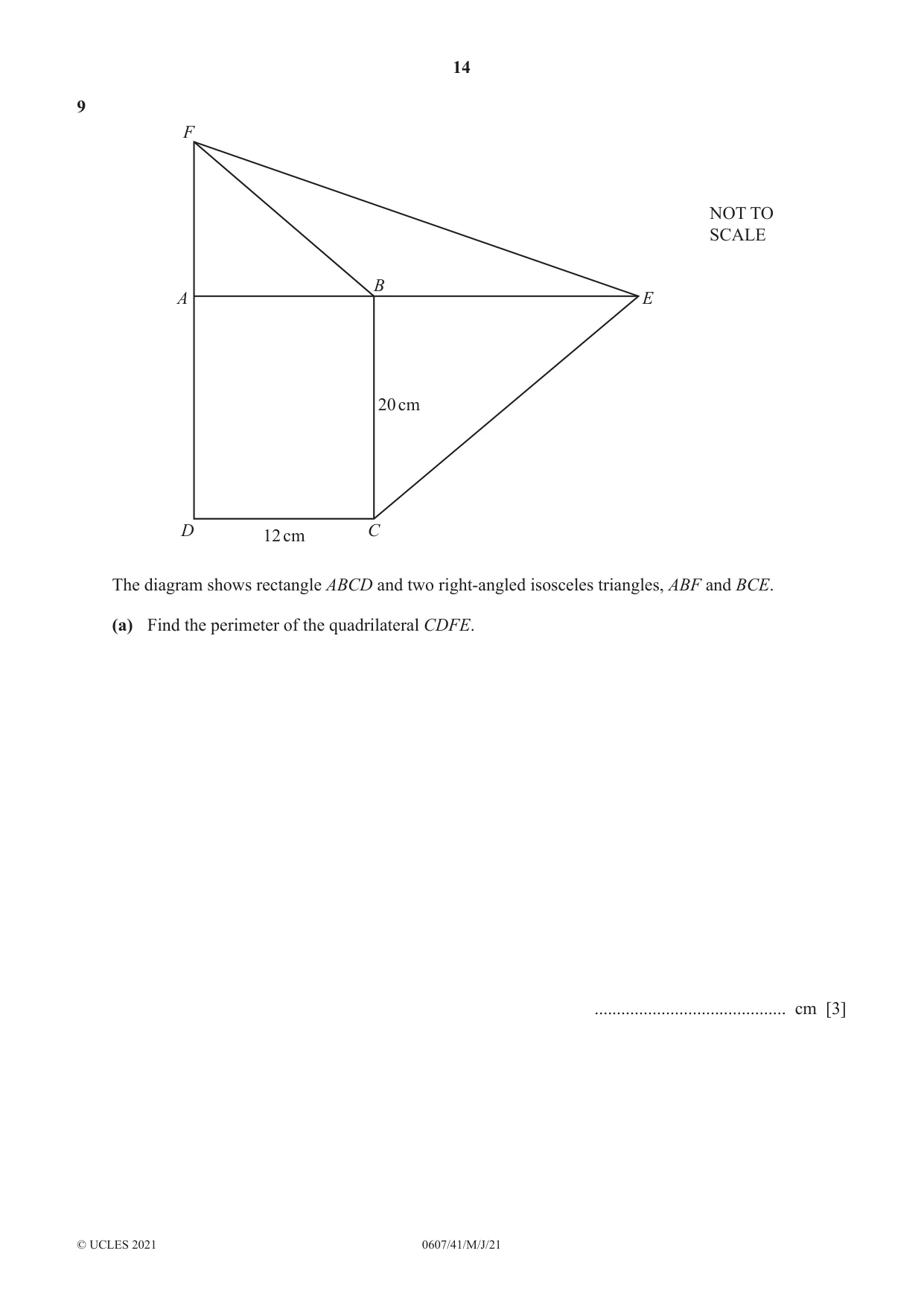
Q9 · F NOT TO SCALE B A E 20 cm D C 12 cm The diagram shows rectangle ABCD and two…
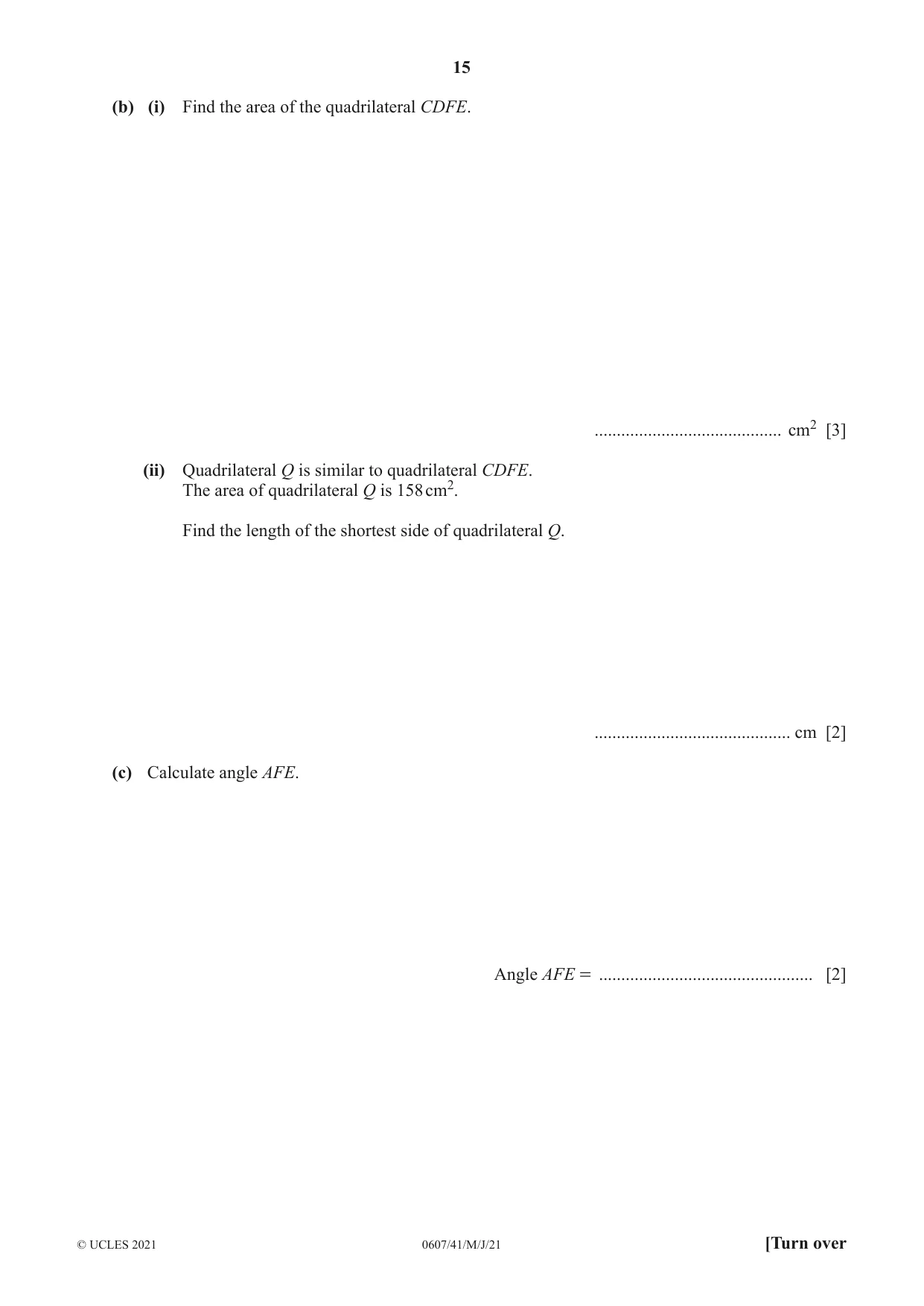
9 F NOT TO SCALE B A E 20 cm D C 12 cm The diagram shows rectangle ABCD and two right-angled isosceles triangles, ABF and BCE. (a) Find the perimeter of the quadrilateral CDFE. ........................................... cm [3] (b) (i) Find the area of the quadrilateral CDFE. .......................................... cm2 [3] (ii) Quadrilateral Q is similar to quadrilateral CDFE. The area of quadrilateral Q is 158 cm2. Find the length of the shortest side of quadrilateral Q. ............................................ cm [2] (c) Calculate angle AFE. Angle AFE = ................................................ [2]
Mark scheme: 9(a) 106 or 106.4 to 106.5 3 2 2 2 2 M2 for 32 + 12 and 20 + 20 oe or M1 for 322 + 122 or 202 + 202 oe 9(b)(i) 632 3 M2 for 0.5 × 20 × 20 and 0.5 × 32 × 12 and 20 × 12 oe or M1 for 0.5 × 20 × 20 or 0.5 × 32 × 12 or 0.5 × 12 × 12 or 0.5 × 12 × 12 9(b)(ii) 6 2 their 632 158 M1 for or 158 their 632 9(c) 69.4 or 69.42 to 69.45 2 32 M1 for tan [ x ] = oe 12
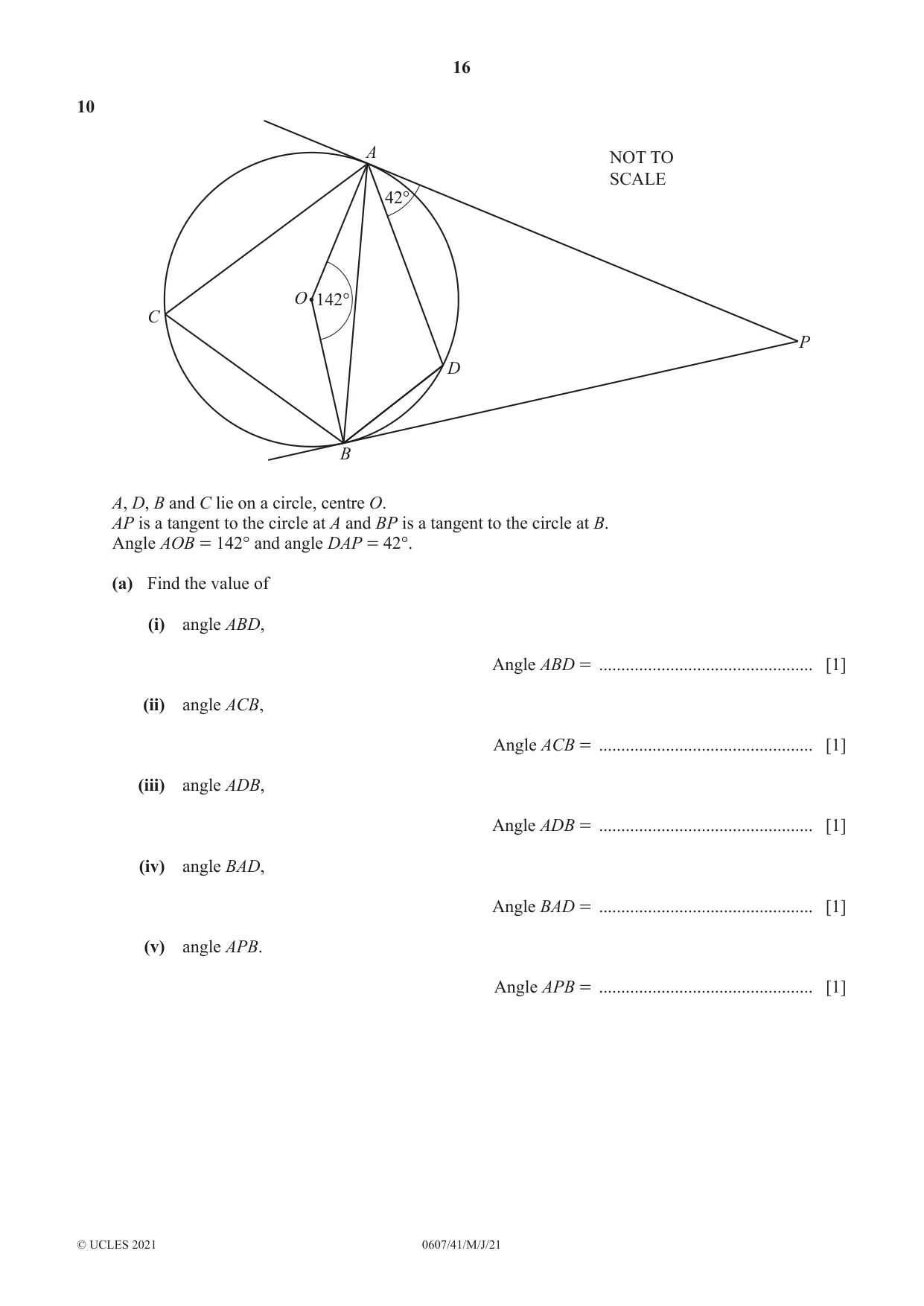
Q10 · A NOT TO SCALE 42° O 142° C P D B A, D, B and C lie on a circle, centre O
10 A NOT TO SCALE 42° O 142° C P D B A, D, B and C lie on a circle, centre O. AP is a tangent to the circle at A and BP is a tangent to the circle at B. Angle AOB = 142° and angle DAP = 42°. (a) Find the value of (i) angle ABD, Angle ABD = ................................................ [1] (ii) angle ACB, Angle ACB = ................................................ [1] (iii) angle ADB, Angle ADB = ................................................ [1] (iv) angle BAD, Angle BAD = ................................................ [1] (v) angle APB. Angle APB = ................................................ [1] (b) The radius of the circle is 11 cm. Find the area of triangle ABD. .......................................... cm2 [5]
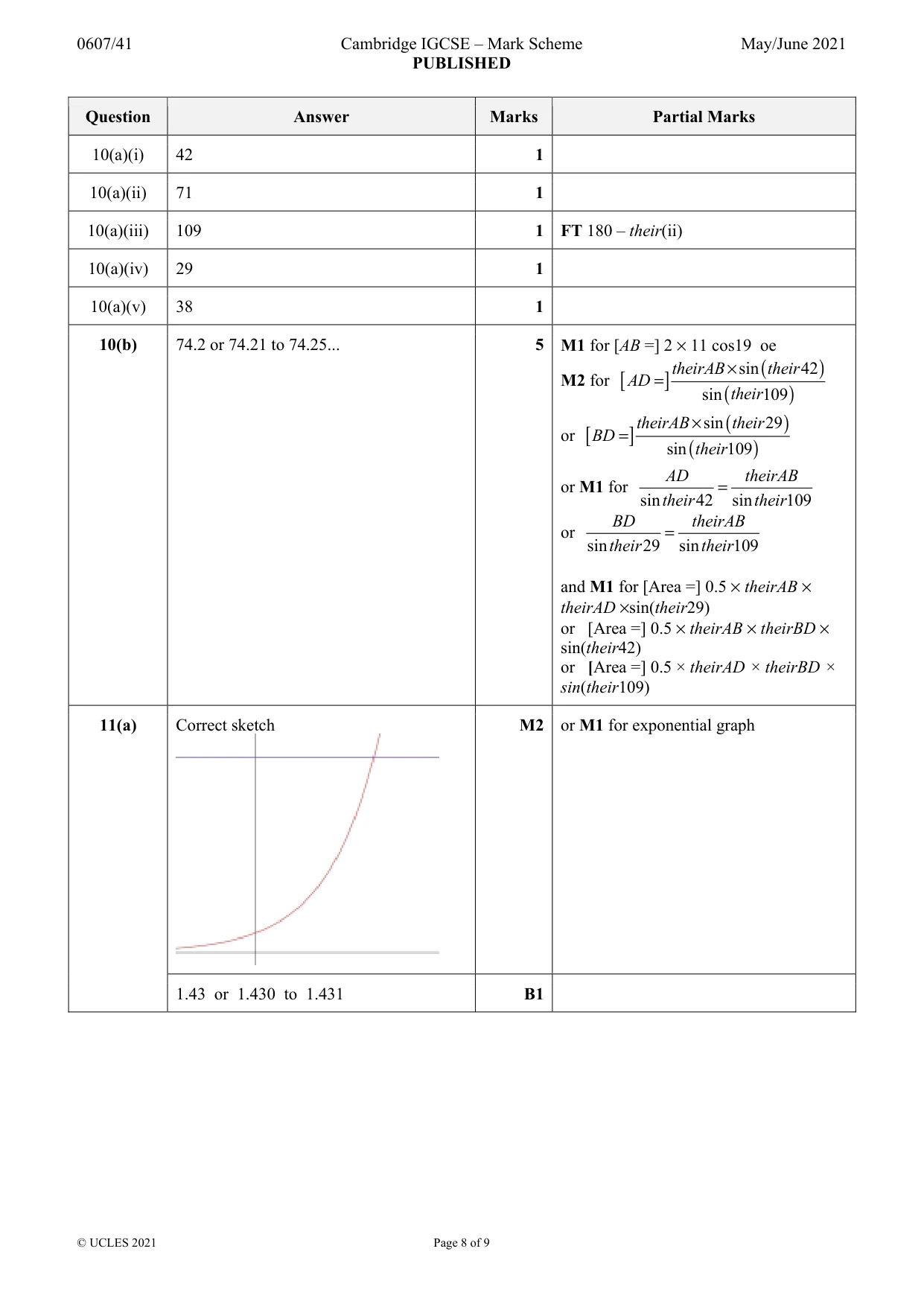
Mark scheme: 10(a)(i) 42 1 10(a)(ii) 71 1 10(a)(iii) 109 1 FT 180 – their(ii) 10(a)(iv) 29 1 10(a)(v) 38 1 10(b) 74.2 or 74.21 to 74.25... 5 M1 for [AB =] 2 × 11 cos19 oe theirAB × sin ( their 42 ) M2 for [ AD = ] sin ( their109 ) theirAB × sin ( their 29 ) or [ BD = ] sin ( their109 ) AD theirAB or M1 for = sin their 42 sin their109 BD theirAB or = sin their 29 sin their109 and M1 for [Area =] 0.5 × theirAB × theirAD ×sin(their29) or [Area =] 0.5 × theirAB × theirBD × sin(their42) or [Area =] 0.5 × theirAD × theirBD × sin(their109)
Q11 · Using a suitable sketch, solve 5 x = 10
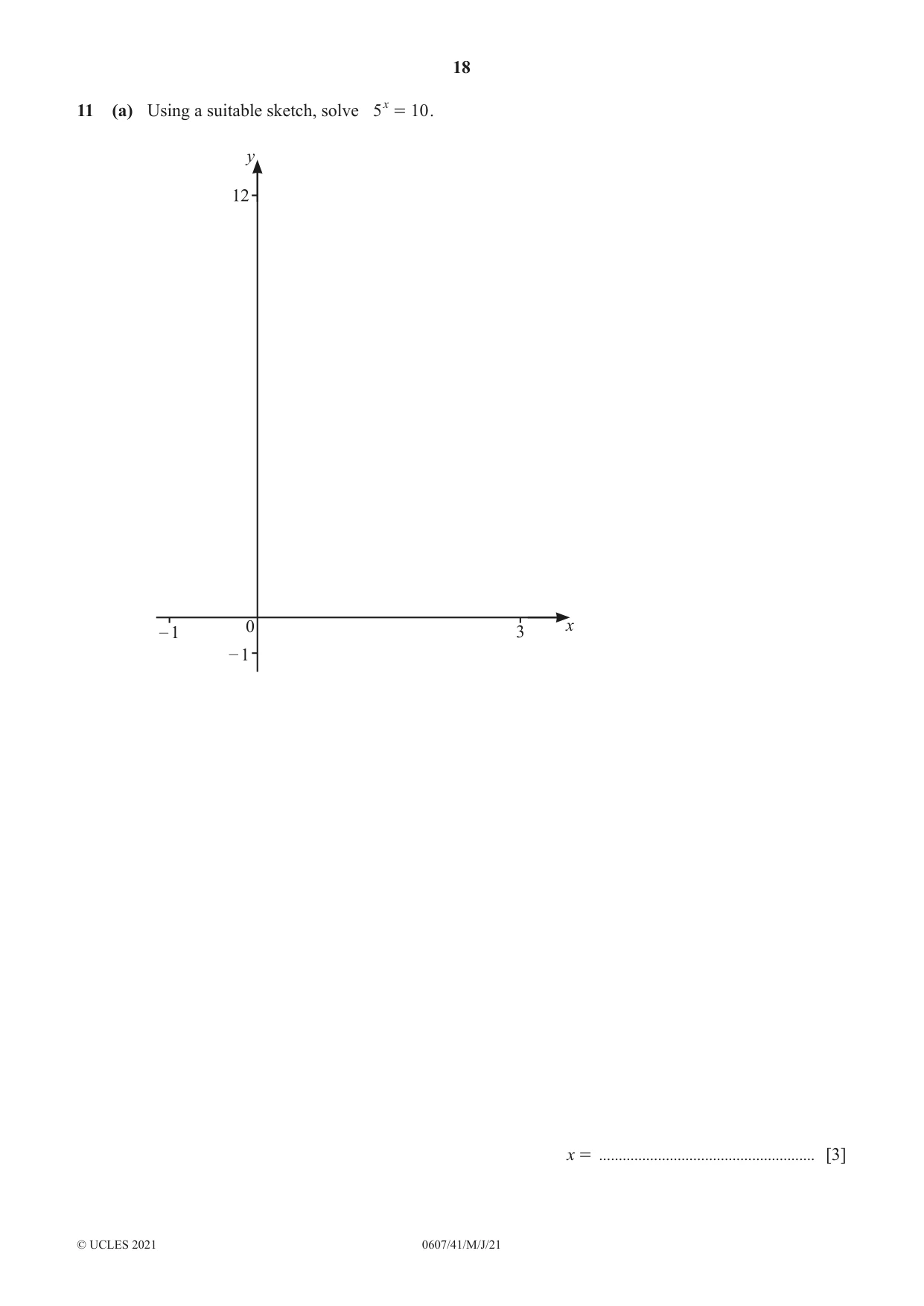
11 (a) Using a suitable sketch, solve 5 x = 10 . y 12 0 x – 1 3 – 1 (b) Solve. 5 + x 6x - 1 = 2x + 3 You must show all your working. x = ............................ or x = ............................ [5]
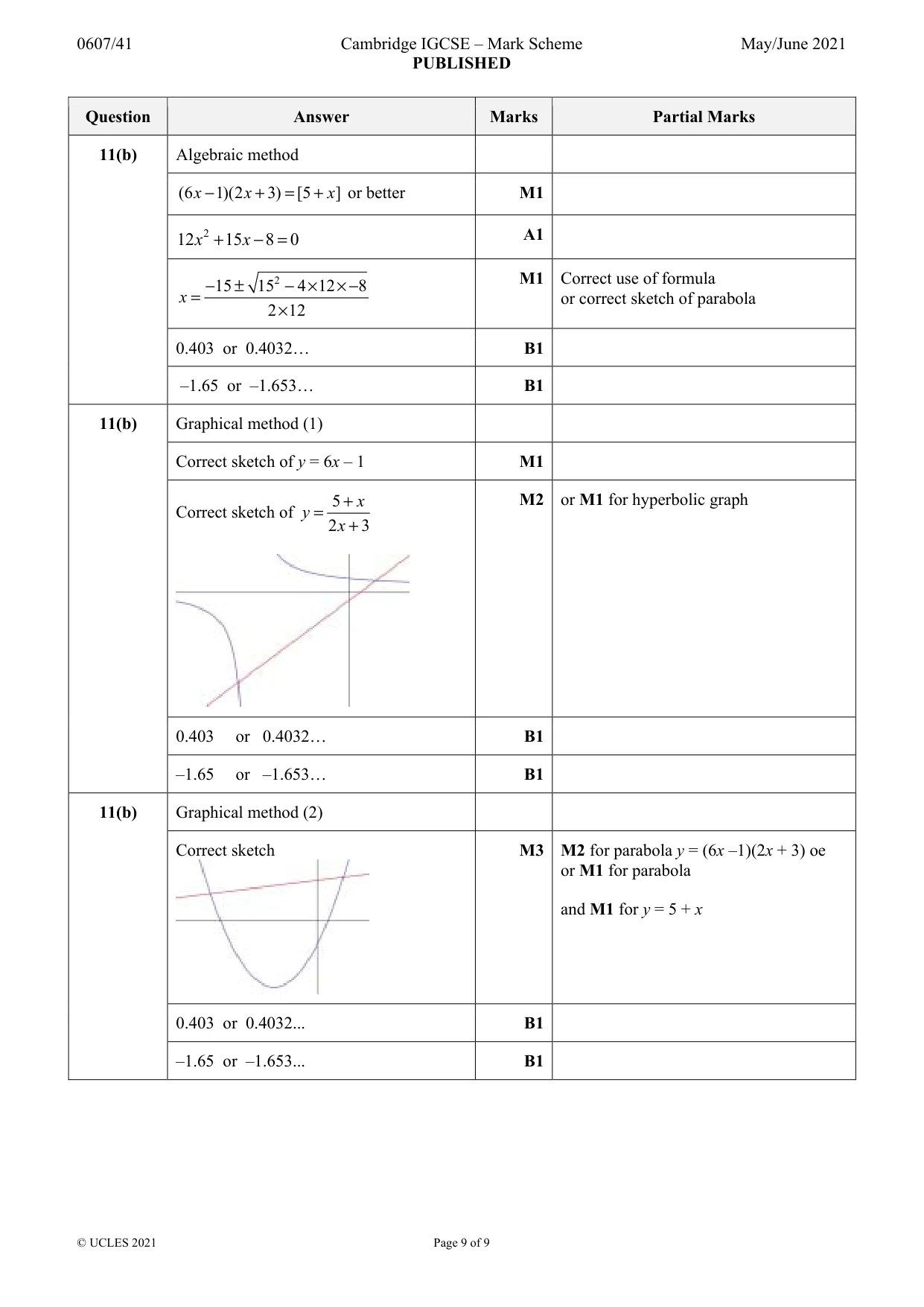
Mark scheme: 11(a) Correct sketch M2 or M1 for exponential graph 1.43 or 1.430 to 1.431 B1 11(b) Algebraic method (6 x − 1)(2 x + 3) = [5 + x ] or better M1 12 x 2 + 15 x −=8 0 A1 2 M1 Correct use of formula −15 ± 15 − 4 × 12 × −8 x = or correct sketch of parabola 2 × 12 0.403 or 0.4032… B1 –1.65 or –1.653… B1 11(b) Graphical method (1) Correct sketch of y = 6x – 1 M1 5 + x M2 or M1 for hyperbolic graph Correct sketch of y = 2 x + 3 0.403 or 0.4032… B1 –1.65 or –1.653… B1 11(b) Graphical method (2) Correct sketch M3 M2 for parabola y = (6x –1)(2x + 3) oe or M1 for parabola and M1 for y = 5 + x 0.403 or 0.4032... B1 –1.65 or –1.653... B1
What was in this paper
The subtopics covered by these 11 questions, and how many questions each got. Open one in a new tab to see every Cambridge question on it.
What you needed in this session
Cambridge’s own grade thresholds for 2021 May/June, Paper 4 · Variant 1. A higher threshold means an easier paper — the bar moves with how the cohort did.