Cambridge IGCSE Mathematics - International 0607 — 2025 Oct/Nov Paper 4 · Variant 1
0607/41/O/N/25 · 15 questions · 75 marks · ≈84 min
The question paper and its mark scheme, free to read here and free to download. This is Cambridge’s own paper, exactly as it was sat.
Question paper16 pages
Mark scheme9 pages
Answers below. Sit the paper first if you are practising.
Questions as text
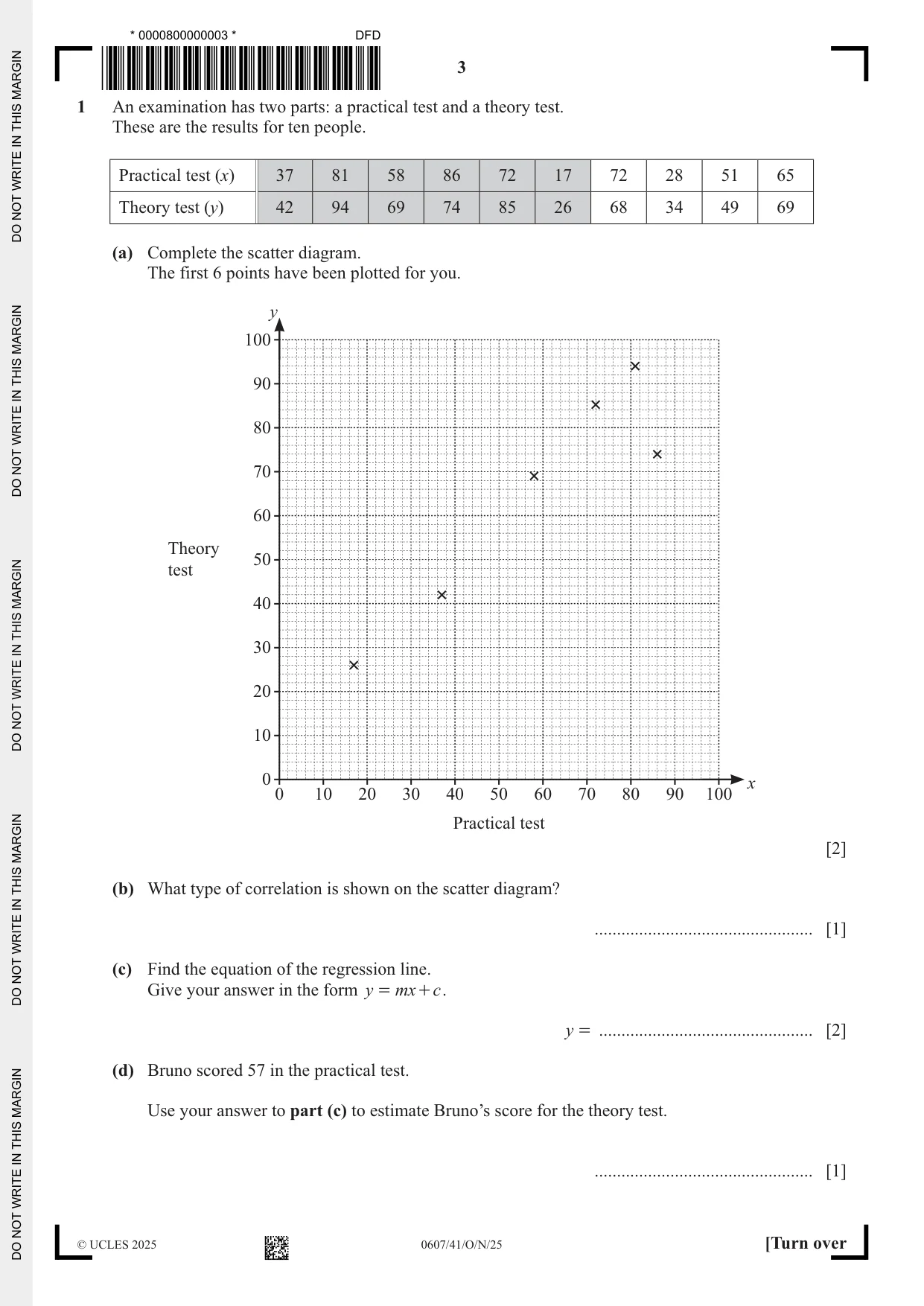
Q1 · An examination has two parts: a practical test and a theory test
1 An examination has two parts: a practical test and a theory test. These are the results for ten people. Practical test (x) 37 81 58 86 72 17 72 28 51 65 Theory test (y) 42 94 69 74 85 26 68 34 49 69 (a) Complete the scatter diagram. The first 6 points have been plotted for you. y 100 90 80 70 60 Theory 50 test 40 30 20 10 0 x 0 10 20 30 40 50 60 70 80 90 100 Practical test [2] (b) What type of correlation is shown on the scatter diagram? ................................................. [1] (c) Find the equation of the regression line. Give your answer in the form y = mx + c . y = ................................................ [2] (d) Bruno scored 57 in the practical test. Use your answer to part (c) to estimate Bruno’s score for the theory test. ................................................. [1]
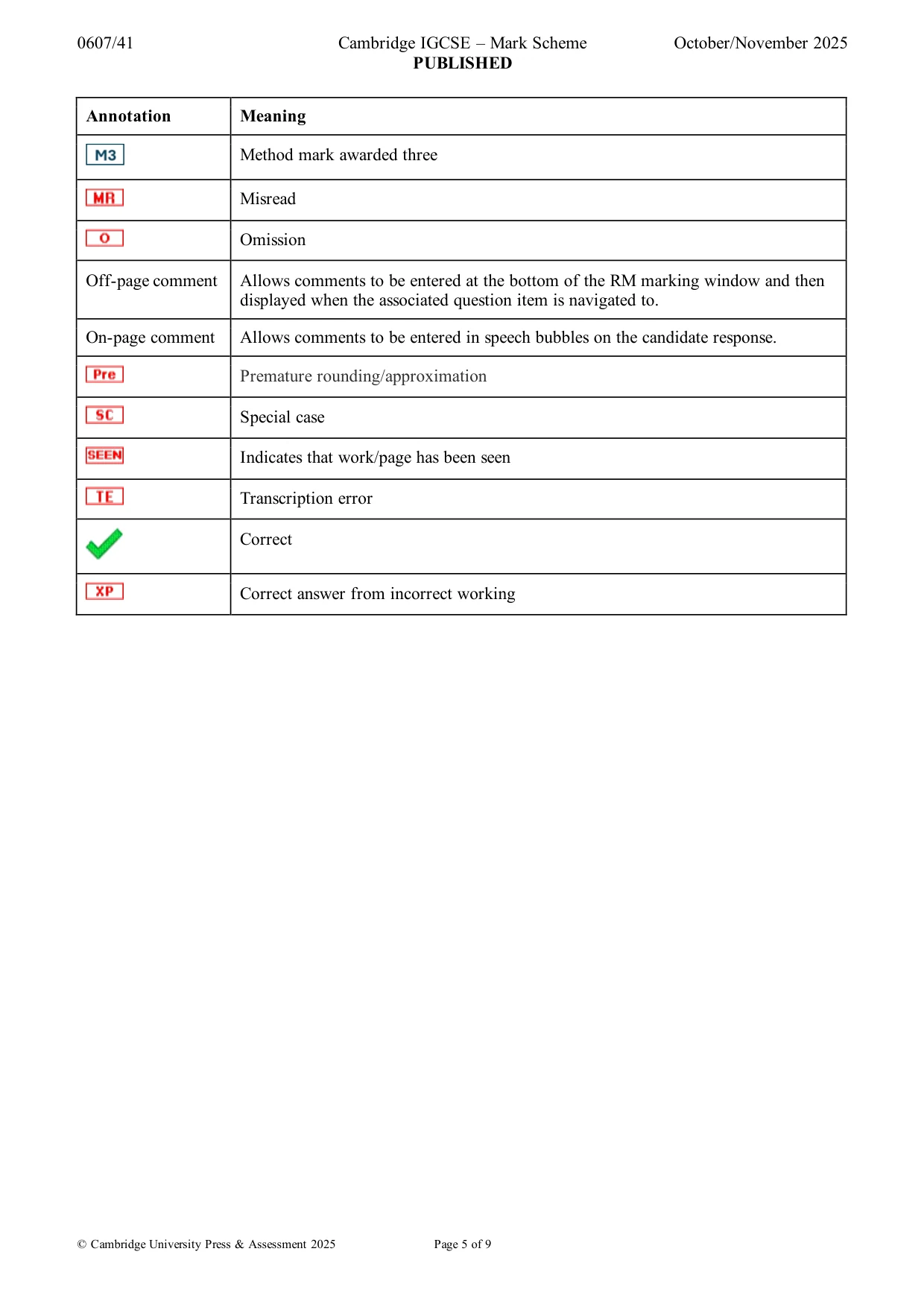
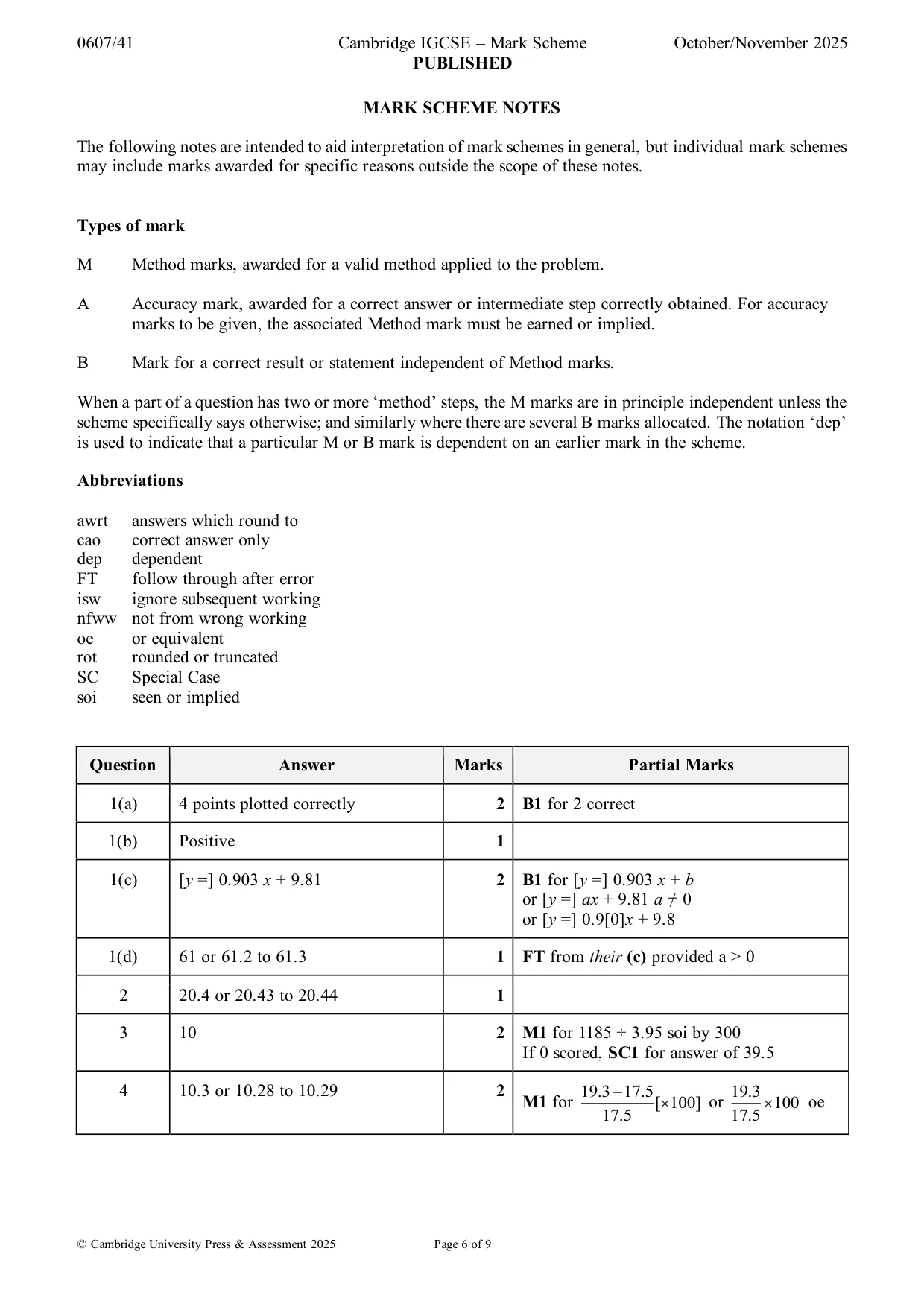
Mark scheme: Question Answer Marks Partial Marks 1(a) 4 points plotted correctly 2 B1 for 2 correct 1(b) Positive 1 1(c) [y =] 0.903 x + 9.81 2 B1 for [y =] 0.903 x + b or [y =] ax + 9.81 a ≠ 0 or [y =] 0.9[0]x + 9.8 1(d) 61 or 61.2 to 61.3 1 FT from their (c) provided a > 0
Question 2
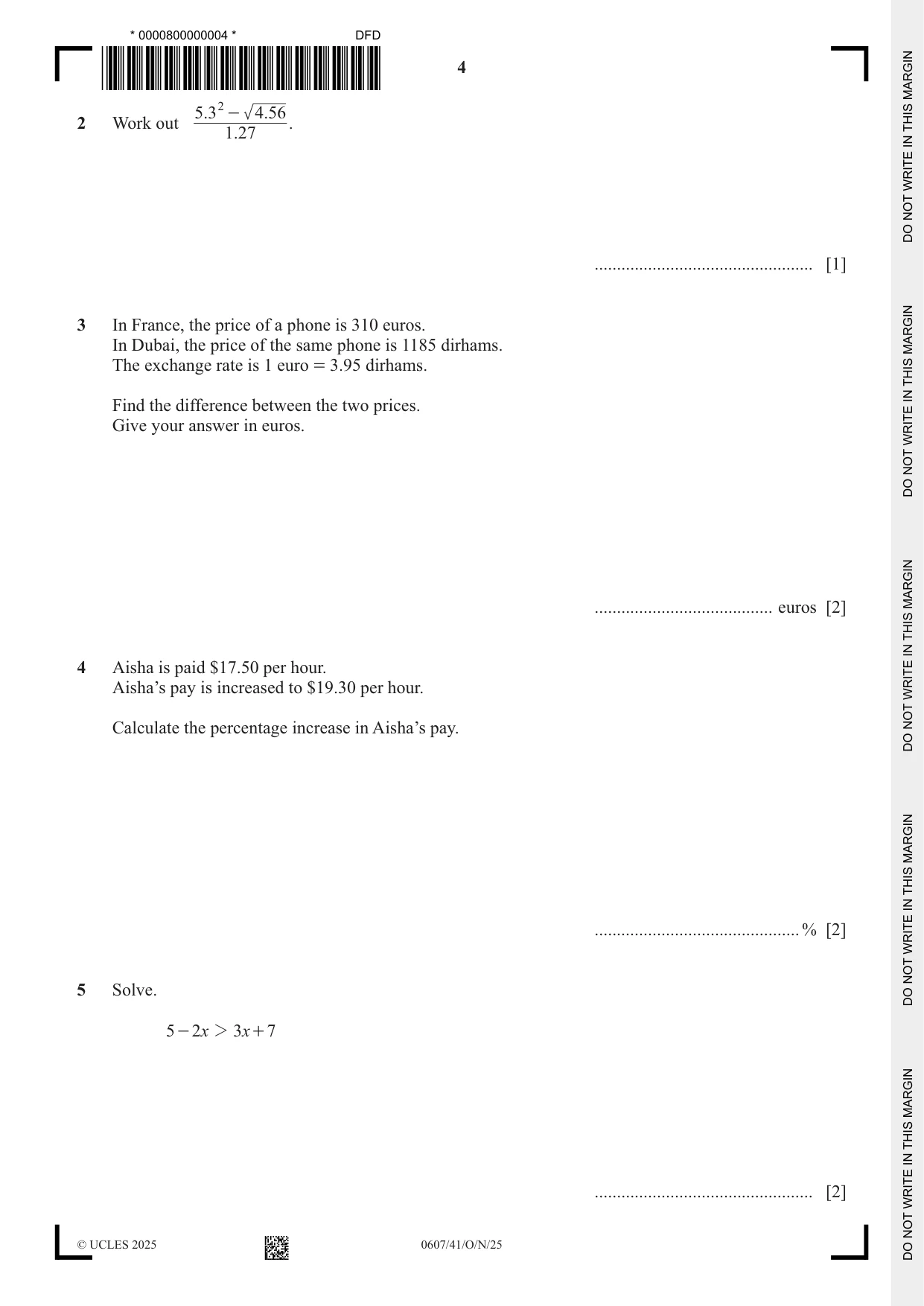
2 Work out . .127 ................................................. [1]
Mark scheme: 2 20.4 or 20.43 to 20.44 1
Q3 · In France, the price of a phone is 310 euros
3 In France, the price of a phone is 310 euros. In Dubai, the price of the same phone is 1185 dirhams. The exchange rate is 1 euro = 3.95 dirhams. Find the difference between the two prices. Give your answer in euros. ........................................ euros [2]
Mark scheme: 3 10 2 M1 for 1185 ÷ 3.95 soi by 300 If 0 scored, SC1 for answer of 39.5
Q4 · Aisha is paid $17.50 per hour
4 Aisha is paid $17.50 per hour. Aisha’s pay is increased to $19.30 per hour. Calculate the percentage increase in Aisha’s pay. ..............................................% [2]
Mark scheme: 4 10.3 or 10.28 to 10.29 2 19.3 − 19.3 M1 for 17.5[ 100] or 100 oe 17.5 17.5
Question 5
5 Solve. 5 - 2x 2 3 x + 7 ................................................. [2]
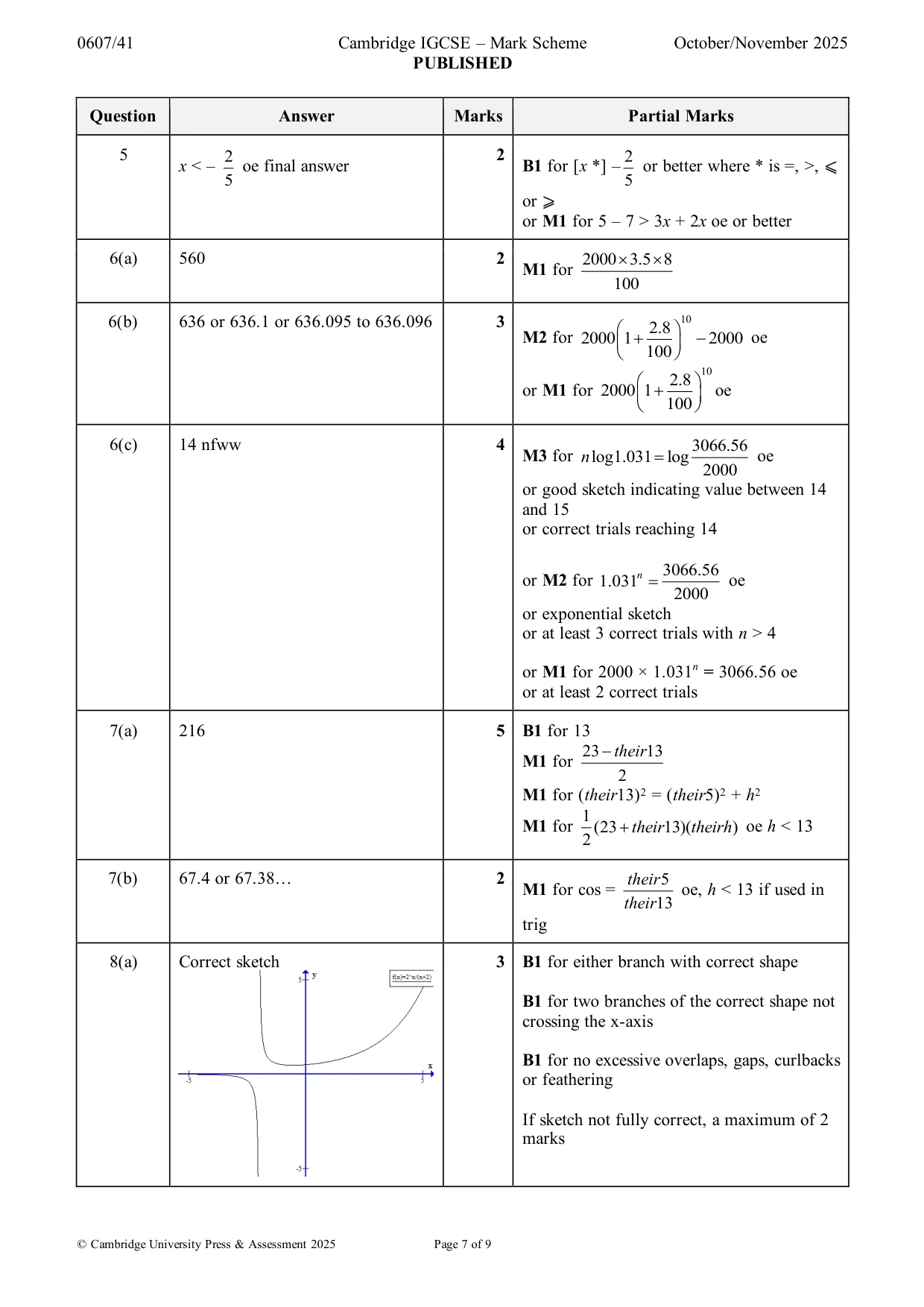
Mark scheme: 5 2 2 2 x < – oe final answer B1 for [x *] – or better where * is =, >, ⩽ 5 5 or ⩾ or M1 for 5 – 7 > 3x + 2x oe or better
Q6 · Jeanne invests $2000 at a rate of 3.5% per year simple interest
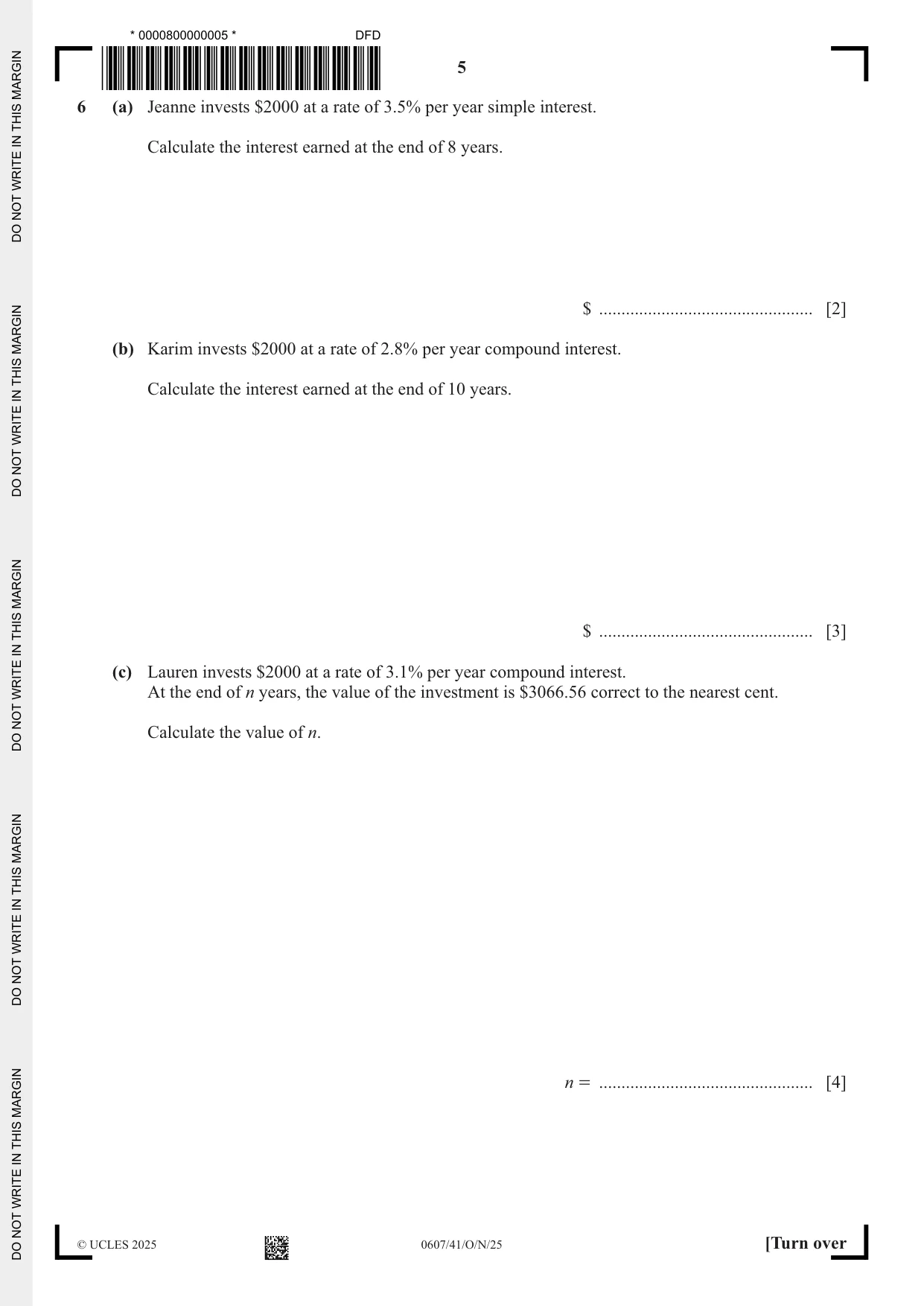
6 (a) Jeanne invests $2000 at a rate of 3.5% per year simple interest. Calculate the interest earned at the end of 8 years. $ ................................................ [2] (b) Karim invests $2000 at a rate of 2.8% per year compound interest. Calculate the interest earned at the end of 10 years. $ ................................................ [3] (c) Lauren invests $2000 at a rate of 3.1% per year compound interest. At the end of n years, the value of the investment is $3066.56 correct to the nearest cent. Calculate the value of n. n = ................................................ [4]
Mark scheme: 6(a) 560 2 2000 3.5 8 M1 for 100 6(b) 636 or 636.1 or 636.095 to 636.096 3 10 2.8 M2 for 2000 1 + − 2000 oe 100 2.8 10 or M1 for 2000 1 + oe 100 6(c) 14 nfww 4 3066.56 M3 for n log1.031 = log oe 2000 or good sketch indicating value between 14 and 15 or correct trials reaching 14 n 3066.56 or M2 for 1.031 = oe 2000 or exponential sketch or at least 3 correct trials with n > 4 or M1 for 2000 × 1.031n = 3066.56 oe or at least 2 correct trials
Q7 · A 23 cm B NOT TO SCALE D C The diagram shows a trapezium, ABCD
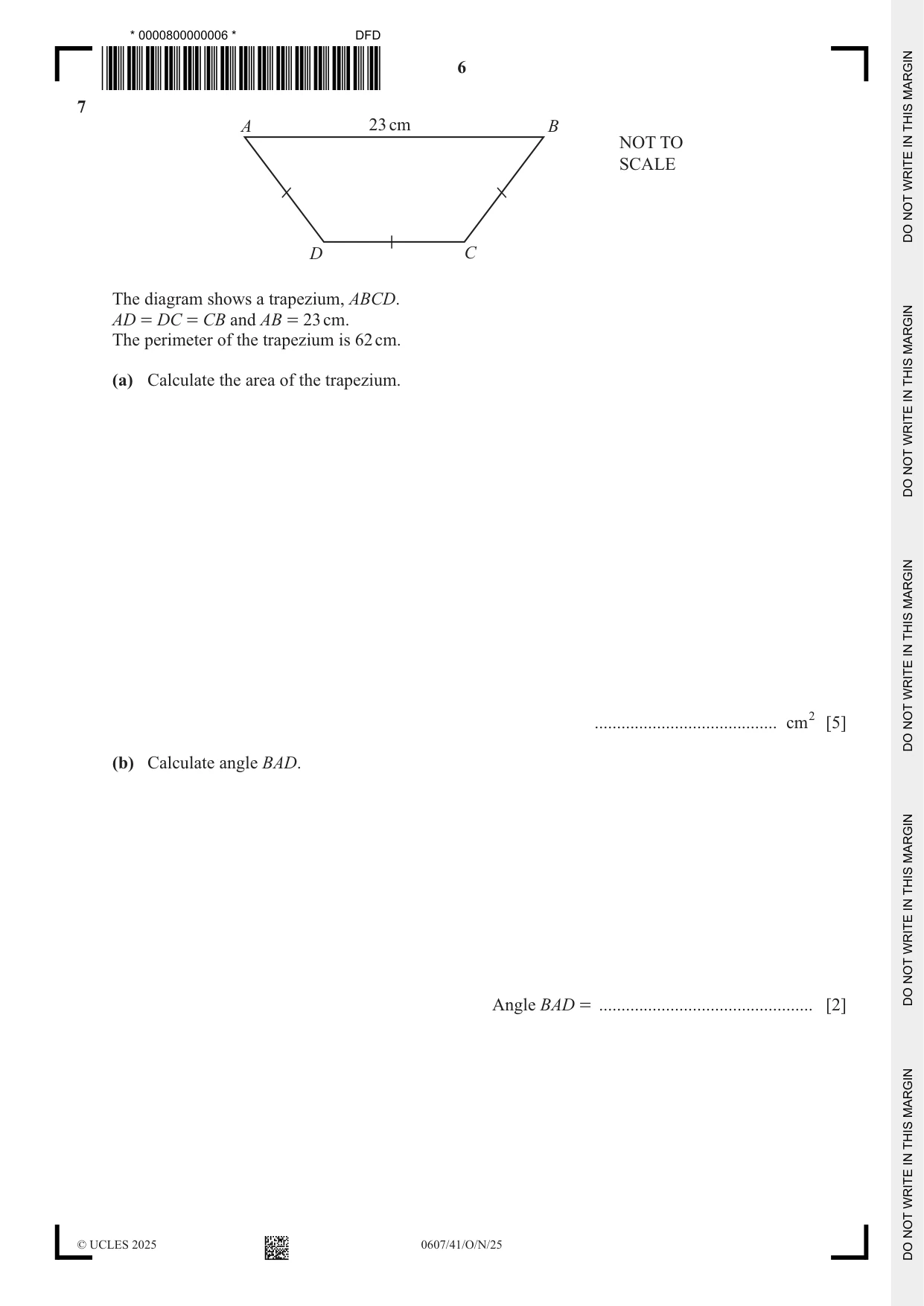
7 A 23 cm B NOT TO SCALE D C The diagram shows a trapezium, ABCD. AD = DC = CB and AB = 23 cm. The perimeter of the trapezium is 62 cm. (a) Calculate the area of the trapezium. ......................................... cm2 [5] (b) Calculate angle BAD. Angle BAD = ................................................ [2]
Mark scheme: 7(a) 216 5 B1 for 13 23 −their13 M1 for 2 M1 for (their13)2 = (their5)2 + h2 1 M1 for (23 + their13)(theirh ) oe h < 13 2 7(b) 67.4 or 67.38… 2 their 5 M1 for cos = oe, h < 13 if used in their13 trig
Q8 · Y 5 x 0 – 5 5 – 5 2x f ( x) = x + 2 (a) On the diagram, sketch the graph of y = f ( x)…
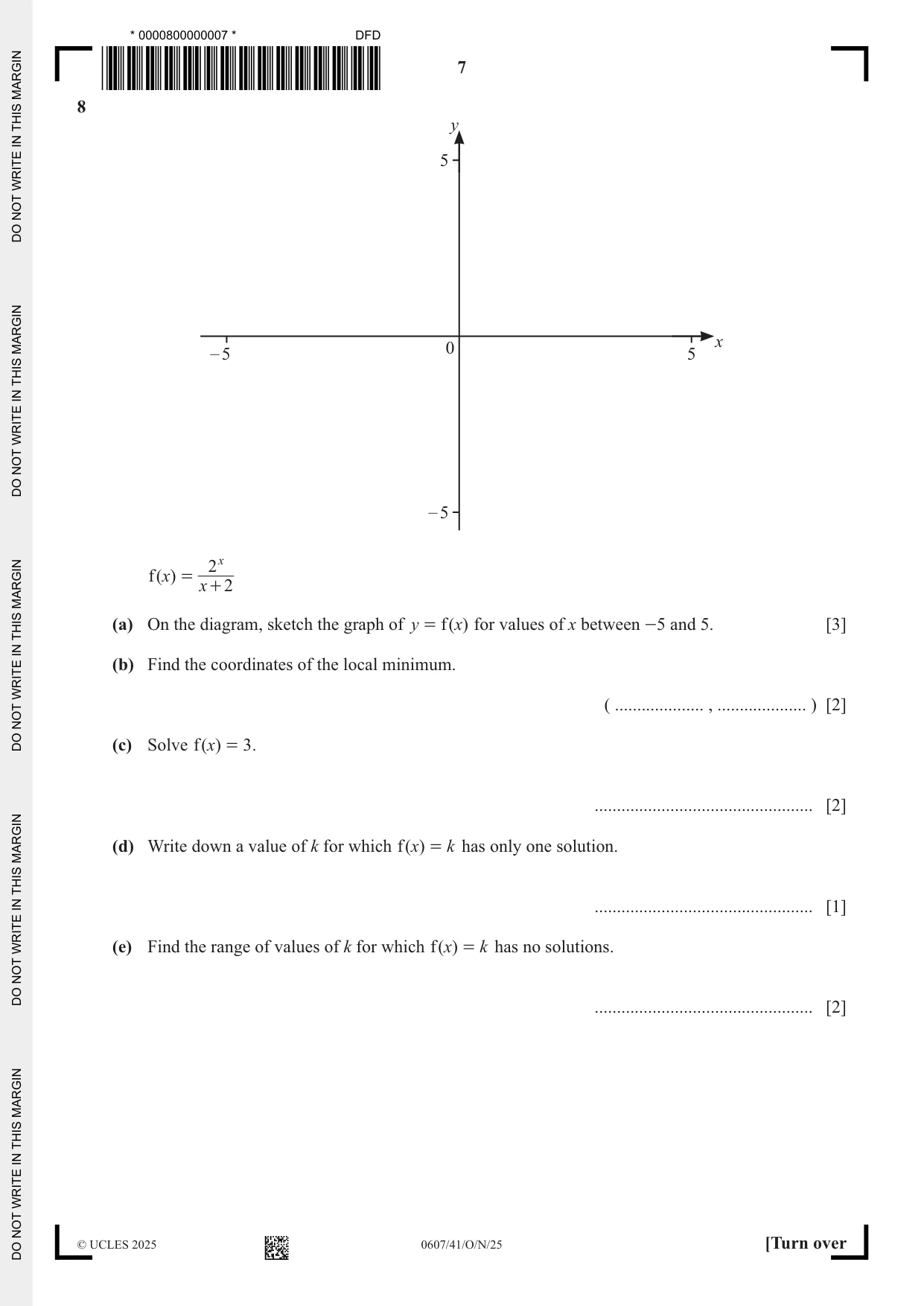
8 y 5 x 0 – 5 5 – 5 2x f ( x) = x + 2 (a) On the diagram, sketch the graph of y = f ( x) for values of x between -5 and 5. [3] (b) Find the coordinates of the local minimum. ( .................... , .................... ) [2] (c) Solve f ( x) = 3 . ................................................. [2] (d) Write down a value of k for which f ( x) = k has only one solution. ................................................. [1] (e) Find the range of values of k for which f ( x) = k has no solutions. ................................................. [2]
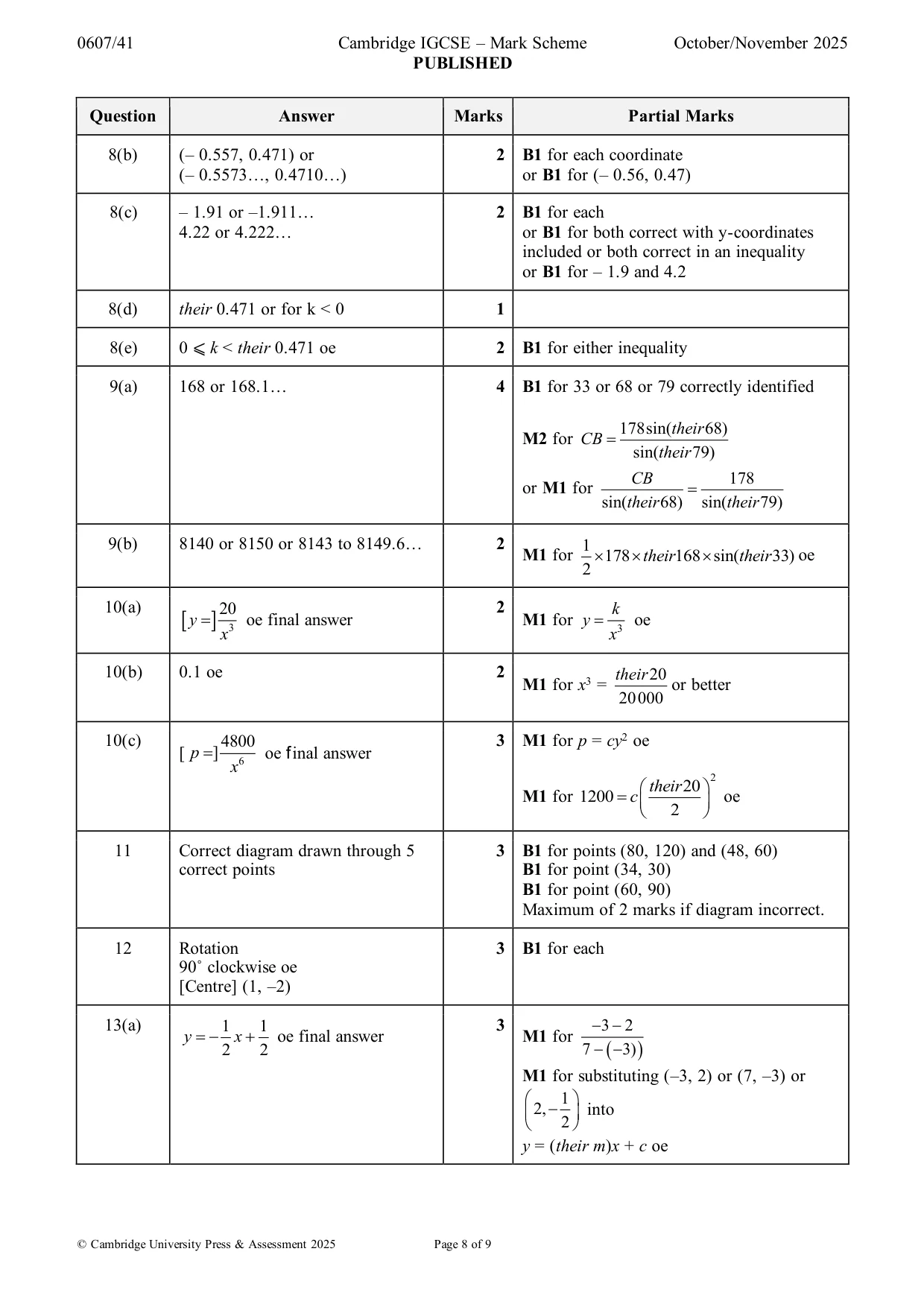
Mark scheme: 8(a) Correct sketch 3 B1 for either branch with correct shape B1 for two branches of the correct shape not crossing the x-axis B1 for no excessive overlaps, gaps, curlbacks or feathering If sketch not fully correct, a maximum of 2 marks 8(b) (– 0.557, 0.471) or 2 B1 for each coordinate (– 0.5573…, 0.4710…) or B1 for (– 0.56, 0.47) 8(c) – 1.91 or –1.911… 2 B1 for each 4.22 or 4.222… or B1 for both correct with y-coordinates included or both correct in an inequality or B1 for – 1.9 and 4.2 8(d) their 0.471 or for k < 0 1 8(e) 0 ⩽ k < their 0.471 oe 2 B1 for either inequality
Q9 · North North 178 m A B NOT TO SCALE C ABC is a field on level ground
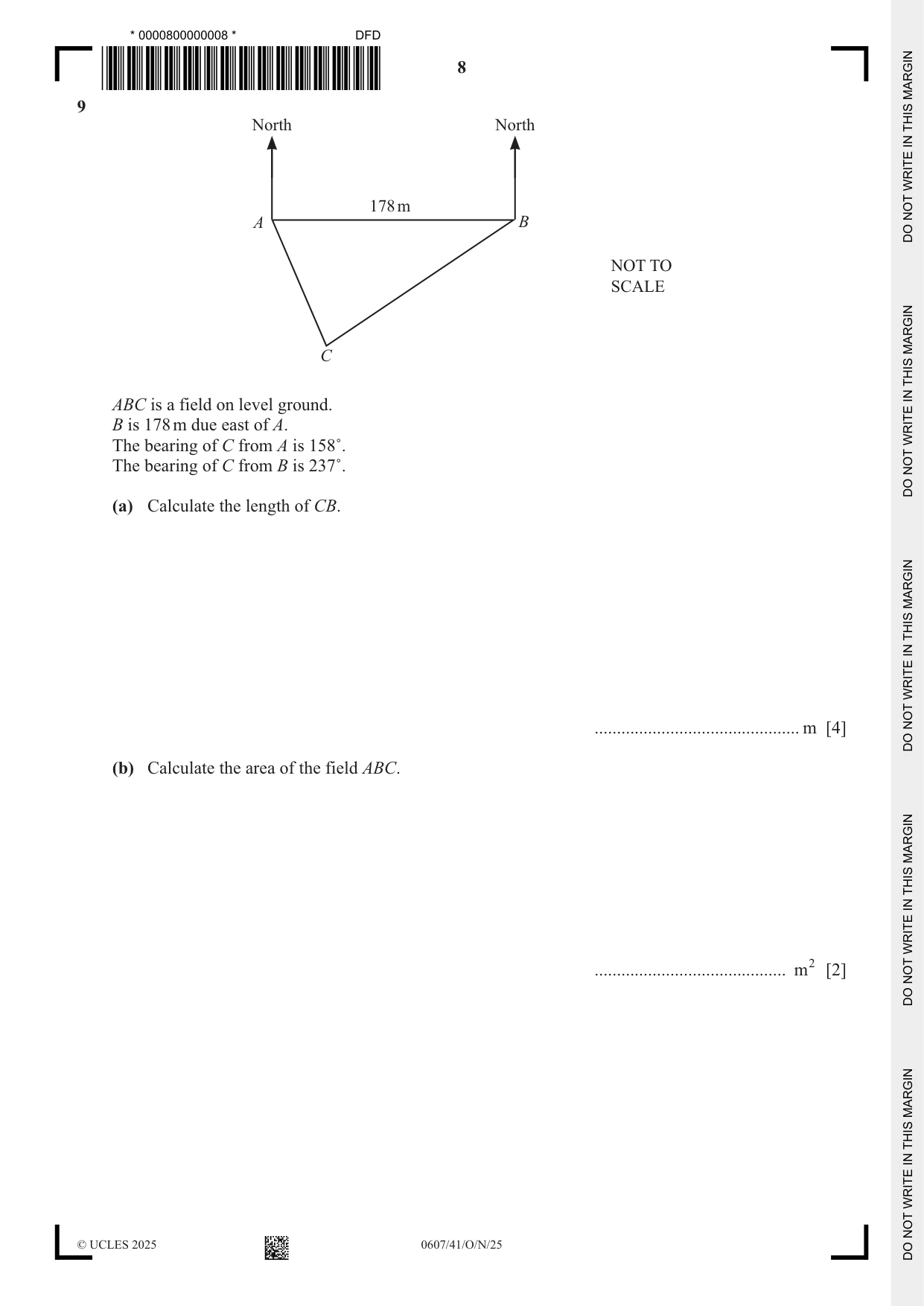
9 North North 178 m A B NOT TO SCALE C ABC is a field on level ground. B is 178 m due east of A. The bearing of C from A is 158˚. The bearing of C from B is 237˚. (a) Calculate the length of CB. .............................................. m [4] (b) Calculate the area of the field ABC. ........................................... m2 [2]
Mark scheme: 9(a) 168 or 168.1… 4 B1 for 33 or 68 or 79 correctly identified 178sin(their 68) M2 for CB = sin(their 79) CB 178 or M1 for = sin(their 68) sin(their 79) 9(b) 8140 or 8150 or 8143 to 8149.6… 2 1 M1 for 178 their168 sin(their 33) oe 2
Q10 · Y is inversely proportional to x3
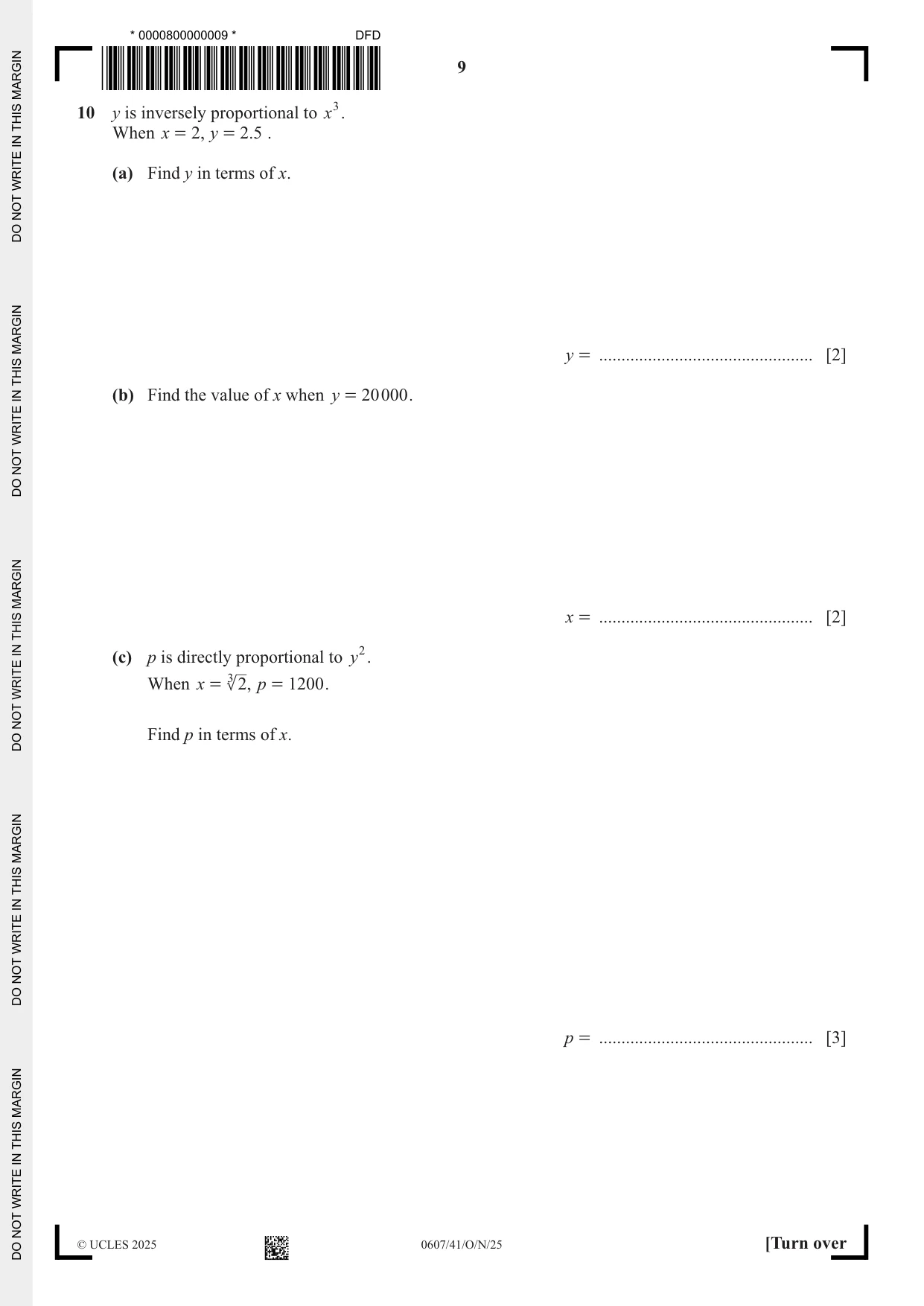
10 y is inversely proportional to x3. When x = 2, y = 2. 5 . (a) Find y in terms of x. y = ................................................ [2] (b) Find the value of x when y = 20000 . x = ................................................ [2] (c) p is directly proportional to y2. When x = 3 2, p = 1200 . Find p in terms of x. p = ................................................ [3]
Mark scheme: 10(a) 20 2 k oe final answer M1 for y = oe y = 3 3 x x 10(b) 0.1 oe 2 their 20 M1 for x3 = or better 20000 10(c) 4800 3 M1 for p = cy2 oe [ p = ] oe final answer x 6 their 20 2 M1 for 1200 = c oe 2
Q11 · The table shows some information about the heights, in cm, of 120 plants
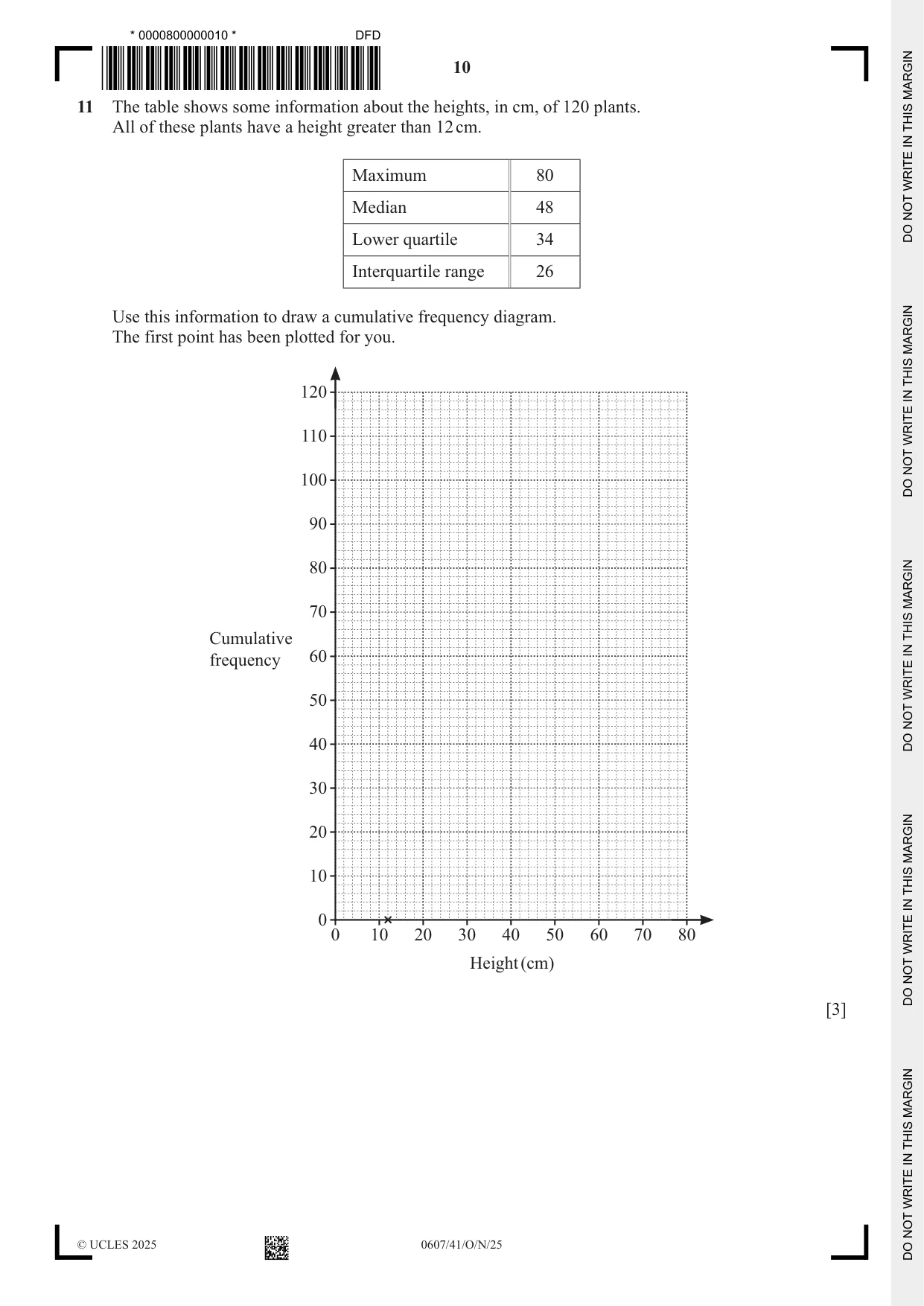
11 The table shows some information about the heights, in cm, of 120 plants. All of these plants have a height greater than 12 cm. Maximum 80 Median 48 Lower quartile 34 Interquartile range 26 Use this information to draw a cumulative frequency diagram. The first point has been plotted for you. 120 110 100 90 80 70 Cumulative frequency 60 50 40 30 20 10 0 0 10 20 30 40 50 60 70 80 Height (cm) [3]
Mark scheme: 11 Correct diagram drawn through 5 3 B1 for points (80, 120) and (48, 60) correct points B1 for point (34, 30) B1 for point (60, 90) Maximum of 2 marks if diagram incorrect.
Q12 · Transformation A is a rotation 90° clockwise about the origin
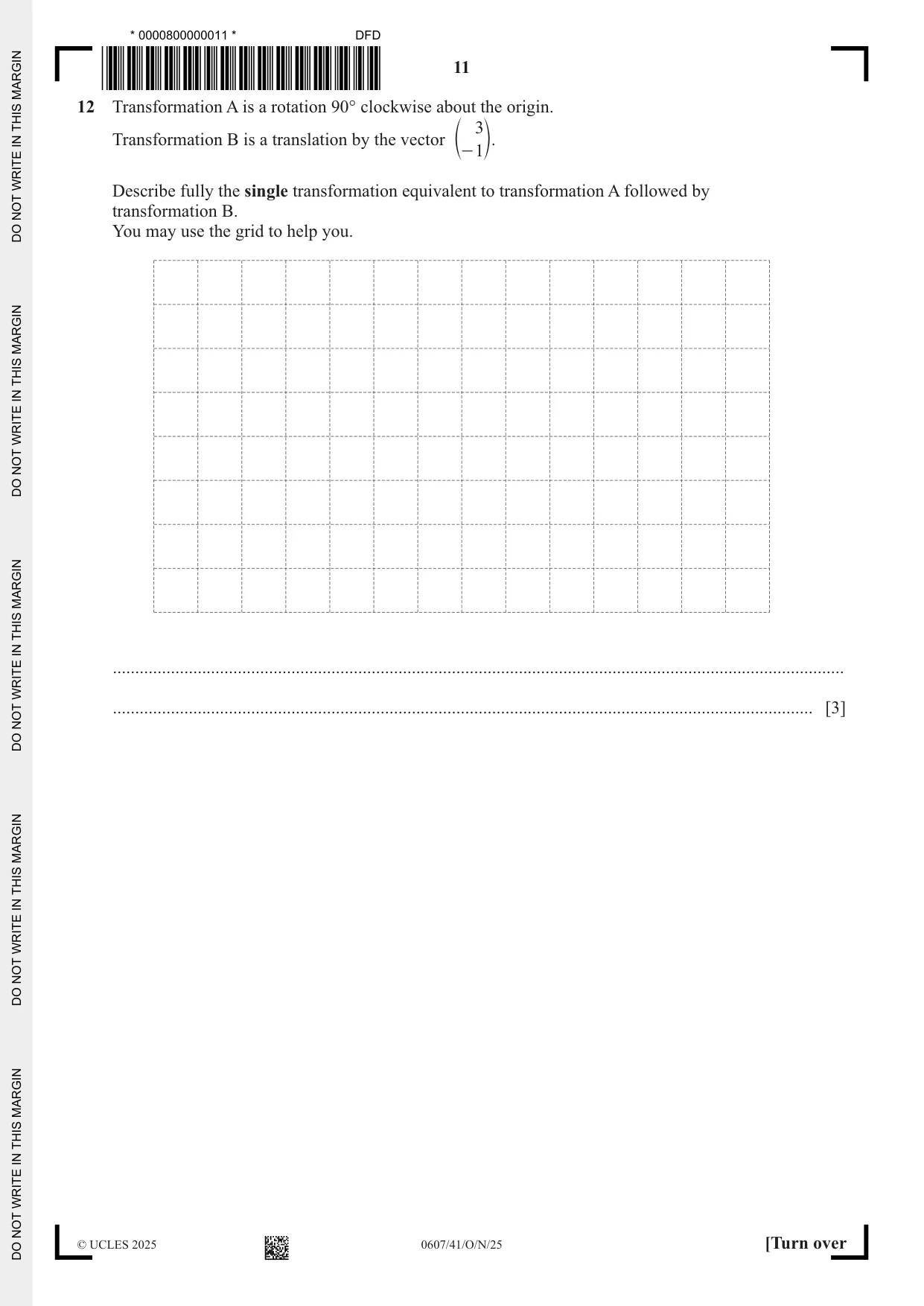
12 Transformation A is a rotation 90° clockwise about the origin. 3 Transformation B is a translation by the vector e o. - 1 Describe fully the single transformation equivalent to transformation A followed by transformation B. You may use the grid to help you. .................................................................................................................................................................... ............................................................................................................................................................. [3]
Mark scheme: 12 Rotation 3 B1 for each 90˚ clockwise oe [Centre] (1, –2)
Q13 · A is the point ( - 3 , 2) and B is the point ( 7 , - 3)
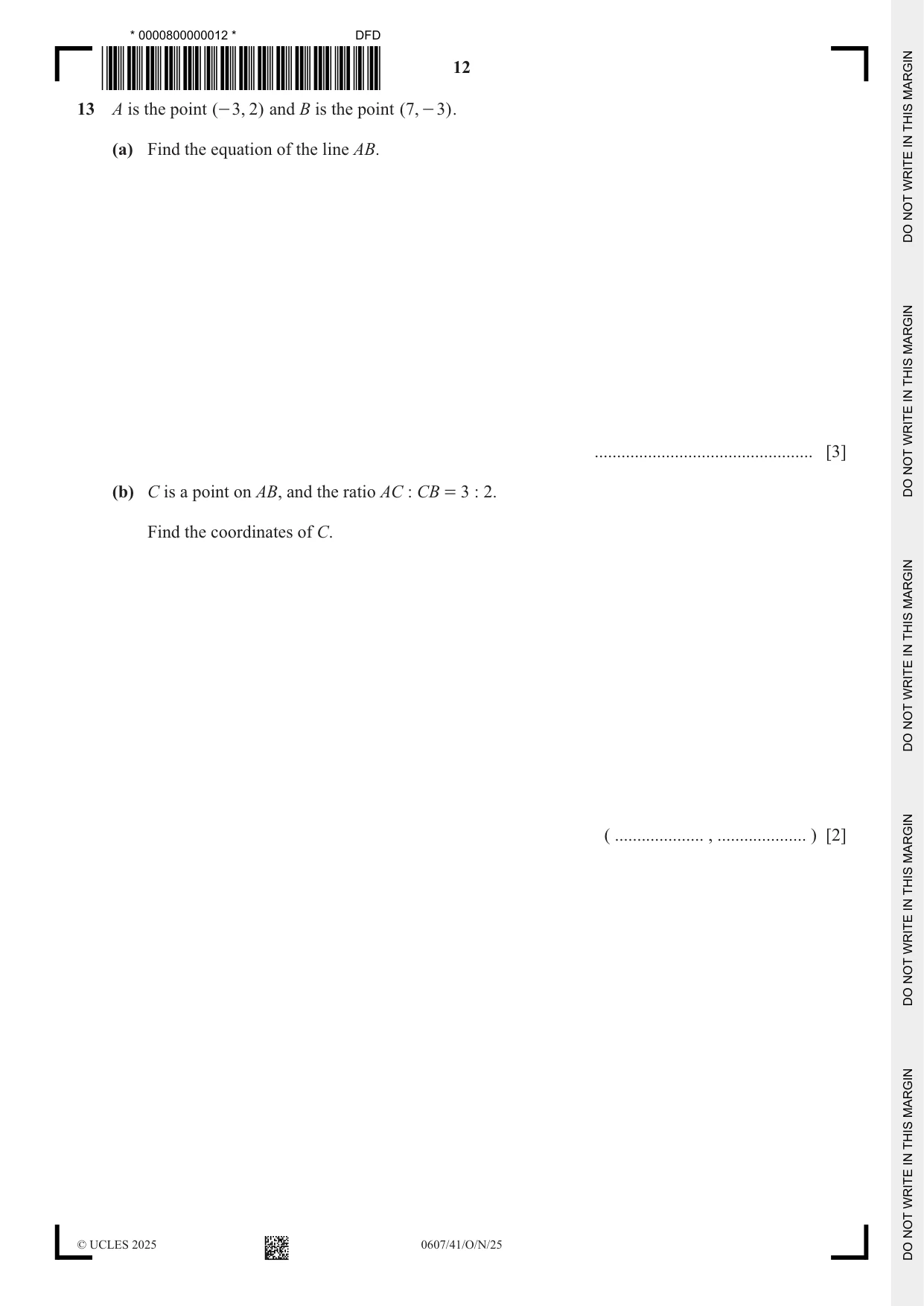
13 A is the point ( - 3 , 2) and B is the point ( 7 , - 3) . (a) Find the equation of the line AB. ................................................. [3] (b) C is a point on AB, and the ratio AC : CB = 3 : 2. Find the coordinates of C. ( .................... , .................... ) [2]
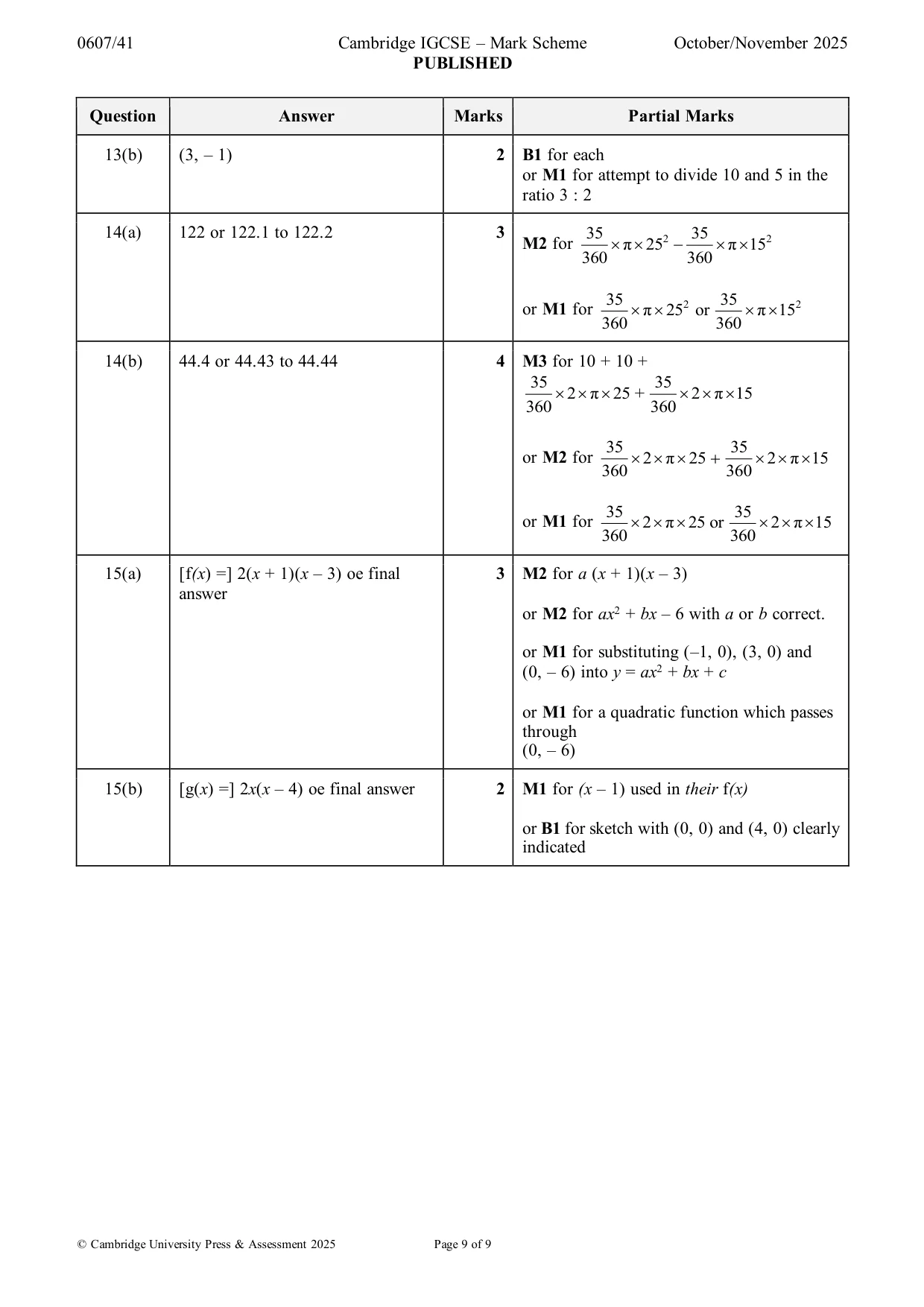
Mark scheme: 13(a) 1 1 3 −−3 2 y = − x + oe final answer M1 for 2 2 7 −−( 3) ) M1 for substituting (–3, 2) or (7, –3) or 1 2, − into 2 y = (their m)x + c oe 13(b) (3, – 1) 2 B1 for each or M1 for attempt to divide 10 and 5 in the ratio 3 : 2
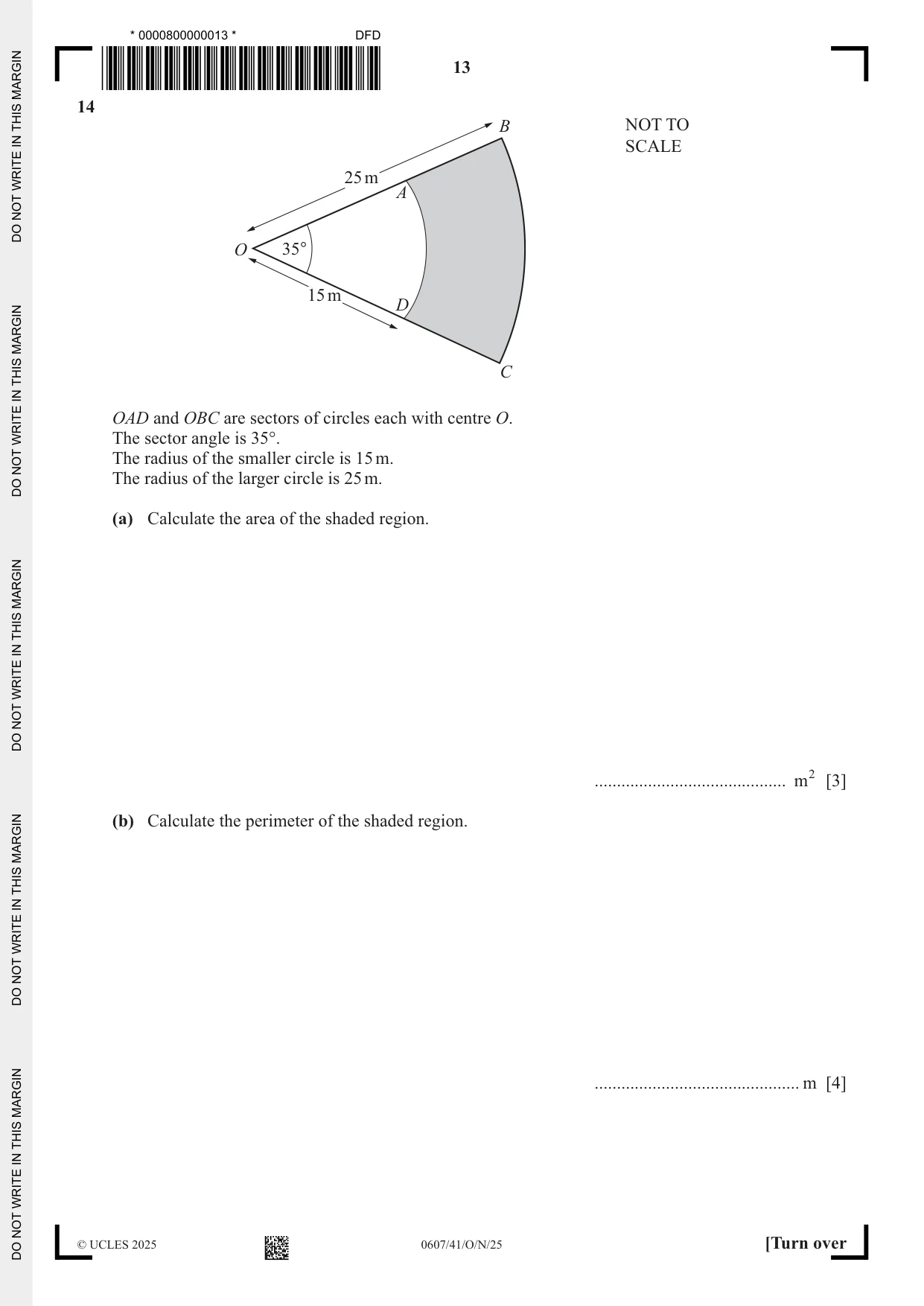
Q14 · B NOT TO SCALE 25 m A O 35° 15 m D C OAD and OBC are sectors of circles each with centre O
14 B NOT TO SCALE 25 m A O 35° 15 m D C OAD and OBC are sectors of circles each with centre O. The sector angle is 35°. The radius of the smaller circle is 15 m. The radius of the larger circle is 25 m. (a) Calculate the area of the shaded region. ........................................... m2 [3] (b) Calculate the perimeter of the shaded region. .............................................. m [4]
Mark scheme: 14(a) 122 or 122.1 to 122.2 3 35 2 35 2 M2 for π 25 − π 15 360 360 35 2 35 2 or M1 for π 25 or π 15 360 360 14(b) 44.4 or 44.43 to 44.44 4 M3 for 10 + 10 + 35 35 2 π 25 + 2 π 15 360 360 35 35 or M2 for 2 π 25 + 2 π 15 360 360 35 35 or M1 for 2 π 25 or 2 π 15 360 360
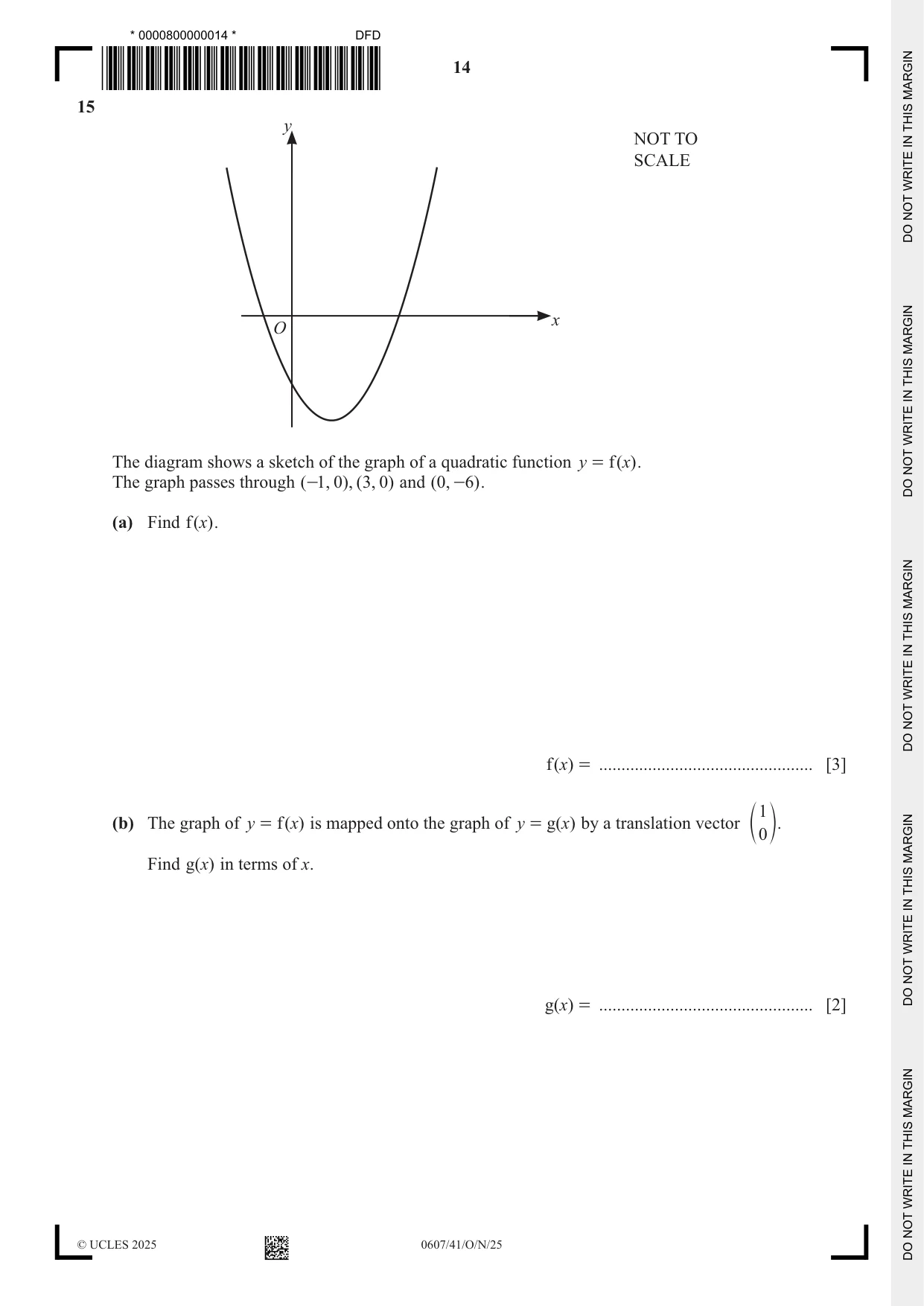
Q15 · Y NOT TO SCALE x O The diagram shows a sketch of the graph of a quadratic function y = f…
15 y NOT TO SCALE x O The diagram shows a sketch of the graph of a quadratic function y = f ( x) . The graph passes through ( -1, 0 ), ( 3, 0 ) and ( 0 , -6) . (a) Find f ( x) . f ( x) = ................................................ [3] 1 (b) The graph of y = f ( x) is mapped onto the graph of y = g ( x) by a translation vector e o. 0 Find g ( )x in terms of x. g ( )x = ................................................ [2]
Mark scheme: 15(a) [f(x) =] 2(x + 1)(x – 3) oe final 3 M2 for a (x + 1)(x – 3) answer or M2 for ax2 + bx – 6 with a or b correct. or M1 for substituting (–1, 0), (3, 0) and (0, – 6) into y = ax2 + bx + c or M1 for a quadratic function which passes through (0, – 6) 15(b) [g(x) =] 2x(x – 4) oe final answer 2 M1 for (x – 1) used in their f(x) or B1 for sketch with (0, 0) and (4, 0) clearly indicated
What was in this paper
The subtopics covered by these 15 questions, and how many questions each got. Open one in a new tab to see every Cambridge question on it.
1Compound shapes and parts of shapes1Cumulative frequency diagrams1Equations of linear graphs1Exponential growth and decay1Finding a quadratic function using1Graphs of functions1Inequalities1Non-right-angled triangles1Percentages1Proportion1Ratio and proportion1Scatter diagrams1Transformations1Using a calculator1What you needed in this session
Cambridge’s own grade thresholds for 2025 Oct/Nov, Paper 4 · Variant 1. A higher threshold means an easier paper — the bar moves with how the cohort did.