Cambridge IGCSE Mathematics - International 0607 — 2020 May/June Paper 4 · Variant 1
0607/41/M/J/20 · 11 questions · 120 marks · ≈135 min
The question paper and its mark scheme, free to read here and free to download. This is Cambridge’s own paper, exactly as it was sat.
Question paper20 pages
Mark scheme9 pages
Answers below. Sit the paper first if you are practising.
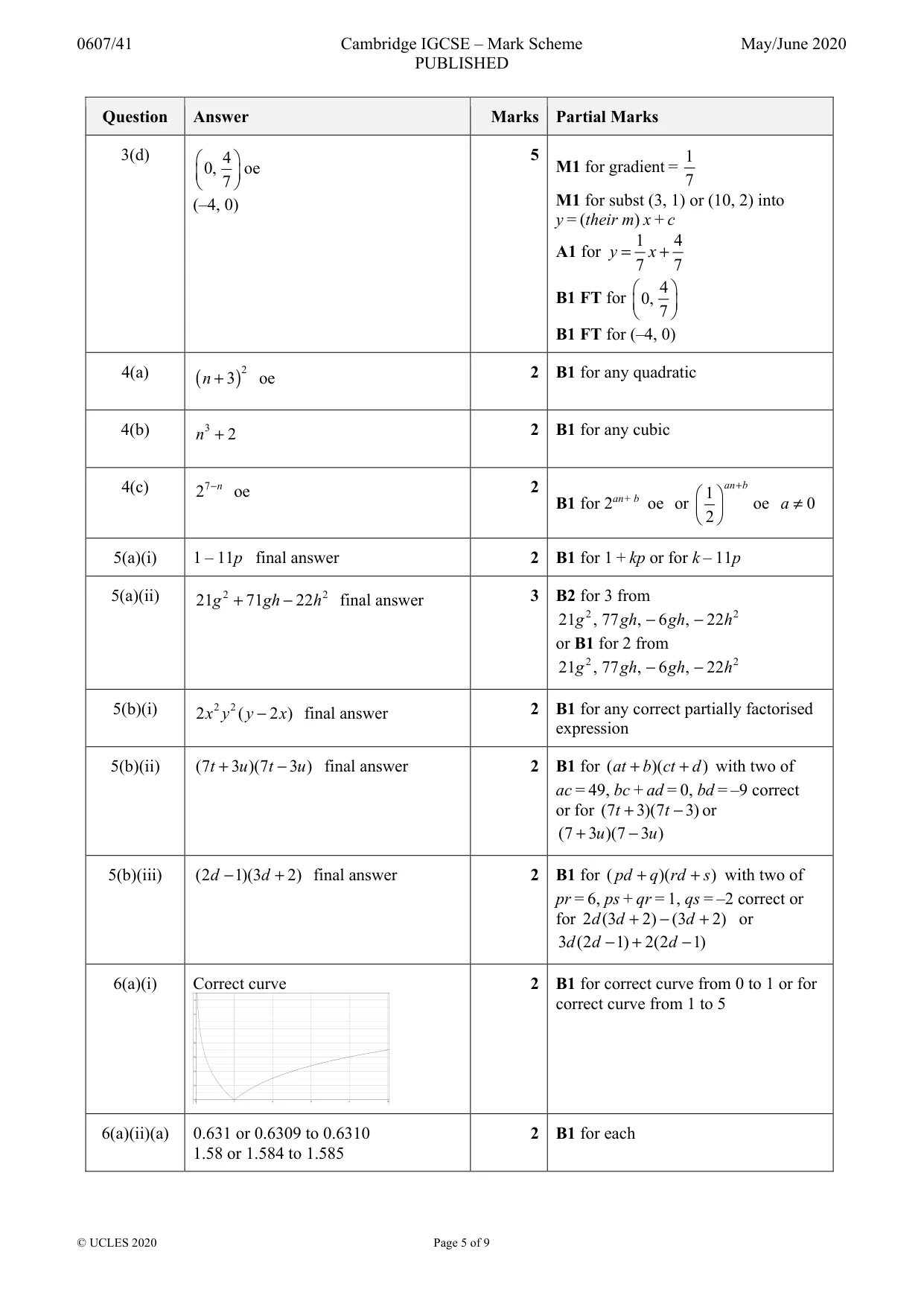
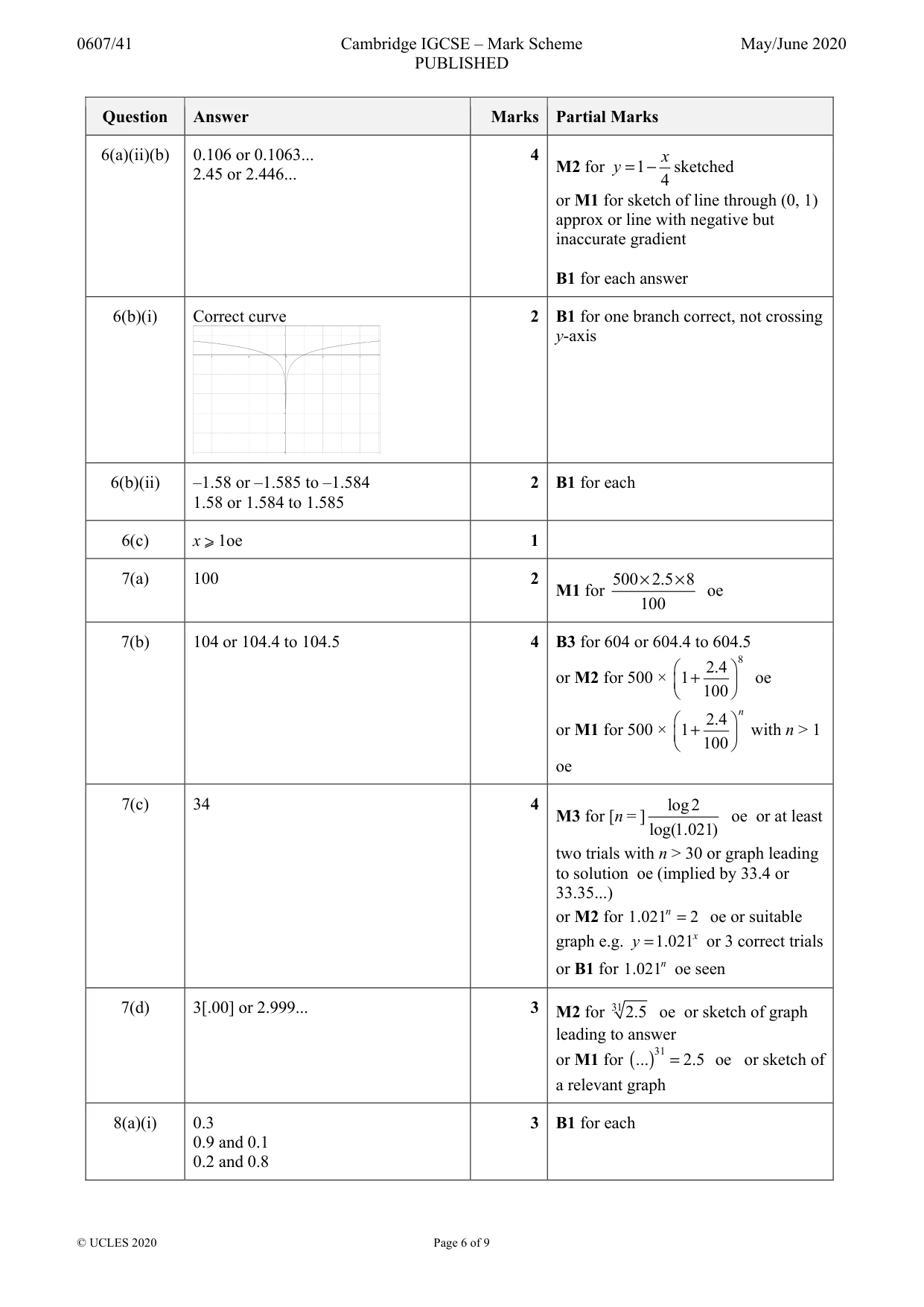
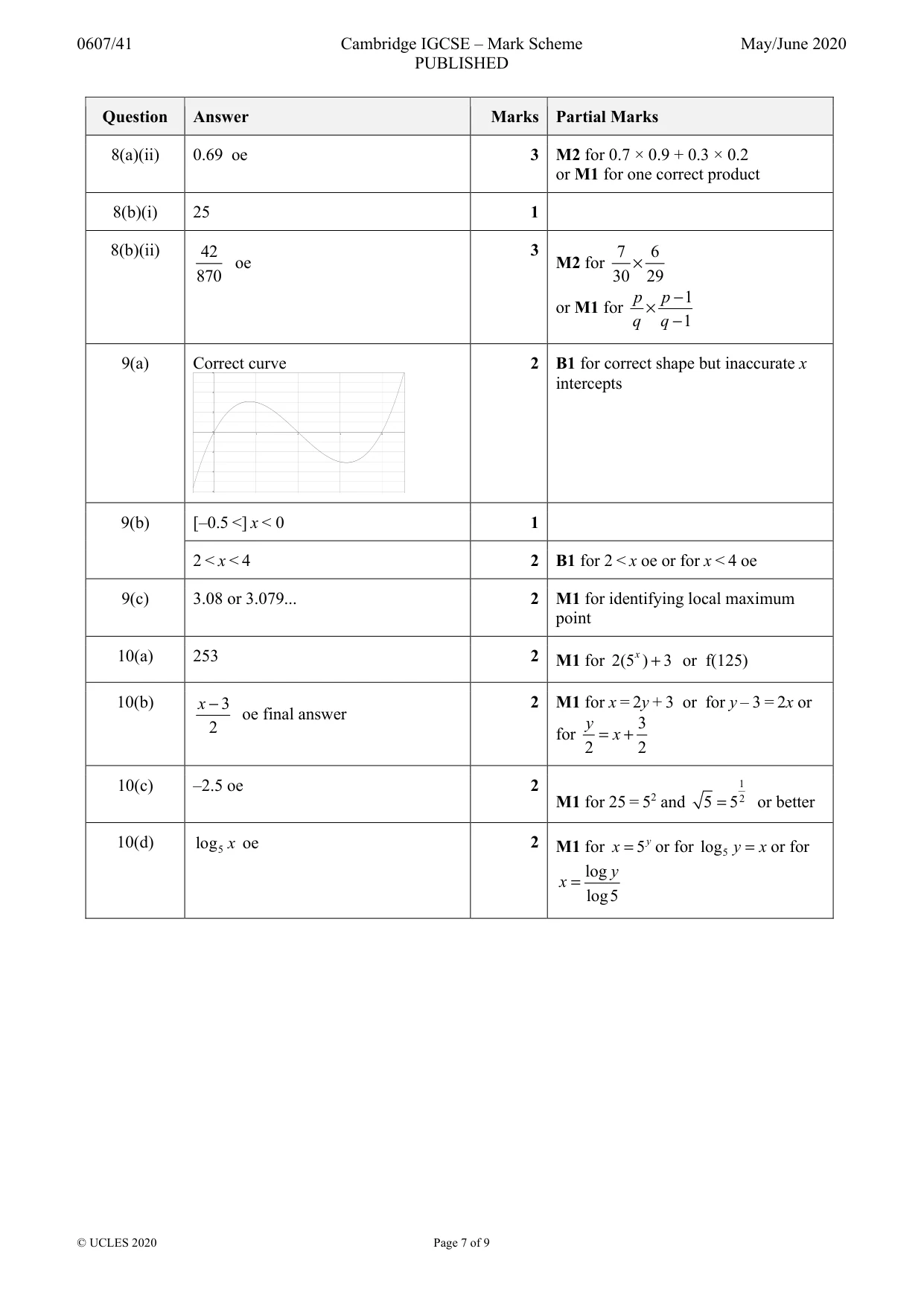
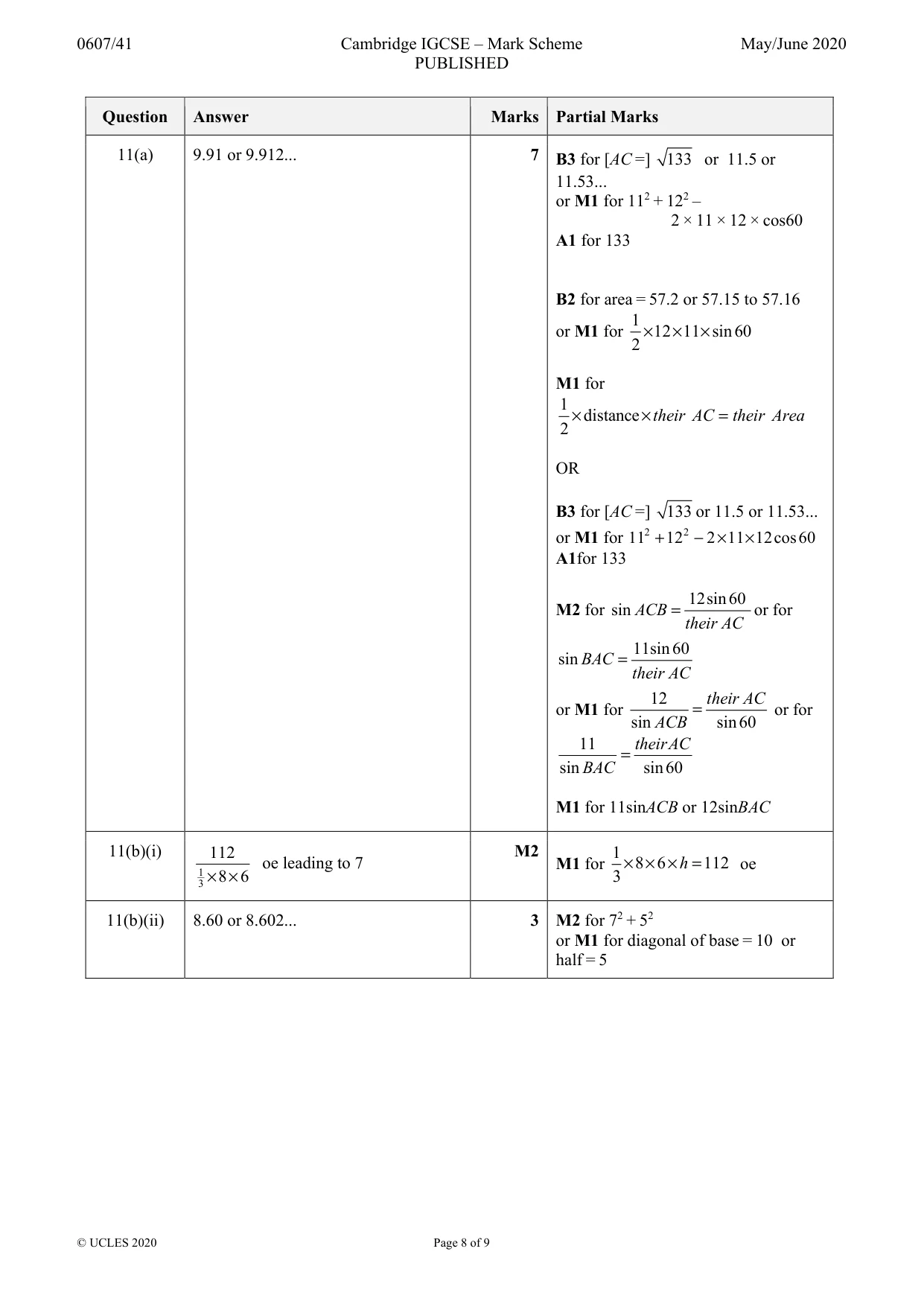
Questions as text
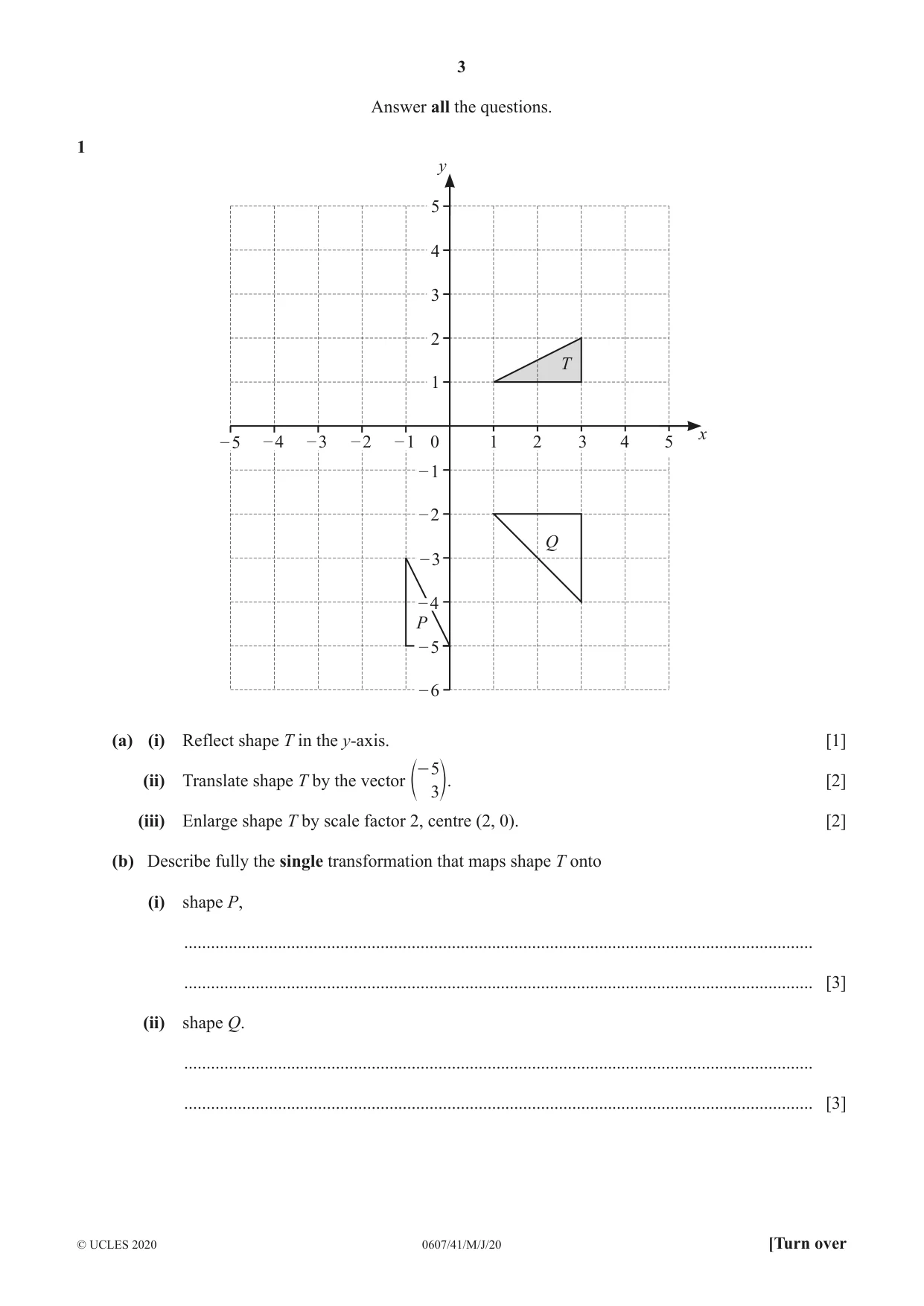
Q1 · Y 5 4 3 2 T 1 x – 5 – 4 – 3 – 2 – 1 0 1 2 3 4 5 – 1 – 2 Q – 3 – 4 P – 5 – 6 (a) (i)…
1 y 5 4 3 2 T 1 x – 5 – 4 – 3 – 2 – 1 0 1 2 3 4 5 – 1 – 2 Q – 3 – 4 P – 5 – 6 (a) (i) Reflect shape T in the y-axis. [1] - 5 (ii) Translate shape T by the vector [2] e 3o. (iii) Enlarge shape T by scale factor 2, centre (2, 0). [2] (b) Describe fully the single transformation that maps shape T onto (i) shape P, ............................................................................................................................................. ............................................................................................................................................. [3] (ii) shape Q. ............................................................................................................................................. ............................................................................................................................................. [3]
Q2 · These are Tom’s ten homework marks
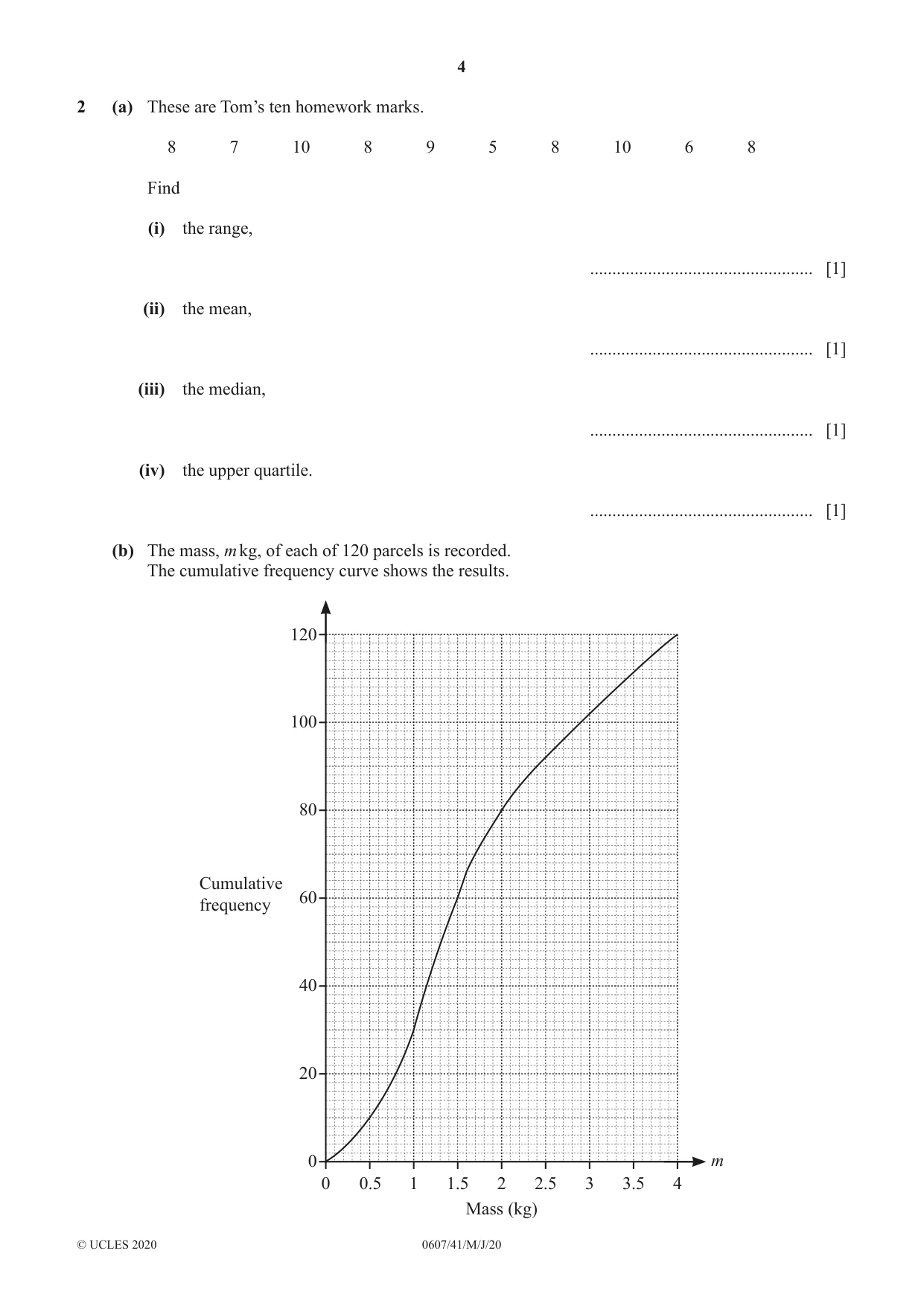
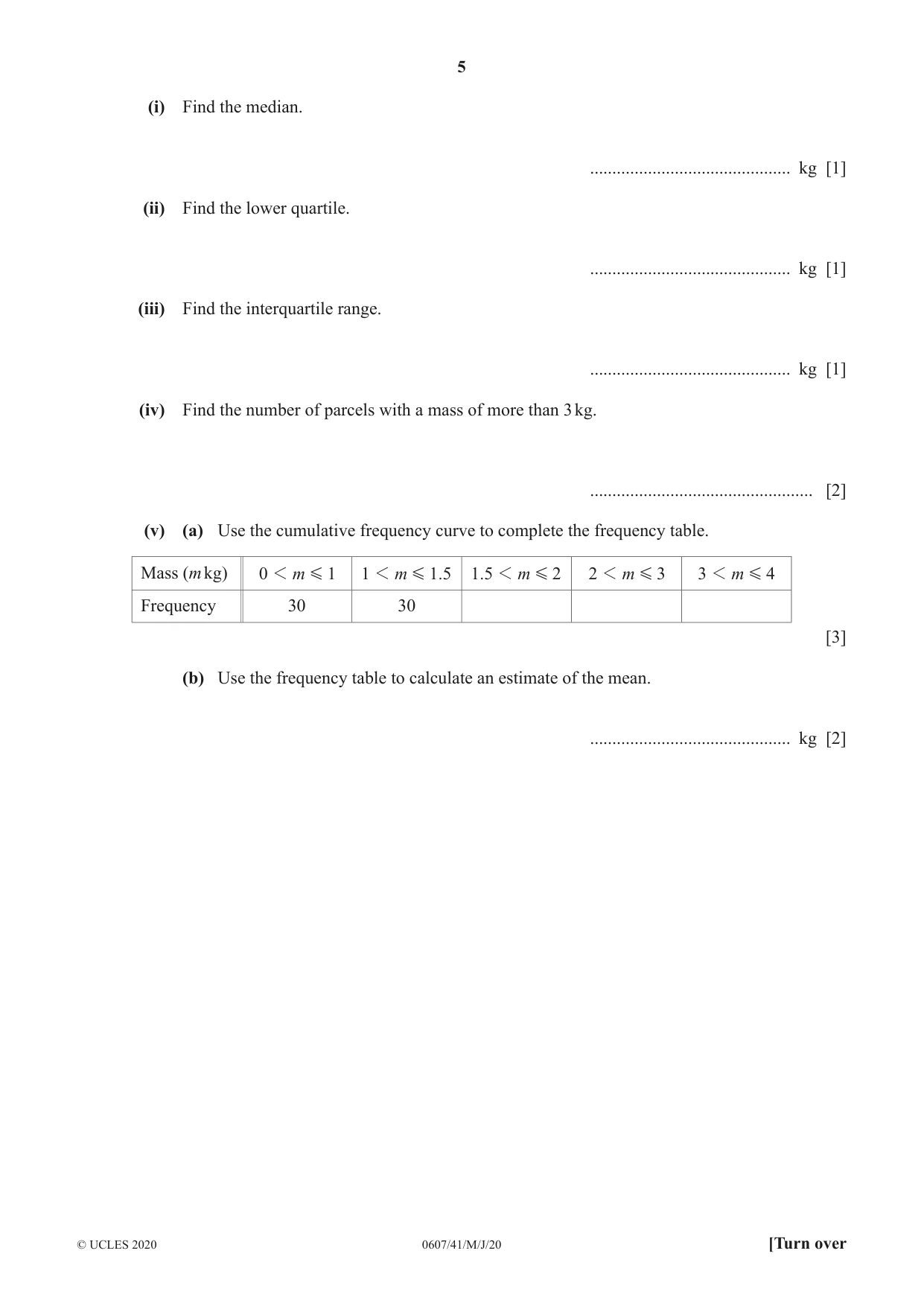
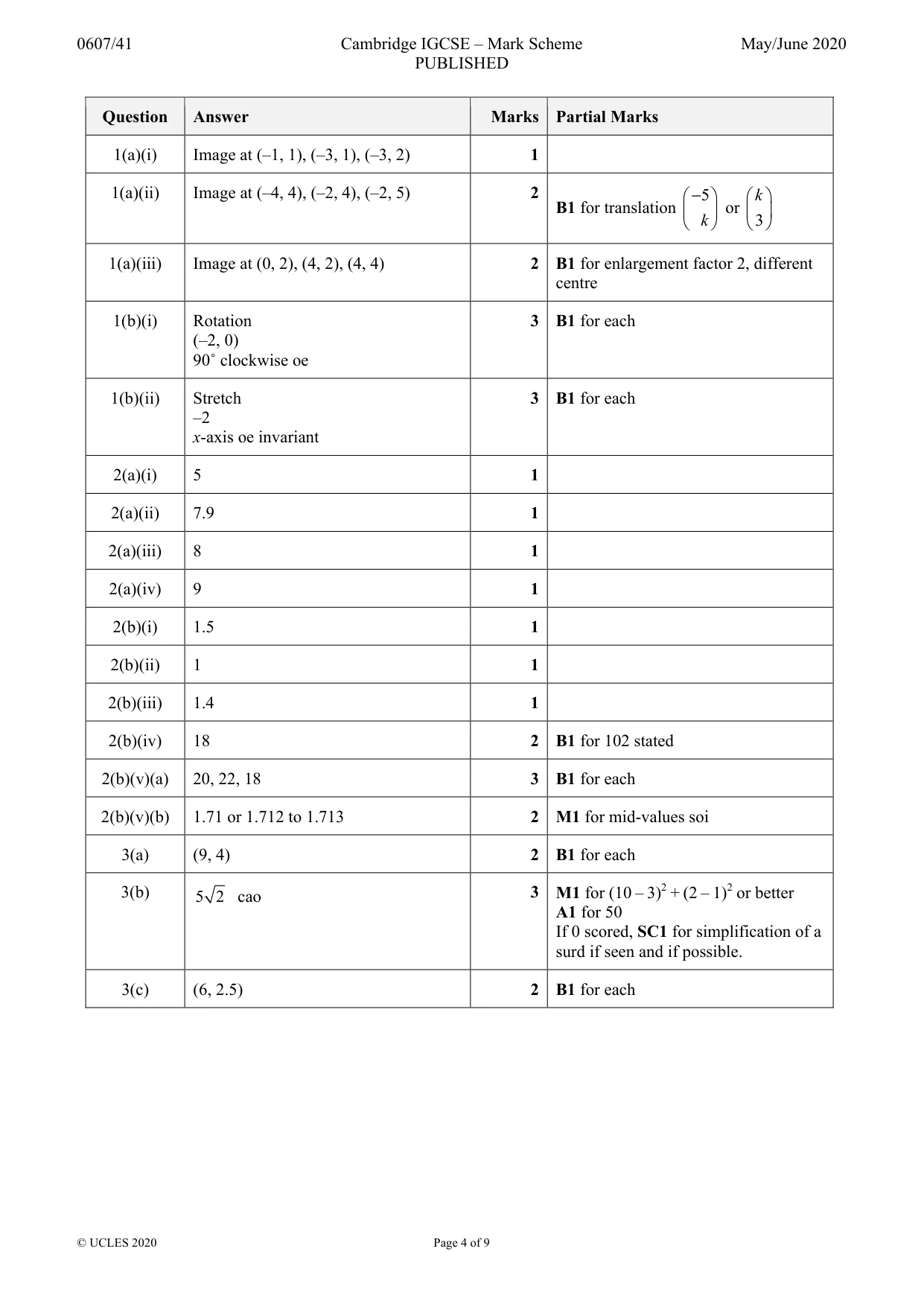
2 (a) These are Tom’s ten homework marks. 8 7 10 8 9 5 8 10 6 8 Find (i) the range, .................................................. [1] (ii) the mean, .................................................. [1] (iii) the median, .................................................. [1] (iv) the upper quartile. .................................................. [1] (b) The mass, m kg, of each of 120 parcels is recorded. The cumulative frequency curve shows the results. 120 100 80 Cumulative 60 frequency 40 20 0 m 0 0.5 1 1.5 2 2.5 3 3.5 4 Mass (kg) (i) Find the median. ............................................. kg [1] (ii) Find the lower quartile. ............................................. kg [1] (iii) Find the interquartile range. ............................................. kg [1] (iv) Find the number of parcels with a mass of more than 3 kg. .................................................. [2] (v) (a) Use the cumulative frequency curve to complete the frequency table. Mass (m kg) 0 1 m G 1 1 1 m G 1. 5 1.5 1 m G 2 2 1 m G 3 3 1 m G 4 Frequency 30 30 [3] (b) Use the frequency table to calculate an estimate of the mean. ............................................. kg [2]
Q3 · Y C NOT TO SCALE D B A O x ABCD is a parallelogram
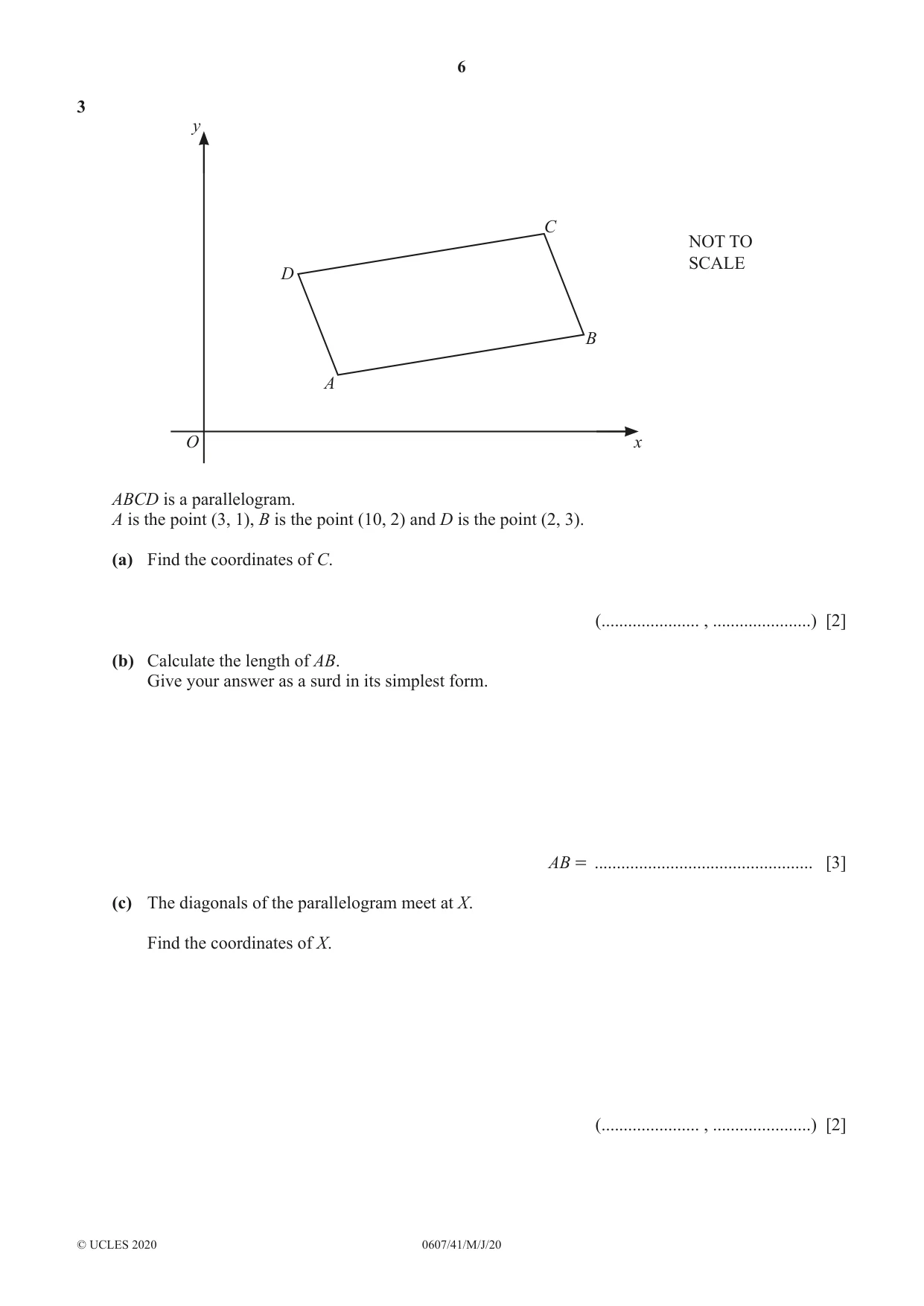
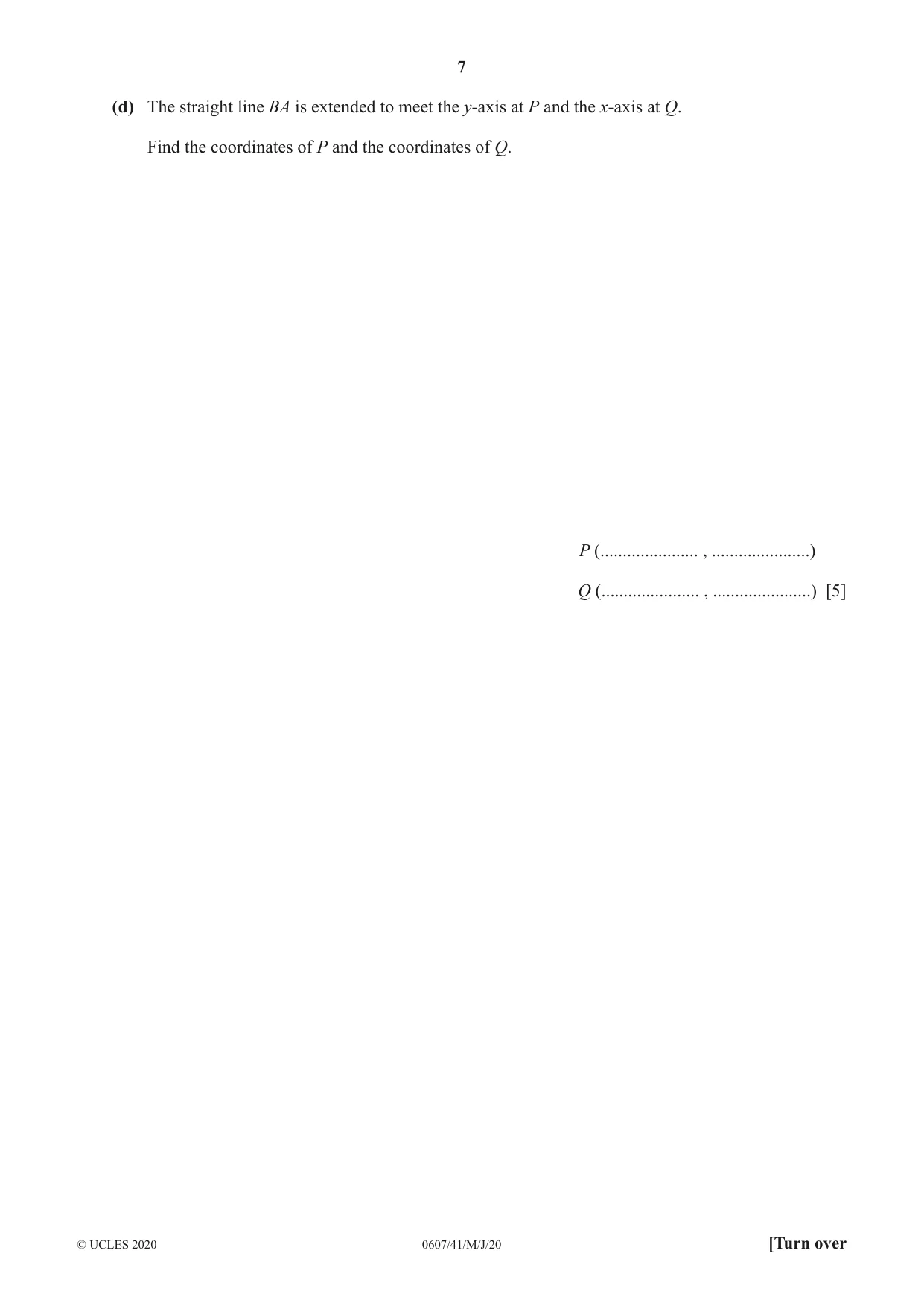
3 y C NOT TO SCALE D B A O x ABCD is a parallelogram. A is the point (3, 1), B is the point (10, 2) and D is the point (2, 3). (a) Find the coordinates of C. (...................... , ......................) [2] (b) Calculate the length of AB. Give your answer as a surd in its simplest form. AB = ................................................. [3] (c) The diagonals of the parallelogram meet at X. Find the coordinates of X. (...................... , ......................) [2] (d) The straight line BA is extended to meet the y-axis at P and the x-axis at Q. Find the coordinates of P and the coordinates of Q. P (...................... , ......................) Q (...................... , ......................) [5]
Q4 · Find the n th term of each sequence
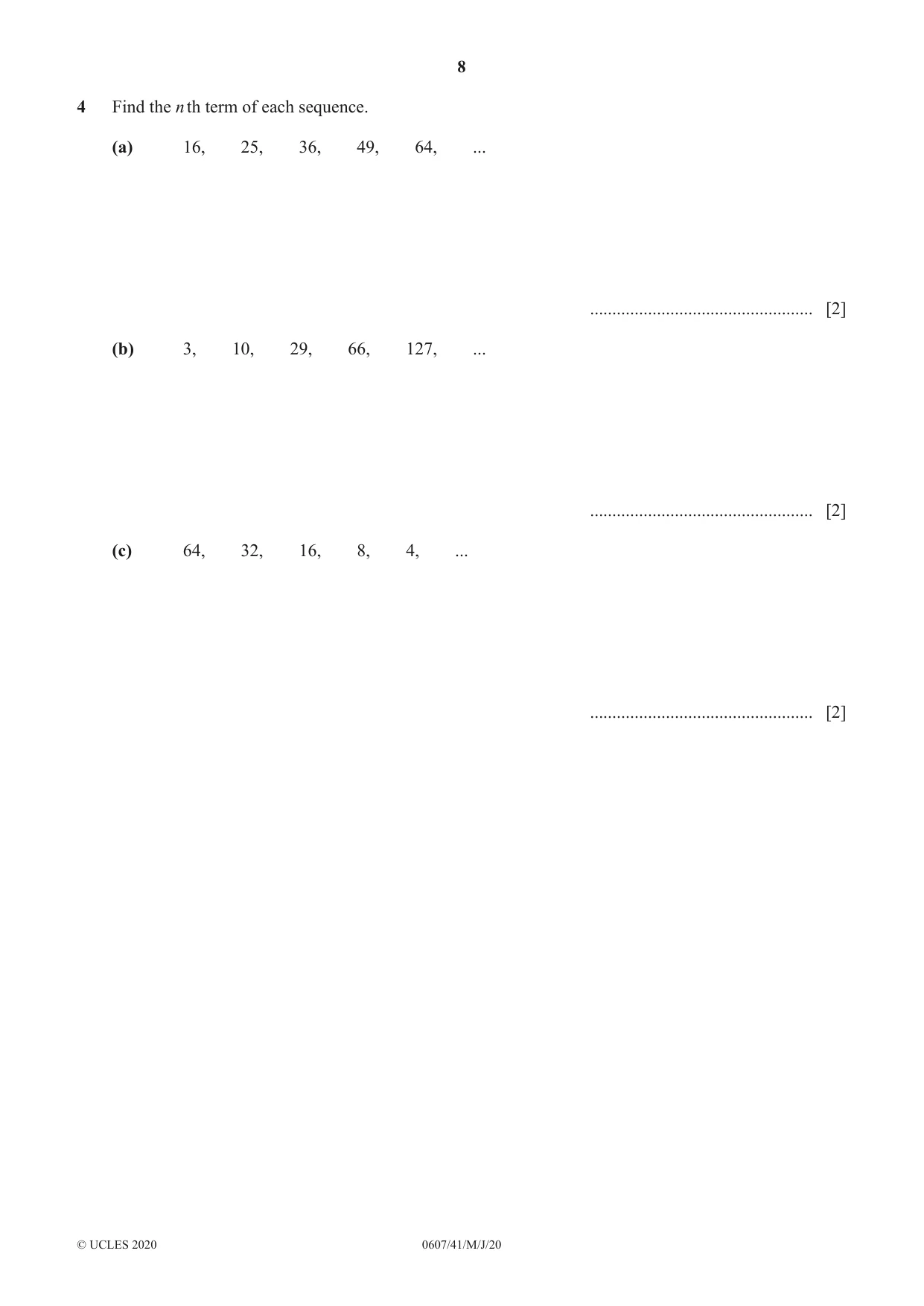
4 Find the n th term of each sequence. (a) 16, 25, 36, 49, 64, ... .................................................. [2] (b) 3, 10, 29, 66, 127, ... .................................................. [2] (c) 64, 32, 16, 8, 4, ... .................................................. [2]
Q5 · Expand the brackets and simplify
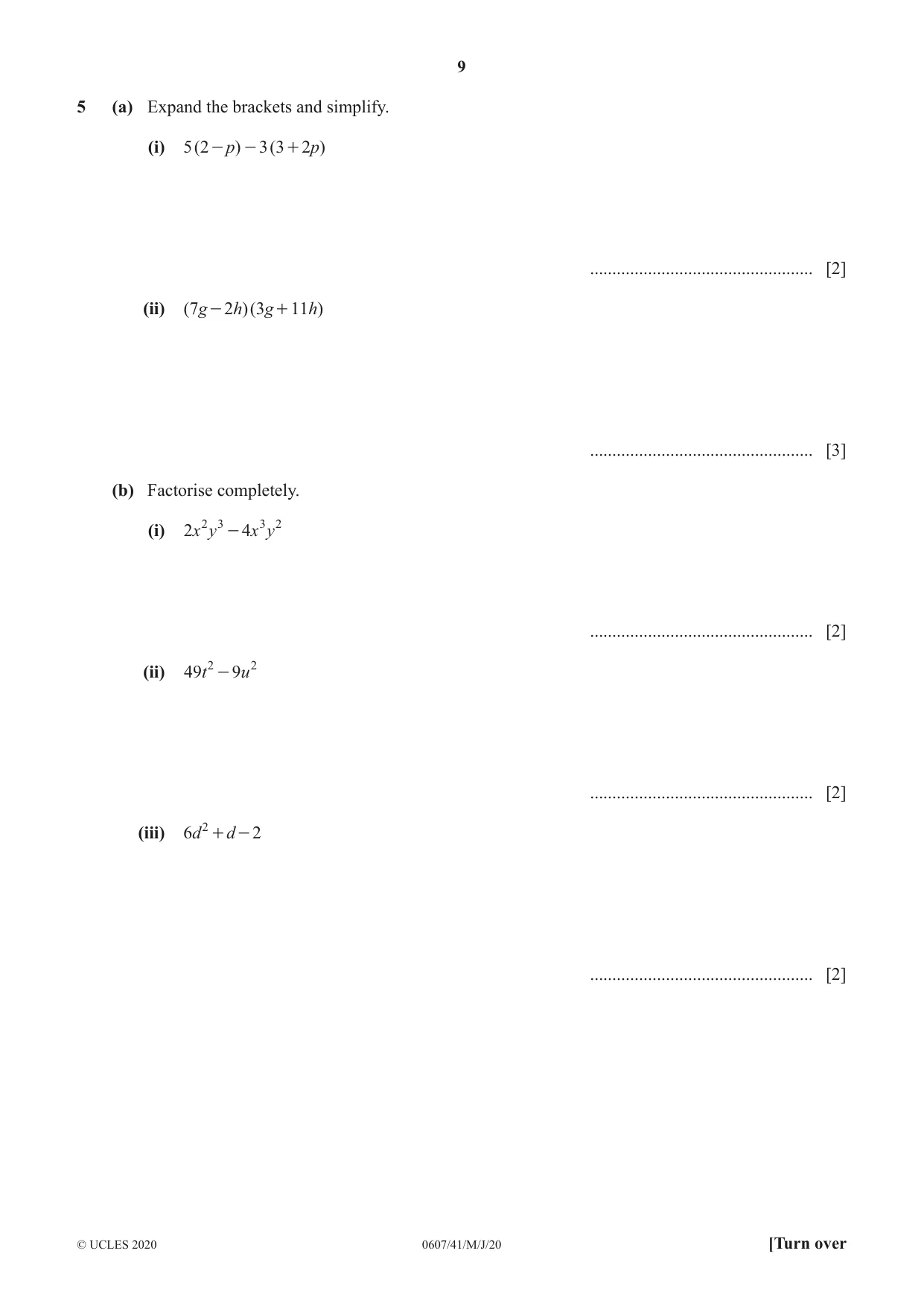
5 (a) Expand the brackets and simplify. (i) 5 ( 2 - p) - 3 ( 3 + 2 p) .................................................. [2] (ii) ( 7g - 2h)( 3g + 11h ) .................................................. [3] (b) Factorise completely. (i) 2x 2 y 3 - 4x 3 y 2 .................................................. [2] (ii) 49t 2 - 9 u 2 .................................................. [2] (iii) 6d 2 + d - 2 .................................................. [2]
Q6 · Y 1.5 0 x 5 (i) On the diagram, sketch the graph of y = log x for 0 1 x G 5
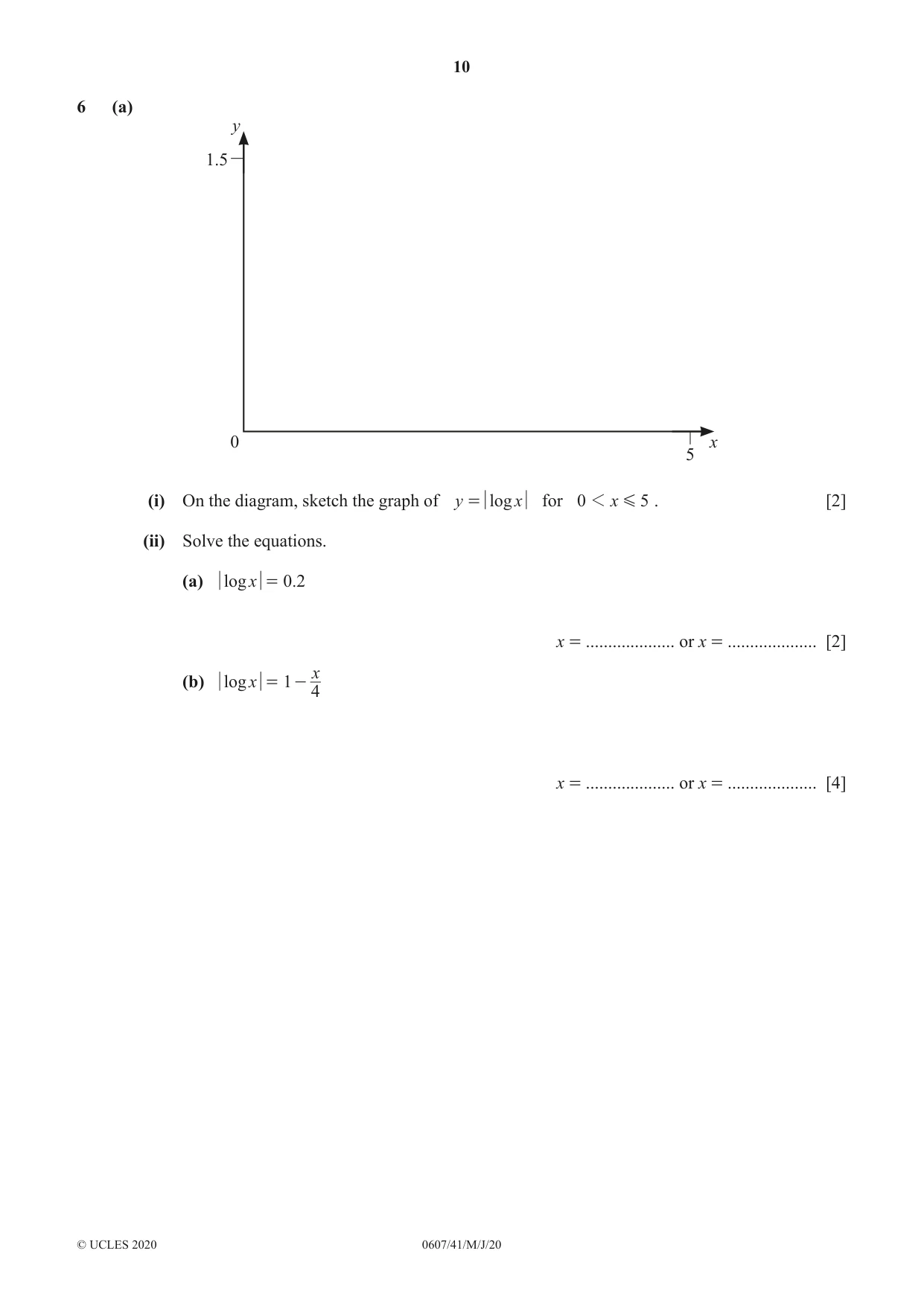
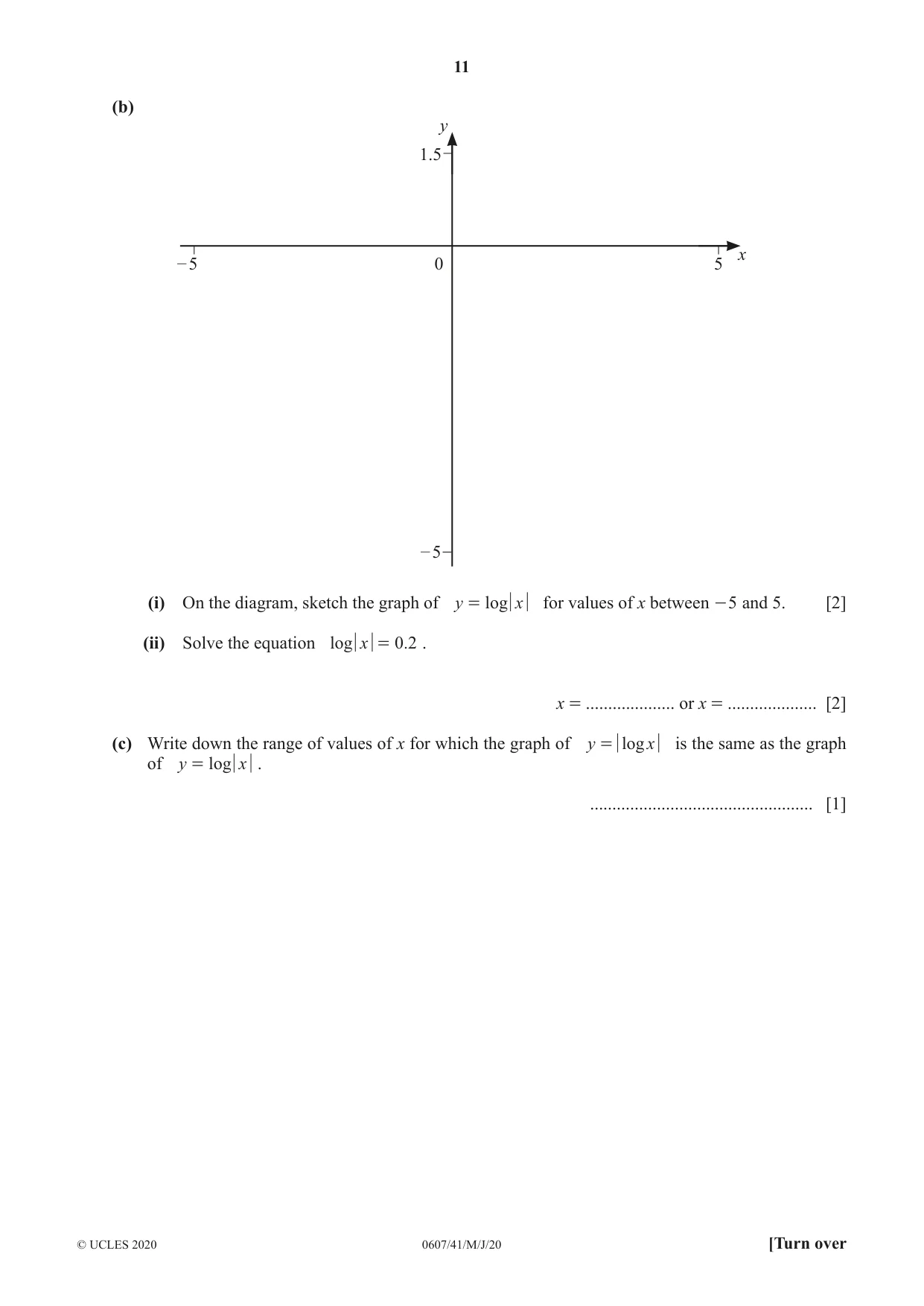
6 (a) y 1.5 0 x 5 (i) On the diagram, sketch the graph of y = log x for 0 1 x G 5 . [2] (ii) Solve the equations. (a) logx = 0.2 x = .................... or x = .................... [2] x (b) logx = 1 - 4 x = .................... or x = .................... [4] (b) y 1.5 x – 5 0 5 – 5 (i) On the diagram, sketch the graph of y = log x for values of x between - 5 and 5. [2] (ii) Solve the equation log x = 0. 2 . x = .................... or x = .................... [2] (c) Write down the range of values of x for which the graph of y = log x is the same as the graph of y = log x . .................................................. [1]
Q7 · Louis invests $500 at a rate of 2.5% per year simple interest
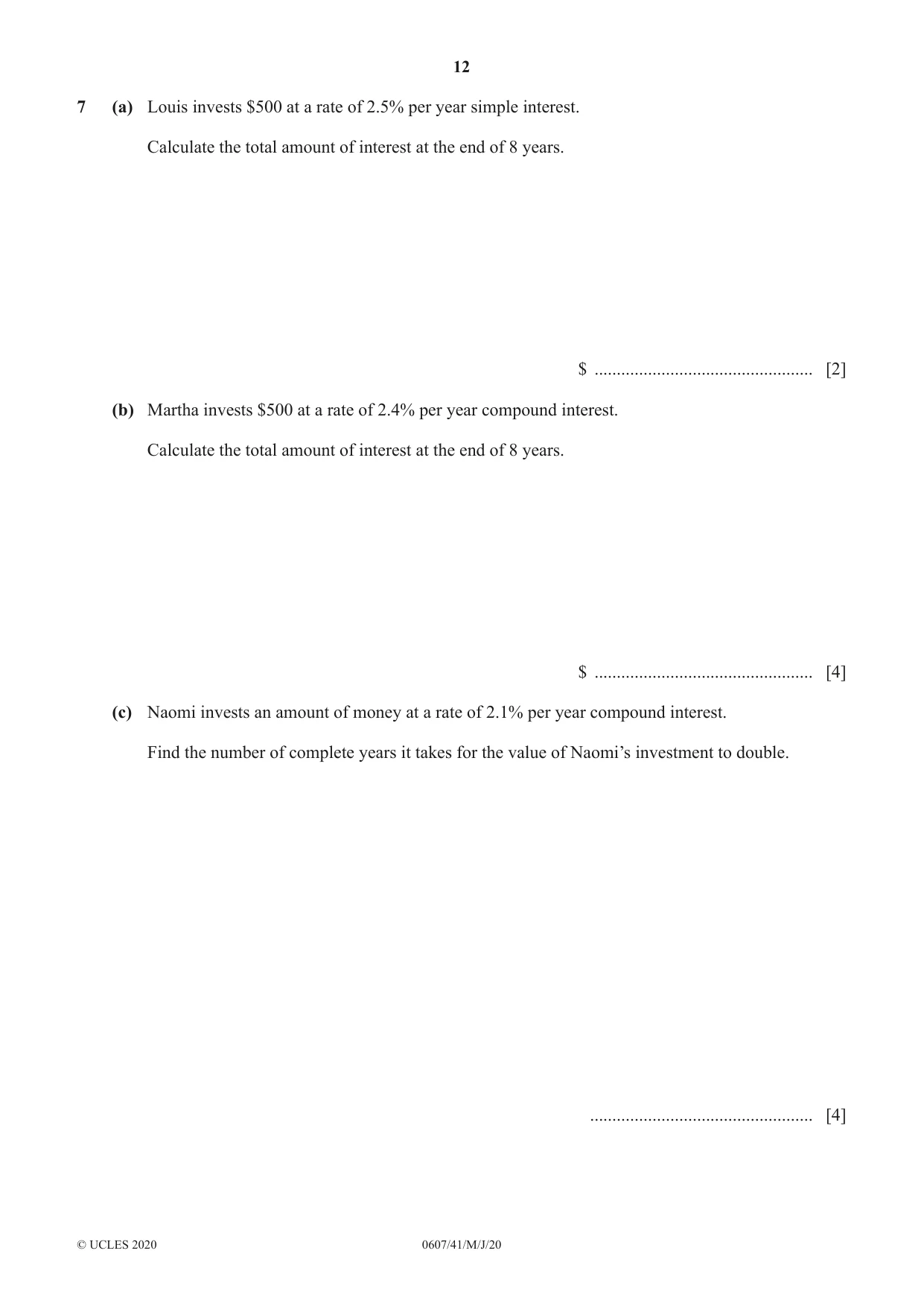
7 (a) Louis invests $500 at a rate of 2.5% per year simple interest. Calculate the total amount of interest at the end of 8 years. $ ................................................. [2] (b) Martha invests $500 at a rate of 2.4% per year compound interest. Calculate the total amount of interest at the end of 8 years. $ ................................................. [4] (c) Naomi invests an amount of money at a rate of 2.1% per year compound interest. Find the number of complete years it takes for the value of Naomi’s investment to double. .................................................. [4] (d) Oscar invests an amount of money at a rate of r % per year compound interest. At the end of 31 years the value of Oscar’s investment is 2.5 times greater than the original amount of money. Find the value of r. r = ................................................. [3]
Q8 · When the weather is fine, the probability that Sara goes to the park is 0.9
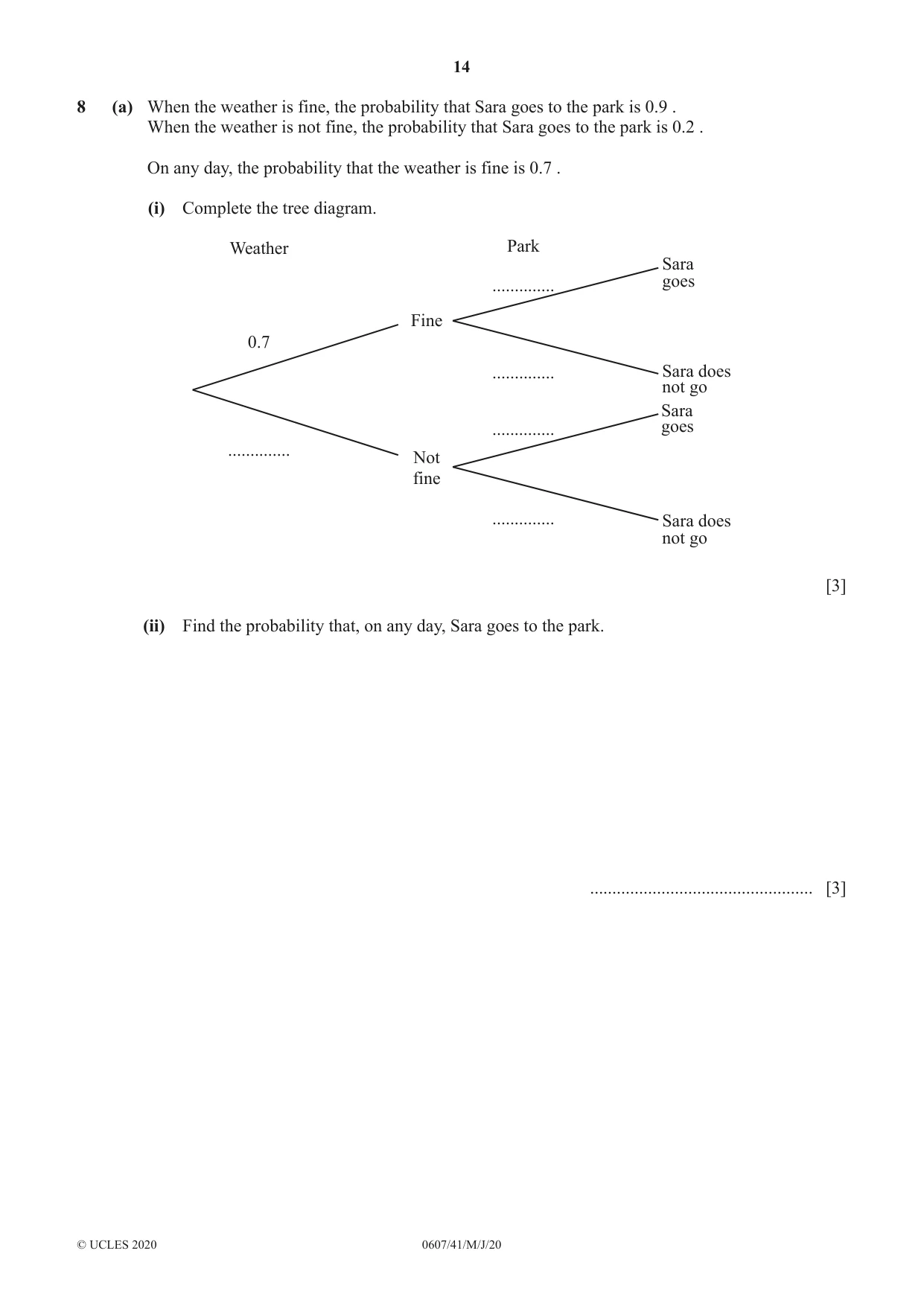
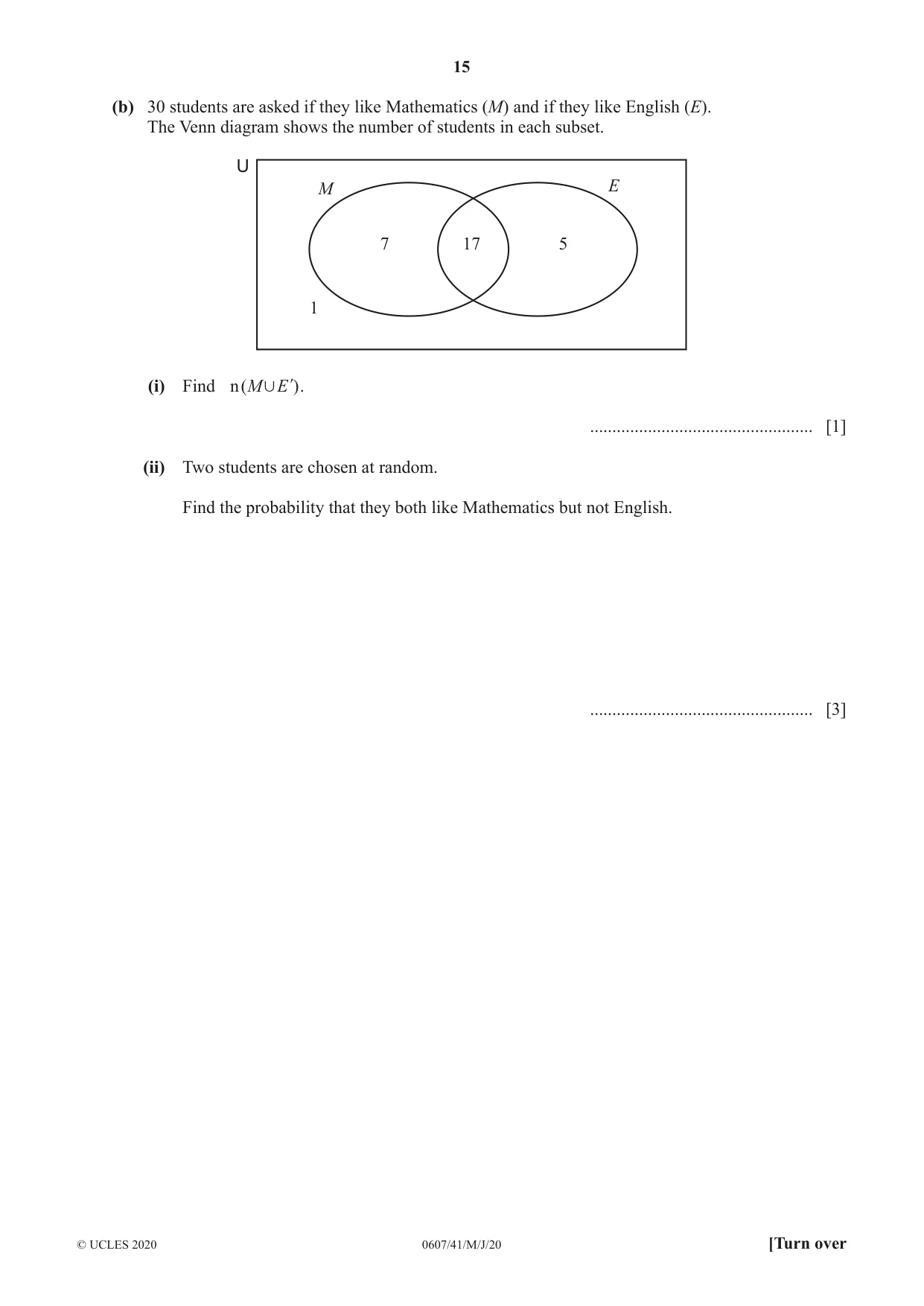
8 (a) When the weather is fine, the probability that Sara goes to the park is 0.9 . When the weather is not fine, the probability that Sara goes to the park is 0.2 . On any day, the probability that the weather is fine is 0.7 . (i) Complete the tree diagram. Weather Park Sara .............. goes Fine 0.7 .............. Sara does not go Sara .............. goes .............. Not fine .............. Sara does not go [3] (ii) Find the probability that, on any day, Sara goes to the park. .................................................. [3] (b) 30 students are asked if they like Mathematics (M) and if they like English (E). The Venn diagram shows the number of students in each subset. U M E 7 17 5 1 (i) Find n ( M , E l) . .................................................. [1] (ii) Two students are chosen at random. Find the probability that they both like Mathematics but not English. .................................................. [3]
Q9 · Y 6 x – 0.5 0 4.5 – 6 f ( )x = x 3 - 6x 2 + 8x for - 0.5 G x G 4.5 (a) On the diagram…
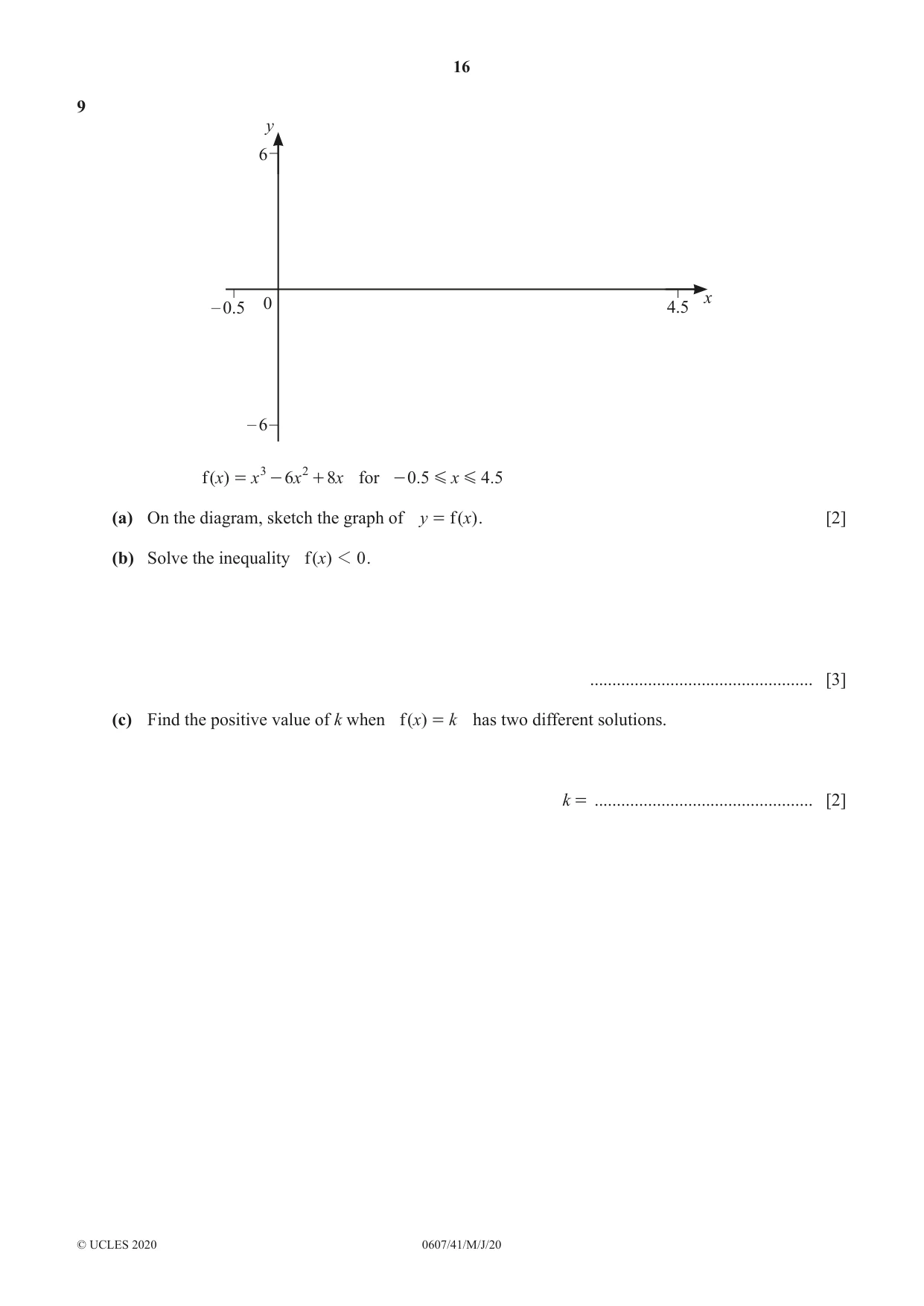
9 y 6 x – 0.5 0 4.5 – 6 f ( )x = x 3 - 6x 2 + 8x for - 0.5 G x G 4.5 (a) On the diagram, sketch the graph of y = f ( x) . [2] (b) Solve the inequality f ( )x 1 0 . .................................................. [3] (c) Find the positive value of k when f ( )x = k has two different solutions. k = ................................................. [2]
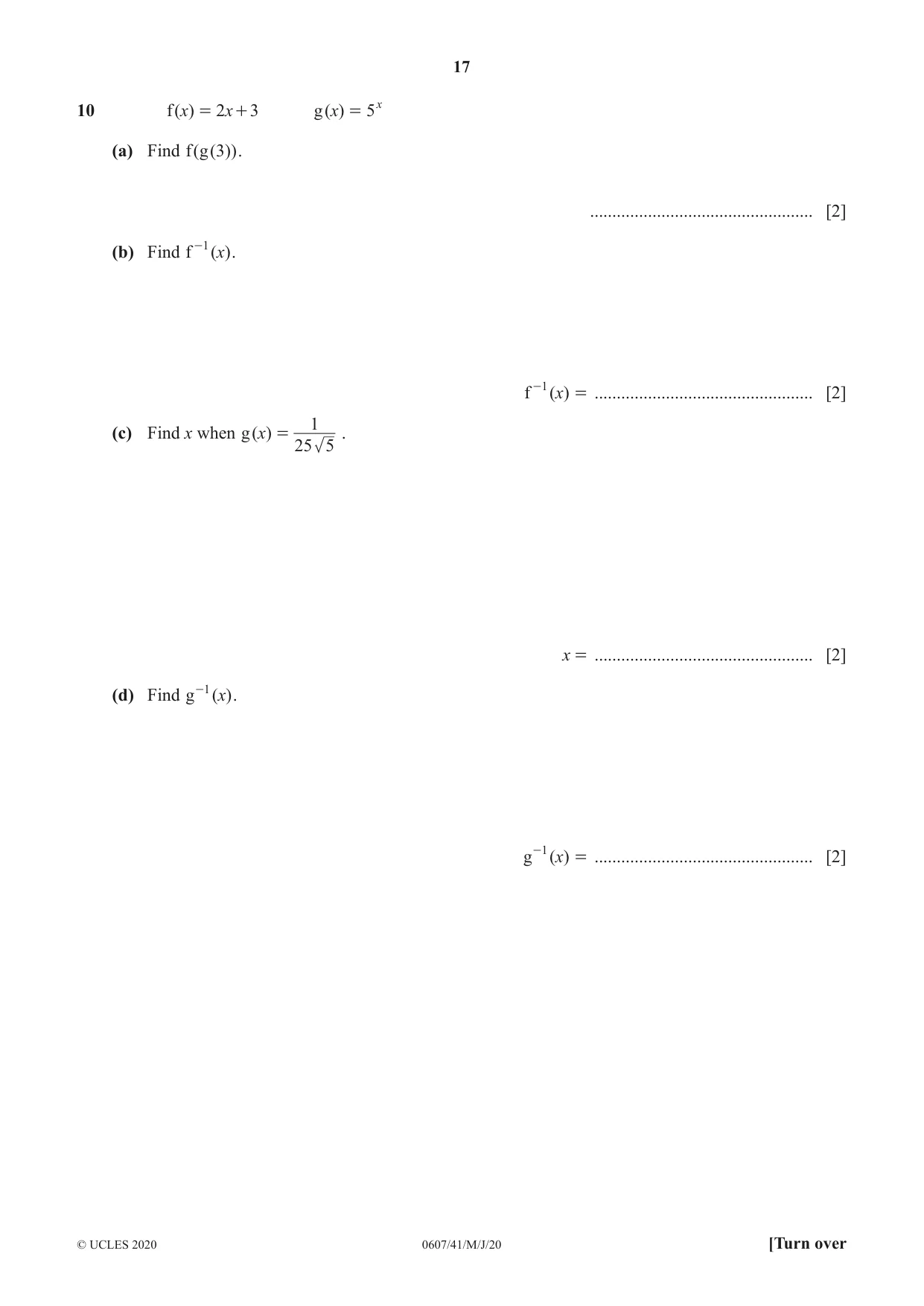
Q10 · F ( )x = 2 x + 3 g ( )x = 5 x (a) Find f ( g ( 3))
10 f ( )x = 2 x + 3 g ( )x = 5 x (a) Find f ( g ( 3)) . .................................................. [2] (b) Find f -1 ( )x . f -1 ( )x = ................................................. [2] 1 (c) Find x when g ( )x = . 25 5 x = ................................................. [2] (d) Find g -1 ( )x . g -1 ( )x = ................................................. [2]
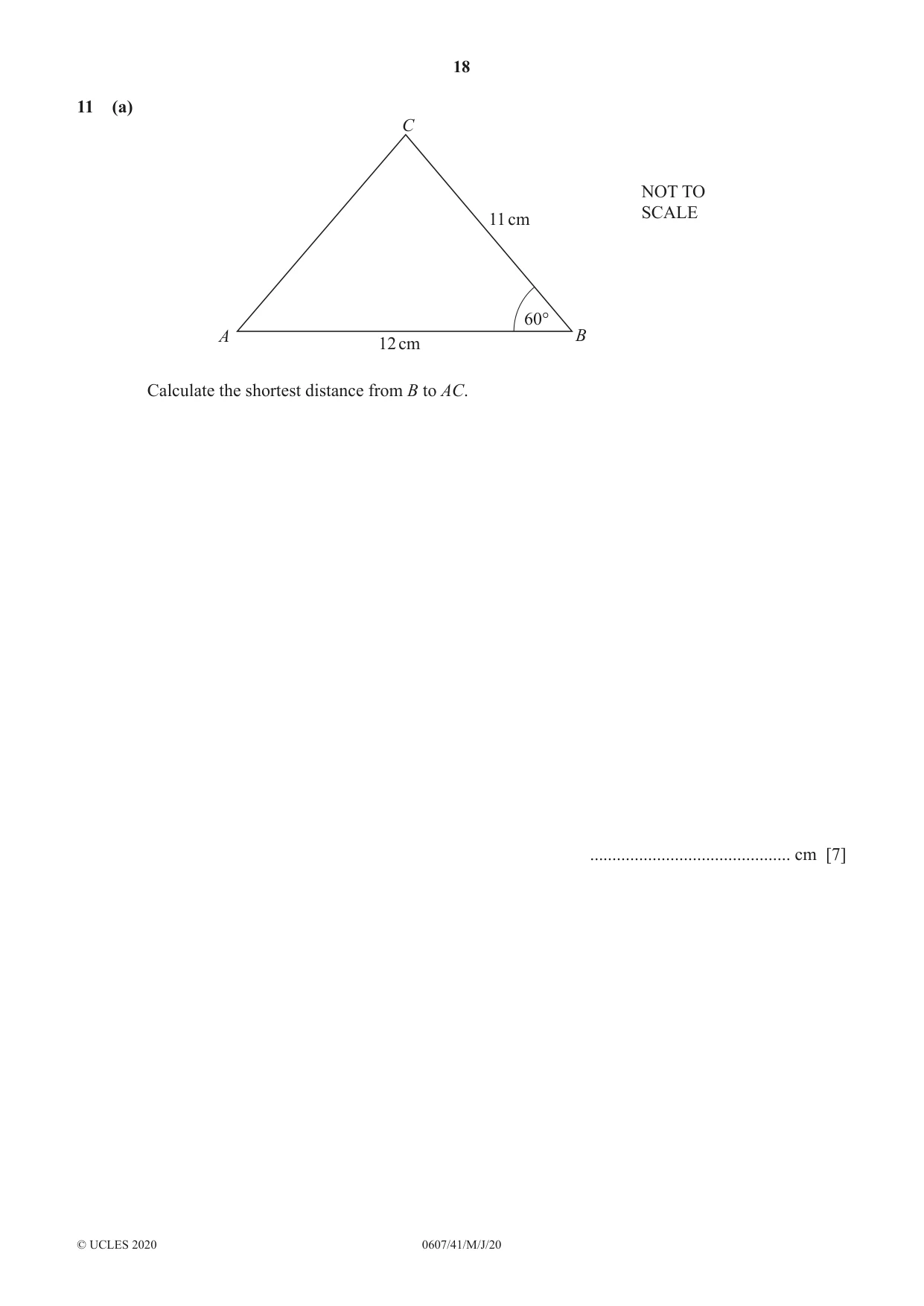
Q11 · C NOT TO SCALE 11 cm 60° A B 12 cm Calculate the shortest distance from B to AC
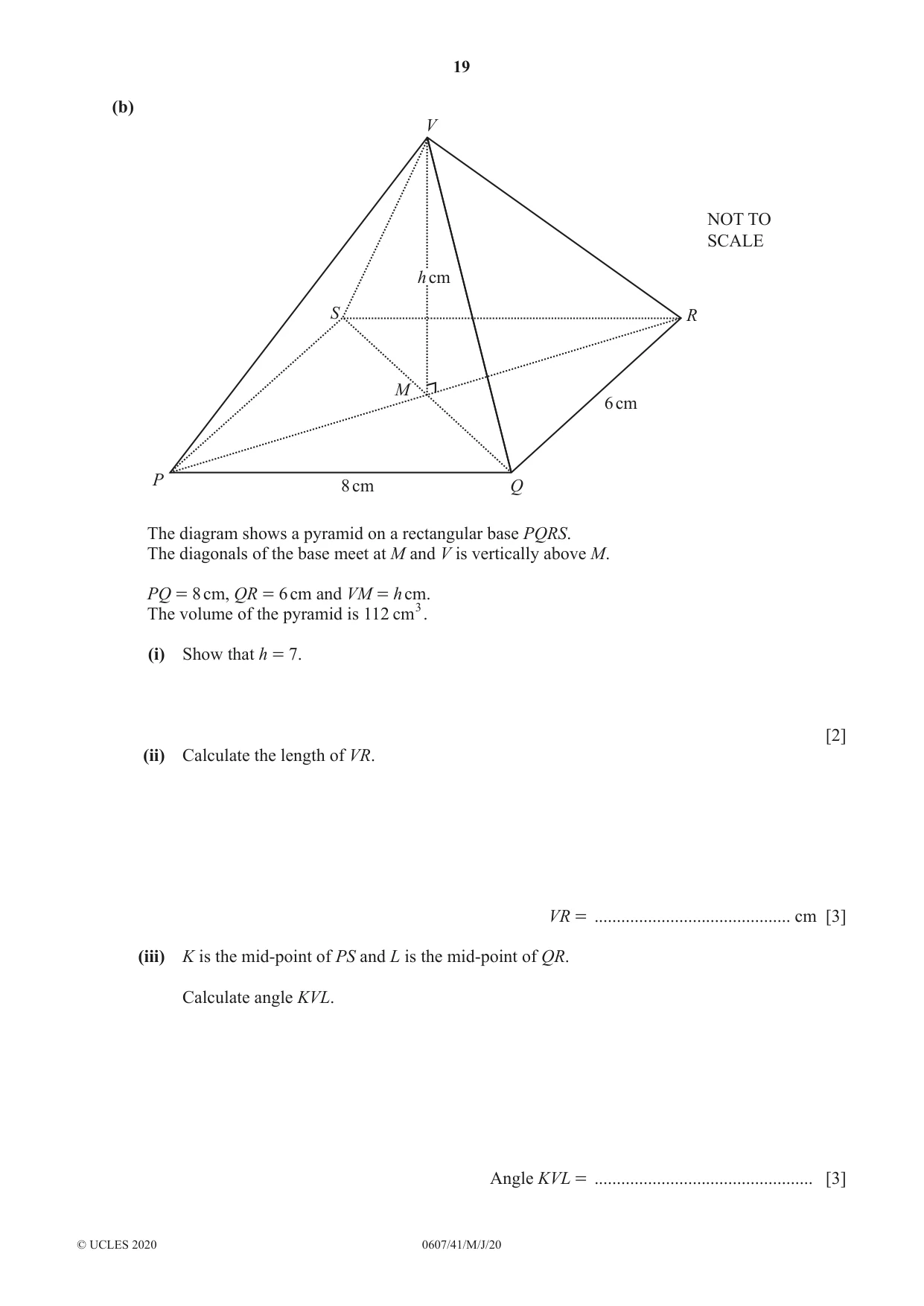
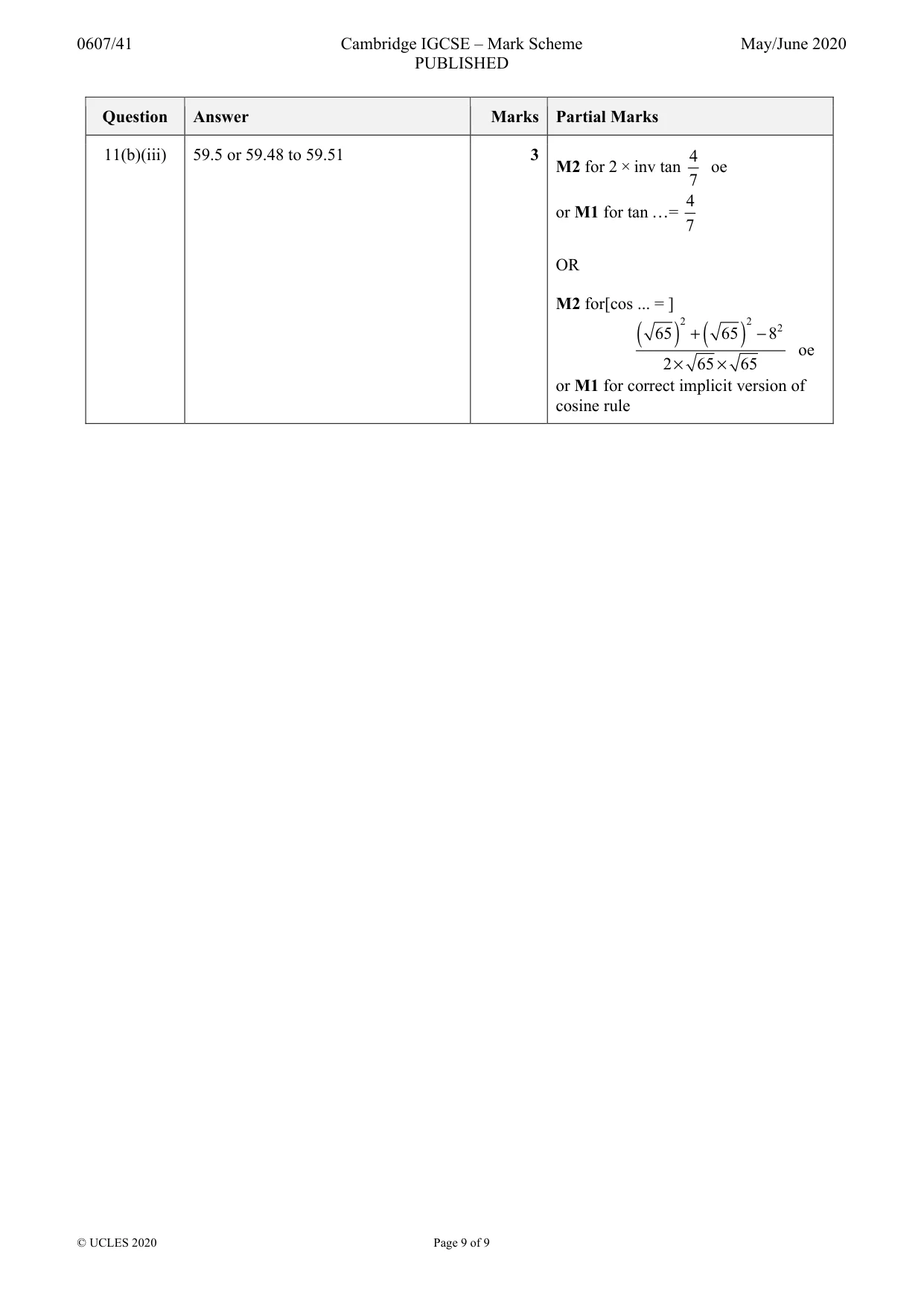
11 (a) C NOT TO SCALE 11 cm 60° A B 12 cm Calculate the shortest distance from B to AC. ............................................. cm [7] (b) V NOT TO SCALE h cm S R M 6 cm P 8 cm Q The diagram shows a pyramid on a rectangular base PQRS. The diagonals of the base meet at M and V is vertically above M. PQ = 8 cm, QR = 6 cm and VM = h cm. The volume of the pyramid is 112 cm3. (i) Show that h = 7. [2] (ii) Calculate the length of VR. VR = ............................................ cm [3] (iii) K is the mid-point of PS and L is the mid-point of QR. Calculate angle KVL. Angle KVL = ................................................. [3]
What was in this paper
The subtopics covered by these 11 questions, and how many questions each got. Open one in a new tab to see every Cambridge question on it.