Cambridge IGCSE Mathematics - International 0607 — 2020 May/June Paper 4 · Variant 2
0607/42/M/J/20 · 11 questions · 120 marks · ≈135 min
The question paper and its mark scheme, free to read here and free to download. This is Cambridge’s own paper, exactly as it was sat.
Question paper20 pages
Mark scheme8 pages
Answers below. Sit the paper first if you are practising.
Questions as text
Q1 · A class of 40 students complete a science test
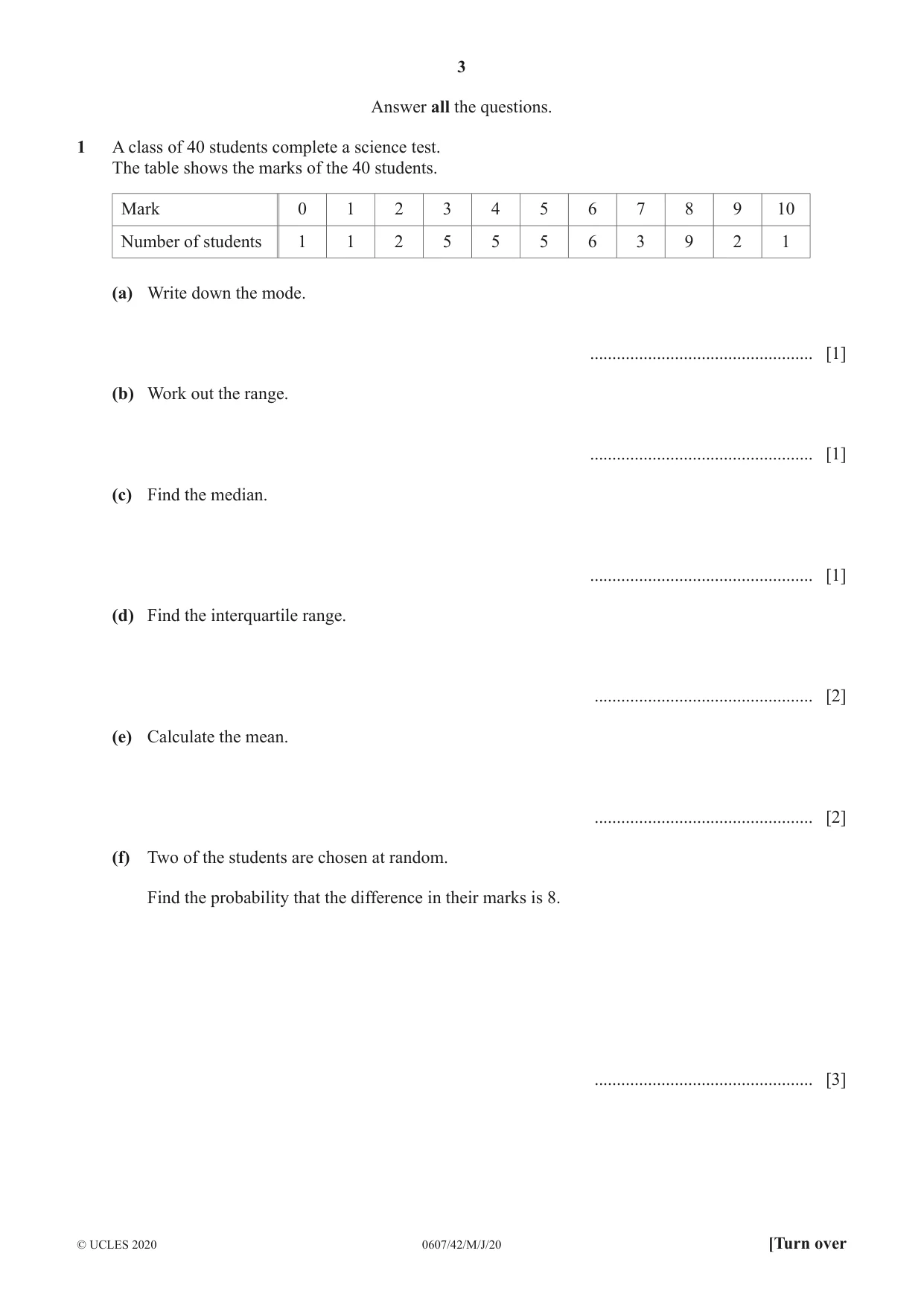
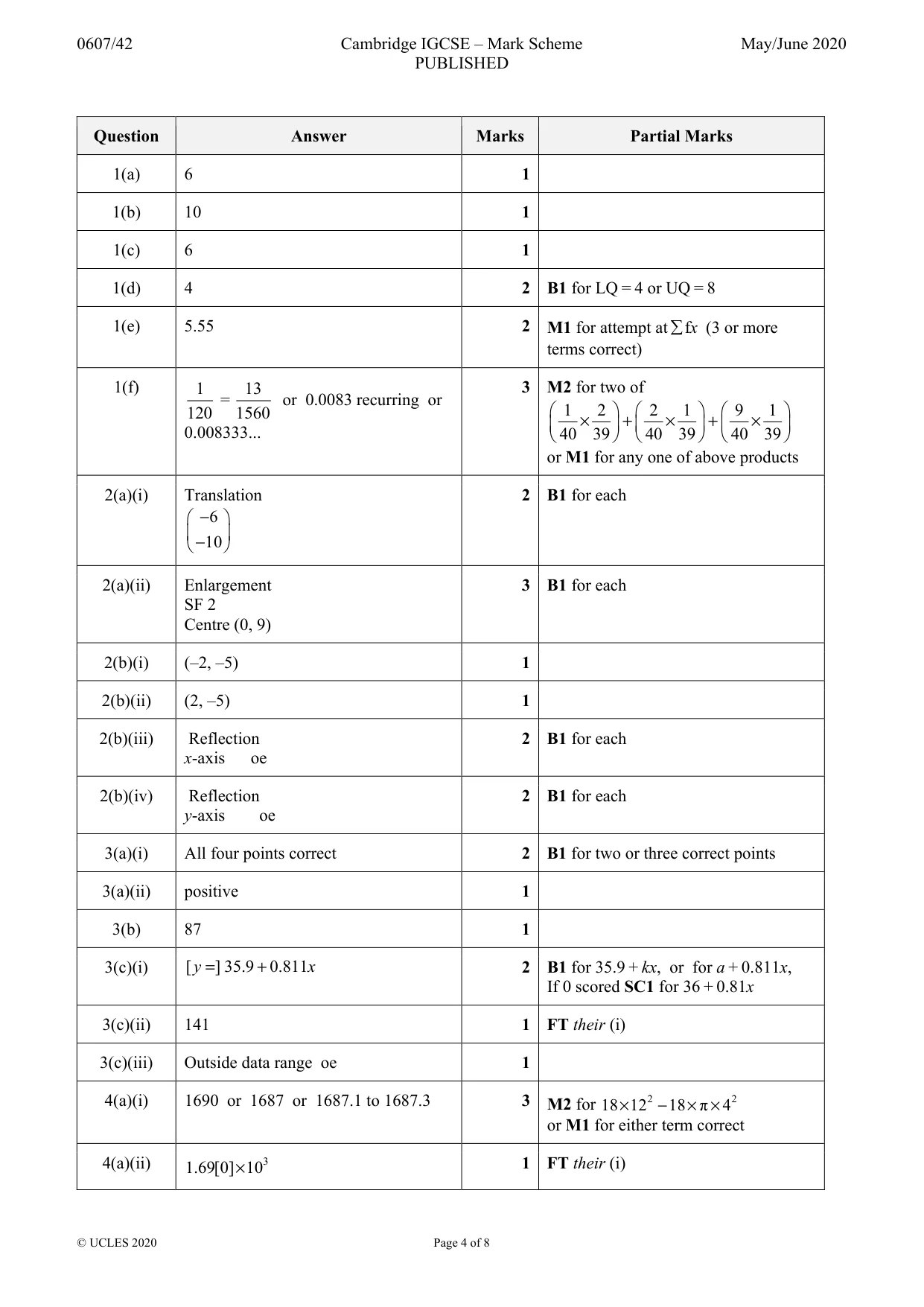
1 A class of 40 students complete a science test. The table shows the marks of the 40 students. Mark 0 1 2 3 4 5 6 7 8 9 10 Number of students 1 1 2 5 5 5 6 3 9 2 1 (a) Write down the mode. .................................................. [1] (b) Work out the range. .................................................. [1] (c) Find the median. .................................................. [1] (d) Find the interquartile range. ................................................. [2] (e) Calculate the mean. ................................................. [2] (f) Two of the students are chosen at random. Find the probability that the difference in their marks is 8. ................................................. [3]
Mark scheme: Question Answer Marks Partial Marks 1(a) 6 1 1(b) 10 1 1(c) 6 1 1(d) 4 2 B1 for LQ = 4 or UQ = 8 1(e) 5.55 2 M1 for attempt at fx (3 or more terms correct) 1(f) 1 13 3 M2 for two of = or 0.0083 recurring or 120 1560 1 2 2 1 9 1 × + × + × 0.008333... 40 39 40 39 40 39 or M1 for any one of above products
Q2 · Y 10 9 8 7 6 A 5 4 3 C 2 1 – 6 – 5 – 4 – 3 – 2 – 1 0 1 2 3 4 5 6 x – 1 – 2 – 3 – 4 B – 5…
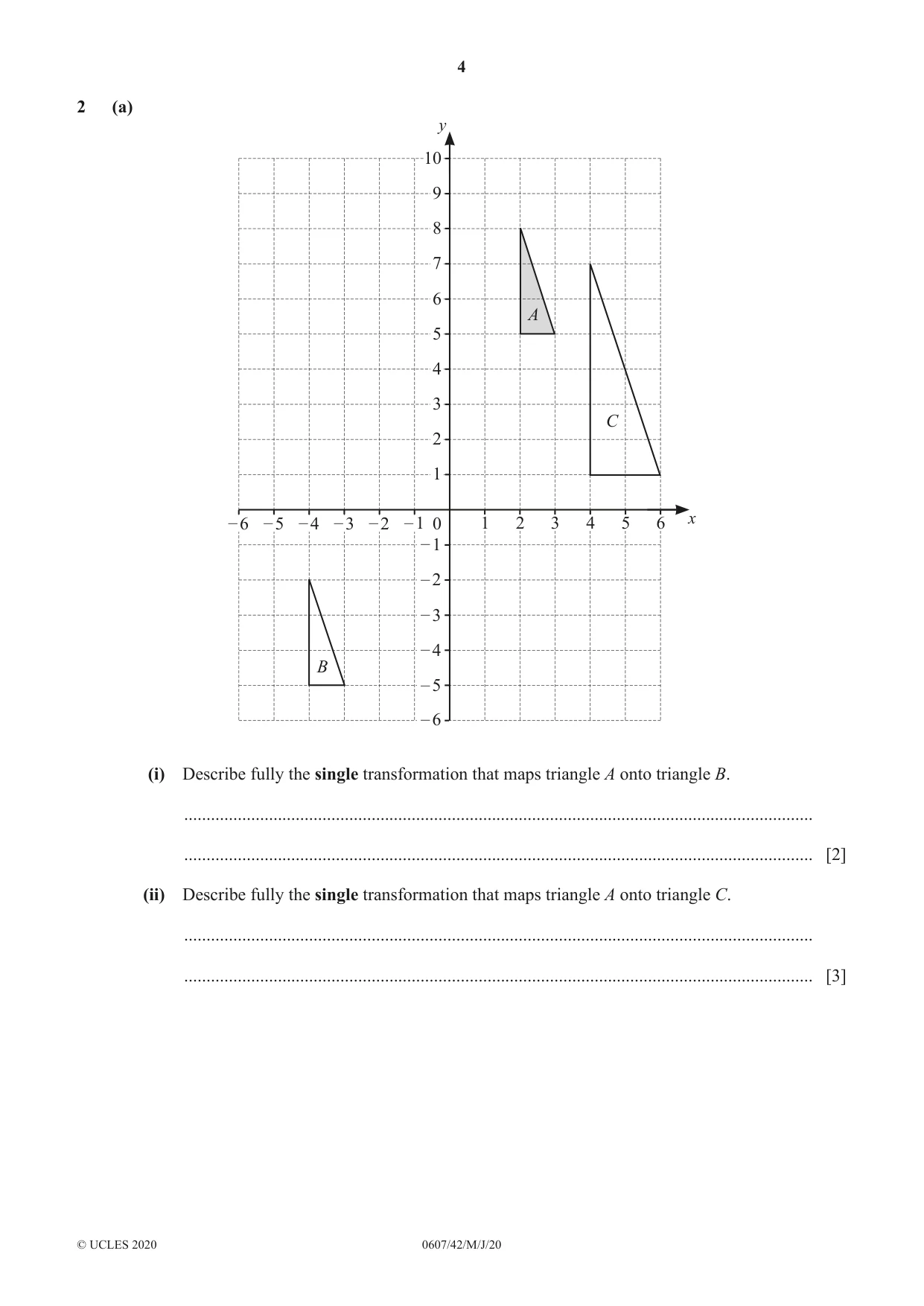
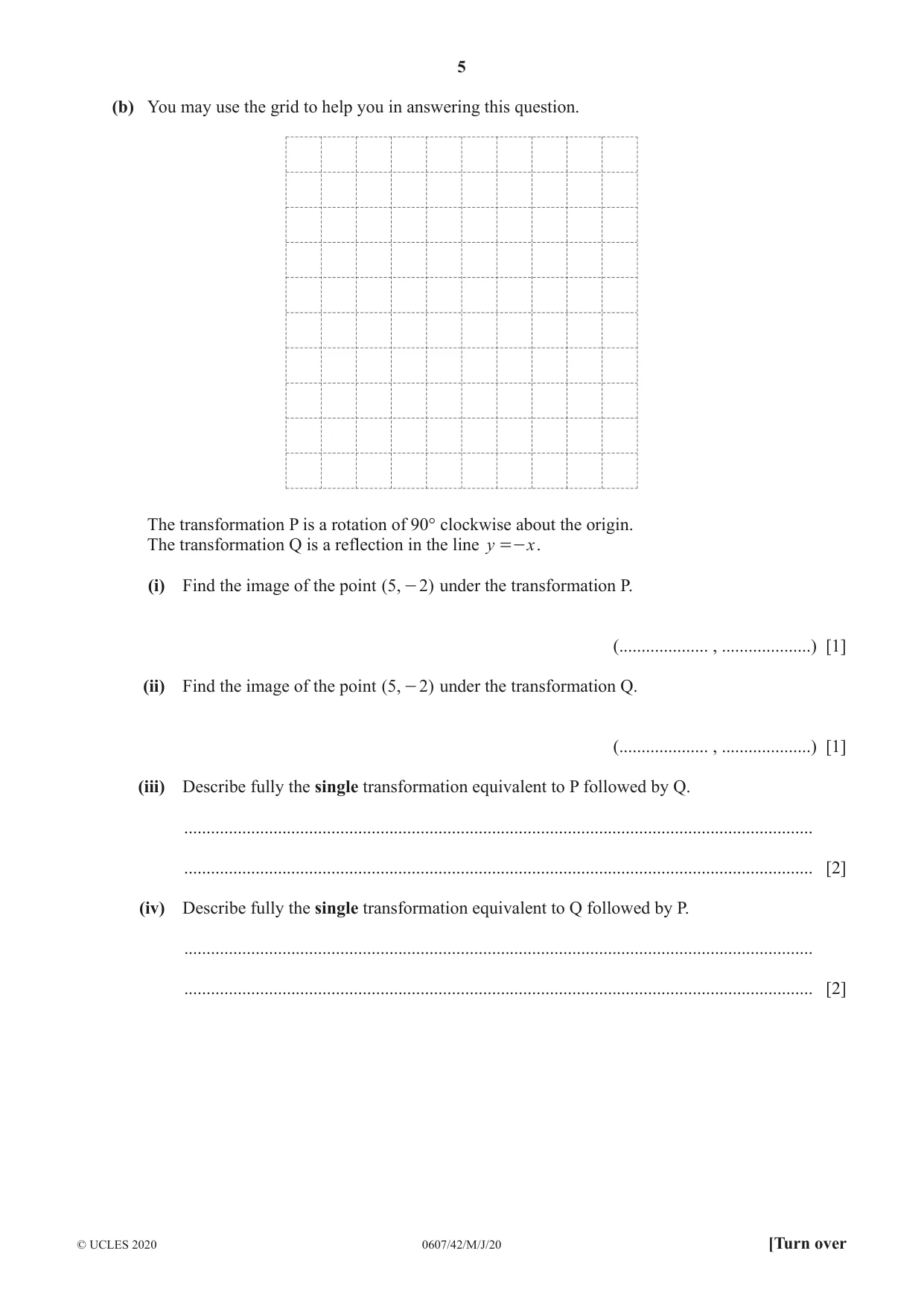
2 (a) y 10 9 8 7 6 A 5 4 3 C 2 1 – 6 – 5 – 4 – 3 – 2 – 1 0 1 2 3 4 5 6 x – 1 – 2 – 3 – 4 B – 5 – 6 (i) Describe fully the single transformation that maps triangle A onto triangle B. ............................................................................................................................................. ............................................................................................................................................. [2] (ii) Describe fully the single transformation that maps triangle A onto triangle C. ............................................................................................................................................. ............................................................................................................................................. [3] (b) You may use the grid to help you in answering this question. The transformation P is a rotation of 90° clockwise about the origin. The transformation Q is a reflection in the line y =- x . (i) Find the image of the point ( 5, - 2) under the transformation P. (.................... , ....................) [1] (ii) Find the image of the point ( 5, - 2) under the transformation Q. (.................... , ....................) [1] (iii) Describe fully the single transformation equivalent to P followed by Q. ............................................................................................................................................. ............................................................................................................................................. [2] (iv) Describe fully the single transformation equivalent to Q followed by P. ............................................................................................................................................. ............................................................................................................................................. [2]
Mark scheme: 2(a)(i) Translation 2 B1 for each − 6 − 10 2(a)(ii) Enlargement 3 B1 for each SF 2 Centre (0, 9) 2(b)(i) (–2, –5) 1 2(b)(ii) (2, –5) 1 2(b)(iii) Reflection 2 B1 for each x-axis oe 2(b)(iv) Reflection 2 B1 for each y-axis oe
Q3 · Petra is a singer
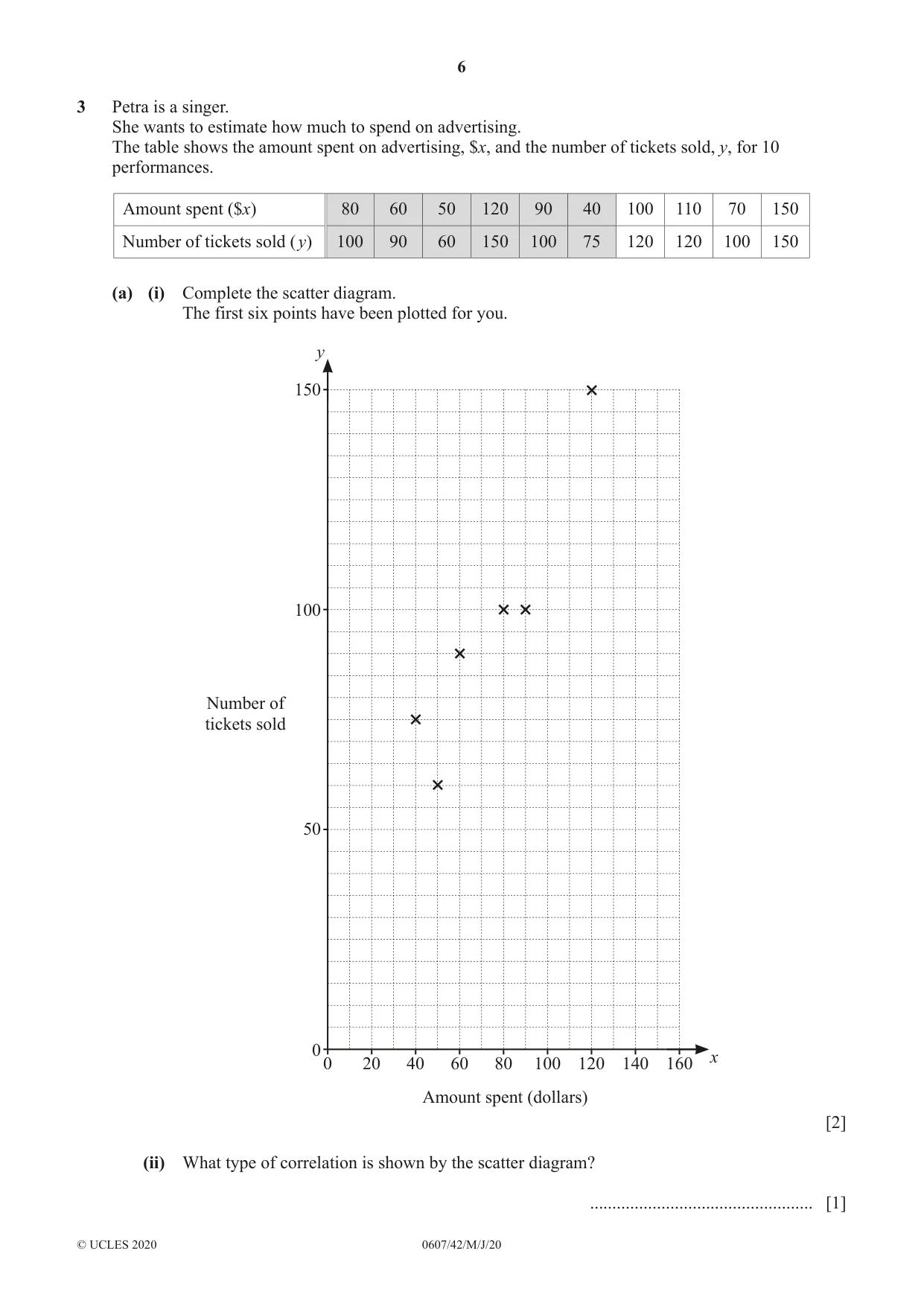
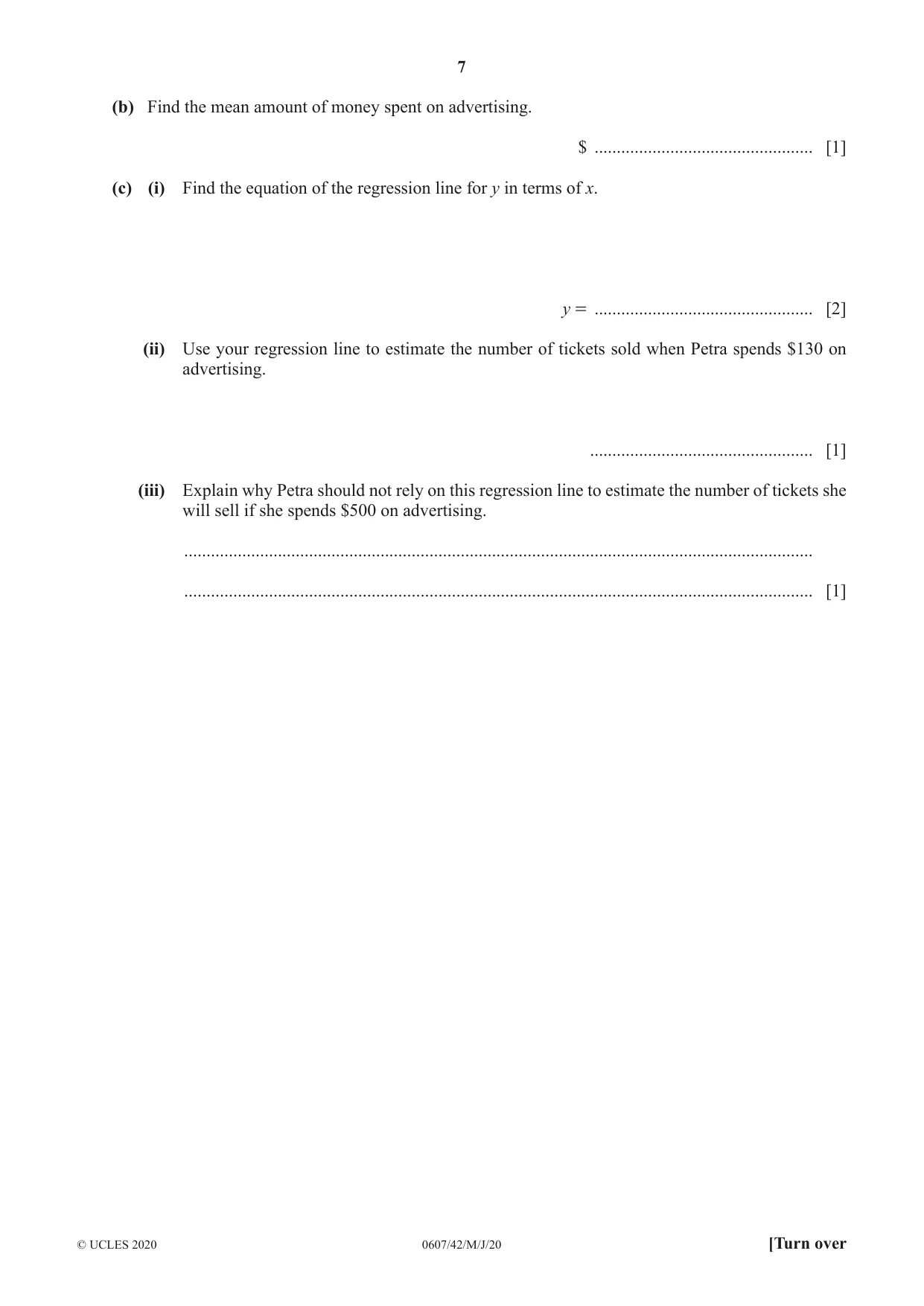
3 Petra is a singer. She wants to estimate how much to spend on advertising. The table shows the amount spent on advertising, $x, and the number of tickets sold, y, for 10 performances. Amount spent ($x) 80 60 50 120 90 40 100 110 70 150 Number of tickets sold ( y) 100 90 60 150 100 75 120 120 100 150 (a) (i) Complete the scatter diagram. The first six points have been plotted for you. y 150 100 Number of tickets sold 50 0 x 0 20 40 60 80 100 120 140 160 Amount spent (dollars) [2] (ii) What type of correlation is shown by the scatter diagram? .................................................. [1] (b) Find the mean amount of money spent on advertising. $ ................................................. [1] (c) (i) Find the equation of the regression line for y in terms of x. y = ................................................. [2] (ii) Use your regression line to estimate the number of tickets sold when Petra spends $130 on advertising. .................................................. [1] (iii) Explain why Petra should not rely on this regression line to estimate the number of tickets she will sell if she spends $500 on advertising. ............................................................................................................................................. ............................................................................................................................................. [1]
Mark scheme: 3(a)(i) All four points correct 2 B1 for two or three correct points 3(a)(ii) positive 1 3(b) 87 1 3(c)(i) [ y = ] 35.9 + 0.811x 2 B1 for 35.9 + kx, or for a + 0.811x, If 0 scored SC1 for 36 + 0.81x 3(c)(ii) 141 1 FT their (i) 3(c)(iii) Outside data range oe 1
Q4 · A piece of metal is in the shape of a cuboid
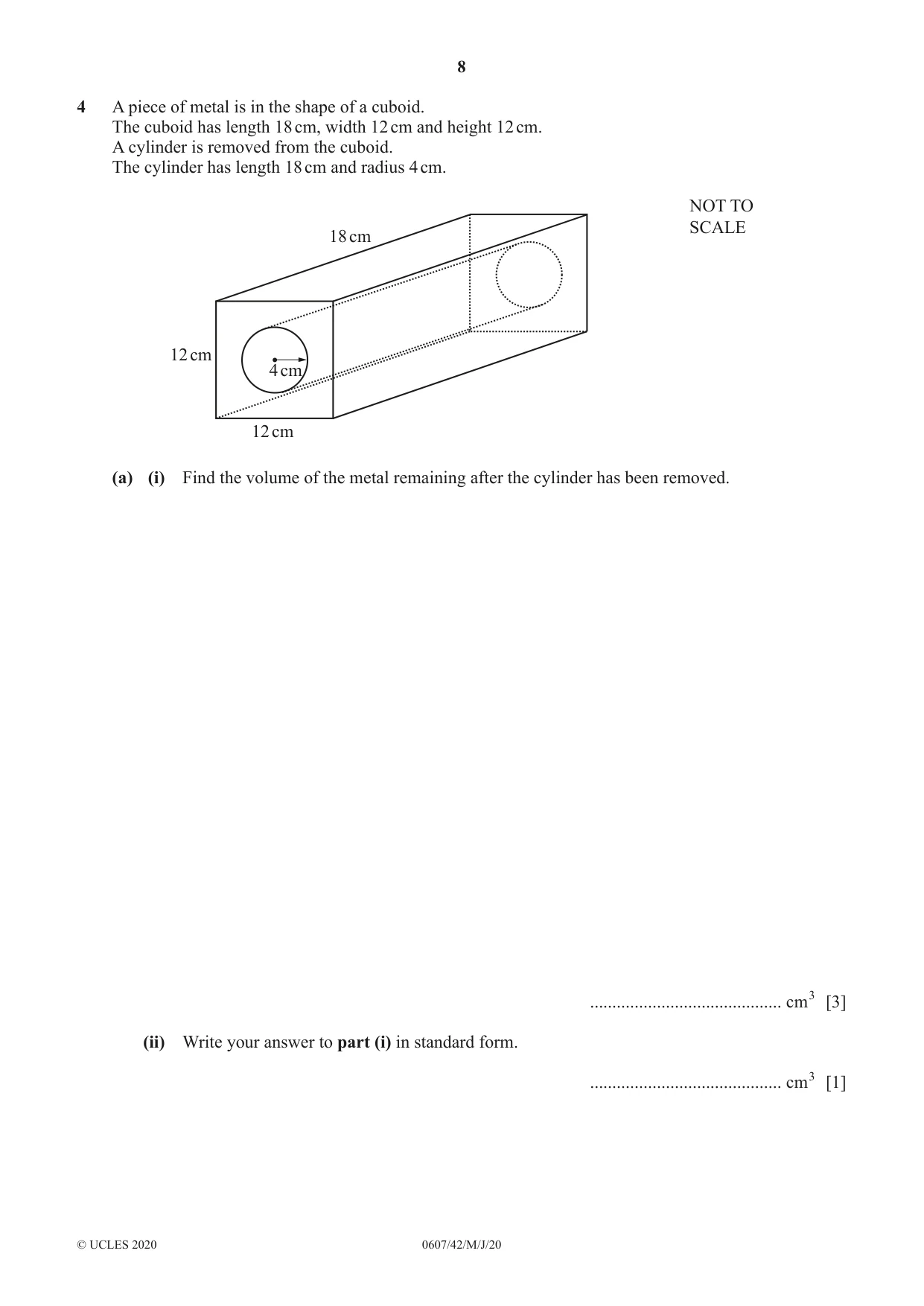
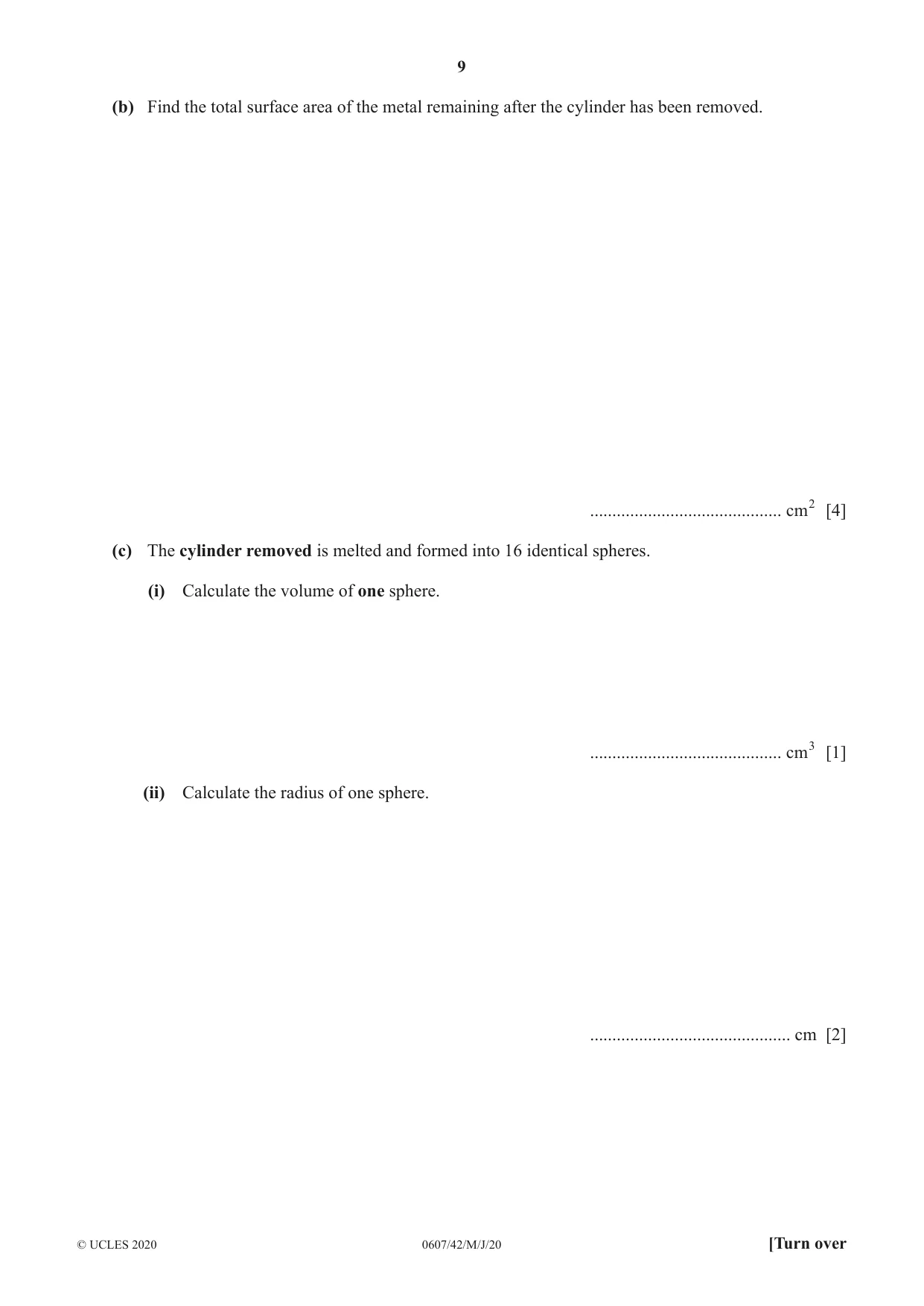
4 A piece of metal is in the shape of a cuboid. The cuboid has length 18 cm, width 12 cm and height 12 cm. A cylinder is removed from the cuboid. The cylinder has length 18 cm and radius 4 cm. NOT TO SCALE 18 cm 12 cm 4 cm 12 cm (a) (i) Find the volume of the metal remaining after the cylinder has been removed. ........................................... cm3 [3] (ii) Write your answer to part (i) in standard form. ........................................... cm3 [1] (b) Find the total surface area of the metal remaining after the cylinder has been removed. ........................................... cm2 [4] (c) The cylinder removed is melted and formed into 16 identical spheres. (i) Calculate the volume of one sphere. ........................................... cm3 [1] (ii) Calculate the radius of one sphere. ............................................. cm [2]
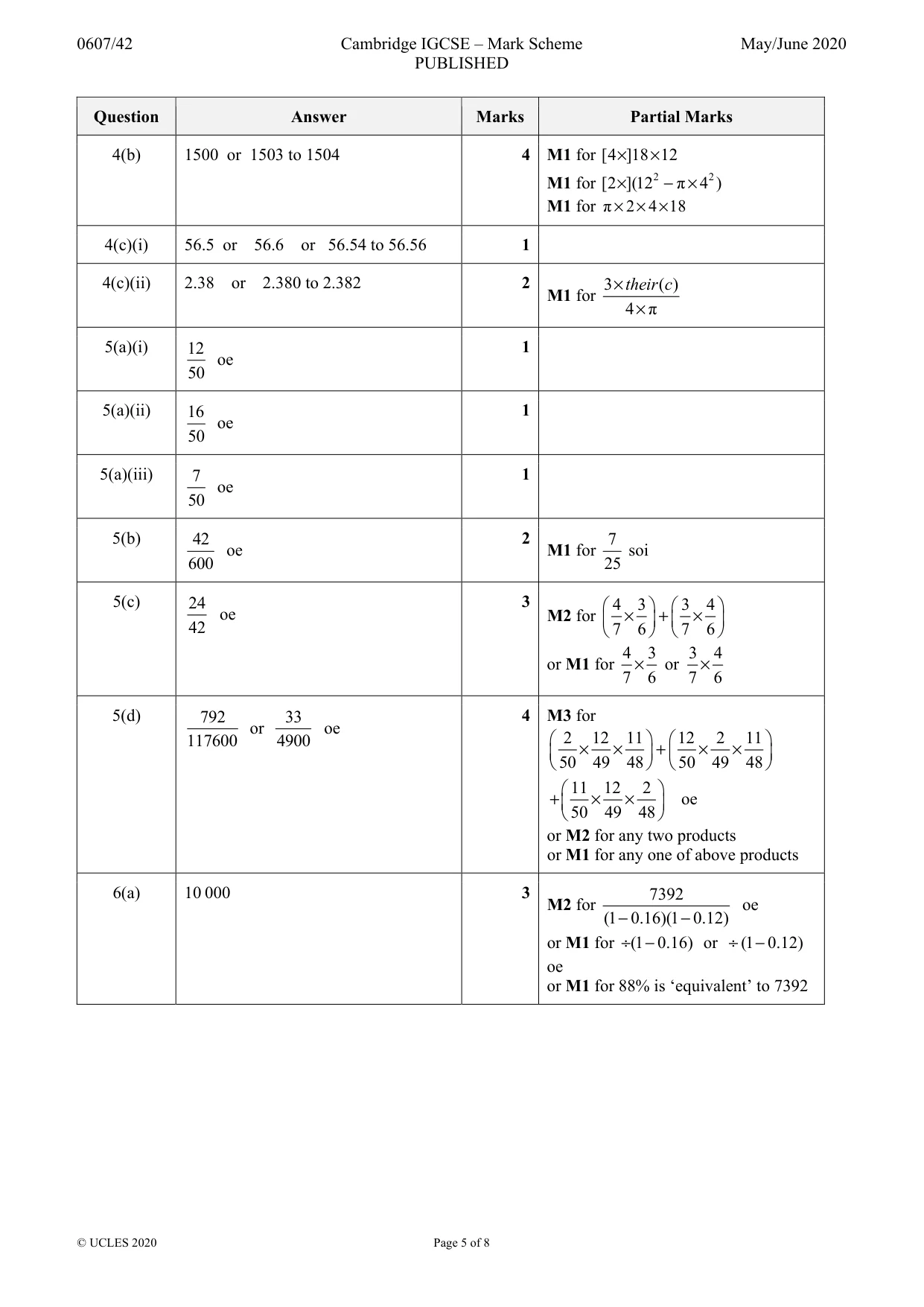
Mark scheme: 4(a)(i) 1690 or 1687 or 1687.1 to 1687.3 3 M2 for 18 × 12 2 − 18 × π × 4 2 or M1 for either term correct 4(a)(ii) 1.69[0] × 10 3 1 FT their (i) 4(b) 1500 or 1503 to 1504 4 M1 for [4 ×]18 × 12 M1 for [2 ×](12 2 − π × 4 2 ) M1 for π × 2 × 4 × 18 4(c)(i) 56.5 or 56.6 or 56.54 to 56.56 1 4(c)(ii) 2.38 or 2.380 to 2.382 2 3 × their ( c ) M1 for 4 × π
Q5 · Fifty students, 25 boys and 25 girls, were asked which sport they prefer
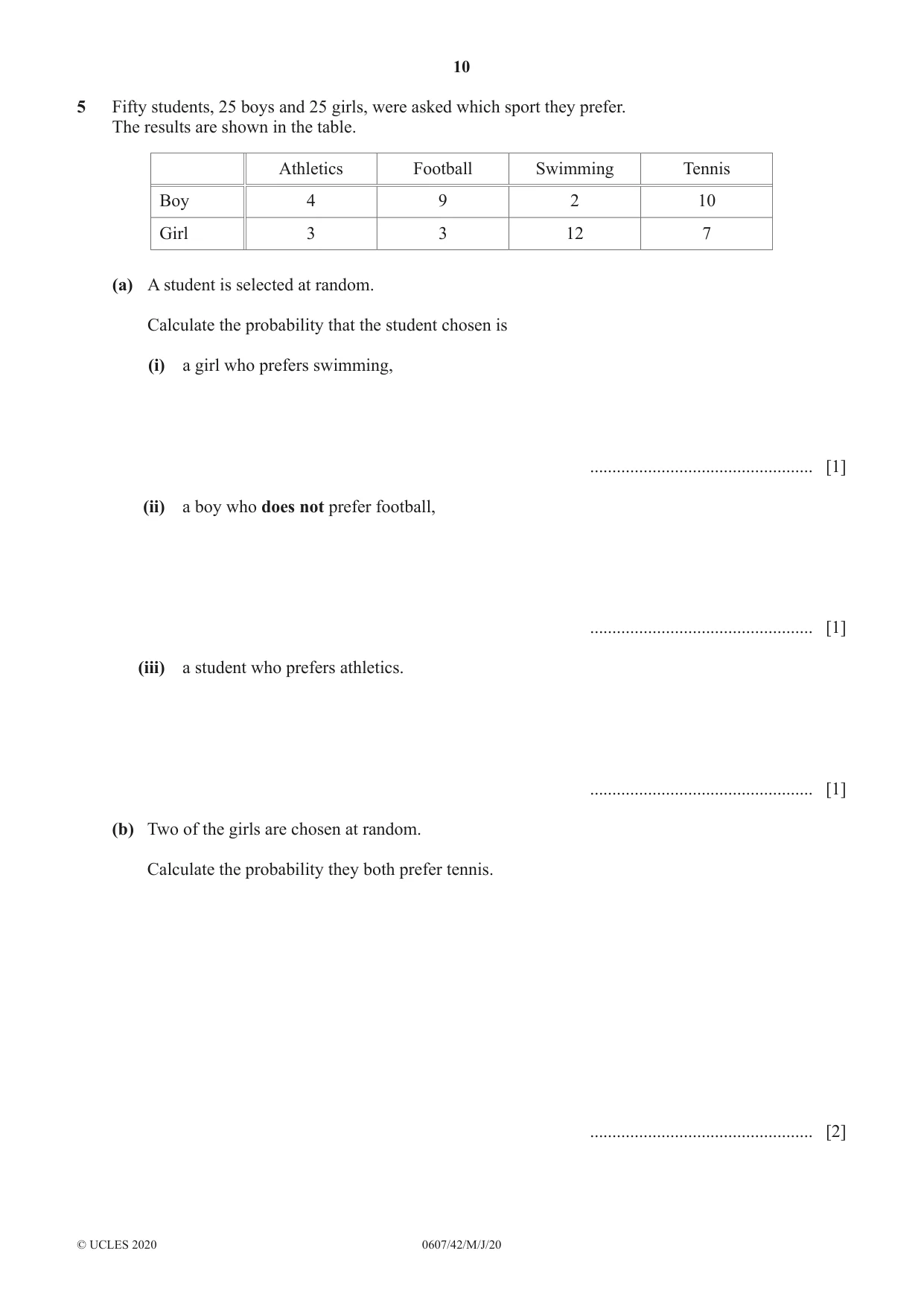
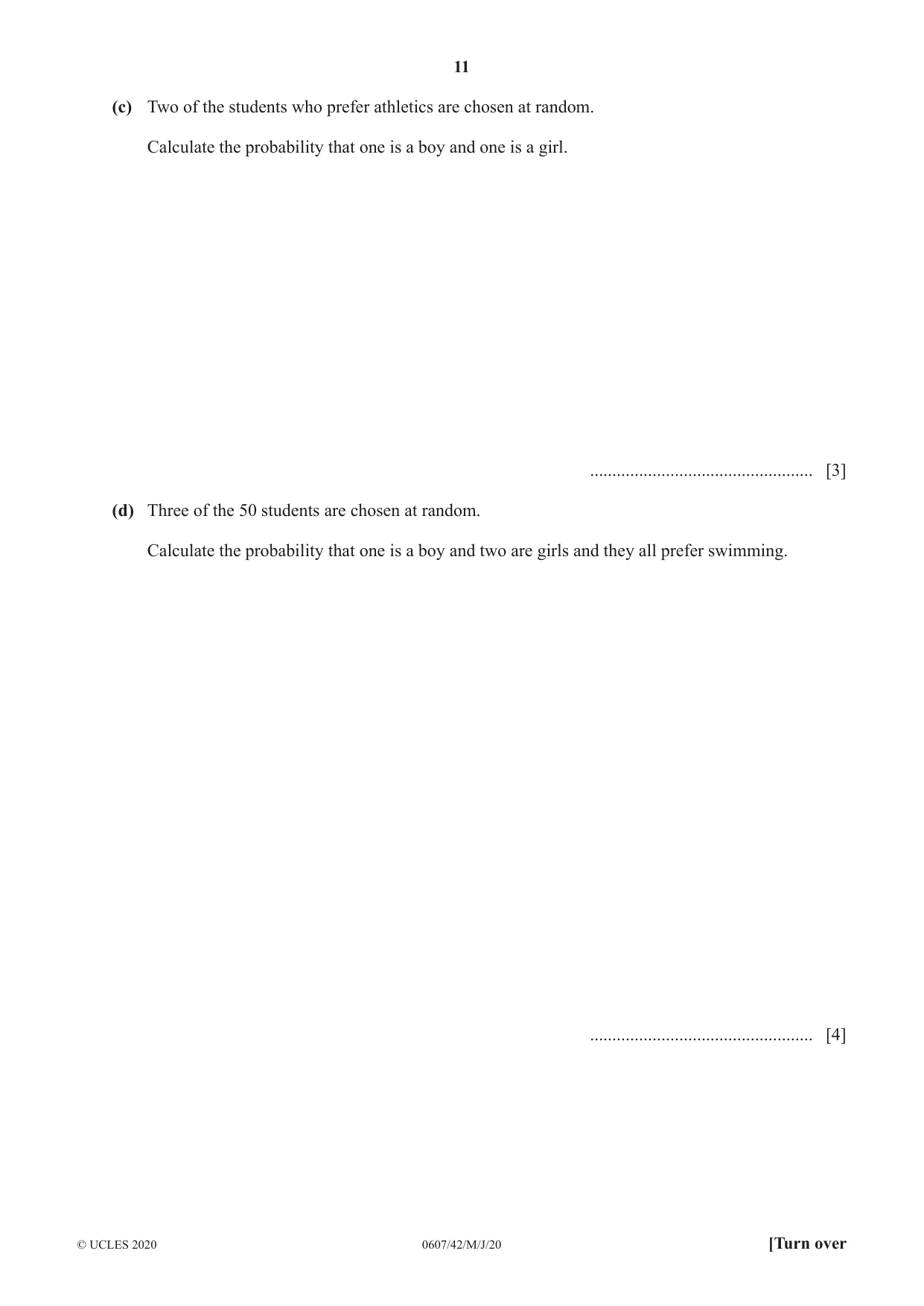
5 Fifty students, 25 boys and 25 girls, were asked which sport they prefer. The results are shown in the table. Athletics Football Swimming Tennis Boy 4 9 2 10 Girl 3 3 12 7 (a) A student is selected at random. Calculate the probability that the student chosen is (i) a girl who prefers swimming, .................................................. [1] (ii) a boy who does not prefer football, .................................................. [1] (iii) a student who prefers athletics. .................................................. [1] (b) Two of the girls are chosen at random. Calculate the probability they both prefer tennis. .................................................. [2] (c) Two of the students who prefer athletics are chosen at random. Calculate the probability that one is a boy and one is a girl. .................................................. [3] (d) Three of the 50 students are chosen at random. Calculate the probability that one is a boy and two are girls and they all prefer swimming. .................................................. [4]
Mark scheme: 5(a)(i) 12 1 oe 50 5(a)(ii) 16 1 oe 50 5(a)(iii) 7 1 oe 50 5(b) 42 2 7 oe M1 for soi 600 25 5(c) 24 3 4 3 3 4 oe M2 for × + × 42 7 6 7 6 4 3 3 4 or M1 for × or × 7 6 7 6 5(d) 792 33 4 M3 for or oe 117600 4900 2 12 11 12 2 11 × × + × × 50 49 48 50 49 48 11 12 2 + × × oe 50 49 48 or M2 for any two products or M1 for any one of above products
Q6 · Herman bought a motorbike on 1 January 2014
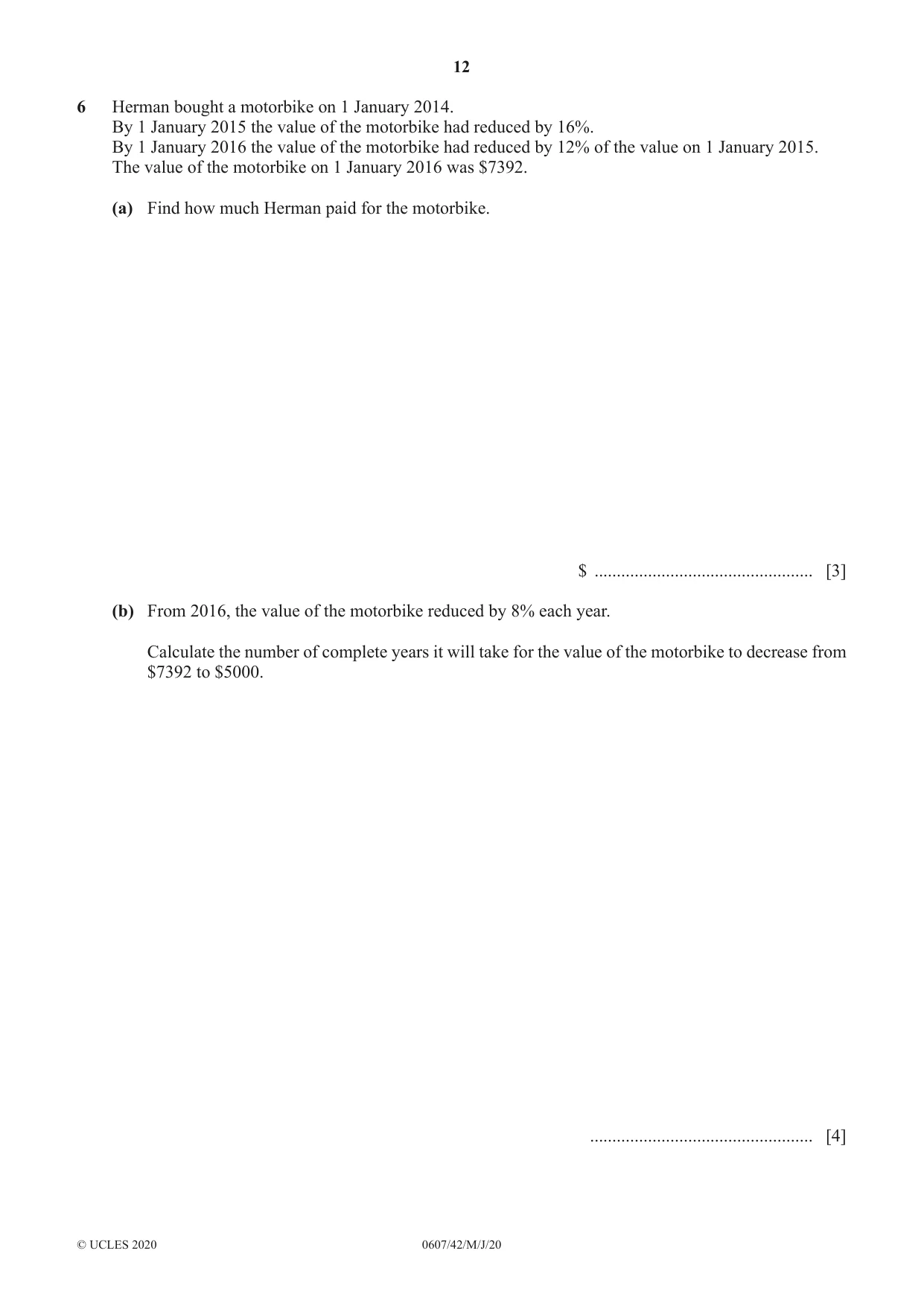
6 Herman bought a motorbike on 1 January 2014. By 1 January 2015 the value of the motorbike had reduced by 16%. By 1 January 2016 the value of the motorbike had reduced by 12% of the value on 1 January 2015. The value of the motorbike on 1 January 2016 was $7392. (a) Find how much Herman paid for the motorbike. $ ................................................. [3] (b) From 2016, the value of the motorbike reduced by 8% each year. Calculate the number of complete years it will take for the value of the motorbike to decrease from $7392 to $5000. .................................................. [4]
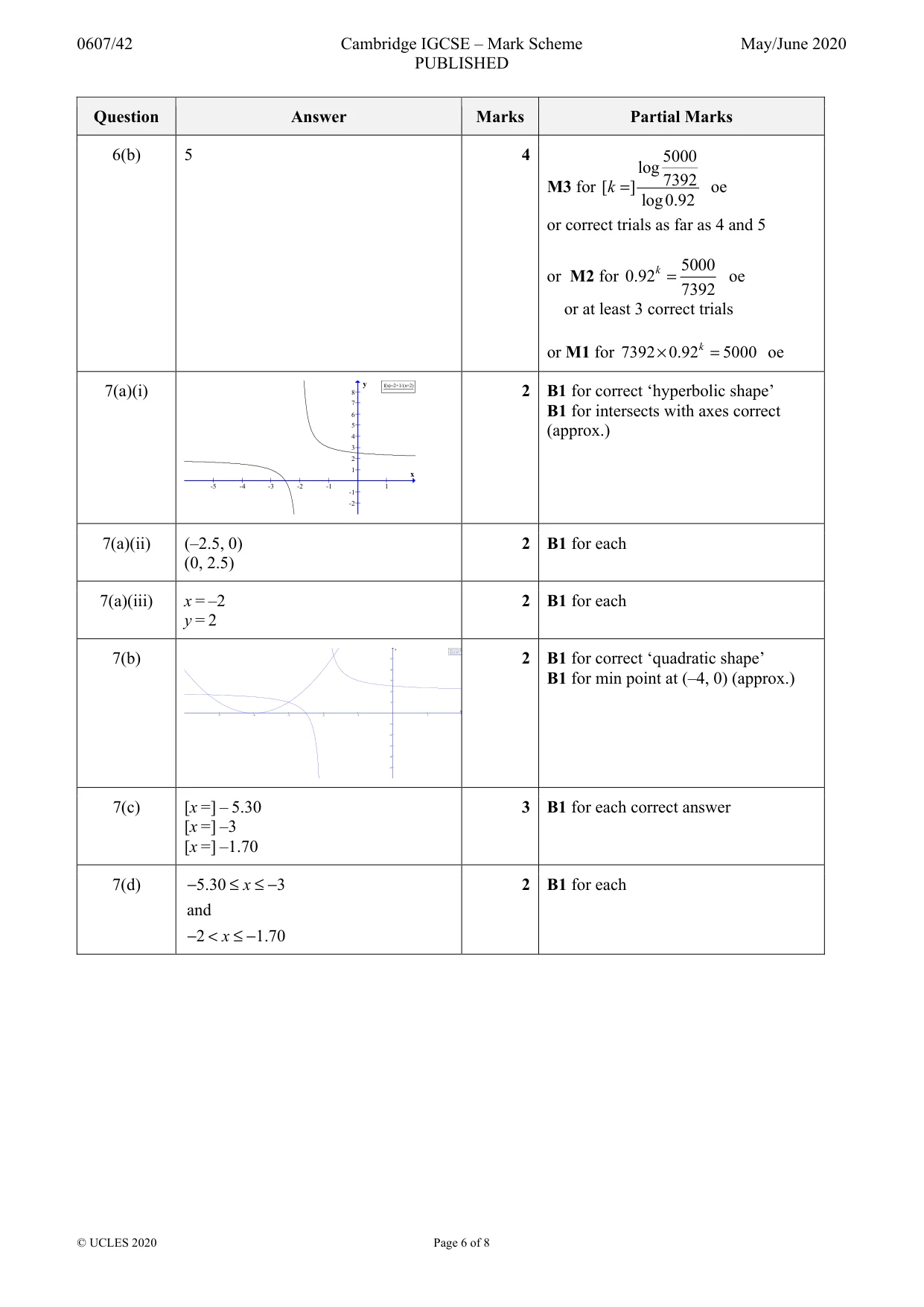
Mark scheme: 6(a) 10 000 3 7392 M2 for oe (1 − 0.16)(1 − 0.12) or M1 for ÷(1 − 0.16) or ÷ (1 − 0.12) oe or M1 for 88% is ‘equivalent’ to 7392 6(b) 5 4 5000 log 7392 M3 for [ k = ] oe log0.92 or correct trials as far as 4 and 5 k 5000 or M2 for 0.92 = oe 7392 or at least 3 correct trials or M1 for 7392 × 0.92 k = 5000 oe
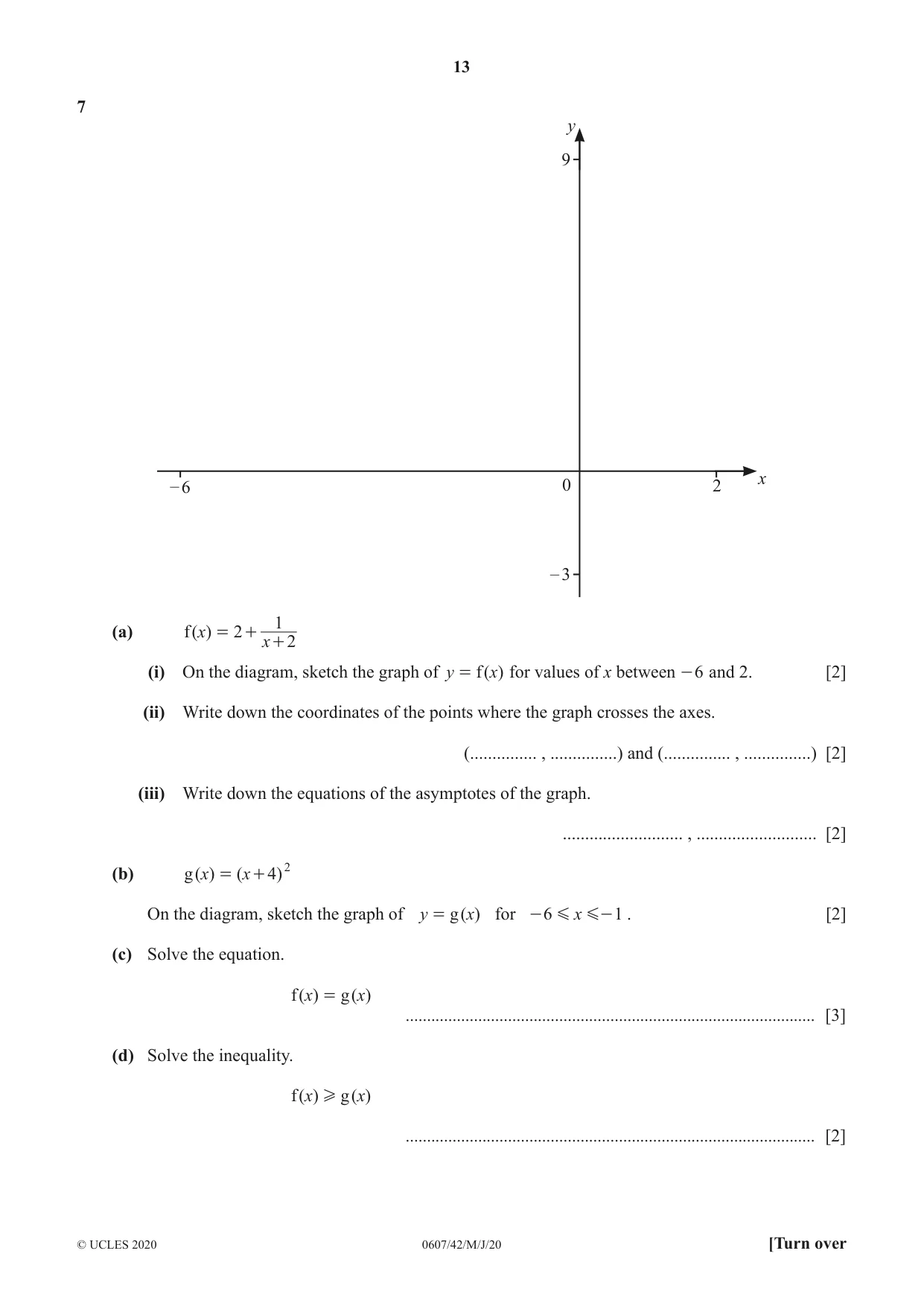
Q7 · Y 9 x – 6 0 2 – 3 1 (a) f ( )x = 2 + x + 2 (i) On the diagram, sketch the graph of y = f…
7 y 9 x – 6 0 2 – 3 1 (a) f ( )x = 2 + x + 2 (i) On the diagram, sketch the graph of y = f ( x) for values of x between - 6 and 2. [2] (ii) Write down the coordinates of the points where the graph crosses the axes. (............... , ...............) and (............... , ...............) [2] (iii) Write down the equations of the asymptotes of the graph. ........................... , ........................... [2] (b) g ( x) = ( x + 4) 2 On the diagram, sketch the graph of y = g ( x) for - 6 G x G - 1 . [2] (c) Solve the equation. f ( x) = g ( x) ................................................................................................ [3] (d) Solve the inequality. f ( x) H g ( x) ................................................................................................ [2]
Mark scheme: 7(a)(i) 8 y f(x)=2+1/(x+2) 2 B1 for correct ‘hyperbolic shape’ 7 6 B1 for intersects with axes correct 5 4 (approx.) 3 2 1 x -5 -4 -3 -2 -1 1 -1 -2 7(a)(ii) (–2.5, 0) 2 B1 for each (0, 2.5) 7(a)(iii) x = –2 2 B1 for each y = 2 y f(x)=2+1/(x+2)f(x)=(x+4)^2 5 7(b) 4 2 B1 for correct ‘quadratic shape’ 3 B1 for min point at (–4, 0) (approx.) 2 1 -5 -4 -3 -2 -1 1 x -1 -2 -3 -4 -5 7(c) [x =] – 5.30 3 B1 for each correct answer [x =] –3 [x =] –1.70 7(d) −5.30 ≤ x ≤−3 2 B1 for each and −<2 x ≤−1.70
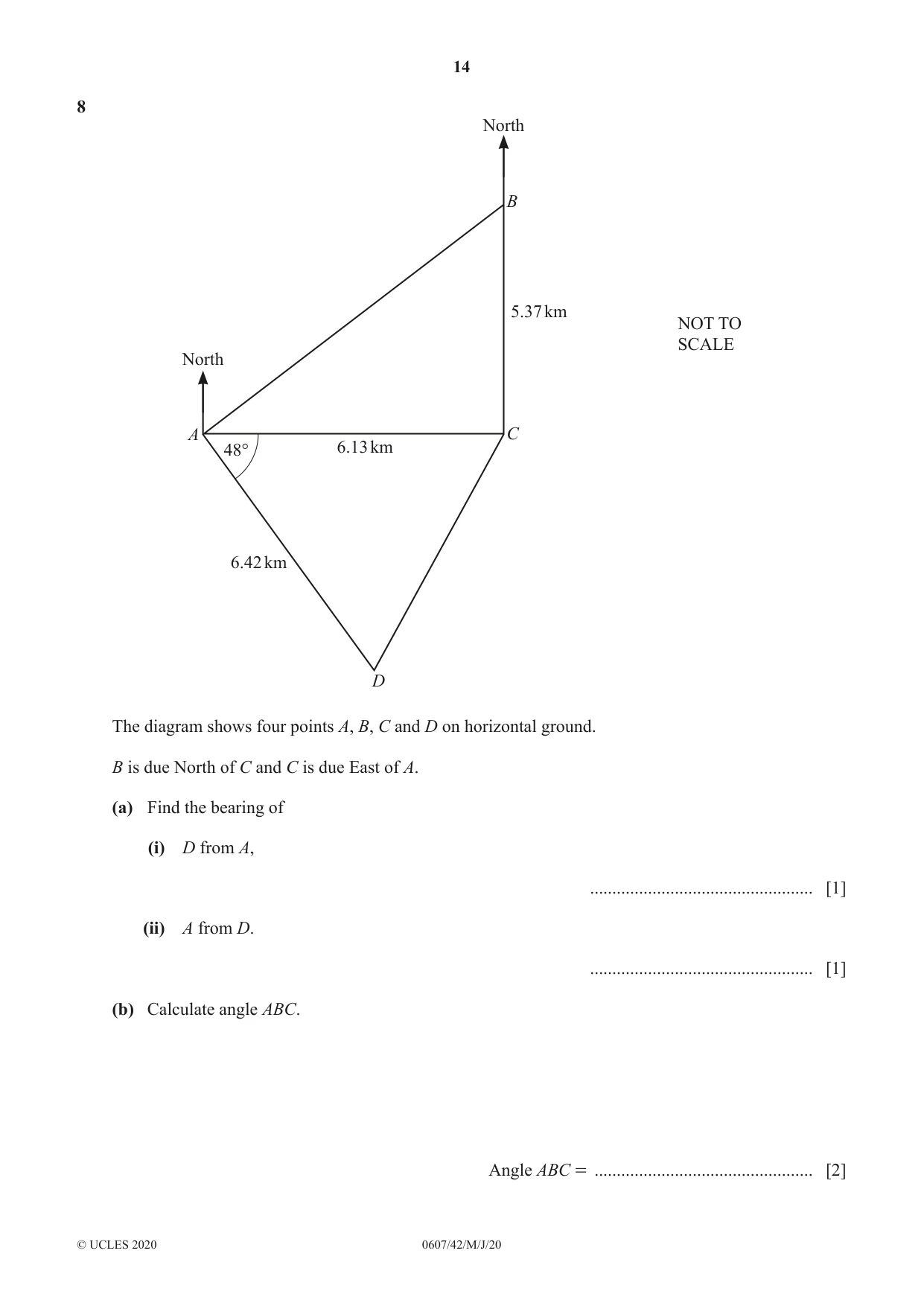
Q8 · North B 5.37 km NOT TO SCALE North A C 48° 6.13 km 6.42 km D The diagram shows four…
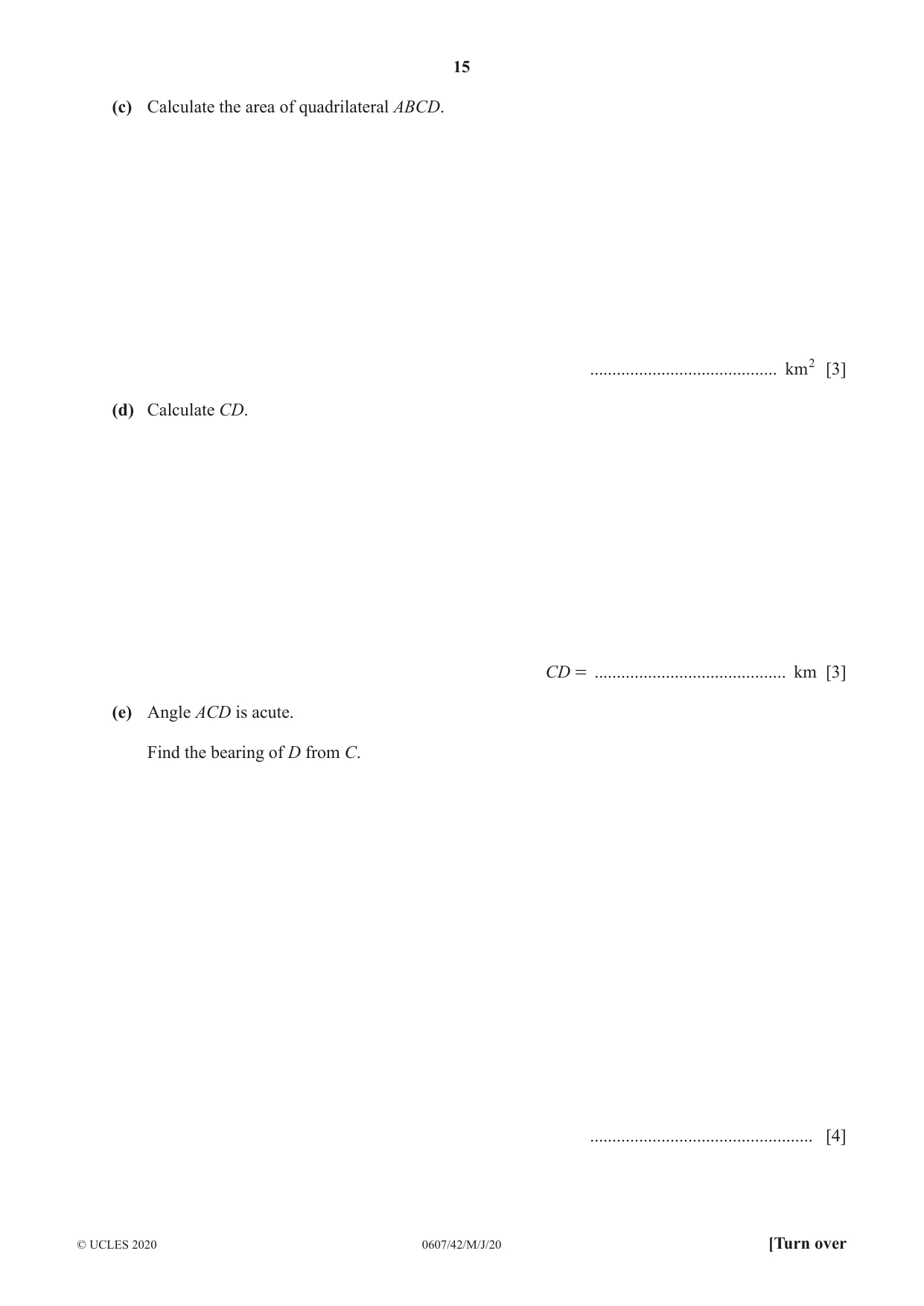
8 North B 5.37 km NOT TO SCALE North A C 48° 6.13 km 6.42 km D The diagram shows four points A, B, C and D on horizontal ground. B is due North of C and C is due East of A. (a) Find the bearing of (i) D from A, .................................................. [1] (ii) A from D. .................................................. [1] (b) Calculate angle ABC. Angle ABC = ................................................. [2] (c) Calculate the area of quadrilateral ABCD. .......................................... km 2 [3] (d) Calculate CD. CD = ........................................... km [3] (e) Angle ACD is acute. Find the bearing of D from C. .................................................. [4]
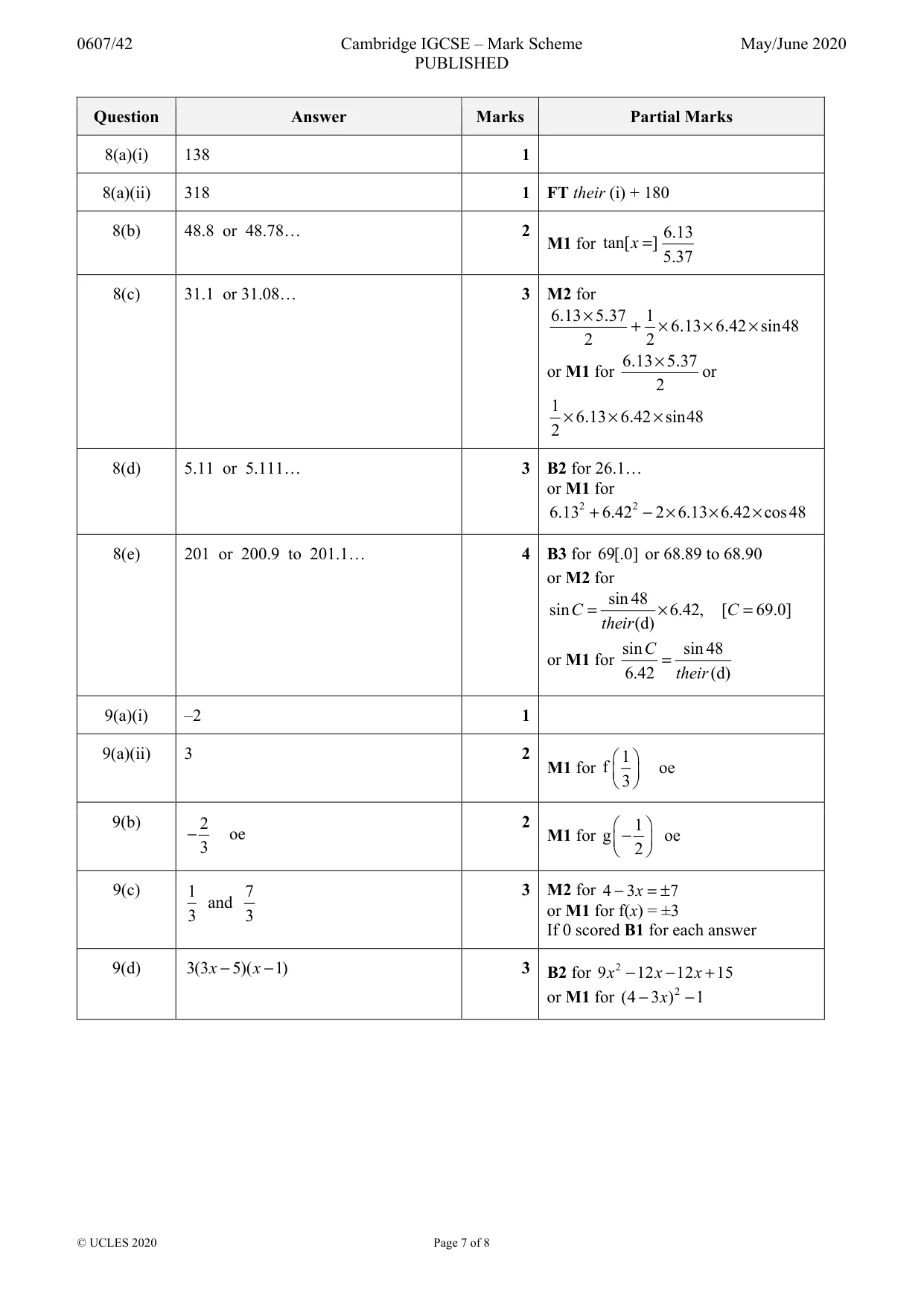
Mark scheme: 8(a)(i) 138 1 8(a)(ii) 318 1 FT their (i) + 180 8(b) 48.8 or 48.78… 2 6.13 M1 for tan[ x = ] 5.37 8(c) 31.1 or 31.08… 3 M2 for 6. 13 × 5. 37 1 + × 6. 13 × 6. 42 × sin48 2 2 6.13 × 5. 37 or M1 for or 2 1 × 6. 13 × 6.42 × sin48 2 8(d) 5.11 or 5.111… 3 B2 for 26.1… or M1 for 6.132 + 6.42 2 − 2 × 6.13 × 6.42 × cos48 8(e) 201 or 200.9 to 201.1… 4 B3 for 69[.0] or 68.89 to 68.90 or M2 for sin 48 sin C = × 6.42, [C = 69.0] their (d) sin C sin 48 or M1 for = 6.42 their (d)
Q9 · F ( )x = 4 - 3 x g ( x) = , x !
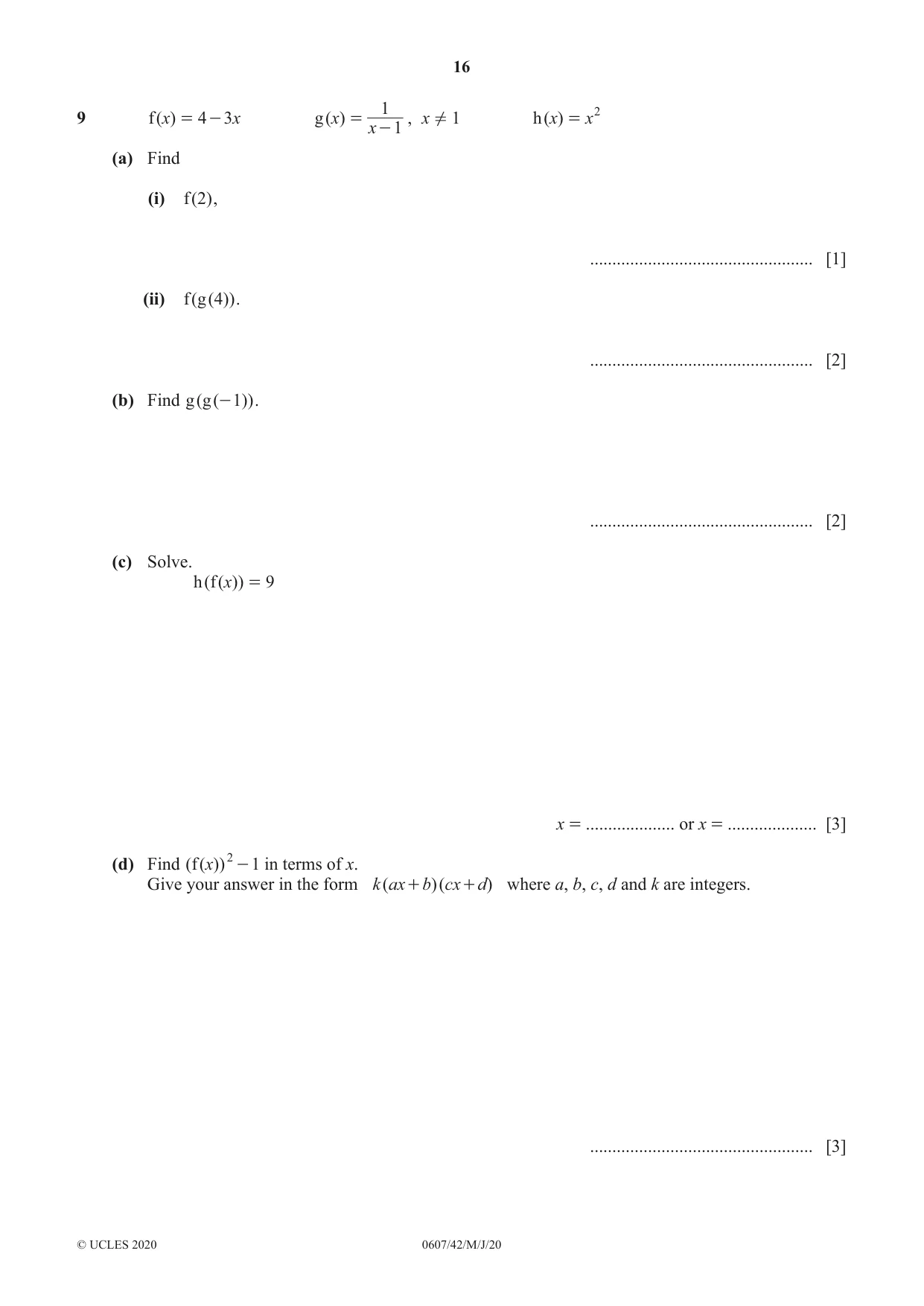
9 f ( )x = 4 - 3 x g ( x) = , x ! 1 h ( )x = x 2 x - 1 (a) Find (i) f ( 2) , .................................................. [1] (ii) f ( g ( 4)) . .................................................. [2] (b) Find g ( g ( - 1)) . .................................................. [2] (c) Solve. h ( f ( x)) = 9 x = .................... or x = .................... [3] (d) Find ( f ( x)) 2 - 1 in terms of x. Give your answer in the form k ( ax + b)( cx + d) where a, b, c, d and k are integers. .................................................. [3]
Mark scheme: 9(a)(i) –2 1 9(a)(ii) 3 2 1 M1 for f oe 3 9(b) 2 2 1 − oe M1 for g − oe 3 2 9(c) 1 7 3 M2 for 4 − 3 x = ± 7 and or M1 for f(x) = ±3 3 3 If 0 scored B1 for each answer 9(d) 3(3 x − 5)( x − 1) 3 B2 for 9 x 2 − 12 x − 12 x + 15 or M1 for (4 − 3 x ) 2 − 1
Q10 · D NOT TO SCALE 20° 50° A 12 m B C The diagram shows a vertical pole CD
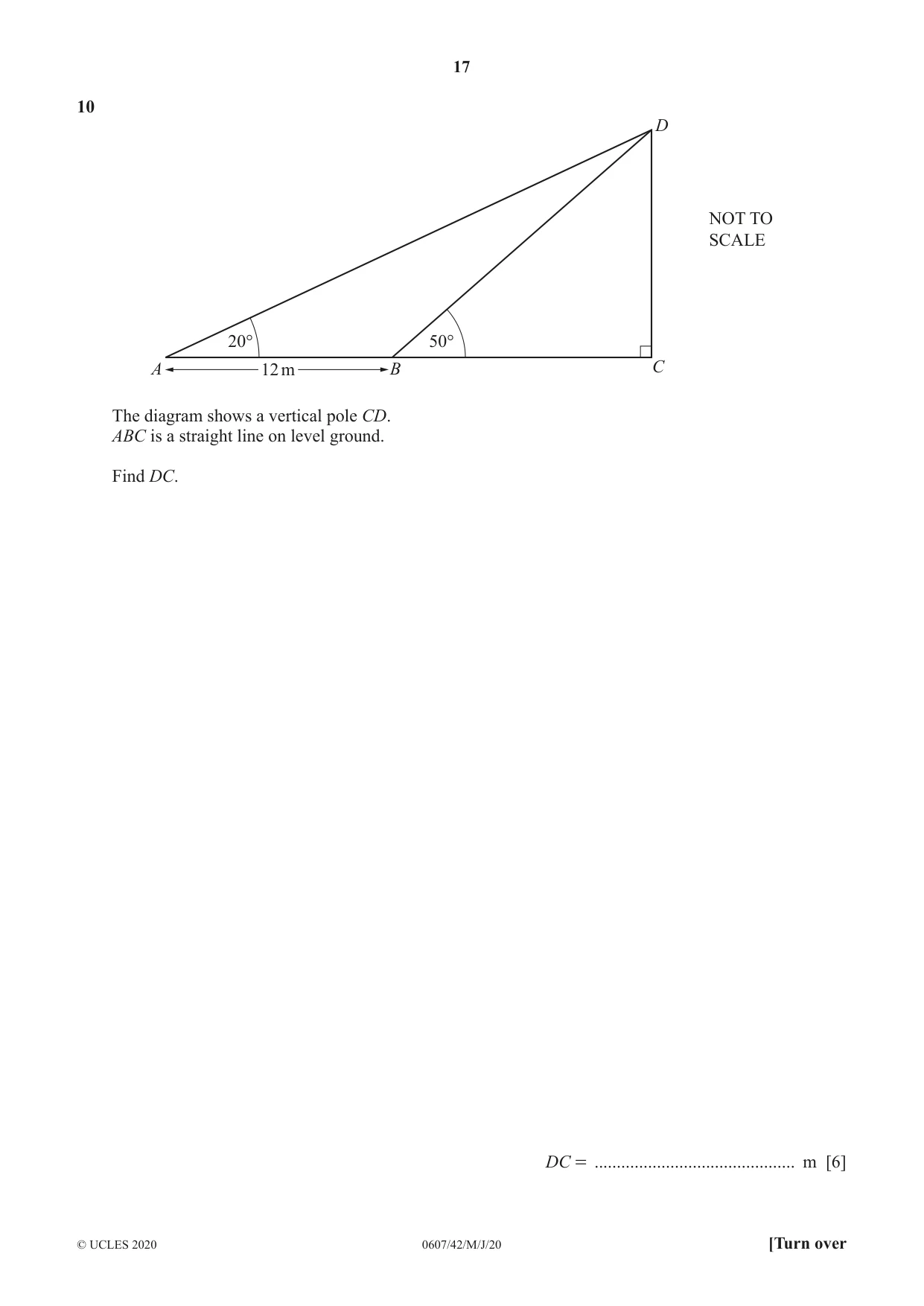
10 D NOT TO SCALE 20° 50° A 12 m B C The diagram shows a vertical pole CD. ABC is a straight line on level ground. Find DC. DC = ............................................. m [6]
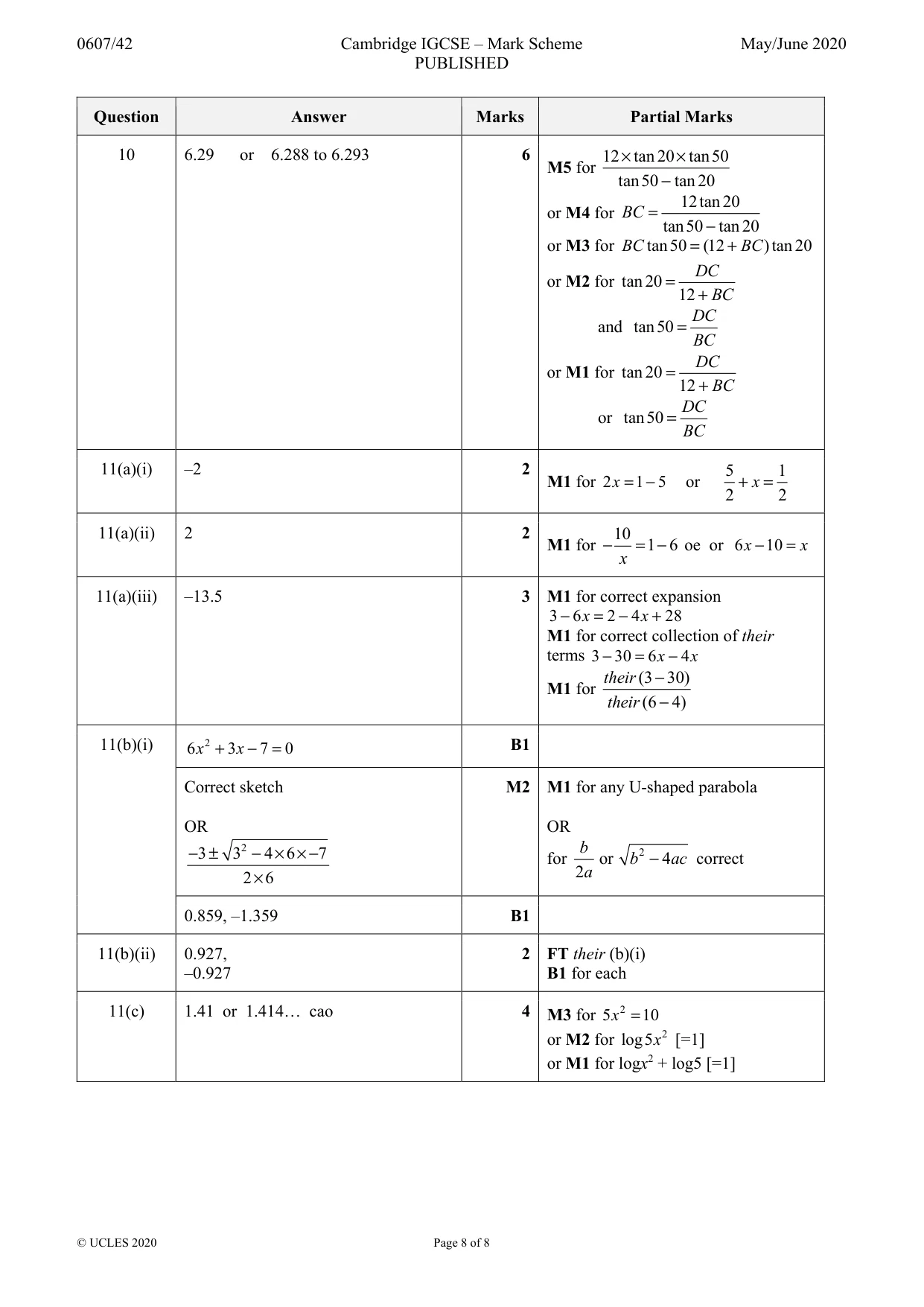
Mark scheme: 10 6.29 or 6.288 to 6.293 6 12 × tan 20 × tan50 M5 for tan50 − tan 20 12tan20 or M4 for BC = tan50 − tan20 or M3 for BC tan50 = (12 + BC )tan 20 DC or M2 for tan20 = 12 + BC DC and tan50 = BC DC or M1 for tan20 = 12 + BC DC or tan50 = BC
Question 11
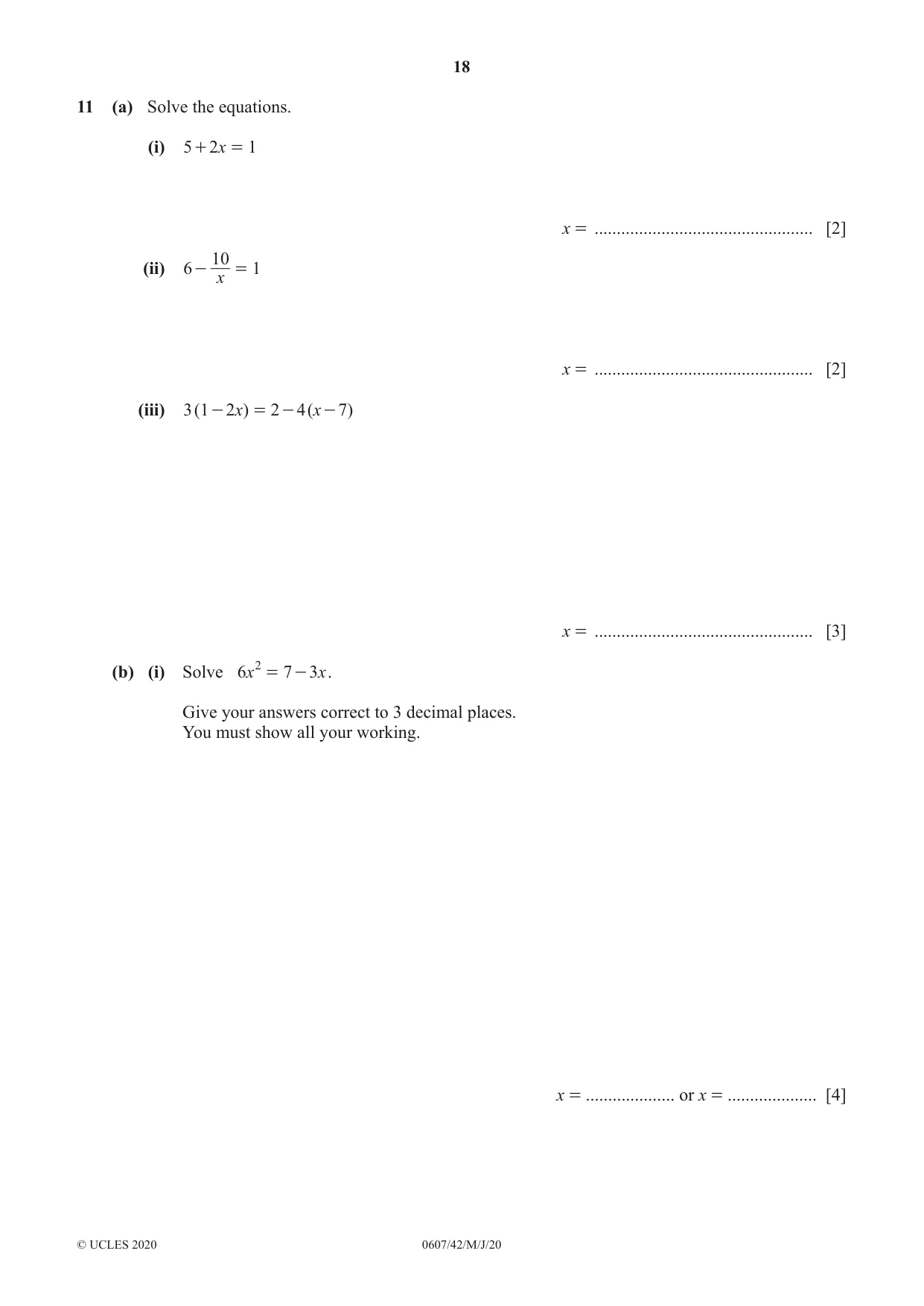
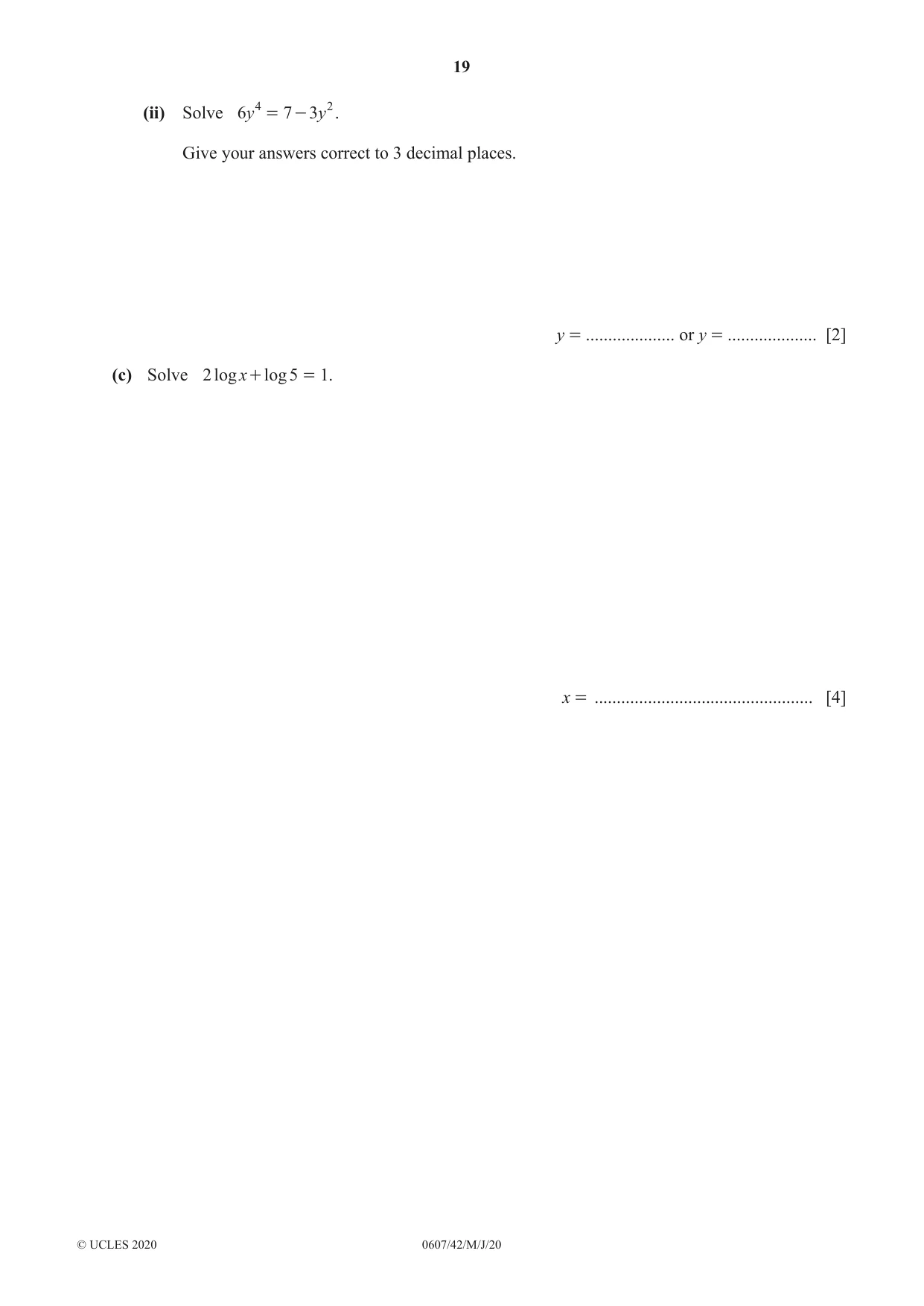
11 (a) Solve the equations. (i) 5 + 2x = 1 x = ................................................. [2] 10 (ii) 6 - = 1 x x = ................................................. [2] (iii) 3 ( 1 - 2x) = 2 - 4 ( x - 7) x = ................................................. [3] (b) (i) Solve 6x 2 = 7 - 3 x . Give your answers correct to 3 decimal places. You must show all your working. x = .................... or x = .................... [4] (ii) Solve 6y 4 = 7 - 3 y 2 . Give your answers correct to 3 decimal places. y = .................... or y = .................... [2] (c) Solve 2 log x + log 5 = 1. x = ................................................. [4]
Mark scheme: 11(a)(i) –2 2 5 1 M1 for 2 x = 1 − 5 or + x = 2 2 11(a)(ii) 2 2 10 M1 for − = 1 − 6 oe or 6 x − 10 = x x 11(a)(iii) –13.5 3 M1 for correct expansion 3 − 6 x = 2 − 4 x + 28 M1 for correct collection of their terms 3 − 30 = 6 x − 4 x their (3 − 30) M1 for their (6 − 4) 11(b)(i) 6 x 2 + 3 x − 7 = 0 B1 Correct sketch M2 M1 for any U-shaped parabola OR OR b −±3 32 − 4 × 6 × −7 for or b 2 − 4 ac correct 2 a 2 × 6 0.859, –1.359 B1 11(b)(ii) 0.927, 2 FT their (b)(i) –0.927 B1 for each 11(c) 1.41 or 1.414… cao 4 M3 for 5 x 2 = 10 or M2 for log5x 2 [=1] or M1 for logx2 + log5 [=1]
What was in this paper
The subtopics covered by these 11 questions, and how many questions each got. Open one in a new tab to see every Cambridge question on it.