Cambridge IGCSE Mathematics - International 0607 — 2019 Oct/Nov Paper 4 · Variant 1
0607/41/O/N/19 · 11 questions · 120 marks · ≈135 min
The question paper and its mark scheme, free to read here and free to download. This is Cambridge’s own paper, exactly as it was sat.
Question paper20 pages

Mark scheme8 pages
Answers below. Sit the paper first if you are practising.
Questions as text
Q1 · 12 students are each given a spelling test
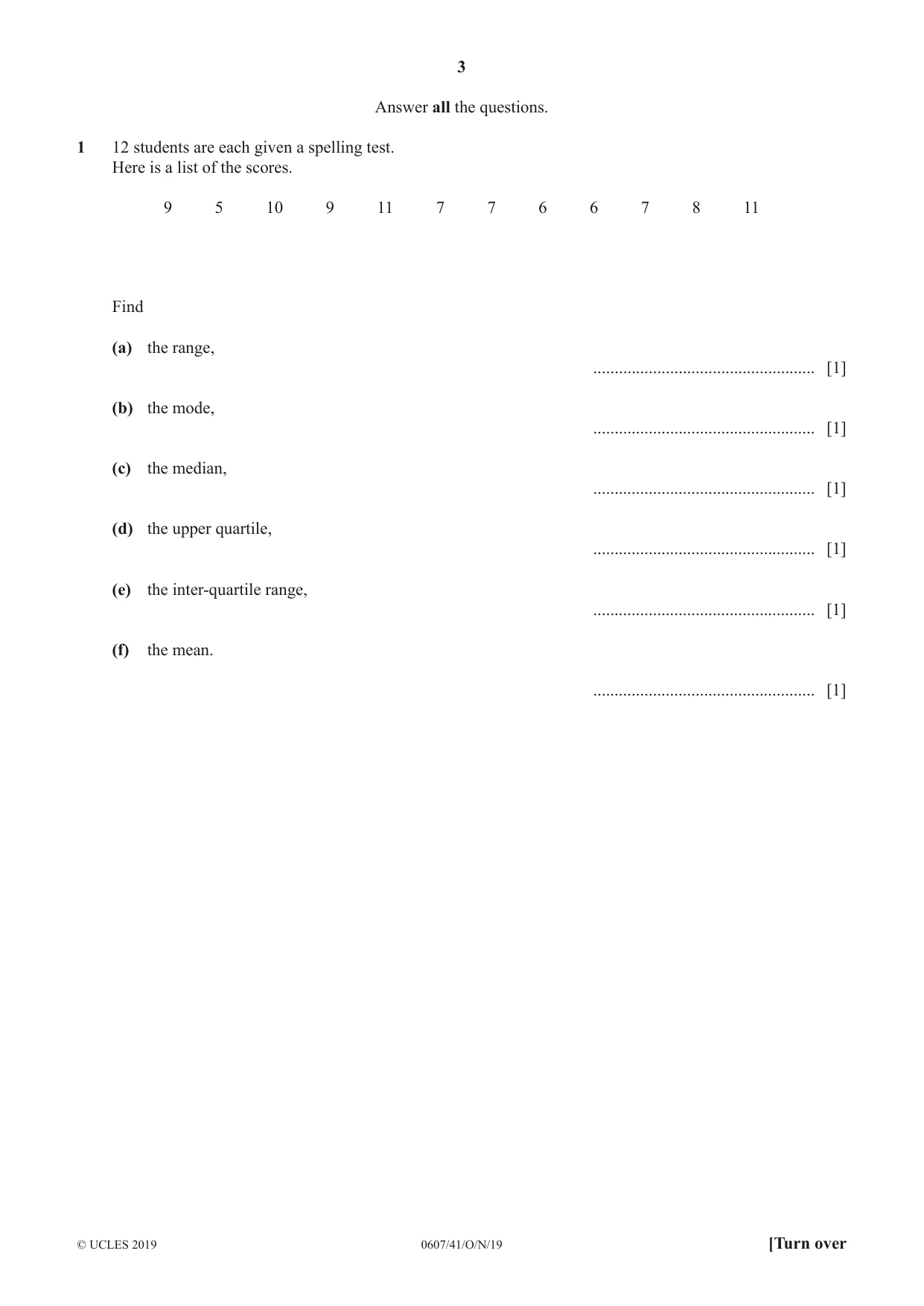
1 12 students are each given a spelling test. Here is a list of the scores. 9 5 10 9 11 7 7 6 6 7 8 11 Find (a) the range, .................................................... [1] (b) the mode, .................................................... [1] (c) the median, .................................................... [1] (d) the upper quartile, .................................................... [1] (e) the inter-quartile range, .................................................... [1] (f) the mean. .................................................... [1]
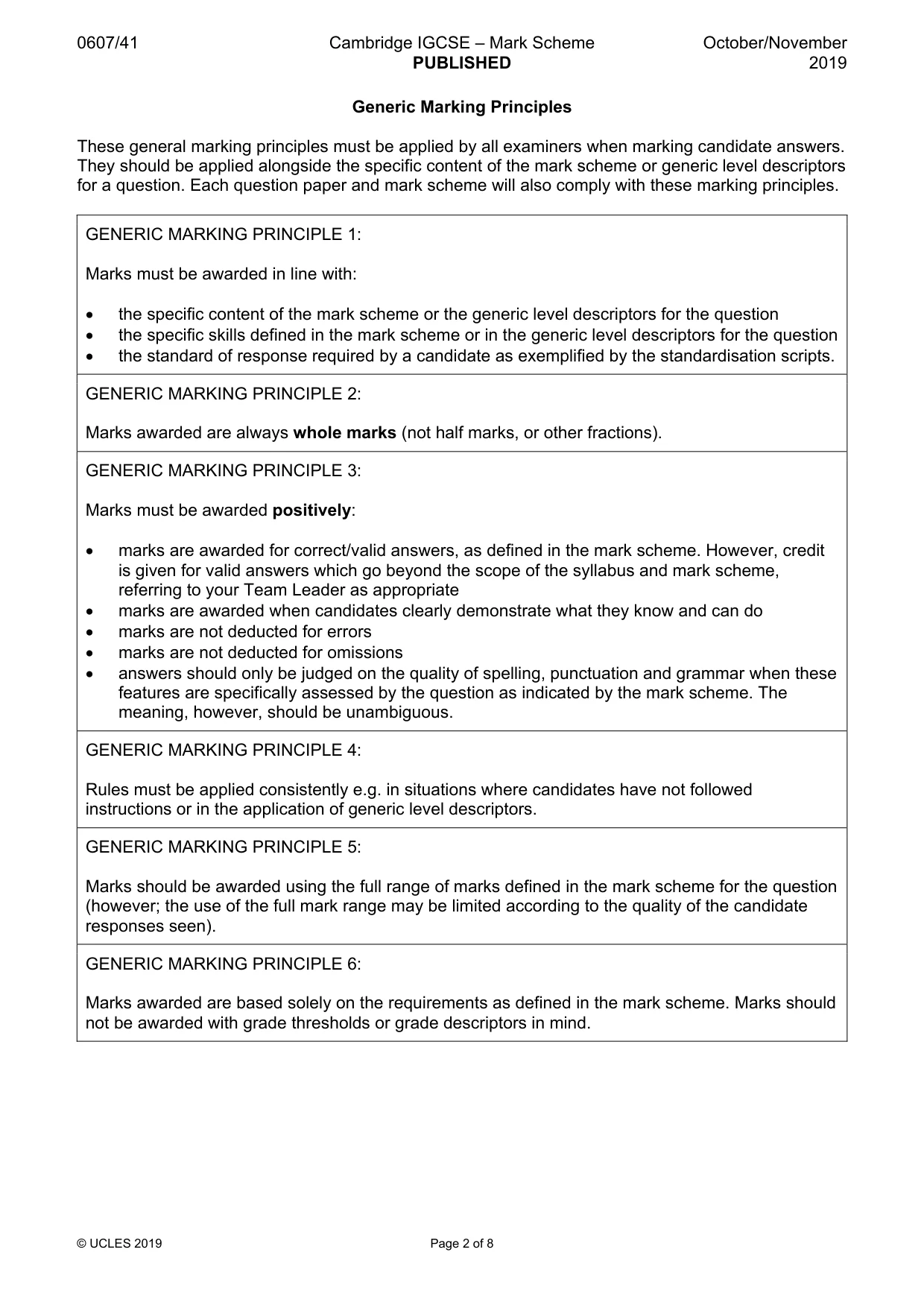
Mark scheme: Question Answer Marks Partial Marks 1(a) 6 1 1(b) 7 1 1(c) 7.5 1 1(d) 9.5 1 1(e) 3 1 1(f) 8 1
Q2 · Increase 4.5 kg by 16%
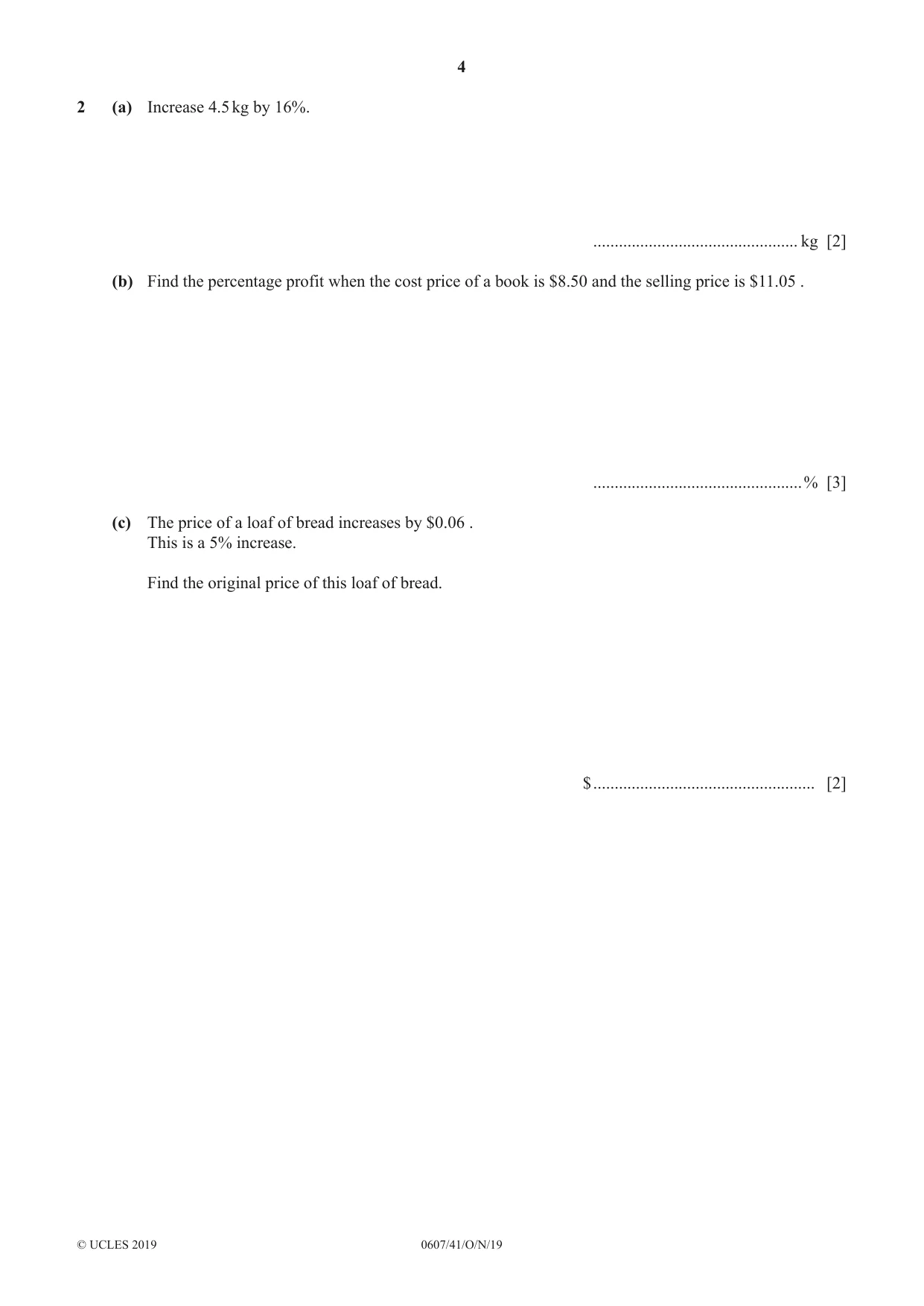
2 (a) Increase 4.5 kg by 16%. ................................................ kg [2] (b) Find the percentage profit when the cost price of a book is $8.50 and the selling price is $11.05 . .................................................% [3] (c) The price of a loaf of bread increases by $0.06 . This is a 5% increase. Find the original price of this loaf of bread. $ .................................................... [2]
Mark scheme: 2(a) 5.22 2 16 M1 for 4.5 × or better 100 If 0 scored SC1 for figs 522 2(b) 30 3 11.05 − 11.05 M2 for 8.5[× 100] or × 100 8.5 8.5 or M1 for 11.05[× 100] 8.5 2(c) 1.2[0] 2 0.06 M1 for × 100 5
Q3 · Y 4 –3 0 3 x –2 1 f (x) = 3 x !
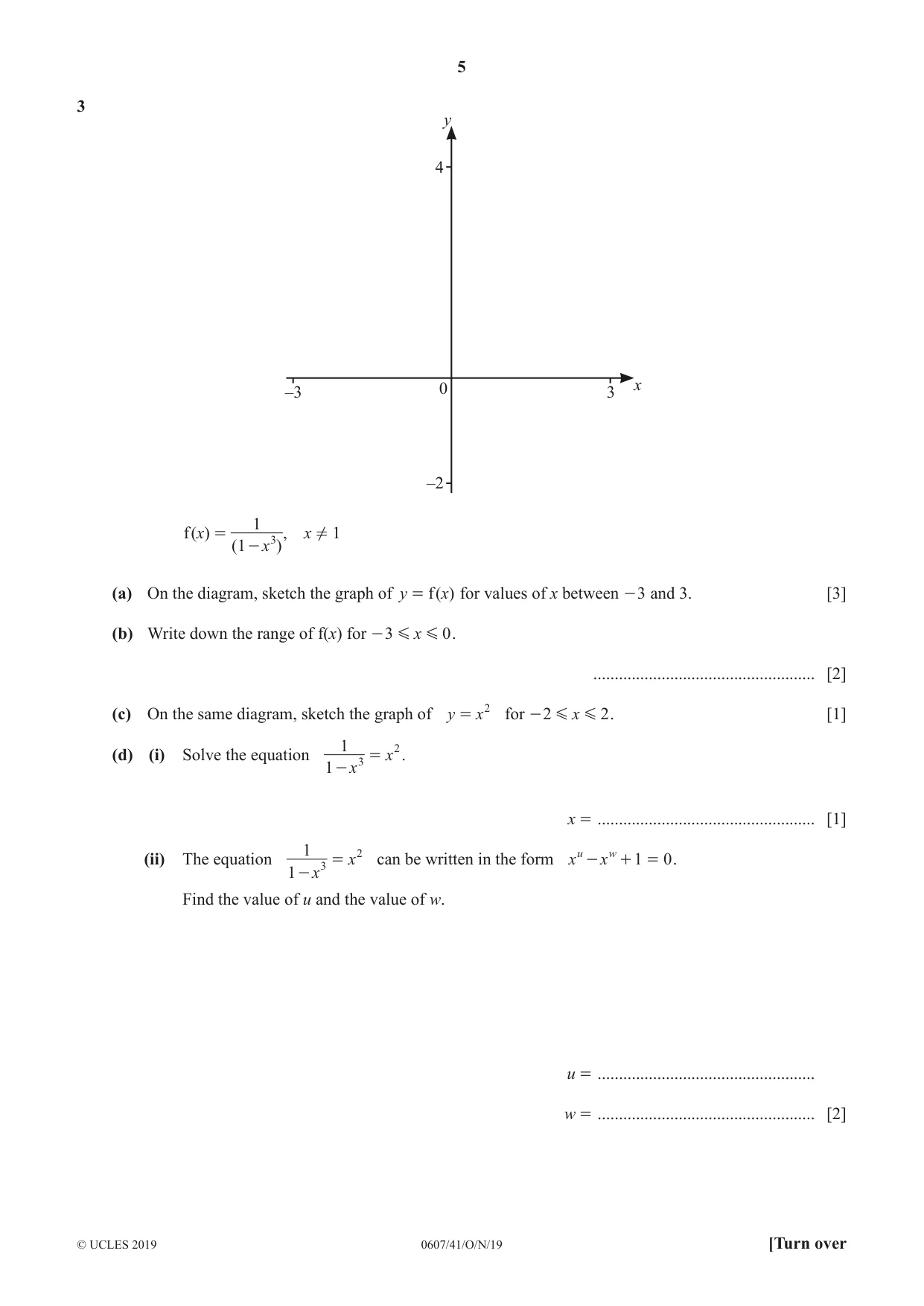
3 y 4 –3 0 3 x –2 1 f (x) = 3 x ! 1 (1 - x ), (a) On the diagram, sketch the graph of y = f ( x) for values of x between - 3 and 3. [3] (b) Write down the range of f(x) for - 3 G x G 0 . .................................................... [2] (c) On the same diagram, sketch the graph of y = x2 for - 2 G x G 2 . [1] 1 2 (d) (i) Solve the equation 3 = x . 1 - x x = ................................................... [1] 1 2 u w (ii) The equation 3 = x can be written in the form x - x + 1 = 0 . 1 - x Find the value of u and the value of w. u = ................................................... w = ................................................... [2]
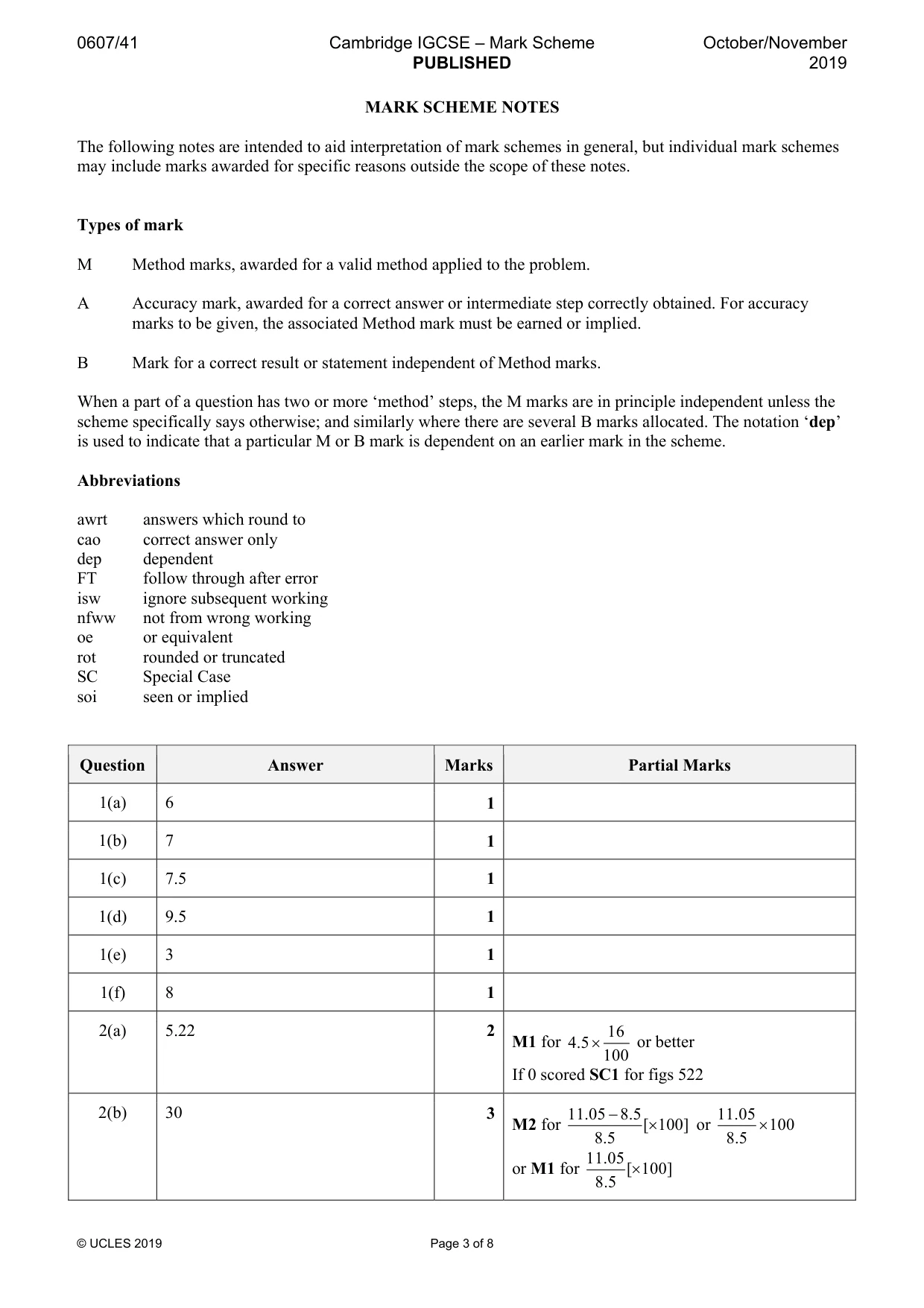
Mark scheme: 3(a) Correct sketch 3 B2 for first branch correct, including gradient 4444 zero at y-intercept or B1 for first branch above x-axis, increasing 3333 and crossing y-axis 2222 1111 B1 for second branch correct 3333 -2-2-2-2 -1-1-1-1 0000 0000 1111 2222 3333 -1-1-1-1 -2-2-2-2 3(b) 0.0357 or 0.03571... - f ( x ) - 1 oe 2 B1 for 0 < f ( x ) or f ( x ) - 1 3(c) Correct sketch 1 Vertex at origin 3(d)(i) –[0].809 or –[0].8087... 1 3(d)(ii) [u = ] 5 2 B1 for each [w = ] 2 or SC1 for answers reversed
Q4 · Y 10 9 8 A 7 6 C 5 4 3 2 T 1 0 x 1 2 3 4 5 6 7 8 9 10 –1 B –2 –3 (a) Describe fully the…
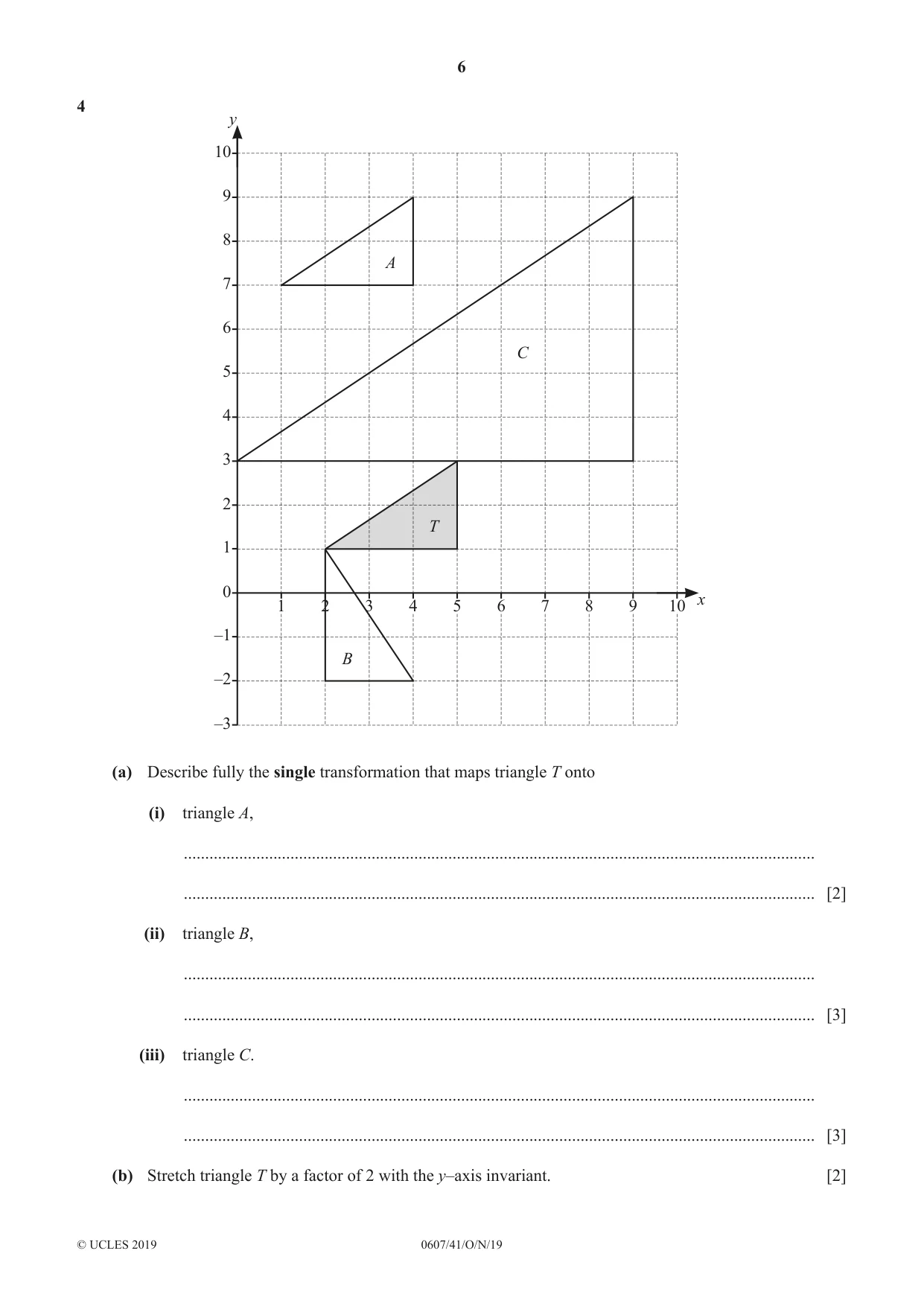
4 y 10 9 8 A 7 6 C 5 4 3 2 T 1 0 x 1 2 3 4 5 6 7 8 9 10 –1 B –2 –3 (a) Describe fully the single transformation that maps triangle T onto (i) triangle A, .................................................................................................................................................... .................................................................................................................................................... [2] (ii) triangle B, .................................................................................................................................................... .................................................................................................................................................... [3] (iii) triangle C. .................................................................................................................................................... .................................................................................................................................................... [3] (b) Stretch triangle T by a factor of 2 with the y–axis invariant. [2]
Mark scheme: 4(a)(i) Translation 2 B1 for each −1 6 4(a)(ii) Rotation 3 B1 for each [centre] (2, 1) 90 clockwise oe 4(a)(iii) Enlargement 3 B1 for each [centre] (3, 0) [factor] 3 4(b) Correct stretch at 2 B1 for stretch factor 2 with x-axis invariant (4, 1) (10, 1), (10, 3) or for stretch with x = k invariant with stretch factor 2
Q5 · Each year the value of a motor bike decreases by 10% of its value at the start of the year
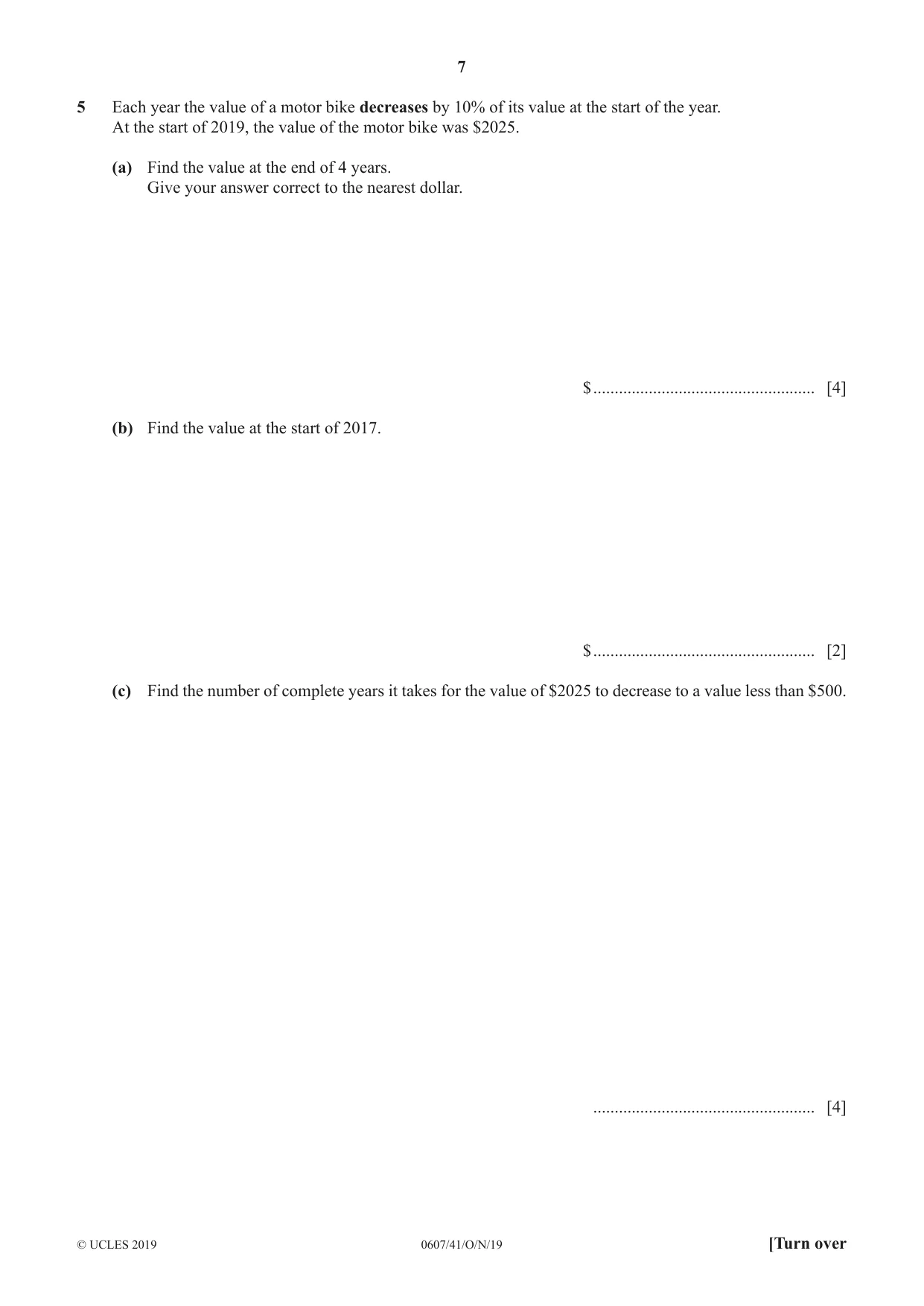
5 Each year the value of a motor bike decreases by 10% of its value at the start of the year. At the start of 2019, the value of the motor bike was $2025. (a) Find the value at the end of 4 years. Give your answer correct to the nearest dollar. $ .................................................... [4] (b) Find the value at the start of 2017. $ .................................................... [2] (c) Find the number of complete years it takes for the value of $2025 to decrease to a value less than $500. .................................................... [4]
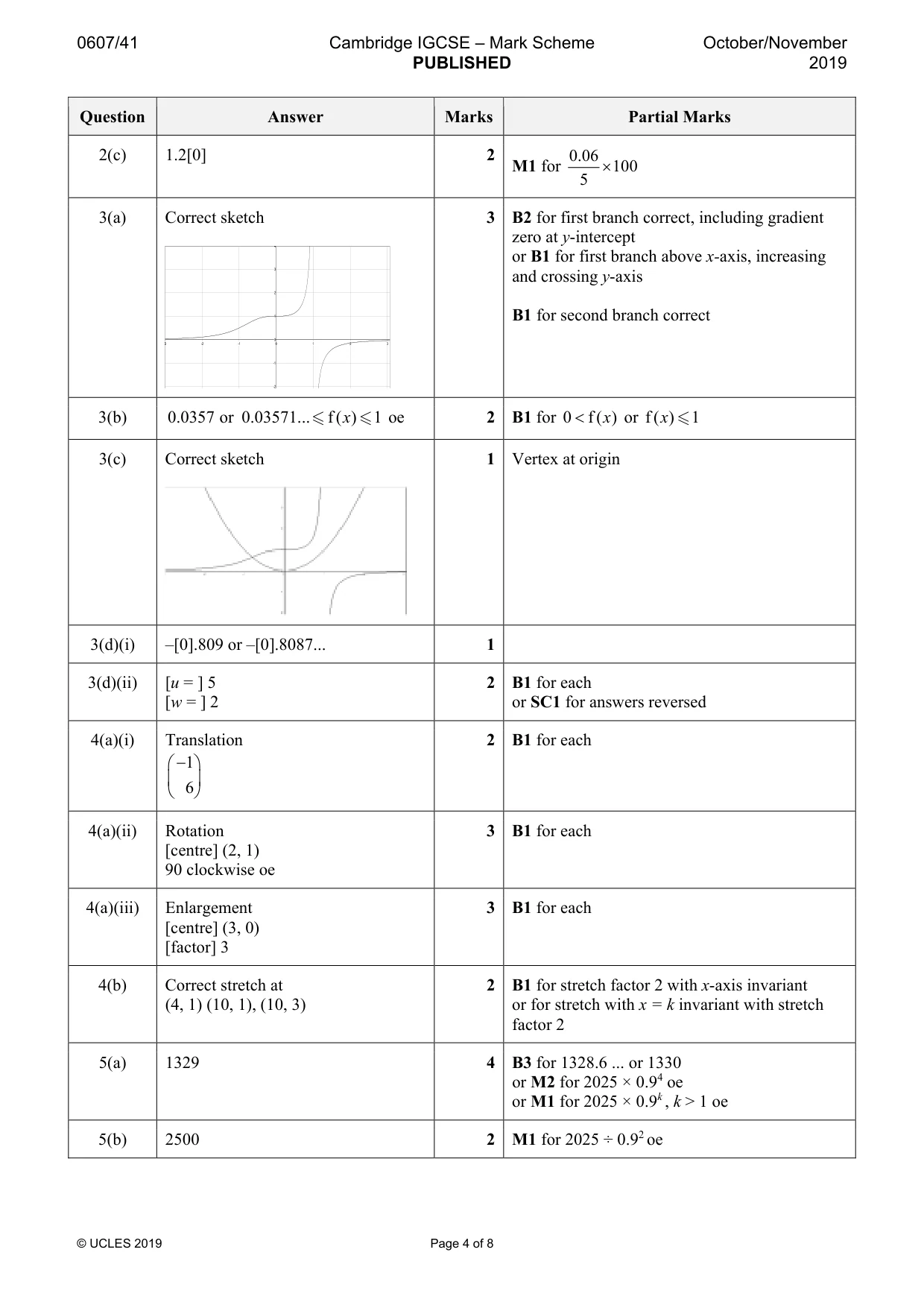
Mark scheme: 5(a) 1329 4 B3 for 1328.6 ... or 1330 or M2 for 2025 × 0.94 oe or M1 for 2025 × 0.9k , k > 1 oe 5(b) 2500 2 M1 for 2025 ÷ 0.92 oe 5(c) 14 4 B3 for 13.3 or 13.27 to 13.28 seen 500 or M3 for n log0.9 = log oe implied by or 2025 for correct trials reaching 13 and 14 or good sketch indicating value between 13 and 14 n 500 or M2 for 0.9 = oe or at least three 2025 correct trials with n > 4 or sketch that could lead to the solution or M1 for 2025 × 0.9 n = 500 oe or at least two correct trials with n > 4 If 0 scored, SC1 for answer 16 or for 15.3 or 15.27 to 15.28 seen
Q6 · The diagram shows a six-sided die and a coin
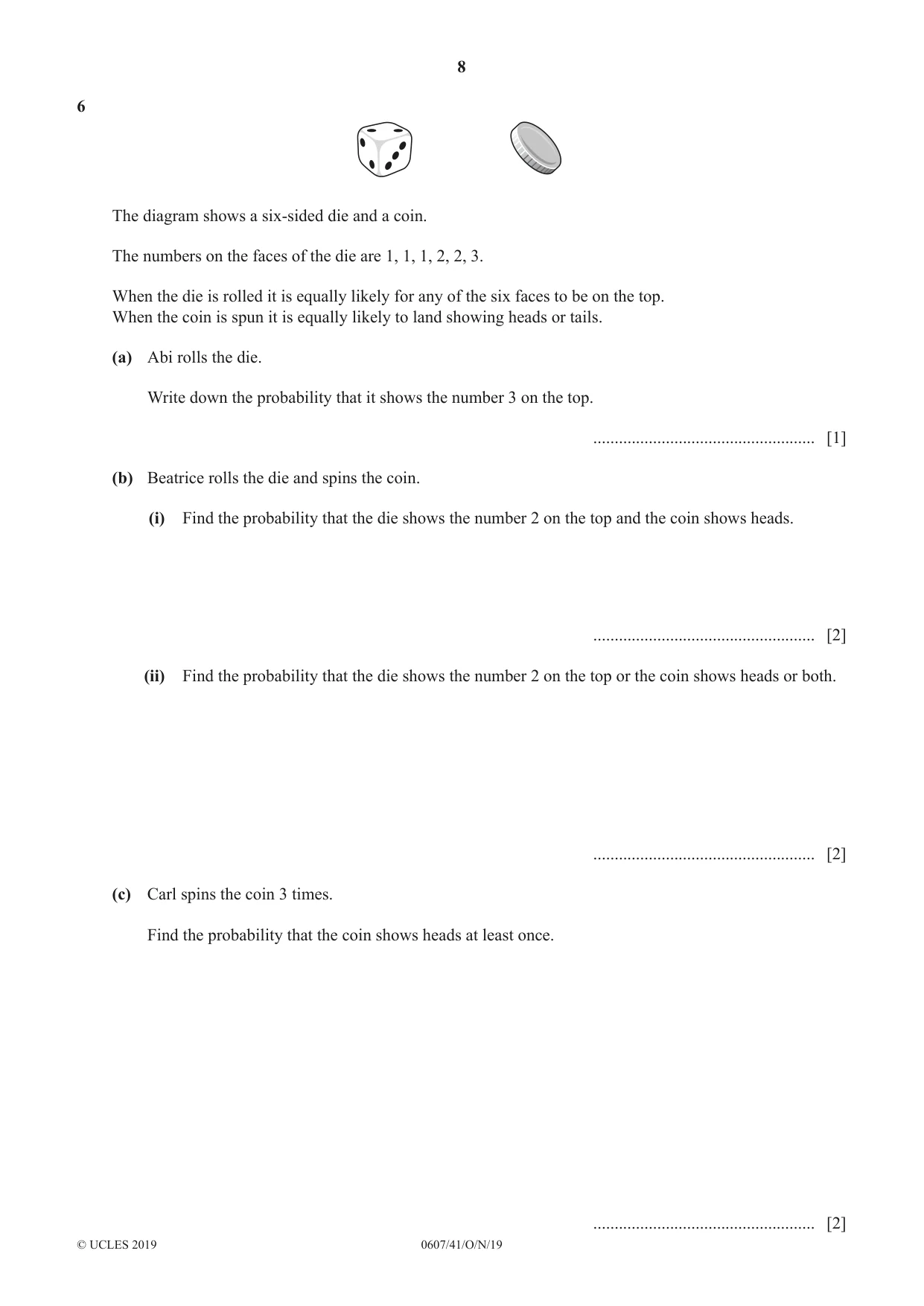
6 The diagram shows a six-sided die and a coin. The numbers on the faces of the die are 1, 1, 1, 2, 2, 3. When the die is rolled it is equally likely for any of the six faces to be on the top. When the coin is spun it is equally likely to land showing heads or tails. (a) Abi rolls the die. Write down the probability that it shows the number 3 on the top. .................................................... [1] (b) Beatrice rolls the die and spins the coin. (i) Find the probability that the die shows the number 2 on the top and the coin shows heads. .................................................... [2] (ii) Find the probability that the die shows the number 2 on the top or the coin shows heads or both. .................................................... [2] (c) Carl spins the coin 3 times. Find the probability that the coin shows heads at least once. .................................................... [2] (d) Drew rolls the die 3 times and records the numbers on the top. Find the probability that the die shows each of the numbers, 1, 2 and 3, once. .................................................... [3] (e) Eva spins the coin n times. 1 The probability that the coin shows tails each time is . 64 Find the value of n. n = ................................................... [1] (f) Frank rolls the die twice and records the two numbers. 1 The probability of these two numbers occurring is . 3 Find these two numbers. ................... and ................... [2]
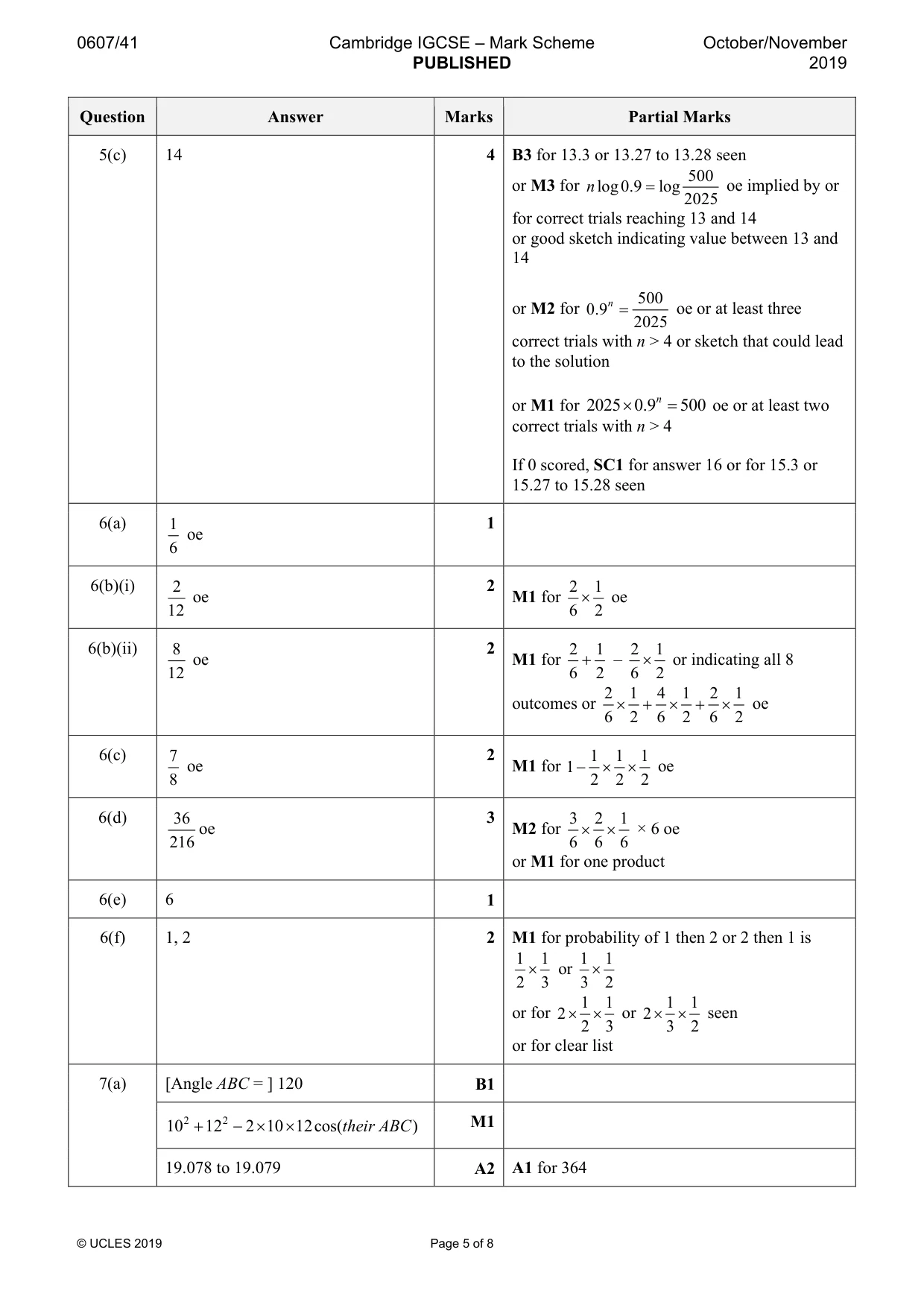
Mark scheme: 6(a) 1 1 oe 6 6(b)(i) 2 2 2 1 oe M1 for × oe 12 6 2 6(b)(ii) 8 2 2 1 2 1 oe M1 for + – × or indicating all 8 12 6 2 6 2 2 1 4 1 2 1 outcomes or × + × + × oe 6 2 6 2 6 2 6(c) 7 2 1 1 1 oe M1 for 1 − × × oe 8 2 2 2 6(d) 36 3 3 2 1 oe M2 for × × × 6 oe 216 6 6 6 or M1 for one product 6(e) 6 1 6(f) 1, 2 2 M1 for probability of 1 then 2 or 2 then 1 is 1 1 1 1 × or × 2 3 3 2 1 1 1 1 or for 2 × × or 2 × × seen 2 3 3 2 or for clear list
Q7 · North North 10 km B 150° NOT TO A SCALE 12 km 18 km C 21 km D The diagram shows four…
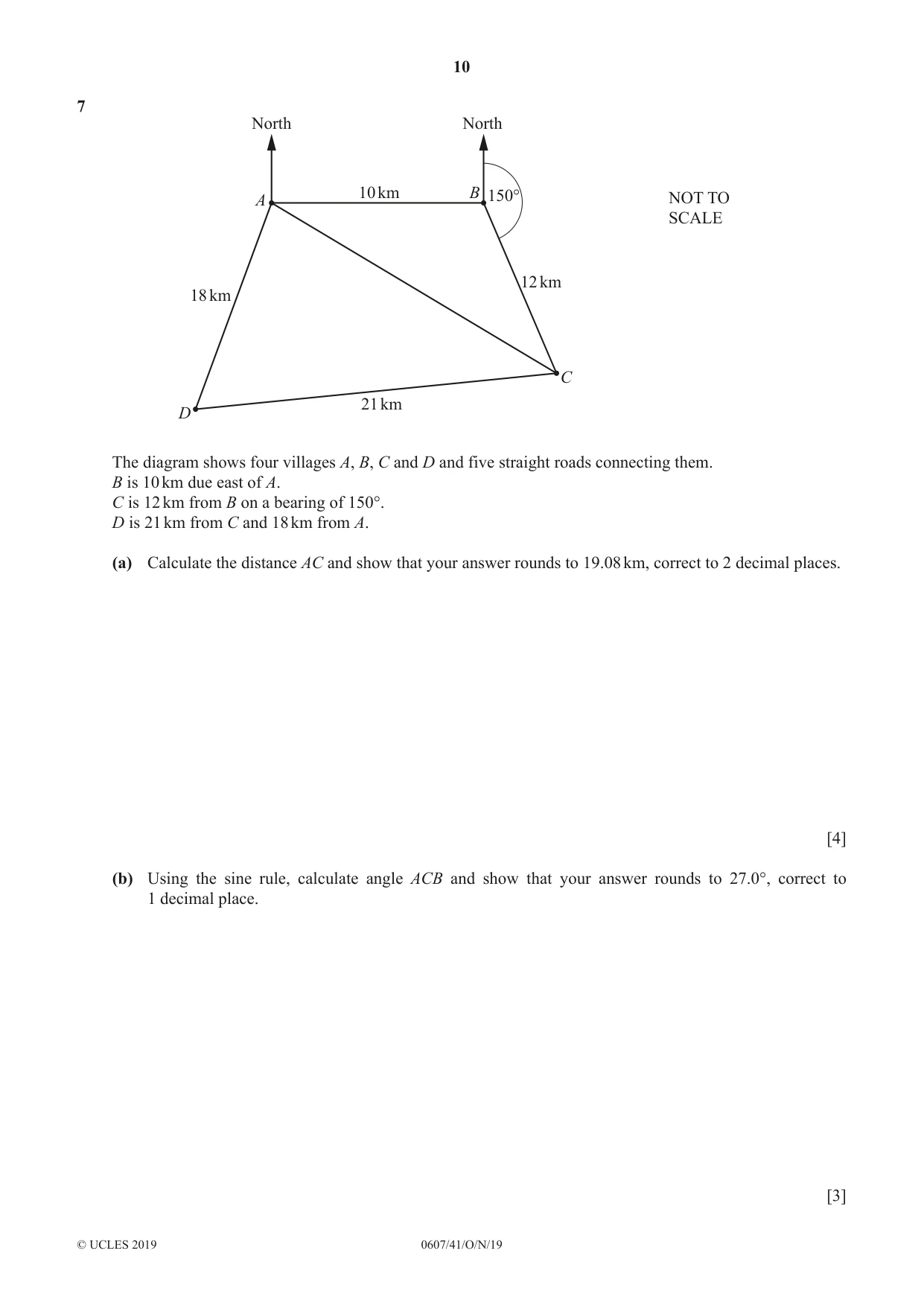
7 North North 10 km B 150° NOT TO A SCALE 12 km 18 km C 21 km D The diagram shows four villages A, B, C and D and five straight roads connecting them. B is 10 km due east of A. C is 12 km from B on a bearing of 150°. D is 21 km from C and 18 km from A. (a) Calculate the distance AC and show that your answer rounds to 19.08 km, correct to 2 decimal places. [4] (b) Using the sine rule, calculate angle ACB and show that your answer rounds to 27.0°, correct to 1 decimal place. [3] (c) Calculate the bearing of D from C. .................................................... [4] (d) A straight path, BP, connects B to the closest point, P, on AC. Calculate the length of this path. ............................................... km [2] (e) The area within triangle ABC is grassland. Calculate the area of this grassland. ..............................................km2 [2]
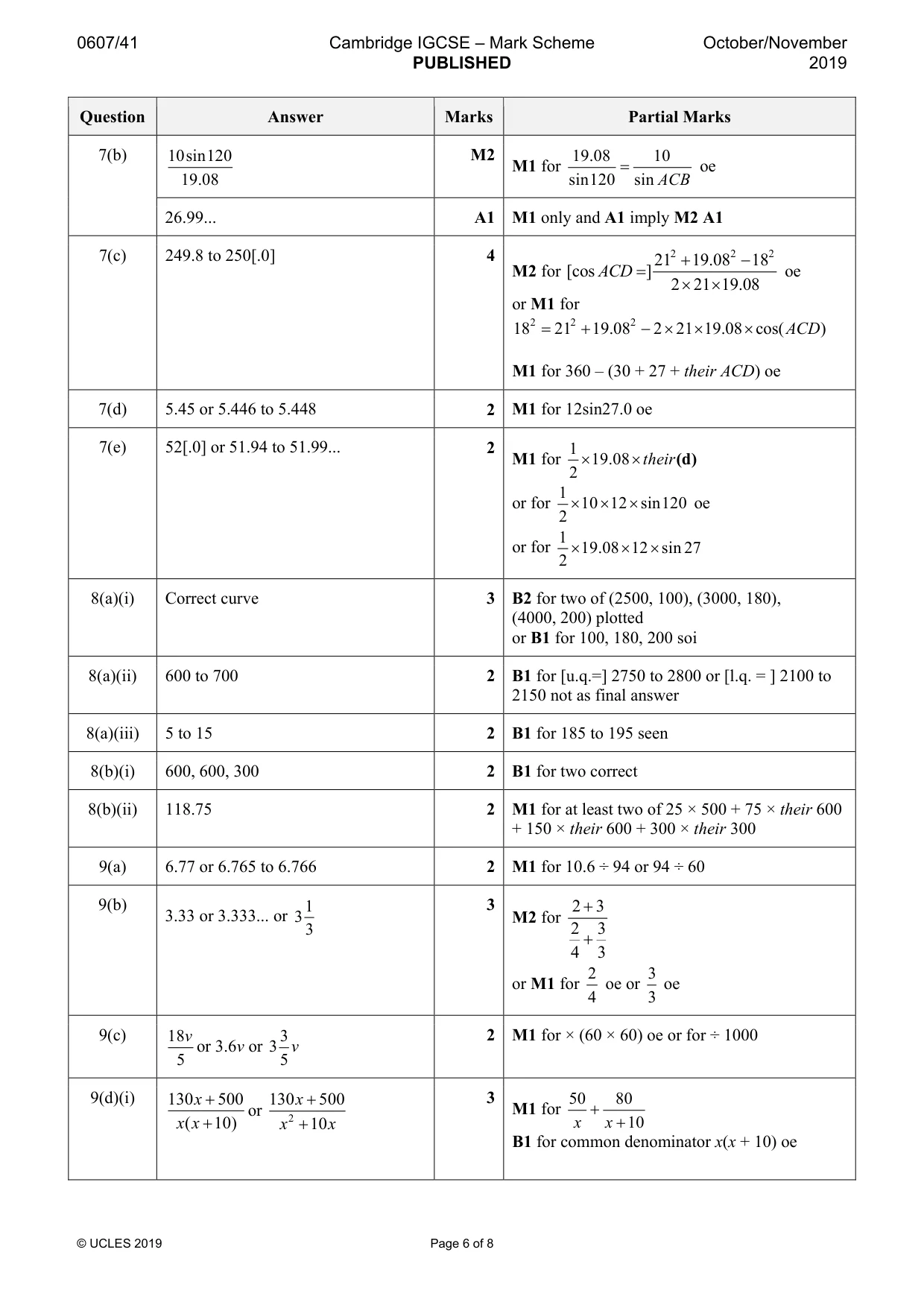
Mark scheme: 7(a) [Angle ABC = ] 120 B1 10 2 + 12 2 − 2 × 10 × 12cos(their ABC ) M1 19.078 to 19.079 A2 A1 for 364 7(b) 10sin120 M2 19.08 10 M1 for = oe 19.08 sin120 sin ACB 26.99... A1 M1 only and A1 imply M2 A1 7(c) 249.8 to 250[.0] 4 212 + 19.082 − 182 M2 for [cos ACD = ] oe 2 × 21 × 19.08 or M1 for 18 2 = 212 + 19.08 2 −×2 21 × 19.08 × cos( ACD ) M1 for 360 – (30 + 27 + their ACD) oe 7(d) 5.45 or 5.446 to 5.448 2 M1 for 12sin27.0 oe 7(e) 52[.0] or 51.94 to 51.99... 2 1 M1 for × 19.08 × their (d) 2 1 or for × 10 × 12 × sin120 oe 2 1 or for × 19.08 × 12 × sin 27 2
Q8 · 200 people took part in a charity walk
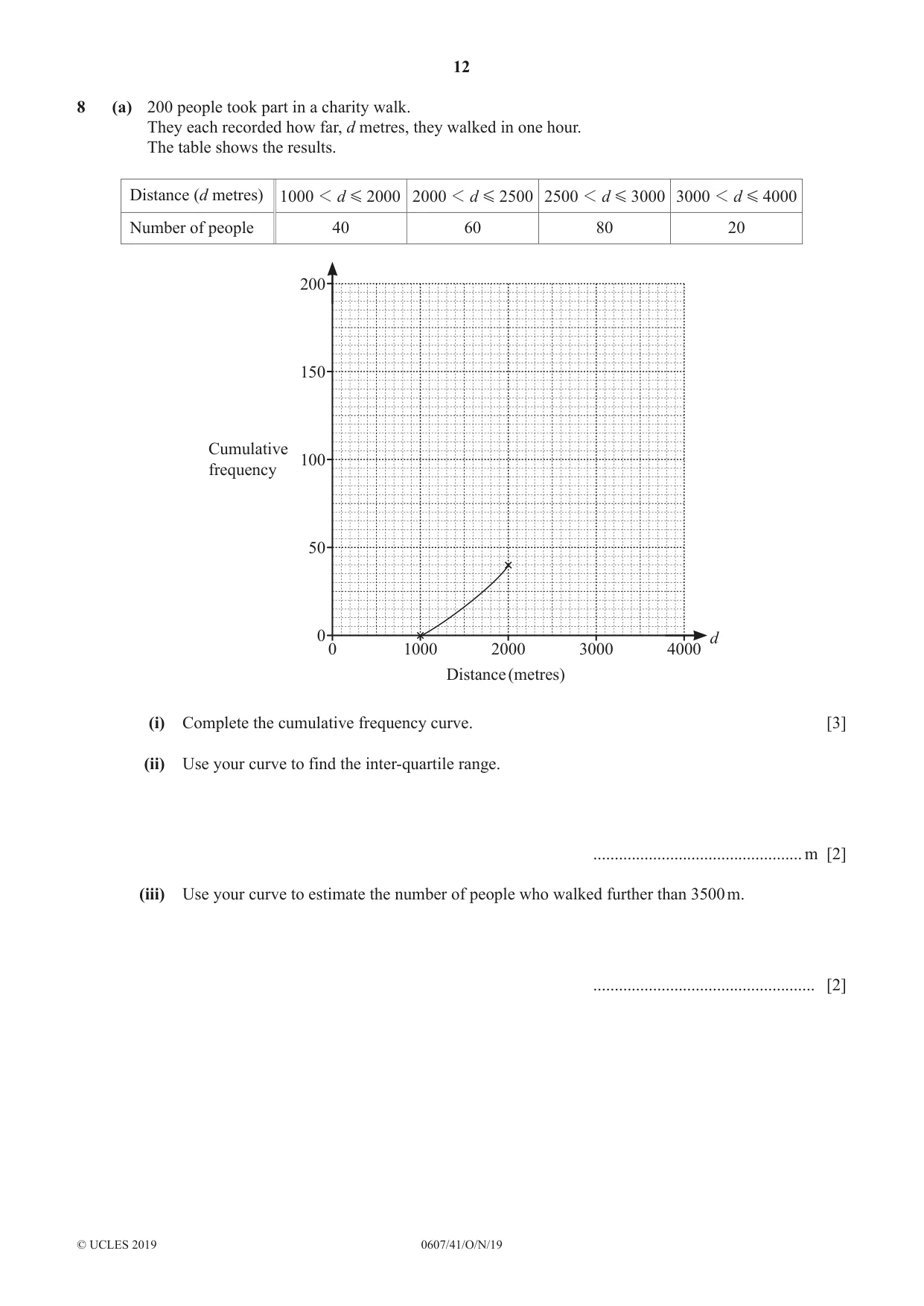
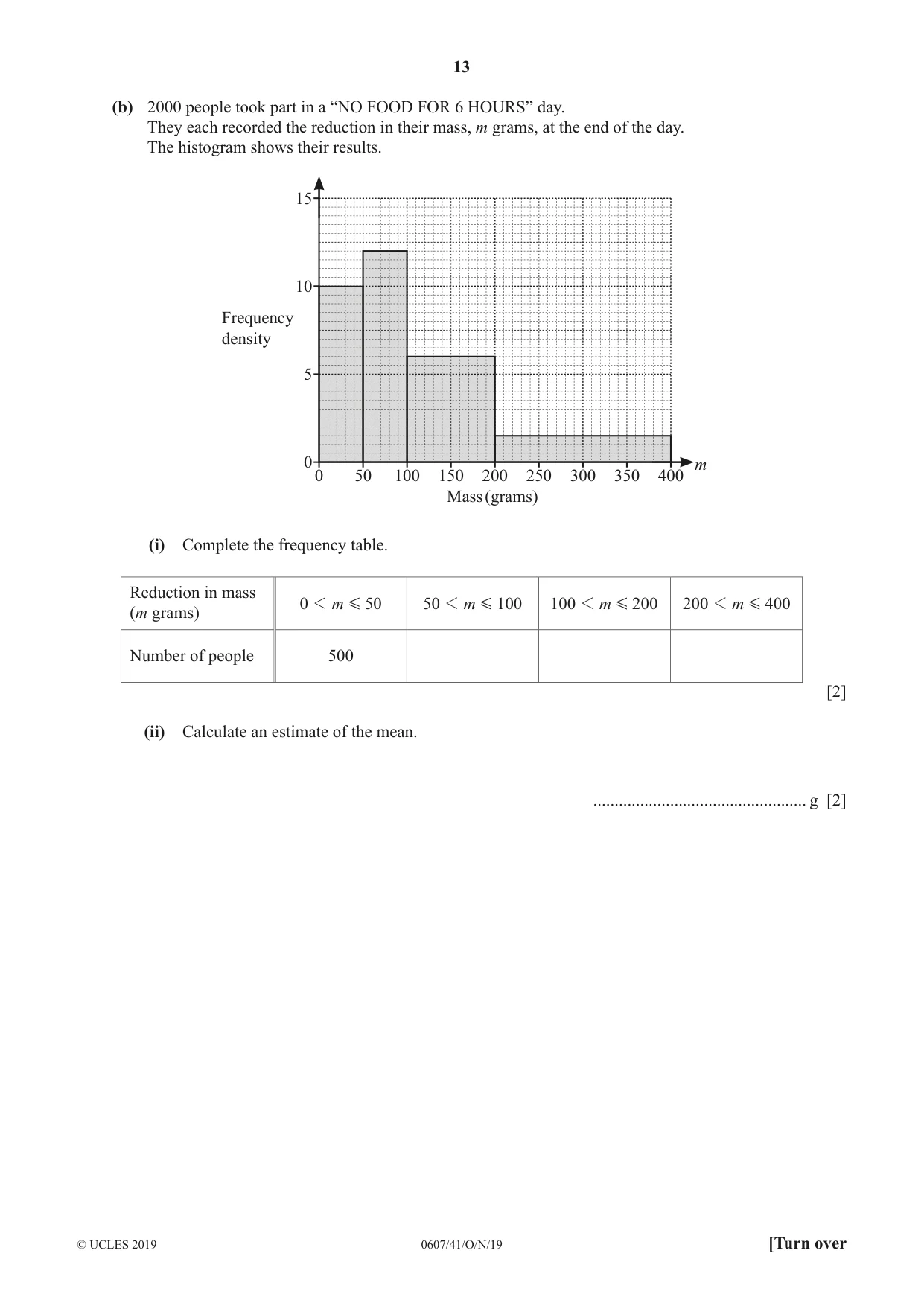
8 (a) 200 people took part in a charity walk. They each recorded how far, d metres, they walked in one hour. The table shows the results. Distance (d metres) 1000 1 d G 2000 2000 1 d G 2500 2500 1 d G 3000 3000 1 d G 4000 Number of people 40 60 80 20 200 150 Cumulative 100 frequency 50 0 d 0 1000 2000 3000 4000 Distance (metres) (i) Complete the cumulative frequency curve. [3] (ii) Use your curve to find the inter-quartile range. ................................................. m [2] (iii) Use your curve to estimate the number of people who walked further than 3500 m. .................................................... [2] (b) 2000 people took part in a “NO FOOD FOR 6 HOURS” day. They each recorded the reduction in their mass, m grams, at the end of the day. The histogram shows their results. 15 10 Frequency density 5 0 m 0 50 100 150 200 250 300 350 400 Mass (grams) (i) Complete the frequency table. Reduction in mass 0 1 m G 50 50 1 m G 100 100 1 m G 200 200 1 m G 400 (m grams) Number of people 500 [2] (ii) Calculate an estimate of the mean. .................................................. g [2]
Mark scheme: 8(a)(i) Correct curve 3 B2 for two of (2500, 100), (3000, 180), (4000, 200) plotted or B1 for 100, 180, 200 soi 8(a)(ii) 600 to 700 2 B1 for [u.q.=] 2750 to 2800 or [l.q. = ] 2100 to 2150 not as final answer 8(a)(iii) 5 to 15 2 B1 for 185 to 195 seen 8(b)(i) 600, 600, 300 2 B1 for two correct 8(b)(ii) 118.75 2 M1 for at least two of 25 × 500 + 75 × their 600 + 150 × their 600 + 300 × their 300
Q9 · Lionel runs 10.6 km in 94 minutes
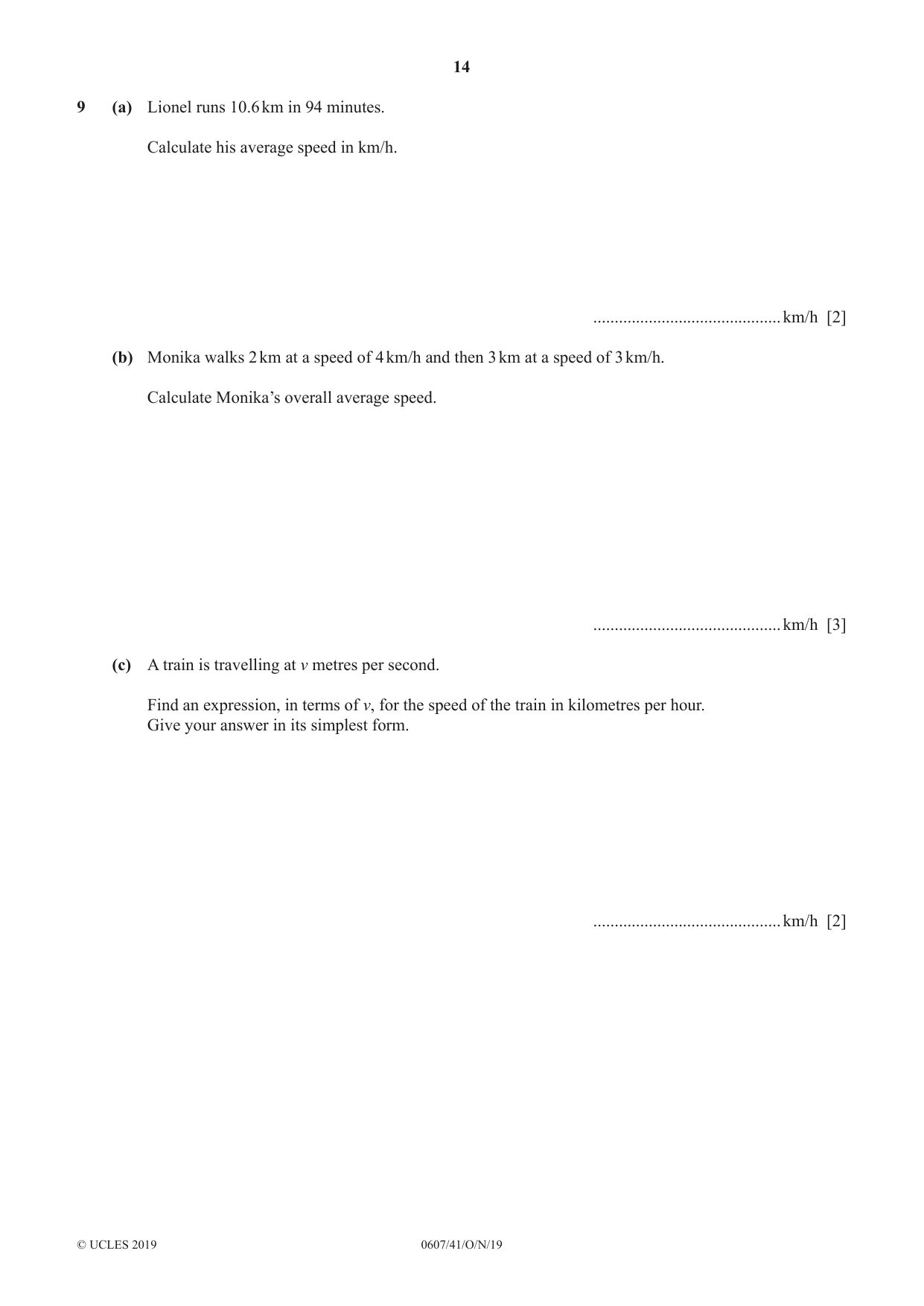
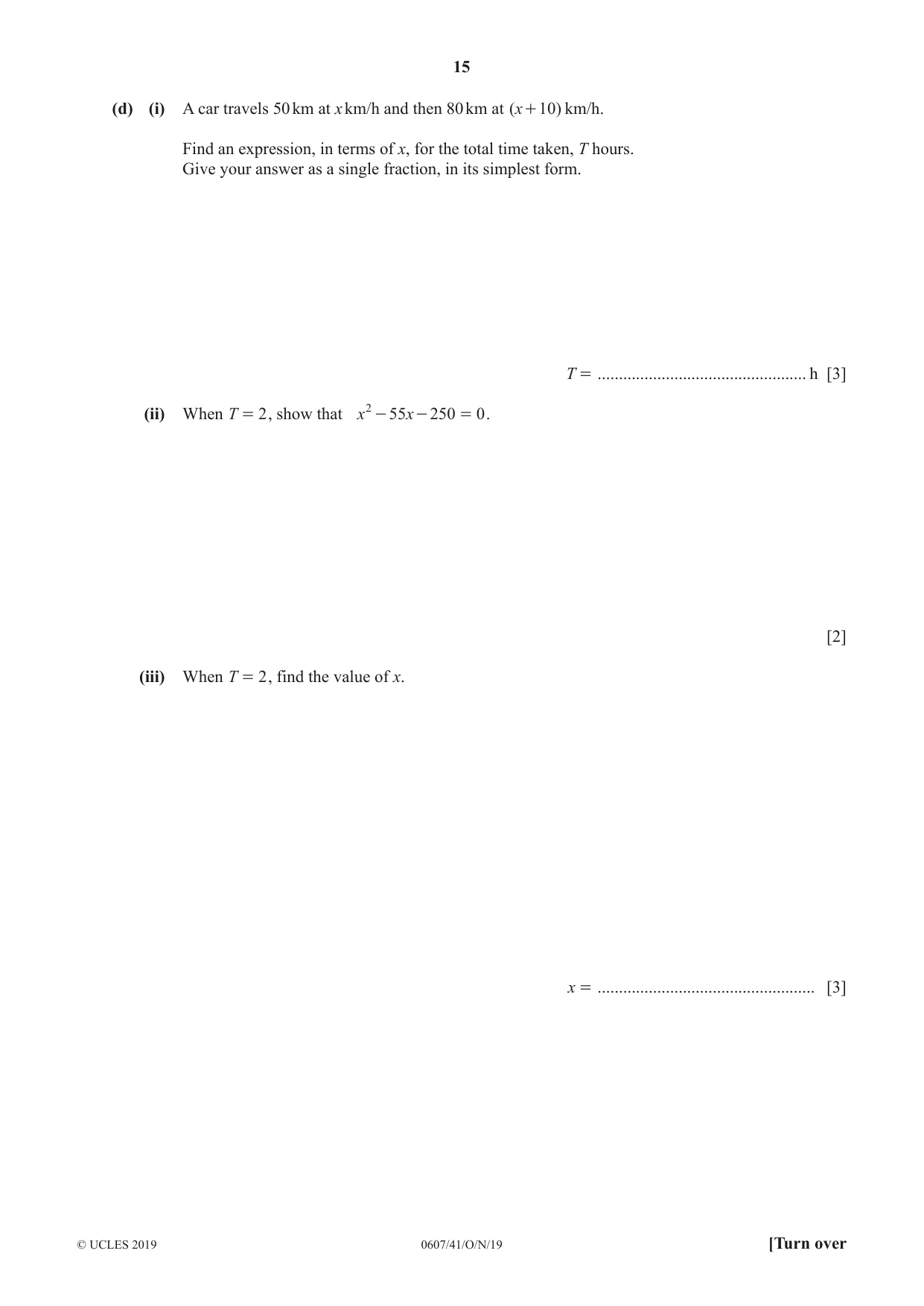
9 (a) Lionel runs 10.6 km in 94 minutes. Calculate his average speed in km/h. ............................................km/h [2] (b) Monika walks 2 km at a speed of 4 km/h and then 3 km at a speed of 3 km/h. Calculate Monika’s overall average speed. ............................................km/h [3] (c) A train is travelling at v metres per second. Find an expression, in terms of v, for the speed of the train in kilometres per hour. Give your answer in its simplest form. ............................................km/h [2] (d) (i) A car travels 50 km at x km/h and then 80 km at (x + 10) km/h. Find an expression, in terms of x, for the total time taken, T hours. Give your answer as a single fraction, in its simplest form. T = ................................................. h [3] (ii) When T = 2 , show that x 2 - 55x - 250 = 0 . [2] (iii) When T = 2 , find the value of x. x = ................................................... [3]
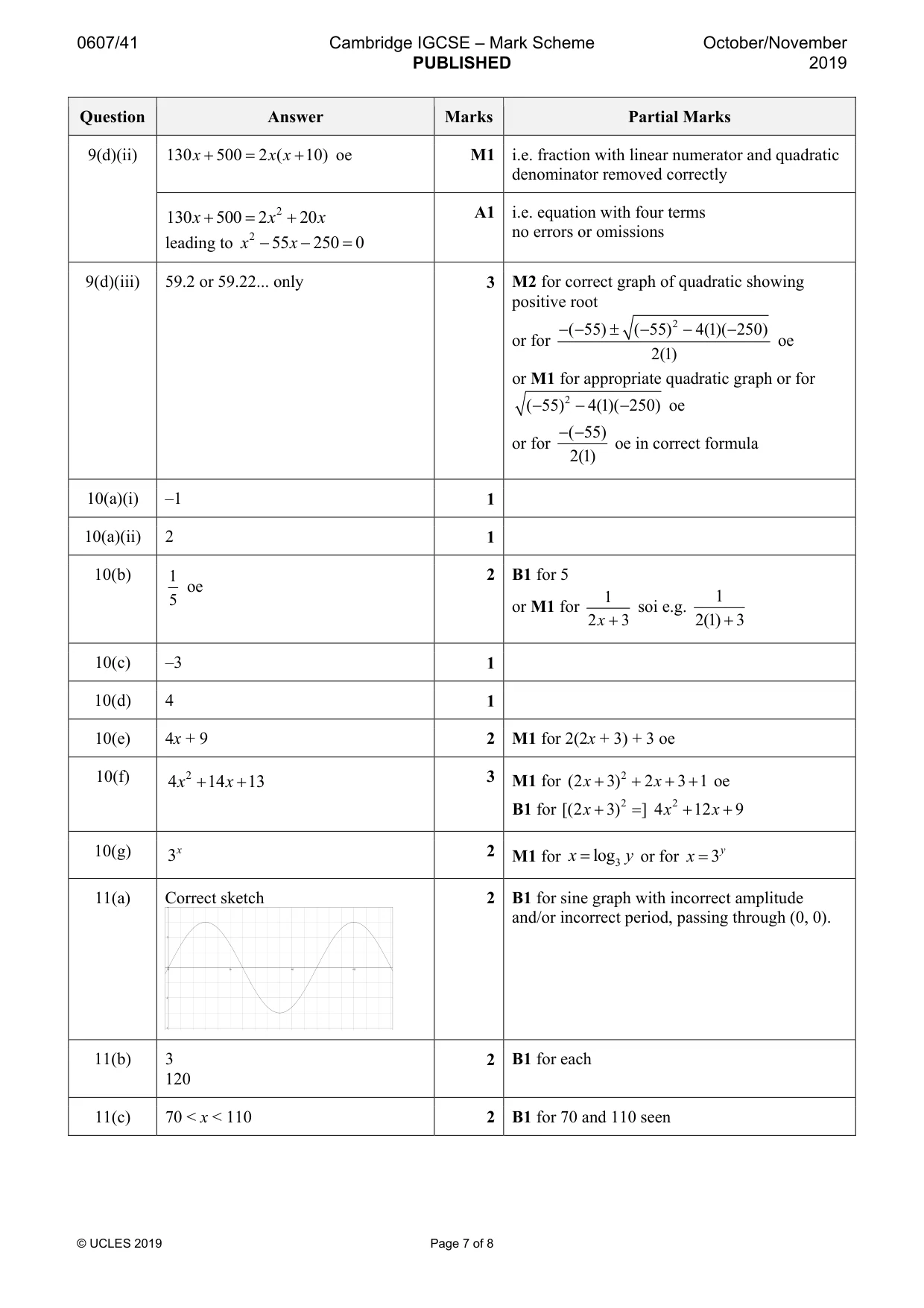
Mark scheme: 9(a) 6.77 or 6.765 to 6.766 2 M1 for 10.6 ÷ 94 or 94 ÷ 60 9(b) 1 3 2 + 3 3.33 or 3.333... or 3 M2 for 3 2 3 + 4 3 2 3 or M1 for oe or oe 4 3 9(c) 18 v 3 2 M1 for × (60 × 60) oe or for ÷ 1000 or 3.6v or v 5 35 9(d)(i) 130 x + 500 130 x + 500 3 50 80 or M1 for + x ( x + 10) x 2 + 10 x x x + 10 B1 for common denominator x(x + 10) oe 9(d)(ii) 130 x + 500 = 2 x ( x + 10) oe M1 i.e. fraction with linear numerator and quadratic denominator removed correctly 130 x + 500 = 2 x 2 + 20 x A1 i.e. equation with four terms 2 no errors or omissions leading to x − 55 x − 250 = 0 9(d)(iii) 59.2 or 59.22... only 3 M2 for correct graph of quadratic showing positive root −−( 55) ± ( − 55) 2 − 4(1)( − 250) or for oe 2(1) or M1 for appropriate quadratic graph or for ( −55) 2 − 4(1)( −250) oe −−( 55) or for oe in correct formula 2(1)
Q10 · F ()x = 2x + 3 g ()x = x , x !
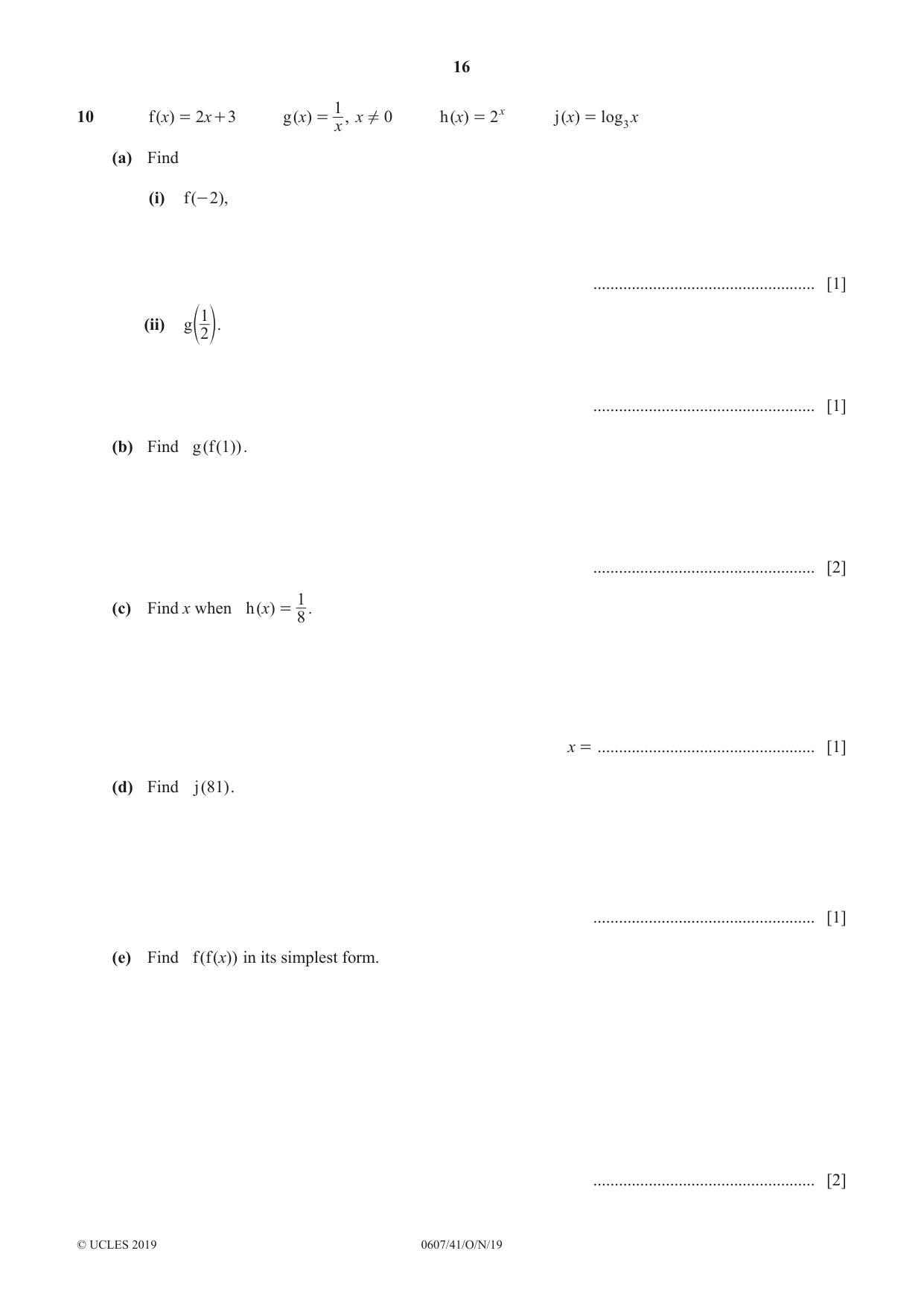
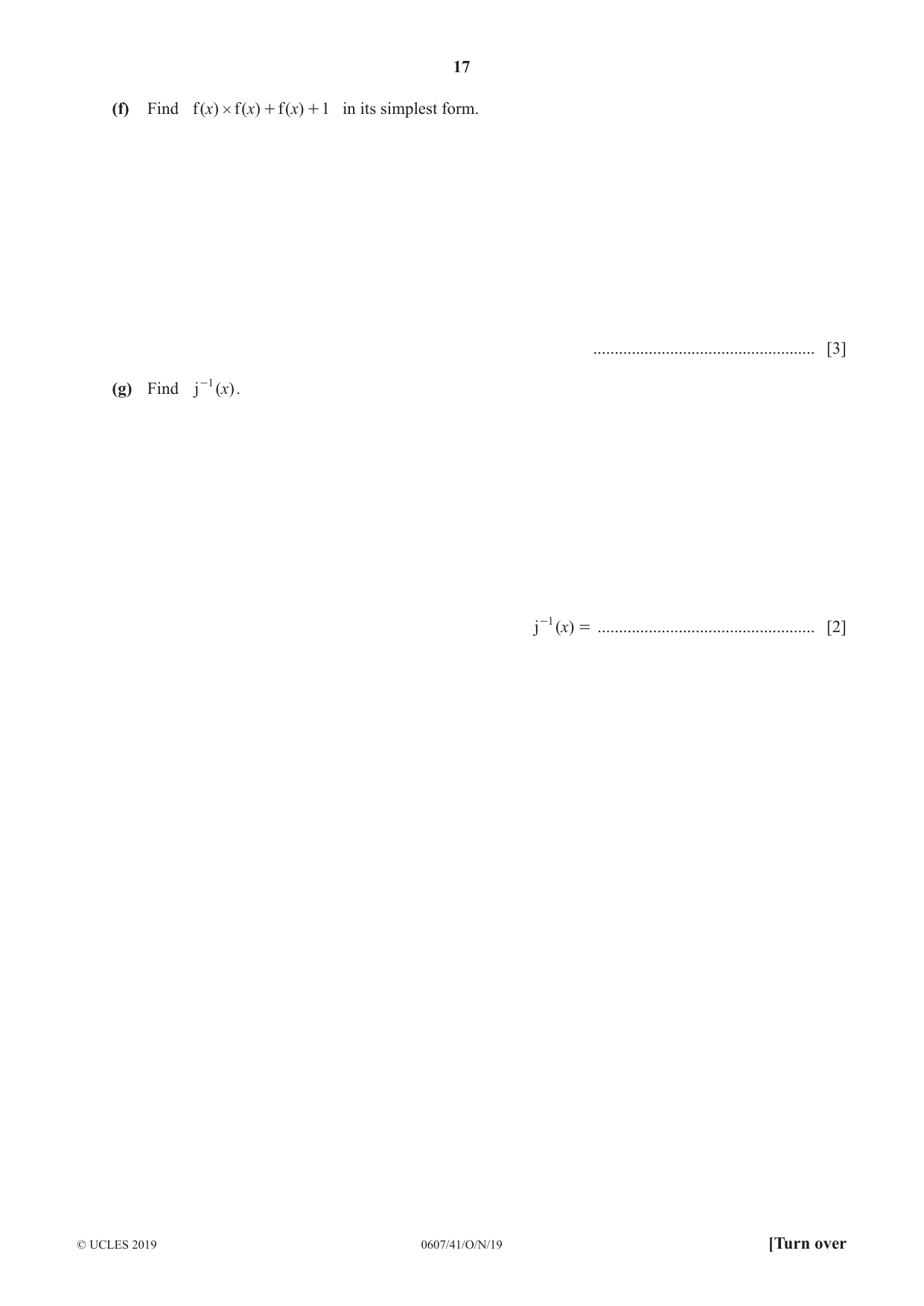
10 f ()x = 2x + 3 g ()x = x , x ! 0 h ()x = 2 j (x ) = log 3 x x (a) Find (i) f (- 2), .................................................... [1] 1 (ii) . ge 2 o .................................................... [1] (b) Find g (f (1)). .................................................... [2] 1 (c) Find x when h (x) = . 8 x = ................................................... [1] (d) Find j (81 ) . .................................................... [1] (e) Find f (f (x)) in its simplest form. .................................................... [2] (f) Find f (x) # f (x) + f ( x) + 1 in its simplest form. .................................................... [3] (g) Find j -1 (x). j -1 ()x = ................................................... [2]
Mark scheme: 10(a)(i) –1 1 10(a)(ii) 2 1 10(b) 1 2 B1 for 5 oe 5 1 1 or M1 for soi e.g. 2 x + 3 2(1) + 3 10(c) –3 1 10(d) 4 1 10(e) 4x + 9 2 M1 for 2(2x + 3) + 3 oe 10(f) 4 x 2 + 14 x + 13 3 M1 for (2 x + 3) 2 + 2 x + 3 + 1 oe B1 for [(2 x + 3) 2 = ] 4 x 2 + 12 x + 9 10(g) 3x 2 M1 for x = log 3 y or for x = 3y
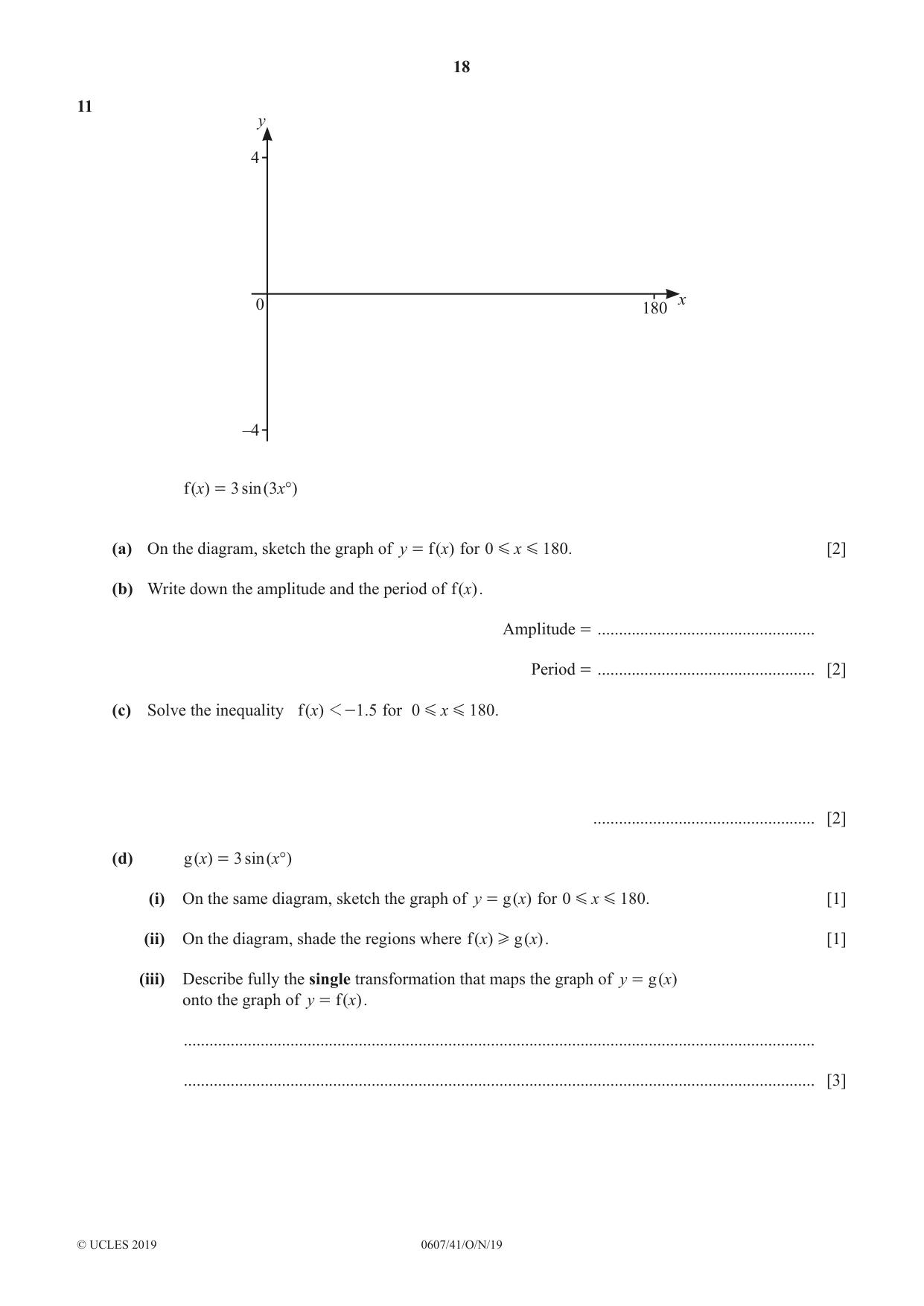
Q11 · Y 4 x 0 180 –4 f (x) = 3 sin (3 x°) (a) On the diagram, sketch the graph of y = f ( x)…
11 y 4 x 0 180 –4 f (x) = 3 sin (3 x°) (a) On the diagram, sketch the graph of y = f ( x) for 0 G x G 180. [2] (b) Write down the amplitude and the period of f (x). Amplitude = ................................................... Period = ................................................... [2] (c) Solve the inequality f (x) 1- 1.5 for 0 G x G 180. .................................................... [2] (d) g (x) = 3 sin ( x°) (i) On the same diagram, sketch the graph of y = g (x) for 0 G x G 180. [1] (ii) On the diagram, shade the regions where f (x) H g (x ). [1] (iii) Describe fully the single transformation that maps the graph of y = g (x) onto the graph of y = f (x). .................................................................................................................................................... .................................................................................................................................................... [3]
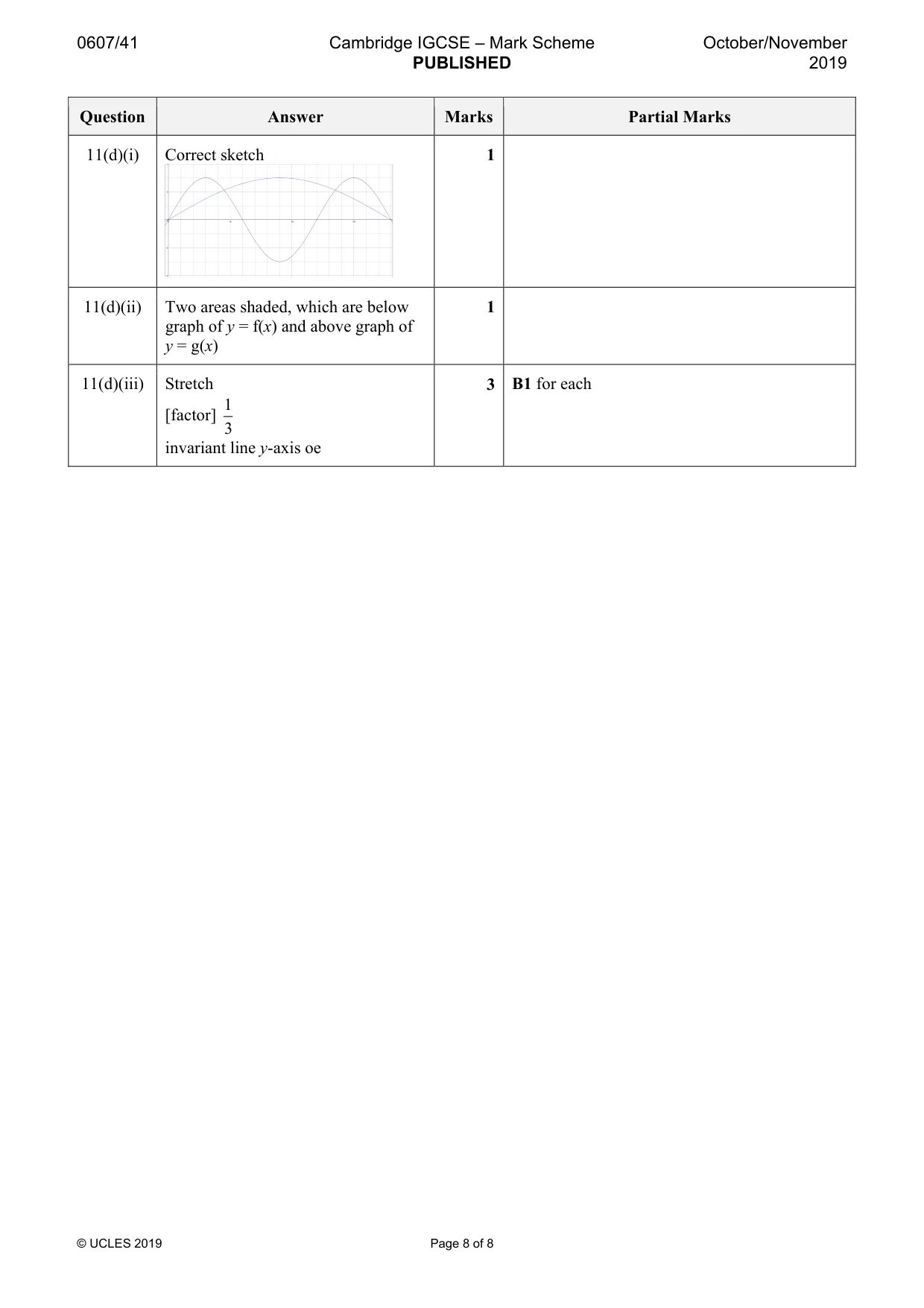
Mark scheme: 11(a) Correct4444 sketch 2 B1 for sine graph with incorrect amplitude and/or incorrect period, passing through (0, 0). 2222 0000 0000 50505050 100100100100 150150150150 -2-2-2-2 -4-4-4-4 11(b) 3 2 B1 for each 120 11(c) 70 < x < 110 2 B1 for 70 and 110 seen 11(d)(i) Correct4444 sketch 1 2222 0000 0000 50505050 100100100100 150150150150 -2-2-2-2 -4-4-4-4 11(d)(ii) Two areas shaded, which are below 1 graph of y = f(x) and above graph of y = g(x) 11(d)(iii) Stretch 3 B1 for each 1 [factor] 3 invariant line y-axis oe
What was in this paper
The subtopics covered by these 11 questions, and how many questions each got. Open one in a new tab to see every Cambridge question on it.
What you needed in this session
Cambridge’s own grade thresholds for 2019 Oct/Nov, Paper 4 · Variant 1. A higher threshold means an easier paper — the bar moves with how the cohort did.