Cambridge IGCSE Mathematics - International 0607 — 2018 May/June Paper 4 · Variant 1
0607/41/M/J/18 · 11 questions · 120 marks · ≈135 min
The question paper and its mark scheme, free to read here and free to download. This is Cambridge’s own paper, exactly as it was sat.
Question paper20 pages
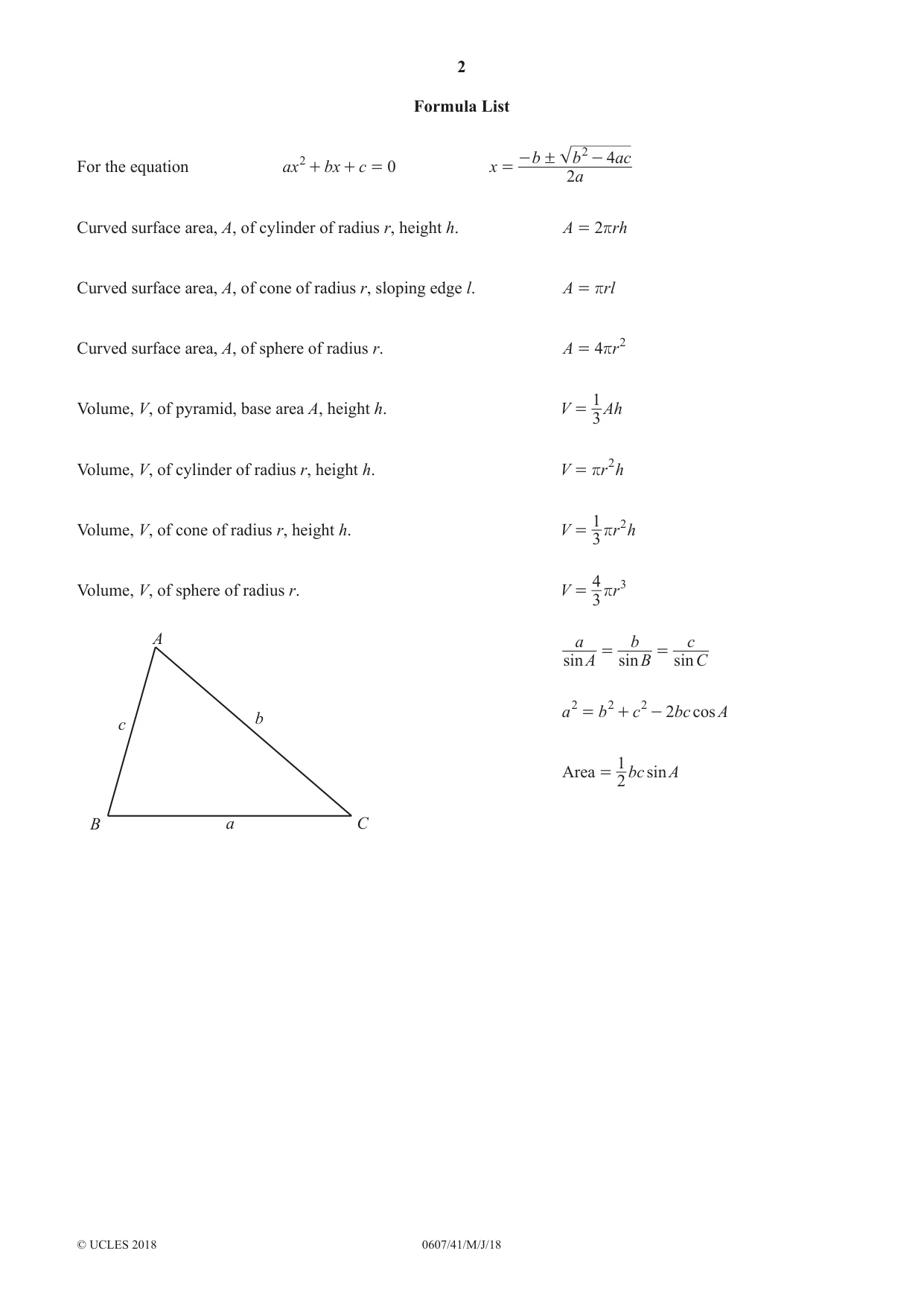
Mark scheme8 pages
Answers below. Sit the paper first if you are practising.
Questions as text
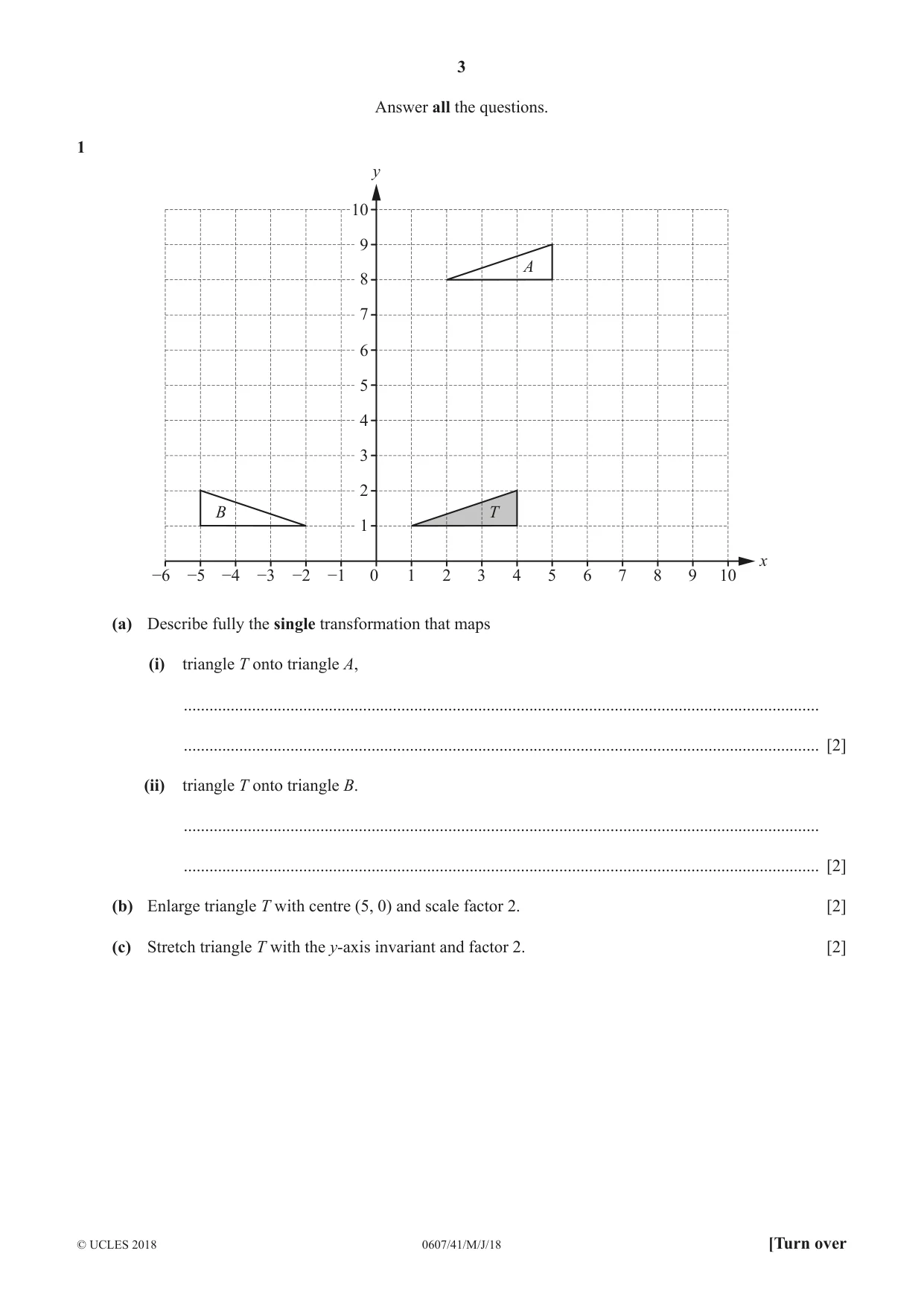
Q1 · Y 10 9 A 8 7 6 5 4 3 2 B T 1 x −6 −5 −4 −3 −2 −1 0 1 2 3 4 5 6 7 8 9 10 (a) Describe…
1 y 10 9 A 8 7 6 5 4 3 2 B T 1 x −6 −5 −4 −3 −2 −1 0 1 2 3 4 5 6 7 8 9 10 (a) Describe fully the single transformation that maps (i) triangle T onto triangle A, ..................................................................................................................................................... ..................................................................................................................................................... [2] (ii) triangle T onto triangle B. ..................................................................................................................................................... ..................................................................................................................................................... [2] (b) Enlarge triangle T with centre (5, 0) and scale factor 2. [2] (c) Stretch triangle T with the y-axis invariant and factor 2. [2]
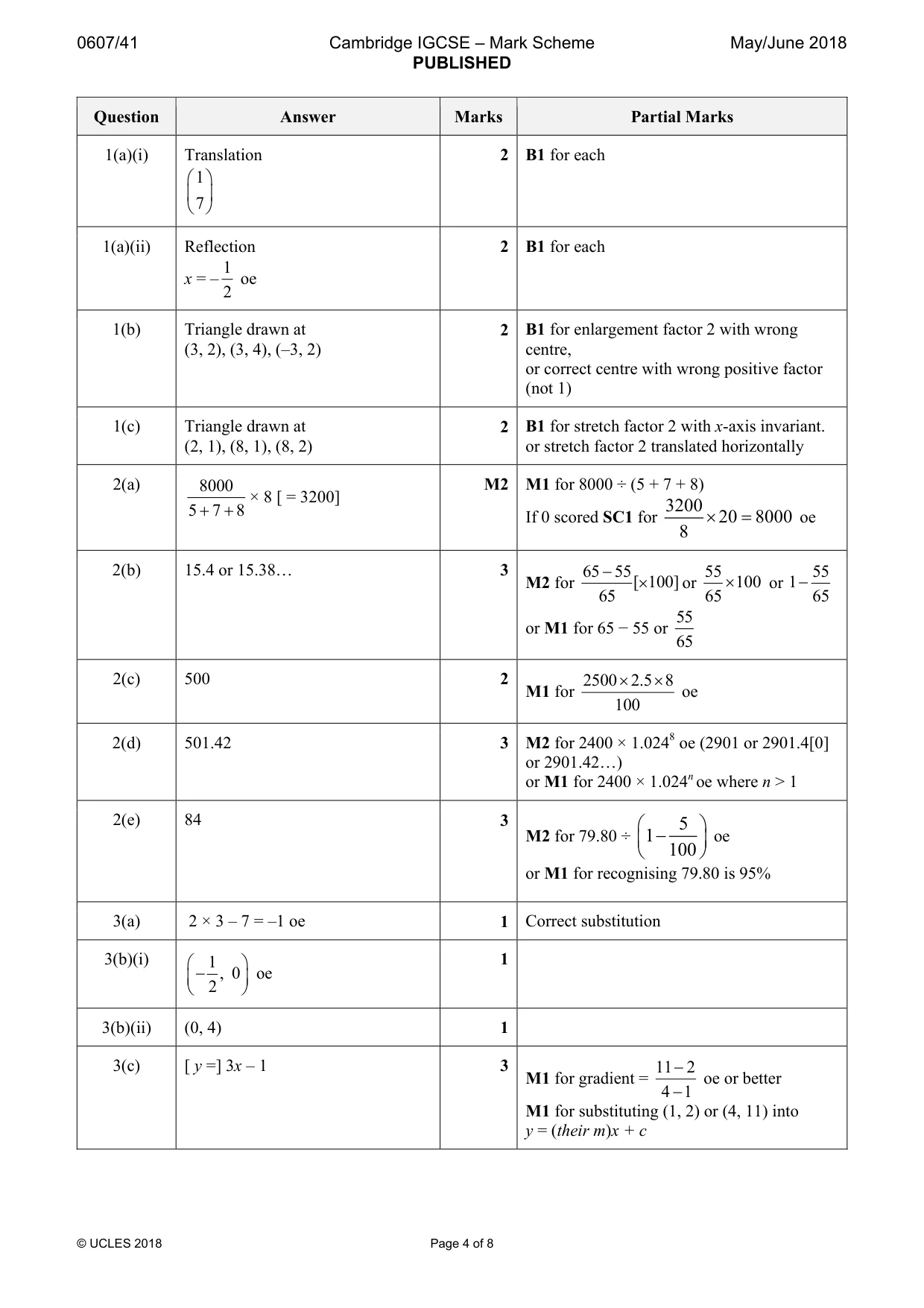
Mark scheme: Question Answer Marks Partial Marks 1(a)(i) Translation 2 B1 for each 1 7 1(a)(ii) Reflection 2 B1 for each 1 x = – oe 2 1(b) Triangle drawn at 2 B1 for enlargement factor 2 with wrong (3, 2), (3, 4), (–3, 2) centre, or correct centre with wrong positive factor (not 1) 1(c) Triangle drawn at 2 B1 for stretch factor 2 with x-axis invariant. (2, 1), (8, 1), (8, 2) or stretch factor 2 translated horizontally
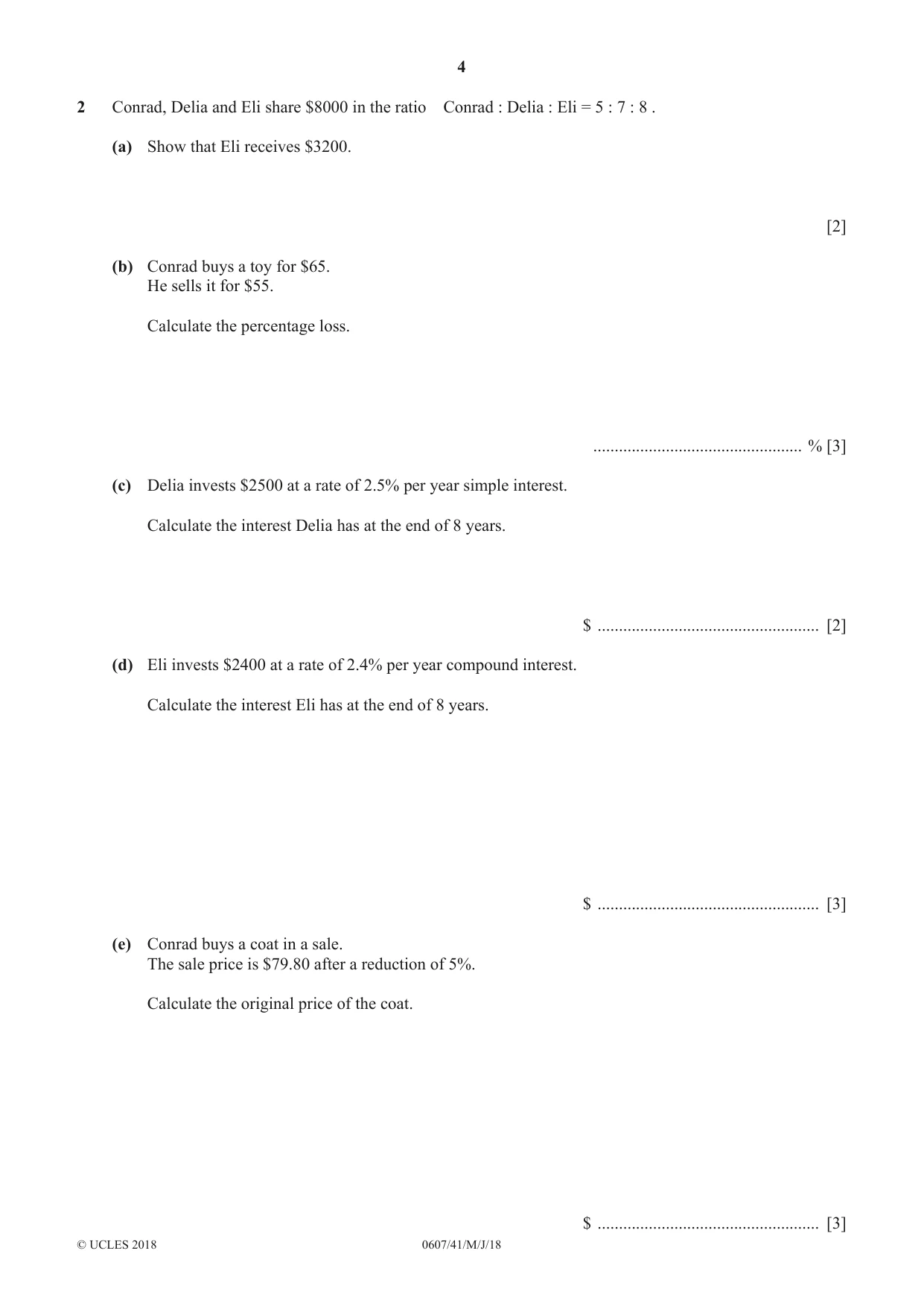
Q2 · Conrad, Delia and Eli share $8000 in the ratio Conrad : Delia : Eli = 5 : 7 : 8
2 Conrad, Delia and Eli share $8000 in the ratio Conrad : Delia : Eli = 5 : 7 : 8 . (a) Show that Eli receives $3200. [2] (b) Conrad buys a toy for $65. He sells it for $55. Calculate the percentage loss. ................................................. % [3] (c) Delia invests $2500 at a rate of 2.5% per year simple interest. Calculate the interest Delia has at the end of 8 years. $ .................................................... [2] (d) Eli invests $2400 at a rate of 2.4% per year compound interest. Calculate the interest Eli has at the end of 8 years. $ .................................................... [3] (e) Conrad buys a coat in a sale. The sale price is $79.80 after a reduction of 5%. Calculate the original price of the coat. $ .................................................... [3]
Mark scheme: 2(a) 8000 M2 M1 for 8000 ÷ (5 + 7 + 8) × 8 [ = 3200] 5 + 7 + 8 3200 If 0 scored SC1 for × 20 = 8000 oe 8 2(b) 15.4 or 15.38… 3 65 − 55[× 100] or 55 × 100 or 1 − 55 M2 for 65 65 65 55 or M1 for 65 − 55 or 65 2(c) 500 2 2500 × 2.5 × 8 M1 for oe 100 2(d) 501.42 3 M2 for 2400 × 1.0248 oe (2901 or 2901.4[0] or 2901.42…) or M1 for 2400 × 1.024n oe where n > 1 2(e) 84 3 5 M2 for 79.80 ÷ 1 − oe 100 or M1 for recognising 79.80 is 95%
Q3 · Show that the point (3, -1) lies on the line y = 2x - 7
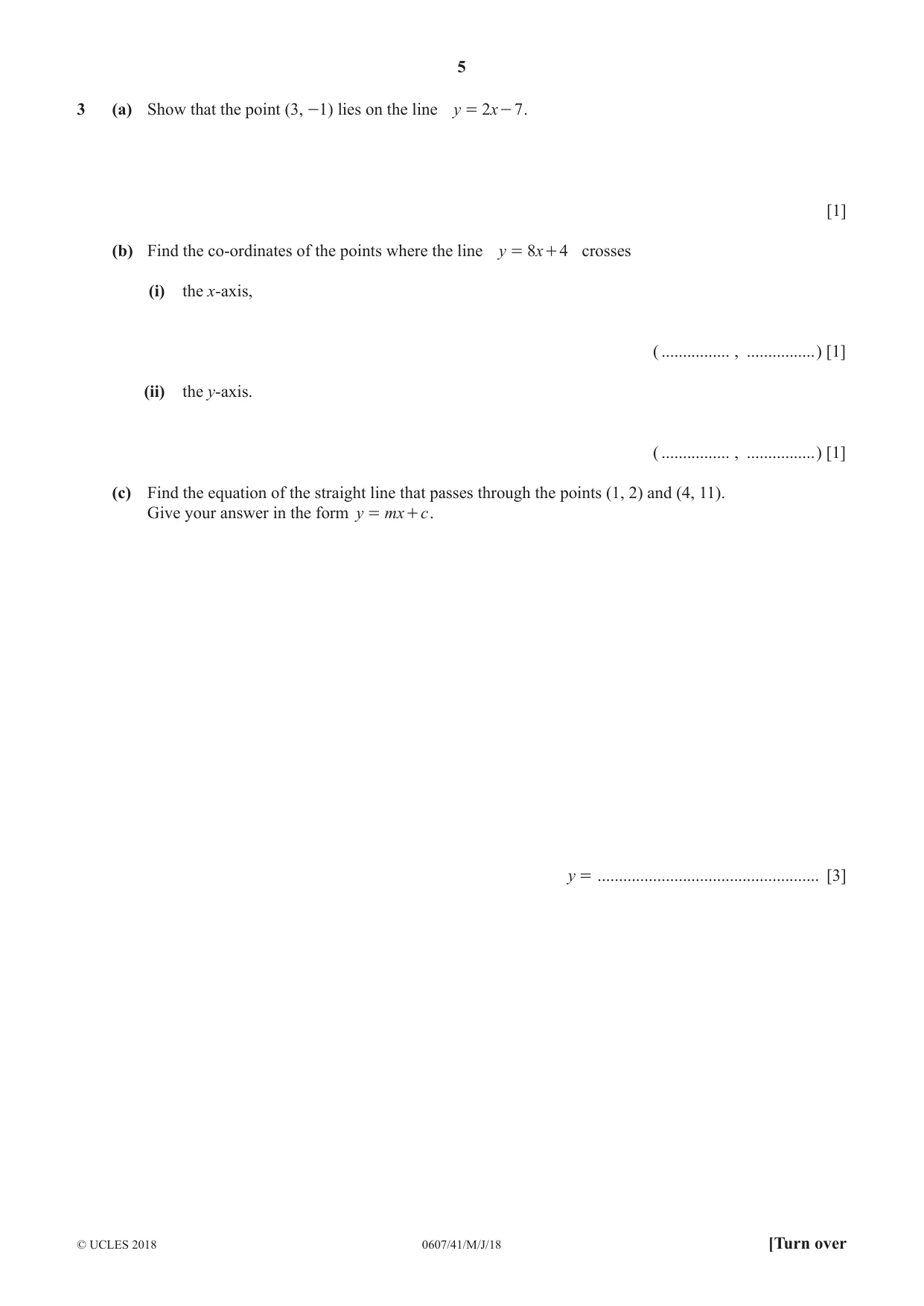
3 (a) Show that the point (3, -1) lies on the line y = 2x - 7 . [1] (b) Find the co-ordinates of the points where the line y = 8x + 4 crosses (i) the x-axis, ( ................ , ................) [1] (ii) the y-axis. ( ................ , ................) [1] (c) Find the equation of the straight line that passes through the points (1, 2) and (4, 11). Give your answer in the form y = mx + c . y = .................................................... [3]
Mark scheme: 3(a) 2 × 3 – 7 = –1 oe 1 Correct substitution 3(b)(i) 1 1 − , 0 oe 2 3(b)(ii) (0, 4) 1 3(c) [ y =] 3x – 1 3 11 − 2 M1 for gradient = oe or better 4 − 1 M1 for substituting (1, 2) or (4, 11) into y = (their m)x + c
Q4 · The list shows the temperature, in degrees Celsius, at noon in Paris on each of 14 days
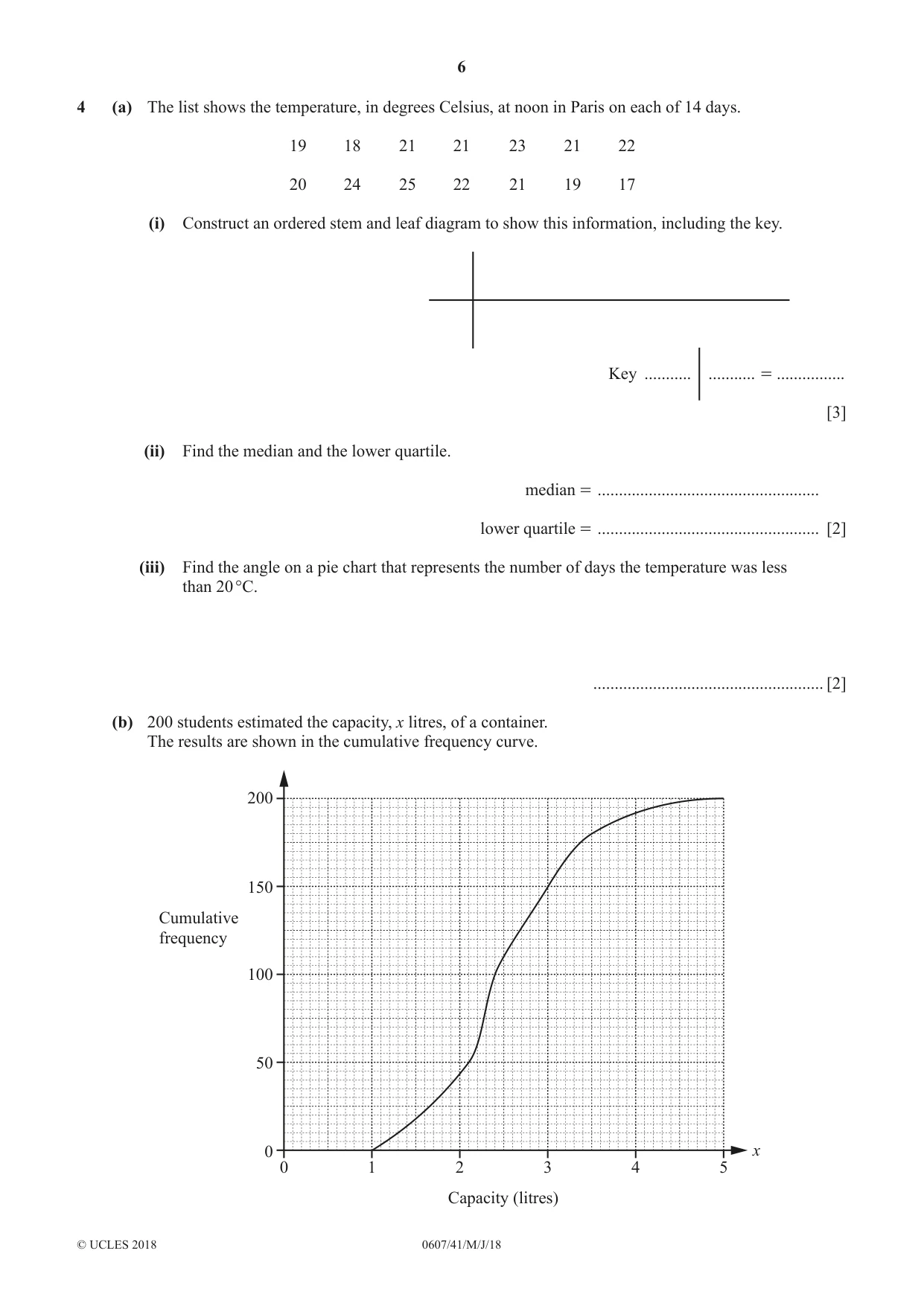
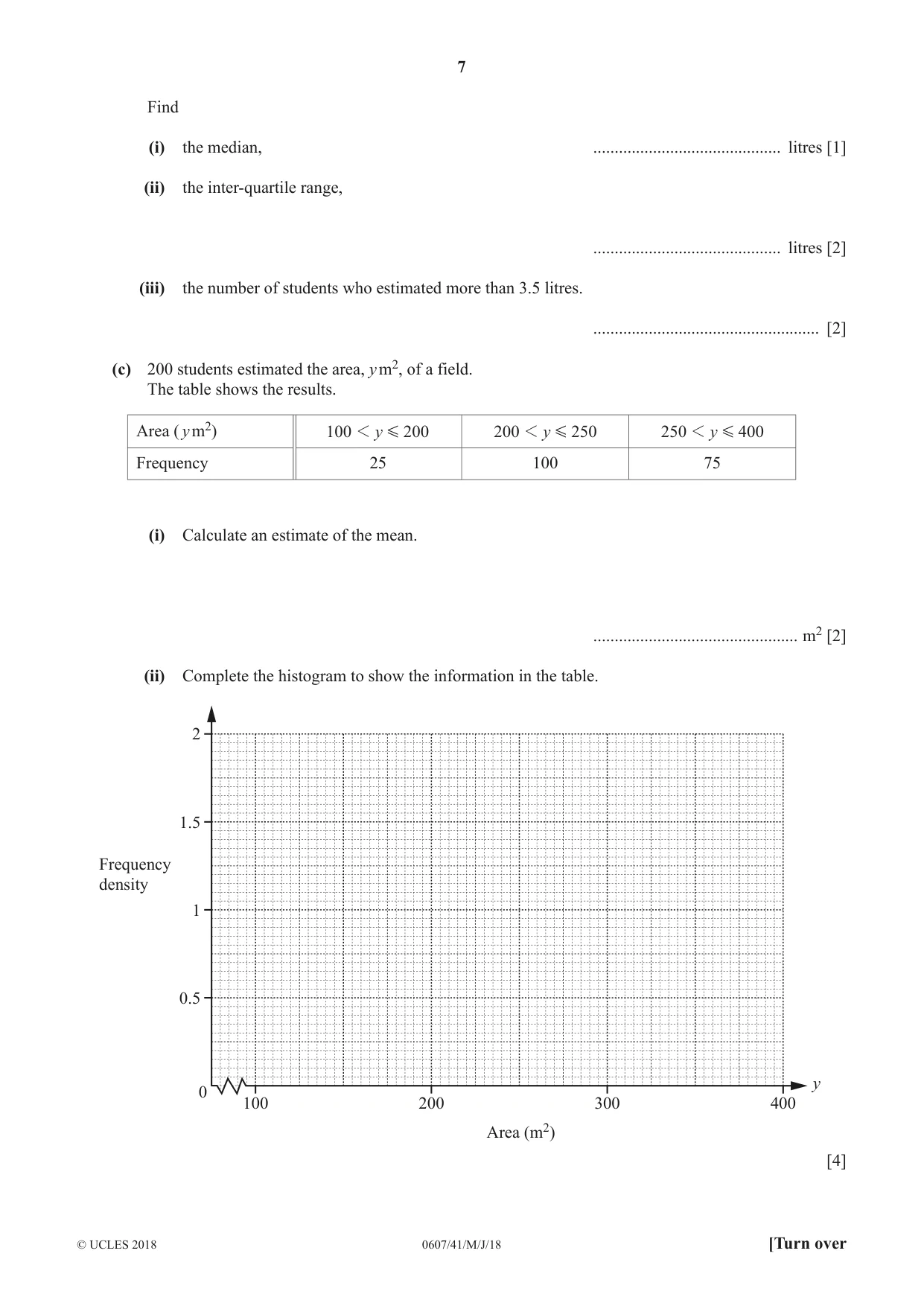
4 (a) The list shows the temperature, in degrees Celsius, at noon in Paris on each of 14 days. 19 18 21 21 23 21 22 20 24 25 22 21 19 17 (i) Construct an ordered stem and leaf diagram to show this information, including the key. Key ........... ........... = ................ [3] (ii) Find the median and the lower quartile. median = .................................................... lower quartile = .................................................... [2] (iii) Find the angle on a pie chart that represents the number of days the temperature was less than 20 °C. ...................................................... [2] (b) 200 students estimated the capacity, x litres, of a container. The results are shown in the cumulative frequency curve. 200 150 Cumulative frequency 100 50 0 x 0 1 2 3 4 5 Capacity (litres) Find (i) the median, ............................................ litres [1] (ii) the inter-quartile range, ............................................ litres [2] (iii) the number of students who estimated more than 3.5 litres. ..................................................... [2] (c) 200 students estimated the area, y m2, of a field. The table shows the results. Area (y m2) 100 1 y G 200 200 1 y G 250 250 1 y G 400 Frequency 25 100 75 (i) Calculate an estimate of the mean. ................................................ m2 [2] (ii) Complete the histogram to show the information in the table. 2 1.5 Frequency density 1 0.5 y 0 100 200 300 400 Area (m2) [4]
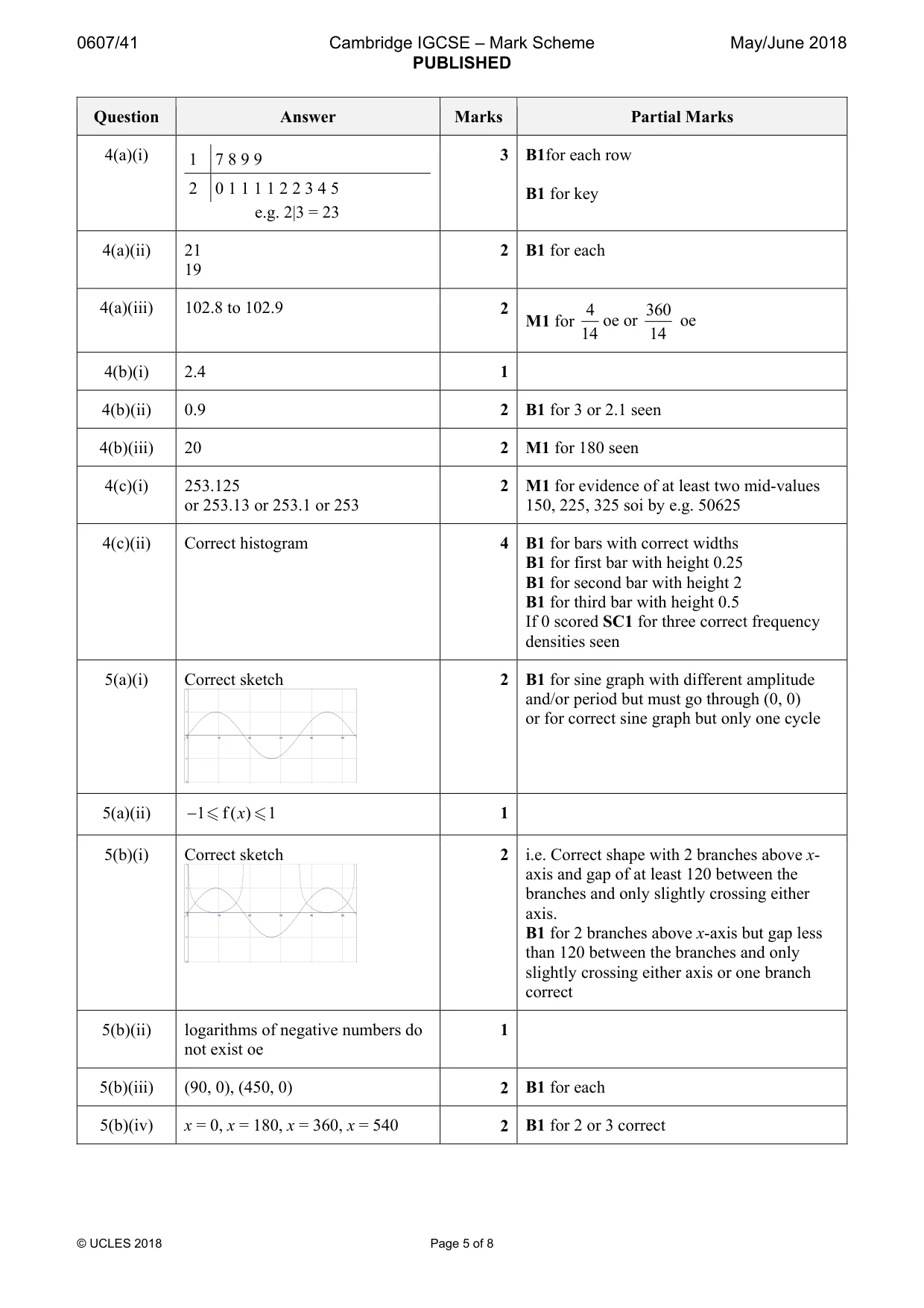
Mark scheme: 4(a)(i) 1 7 8 9 9 3 B1for each row 2 0 1 1 1 1 2 2 3 4 5 B1 for key e.g. 2|3 = 23 4(a)(ii) 21 2 B1 for each 19 4(a)(iii) 102.8 to 102.9 2 4 360 M1 for oe or oe 14 14 4(b)(i) 2.4 1 4(b)(ii) 0.9 2 B1 for 3 or 2.1 seen 4(b)(iii) 20 2 M1 for 180 seen 4(c)(i) 253.125 2 M1 for evidence of at least two mid-values or 253.13 or 253.1 or 253 150, 225, 325 soi by e.g. 50625 4(c)(ii) Correct histogram 4 B1 for bars with correct widths B1 for first bar with height 0.25 B1 for second bar with height 2 B1 for third bar with height 0.5 If 0 scored SC1 for three correct frequency densities seen
Q5 · Y 2 1 x 0 180 360 540 −1 −2 J N 1 f (x) = sin x° g (x ) = log KK OO sin x° L P (a) (i) On…
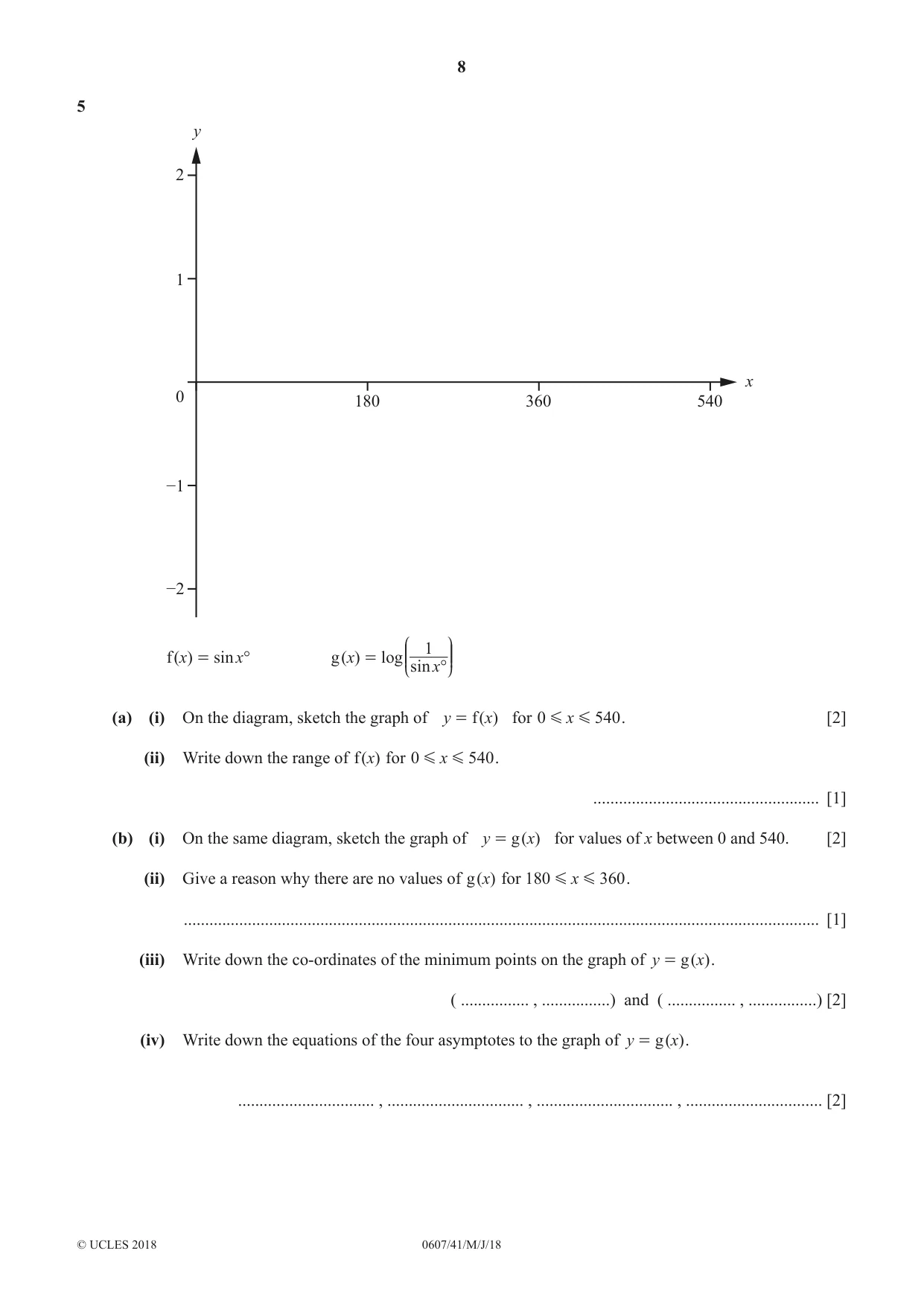
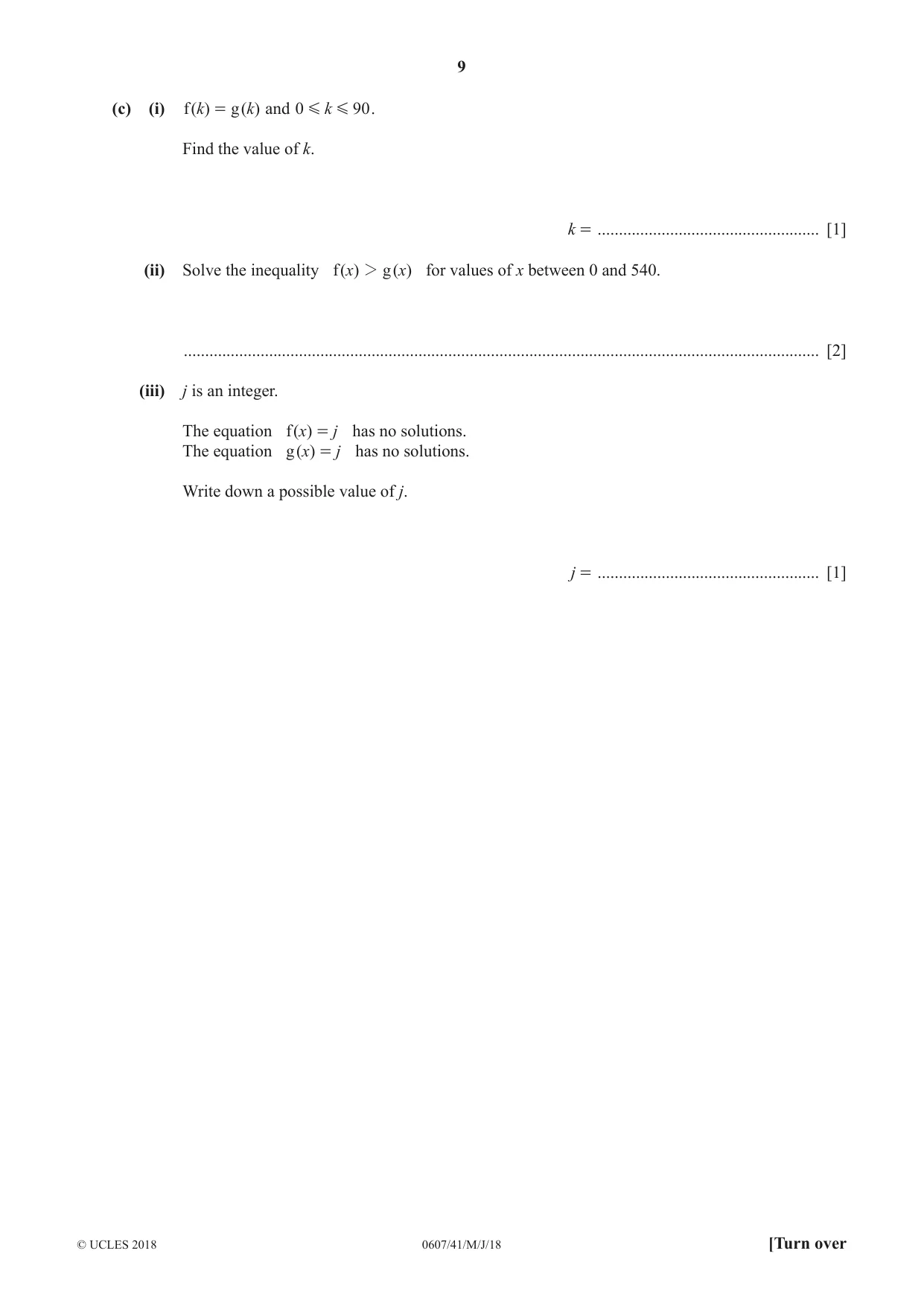
5 y 2 1 x 0 180 360 540 −1 −2 J N 1 f (x) = sin x° g (x ) = log KK OO sin x° L P (a) (i) On the diagram, sketch the graph of y = f (x) for 0 G x G 540 . [2] (ii) Write down the range of f ()x for 0 G x G 540 . ..................................................... [1] (b) (i) On the same diagram, sketch the graph of y = g (x) for values of x between 0 and 540. [2] (ii) Give a reason why there are no values of g ()x for 180 G x G 360 . ..................................................................................................................................................... [1] (iii) Write down the co-ordinates of the minimum points on the graph of y = g (x) . ( ................ , ................) and ( ................ , ................) [2] (iv) Write down the equations of the four asymptotes to the graph of y = g (x) . ................................ , ................................ , ................................ , ................................ [2] (c) (i) f (k) = g (k) and 0 G k G 90 . Find the value of k. k = .................................................... [1] (ii) Solve the inequality f (x) 2 g (x) for values of x between 0 and 540. ..................................................................................................................................................... [2] (iii) j is an integer. The equation f ()x = j has no solutions. The equation g ()x = j has no solutions. Write down a possible value of j. j = .................................................... [1]
Mark scheme: 5(a)(i) Correct2222 sketch 2 B1 for sine graph with different amplitude and/or period but must go through (0, 0) 1111 or for correct sine graph but only one cycle 0000 0000 100100100100 200200200200 300300300300 400400400400 500500500500 -1-1-1-1 -2-2-2-2 5(a)(ii) −-1 f ( x ) - 1 1 5(b)(i) Correct2222 sketch 2 i.e. Correct shape with 2 branches above x- axis and gap of at least 120 between the 1111 branches and only slightly crossing either 0000 0000 100100100100 200200200200 300300300300 400400400400 500500500500 axis. -1-1-1-1 B1 for 2 branches above x-axis but gap less -2-2-2-2 than 120 between the branches and only slightly crossing either axis or one branch correct 5(b)(ii) logarithms of negative numbers do 1 not exist oe 5(b)(iii) (90, 0), (450, 0) 2 B1 for each 5(b)(iv) x = 0, x = 180, x = 360, x = 540 2 B1 for 2 or 3 correct 5(c)(i) 23.5 or 23.51 to 23.52 1 5(c)(ii) 23.5 < x < 156.5 2 B1 for each 383.5< x < 516.5 Allow 23.51 to 23.52, 156.48 to 156.49 Allow 383.51 to 383.52, 516.48 to 516.49 5(c)(iii) Any integer less than – 1 1
Q6 · NOT TO SCALE 12 cm 40 cm (i) The rectangle can be made into a hollow cylinder with height…
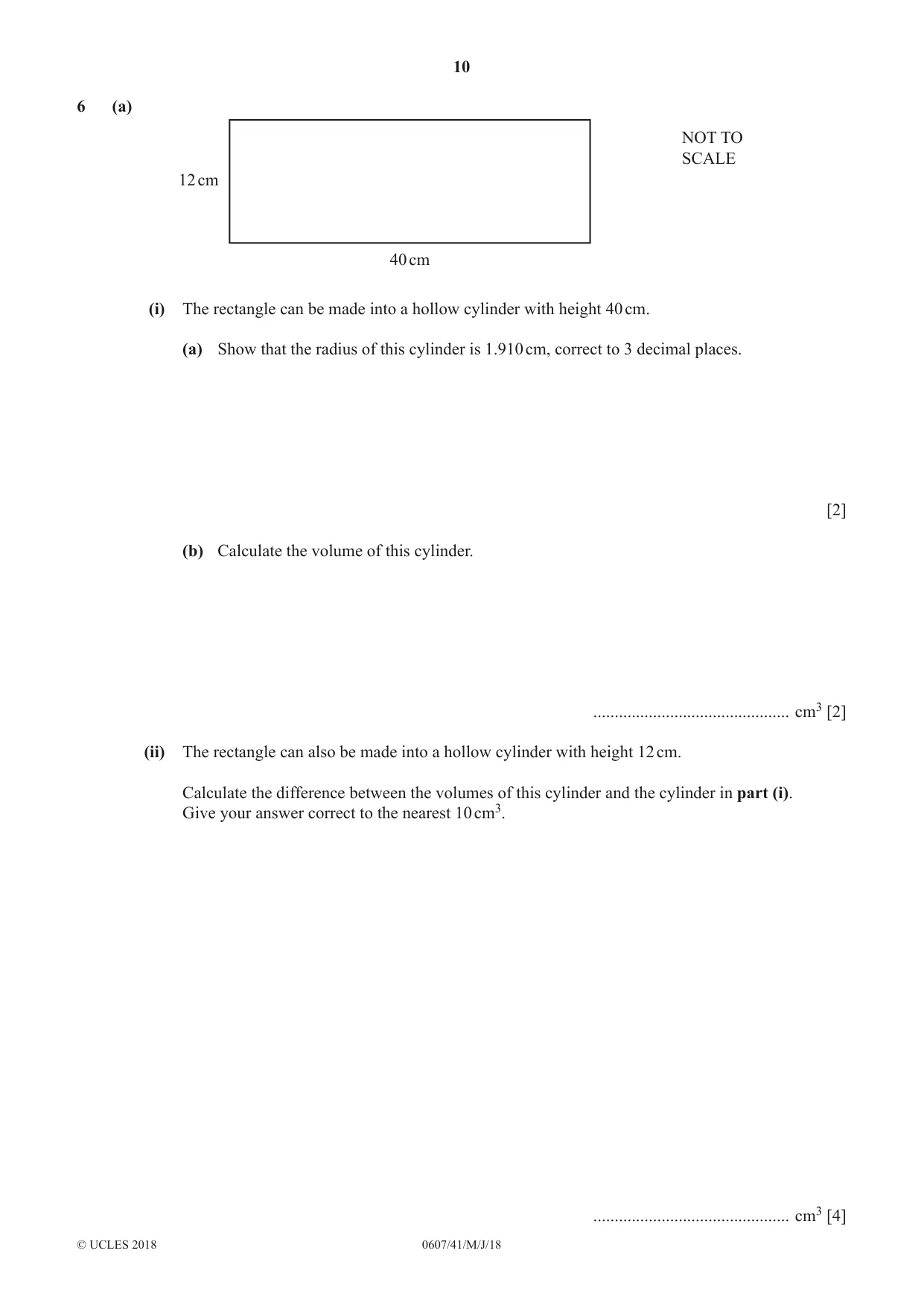
6 (a) NOT TO SCALE 12 cm 40 cm (i) The rectangle can be made into a hollow cylinder with height 40 cm. (a) Show that the radius of this cylinder is 1.910 cm, correct to 3 decimal places. [2] (b) Calculate the volume of this cylinder. .............................................. cm3 [2] (ii) The rectangle can also be made into a hollow cylinder with height 12 cm. Calculate the difference between the volumes of this cylinder and the cylinder in part (i). Give your answer correct to the nearest 10 cm3. .............................................. cm3 [4] (b) A model of a car is mathematically similar to the actual car. The volume of the model is 75 cubic centimetres and the volume of the actual car is 4.8 cubic metres. The scale is model : actual = 1 : n . Find the value of n. n = .................................................... [4]
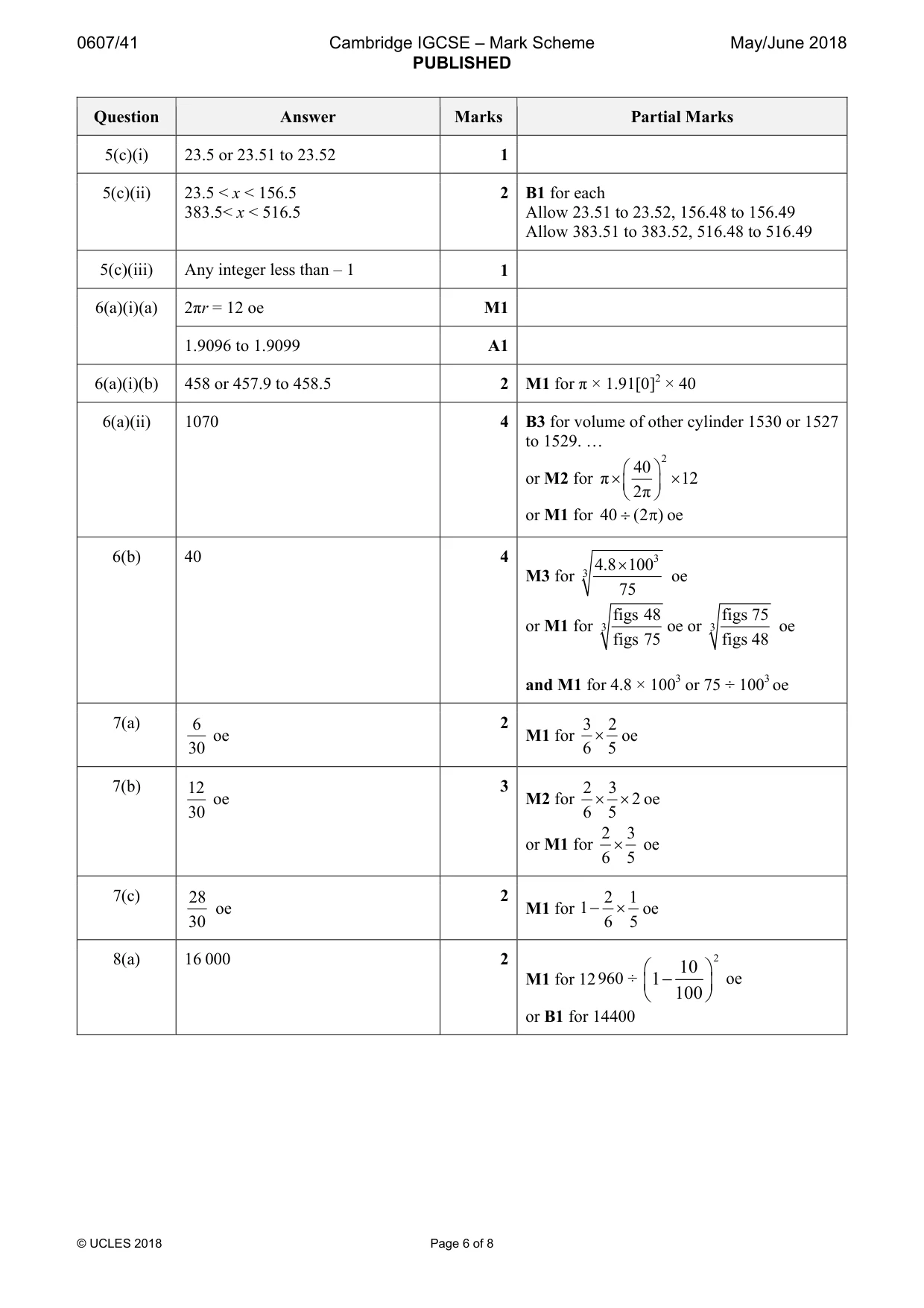
Mark scheme: 6(a)(i)(a) 2πr = 12 oe M1 1.9096 to 1.9099 A1 6(a)(i)(b) 458 or 457.9 to 458.5 2 M1 for π × 1.91[0]2 × 40 6(a)(ii) 1070 4 B3 for volume of other cylinder 1530 or 1527 to 1529. … 40 2 or M2 for π × × 12 2π or M1 for 40 ÷ ( 2 π) oe 6(b) 40 4 3 4.8 × 100 M3 for 3 oe 75 figs 48 figs 75 or M1 for 3 oe or 3 oe figs 75 figs 48 and M1 for 4.8 × 1003 or 75 ÷ 1003 oe
Q7 · 1 cent 1 cent 5 cents 10 cents 10 cents 10 cents The diagram shows coins of values 1…
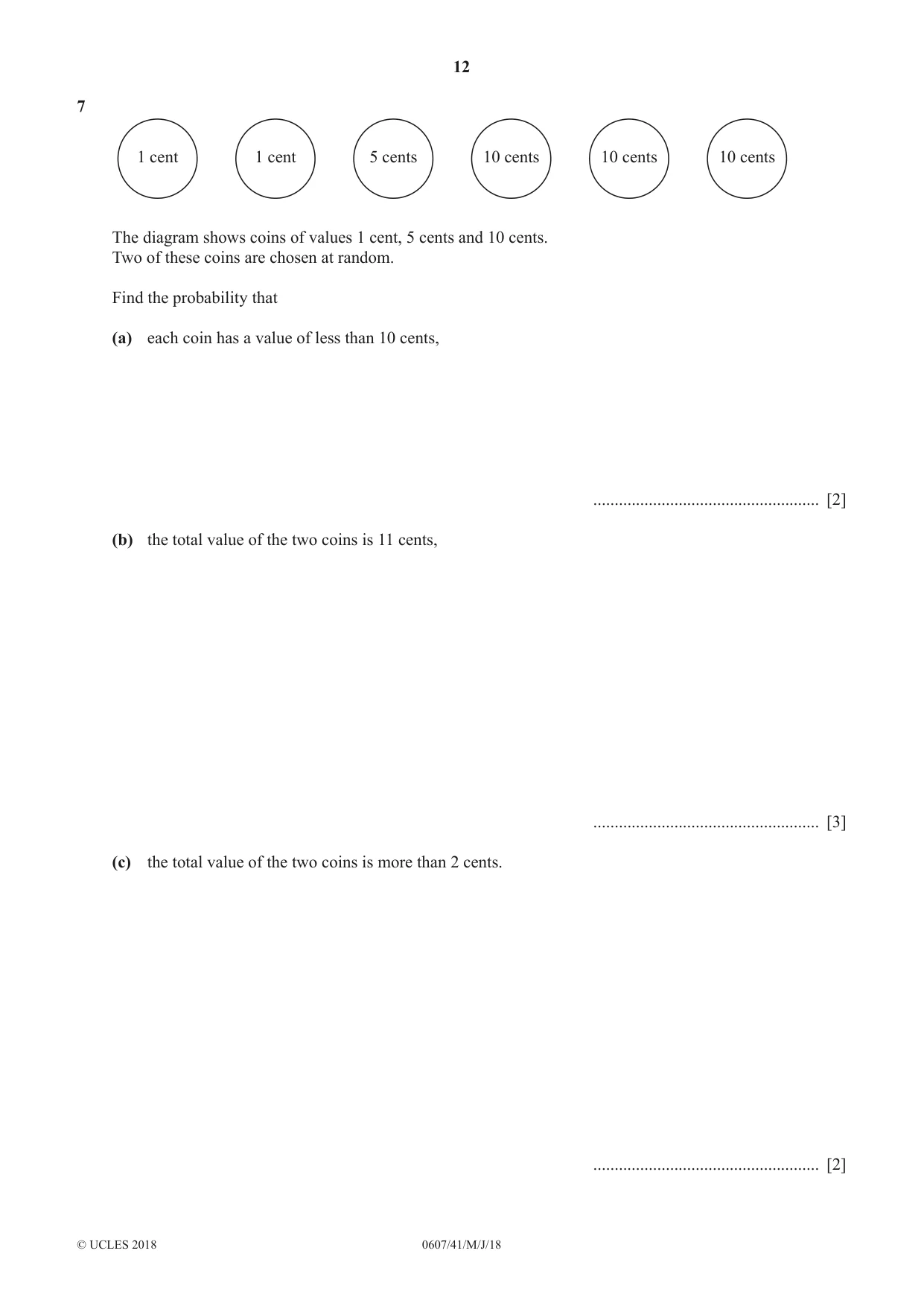
7 1 cent 1 cent 5 cents 10 cents 10 cents 10 cents The diagram shows coins of values 1 cent, 5 cents and 10 cents. Two of these coins are chosen at random. Find the probability that (a) each coin has a value of less than 10 cents, ..................................................... [2] (b) the total value of the two coins is 11 cents, ..................................................... [3] (c) the total value of the two coins is more than 2 cents. ..................................................... [2]
Mark scheme: 7(a) 6 2 3 2 oe M1 for × oe 30 6 5 7(b) 12 3 2 3 oe M2 for × × 2 oe 30 6 5 2 3 or M1 for × oe 6 5 7(c) 28 2 2 1 oe M1 for 1 − × oe 30 6 5
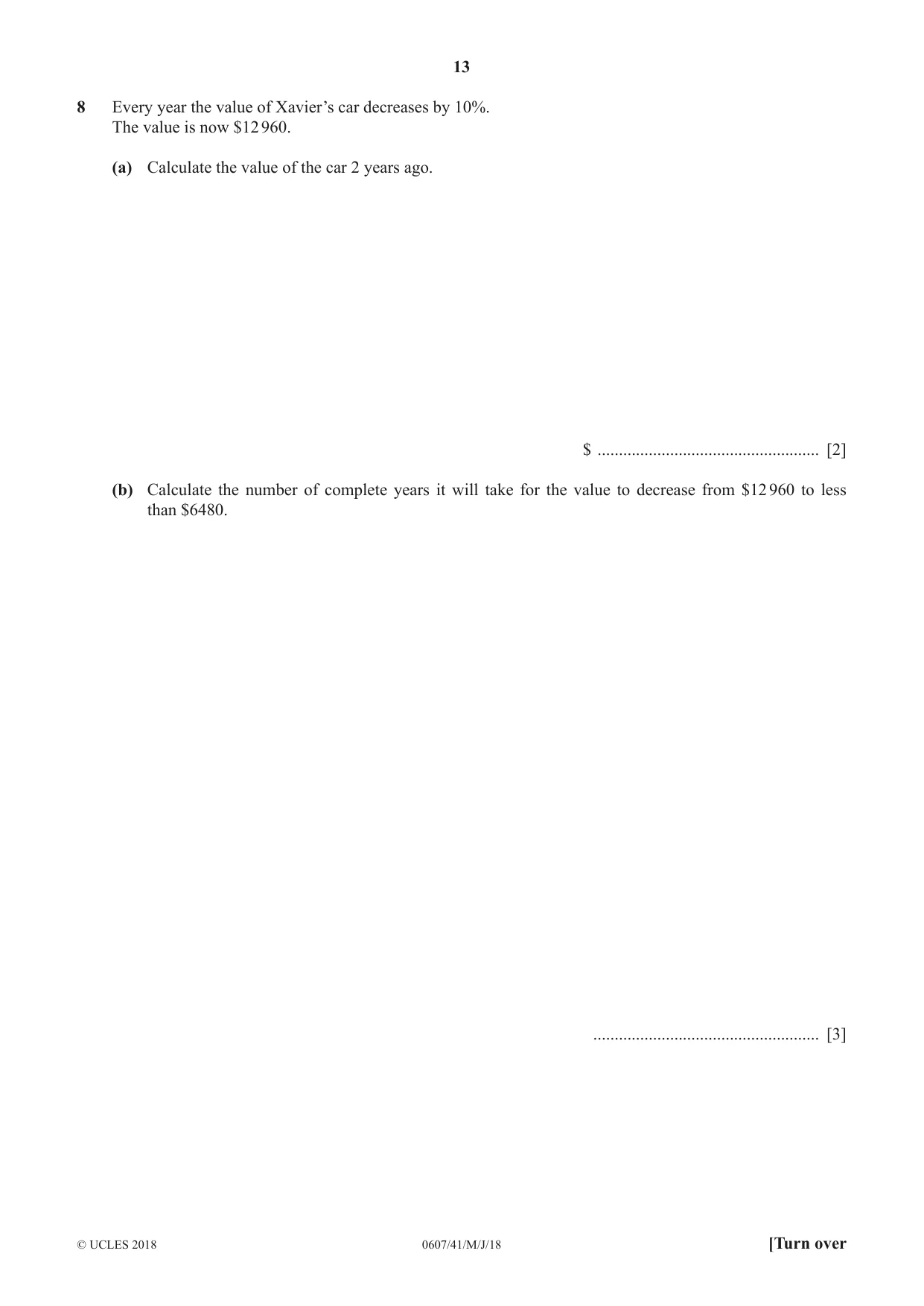
Q8 · Every year the value of Xavier’s car decreases by 10%
8 Every year the value of Xavier’s car decreases by 10%. The value is now $12 960. (a) Calculate the value of the car 2 years ago. $ .................................................... [2] (b) Calculate the number of complete years it will take for the value to decrease from $12 960 to less than $6480. ..................................................... [3]
Mark scheme: 8(a) 16 000 2 2 10 M1 for 12 960 ÷ 1 − oe 100 or B1 for 14400 8(b) 7 nfww 3 B2 for 6.58 or 6.578 to 6.579 6480 log 12960 or M2 for oe or appropriate log0.9 sketch or at least two trials with n > 3 10 n or M1 for 12960 × 1 − = 6480 oe 100 if 0 scored, SC1 for answer 9 nfww, coming from 16000
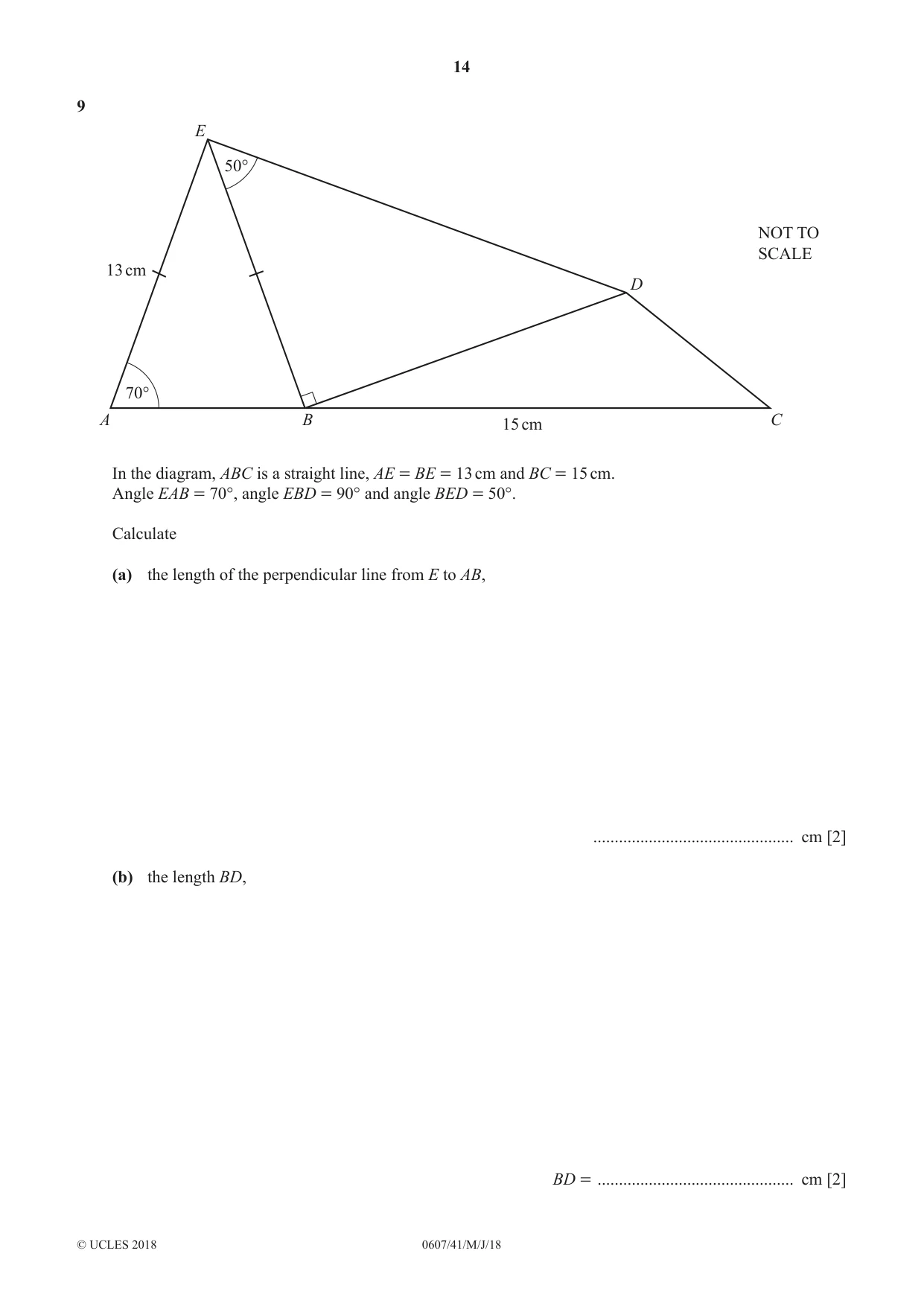
Q9 · E 50° NOT TO SCALE 13 cm D 70° A B C 15 cm In the diagram, ABC is a straight line, AE =…
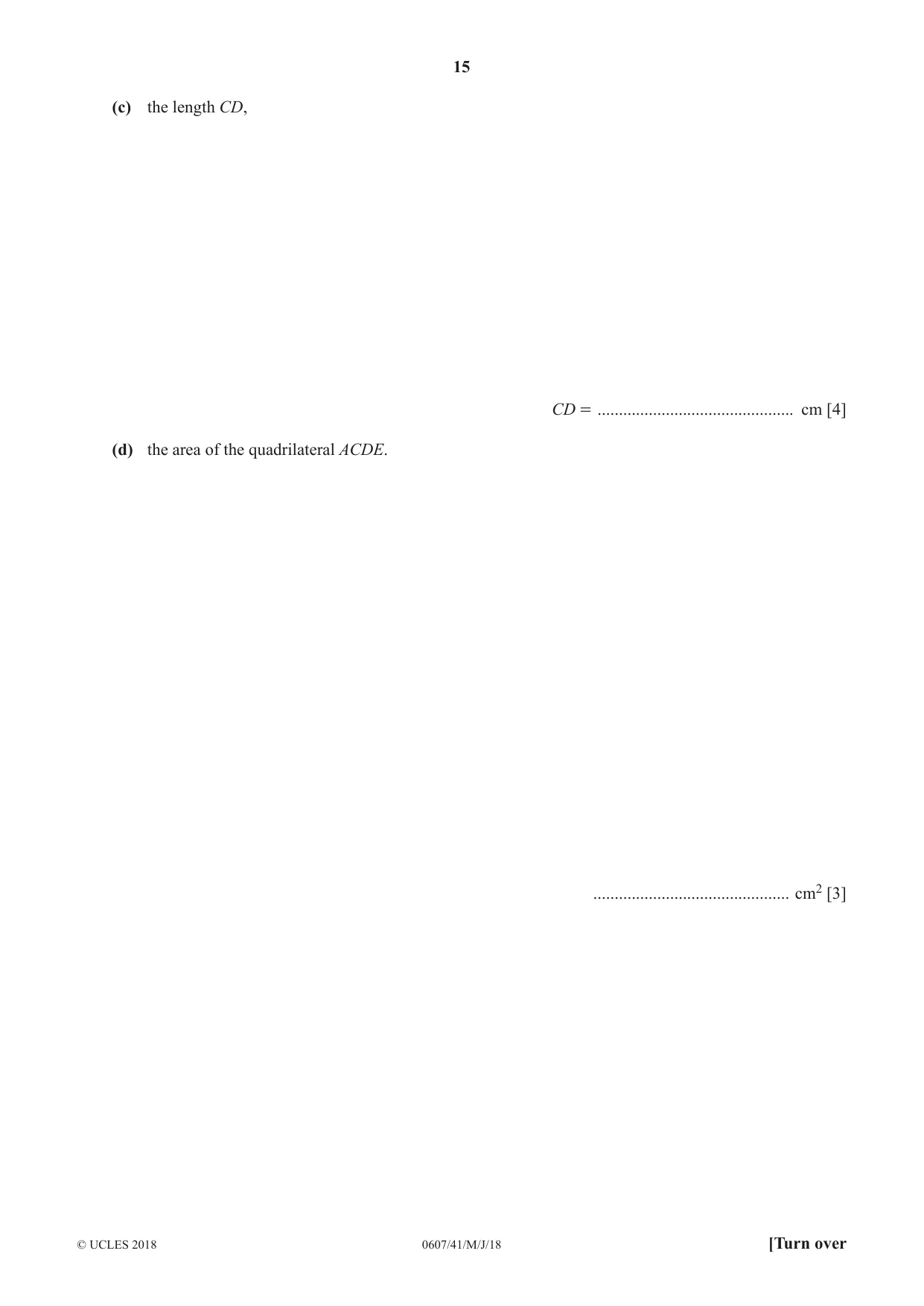
9 E 50° NOT TO SCALE 13 cm D 70° A B C 15 cm In the diagram, ABC is a straight line, AE = BE = 13 cm and BC = 15 cm. Angle EAB = 70°, angle EBD = 90° and angle BED = 50°. Calculate (a) the length of the perpendicular line from E to AB, ............................................... cm [2] (b) the length BD, BD = .............................................. cm [2] (c) the length CD, CD = .............................................. cm [4] (d) the area of the quadrilateral ACDE. .............................................. cm2 [3]
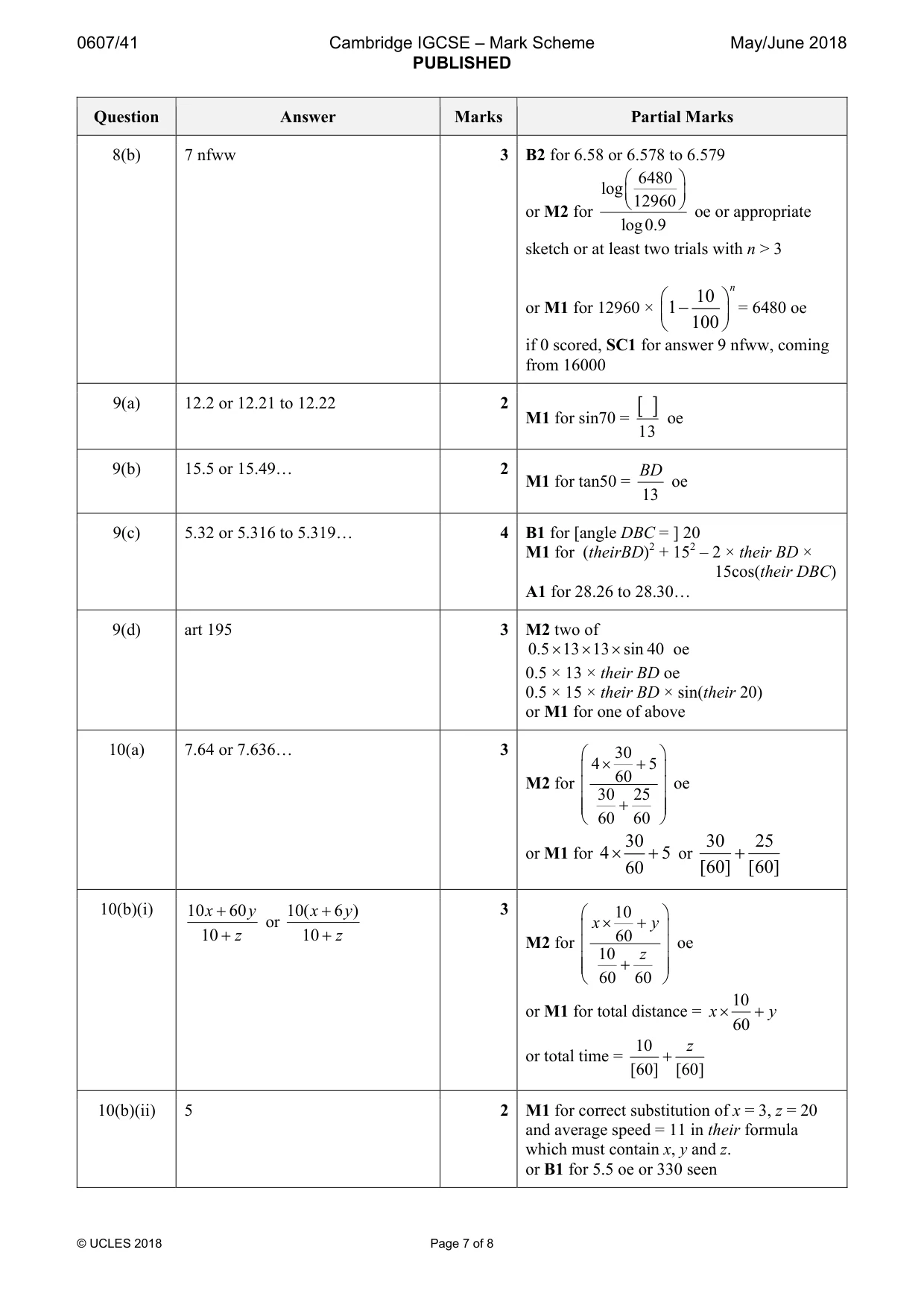
Mark scheme: 9(a) 12.2 or 12.21 to 12.22 2 [ ] M1 for sin70 = oe 13 9(b) 15.5 or 15.49… 2 BD M1 for tan50 = oe 13 9(c) 5.32 or 5.316 to 5.319… 4 B1 for [angle DBC = ] 20 M1 for (theirBD)2 + 152 – 2 × their BD × 15cos(their DBC) A1 for 28.26 to 28.30… 9(d) art 195 3 M2 two of 5.0 × 13 × 13 × sin 40 oe 0.5 × 13 × their BD oe 0.5 × 15 × their BD × sin(their 20) or M1 for one of above
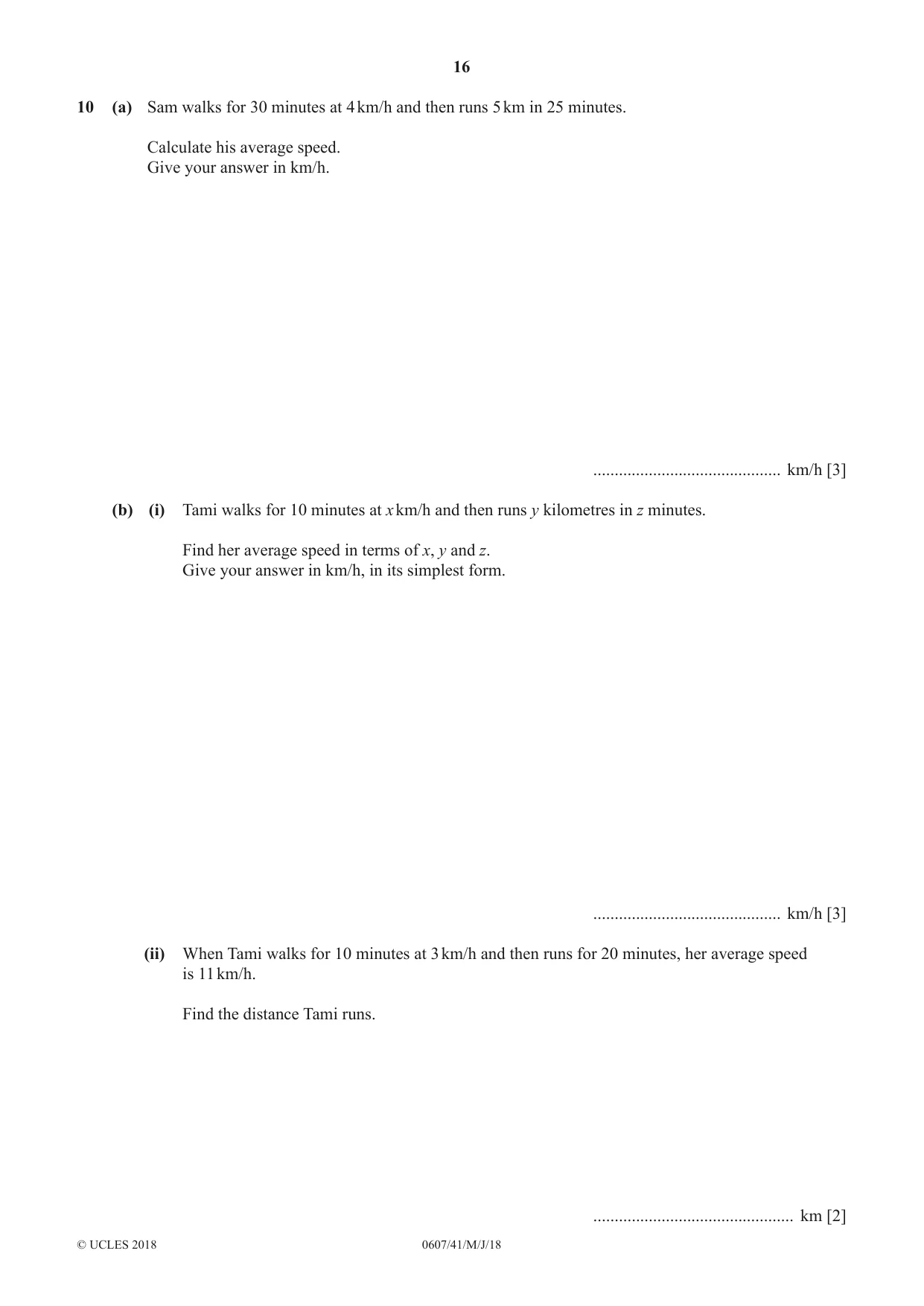
Q10 · Sam walks for 30 minutes at 4 km/h and then runs 5 km in 25 minutes
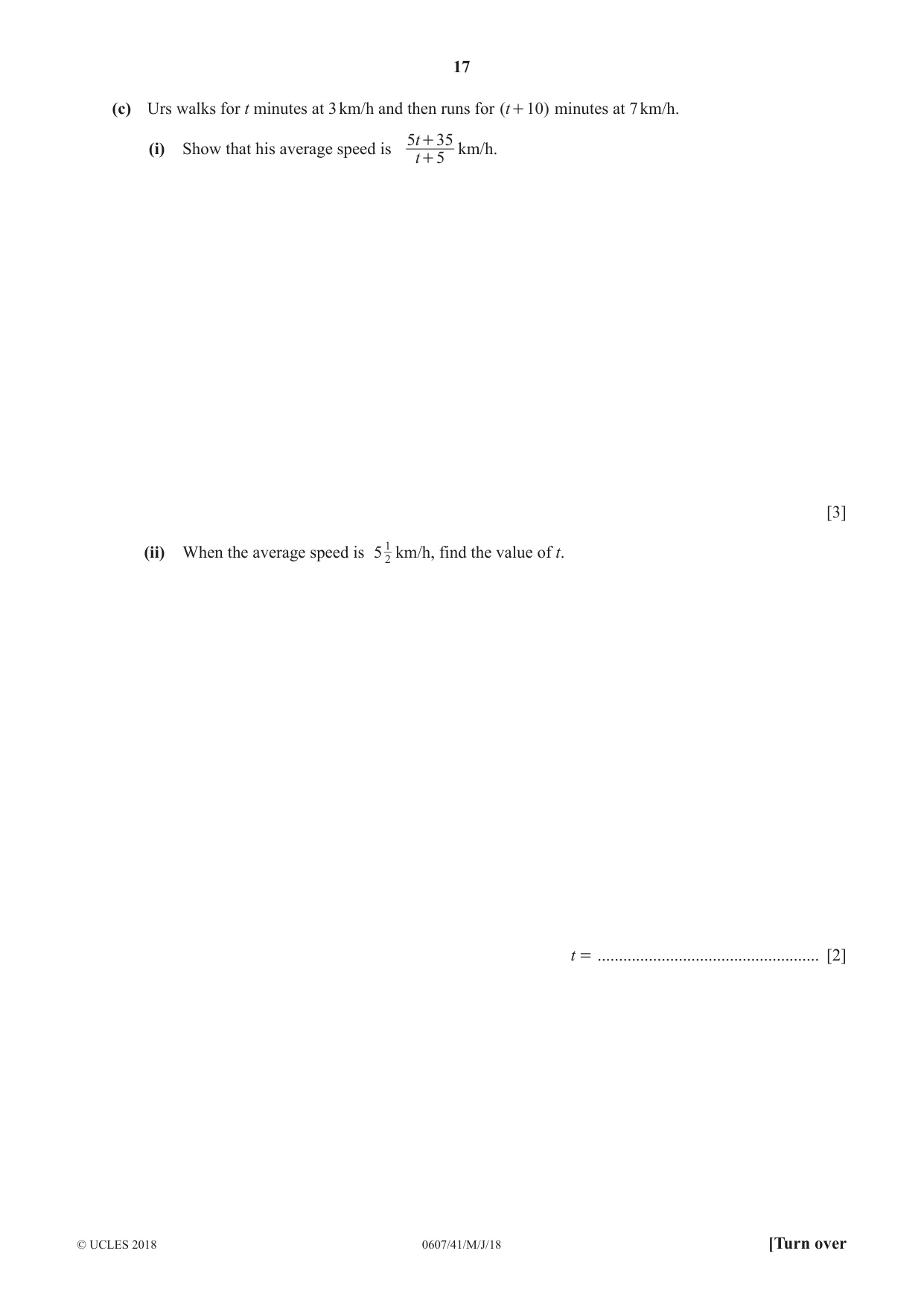
10 (a) Sam walks for 30 minutes at 4 km/h and then runs 5 km in 25 minutes. Calculate his average speed. Give your answer in km/h. ............................................ km/h [3] (b) (i) Tami walks for 10 minutes at x km/h and then runs y kilometres in z minutes. Find her average speed in terms of x, y and z. Give your answer in km/h, in its simplest form. ............................................ km/h [3] (ii) When Tami walks for 10 minutes at 3 km/h and then runs for 20 minutes, her average speed is 11 km/h. Find the distance Tami runs. ............................................... km [2] (c) Urs walks for t minutes at 3 km/h and then runs for (t + 10 ) minutes at 7 km/h. 5t + 35 (i) Show that his average speed is km/h. t + 5 [3] (ii) When the average speed is 5 12 km/h, find the value of t. t = .................................................... [2]
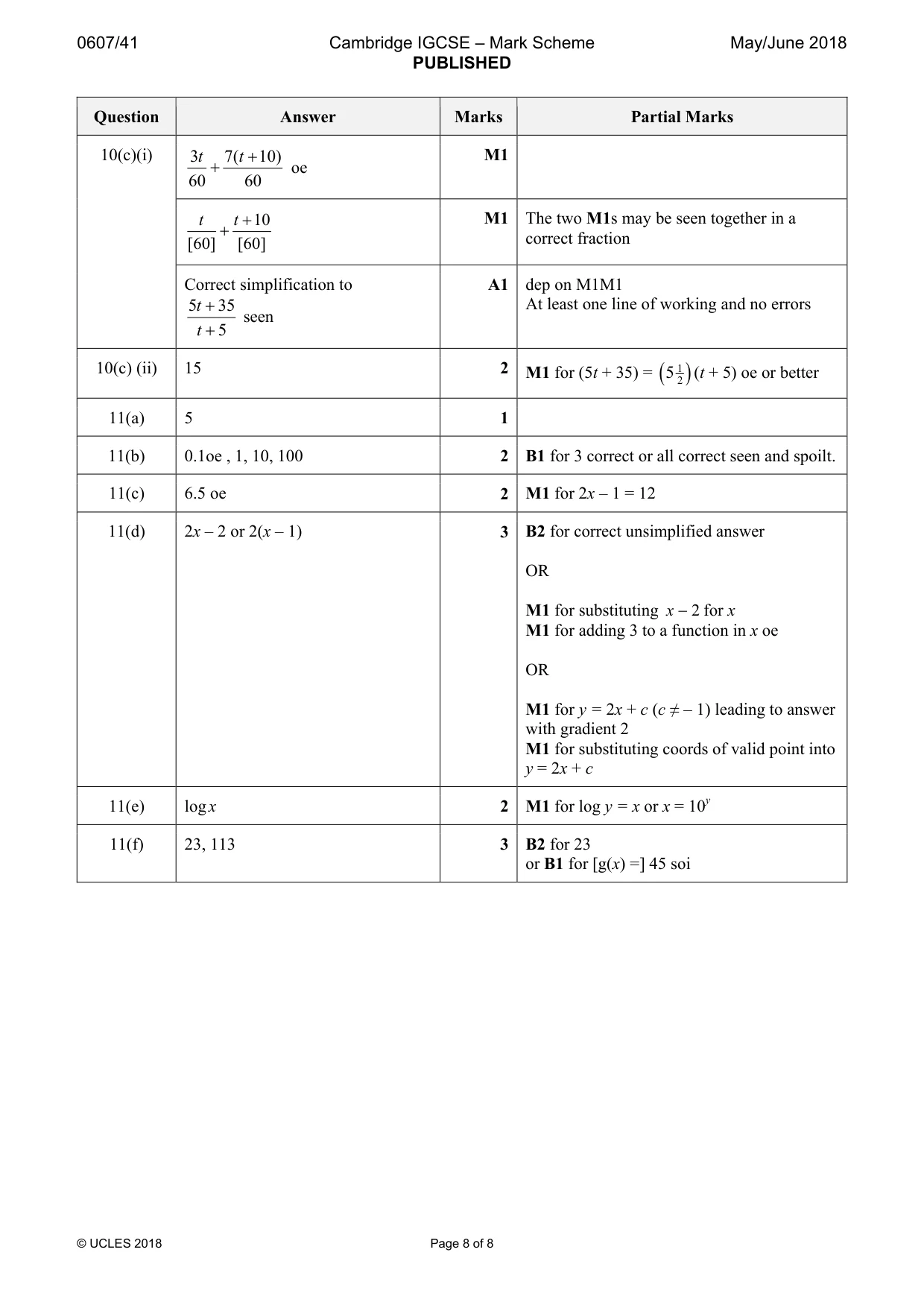
Mark scheme: 10(a) 7.64 or 7.636… 3 30 4 × + 5 60 M2 for oe 30 25 + 60 60 30 30 25 or M1 for 4 × + 5 or + 60 [60] [60] 10(b)(i) 10 x + 60 y 10( x + 6 y ) 3 10 or x × + y 10 + z 10 + z 60 M2 for oe 10 z + 60 60 10 or M1 for total distance = x × + y 60 10 z or total time = + [60] [60] 10(b)(ii) 5 2 M1 for correct substitution of x = 3, z = 20 and average speed = 11 in their formula which must contain x, y and z. or B1 for 5.5 oe or 330 seen 10(c)(i) 3t 7(t + 10) M1 + oe 60 60 t t + 10 M1 The two M1s may be seen together in a + correct fraction [60] [60] Correct simplification to A1 dep on M1M1 5t + 35 At least one line of working and no errors seen t + 5 110(c) (ii) 15 2 M1 for (5t + 35) = ( 5 2 ) (t + 5) oe or better
Q11 · F ()x = 10 x g ()x = 2x - 1 (a) Find the value of g(3)
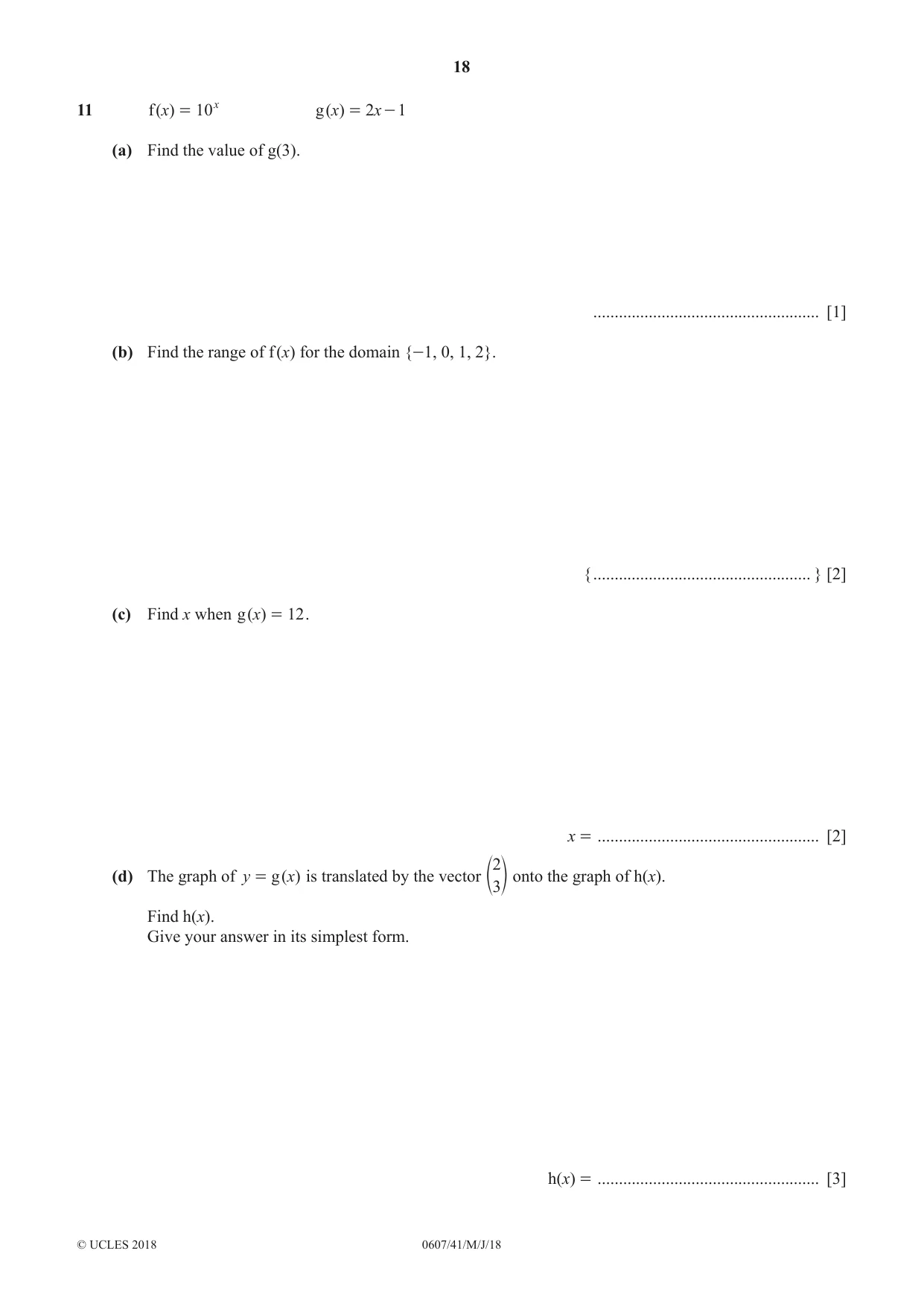
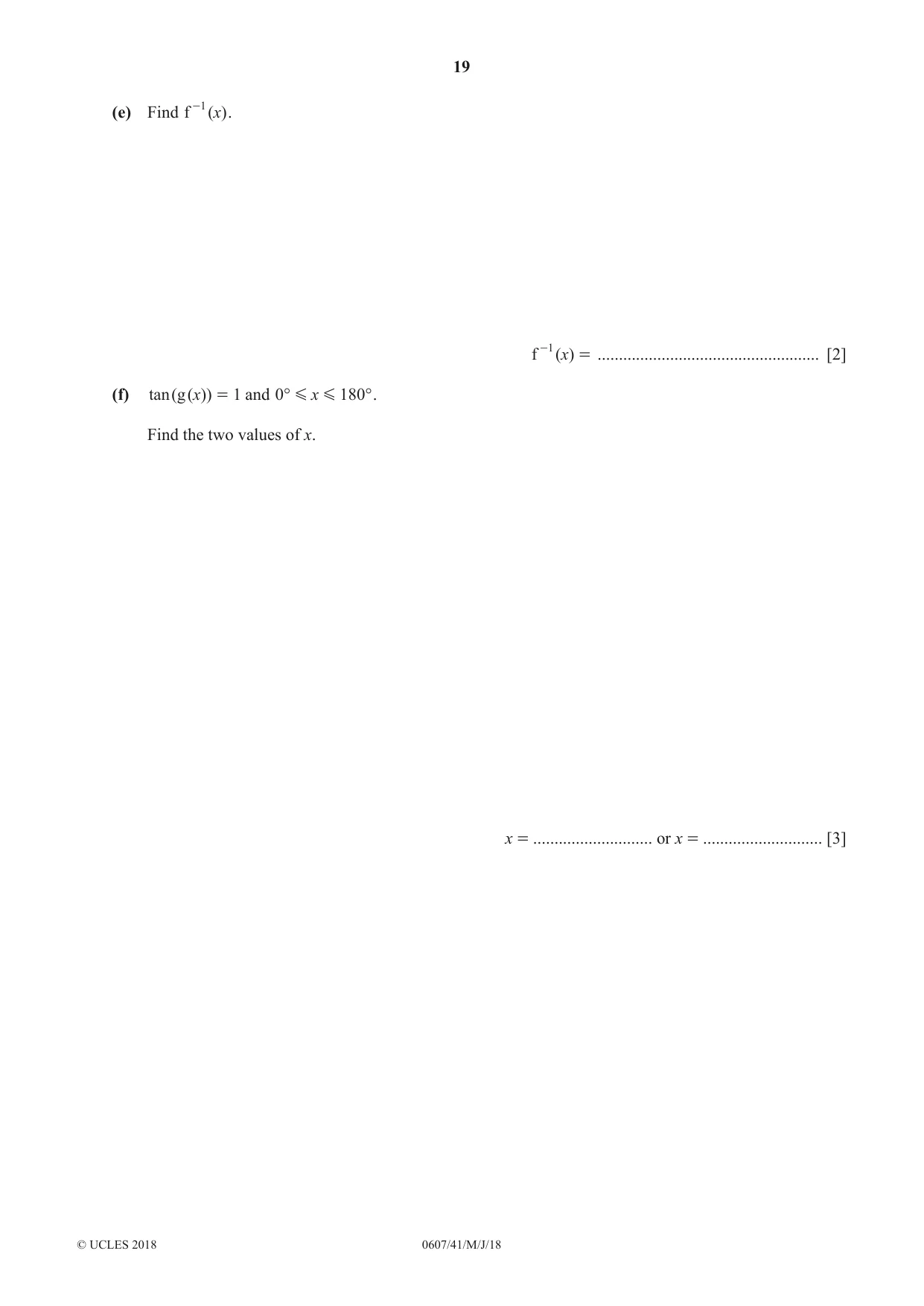
11 f ()x = 10 x g ()x = 2x - 1 (a) Find the value of g(3). ..................................................... [1] (b) Find the range of f (x) for the domain {-1, 0, 1, 2}. { ................................................... } [2] (c) Find x when g ()x = 12 . x = .................................................... [2] 2 (d) The graph of y = g (x) is translated by the vector onto the graph of h(x). e3o Find h(x). Give your answer in its simplest form. h(x) = .................................................... [3] (e) Find f -1 ()x . f -1 ()x = .................................................... [2] (f) tan (g (x)) = 1 and 0° G x G 180° . Find the two values of x. x = ............................ or x = ............................ [3]
Mark scheme: 11(a) 5 1 11(b) 0.1oe , 1, 10, 100 2 B1 for 3 correct or all correct seen and spoilt. 11(c) 6.5 oe 2 M1 for 2x – 1 = 12 11(d) 2x – 2 or 2(x – 1) 3 B2 for correct unsimplified answer OR M1 for substituting x − 2 for x M1 for adding 3 to a function in x oe OR M1 for y = 2x + c (c ≠ – 1) leading to answer with gradient 2 M1 for substituting coords of valid point into y = 2x + c 11(e) log x 2 M1 for log y = x or x = 10y 11(f) 23, 113 3 B2 for 23 or B1 for [g(x) =] 45 soi
What was in this paper
The subtopics covered by these 11 questions, and how many questions each got. Open one in a new tab to see every Cambridge question on it.
What you needed in this session
Cambridge’s own grade thresholds for 2018 May/June, Paper 4 · Variant 1. A higher threshold means an easier paper — the bar moves with how the cohort did.