Cambridge IGCSE Mathematics - International 0607 — 2017 May/June Paper 4 · Variant 1
0607/41/M/J/17 · 11 questions · 120 marks · ≈135 min
The question paper and its mark scheme, free to read here and free to download. This is Cambridge’s own paper, exactly as it was sat.
Question paper20 pages
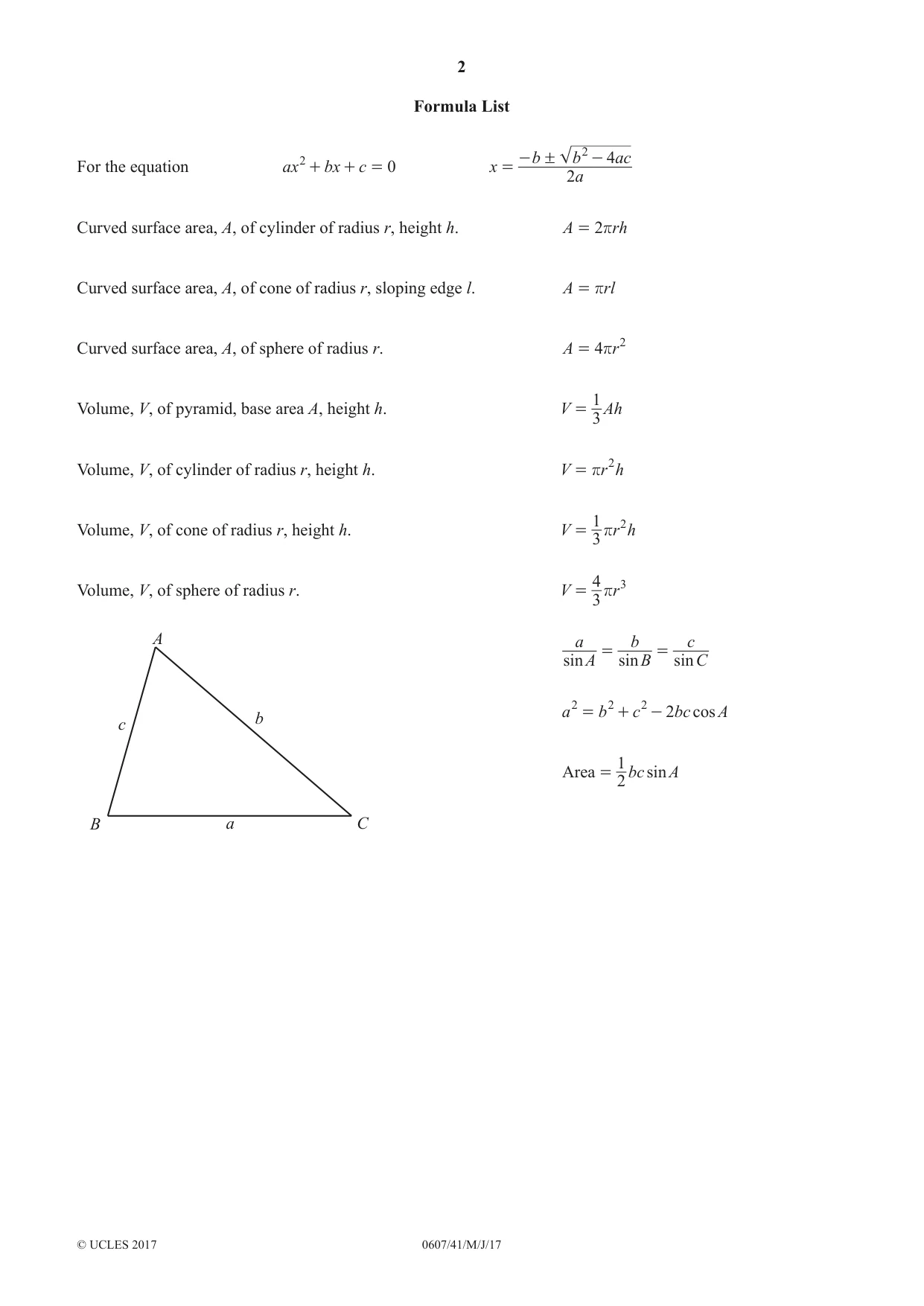
Mark scheme7 pages
Answers below. Sit the paper first if you are practising.
Questions as text
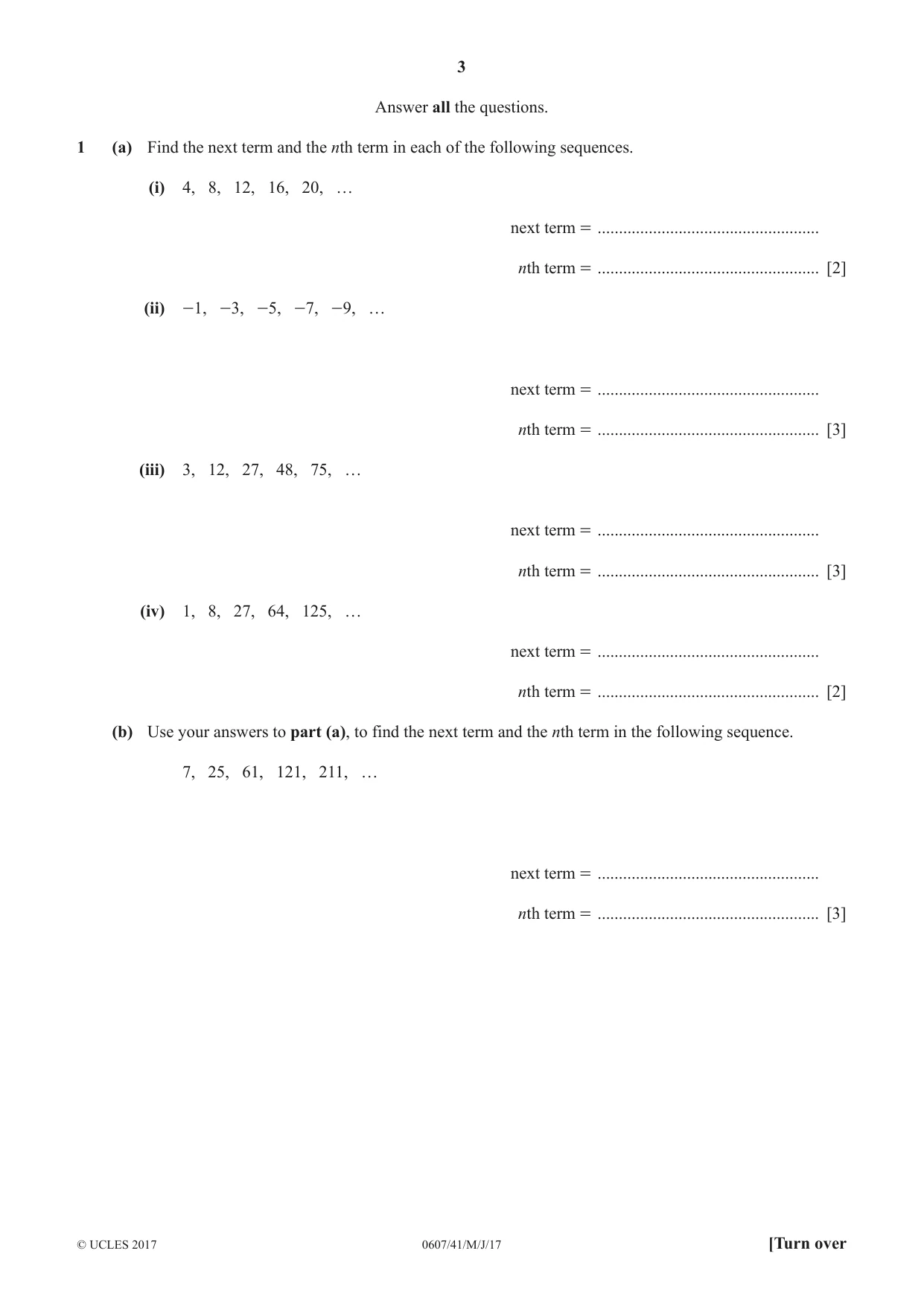
Q1 · Find the next term and the nth term in each of the following sequences
1 (a) Find the next term and the nth term in each of the following sequences. (i) 4, 8, 12, 16, 20, … next term = .................................................... nth term = .................................................... [2] (ii) -1, -3, -5, -7, -9, … next term = .................................................... nth term = .................................................... [3] (iii) 3, 12, 27, 48, 75, … next term = .................................................... nth term = .................................................... [3] (iv) 1, 8, 27, 64, 125, … next term = .................................................... nth term = .................................................... [2] (b) Use your answers to part (a), to find the next term and the nth term in the following sequence. 7, 25, 61, 121, 211, … next term = .................................................... nth term = .................................................... [3]
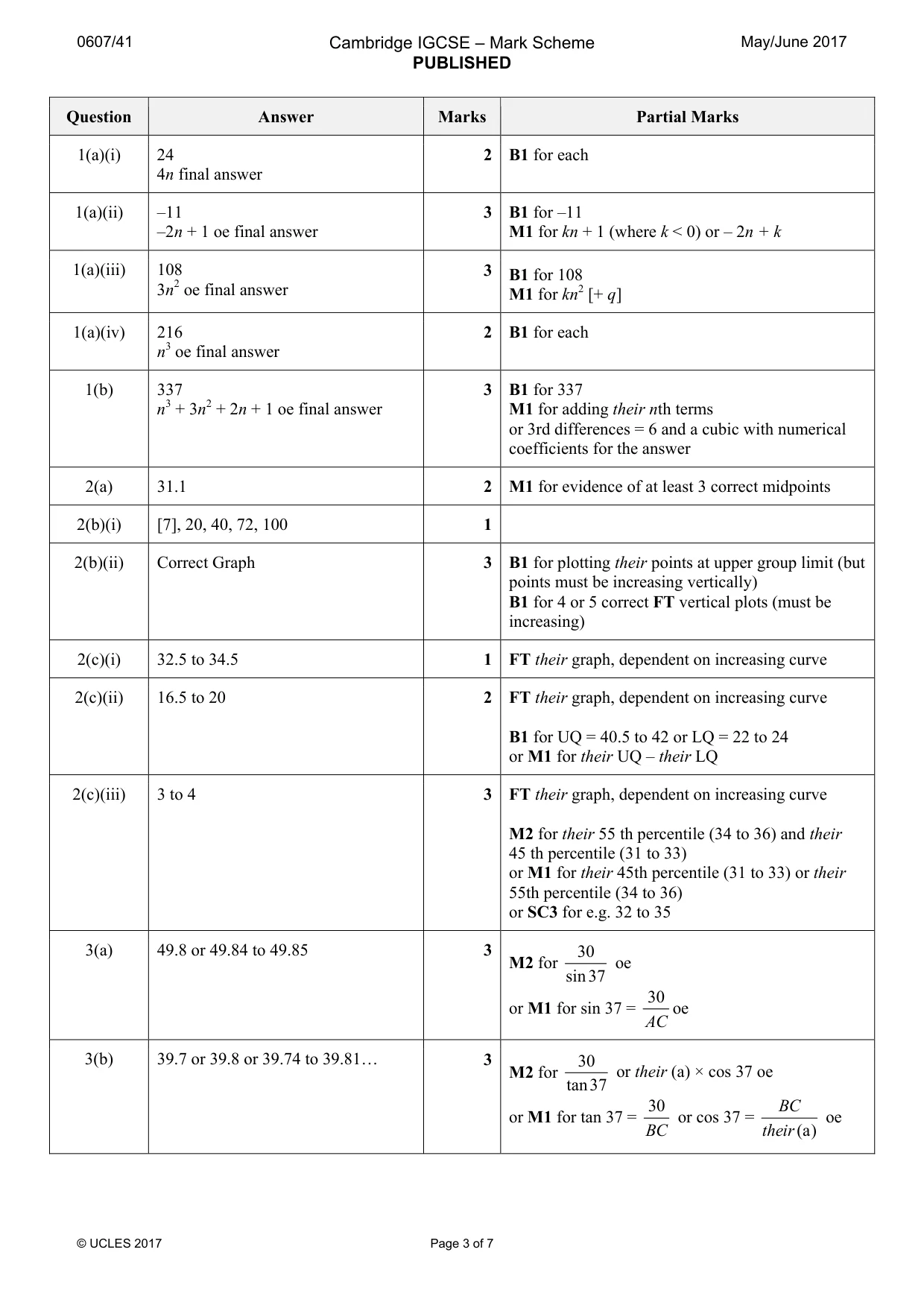
Mark scheme: Question Answer Marks Partial Marks 1(a)(i) 24 2 B1 for each 4n final answer 1(a)(ii) –11 3 B1 for –11 –2n + 1 oe final answer M1 for kn + 1 (where k < 0) or – 2n + k 1(a)(iii) 108 3 B1 for 108 3n2 oe final answer M1 for kn2 [+ q] 1(a)(iv) 216 2 B1 for each n3 oe final answer 1(b) 337 3 B1 for 337 n3 + 3n2 + 2n + 1 oe final answer M1 for adding their nth terms or 3rd differences = 6 and a cubic with numerical coefficients for the answer
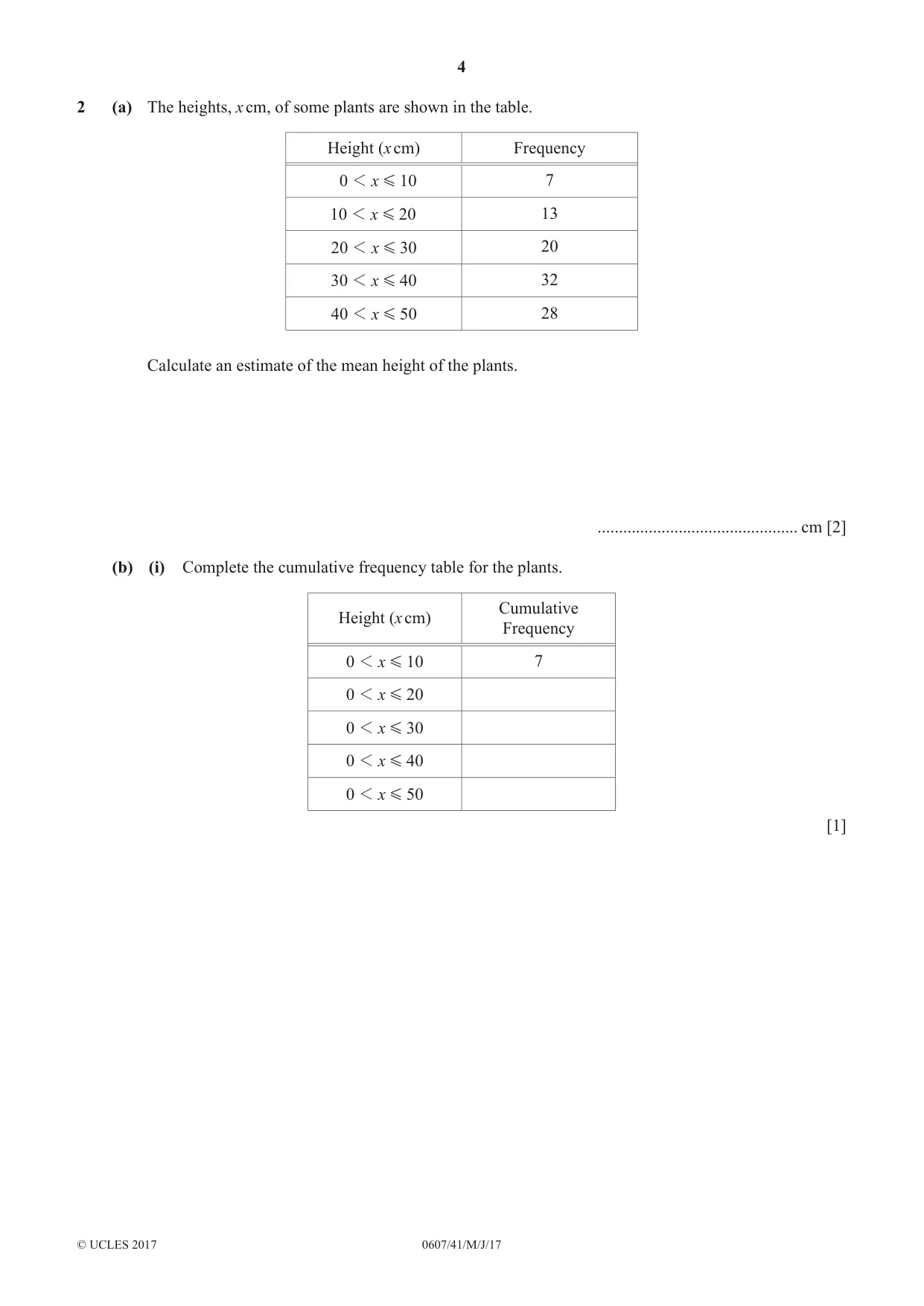
Q2 · The heights, x cm, of some plants are shown in the table
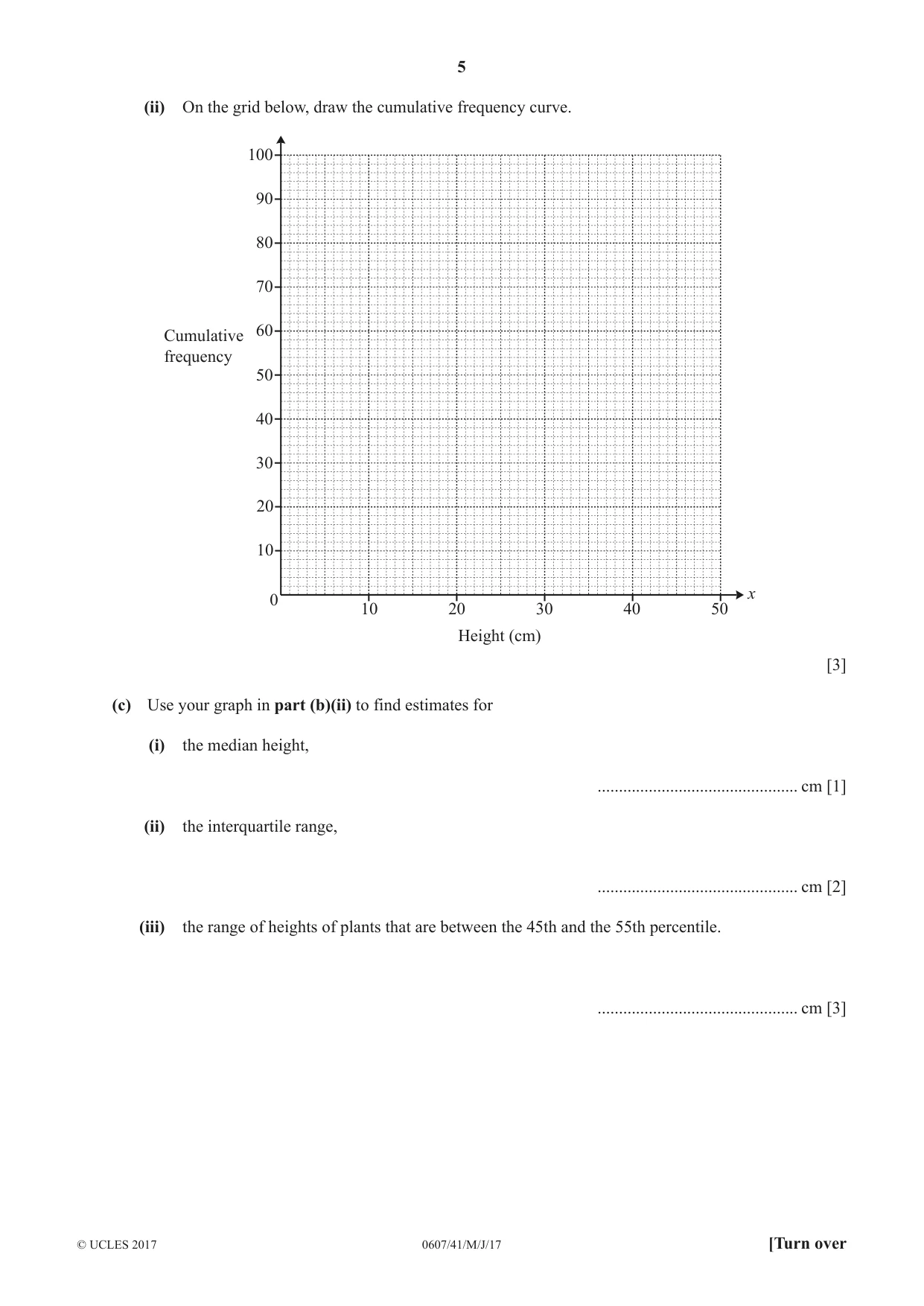
2 (a) The heights, x cm, of some plants are shown in the table. Height (x cm) Frequency 0 1 x G 10 7 10 1 x G 20 13 20 1 x G 30 20 30 1 x G 40 32 40 1 x G 50 28 Calculate an estimate of the mean height of the plants. ............................................... cm [2] (b) (i) Complete the cumulative frequency table for the plants. Cumulative Height (x cm) Frequency 0 1 x G 10 7 0 1 x G 20 0 1 x G 30 0 1 x G 40 0 1 x G 50 [1] (ii) On the grid below, draw the cumulative frequency curve. 100 90 80 70 60 Cumulative frequency 50 40 30 20 10 x 0 10 20 30 40 50 Height (cm) [3] (c) Use your graph in part (b)(ii) to find estimates for (i) the median height, ............................................... cm [1] (ii) the interquartile range, ............................................... cm [2] (iii) the range of heights of plants that are between the 45th and the 55th percentile. ............................................... cm [3]
Mark scheme: 2(a) 31.1 2 M1 for evidence of at least 3 correct midpoints 2(b)(i) [7], 20, 40, 72, 100 1 2(b)(ii) Correct Graph 3 B1 for plotting their points at upper group limit (but points must be increasing vertically) B1 for 4 or 5 correct FT vertical plots (must be increasing) 2(c)(i) 32.5 to 34.5 1 FT their graph, dependent on increasing curve 2(c)(ii) 16.5 to 20 2 FT their graph, dependent on increasing curve B1 for UQ = 40.5 to 42 or LQ = 22 to 24 or M1 for their UQ – their LQ 2(c)(iii) 3 to 4 3 FT their graph, dependent on increasing curve M2 for their 55 th percentile (34 to 36) and their 45 th percentile (31 to 33) or M1 for their 45th percentile (31 to 33) or their 55th percentile (34 to 36) or SC3 for e.g. 32 to 35
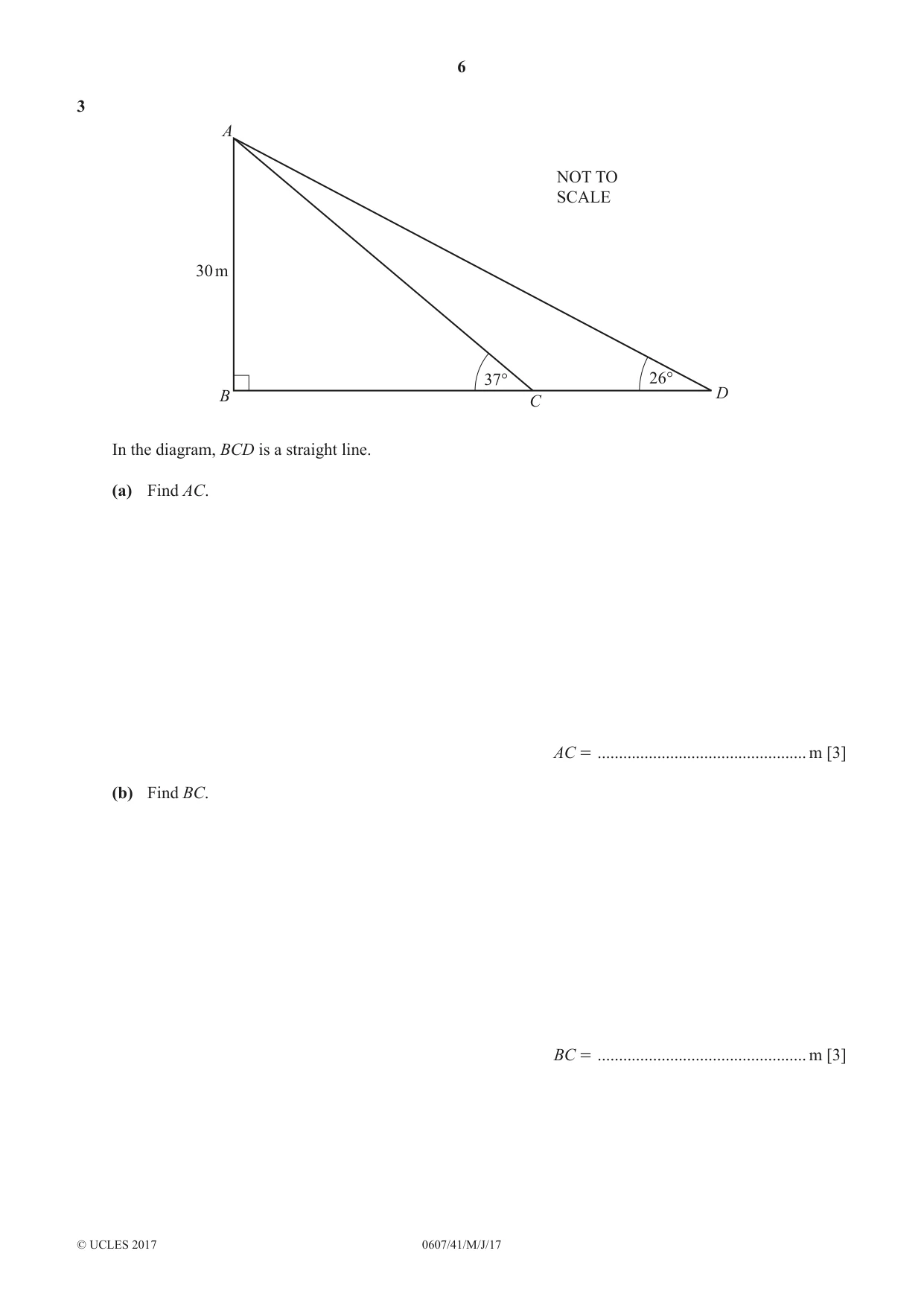
Q3 · A NOT TO SCALE 30 m 37° 26° B D C In the diagram, BCD is a straight line
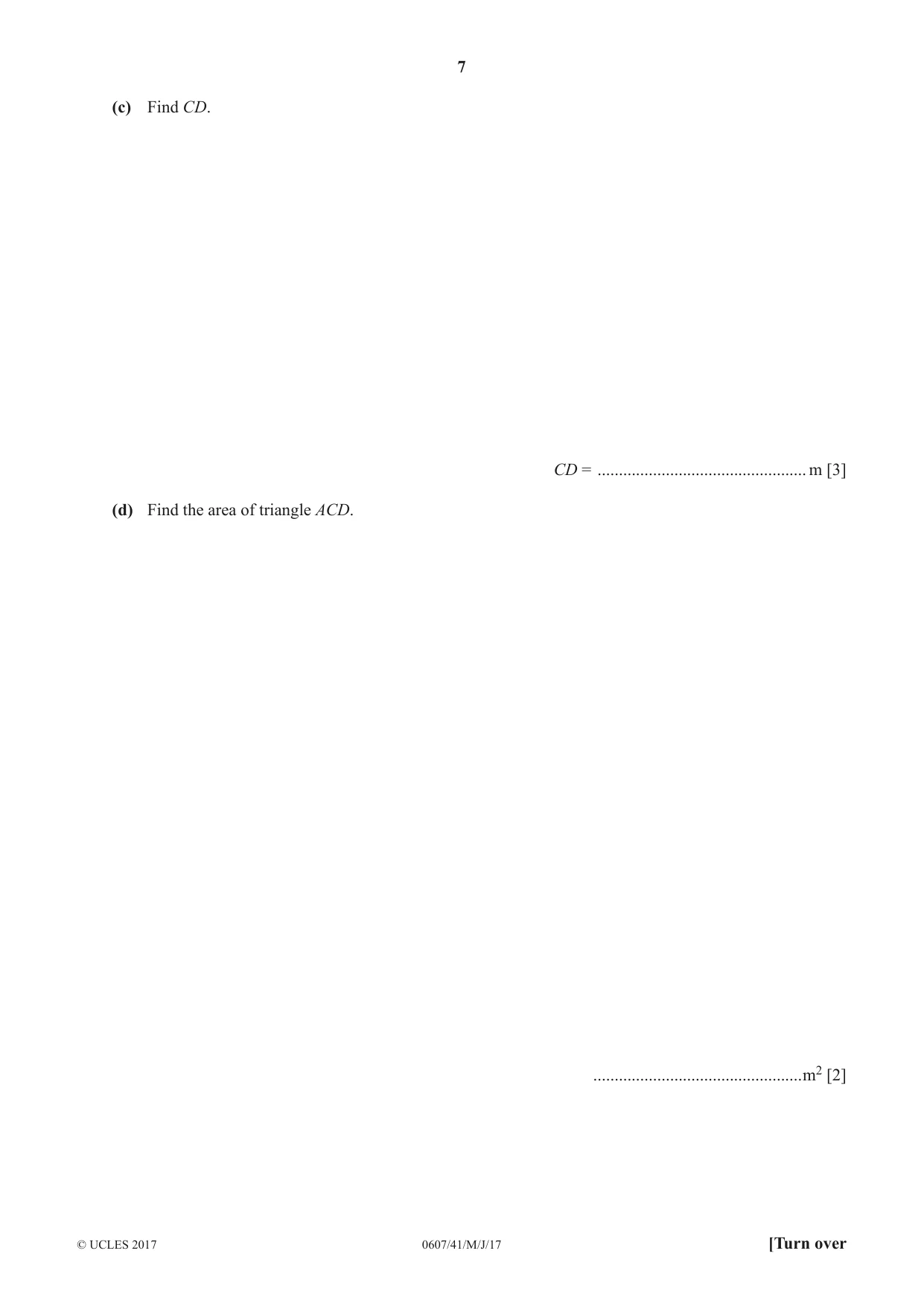
3 A NOT TO SCALE 30 m 37° 26° B D C In the diagram, BCD is a straight line. (a) Find AC. AC = ................................................. m [3] (b) Find BC. BC = ................................................. m [3] (c) Find CD. CD = ................................................. m [3] (d) Find the area of triangle ACD. .................................................m2 [2]
Mark scheme: 3(a) 49.8 or 49.84 to 49.85 3 30 M2 for oe sin37 30 or M1 for sin 37 = oe AC 3(b) 39.7 or 39.8 or 39.74 to 39.81… 3 30 M2 for or their (a) × cos 37 oe tan37 30 BC or M1 for tan 37 = or cos 37 = oe BC their (a) 3(c) 3 30 21.7 or 21.8 or 21.67 to 21.81 M2 for – their(b) tan 26 (their (a)) × sin(180 − (180 − 37) − 26) or oe sin26 30 or M1 for tan 26 their (a) CD or = oe sin26 sin(180 − (180 − 37) − 26) 3(d) 325 or 326 or 327 2 1 M1 for × their (c) × 30 oe or 325[.0] to 327.2 2
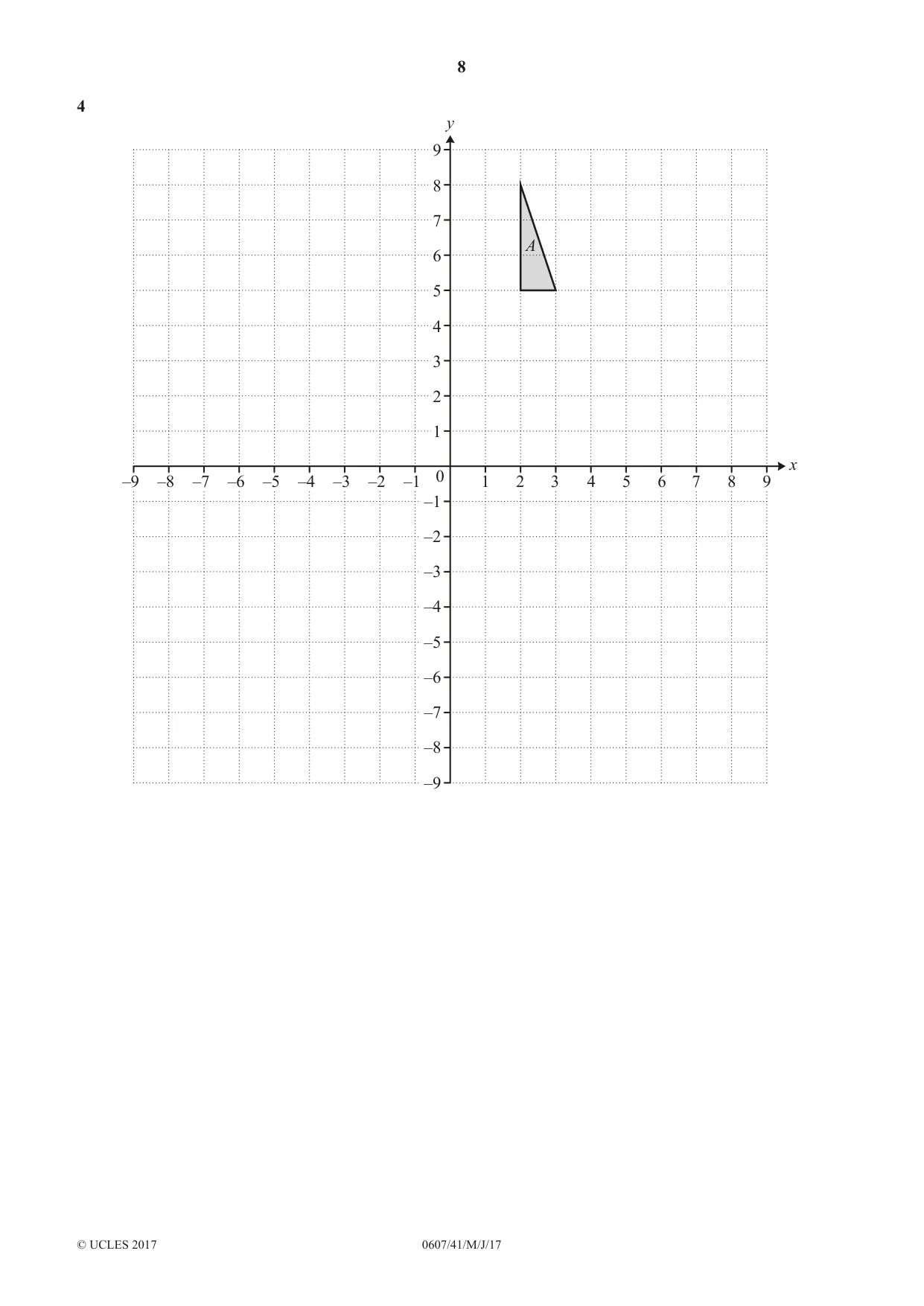
Q4 · Y 9 8 7 A 6 5 4 3 2 1 x 0 –9 –8 –7 –6 –5 –4 –3 –2 –1 1 2 3 4 5 6 7 8 9 –1 –2 –3 –4 –5 –6…
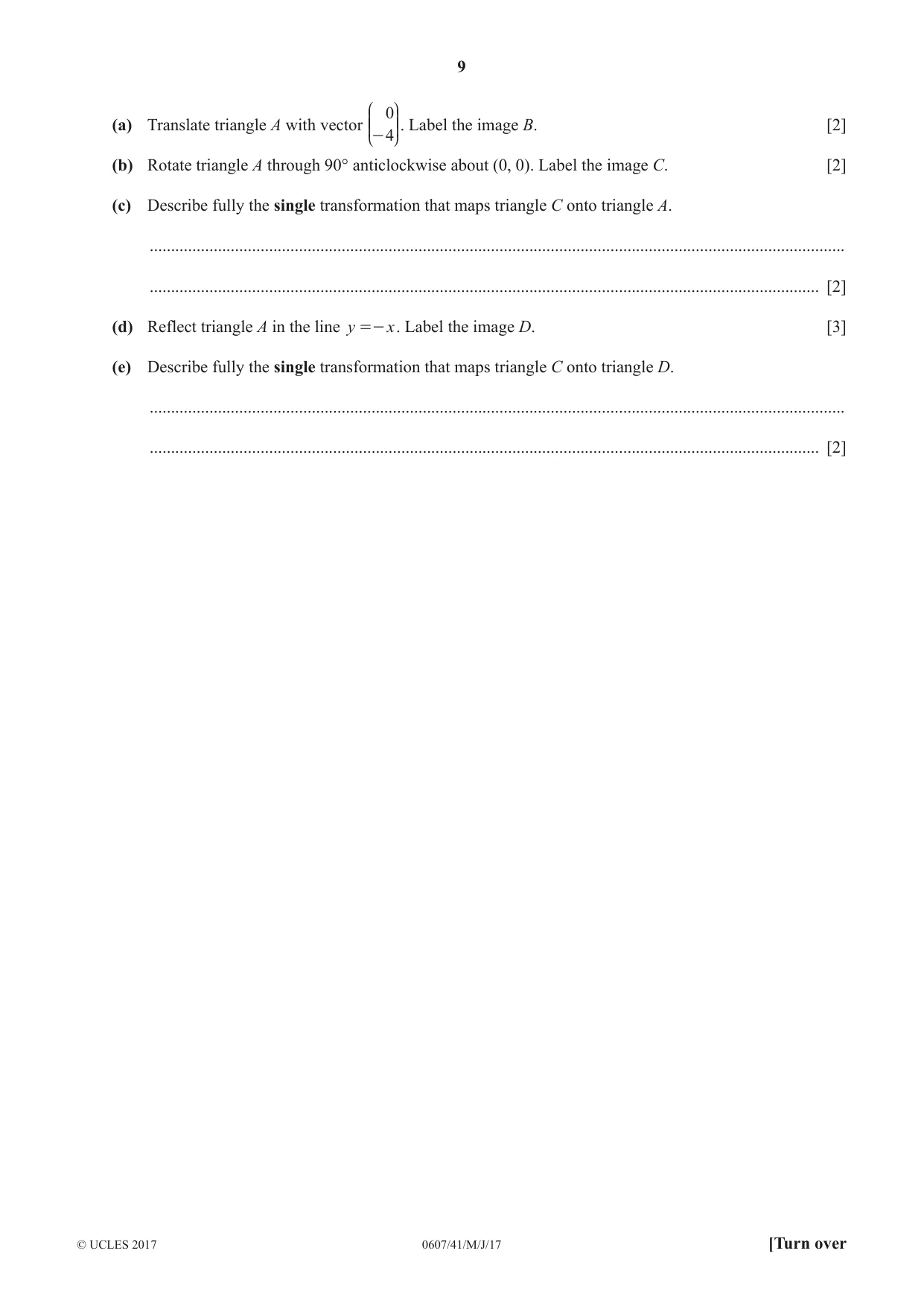
4 y 9 8 7 A 6 5 4 3 2 1 x 0 –9 –8 –7 –6 –5 –4 –3 –2 –1 1 2 3 4 5 6 7 8 9 –1 –2 –3 –4 –5 –6 –7 –8 –9 J N 0 (a) Translate triangle A with vector KK OO. Label the image B. [2] - 4 L P (b) Rotate triangle A through 90° anticlockwise about (0, 0). Label the image C. [2] (c) Describe fully the single transformation that maps triangle C onto triangle A. ................................................................................................................................................................... ............................................................................................................................................................. [2] (d) Reflect triangle A in the line y =- x . Label the image D. [3] (e) Describe fully the single transformation that maps triangle C onto triangle D. ................................................................................................................................................................... ............................................................................................................................................................. [2]
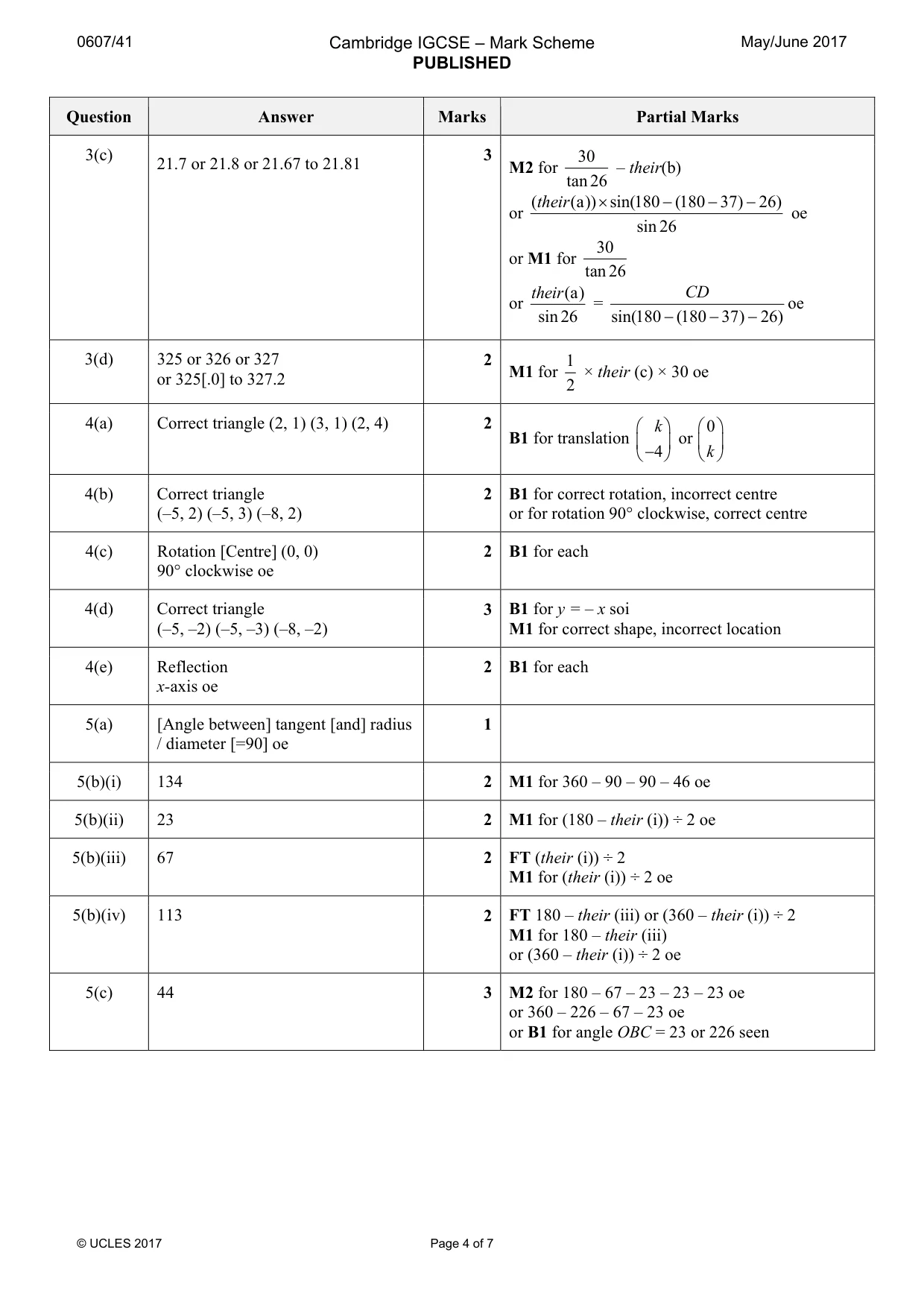
Mark scheme: 4(a) Correct triangle (2, 1) (3, 1) (2, 4) 2 k 0 B1 for translation or − 4 k 4(b) Correct triangle 2 B1 for correct rotation, incorrect centre (–5, 2) (–5, 3) (–8, 2) or for rotation 90° clockwise, correct centre 4(c) Rotation [Centre] (0, 0) 2 B1 for each 90° clockwise oe 4(d) Correct triangle 3 B1 for y = – x soi (–5, –2) (–5, –3) (–8, –2) M1 for correct shape, incorrect location 4(e) Reflection 2 B1 for each x-axis oe
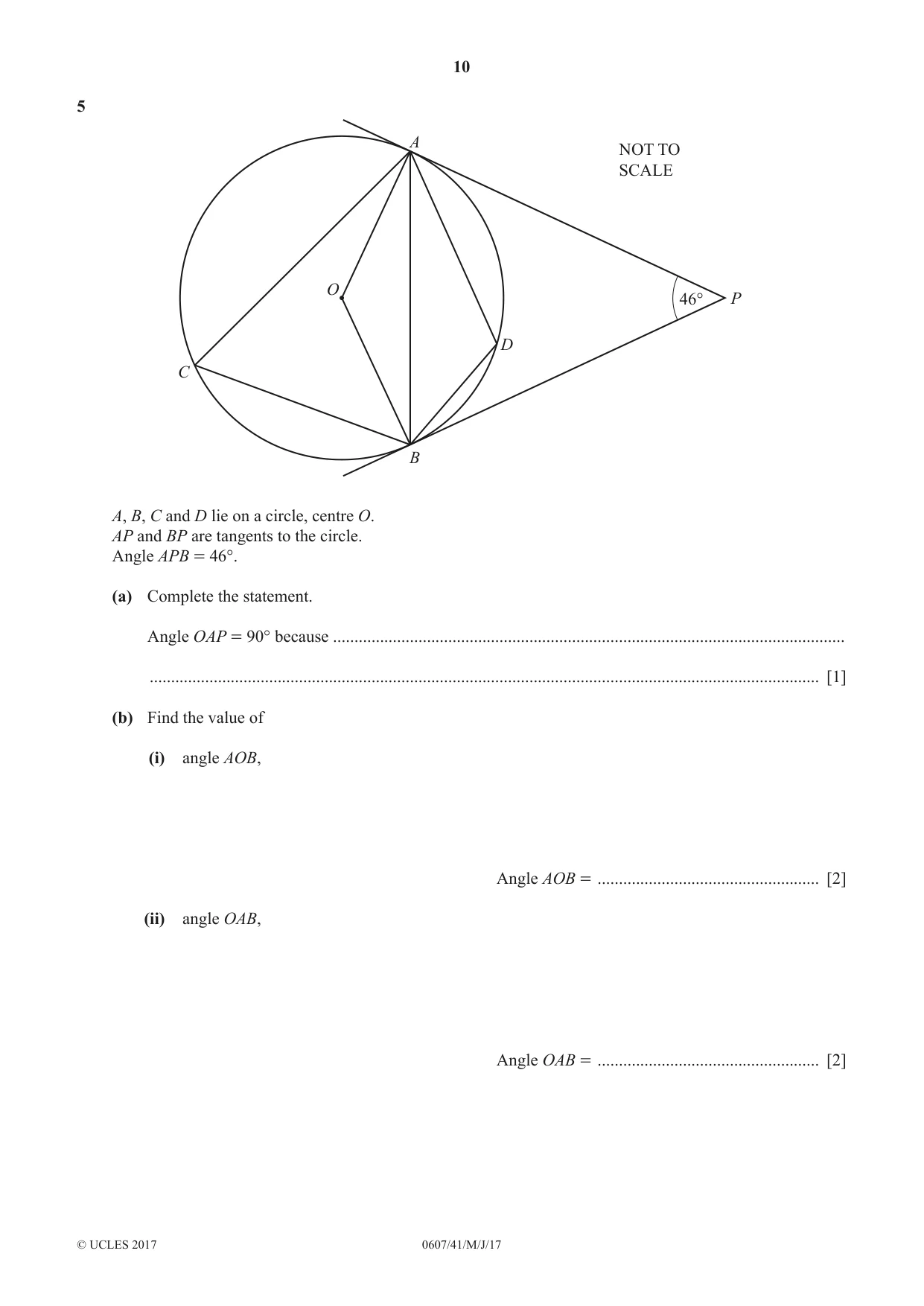
Q5 · A NOT TO SCALE O 46° P D C B A, B, C and D lie on a circle, centre O
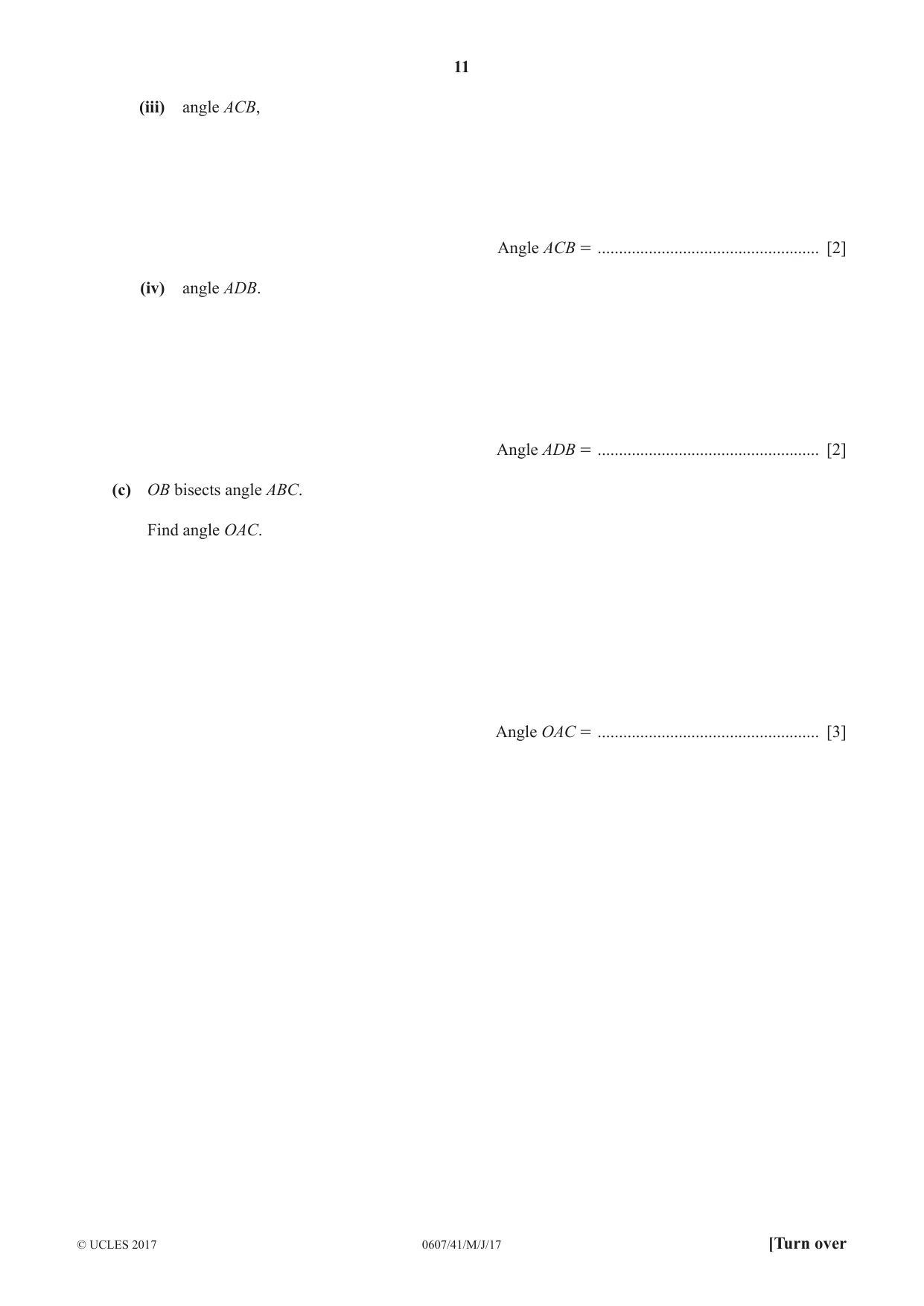
5 A NOT TO SCALE O 46° P D C B A, B, C and D lie on a circle, centre O. AP and BP are tangents to the circle. Angle APB = 46°. (a) Complete the statement. Angle OAP = 90° because ........................................................................................................................ ............................................................................................................................................................. [1] (b) Find the value of (i) angle AOB, Angle AOB = .................................................... [2] (ii) angle OAB, Angle OAB = .................................................... [2] (iii) angle ACB, Angle ACB = .................................................... [2] (iv) angle ADB. Angle ADB = .................................................... [2] (c) OB bisects angle ABC. Find angle OAC. Angle OAC = .................................................... [3]
Mark scheme: 5(a) [Angle between] tangent [and] radius 1 / diameter [=90] oe 5(b)(i) 134 2 M1 for 360 – 90 – 90 – 46 oe 5(b)(ii) 23 2 M1 for (180 – their (i)) ÷ 2 oe 5(b)(iii) 67 2 FT (their (i)) ÷ 2 M1 for (their (i)) ÷ 2 oe 5(b)(iv) 113 2 FT 180 – their (iii) or (360 – their (i)) ÷ 2 M1 for 180 – their (iii) or (360 – their (i)) ÷ 2 oe 5(c) 44 3 M2 for 180 – 67 – 23 – 23 – 23 oe or 360 – 226 – 67 – 23 oe or B1 for angle OBC = 23 or 226 seen
Q6 · Y varies inversely as the square of x
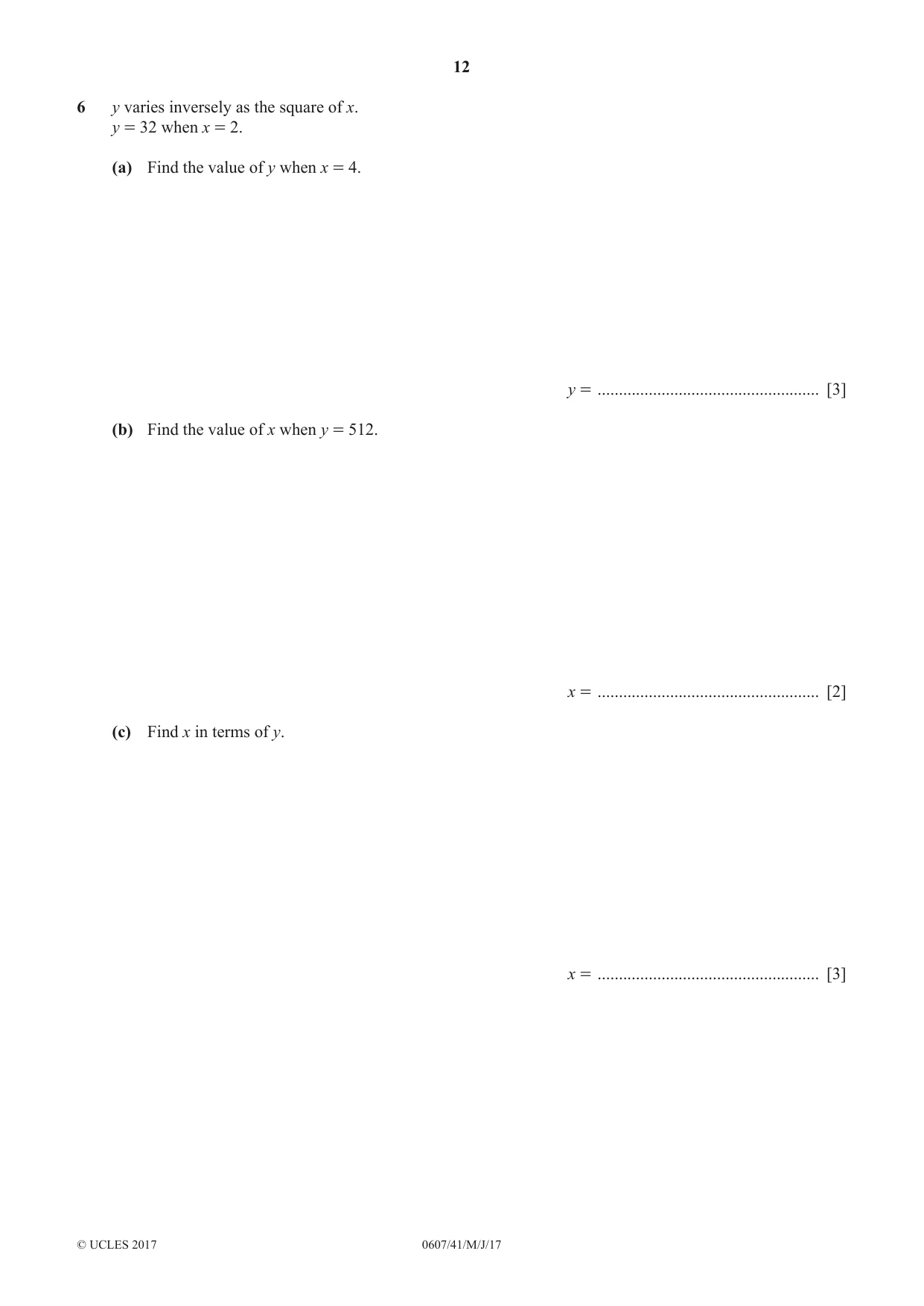
6 y varies inversely as the square of x. y = 32 when x = 2. (a) Find the value of y when x = 4. y = .................................................... [3] (b) Find the value of x when y = 512. x = .................................................... [2] (c) Find x in terms of y. x = .................................................... [3]
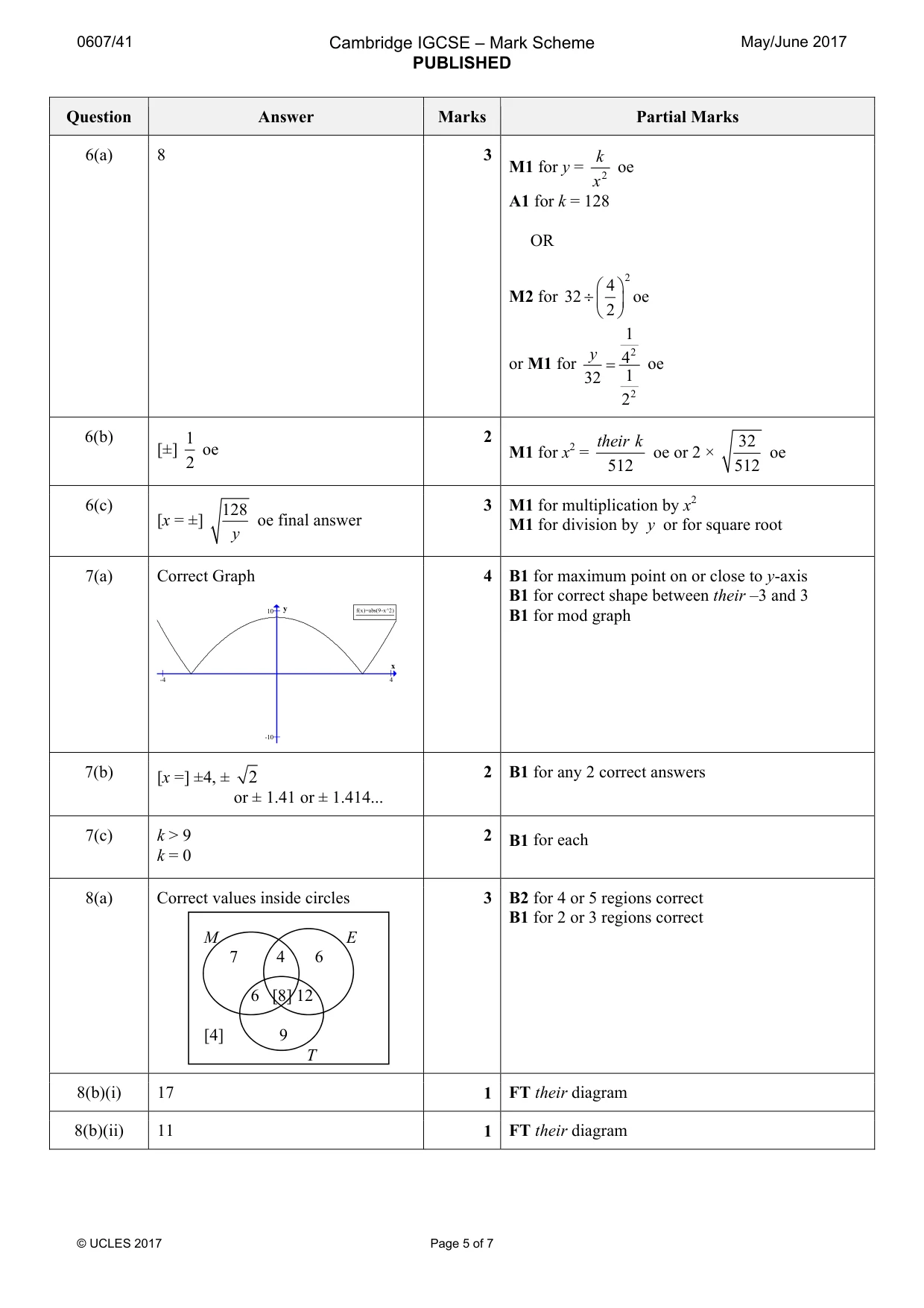
Mark scheme: 6(a) 8 3 k M1 for y = oe x 2 A1 for k = 128 OR 4 2 M2 for 32 ÷ oe 2 1 y 4 2 or M1 for = oe 32 1 2 2 6(b) 1 2 their k 32 [±] oe M1 for x2 = oe or 2 × oe 2 512 512 6(c) 128 3 M1 for multiplication by x2 [x = ±] oe final answer M1 for division by y or for square root y
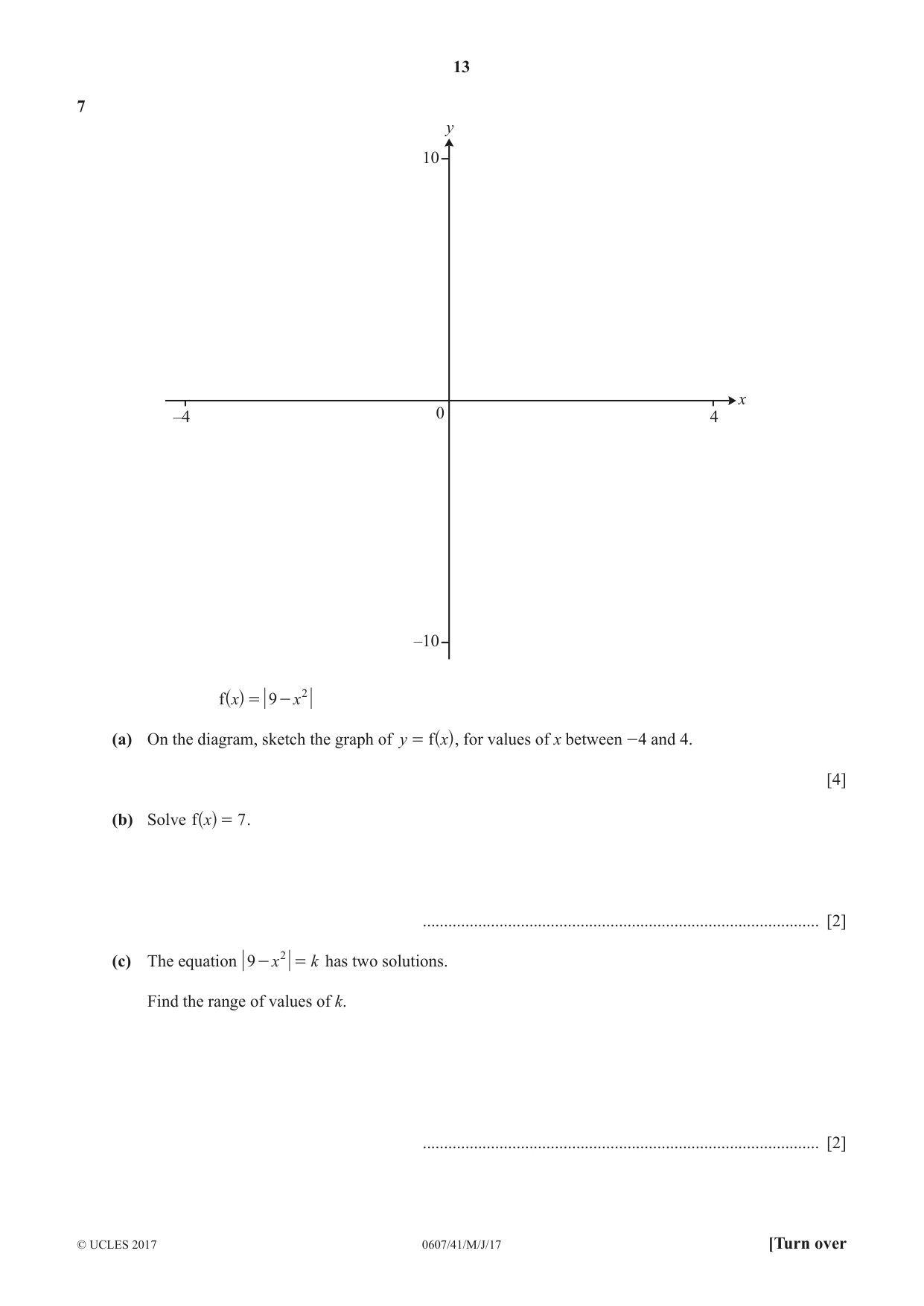
Q7 · Y 10 x –4 0 4 –10 f x = 9 - x 2 ^ h (a) On the diagram, sketch the graph of y = f x for…
7 y 10 x –4 0 4 –10 f x = 9 - x 2 ^ h (a) On the diagram, sketch the graph of y = f x for values of x between -4 and 4. ^ h, [4] (b) Solve f x = 7 . ^ h ............................................................................................. [2] (c) The equation 9 - x 2 = k has two solutions. Find the range of values of k. ............................................................................................. [2]
Mark scheme: 7(a) Correct Graph 4 B1 for maximum point on or close to y-axis B1 for correct shape between their –3 and 3 10 y f(x)=abs(9-x^2) B1 for mod graph x -4 4 -10 7(b) [x =] ±4, ± 2 2 B1 for any 2 correct answers or ± 1.41 or ± 1.414... 7(c) k > 9 2 B1 for each k = 0
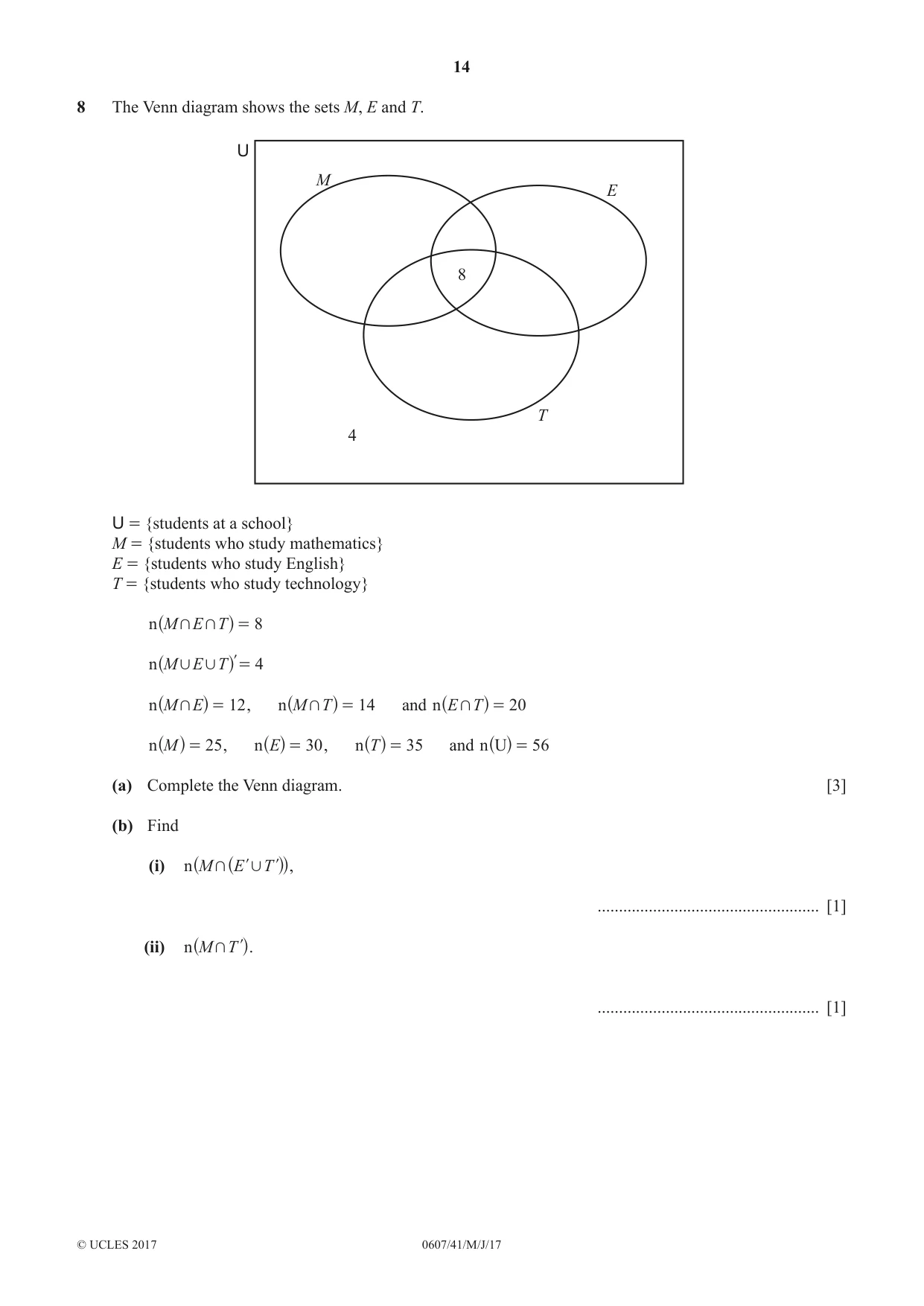
Q8 · The Venn diagram shows the sets M, E and T
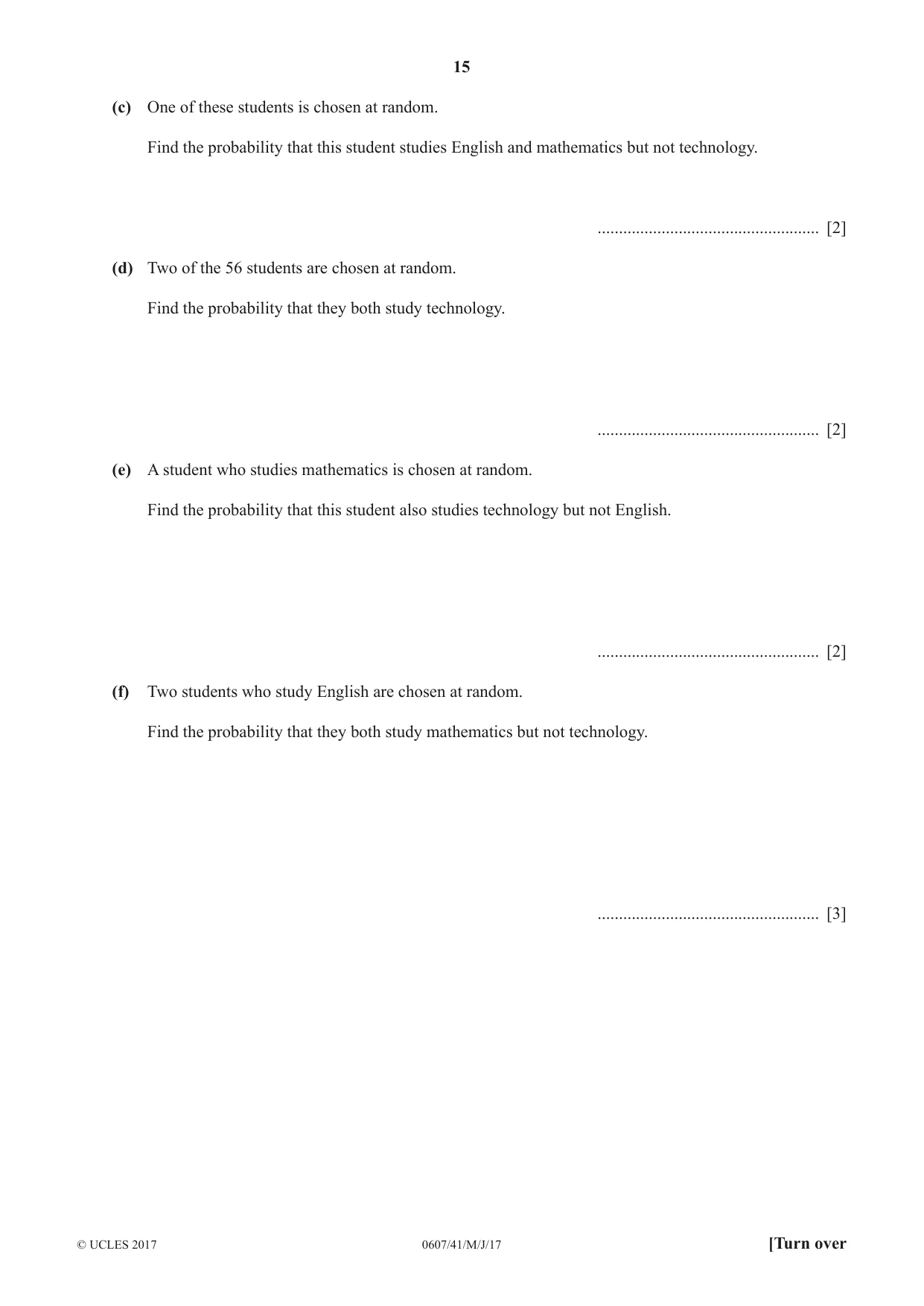
8 The Venn diagram shows the sets M, E and T. U M E 8 T 4 U = {students at a school} M = {students who study mathematics} E = {students who study English} T = {students who study technology} n M + E + T = 8 ^ h n M , E , T l = 4 ^ h n M + E = 12 , n M + T = 14 and n E + T = 20 ^ h ^ h ^ h n M = 25 , n E = 30 , n T = 35 and n U = 56 ^ h ^ h ^ h ^ h (a) Complete the Venn diagram. [3] (b) Find (i) n M + E l , T l ^ ^ hh, .................................................... [1] (ii) n M + T l ^ h. .................................................... [1] (c) One of these students is chosen at random. Find the probability that this student studies English and mathematics but not technology. .................................................... [2] (d) Two of the 56 students are chosen at random. Find the probability that they both study technology. .................................................... [2] (e) A student who studies mathematics is chosen at random. Find the probability that this student also studies technology but not English. .................................................... [2] (f) Two students who study English are chosen at random. Find the probability that they both study mathematics but not technology. .................................................... [3]
Mark scheme: 8(a) Correct values inside circles 3 B2 for 4 or 5 regions correct B1 for 2 or 3 regions correct M E 7 4 6 6 [8] 12 [4] 9 T 8(b)(i) 17 1 FT their diagram 8(b)(ii) 11 1 FT their diagram 8(c) 4 2 FT their 4 oe their 4 p 56 M1 for (k > their 4) or (p < 56) k 56 8(d) 1190 2 35 34 oe M1 for × 3080 56 55 8(e) 6 2 FT their 6 oe their 6 p 25 M1 for (k > their 6) or (p < 25) k 25 8(f) 12 3 their 4 (their 4) − 1 oe M2 for × (their 4 < 30) 870 30 29 a a − 1 or M1 for × (their a < 30) 30 29
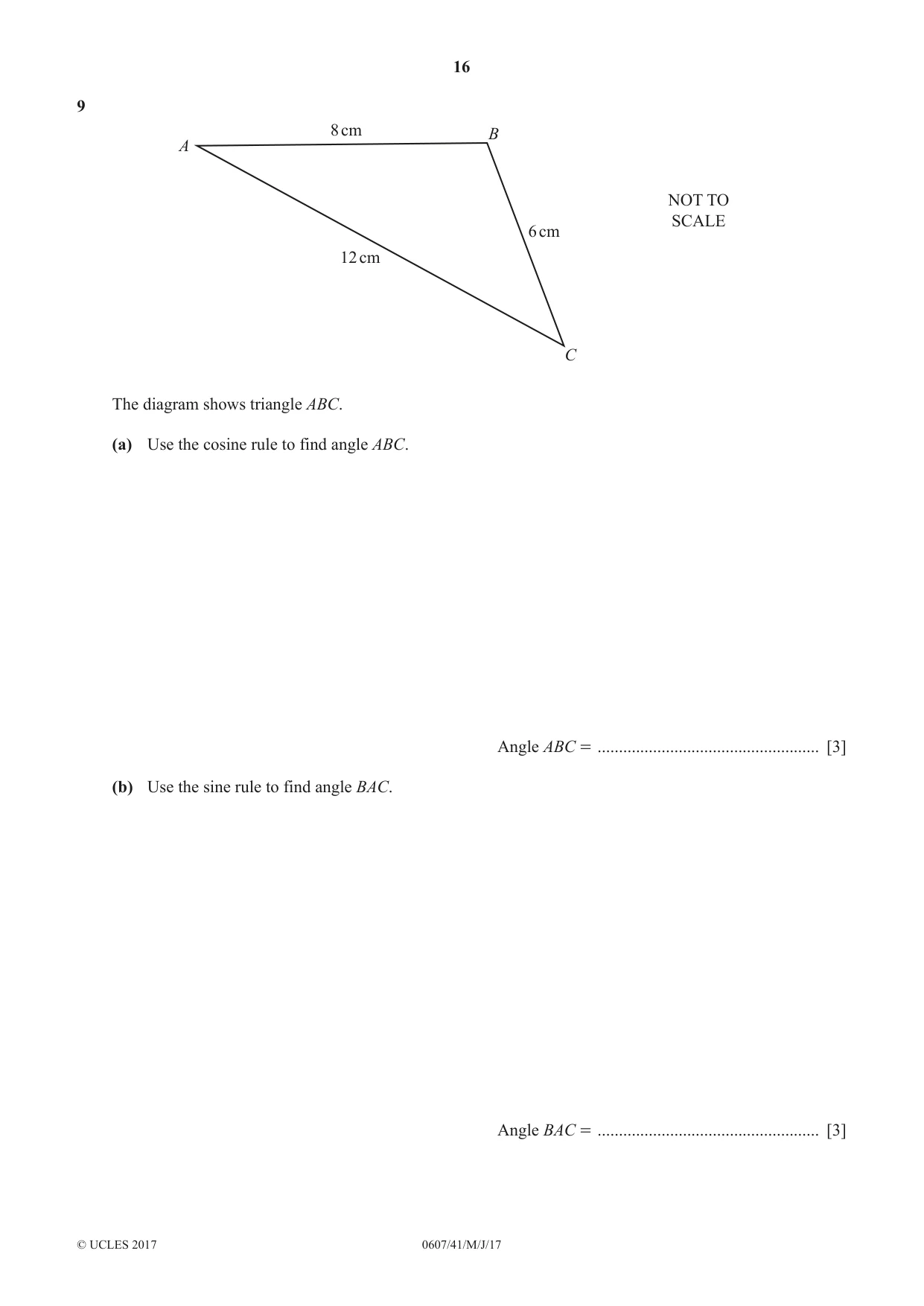
Q9 · 8 cm B A NOT TO SCALE 6 cm 12 cm C The diagram shows triangle ABC
9 8 cm B A NOT TO SCALE 6 cm 12 cm C The diagram shows triangle ABC. (a) Use the cosine rule to find angle ABC. Angle ABC = .................................................... [3] (b) Use the sine rule to find angle BAC. Angle BAC = .................................................... [3]
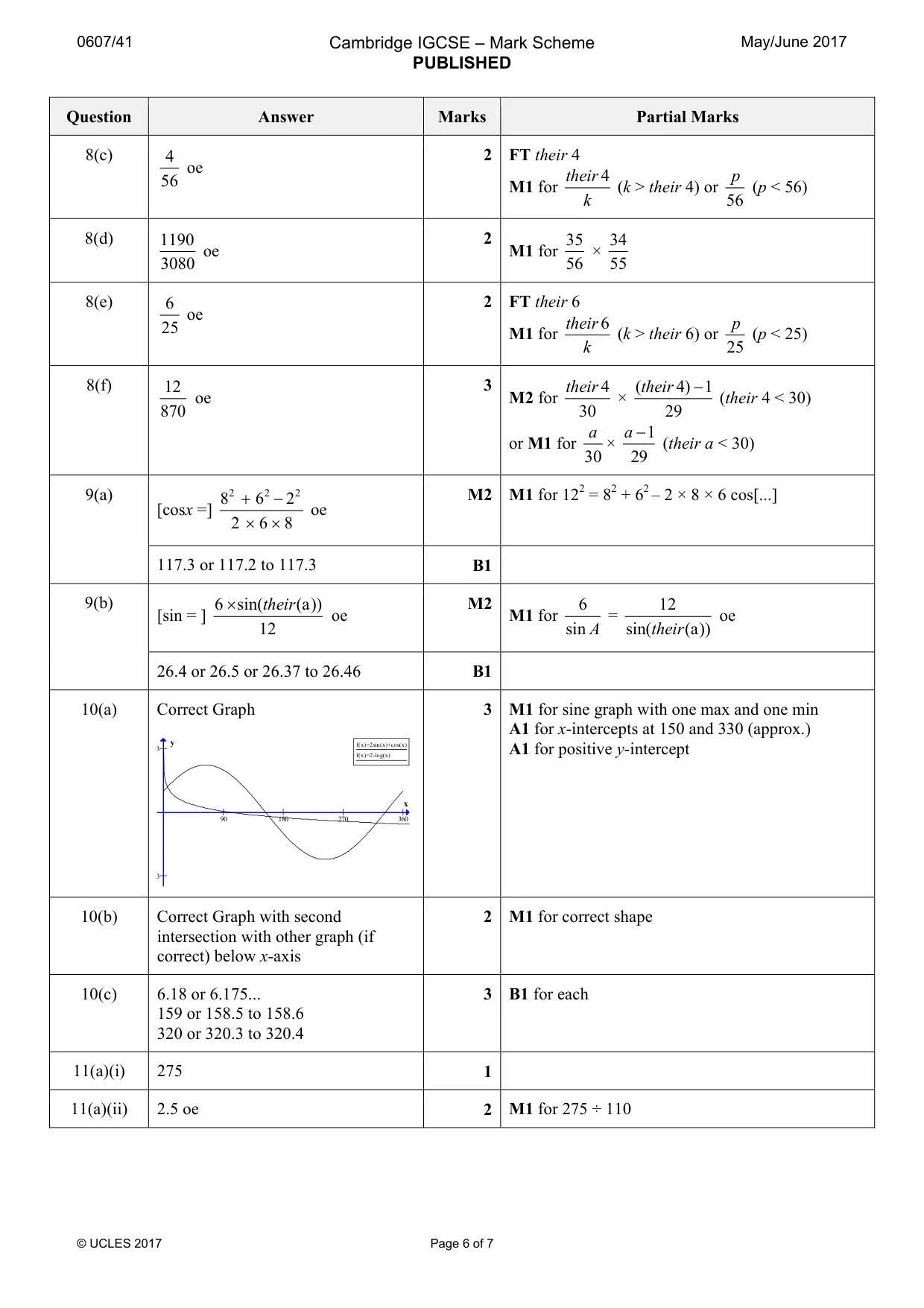
Mark scheme: 9(a) 8 2 + 6 2 − 2 2 M2 M1 for 122 = 82 + 62 – 2 × 8 × 6 cos[...] [cosx =] oe 2 × 6 × 8 117.3 or 117.2 to 117.3 B1 9(b) 6 × sin(their (a)) M2 6 12 [sin = ] oe M1 for = oe 12 sin A sin(their (a)) 26.4 or 26.5 or 26.37 to 26.46 B1
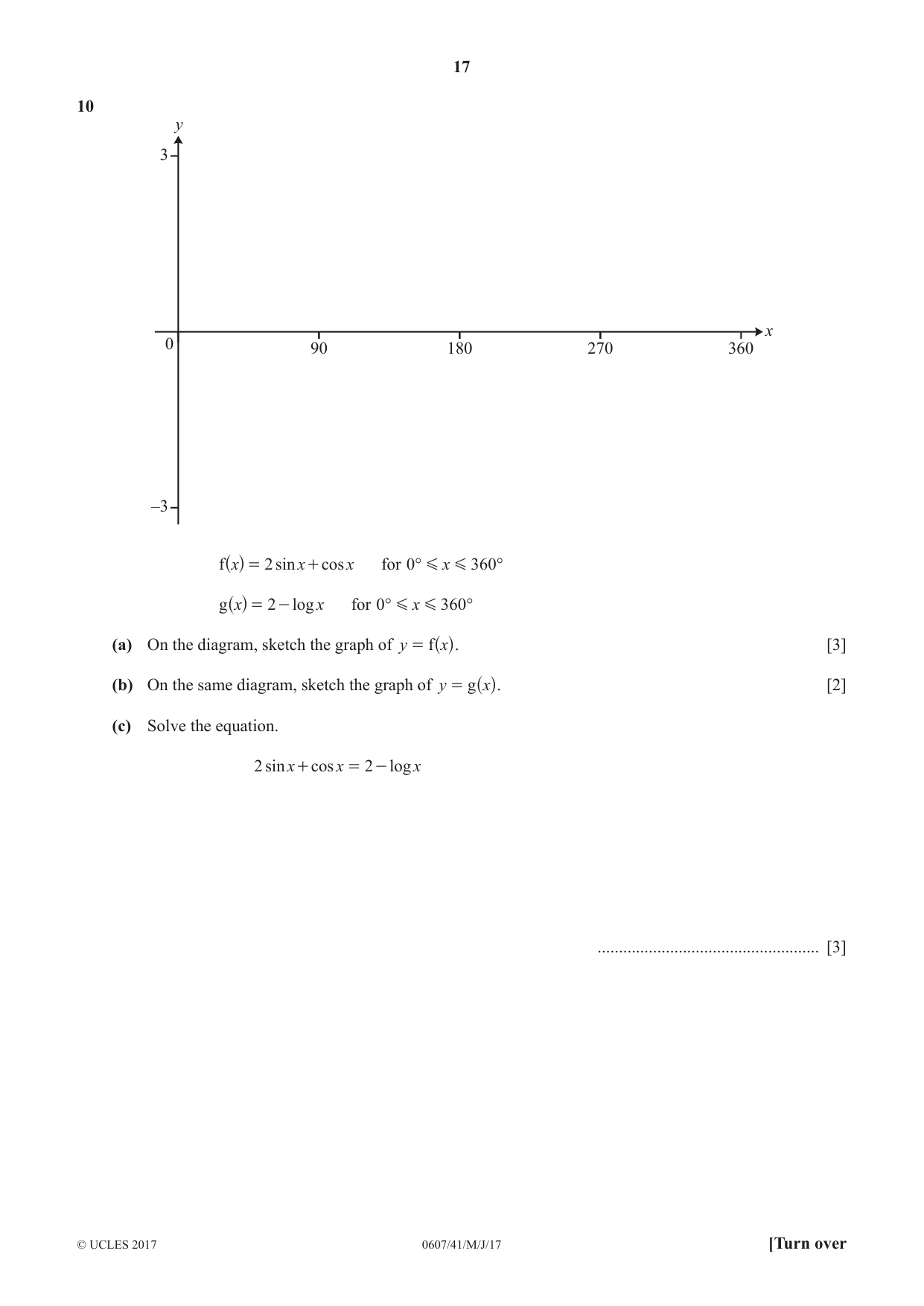
Q10 · Y 3 x 0 90 180 270 360 –3 f x = 2 sin x + cos x for 0° G x G 360 ° ^ h g x = 2 - log x…
10 y 3 x 0 90 180 270 360 –3 f x = 2 sin x + cos x for 0° G x G 360 ° ^ h g x = 2 - log x for 0° G x G 360° ^ h (a) On the diagram, sketch the graph of y = f x [3] ^ h. (b) On the same diagram, sketch the graph of y = g x [2] ^ h. (c) Solve the equation. 2 sin x + cos x = 2 - log x .................................................... [3]
Mark scheme: 10(a) Correct Graph 3 M1 for sine graph with one max and one min A1 for x-intercepts at 150 and 330 (approx.) y f(x)=2sin(x)+cos(x) 3 f(x)=2-log(x) A1 for positive y-intercept x 90 180 270 360 3 10(b) Correct Graph with second 2 M1 for correct shape intersection with other graph (if correct) below x-axis 10(c) 6.18 or 6.175... 3 B1 for each 159 or 158.5 to 158.6 320 or 320.3 to 320.4
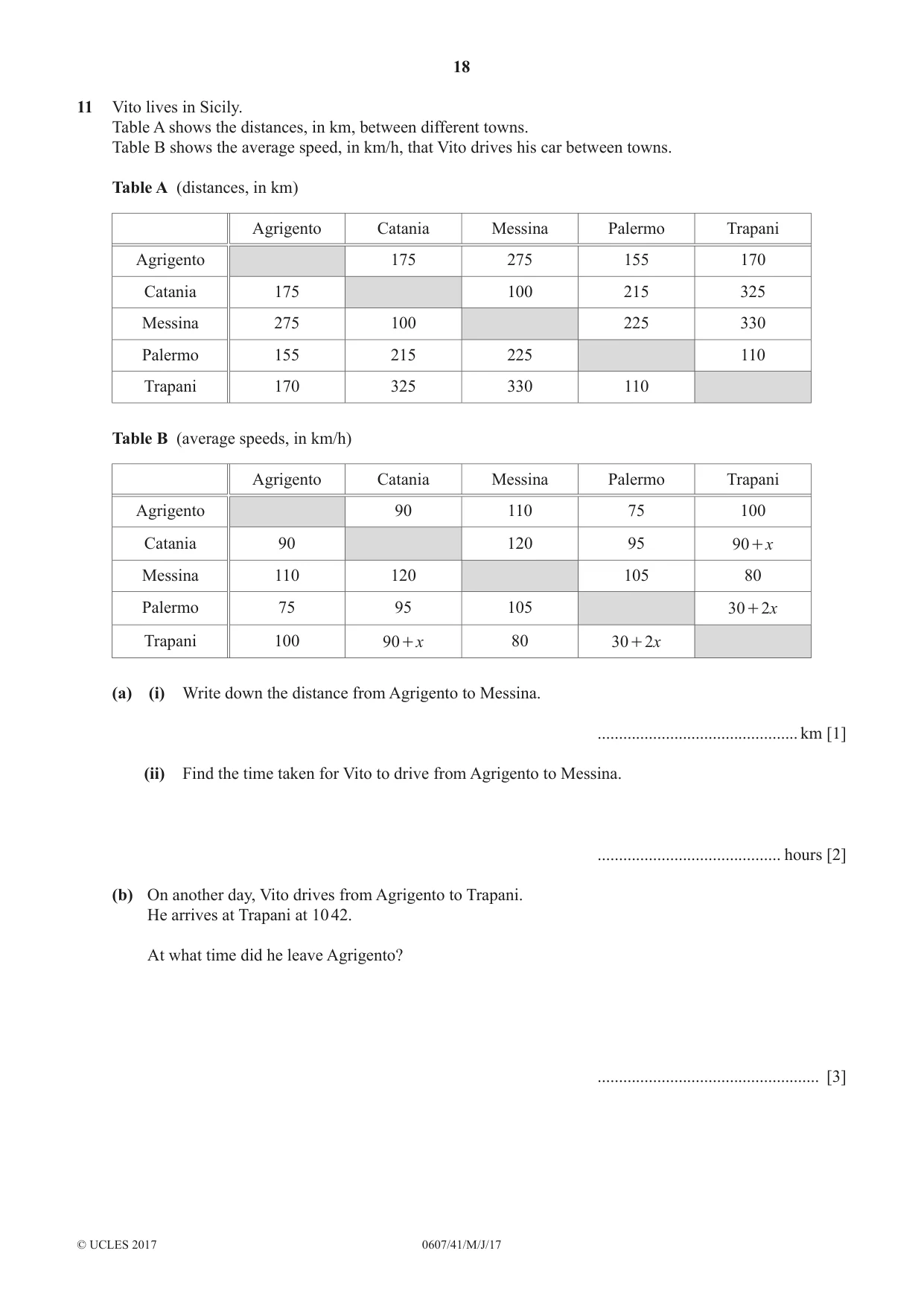
Q11 · Vito lives in Sicily
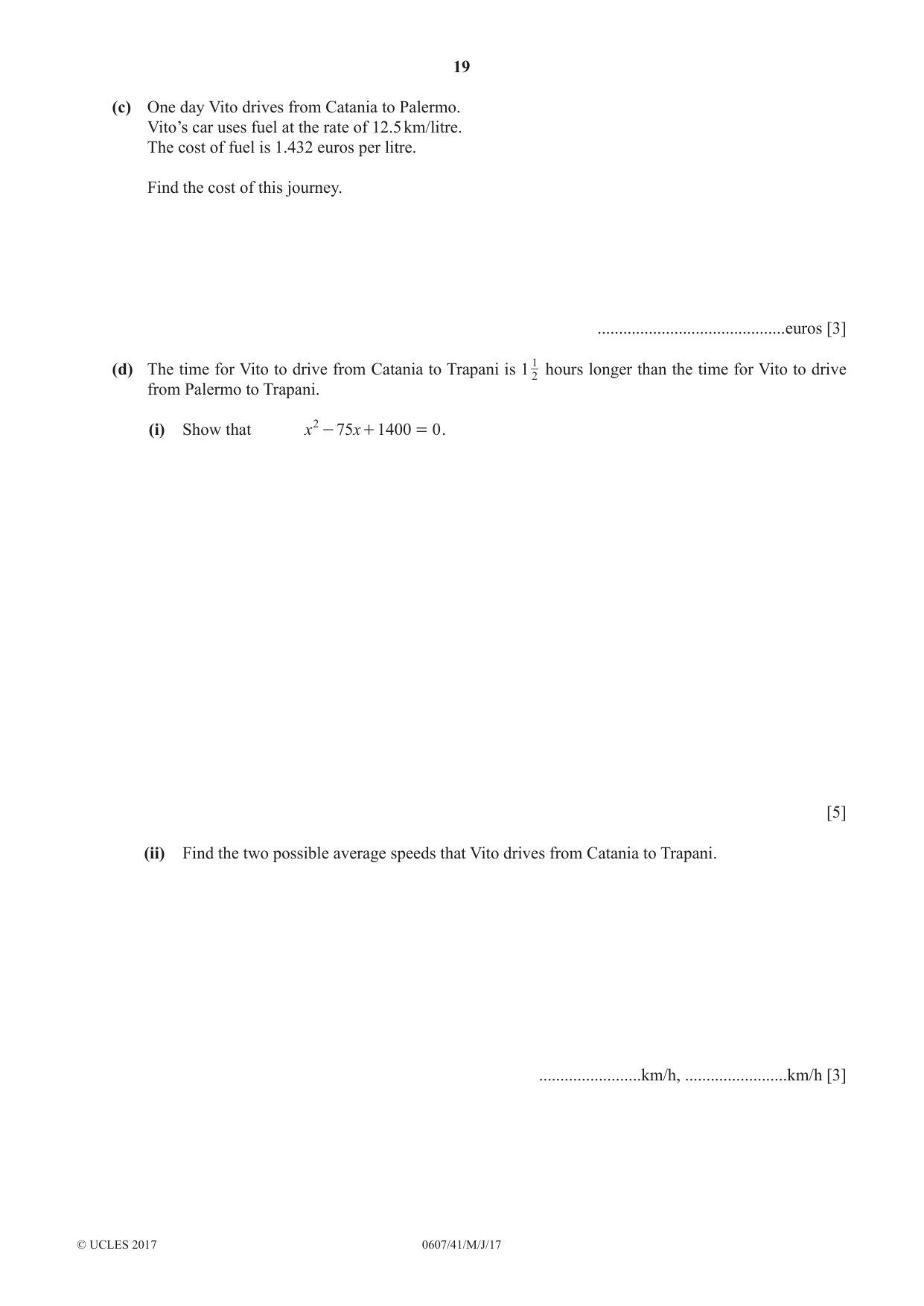
11 Vito lives in Sicily. Table A shows the distances, in km, between different towns. Table B shows the average speed, in km/h, that Vito drives his car between towns. Table A (distances, in km) Agrigento Catania Messina Palermo Trapani Agrigento 175 275 155 170 Catania 175 100 215 325 Messina 275 100 225 330 Palermo 155 215 225 110 Trapani 170 325 330 110 Table B (average speeds, in km/h) Agrigento Catania Messina Palermo Trapani Agrigento 90 110 75 100 Catania 90 120 95 90+ x Messina 110 120 105 80 Palermo 75 95 105 30 + 2x Trapani 100 90+ x 80 30 + 2x (a) (i) Write down the distance from Agrigento to Messina. ............................................... km [1] (ii) Find the time taken for Vito to drive from Agrigento to Messina. ........................................... hours [2] (b) On another day, Vito drives from Agrigento to Trapani. He arrives at Trapani at 10 42. At what time did he leave Agrigento? .................................................... [3] (c) One day Vito drives from Catania to Palermo. Vito’s car uses fuel at the rate of 12.5 km/litre. The cost of fuel is 1.432 euros per litre. Find the cost of this journey. ............................................euros [3] (d) The time for Vito to drive from Catania to Trapani is 1 12 hours longer than the time for Vito to drive from Palermo to Trapani. (i) Show that x 2 - 75x + 1400 = 0 . [5] (ii) Find the two possible average speeds that Vito drives from Catania to Trapani. ........................km/h, ........................km/h [3]
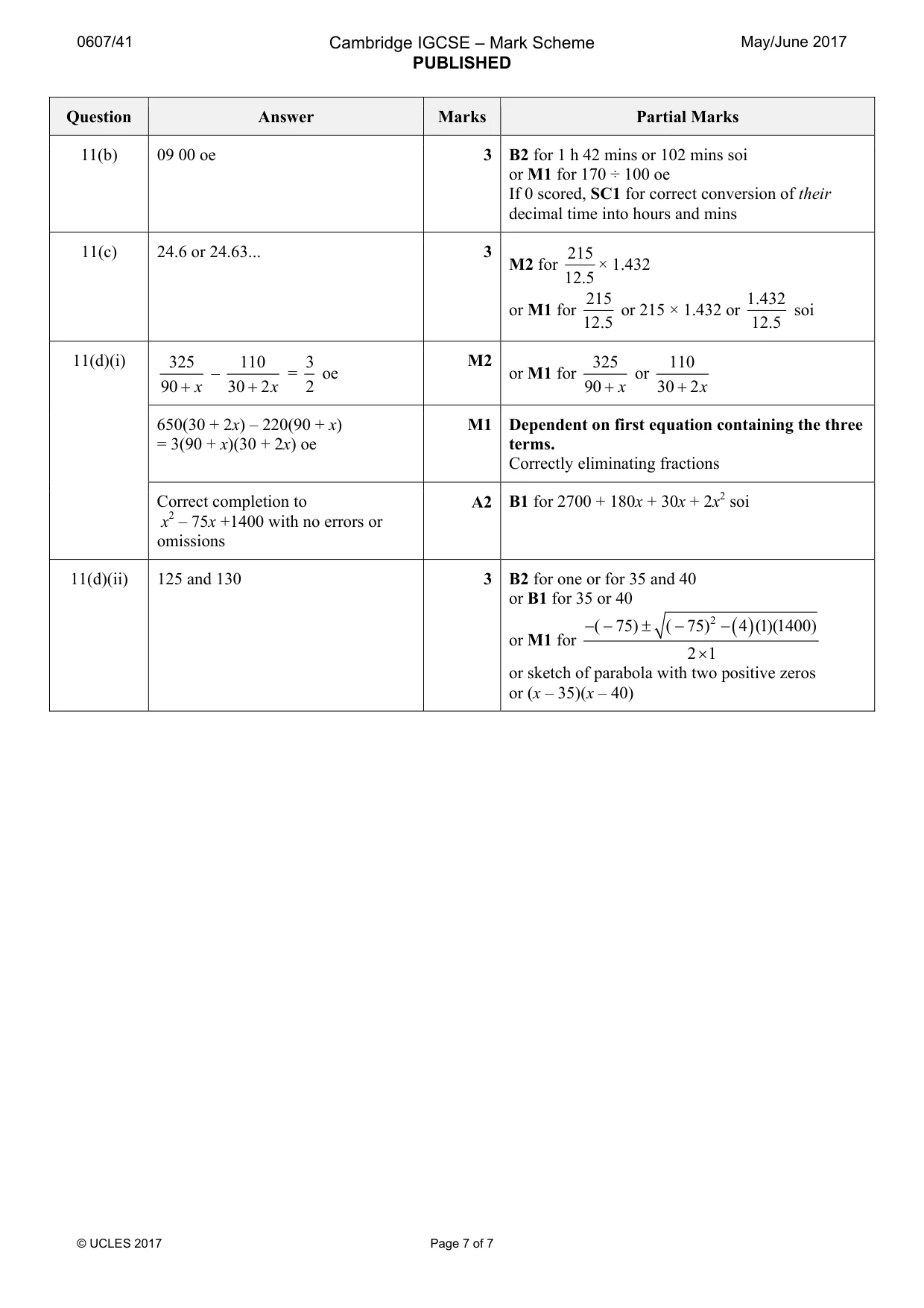
Mark scheme: 11(a)(i) 275 1 11(a)(ii) 2.5 oe 2 M1 for 275 ÷ 110 11(b) 09 00 oe 3 B2 for 1 h 42 mins or 102 mins soi or M1 for 170 ÷ 100 oe If 0 scored, SC1 for correct conversion of their decimal time into hours and mins 11(c) 24.6 or 24.63... 3 215 M2 for × 1.432 12.5 215 1.432 or M1 for or 215 × 1.432 or soi 12.5 12.5 11(d)(i) 325 110 3 M2 325 110 – = oe or M1 for or 90 + x 30 + 2x 2 90 + x 30 + 2x 650(30 + 2x) – 220(90 + x) M1 Dependent on first equation containing the three = 3(90 + x)(30 + 2x) oe terms. Correctly eliminating fractions Correct completion to A2 B1 for 2700 + 180x + 30x + 2x2 soi x2 – 75x +1400 with no errors or omissions 11(d)(ii) 125 and 130 3 B2 for one or for 35 and 40 or B1 for 35 or 40 −−( 75) ± ( − 75) 2 − ( 4 ) (1)(1400) or M1 for 2 × 1 or sketch of parabola with two positive zeros or (x – 35)(x – 40)
What was in this paper
The subtopics covered by these 11 questions, and how many questions each got. Open one in a new tab to see every Cambridge question on it.
What you needed in this session
Cambridge’s own grade thresholds for 2017 May/June, Paper 4 · Variant 1. A higher threshold means an easier paper — the bar moves with how the cohort did.