Cambridge IGCSE Mathematics - International 0607 — 2014 Oct/Nov Paper 4 · Variant 1
0607/41/O/N/14 · 120 marks · ≈135 min
The question paper and its mark scheme, free to read here and free to download. This is Cambridge’s own paper, exactly as it was sat.
Question paper20 pages
Mark scheme8 pages
Answers below. Sit the paper first if you are practising.
Paper as text
Question paper, page 1
This document consists of 20 printed pages. IB14 11_0607_41/5RP © UCLES 2014 [Turn over *5562327434* Cambridge International Examinations Cambridge International General Certificate of Secondary Education CAMBRIDGE INTERNATIONAL MATHEMATICS 0607/41 Paper 4 (Extended) October/November 2014 2 hours 15 minutes Candidates answer on the Question Paper. Additional Materials: Geometrical Instruments Graphics Calculator READ THESE INSTRUCTIONS FIRST Write your Centre number, candidate number and name on all the work you hand in. Write in dark blue or black pen. Do not use staples, paper clips, glue or correction fluid. You may use an HB pencil for any diagrams or graphs. DO NOT WRITE IN ANY BARCODES. Answer all the questions. Unless instructed otherwise, give your answers exactly or correct to three significant figures as appropriate. Answers in degrees should be given to one decimal place. For π, use your calculator value. You must show all the relevant working to gain full marks and you will be given marks for correct methods, including sketches, even if your answer is incorrect. The number of marks is given in brackets [ ] at the end of each question or part question. The total number of marks for this paper is 120.
Question paper, page 2
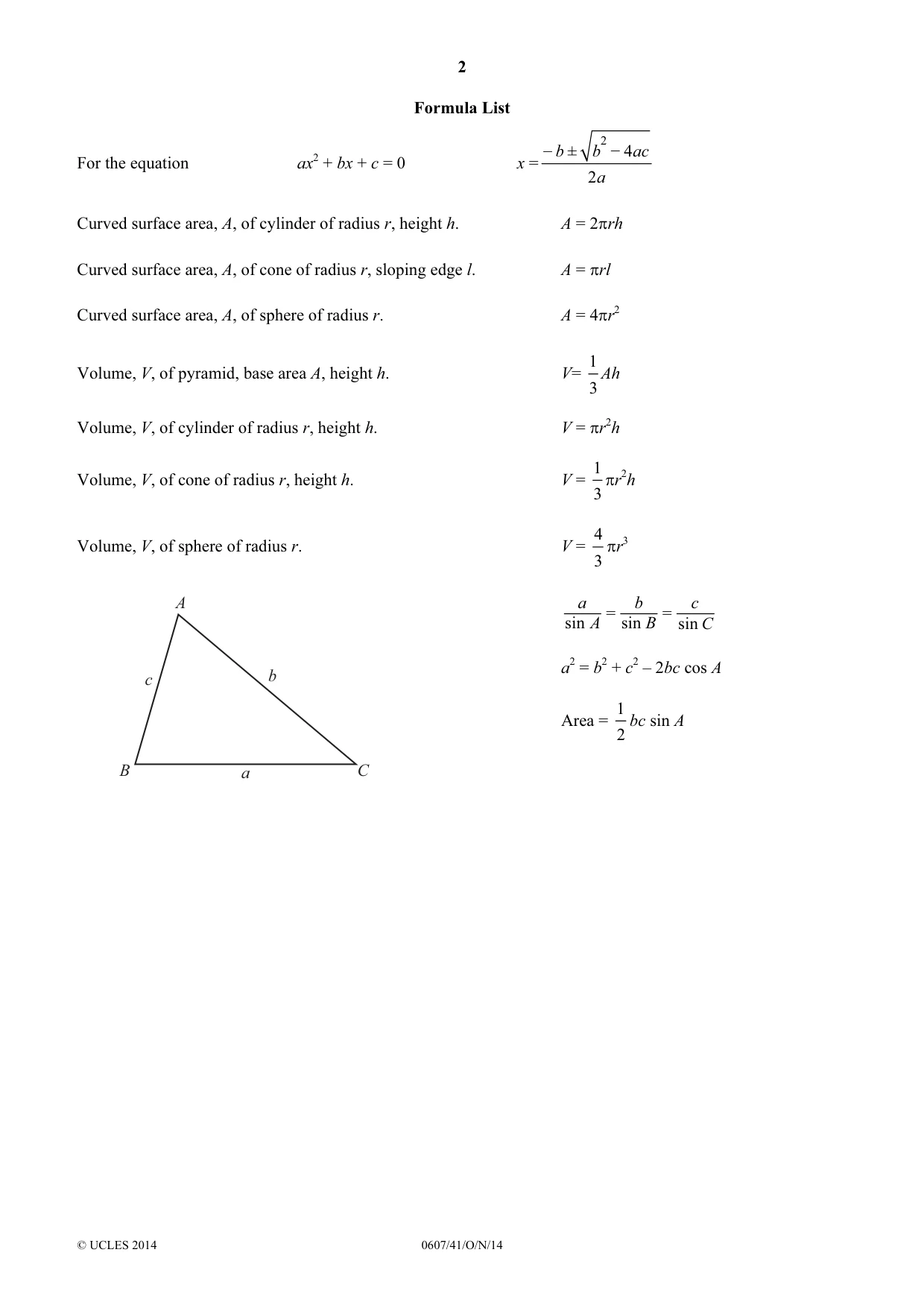
2 © UCLES 2014 0607/41/O/N/14 Formula List For the equation ax2 + bx + c = 0 x = 2 _ ± 4 2 _ b b ac a Curved surface area, A, of cylinder of radius r, height h. A = 2πrh Curved surface area, A, of cone of radius r, sloping edge l. A = πrl Curved surface area, A, of sphere of radius r. A = 4πr2 Volume, V, of pyramid, base area A, height h. V= 1 3 Ah Volume, V, of cylinder of radius r, height h. V = πr2h Volume, V, of cone of radius r, height h. V = 1 3 πr2h Volume, V, of sphere of radius r. V = 4 3 πr3 = = sin sin sin a b c A B C a2 = b2 + c2 – 2bc cos A Area = 1 2 bc sin A A a B C b c
Question paper, page 3
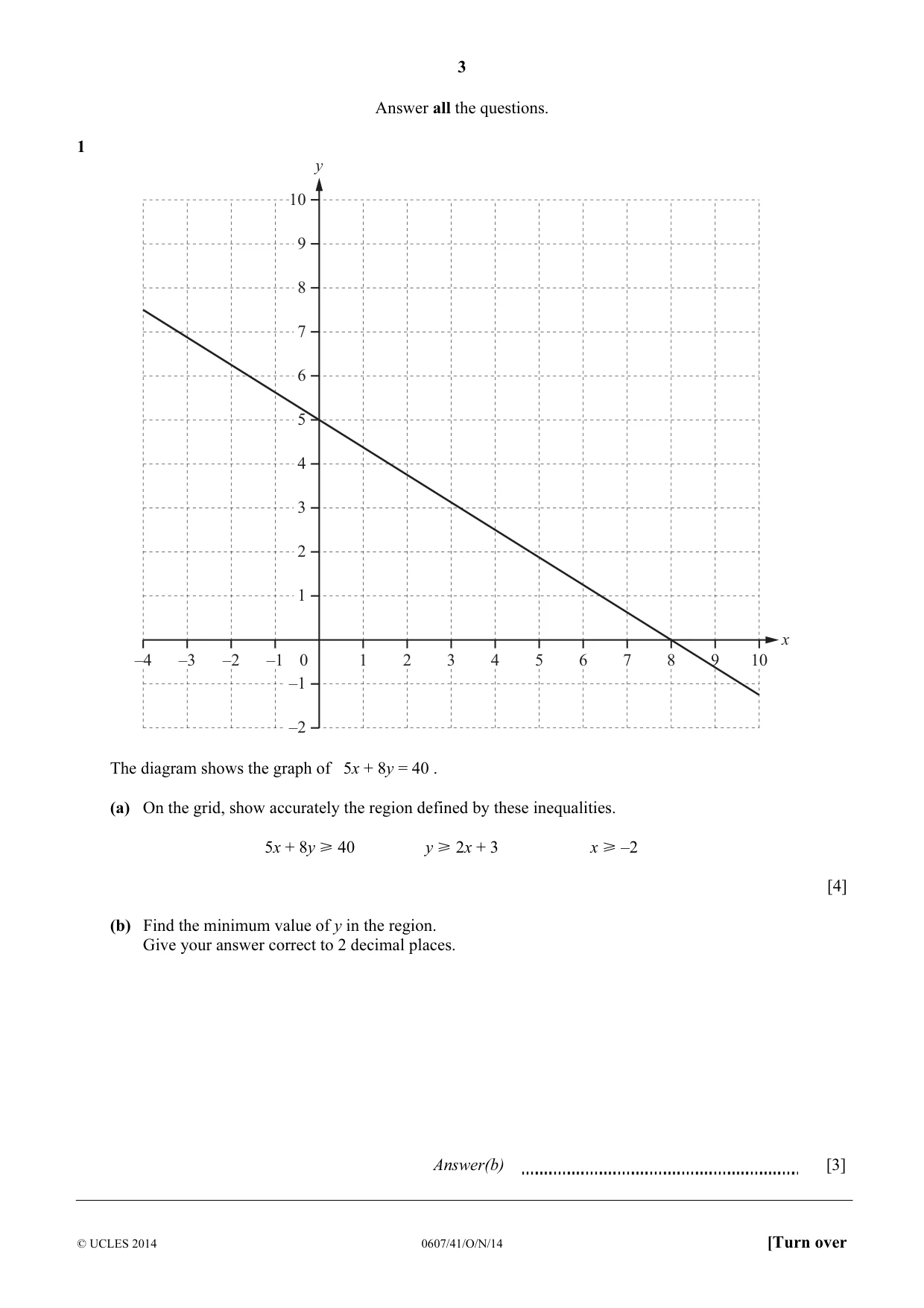
3 © UCLES 2014 0607/41/O/N/14 [Turn over Answer all the questions. 1 y x 0 –1 1 2 3 4 5 6 7 8 9 10 –2 –3 –4 10 9 8 7 6 5 4 3 2 1 –1 –2 The diagram shows the graph of 5x + 8y = 40 . (a) On the grid, show accurately the region defined by these inequalities. 5x + 8y [ 40 y [ 2x + 3 x [ –2 [4] (b) Find the minimum value of y in the region. Give your answer correct to 2 decimal places. Answer(b) [3]
Question paper, page 4
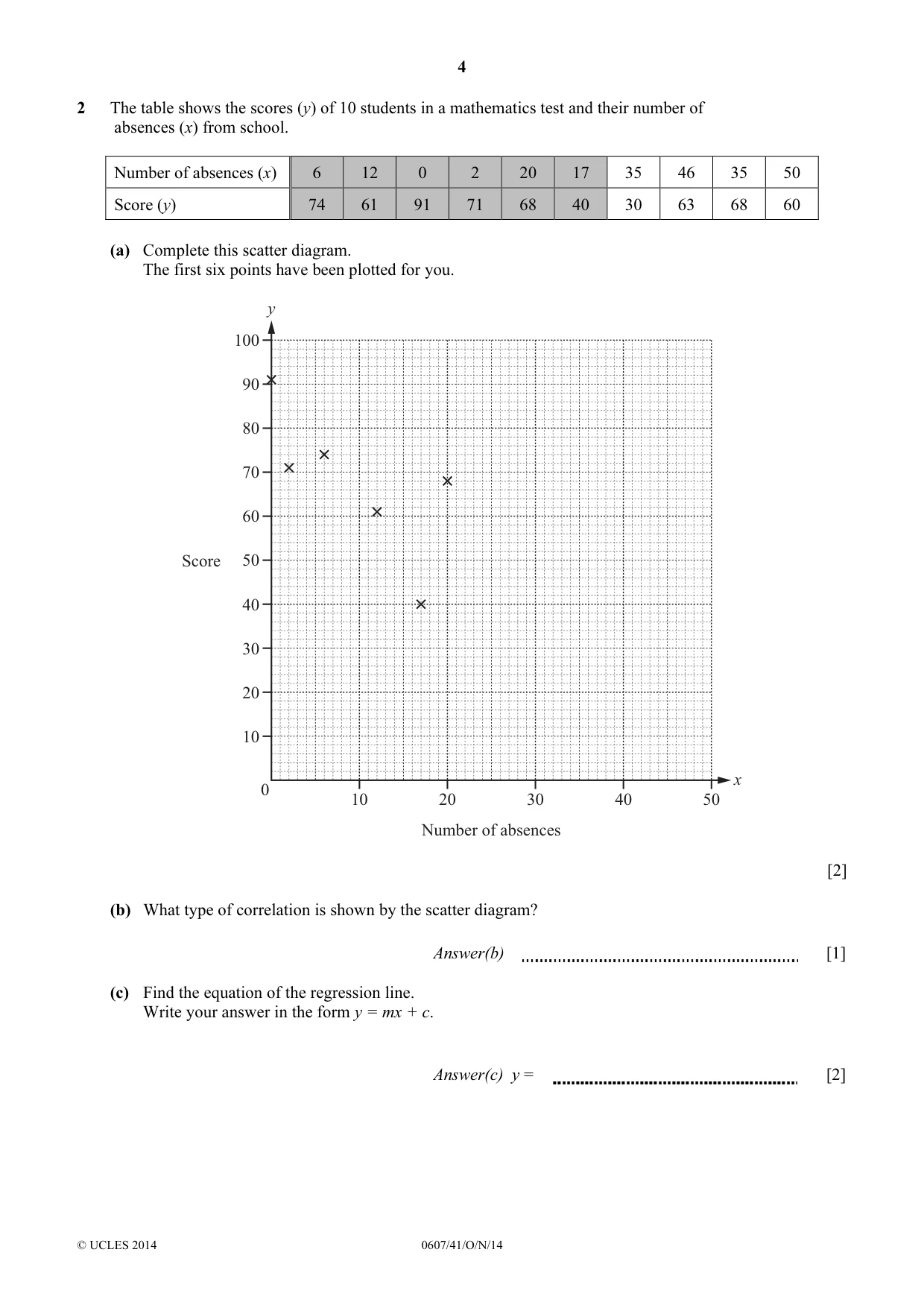
4 © UCLES 2014 0607/41/O/N/14 2 The table shows the scores (y) of 10 students in a mathematics test and their number of absences (x) from school. Number of absences (x) 6 12 0 2 20 17 35 46 35 50 Score (y) 74 61 91 71 68 40 30 63 68 60 (a) Complete this scatter diagram. The first six points have been plotted for you. 100 90 80 70 60 50 40 30 20 10 10 20 30 Number of absences 40 50 0 y x Score [2] (b) What type of correlation is shown by the scatter diagram? Answer(b) [1] (c) Find the equation of the regression line. Write your answer in the form y = mx + c. Answer(c) y = [2]
Question paper, page 5
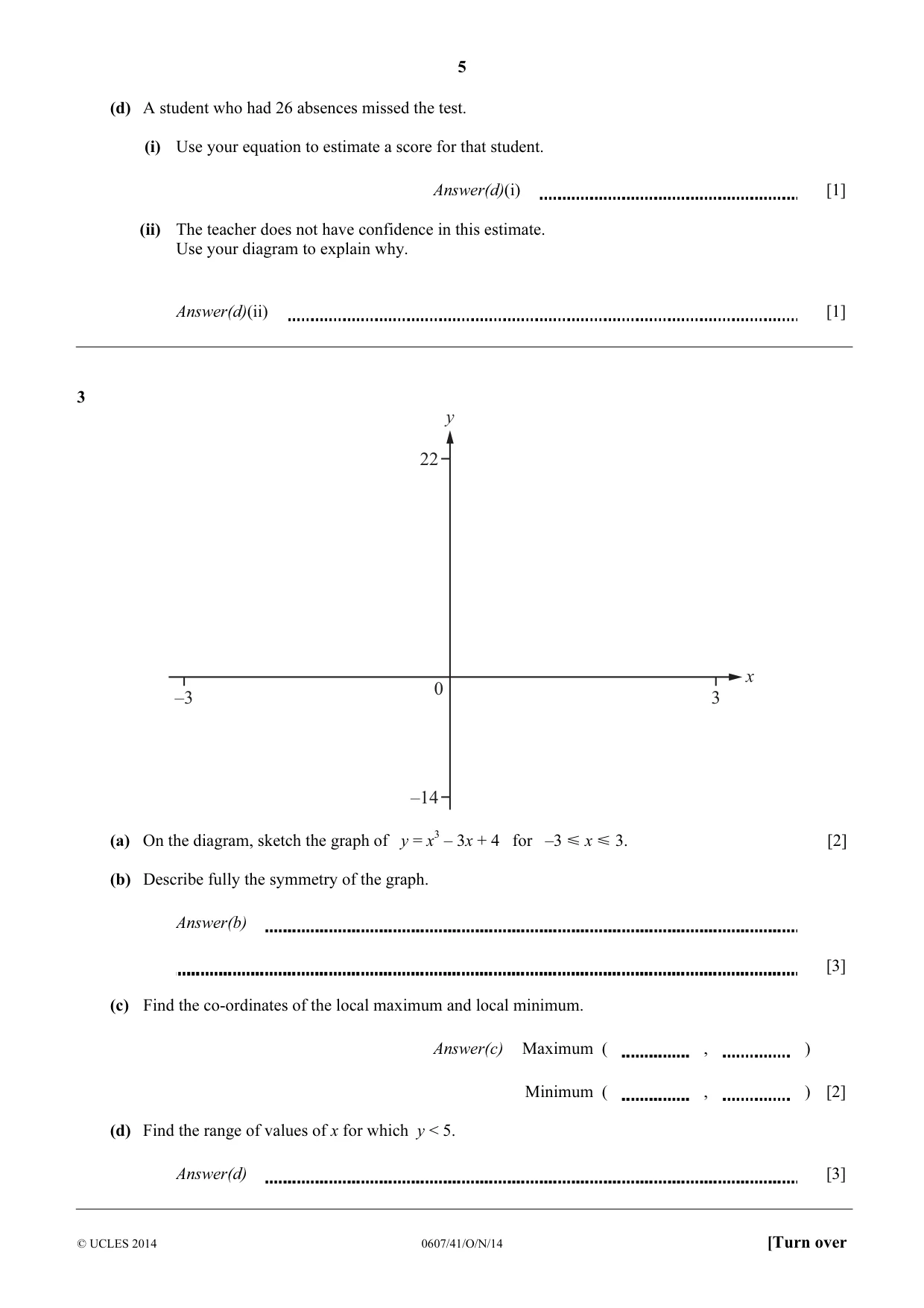
5 © UCLES 2014 0607/41/O/N/14 [Turn over (d) A student who had 26 absences missed the test. (i) Use your equation to estimate a score for that student. Answer(d)(i) [1] (ii) The teacher does not have confidence in this estimate. Use your diagram to explain why. Answer(d)(ii) [1] 3 –3 –14 22 3 x y 0 (a) On the diagram, sketch the graph of y = x3 – 3x + 4 for –3 Y x Y 3. [2] (b) Describe fully the symmetry of the graph. Answer(b) [3] (c) Find the co-ordinates of the local maximum and local minimum. Answer(c) Maximum ( , ) Minimum ( , ) [2] (d) Find the range of values of x for which y < 5. Answer(d) [3]
Question paper, page 6
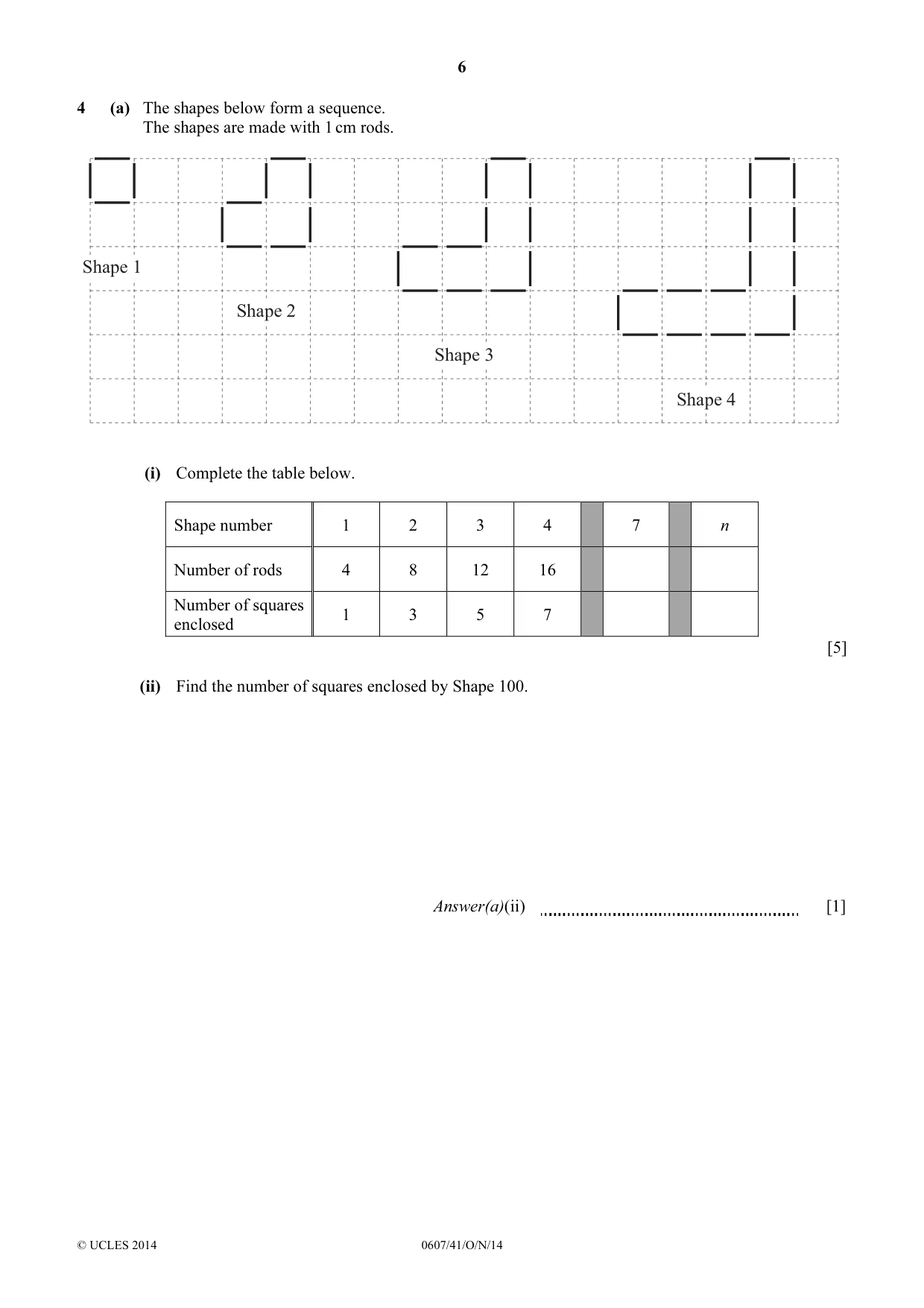
6 © UCLES 2014 0607/41/O/N/14 4 (a) The shapes below form a sequence. The shapes are made with 1 cm rods. Shape 1 Shape 2 Shape 3 Shape 4 (i) Complete the table below. Shape number 1 2 3 4 7 n Number of rods 4 8 12 16 Number of squares enclosed 1 3 5 7 [5] (ii) Find the number of squares enclosed by Shape 100. Answer(a)(ii) [1]
Question paper, page 7
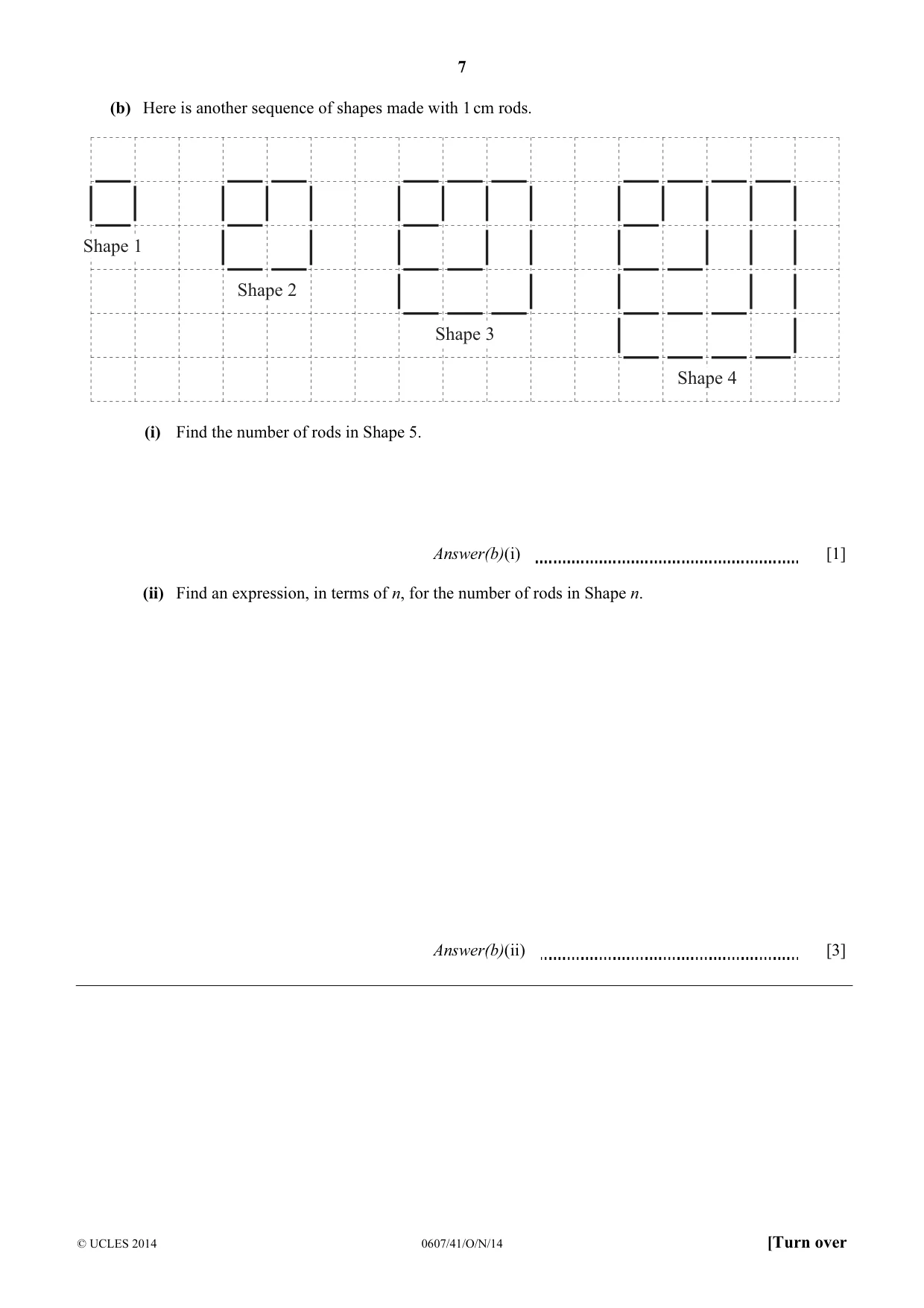
7 © UCLES 2014 0607/41/O/N/14 [Turn over (b) Here is another sequence of shapes made with 1 cm rods. Shape 1 Shape 2 Shape 3 Shape 4 (i) Find the number of rods in Shape 5. Answer(b)(i) [1] (ii) Find an expression, in terms of n, for the number of rods in Shape n. Answer(b)(ii) [3]
Question paper, page 8
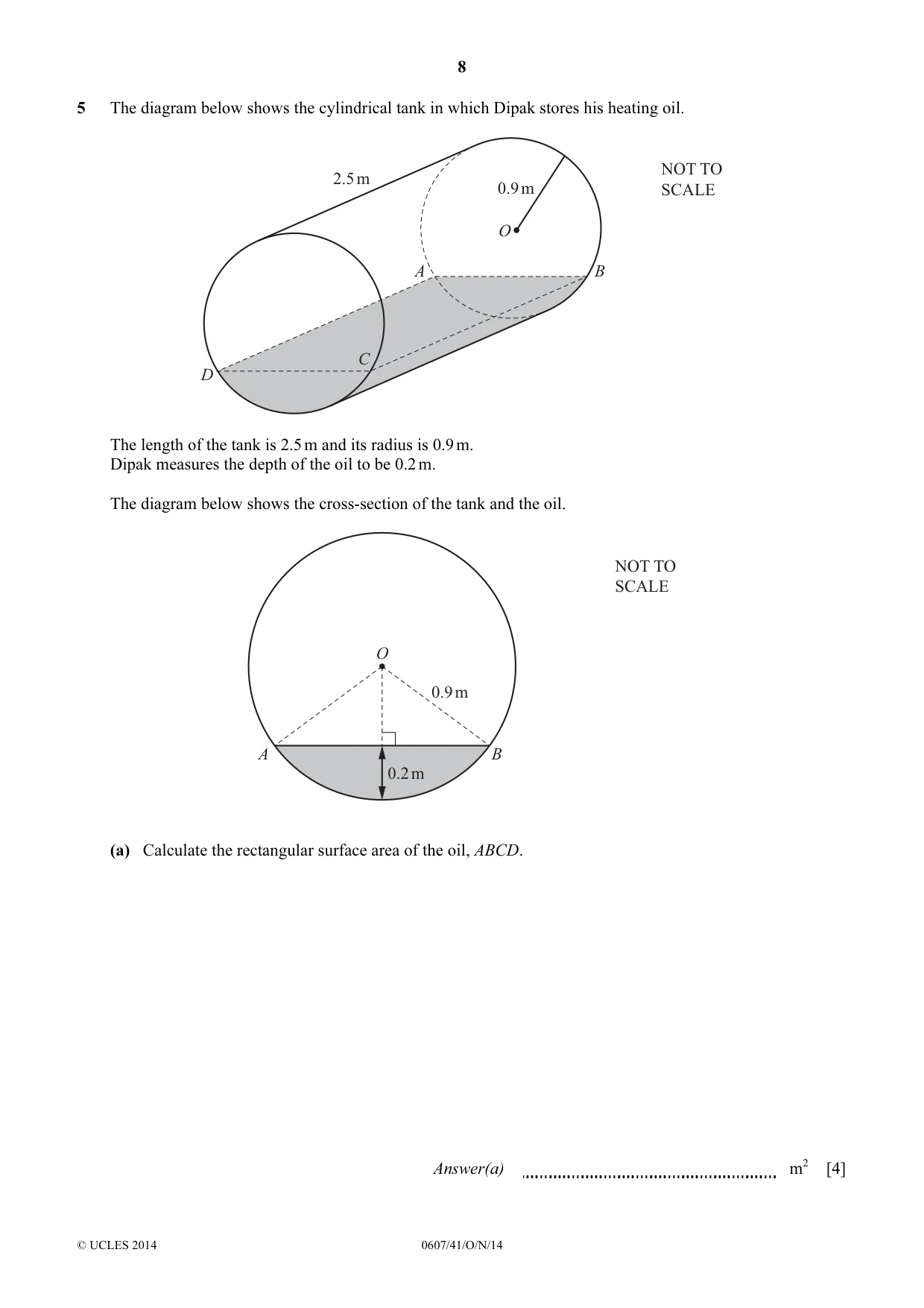
8 © UCLES 2014 0607/41/O/N/14 5 The diagram below shows the cylindrical tank in which Dipak stores his heating oil. D C A B O 2.5 m 0.9 m NOT TO SCALE The length of the tank is 2.5 m and its radius is 0.9 m. Dipak measures the depth of the oil to be 0.2 m. The diagram below shows the cross-section of the tank and the oil. 0.2 m 0.9 m O A B NOT TO SCALE (a) Calculate the rectangular surface area of the oil, ABCD. Answer(a) m2 [4]
Question paper, page 9
9 © UCLES 2014 0607/41/O/N/14 [Turn over (b) Calculate angle AOB and show that it rounds to 77.9° correct to 1 decimal place. [3] (c) Find the number of extra litres of oil that Dipak needs to fill the tank. Answer(c) litres [5]
Question paper, page 10
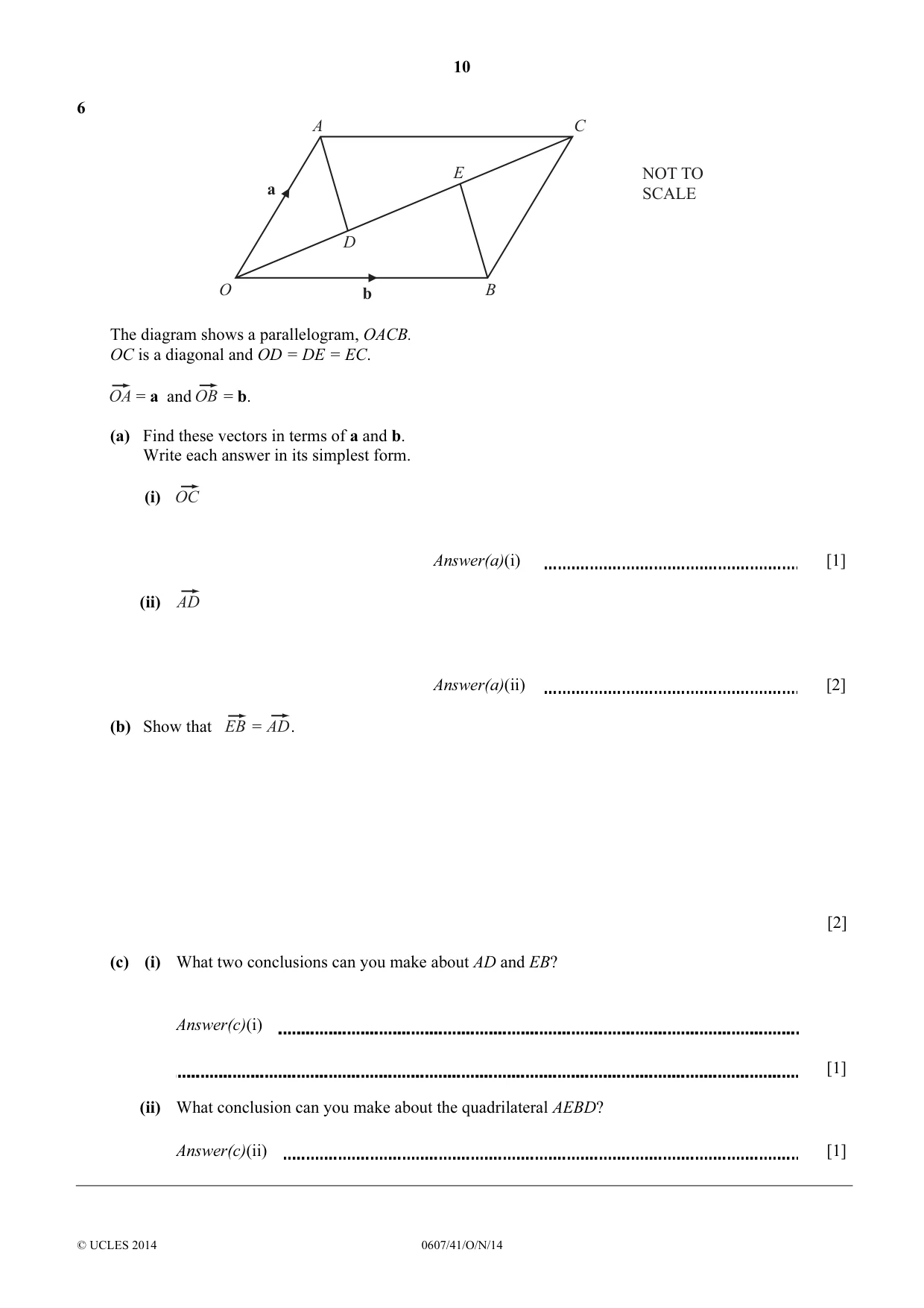
10 © UCLES 2014 0607/41/O/N/14 6 A C B O D E NOT TO SCALE a b The diagram shows a parallelogram, OACB. OC is a diagonal and OD = DE = EC. = a and = b. (a) Find these vectors in terms of a and b. Write each answer in its simplest form. (i) Answer(a)(i) [1] (ii) Answer(a)(ii) [2] (b) Show that = . [2] (c) (i) What two conclusions can you make about AD and EB? Answer(c)(i) [1] (ii) What conclusion can you make about the quadrilateral AEBD? Answer(c)(ii) [1]
Question paper, page 11
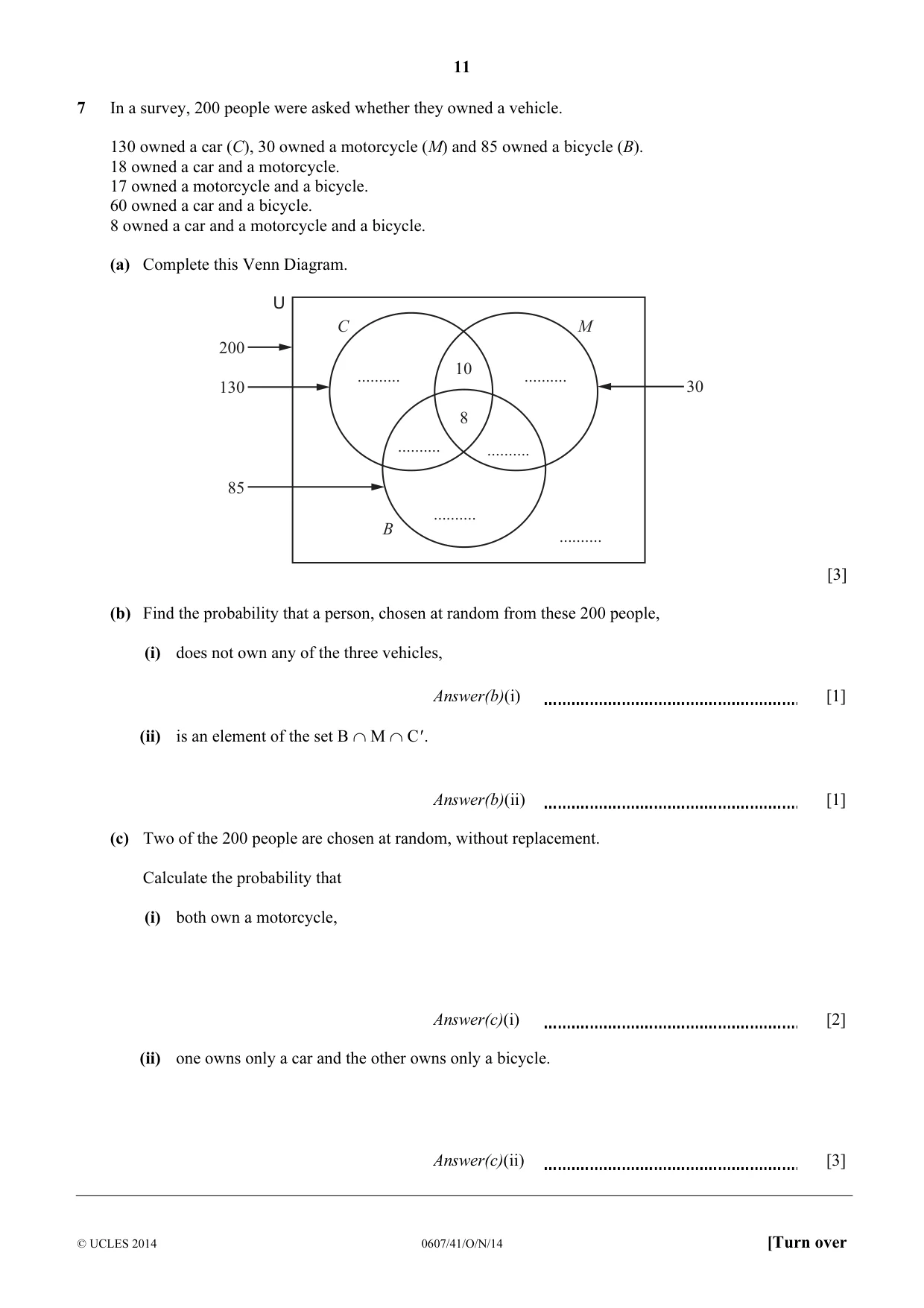
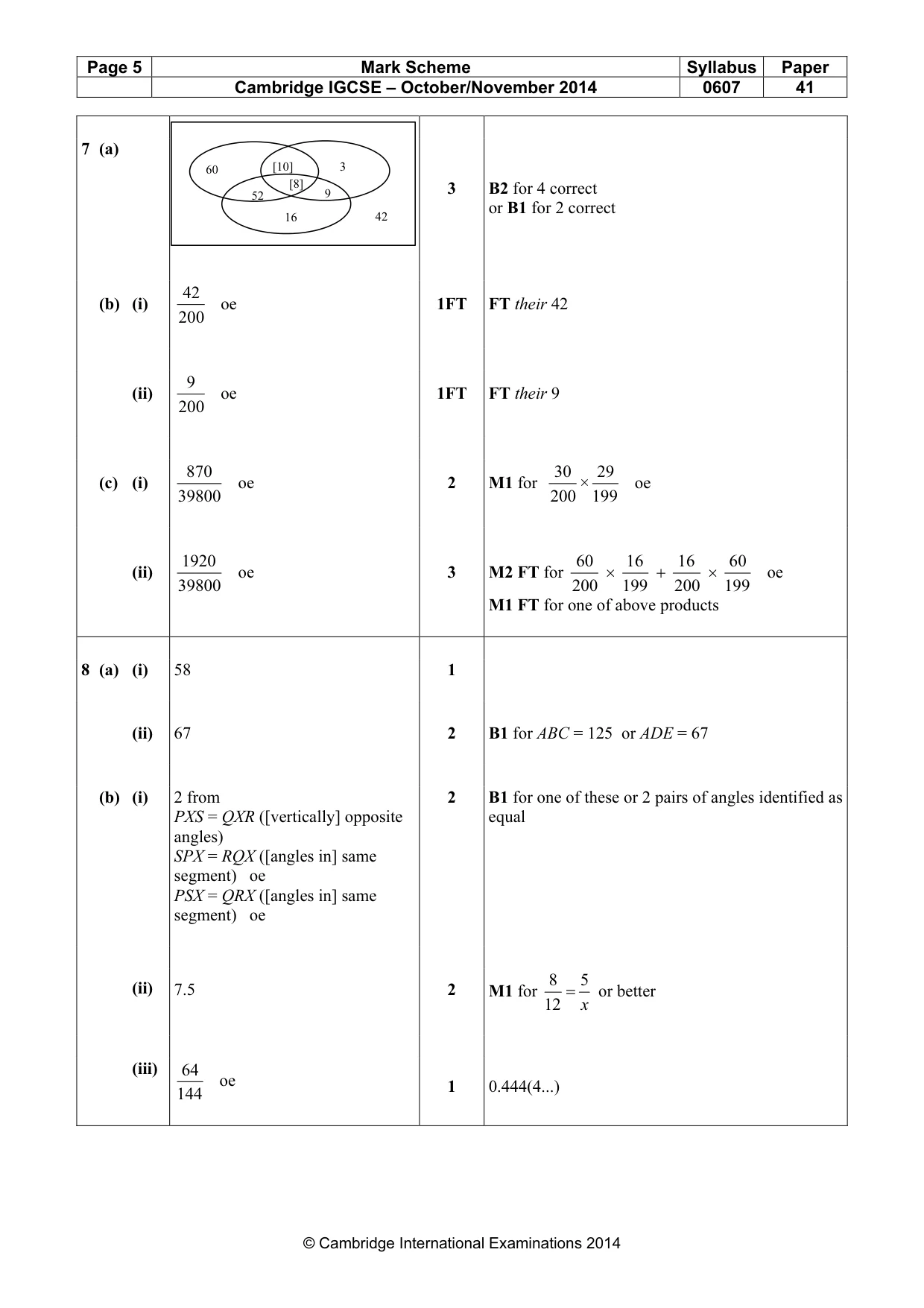
11 © UCLES 2014 0607/41/O/N/14 [Turn over 7 In a survey, 200 people were asked whether they owned a vehicle. 130 owned a car (C), 30 owned a motorcycle (M) and 85 owned a bicycle (B). 18 owned a car and a motorcycle. 17 owned a motorcycle and a bicycle. 60 owned a car and a bicycle. 8 owned a car and a motorcycle and a bicycle. (a) Complete this Venn Diagram. U C M B … … … … … … 10 8 30 200 130 85 [3] (b) Find the probability that a person, chosen at random from these 200 people, (i) does not own any of the three vehicles, Answer(b)(i) [1] (ii) is an element of the set B ∩ M ∩ C ′. Answer(b)(ii) [1] (c) Two of the 200 people are chosen at random, without replacement. Calculate the probability that (i) both own a motorcycle, Answer(c)(i) [2] (ii) one owns only a car and the other owns only a bicycle. Answer(c)(ii) [3]
Question paper, page 12
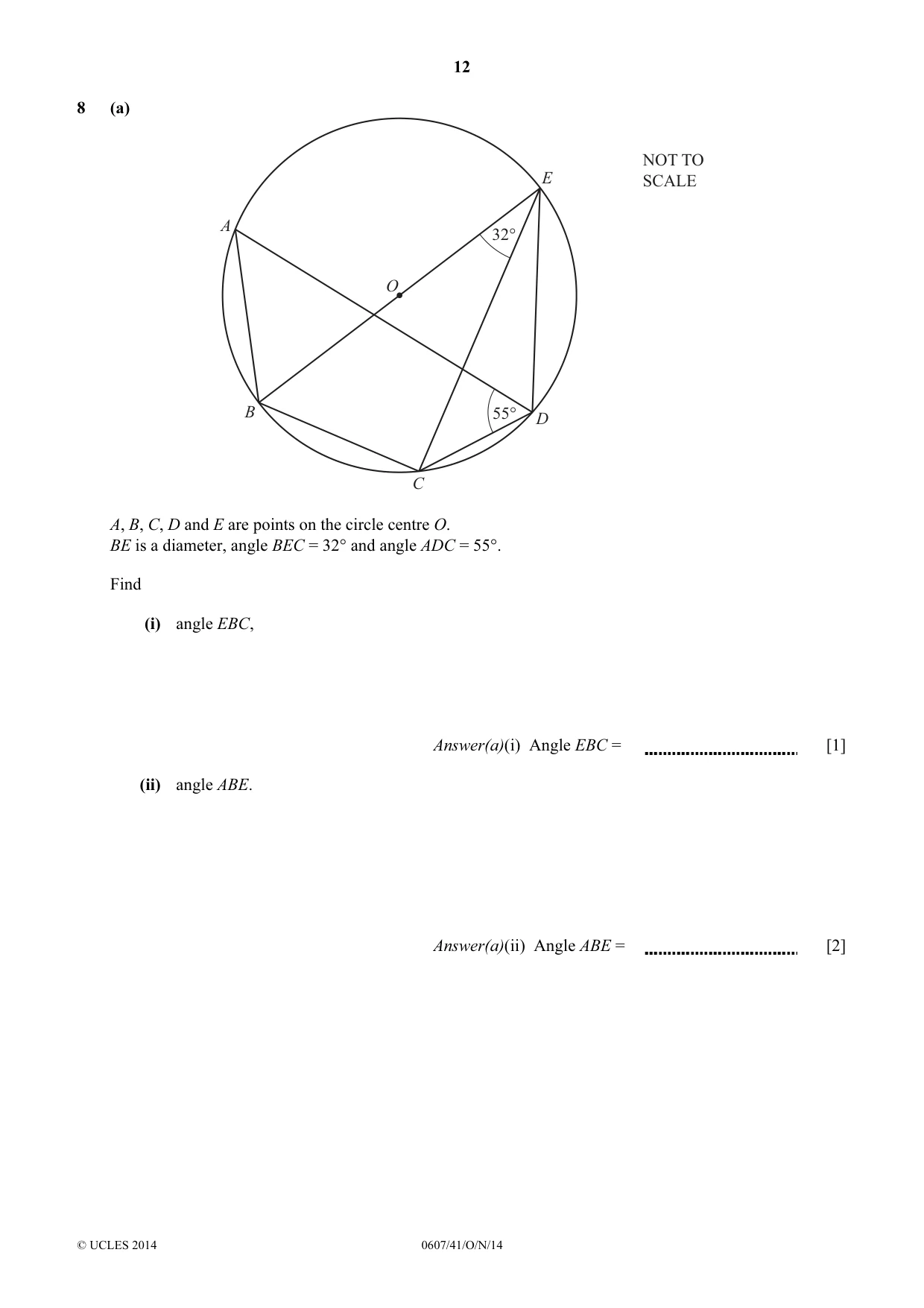
12 © UCLES 2014 0607/41/O/N/14 8 (a) O A B C D E 32° 55° NOT TO SCALE A, B, C, D and E are points on the circle centre O. BE is a diameter, angle BEC = 32° and angle ADC = 55°. Find (i) angle EBC, Answer(a)(i) Angle EBC = [1] (ii) angle ABE. Answer(a)(ii) Angle ABE = [2]
Question paper, page 13
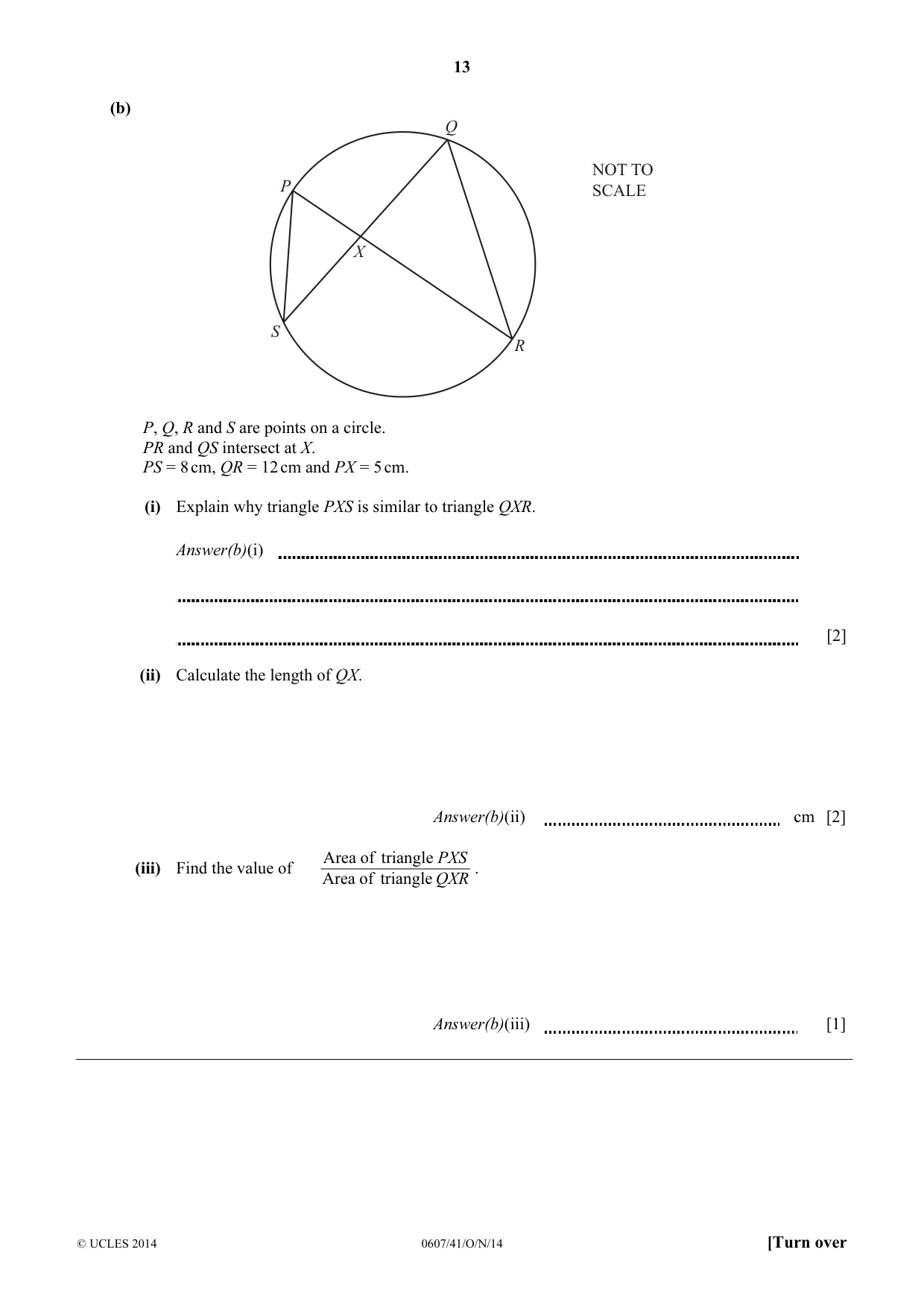
13 © UCLES 2014 0607/41/O/N/14 [Turn over (b) P X Q S R NOT TO SCALE P, Q, R and S are points on a circle. PR and QS intersect at X. PS = 8 cm, QR = 12 cm and PX = 5 cm. (i) Explain why triangle PXS is similar to triangle QXR. Answer(b)(i) [2] (ii) Calculate the length of QX. Answer(b)(ii) cm [2] (iii) Find the value of QXR PXS triangle of Area triangle of Area . Answer(b)(iii) [1]
Question paper, page 14
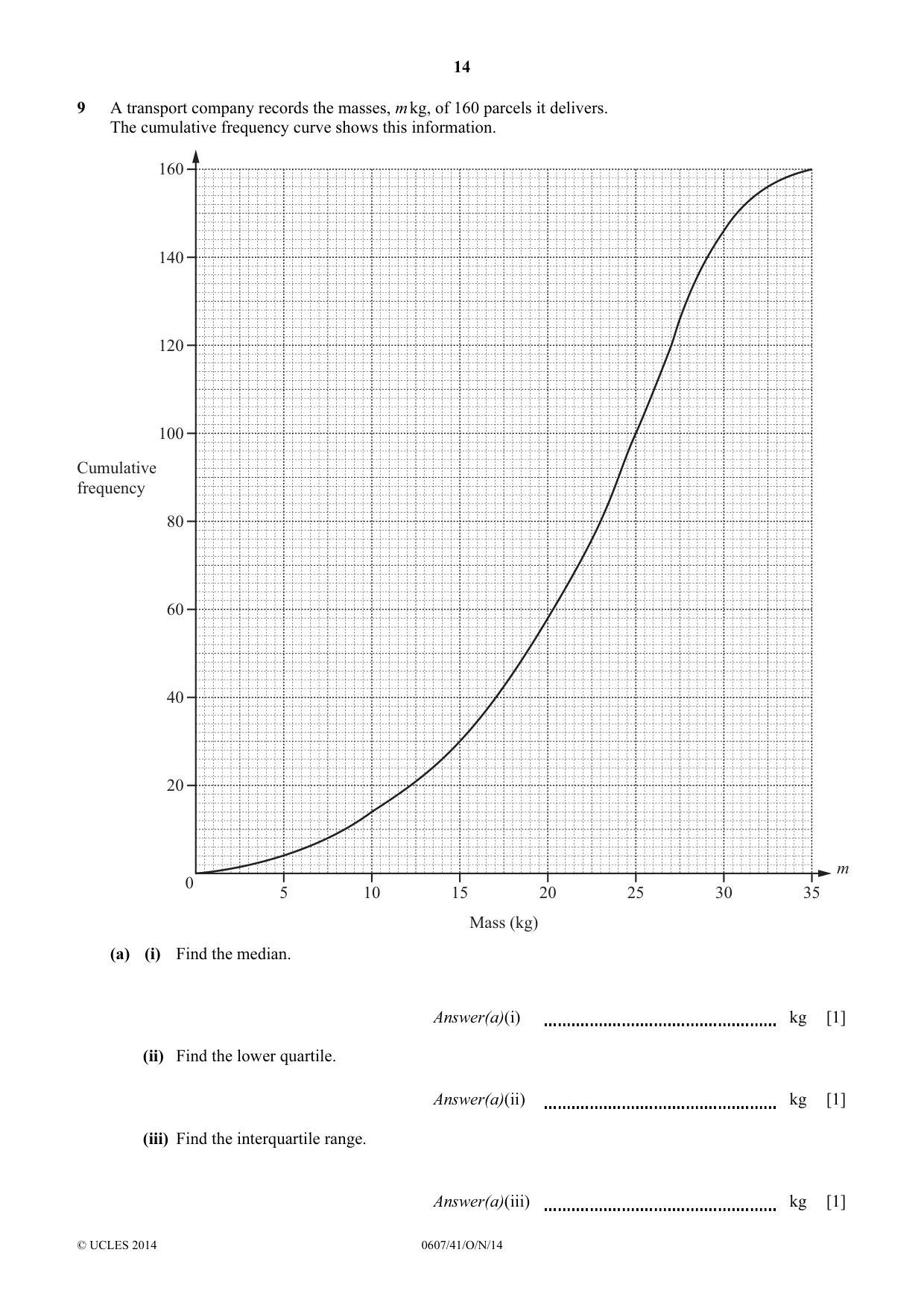
14 © UCLES 2014 0607/41/O/N/14 9 A transport company records the masses, m kg, of 160 parcels it delivers. The cumulative frequency curve shows this information. 160 140 120 100 80 60 40 20 5 10 15 20 Mass (kg) 25 30 35 0 Cumulative frequency m (a) (i) Find the median. Answer(a)(i) kg [1] (ii) Find the lower quartile. Answer(a)(ii) kg [1] (iii) Find the interquartile range. Answer(a)(iii) kg [1]
Question paper, page 15
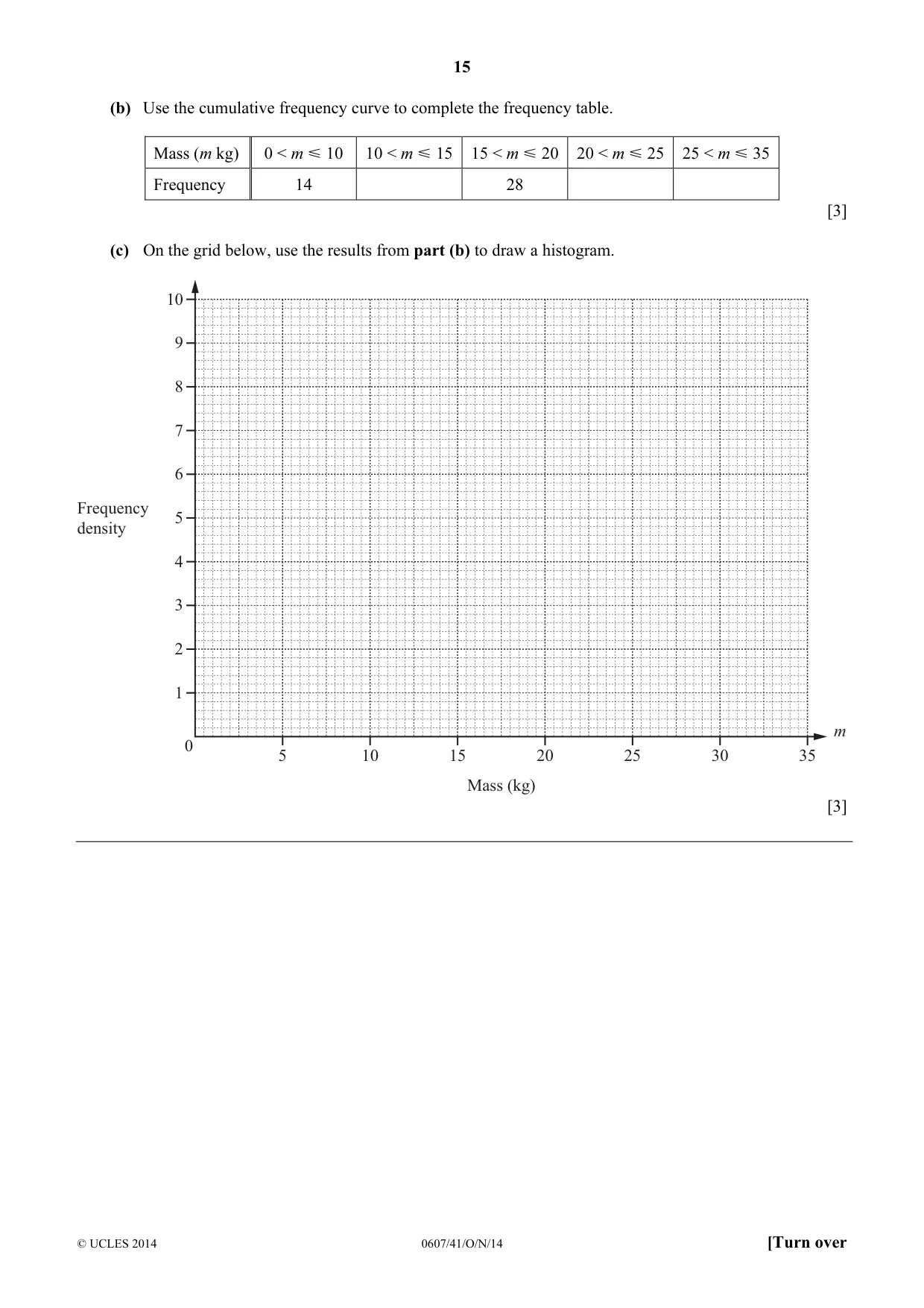
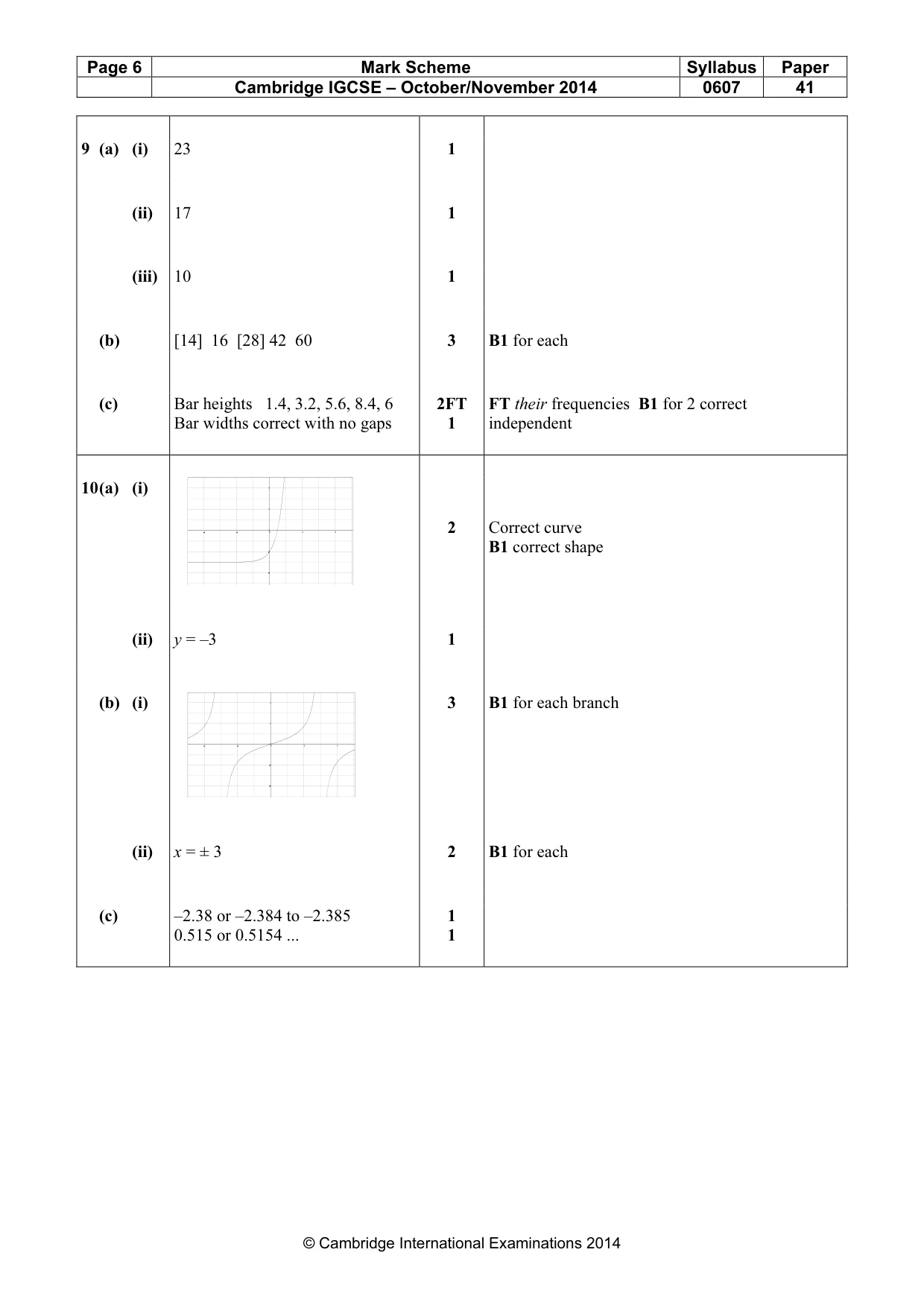
15 © UCLES 2014 0607/41/O/N/14 [Turn over (b) Use the cumulative frequency curve to complete the frequency table. Mass (m kg) 0 < m Y 10 10 < m Y 15 15 < m Y 20 20 < m Y 25 25 < m Y 35 Frequency 14 28 [3] (c) On the grid below, use the results from part (b) to draw a histogram. 10 9 8 7 6 5 4 3 2 1 5 10 15 20 Mass (kg) 25 30 35 0 Frequency density m [3]
Question paper, page 16
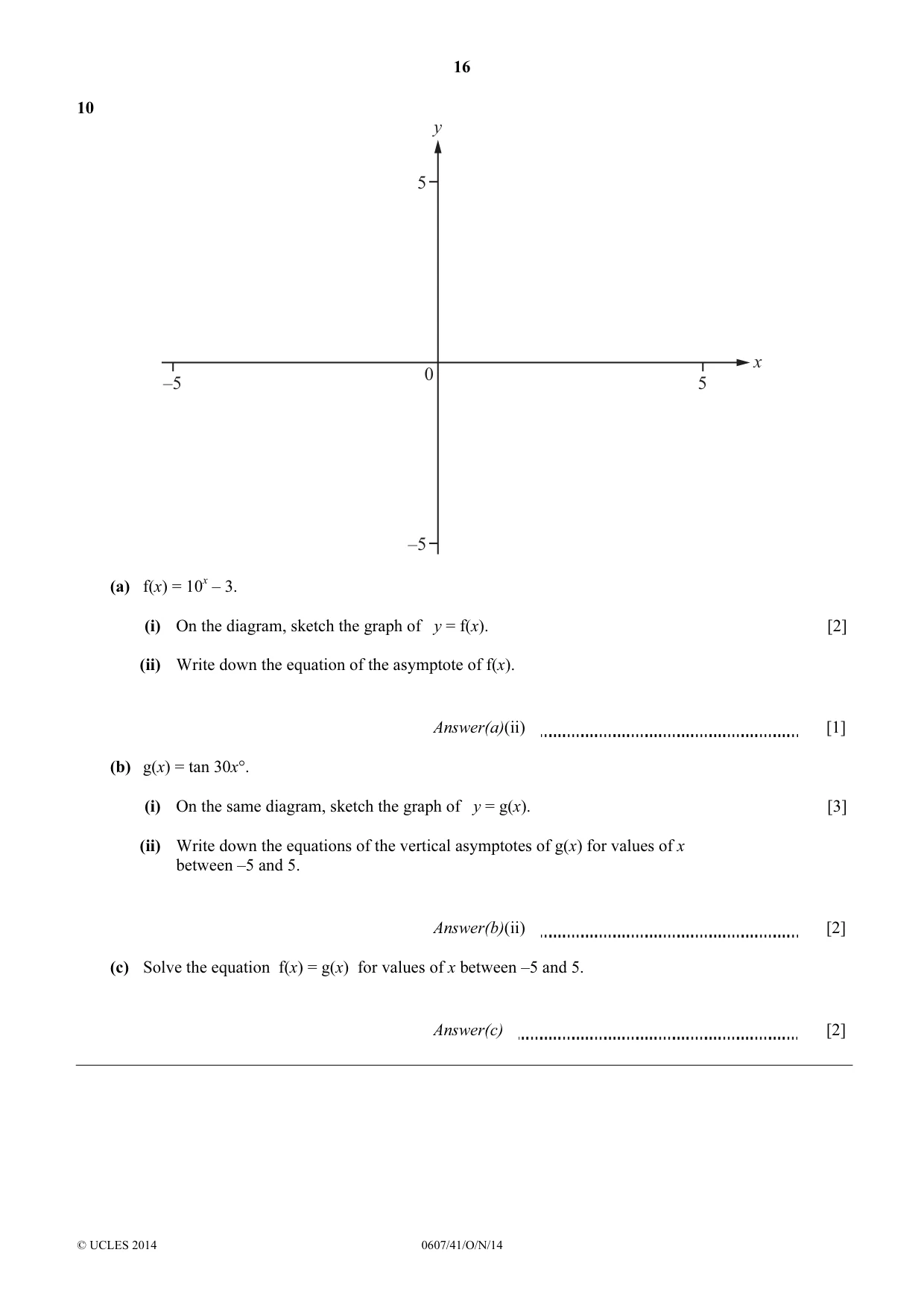
16 © UCLES 2014 0607/41/O/N/14 10 y x –5 –5 5 5 0 (a) f(x) = 10x – 3. (i) On the diagram, sketch the graph of y = f(x). [2] (ii) Write down the equation of the asymptote of f(x). Answer(a)(ii) [1] (b) g(x) = tan 30x°. (i) On the same diagram, sketch the graph of y = g(x). [3] (ii) Write down the equations of the vertical asymptotes of g(x) for values of x between –5 and 5. Answer(b)(ii) [2] (c) Solve the equation f(x) = g(x) for values of x between –5 and 5. Answer(c) [2]
Question paper, page 17
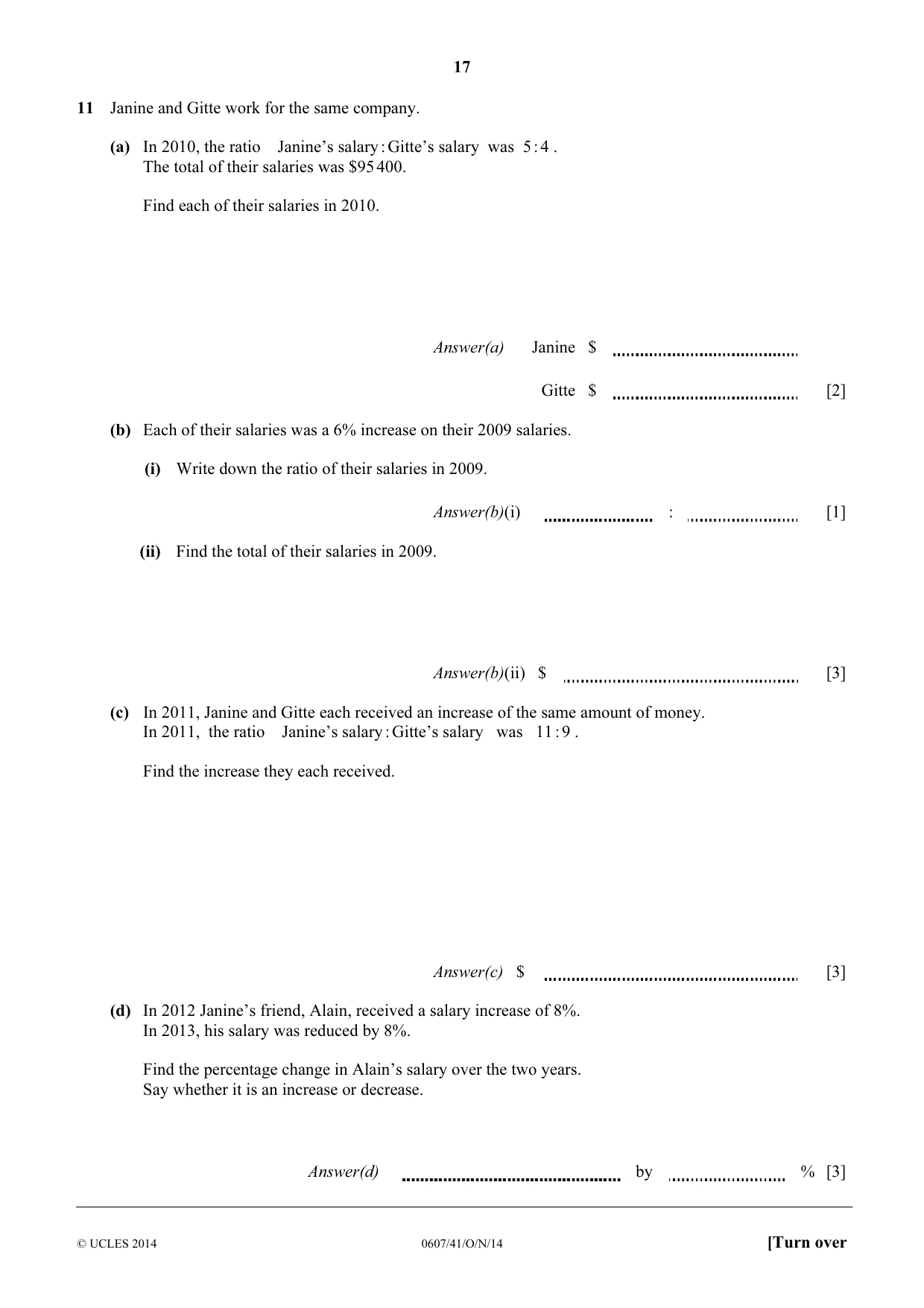
17 © UCLES 2014 0607/41/O/N/14 [Turn over 11 Janine and Gitte work for the same company. (a) In 2010, the ratio Janine’s salary : Gitte’s salary was 5 : 4 . The total of their salaries was $95 400. Find each of their salaries in 2010. Answer(a) Janine $ Gitte $ [2] (b) Each of their salaries was a 6% increase on their 2009 salaries. (i) Write down the ratio of their salaries in 2009. Answer(b)(i) : [1] (ii) Find the total of their salaries in 2009. Answer(b)(ii) $ [3] (c) In 2011, Janine and Gitte each received an increase of the same amount of money. In 2011, the ratio Janine’s salary : Gitte’s salary was 11 : 9 . Find the increase they each received. Answer(c) $ [3] (d) In 2012 Janine’s friend, Alain, received a salary increase of 8%. In 2013, his salary was reduced by 8%. Find the percentage change in Alain’s salary over the two years. Say whether it is an increase or decrease. Answer(d) by % [3]
Question paper, page 18
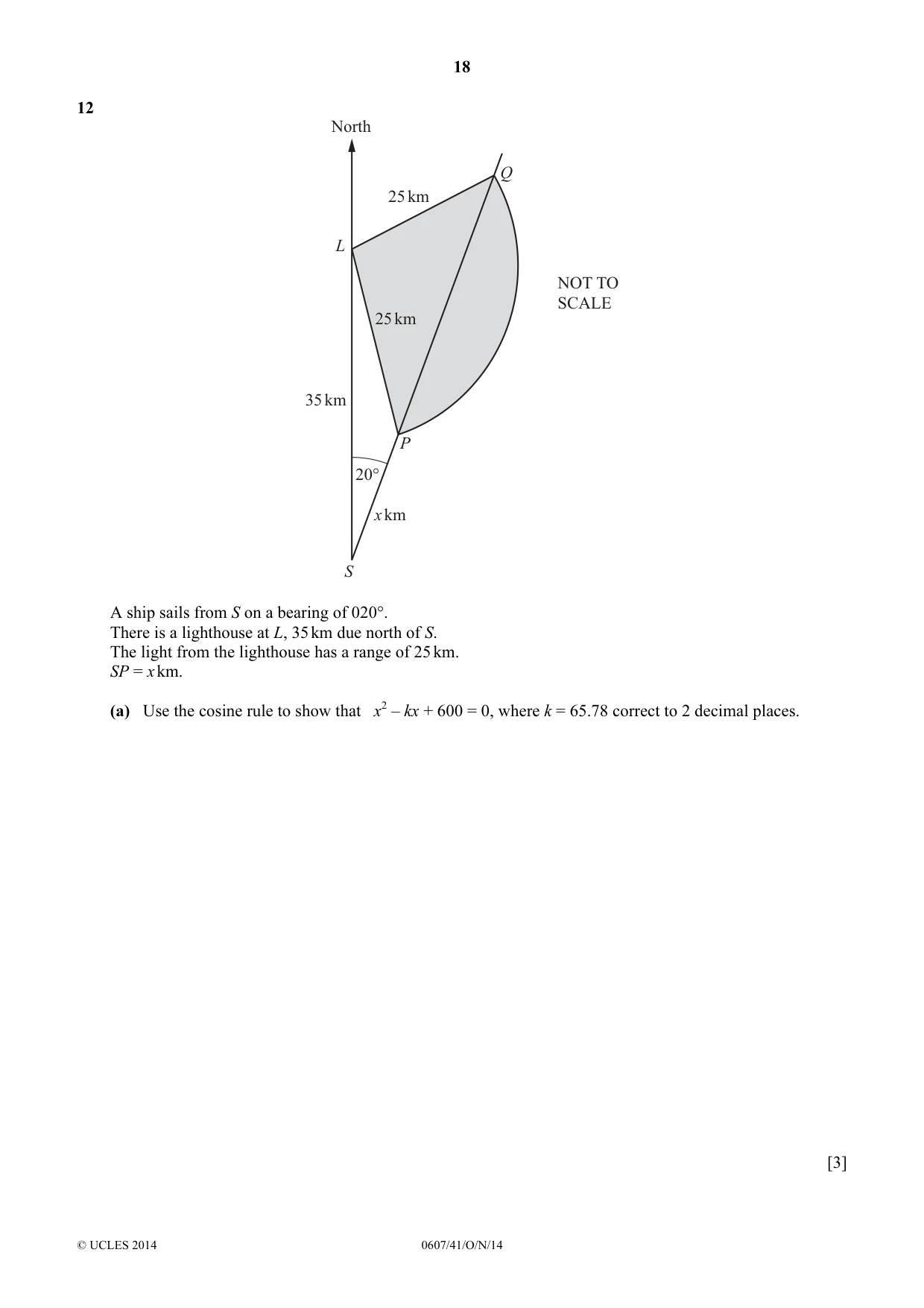
18 © UCLES 2014 0607/41/O/N/14 12 North 20° L Q P S x km 35 km 25 km 25 km NOT TO SCALE A ship sails from S on a bearing of 020°. There is a lighthouse at L, 35 km due north of S. The light from the lighthouse has a range of 25 km. SP = x km. (a) Use the cosine rule to show that x2 – kx + 600 = 0, where k = 65.78 correct to 2 decimal places. [3]
Question paper, page 19
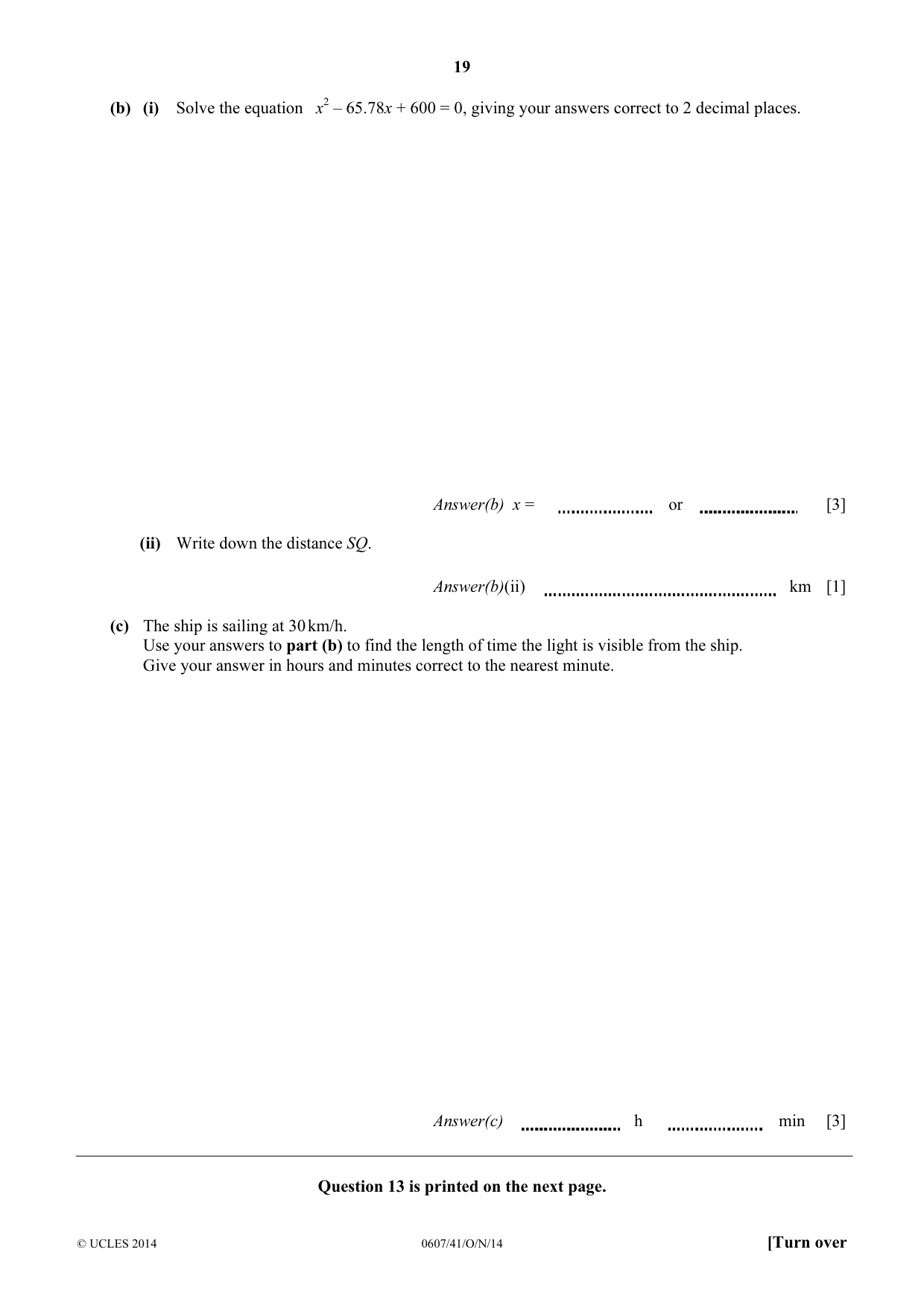
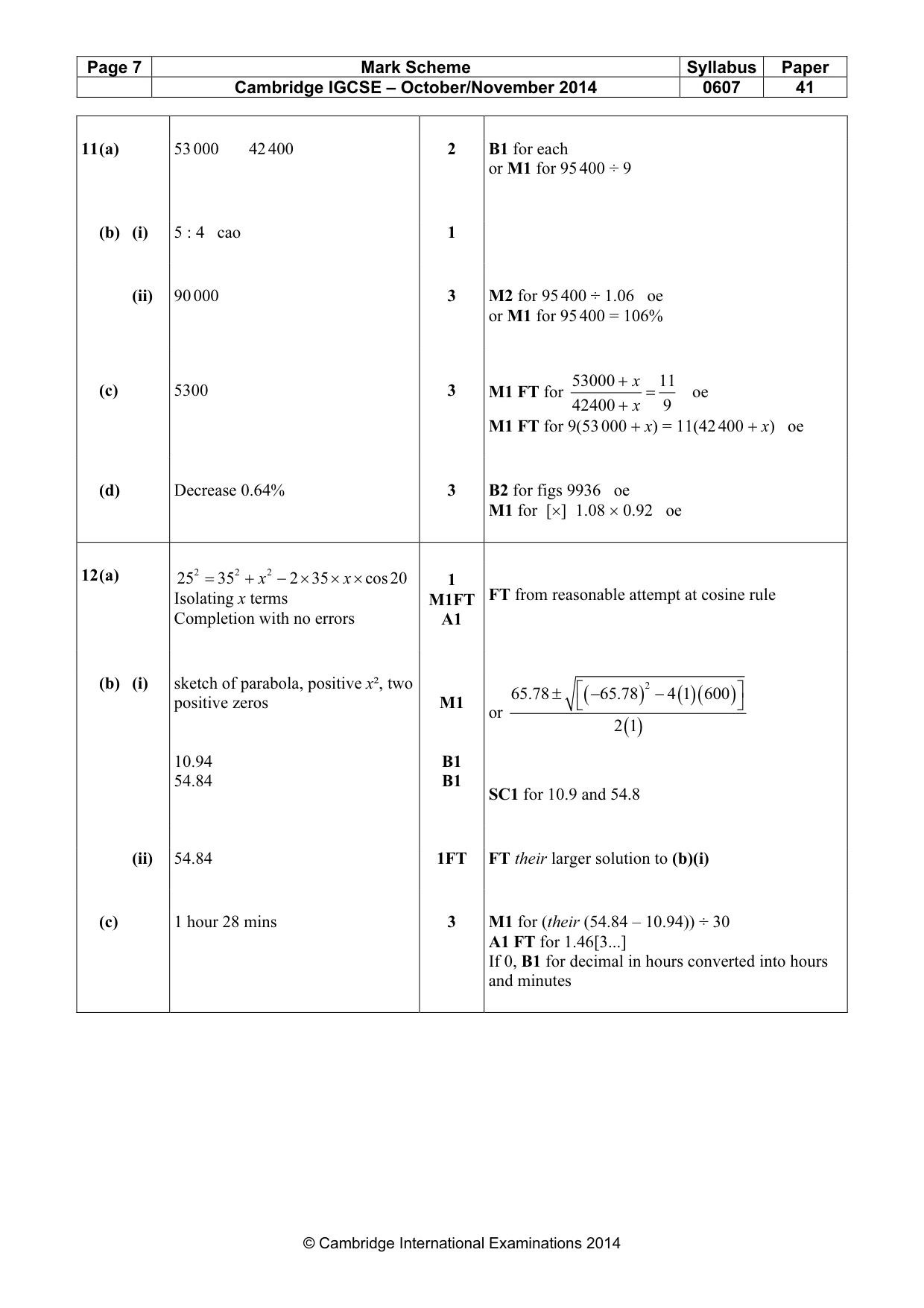
19 © UCLES 2014 0607/41/O/N/14 [Turn over (b) (i) Solve the equation x2 – 65.78x + 600 = 0, giving your answers correct to 2 decimal places. Answer(b) x = or [3] (ii) Write down the distance SQ. Answer(b)(ii) km [1] (c) The ship is sailing at 30 km/h. Use your answers to part (b) to find the length of time the light is visible from the ship. Give your answer in hours and minutes correct to the nearest minute. Answer(c) h min [3] Question 13 is printed on the next page.
Question paper, page 20
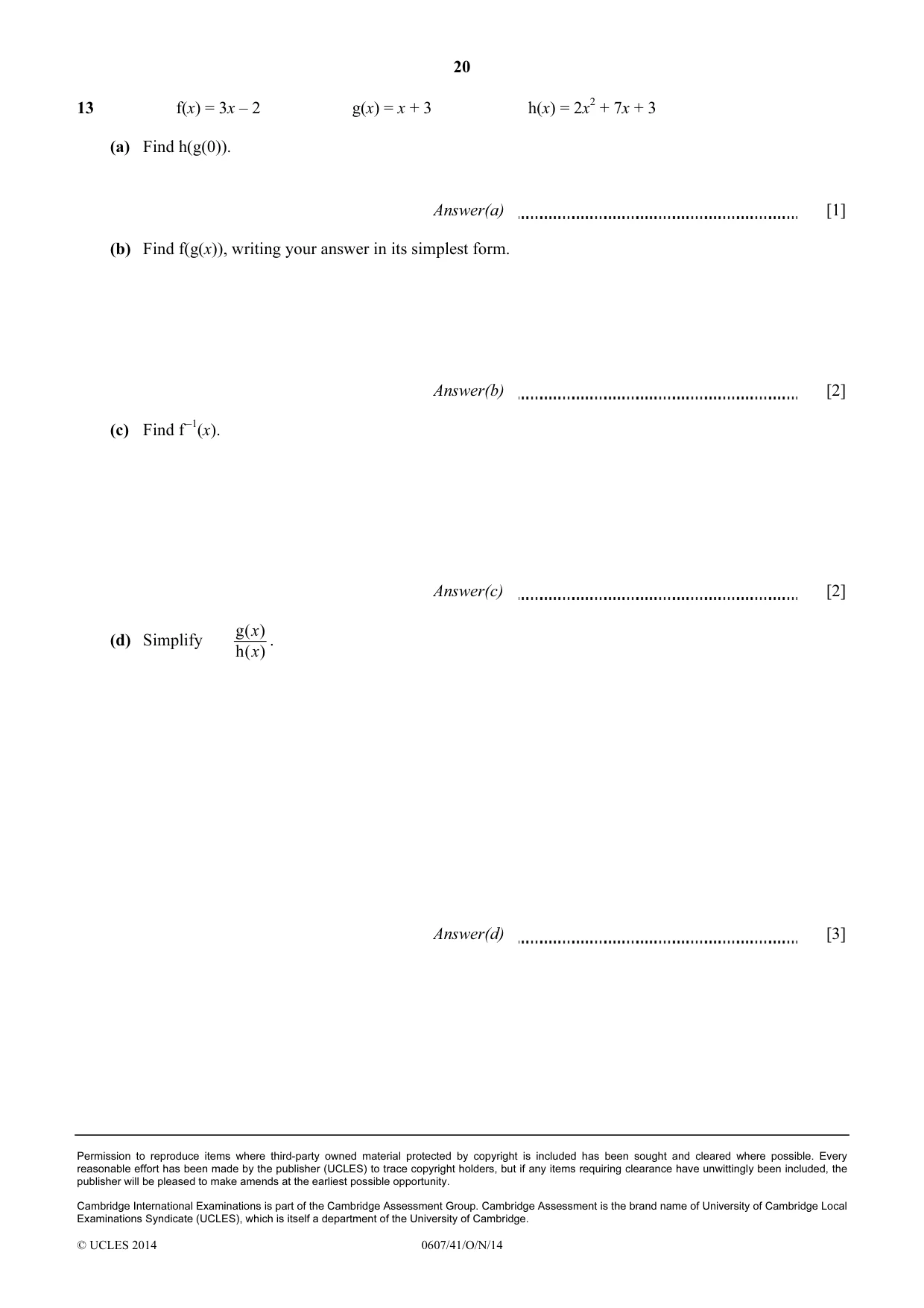
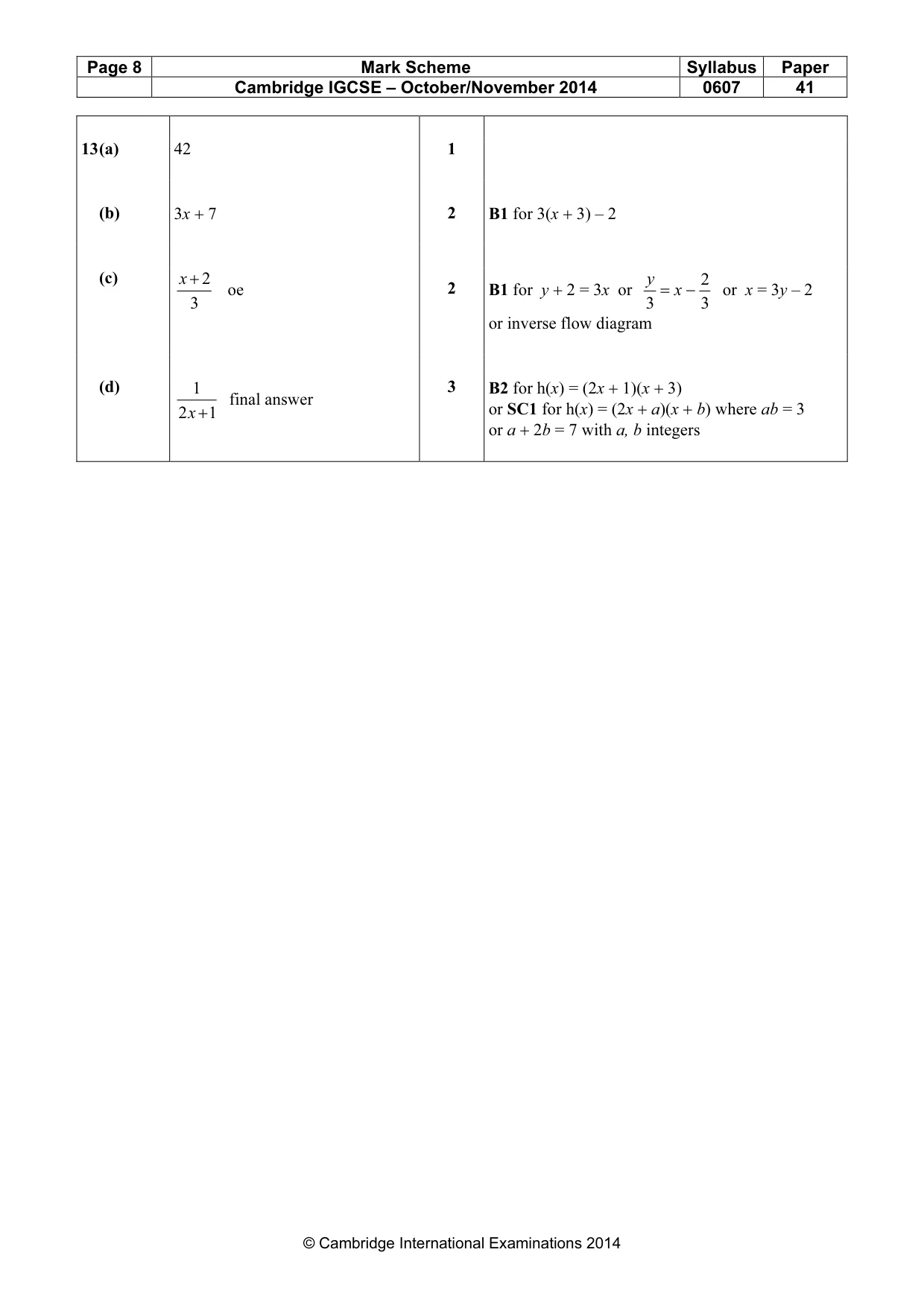
20 Permission to reproduce items where third-party owned material protected by copyright is included has been sought and cleared where possible. Every reasonable effort has been made by the publisher (UCLES) to trace copyright holders, but if any items requiring clearance have unwittingly been included, the publisher will be pleased to make amends at the earliest possible opportunity. Cambridge International Examinations is part of the Cambridge Assessment Group. Cambridge Assessment is the brand name of University of Cambridge Local Examinations Syndicate (UCLES), which is itself a department of the University of Cambridge. © UCLES 2014 0607/41/O/N/14 13 f(x) = 3x – 2 g(x) = x + 3 h(x) = 2x2 + 7x + 3 (a) Find h(g(0)). Answer(a) [1] (b) Find f(g(x)), writing your answer in its simplest form. Answer(b) [2] (c) Find f –1(x). Answer(c) [2] (d) Simplify ) ( h ) ( g x x . Answer(d) [3]
Mark scheme, page 1
® IGCSE is the registered trademark of Cambridge International Examinations. CAMBRIDGE INTERNATIONAL EXAMINATIONS Cambridge International General Certificate of Secondary Education MARK SCHEME for the October/November 2014 series 0607 CAMBRIDGE INTERNATIONAL MATHEMATICS 0607/41 Paper 4 (Extended), maximum raw mark 120 This mark scheme is published as an aid to teachers and candidates, to indicate the requirements of the examination. It shows the basis on which Examiners were instructed to award marks. It does not indicate the details of the discussions that took place at an Examiners’ meeting before marking began, which would have considered the acceptability of alternative answers. Mark schemes should be read in conjunction with the question paper and the Principal Examiner Report for Teachers. Cambridge will not enter into discussions about these mark schemes. Cambridge is publishing the mark schemes for the October/November 2014 series for most Cambridge IGCSE®, Cambridge International A and AS Level components and some Cambridge O Level components.
Mark scheme, page 2
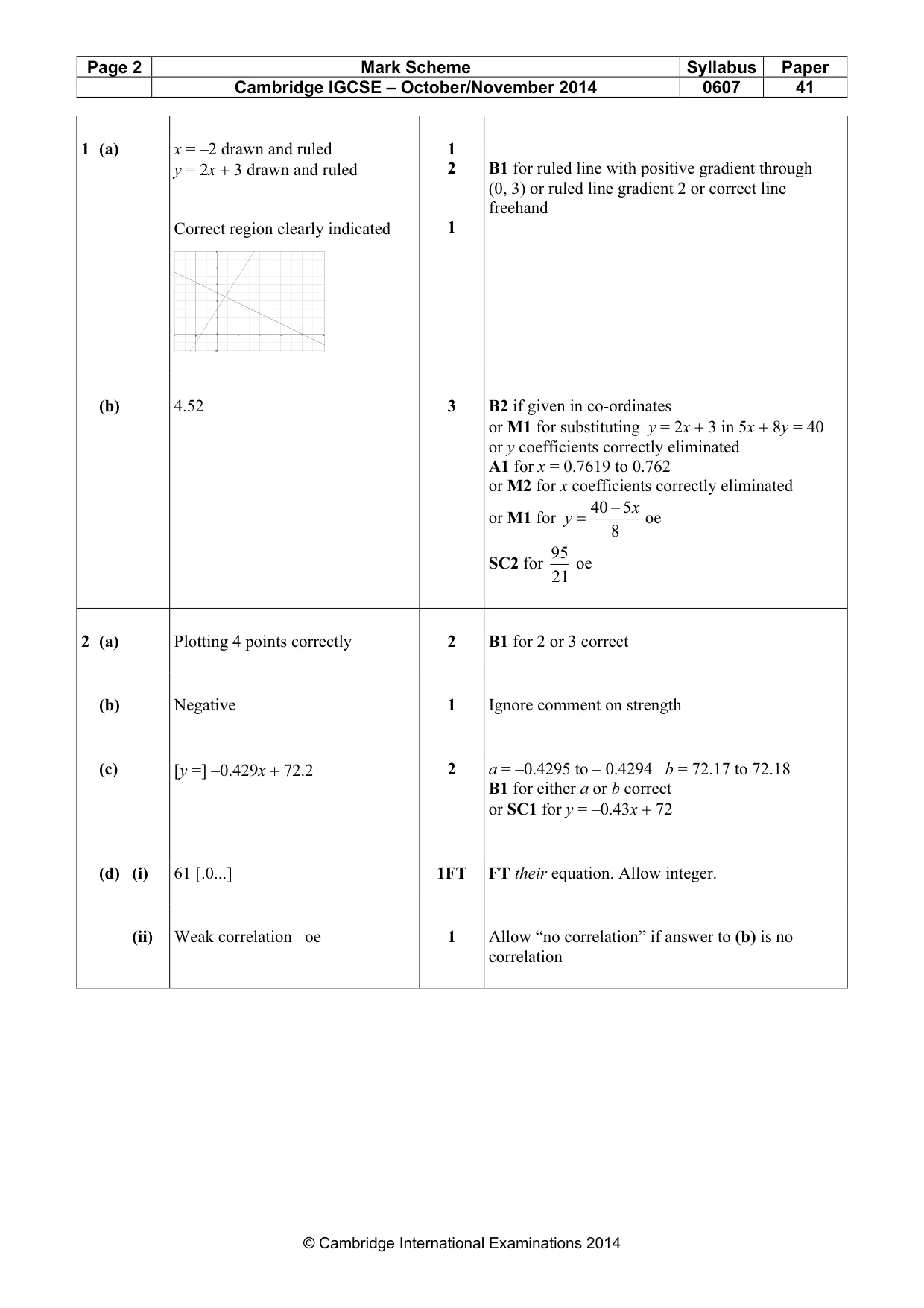
Page 2 Mark Scheme Syllabus Paper Cambridge IGCSE – October/November 2014 0607 41 © Cambridge International Examinations 2014 10 8 6 4 2 0 -2 4 10 8 6 4 2 0 -2 10 8 6 4 2 0 -2 4 10 8 6 4 2 0 -2 10 8 6 4 2 0 -2 4 10 8 6 4 2 0 -2 10 8 6 4 2 0 -2 4 10 8 6 4 2 0 -2 1 (a) x = –2 drawn and ruled y = 2x + 3 drawn and ruled Correct region clearly indicated 1 2 1 B1 for ruled line with positive gradient through (0, 3) or ruled line gradient 2 or correct line freehand (b) 4.52 3 B2 if given in co-ordinates or M1 for substituting y = 2x + 3 in 5x + 8y = 40 or y coefficients correctly eliminated A1 for x = 0.7619 to 0.762 or M2 for x coefficients correctly eliminated or M1 for 40 5 8 x y − = oe SC2 for 21 95 oe 2 (a) Plotting 4 points correctly 2 B1 for 2 or 3 correct (b) Negative 1 Ignore comment on strength (c) [y =] –0.429x + 72.2 2 a = –0.4295 to – 0.4294 b = 72.17 to 72.18 B1 for either a or b correct or SC1 for y = –0.43x + 72 (d) (i) 61 [.0...] 1FT FT their equation. Allow integer. (ii) Weak correlation oe 1 Allow “no correlation” if answer to (b) is no correlation
Mark scheme, page 3
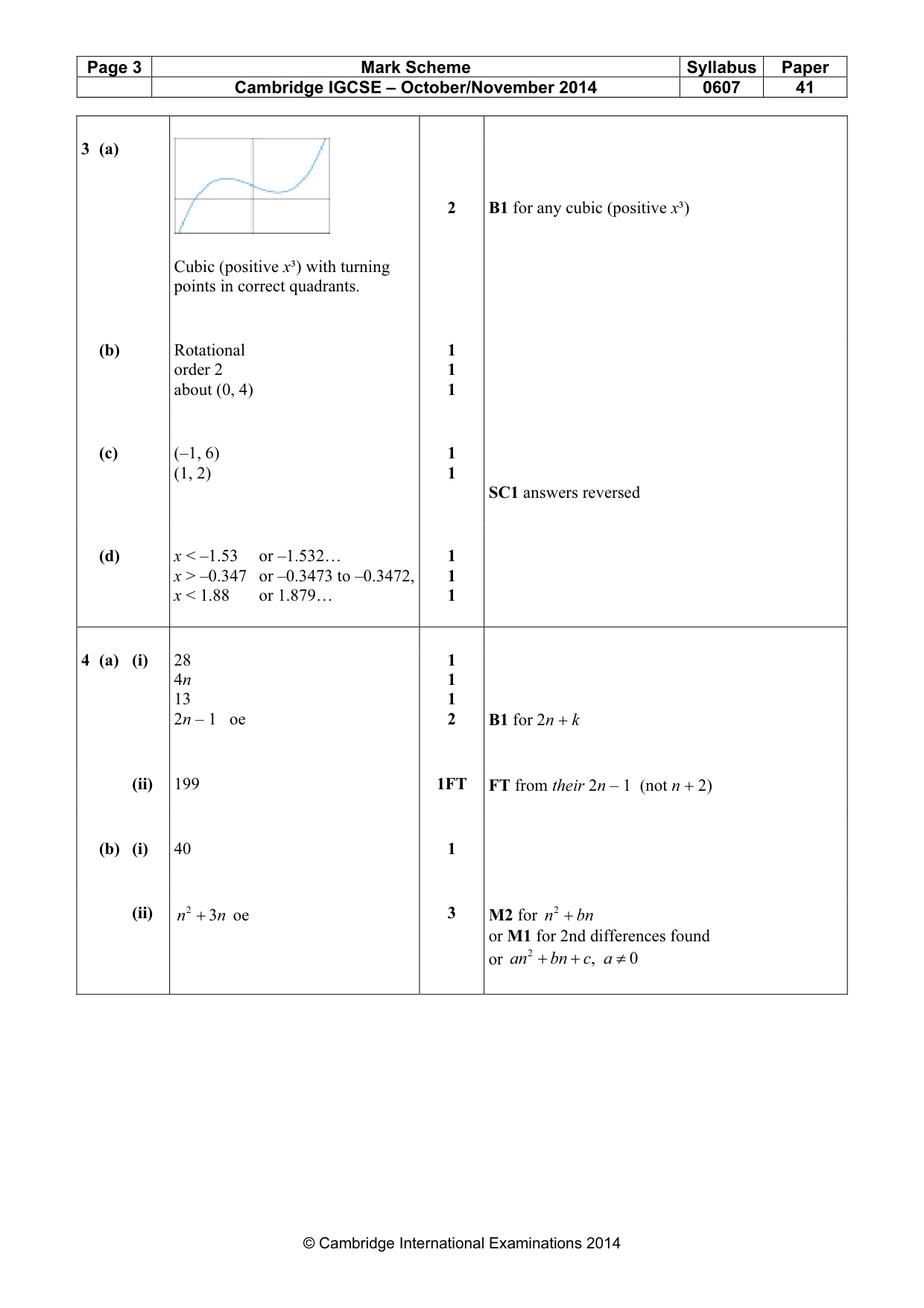
Page 3 Mark Scheme Syllabus Paper Cambridge IGCSE – October/November 2014 0607 41 © Cambridge International Examinations 2014 3 (a) Cubic (positive x³) with turning points in correct quadrants. 2 B1 for any cubic (positive x³) (b) Rotational order 2 about (0, 4) 1 1 1 (c) (–1, 6) (1, 2) 1 1 SC1 answers reversed (d) x < –1.53 or –1.532… x > –0.347 or –0.3473 to –0.3472, x < 1.88 or 1.879… 1 1 1 4 (a) (i) 28 4n 13 2n – 1 oe 1 1 1 2 B1 for 2n + k (ii) 199 1FT FT from their 2n – 1 (not n + 2) (b) (i) 40 1 (ii) 2 3 n n + oe 3 M2 for 2 n bn + or M1 for 2nd differences found or 2 , 0 an bn c a + + ≠
Mark scheme, page 4
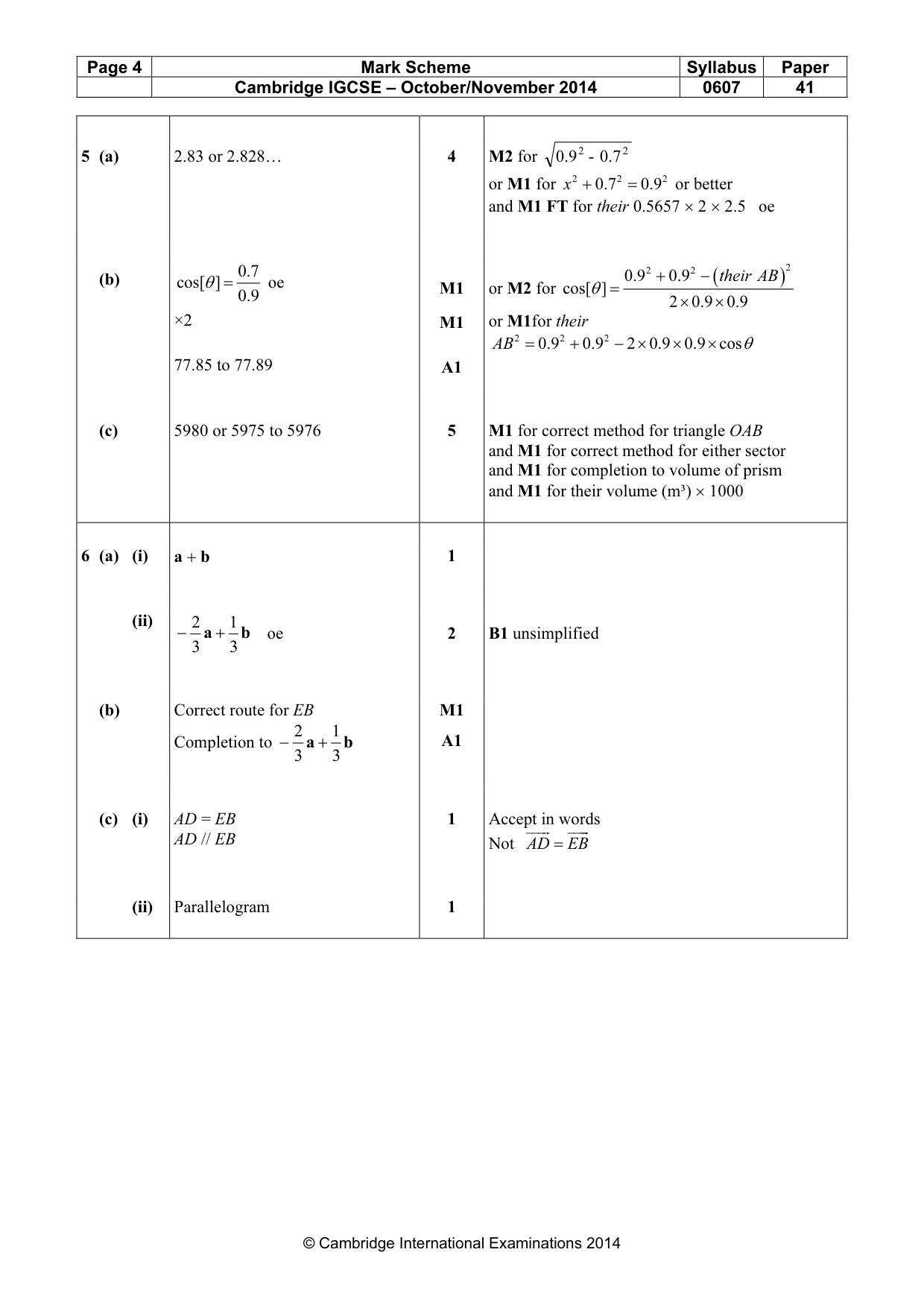
Page 4 Mark Scheme Syllabus Paper Cambridge IGCSE – October/November 2014 0607 41 © Cambridge International Examinations 2014 5 (a) 2.83 or 2.828… 4 M2 for 2 2 0.7 - 9.0 or M1 for 2 2 2 0.7 0.9 x + = or better and M1 FT for their 0.5657 × 2 × 2.5 oe (b) 0.7 cos[ ] 0.9 θ = oe ×2 77.85 to 77.89 M1 M1 A1 or M2 for ( ) 2 2 2 0.9 0.9 cos[ ] 2 0.9 0.9 their AB θ + − = × × or M1for their 2 2 2 0.9 0.9 2 0.9 0.9 cos AB θ = + − × × × (c) 5980 or 5975 to 5976 5 M1 for correct method for triangle OAB and M1 for correct method for either sector and M1 for completion to volume of prism and M1 for their volume (m³) × 1000 6 (a) (i) a + b 1 (ii) b a 3 1 3 2 + − oe 2 B1 unsimplified (b) Correct route for EB Completion to b a 3 1 3 2 + − M1 A1 (c) (i) AD = EB AD // EB 1 Accept in words Not AD EB = uuur uuur (ii) Parallelogram 1
Mark scheme, page 5
Page 5 Mark Scheme Syllabus Paper Cambridge IGCSE – October/November 2014 0607 41 © Cambridge International Examinations 2014 7 (a) 3 B2 for 4 correct or B1 for 2 correct (b) (i) 200 42 oe 1FT FT their 42 (ii) 200 9 oe 1FT FT their 9 (c) (i) 39800 870 oe 2 M1 for 200 30 ×199 29 oe (ii) 39800 1920 oe 3 M2 FT for 200 60 × 199 16 + 200 16 × 199 60 oe M1 FT for one of above products 8 (a) (i) 58 1 (ii) 67 2 B1 for ABC = 125 or ADE = 67 (b) (i) 2 from PXS = QXR ([vertically] opposite angles) SPX = RQX ([angles in] same segment) oe PSX = QRX ([angles in] same segment) oe 2 B1 for one of these or 2 pairs of angles identified as equal (ii) 7.5 2 M1 for 8 5 12 x = or better (iii) 144 64 oe 1 0.444(4...) 9 60 [10] [8] 52 3 16 42
Mark scheme, page 6
Page 6 Mark Scheme Syllabus Paper Cambridge IGCSE – October/November 2014 0607 41 © Cambridge International Examinations 2014 4 2 0 -2 -4 4 2 0 -2 -4 4 2 0 -2 -4 4 2 0 -2 -4 4 2 0 -2 -4 4 2 0 -2 -4 4 2 0 -2 -4 4 2 0 -2 -4 4 2 0 -2 -4 4 2 0 -2 -4 4 2 0 -2 -4 4 2 0 -2 -4 4 2 0 -2 -4 4 2 0 -2 -4 4 2 0 -2 -4 4 2 0 -2 -4 9 (a) (i) 23 1 (ii) 17 1 (iii) 10 1 (b) [14] 16 [28] 42 60 3 B1 for each (c) Bar heights 1.4, 3.2, 5.6, 8.4, 6 Bar widths correct with no gaps 2FT 1 FT their frequencies B1 for 2 correct independent 10 (a) (i) 2 Correct curve B1 correct shape (ii) y = –3 1 (b) (i) 3 B1 for each branch (ii) x = ± 3 2 B1 for each (c) –2.38 or –2.384 to –2.385 0.515 or 0.5154 ... 1 1
Mark scheme, page 7
Page 7 Mark Scheme Syllabus Paper Cambridge IGCSE – October/November 2014 0607 41 © Cambridge International Examinations 2014 11 (a) 53 000 42 400 2 B1 for each or M1 for 95 400 ÷ 9 (b) (i) 5 : 4 cao 1 (ii) 90 000 3 M2 for 95 400 ÷ 1.06 oe or M1 for 95 400 = 106% (c) 5300 3 M1 FT for 9 11 42400 53000 = + + x x oe M1 FT for 9(53 000 + x) = 11(42 400 + x) oe (d) Decrease 0.64% 3 B2 for figs 9936 oe M1 for [×] 1.08 × 0.92 oe 12 (a) 2 2 2 25 35 2 35 cos20 x x = + − × × × Isolating x terms Completion with no errors 1 M1FT A1 FT from reasonable attempt at cosine rule (b) (i) sketch of parabola, positive x², two positive zeros 10.94 54.84 M1 B1 B1 or ( ) ( )( ) ( ) 2 65.78 65.78 4 1 600 2 1 ± − − SC1 for 10.9 and 54.8 (ii) 54.84 1FT FT their larger solution to (b)(i) (c) 1 hour 28 mins 3 M1 for (their (54.84 – 10.94)) ÷ 30 A1 FT for 1.46[3...] If 0, B1 for decimal in hours converted into hours and minutes
Mark scheme, page 8
Page 8 Mark Scheme Syllabus Paper Cambridge IGCSE – October/November 2014 0607 41 © Cambridge International Examinations 2014 13 (a) 42 1 (b) 3x + 7 2 B1 for 3(x + 3) – 2 (c) 3 2 + x oe 2 B1 for y + 2 = 3x or 3 2 3 − = x y or x = 3y – 2 or inverse flow diagram (d) 1 2 1 + x final answer 3 B2 for h(x) = (2x + 1)(x + 3) or SC1 for h(x) = (2x + a)(x + b) where ab = 3 or a + 2b = 7 with a, b integers
What you needed in this session
Cambridge’s own grade thresholds for 2014 Oct/Nov, Paper 4 · Variant 1. A higher threshold means an easier paper — the bar moves with how the cohort did.