Cambridge IGCSE Mathematics - International 0607 — 2014 Oct/Nov Paper 4 · Variant 3
0607/43/O/N/14 · 120 marks · ≈135 min
The question paper and its mark scheme, free to read here and free to download. This is Cambridge’s own paper, exactly as it was sat.
Question paper20 pages
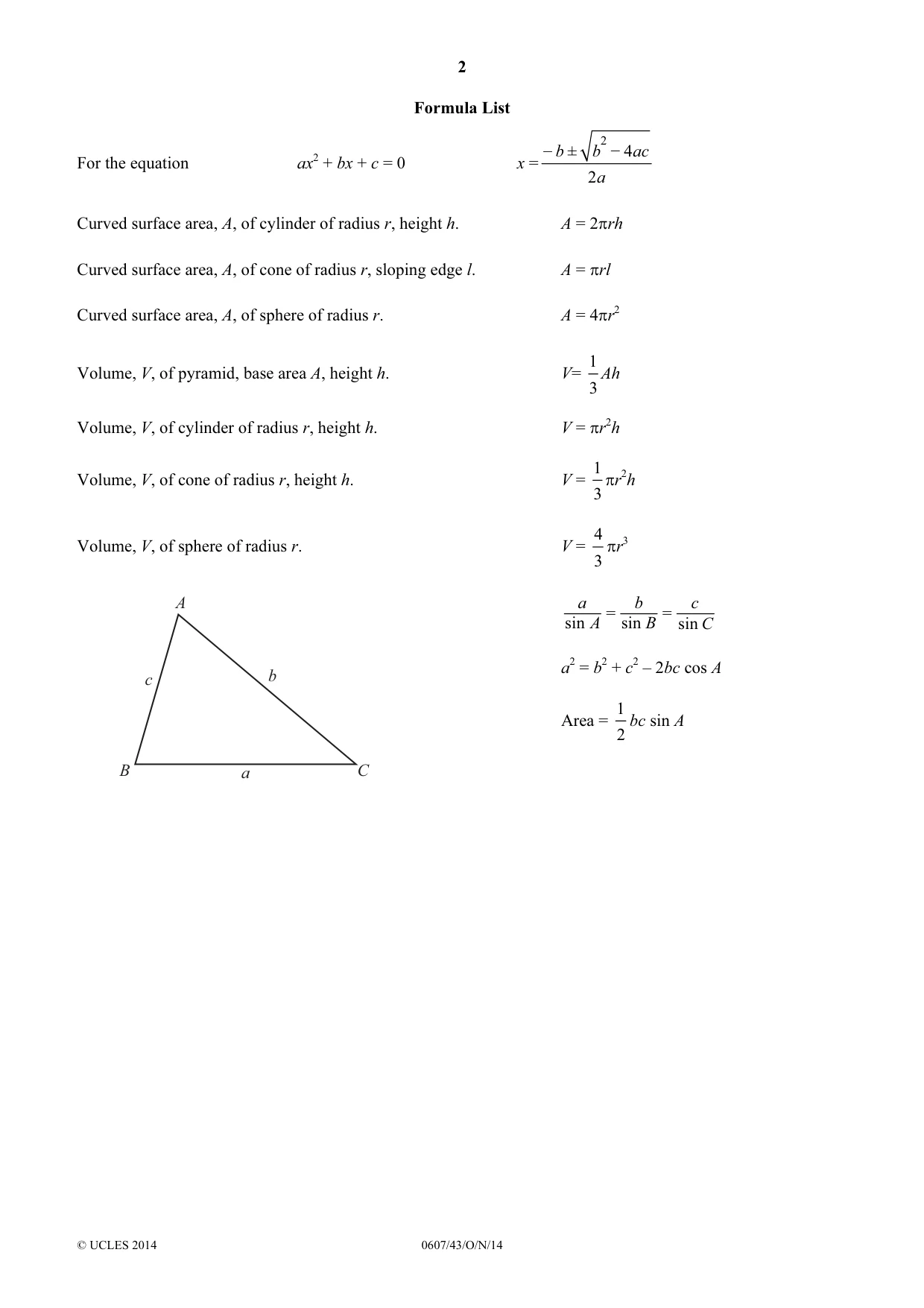
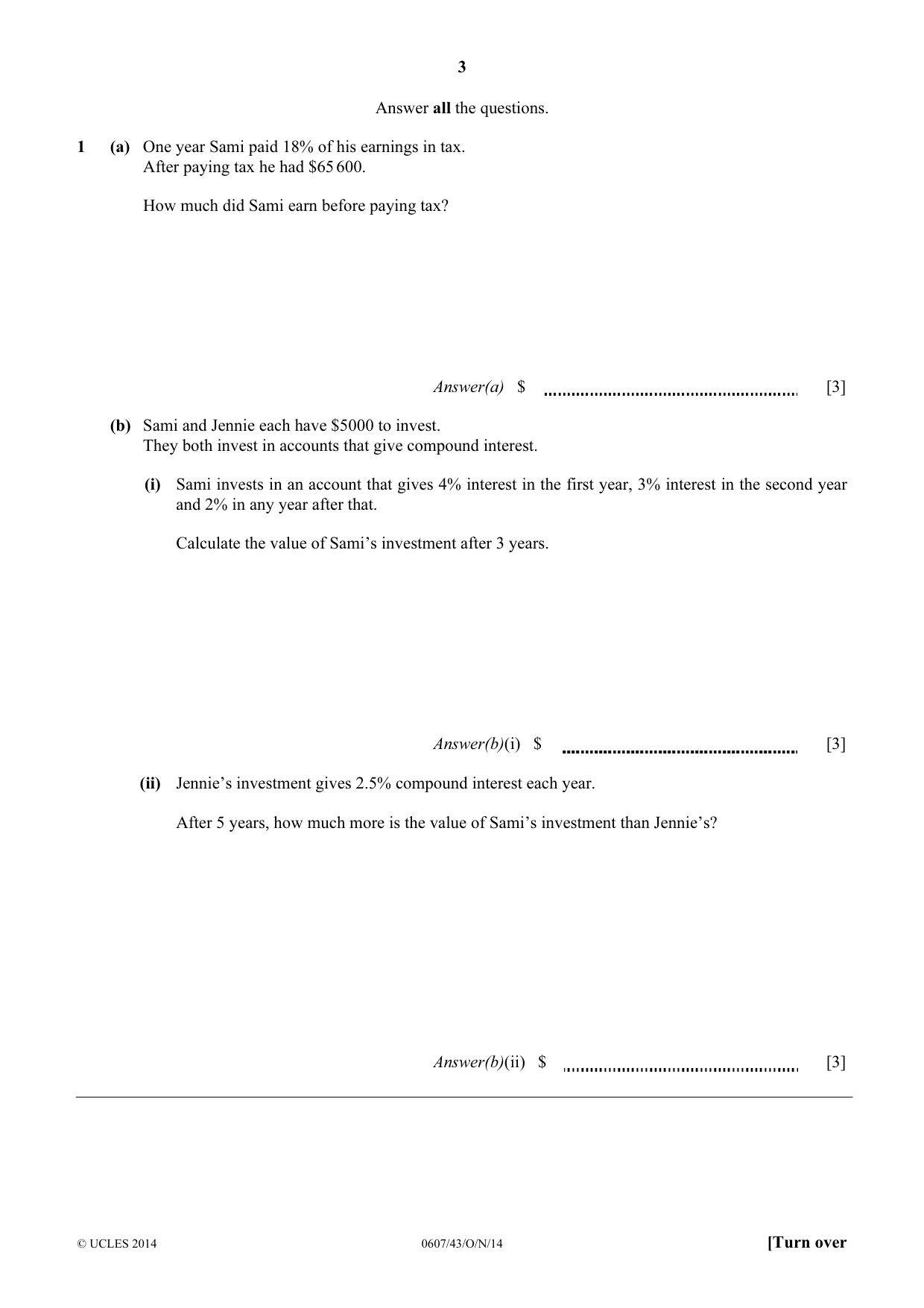
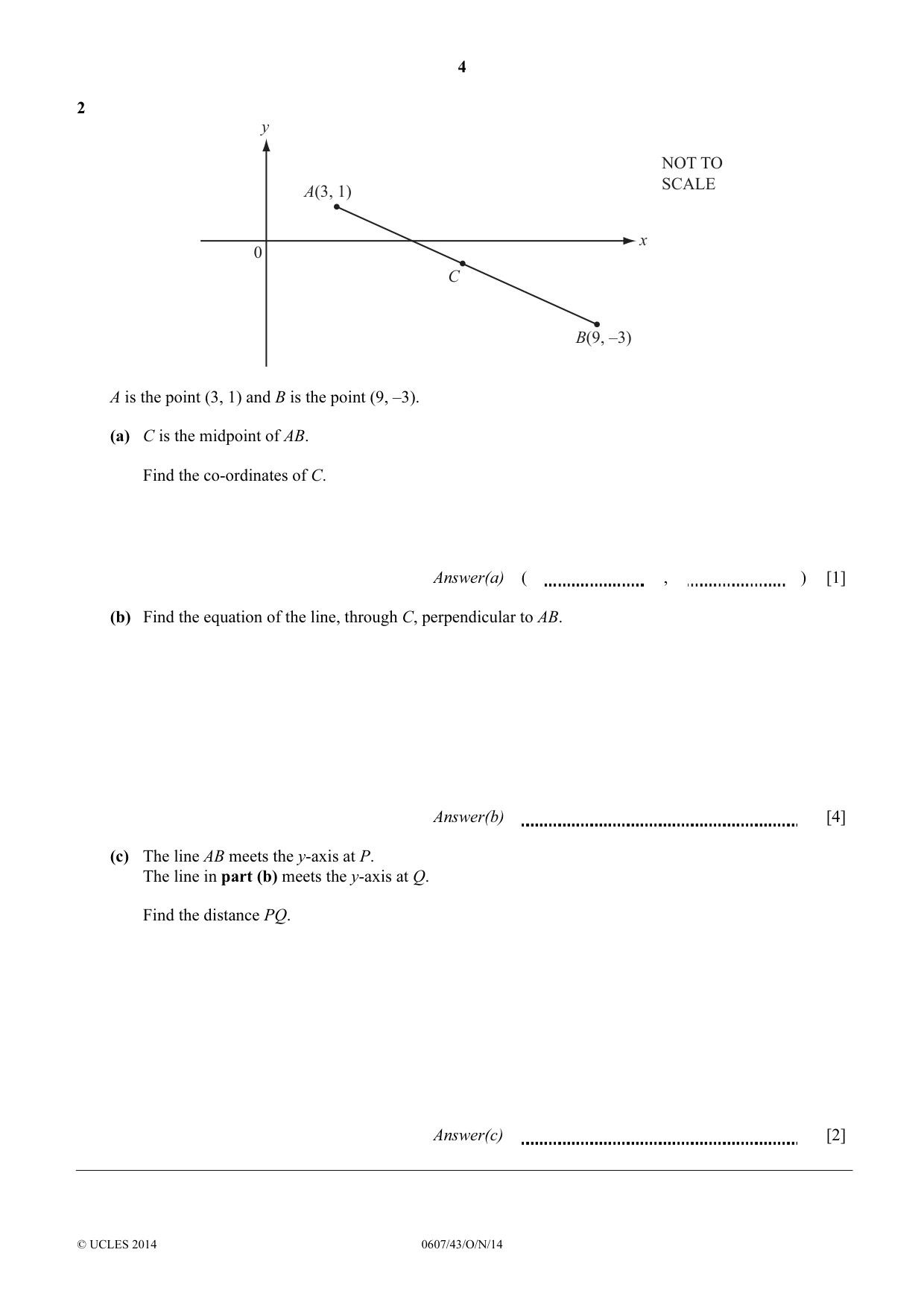
Mark scheme6 pages
Answers below. Sit the paper first if you are practising.
Paper as text
Question paper, page 1
This document consists of 19 printed pages and 1 blank page. IB14 11_0607_43/3RP © UCLES 2014 [Turn over *0709951729* Cambridge International Examinations Cambridge International General Certificate of Secondary Education CAMBRIDGE INTERNATIONAL MATHEMATICS 0607/43 Paper 4 (Extended) October/November 2014 2 hours 15 minutes Candidates answer on the Question Paper. Additional Materials: Geometrical Instruments Graphics Calculator READ THESE INSTRUCTIONS FIRST Write your Centre number, candidate number and name on all the work you hand in. Write in dark blue or black pen. Do not use staples, paper clips, glue or correction fluid. You may use an HB pencil for any diagrams or graphs. DO NOT WRITE IN ANY BARCODES. Answer all the questions. Unless instructed otherwise, give your answers exactly or correct to three significant figures as appropriate. Answers in degrees should be given to one decimal place. For π, use your calculator value. You must show all the relevant working to gain full marks and you will be given marks for correct methods, including sketches, even if your answer is incorrect. The number of marks is given in brackets [ ] at the end of each question or part question. The total number of marks for this paper is 120.
Question paper, page 2
2 © UCLES 2014 0607/43/O/N/14 Formula List For the equation ax2 + bx + c = 0 x = 2 _ ± 4 2 _ b b ac a Curved surface area, A, of cylinder of radius r, height h. A = 2πrh Curved surface area, A, of cone of radius r, sloping edge l. A = πrl Curved surface area, A, of sphere of radius r. A = 4πr2 Volume, V, of pyramid, base area A, height h. V= 1 3 Ah Volume, V, of cylinder of radius r, height h. V = πr2h Volume, V, of cone of radius r, height h. V = 1 3 πr2h Volume, V, of sphere of radius r. V = 4 3 πr3 = = sin sin sin a b c A B C a2 = b2 + c2 – 2bc cos A Area = 1 2 bc sin A A a B C b c
Question paper, page 3
3 © UCLES 2014 0607/43/O/N/14 [Turn over Answer all the questions. 1 (a) One year Sami paid 18% of his earnings in tax. After paying tax he had $65 600. How much did Sami earn before paying tax? Answer(a) $ [3] (b) Sami and Jennie each have $5000 to invest. They both invest in accounts that give compound interest. (i) Sami invests in an account that gives 4% interest in the first year, 3% interest in the second year and 2% in any year after that. Calculate the value of Sami’s investment after 3 years. Answer(b)(i) $ [3] (ii) Jennie’s investment gives 2.5% compound interest each year. After 5 years, how much more is the value of Sami’s investment than Jennie’s? Answer(b)(ii) $ [3]
Question paper, page 4
4 © UCLES 2014 0607/43/O/N/14 2 C y x A(3, 1) B(9, –3) 0 NOT TO SCALE A is the point (3, 1) and B is the point (9, –3). (a) C is the midpoint of AB. Find the co-ordinates of C. Answer(a) ( , ) [1] (b) Find the equation of the line, through C, perpendicular to AB. Answer(b) [4] (c) The line AB meets the y-axis at P. The line in part (b) meets the y-axis at Q. Find the distance PQ. Answer(c) [2]
Question paper, page 5
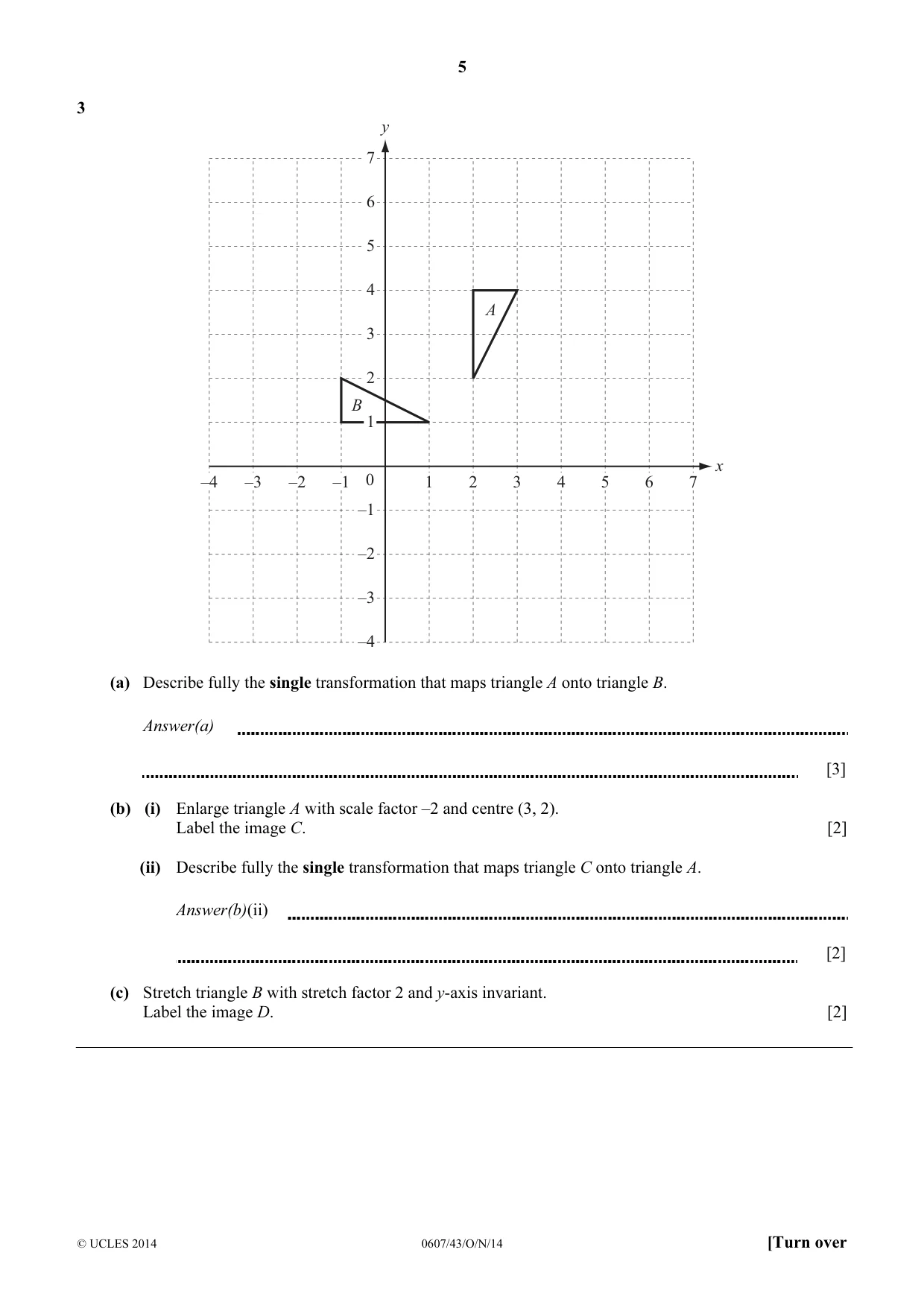
5 © UCLES 2014 0607/43/O/N/14 [Turn over 3 B A y x 7 6 5 4 3 2 1 –1 –2 –3 –4 0 –1 1 2 3 4 5 6 7 –2 –3 –4 (a) Describe fully the single transformation that maps triangle A onto triangle B. Answer(a) [3] (b) (i) Enlarge triangle A with scale factor –2 and centre (3, 2). Label the image C. [2] (ii) Describe fully the single transformation that maps triangle C onto triangle A. Answer(b)(ii) [2] (c) Stretch triangle B with stretch factor 2 and y-axis invariant. Label the image D. [2]
Question paper, page 6
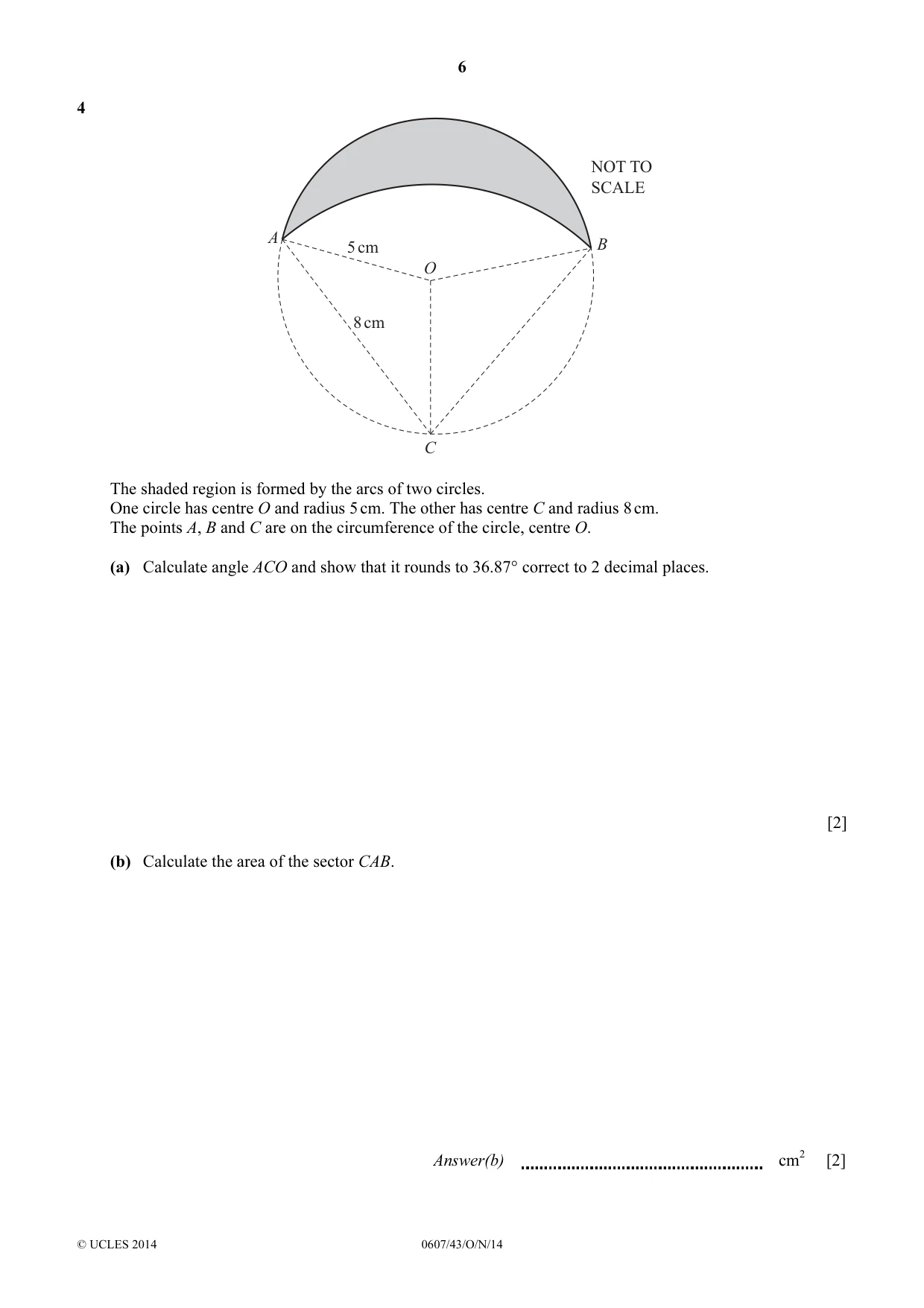
6 © UCLES 2014 0607/43/O/N/14 4 A B C O 5 cm 8 cm NOT TO SCALE The shaded region is formed by the arcs of two circles. One circle has centre O and radius 5 cm. The other has centre C and radius 8 cm. The points A, B and C are on the circumference of the circle, centre O. (a) Calculate angle ACO and show that it rounds to 36.87° correct to 2 decimal places. [2] (b) Calculate the area of the sector CAB. Answer(b) cm2 [2]
Question paper, page 7
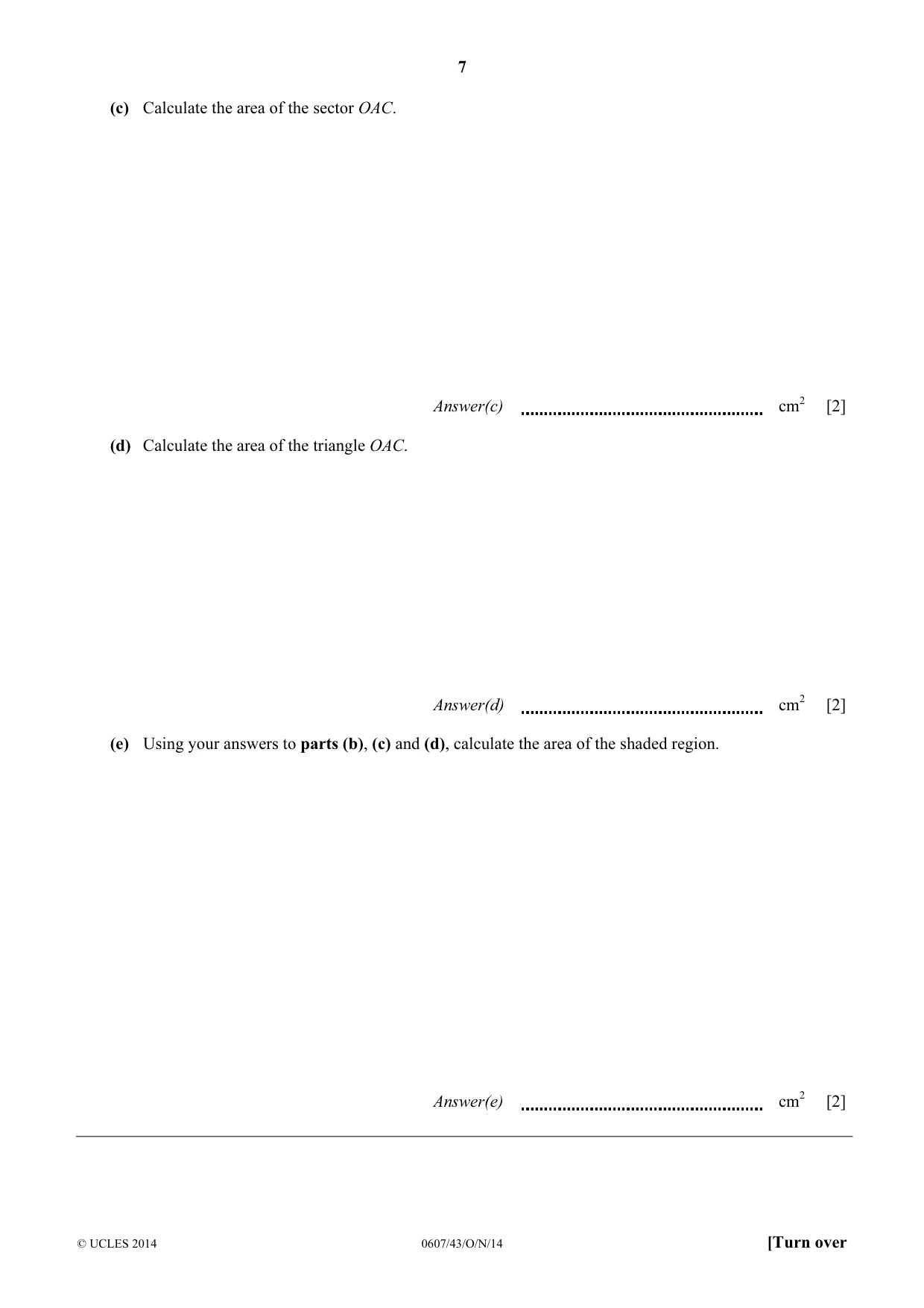
7 © UCLES 2014 0607/43/O/N/14 [Turn over (c) Calculate the area of the sector OAC. Answer(c) cm2 [2] (d) Calculate the area of the triangle OAC. Answer(d) cm2 [2] (e) Using your answers to parts (b), (c) and (d), calculate the area of the shaded region. Answer(e) cm2 [2]
Question paper, page 8
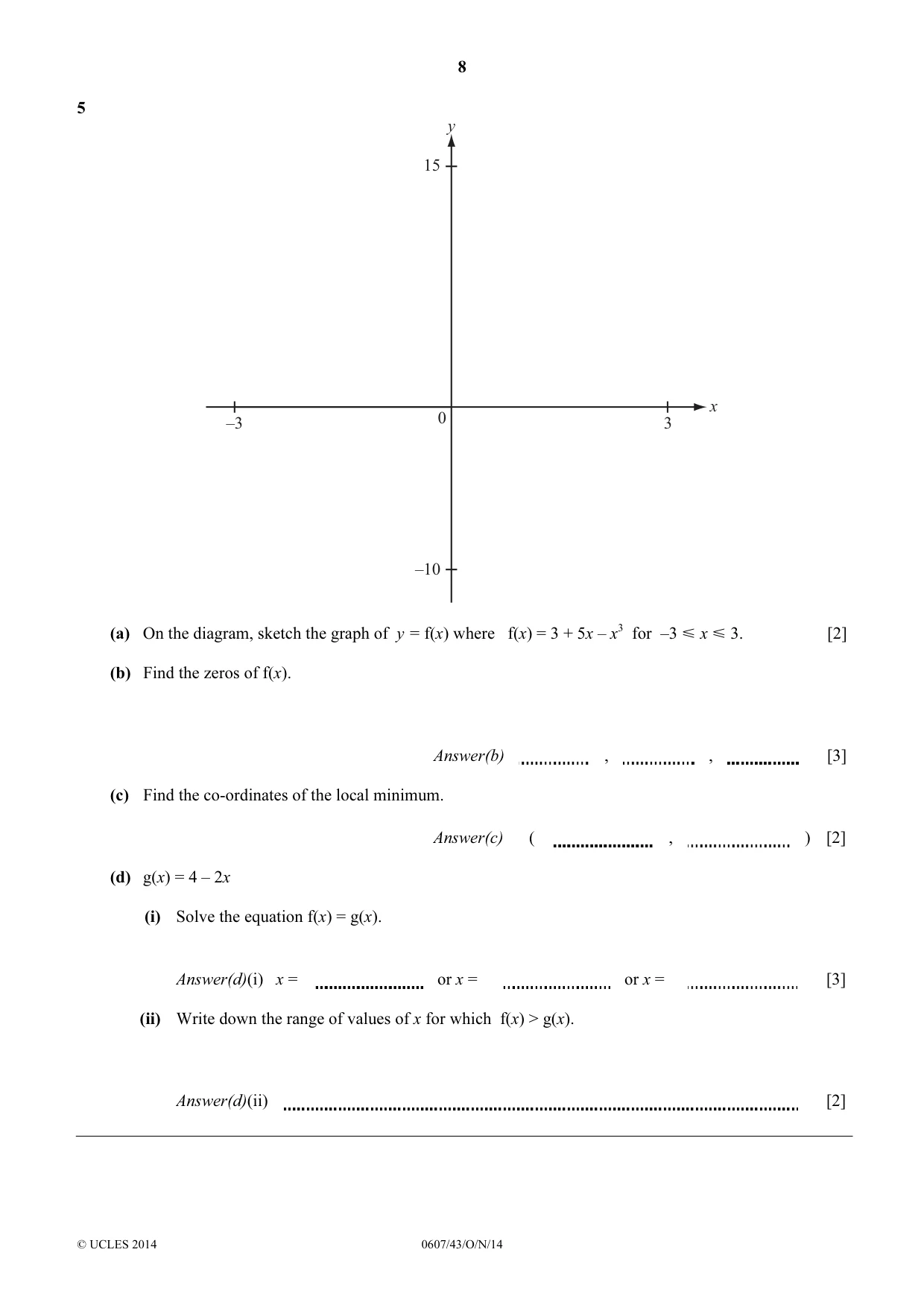
8 © UCLES 2014 0607/43/O/N/14 5 0 15 –10 –3 3 y x (a) On the diagram, sketch the graph of y = f(x) where f(x) = 3 + 5x – x3 for –3 Y x Y 3. [2] (b) Find the zeros of f(x). Answer(b) , , [3] (c) Find the co-ordinates of the local minimum. Answer(c) ( , ) [2] (d) g(x) = 4 – 2x (i) Solve the equation f(x) = g(x). Answer(d)(i) x = or x = or x = [3] (ii) Write down the range of values of x for which f(x) > g(x). Answer(d)(ii) [2]
Question paper, page 9
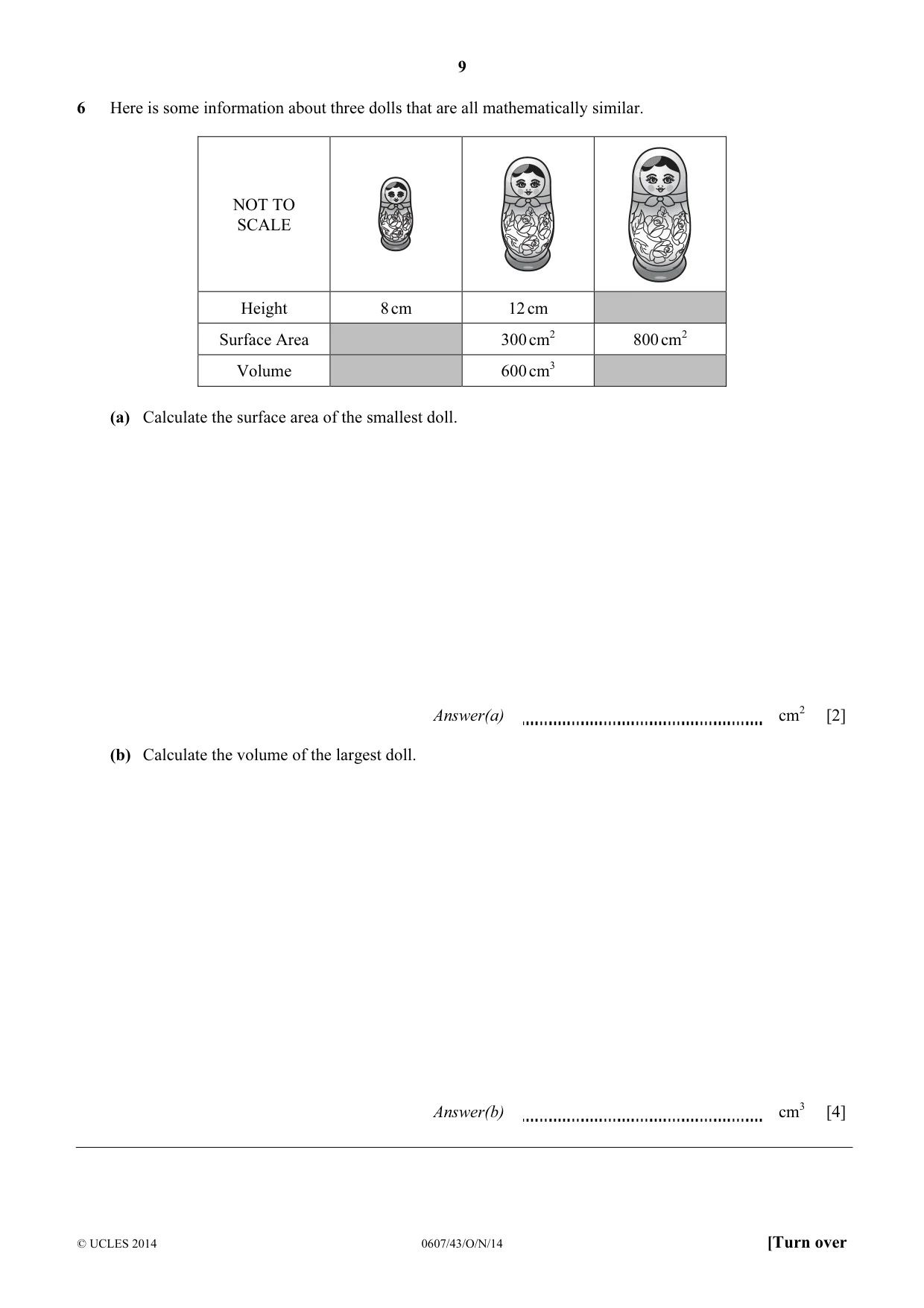
9 © UCLES 2014 0607/43/O/N/14 [Turn over 6 Here is some information about three dolls that are all mathematically similar. NOT TO SCALE Height 8 cm 12 cm Surface Area 300 cm2 800 cm2 Volume 600 cm3 (a) Calculate the surface area of the smallest doll. Answer(a) cm2 [2] (b) Calculate the volume of the largest doll. Answer(b) cm3 [4]
Question paper, page 10
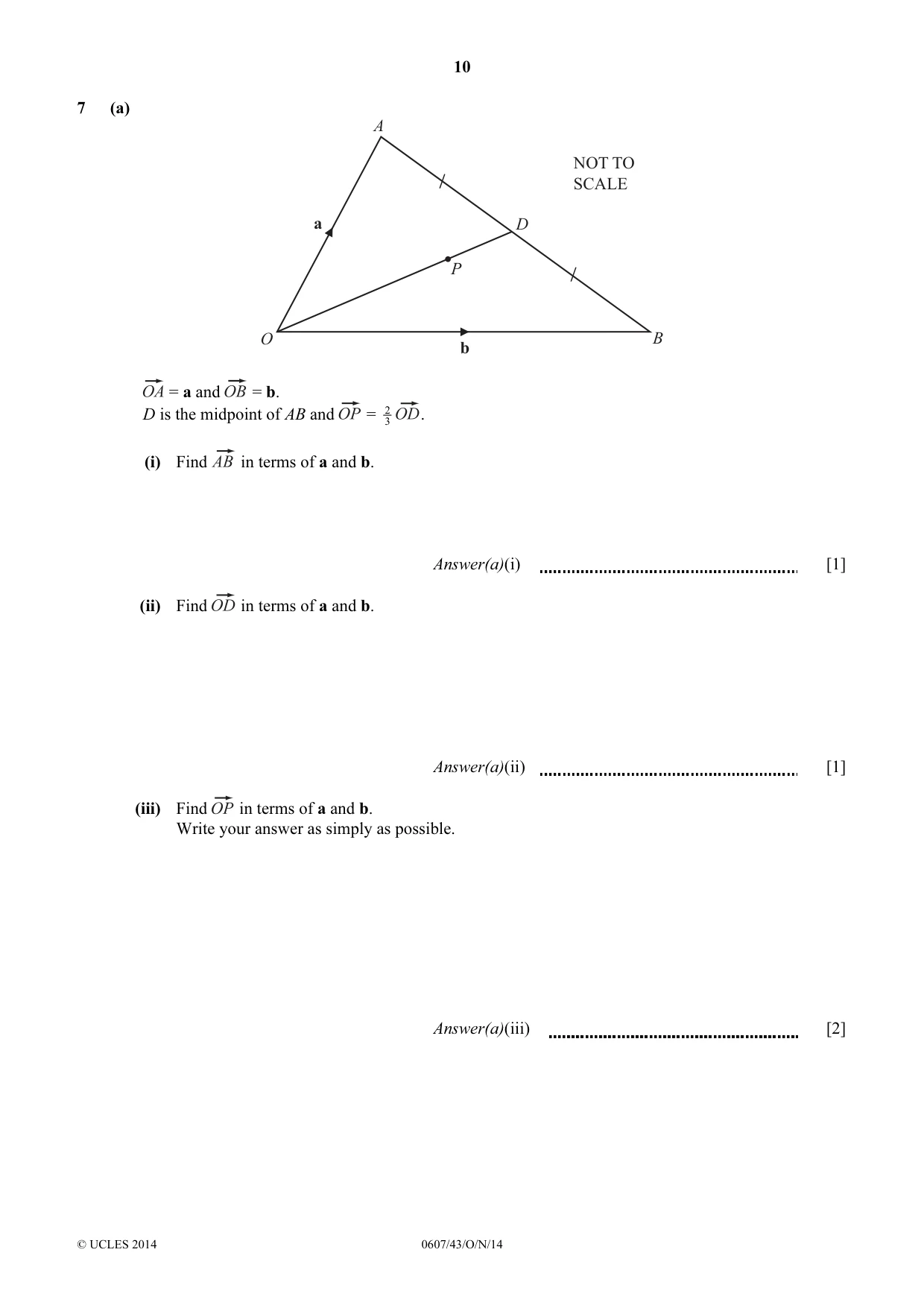
10 © UCLES 2014 0607/43/O/N/14 7 (a) A O D P B a b NOT TO SCALE = a and = b. D is the midpoint of AB and = 3 2 . (i) Find in terms of a and b. Answer(a)(i) [1] (ii) Find in terms of a and b. Answer(a)(ii) [1] (iii) Find in terms of a and b. Write your answer as simply as possible. Answer(a)(iii) [2]
Question paper, page 11
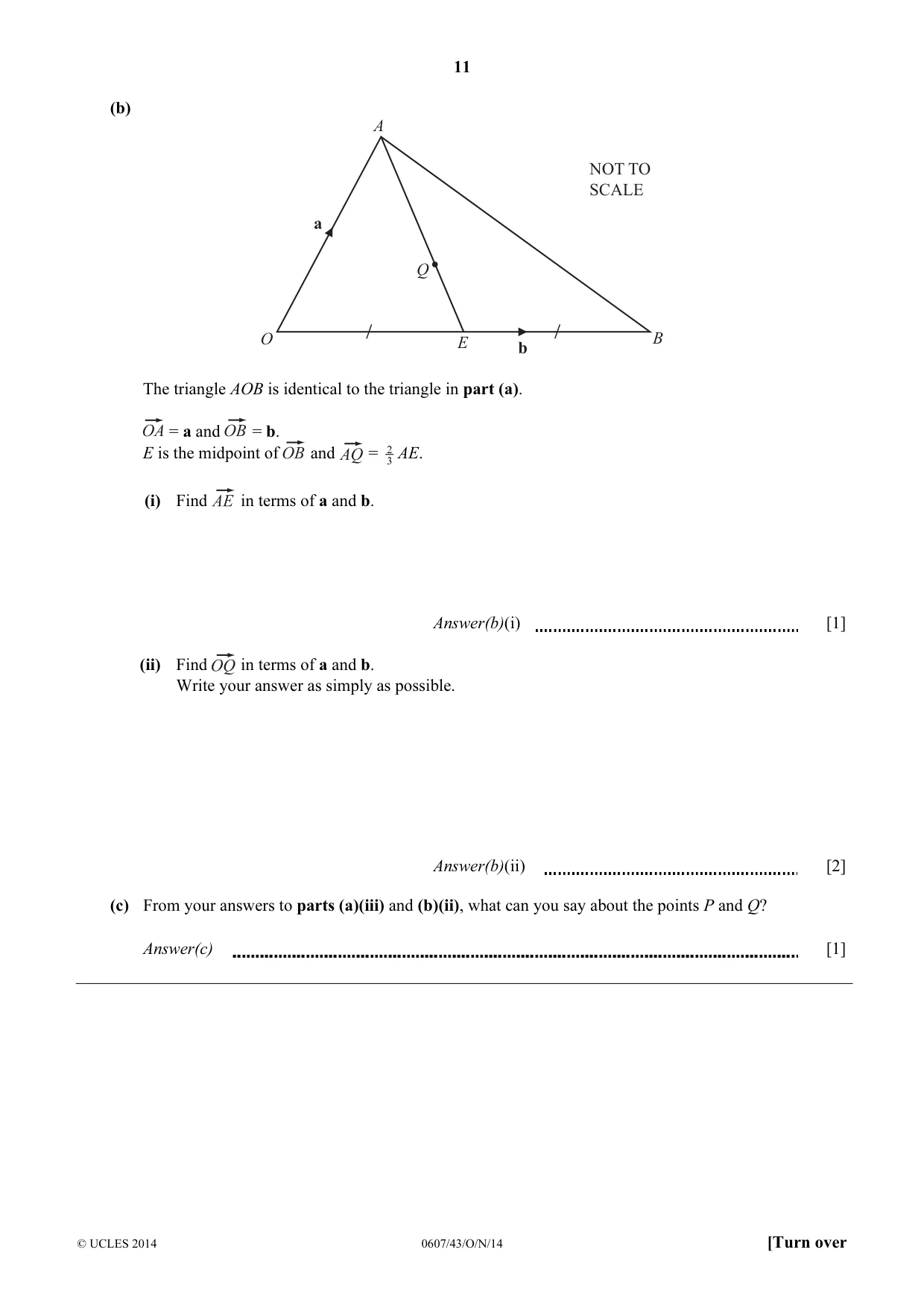
11 © UCLES 2014 0607/43/O/N/14 [Turn over (b) A O Q B a b E NOT TO SCALE The triangle AOB is identical to the triangle in part (a). = a and = b. E is the midpoint of and = 3 2 AE. (i) Find in terms of a and b. Answer(b)(i) [1] (ii) Find in terms of a and b. Write your answer as simply as possible. Answer(b)(ii) [2] (c) From your answers to parts (a)(iii) and (b)(ii), what can you say about the points P and Q? Answer(c) [1]
Question paper, page 12
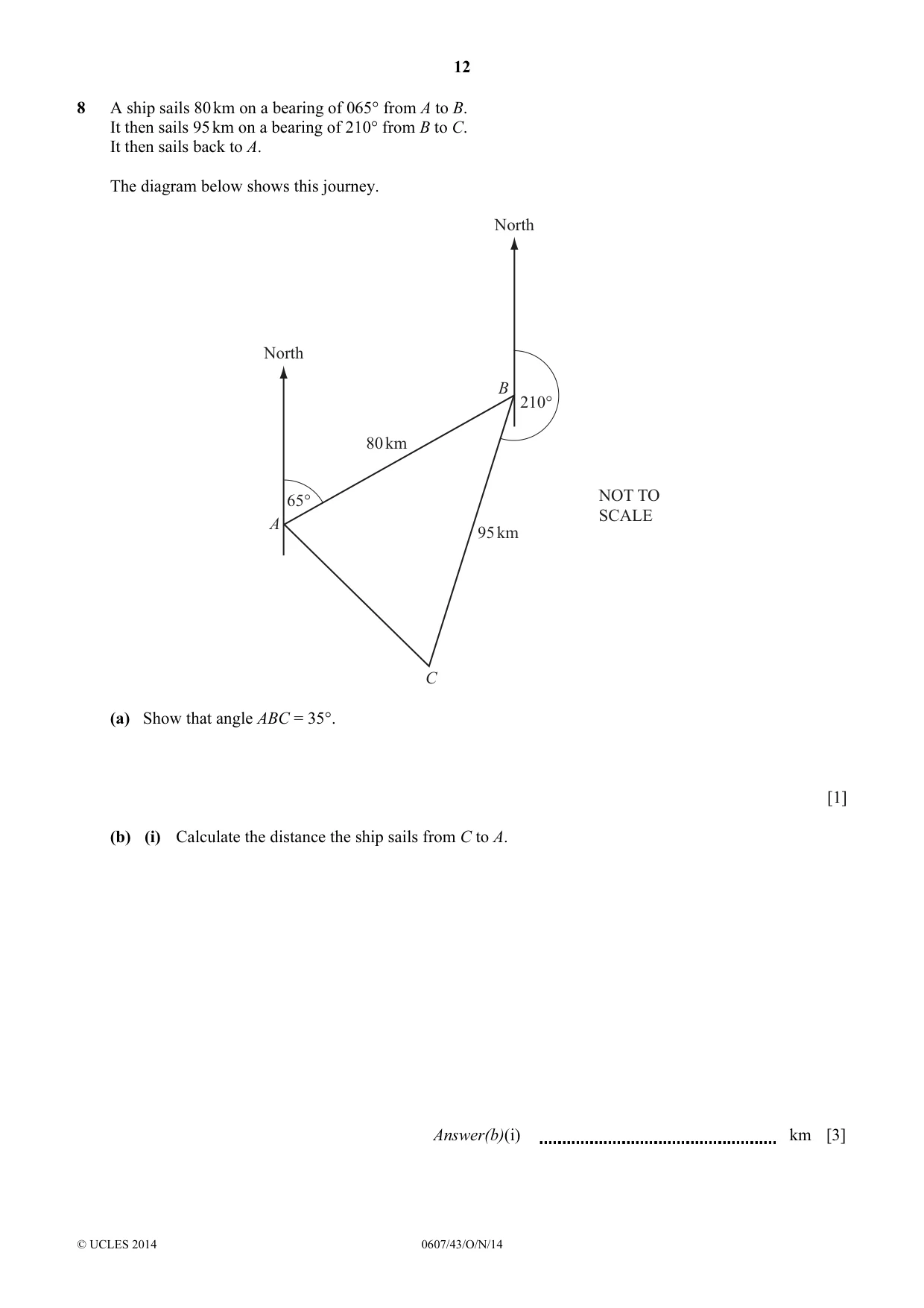
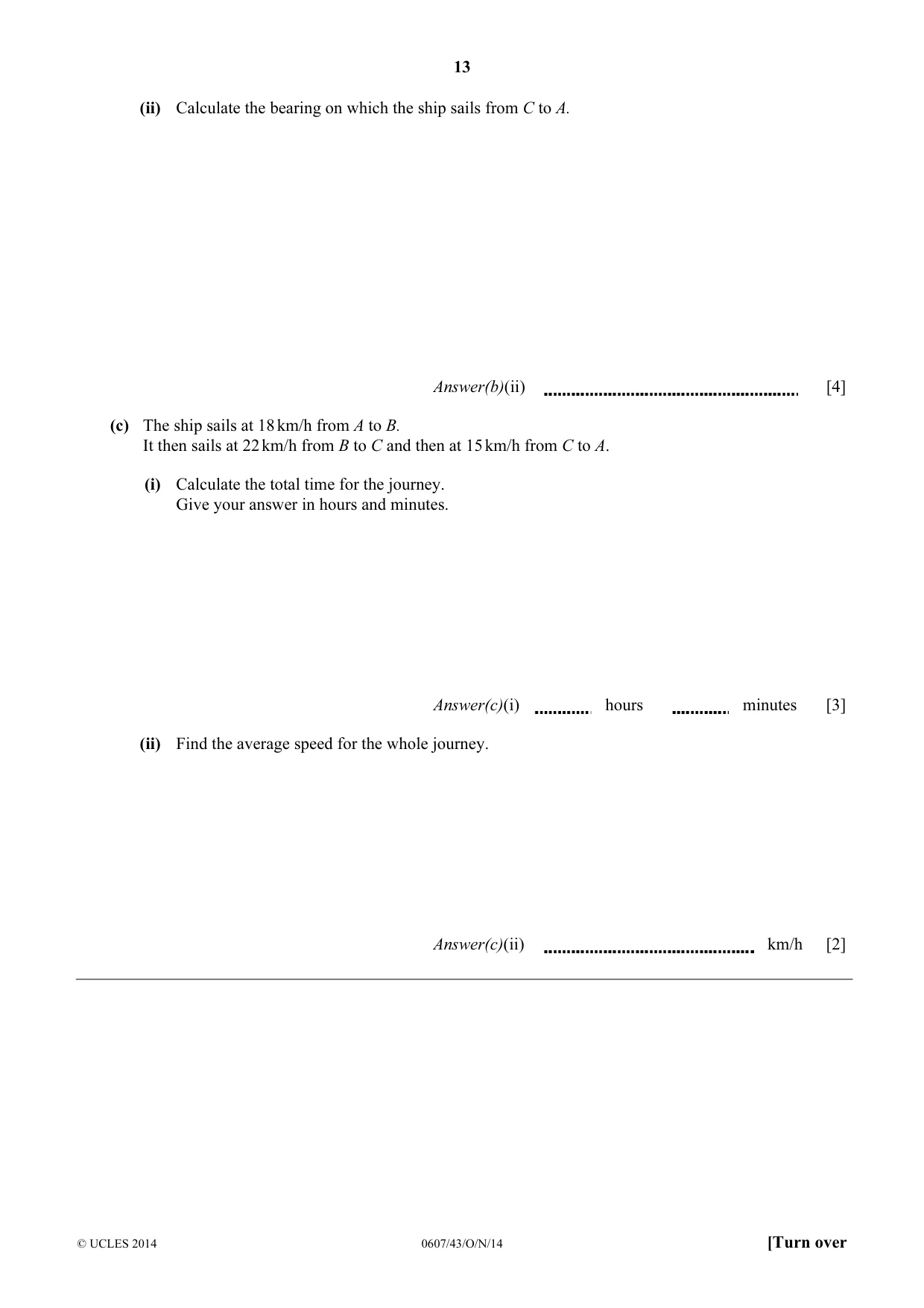
12 © UCLES 2014 0607/43/O/N/14 8 A ship sails 80 km on a bearing of 065° from A to B. It then sails 95 km on a bearing of 210° from B to C. It then sails back to A. The diagram below shows this journey. North North A B C 210° 65° 80 km 95 km NOT TO SCALE (a) Show that angle ABC = 35°. [1] (b) (i) Calculate the distance the ship sails from C to A. Answer(b)(i) km [3]
Question paper, page 13
13 © UCLES 2014 0607/43/O/N/14 [Turn over (ii) Calculate the bearing on which the ship sails from C to A. Answer(b)(ii) [4] (c) The ship sails at 18 km/h from A to B. It then sails at 22 km/h from B to C and then at 15 km/h from C to A. (i) Calculate the total time for the journey. Give your answer in hours and minutes. Answer(c)(i) hours minutes [3] (ii) Find the average speed for the whole journey. Answer(c)(ii) km/h [2]
Question paper, page 14
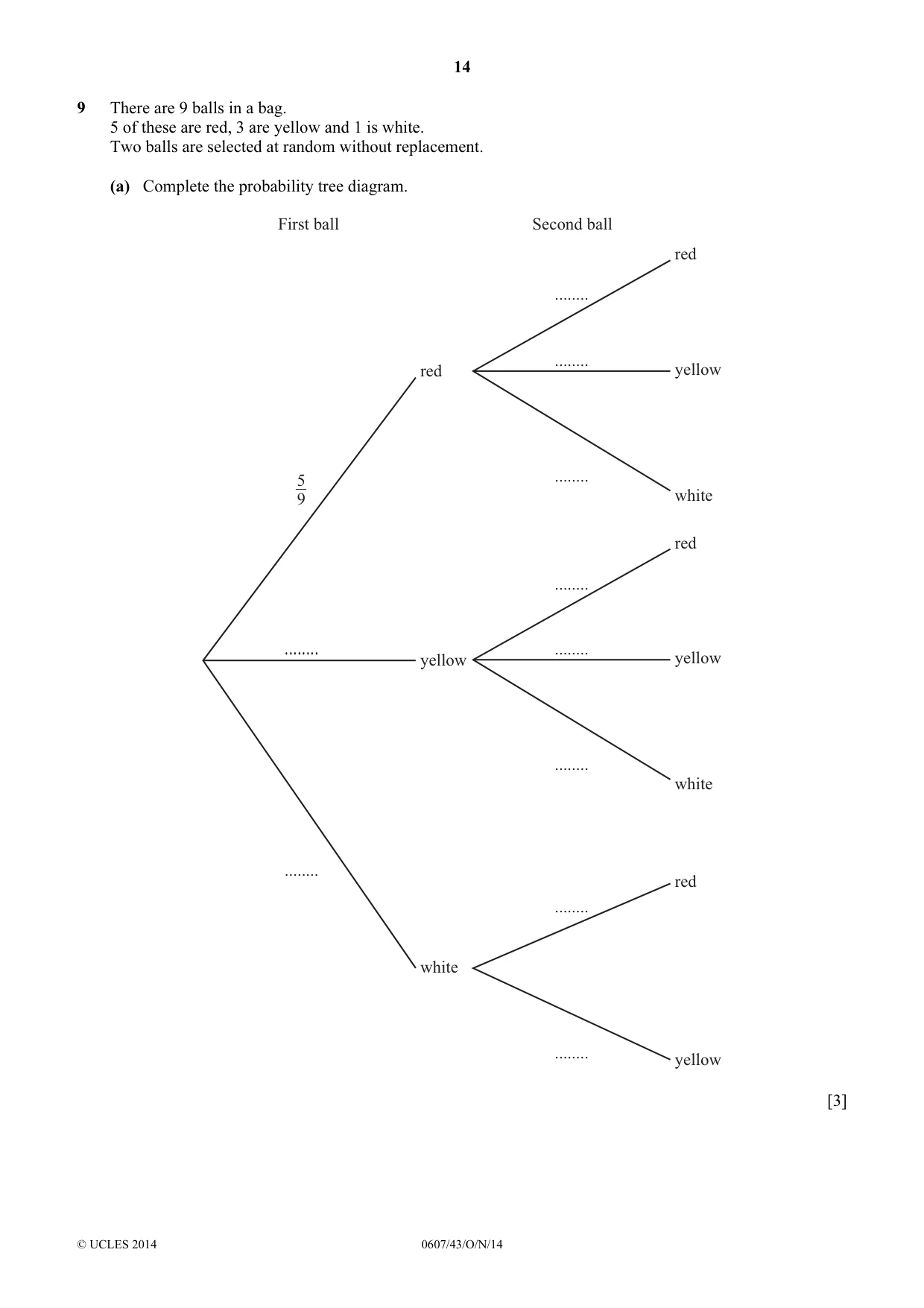
14 © UCLES 2014 0607/43/O/N/14 9 There are 9 balls in a bag. 5 of these are red, 3 are yellow and 1 is white. Two balls are selected at random without replacement. (a) Complete the probability tree diagram. red First ball Second ball … … 5 9 red yellow white … … … yellow red yellow white … … … white red yellow … … [3]
Question paper, page 15
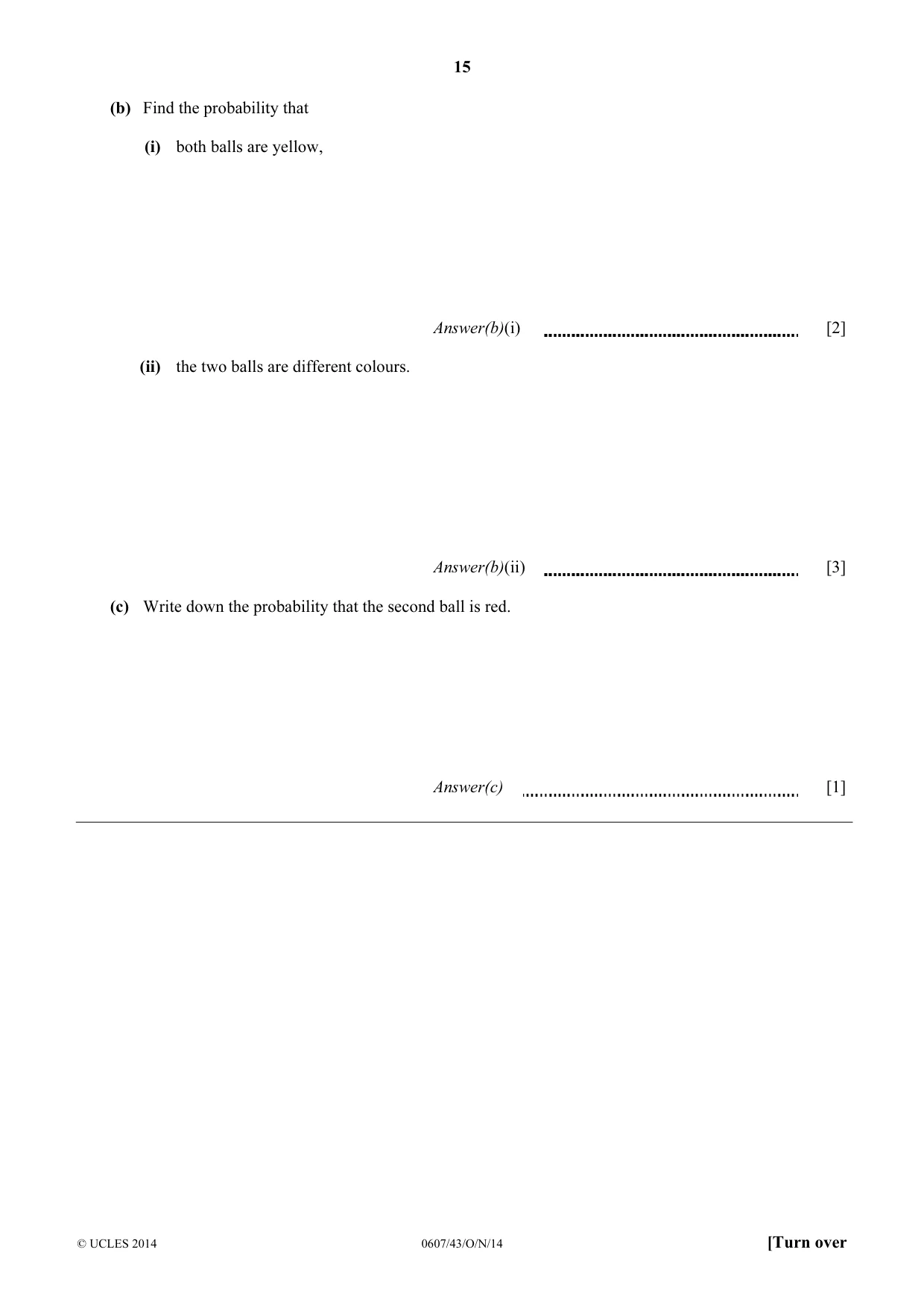
15 © UCLES 2014 0607/43/O/N/14 [Turn over (b) Find the probability that (i) both balls are yellow, Answer(b)(i) [2] (ii) the two balls are different colours. Answer(b)(ii) [3] (c) Write down the probability that the second ball is red. Answer(c) [1]
Question paper, page 16
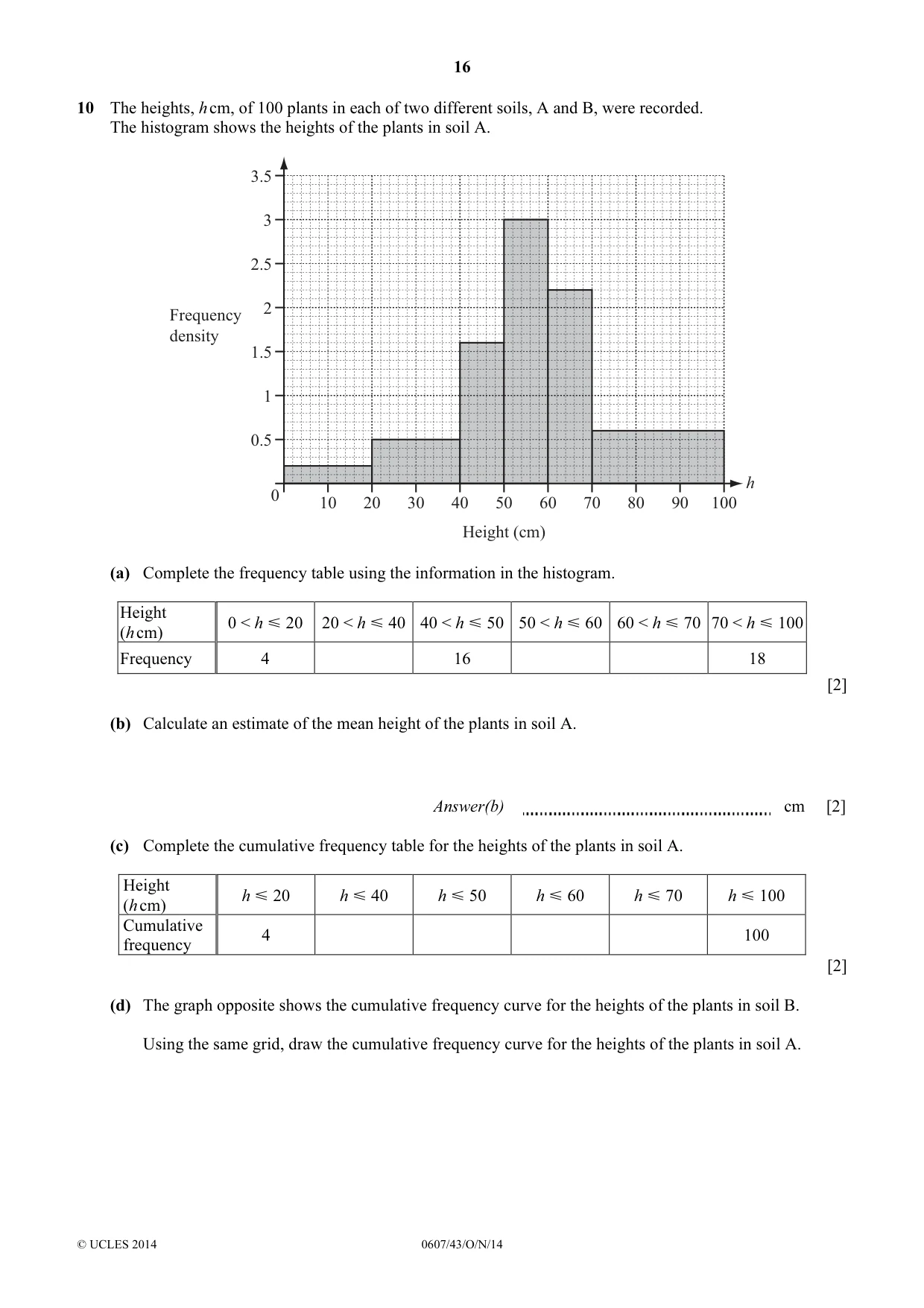
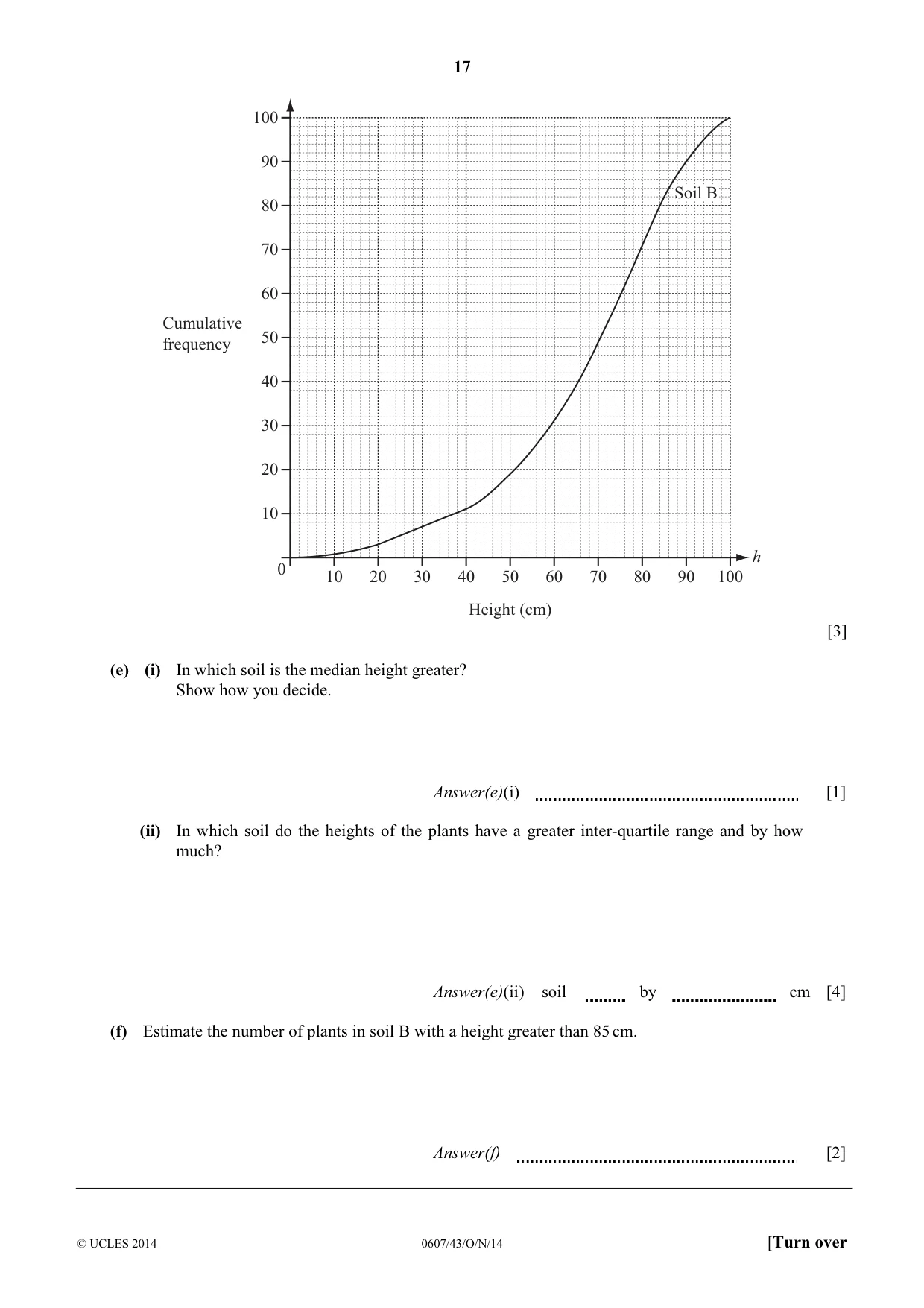
16 © UCLES 2014 0607/43/O/N/14 10 The heights, h cm, of 100 plants in each of two different soils, A and B, were recorded. The histogram shows the heights of the plants in soil A. 3.5 3 2.5 2 1.5 1 0.5 10 20 30 40 50 Height (cm) 60 70 80 90 100 0 Frequency density h (a) Complete the frequency table using the information in the histogram. Height (h cm) 0 < h Y 20 20 < h Y 40 40 < h Y 50 50 < h Y 60 60 < h Y 70 70 < h Y 100 Frequency 4 16 18 [2] (b) Calculate an estimate of the mean height of the plants in soil A. Answer(b) cm [2] (c) Complete the cumulative frequency table for the heights of the plants in soil A. Height (h cm) h Y 20 h Y 40 h Y 50 h Y 60 h Y 70 h Y 100 Cumulative frequency 4 100 [2] (d) The graph opposite shows the cumulative frequency curve for the heights of the plants in soil B. Using the same grid, draw the cumulative frequency curve for the heights of the plants in soil A.
Question paper, page 17
17 © UCLES 2014 0607/43/O/N/14 [Turn over 100 90 80 70 60 50 40 30 20 10 10 Cumulative frequency 20 30 40 50 Height (cm) 60 70 80 90 100 0 h Soil B [3] (e) (i) In which soil is the median height greater? Show how you decide. Answer(e)(i) [1] (ii) In which soil do the heights of the plants have a greater inter-quartile range and by how much? Answer(e)(ii) soil by cm [4] (f) Estimate the number of plants in soil B with a height greater than 85 cm. Answer(f) [2]
Question paper, page 18
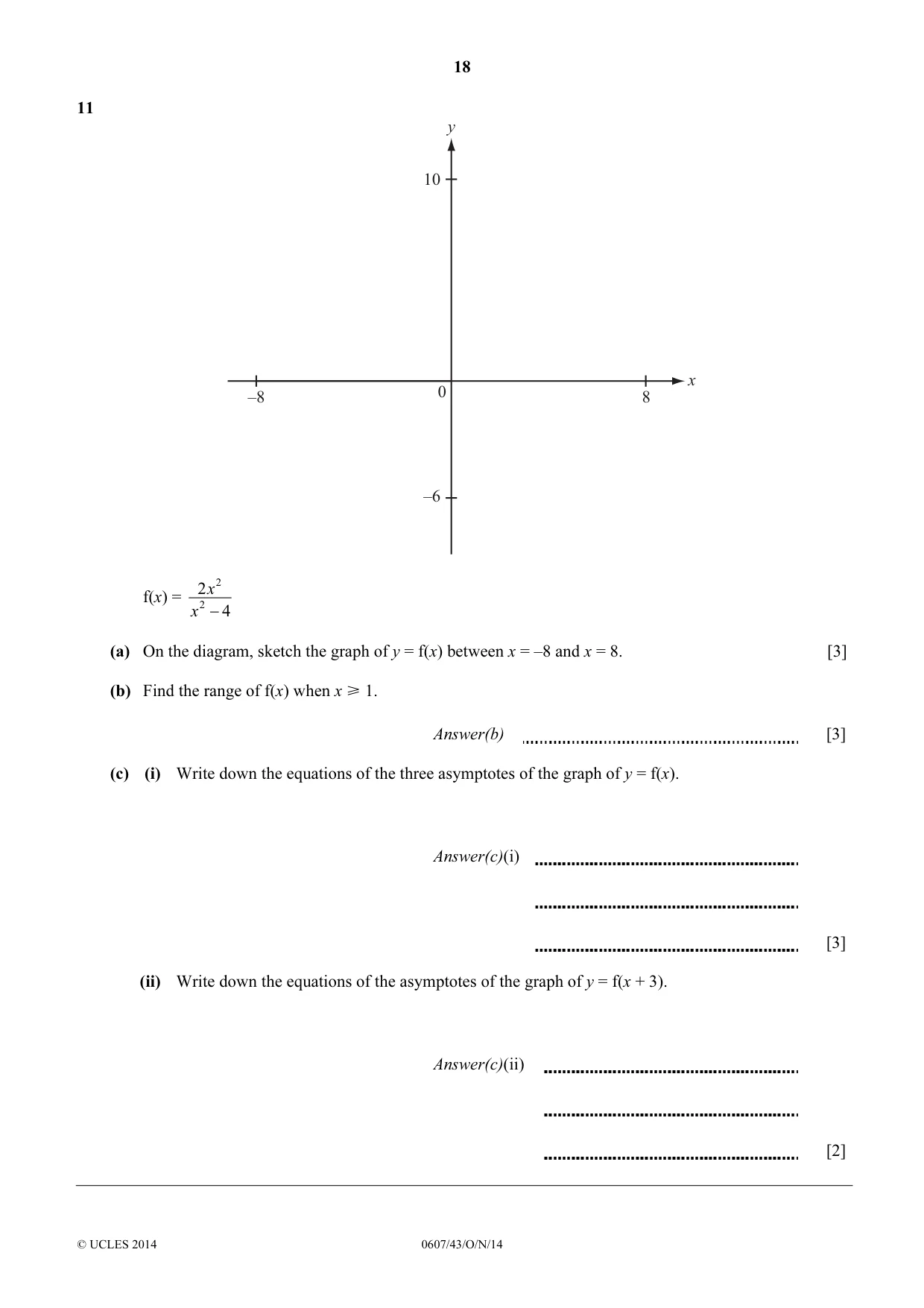
18 © UCLES 2014 0607/43/O/N/14 11 0 10 –6 –8 8 y x f(x) = 4 2 2 2 − x x (a) On the diagram, sketch the graph of y = f(x) between x = –8 and x = 8. [3] (b) Find the range of f(x) when x [ 1. Answer(b) [3] (c) (i) Write down the equations of the three asymptotes of the graph of y = f(x). Answer(c)(i) [3] (ii) Write down the equations of the asymptotes of the graph of y = f(x + 3). Answer(c)(ii) [2]
Question paper, page 19
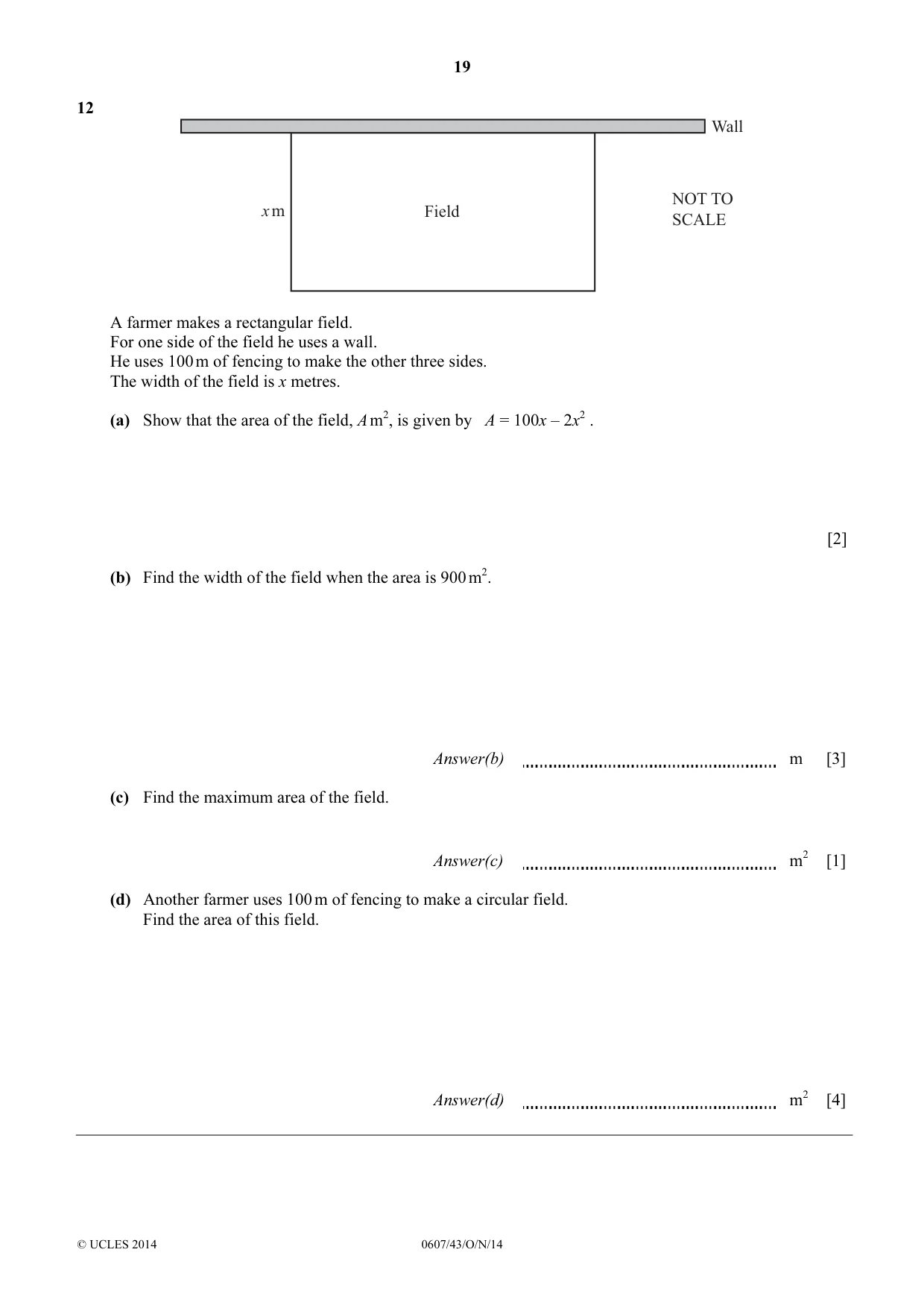
19 © UCLES 2014 0607/43/O/N/14 12 Field Wall x m NOT TO SCALE A farmer makes a rectangular field. For one side of the field he uses a wall. He uses 100 m of fencing to make the other three sides. The width of the field is x metres. (a) Show that the area of the field, A m2, is given by A = 100x – 2x2 . [2] (b) Find the width of the field when the area is 900 m2. Answer(b) m [3] (c) Find the maximum area of the field. Answer(c) m2 [1] (d) Another farmer uses 100 m of fencing to make a circular field. Find the area of this field. Answer(d) m2 [4]
Question paper, page 20
20 Permission to reproduce items where third-party owned material protected by copyright is included has been sought and cleared where possible. Every reasonable effort has been made by the publisher (UCLES) to trace copyright holders, but if any items requiring clearance have unwittingly been included, the publisher will be pleased to make amends at the earliest possible opportunity. Cambridge International Examinations is part of the Cambridge Assessment Group. Cambridge Assessment is the brand name of University of Cambridge Local Examinations Syndicate (UCLES), which is itself a department of the University of Cambridge. © UCLES 2014 0607/43/O/N/14 BLANK PAGE
Mark scheme, page 1
® IGCSE is the registered trademark of Cambridge International Examinations. CAMBRIDGE INTERNATIONAL EXAMINATIONS Cambridge International General Certificate of Secondary Education MARK SCHEME for the October/November 2014 series 0607 CAMBRIDGE INTERNATIONAL MATHEMATICS 0607/43 Paper 4 (Extended), maximum raw mark 120 This mark scheme is published as an aid to teachers and candidates, to indicate the requirements of the examination. It shows the basis on which Examiners were instructed to award marks. It does not indicate the details of the discussions that took place at an Examiners’ meeting before marking began, which would have considered the acceptability of alternative answers. Mark schemes should be read in conjunction with the question paper and the Principal Examiner Report for Teachers. Cambridge will not enter into discussions about these mark schemes. Cambridge is publishing the mark schemes for the October/November 2014 series for most Cambridge IGCSE®, Cambridge International A and AS Level components and some Cambridge O Level components.
Mark scheme, page 2
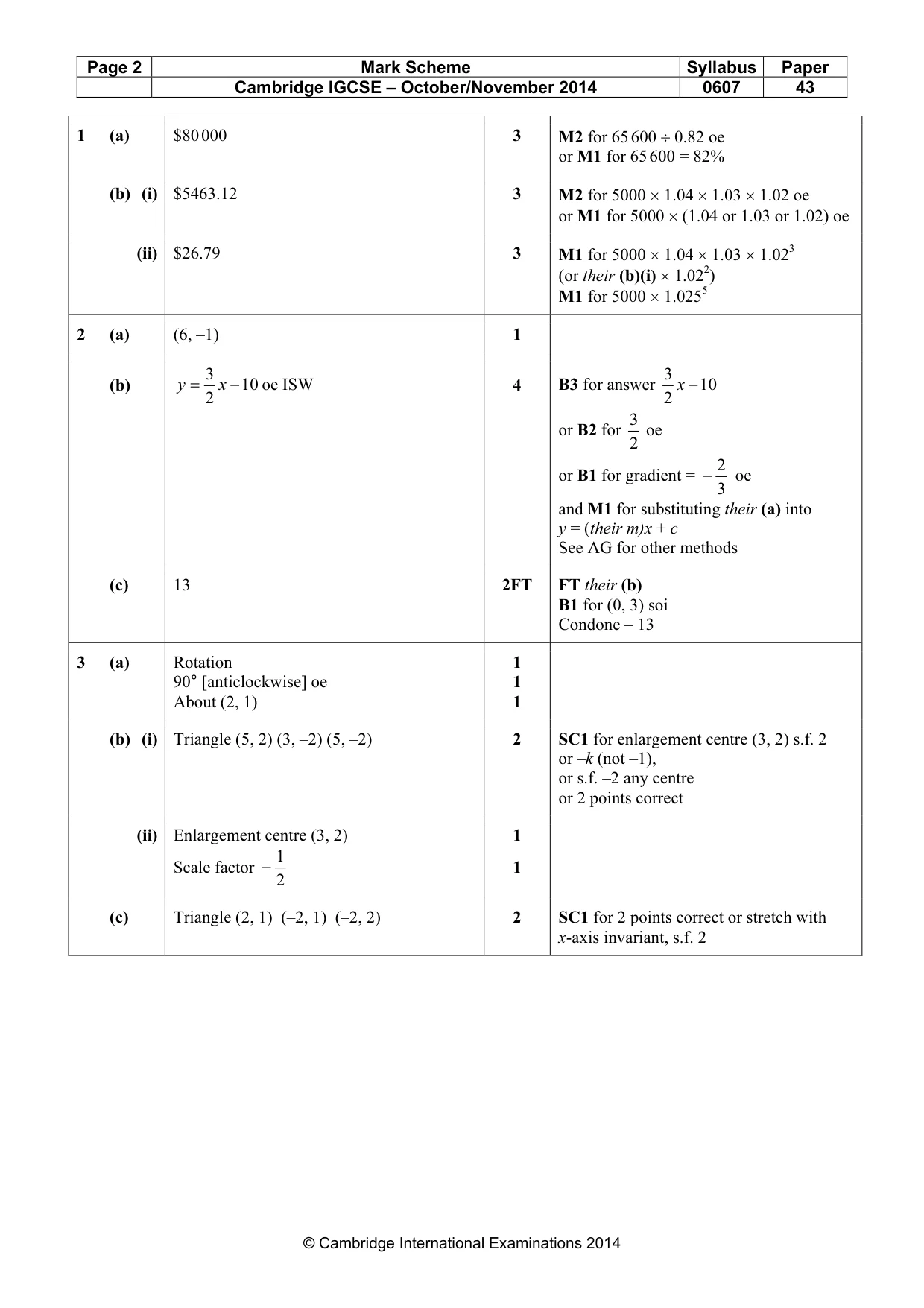
Page 2 Mark Scheme Syllabus Paper Cambridge IGCSE – October/November 2014 0607 43 © Cambridge International Examinations 2014 1 (a) $80 000 3 M2 for 65 600 ÷ 0.82 oe or M1 for 65 600 = 82% (b) (i) $5463.12 3 M2 for 5000 × 1.04 × 1.03 × 1.02 oe or M1 for 5000 × (1.04 or 1.03 or 1.02) oe (ii) $26.79 3 M1 for 5000 × 1.04 × 1.03 × 1.023 (or their (b)(i) × 1.022) M1 for 5000 × 1.0255 2 (a) (6, –1) 1 (b) 10 2 3 − = x y oe ISW 4 B3 for answer 10 2 3 − x or B2 for 2 3 oe or B1 for gradient = 3 2 − oe and M1 for substituting their (a) into y = (their m)x + c See AG for other methods (c) 13 2FT FT their (b) B1 for (0, 3) soi Condone – 13 3 (a) Rotation 90° [anticlockwise] oe About (2, 1) 1 1 1 (b) (i) Triangle (5, 2) (3, –2) (5, –2) 2 SC1 for enlargement centre (3, 2) s.f. 2 or –k (not –1), or s.f. –2 any centre or 2 points correct (ii) Enlargement centre (3, 2) Scale factor 2 1 − 1 1 (c) Triangle (2, 1) (–2, 1) (–2, 2) 2 SC1 for 2 points correct or stretch with x-axis invariant, s.f. 2
Mark scheme, page 3
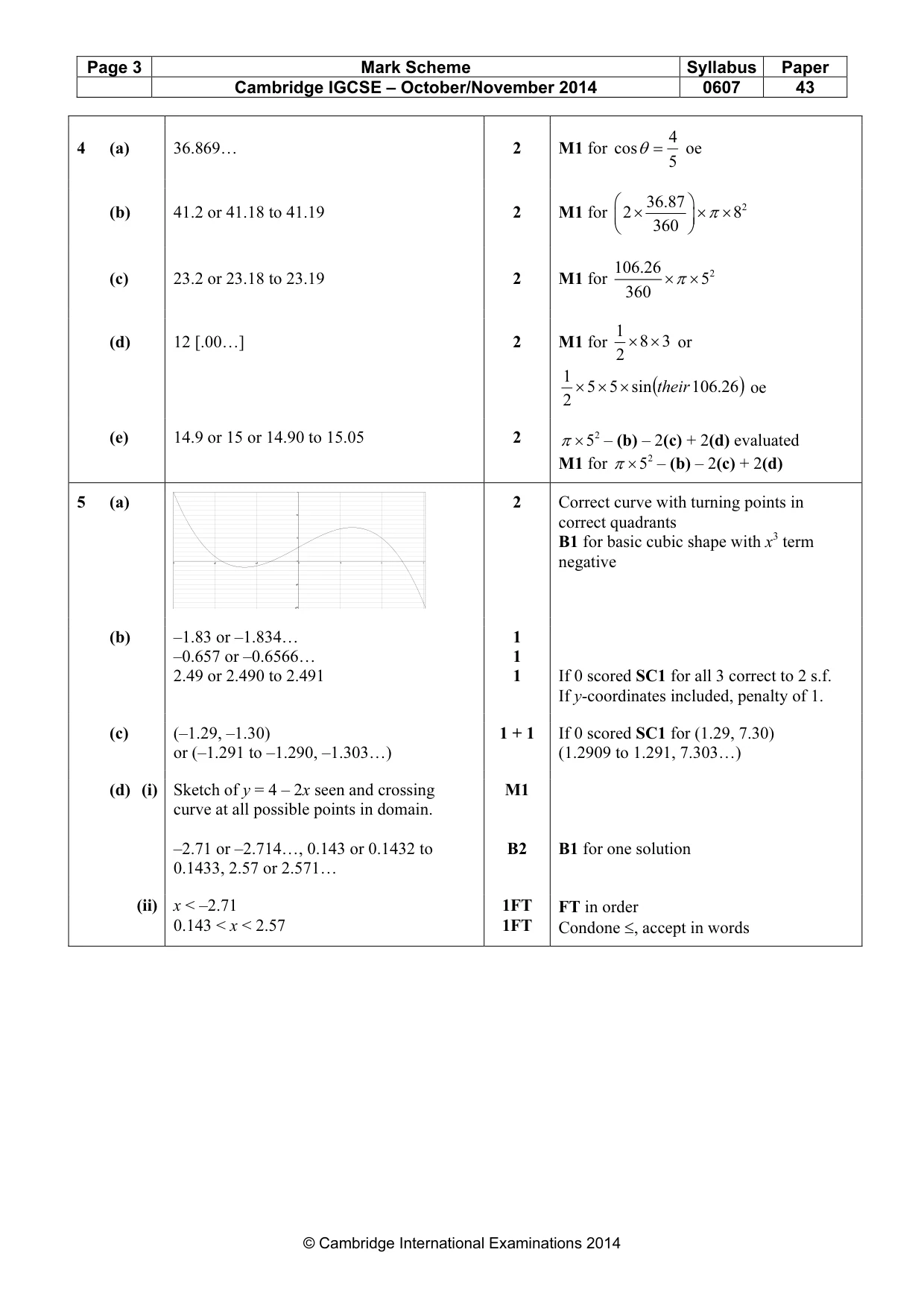
Page 3 Mark Scheme Syllabus Paper Cambridge IGCSE – October/November 2014 0607 43 © Cambridge International Examinations 2014 4 (a) 36.869… 2 M1 for 5 4 cos = θ oe (b) 41.2 or 41.18 to 41.19 2 M1 for 2 36.87 2 8 360 π × × × (c) 23.2 or 23.18 to 23.19 2 M1 for 2 106.26 5 360 π × × (d) 12 [.00…] 2 M1 for 3 8 2 1 × × or ( ) 26 . 106 sin 5 5 2 1 their × × × oe (e) 14.9 or 15 or 14.90 to 15.05 2 2 5 π × – (b) – 2(c) + 2(d) evaluated M1 for 2 5 π × – (b) – 2(c) + 2(d) 5 (a) 2 Correct curve with turning points in correct quadrants B1 for basic cubic shape with x3 term negative (b) –1.83 or –1.834… –0.657 or –0.6566… 2.49 or 2.490 to 2.491 1 1 1 If 0 scored SC1 for all 3 correct to 2 s.f. If y-coordinates included, penalty of 1. (c) (–1.29, –1.30) or (–1.291 to –1.290, –1.303…) 1 + 1 If 0 scored SC1 for (1.29, 7.30) (1.2909 to 1.291, 7.303…) (d) (i) Sketch of y = 4 – 2x seen and crossing curve at all possible points in domain. –2.71 or –2.714…, 0.143 or 0.1432 to 0.1433, 2.57 or 2.571… M1 B2 B1 for one solution (ii) x < –2.71 0.143 < x < 2.57 1FT 1FT FT in order Condone ≤, accept in words 3 2 1 0 -1 -2 3 15 10 5 0 -5 -10 3 2 1 0 -1 -2 3 15 10 5 0 -5 -10 3 2 1 0 -1 -2 3 15 10 5 0 -5 -10 3 2 1 0 -1 -2 3 15 10 5 0 -5 -10
Mark scheme, page 4
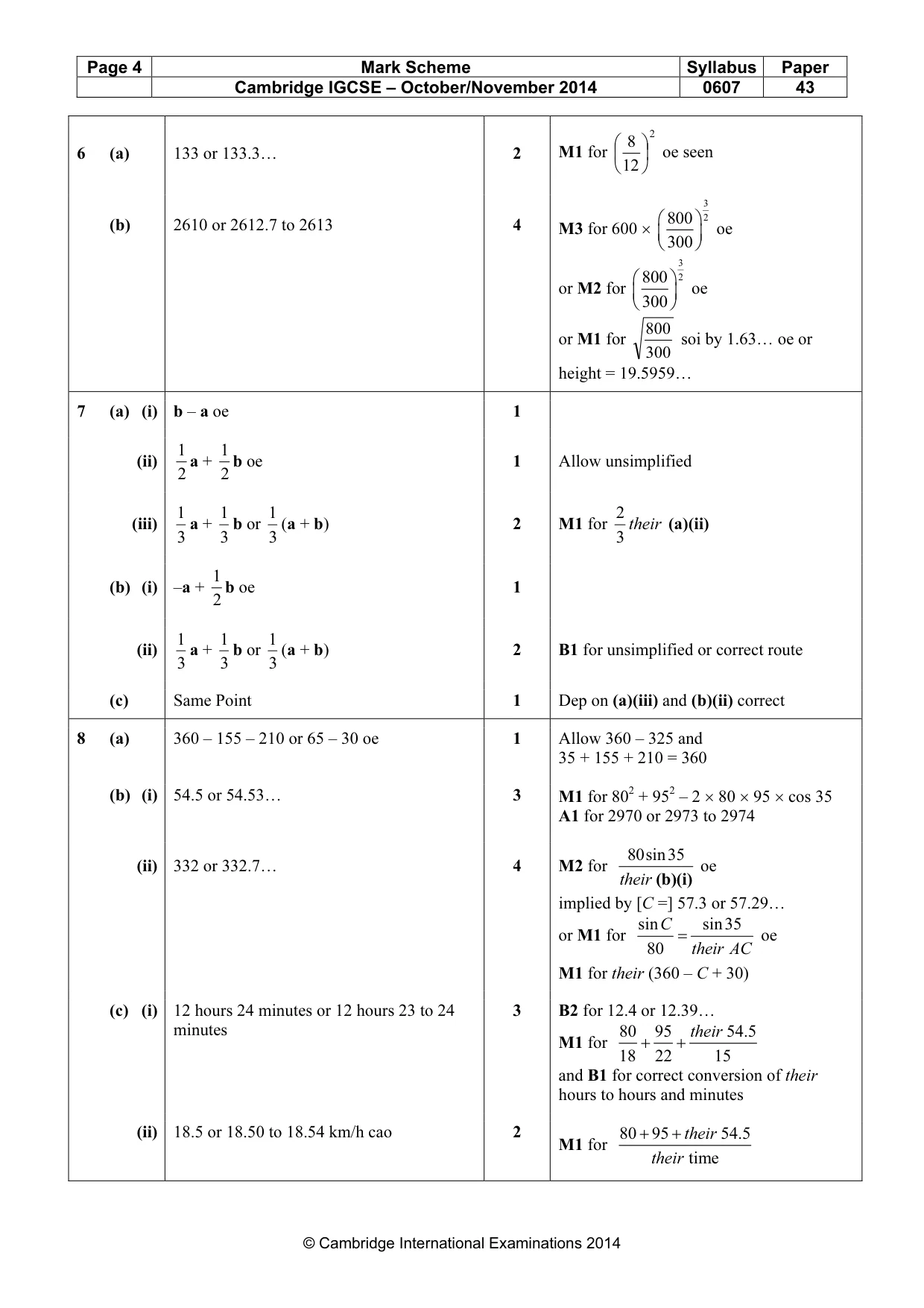
Page 4 Mark Scheme Syllabus Paper Cambridge IGCSE – October/November 2014 0607 43 © Cambridge International Examinations 2014 6 (a) 133 or 133.3… 2 M1 for 2 12 8 oe seen (b) 2610 or 2612.7 to 2613 4 M3 for 600 × 3 2 800 300 oe or M2 for 3 2 800 300 oe or M1 for 300 800 soi by 1.63… oe or height = 19.5959… 7 (a) (i) b – a oe 1 (ii) 2 1 a + 2 1 b oe 1 Allow unsimplified (iii) 3 1 a + 3 1 b or 3 1 (a + b) 2 M1 for their 3 2 (a)(ii) (b) (i) –a + 2 1 b oe 1 (ii) 3 1 a + 3 1 b or 3 1 (a + b) 2 B1 for unsimplified or correct route (c) Same Point 1 Dep on (a)(iii) and (b)(ii) correct 8 (a) 360 – 155 – 210 or 65 – 30 oe 1 Allow 360 – 325 and 35 + 155 + 210 = 360 (b) (i) 54.5 or 54.53… 3 M1 for 802 + 952 – 2 × 80 × 95 × cos 35 A1 for 2970 or 2973 to 2974 (ii) 332 or 332.7… 4 M2 for 80sin35 their (b)(i) oe implied by [C =] 57.3 or 57.29… or M1 for sin sin35 80 C their AC = oe M1 for their (360 – C + 30) (c) (i) 12 hours 24 minutes or 12 hours 23 to 24 minutes 3 B2 for 12.4 or 12.39… M1 for 80 95 54.5 18 22 15 their + + and B1 for correct conversion of their hours to hours and minutes (ii) 18.5 or 18.50 to 18.54 km/h cao 2 M1 for 80 95 54.5 time their their + +
Mark scheme, page 5
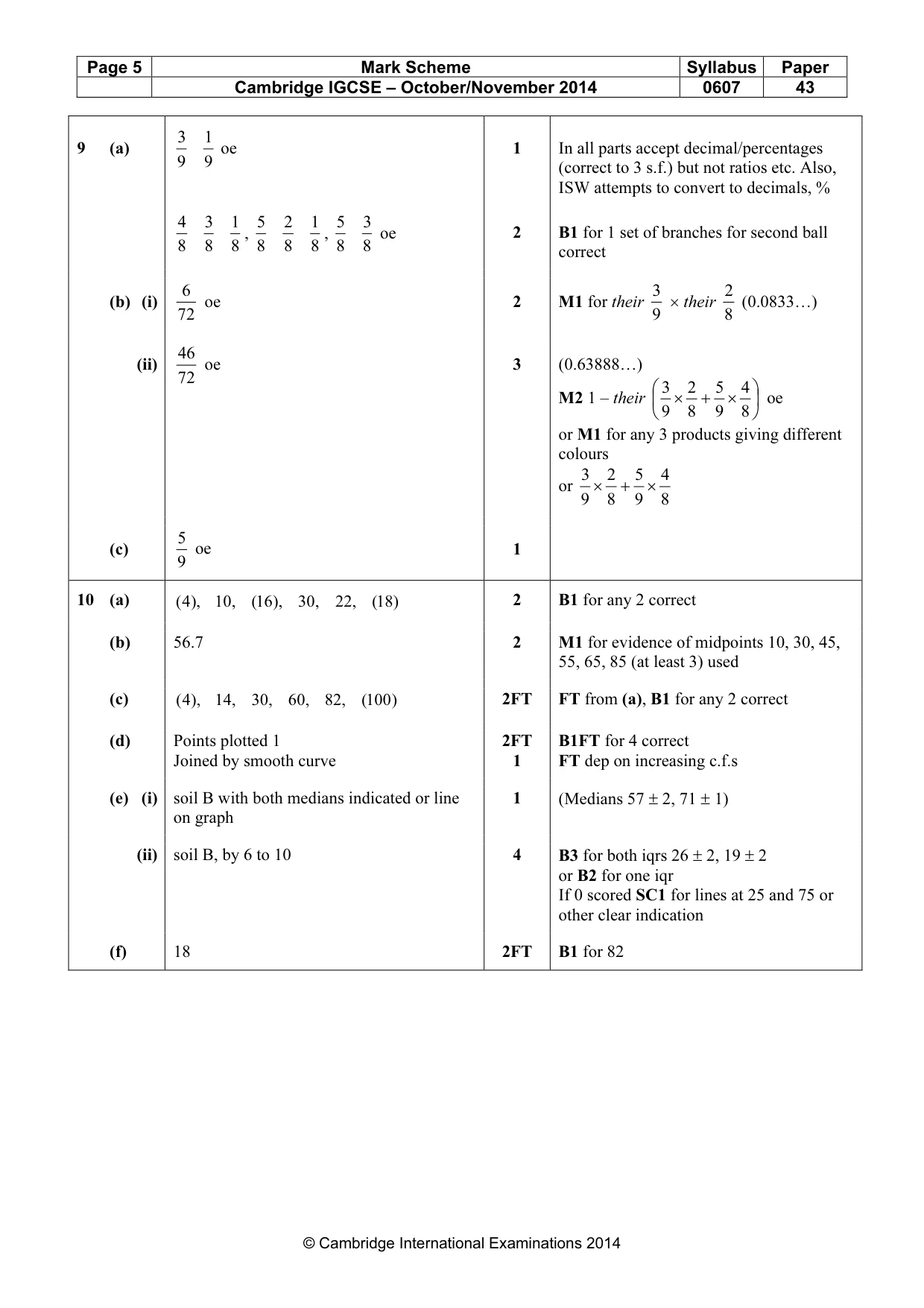
Page 5 Mark Scheme Syllabus Paper Cambridge IGCSE – October/November 2014 0607 43 © Cambridge International Examinations 2014 9 (a) 9 1 9 3 oe 8 1 8 3 8 4 , 8 1 8 2 8 5 , 8 3 8 5 oe 1 2 In all parts accept decimal/percentages (correct to 3 s.f.) but not ratios etc. Also, ISW attempts to convert to decimals, % B1 for 1 set of branches for second ball correct (b) (i) 72 6 oe 2 M1 for their 9 3 × their 8 2 (0.0833…) (ii) 72 46 oe 3 (0.63888…) M2 1 – their × + × 8 4 9 5 8 2 9 3 oe or M1 for any 3 products giving different colours or 8 4 9 5 8 2 9 3 × + × (c) 9 5 oe 1 10 (a) ) 18 ( , 22 , 30 ), 16 ( , 10 ), 4 ( 2 B1 for any 2 correct (b) 56.7 2 M1 for evidence of midpoints 10, 30, 45, 55, 65, 85 (at least 3) used (c) ) 100 ( , 82 , 60 , 30 , 14 ), 4 ( 2FT FT from (a), B1 for any 2 correct (d) Points plotted 1 Joined by smooth curve 2FT 1 B1FT for 4 correct FT dep on increasing c.f.s (e) (i) soil B with both medians indicated or line on graph 1 (Medians 57 ± 2, 71 ± 1) (ii) soil B, by 6 to 10 4 B3 for both iqrs 26 ± 2, 19 ± 2 or B2 for one iqr If 0 scored SC1 for lines at 25 and 75 or other clear indication (f) 18 2FT B1 for 82
Mark scheme, page 6
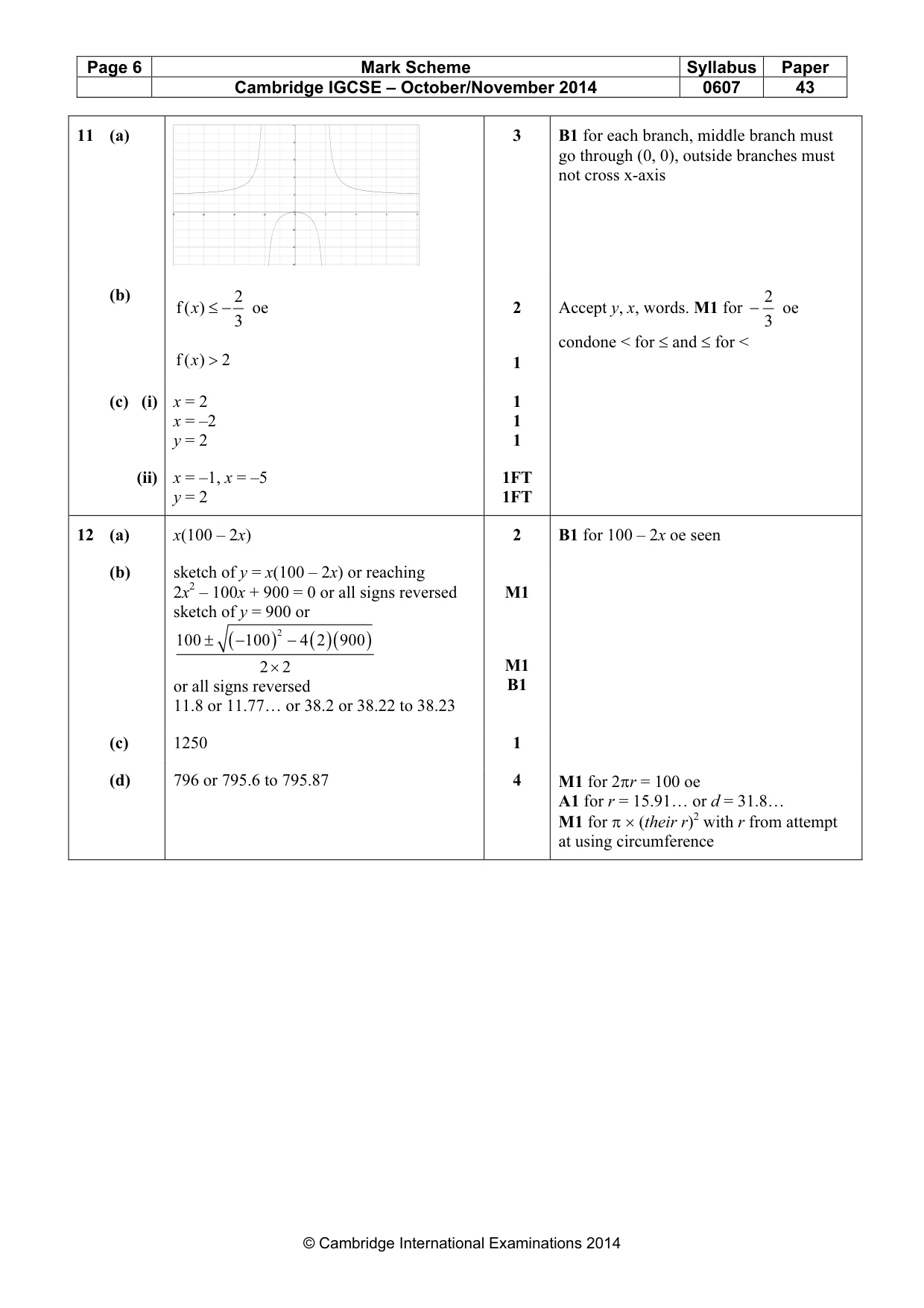
Page 6 Mark Scheme Syllabus Paper Cambridge IGCSE – October/November 2014 0607 43 © Cambridge International Examinations 2014 11 (a) 3 B1 for each branch, middle branch must go through (0, 0), outside branches must not cross x-axis (b) 2 f ( ) 3 x ≤− oe f ( ) 2 x > 2 1 Accept y, x, words. M1 for 3 2 − oe condone < for ≤ and ≤ for < (c) (i) x = 2 x = –2 y = 2 1 1 1 (ii) x = –1, x = –5 y = 2 1FT 1FT 12 (a) x(100 – 2x) 2 B1 for 100 – 2x oe seen (b) sketch of y = x(100 – 2x) or reaching 2x2 – 100x + 900 = 0 or all signs reversed sketch of y = 900 or ( ) ( )( ) 2 100 100 4 2 900 2 2 ± − − × or all signs reversed 11.8 or 11.77… or 38.2 or 38.22 to 38.23 M1 M1 B1 (c) 1250 1 (d) 796 or 795.6 to 795.87 4 M1 for 2πr = 100 oe A1 for r = 15.91… or d = 31.8… M1 for π × (their r)2 with r from attempt at using circumference 8 6 4 2 0 -2 -4 -6 8 10 8 6 4 2 0 -2 -4 -6 8 6 4 2 0 -2 -4 -6 8 10 8 6 4 2 0 -2 -4 -6 8 6 4 2 0 -2 -4 -6 8 10 8 6 4 2 0 -2 -4 -6 8 6 4 2 0 -2 -4 -6 8 10 8 6 4 2 0 -2 -4 -6
What you needed in this session
Cambridge’s own grade thresholds for 2014 Oct/Nov, Paper 4 · Variant 3. A higher threshold means an easier paper — the bar moves with how the cohort did.